Stop Reinventing theWheel:
Adapting Evidence-Based Sexual Health
Interventions for mHealth Delivery
Tiffany M. Montgomery, MSN, RNC-OB, C-EFM
University of California, Los Angeles School of
Nursing
April 26-28, 2015
San Francisco, CA
#YTHLive
Annual Conference on Youth + Tech + Health
Objectives
1. Discuss the importance of intervention adaptation
2. Describe the phases of the ADAPT-ITT model
3. Differentiate among acceptability, feasibility, and
efficacy of adapted interventions.
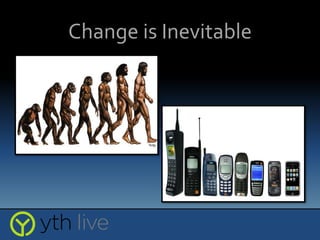
Change is Inevitable
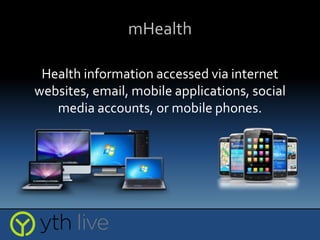
mHealth
Health information accessed via internet
websites, email, mobile applications, social
media accounts, or mobile phones.
WhyText Messages?
• Young adults often prefer technologically-advanced
methods of learning and social engagement [1]
• Decreased organizational costs associated with
personnel and resources needed for intervention
implementation [2]
• Standardized text messages ensure the intervention
fidelity [2]
WhyText Messages? (cont.)
• Utilization of mHealth is encouraged by the CDC [3]
• Removes barriers to healthcare [2]
• Sexual health text messaging interventions have been
shown to be effective [4-7]
• Texts can be sent/received without a broadband
connection
WhyText Messages? (cont.)
• 95% of young adults own a mobile phone [8]
• Not everyone owns a smartphone…
 63% of women; 85% of young adults, ages 18-29; 70% of
Blacks [9]
• …But EVERYONE texts!!!
 100% of young adult mobile phone owners engage in
texting [9]
Why Adaptation?
• Adoption = ready to implement “as is”
• Adaptation = changing an established intervention
for implementation among a population of a
different age, ethnicity, gender, etc.
• Instead of creating entirely new interventions,
adaptation of effective interventions is
recommended [10-15]
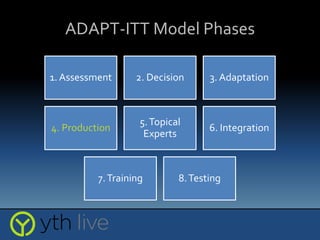
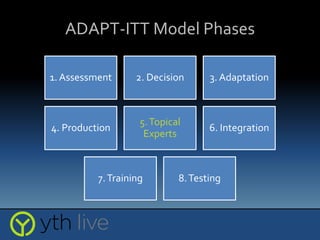
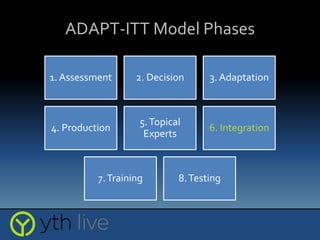
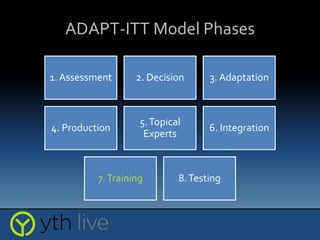
The ADAPT-ITT Model
• Created by HIV/STD prevention interventionists,
Wingood and DiClemente, whose SiSTA
intervention has been successfully adapted for
various populations [16-21]
• Emphasizes acceptability, feasibility, and efficacy
testing
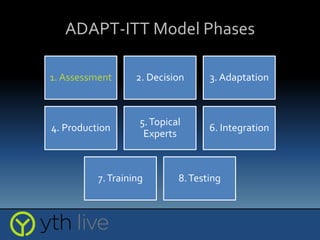
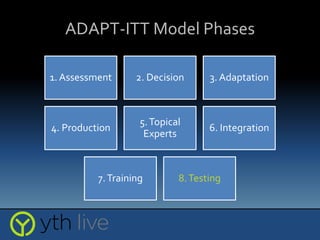
ADAPT-ITT Model Phases
1. Assessment 2. Decision 3. Adaptation
4. Production
5.Topical
Experts
6. Integration
7.Training 8.Testing
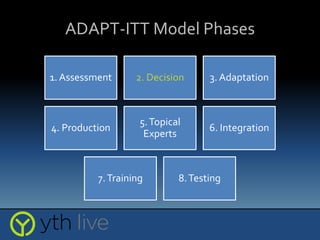
ADAPT-ITT Model Phases
1. Assessment 2. Decision 3. Adaptation
4. Production
5.Topical
Experts
6. Integration
7.Training 8.Testing
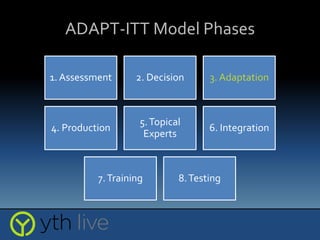
ADAPT-ITT Model Phases
1. Assessment 2. Decision 3. Adaptation
4. Production
5.Topical
Experts
6. Integration
7.Training 8.Testing
ADAPT-ITT Model Phases
1. Assessment 2. Decision 3. Adaptation
4. Production
5.Topical
Experts
6. Integration
7.Training 8.Testing
ADAPT-ITT Model Phases
1. Assessment 2. Decision 3. Adaptation
4. Production
5.Topical
Experts
6. Integration
7.Training 8.Testing
ADAPT-ITT Model Phases
1. Assessment 2. Decision 3. Adaptation
4. Production
5.Topical
Experts
6. Integration
7.Training 8.Testing
ADAPT-ITT Model Phases
1. Assessment 2. Decision 3. Adaptation
4. Production
5.Topical
Experts
6. Integration
7.Training 8.Testing
ADAPT-ITT Model Phases
1. Assessment 2. Decision 3. Adaptation
4. Production
5.Topical
Experts
6. Integration
7.Training 8.Testing
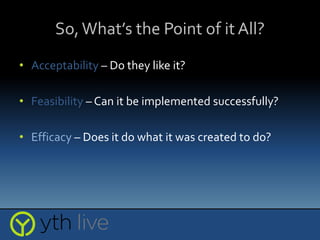
So,What’s the Point of it All?
• Acceptability – Do they like it?
• Feasibility – Can it be implemented successfully?
• Efficacy – Does it do what it was created to do?
Tiffany M. Montgomery
Factor Building, Room 3-650
700Tiverton Avenue
Los Angeles, CA 90024
Tiffany.Montgomery@ucla.edu
#YTHLive
Acknowledgement of Funding Sources
• National Institute of Mental Health, Grant #:
P30MH58107
 UCLA Center for HIV Identification, Prevention, and
Treatment Services
• SigmaThetaTau International Honor Society of
Nursing, GammaTau-at-Large Chapter Pilot Study
Grant
References
1. Rosen, L. (2009). Rewired: Understanding the iGeneration and the way they learn.
Paper presented at the Chronic IllnessConference, Norfolk,VA.
2. Bull, S.,Technology-based health promotion. 2011,Thousand Oaks, CA: SAGE
Publications.
3. Centers for Disease Control and Prevention, The health communicator's social
media toolkit. 2011, U.S. Department of Health and Human Services.
4. Gold, J., et al., A randomised controlled trial using mobile advertising to promote
safer sex and sun safety to young people. Health Education Research, 2011.
26(5): p. 782-794.
5. Gold, J., et al., Determining the impact of text messaging for sexual health
promotion to young people. SexuallyTransmitted Diseases, 2011. 38(4): p. 247-
252.
References (cont.)
6. Lim, M.S.C., et al., Impact of text and email messaging on the sexual health of
young people: a randomised controlled trial. Journal of Epidemiology &
Community Health, 2012. 66(1): p. 69-74.
7. Suffoletto, B., et al., A sex risk reduction text-message program for young adult
females discharged from the emergency department. Journal of Adolescent
Health, 2013. 53(3): p. 387-393.
8. Smith,A. (2011). Americans and text messaging. Pew Internet and American Life
Project.Washington, D.C.: Pew Research Center.
9. Smith,A., U.S. smartphone use in 2015. 2015, Pew Research Center:Washington,
D.C.
10. Card, J.J., J. Solomon, and S.D. Cunningham, How to adapt effective programs
for use in new contexts. Health Promotion Practice, 2011. 12(1): p. 25-35.
References (cont.)
11. Castro, F.G., M. Barrera, and L.K.H. Steiker, Issues and challenges in the design of culturally
adapted evidence-based Interventions, in Annual Review of Clinical Psychology,Vol 6, S. Nolen
Hoeksema,T.D. Cannon, andT. Widiger, Editors. 2010. p. 213-239.
12. Chen, E.K., et al., Tailoring evidence-based interventions for new populations: A method for
program adaptation through community engagement. Evaluation & the Health Professions, 2013.
36(1): p. 73-92.
13. McKleroy,V.S., et al., Adapting evidence-based behavioral interventions for new settings and
target populations. AIDS Education and Prevention, 2006. 18(4): p. 59-73.
14. Villarruel, A.M., L.S. Jemmott, and J.B. Jemmott, III, Designing a culturally based intervention to
reduce HIV sexual risk for Latino adolescents. JANAC: Journal of the Association of Nurses in AIDS
Care, 2005. 16(2): p. 23-31.
15. Wingood, G.M. and R.J. DiClemente, The ADAPT-ITT model: a novel method of adapting
evidence-based HIV Interventions. Journal of Acquired Immune Deficiency Syndromes, 2008. 47:
p. S40-S46.
References (cont.)
16. Belgrave, F.Z., et al., An evaluation of an enhanced Sisters Informing Sisters aboutTopics on AIDS
(SISTA) HIV prevention curriculum:The role of drug education. Journal of HIV/AIDS & Social
Services, 2008. 7(4): p. 313-327.
17. Card, J.J., et al., Translating an effective group-based HIV prevention program to a program
delivered primarily by a computer: Methods and outcomes. AIDS Education and Prevention, 2011.
23(2): p. 159-174.
18. Cornelius, J.B., L. Moneyham, and S. LeGrand,Adaptation of an HIV prevention curriculum for
use with older African American women. Journal of the Association of Nurses in AIDS Care,
2008. 19(1): p. 16-27.
19. Saleh-Onoya, D., et al., SISTA South Africa:The adaptation of an efficacious HIV prevention trial
conducted with African-American women for isiXhosa-speaking South African women. SAHARA-J:
Journal of Social Aspects of HIV-AIDS, 2008. 5(4): p. 186-191.
20. Wingood, G.M., et al., Efficacy of a health educator-delivered HIV prevention intervention for
Latina women: A randomized controlled trial. American Journal of Public Health, 2011. 101(12): p.
2245-2252.
References (cont.)
21. Wingood, G.M., et al., Comparative effectiveness of a faith-based HIV intervention for African
American women: Importance of enhancing religious social capital. American Journal of Public
Health, 2013. 103(12): p. 2226-2233.

Stop Reinventing the Wheel: Adapting Evidence-Based Sexual Health Interventions for mHealth Delivery

  • 1.
    Stop Reinventing theWheel: AdaptingEvidence-Based Sexual Health Interventions for mHealth Delivery Tiffany M. Montgomery, MSN, RNC-OB, C-EFM University of California, Los Angeles School of Nursing April 26-28, 2015 San Francisco, CA #YTHLive Annual Conference on Youth + Tech + Health
  • 2.
    Objectives 1. Discuss theimportance of intervention adaptation 2. Describe the phases of the ADAPT-ITT model 3. Differentiate among acceptability, feasibility, and efficacy of adapted interventions.
  • 3.
  • 4.
    mHealth Health information accessedvia internet websites, email, mobile applications, social media accounts, or mobile phones.
  • 5.
    WhyText Messages? • Youngadults often prefer technologically-advanced methods of learning and social engagement [1] • Decreased organizational costs associated with personnel and resources needed for intervention implementation [2] • Standardized text messages ensure the intervention fidelity [2]
  • 6.
    WhyText Messages? (cont.) •Utilization of mHealth is encouraged by the CDC [3] • Removes barriers to healthcare [2] • Sexual health text messaging interventions have been shown to be effective [4-7] • Texts can be sent/received without a broadband connection
  • 7.
    WhyText Messages? (cont.) •95% of young adults own a mobile phone [8] • Not everyone owns a smartphone…  63% of women; 85% of young adults, ages 18-29; 70% of Blacks [9] • …But EVERYONE texts!!!  100% of young adult mobile phone owners engage in texting [9]
  • 8.
    Why Adaptation? • Adoption= ready to implement “as is” • Adaptation = changing an established intervention for implementation among a population of a different age, ethnicity, gender, etc. • Instead of creating entirely new interventions, adaptation of effective interventions is recommended [10-15]
  • 9.
    The ADAPT-ITT Model •Created by HIV/STD prevention interventionists, Wingood and DiClemente, whose SiSTA intervention has been successfully adapted for various populations [16-21] • Emphasizes acceptability, feasibility, and efficacy testing
  • 10.
    ADAPT-ITT Model Phases 1.Assessment 2. Decision 3. Adaptation 4. Production 5.Topical Experts 6. Integration 7.Training 8.Testing
  • 11.
    ADAPT-ITT Model Phases 1.Assessment 2. Decision 3. Adaptation 4. Production 5.Topical Experts 6. Integration 7.Training 8.Testing
  • 12.
    ADAPT-ITT Model Phases 1.Assessment 2. Decision 3. Adaptation 4. Production 5.Topical Experts 6. Integration 7.Training 8.Testing
  • 13.
    ADAPT-ITT Model Phases 1.Assessment 2. Decision 3. Adaptation 4. Production 5.Topical Experts 6. Integration 7.Training 8.Testing
  • 14.
    ADAPT-ITT Model Phases 1.Assessment 2. Decision 3. Adaptation 4. Production 5.Topical Experts 6. Integration 7.Training 8.Testing
  • 15.
    ADAPT-ITT Model Phases 1.Assessment 2. Decision 3. Adaptation 4. Production 5.Topical Experts 6. Integration 7.Training 8.Testing
  • 16.
    ADAPT-ITT Model Phases 1.Assessment 2. Decision 3. Adaptation 4. Production 5.Topical Experts 6. Integration 7.Training 8.Testing
  • 17.
    ADAPT-ITT Model Phases 1.Assessment 2. Decision 3. Adaptation 4. Production 5.Topical Experts 6. Integration 7.Training 8.Testing
  • 18.
    So,What’s the Pointof it All? • Acceptability – Do they like it? • Feasibility – Can it be implemented successfully? • Efficacy – Does it do what it was created to do?
  • 19.
    Tiffany M. Montgomery FactorBuilding, Room 3-650 700Tiverton Avenue Los Angeles, CA 90024 Tiffany.Montgomery@ucla.edu #YTHLive
  • 20.
    Acknowledgement of FundingSources • National Institute of Mental Health, Grant #: P30MH58107  UCLA Center for HIV Identification, Prevention, and Treatment Services • SigmaThetaTau International Honor Society of Nursing, GammaTau-at-Large Chapter Pilot Study Grant
  • 21.
    References 1. Rosen, L.(2009). Rewired: Understanding the iGeneration and the way they learn. Paper presented at the Chronic IllnessConference, Norfolk,VA. 2. Bull, S.,Technology-based health promotion. 2011,Thousand Oaks, CA: SAGE Publications. 3. Centers for Disease Control and Prevention, The health communicator's social media toolkit. 2011, U.S. Department of Health and Human Services. 4. Gold, J., et al., A randomised controlled trial using mobile advertising to promote safer sex and sun safety to young people. Health Education Research, 2011. 26(5): p. 782-794. 5. Gold, J., et al., Determining the impact of text messaging for sexual health promotion to young people. SexuallyTransmitted Diseases, 2011. 38(4): p. 247- 252.
  • 22.
    References (cont.) 6. Lim,M.S.C., et al., Impact of text and email messaging on the sexual health of young people: a randomised controlled trial. Journal of Epidemiology & Community Health, 2012. 66(1): p. 69-74. 7. Suffoletto, B., et al., A sex risk reduction text-message program for young adult females discharged from the emergency department. Journal of Adolescent Health, 2013. 53(3): p. 387-393. 8. Smith,A. (2011). Americans and text messaging. Pew Internet and American Life Project.Washington, D.C.: Pew Research Center. 9. Smith,A., U.S. smartphone use in 2015. 2015, Pew Research Center:Washington, D.C. 10. Card, J.J., J. Solomon, and S.D. Cunningham, How to adapt effective programs for use in new contexts. Health Promotion Practice, 2011. 12(1): p. 25-35.
  • 23.
    References (cont.) 11. Castro,F.G., M. Barrera, and L.K.H. Steiker, Issues and challenges in the design of culturally adapted evidence-based Interventions, in Annual Review of Clinical Psychology,Vol 6, S. Nolen Hoeksema,T.D. Cannon, andT. Widiger, Editors. 2010. p. 213-239. 12. Chen, E.K., et al., Tailoring evidence-based interventions for new populations: A method for program adaptation through community engagement. Evaluation & the Health Professions, 2013. 36(1): p. 73-92. 13. McKleroy,V.S., et al., Adapting evidence-based behavioral interventions for new settings and target populations. AIDS Education and Prevention, 2006. 18(4): p. 59-73. 14. Villarruel, A.M., L.S. Jemmott, and J.B. Jemmott, III, Designing a culturally based intervention to reduce HIV sexual risk for Latino adolescents. JANAC: Journal of the Association of Nurses in AIDS Care, 2005. 16(2): p. 23-31. 15. Wingood, G.M. and R.J. DiClemente, The ADAPT-ITT model: a novel method of adapting evidence-based HIV Interventions. Journal of Acquired Immune Deficiency Syndromes, 2008. 47: p. S40-S46.
  • 24.
    References (cont.) 16. Belgrave,F.Z., et al., An evaluation of an enhanced Sisters Informing Sisters aboutTopics on AIDS (SISTA) HIV prevention curriculum:The role of drug education. Journal of HIV/AIDS & Social Services, 2008. 7(4): p. 313-327. 17. Card, J.J., et al., Translating an effective group-based HIV prevention program to a program delivered primarily by a computer: Methods and outcomes. AIDS Education and Prevention, 2011. 23(2): p. 159-174. 18. Cornelius, J.B., L. Moneyham, and S. LeGrand,Adaptation of an HIV prevention curriculum for use with older African American women. Journal of the Association of Nurses in AIDS Care, 2008. 19(1): p. 16-27. 19. Saleh-Onoya, D., et al., SISTA South Africa:The adaptation of an efficacious HIV prevention trial conducted with African-American women for isiXhosa-speaking South African women. SAHARA-J: Journal of Social Aspects of HIV-AIDS, 2008. 5(4): p. 186-191. 20. Wingood, G.M., et al., Efficacy of a health educator-delivered HIV prevention intervention for Latina women: A randomized controlled trial. American Journal of Public Health, 2011. 101(12): p. 2245-2252.
  • 25.
    References (cont.) 21. Wingood,G.M., et al., Comparative effectiveness of a faith-based HIV intervention for African American women: Importance of enhancing religious social capital. American Journal of Public Health, 2013. 103(12): p. 2226-2233.