BEHAVIOUR SCIENCES
FAISAL KHAN
DEMONSTRATOR (DENTAL)
INSTITUTE OF PARAMEDICAL SCIENCES
KHYBER MEDICAL UNIVERSITY PESHAWAR
Behavioural sciences
• A branch of science (as psychology, sociology, or anthropology) that
deals primarily with human action and often seeks to generalize
about human behavior in society
• Behavioural science is a branch of the sciences which is concerned
with the study of human and animal behavior
• The term behavioural sciences encompasses all the disciplines that
explore the activities of and interactions among organisms in the
natural world
• It involves the systematic analysis and investigation
of human and animal behaviour through controlled and naturalistic
observation, and disciplined scientific experimentation.
• Difference between behavioural sciences and social sciences
• The term behavioural sciences is often confused with the term social
sciences.Though these two broad areas are interrelated and study
systematic processes of behaviour, they differ on their level of
scientific analysis of various dimensions of behaviour.
• Behavioural sciences abstract empirical data to investigate the
decision processes and communication strategies within and
between organisms in a social system.This involves fields like
psychology, social neuroscience and cognitive science
• In contrast, social sciences provide a perceptive framework to study
the processes of a social system through impacts of social
organization on structural adjustment of the individual and of
groups.They typically include fields like sociology, economics, public
health, anthropology, demography and political science
• Categories of behavioural sciences Behavioural sciences includes
two broad categories: neural — Information sciences and social —
Relational sciences.
• Information processing sciences deals with information processing of
stimuli from the social environment by cognitive entities in order to
engage in decision making, social judgment and social perception for
individual functioning and survival of organism in a social
environment.These include psychology, cognitive
science, psychobiology, neural networks, social cognition, social
psychology, and social neurosciences
• On the other hand, Relational sciences deals with relationships,
interaction, communication networks, associations and relational
strategies or dynamics between organisms or cognitive entities in a
social system.These include fields like sociological social
psychology, social networks, dynamic network analysis, agent-based
model and microsimulation
Why study behavioral science?
• By studying this you will be able professionally explore the activities
of and interactions among organisms in the natural world.
• You will be involved in the systematic analysis and investigation of
human and animal behaviour through controlled and naturalistic
observation.
• Basically if you love to investigate human behaviour, and why they
do what they do, then this field is for you...
Bio-Psycho-Social Model of Health Care and the
Systems Approach
• The biopsychosocial model is an interdisciplinary model that looks at the
interconnection between biology, psychology, and socio
environmental factors.
• The model specifically examines how these aspects play a role in topics
ranging from health and disease models to human development.
• This model was developed by George L. Engel in 1977 and is the first of its
kind to employ this type of multifaceted thinking.
BIO-PSYCHO-SOCIAL MODEL
• The biopsychosocial model (abbreviated "BPS") is a general model
or approach possessing that biological, psychological (which entails
thoughts, emotions, and behaviors), and social factors, all play a
significant role in human functioning in the context of disease or
illness.
• Indeed, health is best understood in terms of a combination of
biological, psychological, and social factors rather than purely in
biological terms.
• This is in contrast to the traditional, reductionist biomedical model of
medicine that suggests every disease process can be explained in
terms of an underlying deviation from normal function such as
a pathogen, genetic or developmental abnormality, or injury.
• The concept is used in fields such as medicine, nursing, health
psychology and sociology, and particularly in more specialist fields
such as psychiatry, health psychology, family therapy,clinical social
work, and clinical psychology
• The biopsychosocial paradigm is also a technical term for the popular
concept of the "mind–body connection", which addresses more
philosophical arguments between the biopsychosocial and
biomedical models, rather than their empirical exploration and
clinical application
• The biopsychosocial model of health is based in part on social
cognitive theory
• The biopsychosocial model implies that treatment of disease
processes, for example type two diabetes and cancer, requires that
the health care team
address biological, psychological and social influences upon a
patient's functioning
Model description and application
• In a philosophical sense, the biopsychosocial model states that the
workings of the body can affect the mind, and the workings of the
mind can affect the body
• This means both a direct interaction between mind and body as well
as indirect effects through intermediate factors
• The biopsychosocial model presumes that it is important to handle
the three together
Application in Medicine
 Biological component: understand the cause of illness stems from the
functioning of the individual's body
 Psychological component: seeks for potential psychological causes for a
health problem such lack of self-control, emotional turmoil, and negative
thinking.
 Social component: investigates how different social factors such as
socioeconomic status, culture, poverty, technology, and religion can
influence. Psychosocial factors can also cause a biological effect
by predisposing the patient to risk factors.
Ex. Person with depression will drink, that can effect to liver damages
Implications
• Consider biological, psychological, and social factors
• Relationships are significant to health
• Patient and doctor
• Patient and family, friends, others
• Keep people healthy rather than wait to treat them when
they become ill.
Challenges
• Poverty as underlying issue
• Lack of resources, education
• Behavior and/or lifestyle
• Misuse of antibiotics
• Gaps in immunizations
• Lack of access to healthcare
• New diseases and re-emerging strains
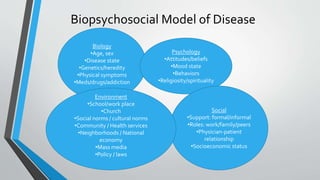
Biopsychosocial Model of Disease
Biology
•Age, sex
•Disease state
•Genetics/heredity
•Physical symptoms
•Meds/drugs/addiction
Psychology
•Attitudes/beliefs
•Mood state
•Behaviors
•Religiosity/spirituality
Social
•Support: formal/informal
•Roles: work/family/peers
•Physician-patient
relationship
•Socioeconomic status
Environment
•School/work place
•Church
•Social norms / cultural norms
•Community / Health services
•Neighborhoods / National
economy
•Mass media
•Policy / laws
01. Introduction to Behavior Sciences Lecture First.pptx

01. Introduction to Behavior Sciences Lecture First.pptx

  • 1.
    BEHAVIOUR SCIENCES FAISAL KHAN DEMONSTRATOR(DENTAL) INSTITUTE OF PARAMEDICAL SCIENCES KHYBER MEDICAL UNIVERSITY PESHAWAR
  • 2.
    Behavioural sciences • Abranch of science (as psychology, sociology, or anthropology) that deals primarily with human action and often seeks to generalize about human behavior in society • Behavioural science is a branch of the sciences which is concerned with the study of human and animal behavior • The term behavioural sciences encompasses all the disciplines that explore the activities of and interactions among organisms in the natural world • It involves the systematic analysis and investigation of human and animal behaviour through controlled and naturalistic observation, and disciplined scientific experimentation.
  • 3.
    • Difference betweenbehavioural sciences and social sciences • The term behavioural sciences is often confused with the term social sciences.Though these two broad areas are interrelated and study systematic processes of behaviour, they differ on their level of scientific analysis of various dimensions of behaviour. • Behavioural sciences abstract empirical data to investigate the decision processes and communication strategies within and between organisms in a social system.This involves fields like psychology, social neuroscience and cognitive science
  • 4.
    • In contrast,social sciences provide a perceptive framework to study the processes of a social system through impacts of social organization on structural adjustment of the individual and of groups.They typically include fields like sociology, economics, public health, anthropology, demography and political science • Categories of behavioural sciences Behavioural sciences includes two broad categories: neural — Information sciences and social — Relational sciences.
  • 5.
    • Information processingsciences deals with information processing of stimuli from the social environment by cognitive entities in order to engage in decision making, social judgment and social perception for individual functioning and survival of organism in a social environment.These include psychology, cognitive science, psychobiology, neural networks, social cognition, social psychology, and social neurosciences • On the other hand, Relational sciences deals with relationships, interaction, communication networks, associations and relational strategies or dynamics between organisms or cognitive entities in a social system.These include fields like sociological social psychology, social networks, dynamic network analysis, agent-based model and microsimulation
  • 6.
    Why study behavioralscience? • By studying this you will be able professionally explore the activities of and interactions among organisms in the natural world. • You will be involved in the systematic analysis and investigation of human and animal behaviour through controlled and naturalistic observation. • Basically if you love to investigate human behaviour, and why they do what they do, then this field is for you...
  • 7.
    Bio-Psycho-Social Model ofHealth Care and the Systems Approach • The biopsychosocial model is an interdisciplinary model that looks at the interconnection between biology, psychology, and socio environmental factors. • The model specifically examines how these aspects play a role in topics ranging from health and disease models to human development. • This model was developed by George L. Engel in 1977 and is the first of its kind to employ this type of multifaceted thinking.
  • 8.
    BIO-PSYCHO-SOCIAL MODEL • Thebiopsychosocial model (abbreviated "BPS") is a general model or approach possessing that biological, psychological (which entails thoughts, emotions, and behaviors), and social factors, all play a significant role in human functioning in the context of disease or illness. • Indeed, health is best understood in terms of a combination of biological, psychological, and social factors rather than purely in biological terms.
  • 9.
    • This isin contrast to the traditional, reductionist biomedical model of medicine that suggests every disease process can be explained in terms of an underlying deviation from normal function such as a pathogen, genetic or developmental abnormality, or injury. • The concept is used in fields such as medicine, nursing, health psychology and sociology, and particularly in more specialist fields such as psychiatry, health psychology, family therapy,clinical social work, and clinical psychology
  • 10.
    • The biopsychosocialparadigm is also a technical term for the popular concept of the "mind–body connection", which addresses more philosophical arguments between the biopsychosocial and biomedical models, rather than their empirical exploration and clinical application • The biopsychosocial model of health is based in part on social cognitive theory • The biopsychosocial model implies that treatment of disease processes, for example type two diabetes and cancer, requires that the health care team address biological, psychological and social influences upon a patient's functioning
  • 11.
    Model description andapplication • In a philosophical sense, the biopsychosocial model states that the workings of the body can affect the mind, and the workings of the mind can affect the body • This means both a direct interaction between mind and body as well as indirect effects through intermediate factors • The biopsychosocial model presumes that it is important to handle the three together
  • 12.
    Application in Medicine Biological component: understand the cause of illness stems from the functioning of the individual's body  Psychological component: seeks for potential psychological causes for a health problem such lack of self-control, emotional turmoil, and negative thinking.  Social component: investigates how different social factors such as socioeconomic status, culture, poverty, technology, and religion can influence. Psychosocial factors can also cause a biological effect by predisposing the patient to risk factors. Ex. Person with depression will drink, that can effect to liver damages
  • 13.
    Implications • Consider biological,psychological, and social factors • Relationships are significant to health • Patient and doctor • Patient and family, friends, others • Keep people healthy rather than wait to treat them when they become ill.
  • 14.
    Challenges • Poverty asunderlying issue • Lack of resources, education • Behavior and/or lifestyle • Misuse of antibiotics • Gaps in immunizations • Lack of access to healthcare • New diseases and re-emerging strains
  • 15.
    Biopsychosocial Model ofDisease Biology •Age, sex •Disease state •Genetics/heredity •Physical symptoms •Meds/drugs/addiction Psychology •Attitudes/beliefs •Mood state •Behaviors •Religiosity/spirituality Social •Support: formal/informal •Roles: work/family/peers •Physician-patient relationship •Socioeconomic status Environment •School/work place •Church •Social norms / cultural norms •Community / Health services •Neighborhoods / National economy •Mass media •Policy / laws