Strength. Performance. Passion.
© 2013 Holcim Ltd
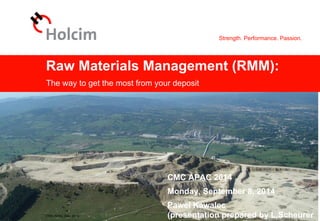
Raw Materials Management (RMM):
The way to get the most from your deposit
CMC APAC 2014
Monday, September 8, 2014
Pawel Kawalec
(presentation prepared by L.ScheurerCMC APAC Sep. 2014
© 2014 Holcim Ltd
• Assure a steady supply of raw materials in terms of quality
and quantity for cement and aggregate production
RMM objective: quality and quantity
© 2014 Holcim Ltd
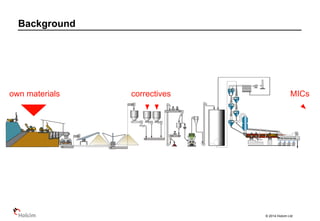
Background
own materials correctives MICs
© 2014 Holcim Ltd
• Natural raw materials in our industry
Clinker production
Cement production
Aggregates
• Basics of geology
• Raw materials investigations
• Resouces - Reserves
Outline
© 2014 Holcim Ltd
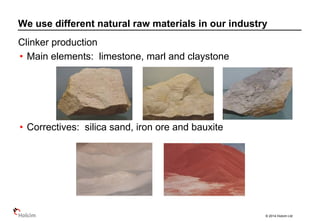
Clinker production
• Main elements: limestone, marl and claystone
• Correctives: silica sand, iron ore and bauxite
We use different natural raw materials in our industry
© 2014 Holcim Ltd
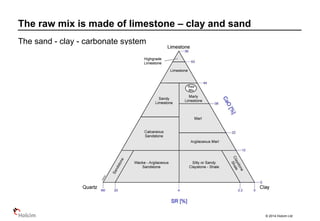
The sand - clay - carbonate system
The raw mix is made of limestone – clay and sand
© 2014 Holcim Ltd
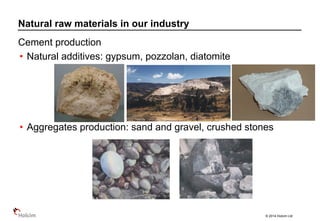
Cement production
• Natural additives: gypsum, pozzolan, diatomite
• Aggregates production: sand and gravel, crushed stones
Natural raw materials in our industry
© 2014 Holcim Ltd
• Raw material supply
Raw materials constitute the basic element for our business.
Industrial, demographic and ecological developments increasingly reduce their
availability.
• Quality control
The raw material quality has a significant bearing on process and products.
• Cost
The raw material situation has a location, and exploitation costs have a significant
bearing on competitiveness.
• Environmental footprints
Traditionally, not having sufficient raw materials was considered as one of the
main risks – nowadays, not getting a permit or even a closure of operation has to
be considered as the highest risk in our business operation.
We need raw materials, what are the issues?
© 2014 Holcim Ltd
• Natural raw materials in our industry
• Basics of geology
Principles
Stratigraphy
Tectonics
• Raw materials investigations
• Resouces - Reserves
Outline
© 2014 Holcim Ltd
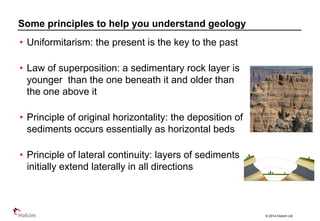
• Uniformitarism: the present is the key to the past
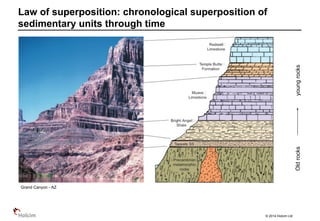
• Law of superposition: a sedimentary rock layer is
younger than the one beneath it and older than
the one above it
• Principle of original horizontality: the deposition of
sediments occurs essentially as horizontal beds
• Principle of lateral continuity: layers of sediments
initially extend laterally in all directions
Some principles to help you understand geology
© 2014 Holcim Ltd
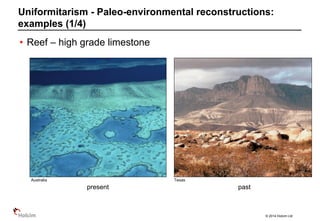
• Reef – high grade limestone
Uniformitarism - Paleo-environmental reconstructions:
examples (1/4)
present past
TexasAustralia
© 2014 Holcim Ltd
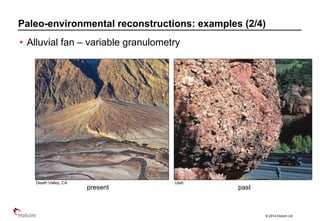
• Alluvial fan – variable granulometry
Paleo-environmental reconstructions: examples (2/4)
present past
UtahDeath Valley, CA
© 2014 Holcim Ltd
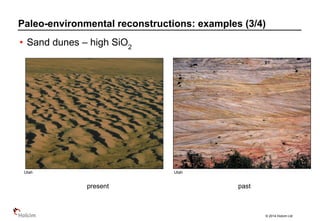
• Sand dunes – high SiO2
Paleo-environmental reconstructions: examples (3/4)
present past
Utah Utah
© 2014 Holcim Ltd
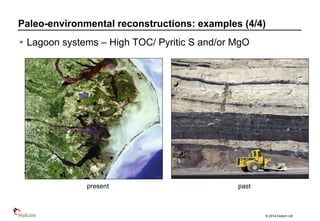
• Lagoon systems – High TOC/ Pyritic S and/or MgO
Paleo-environmental reconstructions: examples (4/4)
present past
Atlantic coast Wyoming
© 2014 Holcim Ltd
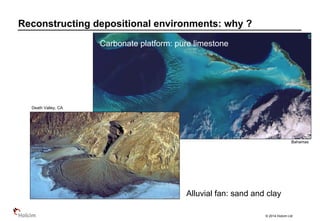
Carbonate platform: pure limestone
Alluvial fan: sand and clay
Death Valley, CA
Bahamas
Reconstructing depositional environments: why ?
© 2014 Holcim Ltd
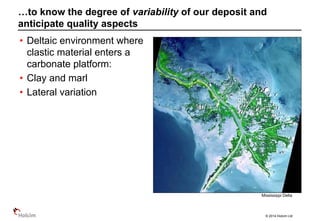
Mississippi Delta
• Deltaic environment where
clastic material enters a
carbonate platform:
• Clay and marl
• Lateral variation
…to know the degree of variability of our deposit and
anticipate quality aspects
© 2014 Holcim Ltd
Law of superposition: chronological superposition of
sedimentary units through time
Oldrocksyoungrocks
Grand Canyon - AZ
© 2014 Holcim Ltd
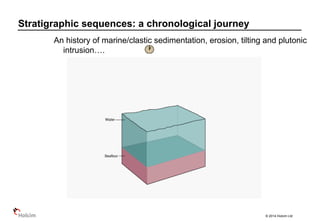
An history of marine/clastic sedimentation, erosion, tilting and plutonic
intrusion….
Stratigraphic sequences: a chronological journey
© 2014 Holcim Ltd
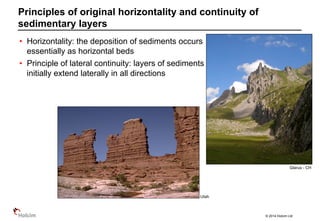
• Horizontality: the deposition of sediments occurs
essentially as horizontal beds
• Principle of lateral continuity: layers of sediments
initially extend laterally in all directions
Principles of original horizontality and continuity of
sedimentary layers
Utah
Glarus - CH
© 2014 Holcim Ltd
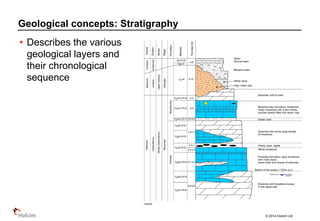
• Describes the various
geological layers and
their chronological
sequence
Geological concepts: Stratigraphy
© 2014 Holcim Ltd
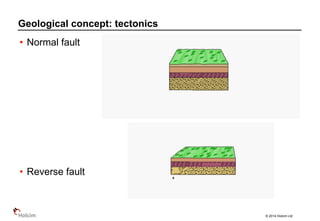
• Normal fault
• Reverse fault
Geological concept: tectonics
© 2014 Holcim Ltd
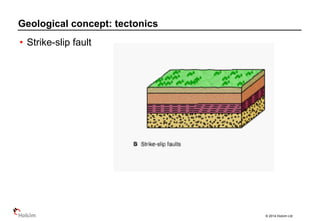
• Strike-slip fault
Geological concept: tectonics
© 2014 Holcim Ltd
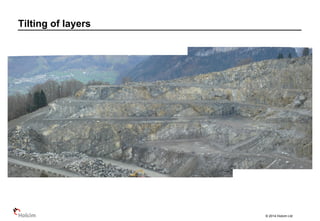
Tilting of layers
Hagerstown
© 2014 Holcim Ltd
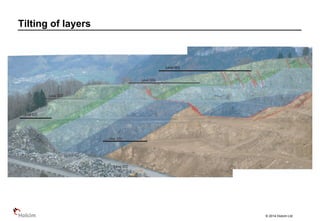
Tilting of layers
Hagerstown
© 2014 Holcim Ltd
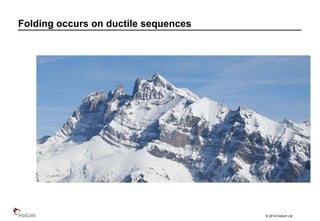
Folding occurs on ductile sequences
Hagerstown
© 2014 Holcim Ltd
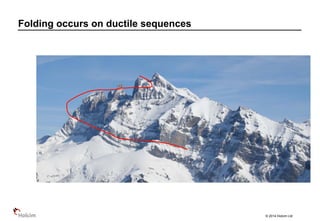
Folding occurs on ductile sequences
Hagerstown
© 2014 Holcim Ltd
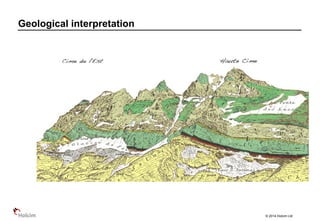
Geological interpretation
Hagerstown
© 2014 Holcim Ltd
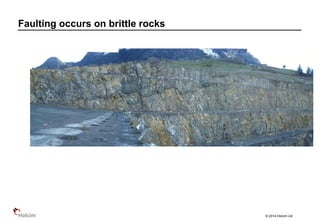
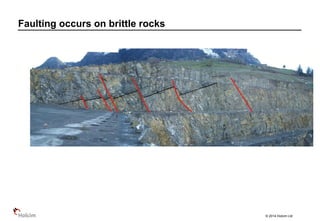
Faulting occurs on brittle rocks
Holderbank
© 2014 Holcim Ltd
Faulting occurs on brittle rocks
Holderbank
© 2014 Holcim Ltd
• Natural raw materials in our industry
• Basics of geology
• Raw materials investigations
Objectives
Desk study
Preliminary investigation
Overall investigation
Detailed investigation
• Resouces - Reserves
Outline
© 2014 Holcim Ltd
We, the raw material specialists, often hear the following
arguments from the plant personnel:
• We know the deposit
• The deposit is very homogeneous
• We had no problems in the past
• etc.
Practical example of what can happen if you don’t do
geological investigations
Why we do not need geological investigations ?
© 2014 Holcim Ltd
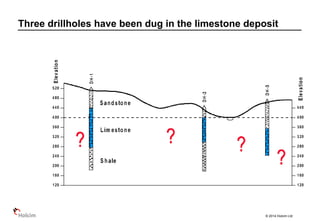
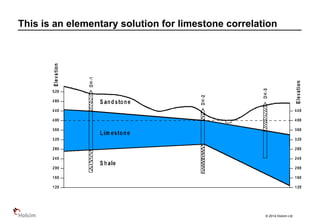
Three drillholes have been dug in the limestone deposit
© 2014 Holcim Ltd
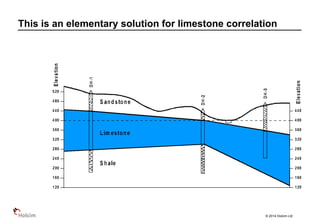
This is an elementary solution for limestone correlation
© 2014 Holcim Ltd
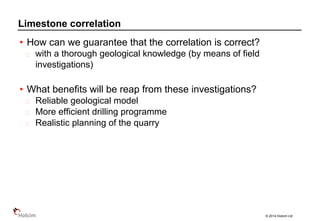
• How can we guarantee that the correlation is correct?
with a thorough geological knowledge (by means of field
investigations)
• What benefits will be get from these investigations?
Reliable geological model
More efficient drilling program
Realistic planning of the quarry
This limestone correlation might not be correct
© 2014 Holcim Ltd
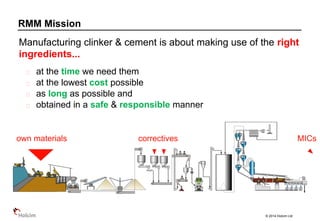
RMM Mission
Manufacturing clinker & cement is about making use of the right
ingredients...
at the time we need them
at the lowest cost possible
as long as possible and
obtained in a safe & responsible manner
own materials correctives MICs
© 2014 Holcim Ltd
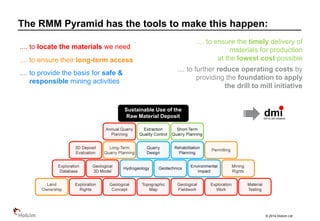
Sustainable Use of the
Raw Material Deposit
The RMM Pyramid has the tools to make this happen:
.... to ensure the timely delivery of
materials for production
at the lowest cost possible
.... to locate the materials we need
.... to provide the basis for safe &
responsible mining activities
.... to ensure their long-term access
.... to further reduce operating costs by
providing the foundation to apply
the drill to mill initiative
© 2014 Holcim Ltd
• That’s not so trivial....
It’s about legal compliancy
It’s about understanding and translating non-linear, geological
processes into a finite numerical model
It’s about estimating the geographic distribution of process-
relevant parameters (multivariate geostatistics)
e.g. LS, AR, SR, CaO, SiO2
, Fe2
O3
, Al2
O3
, minor elements, emission-relevant
components, rock types, physical properties, costs, etc.
How to ensure that kiln(s) and/or mill(s) are fed anytime with
the required materials and as long as possible ?
→ It’s about planning in space AND in time..... Yes, in 4D
!
© 2014 Holcim Ltd
• Once a concession is registered, it is of utmost importance to
make the most of the deposit.
• Therefore, we need adequate tools for the correct evaluation of
the deposit in terms of quality and quantity in order to create
an inventory of the deposit.
• Having an intimate knowledge of the deposit, it is necessary to
develop an optimal exploitation plan in such a way which is
also practicable.
What are the challenges ?
© 2014 Holcim Ltd
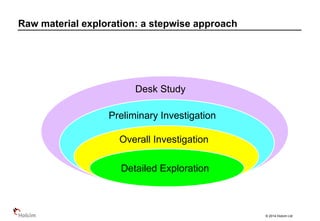
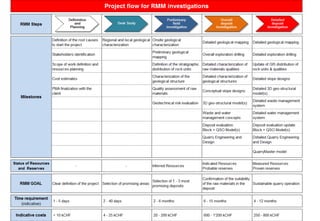
Raw material exploration: a stepwise approach
Desk Study
Preliminary Investigation
Overall Investigation
Detailed Exploration
© 2014 Holcim Ltd
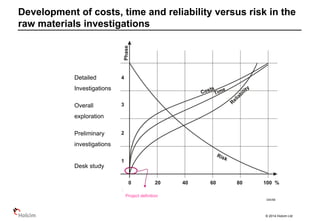
Development of costs, time and reliability versus risk in the
raw materials investigations
Project definition
Desk study
Preliminary
investigations
Overall
exploration
Detailed
Investigations
© 2014 Holcim Ltd
Tools in Raw Materials Management, CM Block Week - T. Galfetti / CM-MMT,
2013-12-02
© 2014 Holcim Ltd
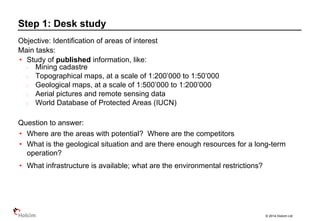
Objective: Identification of areas of interest
Main tasks:
• Study of published information, like:
Mining cadastre
Topographical maps, at a scale of 1:200’000 to 1:50’000
Geological maps, at a scale of 1:500’000 to 1:200’000
Aerial pictures and remote sensing data
World Database of Protected Areas (IUCN)
Question to answer:
• Where are the areas with potential? Where are the competitors
• What is the geological situation and are there enough resources for a long-term
operation?
• What infrastructure is available; what are the environmental restrictions?
Step 1: Desk study
© 2014 Holcim Ltd
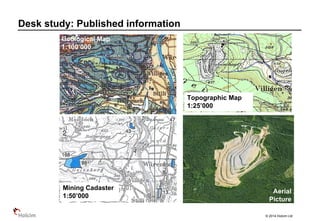
Desk study: Published information
Mining Cadaster
1:50’000
Topographic Map
1:25’000
Geological Map
1:100’000
Aerial
Picture
© 2014 Holcim Ltd
Objective: Identification of potential deposits
Main Tasks:
• Evaluation of geographical and logistics situation
• Evaluation of geological situation
• Surface sampling of outcrops, of small trenches, and eventually
limited drilling
• Chemical and environmental analyses
• Preliminary estimation of raw material quality and quantity
• Evaluation and definition of 1 – 2 deposits for investigation
Step 2: Preliminary investigation
© 2014 Holcim Ltd
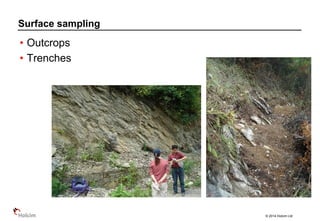
• Outcrops
• Trenches
Surface sampling
© 2014 Holcim Ltd
Objectives: Characterize raw material for CAPEX and guarantee reserves for
an operation of > 100 years
Tasks:
• Topography at a scale of 1:5’000 or better
• Detailed geological mapping and cross sections
• Drill holes and core sampling (limestone: drilling of ca. 2000 – 4000 m,
sampling at intervals of approx. 2 m)
• Raw material testing (around 1000 – 2000 samples)
• 3D geological model
• Overall geotechnical / hydrogeological study
• Block model, QSO, calculation of reserves
• Definition of mining strategy and design
Step 3: Overall investigation
© 2014 Holcim Ltd
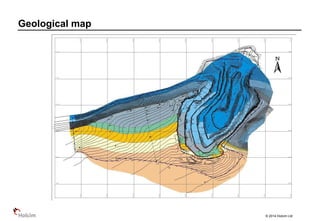
Geological map
© 2014 Holcim Ltd
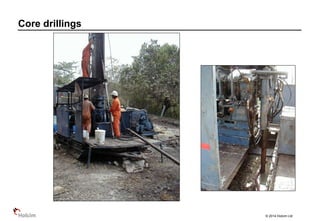
Core drillings
© 2014 Holcim Ltd
Core samples in boxes
© 2014 Holcim Ltd
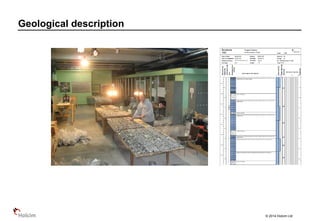
Geological description
© 2014 Holcim Ltd
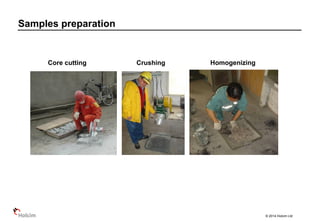
Samples preparation
Core cutting Crushing Homogenizing
© 2014 Holcim Ltd
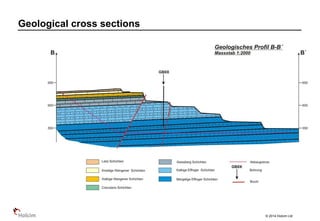
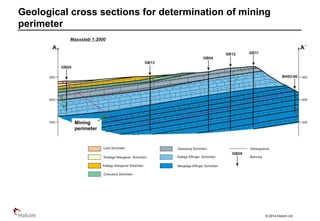
Geological cross sections
© 2014 Holcim Ltd
Geological cross sections for determination of mining
perimeter
Mining
perimeter
© 2014 Holcim Ltd
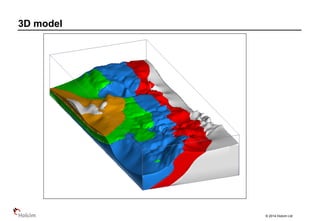
3D model
© 2014 Holcim Ltd
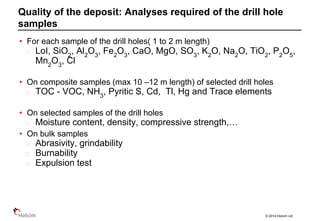
• For each sample of the drill holes( 1 to 2 m length)
LoI, SiO2
, Al2
O3
, Fe2
O3
, CaO, MgO, SO3
, K2
O, Na2
O, TiO2
, P2
O5
,
Mn2
O3
, Cl
• On composite samples (max 10 –12 m length) of selected drill holes
TOC - VOC, NH3
, Pyritic S, Cd, Tl, Hg and Trace elements
• On selected samples of the drill holes
Moisture content, density, compressive strength,…
• On bulk samples
Abrasivity, grindability
Burnability
Expulsion test
Quality of the deposit: Analyses required of the drill hole
samples
© 2014 Holcim Ltd
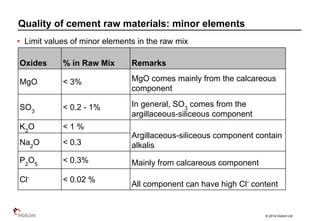
• Limit values of minor elements in the raw mix
Oxides % in Raw Mix Remarks
MgO < 3% MgO comes mainly from the calcareous
component
SO3
< 0.2 - 1% In general, SO3
comes from the
argillaceous-siliceous component
K2
O < 1 %
Argillaceous-siliceous component contain
alkalisNa2
O < 0.3
P2
O5
< 0.3% Mainly from calcareous component
Cl-
< 0.02 %
All component can have high Cl-
content
Quality of cement raw materials: minor elements
© 2014 Holcim Ltd
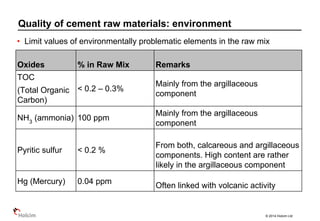
• Limit values of environmentally problematic elements in the raw mix
Oxides % in Raw Mix Remarks
TOC
< 0.2 – 0.3%
Mainly from the argillaceous
component(Total Organic
Carbon)
NH3
(ammonia) 100 ppm
Mainly from the argillaceous
component
Pyritic sulfur < 0.2 %
From both, calcareous and argillaceous
components. High content are rather
likely in the argillaceous component
Hg (Mercury) 0.04 ppm
Often linked with volcanic activity
Quality of cement raw materials: environment
© 2014 Holcim Ltd
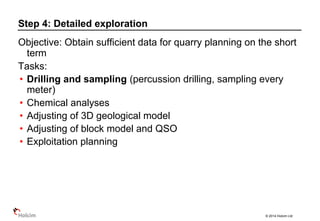
Objective: Obtain sufficient data for quarry planning on the short
term
Tasks:
• Drilling and sampling (percussion drilling, sampling every
meter)
• Chemical analyses
• Adjusting of 3D geological model
• Adjusting of block model and QSO
• Exploitation planning
Step 4: Detailed exploration
© 2014 Holcim Ltd
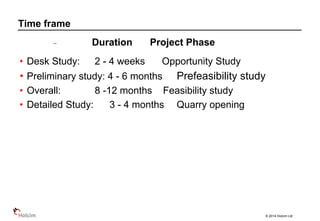
− Duration Project Phase
• Desk Study: 2 - 4 weeks Opportunity Study
• Preliminary study: 4 - 6 months Prefeasibility study
• Overall: 8 -12 months Feasibility study
• Detailed Study: 3 - 4 months Quarry opening
Time frame
© 2014 Holcim Ltd
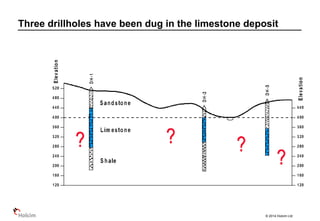
Three drillholes have been dug in the limestone deposit
© 2014 Holcim Ltd
This is an elementary solution for limestone correlation
© 2014 Holcim Ltd
• How can we guarantee that the correlation is correct?
with a thorough geological knowledge (by means of field
investigations)
• What benefits will be reap from these investigations?
Reliable geological model
More efficient drilling programme
Realistic planning of the quarry
Limestone correlation
© 2014 Holcim Ltd
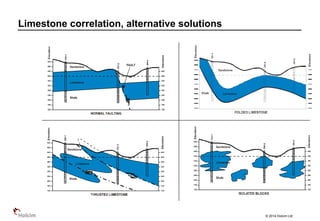
Limestone correlation, alternative solutions
© 2014 Holcim Ltd
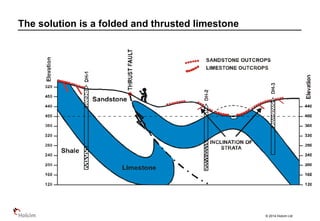
The solution is a folded and thrusted limestone
© 2014 Holcim Ltd
• Natural raw materials in our industry
• Basics of geology
• Raw materials investigations
• Resouces – Reserves
Classification
Example
Outline
© 2014 Holcim Ltd
Holcim Reporting Standard
• PERC: Pan-European Reserves and Resources
Reporting Committee www.perc.co
• To give a clear picture of the raw material
situation of our deposits at time of reporting
considering level of knowledge and confidence
and the requirements of operation.
• Main principles governing the application of the
standard are:
transparency,
materiality,
competence, and
impartiality
• Reference
• Objective
© 2014 Holcim Ltd
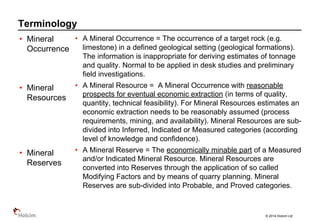
Terminology
• A Mineral Occurrence = The occurrence of a target rock (e.g.
limestone) in a defined geological setting (geological formations).
The information is inappropriate for deriving estimates of tonnage
and quality. Normal to be applied in desk studies and preliminary
field investigations.
• A Mineral Resource = A Mineral Occurrence with reasonable
prospects for eventual economic extraction (in terms of quality,
quantity, technical feasibility). For Mineral Resources estimates an
economic extraction needs to be reasonably assumed (process
requirements, mining, and availability). Mineral Resources are sub-
divided into Inferred, Indicated or Measured categories (according
level of knowledge and confidence).
• A Mineral Reserve = The economically minable part of a Measured
and/or Indicated Mineral Resource. Mineral Resources are
converted into Reserves through the application of so called
Modifying Factors and by means of quarry planning. Mineral
Reserves are sub-divided into Probable, and Proved categories.
• Mineral
Occurrence
• Mineral
Resources
• Mineral
Reserves
© 2014 Holcim Ltd
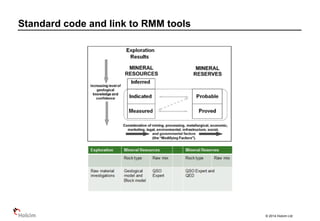
Standard code and link to RMM tools
© 2014 Holcim Ltd
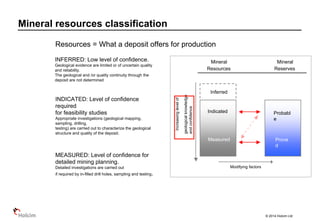
Mineral resources classification
Resources = What a deposit offers for production
INFERRED: Low level of confidence.
Geological evidence are limited or of uncertain quality
and reliability.
The geological and /or quality continuity through the
deposit are not determined
INDICATED: Level of confidence
required
for feasibility studies
Appropriate investigations (geological mapping,
sampling, drilling,
testing) are carried out to characterize the geological
structure and quality of the deposit.
MEASURED: Level of confidence for
detailed mining planning.
Detailed investigations are carried out
if required by in-filled drill holes, sampling and testing.
Probabl
e
Prove
d
Indicated
Measured
Inferred
Mineral
Reserves
Mineral
Resources
Increasinglevelof
geologicalknowledge
andconfidence
Modifying factors
© 2014 Holcim Ltd
Mineral reserves classification
Probabl
e
Prove
d
Indicated
Measured
Inferred
Mineral
Reserves
Mineral
Resources
Increasinglevelof
geologicalknowledge
andconfidence
Modifying factors
Mineral reserves are the economically mineable part
of indicated and/or measured resources
Probable reserves: category that
ensures that the raw materials are
available and suitable.
The extraction is justified. Probable
reserves are estimated based on a
a long term quarry development.
The level of knowledge is sufficient
for decision.
Proved reserves: category that ensures
high accuracy in estimates and
mineability the raw materials.
Detailed reliable mining plans can be
prepared with respect of all factors such
as stability, economic, legal,
environmental.
We would recommend for cement raw material deposits to estimate:
Probable reserves for 50 years of production for a greenfield or expansion project
Proved reserves for 20 to 30 years of production for operation on a roll out basis.
© 2014 Holcim Ltd
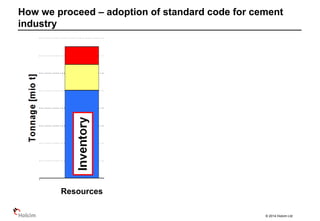
How we proceed – adoption of standard code for cement
industry
Resources Raw Mix Resources Reserves
© 2014 Holcim Ltd
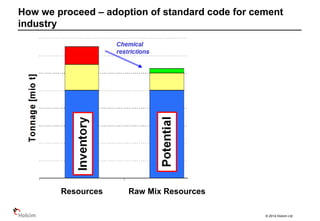
How we proceed – adoption of standard code for cement
industry
Resources Raw Mix Resources Reserves
© 2014 Holcim Ltd
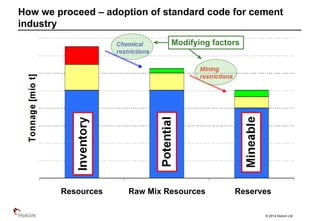
How we proceed – adoption of standard code for cement
industry
Resources Raw Mix Resources Reserves
Modifying factors
© 2014 Holcim Ltd
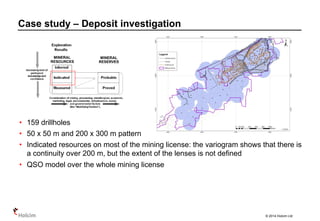
• 159 drillholes
• 50 x 50 m and 200 x 300 m pattern
• Indicated resources on most of the mining license: the variogram shows that there is
a continuity over 200 m, but the extent of the lenses is not defined
• QSO model over the whole mining license
Case study – Deposit investigation
© 2014 Holcim Ltd
• The government land can be mined; you have it under your control
• You can not access into private land
• On which areas can you transform resources into reserves?
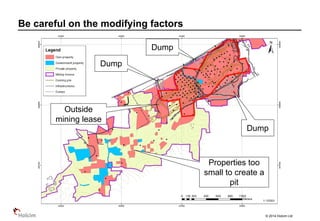
Case Study - Resources and Reserves reporting
© 2014 Holcim Ltd
Be careful on the modifying factors
Dump
Dump
Dump
Outside
mining lease
Properties too
small to create a
pit
© 2014 Holcim Ltd
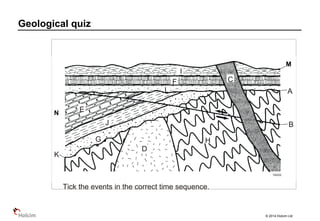
Geological quiz
740/02
K
G
D
J
E
L
F
I
C
H
A
B
Tick the events in the correct time sequence.
M
N
© 2014 Holcim Ltd
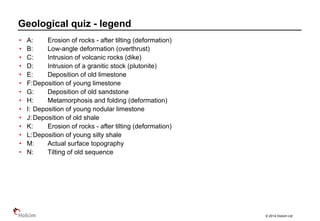
• A: Erosion of rocks - after tilting (deformation)
• B: Low-angle deformation (overthrust)
• C: Intrusion of volcanic rocks (dike)
• D: Intrusion of a granitic stock (plutonite)
• E: Deposition of old limestone
• F:Deposition of young limestone
• G: Deposition of old sandstone
• H: Metamorphosis and folding (deformation)
• I: Deposition of young nodular limestone
• J:Deposition of old shale
• K: Erosion of rocks - after tilting (deformation)
• L:Deposition of young silty shale
• M: Actual surface topography
• N: Tilting of old sequence
Geological quiz - legend
© 2014 Holcim Ltd
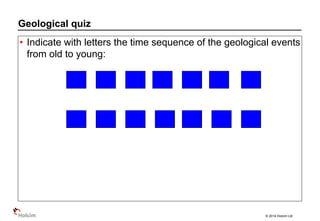
• Indicate with letters the time sequence of the geological events
from old to young:
Geological quiz
© 2014 Holcim Ltd
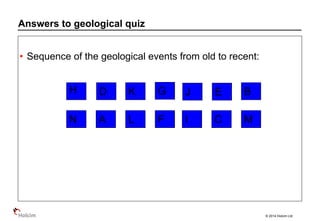
• Sequence of the geological events from old to recent:
Answers to geological quiz
M
H D K G J
CN IA L F
E B
© 2014 Holcim Ltd
• Good geological mapping is decisive for the evaluation of a deposit.
• The stratigraphic and tectonic concepts are vital to understanding
the 3D shape of the deposit.
• The design of the drilling grids should be based on sound geological
concepts.
• The block model cannot be computed before having carried out
detailed geological investigations.
• Only then can the deposit be exploited in an optimal way:
Potential of the deposit: resources / reserves
Minimise environmental impact
Assure safety
Conclusions
© 2014 Holcim Ltd
• Know your deposit: is the life insurance of our operation.
• A thorough knowledge requires investigations
• Investigations require time and resources (competent people
and money).
Messages

01 geological investigation

  • 1.
    Strength. Performance. Passion. ©2013 Holcim Ltd Raw Materials Management (RMM): The way to get the most from your deposit CMC APAC 2014 Monday, September 8, 2014 Pawel Kawalec (presentation prepared by L.ScheurerCMC APAC Sep. 2014
  • 2.
    © 2014 HolcimLtd • Assure a steady supply of raw materials in terms of quality and quantity for cement and aggregate production RMM objective: quality and quantity
  • 3.
    © 2014 HolcimLtd Background own materials correctives MICs
  • 4.
    © 2014 HolcimLtd • Natural raw materials in our industry Clinker production Cement production Aggregates • Basics of geology • Raw materials investigations • Resouces - Reserves Outline
  • 5.
    © 2014 HolcimLtd Clinker production • Main elements: limestone, marl and claystone • Correctives: silica sand, iron ore and bauxite We use different natural raw materials in our industry
  • 6.
    © 2014 HolcimLtd The sand - clay - carbonate system The raw mix is made of limestone – clay and sand
  • 7.
    © 2014 HolcimLtd Cement production • Natural additives: gypsum, pozzolan, diatomite • Aggregates production: sand and gravel, crushed stones Natural raw materials in our industry
  • 8.
    © 2014 HolcimLtd • Raw material supply Raw materials constitute the basic element for our business. Industrial, demographic and ecological developments increasingly reduce their availability. • Quality control The raw material quality has a significant bearing on process and products. • Cost The raw material situation has a location, and exploitation costs have a significant bearing on competitiveness. • Environmental footprints Traditionally, not having sufficient raw materials was considered as one of the main risks – nowadays, not getting a permit or even a closure of operation has to be considered as the highest risk in our business operation. We need raw materials, what are the issues?
  • 9.
    © 2014 HolcimLtd • Natural raw materials in our industry • Basics of geology Principles Stratigraphy Tectonics • Raw materials investigations • Resouces - Reserves Outline
  • 10.
    © 2014 HolcimLtd • Uniformitarism: the present is the key to the past • Law of superposition: a sedimentary rock layer is younger than the one beneath it and older than the one above it • Principle of original horizontality: the deposition of sediments occurs essentially as horizontal beds • Principle of lateral continuity: layers of sediments initially extend laterally in all directions Some principles to help you understand geology
  • 11.
    © 2014 HolcimLtd • Reef – high grade limestone Uniformitarism - Paleo-environmental reconstructions: examples (1/4) present past TexasAustralia
  • 12.
    © 2014 HolcimLtd • Alluvial fan – variable granulometry Paleo-environmental reconstructions: examples (2/4) present past UtahDeath Valley, CA
  • 13.
    © 2014 HolcimLtd • Sand dunes – high SiO2 Paleo-environmental reconstructions: examples (3/4) present past Utah Utah
  • 14.
    © 2014 HolcimLtd • Lagoon systems – High TOC/ Pyritic S and/or MgO Paleo-environmental reconstructions: examples (4/4) present past Atlantic coast Wyoming
  • 15.
    © 2014 HolcimLtd Carbonate platform: pure limestone Alluvial fan: sand and clay Death Valley, CA Bahamas Reconstructing depositional environments: why ?
  • 16.
    © 2014 HolcimLtd Mississippi Delta • Deltaic environment where clastic material enters a carbonate platform: • Clay and marl • Lateral variation …to know the degree of variability of our deposit and anticipate quality aspects
  • 17.
    © 2014 HolcimLtd Law of superposition: chronological superposition of sedimentary units through time Oldrocksyoungrocks Grand Canyon - AZ
  • 18.
    © 2014 HolcimLtd An history of marine/clastic sedimentation, erosion, tilting and plutonic intrusion…. Stratigraphic sequences: a chronological journey
  • 19.
    © 2014 HolcimLtd • Horizontality: the deposition of sediments occurs essentially as horizontal beds • Principle of lateral continuity: layers of sediments initially extend laterally in all directions Principles of original horizontality and continuity of sedimentary layers Utah Glarus - CH
  • 20.
    © 2014 HolcimLtd • Describes the various geological layers and their chronological sequence Geological concepts: Stratigraphy
  • 21.
    © 2014 HolcimLtd • Normal fault • Reverse fault Geological concept: tectonics
  • 22.
    © 2014 HolcimLtd • Strike-slip fault Geological concept: tectonics
  • 23.
    © 2014 HolcimLtd Tilting of layers Hagerstown
  • 24.
    © 2014 HolcimLtd Tilting of layers Hagerstown
  • 25.
    © 2014 HolcimLtd Folding occurs on ductile sequences Hagerstown
  • 26.
    © 2014 HolcimLtd Folding occurs on ductile sequences Hagerstown
  • 27.
    © 2014 HolcimLtd Geological interpretation Hagerstown
  • 28.
    © 2014 HolcimLtd Faulting occurs on brittle rocks Holderbank
  • 29.
    © 2014 HolcimLtd Faulting occurs on brittle rocks Holderbank
  • 30.
    © 2014 HolcimLtd • Natural raw materials in our industry • Basics of geology • Raw materials investigations Objectives Desk study Preliminary investigation Overall investigation Detailed investigation • Resouces - Reserves Outline
  • 31.
    © 2014 HolcimLtd We, the raw material specialists, often hear the following arguments from the plant personnel: • We know the deposit • The deposit is very homogeneous • We had no problems in the past • etc. Practical example of what can happen if you don’t do geological investigations Why we do not need geological investigations ?
  • 32.
    © 2014 HolcimLtd Three drillholes have been dug in the limestone deposit
  • 33.
    © 2014 HolcimLtd This is an elementary solution for limestone correlation
  • 34.
    © 2014 HolcimLtd • How can we guarantee that the correlation is correct? with a thorough geological knowledge (by means of field investigations) • What benefits will be get from these investigations? Reliable geological model More efficient drilling program Realistic planning of the quarry This limestone correlation might not be correct
  • 35.
    © 2014 HolcimLtd RMM Mission Manufacturing clinker & cement is about making use of the right ingredients... at the time we need them at the lowest cost possible as long as possible and obtained in a safe & responsible manner own materials correctives MICs
  • 36.
    © 2014 HolcimLtd Sustainable Use of the Raw Material Deposit The RMM Pyramid has the tools to make this happen: .... to ensure the timely delivery of materials for production at the lowest cost possible .... to locate the materials we need .... to provide the basis for safe & responsible mining activities .... to ensure their long-term access .... to further reduce operating costs by providing the foundation to apply the drill to mill initiative
  • 37.
    © 2014 HolcimLtd • That’s not so trivial.... It’s about legal compliancy It’s about understanding and translating non-linear, geological processes into a finite numerical model It’s about estimating the geographic distribution of process- relevant parameters (multivariate geostatistics) e.g. LS, AR, SR, CaO, SiO2 , Fe2 O3 , Al2 O3 , minor elements, emission-relevant components, rock types, physical properties, costs, etc. How to ensure that kiln(s) and/or mill(s) are fed anytime with the required materials and as long as possible ? → It’s about planning in space AND in time..... Yes, in 4D !
  • 38.
    © 2014 HolcimLtd • Once a concession is registered, it is of utmost importance to make the most of the deposit. • Therefore, we need adequate tools for the correct evaluation of the deposit in terms of quality and quantity in order to create an inventory of the deposit. • Having an intimate knowledge of the deposit, it is necessary to develop an optimal exploitation plan in such a way which is also practicable. What are the challenges ?
  • 39.
    © 2014 HolcimLtd Raw material exploration: a stepwise approach Desk Study Preliminary Investigation Overall Investigation Detailed Exploration
  • 40.
    © 2014 HolcimLtd Development of costs, time and reliability versus risk in the raw materials investigations Project definition Desk study Preliminary investigations Overall exploration Detailed Investigations
  • 41.
    © 2014 HolcimLtd Tools in Raw Materials Management, CM Block Week - T. Galfetti / CM-MMT, 2013-12-02
  • 42.
    © 2014 HolcimLtd Objective: Identification of areas of interest Main tasks: • Study of published information, like: Mining cadastre Topographical maps, at a scale of 1:200’000 to 1:50’000 Geological maps, at a scale of 1:500’000 to 1:200’000 Aerial pictures and remote sensing data World Database of Protected Areas (IUCN) Question to answer: • Where are the areas with potential? Where are the competitors • What is the geological situation and are there enough resources for a long-term operation? • What infrastructure is available; what are the environmental restrictions? Step 1: Desk study
  • 43.
    © 2014 HolcimLtd Desk study: Published information Mining Cadaster 1:50’000 Topographic Map 1:25’000 Geological Map 1:100’000 Aerial Picture
  • 44.
    © 2014 HolcimLtd Objective: Identification of potential deposits Main Tasks: • Evaluation of geographical and logistics situation • Evaluation of geological situation • Surface sampling of outcrops, of small trenches, and eventually limited drilling • Chemical and environmental analyses • Preliminary estimation of raw material quality and quantity • Evaluation and definition of 1 – 2 deposits for investigation Step 2: Preliminary investigation
  • 45.
    © 2014 HolcimLtd • Outcrops • Trenches Surface sampling
  • 46.
    © 2014 HolcimLtd Objectives: Characterize raw material for CAPEX and guarantee reserves for an operation of > 100 years Tasks: • Topography at a scale of 1:5’000 or better • Detailed geological mapping and cross sections • Drill holes and core sampling (limestone: drilling of ca. 2000 – 4000 m, sampling at intervals of approx. 2 m) • Raw material testing (around 1000 – 2000 samples) • 3D geological model • Overall geotechnical / hydrogeological study • Block model, QSO, calculation of reserves • Definition of mining strategy and design Step 3: Overall investigation
  • 47.
    © 2014 HolcimLtd Geological map
  • 48.
    © 2014 HolcimLtd Core drillings
  • 49.
    © 2014 HolcimLtd Core samples in boxes
  • 50.
    © 2014 HolcimLtd Geological description
  • 51.
    © 2014 HolcimLtd Samples preparation Core cutting Crushing Homogenizing
  • 52.
    © 2014 HolcimLtd Geological cross sections
  • 53.
    © 2014 HolcimLtd Geological cross sections for determination of mining perimeter Mining perimeter
  • 54.
    © 2014 HolcimLtd 3D model
  • 55.
    © 2014 HolcimLtd • For each sample of the drill holes( 1 to 2 m length) LoI, SiO2 , Al2 O3 , Fe2 O3 , CaO, MgO, SO3 , K2 O, Na2 O, TiO2 , P2 O5 , Mn2 O3 , Cl • On composite samples (max 10 –12 m length) of selected drill holes TOC - VOC, NH3 , Pyritic S, Cd, Tl, Hg and Trace elements • On selected samples of the drill holes Moisture content, density, compressive strength,… • On bulk samples Abrasivity, grindability Burnability Expulsion test Quality of the deposit: Analyses required of the drill hole samples
  • 56.
    © 2014 HolcimLtd • Limit values of minor elements in the raw mix Oxides % in Raw Mix Remarks MgO < 3% MgO comes mainly from the calcareous component SO3 < 0.2 - 1% In general, SO3 comes from the argillaceous-siliceous component K2 O < 1 % Argillaceous-siliceous component contain alkalisNa2 O < 0.3 P2 O5 < 0.3% Mainly from calcareous component Cl- < 0.02 % All component can have high Cl- content Quality of cement raw materials: minor elements
  • 57.
    © 2014 HolcimLtd • Limit values of environmentally problematic elements in the raw mix Oxides % in Raw Mix Remarks TOC < 0.2 – 0.3% Mainly from the argillaceous component(Total Organic Carbon) NH3 (ammonia) 100 ppm Mainly from the argillaceous component Pyritic sulfur < 0.2 % From both, calcareous and argillaceous components. High content are rather likely in the argillaceous component Hg (Mercury) 0.04 ppm Often linked with volcanic activity Quality of cement raw materials: environment
  • 58.
    © 2014 HolcimLtd Objective: Obtain sufficient data for quarry planning on the short term Tasks: • Drilling and sampling (percussion drilling, sampling every meter) • Chemical analyses • Adjusting of 3D geological model • Adjusting of block model and QSO • Exploitation planning Step 4: Detailed exploration
  • 59.
    © 2014 HolcimLtd − Duration Project Phase • Desk Study: 2 - 4 weeks Opportunity Study • Preliminary study: 4 - 6 months Prefeasibility study • Overall: 8 -12 months Feasibility study • Detailed Study: 3 - 4 months Quarry opening Time frame
  • 60.
    © 2014 HolcimLtd Three drillholes have been dug in the limestone deposit
  • 61.
    © 2014 HolcimLtd This is an elementary solution for limestone correlation
  • 62.
    © 2014 HolcimLtd • How can we guarantee that the correlation is correct? with a thorough geological knowledge (by means of field investigations) • What benefits will be reap from these investigations? Reliable geological model More efficient drilling programme Realistic planning of the quarry Limestone correlation
  • 63.
    © 2014 HolcimLtd Limestone correlation, alternative solutions
  • 64.
    © 2014 HolcimLtd The solution is a folded and thrusted limestone
  • 65.
    © 2014 HolcimLtd • Natural raw materials in our industry • Basics of geology • Raw materials investigations • Resouces – Reserves Classification Example Outline
  • 66.
    © 2014 HolcimLtd Holcim Reporting Standard • PERC: Pan-European Reserves and Resources Reporting Committee www.perc.co • To give a clear picture of the raw material situation of our deposits at time of reporting considering level of knowledge and confidence and the requirements of operation. • Main principles governing the application of the standard are: transparency, materiality, competence, and impartiality • Reference • Objective
  • 67.
    © 2014 HolcimLtd Terminology • A Mineral Occurrence = The occurrence of a target rock (e.g. limestone) in a defined geological setting (geological formations). The information is inappropriate for deriving estimates of tonnage and quality. Normal to be applied in desk studies and preliminary field investigations. • A Mineral Resource = A Mineral Occurrence with reasonable prospects for eventual economic extraction (in terms of quality, quantity, technical feasibility). For Mineral Resources estimates an economic extraction needs to be reasonably assumed (process requirements, mining, and availability). Mineral Resources are sub- divided into Inferred, Indicated or Measured categories (according level of knowledge and confidence). • A Mineral Reserve = The economically minable part of a Measured and/or Indicated Mineral Resource. Mineral Resources are converted into Reserves through the application of so called Modifying Factors and by means of quarry planning. Mineral Reserves are sub-divided into Probable, and Proved categories. • Mineral Occurrence • Mineral Resources • Mineral Reserves
  • 68.
    © 2014 HolcimLtd Standard code and link to RMM tools
  • 69.
    © 2014 HolcimLtd Mineral resources classification Resources = What a deposit offers for production INFERRED: Low level of confidence. Geological evidence are limited or of uncertain quality and reliability. The geological and /or quality continuity through the deposit are not determined INDICATED: Level of confidence required for feasibility studies Appropriate investigations (geological mapping, sampling, drilling, testing) are carried out to characterize the geological structure and quality of the deposit. MEASURED: Level of confidence for detailed mining planning. Detailed investigations are carried out if required by in-filled drill holes, sampling and testing. Probabl e Prove d Indicated Measured Inferred Mineral Reserves Mineral Resources Increasinglevelof geologicalknowledge andconfidence Modifying factors
  • 70.
    © 2014 HolcimLtd Mineral reserves classification Probabl e Prove d Indicated Measured Inferred Mineral Reserves Mineral Resources Increasinglevelof geologicalknowledge andconfidence Modifying factors Mineral reserves are the economically mineable part of indicated and/or measured resources Probable reserves: category that ensures that the raw materials are available and suitable. The extraction is justified. Probable reserves are estimated based on a a long term quarry development. The level of knowledge is sufficient for decision. Proved reserves: category that ensures high accuracy in estimates and mineability the raw materials. Detailed reliable mining plans can be prepared with respect of all factors such as stability, economic, legal, environmental. We would recommend for cement raw material deposits to estimate: Probable reserves for 50 years of production for a greenfield or expansion project Proved reserves for 20 to 30 years of production for operation on a roll out basis.
  • 71.
    © 2014 HolcimLtd How we proceed – adoption of standard code for cement industry Resources Raw Mix Resources Reserves
  • 72.
    © 2014 HolcimLtd How we proceed – adoption of standard code for cement industry Resources Raw Mix Resources Reserves
  • 73.
    © 2014 HolcimLtd How we proceed – adoption of standard code for cement industry Resources Raw Mix Resources Reserves Modifying factors
  • 74.
    © 2014 HolcimLtd • 159 drillholes • 50 x 50 m and 200 x 300 m pattern • Indicated resources on most of the mining license: the variogram shows that there is a continuity over 200 m, but the extent of the lenses is not defined • QSO model over the whole mining license Case study – Deposit investigation
  • 75.
    © 2014 HolcimLtd • The government land can be mined; you have it under your control • You can not access into private land • On which areas can you transform resources into reserves? Case Study - Resources and Reserves reporting
  • 76.
    © 2014 HolcimLtd Be careful on the modifying factors Dump Dump Dump Outside mining lease Properties too small to create a pit
  • 77.
    © 2014 HolcimLtd Geological quiz 740/02 K G D J E L F I C H A B Tick the events in the correct time sequence. M N
  • 78.
    © 2014 HolcimLtd • A: Erosion of rocks - after tilting (deformation) • B: Low-angle deformation (overthrust) • C: Intrusion of volcanic rocks (dike) • D: Intrusion of a granitic stock (plutonite) • E: Deposition of old limestone • F:Deposition of young limestone • G: Deposition of old sandstone • H: Metamorphosis and folding (deformation) • I: Deposition of young nodular limestone • J:Deposition of old shale • K: Erosion of rocks - after tilting (deformation) • L:Deposition of young silty shale • M: Actual surface topography • N: Tilting of old sequence Geological quiz - legend
  • 79.
    © 2014 HolcimLtd • Indicate with letters the time sequence of the geological events from old to young: Geological quiz
  • 80.
    © 2014 HolcimLtd • Sequence of the geological events from old to recent: Answers to geological quiz M H D K G J CN IA L F E B
  • 81.
    © 2014 HolcimLtd • Good geological mapping is decisive for the evaluation of a deposit. • The stratigraphic and tectonic concepts are vital to understanding the 3D shape of the deposit. • The design of the drilling grids should be based on sound geological concepts. • The block model cannot be computed before having carried out detailed geological investigations. • Only then can the deposit be exploited in an optimal way: Potential of the deposit: resources / reserves Minimise environmental impact Assure safety Conclusions
  • 82.
    © 2014 HolcimLtd • Know your deposit: is the life insurance of our operation. • A thorough knowledge requires investigations • Investigations require time and resources (competent people and money). Messages