JoDRA
    Non Conventional Water
       A New Paradigm
                                    by

                       Koussai Quteishat
                                   Director
                Jordan River Consultancy Services, JoDRA
                                  President
             Jordan Desalination and Reuse Association, JoDRA
                               Amman-Jordan

Regional Conference on Advancing Non-Conventional Water Resources Management

                            September 15, 2011
                              Athens, Greece
     JoDRA                                                                     1
JoDRA
              Introduction
                 NCWR

•   Desalinated water
•   Wastewater
•   Water harvesting
•   Aquifer recharge


      JoDRA                      2
JoDRA
           Introduction
              NCWR

Paradigm Change

 COMPREHENSIVE MANAGEMENT of
            NCWR


   JoDRA                       3
JoDRA
        Introduction
   NCWR Management Issues
• Having the water to reuse
• Look ahead when designing for
  treatment
• Energy
• Environment
• Political will
• Acceptability
• Funding options
     JoDRA                        4
JoDRA
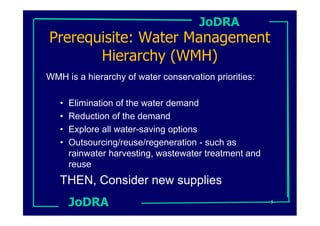
Prerequisite: Water Management
       Hierarchy (WMH)
WMH is a hierarchy of water conservation priorities:

   •   Elimination of the water demand
   •   Reduction of the demand
   •   Explore all water-saving options
   •   Outsourcing/reuse/regeneration - such as
       rainwater harvesting, wastewater treatment and
       reuse
   THEN, Consider new supplies
       JoDRA                                            5
JoDRA

           Policy Options


Paradigm Change

   INTRODUCE POLICY OPTIONS


   JoDRA                       6
JoDRA

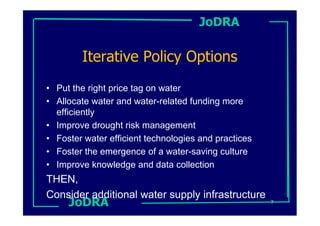
        Iterative Policy Options
• Put the right price tag on water
• Allocate water and water-related funding more
  efficiently
• Improve drought risk management
• Foster water efficient technologies and practices
• Foster the emergence of a water-saving culture
• Improve knowledge and data collection
THEN,
Consider additional water supply infrastructure
     JoDRA                                            7
JoDRA

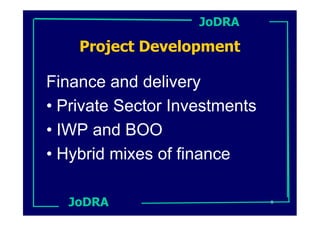
    Project Development

Finance and delivery
• Private Sector Investments
• IWP and BOO
• Hybrid mixes of finance

  JoDRA                        8
JoDRA

   PSP in Project Development


Paradigm Changes

CONTRACTORS, CONSULTANTS, AND
   SUPPLIERS AS DEVELOPERS

  USERS BUY WATER NOT PLANTS
   JoDRA                        9
JoDRA

Sustainable Financing of Projects

Essentials:
• Recover Cost of Water
• Encourage Local Banks to be involved
• Establish Local Water Funds and
  Bonds


    JoDRA                                10
JoDRA

         Types of Projects


• Desalination
• Wastewater Reuse
• Aquifer Storage and Recovery


   JoDRA                          11
JoDRA


JoDRA
JoDRA
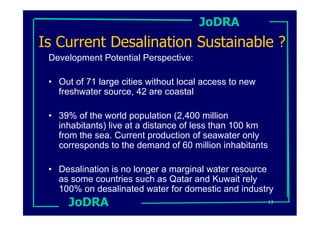
Is Current Desalination Sustainable ?
 Development Potential Perspective:

 • Out of 71 large cities without local access to new
   freshwater source, 42 are coastal

 • 39% of the world population (2,400 million
   inhabitants) live at a distance of less than 100 km
   from the sea. Current production of seawater only
   corresponds to the demand of 60 million inhabitants

 • Desalination is no longer a marginal water resource
   as some countries such as Qatar and Kuwait rely
   100% on desalinated water for domestic and industry
      JoDRA                                              13
JoDRA
 Forces Behind the Development
     Potential of Desalination
• Desalination has advantages over
  conventional resources/civil engineering
  projects

• Desalination, along with demand
  management, are expected to be the
  only recourse for regions with
  overdrafted aquifers

    JoDRA                                14
JoDRA
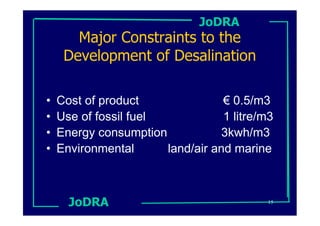
       Major Constraints to the
     Development of Desalination

•   Cost of product               € 0.5/m3
•   Use of fossil fuel            1 litre/m3
•   Energy consumption            3kwh/m3
•   Environmental      land/air and marine


      JoDRA                                15
JoDRA

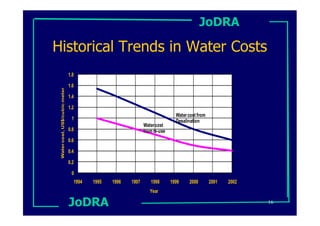
Historical Trends in Water Costs
                               1.8

                               1.6
 Water cost, US$/cubic meter


                               1.4

                               1.2
                                                                             Water cost from
                                1                                            Desalination
                                                             Water cost
                               0.8                           from re-use
                               0.6

                               0.4

                               0.2

                                0
                                 1994   1995   1996   1997      1998       1999    2000        2001   2002
                                                                Year

                               JoDRA                                                                         16
JoDRA
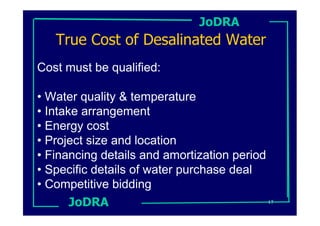
   True Cost of Desalinated Water
Cost must be qualified:

• Water quality & temperature
• Intake arrangement
• Energy cost
• Project size and location
• Financing details and amortization period
• Specific details of water purchase deal
• Competitive bidding
       JoDRA                                17
JoDRA
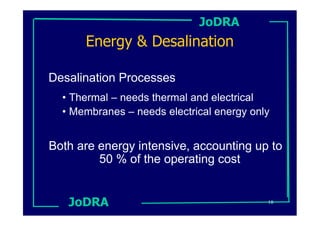
      Energy & Desalination

Desalination Processes
  • Thermal – needs thermal and electrical
  • Membranes – needs electrical energy only


Both are energy intensive, accounting up to
         50 % of the operating cost


   JoDRA                                   18
JoDRA
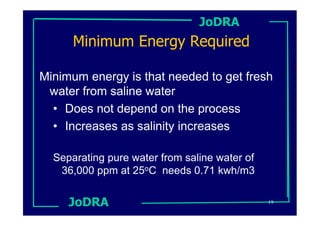
      Minimum Energy Required

Minimum energy is that needed to get fresh
 water from saline water
  • Does not depend on the process
  • Increases as salinity increases

  Separating pure water from saline water of
   36,000 ppm at 25oC needs 0.71 kwh/m3


     JoDRA                                     19
JoDRA
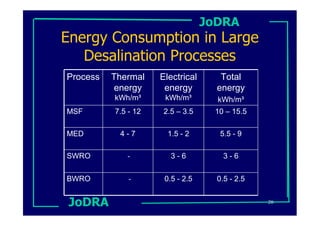
Energy Consumption in Large
   Desalination Processes
Process   Thermal    Electrical      Total
           energy     energy        energy
          kWh/m³      kWh/m³        kWh/m³
MSF       7.5 - 12    2.5 – 3.5    10 – 15.5

MED        4-7         1.5 - 2       5.5 - 9

SWRO         -          3-6           3-6

BWRO          -       0.5 - 2.5     0.5 - 2.5


 JoDRA                                          20
JoDRA

    Renewable Energy Potential

• RE systems have proven to be reliable, and
  are the technologies of the future

• RE has great potential in the MENA and
  Africa

  Current trend in fossil fuel cost increase and
  developments in solar collectors may make
  the solar desalination a feasible option in
  another ten years
    JoDRA                                          21
JoDRA
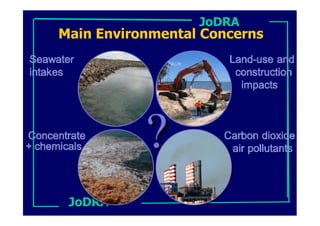
Main Environmental Concerns


           ?
 JoDRA
JoDRA
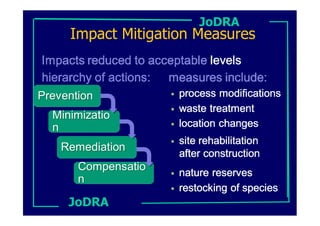
Impact Mitigation Measures


JoDRA
JoDRA
 Impact Mitigation Needs


JoDRA
JoDRA

      Innovations in Desalination

•   Energy savings as well as recovery
•   Aquifer Storage
•   Addressing Seasonal Water/Power Variations
•   Integration into Water Management Systems
•   Zero Liquid Discharge
•   Renewable Energy
•   Nuclear Desalination


      JoDRA                                  25
JoDRA

    Conventional Desalination

Paradigm Change

  CONVENTIONAL DESALINATION IS A
     CONVENTIONAL RESOURCE

  SUSTAINABLE DESALINATION USES
  RENEWABLE ENERGY AND MITIGATES
      ENVIRONMENTAL IMPACTS
   JoDRA                           26
JoDRA

  Wastewater as a Source


It is technically and economically
 possible to produce potable water
          from wastewater


 JoDRA                               27
JoDRA

 Saline Water and Waste Water

Saline water and waste water meet
in the treatment process where the
common denominators are
membranes and technologies
associated with them

   JoDRA                             28
JoDRA
       Wastewater Membrane
       Treatment Technologies

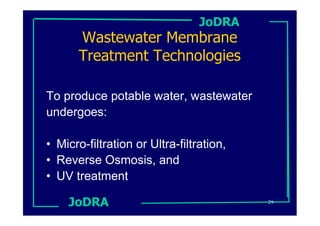
To produce potable water, wastewater
undergoes:

• Micro-filtration or Ultra-filtration,
• Reverse Osmosis, and
• UV treatment

    JoDRA                                 29
JoDRA

      Wastewater Utilization
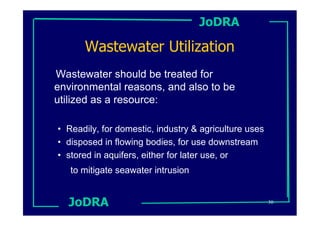
Wastewater should be treated for
environmental reasons, and also to be
utilized as a resource:

• Readily, for domestic, industry & agriculture uses
• disposed in flowing bodies, for use downstream
• stored in aquifers, either for later use, or
   to mitigate seawater intrusion


  JoDRA                                                30
JoDRA

      Why Strategic Storage?


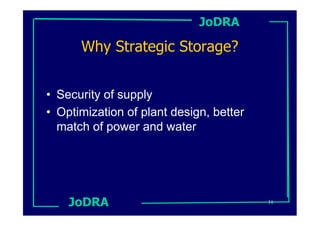
• Security of supply
• Optimization of plant design, better
  match of power and water


    JoDRA                                31
JoDRA

Why Aquifer Storage & Recovery
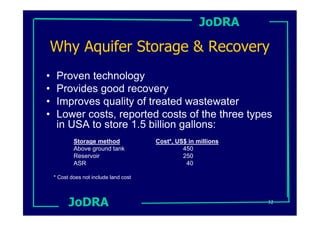
•    Proven technology
•    Provides good recovery
•    Improves quality of treated wastewater
•    Lower costs, reported costs of the three types
     in USA to store 1.5 billion gallons:
            Storage method              Cost*, US$ in millions
            Above ground tank                    450
            Reservoir                            250
            ASR                                   40

    * Cost does not include land cost


          JoDRA                                                  32
JoDRA
  Aquifer Storage and Integrated
  Management of The Resource
If treated wastewater is stored in aquifers,
• its use extended beyond reuse in irrigation and availing
  additional water to meet domestic and industrial needs
• it can also be used to protect aquifers from seawater intrusion,
  hence making more water available.

If desalinated water is stored in aquifers,
• it can lead to better integration of power and water during the
  production phase, and lead to lower production costs
• alleviates fear of over-capacity if desalination plants and
  networks rehabilitation are undertaken simultaneously as water
  produced is stored in aquifers for future use.


      JoDRA                                                          33
JoDRA
Integrated Management of Water
       Wastewater Reuse


  Wastewater Reuse was a policy
   solution that has also become
      a technology solution


  JoDRA                            34
JoDRA
Integrated Management of Water
          Desalination


   Desalination was a technology
   solution that has also become a
            policy solution


  JoDRA                              35
JoDRA
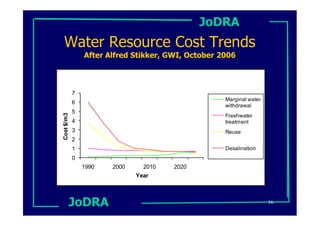
 Water Resource Cost Trends
                After Alfred Stikker, GWI, October 2006


            7
                                                    Marginal water
            6
                                                    withdrawal
            5
Cost $/m3


                                                    Freshwater
            4                                       treatment
            3                                       Reuse
            2
            1                                       Desalination
            0
                1990   2000     2010   2020
                              Year


        JoDRA                                                        36
JoDRA

     Final Word on NCWRM

Main Paradigm

      NCWRM is a policy issue
   Technology is here to support it

           let’s use it wisely

   JoDRA                              37
JoDRA


    Thank You


JoDRA              38

002 NCWRM 2011_Quteishat

  • 1.
    JoDRA Non Conventional Water A New Paradigm by Koussai Quteishat Director Jordan River Consultancy Services, JoDRA President Jordan Desalination and Reuse Association, JoDRA Amman-Jordan Regional Conference on Advancing Non-Conventional Water Resources Management September 15, 2011 Athens, Greece JoDRA 1
  • 2.
    JoDRA Introduction NCWR • Desalinated water • Wastewater • Water harvesting • Aquifer recharge JoDRA 2
  • 3.
    JoDRA Introduction NCWR Paradigm Change COMPREHENSIVE MANAGEMENT of NCWR JoDRA 3
  • 4.
    JoDRA Introduction NCWR Management Issues • Having the water to reuse • Look ahead when designing for treatment • Energy • Environment • Political will • Acceptability • Funding options JoDRA 4
  • 5.
    JoDRA Prerequisite: Water Management Hierarchy (WMH) WMH is a hierarchy of water conservation priorities: • Elimination of the water demand • Reduction of the demand • Explore all water-saving options • Outsourcing/reuse/regeneration - such as rainwater harvesting, wastewater treatment and reuse THEN, Consider new supplies JoDRA 5
  • 6.
    JoDRA Policy Options Paradigm Change INTRODUCE POLICY OPTIONS JoDRA 6
  • 7.
    JoDRA Iterative Policy Options • Put the right price tag on water • Allocate water and water-related funding more efficiently • Improve drought risk management • Foster water efficient technologies and practices • Foster the emergence of a water-saving culture • Improve knowledge and data collection THEN, Consider additional water supply infrastructure JoDRA 7
  • 8.
    JoDRA Project Development Finance and delivery • Private Sector Investments • IWP and BOO • Hybrid mixes of finance JoDRA 8
  • 9.
    JoDRA PSP in Project Development Paradigm Changes CONTRACTORS, CONSULTANTS, AND SUPPLIERS AS DEVELOPERS USERS BUY WATER NOT PLANTS JoDRA 9
  • 10.
    JoDRA Sustainable Financing ofProjects Essentials: • Recover Cost of Water • Encourage Local Banks to be involved • Establish Local Water Funds and Bonds JoDRA 10
  • 11.
    JoDRA Types of Projects • Desalination • Wastewater Reuse • Aquifer Storage and Recovery JoDRA 11
  • 12.
  • 13.
    JoDRA Is Current DesalinationSustainable ? Development Potential Perspective: • Out of 71 large cities without local access to new freshwater source, 42 are coastal • 39% of the world population (2,400 million inhabitants) live at a distance of less than 100 km from the sea. Current production of seawater only corresponds to the demand of 60 million inhabitants • Desalination is no longer a marginal water resource as some countries such as Qatar and Kuwait rely 100% on desalinated water for domestic and industry JoDRA 13
  • 14.
    JoDRA Forces Behindthe Development Potential of Desalination • Desalination has advantages over conventional resources/civil engineering projects • Desalination, along with demand management, are expected to be the only recourse for regions with overdrafted aquifers JoDRA 14
  • 15.
    JoDRA Major Constraints to the Development of Desalination • Cost of product € 0.5/m3 • Use of fossil fuel 1 litre/m3 • Energy consumption 3kwh/m3 • Environmental land/air and marine JoDRA 15
  • 16.
    JoDRA Historical Trends inWater Costs 1.8 1.6 Water cost, US$/cubic meter 1.4 1.2 Water cost from 1 Desalination Water cost 0.8 from re-use 0.6 0.4 0.2 0 1994 1995 1996 1997 1998 1999 2000 2001 2002 Year JoDRA 16
  • 17.
    JoDRA True Cost of Desalinated Water Cost must be qualified: • Water quality & temperature • Intake arrangement • Energy cost • Project size and location • Financing details and amortization period • Specific details of water purchase deal • Competitive bidding JoDRA 17
  • 18.
    JoDRA Energy & Desalination Desalination Processes • Thermal – needs thermal and electrical • Membranes – needs electrical energy only Both are energy intensive, accounting up to 50 % of the operating cost JoDRA 18
  • 19.
    JoDRA Minimum Energy Required Minimum energy is that needed to get fresh water from saline water • Does not depend on the process • Increases as salinity increases Separating pure water from saline water of 36,000 ppm at 25oC needs 0.71 kwh/m3 JoDRA 19
  • 20.
    JoDRA Energy Consumption inLarge Desalination Processes Process Thermal Electrical Total energy energy energy kWh/m³ kWh/m³ kWh/m³ MSF 7.5 - 12 2.5 – 3.5 10 – 15.5 MED 4-7 1.5 - 2 5.5 - 9 SWRO - 3-6 3-6 BWRO - 0.5 - 2.5 0.5 - 2.5 JoDRA 20
  • 21.
    JoDRA Renewable Energy Potential • RE systems have proven to be reliable, and are the technologies of the future • RE has great potential in the MENA and Africa Current trend in fossil fuel cost increase and developments in solar collectors may make the solar desalination a feasible option in another ten years JoDRA 21
  • 22.
  • 23.
  • 24.
  • 25.
    JoDRA Innovations in Desalination • Energy savings as well as recovery • Aquifer Storage • Addressing Seasonal Water/Power Variations • Integration into Water Management Systems • Zero Liquid Discharge • Renewable Energy • Nuclear Desalination JoDRA 25
  • 26.
    JoDRA Conventional Desalination Paradigm Change CONVENTIONAL DESALINATION IS A CONVENTIONAL RESOURCE SUSTAINABLE DESALINATION USES RENEWABLE ENERGY AND MITIGATES ENVIRONMENTAL IMPACTS JoDRA 26
  • 27.
    JoDRA Wastewateras a Source It is technically and economically possible to produce potable water from wastewater JoDRA 27
  • 28.
    JoDRA Saline Waterand Waste Water Saline water and waste water meet in the treatment process where the common denominators are membranes and technologies associated with them JoDRA 28
  • 29.
    JoDRA Wastewater Membrane Treatment Technologies To produce potable water, wastewater undergoes: • Micro-filtration or Ultra-filtration, • Reverse Osmosis, and • UV treatment JoDRA 29
  • 30.
    JoDRA Wastewater Utilization Wastewater should be treated for environmental reasons, and also to be utilized as a resource: • Readily, for domestic, industry & agriculture uses • disposed in flowing bodies, for use downstream • stored in aquifers, either for later use, or to mitigate seawater intrusion JoDRA 30
  • 31.
    JoDRA Why Strategic Storage? • Security of supply • Optimization of plant design, better match of power and water JoDRA 31
  • 32.
    JoDRA Why Aquifer Storage& Recovery • Proven technology • Provides good recovery • Improves quality of treated wastewater • Lower costs, reported costs of the three types in USA to store 1.5 billion gallons: Storage method Cost*, US$ in millions Above ground tank 450 Reservoir 250 ASR 40 * Cost does not include land cost JoDRA 32
  • 33.
    JoDRA AquiferStorage and Integrated Management of The Resource If treated wastewater is stored in aquifers, • its use extended beyond reuse in irrigation and availing additional water to meet domestic and industrial needs • it can also be used to protect aquifers from seawater intrusion, hence making more water available. If desalinated water is stored in aquifers, • it can lead to better integration of power and water during the production phase, and lead to lower production costs • alleviates fear of over-capacity if desalination plants and networks rehabilitation are undertaken simultaneously as water produced is stored in aquifers for future use. JoDRA 33
  • 34.
    JoDRA Integrated Management ofWater Wastewater Reuse Wastewater Reuse was a policy solution that has also become a technology solution JoDRA 34
  • 35.
    JoDRA Integrated Management ofWater Desalination Desalination was a technology solution that has also become a policy solution JoDRA 35
  • 36.
    JoDRA Water ResourceCost Trends After Alfred Stikker, GWI, October 2006 7 Marginal water 6 withdrawal 5 Cost $/m3 Freshwater 4 treatment 3 Reuse 2 1 Desalination 0 1990 2000 2010 2020 Year JoDRA 36
  • 37.
    JoDRA Final Word on NCWRM Main Paradigm NCWRM is a policy issue Technology is here to support it let’s use it wisely JoDRA 37
  • 38.
    JoDRA Thank You JoDRA 38