2nd Gov&Fin Regional Conference
5-6 December 2016, Tunis, Tunisia
Project labelled under the Union for the Mediterranean
Overview, Progress & Current
Status of the initiative
Anthi Brouma, Ph.D.
Head of MENA
GWP-Med
Snapshot of the project
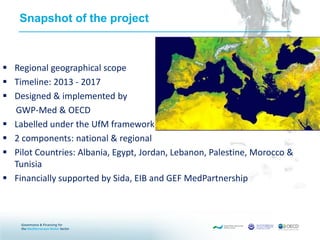
 Regional geographical scope
 Timeline: 2013 - 2017
 Designed & implemented by
GWP-Med & OECD
 Labelled under the UfM framework
 2 components: national & regional
 Pilot Countries: Albania, Egypt, Jordan, Lebanon, Palestine, Morocco &
Tunisia
 Financially supported by Sida, EIB and GEF MedPartnership
Objective
Identify and provide realistic and
implementable solutions (in the form of a
set of operational guidance and a
compendium of good/bad cases and best
practices) to the governance challenges
for the mobilisation of financing for the
Mediterranean water sector
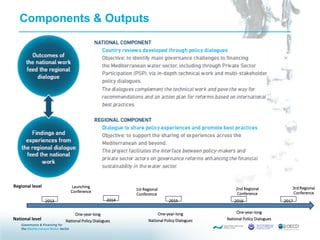
Components & Outputs
One-year-long
National Policy Dialogues
One-year-long
National Policy Dialogues
One-year-long
National Policy DialoguesNational level
Regional level Launching
Conference 1st Regional
Conference
2nd Regional
Conference
3rd Regional
Conference
2013 2014 2015 2016 2017
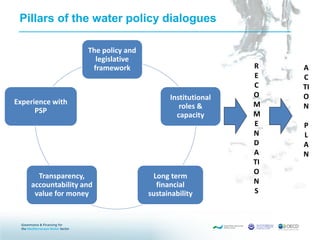
Pillars of the water policy dialogues
The policy and
legislative
framework
Institutional
roles &
capacity
Long term
financial
sustainability
Transparency,
accountability and
value for money
Experience with
PSP
R
E
C
O
M
M
E
N
D
A
TI
O
N
S
A
C
TI
O
N
P
L
A
N
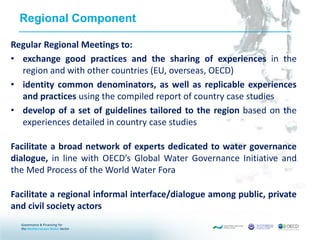
Regional Component
Regular Regional Meetings to:
• exchange good practices and the sharing of experiences in the
region and with other countries (EU, overseas, OECD)
• identity common denominators, as well as replicable experiences
and practices using the compiled report of country case studies
• develop of a set of guidelines tailored to the region based on the
experiences detailed in country case studies
Facilitate a broad network of experts dedicated to water governance
dialogue, in line with OECD’s Global Water Governance Initiative and
the Med Process of the World Water Fora
Facilitate a regional informal interface/dialogue among public, private
and civil society actors
How to do it - Methodology
• Builds on well received earlier work by GWP-Med/OECD in
Egypt and Lebanon
• Long tradition of providing neutral platforms for building
consensus & sharing good practices among wide range of
stakeholders through evidence-based policy dialogues
• Based on tested methodologies and tools to help countries
strengthen institutional capacity to attract financial resources
& manage water resources and service delivery more efficiently
• Allows direct interface between citizens, users, governments and
the private sector, thus enhancing ownership and securing
active participation
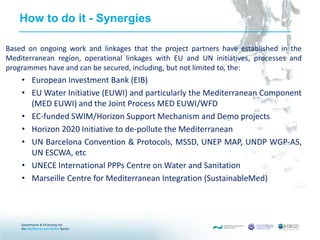
How to do it - Synergies
Based on ongoing work and linkages that the project partners have established in the
Mediterranean region, operational linkages with EU and UN initiatives, processes and
programmes have and can be secured, including, but not limited to, the:
• European Investment Bank (EIB)
• EU Water Initiative (EUWI) and particularly the Mediterranean Component
(MED EUWI) and the Joint Process MED EUWI/WFD
• EC-funded SWIM/Horizon Support Mechanism and Demo projects
• Horizon 2020 Initiative to de-pollute the Mediterranean
• UN Barcelona Convention & Protocols, MSSD, UNEP MAP, UNDP WGP-AS,
UN ESCWA, etc
• UNECE International PPPs Centre on Water and Sanitation
• Marseille Centre for Mediterranean Integration (SustainableMed)
Progress & Activities
(2013-2016)
High level Regional Conference
Palau de Pedralbes
Barcelona, Spain
28-29 May 2013
Official Launching of the Project
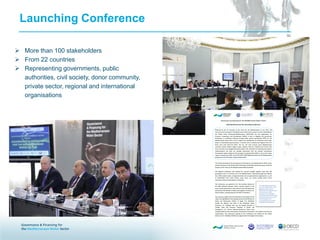
 More than 100 stakeholders
 From 22 countries
 Representing governments, public
authorities, civil society, donor community,
private sector, regional and international
organisations
Launching Conference
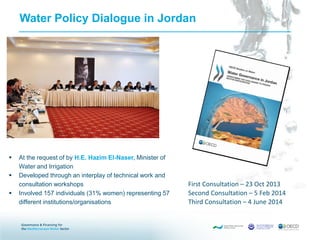
 At the request of by H.E. Hazim El-Naser, Minister of
Water and Irrigation
 Developed through an interplay of technical work and
consultation workshops
 Involved 157 individuals (31% women) representing 57
different institutions/organisations
Water Policy Dialogue in Jordan
First Consultation – 23 Oct 2013
Second Consultation – 5 Feb 2014
Third Consultation – 4 June 2014
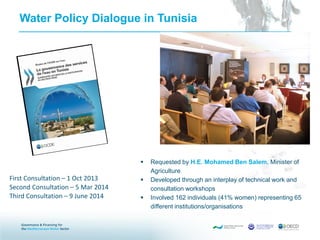
Water Policy Dialogue in Tunisia
 Requested by H.E. Mohamed Ben Salem, Minister of
Agriculture
 Developed through an interplay of technical work and
consultation workshops
 Involved 162 individuals (41% women) representing 65
different institutions/organisations
First Consultation – 1 Oct 2013
Second Consultation – 5 Mar 2014
Third Consultation – 9 June 2014
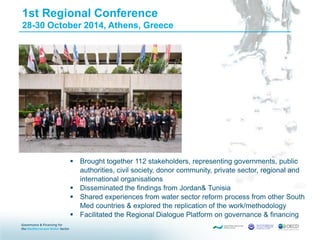
1st Regional Conference
28-30 October 2014, Athens, Greece
 Brought together 112 stakeholders, representing governments, public
authorities, civil society, donor community, private sector, regional and
international organisations
 Disseminated the findings from Jordan& Tunisia
 Shared experiences from water sector reform process from other South
Med countries & explored the replication of the work/methodology
 Facilitated the Regional Dialogue Platform on governance & financing
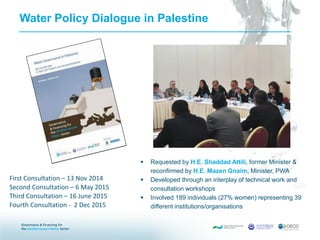
Water Policy Dialogue in Palestine
 Requested by H.E. Shaddad Attili, former Minister &
reconfirmed by H.E. Mazen Gnaim, Minister, PWA
 Developed through an interplay of technical work and
consultation workshops
 Involved 189 individuals (27% women) representing 39
different institutions/organisations
First Consultation – 13 Nov 2014
Second Consultation – 6 May 2015
Third Consultation – 16 June 2015
Fourth Consultation - 2 Dec 2015
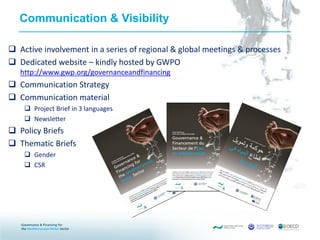
Communication & Visibility
 Active involvement in a series of regional & global meetings & processes
 Dedicated website – kindly hosted by GWPO
http://www.gwp.org/governanceandfinancing
 Communication Strategy
 Communication material
 Project Brief in 3 languages
 Newsletter
 Policy Briefs
 Thematic Briefs
 Gender
 CSR
Key diagnostic points
Contrasted experience with PSP
Tunisia
o Limited use & knowledge of PSP in the water sector
o Shift in government approach towards PSP => water sector should be
ready to impact decision making when the political conditions are in
place
Jordan
o Varied experience with both small and large scale private sector
participation (PSP) projects
o The country is on the verge of concluding mega project and risks failing
reaping the benefits if right conditions are not in place
Palestine
o Some experience with PSP projects and management contracts, also
outside the water sector; replicable examples exist
o Severe water scarcity challenges and lingering political situation
Different institutional setting
Tunisia
• Centralised setting
• Competent administration but limited PSP capacity
Jordan
• Responsibilities for water and PPPs are scattered across institutions
– some overlaps and unclear allocation
• Responsibilities are in flux
• Corporatisation under way
Palestine
• 2014 Water Law has consolidated responsibility and clarified roles
across entities with PSP clearly identified as tool
• Enforcement in progress; undefined period of transition as
structure and responsibilities are being shifted
Common challenges
 Uncertainty & gaps in the legislative & regulatory
framework for water and PPPs undermines legal clarity,
opportunity and stability of water PSP
 Limited financial sustainability of water operators,
important subsidies & fiscal constraints put pressure on
the WWS sector and call for reforms
 Need for greater accountability mechanisms, territorial
development & stakeholders’ engagement
Areas of Recommendation
1. Developing the regulatory framework
2. Improving the budget processes
3. Promoting & ensuring stakeholder
engagement
Tunisia: what PSP for which objectives
 Forms of PSP need to be considered based on an evaluation of past
experience, taking into account the appetite of the PS and
sustainability / value for money
 Small scale PS should be considered in rural areas where SONEDE is
not present
 Piloting BOT for water & wastewater treatment
 Consider forms of PSP that support greater technical & commercial
efficiency, as well as quality services => ONAS is developing
« Concession d’exploitation » and needs to embed the appropriate
incentive mechanisms
 Difficult to consider more complex forms of PSP
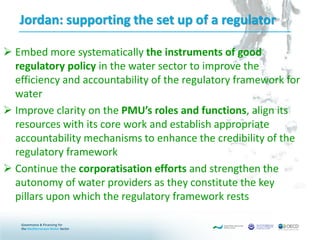
Jordan: supporting the set up of a regulator
 Embed more systematically the instruments of good
regulatory policy in the water sector to improve the
efficiency and accountability of the regulatory framework for
water
 Improve clarity on the PMU’s roles and functions, align its
resources with its core work and establish appropriate
accountability mechanisms to enhance the credibility of the
regulatory framework
 Continue the corporatisation efforts and strengthen the
autonomy of water providers as they constitute the key
pillars upon which the regulatory framework rests
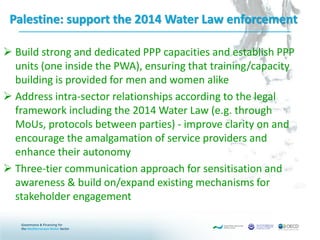
Palestine: support the 2014 Water Law enforcement
 Build strong and dedicated PPP capacities and establish PPP
units (one inside the PWA), ensuring that training/capacity
building is provided for men and women alike
 Address intra-sector relationships according to the legal
framework including the 2014 Water Law (e.g. through
MoUs, protocols between parties) - improve clarity on and
encourage the amalgamation of service providers and
enhance their autonomy
 Three-tier communication approach for sensitisation and
awareness & build on/expand existing mechanisms for
stakeholder engagement
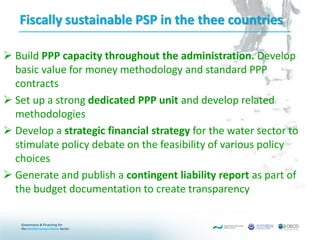
Fiscally sustainable PSP in the thee countries
 Build PPP capacity throughout the administration. Develop
basic value for money methodology and standard PPP
contracts
 Set up a strong dedicated PPP unit and develop related
methodologies
 Develop a strategic financial strategy for the water sector to
stimulate policy debate on the feasibility of various policy
choices
 Generate and publish a contingent liability report as part of
the budget documentation to create transparency
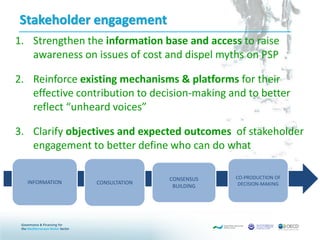
Stakeholder engagement
1. Strengthen the information base and access to raise
awareness on issues of cost and dispel myths on PSP
2. Reinforce existing mechanisms & platforms for their
effective contribution to decision-making and to better
reflect “unheard voices”
3. Clarify objectives and expected outcomes of stakeholder
engagement to better define who can do what
INFORMATION CONSULTATION
CO-PRODUCTION OF
DECISION-MAKING
CONSENSUS
BUILDING
Next steps: Dec 2016 – Dec 2017
 2nd Regional Conference, 5-6 December 2016, Tunis, Tunisia
 Water Policy Dialogue in Lebanon
 At the request of the Ministry of Energy and Water
 Phase II of Water Policy Dialogue in Palestine
 At the request of the Palestinian Water Authority
 3rd/Closing Regional Conference, Nov 2017, Athens or Barcelona
Contacts:
GWP-Med: secretariat@gwpmed.org
OECD: water.governance@oecd.org
UfM: water@ufmsecretariat.org
Thank you
for your kind attention
‫شكري‬ ‫خالص‬ ‫مع‬
‫وامتناني‬ Merci pour
votre attention

Presentation by Ms. Anthi Brouma (GWP-Med)

  • 1.
    2nd Gov&Fin RegionalConference 5-6 December 2016, Tunis, Tunisia Project labelled under the Union for the Mediterranean Overview, Progress & Current Status of the initiative Anthi Brouma, Ph.D. Head of MENA GWP-Med
  • 2.
    Snapshot of theproject  Regional geographical scope  Timeline: 2013 - 2017  Designed & implemented by GWP-Med & OECD  Labelled under the UfM framework  2 components: national & regional  Pilot Countries: Albania, Egypt, Jordan, Lebanon, Palestine, Morocco & Tunisia  Financially supported by Sida, EIB and GEF MedPartnership
  • 3.
    Objective Identify and providerealistic and implementable solutions (in the form of a set of operational guidance and a compendium of good/bad cases and best practices) to the governance challenges for the mobilisation of financing for the Mediterranean water sector
  • 4.
    Components & Outputs One-year-long NationalPolicy Dialogues One-year-long National Policy Dialogues One-year-long National Policy DialoguesNational level Regional level Launching Conference 1st Regional Conference 2nd Regional Conference 3rd Regional Conference 2013 2014 2015 2016 2017
  • 5.
    Pillars of thewater policy dialogues The policy and legislative framework Institutional roles & capacity Long term financial sustainability Transparency, accountability and value for money Experience with PSP R E C O M M E N D A TI O N S A C TI O N P L A N
  • 6.
    Regional Component Regular RegionalMeetings to: • exchange good practices and the sharing of experiences in the region and with other countries (EU, overseas, OECD) • identity common denominators, as well as replicable experiences and practices using the compiled report of country case studies • develop of a set of guidelines tailored to the region based on the experiences detailed in country case studies Facilitate a broad network of experts dedicated to water governance dialogue, in line with OECD’s Global Water Governance Initiative and the Med Process of the World Water Fora Facilitate a regional informal interface/dialogue among public, private and civil society actors
  • 7.
    How to doit - Methodology • Builds on well received earlier work by GWP-Med/OECD in Egypt and Lebanon • Long tradition of providing neutral platforms for building consensus & sharing good practices among wide range of stakeholders through evidence-based policy dialogues • Based on tested methodologies and tools to help countries strengthen institutional capacity to attract financial resources & manage water resources and service delivery more efficiently • Allows direct interface between citizens, users, governments and the private sector, thus enhancing ownership and securing active participation
  • 8.
    How to doit - Synergies Based on ongoing work and linkages that the project partners have established in the Mediterranean region, operational linkages with EU and UN initiatives, processes and programmes have and can be secured, including, but not limited to, the: • European Investment Bank (EIB) • EU Water Initiative (EUWI) and particularly the Mediterranean Component (MED EUWI) and the Joint Process MED EUWI/WFD • EC-funded SWIM/Horizon Support Mechanism and Demo projects • Horizon 2020 Initiative to de-pollute the Mediterranean • UN Barcelona Convention & Protocols, MSSD, UNEP MAP, UNDP WGP-AS, UN ESCWA, etc • UNECE International PPPs Centre on Water and Sanitation • Marseille Centre for Mediterranean Integration (SustainableMed)
  • 9.
  • 10.
    High level RegionalConference Palau de Pedralbes Barcelona, Spain 28-29 May 2013 Official Launching of the Project
  • 11.
     More than100 stakeholders  From 22 countries  Representing governments, public authorities, civil society, donor community, private sector, regional and international organisations Launching Conference
  • 12.
     At therequest of by H.E. Hazim El-Naser, Minister of Water and Irrigation  Developed through an interplay of technical work and consultation workshops  Involved 157 individuals (31% women) representing 57 different institutions/organisations Water Policy Dialogue in Jordan First Consultation – 23 Oct 2013 Second Consultation – 5 Feb 2014 Third Consultation – 4 June 2014
  • 13.
    Water Policy Dialoguein Tunisia  Requested by H.E. Mohamed Ben Salem, Minister of Agriculture  Developed through an interplay of technical work and consultation workshops  Involved 162 individuals (41% women) representing 65 different institutions/organisations First Consultation – 1 Oct 2013 Second Consultation – 5 Mar 2014 Third Consultation – 9 June 2014
  • 14.
    1st Regional Conference 28-30October 2014, Athens, Greece  Brought together 112 stakeholders, representing governments, public authorities, civil society, donor community, private sector, regional and international organisations  Disseminated the findings from Jordan& Tunisia  Shared experiences from water sector reform process from other South Med countries & explored the replication of the work/methodology  Facilitated the Regional Dialogue Platform on governance & financing
  • 15.
    Water Policy Dialoguein Palestine  Requested by H.E. Shaddad Attili, former Minister & reconfirmed by H.E. Mazen Gnaim, Minister, PWA  Developed through an interplay of technical work and consultation workshops  Involved 189 individuals (27% women) representing 39 different institutions/organisations First Consultation – 13 Nov 2014 Second Consultation – 6 May 2015 Third Consultation – 16 June 2015 Fourth Consultation - 2 Dec 2015
  • 16.
    Communication & Visibility Active involvement in a series of regional & global meetings & processes  Dedicated website – kindly hosted by GWPO http://www.gwp.org/governanceandfinancing  Communication Strategy  Communication material  Project Brief in 3 languages  Newsletter  Policy Briefs  Thematic Briefs  Gender  CSR
  • 17.
  • 18.
    Contrasted experience withPSP Tunisia o Limited use & knowledge of PSP in the water sector o Shift in government approach towards PSP => water sector should be ready to impact decision making when the political conditions are in place Jordan o Varied experience with both small and large scale private sector participation (PSP) projects o The country is on the verge of concluding mega project and risks failing reaping the benefits if right conditions are not in place Palestine o Some experience with PSP projects and management contracts, also outside the water sector; replicable examples exist o Severe water scarcity challenges and lingering political situation
  • 19.
    Different institutional setting Tunisia •Centralised setting • Competent administration but limited PSP capacity Jordan • Responsibilities for water and PPPs are scattered across institutions – some overlaps and unclear allocation • Responsibilities are in flux • Corporatisation under way Palestine • 2014 Water Law has consolidated responsibility and clarified roles across entities with PSP clearly identified as tool • Enforcement in progress; undefined period of transition as structure and responsibilities are being shifted
  • 20.
    Common challenges  Uncertainty& gaps in the legislative & regulatory framework for water and PPPs undermines legal clarity, opportunity and stability of water PSP  Limited financial sustainability of water operators, important subsidies & fiscal constraints put pressure on the WWS sector and call for reforms  Need for greater accountability mechanisms, territorial development & stakeholders’ engagement
  • 21.
    Areas of Recommendation 1.Developing the regulatory framework 2. Improving the budget processes 3. Promoting & ensuring stakeholder engagement
  • 22.
    Tunisia: what PSPfor which objectives  Forms of PSP need to be considered based on an evaluation of past experience, taking into account the appetite of the PS and sustainability / value for money  Small scale PS should be considered in rural areas where SONEDE is not present  Piloting BOT for water & wastewater treatment  Consider forms of PSP that support greater technical & commercial efficiency, as well as quality services => ONAS is developing « Concession d’exploitation » and needs to embed the appropriate incentive mechanisms  Difficult to consider more complex forms of PSP
  • 23.
    Jordan: supporting theset up of a regulator  Embed more systematically the instruments of good regulatory policy in the water sector to improve the efficiency and accountability of the regulatory framework for water  Improve clarity on the PMU’s roles and functions, align its resources with its core work and establish appropriate accountability mechanisms to enhance the credibility of the regulatory framework  Continue the corporatisation efforts and strengthen the autonomy of water providers as they constitute the key pillars upon which the regulatory framework rests
  • 24.
    Palestine: support the2014 Water Law enforcement  Build strong and dedicated PPP capacities and establish PPP units (one inside the PWA), ensuring that training/capacity building is provided for men and women alike  Address intra-sector relationships according to the legal framework including the 2014 Water Law (e.g. through MoUs, protocols between parties) - improve clarity on and encourage the amalgamation of service providers and enhance their autonomy  Three-tier communication approach for sensitisation and awareness & build on/expand existing mechanisms for stakeholder engagement
  • 25.
    Fiscally sustainable PSPin the thee countries  Build PPP capacity throughout the administration. Develop basic value for money methodology and standard PPP contracts  Set up a strong dedicated PPP unit and develop related methodologies  Develop a strategic financial strategy for the water sector to stimulate policy debate on the feasibility of various policy choices  Generate and publish a contingent liability report as part of the budget documentation to create transparency
  • 26.
    Stakeholder engagement 1. Strengthenthe information base and access to raise awareness on issues of cost and dispel myths on PSP 2. Reinforce existing mechanisms & platforms for their effective contribution to decision-making and to better reflect “unheard voices” 3. Clarify objectives and expected outcomes of stakeholder engagement to better define who can do what INFORMATION CONSULTATION CO-PRODUCTION OF DECISION-MAKING CONSENSUS BUILDING
  • 27.
    Next steps: Dec2016 – Dec 2017  2nd Regional Conference, 5-6 December 2016, Tunis, Tunisia  Water Policy Dialogue in Lebanon  At the request of the Ministry of Energy and Water  Phase II of Water Policy Dialogue in Palestine  At the request of the Palestinian Water Authority  3rd/Closing Regional Conference, Nov 2017, Athens or Barcelona
  • 28.
    Contacts: GWP-Med: secretariat@gwpmed.org OECD: water.governance@oecd.org UfM:water@ufmsecretariat.org Thank you for your kind attention ‫شكري‬ ‫خالص‬ ‫مع‬ ‫وامتناني‬ Merci pour votre attention