TKDL, Geographical indications, CCRAS,
CCRS, CCRH, CCRUM
Vidhi Sunil Jajoo
M. Pharm (Pharmacognosy)
INDEX
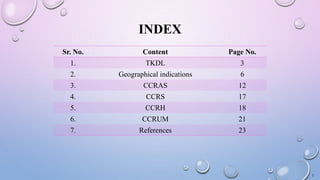
Sr. No. Content Page No.
1. TKDL 3
2. Geographical indications 6
3. CCRAS 12
4. CCRS 17
5. CCRH 18
6. CCRUM 21
7. References 23
2
TKDL
• Traditional Knowledge Digital Library.
• Joint collaboration of CSIR and ministry of AYUSH.
• Established in 2001.
• The information from the ancient texts of medicine and health existing in local
languages such as Sanskrit, Hindi, Arabic, Persian, Urdu, Tamil, Bhoti, etc. have
been digitized in five international languages, namely, English, French, German,
Spanish and Japanese in the TKDL database as prior art.
• It is a bridge between patent officers and traditional knowledge.
• As on date, more than 4.54 lakh formulations/ practices have been transcribed into
the TKDL database.
3
• The main objective of TKDL is to overcome the language barrier to prevent the
traditional knowledge.
• Access of TKDL is available to sixteen patent offices.
• A total of 4,18,885 formulations including 1,19,269 in Ayurveda, 2,36,399 in
Unani, 54,689 in Siddha, 4,151 in Yoga and 4,377 in Sowa Rigpa have been
transcribed so far into the TKDL database (data as on march 25, 2022)
• As on march 25, 2022, 265 patent applications have been either
withdrawn/deemed withdrawn or amended or set aside on the basis of TKDL
evidence thus protecting Indian traditional knowledge
4
NEED OF TKDL ?
1. To prevent traditional knowledge.
2. To overcome the language barrier.
5
Geographical Indication
• Geographical Indication is a name or sign used on certain products which
corresponds to specific geographical location or origin.
• Ex – Darjeeling tea (West Bengal), Tirupathi Laddu, Basmati Rice, Strawberry
(Mahabaleshwar), Sikkim large cardamom (Sikkim).
• Geographical Indication of Goods (Registration And Protection) Act 1999.
• Come into force with effect from 15th September 2003
6
Objectives of GI of Goods Act 1999
• Protect the interest of producers of such good;
• To exclude unauthorized persons from misusing geographical indications and to
protect consumers from deception;
• To promote goods bearing Indian GI in the export market.
Under GI law in India, the right holder can initiate infringement action
against unauthorised use of the registered GI by a third party.
7
8
9
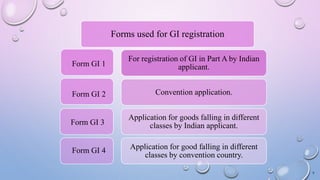
Forms used for GI registration
For registration of GI in Part A by Indian
applicant.
Convention application.
Application for goods falling in different
classes by Indian applicant.
Application for good falling in different
classes by convention country.
Form GI 1
Form GI 2
Form GI 3
Form GI 4
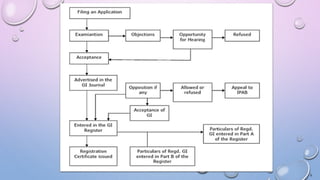
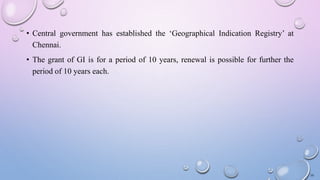
• Central government has established the ‘Geographical Indication Registry’ at
Chennai.
• The grant of GI is for a period of 10 years, renewal is possible for further the
period of 10 years each.
10
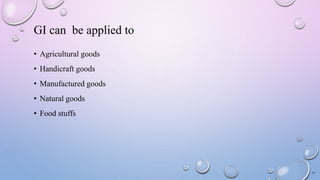
GI can be applied to
• Agricultural goods
• Handicraft goods
• Manufactured goods
• Natural goods
• Food stuffs
11
CCRAS
• Central Council for Research in Ayurvedic Science.
• CCRAS is an autonomous body under Ministry of AYUSH.
• The government of India established Central Council for Research in India
Medicine and Homeopathy in 1969, under the ministry of Health and Family
Welfare.
• In the year 1978, Central Council for Research in Ayurveda and Siddha came into
existence.
• In the year 2011, it further divides into Central Council for Research in Ayurveda
Sciences and Central Council for Research in Siddha
12
VISION
• To develop scientific evidence
• To bring Ayurveda to the people
MISSION
• To aim for AYUSHMAN BHARAT
• To bring up modern scientific
knowledge, technology
• To attain global leadership in research
13
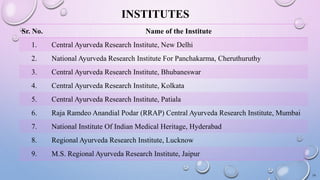
INSTITUTES
Sr. No. Name of the Institute
1. Central Ayurveda Research Institute, New Delhi
2. National Ayurveda Research Institute For Panchakarma, Cheruthuruthy
3. Central Ayurveda Research Institute, Bhubaneswar
4. Central Ayurveda Research Institute, Kolkata
5. Central Ayurveda Research Institute, Patiala
6. Raja Ramdeo Anandial Podar (RRAP) Central Ayurveda Research Institute, Mumbai
7. National Institute Of Indian Medical Heritage, Hyderabad
8. Regional Ayurveda Research Institute, Lucknow
9. M.S. Regional Ayurveda Research Institute, Jaipur
14
15
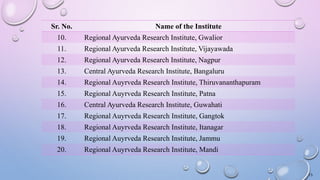
Sr. No. Name of the Institute
10. Regional Ayurveda Research Institute, Gwalior
11. Regional Ayurveda Research Institute, Vijayawada
12. Regional Ayurveda Research Institute, Nagpur
13. Central Ayurveda Research Institute, Bangaluru
14. Regional Auyrveda Research Institute, Thiruvananthapuram
15. Regional Auyrveda Research Institute, Patna
16. Central Ayurveda Research Institute, Guwahati
17. Regional Auyrveda Research Institute, Gangtok
18. Regional Auyrveda Research Institute, Itanagar
19. Regional Auyrveda Research Institute, Jammu
20. Regional Auyrveda Research Institute, Mandi
16
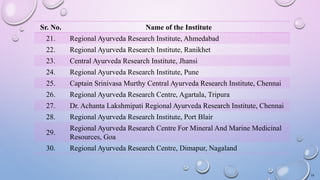
Sr. No. Name of the Institute
21. Regional Ayurveda Research Institute, Ahmedabad
22. Regional Ayurveda Research Institute, Ranikhet
23. Central Ayurveda Research Institute, Jhansi
24. Regional Ayurveda Research Institute, Pune
25. Captain Srinivasa Murthy Central Ayurveda Research Institute, Chennai
26. Regional Ayurveda Research Centre, Agartala, Tripura
27. Dr. Achanta Lakshmipati Regional Ayurveda Research Institute, Chennai
28. Regional Ayurveda Research Institute, Port Blair
29.
Regional Ayurveda Research Centre For Mineral And Marine Medicinal
Resources, Goa
30. Regional Ayurveda Research Centre, Dimapur, Nagaland
CCRS
• Central Council for Research in Siddha.
• Headquarter is in Chennai and eight research institutes/units in six states namely Tamil
Nadu, Puducherry, New Delhi, Kerala and Andra Pradesh.
• 4th January a birthday of Siddhar Agathiyar, the father of siddha medicine, celebrated as
Siddha day.
• It also provide the GCP guidelines.
• The vision of CCRS is preservation and transmission of knowledge and enhancement
of the quality of research for developing drugs with quality, safety and efficacy through
well-established preclinical and clinical research facilities - to prevent/manage/cure the
diseases of varied aetiology.
17
CCRH
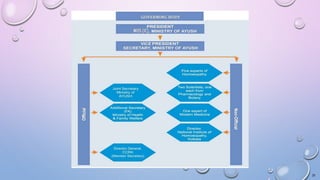
• Central Council for Research in Homoeopathy.
• The headquarters of the council are situated in New Delhi and multi-centric research
is conducted through a network of 26 institutes/units all over India.
• The council was formally constituted on 30th march, 1978, was set up as
an autonomous organization and registered under the societies registration act XXI,
1860.
• Controlled by the ministry of AYUSH.
18
Activities of the council
• Survey, collection and cultivation of medicinal plants
• Drug standardization
• Drug proving
• Clinical verification
• Clinical research
19
20
CCRUM
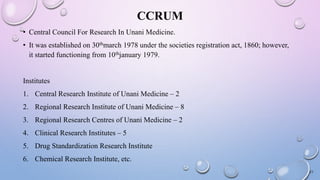
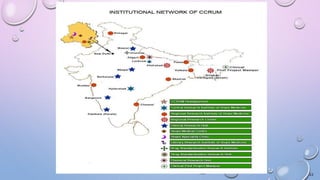
• Central Council For Research In Unani Medicine.
• It was established on 30thmarch 1978 under the societies registration act, 1860; however,
it started functioning from 10thjanuary 1979.
Institutes
1. Central Research Institute of Unani Medicine – 2
2. Regional Research Institute of Unani Medicine – 8
3. Regional Research Centres of Unani Medicine – 2
4. Clinical Research Institutes – 5
5. Drug Standardization Research Institute
6. Chemical Research Institute, etc.
21
22
References
1. https://www.slideshare.net/Vanisree13/geographical-indications-228763626
2. https://www.slideshare.net/parmesharkaur/geographical-indications-ppt-128165928
3. https://www.slideshare.net/SURYAKANTVERMA2/geographical-indications-123290599
4. https://www.slideshare.net/pankaj7379/geographical-indication-233079552
5. https://ssrana.in/ip-laws/geographical-indication-india/
6. https://www.slideshare.net/vishwajeetUpadhye/tkdl-geographical-indicaton-bill-government-bills
7. https://en.wikipedia.org/wiki/Geographical_Indications_of_Goods_(Registration_and_Protection)_Act,_1999
8. http://www.ccras.nic.in/content/about-ccras
9. https://www.lexology.com/library/detail.aspx?g=ae73eed1-d085-40db-9ae5-c687c5e8c613
10. https://www.slideshare.net/ychandra309/ccras
11. https://www.slideshare.net/vkvikramvarma/ccras-central-council-for-reasearch-in-ayurvedic-sciences
12. https://www.ccrhindia.nic.in/index1.aspx?lsid=61&lev=2&lid=59&Regid=0&langid=1
13. https://ccrum.res.in/UserView/index?mid=1415
23

Tkdl-Geographical-indications-CCRAS.pptx

  • 1.
    TKDL, Geographical indications,CCRAS, CCRS, CCRH, CCRUM Vidhi Sunil Jajoo M. Pharm (Pharmacognosy)
  • 2.
    INDEX Sr. No. ContentPage No. 1. TKDL 3 2. Geographical indications 6 3. CCRAS 12 4. CCRS 17 5. CCRH 18 6. CCRUM 21 7. References 23 2
  • 3.
    TKDL • Traditional KnowledgeDigital Library. • Joint collaboration of CSIR and ministry of AYUSH. • Established in 2001. • The information from the ancient texts of medicine and health existing in local languages such as Sanskrit, Hindi, Arabic, Persian, Urdu, Tamil, Bhoti, etc. have been digitized in five international languages, namely, English, French, German, Spanish and Japanese in the TKDL database as prior art. • It is a bridge between patent officers and traditional knowledge. • As on date, more than 4.54 lakh formulations/ practices have been transcribed into the TKDL database. 3
  • 4.
    • The mainobjective of TKDL is to overcome the language barrier to prevent the traditional knowledge. • Access of TKDL is available to sixteen patent offices. • A total of 4,18,885 formulations including 1,19,269 in Ayurveda, 2,36,399 in Unani, 54,689 in Siddha, 4,151 in Yoga and 4,377 in Sowa Rigpa have been transcribed so far into the TKDL database (data as on march 25, 2022) • As on march 25, 2022, 265 patent applications have been either withdrawn/deemed withdrawn or amended or set aside on the basis of TKDL evidence thus protecting Indian traditional knowledge 4
  • 5.
    NEED OF TKDL? 1. To prevent traditional knowledge. 2. To overcome the language barrier. 5
  • 6.
    Geographical Indication • GeographicalIndication is a name or sign used on certain products which corresponds to specific geographical location or origin. • Ex – Darjeeling tea (West Bengal), Tirupathi Laddu, Basmati Rice, Strawberry (Mahabaleshwar), Sikkim large cardamom (Sikkim). • Geographical Indication of Goods (Registration And Protection) Act 1999. • Come into force with effect from 15th September 2003 6
  • 7.
    Objectives of GIof Goods Act 1999 • Protect the interest of producers of such good; • To exclude unauthorized persons from misusing geographical indications and to protect consumers from deception; • To promote goods bearing Indian GI in the export market. Under GI law in India, the right holder can initiate infringement action against unauthorised use of the registered GI by a third party. 7
  • 8.
  • 9.
    9 Forms used forGI registration For registration of GI in Part A by Indian applicant. Convention application. Application for goods falling in different classes by Indian applicant. Application for good falling in different classes by convention country. Form GI 1 Form GI 2 Form GI 3 Form GI 4
  • 10.
    • Central governmenthas established the ‘Geographical Indication Registry’ at Chennai. • The grant of GI is for a period of 10 years, renewal is possible for further the period of 10 years each. 10
  • 11.
    GI can beapplied to • Agricultural goods • Handicraft goods • Manufactured goods • Natural goods • Food stuffs 11
  • 12.
    CCRAS • Central Councilfor Research in Ayurvedic Science. • CCRAS is an autonomous body under Ministry of AYUSH. • The government of India established Central Council for Research in India Medicine and Homeopathy in 1969, under the ministry of Health and Family Welfare. • In the year 1978, Central Council for Research in Ayurveda and Siddha came into existence. • In the year 2011, it further divides into Central Council for Research in Ayurveda Sciences and Central Council for Research in Siddha 12
  • 13.
    VISION • To developscientific evidence • To bring Ayurveda to the people MISSION • To aim for AYUSHMAN BHARAT • To bring up modern scientific knowledge, technology • To attain global leadership in research 13
  • 14.
    INSTITUTES Sr. No. Nameof the Institute 1. Central Ayurveda Research Institute, New Delhi 2. National Ayurveda Research Institute For Panchakarma, Cheruthuruthy 3. Central Ayurveda Research Institute, Bhubaneswar 4. Central Ayurveda Research Institute, Kolkata 5. Central Ayurveda Research Institute, Patiala 6. Raja Ramdeo Anandial Podar (RRAP) Central Ayurveda Research Institute, Mumbai 7. National Institute Of Indian Medical Heritage, Hyderabad 8. Regional Ayurveda Research Institute, Lucknow 9. M.S. Regional Ayurveda Research Institute, Jaipur 14
  • 15.
    15 Sr. No. Nameof the Institute 10. Regional Ayurveda Research Institute, Gwalior 11. Regional Ayurveda Research Institute, Vijayawada 12. Regional Ayurveda Research Institute, Nagpur 13. Central Ayurveda Research Institute, Bangaluru 14. Regional Auyrveda Research Institute, Thiruvananthapuram 15. Regional Auyrveda Research Institute, Patna 16. Central Ayurveda Research Institute, Guwahati 17. Regional Auyrveda Research Institute, Gangtok 18. Regional Auyrveda Research Institute, Itanagar 19. Regional Auyrveda Research Institute, Jammu 20. Regional Auyrveda Research Institute, Mandi
  • 16.
    16 Sr. No. Nameof the Institute 21. Regional Ayurveda Research Institute, Ahmedabad 22. Regional Ayurveda Research Institute, Ranikhet 23. Central Ayurveda Research Institute, Jhansi 24. Regional Ayurveda Research Institute, Pune 25. Captain Srinivasa Murthy Central Ayurveda Research Institute, Chennai 26. Regional Ayurveda Research Centre, Agartala, Tripura 27. Dr. Achanta Lakshmipati Regional Ayurveda Research Institute, Chennai 28. Regional Ayurveda Research Institute, Port Blair 29. Regional Ayurveda Research Centre For Mineral And Marine Medicinal Resources, Goa 30. Regional Ayurveda Research Centre, Dimapur, Nagaland
  • 17.
    CCRS • Central Councilfor Research in Siddha. • Headquarter is in Chennai and eight research institutes/units in six states namely Tamil Nadu, Puducherry, New Delhi, Kerala and Andra Pradesh. • 4th January a birthday of Siddhar Agathiyar, the father of siddha medicine, celebrated as Siddha day. • It also provide the GCP guidelines. • The vision of CCRS is preservation and transmission of knowledge and enhancement of the quality of research for developing drugs with quality, safety and efficacy through well-established preclinical and clinical research facilities - to prevent/manage/cure the diseases of varied aetiology. 17
  • 18.
    CCRH • Central Councilfor Research in Homoeopathy. • The headquarters of the council are situated in New Delhi and multi-centric research is conducted through a network of 26 institutes/units all over India. • The council was formally constituted on 30th march, 1978, was set up as an autonomous organization and registered under the societies registration act XXI, 1860. • Controlled by the ministry of AYUSH. 18
  • 19.
    Activities of thecouncil • Survey, collection and cultivation of medicinal plants • Drug standardization • Drug proving • Clinical verification • Clinical research 19
  • 20.
  • 21.
    CCRUM • Central CouncilFor Research In Unani Medicine. • It was established on 30thmarch 1978 under the societies registration act, 1860; however, it started functioning from 10thjanuary 1979. Institutes 1. Central Research Institute of Unani Medicine – 2 2. Regional Research Institute of Unani Medicine – 8 3. Regional Research Centres of Unani Medicine – 2 4. Clinical Research Institutes – 5 5. Drug Standardization Research Institute 6. Chemical Research Institute, etc. 21
  • 22.
  • 23.
    References 1. https://www.slideshare.net/Vanisree13/geographical-indications-228763626 2. https://www.slideshare.net/parmesharkaur/geographical-indications-ppt-128165928 3.https://www.slideshare.net/SURYAKANTVERMA2/geographical-indications-123290599 4. https://www.slideshare.net/pankaj7379/geographical-indication-233079552 5. https://ssrana.in/ip-laws/geographical-indication-india/ 6. https://www.slideshare.net/vishwajeetUpadhye/tkdl-geographical-indicaton-bill-government-bills 7. https://en.wikipedia.org/wiki/Geographical_Indications_of_Goods_(Registration_and_Protection)_Act,_1999 8. http://www.ccras.nic.in/content/about-ccras 9. https://www.lexology.com/library/detail.aspx?g=ae73eed1-d085-40db-9ae5-c687c5e8c613 10. https://www.slideshare.net/ychandra309/ccras 11. https://www.slideshare.net/vkvikramvarma/ccras-central-council-for-reasearch-in-ayurvedic-sciences 12. https://www.ccrhindia.nic.in/index1.aspx?lsid=61&lev=2&lid=59&Regid=0&langid=1 13. https://ccrum.res.in/UserView/index?mid=1415 23