Permit Holder & Work Party Training
Wellsite Permit to Work
Revision 2
Session Format
Then a theory assessment
Presentation is in 3 Parts
• Acknowledgments
• Purpose
• Scope
• Definitions
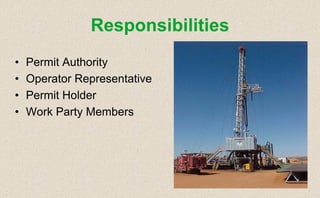
• Responsibilities
• Objectives of the Permit System
Part 1
Acknowledgments
What companies developed Revision 2 of the
Wellsite Permit to Work?
• Santos Ltd
• Origin Energy
• Century Resources Ltd
• Ensign
• Eastern Well Service
• Expro
• Diversified
• Arc Energy
• Beach
• Mitchell
• Expertest
Some of the companies who assisted in the
development of Wellsite Permit to Work System
Rev 2
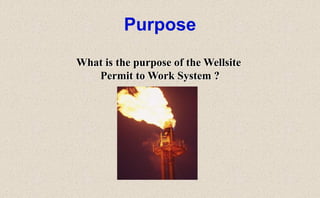
Purpose
What is the purpose of the Wellsite
Permit to Work System ?
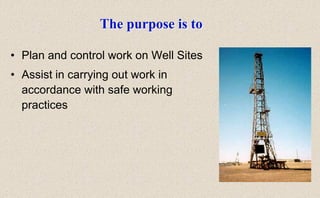
• Plan and control work on Well Sites
• Assist in carrying out work in
accordance with safe working
practices
The purpose is to
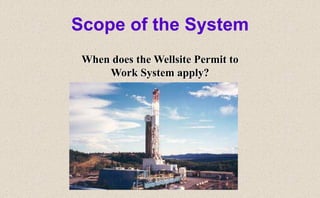
Scope of the System
When does the Wellsite Permit to
Work System apply?
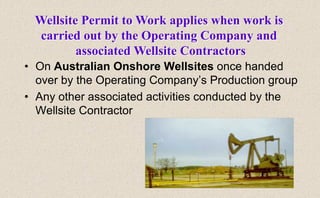
• On Australian Onshore Wellsites once handed
over by the Operating Company’s Production group
• Any other associated activities conducted by the
Wellsite Contractor
Wellsite Permit to Work applies when work is
carried out by the Operating Company and
associated Wellsite Contractors
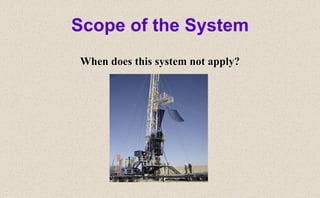
Scope of the System
When does this system not apply?
• The Operating Company’s Permit to Work
Procedures are applicable and/or takes
precedence.
• Seismic operations are conducted that do not
impact on other operations or installations.
• When construction activities take place in a
fenced off area separate from producing plant
and free of hydrocarbons.
This system does NOT apply when
Wellsite Permit to Work
Sets out the work to be done, the precautions to be taken and specifies
all work conditions
Wellsite Permit Authority
The person authorized to issue Wellsite Permits to Work
Operator Representative
Represents the Operating Company responsible for the Wellsite work
Wellsite Permit Holder
The person who receives the Wellsite Permit to Work
Wellsite Work Party
The people whose work is covered by the Wellsite Permit to Work
Definitions
• Permit Authority
• Operator Representative
• Permit Holder
• Work Party Members
Responsibilities
What are the responsibilities of a
Permit Authority?
• Issues permits
• Shares responsibility with the Permit Holder
for defining scope of work in Section A
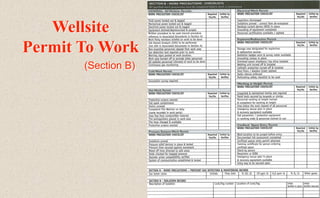
• Defines in Section B the Precautions to be
completed for the work to be performed
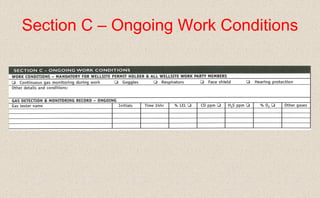
• Defines in Section C the ongoing Work
Conditions with the Permit Holder
Permit Authority
• Ensure the Permit Holder and the
Work Party understand the Permit
to Work Conditions
• Monitor the work carried out by
the Work Party
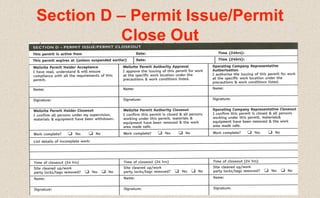
• Complete Section D to issue and
close out Permits
Permit Authority
What are the responsibilities of an
Operator Representative?
• Must ensure that all responsibilities of the Permit
Authority and Permit Holder have been satisfied and the
Permit to Work activities do not impinge on other
activities
• Must be satisfied that Wellsite contractors have
appropriate procedures, JHA’s conducted and personnel
appropriately trained
• Where an Operator Representative has not been
assigned to a Wellsite activity, the Permit Authority must
be briefed by the Operating Company’s Supervisor on
requirements pertaining to Wellsite Permits to Work
Operator Representative
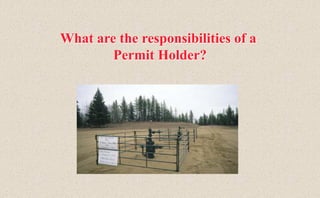
What are the responsibilities of a
Permit Holder?
• Shares responsibility with the Permit Authority
for completing the scope of work in Section A
of the Permit
• Ensures the Work Party understands all the
Permit Precautions and Work Conditions
• With the Permit Authority completes Section D
to accept and close out Permits
• Satisfy themselves that all Work Precautions
are carried out in Section B of the Permit
Permit Holder
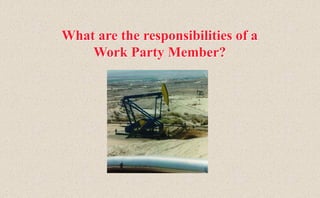
What are the responsibilities of a
Work Party Member?
• Must understand the scope and
conditions of the Permit to Work,
sign that they understand and then
abide by them
• If in doubt, stop work and ask
Work Party Member
Objectives of the System
What are the objectives of
the System?
• People, environment, equipment & product are protected
• Safe working practices are followed whilst work is being
carried out
• The work site is inspected and necessary precautions have
been considered and implemented before work
commences
• Work is only performed on specified equipment
• Location of people and type of work being carried out is
always known should an emergency occur
• Persons carrying out work understand the conditions unde
which work may be carried out
Objectives of the System
• Equipment to be worked on has been correctly prepared
for the work to be carried out
• Correct protective measures are available and are being
used
• Work being done is carefully monitored
• The work site is left in a clean and safe condition upon
completion of the work
• The details of non-completed work are documented and
communicated to the Permit Authority and Operator
Representative as appropriate
• Equipment left unserviceable is correctly tagged and
identified to incoming shifts
Objectives of the System
End of Part 1
• Number of Permit Authorities for a Wellsite
• Permit Holder Qualifications
• Different categories of Permits
• Work not requiring a Permit
Part 2
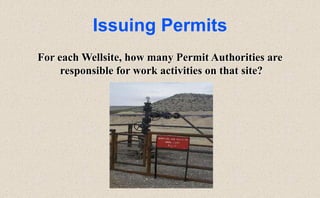
Issuing Permits
For each Wellsite, how many Permit Authorities are
responsible for work activities on that site?
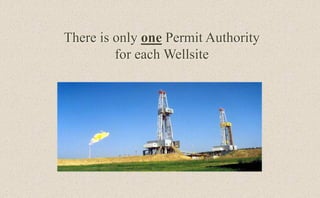
There is only one Permit Authority
for each Wellsite
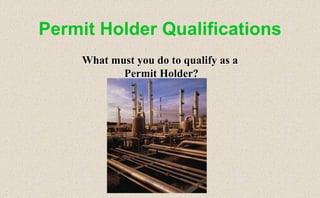
Permit Holder Qualifications
What must you do to qualify as a
Permit Holder?
• Attend both Operating Company and contractor
safety induction sessions
• Participate in the Permit Holder and Work Party
Training Session
• Demonstrate an understanding of the Permit
Holder responsibilities
• Demonstrate an understanding of site specific
regulations
• Demonstrate an understanding of the JHA
system
Permit Holder Qualifications
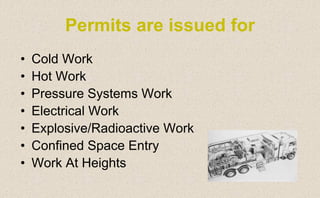
• Cold Work
• Hot Work
• Pressure Systems Work
• Electrical Work
• Explosive/Radioactive Work
• Confined Space Entry
• Work At Heights
Permits are issued for
Cold Work Permit
When would a Cold Work Permit
be required?
Cold Work Permits
Are required for work that is non-standard or
non-routine and is not covered by any other
Wellsite Permit Category
• One off activity that has the potential to injure personnel
or damage equipment
• Any activity that personnel are not familiar with
• Where a JHA does not exist or has not been performed
• Any deviation or modification to existing procedures or
a JHA
What is non-standard or non-routine? It is work that has a
health and safely risk and is not regularly performed. Examples
of such work are
• Isolation, override or disablement of standard safety
systems
• Non-standard operations or maintenance of
equipment or plant
• Any work at heights, not currently covered by an
approved SOP
And further examples of non-standard,
non routine work include
• Scaffold erection on a Wellsite or camp site
• Work in unguarded/unprotected areas
• Work with chemicals for which personnel are
unfamiliar
• Inspection or non-destructive testing of equipment or
plant during normal operations
And Finally
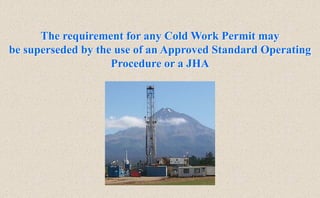
The requirement for any Cold Work Permit may
be superseded by the use of an Approved Standard Operating
Procedure or a JHA
Excavations
I need to dig a hole, or pound in a stake, who do I see?
See the Permit Authority who will decide
if a Permit is required
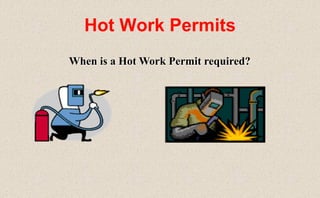
Hot Work Permits
When is a Hot Work Permit required?
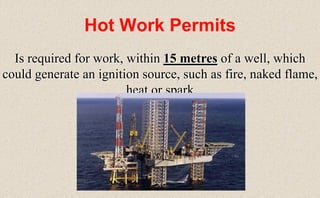
Hot Work Permits
Is required for work, within 15 metres of a well, which
could generate an ignition source, such as fire, naked flame,
heat or spark
• Welding, soldering
• Burning, flame cutting, flame heating
• Grinding
• Use of electrical hand tools, power driven cutters, or
running internal combustion engines, such as found in
forklifts and portable pumps with diesel or petrol engines
that are not fitted with approved devices for use on a
wellsite
• Lighting fires of any kind
Examples of Hot Work
• Use of non-intrinsically safe electrical devices
• Use of cameras containing batteries
• Transfer of diesel or crude oil to or from road
tankers
• Potential to generate static electricity
Examples of Hot Work
Pressure System Work Permit
When is a Pressure System Work Permit required?
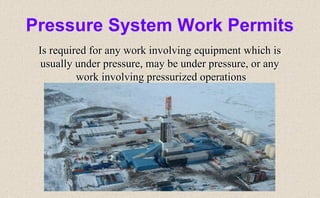
Pressure System Work Permits
Is required for any work involving equipment which is
usually under pressure, may be under pressure, or any
work involving pressurized operations
• Any pressure tests
• Leak off and formation integrity tests
• Work on an accumulator unit and any associated
pressure lines or pressure equipment
• Work on blow out preventers and any associated
pressure lines or pressure equipment
Includes
• Fracture or Acid stimulations
• Chemical injection into wellheads for inhibition
• Work on pumps and any associated pressure lines
• Work on any hydraulic systems
• Work on any air pressure systems
Further includes
Electrical Work Permit
When is an Electrical Work Permit required?
Electrical Work Permits
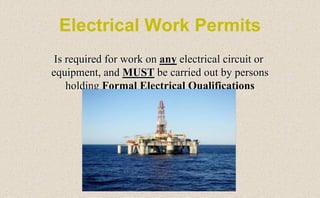
Is required for work on any electrical circuit or
equipment, and MUST be carried out by persons
holding Formal Electrical Qualifications
• Work on generators
• Work on electrical panels
• Work on SCR units (Silicon Controlled Rectifiers used
to power some drilling rigs)
• Work on electric monitors
• Work on electrical circuits which are not in electrical
sub-stations, and includes repair, maintenance or
connection
Includes
Explosive/Radioactive Permit
When is an Explosive/Radioactive
Work Permit required?
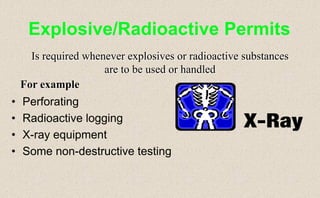
• Perforating
• Radioactive logging
• X-ray equipment
• Some non-destructive testing
Explosive/Radioactive Permits
Is required whenever explosives or radioactive substances
are to be used or handled
For example
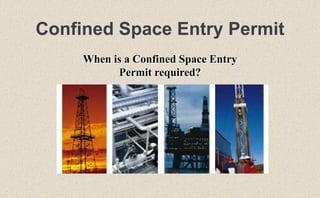
Confined Space Entry Permit
When is a Confined Space Entry
Permit required?
A Confined Space is:
• Is not intended or designed primarily as a place of work
• May have restricted means of entry and exit
• May have inadequate ventilation and/or atmosphere
which is either contaminated or oxygen deficient
• Is at atmospheric pressure during occupancy
Confined Space Entry Permit
‘Is required whenever a person’s upper
body or head enters into a confined space’.
Confined Space Entry Permit
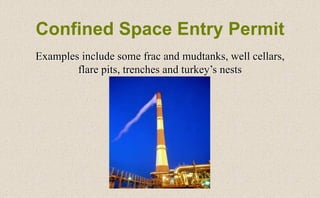
Examples include some frac and mudtanks, well cellars,
flare pits, trenches and turkey’s nests
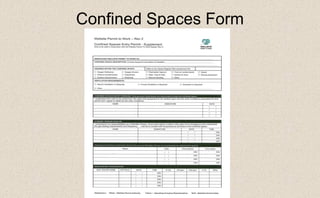
Confined Spaces Form
Work not requiring a Permit
Can work be performed without a Permit?
• Routine operations (work that is regularly performed and
has no particular health or safety risk)
• Minor maintenance work carried out by trained competent
personnel as agreed with the Permit Authority provided an
appropriate Risk Hazard Analysis (such as JHA or
Stepback) has been performed
• Initiating of an Emergency Response and only as directed
by the Permit Authority or Operator Representative
Permits are not required for
• Hot work carried out in an approved maintenance
workshop
• Cold or hot work carried out in camp area provided that an
appropriate JHA or Stepback has been performed
• Routine rig up or rig down of third party equipment if
approved procedures are followed and not specifically
covered by some other permit
• Surveillance activities performed at a wellsite once the
well has been handed over via an approved well handover
procedure
Permits are not required for
(Continued)
End of Part 2
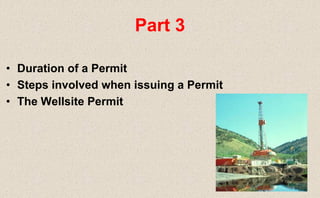
• Duration of a Permit
• Steps involved when issuing a Permit
• The Wellsite Permit
Part 3
Permit Duration
How long can a Permit last?
• End of a Work Party’s shift
• The nominated expiry time on the Permit
• Work is suspended, or delayed due to shift change
• The Permit Holder is no longer available
• The sounding of an emergency alarm
• Cancelled by the Permit Authority
• Cancelled by the Operator Representative
• Work is completed
Permits remain valid until
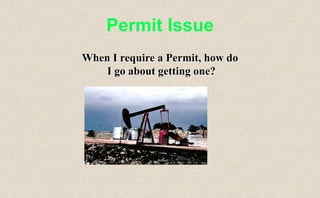
Permit Issue
When I require a Permit, how do
I go about getting one?
• Firstly, notify the Permit Authority
• Secondly, a site inspection and safety briefing
may be required
• Thirdly, the Permit is prepared
Permit Issue
Flow Chart/Decision Tree
Acrobat Document
Wellsite
Permit To Work Form
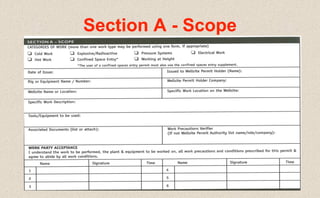
Section A - Scope
Section D – Permit Issue/Permit
Close Out
Section C – Ongoing Work Conditions
Wellsite
Permit To Work
(Section B)
Fire Watcher
I need a Fire Watcher for a
job and have a person in mind.
What must they know?
• Must be familiar with the job being done
• Must be alert for any fire outbreak and take
immediate action
• Does not allow other work not specified by the
Permit to proceed
• Have fire extinguishers/fire hoses ready, and be
trained to use them
Fire Watcher
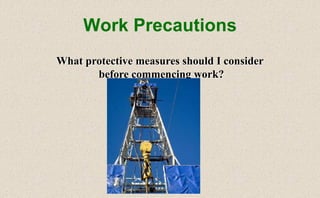
Work Precautions
What protective measures should I consider
before commencing work?
Locks and Danger Tags
I will be putting my hands on to equipment
that needs repairing. Can I lock out that
equipment and tag it?
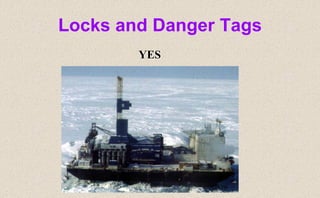
Locks and Danger Tags
YES
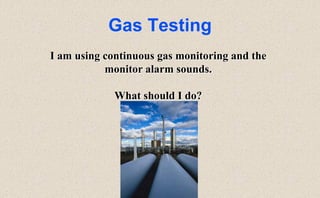
Gas Testing
I am using continuous gas monitoring and the
monitor alarm sounds.
What should I do?
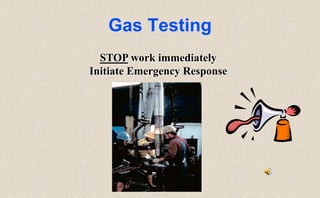
Gas Testing
STOP work immediately
Initiate Emergency Response
Vehicle Entry
I need to drive my vehicle within 15 metres from the
wellhead.
Before doing so, who do I need to see?
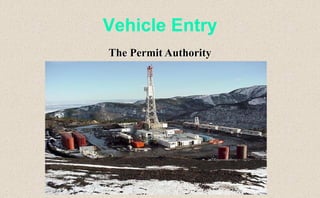
Vehicle Entry
The Permit Authority
The End

004 Wellsite Permit to Work Training Rev 2.pdf

  • 1.
    Permit Holder &Work Party Training Wellsite Permit to Work Revision 2
  • 2.
    Session Format Then atheory assessment Presentation is in 3 Parts
  • 3.
    • Acknowledgments • Purpose •Scope • Definitions • Responsibilities • Objectives of the Permit System Part 1
  • 4.
    Acknowledgments What companies developedRevision 2 of the Wellsite Permit to Work?
  • 5.
    • Santos Ltd •Origin Energy • Century Resources Ltd • Ensign • Eastern Well Service • Expro • Diversified • Arc Energy • Beach • Mitchell • Expertest Some of the companies who assisted in the development of Wellsite Permit to Work System Rev 2
  • 6.
    Purpose What is thepurpose of the Wellsite Permit to Work System ?
  • 7.
    • Plan andcontrol work on Well Sites • Assist in carrying out work in accordance with safe working practices The purpose is to
  • 8.
    Scope of theSystem When does the Wellsite Permit to Work System apply?
  • 9.
    • On AustralianOnshore Wellsites once handed over by the Operating Company’s Production group • Any other associated activities conducted by the Wellsite Contractor Wellsite Permit to Work applies when work is carried out by the Operating Company and associated Wellsite Contractors
  • 10.
    Scope of theSystem When does this system not apply?
  • 11.
    • The OperatingCompany’s Permit to Work Procedures are applicable and/or takes precedence. • Seismic operations are conducted that do not impact on other operations or installations. • When construction activities take place in a fenced off area separate from producing plant and free of hydrocarbons. This system does NOT apply when
  • 12.
    Wellsite Permit toWork Sets out the work to be done, the precautions to be taken and specifies all work conditions Wellsite Permit Authority The person authorized to issue Wellsite Permits to Work Operator Representative Represents the Operating Company responsible for the Wellsite work Wellsite Permit Holder The person who receives the Wellsite Permit to Work Wellsite Work Party The people whose work is covered by the Wellsite Permit to Work Definitions
  • 13.
    • Permit Authority •Operator Representative • Permit Holder • Work Party Members Responsibilities
  • 14.
    What are theresponsibilities of a Permit Authority?
  • 15.
    • Issues permits •Shares responsibility with the Permit Holder for defining scope of work in Section A • Defines in Section B the Precautions to be completed for the work to be performed • Defines in Section C the ongoing Work Conditions with the Permit Holder Permit Authority
  • 16.
    • Ensure thePermit Holder and the Work Party understand the Permit to Work Conditions • Monitor the work carried out by the Work Party • Complete Section D to issue and close out Permits Permit Authority
  • 17.
    What are theresponsibilities of an Operator Representative?
  • 18.
    • Must ensurethat all responsibilities of the Permit Authority and Permit Holder have been satisfied and the Permit to Work activities do not impinge on other activities • Must be satisfied that Wellsite contractors have appropriate procedures, JHA’s conducted and personnel appropriately trained • Where an Operator Representative has not been assigned to a Wellsite activity, the Permit Authority must be briefed by the Operating Company’s Supervisor on requirements pertaining to Wellsite Permits to Work Operator Representative
  • 19.
    What are theresponsibilities of a Permit Holder?
  • 20.
    • Shares responsibilitywith the Permit Authority for completing the scope of work in Section A of the Permit • Ensures the Work Party understands all the Permit Precautions and Work Conditions • With the Permit Authority completes Section D to accept and close out Permits • Satisfy themselves that all Work Precautions are carried out in Section B of the Permit Permit Holder
  • 21.
    What are theresponsibilities of a Work Party Member?
  • 22.
    • Must understandthe scope and conditions of the Permit to Work, sign that they understand and then abide by them • If in doubt, stop work and ask Work Party Member
  • 23.
    Objectives of theSystem What are the objectives of the System?
  • 24.
    • People, environment,equipment & product are protected • Safe working practices are followed whilst work is being carried out • The work site is inspected and necessary precautions have been considered and implemented before work commences • Work is only performed on specified equipment • Location of people and type of work being carried out is always known should an emergency occur • Persons carrying out work understand the conditions unde which work may be carried out Objectives of the System
  • 25.
    • Equipment tobe worked on has been correctly prepared for the work to be carried out • Correct protective measures are available and are being used • Work being done is carefully monitored • The work site is left in a clean and safe condition upon completion of the work • The details of non-completed work are documented and communicated to the Permit Authority and Operator Representative as appropriate • Equipment left unserviceable is correctly tagged and identified to incoming shifts Objectives of the System
  • 26.
  • 27.
    • Number ofPermit Authorities for a Wellsite • Permit Holder Qualifications • Different categories of Permits • Work not requiring a Permit Part 2
  • 28.
    Issuing Permits For eachWellsite, how many Permit Authorities are responsible for work activities on that site?
  • 29.
    There is onlyone Permit Authority for each Wellsite
  • 30.
    Permit Holder Qualifications Whatmust you do to qualify as a Permit Holder?
  • 31.
    • Attend bothOperating Company and contractor safety induction sessions • Participate in the Permit Holder and Work Party Training Session • Demonstrate an understanding of the Permit Holder responsibilities • Demonstrate an understanding of site specific regulations • Demonstrate an understanding of the JHA system Permit Holder Qualifications
  • 32.
    • Cold Work •Hot Work • Pressure Systems Work • Electrical Work • Explosive/Radioactive Work • Confined Space Entry • Work At Heights Permits are issued for
  • 33.
    Cold Work Permit Whenwould a Cold Work Permit be required?
  • 34.
    Cold Work Permits Arerequired for work that is non-standard or non-routine and is not covered by any other Wellsite Permit Category
  • 35.
    • One offactivity that has the potential to injure personnel or damage equipment • Any activity that personnel are not familiar with • Where a JHA does not exist or has not been performed • Any deviation or modification to existing procedures or a JHA What is non-standard or non-routine? It is work that has a health and safely risk and is not regularly performed. Examples of such work are
  • 36.
    • Isolation, overrideor disablement of standard safety systems • Non-standard operations or maintenance of equipment or plant • Any work at heights, not currently covered by an approved SOP And further examples of non-standard, non routine work include
  • 37.
    • Scaffold erectionon a Wellsite or camp site • Work in unguarded/unprotected areas • Work with chemicals for which personnel are unfamiliar • Inspection or non-destructive testing of equipment or plant during normal operations And Finally
  • 38.
    The requirement forany Cold Work Permit may be superseded by the use of an Approved Standard Operating Procedure or a JHA
  • 39.
    Excavations I need todig a hole, or pound in a stake, who do I see?
  • 40.
    See the PermitAuthority who will decide if a Permit is required
  • 41.
    Hot Work Permits Whenis a Hot Work Permit required?
  • 42.
    Hot Work Permits Isrequired for work, within 15 metres of a well, which could generate an ignition source, such as fire, naked flame, heat or spark
  • 43.
    • Welding, soldering •Burning, flame cutting, flame heating • Grinding • Use of electrical hand tools, power driven cutters, or running internal combustion engines, such as found in forklifts and portable pumps with diesel or petrol engines that are not fitted with approved devices for use on a wellsite • Lighting fires of any kind Examples of Hot Work
  • 44.
    • Use ofnon-intrinsically safe electrical devices • Use of cameras containing batteries • Transfer of diesel or crude oil to or from road tankers • Potential to generate static electricity Examples of Hot Work
  • 45.
    Pressure System WorkPermit When is a Pressure System Work Permit required?
  • 46.
    Pressure System WorkPermits Is required for any work involving equipment which is usually under pressure, may be under pressure, or any work involving pressurized operations
  • 47.
    • Any pressuretests • Leak off and formation integrity tests • Work on an accumulator unit and any associated pressure lines or pressure equipment • Work on blow out preventers and any associated pressure lines or pressure equipment Includes
  • 48.
    • Fracture orAcid stimulations • Chemical injection into wellheads for inhibition • Work on pumps and any associated pressure lines • Work on any hydraulic systems • Work on any air pressure systems Further includes
  • 49.
    Electrical Work Permit Whenis an Electrical Work Permit required?
  • 50.
    Electrical Work Permits Isrequired for work on any electrical circuit or equipment, and MUST be carried out by persons holding Formal Electrical Qualifications
  • 51.
    • Work ongenerators • Work on electrical panels • Work on SCR units (Silicon Controlled Rectifiers used to power some drilling rigs) • Work on electric monitors • Work on electrical circuits which are not in electrical sub-stations, and includes repair, maintenance or connection Includes
  • 52.
    Explosive/Radioactive Permit When isan Explosive/Radioactive Work Permit required?
  • 53.
    • Perforating • Radioactivelogging • X-ray equipment • Some non-destructive testing Explosive/Radioactive Permits Is required whenever explosives or radioactive substances are to be used or handled For example
  • 54.
    Confined Space EntryPermit When is a Confined Space Entry Permit required?
  • 55.
    A Confined Spaceis: • Is not intended or designed primarily as a place of work • May have restricted means of entry and exit • May have inadequate ventilation and/or atmosphere which is either contaminated or oxygen deficient • Is at atmospheric pressure during occupancy Confined Space Entry Permit ‘Is required whenever a person’s upper body or head enters into a confined space’.
  • 56.
    Confined Space EntryPermit Examples include some frac and mudtanks, well cellars, flare pits, trenches and turkey’s nests
  • 57.
  • 58.
    Work not requiringa Permit Can work be performed without a Permit?
  • 59.
    • Routine operations(work that is regularly performed and has no particular health or safety risk) • Minor maintenance work carried out by trained competent personnel as agreed with the Permit Authority provided an appropriate Risk Hazard Analysis (such as JHA or Stepback) has been performed • Initiating of an Emergency Response and only as directed by the Permit Authority or Operator Representative Permits are not required for
  • 60.
    • Hot workcarried out in an approved maintenance workshop • Cold or hot work carried out in camp area provided that an appropriate JHA or Stepback has been performed • Routine rig up or rig down of third party equipment if approved procedures are followed and not specifically covered by some other permit • Surveillance activities performed at a wellsite once the well has been handed over via an approved well handover procedure Permits are not required for (Continued)
  • 61.
  • 63.
    • Duration ofa Permit • Steps involved when issuing a Permit • The Wellsite Permit Part 3
  • 64.
    Permit Duration How longcan a Permit last?
  • 65.
    • End ofa Work Party’s shift • The nominated expiry time on the Permit • Work is suspended, or delayed due to shift change • The Permit Holder is no longer available • The sounding of an emergency alarm • Cancelled by the Permit Authority • Cancelled by the Operator Representative • Work is completed Permits remain valid until
  • 66.
    Permit Issue When Irequire a Permit, how do I go about getting one?
  • 67.
    • Firstly, notifythe Permit Authority • Secondly, a site inspection and safety briefing may be required • Thirdly, the Permit is prepared Permit Issue
  • 68.
  • 69.
  • 70.
  • 71.
    Section D –Permit Issue/Permit Close Out
  • 72.
    Section C –Ongoing Work Conditions
  • 73.
  • 74.
    Fire Watcher I needa Fire Watcher for a job and have a person in mind. What must they know?
  • 75.
    • Must befamiliar with the job being done • Must be alert for any fire outbreak and take immediate action • Does not allow other work not specified by the Permit to proceed • Have fire extinguishers/fire hoses ready, and be trained to use them Fire Watcher
  • 76.
    Work Precautions What protectivemeasures should I consider before commencing work?
  • 77.
    Locks and DangerTags I will be putting my hands on to equipment that needs repairing. Can I lock out that equipment and tag it?
  • 78.
  • 79.
    Gas Testing I amusing continuous gas monitoring and the monitor alarm sounds. What should I do?
  • 80.
    Gas Testing STOP workimmediately Initiate Emergency Response
  • 81.
    Vehicle Entry I needto drive my vehicle within 15 metres from the wellhead. Before doing so, who do I need to see?
  • 82.
  • 83.