
Urban Water Sustainability Leadership Conference
               October 17, 2012
The U.S. Water Alliance has met the standards
    and requirements of the Registered Continuing
    Education Program. Credit earned on
    completion of this program will be reported to
    RCEP at RCEP.net. A certificate of completion
    will be issued to each participant. As such, it
    does not include content that may be deemed
    or construed to be an approval or endorsement
    by RCEP.


2
Purpose
To promote the national dialogue on resource recovery and
green infrastructure


        Conference Learning Objectives
         At the end of this presentation you will be able to:
•   Define the range of benefits of green infrastructure practices

•   Identify barriers and costs to implementation of these practices

•   Evaluate options and opportunities for funding, financing, and valuing green
    infrastructure

•   Develop practical actions that government, communities, and others can
    implement to promote adoption of green infrastructure solutions
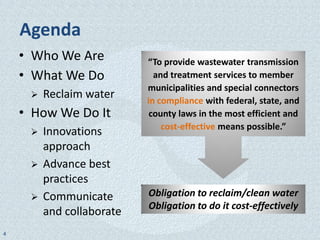
Agenda
    • Who We Are           “To provide wastewater transmission
    • What We Do             and treatment services to member
                           municipalities and special connectors
        Reclaim water     in compliance with federal, state, and
    • How We Do It          county laws in the most efficient and
                               cost-effective means possible.”
        Innovations
         approach
        Advance best
         practices
        Communicate       Obligation to reclaim/clean water
                           Obligation to do it cost-effectively
         and collaborate
4
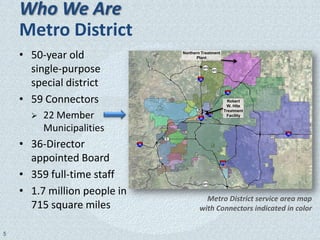
Who We Are
    Metro District
    • 50-year old             Northern Treatment
                                     Plant


      single-purpose
      special district
    • 59 Connectors                                  Robert
                                                    W. Hite
                                                   Treatment
         22 Member                                 Facility


          Municipalities
    • 36-Director
      appointed Board
    • 359 full-time staff
    • 1.7 million people in
                                        Metro District service area map
      715 square miles                with Connectors indicated in color


5
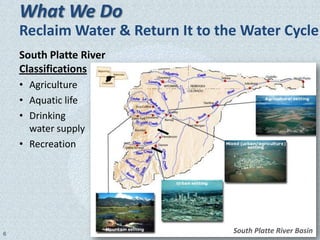
What We Do
    Reclaim Water & Return It to the Water Cycle
    South Platte River
    Classifications
    • Agriculture
    • Aquatic life
    • Drinking
      water supply
    • Recreation


6                                  South Platte River Basin
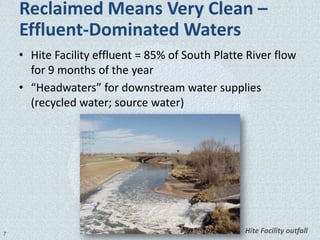
Reclaimed Means Very Clean –
    Effluent-Dominated Waters
    • Hite Facility effluent = 85% of South Platte River flow
      for 9 months of the year
    • “Headwaters” for downstream water supplies
      (recycled water; source water)


7                                                 Hite Facility outfall
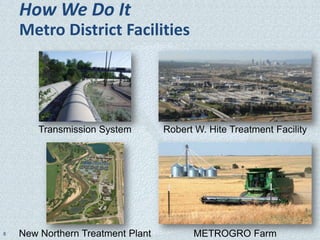
How We Do It
    Metro District Facilities


        Transmission System        Robert W. Hite Treatment Facility


8   New Northern Treatment Plant         METROGRO Farm
Facilities


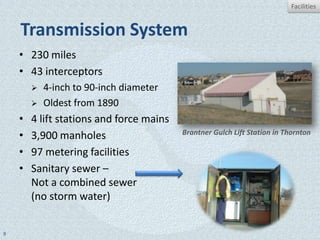
    Transmission System
    • 230 miles
    • 43 interceptors
           4-inch to 90-inch diameter
           Oldest from 1890
    •   4 lift stations and force mains
    •   3,900 manholes                    Brantner Gulch Lift Station in Thornton

    •   97 metering facilities
    •   Sanitary sewer –
        Not a combined sewer
        (no storm water)


9
Facilities


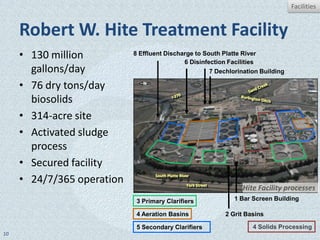
     Robert W. Hite Treatment Facility
     • 130 million          8 Effluent Discharge to South Platte River
                                             6 Disinfection Facilities
       gallons/day                                    7 Dechlorination Building

     • 76 dry tons/day         N


       biosolids
     • 314-acre site
     • Activated sludge
       process
     • Secured facility
     • 24/7/365 operation          South Platte River

                                                   York Street
                                                                      Hite Facility processes
                             3 Primary Clarifiers                   1 Bar Screen Building

                             4 Aeration Basins                   2 Grit Basins

                             5 Secondary Clarifiers                       4 Solids Processing
10
Facilities


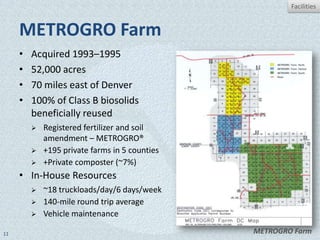
     METROGRO Farm
     •   Acquired 1993–1995
     •   52,000 acres
     •   70 miles east of Denver
     •   100% of Class B biosolids
         beneficially reused
            Registered fertilizer and soil
             amendment – METROGRO®
            +195 private farms in 5 counties
            +Private composter (~7%)
     • In-House Resources
            ~18 truckloads/day/6 days/week
            140-mile round trip average
            Vehicle maintenance

11                                              METROGRO Farm
Facilities


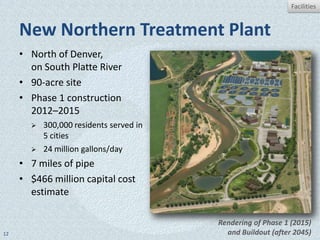
     New Northern Treatment Plant
     • North of Denver,
       on South Platte River
     • 90-acre site
     • Phase 1 construction
       2012–2015
          300,000 residents served in
           5 cities
          24 million gallons/day
     • 7 miles of pipe
     • $466 million capital cost
       estimate

                                         Rendering of Phase 1 (2015)
12                                         and Buildout (after 2045)
Approach


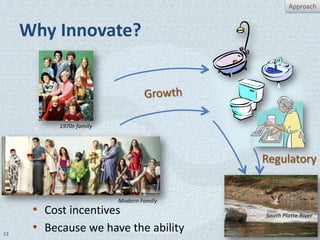
     Why Innovate?


           1970s family


                                          Regulatory


                          Modern Family
      • Cost incentives                   South Platte River

13
      • Because we have the ability
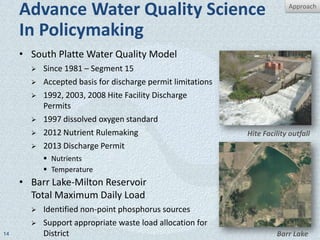
Advance Water Quality Science                                        Approach


     In Policymaking
     • South Platte Water Quality Model
          Since 1981 – Segment 15
          Accepted basis for discharge permit limitations
          1992, 2003, 2008 Hite Facility Discharge
           Permits
          1997 dissolved oxygen standard
          2012 Nutrient Rulemaking                          Hite Facility outfall
          2013 Discharge Permit
            Nutrients
            Temperature
     • Barr Lake-Milton Reservoir
       Total Maximum Daily Load
          Identified non-point phosphorus sources
          Support appropriate waste load allocation for
14         District                                                   Barr Lake
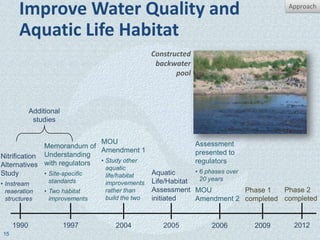
Improve Water Quality and                                                      Approach


      Aquatic Life Habitat
                                             Constructed
                                              backwater
                                                    pool


            Additional
             studies


                              MOU                           Assessment
              Memorandum of
                              Amendment 1                   presented to
Nitrification Understanding
                              • Study other                 regulators
Alternatives with regulators    aquatic
Study         • Site-specific                 Aquatic       • 6 phases over
                                life/habitat
                                                              20 years
• Instream      standards       improvements Life/Habitat
  reaeration  • Two habitat     rather than   Assessment    MOU         Phase 1   Phase 2
  structures    improvements    build the two initiated     Amendment 2 completed completed


     1990                1997     2004          2005             2006         2009    2012
15
Approach

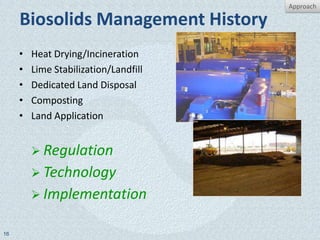
     Biosolids Management History
     •   Heat Drying/Incineration
     •   Lime Stabilization/Landfill
     •   Dedicated Land Disposal
     •   Composting
     •   Land Application


          Regulation
          Technology
          Implementation


16
Approach

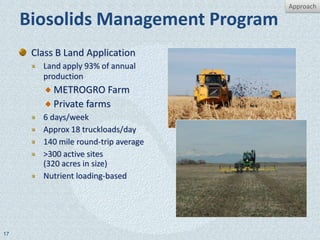
     Biosolids Management Program
      Class B Land Application
        Land apply 93% of annual
        production
           METROGRO Farm
           Private farms
        6 days/week
        Approx 18 truckloads/day
        140 mile round-trip average
        >300 active sites
        (320 acres in size)
        Nutrient loading-based


17
Groundwater Protection                            Approach


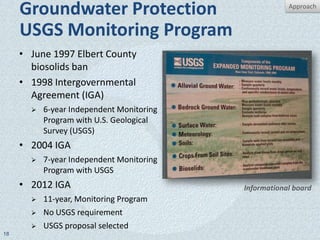
     USGS Monitoring Program
     • June 1997 Elbert County
       biosolids ban
     • 1998 Intergovernmental
       Agreement (IGA)
          6-year Independent Monitoring
           Program with U.S. Geological
           Survey (USGS)
     • 2004 IGA
          7-year Independent Monitoring
           Program with USGS
     • 2012 IGA                            Informational board
          11-year, Monitoring Program
          No USGS requirement
          USGS proposal selected
18
Approach


     Technology and Innovation
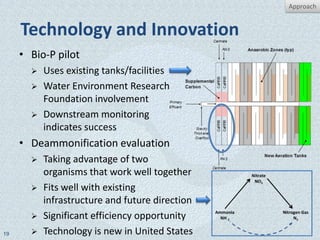
     • Bio-P pilot
          Uses existing tanks/facilities
          Water Environment Research
           Foundation involvement
          Downstream monitoring
           indicates success
     • Deammonification evaluation
          Taking advantage of two
           organisms that work well together
          Fits well with existing
           infrastructure and future direction
          Significant efficiency opportunity
19        Technology is new in United States
Approach


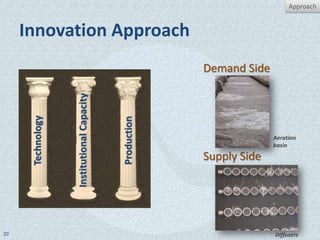
     Innovation Approach
                                                         Demand Side
                   Institutional Capacity
      Technology


                                            Production
                                                                       Aeration
                                                                       basin

                                                         Supply Side


20                                                                     Diffusers
Approach


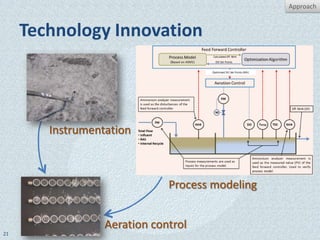
     Technology Innovation

        Picture of
        Endress-
         Hauser
         Monitor

        Instrumentation


                                 Process modeling


                     Aeration control
21
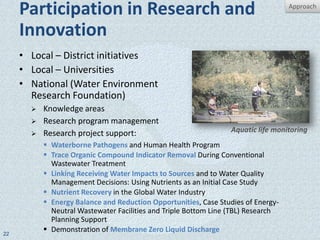
Participation in Research and                                                 Approach


     Innovation
     • Local – District initiatives
     • Local – Universities
     • National (Water Environment
       Research Foundation)
          Knowledge areas
          Research program management
          Research project support:                              Aquatic life monitoring
            Waterborne Pathogens and Human Health Program
            Trace Organic Compound Indicator Removal During Conventional
             Wastewater Treatment
            Linking Receiving Water Impacts to Sources and to Water Quality
             Management Decisions: Using Nutrients as an Initial Case Study
            Nutrient Recovery in the Global Water Industry
            Energy Balance and Reduction Opportunities, Case Studies of Energy-
             Neutral Wastewater Facilities and Triple Bottom Line (TBL) Research
             Planning Support
22
            Demonstration of Membrane Zero Liquid Discharge
‹#›
Best Practices


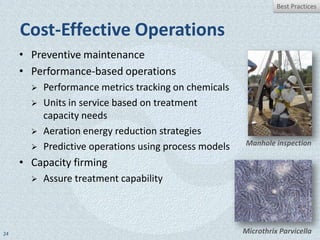
     Cost-Effective Operations
     • Preventive maintenance
     • Performance-based operations
          Performance metrics tracking on chemicals
          Units in service based on treatment
           capacity needs
          Aeration energy reduction strategies
                                                        Manhole inspection
          Predictive operations using process models
     • Capacity firming
          Assure treatment capability


24                                                      Microthrix Parvicella
Best Practices


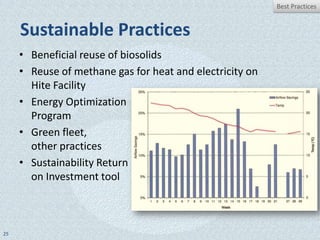
     Sustainable Practices
     • Beneficial reuse of biosolids
     • Reuse of methane gas for heat and electricity on
       Hite Facility
     • Energy Optimization
       Program
     • Green fleet,
       other practices
     • Sustainability Return
       on Investment tool


25
Communication


     Communicate and Collaborate
     • Local Workgroups
          Barr Lake and Milton Reservoir
           Watershed Association
          Colorado Water Quality Forum
           Workgroups
     • National Committees
          NACWA Money Matters Task Force
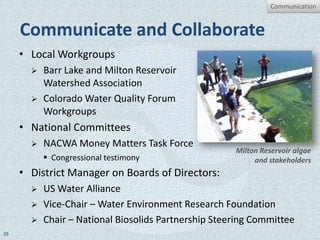
                                                      Milton Reservoir algae
            Congressional testimony                       and stakeholders
     • District Manager on Boards of Directors:
          US Water Alliance
          Vice-Chair – Water Environment Research Foundation
          Chair – National Biosolids Partnership Steering Committee
26
Communication


     Outreach
     •   Website, education, tours, news media
     •   Northern Treatment Plant Visitor’s Center
     •   Citizens’ Participation Group/Farm communities
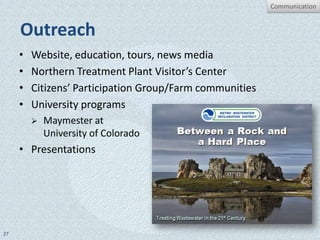
     •   University programs
            Maymester at
             University of Colorado
     • Presentations


27
This concludes the educational content of this activity.


     Questions


                     Steve Rogowski
           Metro Wastewater Reclamation District
28              srogowski@mwrd.dst.co.us

2012 Spotlight City: Denver, CO

  • 1.
    Urban Water SustainabilityLeadership Conference October 17, 2012
  • 2.
    The U.S. WaterAlliance has met the standards and requirements of the Registered Continuing Education Program. Credit earned on completion of this program will be reported to RCEP at RCEP.net. A certificate of completion will be issued to each participant. As such, it does not include content that may be deemed or construed to be an approval or endorsement by RCEP. 2
  • 3.
    Purpose To promote thenational dialogue on resource recovery and green infrastructure Conference Learning Objectives At the end of this presentation you will be able to: • Define the range of benefits of green infrastructure practices • Identify barriers and costs to implementation of these practices • Evaluate options and opportunities for funding, financing, and valuing green infrastructure • Develop practical actions that government, communities, and others can implement to promote adoption of green infrastructure solutions
  • 4.
    Agenda • Who We Are “To provide wastewater transmission • What We Do and treatment services to member municipalities and special connectors  Reclaim water in compliance with federal, state, and • How We Do It county laws in the most efficient and cost-effective means possible.”  Innovations approach  Advance best practices  Communicate Obligation to reclaim/clean water Obligation to do it cost-effectively and collaborate 4
  • 5.
    Who We Are Metro District • 50-year old Northern Treatment Plant single-purpose special district • 59 Connectors Robert W. Hite Treatment  22 Member Facility Municipalities • 36-Director appointed Board • 359 full-time staff • 1.7 million people in Metro District service area map 715 square miles with Connectors indicated in color 5
  • 6.
    What We Do Reclaim Water & Return It to the Water Cycle South Platte River Classifications • Agriculture • Aquatic life • Drinking water supply • Recreation 6 South Platte River Basin
  • 7.
    Reclaimed Means VeryClean – Effluent-Dominated Waters • Hite Facility effluent = 85% of South Platte River flow for 9 months of the year • “Headwaters” for downstream water supplies (recycled water; source water) 7 Hite Facility outfall
  • 8.
    How We DoIt Metro District Facilities Transmission System Robert W. Hite Treatment Facility 8 New Northern Treatment Plant METROGRO Farm
  • 9.
    Facilities Transmission System • 230 miles • 43 interceptors  4-inch to 90-inch diameter  Oldest from 1890 • 4 lift stations and force mains • 3,900 manholes Brantner Gulch Lift Station in Thornton • 97 metering facilities • Sanitary sewer – Not a combined sewer (no storm water) 9
  • 10.
    Facilities Robert W. Hite Treatment Facility • 130 million 8 Effluent Discharge to South Platte River 6 Disinfection Facilities gallons/day 7 Dechlorination Building • 76 dry tons/day N biosolids • 314-acre site • Activated sludge process • Secured facility • 24/7/365 operation South Platte River York Street Hite Facility processes 3 Primary Clarifiers 1 Bar Screen Building 4 Aeration Basins 2 Grit Basins 5 Secondary Clarifiers 4 Solids Processing 10
  • 11.
    Facilities METROGRO Farm • Acquired 1993–1995 • 52,000 acres • 70 miles east of Denver • 100% of Class B biosolids beneficially reused  Registered fertilizer and soil amendment – METROGRO®  +195 private farms in 5 counties  +Private composter (~7%) • In-House Resources  ~18 truckloads/day/6 days/week  140-mile round trip average  Vehicle maintenance 11 METROGRO Farm
  • 12.
    Facilities New Northern Treatment Plant • North of Denver, on South Platte River • 90-acre site • Phase 1 construction 2012–2015  300,000 residents served in 5 cities  24 million gallons/day • 7 miles of pipe • $466 million capital cost estimate Rendering of Phase 1 (2015) 12 and Buildout (after 2045)
  • 13.
    Approach Why Innovate? 1970s family Regulatory Modern Family • Cost incentives South Platte River 13 • Because we have the ability
  • 14.
    Advance Water QualityScience Approach In Policymaking • South Platte Water Quality Model  Since 1981 – Segment 15  Accepted basis for discharge permit limitations  1992, 2003, 2008 Hite Facility Discharge Permits  1997 dissolved oxygen standard  2012 Nutrient Rulemaking Hite Facility outfall  2013 Discharge Permit  Nutrients  Temperature • Barr Lake-Milton Reservoir Total Maximum Daily Load  Identified non-point phosphorus sources  Support appropriate waste load allocation for 14 District Barr Lake
  • 15.
    Improve Water Qualityand Approach Aquatic Life Habitat Constructed backwater pool Additional studies MOU Assessment Memorandum of Amendment 1 presented to Nitrification Understanding • Study other regulators Alternatives with regulators aquatic Study • Site-specific Aquatic • 6 phases over life/habitat 20 years • Instream standards improvements Life/Habitat reaeration • Two habitat rather than Assessment MOU Phase 1 Phase 2 structures improvements build the two initiated Amendment 2 completed completed 1990 1997 2004 2005 2006 2009 2012 15
  • 16.
    Approach Biosolids Management History • Heat Drying/Incineration • Lime Stabilization/Landfill • Dedicated Land Disposal • Composting • Land Application  Regulation  Technology  Implementation 16
  • 17.
    Approach Biosolids Management Program Class B Land Application Land apply 93% of annual production METROGRO Farm Private farms 6 days/week Approx 18 truckloads/day 140 mile round-trip average >300 active sites (320 acres in size) Nutrient loading-based 17
  • 18.
    Groundwater Protection Approach USGS Monitoring Program • June 1997 Elbert County biosolids ban • 1998 Intergovernmental Agreement (IGA)  6-year Independent Monitoring Program with U.S. Geological Survey (USGS) • 2004 IGA  7-year Independent Monitoring Program with USGS • 2012 IGA Informational board  11-year, Monitoring Program  No USGS requirement  USGS proposal selected 18
  • 19.
    Approach Technology and Innovation • Bio-P pilot  Uses existing tanks/facilities  Water Environment Research Foundation involvement  Downstream monitoring indicates success • Deammonification evaluation  Taking advantage of two organisms that work well together  Fits well with existing infrastructure and future direction  Significant efficiency opportunity 19  Technology is new in United States
  • 20.
    Approach Innovation Approach Demand Side Institutional Capacity Technology Production Aeration basin Supply Side 20 Diffusers
  • 21.
    Approach Technology Innovation Picture of Endress- Hauser Monitor Instrumentation Process modeling Aeration control 21
  • 22.
    Participation in Researchand Approach Innovation • Local – District initiatives • Local – Universities • National (Water Environment Research Foundation)  Knowledge areas  Research program management  Research project support: Aquatic life monitoring  Waterborne Pathogens and Human Health Program  Trace Organic Compound Indicator Removal During Conventional Wastewater Treatment  Linking Receiving Water Impacts to Sources and to Water Quality Management Decisions: Using Nutrients as an Initial Case Study  Nutrient Recovery in the Global Water Industry  Energy Balance and Reduction Opportunities, Case Studies of Energy- Neutral Wastewater Facilities and Triple Bottom Line (TBL) Research Planning Support 22  Demonstration of Membrane Zero Liquid Discharge
  • 23.
  • 24.
    Best Practices Cost-Effective Operations • Preventive maintenance • Performance-based operations  Performance metrics tracking on chemicals  Units in service based on treatment capacity needs  Aeration energy reduction strategies Manhole inspection  Predictive operations using process models • Capacity firming  Assure treatment capability 24 Microthrix Parvicella
  • 25.
    Best Practices Sustainable Practices • Beneficial reuse of biosolids • Reuse of methane gas for heat and electricity on Hite Facility • Energy Optimization Program • Green fleet, other practices • Sustainability Return on Investment tool 25
  • 26.
    Communication Communicate and Collaborate • Local Workgroups  Barr Lake and Milton Reservoir Watershed Association  Colorado Water Quality Forum Workgroups • National Committees  NACWA Money Matters Task Force Milton Reservoir algae  Congressional testimony and stakeholders • District Manager on Boards of Directors:  US Water Alliance  Vice-Chair – Water Environment Research Foundation  Chair – National Biosolids Partnership Steering Committee 26
  • 27.
    Communication Outreach • Website, education, tours, news media • Northern Treatment Plant Visitor’s Center • Citizens’ Participation Group/Farm communities • University programs  Maymester at University of Colorado • Presentations 27
  • 28.
    This concludes theeducational content of this activity. Questions Steve Rogowski Metro Wastewater Reclamation District 28 srogowski@mwrd.dst.co.us