QDAS* development and trends in qualitative researchDr. Silvana di GregorioSdG Associates: London & Bostonwww.sdgassociates.com*Qualitative Data Analysis Software
PREZI presentationA PREZI version of this same presentation is available at:http://prezi.com/82arnt4a5pyb/qdas-development-and-future-trends/
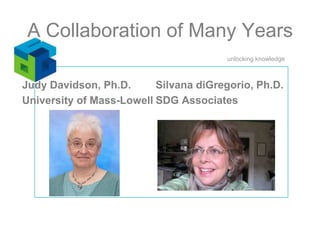
Judy Davidson, Ph.D.University of Mass-LowellSilvana diGregorio, Ph.D.SDG AssociatesA Collaboration of Many Years
Presentation based upon our chapter: Davidson, J. & di Gregorio, S. (forthcoming) Qualitative research and technology:  In the midst of a revolution.  In N. Denzin and Y. Lincoln’s Handbook of Qualitative Inquiry (4th ed.).  Thousand Oaks, CA: Sage.
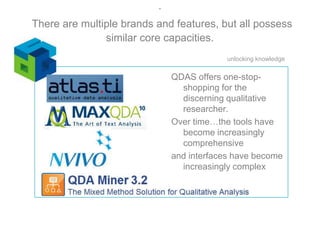
.There are multiple brands and features, but all possess similar core capacities.QDAS offers one-stop-shopping for the discerning qualitative researcher.  Over time…the tools have become increasingly comprehensiveand interfaces have become increasingly complex
Limitations and ChallengesMany senior researchers do not use these tools.  The use of these tools is confined primarily to qualitative researchers both in- and outside-of academia.Few institutions provide sufficient infrastructure support for broad and deep QDAS use. QDAS development has not been considered part of the mainstream history of qualitative research methodology.
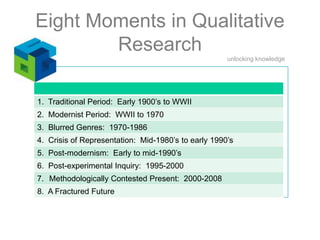
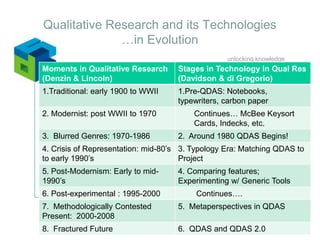
QDAS to QDAS 2.0We believed that to understand QDAS 2.0, it was necessary to chart QDAS development within the context of the evolution of qualitative research methodology.  We turned to Denzin and Lincoln’s Eight Moments in qualitative research for this framework.  We compared this framework with our Stages of QDAS development to produce an historical understanding of the development of QDAS that would inform our views of QDAS 2.0.
Eight Moments in Qualitative Research
Qualitative Research and its Technologies …in Evolution
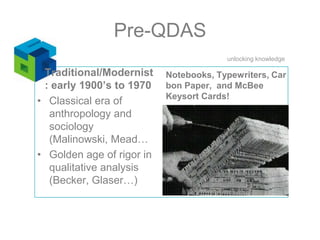
Traditional/Modernist: early 1900’s to 1970Notebooks, Typewriters, Carbon Paper,  and McBee Keysort Cards! Classical era of anthropology and sociology (Malinowski, Mead…Golden age of rigor in qualitative analysis (Becker, Glaser…)Pre-QDAS
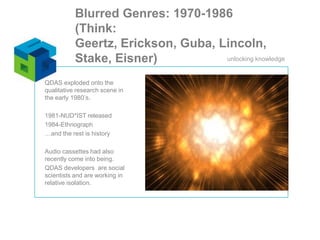
Blurred Genres: 1970-1986(Think: Geertz, Erickson, Guba, Lincoln, Stake, Eisner)QDAS exploded onto the qualitative research scene in the early 1980’s.1981-NUD*IST released1984-Ethnograph…and the rest is historyAudio cassettes had also recently come into being.  QDAS developers  are social scientists and are working in relative isolation.
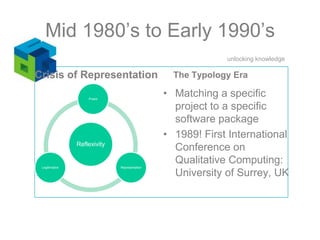
The Typology EraCrisis of RepresentationMid 1980’s to Early 1990’sMatching a specific project to a specific software package1989! First International Conference on Qualitative Computing: University of Surrey, UK
RenataTesch (1990):Strauss and Corbin (1990): Qualitative research: Analysis types and software tools.Identifies 46 types of qualitative research and 10 common principles among themMost QDAS packages support these forms of research.Basics of qualitative research: Grounded theory procedures and techniques.Strauss and Corbin’s grounded theory approach became negatively associated with the notion of QDASIntersections:  QR and QDAS
Fielding and Lee (2007)“There was also an assumption that we were seeking to establish some kind of orthodoxy around the analytic process, particularly in relation to grounded theory.  This is an assumption we have always strongly resisted.  For us, identification of the coding features found in many qualitative data analysis programs with grounded theory has tended to elide program features, analytic procedures and methodological approaches.” …looking back on the challenge to QDAS that  emerged in relationship to Strauss and Corbin’s work .
In Qualitative Research…In QDAS…Competition among QDAS developers to provide packages with core features consumers desire and new whistles and bells.Experimentation with Generic Tools as QDAS Writing experiments abound:AutoethnographyMulti-mediaPerformance EthnographyPost-modernism and post-experimental: Early 1990’s to 2000
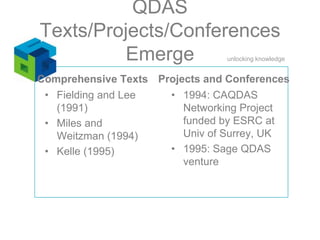
Comprehensive TextsProjects and Conferences1994: CAQDAS Networking Project funded by ESRC at Univ of Surrey, UK1995: Sage QDAS ventureFielding and Lee (1991)Miles and Weitzman (1994)Kelle (1995)QDAS Texts/Projects/Conferences Emerge
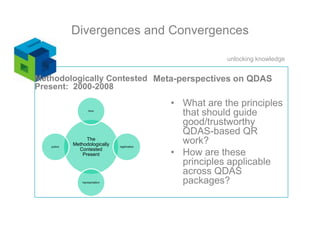
Methodologically Contested Present:  2000-2008Meta-perspectives on QDASWhat are the principles that should guide good/trustworthy QDAS-based QR work?How are these principles applicable across QDAS packages?Divergences and Convergences
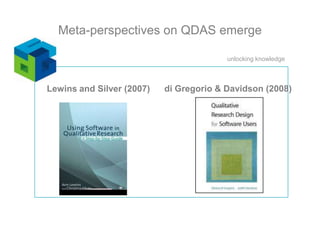
Lewins and Silver(2007)di Gregorio & Davidson (2008)Meta-perspectives on QDAS emerge
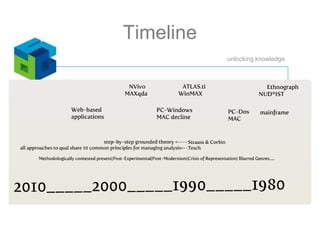
Timeline
Why is this history important?Shows parallel but disconnected developments with qualitative research community and QDAS communityCan explain slowness of QDAS being accepted in qualitative research communityLooking at the past helps us understand how we got to the presentFor the future, QDAS people need to work with the wider qualitative research community
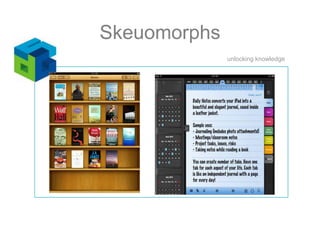
Skeuomorph“A skeuomorph is a design feature that is no longer functional in itself, but that refers back to a feature that was functional at an earlier time…Skeuomorphs visibly testify to the social or psychological necessity for innovation to be tempered by replication…” (Hayles, 1999, 17)
Skeuomorphs
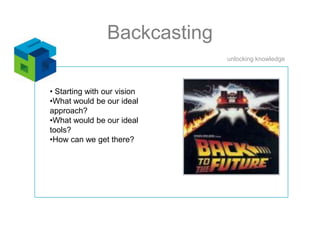
Backcasting Starting with our vision

00 Qdas Development And Trends In Qualitatve Analysis

  • 1.
    QDAS* development andtrends in qualitative researchDr. Silvana di GregorioSdG Associates: London & Bostonwww.sdgassociates.com*Qualitative Data Analysis Software
  • 2.
    PREZI presentationA PREZIversion of this same presentation is available at:http://prezi.com/82arnt4a5pyb/qdas-development-and-future-trends/
  • 3.
    Judy Davidson, Ph.D.Universityof Mass-LowellSilvana diGregorio, Ph.D.SDG AssociatesA Collaboration of Many Years
  • 4.
    Presentation based uponour chapter: Davidson, J. & di Gregorio, S. (forthcoming) Qualitative research and technology: In the midst of a revolution. In N. Denzin and Y. Lincoln’s Handbook of Qualitative Inquiry (4th ed.). Thousand Oaks, CA: Sage.
  • 5.
    .There are multiplebrands and features, but all possess similar core capacities.QDAS offers one-stop-shopping for the discerning qualitative researcher. Over time…the tools have become increasingly comprehensiveand interfaces have become increasingly complex
  • 6.
    Limitations and ChallengesManysenior researchers do not use these tools. The use of these tools is confined primarily to qualitative researchers both in- and outside-of academia.Few institutions provide sufficient infrastructure support for broad and deep QDAS use. QDAS development has not been considered part of the mainstream history of qualitative research methodology.
  • 7.
    QDAS to QDAS2.0We believed that to understand QDAS 2.0, it was necessary to chart QDAS development within the context of the evolution of qualitative research methodology. We turned to Denzin and Lincoln’s Eight Moments in qualitative research for this framework. We compared this framework with our Stages of QDAS development to produce an historical understanding of the development of QDAS that would inform our views of QDAS 2.0.
  • 8.
    Eight Moments inQualitative Research
  • 9.
    Qualitative Research andits Technologies …in Evolution
  • 10.
    Traditional/Modernist: early 1900’sto 1970Notebooks, Typewriters, Carbon Paper, and McBee Keysort Cards! Classical era of anthropology and sociology (Malinowski, Mead…Golden age of rigor in qualitative analysis (Becker, Glaser…)Pre-QDAS
  • 11.
    Blurred Genres: 1970-1986(Think:Geertz, Erickson, Guba, Lincoln, Stake, Eisner)QDAS exploded onto the qualitative research scene in the early 1980’s.1981-NUD*IST released1984-Ethnograph…and the rest is historyAudio cassettes had also recently come into being. QDAS developers are social scientists and are working in relative isolation.
  • 12.
    The Typology EraCrisisof RepresentationMid 1980’s to Early 1990’sMatching a specific project to a specific software package1989! First International Conference on Qualitative Computing: University of Surrey, UK
  • 13.
    RenataTesch (1990):Strauss andCorbin (1990): Qualitative research: Analysis types and software tools.Identifies 46 types of qualitative research and 10 common principles among themMost QDAS packages support these forms of research.Basics of qualitative research: Grounded theory procedures and techniques.Strauss and Corbin’s grounded theory approach became negatively associated with the notion of QDASIntersections: QR and QDAS
  • 14.
    Fielding and Lee(2007)“There was also an assumption that we were seeking to establish some kind of orthodoxy around the analytic process, particularly in relation to grounded theory. This is an assumption we have always strongly resisted. For us, identification of the coding features found in many qualitative data analysis programs with grounded theory has tended to elide program features, analytic procedures and methodological approaches.” …looking back on the challenge to QDAS that emerged in relationship to Strauss and Corbin’s work .
  • 15.
    In Qualitative Research…InQDAS…Competition among QDAS developers to provide packages with core features consumers desire and new whistles and bells.Experimentation with Generic Tools as QDAS Writing experiments abound:AutoethnographyMulti-mediaPerformance EthnographyPost-modernism and post-experimental: Early 1990’s to 2000
  • 16.
    Comprehensive TextsProjects andConferences1994: CAQDAS Networking Project funded by ESRC at Univ of Surrey, UK1995: Sage QDAS ventureFielding and Lee (1991)Miles and Weitzman (1994)Kelle (1995)QDAS Texts/Projects/Conferences Emerge
  • 17.
    Methodologically Contested Present: 2000-2008Meta-perspectives on QDASWhat are the principles that should guide good/trustworthy QDAS-based QR work?How are these principles applicable across QDAS packages?Divergences and Convergences
  • 18.
    Lewins and Silver(2007)diGregorio & Davidson (2008)Meta-perspectives on QDAS emerge
  • 19.
  • 20.
    Why is thishistory important?Shows parallel but disconnected developments with qualitative research community and QDAS communityCan explain slowness of QDAS being accepted in qualitative research communityLooking at the past helps us understand how we got to the presentFor the future, QDAS people need to work with the wider qualitative research community
  • 21.
    Skeuomorph“A skeuomorph isa design feature that is no longer functional in itself, but that refers back to a feature that was functional at an earlier time…Skeuomorphs visibly testify to the social or psychological necessity for innovation to be tempered by replication…” (Hayles, 1999, 17)
  • 22.
  • 23.