Report on Trend and Progress of Banking in India for the year ended
June 30, 2011 submitted to the Central Government in terms of
Section 36(2) of the Banking Regulation Act, 1949

REPORT ON TREND AND PROGRESS
OF BANKING IN INDIA 2010-11

RESERVE BANK OF INDIA
Sale Price:
In India

Abroad

–
–
–
–
–

` 200
` 240
` 150
` 190
US$ 22

(Normal)
(Inclusive of Postal Charges)
(Concessional – at Counter)
(Concessional – Including Postage)
(Inclusive of Air Mail Courier Charges)

© Reserve Bank of India 2011
All rights reserved. Reproduction is permitted provided an acknowledgement of the source is made.

Published by Mohua Roy for the Reserve Bank of India, Mumbai 400 001 and designed and printed by her
at Jayant Printery, 352/54, Murlidhar Compound, Girgaum Road, Mumbai - 400 002.
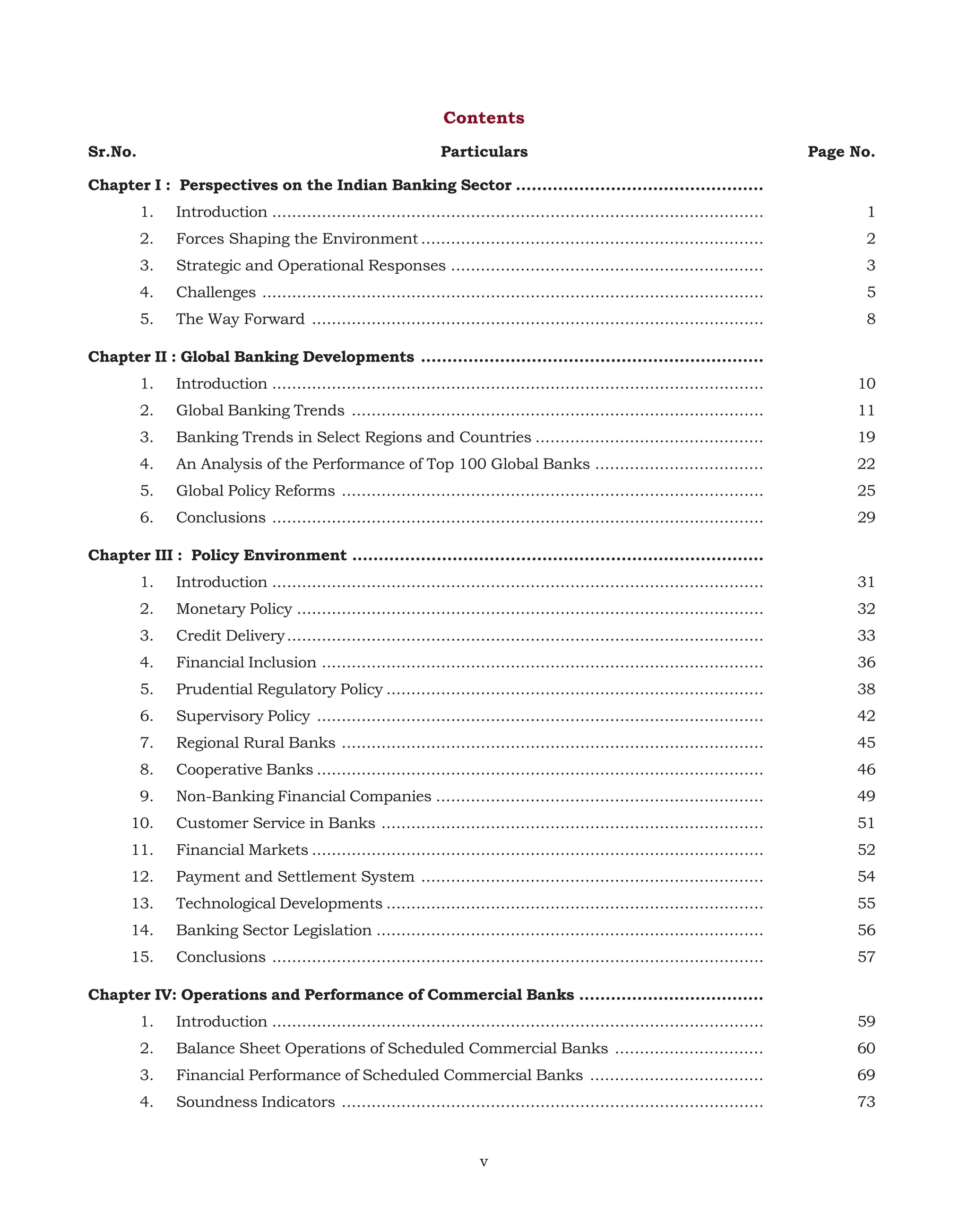
Contents
Sr.No.

Particulars

Page No.

Chapter I : Perspectives on the Indian Banking Sector ...............................................
1.

Introduction ...................................................................................................

1

2.

Forces Shaping the Environment .....................................................................

2

3.

Strategic and Operational Responses ...............................................................

3

4.

Challenges .....................................................................................................

5

5.

The Way Forward ...........................................................................................

8

Chapter II : Global Banking Developments .................................................................
1.

Introduction ...................................................................................................

10

2.

Global Banking Trends ...................................................................................

11

3.

Banking Trends in Select Regions and Countries ..............................................

19

4.

An Analysis of the Performance of Top 100 Global Banks ..................................

22

5.

Global Policy Reforms .....................................................................................

25

6.

Conclusions ...................................................................................................

29

Chapter III : Policy Environment ..............................................................................
1.

Introduction ...................................................................................................

31

2.

Monetary Policy ..............................................................................................

32

3.

Credit Delivery ................................................................................................

33

4.

Financial Inclusion .........................................................................................

36

5.

Prudential Regulatory Policy ............................................................................

38

6.

Supervisory Policy ..........................................................................................

42

7.

Regional Rural Banks .....................................................................................

45

8.

Cooperative Banks ..........................................................................................

46

9.

Non-Banking Financial Companies ..................................................................

49

10.

Customer Service in Banks .............................................................................

51

11.

Financial Markets ...........................................................................................

52

12.

Payment and Settlement System .....................................................................

54

13.

Technological Developments ............................................................................

55

14.

Banking Sector Legislation ..............................................................................

56

15.

Conclusions ...................................................................................................

57

Chapter IV: Operations and Performance of Commercial Banks ...................................
1.

Introduction ...................................................................................................

59

2.

Balance Sheet Operations of Scheduled Commercial Banks ..............................

60

3.

Financial Performance of Scheduled Commercial Banks ...................................

69

4.

Soundness Indicators .....................................................................................

73

v
Sr.No.

Particulars

Page No.

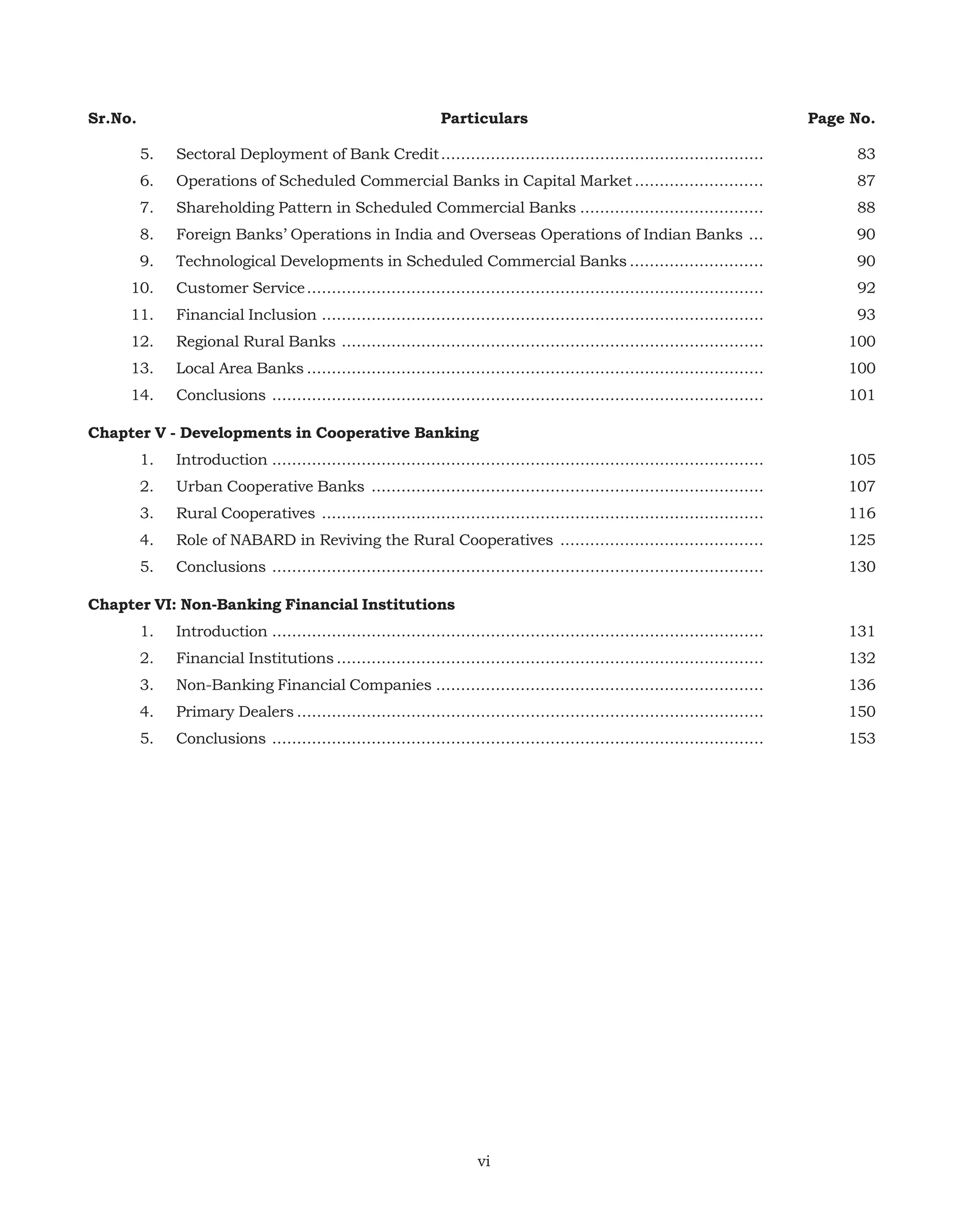
5.

Sectoral Deployment of Bank Credit .................................................................

83

6.

Operations of Scheduled Commercial Banks in Capital Market ..........................

87

7.

Shareholding Pattern in Scheduled Commercial Banks .....................................

88

8.

Foreign Banks’ Operations in India and Overseas Operations of Indian Banks ...

90

9.

Technological Developments in Scheduled Commercial Banks ...........................

90

10.

Customer Service ............................................................................................

92

11.

Financial Inclusion .........................................................................................

93

12.

Regional Rural Banks .....................................................................................

100

13.

Local Area Banks ............................................................................................

100

14.

Conclusions ...................................................................................................

101

Chapter V - Developments in Cooperative Banking
1.

Introduction ...................................................................................................

105

2.

Urban Cooperative Banks ...............................................................................

107

3.

Rural Cooperatives .........................................................................................

116

4.

Role of NABARD in Reviving the Rural Cooperatives .........................................

125

5.

Conclusions ...................................................................................................

130

Chapter VI: Non-Banking Financial Institutions
1.

Introduction ...................................................................................................

131

2.

Financial Institutions ......................................................................................

132

3.

Non-Banking Financial Companies ..................................................................

136

4.

Primary Dealers ..............................................................................................

150

5.

Conclusions ...................................................................................................

153

vi
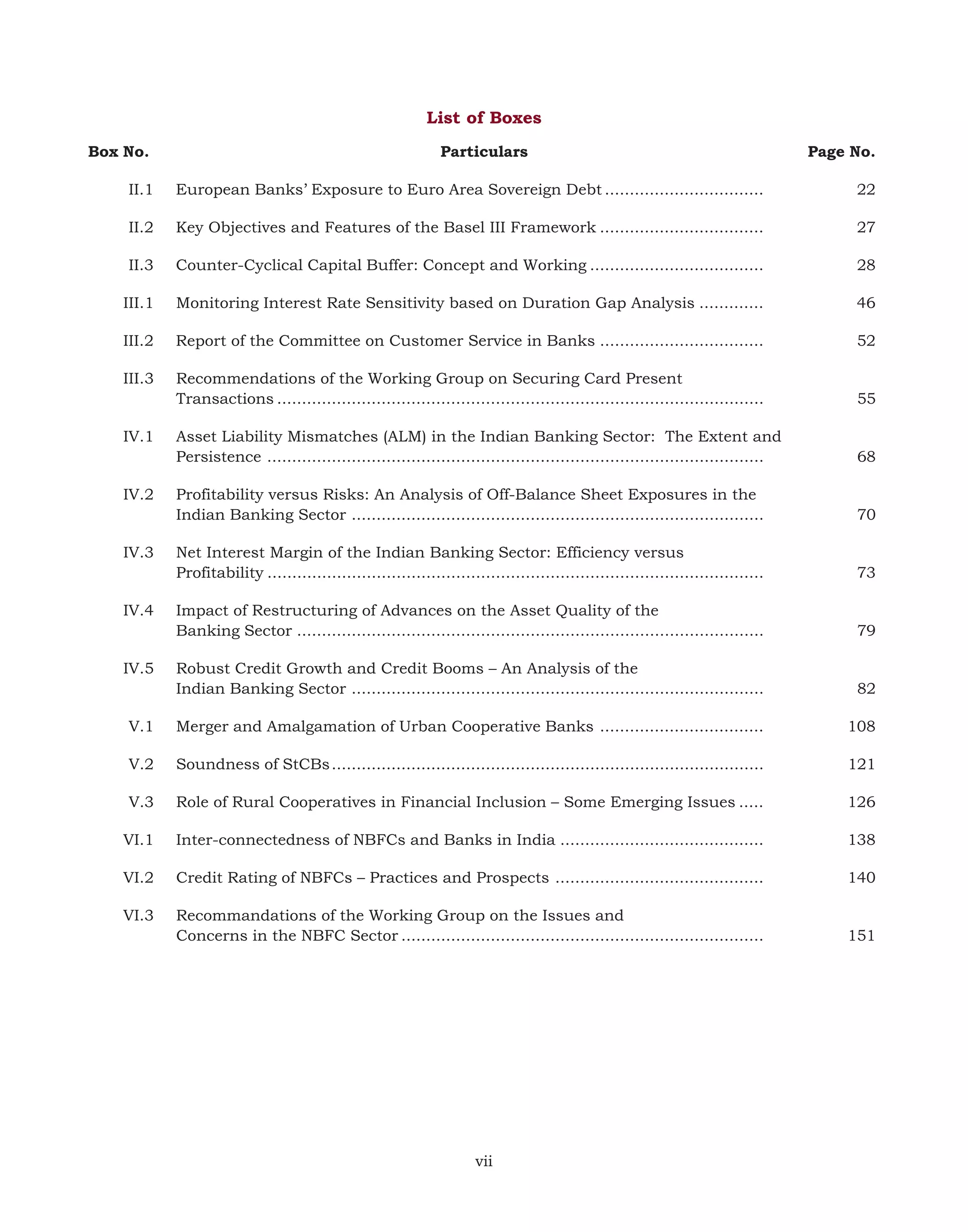
List of Boxes
Box No.

Particulars

Page No.

II.1

European Banks’ Exposure to Euro Area Sovereign Debt ................................

22

II.2

Key Objectives and Features of the Basel III Framework .................................

27

II.3

Counter-Cyclical Capital Buffer: Concept and Working ...................................

28

III.1

Monitoring Interest Rate Sensitivity based on Duration Gap Analysis .............

46

III.2

Report of the Committee on Customer Service in Banks .................................

52

III.3

Recommendations of the Working Group on Securing Card Present
Transactions ..................................................................................................

55

Asset Liability Mismatches (ALM) in the Indian Banking Sector: The Extent and
Persistence ....................................................................................................

68

Profitability versus Risks: An Analysis of Off-Balance Sheet Exposures in the
Indian Banking Sector ...................................................................................

70

Net Interest Margin of the Indian Banking Sector: Efficiency versus
Profitability ....................................................................................................

73

Impact of Restructuring of Advances on the Asset Quality of the
Banking Sector ..............................................................................................

79

Robust Credit Growth and Credit Booms – An Analysis of the
Indian Banking Sector ...................................................................................

82

V.1

Merger and Amalgamation of Urban Cooperative Banks .................................

108

V.2

Soundness of StCBs .......................................................................................

121

V.3

Role of Rural Cooperatives in Financial Inclusion – Some Emerging Issues .....

126

VI.1

Inter-connectedness of NBFCs and Banks in India .........................................

138

VI.2

Credit Rating of NBFCs – Practices and Prospects ..........................................

140

VI.3

Recommandations of the Working Group on the Issues and
Concerns in the NBFC Sector .........................................................................

151

IV.1

IV.2

IV.3

IV.4

IV.5

vii
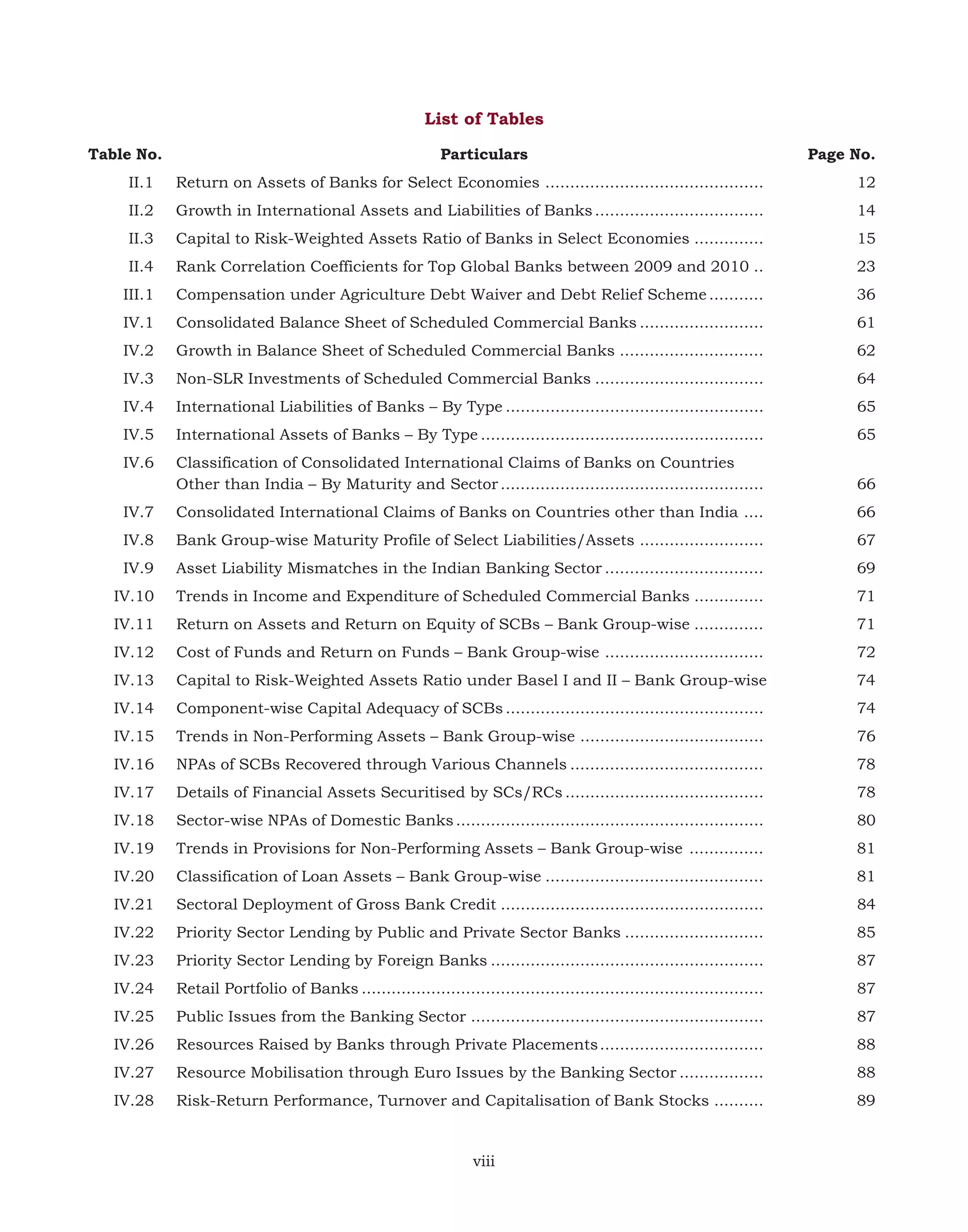
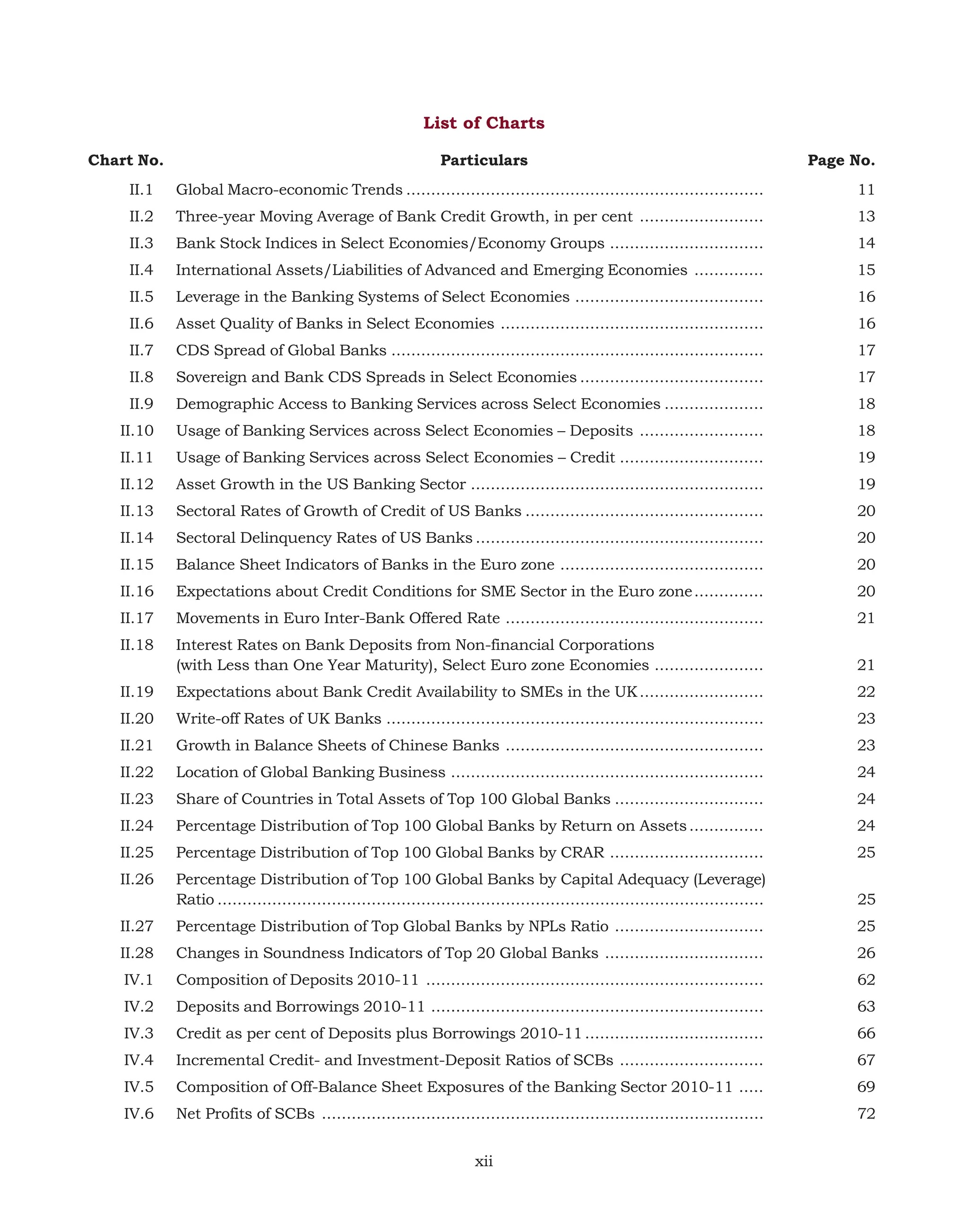
List of Tables
Table No.

Particulars

Page No.

II.1

Return on Assets of Banks for Select Economies ............................................

12

II.2

Growth in International Assets and Liabilities of Banks ..................................

14

II.3

Capital to Risk-Weighted Assets Ratio of Banks in Select Economies ..............

15

II.4

Rank Correlation Coefficients for Top Global Banks between 2009 and 2010 ..

23

III.1

Compensation under Agriculture Debt Waiver and Debt Relief Scheme ...........

36

IV.1

Consolidated Balance Sheet of Scheduled Commercial Banks .........................

61

IV.2

Growth in Balance Sheet of Scheduled Commercial Banks .............................

62

IV.3

Non-SLR Investments of Scheduled Commercial Banks ..................................

64

IV.4

International Liabilities of Banks – By Type ....................................................

65

IV.5

International Assets of Banks – By Type .........................................................

65

IV.6

Classification of Consolidated International Claims of Banks on Countries
Other than India – By Maturity and Sector .....................................................

66

IV.7

Consolidated International Claims of Banks on Countries other than India ....

66

IV.8

Bank Group-wise Maturity Profile of Select Liabilities/Assets .........................

67

IV.9

Asset Liability Mismatches in the Indian Banking Sector ................................

69

IV.10

Trends in Income and Expenditure of Scheduled Commercial Banks ..............

71

IV.11

Return on Assets and Return on Equity of SCBs – Bank Group-wise ..............

71

IV.12

Cost of Funds and Return on Funds – Bank Group-wise ................................

72

IV.13

Capital to Risk-Weighted Assets Ratio under Basel I and II – Bank Group-wise

74

IV.14

Component-wise Capital Adequacy of SCBs ....................................................

74

IV.15

Trends in Non-Performing Assets – Bank Group-wise .....................................

76

IV.16

NPAs of SCBs Recovered through Various Channels .......................................

78

IV.17

Details of Financial Assets Securitised by SCs/RCs ........................................

78

IV.18

Sector-wise NPAs of Domestic Banks ..............................................................

80

IV.19

Trends in Provisions for Non-Performing Assets – Bank Group-wise ...............

81

IV.20

Classification of Loan Assets – Bank Group-wise ............................................

81

IV.21

Sectoral Deployment of Gross Bank Credit .....................................................

84

IV.22

Priority Sector Lending by Public and Private Sector Banks ............................

85

IV.23

Priority Sector Lending by Foreign Banks .......................................................

87

IV.24

Retail Portfolio of Banks .................................................................................

87

IV.25

Public Issues from the Banking Sector ...........................................................

87

IV.26

Resources Raised by Banks through Private Placements .................................

88

IV.27

Resource Mobilisation through Euro Issues by the Banking Sector .................

88

IV.28

Risk-Return Performance, Turnover and Capitalisation of Bank Stocks ..........

89

viii
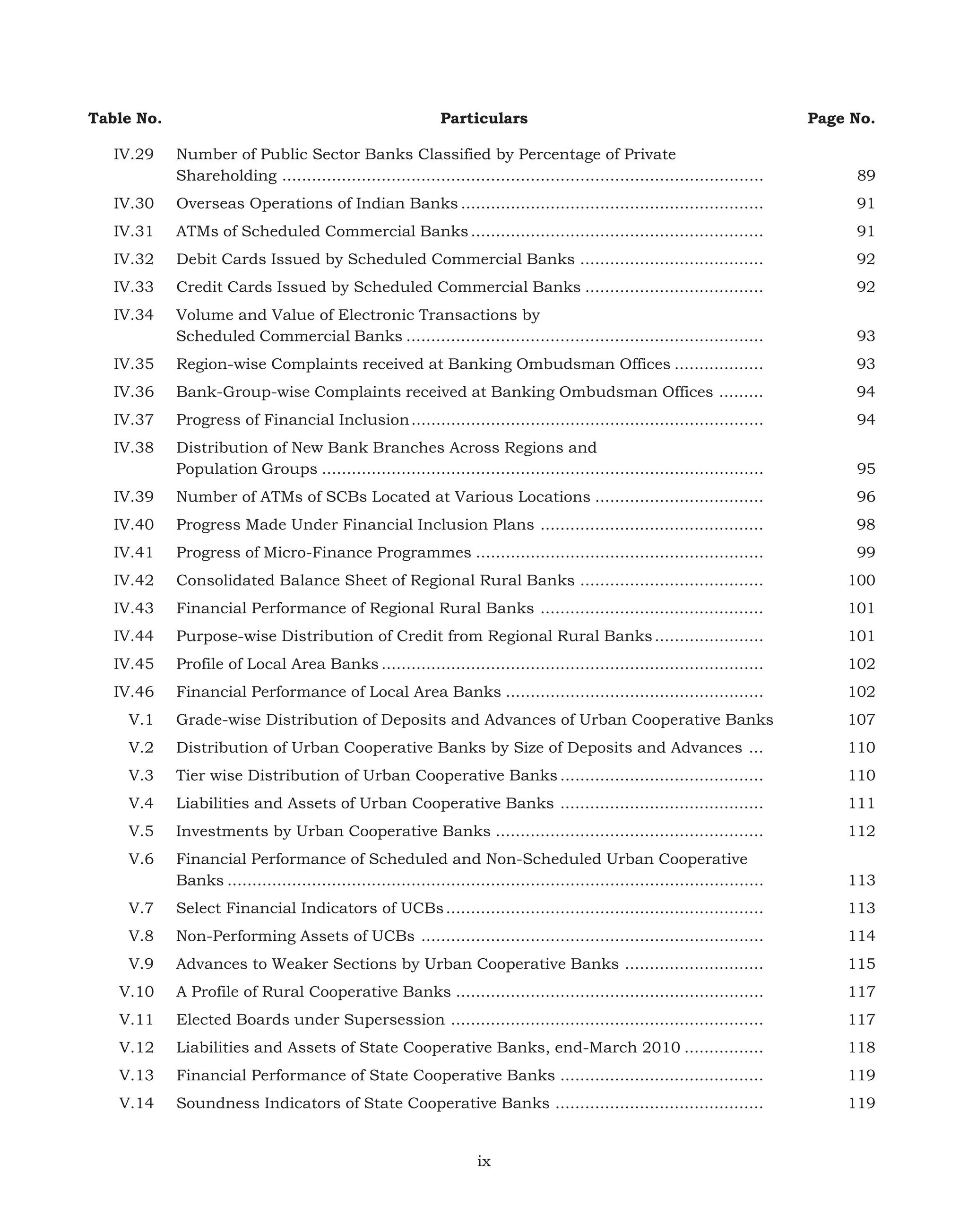
Table No.
IV.29

Particulars

Page No.

Number of Public Sector Banks Classified by Percentage of Private
Shareholding .................................................................................................

89

IV.30

Overseas Operations of Indian Banks .............................................................

91

IV.31

ATMs of Scheduled Commercial Banks ...........................................................

91

IV.32

Debit Cards Issued by Scheduled Commercial Banks .....................................

92

IV.33

Credit Cards Issued by Scheduled Commercial Banks ....................................

92

IV.34

Volume and Value of Electronic Transactions by
Scheduled Commercial Banks ........................................................................

93

IV.35

Region-wise Complaints received at Banking Ombudsman Offices ..................

93

IV.36

Bank-Group-wise Complaints received at Banking Ombudsman Offices .........

94

IV.37

Progress of Financial Inclusion .......................................................................

94

IV.38

Distribution of New Bank Branches Across Regions and
Population Groups .........................................................................................

95

IV.39

Number of ATMs of SCBs Located at Various Locations ..................................

96

IV.40

Progress Made Under Financial Inclusion Plans .............................................

98

IV.41

Progress of Micro-Finance Programmes ..........................................................

99

IV.42

Consolidated Balance Sheet of Regional Rural Banks .....................................

100

IV.43

Financial Performance of Regional Rural Banks .............................................

101

IV.44

Purpose-wise Distribution of Credit from Regional Rural Banks ......................

101

IV.45

Profile of Local Area Banks .............................................................................

102

IV.46

Financial Performance of Local Area Banks ....................................................

102

V.1

Grade-wise Distribution of Deposits and Advances of Urban Cooperative Banks

107

V.2

Distribution of Urban Cooperative Banks by Size of Deposits and Advances ...

110

V.3

Tier wise Distribution of Urban Cooperative Banks .........................................

110

V.4

Liabilities and Assets of Urban Cooperative Banks .........................................

111

V.5

Investments by Urban Cooperative Banks ......................................................

112

V.6

Financial Performance of Scheduled and Non-Scheduled Urban Cooperative
Banks ............................................................................................................

113

V.7

Select Financial Indicators of UCBs ................................................................

113

V.8

Non-Performing Assets of UCBs .....................................................................

114

V.9

Advances to Weaker Sections by Urban Cooperative Banks ............................

115

V.10

A Profile of Rural Cooperative Banks ..............................................................

117

V.11

Elected Boards under Supersession ...............................................................

117

V.12

Liabilities and Assets of State Cooperative Banks, end-March 2010 ................

118

V.13

Financial Performance of State Cooperative Banks .........................................

119

V.14

Soundness Indicators of State Cooperative Banks ..........................................

119

ix
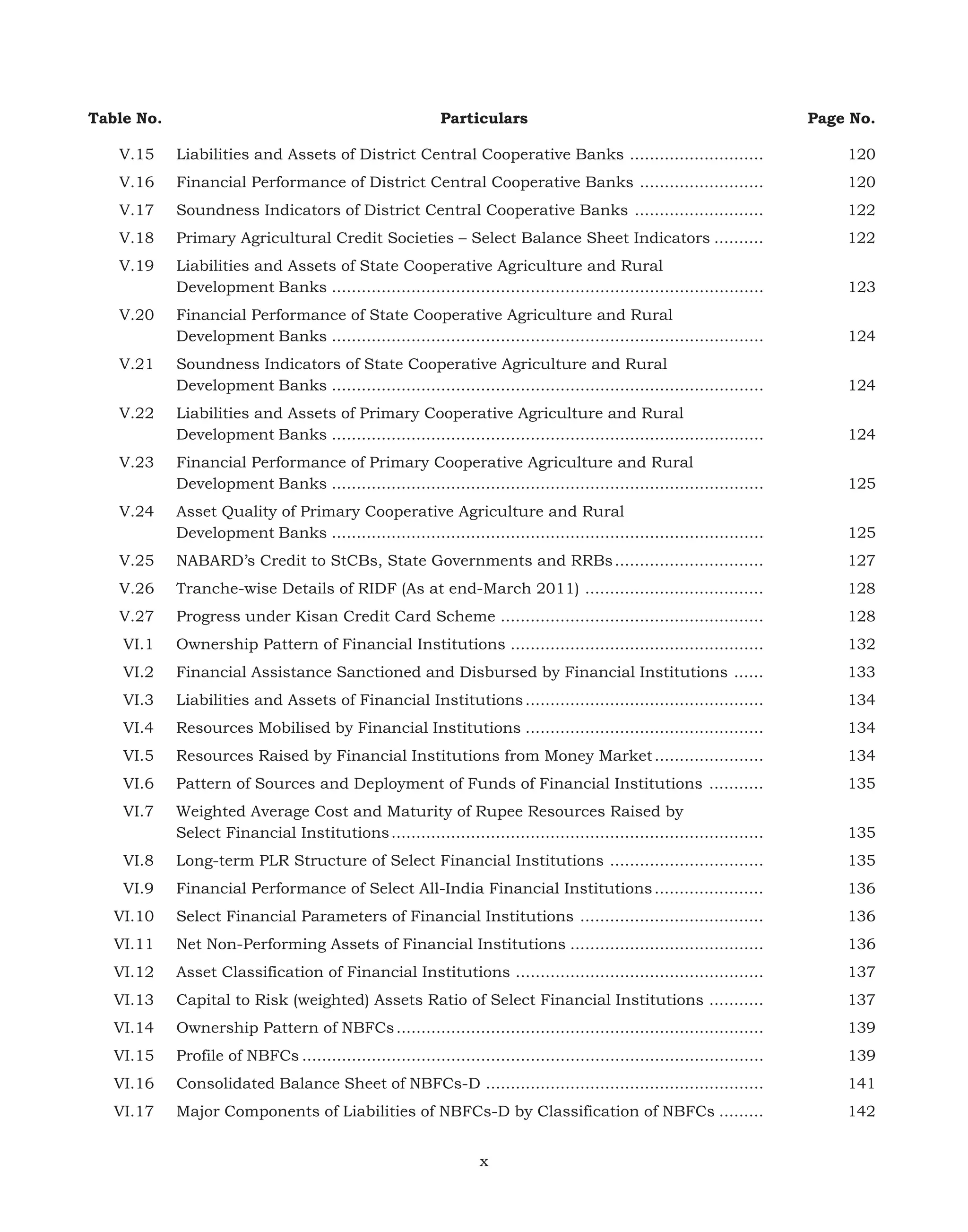
Table No.

Particulars

Page No.

V.15

Liabilities and Assets of District Central Cooperative Banks ...........................

120

V.16

Financial Performance of District Central Cooperative Banks .........................

120

V.17

Soundness Indicators of District Central Cooperative Banks ..........................

122

V.18

Primary Agricultural Credit Societies – Select Balance Sheet Indicators ..........

122

V.19

Liabilities and Assets of State Cooperative Agriculture and Rural
Development Banks .......................................................................................

123

Financial Performance of State Cooperative Agriculture and Rural
Development Banks .......................................................................................

124

Soundness Indicators of State Cooperative Agriculture and Rural
Development Banks .......................................................................................

124

Liabilities and Assets of Primary Cooperative Agriculture and Rural
Development Banks .......................................................................................

124

Financial Performance of Primary Cooperative Agriculture and Rural
Development Banks .......................................................................................

125

Asset Quality of Primary Cooperative Agriculture and Rural
Development Banks .......................................................................................

125

V.25

NABARD’s Credit to StCBs, State Governments and RRBs ..............................

127

V.26

Tranche-wise Details of RIDF (As at end-March 2011) ....................................

128

V.27

Progress under Kisan Credit Card Scheme .....................................................

128

VI.1

Ownership Pattern of Financial Institutions ...................................................

132

VI.2

Financial Assistance Sanctioned and Disbursed by Financial Institutions ......

133

VI.3

Liabilities and Assets of Financial Institutions ................................................

134

VI.4

Resources Mobilised by Financial Institutions ................................................

134

VI.5

Resources Raised by Financial Institutions from Money Market ......................

134

VI.6

Pattern of Sources and Deployment of Funds of Financial Institutions ...........

135

VI.7

Weighted Average Cost and Maturity of Rupee Resources Raised by
Select Financial Institutions ...........................................................................

135

VI.8

Long-term PLR Structure of Select Financial Institutions ...............................

135

VI.9

Financial Performance of Select All-India Financial Institutions ......................

136

VI.10

Select Financial Parameters of Financial Institutions .....................................

136

VI.11

Net Non-Performing Assets of Financial Institutions .......................................

136

VI.12

Asset Classification of Financial Institutions ..................................................

137

VI.13

Capital to Risk (weighted) Assets Ratio of Select Financial Institutions ...........

137

VI.14

Ownership Pattern of NBFCs ..........................................................................

139

VI.15

Profile of NBFCs .............................................................................................

139

VI.16

Consolidated Balance Sheet of NBFCs-D ........................................................

141

VI.17

Major Components of Liabilities of NBFCs-D by Classification of NBFCs .........

142

V.20
V.21
V.22
V.23
V.24

x
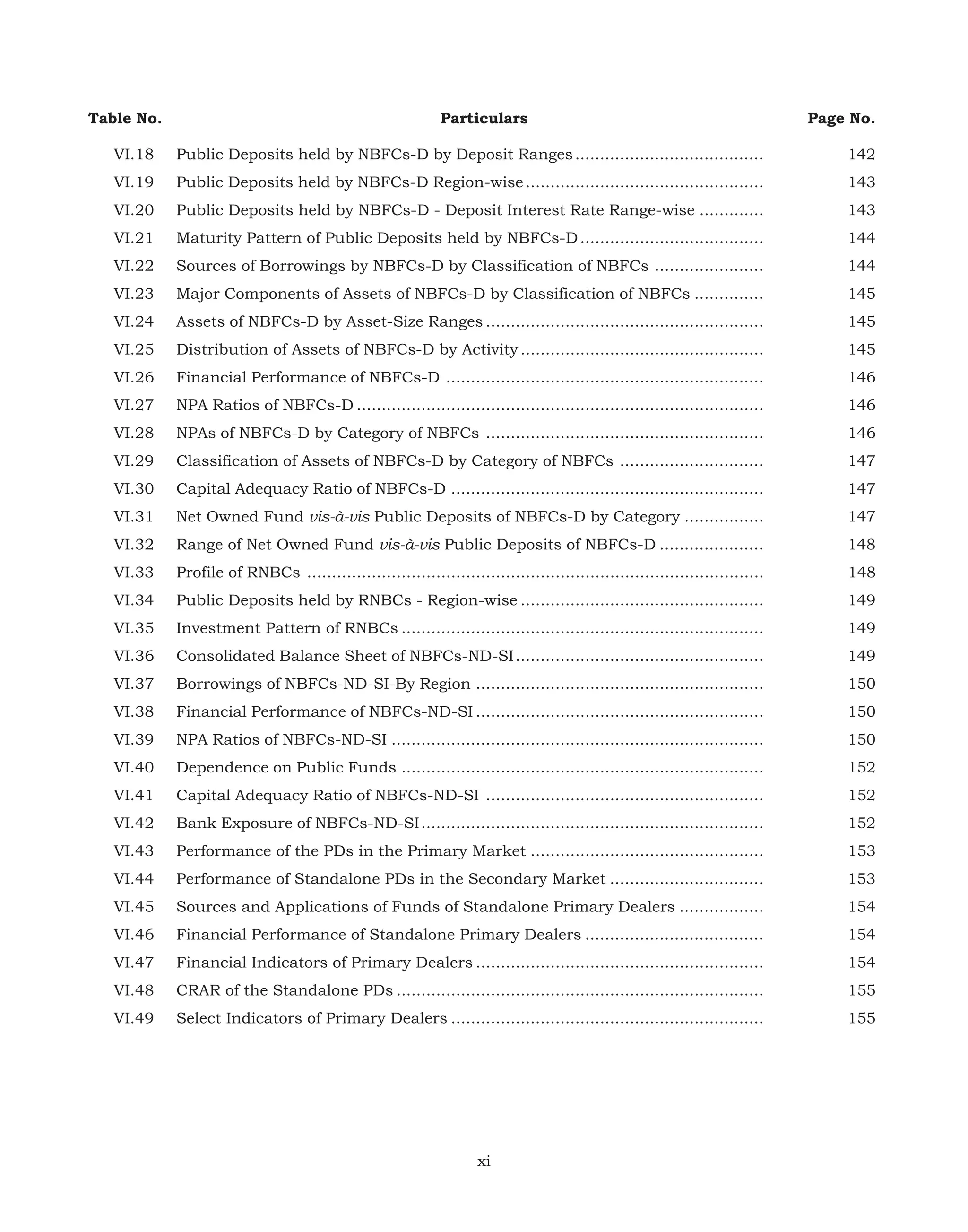
Table No.

Particulars

Page No.

VI.18

Public Deposits held by NBFCs-D by Deposit Ranges ......................................

142

VI.19

Public Deposits held by NBFCs-D Region-wise ................................................

143

VI.20

Public Deposits held by NBFCs-D - Deposit Interest Rate Range-wise .............

143

VI.21

Maturity Pattern of Public Deposits held by NBFCs-D .....................................

144

VI.22

Sources of Borrowings by NBFCs-D by Classification of NBFCs ......................

144

VI.23

Major Components of Assets of NBFCs-D by Classification of NBFCs ..............

145

VI.24

Assets of NBFCs-D by Asset-Size Ranges ........................................................

145

VI.25

Distribution of Assets of NBFCs-D by Activity .................................................

145

VI.26

Financial Performance of NBFCs-D ................................................................

146

VI.27

NPA Ratios of NBFCs-D ..................................................................................

146

VI.28

NPAs of NBFCs-D by Category of NBFCs ........................................................

146

VI.29

Classification of Assets of NBFCs-D by Category of NBFCs .............................

147

VI.30

Capital Adequacy Ratio of NBFCs-D ...............................................................

147

VI.31

Net Owned Fund vis-à-vis Public Deposits of NBFCs-D by Category ................

147

VI.32

Range of Net Owned Fund vis-à-vis Public Deposits of NBFCs-D .....................

148

VI.33

Profile of RNBCs ............................................................................................

148

VI.34

Public Deposits held by RNBCs - Region-wise .................................................

149

VI.35

Investment Pattern of RNBCs .........................................................................

149

VI.36

Consolidated Balance Sheet of NBFCs-ND-SI ..................................................

149

VI.37

Borrowings of NBFCs-ND-SI-By Region ..........................................................

150

VI.38

Financial Performance of NBFCs-ND-SI ..........................................................

150

VI.39

NPA Ratios of NBFCs-ND-SI ...........................................................................

150

VI.40

Dependence on Public Funds .........................................................................

152

VI.41

Capital Adequacy Ratio of NBFCs-ND-SI ........................................................

152

VI.42

Bank Exposure of NBFCs-ND-SI .....................................................................

152

VI.43

Performance of the PDs in the Primary Market ...............................................

153

VI.44

Performance of Standalone PDs in the Secondary Market ...............................

153

VI.45

Sources and Applications of Funds of Standalone Primary Dealers .................

154

VI.46

Financial Performance of Standalone Primary Dealers ....................................

154

VI.47

Financial Indicators of Primary Dealers ..........................................................

154

VI.48

CRAR of the Standalone PDs ..........................................................................

155

VI.49

Select Indicators of Primary Dealers ...............................................................

155

xi
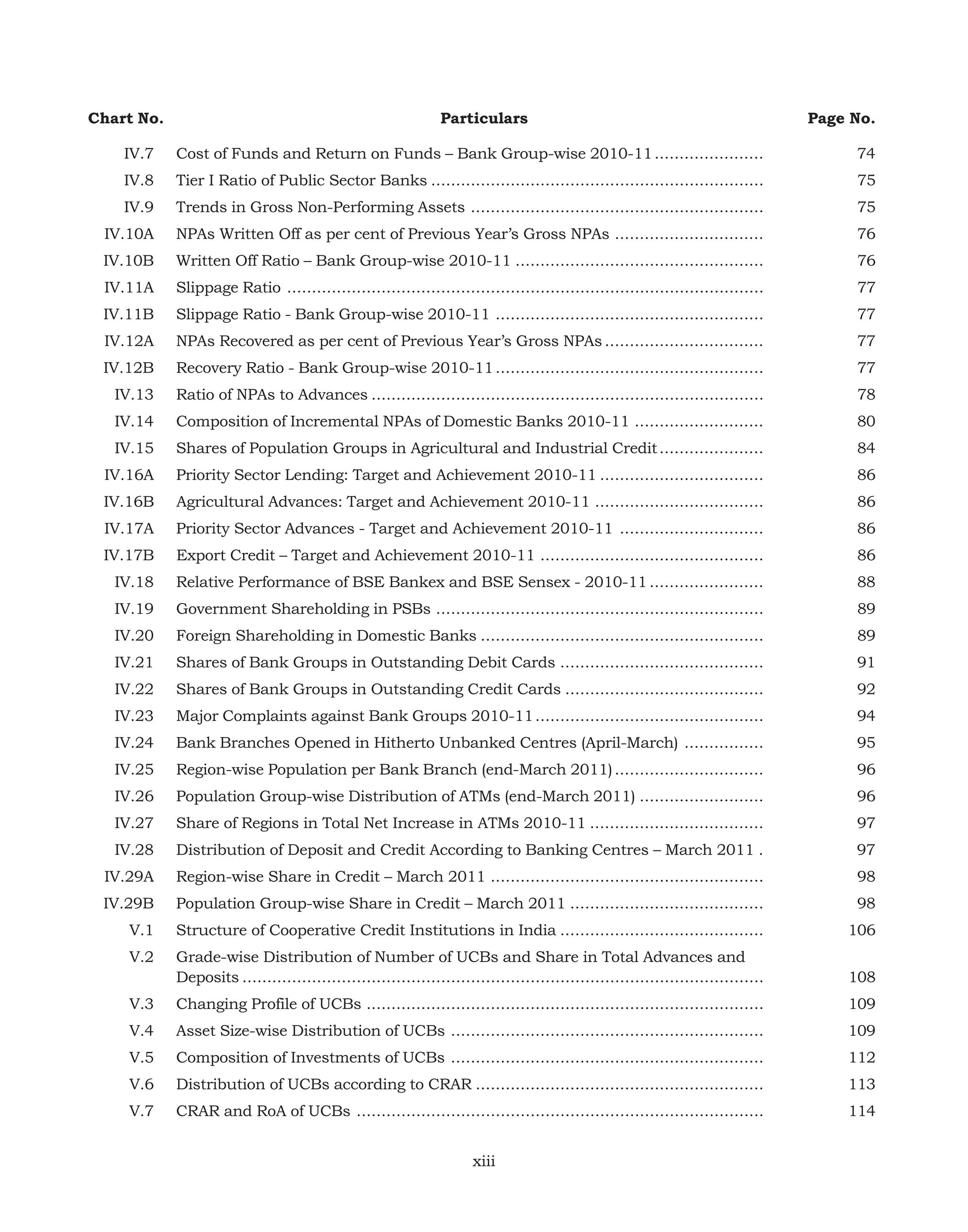
List of Charts
Chart No.

Particulars

Page No.

II.1

Global Macro-economic Trends ........................................................................

11

II.2

Three-year Moving Average of Bank Credit Growth, in per cent .........................

13

II.3

Bank Stock Indices in Select Economies/Economy Groups ...............................

14

II.4

International Assets/Liabilities of Advanced and Emerging Economies ..............

15

II.5

Leverage in the Banking Systems of Select Economies ......................................

16

II.6

Asset Quality of Banks in Select Economies .....................................................

16

II.7

CDS Spread of Global Banks ...........................................................................

17

II.8

Sovereign and Bank CDS Spreads in Select Economies .....................................

17

II.9

Demographic Access to Banking Services across Select Economies ....................

18

II.10

Usage of Banking Services across Select Economies – Deposits .........................

18

II.11

Usage of Banking Services across Select Economies – Credit .............................

19

II.12

Asset Growth in the US Banking Sector ...........................................................

19

II.13

Sectoral Rates of Growth of Credit of US Banks ................................................

20

II.14

Sectoral Delinquency Rates of US Banks ..........................................................

20

II.15

Balance Sheet Indicators of Banks in the Euro zone .........................................

20

II.16

Expectations about Credit Conditions for SME Sector in the Euro zone ..............

20

II.17

Movements in Euro Inter-Bank Offered Rate ....................................................

21

II.18

Interest Rates on Bank Deposits from Non-financial Corporations
(with Less than One Year Maturity), Select Euro zone Economies ......................

21

II.19

Expectations about Bank Credit Availability to SMEs in the UK .........................

22

II.20

Write-off Rates of UK Banks ............................................................................

23

II.21

Growth in Balance Sheets of Chinese Banks ....................................................

23

II.22

Location of Global Banking Business ...............................................................

24

II.23

Share of Countries in Total Assets of Top 100 Global Banks ..............................

24

II.24

Percentage Distribution of Top 100 Global Banks by Return on Assets ...............

24

II.25

Percentage Distribution of Top 100 Global Banks by CRAR ...............................

25

II.26

Percentage Distribution of Top 100 Global Banks by Capital Adequacy (Leverage)
Ratio ..............................................................................................................

25

II.27

Percentage Distribution of Top Global Banks by NPLs Ratio ..............................

25

II.28

Changes in Soundness Indicators of Top 20 Global Banks ................................

26

IV.1

Composition of Deposits 2010-11 ....................................................................

62

IV.2

Deposits and Borrowings 2010-11 ...................................................................

63

IV.3

Credit as per cent of Deposits plus Borrowings 2010-11 ....................................

66

IV.4

Incremental Credit- and Investment-Deposit Ratios of SCBs .............................

67

IV.5

Composition of Off-Balance Sheet Exposures of the Banking Sector 2010-11 .....

69

IV.6

Net Profits of SCBs .........................................................................................

72

xii
Chart No.

Particulars

Page No.

IV.7

Cost of Funds and Return on Funds – Bank Group-wise 2010-11 ......................

74

IV.8

Tier I Ratio of Public Sector Banks ...................................................................

75

IV.9

Trends in Gross Non-Performing Assets ...........................................................

75

IV.10A

NPAs Written Off as per cent of Previous Year’s Gross NPAs ..............................

76

IV.10B

Written Off Ratio – Bank Group-wise 2010-11 ..................................................

76

IV.11A

Slippage Ratio ................................................................................................

77

IV.11B

Slippage Ratio - Bank Group-wise 2010-11 ......................................................

77

IV.12A

NPAs Recovered as per cent of Previous Year’s Gross NPAs ................................

77

IV.12B

Recovery Ratio - Bank Group-wise 2010-11 ......................................................

77

IV.13

Ratio of NPAs to Advances ...............................................................................

78

IV.14

Composition of Incremental NPAs of Domestic Banks 2010-11 ..........................

80

IV.15

Shares of Population Groups in Agricultural and Industrial Credit .....................

84

IV.16A

Priority Sector Lending: Target and Achievement 2010-11 .................................

86

IV.16B

Agricultural Advances: Target and Achievement 2010-11 ..................................

86

IV.17A

Priority Sector Advances - Target and Achievement 2010-11 .............................

86

IV.17B

Export Credit – Target and Achievement 2010-11 .............................................

86

IV.18

Relative Performance of BSE Bankex and BSE Sensex - 2010-11 .......................

88

IV.19

Government Shareholding in PSBs ..................................................................

89

IV.20

Foreign Shareholding in Domestic Banks .........................................................

89

IV.21

Shares of Bank Groups in Outstanding Debit Cards .........................................

91

IV.22

Shares of Bank Groups in Outstanding Credit Cards ........................................

92

IV.23

Major Complaints against Bank Groups 2010-11 ..............................................

94

IV.24

Bank Branches Opened in Hitherto Unbanked Centres (April-March) ................

95

IV.25

Region-wise Population per Bank Branch (end-March 2011) ..............................

96

IV.26

Population Group-wise Distribution of ATMs (end-March 2011) .........................

96

IV.27

Share of Regions in Total Net Increase in ATMs 2010-11 ...................................

97

IV.28

Distribution of Deposit and Credit According to Banking Centres – March 2011 .

97

IV.29A

Region-wise Share in Credit – March 2011 .......................................................

98

IV.29B

Population Group-wise Share in Credit – March 2011 .......................................

98

V.1

Structure of Cooperative Credit Institutions in India .........................................

106

V.2

Grade-wise Distribution of Number of UCBs and Share in Total Advances and
Deposits .........................................................................................................

108

V.3

Changing Profile of UCBs ................................................................................

109

V.4

Asset Size-wise Distribution of UCBs ...............................................................

109

V.5

Composition of Investments of UCBs ...............................................................

112

V.6

Distribution of UCBs according to CRAR ..........................................................

113

V.7

CRAR and RoA of UCBs ..................................................................................

114

xiii
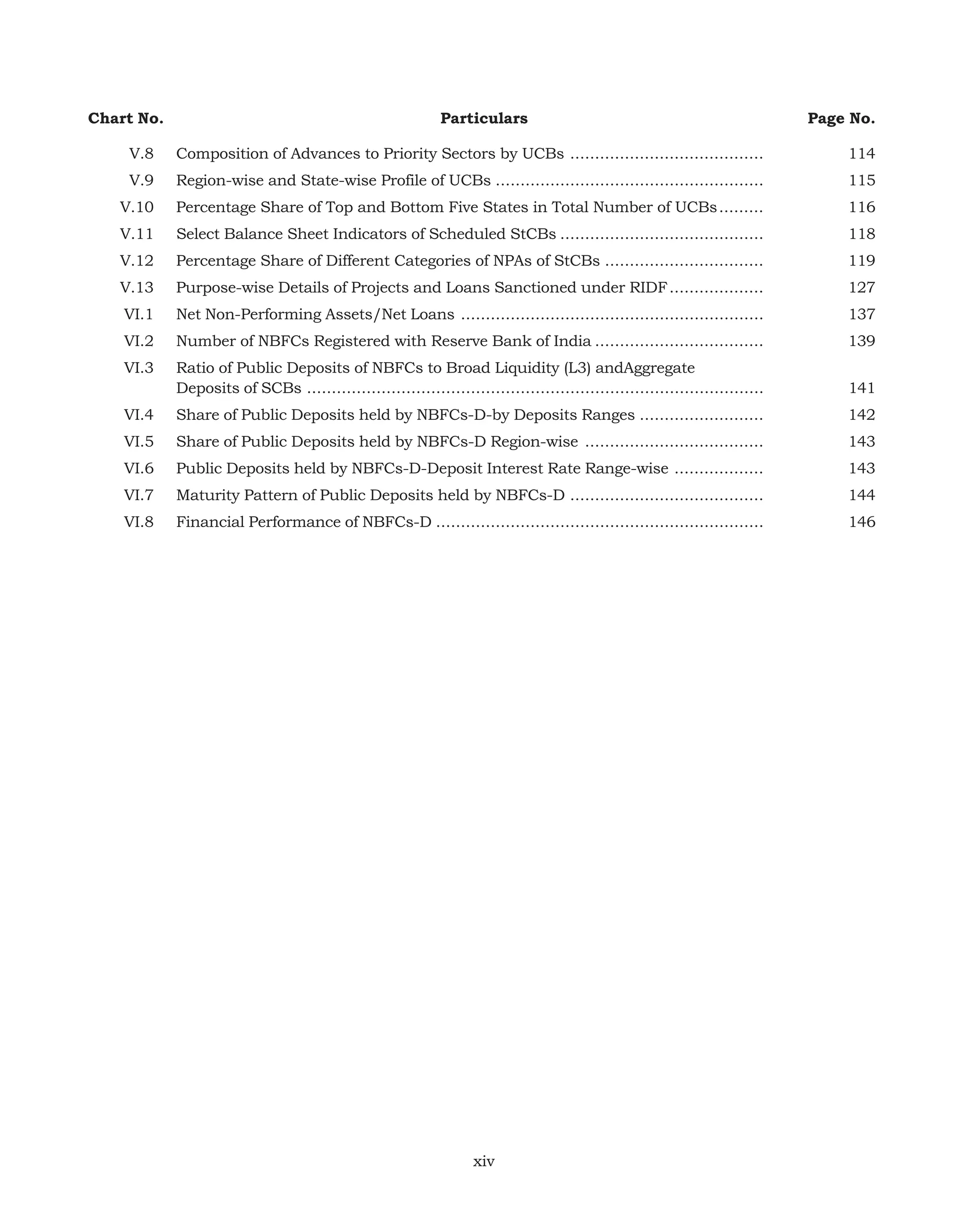
Chart No.

Particulars

Page No.

V.8

Composition of Advances to Priority Sectors by UCBs .......................................

114

V.9

Region-wise and State-wise Profile of UCBs ......................................................

115

V.10

Percentage Share of Top and Bottom Five States in Total Number of UCBs.........

116

V.11

Select Balance Sheet Indicators of Scheduled StCBs .........................................

118

V.12

Percentage Share of Different Categories of NPAs of StCBs ................................

119

V.13

Purpose-wise Details of Projects and Loans Sanctioned under RIDF ...................

127

VI.1

Net Non-Performing Assets/Net Loans .............................................................

137

VI.2

Number of NBFCs Registered with Reserve Bank of India ..................................

139

VI.3

Ratio of Public Deposits of NBFCs to Broad Liquidity (L3) andAggregate
Deposits of SCBs ............................................................................................

141

VI.4

Share of Public Deposits held by NBFCs-D-by Deposits Ranges .........................

142

VI.5

Share of Public Deposits held by NBFCs-D Region-wise ....................................

143

VI.6

Public Deposits held by NBFCs-D-Deposit Interest Rate Range-wise ..................

143

VI.7

Maturity Pattern of Public Deposits held by NBFCs-D .......................................

144

VI.8

Financial Performance of NBFCs-D ..................................................................

146

xiv
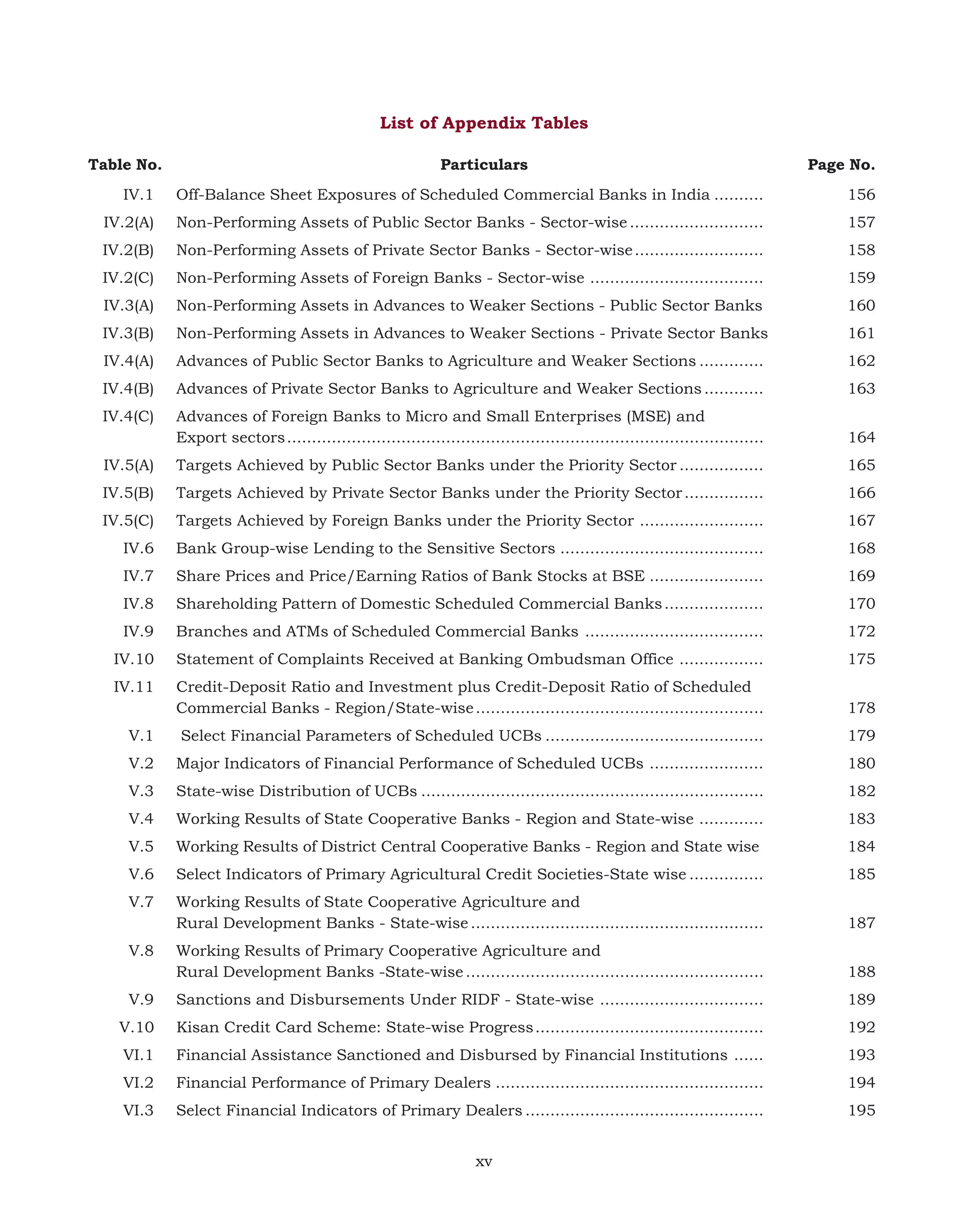
List of Appendix Tables
Table No.

Particulars

Page No.

IV.1

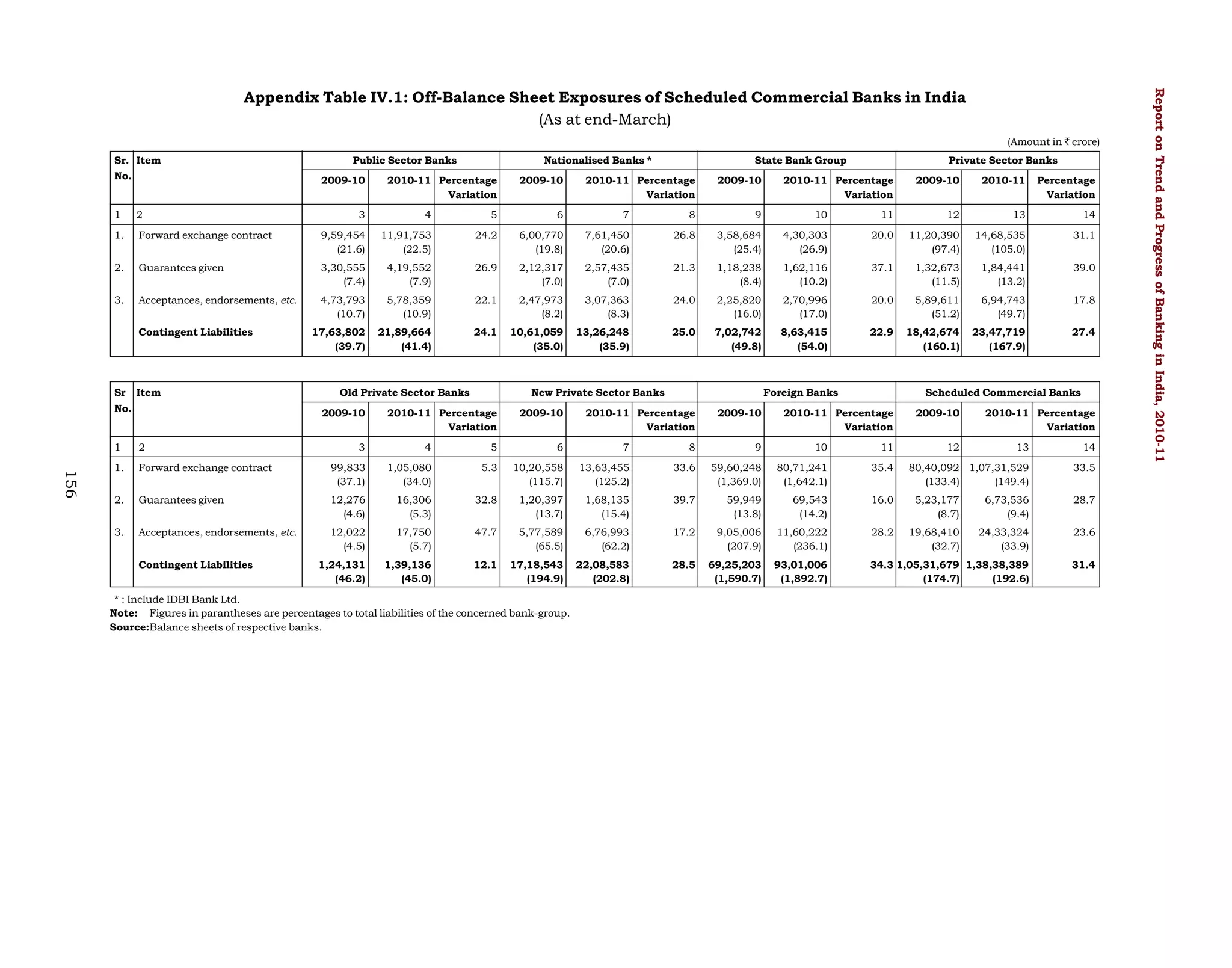
Off-Balance Sheet Exposures of Scheduled Commercial Banks in India ..........

156

IV.2(A)

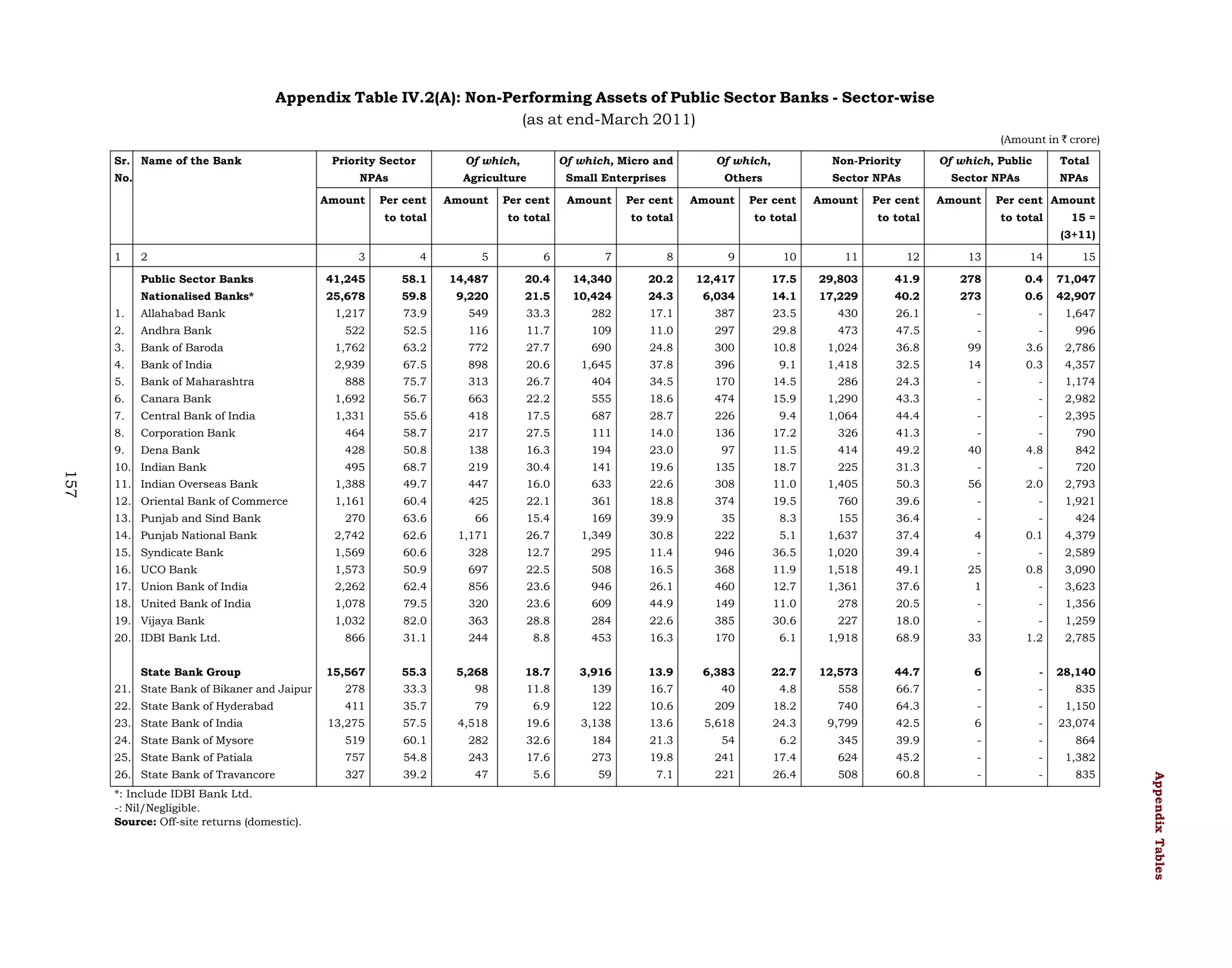
Non-Performing Assets of Public Sector Banks - Sector-wise ...........................

157

IV.2(B)

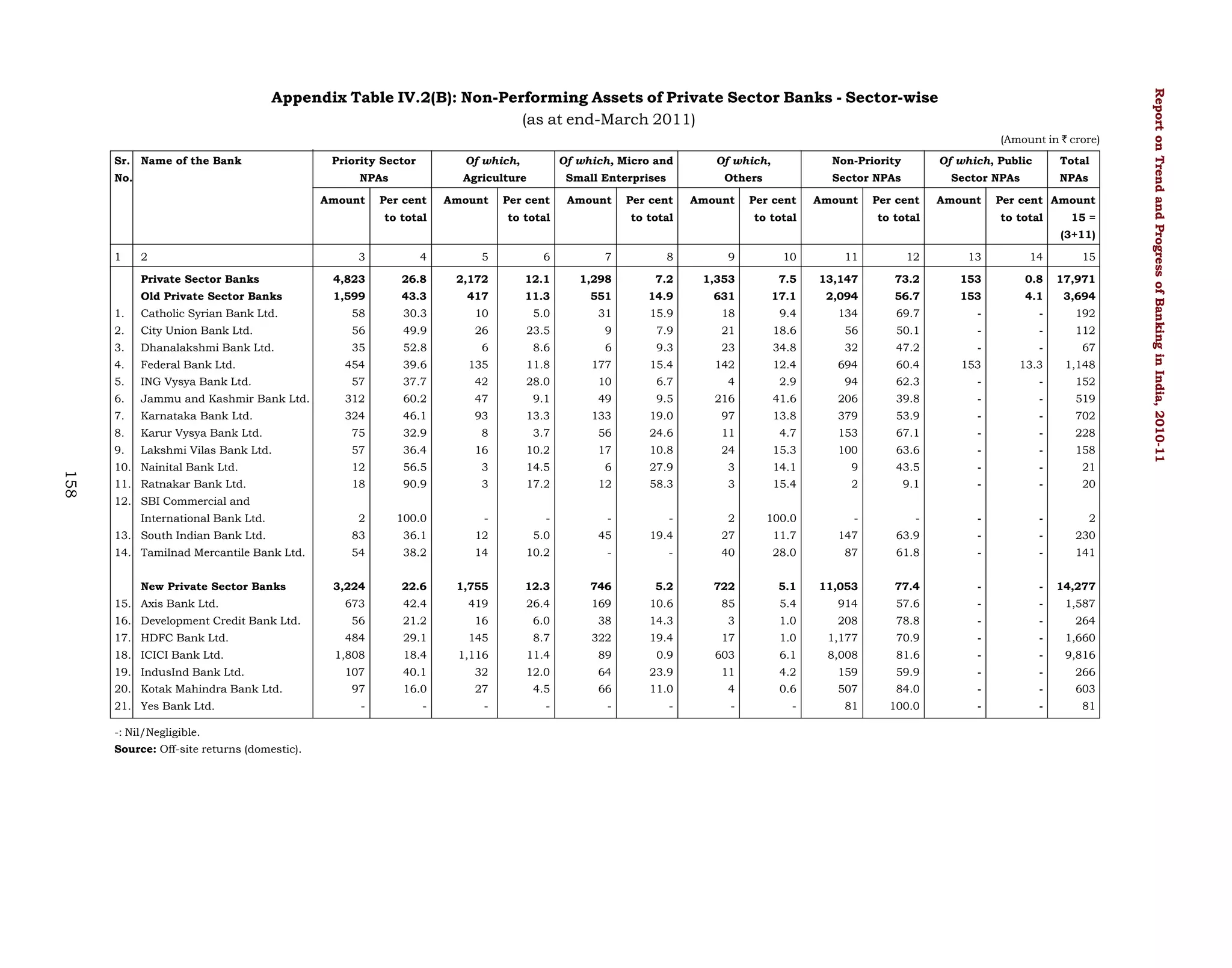
Non-Performing Assets of Private Sector Banks - Sector-wise ..........................

158

IV.2(C)

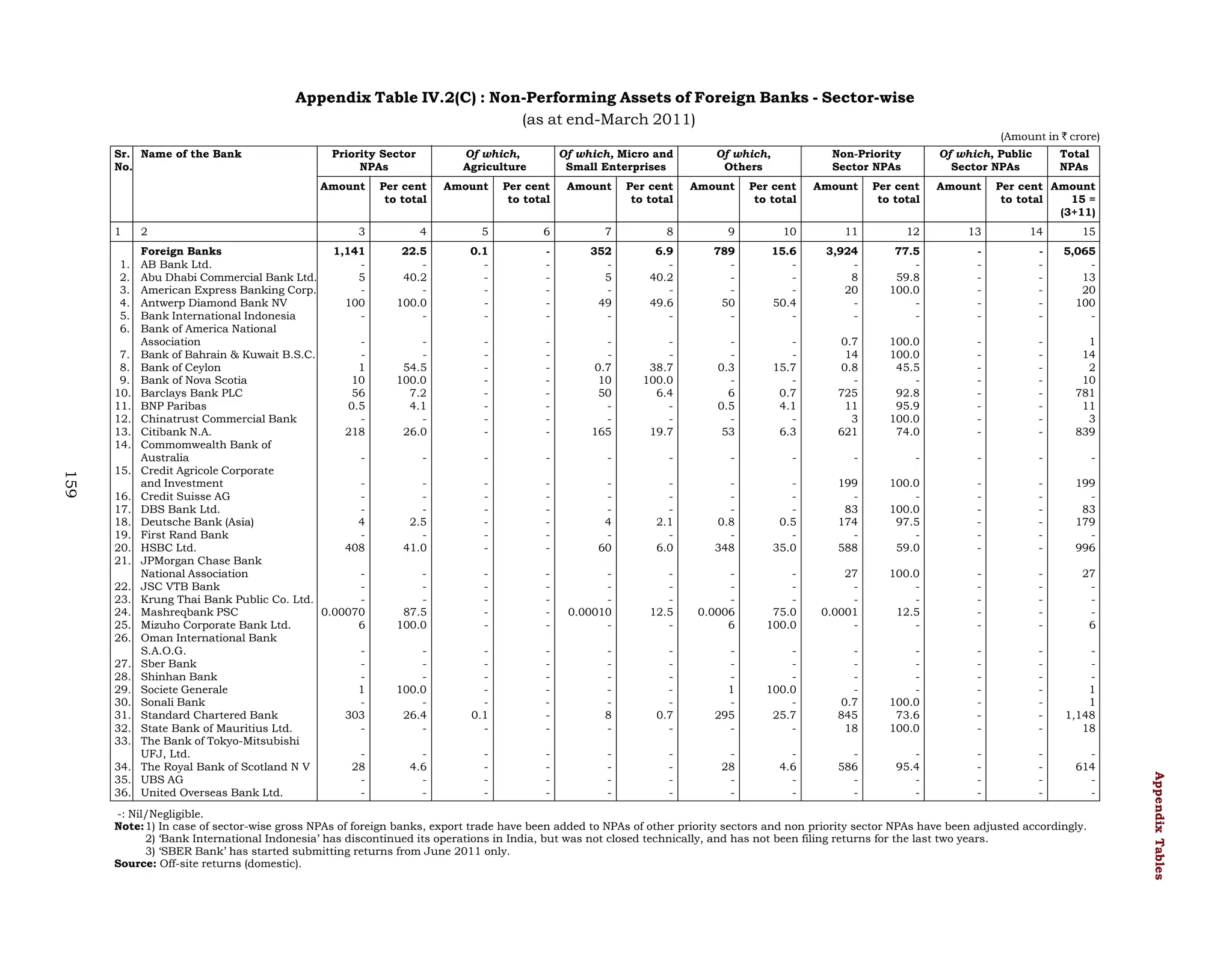
Non-Performing Assets of Foreign Banks - Sector-wise ...................................

159

IV.3(A)

Non-Performing Assets in Advances to Weaker Sections - Public Sector Banks

160

IV.3(B)

Non-Performing Assets in Advances to Weaker Sections - Private Sector Banks

161

IV.4(A)

Advances of Public Sector Banks to Agriculture and Weaker Sections .............

162

IV.4(B)

Advances of Private Sector Banks to Agriculture and Weaker Sections ............

163

IV.4(C)

Advances of Foreign Banks to Micro and Small Enterprises (MSE) and
Export sectors ................................................................................................

164

IV.5(A)

Targets Achieved by Public Sector Banks under the Priority Sector .................

165

IV.5(B)

Targets Achieved by Private Sector Banks under the Priority Sector ................

166

IV.5(C)

Targets Achieved by Foreign Banks under the Priority Sector .........................

167

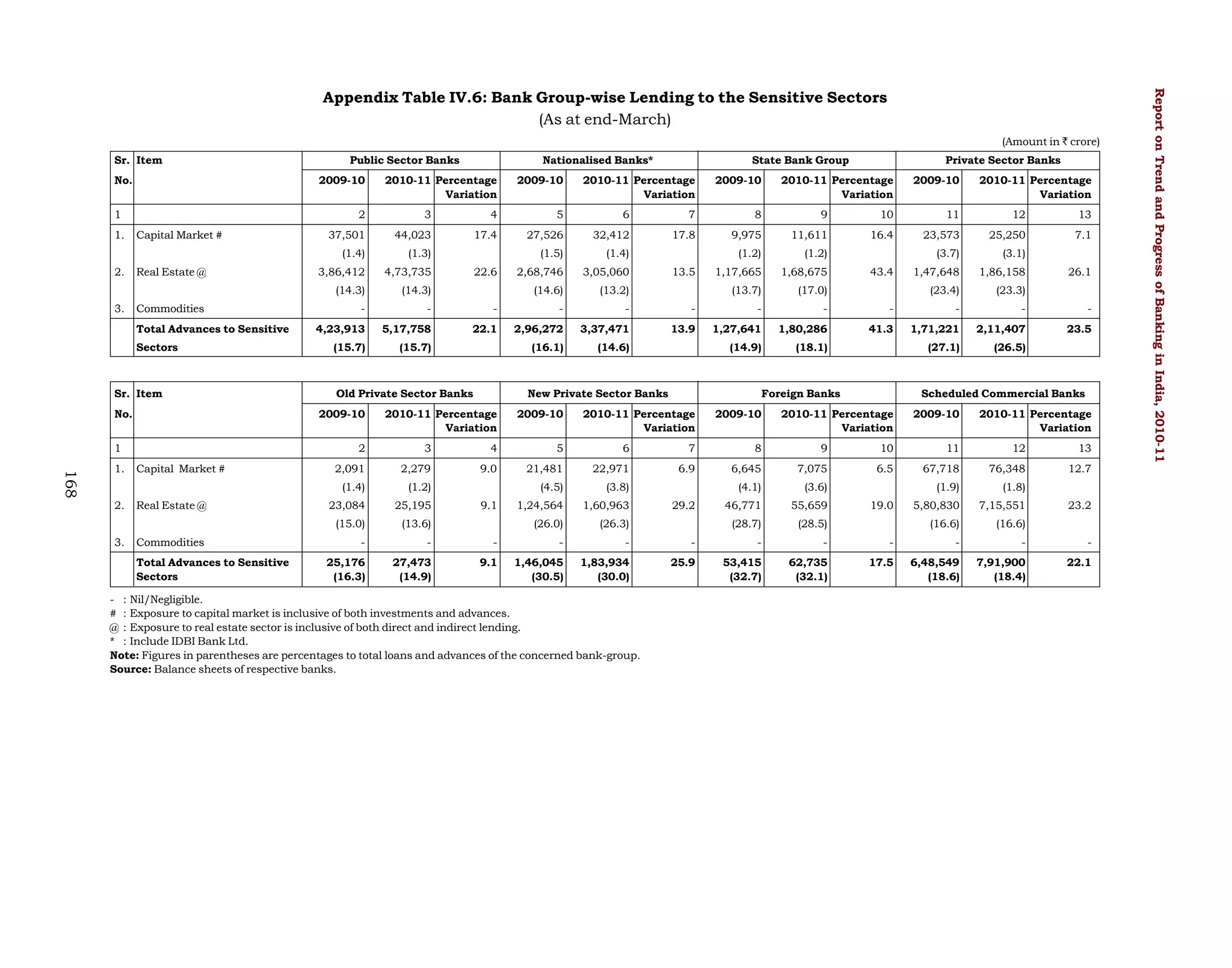
IV.6

Bank Group-wise Lending to the Sensitive Sectors .........................................

168

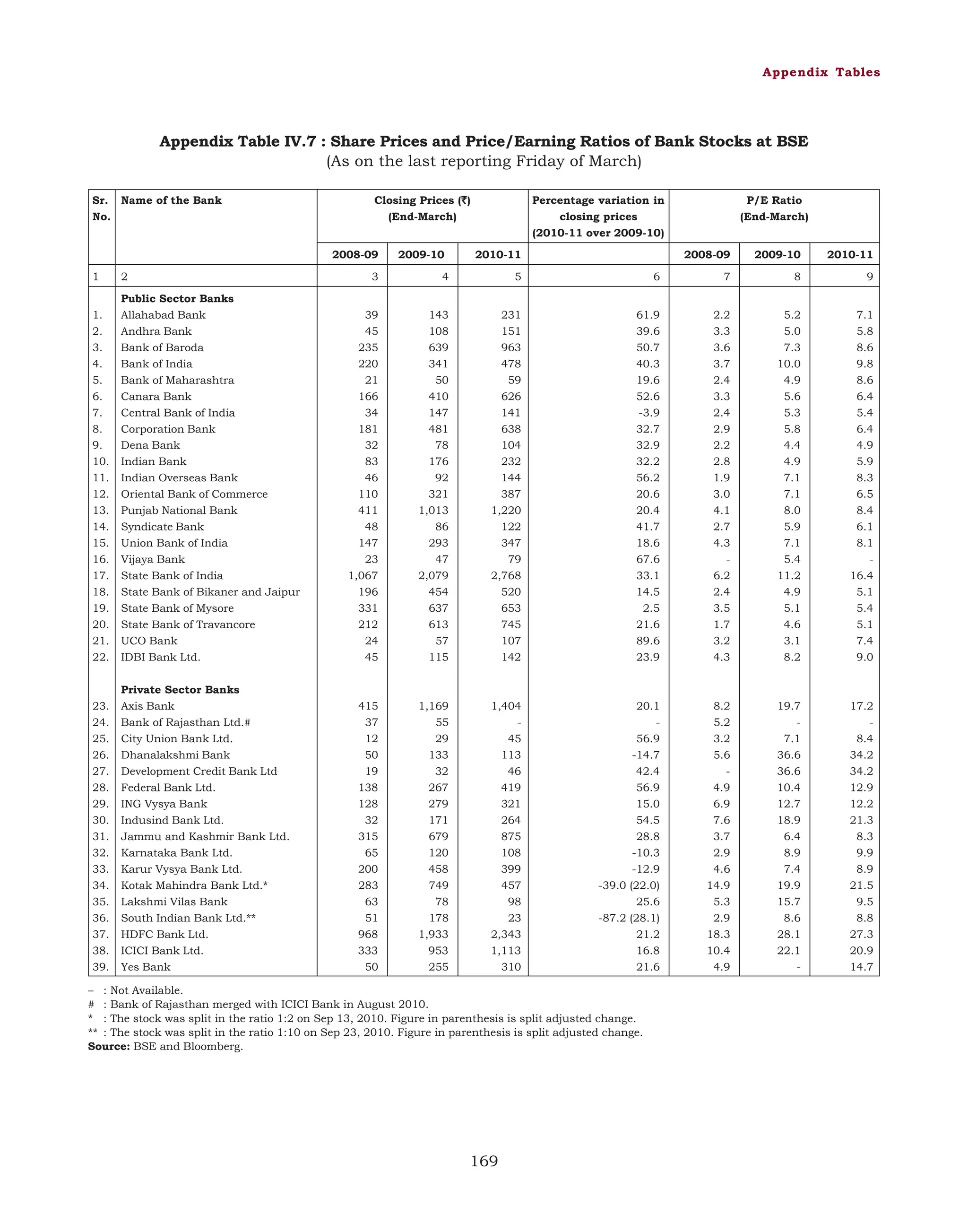
IV.7

Share Prices and Price/Earning Ratios of Bank Stocks at BSE .......................

169

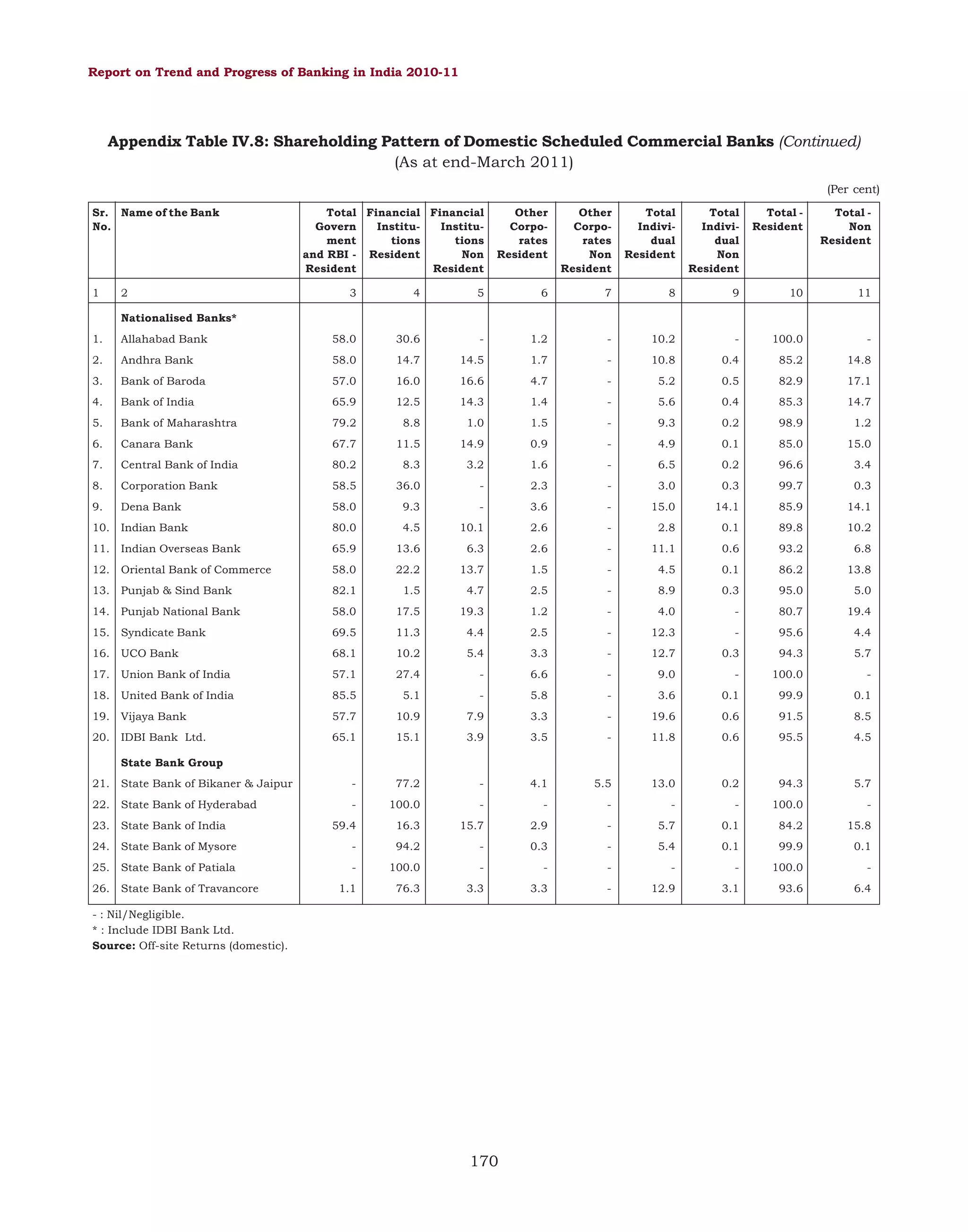
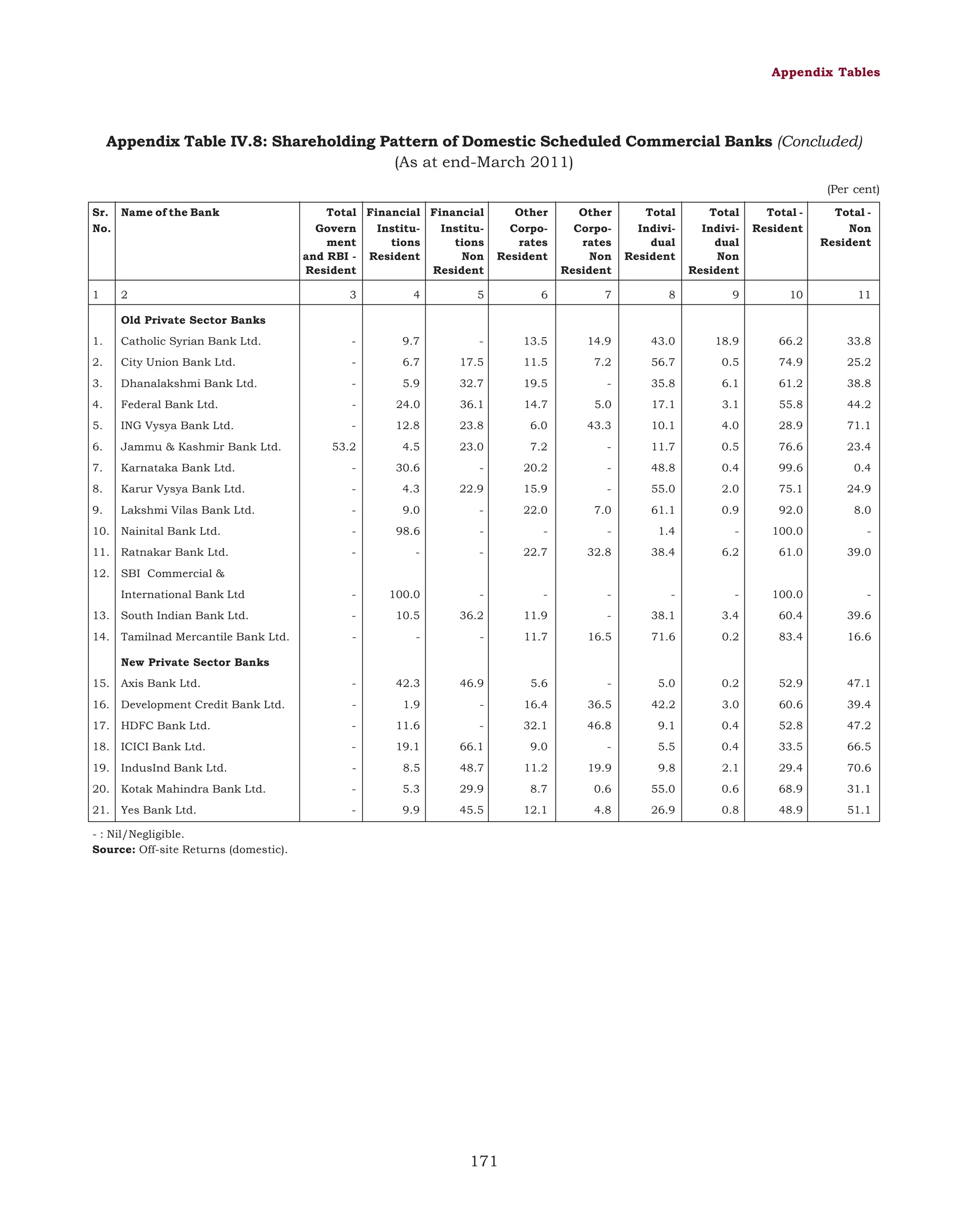
IV.8

Shareholding Pattern of Domestic Scheduled Commercial Banks ....................

170

IV.9

Branches and ATMs of Scheduled Commercial Banks ....................................

172

IV.10

Statement of Complaints Received at Banking Ombudsman Office .................

175

IV.11

Credit-Deposit Ratio and Investment plus Credit-Deposit Ratio of Scheduled
Commercial Banks - Region/State-wise ..........................................................

178

V.1

Select Financial Parameters of Scheduled UCBs ............................................

179

V.2

Major Indicators of Financial Performance of Scheduled UCBs .......................

180

V.3

State-wise Distribution of UCBs .....................................................................

182

V.4

Working Results of State Cooperative Banks - Region and State-wise .............

183

V.5

Working Results of District Central Cooperative Banks - Region and State wise

184

V.6

Select Indicators of Primary Agricultural Credit Societies-State wise ...............

185

V.7

Working Results of State Cooperative Agriculture and
Rural Development Banks - State-wise ...........................................................

187

Working Results of Primary Cooperative Agriculture and
Rural Development Banks -State-wise ............................................................

188

V.9

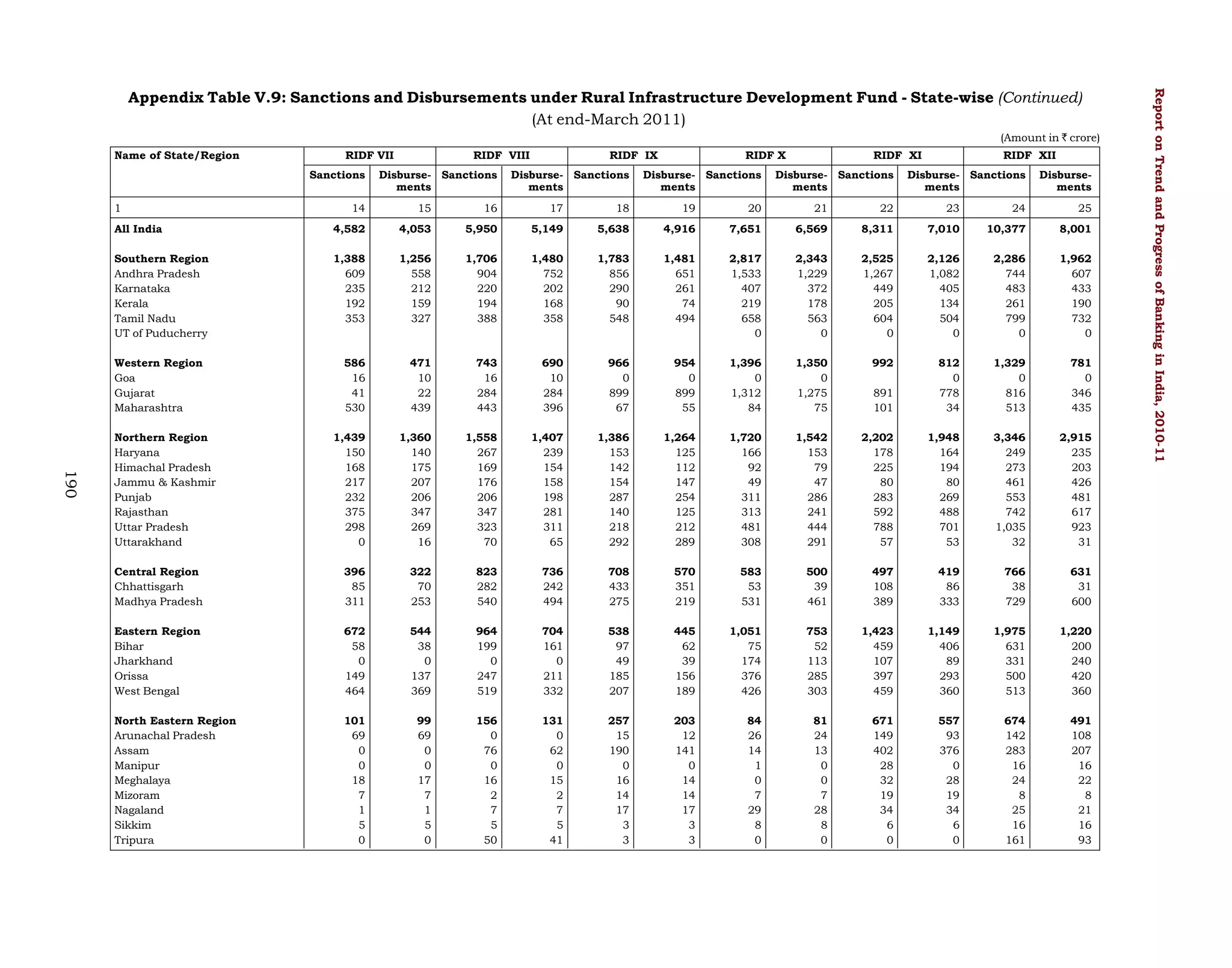
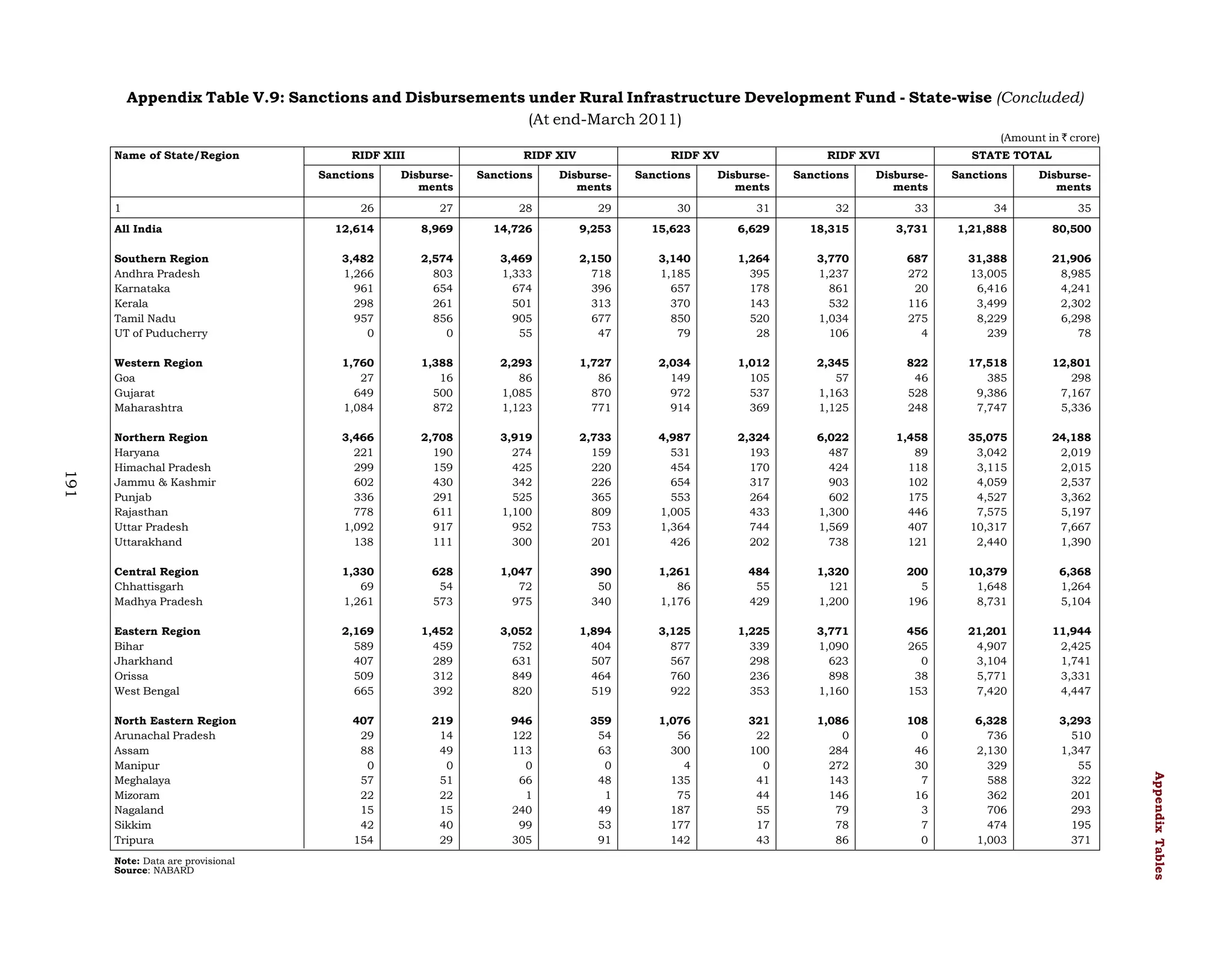
Sanctions and Disbursements Under RIDF - State-wise .................................

189

V.10

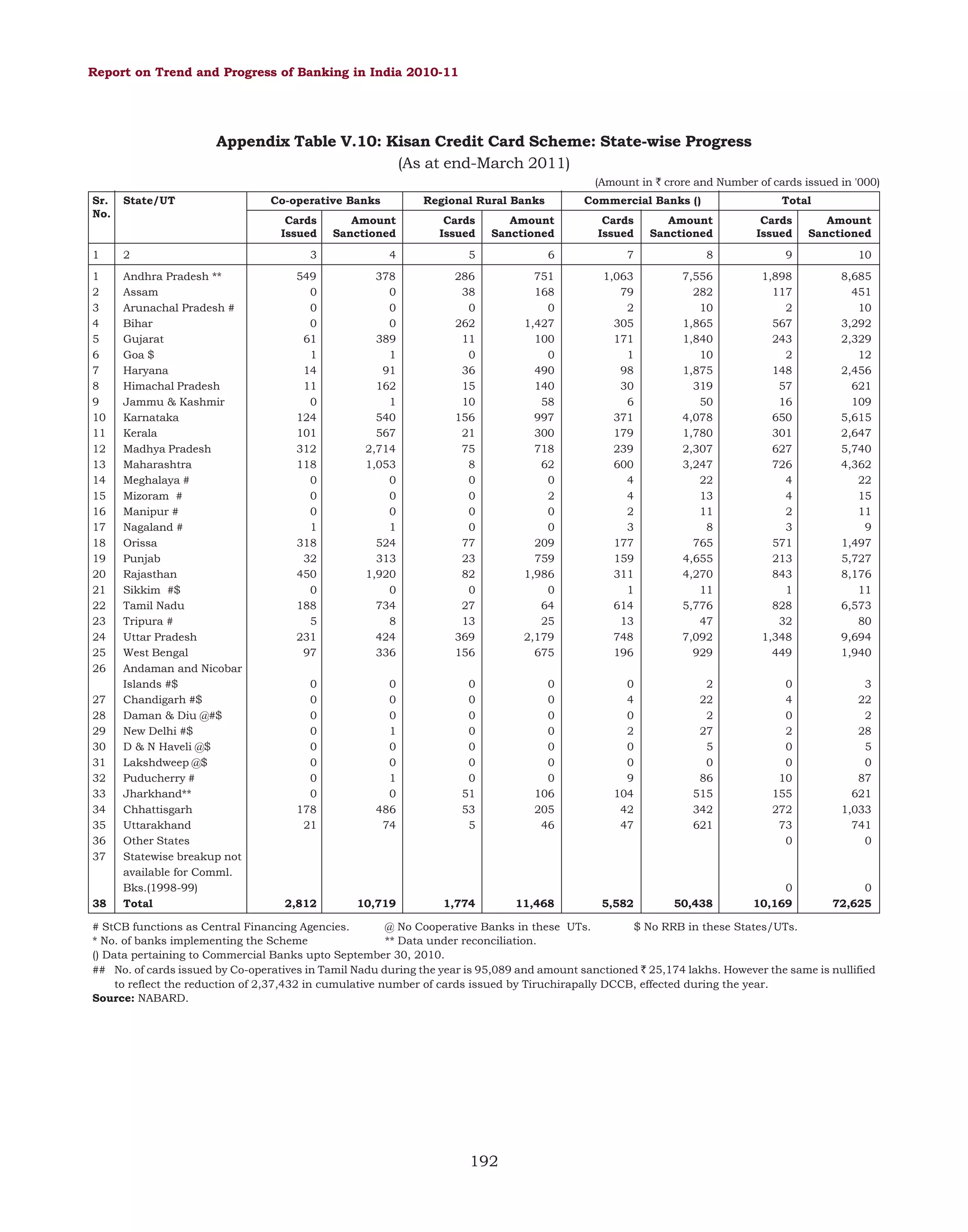
Kisan Credit Card Scheme: State-wise Progress ..............................................

192

VI.1

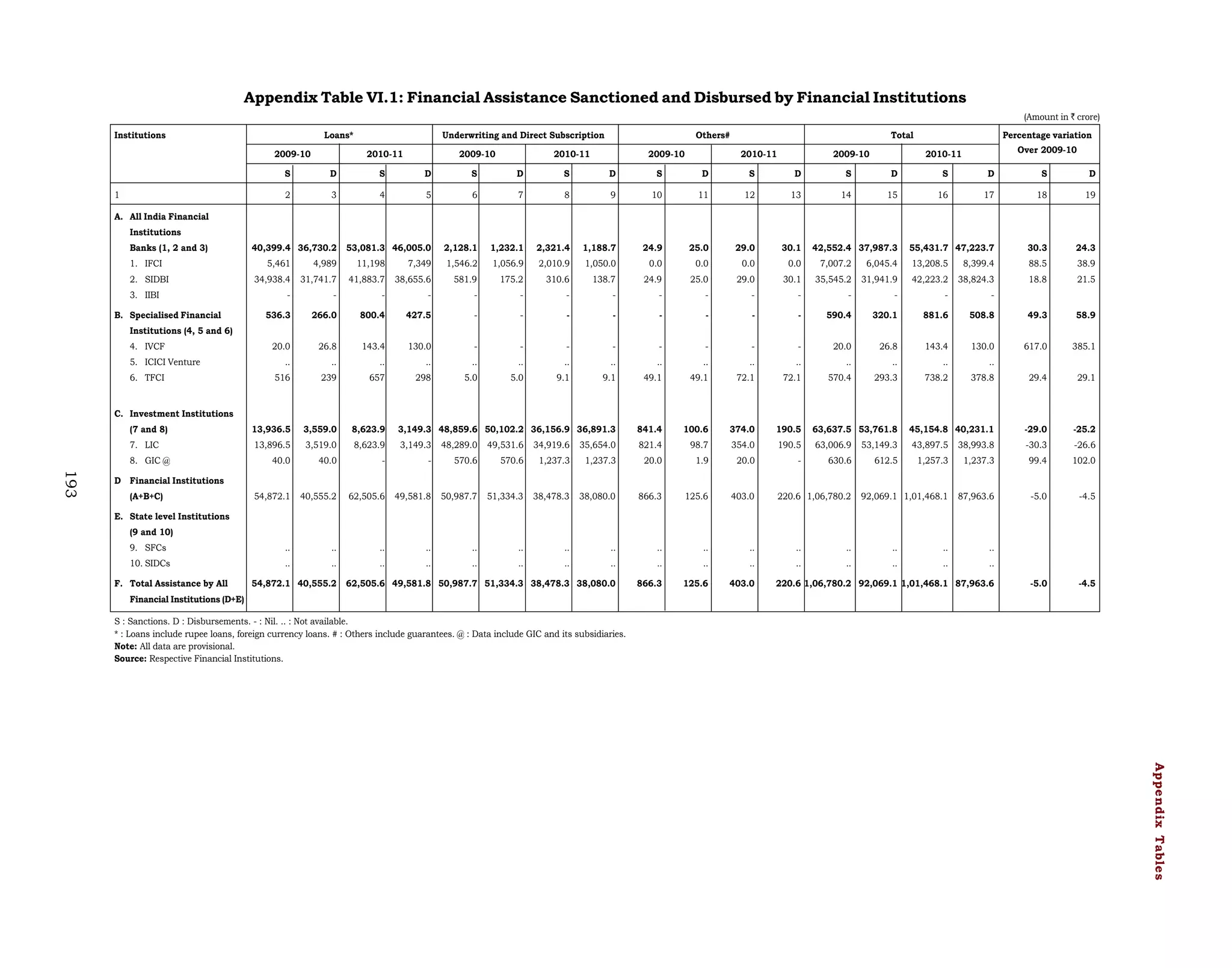
Financial Assistance Sanctioned and Disbursed by Financial Institutions ......

193

VI.2

Financial Performance of Primary Dealers ......................................................

194

VI.3

Select Financial Indicators of Primary Dealers ................................................

195

V.8

xv
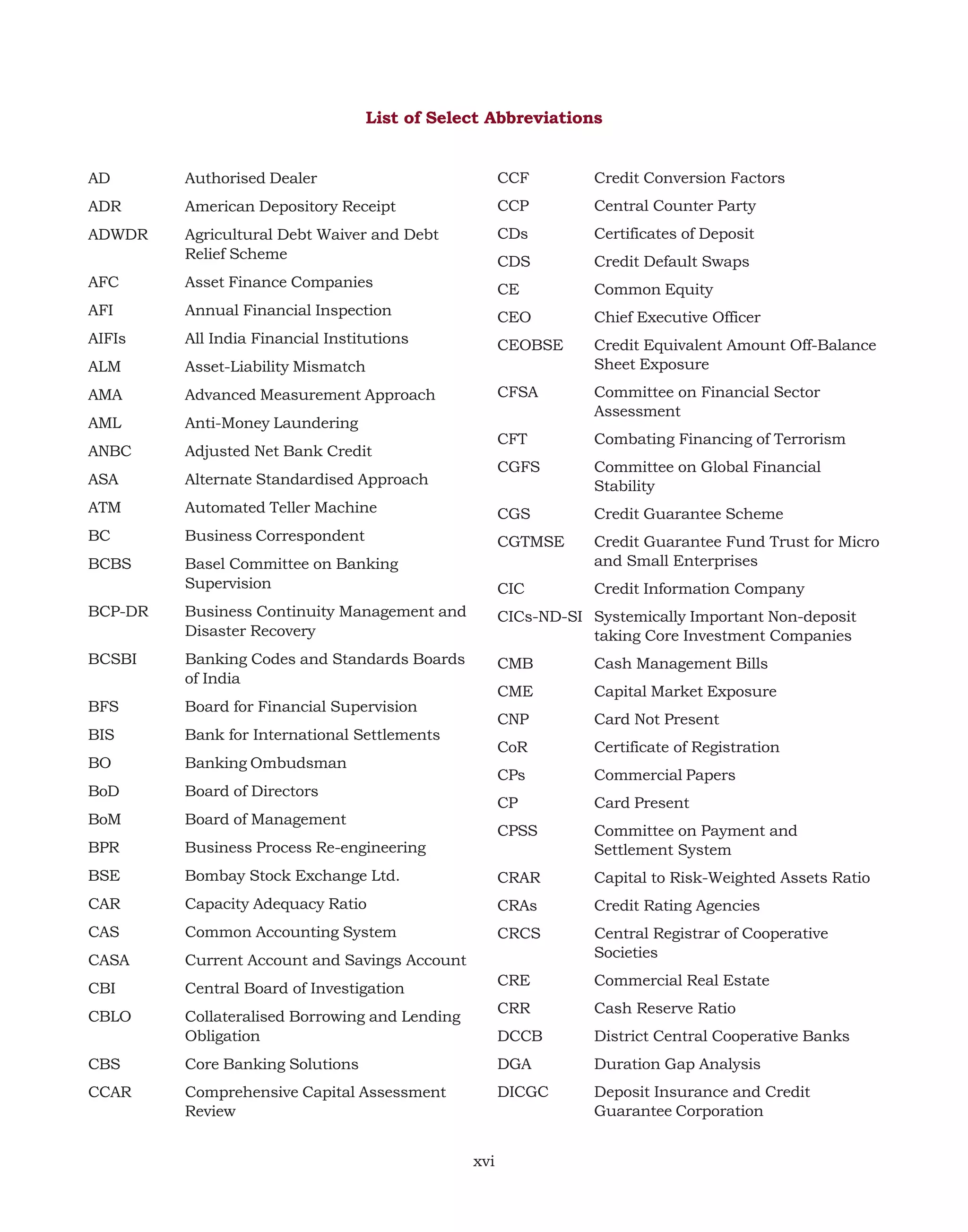
List of Select Abbreviations
AD

Authorised Dealer

CCF

Credit Conversion Factors

ADR

American Depository Receipt

CCP

Central Counter Party

ADWDR

Agricultural Debt Waiver and Debt
Relief Scheme

CDs

Certificates of Deposit

CDS

Credit Default Swaps

AFC

Asset Finance Companies

CE

Common Equity

AFI

Annual Financial Inspection

CEO

Chief Executive Officer

AIFIs

All India Financial Institutions

CEOBSE

ALM

Asset-Liability Mismatch

Credit Equivalent Amount Off-Balance
Sheet Exposure

AMA

Advanced Measurement Approach

CFSA

AML

Anti-Money Laundering

Committee on Financial Sector
Assessment

ANBC

Adjusted Net Bank Credit

CFT

Combating Financing of Terrorism

ASA

Alternate Standardised Approach

CGFS

Committee on Global Financial
Stability

ATM

Automated Teller Machine

CGS

Credit Guarantee Scheme

BC

Business Correspondent

CGTMSE

BCBS

Basel Committee on Banking
Supervision

Credit Guarantee Fund Trust for Micro
and Small Enterprises

CIC

Credit Information Company

BCP-DR

Business Continuity Management and
Disaster Recovery

CICs-ND-SI Systemically Important Non-deposit
taking Core Investment Companies

BCSBI

Banking Codes and Standards Boards
of India

CMB

Cash Management Bills

BFS

Board for Financial Supervision

CME

Capital Market Exposure

BIS

Bank for International Settlements

CNP

Card Not Present

BO

Banking Ombudsman

CoR

Certificate of Registration

BoD

Board of Directors

CPs

Commercial Papers

BoM

Board of Management

CP

Card Present

BPR

Business Process Re-engineering

CPSS

Committee on Payment and
Settlement System

BSE

Bombay Stock Exchange Ltd.

CRAR

Capital to Risk-Weighted Assets Ratio

CAR

Capacity Adequacy Ratio

CRAs

Credit Rating Agencies

CAS

Common Accounting System

CRCS

CASA

Current Account and Savings Account

Central Registrar of Cooperative
Societies

CBI

Central Board of Investigation

CRE

Commercial Real Estate

CBLO

Collateralised Borrowing and Lending
Obligation

CRR

Cash Reserve Ratio

DCCB

District Central Cooperative Banks

CBS

Core Banking Solutions

DGA

Duration Gap Analysis

CCAR

Comprehensive Capital Assessment
Review

DICGC

Deposit Insurance and Credit
Guarantee Corporation

xvi
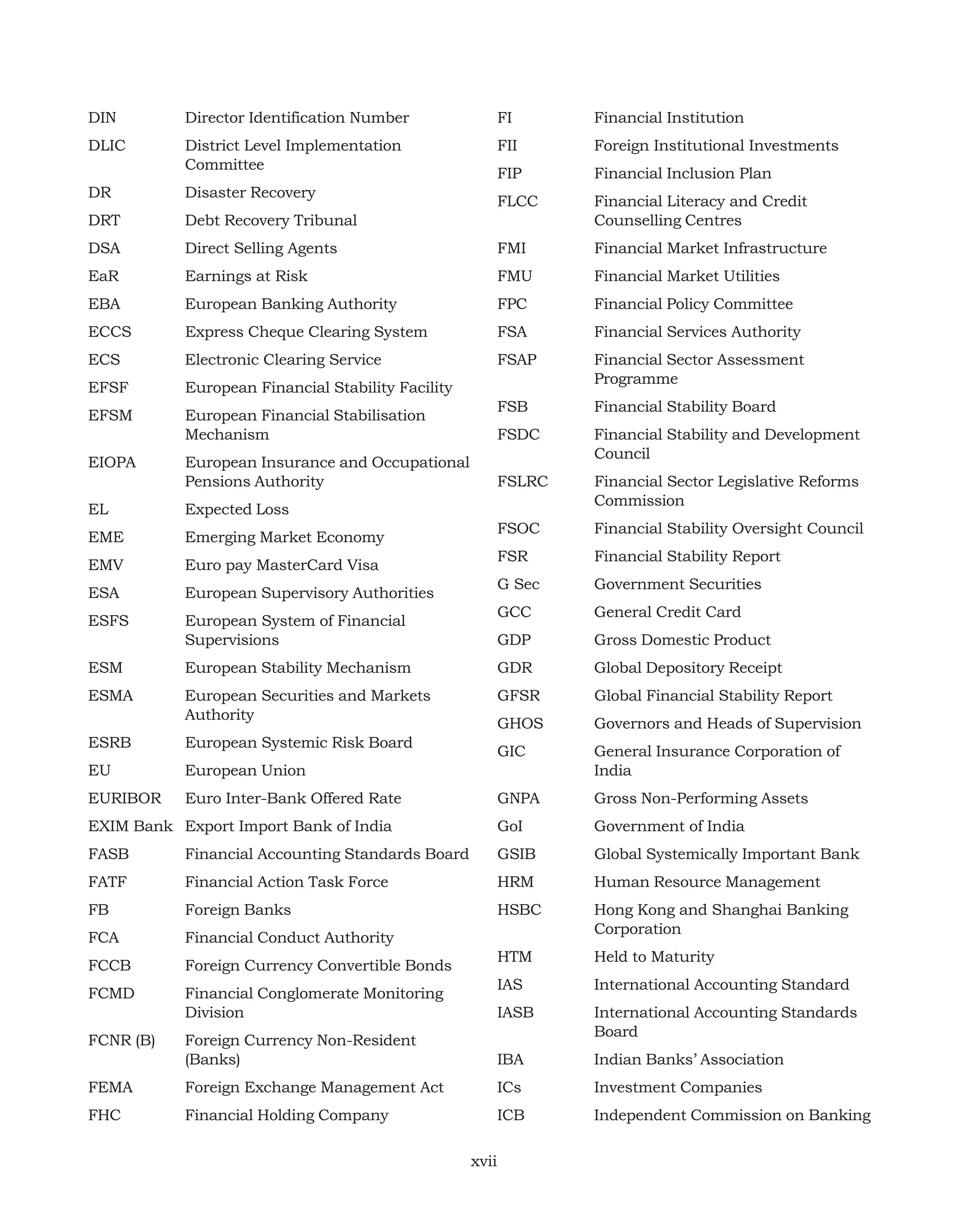
DIN

Director Identification Number

FI

Financial Institution

DLIC

District Level Implementation
Committee

FII

Foreign Institutional Investments

FIP

Financial Inclusion Plan

DR

Disaster Recovery

FLCC

DRT

Debt Recovery Tribunal

Financial Literacy and Credit
Counselling Centres

DSA

Direct Selling Agents

FMI

Financial Market Infrastructure

EaR

Earnings at Risk

FMU

Financial Market Utilities

EBA

European Banking Authority

FPC

Financial Policy Committee

ECCS

Express Cheque Clearing System

FSA

Financial Services Authority

ECS

Electronic Clearing Service

FSAP

EFSF

European Financial Stability Facility

Financial Sector Assessment
Programme

EFSM

European Financial Stabilisation
Mechanism

FSB

Financial Stability Board

FSDC

Financial Stability and Development
Council

FSLRC

Financial Sector Legislative Reforms
Commission

FSOC

Financial Stability Oversight Council

FSR

Financial Stability Report

G Sec

Government Securities

GCC

General Credit Card

GDP

Gross Domestic Product

EIOPA

European Insurance and Occupational
Pensions Authority

EL

Expected Loss

EME

Emerging Market Economy

EMV

Euro pay MasterCard Visa

ESA

European Supervisory Authorities

ESFS

European System of Financial
Supervisions

ESM

European Stability Mechanism

GDR

Global Depository Receipt

ESMA

European Securities and Markets
Authority

GFSR

Global Financial Stability Report

GHOS

Governors and Heads of Supervision

ESRB

European Systemic Risk Board

GIC

EU

European Union

General Insurance Corporation of
India

EURIBOR

Euro Inter-Bank Offered Rate

GNPA

Gross Non-Performing Assets

EXIM Bank Export Import Bank of India

GoI

Government of India

FASB

Financial Accounting Standards Board

GSIB

Global Systemically Important Bank

FATF

Financial Action Task Force

HRM

Human Resource Management

FB

Foreign Banks

HSBC

FCA

Financial Conduct Authority

Hong Kong and Shanghai Banking
Corporation

FCCB

Foreign Currency Convertible Bonds

HTM

Held to Maturity

FCMD

Financial Conglomerate Monitoring
Division

IAS

International Accounting Standard

IASB

Foreign Currency Non-Resident
(Banks)

International Accounting Standards
Board

IBA

Indian Banks’ Association

FEMA

Foreign Exchange Management Act

ICs

Investment Companies

FHC

Financial Holding Company

ICB

Independent Commission on Banking

FCNR (B)

xvii
ICDs

Inter Corporate Deposits

MAG

Macro-economic Assessment Group

ICICI

Industrial Credit and Investment
Corporation of India

MCA

Ministry of Corporate Affairs

ICT

Information and Communications
Technology

MDG

Modified Duration Gap

MENA

Middle East and North African

IDBI

Industrial Development Bank of India

MFI

Micro Finance Institution

IDRBT

Institute for Development and
Research in Banking Technology

MICR

Magnetic Ink Character Recognition

MIS

Management Information System

IFC

Infrastructure Finance Company

MoU

Memorandum of Understanding

IFRS

International Financial Reporting
Standards

MSE

Micro and Small Enterprise

MSF

Marginal Standing Facility

IIBI

Industrial Investment Bank of India

MSME

Micro, Small and Medium Enterprises

IL

Incurred Loss

IMA

Internal Models Approach

MVE

Market Value of Equity

IMF

International Monetary Fund

NABARD

National Bank for Agriculture and
Rural Development

Ind ASs

Indian Accounting Standards

NAFSCOB

INFINET

Indian Financial NETwork

National Federation of State
Cooperative Banks

IOSCO

International Organisation of
Securities Commission

NBFC

Non-Banking Financial Company

NBFC-D

IRB

Internal Rating Based

Non-Banking Financial CompanyDeposit taking

IRC

Incremental Risk Charge

NBFC-ND

IRDA

Insurance Regulatory and
Development Authority

Non-Deposit taking Non-Banking
Financial Company

IRSD

Interest Rate Sensitivity under
Duration Gap Analysis

IT

Information Technology

IVR

Interactive Voice Response

JLGs

Joint Liability Groups

KCC

Kisan Credit Card

KYC

Know Your Customer

LAB

Local Area Bank

LAF

Liquidity Adjustment Facility

LCBG

NBFC-ND-SI Systemically Important Non-Deposit
taking Non-Banking Financial
Company
NBFIs

Non-Banking Financial Institutions

NDS

Negotiated Dealing System

NDTL

Net Demand and Time Liability

NECS

National Electronic Clearing Service

NEFT

National Electronic Fund Transfer

NGO

Non-Government Organisation

NHB

National Housing Bank

Large and Complex Banking Group

NII

Net Interest Income

LCR

Liquidity Coverage Ratio

NIM

Net Interest Margin

LCs

Loan Companies

NIMC

LEI

Long-term Economic Impact

National Implementing and Monitoring
Committee

LGD

Loss Given Default

NOC

No Objection Certificate

LIBOR

London Inter-Bank Offered Rate

NOF

Net Owned Fund

LIC

Life Insurance Corporation of India

NOHC

Non-Operative Holding Company

LTCCS

Long-Term Cooperative Credit
Structure

NPA

Non-Performing Asset

NRE

Non-Resident External

xviii
SAO

Seasonal Agricultural Operations

SARFAESI

Securitisation and Reconstruction of
Financial Assets and Enforcement of
Security Interest

Non-Resident Ordinary

SBLP

SHG-Bank Linkage Programme

NSFR

Net Stable Funding Ratio

SC

Scheduled Caste

OBS

Off-balance Sheet

SCAP

OECD

Organisation for Economic
Corporation and Development

Supervisory Capital Assessment
Programme

SCARDB

OSMOS

Off-Site Monitoring and Surveillance
System

State Cooperative Agriculture and
Rural Development Bank

SCB

Scheduled Commercial Bank

OTC

Over the Counter

SCs/RCs

PACS

Primary Agricultural Credit Society

Securitisation Companies/
Reconstruction Companies

PAT

Profit After Tax

SEBI

Securities and Exchange Board of India

PBT

Profit Before Tax

SHG

Self-Help Group

PCARDB

Primary Cooperative Agriculture and
Rural Development Bank

SIDBI

Small Industries' Development Bank of
India

PD

Primary Dealer

SIFI

Systemically Important Financial
Institution

SLIMC

State Level Implementing and
Monitoring Committee

SLR

Statutory Liquidity Ratio

SME

Small and Medium Enterprises

SPV

Special Purpose Vehicle

SSI

Small Scale Industry

ST

Scheduled Tribe

StCB

State Cooperative Bank

STCCS

Short-Term Cooperative Credit
Structure

NREGA

National Rural Employment
Guarantee Act

NRRDA

National Rural Roads Development
Agency

NRO

PDO – NDS Public Debt Office – Negotiated Dealing
System
PE

Price Earning

PFRDA

Pension Fund Regulatory and
Development Authority

PIN

Personal Identification Number

POS

Point of Sale

PRA

Prudential Regulation Authority

PRBs

Private Sector Banks

PSB

Public Sector Bank

RCS

Registrar of Cooperative Societies

T/B

Treasury Bills

RIDF

Rural Infrastructural Development
Fund

TAFCUB

Task Force for Urban Cooperative Bank

RNBC

Residuary Non-Banking Company

TGA

Traditional Gap Analysis

RoA

Return on Assets

TLE

Terminal Line Encryption

ROE

Return on Equity

UBD

Urban Banks Department

RORWA

Return on Risk Weighted Assets

UCB

Urban Cooperative Bank

RRB

Regional Rural Bank

UKPT

Unique Key Per Terminal

RSA

Rate-Sensitive Assets

UO

Umbrella Organisations

RSL

Rate-Sensitive Liabilities

VAPT

Vulnerability Analysis and Penetration
Test

RTGS

Real Time Gross Settlement System

VaR

Value at Risk

xix
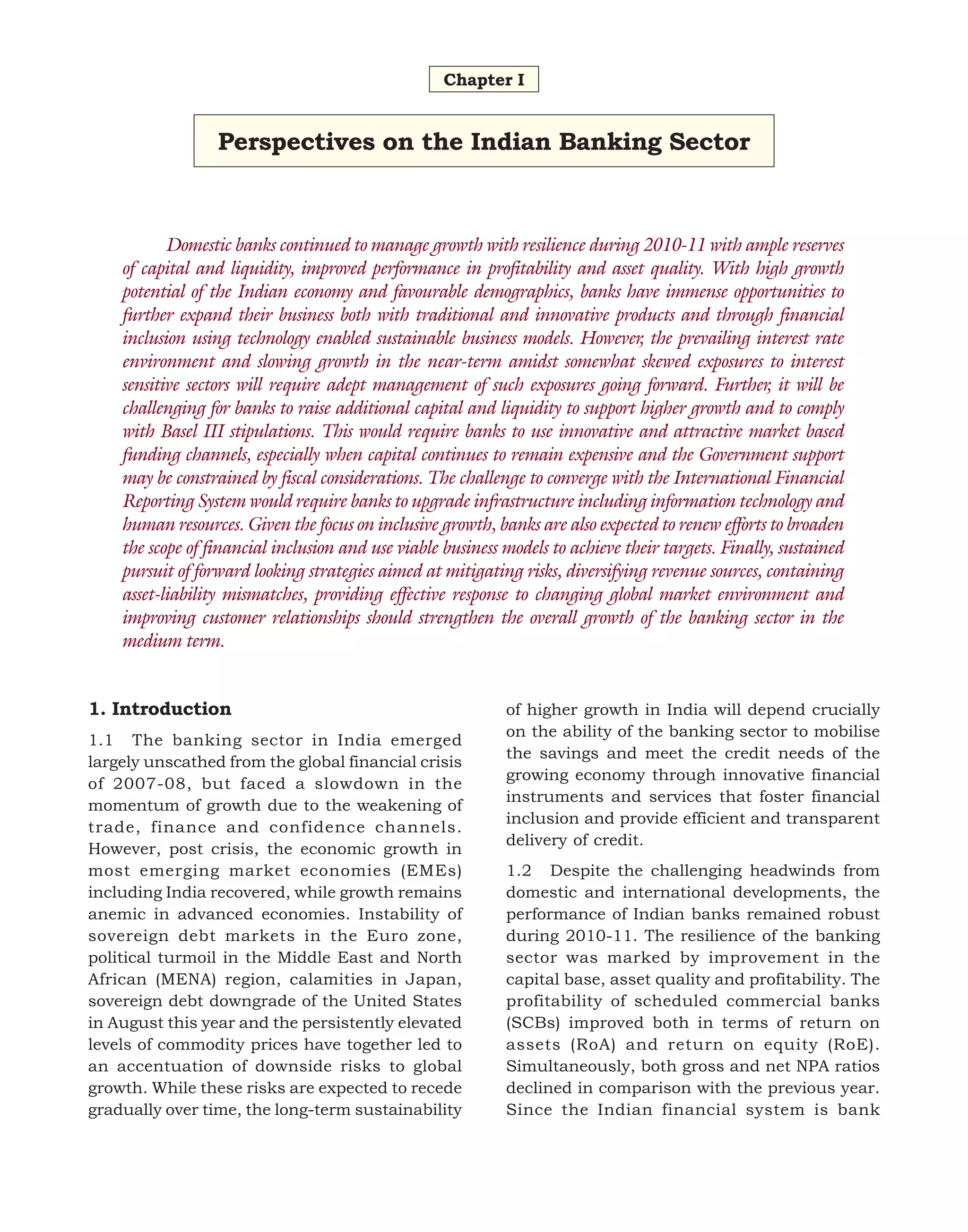
Chapter I

Perspectives on the Indian Banking Sector

Domestic banks continued to manage growth with resilience during 2010-11 with ample reserves
of capital and liquidity, improved performance in profitability and asset quality. With high growth
potential of the Indian economy and favourable demographics, banks have immense opportunities to
further expand their business both with traditional and innovative products and through financial
inclusion using technology enabled sustainable business models. However, the prevailing interest rate
environment and slowing growth in the near-term amidst somewhat skewed exposures to interest
sensitive sectors will require adept management of such exposures going forward. Further, it will be
challenging for banks to raise additional capital and liquidity to support higher growth and to comply
with Basel III stipulations. This would require banks to use innovative and attractive market based
funding channels, especially when capital continues to remain expensive and the Government support
may be constrained by fiscal considerations. The challenge to converge with the International Financial
Reporting System would require banks to upgrade infrastructure including information technology and
human resources. Given the focus on inclusive growth, banks are also expected to renew efforts to broaden
the scope of financial inclusion and use viable business models to achieve their targets. Finally, sustained
pursuit of forward looking strategies aimed at mitigating risks, diversifying revenue sources, containing
asset-liability mismatches, providing effective response to changing global market environment and
improving customer relationships should strengthen the overall growth of the banking sector in the
medium term.
1. Introduction
1.1 The banking sector in India emerged
largely unscathed from the global financial crisis
of 2007-08, but faced a slowdown in the
momentum of growth due to the weakening of
trade, finance and confidence channels.
However, post crisis, the economic growth in
most emerging market economies (EMEs)
including India recovered, while growth remains
anemic in advanced economies. Instability of
sovereign debt markets in the Euro zone,
political turmoil in the Middle East and North
African (MENA) region, calamities in Japan,
sovereign debt downgrade of the United States
in August this year and the persistently elevated
levels of commodity prices have together led to
an accentuation of downside risks to global
growth. While these risks are expected to recede
gradually over time, the long-term sustainability

of higher growth in India will depend crucially
on the ability of the banking sector to mobilise
the savings and meet the credit needs of the
growing economy through innovative financial
instruments and services that foster financial
inclusion and provide efficient and transparent
delivery of credit.
1.2 Despite the challenging headwinds from
domestic and international developments, the
performance of Indian banks remained robust
during 2010-11. The resilience of the banking
sector was marked by improvement in the
capital base, asset quality and profitability. The
profitability of scheduled commercial banks
(SCBs) improved both in terms of return on
assets (RoA) and return on equity (RoE).
Simultaneously, both gross and net NPA ratios
declined in comparison with the previous year.
Since the Indian financial system is bank
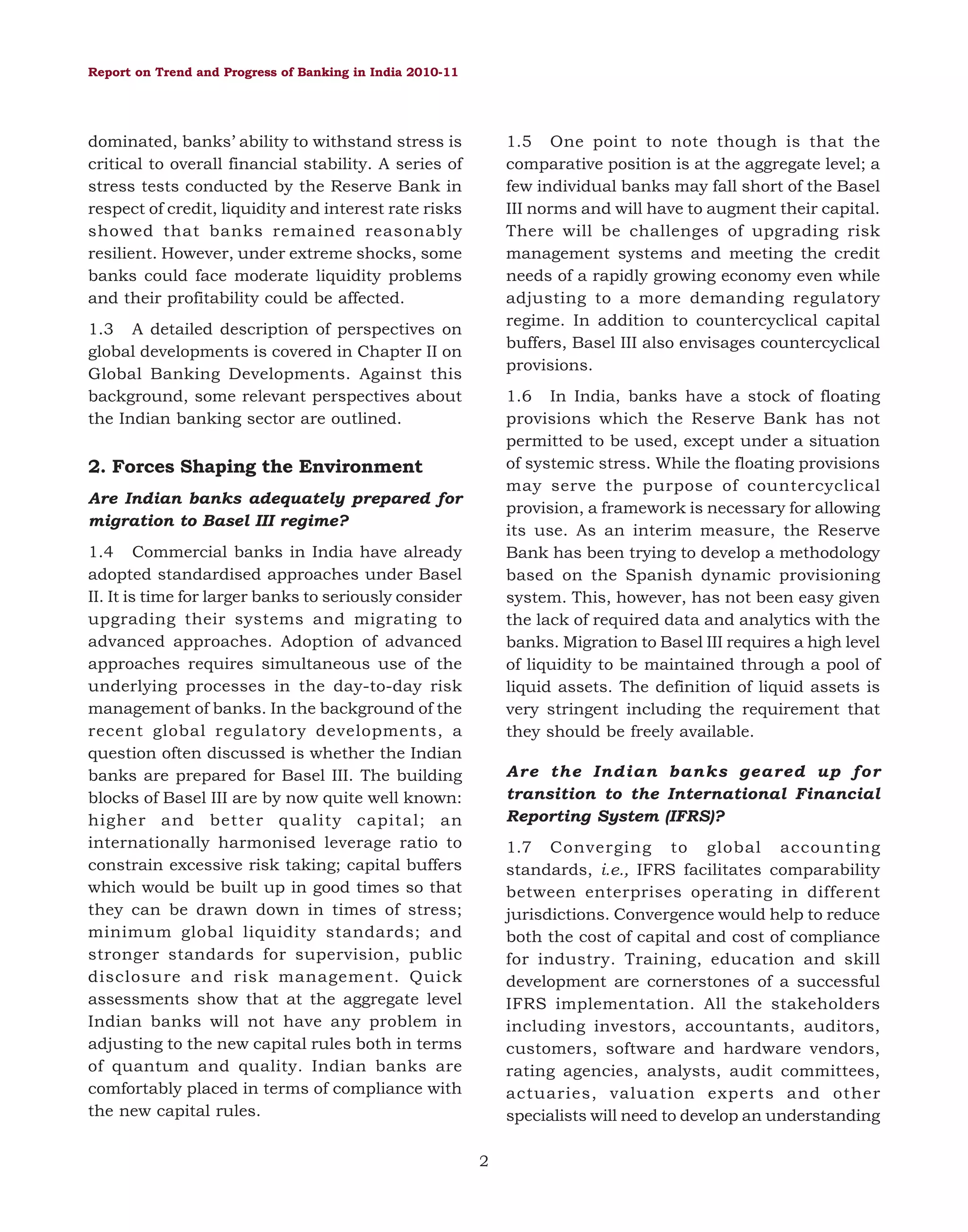
Report on Trend and Progress of Banking in India 2010-11

1.5 One point to note though is that the
comparative position is at the aggregate level; a
few individual banks may fall short of the Basel
III norms and will have to augment their capital.
There will be challenges of upgrading risk
management systems and meeting the credit
needs of a rapidly growing economy even while
adjusting to a more demanding regulatory
regime. In addition to countercyclical capital
buffers, Basel III also envisages countercyclical
provisions.

dominated, banks’ ability to withstand stress is
critical to overall financial stability. A series of
stress tests conducted by the Reserve Bank in
respect of credit, liquidity and interest rate risks
showed that banks remained reasonably
resilient. However, under extreme shocks, some
banks could face moderate liquidity problems
and their profitability could be affected.
1.3 A detailed description of perspectives on
global developments is covered in Chapter II on
Global Banking Developments. Against this
background, some relevant perspectives about
the Indian banking sector are outlined.

1.6 In India, banks have a stock of floating
provisions which the Reserve Bank has not
permitted to be used, except under a situation
of systemic stress. While the floating provisions
may serve the purpose of countercyclical
provision, a framework is necessary for allowing
its use. As an interim measure, the Reserve
Bank has been trying to develop a methodology
based on the Spanish dynamic provisioning
system. This, however, has not been easy given
the lack of required data and analytics with the
banks. Migration to Basel III requires a high level
of liquidity to be maintained through a pool of
liquid assets. The definition of liquid assets is
very stringent including the requirement that
they should be freely available.

2. Forces Shaping the Environment
Are Indian banks adequately prepared for
migration to Basel III regime?
1.4 Commercial banks in India have already
adopted standardised approaches under Basel
II. It is time for larger banks to seriously consider
upgrading their systems and migrating to
advanced approaches. Adoption of advanced
approaches requires simultaneous use of the
underlying processes in the day-to-day risk
management of banks. In the background of the
recent global regulatory developments, a
question often discussed is whether the Indian
banks are prepared for Basel III. The building
blocks of Basel III are by now quite well known:
higher and better quality capital; an
internationally harmonised leverage ratio to
constrain excessive risk taking; capital buffers
which would be built up in good times so that
they can be drawn down in times of stress;
minimum global liquidity standards; and
stronger standards for supervision, public
disclosure and risk management. Quick
assessments show that at the aggregate level
Indian banks will not have any problem in
adjusting to the new capital rules both in terms
of quantum and quality. Indian banks are
comfortably placed in terms of compliance with
the new capital rules.

Are the Indian banks geared up for
transition to the International Financial
Reporting System (IFRS)?
1.7 Converging to global accounting
standards, i.e., IFRS facilitates comparability
between enterprises operating in different
jurisdictions. Convergence would help to reduce
both the cost of capital and cost of compliance
for industry. Training, education and skill
development are cornerstones of a successful
IFRS implementation. All the stakeholders
including investors, accountants, auditors,
customers, software and hardware vendors,
rating agencies, analysts, audit committees,
actuaries, valuation experts and other
specialists will need to develop an understanding
2
Perspectives on the Indian Banking Sector

impact may be more significant if other entities
like other banks, NBFCs, and mutual funds are
included for analysis.

of IFRS provisions to varying degrees and what
they need to do. It is not only the accounting
issues but how to address the non-accounting
issues that will determine how successfully
banks make a transition to IFRS. Additionally,
banks will need to upgrade their infrastructure,
including IT and human resources to face the
complexities and challenges of IFRS. Some major
technical issues arising for Indian banks
during the convergence process are the
differences between the IFRS and current
regulatory guidelines, in particular, those within
the ambit of International Accounting Standard
(IAS) 39 replacement project relating to
classification and measurement of financial
assets and liabilities.

Current and emerging environment offers
sound business opportunities to the banks
1.9 The emerging economic environment
provides a number of opportunities for the
Indian banking sector. Factors like expected
positive economic performance, strong savings
growth spurred by the favourable demographic
dividend, emphasis on expansion of physical
infrastructure and the extent of financial
exclusion to be bridged will ensure growth of
the banking sector in medium term. To exploit
emerging opportunities and to benefit from their
strengths, Indian banks need to be globally
competitive. From a strategic perspective,
competitiveness can be achieved by balancing
factors such as scale, scope, prudence and
knowledge.

Interconnectedness in the banking sector
and vulnerability of financial system
1.8 Post-crisis, macro-prudential policy has
emerged as an important tool for addressing
systemic risk, highlighting its time and the cross
sectional dimensions. While the time dimension
refers to pro-cyclical elements that give rise to
the evolution of aggregate risk over time, the
cross section dimension is concerned with
distribution of risks which can be exacerbated
owing to the interconnectedness in the financial
system. Financial interconnectedness as a part
of macro-financial surveillance is the key issue
in discussions on prudential regulation policies
as it can magnify idiosyncratic shocks across
the financial system. To put in place an effective
system of macro-prudential surveillance of the
financial system, the Reserve Bank has started
using network analysis techniques to model
inter-bank exposures. The analysis revealed that
the banking sector in India is deeply connected.
Further, the contagion analysis made on the
basis of network analysis underlined that
interconnectedness in the banking sector gives
rise to vulnerability of financial system in the
event of failure of one or more banks depending
on the degree of interaction. The contagion
impact is relatively contained due to regulatory
limits on interbank exposures. However, the

3. Strategic and Operational Responses
Migration of financial conglomerates in
India to holding company structure
1.10 At present, most of the financial groups in
India are led by banks and organised under the
Bank Subsidiary model. This model puts
the onus on the parent bank for corporate
governance, performance and capital
requirement of subsidiaries. Besides, the parent
carries very substantial reputational risk. The
Working Group on ‘Introduction of Holding
Company structure in India for banks’ has
recommended migration of major financial
conglomerates to the holding company structure
to address these limitations to some extent. The
main challenges in implementing the
recommendations include, formulating a new
law governing functioning of financial holding
companies, providing right incentives to the
existing financial conglomerates through
appropriate tax treatment and resolution
of strategic and public policy issues by the
Government in the case of public sector banks.
3
Report on Trend and Progress of Banking in India 2010-11

Introducing innovative financial products as
an efficient way to manage risks

March 2008 to 2.21 per cent at end March 2010,
followed by a slight moderation to 2.01 per cent
in 2011. The concern is that the recoveries have
not kept pace with slippages since 2007-08.
Rising interest rates and substantial amount of
restructuring done during the crisis period, if
not done with due care, are likely to put further
pressure on asset quality of banks. Further,
asset quality of banks needs to be closely
watched in the changing interest rate
environment as the sticky loan portfolio of small
and medium enterprises might rise. Therefore,
there is a need for banks to step up efforts to
resolve their existing NPAs and tighten their
credit risk management systems.

1.11 Introducing innovative financial products
is an efficient way to manage risks involved in
the banking business. From this point of view,
the decision to introduce credit default swaps
(CDS) with effect from October 24, 2011 is a
welcome development. However, given their
complex nature, CDS shall be permitted on
listed corporate bonds, unlisted but rated bonds
of infrastructure companies and unlisted/
unrated bonds issued by the Special Purpose
Vehicles (SPVs) set up by infrastructure
companies as reference obligations, and the
reference entities shall be single legal resident
entities. The guidelines also require market
participants to build robust and appropriate risk
management systems. Newer skill sets for
managing newer areas and unfamiliar elements
of risks would continue to pose questions even
to the most advanced banks. The
implementation of innovative financial products
requires diligent assessment of counterparty
and related risks. Banks will have to adopt an
approach to re-evaluate their risk management
acumen in a manner that calls for higher levels
of transparency, structural integrity and
operational control. While expanding market is
a matter of survival, a further challenge for the
banks would be to ring-fence their operations
by establishing a sound risk management
system that is not only protective but also
inclusive and acts as a business enabler.

Robust business continuity management and
disaster recovery
1.13 The extensive use of technology systems
in transaction processing and settlement in
retail as well as inter-institution and interbank
markets requires adequate availability and
capacity to handle the increasing load on these
systems for smooth functioning of financial
markets and banking industry in India. Data
centres managed by the Reserve Bank, and
Indian Financial Network (INFINET), the
communication backbone for the financial sector
managed by the Institute for Development and
Research in Banking Technology (IDRBT),
continued to provide robust support during the
year. Software changes were made in Real Time
Gross Settlement (RTGS) and Public Debt OfficeNegotiated Dealing System (PDO-NDS)
applications to enhance performance and
introduce new functionalities. The next
generation RTGS with advanced technology and
new functionalities is also in the pipeline, which
would have features such as advanced liquidity
management facility, extensible markup
language based messaging system conforming
to ISO 2002, and real time information and
transaction monitoring and control system.
Periodic drills were conducted to get feedback
and assurance on the effectiveness of the

Management of asset quality
1.12 While gross NPAs, in percentage terms,
have declined steadily from 15.70 per cent at
end March 1997 to 2.25 per cent at end March
2011, this does not fully reveal the underlying
realities and some trends are a matter of
concern, which could put pressure on asset
quality of banks in future. Aggressive lending
during the high credit growth phase followed
by the crisis resulted in slippage with gross NPA
ratio steadily rising from 1.81 per cent at end
4
Perspectives on the Indian Banking Sector

Business Continuity management and Disaster
Recovery (BCP-DR) arrangements for shared
infrastructure and Payment and Settlement
Systems. A quarterly report on the BCP-DR and
Vulnerability Analysis and Penetration Testing
(VAPT) exercise conducted by commercial banks
at their end was also obtained and significant
points emerging out of the same are included in
the inputs for analysis and suitable incorporation
in the periodical Financial Stability Report.

inclusion will provide banks access to sizeable
low cost funds as also opportunities for lending
in the small volume segment. The latter should
be possible since the Reserve Bank has
deregulated the interest rate that can be charged
on small value loans. To gainfully pursue
financial inclusion, banks will need to constantly
reinvent their business models and design
products and services demanded by a growing
economy with rapid structural transformation.

4. Challenges

Challenges to further strengthening
inclusive growth

Need for further improving the efficiency
parameters of the Indian Banks

1.16 The banking sector is a key driver of
inclusive growth. There are supply side and
demand side factors driving inclusive growth.
Banks and other financial services players
largely are expected to mitigate the supply side
processes that prevent poor and disadvantaged
social groups from gaining access to the financial
system. Banks were advised to ensure close
and continuous monitoring of Business
Correspondents (BCs). They were also advised
to focus, in future, on opening of some form of
low cost brick and mortar branches between the
base branch and BC locations. Further, banks
were required to make efforts to increase the
number of transactions in no-frill accounts.
There should be seamless integration of the
financial inclusion server with their internal core
banking solution (CBS) systems and in the case
of end-to-end solution, there should be a clear
demarcation of the technology related activities
and BC related activities of their service
providers. However, banks must bear in mind
that apart from the supply side factors, demand
side factors, such as lower income and /or asset
holdings also have a significant bearing on
inclusive growth.

1.14 The Indian banking sector has recorded
an impressive improvement in productivity over
the last 15 years; many of the productivity/
efficiency indicators have moved closer to the
global levels. There has been a particularly
discernible improvement in banks’ operating
efficiency in recent years owing to technology
up-gradation and staff restructuring. However,
to sustain high and inclusive growth, there is a
need to raise the level of domestic savings and
channel those savings into investment. This
implies that banks need to offer attractive
interest rates to depositors and reduce the
lending rates charged on borrowers - in other
words, reduce the net interest margin (NIM). The
NIM of the Indian banking system is higher than
that in some of the other emerging market
economies even after accounting for mandated
social sector obligations such as priority sector
lending and credit support for the Government’s
anti-poverty initiatives.
1.15 By far the most important task is to further
improve operating efficiency on top of what has
already been achieved by optimising operating
costs, i.e., non-interest expenses including
wages and salaries, transaction costs and
provisioning expenses. This will enable banks
to lower lending rates while preserving their
profitability. If pursued effectively, financial

1.17 Banks also need to take into account
various behavioural and motivational attributes
of potential consumers for a financial inclusion
strategy to succeed. Today, access to financial
products is constrained by several factors, which
5
Report on Trend and Progress of Banking in India 2010-11

Need to review laws governing the Indian
banking sector

include: lack of awareness about the financial
products, unaffordable products, high
transaction costs, and products which are not
convenient, inflexible, not customised and of low
quality. A major challenge of the next decade is
financing the millions in the unorganised sector,
self-employed in the micro and small business
sector, the small and marginal farmers as also
rural share-croppers in the agricultural sector.
Other challenges include financing affordable
housing and education needs of low income
households.

1.19 The extant statutory arrangement is
complex with different laws governing different
segments of the banking industry. The
nationalised banks are governed by the Banking
Companies (Acquisition and Transfer of
Undertaking) Acts of 1970 and 1980. State Bank
of India and its subsidiaries are governed by
their respective statutes. Private sector banks
come under the purview of the Companies Act,
1956 and the Banking Regulation Act, 1949.
Foreign banks which have registered their
documents with the registrar under Section 592
of the Companies Act are also banking
companies under the Banking Regulation Act.
Certain provisions of the Banking Regulation Act
have been made applicable to public sector
banks. Similarly, some provisions of the RBI Act
too are applicable to nationalised banks, SBI
and its subsidiaries, private sector banks and
foreign banks. Notwithstanding this wide array
of legislations of varying vintage, the statutory
arrangement has served the system well by
helping maintain an orderly banking system.
Needless to say, each of the statutes was crafted
in a setting reflecting the needs and concerns
of the time. Almost all the statutes have had to
be amended from time to time to reflect changes
in circumstances and context. There is a strong
case for reviewing all the various legislations and
recasting them for a number of reasons. There
is also a need to iron out inconsistencies between
the primary laws governing the banking sector
and other laws applicable to the banking sector.
The decision of the Government to set up a
Financial Sector Legislative Reforms
Commission “to rewrite and clean up the
financial sector laws to bring them in line with
the requirements of the sector” is very timely
and very vital. It is important, however, to
recognise that changes in policy or in the
regulatory architecture cannot be the remit of a
Legislative Reforms Commission. Rather, they
should be debated and decided upon as a

Need for effective corporate governance in
banks
1.18 Banks are different from other corporates
in important respects and that makes corporate
governance of banks not only different but also
more critical. Banks facilitate economic growth,
are the conduits of monetary policy transmission
and constitute the economy’s payment and
settlement system. By the very nature of their
business, banks are highly leveraged. They
accept large amounts of uncollateralised public
funds as deposits in a fiduciary capacity and
further leverage those funds through credit
creation. Banks are interconnected in diverse,
complex and opaque ways underscoring their
‘contagion’ potential. If a corporate fails, the
fallout can be restricted to the stakeholders. If
a bank fails, the impact can spread rapidly
through to other banks with potentially serious
consequences for the entire financial system and
the macro economy. While regulation has a role
to play in ensuring robust corporate standards
in banks, the point to recognise is that effective
regulation is a necessary, but not a sufficient
condition for good corporate governance. In this
context, the relevant issues pertaining to
corporate governance of banks in India are bank
ownership, accountability, transparency, ethics,
compensation, splitting the posts of chairman
and CEO of banks and corporate governance
under financial holding company structure,
which should engage adequate attention.
6
Perspectives on the Indian Banking Sector

prelude to the work of the Commission so that
the Commission has a clear mandate on the
policy directions.

Costs and risks in using technology to
change the face of banking
1.21 Technology adoption has changed the face
of banking in India. Wide spread technology
deployment in the banking business has also
brought to the fore some new issues and
challenges. These can be broadly divided into
two categories - costs and risks. Costs, in terms
of increasing expenditure on IT deployment and
risks that are resulting from reliance on IT
systems without necessary safeguards. Cost
aspects can be addressed by synergising IT
deployment objectives with the broader,
strategic business objectives to ensure adequate
operational and management controls over
purchase as well as maintenance of appropriate
technology solutions. The second aspect relating
to IT risks is a very critical issue. With the
increased use of IT, there are attendant risks
posed to the banks as well as their customers
in terms of monetary loss, data theft, breach of
privacy and banks need to be extremely
cognizant of such risks. Another significant
aspect of banking business is regulatory and
supervisory compliance. With the growth and
globalisation of markets in general and in the
aftermath of recent crisis in particular, number
of such compliance requirements is increasing.
Basel II and III implementation brings in huge
challenges. Banks have adopted technology, but
the benefit of technology has not fully percolated
in terms of cost, speed and convenience.
Empowering customers with technology-driven
benefits is a big challenge.

Can the Indian banks aim to become global
in stature?
1.20 Of late, there is a debate on whether the
Indian banks should aim to become global? In
this context, there is a need to view the related
costs and benefits analytically and also view this
as an aspiration consistent with India’s growing
international profile. Two specific questions that
need clarity in this context are: (i) can Indian
banks aspire to achieve global size? and (ii)
should Indian banks aspire to attain global size?
On the first question, it is unlikely that any of
the Indian banks will come in the top ten of the
global league even after reasonable
consolidation. On the next question, those who
argue that banks must go global contend that
the issue is not so much the size of our banks
in global rankings but of Indian banks having a
strong enough global presence. The main
argument is that the increasing global size and
influence of Indian corporates warrant a
corresponding increase in the global footprint
of Indian banks. The opposing view is that Indian
banks should look inwards rather than
outwards, focus their efforts on financial
deepening at home rather than aspiring to global
size. It is possible to take a middle path and
argue that looking outwards towards increased
global presence and looking inwards towards
deeper financial penetration are not mutually
exclusive; it should be possible to aim for both.
In the wake of the global financial crisis, there
has definitely been a pause to the rapid
expansion
overseas
of
our
banks.
Notwithstanding the risks involved, it will be
opportune for some of the larger banks to be
looking out for opportunities for consolidation.
The surmise, therefore, is that Indian banks
should increase their global presence. In the
rapidly changing global financial landscape, it
is imperative for the Indian banks to think global
but act local.

Emerging trends in payment systems and
related challenges
1.22 The smooth functioning of the market
infrastructure for enabling payment and
settlement systems is essential for market and
financial stability, as also for economic efficiency,
and for the smooth functioning of financial
markets. The financial sector and the payment
and settlement system infrastructure have to
be subservient to the real sector. The evolving
7
Report on Trend and Progress of Banking in India 2010-11

remaining in the NBFC sector that impinge on
financial stability are being addressed by
enhancing the scope of the regulatory perimeter
while vulnerabilities in the liquidity risk
management systems of domestic central
counterparties are being weighed in terms of
new mechanisms for bail-outs.

payment systems scenario offers new challenges
and opportunities to all segments of this
industry. To leverage on the opportunities
provided by new products, the system
providers/banks need to ensure that the
challenges are adequately addressed. It also has
to be ensured that the products cover all
segments of the population and provide an
incentive to adopt these products. The
regulatory process will support all orderly
development of new systems and processes,
within the legal mandate. The important issues
in this context are how banks can provide costeffective, safe, and speedier and hassle free
payment and settlement products and solutions.

5. The Way Forward
1.24 While the opportunities to grow further are
on increase, banks do have to contend with new
challenges as they move forward. The recent
deregulation of savings bank deposit interest
rates announced on October 25, 2011 may
initially lead to some competition, as banks with
low share of savings deposits may like to garner
a larger share of such deposits. However, this
process may not be disruptive. The provisioning
in lieu of pension liabilities and slippages in
incrementally high growth loan portfolios in
sensitive sectors such as retail and real estate
sectors may impact profitability. A specific area
of concern that has come to the fore is the
concentrated and high pace of lending to the
infrastructure sector by the public sector banks
(PSBs), raising the apprehensions of increasing
delinquencies in the future. As mentioned
earlier, banks also face challenges in respect of
demanding needs of supporting growth through
financial inclusion and efficient credit
intermediation through technology and product
innovation.

Some concerns related to financial stability
1.23 Despite the fragility of the global macrofinancial environment, the macroeconomic
fundamentals for India have remained robust.
Further, since December 2010, the financial
markets remained stress-free and the forecast
of the values of the Financial Stress Indicator
pointed out that they were likely to remain stable
in the near term. Some emerging trends that
may be of immediate concern in respect of
financial stability are, (i) the possibility of
spillovers from increasing financialisation of
commodities to financial markets, (ii) interest
rate differentials vis-à-vis advanced economies,
which could propel foreign funding by Indian
corporates leading to currency mismatches, (iii)
rollover risks of maturity of Foreign Currency
Convertible Bonds (FCCBs) requiring
refinancing at higher interest rates, and (iv)
disproportionate growth in bank credit to four
specific sectors, viz., real estate, infrastructure,
NBFCs and retail credit coupled with persistent
asset-liability mismatches, reliance on borrowed
funds and enhanced requirement of provisioning
for NPAs. Stress tests suggest that the banking
sector remains fairly well capitalised and
resilient to asset quality shocks and other
plausible adverse changes in macroeconomic
scenario. Issues pertaining to regulatory gaps

1.25 It is important to recognise that with
further globalisation, consolidation, deregulation
and diversification of the financial system, the
banking business is set to become more complex
and riskier. Issues like complex risk
management, appropriate liquidity management
and enhancing skill development are some
challenges already visible in the Indian context.
The interface between banks and financial
markets has undergone a fundamental shift in
the recent times. The banks have become
intricately linked to financial markets and hence
more vulnerable to financial markets stress.
8
Perspectives on the Indian Banking Sector

While technological advancements in IT have led
to discernible improvement in the efficiency of
banking services, banks have not gained in
terms of efficiency partly because of lack of
business process re-engineering. The challenge
is to leverage technology optimally to balance
growth, efficiency and risk management
objectives.

compulsions of diversity. As articulated earlier,
expected economic performance, robust savings,
policy thrust to expand infrastructure and
further strengthening of financial inclusion are
expected to ensure robust growth of the banking
sector in medium term.
1.27 In the long term, however, the most
significant task of the Indian banking sector is
to ensure that banking products and services
are made available to every individual in the
country efficiently to achieve total financial
inclusion. Going forward, filling the void called
‘financial exclusion’ is the critical responsibility
of banks. Despite all the challenges and issues
to be addressed, the banking sector in India can
look forward to enormous opportunities in their
quest for long term growth. The banking sector
needs to focus on growth through inclusion,
innovation and diversification while complying
with domestic regulations and internalising
international best practices.

Medium term outlook
1.26 To take full advantage of the opportunities
while addressing the new challenges, the
process of institutional strengthening assumes
critical importance. Banks need to build on four
principles, viz., efficiency, stability, transparency
and inclusion. The three balancing acts that the
banking sector development strategy needs to
perform are: between the drivers of banking
sector growth and the requirements of the larger
growth and development agenda; between the
benefits and risks of greater global integration;
and between the advantages of scale and the

9
Chapter II

Global Banking Developments

The year 2010, and 2011 so far, has been a difficult period for the global banking system, with
challenges arising from the global financial system as well as the emerging fiscal and economic growth
scenarios across countries. The Global Financial Stability Report in September 2011 has cautioned that
for the first time since October 2008, the risks to global financial stability have increased, signaling a
partial reversal in the progress made over the past three years. Banking systems in advanced economies
have continued to be on uncertain grounds on account of a lacklustre economic revival and increasing
sovereign credit strains. The US, despite riding on the QE2 wave, has witnessed its economic recovery
losing steam and has experienced a downgrading of its sovereign. The US banking system, which showed
signs of improvement in credit growth and profitability in 2010, now faces a serious question about
whether this revival in the banking system would continue in the near future. The banking system in the
Euro zone, as a whole, stands vulnerable to mounting credit, market and funding risks as a result of
severe deterioration in public finances in certain European countries. Further, many of these banks
require recapitalisation to cushion them from the risk of sovereign defaults. In the UK too, banking
system continues to be beleaguered by high leverage and weak asset quality. In major emerging
economies, credit growth has been at relatively high levels and is being regarded as a cause of concern
given the growing inflationary pressures and increasing capital inflows. Further, concerns are also being
expressed about the credit growth laying foundations for a weak asset quality in the years to come. On the
positive side, both advanced and emerging economies, individually, and multi-laterally, have moved
forward towards strengthening macro-prudential oversight of their banking systems. While it is
important to keep up efforts towards strengthening the banking system from within, it is also equally
important to develop effective solutions for containing fiscal and economic risks, which at the present
juncture, threaten the stability of the global banking system from without. All such solutions need to be
designed keeping in mind the larger interests of the global economy.
1. Introduction
2.1 For the global economy, the year 2010
was replete with a mixed sense of optimism and
concerns. The optimism was attributed to a
somewhat encouraging ‘two speed’ recovery, in
advanced and emerging economies, after a
major slump in economic growth in 2009
following the financial crisis. The concerns,
however, were on account of escalating
sovereign risks in the Euro zone and
heightened inflationary pressures marked by
uncertainty in the Middle East and North Africa

(MENA) region. The beginning of 2011 has seen
the optimism giving way to greater concerns on
account of a projected slowdown of the global
economy in general, and the US economy in
particular, for 2011. Further, sovereign risks
have strengthened even in the US with an
increase in sovereign debt ceiling along with a
downgrading of the rating of the US sovereign by
the credit rating agency of Standard and Poor’s.
2.2 In this milieu, the performance of the
global banking system too has been
characterised by a mixed bag of a few positive
Global Banking Developments

developments and a number of shortfalls. The
positive developments have been in terms of the
efforts by countries towards revamping their
regulatory and supervisory architecture learning
from the crisis, along with an effort to step up
capital adequacy of banks. The major shortfalls,
however, have been the lack of a widespread
revival of the global banking activity, which could
be characterised by improved credit growth,
profitability and asset quality, and lower
leverage.

policy initiatives with regard to the global
banking system during the year.

2. Global Banking Trends
2.4 The current global macro-economic
situation is characterised by an unbalanced
economic recovery across advanced and
emerging economies, moderation in economic
prospects in 2011, high levels of unemployment
and inflationary pressures, and elevated levels of
government debt (Chart II.1).

2.3 Against this setting, this chapter analyses
the performance of the global banking system
using major indicators of banking activity and
soundness for select advanced and emerging
economies. It also looks into the detailed
individual performance of the banking systems
in few advanced and emerging economies/
economy-groups. Finally, at the institutional
level, it analyses the performance of the top-100
banks having major global presence. It then
highlights the major regulatory and supervisory

Macro-economic risks have increased
substantially
2.5 In its September 2011 World Economic
Outlook, the International Monetary Fund (IMF)
has estimated a growth of 4.0 per cent for the
world economy as a whole during 2011, with
emerging and developing economies growing at
6.4 per cent and advanced economies growing
only at 1.6 per cent. The estimate for advanced
economies of 1.6 per cent provided in September

Chart II.1: Global Macro-economic Trends
Rate of Investment (as per cent of GDP)

Global Growth Trends
35

8

30

6

25
Per cent

10

Per cent

4
2
0

15
10

-2

5

-4
-6

20

2006

2007
2008
2009
2010 2011 Est
World
Advanced economies
Emerging and developing economies

0
2006

7.0
6.5
6.0
5.5
5.0
4.5
4.0

120
100
Per cent

7.5

2006
2007
2008
2009
2010 2011 Est
Advanced economies (Rate of inflation)
Emerging and developing economies (Rate of inflation)
Advanced economies (Rate of unemployment)

2008
2009
2010 2011 Est
Emerging and developing economies

Gross Government Debt (as per cent of GDP)
8.5
8.0

Unemployment rate (per cent)

Inflation rate (per cent)

Rate of Unemployment and Inflation
9
8
7
6
5
4
3
2
1
0

2007

Advanced economies

80
60
40
20
0

2006
2007
Advanced economies

Note:
The rate of unemployment is not reported separately for emerging and developing economies.
Source: Calculated from World Economic Outlook database

11

2008
2009
2010 2011 Est
Emerging and developing economies
Report on Trend and Progress of Banking in India 2010-11

Table II.1: Return on Assets of Banks
for Select Economies

2011 was lower than the estimate of 2.2 per cent
provided in June 2011 in light of the lower
quarterly GDP growth of leading advanced
economies. The rate of unemployment in
advanced economies has been little over 8 per
cent in 2010 albeit with some moderation
expected in 2011 as per the IMF estimates.
Inflationary pressures, which had become
stubborn in 2010, more so for emerging
economies as a fallout of rising oil, food and
commodity prices, are expected to aggravate
further in 2011.

Country

Uncertainty about credit revival continues
2.6 Against the macro-economic backdrop
discussed in the foregoing section, banking
business in some advanced economies showed
signs of revival in 2010. An increase in the
growth of bank credit was evident in the US,
Germany and France in the first quarter of 2011
after entering into the negative growth zone after
the crisis. However, there is an uncertainty
about whether this credit revival would continue
or not, given the picture of economic revival
looking bleak in the US and now, even in
Germany1. In fact, credit growth has again
witnessed a slump in the second quarter of 2011
in the US. In the UK and Japan, bank credit
growth, which had entered a downtrend since
the beginning of 2009, has shown a recovery in
2011, but has remained in the negative zone.
Other advanced economies from Europe,
particularly countries with fiscal strains, namely
Portugal, Spain and Italy, showed a steep fall in
the growth in bank credit with no signs of revival
by 2011 (Chart II.2).

2008

2009

2010

2011*
...
...
-0.3
...
...
0.5
...
...
1.2
2.3
...
...
1.8
3.3
1.6

Source: Compiled from Financial Soundness Indicators, IMF
… Not available
* Up to the period ending March

France in 2010 (Table II.1). The RoA of US banks
turned positive by 2010 after staying in the
negative zone in 2008 and 2009; it showed a
further increase in 2011 (March). In Russia,
China and Malaysia, RoA of the banking system,
which had dipped between 2008 and 2009,
recovered between 2009 and 2010. In Russia
and Malaysia, the trend of increase in RoA
continued even in 2011 (March). The RoA of
Indian banks too showed a modest rise between
2008 and 2010.
Disappointing performance of bank stocks
2.8 Changes in bank stock indices, which are
generally associated with changes in balance
sheet and profitability growth of banks, were
globally on a path of slow recovery since the
beginning of 2009. In the US, there was an
upward movement in the prices of bank stocks
but this was within a narrow range, reflecting
weak confidence of investors in these stocks
(Chart II.3). Moreover, there was a striking
downtrend in bank stocks in the US since the

Return on Assets showed a moderate increase
2.7 Apart from the pickup in credit growth,
Return on Assets (RoA), an indicator of banking
system’s profitability and soundness, also
showed a moderate increase in the US and
1

2007

Advanced economies
France
0.4
0.0
0.4
0.6
Germany
0.3
-0.1
0.2
…
Greece
1.0
0.2
-0.1
-0.6
Italy
0.7
0.3
0.2
…
Japan
0.3
-0.3
0.2
0.4
Portugal
1.2
0.4
0.4
0.5
Spain
1.1
0.8
0.6
0.5
United Kingdom
0.4
-0.4
0.1
0.2
United States
1.2
-0.1
-0.1
0.9
Emerging and developing economies
Russia
3.0
1.8
0.7
1.9
China
0.9
1.0
0.9
1.0
India
0.9
1.0
1.1
1.1
Malaysia
1.5
1.5
1.2
1.5
Brazil
3.4
1.5
2.4
3.2
Mexico
2.3
1.4
1.5
1.8

The US GDP growth in the first quarter of 2011 slowed down to 0.4 per cent and recovered, albeit moderately, to 1.3 per cent in
the second quarter. In Germany, GDP growth was 1.3 per cent in the first quarter of 2011 but declined to 0.1 per cent in the
second quarter of the year.

12
-10

Germany

3

2
10

1
8

6

0
4

2

-1

Portugal

35

China

30

25

20

15

70

Russia

60

50

40

30

20

Note:

10

0

13

-10

16

France
70

14
60

12

0
0

-2
-10.0

12
25

Italy
30

10
20
25

8
15
20

6
10
15

4
5
10

2
0
5

0
-5

40

Brazil

35
14

30
12

25
10

20
8

15
6

10
10
4

5
5
2

0
0
0

05-2011

-3

05-2010
08-2010
11-2010
02-2011

-6

05-2009
08-2009
11-2009
02-2010

4

Japan

05-2008
08-2008
11-2008
02-2009

-2

08-2007

-1

-4

11-2007
02-2008

0
0

12-2007
02-2008
04-2008
06-2008
08-2008
10-2008
12-2008
02-2009
04-2009
06-2009
08-2009
10-2009
12-2009
02-2010
04-2010
06-2010
08-2010
10-2010
12-2010
02-2011
04-2011
06-2011
08-2011

2

02-2007

2

05-2007

3

11-2006

US

12-2007
02-2008
04-2008
06-2008
08-2008
10-2008
12-2008
02-2009
04-2009
06-2009
08-2009
10-2009
12-2009
02-2010
04-2010
06-2010
08-2010
10-2010
12-2010
02-2011
04-2011
06-2011
08-2011

4

12-2007
02-2008
04-2008
06-2008
08-2008
10-2008
12-2008
02-2009
04-2009
06-2009
08-2009
10-2009
12-2009
02-2010
04-2010
06-2010
08-2010
10-2010
12-2010
02-2011
04-2011
06-2011

4

8

12-2007
02-2008
04-2008
06-2008
08-2008
10-2008
12-2008
02-2009
04-2009
06-2009
08-2009
10-2009
12-2009
02-2010
04-2010
06-2010
08-2010
10-2010
12-2010
02-2011
04-2011

-2

12-2007
02-2008
04-2008
06-2008
08-2008
10-2008
12-2008
02-2009
04-2009
06-2009
08-2009
10-2009
12-2009
02-2010
04-2010
06-2010
08-2010
10-2010
12-2010
02-2011
04-2011
06-2011
08-2011

5

10

0

12-2007
02-2008
04-2008
06-2008
08-2008
10-2008
12-2008
02-2009
04-2009
06-2009
08-2009
10-2009
12-2009
02-2010
04-2010
06-2010
08-2010
10-2010
12-2010
02-2011
04-2011
06-2011
08-2011

12-2007
02-2008
04-2008
06-2008
08-2008
10-2008
12-2008
02-2009
04-2009
06-2009
08-2009
10-2009
12-2009
02-2010
04-2010
06-2010
08-2010
10-2010
12-2010
02-2011
04-2011
06-2011

12

12-2007
02-2008
04-2008
06-2008
08-2008
10-2008
12-2008
02-2009
04-2009
06-2009
08-2009
10-2009
12-2009
02-2010
04-2010
06-2010
08-2010
10-2010
12-2010
02-2011
04-2011
06-2011
08-2011

12-2007
02-2008
04-2008
06-2008
08-2008
10-2008
12-2008
02-2009
04-2009
06-2009
08-2009
10-2009
12-2009
02-2010
04-2010
06-2010
08-2010
10-2010
12-2010
02-2011
04-2011
06-2011

6

12-2007
02-2008
04-2008
06-2008
08-2008
10-2008
12-2008
02-2009
04-2009
06-2009
08-2009
10-2009
12-2009
02-2010
04-2010
06-2010
08-2010
10-2010
12-2010
02-2011
04-2011
06-2011
08-2011

12-2007
02-2008
04-2008
06-2008
08-2008
10-2008
12-2008
02-2009
04-2009
06-2009
08-2009
10-2009
12-2009
02-2010
04-2010
06-2010
08-2010
10-2010
12-2010
02-2011

-2

04-2008
06-2008
08-2008
10-2008
12-2008
02-2009
04-2009
06-2009
08-2009
10-2009
12-2009
02-2010
04-2010
06-2010
08-2010
10-2010
12-2010
02-2011
04-2011
06-2011

Global Banking Developments

Chart II.2: Three-year Moving Average of Bank Credit Growth, in per cent

15

UK

10

1
0

5

-5

Spain

50

40

30

20

10

India

16

Malaysia

1. Data for Spain are available with quarterly frequency. Hence, its growth rates are reported as quarterover-quarter. Growth rates for all other countries are month-over-month growth rates smoothened
out using three-year moving average method.
2. Bank credit refers to private credit for Germany, Russia, Spain, UK, France and Portugal. In all other
countries, it refers to total bank credit.
3. Credit data used for the growth calculations are as reported in the respective currency of each
country.
Source: Calculated from Thomson Reuters, DataStream
Report on Trend and Progress of Banking in India 2010-11

Chart II.3: Bank Stock Indices in Select Economies/Economy Groups

1500

1000

500

0

350
20000

300
250

15000

200
10000

150
100

5000

50

1-10-2011

1-6-2011

1-8-2011

1-2-2011

1-4-2011

1-10-2010

1-12-2010

1-6-2010

EMEs

1-8-2010

1-2-2010

1-4-2010

1-10-2009

1-12-2009

1-6-2009

China

1-8-2009

1-2-2009

1-4-2009

1-8-2008

1-12-2008

Asia (excl Japan)
EMU (excl Portugal, Greece, Italy, Ireland and Spain)
Portugal, Ireland, Italy, Greece and Spain
US

1-10-2008

0
1-4-2008

1-10-2011

1-6-2011

1-8-2011

1-2-2011

1-4-2011

1-10-2010

1-12-2010

1-6-2010

1-8-2010

1-2-2010

1-4-2010

1-10-2009

1-12-2009

1-6-2009

1-8-2009

1-2-2009

1-4-2009

1-12-2008

1-8-2008

1-10-2008

1-4-2008

1-6-2008

0
1-6-2008

US dollars

2000

25000

400

Indian rupees (for India)

US dollars (for China and EMEs)

2500

India

Note:
EMU refers to European Monetary Union.
Source: Compiled from Thomson Reuters, DataStream

beginning of 2011. A similar downtrend could
also be seen in bank stocks of the fiscally
strained economies. In EMEs as a whole, and in
China, bank stock indices moved upwards very
slowly since the beginning of 2009. Among
EMEs, the upward movement in bank stocks
since the beginning of 2009 was significant for
India, resulting in the index overshooting its precrisis mark by the end of 2010.

2.10 In most advanced countries, the quantum
of international assets and liabilities (in all
currencies vis-à-vis all sectors) also showed a
similar trend of increase between end-March
2010 and end-March 2011 (Chart II.4). Among
advanced countries, the increase in
international business was most striking for
banks located in the US and UK. Even in the
emerging economies, the increase in
international banking business gained
considerable momentum by the first quarter of
2011. Latin American banks increasingly
resorted to the issuance of securities, leading to
a sharp growth in the international liabilities of
these banks.

Revival in international banking business
2.9 In 2010-11 (March), there was
considerable revival in international banking
business (by location of reporting banks)
continuing with the trend in 2009-10. During
2008-09, international assets and liabilities of
banks had contracted significantly in the
aftermath of the financial crisis (Table II.2).

Financial soundness of banks
1. Increase in levels of capital adequacy

Table II.2: Growth in International Assets and
Liabilities of Banks
Item

2.11 The level of capital adequacy across banks
in most advanced economies was on a steady
rise between 2008 and 2010 (Table II.3). By
2010, in the UK, US, Japan and Germany,
Capital to Risk-weighted Assets Ratio (CRAR)
was placed above 15 per cent. The ratio showed
a further increase for US and German banks in
the first quarter of 2011. Among the major
emerging economies, however, the level of
capital adequacy showed a moderate decline
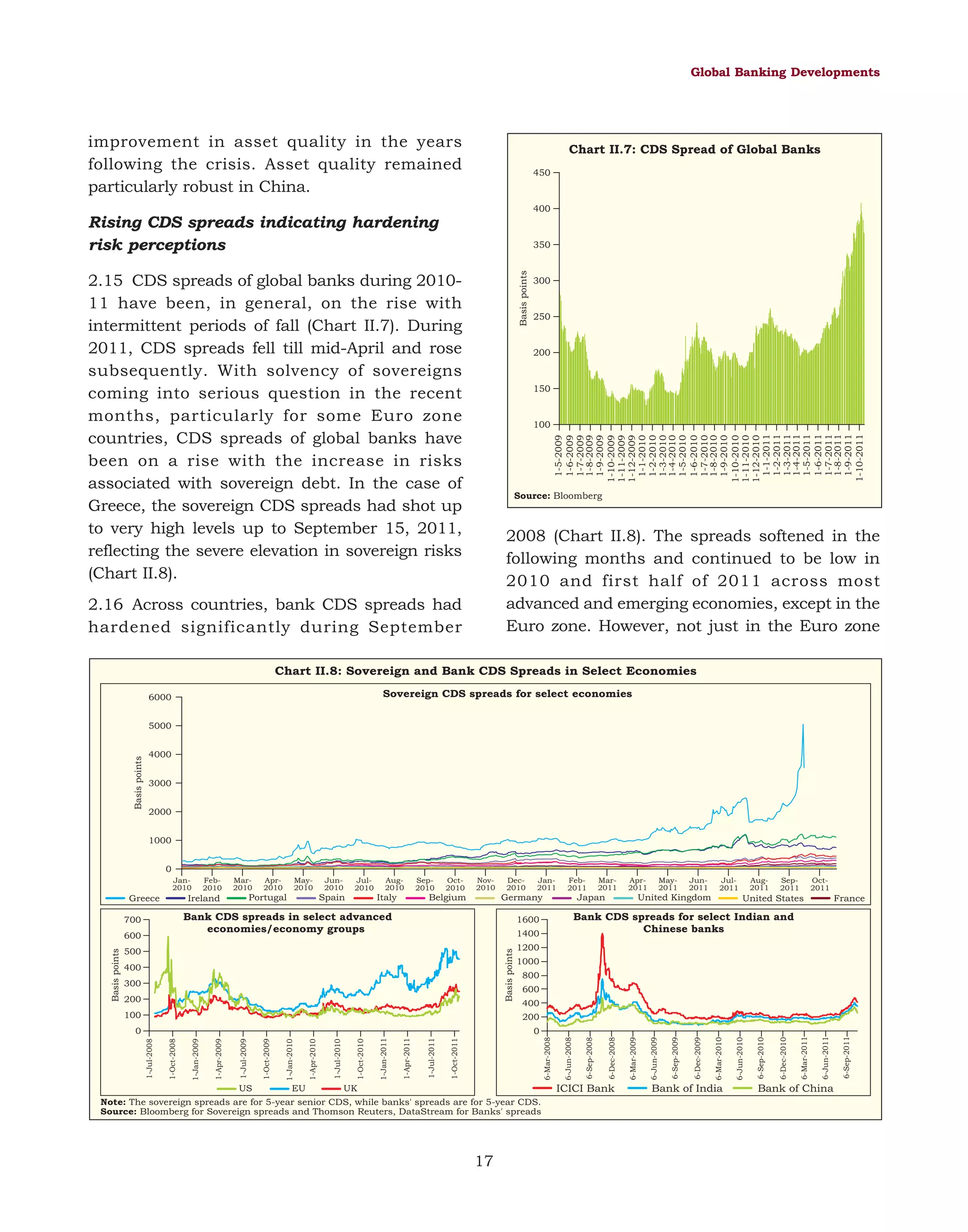
between 2009 and 2010, with the exceptions of
China, India and Mexico. Both Mexican and

2007-08 2008-09 2009-10 2010-11

Total assets
1. External assets
Loans and deposits
Holdings of securities
and other assets
2. Local assets in
foreign currency

26.1
26.6
28.2

-17.5
-17.5
-19.0

0.2
0.1
-1.0

5.4
5.3
6.7

22.1

-13.2

3.0

1.9

22.4

-17.5

0.7

5.7

Total liabilities
1. External liabilities
Loans and deposits
Own issues of securities
and other liabilities
2. Local liabilities in foreign
currency

26.5
27.4
26.5

-18.0
-18.6
-21.2

-0.7
0.2
-1.3

7.1
6.6
6.0

33.7

-2.0

7.4

9.5

20.8

-14.4

-6.1

10.5

Source: Calculated from BIS, Locational Banking Statistics.

14
Global Banking Developments

Chart II.4: International Assets/Liabilities of Advanced and Emerging Economies
8000

International asset position of banks in all
currencies - Advanced economies

9000

7000
US $ billion

8000

6000
US $ billion

7000

International liability position of banks in all
currencies - Advanced economies

5000
4000
3000

6000
5000
4000
3000

2000

2000

1000

1000
0

0
France

Germany

Greece

End-March 2007
End-March 2010

Italy

Japan

End-March 2008
End-March 2011

Spain

United
Kingdom

United
States

France

End-March 2009

Germany

End-March 2007
End-March 2010

International asset position of banks in all currencies Emerging and developing economies

Greece

Italy

Japan

End-March 2008
End-March 2011

Spain

United
Kingdom

United
States

End-March 2009

International liability position of banks in all currenciesEmerging and developing economies

140

100

90

120

80
100
US $ billion

US $ billion

70
60
50
40
30

80
60
40

20
20

10
0

0
Brazil

India

End-March 2007
End-March 2010

Malaysia

End-March 2008
End-March 2011

Mexico

Brazil

End-March 2009

End-March 2007
End-March 2010

India

Malaysia

End-March 2008
End-March 2011

Mexico

End-March 2009

Note: Data for 2007 for Malaysia are not available.
Source: Compiled from BIS Locational Banking Statistics

Chinese banks showed a moderate decline in
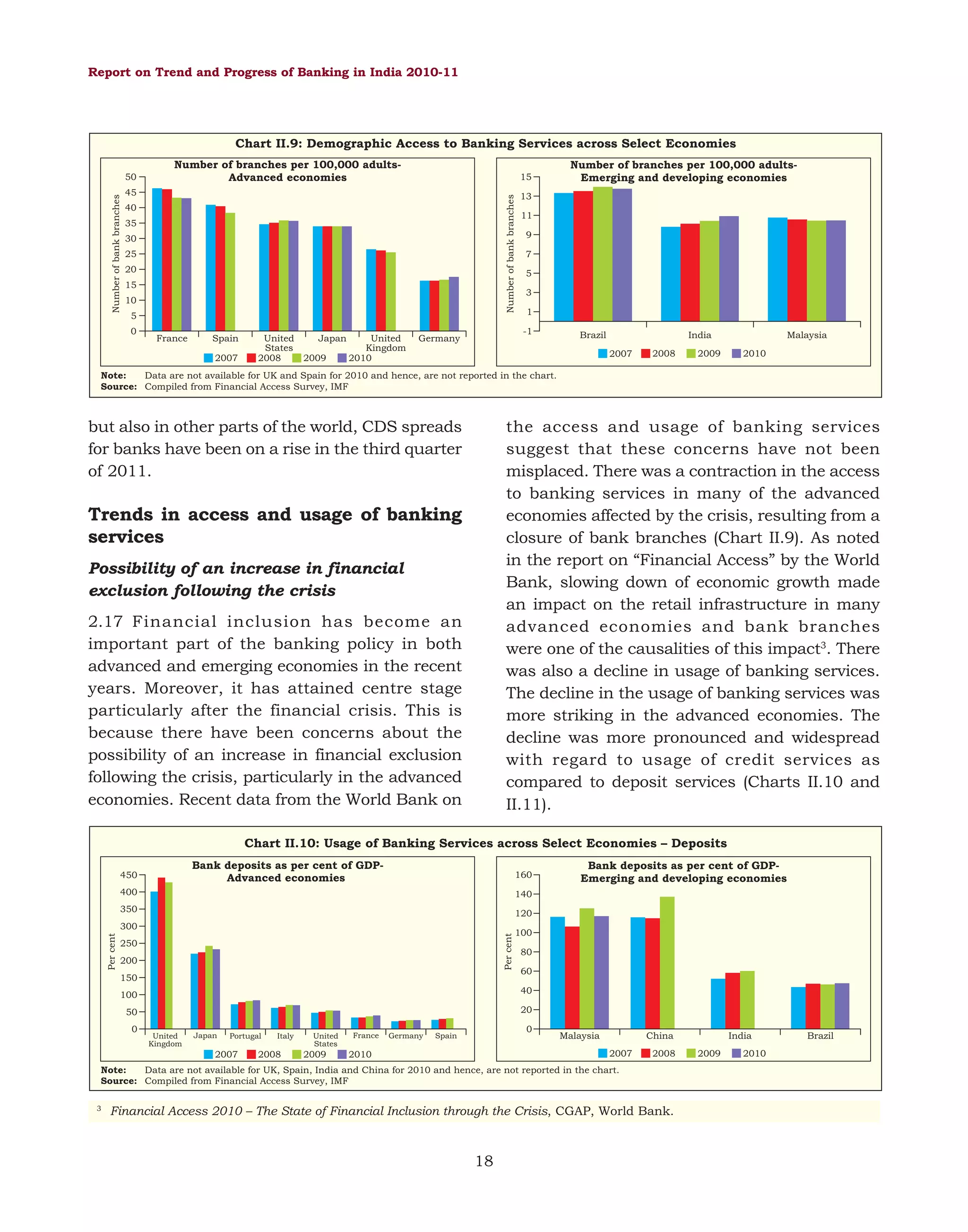
their capital positions by March 2011.

Table II.3: Capital to Risk-Weighted Assets
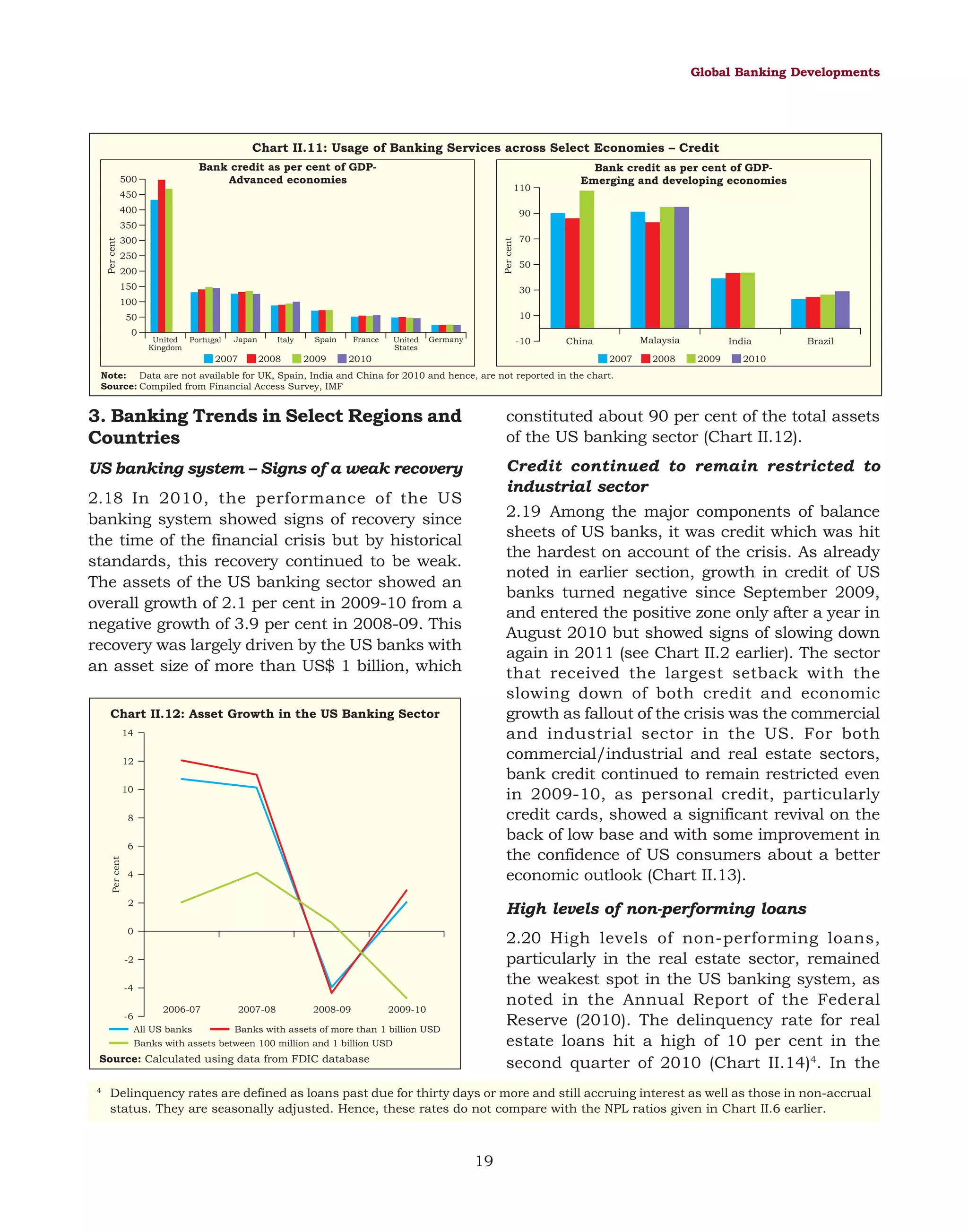
Ratio of Banks in Select Economies
Country

2007

2008

2009

2010

Advanced economies
France
10.2
10.5
12.4
12.3
Germany
12.9
13.6
14.8
16.1
Greece
11.2
9.4
11.7
11.4
Italy
10.4
10.8
12.1
12.3
Japan
12.3
12.4
15.8
16.7
Portugal
10.4
9.4
10.5
10.2
Spain
11.4
11.3
12.2
11.8
United Kingdom
12.6
12.9
14.8
15.9
United States
12.8
12.8
14.3
15.3
Emerging and developing economies
Brazil
18.7
18.2
18.9
17.6
China
8.4
12.0
11.4
12.2
India
12.3
13.0
13.2
13.6
Malaysia
14.4
15.5
18.2
17.5
Mexico
15.9
15.3
16.5
16.9
Russia
15.5
16.8
20.9
18.1

2011*

2. Uneven decline in leverage

...
16.6
12.3
...
...
10.5
...
...
15.5

2.12 There was unevenness in the decline in
banking sector leverage across countries after
the crisis; here, the percentage of total capital
(and reserves) to total assets has been taken as
an indicator of leverage in the banking system2.
In the US, leverage in the banking system
showed some moderation between 2008 and
2010 (Chart II.5). This trend for US banks
continued further in the first quarter of 2011. A
moderation in leverage could also be seen for UK
banks between 2008 and 2010. Notwithstanding
this moderation, the extent of leverage for UK
banks continued to be at relatively high levels.

18.2
11.8
...
16.4
16.5
17.2

Source: Compiled from Financial Soundness Indicators, IMF
… Not available
* Up to the period ending March/May
2

As per the baseline proposal for leverage ratio put forward by the BCBS under its Basel III rules text, (i) the capital measure
should include Tier 1 capital and the predominant form of Tier 1 capital, while (ii) total exposure should include exposure net of
provisions and other valuation adjustments. Hence, the measure of leverage used for the present analysis has been referred to
as preliminary. It directly follows the measure provided by the IMF in its Financial Soundness Indicators (FSI) database. It is
noteworthy, however, that the IMF while discussing this measure, refers to it as a “leverage ratio”; see “Concepts and
Definitions” of FSI, <www.imf.org>.

15
Report on Trend and Progress of Banking in India 2010-11

Chart II.5: Leverage in the Banking Systems of Select Economies
Leverage in the banking system - Advanced economies

Leverage in the banking system-Emerging and developing economies

13
16
14

Per cent

Per cent

11
9
7

12
10
8

5
3

6
2008
2009
2010
2011*
Germany
Portugal
Greece
Italy
United Kingdom
United States
Green : Consistent decline in leverage since 2008
Red : Lack of consistency in the decline in leverage since 2008

4

2007

France
Japan

Spain

2007

Russia

2008
Brazil

2009
Malaysia

Mexico

2010

2011*
China

India

Green : Consistent decline in leverage since 2008
Red : Lack of consistency in the decline in leverage since 2008

Source: Compiled from Financial Soundness Indicators, IMF
* Up to the period ending March

3. Weakening asset quality

Deleveraging had not gained any significant
momentum in the banking systems of other
advanced European economies, viz., France,
Germany, Portugal, Greece and Spain, treating
2008 as the reference point.

2.14 Globally, there was little improvement in
the asset quality of banks since the onset of the
financial crisis. According to the GFSR
(September 2011), credit risks have risen and
continue to be the key potential risk to global
financial stability. The Report went on to add
that improvements in credit risks had lagged
behind improvements in the real economy.
There was a trend of increasing Non-Performing
Loans (NPLs) ratio across most advanced
economies between 2008 and 2010 with the
exception of the US. In the US, there was a
moderate improvement in asset quality between
2009 and 2010, which continued in the first
quarter of 2011 (Chart II.6). In complete contrast
to advanced economies, many of the major
emerging economies showed considerable

2.13 In major emerging economies, banking
systems were generally less leveraged than most
advanced economies. Moreover, the banking
systems in these economies did not show signs
of any perceptible increase in leverage during the
crisis period. However, treating 2008 as the
reference point, in many emerging economies,
there was an increase in the leverage of their
banking systems in the post-crisis period. The
Global Financial Stability Report (GFSR)
(September 2011) has in fact highlighted
releveraging as a major concern for banking
systems in emerging economies.

Chart II.6: Asset Quality of Banks in Select Economies
Ratio of NPLs to total loans- Emerging and
developing economies

Per cent

Per cent

Ratio of NPLs to total loans - Advanced economies
12
11
10
9
8
7
6
5
4
3
2
1
0

2007
Greece
United Kingdom

2008
2009
2010
2011*
Japan
Spain
Italy
Portugal
Germany
France
United States
Note: Ratio of NPLs is not available for 2010 for Germany and hence has not been reported.
Source: Compiled from Financial Soundness Indicators, IMF

16

12
11
10
9
8
7
6
5
4
3
2
1
0

2007

Russia

2008
China

2009

India

* Up to the period ending March

Malaysia

2010

2011*
Brazil

Mexico
Global Banking Developments

improvement in asset quality in the years
following the crisis. Asset quality remained
particularly robust in China.

Chart II.7: CDS Spread of Global Banks
450

400

Rising CDS spreads indicating hardening
risk perceptions
Basis points

350

2.15 CDS spreads of global banks during 201011 have been, in general, on the rise with
intermittent periods of fall (Chart II.7). During
2011, CDS spreads fell till mid-April and rose
subsequently. With solvency of sovereigns
coming into serious question in the recent
months, particularly for some Euro zone
countries, CDS spreads of global banks have
been on a rise with the increase in risks
associated with sovereign debt. In the case of
Greece, the sovereign CDS spreads had shot up
to very high levels up to September 15, 2011,
reflecting the severe elevation in sovereign risks
(Chart II.8).

300

250

200

150

1-5-2009
1-6-2009
1-7-2009
1-8-2009
1-9-2009
1-10-2009
1-11-2009
1-12-2009
1-1-2010
1-2-2010
1-3-2010
1-4-2010
1-5-2010
1-6-2010
1-7-2010
1-8-2010
1-9-2010
1-10-2010
1-11-2010
1-12-2010
1-1-2011
1-2-2011
1-3-2011
1-4-2011
1-5-2011
1-6-2011
1-7-2011
1-8-2011
1-9-2011
1-10-2011

100

Source: Bloomberg

2008 (Chart II.8). The spreads softened in the
following months and continued to be low in
2010 and first half of 2011 across most
advanced and emerging economies, except in the
Euro zone. However, not just in the Euro zone

2.16 Across countries, bank CDS spreads had
hardened significantly during September

Chart II.8: Sovereign and Bank CDS Spreads in Select Economies
Sovereign CDS spreads for select economies

6000

Basis points

5000
4000
3000
2000
1000
0
Jan2010

Greece

Mar2010

Apr2010

May2010

Jun2010

Jul2010

Spain

Portugal

Aug2010

Italy

Sep2010

Oct2010

Nov2010

Dec2010

600

Jan2011

Feb2011

1400

Basis points

400
300
200

Apr2011

May2011

Jun2011

Aug2011

Jul2011

United Kingdom

Sep2011

Oct2011

France

United States

Bank CDS spreads for select Indian and
Chinese banks

1600

500

Mar2011

Japan

Germany

Belgium

Bank CDS spreads in select advanced
economies/economy groups

700

1200
1000
800
600
400

US

EU

ICICI Bank

UK

Note: The sovereign spreads are for 5-year senior CDS, while banks' spreads are for 5-year CDS.
Source: Bloomberg for Sovereign spreads and Thomson Reuters, DataStream for Banks' spreads

17

Bank of China

6-Sep-2011

6-Jun-2011

6-Dec-2010

6-Mar-2011

6-Sep-2010

6-Mar-2010

Bank of India

6-Jun-2010

6-Sep-2009

6-Dec-2009

6-Mar-2009

6-Jun-2009

6-Sep-2008

6-Dec-2008

6-Mar-2008

1-Oct-2011

1-Jul-2011

1-Apr-2011

1-Jan-2011

1-Oct-2010

1-Jul-2010

1-Apr-2010

1-Jan-2010

1-Oct-2009

1-Jul-2009

1-Apr-2009

1-Oct-2008

0
1-Jan-2009

200

0
1-Jul-2008

100

6-Jun-2008

Basis points

Feb2010

Ireland
Report on Trend and Progress of Banking in India 2010-11

Chart II.9: Demographic Access to Banking Services across Select Economies
Number of branches per 100,000 adultsAdvanced economies

15

45

Number of bank branches

Number of bank branches

50
40
35
30
25
20
15
10
5
0

France

Spain
2007

United
Japan
United
States
Kingdom
2008
2009
2010

13
11
9
7
5
3
1
-1

Germany

Number of branches per 100,000 adultsEmerging and developing economies

Brazil

India
2007

2008

2009

Malaysia
2010

Note:
Data are not available for UK and Spain for 2010 and hence, are not reported in the chart.
Source: Compiled from Financial Access Survey, IMF

but also in other parts of the world, CDS spreads
for banks have been on a rise in the third quarter
of 2011.

the access and usage of banking services
suggest that these concerns have not been
misplaced. There was a contraction in the access
to banking services in many of the advanced
economies affected by the crisis, resulting from a
closure of bank branches (Chart II.9). As noted
in the report on “Financial Access” by the World
Bank, slowing down of economic growth made
an impact on the retail infrastructure in many
advanced economies and bank branches
were one of the causalities of this impact3. There
was also a decline in usage of banking services.
The decline in the usage of banking services was
more striking in the advanced economies. The
decline was more pronounced and widespread
with regard to usage of credit services as
compared to deposit services (Charts II.10 and
II.11).

Trends in access and usage of banking
services
Possibility of an increase in financial
exclusion following the crisis
2.17 Financial inclusion has become an
important part of the banking policy in both
advanced and emerging economies in the recent
years. Moreover, it has attained centre stage
particularly after the financial crisis. This is
because there have been concerns about the
possibility of an increase in financial exclusion
following the crisis, particularly in the advanced
economies. Recent data from the World Bank on

Chart II.10: Usage of Banking Services across Select Economies – Deposits
Bank deposits as per cent of GDPAdvanced economies

450

160

400

140

350

120
Per cent

300
Per cent

Bank deposits as per cent of GDPEmerging and developing economies

250
200
150

100
80
60

100

40

50

20

0

United
Kingdom

Japan

Portugal

2007

Italy

2008

United
States

2009

France

Germany

0

Spain

Malaysia

China
2007

2010

2008

Note:
Data are not available for UK, Spain, India and China for 2010 and hence, are not reported in the chart.
Source: Compiled from Financial Access Survey, IMF
3

Financial Access 2010 – The State of Financial Inclusion through the Crisis, CGAP, World Bank.

18

India
2009

2010

Brazil
Global Banking Developments

Chart II.11: Usage of Banking Services across Select Economies – Credit
Bank credit as per cent of GDPAdvanced economies

500

110

450
400

Bank credit as per cent of GDPEmerging and developing economies

90

300

Per cent

Per cent

350
250
200
150

70
50
30

100
10

50
0

United
Portugal
Kingdom

Japan

2007

Italy

2008

France

Spain

2009

United
States

Germany

-10

2010

Malaysia

China
2007

2008

India
2009

Brazil

2010

Note: Data are not available for UK, Spain, India and China for 2010 and hence, are not reported in the chart.
Source: Compiled from Financial Access Survey, IMF

3. Banking Trends in Select Regions and
Countries

constituted about 90 per cent of the total assets
of the US banking sector (Chart II.12).

US banking system – Signs of a weak recovery

Credit continued to remain restricted to
industrial sector

2.18 In 2010, the performance of the US
banking system showed signs of recovery since
the time of the financial crisis but by historical
standards, this recovery continued to be weak.
The assets of the US banking sector showed an
overall growth of 2.1 per cent in 2009-10 from a
negative growth of 3.9 per cent in 2008-09. This
recovery was largely driven by the US banks with
an asset size of more than US$ 1 billion, which

2.19 Among the major components of balance
sheets of US banks, it was credit which was hit
the hardest on account of the crisis. As already
noted in earlier section, growth in credit of US
banks turned negative since September 2009,
and entered the positive zone only after a year in
August 2010 but showed signs of slowing down
again in 2011 (see Chart II.2 earlier). The sector
that received the largest setback with the
slowing down of both credit and economic
growth as fallout of the crisis was the commercial
and industrial sector in the US. For both
commercial/industrial and real estate sectors,
bank credit continued to remain restricted even
in 2009-10, as personal credit, particularly
credit cards, showed a significant revival on the
back of low base and with some improvement in
the confidence of US consumers about a better
economic outlook (Chart II.13).

Chart II.12: Asset Growth in the US Banking Sector
14
12
10
8

Per cent

6
4
2

High levels of non-performing loans

0

2.20 High levels of non-performing loans,
particularly in the real estate sector, remained
the weakest spot in the US banking system, as
noted in the Annual Report of the Federal
Reserve (2010). The delinquency rate for real
estate loans hit a high of 10 per cent in the
second quarter of 2010 (Chart II.14)4. In the

-2
-4
-6

2006-07
All US banks

2007-08

2008-09

2009-10

Banks with assets of more than 1 billion USD

Banks with assets between 100 million and 1 billion USD

Source: Calculated using data from FDIC database
4

Delinquency rates are defined as loans past due for thirty days or more and still accruing interest as well as those in non-accrual
status. They are seasonally adjusted. Hence, these rates do not compare with the NPL ratios given in Chart II.6 earlier.

19
Report on Trend and Progress of Banking in India 2010-11

Chart II.15: Balance Sheet Indicators of
Banks in the Euro zone

Chart II.13: Sectoral Rates of Growth of Credit of US Banks
60
55
50
45
40

Per cent

Per cent per annum

35

25

30

20

15
10
5
0

Jun-2011

Mar-2011

Sep-2010

Dec-2010

Jun-2010

Mar-2010

Sep-2009

Dec-2009

Mar-2009

Jun-2009

Sep-2008

Loans to non-financial private sector
Securities of non-financial private sector
Total assets

Agricultural loans
Individual loans

Note: The rates of growth are three yearly moving averages.
Source: Calculated from ECB database

Source: Calculated using data from FDIC database

subsequent quarters, this rate tapered off
moderately but still remained at a stubbornly
elevated level.

and banks’ investment in securities of the
private sector in 2010 (Chart II.15). However, at
the disaggregated level, concerns about credit
revival continued to plague banks in the fiscally
strained economies (Chart II.2 earlier). Also,
concerns remained about revival in credit to
small and medium enterprises (SMEs) in the
Euro zone, a sector largely dependent on bank
finance (Chart II.16).

Euro zone banking system - Concerns
remain with regard to revival in credit
2.21 At the aggregate level, banking conditions
in the Euro zone showed signs of improvement
in terms of revival in growth in private credit

Chart II.16: Expectations about Credit Conditions for
SME Sector in the Euro zone

Chart II.14: Sectoral Delinquency Rates of US Banks
12

20

10

Credit conditions
have improved
and will
improve

18
15

8

Per cent

Dec-2008

2009-10

Jun-2008

2008-09

Mar-2008

2007-08

Sep-2007

2006-07

Real estate loans
Commercial and Industrial loans
Credit cards

Dec-2007

-25

Jun-2007

-10
-15

Mar-2007

-5

16

6

17
Credit conditions
have deteriorated
and will
deteriorate

4

19
22
22

2

2011 Q1

2011 Q2

2010 Q3

2010 Q4

2010 Q1

2010 Q2

2009 Q3

2009 Q4

2009 Q1

2009 Q2

2008 Q4

2008 Q2

2008 Q3

2007 Q3

2007 Q4
2008 Q1

2007 Q1

2007 Q2

2006 Q3

2006 Q4

2006 Q1

2006 Q2

0

Real estate loans
Commercial and Industrial loans
Credit cards

59

Credit conditions
have remained
unchanged and
will remain
unchanged

60
57
55
0

10

20

30

40

50

60

70

Per cent

Agricultural loans
Individual loans

2009H1

2009H2

2010H1

2010H2

Note: The figures refer to weighted percentage of responses.
Source: Compiled from ECB's Survey on Access to Finance of SMEs in the Euro area

Source: Calculated using data from Federal Reserve database

20
Global Banking Developments

Impact of sovereign debt crisis on Euro zone
banking system

Chart II.18: Interest Rates on Bank Deposits from
Non-financial Corporations (with Less than One
Year Maturity), Select Euro zone Economies

2.22 Sovereigns, especially home sovereigns,
are generally an important part of banks’
balance sheets. With downgrading of sovereigns
and the resulting losses, banks’ balance sheets
in the Euro zone countries, particularly in the
countries which are fiscally challenged, have
weakened significantly. Further, rising sovereign
risks have also increased funding risks for Euro
zone banks. This is evident from a rising trend in
Euribor (Euro Inter-bank Offered Rate) since
mid-2010 (Chart II.17). It is noteworthy that
deposit rates in Spain, Italy and Greece –
economies severely afflicted by the sovereign
debt crisis – are at higher levels than the rates
prevailing in other Euro zone countries, viz.,
France and Germany, again reflecting funding
strains for banks in these economies
(Chart II.18).

6
5

Per cent

4

Italy

Spain

France

5-2011

1-2011

9-2010

5-2010

1-2010

9-2009

5-2009

1-2009

9-2008

Greece

Germany

Source: Compiled from Eurostat database

emerged over stability of banks having exposure
to sovereign debt of Euro area countries,
particularly on account of cross-border exposure
of sovereign debt (Box II.1).
UK banking system – Leverage and credit
risks at elevated levels
2.24 In 2010-11, the UK banking system
showed moderate de-leveraging and reduced its
reliance on wholesale funding, unlike its
counterparts in the Euro zone. However,
the UK banking system continued to be besieged
by some concerns: First, despite de-leveraging,
the level of leverage still remained high for UK
banks. Secondly, private credit growth remained
considerably weak, as already shown in
Chart II.2. Moreover, the near to medium-term
expectations about an improvement in credit
availability have been on wane, particularly for
medium term enterprises, as per the
Bank of England Credit Conditions Survey
(Chart II.19). Thirdly, credit risks continued to be
at elevated levels, as illustrated earlier in Chart
II.6. At the sectoral level, credit risks grew for the
unsecured component of bank loans, namely,
credit card loans (Chart II.20).

Chart II.17: Movements in Euro Inter-Bank Offered Rate
6

5

4
Per cent

5-2008

1-2008

0

2.23 With sovereign debt concerns coming to
the fore in the Euro area, concerns have

3

2

1/1/2008
1/3/2008
1/5/2008
1/7/2008
1/9/2008
1/11/2008
1/1/2009
1/3/2009
1/5/2009
1/7/2009
1/9/2009
1/11/2009
1/1/2010
1/3/2010
1/5/2010
1/7/2010
1/9/2010
1/11/2010
1/1/2011
1/3/2011
1/5/2011
1/7/2011
1/9/2011

1

Euribor 1-month

2
1

Risks related to cross-border exposure of
sovereign debt

0

3

Euribor 1-year

Note:
The rates are monthly averages.
Source: Compiled from ECB database

21
Report on Trend and Progress of Banking in India 2010-11

Box II.1: European Banks’ Exposure to Euro Area Sovereign Debt
Apart from their exposure to sovereign debt of their own
country, cross-border exposure to sovereign debt is also
high for banks in some of the Euro area nations (Table below).
Illustratively, despite Germany’s sound fiscal position,
its exposure to sovereign debt of other Euro area nations,
some of which have debt sustainability issues, is

relatively high. German and French banks are more exposed
to the sovereign debt of Italy than other nations.
Due to the high cross-border exposure to sovereign debt of
banks, any haircut/restructuring could adversely affect the
banks of countries with otherwise sound fiscal
positions.

Table : Exposure to Sovereign Debt of Banks
(in Euro Million)

Exposure to Sovereign Debt of

Banking Exposure of

Greece

Ireland

Portugal

Italy

Spain

56,148
1,739
1,778
1,016
11,624
18,718
4,131
3,160

Greece
Ireland
Portugal
Italy
Spain
France
Germany
UK
Netherlands

5,322
839
239
2,476
12,922
5,580
559

257
13,707
304
6,807
4,864
10,888
2,571
2,272

1,179
1,44,856
6,017
48,185
72,717
10,029
10,313

345
1,383
2,03,310
6,592
31,854
5,916
1,685

Note: The listing of select countries in the Euro area covers the major sources and destination of sovereign debt and is not exhaustive.
Source: Blundell-Wignall, A. and P. Slovik (2010), “The EU Stress Test and Sovereign Debt Exposures”, OECD Working Papers on Finance,
Insurance and Private Pensions, No. 4.

Chinese banking system - concerns about
weakening of asset quality

high level in 2010. With the high growth in
credit, there are concerns being raised about a
weakening of asset quality of Chinese banks in
the near future.

2.25 Among the emerging economies, China
exhibited a rapid expansion in the asset size of
its banking system in 2009, at a time when
banking sector assets in most advanced
economies were in a phase of contraction
following the financial crisis. The growth in bank
assets and credit, however, peaked by the end of
2009 and posted a decline thereafter (Chart
II.21). Yet, credit growth in China remained at a

4. An Analysis of the Performance of
Top 100 Global Banks
Considerable repositioning of banks at the
top end of the asset spectrum
2.26 The rank correlation coefficient of the top20 global banks between 2009 and 2010 worked

Chart II.19: Expectations about Bank Credit Availability to SMEs in the UK
Bank credit availability for small enterprises in the UK

Bank credit availability for medium enterprises in the UK

-30
Observations during previous three months
Expectations during the next three months

-30
Observations during previous three months
Expectations during the next three months

Note: The figures are net percentage balances calculated by weighing the responses of those lenders who answered the question by their market shares.
Source: Bank of England, Credit Conditions Survey

22

2011 Q2

-20

2011 Q1

-10

2010 Q4

0

2010 Q3

Decrease in credit
availability

2011 Q2

2011 Q1

2010 Q4

2010 Q3

-20

2010 Q2

-10

2010 Q1

0

10

2010 Q2

10

20

2010 Q1

20

2009 Q4

Increase in credit
availability

30

2009 Q4

Decrease in credit
availability

Increase in credit
availability

30
Global Banking Developments

Table II.4: Rank Correlation Coefficients for
Top Global Banks between 2009 and 2010

Chart II.20: Write-off Rates of UK Banks
Per cent for consumer credit and credit cards

0.35

3

0.3

2.5

0.25

2
0.2
1.5
0.15

1

0.1

0.5

0.05

0

Per cent for Private non-financial corporations

0.4

3.5

Item
Rank correlation coefficient

Top-50
banks

Top-100
banks

0.83

0.96

0.98

Note: The coefficients were worked out assuming that the sample
of top banks remained the same between the two years. In
other words, the ranking was re-worked by removing the
new additions/deletions of banks during this period.
Source: Calculated from Banker Database

Moderate shift of the global banking
business to emerging economies
2.27 An analysis of the location of incorporation
of top 100 global banks (ranked by the strength
of their Tier 1 capital) suggested a moderate shift
of the global banking business from advanced
economies to emerging economies in the
aftermath of the crisis. This shift was
attributable to bank failures as well as a weak
growth in asset base of banks from the advanced
economies. In terms of both number and total
assets of the top 100 global banks, there was a
fall in the share of advanced economies between
2009 and 2010 (Chart II.22). The decline in the
asset share of advanced economies between
2009 and 2010 was concentrated in the US, UK,
and more prominently, in the Euro zone
economies (Chart II.23).

2006 Q4
2007 Q1
2007 Q2
2007 Q3
2007 Q4
2008 Q1
2008 Q2
2008 Q3
2008 Q4
2009 Q1
2009 Q2
2009 Q3
2009 Q4
2010 Q1
2010 Q2
2010 Q3
2010 Q4
2011 Q1

0

Consumer credit
Credit cards
Private non-financial corporations
Source: Calculated from Bank of England database

out to 0.83. The correlation coefficient increased
steadily, as the sample of banks was
expanded to top-50 and then to top-100 banks.
The rise in the rank correlation coefficients with
the increase in the sample size suggested
that there was considerable repositioning of
banks at the top end of the asset spectrum
(Table II.4).

Improvement in the profitability of global
banks

Chart II.21: Growth in Balance Sheets of Chinese Banks
40

2.28 There was a distinct improvement in the
profitability of global banks between 2009 and
2010 as evident from an increase in RoA. The
percentage of loss making global banks (reporting
negative RoA) was down from 25 per cent in 2009
to only 5 per cent in 2010. Further, about 89 per
cent of the global banks had a positive RoA of less
than 2 per cent in 2010 as against a share of 70
per cent in 2009 (Chart II.24).

35

Per cent

Top-20
banks

30

25

20

Strengthening of capital adequacy of global
banks

Mar-09
Apr-09
May-09
Jun-09
Jul-09
Aug-09
Sep-09
Oct-09
Nov-09
Dec-09
Jan-10
Feb-10
Mar-10
Apr-10
May-10
Jun-10
Jul-10
Aug-10
Sep-10
Oct-10
Nov-10
Dec-10

15

Assets

Deposits

2.29 Apart from a turnaround in profitability of
global banks, there was also strengthening of
capital adequacy positions of these institutions

Credit

Note: Series have been smoothened using three-year moving average method.
Source: Calculated from Peoples' Bank of China database

23
Report on Trend and Progress of Banking in India 2010-11

Chart II.22: Location of Global Banking Business
Composition of number of top 100 global banks

Composition of assets of top 100 global banks

2010

2010

18.0

14.9

15.0

11.8

2009

2009

85.0
82.0

88.2
84.9

Emerging and developing economies

Advanced economies

Emerging and developing economies

Advanced economies

Source: Calculated using Banker Database

between 2009 and 2010. There was an
increasing concentration of banks between 2009
and 2010 in higher size classes based on CRAR.
At end-December 2010, 47 per cent of the top
100 global banks had a CRAR ranging between
13 per cent and 17 per cent, far above the BCBS
norm of 8 per cent under the Basel II framework
(Chart II.25).

about 24 per cent of the top-100 global banks
were highly leveraged with a Capital Adequacy
Ratio (CAR) – a measure of financial leverage – of
less than four per cent; the percentage had come
down moderately by 5 percentage points to 19 per
cent at the end of 2010 (Chart II.26). As against
this, the percentage of global banks with CAR
ranging between 4 and 6 per cent had increased
exactly by the same magnitude from 41 per cent
to 46 per cent.

Slow process of deleveraging of global banks
2.30 Notwithstanding the improvement in CRAR,
soundness of global banks remained a concern
on account of a slow process of deleveraging and
increasing levels of NPAs. At the end of 2009,

Weakening asset quality of global banks
2.31 Between 2009 and 2010, there was a
decline in the proportion of banks reporting very

Chart II.23: Share of Countries in Total Assets of
Top 100 Global Banks

Chart II.24: Percentage Distribution of Top 100
Global Banks by Return on Assets

35

56
30

48

Per cent

25
20

33

15

22
10

17

5

5

3

5
1 1
2<=RoA<3

1<=RoA<2

0<=RoA<1

-1<=RoA<0

0
-3<=RoA<-1

RoA<-3

India

Russia

Brazil

China

Turkey

US

South Africa

UK

Sweden

Switzerland

Singapore

South Korea

Japan

Norway

Denmark

Canada

Eurozone

Australia

Advanced economies

0

3<=RoA<4

6
2

0

2009
2010
Note: On account of non-availability of data on certain banks from the top-100
sample, the percentages may not add up to 100.
Source: Calculated using Banker Database

Emerging and
developing economies

2009
2010
Source: Calculated using Banker Database

24
Global Banking Developments

Chart II.25: Percentage Distribution of Top 100
Global Banks by CRAR
45

Chart II.27: Percentage Distribution of Top Global Banks
by NPLs Ratio

47

18
17
16

16
15

10

19
14

13

6
5

2009

Significant increase in regulatory reforms

41

2.33 Various authoritative reports on the crisis
so far, including that of the latest Financial
Crisis Inquiry Commission of the US (2011),
have attributed the eruption of a financial
crisis of such vast magnitude and impact, to
serious lacunae in the financial regulatory and
supervisory framework6. Further, owing to the
globalisation of finance, these reports have also
underscored the need to increase interregulatory coordination both at the national and
international level. A number of banking policy
reforms are since then being contemplated;
some of these, have even reached the stage of
implementation.

24
19 19

10

9

7

10<CAR

8<CAR<=10

6<CAR<=8

4<CAR<=6

6

2<CAR<=4

5<NPL

5. Global Policy Reforms

46

2009
2010
Note: On account of non-availability of data on certain banks from the top-100
sample, the percentages may not add up to 100.
Source: Calculated using Banker Database

6

3<NPL<=5

2.32 The scatter plots of top 20 global banks
taking three indicators of CRAR, leverage and
NPLs ratio, revealed that while banks were
in the process of stepping up their CRAR
between 2009 and 2010, there seemed to be
little improvement in the leverage and NPLs
ratios of banks during this period (Chart II.28).

Chart II.26: Percentage Distribution of Top 100 Global
Banks by Capital Adequacy (Leverage) Ratio

5

2010

Source: Calculated using Banker Database

high levels of NPLs ratio, suggesting some
temperance of the acute credit strain on banks5.
However, except this change at the extreme end
of the spectrum, there was a general weakening
of the asset quality of top global banks
(Chart II.27).

19

2<NPL<=3

2009
2010
Note: On account of non-availability of data on certain banks from the top-100
sample, the percentages may not add up to 100.
Source: Calculated using Banker Database

1<NPL<=2

17<CRAR

0<NPL<=1

12<CRAR<=13

13<CRAR<=17

10<CRAR<=11

0<CRAR<=10

8
7

14

2

1

11<CRAR<=12

3

12

11

14

On account of non-reporting of data by many banks, the present analysis of NPLs is based on a sample of only 59 banks instead
of 100 banks.
For instance, see Turner Review (2009) and Larosiere Report (2009).

25
Report on Trend and Progress of Banking in India 2010-11

Chart II.28: Changes in Soundness Indicators of Top 20 Global Banks
Top 20 global banks positioned by their NPLs ratio and CRAR

NPLs ratio in per cent

CAR in per cent

Top 20 global banks positioned by their CAR and CRAR
10
Direction of
improving
soundness

7

4

1
0
-2

8
6
4
2

0

CRAR in per cent
2009

Direction of
improving
soundness

0

30

15

12
10

10

20

30

CRAR in per cent

2010

2009

2010

Note: The top 20 banks are as per the list of 2010. The same banks have been chosen for 2009 for these scatter plots.
Source: Compiled from Banker database

Reforms in Capital and Liquidity Standards

of non-viability in January 2011 as a measure
to enhance the quality of regulatory capital.
According to this recommendation, all
regulatory capital instruments should be able
to absorb losses in the event when a bank is
unable to support itself in private market,
including situations where recapitalisation by
public sector is necessary to save the bank.

2.34 The most significant development during
the year was the announcement by the Basel
Committee on Banking Supervision (BCBS) in
December 2010 (followed by minor modifications
with regard to capital treatment for counterparty
credit risk in bilateral trades in June 2011) of the
reform framework to strengthen the capital and
liquidity standards. The framework provides
details of the regulatory standards agreed to by
the Governors and Heads of Supervision (GHOS)
in September 2010, and endorsed by the G-20
Leaders in November 2010. This framework
incorporates both micro-prudential and macroprudential approaches to regulation and
supervision. It is much more comprehensive and
counter-cyclical in approach as compared
to Basel II7. It provides a set of collective minimum
requirements, and is expected to be
implemented in totality and not in parts8. The
key objectives and features of the reform
measures suggested in the Basel III framework
are summarised in Box II.2.

2.36 In December 2010, the Final Report of the
Macro-economic Assessment Group (MAG)
formed by Financial Stability Board (FSB) and
BCBS concluded that the impact of higher
capital standards on economic growth would be
modest and would be much less in magnitude
and spread over a longer time horizon than what
was estimated by the MAG Interim Report in
August 2010. Taking a median of national
estimates, the MAG observed a decline in annual
GDP growth rate of about 3 basis points from its
baseline level for 35 quarters from the start of
implementation of the standards. The Long-term
Economic Impact (LEI) Group studied the costs
and benefits of the new standards over the long
run. The LEI noted that, while the costs in terms
of permanent GDP foregone were expected to be
small, the benefits of reducing crisis-related
risks would be substantial9.

2.35 In addition to the December 2010 capital
rules, the BCBS also recommended the loss
absorption by capital instruments at the point
7

8
9

See Report on Trend and Progress of Banking in India – 2008-09 for a comparison of Basel III and Basel II norms of capital
requirement and schedule for phase-in arrangements of Basel III.
See “Regulatory Reform: Remaining Challenges”, Speech by Jaime Caruana, BIS, July 2011.
“An Assessment of the Long-term Economic Impact of Stronger Capital and Liquidity Requirements”, BIS, August 2010.

26
Global Banking Developments

Box II.2: Key Objectives and Features of the Basel III Framework
Capital Standards

IV. Reduce pro-cyclicality through counter-cyclical buffers

I Raising capital base

Objective - Dampening pro-cyclical movements within the
banking system by making it a “shock absorber” rather than a
transmitter of risk to the real economy.

Objective - Ensuring quality, consistency in definition across
jurisdictions and transparency in disclosure of capital base.

Measures - IV.1. Movement to a relatively less pro-cyclical
Expected Loss (EL) approach as against existing Incurred Loss
(IL) and updation of supervisory guidance consistent with the
EL approach; IV.2. Creation of capital conservation buffers
above the minimum capital and adjust the buffer range during
periods of excess credit growth.

Measures - I.1 Tier 1 capital predominantly held as common
shares and retained earnings; I.2 Remainder of Tier 1 capital
comprising of subordinated instruments with fully
discretionary non-cumulative dividends and with no maturity
date or incentive to redeem; I.3. Innovative hybrid instruments
with an incentive to redeem would be phased out.

Liquidity Standards

II Enhancing risk coverage

I. Minimum liquidity standards

Objective - Strengthening risk coverage of capital framework
especially for on- and off-balance sheet items and derivative
exposures.

Objective - Introducing internationally harmonised and
robust liquidity standards since stronger capital requirements
may be necessary but not a sufficient condition for banking
sector stability.

Measures - II.1. Introduction of stressed Value-at-Risk (VAR)
capital requirement based on a continuous 12-month period
of significant financial stress; II.2. Higher capital requirements
for re-securitisation in banking and trading book; II.3.
Introduction of capital charge for potential mark-to-market
losses related to credit valuation adjustment risks associated
with deterioration in creditworthiness of counterparty; II.4.
Strengthening standards for collateral management. Banks
with large illiquid derivative position to a counterparty would
have to apply longer margining periods for determining
regulatory capital requirements.

Measures - I.1. Introduction of liquidity coverage ratio to
ensure sufficient high quality liquid resources to cope with an
acute stress scenario lasting one month; I.2. Introduction of
net stable funding ratio, which has a longer time horizon of one
year to provide sustainable maturity structure of assets and
liabilities.
II. Quantitative liquidity metrics
Objective - Imparting consistency in quantitative metrics
used by supervisors to capture liquidity risks.

III. Supplement risk-based capital requirements with leverage
measure

Measures - II.1. Introduction of metrics, which include among
others, contractual maturity mismatch, concentration of
funding, available unencumbered assets and liquidity
coverage ratio by currency.

Objective - Containing leverage in the banking sector thereby
mitigating risk related to deleveraging.

Reference:

Measures - III.1. Introduction of a simple, transparent and
independent measure of leverage, comparable across
jurisdictions by adjusting for differences in accounting
standards.

“Basel III: A Global Regulatory Framework for More Resilient
Banks and Banking Systems”, Bank for International
Settlements, June 2011.

Reforms for Systemic Risk Management

2.37 The crisis showed that while most financial
entities can be regulated at an individual level,
the lack of an arrangement to supervise the
system as a whole can create financial
instability. Since the crisis, there has been an
explicit focus on developing a macro-prudential
framework for dealing with system-wide risks.

regulation, calling on international bodies to
develop such a framework 10. The Basel III
framework designed by the BCBS includes a
number of provisions to dampen pro-cyclicality
and increase the resilience of financial system.
The most important macro-prudential measure
under Basel III framework is the counter-cyclical
capital buffer, which can address the time
dimension of systemic risks; the details of the
concept and working of this buffer are illustrated
in Box II.3.

2.38 The G-20 regulatory reform agenda has
turned its attention to macro-prudential

2.39 There are other provisions of Basel III,
which can also address time dimension of

1. Reforms related to Macro-Prudential
Regulatory Framework

10

See “The Basel Committee’s Response to the Financial Crisis: Report to the G-20", BIS, October 2010.

27
Report on Trend and Progress of Banking in India 2010-11

Box II.3: Counter-Cyclical Capital Buffer: Concept and Working
As per the BCBS guidance, any increase in the buffer should
be pre-announced by up to 12 months to give banks time to
meet the additional capital requirements before they take
effect. The reductions, however, would take effect immediately
to reduce the risk of credit supply being constrained by
regulatory capital requirements. Moreover, it is necessary for
authorities to review the information at their disposal and
accordingly, review the counter-cyclical capital buffer
decisions on a quarterly or more frequent basis.

The introduction of a counter-cyclical capital buffer in Basel III
framework is an important step towards improving the quality
of regulatory capital as well as addressing its pro-cyclicality,
thereby facilitating an improved macro-prudential
surveillance of the banking system.
In December 2010, the BCBS issued the guidance for national
authorities for operating the counter-cyclical capital buffer. As
per this guidance, national jurisdictions would determine how
the buffer should vary within the range of 0-2.5 per cent of
risk-weighted assets and also be ready to remove this
requirement in a timely manner if the systemic risk
crystallises. The common reference guide for calibrating the
buffer, as given in the BCBS principles, is private sector creditto-GDP gap (deviations of credit-to-GDP ratio from its longterm trend). However, the BCBS notes that as this guide may
not always work well in all jurisdictions at all times, judgment
coupled with proper communications is an integral part of
calibrating the buffer instead of relying mechanically on the
guide. The BCBS has also suggested using other variables and
qualitative information, such as asset prices, funding spreads,
Credit Default Swap (CDS) spreads, credit condition surveys
and real GDP growth, among others. These indicators can be
useful in assessing the sustainability of credit growth and the
level of system-wide risk.

As the decision about setting the buffer needs to be taken by
national jurisdictions, in India, a Working Group has been set
up within the Reserve Bank. In the Indian context, one of the
major issues for calibrating the buffer relates to the choice of
the reference guide. The Indian economy has undergone
structural changes and growth has not been even across all
sectors. As a result, sectoral credit requirements tend to vary
substantially making it difficult to assess the build-up of risk
based on the credit/GDP guide alone. The Group is currently
examining this and various issues involved in the
operationalisation of the counter-cyclical capital buffer.
Reference:
Bank for International Settlements (2010), “Guidance to
National Authorities for Operating the Counter-Cyclical
Capital Buffer”, December.

systemic risks, though they are not exclusively
designed to address the same. These include
permanent capital conservation buffer;
minimum leverage ratio; and new liquidity
standards. As regards dealing with crosssectional dimension of systemic risks, the Basel
III standards with increased bank capital and
liquidity are expected to enhance the resilience
of each individual institution to adverse shocks.

These measures included the methodology for
assessing systemic importance, and the
additional required capital and their phase-in
arrangements. The assessment methodology for
G-SIBs is indicator-based and comprises five
broad categories viz., their size, interconnectedness, lack of substitutability in terms
of the services they provide, global (crossjurisdictional) activity and complexity11.

2. Reforms related to Systemically
Important Financial Institutions (SIFIs)

3. Reforms for regulating Shadow Banking
and extending the Regulatory Perimeter

2.40 A major development during the year with
regard to containing systemic risks was the
agreement reached by the GHOS on a
consultative document setting out regulatory
measures for Global Systemically Important
Banks (G-SIBs) in June 2011. The regulation of
G-SIBs is instrumental in dealing with the crosssectional dimension of systemic risk by
mitigating inter-connection and contagion risk.

2.41 As the framework for regulation,
supervision and resolution of SIFIs is
strengthened, there is a potential for increase in
incentive for businesses to migrate to the
shadow banking system. Shadow banking is
described as “credit intermediation involving
entities and activities outside the regular
banking system”12. This segment is of concern
because credit intermediation in this segment

11

12

See “Global Systemically Important Banks: Assessment Methodology and Additional Loss Absorbency Requirement”,
Consultative Document, BIS, July 2011.
See "Shadow Banking: Scoping the Issues", FSB, April 2011.

28
Global Banking Developments

takes place in an environment where prudential
regulatory/supervisory oversight is either not
applied or applied in lesser degree than for
banks engaged in similar activities. In an
attempt to close regulatory gaps, the FSB has
formed a Task Force, which has drafted a
scoping paper entitled “Shadow Banking:
Scoping the Issues”, on the basis of which it
made recommendations for the consideration of
G-20 in autumn 2011. The G-20, in its October
2011 meeting, agreed on the initial
recommendations on oversight of shadow
banking. The FSB has suggested surveillance of
shadow banking system through (i) improved
two-step monitoring from micro and macroperspectives and (ii) direct regulation of shadow
banking entities and indirect regulation by
regulating banks’ interactions with these entities.

Marginal improvement in capital adequacy
and profitability of the global banking system
2.44 The growth and soundness of the global
banking system, as discussed, stands
marginally improved on two major counts since
2008. First, there are indications of modest
improvements in profitability of banks in the US
and UK in 2010. Second, there has been a
steady effort by global banks to strengthen their
capital base, which can prepare them to absorb
future losses more effectively.
Vulnerabilities persist
2.45 The global banking system, however,
stands weak on many counts after the crisis.
First, the system as a whole and most advanced
economies, especially the fiscally strained
economies in the Euro zone, still show very weak
credit growth. There are concerns about the
revival in credit growth in many advanced
economies to sectors that rely heavily on bank
financing and are crucial for revival in
employment and growth, namely, small and
medium enterprises.

2.42 Apart from these global reforms, there
have been significant policy reforms across
various advanced countries in the post-crisis
period. There have been attempts to
institutionalise collegial arrangements in the US,
UK and EU, involving the Governments, central
banks and other regulators with the primary
responsibility to identify, monitor and address
threats of systemic risk.

2.46 Secondly, the onset of sovereign debt
pressures since the early 2010 have given rise to
renewed credit, market and funding risks in the
Euro zone economies with troubled sovereigns,
as well as the peripheral economies of Germany,
France and the UK, whose banks are either
directly or indirectly exposed to these sovereigns.
Recapitalisation of banks in the Euro zone is also
a major concern at the present juncture. Many of
the Euro zone banks may require substantial
pumping of capital given the capital shortfall in
the event of a high Greek haircut.

6. Conclusions
Global banks are confronting multiple risks
2.43 Global banking system today stands at a
juncture, where downside risks and challenges
outweigh the positive efforts made by the
banking system towards regaining growth and
health since the outbreak of the financial crisis.
The downside risks are manifold and arise not
just from within the banking system but also from
the financial system in general, fiscal conditions
and state of the global economy. The risks arising
from other segments impact the banking
segment through an “adverse feedback” effect, to
borrow the term used by the European Central
Bank (ECB).

2.47 Thirdly, despite attempts at de-leveraging,
global banks in most advanced economies,
especially in the Euro zone and UK, continue to
be highly leveraged with dependence on
wholesale funding markets. Fourthly, credit
risks also continue to be at high levels, not just
attributable to sovereign credit risks but also
risks emanating from the unsecured
29
Report on Trend and Progress of Banking in India 2010-11

component of bank credit in many advanced
economies. Fifthly, the crisis has dampened the
extent of financial inclusion in most advanced
economies pushing people out of the ambit of
financial system on account of both supply
and demand side factors. Supply of banking
facilities has been eroded with bank
failures and decline in banking activity in
advanced economies. Demand for banking
services too has been affected with a dent on
employment and income generation in these
economies.

advanced economies to step up macro-economic
action, especially for improving the fiscal
situation. Further, both advanced economies and
emerging economies need to work individually
and collectively towards strengthening and
reviving the global banking system. There has to
be greater commitment from countries towards
consistently implementing the banking
regulatory reforms that have been already
agreed upon while strengthening their macroprudential oversight. There is a need, however,
to rightly calibrate the transition to this system
in order to avoid any adverse impact on the
global economy, particularly since the global
economic recovery remains weak. The more
recent intense formal consultations among
European nations to finalise a Euro deal will
have significant implications for European
banks in terms of stiff haircuts to be accepted
and to strengthen the capital bases of banks
through recapitalisation. European banks, thus,
need to brace for some such difficult exercises
before they eventually stabilise. All in all, the
near-term outlook for the global banking system
is fraught with many uncertainties, some of
which are beyond its direct control. In the
present situation, Government agencies, central
banks and banking institutions should
collectively tread the risky path to enduring
recovery and stability.

2.48 Finally, there has been a growing
divergence between the performance of banking
systems in advanced and emerging economies.
While growth and soundness of banks in
advanced economies are at low, the credit
growth in major emerging economies has been
high leading to concerns about overheating of
these economies. In China, there are
concerns about high credit growth leading to
burgeoning of bad assets for banks. The high
levels of inflation coupled with increasing
short-term capital flows into these economies
have further raised concerns about financial
stability.
Near-term outlook for the global banking
system is fraught with many uncertainties
2.49 Given that global risks outweigh
improvements, there is an urgent need for

30
Chapter III

Policy Environment

Macroeconomic policy in India during 2010-11 was aimed at achieving the twin objectives of
sustaining economic growth and controlling inflation. Banking sector policy needs to be consistent with
the broader objectives of macroeconomic policy through the provision of productive credit to bolster
economic growth within the broad contours of monetary management. As the developed world was still
battling low economic growth and deterioration in public finances, and repairing its financial
regulatory architecture in the aftermath of the financial crisis, India successfully reverted back to its
pre-crisis growth path in 2010-11. However, the inflationary pressures, which emerged partly on account
of high global commodity prices and partly due to internal structural imbalances in demand and supply,
remained above the comfort zone in 2010-11. These pressures called for repeated monetary policy
responses, in order to ensure that economic growth, which was in the process of consolidation, was not
sacrificed in the long-run. Indian banking sector policy with regard to financial liberalisation and
innovation has always been calibrated, cautious and yet, consistent. The fact that the Indian banking
system was not adversely affected during the recent crisis is a proof of the success of this policy. Treading on
the same path, the Reserve Bank initiated important policy discussions with regard to providing new
bank licenses, designing the road ahead for the presence of foreign banks, holding company structure for
banks, and introduced credit default swaps for corporate bonds, while migrating to advanced approaches
under the Basel II framework and facilitating the movement towards the Basel III framework.
Financial Inclusion continued to remain high on the agenda of the Reserve Bank with the rolling out of
Board-Approved Financial Inclusion Plans by banks.
1. Introduction
3.1 With the onslaught of the global financial
crisis, banking sector policy across the world
has received a newer meaning and relevance.
There is a growing realisation that regulatory
and supervisory policy needs to be
strengthened to adopt a system-wide approach
to counteract pro-cyclical movements in the
banking sector. The perimeter of regulation also
needs to be expanded to cover the unregulated
segments in order to minimise regulatory
arbitrage. India has been lauded as one of the
few countries that has followed a vigilant and
counter-cyclical policy approach to banking
sector developments. It has also widened the
regulatory perimeter steadily to bring non1

banking entities into the ambit of regulation.
This chapter presents major developments in
various realms of banking sector policy, with
special thrust on regulatory and supervisory
policies adopted during 2010-111. The other
major aspects of the banking policy covered,
include monetary policy, credit delivery,
financial
inclusion,
technological
developments, payment and settlement system,
customer service and legal provisions for
banking. Apart from the commercial banking
sector, major policy measures relating to
Regional Rural Banks (RRBs), Cooperative
Banks, Non-Banking Financial Companies
(NBFCs) and Financial Markets are also
discussed in the chapter.

The period covered in this chapter stretches from April 2010 to October 2011.
Report on Trend and Progress of Banking in India 2010-11

2. Monetary Policy2

Bank made a number of changes in the
operating procedure of monetary policy with
effect from May 2011. As per these changes, the
weighted average overnight call money rate was
made the operating target of monetary policy.
Further, the repo rate was made the single policy
rate to more accurately signal the monetary
policy stance with the reverse repo rate pegged at
a fixed 100 basis points below the repo rate. A
new Marginal Standing Facility (MSF) was also
instituted under which Scheduled Commercial
Banks (SCBs) could borrow overnight up to one
per cent of their respective Net Demand and
Time Liabilities (NDTL), carved out of the
required Statutory Liquidity Ratio (SLR)
portfolio. The MSF rate is 100 basis points above
the repo rate and provides an upper bound to
the policy rate corridor with reverse repo rate as
the lower bound. These changes were deemed
necessary for improved liquidity management
and effective monetary transmission.

Monetary Policy Stance and Measures
3.2 Monetary policy stance in 2010-11 was
attuned to the growth-inflation dynamics
prevailing in the economy in the broader context
of global uncertainties. In the first half of 201011, the thrust of monetary policy was on
avoiding policy impediments to the recovery
amidst global uncertainties, while also
containing inflationary pressures.
3.3 In the second half of 2010-11, while growth
continued to consolidate, the moderating path of
inflation reversed beginning December 2010 due
to a series of supply side shocks, both domestic
and global. Non-food manufacturing inflation
remained much above the trend growth of 4 per
cent during the second half of 2010-11.
Therefore, policy rates were raised to contain
inflation and anchor inflationary expectations.
This was warranted to ensure that the long-term
growth prospects were not harmed, even if it
meant sacrificing some growth in the short-term.

Deregulation of Savings Bank Deposit Rate
3.6 With the steady process of deregulation
since the early 1990s, the only rupee interest
rate that continued to remain regulated was the
savings deposit interest rate. In order to
delineate the advantages and disadvantages of
deregulating the savings deposit rate, the
Reserve Bank prepared a discussion paper
which was placed on the RBI website for
suggestions from general public in April 2011.
The Discussion Paper evoked wide ranging
responses from a cross-section of stakeholders.
The Reserve Bank after weighing both pros and
cons, decided to deregulate the savings bank
deposit rate in its Second Quarter Review of
Monetary Policy 2011-12 released on October
25, 2011. Accordingly, banks can freely
determine their savings bank deposit interest
rates subject to the following two conditions:

3.4 As the inflation remained above the
comfort level of the Reserve Bank even in 201112, the anti-inflationary stance was continued
during this period. Since the exit from its crisisdriven expansionary monetary policy stance, the
Reserve Bank has raised the policy rate (the repo
rate) 13 times by 375 basis points. Till March
2011, the policy rate was raised eight times by
200 bps. In 2011-12 so far (up to October 25,
2011), it was further raised five times by 175
bps. The effective tightening since October 2009
has been of 525 bps as liquidity in the system
transited from surplus to deficit. The CRR was
also raised by 100 bps.
Changes in the Operating Procedure of
Monetary Policy
3.5 Based on the Report of the Working Group
on Operating Procedure of Monetary Policy
(Chairman: Shri Deepak Mohanty), the Reserve
2

•

Each bank will have to offer a uniform
interest rate on savings bank deposits up to

This section deals with monetary policy developments in brief, as they have been covered in the RBI Annual Report 2010-11 in
detail.

32
Policy Environment

`1 lakh, irrespective of the amount in the
account within this limit.
•

prompt-paying farmers has been increased to 2
per cent. Further, in the Union Budget for 201112, the Finance Minister has proposed an
enhancement of the additional interest
subvention for prompt-paying farmers to 3 per
cent making the effective rate for such farmers to
be 4 per cent per annum.

For savings bank deposits over `1 lakh, a
bank may provide differential rates of
interest, if it so chooses. However, there
should not be any discrimination from
customer to customer on interest rates for
similar amount of deposit.

Loans to Micro, Small and Medium
Enterprises (MSME) - Credit Target for MicroEnterprises

3. Credit Delivery
Priority Sector Lending Policy - Loans to
NBFCs

3.9 Pursuant to the recommendations of the
High Level Task Force constituted by the
Government of India (Chairman: Shri T K A Nair),
SCBs have been advised on June 29, 2010 to
allocate 60 per cent of the MSE advances to
micro-enterprises. This target is to be achieved
in three stages viz., 50 per cent in 2010-11, 55
per cent in 2011-12 and 60 per cent in 2012-13
with an annual growth of 10 per cent in the
number of micro-enterprises accounts and an
annual growth of 20 per cent in lending to micro
and small enterprises. A suitable format has also
been devised by the Reserve Bank to capture
and closely monitor the achievement of these
targets by banks on a half-yearly basis (March
and September). From the quarter ending June
2011, the monitoring is being done on a
quarterly basis. The Reserve Bank has also
taken up the matter with banks that have failed
to achieve the targets prescribed by the Task
Force.

3.7 The Reserve Bank advised all SCBs in
February 2011 that loans sanctioned to NBFCs
for on-lending to individuals or other entities
against gold jewellery will not be eligible for
classification under priority sector as agricultural
credit. Similarly, investments made by banks in
securitised assets originated by NBFCs, where
the underlying assets are loans against gold
jewellery and purchase/assignment of gold loan
portfolio from NBFCs are also not eligible for
classification under the agricultural sector.
Priority Sector Lending Policy - Loans to
Agriculture
3.8 The scheme of interest subvention has
been in existence since 2006-07 with regard to
provision of short-term agricultural credit to
farmers by public sector banks, RRBs and
cooperative banks. In 2009-10, an interest
subvention of 2 per cent was provided on shortterm production credit of up to `3 lakh, which
would ensure that credit was made available to
farmers at the ground level at 7 per cent per
annum. Further, an additional interest
subvention of 1 per cent was also provided to
public sector banks in respect of those farmers
who were prompt in repaying their loans within
one year of disbursement of such loans,
reducing the effective rate for such farmers
further to 6 per cent per annum. In 2010-11, the
interest subvention was reduced to 1.5 per cent
and the additional interest subvention for

Credit Guarantee for Credit to Micro and
Small Enterprises
3.10 Based on the recommendations of the
Working Group (Chairman: Shri V.K. Sharma)
constituted by the Reserve Bank in March 2010
to review the Credit Guarantee Scheme (CGS) of
the Credit Guarantee Fund Trust for Micro and
Small Enterprises (CGTMSE), the limit for
collateral free loans to the MSE sector has been
increased to `10 lakh and has been made
mandatory for banks. SCBs are advised to follow
the guidelines on collateral free lending,
33
Report on Trend and Progress of Banking in India 2010-11

encourage branch level functionaries to avail the
credit guarantee cover and making performance
in this regard a criterion in their appraisal.
The Working Group has also made
recommendations regarding an increase in the
extent of guarantee cover, absorption of
guarantee fees for the collateral free loans up to
`10 lakh by CGTMSE, subject to certain
conditions, simplification of procedure for filing
claims with CGTMSE and increasing awareness
about the scheme. The recommendations have
been forwarded to CGTMSE for implementation.

felt for a more rigorous regulation of NBFCs
functioning as Micro-Finance Institutions
(MFIs). Accordingly, a sub-Committee of the
Central Board of the Reserve Bank (Chairman:
Shri Y. H. Malegam) was constituted to study
issues and concerns in the MFI sector. The
Committee has submitted its report in January
2011, which has been placed in public domain.
The Committee, inter alia, has recommended:
(i) creation of a separate category of NBFC-MFIs;
(ii) a margin cap and an interest rate cap on
individual loans; (iii) transparency in interest
charges; (iv) lending by not more than two MFIs
to individual borrowers; (v) creation of one
or more credit information bureaus;
(vi) establishment of a proper system of
grievance redressal procedure by MFIs;
(vii) creation of one or more “social capital funds”;
and (viii) continuation of categorisation of
bank loans to MFIs complying with the
regulation laid down for NBFC-MFIs, under the
priority sector.

Housing Loans
3.11 With the objective of improving
affordability of housing for middle and lower
income groups, the Union Budget of 2009-10
had announced a scheme of 1 per cent interest
subvention in respect of individual housing
loans of up to `10 lakh provided that the cost of
unit did not exceed `20 lakh. The scheme was
applicable initially for a period of one year
effective from October 1, 2009 to September 30,
2010. An initial allocation of `1,000 crore was
announced for this purpose. The Union Budget
for 2010-11 had announced an extension of the
scheme and also made a provision of `700 crore
under the scheme for 2010-11. As per the Union
Budget for 2011-12, the existing scheme has
been further liberalised to housing loans of up to
`15 lakh, where the cost of the house does not
exceed `25 lakh as against the earlier limits of
`10 lakh and `20 lakh, respectively. The scheme
is being implemented through SCBs and
housing finance companies. The Reserve Bank
acts as the nodal agency in respect of SCBs.
After sanctioning and disbursing the eligible
loans, SCBs claim reimbursement of subsidy
from the Reserve Bank on a monthly basis. The
necessary instructions with regard to the
liberalisation of the scheme have been issued to
all SCBs by the Reserve Bank on April 21, 2011.

3.13 The recommendations of the Committee
were discussed with all stakeholders, and in
light of the feedback received, it has been
decided to accept the broad framework of
regulations recommended by the Committee.
Accordingly, all SCBs have been advised on May
3, 2011 that:
1.
Bank credit to MFIs extended on, or after,
April 1, 2011 for on-lending to individuals and
also to members of Self-Help Groups (SHGs)/
Joint Liability Groups (JLGs) will be eligible for
categorisation as priority sector advances under
respective categories viz., agriculture, micro and
small enterprises, and micro credit (for other
purposes), as indirect finance, provided that
(a)

Loans to MFIs

Not less than 75 per cent of the
aggregate loans given by MFIs are
extended for income generating
activities;

(b) Not less than 85 per cent of the total
assets of MFI (other than cash,
balances with banks and financial

3.12 Following concerns about the micro
finance sector in Andhra Pradesh, a need was
34
Policy Environment

for borrower and spouse can be
recovered and administrative charges
must be recovered as per IRDA
guidelines; (vii) There should not be any
penalty for delayed payment; (viii) No
Security Deposit/Margin is to be
collected from borrowers.

institutions, Government securities
and money market instruments) are in
the nature of “qualifying assets”. A
“qualifying asset” has to satisfy the
following criteria: (i) The loan is to be
extended to a borrower whose
household annual income in rural
areas does not exceed `60,000, while
for non-rural areas, it should not
exceed `1,20,000; (ii) Loan does not
exceed `35,000 in the first cycle and
`50,000 in the subsequent cycles; (iii)
Total indebtedness of the borrower
does not exceed `50,000; (iv) Tenure of
loan is not less than 24 months when
loan amount exceeds `15,000 with
right to borrower of prepayment
without penalty; (v) The loan is without
collateral; (vi) Loan is repayable by
weekly, fortnightly or monthly
installments at the choice of the
borrower.
(c)

(d) The banks should obtain, at the end of
each quarter, a Chartered Accountant’s
Certificate from the MFI stating, inter
alia, that all three conditions given
above have been followed.
2.
Bank loans to MFIs, which do not comply
with above conditions and bank loans to other
NBFCs, will not be reckoned as priority
sector loans with effect from April 1, 2011. Bank
loans extended prior to April 1, 2011 classified
under priority sector will continue to be
reckoned as priority sector till the maturity of
such loans.
Progress under the Agriculture Debt Waiver
and Debt Relief Scheme, 2008

Banks have to ensure that MFIs comply
with the following caps on margin and
interest rate as also other ‘pricing
guidelines’: (i) Margin cap at 12 per cent
for all MFIs; (ii) The interest cost is to be
calculated on average fortnightly
balances of outstanding borrowings
and interest income is to be calculated
on average fortnightly balances of
outstanding loan portfolio of qualifying
assets; (iii) Interest cap on individual
loans at 26 per cent per annum to be
calculated on a reducing balance basis;
(iv) Only three components are to be
included in pricing of loans viz., a
processing fee not exceeding 1 per cent
of the gross loan amount, interest
charge, and insurance premium; (v)
The processing fee is not to be included
in the margin cap or the interest cap of
26 per cent; (vi) Only the actual cost of
insurance i.e. actual cost of group
insurance for life, health and livestock

3.14 As per the schedule of reimbursement
provided by the Government of India in respect
of the Agriculture Debt Waiver and Debt Relief
Scheme, 2008, the lending institutions were
compensated in a staggered manner as given in
Table III.1. The Government of India has
sanctioned `40,000 crore as the first and second
instalments. Out of this, `28,000 crore was
transferred to National Bank for Agriculture and
Rural Development (NABARD) for reimbursement
to RRBs and cooperatives. The remaining
amount of `12,000 crore has been earmarked for
reimbursing SCBs, Local Area Banks and Urban
Cooperative Banks. The third instalment of
`11,340.47 crore was released by the
Government of India in January 2011 of which
`1,240.12 crore has been transferred to
NABARD for reimbursement of RRBs and
cooperatives and the remaining amount of
`10,100.35 crore has been utilised for
reimbursing SCBs, Local Area Banks and Urban
Cooperative Banks.
35
Report on Trend and Progress of Banking in India 2010-11

4. Financial Inclusion

permission of the Reserve Bank. While issuing
such authorisation, the Reserve Bank will
continue to factor in, among others, whether at
least 25 per cent of the total number of branches
to be opened during a year are proposed to be
opened in unbanked rural centres.

3.15 Financial inclusion has been made an
integral part of the banking sector policy in
India. Reserve Bank is furthering financial
inclusion in a mission mode through a
combination of strategies ranging from
relaxation of regulatory guidelines, provision of
innovative products, encouraging use of
technology and other supportive measures for
achieving sustainable and scalable financial
inclusion. During 2010-11 too, the Reserve
Bank continued with policy initiatives aimed at
expanding the outreach of banking services to
remote parts of the country.

Relaxation of KYC norms
3.17 Know Your Customer (KYC) requirements
for opening bank accounts were relaxed for
small accounts in August 2005, simplifying
procedure by stipulating that introduction by an
account holder who has been subjected to full
KYC drill and any evidence of the identity and
address of the customer to the satisfaction of the
bank, would suffice for opening such accounts.
In 2010-11, KYC norms have been further
relaxed vide circular dated January 27, 2011 to
include job cards issued by/under National
Rural Employment Guarantee Act (NREGA)
(duly signed by an officer of the State
Government) or the letters issued by the Unique
Identification Authority of India containing
details of name, address and Aadhaar number
can also be taken as the basis for opening small
bank accounts. It was further relaxed vide
circular dated September 28, 2011, making it
applicable to all accounts.

Mandating Opening of Branches in Rural
Unbanked Centres
3.16 To further step up penetration of banking
services in the rural areas, there is a need for
opening of more brick and mortar branches,
besides the use of Business Correspondents
(BCs). Accordingly, banks have been mandated
to allocate at least 25 per cent of their total
number of branches to be opened during a year
to unbanked rural centres. Further, in October
2011, to provide enhanced banking services in
Tier 2 centres (with population of 50,000 to
99,999 as per Census 2001), it has been
proposed to permit domestic SCBs (other than
RRBs) to open branches in these centres without
the need to take permission from the Reserve
Bank in each case, subject to reporting. The
opening of branches in Tier 1 centres (centres
with population of 1,00,000 and above as per
Census 2001) will continue to require prior

Widening the Definition of Business
Correspondent
3.18 Since 2006, the Reserve Bank has
permitted banks to engage Business Facilitators
and Business Correspondents (BFs/BCs) as
intermediaries for providing banking services.
The list of eligible individuals/entities who can

Table III.1: Compensation under Agriculture Debt Waiver and Debt Relief Scheme
(Amount in `crore)
Lending Institutions

Proposed reimbursement**
First instalment

Second instalment

Third instalment

Sept 2008

July 2009

July 2010

July 2011

17,500

10,500

2,800

Balance amount, if any

RRBs and Cooperatives
SCBs, UCBs and LABs
Total

Fourth instalment

7,500

4,500

9,200

Balance amount, if any

25,000

15,000

12,000

Balance amount, if any

** Based on the current provisional estimates

36
Policy Environment

unbanked villages with population above 2,000
as also other unbanked villages with population
below 2,000 through branches/BCs/other
modes; no-frill accounts opened including
through BC-ICT; Kisan Credit Cards (KCC) and
General Credit Cards (GCC) and other specific
products designed by them to cater to the
financially excluded segments. Banks were
advised to integrate Board-approved FIPs with
their business plans and to include the criterion
on financial inclusion as a parameter in the
performance evaluation of their staff. The
implementation of these plans is being closely
monitored by the Reserve Bank.

be engaged as BCs has been widened from time
to time. During 2010-11, in order to harness the
large and widespread retail network of corporate
for providing financial and banking services, ‘forprofit’ companies were also allowed to be
engaged as intermediaries to work as BCs for
banks in addition to entities permitted earlier.
Introduction of Innovative and Simple
Products
3.19 Timely and hassle-free credit being the
most important requirement of poor people,
banks have been advised to provide in-built
overdraft of small amount in no-frill accounts so
that customers can avail of credit of small
amount without any further documentation, for
meeting emergency requirements.

3.22 In order to review the progress of banks in
the implementation of FIPs during the year
2010-11 and making way for accelerated
progress in future, the Reserve Bank has been
conducting one-to-one meetings with Chairman
and Managing Director (CMD)/Chief Executive
Officer (CEO) of banks. Few of the important
action points which emanated out of the
discussions held during May-June 2011 are as
follows:

Roadmap for Banking Services
3.20 With an objective to ensure uniform
progress in provision of banking services in all
parts of the country, banks were advised to draw
up a roadmap for opening banking outlets in
every unbanked village having a population of
more than 2,000, through a brick and mortar
branch or any of the various forms of ICT-based
models, including through BCs. In alignment
with the budget announcements, the timelines
for completing the roadmap was extended to
March 2012 vide circular dated September 16,
2010. About 72,800 such unbanked villages
have been identified and allotted to various banks
through State-level Bankers’ Committee (SLBC).

•

•

3.21 In January 2010, all public and private
sector banks were advised to put in place a
Board-approved three-year Financial Inclusion
Plan (FIP) and submit the same to the Reserve
Bank by March 2010. These banks prepared
and submitted their FIPs containing targets for
March 2011, 2012 and 2013. These plans
broadly include self-determined targets in
respect of rural brick and mortar branches to be
opened; BCs to be employed; coverage of
37

In addition to providing banking services in
villages with more than 2,000 population,
they will also focus on providing banking
services in peripheral villages with
population of less than 2,000.

•

Progress on Financial Inclusion Plans

Banks shall review their delivery models so
that Financial Inclusion results in a
profitable business for them.

In future, banks need to focus more on
opening of brick and mortar branches in
unbanked villages. It may be a low cost and
simple intermediary structure comprising of
minimum infrastructure for operating small
customer transactions and supporting upto
10 BCs at a reasonable distance of 2-3 km.
Such an approach will help banks in having
a better customer redressal mechanism and
at the same time, help in developing a better
BC-monitoring mechanism. This will lead
to efficiency in cash management,
Report on Trend and Progress of Banking in India 2010-11

documentation and redressal of customer
grievances.
•

Banks shall expand financial inclusion
initiatives in urban and semi-urban
areas by targeting pockets of migrant
workers and small vendors and leveraging
Aadhaar enrolment for opening bank
accounts.

•

implementation of advanced risk management
framework particularly in the form of adequate
incentive and compensation schemes for staff.
Thirdly, banks need availability of quality data,
understanding of economic cycles, capability to
use quantitative techniques and skilled staff for
validation of risk models. Hence, it is advisable
that relatively large banks having adequate risk
management systems migrate to advanced
approaches first with other banks focusing on
improving the risk management systems and
MIS in a way that is consistent with their present
operations and simultaneously build up the
requisite organisational skills for the advanced
approaches.

Banks shall formulate financial inclusion
plans for RRBs sponsored by them and
develop an effective monitoring mechanism
so that targets assigned to the RRBs are also
achieved meticulously.

5. Prudential Regulatory Policy

3.25 Further, there are specific challenges in
relation to implementation of individual
approaches. First, as regards modelling credit
risk under the Internal Rating Based (IRB)
Approach, there is a need for modelling
Probability of Default and Loss Given Default
(LGD) based on bank’s own historical credit data.
Lack of adequate historical data poses a problem
in such an exercise. Further, the relevant data is
often kept in disparate systems and units, and
the traditional asset classes used by banks are
different from those required under IRB
approach. The utility of credit risk models based
on market data have only limited scope for
application in India as most of the corporate
borrowers are unlisted and do not have listed
corporate bonds.

Migration to Advanced Approaches under
Basel II
3.23 In March 2009, all commercial banks
in India completed migration to the
basic approaches of Basel II. While the
implementation of the standardised approaches
and Pillar 2 would continue to be improved, the
focus has recently shifted to the implementation
of the advanced approaches for computation of
capital adequacy requirement under the Basel II
framework. These advanced approaches would
help in aligning individual banks’ regulatory
capital with their risk profiles and also improve
their risk management practices. As banking
products and business models become
increasingly complex, the risks inherent in these
products can be measured and managed better
under the advanced approaches. Thus,
migration to advanced approaches would also
help in pricing of financial products and
performance measurement.

3.26 Secondly, modelling operational risk under
the Advanced Measurement Approach (AMA) is
challenging due to the absence of external loss
data and quality internal loss data. Further, it
requires considerable subjective judgement
in incorporation of the effect of business
environment, internal control factors and use of
scenario analysis in computing the operational
risk capital charge.

3.24 Adoption of advanced approaches is more
challenging than the standardised approaches.
First, unlike in the advanced economies, banks
in India are not quite familiar with the use of the
advanced quantitative techniques in risk
management which are essential for computing
risk measures under Basel II. Secondly, banks
have to build institutional capabilities for

3.27 Thirdly, while Internal Models Approach
(IMA) for market risk is relatively less demanding
in terms of data requirements and modelling, the
38
Policy Environment

promote banks. Entities/groups having
significant (10 per cent or more) income or assets
or both from real estate construction and/ or
broking activities individually or taken together
in the last three years will not be eligible.

methodologies for computation of Incremental
Risk Charge (IRC) are still in the early stage of
development.
3.28 The Reserve Bank has laid down the time
line for banks to migrate to advanced
approaches. Guidelines have been issued for
Standardised Approach (TSA)/Alternate
Standardised Approach (ASA) for operational
risk in March 2010 and IMA for market risk in
April 2010. Guidelines on AMA for operational
risk have also been issued in April 2011. Draft
guidelines on Foundation IRB as well as
Advanced IRB Approach for calculating credit
risk capital charge have been placed on the RBI
website on August 10, 2011 inviting comments
from banks and other stakeholders. As indicated
in the Second Quarter Review of Monetary Policy
of 2011-12, it is proposed to issue the final
guidelines on IRB approach by end-December
2011.

(ii) Corporate structure: New banks will be set
up only through a wholly owned Non-Operative
Holding Company (NOHC) to be registered with
the Reserve Bank as NBFC, which will hold the
bank as well as all the other financial companies
in the promoter group.
(iii) Minimum capital requirement: Minimum
capital requirement will be `500 crore. Subject to
this, actual capital to be brought in will depend
on the business plan of the promoters. The
NOHC shall hold minimum 40 per cent of the
paid-up capital of the bank for a period of five
years from the date of licensing of the bank.
Shareholding by NOHC in excess of 40 per cent
shall be brought down to 20 per cent within 10
years and to 15 per cent within 12 years from the
date of licensing of the bank.

Licensing of New Banks in Private Sector
3.29 Pursuant to the announcement made by
the Union Finance Minister in his budget speech
and the Reserve Bank's Annual Policy Statement
for the year 2010-11, a Discussion Paper on
"Entry of New Banks in the Private Sector" was
placed on RBI website on August 11, 2010.
Based on the responses received from various
stakeholders and extensive internal discussions
and consultations with the Government of India,
the Draft Guidelines were prepared and released
on August 29, 2011 on the RBI website, again
seeking comments from various stakeholders.
Suggestions and comments on the draft
guidelines were to be sent by October 31,
2011.

(iv) Foreign shareholding: The aggregate
non-resident shareholding in the new bank shall
not exceed 49 per cent for the first 5 years after
which it will be as per the extant policy.
(v) Corporate governance: At least 50 per cent
of the directors of the NOHC should be
independent directors. The corporate structure
should be such that it does not impede effective
supervision of the bank and the NOHC on a
consolidated basis by the Reserve Bank.
(vi) Business model: The model should be
realistic and viable and should address how the
bank proposes to achieve financial inclusion.
(vii) Other conditions:

Key features of the draft guidelines are as
follows:

•

(i) Eligible promoters: Entities/groups in the
private sector, owned and controlled by
residents, with diversified ownership, sound
credentials and integrity and having successful
track record of at least 10 years will be eligible to
39

The exposure of the bank to any entity in the
promoter group shall not exceed 10 per cent
and the aggregate exposure to all the
entities in the group shall not exceed 20 per
cent of the paid-up capital and reserves of
the bank.
Report on Trend and Progress of Banking in India 2010-11

•

The bank shall get its shares listed on the
stock exchanges within two years of
licensing.

•

The bank shall open at least 25 per cent of
its branches in unbanked rural centres.

•

Existing NBFCs, if considered eligible, may
be permitted to either promote a new bank
or convert themselves into banks.

Holding Companies Structure for Indian
Banks
3.31 Pursuant to the announcement made in
the Monetary Policy Statement for the year
2010-11, a working group was constituted in
June 2010 (Chairperson: Smt. Shyamala
Gopinath) to examine the introduction of a
holding company structure for banks and other
financial entities and the required changes in
legislative and regulatory framework. The Group
had representatives from the Government of
India, the Reserve Bank, Securities and
Exchange Board of India (SEBI), Insurance
Regulatory and Development Authority (IRDA),
Indian Banks’ Association (IBA) and a few banks.
The Report of the Working Group was placed on
the RBI website in May 2011 for public
comments. The Report has been forwarded to
the Government of India for consideration.

(viii) In respect of promoter groups having 40
per cent or more assets / income from nonfinancial business, certain additional
requirements have been stipulated.
It is pertinent to mention that certain
amendments to the Banking Regulation Act,
1949 are under consideration of the Government
of India, a few which, are vital for finalisation and
implementation of the policy for licensing of new
banks in the private sector. These vital
amendments are the removal of restriction of
voting rights and concurrently empowering the
Reserve Bank to approve acquisition of shares
and /or voting rights of 5 per cent or more in a
bank to persons who are 'fit and proper',
empowering the Reserve Bank to supersede the
Board of Directors of a bank so as to protect
depositors' interest, and facilitating consolidated
supervision.

3.32 The Working Group has recommended
Financial Holding Company (FHC) model as a
preferred model for banks and all large financial
groups irrespective of whether they contain a
bank or not. The FHC would primarily be a nonoperating entity and would carry out all financial
activities through subsidiaries. The FHC
would be well diversified and subject to
strict ownership and governance norms.
The ownership restrictions would be applied
either at the level of the FHCs or at the entity
level, depending upon whether the promoters
intend to maintain majority control in the
subsidiaries, wherever it is permissible as per
law.

Final guidelines will be issued and the process of
inviting applications for setting up of new banks
in the private sector will be initiated after
receiving feedback/comments on the Draft
Guidelines, and after the amendments to
Banking Regulation Act, 1949 are in place.

3.33 The Working Group observed that the FHC
model would enable better oversight of financial
groups from a systemic perspective and allow
better resolution of different entities as
compared to Bank Subsidiary Model where
liquidation of the parent bank may make the
liquidation of subsidiaries inevitable.

Presence of Foreign Banks in India
3.30 The Reserve Bank also released a
Discussion Paper on the presence of foreign
banks in India in January 2011 seeking
feedback and suggestions from stakeholders
and general public. After receiving feedback on
the Discussion Paper, comprehensive guidelines
on the mode of presence of foreign banks in India
would be issued.

3.34 To address the systemic concerns, the
Working Group has envisaged consolidated
supervision at FHC level that would be
40
Policy Environment

formalised through Memorandum of
Understanding between financial sector
regulators. The function of FHC regulation would
be undertaken by a separate unit within the
Reserve Bank with staff drawn from both the
Reserve Bank as well as other regulators. To fully
operationalise the FHC model, it has been
recommended that a separate legislation for
regulation of FHC be enacted and amendments
be simultaneously made to other statutes
governing public sector banks, Companies Act
and Banking Regulation Act, 1949, wherever
necessary. In addition, suitable amendments to
various taxation provisions will have to be made
to make the transition from bank subsidiary
model to FHC model, tax and stamp duty
neutral.

subsidiary model to FHC model as this
involves both strategic and public policy
issues for the Government. Irrespective of
whether the Government chooses to
maintain its control at the FHC level or at
the bank level it would have to sort out
implementation, administrative and
management issues.
Compensation Policy
3.36 Compensation of Board of Directors,
including that of the Chief Executive Officer
(CEO) of banks in private sector and foreign
banks has always been under RBI regulation in
terms of the provisions of Banking Regulation
Act, 1949, unlike the situation in many other
jurisdictions. In terms of provisions of the Act,
banking companies in India obtain approval
from the Reserve Bank for conferring any
benefit, amenity or perquisite in whatever form
to their directors/CEOs whether during or after
termination of their term of office.

3.35 However, there are numerous challenges
in implementing the FHC model in India due to
legacy issues and multiplicity of regulatory and
legal provisions that govern various sectors.
Some of the major challenges can be identified as
follows:
•

•

3.37 Based on the Financial Stability Board
(FSB) Principles for Sound Compensation
Practices, the Reserve Bank placed draft
guidelines on compensation in July 2010 on its
website inviting public comments. In October
2010, the Basel Committee on Banking
Supervision (BCBS) brought out a consultative
paper titled “Range of Methodologies for Risk and
Performance Alignment of Remuneration” and
issued the final paper in May 2011.

Though enactment of a separate law for
regulating FHCs has been recommended, it
may take a while before this can be
achieved.
This
is
because
the
recommendations need to be accepted by all
stakeholders including Government of India
and also a simultaneous amendment to
various other acts is made.
There exist various policy issues in the
financial sector including the differential
Government ownership in financial entities,
differential ownership and governance
standards prescribed by various regulators
and differential ceilings for foreign
ownership prescribed for various sectors.
Bringing all financial activities of a group
within a single FHC would presuppose
harmonisation among different sector
policies.

•

3.38 Pursuant to the announcement made in
the Monetary Policy Statement of May 2011 and
taking into account the feedback received on
draft guidelines, the impact analysis carried out
with the help of external consultants and
methodologies prescribed by BCBS on risk
alignment, the Reserve Bank is in the process of
finalising its guidelines on compensation.
Credit Information Companies
3.39 In 2010-11, a Certificate of Registration
(CoR) was issued by the Reserve Bank to

The most challenging task would be
reorganising public sector banks from bank
41
Report on Trend and Progress of Banking in India 2010-11

that the commitments arising out of the wage
settlement can be absorbed by them keeping in
view their financial position. As witnessed during
the last wage revision, public sector banks and
10 old private sector banks, under the 9 th
bipartite settlement, signed in April 2010, were
apparently not able to absorb the impact of the
additional burden arising on account of above.
The IBA approached the Reserve Bank on behalf
of the member banks, seeking approval to
amortise the additional liability. Special
regulatory dispensation of amortisation was
granted to these banks by the Reserve Bank for a
period of five years subject to certain conditions3.
The laxity in building up adequate provisions for
such liabilities is a matter of regulatory concern.
This also has systemic stability issues arising
from under-provisioning and non-compliance
with extant accounting standards. It is,
therefore, necessary that banks make proper
assessment of their superannuation liabilities
and provide for the same from the year in which
the wage settlements fall due and not from the
year in which such settlements are made.

Highmark Credit Information Services Private
Limited to commence business of credit
information after issuing CoR to Experian Credit
Information Company of India Private Limited
and Equifax Credit Information Services Private
Limited earlier in 2009-10. The Reserve Bank
issued a circular in September 2010 to banks/
financial institutions advising them to include
the Director Identification Number (DIN) as one
of the fields in the data submitted by them to
credit information companies and Reserve Bank.
This will ensure that names of directors of these
credit information companies are correctly
identified and in no case, persons whose names
appear to be similar to the names of directors
appearing in the list of Wilful Defaulters of `25
lakh and above or Defaulting borrowers of `1
crore and above are wrongfully denied credit
facilities on such grounds.
Provisioning Coverage Ratio (PCR) for
Advances
3.40 As a macro-prudential measure, banks
were required to maintain PCR of 70 per cent of
gross NPAs with reference to the position as on
end-September 2010. The surplus of the
provision over and above the prescribed
prudential norms should be segregated into a
separate account styled as “counter-cyclical
provisioning buffer” which will be allowed to be
used during periods of system-wide downturn
with the prior approval of the Reserve Bank. This
was intended to be an interim measure till such
time the Reserve Bank introduces a more
comprehensive methodology of counter-cyclical
provisioning taking into account the evolving
international standards.

Road Map for Basel III
3.42 The Basel Committee has prescribed a
detailed roadmap for smooth transition to Basel
III standards between January 1, 2013 and
January 1, 2019. In this regard, the assessment
shows that Indian Banks are well positioned to
adjust to the Basel III norms well within the
phase-in period. However, there exist many
challenges, such as upgrading risk management
systems and meeting the credit needs of a
rapidly growing economy even while adjusting to
a more demanding regulatory regime.

6. Supervisory Policy

Provision for Pension Liabilities

Close and Continuous Supervision of Large
and Systemically Important Banking Groups

3.41 Banks provide various types of employee
benefits such as pension, gratuity in accordance
with the extant accounting standard AS 15,
which is based on the International Accounting
Standard IAS 19. Banks are expected to ensure
3

3.43 For optimising the supervisory resources
and also to have a more focused attention on
banks, which are systemically important, it was

For details, see RBI Annual Report - 2010-11.

42
Policy Environment

decided to reorganise the supervisory processes
and the organisational structure of the
Department of Banking Supervision (DBS). The
reorganisation of the Department was made
effective from April 1, 2011, whereby a new
division named Financial Conglomerate
Monitoring Division (FCMD) was created to have
a system of “close and continuous supervision”
of 12 large and systemically important banking
groups, which account for 52.7 per cent of the
total assets of the banking system. Under the
reorganised set up, the supervisory responsibility
of FCMD would include exercising on-site and
off-site supervision, and a more meaningful
consolidated/conglomerate supervision of
banking groups with a focus on group wide
capital adequacy assessment, among others.

been redefined. The revised guidelines
pertaining to AFI coverage and method of
drafting AFI reports are designed to sharpen the
focus and bring out precision in analysis and
arrive at clear conclusions for enabling the
Reserve Bank to take definitive supervisory
actions based on the findings. The guidelines
have been put in place in the current AFI cycle
2011-12.
Initiatives taken by Board for Financial
Supervision
3.46 The Board for Financial Supervision (BFS),
constituted in November 1994, remains the chief
guiding force behind Reserve Bank’s supervisory
and regulatory initiatives. During July 2010 to
July 2011, the BFS held 13 meetings. It reviewed
98 inspection reports (25 reports of public sector
banks, 30 of private sector banks, 31 of foreign
banks, 4 of local area banks, and 8 of financial
institutions). During the period, the BFS also
reviewed 15 summaries of inspection reports
and 43 summaries of financial highlights
pertaining to scheduled UCBs classified in
Grade I/II. Some of the important issues
deliberated upon by the BFS during the period
are as follows:

Steering Committee to Review Supervisory
Processes for Commercial Banks
3.44 A High Level Steering Committee
(Chairman: Dr. K. C. Chakrabarty) has been
constituted to assess the adequacy of Reserve
Bank’s supervisory policies, procedures and
processes and suggest enhancements for
making the supervisory policies comparable with
global standards. Shri B. Mahapatra, Executive
Director, RBI, Dr. J. R. Varma, Professor, IIM,
Ahmedabad, Shri Diwakar Gupta, MD and CFO,
State Bank of India, Smt. Chanda Kochhar, MD
and CEO, ICICI Bank Ltd., Shri. Basant Seth,
CMD, Syndicate Bank, and Shri M. B. N. Rao,
Retired CMD, Canara Bank are the members
and Shri G. Jaganmohan Rao, Chief General
Manager-in-Charge of the Department of
Banking Supervision is the Member Secretary of
the Committee. The Committee is mandated to
submit its report by July 31, 2012.

•

•

Review of the Format for Annual Financial
Inspection of Banks
3.45 Keeping in view the changes in the banking
system, the way banks do business and the need
for supervisors to keep pace with the fast
changing business practices, the process of the
Annual Financial Inspection (AFI) of banks has
43

Continuing to exercise keen interest in fine
tuning of supervisory rating, the BFS sought
a complete review of the rating methodology.
The suggestions included: (i) review of
weightages given to sub-parameters; (ii) the
adjustment in composite rating to reflect the
deterioration or improvement in the bank’s
performance in various parameters. The
supervisory rating framework is currently
under review.
During the period under review, the BFS had
observed that in order to take advantage of
favourable market conditions and book
profits, many banks were resorting to sale of
securities held under Held to Maturity (HTM)
category on more than one occasion during
the year. In response, as directed by BFS, a
circular was issued in August 2010 advising
Report on Trend and Progress of Banking in India 2010-11

banks to disclose market value of
investments held in HTM category and
indicate the excess of book value over
market value for which provision is not
made, if the value of sales and transfers of
securities to/from HTM category exceeds 5
per cent of the book value of investment in
HTM. This disclosure is required to be made
in “Notes to Accounts” in banks’ audited
Annual Financial Statements. In November
2010, it was clarified that one-time transfer
of securities to/from HTM category with the
approval of Board of Directors permitted at
the beginning of the accounting year and
sales to the Reserve Bank under preannounced OMO auctions would be
excluded from the 5 per cent cap prescribed
in August 2010.
•

•

shocks. The Whole Firm Liquidity Modification
regime which encompasses Indian banks
operating through branches/subsidiaries in the
UK would enable the UK branch of an Indian
bank to place reliance on unlimited liquidity
resources from anywhere within the whole firm
(bank). Six Indian banks having presence in the
UK have applied for “Whole Firm Modification”
after obtaining prior approval of the Reserve
Bank. Subsequently, agreements were entered
into by the Reserve Bank with FSA in October
2010 to monitor the liquidity of the parent bank
on an ongoing basis in respect of the six banks.
As per the agreement, the specifications and
monitoring of triggers for liquidity insufficiency
in respect of UK branches of Indian banks would
rest with the parent bank.

The BFS approved a proposal to subject only
those foreign banks to Annual Financial
Inspection, which have a business share of
more than 0.1 per cent of the market share
(assets plus off-balance sheet business).
Those foreign banks which have a market
share of less than 0.1 per cent will be
inspected once in two years provided their
rating is ‘B’ and above. Those foreign banks
with a market share of less than 0.1 per cent
and with rating of ‘C’ and less will be
inspected annually.

Reporting of Frauds by Public Sector Banks
3.48 The Reserve Bank issued a circular in
October 2010 advising public sector banks
about the increase in the upper limit for
reporting of frauds to Central Bureau of
Investigation (CBI) from `5 crore to `7.5 crore
and accordingly, all fraud cases involving an
amount of `1 crore and above going up to `7.5
crore, where staff involvement is prima facie
evident must be reported to Anti Corruption
Branch of CBI. However, in case where the staff
involvement is prima facie not evident, it would
be advised to CBI’s Economic Offences Wing.
Further, all cases involving more than `7.5 crore
would have to be reported to respective centres
of Banking Security and Fraud Cell, a
specialised cell of the Economic Offences Wing
for major bank fraud cases.

Based on the suggestions of the BFS, it was
decided that as supervisors, the Inspecting
Officers (IOs) should have access to all the
reports/review notes prepared by the
Inspection/Audit teams of the bank, some of
which may be from overseas and may not be
available locally.

Internal Vigilance in Private Sector/Foreign
Banks

Whole Firm Liquidity Modification Regime
in the UK: Implications for Indian Banks

3.49 In order to align the vigilance function in
private and foreign banks to that of the public
sector banks, the existing vigilance functions of a
few private sector and foreign banks were
mapped with the existing guidelines in the
matter and it was observed that the practices

3.47 A new liquidity regime through increased
international cooperation in financial
supervision arrangements was proposed by
Financial Services Authority (FSA), UK to make
the banking system more robust to withstand
44
Policy Environment

vary widely among the banks. Accordingly,
detailed guidelines aimed at bringing about
uniformity and rationalisation in the function of
internal vigilance were issued for private sector
and foreign banks in May 2011 to address all
issues arising out of lapses with regard to
corruption, malpractices and frauds for timely
and appropriate action. Private sector banks and
foreign banks operating in India were advised,
inter alia: (i) to appoint Chief of Internal Vigilance
(CIV) whose role has also been defined in the
guidelines; (ii) to identify sensitive positions and
have board-approved guidelines regarding
rotation of staff and mandatory leave by staff
handling sensitive desks.

46(4)(i) of the Banking Regulation Act, 1949. The
penalties have been imposed for contravention of
various directions and instructions issued by the
Reserve Bank in respect of derivative
transactions. The contraventions relate to
failure to carry out proper due diligence on user
appropriateness and suitability of products, and
selling derivative products to users not having
proper risk management policies, among others.
Return to Monitor Interest Rate Sensitivity
3.52 The Reserve Bank has introduced a new
return to monitor interest rate sensitivity based
on duration gap and has issued a circular in
November 2010 for details on computing the
duration gap. The details about the return and
procedure for calculation are illustrated in
Box III.1.

Guidelines for Forensic Scrutiny
3.50 Forensic scrutinies at certain identified
banks were conducted by the Reserve Bank due
to occurrence of large value frauds and sharp
increase in number of frauds at such banks to
primarily identify the policy gaps, if any, and
adequacy of controls. Based on the findings of
the scrutinies, the operating framework for
tracking frauds and dealing with them was
advised to be structured along the lines
of “Detection and Reporting of Frauds,
Corrective Action and Preventive and Punitive
Action” circular, issued earlier in this regard.
The banks were advised to evolve suitable
controls and disincentives in their HR process
and internal inspection/audit process, which
should focus on ‘fit and proper criteria’
for posting of staff in specialised branches and
build a database at offices about staff having
aptitude for investigation/data analysis and
provide them training in investigation and
forensic audit.

7. Regional Rural Banks
3.53 Regional Rural Banks (RRBs) are regionbased and rural-oriented banks, which have
been set up to correct the regional imbalances
and functional deficiencies in the institutional
credit structure vis-à-vis the weaker sections of
the populace. New credit delivery models
like business correspondents, business
facilitators as well as new technologies are
being experimented with, so as to reach the
unreached customers. In this regard, RRBs are
well placed to carry forward the movement of
financial inclusion due to their local character
and familiarity with the local clientele.
Amalgamation of RRBs
3.54 On account of the consolidation and
amalgamation process which had started in
September 2005, the number of RRBs has come
down to 82. As on date, out of 82 RRBs, 80 RRBs
have been included in the 2nd Schedule of the
RBI Act, 1934. At present, two RRBs viz.,
Paschim-Banga Gramin Bank, West Bengal and
Kalinga Gramin Bank, Orissa are ineligible for
scheduling.

Penal Actions for Violations of RBI’s
Guidelines on Derivative Transactions
3.51 Penalties have been imposed on 19
commercial banks by the Reserve Bank in
exercise of the powers vested with it under the
provisions of Section 47A(1)(b) read with Section
45
Report on Trend and Progress of Banking in India 2010-11

Box III.1: Monitoring Interest Rate Sensitivity based on Duration Gap Analysis
Interest rate risk is the risk where changes in market interest
rates affect a bank’s financial position. Changes in interest
rates impact a bank’s earnings through changes in its Net
Interest Income (NII). Changes in interest rates also impact a
bank’s Market Value of Equity (MVE) or Net Worth through
changes in the economic value of its rate-sensitive assets,
liabilities and off-balance sheet positions. The interest rate risk
can thus be viewed from two perspectives, viz., ‘earnings
perspective’ and ‘economic value perspective’. Generally, the
former is measured using the Traditional Gap Analysis (TGA)
and the latter is measured using more sophisticated Duration
Gap Analysis (DGA).

computing the Modified Duration Gap (MDG). The RSA and
RSL include the rate-sensitive off-balance sheet assets and
liabilities as well. MDG can be used to evaluate the impact on
the MVE of the bank under different interest rate scenarios.
The past few years have seen banks’ foray into financing longterm assets, such as home loans and infrastructure projects.
Banks have been allowed to raise funds through long-term
bonds with a minimum maturity of five years to the extent of
their exposure of residual maturity of more than five years to
the infrastructural sector. Hence, the time buckets viz; ‘over 5
years and up to 7 years’, ‘above 7 years and up to 10 years’ and
‘over 10 years and up to 15 years’ and ‘over 15 years’, have
been incorporated in the new return.

Presently, the Reserve Bank monitors the interest rate risk of
banks through a monthly return on interest rate sensitivity
using the TGA. The focus of the TGA is to measure the level of
a bank’s exposure to interest rate risk in terms of sensitivity
of its NII to interest rate movements over usually a one-year
time horizon. It involves bucketing of all Rate-Sensitive
Assets (RSA) and Rate-Sensitive Liabilities (RSL) and offbalance sheet items as per residual maturity/re-pricing date
in various time bands and computing Earnings at Risk (EaR)
or the loss of income under different interest rate scenarios
over one year.

The step-by-step approach for computing modified duration
gap has been detailed in the Reserve Bank circular
(DBOD.No.BP.BC.59/21.04.098/2010-11) dated November
4, 2010. Banks will be required to compute their interest rate
risk position, in each currency (including Rupees) by applying
DGA to RSA and RSL items in that currency, where either the
assets/liabilities are 5 per cent or more of the bank’s total
global assets/liabilities. The interest rate risk position in all
other residual currencies has to be computed separately on an
aggregate basis. The framework prescribed is aimed at
determining the impact on the MVE arising from changes in
the value of interest rate sensitive positions across the whole
bank i.e., both in the banking and trading books. Banks shall
submit the report on interest rate sensitivity as per DGA in the
stipulated format with effect from June 30, 2011 on a quarterly
basis till March 31, 2012, and on a monthly basis with effect
from April 30, 2012.

In addition to the existing return on Interest Rate Sensitivity
under Traditional Gap Analysis, a new return is being
introduced to monitor the interest rate risk using DGA, called
Interest Rate Sensitivity under Duration Gap Analysis (IRSD).
The DGA involves bucketing of all RSA and RSL as per residual
maturity/re-pricing dates in various time bands and

Branch Licensing Policy for RRBs

Amortisation of Gratuity

3.55 The Reserve Bank has recently liberalised
branch authorisation policy considerably for
RRBs and allowed them to open branches in
Tier 3 to Tier 6 centres (with population of up to
49,999 as per 2001 Census) without
prior authorisation from the Reserve Bank,
subject to reporting to respective Regional
Offices of the Reserve Bank, provided they fulfill
certain conditions as specified in the relevant
circular.

3.57 Owing to enhancement of maximum limit
for payment of gratuity from `3.50 lakh to `10.00
lakh, RRBs' liability towards payment of
additional premium to LIC has increased
considerably. Hence, they have been permitted to
amortise the enhanced expenditure over a period
of five years beginning with the financial year
ending March 31, 2011 subject to a minimum of
1/5th of the total amount involved every year.

CBS Implementation

Urban Cooperative Banks (UCBs)

3.56 As on September 30, 2011, 65 out of 82
RRBs have migrated fully to core banking
solutions (CBS), and implementation of CBS is in
progress in the remaining RRBs. All sponsor
banks have committed to implement CBS in
RRBs by the prescribed time line i.e., September
2011.

3.58 Cooperative banks assume importance in
the Indian financial system under the inclusive
growth agenda, which has laid emphasis on
financial inclusion. During 2010-11, a number
of policy initiatives have been taken to
strengthen cooperative banking in India, details
of which are as follows:

8. Cooperative Banks

46
Policy Environment

Opening of off-site ATMs by UCBs Liberalisation

banked centres. Some of the recommendations
by the Expert Committee are as follows:

3.59 According to the liberalised policy,
Financially Sound and Well-Managed (FSWM)
UCBs can open off-site ATMs over and above
their annual business plan provided they meet
the following criteria: (i) maintenance of a
minimum CRAR of 10 per cent; (ii) net NPAs
being less than 5 per cent; (iii) no default in the
maintenance of CRR/SLR during the preceding
financial year; (iv) continuous net profit for the
last 3 years; (v) sound internal control system
with at least two professional directors on the
Board; and (vi) regulatory comfort based on track
record of compliance with the provisions of
BR Act, 1949 (AACS), RBI Act, 1934 and
instructions/directions issued by the
Reserve Bank from time to time. In addition, the
minimum owned funds of the FSWM
UCBs should be commensurate with entry
point capital norms for the centre where the offsite ATM is proposed/where the UCB is
registered.

•

UCBs which want to operate in the Northeast or only in one State would need a
minimum capital of `50 lakh. The UCBs
which want to operate in other States but
keeping majority of branches in ‘C’ and ‘D’
category population centres would need
minimum capital of `100 lakh. For UCBs
which want to operate in other States
without any requirement in ‘C’ and ‘D’
categories should have a minimum capital
of `300 lakh. The UCBs which want to
operate in more than one State after five
years of successful operations would need a
minimum capital of `500 lakh.

•

There should be segregation of the
ownership of the UCB as a cooperative
society from its functioning as a bank. The
new organisation structure shall consist of a
Board of Management (BoM) in addition to
the Board of Directors (BoD).

•

The BoD will establish a BoM, consisting of
persons with professional skills, which shall
be entrusted with the responsibility for the
control and direction of the affairs of the
bank assisted by a CEO who shall have the
responsibility of the management of the
Bank. The appointment of the CEO shall be
subject to the prior approval of the Reserve
Bank.

New Bank Licenses
3.60 As announced in the Annual Policy
Statement 2010-11, the Reserve Bank set up an
expert committee (Chairman: Shri Y.H.
Malegam) comprising all stakeholders for
studying the advisability of granting licenses to
set up new UCBs. The expert committee
submitted its report on August 18, 2011.
The Committee is of the view that, there is need
for a greater presence of UCBs, especially in
unbanked districts and in centres having
population of less than 5 lakh. In this regard, it is
necessary to encourage new entrants to open
banks and branches in States and districts
which are unbanked or inadequately
banked. The existing well-managed cooperative
credit societies with sound track record should
be given priority for granting licenses as
UCBs particularly in unbanked or inadequately

Guidelines on Trading of Currency Options
by UCBs
3.61 UCBs licensed as Authorised Dealers
(Category I) were allowed to participate in the
exchange traded currency option market
of a designated exchange, recognised by
SEBI as clients only, subject to RBI (Foreign
Exchange Department) guidelines only for the
purpose of hedging underlying forex exposure
arising from customer transactions.

47
Report on Trend and Progress of Banking in India 2010-11

Payment of Gratuity Act, 1972, UCBs were
allowed to defer the expenditure related to
enhancement of gratuity, if not fully charged to
the Profit and Loss Account during the financial
year 2010-11, over a period of five years
beginning with the financial year ended March
31, 2011 subject to charging to the Profit and
Loss Account a minimum of 1/5th of the total
amount involved every year. UCBs have to
disclose the expenditure so deferred in their
Annual Financial Statements.

Exposure to Housing, Real Estate and
Commercial Real Estate Sectors
3.62 As announced in the Second Quarter
Review of Monetary Policy 2010-11, it was
decided that UCBs’ exposures to housing, real
estate and commercial real estate loans would be
limited to 10 per cent of their total assets,
instead of 15 per cent of deposits, which can be
exceeded by an additional limit of 5 per cent of
assets in case of dwelling units costing upto `10
lakh, subsequently increased to `15 lakh for
housing loans granted to individuals. Further, it
was also decided that UCBs would not be
allowed to exceed the aggregate ceiling for real
estate, commercial real estate and housing loans
to the extent of refinance availed from higher
financing agencies and National Housing Bank
(NHB).

Financing of Self-Help Groups (SHGs) and
Joint Liability Groups (JLGs)
3.67 With a view to further expanding the
outreach of UCBs and opening an additional
channel for promoting financial inclusion, which
would also help them in achieving the sub-target
of lending to weaker sections, UCBs were
allowed to lend to SHGs/JLGs. Loans to SHGs/
JLGs for agricultural and allied activities would
be considered as priority sector advances.
Further, other loans to SHGs/JLGs up to
`50,000 would be considered as Micro Credit
and hence treated as priority sector advances.
Lending to SHGs, which qualify as loans to
priority sector, would also be treated as part of
lending to weaker sections.

Prudential Norms on Investment in Zero
Coupon Bonds (ZCBs)
3.63 UCBs were advised not to invest in ZCBs
unless the issuer builds up a sinking fund for all
accrued interest and keeps it invested in liquid
investments/securities (Government Bonds).
Limit for Housing Loans under Priority
Sector Advances
3.64 The limit for housing loans considered
as a priority sector was increased from `20 lakh
to `25 lakh for housing loans sanctioned by
UCBs on or after April 1, 2011.

Internet Banking for Customers of UCBs
3.68 Scheduled UCBs having a minimum net
worth of `100 crore, CRAR of at least 10 per cent,
net NPAs less than 5 per cent and have earned
net profit continuously in the last three years
were allowed to provide internet banking facility
to their customers subject to obtaining prior
approval of the Reserve Bank.

Accounting Procedure for Investment:
Settlement Date Accounting
3.65 UCBs were advised that to bring in
uniformity in the practice adopted by banks
while accounting for investing in Government
securities, they should follow "Settlement Date"
accounting for recording both outright and ready
forward purchase and sale transactions in
Government securities.

Rural Cooperative Banks
Status of Licensing of Cooperative Banks
3.69 There are 31 State Cooperative Banks
(StCBs) and 371 District Central Cooperative
Banks (DCCBs) in the country. Consequent
to the issuance of revised guidelines on
licensing of StCBs and DCCBs, ten StCBs and
160 DCCBs were licensed. As on June 30, 2011,

Enhancement of Gratuity Limits - Prudential
Regulatory Treatment
3.66 Consequent to the increase in the gratuity
payment on account of the Amendment to
48
Policy Environment

seven StCBs and 136 DCCBs were still
unlicensed.

Introduction of Provision of 0.25 per cent
for Standard Assets of NBFCs
3.73 In the interest of counter-cyclicality and
also to ensure that NBFCs create a financial
buffer to protect themselves from the adverse
effects of economic downturns, provisioning of
0.25 per cent of the outstanding standard assets
has been introduced.

Limit imposed on Housing Finance for State
and Central Cooperative Banks
3.70 State and Central Cooperative Banks were
advised to limit the exposure to housing finance
to 5 per cent of their total assets as against 10
per cent of their total loans and advances.

Participation in Currency Options

9. Non-Banking Financial Companies

3.74 NBFCs (excluding RNBCs) have been
permitted to participate in the designated
currency options exchanges recognised by
SEBI, subject to RBI (Foreign Exchange
Department) guidelines, only for the purpose of
hedging their underlying forex exposures
with an appropriate disclosure in their balance
sheets.

Amendment to Definition of Infrastructure
Loan
3.71 The term “Infrastructure Loan” which had
been defined in Para 2(viii) of Non-Banking
Financial (Deposit Accepting or Holding)
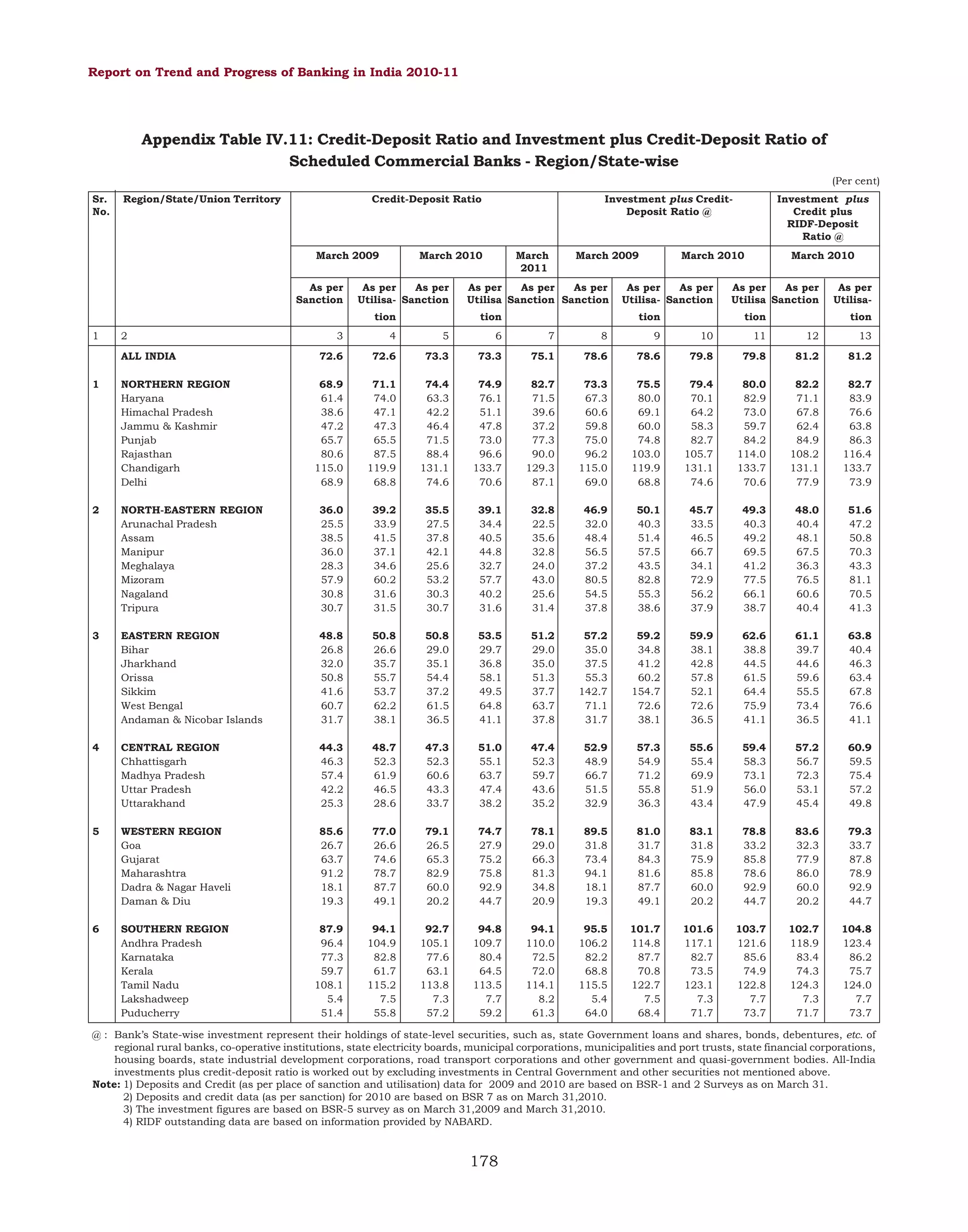
Companies Prudential Norms (Reserve
Bank) Directions, 2007 and Non-Banking
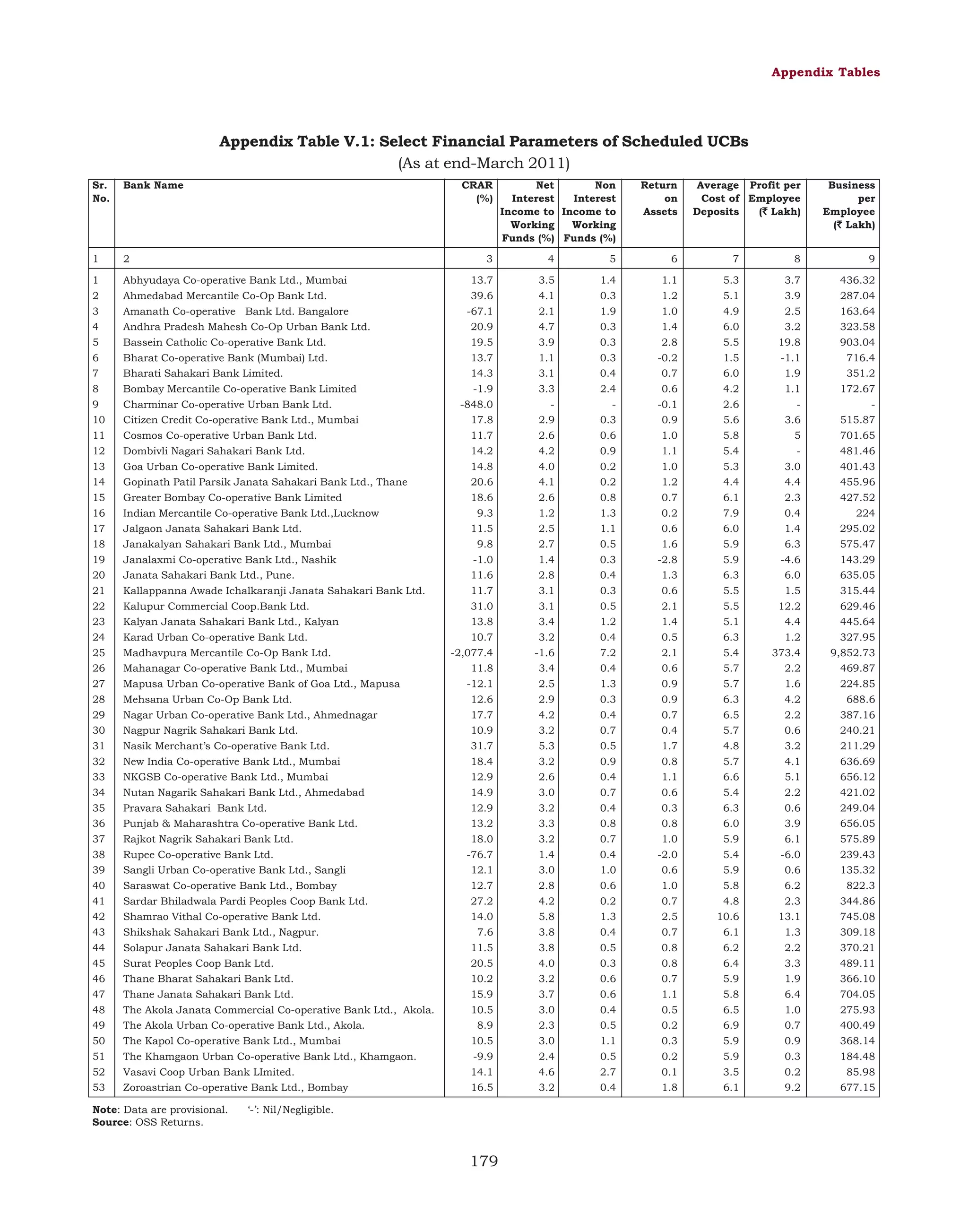
Financial (Non-Deposit Accepting or Holding)
Companies Prudential Norms (Reserve Bank)
Directions, 2007, respectively, were amended.
Consequently, NBFCs have been advised to
include “Telecom Towers” under infrastructure.
Further NBFCs have been advised that only
Credit Rating Agencies (CRAs) approved by the
Reserve Bank can give the rating to
Infrastructure Finance Companies (IFCs).

Submission of Data to Credit Information
Companies
3.75 NBFCs are required to become a member
of at least one credit information company. They
are required to provide the credit information to
the credit information companies in the
prescribed format. NBFCs are also required to
provide historical data in order to enable the new
credit information companies to develop a robust
database.

Regulatory Framework for Core Investment
Companies (CICs)

Balance Sheet and Profit and Loss Account
Information

3.72 Under the extant regulatory framework,
Core Investment Companies (CICs) with an asset
size of less than `100 crore are exempt from the
requirements of registration with the Reserve
Bank. However, CICs with an asset size of `100
crore or more and accessing public funds would
be considered as Systemically Important Core
Investment Companies (CICs-ND-SI) and would
be required to obtain Certificate of Registration
(CoR) from the Reserve Bank under Section 45IA of the Reserve Bank of India Act, 1934 even if
they have been advised in the past that
registration would not be required.

3.76 NBFCs are advised to prepare their
balance sheet and profit and loss account as on
March 31 every year. Any extension of date of
balance sheet would require prior approval of
the Reserve Bank. Further, NBFCs are required
to submit a certificate from Statutory
Auditor with respect to the position of the
company as on March 31 every year within one
month from the date of finalisation of the balance
sheet and in any case not later than December 30
of that year.
49
Report on Trend and Progress of Banking in India 2010-11

NBFCs not to be Partners in Partnership
Firms

Setting up of Central Electronic Registry
under the SARFAESI Act, 2002

3.77 On account of the risks involved in NBFCs
associating themselves with partnership firms,
NBFCs are prohibited from contributing capital
to any partnership firm or to be partners in
partnership firms. In cases of existing
partnerships, NBFCs have been advised that
they may seek early retirement from the
partnership firms.

3.81 To prevent frauds in loan cases involving
multiple lending from different banks on the
same immovable property, a central electronic
registry has been established under the
Securitisation and Reconstruction of Financial
Assets and Enforcement of Security Interest
(SARFAESI) Act.
Opening of Branch/Subsidiary/Joint
Venture/Representative
Office
or
Undertaking Investment Abroad by NBFCs

Ready Forward Contracts in Corporate Debt
Securities

3.82 NBFCs desirous of making any overseas
investment must obtain ‘No Objection’ (NoC)
under the terms of Regulation of the Foreign
Exchange Management (Transfer or Issue of Any
Foreign Security) (Amendment) Regulations,
2004 and the Non-Banking Financial
Companies (opening of Branch/Subsidiary/
Joint Venture/Representative Office or
Undertaking Investment Abroad by NBFCs)
Directions, 2011 issued by the Reserve Bank
before making such investment, from the
Regional Office of the Reserve Bank in whose
jurisdiction the head office of the company is
registered.

3.78 NBFCs registered with the Reserve Bank
(other than Government companies as defined in
Section 617 of the Companies Act, 1956) are
eligible to participate in repo transactions in
corporate debt securities. NBFCs participating in
such repo transactions have been advised to
comply with the Directions and accounting
guidelines issued by the Reserve Bank. All
Systemically Important Non-Deposit taking NonBanking Financial Companies (NBFCs-ND-SI)
are eligible to participate in the repo transactions.
Loan Facilities by NBFCs to the Physically/
Visually Challenged

Entry of NBFCs into Insurance Business

3.79 NBFCs have been advised that there shall
be no discrimination in extending products and
facilities including loan facilities to the physically
/visually challenged applicants on grounds of
disability.

3.83 NBFCs registered with the Reserve Bank
would be permitted to set up a joint venture (JV)
company for undertaking insurance business
with risk participation, subject to certain
safeguards: (i) the maximum equity contribution
such an NBFC can hold in a JV company is 50
per cent of the paid-up capital of the insurance
company; (ii) subsidiary or company in the same
group of an NBFC or of another NBFC engaged in
the business of a non-banking financial
institution or banking business shall not be
allowed to join the insurance company on risk
participation basis. In this regard, it was clarified
that in case, if more than one company in the
same group of the NBFC wishes to take a stake
in the insurance company, the contribution by
all companies in the same group shall be

Enhancing CRAR to 15 Per cent
3.80 It was decided to align the minimum
capital ratio of all deposit-taking NBFCs with
that of NBFCs-ND-SI at 15 per cent. Accordingly,
all deposit taking NBFCs have been advised to
maintain a minimum capital ratio consisting of
Tier I and Tier II capital, which shall not be less
than 15 per cent of its aggregate risk weighted
assets on balance sheet and risk adjusted value
of off-balance sheet items with effect from March
31, 2012.
50
Policy Environment

counted for the limit of 50 per cent prescribed for
the NBFC in such an insurance JV.

provide complaint templates at all ATM sites for
lodging ATM-related complaints.

Returns to be Submitted by NBFCs – Revised
Formats

Real Time Gross Settlement (RTGS) and
National Electronic Fund Transfer System
(NEFT) Services

3.84 In terms of extant instructions, all NBFCs
(excluding RNBCs) are required to file various
returns related to deposit acceptance, prudential
norms and capital market exposure, among
others. It has been decided to rationalise the
returns to streamline the reporting system and
to improve the present method of collecting data.
The Reserve Bank has since hosted the format of
the revised returns on the Bank’s website, viz.,
<https://cosmos.rbi.org.in>. NBFCs shall
submit all the returns online in the revised
formats.

3.88 To ensure prompt redressal of customer
complaints regarding RTGS transactions, banks
have been advised to use existing Customer
Facilitation Centres set up for NEFT and
RTGS customer complaints. To facilitate
easy reconciliation of RTGS/NEFT return
transactions, banks have been advised to
provide necessary information to customers on
return transactions in the account statement.
Further, banks have also been advised to furnish
remitter details to customers in their pass book or
account statement for credits received through
NEFT/National Electronic Clearing Service
(NECS) / Electronic Clearing System (ECS).

10. Customer Service in Banks
3.85 The Reserve Bank focuses on customer
empowerment through enhanced dissemination
of information. Towards providing more efficient
and transparent services to customers, a
number of initiatives were taken in 2010-11.

Cheque Drop-Box Services
3.89 In view of complaints about refusal by
banks to give acknowledgements to customers
for cheques tendered at the counter, compelling
them to drop them in the drop-box, banks have
been advised to ensure stricter compliance with
the extant instructions regarding cheque dropbox facility. Banks have been further advised that
no branch should refuse to accept cheques over
the counter and give proper acknowledgement.

Credit Card Services
3.86 As there have been numerous complaints
about credit card operations of banks, the
Reserve Bank advised banks to strictly adhere to
the guidelines issued in the Master Circular on
Credit Card Operations of July 1, 2011, both in
letter and spirit. A failure to observe these
guidelines could lead to suitable penal action,
including levy of monetary penalties under the
relevant statutory provisions.

Loan Services
3.90 With a view to bring fairness and
transparency, banks have been advised to
disclose ' all in cost ', inclusive of all charges
involved in the processing and sanction of loans
to enable the customer to compare the charges
with other sources of finance. Banks need
to ensure that these charges are nondiscriminatory.

Online Alerts for ATM Services
3.87 The Reserve Bank has advised banks to
put in place a system of online alerts latest by
June 30, 2011 to cardholders, for all types of
transactions, irrespective of the amount involved
through various channels due to the increased
instances of fraudulent withdrawals at ATMs.
Further, banks have been also advised to

Committee on Customer Service in Banks
3.91 The Reserve Bank has constituted a
51
Report on Trend and Progress of Banking in India 2010-11

Committee to study various aspects of customer
service in banks. The major observations made
by the Committee are given in Box III.2.
Customer Satisfaction
Transactions

Survey:

The theme for celebration, proposed by the
Ministry of Consumer Affairs, was “Consumers
Discharge Your Responsibilities: Assert Your
Rights”. To commemorate the occasion, the
Department of Consumer Affairs proposes to
bring out a book titled “Consumer Protection in
India” containing papers written by experts,
which would be released in December 2011.

ATM

3.92 The Reserve Bank commissioned a survey
to assess customer satisfaction in the usage of
ATMs across the country. The Survey covered
600 ATMs distributed proportionately over
metro, urban, semi-urban and rural regions,
constituting 1 per cent of the total number of
60,000 ATMs in the country. The interim report
was presented to the Board for Payment and
Settlement Systems in June 2011. The major
findings of the Survey inter alia were as follows:
(i) cards were mainly used for withdrawing cash
or shopping purposes; (ii) the use of debit cards
for bills payment/ticket purchase was still low;
(iii) the use of debit cards for shopping was the
highest in Maharashtra and Andhra Pradesh; (iv)
the use of cards for shopping was more among
the youth; (v) females used cards with less
frequency.

Exclusive Board Meetings on Customer
Service
3.94 To increase Board oversight on customer
service-related issues in banks, the Annual
Monetary Policy - 2010-11 had announced that
banks should devote exclusive time in a Board
meeting once every six months to deliberate on
these issues. All banks would submit a detailed
memorandum regarding customer service to the
Board of Directors, once every six months and
initiate prompt corrective action, wherever
quality and skill gaps were observed.

11. Financial Markets

Silver Jubilee Year of Consumer Protection
Act

Adherence to Foreign Exchange Management
Act (FEMA) Guidelines for Online Payment
Transactions

3.93 The year 2010-11 was the Silver Jubilee
Year of the Consumer Protection Act, 1986.

3.95 The Online Payment Gateways have
emerged as popular modes of e-commerce and

Box III.2: Report of the Committee on Customer Service in Banks
The Reserve Bank constituted a Committee (through a Board
Memorandum dated May 26, 2010) under the chairmanship
of Shri M. Damodaran, former Chairman, SEBI to examine
banking services rendered to retail and small customers,
including pensioners. The Committee also had a
mandate to look into the grievance redressal mechanism
prevalent in banks, its structure and efficacy, and
suggest measures for expeditious resolution of
complaints.

The Committee submitted its report to the Bank in July 2011.
According to the Committee, the major expectations of
consumers are that banks should: (i) have a customer-centric
approach; (ii) render fair and non-exploitative treatment and
adhere to full disclosure of information; (iii) put in place an
expeditious grievance redressal; (iv) provide a simple deposit
account instead of suo moto offering bouquet services without
customer demand and charging for the same.
The recommendations of the Committee are based on the
above customers expectations. They include inter alia: (i)
creation of a toll free Common Bank Call Number; (ii)
providing plain vanilla savings account without prescription
of minimum balance; (iii) setting up of a trusted third party
KYC data bank, which can be relied upon for KYC purposes;
(iv) providing small remittances at reasonable price; (v) zero
liability against loss in ATM and online transactions; (vi)
enhancement of Deposit Insurance and Credit Guarantee
Corporation (DICGC) cover to `5,00,000.

The Committee had interactions with various stakeholders
on all aspects of customer service fair treatment,
improvement in services to pensioners, attitude of the
bank staff towards the small and rural customers, service
charges and fees, transparency in operations, grievance
redressal, promptness in service, education and information
on new products, and customer rights and expectations,
among others. The Committee also called for public
suggestions.

52
Policy Environment

have facilitated exports, particularly in smallvalue goods and services. The Reserve Bank has
issued guidelines in November 2010
to Authorised Dealer (AD) banks allowing them
to offer the facility of repatriation of exportrelated remittances (up to US$ 500 per
transaction) by entering into standing
arrangements with Online Payment Gateway
Service Providers subject to certain conditions.
Enhancing the existing limit per transaction of
US$ 500 is under consideration.

stakeholders on the draft guidelines prepared by
the Group, final guidelines have been issued in
May 2011. The salient features of the guidelines,
among others, are as follows:
i.

The CDS shall be permitted on listed
corporate bonds, unlisted but rated bonds
of infrastructure companies and unlisted/
unrated bonds issued by the Special
Purpose Vehicles (SPVs) set up by
infrastructure companies as reference
obligations.

Over-the-Counter (OTC) Foreign Exchange
Derivatives

ii.

The reference entities shall be single legal
resident entities.

3.96 The comprehensive guidelines on OTC
foreign exchange derivatives and overseas
hedging of commodity price and freight risks
were issued on December 28, 2010. The
important elements of the revised guidelines,
which became effective in February 2011, are
inter alia: (i) AD category banks can only offer
plain vanilla European Cross Currency Options;
(ii) allowing embedded cross currency option in
the case of foreign currency-rupee swaps; (iii)
permitting the use of cost reduction structures,
both under the contracted exposures and past
performance routes, subject to certain
safeguards; (iv) undertaking swaps to move from
Rupee liability to forex liability is allowed, subject
to certain safeguards.

iii.

The permitted participants have been
categorised into:
a)

b)

Introduction of Credit Default Swaps (CDS)
for Corporate Bonds
3.97 The Reserve Bank had issued draft
guidelines on introduction of CDS in 2003 and
2007. However, taking into account the adverse
developments in the international financial
markets, the issuance of final guidelines was
deferred. Following the proposal of introducing
plain vanilla over-the-counter (OTC) single-name
CDS for corporate bonds made in the Second
Quarter Review of Monetary Policy of 2009-10,
an internal Working Group (Convener: Shri R. N.
Kar) was constituted to finalise the operational
framework. Based on the feedback received from

Market Makers: Participants, such as
commercial banks, NBFCs and standalone PDs are permitted to undertake
both protection buying and protection
selling subject to satisfying certain
eligibility norms. Insurance companies
and mutual funds can act as marketmakers subject to the approval of their
respective regulators.
Users: Participants, among others,
include commercial banks, PDs,
NBFCs, mutual funds, insurance
companies and listed corporates, who
can hedge only their underlying
exposures. Users cannot purchase
CDS without having the underlying
exposure and the protection can be
bought only to the extent (both in terms
of quantum and tenor) of such
underlying risk.

iv.

v.

53

For users, physical settlement is
mandatory. Market makers can opt for any
of the three settlement methods (physical,
cash or auction settlement), provided the
CDS documentation includes such
settlement method.
Reporting requirements: It is mandatory for
market makers to report their CDS trades
Report on Trend and Progress of Banking in India 2010-11

within 30 minutes from the deal time, on
CDS trade reporting platform.
vi.

customers’ preference for electronic modes of
payment.

As CDS markets are exposed to various
risks, market participants are required to
take these risks into account and build
appropriate risk management systems. The
guidelines prescribe counterparty credit
exposure limits, PV01 limit (Change in price
of `100 nominal bond for one basis point
change in yield) and an independent risk
management framework for monitoring and
controlling of all aspects of risks.

Prepaid Payment Instruments
3.101 Keeping in view the increasing popularity
of prepaid payment instruments, the guidelines
issued in April 2009 were revisited in November
2010 and the following amendments inter alia
were effected: (a) Extension of the use of semiclosed prepaid payment instruments used for
payment of utility bills for the purchase of travel
tickets; (b) Permission to banks to issue semiclosed prepaid payment instruments through
agents and BCs. Further, the maximum value of
prepaid instruments that can be used in the
form of mobile-wallets (m-wallets) has been
increased from `5,000 to `50,000.

12. Payment and Settlement System
3.98 The Reserve Bank has set up a robust
technology-based payment and settlement
systems infrastructure with enhanced
assurance of uninterrupted and efficient
provision of services. Major policy initiatives
taken during the year to further strengthen the
payment and settlement system were as follows:

Mobile Banking Transactions
3.102 Recognising the true potential of using
mobile phones as a banking tool towards
furthering financial inclusion, the bank-led
model of mobile banking has been adopted,
which would extend all banking facilities,
including money transfer facility, through the
mobile channel. The Reserve Bank has so far
approved proposals of 50 banks to commence
mobile banking services. The Bank has also
authorised the NPCI to provide a seamless,
instant, 24X7, mobile-based inter-bank fund
transfer system through mobile phones, called
Inter-Bank Mobile Payment Service.

Paper Clearing: Express Cheque Clearing
System
3.99 To impart more efficiency to clearing
process in non-MICR clearing houses, an
advanced clearing house automation package
Express Cheque Clearing System (ECCS) has
been introduced. The ECCS would accept multiuser inputs in a networked environment, corebanking integration and graphic interface
compatibility. The National Payments
Corporation of India (NPCI) has been entrusted
with the task of operationalising this package.

Card-based Transactions
3.103 Given the increasing usage of cards
(credit/debit/prepaid) issued by banks, there is
a definite need to make both Card Present (CP),
where card is swiped at ATMs and Points of Sale
(PoS), and Card Not Present (CNP) transactions,
safe and secure. An important step taken by the
Reserve Bank, which is unique globally, is the
mandate given to banks to provide additional
authentication for all CNP transactions based on
information not available on the card. The banks
introduced additional authentication for CNP

Electronic Payment Systems
3.100 To provide near-to-real-time funds
transfer facility to retail customers, as also to
cater to the stock market timings, 11-hourly
settlements on week days and five-hourly
settlements on Saturdays in National Electronic
Fund Transfer (NEFT) was introduced in March
2010, which has now been extended to over
79,000 branches. This is expected to enhance
54
Policy Environment

transactions except the Interactive Voice
Response (IVR) transactions in April 2009, and
extended the same to all IVR transactions in
February 2011. The mandate presently applies
to all transactions using cards issued in India for
payments on merchant sites where no outflow of
foreign exchange is contemplated. This initiative
has increased the confidence of customers in
this channel leading to a steep fall in the frauds
in e-commerce transactions. The Reserve Bank
has recently constituted a Working Group to
look into the issue of security of all CP
transactions; the major recommendations of the
Group are discussed in Box III.3.

compensation between the issuing and
acquiring banks.
Oversight of Payment Systems
3.105 To ensure that the payment systems
operate in a safe and efficient manner and in line
with extant policy prescriptions, the Reserve
Bank has initiated a process of assessment,
comprising both off-site surveillance and on-site
inspections complimented by market
intelligence. As part of the off-site surveillance, a
database on the various payment instruments,
their volume and value has been created and
placed on the RBI website. An assessment
template has been devised to aid authorised
entities to carry out a self-assessment of their
operations, risk management and business
continuity arrangement.

Efficiency in the ATM Delivery Channel
3.104 To improve the operational efficiency of
ATMs for customers, the Reserve Bank in May
2011 has inter alia advised banks: (a) To reduce
the time limit for resolution of customer
complaints from 12 working days to seven
working days from the date of receipt of the
customer complaint; (b) The customer is entitled
to receive compensation for delay at the rate of
`100 per day, provided the complaint is lodged
with the issuing bank within 30 days from the
date of the transaction; (c) All disputes regarding
ATM-failed transactions should to be settled by
the issuing bank and acquiring bank only
through the ATM system provider leaving no
scope of bilateral settlement arrangement
outside the dispute resolution mechanism of the
system provider. This measure would bring
down the instances of disputes in payment of

13. Technological Developments
3.106 Technology is central to the design and
delivery of banking services. The modern-day
banking services are critically dependent on
technological innovation and improvement.
During 2010-11, several new initiatives were
taken by the Reserve Bank towards improving
the banking sector technology.
Business Continuity Management and
Disaster Recovery
3.107 During the year, periodical drills were
conducted in order to ensure effectiveness of the
Business Continuity Management and Disaster
Recovery (DR) arrangements for shared

Box III.3: Recommendations of the Working Group on Securing Card Present Transactions
biometric finger-print capture in lieu of PIN at the ATM and
PoS for 18 months; (d) Based on the above recommendations,
a decision should be taken to introduce Euro pay Master
Card Visa (EMV) Chip and PIN for credit cards and debit
cards for all domestic transactions within five and seven
years, respectively; (e) EMV Chip Card and PIN should be
issued in lieu of Magstripe cards when at least one purchase
is evidenced at an overseas location. The Report was placed
on the RBI website for public comments. The
recommendations of the Group have been accepted by the
Bank and appropriate directions have been issued in
September 2011.

A Working Group was constituted by the Reserve Bank on
March 31, 2011 for recommending measures to secure all
Card Present (CP) transactions. The Group, which submitted
its report on May 31, 2011, made inter alia the following
recommendations: (a) The technology and payment
infrastructure like implementation of Unique Key Per
Terminal (UKPT) and Terminal Line Encryption (TLE) should
be strengthened within 18-24 months; (b) An additional
factor (Personal Identification Number (PIN) or Biometric) for
all domestic debit card transactions should be introduced
within 24 months; (c) After monitoring the progress made in
the roll-out of Aadhaar UID, it may be considered to use the

55
Report on Trend and Progress of Banking in India 2010-11

NG-RTGS project is expected to be implemented
by December 2012.

infrastructure, and payment and settlement
systems. A quarterly report on the Business
Continuity Planning (BCP)-DR and Vulnerability
Assessment and Penetration Testing (VAPT)
exercise conducted by commercial banks at their
end was obtained. The major points emerging
from these exercises have been included as
inputs for analysis in the Financial Stability
Report brought out by the Reserve Bank.

14. Banking Sector Legislation
3.111 A number of important legislative
changes have either been initiated or effected
during the year, which pave way for reexamination of banking laws, creation of the
inter-regulatory mechanism in the form of
Financial Stability and Development Council
(FSDC) and strengthening of Reserve Bank’s
powers with respect to commercial banks.

IT Vision Document - 2011-17
3.108 A High Level Committee (Chairman: Dr.
K. C. Chakrabarty) and members from IIT, IIM,
IDRBT, Banks, and the Reserve Bank prepared
the “IT Vision Document – 2011-17”, for the
Reserve Bank and banks, which provides an
indicative road map for enhanced usage of IT in
the banking sector.

Constitution of the Financial Sector
Legislative Reforms Commission (FSLRC)
3.112 The FSLRC has been constituted under
the Chairmanship of Justice B.N. Srikrishna by
the Central Government in March 2011, with a
view to rewriting, streamlining and harmonising
financial sector laws, rules and regulations with
the requirements of India’s growing financial
sector. The Terms of Reference of the
Commission inter alia include the following: (i)
examining the architecture of the legislative and
regulatory system governing the Indian financial
sector; (ii) examining if public feedback for draft
subordinate legislation should be made
mandatory, with exception for emergency
measures and; (iii) examining the most
appropriate means of oversight over regulators
and their autonomy from the Government.

Automated Data Flow (ADF) and New
Generation RTGS (NG-RTGS)
3.109 In order to improve the quality and
efficiency of regulatory reporting, a project on
straight through flow of data (ADF) from banks to
the Reserve Bank has been taken up. Banks
have been advised to submit a roadmap
indicating returns which can be sourced directly
from their systems to a centralised repository for
submission to the Reserve Bank. The project is
expected to be completed by December 2012.
3.110 As indicated in the Annual Monetary
Policy Statement for 2010-11, a Working Group
comprising representatives from the Reserve
Bank and select commercial banks was
constituted for preparing an approach for
implementation of next generation RTGS. The
Group submitted its report in August 2010,
which has since been accepted. The Group has
suggested several new features in the new
generation RTGS (NG-RTGS), such as advanced
liquidity management facility, extensible markup language-based messaging system and real
time information and transaction monitoring.
The implementation of the Group’s
recommendations has been initiated and the

The Securities and Insurance Laws
(Amendment and Validation) Act, 2010
3.113 The Act, effective from June 18, 2010,
has amended the Reserve Bank of India Act,
1934, the Insurance Act, 1938, the Securities
Contracts (Regulation) Act, 1956 and the
Securities and Exchange Board of India Act,
1992. As noted in the RBI Annual Report 201011, a new chapter on “Joint Mechanism” has
been inserted in the Reserve Bank of India Act,
1934. The Chapter provides for a Joint
Mechanism, consisting of Union Finance
Minister as its ex-officio Chairperson, Governor,
56
Policy Environment

policy developments have been broadly in-sync
with the major policy objectives of maintaining
price stability, while supporting economic
recovery, financial stability, financial inclusion
and financial sector development.

Reserve Bank, as its ex-officio Vice-Chairman,
Finance Secretary and Chairpersons of SEBI,
IRDA and Pension Fund Regulatory and
Development Authority (PFRDA), as its members
to resolve any difference of opinion among the
regulators. The Act provides for a reference being
made to the Joint Committee only by the
regulators and not by the Central Government.
The decision of the Joint Committee would be
binding on the Reserve Bank, SEBI, IRDA and
PFRDA.

3.116 During the year, the Reserve Bank took
important policy decisions with regard to
forming draft guidelines about granting new
licenses to private sector banks and release of
two major discussion papers regarding the
presence of foreign banks and promoting holding
company structure for banks. Each of these
initiatives was aimed at financial sector
development, while keeping in view the concern
of financial stability. In the field of financial
inclusion, the most noteworthy development was
the formation of Board-approved Financial
Inclusion Plans by banks for a time horizon of
next three years. The other salient policy
developments, which would pave way towards
further reforms in the banking sector, included
changes in major banking sector statutes
including the Banking Regulation Act, 1949 and
constitution of the Financial Sector Legislative
Reforms Commission.

The Banking Laws (Amendment) Bill, 2011
3.114 The Bill, introduced in Lok Sabha in
March 2011, seeks to amend the Banking
Regulation Act, 1949, the Banking Companies
(Acquisition and Transfer of Undertakings) Act,
1970 and the Banking Companies (Acquisition
and Transfer of Undertakings) Act, 1980 to make
the regulatory powers of the Reserve Bank more
effective and to increase the access of the
nationalised banks to capital market to raise
capital required for expansion of banking
business. The Bill seeks to inter alia: (i) enable
the nationalised banks to increase or decrease
the authorised capital with approval from the
Central Government and the Reserve Bank
without being limited by the ceiling of `3,000
crore; (ii) make provisions to ensure that control
of banking companies is in the hands of 'fit and
proper' persons; (iii) allow nationalised banks to
issue two additional instruments (bonus shares
and rights issue) for accessing the capital market
to raise capital required for expansion of banking
business; (iv) substantially increase the
penalties and fine for some violations of the
Banking Regulation Act, 1949; and (v) confer
power upon the Reserve Bank to levy penal
interest in case of non-maintenance of required
cash reserve ratio.

3.117 With a view to improving the use of
technology and customer services in the banking
sector, the Reserve Bank undertook a variety of
measures during the year, including the
initiation of new generation RTGS and
constitution of a committee to analyse
expectations of customers from banks. Another
salient policy development that would impact
financial sector development in a major way in
the years to come, with specific relevance for
banks - as market makers and users - was the
introduction of CDS for corporate bonds. Finally,
for both RRBs and UCBs, a number of regulatory
and developmental measures towards
strengthening the health and physical outreach
of these institutions were taken during the year.

15. Conclusions

3.118 During the year, the inflationary
pressures, which kept re-surfacing partly as a
fallout of external developments and partly on
account of domestic structural imbalances,

3.115 This chapter discussed the major
developments in the area of banking sector
policy in 2010-11 and 2011-12, so far. These
57
Report on Trend and Progress of Banking in India 2010-11

3.119 Going forward, a continued and
consistent momentum of the banking sector
policy, with focused attention on financial
stability and financial inclusion, would
ensure a healthier and more inclusive
banking sector, which can contribute towards
sustained and inclusive growth of the Indian
economy.

necessitated continuous monetary policy
responses. However, while containing
inflation, it was necessary that economic
recovery, which had been delicate in the
aftermath of the crisis, was also not thwarted.
The Reserve Bank dealt with the inflationary
pressures with a view of not to sacrifice the longterm growth prospects.

58
Chapter IV

Operations and Performance of Commercial Banks

The Indian banking sector performed better in 2010-11 over the previous year despite the
challenging operational environment. The banking business of Scheduled Commercial Banks (SCBs)
recorded higher growth in 2010-11 as compared with their performance during the last few years.
Credit grew at 22.9 per cent and deposits grew at 18.3 per cent in 2010-11 over the previous year.
Accordingly, the outstanding credit-deposit ratio of SCBs increased to 76.5 per cent in 2010-11 as
compared with 73.6 per cent in the previous year. Despite the growing pressures on margins owing to
higher interest rate environment, the return on assets (RoA) of SCBs improved to 1.10 per cent in 201011 from 1.05 per cent in 2009-10. The capital to risk weighted assets ratio under both Basel I and II
frameworks at 13.0 per cent and 14.2 per cent, respectively in 2010-11 remained well above the required
minimum of 9 per cent. The gross NPAs to gross advances ratio declined to 2.25 per cent in 2010-11
from 2.39 per cent in 2009-10, displaying improvement in asset quality of the banking sector. Though
there was improvement in the penetration of banking services in 2010-11 over the previous year, the
extent of financial exclusion continued to be staggering. The number of complaints received at the
Banking Ombudsman offices witnessed decline in 2010-11 over the previous year.
1. Introduction
Performance of banks was conditioned by
the dynamics of growth-inflation trade-off
4.1 The Indian banking sector, which is the
edifice of the Indian financial sector, though
weathered the worst consequences of the global
financial turmoil to a large extent, had to
traverse through a challenging macroeconomic
environment during the post crisis period.
Followed by the financial turmoil, the global
financial sector was generally turbulent mainly
because of the European sovereign debt crisis,
and sluggish growth recovery in the Euro zone as
also in the US. In contrast, the banking sectors
in the emerging market economies displayed
better performance in 2010-11 as compared
with their western counterparts. However,
improving economic growth while keeping
inflation at tolerable levels was a policy challenge
faced by many of the emerging market
economies including India during the post crisis
period. To keep inflation at tolerable levels, the

Reserve Bank has also undertaken monetary
tightening during 2010-11. Accordingly, the
operations and performance of commercial
banks during 2010-11 was conditioned to a
great extent by the dynamics of growth-inflation
trade-off experienced by the Indian economy.
Banks operated in a challenging operational
environment
4.2 During 2010-11, higher interest rate
environment not only caused concerns about
slowdown in credit growth, but also increased
the possibility of deterioration in asset quality on
the back of the possible weakening of the
repayment capacities of borrowers in general.
The tight interest rate environment also affected
the profit prospects of commercial banks due to
the possibility of lower margins in 2010-11.
During the year, the large credit intake by some
of the crucial sectors such as NBFCs and
infrastructure, also raised concerns about
financial soundness through the potential build
up of sectoral credit booms. Large borrowings by
Report on Trend and Progress of Banking in India 2010-11

marginal deceleration in growth. The highest
growth was recorded by new private sector
banks (NPRBs) followed by public sector banks
(PSBs). Yet, as at end-March 2011, almost three
fourths of the total assets of the banking sector
belonged to PSBs followed by NPRBs (15 per
cent). Old private sector banks had the lowest
share (around four per cent) followed by foreign
banks (FBs) (around seven per cent).

the telecommunication companies to participate
in the auction of 3G spectrum, reduction in
Government spending as also the large currency
holdings by the public due to high inflation made
the liquidity conditions more stringent in 201011. Further, the need to migrate towards
advanced approaches of capital calibration
under Basel II was also a challenge that loomed
large in the Indian banking sector. Alongside,
there was also a pressing need to become more
innovative to transform unbanked villages into
profitable business locations thereby
strengthening the financial inclusion process, to
keep up with the latest technological
developments and to improve the quality of
customer service.

Liability side of the balance sheet was driven
by capital, borrowings and, other liabilities
4.5 On the liability side of the balance sheet,
the growth was driven mainly by borrowings,
capital, and other liabilities and provisions. The
recapitalisation of public sector banks by the
Central Government, and the mobilisation of
funds from the stock market through public
issues by PSBs were the main factors behind the
growth of capital of SCBs in 2010-11. An
interesting development about the consolidated
balance sheet of SCBs in 2010-11 was the
deceleration in the growth of savings bank
deposits and demand deposits with a
corresponding acceleration in the growth of term
deposits. This could be due to the prevailing
higher interest rate environment, making term
deposits more attractive as compared with
demand and savings deposits.

4.3 Against this backdrop, the present chapter
analyses the operations and performance of
commercial banks in India during the year
2010-11 in terms of deployment of credit,
profitability, soundness indicators and regional
penetration, among others. The chapter
analyses the audited annual accounts of 83
SCBs1, 82 Regional Rural Banks (RRBs) and four
local area banks (LABs) for the financial year
2010-11 to highlight the emerging issues in the
Indian banking sector.

2. Balance Sheet Operations of
Scheduled Commercial Banks

Asset side of the balance sheet was driven
by loans and advances

Consolidated balance sheet of SCBs
registered higher growth

4.6 On the asset side of the balance sheet, the
growth was primarily driven by loans and
advances. There was a revival in credit growth
across all the bank groups except old private
sector banks in 2010-11 as compared with the
previous year despite the tight interest rate
environment. Credit growth in 2010-11 of new
private sector banks and foreign banks was
particularly noteworthy when compared with
their performance during the last year. Notably,

4.4 The consolidated balance sheet of SCBs
recorded higher growth in 2010-11 as compared
with the previous year. This is in contrast to the
trend observed during the last two years and
signals a revival from the peripheral effects of
global financial turmoil. The higher growth in the
consolidated balance sheet of SCBs was
contributed by all the bank groups except old
private sector banks (OPRBs), which recorded
1

These include 26 public sector banks (State Bank of India and its five associates, 19 nationalised banks and IDBI Bank Ltd.), 7 new
private sector banks, 14 old private sector banks and 36 foreign banks. The number of SCBs increased to 83 in 2010-11 from 81
in 2009-10.

60
Operations and Performance of Commercial Banks

Table IV.1: Consolidated Balance Sheet of Scheduled Commercial Banks
(in ` crore)
Item

As at end-March 2011
Public sector
banks

1
1. Capital
2. Reserves and Surplus
3. Deposits
3.1. Demand Deposits
3.2. Savings Bank Deposits
3.3. Term Deposits
4. Borrowings
5. Other Liabilities and Provisions
Total Liabilities/Assets
1. Cash and Balances with RBI
2. Balances with Banks and
Money at Call and Short Notice
3. Investments
3.1 Government Securities (a+b)
a) In India
b) Outside India
3.2 Other Approved Securities
3.3 Non-Approved Securities
4. Loans and Advances
4.1 Bills purchased and Discounted
4.2 Cash Credits, Overdrafts, etc.
4.3 Term Loans
5. Fixed Assets
6. Other Assets

Private sector
banks

Old private
sector banks

New private
sector banks

Foreign banks

All scheduled
commercial banks

2

3

4

5

6

7

19,055
2,71,196
43,72,985
4,10,109
10,83,001
28,79,874
3,95,144
2,35,438
52,93,817

4,805
1,33,784
10,02,759
1,58,929
2,29,130
6,14,699
1,85,984
70,844
13,98,176

1,396
22,425
2,64,157
24,222
49,667
1,90,268
10,967
10,066
3,09,011

3,409
1,11,359
7,38,602
1,34,707
1,79,463
4,24,432
1,75,017
60,778
10,89,166

35,383
45,668
2,40,689
72,900
39,650
1,28,138
92,797
76,992
4,91,528

59,243
4,50,648
56,16,432
6,41,939
13,51,782
36,22,712
6,73,925
3,83,273
71,83,522

3,52,379

86,111

18,173

67,938

20,293

4,58,783

1,32,225
13,28,534
10,82,515
10,74,411
8,103
3,098
2,42,920
33,05,632
1,83,405
13,97,114
17,25,113
36,156
1,38,892

31,616
4,22,020
2,63,181
2,62,252
929
89
1,58,750
7,97,534
33,013
2,03,756
5,60,765
12,980
47,915

3,908
92,617
64,603
64,603
51
27,962
1,84,647
9,875
84,039
90,733
2,509
7,156

27,708
3,29,403
1,98,578
1,97,649
929
38
1,30,787
6,12,886
23,138
1,19,717
4,70,032
10,470
40,760

27,365
1,65,499
1,11,960
1,11,960
2
53,537
1,95,539
25,182
91,172
79,185
4,958
77,874

1,91,206
19,16,053
14,57,657
14,48,624
9,033
3,189
4,55,207
42,98,704
2,41,600
16,92,042
23,65,063
54,093
2,64,681

-: Negligible/Nil
Source: Balance sheets of respective banks.

to an increase in term deposit rates. While
accelerated growth rate of term deposits is a
welcome development from the point of view of
stability of balance sheet as it strengthens the
retail deposit base and reduces asset liability
mismatches; it may increase the interest
expenses of the banking sector, thus, adversely
impacting profitability.

the growth of investments of the banking sector
witnessed deceleration in 2010-11 in
comparison with the previous year. The only
exception to this general trend was the new
private sector banks, which recorded higher
growth in investments in 2010-11 as compared
with the previous year (Tables IV.1 and IV.2).

Major Liabilities of SCBs

Share of CASA deposits in total incremental
deposits declined

Deposits
Deposits registered higher growth

4.8 In contrast, current account and savings
account (CASA) deposits, which are least cost
sources, recorded deceleration in 2010-11. It is
pertinent to note that despite the increased
remuneration on savings deposits based on a
daily product basis with effect from April 1,
2010, the savings deposit mobilisation
decelerated in 2010-11 across all the bank
groups as compared with the previous year. Shift
of funds to term deposits due to higher interest
rates is one of the reasons for this trend.

4.7 Deposits, which constitute 78 per cent of
total liabilities of the banking sector registered
higher growth in 2010-11 in contrast to the
trend observed in the recent years. This was
mainly because of the accelerated deposit
mobilisation of new private sector banks in
2010-11 over the previous year. The higher
growth in deposits emanated mainly from term
deposits. As alluded to earlier, this could be due
to the higher interest rate environment leading
61
Report on Trend and Progress of Banking in India 2010-11

Table IV.2: Growth in Balance Sheet of Scheduled Commercial Banks
(Per cent)
Item

Public sector
banks

1

2

3

Private sector
banks
4

Old private
sector banks

5

6

7

New private
sector banks
8

9

Foreign
banks
10

11

All scheduled
commercial
banks
12

13

2009-10 2010-11 2009-10 2010-11 2009-10 2010-11 2009-10 2010-11 2009-10 2010-11 2009-10 2010-11
1. Capital
2. Reserves and Surplus
3. Deposits
3.1. Demand Deposits
3.2. Savings Bank Deposits
3.3. Term Deposits
4. Borrowings
5. Other Liabilities and Provisions
Total Liabilities/Assets
1. Cash and Balances with RBI
2. Balances with Banks and
Money at Call and Short Notice
3. Investments
3.1 Government Securities (a+b)
a) In India
b) Outside India
3.2 Other Approved Securities
3.3 Non-Approved Securities
4. Loans and Advances
4.1 Bills purchased and
Discounted
4.2 Cash Credits, Overdrafts, etc.
4.3 Term Loans
5. Fixed Assets
6. Other Assets

0.1
16.8
18.6
18.4
25.8
16.2
21.4
4.2
17.9
20.8

40.7
19.2
18.4
11.3
22.1
18.2
25.9
21.4
19.2
30.1

7.3
21.0
11.7
33.5
32.8
1.3
8.5
8.5
12.0
32.0

5.6
15.9
21.9
18.1
23.0
22.5
24.5
20.9
21.5
13.5

8.7
15.9
15.4
22.5
26.2
12.0
40.6
8.4
15.8
27.7

9.7
18.7
14.9
12.2
14.0
15.5
26.4
-1.0
14.9
7.4

6.7
22.0
10.4
35.9
34.9
-3.1
6.9
8.5
10.9
33.3

4.1
15.4
24.6
19.2
25.8
25.8
24.4
25.5
23.5
15.2

19.7
12.3
8.4
12.7
26.5
2.2
-11.9
-29.7
-2.2
22.1

15.9
18.2
3.7
6.8
8.8
0.6
36.0
16.9
12.9
6.3

12.3
17.5
16.8
20.9
26.9
12.9
12.2
-4.6
15.0
23.1

21.9
18.1
18.3
12.4
21.8
18.2
26.8
20.4
19.2
25.4

-12.9
20.0
19.0
18.8
48.2
-36.8
28.4
19.6

15.6
9.3
7.4
7.4
-3.0
-38.2
20.1
22.4

13.9
15.5
10.6
10.6
72.6
43.4
27.6
9.9

-18.2
19.2
9.1
8.8
464.8
-71.4
41.0
26.1

-43.3
15.3
13.4
13.4
56.2
20.5
19.9

-31.3
10.9
6.2
6.2
-82.2
24.9
19.8

38.0
15.6
9.7
9.7
72.6
-31.7
29.5
7.1

-16.0
21.7
10.1
9.7
464.8
74.8
45.0
28.1

-34.2
22.2
17.5
17.5
-41.7
37.7
-1.3

33.1
3.9
-4.7
-4.7
-57.1
28.1
19.8

-11.6
19.3
17.3
17.2
48.6
-34.6
29.2
16.6

10.1
10.8
6.6
6.6
6.1
-40.2
27.6
22.9

10.4
22.9
18.1
2.2
-0.2

30.3
26.9
18.2
4.9
32.9

30.7
9.6
9.0
3.6
-11.6

20.2
28.4
25.7
26.8
21.6

19.1
20.8
19.2
8.0
7.4

10.3
23.4
17.8
6.5
12.6

37.2
2.5
7.0
2.4
-14.5

25.0
32.1
27.3
32.8
23.3

46.9
2.5
-13.4
2.6
-30.1

18.2
24.8
14.9
2.0
14.0

16.3
19.9
14.4
2.5
-14.1

27.5
27.0
19.8
9.1
24.7

-: Negligible/Nil
Source: Balance sheets of respective banks.

However, the upward revision in the savings
deposit rate from 3.5 per cent to 4.0 per cent in
April 2011 and deregulation of interest rate on
savings deposits in October 2011, may improve
the savings deposit mobilisation going forward.
However, in a competitive environment, with the
deregulation of interest rates, savings deposits
will no longer be as less expensive as they were
in the past. In tune with the growth deceleration,
the share of CASA deposits in total incremental
deposits declined to 36 per cent in 2010-11 as
compared with 48 per cent in the previous year.
An analysis at the bank group level indicated
that foreign banks had the highest share of
CASA deposits followed by NPRBs and PSBs
(Chart IV.1).

2008 to become pro-active in finding out the
whereabouts of these customers. Resultantly,
since 2008 the growth rate of unclaimed
Chart IV.1: Composition of Deposits 2010-11
100
90
80

Percentage share

70

57.5
65.9

53.2
64.5

72.0

60
50
40
30
20

42.5
34.1

46.8
35.5

28.0

10

Growth of unclaimed deposits decelerated

0

4.9 The Reserve Bank raised concerns with
regard to the growing unclaimed deposits with
the banking sector and advised SCBs in August

PSBs

OPRBs

CASA

62

NPRBs

FBs

Term deposits

SCBs
Operations and Performance of Commercial Banks

Major Assets of Scheduled Commercial
Banks

deposits witnessed deceleration. The growth
rate of unclaimed deposits came down to 5
per cent in December 2010 as compared with
the growth rates of 15 per cent in December
2009 and 18 per cent in December 2008.
Importantly, unclaimed deposits in the current
accounts and fixed deposit accounts declined as
at end-December 2010 over the previous year.
The share of unclaimed deposits in total
deposits, however, remained more or less same
at 0.02 per cent in 2010-11 as in the previous
year 2.

Bank Credit
Growth of loans and advances witnessed
acceleration
4.11 It is interesting to note that despite the
widespread concerns with regard to slowdown in
credit off-take in the context of tight monetary
policy, on a y-o-y basis, the loans and advances
of the banking sector recorded higher growth in
2010-11 as compared with the previous year.
While the economic recovery from the recent
financial turmoil increased the demand for
credit; from the supply side, higher growth in
deposits as well as growth in capital facilitated
higher credit growth. In contrast to the previous
year’s trend, term loans grew at a higher rate in
2010-11 as compared with the previous year. In
2010-11, new private sector banks recorded
significantly higher growth in term loans as
compared with the previous year, on the back of
corresponding high growth in term deposits
mobilisation.

Borrowings
Borrowings recorded higher growth
4.10 Borrowings, which constitute nine per cent
of the total liabilities of the banking
sector recorded accelerated growth in 2010-11
as compared with the previous year. At the
bank group level, the share of borrowings in
total liabilities exhibited wide variation.
The dependence of foreign banks and new
private sector banks on borrowings was
relatively high as compared with other bank
groups (Chart IV.2).

Investments
Growth of investments decelerated

Chart IV.2: Deposits and Borrowings 2010-11
90

4.12 Due to the accommodation of higher
credit growth, there was an overall deceleration
in the growth of investments in securities in
2010-11 as compared with the previous year. In
2010-11, almost three fourths of the total
investments of the banking sector were in
Government securities held in India, mainly to
meet the SLR requirements prescribed by the
Reserve Bank and to raise funds from the shortterm money market. However, investments of
the banking sector in Government securities
held in India recorded lower growth in 2010-11
as compared with the previous year in tune with
the reduction in SLR requirements from 25
per cent to 24 per cent with effect from
December 18, 2010.

85.5
82.6
78.2

80

As per cent of total liabilities

70

67.8

60
49.0

50
40
30

18.9

20
10

16.1
9.4

7.5
3.5

0
PSBs

OPRBs

Deposits

2

NPRBs

FBs

SCBs

Borrowings

Data on deposits were taken from Quarterly Statistics on Deposits and Credit of SCBs.

63
Report on Trend and Progress of Banking in India 2010-11

with the growth in international assets. Yet, the
international liabilities of the banking sector
continued to be almost double of the international
assets of the banking sector in 2010-11 as in the
recent past. The growth in international
liabilities was mainly led by growth in equities of
banks held by non-residents, Non-Resident
Ordinary (NRO) deposits and foreign currency
borrowings (Table IV.4).

Non-SLR investments declined
4.13 The non-SLR investments of SCBs
witnessed a decline in March 2011 as compared
with those during the corresponding period of
the previous year. This was primarily due to a
decline in the investments in commercial paper
in 2010-11 over those during the previous year.
Investments in commercial paper are short-term
investments of the banking sector to reap
economic gain out of short-term surplus funds.
The decline in such investments reflected tight
liquidity conditions during 2010-11. On the
other hand, banks’ investments in shares
witnessed increase in 2010-11 over the previous
year. Alongside, banks’ investments in bonds/
debentures also witnessed a marginal increase
during 2010-11 as compared with the
previous year (Table IV.3).

International assets recorded higher growth
4.15 The growth in international assets was
mainly led by foreign currency loans to
residents, outstanding export bills drawn on
non-residents by residents and Nostro balances
(Table IV.5).

Consolidated International Claims4
Consolidated international claims recorded
higher growth

International Liabilities and Assets of
Scheduled Commercial Banks3
International liabilities
moderated growth

4.16 The consolidated international claims of
the banking sector registered higher growth
in 2010-11 as compared with the previous year.
The sector-wise composition of international
claims showed that it was mainly claims on

registered

4.14 In 2010-11, international liabilities of the
banking sector grew at a lower rate as compared

Table IV.3: Non-SLR Investments of Scheduled Commercial Banks
(Amount in ` crore)
Instrument

As on March
25, 2011

Per cent
to total

As on October
07, 2011

Per cent
to total

2

3

4

5

1. Commercial Paper

12,310
(-51.1)

5.4

21,244
(-50.2)

8.1

2. Shares

41,316
(37.2)
8,965
32,351

18.2

38,941
(15.0)
8,377
30,564

14.8

93,975
(49.7)
27,946
66,029

41.5

1,09,089
(47.0)
35,013
74,077

41.4

4. Units of MFs

47,603
(-10.0)

21.0

61,806
(2.3)

23.5

5. Instruments issued by FIs

31,296
(-4.0)

13.8

32,326
(12.3)

12.3

2,26,500
(11.3)

100.0

2,63,406
(9.8)

100.0

1

a)
b)

Of which, Public sector undertakings
Of which, Private corporate sector

3. Bonds/Debentures
a)
b)

Of which, Public sector undertakings
Of which, Private corporate sector

Total Investments (1 to 5)

4.0
14.3

12.3
29.2

Note: Figures in parentheses indicate percentage variation over the corresponding period in the previous year.
Source: Section 42(2) returns submitted by SCBs.
3
4

Refers to international liabilities and assets of branches of all commercial banks geographically located in India.
Refers to international assets of all branches (both located in India and abroad) of domestic commercial banks.

64

3.2
11.6

9.2
28.1
Operations and Performance of Commercial Banks

Table IV.4: International Liabilities of Banks – By Type
(As at end-March)
(Amount in ` crore)
Percentage Variation
Item

2010

1

2011

2010

2011

2

Non-resident External Rupee (NRE) Deposits
Non-Resident Ordinary (NRO) Rupee Deposits
2. Own Issues of Securities/Bonds
3. Other Liabilities
of which:
ADRs/GDRs
Equities of banks held by non-residents
Capital/remittable Profits of Foreign Banks in India
and other unclassified International Liabilities
Total International Liabilities

3

4

5

3,38,574
(74.9)
72,234
(16.0)
74,354
(16.4)
1,22,380
(27.1)
30,824
(6.8)
5,439
(1.2)
1,08,166
(23.9)
30,391
(6.7)
50,313
(11.1)
27,462
(6.1)

3,78,221
(74.9)
77,413
(14.8)
95,419
(18.3)
1,21,229
(23.2)
41,072
(7.9)
4,575
(0.9)
1,38,658
(26.6)
34,699
(6.7)
73,159
(14.0)
30,799
(5.9)

4.8

11.7

-0.8

7.2

-1.4

28.3

-1.7

-0.9

49.0

33.2

-20.8

-15.9

91.3

28.2

193.4

14.2

165.8

45.4

0.8

12.2

4,52,179

1. Deposits and Borrowings
of which:
Foreign Currency Non Resident Deposits (Bank)
[FCNR (B)] scheme
Foreign Currency Borrowings *

5,21,454

17.0

15.3

* : Include inter-bank borrowings in India and from abroad, and external commercial borrowings of banks.
Note: Figures in parentheses are percentages to total International liabilities.
Source: Locational Banking Statistics.

banks, which led the growth in total
international claims of banks (Table IV.6).

was mainly led by claims of banks on Germany,
UAE and USA. In contrast, claims of banks on UK
and Hong Kong registered a decline in 2010-11
as compared with the previous year (Table IV.7).

4.17 The growth in the consolidated international
claims of banks on countries other than India

Table IV.5: International Assets of Banks - By Type
(As at end-March)
(Amount in ` crore)
Percentage Variation
Item

2010

2011

2010

2

3

4

5

2,37,181
(96.3)

2,78,741
(96.8)

8.0

17.5

10,196
(4.1)
1,23,476
(50.1)
50,496
(20.5)
52,135
(21.2)
39
(0.0)
9,139
(3.7)

14,414
(5.0)
1,40,083
(48.6)
61,321
(21.3)
62,343
(21.6)
179
(0.1)
9,147
(3.2)

22.2

41.4

23.5

13.4

13.3

21.4

-21.6

19.6

-48.7

359.0

-6.1

0.1

2,46,359
(100.0)

2,88,067
(100.0)

7.4

16.9

1
1. Loans and Investments
of which :
a) Loans to Non-Residents*
b)

Foreign Currency Loans to Residents**

c)

Outstanding Export Bills drawn on
Non-Residents by Residents
Nostro Balances @

d)

2. Holdings of Debt Securities
3. Other Assets

@@

Total International Assets

2011

*
: Include rupee loans and Foreign Currency (FC) loans out of non-residents (NR) deposits;
** : Include loans out of FCNR (B) deposits, Packing Credit in Foreign Currency (PCFC), FC lending to and FC deposits with banks in India.
@ : Include placements made abroad and balances in term deposits with non-resident banks.
@@ : Include capital supplied to and receivable profits from foreign branches/subsidiaries of Indian banks and other unclassified international assets.
Note : Figures in parentheses are percentages to total international assets.
Source: Locational Banking Statistics.

65
Report on Trend and Progress of Banking in India 2010-11

Table IV.6: Classification of Consolidated
International Claims of Banks on Countries
other than India - By Maturity and Sector
(As at end-March)

Table IV.7: Consolidated International Claims
of Banks on Countries other than India
(As at end-March)
(Amount in ` crore)

(Amount in ` crore)
Residual Maturity/Sector

Total Consolidated International Claims
a) Maturity-wise
1) Short-term (residual
maturity less than one year)
2) Long-term (residual
maturity of one year and above)
3) Unallocated
b) Sector-wise
1) Bank
2)

Non-Bank Public

3)

Non-Bank Private

2011

2

1

2010

3

2,33,071

2,46,413

1,44,638
(62.1)
81,939
(35.2)
6,494
(2.8)

1,53,893
(62.5)
87,247
(35.4)
5,273
(2.1)

98,191
(42.1)
1,442
(0.6)
1,33,438
(57.3)

Item

1,09,142
(44.3)
870
(0.4)
1,36,401
(55.4)

2010

1

2011

2

b)
c)

Singapore

d)

Germany

e)

Hong Kong

f)

United Arab Emirates

2,46,413
(100.0)

53,394
(22.9)
36,141
(15.5)
18,437
(7.9)
12,179
(5.2)
18,978
(8.1)
13,536
(5.8)

United Kingdom

3

2,33,071
(100.0)

Total Consolidated
International Claims
of which:
a) United States of America

54,818
(22.2)
34,370
(13.9)
18,546
(7.5)
14,164
(5.7)
18,376
(7.5)
15,498
(6.3)

Note: Figures in parentheses are percentage shares in total
international claims.
Source: Consolidated Banking Statistics - Immediate Country Risk
Basis.

Note: 1) Figures in parentheses are percentages to total International
claims.
2) Unallocated residual maturity comprises maturity not
applicable (e.g., for equities) and maturity information not
available from reporting bank branches.
3) Bank sector includes official monetary institutions (IFC, ECB,
etc.) and central banks.
4) Prior to the quarter ended March 2005, ‘Non-bank public sector’
comprised of companies/institutions other than banks in
which shareholding of State/Central Governments was at least
51 per cent, including State/Central Governments and its
departments. From March 2005 quarter, ‘Non-bank public
sector’ comprises only State/Central Governments and its
departments.
Source: Consolidated Banking Statistics - Immediate Country Risk
Basis.

Credit-Deposit and Investment-Deposit
Ratios of Scheduled Commercial Banks

dependence of these bank groups on deposits for
funds is relatively lower as compared with other
bank groups. These bank groups raise a
substantial amount of funds through borrowings
(see Chart IV.2) and hence, a more meaningful
ratio for a bank group comparison would be
credit as a percentage of deposits plus
borrowings. Public sector banks ranked first in
terms of this ratio followed by private sector
banks and foreign banks (Chart IV.3).

Banks reported higher outstanding creditdeposit ratio

Chart IV.3: Credit as per cent of Deposits plus
Borrowings 2010-11

4.18 Trends in credit-deposit ratio as well as
investment-deposit ratio manifested banks’
preference for credit over investments in 201011. The outstanding credit-deposit ratio was
higher at 77 per cent in 2010-11 as compared
with 74 per cent in the previous year. In
contrast, the outstanding investment-deposit
ratio was lower at 34 per cent in 2010-11 as
compared with 36 per cent in the previous year.
Among the bank groups, new private sector
banks recorded the highest credit-deposit ratio
followed by foreign banks in 2010-11. However,
the higher credit-deposit ratio reported by new
private sector banks as well as foreign banks
needs to be interpreted with a caveat as the

80

69.3
68.3

70
67.1

Per cent

67.1

60

58.6

50
PSBs

66

OPRBs

NPRBs

FBs

SCBs
Operations and Performance of Commercial Banks

4.19 The incremental C-D ratio above 100 per
cent is a rough indicator of overheating in the
economy. Owing to the robust credit growth in
2010-11, the incremental C-D ratio went above
100 per cent during the third quarter of 201011. However, subsequently incremental C-D
ratio witnessed moderation. Accordingly, the
incremental I-D ratio improved during the later
part of the year (Chart IV.4).

Chart IV.4: Incremental Credit- and InvestmentDeposit Ratios of SCBs
120.0

100.0

Per cent

80.0

60.0

40.0

Maturity Profile of Assets and Liabilities of
Banks

20.0

No significant shift in the maturity profilewise composition of assets and liabilities

Incremental C-D ratio
*: Provisional data.

Incremental I-D Ratio

9 Sep, 2011*

22 April 11

1 July 2011

3 Dec. 2010

11 February

24 Sep 2010

7-May-10

16 July 2010

9 Oct 09

26 Feb,2010

31-Jul-09

18 Dec 09

22-May-09

2 Jan 09

13-Mar-09

24 Oct 08

6 June 08

15 Aug 08

28 Mar 08

9 Nov 07

18 Jan 08

31 Aug 07

13 Apr-07

4.20 The mismatches in the maturity profile of
assets and liabilities of the banking sector are a
cause for concern as it leads to the financing of
long-term assets by short-term liabilities. The
maturity profile-wise composition of assets and
liabilities indicated that almost half of the total
deposits and borrowings of the banking sector
were short-term as at end-March 2011.
However, almost one fourth of the total loans and

22 June 07

0.0

100 per cent

advances, and more than half of the total
investments were long-term during the same
period. There was no significant shift in the
maturity profile-wise composition of assets and
liabilities of the banking sector in 2010-11 over
the previous year indicating the persistence of

Table IV.8: Bank Group-wise Maturity Profile of Select Liabilities/Assets
(As at end -March)
(Per cent to total under each item)
Liabilities/assets
1

Public
sector banks

Private
sector banks

Old private
sector banks

New private
sector banks

Foreign banks

All SCBs

I. Deposits
a) Up to 1 year
b) Over 1 year and
up to 3 years
c) Over 3 years
II. Borrowings
a) Up to 1 year
b) Over 1 year and
up to 3 years
c) Over 3 years
III.Loans and Advances
a) Up to 1 year
b) Over 1 year and
up to 3 years
c) Over 3 years
IV. Investments
a) Up to 1 year
b) Over 1 year and
up to 3 years
c) Over 3 years

2

3

4

5

6

7

8

9

10

11

12

13

2010

2011

2010

2011

2010

2011

2010

2011

2010

2011

2010

2011

48.9

48.2

47.7

46.1

47.6

45.3

47.7

46.4

63.7

64.2

49.4

48.5

27.5
23.6

28.6
23.2

38.4
13.9

38.6
15.2

36.8
15.6

40.6
14.1

39.0
13.3

37.9
15.6

26.8
9.5

26.9
9.0

29.4
21.2

30.3
21.1

42.0

40.1

34.7

42.4

49.0

54.5

33.9

41.7

74.6

78.7

44.2

46.2

11.0
46.9

12.5
47.4

23.9
41.4

16.2
41.4

15.6
35.3

12.5
33.0

24.4
41.7

16.4
41.9

14.7
10.7

14.8
6.5

15.3
40.5

13.9
40.0

38.0

36.0

37.1

37.6

40.5

41.9

36.0

36.3

61.1

68.1

38.9

37.8

33.8
28.2

36.2
27.7

34.2
28.7

36.4
26.0

36.8
22.7

38.4
19.7

33.4
30.6

35.8
27.8

20.1
18.8

17.0
15.0

33.3
27.8

35.4
26.8

18.8

18.1

38.1

37.3

24.4

28.7

42.4

39.7

76.4

79.0

28.1

27.6

12.2
69.0

12.7
69.2

21.6
40.2

22.4
40.2

8.8
66.8

12.2
59.1

25.6
32.0

25.3
35.0

15.2
8.4

14.6
6.4

14.4
57.5

15.0
57.3

Source: Balance Sheets of respective banks.

67
Report on Trend and Progress of Banking in India 2010-11

Box IV.1: Asset Liability Mismatches (ALM) in the Indian Banking Sector:
The Extent and Persistence
The analysis of the maturity profile of long-term assets and
liabilities indicates that at the aggregate level, the long-term
assets are financed by short-term liabilities. The ALM
calculated as long-term assets minus long-term liabilities
never turned out to be negative during the recent years
implying that the higher growth observed in the long-term loan
segment is leading to asset liability mismatches in the banking
sector. Bucket-wise break-up of ALM positive gap shows that
the banking sector has the highest ALM positive gap in the
bucket more than five years followed by 3-5 years and 1-3
years. As at end-September 2010, ALM positive gap in the
more than five years bucket constituted 42 per cent of the total
ALM positive gap, followed by 3-5 years bucket (31 per cent)
and 1-3 years bucket (27 per cent).

is used for testing the statistical significance of the measure of
persistence γ.
Table: Measure of Persistence of ALM Positive
Gap – Bucket-wise
Time Buckets

Persistence (γ)
γ

Significance
(γ – 0.5)/(0.5/√T)
γ
√

One to Three Years

0.60

1.483b (0.0606)

Three to Five Years

0.47

-0.404b (0.3264)

More than Five Years

0.47

-0.404b (0.3264)

Total

0.47

0.405b (0.3264)

b
Acceptance of the null hypothesis of zero persistence at 5 per
cent level.
Note: Number of Observations used for the analysis is 55.

An analysis of persistence of the positive ALM gap is carried
out following the methodology developed by Marques (2004).
Accordingly, the persistence of ALM positive gap is estimated
on the basis of absence of mean reversion, that is

The value of γ for the ALM positive gap during the entire
sample period, i.e., March 2006 to September 2010 for all
SCBs is 0.47, which is slightly lower than 0.5. This indicates
that there is no significant persistence in the ALM positive gap
during the period under study at the aggregate level. The
bucket-wise analysis of persistence shows that in none of the
time buckets, the persistence is significant at five per cent
level. However, at ten per cent level, it is persistent in the ‘one
to three years’ time bucket. Thus, in sum, though at the
aggregate level, the ALM positive gap is not significant, in the
‘one to three years’ bucket it is significant and calls for careful
monitoring (Table).

⎛n⎞
γ = 1− ⎜ ⎟
⎝T ⎠
Where n stands for the number of times the series crosses the
mean during a time interval with T+1 observations. It is
theoretically proved that for a symmetric zero mean
white noise process E (γ) = 0.5. Thus, if the value of γ is close to
0.5, it means that there is no significant persistence. On the
other hand, if the value of γ is significantly above 0.5 it signals
the existence of significant persistence. Under the assumption
of a symmetric white noise process (zero persistence), the
statistic
⎤
⎡
⎢ γ − 0.5 ⎥
⎥ ∩ N (0;1)
⎢
⎢ 0.5 ⎥
⎢ T ⎥
⎦
⎣

Reference:
Marques, Carlos Robalo (2004), ‘Inflation Persistence: Facts or
Artefacts?’, Working Paper No. 371, June, European Central
Bank.

Off-Balance Sheet Operations of Scheduled
Commercial Banks

asset-liability mismatches. An analysis of the
extent and persistence of asset liability
mismatches in the Indian banking sector is
provided in Box IV.1 (Table IV.8).

Off-balance sheet operations of banks
continued to increase

4.21 Almost 20 per cent of the long-term assets
of the Indian banking sector were financed by
short-term liabilities in 2010-11. The percentage
of long-term assets financed by short-term
liabilities witnessed a marginal decline over the
previous year (Table IV.9).

4.23 The recent global financial turmoil
demonstrated the risk involved in accumulating
large amount of off-balance sheet exposures
(OBS). Recognising the risky and uncertain
nature of OBS, the Reserve Bank tightened the
prudential norms on OBS in August 2008.

4.22 On the financing side, almost 23 per cent
of short-term liabilities were used to finance
almost 20 per cent of long-term assets in the
banking sector. The percentage share of shortterm liabilities used to finance long-term assets
also witnessed a marginal decline in 2010-11
over the previous year (Table IV.9).

4.24 The off-balance sheet exposures of the
banking sector, which declined in the previous
two years, witnessed a growth of 31 per cent in
2010-11. The forward exchange contracts
constituted more than three fourths of total offbalance sheet exposures in 2010-11. The off68
Operations and Performance of Commercial Banks

Table IV.9: Asset Liability Mismatches in the
Indian Banking Sector

Chart IV.5: Composition of Off-Balance Sheet
Exposures of the Banking Sector 2010-11

(Per cent)
Sr. Bank group/year
no.

1

Long-term Assets Percentage of
Financed by
short-term
Short-term
liabilities used to
Liabilities*
finance longterm assets**
2

3

4

OPRBs, 1.0

5
Forward
Exchange
Contracts, 86.8

2009-10 2010-11 2009-10 2010-11
1 Public sector banks
1.1 Nationalised banks #
1.2 SBI Group
2 Private sector banks
2.1 Old private sector banks
2.2 New private sector banks
3 Foreign banks
All SCBs

22.6
24.1
19.7
14.4
18.9
13.1
-16.2
19.7

22.0
22.3
21.4
15.7
13.4
16.3
-25.0
19.5

28.5
27.3
31.8
19.6
23.8
18.2
-6.4
23.4

NPRBs, 16.0

27.9
24.6
38.2
21.0
17.0
22.1
-9.0
23.3

SBI
Group, 6.2

FBs, 67.2

NBs, 9.6

Acceptance,
12.5
Guarantees,
0.7

*: Calculated as (long-term assets minus long-term liabilities)/longterm assets*100
**: Calculated as (long-term assets minus long-term liabilities)/shortterm liabilities*100
#: Include IDBI Bank Ltd.

balance sheet exposures of foreign banks
constituted more than two thirds of the total offbalance sheet exposures of the banking sector in
2010-11. A detailed analysis of OBS of the Indian
banking sector is provided in Box IV.2 (Appendix
Table IV.1 and Chart IV.5).

prohibited sub-prime lending to the corporate
sector might have contributed to the higher
interest income in 2010-11 apart from robust
credit growth. Although, interest expenses also
witnessed accelerated growth in 2010-11 owing
to the higher interest rate environment, it was
considerably lower than the growth in interest
income. Accordingly, the net interest margin
(NIM) of SCBs improved in 2010-11 over the
previous year.

3. Financial Performance of Scheduled
Commercial Banks
Profitability
Consolidated net profits recorded higher
growth

Growth of ‘other income’ decelerated
4.27 ‘Other income’ recorded a lower growth in
2010-11 over the previous year. The decline in
trading income of the banking sector in 2010-11
over the previous year was one of the reasons for
this trend. However, despite the overall
deceleration in ‘other income’, one of the major
components of ‘other income’, viz., commission
and brokerage recorded higher growth in 201011 over the previous year.

4.25 Despite widespread concerns with regard
to profitability on account of higher interest
expenses on the one hand and, higher nonperforming assets and the consequent higher
provisioning requirements, and lower interest
income on the other, the financial performance
of SCBs improved in 2010-11 as compared with
the previous year.
4.26 The consolidated net profits of the banking
sector recorded higher growth in 2010-11, in
contrast to the deceleration experienced in
2009-10, primarily because of higher growth in
interest income. The implementation of the Base
rate system with effect from July 1, 2010, which

Operating expenses grew at a higher rate
4.28 In contrast, the operating expenses of the
banking sector grew at a higher rate in 2010-11
as compared with the previous year mainly on
account of pay hikes implemented in the
69
Report on Trend and Progress of Banking in India 2010-11

Box IV.2: Profitability versus Risks: An Analysis of Off-Balance Sheet Exposures in the
Indian Banking Sector
Off-balance sheet exposures (OBS) raise concern as its exact
impact on the soundness of the banking sector is uncertain.
In the event of a default, the off-balance sheet exposures
can seriously damage the soundness of the banking sector
as demonstrated by the recent global financial turmoil.
During the last ten years, the OBS of the banking sector
witnessed substantial growth, especially that of new private
sector banks and foreign banks. With the onset of the global
financial turmoil, the policy on OBS was tightened in August
2008. Resultantly, there was a decline in OBS of the banking
sector in 2008-09 and 2009-10. However, with the onset of
recovery, OBS of the banking sector again witnessed a
positive growth in 2010-11 (Chart A).

πit is the ‘other income’ of bank group i at time t, with i =
1,…,N; t = 1,…, T, c is a constant term, Xits are k explanatory
variables and ε it is the disturbance with vi the unobserved
bank-specific effect and u it the idiosyncratic error. The
Hausman test statistic was not significant. Hence, results
of the random effects model are reported. The regression
results are presented below (Table).

Ipso facto, fluctuations in the exchange rate and also the
higher interest rate environment increase the demand for
forward contracts from the customers of banks, which is
the biggest component of the off-balance sheet exposure of
the banking sector. As the economy grows, the demand for
such risk management services from the banking sector also
increases. On the other side, from the point of view of banks,
off-balance sheet exposures, which are basically fee-based
services, increase the gross income although at a higher
level of risk. Thus, if the risk appetite of a particular bank is
high, it has an incentive to accumulate off-balance sheet
exposures to reap more fee income.

Intercept

Table: Impact of OBS on ‘Other Income’
Sample Period : 2002 to 2010 across five bank groups
Number of pooled observations - 50
Dependent Variable: ‘Other Income’
Explanatory Variables

Coefficients
-1.188

t-value
-1.750*

Balance Sheet Assets

0.365

Off-Balance Sheet Exposures

0.085

3.715***
2.189**

First Lag of ‘Other Income’

0.480

4.172***

R-Squared : 0.89
Adjusted R-Squared: 0.88
DW Statistic: 1.44
*: Significant at ten per cent level.
**: Significant at five per cent level.
***: Significant at one per cent level.

The role of OBS in generating ‘other income’ was examined
using panel data regression analysis. The panel data
regression was done at the bank group level. The bank groupwise data used have been taken from the previous issues of
the Report on Trend and Progress of Banking in India.

Results indicated that one per cent increase in off-balance
sheet exposures increases ‘other income’ of the banking
sector by 0.08 per cent. Thus, ceteris paribus, banks have
an incentive to accumulate off-balance sheet exposures in
the interest of garnering better ‘other income’ and profits.

The log of ‘other income’ was taken as the dependant
variable. The independent variables were off-balance sheet
exposures, on-balance sheet assets and first lag of ‘other
income’. Thus, symbolically, the model used in the study
can be written as:

On the other hand, the risk associated with these off-balance
sheet exposures is difficult to quantify. However, it may be
noted that as at end-March 2011, the size of the total offbalance sheet exposures of the Indian banking sector was
larger than the total balance sheet assets of the banking
sector. This was mainly due to foreign banks and new private
sector banks. Public sector banks and old private sector
banks had relatively low level of off-balance sheet exposures
as compared with other bank groups. Thus, in the event of
a default, these exposures can seriously damage the financial
soundness of the banking sector, especially those of foreign
banks and new private sector banks (Chart B).

K

k
π it = c + ∑ β k X it + ε it
k =1

Where

ε it = vi + uit

Chart B: Off-Balance Sheet Exposures (OBS) and
Balance Sheet Assets (BA) - 2010-11
10000000

2500

9000000
8000000

2000

7000000
` crore

1500
1000
500

6000000
5000000
4000000
3000000
2000000

2011

2010

2009

2008

2007

2006

2005

2004

2003

0
2002

Amount of OBS rebased to 100

Chart A: Movements in OBS
3000

1000000
0

SBI Group

SBI Group
New private sector banks
Nationalised banks
Foreign banks
Old private sector banks

NBs

OBS

70

NPRBs

BA

OPRBs

FBs
Operations and Performance of Commercial Banks

Table IV.10: Trends in Income and Expenditure
of Scheduled Commercial Banks

Marginal improvement in return on assets
4.30 Resultantly, the consolidated net profits of
the banking sector registered higher growth in
2010-11 as compared with the decelerating
trend observed during the recent past. The
return on assets of SCBs also marginally
increased to 1.10 per cent in 2010-11 from 1.05
per cent in 2009-10, mainly owing to higher NIM.
The return on equity also witnessed an
improvement over the same period. However, the
SBI group was an exception to this general
trend. The marginal decline in both RoA and RoE
recorded by the SBI group was partly on account
of
the
provisioning
requirements
for housing loans extended at teaser interest
rates. The Reserve Bank had increased
provisioning requirements for such loans
(classified as standard assets) in December 2010
due to the risk of delinquencies upon repricing of
such loans going forward (Table IV.11 and
Chart IV.6).

(Amount in ` crore)
Item

2009-10

2010-11

Amount Percentage
variation
1

Amount Percentage
variation

2

1. Income
a) Interest Income
b) Other Income
2. Expenditure
a) Interest Expended
b) Operating Expenses
of which : Wage Bill
c) Provisions and
Contingencies
3. Operating Profits
4. Net Profits for the year
5. Net Interest Income
(1a-2a)

3

4

5

4,94,446
4,15,179
79,267
4,37,337
2,72,083
1,00,028
55,248

6.63
6.87
5.38
6.42
3.37
11.66
15.16

5,71,230
4,91,667
79,564
5,00,899
2,98,891
1,23,129
71,950

15.53
18.42
0.37
14.53
9.85
23.09
30.23

65,226
1,22,335
57,109

12.17
10.31
8.26

78,879
1,49,210
70,331

20.93
21.97
23.15

1,43,096

14.24

1,92,776

34.72

Memo Item:
1. Net Interest Margin

2.17

2.92

Source: Profit and loss accounts of respective banks.

banking sector during the last one year. Further,
provisions and contingencies also witnessed
higher growth in 2010-11 as compared with the
previous year, mainly on account of increase in
gross non-performing assets (GNPAs) (in
absolute terms). The depreciation in the value of
investments owing to the higher interest rate
environment also increased the provisioning
requirements of the banking sector. As the
provisioning requirements for various categories
of NPAs were increased in May 2011, it is
expected to increase further in future (Table
IV.10).

Efficiency
4.31 On the one hand, while a higher NIM
contributes to profitability, on the other it also
Table IV.11: Return on Assets and Return on
Equity of SCBs – Bank Group-wise
(Per cent)
Sr.
no.

1

Return on
assets

2

Return on
equity

2009-10

4.29 A factor, which helped the banking sector
to maintain profitability in 2010-11 was the
regulatory treatment extended to liabilities
arising out of re-opening of pension option to
employees of PSBs and the enhancement in
gratuity limits in February 2011. The Reserve
Bank allowed banks to amortise the total
liabilities arising out of this development over a
period of five years and as such only one fifth of
the total liabilities was charged to the profit and
loss account of the current year 5.
5

Bank group/year

2010-11

2009-10

2010-11

3

4

5

6

0.97
1.00
0.91
1.28

0.96
1.03
0.79
1.43

17.47
18.30
15.92
11.94

16.90
18.20
14.11
13.70

0.95

1.12

12.29

14.10

1.38
1.26
1.05

1.51
1.74
1.10

11.87
7.34
14.31

13.62
10.28
14.96

1 Public sector banks
1.1 Nationalised banks*
1.2 SBI Group
2 Private sector banks
2.1 Old private
sector banks
2.2 New private
sector banks
3 Foreign banks
All SCBs

*: Nationalised banks include IDBI Bank Ltd.
Note: 1) Return on Assets = Net profits/Average total assets
2) Return on Equity = Net profits/Average total equity
Source: Calculated from balance sheets of respective banks.

The opening balance of reserves of banks will be reduced to the extent of the unamortised carry forward expenditure. In view of the
exceptional nature of the event, the unamortised expenditure would not be reduced from Tier I capital.

71
Report on Trend and Progress of Banking in India 2010-11

NIM to improve the efficiency of financial
intermediation along with increasing the noninterest income to maintain profitability. A
detailed analysis of efficiency of the banking
sector during the last one decade is provided in
Box IV.3.

Chart IV.6: Net Profits of SCBs
40.0

80000
36.9
70000

30.0

60000

23.5

25.0

Absolute Net Profits (` crore)

Return on Assets, Growth in Net Profits

35.0

50000
23.2

20.0

15.0

Cost of funds declined

40000

30000

10.0

4.32 In contrast to the general expectation, cost
of funds of SCBs witnessed a decline in 2010-11
as compared with the previous year, primarily
owing to a decline in the cost of deposits
(Table IV.12).

20000
8.3

5.0

10000
1.00

1.13

1.05

1.10

2008

2009

2010

2011

0.0

0

Return on funds improved
4.33 In contrast, the return on funds increased
in 2010-11 as compared with the previous year,
mainly due to an increase in return on
investments. However, return on advances
declined in 2010-11 over the previous year. One

Absolute Net Profits
Return on Assets
Growth in Net Profits

implies higher cost of financial intermediation in
the economy, which is considered as a sign of
inefficiency. Thus, there is a need to bring down

Table IV.12: Cost of Funds and Return on Funds - Bank Group-wise
(Per cent)
Sr.
No.

Bank group/year

1 2
1 Public sector banks
2009-10
2010-11
1.1 Nationalised banks*
2009-10
2010-11
1.2 SBI Group
2009-10
2010-11
2 Private sector banks
2009-10
2010-11
2.1 Old private sector banks
2009-10
2010-11
2.2 New private sector banks
2009-10
2010-11
3 Foreign banks
2009-10
2010-11
All SCBs
2009-10
2010-11

Cost of
Deposits

Cost of
Borrowings

Cost of
Funds

Return on
Advances

Return on
Investments

Return on
Funds

Spread

3

4

5

6

7

8

9 = (8-5)

5.68
5.12

1.50
2.31

5.35
4.89

9.10
9.09

6.65
6.80

8.34
8.41

2.99
3.52

5.64
5.13

1.65
2.36

5.37
4.93

9.18
9.20

6.81
6.85

8.46
8.50

3.09
3.57

5.75
5.09

1.28
2.22

5.32
4.80

8.93
8.84

6.33
6.67

8.10
8.21

2.78
3.41

5.36
4.97

1.95
2.31

4.83
4.56

9.89
9.67

6.23
6.53

8.60
8.56

3.77
4.00

6.28
5.63

1.87
2.24

6.13
5.50

10.95
10.42

6.09
6.20

9.22
8.98

3.10
3.48

5.01
4.73

1.96
2.31

4.42
4.27

9.56
9.43

6.28
6.62

8.40
8.44

3.99
4.17

3.10
3.30

2.01
2.56

2.83
3.11

9.99
8.75

6.39
7.39

8.30
8.11

5.47
5.00

5.49
5.01

1.70
2.34

5.10
4.73

9.29
9.18

6.54
6.79

8.39
8.42

3.29
3.69

*: Include IDBI Bank Ltd.
Note: 1) Cost of Deposits = Interest Paid on Deposits/Average of current and previous year’s deposits.
2) Cost of Borrowings = Interest Paid on Borrowings/Average of current and previous year’s borrowings.
3) Cost of Funds = (Interest Paid on Deposits + Interest Paid on Borrowings)/(Average of current and previous year’s deposits plus borrowings).
4) Return on Advances = Interest Earned on Advances /Average of current and previous year’s advances.
5) Return on Investments = Interest Earned on Investments /Average of current and previous year’s investments.
6) Return on Funds = (Interest Earned on Advances + Interest Earned on Investments) / (Average of current and previous year’s advances plus
investments).
Source: Calculated from balance sheets of respective banks.

72
Operations and Performance of Commercial Banks

Box IV.3: Net Interest Margin of the Indian Banking Sector: Efficiency versus Profitability
others (i.e., mainly the difference between all other interest
income and interest expenses) showed that NIM from core
banking business witnessed substantial increase during the
last one decade. In contrast, NIM from others witnessed a
decline, leaving the total NIM more or less stable during the
same period. The increase in the NIM from core banking
business indicates that the cost of financial intermediation
increased in the economy during the last one decade. Thus,
there is a need to bring down NIM from core banking business
to bring the overall NIM down (Chart A).

While maintaining profitability is a sine qua non for the
financial soundness of the banking sector, efficient financial
intermediation is important from the point of view of economic
growth. The net interest margin (NIM), operating expenses and
‘other income’ are crucial in determining profitability of the
banking sector. On the other side, one of the indicators, which
is used to assess efficiency of the banking sector is NIM. NIM
indicates the margin taken by the banking sector while doing
banking business. In this context, there is a need to bring
down NIM from an efficiency point of view, nevertheless, from a
profitability point of view; there is a need to increase it. A
balanced approach would be to bring down NIM, which will
improve efficiency of financial intermediation, along with an
increase in income from other sources and reduction in
operating expenses to maintain profitability (Subbarao, 2010).

As alluded to earlier, it is important to increase ‘other income’
and reduce operating expenses as ratio of assets in the interest
of profitability. The operating expenses to total average assets
witnessed a declining trend during the last one decade mainly
owing to the cost effective technological advancements.
However, ‘other income’ to total average assets also witnessed
a declining trend during the last one decade. Thus, it may be
important for the Indian banking sector to improve ‘other
income’ along with a reduction in NIM from core banking
business to maintain profitability and to improve efficiency of
financial intermediation (Chart B).

In India, during the last one decade, NIM was in the range 2.5
per cent to 3.1 per cent. The NIM, which witnessed a declining
trend during the period 2004 to 2010, improved during 201011. The NIM of the Indian banking sector continues to be
higher than some of the emerging market economies of the
world. The decomposition of NIM into NIM from core banking
business, (i.e., calculated as the difference between interest
income from loans and advances minus interest expenses on
deposits as a per cent of average total assets), and NIM from

Reference: D Subbarao (2010), ‘Five Frontier Issues in Indian
Banking’, Speech delivered at ‘BANCON 2010’, Mumbai,
December.

Operating expenses, other income as
per cent of assets

Chart A: Movements in NIM
5.0
4.0

Per cent

3.0
2.0
1.0
0.0
-1.0
-2.0
2002 2003 2004 2005 2006 2007 2008 2009 2010 2011

NIM from Core Banking Business

NIM from others

Chart B: Movements in Operating Expenses and
Other Income

2.5
2.0
1.5
1.0
0.5
0.0

2002 2003 2004 2005 2006 2007 2008 2009 2010 2011

NIM

Operating Expenses to Total Assets

Other Income to Total Assets

4. Soundness Indicators

reason for this trend could be the increase in
gross non-performing loans in absolute terms. In
sum, the increase in return on funds along with
the decline in cost of funds lead to an increase in
spread. At the bank group level, while the return
on funds was largely comparable, there was
substantial variation in cost of funds. The lowest
cost of funds recorded by foreign banks helped
them to register the highest spread in 2010-11.
The high share of less expensive CASA deposits
enabled foreign banks to register lower cost of
deposits and, in turn, lower cost of funds during
the recent years (see Chart IV.1) (Chart IV.7).

Soundness indicators point to a comfortable
position
4.34 Financial soundness of the banking
sector is a sine qua non for the financial
system’s stability in a bank dominated country
like India. Accordingly, different aspects of
financial soundness of the banking sector, viz.,
capital adequacy, asset quality, leverage, credit
booms and liquidity are analysed in this
section.
73
Report on Trend and Progress of Banking in India 2010-11

4.36 The CRAR, however, declined in 2010-11
over the previous year mainly owing to a decline
in Tier II CRAR ratio. Among the bank groups,
foreign banks registered the highest CRAR,
followed by private sector banks and PSBs in
2010-11. Under Basel II also, the CRAR of SCBs
remained well above the required minimum in
2010-11. This implies that, in the short to
medium term, SCBs are not constrained by
capital in extending credit (Table IV.14).

Chart IV.7: Cost of Funds and Return on Funds - Bank
Group-wise 2010-11
10
9.0

9

8.4
8.1

8.5
8.2

8
7

Per cent

6

5.5
4.8

5

5.0

4.9

4.3

4.2

4

3.4

3.6 3.5

3.1

4.37 While implementing Basel II, the Reserve
Bank had specified the per cent of minimum
capital under Basel II as per cent of minimum
capital under Basel I as a prudential floor. Under
this dispensation, the minimum capital under
Basel II should be 100 per cent in the first year,
90 per cent in the second year and 80 per cent in
the third year of the minimum capital under
Basel I to limit any risk arising from the quality of
compliance with the Basel II framework. In
December 2010, banks were advised to continue
with the parallel run till March 31, 2013 and the
prudential floor was fixed at 80 per cent.
Notably, in 2009-10, the third year of Basel II
implementation (for all foreign banks and
domestic banks with international presence), the
ratio was 99.1 per cent, well above the target
prescribed by the Reserve Bank. In 2010-11, it
further increased to 99.4 per cent. Further, in
case of PSBs, Government plans to increase the
Tier I ratio above 8 per cent to ensure the

3
2
1
0

Cost of Funds
FBs

NPRBs

Return on Funds
SBI Group

NBs

Spread
OPRBs

Capital to Risk Weighted Assets Ratio
(CRAR)
CRAR under both Basel I and II remained
well above the stipulated norm
4.35 Though all SCBs excluding RRBs and
LABs migrated to Basel II framework, the
parallel run of Basel I is also continuing as a
backstop measure. The CRAR of all bank groups
under Basel I remained well above the stipulated
regulatory norm of 9 per cent in 2010-11 (Table
IV.13).
Table IV.13: Capital to Risk Weighted Assets
Ratio under Basel I and II – Bank Group-wise
(As at end-March)

Table IV.14: Component-wise
Capital Adequacy of SCBs
(As at end-March)

(Per cent)
Bank group

Basel I

Basel II

2010

2011

2010

2

3

4

5

Public sector banks
Nationalised banks*
SBI group
Private sector banks
Old private sector banks
New private sector banks
Foreign banks

12.1
12.1
12.1
16.7
13.8
17.3
18.1

11.8
12.2
11.0
15.1
13.3
15.5
17.7

13.3
13.2
13.5
17.4
14.9
18.0
17.3

13.1
13.5
12.3
16.5
14.6
16.9
17.0

Scheduled commercial
banks

13.6

13.0

14.5

(Amount in ` crore)

2011

14.2

1

Item

Basel I

Basel II

2010
1

2011

2010

2011

2

3

4

5

A. Capital funds (i+ii)
5,72,582 6,74,662 5,67,381 6,70,389
i) Tier I capital
3,97,666 4,76,615 3,95,100 4,74,581
ii) Tier II capital
1,74,916 1,98,047 1,72,281 1,95,808
B. Risk-weighted
assets
42,16,565 51,81,583 39,01,395 47,24,933
C. CRAR (A as % of B)
13.6
13.0
14.5
14.2
of which: Tier I
9.4
9.2
10.1
10.0
Tier II
4.1
3.8
4.4
4.1

* : Include IDBI Bank Ltd.
Source: Based on off-site returns submitted by banks.

Source: Based on off-site returns submitted by banks.

74
Operations and Performance of Commercial Banks

improvement in asset quality was visible in both
private sector banks and foreign banks. Public
sector banks, however, witnessed deterioration
in asset quality in 2010-11 over the previous
year. This was mainly due to deterioration in
asset quality of the SBI group. Among the bank
groups, SBI group reported the highest GNPA
ratio followed by foreign banks in 2010-11.
Foreign banks, however, registered a decline in
gross non-performing loans in 2010-11 over the
previous year (Chart IV.9 and Table IV.15).

Chart IV.8: Tier I Ratio of Public Sector Banks
12

11

9

8

Banking sector has written off ten per cent
of the previous year’s outstanding GNPAs

7

4.40 During the year 2010-11, the banking
sector has written off almost ten per cent of the
outstanding gross non-performing loans (as at
end-March 2010), which helped in limiting the
growth of gross non-performing loans. The
extent of write off was lower in 2010-11 as
compared with the previous year, however, in
comparison with 2008 and 2009, the ratio was
on the higher side. This indicated that during the
last two years, writting off of NPAs was an
important factor in maintaining the asset quality
of the banking sector at tolerable levels. The
percentage of outstanding GNPAs written off to
total outstanding GNPAs (as at end-March 2010)

6

Public Sector Banks
Target 8 per cent

2009-10

2010-11

financial soundness of these banks. In 2010-11,
only three banks had a Tier I ratio of below 8 per
cent (Chart IV.8).
Indian banks can comfortably cope with the
proposed Basel III framework
4.38 Even with the proposed Basel III
framework, which will become operational from
January 1, 2013 in a phased manner, Indian
banks will not have any problem in adjusting to
the new capital rules both in terms of quantum
and quality. Quick estimates based on the data
furnished by banks in their off-site returns,
showed that the CRAR of Indian banks under
Basel III will be 11.7 per cent (as on June 30,
2010) as compared with the required CRAR
under proposed Basel III at 10.5 per cent.

Chart IV.9: Trends in Gross Non-Performing Assets

120000

25
22.2

22.8

100000

GNPA Ratio, Growth in GNPAs

20

Non-Performing Assets
GNPAs to gross advances ratio improved
4.39 The asset quality of the banking sector
improved in 2010-11 over the previous year. The
gross NPAs to gross advances ratio declined to
2.25 per cent in 2010-11 from 2.39 per cent in
the previous year. The GNPAs, however,
increased in absolute terms in 2010-11 over the
previous year, though at a lower rate. The

80000
15.6

15

60000

11.8

10
40000

5

20000
2.25

2.25

2.39

2.25

2008

2009

2010

2011

0

0

Absolute GNPAs

75

Absolute GNPAs (` crore)

per cent

10

GNPA Ratio

Growth in GNPAs
Report on Trend and Progress of Banking in India 2010-11

Table IV.15: Trends in Non-Performing Assets - Bank Group-wise
(Amount in ` crore)
Item

Public Nationalised
sector
banks*
banks

1

SBI
Group

Private
sector
banks

Old private
sector
banks

New private
sector
banks

Foreign
banks

Scheduled
commercial
banks

4

5

6

7

8

9

Gross NPAs
23,532
17,639
23,039
17,340
22,712
8,657
11,186
5,417
4,172
2,338
30,392
18,240

3,622
3,323
2,412
1,804
231
3,699

14,017
14,017
6,245
3,613
2,107
14,541

7,133
7,133
3,527
5,514
77
5,068

84,698
83,906
70,410
48,091
8,299
97,922

Gross NPAs as per cent of Gross Advances
1.95
2.70
2.74
2.32
1.89
3.00
2.25
1.97

2.87
2.33

4.26
2.54

2.39
2.25

1,137
982

5,234
3,448

2,977
1,312

38,723
41,813

0.78
0.53

1.08
0.56

1.82
0.67

1.11
0.97

2
59,926
59,433
58,226
37,160
5,884
74,614

Closing balance for 2009-10
Opening balance for 2010-11
Addition during 2010-11
Recovered during 2010-11
Written off during 2010-11
Closing balance for 2010-11
2009-10
2010-11

3
36,394
36,394
35,514
25,974
1,712
44,222

2.19
2.23

Closing balance for 2009-10
Closing balance for 2010-11

29,375
36,071

2009-10
2010-11

Net NPAs
12,562
14,790

16,813
21,281

6,371
4,430

Net NPAs as per cent of Net Advances
0.91
1.46
1.01
0.92
1.49
0.56

1.09
1.09

* : Include IDBI Bank Ltd.
Note: Difference between closing balance of gross NPAs in 2009-10 and opening balance of gross NPAs in 2010-11 in the State Bank group is due to
the merger of State Bank of Indore with the State Bank of India. In case of old private sector banks, the difference is due to two reasons: first,
the merger of Bank of Rajasthan and second, due to the inclusion of interest reserve of `5.27 crore in the closing balance of gross NPAs in 200910 and exclusion of the same from the opening balance of gross NPAs in 2010-11 by the City Union Bank.
Source: Balance Sheets of respective banks.

was particularly high for SBI group and new
private sector banks (Charts IV.10A and IV.10B).

4.42 Recovery of GNPAs is another important
component of asset quality management in the
banking sector. During the year 2010-11, the
banking sector recovered 57 per cent of the
outstanding GNPAs (as at end-March 2010)
through various recovery channels. Foreign
banks reported the highest recovery percentage
followed by nationalised banks (Charts IV.12A
and IV.12B).

4.41 Slippage ratio calculated as addition of
gross NPAs during the year as a per cent of
outstanding standard assets of the previous year
is another important indicator of asset quality.
The slippage ratio, which increased consistently
since 2008, witnessed an improvement in 201011, broadly reflecting the recovery of growth. At
the bank group level, new private sector banks
recorded the lowest slippage ratio in 2010-11
(Charts IV.11A and IV.11B).

4.43 SARFAESI Act, Debt Recovery Tribunals
(DRT) and Lok Adalats are different channels
available for the banking sector to recover their
Chart IV.10B: Written Off Ratio - Bank
Group-wise 2010-11

Chart IV.10A: NPAs Written off as per cent of Previous
Year's Gross NPAs
16

20

14.9

16

12
9.8

10
8
6

12
10
8
6

4

15.0

14
Per cent

Per cent

17.7

18

14

2.7

6.4
4.7

4

2

2

0.4

0

1.1

0
2008

2009

2010

NBs

2011

76

SBI Group

OPRBs

NPRBs

FBs
Operations and Performance of Commercial Banks

Chart IV.11A: Slippage Ratio

Chart IV.11B: Slippage Ratio - Bank
Group-wise 2010-11

2.5

3.00
2.1

2.7

2.2
2.0

2.50

2.0
1.8

1.5

Per cent

Per cent

2.00

1.0

2.2
1.9
1.6

1.50

1.3

1.00
0.5

0.50
0.00

0
2008

2009

2010

NBs

2011

NPAs. In 2010-11, there was 51 per cent
increase in the number of cases referred to
under the SARFAESI Act. Further, out of the
total amount involved, more than one third was
recovered in 2010-11. In 2010-11, the number
of cases referred to DRT registered a whopping
growth of 114 per cent over the previous year.
Due to the speedy recovery in Lok Adalats, the
number of cases referred to Lok Adalats is
much more as compared with other channels of
recovery. However, in 2010-11, the number of
cases referred to Lok Adalats witnessed a
decline over the previous year. Moreover, the
percentage of amount recovered to amount
involved was comparatively lower in Lok
Adalats as compared with DRT in 2010-11,
though there was an improvement over the
previous year (Table IV.16).

SBI Group

OPRBs

NPRBs

FBs

4.44 The Reserve Bank issued Certificate of
Registration (CoR) to fourteen securitisation
companies/reconstruction
companies
(SCs/RCs) as at end June, 2011. Of these,
thirteen SC/RCs, registered with the Reserve
Bank, had commenced operations. In 2010-11,
the book value of assets acquired by SCs/RCs
grew at 19 per cent over the previous year. Out of
the total security receipts issued by SCs/RCs in
2010-11, 71 per cent were subscribed by the
banking sector (Table IV.17).
Restructuring of standard advances helped
in limiting the growth of gross nonperforming loans
4.45 The restructuring of advances undertaken
by the banking sector during the recent years
also helped in reducing the GNPA ratio of the

Chart IV.12A: NPAs Recovered as per cent of Previous
Year's Gross NPAs

Chart IV.12B: Recovery Ratio - Bank
Group-wise 2010-11
90

68
66

71.4

70

64

60
Per cent

Per cent

62
60
58
56

77.3

80

66.1

56.5

56.8

55.6

47.5

50

49.8

40
30

54
52

25.8

20
10

50

0
2008

2009

2010

2011

NBs

77

SBI Group

OPRBs

NPRBs

FBs
Report on Trend and Progress of Banking in India 2010-11

Table IV.16: NPAs of SCBs Recovered through Various Channels
(Amount in ` crore)
Recovery channel

2009-10
No. of cases
referred

1

Amount
involved

2010-11

Amout
recovered*

Col. (4) as %
of Col. (3)

No. of cases
referred

Amount
involved

Amount
recovered*

Col.(8) as %
of Col.(7)

2

i) Lok Adalats
ii) DRTs
iii) SARFAESI Act

3

4

5

6

7

8

9

778,833
6,019
78,366#

7,235
9,797
14,249

112
3,133
4,269

1.55
32.00
30.00

616,018
12,872
118,642#

5,254
14,092
30,604

151
3,930
11,561

2.87
27.89
37.78

*: Refers to amount recovered during the given year, which could be with reference to cases referred during the given year as well as during the earlier
years.
#: Number of notices issued.
DRTs- Debt Recovery Tribunals.

2009-10) might have contributed to the growth
in agricultural NPAs in 2010-11 owing to the
deterioration in credit quality. The agricultural
NPAs to agricultural advances of domestic
banks, which declined in 2008-09 due to the
implementation of the Agriculture Debt Waiver
and Relief Scheme, 2008, witnessed an
increasing trend thereafter. In 2010-11, PSBs
registered higher increase in agricultural NPA
ratio as compared with private sector banks
(Charts IV.13 and IV.14, and Appendix Tables
IV.2 (A), IV.2 (B) and IV.2 (C)).

banking sector. The impact of restructuring of
advances on the asset quality of the banking
sector is provided in Box IV.4.
4.46 The share of priority sector NPAs in gross
NPAs of domestic banks witnessed an increase
in 2010-11 over the previous year. While the
ratio of priority sector gross NPAs to priority
sector advances increased in public sector
banks in 2010-11 over the previous year, it
declined in private sector banks during the same
period (Table IV.18 and Chart IV.13).
Agricultural sector contributed 44 per cent
of total incremental NPAs of domestic banks

4.48 Similarly, weaker sections NPAs to weaker
sections advances also witnessed an increase in
PSBs and private sector banks. Despite the
increase in the limit of collateral free loans

4.47 Agricultural sector contributed 44 per cent
of the total incremental NPAs of domestic banks
in 2010-11. Higher growth registered in the
credit to agricultural sector (more than 20 per
cent) during the last four years (2006-07 to

Chart IV.13: Ratio of NPAs to Advances
4.5
4.0

4

Table IV.17: Details of Financial Assets
Securitised by SCs/RCs

3.6

3.5

3.4

3.5

(` crore)

1
1 Book Value of assets acquired
2 Security Receipts issued by SCs/RCs
3 Security Receipts subscribed by
(a) Banks
(b) SCs/RCs
(c) FIIs
(d) Others (Qualified Institutional Buyers)
4 Amount of Security Receipts completely
redeemed

End-June
2010
2

3

62,217
14,051

74,088
15,859

10,314
2,940
797

11,233
3,384
39
1,203

4,556

3.0

3

End-June
2011

6,704

Per cent

Item

2.5

2.2

2.2

2.2

2.4

1.9

2
1.5

1.0

1
0.5

0.5
0

Public
Sector
Banks

Private
Sector
Banks

Priority sector
NPAs to Priority
Sector Advances

-: Nil/negligible.
Source: Quarterly Statement submitted by Securitisation Companies/
Reconstruction Companies (SCs/RCs).

Public
Sector
Banks

Agriculture NPAs
to Agriculture
Advances

2010

78

Private
Sector
Banks

2011

Public
Sector
Banks

Private
Sector
Banks

Weaker Sections
NPAs to Weaker
Section Advances
Operations and Performance of Commercial Banks

Box IV.4: Impact of Restructuring of Advances on the Asset Quality of the Banking Sector
In the aftermath of the global financial turmoil in 2007, the
Reserve Bank had proactively taken many steps to arrest the
downward spiral, if any, in the economy and the banking
sector. Amongst those steps, one important measure was
allowing banks to restructure their advances, as a one-time
measure. Accordingly, the Reserve Bank issued guidelines
on restructuring of advances by banks in August 2008 by
which banks were allowed to restructure accounts of viable
entities classified as standard, sub-standard and doubtful.
Though it was prescribed in August 2008 that accounts
classified as standard assets should be immediately reclassified as sub-standard assets upon restructuring, in
January 2009, an exceptional/special regulatory treatment
was granted to all accounts, which were standard as on
September 1, 2008. The exceptional/special regulatory
treatment permits treating standard accounts as standard
after restructuring, provided certain conditions are met. The
special regulatory treatment allowed to the standard accounts
helped the banking sector to limit the growth of gross nonperforming advances. However, there was always a concern
how many of these restructured standard accounts will fall
back into the NPA category over a period of time as these
borrowers were facing temporary cash flow problems in the

wake of the global financial turmoil. Thus, the impact of
restructuring of advances on the asset quality of the banking
sector will be shaped by the per cent of restructured standard
accounts falling back into the NPA category.
Data on restructuring of advances by bank groups since
September 2008 indicate that public sector banks account
for major portion of the restructuring of standard advances.
At the system level, the restructured standard advances as a
percentage of gross advances increased from 2.16 per cent
as at end-March 2009 to 2.66 per cent as at end-March 2011.
To assess the impact of restructuring of standard advances
on the asset quality of the banking sector, different scenarios
have been developed assuming different values for the
percentage of restructured standard advances falling back
into the NPA category. Results are provided in the Table below.
Under the extreme assumption that the entire restructured
standard advances would have become NPAs if these were
not restructured, the gross NPA ratio would have been as
high as 5.01 per cent as at end-March 2011 as against the
reported GNPA ratio of 2.35 per cent (Table).

Table: Impact of Restructuring on Asset Quality of SCBs
(Amount in ` crore)
Item

All SCBs

Y-on-Y Growth rate

March
2009

March
2010

March
2011

2

3

4

5

6

7

Total Gross Advances
27,93,572
32,71,896
40,12,079
Standard Advances
27,25,350
31,90,080
39,17,991
Of which Restructured
60,379
97,834
1,06,859
Total Gross NPAs
68,222
81,816
94,088
Total Gross NPAs to Total Gross Advances
2.44
2.50
2.35
Restructured standard advances as
% of gross advances
2.16
2.99
2.66
Scenario-I – 15 per cent of Restructured
Standard Advances turning NPAs
Scenario-I NPAs
77,279
96,491
1,10,116
Scenario-I NPA Ratio
2.77
2.94
2.74
Scenario-II – 25 per cent of Restructured
Standard Advances turning NPAs
Scenario-II NPAs
83,317
1,05,996
1,20,684
Scenario-II NPA Ratio
2.98
3.24
3.01
Scenario-III – 100 per cent of Restructured
Standard Advances turning NPAs
Scenario-III NPAs
1,28,601
1,78,537
2,00,860
Scenario-III NPA Ratio
4.60
5.46
5.01

19.79
19.73
192.98
22.17

17.12
17.05
60.19
19.93

22.62
22.82
10.53
14.84

31.13

24.64

14.19

36.59

27.22

13.86

68.21

38.83

12.50

1

2009
over
2008

2010
over
2009

2011
over
2010

priority sector advances was generally high in
PSBs as compared with private sector banks
(Table IV.18, Chart IV.13, and Appendix Tables
IV.3 (A) and IV.3 (B)).

extended to the SME sector from `5 lakhs to `10
lakhs in May 2010, the NPA ratio of the SME
sector witnessed a decline in 2010-11 over the
previous year. In sum, the priority sector NPAs to
79
Report on Trend and Progress of Banking in India 2010-11

per cent in 2010-11 as compared with the
previous year’s growth of 22 per cent. Reflecting
the increase in provisions, the ratio of
outstanding provisions to gross NPAs improved
in 2010-11 over the previous year (Table IV.19).

Chart IV.14: Composition of Incremental NPAs of
Domestic Banks 2010-11

27.2

Net NPAs registered lower growth

44.0

4.50 Net NPAs registered a lower growth of 8 per
cent in 2010-11 as compared with the previous
year’s growth of 23 per cent, reflecting increase
in provisioning for NPAs. Resultantly, net NPAs
to net advances ratio declined in 2010-11 over
2009-10.

8.1

20.7

Standard assets to gross advances ratio
improved

Small Scale Industries
Non-Priority Sectors

Agriculture
Other Priority Sector

Note: Under the item ‘small scale industries’, for the year 2011 data pertain
to ‘micro and small enterprises’ and for the year 2010 data pertain to
‘small scale industries’.

4.51 In accordance with the decline in the gross
NPA ratio in 2010-11 over the previous year, the
standard assets to gross advances ratio
witnessed an improvement during the same
period. However, there was an increase in the

Provisioning for GNPAs witnessed higher growth
4.49 In sync with the growth in GNPAs, the
provisioning for NPAs registered a growth of 25

Table IV.18: Sector-wise NPAs of Domestic Banks*
(Amount in ` crore)
Year

Priority sector

Of which

Non-Priority

Of which

Total NPAs

Agriculture
Amt. Per cent
1

2

3

Small scale industries#

Others

sector

Public Sector

Amt. Per cent

Amt. Per cent

Amt. Per cent

Amt Per cent

Amt. Per cent

4

5

6

7

8

Amt. Per cent

9

10

11

12

13

14

15

26,453
29,802

46.2
41.9

524
278

0.9
0.4

57,301
71,047

100.0
100.0

15,562
17,229

43.9
40.2

280
273

0.8
0.6

35,470
42,907

100.0
100.0

25.1
22.7

10,890
12,573

49.9
44.7

244
6

1.1
0.02

21,830
28,140

100.0
100.0

2010
2011

30,848
41,245

53.8
58.1

8,330
14,487

14.5
20.4

11,537
14,340

Public sector banks
20.1 10,981
19.2
20.2 12,417
17.5

2010
2011

19,908
25,678

56.1
59.8

5,741
9,220

16.2
21.5

8,668
10,424

Nationalised banks**
24.4
5,499
15.5
24.3
6,034
14.1

2010
2011

10,940
15,567

50.1
55.3

2,589
5,268

11.9
18.7

2,869
3,916

2010
2011

4,792
4,823

27.6
26.8

2,023
2,172

11.6
12.1

1,139
1,298

Private sector banks
6.6
1,630
9.4
7.2
1,353
7.5

12,592
13,147

72.4
73.2

153

0.9

17,384
17,971

100.0
100.0

2010
2011

1,613
1,599

44.7
43.3

269
417

7.4
11.3

475
551

Old private sector banks
13.2
869
24.1
14.9
631
17.1

1,999
2,095

55.3
56.7

153

4.1

3,612
3,694

100.0
100.0

2010
2011

3,179
3,224

23.1
22.6

1,754
1,755

12.7
12.3

664
746

New private sector banks
4.8
760
5.5
5.2
722
5.1

10,594
11,053

76.9
77.4

-

-

13,773
14,277

100.0
100.0

2010
2011

35,640
46,068

47.7
51.8

10,353
16,660

13.9
18.7

12,676
15,638

39,045
42,950

52.3
48.2

524
431

0.7
0.5

74,685
89,017

100.0
100.0

13.1
13.9

17.0
17.6

SBI group
5,482
6,383

All SCBs
12,611
13,370

16.9
15.5

#: Data for 2011 pertains to ‘micro and small enterprises’ and, hence, not strictly comparable with 2010.
* : Excluding foreign banks.
- : Nil/negligible.
Amt. – Amount; Per cent – Per cent of total NPAs.
**- include IDBI Bank Ltd.
Source: Based on off-site returns (domestic) submitted by banks.

80
Operations and Performance of Commercial Banks

Table IV.19: Trends in Provisions for Non-Performing Assets – Bank Group-wise
(Amount in ` crore)
Item

Public
sector
banks

Nationalised
banks*

SBI
group

Private
sector
banks

Old
private
sector
banks

New
private
sector
banks

2

3

4

5

6

7

8

9

28,187
29,133
20,641
36,680

17,818
15,720
12,348
21,190

10,369
13,413
8,293
15,490

10,848
6,854
4,150
13,552

2,066
1,149
749
2,466

8,782
5,705
3,401
11,086

4,178
2,755
3,126
3,808

43,213
38,742
27,917
54,040

44,222

30,392

18,240

3,699

14,541

5,068

97,922

48.9
47.9

45.0
51.0

62.4
74.3

61.3
66.7

62.7
76.2

58.7
75.1

51.5
55.2

1
Provisions for NPAs
As at end-March 2010
Add : Provisions made during the year
Less : Write-off, write- back of excess during the year
As at end-March 2011

Memo:
Gross NPAs
74,614
Ratio of outstanding provisions to gross NPAs (per cent)
End-March 2010
47.4
End-March 2011
49.2

Foreign Scheduled
banks commercial
banks

* : Include IDBI Bank Ltd.
Source: Balance sheets of respective banks.

in 2010-11 owing to the corresponding growth in
the capital base of the banking sector.

ratio of doubtful assets to gross advances ratio in
2010-11 over the previous year. The substandard assets as a ratio of gross advances
declined in 2010-11 over the previous year
(Table IV.20).

Credit Boom
Despite higher credit growth, there is no
evidence of credit boom

Leverage Ratio

4.53 From the point of view of banking sector
stability, it is important to monitor the
development of credit bubbles in the economy.
The analysis provided in Box IV.5 indicated that
the robust credit growth during 2010-11 did not

Leverage ratio remained unchanged
4.52 Despite the higher growth in balance sheet
during 2010-11, the leverage ratio, as in the
previous year, remained constant at 6.6 per cent

Table IV.20: Classification of Loan Assets - Bank Group-wise
(As at end-March)
(Amount in ` crore)
Sr. Bank group

Year

No.

Standard assets
Amount

1 2
1 Public sector banks
1.1 Nationalised banks**
1.2 SBI Group
2 Private sector banks
2.1 Old private sector banks
2.2 New private sector banks
3 Foreign banks
Scheduled commercial banks

Sub-standard assets

Per cent*

Amount

Per cent*

Doubtful assets
Amount

Per cent*

Loss assets
Amount

Per cent*

3

4

5

6

7

8

9

10

11

2010
2011
2010
2011
2010
2011
2010
2011
2010
2011
2010
2011
2010
2011
2010
2011

26,73,534
32,72,914
18,27,061
22,91,111
8,46,473
9,81,803
6,26,472
7,93,590
1,52,745
1,83,601
4,73,727
6,09,989
1,60,311
1,94,256
34,60,317
42,60,760

97.81
97.77
98.05
98.11
97.30
97.00
97.27
97.76
97.69
98.03
97.13
97.68
95.74
97.46
97.61
97.75

28,791
34,973
18,520
21,758
10,271
13,215
8,842
4,530
1,395
1,253
7,447
3,277
4,929
1,865
42,562
41,368

1.05
1.04
0.99
0.93
1.18
1.31
1.37
0.56
0.89
0.67
1.53
0.52
2.94
0.94
1.20
0.95

25,383
33,180
15,034
19,282
10,349
13,898
6,590
10,795
1,637
1,815
4,953
8,980
1,440
2,110
33,413
46,085

0.93
0.99
0.81
0.83
1.19
1.37
1.02
1.33
1.05
0.97
1.02
1.44
0.86
1.06
0.94
1.06

5,750
6,463
2,841
3,183
2,909
3,280
2,166
2,864
580
626
1,586
2,238
758
1,087
8,674
10,415

0.21
0.19
0.15
0.14
0.33
0.32
0.34
0.35
0.37
0.33
0.33
0.36
0.45
0.55
0.24
0.24

* : As per cent to gross advances.
**: Include IDBI Bank Ltd.
Note: Constituent items may not add up to the total due to rounding off.
Source: DSB Returns (BSA) submitted by respective banks.

81
Report on Trend and Progress of Banking in India 2010-11

Bank, which had remained in surplus mode for
nearly 18 months, switched into deficit mode at
end-May 2010 and largely remained in deficit for
rest of the financial year 2010-11. Autonomous
factors like the centre’s surplus balance with the
Reserve Bank and currency in circulation were
key drivers of liquidity conditions in 2010-11.
The liquidity conditions have continued to
remain in deficit mode during 2011-12 so far.
Reflecting the tight liquidity conditions and
regular hikes in the policy rates by the Reserve

lead to development of any credit boom in the
economy both at the aggregate and sub-sectoral
level (Box IV.5).

Liquidity
Due to autonomous factors banks operated
under tight liquidity conditions
4.54 During 2010-11, banks were operating
under tight liquidity conditions. The Liquidity
Adjustment Facility (LAF) window of the Reserve

Box IV.5: Robust Credit Growth and Credit Booms – An Analysis of the Indian Banking Sector
The results indicated that at the aggregate level there was
no credit boom in the economy during 2010-11, despite
the higher credit growth. However, the cyclical component
of credit to the infrastructure sector crossed the ceiling of
1.5 times of standard deviation of cyclical credit in the
early 2010-11, though moderated thereafter. Further, the
credit to NBFCs was in an upturn during 2010-11, which
deserves careful monitoring going forward (Charts A, B, C
and D).

The robust credit growth experienced by the Indian economy
during 2010-11 raised concerns with regard to the
development of credit booms in the economy. Credit booms
can seriously undermine the financial soundness of the
banking sector owing to deterioration in credit quality. To
analyse credit booms, the methodology developed by Coricelli
et. al. (2006) is used here. As per the said methodology, a
credit bubble or boom is present when the cyclical
component of credit exceeds 1.5 times the standard deviation
of the cyclical credit. The cyclical component of credit was
obtained from Hodrick-Presscott filter. As along with the
robust growth of aggregate non-food credit, some of the
sectors such as credit to NBFCs and credit to infrastructure
sector also witnessed high growth in 2010-11, the analysis
was also undertaken at the sub-sectoral level. The results
are provided in Charts A, B, C and D.

Reference:
Coricelli, Fabrizio, Fabio Mucci, and Debora Revoltella
(2006), ‘Household Credit in the New Europe: Lending Boom
or Sustainable Growth?’, Discussion Paper No. 5520, Centre
for Economic Policy Research, London, UK.

Chart A: Credit Boom in Aggregate Non-Food Credit

Chart B: Credit Boom in Infrastructure Credit

20

4

15

3
2

5

Per cent

0
-5

1
0
-1

-10

2011Q3

2011Q4

2011Q3

2011Q4

2011Q1

2010Q3

2010Q4

2010Q1

2010Q2

2009Q3

2009Q4

2009Q1

2009Q2

2008Q3

2011Q2

Chart C: Credit Boom in Housing Credit

2008Q4

2008Q1

2008Q2

2007Q3

2007Q4

2007Q1

2007Q2

Ceiling (1.877)

2011Q2

Cyclical Credit

2006Q4

2006Q2

2011Q3

2011Q4

2011Q1

2011Q2

2010Q3

2010Q4

2010Q1

2010Q2

2009Q3

2009Q4

2009Q1

Ceiling (12.664)

2009Q2

2008Q3

2008Q4

2008Q1

2008Q2

2007Q3

2007Q4

2007Q1

2007Q2

-3

2006Q4

-20

2006Q2

-2
2006Q3

-15

2006Q3

Per cent

10

Cyclical Infrastructure Credit

Chart D: Credit Boom in Credit to NBFCs
1

4
3

0.5

Per cent

1
0

0

-0.5

-1
-2

-1

82

2011Q1

2010Q3

2010Q4

2010Q1

2010Q2

2009Q3

2009Q4

2009Q1

2009Q2

2008Q3

2008Q4

2008Q1

2008Q2

2007Q3

Ceiling (0.728)

Cyclical Housing Credit

2007Q4

2007Q2

2007Q1

2006Q4

2006Q2

2006Q3

2011Q3

-1.5

2011Q4

2011Q1

2011Q2

2010Q3

2010Q4

2010Q1

2010Q2

2009Q3

2009Q4

2009Q1

2009Q2

2008Q3

2008Q4

2008Q1

Ceiling (1.901)

2008Q2

2007Q3

2007Q4

2007Q2

2007Q1

2006Q4

-4

2006Q2

-3
2006Q3

Per cent

2

Cyclical Component of Credit to NBFCs
Operations and Performance of Commercial Banks

Bank, the call rate, after hovering around the
lower bound of the informal LAF corridor for a
long period, firmed up since end-May 2010 and
mostly remained above the upper bound of the
informal corridor in the second-half of 2010-11.
The rates in the collateralised segments (i.e.,
CBLO and Market Repo) moved in tandem with
the call rate, but generally remained below it
during this period. Banks and primary dealers
were the major groups of borrowers in the
collateralised segments. The average issuance of
certificates of deposit (CDs) remained high
during 2010-11. The average issuance during
2010-11 was higher at around `33,000 crore as
compared to around `17,000 crore during 200910. In line with the rise in rates in other money
market segments, the effective interest rate in
respect of aggregate CD issuances increased to
9.96 per cent at end-March 2011 from 6.07 per
cent as at end-March 2010.

Credit growth to agriculture and industry
moderated
4.56 The growth of credit to agriculture sector
and industrial sector witnessed moderation
during 2010-11 in comparison with those in the
previous year. The sharp decline in the growth of
agricultural credit was partly on account of
definitional changes effected during FebruaryMarch 2011. It is pertinent to note that despite
the enhancement of limit (from `50,000 to
`1,00,000), for the waiver of margin/security
requirements for agricultural loans in June
2010, the credit flow to the agricultural sector
decelerated in 2010-11 over the previous year.
In tune with the overall moderation in the growth
of industrial credit, the credit to infrastructure
sector also reported lower growth in 2010-11 as
compared with that in the previous year.
However, in comparison with the growth in total
non-food credit and growth in industrial credit,
credit growth to infrastructure sector was
substantially high. The telecommunications
sector was the major contributor of this higher
credit growth, which was mainly due to credit
extended for participation in the 3G spectrum
auctions. As this was a one-time event, credit to
infrastructure sector may moderate going
forward. However, empirical estimation suggests
that these long-term loans increase the asset
liability mismatches in the banking sector (Table
IV.21)6.

5. Sectoral Deployment of Bank Credit
Growth of aggregate non-food credit
improved
4.55 On a y-o-y basis, there was an
improvement in the growth of aggregate nonfood credit in 2010-11 as compared with that in
the previous year. This was in contrast to the
trend observed during the last four years. The
major drivers of this overall credit growth during
2010-11 were credit to services sectors and
personal loans. Within the services sector, credit
to non-banking financial companies (NBFCs)
reported the highest growth rate followed by
tourism, hotels and restaurants, and
professional services. Within personal loans, the
highest credit growth was observed in advances
against shares followed by advances against
FCNR(B)/NRNR deposits and vehicle loans.
6

Shares of services sector and personal loans
in total non-food credit increased
4.57 In sync with the higher growth rates, the
shares of services sector credit and personal
loans increased in the total outstanding nonfood credit as at end-March 2011 in comparison
with the previous year. In contrast, the share of
agricultural credit in the total outstanding non-

Null Hypothesis

F-Statistic

Infrastructure Loans does not granger cause ALM gap in the ‘more than five years’
***: significant at ten per cent level. **: significant at five per cent level.

83

p- value

2.524***

Infrastructure Loans does not granger cause ALM

0.09

4.096**

0.02
Report on Trend and Progress of Banking in India 2010-11

Table IV.21: Sectoral Deployment of
Gross Bank Credit

Chart IV.15: Shares of Population Groups in Agricultural
and Industrial Credit

2009-10

2010-11

Amount Percentage
Variation

Total Non-Food
Gross Bank Credit
(1 to 4)
30,40,007

4

60

5
50

27,729

42.9

-0.3

1,11,836

21.4

14.8

1,75,577

16.8 36,67,355

23.8

Semi-Urban

2005-06

Urban

Metropolitan

2009-10

sector in 2010-11. Out of the total industrial
credit, the share of infrastructure increased from
29 per cent in 2009-10 to 33 per cent in 201011. Further, the credit to telecommunications
sector, which recorded a growth of 69 per cent in
2010-11 over the previous year, also witnessed
an increase in its share in the total
infrastructure credit.

20.6

food credit recorded a decline. Agricultural
sector, which offers employment to large
sections of population received only 13 per cent
of total non-food credit as at end-March 2011.

4.60 As at end-March 2010, more than 70 per
cent of the total industrial credit was disbursed
in metropolitan areas, leaving a small share for
other population groups (Chart IV.15)8.

4.58 Rural areas accounted for almost 39 per
cent of total agricultural credit and another 28
per cent was disbursed in semi-urban areas as
at end-March 2010. The shares of rural, semiurban and urban areas in total agricultural
credit witnessed an increase during the period
2005-06 to 2009-10, while that of metropolitan
areas witnessed a decline during the same
period (Chart IV.15)7.

Despite policy tightening, housing credit
witnessed higher growth
4.61 Personal loans witnessed a growth of 17
per cent in 2010-11 over the previous year. It
may be recalled that growth in personal loans
was one of the major factors behind the high
credit growth phase of the mid-2000s. It may
require careful monitoring at the present
juncture also owing to a number of reasons.
First, housing loans being sensitive to interest
rate increases might increase the possible

4.59 The share of industrial credit also
witnessed a decline in the outstanding non-food
credit in 2010-11 as compared with the previous
year. However, even with the decline, almost half
of the total non-food credit went to the industrial

8

16.4

54.8

Rural

Note: 1) Data are provisional and relate to select banks.
2) The slowdown in credit to agriculture was largely on account
of definitional changes effected during February-March 2011.
Source: Sectoral and Industrial Deployment of Bank Credit Return
(Monthly).

7

Industry

42.5

Agriculture

0

17.0
16.2

10

Industry

-10.2
18.6
23.9

13.8
17.3

18,098
43,710
9,00,801

20
6.5
5.9

-28.1
29.0
12.5

30

Agriculture

38.6
17.0
15.0

Industry

5,26,655
6,85,372
3,46,110

Agriculture

40.7
4.1
7.7

40

25.3
27.9

10.6
23.6

9.4
6.7

22.9 4,60,333
24.4 16,20,849

Industry

1. Agriculture and
Allied Activities
4,16,133
2. Industry
13,11,451
Of which:
Infrastructure
Loans
3,79,888
3. Personal Loans
5,85,633
Of which: Housing
3,00,929
Credit Card
Outstanding
20,145
Education
36,863
4. Services
7,26,790
Of which:
Tourism, hotels and
restaurant
19,410
Commercial Real
Estate Loans
92,128
Non-Banking
Financial Companies 1,13,441

3

37.1
38.5

2

Agriculture

1

70

Amount Percentage
Variation

Per cent

Sector

67.0
71.1

80

(Amount in ` crore)

Based on data taken from Basic Statistical Returns, various issues.
Based on data taken from Basic Statistical Returns 2009-10.

84
Operations and Performance of Commercial Banks

Table IV.22: Priority Sector Lending by Public
and Private Sector Banks
(As on the last reporting Friday of March)

defaults by borrowers. In fact, in December
2010, the Reserve Bank had strengthened the
prudential norms relating to housing loans to
prevent excessive leverage. However, despite
policy tightening, housing credit witnessed
higher growth in 2010-11 over the previous year.
Since the tightening was towards the end of the
financial year, its impact may be felt
subsequently. Second, a sizable portion of
personal loans (except housing and vehicle
loans) are unsecured loans, and may have a
significant impact on GNPAs of the banking
sector. Third, majority of personal loans are
long-term loans and empirical analysis indicated
that it causes asset liability mismatches in the
long-term buckets9.

(Amount in ` crore)
Item

Public Sector

Private Sector

Banks

Banks

2010
1

2011P

2010

2011P

2

3

4

5

Priority Sector Advances#

8,63,777 10,28,615 2,14,669 2,48,828
(41.6)

(41.3)

(45.8)

(46.6)

Of which, Agriculture

3,72,463

4,14,991

90,737

92,136

(17.9)

(16.5)

(19.4)

(15.7)

2,76,319

3,76,625

64,825

87,857

(13.3)

(15.1)

(13.8)

(16.4)

Of which, Micro and
Small Enterprises

P: Provisional.
#: In terms of revised guidelines on lending to priority sector lending,
broad categories include small enterprise sector, retail trade,
microcredit, education and housing.
Note: Figures in parentheses represent percentages to Net Bank Credit/
Adjusted Net Bank Credit (ANBC)/Credit equivalent amount of OffBalance Sheet Exposures (CEOBSE), whichever is higher.

Credit to Priority Sectors

indicated that seven out of 26 public sector
banks were not able to meet the priority sector
lending target of 40 per cent of ANBC in 201011. Further, it is a concern that 18 out of 26
public sector banks could not meet the target set
for agricultural advances in 2010-11. Among the
private sector banks, only one bank could not
meet the priority sector lending target in 201011. However, ten private sector banks did not
meet the target set for agricultural advances in
2010-11 (Charts IV.16A and IV.16B, and
Appendix Tables IV.4A, IV.4B, IV.5A and IV.5B).

At the aggregate level, priority sector lending
target was met by the banking sector
4.62 The priority sector lending10 witnessed a
growth of 18 per cent in 2010-11 over the
previous year. However, the growth of
agricultural advances decelerated to 9 per cent
in 2010-11 as compared with the growth of 23
per cent in the previous year. As in the previous
year, in 2010-11 also, at the aggregate level,
banks have lent more than 40 per cent of their
ANBC to priority sectors. The sub-target
prescribed for agriculture at 18 per cent of ANBC
was also achieved by banks in 2010-11 (Table
IV.22).

4.64 Foreign banks have a slightly different
norm for priority sector lending as the target for
them is set at 32 per cent of ANBC. Further,
export credit is a part of priority sector lending of
foreign banks. In 2010-11, at the aggregate level,
foreign banks achieved the target of priority
sector lending. However, at the bank-level, a few
banks could not meet the priority sector lending

Some public sector banks could not meet the
priority sector lending target
4.63 The bank-wise data on priority sector
advances as per cent of ANBC, however,

F-Statistic

p- value

Personal Loans does not granger cause ALM

2.841**

0.04

Personal Loans does not granger cause ALM gap in the ‘three to five years’

4.340**

0.02

9

Null Hypothesis

**: Significant at five per cent level.
10

As per the extant norms, public sector banks and private sector banks have to lend 40 per cent of their adjusted net bank credit
(ANBC) or credit equivalent amount of off balance sheet exposures, whichever is higher as on March 31st of the previous year to
priority sectors.

85
Report on Trend and Progress of Banking in India 2010-11

Chart IV.16A: Priority Sector Lending: Target and
Achievement 2010-11

Chart IV.16B: Agricultural Advances: Target and
Achievement 2010-11
30

70
65

25

60

20

50

Per cent

Per cent

55

45
40

15
10

35
30

5

25
20

0
Banks
Target (40 per cent)

Banks

Public sector banks

Target (18 per cent)

Private sector banks

Private sector banks

total retail portfolio of the banking sector. The
only sub-segment, which reported negative
growth rate in 2010-11 over the previous year
was credit card receivables (Table IV.24).

target in 2010-11. Further, at the aggregate
level, though foreign banks achieved the target of
export credit at 12 per cent, at the bank level,
some banks could not meet the target (Table
IV.23, Charts IV.17A and IV.17B, and Appendix
Tables IV.4C and IV.5C).

Credit to Sensitive Sectors
Credit to sensitive sectors registered higher
growth

Retail Credit
Retail loan segment registered higher
growth

4.66 Credit to sensitive sectors, viz., exposure to
capital market, direct and indirect lending to real
estate sector and credit to commodities sector
presumes significance in the context of financial
stability as these are the sectors, which are
subject to fluctuations in prices, and as such
leads to booms in loans and advances. In 201011, credit to sensitive sectors recorded higher
growth as compared with the previous year. The
sensitive sector credit growth reported by the
SBI group is particularly noteworthy at 41 per

4.65 The retail loan segment of the banking
sector, which decelerated during the recent past
registered higher growth in 2010-11. The
highest growth was reported by consumer
durables followed by auto loans in 2010-11 over
the previous year. The housing loans witnessed
a moderate growth of 16 per cent in 2010-11
over the previous year. Importantly, housing
loans continued to constitute almost half of the

120

Public sector banks

Chart IV.17A: Priority Sector AdvancesTarget and Achievement 2010-11

Chart IV.17B: Export Credit - Target and
Achievement 2010-11
80
70

100

60
Per cent

Per cent

80
60

50
40
30

40
20
20

10
0

0

Banks
Target (32 per cent)

Banks
Target (12 per cent)

Foreign Banks

Foreign Banks

Note: Priority sector lending target will only be applicable from 2011-12 onwards to banks, which have started their operations in 2010-11. This is one of the
reasons for zero values.

86
Operations and Performance of Commercial Banks

Table IV.23: Priority Sector Lending by
Foreign Banks
(As on the last reporting Friday of March)

Table IV.24: Retail Portfolio of Banks
(Amount in ` crore)
Item

Outstanding as
at end-March

(Amount in ` crore)
Sector

2010

2010

CEOBSE

3

4

2

3

4

5

Housing Loans
Consumer Durables
Credit Card Receivables
Auto Loans
Other Personal Loans

3,15,862
3,032
21,565
78,346
2,03,947

3,67,364
4,555
18,655
1,00,155
2,53,243

20.0
-44.2
-28.0
-6.6
-3.5

16.3
50.2
-13.5
27.8
24.2

6,22,752
(19.0)

7,43,972
(18.5)

4.9

19.5

1
1.
2.
3.
4.
5.

5

Priority Sector Advances #

59,960

36.0 66,527

40.0

Of which: Export credit

33,396

20.1

42,487

25.5

21,147

12.7

21,501

12.9

Of which: Micro and Small
Enterprises*

201011

Total Retail Loans
(1 to 5)

to ANBC/

CEOBSE
2

200910

Percentage

to ANBC/
1

2011

2011P

Amount Percentage Amount

Percentage
variation

P : Provisional.
#: In terms of revised guidelines on lending to priority sector, broad
categories include agriculture, small enterprises sector, retail trade, micro
credit, education and housing.
*: The new guidelines on priority sector advances take into account the
revised definition of small and micro enterprises as per the Micro, Small
and Medium Enterprises Development Act, 2006.
Note: ANBC/CEOBSE – Adjusted Net Bank Credit/Credit equivalent
amount of Off-Balance Sheet Exposures, whichever is higher.

Note: Figures in parentheses represent percentage share of retail loans
in total loans and advances. The amount of total loans and
advances are as provided in the off-site returns (domestic) of
SCBs.
Source: Based on Off-site returns (domestic).

through public issues witnessed substantial
increase in 2010-11, particularly during March
2011 when 70 per cent of the total resources
were raised. Resumption of FII inflows and a
moderate recovery in the secondary market
enabled banks to raise resources. The capital
raised by banks was through rights issue, with
public sector banks accounting for the bulk of
the increase (Table IV.25).

cent as compared with the industry average of
22 per cent in 2010-11. This was mainly due to
the growth in real estate credit.
4.67 Despite higher growth, the share of credit
to sensitive sectors in total loans and advances
witnessed a decline in 2010-11 as compared
with the previous year due to the offsetting jump
in the growth of total loans and advances. The
share of sensitive sector credit as well as real
estate sector credit to total loans and advances
was the highest in foreign banks followed by new
private sector banks in 2010-11 (Appendix Table
IV.6).

4.69 Resources raised by banks through private
placements declined by 40 per cent in 2010-11
over the previous year, mainly on account of
private sector banks, which registered a decline
of over 64 per cent (Table IV.26).

6. Operations of Scheduled Commercial
Banks in Capital Market

4.70 During 2010-11, banks did not raise any
resources from the global capital markets. The
environment of sluggish growth recovery in the
advanced economies, persistence of Euro zone
sovereign debt problems and political tensions in
the MENA region have negatively affected overall

Resources raised by banks through public
issues increased
4.68 In contrast to the trend observed during
the last two years, resources raised by banks

Table IV.25: Public Issues from the Banking Sector
(` crore)
Year

Public Sector Banks

Private Sector Banks

Equity
1
2009-10
2010-11

Debt

2
325
4,332

Total

Equity

Debt

3

4

-

313
915

Grand Total

6

7

8=(6+7)

-

87

Debt

5

-: Nil/Negligible.

Equity

638
5,247

-

638
5,247
Report on Trend and Progress of Banking in India 2010-11

Table IV.26: Resources Raised by Banks
through Private Placements

Volatility of BSE Bankex was higher than
that of BSE Sensex

(Amount in ` crore)
Category

2009-10
No. of Amount
Issues
raised

1

4.72 Out of 38 listed banks, four banks
registered decline in their stock prices over the
previous year. The volatility of BSE Bankex was
higher than that of BSE Sensex in 2010-11 as in
the previous year, reflecting the risk in trading in
these stocks (Table IV.27).

2010-11
No. of
Issues

Amount
raised

2

3

4

5

Private Sector Banks
Public Sector Banks

18
63

17,101
23,762

5
25

6,063
20,916

Total

81

40,863

30

26,979

4.73 In 2010-11, the price earning (P/E) ratio of
nine out of the 38 banks was lower as compared
with the previous year. Bank stocks witnessed
an increase in their share in total turnover in
2010-11 over 2009-10. This share further
increased in 2011-12 (during April and June).
Similarly, the share of bank stocks in total
market capitalisation also increased in 2010-11
over the previous year. However, share of bank
stocks in total market capitalisation witnessed a
decline at end June 2011 over end March 2011
(Table IV.28 and Appendix Table IV.7).

Note: Data for 2010-11 are provisional.
Source: Merchant Bankers and Financial Institutions.

resource mobilisation through Euro issues
(Table IV.27).

Performance of Banking Stocks in the
Secondary Market
Despite concerns, BSE Bankex outperformed
BSE Sensex
4.71 The domestic stock market, which had
recorded significant gains in 2009-10 continued
to grow in 2010-11, albeit at a slower pace.
Despite concerns over the net interest margins
and rising provisions, the BSE Bankex
outperformed BSE Sensex during 2010-11 as in
the previous year, reflecting positive market
sentiments given the healthy growth in credit
demand (Chart IV.18).

7. Shareholding Pattern in Scheduled
Commercial Banks
Government shareholding in PSBs was well
above the statutory requirement
4.74 In 2010-11, Government shareholding in
public sector banks ranged roughly between 57
per cent and 85 per cent in 2010-11, though the
minimum statutory requirement is 51 per cent
(Table IV.29 and Chart IV.19).

Chart IV.18: Relative Performance of BSE Bankex
and BSE Sensex - 2010-11

Table IV.27: Resource Mobilisation through
Euro Issues by the Banking Sector

130

(` crore)

120

Item
1

110

Euro Issues
(i) ADRs
a) Private
b) Public
(ii) GDRs
a) Private
b) Public
(iii) FCCBs

100

3-March-11

31-March-11

20-January-11

10-February-11

9-December-10

30-December-10

18-November-10

7-October-10

28-October-10

26-August-10

BSE Bankex

16-September-10

15-July-10

5-August-10

3-June-10

24-June-10

13-May-10

1-April-10

90

22-April-10

Value of Index rebased to 100

140

2009-10

2010-11

2

3

843
843
843
N.A.

N.A.

N.A.: Not available.
-: Nil/Negligible.
FCCBs – Foreign Currency Convertible Bonds.
ADRs/GDRs- American/Global Depository Receipts.

BSE Sensex

88
Operations and Performance of Commercial Banks

Table IV.28: Risk-Return Performance,
Turnover and Capitalisation of Bank Stocks
Item

200809

200910

201011

201112#

2

3

4

5

-41.8
-37.9

137.2
80.5

24.9
10.9

-3.6
-2.3

1
1. Return*
BSE Bankex
BSE Sensex
2. Volatility@
BSE Bankex
BSE Sensex
3. Share of turnover of bank
stocks in total turnover
4. Share of capitalisation of
bank stocks in total
market capitalisation**

Table IV.29: Number of Public Sector Banks*
Classified by Percentage of Private Shareholding
(end-March 2011)

23.0
24.2

16.5
11.9

10.3
6.3

8.28

9.48

10.03

11.91

2

Up to 10 per cent
More than 10 and
20 per cent
More than 20 and
30 per cent
More than 30 and
40 per cent
More than 40 and
43 per cent

9.96

8.41

Private
Private
Total
resident non-resident
private
shareholding shareholding shareholding

1

4.3
3.3

9.61

Class of shareholding

11.55

*: Percentage variations in indices on a point-to-point basis.
@: Defined as coefficient of variation.
**: As at end-period.
#: April-June 30, 2011.
Source: BSE.

3

4

1

12

-

6

9

4

9

-

1

2

-

6

3

-

10

upto
upto
upto
upto

–: Nil/neglegible.
*: Including 19 nationalised banks, SBI and IDBI Bank Ltd.

shareholding in all private sector banks was less
than 74 per cent, the regulatory maximum
prescribed by the Reserve Bank. Notably, only
four banks, viz., three new private sector banks
and one old private sector bank, had foreign
shareholding of more than 49 per cent in 201011, the ceiling put forward by the Reserve Bank
for new banks for the first five years of their
operations in the draft guidelines issued in
August 2011 (Chart IV.20 and Appendix
Table IV.8).

4.75 The foreign shareholding in public sector
banks continued to be at a lower level in 2010-11
as in the previous year. Twelve out of 21 public
sector banks had only less than ten per cent
foreign shareholding in 2010-11, while rest of
the public sector banks had less than 20 per
cent foreign shareholding. All the new private
sector banks had a foreign shareholding of more
than 30 per cent. In nine out of 14 old private
sector banks, the foreign shareholding was more
than 20 per cent in 2010-11. However, foreign
Chart IV.19: Government Shareholding in PSBs

Chart IV.20: Foreign Shareholding in Domestic Banks

(end-March 2011)

(end-March 2011)

90.0

80

85.0

70

50
Per cent

60

75.0

Per cent

80.0

70.0

40
30

65.0

20
60.0

10
55.0

0
50.0

Banks

45.0

Banks
Ceiling 51 per cent

49 per cent
OPRBs

PSBs

89

NPRBs
PSBs
74 per cent
Report on Trend and Progress of Banking in India 2010-11

8. Foreign Banks’ Operations in India
and Overseas Operations of Indian
Banks

presence as at end-August 2011. In 2010-11,
State Bank of India undertook the largest
expansion of foreign operations through opening
five new offices abroad (Table IV.30).

Operations of foreign banks in India
witnessed an increase

9. Technological Developments in
Scheduled Commercial Banks

4.76 At end-August 2011, 38 foreign banks
(from 24 countries) were operating in India as
compared to 34 banks at end September 2010.
The total number of branches too increased to
321 in August 2011 from 315 in September
2010. In addition, 47 foreign banks operated in
India through representative offices as at end
August 2011 as against 45 as at end September
2010. The largest branch network of foreign
banks in India was that of Standard Chartered
Bank followed by HSBC Ltd., Citibank and the
Royal Bank of Scotland N.V.

Technological upgradation continued
4.79 During the recent years, the pace and
quality of banking was changed by the
technological advancements made in this area.
Computerisation as well as the adoption of core
banking solutions was one of the major steps in
improving the efficiency of banking services. The
new private sector banks and most of the foreign
banks, which started their operations in the mid
nineties followed by liberalisation, were the front
runners in adopting technology. For old private
sector banks and public sector banks adoption
of technology was an arduous job because of the
historical records and practices. However, it is
important to note that presently almost 98 per
cent of the branches of public sector banks are
fully computerised, and within which almost 90
per cent of the branches are on core banking
platform.

4.77 Between September 2010 and August
2011, permission was granted to four new
foreign banks, viz., National Australia Bank,
Industrial and Commercial Bank of China,
Rabobank International and Woori Bank to open
one branch each in India. Permission was also
granted to one foreign bank viz., Sumitomo
Mitsui Banking Corporation to open a
representative office in India.

4.80 Further, introduction of automated teller
machines (ATMs) enabled customers to do
banking without visiting the bank branch. In
2010-11 the number of ATMs witnessed a
growth of 24 per cent over the previous year.
However, the percentage of off-site ATMs to total
ATMs witnessed a marginal decline to 45.3 per
cent in 2010-11 from 45.7 per cent in 2009-10.
More than 65 per cent of the total ATMs belonged
to the public sector banks as at end March 2011
(Table IV.31 and Appendix Table IV.9).

Foreign operations of Indian banks
expanded
4.78 Between September 2010 and August
2011, Indian Banks opened nine more branches
abroad apart from opening one subsidiary and
one representative office. Thus, the foreign
operations of Indian banks (16 public sector
banks and six private sector banks) expanded in
2010-11 with a network of 244 offices as
compared with 233 offices in the previous year.
The largest Indian bank, viz., State Bank of India
had the largest network of foreign offices as at
end August 2011 followed by Bank of Baroda.
These two banks together accounted for 51 per
cent of the total foreign offices of Indian banks as
at end August 2011. Among private sector
banks, ICICI Bank Ltd. had the largest foreign

4.81 During 2010-11, the number of debit
cards grew at the rate of 25 per cent over the
previous year. In sync with the trend observed in
case of ATMs, nearly three fourths of the total
debit cards were issued by PSBs as at end March
2011. The share of PSBs in outstanding debit
cards witnessed an increase during the recent
90
Operations and Performance of Commercial Banks

Table IV.30: Overseas Operations of Indian Banks
(Actually operational)
Name of the Bank

Branch

Subsidiary

Representative Office

Joint Venture Bank

Total

2010

2011

2010

2011

2010

2011

2010

2011

2010

2

3

4

5

6

7

8

9

10

11

I. Public Sector Banks
137
1. Allahabad Bank
1
2. Andhra Bank
3. Bank of Baroda
46
4. Bank of India
24
5. Canara Bank
4
6. Corporation Bank
7. Indian Bank
3
8. Indian Overseas Bank
6
9. IDBI Bank Ltd.
1
10. Punjab National Bank
4
11. State Bank of India
42
12. Syndicate Bank
1
13. UCO Bank
4
14. Union Bank
1
15. United Bank of India
16. Oriental Bank of Commerce
II. New Private Sector Banks
11
17. Axis Bank
3
18. HDFC Bank Ltd.
1
19. ICICI Bank Ltd.
7
20. IndusInd Bank Ltd.
21. Federal Bank Ltd.
22. Kotak Mahindra Bank Ltd.
-

144
1
47
24
4
4
6
1
4
47
1
4
1
13
3
2
8
-

20
9
3
1
2
5
3
3
-

21
9
3
1
3
5
3
3
-

39
1
2
3
5
1
2
4
4
8
2
5
1
1
16
2
2
8
2
1
1

39
1
2
3
5
1
2
4
4
8
2
5
1
1
17
3
2
8
2
1
1

7
1
1
1
4
-

7
1
1
1
4
-

203
2
2
59
33
5
2
3
11
1
11
59
1
6
6
1
1
30
5
3
18
2
1
1

211
2
2
60
33
5
2
4
11
1
12
64
1
6
6
1
1
33
6
4
19
2
1
1

157

23

24

55

56

7

7

233

244

1

Total

148

2011

-: Nil
Note: 1) Data for 2010 relate to end-September.
2) Data for 2011 relate to end-August.

Outstanding number of credit cards declined

years, while that of new private sector banks and
foreign banks witnessed a decline over the same
period. However, in absolute terms, the number
of outstanding debit cards witnessed an increase
for new private sector banks during the recent
years (Table IV.32 and Chart IV.21).

4.82 The issuance of credit cards facilitates
transactions without having to carry paper
Chart IV.21: Shares of Bank Groups in
Outstanding Debit Cards
45

Table IV.31: ATMs of Scheduled
Commercial Banks
(As at end-March 2011)
Bank group

1

On-site Off-site
ATMs
ATMs

2

I

Public sector banks
1.1 Nationalised banks*
1.2 SBI group
II Private sector banks
2.1 Old private sector banks
2.2 New private sector banks
III Foreign banks
All SCBs (I+II+III)

35

Total
Off-site
number ATMs as
of ATMs per cent
of total
ATMs

3

4

5

29,795 19,692
15,691
9,145
14,104 10,547
10,648 13,003
2,641
1,485
8,007 11,518
286
1,081

49,487
24,836
24,651
23,651
4,126
19,525
1,367

39.8
36.8
42.8
55.0
36.0
59.0
79.1

40,729 33,776

74,505

30

Percentage Share

Sr.
No.

40

25
20

45.3

15
10
5
0
NBs

2006-07

*: Include IDBI Bank Ltd.

91

SBI Group

2007-08

OPRBs

2008-09

NPRBs

2009-10

FBs

2010-11
Report on Trend and Progress of Banking in India 2010-11

Table IV.32: Debit Cards Issued by
Scheduled Commercial Banks
(As at end-March 2011)

Chart IV.22: Shares of Bank Groups in Outstanding
Credit Cards
60

(In Millions)
Sr.

Bank group

No.

Outstanding Number of Debit Cards
2006-

2007-

2008-

2009-

50

2010-

08

09

10

11

2

3

4

5

6

I

44.09
19.24
24.85
27.19

64.33
28.29
36.04
34.1

91.7 129.69
40.71 58.82
50.99 70.87
41.34 47.85

170.34
80.27
90.07
53.58

3.94

5.34

7.09

9.81

12.44

23.25
3.70

28.76
4.02

34.25
4.39

38.04
4.43

41.14
3.92

74.98 102.44 137.43 181.97

227.84

Public sector banks
1.1 Nationalised banks
1.2 SBI group
II Private sector banks
2.1 Old private sector
banks
2.2 New private sector
banks
III Foreign banks
All SCBs (I+II+III)

40

Percentage Share

07
1

20

10

money. Despite the decline in the number of
outstanding number of credit cards, the volume
and value of transactions with credit card
recorded a growth of 13 per cent and 22 per cent,
respectively in 2010-11. New private sector
banks and foreign banks accounted for more
than 80 per cent of the total outstanding credit
cards as at end March 2011 (Table IV.33 and
Chart IV.22).

0
NBs

2006-07

Number of complaints against banks
declined

Outstanding Number of Credit Cards
2006-

2007-

2008-

2009-

4.85 Customer satisfaction is an integral
element in inculcating trust among the common
people on the banking sector, which may also
facilitate financial inclusion in the medium to
long-term. Understanding the importance of
customer service in banking, the Reserve Bank
set up a separate Customer Service Department
in 2006 and also Banking Ombudsman (BO)
offices in 15 major banking centres. Since its
inception, BO has been an effective forum for
redressing complaints received from customers.

2010-

07

08

09

10

11

1

2

3

4

5

6

I

4.14
0.75
3.39
10.68

3.93
0.72
3.21
13.29

3.44
0.72
2.72
12.18

3.26
0.73
2.53
9.5

3.08
0.78
2.30
9.32

0.03

0.04

0.06

0.06

0.04

10.65
8.31

13.25
10.33

12.12
9.08

9.44
5.57

9.28
5.64

23.12

27.55

24.70

18.33

18.04

All SCBs (I+II+III)

FBs

2010-11

10. Customer Service

(In Millions)

Public sector banks
1.1 Nationalised banks
1.2 SBI group
II Private sector banks
2.1 Old private sector
banks
2.2 New private sector
banks
III Foreign banks

NPRBs

2009-10

4.84 Both retail and large value systems of
electronic payment transactions registered a
growth out of which NEFT registered a steep
growth in 2010-11 over the previous year (Table
IV.34).

Table IV.33: Credit Cards Issued by
Scheduled Commercial Banks
(As at end-March 2011)

No

OPRBs

2008-09

Volume of transactions through NEFT
registered a steep growth

4.83 The electronic payment systems such as
Electronic Clearing Service (ECS) credit and
debit, National Electronic Fund Transfer (NEFT)

Bank group

SBI Group

2007-08

for retail transactions and Real Time Gross
Settlement (RTGS) for large value, improved the
speed of financial transactions, across the
country.

Electronic banking transactions have been
on steady increase

Sr.

30

92
Operations and Performance of Commercial Banks

Table IV.34: Volume and Value of Electronic Transactions* by Scheduled Commercial Banks
(As at end-March 2011)
(Volume in million, Value in ` crore)
Year

2009-10

2010-11

Volume
1
ECS Credit
ECS Debit
NEFT
RTGS

2009-10

2010-11

2009-10

Percentage Variation

2010-11
Value

2009-10

2010-11

Percentage Variation

2

3

4

5

6

7

8

9

98.1
149.3
66.3
33.2

117.3
156.7
132.3
49.3

11.0
-6.7
106.3
148.5

19.5
5.0
99.5
48.2

1,17,613
69,524
4,09,507
3,94,53,359

1,81,686
73,646
9,39,149
4,84,87,234

20.6
3.8
62.5
22.2

54.5
5.9
129.3
22.9

*: Excluding transactions carried out through cards

4.86 In 2010-11, there was a decline in the
number of complaints received by the BO offices
across the country. The decline was particularly
visible in metropolitan regions, viz., New Delhi,
Mumbai and Chennai. However, in the midst of
general declining trend, there were some
centres, viz., Bhopal, Patna, Ahmedabad,
Chandigarh and Guwahati, which reported an
increase in the number of complaints
(Table IV.35).

foreign banks witnessed a decline over the same
period. Number of complaints per branch was
particularly high for foreign banks at 22.34 in
2010-11. In 2010-11, almost one fourth of the
total complaints were received against credit/
debit/ATM cards. The second largest number of
complaints were received against pension (8 per
cent) followed by loans and advances (6 per
cent). Complaints against pension and direct
selling agents (DSA) increased in 2010-11 over
the previous year (Table IV.36 and Appendix
Table IV.10).

Complaints against public sector banks
increased

4.88 A point to be noted at this juncture is the
concentration of complaints with regard to DSA
against new private sector banks and foreign
banks. In 2010-11, more than 90 per cent of
total complaints relating to DSA were received
against foreign banks and new private sector
banks. Further, more than 50 per cent of the
complaints relating to hidden charges were
received against private sector banks and foreign
banks. Such complaints were relatively less in
case of public sector banks. However, more than
95 per cent of the complaints regarding pension
were received against public sector banks (Chart
IV.23).

4.87 There was, however, an increase in
complaints against public sector banks in 201011 over the previous year, whereas the number
of complaints against private sector banks and
Table IV.35: Region-wise Complaints Received
at Banking Ombudsman Offices
BO office

Number of complaints
2009-10

1

2010-11

2

3

Ahmedabad
Bangalore
Bhopal
Bhubaneswar
Chandigarh
Chennai
Guwahati
Hyderabad
Jaipur
Kanpur
Kolkata
Mumbai
New Delhi
Patna
Thiruvananthapuram

4,149
3,854
3,873
1,219
3,234
12,727
528
5,622
4,560
7,832
5,326
10,058
12,045
1,707
2,532

5,190
3,470
5,210
1,124
3,559
7,668
584
5,012
3,512
8,319
5,192
7,566
10,508
2,283
2,077

Total

79,266

71,274

11. Financial Inclusion
Financial inclusion further progressed
4.89 Financial inclusion has been one of the top
priorities of the Reserve Bank during the recent
years. Accordingly, the Reserve Bank has been
encouraging the banking sector to expand the

Source: Various Regional Offices of Banking Ombudsman.

93
Report on Trend and Progress of Banking in India 2010-11

Table IV.36: Bank Group-wise Complaints Received at Banking Ombudsman Offices –2010-11
Nature of
Complaint

Public
sector
banks

Nationalised
banks*

SBI
group

Private
sector
banks

Old
private
sector
banks

New
private
sector
banks

Foreign
banks

All SCBs

2

3

4

5

6

7

8

9

Deposit accounts
726
Remittances
3,019
Credit/Debit/ATM cards
9,217
Loans/advances
3,262
Charges without prior notice
1,700
Pension
5,746
Failure on commitments made 1,971
Direct selling agents
120
Notes and coins
86
Non-Observance of Fair Practice
of Lenders
8,799
Non-Observance of BCSBI Code 1,260
Others
4,835
Out of subject
1,983
Total complaints
42,724
(1.9)

379
1,574
3,343
1,891
995
1,746
1,035
58
36

347
1,445
5,874
1,371
705
4,000
936
62
50

641
816
4,458
832
1,836
43
747
928
25

50
65
149
185
120
1
94
12
1

591
751
4,309
647
1,716
42
653
916
24

293
175
3,196
199
482
21
161
658
19

1,660
4,010
16,871
4,293
4,018
5,810
2,879
1,706
130

67
206
245
271
131
117
83
16
16

1,727
4,216
17,116
4,564
4,149
5,927
2,962
1,722
146

4,680
742
2,675
1,263
20,417
(6.94)

4,119
518
2,160
720
22,307
(2.3)

3,378
812
2,323
283
17,122
(-24.1)

254
51
167
30
1,179
(-15.4)

3,124
761
2,156
253
15,943
(-24.6)

1,163
204
440
70
7,081
(-38.1)

13,340
2,276
7,598
2,336
66,927
(-11.8)

786
69
606
1,734
4,347
(30.2)

14,126
2,345
8,204
4,070
71,274
(-10.1)

0.45

1.25

1.47

0.25

2.35

22.34

0.90

1

Complaints per Branch

0.69

UCBs/
RRBs/
others

Total

10 11= (9+10)

*: Include IDBI Bank Ltd.
Note: Figures in parentheses indicate percentage change over the previous year.
Source: Various Regional Offices of Banking Ombudsman.

Table IV.37: Progress of Financial Inclusion

banking network both through setting up of new
branches and also through BC model by
leveraging upon the information and
communication technology (ICT). As a result of
all these efforts the status of financial inclusion
improved in 2010-11 over the previous year
(Table IV.37).

No. Indicator
1

1.00
0.90
0.80

0.50
0.40
0.30
0.20
0.10

NPRBs

DSA

Pension

Hidden
Charges

Loans/
Advances

0.00

Cards/
ATM

Percentage Share

0.60

OPRBs

4
54.6
76.5
13,466
16,243
61.2
9.9
18.8
1.49
55.4
9.7

*: Data relate to 2008-09 and 2009-10.
Note:1) Data on credit and deposits are taken from the consolidated
balance sheet of SCBs.
2) Data on bank branches, new bank branches, branches opened in
Tier 3 to Tier 6 centres, and branches opened in unbanked centres
are taken from Master Office File, DSIM. Data relate to AprilMarch.
3) Data on branches include branches of Regional Rural Banks in
2010-11.
4) Data on population for the year 2010-11 are taken from Census
of India 2011.
5) Data on population per bank branch and population per ATM for
the year 2009-10 are repeated from the Report on Trend and
Progress of Banking in India 2009-10.
6) Data on population for the year 2009-10 for calculating Indicators
5-8 are derived from the population per bank branch as reported
in the Report on Trend and Progress of Banking in India 2009-10.
7) Data on number of deposits and credit accounts are taken from
the Basic Statistical Returns 2009-10.
8) Data on number of ATMs, debit cards and credit cards are sourced
from the Department of Payment and Settlement System.

0.70

SBI Group

2010-11

Credit-GDP
53.4
Credit-Deposit
73.6
Population per Bank Branch
14,000
Population per ATM
19,700
Percentage of Population having
deposit accounts*
55.8
6 Percentage of Population having
credit accounts*
9.3
7 Percentage of Population having debit cards
15.2
8 Percentage of Population having credit cards
1.53
9 Branches opened in Tier 3-6 centres
as a per cent of total new bank branches
40.3
10 Branches opened in hitherto unbanked
centres as a per cent of total new
bank branches
5.6

Chart IV.23: Major Complaints against Bank
Groups 2010-11

NBs

2009-10
3

1
2
3
4
5

2

FBs

94
Operations and Performance of Commercial Banks

Extent of financial exclusion is staggering

4.93 An important policy initiative to increase
the number of bank branches in the Tier 3 to
Tier 6 centres was the liberalisation of the
branch authorisation policy in December 2009.
In 2010-11 (April-March), SCBs opened more
number of branches in Tier 3 to 6 centres as
compared with the previous year. More than half
of the new branches were opened in Tier 3 to 6
centres during 2010-11 (April-March) (Table
IV.37).

4.90 Yet, the extent of financial exclusion is
staggering. Out of every 1000 persons, only 99
had a credit account and 600 had a deposit
account as at end-March 2010 11 . This
underlined the need to strengthen the financial
inclusion drive through well thought out policies.

Expansion of Banking Network through
Bank Branches
Number of bank branches increased by 4,826

Bank branches opened in hitherto unbanked
centres increased

4.91 In 2010-11, the number of branches of
SCBs increased by 4,826 over the previous
year. Importantly, of the new branches opened
by SCBs, 22 per cent were in rural areas and 42
per cent were in semi-urban areas. The
Southern region, which is already well banked,
had the highest share of new bank branches in
2010-11. On the other hand, the least banked
region, viz., North-Eastern region had the lowest
share of new bank branches in 2010-11 (Table
IV.38).

4.94 In July 2011, banks were advised to
allocate at least 25 per cent of the total new bank
branches in unbanked rural centres. The bank
branches opened in the hitherto unbanked
centres increased from 281 in 2009-10 to 470 in
2010-11 (April-March). Of the total new bank
branches opened in 2010-11, almost ten per
cent were opened in hitherto unbanked centres
as compared with 6 per cent in the previous
year. However, in comparison with the latest
policy prescription, the share of new
bank branches opened in unbanked centres in
2010-11 was low (Chart IV.24).

4.92 The State-wise distribution of new bank
branches showed that Uttar Pradesh had the
highest share of new bank branches at 11 per
cent followed by Maharashtra (10 per cent),
Andhra Pradesh (9 per cent) and Tamil Nadu
(7 per cent) during the period April-March
2010-11.

Chart IV.24: Bank Branches Opened in Hitherto
Unbanked Centres (April-March)

Total

874 (18.1)
650 (13.5)
97 (2.0)
1,120 (23.2)
1,263 (26.2)
822 (17.0)
4,826(100.0)

Rural
Semi Urban
Urban
Metropolitan
Total

4
1,077 (22.3)
2,011 (41.7)
865 (17.9)
873 (18.1)
-

12.6
11.6
10.3

10.1

10

8.7
7.2
6.3

6.0

5

3.9

0

4,826 (100.0)

Note: Figures in parentheses are percentages to total new bank
branches.
Source: Master Office File.
11

16.2

15

2009-10

2010-11

Data on deposit accounts and credit accounts are taken from the Basic Statistical Returns 2009-10.

95

4.6
3.2

Target

WESTERN
REGION

Central Region
Eastern Region
North Eastern Region
Northern Region
Southern Region
Western Region

3

No. Of new
branches

SOUTHERN
REGION

2

Population
groups

NORTHERN
REGION

1

No. Of new
branches

20

CENTRAL
REGION

Regions

25

NORTH
EASTERN
REGION

Table IV.38: Distribution of New Bank Branches
across Regions and Population Groups
(During the period 2010-11 April-March)

EASTERN
REGION

As per cent of total new bank branches

30
Report on Trend and Progress of Banking in India 2010-11

Table IV.39: Number of ATMs of SCBs Located
at Various Locations

4.95 Despite the efforts taken, the population
per bank branch (after including branches of
RRBs) in North Eastern, Eastern and Central
regions continued to be substantially higher than
the national average in 2010-11 (Chart IV.25).

Bank group

(At end-March 2011)
Rural

1

Semi–
urban

Urban

Metro
politan

Total

2

3

4

5

6

5,872
(11.9)
Nationalised Banks*
2,718
(10.9)
State Bank Group
3,154
(12.8)
Private sector banks
1,262
(5.3)
Old Private Sector Banks
332
(8.0)
New Private Sector Banks
930
(4.8)
Foreign Banks
21
(1.5)

13,278
(26.8)
5,680
(22.9)
7,598
(30.8)
4,784
(20.2)
1,339
(32.5)
3,445
(17.6)
20
(1.5)

16,186
(32.7)
8,132
(32.7)
8,054
(32.7)
7,576
(32.0)
1,401
(34.0)
6,175
(31.6)
300
(21.9)

14,151
(28.6)
8,306
(33.4)
5,845
(23.7)
10,029
(42.4)
1,054
(25.5)
8,975
(46.0)
1,026
(75.1)

49,487
(100.0)
24,836
(100.0)
24,651
(100.0)
23,651
(100.0)
4,126
(100.0)
19,525
(100.0)
1,367
(100.0)

Total

18,082
(24.3)
[24.9]

24,062
(32.3)
[21.8]

25,206
(33.8)
[21.7]

74,505
(100.0)
[23.9]

Public sector banks

Expansion of Banking Network through
ATMs
Nearly 50 per cent of the net increase in
ATMs was at off-site locations
4.96 From the point of view of banking
penetration, off-site ATMs have more relevance
than on-site ATMs. Out of the total net increase
in ATMs in 2010-11, 44 per cent were off-site
ATMs. Sixty three per cent of the net addition of
ATMs by new private sector banks and 98 per
cent of net addition of ATMs by foreign banks
were at off-site locations in 2010-11. Almost 41
per cent and 49 per cent, respectively of the net
addition of ATMs by nationalised banks and old
private sector banks were also at off-site
locations.

7,155
(9.6)
[37.7]

*: Include IDBI Bank Ltd.
Note: 1) Figures in parentheses indicate percentage share of total ATMs
under each bank group.
2) Figures in square brackets are percentage variation over the
previous year.

followed by nationalised banks (38 per cent)
(Table IV.39 and Chart IV.26).

4.98 The share of the North Eastern region was
the lowest in the incremental deployment of
ATMs in 2010-11 (Chart IV.27).

Chart IV.25: Region-wise Population per Bank Branch
(end March 2011)

Chart IV.26: Population Group-wise Distribution of ATMs
(end-March 2011)

17,260

20000
18000

19,255

4.97 In 2010-11, almost one tenth of the total
ATMs were located in rural areas out of which
the State Bank group accounted for 44 per cent

18,328

Rural areas accounted for ten per cent of
total outstanding ATMs

North-Eastern region had the lowest share in
the incremental increase in the deployment
of ATMs

Metropolitan
centres, 33.8

10000

10,077

Population

12000

All India (13,466)

10,043

14000

12,496

16000

Public Sector
Banks, 82.1
Rural
centres, 9.6

8000
6000

Private Sector
Banks, 17.6

Urban
centres,
32.3

4000

FB, 0.3
2000

Semi–urban
centres, 24.3

0

Southern Northern Western

Central

Population per Bank Branch

Eastern

North
Eastern

All-India

96
Operations and Performance of Commercial Banks

Chart IV.27: Share of Regions in Total Net Increase
in ATMs 2010-11

Chart IV.28: Distribution of Deposit and Credit
According to Banking Centres - March 2011

19.3

82.0

Top two hundred centres

74.6
78.6

Top hundred centres

33.8

69.7

2.1

74.2

Top fifty centres

64.1
67.6

Top twenty centres

56.3

11.6

61.4

Top ten centres

50.6
55.7

Top six centres

46.2

14.3
18.9

25.0
21.8

Top one centre

0

Northern
Central

North Eastern
Western

Eastern
Southern

Credit Share

Distribution of Bank Credit and
Deposits12

40

60

80

100

Deposit Share

2011. While the semi-urban areas accounted for
nine per cent of credit as at end March 2011, the
rural areas accounted for six per cent of credit.
(Charts IV.29A and IV.29B, and Appendix Table
IV.11).

Banking business is concentrated in the
metropolitan region
4.99 The spatial distribution of deposit and
credit indicated high level of concentration in the
metropolitan regions. Greater Mumbai centre
alone accounted for 22 per cent of total deposits
and 25 per cent of total credit in 2010-11.
Further, the top six centres, viz., Greater
Mumbai, Delhi, Chennai, Kolkata, Bangalore
and Hyderabad, together accounted for 46 per
cent of total deposits and 56 per cent of total
credit in 2010-11. The concentration of credit
was higher in these centres as compared with
the concentration of deposits (Chart IV.28).

The Reserve Bank is closely monitoring the
Financial Inclusion Plans
4.101 To strengthen the financial inclusion
drive, the Reserve Bank asked banks to cover all
villages with more than 2,000 population with at
least one banking outlet by March 2012. In
addition, banks were also encouraged to cover
the peripheral villages with population less than
2,000. To facilitate the smooth progress of this
plan, all banks were advised to put in place
board approved financial inclusion plans (FIPs).
Banks have already prepared such plans and
the Reserve Bank is closely monitoring the
implementation of these plans. The progress
made under FIPs is provided in Table IV.40.

4.100 Geographical region-wise distribution of
credit indicated that more than one third of the
total credit belonged to the Western region. The
share of North-Eastern region in the total credit
was abysmally low as at end-March 2011. The
population group-wise distribution of credit
indicated that 68 per cent of total credit belonged
to the metropolitan region as at end-March
12

20

Percentage Share

4.102 The total number of villages covered by at
least one banking outlet grew at 82 per cent in
2010-11 over the previous year. Importantly, in
2010-11, 47 per cent of the total villages covered

Data are taken from Quarterly Statistics on Deposits and Credit of Scheduled Commercial Banks March 2011.

97
Report on Trend and Progress of Banking in India 2010-11

Chart IV.29A: Region-wise Share in Credit March 2011

Chart IV.29B: Population Group-wise Share in Credit March 2011
5.8

23.8

26.6

9.0

17.0
0.7
7.5

68.2

6.8
34.6
Northern
Central

North Eastern
Western

Eastern
Southern

Rural

Semi-Urban

Metropolitan

Urban

credit of `65,180 in 2010-11. There is a strong
belief that the SHG movement has the potential
to satisfy the financial service needs of India’s
unbanked people in a sustainable way. However,
the approach has faced a few concerns of being
fundamentally focused on credit without

under FIPs were villages with population less
than 2,000. It can be understood from the table
that banks have been heavily relying on BCs to
expand the banking network in the unbanked
areas under FIPs. In 2010-11, almost 77 per
cent of the total villages covered were through
BCs. The number of ‘no-frills’ accounts recorded
a growth of 50 per cent in 2010-11 over the
previous year. The share of ‘no-frills’ accounts
with overdrafts in the total ‘no-frills’ accounts
improved from 0.3 per cent in 2009-10 to six per
cent in 2010-11. The number of Kisan Credit
Cards (KCCs) and General Credit Cards (GCCs)
witnessed growth of 15 per cent and 49 per cent,
respectively in 2010-11 over the previous year
(Table IV.40).

Table IV.40: Progress Made Under Financial
Inclusion Plans
Sr. Particulars
No.
1

2

1

Total Number of Customer
Service Points deployed
Total Villages Covered
Villages Covered - with
population >2000
Villages Covered - with
population <2000
Villages covered through
Branches
Villages covered through BCs
Villages covered through other
modes (Mobile van and ATM)
Urban Locations covered
through BCs
Number of No-Frill Accounts
(in millions)
Amount in No-Frill Accounts
(` crore)
Number of No-Frill Accounts
with OD (in millions)
Amount in No Frill A/Cs
with OD (` crore)
Number of KCCs outstanding
(in millions)
Amount in KCCs outstanding
(` crore)
Number of GCCs outstanding
(in millions)
Amount in GCCs outstanding
(` crore)

2
3
4
5

Micro Finance

6
7

4.103. SHG-Bank Linkage Programme has
completed two decades of existence since the
early days of the pilot in 1992. The approach has
received wide acceptance amongst a multiplicity
of stakeholders, like the financially excluded
poor households, civil society organisations,
bankers and also the international community.
In 2010-11, 1.2 million new SHGs were creditlinked with banks, and bank loans of `14,547
crore (including repeat loan) was disbursed to
these SHGs. Further, at end-March 2011, 7.46
million SHGs maintained savings accounts with
banks. On an average, the amount of savings per
SHG was `9,405 as compared to the amount of

8
9
10
11
12
13
14
15
16

98

end-March
2010
2011

Progress:
April 10March 11

3

4

5

33,042
54,757

58,361
99,840

25,319
45,083

27,743

53,397

25,654

27,014

46,443

19,429

21,499
33,158

22,684
76,801

1,185
43,643

100

355

255

423

3,653

3,230

50

75

25

4,895

6,566

1,652

.13

4

4

8

199

190

20

23

3

1,07,519 1,43,862

36,343

.6

1

.4

814

1,308

494
Operations and Performance of Commercial Banks

Table IV.41: Progress of Micro-Finance Programmes
(As at end-March)
Item

Self-Help Groups
Number (in million)

Amount (` crore)

2008-09

2009-10

2010-11

2008-09

2009-10

2010-11

2

3

4

5

6

7

1.61(0.26)
4.22(0.98)
6.12(1.51)

1.59(0.27)
4.85(1.25)
6.95(1.69)

1.20(0.24)
4.79(1.29)
7.46(2.02)

12,254(2,015)
22,680(5,862)
5,546(1,563)

14,453(2,198)
28,038(6,251)
6,199(1,293)

14,547(2,480)
31,221(7,829)
7,016(1,817)

1
Loans disbursed by banks during the year
Loans outstanding with banks
Savings with banks

Microfinance Institutions*
Number (in million)

Amount (` crore)

2008-09
Loans disbursed by banks during the year
Loans outstanding with banks

2009-10

2010-11

2008-09

2009-10

2010-11

581
1,915

691
1,513

469
2,176

3,732
5,009

8,063
10,148

7,605
10,689

*: The actual number of MFIs provided with bank loans would be lower on account of MFIs availing loans from more than one bank.
Note: Figures in brackets indicate the details about SHGs covered under Swarnajayanti Gram Swarozgar Yojana (SGSY).
Source: NABARD.

adequate room for intensifying the space for
thrift and savings. Similarly the approach has
also shown the need and scope for allowing
greater flexibility to accommodate multiplicity of
credit borrowings at the SHG level. NABARD’s
attempt at present has been to better appreciate
the concerns being expressed from different
quarters which are aimed at addressing some of
these critical concerns to make the approach
more flexible, client friendly in tune with the
changing needs (Table IV.41).

regulated by the Reserve Bank under the
provisions of the RBI Act, 1934. Among others,
this Bill stipulates that (i) every MFI has to
register before the Registering Authority of the
district, (ii) no member of an SHG can be a
member of more than one SHG, (iii) no MFI can
give a further loan to any SHG/its members
without the approval of the registering authority
where there is an outstanding bank loan, (iv) all
repayments have to be made at the office of the
Gram Panchayat or at a designated public place,
(v) MFIs cannot use agents for recovery or use
coercive methods of recovery, and (vi) loan
recoveries have to be made only by monthly
installments.

4.104. In 2010-11, 461 MFIs were provided
loans by banks to the tune of `7,605 crore. The
growth under the MFI-linkage programme in
terms of both number and amount of loans was
much higher than the corresponding growth
under the SHG-Bank Linkage Programme in
2010-11 (Table IV.41).

4.106. If State Governments start enacting their
own legislations to regulate MFIs including the
ones regulated by the Reserve Bank, there will
be plurality of regulation leaving scope for
regulatory arbitrage. The responsibility for
regulating NBFCs has been given to the Reserve
Bank, thus, empowering it to regulate the NBFCMFIs. If other States also come out with legislation
similar to the AP Government, it will raise
concerns not only about multiple regulations but
also about client protection, as borrowers would
then be subject to different regulations. If there
are separate regulations governing NBFC-MFIs
in individual states, the task of regulation by
the Reserve Bank of MFIs operating in more than

Andhra Pradesh Microfinance Act
4.105. A bill titled “A Bill to protect The Women
Self Help Groups from Exploitation by the Micro
Finance Institutions in the State of Andhra
Pradesh and for the Matters Connected
Therewith or Incidental Thereto” was passed by
the Andhra Pradesh Legislative Assembly on
December 14, 2010. It replaced the Ordinance
on the same matter issued on October 15, 2010.
The Act applies to all entities engaged in the
business of microfinance including NBFCs
99
Report on Trend and Progress of Banking in India 2010-11

Table IV.42: Consolidated Balance Sheet of
Regional Rural Banks

one State will become even more difficult. This
may also impact the business of MFIs, which
are operational in more than one State.

(Amount in ` crore)
Sr.
No.

12. Regional Rural Banks

Item

At end-March
2009-10

1
1
2
3
4

4.107 The professionalism of commercial
banks and the rural orientation of cooperatives
were imbibed in Regional Rural Banks (RRBs) to
improve credit flow to the rural economy without
compromising the overall financial soundness of
the banking sector. RRBs are sponsored by
commercial banks along with the Central
Government and the concerned State
Governments. Presently, there are 82 RRBs
functioning in the country, reduced from 196 in
early 2000s on account of restructuring and
amalgamation of existing RRBs to improve their
financial soundness. Many of the RRBs were also
recapitalised during the recent years to enable
them to extend more credit to the rural areas.

Share Capital
Reserves
Share Capital Deposits
Deposits
4.1 Current
4.2 Savings
4.3 Term
Borrowings from
5.1 NABARD
5.2 Sponsor Bank
5.3 Others
Other Liabilities
Total liabilities/Assets
Cash in Hand
Balances with RBI
Other Bank Balances
Investments
Loans and Advances (net)
Fixed Assets
Other Assets #

2010-11P

3

4

5

197
8,065
3,985
1,45,035
8,065
75,906
61,064
18,770
12,500
6,186
84
8,041
1,84,093
1,784
8,145
39,102
47,289
79,157
379
8,237

197
9,582
4,060
1,66,232
9,190
91,136
65,906
26,491
15,240
9,602
1,649
8,797
2,15,359
2,119
9,853
44,080
55,280
94,715
457
8,855

18.8
1.9
14.6
13.9
20.0
7.9
41.1
21.9
55.2
1,863.0
9.4
17.0
18.8
21.0
12.7
16.9
19.7
20.6
7.5

Memo Item
1 Credit -Deposit Ratio
57.1
2 Investment -Deposit Ratio
32.6
3 (Credit + Investment) -Deposit Ratio 87.2

Amalgamations reduced the number of RRBs
during the recent years

2

Percentage
variation

59.69
55.48
115.17

5

6
7
8
9
10
11
12
13

P: Provisional.
#: Include accumulated losses.
- : Nil/Nigligible.
Source: NABARD.

4.108 The overall deposit mobilisation of RRBs
increased in 2010-11 over the previous year. The
increase was particularly visible in case of saving
deposits followed by deposits in the current
account in 2010-11. The borrowings of RRBs
also increased in 2010-11 over the previous year
owing to higher borrowings from Sponsor Banks,
NABARD and others. On the assets side, RRBs’
balances with the Reserve Bank witnessed an
increase in 2010-11 over the previous year
(Table IV.42).

4.110 It is important to note that more than 80
per cent of the total credit of RRBs belonged to
the priority sector in 2010-11. A little more than
half of the credit was bagged by the agricultural
sector in 2010-11, though the share of
agricultural credit in total credit witnessed a
marginal decline in 2010-11 over the previous
year. Within agriculture, crop loans constituted
almost 74 per cent of the volume of lending.
Within the non-agricultural sector, majority of
the credit was for other purposes in 2010-11
(Table IV.44).

4.109 The net profits of RRBs increased in
2010-11 over the previous year. Despite a
decline in operating profits, net profits registered
an increase owing to the decline in provisions
and contingencies. However, even with the
increase in net profits in absolute terms, the
return on assets recorded a decline in 2010-11
over the previous year. The per branch
profitability as well as per employee profitability
of RRBs witnessed an increase in 2010-11 over
the previous year (Table IV.43).

13. Local Area Banks
Assets of local area banks registered lower
growth
4.111 Local Area Banks (LABs) form a very
small segment of the Indian banking sector.
Though small in size, these institutions have a
100
Operations and Performance of Commercial Banks

Table IV.43: Financial Performance of
Regional Rural Banks

Table IV.44: Purpose-wise Distribution of Credit
from Regional Rural Banks

(Amount in ` crore)
Sr.
No.
1 2

Item

2009-10
(82)

(Amount in ` crore)

2010-11P Percentage
(82)
variation

3

4
16,220
15,225
995
14,232
8,612
4,905
3,825
715

17.2
17.6
11.8
19.1
16.8
38.3
42.9
(-)30.5

2,703
1,988
2,15,359

As at end-March
2010

5

A Income (i + ii)
13,835
i Interest income
12,945
ii Other income
890
B Expenditure (i+ii+iii)
11,951
i Interest expended
7,375
ii Operating expenses
3,547
of which Wage bill
2,676
iii Provisions and contingencies
1,029
C Profit
i Operating profits
2,913
ii Net profits
1,884
D Total assets
1,84,093
E Financial ratios
i Operating profits
1.7
ii Net profits
1.1
iii Income (a + b)
8.3
(a) Interest income
7.7
(b) Other income
0.5
iv Expenditure (a+b+c)
7.1
(a) Interest expended
4.4
(b) Operating expenses
2.1
of which Wage Bill
1.6
(c) Provisions and Contingencies
0.6

Purpose

(-)7.2
5.5
17.0

1 2
I

Agriculture (i to iii)
i
ii

Short-term credit (crop loans)
Term credit (for agriculture and
allied activities)
iii Indirect Advances
II Non-agriculture (i to iv)
i
ii
iii
iv

Rural artisans
Other industries
Retail trade
Other purposes

Total (I+II)

1.3
0.9
7.5
7.1
0.5
6.6
4.0
2.3
1.6
0.3

2011P

3

Memo item :
(a) Priority sector
(b) Non-Priority sector
(c) Percentage share of priority sector
in total credit

4

46,282
(55.9)
33,663

55,067
(54.9)
40,663

12,619
36,537
(44.1)
810
1,598
5,234
28,895

14,404
45,231
(45.1)
881
2,625
5,082
36,643

82,819

1,00,298

68,823
13,956

82,643
17,655

83.1

82.4

P : Provisional.
- : Nil/Negligible.
Note: Figures in parentheses indicate percentage share in total credit.
Source: NABARD

P: Provisional
Note:1) Financial ratios are with respect to average total assets.
2) Figures in parentheses refer to the total number of RRBs.
Source: NABARD.

registered higher growth in 2010-11, the
increase in net profits was less than the growth
in operating profits (Table IV.46).

local orientation, which enables them to cater
better to the needs of local populace hailing from
rural and semi-urban areas. Presently, four
LABs are functioning in India, of which one LAB,
viz., Capital Local Area Bank Ltd. accounted for
more than two third of the total assets of all LABs.

14. Conclusions
Banks’ performance improved, yet concerns
remain
4.114 In retrospect, despite the demanding
operational environment, the Indian banking
sector demonstrated continued revival
from the peripheral spill over effects of the recent
global financial turmoil in 2010-11. This was
evident in the higher credit growth, deposit
growth, better RoA, sound CRAR and
improvement in GNPA ratio, among others.
However, despite the positives, certain concerns
continued to persist in the Indian banking
sector.

4.112 The total assets of LABs registered a
lower growth in 2010-11 over the previous year.
In tune with this overall deceleration, the gross
advances of LABs marginally moderated to 21
per cent in 2010-11 as compared with the
previous year’s growth rate of 22 per cent. In
contrast, the deposit mobilisation recorded a
marginally higher growth of 22 per cent in 201011 as compared with the growth of 20 per cent in
the previous year (Table IV.45).
4.113 Though there was deceleration in the
asset growth of LABs, the RoA of LABs improved
to 1.8 per cent in 2010-11 from 1.4 per cent in
2009-10 mainly due to an increase in net
interest income. As provisions and contingencies

Need to further improve efficiency
4.115 Maintaining profitability is a challenge
especially in a highly competitive and high
interest rate environment. Yet the Indian
101
Report on Trend and Progress of Banking in India 2010-11

Table IV.45: Profile of Local Area Banks
(As at end-March)
(Amount in ` crore)
Bank

Assets
2010

1

Deposits
2011

2010

Gross Advances

2011

2010

2011

2

Krishna Bhima Samruddhi Local Area Bank Ltd.
Subhadra Local Area Bank Ltd.
All LABs

4

5

6

7

750
(67.8)
158
(14.3)
138
(12.5)
61
(5.5)

532
(72.2)
101
(13.7)
75
(10.2)
29
(3.9)

648
(72.2)
122
(13.6)
93
(10.4)
34
(3.8)

347
(65.0)
84
(15.7)
78
(14.6)
25
(4.7)

420
(65.2)
100
(15.5)
88
(13.7)
36
(5.6)

946
(100.0)

Coastal Local Area Bank Ltd.

3

651
(68.8)
127
(13.4)
120
(12.7)
48
(5.1)

Capital Local Area Bank Ltd.

1,107
(100.0)

737
(100.0)

897
(100.0)

534
(100.0)

644
(100.0)

Note: Figures in parentheses indicate percentage share in total.
Source: Based on Off-site returns (domestic).

operating expenses in the interest of efficiency
and profitability.

banking sector managed to improve the RoA
marginally in 2010-11 over the previous year.
However, the detailed analysis showed that NIM,
which is already high in India as compared with
some of the emerging market economies,
increased further. Thus, there is a need to
reduce NIM, increase ‘other income’, and reduce

Need to closely monitor the quality of assets
4.116 A challenging task in the midst of regular
policy rate hikes was the management of the
quality of assets. Though the GNPA ratio
witnessed improvement in 2010-11 over the
previous year, certain concerns with regard to
asset quality of the banking sector continued to
loom large. During the last two years, the writing
off ratios were high in the Indian banking sector,
which implies foregone profitability in an
attempt to clean balance sheets. Further, there
was always a concern with regard to the
restructured standard accounts, i.e., how
many of them will again fall back into the NPA
category. Further, it is a concern that a
substantial portion of the total incremental NPAs
of domestic banks in 2010-11 was contributed by
agricultural NPAs.

Table IV.46: Financial Performance of Local
Area Banks
(Amount in ` crore)
Particulars
1
A Income (i+ii)
i) Interest income
ii) Other income
B Expenditure (i+ii+iii)
i) Interest expended
ii) Provisions and contingencies
iii) Operating expenses
of which :
Wage bill
C Profits
i) Operating profits/loss
ii) Net profits/loss
D Net Interest Income
E Total assets
F Financial ratios
i) Operating profits
ii) Net profits
iii) Income
iv) Interest income
v) Other income
vi) Expenditure
vii) Interest expended
viii) Operating expenses
ix) Wage bill
x) Provisions and contingencies
xi) Net Interest Income

2009-10

2010-11 Percentage
Variation

2

3

4

104
86
18
91
51
8
32

124
107
17
105
55
13
37

19.2
24.4
-5.6
15.4
7.8
62.5
15.6

14

17

21.4

21
13
35
946

32
19
52
1,107

52.4
46.2
48.6
17.0

2.4
1.5
12.0
9.9
2.1
10.5
5.9
3.7
1.6
0.9
4.0

3.1
1.9
12.1
10.4
1.7
10.2
5.4
3.6
1.7
1.3
5.1

Need to persevere with the task of further
strengthening financial inclusion
4.117 Staggering financial exclusion despite the
efforts taken by the banking sector is a critical
issue, which needs to be addressed. In the
coming years, banking sector would need to
make greater efforts to address this issue.
Alongside, it is also important to address certain
flaws observed while expanding the banking

Note: All ratios under ‘F’ are with respect to average total assets.
Source: Based on Off-site returns (domestic).

102
Operations and Performance of Commercial Banks

services during the recent years. These include,
inter alia, larger expansion of banking services
through BCs as compared with branches, lower
percentage of new bank branches opened in the
hitherto unbanked areas, lower percentage of
branches opened in the North Eastern region
and lower percentage of ‘no-frills’ accounts with
overdraft.

personal loans raises risk to the banking sector
as these loans may increase the asset liability
mismatches. For similar reasons, growth pick up
in the commercial real estate loans also deserves
attention.
Need for banks to conform to the priority
sector lending target
4.120 On the other side, during 2010-11 non
adherence to the priority sector lending targets
and targets set for advances to the agriculture
sector raises concern from the point of view of
equitable distribution of credit to productive
sectors of the economy. Though at the aggregate
level, bank groups adhered to the targets
prescribed by the Reserve Bank, at the
bank level, there are a number of banks,
which were not able to meet the target set for
priority sector as a whole and also for
agricultural credit. Non adherence to the
agricultural lending target by a large number of
banks raises concern as still a large proportion of
India’s population depends on the agricultural
sector for livelihood.

Need to improve credit flow to rural areas
4.118 One disquieting feature in the present
business scenario of the Indian banking sector is
the concentration of banking business in a few
metropolitan centres. Six top metropolitan
centres accounted for almost half of the total
banking business of the Indian banking sector.
More alarmingly, rural areas accounted for only
a small proportion of credit. Further, the NorthEastern, Eastern and Central regions continued
to display backwardness in the availability as
well as utilisation of banking services. Thus,
efforts need to be taken to improve credit flow to
the rural areas as also to the North-Eastern,
Eastern and Central regions. This will also help
in increasing credit penetration in terms of
credit-GDP ratio, which is at a lower level in India
as compared with some of the peer group
countries.

Need for greater use of technology to
propagate financial inclusion
4.121 On the operational side, despite the
convenience offered by ATMs in providing
banking services, the debit card penetration
continued to be low with only 30 per cent of
deposit account holders having a debit card. The
status of credit card penetration was worse with
only less than two per cent of the population
having a credit card. Further, the number of
outstanding credit cards witnessed a declining
trend during the recent years. As these
technological advancements improve the pace
and quality of banking services, there is a need
to make efforts to improve card penetration in
the country.

High growth of credit to few sensitive sectors
may impact credit quality
4.119 Though there was no evidence of a credit
boom in the economy, the higher credit growth
observed in some of the sectors such as NBFCs,
infrastructure, personal loans, and real estate
demands continuous monitoring. Credit to the
NBFCs witnessed a growth of more than 50 per
cent in 2010-11 over the previous year, which
requires careful monitoring. Though,
infrastructure loans also witnessed a higher
growth in 2010-11 over the previous year, this
was mainly because of the loans extended to the
telecommunications companies to participate in
the 3G spectrum auctions. As such, it may
moderate in the coming years. Nevertheless,
growth observed in infrastructure loans and

Need for improving the quality of banking
services
4.122 Quality of banking services is another
area, which requires continuous improvement
103
Report on Trend and Progress of Banking in India 2010-11

to attract more customers to the formal banking
channels. It is a welcome development that at
the aggregate level the number of complaints
received at various banking ombudsman offices
registered a decline in 2010-11 over the
previous year. However, a detailed analysis
revealed that both foreign banks and new
private sector banks need to make continuous
efforts to improve the quality of service offered
by DSA as more than 90 per cent of the
complaints with regard to DSA were received
against these two bank groups. Further, these
two bank groups need to promote transparency
by way of informing customers about different
charges levied by them. This is because,
majority of complaints with regard to hidden
charges were also received against these two
bank groups. The area in which the public
sector banks have to pay attention is pension
services. In general, all bank groups should
take more care while offering cards both debit
and credit, as almost one fourth of the total
complaints were with regard to cards.

by operations of foreign banks. It is a fact that
these banks are mostly present in the
metropolitan regions, and as such their role in
furthering financial inclusion especially by
extending banking services to the unbanked
regions is limited. Further, it is also a fact that
even after having a lower priority sector lending
target, many of them have not been meeting
these targets. Moreover, the target set for export
credit was also not met by many of these banks.
On the other side, their share in the sensitive
sector credit, especially share in the real estate
credit was particularly high. Further, the off
balance sheet exposures accumulated by foreign
banks were also particularly high raising
system-wide risks.
4.124 To conclude, focused attention on the
issues that are being confronted by the banking
sector may be imperative in the larger interest of
securing economic growth with equity. Once
these issues are addressed, the Indian banking
sector has the potential to become further
deeper and stronger. Greater attention to these
issues would facilitate better financialisation of
the economy and in the medium to long-term
lead to broad-based economic growth.

Need for a review of foreign banks’ operations
4.123 A generic issue that may deserve
attention at this juncture is the concerns raised

104
Chapter V

Developments in Cooperative Banking

The financial performances of Urban Cooperative Banks (UCBs) improved in 2010-11 though
there are some concerns with regard to some of the UCBs reporting negative CRAR. Within the rural
cooperative sector, State Cooperative Banks (StCBs) and District Central Cooperative Banks (DCCBs)
reported profits but the ground level institutions, i.e., Primary Agricultural Credit Societies (PACS)
continued incurring huge losses. The financial performance of long term cooperatives was found to be
even weaker than their short term counterparts. Also, it was observed that the branch network of
cooperatives, though widespread across the country, continued to be concentrated in certain regions.
Moreover, the network of cooperatives was not broad based in the north-eastern region of the country. This
suggests that efforts need to be taken to improve banking penetration in the north-eastern part of the
country along with improving the financial health of the ground level cooperative institutions.
1. Introduction
5.1 Cooperative banking sector plays an
important role by providing financial
intermediation services to agricultural and allied
activities, small scale industries and self
employed workers. Since the network of
cooperative banks is widespread across different
parts of the country, these institutions are
considered as a potential instrument to bring
people from far-flung areas under the formal
banking network. However, the poor financial
health of cooperative banks in general, and grass
root level cooperatives in particular remains as
an impediment, which needs to be addressed in
order to fully utilise the benefits of wide spread
network of these institutions.

the Negotiated Dealing System (NDS) and
opening up of internet banking channel for
UCBs satisfying certain criteria. This growing
interconnectedness of cooperative sector with
the commercial banking sector, however, raises
the risk of contagion that may affect the financial
system as a whole due to the weak financial
position of these institutions.

Increased Interlinkages between UCBs and
Commercial Banks

5.3 The cooperative structure in India can
broadly be divided into two segments. While the
urban areas are served by Urban Cooperative
Banks (UCBs), rural cooperatives operate in the
rural parts of the country. As at end-March
2011, there were 1,645 UCBs operating in the
country, of which majority were non-scheduled
UCBs. Moreover, while majority of the UCBs
were operating within a single State, there were
42 UCBs having operations in more than one
State.

5.2 In recent years, the integration of
cooperative banks with the financial sector has
increased following the inclusion of UCBs in
Indian Financial Network (INFINET) and Real
Time Gross Settlement System (RTGS) from
November 2010. Further the annual policy
statement of the Reserve Bank for 2010-11
envisages inclusion of financially sound UCBs in

5.4 The rural cooperatives are divided into
short term and long term structures. The
structure of short term cooperatives sector
comprises of State Cooperative Banks (StCBs)
operating as apex level institutions in each state,
District Central Cooperative Banks (DCCBs)
operating at district level and the Primary
Agricultural Credit Societies (PACS) operating at
Report on Trend and Progress of Banking in India 2010-11

grass root level. Similarly, the long term
cooperatives are the State Cooperative
Agriculture and Rural Development Banks
(SCARDBs) at State level and Primary
Cooperative Agriculture and Rural Development
Banks (PCARDBs) operating at district/block
level (Chart V.1)

Bank to solve problems related to duality in
control. This involved signing of Memorandum of
Understanding (MoUs) with the Central/State
Government apart from putting in place a forum
called State Level Task Force on Co-operative
Urban Banks (TAFCUB), for resolving issues
related to duality in control.

5.5 The banking related activities of UCBs are
governed by the Reserve Bank, whereas the
registration and management related activities
are governed by the Registrar of Cooperative
Societies (RCS) in case of UCBs operating in
single State and Central RCS (CRCS) in case of
multi-State UCBs. In case of rural cooperatives,
the structure is even more complex with the
Reserve Bank and the NABARD sharing the
responsibility of regulating banking related
activities and RCS regulating registration/
management related activities. However, efforts
have been taken in recent years by the Reserve

5.6 Organised into five sections, this chapter
provides an analysis of operations and
performances of cooperative banks in India.
Section 1 provides the introduction and a broad
overview of the cooperative sector in India.
Section 2 and 3 focus on the business operations
and performances of UCBs for 2010-11 and
rural cooperatives for 2009-10, respectively1. A
detailed analysis of recent initiatives taken by
NABARD for revival of rural cooperatives is
presented in section 4. Section 5 delineates
important observations emanating from the
analysis presented in this chapter2.

Chart V.1: Structure of Cooperative Credit Institutions in India
(As at end-March 2011)
Cooperative banks (97,410)

UCBs (1,645)

Scheduled (53)

Multi State (25)

Rural cooperatives (95,765)

Long term (717)

Single State (1,575)

Multi State (17)

StCBs (31)

PCARDBs (697)

Single State (28)

Short term (95,048)

SCARDBs (20)

Non-scheduled (1,592)

DCCBs (370)

PACS (94,647)
StCBs:
SCARDBs:
PCARDBs:
Note:

1
2

State Cooperative Banks, DCCBs: District Central Cooperative Banks, PACS: Primary Agricultural Credit Societies.
State Cooperative Agriculture and Rural Development Banks.
Primary Cooperative Agriculture and Rural Development Banks.
1. Figures in parentheses indicate the number of institutions at end-March 2011 for UCBs and at end-March 2010 for rural cooperatives.
2. For rural cooperatives, numbers of cooperatives refer to reporting cooperatives.

Since data for rural cooperatives is available with time lag of one year.
This chapter provides analysis of operation and performance of cooperative banks based on the data collected from Urban Banks
Department (UBD) of RBI (for UCBs) ,NABARD (for rural cooperatives except PACS), and National Federation of State Cooperative
Banks or NAFSCOB (for PACS).

106
Developments in Cooperative Banking

2. Urban Cooperative Banks3

Share of banking business of UCBs of grade
I and II witnessed an increase

Profile of UCBs

5.9 As an outcome of the ongoing consolidation
process of the UCB sector in the form of merger/
acquisition among financially viable banks and
exit of the non-viable ones, there was a
concentration of number of UCBs in grade I and
II categories in recent years. The percentage of
banks in grade I and II together constituted 82
per cent of total UCBs as at end-March 2011
compared to 80 per cent at end-March 2010.
There was, however a marginal decline in the
percentage of UCBs of grade I category in 201011 as compared to the previous year.

Consolidation of UCBs through mergers/
acquisitions is in progress
5.7 UCBs play an important role by providing
banking services to the wider sections of the
society, especially in rural and semi urban areas.
During the period 1991-2004 the UCB sector
witnessed substantial growth possibly
encouraged by the liberalised policy
environment in post reform period. Alongside, a
number of entities in the UCB sector became
weak and unviable, eroding public confidence
and posing systemic risk to the sector. Keeping
in view the heterogeneity of this sector, the
Reserve Bank proposed a multi-layered
regulatory and supervisory approach specifically
aimed at revival and strengthening of UCBs in its
vision document for UCB sector, 2005. In the
vision document the Reserve Bank proposed
merger/amalgamation of viable entities within
the sector and non-disruptive exit of the
unviable ones. In the recent years there has
been a decrease in total number of UCBs as an
outcome of the ongoing consolidation process in
this sector.

5.10 The share of banking business also
witnessed concentration in favour of financially
sound UCBs in the recent past. This is evident
from the fact that the UCBs of grade I and II
witnessed an increase in their share in total
deposits as well as advances in recent years. The
shares of deposits and advances of UCBs in
grade I and II together were 89.5 and 89.9 per
cent of total deposits and advances of UCBs,
respectively, at end-March 2011.

Profile of UCBs-According to Asset Size
wise and Business wise

Grade-wise Distribution of UCBs

Concentration of business was witnessed in
favour of larger UCBs

5.8 UCBs are classified into four categories,
viz., grade I, II, III and IV based on their financial
performance in terms of certain parameters like
CRAR, net NPAs and history of profit/loss.
UCBs categorised as grade I and II are
considered as financially stronger than that of
grade III and IV.

5.11 An analysis of performance of the UCB
sector according to assets, deposits and
advances size wise further confirmed that there
was a concentration of business in favour of
UCBs with larger asset size. The percentage

Table V.1: Grade-wise Distribution of Deposits and Advances of Urban Cooperative Banks
(As at end-March 2011)
Grades
1

Percentage Share
to Total

Amount of
Deposits

Percentage Share
to Total

Amount of
Advances

Percentage
Share to Total

2

I
II
III
IV
Total
3

Number of
UCBs

3

4

5

6

7

845
497
172
131
1,645

51.3
30.2
10.5
8.0
100.0

1,34,691
55,130
10,206
12,004
2,12,031

63.5
26.0
4.8
5.7
100.0

86,916
35,701
6,487
7,237
1,36,341

63.7
26.2
4.8
5.3
100.0

The data for 2011 presented in this section is provisional.

107
Report on Trend and Progress of Banking in India 2010-11

Box V.1: Merger and Amalgamation of Urban Cooperative Banks
The consolidation of the UCBs through the process of merger
of weak entities with stronger ones has been set in motion
through transparent and objective guidelines issued in
February 2005. Though mergers/amalgamations of UCBs
come within the purview of concerned State Government, prior
approval from the Reserve Bank is required for obtaining No
Objection Certificate (NOC). The Reserve Bank, while
considering proposals for merger/amalgamation, confines its
approval to the financial aspects of the merger taking into
consideration the interests of depositors and post-merger
financial stability of the acquirer bank.

Reserve Bank issues no objection certificate (NOC) to the
concerned cooperative/RCS/CRCS. Pursuant to the issue of
guidelines on merger of UCBs, the Reserve Bank received
158 proposals for merger of which the Reserve Bank has
issued NOC to 120 proposals as on end-June 2011(Table
1.1). The RCS notified 95 mergers comprising 8 grade I, 4
grade II, 17 grade III and 66 grade IV UCBs. The year wise
progress of merger/acquisition is presented in Table 1.1.
Table 1.1:Year-wise Progress in Mergers/acquisitions
Financial
year

The financial parameters of the acquirer bank post merger
must conform to the prescribed minimum prudential and
regulatory requirements invariably for the merger cases. In
addition to the guidelines issued in February 2005, the
Reserve Bank issued another set of guidelines in January
2009 for merger/acquisition of UCBs having negative net
worth as on end-March 2007. According to the new guidelines,
the Reserve Bank would also consider scheme of
amalgamation that provides for (i) payment to the depositors
under section 16(2) of the Deposit Insurance and Credit
Guarantee Corporation Act, 1961; (ii) financial contribution
by the transferee bank; and (iii) sacrifice by large depositors.

Proposals
received
in RBI

1

NOCs
issued by
RBI

Merger
effected
(Notified by RCS)

2

3

4

24
32
42
16
26
17
1

13
17
28
26
17
13
6

4
15
27
22
13
11
3

158

120

95

2005-06
2006-07
2007-08
2008-09
2009-10
2010-11
2011-12*
Total
*:Upto June 30,2011

Out of the 95 mergers reported so far, 59 comprised of UCBs
having negative net worth. The maximum number of mergers
took place in the State of Maharashtra (58), followed by
Gujarat (16) and Andhra Pradesh (10). Details about State
wise progress in mergers/acquisitions are furnished in
Table 1.2.

The process of merger/amalgamation requires the acquirer
bank to submit the proposal alongwith some specified
information to RCS/ CRCS and the Reserve Bank. The Reserve
Bank examines the pros and cons of the merger scheme and
places the same before an expert group for further screening
and recommendations. If the proposal is found to be suitable

Table1.2:State-wise Progress in Mergers/acquisition
States

2005-06

2006-07

2007-08

2008-09

2009-10

2010-11

2011-12

1

2

3

4

5

6

7

8

Total
9

Maharashtra
Gujarat
Andhra Pradesh
Karnataka
Punjab
Madhya Pradesh
Uttarakhand
Chhattisgarh
Rajasthan

2
2
-

12
1
1
1
-

14
7
3
2
1
-

16
2
1
1
1
1
-

6
2
3
2

6
1
2
1
1
-

2
1
-

58
16
10
3
1
1
2
2
2

Total

4

15

27

22

13

11

3

95

Chart V.2: Grade-wise Distribution of Number of UCBs and Share in Total Advances and Deposits
(As at end-March 2011)
Distribution of UCBs according to grades

80%

10.1

14.6

9.0

8.0

12.7

13.4

10.7

10.5

27.8

30.2

70%
60%

28.1
29.7

40%
30%
49.1

42.3

100%
10.6

15.4

10.5

90%

80%

50%

20%

90%

52.5

51.4

10.1

89.3

89.9

70%

60%

10.7

16.1

80%

70%

60%

50%
40%

89.4

84.6

89.5

Per cent

90%

Grade-wise percentage share of advances

100%

Per cent

Number of cooperatives (in per cent)

100%

Grade-wise percentage share of deposits

50%
40%

30%

83.9

30%

20%

20%

10%

10%

10%

0%

0%

2008
I

2009
2010
II
III
IV

2011

0%

2009
I+II

2010
III+IV

108

2011

2009
I+II

2010
III+IV

2011
Developments in Cooperative Banking

Chart V.3: Changing Profile of UCBs
Y-o-Y change in share of assets

Distribution of UCBs-YoY variation
25

30

2011

2010

A < 15

15 < A < 25

25 < A < 50

50 < A < 100

100 < A< 250

A < 15

15 < A < 25

25 < A < 50

50 < A < 100

100 < A< 250

250 < A < 500

500 < A < 1000

1000 < A < 2000

2010

5
0

250 < A < 500

5
0

15
10

500 < A < 1000

15
10

25
20

1000 < A < 2000

20

A > 2000

Percentage share of assets

35

A > 2000

Number of UCBs (in per cent)

30

2011

Note: 'A' denotes asset size (in ` crore)

`500 crore, but they accounted for almost 47 per
cent of total advances disbursed in 2010-11
(Table V.2).

share of banks with larger asset size (assets
more than `25 crore) witnessed an increase
in 2010-11 compared to previous year.
Accordingly, percentage share of UCBs with
asset size less than `25 crore declined during the
same period. Also UCBs with larger asset base
witnessed an increase in their share in total
assets (Chart V.3).

Tier-wise Profile of UCBs
Number of tier I banks reduced as compared
with the previous year
5.14 Apart from grade-wise classification, UCBs
are classified into two categories, viz., tier I and
tier II for regulatory purposes. All UCBs following
the below stated criteria4 are classified as tier I
banks where as all other banks are classified as
tier II banks.

5.12 As at end-March 2011, UCBs with assetsize more than `500 crore constituted almost 6
asset-size per cent of total number of UCBs while
the same category of UCBs accounted for a share
of 59 per cent of the total assets of the sector.
UCBs with medium asset size (`100 crore-`500
crore) had a share of 21 per cent of total number
of UCBs and 27 per cent of total assets size.
Accordingly, the remaining share of 14 per cent
of total assets was attributable to UCBs with
smaller asset size (`15 crore-`100 crore), which
accounted for almost 73 per cent of total number
of UCBs (Chart V.4).

Chart V.4: Asset Size-wise Distribution of UCBs
(As at end-March 2010)
17 UCBs (32.4)

52 UCBs (13.4)

104 UCBs (12.8)
351 UCBs (1.1)

244 UCBs
(14.0)
231 UCBs
(1.8)

5.13 An analysis of deposits and advances basewise distribution of UCBs revealed that banking
business was predominantly concentrated in
favour of larger UCBs. UCBs with larger deposit
base (more than or equal to `500 crore), though
accounted for only 4 per cent of total number of
UCBs, contributed almost 53 per cent of total
deposits. Similarly, only 3 per cent of total
number of UCBs had advances base of more than
4

25 UCBs (12.6)

Chart V.4
285 UCBs (7.4)

336 UCBs (4.5)

A > 2000
100 < A< 250

1000 < A < 2000
50 < A < 100

500 < A < 1000
25 < A < 50

250 < A < 500
15 < A < 25

A < 15

Note: 'A' denotes asset size in ` crore and figures in parentheses indicate percentage
share of assets

Deposits and advances as referred in this definition may be reckoned as on 31-st March of the immediate preceding financial year.

109
Report on Trend and Progress of Banking in India 2010-11

Table V.2: Distribution of Urban Cooperative Banks by Size of Deposits and Advances
(As at end-March 2011)
(Amount in `crore)

Deposit base

Distribution of UCBs by Size of Deposits
Number of UCBs
Number

1

Advances base

Distribution of UCBs by Size of Advances

Deposits

Percentage
share in total

Amount

Number of UCBs

Percentage
share in total

Number

Advances

Percentage
share in total

Amount

Percentage
share in total

2

Total

3

4

5

6

7

8

9

10

28
41
91
206
245
318
418
298

1.7
2.5
5.5
12.5
14.9
19.3
25.4
18.1

83,867
28,899
30,212
31,631
17,219
11,442
7,115
1,646

39.6
13.6
14.2
14.9
8.1
5.4
3.4
0.8

Ad j 1000
500 i Ad < 1000
250 i Ad < 500
100 i Ad < 250
50 i Ad < 100
25 i Ad < 50
10 i Ad < 25
Ad < 10

17
27
50
148
182
259
446
516

1.0
1.6
3.0
9.0
11.1
15.7
27.1
31.4

45,487
19,057
17,335
22,642
12,463
9,323
7,297
2,737

33.4
14.0
12.7
16.6
9.1
6.8
5.4
2.0

1,645

D j 1000
500 i D < 1000
250 i D < 500
100 i D < 250
50 i D < 100
25 i D < 50
10 i D < 25
D < 10

100.0

2,12,031

100.0

Total

1,645

100.0 1,36,341

100.0

Note: D: Deposits in rupees crore, Ad: Advances in rupees crore

I.
II.

shares in total deposits as well as advances were
less than 20 per cent. Tier II banks, though
constituted less than one fourth of total number
of banks, accounted for majority share of
advances and deposits. Similarly, the
distribution of total assets was also heavily
skewed in favour of tier II banks with these
banks accounting for almost 81 per cent of total
assets of the UCB sector (Table V.3).

Banks having deposits below `100
crore operating in a single district.
Banks with deposits below `100 crore
operating in more than one district
provided the branches are in
contiguous districts and, deposits and
advances of branches in one district
separately constitute at least 95 per
cent of the total deposits and advances,
respectively of the bank.

Balance Sheet Operations of UCBs

III. Banks with deposits below `100 crore,
whose branches were originally in a
single district but subsequently
became multi-district due to
reorganisation of the district.

Balance sheet of UCBs expanded mainly on
account of growth in borrowings as well as
loans and advances
5.16 Balance sheet of UCBs expanded at a rate
of 15 per cent at end-March 2011 over the
previous year. This expansion in balance
sheet was largely attributed to borrowings on
the liabilities side and loans and advances
on the assets side. Non-scheduled
UCBs witnessed expansion of their balance

5.15 There was an increase in the number of
tier II banks while number of tier I banks
reduced as at end-March 2011 as compared to
the previous year. As at end-March 2011 tier I
banks accounted for more than three fourths of
total number of UCBs. As against this their

Table V.3: Tier-wise Distribution of Urban Cooperative Banks
(As at end-March 2011)
(Amount in `crore)

Bank Tier Type

No. of banks

Deposits

Advances

Assets

Number

Percentage
Share to Total

Amount

Percentage
Share to Total

Amount

Percentage
Share to Total

Amount

Percentage
Share to Total

1

2

3

4

5

6

7

8

9

I
II

1,279
366

77.8
22.2

40,779
1,71,252

19.2
80.8

24,918
1,11,423

18.3
81.7

52,377
2,20,924

19.2
80.8

Total

1,645

100.0

2,12,031

100.0

1,36,341

100.0

2,73,301

100.0

110
Developments in Cooperative Banking

sheet at a higher rate than their scheduled
counterparts.

previous year. While total investments in SLR
securities continued to increase, there was a
decline in investments made in non-SLR
instruments in 2010-11.

5.17 As at end-March 2011, share of deposits in
total liabilities was 78 per cent implying that
UCBs are heavily dependent on deposits for
resources. The share of deposits in total
liabilities increased marginally in 2010-11 as
compared to the previous year. Capital and
reserves together constituted almost 12 per cent
of total liabilities in 2010-11. On the assets side,
loans and advances constituted almost half of
total assets followed by investments and
balances with banks (Table V.4).

5.19 As at end-March 2011, almost 93 per cent
of total investments of UCBs were in SLR
instruments. Investments in Central and State
Governments securities constituted almost 77
per cent of total SLR investments. Further,
investments in term deposits with StCBs and
DCCBs constituted almost one fifth of total SLR
investments of UCBs in 2010-11. There was also
a change in the composition of SLR investments
in 2010-11 with UCBs shifting their investments
from term deposits with StCBs and DCCBs to
Central and State Government securities and
other approved securities (Table V.5).

Investment Activities of Urban Cooperative
Banks
SLR instruments continued to account for a
major part of total investments

5.20 The non-scheduled UCBs witnessed a
higher growth in SLR investments as compared
to their scheduled counterparts. Both

5.18 The growth in total investments of UCBs
moderated in 2010-11 as compared to the

Table V.4: Liabilities and Assets of Urban Cooperative Banks
(As at end-March 2011)
(Amount in `Crore)
Item

Scheduled UCBs

Non-Scheduled UCBs

All UCBs

2010
1
Liabilities
1. Capital
2. Reserves
3. Deposits
4. Borrowings
5. Other Liabilities
Assets
1. Cash in Hand
2. Balances with Banks
3. Money at Call and Short Notice
4. Investments
5. Loans and Advances
6. Other Assets
Total Liabilities/Assets

2011

2010

2011

2010

2011

2

3

4

5

6

7

1,612
(1.6)
10,377
(10.0)
80,208
(77.2)
1,783
(1.7)
9,916
(9.5)

1,871
(1.6)
11,066
(9.3)
92,428
(77.3)
2,718
(2.3)
11,483
(9.6)

3,955
(3.0)
14,153
(10.6)
1,02,943
(77.2)
557
(0.4)
11,766
(8.8)

4,395
(2.9)
15,195
(9.9)
1,19,602
(77.8)
1,571
(1.0)
12,973
(8.4)

5,567
(2.3)
24,531
(10.3)
1,83,150
(77.2)
2,340
(1.0)
21,682
(9.1)

6,267
(2.3)
26,260
(9.6)
2,12,031
(77.6)
4,289
(1.6)
24,455
(8.9)

586
(0.6)
10,290
(9.9)
407
(0.4)
31,107
(29.9)
50,647
(48.7)
10,859
(10.5)

648
(0.5)
11,010
(9.2)
651
(0.5)
33,480
(28.0)
61,772
(51.7)
12,005
(10.0)

1,604
(1.2)
10,238
(7.7)
1,023
(0.8)
48,063
(36.0)
61,789
(46.3)
10,657
(8.0)

1,709
(1.1)
12,880
(8.4)
485
(0.3)
53,595
(34.9)
74,569
(48.5)
10,498
(6.8)

2,190
(0.9)
20,528
(8.7)
1,431
(0.6)
79,170
(33.4)
1,12,436
(47.4)
21,516
(9.1)

2,357
(0.9)
23,890
(8.7)
1,136
(0.4)
87,075
(31.9)
1,36,341
(49.9)
22,503
(8.2)

1,03,896
(100.0)

1,19,566
(100.0)

1,33,374
(100.0)

1,53,736
(100.0)

2,37,271
(100.0)

2,73,302
(100.0)

Note: Figures in parentheses are percentages to total liabilities/assets.

111
Report on Trend and Progress of Banking in India 2010-11

Table V.5: Investments by Urban
Cooperative Banks

the previous year when this sector witnessed a
slowdown in net profits possibly due to the
spillover effects of global financial crisis. This
increase in profits was primarily attributable to a
robust growth in income surpassing the growth
in expenditure, thus improving the overall
financial position of this sector. In case of non
scheduled UCBs, which witnessed their
expenditure growing at a higher rate than
income, the increase in profits was mainly
attributable to a fall in provisions and
contingencies, taxes and staff expenses
(Table V.6).

(Amount in `Crore)
Item

As at
end-March
2010

1

Percentage
Variation

2011 2009-10 2010-11

2

3

4

5

79,169
(100.0)
A. SLR Investments (i to vi)
70,925
(89.6)
i) Central Government Securities 40,818
(51.6)
ii) State Government Securities
7,791
(9.8)
iii)Other Approved Securities
415
(0.5)
iv) Term Deposits with StCBs
6,326
(8.0)
v) Term Deposits with DCCBs
13,839
(17.5)
vi) Others, if any
1,736
(2.2)
B. Non-SLR Investments
8,244
(10.4)

87,075
(100.0)
80,756
(92.7)
52,372
(60.1)
10,127
(11.6)
576
(0.7)
5,496
(6.3)
10,861
(12.5)
1,324
(1.5)
6,319
(7.3)

21.6

10.0

29.3

13.9

19.4

28.3

79.4

30.0

1.2

38.8

19.8

-13.1

51.8

-21.5

13.1

-23.7

-19.4

-23.4

Total Investments (A+B)

5.22 All the major items of the profit and loss
account of the UCB sector witnessed
positive growth during 2010-11. Return on
assets and net interest margin improved for the
sector as a whole owing to a significant
increase in net profits. Bank wise data of RoA
revealed that majority of banks were reporting
RoA in the range of 0-1.5 per cent (Table V.7 and
Chart V.7).

Note: Figures in parentheses are percentages to total investments.

these groups witnessed a decline in their nonSLR investments. The scheduled UCBs,
however, continued to have a higher proportion
of their total investments in non-SLR
instruments as compared to non-scheduled
UCBs (Chart V.5).

Financial Soundness of UCBs
Asset Quality
Gross NPAs increased, though there was a
decline in both gross as well as net NPA
ratios

Financial Performance of UCBs
Net profits of the UCB sector improved due
to growth in income

5.23 The gross non-performing assets (GNPAs)
of UCB sector increased during the period 201011 over the previous year. However, there was a

5.21 Net profits of the UCB sector improved
substantially during 2010-11 as compared to

Chart V.5: Composition of Investments of UCBs
(As at end-March 2011)
Composition of Investments-Non-scheduled UCBs

Composition of Investments-Scheduled UCBs
9%

6%

2010

10%

90%
91%

SLR

2010

11%

89%

2011

2011
94%

Non-SLR

SLR

112

Non-SLR
Developments in Cooperative Banking

Table V.6: Financial Performance of Scheduled and Non-Scheduled Urban Cooperative Banks
(As at end-March 2011)
(Amount in `Crore)
Item

Scheduled

Non-Scheduled

All UCBs

Percentage variation
(All UCBs)

2009-10

2010-11

2009-10

2010-11

2009-10

2010-11

2009-10

2

3

4

5

6

7

8

9

8,561
(100.0)
7,751
(90.5)
810
(9.5)
7,347
(100.0)
5,334
(72.6)
2,013
(27.4)
1,010

9,842
(100.0)
8,989
(91.3)
853
(8.7)
7,809
(100.0)
5,536
(70.9)
2,273
(29.1)
1,154

11,157
(100.0)
10,528
(94.4)
629
(5.6)
9,500
(100.0)
6,670
(70.2)
2,830
(29.8)
1,776

12,601
(100.0)
11,860
(94.1)
741
(5.9)
10,770
(100.0)
7,601
(70.6)
3,169
(29.4)
1,667

19,718
(100.0)
18,279
(92.7)
1,439
(7.3)
16,847
(100.0)
12,004
(71.3)
4,843
(28.7)
2,786

22,443
(100.0)
20,849
(92.9)
1594
(7.1)
18,579
(100.0)
13,137
(70.7)
5,442
(29.3)
2,821

7.1

13.8

9.9

14.1

-19.1

10.8

12.7

10.3

12.3

9.4

13.6

12.4

17.9

1.3

1,214
666
548

2,033
800
1,233

1,657
948
709

1,832
862
970

2,871
1,614
1,257

3,865
1,662
2,203

-17.0
-18.5
-19.6

34.6
12.7
75.3

1
A. Total Income (i+ii)
i.

Interest Income

ii. Non-Interest Income
B. Total Expenditure (i+ii)
i.

Interest Expenditure

ii. Non-Interest Expenditure
of which: Staff Expenses
C. Profits
i. Amount of operating profits
ii. Provisions, contingencies, taxes
iii. Amount of net profits

2010-11

Note: Figures in parentheses are percentages to their respective totals.

5.25 An analysis of bank wise CRAR data
revealed that most of the UCBs with CRAR less
than 9 per cent actually reported negative CRAR.

decline in gross as well as net NPA ratios during
2010-11 implying improvement in asset quality
for the UCB sector. Along with the improvement
in gross and net NPA ratios there was also an
increase in the provisioning coverage ratio of the
sector (Table V.8).

Chart V.6: Distribution of UCBs according to CRAR
(As at end-March 2011)
All UCBs

Capital Adequacy
5%

Majority of UCBs reported CRAR more than
9 per cent

2%

5%
1%
2%

5.24 As at end-March 2011, almost 90 per cent
of the UCBs were found to have a CRAR of more
than 9 per cent. However, it was found that
almost 20 per cent of the scheduled UCBs
failed to comply with the prescribed minimum
CRAR of 9 per cent whereas their nonscheduled counterparts performed better in
terms of capital adequacy with only 8 per cent of
them reporting CRAR below the prescribed limit
(Chart V.6).

2%

15%
2%
2%

58%

13%

13%

79%
23%

78%

Non scheduled
UCBs

CRAR<3%

Scheduled
UCBs
3 % ≤ CRAR < 6%

9 % ≤ CRAR < 12%

6 % ≤ CRAR < 9%

12 % ≤ CRAR

Table V.7: Select Financial Indicators of UCBs
Financial indicators

Scheduled

Non-Scheduled

All UCBs

2009-10
1
Return on Assets
Net Interest Margin

2010-11

2009-10

2010-11

2009-10

2

3

4

5

6

7

0.57
2.54

1.10
3.09

0.57
3.12

0.68
2.97

0.57
2.86

0.86
3.02

113

2010-11
Report on Trend and Progress of Banking in India 2010-11

Table V.8: Non-Performing Assets of UCBs

adjusted bank credit or credit equivalent
amount of off-balance sheet exposure,
whichever is higher, as on 31st March of the
previous year5.

(Amount in `Crore)
Items

Mar’2010

1

Mar’2011

2

1.
2.
3.
4.
5.
6.

3

11,399
3,821
10.1
3.9
7,578
66.5

Gross NPAs
Net NPAs
Gross NPA Ratio
Net NPA Ratio
Provisioning
Coverage Ratio

11,529
3,130
8.5
2.5
8,399
72.9

5.27 As at end-March 2011, advances to priority
sectors by the UCBs constituted almost 46 per
cent of their total advances disbursed by them. A
further breakup of total priority sector advances
revealed that small enterprises and housing
loans constituted almost 59 per cent and 26 per
cent, respectively, of total priority sector
advances. The share of agriculture under
priority sector in total advances declined in
2011 as compared to the previous year
(Chart V.8).

Note: 1. Coverage ratio is calculated as provisioning as percentage of
gross NPAs.
2. Items 3, 4, and 6 are in percentages.

The dismal financial performances of these
banks were also visible with some of them
reporting negative RoA (Chart V.7).

Priority Sector Advances

5.28 As at end-March 2011, almost 14 per cent
of total advances of UCBs were disbursed to
weaker sections6 of which more than 60 per cent
was absorbed by small enterprises. The
advances to weaker sections constituted almost
30 percent of total priority sector advances as at
end-March 2011 (Table V.9).

UCBs’ advances to priority sectors
constituted almost 46 per cent of total
advances
5.26 UCBs play an important role in providing
adequate and timely credit to small and weaker
sections of the society. The priority sector
lending target for UCBs was set at 40 per cent of
Chart V.7: CRAR and RoA of UCBs

Chart V.8: Composition of Advances to
Priority Sectors by UCBs

(As at end-March 2011)

(As at end-March 2011)

4.0

RoA

3.0

1.5 per cent

2.0

1.0

0.0
-15.0 -10.0

-5.0
-1.0

0.0

5.0

10.0

15.0

20.0

25.0

30.0

35.0

40.0

45.0

54%

CRAR

3%
1%

27%

Priority
sector
advances
46%

0.2%

12%

-2.0

3%
-3.0

-4.0

Regulatory minimum
of 9 per cent

-5.0

Non-priority sector advances
Micro credit
Educational loans

-6.0
Note: Four UCBs have been excluded from this chart owing to their very high negative values
for the CRAR as at end-March 2011.

5

6

Agriculture
Small enterprises
State sponsored organizations for SC/ST
Housing loans

Note: Percentages mentioned in this chart are with respect to total loans and advances of UCBs

Existing investments, as on August 30, 2007 made by banks in non-SLR bonds held in HTM category are not taken into account
for calculation of adjusted bank credit. However, fresh investments by banks in non-SLR bonds are taken into account for this
purpose. Also inter-bank exposures will not be taken into account for setting priority sector targets/sub targets.
Advances to priority sectors are inclusive of advances to weaker sections.

114
Developments in Cooperative Banking

Table V.9: Advances to Weaker Sections by
Urban Cooperative Banks
(As at end-March 2011)

more than three fourths of total deposits as well
as advances attributed to western region.
Southern states accounted for 14 and 16 per
cent of total deposits and advances, respectively.
Accordingly, the banking business of UCBs was
very shallow in other parts of the country,
particularly in eastern and north-eastern
regions. (Chart V.9)

(Amount in `Crore)
Sector

Amount

1

Percentage share
in total advances

2

3

Agriculture and Allied Activities
1,507
of which 1. Direct Finance
555
2. Indirect Finance
952
Small Enterprises
11,928
of which 1. Direct Finance
9,991
2. Indirect Finance
1,937
Micro Credit
1,000
State Sponsored Organisations for SC/ST
96
Educational loans
399
Housing loans
4,021

1.1
0.4
0.7
8.7
7.3
1.4
0.7
0.1
0.3
2.9

Total

18,951

5.30 The State-wise data on deposits and
advances further revealed that within the
regions also there was a concentration of
banking business in some of the States. The
share of Maharashtra, Gujarat, Karnataka,
Andhra Pradesh, Kerala and Tamil Nadu
together in total deposits as well as advances of
the UCBs was close to 90 per cent. Maharashtra
alone accounted for more than 65 per cent of the
banking business of UCBs followed by Gujarat
and Karnataka.

13.9

Geographical Spread of UCBs
UCBs continued to be concentrated in the
western region
5.29 An analysis of the State-wise data on
number of UCBs as well as advances and
deposits revealed that UCBs continued to
remain concentrated in terms of number as well
as banking business in the western part of the
country. As at end-March 2011, almost 48 per
cent of the total UCBs were located in the
western States followed by southern States
accounting for 34 per cent of total UCBs. The
concentration was, however, more skewed when
considered in terms of banking business with

5.31 For a comparative analysis among different
grades of UCBs according to level of geographical
concentration, a comparison has been done
between the share of top five States and bottom
five States according to the number of UCBs.
From the analysis it can be concluded that the
level of concentration in terms of geographical
presence was comparatively less in grade I
UCBs followed by grade II/III and grade IV
(Chart V.10).

Chart V.9: Region-wise and State-wise Profile of UCBs
(As at end-March 2011)
76.5 76.7

80

70

70
60

50
40
Per cent

40
30
14.2 15.6

20
3.3

2.9

2.3

1.9

3.7

30
20
10.6 9.7

10

3.0

2.5 2.9

0

10.1 8.5

6.8 7.0
2.6 2.8

2.3 2.8

Percentage share of deposits

Number of UCBs (in per cent)

115

Other
States

Tamil
Nadu

Maharashtra

Kerala

Gujarat

Andhra
Pradesh

Southern

Western

Percentage share of advances

Karnataka

Percentage share of deposits

Central

Eastern &
North
Eastern

0
Northern

Per cent

50

10

65.166.2

60

Percentage share of advances
Report on Trend and Progress of Banking in India 2010-11

3. Rural Cooperatives7

cooperatives in total loans and advances stood at
less than 3 per cent, thus indicating the
dominance of short term structure in rural credit
disbursement. The short term cooperatives
(except PACS) were found to be better placed as
compared to their long term counterparts in
terms of asset quality and recovery performance.
The NPA ratio was found to be higher in case of
long term cooperatives. Within the short term
structure, the PACS, however, reported highest
NPA ratio, indicating poor asset quality of these
grass root level cooperatives (Table V.10).

Financial performance of long term
cooperatives was relatively weak
5.32 As at end-March 2010, there were a total
95,765 rural cooperative institutions operating
in the country. Out of the total number of rural
cooperatives, short term cooperatives
constituted a majority while only one per cent of
the total cooperatives operating in the country
were long term in nature. Within the short term
structure, StCBs and DCCBs reported profits,
whereas the ground level institutions, PACS
incurred huge losses. The financial positions of
long term cooperatives were found to be weaker
than the short term cooperatives with both
SCARDBs and PCARDBs reporting losses as at
end-March 2010.

Management of Cooperatives
Almost one third of total rural cooperatives’
boards under supersession
5.34 As at end-March 2010, almost one third of
total rural cooperative credit institutions
(excluding PACS) had their boards under
supersession. Among various types of rural
cooperatives SCARDBs witnessed the highest
percentage of boards under supersession (Table
V.11).

5.33 StCBs and the DCCBs were heavily
dependent on deposits for resources whereas
borrowings constituted a major part of total
assets in case of PACS, SCARDBs and
PCARDBs. Out of the total loans and advances
issued by the rural cooperatives, DCCBs
accounted for almost 47 per cent followed by
PACS and StCBs. The share of long term

Short-term Structure of Rural
Cooperatives
5.35 The short term structure of rural
cooperatives comprises of StCBs operating as
the apex institutions in each State, DCCBs
operating at the district level and PACS operating
at a more granular level. While StCBs and
DCCBs witnessed fall in their net profits, PACS
continued to incur losses. The NPA ratio,
however, decelerated for StCBs and DCCBs at
end-March 2010 as compared to the previous
year.

Chart V.10: Percentage Share of Top and
Bottom Five States in Total Numbers of UCBs
(As at end-March 2011)
90%

82%

81%

80%

73%
Number of banks (in per cent)

70%

69%

60%
50%
40%
30%

State Cooperative Banks

20%

Growth of StCBs’ balance sheet decelerated
in 2009-10 as compared to previous year

10%

2%

2%

1%

2%

0%

I

II

Share of top 5

7

III

IV

5.36 The balance sheet of StCBs expanded at a
rate close to 12 per cent during 2009-10, which

Share of bottom 5

Data for 2009-10 presented in this section is provisional.

116
Developments in Cooperative Banking

Table V.10: A Profile of Rural Cooperative Banks
(As at 31st March, 2010)
(Amount in `crore)
Item

Short-Term

Long-Term

StCBs

DCCBs

PACS

SCARDBs

PCARDBs

2

3

4

5

6

31

370

94,647

20

697

11,871
79,150
23,559
53,588
49,629
1,20,662

31,370
1,46,404
28,735
1,18,393
1,07,466
2,18,676

4,510
759
15,581
3,205
17,000
25,562

5,165
461
12,832
2,465
11,482
25,037

29
462

322
1,659

40,936
1,132

10
127

276
123

2
209
253
575

47*
523
1,136
4757

41,679
2,347
-1,215
-

9
155
-27
1,190

416
538
-415
4154

4353
8.8
91.8

16,234
12.9
75.7

39,524 ++
41.3
-

5,642
33.2
41.0

4,841
42.0
41.5

1
A.
B.

C.

D.

No. of Cooperative Banks
Balance Sheet Indicators
i. Owned Funds (Capital + Reserves)
ii. Deposits
iii. Borrowings
iv. Loans and Advances Issued
v. Loans and Advances Outstanding
vi. Total Liabilities/Assets
Financial Performance
i. Institutions in Profit
a. No.
b. Amount of Profits
ii. Institutions in Loss
a. No.
b. Amount of Loss
iii. Overall Profit (+)/Loss (-)
iv. Accumulated Loss
Non-performing Assets
i. Amount
ii. As Percentage of Loans Outstanding
iii. Recovery of Loans to Demand (Per cent)

12,479
35,286
51,764
74,938
76,480
1,35,192 +

StCBs: State Cooperative Banks, DCCBs: District Central Cooperative Banks, PACS: Primary Agricultural Credit Societies, SCARDBs: State Cooperative
Agriculture and Rural Development Banks, PCARDBs: Primary Cooperative Agriculture and Rural Development Banks.
‘-‘ : Not available.
+: Working capital.
++: Total overdues.
*: Nayagarh DCCB in Orissa is in no profits no loss situation.
Note: 1 StCBs in the states of Bihar, Manipur, Kerala and West Bengal are repeated for the year 2009-10 from previous year due to lack of information.
2 Data are repeated for DCCBs operating in the States Bihar, West Bengal and Kerala.
3 Manipur SCARDB is defunct.
4 Data for 5 SCARDB are not available for 2010.
Source: NABARD and NAFSCOB.

accounted for the almost 45 per cent of total
assets. During 2009-10, investments increased
at a higher rate than loans and advances.
Also, the percentage share of investments
in total assets increased with a decline in
the share of loans and advances as at endMarch 2010 as compared to the previous year
(Table V.12).

was lower than the growth observed during
2008-09. The growth in StCB’s balance sheet
was mainly due to increase in borrowings and
other liabilities on the liabilities side, and cash
and bank balances, and other assets on the
assets side. On the liabilities side, deposits
continued to account for the largest share of the
resources of StCBs, while investment

Table V.11: Elected Boards under Supersession
(Position as on March 31, 2010)
(Amount in `crore)
Item

StCBs

1
(i) Total number of institutions
(ii) Number of institutions where Boards were under Supersession
Percentage of reporting Boards under supersession [(ii) as per cent of (i)]

DCCBs

SCARDBs

PCARDBs

Total

2

3

4

5

6

31
9
29.0

370
86
23.2

20
9
45.0

697
265
38.0

1,118
369
33.0

Note: 1. Data related to StCBs in Bihar, Sikkim, Pondicherry and West Bengal and DCCBs in Bihar, Jharkhand and West Bengal are repeated for 2009-10 due
to lack of information.
2. SCARDB in Tripura is defunct.
Source: NABARD.

117
Report on Trend and Progress of Banking in India 2010-11

5.37 From the updated information on major
balance sheet indicators of scheduled
StCBs available in Section 42(2) returns, it was
observed that deposits declined significantly in
2010-11 as compared to the previous year. In
contrast, there was substantial increase in total
credit disbursed in 2010-11. Investments in SLR
instruments by StCBs declined in 2010-11 as
compared to the previous year (Chart V.11).

Chart V.11: Select Balance Sheet Indicators of
Scheduled StCBs
(As at end-March 2011)
70000
65,175

52,568
50000
42,396

` Crore

21,329
15,773

0

2008
Deposit

1
Liabilities
1. Capital
2. Reserves
3. Deposits
4. Borrowings
5. Other Liabilities
Assets
1. Cash and Bank balance
2. Investments
3. Loans and Advances
4. Other Assets
Total Liabilities/Assets

3

4

5

1,569
(1.5)
10,325
(9.5)
70,312
(65.0)
20,913
(19.3)
4,997
(4.6)

1,631
(1.4)
10,240
(8.5)
79,150
(65.6)
23,559
(19.5)
6,083
(5.0)

2.3

4.0

4.2

-0.8

24.8

12.6

-7.4

12.7

7.8

21.7

-4.2

17.7

47.6

16.7

-3.3

2.5

1.8

41.3

13.8

11.6

7,960
9,367
(7.4)
(7.8)
46,567
54,334
(43.1)
(45.0)
48,400
49,629
(44.8)
(41.1)
5,188
7,333
(4.8)
(6.1)
1,08,116 1,20,662
(100.0)
(100.0)

2010

2011
Investments (SLR)

increasing continuously. The trend continued in
2009-10 with non-interest income growing at a
significantly higher rate than interest income.
Nonetheless, interest income accounted for
almost 95 per cent of StCBs total income in
2010.

2009-10

2

2009
Credit

Source: Form B under section 42(2) of RBI act, 1934

(Amount in `crore)
2008-09

17,179

10000

Percentage variation

2010

43,350

23,905

Table V.12: Liabilities and Assets of State
Cooperative Banks, end-March 2010

2009#

42,372

30000

20000

5.38 Net profits of StCBs decreased in 2009-10
as compared to the previous year. This fall in
profit was mainly attributed to a slower growth of
income during 2009-10 as compared to the
previous year. There was also a change
discernable in the composition of total income of
the StCBs for last two years with the share of
their non-interest income in total income

As at end-March

46,886

40000

StCBs’ profits decreased mainly on account
of slower growth in income

Item

59,385 58,698

60000

5.39 On the expenditure side, interest
expenditure continued to account for more than
three fourths of total expenses. Total wage bill
increased substantially though there was a fall
in total operating expenses in 2009-10 as
compared to the previous year. Provisions
and contingencies also declined in 2009-10
(Table V.13)
NPA ratio declined for StCBs though there
was a sharp increase in ‘loss’ NPAs
5.40 The asset quality of StCBs improved as at
end-March 2010 over the previous year with
their NPAs declining both in absolute as well as
percentage terms. Analysis of various
categories of NPAs further revealed that
the decline in NPA was mainly on account
of a decline in sub-standard and doubtful
assets while there was a steep increase in loss
assets in 2009-10 as compared to previous year
(Table V.14).

#: Data for 2008-09 is updated
Notes: 1. Figures in brackets are percentages to total liabilities/assets.
2. ‘Reserves’ include credit balance in P&L Account shown
separately by some of the banks.
3. Data for StCBs in the States of Bihar, Manipur, Kerala and West
Bengal repeated for the year 2009-10.
Source: NABARD

118
Developments in Cooperative Banking

Table V.13: Financial Performance of
State Cooperative Banks

District Central Cooperative Banks
Investments grew at a higher rate than loans
and advances

(Amount in `crore)
Item

As at end-March

A. Income (i+ii)

2010

2008-09

2009-10

2

1

Percentage variation

2009

3

4

5

22.5

8.6

Interest Income

21.8

7.4

ii. Other Income

44.1

35.0

21.8

9.8

24.9

15.1

-16.9

-12.9

29.3

-8.7

11.8

13.7

8,239
(100.0)

7,281

7,822

(95.9)

i.

7,590
(100.0)

(94.9)

309

417

(4.1)
B. Expenditure (i+ii+iii)

(5.1)
7,985
(100.0)

5,729

6,595

(78.8)

Interest Expended

7,272
(100.0)

i.

5.42 During 2009-10 the balance sheet of
DCCBs witnessed expansion at a rate close to 12
per cent, which was attributable to growth in
deposits and ‘other’ liabilities on the liabilities
side and investments on the assets side, though
growth in investments decelerated as compared
to 2008-09.

(82.6)

ii. Provisions and

451

393

Contingencies

(6.2)

5.43 Deposits accounted for almost two thirds
of total liabilities of DCCBs in 2009-10,
indicating their heavy dependence on deposits
for funds. Alongside, there was a decline in the
percentage share of capitals and reserves in total
liabilities.

(4.9)

iii. Operating expenses

997

(15.0)
of which, Wage Bill

1,092

(12.5)

512

581

(7.0)

(7.3)

768

647

0.6

-15.8

318

253

43.8

-20.4

5.44 On the assets side, loans and advances
constituted almost half of the total assets
whereas investments accounted for almost one
third of the same. During 2009-10, loans and
advances increased as compared to a decline in
2008-09. However, the higher growth in
investments as compared with the growth of
loans and advances during 2009-10 indicated
DCCBs’ continued preference for investments
rather than lending due to reduction in risk

C. Profits
i.

Operating Profits

ii. Net Profits

Note: 1. Figures in parentheses are percentages to the total income/
expenditure.
2. Data for StCBs in Bihar, West Bengal, Manipur and Kerala are
repeated for the year 2009-10.
Source: NABARD.

5.41 The percentage share of ‘sub-standard’
and ‘loss’ categories of NPAs in total NPAs
increased in 2009-10 as compared to the
previous year though there was a decline in the
percentage share of ‘doubtful’ NPAs during the
same period (Chart V.12).

Chart V.12: Percentage Share of Different Categories of
NPAs of StCBs
(End-March 2010)
80.0

70.0

Table V.14: Soundness Indicators of State
Cooperative Banks

60.0
Percentage share

51.0

(Amount in `crore)
Item

As at end-March

Percentage variation

2009

2010

2009

2010

2

3

4

5

A. Total NPAs (i+ii+iii)
5,725
i. Sub-standard
1,627
ii. Doubtful
3,822
iii. Loss
276
B. NPAs to Loans Ratio
11.8
i. Recovery to Demand (%)
91.8
ii. Provisions Required
2,883
iii. Provision Made
3,310

4,353
1,332
2,219
802
8.8
91.8
2,861
4,438

-7.5
-41.9
44.1
-62.5

-24.0
-18.1
-41.9
190.6

1

8.5
10.3

66.8

50.0

40.0

30.0

28.4

30.6

18.4

20.0

10.0

-0.7
34.1

4.8

0.0

Sub standard
2009

Source: NABARD

119

Doubtful
2010

Loss
Report on Trend and Progress of Banking in India 2010-11

Table V.15: Liabilities and Assets of District
Central Cooperative Banks

expended continued to account for a majority
share of total expenses of DCCBs with the same
increasing at a higher rate than interest income
of DCCBs during 2009-10. Interest income,
which is the major component of income
for DCCBs, increased at a significantly slower
rate in 2009-10 as compared to 2008-09
(Table V.16).

(Amount in `crore)
Item

As at end-March

Percentage variation

2009
1
Liabilities
1. Capital
2. Reserves
3. Deposits
4. Borrowings
5. Other Liabilities
Assets
1. Cash and Bank balance
2. Investments
3. Loans and Advances
4. Other Assets
Total Liabilities/Assets

2010

2008-09

2009-10

2

3

4

5

6,578
7,309
(3.4)
(3.3)
23,227
24,061
(11.9)
(11.0)
1,27,623 1,46,404
(65.2)
(67.0)
27,663
28,735
(14.1)
(13.1)
10,593
12,168
(5.4)
(5.6)

10.8

11.1

3.4

3.6

16.4

14.7

-13.9

3.9

21.1

14.9

21.8

14.6

34.2

17.3

-1.8

8.1

-1.0

10.0

9.4

11.7

12,917
14,797
(6.6)
(6.8)
64,709
75,913
(33.1)
(34.7)
99,429 1,07,466
(50.8)
(49.1)
18,629
20,500
(9.5)
(9.4)
1,95,684 2,18,676
100.0
100.0

Asset quality of DCCBs’ improved with fall
in NPA ratio
5.47 The asset quality of DCCBs improved as at
end-March 2010 continuing the trend of the
previous year. Total NPAs as well as the NPA
ratio declined as at end-March 2010 as
compared to the previous year. Similar to StCBs,
there was an increase in the percentage share of
loss assets in total NPAs of DCCBs with a
subsequent decline in percentage shares of
doubtful and sub-standard assets. Substandard assets continued to account for major

Note: 1. Figures in parentheses are percentages to total.
2. ‘Reserves’ include credit balance in profits and loss account
shown separately by some of the banks.
3. Data for DCCBs of Bihar, West Bengal and Kerala are repeated
for the year 2009-10, as the latest data were not available.
Source: NABARD.

Table V.16: Financial Performance of District
Central Cooperative Banks
(Amount in `crore)
Item

appetite following increased downward risk to
domestic growth emanating from global
economic uncertainties (Table V.15).

As at end-March
2009

1

2010

Percentage variation
2008-09

2009-10

2

3

4

5

16,302

17,713

24.1

8.7

(100.0)

(100.0)

14,817

15,936

23.7

7.6

(90.9)

(90.0)

1,485

1,777

28.6

19.7

(9.1)

(10.0)

14,949

16,576

12.6

10.9

(100.0)

(100.0)

9,413

10,330

19.6

9.7

(63.0)

(62.3)

ii. Provisions and

2,119

2,228

-12.5

5.1

Contingencies

(14.2)

(13.4)

3,417

4,018

14.7

17.6

(22.9)

(24.2)

2,255

2,618

13.9

16.1

(15.1)

(15.8)

i. Operating Profits

3,473

3,363

52.1

-3.2

ii. Net Profits

1,353

1,136

-

-16.0

A. Income (i+ii)

Net profits of DCCBs’ declined mainly due
to increase in operating expenses

i. Interest Income
ii. Other Income

5.45 The overall financial performance of
DCCBs deteriorated during 2009-10 with their
net profits declining substantially. This is in
contrast with the improved financial
performance of these institutions in the
previous year when DCCBs started reporting
overall profits as compared to losses prior to
that.

B. Expenditure(i+ii+iii)
i. Interest Expended

iii. Operating expenses
of which, Wage Bill
C. Profits

5.46 An analysis of different components of the
profit and loss account of DCCBs suggested that
the deceleration of profits was mainly on account
of increase in operating expenses. Interest

Note: 1. Figures in parentheses are percentages to total.
2. Data for DCCBs of Bihar, West Bengal and Kerala are repeated
for the year 2007-08.
Source: NABARD.

120
Developments in Cooperative Banking

Box V.2: Soundness of StCBs
A trend analysis

Resilience of StCBs-a stress test for increase in credit risk

StCBs are the apex institutions in the short term structure of
rural cooperatives. Hence the financial health of StCBs has
strong influence on the overall financial health of short term
rural cooperatives. Particularly, given the fact that the ground
level cooperatives or PACS incurred huge losses in recent
years, StCBs’ ability to provide assistance to PACS depends
on the financial soundness of their own.

Due to unavailability of data, it was not possible to conduct a
stress test at bank level for StCBs. However, to analyse the
resilience of StCBs with respect to increased credit risk a stress
test has been conducted at system’s level. The stress test
assumes increase in gross NPAs of StCBs by 100, 200 and
300 per cent along with the increased provisioning
requirement of 25 per cent in case of sub-standard assets
and 100 per cent for doubtful as well as loss assets. It was
assumed that the ratio of different categories of NPAs remained
the same under all the three scenarios. The increased
provisioning requirement was first adjusted from the operating
profits of StCBs and then the residual provisioning
requirements, if any, was further subtracted from the capital.
Due to unavailability of risk weighted assets for StCBs, CRAR
under the stress is calculated as ratio of capital (after adjusting
for the provisioning requirements) and reserves to investments
and advances. A risk weight of zero per cent was assumed for
investments in SLR instruments by StCBs (obtained from data
collected from form B, sec 42(2) of RBI act). The following
table summarises the stress test results.

Since data on risk weighted asset is not available for rural
cooperatives, it was not possible to measure the capital to
risk weighted asset ratio (CRAR) for StCBs. However, a rough
measure of capital adequacy for StCBs has been taken as
ratio of capital and reserves to investments and advances.
This ratio stood at the range of 12-15 per cent in recent years,
but showed some amount of deceleration in last two years
(Chart 2.1). However, the leverage ratio8 for StCBs was found
to be very high in recent years. The high leverage ratio of
StCBs remains as a cause of concern for rural cooperative
sector and also limits their ability to provide further assistance
to ground level institutions.

Table 2.1: Result of Stress Test for Credit Risk-StCBs

There has been a continuous decline in the NPA of StCBs
since 2006, both at absolute as well as in percentage terms.
This fall was due to reduction in NPAs under the three major
categories, though ‘loss’ category increased in 2009-10.
Despite this, the NPA ratio for StCBs remained high when
compared with the commercial banks. Another important
trend observed in the composition of NPAs of StCBs during
2005-09 is that while share of ‘sub-standard’ NPAs in total
NPA came down, there was an increase in percentage share
of ‘doubtful’ NPAs in total NPA, though the same again
decelerated in 2010. The increase in percentage share of
‘doubtful’ NPAs in total NPA during 2005-09 indicated that
NPA of StCBs has become stickier in recent years.

Items

Scenario I

Secnario II

Scenario III

1

2

3

4

200%
25 per cent
for substandard
assets and 100
per cent for
doubtful/loss
assets
15.8
3.3

300%
25 per cent
for substandard
assets and 100
per cent for
doubtful/loss
assets
15.8
-1.2

Increase in NPA
Provisioning
requirements

100%
25 per cent
for substandard
assets and 100
per cent for
doubtful/loss
assets
CRAR (actual)
15.8
CRAR under the stress 7.7

The result of the stress test revealed that an unexpected
increase in the NPA level would affect the CRAR of StCBs at
system level significantly, with the CRAR level falling
significantly under the three stress scenarios as mentioned
above.

The provision coverage ratio for StCBs exhibited an increasing
trend from 2007 onwards. More importantly, there was a steep
increase in the provision coverage ratio of StCBs in the year
2010 as compared to the previous year.

Chart 2.1: Trend in Capital Adequacy, Leverage and NPAs of StCBs
18.0

8,000.00

20

70.0

16.0

7,000.00

18

60.0

14.0

6,000.00

10.0

40.0

8.0

30.0

6.0

20.0

14

5,000.00

12

4,000.00

10

3,000.00

8
6

2,000.00

4.0

4

Sub standard
Total NPA

CRAR

Doubtfull
NPA ratio

2010

2009

2008

2007

2006

2005

2004

2003

2002

0

2001

0.00

2010

2009

2008

2007

2006

2005

2004

2003

2001

2002

2000

1999

Leverage ratio

2

0.0

0.0

1,000.00

2000

2.0

10.0

Loss

improved at end-March 2010 compared to
previous year (Table V.17).

part of total NPAs followed by doubtful assets.
The recovery performance of DCCBs also
8

16

Per cent

50.0

` crore

12.0

Per cent

Per cent

80.0

Calculated as ratio of assets to capital.

121
Report on Trend and Progress of Banking in India 2010-11

Table V.17: Soundness Indicators of District
Central Cooperative Banks

Almost 43 per cent of the PACS reported
losses

(Amount in `crore)
Item

As at end-March

5.50 Analysis of financial performance of PACS
showed that almost 43 per cent of total PACS
operating all over the country were loss making
entities whereas 5 per cent of total number of
PACS were either dormant or defunct indicating
weak financial performance of these institutions
in general. However, almost 70 per cent of total
PACS were classified as viable and another 23
per cent of total numbers of PACS were classified
as potentially viable as at end-March 2010.

Percentage variation

2009

2010

2

3

4

5

17,989 16,234
8,110
7,229
(45.1)
(44.5)
ii) Doubtful
7,202
6,394
(40.0)
(39.4)
iii) Loss
2,677
2,611
(14.9)
(16.1)
B. Percentage of NPAs to Loans 17.9
12.9
i) Recovery to Demand (%)
72.7
75.7
ii) Provisions Required
10,225 10,984
iii) Provision Made
11,463 12,393

-4.1
2.9

-9.8
-10.9

-12.3

-11.2

0.7

-2.5

-1.6
-5.1

7.4
8.1

1
A. Total NPAs (i+ ii + iii)
i) Sub- standard

2008-09

2009-10

Long-Term Structure of Rural
Cooperatives

Source: NABARD.

Primary Agricultural Credit Societies
(PACS)

5.51 The long term structure of rural
cooperatives consists of SCARDBs operating at
the State level and PCARDBs operating at
district/block level. Both SCARDBs and
PCARDBs reported net losses in 2009-10.
Moreover, these institutions witnessed increase
in their gross NPAs in 2009-10 though the NPA
ratio marginally declined for PCARDBs.

5.48 Primary Agricultural Credit Societies
(PACS) continued to play an important role in
providing institutional credit to agricultural and
rural sectors. PACS are an integral part of short
term rural credit cooperatives, which work at a
grass root level and provide short term crop
loans and other working capital loans to farmers
and rural artisans.

Table V.18: Primary Agricultural Credit
Societies-Select Balance Sheet Indicators

Total advances disbursed by PACS increased
at a rate of 28 per cent

(Amount in `crore)
Item

As at end-March

Percentage variation

2009

5.49 The balance sheet operations of PACS
expanded significantly during 2009-10 over the
previous year. Total working capital of PACS
increased as at end-March 2010 mainly on
account of increase in deposits. Borrowings
constituted more than half of the total
resources of PACS in the year 2009-10,
indicating their heavy reliance on external
sources for funding. Total loans disbursed by
PACS increased by almost 28 per cent during
the year 2009-10. Short term loans, which
continued to constitute more than 80 per cent
of total loans issued by PACS witnessed higher
growth than medium term loans during the
year 2009-10 (Table V.18).

1

2010

2008-09

2009-10

2

3

4

5

3.3
8.3
6.2

14.3
4.9
2.0

-4.1
11.4
3.1
2.3
7.4

8.9
9.0
34.4
5.8
42.9

2.0
1.3
5.0

27.5
29.0
20.6

-2.5
4.6
-16.4

19.4
20.3
17.2

A. Liabilities
1. Total Resources (2+3+4) 87,080
99,529
2. Owned Funds (a+b)
11,896
12,479
a. Paid-up Capital
7,007
7,148
of which,
Government Contribution 603
656
b. Total Reserves
4,889
5,330
3. Deposits
26,245
35,286
4. Borrowings
48,938
51,764
5. Working Capital
94,585 1,35,192
B. Assets
1. Total Loans Issued
(a+b)*
58,787
74,938
a) Short-Term
48,022
61,951
b) Medium-Term
10,765
12,987
2. Total Loans Outstanding
(a+b)
64,044
76,480
a) Short-Term
45,686
54,970
b) Medium-Term
18,359
21,510
Note: * - During the year.
Source: NAFSCOB.

122
Developments in Cooperative Banking

Table V.19: Liabilities and Assets of State
Cooperative Agriculture and Rural
Development Banks

State Cooperative Agriculture and Rural
Development Banks (SCARDBs)
Borrowings reduced while capital and
reserves together increased their share in
total liabilities of SCARDBs

(Amount in `crore)
Item

As at end-March

Percentage variation

2009
1

5.52 Total assets/liabilities of SCARDBs
registered a moderate growth of 0.7 per cent in
2009-10 as compared to 2.5 per cent in 200809. On the liabilities side, borrowing, which is the
major source of funds for SCARDBs registered a
negative growth during 2009-10. The other
important items on liabilities side, i.e., net owned
funds (capital and reserves) and deposits,
however, increased during the same period.

Liabilities
1. Capital
2. Reserves
3. Deposits
4. Borrowings
5. Other Liabilities
Assets
1. Cash and Bank Balance

5.53 On the assets side, loans and advances
accounted for almost two thirds of total assets,
as at end-March 2010. Another major
component of total assets, i.e., ‘other assets’
declined in 2010. Though the growth in
investments slowed down in 2009-10 as
compared to the previous year, the same
continued to grow at a higher rate than loans
and advances in 2009-10 (Table V.19).

2. Investments
3. Loans and Advances
4. Other Assets
Total Liabilities/Assets

2010

2008-09

2009-10

2

3

4

5

812
(3.2)
3,191
(12.6)
711
(2.8)
15,849
(62.4)
4,823
(19.0)

821
(3.2)
3,688
(14.4)
759
(3.0)
15,581
(61.0)
4,713
(18.4)

-33.5

1.0

15.4

15.6

8.6

6.7

-1.6

-1.7

20.2

-2.3

189
(0.7)
2,941
(11.6)
16,420
(64.7)
5,836
(23.0)
25,386
(100.0)

197
(0.8)
3,141
(12.3)
17,000
(66.5)
5,224
(20.4)
25,562
(100.0)

-22.5

4.3

15.6

6.8

-11.2

3.5

67.3

-10.5

2.5

0.7

Note: 1. Figures in parentheses are percentages to their respective totals.
2. Data for SCARDBs in the States of Maharashtra repeated from
the year 2007-08.
3. SCARDB in Manipur is defunct.
Source: NABARD.

SCARDBs reported net losses as compared
to net profits in previous year

during 2009-10. Within the various categories of
NPAs, there was an increase in ‘sub-standard’ as
well as ‘doubtful’ categories of NPAs while ‘loss’
NPAs declined. ‘Sub-standard’ NPAs continued
to account for a majority share of total NPAs
followed by ‘doubtful’ and ‘loss’ categories. The
recovery performance of SCARDBs, however,
improved, at end-March 2010 as compared to
the previous year (Table V.21).

5.54 SCARDBs witnessed a sharp deterioration
in their financial performance during 2009-10.
This is evident from the fact that SCARDBs
reported net losses during 2009-10 as compared
to profits during 2008-09. Deterioration in their
financial performances can be attributed to
sharp fall in interest income on one side, and
significant rise in operating expenses, including
wage expenses on the other side. Though there
was a steep decline in provisions and
contingencies and also marginal decline in
interest expended, this could not, however
compensate for the decline in income by almost
one third of its amount in 2008-09 (Table V.20).

Primary Cooperative Agriculture and Rural
Development Banks (PCARDBs)
PCARDBs’ balance sheet grew at a lower rate
in 2009-10
5.56 The growth of balance sheet of PCARDBs
moderated in 2009-10 as compared to the
previous year mainly on account of contraction
in ‘other’ assets and liabilities and also slower
growth in two major components of their balance

Alongwith decline in profits, NPA ratio also
increased for SCARDBs
5.55 With significant fall in profitability,
SCARDBs also witnessed increase in their NPAs
123
Report on Trend and Progress of Banking in India 2010-11

Table V.20: Financial Performance of State
Cooperative Agriculture and Rural
Development Banks

maximum followed by loans and advances, and
investments. Investments grew at a higher
rate than loans and advances during 2009-10
(Table V.22).

(Amount in `crore)
Item

As at end-March
2009

1

Variation

2010 2008-09

2009-10

2

A Income (i+ii)
i Interest Income
ii Other Income
B Expenditure (i+ii+iii)
i Interest Expended
ii Provisions and
Contingencies
iii Operating expenses
Of which, Wage Bill
D Profits
i Operating Profits
ii Net Profits (+)/ Loss (-)

3

4

3,009
(100.0)
2,774
(92.2)
235
(7.8)
2,960
(100.0)
1,330
(44.9)
1,390
(47.0)
240
(8.1)
194
(6.5)

2,012
(100.0)
1,737
(86.3)
275
(13.7)
2,040
(100.0)
1,303
(63.9)
450
(22.1)
287
(14.1)
233
(11.4)

65.0

-33.1

64.6

-37.4

69.3

17.1

43.2

-31.1

3.7

-2.0

147.7

-67.7

7.7

19.6

19.7

20.3

1,439
49

422
-27

352.2
-

Losses incurred by PCARDB’s increased
followed by sharp increase in staff expenses

5

-70.6
-

5.57 Financial performance of PCARDBs
deteriorated with the amount of losses
increasing in 2009-10 as compared to the
previous year. There was an overall fall in income
of PCARDBs owing to fall in both interest as well
as non-interest income. On the expenditure side,
there was steep increase in staff expenses as well
as provisions and contingencies. It is, however,
worth mentioning that PCARDBs reported
operating profits at end-March 2010, but due to
high provisioning and contingencies reported net
losses (Table V.23).

Note: 1. Figures in parentheses are percentages to their respective
totals.
2. Data for SCARDBs in the States of Maharashtra repeated.
3. SCARDB in Manipur is defunct
Source: NABARD.

Table V.22: Liabilities and Assets of Primary
Cooperative Agriculture and Rural
Development Banks

sheet i.e., borrowings as well as loans and
advances. As at end-March 2010, borrowings
constituted more than half of total resources of
PCARDBs where as capital and reserves together
constituted almost 21 per cent of the same. On
the assets side, the share of ‘other’ assets was

(Amount in `crore)
Item

2009
1
Liabilities
1. Capital

Table V.21: Soundness Indicators of
State Cooperative Agriculture and Rural
Development Banks

2. Reserves
3. Deposits

(Amount in `crore)
Item
1

2010 2008-09

i) Sub-standard
ii) Doubtful
iii) Loss
B. NPAs to Loans Ratio
i) Recovery to Demand (%)
ii) Provisions Required
iii)Provision Made

5. Other Liabilities

2009-10

2

A. Total NPAs (i+ii+iii)

4. Borrowings

As at end-March Percentage Variation
2009

3

4

5

4,948
(100.0)
2,942
(59.5)
1,970
(39.8)
36
(0.7)
30.4
40.7
1,466
1,493

5,641
(100.0)
3,475
(61.6)
2,146
(38.0)
20
(0.4)
33.2
41.0
1,218
1,536

-23.1

14.0

-15.1

18.1

-28.7

9.0

-82.8

-43.7

Assets
1. Cash and Bank Balance
2. Investments
3. Loans and Advances
4. Other Assets

13.9
16.0

As at end-March Percentage Variation

Total Liabilities/Assets

-16.9
2.9

2010 2008-09

2

3

4

5

1,515
(6.1)
3,493
(14.1)
400
(1.6)
12,365
(49.8)
7,073
(28.5)

1,527
(6.1)
3,638
(14.5)
461
(1.8)
12,832
(51.3)
6,579
(26.3)

69.4

0.8

15.0

4.2

17.8

15.2

16.4

3.8

32.8

-7.0

236
(0.9)
1,122
(4.5)
11,268
(45.4)
12,219
(49.2)
24,846
100.0

268
(1.1)
1,167
(4.7)
11,482
(45.9)
12,120
(48.4)
25,037
100.0

86.2

13.6

27.6

4.0

13.7

1.9

31.3

-0.8

22.9

0.8

Note: Figures in parentheses are percentages to totals.
Source: NABARD

Note: Figures in parentheses are percentages to total.
Source: NABARD.

124

2009-10
Developments in Cooperative Banking

Table V.23: Financial Performance of Primary
Cooperative Agriculture and Rural
Development Banks

Table V.24: Asset Quality of Primary
Cooperative Agriculture and Rural
Development Banks
(Amount in `crore)

(Amount in `crore)
Item

2009
1

2010 2008-09

i. Interest Income
ii. Other Income
B. Expenditure (i+ii+iii)
i. Interest Expended
ii. Provisions and
Contingencies
iii.Operating expenses
of which, Wage Bill
C. Profits
i. Operating Profits
ii. Net Profits

3

4

1,831
(100.0)
1,292
(70.5)
540
(29.5)
2,248
(100.0)
1,138
(50.6)
596
(26.5)
513
(22.8)
285
(12.7)

29.2

-9.4

347
-199

180
-417

1

5

2,022
(100.0)
1,431
(70.8)
591
(29.2)
2,221
(100.0)
1,217
(54.8)
545
(24.6)
458
(20.6)
191
(8.6)

As at end-March Percentage Variation
2009

2009-10

2

A. Income (i+ii)

Item

As at end-March Percentage Variation

2

A. Total NPAs (i+ii+iii)

4.8

-9.8

i) Sub-standard

195.8

-8.7

ii) Doubtful

15.3

1.2

iii)Loss

22.9

-6.5

-12.3

9.3

46.0

12.0

-9.4

49.2

32.5
-

-48.1
-

B. NPAs to Loans Ratio
i) Recovery to Demand (%)
ii) Provisions Required
iii)Provision Made

2010 2008-09

2009-10

3

4

5

4,742

4,840

-7.3

2.1

(100.0)
2,769
(58.4)
1,930
(40.7)
43
(0.9)
42.2
39.5
854
903

(100.0)
2,723
(56.3)
2,089
(43.2)
28
(0.6)
42.0
41.5
1,040
1,114

-7.2

-1.7

-8.3

8.2

53.7

-34.2

-5.4
-4.8

21.8
23.4

Note: Figures in parentheses are percentages to total.
Source: NABARD.

Credit to StCBs constituted almost 70 per
cent of total credit extended by NABARD

Note: Figures in parentheses are percentages to their respective totals.
Source: NABARD

5.60 During 2010-11, the total amount of credit
disbursed by NABARD increased significantly as
compared to the previous year. A majority of total
loans disbursed by NABARD in 2010-11 was in
the form of short term credit extended to StCBs
and RRBs. Out of the total credit disbursed by
NABARD in 2010-11, StCBs absorbed almost 70
per cent while RRBs accounted for almost 29 per
cent and the long term credit extended to the
State Governments constituted less than one per
cent. The credit extended to StCBs and RRBs
increased significantly during 2010-11 as
compared to the previous year while there was a
decrease in long term credit extended to the
State Governments (Table V.25).

NPA ratio of PCARDBs declined marginally
5.58 Total NPAs of PCARDBs increased in
absolute terms for PCARDBs as at end-March
2010 as compared to the previous year. There
was, however, a marginal decline in NPA ratio of
PCARDBs during the same period. Among
various types of NPAs, there was a significant
increase in doubtful NPAs while sub-standard
and loss NPAs decreased as at end-March 2010.
The recovery performance of PCARDBs
improved as at end-March 2010 as compared to
the previous year (Table V.24).

4. Role of NABARD in Reviving the
Rural Cooperatives

Progress under Rural Infrastructure
Development Fund (RIDF) and Kisan credit
Card (KCC) Scheme

5.59 NABARD plays a pivotal role in disbursing
credit to rural cooperatives and regional rural
banks (RRBs). The short term credit provided by
NABARD to cooperatives is mainly used for
financing seasonal agricultural activities,
marketing of crops, and pisciculture activities.
The medium term credit is used for financing
other approved agricultural purposes and the
long-term credit involves loans given to State
Governments.

5.61 RIDF was set up as a joint initiative by the
Central Government and NABARD in order to
develop infrastructure in rural areas,
particularly in the backdrop of declining public
investments in agriculture and rural sectors.
The scheme of RIDF was first introduced in the
annual budget of 1995-96. The fund under RIDF
125
Report on Trend and Progress of Banking in India 2010-11

Box V.3: Role of Rural Cooperatives in Financial Inclusion - Some Emerging Issues
The wide network of rural cooperatives spread across the
country is considered as a potential instrument to reach out
the marginalised and poor sections of the society. In this
context a comparative analysis of the geographical spread as
well as banking business undertaken by rural cooperatives
across different regions of the country is necessary. Region
wise data on operations and performances of rural
cooperatives revealed that while the StCBs, which are the
nodal institutions in short term structure of rural cooperatives
are present in every State the DCCBs are heavily concentrated
in central and southern regions of the country. The banking
network of DCCBs were found to be shallow in western and
eastern regions of the country while there is no DCCB in northeastern region. Not only a fewer number of DCCBs have
presence in western and eastern parts of the country, the
percentage of loss making entities are also observed to be
higher in these two regions. On the other hand, PACS, the
ground level institutions within short term rural cooperatives
are concentrated in western and eastern parts of the country.
Among various regions, the percentage share of loss making
PACS in total number of PACS operating is highest in southern
region of the country.
Within the short term credit structure, SCARDBs are
concentrated in central regions while more than 60 per cent of
total PCARDBs are located in southern region of the country.
Notably, the number of PCARDBs operating in western region
is very few and also almost all of the entities in western region
were loss making, as at end-March 2010 (Chart 3.1).
From the region wise data of rural cooperatives it can be
concluded that the network of these institutions, though
widespread are not uniformly present across different parts
of the country. More importantly, the network of rural
cooperatives was found to be significantly weak in northeastern region of the country, thus limiting the potential of
these institutions for financial inclusion. Also, StCBs
witnessed their highest NPA ratio in the north-eastern region
of the country (Appendix table V.4).As at end-March 2010,
only 4 per cent of total PACS were operating in north-eastern
region. SCARDBs operating in north-eastern region also
witnessed NPA ratio close to 50 per cent. The low number of
rural cooperatives operating in north-eastern region as well
as their poor financial performance remains as a concern.

As at end-March 2010, financial performances of DCCBs,
SCARDBs and PCARDBs deteriorated. The fall in profits of
these cooperatives could be attributed to increasing operating
expenses. Rising operating expenses of these cooperatives
indicate operational inefficiencies. This suggest that a
comprehensive planning to streamline the business activities
and human resource development initiatives is required in
this regard. Also computerization of PACS, which has already
started in some of the States, needs further impetus and PACS
operating in other states should also start adopting the same.
The process of adoption of Common accounting System (CAS)
and Management Information System (MIS) for PACS should
further become broad based. The application of modern
technology in business activities is expected to improve the
efficiency of rural cooperatives to wider extent. However,
proper training and orientation programme is needed for the
employees of these institutions in order to familiarize them
with the new technology.
Since only members can borrow from PACS, there is a need
to increase membership per PACS to further utilize the
effectiveness of the wide network of these grass root level
institutions. As at end-March 2010, the number of members
per PAC decreased to 1336 from 1384 at end-March 2009.
Further the membership per PAC was found to be low in
western and central region. Also, borrowers per PAC were
low in north-eastern, western and central regions of the
country (Table 3.1). Though the highest percentages of PACS
were operating in western region of the county, effort is needed
to increase members per PAC for western region as well as for
all-India level.
The percentage of overdues to demand was found to be very
high for PACS operating at north-eastern and western regions
in particular and at all-India level in general. As at end-March
2010, the percentage of overdues reduced marginally
compared to the previous year at all-India level, but the same
further increased for PACS operating in north-eastern region.
High overdues are a serious problem for PACS, which is posing
threat to the financial health and soundness of these
institutions. Adequate reform initiatives are required in this
regard to improve the financial soundness of PACS.

Chart 3.1: Geographical Presence of Rural Cooperatives
(As at end-March 2010)
120

60.0

100

Percentage share of
loss making cooperatives

Nuumber of cooperatives
as percentage of total

70.0

50.0
40.0
30.0
20.0
10.0
0.0

Central

DCCB
Northern

PACS
SCARDB
Eastern
Western
Southern

PCARDB
North-Eastern

80
60
40
20
0

Central

DCCB
Northern

Eastern

PACS
Western

Southern

PCARDB
North-Eastern

Note: Data on percentages of loss making SCARDBs in different regions was not available for 2009-10

Table 3.1: Region-wise Details Of Membership of PACS
(As at end-March 2010)
Regions

Northern
Eastern
Central
Western
Southern
North-Eastern
All-India

Member per PACS

Percentage of
SC/ST members

Percentage of rural
artisans ,small and
marginal farmers

Borrowers per
PACS

Percentage of
SC/ST borrowers

Percentage of rural
artisans, small and
marginal borrowers

862
2,130
665
571
3,064
1,031
1,336

27.7
40.8
47.3
13.3
18.3
35.2
28.9

72.3
59.2
52.7
86.7
81.7
64.8
71.1

464
720
297
147
2,215
73
632

16.9
27.8
38.5
16.2
8.7
32.2
17.1

83.1
72.2
61.5
83.8
91.3
67.8
82.9

126
Developments in Cooperative Banking

Table V.25: NABARD’s Credit to StCBs, State Governments and RRBs
(Amount in ` crore)
Item

2009-10
Drawals Repayments

Limits
1

Outstanding

2010-11
Drawals Repayments Outstanding

Limits

2

3

4

5

6

7

8

9

1. StCBs (a+b)
a. Short-term*
b. Medium-term#
2. State Governments
a. Long-term
3. RRBs (a+b)
a. Short-term*
b. Medium-term#

18,287
18,287
66**

18,680
18,680
0

17,215
17,149
66

17,169
17,169
0

24,814
23,975
839

25,091
24,898
193

18,385
18,385

23,875
23,682
193

8***
7,374
7,374
0

0
7,091
7,091
0

53
3,969
3,842
127

199
6,924
6,904
20

0
10,459
10,400
59

8
10,416
10,416

39
7,137
7,117
20

167
10,203
10,203

Grand Total (1+2+3)

25,661

25,771

21,237

24,292

35,273

35,515

25,561

34,245

Notes: 1. # Medium Term includes MT Conversion, MT(NS) & MT- liquidity support scheme
2. * Short Term includes ST(SAO), ST(Others) and ST( weavers)
3. Repayments under Short Term during 2010-11 includes repayment under ST(SAO)A/C V and also A/C VI, ST(Others) and ST( Weavers)
4. **Sanction since withdrawn
5. ***Long Term Loan sanctioned to Govt. of Kerala in the extended period of 2009-10 (June 2010)
Source: NABARD.

scheme was collected from commercial banks to
the extent of their respective shortfalls from
priority sector lending target for agriculture.

XV. NRRRA was introduced with the objective of
funding the rural roads component of Bharat
Nirman Programme introduced by the Central
Government. As at end-March 2011, the
aggregate allocation under NRRDA stood at
`18,500 crore. Notably, there was no delay in
disbursement of loans under NRRDA, as
indicated by 100 per cent disbursement of loans
sanctioned under the scheme (Table V.26).

One-fifth of the sanctioned loans was
disbursed during the first year of RIDF XVI
5.62 As at end-March 2011, the total amount of
deposits collected under RIDF scheme stood at
`95,785 crore. The number of projects under
RIDF XVI increased as compared to its previous
tranche. However, out of the total loans
sanctions under RIDF XVI, one fifth was
disbursed during the first year.

5.64 The purpose wise details of projects and
loans sanctioned under RIDF showed that
irrigation accounted for more than half of total
projects sanctioned while almost one fifth of total
projects sanctioned were on roads and bridges,
and another 19 per cent were for social sector
projects. As against this, almost 44 per cent of

5.63 A separate window, namely National Rural
Roads Development Agency (NRRDA) was
introduced in 2006-07 under RIDF tranches XII-

Chart V.13: Purpose-wise Details of Projects and Loans Sanctioned under RIDF
(As at end-March 2011)
Projects sanctioned under RIDF
0.2%

Amounts sanctioned under RIDF
10%

7%
2%

30%
14%

19%

53%

44%

21%

Irrigation

Roads and bridges

Social sector

Power sector

Irrigation

Others

Roads and bridges

Social sector

Note: 1. Others' include soil conservation and allied activities, animal husbandry, food process and allied activities, rubber plantation etc.
2. Social sector projects include projects related to supply of drinking water, schools and anganwadi centres, public health etc.

127

Power sector

Others
Report on Trend and Progress of Banking in India 2010-11

Table V.26: Tranche-wise Details of RIDF (As at end-March 2011)
(Amount in ` crore)
Tranches

Amount
Year

1

No. of
Projects

Corpus

Sanctioned

Disbursed

Percentage of loans
disbursed to sanctioned

2

3

4

5

6

7

1995-96
1996-97
1997-98
1998-99
1999-00
2000-01
2001-02
2002-03
2003-04
2004-05
2005-06
2006-07
2007-08
2008-09
2009-10
2010-11
-

I
II
III
IV
V
VI
VII
VIII
IX
X
XI
XII
XIII
XIV
XV
XVI
RIDF : Total
NRRDA (XII to XV)
Grand Total

4,168
8,193
14,345
6,171
12,106
43,168
24,598
20,887
19,544
16,482
29,763
41,774
36,810
85,428
38,946
41,779
4,44,162
4,44,162

2,000
2,500
2,500
3,000
3,500
4,500
5,000
5,500
5,500
8,000
8,000
10,000
12,000
14,000
14,000
16,000
1,16,000
18,500
1,34,500

1,906
2,636
2,733
2,903
3,435
4,489
4,582
5,950
5,638
7,651
8,311
10,377
12,614
14,726
15,623
18,315
1,21,888
18,500
1,40,388

1,761
2,398
2,454
2,482
3,055
4,071
4,053
5,148
4,916
6,569
7,010
8,001
8,969
9,253
6,629
3,731
80,500
18,500
99,000

92.4
91.0
89.8
85.5
88.9
90.7
88.4
86.5
87.2
85.9
84.4
77.1
71.1
62.8
42.4
20.4
66.0
100.0
70.5

‘-‘: Nil/Not Available.
Source: NABARD.

issued by cooperative banks in the year 201011, southern region accounted for a maximum
share of 34 per cent followed by central and
northern region. However, in terms of credit
disbursement under KCCs by cooperative banks
central region accounted a maximum of 35 per
cent. In case of commercial banks, majority of
number of KCCs issued as well as loans
disbursed was in the southern region. One
notable fact was that the number of KCCs issued
as well as credit disbursed under KCC scheme
was notably low in north-eastern region
invariably for cooperatives, commercial as
well as regional rural banks (RRBs) (Appendix
Table V.10).

total loans sanctioned were for development of
roads and bridges followed by irrigation and
social sector projects (Chart V.13).

Developments under Kisan Credit Card
Scheme (KCC)
5.65 At end-March 2011, the total number of
KCCs issued stood at 104 million all over the
country. Total number of cards issued as well as
loans sanctioned under KCC increased in 201011 as compared to previous year (Table V.27).
5.66 An analysis of data on region wise as well
as agency wise disbursement of number of KCCs
issued showed that out of total number of KCCs

Initiatives to make KCC technology enabled

Table V.27: Progress under Kisan
Credit Card Scheme

5.67 The task force on coverage issues related to
Agricultural Debt Waiver and Debt Relief
Scheme (ADWDR), 2008 has stressed on the
need of making KCC technologically enabled
including the conversion of KCC into a smart
card with withdrawals and remittances enabled
at ATMs, points of sale, and through hand held
machines. Also, recommendations have been
made to redesign the MIS of KCC. It has been

(Amount in `crore)
Year

KCCs issued
during the year
(in thousands)

1
2006-07
2007-08
2008-09
2009-10
2010-11

Amount
sanctioned

Cumulative number
of KCCs issued
(in thousands)

2

3

4

8,511
8,470
8,592
9,006
10,168

46,729
88,264
53,085
57,678
72,625

67,605
76,075
84,667
93,673
1,03,841

Source: NABARD

128
Developments in Cooperative Banking

proposed by the committee to fix the KCC limit to
5 years with increased flexibility given to the
farmer to use it as and when needed without
any sub target fixed for any crop or stages of
cultivation.

5.71 An amount of `8661 crore has been
released by NABARD for recapitalisation of
53,380 PACS in sixteen States, while the State
Governments have released `817 crore as their
respective share.

Status of Revival Package for Rural
Cooperatives

Common Accounting System (CAS) and
Management Information System (MIS)

5.68 A task force was constituted by the
Central Government under the chairmanship of
Prof. A Vaidyanathan in 2004 to analyse the
challenges and issues in the rural cooperative
sector as well as to design future action plan for
this sector. Following the recommendations of
this committee, a revival package for short term
rural cooperatives was announced in January
2006. A separate revival package for long term
cooperatives was announced subsequently in
the union budget of 2008-09.

5.72 While the process of adoption of CAS is
underway in 16 States, in the other States where
MoUs have been signed the RCS concerned have
been advised to adopt CAS on the lines
suggested by NABARD.
Special Audit for PACS
5.73 Guidelines and formats for conduct of
special audit were circulated to all participating
States. Further, training for master trainers and
departmental auditors for conduct of special
audit of PACS has been completed in all 25
implementing States. So far, special audit has
been taken up in 80, 773 PACS and completed in
80,639 PACS.

5.69 NABARD has been entrusted with the
responsibility of implementing the revival
package. A National Implementing and
Monitoring Committee (NIMC) monitors the
status of implementation of the revival package
all over the country. Within each State, the State
Level Implementing and Monitoring Committee
(SLIC) supported by NABARD and DCCB level
implementing and monitoring committee (DLIC)
together monitor the implementation status in
the concerned state.

Legal, Institutional and Managerial Reforms
5.74 So far, 21 States amended their State
Cooperative Acts. Amendment of bye laws of
StCBs and PACS is also in progress in various
States.
5.75 In order to bring qualified professionals in
the management of cooperatives, the Reserve
Bank has prescribed ‘fit and proper criteria’ for
appointment of the directors and chief executive
officers (CEOs) of cooperatives. Accordingly,
professional directors satisfying ‘fit and proper
criteria’ have been put in place in the StCBs of
Andhra Pradesh, Karnataka, Maharashtra and
some other States. Also some of the States
have already implemented the prescribed
criteria for appointment of CEO of cooperatives.
Elected Boards are in place in almost all units of
STCCS in all States except Andhra Pradesh,
Arunachal Pradesh, Manipur, Nagaland and
Tamil Nadu.

Implementation of Revival Package for Short
Term Rural Cooperative Credit Structure
(STCCS) is in progress
5.70 The process of implementing the revival
package in any State necessarily begins with
signing a Memorandum of Understanding (MoU)
among the Central Government, the concerned
State Government and NABARD. So far 25 State
Governments have signed the MoU with
Government of India and NABARD, comprising
more than 96 per cent of the rural cooperatives
operating in the country.
129
Report on Trend and Progress of Banking in India 2010-11

Training and Human Resource Initiatives

health. Though the overall profits of UCBs
improved during 2010-11 there were some
concerns regarding some of the UCBs reporting
negative CRAR. Also there was an increase in
gross NPAs of UCBs albeit the NPA ratio
declined.

5.76 A working group set up by NABARD
designs training modules for training of electoral
directors and staffs of PACS. Training has been
imparted to 254 master trainers from 23 States.
These master trainers have trained 2,039
district level trainers to conduct field level
training programme for PACS. So far, 81,037
PACS secretaries have been trained in 17 States
and 1,12,354 elected members of PACS have
been trained in 14 States.

Financial health of the rural cooperatives
was weak sector
5.79 Within the rural cooperative sector, while
the StCBs and DCCBs reported profits, the
ground level institutions, i.e., PACS reported
huge losses. Also, operating expenses,
particularly staff expenses increased
significantly in the long term rural cooperative
sector. This suggests that initiatives need to be
taken in order to rationalise the operating
expenses of these cooperatives. Implementation
of MIS/CAS and computerization of PACS also
needs to be expedited.

5.77 A new programme on business
development and profitability for PACS
secretaries has since been rolled out and 76
master trainers from 12 implementing States
were trained at Bankers Institute of Rural
Development, Lucknow. So far, 36,125 PACS
staffs in eight States have been trained. Also, a
five-day in-campus orientation programme for
branch managers and senior officers of CCBs/
StCB for business development/ diversification
has been developed and 1,582 branch
managers/senior officers of DCCBs/StCB have
been trained.

Regional concentration of cooperatives
limits their role in financial inclusion
5.80 Apart from regional concentration,
banking penetration of cooperatives remained
very low in the north-eastern part of the country.
There is a need to further expand the base of
cooperatives in the north-eastern region. Along
with this, efforts need to be taken to improve the
financial health of grass root level rural
cooperatives i.e., PACS in order to enhance
financial inclusion.

5. Conclusions
UCBs’ profits increased though there are
some concerns regarding their asset quality
5.78 During the year 2010-11, the financial
performances of UCBs improved while some
segments of the rural cooperative sector
witnessed deterioration in their financial

130
Chapter VI

Non-Banking Financial Institutions

Non-Banking Financial Institutions (NBFIs) are playing pivotal role in broadening access to
financial services, enhancing competition and diversification of the financial sector. They are increasingly
being recognised as complementary to the banking system capable of absorbing shocks and spreading risk
mitigation at the times of financial distress. The financial performance of deposit-taking Non-Banking
Financial Companies (NBFCs-D) witnessed improvement as reflected in increased operating profits
while expenditure declined marginally during 2010-11. The consolidated balance sheet of Systemically
Important Non-Deposit taking NBFCs (NBFCs-ND-SI) have expanded but their net profit to total
assets remain unchanged. Resources mobilised by financial institutions (FIs) were considerably higher
during 2010-11. Notwithstanding the turnaround in the trading income, net profit of the primary
dealers (PDs) declined mainly on account of disproportionate increase in interest expenses and decline in
other income. Rapid financial diversification has posed new challenges for regulators, especially in
devising appropriate regulatory safeguards for the highly complex NBFI sector.
1. Introduction
6.1 Non-Banking Financial Institutions
(NBFIs) sector in India comprises various types
of financial institutions with each one of them
having its roots at a particular stage of
development of the financial sector. All-India
financial institutions (AIFIs), largely an outcome
of the development planning in India, were
created for long-term financing. Non-banking
financial companies (NBFCs), on the other
hand, are mostly private sector institutions
which provide a variety of services including
equipment leasing, hire purchase, loans, and
investments. Primary dealers (PDs), which
came into existence in 1995, have played an
important role in both the primary and
secondary Government securities market.
Although commonly grouped as NBFIs, the
nature of operations of FIs, NBFCs and PDs are
quite different from each other. The regulatory
focus in respect of these three types of NBFIs is
also different. Business operations and
financial performance of these entities are
driven mainly by sector-specific factors.

6.2 NBFCs perform a diversified range of
functions and offer various financial services to
individual, corporate and institutional clients.
They have been helping to bridge the
credit gaps in several sectors where the
institutions like banks are unable to venture.
With the growing importance assigned to
financial inclusion, NBFCs have come to be
regarded as important financial intermediaries
particularly for the small-scale and retail
sectors. The regulations governing these
institutions are less rigorous as compared to
banks as they are not subject to certain
regulatory prescriptions applicable to banks.
NBFCs-D are not subject to Cash Reserve Ratio
(CRR) requirements like banks but are
mandated to maintain 15 per cent of their
public deposit liabilities in Government and
other approved securities as liquid assets. The
public deposits do not have insurance cover.
NBFCs do not enjoy refinance facilities from the
Reserve Bank and do not have chequable
deposits and are thus not part of the payment
and settlement systems.
Report on Trend and Progress of Banking in India 2010-11

NHB, SIDBI and IIBI. Of these, four FIs (EXIM
Bank, NABARD, NHB and SIDBI) are under fullfledged regulation and supervision of the
Reserve Bank. IIBI is under the process of
voluntary winding up as on March 31, 2011. In
September 2010, Reserve Bank transferred its
71.5 per cent capital stake-holding in NABARD
to the Government of India (Table VI.1). In April
2010, the Government of India (GoI) agreed to
transfer ownership and shareholding of NHB
from the Reserve Bank to GoI and also to
transfer the registration and regulatory
functions in respect of Housing Finance
Companies from NHB to the Reserve Bank and
retention of supervisory function with the NHB.

6.3 Since 2006, NBFCs were reclassified based
on whether they were involved in the creation of
productive assets. Under the new classification,
the NBFCs were divided into three major
categories, viz., asset finance companies, loan
companies, and investment companies.
Considering the growing importance of
infrastructure finance, a fourth category of
NBFCs involved in infrastructure finance was
introduced in February 2010, viz., Infrastructure
Finance Companies (IFCs). Subsequently, in
January 2011, a new category of companies,
viz., systemically important non-deposit taking
core investment companies (CIC-ND-SI) were
brought under regulation and supervision of the
Reserve Bank.

6.7 During 2010-11, in view of the difficulties
faced by NHB and EXIM Bank in meeting their
overall lending requirements, their ‘aggregate
borrowing limit’ has been enhanced from 10
times of net owned funds (NOF) to 11 times of
NOF for one year (for NHB up to September 30,
2011 and for EXIM Bank up to March 31, 2012),
subject to review. Further, in view of the
difficulties faced by NHB, SIDBI and EXIM Bank
in meeting short term lending requirements,
their borrowing under ‘umbrella limit’ has been
enhanced from 100 per cent of NOF to 150 per
cent of NOF for a period of one year i.e., up
to June 30, 2012, subject to review. The
guidelines regarding prudential norms on
income recognition, asset classification and

6.4 Till recently, NBFCs-ND were subject to
minimal regulation as they were non-deposit
taking bodies and considered as posing
little threat to financial stability. However,
recognising the growing importance of this
segment and its inter-linkages with banks and
other financial institutions, capital adequacy
and exposure norms have been made applicable
to NBFCs-ND that are large and systemically
important (i.e., having asset size of `100 crore
and above) from April 1, 2007; such entities are
referred to as NBFCs-ND-Systemically
Important.
6.5 This chapter provides analysis of the
financial performance and soundness indicators
related to each of these segments of NBFIs
during 2010-11. The chapter is organised into
four sections. Section 2 analyses the financial
performance of FIs. Section 3 discusses the
financial performance of NBFCs-D and NBFCsND-SI. Section 4 provides an analysis of the
performance of PDs in the primary and secondary
markets, followed by Conclusions in Section 5.

Table VI.1 Ownership Pattern of
Financial Institutions
(As on March 31, 2011)
Institution

Ownership

1

2

EXIM Bank
NABARD *

Government of India
Government of India
Reserve Bank of India
Public Sector Banks
Insurance Companies
Financial Institutions

NHB
SIDBI **

2. Financial Institutions

*

Per cent
3
100
99
1
100
72.2
21.4
6.4

In terms of GOI notification dated September 16, 2010, with effect
from September 16, 2010, the share of GOI and RBI in NABARD
equity stands at 99 per cent and 1 per cent respectively.
** IDBI Bank Ltd. (19.2 per cent), State Bank of India (15.2 per cent)
and Life Insurance Corporation of India (14.4 per cent) are the three
major shareholders in respect of SIDBI.

6.6 As at end-March 2011, there were five
financial institutions (FIs) under the regulation
of the Reserve Bank viz., EXIM Bank, NABARD,
132
Non-Banking Financial Institutions

provisioning pertaining to advances,
restructuring of advances, investments portfolio,
etc. issued to banks are also made applicable to
the select FIs.

four FIs, NHB mobilised the largest amount of
resources, followed by NABARD, EXIM Bank and
SIDBI (Table VI.4).
6.11 FIs raise resources from the money market
through various instruments such as
Commercial Paper (CP), Certificates of Deposit
(CDs), and term deposits. During 2010-11, there
was a significant increase in the resources raised
by FIs through CP (Table VI.5). As a result, CP
emerged as the single most important channel
accounting for more than 70 per cent of the total
resources mobilised by FIs from the money
market in 2010-11. FIs are mandated to raise
resources from the money market within the
sanctioned umbrella limit. Though, gross
resources raised by SIDBI from money market
during 2010-11 were ` 8,137 crore, at no point of
time during the year amount outstanding under
the above instruments exceeded the umbrella
limit. As CP is a short-term money market
instrument, FIs kept resorting frequently to this
instrument during the year taking the
cumulative amount raised through CP to a
higher level.

Operations of Financial Institutions
6.8 The financial assistance sanctioned and
disbursed by FIs declined marginally during
2010-11. This was mainly due to the decline in
sanctions and disbursements made by
investment institutions especially LIC (Table VI.2
and Appendix Table VI.1).

Assets and Liabilities of Financial
Institutions
6.9 The combined balance sheet of FIs
expanded during 2010-11. On the liabilities
side, deposits along with ‘bonds and debentures’
remain the major source of borrowings.
However, resources raised from ‘other sources’
witnessed a decline. On the assets side, loans
and advances continued to be the single largest
component contributing more than four-fifth of
the total assets of FIs and witnessed growth of
16.6 per cent during 2010-11 (Table VI.3).

Sources and Uses of Funds

Resources Mobilised by FIs

6.12 Total sources/deployment of funds by FIs
declined modestly during 2010-11. The major
part of the funds of FIs was raised internally
followed by external sources. ‘Other sources’
formed only a small part of the funds of FIs.
While the funds raised from internal sources
rose, external sources witnessed decline mainly

6.10 Resources mobilised by FIs during 201011 were considerably higher than the previous
year. All the components, the long-term, shortterm and foreign currency resources raised
witnessed a sharp rise during 2010-11 as
compared with the previous year. Among the

Table VI.2: Financial Assistance Sanctioned and Disbursed by Financial Institutions
(Amount in ` crore)
Category

Amount

Percentage Variation

2009-10

2010-11

2010-11

S
1
(i)
All-India Term- lending Institutions*
(ii)
Specialised Financial Institutions#
(iii) Investment Institutions @
Total Assistance by FIs (i+ii+iii)

D

S

D

S

2

3

4

5

6

7

42,552
590
63,637
106,779

37,987
320
53,762
92,069

55,432
882
45,155
101,469

47,224
509
40,231
87,964

30.3
49.5
-29.0
-5.0

24.3
59.1
-25.2
-4.5

S: Sanctions. D: Disbursements.
*: Relating to IFCI, SIDBI and IIBI.
@: Relating to LIC and GIC & erstwhile subsidiaries (NIA, UIIC and OIC).
Note: All data are provisional.
Source: Respective Financial Institution.

133

#: Relating to IVCF, ICICI Venture and TFCI.

D
Report on Trend and Progress of Banking in India 2010-11

Table VI.3 Liabilities and Assets of
Financial Institutions
(As at end-March)

Table VI.5: Resources Raised by Financial
Institutions from Money Market
(As at end-March 2011)

(Amount in ` crore)
Item

2010

2011

Percentage
Variation

2

3

4

4,600
(1.8)
39,556
(15.9)
71,011
(28.5)
79,472
(31.9)
35,307
(14.2)
19,037
(7.6)
2,48,983

4,900
(1.7)
42,612
(14.7)
90,097
(31.0)
92,782
(31.9)
42,681
(14.7)
17,544
(6.0)
2,90,616

6.5

3,694
(1.5)
8,676
(3.5)
2,14,671
(86.2)

5,814
(2.0)
11,802
(4.1)
2,50,238
(86.1)

57.4

2,668
(1.1)
553
(0.2)
18,722
(7.5)

3,542
(1.2)
537
(0.2)
18,682
(6.4)

32.8

1
Liabilities
1. Capital
2.

Reserves

3.

Bonds & Debentures

4.

Deposits

5.

Borrowings

6.

Other Liabilities

Total Liabilities/Assets
Assets
1. Cash & Bank Balances
2.

Investments

3.

Loans & Advances

4.

Bills Discounted/
Rediscounted

5.

Fixed Assets

6.

(Amount in ` crore)

Other Assets

Instrument

NABARD

1

SIDBI@

NHB

EXIM

Total

7.7
26.9
16.7
20.9
-7.8
16.7

36.0

2

3

4

5

6

A. Total
7,103
i) Term Deposits
48
ii) Term Money
110
iii) Inter-corporate
Deposits
iv) Certificate of
Deposits
137
v) Commercial
Paper
6,448
vi) Short term loans
from banks
360
B. Umbrella Limit
12,675
C. Utilisation of
Umbrella limit
(A as percentage
of B)
56.0

8,137
2,179
-

2,621
249
-

1,538
71
-

19,398
2,548
110

-

-

-

-

-

-

4

141

5,958

0.0

1,462

13,867

5,610

2,372
3,277

4,408

2,732

145.1

7.6

60.1

- : Nil/Negligible.
Source: Fortnightly return of resources mobilised by financial
institutions.

16.6

Interest payments formed only a small part
of the utilisation of funds by FIs. Other
deployments recorded a sharp increase, while
repayment of past borrowings registered a
decline over the year (Table VI.6).

-2.7
-0.2

Notes: i. Data pertains to four FIs, viz., EXIM Bank, NABARD, NHB
and SIDBI.
ii. Figures in parentheses are percentages to total Liabilities/
Assets.
Source: Balance Sheets of respective FIs. (ii) Unaudited Off-site returns
for NHB as on June 30, 2011.

Maturity and Cost of Borrowings and
Lending
6.13 The weighted average cost of Rupee
resources raised went up across the board
(Table VI.7). The weighted average maturity of
Rupee resources raised by financial institutions,
barring NHB has also gone up over the year.

due to uncertainty in the global financial
markets during 2010-11. A large part of the
funds raised were used for fresh deployments,
followed by repayment of past borrowings.

Table VI.4: Resources Mobilised by Financial Institutions
(Amount in ` crore)
Institution

Total Resources Raised
Short-Term
Foreign Currency

Long-Term

Total
Outstanding
(As at end-March)

Total

2009-10
1
EXIM Bank
NABARD
NHB
SIDBI
Total

2010-11

2009-10

2010-11

2009-10

2010-11

2009-10

2010-11

2009-10

2010-11

2

3

4

5

6

7

8

9

10

11

8,150
16
7,518
13,253
28,937

11,132
9,741
7,538
9,977
38,388

5,052
12,330
10,306
11,500
39,188

1,538
18,532
29,458
2,285
51,813

5,193
987
6,180

11,083
1,226
12,309

18,395
12,346
17,824
25,740
74,305

23,752
28,273
36,996
13,489
1,02,510

40,509
24,922
10,598
30,186
1,06,215

47,192
33,891
10,918
34,090
1,26,091

-: Nil/Negligible.
Note: Long-term rupee resources comprise of borrowings by way of bonds/debentures; and short-term resources comprise of CP, term deposits, ICDs,
CDs and borrowing from the term money. Foreign currency resources comprise of largely bonds and borrowings in the international market.
Source:Respective FIs.

134
Non-Banking Financial Institutions

Table VI.7: Weighted Average Cost and
Maturity of Rupee Resources Raised by
Select Financial Institutions

NHB raised its Prime Lending Rate during the
year, while EXIM Bank and SIDBI kept it
unchanged (Table VI.8).

Institutions

Financial Performance of FIs
EXIM Bank
SIDBI
NABARD
NHB

(i)

Internal

(ii) External
(iii) Others@
B.

Deployment of Funds
(i+ii+iii)
(i) Fresh Deployment
(ii) Repayment of past
borrowings
(iii) Other Deployment
Of which
Interest Payments

Percentage
Variation

2
Sources of Funds
(i+ii+iii)

3

4

3,02,610
(100)
1,56,733
(51.8)
1,26,813
(41.9)
19,065
(6.3)
3,02,610
(100)
1,71,922
(56.8)
1,15,015
(38.0)
15,673
(5.2)

2,97,784
(100)
1,63,197
(54.8)
1,19,072
(40.0)
15,515
(5.2)
2,97,784
(100)
1,74,674
(58.7)
83,971
(28.2)
39,139
(13.1)

-1.6

16,561
(5.5)

14,227
(4.8)

5

7.1
6.0
4.4
6.2

8.4
7.0
7.1
7.2

1.9
2.4
0.3
4.7

2.9
2.5
1.1
2.5

6.16 There was a substantial increase in the
Sub-standard assets of EXIM Bank. However,
Doubtful and Loss assets had decreased during
the year. In case of NABARD, Sub-standard
assets have come to zero level, but doubtful
assets have increased. In case of SIDBI, Substandard and Doubtful assets had increased
substantially during the year. During 2010-11,
sub-standard assets of all the four FIs taken
together have increased sharply (Table VI.12).

(Amount in ` crore)

A.

2010-11

4

was declined marginally. If the four FIs were
ranked in ascending order of the amount of their
net NPAs, SIDBI appeared at the top having the
largest quantum of net NPAs, while NHB was at
the bottom with no NPAs. Moreover, the NPA
ratio (NPAs as per cent of net loans) was the
highest for SIDBI followed by EXIM Bank (Table
VI.11 and Chart VI.1).

Table VI.6: Pattern of Sources and Deployment
of Funds of Financial Institutions
(As at end-March)
2011

2009-10

3

Note: Data are provisional.
Source: Respective FIs.

6.15 At the aggregate level, there was an
increase in the amount of net NPAs for FIs in
2010-11 as compared to the previous year. The
increase in net NPAs, however, was attributable
mainly to SIDBI, whereas, in case of NABARD it

2010

2010-11

2

1

Soundness Indicators: Asset Quality

1

Weighted Average
Maturity (years)

2009-10

6.14 The financial performance of the FIs
deteriorated during 2010-11 due to decrease in
operating profit and net profit. There was a sharp
rise in operating expenses during the year
mainly on account of wage revision. However,
the interest income of FIs increased by 15.4 per
cent (Table VI.9). Among the four FIs, return on
assets (ROA) is highest in case of EXIM Bank
followed by NHB and SIDBI (Table VI.10).

Item

Weighted Average
Cost (per cent)

4.1

Capital Adequacy

-6.1

6.17 During 2010-11, the capital adequacy as
measured by CRAR has increased for NHB and
SIDBI, whereas, EXIM Bank and NABARD
showed decline. It may be noted that, the CRAR
was way above stipulated minimum norm of
9 per cent for each of the FIs (Table VI.13).

-18.6
-1.6
1.6
-27.0

Table VI.8 Long-term PLR Structure of Select
Financial Institutions

149.7

(Per cent)

-14.1
Effective
1

Note: EXIM Bank, NABARD, NHB and SIDBI.
@: Includes cash and balances with banks, balances with the Reserve
Bank and other banks.
Figures in parentheses are percentages to the totals.
Source: Respective FIs.

March 2010
March 2011
Source: Respective FIs.

135

NHB

EXIM Bank

SIDBI

2

3

4

10.25
10.50

14.00
14.00

11.00
11.00
Report on Trend and Progress of Banking in India 2010-11

Table VI.9: Financial Performance of Select All
India Financial Institutions

Table VI.11 Net Non-Performing Assets of
Financial Institutions
(As at end-March)

(Amount in ` crore)

(Amount in ` crore)

2009-10

2010-11

Total

Total

2

3

4

5

15,624
15,147
(96.9)
b) Non Interest Income
478
(3.1)
B) Expenditure
10,492
a) Interest Expenditure
9,611
(91.6)
b) Operating Expenses
880
(8.4)
of which Wage Bill
468
C) Provisions for
1,559
Taxation
D) Profit
Operating Profit (PBT)
4,332
Net Profit (PAT)
2,773
E) Financial Ratios @
Operating Profit
1.9
Net Profit
1.2
Income
6.7
Interest Income
6.5
Other Income
0.2
Expenditure
4.5
Interest Expenditure
4.1
Other Operating Expenses
0.4
Wage Bill
0.2
Provisions
0.7
Spread (Net Interest Income) 2.4

17,965
17,485
(97.3)
480
(2.7)
13,337
11,862
(88.9)
1,475
(11.1)
1,095
1,255

2,340
2,338

15.0
15.4

2.4

0.5

2,846
2,251

27.1
23.4

595

67.6

627
-304

134.1
-19.5

3,808
2,554

-524
-219

-12.1
-7.9

1
A) Income
a) Interest Income

Variation
Amount Percentage

Institution

Net NPAs
2010

3

78
33
69
180

EXIM Bank
NABARD
NHB*
SIDBI
All FIs

2011

2

1

93
30
132
255

- : Nil/Negligible.
*: Position as at end-June as per OSMOS returns.
Source: Audited OSMOS Returns of EXIM Bank, NABARD & SIDBI as
at March 31, 2011 and Unaudited OSMOS Returns of NHB as
at June 30, 2011.

3. Non-Banking Financial Companies
6.18 NBFCs are classified on the basis of the
kind of liabilities they access, the type of
activities they pursue, and of their perceived
systemic importance. On the basis of liabilities,
there are two categories, (i) Category ‘A’
companies (NBFCs holding and accepting public
deposits or NBFCs-D), and (ii) Category ‘B’
companies (NBFCs not having public deposits or
NBFCs-ND). NBFCs-D are subject to
requirements of capital adequacy, liquid assets
maintenance, exposure norms (including
restrictions on exposure to investments in land,
building and unquoted shares), ALM discipline
and reporting requirements. NBFCs-ND are
subject to minimal regulation as they were nondeposit taking bodies and considered as posing
little threat to financial stability. However,
recognising the growing importance of this
segment and its inter-linkages with banks and

1.4
0.9
6.7
6.5
0.2
4.9
4.4
0.5
0.4
0.5
2.1

@: As percentage of total average assets.
Note: 1. Figures in parentheses are percentage shares to total Income/
Expenditure.
Source: i) Annual Accounts of respective FIs.
ii) Audited/Unaudited OSMOS Returns of EXIM Bank,
NABARD & SIDBI as at March 31, 2011.
iii) Unaudited OSMOS returns of NHB as at June 30, 2011.

Particularly higher CRAR for SIDBI indicates the
scope for utilisation of capital for further credit
expansion.

Table VI.10: Select Financial Parameters of Financial Institutions
(As at end-March)
(Per cent)
Institution

Interest
Income/Average
Working Funds

Non-Interest
Income/Average
Working Funds

Operating
Profit/Average
Working Funds

Return on
Average
Assets

Net Profit per
Employee
(` Crore)

2010
1
EXIM Bank
NABARD
NHB *
SIDBI

2011

2010

2011

2010

2011

2010

2011

2010

2011

2

3

4

5

6

7

8

9

10

11

6.28
6.19
7.27
8.42

6.54
6.22
7.74
8.11

0.29
0.10
0.17
0.62

0.46
0.10
0.04
0.35

1.75
1.80
2.14
4.32

2.21
1.25
1.72
3.00

1.13
1.23
1.35
1.15

1.15
0.88
1.11
1.09

2.21
0.33
3.15
0.41

2.39
0.27
3.21
0.50

*: Position as at end-June 2011.
Source: Statements furnished by the FIs.

136
Non-Banking Financial Institutions

Table VI.13: Capital to Risk (Weighted) Assets
Ratio of Select Financial Institutions
(As at end-March)

Chart VI.1: Net Non-Performing Assets/Net Loans
(As at end-March)
0.35

(Per cent)
0.3

Institution

0.30

2010

Per cent

0.2

0.2

0.2

0.20

3

18.5
24.9
19.6
30.2

EXIM Bank
NABARD
NHB *
SIDBI

0.25

2011

2

1

17.2
21.8
20.5
31.6

*: Position as at end-June as per OSMOS returns.
Source: Audited OSMOS Returns of EXIM Bank, NABARD and SIDBI
as at March 31, 2011 and Unaudited OSMOS Returns of NHB
as at June 30, 2011.

0.15

0.10

0.05

0.03

purpose of holding stakes in group concerns, but
not trading in these securities and accepting
public funds. A regulatory framework in the form
of adjusted Net Worth and leverage limits was
put in place for CIC-ND-SIs and they were given
exemption from NOF, capital adequacy and
exposure norms.

0.02

0.00

EXIM Bank

NABARD
2010

SIDBI

2011

Note: NHB has no NPAs

other financial institutions (Box VI.1), capital
adequacy, exposure norms, ALM discipline and
reporting requirement have been made applicable
to NBFCs-ND that are large and systemically
important since April 1, 2007; such entities are
referred to as NBFCs-ND-Systemically Important.

6.20 The ownership pattern of NBFCs-ND-SI as
well as deposit taking NBFCs suggests that
these companies were predominantly nongovernment companies (Public Limited
Companies in nature). The percentage of nongovernment companies were 97.2 per cent and
97.0 per cent, respectively, in NBFCs-ND-SI
and deposit taking NBFCs as against
government companies having a share of 2.8
per cent and 3.0 per cent, respectively at endMarch 2011 (Table VI.14).

6.19 On activity-based classification, NBFCs are
classified into five categories: (i) Loan Companies
(LCs), (ii) Investment Companies (ICs), (iii) Asset
Finance Companies (AFCs), (iv) Infrastructure
Finance Companies (IFCs), and (v) Systemically
Important Core Investment Companies (CICsND-SI). A new category of CIC-ND-SI was created
in August 2010 for those companies with an
asset size of `100 crore and above that was only
in the business of investment for the sole

Profile of NBFCs (including RNBCs)
6.21 The total number of NBFCs registered with
the Reserve Bank declined marginally to 12,409

Table VI.12: Asset Classification of Financial Institutions
(Amount in ` crore)
Institution

Standard
2010

1
EXIM Bank
NABARD
NHB *
SIDBI
All FIs

Sub-Standard
2011

2010

Doubtful

2011

2010

Loss
2011

2010

2011

2

3

4

5

6

7

8

9

38,958
1,20,487
19,837
37,892
2,17,173

45,563
1,39,459
22,582
45,922
2,53,525

62
7
75
144

197
143
339

301
44
2
347

246
68
136
450

50
50

36
1
37

- : Nil/Negligible.
*: Position as at end-June 2011 as per OSMOS returns.
Source: Audited OSMOS Returns of EXIM Bank, NABARD and SIDBI for March 31, 2011 and Unaudited OSMOS Returns of NHB at June 30, 2011.

137
Report on Trend and Progress of Banking in India 2010-11

Box VI.1: Inter-connectedness of NBFCs and Banks in India
Over a period, both banks and non-bank financial companies
have become key elements of India's financial system. In the
wake of recent global financial crisis (2007-09), the role of nonbank financial intermediaries had been highlighted for the
nexus between the banking system and the NBFIs. NBFIs, in
general, were known for taking higher risks than the banking
system. Traditionally, the debate regarding the banks
expansion into non-banking financial areas veered around
certain activities, viz., insurance, investment banking etc.
However, the recent global crisis has extended the debate to
the inter-connectedness of the banking system with the NBFIs
as excessive inter-institutional exposure tends to make the
financial system vulnerable.

Non-Deposit taking Systemically Important NBFCs
(NBFCs-ND-SI)
Among the NBFCs-ND, the large NBFCs with `100 crore and
above assets size classified as systemically important (NBFCND-SI) are also found to depend on banking system for their
resources. As these NBFCs are not deposits taking, they are
regulated with somewhat less rigour compared with NBFCs-D.
In the post global financial crisis, the regulators’ attention
world over has received increased attention towards the
systemically important financial institutions (SIFIs).
Accordingly, even in India the extant prudential regulation of
NBFCs-ND-SI is in the process of convergence with that of the
NBFCs-D.

Banks' Exposure to Deposit taking NBFCs

In any case, it needs to be underlined that, high dependency of
NBFCs on the banking system for their resources, not only will
strain banks at the time of crisis but also place NBFCs
themselves into vulnerable situation as banks can become
over sensitive to a liquidity crisis or imminent crisis and they
can either become too reluctant to lend to NBFCs or at the
extreme case, they may completely refrain from lending to
NBFCs which would further aggravate the precarious
condition. The recent global crisis is a pointer in this direction.

For the deposit taking NBFCs, it is pertinent to note that, the
proportion of public deposits outstanding to their total
liabilities has decreased to just around 3.5 per cent at the endMarch 2011 from 20.9 per cent as at the end-March 2001.
With tightening of the prudential regulatory norms in respect
of deposit taking companies, the public deposit is increasingly
being substituted with their reliance mainly on borrowings.
A closer analysis of the sources of funds revealed that their
total borrowings as at the end of March 2011 constituted as
much as 66.2 per cent of their total liabilities (which increased
from 31.8 per cent as at the end of March 2001).
Understandably, (nearly half of the total borrowings) are from
banks and financial institutions, which demonstrates the
close financial inter-connectedness within the financial
system, as well as underscores higher systemic risks of the
financial system.

Since the regulatory and cost-incentive structures are not
identical for banks and NBFCs and that NBFCs borrow funds
from banks to on-lend, it is necessary to establish adequate
checks and balances to ensure that the banks’ depositors are
not indirectly exposed to the risks of a different cost-incentive
structure.

Banking system seems to be the major source of funding for
NBFCs, both directly and indirectly. Till recently, banks had
the incentive of lending directly to NBFCs as such loans were
permitted to be classified as ‘priority sector’ lending by the
banks. Indirectly, banks fund NBFCs by subscribing to the
debentures and the CP issued by them.

NBFCs also do not have a ceiling on their capital market
related activities unlike the banking system. Moreover
compared with regulation of banking sector, NBFCs in
general, are less stringently regulated, though there has been
substantial progress over the period towards bringing the
regulatory norms relating to NBFCs on par with the banking
system.

The higher borrowings of NBFCs, especially, from the banking
system raise some concerns about their liquidity position.
These concerns will be further accentuated incase the banks’
own liquidity position becomes tight at the time of crisis or
even at crisis like situation.

In view of the above, NBFCs’ increased swapping public
deposits with borrowings from the banking system seems to be
a concern from the point of view of systemic interconnectedness.

6.22 Despite the decline in the number of
NBFCs, their total assets as well as net owned
funds registered an increase during 2010-11,
while public deposits recorded a decline. The
share of Residuary Non-Banking Companies
(RNBCs) in total assets of NBFCs showed a
declining trend. The same trend also witnessed

as at end-June 2011 (Chart VI.2). A similar trend
was also observed in case of deposit taking
NBFCs (NBFCs-D) during 2010-11 mainly due to
cancellation of Certificates of Registration, exit of
NBFCs from deposit taking activities resulting in
conversion of NBFCs from deposit taking into
non-deposit taking companies.
138
Non-Banking Financial Institutions

Table VI.14: Ownership Pattern of NBFCs
(As on March 31, 2011)

year, mainly due to conversion of two major
NBFCs-D into NBFCs-ND (Table VI.16). It may
be mentioned that borrowings constituted
around two-third of the total liabilities of NBFCsD. The public deposits of NBFCs-D, which are
subject to credit reating (Box VI.2), continued to
show an increasing trend during 2010-11. On
the assets side, loans and advances remained
the most important category for NBFCs-D
constituting about three-fourth of their total
assets. The investment constituted second-most
important category which witnessed a subdued
growth during 2010-11 mainly due to decline in
non-SLR investments.

(Number of Companies )
Ownership

NBFCs ND-SI Deposit taking
NBFCs

1

2

B. Non-Government Companies
1. Public Ltd Companies
2. Private Ltd Companies
Total No. of Companies (A)+(B)

3

9
(2.8)
310
(97.2)
181
(56.7)
129
(40.4)
319

A. Government Companies

9
(3.0)
288
(97.0)
279
(93.9)
9
(3.0)
297

Note: Figure in parentheses are percentage share in total number of
NBFCs.

in terms of net owned funds of RNBCs during
2010-11 (Table VI.15).

6.25 Asset Finance Companies (AFCs) held the
largest share in the total assets of NBFCs-D at
end-March 2011 (Table VI.17).

6.23 The ratio of public deposits of NBFCs to
aggregate deposits of Scheduled Commercial
Banks (SCBs) in 2010-11 indicated a decline.
The ratio of deposits of NBFCs to the broad
liquidity aggregate of L3 also declined during the
year (Chart VI.3).

Size-wise Classification of Deposits of
NBFCs-D
6.26 A sharp increase was discernible in the
share of NBFCs-D located at the upper-end
having deposit size of `50 crore and above
accounting for about 90.6 per cent of total
deposits at end-March 2011. However, there
were only 8 NBFCs-D belonging to this category
constituting about 3.7 per cent of the total

Operations of NBFCs-D (excluding RNBCs)
6.24 The balance sheet size of NBFCs-D
expanded at the rate of 11.9 per cent in 2010-11
as compared with 22.2 per cent in the previous

Chart VI.2: Number of NBFCs Registered with the
Reserve Bank of India

Table VI.15: Profile of NBFCs
(Amount in ` crore)
Item

12,409

12,630

12,740

12,809

12,968

13,014

13,261

13,764

14,000

13,849

13,815

14,077

16,000

12,000

NBFCs
1

7,855

8,451

10,000

8,000

As at end-March
2009-10

Total Assets

2
1,12,131

Public Deposits

17,352

Net Owned Funds

16,424

6,000

2011

2010

2009

2008

2007

2006

2005

2004

2003

2002

2001

2000

1999

0

Number of Registered NBFCs

NBFCs

of which:
RNBCs

3

4

5

17,919 1,16,897
(16.0)
14,521
11,964
(83.7)
2,921
17,975
(17.8)

11,466
(9.8)
7,902
(66.0)
2,988
(16.6)

P: Provisional
Note: 1) NBFCs comprise NBFCs-D and RNBCs.
2) Figures in parentheses are percentage shares in respective
total.
3) Of the 297 deposit taking NBFCs, 217 NBFCs filed Annual
Returns for the year ended March 2011 by the cut-off date
September 8, 2011.
Source: Annual Returns.

297

308

336

364

401

428

507

604

710

784

776

624

2,000

679

4,000

2010-11P

of which:
RNBCs

Number of NBFCs-D

139
Report on Trend and Progress of Banking in India 2010-11

Box VI.2: Credit Rating of NBFCs – Practices and Prospects
as well, and being so it could be more volatile or difficult to
predict.

Non-Banking Finance Companies (NBFCs) being
heterogeneous in their operations, they are broadly grouped
under four heads (i) asset finance companies, (ii) loan
companies, (iii) investment companies, and (iv) infrastructure
finance companies for regulatory compliance by the Reserve
Bank. Credit rating for deposit taking NBFCs was
recommended by ‘Working Group on Financial Companies
(Chairman: A. C. Shah) in 1992. However, it was in January
1998 that the new regulatory framework for NBFCs by the
Reserve Bank made it mandatory for NBFCs to get rated in
order to protect the interest of the retail depositors.

All ratings are kept under continuous monitoring throughout
the period of validity.
Regulatory Requirements for Credit Rating of NBFCs
Effective January 31, 1998 the Reserve Bank made credit
rating mandatory to all deposit taking NBFCs with NoF of ` 25
lakh and above. Presently, NBFCs-D with NoF of ` 2 crore and
above have to necessarily get rated by one of the approved
CRAs at least once a year. It is also mandated that they
cannot raise public deposits without the ‘minimum
investment grade’ and the copy of the rating should be
submitted to the Reserve Bank. Moreover, any upgradation or
downgrading of the rating also need to be informed to the
regulator immediately.

The credit ratings assigned are a symbolic representation of
current opinion on the relative credit risk associated with the
instruments rated by credit rating agency(CRA). This opinion
is arrived at after a detailed evaluation of the issuer’s
business and financial risks and on using such evaluation to
project the level and stability of the future financial
performance in various likely scenarios of the rated
companies. Thus, conclusion derived from the analysis of the
particular company based on the detailed information CRA
received from within the company as well as from outside
sources by the rating agency is reflected in a credit rating.

Agency

Minimum grade

The Credit Rating Information Services of
India Ltd (CRISIL)

FA- (FA minus)

ICRA Ltd

MA- (MA minus)

Credit Analysis and Research Ltd (CARE)

Rating Methodology
In rating an NBFC, the credit rating agency evaluates the
company’s business and financial risks, and uses this
evaluation to project the level and stability of its future
financial performance in various likely scenarios. The broad
parameters for assessing the risks of NBFCs are based on
Business Risk: (i) Operating Environment, (ii) Ownership
Structure, (iii) Franchise and Size, (iv) Competitive position,
(v) Management, Systems and Strategy, and (vi) Governance
structure; Financial Risk: (i) Asset Quality, (ii) Liquidity, (iii)
Profitability, and (iv) Capital Adequacy.

CARE BBB (FD)

FITCH Ratings India Pvt. Ltd

[tA- (ind) (FD)]

Prospects for Credit Ratings of NBFCs
The quantum of deposit raised by an NBFC is linked to the
ratings. NBFCs have been incentivized to get rated by credit
rating agencies through linking of their CRAR to the ratings.
Accordingly, as of now a rated NBFC is required to maintain
only 12 per cent of CRAR while unrated NBFCs need to
maintain 15 per cent. Incidentally, the non-deposit taking
NBFCs, though the rating is not mandatory by the regulator,
get their instruments rated by the CRAs.
In the wake of the sub-prime financial crisis, there is a
growing concern among the regulators about the potential
gap between expectation and realization, i.e., between
reliance on credit ratings and the reliability of such ratings.
The concern emanates mainly from the fact that inaccurate
credit ratings could disturb the market allocation incentives,
cost structures and competition. With growing competition
among credit rating agencies commercial aspirations appear
to be too high. The most oft repeated complaint against CRAs
are that they lack accountability as credit rating agencies do
not have a legal duty of accuracy and are often protected from
liability in case of inaccurate ratings. This requires the
attention of regulators and the government.

However, the relative importance of each of these parameters
can vary across companies, depending on its potential to
change the overall risk profile of the company concerned.
Moreover, as many of these parameters are qualitative, the
rating companies try to reduce the subjectivity by capturing
and assessing information on defined sub-parameters and by
comparison across various companies. One of the common
practices among CRAs being that a careful evaluation of the
risk management policies of the NBFC is done as it provides
important guidance for assessing the impact of stress events
on the liquidity, profitability, and capitalisation of the
company concerned.
The CRA evaluates the quality of an NBFC’s capital, apart
from the level of capital. An NBFC’s ability to meet regulatory
capital adequacy requirement is also evaluated. A very high
return on equity may not necessarily translate into a high
credit rating, given that the underlying risk could be very high

References:
RBI (1992): Report of the Working Group on Financial
Companies (Chairman: Shri A. C. Shah), Reserve Bank of
India, Mumbai.

140
Non-Banking Financial Institutions

Region-wise Composition of Deposits held
by NBFCs

Chart VI.3: Ratio of Public Deposits of NBFCs to Broad
Liquidity (L3) and Aggregate Deposits of SCBs
1.80

6.27 There was a concentration of NBFCs-D in
the northern region of the country, which
accounted for 66.4 per cent of companies in the
total number of NBFCs-D at end-March 2011.
However, the deposit size of NBFCs-D in the
northern region was considerably smaller in
comparison with the NBFCs-D located in the
southern region, which accounted for 72.4 per
cent of deposits at end-March 2011. There was
also an increase in the share of deposits held by
NBFCs-D in the southern region during 2010-11
(Table VI.19 and Chart VI.5).

1.60
1.40

Per cent

1.20
1.00
0.80
0.60
0.40

2010-11

2009-10

2008-09

2007-08

2006-07

2005-06

2004-05

2003-04

0.00

2002-03

0.20

6.28 Among the metropolitan cities, New Delhi
from the Northern region accounted for the
largest number of NBFCs-D, while Chennai from
the Southern region held the largest share of
73.9 per cent in total deposits of NBFCs-D.

Ratio of Public Deposits of NBFCs to Broad Liquidity (L3)
Ratio of Public Deposits of NBFCs to Aggregate Deposits of SCBs

number of NBFCs-D. Thus, only relatively bigger
NBFCs-D were able to raise resources through
deposits (Table VI.18 and Chart VI.4).

Table VI.16: Consolidated Balance Sheet of NBFCs-D
(Amount in ` crore)
Item

As at end-March
2010

1

2011 P

Variation
2009-10
Absolute
Per Cent

Variation
2010-11 P
Absolute
Per Cent

2

1. Paid Up Capital+
2. Reserves Surplus
3. Public Deposits
4. Borrowings
5. Other Liabilities
Total Liabilities/Assets
1. Investments
(i) SLR Investments@
(ii) Non-SLR Investments
2. Loans and Advances
3. Bill Business
4. Other Assets

3

4

5

6

7

3,892
(4.1)
12,181
(12.9)
2,831
(3.0)
64,078
(68.0)
11,229
(11.9)
94,212
(100.0)
18,498
9,634
(10.2)
8,864
(9.4)
71,119
(75.5)
45
(0.0)
4,550
(4.8)

3,643
(3.5)
13,506
(12.8)
4,062
(3.9)
69,816
(66.2)
14,404
(13.7)
1,05,431
(100.0)
21,102
13,487
(12.8)
7,614
(7.2)
77,901
(73.9)
89
(0.1)
6,339
(6.0)

75

2.0

-250

-6.4

2,769

29.4

1,325

10.9

860

43.6

1,231

43.5

8181

14.6

5,738

9.0

5,198

86.2

3,175

28.3

17,084

22.2

11,219

11.9

2,812
222

17.9
2.4

2,604
3,854

14.1
40.0

2,590

41.3

-1,250

-14.1

13,108

22.6

6,782

9.5

21

87.9

44

97.4

1,143

33.6

1,789

39.3

P: Provisional
@ SLR investments comprises ‘approved Securities’ and ‘unencumbered term deposits’ in Scheduled Commercial Banks; Loans & advances includes Hire
Purchase and Lease Assets
+ The fall in paid-up capital is on account of conversion of two major deposit taking NBFCs into non-deposit taking NBFCs.
Note: Figures in parentheses are percentage shares in respective total.
Source: Annual Returns.

141
Report on Trend and Progress of Banking in India 2010-11

Table VI.17: Major Components of Liabilities of NBFCs-D by Category of NBFCs
(Amount in ` Crore)
Classification of NBFCs

No. of NBFCs
2009-10

1

Deposits

2010-11 P

2009-10

Borrowings

2010-11 P

2009-10

Liabilities

2010-11 P

2009-10

2010-11 P

2

3

4

5

6

7

8

9

225

174

65

43

290

Asset Finance Companies

217

2,287
(80.8)
544
(19.2)
2,831

3,628
(89.3)
434
(10.7)
4,062

41,927
(65.4)
22,151
(34.6)
64,078

49,022
(70.2)
20,795
(29.8)
69,816

60,902
(64.6)
33,310
(35.4)
94,212

74,008
(70.2)
31,424
(29.8)
1,05,431

Loan Companies
Total

P: Provisional
Note: Figures in parentheses are percentage shares to total.
Source: Annual Returns.

Interest Rate on Public Deposits with
NBFCs

year maturity. In 2010-11, there was an increase
in the shares of deposits belonging to more than
2 years and up to 3 years maturity category,
while the shares of deposits belonging to almost
all maturity categories showed a decline (Table
VI.21 and Chart VI.7).

6.29 The largest amount of public deposits of
NBFCs-D were raised at interest rates in the
range of up to 10 per cent with the share
accounting for about three-fourth as at endMarch 2011 (Table VI. 20 and Chart VI.6).

6.31 Banks and financial institutions were the
dominant source of borrowings for NBFCs-D
with a share of about 50 per cent at end-March
2011. The share of borrowings from the
Government (extended only to Government Loan
Companies) witnessed an increase, while there
was a negligible amount from the external
sources. Others (which include, inter alia, money
borrowed from other companies, commercial
paper, borrowings from mutual funds and any
other type of funds, which were not treated as

Maturity Profile of Public Deposits
6.30 The largest proportion of public deposits
raised by NBFCs-D belonged to the short to
medium-term end of the maturity spectrum. At
end-March 2011, the largest percentage of
deposits had a maturity of more than two years
and up to three years followed by less than 1
Chart VI.4: Share of Public Deposits held by NBFCs-D
by Deposits Ranges
100.0

Table VI.18: Public Deposits held by NBFCs-D
by Deposit Ranges

90.6

90.0

85.3

(Amount in ` crore)

80.0

Deposit Range

No. of NBFCs
60.0

Amount of deposit

2009-10 2010-11P 2009-10 2010-11P

50.0

1

40.0

1. Less than Rs. 0.5 crore
2. More than Rs. 0.5 crore and
up to Rs. 2 crore
3. More than Rs.2 crore and
up to Rs.10 crore
4. More than Rs.10 crore and
up to Rs.20 crore
5. More than Rs.20 crore and
up to Rs.50 crore
6. Rs.50 crore and above
Total

30.0
20.0
10.0
0.7

0.5

2.3

4.5
1.1

3.2

2.4

2.6

4.7

2.0

2009-10

`50 crore and
above

`20 crore to
`50 crore

`10 crore to
`20 crore

`2 crore to
`10 crore

`0.5 crore to
`2 crore

0.0
< `0.5 crore

Per cent to total

70.0

As at end-March

P: Provisional
Source: Annual Returns.

2010-11 P

142

2

3

4

5

184

134

21

19

60

38

64

44

27

28

128

129

5

7

69

108

4
10
290

2
8
217

133
2,416
2,831

81
3,681
4,062
Non-Banking Financial Institutions

Table VI.19: Public Deposits held by NBFCs-D Region-wise

Table VI.20: Public Deposits held by NBFCs-DDeposit Interest Rate Range-wise

(Amount in ` crore)
Region

(Amount in ` Crore)

As at end-March
2010
Number of
NBFCs-D

1

Deposit Interest Rate Range

Public Number of
Deposits NBFCs-D

2010

Public
Deposits

2

3

4

335
9
612
1,876
2,831

144
8
20
45
217

1

188
4
929
2,942
4,062

More than 10 per cent and up to 12 per cent
12 per cent and above
Total

6
37
11
55
109

9
1,812
592
207
2,619

5
26
6
50
87

3

1,516
(53.6)
1,222
(43.2)
93
(3.3)
2,831

2,996
(73.8)
945
(23.3)
121
(3.0)
4,062

P: Provisional
Note: The rate of interest on public deposits cannot however exceed
12.5 per cent.
Figures in parentheses are percentage shares to total.
Source: Annual Returns.

Metropolitan cities:
Kolkata
Chennai
Mumbai
New Delhi
Total

2011 P

2

Up to 10 per cent

5

189
9
27
65
290

North
East
West
South
Total

As at end-March

2011 P

4
2,864
907
98
3,873

As at end-March 2011, more than two-thirds of
the total assets of the NBFCs-D sector were held
by asset finance companies. Component-wise,
advances accounted for predominant share of
total assets followed by investment.

P: Provisional
Source: Annual Returns.

public deposits) registered a significant growth in
2010-11 resulting in a rise in its share in total
borrowings of NBFCs-D (Table VI.22).

Assets of NBFCs

Distribution of NBFCs-D According to Asset
Size

6.32 The total assets of deposit-taking NBFCs-D
sector registered a moderate growth during
2010-11 mainly on account of increase in the
assets of asset finance companies (Table VI.23).

6.33 Based on their deposit taking capacity,
only bigger NBFCs-D had larger asset base. At
end-March 2011, only 7 per cent of NBFCs-D
had an asset size of more than ` 500 crore, which

Chart VI.5: Share of Public Deposits held by
NBFCs-D: Region-wise

Chart VI.6: Public Deposits held by NBFCs-D - Deposit
Interest Rate Range-wise

80.0
72.4

3%

70.0

66.3

23%

Per cent

60.0

3%

54%

50.0
43%

40.0

74%
30.0
21.6

22.9

2009-10

20.0
11.8

10.0
4.6

2010-11
0.3

0.1

0.0

North

East
2009-10

West

South

Upto 10 %

2010-11 P

143

10 to 12 %

12 %and above
Report on Trend and Progress of Banking in India 2010-11

Table VI.21: Maturity Pattern of Public
Deposits held by NBFCs-D

Chart VI.7: Maturity Pattern of Public Deposits held by
NBFCs-D

(Amount in ` Crore)
Maturity Period

As at end-March
2010

1

2011 P

2

2. More than 1 and up to 2 years
3. More than 2 and up to 3 years
4. More than 3 and up to 5 years
5. 5 years and above@
Total

3

1,034
(36.5)
595
(21.0)
1,031
(36.4)
81
(2.9)
90
(3.2)
2,831

1. Less than 1 year

5%

2009-10

982
(24.2)
794
(19.6)
1,988
(48.9)
222
(5.5)
77
(1.9)
4,062

2%

3%
3%
24%

37%

36%
49%

2010-11
21%
20%

P: Provisional
Note: Figures in parentheses are percentages to respective total.
@ Includes unclaimed public deposits of Rs.33 crore as on Mar 31, 2011
(Rs.58 crore in the previous year).
Source: Annual Returns.

< 1 year

had a share of 97.5 per cent in total assets of all
NBFCs-D (Table VI.24).

1 to 2 years

3 to 5 years

5 years and above

2 to 3 years

increase in their operating profits during 201011. This increase in profit was mainly on account
of growth in income (fund based) while
expenditure declined marginally. The operating
profit along with an increase in tax provision
resulted in almost doubling of net profit during
2010-11 (Table VI.26).

Distribution of Assets of NBFCs – Type of
Activity
6.34 During 2010-11, assets held in the form of
loans and inter corporate deposits and
investments of NBFCs-D witnessed a significant
growth. These two categories of activities
constituted 93.9 per cent share in total assets of
the NBFCs-D sector (Table VI.25).

6.36 Expenditure as a percentage to average
total assets witnessed a marginal decline during
2010-11, while income as a percentage to
average total assets more or less remain same
resulting in an increase in net profit to total
average assets (Return on Assets) ratio of
NBFCs-D (Chart VI.8).

Financial Performance of NBFCs-D
6.35 The financial performance of NBFCs-D
witnessed improvement as reflected in the

Table VI.22: Sources of Borrowings by NBFCs-D by Classification of NBFCs
(Amount in ` crore)
Classification

Government

External Sources @

2009-10 2010-11 P

Banks and Financial
Institutions

Debentures

Others

2009-10 2010-11 P

2009-10 2010-11 P

2009-10 2010-11 P

Total
Borrowings
2009-10

2010-11 P

2

3

4

5

6

7

8

9

10

11

12

13

0
(0.0)
Loan Companies 4,710
(100.0)
Total
4,710

0
(0.0)
5,908
(100.0)
5,908

757
(100.0)
0
(0.0)
757

3
(100.0)
0
(0.0)
3

24,159
(75.8)
7,693
(24.2)
31,853

28,329
(80.2)
6,991
(19.8)
35,320

12,030
(80.3)
2,943
(19.7)
14,973

12,285
(85.7)
2,045
(14.3)
14,330

4,980
(42.3)
6,805
(57.7)
11,785

8,405
(59.0)
5,850
(41.0)
14,256

41,927
(65.4)
22,151
(34.6)
64,078

49,022
(70.2)
20,795
(29.8)
69,816

1
Asset Finance

2009-10 2010-11 P

P: Provisional;
@ : Comprises (i) Foreign Government, (ii) Foreign Authority, and (iii) Foreign Citizen or Person.
Note: Figures in parentheses are percentages to respective total.
Source: Annual Returns.

144
Non-Banking Financial Institutions

Table VI.23 : Major Components of Assets of NBFCs-D by Classification of NBFCs
(Amount in ` crore)
Classification

As at end-March
Assets
2010

1

Advances
2011 P

2010

Investment
2011 P

2010

2011 P

2

Loan Companies
Total

3

4

5

6

7

60,902
(64.6)
33,310
(35.4)
94,212

Asset Finance Companies

74,008
(70.2)
31,424
(29.8)
1,05,431

46,651
(65.6)
24,468
(34.4)
71,119

55,724
(71.5)
22,178
(28.5)
77,901

10,688
(57.8)
7,810
(42.2)
18,498

12,630
(59.9)
8,472
(40.1)
21,102

P: Provisional
Figures in parentheses are percentages to respective totals.
Source: Annual Returns.

Soundness Indicators: Asset Quality of
NBFCs-D

NPAs to gross advances ratio for these
companies (Table VI.28).

6.37 There was a significant decline in the gross
NPAs to credit exposure ratio of NBFCs-D in
2010-11 in line with the trend observed in recent
years. Net NPAs remained negative with
provisions exceeding NPAs for last four
consecutive years up to end-March 2011
(Table VI.27).

6.39 There was a decline in the shares of
all three NPA categories of sub-standard,
doubtful and loss assets of all companies in
2010-11 underlining the improvement in asset
quality of these institutions. In case of loan
companies, there was an improvement in share
of standard assets at end-March 2011 to 98.7
per cent (Table VI.29).

6.38 There was an improvement in the asset
quality of asset finance and loan companies in
2009-10 as evident from a decline in the gross

Capital Adequacy Ratio
6.40 At end-March 2011, 199 out of 204 NBFCs
had CRAR of more than 15 per cent or more
(Table VI.30). This indicates that the NBFC
sector is witnessing a consolidation process in
the last few years, wherein the weaker NBFCs
are gradually exiting and paving the way for

Table VI.24: Assets of NBFCs-D by
Asset-Size Ranges
(Amount in ` crore)
No. of Companies

Assets

2010

2011P

2010

2011P

1

2

3

4

5

1. Less than 0.25 Crore

3

2

0

0

20

9

8

3

105

70

125

80

Table VI.25: Distribution of Assets of
NBFCs-D by Activity

2. More than 0.25 Crore and
upto 0.50 Crore

(Amount in ` crore)
Activity

3. More than 0.50 Crore and
upto 2 Crore

91

73

416

347

37

34

831

822

10

8

702

508

7

6

1,377

831

17

15

90,753 1,02,839

290

217

1

94,212 1,05,431

Loans and Inter-corporate
deposits

5. More than 10 Crore and
upto 50 Crore
6. More than 50 Crore and
upto 100 Crore

Investments
Bills

7. More than 100 Crore and
upto 500 Crore
8. Above 500 Crore
Total

Percentage
Growth

2010

4. More than 2 Crore and
upto 10 Crore

As at end-March

Other assets
Total

2011 P

2011 P

2

3

4

71,119
(75.5)
18,498
(19.6)
45
(0.1)
4,550
(4.8)
94,212

77,901
(73.9)
21,102
(20.0)
89
(0.1)
6,339
(6.0)
1,05,431

9.5

P: Provisional.
Note: Figures in parentheses are percentages to respective total.
Source: Annual Returns.

P: Provisional.
Source: Annual Returns.

145

14.1
97.4
39.3
11.9
Report on Trend and Progress of Banking in India 2010-11

Table VI.26: Financial Performance of
NBFCs-D

Chart VI.8: Financial Performance of NBFCs-D

As at end-March
Item

2010

1

2011 P

2

B. Expenditure (i+ii+iii)
(i) Financial
of which Interest Payment
(ii) Operating
(iii) Others
C.
D.
E.
F.
G.

TAX Provisions
Operating Profit (PBT)
Net Profit (PAT)
Total Assets
Financial Ratios
(as % to Total Assets)
i) Income
ii) Fund Income
iii) Fee Income
iv) Expenditure
v) Financial Expenditure
vi) Operating Expenditure
vii) Tax Provision
viii) Net Profit
H. Cost to Income Ratio

15,196
15,069
(99.2)
127
(0.8)
10,934
6,816
(62.3)
902
(8.2)
2,968
(27.1)
1,150
(10.5)
1,402
4,263
2,861
1,05,431

14.5
14.2
0.0
11.7
0.1
2.8
1.2
1.6
81.1

(ii) Fee-Based

3

13,615
13,388
(98.3)
227
(1.7)
11,038
6,546
(59.3)
730
(6.6)
2,666
(24.2)
1,825
(16.5)
1,096
2,577
1,482
94,212

A. Income (i+ii)
(i) Fund Based

14.4
14.3
0.0
10.4
0.1
2.8
1.3
2.7
72.0

8.0

1.5

6.0
1.0
4.0
0.5

2.0

0.0
2006-07

2007-08

2008-09

2009-10 2010-11 P

Net Profit

Expenditure

6.41 Assets of the RNBCs declined by 36 per
cent during the year ended March 2011. The
assets mainly consist of investments in
unencumbered approved securities, bonds/
debentures and fixed deposits/certificates of
Table VI.28: NPAs of NBFCs-D by
Category of NBFCs
(Amount in ` Crore)

3

10.6
8.8
8.2
5.7
3.6
2.2
2.1
2.0
1.3
0.7

2.0

10.0

Residuary Non-Banking Companies (RNBCs)

Net NPAs to
Credit Exposure

3.9
2.7
2.4
2.5
0.5
0.2
#
#
#
#

2002
2003
2004
2005
2006
2007
2008
2009
2010
2011P

2.5
12.0

March 2011 (Table VI.31). There was an increase
in NOF and public deposits of NBFCs-D during
2010-11. This increase was mainly concentrated
in the NOF size category of ` 500 crore and above
(Table VI.32).

(per cent)

2

3.0

14.0

Income

Table VI.27: NPA Ratios of NBFCs-D

1

16.0

2005-06

stronger ones. The ratio of public deposits to Net
Owned Funds (NOF) of NBFCs taken together
has increased marginally to 0.3 per cent at end-

Gross NPAs to
Credit Exposure

3.5

0.0

P: Provisional.
Note : Figures in parentheses are percentage shares to total.
Source: Annual Returns.

End-March

18.0

Net profit as per cent to average total assets

Income and expenditure as per cent to average total assets

(Amount in ` crore)

Classification/
End-March
1
Asset Finance
2009-10
2010-11P
Loan Companies
2009-10
2010-11P
All Companies
2009-10
2010-11P

#: Provision exceeds NPA.
Source: Half-Yearly return on NBFCs-D.

Gross NPAs
Gross
Advances

Amount

% to Gross
Advances

Net
Advances

2

3

4

5

45,449
51,748

350
251

0.77
0.49

44,480
50,807

20,529
18,295

541
243

2.63
1.33

19,913
18,046

65,978
70,043

891
494

1.35
0.70

64,393
68,853

P: Provisional.
Source: Half-Yearly return on NBFCs-D.

146
Non-Banking Financial Institutions

Table VI.29: Classification of Assets of NBFCs-D by Category of NBFCs
(Amount in ` Crore)
Classification/
End-March

Asset Finance Companies
2009-10
2010-11P
Loan Companies
2009-10
2010-11P
All Companies
2009-10
2010-11P

Sub-standard
Assets

Doubtful
Assets

Loss
Assets

Gross
NPAs

Gross
Advances

2

1

Standard
Assets

3

4

5

6

7

45,098
(99.2)
51,497
(99.5)

287
(0.6)
214
(0.4)

46
(0.1)
29
(0.1)

18
(0.0)
8
(0.0)

350
(0.8)
251
(0.5)

45,449
(100.0)
51,748
(100.0)

19,989
(97.4)
18,053
(98.7)

298
(1.5)
102
(0.6)

169
(0.8)
140
(0.8)

74
(0.4)
0
(0.0)

541
(2.6)
243
(1.3)

20,529
(100.0)
18,295
(100.0)

65,087
(98.6)
69,549
(99.3)

585
(0.9)
316
(0.5)

214
(0.3)
169
(0.1)

92
(0.1)
8
(0.0)

891
(1.4)
494
(0.7)

65,978
(100.0)
70,043
(100.0)

P: Provisional.
Note: Figures in parentheses are percentages to total credit Exposures.
Source: Half-Yearly return on NBFCs-D.

deposit of SCBs. However, NOF of RNBCs
increased marginally by 2.3 per cent in 2010-11
(Table VI.33).

while the other was in the central region. RNBCs
are in the process of migrating to other business
models and the companies would reduce

6.42 The decline in the income of RNBCs
during 2010-11 was more than the decline in
expenditure, as a result of which the operating
profits of RNBCs declined significantly during
the year. Despite the decline in the provision for
taxation, the net profits of RNBCs decreased
sharply during 2010-11 compared to a
significant increase in the previous year.

Table VI.31: Net Owned Fund vis-à-vis Public
Deposits of NBFCs-D by Category
(Amount in ` Crore)
Classification

Net Owned Fund

Public Deposits

2009-10

2010-11

2009-10

2010-11

2

3

4

5

Asset Finance Companies

8,697

10,818

Loan Companies

4,806

4,170

13,503

14,987

2,287
(0.3)
545
(0.1)
2,831
(0.2)

3,628
(0.3)
434
(0.1)
4,062
(0.3)

1

Total

Regional Pattern of Deposits of RNBCs

Note: Figures in parentheses are ratio of public deposits to net owned
fund.
Source: Annual Returns.

6.43 At end-March 2011, there were two RNBC,
of which, one was located in the eastern region

Table VI.30: Capital Adequacy Ratio of NBFCs-D
(Number of companies)
CRAR Range

2009-10

2010-11P

AFC

LC

Total

AFC

LC

Total

2

3

4

5

6

7

2
2
0
1
5
21
182
211

1
0
1
0
3
7
53
64

3
2
1
1
8
28
235
275

1
1
0
1
5
19
142
168

1
1
0
2
3
3
27
36

2
2
0
3
8
22
169
204

1
1)

2)
3)
4)
5)

Less than 12%
a) Less than 9%
b) More than 9% and up to 12%
More than 12% and up to 15%
More than 15% and up to 20%
More than 20% and up to 30%
Above 30%
Total

P: Provisional.
Note: AFC-Asset Finance Companies; LC-Loan Companies.
Source: Half-yearly returns.

147
Report on Trend and Progress of Banking in India 2010-11

Table VI.32: Range of Net Owned Fund vis-à-vis Public Deposits of NBFCs-D
(Amount in ` Crore)
Range of NOF

2009-10
No. of
Companies

1

Net Owned
Fund

2010-11P
Public
Deposits

No. of
Companies

Net Owned
Fund

Public
Deposits

2

3

4

5

6

7

4
172
70
27
1
6
10
290

Up to 0.25 crore
More than 0.25 crore and up to 2 crore
More than 2 crore and up to 10 crore
More than 10 crore and up to 50 crore
More than 50 crore and up to 100 crore
More than 100 crore and up to 500 crore
Above 500 crore
Total

-436
130
265
538
66
1,405
11,535
13,503

174
46
134
189
52
480
1,754
2,830

2
113
65
20
2
7
8
217

-200
84
266
453
120
1,712
12,553
14,987

32
32
136
113
104
453
3,192
4,062

P: Provisional.
Source: Annual returns.

their deposit liabilities to ‘nil’ by 2015. Public
deposits held by the two RNBCs registered a
significant decline in 2010-11 mainly on account
of a substantial decline in the deposits held
by the RNBC located in the central region
(Table VI.34).

case of unencumbered approved securities
(Table VI.35).

NBFCs-ND-SI
6.45 The assets of NBFCs-ND-SI for the year
ended March 2011 showed an increase of 24 per
cent over the year ended March 2010. Total
borrowings (secured and unsecured) by NBFCsND-SI increased by 30 per cent during the year
ended March 2011, constituting around twothirds of the total liabilities (Table VI.36).

Investment Pattern of RNBCs
6.44 Following the decline in deposits, there
was a decline in the investments of RNBCs in
2010-11. The decline was noticeable in the

Table VI.33. Profile of RNBCs
(Amount in ` crore)
Item

As at end-March
2010

1
A.

B.
C.

D.

E.
F.
G.

Percentage Variation

2011P

2009-10

2010-11P

2
Assets ( i to v)
(i)
Investment in Unencumbered Approved Securities
(ii) Investment in Fixed Deposits / Certificate of Deposits of
Scheduled Comm. Banks/Public Fin. Institutions
(iii) Debentures / Bonds/ Commercial Papers of Govt. Companies/
Public Sector Banks/Public Fin. Institution/Corporation
(iv) Other Investments
(v) Other Assets
Net Owned Fund
Total Income (i+ii)
(i)
Fund Income
(ii) Fee Income
Total Expenses (i+ii+iii)
(i)
Financial Cost
(ii) Operating Cost
(iii) Other Cost
Taxation
Operating Profit(PBT)
Net Profit(PAT)

P: Provisional
PBT: Profit Before Tax
Source: Annual Returns.

PAT: Profit After Tax

148

3

4

5

17,920
2,467

11,466
1,308

-11.6
-53.0

-36.0
-47.0

4,860

2,652

-19.0

-45.4

5,860
710
4,022
2,921
1,946
1,920
26
1,400
974
343
83
164
546
382

2,876
49
4,582
2,988
1,159
1,128
31
1,006
631
368
7
62
153
91

-16.2
137.4
130.9
56.2
-19.5
-17.1
-74.2
-32.4
-39.3
-9.5
-3.5
10.1
57.5
93.1

-50.9
-93.1
13.9
2.3
-40.4
-41.2
18.8
-28.1
-35.2
7.3
-91.4
-62.2
-71.9
-76.1
Non-Banking Financial Institutions

Table VI.34: Public Deposits Held by
RNBCs - Region-wise

Table VI.35. Investment Pattern of RNBCs
(Amount in ` Crores)
2009-10

2009-10
No. of
RNBCs

No. of
RNBCs

Public
Deposits

1

2

3

4

1

1

Eastern

1

Total
Metropolitan Cities
Kolkata
Total

2

11,235
(77.4)
3,285
(22.6)
14,521

5,290
(66.9)
2,612
(33.1)
7,902

1
1

3,285
3,285

Aggregate Liabilities to the Depositors (ALD)
(i) Unencumbered approved securities

5

Central

1
2
1
1

3

14,521
2,467
(17.0)
4,860
(33.5)
5,860
(40.4)

7,902
1,308
(16.6)
2,652
(33.6)
2,876
(36.4)

710
(4.9)

49
(0.6)

1

2010-11P

Public
Deposits

2010-11P

2

(Amount in ` Crore)

(ii) Fixed Deposits with banks
(iii) Bonds or debentures or commercial
papers of a Govt. Company/
public sector bank/public financial
Institution/corporations
(iv) Other Investments

2,612
2,612

P: Provisional.
Note: Figures in parentheses as percentages to ALDs.
Source: Annual Returns.

P: Provisional.
Note: Figures in parentheses are percentages to respective totals.
Source: Annual Returns.

6.46 NBFCs-ND-SI sector is growing rapidly and
borrowings comprise their largest source of
funds, mostly sourced from banks/FIs. Thus,
they have a systemic linkage and need to be
monitored closely to ensure that they do not pose

Secured borrowings constitute the largest
source of funds for NBFCs-ND-SI, followed by
unsecured borrowings, and reserves and
surplus.

Table VI.36: Consolidated Balance Sheet of NBFCs-ND-SI
(Amount in ` Crore)
Item

2009-10

1
1.
2.
3.
A.

Share Capital
Reserves & Surplus
Total Borrowings
Secured Borrowings
A.1. Debentures
A.2. Borrowings from Banks
A.3. Borrowings from FIs
A.4. Interest Accrued
A.5. Others
B. Un-Secured Borrowings
B.1. Debentures
B.2. Borrowings from Banks
B.3. Borrowings from FIs
B.4. Borrowings from Relatives
B.5. Inter-Corporate Borrowings
B.6. Commercial Paper
B.7. Interest Accrued
B.8. Others
4. Current Liabilities & Provisions
Total Liabilities/ Total Assets
Assets
1. Loans & Advances
1.1. Secured
1.2. Un-Secured
2. Hire Purchase Assets
3. Investments
3.1. Long Term Investments
3.2. Current Investments
4. Cash & Bank Balances
5. Other Current Assets
6. Other Assets
Memo Items
1. Capital Market Exposure
Of which
Equity Shares
2. CME as % to Total Assets
3. Leverage Ratio

2010-11P

Percentage Variation

2

3

4

36,462
1,27,131
3,85,779
1,77,408
58,590
45,850
7,971
3,526
61,471
2,08,371
82,544
43,575
2,471
1,854
22,153
31,049
3,696
21,029
39,433
5,88,806

40,591
1,45,177
5,00,938
2,74,990
98,292
92,698
7,769
5,144
71,086
2,25,948
74,946
45,129
2,923
1,127
24,883
32,321
4,355
40,263
43,648
7,30,366

11.3
14.2
29.9
55.0
67.8
102.2
-2.5
45.9
15.6
8.4
-9.2
3.6
18.3
-39.2
12.3
4.1
17.8
91.5
10.7
24.0

3,48,517
2,48,655
99,862
41,685
1,19,788
82,944
36,844
25,857
40,565
12,393

4,58,173
3,32,544
1,25,629
50,019
1,36,143
95,662
40,481
29,877
42,444
13,431

31.5
33.7
25.8
20.0
13.7
15.3
9.9
15.5
4.6
8.4

59,905

78,399

30.9

27,772
10.2
2.60

31,743
10.7
2.93

14.3

P: Provisional.
Note: 1 .Data presented above pertaining to ND-SIs which have consistently reported for time periods March 2010, March 2011 and June 2011. These
ND-SIs constitutes 93.4 per cent of total assets of all reporting ND-SI.
2. Capital market exposure (CME) includes: (i) investments in listed-instruments, and (ii) CME related loans & advances.
Source: Monthly Return on ND-SI.

149
Report on Trend and Progress of Banking in India 2010-11

any risk to the system. To the extent that they
rely on bank financing, there is an indirect
exposure to depositors. While the concentration
of funding has risks, the caps on bank lending to
NBFCs may constrain their growth. The leverage
ratio of the entire NBFCs-ND-SI sector rose to
2.93 during 2010-11. This sector’s exposure
towards the sensitive sector that is prone to
potential boom-bust cycles such as capital
market also shows an increase. Rapid financial
diversification has also posed new challenges for
regulators, especially in devising appropriate
regulatory safeguards for the highly complex
NBFI sector (Box VI.3).

Table VI.38: Financial Performance of NBFCs- ND-SI
(Amount in ` Crore)
Item
1

2

3

4

71,696
50,118
15,619
7,30,366

20,765
14,842
4,667
7,61,805

9.8
6.9
21.8
2.1

2.7
1.9
22.5
0.6

total asset of the entire NBFCs-ND-SI sector
declined during the year ended March 2011. As
on June 2011, there was marginal increase in
NPA ratio (Table VI.39). At end-March 2011, 104
companies out of 253 NBFCs-ND-SI companies
relied on owned fund to fund their assets.
However, few companies showed their
dependence on ICDs/commercial paper/banks
to fund the significant portion of their assets
(Table VI.40).
6.49 As on March 2011, the majority of reported
companies maintained stipulated minimum
norm of 15 per cent capital adequacy as
measured by CRAR (Table VI.41). This indicates
that there was considerable scope for NBFC-NDSI to utilise its capital for further expansion.
These companies were also largely dependent on
the nationalised banks for their term loans,
working capital loans, and debentures/CPs.
New private banks have emerged as a second
major bank group for these companies to
raise term loans and working capital loans
(Table VI.42).

Financial Performance
6.48 The financial performance of the NBFCsND-SI sector improved significantly as reflected
in the increase in net profit during 2010-11
compared to the previous year. The ROA
remained same during the same period (Table
VI.38). Both the Gross and Net NPAs as a ratio to
Table VI.37: Borrowings of NBFCs-ND-SI
(By Region)

Table VI.39: NPA Ratios of NBFCs-ND-SI
(Amount in ` Crore)

(Amount in ` Crore)

1
North
East
West
South
Total Borrowings

March 2011P

June
2011P

P: Provisional.
Source: Monthly Return on ND-SI (` 100 Crore and above).

6.47 The region-wise analysis of the total
borrowings of the NBFCs-ND-SI reveals that the,
Northern region along with the western region
continued to account for more than 80 per cent
of the total borrowings during the year ended
March 2011 and March 2010; this trend
continued during the quarter ended June 2011
also. All regions registered significant growth
during the year ended March 2011 compared
with the previous year. During the quarter ended
June 2011, all regions continued with the same
trend (Table VI.37).

March 2010

March
2011P

1. Total Income
60,932
2. Total Expenses
43,609
3. Net Profit
12,231
4. Total Assets
5,88,806
Financial Ratios
(i) Income as % to Total Assets
10.3
(ii) Expenditure as % to Total Assets
7.4
(iii) Net Profit to Total Income
20.1
(iv) Net Profit to Total Assets
2.1

Borrowings of NBFCs-ND-SI by Region

Region

March
2010

Item

June 2011P

2

3

4

2,09,491
13,500
1,07,846
54,943
3,85,779

2,68,356
16,937
1,36,877
78,768
5,00,938

2,72,228
18,458
1,48,291
85,847
5,24,823

1
1. Gross NPA to Gross Advances
2. Net NPA to Net Advances
3. Gross NPA to Total Assets
4. Net NPA to Total Assets

March
2010

March
2011P

June
2011P

2

3

4

2.8
1.2
2.0
0.9

1.8
0.7
1.3
0.5

2.3
1.2
1.7
0.9

P: Provisional.
Source: Monthly Return on ND-SI (` 100 crore and above)

P: Provisional.
Source: Monthly Return on NBFCs-ND-SI.

150
Non-Banking Financial Institutions

Box VI.3: Recommendations of the Working Group
on the Issues and Concerns in the NBFC Sector
(vii) Asset classification and provisioning norms similar to
banks to be brought in phased manner for NBFCs. Suitable
income tax deduction akin to banks may be allowed for
provisions made under the regulations. Accounting norms
applicable to banks may be applied to NBFCs;

The Reserve Bank constituted a Working Group on the
'Issues and Concerns in the NBFC Sector' (Chairperson: Smt.
Usha Thorat) to examine a range of emerging issues
pertaining to the regulation of NBFC sector, viz., (i) To review
the concept of ‘principal business’ and to re-examine the
need for separate regulatory categories of NBFCs; (ii) To reassess the entry point norms for NBFCs; (iii) To revisit the
current framework on exemptions to certain categories of
NBFCs; (iv) To frame policy on multiple NBFCs within a single
group and captive NBFCs floated by manufacturing or
industrial houses; (v) To examine the need for convergence
of regulation of NBFCs with that of best regulatory practices
of banks; (vi) To recommend comprehensive ‘Disclosure
norms’ for NBFCs; (vii) To examine the need to prescribe
professional qualifications for Independent Directors on the
Boards of NBFCs-ND-SI; (viii) To examine the need for
monitoring assets in one or other type of NBFC; (ix) To arrive
at a set of principles to guide the frequency and depth of
supervision of NBFCs based on their size and interconnectedness with other institutions.

(viii) NBFCs may be subject to similar regulations as banks
while lending to stock brokers and merchant banks and to
similar regulation for stock brokers, as specified by the
Securities and Exchange Board of India (SEBI), while
undertaking margin financing;
(ix) Financial conglomerate approach may be adopted for
supervision of larger NBFCs that have stock brokers and
merchant bankers in the group;
(x) Government owned entities that qualify as NBFCs may
comply with the regulatory framework applicable to NBFCs
at the earliest.
(xi) Board approved limits for bank’s exposure to real
estate may be made applicable for the bank group as a whole,
where there is an NBFC in the group. The risk weights for
NBFCs that are not sponsored by banks or that do not have
any bank as part of the group may be raised to 150 per cent
for capital market exposures (CME) and 125 per cent for
commercial real estate (CRE) exposures. In case of bank
sponsored NBFCs, the risk weights for CME and CRE may
be the same as specified for banks;

The Report was placed on the Reserve Bank website on
August 23, 2011 for eliciting public comments. The key
recommendations of the Working Group are as follows:
(i) The minimum net owned fund (NOF) requirement for all
new NBFCs wanting to register with the Reserve Bank could
be retained at the present `2 crore till the Reserve Bank of
India Act is amended. The Reserve Bank should, however,
insist on a minimum asset size of more than `50 crore for
registering any new NBFC. Existing NBFCs below this limit
may deregister or be asked to seek a fresh certificate of
registration at the end of two years;

(xii) Captive NBFCs, the business models of which focus
mainly (90 per cent and above) on financing parent
company’s products, may maintain Tier I capital at 12 per
cent from the time of registration. Supervisory risk
assessment of such companies should take into account the
risk of the parent company;

(ii) NBFCs not accessing public funds may be exempted from
registration provided their assets are below `1,000 crore;

(xiii) For the purpose of applicability of registration
and supervision, the total assets of all NBFCs in a group
should be taken together to determine the cut off limit of
`100 crore;

(iii) Any transfer of shareholding, direct or indirect, of 25
per cent and above, change in control, merger or acquisition
of any registered NBFC should have prior approval of the
Reserve Bank;

(xiv) All NBFCs with assets of `100 crore and above,
whether listed or not, should be required to comply with
mandatory disclosures under Clause 49 of SEBI Listing
Agreements.

(iv) The twin criteria of assets and income for determining
the principal business of an NBFC should be increased to
75 per cent of the total asset and 75 per cent of the total
income, respectively. A time period of three years may be
given to fulfill revised principal business criteria;
(v) Tier I capital for Capital to Risk Weighted Assets Ratio
(CRAR) purposes may be specified at 12 per cent to be
achieved in three years for all registered deposit taking and
non-deposit taking NBFCs;

(xv) Disclosure for NBFCs with assets of `100 crore and above
may include provision coverage ratio, liquidity ratio, asset
liability profile, extent of financing of parent company
products, movement of non-performing assets (NPAs), offbalance sheet exposures, structured products and
securitizations/assignments.

(vi) Liquidity ratio may be introduced for all registered NBFCs
such that cash, bank balances and holdings of government
securities fully cover the gaps, if any, between cumulative
outflows and cumulative inflows for the first 30 days;

(xvi) NBFCs with assets of `1,000 crore and above should be
inspected comprehensively on an annual basis and be
subjected to annual stress testing to ascertain their
vulnerability.

4. Primary Dealers

carrying on Primary Dealership business
departmentally (Bank-PDs) and the remaining
eight were non-bank entities, known as

6.50 As on June 30, 2011, there were 21
Primary Dealers (PDs), of which 13 were banks
151
Report on Trend and Progress of Banking in India 2010-11

Table VI.40: Dependence on Public Funds
(As on Mar 31, 2011)

Table VI.41. Capital Adequacy Ratio of NBFCs-ND-SI
(As on March 31, 2011)

(Number of Companies)
Dependence
(per cent to Total
Liabilities)

Owned
Fund

Banks

Debentures

InterCorporate
Deposits

2

Commercial
Paper

3

4

5

6

0
46
47
27
29
104

179
30
24
15
5
0

187
35
18
9
4
0

182
49
10
7
2
3

216
23
8
3
3
0

253

253

253

253

253

1
0 per cent
0 to 20 per cent
20 to 40 per cent
40 to 60 per cent
60 to 80 per cent
80 to 100 per cent
Total Reporting
Companies

(Number of Companies)
CRAR Range

AFC

IFC

IC

LC

Total

1

2

3

4

5

6

Less than 12 per cent
More than 12per cent and
up to 15 per cent
More than 15 per cent and
up to 20 per cent
More than 20 per cent and
up to 30 per cent
Above 30 per cent
Total

-

-

4

2

6

-

-

3

1

4

7

1

3

22

33

4
4
15

1
1
3

9
127
146

19
66
110

33
198
274

Note: AFC-Asset Finance Companies; IFC-Infrastructure Finance
Companies; IC-Investment Companies; LC-Loan Companies.
Source: Annual returns.

standalone PDs, registered as NBFCs under
Section 45 IA of the RBI Act, 1934. In April 2011,
Goldman Sachs (India) Capital Markets Private
Limited was given authorisation to undertake PD
business on a standalone basis. Further,
pursuant to the merger of IDBI Gilts Limited with
its parent entity, IDBI Bank Limited was
authorised to undertake PD business
departmentally from April 2011.

for `38,495 crore, out of which 68.1 per cent of
total bids of the PDs were accepted. PDs are
required to achieve a minimum success ratio of
40 per cent for T-Bills and CMBs put together
on a half-yearly basis. All the PDs had achieved
the stipulated minimum success ratio in both
the first and second half of 2010-11.

Operations and Performance of PDs

6.52 During the year 2010-11, dated G-Sec
were issued for `4,37,000 crore by the
Government of India under the market
borrowing programme. PDs (including bankPDs), offered to underwrite dated G-Sec
amounting to `7,97,545 crore against the
notified amount of `4,37,000 crore. In the dated
G-Sec auctions, the share of the PDs (bids
accepted to the securities issued) increased to
49.6 per cent in 2010-11 from 42.0 per cent in
2009-10 (excluding devolvements) (Table VI. 43).
Partial devolvement on the PDs took place on 6

6.51 During the year 2010-11, the actual bids
submitted by PDs collectively (including bankPDs) in Treasury Bills (T-Bills) auctions were
`6,87,416 crore compared to their bidding
commitment of `3,66,320 crore. The success
ratio, i.e., the total amount of bids of the PDs
accepted to the total commitment of the PDs
increased to 62 per cent from 56 per cent
during 2009-10. In Cash Management Bills
(CMBs) auctions, as against the total notified
amount of `12,000 crore, PDs submitted bids

Table VI.42: Bank Exposure of NBFCs-ND-SI
(As on March 31, 2011)
(Amount in ` Crore)
Bank Group
1
A. Nationalized Banks
B. State Bank Group
C. Old Private Banks
D. New Private Banks
E. Foreign Banks
All Banks

Term Loans

Working Capital Loans

Debentures/CPs

Others

2

3

4

5

6

74,806
8,634
4,892
23,076
6,947
1,18,356

14,233
5,089
1,081
6,541
1,958
28,902

4,519
1,120
653
3,463
995
10,750

312
25
85
370
725
1,517

93,870
14,868
6,712
33,450
10,625
1,59,525

Source: Monthly returns.

152

Total
Non-Banking Financial Institutions

Table VI.43 Performance of the PDs
in the Primary Market
(At end-March)

Table VI.44: Performance of Standalone PDs
in the Secondary Market
(At end-March)
(Amount in ` Crore)

(Amount in ` Crore)
2010
1

2010

2011

2

3

Notified Amount

3,80,000

3,04,000

Bidding Commitment

4,17,060

3,66,320

Actual Bids Submitted

7,54,041

1

6,87,416

Outright
Turnover of standalone PDs
Turnover of market participants
Share of PDs (per cent)
Repo
Turnover of standalone PDs
Turnover of market participants
Share of PDs (per cent)
Total
Turnover of standalone PDs
Turnover of market participants
Share of PDs (per cent)

Treasury Bills

Bid to Cover Ratio

2.0

2.3

2,33,648

2,27,104

56.0

62.0

Notified Amount

4,18,000

4,37,000

Actual Bids submitted

5,35,722

6,23,939

Bids Accepted
Success Ratio (in per cent)
Central Govt. Securities

Bid to Cover Ratio
Bids Accepted
Share of PDs (in per cent)

1.3

1.4

1,75,609

2,16,535

42.0

2011

2

3

9,02,093
56,84,838
15.9

10,89,956
57,41,904
19.0

17,00,382
2,41,83,229
7.0

11,45,970
81,98,568
14.0

26,02,475
2,98,68,067
8.7

22,35,926
1,39,40,472
16.0

49.6

Source: CCIL.

2009-10. However, investments in corporate
bonds increased by 32 per cent as compared
with 77 per cent in 2009-10 (Table VI.45).

instances for `5,772.7 crore during 2010-11 as
compared to 18 instances for `7,219.2 crore in
2009-10.

Financial Performance of Standalone PDs

Performance of Standalone PDs

6.56 Notwithstanding the turnaround in the
trading income, net profit of the PDs declined by
about 22 per cent in 2010-11 mainly on account
of increase in interest expenses and decline in
other income. Hardening of G-Sec yields during
the year impacted the treasury profits
of standalone PDs (Table VI.46 and Appendix
Table VI.2).

6.53 During 2010-11, in the secondary G-Sec
market, the share of turnover of standalone PDs
to the total turnover of market participants
increased from 15.9 per cent to 19 per cent with
respect to outright transactions and from 7 per
cent to 14 per cent in the case of repo
transactions. Overall, the share of standalone
PDs increased from 8.7 per cent to 16 per cent
(Table VI.44).

6.57 Overall, Return on Assets (ROA) decreased
from 1.8 per cent in 2009-10 to 1.1 per cent in
2010-11 following the decline in net profit by 22
per cent while average assets rose by 30 per cent
(Table VI.47). Stand-alone PDs continued to be
well capitalised. The CRAR of individual standalone PDs remained above the prescribed
minimum of 15 per cent as at end-March 2011.
The CRAR of the stand-alone PDs as a group
worked out to 46.2 per cent as at end-March
2011 (Table VI.48 and Appendix Table VI.3). The
Government securities held by primary dealers
as percentage to total assets has gone up to 66
per cent as at end-March 2011 from 61 per cent
in the previous year (Table VI. 49).

Sources and Application of Funds of
Standalone PDs
6.54 During the year 2010-11, IDBI Gilts Ltd.
and Nomura Fixed Income Securities Ltd. had
infused fresh capital. However, on account of
partial buy-back of its capital by SBI DFHI Ltd.,
the capital as also reserves and surplus of the
PDs put together declined marginally. While the
unsecured loans of the PDs declined by 24 per
cent, secured loans increased by 152 per cent.
6.55 As regards application of funds,
investments in G-Sec increased by 38 per cent in
2010-11 compared to a decline of 14 per cent in
153
Report on Trend and Progress of Banking in India 2010-11

Table VI.45: Sources and Applications of Funds of Standalone Primary Dealers
(Amount in ` crore)
Item

End-March
2009

1

2010

Percentage Variation
2011

2010

2011

2

3

4

5

6

Sources of Funds
1 Capital
2 Reserves and Surplus
3 Loans (a+b)
a)
Secured
b)
Unsecured

10,307
1,121
2,213
6,973
2,945
4,028

10,308
1,541
1,925
6,842
2,522
4,320

13,030
1,521
1,886
9,622
6,352
3,271

0.01
37.47
-13.01
-1.88
-14.36
7.25

26.40
-1.30
-2.01
40.64
151.85
-24.29

Application of Funds
1 Fixed Assets
2 Investments (a+b+c)
a)
Government Securities
b)
Commercial Papers
c)
Corporate Bonds
3 Loans and Advances
4 Non-current Assets
5 Equity, Mutual Funds, etc.
6 Others*

10,307
13
7,891
7,305
88
498
959
0
22
1,422

10,308
14
7,280
6,258
142
880
741
0
68
2,205

13,030
38
9,817
8,648
10
1,160
429
0
25
2,721

0.01
7.69
-7.74
-14.33
61.36
76.71
-22.73

26.40
169.86
34.86
38.19
-93.08
31.76
-42.12

209.09
55.07

-63.59
23.38

*: Others include cash + CDs + bank balances + accrued income + deferred tax assets – current liabilities and provisions.
Source: Annual Reports of the PDs.

5. Conclusions

the year mainly on account of wage revision.
There was an increase in the amount of net NPAs
of the FIs in 2010-11. The CRAR of all the FIs
were above the stipulated minimum norm of 9
per cent indicating the scope for utilisation of
capital for further credit expansion.

6.58 The resources raised by FIs during 201011 were significantly higher over the previous
year. All resource raising components, shortterm, long-term and foreign currency resources
witnessed a sharp rise. However, the weighted
average cost of Rupee resources raised went up
across the board. The financial performance of
the FIs deteriorated during 2010-11 due to
decrease in operating profit and net profit. There
was a sharp rise in operating expenses during

6.59 The financial performance of NBFCs-D
showed improvement as reflected in an increase
in the ratio of net profit to total assets during
2010-11. There was a decline in the shares of all
three NPA categories such as sub-standard,
doubtful and loss assets of NBFCs-D underlining
the improvement in asset quality. Most of the
NBFCs-D had CRAR of more than 15 per cent
indicating the consolidation process in the
sector. The size of balance sheet of NBFCs-D has
expanded. On the asset side, loans and
advances remain the most important source

Table VI.46: Financial Performance of
Standalone Primary Dealers
(Amount in ` crore)
Item

2009-10 2010-11

Variation over
2009-10
Amount

Percentage

2

3

4

5

804
690
-30
144
452
302
150
343
227

1,079
970
58
51
811
653
158
272
178

275
280
88
-93
359
351
8
-71
-49

25.5
28.8
151.9
-181.3
44.3
53.8
4.9
-26.2
-27.4

1
A. Income (i + ii + iii)
i) Interest and discount
ii) Trading Profit
iii) Other income
B. Expenses (i + ii)
i) Interest
ii) Administrative Costs
Profit Before Tax
Profit After Tax

Table VI.47: Financial Indicators of Primary Dealers
(Amount in ` crore)
Indicator
1
i) Net profit
ii) Average Assets
iii) Return on Average Assets (in per cent)

Source: Annual Reports of the PDs.

Source : Returns submitted by PDs.

154

2009-10

2010-11

2

3

227
12,815
1.8

178
16,697
1.1
Non-Banking Financial Institutions

Table VI.48: CRAR of the Standalone Primary Dealers
(At end-March)

Table VI. 49: Select Indicators of Primary Dealers
(At end-March)

(Amount in ` crore)
Particulars
1
1. Total Net Capital Funds
2. Total Risk Weighted Assets
a) Credit Risk
b) Market Risk
3. CRAR (per cent)

2010

2011

2

3

3,610
8,308
2,803
5,505
43.5

(Amount in ` crore)
Item

3,626
7,858
3,350
4,508
46.2

1
Total Assets
of which: Government securities
Government securities as
percentage of total assets
Liquidity Support Limit

Source: Returns submitted by PDs.

2010

2011

2

3

10,308
6,258

13,030
8,648

61
3,000

66
3,000

Source: Returns submitted by PDs.

be monitored closely to ensure that they do not
pose any risk.

followed by investment. There was an increase in
the share of deposits ranging more than two
years and up to three years maturity category.
More than two-thirds of total assets of the
NBFCs-D sector were held by asset finance
companies.

6.61 The net profit of the PDs declined in
2010-11 mainly due to disproportionate increase
in interest expenses and decline in other income.
The hardening of G-Sec yields during the year
had impact on the profits of stand-alone PDs.

6.60 The financial performance of the NBFCsND-SI sector also improved significantly as
reflected in the increase in net profit. But, the net
profit as a ratio to total assets remained same
during 2010-11. This sector is growing rapidly
and borrowings comprise their largest source of
funds mostly sourced from banks/FIs. Thus,
they have systemic financial linkage that need to

6.62 The existing supervisory framework
relating to NBFCs sector has to be enhanced to
reflect the ongoing changes in perception of risk
due to existence of regulatory arbitrage, rapid
asset growth, extent of interconnectedness with
the financial sector.

155
(Amount in ` crore)
Sr. Item
No.

Public Sector Banks
2009-10

Nationalised Banks *

2010-11 Percentage
Variation

2009-10

State Bank Group

2010-11 Percentage
Variation

2009-10

Private Sector Banks

2010-11 Percentage
Variation

2009-10

2010-11

Percentage
Variation

1

2

3

4

5

6

7

8

9

10

11

12

13

14

1.

Forward exchange contract

9,59,454
(21.6)

11,91,753
(22.5)

24.2

6,00,770
(19.8)

7,61,450
(20.6)

26.8

3,58,684
(25.4)

4,30,303
(26.9)

20.0

11,20,390
(97.4)

14,68,535
(105.0)

31.1

2.

Guarantees given

3,30,555
(7.4)

4,19,552
(7.9)

26.9

2,12,317
(7.0)

2,57,435
(7.0)

21.3

1,18,238
(8.4)

1,62,116
(10.2)

37.1

1,32,673
(11.5)

1,84,441
(13.2)

39.0

3.

Acceptances, endorsements, etc.

4,73,793
(10.7)

5,78,359
(10.9)

22.1

2,47,973
(8.2)

3,07,363
(8.3)

24.0

2,25,820
(16.0)

2,70,996
(17.0)

20.0

5,89,611
(51.2)

6,94,743
(49.7)

17.8

17,63,802
(39.7)

21,89,664
(41.4)

24.1

10,61,059
(35.0)

13,26,248
(35.9)

25.0

7,02,742
(49.8)

8,63,415
(54.0)

22.9

18,42,674
(160.1)

23,47,719
(167.9)

27.4

Contingent Liabilities

Sr

Item

No.

Old Private Sector Banks
2009-10

New Private Sector Banks

2010-11 Percentage
Variation

2009-10

Foreign Banks

2010-11 Percentage
Variation

2009-10

Scheduled Commercial Banks

2010-11 Percentage
Variation

2009-10

156

1

2

3

4

5

6

7

8

9

10

11

1.

Forward exchange contract

99,833
(37.1)

1,05,080
(34.0)

5.3

10,20,558
(115.7)

13,63,455
(125.2)

33.6

59,60,248
(1,369.0)

80,71,241
(1,642.1)

35.4

2.

Guarantees given

12,276
(4.6)

16,306
(5.3)

32.8

1,20,397
(13.7)

1,68,135
(15.4)

39.7

59,949
(13.8)

69,543
(14.2)

16.0

5,23,177
(8.7)

6,73,536
(9.4)

28.7

3.

Acceptances, endorsements, etc.

12,022
(4.5)

17,750
(5.7)

47.7

5,77,589
(65.5)

6,76,993
(62.2)

17.2

9,05,006
(207.9)

11,60,222
(236.1)

28.2

19,68,410
(32.7)

24,33,324
(33.9)

23.6

1,24,131
(46.2)

1,39,136
(45.0)

12.1

17,18,543
(194.9)

22,08,583
(202.8)

28.5

69,25,203
(1,590.7)

93,01,006
(1,892.7)

34.3 1,05,31,679 1,38,38,389
(174.7)
(192.6)

31.4

Contingent Liabilities

* : Include IDBI Bank Ltd.
Note: Figures in parantheses are percentages to total liabilities of the concerned bank-group.
Source:Balance sheets of respective banks.

12

2010-11 Percentage
Variation
13

14

80,40,092 1,07,31,529
(133.4)
(149.4)

33.5

Report on Trend and Progress of Banking in India, 2010-11

Appendix Table IV.1: Off-Balance Sheet Exposures of Scheduled Commercial Banks in India
(As at end-March)
Appendix Table IV.2(A): Non-Performing Assets of Public Sector Banks - Sector-wise
(as at end-March 2011)
(Amount in ` crore)
Sr. Name of the Bank

Of which,

Of which, Micro and

Of which,

Non-Priority

Of which, Public

Total

NPAs

No.

Priority Sector

Agriculture

Small Enterprises

Others

Sector NPAs

Sector NPAs

NPAs

Amount

Per cent

Amount

to total

Per cent

Amount

to total

Per cent

Amount

to total

Per cent

Amount

to total

Per cent

Amount

to total

Per cent Amount
to total

15 =
(3+11)

1

2

3

4

5

Public Sector Banks

41,245

58.1

14,487

20.4

Nationalised Banks*

25,678

59.8

9,220

21.5

1.

Allahabad Bank

2.

Andhra Bank

3.

6

7

8

9

10

11

12

13

14

15

14,340

20.2

12,417

17.5

29,803

41.9

278

0.4

71,047

10,424

24.3

6,034

14.1

17,229

40.2

273

0.6

42,907
1,647

1,217

73.9

549

33.3

282

17.1

387

23.5

430

26.1

-

-

522

52.5

116

11.7

109

11.0

297

29.8

473

47.5

-

-

996

Bank of Baroda

1,762

63.2

772

27.7

690

24.8

300

10.8

1,024

36.8

99

3.6

2,786

4.

Bank of India

2,939

67.5

898

20.6

1,645

37.8

396

9.1

1,418

32.5

14

0.3

4,357

5.

Bank of Maharashtra

888

75.7

313

26.7

404

34.5

170

14.5

286

24.3

-

-

1,174

6.

Canara Bank

1,692

56.7

663

22.2

555

18.6

474

15.9

1,290

43.3

-

-

2,982

7.

Central Bank of India

1,331

55.6

418

17.5

687

28.7

226

9.4

1,064

44.4

-

-

2,395

8.

Corporation Bank

464

58.7

217

27.5

111

14.0

136

17.2

326

41.3

-

-

790

9.

Dena Bank

428

50.8

138

16.3

194

23.0

97

11.5

414

49.2

40

4.8

842

157

10. Indian Bank

495

68.7

219

30.4

141

19.6

135

18.7

225

31.3

-

-

720

11. Indian Overseas Bank

1,388

49.7

447

16.0

633

22.6

308

11.0

1,405

50.3

56

2.0

2,793

12. Oriental Bank of Commerce

1,161

60.4

425

22.1

361

18.8

374

19.5

760

39.6

-

-

1,921

270

63.6

66

15.4

169

39.9

35

8.3

155

36.4

-

-

424

14. Punjab National Bank

2,742

62.6

1,171

26.7

1,349

30.8

222

5.1

1,637

37.4

4

0.1

4,379

15. Syndicate Bank

1,569

60.6

328

12.7

295

11.4

946

36.5

1,020

39.4

-

-

2,589

16. UCO Bank

1,573

50.9

697

22.5

508

16.5

368

11.9

1,518

49.1

25

0.8

3,090

17. Union Bank of India

2,262

62.4

856

23.6

946

26.1

460

12.7

1,361

37.6

1

-

3,623

18. United Bank of India

1,078

79.5

320

23.6

609

44.9

149

11.0

278

20.5

-

-

1,356

19. Vijaya Bank

1,032

82.0

363

28.8

284

22.6

385

30.6

227

18.0

-

-

1,259

866

31.1

244

8.8

453

16.3

170

6.1

1,918

68.9

33

1.2

2,785
28,140

13. Punjab and Sind Bank

20. IDBI Bank Ltd.

15,567

55.3

5,268

18.7

3,916

13.9

6,383

22.7

12,573

44.7

6

-

21. State Bank of Bikaner and Jaipur

State Bank Group

278

33.3

98

11.8

139

16.7

40

4.8

558

66.7

-

-

835

22. State Bank of Hyderabad

411

35.7

79

6.9

122

10.6

209

18.2

740

64.3

-

-

1,150
23,074

23. State Bank of India

57.5

4,518

19.6

3,138

13.6

5,618

24.3

9,799

42.5

6

-

519

60.1

282

32.6

184

21.3

54

6.2

345

39.9

-

-

864

25. State Bank of Patiala

757

54.8

243

17.6

273

19.8

241

17.4

624

45.2

-

-

1,382

26. State Bank of Travancore

327

39.2

47

5.6

59

7.1

221

26.4

508

60.8

-

-

835

*: Include IDBI Bank Ltd.
-: Nil/Negligible.
Source: Off-site returns (domestic).

Appendix Tables

13,275

24. State Bank of Mysore
(Amount in ` crore)
Sr. Name of the Bank

Of which,

Of which, Micro and

Of which,

Non-Priority

Of which, Public

Total

NPAs

No.

Priority Sector

Agriculture

Small Enterprises

Others

Sector NPAs

Sector NPAs

NPAs

Amount

Per cent

Amount

to total

Per cent

Amount

to total

Per cent

Amount

to total

Per cent

Amount

to total

Per cent

Amount

to total

Per cent Amount
to total

15 =
(3+11)

1

2

3

4

5

6

7

Private Sector Banks

4,823

26.8

Old Private Sector Banks

1,599

43.3

8

9

2,172

12.1

417

11.3

10

11

1,298

7.2

551

14.9

12

1,353

7.5

13,147

73.2

631

17.1

2,094

56.7

13

14

15

153

0.8

17,971

153

4.1

3,694

1.

Catholic Syrian Bank Ltd.

58

30.3

10

5.0

31

15.9

18

9.4

134

69.7

-

-

192

2.

City Union Bank Ltd.

56

49.9

26

23.5

9

7.9

21

18.6

56

50.1

-

-

112

3.

Dhanalakshmi Bank Ltd.

35

52.8

6

8.6

6

9.3

23

34.8

32

47.2

-

-

67

4.

Federal Bank Ltd.

454

39.6

135

11.8

177

15.4

142

12.4

694

60.4

153

13.3

1,148

ING Vysya Bank Ltd.

57

37.7

42

28.0

10

6.7

4

2.9

94

62.3

-

-

152

6.

Jammu and Kashmir Bank Ltd.

312

60.2

47

9.1

49

9.5

216

41.6

206

39.8

-

-

519

7.

Karnataka Bank Ltd.

324

46.1

93

13.3

133

19.0

97

13.8

379

53.9

-

-

702

8.

Karur Vysya Bank Ltd.

75

32.9

8

3.7

56

24.6

11

4.7

153

67.1

-

-

228

9.

158

5.

Lakshmi Vilas Bank Ltd.

57

36.4

16

10.2

17

10.8

24

15.3

100

63.6

-

-

158

10. Nainital Bank Ltd.

12

56.5

3

14.5

6

27.9

3

14.1

9

43.5

-

-

21

11. Ratnakar Bank Ltd.

18

90.9

3

17.2

12

58.3

3

15.4

2

9.1

-

-

20

12. SBI Commercial and
International Bank Ltd.

2

100.0

-

-

-

-

2

100.0

-

-

-

-

2

13. South Indian Bank Ltd.

83

36.1

12

5.0

45

19.4

27

11.7

147

63.9

-

-

230

14. Tamilnad Mercantile Bank Ltd.

54

38.2

14

10.2

-

-

40

28.0

87

61.8

-

-

141

3,224

22.6

1,755

12.3

746

5.2

722

5.1

11,053

77.4

-

-

14,277

673

42.4

419

26.4

169

10.6

85

5.4

914

57.6

-

-

1,587

56

21.2

16

6.0

38

14.3

3

1.0

208

78.8

-

-

264

484

29.1

145

8.7

322

19.4

17

1.0

1,177

70.9

-

-

1,660

1,808

18.4

1,116

11.4

89

0.9

603

6.1

8,008

81.6

-

-

9,816

107

40.1

32

12.0

64

23.9

11

4.2

159

59.9

-

-

266

97

16.0

27

4.5

66

11.0

4

0.6

507

84.0

-

-

603

-

-

-

-

-

-

-

-

81

100.0

-

-

81

New Private Sector Banks
15. Axis Bank Ltd.
16. Development Credit Bank Ltd.
17. HDFC Bank Ltd.
18. ICICI Bank Ltd.
19. IndusInd Bank Ltd.
20. Kotak Mahindra Bank Ltd.
21. Yes Bank Ltd.
-: Nil/Negligible.
Source: Off-site returns (domestic).

Report on Trend and Progress of Banking in India, 2010-11

Appendix Table IV.2(B): Non-Performing Assets of Private Sector Banks - Sector-wise
(as at end-March 2011)
Appendix Table IV.2(C) : Non-Performing Assets of Foreign Banks - Sector-wise
(as at end-March 2011)
(Amount in ` crore)
Sr. Name of the Bank
No.

Priority Sector
NPAs

Of which,
Agriculture

Of which, Micro and
Small Enterprises

Of which,
Others

Non-Priority
Sector NPAs

Of which, Public
Sector NPAs

Total
NPAs

1
1.
2.
3.
4.
5.
6.
7.
8.
9.
10.
11.
12.
13.
14.

159

15.
16.
17.
18.
19.
20.
21.
22.
23.
24.
25.
26.
27.
28.
29.
30.
31.
32.
33.
34.
35.
36.

Per cent
to total

Amount

Per cent
to total

Amount

Per cent
to total

Amount

Per cent
to total

Amount

Per cent
to total

Amount

3

4

5

6

7

8

9

10

11

12

13

14

15

Foreign Banks
1,141
AB Bank Ltd.
Abu Dhabi Commercial Bank Ltd.
5
American Express Banking Corp.
Antwerp Diamond Bank NV
100
Bank International Indonesia
Bank of America National
Association
Bank of Bahrain & Kuwait B.S.C.
Bank of Ceylon
1
Bank of Nova Scotia
10
Barclays Bank PLC
56
BNP Paribas
0.5
Chinatrust Commercial Bank
Citibank N.A.
218
Commomwealth Bank of
Australia
Credit Agricole Corporate
and Investment
Credit Suisse AG
DBS Bank Ltd.
Deutsche Bank (Asia)
4
First Rand Bank
HSBC Ltd.
408
JPMorgan Chase Bank
National Association
JSC VTB Bank
Krung Thai Bank Public Co. Ltd.
Mashreqbank PSC
0.00070
Mizuho Corporate Bank Ltd.
6
Oman International Bank
S.A.O.G.
Sber Bank
Shinhan Bank
Societe Generale
1
Sonali Bank
Standard Chartered Bank
303
State Bank of Mauritius Ltd.
The Bank of Tokyo-Mitsubishi
UFJ, Ltd.
The Royal Bank of Scotland N V
28
UBS AG
United Overseas Bank Ltd.
-

22.5
40.2
100.0
-

0.1
-

-

352
5
49
-

6.9
40.2
49.6
-

789
50
-

15.6
50.4
-

3,924
8
20
-

77.5
59.8
100.0
-

-

-

5,065
13
20
100
-

54.5
100.0
7.2
4.1
26.0

-

-

0.7
10
50
165

38.7
100.0
6.4
19.7

0.3
6
0.5
53

15.7
0.7
4.1
6.3

0.7
14
0.8
725
11
3
621

100.0
100.0
45.5
92.8
95.9
100.0
74.0

-

-

1
14
2
10
781
11
3
839

-

-

-

-

-

-

-

-

-

-

-

-

2.5
41.0

-

-

4
60

2.1
6.0

0.8
348

0.5
35.0

199
83
174
588

100.0
100.0
97.5
59.0

-

-

199
83
179
996

87.5
100.0

-

-

0.00010
-

12.5
-

0.0006
6

75.0
100.0

27
0.0001
-

100.0
12.5
-

-

-

27
6

100.0
26.4
-

0.1
-

-

8
-

0.7
-

1
295
-

100.0
25.7
-

0.7
845
18

100.0
73.6
100.0

-

-

1
1
1,148
18

4.6
-

-

-

-

-

28
-

4.6
-

586
-

95.4
-

-

-

614
-

2

Per cent Amount
to total
15 =
(3+11)

-: Nil/Negligible.
Note: 1) In case of sector-wise gross NPAs of foreign banks, export trade have been added to NPAs of other priority sectors and non priority sector NPAs have been adjusted accordingly.
2) ‘Bank International Indonesia’ has discontinued its operations in India, but was not closed technically, and has not been filing returns for the last two years.
3) ‘SBER Bank’ has started submitting returns from June 2011 only.
Source: Off-site returns (domestic).

Appendix Tables

Amount
Report on Trend and Progress of Banking in India 2010-11

Appendix Table IV.3(A): Non-Performing Assets in Advances to
Weaker Sections - Public Sector Banks
(As at end March 2011)
(Amount in ` crore)
Sr. No.

Name of the Bank

NPAs in Advances to Weaker Sections
Amount
3

4

Public Sector Banks

7,929

3.6

Nationalised Banks

1

Per cent

5,314

3.8

155

2.1

47

0.7
6.9

2

1.

Allahabad Bank

2.

Andhra Bank

3.

Bank of Baroda

557

4.

Bank of India

800

4.2

5.

Bank of Maharashtra

263

10.0

6.

Canara Bank

354

2.0

7.

Central Bank of India

152

11.8

8.

Corporation Bank

9.

Dena Bank

10.

Indian Bank

52

1.2

105

3.9

17

0.3

11.

Indian Overseas Bank

422

5.6

12.

Oriental Bank of Commerce

213

3.5

13.

Punjab and Sind Bank

49

1.6

14.

Punjab National Bank

852

5.4

15.

Syndicate Bank

229

2.7

16.

UCO Bank

288

3.8

17.

Union Bank of India

426

11.8

18.

United Bank of India

77

1.5

19.

Vijaya Bank

234

6.1

20.

IDBI Bank Ltd.

22

0.6

2,615

3.2

State Bank Group
21.

State Bank of Bikaner and Jaipur

112

1.8

22.

State Bank of Hyderabad

179

2.5

23.

State Bank of India

2,013

3.4
3.0

24.

State Bank of Mysore

129

25.

State Bank of Patiala

53

7.9

26.

State Bank of Travancore

129

3.0

Note: Nationalised banks include IDBI Bank Ltd.
Source: Based on off-site returns submitted by banks(domestic).

160
Appendix Tables

Appendix Table IV.3(B): Non-Performing Assets in Advances to
Weaker Sections - Private Sector Banks
(As at end March 2011)
(Amount in ` crore)
Sr. No.

Name of the Bank

NPAs in Advances to Weaker Sections
Amount

1

3

2

Per cent
4

Private Sector Banks

283

1.0

Old Private Sector Banks

145

1.1

1.

Catholic Syrian Bank Ltd.

5

0.6

2.

City Union Bank Ltd.

-

-

3.

Dhanalakshmi Bank Ltd.

4.

Federal Bank Ltd.

-

-

36

3.2

5.

ING Vysya Bank Ltd.

4

0.8

6.

Jammu and Kashmir Bank Ltd.

43

1.5

7.

Karnataka Bank Ltd.

10

1.9

8.

Karur Vysya Bank Ltd.

5

0.3

9.

Lakshmi Vilas Bank Ltd.

14

1.8

10.

Nainital Bank Ltd.

-

-

11.

Ratnakar Bank Ltd.

1

1.3

12.

SBI Commercial and International Bank Ltd.

-

-

13.

South Indian Bank Ltd.

6

0.2

14.

Tamilnad Mercantile Bank Ltd.

21

2.1

138

1.0

-

-

New Private Sector Banks
15.

Axis Bank Ltd.

16.

Development Credit Bank Ltd.

2

0.6

17.

HDFC Bank Ltd.

24

0.8

18.

ICICI Bank Ltd.

95

2.8

19.

IndusInd Bank Ltd.

-

-

20.

Kotak Mahindra Bank Ltd.

18

0.9

21.

Yes Bank Ltd.

-

-

- : Nil/Negligible.
Source: Based on off-site returns submitted by banks (domestic).

161
(Amount in ` crore)
Sr.
No.

Name of the Bank

162

2

1.
2.
3.
4.
5.
6.
7.
8.
9.
10.
11.
12.
13.
14.
15.
16.
17.
18.
19.
20.

Public Sector Banks
Nationalised Banks*
Allahabad Bank
Andhra Bank
Bank of Baroda
Bank of India
Bank of Maharashtra
Canara Bank
Central Bank of India
Corporation Bank
Dena Bank
Indian Bank
Indian Overseas Bank
Oriental Bank of Commerce
Punjab National Bank
Punjab & Sind Bank
Syndicate Bank
Union Bank of India
United Bank of India
UCO Bank
Vijaya Bank
IDBI Bank Ltd.

21.
22.
23.
24.
25.
26.

State Bank Group
State Bank of India
State Bank of Bikaner & Jaipur
State Bank of Hyderabad
State Bank of Mysore
State Bank of Patiala
State Bank of Travancore

Total Agricultural
Advances

Amount

1

Total Priority Sector
Advances

Of which, Direct
Agricultural Advances

Of which, Indirect
Agricultural Advances

Advances to Weaker
Sections

Per cent to
ANBC
or credit
equivalent
of OBE,
whichever
is higher

Amount

Per cent to
ANBC
or credit
equivalent
of OBE,
whichever
is higher

Amount

Per cent to
ANBC
or credit
equivalent
of OBE,
whichever
is higher

Amount

Per cent to
ANBC
or credit
equivalent
of OBE,
whichever
is higher

Amount

Per cent to
ANBC
or credit
equivalent
of OBE,
whichever
is higher

3

4

5

6

7

8

9

10

11

12

30,764
21,885
57,364
60,035
15,680
70,757
40,075
20,308
15,150
25,573
32,648
34,470
73,765
13,249
36,606
49,128
17,751
27,963
14,671
40,838

43.0
38.5
43.6
45.6
38.7
44.1
37.8
32.1
42.4
43.0
44.5
41.3
40.7
40.5
46.2
41.9
41.5
38.8
35.0
29.5

13,387
9,808
24,529
21,135
4,483
29,656
19,009
4,270
6,389
10,986
16,056
12,413
35,054
5,993
15,143
20,254
5,712
11,354
4,969
14,957

18.2
17.3
17.5
16.1
11.1
18.5
16.9
6.8
16.2
18.5
21.8
14.8
19.3
15.0
18.6
14.1
13.1
15.7
11.9
10.3

9,808
8,418
17,158
15,237
3,835
22,669
13,192
2,901
4,179
8,692
12,724
8,626
26,837
3,442
11,180
11,301
3,677
8,191
3,773
7,996

13.7
14.8
13.0
11.6
9.5
14.1
12.4
4.6
11.7
14.6
17.3
10.3
14.8
10.5
14.1
9.6
8.6
11.4
9.0
5.8

3,579
1,390
7,371
5,898
648
6,987
5,816
1,370
2,210
2,294
3,332
3,787
8,217
2,550
3,963
8,953
2,035
3,163
1,196
6,962

5.0
2.4
5.6
4.5
1.6
4.4
5.5
2.2
6.2
3.9
4.5
4.5
4.5
7.8
5.0
7.6
4.8
4.4
2.9
5.0

7,547
7,000
13,245
17,713
2,590
17,824
10,708
4,442
2,690
6,073
7,463
6,066
18,365
3,128
8,505
11,849
5,143
7,496
3,808
3,699

10.5
12.3
10.1
13.5
6.4
11.1
10.1
7.0
7.5
10.2
10.2
7.3
10.1
9.6
10.7
10.1
12.0
10.4
9.1
2.7

2,38,809
14,855
27,478
12,106
19,325
17,363

42.0
41.8
51.5
40.5
41.1
44.1

94,228
7,245
10,210
5,319
6,851
5,580

16.6
20.4
18.6
16.8
14.6
14.2

68,663
5,969
7,519
3,676
5,615
4,807

12.1
16.8
14.1
12.3
11.9
12.2

25,565
1,277
2,692
1,643
1,236
773

4.5
3.6
5.0
5.5
2.6
2.0

59,213
6,192
2,184
4,291
4,793
4,289

10.4
17.4
4.1
14.4
10.2
10.9

* : Include IDBI Bank Ltd.
Note: 1) Data are provisional.
2) ANBC - Adjusted net bank credit or credit equivalent amount of off-balance sheet exposures, whichever is higher, with effect from April 30, 2007.
3) Indirect agriculture is reckoned up to 4.5 per cent of ANBC for calculation of percentage for Agriculture.
4) For IDBI Bank Ltd. concessional priority sector lending and agriculture lending targets have been fixed at 34 per cent and 14 per cent of ANBC respectively ,as on the last reporting
Friday of March 2011.
Source: Data furnished by respective banks.

Report on Trend and Progress of Banking in India, 2010-11

Appendix Table IV.4A: Advances of Public Sector Banks to Agriculture and Weaker Sections
(As on the last reporting Friday of March 2011)
Appendix Table IV.4B: Advances of Private Sector Banks to Agriculture and Weaker Sections
(As on the last reporting Friday of March 2011)
(Amount in ` crore)
Sr.
No.

163

1.
2.
3.
4.
5.
6.
7.
8.
9.
10.
11.
12.
13.
14.
15.
16.
17.
18.
19.
20.
21.

Total Priority Sector
Advances

Total Agricultural
Advances

Amount

1

Name of the Bank

Per cent to
ANBC
or credit
equivalent
of OBE,
whichever
is higher

Amount

Per cent to
ANBC
or credit
equivalent
of OBE,
whichever
is higher

Amount

Per cent to
ANBC
or credit
equivalent
of OBE,
whichever
is higher

Amount

Per cent to
ANBC
or credit
equivalent
of OBE,
whichever
is higher

Amount

Per cent to
ANBC
or credit
equivalent
of OBE,
whichever
is higher

3

4

5

6

7

8

9

10

11

12

41,300
2,117
3,346
1,657
2,555
11,312
10,163
58,064
55,173
9,437
7,724
10,424
6,348
5,614
8,991
2,615
811
500

44.4
46.6
48.4
45.1
50.7
40.9
45.7
46.6
53.1
45.9
41.7
51.9
43.0
41.1
42.4
41.2
62.9
56.1

16,381
891
1,179
773
915
3,588
5,888
22,817
15,414
3,406
2,501
2,897
1,974
2,501
4,186
1,181
276
228

15.2
19.6
17.1
16.3
18.1
13.0
20.1
14.8
14.0
16.3
12.9
12.5
13.1
18.3
19.5
18.6
20.5
23.0

9,961
857
981
433
717
2,725
3,477
12,848
9,897
2,415
1,552
1,612
1,270
2,103
3,180
930
206
165

10.7
18.9
14.2
11.8
14.2
9.9
15.6
10.3
9.5
11.8
8.4
8.0
8.6
15.4
15.0
14.6
16.0
18.5

6,420
34
198
340
198
864
2,411
9,969
5,517
991
948
1,285
704
398
1,006
251
70
63

6.9
0.8
2.9
9.3
3.9
3.1
10.8
8.0
5.3
4.8
5.1
6.4
4.8
2.9
4.7
4.0
5.5
7.1

4,654
827
528
340
859
1,238
1,388
2,908
3,443
1,763
455
2,807
536
1,390
1,982
728
104
109

5.0
18.2
7.6
9.3
17.0
4.5
62.4
2.3
3.3
8.6
2.5
14.0
3.6
10.2
9.4
11.5
8.0
12.2

97
6,085
4,494

46.8
38.1
53.6

50
3,418
1,670

24.2
21.4
19.9

46
3,275
1,395

22.3
20.5
16.6

4
144
275

1.9
0.9
3.3

24
3,056
959

11.5
19.1
11.4

2
Private Sector Banks
Axis Bank Ltd.
Catholic Syrian Bank Ltd.
City Union Bank Ltd.
Development Credit Bank Ltd.
Dhanalakshmi Bank Ltd.
Federal Bank Ltd.
Yes Bank Ltd.
HDFC Bank Ltd.
ICICI Bank Ltd.
IndusInd Bank Ltd.
ING Vysya Bank Ltd.
Jammu & Kashmir Bank Ltd.
Karnataka Bank Ltd.
Karur Vysya Bank Ltd.
Kotak Mahindra Bank Ltd.
Lakshmi Vilas Bank Ltd.
Nainital Bank Ltd.
Ratnakar Bank Ltd.
SBI Commercial &
International Bank Ltd.
South Indian Bank Ltd.
Tamilnad Mercantile Bank Ltd.

Of which, Direct
Agricultural Advances

Of which, Indirect
Agricultural Advances

Advances to Weaker
Sections

Note: 1) Data are provisional.
2) ANBC - Adjusted net bank credit or credit equivalent amount of off-balance sheet exposures, whichever is higher, with effect from April 30, 2007.
3) Indirect agriculture is reckoned up to 4.5 per cent of ANBC or credit equivalent amount of off-balance sheet exposures,whichever is higher, for computation of achievement in
lending to agriculture sector.
Source: Data furnished by respective banks.

Appendix Tables
Report on Trend and Progress of Banking in India, 2010-11

Appendix Table IV.4C: Advances of ¢¨¸™½©¸ú ¤¸ÿˆÅ to Micro and Small Enterprises
(MSE) and Export sectors
(As on the last reporting Friday of March 2011)
(Amount in ` crore)
Sr. Name of the Bank
No.

Total Priority Sector
Advances

MSE Advances

Export Credit

Amount

1

2

1.
2.
3.
4.
5.
6.
7.
8.
9.
10.
11.
12.
13.
14.
15.
16.
17.
18.
19.
20.
21.
22.
23.
24.
25.
26.
27.
28.
29.
30.
31.
32.
33.
34.
35.
36.

Foreign Banks
AB Bank Ltd.
Abu Dhabi Commercial Bank Ltd.
American Express Banking Corp.
Antwerp Diamond Bank NV
BNP Paribas
Bank International Indonesia
Bank of America National Association
Bank of Bahrain & Kuwait B.S.C.
Bank of Ceylon
Bank of Nova Scotia
Barclays Bank PLC
Chinatrust Commercial Bank
Citibank N.A.
Commomwealth Bank of Australia
Credit Agricole
Credit Suisse AG
DBS Bank Ltd.
Deutsche Bank (Asia)
First Rand Bank
HSBC Ltd.
JP Morgan Chase Bank
JSC VTB
Krung Thai Bank
Mashreqbank PSC
Mizuho Corporate Bank
Oman International Bank S.A.O.G.
Sber Bank
Shinhan Bank
Societe Generale
Sonali Bank
Standard Chartered Bank
State Bank of Mauritius
The Bank of Tokyo-Mitsubishi
The Royal Bank of Scotland
UBS AG
United Overseas Bank Ltd.

Per cent to
ANBC
or credit
equivalent
of OBE,
whichever
is higher

Amount

Per cent to
ANBC
or credit
equivalent
of OBE,
whichever
is higher

Amount

Per cent to
ANBC
or credit
equivalent
of OBE,
whichever
is higher

3

4

5

6

7

8

21
71
511
1,275
1,518
132
33
2,729
3,043
40
13,246
1,410
3,790
4,828
57
10,463
1,182
10
5
41
488
172
267
4
14,188
176
1,977
4,792
149
-

33.9
42.8
105.5
34.1
41.8
34.1
41.6
53.8
40.2
20.1
36.1
48.3
64.2
36.9
283.8
42.5
41.9
26.1
94.1
73.8
17.9
35.8
64.2
40.2
34.1
43.0
59.1
34.4
104.1
-

13
43
162
738
430
41
17
509
2,005
40
4,174
350
687
1,664
6
2,994
295
5
1
206
59
50
4,476
65
335
2,070
100
-

20.9
25.7
33.5
19.8
11.9
10.6
21.4
10.0
26.5
20.1
11.4
12.0
11.6
12.7
28.6
12.2
10.4
94.1
1.7
7.6
12
12.0
10.8
15.9
10.0
14.9
69.8
-

8
28
349
537
1,088
73
18
2,220
1,600
7,406
1,060
3,103
3,115
51
6,810
887
10
40
282
64
196
8,097
102
1,642
3,709
49
-

12.9
17.1
72.1
30.0
22.3
43.8
20
36.3
52.6
23.8
255.3
27.7
31.4
26.1
72
10.3
47.3
19.5
25.0
26.6
34.3
-

- : Nil/Negligible.
Note:1) Data are provisional.
2) ANBC - Adjusted net bank credit or credit equivalent amount of off-balance sheet exposures, whichever is higher, with effect from April 30,
2007.
Source: Data furnished by respective banks.

164
Appendix Tables

Appendix Table IV.5A: Targets Achieved by Public Sector Banks under the Priority Sector
(As on the last reporting Friday of March 2011)
Sr.

Name of the Bank

Overall

Agriculture

Weaker Sections

3

4

5

√

No.
1

2
Public Sector Banks
Nationalised Banks*

1.

Allahabad Bank

√

√

2.

Andhra Bank

X

X

√

3.

Bank of Baroda

√

X

√

4.

Bank of India

√

X

√

5.

Bank of Maharashtra

X

X

X

6.

Canara Bank

√

√

√

7.

Central Bank of India

X

X

√

8.

Corporation Bank

X

X

X

9.

Dena Bank

√

X

X

10.

Indian Bank

√

√

√

11.

Indian Overseas Bank

√

√

√

12.

Oriental Bank of Commerce

√

X

X

13.

Punjab National Bank

√

√

√

14.

Punjab and Sind Bank

√

X

X

15.

Syndicate Bank

√

√

√

16.

Union Bank of India

√

X

√

17.

United Bank of India

√

X

√

18.

UCO Bank

X

X

√

19.

Vijaya Bank

X

X

X

20.

IDBI Bank Ltd.

X

X

NA

State Bank Group
21.

State Bank of India

√

X

√

22.

State Bank of Bikaner and Jaipur

√

√

√

23.

State Bank of Hyderabad

√

√

X

24.

State Bank of Mysore

√

X

√

25.

State Bank of Patiala

√

X

√

26.

State Bank of Travancore

√

X

√

√ : Indicates meeting the respective norm for priority sector.
×: Indicates shortfall in the respective norm for priority sector.
* : Nationalised banks include IDBI Bank Ltd.
NA: Not applicable.
Note: For IDBI Bank Ltd. concessional priority sector lending and agriculture lending targets have been fixed at 34 per cent and 14 per cent of ANBC
respectively, as on the last reporting Friday of March 2011.

165
Report on Trend and Progress of Banking in India 2010-11

Appendix Table IV.5B: Targets Achieved by Private Sector Banks under the Priority Sector
(As on the last reporting Friday of March 2011)
Sr.

Name of the Bank

Overall

Agriculture

Weaker Sections

3

4

5

X

No.
1

2

1.

Axis Bank Ltd.

√

X

2.

Catholic Syrian Bank Ltd.

√

√

√

3.

City Union Bank Ltd.

√

X

X

4.

Development Credit Bank Ltd.

√

X

X

5.

Dhanalakshmi Bank Ltd.

√

√

√

6.

Federal Bank Ltd.

√

X

X

7.

HDFC Bank Ltd.

√

X

X

8.

ICICI Bank Ltd.

√

X

X

9.

IndusInd Bank Ltd.

√

X

X

10.

ING Vysya Bank Ltd.

√

X

X

11.

Jammu & Kashmir Bank Ltd.

√

X

√

12.

Karnataka Bank Ltd.

√

X

X

13.

Karur Vysya Bank Ltd.

√

√

√

14.

Kotak Mahindra Bank Ltd.

√

√

X

15.

Lakshmi Vilas Bank Ltd.

√

√

√

16.

Nainital Bank Ltd.

√

√

X

17.

Ratnakar Bank Ltd.

√

√

√

18.

SBI Commercial & International Bank Ltd.

√

√

√

19.

South Indian Bank Ltd.

X

√

√

20.

Tamilnad Mercantile Bank Ltd.

√

√

√

21.

Yes Bank Ltd.

√

√

√

Private Sector Banks

√ : Indicates meeting the respective norm for priority sector.
×: Indicates shortfall in the respective norm for priority sector.

166
Appendix Tables

Appendix Table IV.5C: Targets Achieved by Foreign Banks under the Priority Sector
(As on the last reporting Friday of March 2011)
Sr.
No.

Name of the Bank

Overall

Advances to Micro and
Small Enterprises

Export Credit

1

2

3

4

5

1.
2.
3.
4.
5.
6.
7.
8.
9.
10.
11.
12.
13.
14.
15.
16.
17.
18.
19.
20.
21.
22.
23.
24.
25.
26.
27.
28.
29.
30.
31.
32.
33.
34.
35.
36.

Foreign Banks
A B Bank Ltd.
Abu Dhabi Commercial Bank
American Express Banking Corporation
Antwerp Diamond Bank NV
Bank International Indonesia
Bank of America National Association
Bank of Baharin and Kuwait B.S.C.
Bank of Ceylon
Bank of Nova Scotia
Barclays Bank PLC
BNP Paribas
China Trust Commercial Bank
Citi Bank
Commonwealth Bank of Australia
Credit Agricole Corporate and Investment
Credit Suisse AG
DBS Bank Ltd.
Deutsche Bank (Asia)
First Rand Bank
HSBC Ltd.
JPMorgan Chase Bank National Association
JSC VTB
Krung Thai Bank Public Co. Ltd.
Mashreqbank PSC
Mizuho Corporate Bank Ltd.
Oman International Bank S.A.O.G.
Sber Bank
Shinhan Bank
Societe Generale
Sonali Bank
Standard Chartered Bank
State Bank of Mauritius Ltd.
The Bank of Tokyo-Mitsubishi UFJ
The Royal Bank of Scotland
UBS AG
United Overseas Bank Ltd.

√
√
√
√
√
√
√
√
√
X
√
√
√
√
√
√
√
X
√
√
√
X
√
√
√
√
√
√
√
√
-

√
√
√
√
√
√
√
√
√
√
√
√
√
√
√
√
√
X
√
X
X
X
√
√
X
√
√
√
√
√
-

√
√
√
√
X
√
√
X
X
X
√
√
√
√
√
√
√
√
X
√
X
X
X
√
X
√
√
X
√
√
-

√ : Indicates meeting the respective norm for priority sector.
X : Indicates not meeting the respective norm for priority sector.
- : Nil/Negligible/Not Applicable
Note:Priority sector lending target will only be applicable from 2011-12 onwards to banks, which have started their opeations in 2010-11.

167
(Amount in ` crore)
Sr. Item
No.

Public Sector Banks
2009-10

1

2010-11 Percentage
Variation

2009-10

State Bank Group

2010-11 Percentage
Variation

2009-10

Private Sector Banks

2010-11 Percentage
Variation

2009-10

2010-11 Percentage
Variation

2

1.

Capital Market #

2.

Real Estate @

3

4

5

6

7

8

9

10

11

12

13

37,501

44,023

17.4

27,526

32,412

17.8

9,975

11,611

16.4

23,573

25,250

7.1

(1.5)

(1.4)

(1.2)

(1.2)

(3.7)

(3.1)

22.6

2,68,746

3,05,060

13.5

1,17,665

1,68,675

43.4

1,47,648

1,86,158

(14.6)

(13.2)

(13.7)

(17.0)

(23.4)

(23.3)

(1.4)

Commodities
Total Advances to Sensitive
Sectors

Sr. Item
No.

(1.3)

3,86,412

4,73,735

(14.3)
3.

Nationalised Banks*

(14.3)

-

-

-

-

-

-

-

-

-

-

-

-

4,23,913

5,17,758

22.1

2,96,272

3,37,471

13.9

1,27,641

1,80,286

41.3

1,71,221

2,11,407

23.5

(15.7)

(15.7)

(16.1)

(14.6)

(14.9)

(18.1)

(27.1)

(26.5)

Old Private Sector Banks
2009-10

1

26.1

New Private Sector Banks

2010-11 Percentage
Variation

2009-10

Foreign Banks

2010-11 Percentage
Variation

2009-10

Scheduled Commercial Banks

2010-11 Percentage
Variation

2009-10

2010-11 Percentage
Variation

168

3.

Real Estate @
Commodities
Total Advances to Sensitive
Sectors

4

5

6

7

8

9

10

11

12

13

2,091

2,279

9.0

21,481

22,971

6.9

6,645

7,075

6.5

67,718

76,348

12.7

(1.2)

(4.5)

(3.8)

(4.1)

(3.6)

(1.9)

(1.8)

23,084

25,195

1,24,564

1,60,963

46,771

55,659

5,80,830

7,15,551

(15.0)

2.

Capital Market #

3

(1.4)

1.

2

(13.6)

(26.0)

(26.3)

(28.7)

(28.5)

(16.6)

(16.6)

-

-

-

-

-

-

-

-

-

-

-

-

25,176
(16.3)

27,473
(14.9)

9.1

1,46,045
(30.5)

1,83,934
(30.0)

25.9

53,415
(32.7)

62,735
(32.1)

17.5

6,48,549
(18.6)

7,91,900
(18.4)

22.1

9.1

- : Nil/Negligible.
# : Exposure to capital market is inclusive of both investments and advances.
@ : Exposure to real estate sector is inclusive of both direct and indirect lending.
* : Include IDBI Bank Ltd.
Note: Figures in parentheses are percentages to total loans and advances of the concerned bank-group.
Source: Balance sheets of respective banks.

29.2

19.0

23.2

Report on Trend and Progress of Banking in India, 2010-11

Appendix Table IV.6: Bank Group-wise Lending to the Sensitive Sectors
(As at end-March)
Appendix Tables

Appendix Table IV.7 : Share Prices and Price/Earning Ratios of Bank Stocks at BSE
(As on the last reporting Friday of March)
Sr. Name of the Bank
No.

Closing Prices (`)
`
(End-March)
2008-09

1

2

1.
2.
3.
4.
5.
6.
7.
8.
9.
10.
11.
12.
13.
14.
15.
16.
17.
18.
19.
20.
21.
22.

Public Sector Banks
Allahabad Bank
Andhra Bank
Bank of Baroda
Bank of India
Bank of Maharashtra
Canara Bank
Central Bank of India
Corporation Bank
Dena Bank
Indian Bank
Indian Overseas Bank
Oriental Bank of Commerce
Punjab National Bank
Syndicate Bank
Union Bank of India
Vijaya Bank
State Bank of India
State Bank of Bikaner and Jaipur
State Bank of Mysore
State Bank of Travancore
UCO Bank
IDBI Bank Ltd.

23.
24.
25.
26.
27.
28.
29.
30.
31.
32.
33.
34.
35.
36.
37.
38.
39.

Private Sector Banks
Axis Bank
Bank of Rajasthan Ltd.#
City Union Bank Ltd.
Dhanalakshmi Bank
Development Credit Bank Ltd
Federal Bank Ltd.
ING Vysya Bank
Indusind Bank Ltd.
Jammu and Kashmir Bank Ltd.
Karnataka Bank Ltd.
Karur Vysya Bank Ltd.
Kotak Mahindra Bank Ltd.*
Lakshmi Vilas Bank
South Indian Bank Ltd.**
HDFC Bank Ltd.
ICICI Bank Ltd.
Yes Bank

2009-10

Percentage variation in
closing prices
(2010-11 over 2009-10)
2010-11

P/E Ratio
(End-March)
2008-09

2009-10

2010-11

3

4

5

6

7

8

9

39
45
235
220
21
166
34
181
32
83
46
110
411
48
147
23
1,067
196
331
212
24
45

143
108
639
341
50
410
147
481
78
176
92
321
1,013
86
293
47
2,079
454
637
613
57
115

231
151
963
478
59
626
141
638
104
232
144
387
1,220
122
347
79
2,768
520
653
745
107
142

61.9
39.6
50.7
40.3
19.6
52.6
-3.9
32.7
32.9
32.2
56.2
20.6
20.4
41.7
18.6
67.6
33.1
14.5
2.5
21.6
89.6
23.9

2.2
3.3
3.6
3.7
2.4
3.3
2.4
2.9
2.2
2.8
1.9
3.0
4.1
2.7
4.3
6.2
2.4
3.5
1.7
3.2
4.3

5.2
5.0
7.3
10.0
4.9
5.6
5.3
5.8
4.4
4.9
7.1
7.1
8.0
5.9
7.1
5.4
11.2
4.9
5.1
4.6
3.1
8.2

7.1
5.8
8.6
9.8
8.6
6.4
5.4
6.4
4.9
5.9
8.3
6.5
8.4
6.1
8.1
16.4
5.1
5.4
5.1
7.4
9.0

415
37
12
50
19
138
128
32
315
65
200
283
63
51
968
333
50

1,169
55
29
133
32
267
279
171
679
120
458
749
78
178
1,933
953
255

1,404
45
113
46
419
321
264
875
108
399
457
98
23
2,343
1,113
310

20.1
56.9
-14.7
42.4
56.9
15.0
54.5
28.8
-10.3
-12.9
-39.0 (22.0)
25.6
-87.2 (28.1)
21.2
16.8
21.6

8.2
5.2
3.2
5.6
4.9
6.9
7.6
3.7
2.9
4.6
14.9
5.3
2.9
18.3
10.4
4.9

19.7
7.1
36.6
36.6
10.4
12.7
18.9
6.4
8.9
7.4
19.9
15.7
8.6
28.1
22.1
-

17.2
8.4
34.2
34.2
12.9
12.2
21.3
8.3
9.9
8.9
21.5
9.5
8.8
27.3
20.9
14.7

– : Not Available.
# : Bank of Rajasthan merged with ICICI Bank in August 2010.
* : The stock was split in the ratio 1:2 on Sep 13, 2010. Figure in parenthesis is split adjusted change.
** : The stock was split in the ratio 1:10 on Sep 23, 2010. Figure in parenthesis is split adjusted change.
Source: BSE and Bloomberg.

169
Report on Trend and Progress of Banking in India 2010-11

Appendix Table IV.8: Shareholding Pattern of Domestic Scheduled Commercial Banks (Continued)
(As at end-March 2011)
(Per cent)
Sr. Name of the Bank
No.

1

2

Total Financial Financial
Govern
InstituInstitument
tions
tions
and RBI - Resident
Non
Resident
Resident
3

4

Other
Corporates
Resident

Other
Corporates
Non
Resident

Total
Individual
Resident

Total
Individual
Non
Resident

Total Resident

Total Non
Resident

5

6

7

8

9

10

11

Nationalised Banks*
1.

Allahabad Bank

58.0

30.6

-

1.2

-

10.2

-

100.0

-

2.

Andhra Bank

58.0

14.7

14.5

1.7

-

10.8

0.4

85.2

14.8

3.

Bank of Baroda

57.0

16.0

16.6

4.7

-

5.2

0.5

82.9

17.1

4.

Bank of India

65.9

12.5

14.3

1.4

-

5.6

0.4

85.3

14.7

5.

Bank of Maharashtra

79.2

8.8

1.0

1.5

-

9.3

0.2

98.9

1.2

6.

Canara Bank

67.7

11.5

14.9

0.9

-

4.9

0.1

85.0

15.0

7.

Central Bank of India

80.2

8.3

3.2

1.6

-

6.5

0.2

96.6

3.4

8.

Corporation Bank

58.5

36.0

-

2.3

-

3.0

0.3

99.7

0.3

9.

Dena Bank

58.0

9.3

-

3.6

-

15.0

14.1

85.9

14.1

10.

Indian Bank

80.0

4.5

10.1

2.6

-

2.8

0.1

89.8

10.2

11.

Indian Overseas Bank

65.9

13.6

6.3

2.6

-

11.1

0.6

93.2

6.8

12.

Oriental Bank of Commerce

58.0

22.2

13.7

1.5

-

4.5

0.1

86.2

13.8

13.

Punjab & Sind Bank

82.1

1.5

4.7

2.5

-

8.9

0.3

95.0

5.0

14.

Punjab National Bank

58.0

17.5

19.3

1.2

-

4.0

-

80.7

19.4

15.

Syndicate Bank

69.5

11.3

4.4

2.5

-

12.3

-

95.6

4.4

16.

UCO Bank

68.1

10.2

5.4

3.3

-

12.7

0.3

94.3

5.7

17.

Union Bank of India

57.1

27.4

-

6.6

-

9.0

-

100.0

-

18.

United Bank of India

85.5

5.1

-

5.8

-

3.6

0.1

99.9

0.1

19.

Vijaya Bank

57.7

10.9

7.9

3.3

-

19.6

0.6

91.5

8.5

20.

IDBI Bank Ltd.

65.1

15.1

3.9

3.5

-

11.8

0.6

95.5

4.5

21.

State Bank of Bikaner & Jaipur

-

77.2

-

4.1

5.5

13.0

0.2

94.3

5.7

State Bank Group

22.

State Bank of Hyderabad

23.

State Bank of India

24.

State Bank of Mysore

25.

State Bank of Patiala

26.

State Bank of Travancore

-

100.0

-

-

-

-

-

100.0

-

59.4

16.3

15.7

2.9

-

5.7

0.1

84.2

15.8

-

94.2

-

0.3

-

5.4

0.1

99.9

0.1

-

100.0

-

-

-

-

-

100.0

-

1.1

76.3

3.3

3.3

-

12.9

3.1

93.6

6.4

- : Nil/Negligible.
* : Include IDBI Bank Ltd.
Source: Off-site Returns (domestic).

170
Appendix Tables

Appendix Table IV.8: Shareholding Pattern of Domestic Scheduled Commercial Banks (Concluded)
(As at end-March 2011)
(Per cent)
Sr. Name of the Bank
No.

1

2

1.

Total Financial Financial
Govern
InstituInstitument
tions
tions
and RBI - Resident
Non
Resident
Resident

Other
Corporates
Resident

Other
Corporates
Non
Resident

Total
Individual
Resident

Total
Individual
Non
Resident

Total Resident

Total Non
Resident

5

6

7

8

9

10

11

3

4

Catholic Syrian Bank Ltd.

-

9.7

-

13.5

14.9

43.0

18.9

66.2

33.8

2.

City Union Bank Ltd.

-

6.7

17.5

11.5

7.2

56.7

0.5

74.9

25.2

3.

Dhanalakshmi Bank Ltd.

-

5.9

32.7

19.5

-

35.8

6.1

61.2

38.8

4.

Federal Bank Ltd.

-

24.0

36.1

14.7

5.0

17.1

3.1

55.8

44.2

5.

ING Vysya Bank Ltd.

6.

Jammu & Kashmir Bank Ltd.

7.

Old Private Sector Banks

-

12.8

23.8

6.0

43.3

10.1

4.0

28.9

71.1

53.2

4.5

23.0

7.2

-

11.7

0.5

76.6

23.4

Karnataka Bank Ltd.

-

30.6

-

20.2

-

48.8

0.4

99.6

0.4

8.

Karur Vysya Bank Ltd.

-

4.3

22.9

15.9

-

55.0

2.0

75.1

24.9

9.

Lakshmi Vilas Bank Ltd.

-

9.0

-

22.0

7.0

61.1

0.9

92.0

8.0

10.

Nainital Bank Ltd.

-

98.6

-

-

-

1.4

-

100.0

-

11.

Ratnakar Bank Ltd.

-

-

-

22.7

32.8

38.4

6.2

61.0

39.0

12.

SBI Commercial &
International Bank Ltd

-

100.0

-

-

-

-

-

100.0

-

13.

South Indian Bank Ltd.

-

10.5

36.2

11.9

-

38.1

3.4

60.4

39.6

14.

Tamilnad Mercantile Bank Ltd.

-

-

-

11.7

16.5

71.6

0.2

83.4

16.6

15.

Axis Bank Ltd.

-

42.3

46.9

5.6

-

5.0

0.2

52.9

47.1

New Private Sector Banks

16.

Development Credit Bank Ltd.

-

1.9

-

16.4

36.5

42.2

3.0

60.6

39.4

17.

HDFC Bank Ltd.

-

11.6

-

32.1

46.8

9.1

0.4

52.8

47.2

18.

ICICI Bank Ltd.

-

19.1

66.1

9.0

-

5.5

0.4

33.5

66.5

19.

IndusInd Bank Ltd.

-

8.5

48.7

11.2

19.9

9.8

2.1

29.4

70.6

20.

Kotak Mahindra Bank Ltd.

-

5.3

29.9

8.7

0.6

55.0

0.6

68.9

31.1

21.

Yes Bank Ltd.

-

9.9

45.5

12.1

4.8

26.9

0.8

48.9

51.1

- : Nil/Negligible.
Source: Off-site Returns (domestic).

171
Report on Trend and Progress of Banking in India 2010-11

Appendix Table IV.9: Branches and ATMs of Scheduled Commercial Banks (Continued)
(As at end-March 2011)
Sr. Name of the Bank
No.

Branches
Rural

Semi-

Urban

urban
1

2

ATMs
Metro-

Per cent of Per cent of

On-site

Off-site

Total

politan

Off-site to

ATMs to

total ATMs

Total

Branches

3

4

5

6

7

8

9

10

11

12

Scheduled Commercial Banks

21,705

19,800

16,945

15,680

74,130

40,729

33,776

74,505

45.3

100.5

Public Sector Banks

20,387

15,978

13,569

12,277

62,211

29,795

9,692

49,487

39.8

79.5

Nationalised Banks

56.1

14,185

10,561

10,154

9,398

44,298

15,691

9,145

24,836

36.8

1.

Allahabad Bank

968

455

506

444

2,373

142

72

214

3.6

9.0

2

Andhra Bank

407

422

455

319

1,603

452

529

981

53.9

61.2

3.

Bank of Baroda

1,171

833

625

723

3,352

998

563

1,561

36.1

46.6

4.

Bank of India

1,299

769

613

622

3,303

755

670

1,425

47.0

43.1

5.

Bank of Maharashtra

534

290

298

383

1,505

323

94

417

22.5

27.7

6.

Canara Bank

803

912

765

772

3,252

1,415

758

2,173

34.9

66.8

7.

Central Bank of India

1,386

948

724

679

3,737

374

632

1,006

62.8

26.9

8.

Corporation Bank

216

338

362

352

1,268

677

505

1,182

42.7

93.2

9.

Dena Bank

362

258

264

307

1,191

391

105

496

21.2

41.6

10.

Indian Bank

496

502

473

358

1,829

806

322

1,128

28.5

61.7

11.

Indian Overseas Bank

573

547

543

504

2,167

719

324

1,043

31.1

48.1

12.

Oriental Bank of Commerce

333

396

495

416

1,640

878

314

1,192

26.3

72.7

13.

Punjab and Sind Bank

299

150

238

254

941

81

2

83

2.4

8.8

14.

Punjab National Bank

1,972

1,091

993

799

4,855

3,044

2,006

5,050

39.7

104.0

15.

Syndicate Bank

768

605

591

527

2,491

1,018

202

1,220

16.6

49.0

16.

UCO Bank

802

466

479

445

2,192

411

197

608

32.4

27.7

17.

Union Bank of India

828

846

730

647

3,051

1,830

804

2,634

30.5

86.3

18.

United Bank of India

627

286

349

294

1,556

262

246

508

48.4

32.6

19.

Vijaya Bank

260

260

358

308

1,186

447

98

545

18.0

46.0

20.

IDBI Bank Ltd.

81

187

293

245

806

668

702

1,370

51.2

170.0

State Bank Group

6,202

5,417

3,415

2,879

17,913

14,104

10,547

24,651

42.8

137.6

21.

State Bank of India

4,972

3,865

2,382

2,065

13,284

10,826

9,258

20,084

46.1

151.2

22.

State Bank of Bikaner and Jaipur

317

256

164

172

909

586

391

977

40.0

107.5

23.

State Bank of Hyderabad

311

387

292

220

1,210

997

273

1,270

21.5

105.0

24.

State Bank of Mysore

213

141

152

194

700

532

203

735

27.6

105.0

25.

State Bank of Patiala

334

280

249

150

1,013

574

178

752

23.7

74.2

26.

State Bank of Travancore

55

488

176

78

797

589

244

833

29.3

104.5

Note: Nationalised Banks include IDBI Bank Ltd.
Source: Master office file (latest updated version ) on commercial Banks.

172
Appendix Tables

Appendix Table IV.9: Branches and ATMs of Scheduled Commercial Banks (Continued)
(As at end-March 2011)
Sr.

Name of the Bank

No.

Branches
Rural

Semi-

Urban

urban
1

2
Private Sector Banks
Old Private Sector Banks

ATMs

Metro-

Total

On-site

Per cent of Per cent of

Off-site

Total

Off-site to

ATMs to

total ATMs

politan

Branches

3

4

5

6

7

8

9

10

11

12

1,311

3,814

3,315

3,162

11,602

10,648

13,003

23,651

55.0

203.9

764

1,738

1,349

966

4,817

2,641

1,485

4,126

36.0

85.7

1.

Catholic Syrian Bank Ltd.

18

194

99

49

360

105

54

159

34.0

44.2

2.

City Union Bank Ltd.

34

82

83

49

248

185

47

232

20.3

93.5

3.

Dhanalakshmi Bank Ltd.

24

107

83

59

273

167

292

459

63.6

168.1

4.

Federal Bank Ltd.

49

402

178

112

741

462

342

804

42.5

108.5

5.

ING Vysya Bank

83

84

162

175

504

206

194

400

48.5

79.4

6.

Jammu and Kashmir Bank Ltd.

231

84

124

64

503

262

100

362

27.6

72.0

7.

Karnataka Bank Ltd.

90

101

148

144

483

192

75

267

28.1

55.3

8.

Karur Vysya Bank Ltd.

33

128

127

81

369

371

117

488

24.0

132.2

9.

Lakshmi Vilas Bank Ltd.

38

97

86

48

269

145

105

250

42.0

92.9

10.

Nainital Bank Ltd.

25

29

25

22

101

-

-

-

-

-

11.

Ratnakar Bank Ltd.

25

30

20

25

100

32

-

32

-

32.0

100.0

12.

SBI Commercial and
International Bank Ltd.

-

-

-

2

2

2

-

2

-

13.

South Indian Bank Ltd.

65

304

160

103

632

398

91

489

18.6

77.4

14.

Tamilnad Mercantile Bank Ltd.

49

96

54

33

232

114

68

182

37.4

78.4

547

2,076

1,966

2,196

6,785

8,007

11,518

19,525

59.0

287.8

15.

Axis Bank Ltd.

94

449

452

382

1,377

1,743

4,527

6,270

72.2

455.3

16.

Development Credit Bank Ltd.

4

14

12

52

82

78

56

134

41.8

163.4

17.

HDFC Bank Ltd.

123

619

548

673

1,963

2,749

2,722

5,471

49.8

278.7

18.

ICICI Bank Ltd.

260

803

693

767

2,523

2,727

3,377

6,104

55.3

241.9

19.

IndusInd Bank Ltd.

22

78

110

93

303

254

340

594

57.2

196.0

20.

Kotak Mahindra Ltd.

21

57

82

162

322

307

403

710

56.8

220.5

21.

Yes Bank Ltd.

23

56

69

67

215

149

93

242

38.4

112.6

New Private Sector Banks

– : Nil/Negligible.
Source: Master office file (latest updated version ) on commercial Banks.

173
Report on Trend and Progress of Banking in India 2010-11

Appendix Table IV.9: Branches and ATMs of Scheduled Commercial Banks (Concluded)
(As at end-March 2011)
Sr.

Name of the Bank

No.

Branches
Rural

Semi-

Urban

ATMs

Metro-

urban

Total

On-site

Per cent of Per cent of

Off-site

Total Off-site to

ATMs to

total ATMs

Branches

politan

1

2

3

4

5

6

7

8

9

10

11

12

Foreign Banks

7

8

61

241

317

286

1,081

1,367

79.1

431.2

1.

AB Bank Ltd.

-

-

-

1

1

-

-

-

-

-

2.

Abu Dhabi Commercial Bank Ltd.

-

-

-

2

2

-

-

-

-

-

3.

American Express Banking Corp.

-

-

-

1

1

-

-

-

-

-

4.

Antwerp Diamond Bank NV

-

-

-

1

1

-

-

-

-

-

5.

BNP Paribas

-

-

-

9

9

-

-

-

-

-

6.

Bank International Indonesia

-

-

-

1

1

-

-

-

-

-

7.

Bank of America National
Association

-

-

-

5

5

-

-

-

-

-

8.

Bank of Bahrain & Kuwait B.S.C.

-

-

-

2

2

-

-

-

-

-

9.

Bank of Ceylon

-

-

-

1

1

-

-

-

-

-

10.

Bank of Nova Scotia

-

-

1

4

5

-

-

-

-

-

11.

Barclays Bank PLC

-

1

4

4

9

7

28

35

80.0

388.9

12.

Chinatrust Commercial Bank

-

-

-

1

1

-

-

-

-

-

13.

Citibank N.A.

-

2

12

29

43

58

593

651

91.1

1,514.0

14.

Commomwealth Bank of Australia

-

-

-

1

1

-

-

-

-

-

15.

Credit Agricole Corporate and
Investment

-

-

-

6

6

-

-

-

-

-

16.

Credit Suisse AG

-

-

-

1

1

-

-

-

-

-

17.

DBS Bank Ltd.

3

3

-

6

12

4

26

30

-

250.0

18.

Deutsche Bank (Asia)

1

-

6

8

15

14

46

60

76.7

400.0

19.

First Rand Bank

-

-

-

1

1

-

-

-

-

-

20.

HSBC Ltd.

1

1

10

38

50

72

79

151

52.3

302.0

21.

JPMorgan Chase Bank National
Association

22.

-

-

-

1

1

-

-

-

-

-

JSC VTB Bank

-

-

-

1

1

-

-

-

-

-

23.

Krung Thai Bank Public Co. Ltd.

-

-

-

1

1

-

-

-

-

-

24.

Mashreqbank PSC

-

-

-

2

2

-

-

-

-

-

25.

Mizuho Corporate Bank Ltd.

-

-

-

2

2

-

-

-

-

-

26.

Oman International Bank S.A.O.G.

-

-

1

1

2

1

-

1

-

-

27.

Sber Bank

-

-

-

1

1

-

-

-

-

-

28.

Shinhan Bank

-

1

-

2

3

-

-

-

-

-

29.

Societe Generale

-

-

-

2

2

-

-

-

-

-

30.

Sonali Bank

-

-

1

1

2

-

-

-

-

-

31.

Standard Chartered Bank

-

-

16

78

94

95

224

319

70.2

339.4

32.

State Bank of Mauritius Ltd.

-

-

-

3

3

-

-

-

-

-

33.

The Bank of Tokyo-Mitsubishi
UFJ, Ltd.

-

-

-

3

3

-

-

-

-

-

34.

The Royal Bank of Scotland N V

2

-

10

19

31

35

85

120

70.8

387.1

35.

UBS AG

-

-

-

1

1

-

-

-

-

-

36.

United Overseas Bank Ltd.

-

-

-

1

1

-

-

-

-

-

– : Nil/Negligible.
Source: Master office file (latest updated version ) on commercial Banks.

174
Appendix Table IV.10: Statement of Complaints Received at Banking Ombudsman Office (Continued)
(For the period 2010-11)
Category-wise break up of complaints
Sr. Name of the Bank
No.

1

2

Total No. of Number
Complaints of compReceived
laints
other
than
credit/
debit
card
complaints/
1000
accounts*
3

4

Number Number Deposit
of of comp- Account
credit/
laints
debit
per
card branch#
complaints/
1000
credit/
debit
card
accou
nts@
5

6

7

Remittances

Loans/
Advances
General
&
Housing

ATM/
Credit/
Debit
Cards

Charges
without
prior
notice

Pension

8

9

10

11

12

Failure
Non
on Comm- Observitments
ance
made
of Fair
Practices
code

Notes
and
Coins

13

14

15

BCSBI Recovery
Agents

16

17

Out of Others
Subject

18

19

Scheduled Commercial
Banks

66,927

0.08

0.16

0.90

1,660

4,010

4,293

16,871

4,018

5,810

2,879

13,340

130

2,276

1,706

2,336

7,598

Public Sector Banks

42,724

0.05

0.01

0.69

726

3,019

3,262

9,217

1,700

5,746

1,971

8,799

86

1,260

120

1,983

4,835

Nationalised Banks**

0.02

0.00

0.45

379

1,574

1,891

3,343

995

1,746

1,035

4,680

36

742

58

1,263

2,675

Allahabad Bank

834

0.02

0.07

0.35

7

74

47

71

28

67

38

230

1

49

-

113

109

2.

Andhra Bank

842

0.02

0.03

0.53

14

33

104

160

20

89

56

173

-

53

-

8

132

3.

Bank of Baroda

2,034

0.03

0.05

0.61

52

176

133

343

123

136

90

489

7

75

11

180

219

4.

175

20,417

1.

Bank of India

1,532

0.02

0.04

0.47

21

137

76

304

49

151

63

425

2

48

3

72

181

5.

Bank of Maharashtra

369

0.02

0.02

0.25

3

36

23

34

24

34

16

119

1

21

2

8

48

6.

Canara Bank

2,047

0.03

0.06

0.63

45

177

235

393

80

192

128

324

3

89

9

83

289

7.

Central Bank of India

1,495

0.03

0.04

0.40

23

135

103

130

30

195

65

450

-

54

1

101

208

8.

Corporation Bank

459

0.02

0.03

0.37

8

34

38

122

31

10

17

120

-

15

-

12

52

9.

Dena Bank

593

0.03

0.03

0.50

5

27

14

45

67

92

10

228

-

34

2

22

47

10. Indian Bank

719

0.02

0.02

0.39

14

46

224

95

37

49

75

66

4

14

3

9

83

11. Indian Overseas Bank

754

0.02

0.04

0.35

18

46

166

127

35

49

70

113

4

16

4

25

81

12. Oriental Bank of Commerce

686

0.03

0.05

0.42

5

64

44

136

43

16

30

160

-

16

3

49

120

13. Punjab and Sind Bank

278

0.02

0.31

0.30

5

16

46

16

11

34

4

58

-

13

3

23

49

14. Punjab National Bank

2,946

0.02

0.05

0.61

42

247

175

676

98

376

128

482

8

52

4

271

387

15. Syndicate Bank

969

0.02

0.04

0.39

14

55

98

197

59

69

35

200

-

34

7

84

117

16. UCO Bank

922

0.03

0.06

0.42

16

73

63

82

78

77

46

304

-

31

3

36

113

17. Union Bank of India

1,491

0.03

0.03

0.49

40

92

197

220

82

72

86

285

4

66

1

117

229

18. United Bank of India

466

0.02

0.03

0.30

6

38

21

41

19

27

21

193

-

24

1

15

60

19. Vijaya Bank

295

0.02

0.03

0.25

6

24

31

39

8

8

17

71

-

22

1

12

56

20. IDBI Bank Limited

686

0.08

0.02

0.85

35

44

53

112

73

3

40

190

2

16

-

23

95

State Bank Group

22,307

0.03

0.06

1.25

347

1,445

1,371

5,874

705

4,000

936

4,119

50

518

62

720

2,160

21. State Bank of India

19,435

0.05

0.07

1.46

297

1,231

1,034

5,268

543

3,683

797

3,485

39

456

52

652

1,898

and Jaipur
23. State Bank of Hyderabad

1,005

0.05

0.05

1.11

17

107

85

173

78

92

86

249

6

10

3

12

87

628

0.02

0.04

0.52

14

36

48

205

36

98

19

94

1

19

2

5

51

25. State Bank of Mysore

305

0.03

0.03

0.44

4

25

13

63

8

56

5

81

-

6

-

18

26

26. State Bank of Patiala

548

0.04

0.05

0.54

10

37

74

142

27

65

17

49

4

5

5

30

83

27. State Bank of Travancore

386

0.03

0.00

0.48

5

9

117

23

13

6

12

161

-

22

-

3

15

Appendix Tables

22. State Bank of Bikaner
Category-wise break up of complaints
Sr. Name of the Bank
No.

Total No. of Number
Complaints of compReceived
laints
other
than
credit/
debit
card
complaints/
1000
accounts*

1

2
Private Sector Banks
Old Private Sector Banks

Number Number Deposit
of of comp- Account
credit/
laints
debit
per
card branch#
complaints/
1000
credit/
debit
card
accou

Remittances

Loans/
Advances
General
&
Housing

ATM/
Credit/
Debit
Cards

Charges
without
Prior
Notice

Pension

Failure
Non
on Comm- Observitments
ance
made
of Fair
Practices
code

Notes
and
Coins

BCSBI Recovery
Agents

Out of Others
Subject

nts@

3

4

5

6

7

8

9

10

11

12

13

14

15

16

17

18

19

17,122

0.08

0.07

1.47

641

816

832

4,458

1,836

43

747

3,378

25

812

928

283

2,323

0.02

0.01

0.25

50

65

185

149

120

1

94

254

1

51

12

30

167

Catholic Syrian Bank Ltd.

43

-

-

0.1

2

2

9

2

11

-

2

7

-

5

-

-

3

2.

City Union Bank Ltd.

41

-

-

0.2

2

3

11

8

1

-

9

4

-

1

-

-

2

3.

Dhanalakshmi Bank Ltd.

100

-

-

0.4

4

1

17

11

18

-

3

29

-

1

2

1

13

4.

176

1,179

1.

Federal Bank Ltd.

190

-

-

0.3

10

9

22

22

24

-

16

47

-

6

2

3

29

5.

ING Vysya Bank Ltd.

324

0.1

-

0.6

20

20

27

46

32

-

21

75

-

18

3

11

51

6.

Jammu and Kashmir
13

Bank Ltd.

47

-

-

0.1

3

3

3

9

1

-

-

8

-

1

1

5

7.

Karnataka Bank Ltd.

74

-

-

0.2

1

8

9

17

7

1

3

14

-

3

-

2

9

8.

Karur Vysya Bank Ltd.

109

-

-

0.3

2

8

25

12

11

-

15

16

-

6

1

2

11

9.

Laxmi Vilas Bank Ltd.

10

55

-

-

0.2

3

1

19

4

1

-

9

5

1

2

-

-

22

-

-

0.2

1

2

-

2

1

-

-

5

-

1

-

5

5

9

-

0.1

0.1

1

-

2

1

1

-

-

3

-

-

-

-

1

International Bank Ltd.

2

0.1

-

1.0

-

-

-

-

-

-

-

1

-

-

-

-

1

13. South Indian Bank Ltd.

102

-

-

0.2

-

7

27

9

6

-

8

26

-

6

1

1

11

61

-

-

0.3

1

1

14

6

6

-

8

14

-

1

2

-

8

15,943

0.12

0.08

2.35

591

751

647

4,309

1,716

42

653

3,124

24

761

916

253

2,156

2,215

0.1

0.1

1.6

68

155

99

624

346

8

90

392

4

67

79

56

227

10. Nainital Bank Ltd.
11. Ratnakar Bank Ltd.
12. SBI Commercial and

14. Tamilnad Mercantile
Bank Ltd.
New Private Sector Banks
15. Axis Bank Ltd.
16. Development Credit
94

0.1

-

1.2

4

8

5

5

12

-

5

40

-

2

1

-

12

17. HDFC Bank Ltd.

Bank Ltd.

5,590

0.1

0.1

2.9

223

208

245

1,543

680

12

256

1,195

12

297

280

86

553

18. ICICI Bank Ltd.

1,223

6,895

0.1

0.1

2.7

220

323

258

1,967

510

19

242

1,205

5

358

471

94

19. Indus Ind Bank Ltd.

373

0.1

0.1

1.2

25

21

17

42

56

1

20

112

-

12

7

7

53

20. Kotak Mahindra Bank Ltd.

728

0.3

0.1

2.3

47

35

23

110

107

1

37

173

3

24

78

9

81

48

0.1

0.1

0.2

4

1

-

18

5

1

3

7

-

1

-

1

7

21. Yes Bank Ltd.

Report on Trend and Progress of Banking in India, 2010-11

Appendix Table IV.10: Statement of Complaints Received at Banking Ombudsman Office (Continued)
(For the period 2010-11)
Appendix Table IV.10: Statement of Complaints Received at Banking Ombudsman Office (Concluded)
(For the period 2010-11)
Category-wise break up of complaints
Sr. Name of the Bank
No.

1
1.
2.
3.
4.
5.
6.
7.
8.

177

9.
10.
11.
12.
13.
14.
15.
16.
17.
18.
19.
20.
21.
22.
23.
24.
25.
26.
27.
28.
29.
30.
31.
32.
33.
34.

Foreign Banks
AB Bank Ltd.
Abu Dhabi Commercial
Bank Ltd.
American Express Banking
Corp.
Antwerp Diamond Bank NV
BNP Paribas
Bank International Indonesia
Bank of America National
Association
Bank of Bahrain & Kuwait
B.S.C.
Bank of Ceylon
Bank of Nova Scotia
Barclays Bank PLC
Chinatrust Commercial Bank
Citibank N.A.
Commomwealth Bank of
Australia
Credit Agricole Corporate
and Investment
Credit Suisse AG
DBS Bank Ltd.
Deutsche Bank (Asia)
First Rand Bank
HSBC Ltd.
JPMorgan Chase Bank
National Association
JSC VTB Bank
Krung Thai Bank Public
Co. Ltd.
Mashreqbank PSC
Mizuho Corporate Bank Ltd.
Oman International Bank
S.A.O.G.
Sber Bank
Shinhan Bank
Societe Generale
Sonali Bank
Standard Chartered Bank
State Bank of Mauritius Ltd.
The Bank of Tokyo-Mitsubishi
UFJ,Ltd.
The Royal Bank of Scotland
NV
UBS AG
United Overseas Bank Ltd.

Number Number Deposit
of of comp- Account
credit/
laints
debit
per
card branch#
complaints/
1000
credit/
debit
card
accou
nts@

Remittances

Loans/
Advances
General
&
Housing

ATM/
Credit/
Debit
Cards

Charges
without
Prior
Notice

Pension

Failure
Non
on Comm- Observitments
ance
of Fair
Practices
code

Notes
and
Coins

BCSBI Recovery
Agents

Out of Others
Subject

3

4

5

6

7

8

9

10

11

12

13

14

15

16

17

18

19

7,081
-

0.27
-

0.35
-

22.34
-

293
-

175
-

199
-

3,196
-

482
-

21
-

161
-

1,163
-

19
-

204
-

658
-

70
-

440
-

-

-

-

-

-

-

-

-

-

-

-

-

-

-

-

-

-

67
1
-

0.65
-

0.07
-

67.00
0.11
-

-

5

3

38

-

-

-

8

-

-

10

-

3

-

-

1
-

-

-

-

-

-

-

-

-

-

-

-

-

-

-

-

-

-

-

-

-

-

-

-

-

-

-

-

629
1
967

0.40
0.11
0.13

0.89
0.09

69.89
1.00
22.49

16
35

16
-

20
31

299
367

38
36

3
-

10
22

73
1
196

1

16
42

107
158

3
15

28
64

-

-

-

-

-

-

-

-

-

-

-

-

-

-

-

-

-

36
208
1,865

0.91
0.36
0.27

0.80
0.65

3.00
13.87
37.30

9
77

34
3
34

11
44

82
941

12
126

4

2
38

2
41
292

8

13
39

17
161

3
4

15
97

-

-

-

-

-

-

-

-

-

-

-

-

-

-

-

-

-

-

-

-

-

-

-

-

-

-

-

-

-

-

-

-

-

-

2,144
1

0.34
0.07

0.47
-

22.8
0.3

117
-

65
-

69
-

869
-

183
-

6
-

68
-

389
1

8
-

71
-

98
-

31
-

170
-

-

-

-

-

-

-

-

-

-

-

-

-

-

-

-

-

-

1,162
-

0.45
-

1.03
-

37.5
-

39
-

18
-

20
-

600
-

87
-

8
-

21
-

160
-

2
-

23
-

107
-

14
-

63
-

* The number of accounts as on March 31, 2009.
@ The number of credit/debit card accounts as on June 30, 2011.
# The number of branches as on March 31, 2011.
'-' Nil/Negligible/Not applicable.
** Include IDBI Bank Ltd.

Appendix Tables

35.
36.

2

Total No. of Number
Complaints of compReceived
laints
other
than
credit/
debit
card
complaints/
1000
accounts*
Report on Trend and Progress of Banking in India 2010-11

Appendix Table IV.11: Credit-Deposit Ratio and Investment plus Credit-Deposit Ratio of
Scheduled Commercial Banks - Region/State-wise
(Per cent)
Sr.
No.

Region/State/Union Territory

Credit-Deposit Ratio

March 2009
As per
Sanction

March 2010

As per
As per
Utilisa- Sanction
tion

1

2
ALL INDIA

Investment plus CreditDeposit Ratio @

March
2011

March 2009

As per
As per
As per
Utilisa Sanction Sanction
tion

Investment plus
Credit plus
RIDF-Deposit
Ratio @

March 2010

As per
As per
Utilisa- Sanction
tion

March 2010

As per
As per
Utilisa Sanction
tion

As per
Utilisation

3

4

5

6

7

8

9

10

11

12

13

72.6

72.6

73.3

73.3

75.1

78.6

78.6

79.8

79.8

81.2

81.2

68.9
61.4
38.6
47.2
65.7
80.6
115.0
68.9

71.1
74.0
47.1
47.3
65.5
87.5
119.9
68.8

74.4
63.3
42.2
46.4
71.5
88.4
131.1
74.6

74.9
76.1
51.1
47.8
73.0
96.6
133.7
70.6

82.7
71.5
39.6
37.2
77.3
90.0
129.3
87.1

73.3
67.3
60.6
59.8
75.0
96.2
115.0
69.0

75.5
80.0
69.1
60.0
74.8
103.0
119.9
68.8

79.4
70.1
64.2
58.3
82.7
105.7
131.1
74.6

80.0
82.9
73.0
59.7
84.2
114.0
133.7
70.6

82.2
71.1
67.8
62.4
84.9
108.2
131.1
77.9

82.7
83.9
76.6
63.8
86.3
116.4
133.7
73.9

1

NORTHERN REGION
Haryana
Himachal Pradesh
Jammu & Kashmir
Punjab
Rajasthan
Chandigarh
Delhi

2

NORTH-EASTERN REGION
Arunachal Pradesh
Assam
Manipur
Meghalaya
Mizoram
Nagaland
Tripura

36.0
25.5
38.5
36.0
28.3
57.9
30.8
30.7

39.2
33.9
41.5
37.1
34.6
60.2
31.6
31.5

35.5
27.5
37.8
42.1
25.6
53.2
30.3
30.7

39.1
34.4
40.5
44.8
32.7
57.7
40.2
31.6

32.8
22.5
35.6
32.8
24.0
43.0
25.6
31.4

46.9
32.0
48.4
56.5
37.2
80.5
54.5
37.8

50.1
40.3
51.4
57.5
43.5
82.8
55.3
38.6

45.7
33.5
46.5
66.7
34.1
72.9
56.2
37.9

49.3
40.3
49.2
69.5
41.2
77.5
66.1
38.7

48.0
40.4
48.1
67.5
36.3
76.5
60.6
40.4

51.6
47.2
50.8
70.3
43.3
81.1
70.5
41.3

3

EASTERN REGION
Bihar
Jharkhand
Orissa
Sikkim
West Bengal
Andaman & Nicobar Islands

48.8
26.8
32.0
50.8
41.6
60.7
31.7

50.8
26.6
35.7
55.7
53.7
62.2
38.1

50.8
29.0
35.1
54.4
37.2
61.5
36.5

53.5
29.7
36.8
58.1
49.5
64.8
41.1

51.2
29.0
35.0
51.3
37.7
63.7
37.8

57.2
35.0
37.5
55.3
142.7
71.1
31.7

59.2
34.8
41.2
60.2
154.7
72.6
38.1

59.9
38.1
42.8
57.8
52.1
72.6
36.5

62.6
38.8
44.5
61.5
64.4
75.9
41.1

61.1
39.7
44.6
59.6
55.5
73.4
36.5

63.8
40.4
46.3
63.4
67.8
76.6
41.1

4

CENTRAL REGION
Chhattisgarh
Madhya Pradesh
Uttar Pradesh
Uttarakhand

44.3
46.3
57.4
42.2
25.3

48.7
52.3
61.9
46.5
28.6

47.3
52.3
60.6
43.3
33.7

51.0
55.1
63.7
47.4
38.2

47.4
52.3
59.7
43.6
35.2

52.9
48.9
66.7
51.5
32.9

57.3
54.9
71.2
55.8
36.3

55.6
55.4
69.9
51.9
43.4

59.4
58.3
73.1
56.0
47.9

57.2
56.7
72.3
53.1
45.4

60.9
59.5
75.4
57.2
49.8

5

WESTERN REGION
Goa
Gujarat
Maharashtra
Dadra & Nagar Haveli
Daman & Diu

85.6
26.7
63.7
91.2
18.1
19.3

77.0
26.6
74.6
78.7
87.7
49.1

79.1
26.5
65.3
82.9
60.0
20.2

74.7
27.9
75.2
75.8
92.9
44.7

78.1
29.0
66.3
81.3
34.8
20.9

89.5
31.8
73.4
94.1
18.1
19.3

81.0
31.7
84.3
81.6
87.7
49.1

83.1
31.8
75.9
85.8
60.0
20.2

78.8
33.2
85.8
78.6
92.9
44.7

83.6
32.3
77.9
86.0
60.0
20.2

79.3
33.7
87.8
78.9
92.9
44.7

6

SOUTHERN REGION
Andhra Pradesh
Karnataka
Kerala
Tamil Nadu
Lakshadweep
Puducherry

87.9
96.4
77.3
59.7
108.1
5.4
51.4

94.1
104.9
82.8
61.7
115.2
7.5
55.8

92.7
105.1
77.6
63.1
113.8
7.3
57.2

94.8
109.7
80.4
64.5
113.5
7.7
59.2

94.1
110.0
72.5
72.0
114.1
8.2
61.3

95.5
106.2
82.2
68.8
115.5
5.4
64.0

101.7
114.8
87.7
70.8
122.7
7.5
68.4

101.6
117.1
82.7
73.5
123.1
7.3
71.7

103.7
121.6
85.6
74.9
122.8
7.7
73.7

102.7
118.9
83.4
74.3
124.3
7.3
71.7

104.8
123.4
86.2
75.7
124.0
7.7
73.7

@ : Bank’s State-wise investment represent their holdings of state-level securities, such as, state Government loans and shares, bonds, debentures, etc. of
regional rural banks, co-operative institutions, state electricity boards, municipal corporations, municipalities and port trusts, state financial corporations,
housing boards, state industrial development corporations, road transport corporations and other government and quasi-government bodies. All-India
investments plus credit-deposit ratio is worked out by excluding investments in Central Government and other securities not mentioned above.
Note: 1) Deposits and Credit (as per place of sanction and utilisation) data for 2009 and 2010 are based on BSR-1 and 2 Surveys as on March 31.
2) Deposits and credit data (as per sanction) for 2010 are based on BSR 7 as on March 31,2010.
3) The investment figures are based on BSR-5 survey as on March 31,2009 and March 31,2010.
4) RIDF outstanding data are based on information provided by NABARD.

178
Appendix Tables

Appendix Table V.1: Select Financial Parameters of Scheduled UCBs
(As at end-March 2011)
Sr.
No.

Bank Name

CRAR
(%)

1

2

1

Abhyudaya Co-operative Bank Ltd., Mumbai

2

Ahmedabad Mercantile Co-Op Bank Ltd.

3

Amanath Co-operative Bank Ltd. Bangalore

4

Net
Non
Interest
Interest
Income to Income to
Working
Working
Funds (%) Funds (%)

Return
on
Assets

Average Profit per
Cost of Employee
`
Deposits
(` Lakh)

Business
per
Employee
(` Lakh)
`

3

4

5

6

7

8

9

13.7

3.5

1.4

1.1

5.3

3.7

436.32
287.04

39.6

4.1

0.3

1.2

5.1

3.9

-67.1

2.1

1.9

1.0

4.9

2.5

163.64

Andhra Pradesh Mahesh Co-Op Urban Bank Ltd.

20.9

4.7

0.3

1.4

6.0

3.2

323.58

5

Bassein Catholic Co-operative Bank Ltd.

19.5

3.9

0.3

2.8

5.5

19.8

903.04

6

Bharat Co-operative Bank (Mumbai) Ltd.

13.7

1.1

0.3

-0.2

1.5

-1.1

716.4

7

Bharati Sahakari Bank Limited.

14.3

3.1

0.4

0.7

6.0

1.9

351.2

8

Bombay Mercantile Co-operative Bank Limited

172.67

9

Charminar Co-operative Urban Bank Ltd.

10

Citizen Credit Co-operative Bank Ltd., Mumbai

11

Cosmos Co-operative Urban Bank Ltd.

11.7

2.6

0.6

12

Dombivli Nagari Sahakari Bank Ltd.

14.2

4.2

0.9

13

Goa Urban Co-operative Bank Limited.

14.8

4.0

0.2

14

Gopinath Patil Parsik Janata Sahakari Bank Ltd., Thane

20.6

4.1

0.2

15

Greater Bombay Co-operative Bank Limited

18.6

2.6

0.8

-1.9

3.3

2.4

0.6

4.2

1.1

-848.0

-

-

-0.1

2.6

-

-

17.8

2.9

0.3

0.9

5.6

3.6

515.87

1.0

5.8

5

701.65

1.1

5.4

-

481.46

1.0

5.3

3.0

401.43

1.2

4.4

4.4

455.96

0.7

6.1

2.3

427.52

16

Indian Mercantile Co-operative Bank Ltd.,Lucknow

17

Jalgaon Janata Sahakari Bank Ltd.

9.3

1.2

1.3

0.2

7.9

0.4

224

11.5

2.5

1.1

0.6

6.0

1.4

295.02

18

Janakalyan Sahakari Bank Ltd., Mumbai

9.8

2.7

0.5

1.6

5.9

6.3

575.47

19

Janalaxmi Co-operative Bank Ltd., Nashik

-1.0

1.4

0.3

-2.8

5.9

-4.6

143.29

20

Janata Sahakari Bank Ltd., Pune.

11.6

2.8

0.4

1.3

6.3

6.0

635.05

21

Kallappanna Awade Ichalkaranji Janata Sahakari Bank Ltd.

11.7

3.1

0.3

0.6

5.5

1.5

315.44

22

Kalupur Commercial Coop.Bank Ltd.

31.0

3.1

0.5

2.1

5.5

12.2

629.46

23

Kalyan Janata Sahakari Bank Ltd., Kalyan

13.8

3.4

1.2

1.4

5.1

4.4

445.64

24

Karad Urban Co-operative Bank Ltd.

10.7

3.2

0.4

0.5

6.3

1.2

327.95

25

Madhavpura Mercantile Co-Op Bank Ltd.

-2,077.4

-1.6

7.2

2.1

5.4

373.4

9,852.73

26

Mahanagar Co-operative Bank Ltd., Mumbai

11.8

3.4

0.4

0.6

5.7

2.2

469.87

27

Mapusa Urban Co-operative Bank of Goa Ltd., Mapusa

-12.1

2.5

1.3

0.9

5.7

1.6

224.85

28

Mehsana Urban Co-Op Bank Ltd.

12.6

2.9

0.3

0.9

6.3

4.2

688.6

29

Nagar Urban Co-operative Bank Ltd., Ahmednagar

17.7

4.2

0.4

0.7

6.5

2.2

387.16

30

Nagpur Nagrik Sahakari Bank Ltd.

10.9

3.2

0.7

0.4

5.7

0.6

240.21

31

Nasik Merchant’s Co-operative Bank Ltd.

31.7

5.3

0.5

1.7

4.8

3.2

211.29

32

New India Co-operative Bank Ltd., Mumbai

18.4

3.2

0.9

0.8

5.7

4.1

636.69

33

NKGSB Co-operative Bank Ltd., Mumbai

12.9

2.6

0.4

1.1

6.6

5.1

656.12

34

Nutan Nagarik Sahakari Bank Ltd., Ahmedabad

14.9

3.0

0.7

0.6

5.4

2.2

421.02

35

Pravara Sahakari Bank Ltd.

12.9

3.2

0.4

0.3

6.3

0.6

249.04

36

Punjab & Maharashtra Co-operative Bank Ltd.

13.2

3.3

0.8

0.8

6.0

3.9

656.05

37

Rajkot Nagrik Sahakari Bank Ltd.

18.0

3.2

0.7

1.0

5.9

6.1

575.89

38

Rupee Co-operative Bank Ltd.

-76.7

1.4

0.4

-2.0

5.4

-6.0

239.43

39

Sangli Urban Co-operative Bank Ltd., Sangli

12.1

3.0

1.0

0.6

5.9

0.6

135.32

40

Saraswat Co-operative Bank Ltd., Bombay

12.7

2.8

0.6

1.0

5.8

6.2

822.3

41

Sardar Bhiladwala Pardi Peoples Coop Bank Ltd.

27.2

4.2

0.2

0.7

4.8

2.3

344.86

42

Shamrao Vithal Co-operative Bank Ltd.

14.0

5.8

1.3

2.5

10.6

13.1

745.08

43

Shikshak Sahakari Bank Ltd., Nagpur.

7.6

3.8

0.4

0.7

6.1

1.3

309.18

44

Solapur Janata Sahakari Bank Ltd.

11.5

3.8

0.5

0.8

6.2

2.2

370.21

45

Surat Peoples Coop Bank Ltd.

20.5

4.0

0.3

0.8

6.4

3.3

489.11

46

Thane Bharat Sahakari Bank Ltd.

10.2

3.2

0.6

0.7

5.9

1.9

366.10

47

Thane Janata Sahakari Bank Ltd.

15.9

3.7

0.6

1.1

5.8

6.4

704.05

48

The Akola Janata Commercial Co-operative Bank Ltd., Akola.

10.5

3.0

0.4

0.5

6.5

1.0

275.93

49

The Akola Urban Co-operative Bank Ltd., Akola.

8.9

2.3

0.5

0.2

6.9

0.7

400.49

50

The Kapol Co-operative Bank Ltd., Mumbai

10.5

3.0

1.1

0.3

5.9

0.9

368.14

51

The Khamgaon Urban Co-operative Bank Ltd., Khamgaon.

-9.9

2.4

0.5

0.2

5.9

0.3

184.48

52

Vasavi Coop Urban Bank LImited.

14.1

4.6

2.7

0.1

3.5

0.2

85.98

53

Zoroastrian Co-operative Bank Ltd., Bombay

16.5

3.2

0.4

1.8

6.1

9.2

677.15

Note: Data are provisional.
Source: OSS Returns.

‘-’: Nil/Negligible.

179
Report on Trend and Progress of Banking in India 2010-11

Appendix Table V.2: Major Indicators of Financial Performance of Scheduled UCBs (Continued)
(As at end-March)
(As per cent to Total Assets)
Sr.
No

Bank Name

Operating Profit

1

2

3

4

5

6

7

8

1

Abhyudaya Co-operative Bank Ltd., Mumbai

1.2

2.7

0.5

1.1

7.5

7.7

2

Ahmedabad Mercantile Co-Op Bank Ltd.

2.2

1.9

1.4

1.2

7.0

7.2

3

Amanath Co-operative Bank Ltd. Bangalore

0.1

1.2

0.1

1.0

3.5

3.6

4

Andhra Pradesh Mahesh Co-Op Urban Bank Ltd.

2.1

2.6

1.5

1.4

10.1

9.6

5

Bassein Catholic Co-operative Bank Ltd.

2.4

3.0

1.3

2.8

8.5

8.5

6

Bharat Co-operative Bank (Mumbai) Ltd.

0.9

0.7

-0.1

-0.2

2.1

2.4

7

Bharati Sahakari Bank Limited.

1.3

1.3

0.6

0.7

7.8

7.7

8

Bombay Mercantile Co-operative Bank Limited

9

Charminar Co-operative Urban Bank Ltd.

10

Citizen Credit Co-operative Bank Ltd., Mumbai

1.4

1.6

0.7

0.9

7.0

7.8

11

Cosmos Co-operative Urban Bank Ltd.

1.4

1.6

0.6

1.0

8.3

7.3

12

Dombivli Nagari Sahakari Bank Ltd.

2.2

2.8

1.2

1.1

7.8

8.3

13

Goa Urban Co-operative Bank Limited.

1.9

2.0

0.7

1.0

8.3

8.3

14

Gopinath Patil Parsik Janata Sahakari Bank Ltd., Thane

2.3

2.3

1.3

1.2

7.5

7.6

2009-10

15

Greater Bombay Co-operative Bank Limited

16

Indian Mercantile Co-operative Bank Ltd.,Lucknow

17
18

Net Profit after Taxes

2010-11

2009-10

Interest Income

2010-11

2009-10

2010-11

2.2

2.2

0.3

0.6

5.0

5.3

-0.7

-0.1

-0.7

-0.1

3.4

1.0

0.9

1.1

0.5

0.7

7.5

8.3

0.79

2.56

-15

0.76

26.8

30.3

Jalgaon Janata Sahakari Bank Ltd.

1.4

1.1

0.4

0.6

6.9

7.0

Janakalyan Sahakari Bank Ltd., Mumbai

0.2

0.8

0.8

1.6

7.8

8.2

19

Janalaxmi Co-operative Bank Ltd., Nashik

-1.0

0.3

-6.6

-2.8

3.7

4.8

20

Janata Sahakari Bank Ltd., Pune.

1.5

1.7

0.6

1.3

8.2

8.0

21

Kallappanna Awade Ichalkaranji Janata Sahakari Bank Ltd.

0.8

1.2

0.4

0.6

8.2

7.8

22

Kalupur Commercial Coop.Bank Ltd.

1.7

2.1

1.0

2.1

6.8

6.6

23

Kalyan Janata Sahakari Bank Ltd., Kalyan

1.9

2.3

0.9

1.4

7.5

7.6

24

Karad Urban Co-operative Bank Ltd.

1.0

1.3

0.4

0.5

8.5

8.7

25

Madhavpura Mercantile Co-Op Bank Ltd.

-0.8

-0.59

0.9

0.07

0.4

0.5

26

Mahanagar Co-operative Bank Ltd., Mumbai

27

Mapusa Urban Co-operative Bank of Goa Ltd., Mapusa

1.3

1.3

0.7

0.6

7.9

8.1

-

0.8

1.1

0.9

7.0

6.9
8.5

28

Mehsana Urban Co-Op Bank Ltd.

1.8

2.2

0.8

0.9

8.3

29

Nagar Urban Co-operative Bank Ltd., Ahmednagar

1.5

1.8

0.5

0.7

8.4

8.9

30

Nagpur Nagrik Sahakari Bank Ltd.

0.8

1.1

0.3

0.4

7.5

8.1

31

Nasik Merchant’s Co-operative Bank Ltd.

2.8

2.9

1.7

1.7

8.6

8.4

32

New India Co-operative Bank Ltd., Mumbai

0.8

1.4

0.7

0.8

8.6

8.1

33

NKGSB Co-operative Bank Ltd., Mumbai

1.4

1.5

1.1

1.1

8.4

8.3

34

Nutan Nagarik Sahakari Bank Ltd., Ahmedabad

0.8

0.6

0.6

0.6

7.5

7.3

35

Pravara Sahakari Bank Ltd.

0.4

1.1

-0.4

0.3

7.9

8.5

36

Punjab & Maharashtra Co-operative Bank Ltd.

2.0

1.9

0.9

0.8

8.0

8.6

37

Rajkot Nagrik Sahakari Bank Ltd.

1.5

1.6

1.0

1.0

7.6

5.7

38

Rupee Co-operative Bank Ltd.

-1.0

-0.5

-1.3

-2

3.7

3.6

39

Sangli Urban Co-operative Bank Ltd., Sangli

1.2

1.3

0.6

0.6

7.5

7.4

40

Saraswat Co-operative Bank Ltd., Bombay

1.0

1.7

0.6

1.0

6.4

7.2

41

Sardar Bhiladwala Pardi Peoples Coop Bank Ltd.

2.4

1.9

1.0

0.7

7.2

6.8

42

Shamrao Vithal Co-operative Bank Ltd.

2.1

4.4

1.0

2.5

8.6

14.7

43

Shikshak Sahakari Bank Ltd., Nagpur.

0.1

1.2

-0.8

-0.6

5.7

6.4

44

Solapur Janata Sahakari Bank Ltd.

1.1

1.8

0.6

0.8

8.8

8.9

45

Surat Peoples Coop Bank Ltd.

1.5

2.5

0.6

0.8

8.1

8.7

46

Thane Bharat Sahakari Bank Ltd.

0.3

1.1

0.2

0.7

7.7

8.3

47

Thane Janata Sahakari Bank Ltd.

2.2

2.2

1.2

1.1

8.4

8.1

48

The Akola Janata Commercial Co-operative Bank Ltd., Akola.

0.7

1.5

0.1

0.5

8.4

8.4

49

The Akola Urban Co-operative Bank Ltd., Akola.

0.7

1.5

0.1

0.2

8.4

7.9
8.3

50

The Kapol Co-operative Bank Ltd., Mumbai

51

The Khamgaon Urban Co-operative Bank Ltd., Khamgaon.

0.4

1.1

0.1

0.3

8.0

-1.8

0.6

-5.1

0.2

6.9

52

7.0

Vasavi Coop Urban Bank LImited.

0.2

1.3

0.1

0.1

4.3

4.4

53

Zoroastrian Co-operative Bank Ltd., Bombay

0.7

1.8

0.4

1.8

8.3

8.4

180
Appendix Tables

Appendix Table V.2: Major Indicators of Financial Performance of Scheduled UCBs (Concluded)
(As at end-March)
(As per cent to Total Assets)
Sr.

Bank Name

Interest Expended

Provisions &

Total Operating

Contingencies

No.

Expenses

2009-10

2010-11

2009-10

2010-11

2009-10

9

10

11

12

13

14

15

16

Abhyudaya Co-operative Bank Ltd., Mumbai

4.5

4.3

0.3

0.4

7.1

6.3

3.0

3.4

2

Ahmedabad Mercantile Co-Op Bank Ltd.

3.3

3.2

0.2

0.1

5.1

5.6

3.8

4.0

3

Amanath Co-operative Bank Ltd. Bangalore

2.6

2.3

-

0.2

4.2

3.7

0.9

1.4

4

Andhra Pradesh Mahesh Co-Op Urban Bank Ltd.

5.9

5.1

0.1

0.6

8.2

7.2

4.2

4.5

5

Bassein Catholic Co-operative Bank Ltd.

5.3

4.6

0.5

0.2

6.4

5.7

3.3

3.9

6

Bharat Co-operative Bank (Mumbai) Ltd.

1.6

1.3

0.3

0.2

2.2

1.9

0.6

1.0

7

Bharati Sahakari Bank Limited.

5.0

4.8

0.7

0.6

7.0

6.7

2.9

2.9

1

2

1

2009-10 2010-11 P

Spread
2010-11

8

Bombay Mercantile Co-operative Bank Limited

3.0

3.0

0.7

0.4

4.8

4.9

2.0

2.4

9

Charminar Co-operative Urban Bank Ltd.

3.8

1.3

-

-

4.7

2.8

-0.4

-0.3

10

Citizen Credit Co-operative Bank Ltd., Mumbai

4.7

4.9

0.4

0.4

6.2

6.4

2.2

2.8

11

Cosmos Co-operative Urban Bank Ltd.

6.1

4.8

0.6

0.2

7.7

6.4

2.1

2.5

12

Dombivli Nagari Sahakari Bank Ltd.

5

4.6

0.7

1.1

6.7

6.3

2.8

3.7

13

Goa Urban Co-operative Bank Limited.

4.8

4.4

0.7

0.5

6.7

6.5

3.5

4.0

14

Gopinath Patil Parsik Janata Sahakari Bank Ltd., Thane

3.4

3.5

0.3

0.4

5.4

5.5

4.1

4.1

15

Greater Bombay Co-operative Bank Limited

5.8

5.7

0.4

0.3

8.1

8.3

1.7

2.6

16

Indian Mercantile Co-operative Bank Ltd.,Lucknow

24.61

25.8

15.8

0.4

30.1

32.65

0.5

1.0

17

Jalgaon Janata Sahakari Bank Ltd.

5.0

4.7

0.9

0.5

6.9

6.9

1.9

2.3

18

Janakalyan Sahakari Bank Ltd., Mumbai

5.9

5.5

-

0.1

8.2

7.9

1.9

2.7

19

Janalaxmi Co-operative Bank Ltd., Nashik

3.8

3.7

5.5

3.1

4.9

4.7

-0.1

1.1

20

Janata Sahakari Bank Ltd., Pune.

6.0

5.3

0.6

0.3

7.6

6.7

2.2

2.7

21

Kallappanna Awade Ichalkaranji Janata Sahakari Bank Ltd.

5.5

4.7

0.2

0.3

7.7

6.9

2.6

3.1

22

Kalupur Commercial Coop.Bank Ltd.

4.5

3.7

0.2

-

5.7

5.0

2.3

2.9

23

Kalyan Janata Sahakari Bank Ltd., Kalyan

4.4

4.3

0.5

0.4

6.5

6.5

3.1

3.3

6.0

5.5

0.3

0.4

8.2

8

2.5

3.2

1.02

1

-

-

1.24

1.1

-0.58

-0.5

24

Karad Urban Co-operative Bank Ltd.

25

Madhavpura Mercantile Co-Op Bank Ltd.

26

Mahanagar Co-operative Bank Ltd., Mumbai

4.5

4.8

0.6

0.3

7.1

7.2

3.4

3.3

27

Mapusa Urban Co-operative Bank of Goa Ltd., Mapusa

5.4

4.9

0.1

-

7.6

7.1

1.7

2.0

28

Mehsana Urban Co-Op Bank Ltd.

5.7

5.5

0.4

0.6

6.9

6.7

2.6

3.0

29

Nagar Urban Co-operative Bank Ltd., Ahmednagar

5.1

5.0

0.7

0.5

7.3

7.5

3.3

3.9

30

Nagpur Nagrik Sahakari Bank Ltd.

5.3

4.9

0.4

0.5

8.1

7.7

2.2

3.2

31

Nasik Merchant’s Co-operative Bank Ltd.

3.6

3.5

0.4

0.5

6.2

5.9

4.9

4.9

32

New India Co-operative Bank Ltd., Mumbai

4.9

4.9

-

0.4

7.8

7.6

3.7

3.2

33

NKGSB Co-operative Bank Ltd., Mumbai

6.2

5.7

-

-

7.8

7.1

2.2

2.6

34

Nutan Nagarik Sahakari Bank Ltd., Ahmedabad

5.0

4.2

-

-

7.7

7.4

2.5

3.0

35

Pravara Sahakari Bank Ltd.

5.8

5.4

0.8

0.8

7.8

7.8

2.1

3.1

36

Punjab & Maharashtra Co-operative Bank Ltd.

4.9

5.3

0.2

0.2

7.1

7.6

3.1

3.3

37

Rajkot Nagrik Sahakari Bank Ltd.

5.2

3.4

0.4

0.3

6.7

4.5

2.4

2.3

38

Rupee Co-operative Bank Ltd.

3.6

2.9

0.2

1.5

5.1

4.4

0.1

0.8

39

Sangli Urban Co-operative Bank Ltd., Sangli

5.0

4.7

0.6

0.8

7.3

7.0

2.5

2.7

40

Saraswat Co-operative Bank Ltd., Bombay

5.0

4.7

0.2

0.3

6.6

6.3

1.4

2.5

41

Sardar Bhiladwala Pardi Peoples Coop Bank Ltd.

3.0

3.2

0.7

0.7

5.0

5.1

4.2

3.6

42

Shamrao Vithal Co-operative Bank Ltd.

5.8

9.1

0.4

0.7

7.5

11.7

2.7

5.6

43

Shikshak Sahakari Bank Ltd., Nagpur.

4.1

3.5

0.8

0.6

6

5.5

1.6

2.9

44

Solapur Janata Sahakari Bank Ltd.

5.7

5.2

0.2

0.5

8.1

7.6

3.1

3.7

45

Surat Peoples Coop Bank Ltd.

4.8

4.7

0.5

1.6

6.9

6.7

3.2

4.0

46

Thane Bharat Sahakari Bank Ltd.

5.8

5.2

0.1

0.2

8.2

7.8

1.9

3.1

47

Thane Janata Sahakari Bank Ltd.

5.2

4.8

0.2

0.4

7.1

6.5

3.2

3.3

48

The Akola Janata Commercial Co-operative Bank Ltd., Akola.

6.6

5.5

0.6

0.8

8.2

7.3

1.8

2.9

49

The Akola Urban Co-operative Bank Ltd., Akola.

7.1

5.7

0.5

1.0

8.1

6.8

1.4

2.2

50

The Kapol Co-operative Bank Ltd., Mumbai

5.8

5.4

0.1

0.2

8.8

8.2

2.2

3.0

51

The Khamgaon Urban Co-operative Bank Ltd., Khamgaon.

6.9

4.9

3.2

0.4

9.2

6.7

0.1

2.1

52

Vasavi Coop Urban Bank LImited.

2.0

2.1

-

0.9

4.3

4.6

2.3

2.3

5.9

5.2

0.1

-

8.1

7.2

2.4

3.2

53
Zoroastrian Co-operative Bank Ltd., Bombay
‘-’: Nil/Negligible.
Note: Data are provisional.
Source: OSS Returns.

181
Report on Trend and Progress of Banking in India 2010-11

Appendix Table V.3: State-wise Distribution of UCBs
(As at end-March 2011)
Sr
No.

State

Total
number
of
UCBs

Total
number of
branches
(including
head office
cum
branches)

Total
number of
Extension
Counters

Total
number of
ATMs

1

2

1.

Andhra Pradesh

2.

Assam

3.

Bihar

4.

Number of
Number of
districts
districts
with a
without a
presence
presence
of
of
UCB branch UCB branch

Deposits
(` Cr.)
`

Advances
(` Cr.)
`

3

4

5

6

7

8

9

10

106

260

6

3

8

22

0

21

2

5,348

3,963

5

22

438

3

5

1

187

1

2

22

65

Chhattisgarh

12

22

2

33

0

8

10

369

120

5.

Delhi

15

79

1

0

1

0

1,563

854

6.

Goa

6

66

1

0

2

0

1,696

1,019

7.

Gujarat

243

853

2

70

24

1

22,422

13,250

8.

Haryana

7

17

1

0

7

13

397

219

9.

Himachal Pradesh

5

9

1

0

3

3

346

193

10.

Jammu & Kashmir

4

19

4

0

6

16

307

156

0

2

36

9

18

30

11.

Jharkhand

2

2

12.

Karnataka

268

840

13.

Kerala

60

358

2

1

14

14.

Madhya Pradesh

52

90

1

0

23

15.

Maharashtra

539

4,526

117

1,003

35

0

16.

Manipur

3

10

1

17.

Meghalaya

3

4

18.

Mizoram

19.

Orissa

1

46

9
9,602

0

5,522

3,844

26

1,317

624

1,38,124

90,260

0

2

7

176

80

0

1

12

17
14,333

3

4

106

49

0
4

1

7

23

8

0

13

17

1,017

578

20.

Puducherry

1

6

0

0

1

3

122

100

21.

Punjab

4

19

1

0

2

18

717

356

39

200

3

3

23

10

3,711

2,159

1

3

2

2

13

9

129

313

32

0

4,822

3,773

22.

Rajasthan

23.

Sikkim

24.

Tamil Nadu

25.

Tripura

26.

Uttar Pradesh

27.

Uttarakhand

5

61

2

3

8

5

2,037

1,340

28.

West Bengal

46

103

2

3

11

8

2,969

1,593

1,645

8,178

180

1,118

322

268

2,12,031

1,36,341

All India

1

242

4
0

2

3

1

9

19

9

39

33

4,052

1,953

2

70

0

Note: Data are provisional.

182
Appendix Tables

Appendix Table V.4: Working Results of State Cooperative Banks - Region and State-wise
(As at end-March)
(Amount in ` crore)
Sr.
No.

Region/State

Amount of
Profit/Loss
2009

1

2

1.
2.
3.
4.
5.
6.
7.

NORTHERN REGION
Chandigarh
Delhi
Haryana
Himachal Pradesh
Jammu & Kashmir
Punjab
Rajasthan

8.
9.
10.
11.
12.
13.
14.
15.

NORTH-EASTERN REGION
Arunachal Pradesh
Assam
Manipur
Meghalaya
Mizoram
Nagaland
Sikkim
Tripura

16.
17.
18.
19.

Total NPAs

2010 P

2009

NPAs as
Percentage of
Loans Outstanding
2010 P

2009

Recovery to Demand
(Per cent as
at end-June)

2010 P

2009

2010 P

3

4

5

6

7

8

9

10

106
7
32
11
28
0
12
16

72
3
26
-14
36
0
8
13

347
6
35
2
197
19
55
33

364
9
30
2
217
17
56
33

3.1
11.9
10.8
0.1
14.1
21.4
1.2
1.9

3.2
15.6
9.4
0.1
13.2
19.1
1.2
1.8

97.3
61.9
92.4
97.7
85.5
56.7
99.2
96.5

97.9
60.9
89.0
99.9
80.0
58.3
99.2
97.1

18
3
-1
9
15
2
-13
1
2

68
9
6
9
19
2
1
2
20

435
96
119
84
37
22
29
2
46

455
110
112
105
40
24
29
2
33

37.4
79.7
38.3
58.0
17.7
17.0
45.5
7.0
29.7

36.1
99.9
34.6
69.1
15.0
18.9
41.9
7.0
18.1

49.2
11.8
68.7
43.7
21.0
75.3
70.4
62.2
64.6

45.5
14.4
64.3
19.6
20.1
75.3
67.1
62.2
65.7

EASTERN REGION
Andaman & Nicobar
Bihar
Orissa
West Bengal

33
2
6
10
15

33
2
6
10
15

468
15
229
136
88

386
29
154
115
88

9.6
12.7
37.3
6.9
4.0

7.1
20.0
24.2
4.6
4.0

87.2
74.8
46.3
95.6
91.1

91.6
59.2
72.1
96.7
91.1

20.
21.
22.
23.

CENTRAL REGION
Chattisgarh
Madhya Pradesh
Uttar Pradesh
Uttarakhand

68
2
30
35
1

45
5
18
20
2

607
63
92
443
9

470
63
59
317
31

10.0
16.7
4.0
13.6
6.3

7.3
10.1
2.4
10.3
12.4

93.0
59.2
96.2
92.9
91.7

92.4
80.0
96.9
90.2
97.4

24.
25.
26.

WESTERN REGION
Goa
Gujarat
Maharashtra

-34
1
-53
18

64
1
60
3

2,268
61
300
1,907

1,927
61
195
1,671

20.1
12.3
16.9
21.8

18.4
10.9
10.2
20.9

83.3
80.3
86.8
82.2

81.6
80.7
87.2
79.6

27.
28.
29.
30.
31.

SOUTHERN REGION
Andhra Pradesh
Karnataka
Kerala
Puducherry
Tamil Nadu

127
61
13
20
-1
34

-29
137
9
-194
0
19

1,600
948
192
338
19
103

751
40
137
394
15
165

11.3
20.2
5.5
14.0
8.9
3.1

5.3
1.0
4.4
19.2
6.2
3.6

95.0
93.3
95.3
88.8
90.8
99.8

93.9
88.9
97.6
81.8
92.0
99.8

ALL-INDIA

318

253

5,725

4,353

11.8

8.8

91.8

91.8

P: Provisional.
Note: 1. Data for StCBs in the states of Bihar, Kerala, Manipur and West Bengal are repeated for the year 2010 from previous year.
2. Jharkhand StCB is not yet functional and hence is not included.
Source: NABARD

183
(Amount in ` crore)
Sr. Region/State
No.

2009
Number
of
reporting
DCCBs

1

2

Profit
Number
of
DCCBs

2010
Loss

Amount

Number
of
DCCBs

Number

Amount

of
reporting
DCCBs

2008-09

Profit
Number
of
DCCBs

Loss

Amount

Number
of
DCCBs

2009-10

Total

Amount

NPA to Recovery

Total

NPAs

Loans
to
ratio Demand
(per cent) (per cent)
as at
end-June

NPAs

NPA to

Recovery

Loans
to
ratio
Demand
(per cent) (per cent)
as at
end-June

4

5

6

7

8

9

10

11

12

13

14

15

16

17

18

73

69

148

4

28

73

65

112

8

35

1,807

6.6

77.8

1,812

8.9

79.6

1

Haryana

19

18

31

1

9

19

15

9

4

19

535

9.6

61.4

587

10.2

63.7

2

Himachal Pradesh

2

2

50

-

-

2

2

48

-

-

112

7.7

84.4

129

7.8

87.4

3

Jammu & Kashmir

3

2

1

1

7

3

2

1

1

3

83

17.9

61.6

76

14.8

73.3

4

Punjab

20

19

38

1

2

20

18

32

2

9

540

7.3

91.2

562

7.0

92.5

5

Rajasthan

29

28

28

1

10

29

28

22

1

4

537

13.6

79.0

458

10.4

79.0

EASTERN REGION

64

50

77

14

93

64

46

50

17

115

1,136

17.7

62.7

1,136

5.1

68.4

6

Bihar

22

13

12

9

23

22

13

12

9

23

339

54.5

50.8

339

54.5

50.8

7

Jharkhand

8

5

8

3

2

8

5

3

3

14

101

75.9

17.2

101

75.9

17.2

8

Orissa

17

15

29

2

37

17

14

7

2

47

289

9.3

59.6

289

1.5

69.6

9

184

3

NORTHERN REGION

West Bengal

17

17

28

-

31

17

14

28

3

31

407

16.0

75.6

407

16.0

75.6

104

90

294

14

43

104

95

305

9

38

3,357

27.7

63.7

3,135

24.7

68.0

6

6

40

-

-

6

6

44

-

-

236

24.7

69.5

242

23.1

72.1

38

37

122

1

4

38

38

119

-

-

1,583

29.2

65.2

1,496

24.9

68.3

CENTRAL REGION
10

Chattisgarh

11

Madhya Pradesh

12

Uttar Pradesh

50

37

91

13

39

50

41

102

9

38

1,387

30.0

57.8

1,233

27.9

63.6

13

Uttarakhand

10

10

41

-

-

10

10

40

-

-

151

13.7

83.4

164

13.7

87.4
71.8

WESTERN REGION

49

41

573

8

55

49

42

593

7

322

6,502

15.3

66.8

5,597

17.7

14

Gujarat

18

14

101

4

18

18

17

113

1

3

1,116

18.1

74.7

994

15.9

75.6

15

Maharashtra

31

27

472

4

37

31

25

480

6

319

5,386

23.5

63.8

4,603

18.1

70.6

SOUTHERN REGION

80

74

503

6

22

80

74

600

6

14

5,187

15.6

80.6

4,553

11.6

82.4

16

Andhra Pradesh

22

19

213

3

11

22

22

134

-

-

1,237

20.4

74.2

785

12.6

78.9

17

Karnataka

21

21

70

-

-

21

18

85

3

6

773

12.9

81.6

740

10.9

74.5

18

Kerala

14

13

31

1

1

14

11

27

3

8

1,285

13.5

87.0

1,442

12.4

87.8

19

Tamil Nadu

23

21

189

2

10

23

23

354

-

-

1,892

15.3

82.2

1,586

10.9

86.5

ALL-INDIA

370

324

1,595

46

241

370

322

1,660

47

524

17,989

17.9

72.7

16,233

12.9

75.7

'-': Nil/Negligible
Note: 1. Data for 2010 are provisional.
2. One DCCB in Orissa was in no profit no loss position in 2009-10.
3. Profit and loss in respect of DCCBs in Bihar and West Bengal are repeated for the year 2009-10 from previous year.
Source: NABARD

Report on Trend and Progress of Banking in India, 2010-11

Appendix Table V.5: Working Results of District Central Cooperative Banks - Region and State-wise
(As at end-March)
Appendix Tables

Appendix Table V.6: Select Indicators of Primary Agricultural
Credit Societies-State wise (Continued)
(As at March 31, 2010)
Sr.
No.

1

Region/State

2
Northern Region

No. of
PACS

Deposits Borrowings
`
(` crore)
(` crore)
`

Working
Capital
`
(` crore)

Loans and Advances
Issued (` crore)
`
Shortterm

Loans and Advances
`
Outstanding (` crore)

Societies in
in Profit

Medium- Agriculture
Nonterm
Agriculture

No.

Amount
(` crore)
`

3

4

5

6

7

8

9

10

11

12

12,623

2,781

11,413

20,336

13,401

282

7,441

542

7,767

156
0.03

1.

Chandigarh

2

Haryana

3

Himachal Pradesh

4

Jammu & Kashmir

765

1

37

79

10

5

Punjab

3,990

908

4,020

5,901

6,199

6

Rajasthan

5,127

310

2,806

5,787

2,913

North-Eastern Region

3,583

72

65

378

7

Arunachal Pradesh

33

-

13

18

8

Assam

766

-

-

111

9

Manipur

204

1

1

4

3

-

5

-

-

-

10

Meghalaya

179

3

13

22

3

0.01

10

1

68

0.23

11

Mizoram

1

12

Nagaland

13
14

0.03

0.09

0.23

0.03

0.10

-

0.05

15

371

4,485

6,992

4,279

38

4,443

389

33

2

2,097

1,191

64

1,577

1

26

34

-

1,650

17

3

22

1

275

1

54

128

-

2,504

92

162

2,812

152

3,290

44

19

2

40

7

637

82

-

-

-

-

12

3

7

1

6

0.30

309

76

245

-

-

6

1

0.12

1

-

83

1,719

64

9

112

2

0.47

2

4

-

-

Sikkim

169

-

2

4

3

0.13

1

0.02

78

-

Tripura

268

4

27

100

0.04

0.07

17

2

87

2

20,308

3,763

4,405

10,574

4,566

865

4,374

150

5,110

49

46

0.44

3

4

3

0.47

3

-

33

0.06

8,463

67

501

493

353

-

171

-

1,180

6

208

13

3

15

1

-

2.64

7.23

60

1

Eastern Region
15

16
628

Andaman &Nicobar Island

16

Bihar

17

Jharkhand

18

Orissa

3,565

2,382

2,332

6,153

3,034

568

2,978

125

1,365

25

19

West Bengal

8,026

1,301

1,566

3,909

1,175

297

1,220

17

2,472

17
152

15,454

1,098

4,732

7,510

4,026

219

3,692

281

7,419

20

Central Region
Chhattisgarh

1,213

250

538

995

578

50

529

52

816

28

21

Madhya Pradesh

4,633

504

2,914

4,561

2,371

125

2,097

229

1,632

78

22

Uttarakhand

23

Uttar Pradesh

24

Goa

Western Region

679

276

310

695

291

32

266

0

435

28

8,929

68

971

1,259

786

12

800

0

4,536

18

29,082

375

13,263

18,735

7,718

1,493

10,315

1,736

14,711

470

79

33

5

58

2

8

5

16

56

0.24

25

Gujarat

7,763

241

3,870

5,741

3,611

307

3,584

35

4,786

86

26

Maharashtra

21,240

100

9,388

12,937

4,106

1,178

6,726

1,686

9,869

384

Southern Region

316

13,597

27,198

17,885

77,658

32,220

10,126

15,261

7,926

5,292

27

Andhra Pradesh

2,721

1,153

4,790

34,278

3,007

332

3,644

227

951

23

28

Karnataka

4,694

1,618

3,708

6,058

3,159

108

3,198

150

1,909

51

29

Kerala

1,608

20,907

2,781

25,952

17,631

8,522

5,692

4,199

772

165

30

Puducherry

52

70

33

129

29

9

10

0.08

23

1

31

Tamil Nadu

4,522

3,450

6,574

11,241

8,395

1,154

2,718

3,350

1,637

76

ALL INDIA

94,647

35,286

51,764

1,35,191

61,951

12,987

41,123

10,642

40,936

1,226

185
Report on Trend and Progress of Banking in India 2010-11

Appendix Table V.6: Select Indicators of Primary Agricultural
Credit Societies-State wise (Concluded)
(As at March 31, 2010)
Sr.
No.

Region/State

Societies in Loss
No.

1

2
Northern Region

Viable

Potentially
viable

Dormant

Defunct

Others

Amount
(` crore)
`

13

14

15

16

17

18

19

3,718

356

9,058

2,656

667

223

19

1.

Chandigarh

1

-

15

-

1

-

-

2

Haryana

595

294

628

-

-

-

-

3

Himachal Pradesh

390

3

443

1,613

24

-

17

4

Jammu & Kashmir

356

15

275

173

96

219

2

5

Punjab

970

13

3,206

290

490

4

6

Rajasthan

1,406

32

4,491

580

56

-

983

109

2,052

426

668

435

7

Arunachal Pradesh

20

5

11

16

5

1

8

Assam

419

99

709

57

-

-

9

Manipur

108

0.02

195

-

8

1

10

Meghalaya

111

0.29

169

10

-

-

11

Mizoram

116

2

93

96

-

54

12

Nagaland

-

-

457

228

655

379

North-Eastern Region

2

2

13

Sikkim

28

-

158

11

-

-

14

Tripura

181

3

260

8

-

-

10,870

107

15,547

2,946

771

532

15

Andaman &Nicobar Island

7

0

39

4

1

2

3,962

1

8,463

-

-

-

-

0

0

60

85

29

0

34

Eastern Region

512

16

Bihar

17

Jharkhand

18

Orissa

2,143

93

2,913

502

27

4

119

19

West Bengal

4,758

13

4,072

2,355

714

526

359

Central Region

5,192

250

12,066

2,654

478

185

71

397

8

1,117

96

0

0

2,610

230

3,373

1,183

6

0

217

11

461

106

90

22

1,968

2

7,115

1,269

382

163

13,212

597

18,409

9,711

563

231

23

0

59

12

8

0

20

Chhattisgarh

21

Madhya Pradesh

22

Uttarakhand

23

Uttar Pradesh

24

Goa

Western Region
25

Gujarat

26

Maharashtra

71

168

202

5,027

1,782

555

231

395

13,323

7,917

0

0

Southern Region
27

2,310
10,879

168

7,704

946

8,408

3,979

334

59

Andhra Pradesh

1,789

476

2,163

546

5

7

2,320

73

2,946

1,192

294

50

212

682

123

1,324

226

35

1

22

817

28

Karnataka

29

Kerala

30

Puducherry

29

6

23

29

0

0

31

Tamil Nadu

2,884

269

1,952

1,986

0

1

583

ALL INDIA

41,679

2,365

65,540

22,372

3,481

1,665

1,589

'-’ : Nil/Negligible
Source: NAFSCOB

186
Appendix Tables

Appendix Table V.7: Working Results of State Cooperative Agriculture and
Rural Development Banks - State-wise
(As at end-March)
(Amount in ` crore)
Sr
No.

Region/State

1

2

1.
2.
3.
4.
5.

Branches

Profit/Loss

Total NPAs

NPAs as percentage of Loans
Outstanding

Recovery
(Per cent)

2010

2009

2010

2009

2010

2009

2010

2009

2010

3

4

5

6

7

8

9

10

11

NORTHERN REGION
Haryana @
Himachal Pradesh #
Jammu & Kashmir*
Punjab @
Rajasthan @

85
0
33
45
0
7

69
13
12
-5
25
24

50
5
1
-2
27
19

761
232
102
7
1
419

899
550
68
5
2
274

13.9
13.3
39.0
80.1
0.04
28.9

15.6
28.5
27.5
46.1
0.09
18.3

64.9
63.1
49.3
20.9
80.8
59.2

58.0
46.4
51.4
29.0
78.9
51.8

6.
7.
8.

NORTH-EASTERN REGION
Assam*
Manipur*
Tripura*

35
30
0
5

-3
-3
0
0

-3
-3
0
0

16
8
0
8

16
8
0
8

52.0
78.8
0
39.0

51.8
79.7
0
39.0

53.4
30.9
0
61.2

54.4
36.4
0
61.2

9.
10.
11.

EASTERN REGION
Bihar*
Orissa @
West Bengal #

138
131
5
2

-1
-1
-1
1

7
-1
-1
9

369
59
110
200

314
59
110
145

40.3
85.3
99.9
27.1

31.4
85.3
99.9
17.6

34.7
1.9
48.9
56.7

36.5
1.9
48.9
59.8

12.
13.
14.

CENTRAL REGION
Chattisgarh @
Madhya Pradesh @
Uttar Pradesh*

349
0
7
342

207
0
-75
282

-50
0
-61
11

1,724
89
391
1,244

2,266
95
486
1,685

39.2
44.5
31.6
42.0

49.0
49.6
40.1
52.4

35.3
42.2
27.4
38.3

37.5
36.2
26.1
43.4

15.
16.

WESTERN REGION
Gujarat*
Maharashtra @

181
181
0

22
26
-4

32
36
-4

1,381
264
1,117

1,424
307
1,117

77.6
43.1
95.7

80.7
51.4
95.7

20.1
38.1
13.3

19.5
37.2
13.3

17.
18.
19.
20.

SOUTHERN REGION
Karnataka @
Kerala @
Puducherry*
Tamil Nadu @

56
23
14
1
18

22
0
18
2
2

-63
-83
18
0
2

696
382
92
1
221

723
395
106
1
221

19.0
28.7
5.1
10.0
41.3

19.2
28.9
5.6
4.9
41.3

51.7
32.4
88.4
91.5
4.9

57.9
43.9
92.5
95.7
4.9

844

316

-27

4,947

5,642

30.4

33.2

40.7

41.0

ALL INDIA

@ Federal structure
# Mixed structure
* Unitary structure
Note: 1. Data for 2010 are provisional.
2. Data for the states of Bihar, Maharashtra, Orissa, Tamil Nadu and Tripura repeated for the year 2010 from previous year.
3. Manipur SCARDB is defunct.
Source: NABARD.

187
Appendix Table V.8: Working Results of Primary Cooperative Agriculture and Rural Development Banks -State-wise
(As at end-March)
(Amount in ` crore)
Sr. State
No.

2008-09
Profit

2009-10
Loss

Profit

NPAs

NPAs as Percentage

Recovery

of Loans

Loss

(Per cent)

Outstanding
Number
1

2
NORTHERN REGION

Amount

Number

Amount

Number

Amount

Number

Amount

2009

2010

2009

as at end-June

2010

2009

2010

3

4

5

6

7

8

9

10

11

12

13

14

15

16

99

72

46

76

105

52

40

204

1,881

2,288

35.3

34.7

39.1

41.2
27.1

1.

Haryana

4

25

15

45

0

0

19

166

661

952

38.2

49.9

22.3

2.

Himachal Pradesh

0

0

1

3

1

2

0

0

26

28

35.5

38.3

59.2

61.3

3.

Punjab

64

25

25

16

80

38

9

4

795

762

35.2

37.3

57.6

59.4

4

Rajasthan

31

22

5

12

24

12

12

34

399

546

28.7

38.3

40.1

37.8

CENTRAL REGION

23

24

27

69

16

2

34

36

746

623

63.2

56.7

37.6

37.5

6

0

6

3

3

0

9

6

72

73

42.1

46.1

49.5

52.9

Chhattisgarh

6.

Madhya Pradesh

17

24

21

66

13

2

25

30

674

550

66.8

58.5

36.0

35.3

EASTERN REGION

50

15

19

5

11

2

54

37

250

175

37.7

23.1

56.3

46.3

7.

Orissa

32

1

14

3

4

1

39

18

30

30

97.5

97.5

48.5

48.5

8.

188

5.

West Bengal

18

14

5

2

7

1

15

19

220

145

34.8

20.0

61.0

44.9

WESTERN REGION

4

6

25

132

0

0

29

184

614

481

95.9

98.8

8.0

20.8

9.

Maharashtra

4

6

25

132

0

0

29

184

614

481

95.9

98.8

8.0

20.8

167

71

236

60

144

67

259

77

1,252

1,274

36.6

35.4

50.1

48.2

10. Karnataka

SOUTHERN REGION

79

26

98

39

56

22

121

56

408

457

33.0

35.8

49.0

43.9

11. Kerala

39

36

7

1

39

36

7

1

690

663

37.9

33.9

61.1

66.9

12. Tamil Nadu

49

9

131

20

49

9

131

20

154

154

42.2

42.2

12.1

12.1

ALL INDIA

343

188

353

342

276

123

416

538

4,743

4,841

42.2

42.0

39.5

41.5

Note: Data for 2009-10 are provisional
Source: NABARD.

Appendix Tables
Appendix Table V.9: Sanctions and Disbursements under Rural Infrastructure Development Fund - State-wise (Continued)
(At end-March 2011)
(Amount in ` crore)
Name of State/Region

RIDF I
Sanctions

1

RIDF II

Disburse- Sanctions
ments

RIDF III

Disburse- Sanctions
ments

RIDF IV

Disburse- Sanctions
ments

RIDF V

Disburse- Sanctions
ments

RIDF VI

Disburse- Sanctions
ments

Disbursements

3

4

5

6

7

8

9

10

11

12

13

1,761

2,636

2,398

2,733

2,454

2,903

2,482

3,435

3,055

4,489

4,071

Southern Region
Andhra Pradesh
Karnataka
Kerala
Tamil Nadu
UT of Puducherry

499
227
176
96

460
215
159
86

865
337
195
87
246

780
308
180
73
219

752
282
171
89
209

673
252
162
74
186

702
287
172
64
179

640
273
167
57
143

925
379
173
127
246

856
359
165
117
216

1,279
559
292
175
253

1,174
511
275
159
229

Western Region
Goa
Gujarat
Maharashtra

345
7
151
187

322
7
145
170

359

319

408

381

511

114
204

154
254

135
246

380
9
91
280

572

127
232

426
9
115
302

222
350

179
332

964
19
506
439

881
9
462
410

Northern Region
Haryana
Himachal Pradesh
Jammu & Kashmir
Punjab
Rajasthan
Uttar Pradesh
Uttarakhand

527
27
14
6
61
124
296
0

499
19
14
6
61
117
282
0

792
64
53

713
62
53

63
152
461
0

62
129
407
0

838
67
51
36
89
158
414
22

753
62
49
24
85
140
389
2

935
53
88
107
96
64
475
51

749
48
79
103
75
49
389
6

868
90
110
111
103
132
317
5

810
80
108
109
91
120
300
0

1,070
65
127
162
229
254
233
0

1,006
62
128
155
200
245
218
0

Central Region
Chhattisgarh
Madhya Pradesh

241
82
159

215
78
137

250
10
241

239
6
233

280
57
223

262
58
204

242
69
173

218
65
153

263
34
229

245
32
213

372
51
321

310
43
267

Eastern Region
Bihar
Jharkhand
Orissa
West Bengal

286
22
0
170
95

257
13
0
162
82

307
0
0
151
156

286
0
0
141
145

432
58
4
199
171

363
27
2
172
161

481
0
119
149
214

392
0
82
117
193

442
0
91
128
222

363
0
82
100
181

512
0
0
104
408

442
0
0
86
356

9
0
0
2
3
2
1
0
0

8
0
0
1
3
2
1
0
0

63
0
63
0
0
0
0
0
0

61
0
61
0
0
0
0
0
0

23
0
16
0
7
0
0
0
0

23
0
16
0
7
0
0
0
0

117
0
65
0
9
0
0
21
22

103
0
52
0
9
0
0
21
21

364
25
186
0
31
54
16
9
44

270
23
117
0
31
54
14
9
22

291
103
50
8
30
4
56
5
35

258
92
45
8
29
4
48
5
28

189

North Eastern Region
Arunachal Pradesh
Assam
Manipur
Meghalaya
Mizoram
Nagaland
Sikkim
Tripura

Appendix Tables

2
1,906

All India
(Amount in ` crore)
Name of State/Region

RIDF VII
Sanctions

1

RIDF VIII

Disburse- Sanctions
ments

RIDF IX

Disburse- Sanctions
ments

RIDF X

Disburse- Sanctions
ments

RIDF XI

Disburse- Sanctions
ments

RIDF XII

Disburse- Sanctions
ments

Disbursements

14

15

16

17

18

19

20

21

22

23

24

25

All India

4,582

4,053

5,950

5,149

5,638

4,916

7,651

6,569

8,311

7,010

10,377

8,001

Southern Region
Andhra Pradesh
Karnataka
Kerala
Tamil Nadu
UT of Puducherry

1,388
609
235
192
353

1,256
558
212
159
327

1,706
904
220
194
388

1,480
752
202
168
358

1,783
856
290
90
548

1,481
651
261
74
494

2,817
1,533
407
219
658
0

2,343
1,229
372
178
563
0

2,525
1,267
449
205
604
0

2,126
1,082
405
134
504
0

2,286
744
483
261
799
0

1,962
607
433
190
732
0

586
16
41
530

471
10
22
439

743
16
284
443

690
10
284
396

966
0
899
67

954
0
899
55

1,396
0
1,312
84

1,350
0
1,275
75

992
891
101

812
0
778
34

1,329
0
816
513

781
0
346
435

1,439
150
168
217
232
375
298
0

1,360
140
175
207
206
347
269
16

1,558
267
169
176
206
347
323
70

1,407
239
154
158
198
281
311
65

1,386
153
142
154
287
140
218
292

1,264
125
112
147
254
125
212
289

1,720
166
92
49
311
313
481
308

1,542
153
79
47
286
241
444
291

2,202
178
225
80
283
592
788
57

1,948
164
194
80
269
488
701
53

3,346
249
273
461
553
742
1,035
32

2,915
235
203
426
481
617
923
31

Central Region
Chhattisgarh
Madhya Pradesh

396
85
311

322
70
253

823
282
540

736
242
494

708
433
275

570
351
219

583
53
531

500
39
461

497
108
389

419
86
333

766
38
729

631
31
600

Eastern Region
Bihar
Jharkhand
Orissa
West Bengal

672
58
0
149
464

544
38
0
137
369

964
199
0
247
519

704
161
0
211
332

538
97
49
185
207

445
62
39
156
189

1,051
75
174
376
426

753
52
113
285
303

1,423
459
107
397
459

1,149
406
89
293
360

1,975
631
331
500
513

1,220
200
240
420
360

North Eastern Region
Arunachal Pradesh
Assam
Manipur
Meghalaya
Mizoram
Nagaland
Sikkim
Tripura

101
69
0
0
18
7
1
5
0

99
69
0
0
17
7
1
5
0

156
0
76
0
16
2
7
5
50

131
0
62
0
15
2
7
5
41

257
15
190
0
16
14
17
3
3

203
12
141
0
14
14
17
3
3

84
26
14
1
0
7
29
8
0

81
24
13
0
0
7
28
8
0

671
149
402
28
32
19
34
6
0

557
93
376
0
28
19
34
6
0

674
142
283
16
24
8
25
16
161

491
108
207
16
22
8
21
16
93

Western Region
Goa
Gujarat
Maharashtra

190

Northern Region
Haryana
Himachal Pradesh
Jammu & Kashmir
Punjab
Rajasthan
Uttar Pradesh
Uttarakhand

Report on Trend and Progress of Banking in India, 2010-11

Appendix Table V.9: Sanctions and Disbursements under Rural Infrastructure Development Fund - State-wise (Continued)
(At end-March 2011)
Appendix Table V.9: Sanctions and Disbursements under Rural Infrastructure Development Fund - State-wise (Concluded)
(At end-March 2011)
(Amount in ` crore)
Name of State/Region

RIDF XIII
Sanctions

1

RIDF XIV

Disbursements

Sanctions

RIDF XV

Disbursements

Sanctions

RIDF XVI

Disbursements

Sanctions

STATE TOTAL

Disbursements

Sanctions

Disbursements

27

28

29

30

31

32

33

34

35

8,969

14,726

9,253

15,623

6,629

18,315

3,731

1,21,888

80,500

Southern Region
Andhra Pradesh
Karnataka
Kerala
Tamil Nadu
UT of Puducherry

3,482
1,266
961
298
957
0

2,574
803
654
261
856
0

3,469
1,333
674
501
905
55

2,150
718
396
313
677
47

3,140
1,185
657
370
850
79

1,264
395
178
143
520
28

3,770
1,237
861
532
1,034
106

687
272
20
116
275
4

31,388
13,005
6,416
3,499
8,229
239

21,906
8,985
4,241
2,302
6,298
78

Western Region
Goa
Gujarat
Maharashtra

1,760
27
649
1,084

1,388
16
500
872

2,293
86
1,085
1,123

1,727
86
870
771

2,034
149
972
914

1,012
105
537
369

2,345
57
1,163
1,125

822
46
528
248

17,518
385
9,386
7,747

12,801
298
7,167
5,336

Northern Region
Haryana
Himachal Pradesh
Jammu & Kashmir
Punjab
Rajasthan
Uttar Pradesh
Uttarakhand

3,466
221
299
602
336
778
1,092
138

2,708
190
159
430
291
611
917
111

3,919
274
425
342
525
1,100
952
300

2,733
159
220
226
365
809
753
201

4,987
531
454
654
553
1,005
1,364
426

2,324
193
170
317
264
433
744
202

6,022
487
424
903
602
1,300
1,569
738

1,458
89
118
102
175
446
407
121

35,075
3,042
3,115
4,059
4,527
7,575
10,317
2,440

24,188
2,019
2,015
2,537
3,362
5,197
7,667
1,390

Central Region
Chhattisgarh
Madhya Pradesh

1,330
69
1,261

628
54
573

1,047
72
975

390
50
340

1,261
86
1,176

484
55
429

1,320
121
1,200

200
5
196

10,379
1,648
8,731

6,368
1,264
5,104

Eastern Region
Bihar
Jharkhand
Orissa
West Bengal

2,169
589
407
509
665

1,452
459
289
312
392

3,052
752
631
849
820

1,894
404
507
464
519

3,125
877
567
760
922

1,225
339
298
236
353

3,771
1,090
623
898
1,160

456
265
0
38
153

21,201
4,907
3,104
5,771
7,420

11,944
2,425
1,741
3,331
4,447

407
29
88
0
57
22
15
42
154

219
14
49
0
51
22
15
40
29

946
122
113
0
66
1
240
99
305

359
54
63
0
48
1
49
53
91

1,076
56
300
4
135
75
187
177
142

321
22
100
0
41
44
55
17
43

1,086
0
284
272
143
146
79
78
86

108
0
46
30
7
16
3
7
0

6,328
736
2,130
329
588
362
706
474
1,003

3,293
510
1,347
55
322
201
293
195
371

191

North Eastern Region
Arunachal Pradesh
Assam
Manipur
Meghalaya
Mizoram
Nagaland
Sikkim
Tripura
Note: Data are provisional
Source: NABARD

Appendix Tables

26
12,614

All India
Report on Trend and Progress of Banking in India 2010-11

Appendix Table V.10: Kisan Credit Card Scheme: State-wise Progress
(As at end-March 2011)
(Amount in ` crore and Number of cards issued in '000)
Sr.
No.

State/UT

1

2

1
2
3
4
5
6
7
8
9
10
11
12
13
14
15
16
17
18
19
20
21
22
23
24
25
26

Andhra Pradesh **
Assam
Arunachal Pradesh #
Bihar
Gujarat
Goa $
Haryana
Himachal Pradesh
Jammu & Kashmir
Karnataka
Kerala
Madhya Pradesh
Maharashtra
Meghalaya #
Mizoram #
Manipur #
Nagaland #
Orissa
Punjab
Rajasthan
Sikkim #$
Tamil Nadu
Tripura #
Uttar Pradesh
West Bengal
Andaman and Nicobar
Islands #$
Chandigarh #$
Daman & Diu @#$
New Delhi #$
D & N Haveli @$
Lakshdweep @$
Puducherry #
Jharkhand**
Chhattisgarh
Uttarakhand
Other States
Statewise breakup not
available for Comml.
Bks.(1998-99)
Total

27
28
29
30
31
32
33
34
35
36
37

38

Co-operative Banks

Regional Rural Banks

Commercial Banks ()

Total

Cards
Issued

Amount
Sanctioned

Cards
Issued

Amount
Sanctioned

Cards
Issued

Amount
Sanctioned

Cards
Issued

Amount
Sanctioned

3

4

5

6

7

8

9

10

549
0
0
0
61
1
14
11
0
124
101
312
118
0
0
0
1
318
32
450
0
188
5
231
97

378
0
0
0
389
1
91
162
1
540
567
2,714
1,053
0
0
0
1
524
313
1,920
0
734
8
424
336

286
38
0
262
11
0
36
15
10
156
21
75
8
0
0
0
0
77
23
82
0
27
13
369
156

751
168
0
1,427
100
0
490
140
58
997
300
718
62
0
2
0
0
209
759
1,986
0
64
25
2,179
675

1,063
79
2
305
171
1
98
30
6
371
179
239
600
4
4
2
3
177
159
311
1
614
13
748
196

7,556
282
10
1,865
1,840
10
1,875
319
50
4,078
1,780
2,307
3,247
22
13
11
8
765
4,655
4,270
11
5,776
47
7,092
929

1,898
117
2
567
243
2
148
57
16
650
301
627
726
4
4
2
3
571
213
843
1
828
32
1,348
449

8,685
451
10
3,292
2,329
12
2,456
621
109
5,615
2,647
5,740
4,362
22
15
11
9
1,497
5,727
8,176
11
6,573
80
9,694
1,940

0
0
0
0
0
0
0
0
178
21

0
0
0
1
0
0
1
0
486
74

0
0
0
0
0
0
0
51
53
5

0
0
0
0
0
0
0
106
205
46

0
4
0
2
0
0
9
104
42
47

2
22
2
27
5
0
86
515
342
621

0
4
0
2
0
0
10
155
272
73
0

3
22
2
28
5
0
87
621
1,033
741
0

2,812

10,719

1,774

11,468

5,582

50,438

0
10,169

0
72,625

# StCB functions as Central Financing Agencies.
@ No Cooperative Banks in these UTs.
$ No RRB in these States/UTs.
* No. of banks implementing the Scheme
** Data under reconciliation.
() Data pertaining to Commercial Banks upto September 30, 2010.
## No. of cards issued by Co-operatives in Tamil Nadu during the year is 95,089 and amount sanctioned ` 25,174 lakhs. However the same is nullified
to reflect the reduction of 2,37,432 in cumulative number of cards issued by Tiruchirapally DCCB, effected during the year.
Source: NABARD.

192
Appendix Table VI.1: Financial Assistance Sanctioned and Disbursed by Financial Institutions
(Amount in ` crore)
Institutions

Loans*
2009-10

Underwriting and Direct Subscription
2010-11

2009-10

Others#

2010-11

2009-10

Total
2010-11

2009-10

Percentage variation
Over 2009-10

2010-11

S

D

S

D

S

D

S

D

S

D

S

D

S

D

S

D

S

D

2

1

3

4

5

6

7

8

9

10

11

12

13

14

15

16

17

18

19

53,081.3 46,005.0

24.3

A. All India Financial
Institutions
Banks (1, 2 and 3)

2,128.1

1,232.1

2,321.4

1,188.7

24.9

25.0

29.0

30.1

55,431.7 47,223.7

30.3

5,461

4,989

11,198

7,349

1,546.2

1,056.9

2,010.9

1,050.0

0.0

0.0

0.0

0.0

7,007.2

6,045.4

13,208.5

8,399.4

88.5

38.9

34,938.4

31,741.7

41,883.7

38,655.6

581.9

175.2

310.6

138.7

24.9

25.0

29.0

30.1

35,545.2

31,941.9

42,223.2

38,824.3

18.8

21.5

-

-

-

-

-

-

-

-

-

-

-

-

-

-

-

-

536.3

266.0

800.4

427.5

-

-

-

-

-

-

-

-

590.4

320.1

881.6

508.8

49.3

58.9

20.0

26.8

143.4

130.0

-

-

-

-

-

-

-

-

20.0

26.8

143.4

130.0

617.0

385.1

..

..

..

..

..

..

..

..

..

..

..

..

..

..

..

..

516

239

657

298

5.0

5.0

9.1

9.1

49.1

49.1

72.1

72.1

570.4

293.3

738.2

378.8

29.4

29.1

(7 and 8)

13,936.5

3,559.0

8,623.9

3,149.3 48,859.6 50,102.2 36,156.9 36,891.3

841.4

100.6

374.0

190.5

63,637.5 53,761.8

45,154.8 40,231.1

-29.0

-25.2

7. LIC

13,896.5

3,519.0

8,623.9

3,149.3

48,289.0

49,531.6

34,919.6

35,654.0

821.4

98.7

354.0

190.5

63,006.9

53,149.3

43,897.5

38,993.8

-30.3

-26.6

40.0

40.0

-

-

570.6

570.6

1,237.3

1,237.3

20.0

1.9

20.0

-

630.6

612.5

1,257.3

1,237.3

99.4

102.0

54,872.1

40,555.2

62,505.6

49,581.8

50,987.7

51,334.3

38,478.3

38,080.0

866.3

125.6

403.0

92,069.1 1,01,468.1

87,963.6

-5.0

-4.5

9. SFCs

..

..

..

..

..

..

..

..

..

..

..

..

..

..

..

..

10. SIDCs

..

..

..

..

..

..

..

..

..

..

..

..

..

..

..

..

62,505.6 49,581.8 50,987.7 51,334.3 38,478.3 38,080.0

866.3

125.6

403.0

-5.0

-4.5

1. IFCI
2. SIDBI
3. IIBI
B. Specialised Financial

40,399.4 36,730.2

42,552.4 37,987.3

Institutions (4, 5 and 6)
4. IVCF
5. ICICI Venture
6. TFCI

C. Investment Institutions

8. GIC @

193

D Financial Institutions
(A+B+C)

220.6 1,06,780.2

E. State level Institutions
(9 and 10)

F. Total Assistance by All

54,872.1 40,555.2

220.6 1,06,780.2 92,069.1 1,01,468.1 87,963.6

Financial Institutions (D+E)
S : Sanctions. D : Disbursements. - : Nil. .. : Not available.
* : Loans include rupee loans, foreign currency loans. # : Others include guarantees. @ : Data include GIC and its subsidiaries.
Note: All data are provisional.
Source: Respective Financial Institutions.

Appendix Tables
(Amount in ` crore)
Sr. Name of the Primary Dealers
No.

Year

Income

Expenditure

1
2

STCI-PD
SBI DFHI LTD

Trading
Profit

Other
Income

2

3

4

5

2009-10

100

-31

11

2010-11

1

Interest
Income
including
Discount
Income

138

-13

4

Other
Expenditure

Total
diture

Profit
Before
Tax

7

8

9

10

11

80

44

16

60

20

13

4.7

129

105

16

121

8

5

1.9
7.9

Total
Interest
Income Expenses

6

Profit
After
Tax

Return
On Net
worth
(per cent)

12

ICICI Securities Ltd

4

PNB Gilts

127

50

15

192

40

14

54

135

89

2010-11
3

2009-10

145

23

3

171

67

19

86

85

53

5.3

2009-10

245

24

52

321

134

72

206

116

85

15.0

2010-11

22

359

226

53

279

80

53

9.0

-30

31

102

35

11

46

56

37

6.5

99

-11

15

103

52

8

59

44

31

5.3

194

8

Deutsche Securities (India) Pvt Ltd
IDBI Gilts Ltd

3

7

39

13

17

30

10

5

1.9

14

3

126

80

19

98

27

18

6.5

2009-10

18

-10

15

23

7

14

21

1

1

0.4

101

12

1

115

69

27

96

18

12

3.3

2009-10

47

-10

7

44

17

4

21

23

15

6.7

2010-11

7

29
110

2010-11

Nomura FI Sec. Ltd.

2009-10
2010-11

6

Morgan Stanley - PD

36

101

2010-11
5

301

2009-10

37

-8

1

30

19

4

23

7

5

2.0

2009-10

23

-26

6

3

13

9

22

-18

-18

-17.0

2010-11

All amounts rounded off to the nearest crore.
Source: Primary Dealers’ Returns.

39

6

2

46

36

9

45

1

1

0.9

2009-10

690

-30

144

804

303

157

460

343

227

6.9

2010-11

TOTAL

970

58

51

1,079

653

154

807

272

178

5.1

Report on Trend and Progress of Banking in India, 2010-11

Appendix Table VI.2: Financial Performance of Primary Dealers
Appendix Table VI.3: Select Financial Indicators of Primary Dealers
(Amount in ` crore)
Sr. Name of the Primary Dealers
No.

Capital Funds
(Tier I + Tier II +
eligible Tier III)

CRAR (Per cent)

Stock of Government
Securities and
Treasury bills
(Book Value/MTM)

Total Assest
(Net of current
liabilities and
provisions)

2009-10
1

2010-11

2009-10

2010-11

2009-10

2010-11

2009-10

2010-11

2

3

4

5

6

7

8

9

1

Deutsche Securities (India) Pvt. Ltd

228

224

53

265

235

333

279

385

2

ICICI Securities Primary Dealer Ltd.

807

891

29

29

639

3,148

3,046

5,505

3

IDBI Gilts Ltd.

142

164

72

248

175

368

449

443

4

Morgan Stanley India Primary Dealer Pvt. Ltd.*

267

286

17

21

1,311

271

1,275

316

5

Nomura Fixed Income Securities Pvt. Ltd.**

246

373

50

41

707

808

793

1,230

6

PNB Gilts Ltd.

553

569

42

94

1,007

1,141

1,308

1,427

7

SBI DFHI Ltd.

1,109

853

149

130

1,225

1,122

1,917

1,657

8

STCI Primary Dealer Ltd.

258

266

33

26

960

1,453

1,240

2,067

3,610

3,626

44

46

6,258

8,643

10,308

13,030

Total

195

* Morgan Stanley India PD commenced PD operations w.e.f. July 20, 2009.
** Nomura FIS commenced PD operations w.e.f. September 7, 2009.
Source: Primary Dealers’ Returns.

Appendix Tables

0 tpbi121111 full

  • 1.
    Report on Trendand Progress of Banking in India for the year ended June 30, 2011 submitted to the Central Government in terms of Section 36(2) of the Banking Regulation Act, 1949 REPORT ON TREND AND PROGRESS OF BANKING IN INDIA 2010-11 RESERVE BANK OF INDIA
  • 2.
    Sale Price: In India Abroad – – – – – `200 ` 240 ` 150 ` 190 US$ 22 (Normal) (Inclusive of Postal Charges) (Concessional – at Counter) (Concessional – Including Postage) (Inclusive of Air Mail Courier Charges) © Reserve Bank of India 2011 All rights reserved. Reproduction is permitted provided an acknowledgement of the source is made. Published by Mohua Roy for the Reserve Bank of India, Mumbai 400 001 and designed and printed by her at Jayant Printery, 352/54, Murlidhar Compound, Girgaum Road, Mumbai - 400 002.
  • 5.
    Contents Sr.No. Particulars Page No. Chapter I: Perspectives on the Indian Banking Sector ............................................... 1. Introduction ................................................................................................... 1 2. Forces Shaping the Environment ..................................................................... 2 3. Strategic and Operational Responses ............................................................... 3 4. Challenges ..................................................................................................... 5 5. The Way Forward ........................................................................................... 8 Chapter II : Global Banking Developments ................................................................. 1. Introduction ................................................................................................... 10 2. Global Banking Trends ................................................................................... 11 3. Banking Trends in Select Regions and Countries .............................................. 19 4. An Analysis of the Performance of Top 100 Global Banks .................................. 22 5. Global Policy Reforms ..................................................................................... 25 6. Conclusions ................................................................................................... 29 Chapter III : Policy Environment .............................................................................. 1. Introduction ................................................................................................... 31 2. Monetary Policy .............................................................................................. 32 3. Credit Delivery ................................................................................................ 33 4. Financial Inclusion ......................................................................................... 36 5. Prudential Regulatory Policy ............................................................................ 38 6. Supervisory Policy .......................................................................................... 42 7. Regional Rural Banks ..................................................................................... 45 8. Cooperative Banks .......................................................................................... 46 9. Non-Banking Financial Companies .................................................................. 49 10. Customer Service in Banks ............................................................................. 51 11. Financial Markets ........................................................................................... 52 12. Payment and Settlement System ..................................................................... 54 13. Technological Developments ............................................................................ 55 14. Banking Sector Legislation .............................................................................. 56 15. Conclusions ................................................................................................... 57 Chapter IV: Operations and Performance of Commercial Banks ................................... 1. Introduction ................................................................................................... 59 2. Balance Sheet Operations of Scheduled Commercial Banks .............................. 60 3. Financial Performance of Scheduled Commercial Banks ................................... 69 4. Soundness Indicators ..................................................................................... 73 v
  • 6.
    Sr.No. Particulars Page No. 5. Sectoral Deploymentof Bank Credit ................................................................. 83 6. Operations of Scheduled Commercial Banks in Capital Market .......................... 87 7. Shareholding Pattern in Scheduled Commercial Banks ..................................... 88 8. Foreign Banks’ Operations in India and Overseas Operations of Indian Banks ... 90 9. Technological Developments in Scheduled Commercial Banks ........................... 90 10. Customer Service ............................................................................................ 92 11. Financial Inclusion ......................................................................................... 93 12. Regional Rural Banks ..................................................................................... 100 13. Local Area Banks ............................................................................................ 100 14. Conclusions ................................................................................................... 101 Chapter V - Developments in Cooperative Banking 1. Introduction ................................................................................................... 105 2. Urban Cooperative Banks ............................................................................... 107 3. Rural Cooperatives ......................................................................................... 116 4. Role of NABARD in Reviving the Rural Cooperatives ......................................... 125 5. Conclusions ................................................................................................... 130 Chapter VI: Non-Banking Financial Institutions 1. Introduction ................................................................................................... 131 2. Financial Institutions ...................................................................................... 132 3. Non-Banking Financial Companies .................................................................. 136 4. Primary Dealers .............................................................................................. 150 5. Conclusions ................................................................................................... 153 vi
  • 7.
    List of Boxes BoxNo. Particulars Page No. II.1 European Banks’ Exposure to Euro Area Sovereign Debt ................................ 22 II.2 Key Objectives and Features of the Basel III Framework ................................. 27 II.3 Counter-Cyclical Capital Buffer: Concept and Working ................................... 28 III.1 Monitoring Interest Rate Sensitivity based on Duration Gap Analysis ............. 46 III.2 Report of the Committee on Customer Service in Banks ................................. 52 III.3 Recommendations of the Working Group on Securing Card Present Transactions .................................................................................................. 55 Asset Liability Mismatches (ALM) in the Indian Banking Sector: The Extent and Persistence .................................................................................................... 68 Profitability versus Risks: An Analysis of Off-Balance Sheet Exposures in the Indian Banking Sector ................................................................................... 70 Net Interest Margin of the Indian Banking Sector: Efficiency versus Profitability .................................................................................................... 73 Impact of Restructuring of Advances on the Asset Quality of the Banking Sector .............................................................................................. 79 Robust Credit Growth and Credit Booms – An Analysis of the Indian Banking Sector ................................................................................... 82 V.1 Merger and Amalgamation of Urban Cooperative Banks ................................. 108 V.2 Soundness of StCBs ....................................................................................... 121 V.3 Role of Rural Cooperatives in Financial Inclusion – Some Emerging Issues ..... 126 VI.1 Inter-connectedness of NBFCs and Banks in India ......................................... 138 VI.2 Credit Rating of NBFCs – Practices and Prospects .......................................... 140 VI.3 Recommandations of the Working Group on the Issues and Concerns in the NBFC Sector ......................................................................... 151 IV.1 IV.2 IV.3 IV.4 IV.5 vii
  • 8.
    List of Tables TableNo. Particulars Page No. II.1 Return on Assets of Banks for Select Economies ............................................ 12 II.2 Growth in International Assets and Liabilities of Banks .................................. 14 II.3 Capital to Risk-Weighted Assets Ratio of Banks in Select Economies .............. 15 II.4 Rank Correlation Coefficients for Top Global Banks between 2009 and 2010 .. 23 III.1 Compensation under Agriculture Debt Waiver and Debt Relief Scheme ........... 36 IV.1 Consolidated Balance Sheet of Scheduled Commercial Banks ......................... 61 IV.2 Growth in Balance Sheet of Scheduled Commercial Banks ............................. 62 IV.3 Non-SLR Investments of Scheduled Commercial Banks .................................. 64 IV.4 International Liabilities of Banks – By Type .................................................... 65 IV.5 International Assets of Banks – By Type ......................................................... 65 IV.6 Classification of Consolidated International Claims of Banks on Countries Other than India – By Maturity and Sector ..................................................... 66 IV.7 Consolidated International Claims of Banks on Countries other than India .... 66 IV.8 Bank Group-wise Maturity Profile of Select Liabilities/Assets ......................... 67 IV.9 Asset Liability Mismatches in the Indian Banking Sector ................................ 69 IV.10 Trends in Income and Expenditure of Scheduled Commercial Banks .............. 71 IV.11 Return on Assets and Return on Equity of SCBs – Bank Group-wise .............. 71 IV.12 Cost of Funds and Return on Funds – Bank Group-wise ................................ 72 IV.13 Capital to Risk-Weighted Assets Ratio under Basel I and II – Bank Group-wise 74 IV.14 Component-wise Capital Adequacy of SCBs .................................................... 74 IV.15 Trends in Non-Performing Assets – Bank Group-wise ..................................... 76 IV.16 NPAs of SCBs Recovered through Various Channels ....................................... 78 IV.17 Details of Financial Assets Securitised by SCs/RCs ........................................ 78 IV.18 Sector-wise NPAs of Domestic Banks .............................................................. 80 IV.19 Trends in Provisions for Non-Performing Assets – Bank Group-wise ............... 81 IV.20 Classification of Loan Assets – Bank Group-wise ............................................ 81 IV.21 Sectoral Deployment of Gross Bank Credit ..................................................... 84 IV.22 Priority Sector Lending by Public and Private Sector Banks ............................ 85 IV.23 Priority Sector Lending by Foreign Banks ....................................................... 87 IV.24 Retail Portfolio of Banks ................................................................................. 87 IV.25 Public Issues from the Banking Sector ........................................................... 87 IV.26 Resources Raised by Banks through Private Placements ................................. 88 IV.27 Resource Mobilisation through Euro Issues by the Banking Sector ................. 88 IV.28 Risk-Return Performance, Turnover and Capitalisation of Bank Stocks .......... 89 viii
  • 9.
    Table No. IV.29 Particulars Page No. Numberof Public Sector Banks Classified by Percentage of Private Shareholding ................................................................................................. 89 IV.30 Overseas Operations of Indian Banks ............................................................. 91 IV.31 ATMs of Scheduled Commercial Banks ........................................................... 91 IV.32 Debit Cards Issued by Scheduled Commercial Banks ..................................... 92 IV.33 Credit Cards Issued by Scheduled Commercial Banks .................................... 92 IV.34 Volume and Value of Electronic Transactions by Scheduled Commercial Banks ........................................................................ 93 IV.35 Region-wise Complaints received at Banking Ombudsman Offices .................. 93 IV.36 Bank-Group-wise Complaints received at Banking Ombudsman Offices ......... 94 IV.37 Progress of Financial Inclusion ....................................................................... 94 IV.38 Distribution of New Bank Branches Across Regions and Population Groups ......................................................................................... 95 IV.39 Number of ATMs of SCBs Located at Various Locations .................................. 96 IV.40 Progress Made Under Financial Inclusion Plans ............................................. 98 IV.41 Progress of Micro-Finance Programmes .......................................................... 99 IV.42 Consolidated Balance Sheet of Regional Rural Banks ..................................... 100 IV.43 Financial Performance of Regional Rural Banks ............................................. 101 IV.44 Purpose-wise Distribution of Credit from Regional Rural Banks ...................... 101 IV.45 Profile of Local Area Banks ............................................................................. 102 IV.46 Financial Performance of Local Area Banks .................................................... 102 V.1 Grade-wise Distribution of Deposits and Advances of Urban Cooperative Banks 107 V.2 Distribution of Urban Cooperative Banks by Size of Deposits and Advances ... 110 V.3 Tier wise Distribution of Urban Cooperative Banks ......................................... 110 V.4 Liabilities and Assets of Urban Cooperative Banks ......................................... 111 V.5 Investments by Urban Cooperative Banks ...................................................... 112 V.6 Financial Performance of Scheduled and Non-Scheduled Urban Cooperative Banks ............................................................................................................ 113 V.7 Select Financial Indicators of UCBs ................................................................ 113 V.8 Non-Performing Assets of UCBs ..................................................................... 114 V.9 Advances to Weaker Sections by Urban Cooperative Banks ............................ 115 V.10 A Profile of Rural Cooperative Banks .............................................................. 117 V.11 Elected Boards under Supersession ............................................................... 117 V.12 Liabilities and Assets of State Cooperative Banks, end-March 2010 ................ 118 V.13 Financial Performance of State Cooperative Banks ......................................... 119 V.14 Soundness Indicators of State Cooperative Banks .......................................... 119 ix
  • 10.
    Table No. Particulars Page No. V.15 Liabilitiesand Assets of District Central Cooperative Banks ........................... 120 V.16 Financial Performance of District Central Cooperative Banks ......................... 120 V.17 Soundness Indicators of District Central Cooperative Banks .......................... 122 V.18 Primary Agricultural Credit Societies – Select Balance Sheet Indicators .......... 122 V.19 Liabilities and Assets of State Cooperative Agriculture and Rural Development Banks ....................................................................................... 123 Financial Performance of State Cooperative Agriculture and Rural Development Banks ....................................................................................... 124 Soundness Indicators of State Cooperative Agriculture and Rural Development Banks ....................................................................................... 124 Liabilities and Assets of Primary Cooperative Agriculture and Rural Development Banks ....................................................................................... 124 Financial Performance of Primary Cooperative Agriculture and Rural Development Banks ....................................................................................... 125 Asset Quality of Primary Cooperative Agriculture and Rural Development Banks ....................................................................................... 125 V.25 NABARD’s Credit to StCBs, State Governments and RRBs .............................. 127 V.26 Tranche-wise Details of RIDF (As at end-March 2011) .................................... 128 V.27 Progress under Kisan Credit Card Scheme ..................................................... 128 VI.1 Ownership Pattern of Financial Institutions ................................................... 132 VI.2 Financial Assistance Sanctioned and Disbursed by Financial Institutions ...... 133 VI.3 Liabilities and Assets of Financial Institutions ................................................ 134 VI.4 Resources Mobilised by Financial Institutions ................................................ 134 VI.5 Resources Raised by Financial Institutions from Money Market ...................... 134 VI.6 Pattern of Sources and Deployment of Funds of Financial Institutions ........... 135 VI.7 Weighted Average Cost and Maturity of Rupee Resources Raised by Select Financial Institutions ........................................................................... 135 VI.8 Long-term PLR Structure of Select Financial Institutions ............................... 135 VI.9 Financial Performance of Select All-India Financial Institutions ...................... 136 VI.10 Select Financial Parameters of Financial Institutions ..................................... 136 VI.11 Net Non-Performing Assets of Financial Institutions ....................................... 136 VI.12 Asset Classification of Financial Institutions .................................................. 137 VI.13 Capital to Risk (weighted) Assets Ratio of Select Financial Institutions ........... 137 VI.14 Ownership Pattern of NBFCs .......................................................................... 139 VI.15 Profile of NBFCs ............................................................................................. 139 VI.16 Consolidated Balance Sheet of NBFCs-D ........................................................ 141 VI.17 Major Components of Liabilities of NBFCs-D by Classification of NBFCs ......... 142 V.20 V.21 V.22 V.23 V.24 x
  • 11.
    Table No. Particulars Page No. VI.18 PublicDeposits held by NBFCs-D by Deposit Ranges ...................................... 142 VI.19 Public Deposits held by NBFCs-D Region-wise ................................................ 143 VI.20 Public Deposits held by NBFCs-D - Deposit Interest Rate Range-wise ............. 143 VI.21 Maturity Pattern of Public Deposits held by NBFCs-D ..................................... 144 VI.22 Sources of Borrowings by NBFCs-D by Classification of NBFCs ...................... 144 VI.23 Major Components of Assets of NBFCs-D by Classification of NBFCs .............. 145 VI.24 Assets of NBFCs-D by Asset-Size Ranges ........................................................ 145 VI.25 Distribution of Assets of NBFCs-D by Activity ................................................. 145 VI.26 Financial Performance of NBFCs-D ................................................................ 146 VI.27 NPA Ratios of NBFCs-D .................................................................................. 146 VI.28 NPAs of NBFCs-D by Category of NBFCs ........................................................ 146 VI.29 Classification of Assets of NBFCs-D by Category of NBFCs ............................. 147 VI.30 Capital Adequacy Ratio of NBFCs-D ............................................................... 147 VI.31 Net Owned Fund vis-à-vis Public Deposits of NBFCs-D by Category ................ 147 VI.32 Range of Net Owned Fund vis-à-vis Public Deposits of NBFCs-D ..................... 148 VI.33 Profile of RNBCs ............................................................................................ 148 VI.34 Public Deposits held by RNBCs - Region-wise ................................................. 149 VI.35 Investment Pattern of RNBCs ......................................................................... 149 VI.36 Consolidated Balance Sheet of NBFCs-ND-SI .................................................. 149 VI.37 Borrowings of NBFCs-ND-SI-By Region .......................................................... 150 VI.38 Financial Performance of NBFCs-ND-SI .......................................................... 150 VI.39 NPA Ratios of NBFCs-ND-SI ........................................................................... 150 VI.40 Dependence on Public Funds ......................................................................... 152 VI.41 Capital Adequacy Ratio of NBFCs-ND-SI ........................................................ 152 VI.42 Bank Exposure of NBFCs-ND-SI ..................................................................... 152 VI.43 Performance of the PDs in the Primary Market ............................................... 153 VI.44 Performance of Standalone PDs in the Secondary Market ............................... 153 VI.45 Sources and Applications of Funds of Standalone Primary Dealers ................. 154 VI.46 Financial Performance of Standalone Primary Dealers .................................... 154 VI.47 Financial Indicators of Primary Dealers .......................................................... 154 VI.48 CRAR of the Standalone PDs .......................................................................... 155 VI.49 Select Indicators of Primary Dealers ............................................................... 155 xi
  • 12.
    List of Charts ChartNo. Particulars Page No. II.1 Global Macro-economic Trends ........................................................................ 11 II.2 Three-year Moving Average of Bank Credit Growth, in per cent ......................... 13 II.3 Bank Stock Indices in Select Economies/Economy Groups ............................... 14 II.4 International Assets/Liabilities of Advanced and Emerging Economies .............. 15 II.5 Leverage in the Banking Systems of Select Economies ...................................... 16 II.6 Asset Quality of Banks in Select Economies ..................................................... 16 II.7 CDS Spread of Global Banks ........................................................................... 17 II.8 Sovereign and Bank CDS Spreads in Select Economies ..................................... 17 II.9 Demographic Access to Banking Services across Select Economies .................... 18 II.10 Usage of Banking Services across Select Economies – Deposits ......................... 18 II.11 Usage of Banking Services across Select Economies – Credit ............................. 19 II.12 Asset Growth in the US Banking Sector ........................................................... 19 II.13 Sectoral Rates of Growth of Credit of US Banks ................................................ 20 II.14 Sectoral Delinquency Rates of US Banks .......................................................... 20 II.15 Balance Sheet Indicators of Banks in the Euro zone ......................................... 20 II.16 Expectations about Credit Conditions for SME Sector in the Euro zone .............. 20 II.17 Movements in Euro Inter-Bank Offered Rate .................................................... 21 II.18 Interest Rates on Bank Deposits from Non-financial Corporations (with Less than One Year Maturity), Select Euro zone Economies ...................... 21 II.19 Expectations about Bank Credit Availability to SMEs in the UK ......................... 22 II.20 Write-off Rates of UK Banks ............................................................................ 23 II.21 Growth in Balance Sheets of Chinese Banks .................................................... 23 II.22 Location of Global Banking Business ............................................................... 24 II.23 Share of Countries in Total Assets of Top 100 Global Banks .............................. 24 II.24 Percentage Distribution of Top 100 Global Banks by Return on Assets ............... 24 II.25 Percentage Distribution of Top 100 Global Banks by CRAR ............................... 25 II.26 Percentage Distribution of Top 100 Global Banks by Capital Adequacy (Leverage) Ratio .............................................................................................................. 25 II.27 Percentage Distribution of Top Global Banks by NPLs Ratio .............................. 25 II.28 Changes in Soundness Indicators of Top 20 Global Banks ................................ 26 IV.1 Composition of Deposits 2010-11 .................................................................... 62 IV.2 Deposits and Borrowings 2010-11 ................................................................... 63 IV.3 Credit as per cent of Deposits plus Borrowings 2010-11 .................................... 66 IV.4 Incremental Credit- and Investment-Deposit Ratios of SCBs ............................. 67 IV.5 Composition of Off-Balance Sheet Exposures of the Banking Sector 2010-11 ..... 69 IV.6 Net Profits of SCBs ......................................................................................... 72 xii
  • 13.
    Chart No. Particulars Page No. IV.7 Costof Funds and Return on Funds – Bank Group-wise 2010-11 ...................... 74 IV.8 Tier I Ratio of Public Sector Banks ................................................................... 75 IV.9 Trends in Gross Non-Performing Assets ........................................................... 75 IV.10A NPAs Written Off as per cent of Previous Year’s Gross NPAs .............................. 76 IV.10B Written Off Ratio – Bank Group-wise 2010-11 .................................................. 76 IV.11A Slippage Ratio ................................................................................................ 77 IV.11B Slippage Ratio - Bank Group-wise 2010-11 ...................................................... 77 IV.12A NPAs Recovered as per cent of Previous Year’s Gross NPAs ................................ 77 IV.12B Recovery Ratio - Bank Group-wise 2010-11 ...................................................... 77 IV.13 Ratio of NPAs to Advances ............................................................................... 78 IV.14 Composition of Incremental NPAs of Domestic Banks 2010-11 .......................... 80 IV.15 Shares of Population Groups in Agricultural and Industrial Credit ..................... 84 IV.16A Priority Sector Lending: Target and Achievement 2010-11 ................................. 86 IV.16B Agricultural Advances: Target and Achievement 2010-11 .................................. 86 IV.17A Priority Sector Advances - Target and Achievement 2010-11 ............................. 86 IV.17B Export Credit – Target and Achievement 2010-11 ............................................. 86 IV.18 Relative Performance of BSE Bankex and BSE Sensex - 2010-11 ....................... 88 IV.19 Government Shareholding in PSBs .................................................................. 89 IV.20 Foreign Shareholding in Domestic Banks ......................................................... 89 IV.21 Shares of Bank Groups in Outstanding Debit Cards ......................................... 91 IV.22 Shares of Bank Groups in Outstanding Credit Cards ........................................ 92 IV.23 Major Complaints against Bank Groups 2010-11 .............................................. 94 IV.24 Bank Branches Opened in Hitherto Unbanked Centres (April-March) ................ 95 IV.25 Region-wise Population per Bank Branch (end-March 2011) .............................. 96 IV.26 Population Group-wise Distribution of ATMs (end-March 2011) ......................... 96 IV.27 Share of Regions in Total Net Increase in ATMs 2010-11 ................................... 97 IV.28 Distribution of Deposit and Credit According to Banking Centres – March 2011 . 97 IV.29A Region-wise Share in Credit – March 2011 ....................................................... 98 IV.29B Population Group-wise Share in Credit – March 2011 ....................................... 98 V.1 Structure of Cooperative Credit Institutions in India ......................................... 106 V.2 Grade-wise Distribution of Number of UCBs and Share in Total Advances and Deposits ......................................................................................................... 108 V.3 Changing Profile of UCBs ................................................................................ 109 V.4 Asset Size-wise Distribution of UCBs ............................................................... 109 V.5 Composition of Investments of UCBs ............................................................... 112 V.6 Distribution of UCBs according to CRAR .......................................................... 113 V.7 CRAR and RoA of UCBs .................................................................................. 114 xiii
  • 14.
    Chart No. Particulars Page No. V.8 Compositionof Advances to Priority Sectors by UCBs ....................................... 114 V.9 Region-wise and State-wise Profile of UCBs ...................................................... 115 V.10 Percentage Share of Top and Bottom Five States in Total Number of UCBs......... 116 V.11 Select Balance Sheet Indicators of Scheduled StCBs ......................................... 118 V.12 Percentage Share of Different Categories of NPAs of StCBs ................................ 119 V.13 Purpose-wise Details of Projects and Loans Sanctioned under RIDF ................... 127 VI.1 Net Non-Performing Assets/Net Loans ............................................................. 137 VI.2 Number of NBFCs Registered with Reserve Bank of India .................................. 139 VI.3 Ratio of Public Deposits of NBFCs to Broad Liquidity (L3) andAggregate Deposits of SCBs ............................................................................................ 141 VI.4 Share of Public Deposits held by NBFCs-D-by Deposits Ranges ......................... 142 VI.5 Share of Public Deposits held by NBFCs-D Region-wise .................................... 143 VI.6 Public Deposits held by NBFCs-D-Deposit Interest Rate Range-wise .................. 143 VI.7 Maturity Pattern of Public Deposits held by NBFCs-D ....................................... 144 VI.8 Financial Performance of NBFCs-D .................................................................. 146 xiv
  • 15.
    List of AppendixTables Table No. Particulars Page No. IV.1 Off-Balance Sheet Exposures of Scheduled Commercial Banks in India .......... 156 IV.2(A) Non-Performing Assets of Public Sector Banks - Sector-wise ........................... 157 IV.2(B) Non-Performing Assets of Private Sector Banks - Sector-wise .......................... 158 IV.2(C) Non-Performing Assets of Foreign Banks - Sector-wise ................................... 159 IV.3(A) Non-Performing Assets in Advances to Weaker Sections - Public Sector Banks 160 IV.3(B) Non-Performing Assets in Advances to Weaker Sections - Private Sector Banks 161 IV.4(A) Advances of Public Sector Banks to Agriculture and Weaker Sections ............. 162 IV.4(B) Advances of Private Sector Banks to Agriculture and Weaker Sections ............ 163 IV.4(C) Advances of Foreign Banks to Micro and Small Enterprises (MSE) and Export sectors ................................................................................................ 164 IV.5(A) Targets Achieved by Public Sector Banks under the Priority Sector ................. 165 IV.5(B) Targets Achieved by Private Sector Banks under the Priority Sector ................ 166 IV.5(C) Targets Achieved by Foreign Banks under the Priority Sector ......................... 167 IV.6 Bank Group-wise Lending to the Sensitive Sectors ......................................... 168 IV.7 Share Prices and Price/Earning Ratios of Bank Stocks at BSE ....................... 169 IV.8 Shareholding Pattern of Domestic Scheduled Commercial Banks .................... 170 IV.9 Branches and ATMs of Scheduled Commercial Banks .................................... 172 IV.10 Statement of Complaints Received at Banking Ombudsman Office ................. 175 IV.11 Credit-Deposit Ratio and Investment plus Credit-Deposit Ratio of Scheduled Commercial Banks - Region/State-wise .......................................................... 178 V.1 Select Financial Parameters of Scheduled UCBs ............................................ 179 V.2 Major Indicators of Financial Performance of Scheduled UCBs ....................... 180 V.3 State-wise Distribution of UCBs ..................................................................... 182 V.4 Working Results of State Cooperative Banks - Region and State-wise ............. 183 V.5 Working Results of District Central Cooperative Banks - Region and State wise 184 V.6 Select Indicators of Primary Agricultural Credit Societies-State wise ............... 185 V.7 Working Results of State Cooperative Agriculture and Rural Development Banks - State-wise ........................................................... 187 Working Results of Primary Cooperative Agriculture and Rural Development Banks -State-wise ............................................................ 188 V.9 Sanctions and Disbursements Under RIDF - State-wise ................................. 189 V.10 Kisan Credit Card Scheme: State-wise Progress .............................................. 192 VI.1 Financial Assistance Sanctioned and Disbursed by Financial Institutions ...... 193 VI.2 Financial Performance of Primary Dealers ...................................................... 194 VI.3 Select Financial Indicators of Primary Dealers ................................................ 195 V.8 xv
  • 16.
    List of SelectAbbreviations AD Authorised Dealer CCF Credit Conversion Factors ADR American Depository Receipt CCP Central Counter Party ADWDR Agricultural Debt Waiver and Debt Relief Scheme CDs Certificates of Deposit CDS Credit Default Swaps AFC Asset Finance Companies CE Common Equity AFI Annual Financial Inspection CEO Chief Executive Officer AIFIs All India Financial Institutions CEOBSE ALM Asset-Liability Mismatch Credit Equivalent Amount Off-Balance Sheet Exposure AMA Advanced Measurement Approach CFSA AML Anti-Money Laundering Committee on Financial Sector Assessment ANBC Adjusted Net Bank Credit CFT Combating Financing of Terrorism ASA Alternate Standardised Approach CGFS Committee on Global Financial Stability ATM Automated Teller Machine CGS Credit Guarantee Scheme BC Business Correspondent CGTMSE BCBS Basel Committee on Banking Supervision Credit Guarantee Fund Trust for Micro and Small Enterprises CIC Credit Information Company BCP-DR Business Continuity Management and Disaster Recovery CICs-ND-SI Systemically Important Non-deposit taking Core Investment Companies BCSBI Banking Codes and Standards Boards of India CMB Cash Management Bills BFS Board for Financial Supervision CME Capital Market Exposure BIS Bank for International Settlements CNP Card Not Present BO Banking Ombudsman CoR Certificate of Registration BoD Board of Directors CPs Commercial Papers BoM Board of Management CP Card Present BPR Business Process Re-engineering CPSS Committee on Payment and Settlement System BSE Bombay Stock Exchange Ltd. CRAR Capital to Risk-Weighted Assets Ratio CAR Capacity Adequacy Ratio CRAs Credit Rating Agencies CAS Common Accounting System CRCS CASA Current Account and Savings Account Central Registrar of Cooperative Societies CBI Central Board of Investigation CRE Commercial Real Estate CBLO Collateralised Borrowing and Lending Obligation CRR Cash Reserve Ratio DCCB District Central Cooperative Banks CBS Core Banking Solutions DGA Duration Gap Analysis CCAR Comprehensive Capital Assessment Review DICGC Deposit Insurance and Credit Guarantee Corporation xvi
  • 17.
    DIN Director Identification Number FI FinancialInstitution DLIC District Level Implementation Committee FII Foreign Institutional Investments FIP Financial Inclusion Plan DR Disaster Recovery FLCC DRT Debt Recovery Tribunal Financial Literacy and Credit Counselling Centres DSA Direct Selling Agents FMI Financial Market Infrastructure EaR Earnings at Risk FMU Financial Market Utilities EBA European Banking Authority FPC Financial Policy Committee ECCS Express Cheque Clearing System FSA Financial Services Authority ECS Electronic Clearing Service FSAP EFSF European Financial Stability Facility Financial Sector Assessment Programme EFSM European Financial Stabilisation Mechanism FSB Financial Stability Board FSDC Financial Stability and Development Council FSLRC Financial Sector Legislative Reforms Commission FSOC Financial Stability Oversight Council FSR Financial Stability Report G Sec Government Securities GCC General Credit Card GDP Gross Domestic Product EIOPA European Insurance and Occupational Pensions Authority EL Expected Loss EME Emerging Market Economy EMV Euro pay MasterCard Visa ESA European Supervisory Authorities ESFS European System of Financial Supervisions ESM European Stability Mechanism GDR Global Depository Receipt ESMA European Securities and Markets Authority GFSR Global Financial Stability Report GHOS Governors and Heads of Supervision ESRB European Systemic Risk Board GIC EU European Union General Insurance Corporation of India EURIBOR Euro Inter-Bank Offered Rate GNPA Gross Non-Performing Assets EXIM Bank Export Import Bank of India GoI Government of India FASB Financial Accounting Standards Board GSIB Global Systemically Important Bank FATF Financial Action Task Force HRM Human Resource Management FB Foreign Banks HSBC FCA Financial Conduct Authority Hong Kong and Shanghai Banking Corporation FCCB Foreign Currency Convertible Bonds HTM Held to Maturity FCMD Financial Conglomerate Monitoring Division IAS International Accounting Standard IASB Foreign Currency Non-Resident (Banks) International Accounting Standards Board IBA Indian Banks’ Association FEMA Foreign Exchange Management Act ICs Investment Companies FHC Financial Holding Company ICB Independent Commission on Banking FCNR (B) xvii
  • 18.
    ICDs Inter Corporate Deposits MAG Macro-economicAssessment Group ICICI Industrial Credit and Investment Corporation of India MCA Ministry of Corporate Affairs ICT Information and Communications Technology MDG Modified Duration Gap MENA Middle East and North African IDBI Industrial Development Bank of India MFI Micro Finance Institution IDRBT Institute for Development and Research in Banking Technology MICR Magnetic Ink Character Recognition MIS Management Information System IFC Infrastructure Finance Company MoU Memorandum of Understanding IFRS International Financial Reporting Standards MSE Micro and Small Enterprise MSF Marginal Standing Facility IIBI Industrial Investment Bank of India MSME Micro, Small and Medium Enterprises IL Incurred Loss IMA Internal Models Approach MVE Market Value of Equity IMF International Monetary Fund NABARD National Bank for Agriculture and Rural Development Ind ASs Indian Accounting Standards NAFSCOB INFINET Indian Financial NETwork National Federation of State Cooperative Banks IOSCO International Organisation of Securities Commission NBFC Non-Banking Financial Company NBFC-D IRB Internal Rating Based Non-Banking Financial CompanyDeposit taking IRC Incremental Risk Charge NBFC-ND IRDA Insurance Regulatory and Development Authority Non-Deposit taking Non-Banking Financial Company IRSD Interest Rate Sensitivity under Duration Gap Analysis IT Information Technology IVR Interactive Voice Response JLGs Joint Liability Groups KCC Kisan Credit Card KYC Know Your Customer LAB Local Area Bank LAF Liquidity Adjustment Facility LCBG NBFC-ND-SI Systemically Important Non-Deposit taking Non-Banking Financial Company NBFIs Non-Banking Financial Institutions NDS Negotiated Dealing System NDTL Net Demand and Time Liability NECS National Electronic Clearing Service NEFT National Electronic Fund Transfer NGO Non-Government Organisation NHB National Housing Bank Large and Complex Banking Group NII Net Interest Income LCR Liquidity Coverage Ratio NIM Net Interest Margin LCs Loan Companies NIMC LEI Long-term Economic Impact National Implementing and Monitoring Committee LGD Loss Given Default NOC No Objection Certificate LIBOR London Inter-Bank Offered Rate NOF Net Owned Fund LIC Life Insurance Corporation of India NOHC Non-Operative Holding Company LTCCS Long-Term Cooperative Credit Structure NPA Non-Performing Asset NRE Non-Resident External xviii
  • 19.
    SAO Seasonal Agricultural Operations SARFAESI Securitisationand Reconstruction of Financial Assets and Enforcement of Security Interest Non-Resident Ordinary SBLP SHG-Bank Linkage Programme NSFR Net Stable Funding Ratio SC Scheduled Caste OBS Off-balance Sheet SCAP OECD Organisation for Economic Corporation and Development Supervisory Capital Assessment Programme SCARDB OSMOS Off-Site Monitoring and Surveillance System State Cooperative Agriculture and Rural Development Bank SCB Scheduled Commercial Bank OTC Over the Counter SCs/RCs PACS Primary Agricultural Credit Society Securitisation Companies/ Reconstruction Companies PAT Profit After Tax SEBI Securities and Exchange Board of India PBT Profit Before Tax SHG Self-Help Group PCARDB Primary Cooperative Agriculture and Rural Development Bank SIDBI Small Industries' Development Bank of India PD Primary Dealer SIFI Systemically Important Financial Institution SLIMC State Level Implementing and Monitoring Committee SLR Statutory Liquidity Ratio SME Small and Medium Enterprises SPV Special Purpose Vehicle SSI Small Scale Industry ST Scheduled Tribe StCB State Cooperative Bank STCCS Short-Term Cooperative Credit Structure NREGA National Rural Employment Guarantee Act NRRDA National Rural Roads Development Agency NRO PDO – NDS Public Debt Office – Negotiated Dealing System PE Price Earning PFRDA Pension Fund Regulatory and Development Authority PIN Personal Identification Number POS Point of Sale PRA Prudential Regulation Authority PRBs Private Sector Banks PSB Public Sector Bank RCS Registrar of Cooperative Societies T/B Treasury Bills RIDF Rural Infrastructural Development Fund TAFCUB Task Force for Urban Cooperative Bank RNBC Residuary Non-Banking Company TGA Traditional Gap Analysis RoA Return on Assets TLE Terminal Line Encryption ROE Return on Equity UBD Urban Banks Department RORWA Return on Risk Weighted Assets UCB Urban Cooperative Bank RRB Regional Rural Bank UKPT Unique Key Per Terminal RSA Rate-Sensitive Assets UO Umbrella Organisations RSL Rate-Sensitive Liabilities VAPT Vulnerability Analysis and Penetration Test RTGS Real Time Gross Settlement System VaR Value at Risk xix
  • 21.
    Chapter I Perspectives onthe Indian Banking Sector Domestic banks continued to manage growth with resilience during 2010-11 with ample reserves of capital and liquidity, improved performance in profitability and asset quality. With high growth potential of the Indian economy and favourable demographics, banks have immense opportunities to further expand their business both with traditional and innovative products and through financial inclusion using technology enabled sustainable business models. However, the prevailing interest rate environment and slowing growth in the near-term amidst somewhat skewed exposures to interest sensitive sectors will require adept management of such exposures going forward. Further, it will be challenging for banks to raise additional capital and liquidity to support higher growth and to comply with Basel III stipulations. This would require banks to use innovative and attractive market based funding channels, especially when capital continues to remain expensive and the Government support may be constrained by fiscal considerations. The challenge to converge with the International Financial Reporting System would require banks to upgrade infrastructure including information technology and human resources. Given the focus on inclusive growth, banks are also expected to renew efforts to broaden the scope of financial inclusion and use viable business models to achieve their targets. Finally, sustained pursuit of forward looking strategies aimed at mitigating risks, diversifying revenue sources, containing asset-liability mismatches, providing effective response to changing global market environment and improving customer relationships should strengthen the overall growth of the banking sector in the medium term. 1. Introduction 1.1 The banking sector in India emerged largely unscathed from the global financial crisis of 2007-08, but faced a slowdown in the momentum of growth due to the weakening of trade, finance and confidence channels. However, post crisis, the economic growth in most emerging market economies (EMEs) including India recovered, while growth remains anemic in advanced economies. Instability of sovereign debt markets in the Euro zone, political turmoil in the Middle East and North African (MENA) region, calamities in Japan, sovereign debt downgrade of the United States in August this year and the persistently elevated levels of commodity prices have together led to an accentuation of downside risks to global growth. While these risks are expected to recede gradually over time, the long-term sustainability of higher growth in India will depend crucially on the ability of the banking sector to mobilise the savings and meet the credit needs of the growing economy through innovative financial instruments and services that foster financial inclusion and provide efficient and transparent delivery of credit. 1.2 Despite the challenging headwinds from domestic and international developments, the performance of Indian banks remained robust during 2010-11. The resilience of the banking sector was marked by improvement in the capital base, asset quality and profitability. The profitability of scheduled commercial banks (SCBs) improved both in terms of return on assets (RoA) and return on equity (RoE). Simultaneously, both gross and net NPA ratios declined in comparison with the previous year. Since the Indian financial system is bank
  • 22.
    Report on Trendand Progress of Banking in India 2010-11 1.5 One point to note though is that the comparative position is at the aggregate level; a few individual banks may fall short of the Basel III norms and will have to augment their capital. There will be challenges of upgrading risk management systems and meeting the credit needs of a rapidly growing economy even while adjusting to a more demanding regulatory regime. In addition to countercyclical capital buffers, Basel III also envisages countercyclical provisions. dominated, banks’ ability to withstand stress is critical to overall financial stability. A series of stress tests conducted by the Reserve Bank in respect of credit, liquidity and interest rate risks showed that banks remained reasonably resilient. However, under extreme shocks, some banks could face moderate liquidity problems and their profitability could be affected. 1.3 A detailed description of perspectives on global developments is covered in Chapter II on Global Banking Developments. Against this background, some relevant perspectives about the Indian banking sector are outlined. 1.6 In India, banks have a stock of floating provisions which the Reserve Bank has not permitted to be used, except under a situation of systemic stress. While the floating provisions may serve the purpose of countercyclical provision, a framework is necessary for allowing its use. As an interim measure, the Reserve Bank has been trying to develop a methodology based on the Spanish dynamic provisioning system. This, however, has not been easy given the lack of required data and analytics with the banks. Migration to Basel III requires a high level of liquidity to be maintained through a pool of liquid assets. The definition of liquid assets is very stringent including the requirement that they should be freely available. 2. Forces Shaping the Environment Are Indian banks adequately prepared for migration to Basel III regime? 1.4 Commercial banks in India have already adopted standardised approaches under Basel II. It is time for larger banks to seriously consider upgrading their systems and migrating to advanced approaches. Adoption of advanced approaches requires simultaneous use of the underlying processes in the day-to-day risk management of banks. In the background of the recent global regulatory developments, a question often discussed is whether the Indian banks are prepared for Basel III. The building blocks of Basel III are by now quite well known: higher and better quality capital; an internationally harmonised leverage ratio to constrain excessive risk taking; capital buffers which would be built up in good times so that they can be drawn down in times of stress; minimum global liquidity standards; and stronger standards for supervision, public disclosure and risk management. Quick assessments show that at the aggregate level Indian banks will not have any problem in adjusting to the new capital rules both in terms of quantum and quality. Indian banks are comfortably placed in terms of compliance with the new capital rules. Are the Indian banks geared up for transition to the International Financial Reporting System (IFRS)? 1.7 Converging to global accounting standards, i.e., IFRS facilitates comparability between enterprises operating in different jurisdictions. Convergence would help to reduce both the cost of capital and cost of compliance for industry. Training, education and skill development are cornerstones of a successful IFRS implementation. All the stakeholders including investors, accountants, auditors, customers, software and hardware vendors, rating agencies, analysts, audit committees, actuaries, valuation experts and other specialists will need to develop an understanding 2
  • 23.
    Perspectives on theIndian Banking Sector impact may be more significant if other entities like other banks, NBFCs, and mutual funds are included for analysis. of IFRS provisions to varying degrees and what they need to do. It is not only the accounting issues but how to address the non-accounting issues that will determine how successfully banks make a transition to IFRS. Additionally, banks will need to upgrade their infrastructure, including IT and human resources to face the complexities and challenges of IFRS. Some major technical issues arising for Indian banks during the convergence process are the differences between the IFRS and current regulatory guidelines, in particular, those within the ambit of International Accounting Standard (IAS) 39 replacement project relating to classification and measurement of financial assets and liabilities. Current and emerging environment offers sound business opportunities to the banks 1.9 The emerging economic environment provides a number of opportunities for the Indian banking sector. Factors like expected positive economic performance, strong savings growth spurred by the favourable demographic dividend, emphasis on expansion of physical infrastructure and the extent of financial exclusion to be bridged will ensure growth of the banking sector in medium term. To exploit emerging opportunities and to benefit from their strengths, Indian banks need to be globally competitive. From a strategic perspective, competitiveness can be achieved by balancing factors such as scale, scope, prudence and knowledge. Interconnectedness in the banking sector and vulnerability of financial system 1.8 Post-crisis, macro-prudential policy has emerged as an important tool for addressing systemic risk, highlighting its time and the cross sectional dimensions. While the time dimension refers to pro-cyclical elements that give rise to the evolution of aggregate risk over time, the cross section dimension is concerned with distribution of risks which can be exacerbated owing to the interconnectedness in the financial system. Financial interconnectedness as a part of macro-financial surveillance is the key issue in discussions on prudential regulation policies as it can magnify idiosyncratic shocks across the financial system. To put in place an effective system of macro-prudential surveillance of the financial system, the Reserve Bank has started using network analysis techniques to model inter-bank exposures. The analysis revealed that the banking sector in India is deeply connected. Further, the contagion analysis made on the basis of network analysis underlined that interconnectedness in the banking sector gives rise to vulnerability of financial system in the event of failure of one or more banks depending on the degree of interaction. The contagion impact is relatively contained due to regulatory limits on interbank exposures. However, the 3. Strategic and Operational Responses Migration of financial conglomerates in India to holding company structure 1.10 At present, most of the financial groups in India are led by banks and organised under the Bank Subsidiary model. This model puts the onus on the parent bank for corporate governance, performance and capital requirement of subsidiaries. Besides, the parent carries very substantial reputational risk. The Working Group on ‘Introduction of Holding Company structure in India for banks’ has recommended migration of major financial conglomerates to the holding company structure to address these limitations to some extent. The main challenges in implementing the recommendations include, formulating a new law governing functioning of financial holding companies, providing right incentives to the existing financial conglomerates through appropriate tax treatment and resolution of strategic and public policy issues by the Government in the case of public sector banks. 3
  • 24.
    Report on Trendand Progress of Banking in India 2010-11 Introducing innovative financial products as an efficient way to manage risks March 2008 to 2.21 per cent at end March 2010, followed by a slight moderation to 2.01 per cent in 2011. The concern is that the recoveries have not kept pace with slippages since 2007-08. Rising interest rates and substantial amount of restructuring done during the crisis period, if not done with due care, are likely to put further pressure on asset quality of banks. Further, asset quality of banks needs to be closely watched in the changing interest rate environment as the sticky loan portfolio of small and medium enterprises might rise. Therefore, there is a need for banks to step up efforts to resolve their existing NPAs and tighten their credit risk management systems. 1.11 Introducing innovative financial products is an efficient way to manage risks involved in the banking business. From this point of view, the decision to introduce credit default swaps (CDS) with effect from October 24, 2011 is a welcome development. However, given their complex nature, CDS shall be permitted on listed corporate bonds, unlisted but rated bonds of infrastructure companies and unlisted/ unrated bonds issued by the Special Purpose Vehicles (SPVs) set up by infrastructure companies as reference obligations, and the reference entities shall be single legal resident entities. The guidelines also require market participants to build robust and appropriate risk management systems. Newer skill sets for managing newer areas and unfamiliar elements of risks would continue to pose questions even to the most advanced banks. The implementation of innovative financial products requires diligent assessment of counterparty and related risks. Banks will have to adopt an approach to re-evaluate their risk management acumen in a manner that calls for higher levels of transparency, structural integrity and operational control. While expanding market is a matter of survival, a further challenge for the banks would be to ring-fence their operations by establishing a sound risk management system that is not only protective but also inclusive and acts as a business enabler. Robust business continuity management and disaster recovery 1.13 The extensive use of technology systems in transaction processing and settlement in retail as well as inter-institution and interbank markets requires adequate availability and capacity to handle the increasing load on these systems for smooth functioning of financial markets and banking industry in India. Data centres managed by the Reserve Bank, and Indian Financial Network (INFINET), the communication backbone for the financial sector managed by the Institute for Development and Research in Banking Technology (IDRBT), continued to provide robust support during the year. Software changes were made in Real Time Gross Settlement (RTGS) and Public Debt OfficeNegotiated Dealing System (PDO-NDS) applications to enhance performance and introduce new functionalities. The next generation RTGS with advanced technology and new functionalities is also in the pipeline, which would have features such as advanced liquidity management facility, extensible markup language based messaging system conforming to ISO 2002, and real time information and transaction monitoring and control system. Periodic drills were conducted to get feedback and assurance on the effectiveness of the Management of asset quality 1.12 While gross NPAs, in percentage terms, have declined steadily from 15.70 per cent at end March 1997 to 2.25 per cent at end March 2011, this does not fully reveal the underlying realities and some trends are a matter of concern, which could put pressure on asset quality of banks in future. Aggressive lending during the high credit growth phase followed by the crisis resulted in slippage with gross NPA ratio steadily rising from 1.81 per cent at end 4
  • 25.
    Perspectives on theIndian Banking Sector Business Continuity management and Disaster Recovery (BCP-DR) arrangements for shared infrastructure and Payment and Settlement Systems. A quarterly report on the BCP-DR and Vulnerability Analysis and Penetration Testing (VAPT) exercise conducted by commercial banks at their end was also obtained and significant points emerging out of the same are included in the inputs for analysis and suitable incorporation in the periodical Financial Stability Report. inclusion will provide banks access to sizeable low cost funds as also opportunities for lending in the small volume segment. The latter should be possible since the Reserve Bank has deregulated the interest rate that can be charged on small value loans. To gainfully pursue financial inclusion, banks will need to constantly reinvent their business models and design products and services demanded by a growing economy with rapid structural transformation. 4. Challenges Challenges to further strengthening inclusive growth Need for further improving the efficiency parameters of the Indian Banks 1.16 The banking sector is a key driver of inclusive growth. There are supply side and demand side factors driving inclusive growth. Banks and other financial services players largely are expected to mitigate the supply side processes that prevent poor and disadvantaged social groups from gaining access to the financial system. Banks were advised to ensure close and continuous monitoring of Business Correspondents (BCs). They were also advised to focus, in future, on opening of some form of low cost brick and mortar branches between the base branch and BC locations. Further, banks were required to make efforts to increase the number of transactions in no-frill accounts. There should be seamless integration of the financial inclusion server with their internal core banking solution (CBS) systems and in the case of end-to-end solution, there should be a clear demarcation of the technology related activities and BC related activities of their service providers. However, banks must bear in mind that apart from the supply side factors, demand side factors, such as lower income and /or asset holdings also have a significant bearing on inclusive growth. 1.14 The Indian banking sector has recorded an impressive improvement in productivity over the last 15 years; many of the productivity/ efficiency indicators have moved closer to the global levels. There has been a particularly discernible improvement in banks’ operating efficiency in recent years owing to technology up-gradation and staff restructuring. However, to sustain high and inclusive growth, there is a need to raise the level of domestic savings and channel those savings into investment. This implies that banks need to offer attractive interest rates to depositors and reduce the lending rates charged on borrowers - in other words, reduce the net interest margin (NIM). The NIM of the Indian banking system is higher than that in some of the other emerging market economies even after accounting for mandated social sector obligations such as priority sector lending and credit support for the Government’s anti-poverty initiatives. 1.15 By far the most important task is to further improve operating efficiency on top of what has already been achieved by optimising operating costs, i.e., non-interest expenses including wages and salaries, transaction costs and provisioning expenses. This will enable banks to lower lending rates while preserving their profitability. If pursued effectively, financial 1.17 Banks also need to take into account various behavioural and motivational attributes of potential consumers for a financial inclusion strategy to succeed. Today, access to financial products is constrained by several factors, which 5
  • 26.
    Report on Trendand Progress of Banking in India 2010-11 Need to review laws governing the Indian banking sector include: lack of awareness about the financial products, unaffordable products, high transaction costs, and products which are not convenient, inflexible, not customised and of low quality. A major challenge of the next decade is financing the millions in the unorganised sector, self-employed in the micro and small business sector, the small and marginal farmers as also rural share-croppers in the agricultural sector. Other challenges include financing affordable housing and education needs of low income households. 1.19 The extant statutory arrangement is complex with different laws governing different segments of the banking industry. The nationalised banks are governed by the Banking Companies (Acquisition and Transfer of Undertaking) Acts of 1970 and 1980. State Bank of India and its subsidiaries are governed by their respective statutes. Private sector banks come under the purview of the Companies Act, 1956 and the Banking Regulation Act, 1949. Foreign banks which have registered their documents with the registrar under Section 592 of the Companies Act are also banking companies under the Banking Regulation Act. Certain provisions of the Banking Regulation Act have been made applicable to public sector banks. Similarly, some provisions of the RBI Act too are applicable to nationalised banks, SBI and its subsidiaries, private sector banks and foreign banks. Notwithstanding this wide array of legislations of varying vintage, the statutory arrangement has served the system well by helping maintain an orderly banking system. Needless to say, each of the statutes was crafted in a setting reflecting the needs and concerns of the time. Almost all the statutes have had to be amended from time to time to reflect changes in circumstances and context. There is a strong case for reviewing all the various legislations and recasting them for a number of reasons. There is also a need to iron out inconsistencies between the primary laws governing the banking sector and other laws applicable to the banking sector. The decision of the Government to set up a Financial Sector Legislative Reforms Commission “to rewrite and clean up the financial sector laws to bring them in line with the requirements of the sector” is very timely and very vital. It is important, however, to recognise that changes in policy or in the regulatory architecture cannot be the remit of a Legislative Reforms Commission. Rather, they should be debated and decided upon as a Need for effective corporate governance in banks 1.18 Banks are different from other corporates in important respects and that makes corporate governance of banks not only different but also more critical. Banks facilitate economic growth, are the conduits of monetary policy transmission and constitute the economy’s payment and settlement system. By the very nature of their business, banks are highly leveraged. They accept large amounts of uncollateralised public funds as deposits in a fiduciary capacity and further leverage those funds through credit creation. Banks are interconnected in diverse, complex and opaque ways underscoring their ‘contagion’ potential. If a corporate fails, the fallout can be restricted to the stakeholders. If a bank fails, the impact can spread rapidly through to other banks with potentially serious consequences for the entire financial system and the macro economy. While regulation has a role to play in ensuring robust corporate standards in banks, the point to recognise is that effective regulation is a necessary, but not a sufficient condition for good corporate governance. In this context, the relevant issues pertaining to corporate governance of banks in India are bank ownership, accountability, transparency, ethics, compensation, splitting the posts of chairman and CEO of banks and corporate governance under financial holding company structure, which should engage adequate attention. 6
  • 27.
    Perspectives on theIndian Banking Sector prelude to the work of the Commission so that the Commission has a clear mandate on the policy directions. Costs and risks in using technology to change the face of banking 1.21 Technology adoption has changed the face of banking in India. Wide spread technology deployment in the banking business has also brought to the fore some new issues and challenges. These can be broadly divided into two categories - costs and risks. Costs, in terms of increasing expenditure on IT deployment and risks that are resulting from reliance on IT systems without necessary safeguards. Cost aspects can be addressed by synergising IT deployment objectives with the broader, strategic business objectives to ensure adequate operational and management controls over purchase as well as maintenance of appropriate technology solutions. The second aspect relating to IT risks is a very critical issue. With the increased use of IT, there are attendant risks posed to the banks as well as their customers in terms of monetary loss, data theft, breach of privacy and banks need to be extremely cognizant of such risks. Another significant aspect of banking business is regulatory and supervisory compliance. With the growth and globalisation of markets in general and in the aftermath of recent crisis in particular, number of such compliance requirements is increasing. Basel II and III implementation brings in huge challenges. Banks have adopted technology, but the benefit of technology has not fully percolated in terms of cost, speed and convenience. Empowering customers with technology-driven benefits is a big challenge. Can the Indian banks aim to become global in stature? 1.20 Of late, there is a debate on whether the Indian banks should aim to become global? In this context, there is a need to view the related costs and benefits analytically and also view this as an aspiration consistent with India’s growing international profile. Two specific questions that need clarity in this context are: (i) can Indian banks aspire to achieve global size? and (ii) should Indian banks aspire to attain global size? On the first question, it is unlikely that any of the Indian banks will come in the top ten of the global league even after reasonable consolidation. On the next question, those who argue that banks must go global contend that the issue is not so much the size of our banks in global rankings but of Indian banks having a strong enough global presence. The main argument is that the increasing global size and influence of Indian corporates warrant a corresponding increase in the global footprint of Indian banks. The opposing view is that Indian banks should look inwards rather than outwards, focus their efforts on financial deepening at home rather than aspiring to global size. It is possible to take a middle path and argue that looking outwards towards increased global presence and looking inwards towards deeper financial penetration are not mutually exclusive; it should be possible to aim for both. In the wake of the global financial crisis, there has definitely been a pause to the rapid expansion overseas of our banks. Notwithstanding the risks involved, it will be opportune for some of the larger banks to be looking out for opportunities for consolidation. The surmise, therefore, is that Indian banks should increase their global presence. In the rapidly changing global financial landscape, it is imperative for the Indian banks to think global but act local. Emerging trends in payment systems and related challenges 1.22 The smooth functioning of the market infrastructure for enabling payment and settlement systems is essential for market and financial stability, as also for economic efficiency, and for the smooth functioning of financial markets. The financial sector and the payment and settlement system infrastructure have to be subservient to the real sector. The evolving 7
  • 28.
    Report on Trendand Progress of Banking in India 2010-11 remaining in the NBFC sector that impinge on financial stability are being addressed by enhancing the scope of the regulatory perimeter while vulnerabilities in the liquidity risk management systems of domestic central counterparties are being weighed in terms of new mechanisms for bail-outs. payment systems scenario offers new challenges and opportunities to all segments of this industry. To leverage on the opportunities provided by new products, the system providers/banks need to ensure that the challenges are adequately addressed. It also has to be ensured that the products cover all segments of the population and provide an incentive to adopt these products. The regulatory process will support all orderly development of new systems and processes, within the legal mandate. The important issues in this context are how banks can provide costeffective, safe, and speedier and hassle free payment and settlement products and solutions. 5. The Way Forward 1.24 While the opportunities to grow further are on increase, banks do have to contend with new challenges as they move forward. The recent deregulation of savings bank deposit interest rates announced on October 25, 2011 may initially lead to some competition, as banks with low share of savings deposits may like to garner a larger share of such deposits. However, this process may not be disruptive. The provisioning in lieu of pension liabilities and slippages in incrementally high growth loan portfolios in sensitive sectors such as retail and real estate sectors may impact profitability. A specific area of concern that has come to the fore is the concentrated and high pace of lending to the infrastructure sector by the public sector banks (PSBs), raising the apprehensions of increasing delinquencies in the future. As mentioned earlier, banks also face challenges in respect of demanding needs of supporting growth through financial inclusion and efficient credit intermediation through technology and product innovation. Some concerns related to financial stability 1.23 Despite the fragility of the global macrofinancial environment, the macroeconomic fundamentals for India have remained robust. Further, since December 2010, the financial markets remained stress-free and the forecast of the values of the Financial Stress Indicator pointed out that they were likely to remain stable in the near term. Some emerging trends that may be of immediate concern in respect of financial stability are, (i) the possibility of spillovers from increasing financialisation of commodities to financial markets, (ii) interest rate differentials vis-à-vis advanced economies, which could propel foreign funding by Indian corporates leading to currency mismatches, (iii) rollover risks of maturity of Foreign Currency Convertible Bonds (FCCBs) requiring refinancing at higher interest rates, and (iv) disproportionate growth in bank credit to four specific sectors, viz., real estate, infrastructure, NBFCs and retail credit coupled with persistent asset-liability mismatches, reliance on borrowed funds and enhanced requirement of provisioning for NPAs. Stress tests suggest that the banking sector remains fairly well capitalised and resilient to asset quality shocks and other plausible adverse changes in macroeconomic scenario. Issues pertaining to regulatory gaps 1.25 It is important to recognise that with further globalisation, consolidation, deregulation and diversification of the financial system, the banking business is set to become more complex and riskier. Issues like complex risk management, appropriate liquidity management and enhancing skill development are some challenges already visible in the Indian context. The interface between banks and financial markets has undergone a fundamental shift in the recent times. The banks have become intricately linked to financial markets and hence more vulnerable to financial markets stress. 8
  • 29.
    Perspectives on theIndian Banking Sector While technological advancements in IT have led to discernible improvement in the efficiency of banking services, banks have not gained in terms of efficiency partly because of lack of business process re-engineering. The challenge is to leverage technology optimally to balance growth, efficiency and risk management objectives. compulsions of diversity. As articulated earlier, expected economic performance, robust savings, policy thrust to expand infrastructure and further strengthening of financial inclusion are expected to ensure robust growth of the banking sector in medium term. 1.27 In the long term, however, the most significant task of the Indian banking sector is to ensure that banking products and services are made available to every individual in the country efficiently to achieve total financial inclusion. Going forward, filling the void called ‘financial exclusion’ is the critical responsibility of banks. Despite all the challenges and issues to be addressed, the banking sector in India can look forward to enormous opportunities in their quest for long term growth. The banking sector needs to focus on growth through inclusion, innovation and diversification while complying with domestic regulations and internalising international best practices. Medium term outlook 1.26 To take full advantage of the opportunities while addressing the new challenges, the process of institutional strengthening assumes critical importance. Banks need to build on four principles, viz., efficiency, stability, transparency and inclusion. The three balancing acts that the banking sector development strategy needs to perform are: between the drivers of banking sector growth and the requirements of the larger growth and development agenda; between the benefits and risks of greater global integration; and between the advantages of scale and the 9
  • 30.
    Chapter II Global BankingDevelopments The year 2010, and 2011 so far, has been a difficult period for the global banking system, with challenges arising from the global financial system as well as the emerging fiscal and economic growth scenarios across countries. The Global Financial Stability Report in September 2011 has cautioned that for the first time since October 2008, the risks to global financial stability have increased, signaling a partial reversal in the progress made over the past three years. Banking systems in advanced economies have continued to be on uncertain grounds on account of a lacklustre economic revival and increasing sovereign credit strains. The US, despite riding on the QE2 wave, has witnessed its economic recovery losing steam and has experienced a downgrading of its sovereign. The US banking system, which showed signs of improvement in credit growth and profitability in 2010, now faces a serious question about whether this revival in the banking system would continue in the near future. The banking system in the Euro zone, as a whole, stands vulnerable to mounting credit, market and funding risks as a result of severe deterioration in public finances in certain European countries. Further, many of these banks require recapitalisation to cushion them from the risk of sovereign defaults. In the UK too, banking system continues to be beleaguered by high leverage and weak asset quality. In major emerging economies, credit growth has been at relatively high levels and is being regarded as a cause of concern given the growing inflationary pressures and increasing capital inflows. Further, concerns are also being expressed about the credit growth laying foundations for a weak asset quality in the years to come. On the positive side, both advanced and emerging economies, individually, and multi-laterally, have moved forward towards strengthening macro-prudential oversight of their banking systems. While it is important to keep up efforts towards strengthening the banking system from within, it is also equally important to develop effective solutions for containing fiscal and economic risks, which at the present juncture, threaten the stability of the global banking system from without. All such solutions need to be designed keeping in mind the larger interests of the global economy. 1. Introduction 2.1 For the global economy, the year 2010 was replete with a mixed sense of optimism and concerns. The optimism was attributed to a somewhat encouraging ‘two speed’ recovery, in advanced and emerging economies, after a major slump in economic growth in 2009 following the financial crisis. The concerns, however, were on account of escalating sovereign risks in the Euro zone and heightened inflationary pressures marked by uncertainty in the Middle East and North Africa (MENA) region. The beginning of 2011 has seen the optimism giving way to greater concerns on account of a projected slowdown of the global economy in general, and the US economy in particular, for 2011. Further, sovereign risks have strengthened even in the US with an increase in sovereign debt ceiling along with a downgrading of the rating of the US sovereign by the credit rating agency of Standard and Poor’s. 2.2 In this milieu, the performance of the global banking system too has been characterised by a mixed bag of a few positive
  • 31.
    Global Banking Developments developmentsand a number of shortfalls. The positive developments have been in terms of the efforts by countries towards revamping their regulatory and supervisory architecture learning from the crisis, along with an effort to step up capital adequacy of banks. The major shortfalls, however, have been the lack of a widespread revival of the global banking activity, which could be characterised by improved credit growth, profitability and asset quality, and lower leverage. policy initiatives with regard to the global banking system during the year. 2. Global Banking Trends 2.4 The current global macro-economic situation is characterised by an unbalanced economic recovery across advanced and emerging economies, moderation in economic prospects in 2011, high levels of unemployment and inflationary pressures, and elevated levels of government debt (Chart II.1). 2.3 Against this setting, this chapter analyses the performance of the global banking system using major indicators of banking activity and soundness for select advanced and emerging economies. It also looks into the detailed individual performance of the banking systems in few advanced and emerging economies/ economy-groups. Finally, at the institutional level, it analyses the performance of the top-100 banks having major global presence. It then highlights the major regulatory and supervisory Macro-economic risks have increased substantially 2.5 In its September 2011 World Economic Outlook, the International Monetary Fund (IMF) has estimated a growth of 4.0 per cent for the world economy as a whole during 2011, with emerging and developing economies growing at 6.4 per cent and advanced economies growing only at 1.6 per cent. The estimate for advanced economies of 1.6 per cent provided in September Chart II.1: Global Macro-economic Trends Rate of Investment (as per cent of GDP) Global Growth Trends 35 8 30 6 25 Per cent 10 Per cent 4 2 0 15 10 -2 5 -4 -6 20 2006 2007 2008 2009 2010 2011 Est World Advanced economies Emerging and developing economies 0 2006 7.0 6.5 6.0 5.5 5.0 4.5 4.0 120 100 Per cent 7.5 2006 2007 2008 2009 2010 2011 Est Advanced economies (Rate of inflation) Emerging and developing economies (Rate of inflation) Advanced economies (Rate of unemployment) 2008 2009 2010 2011 Est Emerging and developing economies Gross Government Debt (as per cent of GDP) 8.5 8.0 Unemployment rate (per cent) Inflation rate (per cent) Rate of Unemployment and Inflation 9 8 7 6 5 4 3 2 1 0 2007 Advanced economies 80 60 40 20 0 2006 2007 Advanced economies Note: The rate of unemployment is not reported separately for emerging and developing economies. Source: Calculated from World Economic Outlook database 11 2008 2009 2010 2011 Est Emerging and developing economies
  • 32.
    Report on Trendand Progress of Banking in India 2010-11 Table II.1: Return on Assets of Banks for Select Economies 2011 was lower than the estimate of 2.2 per cent provided in June 2011 in light of the lower quarterly GDP growth of leading advanced economies. The rate of unemployment in advanced economies has been little over 8 per cent in 2010 albeit with some moderation expected in 2011 as per the IMF estimates. Inflationary pressures, which had become stubborn in 2010, more so for emerging economies as a fallout of rising oil, food and commodity prices, are expected to aggravate further in 2011. Country Uncertainty about credit revival continues 2.6 Against the macro-economic backdrop discussed in the foregoing section, banking business in some advanced economies showed signs of revival in 2010. An increase in the growth of bank credit was evident in the US, Germany and France in the first quarter of 2011 after entering into the negative growth zone after the crisis. However, there is an uncertainty about whether this credit revival would continue or not, given the picture of economic revival looking bleak in the US and now, even in Germany1. In fact, credit growth has again witnessed a slump in the second quarter of 2011 in the US. In the UK and Japan, bank credit growth, which had entered a downtrend since the beginning of 2009, has shown a recovery in 2011, but has remained in the negative zone. Other advanced economies from Europe, particularly countries with fiscal strains, namely Portugal, Spain and Italy, showed a steep fall in the growth in bank credit with no signs of revival by 2011 (Chart II.2). 2008 2009 2010 2011* ... ... -0.3 ... ... 0.5 ... ... 1.2 2.3 ... ... 1.8 3.3 1.6 Source: Compiled from Financial Soundness Indicators, IMF … Not available * Up to the period ending March France in 2010 (Table II.1). The RoA of US banks turned positive by 2010 after staying in the negative zone in 2008 and 2009; it showed a further increase in 2011 (March). In Russia, China and Malaysia, RoA of the banking system, which had dipped between 2008 and 2009, recovered between 2009 and 2010. In Russia and Malaysia, the trend of increase in RoA continued even in 2011 (March). The RoA of Indian banks too showed a modest rise between 2008 and 2010. Disappointing performance of bank stocks 2.8 Changes in bank stock indices, which are generally associated with changes in balance sheet and profitability growth of banks, were globally on a path of slow recovery since the beginning of 2009. In the US, there was an upward movement in the prices of bank stocks but this was within a narrow range, reflecting weak confidence of investors in these stocks (Chart II.3). Moreover, there was a striking downtrend in bank stocks in the US since the Return on Assets showed a moderate increase 2.7 Apart from the pickup in credit growth, Return on Assets (RoA), an indicator of banking system’s profitability and soundness, also showed a moderate increase in the US and 1 2007 Advanced economies France 0.4 0.0 0.4 0.6 Germany 0.3 -0.1 0.2 … Greece 1.0 0.2 -0.1 -0.6 Italy 0.7 0.3 0.2 … Japan 0.3 -0.3 0.2 0.4 Portugal 1.2 0.4 0.4 0.5 Spain 1.1 0.8 0.6 0.5 United Kingdom 0.4 -0.4 0.1 0.2 United States 1.2 -0.1 -0.1 0.9 Emerging and developing economies Russia 3.0 1.8 0.7 1.9 China 0.9 1.0 0.9 1.0 India 0.9 1.0 1.1 1.1 Malaysia 1.5 1.5 1.2 1.5 Brazil 3.4 1.5 2.4 3.2 Mexico 2.3 1.4 1.5 1.8 The US GDP growth in the first quarter of 2011 slowed down to 0.4 per cent and recovered, albeit moderately, to 1.3 per cent in the second quarter. In Germany, GDP growth was 1.3 per cent in the first quarter of 2011 but declined to 0.1 per cent in the second quarter of the year. 12
  • 33.
    -10 Germany 3 2 10 1 8 6 0 4 2 -1 Portugal 35 China 30 25 20 15 70 Russia 60 50 40 30 20 Note: 10 0 13 -10 16 France 70 14 60 12 0 0 -2 -10.0 12 25 Italy 30 10 20 25 8 15 20 6 10 15 4 5 10 2 0 5 0 -5 40 Brazil 35 14 30 12 25 10 20 8 15 6 10 10 4 5 5 2 0 0 0 05-2011 -3 05-2010 08-2010 11-2010 02-2011 -6 05-2009 08-2009 11-2009 02-2010 4 Japan 05-2008 08-2008 11-2008 02-2009 -2 08-2007 -1 -4 11-2007 02-2008 0 0 12-2007 02-2008 04-2008 06-2008 08-2008 10-2008 12-2008 02-2009 04-2009 06-2009 08-2009 10-2009 12-2009 02-2010 04-2010 06-2010 08-2010 10-2010 12-2010 02-2011 04-2011 06-2011 08-2011 2 02-2007 2 05-2007 3 11-2006 US 12-2007 02-2008 04-2008 06-2008 08-2008 10-2008 12-2008 02-2009 04-2009 06-2009 08-2009 10-2009 12-2009 02-2010 04-2010 06-2010 08-2010 10-2010 12-2010 02-2011 04-2011 06-2011 08-2011 4 12-2007 02-2008 04-2008 06-2008 08-2008 10-2008 12-2008 02-2009 04-2009 06-2009 08-2009 10-2009 12-2009 02-2010 04-2010 06-2010 08-2010 10-2010 12-2010 02-2011 04-2011 06-2011 4 8 12-2007 02-2008 04-2008 06-2008 08-2008 10-2008 12-2008 02-2009 04-2009 06-2009 08-2009 10-2009 12-2009 02-2010 04-2010 06-2010 08-2010 10-2010 12-2010 02-2011 04-2011 -2 12-2007 02-2008 04-2008 06-2008 08-2008 10-2008 12-2008 02-2009 04-2009 06-2009 08-2009 10-2009 12-2009 02-2010 04-2010 06-2010 08-2010 10-2010 12-2010 02-2011 04-2011 06-2011 08-2011 5 10 0 12-2007 02-2008 04-2008 06-2008 08-2008 10-2008 12-2008 02-2009 04-2009 06-2009 08-2009 10-2009 12-2009 02-2010 04-2010 06-2010 08-2010 10-2010 12-2010 02-2011 04-2011 06-2011 08-2011 12-2007 02-2008 04-2008 06-2008 08-2008 10-2008 12-2008 02-2009 04-2009 06-2009 08-2009 10-2009 12-2009 02-2010 04-2010 06-2010 08-2010 10-2010 12-2010 02-2011 04-2011 06-2011 12 12-2007 02-2008 04-2008 06-2008 08-2008 10-2008 12-2008 02-2009 04-2009 06-2009 08-2009 10-2009 12-2009 02-2010 04-2010 06-2010 08-2010 10-2010 12-2010 02-2011 04-2011 06-2011 08-2011 12-2007 02-2008 04-2008 06-2008 08-2008 10-2008 12-2008 02-2009 04-2009 06-2009 08-2009 10-2009 12-2009 02-2010 04-2010 06-2010 08-2010 10-2010 12-2010 02-2011 04-2011 06-2011 6 12-2007 02-2008 04-2008 06-2008 08-2008 10-2008 12-2008 02-2009 04-2009 06-2009 08-2009 10-2009 12-2009 02-2010 04-2010 06-2010 08-2010 10-2010 12-2010 02-2011 04-2011 06-2011 08-2011 12-2007 02-2008 04-2008 06-2008 08-2008 10-2008 12-2008 02-2009 04-2009 06-2009 08-2009 10-2009 12-2009 02-2010 04-2010 06-2010 08-2010 10-2010 12-2010 02-2011 -2 04-2008 06-2008 08-2008 10-2008 12-2008 02-2009 04-2009 06-2009 08-2009 10-2009 12-2009 02-2010 04-2010 06-2010 08-2010 10-2010 12-2010 02-2011 04-2011 06-2011 Global Banking Developments ChartII.2: Three-year Moving Average of Bank Credit Growth, in per cent 15 UK 10 1 0 5 -5 Spain 50 40 30 20 10 India 16 Malaysia 1. Data for Spain are available with quarterly frequency. Hence, its growth rates are reported as quarterover-quarter. Growth rates for all other countries are month-over-month growth rates smoothened out using three-year moving average method. 2. Bank credit refers to private credit for Germany, Russia, Spain, UK, France and Portugal. In all other countries, it refers to total bank credit. 3. Credit data used for the growth calculations are as reported in the respective currency of each country. Source: Calculated from Thomson Reuters, DataStream
  • 34.
    Report on Trendand Progress of Banking in India 2010-11 Chart II.3: Bank Stock Indices in Select Economies/Economy Groups 1500 1000 500 0 350 20000 300 250 15000 200 10000 150 100 5000 50 1-10-2011 1-6-2011 1-8-2011 1-2-2011 1-4-2011 1-10-2010 1-12-2010 1-6-2010 EMEs 1-8-2010 1-2-2010 1-4-2010 1-10-2009 1-12-2009 1-6-2009 China 1-8-2009 1-2-2009 1-4-2009 1-8-2008 1-12-2008 Asia (excl Japan) EMU (excl Portugal, Greece, Italy, Ireland and Spain) Portugal, Ireland, Italy, Greece and Spain US 1-10-2008 0 1-4-2008 1-10-2011 1-6-2011 1-8-2011 1-2-2011 1-4-2011 1-10-2010 1-12-2010 1-6-2010 1-8-2010 1-2-2010 1-4-2010 1-10-2009 1-12-2009 1-6-2009 1-8-2009 1-2-2009 1-4-2009 1-12-2008 1-8-2008 1-10-2008 1-4-2008 1-6-2008 0 1-6-2008 US dollars 2000 25000 400 Indian rupees (for India) US dollars (for China and EMEs) 2500 India Note: EMU refers to European Monetary Union. Source: Compiled from Thomson Reuters, DataStream beginning of 2011. A similar downtrend could also be seen in bank stocks of the fiscally strained economies. In EMEs as a whole, and in China, bank stock indices moved upwards very slowly since the beginning of 2009. Among EMEs, the upward movement in bank stocks since the beginning of 2009 was significant for India, resulting in the index overshooting its precrisis mark by the end of 2010. 2.10 In most advanced countries, the quantum of international assets and liabilities (in all currencies vis-à-vis all sectors) also showed a similar trend of increase between end-March 2010 and end-March 2011 (Chart II.4). Among advanced countries, the increase in international business was most striking for banks located in the US and UK. Even in the emerging economies, the increase in international banking business gained considerable momentum by the first quarter of 2011. Latin American banks increasingly resorted to the issuance of securities, leading to a sharp growth in the international liabilities of these banks. Revival in international banking business 2.9 In 2010-11 (March), there was considerable revival in international banking business (by location of reporting banks) continuing with the trend in 2009-10. During 2008-09, international assets and liabilities of banks had contracted significantly in the aftermath of the financial crisis (Table II.2). Financial soundness of banks 1. Increase in levels of capital adequacy Table II.2: Growth in International Assets and Liabilities of Banks Item 2.11 The level of capital adequacy across banks in most advanced economies was on a steady rise between 2008 and 2010 (Table II.3). By 2010, in the UK, US, Japan and Germany, Capital to Risk-weighted Assets Ratio (CRAR) was placed above 15 per cent. The ratio showed a further increase for US and German banks in the first quarter of 2011. Among the major emerging economies, however, the level of capital adequacy showed a moderate decline between 2009 and 2010, with the exceptions of China, India and Mexico. Both Mexican and 2007-08 2008-09 2009-10 2010-11 Total assets 1. External assets Loans and deposits Holdings of securities and other assets 2. Local assets in foreign currency 26.1 26.6 28.2 -17.5 -17.5 -19.0 0.2 0.1 -1.0 5.4 5.3 6.7 22.1 -13.2 3.0 1.9 22.4 -17.5 0.7 5.7 Total liabilities 1. External liabilities Loans and deposits Own issues of securities and other liabilities 2. Local liabilities in foreign currency 26.5 27.4 26.5 -18.0 -18.6 -21.2 -0.7 0.2 -1.3 7.1 6.6 6.0 33.7 -2.0 7.4 9.5 20.8 -14.4 -6.1 10.5 Source: Calculated from BIS, Locational Banking Statistics. 14
  • 35.
    Global Banking Developments ChartII.4: International Assets/Liabilities of Advanced and Emerging Economies 8000 International asset position of banks in all currencies - Advanced economies 9000 7000 US $ billion 8000 6000 US $ billion 7000 International liability position of banks in all currencies - Advanced economies 5000 4000 3000 6000 5000 4000 3000 2000 2000 1000 1000 0 0 France Germany Greece End-March 2007 End-March 2010 Italy Japan End-March 2008 End-March 2011 Spain United Kingdom United States France End-March 2009 Germany End-March 2007 End-March 2010 International asset position of banks in all currencies Emerging and developing economies Greece Italy Japan End-March 2008 End-March 2011 Spain United Kingdom United States End-March 2009 International liability position of banks in all currenciesEmerging and developing economies 140 100 90 120 80 100 US $ billion US $ billion 70 60 50 40 30 80 60 40 20 20 10 0 0 Brazil India End-March 2007 End-March 2010 Malaysia End-March 2008 End-March 2011 Mexico Brazil End-March 2009 End-March 2007 End-March 2010 India Malaysia End-March 2008 End-March 2011 Mexico End-March 2009 Note: Data for 2007 for Malaysia are not available. Source: Compiled from BIS Locational Banking Statistics Chinese banks showed a moderate decline in their capital positions by March 2011. Table II.3: Capital to Risk-Weighted Assets Ratio of Banks in Select Economies Country 2007 2008 2009 2010 Advanced economies France 10.2 10.5 12.4 12.3 Germany 12.9 13.6 14.8 16.1 Greece 11.2 9.4 11.7 11.4 Italy 10.4 10.8 12.1 12.3 Japan 12.3 12.4 15.8 16.7 Portugal 10.4 9.4 10.5 10.2 Spain 11.4 11.3 12.2 11.8 United Kingdom 12.6 12.9 14.8 15.9 United States 12.8 12.8 14.3 15.3 Emerging and developing economies Brazil 18.7 18.2 18.9 17.6 China 8.4 12.0 11.4 12.2 India 12.3 13.0 13.2 13.6 Malaysia 14.4 15.5 18.2 17.5 Mexico 15.9 15.3 16.5 16.9 Russia 15.5 16.8 20.9 18.1 2011* 2. Uneven decline in leverage ... 16.6 12.3 ... ... 10.5 ... ... 15.5 2.12 There was unevenness in the decline in banking sector leverage across countries after the crisis; here, the percentage of total capital (and reserves) to total assets has been taken as an indicator of leverage in the banking system2. In the US, leverage in the banking system showed some moderation between 2008 and 2010 (Chart II.5). This trend for US banks continued further in the first quarter of 2011. A moderation in leverage could also be seen for UK banks between 2008 and 2010. Notwithstanding this moderation, the extent of leverage for UK banks continued to be at relatively high levels. 18.2 11.8 ... 16.4 16.5 17.2 Source: Compiled from Financial Soundness Indicators, IMF … Not available * Up to the period ending March/May 2 As per the baseline proposal for leverage ratio put forward by the BCBS under its Basel III rules text, (i) the capital measure should include Tier 1 capital and the predominant form of Tier 1 capital, while (ii) total exposure should include exposure net of provisions and other valuation adjustments. Hence, the measure of leverage used for the present analysis has been referred to as preliminary. It directly follows the measure provided by the IMF in its Financial Soundness Indicators (FSI) database. It is noteworthy, however, that the IMF while discussing this measure, refers to it as a “leverage ratio”; see “Concepts and Definitions” of FSI, <www.imf.org>. 15
  • 36.
    Report on Trendand Progress of Banking in India 2010-11 Chart II.5: Leverage in the Banking Systems of Select Economies Leverage in the banking system - Advanced economies Leverage in the banking system-Emerging and developing economies 13 16 14 Per cent Per cent 11 9 7 12 10 8 5 3 6 2008 2009 2010 2011* Germany Portugal Greece Italy United Kingdom United States Green : Consistent decline in leverage since 2008 Red : Lack of consistency in the decline in leverage since 2008 4 2007 France Japan Spain 2007 Russia 2008 Brazil 2009 Malaysia Mexico 2010 2011* China India Green : Consistent decline in leverage since 2008 Red : Lack of consistency in the decline in leverage since 2008 Source: Compiled from Financial Soundness Indicators, IMF * Up to the period ending March 3. Weakening asset quality Deleveraging had not gained any significant momentum in the banking systems of other advanced European economies, viz., France, Germany, Portugal, Greece and Spain, treating 2008 as the reference point. 2.14 Globally, there was little improvement in the asset quality of banks since the onset of the financial crisis. According to the GFSR (September 2011), credit risks have risen and continue to be the key potential risk to global financial stability. The Report went on to add that improvements in credit risks had lagged behind improvements in the real economy. There was a trend of increasing Non-Performing Loans (NPLs) ratio across most advanced economies between 2008 and 2010 with the exception of the US. In the US, there was a moderate improvement in asset quality between 2009 and 2010, which continued in the first quarter of 2011 (Chart II.6). In complete contrast to advanced economies, many of the major emerging economies showed considerable 2.13 In major emerging economies, banking systems were generally less leveraged than most advanced economies. Moreover, the banking systems in these economies did not show signs of any perceptible increase in leverage during the crisis period. However, treating 2008 as the reference point, in many emerging economies, there was an increase in the leverage of their banking systems in the post-crisis period. The Global Financial Stability Report (GFSR) (September 2011) has in fact highlighted releveraging as a major concern for banking systems in emerging economies. Chart II.6: Asset Quality of Banks in Select Economies Ratio of NPLs to total loans- Emerging and developing economies Per cent Per cent Ratio of NPLs to total loans - Advanced economies 12 11 10 9 8 7 6 5 4 3 2 1 0 2007 Greece United Kingdom 2008 2009 2010 2011* Japan Spain Italy Portugal Germany France United States Note: Ratio of NPLs is not available for 2010 for Germany and hence has not been reported. Source: Compiled from Financial Soundness Indicators, IMF 16 12 11 10 9 8 7 6 5 4 3 2 1 0 2007 Russia 2008 China 2009 India * Up to the period ending March Malaysia 2010 2011* Brazil Mexico
  • 37.
    Global Banking Developments improvementin asset quality in the years following the crisis. Asset quality remained particularly robust in China. Chart II.7: CDS Spread of Global Banks 450 400 Rising CDS spreads indicating hardening risk perceptions Basis points 350 2.15 CDS spreads of global banks during 201011 have been, in general, on the rise with intermittent periods of fall (Chart II.7). During 2011, CDS spreads fell till mid-April and rose subsequently. With solvency of sovereigns coming into serious question in the recent months, particularly for some Euro zone countries, CDS spreads of global banks have been on a rise with the increase in risks associated with sovereign debt. In the case of Greece, the sovereign CDS spreads had shot up to very high levels up to September 15, 2011, reflecting the severe elevation in sovereign risks (Chart II.8). 300 250 200 150 1-5-2009 1-6-2009 1-7-2009 1-8-2009 1-9-2009 1-10-2009 1-11-2009 1-12-2009 1-1-2010 1-2-2010 1-3-2010 1-4-2010 1-5-2010 1-6-2010 1-7-2010 1-8-2010 1-9-2010 1-10-2010 1-11-2010 1-12-2010 1-1-2011 1-2-2011 1-3-2011 1-4-2011 1-5-2011 1-6-2011 1-7-2011 1-8-2011 1-9-2011 1-10-2011 100 Source: Bloomberg 2008 (Chart II.8). The spreads softened in the following months and continued to be low in 2010 and first half of 2011 across most advanced and emerging economies, except in the Euro zone. However, not just in the Euro zone 2.16 Across countries, bank CDS spreads had hardened significantly during September Chart II.8: Sovereign and Bank CDS Spreads in Select Economies Sovereign CDS spreads for select economies 6000 Basis points 5000 4000 3000 2000 1000 0 Jan2010 Greece Mar2010 Apr2010 May2010 Jun2010 Jul2010 Spain Portugal Aug2010 Italy Sep2010 Oct2010 Nov2010 Dec2010 600 Jan2011 Feb2011 1400 Basis points 400 300 200 Apr2011 May2011 Jun2011 Aug2011 Jul2011 United Kingdom Sep2011 Oct2011 France United States Bank CDS spreads for select Indian and Chinese banks 1600 500 Mar2011 Japan Germany Belgium Bank CDS spreads in select advanced economies/economy groups 700 1200 1000 800 600 400 US EU ICICI Bank UK Note: The sovereign spreads are for 5-year senior CDS, while banks' spreads are for 5-year CDS. Source: Bloomberg for Sovereign spreads and Thomson Reuters, DataStream for Banks' spreads 17 Bank of China 6-Sep-2011 6-Jun-2011 6-Dec-2010 6-Mar-2011 6-Sep-2010 6-Mar-2010 Bank of India 6-Jun-2010 6-Sep-2009 6-Dec-2009 6-Mar-2009 6-Jun-2009 6-Sep-2008 6-Dec-2008 6-Mar-2008 1-Oct-2011 1-Jul-2011 1-Apr-2011 1-Jan-2011 1-Oct-2010 1-Jul-2010 1-Apr-2010 1-Jan-2010 1-Oct-2009 1-Jul-2009 1-Apr-2009 1-Oct-2008 0 1-Jan-2009 200 0 1-Jul-2008 100 6-Jun-2008 Basis points Feb2010 Ireland
  • 38.
    Report on Trendand Progress of Banking in India 2010-11 Chart II.9: Demographic Access to Banking Services across Select Economies Number of branches per 100,000 adultsAdvanced economies 15 45 Number of bank branches Number of bank branches 50 40 35 30 25 20 15 10 5 0 France Spain 2007 United Japan United States Kingdom 2008 2009 2010 13 11 9 7 5 3 1 -1 Germany Number of branches per 100,000 adultsEmerging and developing economies Brazil India 2007 2008 2009 Malaysia 2010 Note: Data are not available for UK and Spain for 2010 and hence, are not reported in the chart. Source: Compiled from Financial Access Survey, IMF but also in other parts of the world, CDS spreads for banks have been on a rise in the third quarter of 2011. the access and usage of banking services suggest that these concerns have not been misplaced. There was a contraction in the access to banking services in many of the advanced economies affected by the crisis, resulting from a closure of bank branches (Chart II.9). As noted in the report on “Financial Access” by the World Bank, slowing down of economic growth made an impact on the retail infrastructure in many advanced economies and bank branches were one of the causalities of this impact3. There was also a decline in usage of banking services. The decline in the usage of banking services was more striking in the advanced economies. The decline was more pronounced and widespread with regard to usage of credit services as compared to deposit services (Charts II.10 and II.11). Trends in access and usage of banking services Possibility of an increase in financial exclusion following the crisis 2.17 Financial inclusion has become an important part of the banking policy in both advanced and emerging economies in the recent years. Moreover, it has attained centre stage particularly after the financial crisis. This is because there have been concerns about the possibility of an increase in financial exclusion following the crisis, particularly in the advanced economies. Recent data from the World Bank on Chart II.10: Usage of Banking Services across Select Economies – Deposits Bank deposits as per cent of GDPAdvanced economies 450 160 400 140 350 120 Per cent 300 Per cent Bank deposits as per cent of GDPEmerging and developing economies 250 200 150 100 80 60 100 40 50 20 0 United Kingdom Japan Portugal 2007 Italy 2008 United States 2009 France Germany 0 Spain Malaysia China 2007 2010 2008 Note: Data are not available for UK, Spain, India and China for 2010 and hence, are not reported in the chart. Source: Compiled from Financial Access Survey, IMF 3 Financial Access 2010 – The State of Financial Inclusion through the Crisis, CGAP, World Bank. 18 India 2009 2010 Brazil
  • 39.
    Global Banking Developments ChartII.11: Usage of Banking Services across Select Economies – Credit Bank credit as per cent of GDPAdvanced economies 500 110 450 400 Bank credit as per cent of GDPEmerging and developing economies 90 300 Per cent Per cent 350 250 200 150 70 50 30 100 10 50 0 United Portugal Kingdom Japan 2007 Italy 2008 France Spain 2009 United States Germany -10 2010 Malaysia China 2007 2008 India 2009 Brazil 2010 Note: Data are not available for UK, Spain, India and China for 2010 and hence, are not reported in the chart. Source: Compiled from Financial Access Survey, IMF 3. Banking Trends in Select Regions and Countries constituted about 90 per cent of the total assets of the US banking sector (Chart II.12). US banking system – Signs of a weak recovery Credit continued to remain restricted to industrial sector 2.18 In 2010, the performance of the US banking system showed signs of recovery since the time of the financial crisis but by historical standards, this recovery continued to be weak. The assets of the US banking sector showed an overall growth of 2.1 per cent in 2009-10 from a negative growth of 3.9 per cent in 2008-09. This recovery was largely driven by the US banks with an asset size of more than US$ 1 billion, which 2.19 Among the major components of balance sheets of US banks, it was credit which was hit the hardest on account of the crisis. As already noted in earlier section, growth in credit of US banks turned negative since September 2009, and entered the positive zone only after a year in August 2010 but showed signs of slowing down again in 2011 (see Chart II.2 earlier). The sector that received the largest setback with the slowing down of both credit and economic growth as fallout of the crisis was the commercial and industrial sector in the US. For both commercial/industrial and real estate sectors, bank credit continued to remain restricted even in 2009-10, as personal credit, particularly credit cards, showed a significant revival on the back of low base and with some improvement in the confidence of US consumers about a better economic outlook (Chart II.13). Chart II.12: Asset Growth in the US Banking Sector 14 12 10 8 Per cent 6 4 2 High levels of non-performing loans 0 2.20 High levels of non-performing loans, particularly in the real estate sector, remained the weakest spot in the US banking system, as noted in the Annual Report of the Federal Reserve (2010). The delinquency rate for real estate loans hit a high of 10 per cent in the second quarter of 2010 (Chart II.14)4. In the -2 -4 -6 2006-07 All US banks 2007-08 2008-09 2009-10 Banks with assets of more than 1 billion USD Banks with assets between 100 million and 1 billion USD Source: Calculated using data from FDIC database 4 Delinquency rates are defined as loans past due for thirty days or more and still accruing interest as well as those in non-accrual status. They are seasonally adjusted. Hence, these rates do not compare with the NPL ratios given in Chart II.6 earlier. 19
  • 40.
    Report on Trendand Progress of Banking in India 2010-11 Chart II.15: Balance Sheet Indicators of Banks in the Euro zone Chart II.13: Sectoral Rates of Growth of Credit of US Banks 60 55 50 45 40 Per cent Per cent per annum 35 25 30 20 15 10 5 0 Jun-2011 Mar-2011 Sep-2010 Dec-2010 Jun-2010 Mar-2010 Sep-2009 Dec-2009 Mar-2009 Jun-2009 Sep-2008 Loans to non-financial private sector Securities of non-financial private sector Total assets Agricultural loans Individual loans Note: The rates of growth are three yearly moving averages. Source: Calculated from ECB database Source: Calculated using data from FDIC database subsequent quarters, this rate tapered off moderately but still remained at a stubbornly elevated level. and banks’ investment in securities of the private sector in 2010 (Chart II.15). However, at the disaggregated level, concerns about credit revival continued to plague banks in the fiscally strained economies (Chart II.2 earlier). Also, concerns remained about revival in credit to small and medium enterprises (SMEs) in the Euro zone, a sector largely dependent on bank finance (Chart II.16). Euro zone banking system - Concerns remain with regard to revival in credit 2.21 At the aggregate level, banking conditions in the Euro zone showed signs of improvement in terms of revival in growth in private credit Chart II.16: Expectations about Credit Conditions for SME Sector in the Euro zone Chart II.14: Sectoral Delinquency Rates of US Banks 12 20 10 Credit conditions have improved and will improve 18 15 8 Per cent Dec-2008 2009-10 Jun-2008 2008-09 Mar-2008 2007-08 Sep-2007 2006-07 Real estate loans Commercial and Industrial loans Credit cards Dec-2007 -25 Jun-2007 -10 -15 Mar-2007 -5 16 6 17 Credit conditions have deteriorated and will deteriorate 4 19 22 22 2 2011 Q1 2011 Q2 2010 Q3 2010 Q4 2010 Q1 2010 Q2 2009 Q3 2009 Q4 2009 Q1 2009 Q2 2008 Q4 2008 Q2 2008 Q3 2007 Q3 2007 Q4 2008 Q1 2007 Q1 2007 Q2 2006 Q3 2006 Q4 2006 Q1 2006 Q2 0 Real estate loans Commercial and Industrial loans Credit cards 59 Credit conditions have remained unchanged and will remain unchanged 60 57 55 0 10 20 30 40 50 60 70 Per cent Agricultural loans Individual loans 2009H1 2009H2 2010H1 2010H2 Note: The figures refer to weighted percentage of responses. Source: Compiled from ECB's Survey on Access to Finance of SMEs in the Euro area Source: Calculated using data from Federal Reserve database 20
  • 41.
    Global Banking Developments Impactof sovereign debt crisis on Euro zone banking system Chart II.18: Interest Rates on Bank Deposits from Non-financial Corporations (with Less than One Year Maturity), Select Euro zone Economies 2.22 Sovereigns, especially home sovereigns, are generally an important part of banks’ balance sheets. With downgrading of sovereigns and the resulting losses, banks’ balance sheets in the Euro zone countries, particularly in the countries which are fiscally challenged, have weakened significantly. Further, rising sovereign risks have also increased funding risks for Euro zone banks. This is evident from a rising trend in Euribor (Euro Inter-bank Offered Rate) since mid-2010 (Chart II.17). It is noteworthy that deposit rates in Spain, Italy and Greece – economies severely afflicted by the sovereign debt crisis – are at higher levels than the rates prevailing in other Euro zone countries, viz., France and Germany, again reflecting funding strains for banks in these economies (Chart II.18). 6 5 Per cent 4 Italy Spain France 5-2011 1-2011 9-2010 5-2010 1-2010 9-2009 5-2009 1-2009 9-2008 Greece Germany Source: Compiled from Eurostat database emerged over stability of banks having exposure to sovereign debt of Euro area countries, particularly on account of cross-border exposure of sovereign debt (Box II.1). UK banking system – Leverage and credit risks at elevated levels 2.24 In 2010-11, the UK banking system showed moderate de-leveraging and reduced its reliance on wholesale funding, unlike its counterparts in the Euro zone. However, the UK banking system continued to be besieged by some concerns: First, despite de-leveraging, the level of leverage still remained high for UK banks. Secondly, private credit growth remained considerably weak, as already shown in Chart II.2. Moreover, the near to medium-term expectations about an improvement in credit availability have been on wane, particularly for medium term enterprises, as per the Bank of England Credit Conditions Survey (Chart II.19). Thirdly, credit risks continued to be at elevated levels, as illustrated earlier in Chart II.6. At the sectoral level, credit risks grew for the unsecured component of bank loans, namely, credit card loans (Chart II.20). Chart II.17: Movements in Euro Inter-Bank Offered Rate 6 5 4 Per cent 5-2008 1-2008 0 2.23 With sovereign debt concerns coming to the fore in the Euro area, concerns have 3 2 1/1/2008 1/3/2008 1/5/2008 1/7/2008 1/9/2008 1/11/2008 1/1/2009 1/3/2009 1/5/2009 1/7/2009 1/9/2009 1/11/2009 1/1/2010 1/3/2010 1/5/2010 1/7/2010 1/9/2010 1/11/2010 1/1/2011 1/3/2011 1/5/2011 1/7/2011 1/9/2011 1 Euribor 1-month 2 1 Risks related to cross-border exposure of sovereign debt 0 3 Euribor 1-year Note: The rates are monthly averages. Source: Compiled from ECB database 21
  • 42.
    Report on Trendand Progress of Banking in India 2010-11 Box II.1: European Banks’ Exposure to Euro Area Sovereign Debt Apart from their exposure to sovereign debt of their own country, cross-border exposure to sovereign debt is also high for banks in some of the Euro area nations (Table below). Illustratively, despite Germany’s sound fiscal position, its exposure to sovereign debt of other Euro area nations, some of which have debt sustainability issues, is relatively high. German and French banks are more exposed to the sovereign debt of Italy than other nations. Due to the high cross-border exposure to sovereign debt of banks, any haircut/restructuring could adversely affect the banks of countries with otherwise sound fiscal positions. Table : Exposure to Sovereign Debt of Banks (in Euro Million) Exposure to Sovereign Debt of Banking Exposure of Greece Ireland Portugal Italy Spain 56,148 1,739 1,778 1,016 11,624 18,718 4,131 3,160 Greece Ireland Portugal Italy Spain France Germany UK Netherlands 5,322 839 239 2,476 12,922 5,580 559 257 13,707 304 6,807 4,864 10,888 2,571 2,272 1,179 1,44,856 6,017 48,185 72,717 10,029 10,313 345 1,383 2,03,310 6,592 31,854 5,916 1,685 Note: The listing of select countries in the Euro area covers the major sources and destination of sovereign debt and is not exhaustive. Source: Blundell-Wignall, A. and P. Slovik (2010), “The EU Stress Test and Sovereign Debt Exposures”, OECD Working Papers on Finance, Insurance and Private Pensions, No. 4. Chinese banking system - concerns about weakening of asset quality high level in 2010. With the high growth in credit, there are concerns being raised about a weakening of asset quality of Chinese banks in the near future. 2.25 Among the emerging economies, China exhibited a rapid expansion in the asset size of its banking system in 2009, at a time when banking sector assets in most advanced economies were in a phase of contraction following the financial crisis. The growth in bank assets and credit, however, peaked by the end of 2009 and posted a decline thereafter (Chart II.21). Yet, credit growth in China remained at a 4. An Analysis of the Performance of Top 100 Global Banks Considerable repositioning of banks at the top end of the asset spectrum 2.26 The rank correlation coefficient of the top20 global banks between 2009 and 2010 worked Chart II.19: Expectations about Bank Credit Availability to SMEs in the UK Bank credit availability for small enterprises in the UK Bank credit availability for medium enterprises in the UK -30 Observations during previous three months Expectations during the next three months -30 Observations during previous three months Expectations during the next three months Note: The figures are net percentage balances calculated by weighing the responses of those lenders who answered the question by their market shares. Source: Bank of England, Credit Conditions Survey 22 2011 Q2 -20 2011 Q1 -10 2010 Q4 0 2010 Q3 Decrease in credit availability 2011 Q2 2011 Q1 2010 Q4 2010 Q3 -20 2010 Q2 -10 2010 Q1 0 10 2010 Q2 10 20 2010 Q1 20 2009 Q4 Increase in credit availability 30 2009 Q4 Decrease in credit availability Increase in credit availability 30
  • 43.
    Global Banking Developments TableII.4: Rank Correlation Coefficients for Top Global Banks between 2009 and 2010 Chart II.20: Write-off Rates of UK Banks Per cent for consumer credit and credit cards 0.35 3 0.3 2.5 0.25 2 0.2 1.5 0.15 1 0.1 0.5 0.05 0 Per cent for Private non-financial corporations 0.4 3.5 Item Rank correlation coefficient Top-50 banks Top-100 banks 0.83 0.96 0.98 Note: The coefficients were worked out assuming that the sample of top banks remained the same between the two years. In other words, the ranking was re-worked by removing the new additions/deletions of banks during this period. Source: Calculated from Banker Database Moderate shift of the global banking business to emerging economies 2.27 An analysis of the location of incorporation of top 100 global banks (ranked by the strength of their Tier 1 capital) suggested a moderate shift of the global banking business from advanced economies to emerging economies in the aftermath of the crisis. This shift was attributable to bank failures as well as a weak growth in asset base of banks from the advanced economies. In terms of both number and total assets of the top 100 global banks, there was a fall in the share of advanced economies between 2009 and 2010 (Chart II.22). The decline in the asset share of advanced economies between 2009 and 2010 was concentrated in the US, UK, and more prominently, in the Euro zone economies (Chart II.23). 2006 Q4 2007 Q1 2007 Q2 2007 Q3 2007 Q4 2008 Q1 2008 Q2 2008 Q3 2008 Q4 2009 Q1 2009 Q2 2009 Q3 2009 Q4 2010 Q1 2010 Q2 2010 Q3 2010 Q4 2011 Q1 0 Consumer credit Credit cards Private non-financial corporations Source: Calculated from Bank of England database out to 0.83. The correlation coefficient increased steadily, as the sample of banks was expanded to top-50 and then to top-100 banks. The rise in the rank correlation coefficients with the increase in the sample size suggested that there was considerable repositioning of banks at the top end of the asset spectrum (Table II.4). Improvement in the profitability of global banks Chart II.21: Growth in Balance Sheets of Chinese Banks 40 2.28 There was a distinct improvement in the profitability of global banks between 2009 and 2010 as evident from an increase in RoA. The percentage of loss making global banks (reporting negative RoA) was down from 25 per cent in 2009 to only 5 per cent in 2010. Further, about 89 per cent of the global banks had a positive RoA of less than 2 per cent in 2010 as against a share of 70 per cent in 2009 (Chart II.24). 35 Per cent Top-20 banks 30 25 20 Strengthening of capital adequacy of global banks Mar-09 Apr-09 May-09 Jun-09 Jul-09 Aug-09 Sep-09 Oct-09 Nov-09 Dec-09 Jan-10 Feb-10 Mar-10 Apr-10 May-10 Jun-10 Jul-10 Aug-10 Sep-10 Oct-10 Nov-10 Dec-10 15 Assets Deposits 2.29 Apart from a turnaround in profitability of global banks, there was also strengthening of capital adequacy positions of these institutions Credit Note: Series have been smoothened using three-year moving average method. Source: Calculated from Peoples' Bank of China database 23
  • 44.
    Report on Trendand Progress of Banking in India 2010-11 Chart II.22: Location of Global Banking Business Composition of number of top 100 global banks Composition of assets of top 100 global banks 2010 2010 18.0 14.9 15.0 11.8 2009 2009 85.0 82.0 88.2 84.9 Emerging and developing economies Advanced economies Emerging and developing economies Advanced economies Source: Calculated using Banker Database between 2009 and 2010. There was an increasing concentration of banks between 2009 and 2010 in higher size classes based on CRAR. At end-December 2010, 47 per cent of the top 100 global banks had a CRAR ranging between 13 per cent and 17 per cent, far above the BCBS norm of 8 per cent under the Basel II framework (Chart II.25). about 24 per cent of the top-100 global banks were highly leveraged with a Capital Adequacy Ratio (CAR) – a measure of financial leverage – of less than four per cent; the percentage had come down moderately by 5 percentage points to 19 per cent at the end of 2010 (Chart II.26). As against this, the percentage of global banks with CAR ranging between 4 and 6 per cent had increased exactly by the same magnitude from 41 per cent to 46 per cent. Slow process of deleveraging of global banks 2.30 Notwithstanding the improvement in CRAR, soundness of global banks remained a concern on account of a slow process of deleveraging and increasing levels of NPAs. At the end of 2009, Weakening asset quality of global banks 2.31 Between 2009 and 2010, there was a decline in the proportion of banks reporting very Chart II.23: Share of Countries in Total Assets of Top 100 Global Banks Chart II.24: Percentage Distribution of Top 100 Global Banks by Return on Assets 35 56 30 48 Per cent 25 20 33 15 22 10 17 5 5 3 5 1 1 2<=RoA<3 1<=RoA<2 0<=RoA<1 -1<=RoA<0 0 -3<=RoA<-1 RoA<-3 India Russia Brazil China Turkey US South Africa UK Sweden Switzerland Singapore South Korea Japan Norway Denmark Canada Eurozone Australia Advanced economies 0 3<=RoA<4 6 2 0 2009 2010 Note: On account of non-availability of data on certain banks from the top-100 sample, the percentages may not add up to 100. Source: Calculated using Banker Database Emerging and developing economies 2009 2010 Source: Calculated using Banker Database 24
  • 45.
    Global Banking Developments ChartII.25: Percentage Distribution of Top 100 Global Banks by CRAR 45 Chart II.27: Percentage Distribution of Top Global Banks by NPLs Ratio 47 18 17 16 16 15 10 19 14 13 6 5 2009 Significant increase in regulatory reforms 41 2.33 Various authoritative reports on the crisis so far, including that of the latest Financial Crisis Inquiry Commission of the US (2011), have attributed the eruption of a financial crisis of such vast magnitude and impact, to serious lacunae in the financial regulatory and supervisory framework6. Further, owing to the globalisation of finance, these reports have also underscored the need to increase interregulatory coordination both at the national and international level. A number of banking policy reforms are since then being contemplated; some of these, have even reached the stage of implementation. 24 19 19 10 9 7 10<CAR 8<CAR<=10 6<CAR<=8 4<CAR<=6 6 2<CAR<=4 5<NPL 5. Global Policy Reforms 46 2009 2010 Note: On account of non-availability of data on certain banks from the top-100 sample, the percentages may not add up to 100. Source: Calculated using Banker Database 6 3<NPL<=5 2.32 The scatter plots of top 20 global banks taking three indicators of CRAR, leverage and NPLs ratio, revealed that while banks were in the process of stepping up their CRAR between 2009 and 2010, there seemed to be little improvement in the leverage and NPLs ratios of banks during this period (Chart II.28). Chart II.26: Percentage Distribution of Top 100 Global Banks by Capital Adequacy (Leverage) Ratio 5 2010 Source: Calculated using Banker Database high levels of NPLs ratio, suggesting some temperance of the acute credit strain on banks5. However, except this change at the extreme end of the spectrum, there was a general weakening of the asset quality of top global banks (Chart II.27). 19 2<NPL<=3 2009 2010 Note: On account of non-availability of data on certain banks from the top-100 sample, the percentages may not add up to 100. Source: Calculated using Banker Database 1<NPL<=2 17<CRAR 0<NPL<=1 12<CRAR<=13 13<CRAR<=17 10<CRAR<=11 0<CRAR<=10 8 7 14 2 1 11<CRAR<=12 3 12 11 14 On account of non-reporting of data by many banks, the present analysis of NPLs is based on a sample of only 59 banks instead of 100 banks. For instance, see Turner Review (2009) and Larosiere Report (2009). 25
  • 46.
    Report on Trendand Progress of Banking in India 2010-11 Chart II.28: Changes in Soundness Indicators of Top 20 Global Banks Top 20 global banks positioned by their NPLs ratio and CRAR NPLs ratio in per cent CAR in per cent Top 20 global banks positioned by their CAR and CRAR 10 Direction of improving soundness 7 4 1 0 -2 8 6 4 2 0 CRAR in per cent 2009 Direction of improving soundness 0 30 15 12 10 10 20 30 CRAR in per cent 2010 2009 2010 Note: The top 20 banks are as per the list of 2010. The same banks have been chosen for 2009 for these scatter plots. Source: Compiled from Banker database Reforms in Capital and Liquidity Standards of non-viability in January 2011 as a measure to enhance the quality of regulatory capital. According to this recommendation, all regulatory capital instruments should be able to absorb losses in the event when a bank is unable to support itself in private market, including situations where recapitalisation by public sector is necessary to save the bank. 2.34 The most significant development during the year was the announcement by the Basel Committee on Banking Supervision (BCBS) in December 2010 (followed by minor modifications with regard to capital treatment for counterparty credit risk in bilateral trades in June 2011) of the reform framework to strengthen the capital and liquidity standards. The framework provides details of the regulatory standards agreed to by the Governors and Heads of Supervision (GHOS) in September 2010, and endorsed by the G-20 Leaders in November 2010. This framework incorporates both micro-prudential and macroprudential approaches to regulation and supervision. It is much more comprehensive and counter-cyclical in approach as compared to Basel II7. It provides a set of collective minimum requirements, and is expected to be implemented in totality and not in parts8. The key objectives and features of the reform measures suggested in the Basel III framework are summarised in Box II.2. 2.36 In December 2010, the Final Report of the Macro-economic Assessment Group (MAG) formed by Financial Stability Board (FSB) and BCBS concluded that the impact of higher capital standards on economic growth would be modest and would be much less in magnitude and spread over a longer time horizon than what was estimated by the MAG Interim Report in August 2010. Taking a median of national estimates, the MAG observed a decline in annual GDP growth rate of about 3 basis points from its baseline level for 35 quarters from the start of implementation of the standards. The Long-term Economic Impact (LEI) Group studied the costs and benefits of the new standards over the long run. The LEI noted that, while the costs in terms of permanent GDP foregone were expected to be small, the benefits of reducing crisis-related risks would be substantial9. 2.35 In addition to the December 2010 capital rules, the BCBS also recommended the loss absorption by capital instruments at the point 7 8 9 See Report on Trend and Progress of Banking in India – 2008-09 for a comparison of Basel III and Basel II norms of capital requirement and schedule for phase-in arrangements of Basel III. See “Regulatory Reform: Remaining Challenges”, Speech by Jaime Caruana, BIS, July 2011. “An Assessment of the Long-term Economic Impact of Stronger Capital and Liquidity Requirements”, BIS, August 2010. 26
  • 47.
    Global Banking Developments BoxII.2: Key Objectives and Features of the Basel III Framework Capital Standards IV. Reduce pro-cyclicality through counter-cyclical buffers I Raising capital base Objective - Dampening pro-cyclical movements within the banking system by making it a “shock absorber” rather than a transmitter of risk to the real economy. Objective - Ensuring quality, consistency in definition across jurisdictions and transparency in disclosure of capital base. Measures - IV.1. Movement to a relatively less pro-cyclical Expected Loss (EL) approach as against existing Incurred Loss (IL) and updation of supervisory guidance consistent with the EL approach; IV.2. Creation of capital conservation buffers above the minimum capital and adjust the buffer range during periods of excess credit growth. Measures - I.1 Tier 1 capital predominantly held as common shares and retained earnings; I.2 Remainder of Tier 1 capital comprising of subordinated instruments with fully discretionary non-cumulative dividends and with no maturity date or incentive to redeem; I.3. Innovative hybrid instruments with an incentive to redeem would be phased out. Liquidity Standards II Enhancing risk coverage I. Minimum liquidity standards Objective - Strengthening risk coverage of capital framework especially for on- and off-balance sheet items and derivative exposures. Objective - Introducing internationally harmonised and robust liquidity standards since stronger capital requirements may be necessary but not a sufficient condition for banking sector stability. Measures - II.1. Introduction of stressed Value-at-Risk (VAR) capital requirement based on a continuous 12-month period of significant financial stress; II.2. Higher capital requirements for re-securitisation in banking and trading book; II.3. Introduction of capital charge for potential mark-to-market losses related to credit valuation adjustment risks associated with deterioration in creditworthiness of counterparty; II.4. Strengthening standards for collateral management. Banks with large illiquid derivative position to a counterparty would have to apply longer margining periods for determining regulatory capital requirements. Measures - I.1. Introduction of liquidity coverage ratio to ensure sufficient high quality liquid resources to cope with an acute stress scenario lasting one month; I.2. Introduction of net stable funding ratio, which has a longer time horizon of one year to provide sustainable maturity structure of assets and liabilities. II. Quantitative liquidity metrics Objective - Imparting consistency in quantitative metrics used by supervisors to capture liquidity risks. III. Supplement risk-based capital requirements with leverage measure Measures - II.1. Introduction of metrics, which include among others, contractual maturity mismatch, concentration of funding, available unencumbered assets and liquidity coverage ratio by currency. Objective - Containing leverage in the banking sector thereby mitigating risk related to deleveraging. Reference: Measures - III.1. Introduction of a simple, transparent and independent measure of leverage, comparable across jurisdictions by adjusting for differences in accounting standards. “Basel III: A Global Regulatory Framework for More Resilient Banks and Banking Systems”, Bank for International Settlements, June 2011. Reforms for Systemic Risk Management 2.37 The crisis showed that while most financial entities can be regulated at an individual level, the lack of an arrangement to supervise the system as a whole can create financial instability. Since the crisis, there has been an explicit focus on developing a macro-prudential framework for dealing with system-wide risks. regulation, calling on international bodies to develop such a framework 10. The Basel III framework designed by the BCBS includes a number of provisions to dampen pro-cyclicality and increase the resilience of financial system. The most important macro-prudential measure under Basel III framework is the counter-cyclical capital buffer, which can address the time dimension of systemic risks; the details of the concept and working of this buffer are illustrated in Box II.3. 2.38 The G-20 regulatory reform agenda has turned its attention to macro-prudential 2.39 There are other provisions of Basel III, which can also address time dimension of 1. Reforms related to Macro-Prudential Regulatory Framework 10 See “The Basel Committee’s Response to the Financial Crisis: Report to the G-20", BIS, October 2010. 27
  • 48.
    Report on Trendand Progress of Banking in India 2010-11 Box II.3: Counter-Cyclical Capital Buffer: Concept and Working As per the BCBS guidance, any increase in the buffer should be pre-announced by up to 12 months to give banks time to meet the additional capital requirements before they take effect. The reductions, however, would take effect immediately to reduce the risk of credit supply being constrained by regulatory capital requirements. Moreover, it is necessary for authorities to review the information at their disposal and accordingly, review the counter-cyclical capital buffer decisions on a quarterly or more frequent basis. The introduction of a counter-cyclical capital buffer in Basel III framework is an important step towards improving the quality of regulatory capital as well as addressing its pro-cyclicality, thereby facilitating an improved macro-prudential surveillance of the banking system. In December 2010, the BCBS issued the guidance for national authorities for operating the counter-cyclical capital buffer. As per this guidance, national jurisdictions would determine how the buffer should vary within the range of 0-2.5 per cent of risk-weighted assets and also be ready to remove this requirement in a timely manner if the systemic risk crystallises. The common reference guide for calibrating the buffer, as given in the BCBS principles, is private sector creditto-GDP gap (deviations of credit-to-GDP ratio from its longterm trend). However, the BCBS notes that as this guide may not always work well in all jurisdictions at all times, judgment coupled with proper communications is an integral part of calibrating the buffer instead of relying mechanically on the guide. The BCBS has also suggested using other variables and qualitative information, such as asset prices, funding spreads, Credit Default Swap (CDS) spreads, credit condition surveys and real GDP growth, among others. These indicators can be useful in assessing the sustainability of credit growth and the level of system-wide risk. As the decision about setting the buffer needs to be taken by national jurisdictions, in India, a Working Group has been set up within the Reserve Bank. In the Indian context, one of the major issues for calibrating the buffer relates to the choice of the reference guide. The Indian economy has undergone structural changes and growth has not been even across all sectors. As a result, sectoral credit requirements tend to vary substantially making it difficult to assess the build-up of risk based on the credit/GDP guide alone. The Group is currently examining this and various issues involved in the operationalisation of the counter-cyclical capital buffer. Reference: Bank for International Settlements (2010), “Guidance to National Authorities for Operating the Counter-Cyclical Capital Buffer”, December. systemic risks, though they are not exclusively designed to address the same. These include permanent capital conservation buffer; minimum leverage ratio; and new liquidity standards. As regards dealing with crosssectional dimension of systemic risks, the Basel III standards with increased bank capital and liquidity are expected to enhance the resilience of each individual institution to adverse shocks. These measures included the methodology for assessing systemic importance, and the additional required capital and their phase-in arrangements. The assessment methodology for G-SIBs is indicator-based and comprises five broad categories viz., their size, interconnectedness, lack of substitutability in terms of the services they provide, global (crossjurisdictional) activity and complexity11. 2. Reforms related to Systemically Important Financial Institutions (SIFIs) 3. Reforms for regulating Shadow Banking and extending the Regulatory Perimeter 2.40 A major development during the year with regard to containing systemic risks was the agreement reached by the GHOS on a consultative document setting out regulatory measures for Global Systemically Important Banks (G-SIBs) in June 2011. The regulation of G-SIBs is instrumental in dealing with the crosssectional dimension of systemic risk by mitigating inter-connection and contagion risk. 2.41 As the framework for regulation, supervision and resolution of SIFIs is strengthened, there is a potential for increase in incentive for businesses to migrate to the shadow banking system. Shadow banking is described as “credit intermediation involving entities and activities outside the regular banking system”12. This segment is of concern because credit intermediation in this segment 11 12 See “Global Systemically Important Banks: Assessment Methodology and Additional Loss Absorbency Requirement”, Consultative Document, BIS, July 2011. See "Shadow Banking: Scoping the Issues", FSB, April 2011. 28
  • 49.
    Global Banking Developments takesplace in an environment where prudential regulatory/supervisory oversight is either not applied or applied in lesser degree than for banks engaged in similar activities. In an attempt to close regulatory gaps, the FSB has formed a Task Force, which has drafted a scoping paper entitled “Shadow Banking: Scoping the Issues”, on the basis of which it made recommendations for the consideration of G-20 in autumn 2011. The G-20, in its October 2011 meeting, agreed on the initial recommendations on oversight of shadow banking. The FSB has suggested surveillance of shadow banking system through (i) improved two-step monitoring from micro and macroperspectives and (ii) direct regulation of shadow banking entities and indirect regulation by regulating banks’ interactions with these entities. Marginal improvement in capital adequacy and profitability of the global banking system 2.44 The growth and soundness of the global banking system, as discussed, stands marginally improved on two major counts since 2008. First, there are indications of modest improvements in profitability of banks in the US and UK in 2010. Second, there has been a steady effort by global banks to strengthen their capital base, which can prepare them to absorb future losses more effectively. Vulnerabilities persist 2.45 The global banking system, however, stands weak on many counts after the crisis. First, the system as a whole and most advanced economies, especially the fiscally strained economies in the Euro zone, still show very weak credit growth. There are concerns about the revival in credit growth in many advanced economies to sectors that rely heavily on bank financing and are crucial for revival in employment and growth, namely, small and medium enterprises. 2.42 Apart from these global reforms, there have been significant policy reforms across various advanced countries in the post-crisis period. There have been attempts to institutionalise collegial arrangements in the US, UK and EU, involving the Governments, central banks and other regulators with the primary responsibility to identify, monitor and address threats of systemic risk. 2.46 Secondly, the onset of sovereign debt pressures since the early 2010 have given rise to renewed credit, market and funding risks in the Euro zone economies with troubled sovereigns, as well as the peripheral economies of Germany, France and the UK, whose banks are either directly or indirectly exposed to these sovereigns. Recapitalisation of banks in the Euro zone is also a major concern at the present juncture. Many of the Euro zone banks may require substantial pumping of capital given the capital shortfall in the event of a high Greek haircut. 6. Conclusions Global banks are confronting multiple risks 2.43 Global banking system today stands at a juncture, where downside risks and challenges outweigh the positive efforts made by the banking system towards regaining growth and health since the outbreak of the financial crisis. The downside risks are manifold and arise not just from within the banking system but also from the financial system in general, fiscal conditions and state of the global economy. The risks arising from other segments impact the banking segment through an “adverse feedback” effect, to borrow the term used by the European Central Bank (ECB). 2.47 Thirdly, despite attempts at de-leveraging, global banks in most advanced economies, especially in the Euro zone and UK, continue to be highly leveraged with dependence on wholesale funding markets. Fourthly, credit risks also continue to be at high levels, not just attributable to sovereign credit risks but also risks emanating from the unsecured 29
  • 50.
    Report on Trendand Progress of Banking in India 2010-11 component of bank credit in many advanced economies. Fifthly, the crisis has dampened the extent of financial inclusion in most advanced economies pushing people out of the ambit of financial system on account of both supply and demand side factors. Supply of banking facilities has been eroded with bank failures and decline in banking activity in advanced economies. Demand for banking services too has been affected with a dent on employment and income generation in these economies. advanced economies to step up macro-economic action, especially for improving the fiscal situation. Further, both advanced economies and emerging economies need to work individually and collectively towards strengthening and reviving the global banking system. There has to be greater commitment from countries towards consistently implementing the banking regulatory reforms that have been already agreed upon while strengthening their macroprudential oversight. There is a need, however, to rightly calibrate the transition to this system in order to avoid any adverse impact on the global economy, particularly since the global economic recovery remains weak. The more recent intense formal consultations among European nations to finalise a Euro deal will have significant implications for European banks in terms of stiff haircuts to be accepted and to strengthen the capital bases of banks through recapitalisation. European banks, thus, need to brace for some such difficult exercises before they eventually stabilise. All in all, the near-term outlook for the global banking system is fraught with many uncertainties, some of which are beyond its direct control. In the present situation, Government agencies, central banks and banking institutions should collectively tread the risky path to enduring recovery and stability. 2.48 Finally, there has been a growing divergence between the performance of banking systems in advanced and emerging economies. While growth and soundness of banks in advanced economies are at low, the credit growth in major emerging economies has been high leading to concerns about overheating of these economies. In China, there are concerns about high credit growth leading to burgeoning of bad assets for banks. The high levels of inflation coupled with increasing short-term capital flows into these economies have further raised concerns about financial stability. Near-term outlook for the global banking system is fraught with many uncertainties 2.49 Given that global risks outweigh improvements, there is an urgent need for 30
  • 51.
    Chapter III Policy Environment Macroeconomicpolicy in India during 2010-11 was aimed at achieving the twin objectives of sustaining economic growth and controlling inflation. Banking sector policy needs to be consistent with the broader objectives of macroeconomic policy through the provision of productive credit to bolster economic growth within the broad contours of monetary management. As the developed world was still battling low economic growth and deterioration in public finances, and repairing its financial regulatory architecture in the aftermath of the financial crisis, India successfully reverted back to its pre-crisis growth path in 2010-11. However, the inflationary pressures, which emerged partly on account of high global commodity prices and partly due to internal structural imbalances in demand and supply, remained above the comfort zone in 2010-11. These pressures called for repeated monetary policy responses, in order to ensure that economic growth, which was in the process of consolidation, was not sacrificed in the long-run. Indian banking sector policy with regard to financial liberalisation and innovation has always been calibrated, cautious and yet, consistent. The fact that the Indian banking system was not adversely affected during the recent crisis is a proof of the success of this policy. Treading on the same path, the Reserve Bank initiated important policy discussions with regard to providing new bank licenses, designing the road ahead for the presence of foreign banks, holding company structure for banks, and introduced credit default swaps for corporate bonds, while migrating to advanced approaches under the Basel II framework and facilitating the movement towards the Basel III framework. Financial Inclusion continued to remain high on the agenda of the Reserve Bank with the rolling out of Board-Approved Financial Inclusion Plans by banks. 1. Introduction 3.1 With the onslaught of the global financial crisis, banking sector policy across the world has received a newer meaning and relevance. There is a growing realisation that regulatory and supervisory policy needs to be strengthened to adopt a system-wide approach to counteract pro-cyclical movements in the banking sector. The perimeter of regulation also needs to be expanded to cover the unregulated segments in order to minimise regulatory arbitrage. India has been lauded as one of the few countries that has followed a vigilant and counter-cyclical policy approach to banking sector developments. It has also widened the regulatory perimeter steadily to bring non1 banking entities into the ambit of regulation. This chapter presents major developments in various realms of banking sector policy, with special thrust on regulatory and supervisory policies adopted during 2010-111. The other major aspects of the banking policy covered, include monetary policy, credit delivery, financial inclusion, technological developments, payment and settlement system, customer service and legal provisions for banking. Apart from the commercial banking sector, major policy measures relating to Regional Rural Banks (RRBs), Cooperative Banks, Non-Banking Financial Companies (NBFCs) and Financial Markets are also discussed in the chapter. The period covered in this chapter stretches from April 2010 to October 2011.
  • 52.
    Report on Trendand Progress of Banking in India 2010-11 2. Monetary Policy2 Bank made a number of changes in the operating procedure of monetary policy with effect from May 2011. As per these changes, the weighted average overnight call money rate was made the operating target of monetary policy. Further, the repo rate was made the single policy rate to more accurately signal the monetary policy stance with the reverse repo rate pegged at a fixed 100 basis points below the repo rate. A new Marginal Standing Facility (MSF) was also instituted under which Scheduled Commercial Banks (SCBs) could borrow overnight up to one per cent of their respective Net Demand and Time Liabilities (NDTL), carved out of the required Statutory Liquidity Ratio (SLR) portfolio. The MSF rate is 100 basis points above the repo rate and provides an upper bound to the policy rate corridor with reverse repo rate as the lower bound. These changes were deemed necessary for improved liquidity management and effective monetary transmission. Monetary Policy Stance and Measures 3.2 Monetary policy stance in 2010-11 was attuned to the growth-inflation dynamics prevailing in the economy in the broader context of global uncertainties. In the first half of 201011, the thrust of monetary policy was on avoiding policy impediments to the recovery amidst global uncertainties, while also containing inflationary pressures. 3.3 In the second half of 2010-11, while growth continued to consolidate, the moderating path of inflation reversed beginning December 2010 due to a series of supply side shocks, both domestic and global. Non-food manufacturing inflation remained much above the trend growth of 4 per cent during the second half of 2010-11. Therefore, policy rates were raised to contain inflation and anchor inflationary expectations. This was warranted to ensure that the long-term growth prospects were not harmed, even if it meant sacrificing some growth in the short-term. Deregulation of Savings Bank Deposit Rate 3.6 With the steady process of deregulation since the early 1990s, the only rupee interest rate that continued to remain regulated was the savings deposit interest rate. In order to delineate the advantages and disadvantages of deregulating the savings deposit rate, the Reserve Bank prepared a discussion paper which was placed on the RBI website for suggestions from general public in April 2011. The Discussion Paper evoked wide ranging responses from a cross-section of stakeholders. The Reserve Bank after weighing both pros and cons, decided to deregulate the savings bank deposit rate in its Second Quarter Review of Monetary Policy 2011-12 released on October 25, 2011. Accordingly, banks can freely determine their savings bank deposit interest rates subject to the following two conditions: 3.4 As the inflation remained above the comfort level of the Reserve Bank even in 201112, the anti-inflationary stance was continued during this period. Since the exit from its crisisdriven expansionary monetary policy stance, the Reserve Bank has raised the policy rate (the repo rate) 13 times by 375 basis points. Till March 2011, the policy rate was raised eight times by 200 bps. In 2011-12 so far (up to October 25, 2011), it was further raised five times by 175 bps. The effective tightening since October 2009 has been of 525 bps as liquidity in the system transited from surplus to deficit. The CRR was also raised by 100 bps. Changes in the Operating Procedure of Monetary Policy 3.5 Based on the Report of the Working Group on Operating Procedure of Monetary Policy (Chairman: Shri Deepak Mohanty), the Reserve 2 • Each bank will have to offer a uniform interest rate on savings bank deposits up to This section deals with monetary policy developments in brief, as they have been covered in the RBI Annual Report 2010-11 in detail. 32
  • 53.
    Policy Environment `1 lakh,irrespective of the amount in the account within this limit. • prompt-paying farmers has been increased to 2 per cent. Further, in the Union Budget for 201112, the Finance Minister has proposed an enhancement of the additional interest subvention for prompt-paying farmers to 3 per cent making the effective rate for such farmers to be 4 per cent per annum. For savings bank deposits over `1 lakh, a bank may provide differential rates of interest, if it so chooses. However, there should not be any discrimination from customer to customer on interest rates for similar amount of deposit. Loans to Micro, Small and Medium Enterprises (MSME) - Credit Target for MicroEnterprises 3. Credit Delivery Priority Sector Lending Policy - Loans to NBFCs 3.9 Pursuant to the recommendations of the High Level Task Force constituted by the Government of India (Chairman: Shri T K A Nair), SCBs have been advised on June 29, 2010 to allocate 60 per cent of the MSE advances to micro-enterprises. This target is to be achieved in three stages viz., 50 per cent in 2010-11, 55 per cent in 2011-12 and 60 per cent in 2012-13 with an annual growth of 10 per cent in the number of micro-enterprises accounts and an annual growth of 20 per cent in lending to micro and small enterprises. A suitable format has also been devised by the Reserve Bank to capture and closely monitor the achievement of these targets by banks on a half-yearly basis (March and September). From the quarter ending June 2011, the monitoring is being done on a quarterly basis. The Reserve Bank has also taken up the matter with banks that have failed to achieve the targets prescribed by the Task Force. 3.7 The Reserve Bank advised all SCBs in February 2011 that loans sanctioned to NBFCs for on-lending to individuals or other entities against gold jewellery will not be eligible for classification under priority sector as agricultural credit. Similarly, investments made by banks in securitised assets originated by NBFCs, where the underlying assets are loans against gold jewellery and purchase/assignment of gold loan portfolio from NBFCs are also not eligible for classification under the agricultural sector. Priority Sector Lending Policy - Loans to Agriculture 3.8 The scheme of interest subvention has been in existence since 2006-07 with regard to provision of short-term agricultural credit to farmers by public sector banks, RRBs and cooperative banks. In 2009-10, an interest subvention of 2 per cent was provided on shortterm production credit of up to `3 lakh, which would ensure that credit was made available to farmers at the ground level at 7 per cent per annum. Further, an additional interest subvention of 1 per cent was also provided to public sector banks in respect of those farmers who were prompt in repaying their loans within one year of disbursement of such loans, reducing the effective rate for such farmers further to 6 per cent per annum. In 2010-11, the interest subvention was reduced to 1.5 per cent and the additional interest subvention for Credit Guarantee for Credit to Micro and Small Enterprises 3.10 Based on the recommendations of the Working Group (Chairman: Shri V.K. Sharma) constituted by the Reserve Bank in March 2010 to review the Credit Guarantee Scheme (CGS) of the Credit Guarantee Fund Trust for Micro and Small Enterprises (CGTMSE), the limit for collateral free loans to the MSE sector has been increased to `10 lakh and has been made mandatory for banks. SCBs are advised to follow the guidelines on collateral free lending, 33
  • 54.
    Report on Trendand Progress of Banking in India 2010-11 encourage branch level functionaries to avail the credit guarantee cover and making performance in this regard a criterion in their appraisal. The Working Group has also made recommendations regarding an increase in the extent of guarantee cover, absorption of guarantee fees for the collateral free loans up to `10 lakh by CGTMSE, subject to certain conditions, simplification of procedure for filing claims with CGTMSE and increasing awareness about the scheme. The recommendations have been forwarded to CGTMSE for implementation. felt for a more rigorous regulation of NBFCs functioning as Micro-Finance Institutions (MFIs). Accordingly, a sub-Committee of the Central Board of the Reserve Bank (Chairman: Shri Y. H. Malegam) was constituted to study issues and concerns in the MFI sector. The Committee has submitted its report in January 2011, which has been placed in public domain. The Committee, inter alia, has recommended: (i) creation of a separate category of NBFC-MFIs; (ii) a margin cap and an interest rate cap on individual loans; (iii) transparency in interest charges; (iv) lending by not more than two MFIs to individual borrowers; (v) creation of one or more credit information bureaus; (vi) establishment of a proper system of grievance redressal procedure by MFIs; (vii) creation of one or more “social capital funds”; and (viii) continuation of categorisation of bank loans to MFIs complying with the regulation laid down for NBFC-MFIs, under the priority sector. Housing Loans 3.11 With the objective of improving affordability of housing for middle and lower income groups, the Union Budget of 2009-10 had announced a scheme of 1 per cent interest subvention in respect of individual housing loans of up to `10 lakh provided that the cost of unit did not exceed `20 lakh. The scheme was applicable initially for a period of one year effective from October 1, 2009 to September 30, 2010. An initial allocation of `1,000 crore was announced for this purpose. The Union Budget for 2010-11 had announced an extension of the scheme and also made a provision of `700 crore under the scheme for 2010-11. As per the Union Budget for 2011-12, the existing scheme has been further liberalised to housing loans of up to `15 lakh, where the cost of the house does not exceed `25 lakh as against the earlier limits of `10 lakh and `20 lakh, respectively. The scheme is being implemented through SCBs and housing finance companies. The Reserve Bank acts as the nodal agency in respect of SCBs. After sanctioning and disbursing the eligible loans, SCBs claim reimbursement of subsidy from the Reserve Bank on a monthly basis. The necessary instructions with regard to the liberalisation of the scheme have been issued to all SCBs by the Reserve Bank on April 21, 2011. 3.13 The recommendations of the Committee were discussed with all stakeholders, and in light of the feedback received, it has been decided to accept the broad framework of regulations recommended by the Committee. Accordingly, all SCBs have been advised on May 3, 2011 that: 1. Bank credit to MFIs extended on, or after, April 1, 2011 for on-lending to individuals and also to members of Self-Help Groups (SHGs)/ Joint Liability Groups (JLGs) will be eligible for categorisation as priority sector advances under respective categories viz., agriculture, micro and small enterprises, and micro credit (for other purposes), as indirect finance, provided that (a) Loans to MFIs Not less than 75 per cent of the aggregate loans given by MFIs are extended for income generating activities; (b) Not less than 85 per cent of the total assets of MFI (other than cash, balances with banks and financial 3.12 Following concerns about the micro finance sector in Andhra Pradesh, a need was 34
  • 55.
    Policy Environment for borrowerand spouse can be recovered and administrative charges must be recovered as per IRDA guidelines; (vii) There should not be any penalty for delayed payment; (viii) No Security Deposit/Margin is to be collected from borrowers. institutions, Government securities and money market instruments) are in the nature of “qualifying assets”. A “qualifying asset” has to satisfy the following criteria: (i) The loan is to be extended to a borrower whose household annual income in rural areas does not exceed `60,000, while for non-rural areas, it should not exceed `1,20,000; (ii) Loan does not exceed `35,000 in the first cycle and `50,000 in the subsequent cycles; (iii) Total indebtedness of the borrower does not exceed `50,000; (iv) Tenure of loan is not less than 24 months when loan amount exceeds `15,000 with right to borrower of prepayment without penalty; (v) The loan is without collateral; (vi) Loan is repayable by weekly, fortnightly or monthly installments at the choice of the borrower. (c) (d) The banks should obtain, at the end of each quarter, a Chartered Accountant’s Certificate from the MFI stating, inter alia, that all three conditions given above have been followed. 2. Bank loans to MFIs, which do not comply with above conditions and bank loans to other NBFCs, will not be reckoned as priority sector loans with effect from April 1, 2011. Bank loans extended prior to April 1, 2011 classified under priority sector will continue to be reckoned as priority sector till the maturity of such loans. Progress under the Agriculture Debt Waiver and Debt Relief Scheme, 2008 Banks have to ensure that MFIs comply with the following caps on margin and interest rate as also other ‘pricing guidelines’: (i) Margin cap at 12 per cent for all MFIs; (ii) The interest cost is to be calculated on average fortnightly balances of outstanding borrowings and interest income is to be calculated on average fortnightly balances of outstanding loan portfolio of qualifying assets; (iii) Interest cap on individual loans at 26 per cent per annum to be calculated on a reducing balance basis; (iv) Only three components are to be included in pricing of loans viz., a processing fee not exceeding 1 per cent of the gross loan amount, interest charge, and insurance premium; (v) The processing fee is not to be included in the margin cap or the interest cap of 26 per cent; (vi) Only the actual cost of insurance i.e. actual cost of group insurance for life, health and livestock 3.14 As per the schedule of reimbursement provided by the Government of India in respect of the Agriculture Debt Waiver and Debt Relief Scheme, 2008, the lending institutions were compensated in a staggered manner as given in Table III.1. The Government of India has sanctioned `40,000 crore as the first and second instalments. Out of this, `28,000 crore was transferred to National Bank for Agriculture and Rural Development (NABARD) for reimbursement to RRBs and cooperatives. The remaining amount of `12,000 crore has been earmarked for reimbursing SCBs, Local Area Banks and Urban Cooperative Banks. The third instalment of `11,340.47 crore was released by the Government of India in January 2011 of which `1,240.12 crore has been transferred to NABARD for reimbursement of RRBs and cooperatives and the remaining amount of `10,100.35 crore has been utilised for reimbursing SCBs, Local Area Banks and Urban Cooperative Banks. 35
  • 56.
    Report on Trendand Progress of Banking in India 2010-11 4. Financial Inclusion permission of the Reserve Bank. While issuing such authorisation, the Reserve Bank will continue to factor in, among others, whether at least 25 per cent of the total number of branches to be opened during a year are proposed to be opened in unbanked rural centres. 3.15 Financial inclusion has been made an integral part of the banking sector policy in India. Reserve Bank is furthering financial inclusion in a mission mode through a combination of strategies ranging from relaxation of regulatory guidelines, provision of innovative products, encouraging use of technology and other supportive measures for achieving sustainable and scalable financial inclusion. During 2010-11 too, the Reserve Bank continued with policy initiatives aimed at expanding the outreach of banking services to remote parts of the country. Relaxation of KYC norms 3.17 Know Your Customer (KYC) requirements for opening bank accounts were relaxed for small accounts in August 2005, simplifying procedure by stipulating that introduction by an account holder who has been subjected to full KYC drill and any evidence of the identity and address of the customer to the satisfaction of the bank, would suffice for opening such accounts. In 2010-11, KYC norms have been further relaxed vide circular dated January 27, 2011 to include job cards issued by/under National Rural Employment Guarantee Act (NREGA) (duly signed by an officer of the State Government) or the letters issued by the Unique Identification Authority of India containing details of name, address and Aadhaar number can also be taken as the basis for opening small bank accounts. It was further relaxed vide circular dated September 28, 2011, making it applicable to all accounts. Mandating Opening of Branches in Rural Unbanked Centres 3.16 To further step up penetration of banking services in the rural areas, there is a need for opening of more brick and mortar branches, besides the use of Business Correspondents (BCs). Accordingly, banks have been mandated to allocate at least 25 per cent of their total number of branches to be opened during a year to unbanked rural centres. Further, in October 2011, to provide enhanced banking services in Tier 2 centres (with population of 50,000 to 99,999 as per Census 2001), it has been proposed to permit domestic SCBs (other than RRBs) to open branches in these centres without the need to take permission from the Reserve Bank in each case, subject to reporting. The opening of branches in Tier 1 centres (centres with population of 1,00,000 and above as per Census 2001) will continue to require prior Widening the Definition of Business Correspondent 3.18 Since 2006, the Reserve Bank has permitted banks to engage Business Facilitators and Business Correspondents (BFs/BCs) as intermediaries for providing banking services. The list of eligible individuals/entities who can Table III.1: Compensation under Agriculture Debt Waiver and Debt Relief Scheme (Amount in `crore) Lending Institutions Proposed reimbursement** First instalment Second instalment Third instalment Sept 2008 July 2009 July 2010 July 2011 17,500 10,500 2,800 Balance amount, if any RRBs and Cooperatives SCBs, UCBs and LABs Total Fourth instalment 7,500 4,500 9,200 Balance amount, if any 25,000 15,000 12,000 Balance amount, if any ** Based on the current provisional estimates 36
  • 57.
    Policy Environment unbanked villageswith population above 2,000 as also other unbanked villages with population below 2,000 through branches/BCs/other modes; no-frill accounts opened including through BC-ICT; Kisan Credit Cards (KCC) and General Credit Cards (GCC) and other specific products designed by them to cater to the financially excluded segments. Banks were advised to integrate Board-approved FIPs with their business plans and to include the criterion on financial inclusion as a parameter in the performance evaluation of their staff. The implementation of these plans is being closely monitored by the Reserve Bank. be engaged as BCs has been widened from time to time. During 2010-11, in order to harness the large and widespread retail network of corporate for providing financial and banking services, ‘forprofit’ companies were also allowed to be engaged as intermediaries to work as BCs for banks in addition to entities permitted earlier. Introduction of Innovative and Simple Products 3.19 Timely and hassle-free credit being the most important requirement of poor people, banks have been advised to provide in-built overdraft of small amount in no-frill accounts so that customers can avail of credit of small amount without any further documentation, for meeting emergency requirements. 3.22 In order to review the progress of banks in the implementation of FIPs during the year 2010-11 and making way for accelerated progress in future, the Reserve Bank has been conducting one-to-one meetings with Chairman and Managing Director (CMD)/Chief Executive Officer (CEO) of banks. Few of the important action points which emanated out of the discussions held during May-June 2011 are as follows: Roadmap for Banking Services 3.20 With an objective to ensure uniform progress in provision of banking services in all parts of the country, banks were advised to draw up a roadmap for opening banking outlets in every unbanked village having a population of more than 2,000, through a brick and mortar branch or any of the various forms of ICT-based models, including through BCs. In alignment with the budget announcements, the timelines for completing the roadmap was extended to March 2012 vide circular dated September 16, 2010. About 72,800 such unbanked villages have been identified and allotted to various banks through State-level Bankers’ Committee (SLBC). • • 3.21 In January 2010, all public and private sector banks were advised to put in place a Board-approved three-year Financial Inclusion Plan (FIP) and submit the same to the Reserve Bank by March 2010. These banks prepared and submitted their FIPs containing targets for March 2011, 2012 and 2013. These plans broadly include self-determined targets in respect of rural brick and mortar branches to be opened; BCs to be employed; coverage of 37 In addition to providing banking services in villages with more than 2,000 population, they will also focus on providing banking services in peripheral villages with population of less than 2,000. • Progress on Financial Inclusion Plans Banks shall review their delivery models so that Financial Inclusion results in a profitable business for them. In future, banks need to focus more on opening of brick and mortar branches in unbanked villages. It may be a low cost and simple intermediary structure comprising of minimum infrastructure for operating small customer transactions and supporting upto 10 BCs at a reasonable distance of 2-3 km. Such an approach will help banks in having a better customer redressal mechanism and at the same time, help in developing a better BC-monitoring mechanism. This will lead to efficiency in cash management,
  • 58.
    Report on Trendand Progress of Banking in India 2010-11 documentation and redressal of customer grievances. • Banks shall expand financial inclusion initiatives in urban and semi-urban areas by targeting pockets of migrant workers and small vendors and leveraging Aadhaar enrolment for opening bank accounts. • implementation of advanced risk management framework particularly in the form of adequate incentive and compensation schemes for staff. Thirdly, banks need availability of quality data, understanding of economic cycles, capability to use quantitative techniques and skilled staff for validation of risk models. Hence, it is advisable that relatively large banks having adequate risk management systems migrate to advanced approaches first with other banks focusing on improving the risk management systems and MIS in a way that is consistent with their present operations and simultaneously build up the requisite organisational skills for the advanced approaches. Banks shall formulate financial inclusion plans for RRBs sponsored by them and develop an effective monitoring mechanism so that targets assigned to the RRBs are also achieved meticulously. 5. Prudential Regulatory Policy 3.25 Further, there are specific challenges in relation to implementation of individual approaches. First, as regards modelling credit risk under the Internal Rating Based (IRB) Approach, there is a need for modelling Probability of Default and Loss Given Default (LGD) based on bank’s own historical credit data. Lack of adequate historical data poses a problem in such an exercise. Further, the relevant data is often kept in disparate systems and units, and the traditional asset classes used by banks are different from those required under IRB approach. The utility of credit risk models based on market data have only limited scope for application in India as most of the corporate borrowers are unlisted and do not have listed corporate bonds. Migration to Advanced Approaches under Basel II 3.23 In March 2009, all commercial banks in India completed migration to the basic approaches of Basel II. While the implementation of the standardised approaches and Pillar 2 would continue to be improved, the focus has recently shifted to the implementation of the advanced approaches for computation of capital adequacy requirement under the Basel II framework. These advanced approaches would help in aligning individual banks’ regulatory capital with their risk profiles and also improve their risk management practices. As banking products and business models become increasingly complex, the risks inherent in these products can be measured and managed better under the advanced approaches. Thus, migration to advanced approaches would also help in pricing of financial products and performance measurement. 3.26 Secondly, modelling operational risk under the Advanced Measurement Approach (AMA) is challenging due to the absence of external loss data and quality internal loss data. Further, it requires considerable subjective judgement in incorporation of the effect of business environment, internal control factors and use of scenario analysis in computing the operational risk capital charge. 3.24 Adoption of advanced approaches is more challenging than the standardised approaches. First, unlike in the advanced economies, banks in India are not quite familiar with the use of the advanced quantitative techniques in risk management which are essential for computing risk measures under Basel II. Secondly, banks have to build institutional capabilities for 3.27 Thirdly, while Internal Models Approach (IMA) for market risk is relatively less demanding in terms of data requirements and modelling, the 38
  • 59.
    Policy Environment promote banks.Entities/groups having significant (10 per cent or more) income or assets or both from real estate construction and/ or broking activities individually or taken together in the last three years will not be eligible. methodologies for computation of Incremental Risk Charge (IRC) are still in the early stage of development. 3.28 The Reserve Bank has laid down the time line for banks to migrate to advanced approaches. Guidelines have been issued for Standardised Approach (TSA)/Alternate Standardised Approach (ASA) for operational risk in March 2010 and IMA for market risk in April 2010. Guidelines on AMA for operational risk have also been issued in April 2011. Draft guidelines on Foundation IRB as well as Advanced IRB Approach for calculating credit risk capital charge have been placed on the RBI website on August 10, 2011 inviting comments from banks and other stakeholders. As indicated in the Second Quarter Review of Monetary Policy of 2011-12, it is proposed to issue the final guidelines on IRB approach by end-December 2011. (ii) Corporate structure: New banks will be set up only through a wholly owned Non-Operative Holding Company (NOHC) to be registered with the Reserve Bank as NBFC, which will hold the bank as well as all the other financial companies in the promoter group. (iii) Minimum capital requirement: Minimum capital requirement will be `500 crore. Subject to this, actual capital to be brought in will depend on the business plan of the promoters. The NOHC shall hold minimum 40 per cent of the paid-up capital of the bank for a period of five years from the date of licensing of the bank. Shareholding by NOHC in excess of 40 per cent shall be brought down to 20 per cent within 10 years and to 15 per cent within 12 years from the date of licensing of the bank. Licensing of New Banks in Private Sector 3.29 Pursuant to the announcement made by the Union Finance Minister in his budget speech and the Reserve Bank's Annual Policy Statement for the year 2010-11, a Discussion Paper on "Entry of New Banks in the Private Sector" was placed on RBI website on August 11, 2010. Based on the responses received from various stakeholders and extensive internal discussions and consultations with the Government of India, the Draft Guidelines were prepared and released on August 29, 2011 on the RBI website, again seeking comments from various stakeholders. Suggestions and comments on the draft guidelines were to be sent by October 31, 2011. (iv) Foreign shareholding: The aggregate non-resident shareholding in the new bank shall not exceed 49 per cent for the first 5 years after which it will be as per the extant policy. (v) Corporate governance: At least 50 per cent of the directors of the NOHC should be independent directors. The corporate structure should be such that it does not impede effective supervision of the bank and the NOHC on a consolidated basis by the Reserve Bank. (vi) Business model: The model should be realistic and viable and should address how the bank proposes to achieve financial inclusion. (vii) Other conditions: Key features of the draft guidelines are as follows: • (i) Eligible promoters: Entities/groups in the private sector, owned and controlled by residents, with diversified ownership, sound credentials and integrity and having successful track record of at least 10 years will be eligible to 39 The exposure of the bank to any entity in the promoter group shall not exceed 10 per cent and the aggregate exposure to all the entities in the group shall not exceed 20 per cent of the paid-up capital and reserves of the bank.
  • 60.
    Report on Trendand Progress of Banking in India 2010-11 • The bank shall get its shares listed on the stock exchanges within two years of licensing. • The bank shall open at least 25 per cent of its branches in unbanked rural centres. • Existing NBFCs, if considered eligible, may be permitted to either promote a new bank or convert themselves into banks. Holding Companies Structure for Indian Banks 3.31 Pursuant to the announcement made in the Monetary Policy Statement for the year 2010-11, a working group was constituted in June 2010 (Chairperson: Smt. Shyamala Gopinath) to examine the introduction of a holding company structure for banks and other financial entities and the required changes in legislative and regulatory framework. The Group had representatives from the Government of India, the Reserve Bank, Securities and Exchange Board of India (SEBI), Insurance Regulatory and Development Authority (IRDA), Indian Banks’ Association (IBA) and a few banks. The Report of the Working Group was placed on the RBI website in May 2011 for public comments. The Report has been forwarded to the Government of India for consideration. (viii) In respect of promoter groups having 40 per cent or more assets / income from nonfinancial business, certain additional requirements have been stipulated. It is pertinent to mention that certain amendments to the Banking Regulation Act, 1949 are under consideration of the Government of India, a few which, are vital for finalisation and implementation of the policy for licensing of new banks in the private sector. These vital amendments are the removal of restriction of voting rights and concurrently empowering the Reserve Bank to approve acquisition of shares and /or voting rights of 5 per cent or more in a bank to persons who are 'fit and proper', empowering the Reserve Bank to supersede the Board of Directors of a bank so as to protect depositors' interest, and facilitating consolidated supervision. 3.32 The Working Group has recommended Financial Holding Company (FHC) model as a preferred model for banks and all large financial groups irrespective of whether they contain a bank or not. The FHC would primarily be a nonoperating entity and would carry out all financial activities through subsidiaries. The FHC would be well diversified and subject to strict ownership and governance norms. The ownership restrictions would be applied either at the level of the FHCs or at the entity level, depending upon whether the promoters intend to maintain majority control in the subsidiaries, wherever it is permissible as per law. Final guidelines will be issued and the process of inviting applications for setting up of new banks in the private sector will be initiated after receiving feedback/comments on the Draft Guidelines, and after the amendments to Banking Regulation Act, 1949 are in place. 3.33 The Working Group observed that the FHC model would enable better oversight of financial groups from a systemic perspective and allow better resolution of different entities as compared to Bank Subsidiary Model where liquidation of the parent bank may make the liquidation of subsidiaries inevitable. Presence of Foreign Banks in India 3.30 The Reserve Bank also released a Discussion Paper on the presence of foreign banks in India in January 2011 seeking feedback and suggestions from stakeholders and general public. After receiving feedback on the Discussion Paper, comprehensive guidelines on the mode of presence of foreign banks in India would be issued. 3.34 To address the systemic concerns, the Working Group has envisaged consolidated supervision at FHC level that would be 40
  • 61.
    Policy Environment formalised throughMemorandum of Understanding between financial sector regulators. The function of FHC regulation would be undertaken by a separate unit within the Reserve Bank with staff drawn from both the Reserve Bank as well as other regulators. To fully operationalise the FHC model, it has been recommended that a separate legislation for regulation of FHC be enacted and amendments be simultaneously made to other statutes governing public sector banks, Companies Act and Banking Regulation Act, 1949, wherever necessary. In addition, suitable amendments to various taxation provisions will have to be made to make the transition from bank subsidiary model to FHC model, tax and stamp duty neutral. subsidiary model to FHC model as this involves both strategic and public policy issues for the Government. Irrespective of whether the Government chooses to maintain its control at the FHC level or at the bank level it would have to sort out implementation, administrative and management issues. Compensation Policy 3.36 Compensation of Board of Directors, including that of the Chief Executive Officer (CEO) of banks in private sector and foreign banks has always been under RBI regulation in terms of the provisions of Banking Regulation Act, 1949, unlike the situation in many other jurisdictions. In terms of provisions of the Act, banking companies in India obtain approval from the Reserve Bank for conferring any benefit, amenity or perquisite in whatever form to their directors/CEOs whether during or after termination of their term of office. 3.35 However, there are numerous challenges in implementing the FHC model in India due to legacy issues and multiplicity of regulatory and legal provisions that govern various sectors. Some of the major challenges can be identified as follows: • • 3.37 Based on the Financial Stability Board (FSB) Principles for Sound Compensation Practices, the Reserve Bank placed draft guidelines on compensation in July 2010 on its website inviting public comments. In October 2010, the Basel Committee on Banking Supervision (BCBS) brought out a consultative paper titled “Range of Methodologies for Risk and Performance Alignment of Remuneration” and issued the final paper in May 2011. Though enactment of a separate law for regulating FHCs has been recommended, it may take a while before this can be achieved. This is because the recommendations need to be accepted by all stakeholders including Government of India and also a simultaneous amendment to various other acts is made. There exist various policy issues in the financial sector including the differential Government ownership in financial entities, differential ownership and governance standards prescribed by various regulators and differential ceilings for foreign ownership prescribed for various sectors. Bringing all financial activities of a group within a single FHC would presuppose harmonisation among different sector policies. • 3.38 Pursuant to the announcement made in the Monetary Policy Statement of May 2011 and taking into account the feedback received on draft guidelines, the impact analysis carried out with the help of external consultants and methodologies prescribed by BCBS on risk alignment, the Reserve Bank is in the process of finalising its guidelines on compensation. Credit Information Companies 3.39 In 2010-11, a Certificate of Registration (CoR) was issued by the Reserve Bank to The most challenging task would be reorganising public sector banks from bank 41
  • 62.
    Report on Trendand Progress of Banking in India 2010-11 that the commitments arising out of the wage settlement can be absorbed by them keeping in view their financial position. As witnessed during the last wage revision, public sector banks and 10 old private sector banks, under the 9 th bipartite settlement, signed in April 2010, were apparently not able to absorb the impact of the additional burden arising on account of above. The IBA approached the Reserve Bank on behalf of the member banks, seeking approval to amortise the additional liability. Special regulatory dispensation of amortisation was granted to these banks by the Reserve Bank for a period of five years subject to certain conditions3. The laxity in building up adequate provisions for such liabilities is a matter of regulatory concern. This also has systemic stability issues arising from under-provisioning and non-compliance with extant accounting standards. It is, therefore, necessary that banks make proper assessment of their superannuation liabilities and provide for the same from the year in which the wage settlements fall due and not from the year in which such settlements are made. Highmark Credit Information Services Private Limited to commence business of credit information after issuing CoR to Experian Credit Information Company of India Private Limited and Equifax Credit Information Services Private Limited earlier in 2009-10. The Reserve Bank issued a circular in September 2010 to banks/ financial institutions advising them to include the Director Identification Number (DIN) as one of the fields in the data submitted by them to credit information companies and Reserve Bank. This will ensure that names of directors of these credit information companies are correctly identified and in no case, persons whose names appear to be similar to the names of directors appearing in the list of Wilful Defaulters of `25 lakh and above or Defaulting borrowers of `1 crore and above are wrongfully denied credit facilities on such grounds. Provisioning Coverage Ratio (PCR) for Advances 3.40 As a macro-prudential measure, banks were required to maintain PCR of 70 per cent of gross NPAs with reference to the position as on end-September 2010. The surplus of the provision over and above the prescribed prudential norms should be segregated into a separate account styled as “counter-cyclical provisioning buffer” which will be allowed to be used during periods of system-wide downturn with the prior approval of the Reserve Bank. This was intended to be an interim measure till such time the Reserve Bank introduces a more comprehensive methodology of counter-cyclical provisioning taking into account the evolving international standards. Road Map for Basel III 3.42 The Basel Committee has prescribed a detailed roadmap for smooth transition to Basel III standards between January 1, 2013 and January 1, 2019. In this regard, the assessment shows that Indian Banks are well positioned to adjust to the Basel III norms well within the phase-in period. However, there exist many challenges, such as upgrading risk management systems and meeting the credit needs of a rapidly growing economy even while adjusting to a more demanding regulatory regime. 6. Supervisory Policy Provision for Pension Liabilities Close and Continuous Supervision of Large and Systemically Important Banking Groups 3.41 Banks provide various types of employee benefits such as pension, gratuity in accordance with the extant accounting standard AS 15, which is based on the International Accounting Standard IAS 19. Banks are expected to ensure 3 3.43 For optimising the supervisory resources and also to have a more focused attention on banks, which are systemically important, it was For details, see RBI Annual Report - 2010-11. 42
  • 63.
    Policy Environment decided toreorganise the supervisory processes and the organisational structure of the Department of Banking Supervision (DBS). The reorganisation of the Department was made effective from April 1, 2011, whereby a new division named Financial Conglomerate Monitoring Division (FCMD) was created to have a system of “close and continuous supervision” of 12 large and systemically important banking groups, which account for 52.7 per cent of the total assets of the banking system. Under the reorganised set up, the supervisory responsibility of FCMD would include exercising on-site and off-site supervision, and a more meaningful consolidated/conglomerate supervision of banking groups with a focus on group wide capital adequacy assessment, among others. been redefined. The revised guidelines pertaining to AFI coverage and method of drafting AFI reports are designed to sharpen the focus and bring out precision in analysis and arrive at clear conclusions for enabling the Reserve Bank to take definitive supervisory actions based on the findings. The guidelines have been put in place in the current AFI cycle 2011-12. Initiatives taken by Board for Financial Supervision 3.46 The Board for Financial Supervision (BFS), constituted in November 1994, remains the chief guiding force behind Reserve Bank’s supervisory and regulatory initiatives. During July 2010 to July 2011, the BFS held 13 meetings. It reviewed 98 inspection reports (25 reports of public sector banks, 30 of private sector banks, 31 of foreign banks, 4 of local area banks, and 8 of financial institutions). During the period, the BFS also reviewed 15 summaries of inspection reports and 43 summaries of financial highlights pertaining to scheduled UCBs classified in Grade I/II. Some of the important issues deliberated upon by the BFS during the period are as follows: Steering Committee to Review Supervisory Processes for Commercial Banks 3.44 A High Level Steering Committee (Chairman: Dr. K. C. Chakrabarty) has been constituted to assess the adequacy of Reserve Bank’s supervisory policies, procedures and processes and suggest enhancements for making the supervisory policies comparable with global standards. Shri B. Mahapatra, Executive Director, RBI, Dr. J. R. Varma, Professor, IIM, Ahmedabad, Shri Diwakar Gupta, MD and CFO, State Bank of India, Smt. Chanda Kochhar, MD and CEO, ICICI Bank Ltd., Shri. Basant Seth, CMD, Syndicate Bank, and Shri M. B. N. Rao, Retired CMD, Canara Bank are the members and Shri G. Jaganmohan Rao, Chief General Manager-in-Charge of the Department of Banking Supervision is the Member Secretary of the Committee. The Committee is mandated to submit its report by July 31, 2012. • • Review of the Format for Annual Financial Inspection of Banks 3.45 Keeping in view the changes in the banking system, the way banks do business and the need for supervisors to keep pace with the fast changing business practices, the process of the Annual Financial Inspection (AFI) of banks has 43 Continuing to exercise keen interest in fine tuning of supervisory rating, the BFS sought a complete review of the rating methodology. The suggestions included: (i) review of weightages given to sub-parameters; (ii) the adjustment in composite rating to reflect the deterioration or improvement in the bank’s performance in various parameters. The supervisory rating framework is currently under review. During the period under review, the BFS had observed that in order to take advantage of favourable market conditions and book profits, many banks were resorting to sale of securities held under Held to Maturity (HTM) category on more than one occasion during the year. In response, as directed by BFS, a circular was issued in August 2010 advising
  • 64.
    Report on Trendand Progress of Banking in India 2010-11 banks to disclose market value of investments held in HTM category and indicate the excess of book value over market value for which provision is not made, if the value of sales and transfers of securities to/from HTM category exceeds 5 per cent of the book value of investment in HTM. This disclosure is required to be made in “Notes to Accounts” in banks’ audited Annual Financial Statements. In November 2010, it was clarified that one-time transfer of securities to/from HTM category with the approval of Board of Directors permitted at the beginning of the accounting year and sales to the Reserve Bank under preannounced OMO auctions would be excluded from the 5 per cent cap prescribed in August 2010. • • shocks. The Whole Firm Liquidity Modification regime which encompasses Indian banks operating through branches/subsidiaries in the UK would enable the UK branch of an Indian bank to place reliance on unlimited liquidity resources from anywhere within the whole firm (bank). Six Indian banks having presence in the UK have applied for “Whole Firm Modification” after obtaining prior approval of the Reserve Bank. Subsequently, agreements were entered into by the Reserve Bank with FSA in October 2010 to monitor the liquidity of the parent bank on an ongoing basis in respect of the six banks. As per the agreement, the specifications and monitoring of triggers for liquidity insufficiency in respect of UK branches of Indian banks would rest with the parent bank. The BFS approved a proposal to subject only those foreign banks to Annual Financial Inspection, which have a business share of more than 0.1 per cent of the market share (assets plus off-balance sheet business). Those foreign banks which have a market share of less than 0.1 per cent will be inspected once in two years provided their rating is ‘B’ and above. Those foreign banks with a market share of less than 0.1 per cent and with rating of ‘C’ and less will be inspected annually. Reporting of Frauds by Public Sector Banks 3.48 The Reserve Bank issued a circular in October 2010 advising public sector banks about the increase in the upper limit for reporting of frauds to Central Bureau of Investigation (CBI) from `5 crore to `7.5 crore and accordingly, all fraud cases involving an amount of `1 crore and above going up to `7.5 crore, where staff involvement is prima facie evident must be reported to Anti Corruption Branch of CBI. However, in case where the staff involvement is prima facie not evident, it would be advised to CBI’s Economic Offences Wing. Further, all cases involving more than `7.5 crore would have to be reported to respective centres of Banking Security and Fraud Cell, a specialised cell of the Economic Offences Wing for major bank fraud cases. Based on the suggestions of the BFS, it was decided that as supervisors, the Inspecting Officers (IOs) should have access to all the reports/review notes prepared by the Inspection/Audit teams of the bank, some of which may be from overseas and may not be available locally. Internal Vigilance in Private Sector/Foreign Banks Whole Firm Liquidity Modification Regime in the UK: Implications for Indian Banks 3.49 In order to align the vigilance function in private and foreign banks to that of the public sector banks, the existing vigilance functions of a few private sector and foreign banks were mapped with the existing guidelines in the matter and it was observed that the practices 3.47 A new liquidity regime through increased international cooperation in financial supervision arrangements was proposed by Financial Services Authority (FSA), UK to make the banking system more robust to withstand 44
  • 65.
    Policy Environment vary widelyamong the banks. Accordingly, detailed guidelines aimed at bringing about uniformity and rationalisation in the function of internal vigilance were issued for private sector and foreign banks in May 2011 to address all issues arising out of lapses with regard to corruption, malpractices and frauds for timely and appropriate action. Private sector banks and foreign banks operating in India were advised, inter alia: (i) to appoint Chief of Internal Vigilance (CIV) whose role has also been defined in the guidelines; (ii) to identify sensitive positions and have board-approved guidelines regarding rotation of staff and mandatory leave by staff handling sensitive desks. 46(4)(i) of the Banking Regulation Act, 1949. The penalties have been imposed for contravention of various directions and instructions issued by the Reserve Bank in respect of derivative transactions. The contraventions relate to failure to carry out proper due diligence on user appropriateness and suitability of products, and selling derivative products to users not having proper risk management policies, among others. Return to Monitor Interest Rate Sensitivity 3.52 The Reserve Bank has introduced a new return to monitor interest rate sensitivity based on duration gap and has issued a circular in November 2010 for details on computing the duration gap. The details about the return and procedure for calculation are illustrated in Box III.1. Guidelines for Forensic Scrutiny 3.50 Forensic scrutinies at certain identified banks were conducted by the Reserve Bank due to occurrence of large value frauds and sharp increase in number of frauds at such banks to primarily identify the policy gaps, if any, and adequacy of controls. Based on the findings of the scrutinies, the operating framework for tracking frauds and dealing with them was advised to be structured along the lines of “Detection and Reporting of Frauds, Corrective Action and Preventive and Punitive Action” circular, issued earlier in this regard. The banks were advised to evolve suitable controls and disincentives in their HR process and internal inspection/audit process, which should focus on ‘fit and proper criteria’ for posting of staff in specialised branches and build a database at offices about staff having aptitude for investigation/data analysis and provide them training in investigation and forensic audit. 7. Regional Rural Banks 3.53 Regional Rural Banks (RRBs) are regionbased and rural-oriented banks, which have been set up to correct the regional imbalances and functional deficiencies in the institutional credit structure vis-à-vis the weaker sections of the populace. New credit delivery models like business correspondents, business facilitators as well as new technologies are being experimented with, so as to reach the unreached customers. In this regard, RRBs are well placed to carry forward the movement of financial inclusion due to their local character and familiarity with the local clientele. Amalgamation of RRBs 3.54 On account of the consolidation and amalgamation process which had started in September 2005, the number of RRBs has come down to 82. As on date, out of 82 RRBs, 80 RRBs have been included in the 2nd Schedule of the RBI Act, 1934. At present, two RRBs viz., Paschim-Banga Gramin Bank, West Bengal and Kalinga Gramin Bank, Orissa are ineligible for scheduling. Penal Actions for Violations of RBI’s Guidelines on Derivative Transactions 3.51 Penalties have been imposed on 19 commercial banks by the Reserve Bank in exercise of the powers vested with it under the provisions of Section 47A(1)(b) read with Section 45
  • 66.
    Report on Trendand Progress of Banking in India 2010-11 Box III.1: Monitoring Interest Rate Sensitivity based on Duration Gap Analysis Interest rate risk is the risk where changes in market interest rates affect a bank’s financial position. Changes in interest rates impact a bank’s earnings through changes in its Net Interest Income (NII). Changes in interest rates also impact a bank’s Market Value of Equity (MVE) or Net Worth through changes in the economic value of its rate-sensitive assets, liabilities and off-balance sheet positions. The interest rate risk can thus be viewed from two perspectives, viz., ‘earnings perspective’ and ‘economic value perspective’. Generally, the former is measured using the Traditional Gap Analysis (TGA) and the latter is measured using more sophisticated Duration Gap Analysis (DGA). computing the Modified Duration Gap (MDG). The RSA and RSL include the rate-sensitive off-balance sheet assets and liabilities as well. MDG can be used to evaluate the impact on the MVE of the bank under different interest rate scenarios. The past few years have seen banks’ foray into financing longterm assets, such as home loans and infrastructure projects. Banks have been allowed to raise funds through long-term bonds with a minimum maturity of five years to the extent of their exposure of residual maturity of more than five years to the infrastructural sector. Hence, the time buckets viz; ‘over 5 years and up to 7 years’, ‘above 7 years and up to 10 years’ and ‘over 10 years and up to 15 years’ and ‘over 15 years’, have been incorporated in the new return. Presently, the Reserve Bank monitors the interest rate risk of banks through a monthly return on interest rate sensitivity using the TGA. The focus of the TGA is to measure the level of a bank’s exposure to interest rate risk in terms of sensitivity of its NII to interest rate movements over usually a one-year time horizon. It involves bucketing of all Rate-Sensitive Assets (RSA) and Rate-Sensitive Liabilities (RSL) and offbalance sheet items as per residual maturity/re-pricing date in various time bands and computing Earnings at Risk (EaR) or the loss of income under different interest rate scenarios over one year. The step-by-step approach for computing modified duration gap has been detailed in the Reserve Bank circular (DBOD.No.BP.BC.59/21.04.098/2010-11) dated November 4, 2010. Banks will be required to compute their interest rate risk position, in each currency (including Rupees) by applying DGA to RSA and RSL items in that currency, where either the assets/liabilities are 5 per cent or more of the bank’s total global assets/liabilities. The interest rate risk position in all other residual currencies has to be computed separately on an aggregate basis. The framework prescribed is aimed at determining the impact on the MVE arising from changes in the value of interest rate sensitive positions across the whole bank i.e., both in the banking and trading books. Banks shall submit the report on interest rate sensitivity as per DGA in the stipulated format with effect from June 30, 2011 on a quarterly basis till March 31, 2012, and on a monthly basis with effect from April 30, 2012. In addition to the existing return on Interest Rate Sensitivity under Traditional Gap Analysis, a new return is being introduced to monitor the interest rate risk using DGA, called Interest Rate Sensitivity under Duration Gap Analysis (IRSD). The DGA involves bucketing of all RSA and RSL as per residual maturity/re-pricing dates in various time bands and Branch Licensing Policy for RRBs Amortisation of Gratuity 3.55 The Reserve Bank has recently liberalised branch authorisation policy considerably for RRBs and allowed them to open branches in Tier 3 to Tier 6 centres (with population of up to 49,999 as per 2001 Census) without prior authorisation from the Reserve Bank, subject to reporting to respective Regional Offices of the Reserve Bank, provided they fulfill certain conditions as specified in the relevant circular. 3.57 Owing to enhancement of maximum limit for payment of gratuity from `3.50 lakh to `10.00 lakh, RRBs' liability towards payment of additional premium to LIC has increased considerably. Hence, they have been permitted to amortise the enhanced expenditure over a period of five years beginning with the financial year ending March 31, 2011 subject to a minimum of 1/5th of the total amount involved every year. CBS Implementation Urban Cooperative Banks (UCBs) 3.56 As on September 30, 2011, 65 out of 82 RRBs have migrated fully to core banking solutions (CBS), and implementation of CBS is in progress in the remaining RRBs. All sponsor banks have committed to implement CBS in RRBs by the prescribed time line i.e., September 2011. 3.58 Cooperative banks assume importance in the Indian financial system under the inclusive growth agenda, which has laid emphasis on financial inclusion. During 2010-11, a number of policy initiatives have been taken to strengthen cooperative banking in India, details of which are as follows: 8. Cooperative Banks 46
  • 67.
    Policy Environment Opening ofoff-site ATMs by UCBs Liberalisation banked centres. Some of the recommendations by the Expert Committee are as follows: 3.59 According to the liberalised policy, Financially Sound and Well-Managed (FSWM) UCBs can open off-site ATMs over and above their annual business plan provided they meet the following criteria: (i) maintenance of a minimum CRAR of 10 per cent; (ii) net NPAs being less than 5 per cent; (iii) no default in the maintenance of CRR/SLR during the preceding financial year; (iv) continuous net profit for the last 3 years; (v) sound internal control system with at least two professional directors on the Board; and (vi) regulatory comfort based on track record of compliance with the provisions of BR Act, 1949 (AACS), RBI Act, 1934 and instructions/directions issued by the Reserve Bank from time to time. In addition, the minimum owned funds of the FSWM UCBs should be commensurate with entry point capital norms for the centre where the offsite ATM is proposed/where the UCB is registered. • UCBs which want to operate in the Northeast or only in one State would need a minimum capital of `50 lakh. The UCBs which want to operate in other States but keeping majority of branches in ‘C’ and ‘D’ category population centres would need minimum capital of `100 lakh. For UCBs which want to operate in other States without any requirement in ‘C’ and ‘D’ categories should have a minimum capital of `300 lakh. The UCBs which want to operate in more than one State after five years of successful operations would need a minimum capital of `500 lakh. • There should be segregation of the ownership of the UCB as a cooperative society from its functioning as a bank. The new organisation structure shall consist of a Board of Management (BoM) in addition to the Board of Directors (BoD). • The BoD will establish a BoM, consisting of persons with professional skills, which shall be entrusted with the responsibility for the control and direction of the affairs of the bank assisted by a CEO who shall have the responsibility of the management of the Bank. The appointment of the CEO shall be subject to the prior approval of the Reserve Bank. New Bank Licenses 3.60 As announced in the Annual Policy Statement 2010-11, the Reserve Bank set up an expert committee (Chairman: Shri Y.H. Malegam) comprising all stakeholders for studying the advisability of granting licenses to set up new UCBs. The expert committee submitted its report on August 18, 2011. The Committee is of the view that, there is need for a greater presence of UCBs, especially in unbanked districts and in centres having population of less than 5 lakh. In this regard, it is necessary to encourage new entrants to open banks and branches in States and districts which are unbanked or inadequately banked. The existing well-managed cooperative credit societies with sound track record should be given priority for granting licenses as UCBs particularly in unbanked or inadequately Guidelines on Trading of Currency Options by UCBs 3.61 UCBs licensed as Authorised Dealers (Category I) were allowed to participate in the exchange traded currency option market of a designated exchange, recognised by SEBI as clients only, subject to RBI (Foreign Exchange Department) guidelines only for the purpose of hedging underlying forex exposure arising from customer transactions. 47
  • 68.
    Report on Trendand Progress of Banking in India 2010-11 Payment of Gratuity Act, 1972, UCBs were allowed to defer the expenditure related to enhancement of gratuity, if not fully charged to the Profit and Loss Account during the financial year 2010-11, over a period of five years beginning with the financial year ended March 31, 2011 subject to charging to the Profit and Loss Account a minimum of 1/5th of the total amount involved every year. UCBs have to disclose the expenditure so deferred in their Annual Financial Statements. Exposure to Housing, Real Estate and Commercial Real Estate Sectors 3.62 As announced in the Second Quarter Review of Monetary Policy 2010-11, it was decided that UCBs’ exposures to housing, real estate and commercial real estate loans would be limited to 10 per cent of their total assets, instead of 15 per cent of deposits, which can be exceeded by an additional limit of 5 per cent of assets in case of dwelling units costing upto `10 lakh, subsequently increased to `15 lakh for housing loans granted to individuals. Further, it was also decided that UCBs would not be allowed to exceed the aggregate ceiling for real estate, commercial real estate and housing loans to the extent of refinance availed from higher financing agencies and National Housing Bank (NHB). Financing of Self-Help Groups (SHGs) and Joint Liability Groups (JLGs) 3.67 With a view to further expanding the outreach of UCBs and opening an additional channel for promoting financial inclusion, which would also help them in achieving the sub-target of lending to weaker sections, UCBs were allowed to lend to SHGs/JLGs. Loans to SHGs/ JLGs for agricultural and allied activities would be considered as priority sector advances. Further, other loans to SHGs/JLGs up to `50,000 would be considered as Micro Credit and hence treated as priority sector advances. Lending to SHGs, which qualify as loans to priority sector, would also be treated as part of lending to weaker sections. Prudential Norms on Investment in Zero Coupon Bonds (ZCBs) 3.63 UCBs were advised not to invest in ZCBs unless the issuer builds up a sinking fund for all accrued interest and keeps it invested in liquid investments/securities (Government Bonds). Limit for Housing Loans under Priority Sector Advances 3.64 The limit for housing loans considered as a priority sector was increased from `20 lakh to `25 lakh for housing loans sanctioned by UCBs on or after April 1, 2011. Internet Banking for Customers of UCBs 3.68 Scheduled UCBs having a minimum net worth of `100 crore, CRAR of at least 10 per cent, net NPAs less than 5 per cent and have earned net profit continuously in the last three years were allowed to provide internet banking facility to their customers subject to obtaining prior approval of the Reserve Bank. Accounting Procedure for Investment: Settlement Date Accounting 3.65 UCBs were advised that to bring in uniformity in the practice adopted by banks while accounting for investing in Government securities, they should follow "Settlement Date" accounting for recording both outright and ready forward purchase and sale transactions in Government securities. Rural Cooperative Banks Status of Licensing of Cooperative Banks 3.69 There are 31 State Cooperative Banks (StCBs) and 371 District Central Cooperative Banks (DCCBs) in the country. Consequent to the issuance of revised guidelines on licensing of StCBs and DCCBs, ten StCBs and 160 DCCBs were licensed. As on June 30, 2011, Enhancement of Gratuity Limits - Prudential Regulatory Treatment 3.66 Consequent to the increase in the gratuity payment on account of the Amendment to 48
  • 69.
    Policy Environment seven StCBsand 136 DCCBs were still unlicensed. Introduction of Provision of 0.25 per cent for Standard Assets of NBFCs 3.73 In the interest of counter-cyclicality and also to ensure that NBFCs create a financial buffer to protect themselves from the adverse effects of economic downturns, provisioning of 0.25 per cent of the outstanding standard assets has been introduced. Limit imposed on Housing Finance for State and Central Cooperative Banks 3.70 State and Central Cooperative Banks were advised to limit the exposure to housing finance to 5 per cent of their total assets as against 10 per cent of their total loans and advances. Participation in Currency Options 9. Non-Banking Financial Companies 3.74 NBFCs (excluding RNBCs) have been permitted to participate in the designated currency options exchanges recognised by SEBI, subject to RBI (Foreign Exchange Department) guidelines, only for the purpose of hedging their underlying forex exposures with an appropriate disclosure in their balance sheets. Amendment to Definition of Infrastructure Loan 3.71 The term “Infrastructure Loan” which had been defined in Para 2(viii) of Non-Banking Financial (Deposit Accepting or Holding) Companies Prudential Norms (Reserve Bank) Directions, 2007 and Non-Banking Financial (Non-Deposit Accepting or Holding) Companies Prudential Norms (Reserve Bank) Directions, 2007, respectively, were amended. Consequently, NBFCs have been advised to include “Telecom Towers” under infrastructure. Further NBFCs have been advised that only Credit Rating Agencies (CRAs) approved by the Reserve Bank can give the rating to Infrastructure Finance Companies (IFCs). Submission of Data to Credit Information Companies 3.75 NBFCs are required to become a member of at least one credit information company. They are required to provide the credit information to the credit information companies in the prescribed format. NBFCs are also required to provide historical data in order to enable the new credit information companies to develop a robust database. Regulatory Framework for Core Investment Companies (CICs) Balance Sheet and Profit and Loss Account Information 3.72 Under the extant regulatory framework, Core Investment Companies (CICs) with an asset size of less than `100 crore are exempt from the requirements of registration with the Reserve Bank. However, CICs with an asset size of `100 crore or more and accessing public funds would be considered as Systemically Important Core Investment Companies (CICs-ND-SI) and would be required to obtain Certificate of Registration (CoR) from the Reserve Bank under Section 45IA of the Reserve Bank of India Act, 1934 even if they have been advised in the past that registration would not be required. 3.76 NBFCs are advised to prepare their balance sheet and profit and loss account as on March 31 every year. Any extension of date of balance sheet would require prior approval of the Reserve Bank. Further, NBFCs are required to submit a certificate from Statutory Auditor with respect to the position of the company as on March 31 every year within one month from the date of finalisation of the balance sheet and in any case not later than December 30 of that year. 49
  • 70.
    Report on Trendand Progress of Banking in India 2010-11 NBFCs not to be Partners in Partnership Firms Setting up of Central Electronic Registry under the SARFAESI Act, 2002 3.77 On account of the risks involved in NBFCs associating themselves with partnership firms, NBFCs are prohibited from contributing capital to any partnership firm or to be partners in partnership firms. In cases of existing partnerships, NBFCs have been advised that they may seek early retirement from the partnership firms. 3.81 To prevent frauds in loan cases involving multiple lending from different banks on the same immovable property, a central electronic registry has been established under the Securitisation and Reconstruction of Financial Assets and Enforcement of Security Interest (SARFAESI) Act. Opening of Branch/Subsidiary/Joint Venture/Representative Office or Undertaking Investment Abroad by NBFCs Ready Forward Contracts in Corporate Debt Securities 3.82 NBFCs desirous of making any overseas investment must obtain ‘No Objection’ (NoC) under the terms of Regulation of the Foreign Exchange Management (Transfer or Issue of Any Foreign Security) (Amendment) Regulations, 2004 and the Non-Banking Financial Companies (opening of Branch/Subsidiary/ Joint Venture/Representative Office or Undertaking Investment Abroad by NBFCs) Directions, 2011 issued by the Reserve Bank before making such investment, from the Regional Office of the Reserve Bank in whose jurisdiction the head office of the company is registered. 3.78 NBFCs registered with the Reserve Bank (other than Government companies as defined in Section 617 of the Companies Act, 1956) are eligible to participate in repo transactions in corporate debt securities. NBFCs participating in such repo transactions have been advised to comply with the Directions and accounting guidelines issued by the Reserve Bank. All Systemically Important Non-Deposit taking NonBanking Financial Companies (NBFCs-ND-SI) are eligible to participate in the repo transactions. Loan Facilities by NBFCs to the Physically/ Visually Challenged Entry of NBFCs into Insurance Business 3.79 NBFCs have been advised that there shall be no discrimination in extending products and facilities including loan facilities to the physically /visually challenged applicants on grounds of disability. 3.83 NBFCs registered with the Reserve Bank would be permitted to set up a joint venture (JV) company for undertaking insurance business with risk participation, subject to certain safeguards: (i) the maximum equity contribution such an NBFC can hold in a JV company is 50 per cent of the paid-up capital of the insurance company; (ii) subsidiary or company in the same group of an NBFC or of another NBFC engaged in the business of a non-banking financial institution or banking business shall not be allowed to join the insurance company on risk participation basis. In this regard, it was clarified that in case, if more than one company in the same group of the NBFC wishes to take a stake in the insurance company, the contribution by all companies in the same group shall be Enhancing CRAR to 15 Per cent 3.80 It was decided to align the minimum capital ratio of all deposit-taking NBFCs with that of NBFCs-ND-SI at 15 per cent. Accordingly, all deposit taking NBFCs have been advised to maintain a minimum capital ratio consisting of Tier I and Tier II capital, which shall not be less than 15 per cent of its aggregate risk weighted assets on balance sheet and risk adjusted value of off-balance sheet items with effect from March 31, 2012. 50
  • 71.
    Policy Environment counted forthe limit of 50 per cent prescribed for the NBFC in such an insurance JV. provide complaint templates at all ATM sites for lodging ATM-related complaints. Returns to be Submitted by NBFCs – Revised Formats Real Time Gross Settlement (RTGS) and National Electronic Fund Transfer System (NEFT) Services 3.84 In terms of extant instructions, all NBFCs (excluding RNBCs) are required to file various returns related to deposit acceptance, prudential norms and capital market exposure, among others. It has been decided to rationalise the returns to streamline the reporting system and to improve the present method of collecting data. The Reserve Bank has since hosted the format of the revised returns on the Bank’s website, viz., <https://cosmos.rbi.org.in>. NBFCs shall submit all the returns online in the revised formats. 3.88 To ensure prompt redressal of customer complaints regarding RTGS transactions, banks have been advised to use existing Customer Facilitation Centres set up for NEFT and RTGS customer complaints. To facilitate easy reconciliation of RTGS/NEFT return transactions, banks have been advised to provide necessary information to customers on return transactions in the account statement. Further, banks have also been advised to furnish remitter details to customers in their pass book or account statement for credits received through NEFT/National Electronic Clearing Service (NECS) / Electronic Clearing System (ECS). 10. Customer Service in Banks 3.85 The Reserve Bank focuses on customer empowerment through enhanced dissemination of information. Towards providing more efficient and transparent services to customers, a number of initiatives were taken in 2010-11. Cheque Drop-Box Services 3.89 In view of complaints about refusal by banks to give acknowledgements to customers for cheques tendered at the counter, compelling them to drop them in the drop-box, banks have been advised to ensure stricter compliance with the extant instructions regarding cheque dropbox facility. Banks have been further advised that no branch should refuse to accept cheques over the counter and give proper acknowledgement. Credit Card Services 3.86 As there have been numerous complaints about credit card operations of banks, the Reserve Bank advised banks to strictly adhere to the guidelines issued in the Master Circular on Credit Card Operations of July 1, 2011, both in letter and spirit. A failure to observe these guidelines could lead to suitable penal action, including levy of monetary penalties under the relevant statutory provisions. Loan Services 3.90 With a view to bring fairness and transparency, banks have been advised to disclose ' all in cost ', inclusive of all charges involved in the processing and sanction of loans to enable the customer to compare the charges with other sources of finance. Banks need to ensure that these charges are nondiscriminatory. Online Alerts for ATM Services 3.87 The Reserve Bank has advised banks to put in place a system of online alerts latest by June 30, 2011 to cardholders, for all types of transactions, irrespective of the amount involved through various channels due to the increased instances of fraudulent withdrawals at ATMs. Further, banks have been also advised to Committee on Customer Service in Banks 3.91 The Reserve Bank has constituted a 51
  • 72.
    Report on Trendand Progress of Banking in India 2010-11 Committee to study various aspects of customer service in banks. The major observations made by the Committee are given in Box III.2. Customer Satisfaction Transactions Survey: The theme for celebration, proposed by the Ministry of Consumer Affairs, was “Consumers Discharge Your Responsibilities: Assert Your Rights”. To commemorate the occasion, the Department of Consumer Affairs proposes to bring out a book titled “Consumer Protection in India” containing papers written by experts, which would be released in December 2011. ATM 3.92 The Reserve Bank commissioned a survey to assess customer satisfaction in the usage of ATMs across the country. The Survey covered 600 ATMs distributed proportionately over metro, urban, semi-urban and rural regions, constituting 1 per cent of the total number of 60,000 ATMs in the country. The interim report was presented to the Board for Payment and Settlement Systems in June 2011. The major findings of the Survey inter alia were as follows: (i) cards were mainly used for withdrawing cash or shopping purposes; (ii) the use of debit cards for bills payment/ticket purchase was still low; (iii) the use of debit cards for shopping was the highest in Maharashtra and Andhra Pradesh; (iv) the use of cards for shopping was more among the youth; (v) females used cards with less frequency. Exclusive Board Meetings on Customer Service 3.94 To increase Board oversight on customer service-related issues in banks, the Annual Monetary Policy - 2010-11 had announced that banks should devote exclusive time in a Board meeting once every six months to deliberate on these issues. All banks would submit a detailed memorandum regarding customer service to the Board of Directors, once every six months and initiate prompt corrective action, wherever quality and skill gaps were observed. 11. Financial Markets Silver Jubilee Year of Consumer Protection Act Adherence to Foreign Exchange Management Act (FEMA) Guidelines for Online Payment Transactions 3.93 The year 2010-11 was the Silver Jubilee Year of the Consumer Protection Act, 1986. 3.95 The Online Payment Gateways have emerged as popular modes of e-commerce and Box III.2: Report of the Committee on Customer Service in Banks The Reserve Bank constituted a Committee (through a Board Memorandum dated May 26, 2010) under the chairmanship of Shri M. Damodaran, former Chairman, SEBI to examine banking services rendered to retail and small customers, including pensioners. The Committee also had a mandate to look into the grievance redressal mechanism prevalent in banks, its structure and efficacy, and suggest measures for expeditious resolution of complaints. The Committee submitted its report to the Bank in July 2011. According to the Committee, the major expectations of consumers are that banks should: (i) have a customer-centric approach; (ii) render fair and non-exploitative treatment and adhere to full disclosure of information; (iii) put in place an expeditious grievance redressal; (iv) provide a simple deposit account instead of suo moto offering bouquet services without customer demand and charging for the same. The recommendations of the Committee are based on the above customers expectations. They include inter alia: (i) creation of a toll free Common Bank Call Number; (ii) providing plain vanilla savings account without prescription of minimum balance; (iii) setting up of a trusted third party KYC data bank, which can be relied upon for KYC purposes; (iv) providing small remittances at reasonable price; (v) zero liability against loss in ATM and online transactions; (vi) enhancement of Deposit Insurance and Credit Guarantee Corporation (DICGC) cover to `5,00,000. The Committee had interactions with various stakeholders on all aspects of customer service fair treatment, improvement in services to pensioners, attitude of the bank staff towards the small and rural customers, service charges and fees, transparency in operations, grievance redressal, promptness in service, education and information on new products, and customer rights and expectations, among others. The Committee also called for public suggestions. 52
  • 73.
    Policy Environment have facilitatedexports, particularly in smallvalue goods and services. The Reserve Bank has issued guidelines in November 2010 to Authorised Dealer (AD) banks allowing them to offer the facility of repatriation of exportrelated remittances (up to US$ 500 per transaction) by entering into standing arrangements with Online Payment Gateway Service Providers subject to certain conditions. Enhancing the existing limit per transaction of US$ 500 is under consideration. stakeholders on the draft guidelines prepared by the Group, final guidelines have been issued in May 2011. The salient features of the guidelines, among others, are as follows: i. The CDS shall be permitted on listed corporate bonds, unlisted but rated bonds of infrastructure companies and unlisted/ unrated bonds issued by the Special Purpose Vehicles (SPVs) set up by infrastructure companies as reference obligations. Over-the-Counter (OTC) Foreign Exchange Derivatives ii. The reference entities shall be single legal resident entities. 3.96 The comprehensive guidelines on OTC foreign exchange derivatives and overseas hedging of commodity price and freight risks were issued on December 28, 2010. The important elements of the revised guidelines, which became effective in February 2011, are inter alia: (i) AD category banks can only offer plain vanilla European Cross Currency Options; (ii) allowing embedded cross currency option in the case of foreign currency-rupee swaps; (iii) permitting the use of cost reduction structures, both under the contracted exposures and past performance routes, subject to certain safeguards; (iv) undertaking swaps to move from Rupee liability to forex liability is allowed, subject to certain safeguards. iii. The permitted participants have been categorised into: a) b) Introduction of Credit Default Swaps (CDS) for Corporate Bonds 3.97 The Reserve Bank had issued draft guidelines on introduction of CDS in 2003 and 2007. However, taking into account the adverse developments in the international financial markets, the issuance of final guidelines was deferred. Following the proposal of introducing plain vanilla over-the-counter (OTC) single-name CDS for corporate bonds made in the Second Quarter Review of Monetary Policy of 2009-10, an internal Working Group (Convener: Shri R. N. Kar) was constituted to finalise the operational framework. Based on the feedback received from Market Makers: Participants, such as commercial banks, NBFCs and standalone PDs are permitted to undertake both protection buying and protection selling subject to satisfying certain eligibility norms. Insurance companies and mutual funds can act as marketmakers subject to the approval of their respective regulators. Users: Participants, among others, include commercial banks, PDs, NBFCs, mutual funds, insurance companies and listed corporates, who can hedge only their underlying exposures. Users cannot purchase CDS without having the underlying exposure and the protection can be bought only to the extent (both in terms of quantum and tenor) of such underlying risk. iv. v. 53 For users, physical settlement is mandatory. Market makers can opt for any of the three settlement methods (physical, cash or auction settlement), provided the CDS documentation includes such settlement method. Reporting requirements: It is mandatory for market makers to report their CDS trades
  • 74.
    Report on Trendand Progress of Banking in India 2010-11 within 30 minutes from the deal time, on CDS trade reporting platform. vi. customers’ preference for electronic modes of payment. As CDS markets are exposed to various risks, market participants are required to take these risks into account and build appropriate risk management systems. The guidelines prescribe counterparty credit exposure limits, PV01 limit (Change in price of `100 nominal bond for one basis point change in yield) and an independent risk management framework for monitoring and controlling of all aspects of risks. Prepaid Payment Instruments 3.101 Keeping in view the increasing popularity of prepaid payment instruments, the guidelines issued in April 2009 were revisited in November 2010 and the following amendments inter alia were effected: (a) Extension of the use of semiclosed prepaid payment instruments used for payment of utility bills for the purchase of travel tickets; (b) Permission to banks to issue semiclosed prepaid payment instruments through agents and BCs. Further, the maximum value of prepaid instruments that can be used in the form of mobile-wallets (m-wallets) has been increased from `5,000 to `50,000. 12. Payment and Settlement System 3.98 The Reserve Bank has set up a robust technology-based payment and settlement systems infrastructure with enhanced assurance of uninterrupted and efficient provision of services. Major policy initiatives taken during the year to further strengthen the payment and settlement system were as follows: Mobile Banking Transactions 3.102 Recognising the true potential of using mobile phones as a banking tool towards furthering financial inclusion, the bank-led model of mobile banking has been adopted, which would extend all banking facilities, including money transfer facility, through the mobile channel. The Reserve Bank has so far approved proposals of 50 banks to commence mobile banking services. The Bank has also authorised the NPCI to provide a seamless, instant, 24X7, mobile-based inter-bank fund transfer system through mobile phones, called Inter-Bank Mobile Payment Service. Paper Clearing: Express Cheque Clearing System 3.99 To impart more efficiency to clearing process in non-MICR clearing houses, an advanced clearing house automation package Express Cheque Clearing System (ECCS) has been introduced. The ECCS would accept multiuser inputs in a networked environment, corebanking integration and graphic interface compatibility. The National Payments Corporation of India (NPCI) has been entrusted with the task of operationalising this package. Card-based Transactions 3.103 Given the increasing usage of cards (credit/debit/prepaid) issued by banks, there is a definite need to make both Card Present (CP), where card is swiped at ATMs and Points of Sale (PoS), and Card Not Present (CNP) transactions, safe and secure. An important step taken by the Reserve Bank, which is unique globally, is the mandate given to banks to provide additional authentication for all CNP transactions based on information not available on the card. The banks introduced additional authentication for CNP Electronic Payment Systems 3.100 To provide near-to-real-time funds transfer facility to retail customers, as also to cater to the stock market timings, 11-hourly settlements on week days and five-hourly settlements on Saturdays in National Electronic Fund Transfer (NEFT) was introduced in March 2010, which has now been extended to over 79,000 branches. This is expected to enhance 54
  • 75.
    Policy Environment transactions exceptthe Interactive Voice Response (IVR) transactions in April 2009, and extended the same to all IVR transactions in February 2011. The mandate presently applies to all transactions using cards issued in India for payments on merchant sites where no outflow of foreign exchange is contemplated. This initiative has increased the confidence of customers in this channel leading to a steep fall in the frauds in e-commerce transactions. The Reserve Bank has recently constituted a Working Group to look into the issue of security of all CP transactions; the major recommendations of the Group are discussed in Box III.3. compensation between the issuing and acquiring banks. Oversight of Payment Systems 3.105 To ensure that the payment systems operate in a safe and efficient manner and in line with extant policy prescriptions, the Reserve Bank has initiated a process of assessment, comprising both off-site surveillance and on-site inspections complimented by market intelligence. As part of the off-site surveillance, a database on the various payment instruments, their volume and value has been created and placed on the RBI website. An assessment template has been devised to aid authorised entities to carry out a self-assessment of their operations, risk management and business continuity arrangement. Efficiency in the ATM Delivery Channel 3.104 To improve the operational efficiency of ATMs for customers, the Reserve Bank in May 2011 has inter alia advised banks: (a) To reduce the time limit for resolution of customer complaints from 12 working days to seven working days from the date of receipt of the customer complaint; (b) The customer is entitled to receive compensation for delay at the rate of `100 per day, provided the complaint is lodged with the issuing bank within 30 days from the date of the transaction; (c) All disputes regarding ATM-failed transactions should to be settled by the issuing bank and acquiring bank only through the ATM system provider leaving no scope of bilateral settlement arrangement outside the dispute resolution mechanism of the system provider. This measure would bring down the instances of disputes in payment of 13. Technological Developments 3.106 Technology is central to the design and delivery of banking services. The modern-day banking services are critically dependent on technological innovation and improvement. During 2010-11, several new initiatives were taken by the Reserve Bank towards improving the banking sector technology. Business Continuity Management and Disaster Recovery 3.107 During the year, periodical drills were conducted in order to ensure effectiveness of the Business Continuity Management and Disaster Recovery (DR) arrangements for shared Box III.3: Recommendations of the Working Group on Securing Card Present Transactions biometric finger-print capture in lieu of PIN at the ATM and PoS for 18 months; (d) Based on the above recommendations, a decision should be taken to introduce Euro pay Master Card Visa (EMV) Chip and PIN for credit cards and debit cards for all domestic transactions within five and seven years, respectively; (e) EMV Chip Card and PIN should be issued in lieu of Magstripe cards when at least one purchase is evidenced at an overseas location. The Report was placed on the RBI website for public comments. The recommendations of the Group have been accepted by the Bank and appropriate directions have been issued in September 2011. A Working Group was constituted by the Reserve Bank on March 31, 2011 for recommending measures to secure all Card Present (CP) transactions. The Group, which submitted its report on May 31, 2011, made inter alia the following recommendations: (a) The technology and payment infrastructure like implementation of Unique Key Per Terminal (UKPT) and Terminal Line Encryption (TLE) should be strengthened within 18-24 months; (b) An additional factor (Personal Identification Number (PIN) or Biometric) for all domestic debit card transactions should be introduced within 24 months; (c) After monitoring the progress made in the roll-out of Aadhaar UID, it may be considered to use the 55
  • 76.
    Report on Trendand Progress of Banking in India 2010-11 NG-RTGS project is expected to be implemented by December 2012. infrastructure, and payment and settlement systems. A quarterly report on the Business Continuity Planning (BCP)-DR and Vulnerability Assessment and Penetration Testing (VAPT) exercise conducted by commercial banks at their end was obtained. The major points emerging from these exercises have been included as inputs for analysis in the Financial Stability Report brought out by the Reserve Bank. 14. Banking Sector Legislation 3.111 A number of important legislative changes have either been initiated or effected during the year, which pave way for reexamination of banking laws, creation of the inter-regulatory mechanism in the form of Financial Stability and Development Council (FSDC) and strengthening of Reserve Bank’s powers with respect to commercial banks. IT Vision Document - 2011-17 3.108 A High Level Committee (Chairman: Dr. K. C. Chakrabarty) and members from IIT, IIM, IDRBT, Banks, and the Reserve Bank prepared the “IT Vision Document – 2011-17”, for the Reserve Bank and banks, which provides an indicative road map for enhanced usage of IT in the banking sector. Constitution of the Financial Sector Legislative Reforms Commission (FSLRC) 3.112 The FSLRC has been constituted under the Chairmanship of Justice B.N. Srikrishna by the Central Government in March 2011, with a view to rewriting, streamlining and harmonising financial sector laws, rules and regulations with the requirements of India’s growing financial sector. The Terms of Reference of the Commission inter alia include the following: (i) examining the architecture of the legislative and regulatory system governing the Indian financial sector; (ii) examining if public feedback for draft subordinate legislation should be made mandatory, with exception for emergency measures and; (iii) examining the most appropriate means of oversight over regulators and their autonomy from the Government. Automated Data Flow (ADF) and New Generation RTGS (NG-RTGS) 3.109 In order to improve the quality and efficiency of regulatory reporting, a project on straight through flow of data (ADF) from banks to the Reserve Bank has been taken up. Banks have been advised to submit a roadmap indicating returns which can be sourced directly from their systems to a centralised repository for submission to the Reserve Bank. The project is expected to be completed by December 2012. 3.110 As indicated in the Annual Monetary Policy Statement for 2010-11, a Working Group comprising representatives from the Reserve Bank and select commercial banks was constituted for preparing an approach for implementation of next generation RTGS. The Group submitted its report in August 2010, which has since been accepted. The Group has suggested several new features in the new generation RTGS (NG-RTGS), such as advanced liquidity management facility, extensible markup language-based messaging system and real time information and transaction monitoring. The implementation of the Group’s recommendations has been initiated and the The Securities and Insurance Laws (Amendment and Validation) Act, 2010 3.113 The Act, effective from June 18, 2010, has amended the Reserve Bank of India Act, 1934, the Insurance Act, 1938, the Securities Contracts (Regulation) Act, 1956 and the Securities and Exchange Board of India Act, 1992. As noted in the RBI Annual Report 201011, a new chapter on “Joint Mechanism” has been inserted in the Reserve Bank of India Act, 1934. The Chapter provides for a Joint Mechanism, consisting of Union Finance Minister as its ex-officio Chairperson, Governor, 56
  • 77.
    Policy Environment policy developmentshave been broadly in-sync with the major policy objectives of maintaining price stability, while supporting economic recovery, financial stability, financial inclusion and financial sector development. Reserve Bank, as its ex-officio Vice-Chairman, Finance Secretary and Chairpersons of SEBI, IRDA and Pension Fund Regulatory and Development Authority (PFRDA), as its members to resolve any difference of opinion among the regulators. The Act provides for a reference being made to the Joint Committee only by the regulators and not by the Central Government. The decision of the Joint Committee would be binding on the Reserve Bank, SEBI, IRDA and PFRDA. 3.116 During the year, the Reserve Bank took important policy decisions with regard to forming draft guidelines about granting new licenses to private sector banks and release of two major discussion papers regarding the presence of foreign banks and promoting holding company structure for banks. Each of these initiatives was aimed at financial sector development, while keeping in view the concern of financial stability. In the field of financial inclusion, the most noteworthy development was the formation of Board-approved Financial Inclusion Plans by banks for a time horizon of next three years. The other salient policy developments, which would pave way towards further reforms in the banking sector, included changes in major banking sector statutes including the Banking Regulation Act, 1949 and constitution of the Financial Sector Legislative Reforms Commission. The Banking Laws (Amendment) Bill, 2011 3.114 The Bill, introduced in Lok Sabha in March 2011, seeks to amend the Banking Regulation Act, 1949, the Banking Companies (Acquisition and Transfer of Undertakings) Act, 1970 and the Banking Companies (Acquisition and Transfer of Undertakings) Act, 1980 to make the regulatory powers of the Reserve Bank more effective and to increase the access of the nationalised banks to capital market to raise capital required for expansion of banking business. The Bill seeks to inter alia: (i) enable the nationalised banks to increase or decrease the authorised capital with approval from the Central Government and the Reserve Bank without being limited by the ceiling of `3,000 crore; (ii) make provisions to ensure that control of banking companies is in the hands of 'fit and proper' persons; (iii) allow nationalised banks to issue two additional instruments (bonus shares and rights issue) for accessing the capital market to raise capital required for expansion of banking business; (iv) substantially increase the penalties and fine for some violations of the Banking Regulation Act, 1949; and (v) confer power upon the Reserve Bank to levy penal interest in case of non-maintenance of required cash reserve ratio. 3.117 With a view to improving the use of technology and customer services in the banking sector, the Reserve Bank undertook a variety of measures during the year, including the initiation of new generation RTGS and constitution of a committee to analyse expectations of customers from banks. Another salient policy development that would impact financial sector development in a major way in the years to come, with specific relevance for banks - as market makers and users - was the introduction of CDS for corporate bonds. Finally, for both RRBs and UCBs, a number of regulatory and developmental measures towards strengthening the health and physical outreach of these institutions were taken during the year. 15. Conclusions 3.118 During the year, the inflationary pressures, which kept re-surfacing partly as a fallout of external developments and partly on account of domestic structural imbalances, 3.115 This chapter discussed the major developments in the area of banking sector policy in 2010-11 and 2011-12, so far. These 57
  • 78.
    Report on Trendand Progress of Banking in India 2010-11 3.119 Going forward, a continued and consistent momentum of the banking sector policy, with focused attention on financial stability and financial inclusion, would ensure a healthier and more inclusive banking sector, which can contribute towards sustained and inclusive growth of the Indian economy. necessitated continuous monetary policy responses. However, while containing inflation, it was necessary that economic recovery, which had been delicate in the aftermath of the crisis, was also not thwarted. The Reserve Bank dealt with the inflationary pressures with a view of not to sacrifice the longterm growth prospects. 58
  • 79.
    Chapter IV Operations andPerformance of Commercial Banks The Indian banking sector performed better in 2010-11 over the previous year despite the challenging operational environment. The banking business of Scheduled Commercial Banks (SCBs) recorded higher growth in 2010-11 as compared with their performance during the last few years. Credit grew at 22.9 per cent and deposits grew at 18.3 per cent in 2010-11 over the previous year. Accordingly, the outstanding credit-deposit ratio of SCBs increased to 76.5 per cent in 2010-11 as compared with 73.6 per cent in the previous year. Despite the growing pressures on margins owing to higher interest rate environment, the return on assets (RoA) of SCBs improved to 1.10 per cent in 201011 from 1.05 per cent in 2009-10. The capital to risk weighted assets ratio under both Basel I and II frameworks at 13.0 per cent and 14.2 per cent, respectively in 2010-11 remained well above the required minimum of 9 per cent. The gross NPAs to gross advances ratio declined to 2.25 per cent in 2010-11 from 2.39 per cent in 2009-10, displaying improvement in asset quality of the banking sector. Though there was improvement in the penetration of banking services in 2010-11 over the previous year, the extent of financial exclusion continued to be staggering. The number of complaints received at the Banking Ombudsman offices witnessed decline in 2010-11 over the previous year. 1. Introduction Performance of banks was conditioned by the dynamics of growth-inflation trade-off 4.1 The Indian banking sector, which is the edifice of the Indian financial sector, though weathered the worst consequences of the global financial turmoil to a large extent, had to traverse through a challenging macroeconomic environment during the post crisis period. Followed by the financial turmoil, the global financial sector was generally turbulent mainly because of the European sovereign debt crisis, and sluggish growth recovery in the Euro zone as also in the US. In contrast, the banking sectors in the emerging market economies displayed better performance in 2010-11 as compared with their western counterparts. However, improving economic growth while keeping inflation at tolerable levels was a policy challenge faced by many of the emerging market economies including India during the post crisis period. To keep inflation at tolerable levels, the Reserve Bank has also undertaken monetary tightening during 2010-11. Accordingly, the operations and performance of commercial banks during 2010-11 was conditioned to a great extent by the dynamics of growth-inflation trade-off experienced by the Indian economy. Banks operated in a challenging operational environment 4.2 During 2010-11, higher interest rate environment not only caused concerns about slowdown in credit growth, but also increased the possibility of deterioration in asset quality on the back of the possible weakening of the repayment capacities of borrowers in general. The tight interest rate environment also affected the profit prospects of commercial banks due to the possibility of lower margins in 2010-11. During the year, the large credit intake by some of the crucial sectors such as NBFCs and infrastructure, also raised concerns about financial soundness through the potential build up of sectoral credit booms. Large borrowings by
  • 80.
    Report on Trendand Progress of Banking in India 2010-11 marginal deceleration in growth. The highest growth was recorded by new private sector banks (NPRBs) followed by public sector banks (PSBs). Yet, as at end-March 2011, almost three fourths of the total assets of the banking sector belonged to PSBs followed by NPRBs (15 per cent). Old private sector banks had the lowest share (around four per cent) followed by foreign banks (FBs) (around seven per cent). the telecommunication companies to participate in the auction of 3G spectrum, reduction in Government spending as also the large currency holdings by the public due to high inflation made the liquidity conditions more stringent in 201011. Further, the need to migrate towards advanced approaches of capital calibration under Basel II was also a challenge that loomed large in the Indian banking sector. Alongside, there was also a pressing need to become more innovative to transform unbanked villages into profitable business locations thereby strengthening the financial inclusion process, to keep up with the latest technological developments and to improve the quality of customer service. Liability side of the balance sheet was driven by capital, borrowings and, other liabilities 4.5 On the liability side of the balance sheet, the growth was driven mainly by borrowings, capital, and other liabilities and provisions. The recapitalisation of public sector banks by the Central Government, and the mobilisation of funds from the stock market through public issues by PSBs were the main factors behind the growth of capital of SCBs in 2010-11. An interesting development about the consolidated balance sheet of SCBs in 2010-11 was the deceleration in the growth of savings bank deposits and demand deposits with a corresponding acceleration in the growth of term deposits. This could be due to the prevailing higher interest rate environment, making term deposits more attractive as compared with demand and savings deposits. 4.3 Against this backdrop, the present chapter analyses the operations and performance of commercial banks in India during the year 2010-11 in terms of deployment of credit, profitability, soundness indicators and regional penetration, among others. The chapter analyses the audited annual accounts of 83 SCBs1, 82 Regional Rural Banks (RRBs) and four local area banks (LABs) for the financial year 2010-11 to highlight the emerging issues in the Indian banking sector. 2. Balance Sheet Operations of Scheduled Commercial Banks Asset side of the balance sheet was driven by loans and advances Consolidated balance sheet of SCBs registered higher growth 4.6 On the asset side of the balance sheet, the growth was primarily driven by loans and advances. There was a revival in credit growth across all the bank groups except old private sector banks in 2010-11 as compared with the previous year despite the tight interest rate environment. Credit growth in 2010-11 of new private sector banks and foreign banks was particularly noteworthy when compared with their performance during the last year. Notably, 4.4 The consolidated balance sheet of SCBs recorded higher growth in 2010-11 as compared with the previous year. This is in contrast to the trend observed during the last two years and signals a revival from the peripheral effects of global financial turmoil. The higher growth in the consolidated balance sheet of SCBs was contributed by all the bank groups except old private sector banks (OPRBs), which recorded 1 These include 26 public sector banks (State Bank of India and its five associates, 19 nationalised banks and IDBI Bank Ltd.), 7 new private sector banks, 14 old private sector banks and 36 foreign banks. The number of SCBs increased to 83 in 2010-11 from 81 in 2009-10. 60
  • 81.
    Operations and Performanceof Commercial Banks Table IV.1: Consolidated Balance Sheet of Scheduled Commercial Banks (in ` crore) Item As at end-March 2011 Public sector banks 1 1. Capital 2. Reserves and Surplus 3. Deposits 3.1. Demand Deposits 3.2. Savings Bank Deposits 3.3. Term Deposits 4. Borrowings 5. Other Liabilities and Provisions Total Liabilities/Assets 1. Cash and Balances with RBI 2. Balances with Banks and Money at Call and Short Notice 3. Investments 3.1 Government Securities (a+b) a) In India b) Outside India 3.2 Other Approved Securities 3.3 Non-Approved Securities 4. Loans and Advances 4.1 Bills purchased and Discounted 4.2 Cash Credits, Overdrafts, etc. 4.3 Term Loans 5. Fixed Assets 6. Other Assets Private sector banks Old private sector banks New private sector banks Foreign banks All scheduled commercial banks 2 3 4 5 6 7 19,055 2,71,196 43,72,985 4,10,109 10,83,001 28,79,874 3,95,144 2,35,438 52,93,817 4,805 1,33,784 10,02,759 1,58,929 2,29,130 6,14,699 1,85,984 70,844 13,98,176 1,396 22,425 2,64,157 24,222 49,667 1,90,268 10,967 10,066 3,09,011 3,409 1,11,359 7,38,602 1,34,707 1,79,463 4,24,432 1,75,017 60,778 10,89,166 35,383 45,668 2,40,689 72,900 39,650 1,28,138 92,797 76,992 4,91,528 59,243 4,50,648 56,16,432 6,41,939 13,51,782 36,22,712 6,73,925 3,83,273 71,83,522 3,52,379 86,111 18,173 67,938 20,293 4,58,783 1,32,225 13,28,534 10,82,515 10,74,411 8,103 3,098 2,42,920 33,05,632 1,83,405 13,97,114 17,25,113 36,156 1,38,892 31,616 4,22,020 2,63,181 2,62,252 929 89 1,58,750 7,97,534 33,013 2,03,756 5,60,765 12,980 47,915 3,908 92,617 64,603 64,603 51 27,962 1,84,647 9,875 84,039 90,733 2,509 7,156 27,708 3,29,403 1,98,578 1,97,649 929 38 1,30,787 6,12,886 23,138 1,19,717 4,70,032 10,470 40,760 27,365 1,65,499 1,11,960 1,11,960 2 53,537 1,95,539 25,182 91,172 79,185 4,958 77,874 1,91,206 19,16,053 14,57,657 14,48,624 9,033 3,189 4,55,207 42,98,704 2,41,600 16,92,042 23,65,063 54,093 2,64,681 -: Negligible/Nil Source: Balance sheets of respective banks. to an increase in term deposit rates. While accelerated growth rate of term deposits is a welcome development from the point of view of stability of balance sheet as it strengthens the retail deposit base and reduces asset liability mismatches; it may increase the interest expenses of the banking sector, thus, adversely impacting profitability. the growth of investments of the banking sector witnessed deceleration in 2010-11 in comparison with the previous year. The only exception to this general trend was the new private sector banks, which recorded higher growth in investments in 2010-11 as compared with the previous year (Tables IV.1 and IV.2). Major Liabilities of SCBs Share of CASA deposits in total incremental deposits declined Deposits Deposits registered higher growth 4.8 In contrast, current account and savings account (CASA) deposits, which are least cost sources, recorded deceleration in 2010-11. It is pertinent to note that despite the increased remuneration on savings deposits based on a daily product basis with effect from April 1, 2010, the savings deposit mobilisation decelerated in 2010-11 across all the bank groups as compared with the previous year. Shift of funds to term deposits due to higher interest rates is one of the reasons for this trend. 4.7 Deposits, which constitute 78 per cent of total liabilities of the banking sector registered higher growth in 2010-11 in contrast to the trend observed in the recent years. This was mainly because of the accelerated deposit mobilisation of new private sector banks in 2010-11 over the previous year. The higher growth in deposits emanated mainly from term deposits. As alluded to earlier, this could be due to the higher interest rate environment leading 61
  • 82.
    Report on Trendand Progress of Banking in India 2010-11 Table IV.2: Growth in Balance Sheet of Scheduled Commercial Banks (Per cent) Item Public sector banks 1 2 3 Private sector banks 4 Old private sector banks 5 6 7 New private sector banks 8 9 Foreign banks 10 11 All scheduled commercial banks 12 13 2009-10 2010-11 2009-10 2010-11 2009-10 2010-11 2009-10 2010-11 2009-10 2010-11 2009-10 2010-11 1. Capital 2. Reserves and Surplus 3. Deposits 3.1. Demand Deposits 3.2. Savings Bank Deposits 3.3. Term Deposits 4. Borrowings 5. Other Liabilities and Provisions Total Liabilities/Assets 1. Cash and Balances with RBI 2. Balances with Banks and Money at Call and Short Notice 3. Investments 3.1 Government Securities (a+b) a) In India b) Outside India 3.2 Other Approved Securities 3.3 Non-Approved Securities 4. Loans and Advances 4.1 Bills purchased and Discounted 4.2 Cash Credits, Overdrafts, etc. 4.3 Term Loans 5. Fixed Assets 6. Other Assets 0.1 16.8 18.6 18.4 25.8 16.2 21.4 4.2 17.9 20.8 40.7 19.2 18.4 11.3 22.1 18.2 25.9 21.4 19.2 30.1 7.3 21.0 11.7 33.5 32.8 1.3 8.5 8.5 12.0 32.0 5.6 15.9 21.9 18.1 23.0 22.5 24.5 20.9 21.5 13.5 8.7 15.9 15.4 22.5 26.2 12.0 40.6 8.4 15.8 27.7 9.7 18.7 14.9 12.2 14.0 15.5 26.4 -1.0 14.9 7.4 6.7 22.0 10.4 35.9 34.9 -3.1 6.9 8.5 10.9 33.3 4.1 15.4 24.6 19.2 25.8 25.8 24.4 25.5 23.5 15.2 19.7 12.3 8.4 12.7 26.5 2.2 -11.9 -29.7 -2.2 22.1 15.9 18.2 3.7 6.8 8.8 0.6 36.0 16.9 12.9 6.3 12.3 17.5 16.8 20.9 26.9 12.9 12.2 -4.6 15.0 23.1 21.9 18.1 18.3 12.4 21.8 18.2 26.8 20.4 19.2 25.4 -12.9 20.0 19.0 18.8 48.2 -36.8 28.4 19.6 15.6 9.3 7.4 7.4 -3.0 -38.2 20.1 22.4 13.9 15.5 10.6 10.6 72.6 43.4 27.6 9.9 -18.2 19.2 9.1 8.8 464.8 -71.4 41.0 26.1 -43.3 15.3 13.4 13.4 56.2 20.5 19.9 -31.3 10.9 6.2 6.2 -82.2 24.9 19.8 38.0 15.6 9.7 9.7 72.6 -31.7 29.5 7.1 -16.0 21.7 10.1 9.7 464.8 74.8 45.0 28.1 -34.2 22.2 17.5 17.5 -41.7 37.7 -1.3 33.1 3.9 -4.7 -4.7 -57.1 28.1 19.8 -11.6 19.3 17.3 17.2 48.6 -34.6 29.2 16.6 10.1 10.8 6.6 6.6 6.1 -40.2 27.6 22.9 10.4 22.9 18.1 2.2 -0.2 30.3 26.9 18.2 4.9 32.9 30.7 9.6 9.0 3.6 -11.6 20.2 28.4 25.7 26.8 21.6 19.1 20.8 19.2 8.0 7.4 10.3 23.4 17.8 6.5 12.6 37.2 2.5 7.0 2.4 -14.5 25.0 32.1 27.3 32.8 23.3 46.9 2.5 -13.4 2.6 -30.1 18.2 24.8 14.9 2.0 14.0 16.3 19.9 14.4 2.5 -14.1 27.5 27.0 19.8 9.1 24.7 -: Negligible/Nil Source: Balance sheets of respective banks. However, the upward revision in the savings deposit rate from 3.5 per cent to 4.0 per cent in April 2011 and deregulation of interest rate on savings deposits in October 2011, may improve the savings deposit mobilisation going forward. However, in a competitive environment, with the deregulation of interest rates, savings deposits will no longer be as less expensive as they were in the past. In tune with the growth deceleration, the share of CASA deposits in total incremental deposits declined to 36 per cent in 2010-11 as compared with 48 per cent in the previous year. An analysis at the bank group level indicated that foreign banks had the highest share of CASA deposits followed by NPRBs and PSBs (Chart IV.1). 2008 to become pro-active in finding out the whereabouts of these customers. Resultantly, since 2008 the growth rate of unclaimed Chart IV.1: Composition of Deposits 2010-11 100 90 80 Percentage share 70 57.5 65.9 53.2 64.5 72.0 60 50 40 30 20 42.5 34.1 46.8 35.5 28.0 10 Growth of unclaimed deposits decelerated 0 4.9 The Reserve Bank raised concerns with regard to the growing unclaimed deposits with the banking sector and advised SCBs in August PSBs OPRBs CASA 62 NPRBs FBs Term deposits SCBs
  • 83.
    Operations and Performanceof Commercial Banks Major Assets of Scheduled Commercial Banks deposits witnessed deceleration. The growth rate of unclaimed deposits came down to 5 per cent in December 2010 as compared with the growth rates of 15 per cent in December 2009 and 18 per cent in December 2008. Importantly, unclaimed deposits in the current accounts and fixed deposit accounts declined as at end-December 2010 over the previous year. The share of unclaimed deposits in total deposits, however, remained more or less same at 0.02 per cent in 2010-11 as in the previous year 2. Bank Credit Growth of loans and advances witnessed acceleration 4.11 It is interesting to note that despite the widespread concerns with regard to slowdown in credit off-take in the context of tight monetary policy, on a y-o-y basis, the loans and advances of the banking sector recorded higher growth in 2010-11 as compared with the previous year. While the economic recovery from the recent financial turmoil increased the demand for credit; from the supply side, higher growth in deposits as well as growth in capital facilitated higher credit growth. In contrast to the previous year’s trend, term loans grew at a higher rate in 2010-11 as compared with the previous year. In 2010-11, new private sector banks recorded significantly higher growth in term loans as compared with the previous year, on the back of corresponding high growth in term deposits mobilisation. Borrowings Borrowings recorded higher growth 4.10 Borrowings, which constitute nine per cent of the total liabilities of the banking sector recorded accelerated growth in 2010-11 as compared with the previous year. At the bank group level, the share of borrowings in total liabilities exhibited wide variation. The dependence of foreign banks and new private sector banks on borrowings was relatively high as compared with other bank groups (Chart IV.2). Investments Growth of investments decelerated Chart IV.2: Deposits and Borrowings 2010-11 90 4.12 Due to the accommodation of higher credit growth, there was an overall deceleration in the growth of investments in securities in 2010-11 as compared with the previous year. In 2010-11, almost three fourths of the total investments of the banking sector were in Government securities held in India, mainly to meet the SLR requirements prescribed by the Reserve Bank and to raise funds from the shortterm money market. However, investments of the banking sector in Government securities held in India recorded lower growth in 2010-11 as compared with the previous year in tune with the reduction in SLR requirements from 25 per cent to 24 per cent with effect from December 18, 2010. 85.5 82.6 78.2 80 As per cent of total liabilities 70 67.8 60 49.0 50 40 30 18.9 20 10 16.1 9.4 7.5 3.5 0 PSBs OPRBs Deposits 2 NPRBs FBs SCBs Borrowings Data on deposits were taken from Quarterly Statistics on Deposits and Credit of SCBs. 63
  • 84.
    Report on Trendand Progress of Banking in India 2010-11 with the growth in international assets. Yet, the international liabilities of the banking sector continued to be almost double of the international assets of the banking sector in 2010-11 as in the recent past. The growth in international liabilities was mainly led by growth in equities of banks held by non-residents, Non-Resident Ordinary (NRO) deposits and foreign currency borrowings (Table IV.4). Non-SLR investments declined 4.13 The non-SLR investments of SCBs witnessed a decline in March 2011 as compared with those during the corresponding period of the previous year. This was primarily due to a decline in the investments in commercial paper in 2010-11 over those during the previous year. Investments in commercial paper are short-term investments of the banking sector to reap economic gain out of short-term surplus funds. The decline in such investments reflected tight liquidity conditions during 2010-11. On the other hand, banks’ investments in shares witnessed increase in 2010-11 over the previous year. Alongside, banks’ investments in bonds/ debentures also witnessed a marginal increase during 2010-11 as compared with the previous year (Table IV.3). International assets recorded higher growth 4.15 The growth in international assets was mainly led by foreign currency loans to residents, outstanding export bills drawn on non-residents by residents and Nostro balances (Table IV.5). Consolidated International Claims4 Consolidated international claims recorded higher growth International Liabilities and Assets of Scheduled Commercial Banks3 International liabilities moderated growth 4.16 The consolidated international claims of the banking sector registered higher growth in 2010-11 as compared with the previous year. The sector-wise composition of international claims showed that it was mainly claims on registered 4.14 In 2010-11, international liabilities of the banking sector grew at a lower rate as compared Table IV.3: Non-SLR Investments of Scheduled Commercial Banks (Amount in ` crore) Instrument As on March 25, 2011 Per cent to total As on October 07, 2011 Per cent to total 2 3 4 5 1. Commercial Paper 12,310 (-51.1) 5.4 21,244 (-50.2) 8.1 2. Shares 41,316 (37.2) 8,965 32,351 18.2 38,941 (15.0) 8,377 30,564 14.8 93,975 (49.7) 27,946 66,029 41.5 1,09,089 (47.0) 35,013 74,077 41.4 4. Units of MFs 47,603 (-10.0) 21.0 61,806 (2.3) 23.5 5. Instruments issued by FIs 31,296 (-4.0) 13.8 32,326 (12.3) 12.3 2,26,500 (11.3) 100.0 2,63,406 (9.8) 100.0 1 a) b) Of which, Public sector undertakings Of which, Private corporate sector 3. Bonds/Debentures a) b) Of which, Public sector undertakings Of which, Private corporate sector Total Investments (1 to 5) 4.0 14.3 12.3 29.2 Note: Figures in parentheses indicate percentage variation over the corresponding period in the previous year. Source: Section 42(2) returns submitted by SCBs. 3 4 Refers to international liabilities and assets of branches of all commercial banks geographically located in India. Refers to international assets of all branches (both located in India and abroad) of domestic commercial banks. 64 3.2 11.6 9.2 28.1
  • 85.
    Operations and Performanceof Commercial Banks Table IV.4: International Liabilities of Banks – By Type (As at end-March) (Amount in ` crore) Percentage Variation Item 2010 1 2011 2010 2011 2 Non-resident External Rupee (NRE) Deposits Non-Resident Ordinary (NRO) Rupee Deposits 2. Own Issues of Securities/Bonds 3. Other Liabilities of which: ADRs/GDRs Equities of banks held by non-residents Capital/remittable Profits of Foreign Banks in India and other unclassified International Liabilities Total International Liabilities 3 4 5 3,38,574 (74.9) 72,234 (16.0) 74,354 (16.4) 1,22,380 (27.1) 30,824 (6.8) 5,439 (1.2) 1,08,166 (23.9) 30,391 (6.7) 50,313 (11.1) 27,462 (6.1) 3,78,221 (74.9) 77,413 (14.8) 95,419 (18.3) 1,21,229 (23.2) 41,072 (7.9) 4,575 (0.9) 1,38,658 (26.6) 34,699 (6.7) 73,159 (14.0) 30,799 (5.9) 4.8 11.7 -0.8 7.2 -1.4 28.3 -1.7 -0.9 49.0 33.2 -20.8 -15.9 91.3 28.2 193.4 14.2 165.8 45.4 0.8 12.2 4,52,179 1. Deposits and Borrowings of which: Foreign Currency Non Resident Deposits (Bank) [FCNR (B)] scheme Foreign Currency Borrowings * 5,21,454 17.0 15.3 * : Include inter-bank borrowings in India and from abroad, and external commercial borrowings of banks. Note: Figures in parentheses are percentages to total International liabilities. Source: Locational Banking Statistics. banks, which led the growth in total international claims of banks (Table IV.6). was mainly led by claims of banks on Germany, UAE and USA. In contrast, claims of banks on UK and Hong Kong registered a decline in 2010-11 as compared with the previous year (Table IV.7). 4.17 The growth in the consolidated international claims of banks on countries other than India Table IV.5: International Assets of Banks - By Type (As at end-March) (Amount in ` crore) Percentage Variation Item 2010 2011 2010 2 3 4 5 2,37,181 (96.3) 2,78,741 (96.8) 8.0 17.5 10,196 (4.1) 1,23,476 (50.1) 50,496 (20.5) 52,135 (21.2) 39 (0.0) 9,139 (3.7) 14,414 (5.0) 1,40,083 (48.6) 61,321 (21.3) 62,343 (21.6) 179 (0.1) 9,147 (3.2) 22.2 41.4 23.5 13.4 13.3 21.4 -21.6 19.6 -48.7 359.0 -6.1 0.1 2,46,359 (100.0) 2,88,067 (100.0) 7.4 16.9 1 1. Loans and Investments of which : a) Loans to Non-Residents* b) Foreign Currency Loans to Residents** c) Outstanding Export Bills drawn on Non-Residents by Residents Nostro Balances @ d) 2. Holdings of Debt Securities 3. Other Assets @@ Total International Assets 2011 * : Include rupee loans and Foreign Currency (FC) loans out of non-residents (NR) deposits; ** : Include loans out of FCNR (B) deposits, Packing Credit in Foreign Currency (PCFC), FC lending to and FC deposits with banks in India. @ : Include placements made abroad and balances in term deposits with non-resident banks. @@ : Include capital supplied to and receivable profits from foreign branches/subsidiaries of Indian banks and other unclassified international assets. Note : Figures in parentheses are percentages to total international assets. Source: Locational Banking Statistics. 65
  • 86.
    Report on Trendand Progress of Banking in India 2010-11 Table IV.6: Classification of Consolidated International Claims of Banks on Countries other than India - By Maturity and Sector (As at end-March) Table IV.7: Consolidated International Claims of Banks on Countries other than India (As at end-March) (Amount in ` crore) (Amount in ` crore) Residual Maturity/Sector Total Consolidated International Claims a) Maturity-wise 1) Short-term (residual maturity less than one year) 2) Long-term (residual maturity of one year and above) 3) Unallocated b) Sector-wise 1) Bank 2) Non-Bank Public 3) Non-Bank Private 2011 2 1 2010 3 2,33,071 2,46,413 1,44,638 (62.1) 81,939 (35.2) 6,494 (2.8) 1,53,893 (62.5) 87,247 (35.4) 5,273 (2.1) 98,191 (42.1) 1,442 (0.6) 1,33,438 (57.3) Item 1,09,142 (44.3) 870 (0.4) 1,36,401 (55.4) 2010 1 2011 2 b) c) Singapore d) Germany e) Hong Kong f) United Arab Emirates 2,46,413 (100.0) 53,394 (22.9) 36,141 (15.5) 18,437 (7.9) 12,179 (5.2) 18,978 (8.1) 13,536 (5.8) United Kingdom 3 2,33,071 (100.0) Total Consolidated International Claims of which: a) United States of America 54,818 (22.2) 34,370 (13.9) 18,546 (7.5) 14,164 (5.7) 18,376 (7.5) 15,498 (6.3) Note: Figures in parentheses are percentage shares in total international claims. Source: Consolidated Banking Statistics - Immediate Country Risk Basis. Note: 1) Figures in parentheses are percentages to total International claims. 2) Unallocated residual maturity comprises maturity not applicable (e.g., for equities) and maturity information not available from reporting bank branches. 3) Bank sector includes official monetary institutions (IFC, ECB, etc.) and central banks. 4) Prior to the quarter ended March 2005, ‘Non-bank public sector’ comprised of companies/institutions other than banks in which shareholding of State/Central Governments was at least 51 per cent, including State/Central Governments and its departments. From March 2005 quarter, ‘Non-bank public sector’ comprises only State/Central Governments and its departments. Source: Consolidated Banking Statistics - Immediate Country Risk Basis. Credit-Deposit and Investment-Deposit Ratios of Scheduled Commercial Banks dependence of these bank groups on deposits for funds is relatively lower as compared with other bank groups. These bank groups raise a substantial amount of funds through borrowings (see Chart IV.2) and hence, a more meaningful ratio for a bank group comparison would be credit as a percentage of deposits plus borrowings. Public sector banks ranked first in terms of this ratio followed by private sector banks and foreign banks (Chart IV.3). Banks reported higher outstanding creditdeposit ratio Chart IV.3: Credit as per cent of Deposits plus Borrowings 2010-11 4.18 Trends in credit-deposit ratio as well as investment-deposit ratio manifested banks’ preference for credit over investments in 201011. The outstanding credit-deposit ratio was higher at 77 per cent in 2010-11 as compared with 74 per cent in the previous year. In contrast, the outstanding investment-deposit ratio was lower at 34 per cent in 2010-11 as compared with 36 per cent in the previous year. Among the bank groups, new private sector banks recorded the highest credit-deposit ratio followed by foreign banks in 2010-11. However, the higher credit-deposit ratio reported by new private sector banks as well as foreign banks needs to be interpreted with a caveat as the 80 69.3 68.3 70 67.1 Per cent 67.1 60 58.6 50 PSBs 66 OPRBs NPRBs FBs SCBs
  • 87.
    Operations and Performanceof Commercial Banks 4.19 The incremental C-D ratio above 100 per cent is a rough indicator of overheating in the economy. Owing to the robust credit growth in 2010-11, the incremental C-D ratio went above 100 per cent during the third quarter of 201011. However, subsequently incremental C-D ratio witnessed moderation. Accordingly, the incremental I-D ratio improved during the later part of the year (Chart IV.4). Chart IV.4: Incremental Credit- and InvestmentDeposit Ratios of SCBs 120.0 100.0 Per cent 80.0 60.0 40.0 Maturity Profile of Assets and Liabilities of Banks 20.0 No significant shift in the maturity profilewise composition of assets and liabilities Incremental C-D ratio *: Provisional data. Incremental I-D Ratio 9 Sep, 2011* 22 April 11 1 July 2011 3 Dec. 2010 11 February 24 Sep 2010 7-May-10 16 July 2010 9 Oct 09 26 Feb,2010 31-Jul-09 18 Dec 09 22-May-09 2 Jan 09 13-Mar-09 24 Oct 08 6 June 08 15 Aug 08 28 Mar 08 9 Nov 07 18 Jan 08 31 Aug 07 13 Apr-07 4.20 The mismatches in the maturity profile of assets and liabilities of the banking sector are a cause for concern as it leads to the financing of long-term assets by short-term liabilities. The maturity profile-wise composition of assets and liabilities indicated that almost half of the total deposits and borrowings of the banking sector were short-term as at end-March 2011. However, almost one fourth of the total loans and 22 June 07 0.0 100 per cent advances, and more than half of the total investments were long-term during the same period. There was no significant shift in the maturity profile-wise composition of assets and liabilities of the banking sector in 2010-11 over the previous year indicating the persistence of Table IV.8: Bank Group-wise Maturity Profile of Select Liabilities/Assets (As at end -March) (Per cent to total under each item) Liabilities/assets 1 Public sector banks Private sector banks Old private sector banks New private sector banks Foreign banks All SCBs I. Deposits a) Up to 1 year b) Over 1 year and up to 3 years c) Over 3 years II. Borrowings a) Up to 1 year b) Over 1 year and up to 3 years c) Over 3 years III.Loans and Advances a) Up to 1 year b) Over 1 year and up to 3 years c) Over 3 years IV. Investments a) Up to 1 year b) Over 1 year and up to 3 years c) Over 3 years 2 3 4 5 6 7 8 9 10 11 12 13 2010 2011 2010 2011 2010 2011 2010 2011 2010 2011 2010 2011 48.9 48.2 47.7 46.1 47.6 45.3 47.7 46.4 63.7 64.2 49.4 48.5 27.5 23.6 28.6 23.2 38.4 13.9 38.6 15.2 36.8 15.6 40.6 14.1 39.0 13.3 37.9 15.6 26.8 9.5 26.9 9.0 29.4 21.2 30.3 21.1 42.0 40.1 34.7 42.4 49.0 54.5 33.9 41.7 74.6 78.7 44.2 46.2 11.0 46.9 12.5 47.4 23.9 41.4 16.2 41.4 15.6 35.3 12.5 33.0 24.4 41.7 16.4 41.9 14.7 10.7 14.8 6.5 15.3 40.5 13.9 40.0 38.0 36.0 37.1 37.6 40.5 41.9 36.0 36.3 61.1 68.1 38.9 37.8 33.8 28.2 36.2 27.7 34.2 28.7 36.4 26.0 36.8 22.7 38.4 19.7 33.4 30.6 35.8 27.8 20.1 18.8 17.0 15.0 33.3 27.8 35.4 26.8 18.8 18.1 38.1 37.3 24.4 28.7 42.4 39.7 76.4 79.0 28.1 27.6 12.2 69.0 12.7 69.2 21.6 40.2 22.4 40.2 8.8 66.8 12.2 59.1 25.6 32.0 25.3 35.0 15.2 8.4 14.6 6.4 14.4 57.5 15.0 57.3 Source: Balance Sheets of respective banks. 67
  • 88.
    Report on Trendand Progress of Banking in India 2010-11 Box IV.1: Asset Liability Mismatches (ALM) in the Indian Banking Sector: The Extent and Persistence The analysis of the maturity profile of long-term assets and liabilities indicates that at the aggregate level, the long-term assets are financed by short-term liabilities. The ALM calculated as long-term assets minus long-term liabilities never turned out to be negative during the recent years implying that the higher growth observed in the long-term loan segment is leading to asset liability mismatches in the banking sector. Bucket-wise break-up of ALM positive gap shows that the banking sector has the highest ALM positive gap in the bucket more than five years followed by 3-5 years and 1-3 years. As at end-September 2010, ALM positive gap in the more than five years bucket constituted 42 per cent of the total ALM positive gap, followed by 3-5 years bucket (31 per cent) and 1-3 years bucket (27 per cent). is used for testing the statistical significance of the measure of persistence γ. Table: Measure of Persistence of ALM Positive Gap – Bucket-wise Time Buckets Persistence (γ) γ Significance (γ – 0.5)/(0.5/√T) γ √ One to Three Years 0.60 1.483b (0.0606) Three to Five Years 0.47 -0.404b (0.3264) More than Five Years 0.47 -0.404b (0.3264) Total 0.47 0.405b (0.3264) b Acceptance of the null hypothesis of zero persistence at 5 per cent level. Note: Number of Observations used for the analysis is 55. An analysis of persistence of the positive ALM gap is carried out following the methodology developed by Marques (2004). Accordingly, the persistence of ALM positive gap is estimated on the basis of absence of mean reversion, that is The value of γ for the ALM positive gap during the entire sample period, i.e., March 2006 to September 2010 for all SCBs is 0.47, which is slightly lower than 0.5. This indicates that there is no significant persistence in the ALM positive gap during the period under study at the aggregate level. The bucket-wise analysis of persistence shows that in none of the time buckets, the persistence is significant at five per cent level. However, at ten per cent level, it is persistent in the ‘one to three years’ time bucket. Thus, in sum, though at the aggregate level, the ALM positive gap is not significant, in the ‘one to three years’ bucket it is significant and calls for careful monitoring (Table). ⎛n⎞ γ = 1− ⎜ ⎟ ⎝T ⎠ Where n stands for the number of times the series crosses the mean during a time interval with T+1 observations. It is theoretically proved that for a symmetric zero mean white noise process E (γ) = 0.5. Thus, if the value of γ is close to 0.5, it means that there is no significant persistence. On the other hand, if the value of γ is significantly above 0.5 it signals the existence of significant persistence. Under the assumption of a symmetric white noise process (zero persistence), the statistic ⎤ ⎡ ⎢ γ − 0.5 ⎥ ⎥ ∩ N (0;1) ⎢ ⎢ 0.5 ⎥ ⎢ T ⎥ ⎦ ⎣ Reference: Marques, Carlos Robalo (2004), ‘Inflation Persistence: Facts or Artefacts?’, Working Paper No. 371, June, European Central Bank. Off-Balance Sheet Operations of Scheduled Commercial Banks asset-liability mismatches. An analysis of the extent and persistence of asset liability mismatches in the Indian banking sector is provided in Box IV.1 (Table IV.8). Off-balance sheet operations of banks continued to increase 4.21 Almost 20 per cent of the long-term assets of the Indian banking sector were financed by short-term liabilities in 2010-11. The percentage of long-term assets financed by short-term liabilities witnessed a marginal decline over the previous year (Table IV.9). 4.23 The recent global financial turmoil demonstrated the risk involved in accumulating large amount of off-balance sheet exposures (OBS). Recognising the risky and uncertain nature of OBS, the Reserve Bank tightened the prudential norms on OBS in August 2008. 4.22 On the financing side, almost 23 per cent of short-term liabilities were used to finance almost 20 per cent of long-term assets in the banking sector. The percentage share of shortterm liabilities used to finance long-term assets also witnessed a marginal decline in 2010-11 over the previous year (Table IV.9). 4.24 The off-balance sheet exposures of the banking sector, which declined in the previous two years, witnessed a growth of 31 per cent in 2010-11. The forward exchange contracts constituted more than three fourths of total offbalance sheet exposures in 2010-11. The off68
  • 89.
    Operations and Performanceof Commercial Banks Table IV.9: Asset Liability Mismatches in the Indian Banking Sector Chart IV.5: Composition of Off-Balance Sheet Exposures of the Banking Sector 2010-11 (Per cent) Sr. Bank group/year no. 1 Long-term Assets Percentage of Financed by short-term Short-term liabilities used to Liabilities* finance longterm assets** 2 3 4 OPRBs, 1.0 5 Forward Exchange Contracts, 86.8 2009-10 2010-11 2009-10 2010-11 1 Public sector banks 1.1 Nationalised banks # 1.2 SBI Group 2 Private sector banks 2.1 Old private sector banks 2.2 New private sector banks 3 Foreign banks All SCBs 22.6 24.1 19.7 14.4 18.9 13.1 -16.2 19.7 22.0 22.3 21.4 15.7 13.4 16.3 -25.0 19.5 28.5 27.3 31.8 19.6 23.8 18.2 -6.4 23.4 NPRBs, 16.0 27.9 24.6 38.2 21.0 17.0 22.1 -9.0 23.3 SBI Group, 6.2 FBs, 67.2 NBs, 9.6 Acceptance, 12.5 Guarantees, 0.7 *: Calculated as (long-term assets minus long-term liabilities)/longterm assets*100 **: Calculated as (long-term assets minus long-term liabilities)/shortterm liabilities*100 #: Include IDBI Bank Ltd. balance sheet exposures of foreign banks constituted more than two thirds of the total offbalance sheet exposures of the banking sector in 2010-11. A detailed analysis of OBS of the Indian banking sector is provided in Box IV.2 (Appendix Table IV.1 and Chart IV.5). prohibited sub-prime lending to the corporate sector might have contributed to the higher interest income in 2010-11 apart from robust credit growth. Although, interest expenses also witnessed accelerated growth in 2010-11 owing to the higher interest rate environment, it was considerably lower than the growth in interest income. Accordingly, the net interest margin (NIM) of SCBs improved in 2010-11 over the previous year. 3. Financial Performance of Scheduled Commercial Banks Profitability Consolidated net profits recorded higher growth Growth of ‘other income’ decelerated 4.27 ‘Other income’ recorded a lower growth in 2010-11 over the previous year. The decline in trading income of the banking sector in 2010-11 over the previous year was one of the reasons for this trend. However, despite the overall deceleration in ‘other income’, one of the major components of ‘other income’, viz., commission and brokerage recorded higher growth in 201011 over the previous year. 4.25 Despite widespread concerns with regard to profitability on account of higher interest expenses on the one hand and, higher nonperforming assets and the consequent higher provisioning requirements, and lower interest income on the other, the financial performance of SCBs improved in 2010-11 as compared with the previous year. 4.26 The consolidated net profits of the banking sector recorded higher growth in 2010-11, in contrast to the deceleration experienced in 2009-10, primarily because of higher growth in interest income. The implementation of the Base rate system with effect from July 1, 2010, which Operating expenses grew at a higher rate 4.28 In contrast, the operating expenses of the banking sector grew at a higher rate in 2010-11 as compared with the previous year mainly on account of pay hikes implemented in the 69
  • 90.
    Report on Trendand Progress of Banking in India 2010-11 Box IV.2: Profitability versus Risks: An Analysis of Off-Balance Sheet Exposures in the Indian Banking Sector Off-balance sheet exposures (OBS) raise concern as its exact impact on the soundness of the banking sector is uncertain. In the event of a default, the off-balance sheet exposures can seriously damage the soundness of the banking sector as demonstrated by the recent global financial turmoil. During the last ten years, the OBS of the banking sector witnessed substantial growth, especially that of new private sector banks and foreign banks. With the onset of the global financial turmoil, the policy on OBS was tightened in August 2008. Resultantly, there was a decline in OBS of the banking sector in 2008-09 and 2009-10. However, with the onset of recovery, OBS of the banking sector again witnessed a positive growth in 2010-11 (Chart A). πit is the ‘other income’ of bank group i at time t, with i = 1,…,N; t = 1,…, T, c is a constant term, Xits are k explanatory variables and ε it is the disturbance with vi the unobserved bank-specific effect and u it the idiosyncratic error. The Hausman test statistic was not significant. Hence, results of the random effects model are reported. The regression results are presented below (Table). Ipso facto, fluctuations in the exchange rate and also the higher interest rate environment increase the demand for forward contracts from the customers of banks, which is the biggest component of the off-balance sheet exposure of the banking sector. As the economy grows, the demand for such risk management services from the banking sector also increases. On the other side, from the point of view of banks, off-balance sheet exposures, which are basically fee-based services, increase the gross income although at a higher level of risk. Thus, if the risk appetite of a particular bank is high, it has an incentive to accumulate off-balance sheet exposures to reap more fee income. Intercept Table: Impact of OBS on ‘Other Income’ Sample Period : 2002 to 2010 across five bank groups Number of pooled observations - 50 Dependent Variable: ‘Other Income’ Explanatory Variables Coefficients -1.188 t-value -1.750* Balance Sheet Assets 0.365 Off-Balance Sheet Exposures 0.085 3.715*** 2.189** First Lag of ‘Other Income’ 0.480 4.172*** R-Squared : 0.89 Adjusted R-Squared: 0.88 DW Statistic: 1.44 *: Significant at ten per cent level. **: Significant at five per cent level. ***: Significant at one per cent level. The role of OBS in generating ‘other income’ was examined using panel data regression analysis. The panel data regression was done at the bank group level. The bank groupwise data used have been taken from the previous issues of the Report on Trend and Progress of Banking in India. Results indicated that one per cent increase in off-balance sheet exposures increases ‘other income’ of the banking sector by 0.08 per cent. Thus, ceteris paribus, banks have an incentive to accumulate off-balance sheet exposures in the interest of garnering better ‘other income’ and profits. The log of ‘other income’ was taken as the dependant variable. The independent variables were off-balance sheet exposures, on-balance sheet assets and first lag of ‘other income’. Thus, symbolically, the model used in the study can be written as: On the other hand, the risk associated with these off-balance sheet exposures is difficult to quantify. However, it may be noted that as at end-March 2011, the size of the total offbalance sheet exposures of the Indian banking sector was larger than the total balance sheet assets of the banking sector. This was mainly due to foreign banks and new private sector banks. Public sector banks and old private sector banks had relatively low level of off-balance sheet exposures as compared with other bank groups. Thus, in the event of a default, these exposures can seriously damage the financial soundness of the banking sector, especially those of foreign banks and new private sector banks (Chart B). K k π it = c + ∑ β k X it + ε it k =1 Where ε it = vi + uit Chart B: Off-Balance Sheet Exposures (OBS) and Balance Sheet Assets (BA) - 2010-11 10000000 2500 9000000 8000000 2000 7000000 ` crore 1500 1000 500 6000000 5000000 4000000 3000000 2000000 2011 2010 2009 2008 2007 2006 2005 2004 2003 0 2002 Amount of OBS rebased to 100 Chart A: Movements in OBS 3000 1000000 0 SBI Group SBI Group New private sector banks Nationalised banks Foreign banks Old private sector banks NBs OBS 70 NPRBs BA OPRBs FBs
  • 91.
    Operations and Performanceof Commercial Banks Table IV.10: Trends in Income and Expenditure of Scheduled Commercial Banks Marginal improvement in return on assets 4.30 Resultantly, the consolidated net profits of the banking sector registered higher growth in 2010-11 as compared with the decelerating trend observed during the recent past. The return on assets of SCBs also marginally increased to 1.10 per cent in 2010-11 from 1.05 per cent in 2009-10, mainly owing to higher NIM. The return on equity also witnessed an improvement over the same period. However, the SBI group was an exception to this general trend. The marginal decline in both RoA and RoE recorded by the SBI group was partly on account of the provisioning requirements for housing loans extended at teaser interest rates. The Reserve Bank had increased provisioning requirements for such loans (classified as standard assets) in December 2010 due to the risk of delinquencies upon repricing of such loans going forward (Table IV.11 and Chart IV.6). (Amount in ` crore) Item 2009-10 2010-11 Amount Percentage variation 1 Amount Percentage variation 2 1. Income a) Interest Income b) Other Income 2. Expenditure a) Interest Expended b) Operating Expenses of which : Wage Bill c) Provisions and Contingencies 3. Operating Profits 4. Net Profits for the year 5. Net Interest Income (1a-2a) 3 4 5 4,94,446 4,15,179 79,267 4,37,337 2,72,083 1,00,028 55,248 6.63 6.87 5.38 6.42 3.37 11.66 15.16 5,71,230 4,91,667 79,564 5,00,899 2,98,891 1,23,129 71,950 15.53 18.42 0.37 14.53 9.85 23.09 30.23 65,226 1,22,335 57,109 12.17 10.31 8.26 78,879 1,49,210 70,331 20.93 21.97 23.15 1,43,096 14.24 1,92,776 34.72 Memo Item: 1. Net Interest Margin 2.17 2.92 Source: Profit and loss accounts of respective banks. banking sector during the last one year. Further, provisions and contingencies also witnessed higher growth in 2010-11 as compared with the previous year, mainly on account of increase in gross non-performing assets (GNPAs) (in absolute terms). The depreciation in the value of investments owing to the higher interest rate environment also increased the provisioning requirements of the banking sector. As the provisioning requirements for various categories of NPAs were increased in May 2011, it is expected to increase further in future (Table IV.10). Efficiency 4.31 On the one hand, while a higher NIM contributes to profitability, on the other it also Table IV.11: Return on Assets and Return on Equity of SCBs – Bank Group-wise (Per cent) Sr. no. 1 Return on assets 2 Return on equity 2009-10 4.29 A factor, which helped the banking sector to maintain profitability in 2010-11 was the regulatory treatment extended to liabilities arising out of re-opening of pension option to employees of PSBs and the enhancement in gratuity limits in February 2011. The Reserve Bank allowed banks to amortise the total liabilities arising out of this development over a period of five years and as such only one fifth of the total liabilities was charged to the profit and loss account of the current year 5. 5 Bank group/year 2010-11 2009-10 2010-11 3 4 5 6 0.97 1.00 0.91 1.28 0.96 1.03 0.79 1.43 17.47 18.30 15.92 11.94 16.90 18.20 14.11 13.70 0.95 1.12 12.29 14.10 1.38 1.26 1.05 1.51 1.74 1.10 11.87 7.34 14.31 13.62 10.28 14.96 1 Public sector banks 1.1 Nationalised banks* 1.2 SBI Group 2 Private sector banks 2.1 Old private sector banks 2.2 New private sector banks 3 Foreign banks All SCBs *: Nationalised banks include IDBI Bank Ltd. Note: 1) Return on Assets = Net profits/Average total assets 2) Return on Equity = Net profits/Average total equity Source: Calculated from balance sheets of respective banks. The opening balance of reserves of banks will be reduced to the extent of the unamortised carry forward expenditure. In view of the exceptional nature of the event, the unamortised expenditure would not be reduced from Tier I capital. 71
  • 92.
    Report on Trendand Progress of Banking in India 2010-11 NIM to improve the efficiency of financial intermediation along with increasing the noninterest income to maintain profitability. A detailed analysis of efficiency of the banking sector during the last one decade is provided in Box IV.3. Chart IV.6: Net Profits of SCBs 40.0 80000 36.9 70000 30.0 60000 23.5 25.0 Absolute Net Profits (` crore) Return on Assets, Growth in Net Profits 35.0 50000 23.2 20.0 15.0 Cost of funds declined 40000 30000 10.0 4.32 In contrast to the general expectation, cost of funds of SCBs witnessed a decline in 2010-11 as compared with the previous year, primarily owing to a decline in the cost of deposits (Table IV.12). 20000 8.3 5.0 10000 1.00 1.13 1.05 1.10 2008 2009 2010 2011 0.0 0 Return on funds improved 4.33 In contrast, the return on funds increased in 2010-11 as compared with the previous year, mainly due to an increase in return on investments. However, return on advances declined in 2010-11 over the previous year. One Absolute Net Profits Return on Assets Growth in Net Profits implies higher cost of financial intermediation in the economy, which is considered as a sign of inefficiency. Thus, there is a need to bring down Table IV.12: Cost of Funds and Return on Funds - Bank Group-wise (Per cent) Sr. No. Bank group/year 1 2 1 Public sector banks 2009-10 2010-11 1.1 Nationalised banks* 2009-10 2010-11 1.2 SBI Group 2009-10 2010-11 2 Private sector banks 2009-10 2010-11 2.1 Old private sector banks 2009-10 2010-11 2.2 New private sector banks 2009-10 2010-11 3 Foreign banks 2009-10 2010-11 All SCBs 2009-10 2010-11 Cost of Deposits Cost of Borrowings Cost of Funds Return on Advances Return on Investments Return on Funds Spread 3 4 5 6 7 8 9 = (8-5) 5.68 5.12 1.50 2.31 5.35 4.89 9.10 9.09 6.65 6.80 8.34 8.41 2.99 3.52 5.64 5.13 1.65 2.36 5.37 4.93 9.18 9.20 6.81 6.85 8.46 8.50 3.09 3.57 5.75 5.09 1.28 2.22 5.32 4.80 8.93 8.84 6.33 6.67 8.10 8.21 2.78 3.41 5.36 4.97 1.95 2.31 4.83 4.56 9.89 9.67 6.23 6.53 8.60 8.56 3.77 4.00 6.28 5.63 1.87 2.24 6.13 5.50 10.95 10.42 6.09 6.20 9.22 8.98 3.10 3.48 5.01 4.73 1.96 2.31 4.42 4.27 9.56 9.43 6.28 6.62 8.40 8.44 3.99 4.17 3.10 3.30 2.01 2.56 2.83 3.11 9.99 8.75 6.39 7.39 8.30 8.11 5.47 5.00 5.49 5.01 1.70 2.34 5.10 4.73 9.29 9.18 6.54 6.79 8.39 8.42 3.29 3.69 *: Include IDBI Bank Ltd. Note: 1) Cost of Deposits = Interest Paid on Deposits/Average of current and previous year’s deposits. 2) Cost of Borrowings = Interest Paid on Borrowings/Average of current and previous year’s borrowings. 3) Cost of Funds = (Interest Paid on Deposits + Interest Paid on Borrowings)/(Average of current and previous year’s deposits plus borrowings). 4) Return on Advances = Interest Earned on Advances /Average of current and previous year’s advances. 5) Return on Investments = Interest Earned on Investments /Average of current and previous year’s investments. 6) Return on Funds = (Interest Earned on Advances + Interest Earned on Investments) / (Average of current and previous year’s advances plus investments). Source: Calculated from balance sheets of respective banks. 72
  • 93.
    Operations and Performanceof Commercial Banks Box IV.3: Net Interest Margin of the Indian Banking Sector: Efficiency versus Profitability others (i.e., mainly the difference between all other interest income and interest expenses) showed that NIM from core banking business witnessed substantial increase during the last one decade. In contrast, NIM from others witnessed a decline, leaving the total NIM more or less stable during the same period. The increase in the NIM from core banking business indicates that the cost of financial intermediation increased in the economy during the last one decade. Thus, there is a need to bring down NIM from core banking business to bring the overall NIM down (Chart A). While maintaining profitability is a sine qua non for the financial soundness of the banking sector, efficient financial intermediation is important from the point of view of economic growth. The net interest margin (NIM), operating expenses and ‘other income’ are crucial in determining profitability of the banking sector. On the other side, one of the indicators, which is used to assess efficiency of the banking sector is NIM. NIM indicates the margin taken by the banking sector while doing banking business. In this context, there is a need to bring down NIM from an efficiency point of view, nevertheless, from a profitability point of view; there is a need to increase it. A balanced approach would be to bring down NIM, which will improve efficiency of financial intermediation, along with an increase in income from other sources and reduction in operating expenses to maintain profitability (Subbarao, 2010). As alluded to earlier, it is important to increase ‘other income’ and reduce operating expenses as ratio of assets in the interest of profitability. The operating expenses to total average assets witnessed a declining trend during the last one decade mainly owing to the cost effective technological advancements. However, ‘other income’ to total average assets also witnessed a declining trend during the last one decade. Thus, it may be important for the Indian banking sector to improve ‘other income’ along with a reduction in NIM from core banking business to maintain profitability and to improve efficiency of financial intermediation (Chart B). In India, during the last one decade, NIM was in the range 2.5 per cent to 3.1 per cent. The NIM, which witnessed a declining trend during the period 2004 to 2010, improved during 201011. The NIM of the Indian banking sector continues to be higher than some of the emerging market economies of the world. The decomposition of NIM into NIM from core banking business, (i.e., calculated as the difference between interest income from loans and advances minus interest expenses on deposits as a per cent of average total assets), and NIM from Reference: D Subbarao (2010), ‘Five Frontier Issues in Indian Banking’, Speech delivered at ‘BANCON 2010’, Mumbai, December. Operating expenses, other income as per cent of assets Chart A: Movements in NIM 5.0 4.0 Per cent 3.0 2.0 1.0 0.0 -1.0 -2.0 2002 2003 2004 2005 2006 2007 2008 2009 2010 2011 NIM from Core Banking Business NIM from others Chart B: Movements in Operating Expenses and Other Income 2.5 2.0 1.5 1.0 0.5 0.0 2002 2003 2004 2005 2006 2007 2008 2009 2010 2011 NIM Operating Expenses to Total Assets Other Income to Total Assets 4. Soundness Indicators reason for this trend could be the increase in gross non-performing loans in absolute terms. In sum, the increase in return on funds along with the decline in cost of funds lead to an increase in spread. At the bank group level, while the return on funds was largely comparable, there was substantial variation in cost of funds. The lowest cost of funds recorded by foreign banks helped them to register the highest spread in 2010-11. The high share of less expensive CASA deposits enabled foreign banks to register lower cost of deposits and, in turn, lower cost of funds during the recent years (see Chart IV.1) (Chart IV.7). Soundness indicators point to a comfortable position 4.34 Financial soundness of the banking sector is a sine qua non for the financial system’s stability in a bank dominated country like India. Accordingly, different aspects of financial soundness of the banking sector, viz., capital adequacy, asset quality, leverage, credit booms and liquidity are analysed in this section. 73
  • 94.
    Report on Trendand Progress of Banking in India 2010-11 4.36 The CRAR, however, declined in 2010-11 over the previous year mainly owing to a decline in Tier II CRAR ratio. Among the bank groups, foreign banks registered the highest CRAR, followed by private sector banks and PSBs in 2010-11. Under Basel II also, the CRAR of SCBs remained well above the required minimum in 2010-11. This implies that, in the short to medium term, SCBs are not constrained by capital in extending credit (Table IV.14). Chart IV.7: Cost of Funds and Return on Funds - Bank Group-wise 2010-11 10 9.0 9 8.4 8.1 8.5 8.2 8 7 Per cent 6 5.5 4.8 5 5.0 4.9 4.3 4.2 4 3.4 3.6 3.5 3.1 4.37 While implementing Basel II, the Reserve Bank had specified the per cent of minimum capital under Basel II as per cent of minimum capital under Basel I as a prudential floor. Under this dispensation, the minimum capital under Basel II should be 100 per cent in the first year, 90 per cent in the second year and 80 per cent in the third year of the minimum capital under Basel I to limit any risk arising from the quality of compliance with the Basel II framework. In December 2010, banks were advised to continue with the parallel run till March 31, 2013 and the prudential floor was fixed at 80 per cent. Notably, in 2009-10, the third year of Basel II implementation (for all foreign banks and domestic banks with international presence), the ratio was 99.1 per cent, well above the target prescribed by the Reserve Bank. In 2010-11, it further increased to 99.4 per cent. Further, in case of PSBs, Government plans to increase the Tier I ratio above 8 per cent to ensure the 3 2 1 0 Cost of Funds FBs NPRBs Return on Funds SBI Group NBs Spread OPRBs Capital to Risk Weighted Assets Ratio (CRAR) CRAR under both Basel I and II remained well above the stipulated norm 4.35 Though all SCBs excluding RRBs and LABs migrated to Basel II framework, the parallel run of Basel I is also continuing as a backstop measure. The CRAR of all bank groups under Basel I remained well above the stipulated regulatory norm of 9 per cent in 2010-11 (Table IV.13). Table IV.13: Capital to Risk Weighted Assets Ratio under Basel I and II – Bank Group-wise (As at end-March) Table IV.14: Component-wise Capital Adequacy of SCBs (As at end-March) (Per cent) Bank group Basel I Basel II 2010 2011 2010 2 3 4 5 Public sector banks Nationalised banks* SBI group Private sector banks Old private sector banks New private sector banks Foreign banks 12.1 12.1 12.1 16.7 13.8 17.3 18.1 11.8 12.2 11.0 15.1 13.3 15.5 17.7 13.3 13.2 13.5 17.4 14.9 18.0 17.3 13.1 13.5 12.3 16.5 14.6 16.9 17.0 Scheduled commercial banks 13.6 13.0 14.5 (Amount in ` crore) 2011 14.2 1 Item Basel I Basel II 2010 1 2011 2010 2011 2 3 4 5 A. Capital funds (i+ii) 5,72,582 6,74,662 5,67,381 6,70,389 i) Tier I capital 3,97,666 4,76,615 3,95,100 4,74,581 ii) Tier II capital 1,74,916 1,98,047 1,72,281 1,95,808 B. Risk-weighted assets 42,16,565 51,81,583 39,01,395 47,24,933 C. CRAR (A as % of B) 13.6 13.0 14.5 14.2 of which: Tier I 9.4 9.2 10.1 10.0 Tier II 4.1 3.8 4.4 4.1 * : Include IDBI Bank Ltd. Source: Based on off-site returns submitted by banks. Source: Based on off-site returns submitted by banks. 74
  • 95.
    Operations and Performanceof Commercial Banks improvement in asset quality was visible in both private sector banks and foreign banks. Public sector banks, however, witnessed deterioration in asset quality in 2010-11 over the previous year. This was mainly due to deterioration in asset quality of the SBI group. Among the bank groups, SBI group reported the highest GNPA ratio followed by foreign banks in 2010-11. Foreign banks, however, registered a decline in gross non-performing loans in 2010-11 over the previous year (Chart IV.9 and Table IV.15). Chart IV.8: Tier I Ratio of Public Sector Banks 12 11 9 8 Banking sector has written off ten per cent of the previous year’s outstanding GNPAs 7 4.40 During the year 2010-11, the banking sector has written off almost ten per cent of the outstanding gross non-performing loans (as at end-March 2010), which helped in limiting the growth of gross non-performing loans. The extent of write off was lower in 2010-11 as compared with the previous year, however, in comparison with 2008 and 2009, the ratio was on the higher side. This indicated that during the last two years, writting off of NPAs was an important factor in maintaining the asset quality of the banking sector at tolerable levels. The percentage of outstanding GNPAs written off to total outstanding GNPAs (as at end-March 2010) 6 Public Sector Banks Target 8 per cent 2009-10 2010-11 financial soundness of these banks. In 2010-11, only three banks had a Tier I ratio of below 8 per cent (Chart IV.8). Indian banks can comfortably cope with the proposed Basel III framework 4.38 Even with the proposed Basel III framework, which will become operational from January 1, 2013 in a phased manner, Indian banks will not have any problem in adjusting to the new capital rules both in terms of quantum and quality. Quick estimates based on the data furnished by banks in their off-site returns, showed that the CRAR of Indian banks under Basel III will be 11.7 per cent (as on June 30, 2010) as compared with the required CRAR under proposed Basel III at 10.5 per cent. Chart IV.9: Trends in Gross Non-Performing Assets 120000 25 22.2 22.8 100000 GNPA Ratio, Growth in GNPAs 20 Non-Performing Assets GNPAs to gross advances ratio improved 4.39 The asset quality of the banking sector improved in 2010-11 over the previous year. The gross NPAs to gross advances ratio declined to 2.25 per cent in 2010-11 from 2.39 per cent in the previous year. The GNPAs, however, increased in absolute terms in 2010-11 over the previous year, though at a lower rate. The 80000 15.6 15 60000 11.8 10 40000 5 20000 2.25 2.25 2.39 2.25 2008 2009 2010 2011 0 0 Absolute GNPAs 75 Absolute GNPAs (` crore) per cent 10 GNPA Ratio Growth in GNPAs
  • 96.
    Report on Trendand Progress of Banking in India 2010-11 Table IV.15: Trends in Non-Performing Assets - Bank Group-wise (Amount in ` crore) Item Public Nationalised sector banks* banks 1 SBI Group Private sector banks Old private sector banks New private sector banks Foreign banks Scheduled commercial banks 4 5 6 7 8 9 Gross NPAs 23,532 17,639 23,039 17,340 22,712 8,657 11,186 5,417 4,172 2,338 30,392 18,240 3,622 3,323 2,412 1,804 231 3,699 14,017 14,017 6,245 3,613 2,107 14,541 7,133 7,133 3,527 5,514 77 5,068 84,698 83,906 70,410 48,091 8,299 97,922 Gross NPAs as per cent of Gross Advances 1.95 2.70 2.74 2.32 1.89 3.00 2.25 1.97 2.87 2.33 4.26 2.54 2.39 2.25 1,137 982 5,234 3,448 2,977 1,312 38,723 41,813 0.78 0.53 1.08 0.56 1.82 0.67 1.11 0.97 2 59,926 59,433 58,226 37,160 5,884 74,614 Closing balance for 2009-10 Opening balance for 2010-11 Addition during 2010-11 Recovered during 2010-11 Written off during 2010-11 Closing balance for 2010-11 2009-10 2010-11 3 36,394 36,394 35,514 25,974 1,712 44,222 2.19 2.23 Closing balance for 2009-10 Closing balance for 2010-11 29,375 36,071 2009-10 2010-11 Net NPAs 12,562 14,790 16,813 21,281 6,371 4,430 Net NPAs as per cent of Net Advances 0.91 1.46 1.01 0.92 1.49 0.56 1.09 1.09 * : Include IDBI Bank Ltd. Note: Difference between closing balance of gross NPAs in 2009-10 and opening balance of gross NPAs in 2010-11 in the State Bank group is due to the merger of State Bank of Indore with the State Bank of India. In case of old private sector banks, the difference is due to two reasons: first, the merger of Bank of Rajasthan and second, due to the inclusion of interest reserve of `5.27 crore in the closing balance of gross NPAs in 200910 and exclusion of the same from the opening balance of gross NPAs in 2010-11 by the City Union Bank. Source: Balance Sheets of respective banks. was particularly high for SBI group and new private sector banks (Charts IV.10A and IV.10B). 4.42 Recovery of GNPAs is another important component of asset quality management in the banking sector. During the year 2010-11, the banking sector recovered 57 per cent of the outstanding GNPAs (as at end-March 2010) through various recovery channels. Foreign banks reported the highest recovery percentage followed by nationalised banks (Charts IV.12A and IV.12B). 4.41 Slippage ratio calculated as addition of gross NPAs during the year as a per cent of outstanding standard assets of the previous year is another important indicator of asset quality. The slippage ratio, which increased consistently since 2008, witnessed an improvement in 201011, broadly reflecting the recovery of growth. At the bank group level, new private sector banks recorded the lowest slippage ratio in 2010-11 (Charts IV.11A and IV.11B). 4.43 SARFAESI Act, Debt Recovery Tribunals (DRT) and Lok Adalats are different channels available for the banking sector to recover their Chart IV.10B: Written Off Ratio - Bank Group-wise 2010-11 Chart IV.10A: NPAs Written off as per cent of Previous Year's Gross NPAs 16 20 14.9 16 12 9.8 10 8 6 12 10 8 6 4 15.0 14 Per cent Per cent 17.7 18 14 2.7 6.4 4.7 4 2 2 0.4 0 1.1 0 2008 2009 2010 NBs 2011 76 SBI Group OPRBs NPRBs FBs
  • 97.
    Operations and Performanceof Commercial Banks Chart IV.11A: Slippage Ratio Chart IV.11B: Slippage Ratio - Bank Group-wise 2010-11 2.5 3.00 2.1 2.7 2.2 2.0 2.50 2.0 1.8 1.5 Per cent Per cent 2.00 1.0 2.2 1.9 1.6 1.50 1.3 1.00 0.5 0.50 0.00 0 2008 2009 2010 NBs 2011 NPAs. In 2010-11, there was 51 per cent increase in the number of cases referred to under the SARFAESI Act. Further, out of the total amount involved, more than one third was recovered in 2010-11. In 2010-11, the number of cases referred to DRT registered a whopping growth of 114 per cent over the previous year. Due to the speedy recovery in Lok Adalats, the number of cases referred to Lok Adalats is much more as compared with other channels of recovery. However, in 2010-11, the number of cases referred to Lok Adalats witnessed a decline over the previous year. Moreover, the percentage of amount recovered to amount involved was comparatively lower in Lok Adalats as compared with DRT in 2010-11, though there was an improvement over the previous year (Table IV.16). SBI Group OPRBs NPRBs FBs 4.44 The Reserve Bank issued Certificate of Registration (CoR) to fourteen securitisation companies/reconstruction companies (SCs/RCs) as at end June, 2011. Of these, thirteen SC/RCs, registered with the Reserve Bank, had commenced operations. In 2010-11, the book value of assets acquired by SCs/RCs grew at 19 per cent over the previous year. Out of the total security receipts issued by SCs/RCs in 2010-11, 71 per cent were subscribed by the banking sector (Table IV.17). Restructuring of standard advances helped in limiting the growth of gross nonperforming loans 4.45 The restructuring of advances undertaken by the banking sector during the recent years also helped in reducing the GNPA ratio of the Chart IV.12A: NPAs Recovered as per cent of Previous Year's Gross NPAs Chart IV.12B: Recovery Ratio - Bank Group-wise 2010-11 90 68 66 71.4 70 64 60 Per cent Per cent 62 60 58 56 77.3 80 66.1 56.5 56.8 55.6 47.5 50 49.8 40 30 54 52 25.8 20 10 50 0 2008 2009 2010 2011 NBs 77 SBI Group OPRBs NPRBs FBs
  • 98.
    Report on Trendand Progress of Banking in India 2010-11 Table IV.16: NPAs of SCBs Recovered through Various Channels (Amount in ` crore) Recovery channel 2009-10 No. of cases referred 1 Amount involved 2010-11 Amout recovered* Col. (4) as % of Col. (3) No. of cases referred Amount involved Amount recovered* Col.(8) as % of Col.(7) 2 i) Lok Adalats ii) DRTs iii) SARFAESI Act 3 4 5 6 7 8 9 778,833 6,019 78,366# 7,235 9,797 14,249 112 3,133 4,269 1.55 32.00 30.00 616,018 12,872 118,642# 5,254 14,092 30,604 151 3,930 11,561 2.87 27.89 37.78 *: Refers to amount recovered during the given year, which could be with reference to cases referred during the given year as well as during the earlier years. #: Number of notices issued. DRTs- Debt Recovery Tribunals. 2009-10) might have contributed to the growth in agricultural NPAs in 2010-11 owing to the deterioration in credit quality. The agricultural NPAs to agricultural advances of domestic banks, which declined in 2008-09 due to the implementation of the Agriculture Debt Waiver and Relief Scheme, 2008, witnessed an increasing trend thereafter. In 2010-11, PSBs registered higher increase in agricultural NPA ratio as compared with private sector banks (Charts IV.13 and IV.14, and Appendix Tables IV.2 (A), IV.2 (B) and IV.2 (C)). banking sector. The impact of restructuring of advances on the asset quality of the banking sector is provided in Box IV.4. 4.46 The share of priority sector NPAs in gross NPAs of domestic banks witnessed an increase in 2010-11 over the previous year. While the ratio of priority sector gross NPAs to priority sector advances increased in public sector banks in 2010-11 over the previous year, it declined in private sector banks during the same period (Table IV.18 and Chart IV.13). Agricultural sector contributed 44 per cent of total incremental NPAs of domestic banks 4.48 Similarly, weaker sections NPAs to weaker sections advances also witnessed an increase in PSBs and private sector banks. Despite the increase in the limit of collateral free loans 4.47 Agricultural sector contributed 44 per cent of the total incremental NPAs of domestic banks in 2010-11. Higher growth registered in the credit to agricultural sector (more than 20 per cent) during the last four years (2006-07 to Chart IV.13: Ratio of NPAs to Advances 4.5 4.0 4 Table IV.17: Details of Financial Assets Securitised by SCs/RCs 3.6 3.5 3.4 3.5 (` crore) 1 1 Book Value of assets acquired 2 Security Receipts issued by SCs/RCs 3 Security Receipts subscribed by (a) Banks (b) SCs/RCs (c) FIIs (d) Others (Qualified Institutional Buyers) 4 Amount of Security Receipts completely redeemed End-June 2010 2 3 62,217 14,051 74,088 15,859 10,314 2,940 797 11,233 3,384 39 1,203 4,556 3.0 3 End-June 2011 6,704 Per cent Item 2.5 2.2 2.2 2.2 2.4 1.9 2 1.5 1.0 1 0.5 0.5 0 Public Sector Banks Private Sector Banks Priority sector NPAs to Priority Sector Advances -: Nil/negligible. Source: Quarterly Statement submitted by Securitisation Companies/ Reconstruction Companies (SCs/RCs). Public Sector Banks Agriculture NPAs to Agriculture Advances 2010 78 Private Sector Banks 2011 Public Sector Banks Private Sector Banks Weaker Sections NPAs to Weaker Section Advances
  • 99.
    Operations and Performanceof Commercial Banks Box IV.4: Impact of Restructuring of Advances on the Asset Quality of the Banking Sector In the aftermath of the global financial turmoil in 2007, the Reserve Bank had proactively taken many steps to arrest the downward spiral, if any, in the economy and the banking sector. Amongst those steps, one important measure was allowing banks to restructure their advances, as a one-time measure. Accordingly, the Reserve Bank issued guidelines on restructuring of advances by banks in August 2008 by which banks were allowed to restructure accounts of viable entities classified as standard, sub-standard and doubtful. Though it was prescribed in August 2008 that accounts classified as standard assets should be immediately reclassified as sub-standard assets upon restructuring, in January 2009, an exceptional/special regulatory treatment was granted to all accounts, which were standard as on September 1, 2008. The exceptional/special regulatory treatment permits treating standard accounts as standard after restructuring, provided certain conditions are met. The special regulatory treatment allowed to the standard accounts helped the banking sector to limit the growth of gross nonperforming advances. However, there was always a concern how many of these restructured standard accounts will fall back into the NPA category over a period of time as these borrowers were facing temporary cash flow problems in the wake of the global financial turmoil. Thus, the impact of restructuring of advances on the asset quality of the banking sector will be shaped by the per cent of restructured standard accounts falling back into the NPA category. Data on restructuring of advances by bank groups since September 2008 indicate that public sector banks account for major portion of the restructuring of standard advances. At the system level, the restructured standard advances as a percentage of gross advances increased from 2.16 per cent as at end-March 2009 to 2.66 per cent as at end-March 2011. To assess the impact of restructuring of standard advances on the asset quality of the banking sector, different scenarios have been developed assuming different values for the percentage of restructured standard advances falling back into the NPA category. Results are provided in the Table below. Under the extreme assumption that the entire restructured standard advances would have become NPAs if these were not restructured, the gross NPA ratio would have been as high as 5.01 per cent as at end-March 2011 as against the reported GNPA ratio of 2.35 per cent (Table). Table: Impact of Restructuring on Asset Quality of SCBs (Amount in ` crore) Item All SCBs Y-on-Y Growth rate March 2009 March 2010 March 2011 2 3 4 5 6 7 Total Gross Advances 27,93,572 32,71,896 40,12,079 Standard Advances 27,25,350 31,90,080 39,17,991 Of which Restructured 60,379 97,834 1,06,859 Total Gross NPAs 68,222 81,816 94,088 Total Gross NPAs to Total Gross Advances 2.44 2.50 2.35 Restructured standard advances as % of gross advances 2.16 2.99 2.66 Scenario-I – 15 per cent of Restructured Standard Advances turning NPAs Scenario-I NPAs 77,279 96,491 1,10,116 Scenario-I NPA Ratio 2.77 2.94 2.74 Scenario-II – 25 per cent of Restructured Standard Advances turning NPAs Scenario-II NPAs 83,317 1,05,996 1,20,684 Scenario-II NPA Ratio 2.98 3.24 3.01 Scenario-III – 100 per cent of Restructured Standard Advances turning NPAs Scenario-III NPAs 1,28,601 1,78,537 2,00,860 Scenario-III NPA Ratio 4.60 5.46 5.01 19.79 19.73 192.98 22.17 17.12 17.05 60.19 19.93 22.62 22.82 10.53 14.84 31.13 24.64 14.19 36.59 27.22 13.86 68.21 38.83 12.50 1 2009 over 2008 2010 over 2009 2011 over 2010 priority sector advances was generally high in PSBs as compared with private sector banks (Table IV.18, Chart IV.13, and Appendix Tables IV.3 (A) and IV.3 (B)). extended to the SME sector from `5 lakhs to `10 lakhs in May 2010, the NPA ratio of the SME sector witnessed a decline in 2010-11 over the previous year. In sum, the priority sector NPAs to 79
  • 100.
    Report on Trendand Progress of Banking in India 2010-11 per cent in 2010-11 as compared with the previous year’s growth of 22 per cent. Reflecting the increase in provisions, the ratio of outstanding provisions to gross NPAs improved in 2010-11 over the previous year (Table IV.19). Chart IV.14: Composition of Incremental NPAs of Domestic Banks 2010-11 27.2 Net NPAs registered lower growth 44.0 4.50 Net NPAs registered a lower growth of 8 per cent in 2010-11 as compared with the previous year’s growth of 23 per cent, reflecting increase in provisioning for NPAs. Resultantly, net NPAs to net advances ratio declined in 2010-11 over 2009-10. 8.1 20.7 Standard assets to gross advances ratio improved Small Scale Industries Non-Priority Sectors Agriculture Other Priority Sector Note: Under the item ‘small scale industries’, for the year 2011 data pertain to ‘micro and small enterprises’ and for the year 2010 data pertain to ‘small scale industries’. 4.51 In accordance with the decline in the gross NPA ratio in 2010-11 over the previous year, the standard assets to gross advances ratio witnessed an improvement during the same period. However, there was an increase in the Provisioning for GNPAs witnessed higher growth 4.49 In sync with the growth in GNPAs, the provisioning for NPAs registered a growth of 25 Table IV.18: Sector-wise NPAs of Domestic Banks* (Amount in ` crore) Year Priority sector Of which Non-Priority Of which Total NPAs Agriculture Amt. Per cent 1 2 3 Small scale industries# Others sector Public Sector Amt. Per cent Amt. Per cent Amt. Per cent Amt Per cent Amt. Per cent 4 5 6 7 8 Amt. Per cent 9 10 11 12 13 14 15 26,453 29,802 46.2 41.9 524 278 0.9 0.4 57,301 71,047 100.0 100.0 15,562 17,229 43.9 40.2 280 273 0.8 0.6 35,470 42,907 100.0 100.0 25.1 22.7 10,890 12,573 49.9 44.7 244 6 1.1 0.02 21,830 28,140 100.0 100.0 2010 2011 30,848 41,245 53.8 58.1 8,330 14,487 14.5 20.4 11,537 14,340 Public sector banks 20.1 10,981 19.2 20.2 12,417 17.5 2010 2011 19,908 25,678 56.1 59.8 5,741 9,220 16.2 21.5 8,668 10,424 Nationalised banks** 24.4 5,499 15.5 24.3 6,034 14.1 2010 2011 10,940 15,567 50.1 55.3 2,589 5,268 11.9 18.7 2,869 3,916 2010 2011 4,792 4,823 27.6 26.8 2,023 2,172 11.6 12.1 1,139 1,298 Private sector banks 6.6 1,630 9.4 7.2 1,353 7.5 12,592 13,147 72.4 73.2 153 0.9 17,384 17,971 100.0 100.0 2010 2011 1,613 1,599 44.7 43.3 269 417 7.4 11.3 475 551 Old private sector banks 13.2 869 24.1 14.9 631 17.1 1,999 2,095 55.3 56.7 153 4.1 3,612 3,694 100.0 100.0 2010 2011 3,179 3,224 23.1 22.6 1,754 1,755 12.7 12.3 664 746 New private sector banks 4.8 760 5.5 5.2 722 5.1 10,594 11,053 76.9 77.4 - - 13,773 14,277 100.0 100.0 2010 2011 35,640 46,068 47.7 51.8 10,353 16,660 13.9 18.7 12,676 15,638 39,045 42,950 52.3 48.2 524 431 0.7 0.5 74,685 89,017 100.0 100.0 13.1 13.9 17.0 17.6 SBI group 5,482 6,383 All SCBs 12,611 13,370 16.9 15.5 #: Data for 2011 pertains to ‘micro and small enterprises’ and, hence, not strictly comparable with 2010. * : Excluding foreign banks. - : Nil/negligible. Amt. – Amount; Per cent – Per cent of total NPAs. **- include IDBI Bank Ltd. Source: Based on off-site returns (domestic) submitted by banks. 80
  • 101.
    Operations and Performanceof Commercial Banks Table IV.19: Trends in Provisions for Non-Performing Assets – Bank Group-wise (Amount in ` crore) Item Public sector banks Nationalised banks* SBI group Private sector banks Old private sector banks New private sector banks 2 3 4 5 6 7 8 9 28,187 29,133 20,641 36,680 17,818 15,720 12,348 21,190 10,369 13,413 8,293 15,490 10,848 6,854 4,150 13,552 2,066 1,149 749 2,466 8,782 5,705 3,401 11,086 4,178 2,755 3,126 3,808 43,213 38,742 27,917 54,040 44,222 30,392 18,240 3,699 14,541 5,068 97,922 48.9 47.9 45.0 51.0 62.4 74.3 61.3 66.7 62.7 76.2 58.7 75.1 51.5 55.2 1 Provisions for NPAs As at end-March 2010 Add : Provisions made during the year Less : Write-off, write- back of excess during the year As at end-March 2011 Memo: Gross NPAs 74,614 Ratio of outstanding provisions to gross NPAs (per cent) End-March 2010 47.4 End-March 2011 49.2 Foreign Scheduled banks commercial banks * : Include IDBI Bank Ltd. Source: Balance sheets of respective banks. in 2010-11 owing to the corresponding growth in the capital base of the banking sector. ratio of doubtful assets to gross advances ratio in 2010-11 over the previous year. The substandard assets as a ratio of gross advances declined in 2010-11 over the previous year (Table IV.20). Credit Boom Despite higher credit growth, there is no evidence of credit boom Leverage Ratio 4.53 From the point of view of banking sector stability, it is important to monitor the development of credit bubbles in the economy. The analysis provided in Box IV.5 indicated that the robust credit growth during 2010-11 did not Leverage ratio remained unchanged 4.52 Despite the higher growth in balance sheet during 2010-11, the leverage ratio, as in the previous year, remained constant at 6.6 per cent Table IV.20: Classification of Loan Assets - Bank Group-wise (As at end-March) (Amount in ` crore) Sr. Bank group Year No. Standard assets Amount 1 2 1 Public sector banks 1.1 Nationalised banks** 1.2 SBI Group 2 Private sector banks 2.1 Old private sector banks 2.2 New private sector banks 3 Foreign banks Scheduled commercial banks Sub-standard assets Per cent* Amount Per cent* Doubtful assets Amount Per cent* Loss assets Amount Per cent* 3 4 5 6 7 8 9 10 11 2010 2011 2010 2011 2010 2011 2010 2011 2010 2011 2010 2011 2010 2011 2010 2011 26,73,534 32,72,914 18,27,061 22,91,111 8,46,473 9,81,803 6,26,472 7,93,590 1,52,745 1,83,601 4,73,727 6,09,989 1,60,311 1,94,256 34,60,317 42,60,760 97.81 97.77 98.05 98.11 97.30 97.00 97.27 97.76 97.69 98.03 97.13 97.68 95.74 97.46 97.61 97.75 28,791 34,973 18,520 21,758 10,271 13,215 8,842 4,530 1,395 1,253 7,447 3,277 4,929 1,865 42,562 41,368 1.05 1.04 0.99 0.93 1.18 1.31 1.37 0.56 0.89 0.67 1.53 0.52 2.94 0.94 1.20 0.95 25,383 33,180 15,034 19,282 10,349 13,898 6,590 10,795 1,637 1,815 4,953 8,980 1,440 2,110 33,413 46,085 0.93 0.99 0.81 0.83 1.19 1.37 1.02 1.33 1.05 0.97 1.02 1.44 0.86 1.06 0.94 1.06 5,750 6,463 2,841 3,183 2,909 3,280 2,166 2,864 580 626 1,586 2,238 758 1,087 8,674 10,415 0.21 0.19 0.15 0.14 0.33 0.32 0.34 0.35 0.37 0.33 0.33 0.36 0.45 0.55 0.24 0.24 * : As per cent to gross advances. **: Include IDBI Bank Ltd. Note: Constituent items may not add up to the total due to rounding off. Source: DSB Returns (BSA) submitted by respective banks. 81
  • 102.
    Report on Trendand Progress of Banking in India 2010-11 Bank, which had remained in surplus mode for nearly 18 months, switched into deficit mode at end-May 2010 and largely remained in deficit for rest of the financial year 2010-11. Autonomous factors like the centre’s surplus balance with the Reserve Bank and currency in circulation were key drivers of liquidity conditions in 2010-11. The liquidity conditions have continued to remain in deficit mode during 2011-12 so far. Reflecting the tight liquidity conditions and regular hikes in the policy rates by the Reserve lead to development of any credit boom in the economy both at the aggregate and sub-sectoral level (Box IV.5). Liquidity Due to autonomous factors banks operated under tight liquidity conditions 4.54 During 2010-11, banks were operating under tight liquidity conditions. The Liquidity Adjustment Facility (LAF) window of the Reserve Box IV.5: Robust Credit Growth and Credit Booms – An Analysis of the Indian Banking Sector The results indicated that at the aggregate level there was no credit boom in the economy during 2010-11, despite the higher credit growth. However, the cyclical component of credit to the infrastructure sector crossed the ceiling of 1.5 times of standard deviation of cyclical credit in the early 2010-11, though moderated thereafter. Further, the credit to NBFCs was in an upturn during 2010-11, which deserves careful monitoring going forward (Charts A, B, C and D). The robust credit growth experienced by the Indian economy during 2010-11 raised concerns with regard to the development of credit booms in the economy. Credit booms can seriously undermine the financial soundness of the banking sector owing to deterioration in credit quality. To analyse credit booms, the methodology developed by Coricelli et. al. (2006) is used here. As per the said methodology, a credit bubble or boom is present when the cyclical component of credit exceeds 1.5 times the standard deviation of the cyclical credit. The cyclical component of credit was obtained from Hodrick-Presscott filter. As along with the robust growth of aggregate non-food credit, some of the sectors such as credit to NBFCs and credit to infrastructure sector also witnessed high growth in 2010-11, the analysis was also undertaken at the sub-sectoral level. The results are provided in Charts A, B, C and D. Reference: Coricelli, Fabrizio, Fabio Mucci, and Debora Revoltella (2006), ‘Household Credit in the New Europe: Lending Boom or Sustainable Growth?’, Discussion Paper No. 5520, Centre for Economic Policy Research, London, UK. Chart A: Credit Boom in Aggregate Non-Food Credit Chart B: Credit Boom in Infrastructure Credit 20 4 15 3 2 5 Per cent 0 -5 1 0 -1 -10 2011Q3 2011Q4 2011Q3 2011Q4 2011Q1 2010Q3 2010Q4 2010Q1 2010Q2 2009Q3 2009Q4 2009Q1 2009Q2 2008Q3 2011Q2 Chart C: Credit Boom in Housing Credit 2008Q4 2008Q1 2008Q2 2007Q3 2007Q4 2007Q1 2007Q2 Ceiling (1.877) 2011Q2 Cyclical Credit 2006Q4 2006Q2 2011Q3 2011Q4 2011Q1 2011Q2 2010Q3 2010Q4 2010Q1 2010Q2 2009Q3 2009Q4 2009Q1 Ceiling (12.664) 2009Q2 2008Q3 2008Q4 2008Q1 2008Q2 2007Q3 2007Q4 2007Q1 2007Q2 -3 2006Q4 -20 2006Q2 -2 2006Q3 -15 2006Q3 Per cent 10 Cyclical Infrastructure Credit Chart D: Credit Boom in Credit to NBFCs 1 4 3 0.5 Per cent 1 0 0 -0.5 -1 -2 -1 82 2011Q1 2010Q3 2010Q4 2010Q1 2010Q2 2009Q3 2009Q4 2009Q1 2009Q2 2008Q3 2008Q4 2008Q1 2008Q2 2007Q3 Ceiling (0.728) Cyclical Housing Credit 2007Q4 2007Q2 2007Q1 2006Q4 2006Q2 2006Q3 2011Q3 -1.5 2011Q4 2011Q1 2011Q2 2010Q3 2010Q4 2010Q1 2010Q2 2009Q3 2009Q4 2009Q1 2009Q2 2008Q3 2008Q4 2008Q1 Ceiling (1.901) 2008Q2 2007Q3 2007Q4 2007Q2 2007Q1 2006Q4 -4 2006Q2 -3 2006Q3 Per cent 2 Cyclical Component of Credit to NBFCs
  • 103.
    Operations and Performanceof Commercial Banks Bank, the call rate, after hovering around the lower bound of the informal LAF corridor for a long period, firmed up since end-May 2010 and mostly remained above the upper bound of the informal corridor in the second-half of 2010-11. The rates in the collateralised segments (i.e., CBLO and Market Repo) moved in tandem with the call rate, but generally remained below it during this period. Banks and primary dealers were the major groups of borrowers in the collateralised segments. The average issuance of certificates of deposit (CDs) remained high during 2010-11. The average issuance during 2010-11 was higher at around `33,000 crore as compared to around `17,000 crore during 200910. In line with the rise in rates in other money market segments, the effective interest rate in respect of aggregate CD issuances increased to 9.96 per cent at end-March 2011 from 6.07 per cent as at end-March 2010. Credit growth to agriculture and industry moderated 4.56 The growth of credit to agriculture sector and industrial sector witnessed moderation during 2010-11 in comparison with those in the previous year. The sharp decline in the growth of agricultural credit was partly on account of definitional changes effected during FebruaryMarch 2011. It is pertinent to note that despite the enhancement of limit (from `50,000 to `1,00,000), for the waiver of margin/security requirements for agricultural loans in June 2010, the credit flow to the agricultural sector decelerated in 2010-11 over the previous year. In tune with the overall moderation in the growth of industrial credit, the credit to infrastructure sector also reported lower growth in 2010-11 as compared with that in the previous year. However, in comparison with the growth in total non-food credit and growth in industrial credit, credit growth to infrastructure sector was substantially high. The telecommunications sector was the major contributor of this higher credit growth, which was mainly due to credit extended for participation in the 3G spectrum auctions. As this was a one-time event, credit to infrastructure sector may moderate going forward. However, empirical estimation suggests that these long-term loans increase the asset liability mismatches in the banking sector (Table IV.21)6. 5. Sectoral Deployment of Bank Credit Growth of aggregate non-food credit improved 4.55 On a y-o-y basis, there was an improvement in the growth of aggregate nonfood credit in 2010-11 as compared with that in the previous year. This was in contrast to the trend observed during the last four years. The major drivers of this overall credit growth during 2010-11 were credit to services sectors and personal loans. Within the services sector, credit to non-banking financial companies (NBFCs) reported the highest growth rate followed by tourism, hotels and restaurants, and professional services. Within personal loans, the highest credit growth was observed in advances against shares followed by advances against FCNR(B)/NRNR deposits and vehicle loans. 6 Shares of services sector and personal loans in total non-food credit increased 4.57 In sync with the higher growth rates, the shares of services sector credit and personal loans increased in the total outstanding nonfood credit as at end-March 2011 in comparison with the previous year. In contrast, the share of agricultural credit in the total outstanding non- Null Hypothesis F-Statistic Infrastructure Loans does not granger cause ALM gap in the ‘more than five years’ ***: significant at ten per cent level. **: significant at five per cent level. 83 p- value 2.524*** Infrastructure Loans does not granger cause ALM 0.09 4.096** 0.02
  • 104.
    Report on Trendand Progress of Banking in India 2010-11 Table IV.21: Sectoral Deployment of Gross Bank Credit Chart IV.15: Shares of Population Groups in Agricultural and Industrial Credit 2009-10 2010-11 Amount Percentage Variation Total Non-Food Gross Bank Credit (1 to 4) 30,40,007 4 60 5 50 27,729 42.9 -0.3 1,11,836 21.4 14.8 1,75,577 16.8 36,67,355 23.8 Semi-Urban 2005-06 Urban Metropolitan 2009-10 sector in 2010-11. Out of the total industrial credit, the share of infrastructure increased from 29 per cent in 2009-10 to 33 per cent in 201011. Further, the credit to telecommunications sector, which recorded a growth of 69 per cent in 2010-11 over the previous year, also witnessed an increase in its share in the total infrastructure credit. 20.6 food credit recorded a decline. Agricultural sector, which offers employment to large sections of population received only 13 per cent of total non-food credit as at end-March 2011. 4.60 As at end-March 2010, more than 70 per cent of the total industrial credit was disbursed in metropolitan areas, leaving a small share for other population groups (Chart IV.15)8. 4.58 Rural areas accounted for almost 39 per cent of total agricultural credit and another 28 per cent was disbursed in semi-urban areas as at end-March 2010. The shares of rural, semiurban and urban areas in total agricultural credit witnessed an increase during the period 2005-06 to 2009-10, while that of metropolitan areas witnessed a decline during the same period (Chart IV.15)7. Despite policy tightening, housing credit witnessed higher growth 4.61 Personal loans witnessed a growth of 17 per cent in 2010-11 over the previous year. It may be recalled that growth in personal loans was one of the major factors behind the high credit growth phase of the mid-2000s. It may require careful monitoring at the present juncture also owing to a number of reasons. First, housing loans being sensitive to interest rate increases might increase the possible 4.59 The share of industrial credit also witnessed a decline in the outstanding non-food credit in 2010-11 as compared with the previous year. However, even with the decline, almost half of the total non-food credit went to the industrial 8 16.4 54.8 Rural Note: 1) Data are provisional and relate to select banks. 2) The slowdown in credit to agriculture was largely on account of definitional changes effected during February-March 2011. Source: Sectoral and Industrial Deployment of Bank Credit Return (Monthly). 7 Industry 42.5 Agriculture 0 17.0 16.2 10 Industry -10.2 18.6 23.9 13.8 17.3 18,098 43,710 9,00,801 20 6.5 5.9 -28.1 29.0 12.5 30 Agriculture 38.6 17.0 15.0 Industry 5,26,655 6,85,372 3,46,110 Agriculture 40.7 4.1 7.7 40 25.3 27.9 10.6 23.6 9.4 6.7 22.9 4,60,333 24.4 16,20,849 Industry 1. Agriculture and Allied Activities 4,16,133 2. Industry 13,11,451 Of which: Infrastructure Loans 3,79,888 3. Personal Loans 5,85,633 Of which: Housing 3,00,929 Credit Card Outstanding 20,145 Education 36,863 4. Services 7,26,790 Of which: Tourism, hotels and restaurant 19,410 Commercial Real Estate Loans 92,128 Non-Banking Financial Companies 1,13,441 3 37.1 38.5 2 Agriculture 1 70 Amount Percentage Variation Per cent Sector 67.0 71.1 80 (Amount in ` crore) Based on data taken from Basic Statistical Returns, various issues. Based on data taken from Basic Statistical Returns 2009-10. 84
  • 105.
    Operations and Performanceof Commercial Banks Table IV.22: Priority Sector Lending by Public and Private Sector Banks (As on the last reporting Friday of March) defaults by borrowers. In fact, in December 2010, the Reserve Bank had strengthened the prudential norms relating to housing loans to prevent excessive leverage. However, despite policy tightening, housing credit witnessed higher growth in 2010-11 over the previous year. Since the tightening was towards the end of the financial year, its impact may be felt subsequently. Second, a sizable portion of personal loans (except housing and vehicle loans) are unsecured loans, and may have a significant impact on GNPAs of the banking sector. Third, majority of personal loans are long-term loans and empirical analysis indicated that it causes asset liability mismatches in the long-term buckets9. (Amount in ` crore) Item Public Sector Private Sector Banks Banks 2010 1 2011P 2010 2011P 2 3 4 5 Priority Sector Advances# 8,63,777 10,28,615 2,14,669 2,48,828 (41.6) (41.3) (45.8) (46.6) Of which, Agriculture 3,72,463 4,14,991 90,737 92,136 (17.9) (16.5) (19.4) (15.7) 2,76,319 3,76,625 64,825 87,857 (13.3) (15.1) (13.8) (16.4) Of which, Micro and Small Enterprises P: Provisional. #: In terms of revised guidelines on lending to priority sector lending, broad categories include small enterprise sector, retail trade, microcredit, education and housing. Note: Figures in parentheses represent percentages to Net Bank Credit/ Adjusted Net Bank Credit (ANBC)/Credit equivalent amount of OffBalance Sheet Exposures (CEOBSE), whichever is higher. Credit to Priority Sectors indicated that seven out of 26 public sector banks were not able to meet the priority sector lending target of 40 per cent of ANBC in 201011. Further, it is a concern that 18 out of 26 public sector banks could not meet the target set for agricultural advances in 2010-11. Among the private sector banks, only one bank could not meet the priority sector lending target in 201011. However, ten private sector banks did not meet the target set for agricultural advances in 2010-11 (Charts IV.16A and IV.16B, and Appendix Tables IV.4A, IV.4B, IV.5A and IV.5B). At the aggregate level, priority sector lending target was met by the banking sector 4.62 The priority sector lending10 witnessed a growth of 18 per cent in 2010-11 over the previous year. However, the growth of agricultural advances decelerated to 9 per cent in 2010-11 as compared with the growth of 23 per cent in the previous year. As in the previous year, in 2010-11 also, at the aggregate level, banks have lent more than 40 per cent of their ANBC to priority sectors. The sub-target prescribed for agriculture at 18 per cent of ANBC was also achieved by banks in 2010-11 (Table IV.22). 4.64 Foreign banks have a slightly different norm for priority sector lending as the target for them is set at 32 per cent of ANBC. Further, export credit is a part of priority sector lending of foreign banks. In 2010-11, at the aggregate level, foreign banks achieved the target of priority sector lending. However, at the bank-level, a few banks could not meet the priority sector lending Some public sector banks could not meet the priority sector lending target 4.63 The bank-wise data on priority sector advances as per cent of ANBC, however, F-Statistic p- value Personal Loans does not granger cause ALM 2.841** 0.04 Personal Loans does not granger cause ALM gap in the ‘three to five years’ 4.340** 0.02 9 Null Hypothesis **: Significant at five per cent level. 10 As per the extant norms, public sector banks and private sector banks have to lend 40 per cent of their adjusted net bank credit (ANBC) or credit equivalent amount of off balance sheet exposures, whichever is higher as on March 31st of the previous year to priority sectors. 85
  • 106.
    Report on Trendand Progress of Banking in India 2010-11 Chart IV.16A: Priority Sector Lending: Target and Achievement 2010-11 Chart IV.16B: Agricultural Advances: Target and Achievement 2010-11 30 70 65 25 60 20 50 Per cent Per cent 55 45 40 15 10 35 30 5 25 20 0 Banks Target (40 per cent) Banks Public sector banks Target (18 per cent) Private sector banks Private sector banks total retail portfolio of the banking sector. The only sub-segment, which reported negative growth rate in 2010-11 over the previous year was credit card receivables (Table IV.24). target in 2010-11. Further, at the aggregate level, though foreign banks achieved the target of export credit at 12 per cent, at the bank level, some banks could not meet the target (Table IV.23, Charts IV.17A and IV.17B, and Appendix Tables IV.4C and IV.5C). Credit to Sensitive Sectors Credit to sensitive sectors registered higher growth Retail Credit Retail loan segment registered higher growth 4.66 Credit to sensitive sectors, viz., exposure to capital market, direct and indirect lending to real estate sector and credit to commodities sector presumes significance in the context of financial stability as these are the sectors, which are subject to fluctuations in prices, and as such leads to booms in loans and advances. In 201011, credit to sensitive sectors recorded higher growth as compared with the previous year. The sensitive sector credit growth reported by the SBI group is particularly noteworthy at 41 per 4.65 The retail loan segment of the banking sector, which decelerated during the recent past registered higher growth in 2010-11. The highest growth was reported by consumer durables followed by auto loans in 2010-11 over the previous year. The housing loans witnessed a moderate growth of 16 per cent in 2010-11 over the previous year. Importantly, housing loans continued to constitute almost half of the 120 Public sector banks Chart IV.17A: Priority Sector AdvancesTarget and Achievement 2010-11 Chart IV.17B: Export Credit - Target and Achievement 2010-11 80 70 100 60 Per cent Per cent 80 60 50 40 30 40 20 20 10 0 0 Banks Target (32 per cent) Banks Target (12 per cent) Foreign Banks Foreign Banks Note: Priority sector lending target will only be applicable from 2011-12 onwards to banks, which have started their operations in 2010-11. This is one of the reasons for zero values. 86
  • 107.
    Operations and Performanceof Commercial Banks Table IV.23: Priority Sector Lending by Foreign Banks (As on the last reporting Friday of March) Table IV.24: Retail Portfolio of Banks (Amount in ` crore) Item Outstanding as at end-March (Amount in ` crore) Sector 2010 2010 CEOBSE 3 4 2 3 4 5 Housing Loans Consumer Durables Credit Card Receivables Auto Loans Other Personal Loans 3,15,862 3,032 21,565 78,346 2,03,947 3,67,364 4,555 18,655 1,00,155 2,53,243 20.0 -44.2 -28.0 -6.6 -3.5 16.3 50.2 -13.5 27.8 24.2 6,22,752 (19.0) 7,43,972 (18.5) 4.9 19.5 1 1. 2. 3. 4. 5. 5 Priority Sector Advances # 59,960 36.0 66,527 40.0 Of which: Export credit 33,396 20.1 42,487 25.5 21,147 12.7 21,501 12.9 Of which: Micro and Small Enterprises* 201011 Total Retail Loans (1 to 5) to ANBC/ CEOBSE 2 200910 Percentage to ANBC/ 1 2011 2011P Amount Percentage Amount Percentage variation P : Provisional. #: In terms of revised guidelines on lending to priority sector, broad categories include agriculture, small enterprises sector, retail trade, micro credit, education and housing. *: The new guidelines on priority sector advances take into account the revised definition of small and micro enterprises as per the Micro, Small and Medium Enterprises Development Act, 2006. Note: ANBC/CEOBSE – Adjusted Net Bank Credit/Credit equivalent amount of Off-Balance Sheet Exposures, whichever is higher. Note: Figures in parentheses represent percentage share of retail loans in total loans and advances. The amount of total loans and advances are as provided in the off-site returns (domestic) of SCBs. Source: Based on Off-site returns (domestic). through public issues witnessed substantial increase in 2010-11, particularly during March 2011 when 70 per cent of the total resources were raised. Resumption of FII inflows and a moderate recovery in the secondary market enabled banks to raise resources. The capital raised by banks was through rights issue, with public sector banks accounting for the bulk of the increase (Table IV.25). cent as compared with the industry average of 22 per cent in 2010-11. This was mainly due to the growth in real estate credit. 4.67 Despite higher growth, the share of credit to sensitive sectors in total loans and advances witnessed a decline in 2010-11 as compared with the previous year due to the offsetting jump in the growth of total loans and advances. The share of sensitive sector credit as well as real estate sector credit to total loans and advances was the highest in foreign banks followed by new private sector banks in 2010-11 (Appendix Table IV.6). 4.69 Resources raised by banks through private placements declined by 40 per cent in 2010-11 over the previous year, mainly on account of private sector banks, which registered a decline of over 64 per cent (Table IV.26). 6. Operations of Scheduled Commercial Banks in Capital Market 4.70 During 2010-11, banks did not raise any resources from the global capital markets. The environment of sluggish growth recovery in the advanced economies, persistence of Euro zone sovereign debt problems and political tensions in the MENA region have negatively affected overall Resources raised by banks through public issues increased 4.68 In contrast to the trend observed during the last two years, resources raised by banks Table IV.25: Public Issues from the Banking Sector (` crore) Year Public Sector Banks Private Sector Banks Equity 1 2009-10 2010-11 Debt 2 325 4,332 Total Equity Debt 3 4 - 313 915 Grand Total 6 7 8=(6+7) - 87 Debt 5 -: Nil/Negligible. Equity 638 5,247 - 638 5,247
  • 108.
    Report on Trendand Progress of Banking in India 2010-11 Table IV.26: Resources Raised by Banks through Private Placements Volatility of BSE Bankex was higher than that of BSE Sensex (Amount in ` crore) Category 2009-10 No. of Amount Issues raised 1 4.72 Out of 38 listed banks, four banks registered decline in their stock prices over the previous year. The volatility of BSE Bankex was higher than that of BSE Sensex in 2010-11 as in the previous year, reflecting the risk in trading in these stocks (Table IV.27). 2010-11 No. of Issues Amount raised 2 3 4 5 Private Sector Banks Public Sector Banks 18 63 17,101 23,762 5 25 6,063 20,916 Total 81 40,863 30 26,979 4.73 In 2010-11, the price earning (P/E) ratio of nine out of the 38 banks was lower as compared with the previous year. Bank stocks witnessed an increase in their share in total turnover in 2010-11 over 2009-10. This share further increased in 2011-12 (during April and June). Similarly, the share of bank stocks in total market capitalisation also increased in 2010-11 over the previous year. However, share of bank stocks in total market capitalisation witnessed a decline at end June 2011 over end March 2011 (Table IV.28 and Appendix Table IV.7). Note: Data for 2010-11 are provisional. Source: Merchant Bankers and Financial Institutions. resource mobilisation through Euro issues (Table IV.27). Performance of Banking Stocks in the Secondary Market Despite concerns, BSE Bankex outperformed BSE Sensex 4.71 The domestic stock market, which had recorded significant gains in 2009-10 continued to grow in 2010-11, albeit at a slower pace. Despite concerns over the net interest margins and rising provisions, the BSE Bankex outperformed BSE Sensex during 2010-11 as in the previous year, reflecting positive market sentiments given the healthy growth in credit demand (Chart IV.18). 7. Shareholding Pattern in Scheduled Commercial Banks Government shareholding in PSBs was well above the statutory requirement 4.74 In 2010-11, Government shareholding in public sector banks ranged roughly between 57 per cent and 85 per cent in 2010-11, though the minimum statutory requirement is 51 per cent (Table IV.29 and Chart IV.19). Chart IV.18: Relative Performance of BSE Bankex and BSE Sensex - 2010-11 Table IV.27: Resource Mobilisation through Euro Issues by the Banking Sector 130 (` crore) 120 Item 1 110 Euro Issues (i) ADRs a) Private b) Public (ii) GDRs a) Private b) Public (iii) FCCBs 100 3-March-11 31-March-11 20-January-11 10-February-11 9-December-10 30-December-10 18-November-10 7-October-10 28-October-10 26-August-10 BSE Bankex 16-September-10 15-July-10 5-August-10 3-June-10 24-June-10 13-May-10 1-April-10 90 22-April-10 Value of Index rebased to 100 140 2009-10 2010-11 2 3 843 843 843 N.A. N.A. N.A.: Not available. -: Nil/Negligible. FCCBs – Foreign Currency Convertible Bonds. ADRs/GDRs- American/Global Depository Receipts. BSE Sensex 88
  • 109.
    Operations and Performanceof Commercial Banks Table IV.28: Risk-Return Performance, Turnover and Capitalisation of Bank Stocks Item 200809 200910 201011 201112# 2 3 4 5 -41.8 -37.9 137.2 80.5 24.9 10.9 -3.6 -2.3 1 1. Return* BSE Bankex BSE Sensex 2. Volatility@ BSE Bankex BSE Sensex 3. Share of turnover of bank stocks in total turnover 4. Share of capitalisation of bank stocks in total market capitalisation** Table IV.29: Number of Public Sector Banks* Classified by Percentage of Private Shareholding (end-March 2011) 23.0 24.2 16.5 11.9 10.3 6.3 8.28 9.48 10.03 11.91 2 Up to 10 per cent More than 10 and 20 per cent More than 20 and 30 per cent More than 30 and 40 per cent More than 40 and 43 per cent 9.96 8.41 Private Private Total resident non-resident private shareholding shareholding shareholding 1 4.3 3.3 9.61 Class of shareholding 11.55 *: Percentage variations in indices on a point-to-point basis. @: Defined as coefficient of variation. **: As at end-period. #: April-June 30, 2011. Source: BSE. 3 4 1 12 - 6 9 4 9 - 1 2 - 6 3 - 10 upto upto upto upto –: Nil/neglegible. *: Including 19 nationalised banks, SBI and IDBI Bank Ltd. shareholding in all private sector banks was less than 74 per cent, the regulatory maximum prescribed by the Reserve Bank. Notably, only four banks, viz., three new private sector banks and one old private sector bank, had foreign shareholding of more than 49 per cent in 201011, the ceiling put forward by the Reserve Bank for new banks for the first five years of their operations in the draft guidelines issued in August 2011 (Chart IV.20 and Appendix Table IV.8). 4.75 The foreign shareholding in public sector banks continued to be at a lower level in 2010-11 as in the previous year. Twelve out of 21 public sector banks had only less than ten per cent foreign shareholding in 2010-11, while rest of the public sector banks had less than 20 per cent foreign shareholding. All the new private sector banks had a foreign shareholding of more than 30 per cent. In nine out of 14 old private sector banks, the foreign shareholding was more than 20 per cent in 2010-11. However, foreign Chart IV.19: Government Shareholding in PSBs Chart IV.20: Foreign Shareholding in Domestic Banks (end-March 2011) (end-March 2011) 90.0 80 85.0 70 50 Per cent 60 75.0 Per cent 80.0 70.0 40 30 65.0 20 60.0 10 55.0 0 50.0 Banks 45.0 Banks Ceiling 51 per cent 49 per cent OPRBs PSBs 89 NPRBs PSBs 74 per cent
  • 110.
    Report on Trendand Progress of Banking in India 2010-11 8. Foreign Banks’ Operations in India and Overseas Operations of Indian Banks presence as at end-August 2011. In 2010-11, State Bank of India undertook the largest expansion of foreign operations through opening five new offices abroad (Table IV.30). Operations of foreign banks in India witnessed an increase 9. Technological Developments in Scheduled Commercial Banks 4.76 At end-August 2011, 38 foreign banks (from 24 countries) were operating in India as compared to 34 banks at end September 2010. The total number of branches too increased to 321 in August 2011 from 315 in September 2010. In addition, 47 foreign banks operated in India through representative offices as at end August 2011 as against 45 as at end September 2010. The largest branch network of foreign banks in India was that of Standard Chartered Bank followed by HSBC Ltd., Citibank and the Royal Bank of Scotland N.V. Technological upgradation continued 4.79 During the recent years, the pace and quality of banking was changed by the technological advancements made in this area. Computerisation as well as the adoption of core banking solutions was one of the major steps in improving the efficiency of banking services. The new private sector banks and most of the foreign banks, which started their operations in the mid nineties followed by liberalisation, were the front runners in adopting technology. For old private sector banks and public sector banks adoption of technology was an arduous job because of the historical records and practices. However, it is important to note that presently almost 98 per cent of the branches of public sector banks are fully computerised, and within which almost 90 per cent of the branches are on core banking platform. 4.77 Between September 2010 and August 2011, permission was granted to four new foreign banks, viz., National Australia Bank, Industrial and Commercial Bank of China, Rabobank International and Woori Bank to open one branch each in India. Permission was also granted to one foreign bank viz., Sumitomo Mitsui Banking Corporation to open a representative office in India. 4.80 Further, introduction of automated teller machines (ATMs) enabled customers to do banking without visiting the bank branch. In 2010-11 the number of ATMs witnessed a growth of 24 per cent over the previous year. However, the percentage of off-site ATMs to total ATMs witnessed a marginal decline to 45.3 per cent in 2010-11 from 45.7 per cent in 2009-10. More than 65 per cent of the total ATMs belonged to the public sector banks as at end March 2011 (Table IV.31 and Appendix Table IV.9). Foreign operations of Indian banks expanded 4.78 Between September 2010 and August 2011, Indian Banks opened nine more branches abroad apart from opening one subsidiary and one representative office. Thus, the foreign operations of Indian banks (16 public sector banks and six private sector banks) expanded in 2010-11 with a network of 244 offices as compared with 233 offices in the previous year. The largest Indian bank, viz., State Bank of India had the largest network of foreign offices as at end August 2011 followed by Bank of Baroda. These two banks together accounted for 51 per cent of the total foreign offices of Indian banks as at end August 2011. Among private sector banks, ICICI Bank Ltd. had the largest foreign 4.81 During 2010-11, the number of debit cards grew at the rate of 25 per cent over the previous year. In sync with the trend observed in case of ATMs, nearly three fourths of the total debit cards were issued by PSBs as at end March 2011. The share of PSBs in outstanding debit cards witnessed an increase during the recent 90
  • 111.
    Operations and Performanceof Commercial Banks Table IV.30: Overseas Operations of Indian Banks (Actually operational) Name of the Bank Branch Subsidiary Representative Office Joint Venture Bank Total 2010 2011 2010 2011 2010 2011 2010 2011 2010 2 3 4 5 6 7 8 9 10 11 I. Public Sector Banks 137 1. Allahabad Bank 1 2. Andhra Bank 3. Bank of Baroda 46 4. Bank of India 24 5. Canara Bank 4 6. Corporation Bank 7. Indian Bank 3 8. Indian Overseas Bank 6 9. IDBI Bank Ltd. 1 10. Punjab National Bank 4 11. State Bank of India 42 12. Syndicate Bank 1 13. UCO Bank 4 14. Union Bank 1 15. United Bank of India 16. Oriental Bank of Commerce II. New Private Sector Banks 11 17. Axis Bank 3 18. HDFC Bank Ltd. 1 19. ICICI Bank Ltd. 7 20. IndusInd Bank Ltd. 21. Federal Bank Ltd. 22. Kotak Mahindra Bank Ltd. - 144 1 47 24 4 4 6 1 4 47 1 4 1 13 3 2 8 - 20 9 3 1 2 5 3 3 - 21 9 3 1 3 5 3 3 - 39 1 2 3 5 1 2 4 4 8 2 5 1 1 16 2 2 8 2 1 1 39 1 2 3 5 1 2 4 4 8 2 5 1 1 17 3 2 8 2 1 1 7 1 1 1 4 - 7 1 1 1 4 - 203 2 2 59 33 5 2 3 11 1 11 59 1 6 6 1 1 30 5 3 18 2 1 1 211 2 2 60 33 5 2 4 11 1 12 64 1 6 6 1 1 33 6 4 19 2 1 1 157 23 24 55 56 7 7 233 244 1 Total 148 2011 -: Nil Note: 1) Data for 2010 relate to end-September. 2) Data for 2011 relate to end-August. Outstanding number of credit cards declined years, while that of new private sector banks and foreign banks witnessed a decline over the same period. However, in absolute terms, the number of outstanding debit cards witnessed an increase for new private sector banks during the recent years (Table IV.32 and Chart IV.21). 4.82 The issuance of credit cards facilitates transactions without having to carry paper Chart IV.21: Shares of Bank Groups in Outstanding Debit Cards 45 Table IV.31: ATMs of Scheduled Commercial Banks (As at end-March 2011) Bank group 1 On-site Off-site ATMs ATMs 2 I Public sector banks 1.1 Nationalised banks* 1.2 SBI group II Private sector banks 2.1 Old private sector banks 2.2 New private sector banks III Foreign banks All SCBs (I+II+III) 35 Total Off-site number ATMs as of ATMs per cent of total ATMs 3 4 5 29,795 19,692 15,691 9,145 14,104 10,547 10,648 13,003 2,641 1,485 8,007 11,518 286 1,081 49,487 24,836 24,651 23,651 4,126 19,525 1,367 39.8 36.8 42.8 55.0 36.0 59.0 79.1 40,729 33,776 74,505 30 Percentage Share Sr. No. 40 25 20 45.3 15 10 5 0 NBs 2006-07 *: Include IDBI Bank Ltd. 91 SBI Group 2007-08 OPRBs 2008-09 NPRBs 2009-10 FBs 2010-11
  • 112.
    Report on Trendand Progress of Banking in India 2010-11 Table IV.32: Debit Cards Issued by Scheduled Commercial Banks (As at end-March 2011) Chart IV.22: Shares of Bank Groups in Outstanding Credit Cards 60 (In Millions) Sr. Bank group No. Outstanding Number of Debit Cards 2006- 2007- 2008- 2009- 50 2010- 08 09 10 11 2 3 4 5 6 I 44.09 19.24 24.85 27.19 64.33 28.29 36.04 34.1 91.7 129.69 40.71 58.82 50.99 70.87 41.34 47.85 170.34 80.27 90.07 53.58 3.94 5.34 7.09 9.81 12.44 23.25 3.70 28.76 4.02 34.25 4.39 38.04 4.43 41.14 3.92 74.98 102.44 137.43 181.97 227.84 Public sector banks 1.1 Nationalised banks 1.2 SBI group II Private sector banks 2.1 Old private sector banks 2.2 New private sector banks III Foreign banks All SCBs (I+II+III) 40 Percentage Share 07 1 20 10 money. Despite the decline in the number of outstanding number of credit cards, the volume and value of transactions with credit card recorded a growth of 13 per cent and 22 per cent, respectively in 2010-11. New private sector banks and foreign banks accounted for more than 80 per cent of the total outstanding credit cards as at end March 2011 (Table IV.33 and Chart IV.22). 0 NBs 2006-07 Number of complaints against banks declined Outstanding Number of Credit Cards 2006- 2007- 2008- 2009- 4.85 Customer satisfaction is an integral element in inculcating trust among the common people on the banking sector, which may also facilitate financial inclusion in the medium to long-term. Understanding the importance of customer service in banking, the Reserve Bank set up a separate Customer Service Department in 2006 and also Banking Ombudsman (BO) offices in 15 major banking centres. Since its inception, BO has been an effective forum for redressing complaints received from customers. 2010- 07 08 09 10 11 1 2 3 4 5 6 I 4.14 0.75 3.39 10.68 3.93 0.72 3.21 13.29 3.44 0.72 2.72 12.18 3.26 0.73 2.53 9.5 3.08 0.78 2.30 9.32 0.03 0.04 0.06 0.06 0.04 10.65 8.31 13.25 10.33 12.12 9.08 9.44 5.57 9.28 5.64 23.12 27.55 24.70 18.33 18.04 All SCBs (I+II+III) FBs 2010-11 10. Customer Service (In Millions) Public sector banks 1.1 Nationalised banks 1.2 SBI group II Private sector banks 2.1 Old private sector banks 2.2 New private sector banks III Foreign banks NPRBs 2009-10 4.84 Both retail and large value systems of electronic payment transactions registered a growth out of which NEFT registered a steep growth in 2010-11 over the previous year (Table IV.34). Table IV.33: Credit Cards Issued by Scheduled Commercial Banks (As at end-March 2011) No OPRBs 2008-09 Volume of transactions through NEFT registered a steep growth 4.83 The electronic payment systems such as Electronic Clearing Service (ECS) credit and debit, National Electronic Fund Transfer (NEFT) Bank group SBI Group 2007-08 for retail transactions and Real Time Gross Settlement (RTGS) for large value, improved the speed of financial transactions, across the country. Electronic banking transactions have been on steady increase Sr. 30 92
  • 113.
    Operations and Performanceof Commercial Banks Table IV.34: Volume and Value of Electronic Transactions* by Scheduled Commercial Banks (As at end-March 2011) (Volume in million, Value in ` crore) Year 2009-10 2010-11 Volume 1 ECS Credit ECS Debit NEFT RTGS 2009-10 2010-11 2009-10 Percentage Variation 2010-11 Value 2009-10 2010-11 Percentage Variation 2 3 4 5 6 7 8 9 98.1 149.3 66.3 33.2 117.3 156.7 132.3 49.3 11.0 -6.7 106.3 148.5 19.5 5.0 99.5 48.2 1,17,613 69,524 4,09,507 3,94,53,359 1,81,686 73,646 9,39,149 4,84,87,234 20.6 3.8 62.5 22.2 54.5 5.9 129.3 22.9 *: Excluding transactions carried out through cards 4.86 In 2010-11, there was a decline in the number of complaints received by the BO offices across the country. The decline was particularly visible in metropolitan regions, viz., New Delhi, Mumbai and Chennai. However, in the midst of general declining trend, there were some centres, viz., Bhopal, Patna, Ahmedabad, Chandigarh and Guwahati, which reported an increase in the number of complaints (Table IV.35). foreign banks witnessed a decline over the same period. Number of complaints per branch was particularly high for foreign banks at 22.34 in 2010-11. In 2010-11, almost one fourth of the total complaints were received against credit/ debit/ATM cards. The second largest number of complaints were received against pension (8 per cent) followed by loans and advances (6 per cent). Complaints against pension and direct selling agents (DSA) increased in 2010-11 over the previous year (Table IV.36 and Appendix Table IV.10). Complaints against public sector banks increased 4.88 A point to be noted at this juncture is the concentration of complaints with regard to DSA against new private sector banks and foreign banks. In 2010-11, more than 90 per cent of total complaints relating to DSA were received against foreign banks and new private sector banks. Further, more than 50 per cent of the complaints relating to hidden charges were received against private sector banks and foreign banks. Such complaints were relatively less in case of public sector banks. However, more than 95 per cent of the complaints regarding pension were received against public sector banks (Chart IV.23). 4.87 There was, however, an increase in complaints against public sector banks in 201011 over the previous year, whereas the number of complaints against private sector banks and Table IV.35: Region-wise Complaints Received at Banking Ombudsman Offices BO office Number of complaints 2009-10 1 2010-11 2 3 Ahmedabad Bangalore Bhopal Bhubaneswar Chandigarh Chennai Guwahati Hyderabad Jaipur Kanpur Kolkata Mumbai New Delhi Patna Thiruvananthapuram 4,149 3,854 3,873 1,219 3,234 12,727 528 5,622 4,560 7,832 5,326 10,058 12,045 1,707 2,532 5,190 3,470 5,210 1,124 3,559 7,668 584 5,012 3,512 8,319 5,192 7,566 10,508 2,283 2,077 Total 79,266 71,274 11. Financial Inclusion Financial inclusion further progressed 4.89 Financial inclusion has been one of the top priorities of the Reserve Bank during the recent years. Accordingly, the Reserve Bank has been encouraging the banking sector to expand the Source: Various Regional Offices of Banking Ombudsman. 93
  • 114.
    Report on Trendand Progress of Banking in India 2010-11 Table IV.36: Bank Group-wise Complaints Received at Banking Ombudsman Offices –2010-11 Nature of Complaint Public sector banks Nationalised banks* SBI group Private sector banks Old private sector banks New private sector banks Foreign banks All SCBs 2 3 4 5 6 7 8 9 Deposit accounts 726 Remittances 3,019 Credit/Debit/ATM cards 9,217 Loans/advances 3,262 Charges without prior notice 1,700 Pension 5,746 Failure on commitments made 1,971 Direct selling agents 120 Notes and coins 86 Non-Observance of Fair Practice of Lenders 8,799 Non-Observance of BCSBI Code 1,260 Others 4,835 Out of subject 1,983 Total complaints 42,724 (1.9) 379 1,574 3,343 1,891 995 1,746 1,035 58 36 347 1,445 5,874 1,371 705 4,000 936 62 50 641 816 4,458 832 1,836 43 747 928 25 50 65 149 185 120 1 94 12 1 591 751 4,309 647 1,716 42 653 916 24 293 175 3,196 199 482 21 161 658 19 1,660 4,010 16,871 4,293 4,018 5,810 2,879 1,706 130 67 206 245 271 131 117 83 16 16 1,727 4,216 17,116 4,564 4,149 5,927 2,962 1,722 146 4,680 742 2,675 1,263 20,417 (6.94) 4,119 518 2,160 720 22,307 (2.3) 3,378 812 2,323 283 17,122 (-24.1) 254 51 167 30 1,179 (-15.4) 3,124 761 2,156 253 15,943 (-24.6) 1,163 204 440 70 7,081 (-38.1) 13,340 2,276 7,598 2,336 66,927 (-11.8) 786 69 606 1,734 4,347 (30.2) 14,126 2,345 8,204 4,070 71,274 (-10.1) 0.45 1.25 1.47 0.25 2.35 22.34 0.90 1 Complaints per Branch 0.69 UCBs/ RRBs/ others Total 10 11= (9+10) *: Include IDBI Bank Ltd. Note: Figures in parentheses indicate percentage change over the previous year. Source: Various Regional Offices of Banking Ombudsman. Table IV.37: Progress of Financial Inclusion banking network both through setting up of new branches and also through BC model by leveraging upon the information and communication technology (ICT). As a result of all these efforts the status of financial inclusion improved in 2010-11 over the previous year (Table IV.37). No. Indicator 1 1.00 0.90 0.80 0.50 0.40 0.30 0.20 0.10 NPRBs DSA Pension Hidden Charges Loans/ Advances 0.00 Cards/ ATM Percentage Share 0.60 OPRBs 4 54.6 76.5 13,466 16,243 61.2 9.9 18.8 1.49 55.4 9.7 *: Data relate to 2008-09 and 2009-10. Note:1) Data on credit and deposits are taken from the consolidated balance sheet of SCBs. 2) Data on bank branches, new bank branches, branches opened in Tier 3 to Tier 6 centres, and branches opened in unbanked centres are taken from Master Office File, DSIM. Data relate to AprilMarch. 3) Data on branches include branches of Regional Rural Banks in 2010-11. 4) Data on population for the year 2010-11 are taken from Census of India 2011. 5) Data on population per bank branch and population per ATM for the year 2009-10 are repeated from the Report on Trend and Progress of Banking in India 2009-10. 6) Data on population for the year 2009-10 for calculating Indicators 5-8 are derived from the population per bank branch as reported in the Report on Trend and Progress of Banking in India 2009-10. 7) Data on number of deposits and credit accounts are taken from the Basic Statistical Returns 2009-10. 8) Data on number of ATMs, debit cards and credit cards are sourced from the Department of Payment and Settlement System. 0.70 SBI Group 2010-11 Credit-GDP 53.4 Credit-Deposit 73.6 Population per Bank Branch 14,000 Population per ATM 19,700 Percentage of Population having deposit accounts* 55.8 6 Percentage of Population having credit accounts* 9.3 7 Percentage of Population having debit cards 15.2 8 Percentage of Population having credit cards 1.53 9 Branches opened in Tier 3-6 centres as a per cent of total new bank branches 40.3 10 Branches opened in hitherto unbanked centres as a per cent of total new bank branches 5.6 Chart IV.23: Major Complaints against Bank Groups 2010-11 NBs 2009-10 3 1 2 3 4 5 2 FBs 94
  • 115.
    Operations and Performanceof Commercial Banks Extent of financial exclusion is staggering 4.93 An important policy initiative to increase the number of bank branches in the Tier 3 to Tier 6 centres was the liberalisation of the branch authorisation policy in December 2009. In 2010-11 (April-March), SCBs opened more number of branches in Tier 3 to 6 centres as compared with the previous year. More than half of the new branches were opened in Tier 3 to 6 centres during 2010-11 (April-March) (Table IV.37). 4.90 Yet, the extent of financial exclusion is staggering. Out of every 1000 persons, only 99 had a credit account and 600 had a deposit account as at end-March 2010 11 . This underlined the need to strengthen the financial inclusion drive through well thought out policies. Expansion of Banking Network through Bank Branches Number of bank branches increased by 4,826 Bank branches opened in hitherto unbanked centres increased 4.91 In 2010-11, the number of branches of SCBs increased by 4,826 over the previous year. Importantly, of the new branches opened by SCBs, 22 per cent were in rural areas and 42 per cent were in semi-urban areas. The Southern region, which is already well banked, had the highest share of new bank branches in 2010-11. On the other hand, the least banked region, viz., North-Eastern region had the lowest share of new bank branches in 2010-11 (Table IV.38). 4.94 In July 2011, banks were advised to allocate at least 25 per cent of the total new bank branches in unbanked rural centres. The bank branches opened in the hitherto unbanked centres increased from 281 in 2009-10 to 470 in 2010-11 (April-March). Of the total new bank branches opened in 2010-11, almost ten per cent were opened in hitherto unbanked centres as compared with 6 per cent in the previous year. However, in comparison with the latest policy prescription, the share of new bank branches opened in unbanked centres in 2010-11 was low (Chart IV.24). 4.92 The State-wise distribution of new bank branches showed that Uttar Pradesh had the highest share of new bank branches at 11 per cent followed by Maharashtra (10 per cent), Andhra Pradesh (9 per cent) and Tamil Nadu (7 per cent) during the period April-March 2010-11. Chart IV.24: Bank Branches Opened in Hitherto Unbanked Centres (April-March) Total 874 (18.1) 650 (13.5) 97 (2.0) 1,120 (23.2) 1,263 (26.2) 822 (17.0) 4,826(100.0) Rural Semi Urban Urban Metropolitan Total 4 1,077 (22.3) 2,011 (41.7) 865 (17.9) 873 (18.1) - 12.6 11.6 10.3 10.1 10 8.7 7.2 6.3 6.0 5 3.9 0 4,826 (100.0) Note: Figures in parentheses are percentages to total new bank branches. Source: Master Office File. 11 16.2 15 2009-10 2010-11 Data on deposit accounts and credit accounts are taken from the Basic Statistical Returns 2009-10. 95 4.6 3.2 Target WESTERN REGION Central Region Eastern Region North Eastern Region Northern Region Southern Region Western Region 3 No. Of new branches SOUTHERN REGION 2 Population groups NORTHERN REGION 1 No. Of new branches 20 CENTRAL REGION Regions 25 NORTH EASTERN REGION Table IV.38: Distribution of New Bank Branches across Regions and Population Groups (During the period 2010-11 April-March) EASTERN REGION As per cent of total new bank branches 30
  • 116.
    Report on Trendand Progress of Banking in India 2010-11 Table IV.39: Number of ATMs of SCBs Located at Various Locations 4.95 Despite the efforts taken, the population per bank branch (after including branches of RRBs) in North Eastern, Eastern and Central regions continued to be substantially higher than the national average in 2010-11 (Chart IV.25). Bank group (At end-March 2011) Rural 1 Semi– urban Urban Metro politan Total 2 3 4 5 6 5,872 (11.9) Nationalised Banks* 2,718 (10.9) State Bank Group 3,154 (12.8) Private sector banks 1,262 (5.3) Old Private Sector Banks 332 (8.0) New Private Sector Banks 930 (4.8) Foreign Banks 21 (1.5) 13,278 (26.8) 5,680 (22.9) 7,598 (30.8) 4,784 (20.2) 1,339 (32.5) 3,445 (17.6) 20 (1.5) 16,186 (32.7) 8,132 (32.7) 8,054 (32.7) 7,576 (32.0) 1,401 (34.0) 6,175 (31.6) 300 (21.9) 14,151 (28.6) 8,306 (33.4) 5,845 (23.7) 10,029 (42.4) 1,054 (25.5) 8,975 (46.0) 1,026 (75.1) 49,487 (100.0) 24,836 (100.0) 24,651 (100.0) 23,651 (100.0) 4,126 (100.0) 19,525 (100.0) 1,367 (100.0) Total 18,082 (24.3) [24.9] 24,062 (32.3) [21.8] 25,206 (33.8) [21.7] 74,505 (100.0) [23.9] Public sector banks Expansion of Banking Network through ATMs Nearly 50 per cent of the net increase in ATMs was at off-site locations 4.96 From the point of view of banking penetration, off-site ATMs have more relevance than on-site ATMs. Out of the total net increase in ATMs in 2010-11, 44 per cent were off-site ATMs. Sixty three per cent of the net addition of ATMs by new private sector banks and 98 per cent of net addition of ATMs by foreign banks were at off-site locations in 2010-11. Almost 41 per cent and 49 per cent, respectively of the net addition of ATMs by nationalised banks and old private sector banks were also at off-site locations. 7,155 (9.6) [37.7] *: Include IDBI Bank Ltd. Note: 1) Figures in parentheses indicate percentage share of total ATMs under each bank group. 2) Figures in square brackets are percentage variation over the previous year. followed by nationalised banks (38 per cent) (Table IV.39 and Chart IV.26). 4.98 The share of the North Eastern region was the lowest in the incremental deployment of ATMs in 2010-11 (Chart IV.27). Chart IV.25: Region-wise Population per Bank Branch (end March 2011) Chart IV.26: Population Group-wise Distribution of ATMs (end-March 2011) 17,260 20000 18000 19,255 4.97 In 2010-11, almost one tenth of the total ATMs were located in rural areas out of which the State Bank group accounted for 44 per cent 18,328 Rural areas accounted for ten per cent of total outstanding ATMs North-Eastern region had the lowest share in the incremental increase in the deployment of ATMs Metropolitan centres, 33.8 10000 10,077 Population 12000 All India (13,466) 10,043 14000 12,496 16000 Public Sector Banks, 82.1 Rural centres, 9.6 8000 6000 Private Sector Banks, 17.6 Urban centres, 32.3 4000 FB, 0.3 2000 Semi–urban centres, 24.3 0 Southern Northern Western Central Population per Bank Branch Eastern North Eastern All-India 96
  • 117.
    Operations and Performanceof Commercial Banks Chart IV.27: Share of Regions in Total Net Increase in ATMs 2010-11 Chart IV.28: Distribution of Deposit and Credit According to Banking Centres - March 2011 19.3 82.0 Top two hundred centres 74.6 78.6 Top hundred centres 33.8 69.7 2.1 74.2 Top fifty centres 64.1 67.6 Top twenty centres 56.3 11.6 61.4 Top ten centres 50.6 55.7 Top six centres 46.2 14.3 18.9 25.0 21.8 Top one centre 0 Northern Central North Eastern Western Eastern Southern Credit Share Distribution of Bank Credit and Deposits12 40 60 80 100 Deposit Share 2011. While the semi-urban areas accounted for nine per cent of credit as at end March 2011, the rural areas accounted for six per cent of credit. (Charts IV.29A and IV.29B, and Appendix Table IV.11). Banking business is concentrated in the metropolitan region 4.99 The spatial distribution of deposit and credit indicated high level of concentration in the metropolitan regions. Greater Mumbai centre alone accounted for 22 per cent of total deposits and 25 per cent of total credit in 2010-11. Further, the top six centres, viz., Greater Mumbai, Delhi, Chennai, Kolkata, Bangalore and Hyderabad, together accounted for 46 per cent of total deposits and 56 per cent of total credit in 2010-11. The concentration of credit was higher in these centres as compared with the concentration of deposits (Chart IV.28). The Reserve Bank is closely monitoring the Financial Inclusion Plans 4.101 To strengthen the financial inclusion drive, the Reserve Bank asked banks to cover all villages with more than 2,000 population with at least one banking outlet by March 2012. In addition, banks were also encouraged to cover the peripheral villages with population less than 2,000. To facilitate the smooth progress of this plan, all banks were advised to put in place board approved financial inclusion plans (FIPs). Banks have already prepared such plans and the Reserve Bank is closely monitoring the implementation of these plans. The progress made under FIPs is provided in Table IV.40. 4.100 Geographical region-wise distribution of credit indicated that more than one third of the total credit belonged to the Western region. The share of North-Eastern region in the total credit was abysmally low as at end-March 2011. The population group-wise distribution of credit indicated that 68 per cent of total credit belonged to the metropolitan region as at end-March 12 20 Percentage Share 4.102 The total number of villages covered by at least one banking outlet grew at 82 per cent in 2010-11 over the previous year. Importantly, in 2010-11, 47 per cent of the total villages covered Data are taken from Quarterly Statistics on Deposits and Credit of Scheduled Commercial Banks March 2011. 97
  • 118.
    Report on Trendand Progress of Banking in India 2010-11 Chart IV.29A: Region-wise Share in Credit March 2011 Chart IV.29B: Population Group-wise Share in Credit March 2011 5.8 23.8 26.6 9.0 17.0 0.7 7.5 68.2 6.8 34.6 Northern Central North Eastern Western Eastern Southern Rural Semi-Urban Metropolitan Urban credit of `65,180 in 2010-11. There is a strong belief that the SHG movement has the potential to satisfy the financial service needs of India’s unbanked people in a sustainable way. However, the approach has faced a few concerns of being fundamentally focused on credit without under FIPs were villages with population less than 2,000. It can be understood from the table that banks have been heavily relying on BCs to expand the banking network in the unbanked areas under FIPs. In 2010-11, almost 77 per cent of the total villages covered were through BCs. The number of ‘no-frills’ accounts recorded a growth of 50 per cent in 2010-11 over the previous year. The share of ‘no-frills’ accounts with overdrafts in the total ‘no-frills’ accounts improved from 0.3 per cent in 2009-10 to six per cent in 2010-11. The number of Kisan Credit Cards (KCCs) and General Credit Cards (GCCs) witnessed growth of 15 per cent and 49 per cent, respectively in 2010-11 over the previous year (Table IV.40). Table IV.40: Progress Made Under Financial Inclusion Plans Sr. Particulars No. 1 2 1 Total Number of Customer Service Points deployed Total Villages Covered Villages Covered - with population >2000 Villages Covered - with population <2000 Villages covered through Branches Villages covered through BCs Villages covered through other modes (Mobile van and ATM) Urban Locations covered through BCs Number of No-Frill Accounts (in millions) Amount in No-Frill Accounts (` crore) Number of No-Frill Accounts with OD (in millions) Amount in No Frill A/Cs with OD (` crore) Number of KCCs outstanding (in millions) Amount in KCCs outstanding (` crore) Number of GCCs outstanding (in millions) Amount in GCCs outstanding (` crore) 2 3 4 5 Micro Finance 6 7 4.103. SHG-Bank Linkage Programme has completed two decades of existence since the early days of the pilot in 1992. The approach has received wide acceptance amongst a multiplicity of stakeholders, like the financially excluded poor households, civil society organisations, bankers and also the international community. In 2010-11, 1.2 million new SHGs were creditlinked with banks, and bank loans of `14,547 crore (including repeat loan) was disbursed to these SHGs. Further, at end-March 2011, 7.46 million SHGs maintained savings accounts with banks. On an average, the amount of savings per SHG was `9,405 as compared to the amount of 8 9 10 11 12 13 14 15 16 98 end-March 2010 2011 Progress: April 10March 11 3 4 5 33,042 54,757 58,361 99,840 25,319 45,083 27,743 53,397 25,654 27,014 46,443 19,429 21,499 33,158 22,684 76,801 1,185 43,643 100 355 255 423 3,653 3,230 50 75 25 4,895 6,566 1,652 .13 4 4 8 199 190 20 23 3 1,07,519 1,43,862 36,343 .6 1 .4 814 1,308 494
  • 119.
    Operations and Performanceof Commercial Banks Table IV.41: Progress of Micro-Finance Programmes (As at end-March) Item Self-Help Groups Number (in million) Amount (` crore) 2008-09 2009-10 2010-11 2008-09 2009-10 2010-11 2 3 4 5 6 7 1.61(0.26) 4.22(0.98) 6.12(1.51) 1.59(0.27) 4.85(1.25) 6.95(1.69) 1.20(0.24) 4.79(1.29) 7.46(2.02) 12,254(2,015) 22,680(5,862) 5,546(1,563) 14,453(2,198) 28,038(6,251) 6,199(1,293) 14,547(2,480) 31,221(7,829) 7,016(1,817) 1 Loans disbursed by banks during the year Loans outstanding with banks Savings with banks Microfinance Institutions* Number (in million) Amount (` crore) 2008-09 Loans disbursed by banks during the year Loans outstanding with banks 2009-10 2010-11 2008-09 2009-10 2010-11 581 1,915 691 1,513 469 2,176 3,732 5,009 8,063 10,148 7,605 10,689 *: The actual number of MFIs provided with bank loans would be lower on account of MFIs availing loans from more than one bank. Note: Figures in brackets indicate the details about SHGs covered under Swarnajayanti Gram Swarozgar Yojana (SGSY). Source: NABARD. adequate room for intensifying the space for thrift and savings. Similarly the approach has also shown the need and scope for allowing greater flexibility to accommodate multiplicity of credit borrowings at the SHG level. NABARD’s attempt at present has been to better appreciate the concerns being expressed from different quarters which are aimed at addressing some of these critical concerns to make the approach more flexible, client friendly in tune with the changing needs (Table IV.41). regulated by the Reserve Bank under the provisions of the RBI Act, 1934. Among others, this Bill stipulates that (i) every MFI has to register before the Registering Authority of the district, (ii) no member of an SHG can be a member of more than one SHG, (iii) no MFI can give a further loan to any SHG/its members without the approval of the registering authority where there is an outstanding bank loan, (iv) all repayments have to be made at the office of the Gram Panchayat or at a designated public place, (v) MFIs cannot use agents for recovery or use coercive methods of recovery, and (vi) loan recoveries have to be made only by monthly installments. 4.104. In 2010-11, 461 MFIs were provided loans by banks to the tune of `7,605 crore. The growth under the MFI-linkage programme in terms of both number and amount of loans was much higher than the corresponding growth under the SHG-Bank Linkage Programme in 2010-11 (Table IV.41). 4.106. If State Governments start enacting their own legislations to regulate MFIs including the ones regulated by the Reserve Bank, there will be plurality of regulation leaving scope for regulatory arbitrage. The responsibility for regulating NBFCs has been given to the Reserve Bank, thus, empowering it to regulate the NBFCMFIs. If other States also come out with legislation similar to the AP Government, it will raise concerns not only about multiple regulations but also about client protection, as borrowers would then be subject to different regulations. If there are separate regulations governing NBFC-MFIs in individual states, the task of regulation by the Reserve Bank of MFIs operating in more than Andhra Pradesh Microfinance Act 4.105. A bill titled “A Bill to protect The Women Self Help Groups from Exploitation by the Micro Finance Institutions in the State of Andhra Pradesh and for the Matters Connected Therewith or Incidental Thereto” was passed by the Andhra Pradesh Legislative Assembly on December 14, 2010. It replaced the Ordinance on the same matter issued on October 15, 2010. The Act applies to all entities engaged in the business of microfinance including NBFCs 99
  • 120.
    Report on Trendand Progress of Banking in India 2010-11 Table IV.42: Consolidated Balance Sheet of Regional Rural Banks one State will become even more difficult. This may also impact the business of MFIs, which are operational in more than one State. (Amount in ` crore) Sr. No. 12. Regional Rural Banks Item At end-March 2009-10 1 1 2 3 4 4.107 The professionalism of commercial banks and the rural orientation of cooperatives were imbibed in Regional Rural Banks (RRBs) to improve credit flow to the rural economy without compromising the overall financial soundness of the banking sector. RRBs are sponsored by commercial banks along with the Central Government and the concerned State Governments. Presently, there are 82 RRBs functioning in the country, reduced from 196 in early 2000s on account of restructuring and amalgamation of existing RRBs to improve their financial soundness. Many of the RRBs were also recapitalised during the recent years to enable them to extend more credit to the rural areas. Share Capital Reserves Share Capital Deposits Deposits 4.1 Current 4.2 Savings 4.3 Term Borrowings from 5.1 NABARD 5.2 Sponsor Bank 5.3 Others Other Liabilities Total liabilities/Assets Cash in Hand Balances with RBI Other Bank Balances Investments Loans and Advances (net) Fixed Assets Other Assets # 2010-11P 3 4 5 197 8,065 3,985 1,45,035 8,065 75,906 61,064 18,770 12,500 6,186 84 8,041 1,84,093 1,784 8,145 39,102 47,289 79,157 379 8,237 197 9,582 4,060 1,66,232 9,190 91,136 65,906 26,491 15,240 9,602 1,649 8,797 2,15,359 2,119 9,853 44,080 55,280 94,715 457 8,855 18.8 1.9 14.6 13.9 20.0 7.9 41.1 21.9 55.2 1,863.0 9.4 17.0 18.8 21.0 12.7 16.9 19.7 20.6 7.5 Memo Item 1 Credit -Deposit Ratio 57.1 2 Investment -Deposit Ratio 32.6 3 (Credit + Investment) -Deposit Ratio 87.2 Amalgamations reduced the number of RRBs during the recent years 2 Percentage variation 59.69 55.48 115.17 5 6 7 8 9 10 11 12 13 P: Provisional. #: Include accumulated losses. - : Nil/Nigligible. Source: NABARD. 4.108 The overall deposit mobilisation of RRBs increased in 2010-11 over the previous year. The increase was particularly visible in case of saving deposits followed by deposits in the current account in 2010-11. The borrowings of RRBs also increased in 2010-11 over the previous year owing to higher borrowings from Sponsor Banks, NABARD and others. On the assets side, RRBs’ balances with the Reserve Bank witnessed an increase in 2010-11 over the previous year (Table IV.42). 4.110 It is important to note that more than 80 per cent of the total credit of RRBs belonged to the priority sector in 2010-11. A little more than half of the credit was bagged by the agricultural sector in 2010-11, though the share of agricultural credit in total credit witnessed a marginal decline in 2010-11 over the previous year. Within agriculture, crop loans constituted almost 74 per cent of the volume of lending. Within the non-agricultural sector, majority of the credit was for other purposes in 2010-11 (Table IV.44). 4.109 The net profits of RRBs increased in 2010-11 over the previous year. Despite a decline in operating profits, net profits registered an increase owing to the decline in provisions and contingencies. However, even with the increase in net profits in absolute terms, the return on assets recorded a decline in 2010-11 over the previous year. The per branch profitability as well as per employee profitability of RRBs witnessed an increase in 2010-11 over the previous year (Table IV.43). 13. Local Area Banks Assets of local area banks registered lower growth 4.111 Local Area Banks (LABs) form a very small segment of the Indian banking sector. Though small in size, these institutions have a 100
  • 121.
    Operations and Performanceof Commercial Banks Table IV.43: Financial Performance of Regional Rural Banks Table IV.44: Purpose-wise Distribution of Credit from Regional Rural Banks (Amount in ` crore) Sr. No. 1 2 Item 2009-10 (82) (Amount in ` crore) 2010-11P Percentage (82) variation 3 4 16,220 15,225 995 14,232 8,612 4,905 3,825 715 17.2 17.6 11.8 19.1 16.8 38.3 42.9 (-)30.5 2,703 1,988 2,15,359 As at end-March 2010 5 A Income (i + ii) 13,835 i Interest income 12,945 ii Other income 890 B Expenditure (i+ii+iii) 11,951 i Interest expended 7,375 ii Operating expenses 3,547 of which Wage bill 2,676 iii Provisions and contingencies 1,029 C Profit i Operating profits 2,913 ii Net profits 1,884 D Total assets 1,84,093 E Financial ratios i Operating profits 1.7 ii Net profits 1.1 iii Income (a + b) 8.3 (a) Interest income 7.7 (b) Other income 0.5 iv Expenditure (a+b+c) 7.1 (a) Interest expended 4.4 (b) Operating expenses 2.1 of which Wage Bill 1.6 (c) Provisions and Contingencies 0.6 Purpose (-)7.2 5.5 17.0 1 2 I Agriculture (i to iii) i ii Short-term credit (crop loans) Term credit (for agriculture and allied activities) iii Indirect Advances II Non-agriculture (i to iv) i ii iii iv Rural artisans Other industries Retail trade Other purposes Total (I+II) 1.3 0.9 7.5 7.1 0.5 6.6 4.0 2.3 1.6 0.3 2011P 3 Memo item : (a) Priority sector (b) Non-Priority sector (c) Percentage share of priority sector in total credit 4 46,282 (55.9) 33,663 55,067 (54.9) 40,663 12,619 36,537 (44.1) 810 1,598 5,234 28,895 14,404 45,231 (45.1) 881 2,625 5,082 36,643 82,819 1,00,298 68,823 13,956 82,643 17,655 83.1 82.4 P : Provisional. - : Nil/Negligible. Note: Figures in parentheses indicate percentage share in total credit. Source: NABARD P: Provisional Note:1) Financial ratios are with respect to average total assets. 2) Figures in parentheses refer to the total number of RRBs. Source: NABARD. registered higher growth in 2010-11, the increase in net profits was less than the growth in operating profits (Table IV.46). local orientation, which enables them to cater better to the needs of local populace hailing from rural and semi-urban areas. Presently, four LABs are functioning in India, of which one LAB, viz., Capital Local Area Bank Ltd. accounted for more than two third of the total assets of all LABs. 14. Conclusions Banks’ performance improved, yet concerns remain 4.114 In retrospect, despite the demanding operational environment, the Indian banking sector demonstrated continued revival from the peripheral spill over effects of the recent global financial turmoil in 2010-11. This was evident in the higher credit growth, deposit growth, better RoA, sound CRAR and improvement in GNPA ratio, among others. However, despite the positives, certain concerns continued to persist in the Indian banking sector. 4.112 The total assets of LABs registered a lower growth in 2010-11 over the previous year. In tune with this overall deceleration, the gross advances of LABs marginally moderated to 21 per cent in 2010-11 as compared with the previous year’s growth rate of 22 per cent. In contrast, the deposit mobilisation recorded a marginally higher growth of 22 per cent in 201011 as compared with the growth of 20 per cent in the previous year (Table IV.45). 4.113 Though there was deceleration in the asset growth of LABs, the RoA of LABs improved to 1.8 per cent in 2010-11 from 1.4 per cent in 2009-10 mainly due to an increase in net interest income. As provisions and contingencies Need to further improve efficiency 4.115 Maintaining profitability is a challenge especially in a highly competitive and high interest rate environment. Yet the Indian 101
  • 122.
    Report on Trendand Progress of Banking in India 2010-11 Table IV.45: Profile of Local Area Banks (As at end-March) (Amount in ` crore) Bank Assets 2010 1 Deposits 2011 2010 Gross Advances 2011 2010 2011 2 Krishna Bhima Samruddhi Local Area Bank Ltd. Subhadra Local Area Bank Ltd. All LABs 4 5 6 7 750 (67.8) 158 (14.3) 138 (12.5) 61 (5.5) 532 (72.2) 101 (13.7) 75 (10.2) 29 (3.9) 648 (72.2) 122 (13.6) 93 (10.4) 34 (3.8) 347 (65.0) 84 (15.7) 78 (14.6) 25 (4.7) 420 (65.2) 100 (15.5) 88 (13.7) 36 (5.6) 946 (100.0) Coastal Local Area Bank Ltd. 3 651 (68.8) 127 (13.4) 120 (12.7) 48 (5.1) Capital Local Area Bank Ltd. 1,107 (100.0) 737 (100.0) 897 (100.0) 534 (100.0) 644 (100.0) Note: Figures in parentheses indicate percentage share in total. Source: Based on Off-site returns (domestic). operating expenses in the interest of efficiency and profitability. banking sector managed to improve the RoA marginally in 2010-11 over the previous year. However, the detailed analysis showed that NIM, which is already high in India as compared with some of the emerging market economies, increased further. Thus, there is a need to reduce NIM, increase ‘other income’, and reduce Need to closely monitor the quality of assets 4.116 A challenging task in the midst of regular policy rate hikes was the management of the quality of assets. Though the GNPA ratio witnessed improvement in 2010-11 over the previous year, certain concerns with regard to asset quality of the banking sector continued to loom large. During the last two years, the writing off ratios were high in the Indian banking sector, which implies foregone profitability in an attempt to clean balance sheets. Further, there was always a concern with regard to the restructured standard accounts, i.e., how many of them will again fall back into the NPA category. Further, it is a concern that a substantial portion of the total incremental NPAs of domestic banks in 2010-11 was contributed by agricultural NPAs. Table IV.46: Financial Performance of Local Area Banks (Amount in ` crore) Particulars 1 A Income (i+ii) i) Interest income ii) Other income B Expenditure (i+ii+iii) i) Interest expended ii) Provisions and contingencies iii) Operating expenses of which : Wage bill C Profits i) Operating profits/loss ii) Net profits/loss D Net Interest Income E Total assets F Financial ratios i) Operating profits ii) Net profits iii) Income iv) Interest income v) Other income vi) Expenditure vii) Interest expended viii) Operating expenses ix) Wage bill x) Provisions and contingencies xi) Net Interest Income 2009-10 2010-11 Percentage Variation 2 3 4 104 86 18 91 51 8 32 124 107 17 105 55 13 37 19.2 24.4 -5.6 15.4 7.8 62.5 15.6 14 17 21.4 21 13 35 946 32 19 52 1,107 52.4 46.2 48.6 17.0 2.4 1.5 12.0 9.9 2.1 10.5 5.9 3.7 1.6 0.9 4.0 3.1 1.9 12.1 10.4 1.7 10.2 5.4 3.6 1.7 1.3 5.1 Need to persevere with the task of further strengthening financial inclusion 4.117 Staggering financial exclusion despite the efforts taken by the banking sector is a critical issue, which needs to be addressed. In the coming years, banking sector would need to make greater efforts to address this issue. Alongside, it is also important to address certain flaws observed while expanding the banking Note: All ratios under ‘F’ are with respect to average total assets. Source: Based on Off-site returns (domestic). 102
  • 123.
    Operations and Performanceof Commercial Banks services during the recent years. These include, inter alia, larger expansion of banking services through BCs as compared with branches, lower percentage of new bank branches opened in the hitherto unbanked areas, lower percentage of branches opened in the North Eastern region and lower percentage of ‘no-frills’ accounts with overdraft. personal loans raises risk to the banking sector as these loans may increase the asset liability mismatches. For similar reasons, growth pick up in the commercial real estate loans also deserves attention. Need for banks to conform to the priority sector lending target 4.120 On the other side, during 2010-11 non adherence to the priority sector lending targets and targets set for advances to the agriculture sector raises concern from the point of view of equitable distribution of credit to productive sectors of the economy. Though at the aggregate level, bank groups adhered to the targets prescribed by the Reserve Bank, at the bank level, there are a number of banks, which were not able to meet the target set for priority sector as a whole and also for agricultural credit. Non adherence to the agricultural lending target by a large number of banks raises concern as still a large proportion of India’s population depends on the agricultural sector for livelihood. Need to improve credit flow to rural areas 4.118 One disquieting feature in the present business scenario of the Indian banking sector is the concentration of banking business in a few metropolitan centres. Six top metropolitan centres accounted for almost half of the total banking business of the Indian banking sector. More alarmingly, rural areas accounted for only a small proportion of credit. Further, the NorthEastern, Eastern and Central regions continued to display backwardness in the availability as well as utilisation of banking services. Thus, efforts need to be taken to improve credit flow to the rural areas as also to the North-Eastern, Eastern and Central regions. This will also help in increasing credit penetration in terms of credit-GDP ratio, which is at a lower level in India as compared with some of the peer group countries. Need for greater use of technology to propagate financial inclusion 4.121 On the operational side, despite the convenience offered by ATMs in providing banking services, the debit card penetration continued to be low with only 30 per cent of deposit account holders having a debit card. The status of credit card penetration was worse with only less than two per cent of the population having a credit card. Further, the number of outstanding credit cards witnessed a declining trend during the recent years. As these technological advancements improve the pace and quality of banking services, there is a need to make efforts to improve card penetration in the country. High growth of credit to few sensitive sectors may impact credit quality 4.119 Though there was no evidence of a credit boom in the economy, the higher credit growth observed in some of the sectors such as NBFCs, infrastructure, personal loans, and real estate demands continuous monitoring. Credit to the NBFCs witnessed a growth of more than 50 per cent in 2010-11 over the previous year, which requires careful monitoring. Though, infrastructure loans also witnessed a higher growth in 2010-11 over the previous year, this was mainly because of the loans extended to the telecommunications companies to participate in the 3G spectrum auctions. As such, it may moderate in the coming years. Nevertheless, growth observed in infrastructure loans and Need for improving the quality of banking services 4.122 Quality of banking services is another area, which requires continuous improvement 103
  • 124.
    Report on Trendand Progress of Banking in India 2010-11 to attract more customers to the formal banking channels. It is a welcome development that at the aggregate level the number of complaints received at various banking ombudsman offices registered a decline in 2010-11 over the previous year. However, a detailed analysis revealed that both foreign banks and new private sector banks need to make continuous efforts to improve the quality of service offered by DSA as more than 90 per cent of the complaints with regard to DSA were received against these two bank groups. Further, these two bank groups need to promote transparency by way of informing customers about different charges levied by them. This is because, majority of complaints with regard to hidden charges were also received against these two bank groups. The area in which the public sector banks have to pay attention is pension services. In general, all bank groups should take more care while offering cards both debit and credit, as almost one fourth of the total complaints were with regard to cards. by operations of foreign banks. It is a fact that these banks are mostly present in the metropolitan regions, and as such their role in furthering financial inclusion especially by extending banking services to the unbanked regions is limited. Further, it is also a fact that even after having a lower priority sector lending target, many of them have not been meeting these targets. Moreover, the target set for export credit was also not met by many of these banks. On the other side, their share in the sensitive sector credit, especially share in the real estate credit was particularly high. Further, the off balance sheet exposures accumulated by foreign banks were also particularly high raising system-wide risks. 4.124 To conclude, focused attention on the issues that are being confronted by the banking sector may be imperative in the larger interest of securing economic growth with equity. Once these issues are addressed, the Indian banking sector has the potential to become further deeper and stronger. Greater attention to these issues would facilitate better financialisation of the economy and in the medium to long-term lead to broad-based economic growth. Need for a review of foreign banks’ operations 4.123 A generic issue that may deserve attention at this juncture is the concerns raised 104
  • 125.
    Chapter V Developments inCooperative Banking The financial performances of Urban Cooperative Banks (UCBs) improved in 2010-11 though there are some concerns with regard to some of the UCBs reporting negative CRAR. Within the rural cooperative sector, State Cooperative Banks (StCBs) and District Central Cooperative Banks (DCCBs) reported profits but the ground level institutions, i.e., Primary Agricultural Credit Societies (PACS) continued incurring huge losses. The financial performance of long term cooperatives was found to be even weaker than their short term counterparts. Also, it was observed that the branch network of cooperatives, though widespread across the country, continued to be concentrated in certain regions. Moreover, the network of cooperatives was not broad based in the north-eastern region of the country. This suggests that efforts need to be taken to improve banking penetration in the north-eastern part of the country along with improving the financial health of the ground level cooperative institutions. 1. Introduction 5.1 Cooperative banking sector plays an important role by providing financial intermediation services to agricultural and allied activities, small scale industries and self employed workers. Since the network of cooperative banks is widespread across different parts of the country, these institutions are considered as a potential instrument to bring people from far-flung areas under the formal banking network. However, the poor financial health of cooperative banks in general, and grass root level cooperatives in particular remains as an impediment, which needs to be addressed in order to fully utilise the benefits of wide spread network of these institutions. the Negotiated Dealing System (NDS) and opening up of internet banking channel for UCBs satisfying certain criteria. This growing interconnectedness of cooperative sector with the commercial banking sector, however, raises the risk of contagion that may affect the financial system as a whole due to the weak financial position of these institutions. Increased Interlinkages between UCBs and Commercial Banks 5.3 The cooperative structure in India can broadly be divided into two segments. While the urban areas are served by Urban Cooperative Banks (UCBs), rural cooperatives operate in the rural parts of the country. As at end-March 2011, there were 1,645 UCBs operating in the country, of which majority were non-scheduled UCBs. Moreover, while majority of the UCBs were operating within a single State, there were 42 UCBs having operations in more than one State. 5.2 In recent years, the integration of cooperative banks with the financial sector has increased following the inclusion of UCBs in Indian Financial Network (INFINET) and Real Time Gross Settlement System (RTGS) from November 2010. Further the annual policy statement of the Reserve Bank for 2010-11 envisages inclusion of financially sound UCBs in 5.4 The rural cooperatives are divided into short term and long term structures. The structure of short term cooperatives sector comprises of State Cooperative Banks (StCBs) operating as apex level institutions in each state, District Central Cooperative Banks (DCCBs) operating at district level and the Primary Agricultural Credit Societies (PACS) operating at
  • 126.
    Report on Trendand Progress of Banking in India 2010-11 grass root level. Similarly, the long term cooperatives are the State Cooperative Agriculture and Rural Development Banks (SCARDBs) at State level and Primary Cooperative Agriculture and Rural Development Banks (PCARDBs) operating at district/block level (Chart V.1) Bank to solve problems related to duality in control. This involved signing of Memorandum of Understanding (MoUs) with the Central/State Government apart from putting in place a forum called State Level Task Force on Co-operative Urban Banks (TAFCUB), for resolving issues related to duality in control. 5.5 The banking related activities of UCBs are governed by the Reserve Bank, whereas the registration and management related activities are governed by the Registrar of Cooperative Societies (RCS) in case of UCBs operating in single State and Central RCS (CRCS) in case of multi-State UCBs. In case of rural cooperatives, the structure is even more complex with the Reserve Bank and the NABARD sharing the responsibility of regulating banking related activities and RCS regulating registration/ management related activities. However, efforts have been taken in recent years by the Reserve 5.6 Organised into five sections, this chapter provides an analysis of operations and performances of cooperative banks in India. Section 1 provides the introduction and a broad overview of the cooperative sector in India. Section 2 and 3 focus on the business operations and performances of UCBs for 2010-11 and rural cooperatives for 2009-10, respectively1. A detailed analysis of recent initiatives taken by NABARD for revival of rural cooperatives is presented in section 4. Section 5 delineates important observations emanating from the analysis presented in this chapter2. Chart V.1: Structure of Cooperative Credit Institutions in India (As at end-March 2011) Cooperative banks (97,410) UCBs (1,645) Scheduled (53) Multi State (25) Rural cooperatives (95,765) Long term (717) Single State (1,575) Multi State (17) StCBs (31) PCARDBs (697) Single State (28) Short term (95,048) SCARDBs (20) Non-scheduled (1,592) DCCBs (370) PACS (94,647) StCBs: SCARDBs: PCARDBs: Note: 1 2 State Cooperative Banks, DCCBs: District Central Cooperative Banks, PACS: Primary Agricultural Credit Societies. State Cooperative Agriculture and Rural Development Banks. Primary Cooperative Agriculture and Rural Development Banks. 1. Figures in parentheses indicate the number of institutions at end-March 2011 for UCBs and at end-March 2010 for rural cooperatives. 2. For rural cooperatives, numbers of cooperatives refer to reporting cooperatives. Since data for rural cooperatives is available with time lag of one year. This chapter provides analysis of operation and performance of cooperative banks based on the data collected from Urban Banks Department (UBD) of RBI (for UCBs) ,NABARD (for rural cooperatives except PACS), and National Federation of State Cooperative Banks or NAFSCOB (for PACS). 106
  • 127.
    Developments in CooperativeBanking 2. Urban Cooperative Banks3 Share of banking business of UCBs of grade I and II witnessed an increase Profile of UCBs 5.9 As an outcome of the ongoing consolidation process of the UCB sector in the form of merger/ acquisition among financially viable banks and exit of the non-viable ones, there was a concentration of number of UCBs in grade I and II categories in recent years. The percentage of banks in grade I and II together constituted 82 per cent of total UCBs as at end-March 2011 compared to 80 per cent at end-March 2010. There was, however a marginal decline in the percentage of UCBs of grade I category in 201011 as compared to the previous year. Consolidation of UCBs through mergers/ acquisitions is in progress 5.7 UCBs play an important role by providing banking services to the wider sections of the society, especially in rural and semi urban areas. During the period 1991-2004 the UCB sector witnessed substantial growth possibly encouraged by the liberalised policy environment in post reform period. Alongside, a number of entities in the UCB sector became weak and unviable, eroding public confidence and posing systemic risk to the sector. Keeping in view the heterogeneity of this sector, the Reserve Bank proposed a multi-layered regulatory and supervisory approach specifically aimed at revival and strengthening of UCBs in its vision document for UCB sector, 2005. In the vision document the Reserve Bank proposed merger/amalgamation of viable entities within the sector and non-disruptive exit of the unviable ones. In the recent years there has been a decrease in total number of UCBs as an outcome of the ongoing consolidation process in this sector. 5.10 The share of banking business also witnessed concentration in favour of financially sound UCBs in the recent past. This is evident from the fact that the UCBs of grade I and II witnessed an increase in their share in total deposits as well as advances in recent years. The shares of deposits and advances of UCBs in grade I and II together were 89.5 and 89.9 per cent of total deposits and advances of UCBs, respectively, at end-March 2011. Profile of UCBs-According to Asset Size wise and Business wise Grade-wise Distribution of UCBs Concentration of business was witnessed in favour of larger UCBs 5.8 UCBs are classified into four categories, viz., grade I, II, III and IV based on their financial performance in terms of certain parameters like CRAR, net NPAs and history of profit/loss. UCBs categorised as grade I and II are considered as financially stronger than that of grade III and IV. 5.11 An analysis of performance of the UCB sector according to assets, deposits and advances size wise further confirmed that there was a concentration of business in favour of UCBs with larger asset size. The percentage Table V.1: Grade-wise Distribution of Deposits and Advances of Urban Cooperative Banks (As at end-March 2011) Grades 1 Percentage Share to Total Amount of Deposits Percentage Share to Total Amount of Advances Percentage Share to Total 2 I II III IV Total 3 Number of UCBs 3 4 5 6 7 845 497 172 131 1,645 51.3 30.2 10.5 8.0 100.0 1,34,691 55,130 10,206 12,004 2,12,031 63.5 26.0 4.8 5.7 100.0 86,916 35,701 6,487 7,237 1,36,341 63.7 26.2 4.8 5.3 100.0 The data for 2011 presented in this section is provisional. 107
  • 128.
    Report on Trendand Progress of Banking in India 2010-11 Box V.1: Merger and Amalgamation of Urban Cooperative Banks The consolidation of the UCBs through the process of merger of weak entities with stronger ones has been set in motion through transparent and objective guidelines issued in February 2005. Though mergers/amalgamations of UCBs come within the purview of concerned State Government, prior approval from the Reserve Bank is required for obtaining No Objection Certificate (NOC). The Reserve Bank, while considering proposals for merger/amalgamation, confines its approval to the financial aspects of the merger taking into consideration the interests of depositors and post-merger financial stability of the acquirer bank. Reserve Bank issues no objection certificate (NOC) to the concerned cooperative/RCS/CRCS. Pursuant to the issue of guidelines on merger of UCBs, the Reserve Bank received 158 proposals for merger of which the Reserve Bank has issued NOC to 120 proposals as on end-June 2011(Table 1.1). The RCS notified 95 mergers comprising 8 grade I, 4 grade II, 17 grade III and 66 grade IV UCBs. The year wise progress of merger/acquisition is presented in Table 1.1. Table 1.1:Year-wise Progress in Mergers/acquisitions Financial year The financial parameters of the acquirer bank post merger must conform to the prescribed minimum prudential and regulatory requirements invariably for the merger cases. In addition to the guidelines issued in February 2005, the Reserve Bank issued another set of guidelines in January 2009 for merger/acquisition of UCBs having negative net worth as on end-March 2007. According to the new guidelines, the Reserve Bank would also consider scheme of amalgamation that provides for (i) payment to the depositors under section 16(2) of the Deposit Insurance and Credit Guarantee Corporation Act, 1961; (ii) financial contribution by the transferee bank; and (iii) sacrifice by large depositors. Proposals received in RBI 1 NOCs issued by RBI Merger effected (Notified by RCS) 2 3 4 24 32 42 16 26 17 1 13 17 28 26 17 13 6 4 15 27 22 13 11 3 158 120 95 2005-06 2006-07 2007-08 2008-09 2009-10 2010-11 2011-12* Total *:Upto June 30,2011 Out of the 95 mergers reported so far, 59 comprised of UCBs having negative net worth. The maximum number of mergers took place in the State of Maharashtra (58), followed by Gujarat (16) and Andhra Pradesh (10). Details about State wise progress in mergers/acquisitions are furnished in Table 1.2. The process of merger/amalgamation requires the acquirer bank to submit the proposal alongwith some specified information to RCS/ CRCS and the Reserve Bank. The Reserve Bank examines the pros and cons of the merger scheme and places the same before an expert group for further screening and recommendations. If the proposal is found to be suitable Table1.2:State-wise Progress in Mergers/acquisition States 2005-06 2006-07 2007-08 2008-09 2009-10 2010-11 2011-12 1 2 3 4 5 6 7 8 Total 9 Maharashtra Gujarat Andhra Pradesh Karnataka Punjab Madhya Pradesh Uttarakhand Chhattisgarh Rajasthan 2 2 - 12 1 1 1 - 14 7 3 2 1 - 16 2 1 1 1 1 - 6 2 3 2 6 1 2 1 1 - 2 1 - 58 16 10 3 1 1 2 2 2 Total 4 15 27 22 13 11 3 95 Chart V.2: Grade-wise Distribution of Number of UCBs and Share in Total Advances and Deposits (As at end-March 2011) Distribution of UCBs according to grades 80% 10.1 14.6 9.0 8.0 12.7 13.4 10.7 10.5 27.8 30.2 70% 60% 28.1 29.7 40% 30% 49.1 42.3 100% 10.6 15.4 10.5 90% 80% 50% 20% 90% 52.5 51.4 10.1 89.3 89.9 70% 60% 10.7 16.1 80% 70% 60% 50% 40% 89.4 84.6 89.5 Per cent 90% Grade-wise percentage share of advances 100% Per cent Number of cooperatives (in per cent) 100% Grade-wise percentage share of deposits 50% 40% 30% 83.9 30% 20% 20% 10% 10% 10% 0% 0% 2008 I 2009 2010 II III IV 2011 0% 2009 I+II 2010 III+IV 108 2011 2009 I+II 2010 III+IV 2011
  • 129.
    Developments in CooperativeBanking Chart V.3: Changing Profile of UCBs Y-o-Y change in share of assets Distribution of UCBs-YoY variation 25 30 2011 2010 A < 15 15 < A < 25 25 < A < 50 50 < A < 100 100 < A< 250 A < 15 15 < A < 25 25 < A < 50 50 < A < 100 100 < A< 250 250 < A < 500 500 < A < 1000 1000 < A < 2000 2010 5 0 250 < A < 500 5 0 15 10 500 < A < 1000 15 10 25 20 1000 < A < 2000 20 A > 2000 Percentage share of assets 35 A > 2000 Number of UCBs (in per cent) 30 2011 Note: 'A' denotes asset size (in ` crore) `500 crore, but they accounted for almost 47 per cent of total advances disbursed in 2010-11 (Table V.2). share of banks with larger asset size (assets more than `25 crore) witnessed an increase in 2010-11 compared to previous year. Accordingly, percentage share of UCBs with asset size less than `25 crore declined during the same period. Also UCBs with larger asset base witnessed an increase in their share in total assets (Chart V.3). Tier-wise Profile of UCBs Number of tier I banks reduced as compared with the previous year 5.14 Apart from grade-wise classification, UCBs are classified into two categories, viz., tier I and tier II for regulatory purposes. All UCBs following the below stated criteria4 are classified as tier I banks where as all other banks are classified as tier II banks. 5.12 As at end-March 2011, UCBs with assetsize more than `500 crore constituted almost 6 asset-size per cent of total number of UCBs while the same category of UCBs accounted for a share of 59 per cent of the total assets of the sector. UCBs with medium asset size (`100 crore-`500 crore) had a share of 21 per cent of total number of UCBs and 27 per cent of total assets size. Accordingly, the remaining share of 14 per cent of total assets was attributable to UCBs with smaller asset size (`15 crore-`100 crore), which accounted for almost 73 per cent of total number of UCBs (Chart V.4). Chart V.4: Asset Size-wise Distribution of UCBs (As at end-March 2010) 17 UCBs (32.4) 52 UCBs (13.4) 104 UCBs (12.8) 351 UCBs (1.1) 244 UCBs (14.0) 231 UCBs (1.8) 5.13 An analysis of deposits and advances basewise distribution of UCBs revealed that banking business was predominantly concentrated in favour of larger UCBs. UCBs with larger deposit base (more than or equal to `500 crore), though accounted for only 4 per cent of total number of UCBs, contributed almost 53 per cent of total deposits. Similarly, only 3 per cent of total number of UCBs had advances base of more than 4 25 UCBs (12.6) Chart V.4 285 UCBs (7.4) 336 UCBs (4.5) A > 2000 100 < A< 250 1000 < A < 2000 50 < A < 100 500 < A < 1000 25 < A < 50 250 < A < 500 15 < A < 25 A < 15 Note: 'A' denotes asset size in ` crore and figures in parentheses indicate percentage share of assets Deposits and advances as referred in this definition may be reckoned as on 31-st March of the immediate preceding financial year. 109
  • 130.
    Report on Trendand Progress of Banking in India 2010-11 Table V.2: Distribution of Urban Cooperative Banks by Size of Deposits and Advances (As at end-March 2011) (Amount in `crore) Deposit base Distribution of UCBs by Size of Deposits Number of UCBs Number 1 Advances base Distribution of UCBs by Size of Advances Deposits Percentage share in total Amount Number of UCBs Percentage share in total Number Advances Percentage share in total Amount Percentage share in total 2 Total 3 4 5 6 7 8 9 10 28 41 91 206 245 318 418 298 1.7 2.5 5.5 12.5 14.9 19.3 25.4 18.1 83,867 28,899 30,212 31,631 17,219 11,442 7,115 1,646 39.6 13.6 14.2 14.9 8.1 5.4 3.4 0.8 Ad j 1000 500 i Ad < 1000 250 i Ad < 500 100 i Ad < 250 50 i Ad < 100 25 i Ad < 50 10 i Ad < 25 Ad < 10 17 27 50 148 182 259 446 516 1.0 1.6 3.0 9.0 11.1 15.7 27.1 31.4 45,487 19,057 17,335 22,642 12,463 9,323 7,297 2,737 33.4 14.0 12.7 16.6 9.1 6.8 5.4 2.0 1,645 D j 1000 500 i D < 1000 250 i D < 500 100 i D < 250 50 i D < 100 25 i D < 50 10 i D < 25 D < 10 100.0 2,12,031 100.0 Total 1,645 100.0 1,36,341 100.0 Note: D: Deposits in rupees crore, Ad: Advances in rupees crore I. II. shares in total deposits as well as advances were less than 20 per cent. Tier II banks, though constituted less than one fourth of total number of banks, accounted for majority share of advances and deposits. Similarly, the distribution of total assets was also heavily skewed in favour of tier II banks with these banks accounting for almost 81 per cent of total assets of the UCB sector (Table V.3). Banks having deposits below `100 crore operating in a single district. Banks with deposits below `100 crore operating in more than one district provided the branches are in contiguous districts and, deposits and advances of branches in one district separately constitute at least 95 per cent of the total deposits and advances, respectively of the bank. Balance Sheet Operations of UCBs III. Banks with deposits below `100 crore, whose branches were originally in a single district but subsequently became multi-district due to reorganisation of the district. Balance sheet of UCBs expanded mainly on account of growth in borrowings as well as loans and advances 5.16 Balance sheet of UCBs expanded at a rate of 15 per cent at end-March 2011 over the previous year. This expansion in balance sheet was largely attributed to borrowings on the liabilities side and loans and advances on the assets side. Non-scheduled UCBs witnessed expansion of their balance 5.15 There was an increase in the number of tier II banks while number of tier I banks reduced as at end-March 2011 as compared to the previous year. As at end-March 2011 tier I banks accounted for more than three fourths of total number of UCBs. As against this their Table V.3: Tier-wise Distribution of Urban Cooperative Banks (As at end-March 2011) (Amount in `crore) Bank Tier Type No. of banks Deposits Advances Assets Number Percentage Share to Total Amount Percentage Share to Total Amount Percentage Share to Total Amount Percentage Share to Total 1 2 3 4 5 6 7 8 9 I II 1,279 366 77.8 22.2 40,779 1,71,252 19.2 80.8 24,918 1,11,423 18.3 81.7 52,377 2,20,924 19.2 80.8 Total 1,645 100.0 2,12,031 100.0 1,36,341 100.0 2,73,301 100.0 110
  • 131.
    Developments in CooperativeBanking sheet at a higher rate than their scheduled counterparts. previous year. While total investments in SLR securities continued to increase, there was a decline in investments made in non-SLR instruments in 2010-11. 5.17 As at end-March 2011, share of deposits in total liabilities was 78 per cent implying that UCBs are heavily dependent on deposits for resources. The share of deposits in total liabilities increased marginally in 2010-11 as compared to the previous year. Capital and reserves together constituted almost 12 per cent of total liabilities in 2010-11. On the assets side, loans and advances constituted almost half of total assets followed by investments and balances with banks (Table V.4). 5.19 As at end-March 2011, almost 93 per cent of total investments of UCBs were in SLR instruments. Investments in Central and State Governments securities constituted almost 77 per cent of total SLR investments. Further, investments in term deposits with StCBs and DCCBs constituted almost one fifth of total SLR investments of UCBs in 2010-11. There was also a change in the composition of SLR investments in 2010-11 with UCBs shifting their investments from term deposits with StCBs and DCCBs to Central and State Government securities and other approved securities (Table V.5). Investment Activities of Urban Cooperative Banks SLR instruments continued to account for a major part of total investments 5.20 The non-scheduled UCBs witnessed a higher growth in SLR investments as compared to their scheduled counterparts. Both 5.18 The growth in total investments of UCBs moderated in 2010-11 as compared to the Table V.4: Liabilities and Assets of Urban Cooperative Banks (As at end-March 2011) (Amount in `Crore) Item Scheduled UCBs Non-Scheduled UCBs All UCBs 2010 1 Liabilities 1. Capital 2. Reserves 3. Deposits 4. Borrowings 5. Other Liabilities Assets 1. Cash in Hand 2. Balances with Banks 3. Money at Call and Short Notice 4. Investments 5. Loans and Advances 6. Other Assets Total Liabilities/Assets 2011 2010 2011 2010 2011 2 3 4 5 6 7 1,612 (1.6) 10,377 (10.0) 80,208 (77.2) 1,783 (1.7) 9,916 (9.5) 1,871 (1.6) 11,066 (9.3) 92,428 (77.3) 2,718 (2.3) 11,483 (9.6) 3,955 (3.0) 14,153 (10.6) 1,02,943 (77.2) 557 (0.4) 11,766 (8.8) 4,395 (2.9) 15,195 (9.9) 1,19,602 (77.8) 1,571 (1.0) 12,973 (8.4) 5,567 (2.3) 24,531 (10.3) 1,83,150 (77.2) 2,340 (1.0) 21,682 (9.1) 6,267 (2.3) 26,260 (9.6) 2,12,031 (77.6) 4,289 (1.6) 24,455 (8.9) 586 (0.6) 10,290 (9.9) 407 (0.4) 31,107 (29.9) 50,647 (48.7) 10,859 (10.5) 648 (0.5) 11,010 (9.2) 651 (0.5) 33,480 (28.0) 61,772 (51.7) 12,005 (10.0) 1,604 (1.2) 10,238 (7.7) 1,023 (0.8) 48,063 (36.0) 61,789 (46.3) 10,657 (8.0) 1,709 (1.1) 12,880 (8.4) 485 (0.3) 53,595 (34.9) 74,569 (48.5) 10,498 (6.8) 2,190 (0.9) 20,528 (8.7) 1,431 (0.6) 79,170 (33.4) 1,12,436 (47.4) 21,516 (9.1) 2,357 (0.9) 23,890 (8.7) 1,136 (0.4) 87,075 (31.9) 1,36,341 (49.9) 22,503 (8.2) 1,03,896 (100.0) 1,19,566 (100.0) 1,33,374 (100.0) 1,53,736 (100.0) 2,37,271 (100.0) 2,73,302 (100.0) Note: Figures in parentheses are percentages to total liabilities/assets. 111
  • 132.
    Report on Trendand Progress of Banking in India 2010-11 Table V.5: Investments by Urban Cooperative Banks the previous year when this sector witnessed a slowdown in net profits possibly due to the spillover effects of global financial crisis. This increase in profits was primarily attributable to a robust growth in income surpassing the growth in expenditure, thus improving the overall financial position of this sector. In case of non scheduled UCBs, which witnessed their expenditure growing at a higher rate than income, the increase in profits was mainly attributable to a fall in provisions and contingencies, taxes and staff expenses (Table V.6). (Amount in `Crore) Item As at end-March 2010 1 Percentage Variation 2011 2009-10 2010-11 2 3 4 5 79,169 (100.0) A. SLR Investments (i to vi) 70,925 (89.6) i) Central Government Securities 40,818 (51.6) ii) State Government Securities 7,791 (9.8) iii)Other Approved Securities 415 (0.5) iv) Term Deposits with StCBs 6,326 (8.0) v) Term Deposits with DCCBs 13,839 (17.5) vi) Others, if any 1,736 (2.2) B. Non-SLR Investments 8,244 (10.4) 87,075 (100.0) 80,756 (92.7) 52,372 (60.1) 10,127 (11.6) 576 (0.7) 5,496 (6.3) 10,861 (12.5) 1,324 (1.5) 6,319 (7.3) 21.6 10.0 29.3 13.9 19.4 28.3 79.4 30.0 1.2 38.8 19.8 -13.1 51.8 -21.5 13.1 -23.7 -19.4 -23.4 Total Investments (A+B) 5.22 All the major items of the profit and loss account of the UCB sector witnessed positive growth during 2010-11. Return on assets and net interest margin improved for the sector as a whole owing to a significant increase in net profits. Bank wise data of RoA revealed that majority of banks were reporting RoA in the range of 0-1.5 per cent (Table V.7 and Chart V.7). Note: Figures in parentheses are percentages to total investments. these groups witnessed a decline in their nonSLR investments. The scheduled UCBs, however, continued to have a higher proportion of their total investments in non-SLR instruments as compared to non-scheduled UCBs (Chart V.5). Financial Soundness of UCBs Asset Quality Gross NPAs increased, though there was a decline in both gross as well as net NPA ratios Financial Performance of UCBs Net profits of the UCB sector improved due to growth in income 5.23 The gross non-performing assets (GNPAs) of UCB sector increased during the period 201011 over the previous year. However, there was a 5.21 Net profits of the UCB sector improved substantially during 2010-11 as compared to Chart V.5: Composition of Investments of UCBs (As at end-March 2011) Composition of Investments-Non-scheduled UCBs Composition of Investments-Scheduled UCBs 9% 6% 2010 10% 90% 91% SLR 2010 11% 89% 2011 2011 94% Non-SLR SLR 112 Non-SLR
  • 133.
    Developments in CooperativeBanking Table V.6: Financial Performance of Scheduled and Non-Scheduled Urban Cooperative Banks (As at end-March 2011) (Amount in `Crore) Item Scheduled Non-Scheduled All UCBs Percentage variation (All UCBs) 2009-10 2010-11 2009-10 2010-11 2009-10 2010-11 2009-10 2 3 4 5 6 7 8 9 8,561 (100.0) 7,751 (90.5) 810 (9.5) 7,347 (100.0) 5,334 (72.6) 2,013 (27.4) 1,010 9,842 (100.0) 8,989 (91.3) 853 (8.7) 7,809 (100.0) 5,536 (70.9) 2,273 (29.1) 1,154 11,157 (100.0) 10,528 (94.4) 629 (5.6) 9,500 (100.0) 6,670 (70.2) 2,830 (29.8) 1,776 12,601 (100.0) 11,860 (94.1) 741 (5.9) 10,770 (100.0) 7,601 (70.6) 3,169 (29.4) 1,667 19,718 (100.0) 18,279 (92.7) 1,439 (7.3) 16,847 (100.0) 12,004 (71.3) 4,843 (28.7) 2,786 22,443 (100.0) 20,849 (92.9) 1594 (7.1) 18,579 (100.0) 13,137 (70.7) 5,442 (29.3) 2,821 7.1 13.8 9.9 14.1 -19.1 10.8 12.7 10.3 12.3 9.4 13.6 12.4 17.9 1.3 1,214 666 548 2,033 800 1,233 1,657 948 709 1,832 862 970 2,871 1,614 1,257 3,865 1,662 2,203 -17.0 -18.5 -19.6 34.6 12.7 75.3 1 A. Total Income (i+ii) i. Interest Income ii. Non-Interest Income B. Total Expenditure (i+ii) i. Interest Expenditure ii. Non-Interest Expenditure of which: Staff Expenses C. Profits i. Amount of operating profits ii. Provisions, contingencies, taxes iii. Amount of net profits 2010-11 Note: Figures in parentheses are percentages to their respective totals. 5.25 An analysis of bank wise CRAR data revealed that most of the UCBs with CRAR less than 9 per cent actually reported negative CRAR. decline in gross as well as net NPA ratios during 2010-11 implying improvement in asset quality for the UCB sector. Along with the improvement in gross and net NPA ratios there was also an increase in the provisioning coverage ratio of the sector (Table V.8). Chart V.6: Distribution of UCBs according to CRAR (As at end-March 2011) All UCBs Capital Adequacy 5% Majority of UCBs reported CRAR more than 9 per cent 2% 5% 1% 2% 5.24 As at end-March 2011, almost 90 per cent of the UCBs were found to have a CRAR of more than 9 per cent. However, it was found that almost 20 per cent of the scheduled UCBs failed to comply with the prescribed minimum CRAR of 9 per cent whereas their nonscheduled counterparts performed better in terms of capital adequacy with only 8 per cent of them reporting CRAR below the prescribed limit (Chart V.6). 2% 15% 2% 2% 58% 13% 13% 79% 23% 78% Non scheduled UCBs CRAR<3% Scheduled UCBs 3 % ≤ CRAR < 6% 9 % ≤ CRAR < 12% 6 % ≤ CRAR < 9% 12 % ≤ CRAR Table V.7: Select Financial Indicators of UCBs Financial indicators Scheduled Non-Scheduled All UCBs 2009-10 1 Return on Assets Net Interest Margin 2010-11 2009-10 2010-11 2009-10 2 3 4 5 6 7 0.57 2.54 1.10 3.09 0.57 3.12 0.68 2.97 0.57 2.86 0.86 3.02 113 2010-11
  • 134.
    Report on Trendand Progress of Banking in India 2010-11 Table V.8: Non-Performing Assets of UCBs adjusted bank credit or credit equivalent amount of off-balance sheet exposure, whichever is higher, as on 31st March of the previous year5. (Amount in `Crore) Items Mar’2010 1 Mar’2011 2 1. 2. 3. 4. 5. 6. 3 11,399 3,821 10.1 3.9 7,578 66.5 Gross NPAs Net NPAs Gross NPA Ratio Net NPA Ratio Provisioning Coverage Ratio 11,529 3,130 8.5 2.5 8,399 72.9 5.27 As at end-March 2011, advances to priority sectors by the UCBs constituted almost 46 per cent of their total advances disbursed by them. A further breakup of total priority sector advances revealed that small enterprises and housing loans constituted almost 59 per cent and 26 per cent, respectively, of total priority sector advances. The share of agriculture under priority sector in total advances declined in 2011 as compared to the previous year (Chart V.8). Note: 1. Coverage ratio is calculated as provisioning as percentage of gross NPAs. 2. Items 3, 4, and 6 are in percentages. The dismal financial performances of these banks were also visible with some of them reporting negative RoA (Chart V.7). Priority Sector Advances 5.28 As at end-March 2011, almost 14 per cent of total advances of UCBs were disbursed to weaker sections6 of which more than 60 per cent was absorbed by small enterprises. The advances to weaker sections constituted almost 30 percent of total priority sector advances as at end-March 2011 (Table V.9). UCBs’ advances to priority sectors constituted almost 46 per cent of total advances 5.26 UCBs play an important role in providing adequate and timely credit to small and weaker sections of the society. The priority sector lending target for UCBs was set at 40 per cent of Chart V.7: CRAR and RoA of UCBs Chart V.8: Composition of Advances to Priority Sectors by UCBs (As at end-March 2011) (As at end-March 2011) 4.0 RoA 3.0 1.5 per cent 2.0 1.0 0.0 -15.0 -10.0 -5.0 -1.0 0.0 5.0 10.0 15.0 20.0 25.0 30.0 35.0 40.0 45.0 54% CRAR 3% 1% 27% Priority sector advances 46% 0.2% 12% -2.0 3% -3.0 -4.0 Regulatory minimum of 9 per cent -5.0 Non-priority sector advances Micro credit Educational loans -6.0 Note: Four UCBs have been excluded from this chart owing to their very high negative values for the CRAR as at end-March 2011. 5 6 Agriculture Small enterprises State sponsored organizations for SC/ST Housing loans Note: Percentages mentioned in this chart are with respect to total loans and advances of UCBs Existing investments, as on August 30, 2007 made by banks in non-SLR bonds held in HTM category are not taken into account for calculation of adjusted bank credit. However, fresh investments by banks in non-SLR bonds are taken into account for this purpose. Also inter-bank exposures will not be taken into account for setting priority sector targets/sub targets. Advances to priority sectors are inclusive of advances to weaker sections. 114
  • 135.
    Developments in CooperativeBanking Table V.9: Advances to Weaker Sections by Urban Cooperative Banks (As at end-March 2011) more than three fourths of total deposits as well as advances attributed to western region. Southern states accounted for 14 and 16 per cent of total deposits and advances, respectively. Accordingly, the banking business of UCBs was very shallow in other parts of the country, particularly in eastern and north-eastern regions. (Chart V.9) (Amount in `Crore) Sector Amount 1 Percentage share in total advances 2 3 Agriculture and Allied Activities 1,507 of which 1. Direct Finance 555 2. Indirect Finance 952 Small Enterprises 11,928 of which 1. Direct Finance 9,991 2. Indirect Finance 1,937 Micro Credit 1,000 State Sponsored Organisations for SC/ST 96 Educational loans 399 Housing loans 4,021 1.1 0.4 0.7 8.7 7.3 1.4 0.7 0.1 0.3 2.9 Total 18,951 5.30 The State-wise data on deposits and advances further revealed that within the regions also there was a concentration of banking business in some of the States. The share of Maharashtra, Gujarat, Karnataka, Andhra Pradesh, Kerala and Tamil Nadu together in total deposits as well as advances of the UCBs was close to 90 per cent. Maharashtra alone accounted for more than 65 per cent of the banking business of UCBs followed by Gujarat and Karnataka. 13.9 Geographical Spread of UCBs UCBs continued to be concentrated in the western region 5.29 An analysis of the State-wise data on number of UCBs as well as advances and deposits revealed that UCBs continued to remain concentrated in terms of number as well as banking business in the western part of the country. As at end-March 2011, almost 48 per cent of the total UCBs were located in the western States followed by southern States accounting for 34 per cent of total UCBs. The concentration was, however, more skewed when considered in terms of banking business with 5.31 For a comparative analysis among different grades of UCBs according to level of geographical concentration, a comparison has been done between the share of top five States and bottom five States according to the number of UCBs. From the analysis it can be concluded that the level of concentration in terms of geographical presence was comparatively less in grade I UCBs followed by grade II/III and grade IV (Chart V.10). Chart V.9: Region-wise and State-wise Profile of UCBs (As at end-March 2011) 76.5 76.7 80 70 70 60 50 40 Per cent 40 30 14.2 15.6 20 3.3 2.9 2.3 1.9 3.7 30 20 10.6 9.7 10 3.0 2.5 2.9 0 10.1 8.5 6.8 7.0 2.6 2.8 2.3 2.8 Percentage share of deposits Number of UCBs (in per cent) 115 Other States Tamil Nadu Maharashtra Kerala Gujarat Andhra Pradesh Southern Western Percentage share of advances Karnataka Percentage share of deposits Central Eastern & North Eastern 0 Northern Per cent 50 10 65.166.2 60 Percentage share of advances
  • 136.
    Report on Trendand Progress of Banking in India 2010-11 3. Rural Cooperatives7 cooperatives in total loans and advances stood at less than 3 per cent, thus indicating the dominance of short term structure in rural credit disbursement. The short term cooperatives (except PACS) were found to be better placed as compared to their long term counterparts in terms of asset quality and recovery performance. The NPA ratio was found to be higher in case of long term cooperatives. Within the short term structure, the PACS, however, reported highest NPA ratio, indicating poor asset quality of these grass root level cooperatives (Table V.10). Financial performance of long term cooperatives was relatively weak 5.32 As at end-March 2010, there were a total 95,765 rural cooperative institutions operating in the country. Out of the total number of rural cooperatives, short term cooperatives constituted a majority while only one per cent of the total cooperatives operating in the country were long term in nature. Within the short term structure, StCBs and DCCBs reported profits, whereas the ground level institutions, PACS incurred huge losses. The financial positions of long term cooperatives were found to be weaker than the short term cooperatives with both SCARDBs and PCARDBs reporting losses as at end-March 2010. Management of Cooperatives Almost one third of total rural cooperatives’ boards under supersession 5.34 As at end-March 2010, almost one third of total rural cooperative credit institutions (excluding PACS) had their boards under supersession. Among various types of rural cooperatives SCARDBs witnessed the highest percentage of boards under supersession (Table V.11). 5.33 StCBs and the DCCBs were heavily dependent on deposits for resources whereas borrowings constituted a major part of total assets in case of PACS, SCARDBs and PCARDBs. Out of the total loans and advances issued by the rural cooperatives, DCCBs accounted for almost 47 per cent followed by PACS and StCBs. The share of long term Short-term Structure of Rural Cooperatives 5.35 The short term structure of rural cooperatives comprises of StCBs operating as the apex institutions in each State, DCCBs operating at the district level and PACS operating at a more granular level. While StCBs and DCCBs witnessed fall in their net profits, PACS continued to incur losses. The NPA ratio, however, decelerated for StCBs and DCCBs at end-March 2010 as compared to the previous year. Chart V.10: Percentage Share of Top and Bottom Five States in Total Numbers of UCBs (As at end-March 2011) 90% 82% 81% 80% 73% Number of banks (in per cent) 70% 69% 60% 50% 40% 30% State Cooperative Banks 20% Growth of StCBs’ balance sheet decelerated in 2009-10 as compared to previous year 10% 2% 2% 1% 2% 0% I II Share of top 5 7 III IV 5.36 The balance sheet of StCBs expanded at a rate close to 12 per cent during 2009-10, which Share of bottom 5 Data for 2009-10 presented in this section is provisional. 116
  • 137.
    Developments in CooperativeBanking Table V.10: A Profile of Rural Cooperative Banks (As at 31st March, 2010) (Amount in `crore) Item Short-Term Long-Term StCBs DCCBs PACS SCARDBs PCARDBs 2 3 4 5 6 31 370 94,647 20 697 11,871 79,150 23,559 53,588 49,629 1,20,662 31,370 1,46,404 28,735 1,18,393 1,07,466 2,18,676 4,510 759 15,581 3,205 17,000 25,562 5,165 461 12,832 2,465 11,482 25,037 29 462 322 1,659 40,936 1,132 10 127 276 123 2 209 253 575 47* 523 1,136 4757 41,679 2,347 -1,215 - 9 155 -27 1,190 416 538 -415 4154 4353 8.8 91.8 16,234 12.9 75.7 39,524 ++ 41.3 - 5,642 33.2 41.0 4,841 42.0 41.5 1 A. B. C. D. No. of Cooperative Banks Balance Sheet Indicators i. Owned Funds (Capital + Reserves) ii. Deposits iii. Borrowings iv. Loans and Advances Issued v. Loans and Advances Outstanding vi. Total Liabilities/Assets Financial Performance i. Institutions in Profit a. No. b. Amount of Profits ii. Institutions in Loss a. No. b. Amount of Loss iii. Overall Profit (+)/Loss (-) iv. Accumulated Loss Non-performing Assets i. Amount ii. As Percentage of Loans Outstanding iii. Recovery of Loans to Demand (Per cent) 12,479 35,286 51,764 74,938 76,480 1,35,192 + StCBs: State Cooperative Banks, DCCBs: District Central Cooperative Banks, PACS: Primary Agricultural Credit Societies, SCARDBs: State Cooperative Agriculture and Rural Development Banks, PCARDBs: Primary Cooperative Agriculture and Rural Development Banks. ‘-‘ : Not available. +: Working capital. ++: Total overdues. *: Nayagarh DCCB in Orissa is in no profits no loss situation. Note: 1 StCBs in the states of Bihar, Manipur, Kerala and West Bengal are repeated for the year 2009-10 from previous year due to lack of information. 2 Data are repeated for DCCBs operating in the States Bihar, West Bengal and Kerala. 3 Manipur SCARDB is defunct. 4 Data for 5 SCARDB are not available for 2010. Source: NABARD and NAFSCOB. accounted for the almost 45 per cent of total assets. During 2009-10, investments increased at a higher rate than loans and advances. Also, the percentage share of investments in total assets increased with a decline in the share of loans and advances as at endMarch 2010 as compared to the previous year (Table V.12). was lower than the growth observed during 2008-09. The growth in StCB’s balance sheet was mainly due to increase in borrowings and other liabilities on the liabilities side, and cash and bank balances, and other assets on the assets side. On the liabilities side, deposits continued to account for the largest share of the resources of StCBs, while investment Table V.11: Elected Boards under Supersession (Position as on March 31, 2010) (Amount in `crore) Item StCBs 1 (i) Total number of institutions (ii) Number of institutions where Boards were under Supersession Percentage of reporting Boards under supersession [(ii) as per cent of (i)] DCCBs SCARDBs PCARDBs Total 2 3 4 5 6 31 9 29.0 370 86 23.2 20 9 45.0 697 265 38.0 1,118 369 33.0 Note: 1. Data related to StCBs in Bihar, Sikkim, Pondicherry and West Bengal and DCCBs in Bihar, Jharkhand and West Bengal are repeated for 2009-10 due to lack of information. 2. SCARDB in Tripura is defunct. Source: NABARD. 117
  • 138.
    Report on Trendand Progress of Banking in India 2010-11 5.37 From the updated information on major balance sheet indicators of scheduled StCBs available in Section 42(2) returns, it was observed that deposits declined significantly in 2010-11 as compared to the previous year. In contrast, there was substantial increase in total credit disbursed in 2010-11. Investments in SLR instruments by StCBs declined in 2010-11 as compared to the previous year (Chart V.11). Chart V.11: Select Balance Sheet Indicators of Scheduled StCBs (As at end-March 2011) 70000 65,175 52,568 50000 42,396 ` Crore 21,329 15,773 0 2008 Deposit 1 Liabilities 1. Capital 2. Reserves 3. Deposits 4. Borrowings 5. Other Liabilities Assets 1. Cash and Bank balance 2. Investments 3. Loans and Advances 4. Other Assets Total Liabilities/Assets 3 4 5 1,569 (1.5) 10,325 (9.5) 70,312 (65.0) 20,913 (19.3) 4,997 (4.6) 1,631 (1.4) 10,240 (8.5) 79,150 (65.6) 23,559 (19.5) 6,083 (5.0) 2.3 4.0 4.2 -0.8 24.8 12.6 -7.4 12.7 7.8 21.7 -4.2 17.7 47.6 16.7 -3.3 2.5 1.8 41.3 13.8 11.6 7,960 9,367 (7.4) (7.8) 46,567 54,334 (43.1) (45.0) 48,400 49,629 (44.8) (41.1) 5,188 7,333 (4.8) (6.1) 1,08,116 1,20,662 (100.0) (100.0) 2010 2011 Investments (SLR) increasing continuously. The trend continued in 2009-10 with non-interest income growing at a significantly higher rate than interest income. Nonetheless, interest income accounted for almost 95 per cent of StCBs total income in 2010. 2009-10 2 2009 Credit Source: Form B under section 42(2) of RBI act, 1934 (Amount in `crore) 2008-09 17,179 10000 Percentage variation 2010 43,350 23,905 Table V.12: Liabilities and Assets of State Cooperative Banks, end-March 2010 2009# 42,372 30000 20000 5.38 Net profits of StCBs decreased in 2009-10 as compared to the previous year. This fall in profit was mainly attributed to a slower growth of income during 2009-10 as compared to the previous year. There was also a change discernable in the composition of total income of the StCBs for last two years with the share of their non-interest income in total income As at end-March 46,886 40000 StCBs’ profits decreased mainly on account of slower growth in income Item 59,385 58,698 60000 5.39 On the expenditure side, interest expenditure continued to account for more than three fourths of total expenses. Total wage bill increased substantially though there was a fall in total operating expenses in 2009-10 as compared to the previous year. Provisions and contingencies also declined in 2009-10 (Table V.13) NPA ratio declined for StCBs though there was a sharp increase in ‘loss’ NPAs 5.40 The asset quality of StCBs improved as at end-March 2010 over the previous year with their NPAs declining both in absolute as well as percentage terms. Analysis of various categories of NPAs further revealed that the decline in NPA was mainly on account of a decline in sub-standard and doubtful assets while there was a steep increase in loss assets in 2009-10 as compared to previous year (Table V.14). #: Data for 2008-09 is updated Notes: 1. Figures in brackets are percentages to total liabilities/assets. 2. ‘Reserves’ include credit balance in P&L Account shown separately by some of the banks. 3. Data for StCBs in the States of Bihar, Manipur, Kerala and West Bengal repeated for the year 2009-10. Source: NABARD 118
  • 139.
    Developments in CooperativeBanking Table V.13: Financial Performance of State Cooperative Banks District Central Cooperative Banks Investments grew at a higher rate than loans and advances (Amount in `crore) Item As at end-March A. Income (i+ii) 2010 2008-09 2009-10 2 1 Percentage variation 2009 3 4 5 22.5 8.6 Interest Income 21.8 7.4 ii. Other Income 44.1 35.0 21.8 9.8 24.9 15.1 -16.9 -12.9 29.3 -8.7 11.8 13.7 8,239 (100.0) 7,281 7,822 (95.9) i. 7,590 (100.0) (94.9) 309 417 (4.1) B. Expenditure (i+ii+iii) (5.1) 7,985 (100.0) 5,729 6,595 (78.8) Interest Expended 7,272 (100.0) i. 5.42 During 2009-10 the balance sheet of DCCBs witnessed expansion at a rate close to 12 per cent, which was attributable to growth in deposits and ‘other’ liabilities on the liabilities side and investments on the assets side, though growth in investments decelerated as compared to 2008-09. (82.6) ii. Provisions and 451 393 Contingencies (6.2) 5.43 Deposits accounted for almost two thirds of total liabilities of DCCBs in 2009-10, indicating their heavy dependence on deposits for funds. Alongside, there was a decline in the percentage share of capitals and reserves in total liabilities. (4.9) iii. Operating expenses 997 (15.0) of which, Wage Bill 1,092 (12.5) 512 581 (7.0) (7.3) 768 647 0.6 -15.8 318 253 43.8 -20.4 5.44 On the assets side, loans and advances constituted almost half of the total assets whereas investments accounted for almost one third of the same. During 2009-10, loans and advances increased as compared to a decline in 2008-09. However, the higher growth in investments as compared with the growth of loans and advances during 2009-10 indicated DCCBs’ continued preference for investments rather than lending due to reduction in risk C. Profits i. Operating Profits ii. Net Profits Note: 1. Figures in parentheses are percentages to the total income/ expenditure. 2. Data for StCBs in Bihar, West Bengal, Manipur and Kerala are repeated for the year 2009-10. Source: NABARD. 5.41 The percentage share of ‘sub-standard’ and ‘loss’ categories of NPAs in total NPAs increased in 2009-10 as compared to the previous year though there was a decline in the percentage share of ‘doubtful’ NPAs during the same period (Chart V.12). Chart V.12: Percentage Share of Different Categories of NPAs of StCBs (End-March 2010) 80.0 70.0 Table V.14: Soundness Indicators of State Cooperative Banks 60.0 Percentage share 51.0 (Amount in `crore) Item As at end-March Percentage variation 2009 2010 2009 2010 2 3 4 5 A. Total NPAs (i+ii+iii) 5,725 i. Sub-standard 1,627 ii. Doubtful 3,822 iii. Loss 276 B. NPAs to Loans Ratio 11.8 i. Recovery to Demand (%) 91.8 ii. Provisions Required 2,883 iii. Provision Made 3,310 4,353 1,332 2,219 802 8.8 91.8 2,861 4,438 -7.5 -41.9 44.1 -62.5 -24.0 -18.1 -41.9 190.6 1 8.5 10.3 66.8 50.0 40.0 30.0 28.4 30.6 18.4 20.0 10.0 -0.7 34.1 4.8 0.0 Sub standard 2009 Source: NABARD 119 Doubtful 2010 Loss
  • 140.
    Report on Trendand Progress of Banking in India 2010-11 Table V.15: Liabilities and Assets of District Central Cooperative Banks expended continued to account for a majority share of total expenses of DCCBs with the same increasing at a higher rate than interest income of DCCBs during 2009-10. Interest income, which is the major component of income for DCCBs, increased at a significantly slower rate in 2009-10 as compared to 2008-09 (Table V.16). (Amount in `crore) Item As at end-March Percentage variation 2009 1 Liabilities 1. Capital 2. Reserves 3. Deposits 4. Borrowings 5. Other Liabilities Assets 1. Cash and Bank balance 2. Investments 3. Loans and Advances 4. Other Assets Total Liabilities/Assets 2010 2008-09 2009-10 2 3 4 5 6,578 7,309 (3.4) (3.3) 23,227 24,061 (11.9) (11.0) 1,27,623 1,46,404 (65.2) (67.0) 27,663 28,735 (14.1) (13.1) 10,593 12,168 (5.4) (5.6) 10.8 11.1 3.4 3.6 16.4 14.7 -13.9 3.9 21.1 14.9 21.8 14.6 34.2 17.3 -1.8 8.1 -1.0 10.0 9.4 11.7 12,917 14,797 (6.6) (6.8) 64,709 75,913 (33.1) (34.7) 99,429 1,07,466 (50.8) (49.1) 18,629 20,500 (9.5) (9.4) 1,95,684 2,18,676 100.0 100.0 Asset quality of DCCBs’ improved with fall in NPA ratio 5.47 The asset quality of DCCBs improved as at end-March 2010 continuing the trend of the previous year. Total NPAs as well as the NPA ratio declined as at end-March 2010 as compared to the previous year. Similar to StCBs, there was an increase in the percentage share of loss assets in total NPAs of DCCBs with a subsequent decline in percentage shares of doubtful and sub-standard assets. Substandard assets continued to account for major Note: 1. Figures in parentheses are percentages to total. 2. ‘Reserves’ include credit balance in profits and loss account shown separately by some of the banks. 3. Data for DCCBs of Bihar, West Bengal and Kerala are repeated for the year 2009-10, as the latest data were not available. Source: NABARD. Table V.16: Financial Performance of District Central Cooperative Banks (Amount in `crore) Item appetite following increased downward risk to domestic growth emanating from global economic uncertainties (Table V.15). As at end-March 2009 1 2010 Percentage variation 2008-09 2009-10 2 3 4 5 16,302 17,713 24.1 8.7 (100.0) (100.0) 14,817 15,936 23.7 7.6 (90.9) (90.0) 1,485 1,777 28.6 19.7 (9.1) (10.0) 14,949 16,576 12.6 10.9 (100.0) (100.0) 9,413 10,330 19.6 9.7 (63.0) (62.3) ii. Provisions and 2,119 2,228 -12.5 5.1 Contingencies (14.2) (13.4) 3,417 4,018 14.7 17.6 (22.9) (24.2) 2,255 2,618 13.9 16.1 (15.1) (15.8) i. Operating Profits 3,473 3,363 52.1 -3.2 ii. Net Profits 1,353 1,136 - -16.0 A. Income (i+ii) Net profits of DCCBs’ declined mainly due to increase in operating expenses i. Interest Income ii. Other Income 5.45 The overall financial performance of DCCBs deteriorated during 2009-10 with their net profits declining substantially. This is in contrast with the improved financial performance of these institutions in the previous year when DCCBs started reporting overall profits as compared to losses prior to that. B. Expenditure(i+ii+iii) i. Interest Expended iii. Operating expenses of which, Wage Bill C. Profits 5.46 An analysis of different components of the profit and loss account of DCCBs suggested that the deceleration of profits was mainly on account of increase in operating expenses. Interest Note: 1. Figures in parentheses are percentages to total. 2. Data for DCCBs of Bihar, West Bengal and Kerala are repeated for the year 2007-08. Source: NABARD. 120
  • 141.
    Developments in CooperativeBanking Box V.2: Soundness of StCBs A trend analysis Resilience of StCBs-a stress test for increase in credit risk StCBs are the apex institutions in the short term structure of rural cooperatives. Hence the financial health of StCBs has strong influence on the overall financial health of short term rural cooperatives. Particularly, given the fact that the ground level cooperatives or PACS incurred huge losses in recent years, StCBs’ ability to provide assistance to PACS depends on the financial soundness of their own. Due to unavailability of data, it was not possible to conduct a stress test at bank level for StCBs. However, to analyse the resilience of StCBs with respect to increased credit risk a stress test has been conducted at system’s level. The stress test assumes increase in gross NPAs of StCBs by 100, 200 and 300 per cent along with the increased provisioning requirement of 25 per cent in case of sub-standard assets and 100 per cent for doubtful as well as loss assets. It was assumed that the ratio of different categories of NPAs remained the same under all the three scenarios. The increased provisioning requirement was first adjusted from the operating profits of StCBs and then the residual provisioning requirements, if any, was further subtracted from the capital. Due to unavailability of risk weighted assets for StCBs, CRAR under the stress is calculated as ratio of capital (after adjusting for the provisioning requirements) and reserves to investments and advances. A risk weight of zero per cent was assumed for investments in SLR instruments by StCBs (obtained from data collected from form B, sec 42(2) of RBI act). The following table summarises the stress test results. Since data on risk weighted asset is not available for rural cooperatives, it was not possible to measure the capital to risk weighted asset ratio (CRAR) for StCBs. However, a rough measure of capital adequacy for StCBs has been taken as ratio of capital and reserves to investments and advances. This ratio stood at the range of 12-15 per cent in recent years, but showed some amount of deceleration in last two years (Chart 2.1). However, the leverage ratio8 for StCBs was found to be very high in recent years. The high leverage ratio of StCBs remains as a cause of concern for rural cooperative sector and also limits their ability to provide further assistance to ground level institutions. Table 2.1: Result of Stress Test for Credit Risk-StCBs There has been a continuous decline in the NPA of StCBs since 2006, both at absolute as well as in percentage terms. This fall was due to reduction in NPAs under the three major categories, though ‘loss’ category increased in 2009-10. Despite this, the NPA ratio for StCBs remained high when compared with the commercial banks. Another important trend observed in the composition of NPAs of StCBs during 2005-09 is that while share of ‘sub-standard’ NPAs in total NPA came down, there was an increase in percentage share of ‘doubtful’ NPAs in total NPA, though the same again decelerated in 2010. The increase in percentage share of ‘doubtful’ NPAs in total NPA during 2005-09 indicated that NPA of StCBs has become stickier in recent years. Items Scenario I Secnario II Scenario III 1 2 3 4 200% 25 per cent for substandard assets and 100 per cent for doubtful/loss assets 15.8 3.3 300% 25 per cent for substandard assets and 100 per cent for doubtful/loss assets 15.8 -1.2 Increase in NPA Provisioning requirements 100% 25 per cent for substandard assets and 100 per cent for doubtful/loss assets CRAR (actual) 15.8 CRAR under the stress 7.7 The result of the stress test revealed that an unexpected increase in the NPA level would affect the CRAR of StCBs at system level significantly, with the CRAR level falling significantly under the three stress scenarios as mentioned above. The provision coverage ratio for StCBs exhibited an increasing trend from 2007 onwards. More importantly, there was a steep increase in the provision coverage ratio of StCBs in the year 2010 as compared to the previous year. Chart 2.1: Trend in Capital Adequacy, Leverage and NPAs of StCBs 18.0 8,000.00 20 70.0 16.0 7,000.00 18 60.0 14.0 6,000.00 10.0 40.0 8.0 30.0 6.0 20.0 14 5,000.00 12 4,000.00 10 3,000.00 8 6 2,000.00 4.0 4 Sub standard Total NPA CRAR Doubtfull NPA ratio 2010 2009 2008 2007 2006 2005 2004 2003 2002 0 2001 0.00 2010 2009 2008 2007 2006 2005 2004 2003 2001 2002 2000 1999 Leverage ratio 2 0.0 0.0 1,000.00 2000 2.0 10.0 Loss improved at end-March 2010 compared to previous year (Table V.17). part of total NPAs followed by doubtful assets. The recovery performance of DCCBs also 8 16 Per cent 50.0 ` crore 12.0 Per cent Per cent 80.0 Calculated as ratio of assets to capital. 121
  • 142.
    Report on Trendand Progress of Banking in India 2010-11 Table V.17: Soundness Indicators of District Central Cooperative Banks Almost 43 per cent of the PACS reported losses (Amount in `crore) Item As at end-March 5.50 Analysis of financial performance of PACS showed that almost 43 per cent of total PACS operating all over the country were loss making entities whereas 5 per cent of total number of PACS were either dormant or defunct indicating weak financial performance of these institutions in general. However, almost 70 per cent of total PACS were classified as viable and another 23 per cent of total numbers of PACS were classified as potentially viable as at end-March 2010. Percentage variation 2009 2010 2 3 4 5 17,989 16,234 8,110 7,229 (45.1) (44.5) ii) Doubtful 7,202 6,394 (40.0) (39.4) iii) Loss 2,677 2,611 (14.9) (16.1) B. Percentage of NPAs to Loans 17.9 12.9 i) Recovery to Demand (%) 72.7 75.7 ii) Provisions Required 10,225 10,984 iii) Provision Made 11,463 12,393 -4.1 2.9 -9.8 -10.9 -12.3 -11.2 0.7 -2.5 -1.6 -5.1 7.4 8.1 1 A. Total NPAs (i+ ii + iii) i) Sub- standard 2008-09 2009-10 Long-Term Structure of Rural Cooperatives Source: NABARD. Primary Agricultural Credit Societies (PACS) 5.51 The long term structure of rural cooperatives consists of SCARDBs operating at the State level and PCARDBs operating at district/block level. Both SCARDBs and PCARDBs reported net losses in 2009-10. Moreover, these institutions witnessed increase in their gross NPAs in 2009-10 though the NPA ratio marginally declined for PCARDBs. 5.48 Primary Agricultural Credit Societies (PACS) continued to play an important role in providing institutional credit to agricultural and rural sectors. PACS are an integral part of short term rural credit cooperatives, which work at a grass root level and provide short term crop loans and other working capital loans to farmers and rural artisans. Table V.18: Primary Agricultural Credit Societies-Select Balance Sheet Indicators Total advances disbursed by PACS increased at a rate of 28 per cent (Amount in `crore) Item As at end-March Percentage variation 2009 5.49 The balance sheet operations of PACS expanded significantly during 2009-10 over the previous year. Total working capital of PACS increased as at end-March 2010 mainly on account of increase in deposits. Borrowings constituted more than half of the total resources of PACS in the year 2009-10, indicating their heavy reliance on external sources for funding. Total loans disbursed by PACS increased by almost 28 per cent during the year 2009-10. Short term loans, which continued to constitute more than 80 per cent of total loans issued by PACS witnessed higher growth than medium term loans during the year 2009-10 (Table V.18). 1 2010 2008-09 2009-10 2 3 4 5 3.3 8.3 6.2 14.3 4.9 2.0 -4.1 11.4 3.1 2.3 7.4 8.9 9.0 34.4 5.8 42.9 2.0 1.3 5.0 27.5 29.0 20.6 -2.5 4.6 -16.4 19.4 20.3 17.2 A. Liabilities 1. Total Resources (2+3+4) 87,080 99,529 2. Owned Funds (a+b) 11,896 12,479 a. Paid-up Capital 7,007 7,148 of which, Government Contribution 603 656 b. Total Reserves 4,889 5,330 3. Deposits 26,245 35,286 4. Borrowings 48,938 51,764 5. Working Capital 94,585 1,35,192 B. Assets 1. Total Loans Issued (a+b)* 58,787 74,938 a) Short-Term 48,022 61,951 b) Medium-Term 10,765 12,987 2. Total Loans Outstanding (a+b) 64,044 76,480 a) Short-Term 45,686 54,970 b) Medium-Term 18,359 21,510 Note: * - During the year. Source: NAFSCOB. 122
  • 143.
    Developments in CooperativeBanking Table V.19: Liabilities and Assets of State Cooperative Agriculture and Rural Development Banks State Cooperative Agriculture and Rural Development Banks (SCARDBs) Borrowings reduced while capital and reserves together increased their share in total liabilities of SCARDBs (Amount in `crore) Item As at end-March Percentage variation 2009 1 5.52 Total assets/liabilities of SCARDBs registered a moderate growth of 0.7 per cent in 2009-10 as compared to 2.5 per cent in 200809. On the liabilities side, borrowing, which is the major source of funds for SCARDBs registered a negative growth during 2009-10. The other important items on liabilities side, i.e., net owned funds (capital and reserves) and deposits, however, increased during the same period. Liabilities 1. Capital 2. Reserves 3. Deposits 4. Borrowings 5. Other Liabilities Assets 1. Cash and Bank Balance 5.53 On the assets side, loans and advances accounted for almost two thirds of total assets, as at end-March 2010. Another major component of total assets, i.e., ‘other assets’ declined in 2010. Though the growth in investments slowed down in 2009-10 as compared to the previous year, the same continued to grow at a higher rate than loans and advances in 2009-10 (Table V.19). 2. Investments 3. Loans and Advances 4. Other Assets Total Liabilities/Assets 2010 2008-09 2009-10 2 3 4 5 812 (3.2) 3,191 (12.6) 711 (2.8) 15,849 (62.4) 4,823 (19.0) 821 (3.2) 3,688 (14.4) 759 (3.0) 15,581 (61.0) 4,713 (18.4) -33.5 1.0 15.4 15.6 8.6 6.7 -1.6 -1.7 20.2 -2.3 189 (0.7) 2,941 (11.6) 16,420 (64.7) 5,836 (23.0) 25,386 (100.0) 197 (0.8) 3,141 (12.3) 17,000 (66.5) 5,224 (20.4) 25,562 (100.0) -22.5 4.3 15.6 6.8 -11.2 3.5 67.3 -10.5 2.5 0.7 Note: 1. Figures in parentheses are percentages to their respective totals. 2. Data for SCARDBs in the States of Maharashtra repeated from the year 2007-08. 3. SCARDB in Manipur is defunct. Source: NABARD. SCARDBs reported net losses as compared to net profits in previous year during 2009-10. Within the various categories of NPAs, there was an increase in ‘sub-standard’ as well as ‘doubtful’ categories of NPAs while ‘loss’ NPAs declined. ‘Sub-standard’ NPAs continued to account for a majority share of total NPAs followed by ‘doubtful’ and ‘loss’ categories. The recovery performance of SCARDBs, however, improved, at end-March 2010 as compared to the previous year (Table V.21). 5.54 SCARDBs witnessed a sharp deterioration in their financial performance during 2009-10. This is evident from the fact that SCARDBs reported net losses during 2009-10 as compared to profits during 2008-09. Deterioration in their financial performances can be attributed to sharp fall in interest income on one side, and significant rise in operating expenses, including wage expenses on the other side. Though there was a steep decline in provisions and contingencies and also marginal decline in interest expended, this could not, however compensate for the decline in income by almost one third of its amount in 2008-09 (Table V.20). Primary Cooperative Agriculture and Rural Development Banks (PCARDBs) PCARDBs’ balance sheet grew at a lower rate in 2009-10 5.56 The growth of balance sheet of PCARDBs moderated in 2009-10 as compared to the previous year mainly on account of contraction in ‘other’ assets and liabilities and also slower growth in two major components of their balance Alongwith decline in profits, NPA ratio also increased for SCARDBs 5.55 With significant fall in profitability, SCARDBs also witnessed increase in their NPAs 123
  • 144.
    Report on Trendand Progress of Banking in India 2010-11 Table V.20: Financial Performance of State Cooperative Agriculture and Rural Development Banks maximum followed by loans and advances, and investments. Investments grew at a higher rate than loans and advances during 2009-10 (Table V.22). (Amount in `crore) Item As at end-March 2009 1 Variation 2010 2008-09 2009-10 2 A Income (i+ii) i Interest Income ii Other Income B Expenditure (i+ii+iii) i Interest Expended ii Provisions and Contingencies iii Operating expenses Of which, Wage Bill D Profits i Operating Profits ii Net Profits (+)/ Loss (-) 3 4 3,009 (100.0) 2,774 (92.2) 235 (7.8) 2,960 (100.0) 1,330 (44.9) 1,390 (47.0) 240 (8.1) 194 (6.5) 2,012 (100.0) 1,737 (86.3) 275 (13.7) 2,040 (100.0) 1,303 (63.9) 450 (22.1) 287 (14.1) 233 (11.4) 65.0 -33.1 64.6 -37.4 69.3 17.1 43.2 -31.1 3.7 -2.0 147.7 -67.7 7.7 19.6 19.7 20.3 1,439 49 422 -27 352.2 - Losses incurred by PCARDB’s increased followed by sharp increase in staff expenses 5 -70.6 - 5.57 Financial performance of PCARDBs deteriorated with the amount of losses increasing in 2009-10 as compared to the previous year. There was an overall fall in income of PCARDBs owing to fall in both interest as well as non-interest income. On the expenditure side, there was steep increase in staff expenses as well as provisions and contingencies. It is, however, worth mentioning that PCARDBs reported operating profits at end-March 2010, but due to high provisioning and contingencies reported net losses (Table V.23). Note: 1. Figures in parentheses are percentages to their respective totals. 2. Data for SCARDBs in the States of Maharashtra repeated. 3. SCARDB in Manipur is defunct Source: NABARD. Table V.22: Liabilities and Assets of Primary Cooperative Agriculture and Rural Development Banks sheet i.e., borrowings as well as loans and advances. As at end-March 2010, borrowings constituted more than half of total resources of PCARDBs where as capital and reserves together constituted almost 21 per cent of the same. On the assets side, the share of ‘other’ assets was (Amount in `crore) Item 2009 1 Liabilities 1. Capital Table V.21: Soundness Indicators of State Cooperative Agriculture and Rural Development Banks 2. Reserves 3. Deposits (Amount in `crore) Item 1 2010 2008-09 i) Sub-standard ii) Doubtful iii) Loss B. NPAs to Loans Ratio i) Recovery to Demand (%) ii) Provisions Required iii)Provision Made 5. Other Liabilities 2009-10 2 A. Total NPAs (i+ii+iii) 4. Borrowings As at end-March Percentage Variation 2009 3 4 5 4,948 (100.0) 2,942 (59.5) 1,970 (39.8) 36 (0.7) 30.4 40.7 1,466 1,493 5,641 (100.0) 3,475 (61.6) 2,146 (38.0) 20 (0.4) 33.2 41.0 1,218 1,536 -23.1 14.0 -15.1 18.1 -28.7 9.0 -82.8 -43.7 Assets 1. Cash and Bank Balance 2. Investments 3. Loans and Advances 4. Other Assets 13.9 16.0 As at end-March Percentage Variation Total Liabilities/Assets -16.9 2.9 2010 2008-09 2 3 4 5 1,515 (6.1) 3,493 (14.1) 400 (1.6) 12,365 (49.8) 7,073 (28.5) 1,527 (6.1) 3,638 (14.5) 461 (1.8) 12,832 (51.3) 6,579 (26.3) 69.4 0.8 15.0 4.2 17.8 15.2 16.4 3.8 32.8 -7.0 236 (0.9) 1,122 (4.5) 11,268 (45.4) 12,219 (49.2) 24,846 100.0 268 (1.1) 1,167 (4.7) 11,482 (45.9) 12,120 (48.4) 25,037 100.0 86.2 13.6 27.6 4.0 13.7 1.9 31.3 -0.8 22.9 0.8 Note: Figures in parentheses are percentages to totals. Source: NABARD Note: Figures in parentheses are percentages to total. Source: NABARD. 124 2009-10
  • 145.
    Developments in CooperativeBanking Table V.23: Financial Performance of Primary Cooperative Agriculture and Rural Development Banks Table V.24: Asset Quality of Primary Cooperative Agriculture and Rural Development Banks (Amount in `crore) (Amount in `crore) Item 2009 1 2010 2008-09 i. Interest Income ii. Other Income B. Expenditure (i+ii+iii) i. Interest Expended ii. Provisions and Contingencies iii.Operating expenses of which, Wage Bill C. Profits i. Operating Profits ii. Net Profits 3 4 1,831 (100.0) 1,292 (70.5) 540 (29.5) 2,248 (100.0) 1,138 (50.6) 596 (26.5) 513 (22.8) 285 (12.7) 29.2 -9.4 347 -199 180 -417 1 5 2,022 (100.0) 1,431 (70.8) 591 (29.2) 2,221 (100.0) 1,217 (54.8) 545 (24.6) 458 (20.6) 191 (8.6) As at end-March Percentage Variation 2009 2009-10 2 A. Income (i+ii) Item As at end-March Percentage Variation 2 A. Total NPAs (i+ii+iii) 4.8 -9.8 i) Sub-standard 195.8 -8.7 ii) Doubtful 15.3 1.2 iii)Loss 22.9 -6.5 -12.3 9.3 46.0 12.0 -9.4 49.2 32.5 - -48.1 - B. NPAs to Loans Ratio i) Recovery to Demand (%) ii) Provisions Required iii)Provision Made 2010 2008-09 2009-10 3 4 5 4,742 4,840 -7.3 2.1 (100.0) 2,769 (58.4) 1,930 (40.7) 43 (0.9) 42.2 39.5 854 903 (100.0) 2,723 (56.3) 2,089 (43.2) 28 (0.6) 42.0 41.5 1,040 1,114 -7.2 -1.7 -8.3 8.2 53.7 -34.2 -5.4 -4.8 21.8 23.4 Note: Figures in parentheses are percentages to total. Source: NABARD. Credit to StCBs constituted almost 70 per cent of total credit extended by NABARD Note: Figures in parentheses are percentages to their respective totals. Source: NABARD 5.60 During 2010-11, the total amount of credit disbursed by NABARD increased significantly as compared to the previous year. A majority of total loans disbursed by NABARD in 2010-11 was in the form of short term credit extended to StCBs and RRBs. Out of the total credit disbursed by NABARD in 2010-11, StCBs absorbed almost 70 per cent while RRBs accounted for almost 29 per cent and the long term credit extended to the State Governments constituted less than one per cent. The credit extended to StCBs and RRBs increased significantly during 2010-11 as compared to the previous year while there was a decrease in long term credit extended to the State Governments (Table V.25). NPA ratio of PCARDBs declined marginally 5.58 Total NPAs of PCARDBs increased in absolute terms for PCARDBs as at end-March 2010 as compared to the previous year. There was, however, a marginal decline in NPA ratio of PCARDBs during the same period. Among various types of NPAs, there was a significant increase in doubtful NPAs while sub-standard and loss NPAs decreased as at end-March 2010. The recovery performance of PCARDBs improved as at end-March 2010 as compared to the previous year (Table V.24). 4. Role of NABARD in Reviving the Rural Cooperatives Progress under Rural Infrastructure Development Fund (RIDF) and Kisan credit Card (KCC) Scheme 5.59 NABARD plays a pivotal role in disbursing credit to rural cooperatives and regional rural banks (RRBs). The short term credit provided by NABARD to cooperatives is mainly used for financing seasonal agricultural activities, marketing of crops, and pisciculture activities. The medium term credit is used for financing other approved agricultural purposes and the long-term credit involves loans given to State Governments. 5.61 RIDF was set up as a joint initiative by the Central Government and NABARD in order to develop infrastructure in rural areas, particularly in the backdrop of declining public investments in agriculture and rural sectors. The scheme of RIDF was first introduced in the annual budget of 1995-96. The fund under RIDF 125
  • 146.
    Report on Trendand Progress of Banking in India 2010-11 Box V.3: Role of Rural Cooperatives in Financial Inclusion - Some Emerging Issues The wide network of rural cooperatives spread across the country is considered as a potential instrument to reach out the marginalised and poor sections of the society. In this context a comparative analysis of the geographical spread as well as banking business undertaken by rural cooperatives across different regions of the country is necessary. Region wise data on operations and performances of rural cooperatives revealed that while the StCBs, which are the nodal institutions in short term structure of rural cooperatives are present in every State the DCCBs are heavily concentrated in central and southern regions of the country. The banking network of DCCBs were found to be shallow in western and eastern regions of the country while there is no DCCB in northeastern region. Not only a fewer number of DCCBs have presence in western and eastern parts of the country, the percentage of loss making entities are also observed to be higher in these two regions. On the other hand, PACS, the ground level institutions within short term rural cooperatives are concentrated in western and eastern parts of the country. Among various regions, the percentage share of loss making PACS in total number of PACS operating is highest in southern region of the country. Within the short term credit structure, SCARDBs are concentrated in central regions while more than 60 per cent of total PCARDBs are located in southern region of the country. Notably, the number of PCARDBs operating in western region is very few and also almost all of the entities in western region were loss making, as at end-March 2010 (Chart 3.1). From the region wise data of rural cooperatives it can be concluded that the network of these institutions, though widespread are not uniformly present across different parts of the country. More importantly, the network of rural cooperatives was found to be significantly weak in northeastern region of the country, thus limiting the potential of these institutions for financial inclusion. Also, StCBs witnessed their highest NPA ratio in the north-eastern region of the country (Appendix table V.4).As at end-March 2010, only 4 per cent of total PACS were operating in north-eastern region. SCARDBs operating in north-eastern region also witnessed NPA ratio close to 50 per cent. The low number of rural cooperatives operating in north-eastern region as well as their poor financial performance remains as a concern. As at end-March 2010, financial performances of DCCBs, SCARDBs and PCARDBs deteriorated. The fall in profits of these cooperatives could be attributed to increasing operating expenses. Rising operating expenses of these cooperatives indicate operational inefficiencies. This suggest that a comprehensive planning to streamline the business activities and human resource development initiatives is required in this regard. Also computerization of PACS, which has already started in some of the States, needs further impetus and PACS operating in other states should also start adopting the same. The process of adoption of Common accounting System (CAS) and Management Information System (MIS) for PACS should further become broad based. The application of modern technology in business activities is expected to improve the efficiency of rural cooperatives to wider extent. However, proper training and orientation programme is needed for the employees of these institutions in order to familiarize them with the new technology. Since only members can borrow from PACS, there is a need to increase membership per PACS to further utilize the effectiveness of the wide network of these grass root level institutions. As at end-March 2010, the number of members per PAC decreased to 1336 from 1384 at end-March 2009. Further the membership per PAC was found to be low in western and central region. Also, borrowers per PAC were low in north-eastern, western and central regions of the country (Table 3.1). Though the highest percentages of PACS were operating in western region of the county, effort is needed to increase members per PAC for western region as well as for all-India level. The percentage of overdues to demand was found to be very high for PACS operating at north-eastern and western regions in particular and at all-India level in general. As at end-March 2010, the percentage of overdues reduced marginally compared to the previous year at all-India level, but the same further increased for PACS operating in north-eastern region. High overdues are a serious problem for PACS, which is posing threat to the financial health and soundness of these institutions. Adequate reform initiatives are required in this regard to improve the financial soundness of PACS. Chart 3.1: Geographical Presence of Rural Cooperatives (As at end-March 2010) 120 60.0 100 Percentage share of loss making cooperatives Nuumber of cooperatives as percentage of total 70.0 50.0 40.0 30.0 20.0 10.0 0.0 Central DCCB Northern PACS SCARDB Eastern Western Southern PCARDB North-Eastern 80 60 40 20 0 Central DCCB Northern Eastern PACS Western Southern PCARDB North-Eastern Note: Data on percentages of loss making SCARDBs in different regions was not available for 2009-10 Table 3.1: Region-wise Details Of Membership of PACS (As at end-March 2010) Regions Northern Eastern Central Western Southern North-Eastern All-India Member per PACS Percentage of SC/ST members Percentage of rural artisans ,small and marginal farmers Borrowers per PACS Percentage of SC/ST borrowers Percentage of rural artisans, small and marginal borrowers 862 2,130 665 571 3,064 1,031 1,336 27.7 40.8 47.3 13.3 18.3 35.2 28.9 72.3 59.2 52.7 86.7 81.7 64.8 71.1 464 720 297 147 2,215 73 632 16.9 27.8 38.5 16.2 8.7 32.2 17.1 83.1 72.2 61.5 83.8 91.3 67.8 82.9 126
  • 147.
    Developments in CooperativeBanking Table V.25: NABARD’s Credit to StCBs, State Governments and RRBs (Amount in ` crore) Item 2009-10 Drawals Repayments Limits 1 Outstanding 2010-11 Drawals Repayments Outstanding Limits 2 3 4 5 6 7 8 9 1. StCBs (a+b) a. Short-term* b. Medium-term# 2. State Governments a. Long-term 3. RRBs (a+b) a. Short-term* b. Medium-term# 18,287 18,287 66** 18,680 18,680 0 17,215 17,149 66 17,169 17,169 0 24,814 23,975 839 25,091 24,898 193 18,385 18,385 23,875 23,682 193 8*** 7,374 7,374 0 0 7,091 7,091 0 53 3,969 3,842 127 199 6,924 6,904 20 0 10,459 10,400 59 8 10,416 10,416 39 7,137 7,117 20 167 10,203 10,203 Grand Total (1+2+3) 25,661 25,771 21,237 24,292 35,273 35,515 25,561 34,245 Notes: 1. # Medium Term includes MT Conversion, MT(NS) & MT- liquidity support scheme 2. * Short Term includes ST(SAO), ST(Others) and ST( weavers) 3. Repayments under Short Term during 2010-11 includes repayment under ST(SAO)A/C V and also A/C VI, ST(Others) and ST( Weavers) 4. **Sanction since withdrawn 5. ***Long Term Loan sanctioned to Govt. of Kerala in the extended period of 2009-10 (June 2010) Source: NABARD. scheme was collected from commercial banks to the extent of their respective shortfalls from priority sector lending target for agriculture. XV. NRRRA was introduced with the objective of funding the rural roads component of Bharat Nirman Programme introduced by the Central Government. As at end-March 2011, the aggregate allocation under NRRDA stood at `18,500 crore. Notably, there was no delay in disbursement of loans under NRRDA, as indicated by 100 per cent disbursement of loans sanctioned under the scheme (Table V.26). One-fifth of the sanctioned loans was disbursed during the first year of RIDF XVI 5.62 As at end-March 2011, the total amount of deposits collected under RIDF scheme stood at `95,785 crore. The number of projects under RIDF XVI increased as compared to its previous tranche. However, out of the total loans sanctions under RIDF XVI, one fifth was disbursed during the first year. 5.64 The purpose wise details of projects and loans sanctioned under RIDF showed that irrigation accounted for more than half of total projects sanctioned while almost one fifth of total projects sanctioned were on roads and bridges, and another 19 per cent were for social sector projects. As against this, almost 44 per cent of 5.63 A separate window, namely National Rural Roads Development Agency (NRRDA) was introduced in 2006-07 under RIDF tranches XII- Chart V.13: Purpose-wise Details of Projects and Loans Sanctioned under RIDF (As at end-March 2011) Projects sanctioned under RIDF 0.2% Amounts sanctioned under RIDF 10% 7% 2% 30% 14% 19% 53% 44% 21% Irrigation Roads and bridges Social sector Power sector Irrigation Others Roads and bridges Social sector Note: 1. Others' include soil conservation and allied activities, animal husbandry, food process and allied activities, rubber plantation etc. 2. Social sector projects include projects related to supply of drinking water, schools and anganwadi centres, public health etc. 127 Power sector Others
  • 148.
    Report on Trendand Progress of Banking in India 2010-11 Table V.26: Tranche-wise Details of RIDF (As at end-March 2011) (Amount in ` crore) Tranches Amount Year 1 No. of Projects Corpus Sanctioned Disbursed Percentage of loans disbursed to sanctioned 2 3 4 5 6 7 1995-96 1996-97 1997-98 1998-99 1999-00 2000-01 2001-02 2002-03 2003-04 2004-05 2005-06 2006-07 2007-08 2008-09 2009-10 2010-11 - I II III IV V VI VII VIII IX X XI XII XIII XIV XV XVI RIDF : Total NRRDA (XII to XV) Grand Total 4,168 8,193 14,345 6,171 12,106 43,168 24,598 20,887 19,544 16,482 29,763 41,774 36,810 85,428 38,946 41,779 4,44,162 4,44,162 2,000 2,500 2,500 3,000 3,500 4,500 5,000 5,500 5,500 8,000 8,000 10,000 12,000 14,000 14,000 16,000 1,16,000 18,500 1,34,500 1,906 2,636 2,733 2,903 3,435 4,489 4,582 5,950 5,638 7,651 8,311 10,377 12,614 14,726 15,623 18,315 1,21,888 18,500 1,40,388 1,761 2,398 2,454 2,482 3,055 4,071 4,053 5,148 4,916 6,569 7,010 8,001 8,969 9,253 6,629 3,731 80,500 18,500 99,000 92.4 91.0 89.8 85.5 88.9 90.7 88.4 86.5 87.2 85.9 84.4 77.1 71.1 62.8 42.4 20.4 66.0 100.0 70.5 ‘-‘: Nil/Not Available. Source: NABARD. issued by cooperative banks in the year 201011, southern region accounted for a maximum share of 34 per cent followed by central and northern region. However, in terms of credit disbursement under KCCs by cooperative banks central region accounted a maximum of 35 per cent. In case of commercial banks, majority of number of KCCs issued as well as loans disbursed was in the southern region. One notable fact was that the number of KCCs issued as well as credit disbursed under KCC scheme was notably low in north-eastern region invariably for cooperatives, commercial as well as regional rural banks (RRBs) (Appendix Table V.10). total loans sanctioned were for development of roads and bridges followed by irrigation and social sector projects (Chart V.13). Developments under Kisan Credit Card Scheme (KCC) 5.65 At end-March 2011, the total number of KCCs issued stood at 104 million all over the country. Total number of cards issued as well as loans sanctioned under KCC increased in 201011 as compared to previous year (Table V.27). 5.66 An analysis of data on region wise as well as agency wise disbursement of number of KCCs issued showed that out of total number of KCCs Initiatives to make KCC technology enabled Table V.27: Progress under Kisan Credit Card Scheme 5.67 The task force on coverage issues related to Agricultural Debt Waiver and Debt Relief Scheme (ADWDR), 2008 has stressed on the need of making KCC technologically enabled including the conversion of KCC into a smart card with withdrawals and remittances enabled at ATMs, points of sale, and through hand held machines. Also, recommendations have been made to redesign the MIS of KCC. It has been (Amount in `crore) Year KCCs issued during the year (in thousands) 1 2006-07 2007-08 2008-09 2009-10 2010-11 Amount sanctioned Cumulative number of KCCs issued (in thousands) 2 3 4 8,511 8,470 8,592 9,006 10,168 46,729 88,264 53,085 57,678 72,625 67,605 76,075 84,667 93,673 1,03,841 Source: NABARD 128
  • 149.
    Developments in CooperativeBanking proposed by the committee to fix the KCC limit to 5 years with increased flexibility given to the farmer to use it as and when needed without any sub target fixed for any crop or stages of cultivation. 5.71 An amount of `8661 crore has been released by NABARD for recapitalisation of 53,380 PACS in sixteen States, while the State Governments have released `817 crore as their respective share. Status of Revival Package for Rural Cooperatives Common Accounting System (CAS) and Management Information System (MIS) 5.68 A task force was constituted by the Central Government under the chairmanship of Prof. A Vaidyanathan in 2004 to analyse the challenges and issues in the rural cooperative sector as well as to design future action plan for this sector. Following the recommendations of this committee, a revival package for short term rural cooperatives was announced in January 2006. A separate revival package for long term cooperatives was announced subsequently in the union budget of 2008-09. 5.72 While the process of adoption of CAS is underway in 16 States, in the other States where MoUs have been signed the RCS concerned have been advised to adopt CAS on the lines suggested by NABARD. Special Audit for PACS 5.73 Guidelines and formats for conduct of special audit were circulated to all participating States. Further, training for master trainers and departmental auditors for conduct of special audit of PACS has been completed in all 25 implementing States. So far, special audit has been taken up in 80, 773 PACS and completed in 80,639 PACS. 5.69 NABARD has been entrusted with the responsibility of implementing the revival package. A National Implementing and Monitoring Committee (NIMC) monitors the status of implementation of the revival package all over the country. Within each State, the State Level Implementing and Monitoring Committee (SLIC) supported by NABARD and DCCB level implementing and monitoring committee (DLIC) together monitor the implementation status in the concerned state. Legal, Institutional and Managerial Reforms 5.74 So far, 21 States amended their State Cooperative Acts. Amendment of bye laws of StCBs and PACS is also in progress in various States. 5.75 In order to bring qualified professionals in the management of cooperatives, the Reserve Bank has prescribed ‘fit and proper criteria’ for appointment of the directors and chief executive officers (CEOs) of cooperatives. Accordingly, professional directors satisfying ‘fit and proper criteria’ have been put in place in the StCBs of Andhra Pradesh, Karnataka, Maharashtra and some other States. Also some of the States have already implemented the prescribed criteria for appointment of CEO of cooperatives. Elected Boards are in place in almost all units of STCCS in all States except Andhra Pradesh, Arunachal Pradesh, Manipur, Nagaland and Tamil Nadu. Implementation of Revival Package for Short Term Rural Cooperative Credit Structure (STCCS) is in progress 5.70 The process of implementing the revival package in any State necessarily begins with signing a Memorandum of Understanding (MoU) among the Central Government, the concerned State Government and NABARD. So far 25 State Governments have signed the MoU with Government of India and NABARD, comprising more than 96 per cent of the rural cooperatives operating in the country. 129
  • 150.
    Report on Trendand Progress of Banking in India 2010-11 Training and Human Resource Initiatives health. Though the overall profits of UCBs improved during 2010-11 there were some concerns regarding some of the UCBs reporting negative CRAR. Also there was an increase in gross NPAs of UCBs albeit the NPA ratio declined. 5.76 A working group set up by NABARD designs training modules for training of electoral directors and staffs of PACS. Training has been imparted to 254 master trainers from 23 States. These master trainers have trained 2,039 district level trainers to conduct field level training programme for PACS. So far, 81,037 PACS secretaries have been trained in 17 States and 1,12,354 elected members of PACS have been trained in 14 States. Financial health of the rural cooperatives was weak sector 5.79 Within the rural cooperative sector, while the StCBs and DCCBs reported profits, the ground level institutions, i.e., PACS reported huge losses. Also, operating expenses, particularly staff expenses increased significantly in the long term rural cooperative sector. This suggests that initiatives need to be taken in order to rationalise the operating expenses of these cooperatives. Implementation of MIS/CAS and computerization of PACS also needs to be expedited. 5.77 A new programme on business development and profitability for PACS secretaries has since been rolled out and 76 master trainers from 12 implementing States were trained at Bankers Institute of Rural Development, Lucknow. So far, 36,125 PACS staffs in eight States have been trained. Also, a five-day in-campus orientation programme for branch managers and senior officers of CCBs/ StCB for business development/ diversification has been developed and 1,582 branch managers/senior officers of DCCBs/StCB have been trained. Regional concentration of cooperatives limits their role in financial inclusion 5.80 Apart from regional concentration, banking penetration of cooperatives remained very low in the north-eastern part of the country. There is a need to further expand the base of cooperatives in the north-eastern region. Along with this, efforts need to be taken to improve the financial health of grass root level rural cooperatives i.e., PACS in order to enhance financial inclusion. 5. Conclusions UCBs’ profits increased though there are some concerns regarding their asset quality 5.78 During the year 2010-11, the financial performances of UCBs improved while some segments of the rural cooperative sector witnessed deterioration in their financial 130
  • 151.
    Chapter VI Non-Banking FinancialInstitutions Non-Banking Financial Institutions (NBFIs) are playing pivotal role in broadening access to financial services, enhancing competition and diversification of the financial sector. They are increasingly being recognised as complementary to the banking system capable of absorbing shocks and spreading risk mitigation at the times of financial distress. The financial performance of deposit-taking Non-Banking Financial Companies (NBFCs-D) witnessed improvement as reflected in increased operating profits while expenditure declined marginally during 2010-11. The consolidated balance sheet of Systemically Important Non-Deposit taking NBFCs (NBFCs-ND-SI) have expanded but their net profit to total assets remain unchanged. Resources mobilised by financial institutions (FIs) were considerably higher during 2010-11. Notwithstanding the turnaround in the trading income, net profit of the primary dealers (PDs) declined mainly on account of disproportionate increase in interest expenses and decline in other income. Rapid financial diversification has posed new challenges for regulators, especially in devising appropriate regulatory safeguards for the highly complex NBFI sector. 1. Introduction 6.1 Non-Banking Financial Institutions (NBFIs) sector in India comprises various types of financial institutions with each one of them having its roots at a particular stage of development of the financial sector. All-India financial institutions (AIFIs), largely an outcome of the development planning in India, were created for long-term financing. Non-banking financial companies (NBFCs), on the other hand, are mostly private sector institutions which provide a variety of services including equipment leasing, hire purchase, loans, and investments. Primary dealers (PDs), which came into existence in 1995, have played an important role in both the primary and secondary Government securities market. Although commonly grouped as NBFIs, the nature of operations of FIs, NBFCs and PDs are quite different from each other. The regulatory focus in respect of these three types of NBFIs is also different. Business operations and financial performance of these entities are driven mainly by sector-specific factors. 6.2 NBFCs perform a diversified range of functions and offer various financial services to individual, corporate and institutional clients. They have been helping to bridge the credit gaps in several sectors where the institutions like banks are unable to venture. With the growing importance assigned to financial inclusion, NBFCs have come to be regarded as important financial intermediaries particularly for the small-scale and retail sectors. The regulations governing these institutions are less rigorous as compared to banks as they are not subject to certain regulatory prescriptions applicable to banks. NBFCs-D are not subject to Cash Reserve Ratio (CRR) requirements like banks but are mandated to maintain 15 per cent of their public deposit liabilities in Government and other approved securities as liquid assets. The public deposits do not have insurance cover. NBFCs do not enjoy refinance facilities from the Reserve Bank and do not have chequable deposits and are thus not part of the payment and settlement systems.
  • 152.
    Report on Trendand Progress of Banking in India 2010-11 NHB, SIDBI and IIBI. Of these, four FIs (EXIM Bank, NABARD, NHB and SIDBI) are under fullfledged regulation and supervision of the Reserve Bank. IIBI is under the process of voluntary winding up as on March 31, 2011. In September 2010, Reserve Bank transferred its 71.5 per cent capital stake-holding in NABARD to the Government of India (Table VI.1). In April 2010, the Government of India (GoI) agreed to transfer ownership and shareholding of NHB from the Reserve Bank to GoI and also to transfer the registration and regulatory functions in respect of Housing Finance Companies from NHB to the Reserve Bank and retention of supervisory function with the NHB. 6.3 Since 2006, NBFCs were reclassified based on whether they were involved in the creation of productive assets. Under the new classification, the NBFCs were divided into three major categories, viz., asset finance companies, loan companies, and investment companies. Considering the growing importance of infrastructure finance, a fourth category of NBFCs involved in infrastructure finance was introduced in February 2010, viz., Infrastructure Finance Companies (IFCs). Subsequently, in January 2011, a new category of companies, viz., systemically important non-deposit taking core investment companies (CIC-ND-SI) were brought under regulation and supervision of the Reserve Bank. 6.7 During 2010-11, in view of the difficulties faced by NHB and EXIM Bank in meeting their overall lending requirements, their ‘aggregate borrowing limit’ has been enhanced from 10 times of net owned funds (NOF) to 11 times of NOF for one year (for NHB up to September 30, 2011 and for EXIM Bank up to March 31, 2012), subject to review. Further, in view of the difficulties faced by NHB, SIDBI and EXIM Bank in meeting short term lending requirements, their borrowing under ‘umbrella limit’ has been enhanced from 100 per cent of NOF to 150 per cent of NOF for a period of one year i.e., up to June 30, 2012, subject to review. The guidelines regarding prudential norms on income recognition, asset classification and 6.4 Till recently, NBFCs-ND were subject to minimal regulation as they were non-deposit taking bodies and considered as posing little threat to financial stability. However, recognising the growing importance of this segment and its inter-linkages with banks and other financial institutions, capital adequacy and exposure norms have been made applicable to NBFCs-ND that are large and systemically important (i.e., having asset size of `100 crore and above) from April 1, 2007; such entities are referred to as NBFCs-ND-Systemically Important. 6.5 This chapter provides analysis of the financial performance and soundness indicators related to each of these segments of NBFIs during 2010-11. The chapter is organised into four sections. Section 2 analyses the financial performance of FIs. Section 3 discusses the financial performance of NBFCs-D and NBFCsND-SI. Section 4 provides an analysis of the performance of PDs in the primary and secondary markets, followed by Conclusions in Section 5. Table VI.1 Ownership Pattern of Financial Institutions (As on March 31, 2011) Institution Ownership 1 2 EXIM Bank NABARD * Government of India Government of India Reserve Bank of India Reserve Bank of India Public Sector Banks Insurance Companies Financial Institutions NHB SIDBI ** 2. Financial Institutions * Per cent 3 100 99 1 100 72.2 21.4 6.4 In terms of GOI notification dated September 16, 2010, with effect from September 16, 2010, the share of GOI and RBI in NABARD equity stands at 99 per cent and 1 per cent respectively. ** IDBI Bank Ltd. (19.2 per cent), State Bank of India (15.2 per cent) and Life Insurance Corporation of India (14.4 per cent) are the three major shareholders in respect of SIDBI. 6.6 As at end-March 2011, there were five financial institutions (FIs) under the regulation of the Reserve Bank viz., EXIM Bank, NABARD, 132
  • 153.
    Non-Banking Financial Institutions provisioningpertaining to advances, restructuring of advances, investments portfolio, etc. issued to banks are also made applicable to the select FIs. four FIs, NHB mobilised the largest amount of resources, followed by NABARD, EXIM Bank and SIDBI (Table VI.4). 6.11 FIs raise resources from the money market through various instruments such as Commercial Paper (CP), Certificates of Deposit (CDs), and term deposits. During 2010-11, there was a significant increase in the resources raised by FIs through CP (Table VI.5). As a result, CP emerged as the single most important channel accounting for more than 70 per cent of the total resources mobilised by FIs from the money market in 2010-11. FIs are mandated to raise resources from the money market within the sanctioned umbrella limit. Though, gross resources raised by SIDBI from money market during 2010-11 were ` 8,137 crore, at no point of time during the year amount outstanding under the above instruments exceeded the umbrella limit. As CP is a short-term money market instrument, FIs kept resorting frequently to this instrument during the year taking the cumulative amount raised through CP to a higher level. Operations of Financial Institutions 6.8 The financial assistance sanctioned and disbursed by FIs declined marginally during 2010-11. This was mainly due to the decline in sanctions and disbursements made by investment institutions especially LIC (Table VI.2 and Appendix Table VI.1). Assets and Liabilities of Financial Institutions 6.9 The combined balance sheet of FIs expanded during 2010-11. On the liabilities side, deposits along with ‘bonds and debentures’ remain the major source of borrowings. However, resources raised from ‘other sources’ witnessed a decline. On the assets side, loans and advances continued to be the single largest component contributing more than four-fifth of the total assets of FIs and witnessed growth of 16.6 per cent during 2010-11 (Table VI.3). Sources and Uses of Funds Resources Mobilised by FIs 6.12 Total sources/deployment of funds by FIs declined modestly during 2010-11. The major part of the funds of FIs was raised internally followed by external sources. ‘Other sources’ formed only a small part of the funds of FIs. While the funds raised from internal sources rose, external sources witnessed decline mainly 6.10 Resources mobilised by FIs during 201011 were considerably higher than the previous year. All the components, the long-term, shortterm and foreign currency resources raised witnessed a sharp rise during 2010-11 as compared with the previous year. Among the Table VI.2: Financial Assistance Sanctioned and Disbursed by Financial Institutions (Amount in ` crore) Category Amount Percentage Variation 2009-10 2010-11 2010-11 S 1 (i) All-India Term- lending Institutions* (ii) Specialised Financial Institutions# (iii) Investment Institutions @ Total Assistance by FIs (i+ii+iii) D S D S 2 3 4 5 6 7 42,552 590 63,637 106,779 37,987 320 53,762 92,069 55,432 882 45,155 101,469 47,224 509 40,231 87,964 30.3 49.5 -29.0 -5.0 24.3 59.1 -25.2 -4.5 S: Sanctions. D: Disbursements. *: Relating to IFCI, SIDBI and IIBI. @: Relating to LIC and GIC & erstwhile subsidiaries (NIA, UIIC and OIC). Note: All data are provisional. Source: Respective Financial Institution. 133 #: Relating to IVCF, ICICI Venture and TFCI. D
  • 154.
    Report on Trendand Progress of Banking in India 2010-11 Table VI.3 Liabilities and Assets of Financial Institutions (As at end-March) Table VI.5: Resources Raised by Financial Institutions from Money Market (As at end-March 2011) (Amount in ` crore) Item 2010 2011 Percentage Variation 2 3 4 4,600 (1.8) 39,556 (15.9) 71,011 (28.5) 79,472 (31.9) 35,307 (14.2) 19,037 (7.6) 2,48,983 4,900 (1.7) 42,612 (14.7) 90,097 (31.0) 92,782 (31.9) 42,681 (14.7) 17,544 (6.0) 2,90,616 6.5 3,694 (1.5) 8,676 (3.5) 2,14,671 (86.2) 5,814 (2.0) 11,802 (4.1) 2,50,238 (86.1) 57.4 2,668 (1.1) 553 (0.2) 18,722 (7.5) 3,542 (1.2) 537 (0.2) 18,682 (6.4) 32.8 1 Liabilities 1. Capital 2. Reserves 3. Bonds & Debentures 4. Deposits 5. Borrowings 6. Other Liabilities Total Liabilities/Assets Assets 1. Cash & Bank Balances 2. Investments 3. Loans & Advances 4. Bills Discounted/ Rediscounted 5. Fixed Assets 6. (Amount in ` crore) Other Assets Instrument NABARD 1 SIDBI@ NHB EXIM Total 7.7 26.9 16.7 20.9 -7.8 16.7 36.0 2 3 4 5 6 A. Total 7,103 i) Term Deposits 48 ii) Term Money 110 iii) Inter-corporate Deposits iv) Certificate of Deposits 137 v) Commercial Paper 6,448 vi) Short term loans from banks 360 B. Umbrella Limit 12,675 C. Utilisation of Umbrella limit (A as percentage of B) 56.0 8,137 2,179 - 2,621 249 - 1,538 71 - 19,398 2,548 110 - - - - - - 4 141 5,958 0.0 1,462 13,867 5,610 2,372 3,277 4,408 2,732 145.1 7.6 60.1 - : Nil/Negligible. Source: Fortnightly return of resources mobilised by financial institutions. 16.6 Interest payments formed only a small part of the utilisation of funds by FIs. Other deployments recorded a sharp increase, while repayment of past borrowings registered a decline over the year (Table VI.6). -2.7 -0.2 Notes: i. Data pertains to four FIs, viz., EXIM Bank, NABARD, NHB and SIDBI. ii. Figures in parentheses are percentages to total Liabilities/ Assets. Source: Balance Sheets of respective FIs. (ii) Unaudited Off-site returns for NHB as on June 30, 2011. Maturity and Cost of Borrowings and Lending 6.13 The weighted average cost of Rupee resources raised went up across the board (Table VI.7). The weighted average maturity of Rupee resources raised by financial institutions, barring NHB has also gone up over the year. due to uncertainty in the global financial markets during 2010-11. A large part of the funds raised were used for fresh deployments, followed by repayment of past borrowings. Table VI.4: Resources Mobilised by Financial Institutions (Amount in ` crore) Institution Total Resources Raised Short-Term Foreign Currency Long-Term Total Outstanding (As at end-March) Total 2009-10 1 EXIM Bank NABARD NHB SIDBI Total 2010-11 2009-10 2010-11 2009-10 2010-11 2009-10 2010-11 2009-10 2010-11 2 3 4 5 6 7 8 9 10 11 8,150 16 7,518 13,253 28,937 11,132 9,741 7,538 9,977 38,388 5,052 12,330 10,306 11,500 39,188 1,538 18,532 29,458 2,285 51,813 5,193 987 6,180 11,083 1,226 12,309 18,395 12,346 17,824 25,740 74,305 23,752 28,273 36,996 13,489 1,02,510 40,509 24,922 10,598 30,186 1,06,215 47,192 33,891 10,918 34,090 1,26,091 -: Nil/Negligible. Note: Long-term rupee resources comprise of borrowings by way of bonds/debentures; and short-term resources comprise of CP, term deposits, ICDs, CDs and borrowing from the term money. Foreign currency resources comprise of largely bonds and borrowings in the international market. Source:Respective FIs. 134
  • 155.
    Non-Banking Financial Institutions TableVI.7: Weighted Average Cost and Maturity of Rupee Resources Raised by Select Financial Institutions NHB raised its Prime Lending Rate during the year, while EXIM Bank and SIDBI kept it unchanged (Table VI.8). Institutions Financial Performance of FIs EXIM Bank SIDBI NABARD NHB (i) Internal (ii) External (iii) Others@ B. Deployment of Funds (i+ii+iii) (i) Fresh Deployment (ii) Repayment of past borrowings (iii) Other Deployment Of which Interest Payments Percentage Variation 2 Sources of Funds (i+ii+iii) 3 4 3,02,610 (100) 1,56,733 (51.8) 1,26,813 (41.9) 19,065 (6.3) 3,02,610 (100) 1,71,922 (56.8) 1,15,015 (38.0) 15,673 (5.2) 2,97,784 (100) 1,63,197 (54.8) 1,19,072 (40.0) 15,515 (5.2) 2,97,784 (100) 1,74,674 (58.7) 83,971 (28.2) 39,139 (13.1) -1.6 16,561 (5.5) 14,227 (4.8) 5 7.1 6.0 4.4 6.2 8.4 7.0 7.1 7.2 1.9 2.4 0.3 4.7 2.9 2.5 1.1 2.5 6.16 There was a substantial increase in the Sub-standard assets of EXIM Bank. However, Doubtful and Loss assets had decreased during the year. In case of NABARD, Sub-standard assets have come to zero level, but doubtful assets have increased. In case of SIDBI, Substandard and Doubtful assets had increased substantially during the year. During 2010-11, sub-standard assets of all the four FIs taken together have increased sharply (Table VI.12). (Amount in ` crore) A. 2010-11 4 was declined marginally. If the four FIs were ranked in ascending order of the amount of their net NPAs, SIDBI appeared at the top having the largest quantum of net NPAs, while NHB was at the bottom with no NPAs. Moreover, the NPA ratio (NPAs as per cent of net loans) was the highest for SIDBI followed by EXIM Bank (Table VI.11 and Chart VI.1). Table VI.6: Pattern of Sources and Deployment of Funds of Financial Institutions (As at end-March) 2011 2009-10 3 Note: Data are provisional. Source: Respective FIs. 6.15 At the aggregate level, there was an increase in the amount of net NPAs for FIs in 2010-11 as compared to the previous year. The increase in net NPAs, however, was attributable mainly to SIDBI, whereas, in case of NABARD it 2010 2010-11 2 1 Soundness Indicators: Asset Quality 1 Weighted Average Maturity (years) 2009-10 6.14 The financial performance of the FIs deteriorated during 2010-11 due to decrease in operating profit and net profit. There was a sharp rise in operating expenses during the year mainly on account of wage revision. However, the interest income of FIs increased by 15.4 per cent (Table VI.9). Among the four FIs, return on assets (ROA) is highest in case of EXIM Bank followed by NHB and SIDBI (Table VI.10). Item Weighted Average Cost (per cent) 4.1 Capital Adequacy -6.1 6.17 During 2010-11, the capital adequacy as measured by CRAR has increased for NHB and SIDBI, whereas, EXIM Bank and NABARD showed decline. It may be noted that, the CRAR was way above stipulated minimum norm of 9 per cent for each of the FIs (Table VI.13). -18.6 -1.6 1.6 -27.0 Table VI.8 Long-term PLR Structure of Select Financial Institutions 149.7 (Per cent) -14.1 Effective 1 Note: EXIM Bank, NABARD, NHB and SIDBI. @: Includes cash and balances with banks, balances with the Reserve Bank and other banks. Figures in parentheses are percentages to the totals. Source: Respective FIs. March 2010 March 2011 Source: Respective FIs. 135 NHB EXIM Bank SIDBI 2 3 4 10.25 10.50 14.00 14.00 11.00 11.00
  • 156.
    Report on Trendand Progress of Banking in India 2010-11 Table VI.9: Financial Performance of Select All India Financial Institutions Table VI.11 Net Non-Performing Assets of Financial Institutions (As at end-March) (Amount in ` crore) (Amount in ` crore) 2009-10 2010-11 Total Total 2 3 4 5 15,624 15,147 (96.9) b) Non Interest Income 478 (3.1) B) Expenditure 10,492 a) Interest Expenditure 9,611 (91.6) b) Operating Expenses 880 (8.4) of which Wage Bill 468 C) Provisions for 1,559 Taxation D) Profit Operating Profit (PBT) 4,332 Net Profit (PAT) 2,773 E) Financial Ratios @ Operating Profit 1.9 Net Profit 1.2 Income 6.7 Interest Income 6.5 Other Income 0.2 Expenditure 4.5 Interest Expenditure 4.1 Other Operating Expenses 0.4 Wage Bill 0.2 Provisions 0.7 Spread (Net Interest Income) 2.4 17,965 17,485 (97.3) 480 (2.7) 13,337 11,862 (88.9) 1,475 (11.1) 1,095 1,255 2,340 2,338 15.0 15.4 2.4 0.5 2,846 2,251 27.1 23.4 595 67.6 627 -304 134.1 -19.5 3,808 2,554 -524 -219 -12.1 -7.9 1 A) Income a) Interest Income Variation Amount Percentage Institution Net NPAs 2010 3 78 33 69 180 EXIM Bank NABARD NHB* SIDBI All FIs 2011 2 1 93 30 132 255 - : Nil/Negligible. *: Position as at end-June as per OSMOS returns. Source: Audited OSMOS Returns of EXIM Bank, NABARD & SIDBI as at March 31, 2011 and Unaudited OSMOS Returns of NHB as at June 30, 2011. 3. Non-Banking Financial Companies 6.18 NBFCs are classified on the basis of the kind of liabilities they access, the type of activities they pursue, and of their perceived systemic importance. On the basis of liabilities, there are two categories, (i) Category ‘A’ companies (NBFCs holding and accepting public deposits or NBFCs-D), and (ii) Category ‘B’ companies (NBFCs not having public deposits or NBFCs-ND). NBFCs-D are subject to requirements of capital adequacy, liquid assets maintenance, exposure norms (including restrictions on exposure to investments in land, building and unquoted shares), ALM discipline and reporting requirements. NBFCs-ND are subject to minimal regulation as they were nondeposit taking bodies and considered as posing little threat to financial stability. However, recognising the growing importance of this segment and its inter-linkages with banks and 1.4 0.9 6.7 6.5 0.2 4.9 4.4 0.5 0.4 0.5 2.1 @: As percentage of total average assets. Note: 1. Figures in parentheses are percentage shares to total Income/ Expenditure. Source: i) Annual Accounts of respective FIs. ii) Audited/Unaudited OSMOS Returns of EXIM Bank, NABARD & SIDBI as at March 31, 2011. iii) Unaudited OSMOS returns of NHB as at June 30, 2011. Particularly higher CRAR for SIDBI indicates the scope for utilisation of capital for further credit expansion. Table VI.10: Select Financial Parameters of Financial Institutions (As at end-March) (Per cent) Institution Interest Income/Average Working Funds Non-Interest Income/Average Working Funds Operating Profit/Average Working Funds Return on Average Assets Net Profit per Employee (` Crore) 2010 1 EXIM Bank NABARD NHB * SIDBI 2011 2010 2011 2010 2011 2010 2011 2010 2011 2 3 4 5 6 7 8 9 10 11 6.28 6.19 7.27 8.42 6.54 6.22 7.74 8.11 0.29 0.10 0.17 0.62 0.46 0.10 0.04 0.35 1.75 1.80 2.14 4.32 2.21 1.25 1.72 3.00 1.13 1.23 1.35 1.15 1.15 0.88 1.11 1.09 2.21 0.33 3.15 0.41 2.39 0.27 3.21 0.50 *: Position as at end-June 2011. Source: Statements furnished by the FIs. 136
  • 157.
    Non-Banking Financial Institutions TableVI.13: Capital to Risk (Weighted) Assets Ratio of Select Financial Institutions (As at end-March) Chart VI.1: Net Non-Performing Assets/Net Loans (As at end-March) 0.35 (Per cent) 0.3 Institution 0.30 2010 Per cent 0.2 0.2 0.2 0.20 3 18.5 24.9 19.6 30.2 EXIM Bank NABARD NHB * SIDBI 0.25 2011 2 1 17.2 21.8 20.5 31.6 *: Position as at end-June as per OSMOS returns. Source: Audited OSMOS Returns of EXIM Bank, NABARD and SIDBI as at March 31, 2011 and Unaudited OSMOS Returns of NHB as at June 30, 2011. 0.15 0.10 0.05 0.03 purpose of holding stakes in group concerns, but not trading in these securities and accepting public funds. A regulatory framework in the form of adjusted Net Worth and leverage limits was put in place for CIC-ND-SIs and they were given exemption from NOF, capital adequacy and exposure norms. 0.02 0.00 EXIM Bank NABARD 2010 SIDBI 2011 Note: NHB has no NPAs other financial institutions (Box VI.1), capital adequacy, exposure norms, ALM discipline and reporting requirement have been made applicable to NBFCs-ND that are large and systemically important since April 1, 2007; such entities are referred to as NBFCs-ND-Systemically Important. 6.20 The ownership pattern of NBFCs-ND-SI as well as deposit taking NBFCs suggests that these companies were predominantly nongovernment companies (Public Limited Companies in nature). The percentage of nongovernment companies were 97.2 per cent and 97.0 per cent, respectively, in NBFCs-ND-SI and deposit taking NBFCs as against government companies having a share of 2.8 per cent and 3.0 per cent, respectively at endMarch 2011 (Table VI.14). 6.19 On activity-based classification, NBFCs are classified into five categories: (i) Loan Companies (LCs), (ii) Investment Companies (ICs), (iii) Asset Finance Companies (AFCs), (iv) Infrastructure Finance Companies (IFCs), and (v) Systemically Important Core Investment Companies (CICsND-SI). A new category of CIC-ND-SI was created in August 2010 for those companies with an asset size of `100 crore and above that was only in the business of investment for the sole Profile of NBFCs (including RNBCs) 6.21 The total number of NBFCs registered with the Reserve Bank declined marginally to 12,409 Table VI.12: Asset Classification of Financial Institutions (Amount in ` crore) Institution Standard 2010 1 EXIM Bank NABARD NHB * SIDBI All FIs Sub-Standard 2011 2010 Doubtful 2011 2010 Loss 2011 2010 2011 2 3 4 5 6 7 8 9 38,958 1,20,487 19,837 37,892 2,17,173 45,563 1,39,459 22,582 45,922 2,53,525 62 7 75 144 197 143 339 301 44 2 347 246 68 136 450 50 50 36 1 37 - : Nil/Negligible. *: Position as at end-June 2011 as per OSMOS returns. Source: Audited OSMOS Returns of EXIM Bank, NABARD and SIDBI for March 31, 2011 and Unaudited OSMOS Returns of NHB at June 30, 2011. 137
  • 158.
    Report on Trendand Progress of Banking in India 2010-11 Box VI.1: Inter-connectedness of NBFCs and Banks in India Over a period, both banks and non-bank financial companies have become key elements of India's financial system. In the wake of recent global financial crisis (2007-09), the role of nonbank financial intermediaries had been highlighted for the nexus between the banking system and the NBFIs. NBFIs, in general, were known for taking higher risks than the banking system. Traditionally, the debate regarding the banks expansion into non-banking financial areas veered around certain activities, viz., insurance, investment banking etc. However, the recent global crisis has extended the debate to the inter-connectedness of the banking system with the NBFIs as excessive inter-institutional exposure tends to make the financial system vulnerable. Non-Deposit taking Systemically Important NBFCs (NBFCs-ND-SI) Among the NBFCs-ND, the large NBFCs with `100 crore and above assets size classified as systemically important (NBFCND-SI) are also found to depend on banking system for their resources. As these NBFCs are not deposits taking, they are regulated with somewhat less rigour compared with NBFCs-D. In the post global financial crisis, the regulators’ attention world over has received increased attention towards the systemically important financial institutions (SIFIs). Accordingly, even in India the extant prudential regulation of NBFCs-ND-SI is in the process of convergence with that of the NBFCs-D. Banks' Exposure to Deposit taking NBFCs In any case, it needs to be underlined that, high dependency of NBFCs on the banking system for their resources, not only will strain banks at the time of crisis but also place NBFCs themselves into vulnerable situation as banks can become over sensitive to a liquidity crisis or imminent crisis and they can either become too reluctant to lend to NBFCs or at the extreme case, they may completely refrain from lending to NBFCs which would further aggravate the precarious condition. The recent global crisis is a pointer in this direction. For the deposit taking NBFCs, it is pertinent to note that, the proportion of public deposits outstanding to their total liabilities has decreased to just around 3.5 per cent at the endMarch 2011 from 20.9 per cent as at the end-March 2001. With tightening of the prudential regulatory norms in respect of deposit taking companies, the public deposit is increasingly being substituted with their reliance mainly on borrowings. A closer analysis of the sources of funds revealed that their total borrowings as at the end of March 2011 constituted as much as 66.2 per cent of their total liabilities (which increased from 31.8 per cent as at the end of March 2001). Understandably, (nearly half of the total borrowings) are from banks and financial institutions, which demonstrates the close financial inter-connectedness within the financial system, as well as underscores higher systemic risks of the financial system. Since the regulatory and cost-incentive structures are not identical for banks and NBFCs and that NBFCs borrow funds from banks to on-lend, it is necessary to establish adequate checks and balances to ensure that the banks’ depositors are not indirectly exposed to the risks of a different cost-incentive structure. Banking system seems to be the major source of funding for NBFCs, both directly and indirectly. Till recently, banks had the incentive of lending directly to NBFCs as such loans were permitted to be classified as ‘priority sector’ lending by the banks. Indirectly, banks fund NBFCs by subscribing to the debentures and the CP issued by them. NBFCs also do not have a ceiling on their capital market related activities unlike the banking system. Moreover compared with regulation of banking sector, NBFCs in general, are less stringently regulated, though there has been substantial progress over the period towards bringing the regulatory norms relating to NBFCs on par with the banking system. The higher borrowings of NBFCs, especially, from the banking system raise some concerns about their liquidity position. These concerns will be further accentuated incase the banks’ own liquidity position becomes tight at the time of crisis or even at crisis like situation. In view of the above, NBFCs’ increased swapping public deposits with borrowings from the banking system seems to be a concern from the point of view of systemic interconnectedness. 6.22 Despite the decline in the number of NBFCs, their total assets as well as net owned funds registered an increase during 2010-11, while public deposits recorded a decline. The share of Residuary Non-Banking Companies (RNBCs) in total assets of NBFCs showed a declining trend. The same trend also witnessed as at end-June 2011 (Chart VI.2). A similar trend was also observed in case of deposit taking NBFCs (NBFCs-D) during 2010-11 mainly due to cancellation of Certificates of Registration, exit of NBFCs from deposit taking activities resulting in conversion of NBFCs from deposit taking into non-deposit taking companies. 138
  • 159.
    Non-Banking Financial Institutions TableVI.14: Ownership Pattern of NBFCs (As on March 31, 2011) year, mainly due to conversion of two major NBFCs-D into NBFCs-ND (Table VI.16). It may be mentioned that borrowings constituted around two-third of the total liabilities of NBFCsD. The public deposits of NBFCs-D, which are subject to credit reating (Box VI.2), continued to show an increasing trend during 2010-11. On the assets side, loans and advances remained the most important category for NBFCs-D constituting about three-fourth of their total assets. The investment constituted second-most important category which witnessed a subdued growth during 2010-11 mainly due to decline in non-SLR investments. (Number of Companies ) Ownership NBFCs ND-SI Deposit taking NBFCs 1 2 B. Non-Government Companies 1. Public Ltd Companies 2. Private Ltd Companies Total No. of Companies (A)+(B) 3 9 (2.8) 310 (97.2) 181 (56.7) 129 (40.4) 319 A. Government Companies 9 (3.0) 288 (97.0) 279 (93.9) 9 (3.0) 297 Note: Figure in parentheses are percentage share in total number of NBFCs. in terms of net owned funds of RNBCs during 2010-11 (Table VI.15). 6.25 Asset Finance Companies (AFCs) held the largest share in the total assets of NBFCs-D at end-March 2011 (Table VI.17). 6.23 The ratio of public deposits of NBFCs to aggregate deposits of Scheduled Commercial Banks (SCBs) in 2010-11 indicated a decline. The ratio of deposits of NBFCs to the broad liquidity aggregate of L3 also declined during the year (Chart VI.3). Size-wise Classification of Deposits of NBFCs-D 6.26 A sharp increase was discernible in the share of NBFCs-D located at the upper-end having deposit size of `50 crore and above accounting for about 90.6 per cent of total deposits at end-March 2011. However, there were only 8 NBFCs-D belonging to this category constituting about 3.7 per cent of the total Operations of NBFCs-D (excluding RNBCs) 6.24 The balance sheet size of NBFCs-D expanded at the rate of 11.9 per cent in 2010-11 as compared with 22.2 per cent in the previous Chart VI.2: Number of NBFCs Registered with the Reserve Bank of India Table VI.15: Profile of NBFCs (Amount in ` crore) Item 12,409 12,630 12,740 12,809 12,968 13,014 13,261 13,764 14,000 13,849 13,815 14,077 16,000 12,000 NBFCs 1 7,855 8,451 10,000 8,000 As at end-March 2009-10 Total Assets 2 1,12,131 Public Deposits 17,352 Net Owned Funds 16,424 6,000 2011 2010 2009 2008 2007 2006 2005 2004 2003 2002 2001 2000 1999 0 Number of Registered NBFCs NBFCs of which: RNBCs 3 4 5 17,919 1,16,897 (16.0) 14,521 11,964 (83.7) 2,921 17,975 (17.8) 11,466 (9.8) 7,902 (66.0) 2,988 (16.6) P: Provisional Note: 1) NBFCs comprise NBFCs-D and RNBCs. 2) Figures in parentheses are percentage shares in respective total. 3) Of the 297 deposit taking NBFCs, 217 NBFCs filed Annual Returns for the year ended March 2011 by the cut-off date September 8, 2011. Source: Annual Returns. 297 308 336 364 401 428 507 604 710 784 776 624 2,000 679 4,000 2010-11P of which: RNBCs Number of NBFCs-D 139
  • 160.
    Report on Trendand Progress of Banking in India 2010-11 Box VI.2: Credit Rating of NBFCs – Practices and Prospects as well, and being so it could be more volatile or difficult to predict. Non-Banking Finance Companies (NBFCs) being heterogeneous in their operations, they are broadly grouped under four heads (i) asset finance companies, (ii) loan companies, (iii) investment companies, and (iv) infrastructure finance companies for regulatory compliance by the Reserve Bank. Credit rating for deposit taking NBFCs was recommended by ‘Working Group on Financial Companies (Chairman: A. C. Shah) in 1992. However, it was in January 1998 that the new regulatory framework for NBFCs by the Reserve Bank made it mandatory for NBFCs to get rated in order to protect the interest of the retail depositors. All ratings are kept under continuous monitoring throughout the period of validity. Regulatory Requirements for Credit Rating of NBFCs Effective January 31, 1998 the Reserve Bank made credit rating mandatory to all deposit taking NBFCs with NoF of ` 25 lakh and above. Presently, NBFCs-D with NoF of ` 2 crore and above have to necessarily get rated by one of the approved CRAs at least once a year. It is also mandated that they cannot raise public deposits without the ‘minimum investment grade’ and the copy of the rating should be submitted to the Reserve Bank. Moreover, any upgradation or downgrading of the rating also need to be informed to the regulator immediately. The credit ratings assigned are a symbolic representation of current opinion on the relative credit risk associated with the instruments rated by credit rating agency(CRA). This opinion is arrived at after a detailed evaluation of the issuer’s business and financial risks and on using such evaluation to project the level and stability of the future financial performance in various likely scenarios of the rated companies. Thus, conclusion derived from the analysis of the particular company based on the detailed information CRA received from within the company as well as from outside sources by the rating agency is reflected in a credit rating. Agency Minimum grade The Credit Rating Information Services of India Ltd (CRISIL) FA- (FA minus) ICRA Ltd MA- (MA minus) Credit Analysis and Research Ltd (CARE) Rating Methodology In rating an NBFC, the credit rating agency evaluates the company’s business and financial risks, and uses this evaluation to project the level and stability of its future financial performance in various likely scenarios. The broad parameters for assessing the risks of NBFCs are based on Business Risk: (i) Operating Environment, (ii) Ownership Structure, (iii) Franchise and Size, (iv) Competitive position, (v) Management, Systems and Strategy, and (vi) Governance structure; Financial Risk: (i) Asset Quality, (ii) Liquidity, (iii) Profitability, and (iv) Capital Adequacy. CARE BBB (FD) FITCH Ratings India Pvt. Ltd [tA- (ind) (FD)] Prospects for Credit Ratings of NBFCs The quantum of deposit raised by an NBFC is linked to the ratings. NBFCs have been incentivized to get rated by credit rating agencies through linking of their CRAR to the ratings. Accordingly, as of now a rated NBFC is required to maintain only 12 per cent of CRAR while unrated NBFCs need to maintain 15 per cent. Incidentally, the non-deposit taking NBFCs, though the rating is not mandatory by the regulator, get their instruments rated by the CRAs. In the wake of the sub-prime financial crisis, there is a growing concern among the regulators about the potential gap between expectation and realization, i.e., between reliance on credit ratings and the reliability of such ratings. The concern emanates mainly from the fact that inaccurate credit ratings could disturb the market allocation incentives, cost structures and competition. With growing competition among credit rating agencies commercial aspirations appear to be too high. The most oft repeated complaint against CRAs are that they lack accountability as credit rating agencies do not have a legal duty of accuracy and are often protected from liability in case of inaccurate ratings. This requires the attention of regulators and the government. However, the relative importance of each of these parameters can vary across companies, depending on its potential to change the overall risk profile of the company concerned. Moreover, as many of these parameters are qualitative, the rating companies try to reduce the subjectivity by capturing and assessing information on defined sub-parameters and by comparison across various companies. One of the common practices among CRAs being that a careful evaluation of the risk management policies of the NBFC is done as it provides important guidance for assessing the impact of stress events on the liquidity, profitability, and capitalisation of the company concerned. The CRA evaluates the quality of an NBFC’s capital, apart from the level of capital. An NBFC’s ability to meet regulatory capital adequacy requirement is also evaluated. A very high return on equity may not necessarily translate into a high credit rating, given that the underlying risk could be very high References: RBI (1992): Report of the Working Group on Financial Companies (Chairman: Shri A. C. Shah), Reserve Bank of India, Mumbai. 140
  • 161.
    Non-Banking Financial Institutions Region-wiseComposition of Deposits held by NBFCs Chart VI.3: Ratio of Public Deposits of NBFCs to Broad Liquidity (L3) and Aggregate Deposits of SCBs 1.80 6.27 There was a concentration of NBFCs-D in the northern region of the country, which accounted for 66.4 per cent of companies in the total number of NBFCs-D at end-March 2011. However, the deposit size of NBFCs-D in the northern region was considerably smaller in comparison with the NBFCs-D located in the southern region, which accounted for 72.4 per cent of deposits at end-March 2011. There was also an increase in the share of deposits held by NBFCs-D in the southern region during 2010-11 (Table VI.19 and Chart VI.5). 1.60 1.40 Per cent 1.20 1.00 0.80 0.60 0.40 2010-11 2009-10 2008-09 2007-08 2006-07 2005-06 2004-05 2003-04 0.00 2002-03 0.20 6.28 Among the metropolitan cities, New Delhi from the Northern region accounted for the largest number of NBFCs-D, while Chennai from the Southern region held the largest share of 73.9 per cent in total deposits of NBFCs-D. Ratio of Public Deposits of NBFCs to Broad Liquidity (L3) Ratio of Public Deposits of NBFCs to Aggregate Deposits of SCBs number of NBFCs-D. Thus, only relatively bigger NBFCs-D were able to raise resources through deposits (Table VI.18 and Chart VI.4). Table VI.16: Consolidated Balance Sheet of NBFCs-D (Amount in ` crore) Item As at end-March 2010 1 2011 P Variation 2009-10 Absolute Per Cent Variation 2010-11 P Absolute Per Cent 2 1. Paid Up Capital+ 2. Reserves Surplus 3. Public Deposits 4. Borrowings 5. Other Liabilities Total Liabilities/Assets 1. Investments (i) SLR Investments@ (ii) Non-SLR Investments 2. Loans and Advances 3. Bill Business 4. Other Assets 3 4 5 6 7 3,892 (4.1) 12,181 (12.9) 2,831 (3.0) 64,078 (68.0) 11,229 (11.9) 94,212 (100.0) 18,498 9,634 (10.2) 8,864 (9.4) 71,119 (75.5) 45 (0.0) 4,550 (4.8) 3,643 (3.5) 13,506 (12.8) 4,062 (3.9) 69,816 (66.2) 14,404 (13.7) 1,05,431 (100.0) 21,102 13,487 (12.8) 7,614 (7.2) 77,901 (73.9) 89 (0.1) 6,339 (6.0) 75 2.0 -250 -6.4 2,769 29.4 1,325 10.9 860 43.6 1,231 43.5 8181 14.6 5,738 9.0 5,198 86.2 3,175 28.3 17,084 22.2 11,219 11.9 2,812 222 17.9 2.4 2,604 3,854 14.1 40.0 2,590 41.3 -1,250 -14.1 13,108 22.6 6,782 9.5 21 87.9 44 97.4 1,143 33.6 1,789 39.3 P: Provisional @ SLR investments comprises ‘approved Securities’ and ‘unencumbered term deposits’ in Scheduled Commercial Banks; Loans & advances includes Hire Purchase and Lease Assets + The fall in paid-up capital is on account of conversion of two major deposit taking NBFCs into non-deposit taking NBFCs. Note: Figures in parentheses are percentage shares in respective total. Source: Annual Returns. 141
  • 162.
    Report on Trendand Progress of Banking in India 2010-11 Table VI.17: Major Components of Liabilities of NBFCs-D by Category of NBFCs (Amount in ` Crore) Classification of NBFCs No. of NBFCs 2009-10 1 Deposits 2010-11 P 2009-10 Borrowings 2010-11 P 2009-10 Liabilities 2010-11 P 2009-10 2010-11 P 2 3 4 5 6 7 8 9 225 174 65 43 290 Asset Finance Companies 217 2,287 (80.8) 544 (19.2) 2,831 3,628 (89.3) 434 (10.7) 4,062 41,927 (65.4) 22,151 (34.6) 64,078 49,022 (70.2) 20,795 (29.8) 69,816 60,902 (64.6) 33,310 (35.4) 94,212 74,008 (70.2) 31,424 (29.8) 1,05,431 Loan Companies Total P: Provisional Note: Figures in parentheses are percentage shares to total. Source: Annual Returns. Interest Rate on Public Deposits with NBFCs year maturity. In 2010-11, there was an increase in the shares of deposits belonging to more than 2 years and up to 3 years maturity category, while the shares of deposits belonging to almost all maturity categories showed a decline (Table VI.21 and Chart VI.7). 6.29 The largest amount of public deposits of NBFCs-D were raised at interest rates in the range of up to 10 per cent with the share accounting for about three-fourth as at endMarch 2011 (Table VI. 20 and Chart VI.6). 6.31 Banks and financial institutions were the dominant source of borrowings for NBFCs-D with a share of about 50 per cent at end-March 2011. The share of borrowings from the Government (extended only to Government Loan Companies) witnessed an increase, while there was a negligible amount from the external sources. Others (which include, inter alia, money borrowed from other companies, commercial paper, borrowings from mutual funds and any other type of funds, which were not treated as Maturity Profile of Public Deposits 6.30 The largest proportion of public deposits raised by NBFCs-D belonged to the short to medium-term end of the maturity spectrum. At end-March 2011, the largest percentage of deposits had a maturity of more than two years and up to three years followed by less than 1 Chart VI.4: Share of Public Deposits held by NBFCs-D by Deposits Ranges 100.0 Table VI.18: Public Deposits held by NBFCs-D by Deposit Ranges 90.6 90.0 85.3 (Amount in ` crore) 80.0 Deposit Range No. of NBFCs 60.0 Amount of deposit 2009-10 2010-11P 2009-10 2010-11P 50.0 1 40.0 1. Less than Rs. 0.5 crore 2. More than Rs. 0.5 crore and up to Rs. 2 crore 3. More than Rs.2 crore and up to Rs.10 crore 4. More than Rs.10 crore and up to Rs.20 crore 5. More than Rs.20 crore and up to Rs.50 crore 6. Rs.50 crore and above Total 30.0 20.0 10.0 0.7 0.5 2.3 4.5 1.1 3.2 2.4 2.6 4.7 2.0 2009-10 `50 crore and above `20 crore to `50 crore `10 crore to `20 crore `2 crore to `10 crore `0.5 crore to `2 crore 0.0 < `0.5 crore Per cent to total 70.0 As at end-March P: Provisional Source: Annual Returns. 2010-11 P 142 2 3 4 5 184 134 21 19 60 38 64 44 27 28 128 129 5 7 69 108 4 10 290 2 8 217 133 2,416 2,831 81 3,681 4,062
  • 163.
    Non-Banking Financial Institutions TableVI.19: Public Deposits held by NBFCs-D Region-wise Table VI.20: Public Deposits held by NBFCs-DDeposit Interest Rate Range-wise (Amount in ` crore) Region (Amount in ` Crore) As at end-March 2010 Number of NBFCs-D 1 Deposit Interest Rate Range Public Number of Deposits NBFCs-D 2010 Public Deposits 2 3 4 335 9 612 1,876 2,831 144 8 20 45 217 1 188 4 929 2,942 4,062 More than 10 per cent and up to 12 per cent 12 per cent and above Total 6 37 11 55 109 9 1,812 592 207 2,619 5 26 6 50 87 3 1,516 (53.6) 1,222 (43.2) 93 (3.3) 2,831 2,996 (73.8) 945 (23.3) 121 (3.0) 4,062 P: Provisional Note: The rate of interest on public deposits cannot however exceed 12.5 per cent. Figures in parentheses are percentage shares to total. Source: Annual Returns. Metropolitan cities: Kolkata Chennai Mumbai New Delhi Total 2011 P 2 Up to 10 per cent 5 189 9 27 65 290 North East West South Total As at end-March 2011 P 4 2,864 907 98 3,873 As at end-March 2011, more than two-thirds of the total assets of the NBFCs-D sector were held by asset finance companies. Component-wise, advances accounted for predominant share of total assets followed by investment. P: Provisional Source: Annual Returns. public deposits) registered a significant growth in 2010-11 resulting in a rise in its share in total borrowings of NBFCs-D (Table VI.22). Assets of NBFCs Distribution of NBFCs-D According to Asset Size 6.32 The total assets of deposit-taking NBFCs-D sector registered a moderate growth during 2010-11 mainly on account of increase in the assets of asset finance companies (Table VI.23). 6.33 Based on their deposit taking capacity, only bigger NBFCs-D had larger asset base. At end-March 2011, only 7 per cent of NBFCs-D had an asset size of more than ` 500 crore, which Chart VI.5: Share of Public Deposits held by NBFCs-D: Region-wise Chart VI.6: Public Deposits held by NBFCs-D - Deposit Interest Rate Range-wise 80.0 72.4 3% 70.0 66.3 23% Per cent 60.0 3% 54% 50.0 43% 40.0 74% 30.0 21.6 22.9 2009-10 20.0 11.8 10.0 4.6 2010-11 0.3 0.1 0.0 North East 2009-10 West South Upto 10 % 2010-11 P 143 10 to 12 % 12 %and above
  • 164.
    Report on Trendand Progress of Banking in India 2010-11 Table VI.21: Maturity Pattern of Public Deposits held by NBFCs-D Chart VI.7: Maturity Pattern of Public Deposits held by NBFCs-D (Amount in ` Crore) Maturity Period As at end-March 2010 1 2011 P 2 2. More than 1 and up to 2 years 3. More than 2 and up to 3 years 4. More than 3 and up to 5 years 5. 5 years and above@ Total 3 1,034 (36.5) 595 (21.0) 1,031 (36.4) 81 (2.9) 90 (3.2) 2,831 1. Less than 1 year 5% 2009-10 982 (24.2) 794 (19.6) 1,988 (48.9) 222 (5.5) 77 (1.9) 4,062 2% 3% 3% 24% 37% 36% 49% 2010-11 21% 20% P: Provisional Note: Figures in parentheses are percentages to respective total. @ Includes unclaimed public deposits of Rs.33 crore as on Mar 31, 2011 (Rs.58 crore in the previous year). Source: Annual Returns. < 1 year had a share of 97.5 per cent in total assets of all NBFCs-D (Table VI.24). 1 to 2 years 3 to 5 years 5 years and above 2 to 3 years increase in their operating profits during 201011. This increase in profit was mainly on account of growth in income (fund based) while expenditure declined marginally. The operating profit along with an increase in tax provision resulted in almost doubling of net profit during 2010-11 (Table VI.26). Distribution of Assets of NBFCs – Type of Activity 6.34 During 2010-11, assets held in the form of loans and inter corporate deposits and investments of NBFCs-D witnessed a significant growth. These two categories of activities constituted 93.9 per cent share in total assets of the NBFCs-D sector (Table VI.25). 6.36 Expenditure as a percentage to average total assets witnessed a marginal decline during 2010-11, while income as a percentage to average total assets more or less remain same resulting in an increase in net profit to total average assets (Return on Assets) ratio of NBFCs-D (Chart VI.8). Financial Performance of NBFCs-D 6.35 The financial performance of NBFCs-D witnessed improvement as reflected in the Table VI.22: Sources of Borrowings by NBFCs-D by Classification of NBFCs (Amount in ` crore) Classification Government External Sources @ 2009-10 2010-11 P Banks and Financial Institutions Debentures Others 2009-10 2010-11 P 2009-10 2010-11 P 2009-10 2010-11 P Total Borrowings 2009-10 2010-11 P 2 3 4 5 6 7 8 9 10 11 12 13 0 (0.0) Loan Companies 4,710 (100.0) Total 4,710 0 (0.0) 5,908 (100.0) 5,908 757 (100.0) 0 (0.0) 757 3 (100.0) 0 (0.0) 3 24,159 (75.8) 7,693 (24.2) 31,853 28,329 (80.2) 6,991 (19.8) 35,320 12,030 (80.3) 2,943 (19.7) 14,973 12,285 (85.7) 2,045 (14.3) 14,330 4,980 (42.3) 6,805 (57.7) 11,785 8,405 (59.0) 5,850 (41.0) 14,256 41,927 (65.4) 22,151 (34.6) 64,078 49,022 (70.2) 20,795 (29.8) 69,816 1 Asset Finance 2009-10 2010-11 P P: Provisional; @ : Comprises (i) Foreign Government, (ii) Foreign Authority, and (iii) Foreign Citizen or Person. Note: Figures in parentheses are percentages to respective total. Source: Annual Returns. 144
  • 165.
    Non-Banking Financial Institutions TableVI.23 : Major Components of Assets of NBFCs-D by Classification of NBFCs (Amount in ` crore) Classification As at end-March Assets 2010 1 Advances 2011 P 2010 Investment 2011 P 2010 2011 P 2 Loan Companies Total 3 4 5 6 7 60,902 (64.6) 33,310 (35.4) 94,212 Asset Finance Companies 74,008 (70.2) 31,424 (29.8) 1,05,431 46,651 (65.6) 24,468 (34.4) 71,119 55,724 (71.5) 22,178 (28.5) 77,901 10,688 (57.8) 7,810 (42.2) 18,498 12,630 (59.9) 8,472 (40.1) 21,102 P: Provisional Figures in parentheses are percentages to respective totals. Source: Annual Returns. Soundness Indicators: Asset Quality of NBFCs-D NPAs to gross advances ratio for these companies (Table VI.28). 6.37 There was a significant decline in the gross NPAs to credit exposure ratio of NBFCs-D in 2010-11 in line with the trend observed in recent years. Net NPAs remained negative with provisions exceeding NPAs for last four consecutive years up to end-March 2011 (Table VI.27). 6.39 There was a decline in the shares of all three NPA categories of sub-standard, doubtful and loss assets of all companies in 2010-11 underlining the improvement in asset quality of these institutions. In case of loan companies, there was an improvement in share of standard assets at end-March 2011 to 98.7 per cent (Table VI.29). 6.38 There was an improvement in the asset quality of asset finance and loan companies in 2009-10 as evident from a decline in the gross Capital Adequacy Ratio 6.40 At end-March 2011, 199 out of 204 NBFCs had CRAR of more than 15 per cent or more (Table VI.30). This indicates that the NBFC sector is witnessing a consolidation process in the last few years, wherein the weaker NBFCs are gradually exiting and paving the way for Table VI.24: Assets of NBFCs-D by Asset-Size Ranges (Amount in ` crore) No. of Companies Assets 2010 2011P 2010 2011P 1 2 3 4 5 1. Less than 0.25 Crore 3 2 0 0 20 9 8 3 105 70 125 80 Table VI.25: Distribution of Assets of NBFCs-D by Activity 2. More than 0.25 Crore and upto 0.50 Crore (Amount in ` crore) Activity 3. More than 0.50 Crore and upto 2 Crore 91 73 416 347 37 34 831 822 10 8 702 508 7 6 1,377 831 17 15 90,753 1,02,839 290 217 1 94,212 1,05,431 Loans and Inter-corporate deposits 5. More than 10 Crore and upto 50 Crore 6. More than 50 Crore and upto 100 Crore Investments Bills 7. More than 100 Crore and upto 500 Crore 8. Above 500 Crore Total Percentage Growth 2010 4. More than 2 Crore and upto 10 Crore As at end-March Other assets Total 2011 P 2011 P 2 3 4 71,119 (75.5) 18,498 (19.6) 45 (0.1) 4,550 (4.8) 94,212 77,901 (73.9) 21,102 (20.0) 89 (0.1) 6,339 (6.0) 1,05,431 9.5 P: Provisional. Note: Figures in parentheses are percentages to respective total. Source: Annual Returns. P: Provisional. Source: Annual Returns. 145 14.1 97.4 39.3 11.9
  • 166.
    Report on Trendand Progress of Banking in India 2010-11 Table VI.26: Financial Performance of NBFCs-D Chart VI.8: Financial Performance of NBFCs-D As at end-March Item 2010 1 2011 P 2 B. Expenditure (i+ii+iii) (i) Financial of which Interest Payment (ii) Operating (iii) Others C. D. E. F. G. TAX Provisions Operating Profit (PBT) Net Profit (PAT) Total Assets Financial Ratios (as % to Total Assets) i) Income ii) Fund Income iii) Fee Income iv) Expenditure v) Financial Expenditure vi) Operating Expenditure vii) Tax Provision viii) Net Profit H. Cost to Income Ratio 15,196 15,069 (99.2) 127 (0.8) 10,934 6,816 (62.3) 902 (8.2) 2,968 (27.1) 1,150 (10.5) 1,402 4,263 2,861 1,05,431 14.5 14.2 0.0 11.7 0.1 2.8 1.2 1.6 81.1 (ii) Fee-Based 3 13,615 13,388 (98.3) 227 (1.7) 11,038 6,546 (59.3) 730 (6.6) 2,666 (24.2) 1,825 (16.5) 1,096 2,577 1,482 94,212 A. Income (i+ii) (i) Fund Based 14.4 14.3 0.0 10.4 0.1 2.8 1.3 2.7 72.0 8.0 1.5 6.0 1.0 4.0 0.5 2.0 0.0 2006-07 2007-08 2008-09 2009-10 2010-11 P Net Profit Expenditure 6.41 Assets of the RNBCs declined by 36 per cent during the year ended March 2011. The assets mainly consist of investments in unencumbered approved securities, bonds/ debentures and fixed deposits/certificates of Table VI.28: NPAs of NBFCs-D by Category of NBFCs (Amount in ` Crore) 3 10.6 8.8 8.2 5.7 3.6 2.2 2.1 2.0 1.3 0.7 2.0 10.0 Residuary Non-Banking Companies (RNBCs) Net NPAs to Credit Exposure 3.9 2.7 2.4 2.5 0.5 0.2 # # # # 2002 2003 2004 2005 2006 2007 2008 2009 2010 2011P 2.5 12.0 March 2011 (Table VI.31). There was an increase in NOF and public deposits of NBFCs-D during 2010-11. This increase was mainly concentrated in the NOF size category of ` 500 crore and above (Table VI.32). (per cent) 2 3.0 14.0 Income Table VI.27: NPA Ratios of NBFCs-D 1 16.0 2005-06 stronger ones. The ratio of public deposits to Net Owned Funds (NOF) of NBFCs taken together has increased marginally to 0.3 per cent at end- Gross NPAs to Credit Exposure 3.5 0.0 P: Provisional. Note : Figures in parentheses are percentage shares to total. Source: Annual Returns. End-March 18.0 Net profit as per cent to average total assets Income and expenditure as per cent to average total assets (Amount in ` crore) Classification/ End-March 1 Asset Finance 2009-10 2010-11P Loan Companies 2009-10 2010-11P All Companies 2009-10 2010-11P #: Provision exceeds NPA. Source: Half-Yearly return on NBFCs-D. Gross NPAs Gross Advances Amount % to Gross Advances Net Advances 2 3 4 5 45,449 51,748 350 251 0.77 0.49 44,480 50,807 20,529 18,295 541 243 2.63 1.33 19,913 18,046 65,978 70,043 891 494 1.35 0.70 64,393 68,853 P: Provisional. Source: Half-Yearly return on NBFCs-D. 146
  • 167.
    Non-Banking Financial Institutions TableVI.29: Classification of Assets of NBFCs-D by Category of NBFCs (Amount in ` Crore) Classification/ End-March Asset Finance Companies 2009-10 2010-11P Loan Companies 2009-10 2010-11P All Companies 2009-10 2010-11P Sub-standard Assets Doubtful Assets Loss Assets Gross NPAs Gross Advances 2 1 Standard Assets 3 4 5 6 7 45,098 (99.2) 51,497 (99.5) 287 (0.6) 214 (0.4) 46 (0.1) 29 (0.1) 18 (0.0) 8 (0.0) 350 (0.8) 251 (0.5) 45,449 (100.0) 51,748 (100.0) 19,989 (97.4) 18,053 (98.7) 298 (1.5) 102 (0.6) 169 (0.8) 140 (0.8) 74 (0.4) 0 (0.0) 541 (2.6) 243 (1.3) 20,529 (100.0) 18,295 (100.0) 65,087 (98.6) 69,549 (99.3) 585 (0.9) 316 (0.5) 214 (0.3) 169 (0.1) 92 (0.1) 8 (0.0) 891 (1.4) 494 (0.7) 65,978 (100.0) 70,043 (100.0) P: Provisional. Note: Figures in parentheses are percentages to total credit Exposures. Source: Half-Yearly return on NBFCs-D. deposit of SCBs. However, NOF of RNBCs increased marginally by 2.3 per cent in 2010-11 (Table VI.33). while the other was in the central region. RNBCs are in the process of migrating to other business models and the companies would reduce 6.42 The decline in the income of RNBCs during 2010-11 was more than the decline in expenditure, as a result of which the operating profits of RNBCs declined significantly during the year. Despite the decline in the provision for taxation, the net profits of RNBCs decreased sharply during 2010-11 compared to a significant increase in the previous year. Table VI.31: Net Owned Fund vis-à-vis Public Deposits of NBFCs-D by Category (Amount in ` Crore) Classification Net Owned Fund Public Deposits 2009-10 2010-11 2009-10 2010-11 2 3 4 5 Asset Finance Companies 8,697 10,818 Loan Companies 4,806 4,170 13,503 14,987 2,287 (0.3) 545 (0.1) 2,831 (0.2) 3,628 (0.3) 434 (0.1) 4,062 (0.3) 1 Total Regional Pattern of Deposits of RNBCs Note: Figures in parentheses are ratio of public deposits to net owned fund. Source: Annual Returns. 6.43 At end-March 2011, there were two RNBC, of which, one was located in the eastern region Table VI.30: Capital Adequacy Ratio of NBFCs-D (Number of companies) CRAR Range 2009-10 2010-11P AFC LC Total AFC LC Total 2 3 4 5 6 7 2 2 0 1 5 21 182 211 1 0 1 0 3 7 53 64 3 2 1 1 8 28 235 275 1 1 0 1 5 19 142 168 1 1 0 2 3 3 27 36 2 2 0 3 8 22 169 204 1 1) 2) 3) 4) 5) Less than 12% a) Less than 9% b) More than 9% and up to 12% More than 12% and up to 15% More than 15% and up to 20% More than 20% and up to 30% Above 30% Total P: Provisional. Note: AFC-Asset Finance Companies; LC-Loan Companies. Source: Half-yearly returns. 147
  • 168.
    Report on Trendand Progress of Banking in India 2010-11 Table VI.32: Range of Net Owned Fund vis-à-vis Public Deposits of NBFCs-D (Amount in ` Crore) Range of NOF 2009-10 No. of Companies 1 Net Owned Fund 2010-11P Public Deposits No. of Companies Net Owned Fund Public Deposits 2 3 4 5 6 7 4 172 70 27 1 6 10 290 Up to 0.25 crore More than 0.25 crore and up to 2 crore More than 2 crore and up to 10 crore More than 10 crore and up to 50 crore More than 50 crore and up to 100 crore More than 100 crore and up to 500 crore Above 500 crore Total -436 130 265 538 66 1,405 11,535 13,503 174 46 134 189 52 480 1,754 2,830 2 113 65 20 2 7 8 217 -200 84 266 453 120 1,712 12,553 14,987 32 32 136 113 104 453 3,192 4,062 P: Provisional. Source: Annual returns. their deposit liabilities to ‘nil’ by 2015. Public deposits held by the two RNBCs registered a significant decline in 2010-11 mainly on account of a substantial decline in the deposits held by the RNBC located in the central region (Table VI.34). case of unencumbered approved securities (Table VI.35). NBFCs-ND-SI 6.45 The assets of NBFCs-ND-SI for the year ended March 2011 showed an increase of 24 per cent over the year ended March 2010. Total borrowings (secured and unsecured) by NBFCsND-SI increased by 30 per cent during the year ended March 2011, constituting around twothirds of the total liabilities (Table VI.36). Investment Pattern of RNBCs 6.44 Following the decline in deposits, there was a decline in the investments of RNBCs in 2010-11. The decline was noticeable in the Table VI.33. Profile of RNBCs (Amount in ` crore) Item As at end-March 2010 1 A. B. C. D. E. F. G. Percentage Variation 2011P 2009-10 2010-11P 2 Assets ( i to v) (i) Investment in Unencumbered Approved Securities (ii) Investment in Fixed Deposits / Certificate of Deposits of Scheduled Comm. Banks/Public Fin. Institutions (iii) Debentures / Bonds/ Commercial Papers of Govt. Companies/ Public Sector Banks/Public Fin. Institution/Corporation (iv) Other Investments (v) Other Assets Net Owned Fund Total Income (i+ii) (i) Fund Income (ii) Fee Income Total Expenses (i+ii+iii) (i) Financial Cost (ii) Operating Cost (iii) Other Cost Taxation Operating Profit(PBT) Net Profit(PAT) P: Provisional PBT: Profit Before Tax Source: Annual Returns. PAT: Profit After Tax 148 3 4 5 17,920 2,467 11,466 1,308 -11.6 -53.0 -36.0 -47.0 4,860 2,652 -19.0 -45.4 5,860 710 4,022 2,921 1,946 1,920 26 1,400 974 343 83 164 546 382 2,876 49 4,582 2,988 1,159 1,128 31 1,006 631 368 7 62 153 91 -16.2 137.4 130.9 56.2 -19.5 -17.1 -74.2 -32.4 -39.3 -9.5 -3.5 10.1 57.5 93.1 -50.9 -93.1 13.9 2.3 -40.4 -41.2 18.8 -28.1 -35.2 7.3 -91.4 -62.2 -71.9 -76.1
  • 169.
    Non-Banking Financial Institutions TableVI.34: Public Deposits Held by RNBCs - Region-wise Table VI.35. Investment Pattern of RNBCs (Amount in ` Crores) 2009-10 2009-10 No. of RNBCs No. of RNBCs Public Deposits 1 2 3 4 1 1 Eastern 1 Total Metropolitan Cities Kolkata Total 2 11,235 (77.4) 3,285 (22.6) 14,521 5,290 (66.9) 2,612 (33.1) 7,902 1 1 3,285 3,285 Aggregate Liabilities to the Depositors (ALD) (i) Unencumbered approved securities 5 Central 1 2 1 1 3 14,521 2,467 (17.0) 4,860 (33.5) 5,860 (40.4) 7,902 1,308 (16.6) 2,652 (33.6) 2,876 (36.4) 710 (4.9) 49 (0.6) 1 2010-11P Public Deposits 2010-11P 2 (Amount in ` Crore) (ii) Fixed Deposits with banks (iii) Bonds or debentures or commercial papers of a Govt. Company/ public sector bank/public financial Institution/corporations (iv) Other Investments 2,612 2,612 P: Provisional. Note: Figures in parentheses as percentages to ALDs. Source: Annual Returns. P: Provisional. Note: Figures in parentheses are percentages to respective totals. Source: Annual Returns. 6.46 NBFCs-ND-SI sector is growing rapidly and borrowings comprise their largest source of funds, mostly sourced from banks/FIs. Thus, they have a systemic linkage and need to be monitored closely to ensure that they do not pose Secured borrowings constitute the largest source of funds for NBFCs-ND-SI, followed by unsecured borrowings, and reserves and surplus. Table VI.36: Consolidated Balance Sheet of NBFCs-ND-SI (Amount in ` Crore) Item 2009-10 1 1. 2. 3. A. Share Capital Reserves & Surplus Total Borrowings Secured Borrowings A.1. Debentures A.2. Borrowings from Banks A.3. Borrowings from FIs A.4. Interest Accrued A.5. Others B. Un-Secured Borrowings B.1. Debentures B.2. Borrowings from Banks B.3. Borrowings from FIs B.4. Borrowings from Relatives B.5. Inter-Corporate Borrowings B.6. Commercial Paper B.7. Interest Accrued B.8. Others 4. Current Liabilities & Provisions Total Liabilities/ Total Assets Assets 1. Loans & Advances 1.1. Secured 1.2. Un-Secured 2. Hire Purchase Assets 3. Investments 3.1. Long Term Investments 3.2. Current Investments 4. Cash & Bank Balances 5. Other Current Assets 6. Other Assets Memo Items 1. Capital Market Exposure Of which Equity Shares 2. CME as % to Total Assets 3. Leverage Ratio 2010-11P Percentage Variation 2 3 4 36,462 1,27,131 3,85,779 1,77,408 58,590 45,850 7,971 3,526 61,471 2,08,371 82,544 43,575 2,471 1,854 22,153 31,049 3,696 21,029 39,433 5,88,806 40,591 1,45,177 5,00,938 2,74,990 98,292 92,698 7,769 5,144 71,086 2,25,948 74,946 45,129 2,923 1,127 24,883 32,321 4,355 40,263 43,648 7,30,366 11.3 14.2 29.9 55.0 67.8 102.2 -2.5 45.9 15.6 8.4 -9.2 3.6 18.3 -39.2 12.3 4.1 17.8 91.5 10.7 24.0 3,48,517 2,48,655 99,862 41,685 1,19,788 82,944 36,844 25,857 40,565 12,393 4,58,173 3,32,544 1,25,629 50,019 1,36,143 95,662 40,481 29,877 42,444 13,431 31.5 33.7 25.8 20.0 13.7 15.3 9.9 15.5 4.6 8.4 59,905 78,399 30.9 27,772 10.2 2.60 31,743 10.7 2.93 14.3 P: Provisional. Note: 1 .Data presented above pertaining to ND-SIs which have consistently reported for time periods March 2010, March 2011 and June 2011. These ND-SIs constitutes 93.4 per cent of total assets of all reporting ND-SI. 2. Capital market exposure (CME) includes: (i) investments in listed-instruments, and (ii) CME related loans & advances. Source: Monthly Return on ND-SI. 149
  • 170.
    Report on Trendand Progress of Banking in India 2010-11 any risk to the system. To the extent that they rely on bank financing, there is an indirect exposure to depositors. While the concentration of funding has risks, the caps on bank lending to NBFCs may constrain their growth. The leverage ratio of the entire NBFCs-ND-SI sector rose to 2.93 during 2010-11. This sector’s exposure towards the sensitive sector that is prone to potential boom-bust cycles such as capital market also shows an increase. Rapid financial diversification has also posed new challenges for regulators, especially in devising appropriate regulatory safeguards for the highly complex NBFI sector (Box VI.3). Table VI.38: Financial Performance of NBFCs- ND-SI (Amount in ` Crore) Item 1 2 3 4 71,696 50,118 15,619 7,30,366 20,765 14,842 4,667 7,61,805 9.8 6.9 21.8 2.1 2.7 1.9 22.5 0.6 total asset of the entire NBFCs-ND-SI sector declined during the year ended March 2011. As on June 2011, there was marginal increase in NPA ratio (Table VI.39). At end-March 2011, 104 companies out of 253 NBFCs-ND-SI companies relied on owned fund to fund their assets. However, few companies showed their dependence on ICDs/commercial paper/banks to fund the significant portion of their assets (Table VI.40). 6.49 As on March 2011, the majority of reported companies maintained stipulated minimum norm of 15 per cent capital adequacy as measured by CRAR (Table VI.41). This indicates that there was considerable scope for NBFC-NDSI to utilise its capital for further expansion. These companies were also largely dependent on the nationalised banks for their term loans, working capital loans, and debentures/CPs. New private banks have emerged as a second major bank group for these companies to raise term loans and working capital loans (Table VI.42). Financial Performance 6.48 The financial performance of the NBFCsND-SI sector improved significantly as reflected in the increase in net profit during 2010-11 compared to the previous year. The ROA remained same during the same period (Table VI.38). Both the Gross and Net NPAs as a ratio to Table VI.37: Borrowings of NBFCs-ND-SI (By Region) Table VI.39: NPA Ratios of NBFCs-ND-SI (Amount in ` Crore) (Amount in ` Crore) 1 North East West South Total Borrowings March 2011P June 2011P P: Provisional. Source: Monthly Return on ND-SI (` 100 Crore and above). 6.47 The region-wise analysis of the total borrowings of the NBFCs-ND-SI reveals that the, Northern region along with the western region continued to account for more than 80 per cent of the total borrowings during the year ended March 2011 and March 2010; this trend continued during the quarter ended June 2011 also. All regions registered significant growth during the year ended March 2011 compared with the previous year. During the quarter ended June 2011, all regions continued with the same trend (Table VI.37). March 2010 March 2011P 1. Total Income 60,932 2. Total Expenses 43,609 3. Net Profit 12,231 4. Total Assets 5,88,806 Financial Ratios (i) Income as % to Total Assets 10.3 (ii) Expenditure as % to Total Assets 7.4 (iii) Net Profit to Total Income 20.1 (iv) Net Profit to Total Assets 2.1 Borrowings of NBFCs-ND-SI by Region Region March 2010 Item June 2011P 2 3 4 2,09,491 13,500 1,07,846 54,943 3,85,779 2,68,356 16,937 1,36,877 78,768 5,00,938 2,72,228 18,458 1,48,291 85,847 5,24,823 1 1. Gross NPA to Gross Advances 2. Net NPA to Net Advances 3. Gross NPA to Total Assets 4. Net NPA to Total Assets March 2010 March 2011P June 2011P 2 3 4 2.8 1.2 2.0 0.9 1.8 0.7 1.3 0.5 2.3 1.2 1.7 0.9 P: Provisional. Source: Monthly Return on ND-SI (` 100 crore and above) P: Provisional. Source: Monthly Return on NBFCs-ND-SI. 150
  • 171.
    Non-Banking Financial Institutions BoxVI.3: Recommendations of the Working Group on the Issues and Concerns in the NBFC Sector (vii) Asset classification and provisioning norms similar to banks to be brought in phased manner for NBFCs. Suitable income tax deduction akin to banks may be allowed for provisions made under the regulations. Accounting norms applicable to banks may be applied to NBFCs; The Reserve Bank constituted a Working Group on the 'Issues and Concerns in the NBFC Sector' (Chairperson: Smt. Usha Thorat) to examine a range of emerging issues pertaining to the regulation of NBFC sector, viz., (i) To review the concept of ‘principal business’ and to re-examine the need for separate regulatory categories of NBFCs; (ii) To reassess the entry point norms for NBFCs; (iii) To revisit the current framework on exemptions to certain categories of NBFCs; (iv) To frame policy on multiple NBFCs within a single group and captive NBFCs floated by manufacturing or industrial houses; (v) To examine the need for convergence of regulation of NBFCs with that of best regulatory practices of banks; (vi) To recommend comprehensive ‘Disclosure norms’ for NBFCs; (vii) To examine the need to prescribe professional qualifications for Independent Directors on the Boards of NBFCs-ND-SI; (viii) To examine the need for monitoring assets in one or other type of NBFC; (ix) To arrive at a set of principles to guide the frequency and depth of supervision of NBFCs based on their size and interconnectedness with other institutions. (viii) NBFCs may be subject to similar regulations as banks while lending to stock brokers and merchant banks and to similar regulation for stock brokers, as specified by the Securities and Exchange Board of India (SEBI), while undertaking margin financing; (ix) Financial conglomerate approach may be adopted for supervision of larger NBFCs that have stock brokers and merchant bankers in the group; (x) Government owned entities that qualify as NBFCs may comply with the regulatory framework applicable to NBFCs at the earliest. (xi) Board approved limits for bank’s exposure to real estate may be made applicable for the bank group as a whole, where there is an NBFC in the group. The risk weights for NBFCs that are not sponsored by banks or that do not have any bank as part of the group may be raised to 150 per cent for capital market exposures (CME) and 125 per cent for commercial real estate (CRE) exposures. In case of bank sponsored NBFCs, the risk weights for CME and CRE may be the same as specified for banks; The Report was placed on the Reserve Bank website on August 23, 2011 for eliciting public comments. The key recommendations of the Working Group are as follows: (i) The minimum net owned fund (NOF) requirement for all new NBFCs wanting to register with the Reserve Bank could be retained at the present `2 crore till the Reserve Bank of India Act is amended. The Reserve Bank should, however, insist on a minimum asset size of more than `50 crore for registering any new NBFC. Existing NBFCs below this limit may deregister or be asked to seek a fresh certificate of registration at the end of two years; (xii) Captive NBFCs, the business models of which focus mainly (90 per cent and above) on financing parent company’s products, may maintain Tier I capital at 12 per cent from the time of registration. Supervisory risk assessment of such companies should take into account the risk of the parent company; (ii) NBFCs not accessing public funds may be exempted from registration provided their assets are below `1,000 crore; (xiii) For the purpose of applicability of registration and supervision, the total assets of all NBFCs in a group should be taken together to determine the cut off limit of `100 crore; (iii) Any transfer of shareholding, direct or indirect, of 25 per cent and above, change in control, merger or acquisition of any registered NBFC should have prior approval of the Reserve Bank; (xiv) All NBFCs with assets of `100 crore and above, whether listed or not, should be required to comply with mandatory disclosures under Clause 49 of SEBI Listing Agreements. (iv) The twin criteria of assets and income for determining the principal business of an NBFC should be increased to 75 per cent of the total asset and 75 per cent of the total income, respectively. A time period of three years may be given to fulfill revised principal business criteria; (v) Tier I capital for Capital to Risk Weighted Assets Ratio (CRAR) purposes may be specified at 12 per cent to be achieved in three years for all registered deposit taking and non-deposit taking NBFCs; (xv) Disclosure for NBFCs with assets of `100 crore and above may include provision coverage ratio, liquidity ratio, asset liability profile, extent of financing of parent company products, movement of non-performing assets (NPAs), offbalance sheet exposures, structured products and securitizations/assignments. (vi) Liquidity ratio may be introduced for all registered NBFCs such that cash, bank balances and holdings of government securities fully cover the gaps, if any, between cumulative outflows and cumulative inflows for the first 30 days; (xvi) NBFCs with assets of `1,000 crore and above should be inspected comprehensively on an annual basis and be subjected to annual stress testing to ascertain their vulnerability. 4. Primary Dealers carrying on Primary Dealership business departmentally (Bank-PDs) and the remaining eight were non-bank entities, known as 6.50 As on June 30, 2011, there were 21 Primary Dealers (PDs), of which 13 were banks 151
  • 172.
    Report on Trendand Progress of Banking in India 2010-11 Table VI.40: Dependence on Public Funds (As on Mar 31, 2011) Table VI.41. Capital Adequacy Ratio of NBFCs-ND-SI (As on March 31, 2011) (Number of Companies) Dependence (per cent to Total Liabilities) Owned Fund Banks Debentures InterCorporate Deposits 2 Commercial Paper 3 4 5 6 0 46 47 27 29 104 179 30 24 15 5 0 187 35 18 9 4 0 182 49 10 7 2 3 216 23 8 3 3 0 253 253 253 253 253 1 0 per cent 0 to 20 per cent 20 to 40 per cent 40 to 60 per cent 60 to 80 per cent 80 to 100 per cent Total Reporting Companies (Number of Companies) CRAR Range AFC IFC IC LC Total 1 2 3 4 5 6 Less than 12 per cent More than 12per cent and up to 15 per cent More than 15 per cent and up to 20 per cent More than 20 per cent and up to 30 per cent Above 30 per cent Total - - 4 2 6 - - 3 1 4 7 1 3 22 33 4 4 15 1 1 3 9 127 146 19 66 110 33 198 274 Note: AFC-Asset Finance Companies; IFC-Infrastructure Finance Companies; IC-Investment Companies; LC-Loan Companies. Source: Annual returns. standalone PDs, registered as NBFCs under Section 45 IA of the RBI Act, 1934. In April 2011, Goldman Sachs (India) Capital Markets Private Limited was given authorisation to undertake PD business on a standalone basis. Further, pursuant to the merger of IDBI Gilts Limited with its parent entity, IDBI Bank Limited was authorised to undertake PD business departmentally from April 2011. for `38,495 crore, out of which 68.1 per cent of total bids of the PDs were accepted. PDs are required to achieve a minimum success ratio of 40 per cent for T-Bills and CMBs put together on a half-yearly basis. All the PDs had achieved the stipulated minimum success ratio in both the first and second half of 2010-11. Operations and Performance of PDs 6.52 During the year 2010-11, dated G-Sec were issued for `4,37,000 crore by the Government of India under the market borrowing programme. PDs (including bankPDs), offered to underwrite dated G-Sec amounting to `7,97,545 crore against the notified amount of `4,37,000 crore. In the dated G-Sec auctions, the share of the PDs (bids accepted to the securities issued) increased to 49.6 per cent in 2010-11 from 42.0 per cent in 2009-10 (excluding devolvements) (Table VI. 43). Partial devolvement on the PDs took place on 6 6.51 During the year 2010-11, the actual bids submitted by PDs collectively (including bankPDs) in Treasury Bills (T-Bills) auctions were `6,87,416 crore compared to their bidding commitment of `3,66,320 crore. The success ratio, i.e., the total amount of bids of the PDs accepted to the total commitment of the PDs increased to 62 per cent from 56 per cent during 2009-10. In Cash Management Bills (CMBs) auctions, as against the total notified amount of `12,000 crore, PDs submitted bids Table VI.42: Bank Exposure of NBFCs-ND-SI (As on March 31, 2011) (Amount in ` Crore) Bank Group 1 A. Nationalized Banks B. State Bank Group C. Old Private Banks D. New Private Banks E. Foreign Banks All Banks Term Loans Working Capital Loans Debentures/CPs Others 2 3 4 5 6 74,806 8,634 4,892 23,076 6,947 1,18,356 14,233 5,089 1,081 6,541 1,958 28,902 4,519 1,120 653 3,463 995 10,750 312 25 85 370 725 1,517 93,870 14,868 6,712 33,450 10,625 1,59,525 Source: Monthly returns. 152 Total
  • 173.
    Non-Banking Financial Institutions TableVI.43 Performance of the PDs in the Primary Market (At end-March) Table VI.44: Performance of Standalone PDs in the Secondary Market (At end-March) (Amount in ` Crore) (Amount in ` Crore) 2010 1 2010 2011 2 3 Notified Amount 3,80,000 3,04,000 Bidding Commitment 4,17,060 3,66,320 Actual Bids Submitted 7,54,041 1 6,87,416 Outright Turnover of standalone PDs Turnover of market participants Share of PDs (per cent) Repo Turnover of standalone PDs Turnover of market participants Share of PDs (per cent) Total Turnover of standalone PDs Turnover of market participants Share of PDs (per cent) Treasury Bills Bid to Cover Ratio 2.0 2.3 2,33,648 2,27,104 56.0 62.0 Notified Amount 4,18,000 4,37,000 Actual Bids submitted 5,35,722 6,23,939 Bids Accepted Success Ratio (in per cent) Central Govt. Securities Bid to Cover Ratio Bids Accepted Share of PDs (in per cent) 1.3 1.4 1,75,609 2,16,535 42.0 2011 2 3 9,02,093 56,84,838 15.9 10,89,956 57,41,904 19.0 17,00,382 2,41,83,229 7.0 11,45,970 81,98,568 14.0 26,02,475 2,98,68,067 8.7 22,35,926 1,39,40,472 16.0 49.6 Source: CCIL. 2009-10. However, investments in corporate bonds increased by 32 per cent as compared with 77 per cent in 2009-10 (Table VI.45). instances for `5,772.7 crore during 2010-11 as compared to 18 instances for `7,219.2 crore in 2009-10. Financial Performance of Standalone PDs Performance of Standalone PDs 6.56 Notwithstanding the turnaround in the trading income, net profit of the PDs declined by about 22 per cent in 2010-11 mainly on account of increase in interest expenses and decline in other income. Hardening of G-Sec yields during the year impacted the treasury profits of standalone PDs (Table VI.46 and Appendix Table VI.2). 6.53 During 2010-11, in the secondary G-Sec market, the share of turnover of standalone PDs to the total turnover of market participants increased from 15.9 per cent to 19 per cent with respect to outright transactions and from 7 per cent to 14 per cent in the case of repo transactions. Overall, the share of standalone PDs increased from 8.7 per cent to 16 per cent (Table VI.44). 6.57 Overall, Return on Assets (ROA) decreased from 1.8 per cent in 2009-10 to 1.1 per cent in 2010-11 following the decline in net profit by 22 per cent while average assets rose by 30 per cent (Table VI.47). Stand-alone PDs continued to be well capitalised. The CRAR of individual standalone PDs remained above the prescribed minimum of 15 per cent as at end-March 2011. The CRAR of the stand-alone PDs as a group worked out to 46.2 per cent as at end-March 2011 (Table VI.48 and Appendix Table VI.3). The Government securities held by primary dealers as percentage to total assets has gone up to 66 per cent as at end-March 2011 from 61 per cent in the previous year (Table VI. 49). Sources and Application of Funds of Standalone PDs 6.54 During the year 2010-11, IDBI Gilts Ltd. and Nomura Fixed Income Securities Ltd. had infused fresh capital. However, on account of partial buy-back of its capital by SBI DFHI Ltd., the capital as also reserves and surplus of the PDs put together declined marginally. While the unsecured loans of the PDs declined by 24 per cent, secured loans increased by 152 per cent. 6.55 As regards application of funds, investments in G-Sec increased by 38 per cent in 2010-11 compared to a decline of 14 per cent in 153
  • 174.
    Report on Trendand Progress of Banking in India 2010-11 Table VI.45: Sources and Applications of Funds of Standalone Primary Dealers (Amount in ` crore) Item End-March 2009 1 2010 Percentage Variation 2011 2010 2011 2 3 4 5 6 Sources of Funds 1 Capital 2 Reserves and Surplus 3 Loans (a+b) a) Secured b) Unsecured 10,307 1,121 2,213 6,973 2,945 4,028 10,308 1,541 1,925 6,842 2,522 4,320 13,030 1,521 1,886 9,622 6,352 3,271 0.01 37.47 -13.01 -1.88 -14.36 7.25 26.40 -1.30 -2.01 40.64 151.85 -24.29 Application of Funds 1 Fixed Assets 2 Investments (a+b+c) a) Government Securities b) Commercial Papers c) Corporate Bonds 3 Loans and Advances 4 Non-current Assets 5 Equity, Mutual Funds, etc. 6 Others* 10,307 13 7,891 7,305 88 498 959 0 22 1,422 10,308 14 7,280 6,258 142 880 741 0 68 2,205 13,030 38 9,817 8,648 10 1,160 429 0 25 2,721 0.01 7.69 -7.74 -14.33 61.36 76.71 -22.73 26.40 169.86 34.86 38.19 -93.08 31.76 -42.12 209.09 55.07 -63.59 23.38 *: Others include cash + CDs + bank balances + accrued income + deferred tax assets – current liabilities and provisions. Source: Annual Reports of the PDs. 5. Conclusions the year mainly on account of wage revision. There was an increase in the amount of net NPAs of the FIs in 2010-11. The CRAR of all the FIs were above the stipulated minimum norm of 9 per cent indicating the scope for utilisation of capital for further credit expansion. 6.58 The resources raised by FIs during 201011 were significantly higher over the previous year. All resource raising components, shortterm, long-term and foreign currency resources witnessed a sharp rise. However, the weighted average cost of Rupee resources raised went up across the board. The financial performance of the FIs deteriorated during 2010-11 due to decrease in operating profit and net profit. There was a sharp rise in operating expenses during 6.59 The financial performance of NBFCs-D showed improvement as reflected in an increase in the ratio of net profit to total assets during 2010-11. There was a decline in the shares of all three NPA categories such as sub-standard, doubtful and loss assets of NBFCs-D underlining the improvement in asset quality. Most of the NBFCs-D had CRAR of more than 15 per cent indicating the consolidation process in the sector. The size of balance sheet of NBFCs-D has expanded. On the asset side, loans and advances remain the most important source Table VI.46: Financial Performance of Standalone Primary Dealers (Amount in ` crore) Item 2009-10 2010-11 Variation over 2009-10 Amount Percentage 2 3 4 5 804 690 -30 144 452 302 150 343 227 1,079 970 58 51 811 653 158 272 178 275 280 88 -93 359 351 8 -71 -49 25.5 28.8 151.9 -181.3 44.3 53.8 4.9 -26.2 -27.4 1 A. Income (i + ii + iii) i) Interest and discount ii) Trading Profit iii) Other income B. Expenses (i + ii) i) Interest ii) Administrative Costs Profit Before Tax Profit After Tax Table VI.47: Financial Indicators of Primary Dealers (Amount in ` crore) Indicator 1 i) Net profit ii) Average Assets iii) Return on Average Assets (in per cent) Source: Annual Reports of the PDs. Source : Returns submitted by PDs. 154 2009-10 2010-11 2 3 227 12,815 1.8 178 16,697 1.1
  • 175.
    Non-Banking Financial Institutions TableVI.48: CRAR of the Standalone Primary Dealers (At end-March) Table VI. 49: Select Indicators of Primary Dealers (At end-March) (Amount in ` crore) Particulars 1 1. Total Net Capital Funds 2. Total Risk Weighted Assets a) Credit Risk b) Market Risk 3. CRAR (per cent) 2010 2011 2 3 3,610 8,308 2,803 5,505 43.5 (Amount in ` crore) Item 3,626 7,858 3,350 4,508 46.2 1 Total Assets of which: Government securities Government securities as percentage of total assets Liquidity Support Limit Source: Returns submitted by PDs. 2010 2011 2 3 10,308 6,258 13,030 8,648 61 3,000 66 3,000 Source: Returns submitted by PDs. be monitored closely to ensure that they do not pose any risk. followed by investment. There was an increase in the share of deposits ranging more than two years and up to three years maturity category. More than two-thirds of total assets of the NBFCs-D sector were held by asset finance companies. 6.61 The net profit of the PDs declined in 2010-11 mainly due to disproportionate increase in interest expenses and decline in other income. The hardening of G-Sec yields during the year had impact on the profits of stand-alone PDs. 6.60 The financial performance of the NBFCsND-SI sector also improved significantly as reflected in the increase in net profit. But, the net profit as a ratio to total assets remained same during 2010-11. This sector is growing rapidly and borrowings comprise their largest source of funds mostly sourced from banks/FIs. Thus, they have systemic financial linkage that need to 6.62 The existing supervisory framework relating to NBFCs sector has to be enhanced to reflect the ongoing changes in perception of risk due to existence of regulatory arbitrage, rapid asset growth, extent of interconnectedness with the financial sector. 155
  • 176.
    (Amount in `crore) Sr. Item No. Public Sector Banks 2009-10 Nationalised Banks * 2010-11 Percentage Variation 2009-10 State Bank Group 2010-11 Percentage Variation 2009-10 Private Sector Banks 2010-11 Percentage Variation 2009-10 2010-11 Percentage Variation 1 2 3 4 5 6 7 8 9 10 11 12 13 14 1. Forward exchange contract 9,59,454 (21.6) 11,91,753 (22.5) 24.2 6,00,770 (19.8) 7,61,450 (20.6) 26.8 3,58,684 (25.4) 4,30,303 (26.9) 20.0 11,20,390 (97.4) 14,68,535 (105.0) 31.1 2. Guarantees given 3,30,555 (7.4) 4,19,552 (7.9) 26.9 2,12,317 (7.0) 2,57,435 (7.0) 21.3 1,18,238 (8.4) 1,62,116 (10.2) 37.1 1,32,673 (11.5) 1,84,441 (13.2) 39.0 3. Acceptances, endorsements, etc. 4,73,793 (10.7) 5,78,359 (10.9) 22.1 2,47,973 (8.2) 3,07,363 (8.3) 24.0 2,25,820 (16.0) 2,70,996 (17.0) 20.0 5,89,611 (51.2) 6,94,743 (49.7) 17.8 17,63,802 (39.7) 21,89,664 (41.4) 24.1 10,61,059 (35.0) 13,26,248 (35.9) 25.0 7,02,742 (49.8) 8,63,415 (54.0) 22.9 18,42,674 (160.1) 23,47,719 (167.9) 27.4 Contingent Liabilities Sr Item No. Old Private Sector Banks 2009-10 New Private Sector Banks 2010-11 Percentage Variation 2009-10 Foreign Banks 2010-11 Percentage Variation 2009-10 Scheduled Commercial Banks 2010-11 Percentage Variation 2009-10 156 1 2 3 4 5 6 7 8 9 10 11 1. Forward exchange contract 99,833 (37.1) 1,05,080 (34.0) 5.3 10,20,558 (115.7) 13,63,455 (125.2) 33.6 59,60,248 (1,369.0) 80,71,241 (1,642.1) 35.4 2. Guarantees given 12,276 (4.6) 16,306 (5.3) 32.8 1,20,397 (13.7) 1,68,135 (15.4) 39.7 59,949 (13.8) 69,543 (14.2) 16.0 5,23,177 (8.7) 6,73,536 (9.4) 28.7 3. Acceptances, endorsements, etc. 12,022 (4.5) 17,750 (5.7) 47.7 5,77,589 (65.5) 6,76,993 (62.2) 17.2 9,05,006 (207.9) 11,60,222 (236.1) 28.2 19,68,410 (32.7) 24,33,324 (33.9) 23.6 1,24,131 (46.2) 1,39,136 (45.0) 12.1 17,18,543 (194.9) 22,08,583 (202.8) 28.5 69,25,203 (1,590.7) 93,01,006 (1,892.7) 34.3 1,05,31,679 1,38,38,389 (174.7) (192.6) 31.4 Contingent Liabilities * : Include IDBI Bank Ltd. Note: Figures in parantheses are percentages to total liabilities of the concerned bank-group. Source:Balance sheets of respective banks. 12 2010-11 Percentage Variation 13 14 80,40,092 1,07,31,529 (133.4) (149.4) 33.5 Report on Trend and Progress of Banking in India, 2010-11 Appendix Table IV.1: Off-Balance Sheet Exposures of Scheduled Commercial Banks in India (As at end-March)
  • 177.
    Appendix Table IV.2(A):Non-Performing Assets of Public Sector Banks - Sector-wise (as at end-March 2011) (Amount in ` crore) Sr. Name of the Bank Of which, Of which, Micro and Of which, Non-Priority Of which, Public Total NPAs No. Priority Sector Agriculture Small Enterprises Others Sector NPAs Sector NPAs NPAs Amount Per cent Amount to total Per cent Amount to total Per cent Amount to total Per cent Amount to total Per cent Amount to total Per cent Amount to total 15 = (3+11) 1 2 3 4 5 Public Sector Banks 41,245 58.1 14,487 20.4 Nationalised Banks* 25,678 59.8 9,220 21.5 1. Allahabad Bank 2. Andhra Bank 3. 6 7 8 9 10 11 12 13 14 15 14,340 20.2 12,417 17.5 29,803 41.9 278 0.4 71,047 10,424 24.3 6,034 14.1 17,229 40.2 273 0.6 42,907 1,647 1,217 73.9 549 33.3 282 17.1 387 23.5 430 26.1 - - 522 52.5 116 11.7 109 11.0 297 29.8 473 47.5 - - 996 Bank of Baroda 1,762 63.2 772 27.7 690 24.8 300 10.8 1,024 36.8 99 3.6 2,786 4. Bank of India 2,939 67.5 898 20.6 1,645 37.8 396 9.1 1,418 32.5 14 0.3 4,357 5. Bank of Maharashtra 888 75.7 313 26.7 404 34.5 170 14.5 286 24.3 - - 1,174 6. Canara Bank 1,692 56.7 663 22.2 555 18.6 474 15.9 1,290 43.3 - - 2,982 7. Central Bank of India 1,331 55.6 418 17.5 687 28.7 226 9.4 1,064 44.4 - - 2,395 8. Corporation Bank 464 58.7 217 27.5 111 14.0 136 17.2 326 41.3 - - 790 9. Dena Bank 428 50.8 138 16.3 194 23.0 97 11.5 414 49.2 40 4.8 842 157 10. Indian Bank 495 68.7 219 30.4 141 19.6 135 18.7 225 31.3 - - 720 11. Indian Overseas Bank 1,388 49.7 447 16.0 633 22.6 308 11.0 1,405 50.3 56 2.0 2,793 12. Oriental Bank of Commerce 1,161 60.4 425 22.1 361 18.8 374 19.5 760 39.6 - - 1,921 270 63.6 66 15.4 169 39.9 35 8.3 155 36.4 - - 424 14. Punjab National Bank 2,742 62.6 1,171 26.7 1,349 30.8 222 5.1 1,637 37.4 4 0.1 4,379 15. Syndicate Bank 1,569 60.6 328 12.7 295 11.4 946 36.5 1,020 39.4 - - 2,589 16. UCO Bank 1,573 50.9 697 22.5 508 16.5 368 11.9 1,518 49.1 25 0.8 3,090 17. Union Bank of India 2,262 62.4 856 23.6 946 26.1 460 12.7 1,361 37.6 1 - 3,623 18. United Bank of India 1,078 79.5 320 23.6 609 44.9 149 11.0 278 20.5 - - 1,356 19. Vijaya Bank 1,032 82.0 363 28.8 284 22.6 385 30.6 227 18.0 - - 1,259 866 31.1 244 8.8 453 16.3 170 6.1 1,918 68.9 33 1.2 2,785 28,140 13. Punjab and Sind Bank 20. IDBI Bank Ltd. 15,567 55.3 5,268 18.7 3,916 13.9 6,383 22.7 12,573 44.7 6 - 21. State Bank of Bikaner and Jaipur State Bank Group 278 33.3 98 11.8 139 16.7 40 4.8 558 66.7 - - 835 22. State Bank of Hyderabad 411 35.7 79 6.9 122 10.6 209 18.2 740 64.3 - - 1,150 23,074 23. State Bank of India 57.5 4,518 19.6 3,138 13.6 5,618 24.3 9,799 42.5 6 - 519 60.1 282 32.6 184 21.3 54 6.2 345 39.9 - - 864 25. State Bank of Patiala 757 54.8 243 17.6 273 19.8 241 17.4 624 45.2 - - 1,382 26. State Bank of Travancore 327 39.2 47 5.6 59 7.1 221 26.4 508 60.8 - - 835 *: Include IDBI Bank Ltd. -: Nil/Negligible. Source: Off-site returns (domestic). Appendix Tables 13,275 24. State Bank of Mysore
  • 178.
    (Amount in `crore) Sr. Name of the Bank Of which, Of which, Micro and Of which, Non-Priority Of which, Public Total NPAs No. Priority Sector Agriculture Small Enterprises Others Sector NPAs Sector NPAs NPAs Amount Per cent Amount to total Per cent Amount to total Per cent Amount to total Per cent Amount to total Per cent Amount to total Per cent Amount to total 15 = (3+11) 1 2 3 4 5 6 7 Private Sector Banks 4,823 26.8 Old Private Sector Banks 1,599 43.3 8 9 2,172 12.1 417 11.3 10 11 1,298 7.2 551 14.9 12 1,353 7.5 13,147 73.2 631 17.1 2,094 56.7 13 14 15 153 0.8 17,971 153 4.1 3,694 1. Catholic Syrian Bank Ltd. 58 30.3 10 5.0 31 15.9 18 9.4 134 69.7 - - 192 2. City Union Bank Ltd. 56 49.9 26 23.5 9 7.9 21 18.6 56 50.1 - - 112 3. Dhanalakshmi Bank Ltd. 35 52.8 6 8.6 6 9.3 23 34.8 32 47.2 - - 67 4. Federal Bank Ltd. 454 39.6 135 11.8 177 15.4 142 12.4 694 60.4 153 13.3 1,148 ING Vysya Bank Ltd. 57 37.7 42 28.0 10 6.7 4 2.9 94 62.3 - - 152 6. Jammu and Kashmir Bank Ltd. 312 60.2 47 9.1 49 9.5 216 41.6 206 39.8 - - 519 7. Karnataka Bank Ltd. 324 46.1 93 13.3 133 19.0 97 13.8 379 53.9 - - 702 8. Karur Vysya Bank Ltd. 75 32.9 8 3.7 56 24.6 11 4.7 153 67.1 - - 228 9. 158 5. Lakshmi Vilas Bank Ltd. 57 36.4 16 10.2 17 10.8 24 15.3 100 63.6 - - 158 10. Nainital Bank Ltd. 12 56.5 3 14.5 6 27.9 3 14.1 9 43.5 - - 21 11. Ratnakar Bank Ltd. 18 90.9 3 17.2 12 58.3 3 15.4 2 9.1 - - 20 12. SBI Commercial and International Bank Ltd. 2 100.0 - - - - 2 100.0 - - - - 2 13. South Indian Bank Ltd. 83 36.1 12 5.0 45 19.4 27 11.7 147 63.9 - - 230 14. Tamilnad Mercantile Bank Ltd. 54 38.2 14 10.2 - - 40 28.0 87 61.8 - - 141 3,224 22.6 1,755 12.3 746 5.2 722 5.1 11,053 77.4 - - 14,277 673 42.4 419 26.4 169 10.6 85 5.4 914 57.6 - - 1,587 56 21.2 16 6.0 38 14.3 3 1.0 208 78.8 - - 264 484 29.1 145 8.7 322 19.4 17 1.0 1,177 70.9 - - 1,660 1,808 18.4 1,116 11.4 89 0.9 603 6.1 8,008 81.6 - - 9,816 107 40.1 32 12.0 64 23.9 11 4.2 159 59.9 - - 266 97 16.0 27 4.5 66 11.0 4 0.6 507 84.0 - - 603 - - - - - - - - 81 100.0 - - 81 New Private Sector Banks 15. Axis Bank Ltd. 16. Development Credit Bank Ltd. 17. HDFC Bank Ltd. 18. ICICI Bank Ltd. 19. IndusInd Bank Ltd. 20. Kotak Mahindra Bank Ltd. 21. Yes Bank Ltd. -: Nil/Negligible. Source: Off-site returns (domestic). Report on Trend and Progress of Banking in India, 2010-11 Appendix Table IV.2(B): Non-Performing Assets of Private Sector Banks - Sector-wise (as at end-March 2011)
  • 179.
    Appendix Table IV.2(C): Non-Performing Assets of Foreign Banks - Sector-wise (as at end-March 2011) (Amount in ` crore) Sr. Name of the Bank No. Priority Sector NPAs Of which, Agriculture Of which, Micro and Small Enterprises Of which, Others Non-Priority Sector NPAs Of which, Public Sector NPAs Total NPAs 1 1. 2. 3. 4. 5. 6. 7. 8. 9. 10. 11. 12. 13. 14. 159 15. 16. 17. 18. 19. 20. 21. 22. 23. 24. 25. 26. 27. 28. 29. 30. 31. 32. 33. 34. 35. 36. Per cent to total Amount Per cent to total Amount Per cent to total Amount Per cent to total Amount Per cent to total Amount 3 4 5 6 7 8 9 10 11 12 13 14 15 Foreign Banks 1,141 AB Bank Ltd. Abu Dhabi Commercial Bank Ltd. 5 American Express Banking Corp. Antwerp Diamond Bank NV 100 Bank International Indonesia Bank of America National Association Bank of Bahrain & Kuwait B.S.C. Bank of Ceylon 1 Bank of Nova Scotia 10 Barclays Bank PLC 56 BNP Paribas 0.5 Chinatrust Commercial Bank Citibank N.A. 218 Commomwealth Bank of Australia Credit Agricole Corporate and Investment Credit Suisse AG DBS Bank Ltd. Deutsche Bank (Asia) 4 First Rand Bank HSBC Ltd. 408 JPMorgan Chase Bank National Association JSC VTB Bank Krung Thai Bank Public Co. Ltd. Mashreqbank PSC 0.00070 Mizuho Corporate Bank Ltd. 6 Oman International Bank S.A.O.G. Sber Bank Shinhan Bank Societe Generale 1 Sonali Bank Standard Chartered Bank 303 State Bank of Mauritius Ltd. The Bank of Tokyo-Mitsubishi UFJ, Ltd. The Royal Bank of Scotland N V 28 UBS AG United Overseas Bank Ltd. - 22.5 40.2 100.0 - 0.1 - - 352 5 49 - 6.9 40.2 49.6 - 789 50 - 15.6 50.4 - 3,924 8 20 - 77.5 59.8 100.0 - - - 5,065 13 20 100 - 54.5 100.0 7.2 4.1 26.0 - - 0.7 10 50 165 38.7 100.0 6.4 19.7 0.3 6 0.5 53 15.7 0.7 4.1 6.3 0.7 14 0.8 725 11 3 621 100.0 100.0 45.5 92.8 95.9 100.0 74.0 - - 1 14 2 10 781 11 3 839 - - - - - - - - - - - - 2.5 41.0 - - 4 60 2.1 6.0 0.8 348 0.5 35.0 199 83 174 588 100.0 100.0 97.5 59.0 - - 199 83 179 996 87.5 100.0 - - 0.00010 - 12.5 - 0.0006 6 75.0 100.0 27 0.0001 - 100.0 12.5 - - - 27 6 100.0 26.4 - 0.1 - - 8 - 0.7 - 1 295 - 100.0 25.7 - 0.7 845 18 100.0 73.6 100.0 - - 1 1 1,148 18 4.6 - - - - - 28 - 4.6 - 586 - 95.4 - - - 614 - 2 Per cent Amount to total 15 = (3+11) -: Nil/Negligible. Note: 1) In case of sector-wise gross NPAs of foreign banks, export trade have been added to NPAs of other priority sectors and non priority sector NPAs have been adjusted accordingly. 2) ‘Bank International Indonesia’ has discontinued its operations in India, but was not closed technically, and has not been filing returns for the last two years. 3) ‘SBER Bank’ has started submitting returns from June 2011 only. Source: Off-site returns (domestic). Appendix Tables Amount
  • 180.
    Report on Trendand Progress of Banking in India 2010-11 Appendix Table IV.3(A): Non-Performing Assets in Advances to Weaker Sections - Public Sector Banks (As at end March 2011) (Amount in ` crore) Sr. No. Name of the Bank NPAs in Advances to Weaker Sections Amount 3 4 Public Sector Banks 7,929 3.6 Nationalised Banks 1 Per cent 5,314 3.8 155 2.1 47 0.7 6.9 2 1. Allahabad Bank 2. Andhra Bank 3. Bank of Baroda 557 4. Bank of India 800 4.2 5. Bank of Maharashtra 263 10.0 6. Canara Bank 354 2.0 7. Central Bank of India 152 11.8 8. Corporation Bank 9. Dena Bank 10. Indian Bank 52 1.2 105 3.9 17 0.3 11. Indian Overseas Bank 422 5.6 12. Oriental Bank of Commerce 213 3.5 13. Punjab and Sind Bank 49 1.6 14. Punjab National Bank 852 5.4 15. Syndicate Bank 229 2.7 16. UCO Bank 288 3.8 17. Union Bank of India 426 11.8 18. United Bank of India 77 1.5 19. Vijaya Bank 234 6.1 20. IDBI Bank Ltd. 22 0.6 2,615 3.2 State Bank Group 21. State Bank of Bikaner and Jaipur 112 1.8 22. State Bank of Hyderabad 179 2.5 23. State Bank of India 2,013 3.4 3.0 24. State Bank of Mysore 129 25. State Bank of Patiala 53 7.9 26. State Bank of Travancore 129 3.0 Note: Nationalised banks include IDBI Bank Ltd. Source: Based on off-site returns submitted by banks(domestic). 160
  • 181.
    Appendix Tables Appendix TableIV.3(B): Non-Performing Assets in Advances to Weaker Sections - Private Sector Banks (As at end March 2011) (Amount in ` crore) Sr. No. Name of the Bank NPAs in Advances to Weaker Sections Amount 1 3 2 Per cent 4 Private Sector Banks 283 1.0 Old Private Sector Banks 145 1.1 1. Catholic Syrian Bank Ltd. 5 0.6 2. City Union Bank Ltd. - - 3. Dhanalakshmi Bank Ltd. 4. Federal Bank Ltd. - - 36 3.2 5. ING Vysya Bank Ltd. 4 0.8 6. Jammu and Kashmir Bank Ltd. 43 1.5 7. Karnataka Bank Ltd. 10 1.9 8. Karur Vysya Bank Ltd. 5 0.3 9. Lakshmi Vilas Bank Ltd. 14 1.8 10. Nainital Bank Ltd. - - 11. Ratnakar Bank Ltd. 1 1.3 12. SBI Commercial and International Bank Ltd. - - 13. South Indian Bank Ltd. 6 0.2 14. Tamilnad Mercantile Bank Ltd. 21 2.1 138 1.0 - - New Private Sector Banks 15. Axis Bank Ltd. 16. Development Credit Bank Ltd. 2 0.6 17. HDFC Bank Ltd. 24 0.8 18. ICICI Bank Ltd. 95 2.8 19. IndusInd Bank Ltd. - - 20. Kotak Mahindra Bank Ltd. 18 0.9 21. Yes Bank Ltd. - - - : Nil/Negligible. Source: Based on off-site returns submitted by banks (domestic). 161
  • 182.
    (Amount in `crore) Sr. No. Name of the Bank 162 2 1. 2. 3. 4. 5. 6. 7. 8. 9. 10. 11. 12. 13. 14. 15. 16. 17. 18. 19. 20. Public Sector Banks Nationalised Banks* Allahabad Bank Andhra Bank Bank of Baroda Bank of India Bank of Maharashtra Canara Bank Central Bank of India Corporation Bank Dena Bank Indian Bank Indian Overseas Bank Oriental Bank of Commerce Punjab National Bank Punjab & Sind Bank Syndicate Bank Union Bank of India United Bank of India UCO Bank Vijaya Bank IDBI Bank Ltd. 21. 22. 23. 24. 25. 26. State Bank Group State Bank of India State Bank of Bikaner & Jaipur State Bank of Hyderabad State Bank of Mysore State Bank of Patiala State Bank of Travancore Total Agricultural Advances Amount 1 Total Priority Sector Advances Of which, Direct Agricultural Advances Of which, Indirect Agricultural Advances Advances to Weaker Sections Per cent to ANBC or credit equivalent of OBE, whichever is higher Amount Per cent to ANBC or credit equivalent of OBE, whichever is higher Amount Per cent to ANBC or credit equivalent of OBE, whichever is higher Amount Per cent to ANBC or credit equivalent of OBE, whichever is higher Amount Per cent to ANBC or credit equivalent of OBE, whichever is higher 3 4 5 6 7 8 9 10 11 12 30,764 21,885 57,364 60,035 15,680 70,757 40,075 20,308 15,150 25,573 32,648 34,470 73,765 13,249 36,606 49,128 17,751 27,963 14,671 40,838 43.0 38.5 43.6 45.6 38.7 44.1 37.8 32.1 42.4 43.0 44.5 41.3 40.7 40.5 46.2 41.9 41.5 38.8 35.0 29.5 13,387 9,808 24,529 21,135 4,483 29,656 19,009 4,270 6,389 10,986 16,056 12,413 35,054 5,993 15,143 20,254 5,712 11,354 4,969 14,957 18.2 17.3 17.5 16.1 11.1 18.5 16.9 6.8 16.2 18.5 21.8 14.8 19.3 15.0 18.6 14.1 13.1 15.7 11.9 10.3 9,808 8,418 17,158 15,237 3,835 22,669 13,192 2,901 4,179 8,692 12,724 8,626 26,837 3,442 11,180 11,301 3,677 8,191 3,773 7,996 13.7 14.8 13.0 11.6 9.5 14.1 12.4 4.6 11.7 14.6 17.3 10.3 14.8 10.5 14.1 9.6 8.6 11.4 9.0 5.8 3,579 1,390 7,371 5,898 648 6,987 5,816 1,370 2,210 2,294 3,332 3,787 8,217 2,550 3,963 8,953 2,035 3,163 1,196 6,962 5.0 2.4 5.6 4.5 1.6 4.4 5.5 2.2 6.2 3.9 4.5 4.5 4.5 7.8 5.0 7.6 4.8 4.4 2.9 5.0 7,547 7,000 13,245 17,713 2,590 17,824 10,708 4,442 2,690 6,073 7,463 6,066 18,365 3,128 8,505 11,849 5,143 7,496 3,808 3,699 10.5 12.3 10.1 13.5 6.4 11.1 10.1 7.0 7.5 10.2 10.2 7.3 10.1 9.6 10.7 10.1 12.0 10.4 9.1 2.7 2,38,809 14,855 27,478 12,106 19,325 17,363 42.0 41.8 51.5 40.5 41.1 44.1 94,228 7,245 10,210 5,319 6,851 5,580 16.6 20.4 18.6 16.8 14.6 14.2 68,663 5,969 7,519 3,676 5,615 4,807 12.1 16.8 14.1 12.3 11.9 12.2 25,565 1,277 2,692 1,643 1,236 773 4.5 3.6 5.0 5.5 2.6 2.0 59,213 6,192 2,184 4,291 4,793 4,289 10.4 17.4 4.1 14.4 10.2 10.9 * : Include IDBI Bank Ltd. Note: 1) Data are provisional. 2) ANBC - Adjusted net bank credit or credit equivalent amount of off-balance sheet exposures, whichever is higher, with effect from April 30, 2007. 3) Indirect agriculture is reckoned up to 4.5 per cent of ANBC for calculation of percentage for Agriculture. 4) For IDBI Bank Ltd. concessional priority sector lending and agriculture lending targets have been fixed at 34 per cent and 14 per cent of ANBC respectively ,as on the last reporting Friday of March 2011. Source: Data furnished by respective banks. Report on Trend and Progress of Banking in India, 2010-11 Appendix Table IV.4A: Advances of Public Sector Banks to Agriculture and Weaker Sections (As on the last reporting Friday of March 2011)
  • 183.
    Appendix Table IV.4B:Advances of Private Sector Banks to Agriculture and Weaker Sections (As on the last reporting Friday of March 2011) (Amount in ` crore) Sr. No. 163 1. 2. 3. 4. 5. 6. 7. 8. 9. 10. 11. 12. 13. 14. 15. 16. 17. 18. 19. 20. 21. Total Priority Sector Advances Total Agricultural Advances Amount 1 Name of the Bank Per cent to ANBC or credit equivalent of OBE, whichever is higher Amount Per cent to ANBC or credit equivalent of OBE, whichever is higher Amount Per cent to ANBC or credit equivalent of OBE, whichever is higher Amount Per cent to ANBC or credit equivalent of OBE, whichever is higher Amount Per cent to ANBC or credit equivalent of OBE, whichever is higher 3 4 5 6 7 8 9 10 11 12 41,300 2,117 3,346 1,657 2,555 11,312 10,163 58,064 55,173 9,437 7,724 10,424 6,348 5,614 8,991 2,615 811 500 44.4 46.6 48.4 45.1 50.7 40.9 45.7 46.6 53.1 45.9 41.7 51.9 43.0 41.1 42.4 41.2 62.9 56.1 16,381 891 1,179 773 915 3,588 5,888 22,817 15,414 3,406 2,501 2,897 1,974 2,501 4,186 1,181 276 228 15.2 19.6 17.1 16.3 18.1 13.0 20.1 14.8 14.0 16.3 12.9 12.5 13.1 18.3 19.5 18.6 20.5 23.0 9,961 857 981 433 717 2,725 3,477 12,848 9,897 2,415 1,552 1,612 1,270 2,103 3,180 930 206 165 10.7 18.9 14.2 11.8 14.2 9.9 15.6 10.3 9.5 11.8 8.4 8.0 8.6 15.4 15.0 14.6 16.0 18.5 6,420 34 198 340 198 864 2,411 9,969 5,517 991 948 1,285 704 398 1,006 251 70 63 6.9 0.8 2.9 9.3 3.9 3.1 10.8 8.0 5.3 4.8 5.1 6.4 4.8 2.9 4.7 4.0 5.5 7.1 4,654 827 528 340 859 1,238 1,388 2,908 3,443 1,763 455 2,807 536 1,390 1,982 728 104 109 5.0 18.2 7.6 9.3 17.0 4.5 62.4 2.3 3.3 8.6 2.5 14.0 3.6 10.2 9.4 11.5 8.0 12.2 97 6,085 4,494 46.8 38.1 53.6 50 3,418 1,670 24.2 21.4 19.9 46 3,275 1,395 22.3 20.5 16.6 4 144 275 1.9 0.9 3.3 24 3,056 959 11.5 19.1 11.4 2 Private Sector Banks Axis Bank Ltd. Catholic Syrian Bank Ltd. City Union Bank Ltd. Development Credit Bank Ltd. Dhanalakshmi Bank Ltd. Federal Bank Ltd. Yes Bank Ltd. HDFC Bank Ltd. ICICI Bank Ltd. IndusInd Bank Ltd. ING Vysya Bank Ltd. Jammu & Kashmir Bank Ltd. Karnataka Bank Ltd. Karur Vysya Bank Ltd. Kotak Mahindra Bank Ltd. Lakshmi Vilas Bank Ltd. Nainital Bank Ltd. Ratnakar Bank Ltd. SBI Commercial & International Bank Ltd. South Indian Bank Ltd. Tamilnad Mercantile Bank Ltd. Of which, Direct Agricultural Advances Of which, Indirect Agricultural Advances Advances to Weaker Sections Note: 1) Data are provisional. 2) ANBC - Adjusted net bank credit or credit equivalent amount of off-balance sheet exposures, whichever is higher, with effect from April 30, 2007. 3) Indirect agriculture is reckoned up to 4.5 per cent of ANBC or credit equivalent amount of off-balance sheet exposures,whichever is higher, for computation of achievement in lending to agriculture sector. Source: Data furnished by respective banks. Appendix Tables
  • 184.
    Report on Trendand Progress of Banking in India, 2010-11 Appendix Table IV.4C: Advances of ¢¨¸™½©¸ú ¤¸ÿˆÅ to Micro and Small Enterprises (MSE) and Export sectors (As on the last reporting Friday of March 2011) (Amount in ` crore) Sr. Name of the Bank No. Total Priority Sector Advances MSE Advances Export Credit Amount 1 2 1. 2. 3. 4. 5. 6. 7. 8. 9. 10. 11. 12. 13. 14. 15. 16. 17. 18. 19. 20. 21. 22. 23. 24. 25. 26. 27. 28. 29. 30. 31. 32. 33. 34. 35. 36. Foreign Banks AB Bank Ltd. Abu Dhabi Commercial Bank Ltd. American Express Banking Corp. Antwerp Diamond Bank NV BNP Paribas Bank International Indonesia Bank of America National Association Bank of Bahrain & Kuwait B.S.C. Bank of Ceylon Bank of Nova Scotia Barclays Bank PLC Chinatrust Commercial Bank Citibank N.A. Commomwealth Bank of Australia Credit Agricole Credit Suisse AG DBS Bank Ltd. Deutsche Bank (Asia) First Rand Bank HSBC Ltd. JP Morgan Chase Bank JSC VTB Krung Thai Bank Mashreqbank PSC Mizuho Corporate Bank Oman International Bank S.A.O.G. Sber Bank Shinhan Bank Societe Generale Sonali Bank Standard Chartered Bank State Bank of Mauritius The Bank of Tokyo-Mitsubishi The Royal Bank of Scotland UBS AG United Overseas Bank Ltd. Per cent to ANBC or credit equivalent of OBE, whichever is higher Amount Per cent to ANBC or credit equivalent of OBE, whichever is higher Amount Per cent to ANBC or credit equivalent of OBE, whichever is higher 3 4 5 6 7 8 21 71 511 1,275 1,518 132 33 2,729 3,043 40 13,246 1,410 3,790 4,828 57 10,463 1,182 10 5 41 488 172 267 4 14,188 176 1,977 4,792 149 - 33.9 42.8 105.5 34.1 41.8 34.1 41.6 53.8 40.2 20.1 36.1 48.3 64.2 36.9 283.8 42.5 41.9 26.1 94.1 73.8 17.9 35.8 64.2 40.2 34.1 43.0 59.1 34.4 104.1 - 13 43 162 738 430 41 17 509 2,005 40 4,174 350 687 1,664 6 2,994 295 5 1 206 59 50 4,476 65 335 2,070 100 - 20.9 25.7 33.5 19.8 11.9 10.6 21.4 10.0 26.5 20.1 11.4 12.0 11.6 12.7 28.6 12.2 10.4 94.1 1.7 7.6 12 12.0 10.8 15.9 10.0 14.9 69.8 - 8 28 349 537 1,088 73 18 2,220 1,600 7,406 1,060 3,103 3,115 51 6,810 887 10 40 282 64 196 8,097 102 1,642 3,709 49 - 12.9 17.1 72.1 30.0 22.3 43.8 20 36.3 52.6 23.8 255.3 27.7 31.4 26.1 72 10.3 47.3 19.5 25.0 26.6 34.3 - - : Nil/Negligible. Note:1) Data are provisional. 2) ANBC - Adjusted net bank credit or credit equivalent amount of off-balance sheet exposures, whichever is higher, with effect from April 30, 2007. Source: Data furnished by respective banks. 164
  • 185.
    Appendix Tables Appendix TableIV.5A: Targets Achieved by Public Sector Banks under the Priority Sector (As on the last reporting Friday of March 2011) Sr. Name of the Bank Overall Agriculture Weaker Sections 3 4 5 √ No. 1 2 Public Sector Banks Nationalised Banks* 1. Allahabad Bank √ √ 2. Andhra Bank X X √ 3. Bank of Baroda √ X √ 4. Bank of India √ X √ 5. Bank of Maharashtra X X X 6. Canara Bank √ √ √ 7. Central Bank of India X X √ 8. Corporation Bank X X X 9. Dena Bank √ X X 10. Indian Bank √ √ √ 11. Indian Overseas Bank √ √ √ 12. Oriental Bank of Commerce √ X X 13. Punjab National Bank √ √ √ 14. Punjab and Sind Bank √ X X 15. Syndicate Bank √ √ √ 16. Union Bank of India √ X √ 17. United Bank of India √ X √ 18. UCO Bank X X √ 19. Vijaya Bank X X X 20. IDBI Bank Ltd. X X NA State Bank Group 21. State Bank of India √ X √ 22. State Bank of Bikaner and Jaipur √ √ √ 23. State Bank of Hyderabad √ √ X 24. State Bank of Mysore √ X √ 25. State Bank of Patiala √ X √ 26. State Bank of Travancore √ X √ √ : Indicates meeting the respective norm for priority sector. ×: Indicates shortfall in the respective norm for priority sector. * : Nationalised banks include IDBI Bank Ltd. NA: Not applicable. Note: For IDBI Bank Ltd. concessional priority sector lending and agriculture lending targets have been fixed at 34 per cent and 14 per cent of ANBC respectively, as on the last reporting Friday of March 2011. 165
  • 186.
    Report on Trendand Progress of Banking in India 2010-11 Appendix Table IV.5B: Targets Achieved by Private Sector Banks under the Priority Sector (As on the last reporting Friday of March 2011) Sr. Name of the Bank Overall Agriculture Weaker Sections 3 4 5 X No. 1 2 1. Axis Bank Ltd. √ X 2. Catholic Syrian Bank Ltd. √ √ √ 3. City Union Bank Ltd. √ X X 4. Development Credit Bank Ltd. √ X X 5. Dhanalakshmi Bank Ltd. √ √ √ 6. Federal Bank Ltd. √ X X 7. HDFC Bank Ltd. √ X X 8. ICICI Bank Ltd. √ X X 9. IndusInd Bank Ltd. √ X X 10. ING Vysya Bank Ltd. √ X X 11. Jammu & Kashmir Bank Ltd. √ X √ 12. Karnataka Bank Ltd. √ X X 13. Karur Vysya Bank Ltd. √ √ √ 14. Kotak Mahindra Bank Ltd. √ √ X 15. Lakshmi Vilas Bank Ltd. √ √ √ 16. Nainital Bank Ltd. √ √ X 17. Ratnakar Bank Ltd. √ √ √ 18. SBI Commercial & International Bank Ltd. √ √ √ 19. South Indian Bank Ltd. X √ √ 20. Tamilnad Mercantile Bank Ltd. √ √ √ 21. Yes Bank Ltd. √ √ √ Private Sector Banks √ : Indicates meeting the respective norm for priority sector. ×: Indicates shortfall in the respective norm for priority sector. 166
  • 187.
    Appendix Tables Appendix TableIV.5C: Targets Achieved by Foreign Banks under the Priority Sector (As on the last reporting Friday of March 2011) Sr. No. Name of the Bank Overall Advances to Micro and Small Enterprises Export Credit 1 2 3 4 5 1. 2. 3. 4. 5. 6. 7. 8. 9. 10. 11. 12. 13. 14. 15. 16. 17. 18. 19. 20. 21. 22. 23. 24. 25. 26. 27. 28. 29. 30. 31. 32. 33. 34. 35. 36. Foreign Banks A B Bank Ltd. Abu Dhabi Commercial Bank American Express Banking Corporation Antwerp Diamond Bank NV Bank International Indonesia Bank of America National Association Bank of Baharin and Kuwait B.S.C. Bank of Ceylon Bank of Nova Scotia Barclays Bank PLC BNP Paribas China Trust Commercial Bank Citi Bank Commonwealth Bank of Australia Credit Agricole Corporate and Investment Credit Suisse AG DBS Bank Ltd. Deutsche Bank (Asia) First Rand Bank HSBC Ltd. JPMorgan Chase Bank National Association JSC VTB Krung Thai Bank Public Co. Ltd. Mashreqbank PSC Mizuho Corporate Bank Ltd. Oman International Bank S.A.O.G. Sber Bank Shinhan Bank Societe Generale Sonali Bank Standard Chartered Bank State Bank of Mauritius Ltd. The Bank of Tokyo-Mitsubishi UFJ The Royal Bank of Scotland UBS AG United Overseas Bank Ltd. √ √ √ √ √ √ √ √ √ X √ √ √ √ √ √ √ X √ √ √ X √ √ √ √ √ √ √ √ - √ √ √ √ √ √ √ √ √ √ √ √ √ √ √ √ √ X √ X X X √ √ X √ √ √ √ √ - √ √ √ √ X √ √ X X X √ √ √ √ √ √ √ √ X √ X X X √ X √ √ X √ √ - √ : Indicates meeting the respective norm for priority sector. X : Indicates not meeting the respective norm for priority sector. - : Nil/Negligible/Not Applicable Note:Priority sector lending target will only be applicable from 2011-12 onwards to banks, which have started their opeations in 2010-11. 167
  • 188.
    (Amount in `crore) Sr. Item No. Public Sector Banks 2009-10 1 2010-11 Percentage Variation 2009-10 State Bank Group 2010-11 Percentage Variation 2009-10 Private Sector Banks 2010-11 Percentage Variation 2009-10 2010-11 Percentage Variation 2 1. Capital Market # 2. Real Estate @ 3 4 5 6 7 8 9 10 11 12 13 37,501 44,023 17.4 27,526 32,412 17.8 9,975 11,611 16.4 23,573 25,250 7.1 (1.5) (1.4) (1.2) (1.2) (3.7) (3.1) 22.6 2,68,746 3,05,060 13.5 1,17,665 1,68,675 43.4 1,47,648 1,86,158 (14.6) (13.2) (13.7) (17.0) (23.4) (23.3) (1.4) Commodities Total Advances to Sensitive Sectors Sr. Item No. (1.3) 3,86,412 4,73,735 (14.3) 3. Nationalised Banks* (14.3) - - - - - - - - - - - - 4,23,913 5,17,758 22.1 2,96,272 3,37,471 13.9 1,27,641 1,80,286 41.3 1,71,221 2,11,407 23.5 (15.7) (15.7) (16.1) (14.6) (14.9) (18.1) (27.1) (26.5) Old Private Sector Banks 2009-10 1 26.1 New Private Sector Banks 2010-11 Percentage Variation 2009-10 Foreign Banks 2010-11 Percentage Variation 2009-10 Scheduled Commercial Banks 2010-11 Percentage Variation 2009-10 2010-11 Percentage Variation 168 3. Real Estate @ Commodities Total Advances to Sensitive Sectors 4 5 6 7 8 9 10 11 12 13 2,091 2,279 9.0 21,481 22,971 6.9 6,645 7,075 6.5 67,718 76,348 12.7 (1.2) (4.5) (3.8) (4.1) (3.6) (1.9) (1.8) 23,084 25,195 1,24,564 1,60,963 46,771 55,659 5,80,830 7,15,551 (15.0) 2. Capital Market # 3 (1.4) 1. 2 (13.6) (26.0) (26.3) (28.7) (28.5) (16.6) (16.6) - - - - - - - - - - - - 25,176 (16.3) 27,473 (14.9) 9.1 1,46,045 (30.5) 1,83,934 (30.0) 25.9 53,415 (32.7) 62,735 (32.1) 17.5 6,48,549 (18.6) 7,91,900 (18.4) 22.1 9.1 - : Nil/Negligible. # : Exposure to capital market is inclusive of both investments and advances. @ : Exposure to real estate sector is inclusive of both direct and indirect lending. * : Include IDBI Bank Ltd. Note: Figures in parentheses are percentages to total loans and advances of the concerned bank-group. Source: Balance sheets of respective banks. 29.2 19.0 23.2 Report on Trend and Progress of Banking in India, 2010-11 Appendix Table IV.6: Bank Group-wise Lending to the Sensitive Sectors (As at end-March)
  • 189.
    Appendix Tables Appendix TableIV.7 : Share Prices and Price/Earning Ratios of Bank Stocks at BSE (As on the last reporting Friday of March) Sr. Name of the Bank No. Closing Prices (`) ` (End-March) 2008-09 1 2 1. 2. 3. 4. 5. 6. 7. 8. 9. 10. 11. 12. 13. 14. 15. 16. 17. 18. 19. 20. 21. 22. Public Sector Banks Allahabad Bank Andhra Bank Bank of Baroda Bank of India Bank of Maharashtra Canara Bank Central Bank of India Corporation Bank Dena Bank Indian Bank Indian Overseas Bank Oriental Bank of Commerce Punjab National Bank Syndicate Bank Union Bank of India Vijaya Bank State Bank of India State Bank of Bikaner and Jaipur State Bank of Mysore State Bank of Travancore UCO Bank IDBI Bank Ltd. 23. 24. 25. 26. 27. 28. 29. 30. 31. 32. 33. 34. 35. 36. 37. 38. 39. Private Sector Banks Axis Bank Bank of Rajasthan Ltd.# City Union Bank Ltd. Dhanalakshmi Bank Development Credit Bank Ltd Federal Bank Ltd. ING Vysya Bank Indusind Bank Ltd. Jammu and Kashmir Bank Ltd. Karnataka Bank Ltd. Karur Vysya Bank Ltd. Kotak Mahindra Bank Ltd.* Lakshmi Vilas Bank South Indian Bank Ltd.** HDFC Bank Ltd. ICICI Bank Ltd. Yes Bank 2009-10 Percentage variation in closing prices (2010-11 over 2009-10) 2010-11 P/E Ratio (End-March) 2008-09 2009-10 2010-11 3 4 5 6 7 8 9 39 45 235 220 21 166 34 181 32 83 46 110 411 48 147 23 1,067 196 331 212 24 45 143 108 639 341 50 410 147 481 78 176 92 321 1,013 86 293 47 2,079 454 637 613 57 115 231 151 963 478 59 626 141 638 104 232 144 387 1,220 122 347 79 2,768 520 653 745 107 142 61.9 39.6 50.7 40.3 19.6 52.6 -3.9 32.7 32.9 32.2 56.2 20.6 20.4 41.7 18.6 67.6 33.1 14.5 2.5 21.6 89.6 23.9 2.2 3.3 3.6 3.7 2.4 3.3 2.4 2.9 2.2 2.8 1.9 3.0 4.1 2.7 4.3 6.2 2.4 3.5 1.7 3.2 4.3 5.2 5.0 7.3 10.0 4.9 5.6 5.3 5.8 4.4 4.9 7.1 7.1 8.0 5.9 7.1 5.4 11.2 4.9 5.1 4.6 3.1 8.2 7.1 5.8 8.6 9.8 8.6 6.4 5.4 6.4 4.9 5.9 8.3 6.5 8.4 6.1 8.1 16.4 5.1 5.4 5.1 7.4 9.0 415 37 12 50 19 138 128 32 315 65 200 283 63 51 968 333 50 1,169 55 29 133 32 267 279 171 679 120 458 749 78 178 1,933 953 255 1,404 45 113 46 419 321 264 875 108 399 457 98 23 2,343 1,113 310 20.1 56.9 -14.7 42.4 56.9 15.0 54.5 28.8 -10.3 -12.9 -39.0 (22.0) 25.6 -87.2 (28.1) 21.2 16.8 21.6 8.2 5.2 3.2 5.6 4.9 6.9 7.6 3.7 2.9 4.6 14.9 5.3 2.9 18.3 10.4 4.9 19.7 7.1 36.6 36.6 10.4 12.7 18.9 6.4 8.9 7.4 19.9 15.7 8.6 28.1 22.1 - 17.2 8.4 34.2 34.2 12.9 12.2 21.3 8.3 9.9 8.9 21.5 9.5 8.8 27.3 20.9 14.7 – : Not Available. # : Bank of Rajasthan merged with ICICI Bank in August 2010. * : The stock was split in the ratio 1:2 on Sep 13, 2010. Figure in parenthesis is split adjusted change. ** : The stock was split in the ratio 1:10 on Sep 23, 2010. Figure in parenthesis is split adjusted change. Source: BSE and Bloomberg. 169
  • 190.
    Report on Trendand Progress of Banking in India 2010-11 Appendix Table IV.8: Shareholding Pattern of Domestic Scheduled Commercial Banks (Continued) (As at end-March 2011) (Per cent) Sr. Name of the Bank No. 1 2 Total Financial Financial Govern InstituInstitument tions tions and RBI - Resident Non Resident Resident 3 4 Other Corporates Resident Other Corporates Non Resident Total Individual Resident Total Individual Non Resident Total Resident Total Non Resident 5 6 7 8 9 10 11 Nationalised Banks* 1. Allahabad Bank 58.0 30.6 - 1.2 - 10.2 - 100.0 - 2. Andhra Bank 58.0 14.7 14.5 1.7 - 10.8 0.4 85.2 14.8 3. Bank of Baroda 57.0 16.0 16.6 4.7 - 5.2 0.5 82.9 17.1 4. Bank of India 65.9 12.5 14.3 1.4 - 5.6 0.4 85.3 14.7 5. Bank of Maharashtra 79.2 8.8 1.0 1.5 - 9.3 0.2 98.9 1.2 6. Canara Bank 67.7 11.5 14.9 0.9 - 4.9 0.1 85.0 15.0 7. Central Bank of India 80.2 8.3 3.2 1.6 - 6.5 0.2 96.6 3.4 8. Corporation Bank 58.5 36.0 - 2.3 - 3.0 0.3 99.7 0.3 9. Dena Bank 58.0 9.3 - 3.6 - 15.0 14.1 85.9 14.1 10. Indian Bank 80.0 4.5 10.1 2.6 - 2.8 0.1 89.8 10.2 11. Indian Overseas Bank 65.9 13.6 6.3 2.6 - 11.1 0.6 93.2 6.8 12. Oriental Bank of Commerce 58.0 22.2 13.7 1.5 - 4.5 0.1 86.2 13.8 13. Punjab & Sind Bank 82.1 1.5 4.7 2.5 - 8.9 0.3 95.0 5.0 14. Punjab National Bank 58.0 17.5 19.3 1.2 - 4.0 - 80.7 19.4 15. Syndicate Bank 69.5 11.3 4.4 2.5 - 12.3 - 95.6 4.4 16. UCO Bank 68.1 10.2 5.4 3.3 - 12.7 0.3 94.3 5.7 17. Union Bank of India 57.1 27.4 - 6.6 - 9.0 - 100.0 - 18. United Bank of India 85.5 5.1 - 5.8 - 3.6 0.1 99.9 0.1 19. Vijaya Bank 57.7 10.9 7.9 3.3 - 19.6 0.6 91.5 8.5 20. IDBI Bank Ltd. 65.1 15.1 3.9 3.5 - 11.8 0.6 95.5 4.5 21. State Bank of Bikaner & Jaipur - 77.2 - 4.1 5.5 13.0 0.2 94.3 5.7 State Bank Group 22. State Bank of Hyderabad 23. State Bank of India 24. State Bank of Mysore 25. State Bank of Patiala 26. State Bank of Travancore - 100.0 - - - - - 100.0 - 59.4 16.3 15.7 2.9 - 5.7 0.1 84.2 15.8 - 94.2 - 0.3 - 5.4 0.1 99.9 0.1 - 100.0 - - - - - 100.0 - 1.1 76.3 3.3 3.3 - 12.9 3.1 93.6 6.4 - : Nil/Negligible. * : Include IDBI Bank Ltd. Source: Off-site Returns (domestic). 170
  • 191.
    Appendix Tables Appendix TableIV.8: Shareholding Pattern of Domestic Scheduled Commercial Banks (Concluded) (As at end-March 2011) (Per cent) Sr. Name of the Bank No. 1 2 1. Total Financial Financial Govern InstituInstitument tions tions and RBI - Resident Non Resident Resident Other Corporates Resident Other Corporates Non Resident Total Individual Resident Total Individual Non Resident Total Resident Total Non Resident 5 6 7 8 9 10 11 3 4 Catholic Syrian Bank Ltd. - 9.7 - 13.5 14.9 43.0 18.9 66.2 33.8 2. City Union Bank Ltd. - 6.7 17.5 11.5 7.2 56.7 0.5 74.9 25.2 3. Dhanalakshmi Bank Ltd. - 5.9 32.7 19.5 - 35.8 6.1 61.2 38.8 4. Federal Bank Ltd. - 24.0 36.1 14.7 5.0 17.1 3.1 55.8 44.2 5. ING Vysya Bank Ltd. 6. Jammu & Kashmir Bank Ltd. 7. Old Private Sector Banks - 12.8 23.8 6.0 43.3 10.1 4.0 28.9 71.1 53.2 4.5 23.0 7.2 - 11.7 0.5 76.6 23.4 Karnataka Bank Ltd. - 30.6 - 20.2 - 48.8 0.4 99.6 0.4 8. Karur Vysya Bank Ltd. - 4.3 22.9 15.9 - 55.0 2.0 75.1 24.9 9. Lakshmi Vilas Bank Ltd. - 9.0 - 22.0 7.0 61.1 0.9 92.0 8.0 10. Nainital Bank Ltd. - 98.6 - - - 1.4 - 100.0 - 11. Ratnakar Bank Ltd. - - - 22.7 32.8 38.4 6.2 61.0 39.0 12. SBI Commercial & International Bank Ltd - 100.0 - - - - - 100.0 - 13. South Indian Bank Ltd. - 10.5 36.2 11.9 - 38.1 3.4 60.4 39.6 14. Tamilnad Mercantile Bank Ltd. - - - 11.7 16.5 71.6 0.2 83.4 16.6 15. Axis Bank Ltd. - 42.3 46.9 5.6 - 5.0 0.2 52.9 47.1 New Private Sector Banks 16. Development Credit Bank Ltd. - 1.9 - 16.4 36.5 42.2 3.0 60.6 39.4 17. HDFC Bank Ltd. - 11.6 - 32.1 46.8 9.1 0.4 52.8 47.2 18. ICICI Bank Ltd. - 19.1 66.1 9.0 - 5.5 0.4 33.5 66.5 19. IndusInd Bank Ltd. - 8.5 48.7 11.2 19.9 9.8 2.1 29.4 70.6 20. Kotak Mahindra Bank Ltd. - 5.3 29.9 8.7 0.6 55.0 0.6 68.9 31.1 21. Yes Bank Ltd. - 9.9 45.5 12.1 4.8 26.9 0.8 48.9 51.1 - : Nil/Negligible. Source: Off-site Returns (domestic). 171
  • 192.
    Report on Trendand Progress of Banking in India 2010-11 Appendix Table IV.9: Branches and ATMs of Scheduled Commercial Banks (Continued) (As at end-March 2011) Sr. Name of the Bank No. Branches Rural Semi- Urban urban 1 2 ATMs Metro- Per cent of Per cent of On-site Off-site Total politan Off-site to ATMs to total ATMs Total Branches 3 4 5 6 7 8 9 10 11 12 Scheduled Commercial Banks 21,705 19,800 16,945 15,680 74,130 40,729 33,776 74,505 45.3 100.5 Public Sector Banks 20,387 15,978 13,569 12,277 62,211 29,795 9,692 49,487 39.8 79.5 Nationalised Banks 56.1 14,185 10,561 10,154 9,398 44,298 15,691 9,145 24,836 36.8 1. Allahabad Bank 968 455 506 444 2,373 142 72 214 3.6 9.0 2 Andhra Bank 407 422 455 319 1,603 452 529 981 53.9 61.2 3. Bank of Baroda 1,171 833 625 723 3,352 998 563 1,561 36.1 46.6 4. Bank of India 1,299 769 613 622 3,303 755 670 1,425 47.0 43.1 5. Bank of Maharashtra 534 290 298 383 1,505 323 94 417 22.5 27.7 6. Canara Bank 803 912 765 772 3,252 1,415 758 2,173 34.9 66.8 7. Central Bank of India 1,386 948 724 679 3,737 374 632 1,006 62.8 26.9 8. Corporation Bank 216 338 362 352 1,268 677 505 1,182 42.7 93.2 9. Dena Bank 362 258 264 307 1,191 391 105 496 21.2 41.6 10. Indian Bank 496 502 473 358 1,829 806 322 1,128 28.5 61.7 11. Indian Overseas Bank 573 547 543 504 2,167 719 324 1,043 31.1 48.1 12. Oriental Bank of Commerce 333 396 495 416 1,640 878 314 1,192 26.3 72.7 13. Punjab and Sind Bank 299 150 238 254 941 81 2 83 2.4 8.8 14. Punjab National Bank 1,972 1,091 993 799 4,855 3,044 2,006 5,050 39.7 104.0 15. Syndicate Bank 768 605 591 527 2,491 1,018 202 1,220 16.6 49.0 16. UCO Bank 802 466 479 445 2,192 411 197 608 32.4 27.7 17. Union Bank of India 828 846 730 647 3,051 1,830 804 2,634 30.5 86.3 18. United Bank of India 627 286 349 294 1,556 262 246 508 48.4 32.6 19. Vijaya Bank 260 260 358 308 1,186 447 98 545 18.0 46.0 20. IDBI Bank Ltd. 81 187 293 245 806 668 702 1,370 51.2 170.0 State Bank Group 6,202 5,417 3,415 2,879 17,913 14,104 10,547 24,651 42.8 137.6 21. State Bank of India 4,972 3,865 2,382 2,065 13,284 10,826 9,258 20,084 46.1 151.2 22. State Bank of Bikaner and Jaipur 317 256 164 172 909 586 391 977 40.0 107.5 23. State Bank of Hyderabad 311 387 292 220 1,210 997 273 1,270 21.5 105.0 24. State Bank of Mysore 213 141 152 194 700 532 203 735 27.6 105.0 25. State Bank of Patiala 334 280 249 150 1,013 574 178 752 23.7 74.2 26. State Bank of Travancore 55 488 176 78 797 589 244 833 29.3 104.5 Note: Nationalised Banks include IDBI Bank Ltd. Source: Master office file (latest updated version ) on commercial Banks. 172
  • 193.
    Appendix Tables Appendix TableIV.9: Branches and ATMs of Scheduled Commercial Banks (Continued) (As at end-March 2011) Sr. Name of the Bank No. Branches Rural Semi- Urban urban 1 2 Private Sector Banks Old Private Sector Banks ATMs Metro- Total On-site Per cent of Per cent of Off-site Total Off-site to ATMs to total ATMs politan Branches 3 4 5 6 7 8 9 10 11 12 1,311 3,814 3,315 3,162 11,602 10,648 13,003 23,651 55.0 203.9 764 1,738 1,349 966 4,817 2,641 1,485 4,126 36.0 85.7 1. Catholic Syrian Bank Ltd. 18 194 99 49 360 105 54 159 34.0 44.2 2. City Union Bank Ltd. 34 82 83 49 248 185 47 232 20.3 93.5 3. Dhanalakshmi Bank Ltd. 24 107 83 59 273 167 292 459 63.6 168.1 4. Federal Bank Ltd. 49 402 178 112 741 462 342 804 42.5 108.5 5. ING Vysya Bank 83 84 162 175 504 206 194 400 48.5 79.4 6. Jammu and Kashmir Bank Ltd. 231 84 124 64 503 262 100 362 27.6 72.0 7. Karnataka Bank Ltd. 90 101 148 144 483 192 75 267 28.1 55.3 8. Karur Vysya Bank Ltd. 33 128 127 81 369 371 117 488 24.0 132.2 9. Lakshmi Vilas Bank Ltd. 38 97 86 48 269 145 105 250 42.0 92.9 10. Nainital Bank Ltd. 25 29 25 22 101 - - - - - 11. Ratnakar Bank Ltd. 25 30 20 25 100 32 - 32 - 32.0 100.0 12. SBI Commercial and International Bank Ltd. - - - 2 2 2 - 2 - 13. South Indian Bank Ltd. 65 304 160 103 632 398 91 489 18.6 77.4 14. Tamilnad Mercantile Bank Ltd. 49 96 54 33 232 114 68 182 37.4 78.4 547 2,076 1,966 2,196 6,785 8,007 11,518 19,525 59.0 287.8 15. Axis Bank Ltd. 94 449 452 382 1,377 1,743 4,527 6,270 72.2 455.3 16. Development Credit Bank Ltd. 4 14 12 52 82 78 56 134 41.8 163.4 17. HDFC Bank Ltd. 123 619 548 673 1,963 2,749 2,722 5,471 49.8 278.7 18. ICICI Bank Ltd. 260 803 693 767 2,523 2,727 3,377 6,104 55.3 241.9 19. IndusInd Bank Ltd. 22 78 110 93 303 254 340 594 57.2 196.0 20. Kotak Mahindra Ltd. 21 57 82 162 322 307 403 710 56.8 220.5 21. Yes Bank Ltd. 23 56 69 67 215 149 93 242 38.4 112.6 New Private Sector Banks – : Nil/Negligible. Source: Master office file (latest updated version ) on commercial Banks. 173
  • 194.
    Report on Trendand Progress of Banking in India 2010-11 Appendix Table IV.9: Branches and ATMs of Scheduled Commercial Banks (Concluded) (As at end-March 2011) Sr. Name of the Bank No. Branches Rural Semi- Urban ATMs Metro- urban Total On-site Per cent of Per cent of Off-site Total Off-site to ATMs to total ATMs Branches politan 1 2 3 4 5 6 7 8 9 10 11 12 Foreign Banks 7 8 61 241 317 286 1,081 1,367 79.1 431.2 1. AB Bank Ltd. - - - 1 1 - - - - - 2. Abu Dhabi Commercial Bank Ltd. - - - 2 2 - - - - - 3. American Express Banking Corp. - - - 1 1 - - - - - 4. Antwerp Diamond Bank NV - - - 1 1 - - - - - 5. BNP Paribas - - - 9 9 - - - - - 6. Bank International Indonesia - - - 1 1 - - - - - 7. Bank of America National Association - - - 5 5 - - - - - 8. Bank of Bahrain & Kuwait B.S.C. - - - 2 2 - - - - - 9. Bank of Ceylon - - - 1 1 - - - - - 10. Bank of Nova Scotia - - 1 4 5 - - - - - 11. Barclays Bank PLC - 1 4 4 9 7 28 35 80.0 388.9 12. Chinatrust Commercial Bank - - - 1 1 - - - - - 13. Citibank N.A. - 2 12 29 43 58 593 651 91.1 1,514.0 14. Commomwealth Bank of Australia - - - 1 1 - - - - - 15. Credit Agricole Corporate and Investment - - - 6 6 - - - - - 16. Credit Suisse AG - - - 1 1 - - - - - 17. DBS Bank Ltd. 3 3 - 6 12 4 26 30 - 250.0 18. Deutsche Bank (Asia) 1 - 6 8 15 14 46 60 76.7 400.0 19. First Rand Bank - - - 1 1 - - - - - 20. HSBC Ltd. 1 1 10 38 50 72 79 151 52.3 302.0 21. JPMorgan Chase Bank National Association 22. - - - 1 1 - - - - - JSC VTB Bank - - - 1 1 - - - - - 23. Krung Thai Bank Public Co. Ltd. - - - 1 1 - - - - - 24. Mashreqbank PSC - - - 2 2 - - - - - 25. Mizuho Corporate Bank Ltd. - - - 2 2 - - - - - 26. Oman International Bank S.A.O.G. - - 1 1 2 1 - 1 - - 27. Sber Bank - - - 1 1 - - - - - 28. Shinhan Bank - 1 - 2 3 - - - - - 29. Societe Generale - - - 2 2 - - - - - 30. Sonali Bank - - 1 1 2 - - - - - 31. Standard Chartered Bank - - 16 78 94 95 224 319 70.2 339.4 32. State Bank of Mauritius Ltd. - - - 3 3 - - - - - 33. The Bank of Tokyo-Mitsubishi UFJ, Ltd. - - - 3 3 - - - - - 34. The Royal Bank of Scotland N V 2 - 10 19 31 35 85 120 70.8 387.1 35. UBS AG - - - 1 1 - - - - - 36. United Overseas Bank Ltd. - - - 1 1 - - - - - – : Nil/Negligible. Source: Master office file (latest updated version ) on commercial Banks. 174
  • 195.
    Appendix Table IV.10:Statement of Complaints Received at Banking Ombudsman Office (Continued) (For the period 2010-11) Category-wise break up of complaints Sr. Name of the Bank No. 1 2 Total No. of Number Complaints of compReceived laints other than credit/ debit card complaints/ 1000 accounts* 3 4 Number Number Deposit of of comp- Account credit/ laints debit per card branch# complaints/ 1000 credit/ debit card accou nts@ 5 6 7 Remittances Loans/ Advances General & Housing ATM/ Credit/ Debit Cards Charges without prior notice Pension 8 9 10 11 12 Failure Non on Comm- Observitments ance made of Fair Practices code Notes and Coins 13 14 15 BCSBI Recovery Agents 16 17 Out of Others Subject 18 19 Scheduled Commercial Banks 66,927 0.08 0.16 0.90 1,660 4,010 4,293 16,871 4,018 5,810 2,879 13,340 130 2,276 1,706 2,336 7,598 Public Sector Banks 42,724 0.05 0.01 0.69 726 3,019 3,262 9,217 1,700 5,746 1,971 8,799 86 1,260 120 1,983 4,835 Nationalised Banks** 0.02 0.00 0.45 379 1,574 1,891 3,343 995 1,746 1,035 4,680 36 742 58 1,263 2,675 Allahabad Bank 834 0.02 0.07 0.35 7 74 47 71 28 67 38 230 1 49 - 113 109 2. Andhra Bank 842 0.02 0.03 0.53 14 33 104 160 20 89 56 173 - 53 - 8 132 3. Bank of Baroda 2,034 0.03 0.05 0.61 52 176 133 343 123 136 90 489 7 75 11 180 219 4. 175 20,417 1. Bank of India 1,532 0.02 0.04 0.47 21 137 76 304 49 151 63 425 2 48 3 72 181 5. Bank of Maharashtra 369 0.02 0.02 0.25 3 36 23 34 24 34 16 119 1 21 2 8 48 6. Canara Bank 2,047 0.03 0.06 0.63 45 177 235 393 80 192 128 324 3 89 9 83 289 7. Central Bank of India 1,495 0.03 0.04 0.40 23 135 103 130 30 195 65 450 - 54 1 101 208 8. Corporation Bank 459 0.02 0.03 0.37 8 34 38 122 31 10 17 120 - 15 - 12 52 9. Dena Bank 593 0.03 0.03 0.50 5 27 14 45 67 92 10 228 - 34 2 22 47 10. Indian Bank 719 0.02 0.02 0.39 14 46 224 95 37 49 75 66 4 14 3 9 83 11. Indian Overseas Bank 754 0.02 0.04 0.35 18 46 166 127 35 49 70 113 4 16 4 25 81 12. Oriental Bank of Commerce 686 0.03 0.05 0.42 5 64 44 136 43 16 30 160 - 16 3 49 120 13. Punjab and Sind Bank 278 0.02 0.31 0.30 5 16 46 16 11 34 4 58 - 13 3 23 49 14. Punjab National Bank 2,946 0.02 0.05 0.61 42 247 175 676 98 376 128 482 8 52 4 271 387 15. Syndicate Bank 969 0.02 0.04 0.39 14 55 98 197 59 69 35 200 - 34 7 84 117 16. UCO Bank 922 0.03 0.06 0.42 16 73 63 82 78 77 46 304 - 31 3 36 113 17. Union Bank of India 1,491 0.03 0.03 0.49 40 92 197 220 82 72 86 285 4 66 1 117 229 18. United Bank of India 466 0.02 0.03 0.30 6 38 21 41 19 27 21 193 - 24 1 15 60 19. Vijaya Bank 295 0.02 0.03 0.25 6 24 31 39 8 8 17 71 - 22 1 12 56 20. IDBI Bank Limited 686 0.08 0.02 0.85 35 44 53 112 73 3 40 190 2 16 - 23 95 State Bank Group 22,307 0.03 0.06 1.25 347 1,445 1,371 5,874 705 4,000 936 4,119 50 518 62 720 2,160 21. State Bank of India 19,435 0.05 0.07 1.46 297 1,231 1,034 5,268 543 3,683 797 3,485 39 456 52 652 1,898 and Jaipur 23. State Bank of Hyderabad 1,005 0.05 0.05 1.11 17 107 85 173 78 92 86 249 6 10 3 12 87 628 0.02 0.04 0.52 14 36 48 205 36 98 19 94 1 19 2 5 51 25. State Bank of Mysore 305 0.03 0.03 0.44 4 25 13 63 8 56 5 81 - 6 - 18 26 26. State Bank of Patiala 548 0.04 0.05 0.54 10 37 74 142 27 65 17 49 4 5 5 30 83 27. State Bank of Travancore 386 0.03 0.00 0.48 5 9 117 23 13 6 12 161 - 22 - 3 15 Appendix Tables 22. State Bank of Bikaner
  • 196.
    Category-wise break upof complaints Sr. Name of the Bank No. Total No. of Number Complaints of compReceived laints other than credit/ debit card complaints/ 1000 accounts* 1 2 Private Sector Banks Old Private Sector Banks Number Number Deposit of of comp- Account credit/ laints debit per card branch# complaints/ 1000 credit/ debit card accou Remittances Loans/ Advances General & Housing ATM/ Credit/ Debit Cards Charges without Prior Notice Pension Failure Non on Comm- Observitments ance made of Fair Practices code Notes and Coins BCSBI Recovery Agents Out of Others Subject nts@ 3 4 5 6 7 8 9 10 11 12 13 14 15 16 17 18 19 17,122 0.08 0.07 1.47 641 816 832 4,458 1,836 43 747 3,378 25 812 928 283 2,323 0.02 0.01 0.25 50 65 185 149 120 1 94 254 1 51 12 30 167 Catholic Syrian Bank Ltd. 43 - - 0.1 2 2 9 2 11 - 2 7 - 5 - - 3 2. City Union Bank Ltd. 41 - - 0.2 2 3 11 8 1 - 9 4 - 1 - - 2 3. Dhanalakshmi Bank Ltd. 100 - - 0.4 4 1 17 11 18 - 3 29 - 1 2 1 13 4. 176 1,179 1. Federal Bank Ltd. 190 - - 0.3 10 9 22 22 24 - 16 47 - 6 2 3 29 5. ING Vysya Bank Ltd. 324 0.1 - 0.6 20 20 27 46 32 - 21 75 - 18 3 11 51 6. Jammu and Kashmir 13 Bank Ltd. 47 - - 0.1 3 3 3 9 1 - - 8 - 1 1 5 7. Karnataka Bank Ltd. 74 - - 0.2 1 8 9 17 7 1 3 14 - 3 - 2 9 8. Karur Vysya Bank Ltd. 109 - - 0.3 2 8 25 12 11 - 15 16 - 6 1 2 11 9. Laxmi Vilas Bank Ltd. 10 55 - - 0.2 3 1 19 4 1 - 9 5 1 2 - - 22 - - 0.2 1 2 - 2 1 - - 5 - 1 - 5 5 9 - 0.1 0.1 1 - 2 1 1 - - 3 - - - - 1 International Bank Ltd. 2 0.1 - 1.0 - - - - - - - 1 - - - - 1 13. South Indian Bank Ltd. 102 - - 0.2 - 7 27 9 6 - 8 26 - 6 1 1 11 61 - - 0.3 1 1 14 6 6 - 8 14 - 1 2 - 8 15,943 0.12 0.08 2.35 591 751 647 4,309 1,716 42 653 3,124 24 761 916 253 2,156 2,215 0.1 0.1 1.6 68 155 99 624 346 8 90 392 4 67 79 56 227 10. Nainital Bank Ltd. 11. Ratnakar Bank Ltd. 12. SBI Commercial and 14. Tamilnad Mercantile Bank Ltd. New Private Sector Banks 15. Axis Bank Ltd. 16. Development Credit 94 0.1 - 1.2 4 8 5 5 12 - 5 40 - 2 1 - 12 17. HDFC Bank Ltd. Bank Ltd. 5,590 0.1 0.1 2.9 223 208 245 1,543 680 12 256 1,195 12 297 280 86 553 18. ICICI Bank Ltd. 1,223 6,895 0.1 0.1 2.7 220 323 258 1,967 510 19 242 1,205 5 358 471 94 19. Indus Ind Bank Ltd. 373 0.1 0.1 1.2 25 21 17 42 56 1 20 112 - 12 7 7 53 20. Kotak Mahindra Bank Ltd. 728 0.3 0.1 2.3 47 35 23 110 107 1 37 173 3 24 78 9 81 48 0.1 0.1 0.2 4 1 - 18 5 1 3 7 - 1 - 1 7 21. Yes Bank Ltd. Report on Trend and Progress of Banking in India, 2010-11 Appendix Table IV.10: Statement of Complaints Received at Banking Ombudsman Office (Continued) (For the period 2010-11)
  • 197.
    Appendix Table IV.10:Statement of Complaints Received at Banking Ombudsman Office (Concluded) (For the period 2010-11) Category-wise break up of complaints Sr. Name of the Bank No. 1 1. 2. 3. 4. 5. 6. 7. 8. 177 9. 10. 11. 12. 13. 14. 15. 16. 17. 18. 19. 20. 21. 22. 23. 24. 25. 26. 27. 28. 29. 30. 31. 32. 33. 34. Foreign Banks AB Bank Ltd. Abu Dhabi Commercial Bank Ltd. American Express Banking Corp. Antwerp Diamond Bank NV BNP Paribas Bank International Indonesia Bank of America National Association Bank of Bahrain & Kuwait B.S.C. Bank of Ceylon Bank of Nova Scotia Barclays Bank PLC Chinatrust Commercial Bank Citibank N.A. Commomwealth Bank of Australia Credit Agricole Corporate and Investment Credit Suisse AG DBS Bank Ltd. Deutsche Bank (Asia) First Rand Bank HSBC Ltd. JPMorgan Chase Bank National Association JSC VTB Bank Krung Thai Bank Public Co. Ltd. Mashreqbank PSC Mizuho Corporate Bank Ltd. Oman International Bank S.A.O.G. Sber Bank Shinhan Bank Societe Generale Sonali Bank Standard Chartered Bank State Bank of Mauritius Ltd. The Bank of Tokyo-Mitsubishi UFJ,Ltd. The Royal Bank of Scotland NV UBS AG United Overseas Bank Ltd. Number Number Deposit of of comp- Account credit/ laints debit per card branch# complaints/ 1000 credit/ debit card accou nts@ Remittances Loans/ Advances General & Housing ATM/ Credit/ Debit Cards Charges without Prior Notice Pension Failure Non on Comm- Observitments ance of Fair Practices code Notes and Coins BCSBI Recovery Agents Out of Others Subject 3 4 5 6 7 8 9 10 11 12 13 14 15 16 17 18 19 7,081 - 0.27 - 0.35 - 22.34 - 293 - 175 - 199 - 3,196 - 482 - 21 - 161 - 1,163 - 19 - 204 - 658 - 70 - 440 - - - - - - - - - - - - - - - - - - 67 1 - 0.65 - 0.07 - 67.00 0.11 - - 5 3 38 - - - 8 - - 10 - 3 - - 1 - - - - - - - - - - - - - - - - - - - - - - - - - - - - 629 1 967 0.40 0.11 0.13 0.89 0.09 69.89 1.00 22.49 16 35 16 - 20 31 299 367 38 36 3 - 10 22 73 1 196 1 16 42 107 158 3 15 28 64 - - - - - - - - - - - - - - - - - 36 208 1,865 0.91 0.36 0.27 0.80 0.65 3.00 13.87 37.30 9 77 34 3 34 11 44 82 941 12 126 4 2 38 2 41 292 8 13 39 17 161 3 4 15 97 - - - - - - - - - - - - - - - - - - - - - - - - - - - - - - - - - - 2,144 1 0.34 0.07 0.47 - 22.8 0.3 117 - 65 - 69 - 869 - 183 - 6 - 68 - 389 1 8 - 71 - 98 - 31 - 170 - - - - - - - - - - - - - - - - - - 1,162 - 0.45 - 1.03 - 37.5 - 39 - 18 - 20 - 600 - 87 - 8 - 21 - 160 - 2 - 23 - 107 - 14 - 63 - * The number of accounts as on March 31, 2009. @ The number of credit/debit card accounts as on June 30, 2011. # The number of branches as on March 31, 2011. '-' Nil/Negligible/Not applicable. ** Include IDBI Bank Ltd. Appendix Tables 35. 36. 2 Total No. of Number Complaints of compReceived laints other than credit/ debit card complaints/ 1000 accounts*
  • 198.
    Report on Trendand Progress of Banking in India 2010-11 Appendix Table IV.11: Credit-Deposit Ratio and Investment plus Credit-Deposit Ratio of Scheduled Commercial Banks - Region/State-wise (Per cent) Sr. No. Region/State/Union Territory Credit-Deposit Ratio March 2009 As per Sanction March 2010 As per As per Utilisa- Sanction tion 1 2 ALL INDIA Investment plus CreditDeposit Ratio @ March 2011 March 2009 As per As per As per Utilisa Sanction Sanction tion Investment plus Credit plus RIDF-Deposit Ratio @ March 2010 As per As per Utilisa- Sanction tion March 2010 As per As per Utilisa Sanction tion As per Utilisation 3 4 5 6 7 8 9 10 11 12 13 72.6 72.6 73.3 73.3 75.1 78.6 78.6 79.8 79.8 81.2 81.2 68.9 61.4 38.6 47.2 65.7 80.6 115.0 68.9 71.1 74.0 47.1 47.3 65.5 87.5 119.9 68.8 74.4 63.3 42.2 46.4 71.5 88.4 131.1 74.6 74.9 76.1 51.1 47.8 73.0 96.6 133.7 70.6 82.7 71.5 39.6 37.2 77.3 90.0 129.3 87.1 73.3 67.3 60.6 59.8 75.0 96.2 115.0 69.0 75.5 80.0 69.1 60.0 74.8 103.0 119.9 68.8 79.4 70.1 64.2 58.3 82.7 105.7 131.1 74.6 80.0 82.9 73.0 59.7 84.2 114.0 133.7 70.6 82.2 71.1 67.8 62.4 84.9 108.2 131.1 77.9 82.7 83.9 76.6 63.8 86.3 116.4 133.7 73.9 1 NORTHERN REGION Haryana Himachal Pradesh Jammu & Kashmir Punjab Rajasthan Chandigarh Delhi 2 NORTH-EASTERN REGION Arunachal Pradesh Assam Manipur Meghalaya Mizoram Nagaland Tripura 36.0 25.5 38.5 36.0 28.3 57.9 30.8 30.7 39.2 33.9 41.5 37.1 34.6 60.2 31.6 31.5 35.5 27.5 37.8 42.1 25.6 53.2 30.3 30.7 39.1 34.4 40.5 44.8 32.7 57.7 40.2 31.6 32.8 22.5 35.6 32.8 24.0 43.0 25.6 31.4 46.9 32.0 48.4 56.5 37.2 80.5 54.5 37.8 50.1 40.3 51.4 57.5 43.5 82.8 55.3 38.6 45.7 33.5 46.5 66.7 34.1 72.9 56.2 37.9 49.3 40.3 49.2 69.5 41.2 77.5 66.1 38.7 48.0 40.4 48.1 67.5 36.3 76.5 60.6 40.4 51.6 47.2 50.8 70.3 43.3 81.1 70.5 41.3 3 EASTERN REGION Bihar Jharkhand Orissa Sikkim West Bengal Andaman & Nicobar Islands 48.8 26.8 32.0 50.8 41.6 60.7 31.7 50.8 26.6 35.7 55.7 53.7 62.2 38.1 50.8 29.0 35.1 54.4 37.2 61.5 36.5 53.5 29.7 36.8 58.1 49.5 64.8 41.1 51.2 29.0 35.0 51.3 37.7 63.7 37.8 57.2 35.0 37.5 55.3 142.7 71.1 31.7 59.2 34.8 41.2 60.2 154.7 72.6 38.1 59.9 38.1 42.8 57.8 52.1 72.6 36.5 62.6 38.8 44.5 61.5 64.4 75.9 41.1 61.1 39.7 44.6 59.6 55.5 73.4 36.5 63.8 40.4 46.3 63.4 67.8 76.6 41.1 4 CENTRAL REGION Chhattisgarh Madhya Pradesh Uttar Pradesh Uttarakhand 44.3 46.3 57.4 42.2 25.3 48.7 52.3 61.9 46.5 28.6 47.3 52.3 60.6 43.3 33.7 51.0 55.1 63.7 47.4 38.2 47.4 52.3 59.7 43.6 35.2 52.9 48.9 66.7 51.5 32.9 57.3 54.9 71.2 55.8 36.3 55.6 55.4 69.9 51.9 43.4 59.4 58.3 73.1 56.0 47.9 57.2 56.7 72.3 53.1 45.4 60.9 59.5 75.4 57.2 49.8 5 WESTERN REGION Goa Gujarat Maharashtra Dadra & Nagar Haveli Daman & Diu 85.6 26.7 63.7 91.2 18.1 19.3 77.0 26.6 74.6 78.7 87.7 49.1 79.1 26.5 65.3 82.9 60.0 20.2 74.7 27.9 75.2 75.8 92.9 44.7 78.1 29.0 66.3 81.3 34.8 20.9 89.5 31.8 73.4 94.1 18.1 19.3 81.0 31.7 84.3 81.6 87.7 49.1 83.1 31.8 75.9 85.8 60.0 20.2 78.8 33.2 85.8 78.6 92.9 44.7 83.6 32.3 77.9 86.0 60.0 20.2 79.3 33.7 87.8 78.9 92.9 44.7 6 SOUTHERN REGION Andhra Pradesh Karnataka Kerala Tamil Nadu Lakshadweep Puducherry 87.9 96.4 77.3 59.7 108.1 5.4 51.4 94.1 104.9 82.8 61.7 115.2 7.5 55.8 92.7 105.1 77.6 63.1 113.8 7.3 57.2 94.8 109.7 80.4 64.5 113.5 7.7 59.2 94.1 110.0 72.5 72.0 114.1 8.2 61.3 95.5 106.2 82.2 68.8 115.5 5.4 64.0 101.7 114.8 87.7 70.8 122.7 7.5 68.4 101.6 117.1 82.7 73.5 123.1 7.3 71.7 103.7 121.6 85.6 74.9 122.8 7.7 73.7 102.7 118.9 83.4 74.3 124.3 7.3 71.7 104.8 123.4 86.2 75.7 124.0 7.7 73.7 @ : Bank’s State-wise investment represent their holdings of state-level securities, such as, state Government loans and shares, bonds, debentures, etc. of regional rural banks, co-operative institutions, state electricity boards, municipal corporations, municipalities and port trusts, state financial corporations, housing boards, state industrial development corporations, road transport corporations and other government and quasi-government bodies. All-India investments plus credit-deposit ratio is worked out by excluding investments in Central Government and other securities not mentioned above. Note: 1) Deposits and Credit (as per place of sanction and utilisation) data for 2009 and 2010 are based on BSR-1 and 2 Surveys as on March 31. 2) Deposits and credit data (as per sanction) for 2010 are based on BSR 7 as on March 31,2010. 3) The investment figures are based on BSR-5 survey as on March 31,2009 and March 31,2010. 4) RIDF outstanding data are based on information provided by NABARD. 178
  • 199.
    Appendix Tables Appendix TableV.1: Select Financial Parameters of Scheduled UCBs (As at end-March 2011) Sr. No. Bank Name CRAR (%) 1 2 1 Abhyudaya Co-operative Bank Ltd., Mumbai 2 Ahmedabad Mercantile Co-Op Bank Ltd. 3 Amanath Co-operative Bank Ltd. Bangalore 4 Net Non Interest Interest Income to Income to Working Working Funds (%) Funds (%) Return on Assets Average Profit per Cost of Employee ` Deposits (` Lakh) Business per Employee (` Lakh) ` 3 4 5 6 7 8 9 13.7 3.5 1.4 1.1 5.3 3.7 436.32 287.04 39.6 4.1 0.3 1.2 5.1 3.9 -67.1 2.1 1.9 1.0 4.9 2.5 163.64 Andhra Pradesh Mahesh Co-Op Urban Bank Ltd. 20.9 4.7 0.3 1.4 6.0 3.2 323.58 5 Bassein Catholic Co-operative Bank Ltd. 19.5 3.9 0.3 2.8 5.5 19.8 903.04 6 Bharat Co-operative Bank (Mumbai) Ltd. 13.7 1.1 0.3 -0.2 1.5 -1.1 716.4 7 Bharati Sahakari Bank Limited. 14.3 3.1 0.4 0.7 6.0 1.9 351.2 8 Bombay Mercantile Co-operative Bank Limited 172.67 9 Charminar Co-operative Urban Bank Ltd. 10 Citizen Credit Co-operative Bank Ltd., Mumbai 11 Cosmos Co-operative Urban Bank Ltd. 11.7 2.6 0.6 12 Dombivli Nagari Sahakari Bank Ltd. 14.2 4.2 0.9 13 Goa Urban Co-operative Bank Limited. 14.8 4.0 0.2 14 Gopinath Patil Parsik Janata Sahakari Bank Ltd., Thane 20.6 4.1 0.2 15 Greater Bombay Co-operative Bank Limited 18.6 2.6 0.8 -1.9 3.3 2.4 0.6 4.2 1.1 -848.0 - - -0.1 2.6 - - 17.8 2.9 0.3 0.9 5.6 3.6 515.87 1.0 5.8 5 701.65 1.1 5.4 - 481.46 1.0 5.3 3.0 401.43 1.2 4.4 4.4 455.96 0.7 6.1 2.3 427.52 16 Indian Mercantile Co-operative Bank Ltd.,Lucknow 17 Jalgaon Janata Sahakari Bank Ltd. 9.3 1.2 1.3 0.2 7.9 0.4 224 11.5 2.5 1.1 0.6 6.0 1.4 295.02 18 Janakalyan Sahakari Bank Ltd., Mumbai 9.8 2.7 0.5 1.6 5.9 6.3 575.47 19 Janalaxmi Co-operative Bank Ltd., Nashik -1.0 1.4 0.3 -2.8 5.9 -4.6 143.29 20 Janata Sahakari Bank Ltd., Pune. 11.6 2.8 0.4 1.3 6.3 6.0 635.05 21 Kallappanna Awade Ichalkaranji Janata Sahakari Bank Ltd. 11.7 3.1 0.3 0.6 5.5 1.5 315.44 22 Kalupur Commercial Coop.Bank Ltd. 31.0 3.1 0.5 2.1 5.5 12.2 629.46 23 Kalyan Janata Sahakari Bank Ltd., Kalyan 13.8 3.4 1.2 1.4 5.1 4.4 445.64 24 Karad Urban Co-operative Bank Ltd. 10.7 3.2 0.4 0.5 6.3 1.2 327.95 25 Madhavpura Mercantile Co-Op Bank Ltd. -2,077.4 -1.6 7.2 2.1 5.4 373.4 9,852.73 26 Mahanagar Co-operative Bank Ltd., Mumbai 11.8 3.4 0.4 0.6 5.7 2.2 469.87 27 Mapusa Urban Co-operative Bank of Goa Ltd., Mapusa -12.1 2.5 1.3 0.9 5.7 1.6 224.85 28 Mehsana Urban Co-Op Bank Ltd. 12.6 2.9 0.3 0.9 6.3 4.2 688.6 29 Nagar Urban Co-operative Bank Ltd., Ahmednagar 17.7 4.2 0.4 0.7 6.5 2.2 387.16 30 Nagpur Nagrik Sahakari Bank Ltd. 10.9 3.2 0.7 0.4 5.7 0.6 240.21 31 Nasik Merchant’s Co-operative Bank Ltd. 31.7 5.3 0.5 1.7 4.8 3.2 211.29 32 New India Co-operative Bank Ltd., Mumbai 18.4 3.2 0.9 0.8 5.7 4.1 636.69 33 NKGSB Co-operative Bank Ltd., Mumbai 12.9 2.6 0.4 1.1 6.6 5.1 656.12 34 Nutan Nagarik Sahakari Bank Ltd., Ahmedabad 14.9 3.0 0.7 0.6 5.4 2.2 421.02 35 Pravara Sahakari Bank Ltd. 12.9 3.2 0.4 0.3 6.3 0.6 249.04 36 Punjab & Maharashtra Co-operative Bank Ltd. 13.2 3.3 0.8 0.8 6.0 3.9 656.05 37 Rajkot Nagrik Sahakari Bank Ltd. 18.0 3.2 0.7 1.0 5.9 6.1 575.89 38 Rupee Co-operative Bank Ltd. -76.7 1.4 0.4 -2.0 5.4 -6.0 239.43 39 Sangli Urban Co-operative Bank Ltd., Sangli 12.1 3.0 1.0 0.6 5.9 0.6 135.32 40 Saraswat Co-operative Bank Ltd., Bombay 12.7 2.8 0.6 1.0 5.8 6.2 822.3 41 Sardar Bhiladwala Pardi Peoples Coop Bank Ltd. 27.2 4.2 0.2 0.7 4.8 2.3 344.86 42 Shamrao Vithal Co-operative Bank Ltd. 14.0 5.8 1.3 2.5 10.6 13.1 745.08 43 Shikshak Sahakari Bank Ltd., Nagpur. 7.6 3.8 0.4 0.7 6.1 1.3 309.18 44 Solapur Janata Sahakari Bank Ltd. 11.5 3.8 0.5 0.8 6.2 2.2 370.21 45 Surat Peoples Coop Bank Ltd. 20.5 4.0 0.3 0.8 6.4 3.3 489.11 46 Thane Bharat Sahakari Bank Ltd. 10.2 3.2 0.6 0.7 5.9 1.9 366.10 47 Thane Janata Sahakari Bank Ltd. 15.9 3.7 0.6 1.1 5.8 6.4 704.05 48 The Akola Janata Commercial Co-operative Bank Ltd., Akola. 10.5 3.0 0.4 0.5 6.5 1.0 275.93 49 The Akola Urban Co-operative Bank Ltd., Akola. 8.9 2.3 0.5 0.2 6.9 0.7 400.49 50 The Kapol Co-operative Bank Ltd., Mumbai 10.5 3.0 1.1 0.3 5.9 0.9 368.14 51 The Khamgaon Urban Co-operative Bank Ltd., Khamgaon. -9.9 2.4 0.5 0.2 5.9 0.3 184.48 52 Vasavi Coop Urban Bank LImited. 14.1 4.6 2.7 0.1 3.5 0.2 85.98 53 Zoroastrian Co-operative Bank Ltd., Bombay 16.5 3.2 0.4 1.8 6.1 9.2 677.15 Note: Data are provisional. Source: OSS Returns. ‘-’: Nil/Negligible. 179
  • 200.
    Report on Trendand Progress of Banking in India 2010-11 Appendix Table V.2: Major Indicators of Financial Performance of Scheduled UCBs (Continued) (As at end-March) (As per cent to Total Assets) Sr. No Bank Name Operating Profit 1 2 3 4 5 6 7 8 1 Abhyudaya Co-operative Bank Ltd., Mumbai 1.2 2.7 0.5 1.1 7.5 7.7 2 Ahmedabad Mercantile Co-Op Bank Ltd. 2.2 1.9 1.4 1.2 7.0 7.2 3 Amanath Co-operative Bank Ltd. Bangalore 0.1 1.2 0.1 1.0 3.5 3.6 4 Andhra Pradesh Mahesh Co-Op Urban Bank Ltd. 2.1 2.6 1.5 1.4 10.1 9.6 5 Bassein Catholic Co-operative Bank Ltd. 2.4 3.0 1.3 2.8 8.5 8.5 6 Bharat Co-operative Bank (Mumbai) Ltd. 0.9 0.7 -0.1 -0.2 2.1 2.4 7 Bharati Sahakari Bank Limited. 1.3 1.3 0.6 0.7 7.8 7.7 8 Bombay Mercantile Co-operative Bank Limited 9 Charminar Co-operative Urban Bank Ltd. 10 Citizen Credit Co-operative Bank Ltd., Mumbai 1.4 1.6 0.7 0.9 7.0 7.8 11 Cosmos Co-operative Urban Bank Ltd. 1.4 1.6 0.6 1.0 8.3 7.3 12 Dombivli Nagari Sahakari Bank Ltd. 2.2 2.8 1.2 1.1 7.8 8.3 13 Goa Urban Co-operative Bank Limited. 1.9 2.0 0.7 1.0 8.3 8.3 14 Gopinath Patil Parsik Janata Sahakari Bank Ltd., Thane 2.3 2.3 1.3 1.2 7.5 7.6 2009-10 15 Greater Bombay Co-operative Bank Limited 16 Indian Mercantile Co-operative Bank Ltd.,Lucknow 17 18 Net Profit after Taxes 2010-11 2009-10 Interest Income 2010-11 2009-10 2010-11 2.2 2.2 0.3 0.6 5.0 5.3 -0.7 -0.1 -0.7 -0.1 3.4 1.0 0.9 1.1 0.5 0.7 7.5 8.3 0.79 2.56 -15 0.76 26.8 30.3 Jalgaon Janata Sahakari Bank Ltd. 1.4 1.1 0.4 0.6 6.9 7.0 Janakalyan Sahakari Bank Ltd., Mumbai 0.2 0.8 0.8 1.6 7.8 8.2 19 Janalaxmi Co-operative Bank Ltd., Nashik -1.0 0.3 -6.6 -2.8 3.7 4.8 20 Janata Sahakari Bank Ltd., Pune. 1.5 1.7 0.6 1.3 8.2 8.0 21 Kallappanna Awade Ichalkaranji Janata Sahakari Bank Ltd. 0.8 1.2 0.4 0.6 8.2 7.8 22 Kalupur Commercial Coop.Bank Ltd. 1.7 2.1 1.0 2.1 6.8 6.6 23 Kalyan Janata Sahakari Bank Ltd., Kalyan 1.9 2.3 0.9 1.4 7.5 7.6 24 Karad Urban Co-operative Bank Ltd. 1.0 1.3 0.4 0.5 8.5 8.7 25 Madhavpura Mercantile Co-Op Bank Ltd. -0.8 -0.59 0.9 0.07 0.4 0.5 26 Mahanagar Co-operative Bank Ltd., Mumbai 27 Mapusa Urban Co-operative Bank of Goa Ltd., Mapusa 1.3 1.3 0.7 0.6 7.9 8.1 - 0.8 1.1 0.9 7.0 6.9 8.5 28 Mehsana Urban Co-Op Bank Ltd. 1.8 2.2 0.8 0.9 8.3 29 Nagar Urban Co-operative Bank Ltd., Ahmednagar 1.5 1.8 0.5 0.7 8.4 8.9 30 Nagpur Nagrik Sahakari Bank Ltd. 0.8 1.1 0.3 0.4 7.5 8.1 31 Nasik Merchant’s Co-operative Bank Ltd. 2.8 2.9 1.7 1.7 8.6 8.4 32 New India Co-operative Bank Ltd., Mumbai 0.8 1.4 0.7 0.8 8.6 8.1 33 NKGSB Co-operative Bank Ltd., Mumbai 1.4 1.5 1.1 1.1 8.4 8.3 34 Nutan Nagarik Sahakari Bank Ltd., Ahmedabad 0.8 0.6 0.6 0.6 7.5 7.3 35 Pravara Sahakari Bank Ltd. 0.4 1.1 -0.4 0.3 7.9 8.5 36 Punjab & Maharashtra Co-operative Bank Ltd. 2.0 1.9 0.9 0.8 8.0 8.6 37 Rajkot Nagrik Sahakari Bank Ltd. 1.5 1.6 1.0 1.0 7.6 5.7 38 Rupee Co-operative Bank Ltd. -1.0 -0.5 -1.3 -2 3.7 3.6 39 Sangli Urban Co-operative Bank Ltd., Sangli 1.2 1.3 0.6 0.6 7.5 7.4 40 Saraswat Co-operative Bank Ltd., Bombay 1.0 1.7 0.6 1.0 6.4 7.2 41 Sardar Bhiladwala Pardi Peoples Coop Bank Ltd. 2.4 1.9 1.0 0.7 7.2 6.8 42 Shamrao Vithal Co-operative Bank Ltd. 2.1 4.4 1.0 2.5 8.6 14.7 43 Shikshak Sahakari Bank Ltd., Nagpur. 0.1 1.2 -0.8 -0.6 5.7 6.4 44 Solapur Janata Sahakari Bank Ltd. 1.1 1.8 0.6 0.8 8.8 8.9 45 Surat Peoples Coop Bank Ltd. 1.5 2.5 0.6 0.8 8.1 8.7 46 Thane Bharat Sahakari Bank Ltd. 0.3 1.1 0.2 0.7 7.7 8.3 47 Thane Janata Sahakari Bank Ltd. 2.2 2.2 1.2 1.1 8.4 8.1 48 The Akola Janata Commercial Co-operative Bank Ltd., Akola. 0.7 1.5 0.1 0.5 8.4 8.4 49 The Akola Urban Co-operative Bank Ltd., Akola. 0.7 1.5 0.1 0.2 8.4 7.9 8.3 50 The Kapol Co-operative Bank Ltd., Mumbai 51 The Khamgaon Urban Co-operative Bank Ltd., Khamgaon. 0.4 1.1 0.1 0.3 8.0 -1.8 0.6 -5.1 0.2 6.9 52 7.0 Vasavi Coop Urban Bank LImited. 0.2 1.3 0.1 0.1 4.3 4.4 53 Zoroastrian Co-operative Bank Ltd., Bombay 0.7 1.8 0.4 1.8 8.3 8.4 180
  • 201.
    Appendix Tables Appendix TableV.2: Major Indicators of Financial Performance of Scheduled UCBs (Concluded) (As at end-March) (As per cent to Total Assets) Sr. Bank Name Interest Expended Provisions & Total Operating Contingencies No. Expenses 2009-10 2010-11 2009-10 2010-11 2009-10 9 10 11 12 13 14 15 16 Abhyudaya Co-operative Bank Ltd., Mumbai 4.5 4.3 0.3 0.4 7.1 6.3 3.0 3.4 2 Ahmedabad Mercantile Co-Op Bank Ltd. 3.3 3.2 0.2 0.1 5.1 5.6 3.8 4.0 3 Amanath Co-operative Bank Ltd. Bangalore 2.6 2.3 - 0.2 4.2 3.7 0.9 1.4 4 Andhra Pradesh Mahesh Co-Op Urban Bank Ltd. 5.9 5.1 0.1 0.6 8.2 7.2 4.2 4.5 5 Bassein Catholic Co-operative Bank Ltd. 5.3 4.6 0.5 0.2 6.4 5.7 3.3 3.9 6 Bharat Co-operative Bank (Mumbai) Ltd. 1.6 1.3 0.3 0.2 2.2 1.9 0.6 1.0 7 Bharati Sahakari Bank Limited. 5.0 4.8 0.7 0.6 7.0 6.7 2.9 2.9 1 2 1 2009-10 2010-11 P Spread 2010-11 8 Bombay Mercantile Co-operative Bank Limited 3.0 3.0 0.7 0.4 4.8 4.9 2.0 2.4 9 Charminar Co-operative Urban Bank Ltd. 3.8 1.3 - - 4.7 2.8 -0.4 -0.3 10 Citizen Credit Co-operative Bank Ltd., Mumbai 4.7 4.9 0.4 0.4 6.2 6.4 2.2 2.8 11 Cosmos Co-operative Urban Bank Ltd. 6.1 4.8 0.6 0.2 7.7 6.4 2.1 2.5 12 Dombivli Nagari Sahakari Bank Ltd. 5 4.6 0.7 1.1 6.7 6.3 2.8 3.7 13 Goa Urban Co-operative Bank Limited. 4.8 4.4 0.7 0.5 6.7 6.5 3.5 4.0 14 Gopinath Patil Parsik Janata Sahakari Bank Ltd., Thane 3.4 3.5 0.3 0.4 5.4 5.5 4.1 4.1 15 Greater Bombay Co-operative Bank Limited 5.8 5.7 0.4 0.3 8.1 8.3 1.7 2.6 16 Indian Mercantile Co-operative Bank Ltd.,Lucknow 24.61 25.8 15.8 0.4 30.1 32.65 0.5 1.0 17 Jalgaon Janata Sahakari Bank Ltd. 5.0 4.7 0.9 0.5 6.9 6.9 1.9 2.3 18 Janakalyan Sahakari Bank Ltd., Mumbai 5.9 5.5 - 0.1 8.2 7.9 1.9 2.7 19 Janalaxmi Co-operative Bank Ltd., Nashik 3.8 3.7 5.5 3.1 4.9 4.7 -0.1 1.1 20 Janata Sahakari Bank Ltd., Pune. 6.0 5.3 0.6 0.3 7.6 6.7 2.2 2.7 21 Kallappanna Awade Ichalkaranji Janata Sahakari Bank Ltd. 5.5 4.7 0.2 0.3 7.7 6.9 2.6 3.1 22 Kalupur Commercial Coop.Bank Ltd. 4.5 3.7 0.2 - 5.7 5.0 2.3 2.9 23 Kalyan Janata Sahakari Bank Ltd., Kalyan 4.4 4.3 0.5 0.4 6.5 6.5 3.1 3.3 6.0 5.5 0.3 0.4 8.2 8 2.5 3.2 1.02 1 - - 1.24 1.1 -0.58 -0.5 24 Karad Urban Co-operative Bank Ltd. 25 Madhavpura Mercantile Co-Op Bank Ltd. 26 Mahanagar Co-operative Bank Ltd., Mumbai 4.5 4.8 0.6 0.3 7.1 7.2 3.4 3.3 27 Mapusa Urban Co-operative Bank of Goa Ltd., Mapusa 5.4 4.9 0.1 - 7.6 7.1 1.7 2.0 28 Mehsana Urban Co-Op Bank Ltd. 5.7 5.5 0.4 0.6 6.9 6.7 2.6 3.0 29 Nagar Urban Co-operative Bank Ltd., Ahmednagar 5.1 5.0 0.7 0.5 7.3 7.5 3.3 3.9 30 Nagpur Nagrik Sahakari Bank Ltd. 5.3 4.9 0.4 0.5 8.1 7.7 2.2 3.2 31 Nasik Merchant’s Co-operative Bank Ltd. 3.6 3.5 0.4 0.5 6.2 5.9 4.9 4.9 32 New India Co-operative Bank Ltd., Mumbai 4.9 4.9 - 0.4 7.8 7.6 3.7 3.2 33 NKGSB Co-operative Bank Ltd., Mumbai 6.2 5.7 - - 7.8 7.1 2.2 2.6 34 Nutan Nagarik Sahakari Bank Ltd., Ahmedabad 5.0 4.2 - - 7.7 7.4 2.5 3.0 35 Pravara Sahakari Bank Ltd. 5.8 5.4 0.8 0.8 7.8 7.8 2.1 3.1 36 Punjab & Maharashtra Co-operative Bank Ltd. 4.9 5.3 0.2 0.2 7.1 7.6 3.1 3.3 37 Rajkot Nagrik Sahakari Bank Ltd. 5.2 3.4 0.4 0.3 6.7 4.5 2.4 2.3 38 Rupee Co-operative Bank Ltd. 3.6 2.9 0.2 1.5 5.1 4.4 0.1 0.8 39 Sangli Urban Co-operative Bank Ltd., Sangli 5.0 4.7 0.6 0.8 7.3 7.0 2.5 2.7 40 Saraswat Co-operative Bank Ltd., Bombay 5.0 4.7 0.2 0.3 6.6 6.3 1.4 2.5 41 Sardar Bhiladwala Pardi Peoples Coop Bank Ltd. 3.0 3.2 0.7 0.7 5.0 5.1 4.2 3.6 42 Shamrao Vithal Co-operative Bank Ltd. 5.8 9.1 0.4 0.7 7.5 11.7 2.7 5.6 43 Shikshak Sahakari Bank Ltd., Nagpur. 4.1 3.5 0.8 0.6 6 5.5 1.6 2.9 44 Solapur Janata Sahakari Bank Ltd. 5.7 5.2 0.2 0.5 8.1 7.6 3.1 3.7 45 Surat Peoples Coop Bank Ltd. 4.8 4.7 0.5 1.6 6.9 6.7 3.2 4.0 46 Thane Bharat Sahakari Bank Ltd. 5.8 5.2 0.1 0.2 8.2 7.8 1.9 3.1 47 Thane Janata Sahakari Bank Ltd. 5.2 4.8 0.2 0.4 7.1 6.5 3.2 3.3 48 The Akola Janata Commercial Co-operative Bank Ltd., Akola. 6.6 5.5 0.6 0.8 8.2 7.3 1.8 2.9 49 The Akola Urban Co-operative Bank Ltd., Akola. 7.1 5.7 0.5 1.0 8.1 6.8 1.4 2.2 50 The Kapol Co-operative Bank Ltd., Mumbai 5.8 5.4 0.1 0.2 8.8 8.2 2.2 3.0 51 The Khamgaon Urban Co-operative Bank Ltd., Khamgaon. 6.9 4.9 3.2 0.4 9.2 6.7 0.1 2.1 52 Vasavi Coop Urban Bank LImited. 2.0 2.1 - 0.9 4.3 4.6 2.3 2.3 5.9 5.2 0.1 - 8.1 7.2 2.4 3.2 53 Zoroastrian Co-operative Bank Ltd., Bombay ‘-’: Nil/Negligible. Note: Data are provisional. Source: OSS Returns. 181
  • 202.
    Report on Trendand Progress of Banking in India 2010-11 Appendix Table V.3: State-wise Distribution of UCBs (As at end-March 2011) Sr No. State Total number of UCBs Total number of branches (including head office cum branches) Total number of Extension Counters Total number of ATMs 1 2 1. Andhra Pradesh 2. Assam 3. Bihar 4. Number of Number of districts districts with a without a presence presence of of UCB branch UCB branch Deposits (` Cr.) ` Advances (` Cr.) ` 3 4 5 6 7 8 9 10 106 260 6 3 8 22 0 21 2 5,348 3,963 5 22 438 3 5 1 187 1 2 22 65 Chhattisgarh 12 22 2 33 0 8 10 369 120 5. Delhi 15 79 1 0 1 0 1,563 854 6. Goa 6 66 1 0 2 0 1,696 1,019 7. Gujarat 243 853 2 70 24 1 22,422 13,250 8. Haryana 7 17 1 0 7 13 397 219 9. Himachal Pradesh 5 9 1 0 3 3 346 193 10. Jammu & Kashmir 4 19 4 0 6 16 307 156 0 2 36 9 18 30 11. Jharkhand 2 2 12. Karnataka 268 840 13. Kerala 60 358 2 1 14 14. Madhya Pradesh 52 90 1 0 23 15. Maharashtra 539 4,526 117 1,003 35 0 16. Manipur 3 10 1 17. Meghalaya 3 4 18. Mizoram 19. Orissa 1 46 9 9,602 0 5,522 3,844 26 1,317 624 1,38,124 90,260 0 2 7 176 80 0 1 12 17 14,333 3 4 106 49 0 4 1 7 23 8 0 13 17 1,017 578 20. Puducherry 1 6 0 0 1 3 122 100 21. Punjab 4 19 1 0 2 18 717 356 39 200 3 3 23 10 3,711 2,159 1 3 2 2 13 9 129 313 32 0 4,822 3,773 22. Rajasthan 23. Sikkim 24. Tamil Nadu 25. Tripura 26. Uttar Pradesh 27. Uttarakhand 5 61 2 3 8 5 2,037 1,340 28. West Bengal 46 103 2 3 11 8 2,969 1,593 1,645 8,178 180 1,118 322 268 2,12,031 1,36,341 All India 1 242 4 0 2 3 1 9 19 9 39 33 4,052 1,953 2 70 0 Note: Data are provisional. 182
  • 203.
    Appendix Tables Appendix TableV.4: Working Results of State Cooperative Banks - Region and State-wise (As at end-March) (Amount in ` crore) Sr. No. Region/State Amount of Profit/Loss 2009 1 2 1. 2. 3. 4. 5. 6. 7. NORTHERN REGION Chandigarh Delhi Haryana Himachal Pradesh Jammu & Kashmir Punjab Rajasthan 8. 9. 10. 11. 12. 13. 14. 15. NORTH-EASTERN REGION Arunachal Pradesh Assam Manipur Meghalaya Mizoram Nagaland Sikkim Tripura 16. 17. 18. 19. Total NPAs 2010 P 2009 NPAs as Percentage of Loans Outstanding 2010 P 2009 Recovery to Demand (Per cent as at end-June) 2010 P 2009 2010 P 3 4 5 6 7 8 9 10 106 7 32 11 28 0 12 16 72 3 26 -14 36 0 8 13 347 6 35 2 197 19 55 33 364 9 30 2 217 17 56 33 3.1 11.9 10.8 0.1 14.1 21.4 1.2 1.9 3.2 15.6 9.4 0.1 13.2 19.1 1.2 1.8 97.3 61.9 92.4 97.7 85.5 56.7 99.2 96.5 97.9 60.9 89.0 99.9 80.0 58.3 99.2 97.1 18 3 -1 9 15 2 -13 1 2 68 9 6 9 19 2 1 2 20 435 96 119 84 37 22 29 2 46 455 110 112 105 40 24 29 2 33 37.4 79.7 38.3 58.0 17.7 17.0 45.5 7.0 29.7 36.1 99.9 34.6 69.1 15.0 18.9 41.9 7.0 18.1 49.2 11.8 68.7 43.7 21.0 75.3 70.4 62.2 64.6 45.5 14.4 64.3 19.6 20.1 75.3 67.1 62.2 65.7 EASTERN REGION Andaman & Nicobar Bihar Orissa West Bengal 33 2 6 10 15 33 2 6 10 15 468 15 229 136 88 386 29 154 115 88 9.6 12.7 37.3 6.9 4.0 7.1 20.0 24.2 4.6 4.0 87.2 74.8 46.3 95.6 91.1 91.6 59.2 72.1 96.7 91.1 20. 21. 22. 23. CENTRAL REGION Chattisgarh Madhya Pradesh Uttar Pradesh Uttarakhand 68 2 30 35 1 45 5 18 20 2 607 63 92 443 9 470 63 59 317 31 10.0 16.7 4.0 13.6 6.3 7.3 10.1 2.4 10.3 12.4 93.0 59.2 96.2 92.9 91.7 92.4 80.0 96.9 90.2 97.4 24. 25. 26. WESTERN REGION Goa Gujarat Maharashtra -34 1 -53 18 64 1 60 3 2,268 61 300 1,907 1,927 61 195 1,671 20.1 12.3 16.9 21.8 18.4 10.9 10.2 20.9 83.3 80.3 86.8 82.2 81.6 80.7 87.2 79.6 27. 28. 29. 30. 31. SOUTHERN REGION Andhra Pradesh Karnataka Kerala Puducherry Tamil Nadu 127 61 13 20 -1 34 -29 137 9 -194 0 19 1,600 948 192 338 19 103 751 40 137 394 15 165 11.3 20.2 5.5 14.0 8.9 3.1 5.3 1.0 4.4 19.2 6.2 3.6 95.0 93.3 95.3 88.8 90.8 99.8 93.9 88.9 97.6 81.8 92.0 99.8 ALL-INDIA 318 253 5,725 4,353 11.8 8.8 91.8 91.8 P: Provisional. Note: 1. Data for StCBs in the states of Bihar, Kerala, Manipur and West Bengal are repeated for the year 2010 from previous year. 2. Jharkhand StCB is not yet functional and hence is not included. Source: NABARD 183
  • 204.
    (Amount in `crore) Sr. Region/State No. 2009 Number of reporting DCCBs 1 2 Profit Number of DCCBs 2010 Loss Amount Number of DCCBs Number Amount of reporting DCCBs 2008-09 Profit Number of DCCBs Loss Amount Number of DCCBs 2009-10 Total Amount NPA to Recovery Total NPAs Loans to ratio Demand (per cent) (per cent) as at end-June NPAs NPA to Recovery Loans to ratio Demand (per cent) (per cent) as at end-June 4 5 6 7 8 9 10 11 12 13 14 15 16 17 18 73 69 148 4 28 73 65 112 8 35 1,807 6.6 77.8 1,812 8.9 79.6 1 Haryana 19 18 31 1 9 19 15 9 4 19 535 9.6 61.4 587 10.2 63.7 2 Himachal Pradesh 2 2 50 - - 2 2 48 - - 112 7.7 84.4 129 7.8 87.4 3 Jammu & Kashmir 3 2 1 1 7 3 2 1 1 3 83 17.9 61.6 76 14.8 73.3 4 Punjab 20 19 38 1 2 20 18 32 2 9 540 7.3 91.2 562 7.0 92.5 5 Rajasthan 29 28 28 1 10 29 28 22 1 4 537 13.6 79.0 458 10.4 79.0 EASTERN REGION 64 50 77 14 93 64 46 50 17 115 1,136 17.7 62.7 1,136 5.1 68.4 6 Bihar 22 13 12 9 23 22 13 12 9 23 339 54.5 50.8 339 54.5 50.8 7 Jharkhand 8 5 8 3 2 8 5 3 3 14 101 75.9 17.2 101 75.9 17.2 8 Orissa 17 15 29 2 37 17 14 7 2 47 289 9.3 59.6 289 1.5 69.6 9 184 3 NORTHERN REGION West Bengal 17 17 28 - 31 17 14 28 3 31 407 16.0 75.6 407 16.0 75.6 104 90 294 14 43 104 95 305 9 38 3,357 27.7 63.7 3,135 24.7 68.0 6 6 40 - - 6 6 44 - - 236 24.7 69.5 242 23.1 72.1 38 37 122 1 4 38 38 119 - - 1,583 29.2 65.2 1,496 24.9 68.3 CENTRAL REGION 10 Chattisgarh 11 Madhya Pradesh 12 Uttar Pradesh 50 37 91 13 39 50 41 102 9 38 1,387 30.0 57.8 1,233 27.9 63.6 13 Uttarakhand 10 10 41 - - 10 10 40 - - 151 13.7 83.4 164 13.7 87.4 71.8 WESTERN REGION 49 41 573 8 55 49 42 593 7 322 6,502 15.3 66.8 5,597 17.7 14 Gujarat 18 14 101 4 18 18 17 113 1 3 1,116 18.1 74.7 994 15.9 75.6 15 Maharashtra 31 27 472 4 37 31 25 480 6 319 5,386 23.5 63.8 4,603 18.1 70.6 SOUTHERN REGION 80 74 503 6 22 80 74 600 6 14 5,187 15.6 80.6 4,553 11.6 82.4 16 Andhra Pradesh 22 19 213 3 11 22 22 134 - - 1,237 20.4 74.2 785 12.6 78.9 17 Karnataka 21 21 70 - - 21 18 85 3 6 773 12.9 81.6 740 10.9 74.5 18 Kerala 14 13 31 1 1 14 11 27 3 8 1,285 13.5 87.0 1,442 12.4 87.8 19 Tamil Nadu 23 21 189 2 10 23 23 354 - - 1,892 15.3 82.2 1,586 10.9 86.5 ALL-INDIA 370 324 1,595 46 241 370 322 1,660 47 524 17,989 17.9 72.7 16,233 12.9 75.7 '-': Nil/Negligible Note: 1. Data for 2010 are provisional. 2. One DCCB in Orissa was in no profit no loss position in 2009-10. 3. Profit and loss in respect of DCCBs in Bihar and West Bengal are repeated for the year 2009-10 from previous year. Source: NABARD Report on Trend and Progress of Banking in India, 2010-11 Appendix Table V.5: Working Results of District Central Cooperative Banks - Region and State-wise (As at end-March)
  • 205.
    Appendix Tables Appendix TableV.6: Select Indicators of Primary Agricultural Credit Societies-State wise (Continued) (As at March 31, 2010) Sr. No. 1 Region/State 2 Northern Region No. of PACS Deposits Borrowings ` (` crore) (` crore) ` Working Capital ` (` crore) Loans and Advances Issued (` crore) ` Shortterm Loans and Advances ` Outstanding (` crore) Societies in in Profit Medium- Agriculture Nonterm Agriculture No. Amount (` crore) ` 3 4 5 6 7 8 9 10 11 12 12,623 2,781 11,413 20,336 13,401 282 7,441 542 7,767 156 0.03 1. Chandigarh 2 Haryana 3 Himachal Pradesh 4 Jammu & Kashmir 765 1 37 79 10 5 Punjab 3,990 908 4,020 5,901 6,199 6 Rajasthan 5,127 310 2,806 5,787 2,913 North-Eastern Region 3,583 72 65 378 7 Arunachal Pradesh 33 - 13 18 8 Assam 766 - - 111 9 Manipur 204 1 1 4 3 - 5 - - - 10 Meghalaya 179 3 13 22 3 0.01 10 1 68 0.23 11 Mizoram 1 12 Nagaland 13 14 0.03 0.09 0.23 0.03 0.10 - 0.05 15 371 4,485 6,992 4,279 38 4,443 389 33 2 2,097 1,191 64 1,577 1 26 34 - 1,650 17 3 22 1 275 1 54 128 - 2,504 92 162 2,812 152 3,290 44 19 2 40 7 637 82 - - - - 12 3 7 1 6 0.30 309 76 245 - - 6 1 0.12 1 - 83 1,719 64 9 112 2 0.47 2 4 - - Sikkim 169 - 2 4 3 0.13 1 0.02 78 - Tripura 268 4 27 100 0.04 0.07 17 2 87 2 20,308 3,763 4,405 10,574 4,566 865 4,374 150 5,110 49 46 0.44 3 4 3 0.47 3 - 33 0.06 8,463 67 501 493 353 - 171 - 1,180 6 208 13 3 15 1 - 2.64 7.23 60 1 Eastern Region 15 16 628 Andaman &Nicobar Island 16 Bihar 17 Jharkhand 18 Orissa 3,565 2,382 2,332 6,153 3,034 568 2,978 125 1,365 25 19 West Bengal 8,026 1,301 1,566 3,909 1,175 297 1,220 17 2,472 17 152 15,454 1,098 4,732 7,510 4,026 219 3,692 281 7,419 20 Central Region Chhattisgarh 1,213 250 538 995 578 50 529 52 816 28 21 Madhya Pradesh 4,633 504 2,914 4,561 2,371 125 2,097 229 1,632 78 22 Uttarakhand 23 Uttar Pradesh 24 Goa Western Region 679 276 310 695 291 32 266 0 435 28 8,929 68 971 1,259 786 12 800 0 4,536 18 29,082 375 13,263 18,735 7,718 1,493 10,315 1,736 14,711 470 79 33 5 58 2 8 5 16 56 0.24 25 Gujarat 7,763 241 3,870 5,741 3,611 307 3,584 35 4,786 86 26 Maharashtra 21,240 100 9,388 12,937 4,106 1,178 6,726 1,686 9,869 384 Southern Region 316 13,597 27,198 17,885 77,658 32,220 10,126 15,261 7,926 5,292 27 Andhra Pradesh 2,721 1,153 4,790 34,278 3,007 332 3,644 227 951 23 28 Karnataka 4,694 1,618 3,708 6,058 3,159 108 3,198 150 1,909 51 29 Kerala 1,608 20,907 2,781 25,952 17,631 8,522 5,692 4,199 772 165 30 Puducherry 52 70 33 129 29 9 10 0.08 23 1 31 Tamil Nadu 4,522 3,450 6,574 11,241 8,395 1,154 2,718 3,350 1,637 76 ALL INDIA 94,647 35,286 51,764 1,35,191 61,951 12,987 41,123 10,642 40,936 1,226 185
  • 206.
    Report on Trendand Progress of Banking in India 2010-11 Appendix Table V.6: Select Indicators of Primary Agricultural Credit Societies-State wise (Concluded) (As at March 31, 2010) Sr. No. Region/State Societies in Loss No. 1 2 Northern Region Viable Potentially viable Dormant Defunct Others Amount (` crore) ` 13 14 15 16 17 18 19 3,718 356 9,058 2,656 667 223 19 1. Chandigarh 1 - 15 - 1 - - 2 Haryana 595 294 628 - - - - 3 Himachal Pradesh 390 3 443 1,613 24 - 17 4 Jammu & Kashmir 356 15 275 173 96 219 2 5 Punjab 970 13 3,206 290 490 4 6 Rajasthan 1,406 32 4,491 580 56 - 983 109 2,052 426 668 435 7 Arunachal Pradesh 20 5 11 16 5 1 8 Assam 419 99 709 57 - - 9 Manipur 108 0.02 195 - 8 1 10 Meghalaya 111 0.29 169 10 - - 11 Mizoram 116 2 93 96 - 54 12 Nagaland - - 457 228 655 379 North-Eastern Region 2 2 13 Sikkim 28 - 158 11 - - 14 Tripura 181 3 260 8 - - 10,870 107 15,547 2,946 771 532 15 Andaman &Nicobar Island 7 0 39 4 1 2 3,962 1 8,463 - - - - 0 0 60 85 29 0 34 Eastern Region 512 16 Bihar 17 Jharkhand 18 Orissa 2,143 93 2,913 502 27 4 119 19 West Bengal 4,758 13 4,072 2,355 714 526 359 Central Region 5,192 250 12,066 2,654 478 185 71 397 8 1,117 96 0 0 2,610 230 3,373 1,183 6 0 217 11 461 106 90 22 1,968 2 7,115 1,269 382 163 13,212 597 18,409 9,711 563 231 23 0 59 12 8 0 20 Chhattisgarh 21 Madhya Pradesh 22 Uttarakhand 23 Uttar Pradesh 24 Goa Western Region 25 Gujarat 26 Maharashtra 71 168 202 5,027 1,782 555 231 395 13,323 7,917 0 0 Southern Region 27 2,310 10,879 168 7,704 946 8,408 3,979 334 59 Andhra Pradesh 1,789 476 2,163 546 5 7 2,320 73 2,946 1,192 294 50 212 682 123 1,324 226 35 1 22 817 28 Karnataka 29 Kerala 30 Puducherry 29 6 23 29 0 0 31 Tamil Nadu 2,884 269 1,952 1,986 0 1 583 ALL INDIA 41,679 2,365 65,540 22,372 3,481 1,665 1,589 '-’ : Nil/Negligible Source: NAFSCOB 186
  • 207.
    Appendix Tables Appendix TableV.7: Working Results of State Cooperative Agriculture and Rural Development Banks - State-wise (As at end-March) (Amount in ` crore) Sr No. Region/State 1 2 1. 2. 3. 4. 5. Branches Profit/Loss Total NPAs NPAs as percentage of Loans Outstanding Recovery (Per cent) 2010 2009 2010 2009 2010 2009 2010 2009 2010 3 4 5 6 7 8 9 10 11 NORTHERN REGION Haryana @ Himachal Pradesh # Jammu & Kashmir* Punjab @ Rajasthan @ 85 0 33 45 0 7 69 13 12 -5 25 24 50 5 1 -2 27 19 761 232 102 7 1 419 899 550 68 5 2 274 13.9 13.3 39.0 80.1 0.04 28.9 15.6 28.5 27.5 46.1 0.09 18.3 64.9 63.1 49.3 20.9 80.8 59.2 58.0 46.4 51.4 29.0 78.9 51.8 6. 7. 8. NORTH-EASTERN REGION Assam* Manipur* Tripura* 35 30 0 5 -3 -3 0 0 -3 -3 0 0 16 8 0 8 16 8 0 8 52.0 78.8 0 39.0 51.8 79.7 0 39.0 53.4 30.9 0 61.2 54.4 36.4 0 61.2 9. 10. 11. EASTERN REGION Bihar* Orissa @ West Bengal # 138 131 5 2 -1 -1 -1 1 7 -1 -1 9 369 59 110 200 314 59 110 145 40.3 85.3 99.9 27.1 31.4 85.3 99.9 17.6 34.7 1.9 48.9 56.7 36.5 1.9 48.9 59.8 12. 13. 14. CENTRAL REGION Chattisgarh @ Madhya Pradesh @ Uttar Pradesh* 349 0 7 342 207 0 -75 282 -50 0 -61 11 1,724 89 391 1,244 2,266 95 486 1,685 39.2 44.5 31.6 42.0 49.0 49.6 40.1 52.4 35.3 42.2 27.4 38.3 37.5 36.2 26.1 43.4 15. 16. WESTERN REGION Gujarat* Maharashtra @ 181 181 0 22 26 -4 32 36 -4 1,381 264 1,117 1,424 307 1,117 77.6 43.1 95.7 80.7 51.4 95.7 20.1 38.1 13.3 19.5 37.2 13.3 17. 18. 19. 20. SOUTHERN REGION Karnataka @ Kerala @ Puducherry* Tamil Nadu @ 56 23 14 1 18 22 0 18 2 2 -63 -83 18 0 2 696 382 92 1 221 723 395 106 1 221 19.0 28.7 5.1 10.0 41.3 19.2 28.9 5.6 4.9 41.3 51.7 32.4 88.4 91.5 4.9 57.9 43.9 92.5 95.7 4.9 844 316 -27 4,947 5,642 30.4 33.2 40.7 41.0 ALL INDIA @ Federal structure # Mixed structure * Unitary structure Note: 1. Data for 2010 are provisional. 2. Data for the states of Bihar, Maharashtra, Orissa, Tamil Nadu and Tripura repeated for the year 2010 from previous year. 3. Manipur SCARDB is defunct. Source: NABARD. 187
  • 208.
    Appendix Table V.8:Working Results of Primary Cooperative Agriculture and Rural Development Banks -State-wise (As at end-March) (Amount in ` crore) Sr. State No. 2008-09 Profit 2009-10 Loss Profit NPAs NPAs as Percentage Recovery of Loans Loss (Per cent) Outstanding Number 1 2 NORTHERN REGION Amount Number Amount Number Amount Number Amount 2009 2010 2009 as at end-June 2010 2009 2010 3 4 5 6 7 8 9 10 11 12 13 14 15 16 99 72 46 76 105 52 40 204 1,881 2,288 35.3 34.7 39.1 41.2 27.1 1. Haryana 4 25 15 45 0 0 19 166 661 952 38.2 49.9 22.3 2. Himachal Pradesh 0 0 1 3 1 2 0 0 26 28 35.5 38.3 59.2 61.3 3. Punjab 64 25 25 16 80 38 9 4 795 762 35.2 37.3 57.6 59.4 4 Rajasthan 31 22 5 12 24 12 12 34 399 546 28.7 38.3 40.1 37.8 CENTRAL REGION 23 24 27 69 16 2 34 36 746 623 63.2 56.7 37.6 37.5 6 0 6 3 3 0 9 6 72 73 42.1 46.1 49.5 52.9 Chhattisgarh 6. Madhya Pradesh 17 24 21 66 13 2 25 30 674 550 66.8 58.5 36.0 35.3 EASTERN REGION 50 15 19 5 11 2 54 37 250 175 37.7 23.1 56.3 46.3 7. Orissa 32 1 14 3 4 1 39 18 30 30 97.5 97.5 48.5 48.5 8. 188 5. West Bengal 18 14 5 2 7 1 15 19 220 145 34.8 20.0 61.0 44.9 WESTERN REGION 4 6 25 132 0 0 29 184 614 481 95.9 98.8 8.0 20.8 9. Maharashtra 4 6 25 132 0 0 29 184 614 481 95.9 98.8 8.0 20.8 167 71 236 60 144 67 259 77 1,252 1,274 36.6 35.4 50.1 48.2 10. Karnataka SOUTHERN REGION 79 26 98 39 56 22 121 56 408 457 33.0 35.8 49.0 43.9 11. Kerala 39 36 7 1 39 36 7 1 690 663 37.9 33.9 61.1 66.9 12. Tamil Nadu 49 9 131 20 49 9 131 20 154 154 42.2 42.2 12.1 12.1 ALL INDIA 343 188 353 342 276 123 416 538 4,743 4,841 42.2 42.0 39.5 41.5 Note: Data for 2009-10 are provisional Source: NABARD. Appendix Tables
  • 209.
    Appendix Table V.9:Sanctions and Disbursements under Rural Infrastructure Development Fund - State-wise (Continued) (At end-March 2011) (Amount in ` crore) Name of State/Region RIDF I Sanctions 1 RIDF II Disburse- Sanctions ments RIDF III Disburse- Sanctions ments RIDF IV Disburse- Sanctions ments RIDF V Disburse- Sanctions ments RIDF VI Disburse- Sanctions ments Disbursements 3 4 5 6 7 8 9 10 11 12 13 1,761 2,636 2,398 2,733 2,454 2,903 2,482 3,435 3,055 4,489 4,071 Southern Region Andhra Pradesh Karnataka Kerala Tamil Nadu UT of Puducherry 499 227 176 96 460 215 159 86 865 337 195 87 246 780 308 180 73 219 752 282 171 89 209 673 252 162 74 186 702 287 172 64 179 640 273 167 57 143 925 379 173 127 246 856 359 165 117 216 1,279 559 292 175 253 1,174 511 275 159 229 Western Region Goa Gujarat Maharashtra 345 7 151 187 322 7 145 170 359 319 408 381 511 114 204 154 254 135 246 380 9 91 280 572 127 232 426 9 115 302 222 350 179 332 964 19 506 439 881 9 462 410 Northern Region Haryana Himachal Pradesh Jammu & Kashmir Punjab Rajasthan Uttar Pradesh Uttarakhand 527 27 14 6 61 124 296 0 499 19 14 6 61 117 282 0 792 64 53 713 62 53 63 152 461 0 62 129 407 0 838 67 51 36 89 158 414 22 753 62 49 24 85 140 389 2 935 53 88 107 96 64 475 51 749 48 79 103 75 49 389 6 868 90 110 111 103 132 317 5 810 80 108 109 91 120 300 0 1,070 65 127 162 229 254 233 0 1,006 62 128 155 200 245 218 0 Central Region Chhattisgarh Madhya Pradesh 241 82 159 215 78 137 250 10 241 239 6 233 280 57 223 262 58 204 242 69 173 218 65 153 263 34 229 245 32 213 372 51 321 310 43 267 Eastern Region Bihar Jharkhand Orissa West Bengal 286 22 0 170 95 257 13 0 162 82 307 0 0 151 156 286 0 0 141 145 432 58 4 199 171 363 27 2 172 161 481 0 119 149 214 392 0 82 117 193 442 0 91 128 222 363 0 82 100 181 512 0 0 104 408 442 0 0 86 356 9 0 0 2 3 2 1 0 0 8 0 0 1 3 2 1 0 0 63 0 63 0 0 0 0 0 0 61 0 61 0 0 0 0 0 0 23 0 16 0 7 0 0 0 0 23 0 16 0 7 0 0 0 0 117 0 65 0 9 0 0 21 22 103 0 52 0 9 0 0 21 21 364 25 186 0 31 54 16 9 44 270 23 117 0 31 54 14 9 22 291 103 50 8 30 4 56 5 35 258 92 45 8 29 4 48 5 28 189 North Eastern Region Arunachal Pradesh Assam Manipur Meghalaya Mizoram Nagaland Sikkim Tripura Appendix Tables 2 1,906 All India
  • 210.
    (Amount in `crore) Name of State/Region RIDF VII Sanctions 1 RIDF VIII Disburse- Sanctions ments RIDF IX Disburse- Sanctions ments RIDF X Disburse- Sanctions ments RIDF XI Disburse- Sanctions ments RIDF XII Disburse- Sanctions ments Disbursements 14 15 16 17 18 19 20 21 22 23 24 25 All India 4,582 4,053 5,950 5,149 5,638 4,916 7,651 6,569 8,311 7,010 10,377 8,001 Southern Region Andhra Pradesh Karnataka Kerala Tamil Nadu UT of Puducherry 1,388 609 235 192 353 1,256 558 212 159 327 1,706 904 220 194 388 1,480 752 202 168 358 1,783 856 290 90 548 1,481 651 261 74 494 2,817 1,533 407 219 658 0 2,343 1,229 372 178 563 0 2,525 1,267 449 205 604 0 2,126 1,082 405 134 504 0 2,286 744 483 261 799 0 1,962 607 433 190 732 0 586 16 41 530 471 10 22 439 743 16 284 443 690 10 284 396 966 0 899 67 954 0 899 55 1,396 0 1,312 84 1,350 0 1,275 75 992 891 101 812 0 778 34 1,329 0 816 513 781 0 346 435 1,439 150 168 217 232 375 298 0 1,360 140 175 207 206 347 269 16 1,558 267 169 176 206 347 323 70 1,407 239 154 158 198 281 311 65 1,386 153 142 154 287 140 218 292 1,264 125 112 147 254 125 212 289 1,720 166 92 49 311 313 481 308 1,542 153 79 47 286 241 444 291 2,202 178 225 80 283 592 788 57 1,948 164 194 80 269 488 701 53 3,346 249 273 461 553 742 1,035 32 2,915 235 203 426 481 617 923 31 Central Region Chhattisgarh Madhya Pradesh 396 85 311 322 70 253 823 282 540 736 242 494 708 433 275 570 351 219 583 53 531 500 39 461 497 108 389 419 86 333 766 38 729 631 31 600 Eastern Region Bihar Jharkhand Orissa West Bengal 672 58 0 149 464 544 38 0 137 369 964 199 0 247 519 704 161 0 211 332 538 97 49 185 207 445 62 39 156 189 1,051 75 174 376 426 753 52 113 285 303 1,423 459 107 397 459 1,149 406 89 293 360 1,975 631 331 500 513 1,220 200 240 420 360 North Eastern Region Arunachal Pradesh Assam Manipur Meghalaya Mizoram Nagaland Sikkim Tripura 101 69 0 0 18 7 1 5 0 99 69 0 0 17 7 1 5 0 156 0 76 0 16 2 7 5 50 131 0 62 0 15 2 7 5 41 257 15 190 0 16 14 17 3 3 203 12 141 0 14 14 17 3 3 84 26 14 1 0 7 29 8 0 81 24 13 0 0 7 28 8 0 671 149 402 28 32 19 34 6 0 557 93 376 0 28 19 34 6 0 674 142 283 16 24 8 25 16 161 491 108 207 16 22 8 21 16 93 Western Region Goa Gujarat Maharashtra 190 Northern Region Haryana Himachal Pradesh Jammu & Kashmir Punjab Rajasthan Uttar Pradesh Uttarakhand Report on Trend and Progress of Banking in India, 2010-11 Appendix Table V.9: Sanctions and Disbursements under Rural Infrastructure Development Fund - State-wise (Continued) (At end-March 2011)
  • 211.
    Appendix Table V.9:Sanctions and Disbursements under Rural Infrastructure Development Fund - State-wise (Concluded) (At end-March 2011) (Amount in ` crore) Name of State/Region RIDF XIII Sanctions 1 RIDF XIV Disbursements Sanctions RIDF XV Disbursements Sanctions RIDF XVI Disbursements Sanctions STATE TOTAL Disbursements Sanctions Disbursements 27 28 29 30 31 32 33 34 35 8,969 14,726 9,253 15,623 6,629 18,315 3,731 1,21,888 80,500 Southern Region Andhra Pradesh Karnataka Kerala Tamil Nadu UT of Puducherry 3,482 1,266 961 298 957 0 2,574 803 654 261 856 0 3,469 1,333 674 501 905 55 2,150 718 396 313 677 47 3,140 1,185 657 370 850 79 1,264 395 178 143 520 28 3,770 1,237 861 532 1,034 106 687 272 20 116 275 4 31,388 13,005 6,416 3,499 8,229 239 21,906 8,985 4,241 2,302 6,298 78 Western Region Goa Gujarat Maharashtra 1,760 27 649 1,084 1,388 16 500 872 2,293 86 1,085 1,123 1,727 86 870 771 2,034 149 972 914 1,012 105 537 369 2,345 57 1,163 1,125 822 46 528 248 17,518 385 9,386 7,747 12,801 298 7,167 5,336 Northern Region Haryana Himachal Pradesh Jammu & Kashmir Punjab Rajasthan Uttar Pradesh Uttarakhand 3,466 221 299 602 336 778 1,092 138 2,708 190 159 430 291 611 917 111 3,919 274 425 342 525 1,100 952 300 2,733 159 220 226 365 809 753 201 4,987 531 454 654 553 1,005 1,364 426 2,324 193 170 317 264 433 744 202 6,022 487 424 903 602 1,300 1,569 738 1,458 89 118 102 175 446 407 121 35,075 3,042 3,115 4,059 4,527 7,575 10,317 2,440 24,188 2,019 2,015 2,537 3,362 5,197 7,667 1,390 Central Region Chhattisgarh Madhya Pradesh 1,330 69 1,261 628 54 573 1,047 72 975 390 50 340 1,261 86 1,176 484 55 429 1,320 121 1,200 200 5 196 10,379 1,648 8,731 6,368 1,264 5,104 Eastern Region Bihar Jharkhand Orissa West Bengal 2,169 589 407 509 665 1,452 459 289 312 392 3,052 752 631 849 820 1,894 404 507 464 519 3,125 877 567 760 922 1,225 339 298 236 353 3,771 1,090 623 898 1,160 456 265 0 38 153 21,201 4,907 3,104 5,771 7,420 11,944 2,425 1,741 3,331 4,447 407 29 88 0 57 22 15 42 154 219 14 49 0 51 22 15 40 29 946 122 113 0 66 1 240 99 305 359 54 63 0 48 1 49 53 91 1,076 56 300 4 135 75 187 177 142 321 22 100 0 41 44 55 17 43 1,086 0 284 272 143 146 79 78 86 108 0 46 30 7 16 3 7 0 6,328 736 2,130 329 588 362 706 474 1,003 3,293 510 1,347 55 322 201 293 195 371 191 North Eastern Region Arunachal Pradesh Assam Manipur Meghalaya Mizoram Nagaland Sikkim Tripura Note: Data are provisional Source: NABARD Appendix Tables 26 12,614 All India
  • 212.
    Report on Trendand Progress of Banking in India 2010-11 Appendix Table V.10: Kisan Credit Card Scheme: State-wise Progress (As at end-March 2011) (Amount in ` crore and Number of cards issued in '000) Sr. No. State/UT 1 2 1 2 3 4 5 6 7 8 9 10 11 12 13 14 15 16 17 18 19 20 21 22 23 24 25 26 Andhra Pradesh ** Assam Arunachal Pradesh # Bihar Gujarat Goa $ Haryana Himachal Pradesh Jammu & Kashmir Karnataka Kerala Madhya Pradesh Maharashtra Meghalaya # Mizoram # Manipur # Nagaland # Orissa Punjab Rajasthan Sikkim #$ Tamil Nadu Tripura # Uttar Pradesh West Bengal Andaman and Nicobar Islands #$ Chandigarh #$ Daman & Diu @#$ New Delhi #$ D & N Haveli @$ Lakshdweep @$ Puducherry # Jharkhand** Chhattisgarh Uttarakhand Other States Statewise breakup not available for Comml. Bks.(1998-99) Total 27 28 29 30 31 32 33 34 35 36 37 38 Co-operative Banks Regional Rural Banks Commercial Banks () Total Cards Issued Amount Sanctioned Cards Issued Amount Sanctioned Cards Issued Amount Sanctioned Cards Issued Amount Sanctioned 3 4 5 6 7 8 9 10 549 0 0 0 61 1 14 11 0 124 101 312 118 0 0 0 1 318 32 450 0 188 5 231 97 378 0 0 0 389 1 91 162 1 540 567 2,714 1,053 0 0 0 1 524 313 1,920 0 734 8 424 336 286 38 0 262 11 0 36 15 10 156 21 75 8 0 0 0 0 77 23 82 0 27 13 369 156 751 168 0 1,427 100 0 490 140 58 997 300 718 62 0 2 0 0 209 759 1,986 0 64 25 2,179 675 1,063 79 2 305 171 1 98 30 6 371 179 239 600 4 4 2 3 177 159 311 1 614 13 748 196 7,556 282 10 1,865 1,840 10 1,875 319 50 4,078 1,780 2,307 3,247 22 13 11 8 765 4,655 4,270 11 5,776 47 7,092 929 1,898 117 2 567 243 2 148 57 16 650 301 627 726 4 4 2 3 571 213 843 1 828 32 1,348 449 8,685 451 10 3,292 2,329 12 2,456 621 109 5,615 2,647 5,740 4,362 22 15 11 9 1,497 5,727 8,176 11 6,573 80 9,694 1,940 0 0 0 0 0 0 0 0 178 21 0 0 0 1 0 0 1 0 486 74 0 0 0 0 0 0 0 51 53 5 0 0 0 0 0 0 0 106 205 46 0 4 0 2 0 0 9 104 42 47 2 22 2 27 5 0 86 515 342 621 0 4 0 2 0 0 10 155 272 73 0 3 22 2 28 5 0 87 621 1,033 741 0 2,812 10,719 1,774 11,468 5,582 50,438 0 10,169 0 72,625 # StCB functions as Central Financing Agencies. @ No Cooperative Banks in these UTs. $ No RRB in these States/UTs. * No. of banks implementing the Scheme ** Data under reconciliation. () Data pertaining to Commercial Banks upto September 30, 2010. ## No. of cards issued by Co-operatives in Tamil Nadu during the year is 95,089 and amount sanctioned ` 25,174 lakhs. However the same is nullified to reflect the reduction of 2,37,432 in cumulative number of cards issued by Tiruchirapally DCCB, effected during the year. Source: NABARD. 192
  • 213.
    Appendix Table VI.1:Financial Assistance Sanctioned and Disbursed by Financial Institutions (Amount in ` crore) Institutions Loans* 2009-10 Underwriting and Direct Subscription 2010-11 2009-10 Others# 2010-11 2009-10 Total 2010-11 2009-10 Percentage variation Over 2009-10 2010-11 S D S D S D S D S D S D S D S D S D 2 1 3 4 5 6 7 8 9 10 11 12 13 14 15 16 17 18 19 53,081.3 46,005.0 24.3 A. All India Financial Institutions Banks (1, 2 and 3) 2,128.1 1,232.1 2,321.4 1,188.7 24.9 25.0 29.0 30.1 55,431.7 47,223.7 30.3 5,461 4,989 11,198 7,349 1,546.2 1,056.9 2,010.9 1,050.0 0.0 0.0 0.0 0.0 7,007.2 6,045.4 13,208.5 8,399.4 88.5 38.9 34,938.4 31,741.7 41,883.7 38,655.6 581.9 175.2 310.6 138.7 24.9 25.0 29.0 30.1 35,545.2 31,941.9 42,223.2 38,824.3 18.8 21.5 - - - - - - - - - - - - - - - - 536.3 266.0 800.4 427.5 - - - - - - - - 590.4 320.1 881.6 508.8 49.3 58.9 20.0 26.8 143.4 130.0 - - - - - - - - 20.0 26.8 143.4 130.0 617.0 385.1 .. .. .. .. .. .. .. .. .. .. .. .. .. .. .. .. 516 239 657 298 5.0 5.0 9.1 9.1 49.1 49.1 72.1 72.1 570.4 293.3 738.2 378.8 29.4 29.1 (7 and 8) 13,936.5 3,559.0 8,623.9 3,149.3 48,859.6 50,102.2 36,156.9 36,891.3 841.4 100.6 374.0 190.5 63,637.5 53,761.8 45,154.8 40,231.1 -29.0 -25.2 7. LIC 13,896.5 3,519.0 8,623.9 3,149.3 48,289.0 49,531.6 34,919.6 35,654.0 821.4 98.7 354.0 190.5 63,006.9 53,149.3 43,897.5 38,993.8 -30.3 -26.6 40.0 40.0 - - 570.6 570.6 1,237.3 1,237.3 20.0 1.9 20.0 - 630.6 612.5 1,257.3 1,237.3 99.4 102.0 54,872.1 40,555.2 62,505.6 49,581.8 50,987.7 51,334.3 38,478.3 38,080.0 866.3 125.6 403.0 92,069.1 1,01,468.1 87,963.6 -5.0 -4.5 9. SFCs .. .. .. .. .. .. .. .. .. .. .. .. .. .. .. .. 10. SIDCs .. .. .. .. .. .. .. .. .. .. .. .. .. .. .. .. 62,505.6 49,581.8 50,987.7 51,334.3 38,478.3 38,080.0 866.3 125.6 403.0 -5.0 -4.5 1. IFCI 2. SIDBI 3. IIBI B. Specialised Financial 40,399.4 36,730.2 42,552.4 37,987.3 Institutions (4, 5 and 6) 4. IVCF 5. ICICI Venture 6. TFCI C. Investment Institutions 8. GIC @ 193 D Financial Institutions (A+B+C) 220.6 1,06,780.2 E. State level Institutions (9 and 10) F. Total Assistance by All 54,872.1 40,555.2 220.6 1,06,780.2 92,069.1 1,01,468.1 87,963.6 Financial Institutions (D+E) S : Sanctions. D : Disbursements. - : Nil. .. : Not available. * : Loans include rupee loans, foreign currency loans. # : Others include guarantees. @ : Data include GIC and its subsidiaries. Note: All data are provisional. Source: Respective Financial Institutions. Appendix Tables
  • 214.
    (Amount in `crore) Sr. Name of the Primary Dealers No. Year Income Expenditure 1 2 STCI-PD SBI DFHI LTD Trading Profit Other Income 2 3 4 5 2009-10 100 -31 11 2010-11 1 Interest Income including Discount Income 138 -13 4 Other Expenditure Total diture Profit Before Tax 7 8 9 10 11 80 44 16 60 20 13 4.7 129 105 16 121 8 5 1.9 7.9 Total Interest Income Expenses 6 Profit After Tax Return On Net worth (per cent) 12 ICICI Securities Ltd 4 PNB Gilts 127 50 15 192 40 14 54 135 89 2010-11 3 2009-10 145 23 3 171 67 19 86 85 53 5.3 2009-10 245 24 52 321 134 72 206 116 85 15.0 2010-11 22 359 226 53 279 80 53 9.0 -30 31 102 35 11 46 56 37 6.5 99 -11 15 103 52 8 59 44 31 5.3 194 8 Deutsche Securities (India) Pvt Ltd IDBI Gilts Ltd 3 7 39 13 17 30 10 5 1.9 14 3 126 80 19 98 27 18 6.5 2009-10 18 -10 15 23 7 14 21 1 1 0.4 101 12 1 115 69 27 96 18 12 3.3 2009-10 47 -10 7 44 17 4 21 23 15 6.7 2010-11 7 29 110 2010-11 Nomura FI Sec. Ltd. 2009-10 2010-11 6 Morgan Stanley - PD 36 101 2010-11 5 301 2009-10 37 -8 1 30 19 4 23 7 5 2.0 2009-10 23 -26 6 3 13 9 22 -18 -18 -17.0 2010-11 All amounts rounded off to the nearest crore. Source: Primary Dealers’ Returns. 39 6 2 46 36 9 45 1 1 0.9 2009-10 690 -30 144 804 303 157 460 343 227 6.9 2010-11 TOTAL 970 58 51 1,079 653 154 807 272 178 5.1 Report on Trend and Progress of Banking in India, 2010-11 Appendix Table VI.2: Financial Performance of Primary Dealers
  • 215.
    Appendix Table VI.3:Select Financial Indicators of Primary Dealers (Amount in ` crore) Sr. Name of the Primary Dealers No. Capital Funds (Tier I + Tier II + eligible Tier III) CRAR (Per cent) Stock of Government Securities and Treasury bills (Book Value/MTM) Total Assest (Net of current liabilities and provisions) 2009-10 1 2010-11 2009-10 2010-11 2009-10 2010-11 2009-10 2010-11 2 3 4 5 6 7 8 9 1 Deutsche Securities (India) Pvt. Ltd 228 224 53 265 235 333 279 385 2 ICICI Securities Primary Dealer Ltd. 807 891 29 29 639 3,148 3,046 5,505 3 IDBI Gilts Ltd. 142 164 72 248 175 368 449 443 4 Morgan Stanley India Primary Dealer Pvt. Ltd.* 267 286 17 21 1,311 271 1,275 316 5 Nomura Fixed Income Securities Pvt. Ltd.** 246 373 50 41 707 808 793 1,230 6 PNB Gilts Ltd. 553 569 42 94 1,007 1,141 1,308 1,427 7 SBI DFHI Ltd. 1,109 853 149 130 1,225 1,122 1,917 1,657 8 STCI Primary Dealer Ltd. 258 266 33 26 960 1,453 1,240 2,067 3,610 3,626 44 46 6,258 8,643 10,308 13,030 Total 195 * Morgan Stanley India PD commenced PD operations w.e.f. July 20, 2009. ** Nomura FIS commenced PD operations w.e.f. September 7, 2009. Source: Primary Dealers’ Returns. Appendix Tables