IWGIA

THE INDIGENOUS WORLD 2010

Region and country reports covering most of the
indigenous world.
Updated information on international and regional
processes relating to indigenous peoples.
The Indigenous World 2010 is an essential source
of information and indispensable tool for those who
need to be informed about the most recent issues
and developments that have impacted on indigenous peoples worldwide. It is published in English
and Spanish.

INTERNATIONAL
WORK GROUP FOR
INDIGENOUS AFFAIRS

THE INDIGENOUS WORLD 2010

This yearbook contains a comprehensive update
on the current situation of indigenous peoples and
their human rights, and provides an overview of the
most important developments in international and
regional processes during 2009. 72 indigenous and
non-indigenous scholars and activists provide their
insight and knowledge to the book with:

THE INDIGENOUS WORLD 2010
THE INDIGENOUS
WORLD 2010

Copenhagen 2010
THE INDIGENOUS WORLD 2010
Compilation and editing: Cæcilie Mikkelsen
Regional editors:
	
The Circumpolar North & North America: Cæcilie Mikkelsen
	
Central and South America: Alejandro Parellada
	
Australia and the Pacific: Cæcilie Mikkelsen
	
Asia: Christian Erni and Christina Nilsson
	
The Middle East: Diana Vinding
	
Africa: Marianne Wiben Jensen and Geneviève Rose
	
International Processes: Lola García-Alix and Cæcilie Mikkelsen
Cover and typesetting: Jorge Monrás
Maps: Ronan McHugh and Jorge Monrás
English translation: Elaine Bolton and Brenda Gonzalez
Proof reading: Elaine Bolton
Russian translation: Jennifer Castner
Prepress and Print: Eks-Skolens Trykkeri, Copenhagen, Denmark
© The authors and The International Work
Group for Indigenous Affairs
(IWGIA), 2010 - All Rights Reserved
The reproduction and distribution of information contained in The Indigenous World is welcome as long as the source is cited. However, the
translation of articles into other languages and
the reproduction of the whole BOOK is not allowed without the consent of IWGIA. The articles in The Indigenous World reflect the authors’
own views and opinions and not necessarily
those of IWGIA itself, nor can IWGIA be held
responsible for the accuracy of their content.

Hurridocs CIP data
Title: The Indigenous World 2010
Edited by: Cæcilie Mikkelsen
Pages: 632
ISSN: 1024-0217
ISBN: 978-87-91563-75-1
Language: 	English
Index: 1. Indigenous Peoples – 2. Yearbook –
3. International Processes
Geografical area: World
Publication date: April 2010

The Indigenous World is published
annually in English and Spanish.
Director: Lola García-Alix
Administrator: Zoya Shahbazian

Distribution in North America:
Transaction Publishers
300 McGaw Drive
Raritan Center - Edison, NJ 08857
www.transactionpub.com

This book has been produced with financial support from the Danish Ministry of Foreign Affairs and NORAD.

INTERNATIONAL WORK GROUP
FOR INDIGENOUS AFFAIRS
Classensgade 11 E, DK 2100 - Copenhagen, Denmark
Tel: (45) 35 27 05 00 - Fax: (45) 35 27 05 07
E-mail: iwgia@iwgia.org - Web: www.iwgia.org
CONTENTS
Editorial.............................................................................................................10
	
PART I – COUNTRY REPORTS
			
The Circumpolar North
Greenland.......................................................................................................18
Sápmi
Sweden......................................................................................................26
Norway......................................................................................................31
Russian Federation.......................................................................................36
Inuit Regions of Canada. .............................................................................49
.
North America
Canada...........................................................................................................56	
United States of America.............................................................................67	
Mexico and Central America
Mexico............................................................................................................78	
Guatemala......................................................................................................90
Honduras.....................................................................................................102	
.
Nicaragua..................................................................................................... 110
Costa Rica.....................................................................................................120
Panama.........................................................................................................127
South America
Colombia......................................................................................................136	
Venezuela.....................................................................................................148
Suriname......................................................................................................162
Ecuador. .......................................................................................................169
.
Peru...............................................................................................................183	
Bolivia...........................................................................................................195	
Brazil.............................................................................................................207
Paraguay. .....................................................................................................218	
.
Argentina......................................................................................................229	
Chile..............................................................................................................243
Australia, New Zealand and the Pacific
Australia.......................................................................................................258
Aotearoa (New Zealand). ..........................................................................267
.
Guam............................................................................................................275
.
West Papua...................................................................................................281
Tuvalu...........................................................................................................288
Hawaii..........................................................................................................293
.
East and South East Asia
Japan.............................................................................................................300	
China.............................................................................................................308
Tibet. .............................................................................................................315
.
Taiwan..........................................................................................................320	
.
Philippines...................................................................................................327	
Indonesia......................................................................................................335	
Malaysia.......................................................................................................344	
Thailand. ......................................................................................................352	
.
Cambodia.....................................................................................................359
Viet Nam......................................................................................................367
.
Laos...............................................................................................................375	
Burma ..........................................................................................................382	
South Asia
Bangladesh...................................................................................................392
Nepal. ...........................................................................................................400	
.
India..............................................................................................................406
Nagalim........................................................................................................422
Middle East
The Palestinian Bedouin in Israel.............................................................430
North and West Africa
Morocco........................................................................................................438
Algeria..........................................................................................................446	
Niger.............................................................................................................453
Burkina Faso................................................................................................459
The Horn of Africa and East Africa
Ethiopia........................................................................................................468	
.
Kenya............................................................................................................476
Uganda.........................................................................................................486	
Tanzania.......................................................................................................492	
.
Central Africa
Rwanda.........................................................................................................504	
Burundi.........................................................................................................510
The Democratic Republic of Congo (DRC).............................................516
The Republic of Congo...............................................................................522
Gabon............................................................................................................527
Cameroon.....................................................................................................534
Southern Africa
Angola. .........................................................................................................540	
.
Namibia........................................................................................................545
Botswana......................................................................................................554	
South Africa.................................................................................................562	
PART II - INTERNATIONAL PROCESSES
The UN Permanent Forum on Indigenous Issues......................................570
The Expert Mechanism on the Rights of Indigenous Peopes...................576
The Special Rapporteur on Indigenous Peoples........................................583
.
The Universal Periodic Review. ...................................................................590
.
The UN Framework Convention on Climate Change ..............................595
The Convention on Biological Diversity.....................................................604
.
The African Commission on Human and Peoples’ Rights.......................613
The Arctic Council..........................................................................................620
PART III - General Information
About IWGIA. ................................................................................................. 626
.
Becoming a member....................................................................................... 627
IWGIA publications 2009............................................................................... 628
EDITORIAL
10

IWGIA - THE INDIGENOUS WORLD - 2010

EDITORIAL

T

he right to self-determination is at the heart of indigenous peoples’
struggles worldwide. In 2009, some major steps were taken towards this goal, especially in Greenland and Bolivia.
In 2009, Greenland entered a new era after some years of internal
deliberations followed by negotiations with Denmark, when on its national day of June 21, Danish Queen Margrethe officially handed over
the Self-Government Act to the President of the Greenland Parliament.
This Act gives Greenland greater autonomy and, for example, makes
Greenlandic the only official language and obliges the Danish Government to hold prior consultation with the Greenland Self Government
before presenting bills that affect Greenland. The new Greenland-Denmark relationship began 30 years ago with the establishment of Home
Rule in 1979 and has been further developed by the principles laid out
in the UN Declaration on the Rights of Indigenous Peoples (UNDRIP).
In Bolivia, another kind of indigenous self-determination was
achieved when, in January, a long and difficult process was concluded
with the approval of the new State Constitution that declares Bolivia to
be a plurinational and communitarian state and improves the rights of
indigenous peoples with regard to, among other things, electoral representation and language, and which stipulates the framework for improved autonomy for indigenous territories. On December 6, the indigenous president, Evo Morales, was re-elected and the governing
party won a two-thirds majority that will enable the government to
speed up the implementation of the new Constitution. Although not
nearly as far reaching, the Indigenous World 2010 reports on various
other achievements for indigenous peoples in 2009. For example, although the government of Cameroon is still only considering a draft
law on Marginal Populations, it this year officially engaged in celebrating Indigenous Peoples’ Day for the first time and took steps towards
further dialogue with indigenous organisations. In the Republic of
Congo, hopes were raised for the future of indigenous peoples when
the year ended with the adoption of a Law on promoting and protect-
EDITORIAL

11

ing indigenous peoples. It covers all the rights contained in the UNDRIP and thus represents a huge step forward in the endorsement of
indigenous rights in Africa.
It should also be mentioned that, in April, Australia finally endorsed the UNDRIP, leaving New Zealand, Canada and the US as the
only remaining states to object to its adoption.
In spite of the positive developments achieved in 2009, the articles in
this year’s edition of The Indigenous World show once again a frighteningly clear picture of the situation of indigenous peoples as of 2010 as
one of an uphill struggle for physical and cultural survival in a world
dominated by environmental insecurity, development aggression and
continuous criminalization of indigenous lifestyles and social protests.
It is noteworthy how many of this year’s articles refer to the UNDRIP,
ILO Convention 169 on Indigenous and Tribal Peoples, the Universal Periodic Review mechanism of the UN Human Rights Council and the Special Rapporteur on the situation of human rights and fundamental
freedoms of indigenous people as key legal tools and human rights mechanisms used by indigenous peoples. However, it is also clear that international agreements and human rights mechanisms are far from enough to
safeguard indigenous peoples from abuses of their fundamental rights.
The situation for indigenous peoples in Latin America in 2009 was
for example characterized by the huge implementation gap between
the law and actual practice. When national economic interests are balanced against the indigenous peoples’ rights to consultation and free,
prior and informed consent, the latter systematically lose out. An example of this is the Brazilian President’s high-profile “Growth Acceleration Plan”, which contains plans for the building of hundreds of
hydro-electric power plants on indigenous land in the Amazon rainforest, none of which have been presented for consultation with the
affected indigenous peoples.
The issue of indigenous peoples’ right to be consulted, as well as their
right to participate in decision-making processes, was also given particular attention by the UN Special Rapporteur and the Expert Mechanism on
the Rights of Indigenous Peoples. In his 2nd report to the UN Human
Rights Council in September 2009, the Special Rapporteur devoted the
second half of his report to an analysis of the duty of states to consult with
indigenous peoples on matters affecting them. Also in September 2009,
12

IWGIA - THE INDIGENOUS WORLD - 2010

the Human Rights Council requested the Mechanism to carry out a study
on indigenous peoples and the right to participate in decision-making.

Climate change
2009 will be remembered for the heightened focus on climate change
and the enormous challenge we all face in safeguarding the planet.
Although 2009 ended with disillusion over the outcome of the Climate
Change Conference in Copenhagen, which resulted in a disappointing
and inconclusive Copenhagen Accord, it also left a trace of hope that
the renewed alliances between indigenous peoples and global civil society might bear fruit in the new decade, as expressed in many of this
year’s articles. Not since the Earth Summit in Rio in 1992 has so much
hope and determination to find common solutions to a global problem
been expressed by governments and civil society alike. During 2009
the International Indigenous Peoples’ Forum on Climate Change (IIPFCC) worked hard to secure recognition of indigenous peoples’ rights
in the context of the UN Framework Convention on Climate Change
(UNFCCC) negotiations..In this process they succeeded in getting a
reference to the UNDRIP in the draft decision on Reducing Emissions
from Deforestation and Forest Degradation (REDD).
The devastating effects of climate change on indigenous peoples
and their livelihoods is reflected in many of the country reports. Indigenous peoples are, moreover, at risk of falling victim to some of the
mitigation measures suggested by the international community, including “green” sources of energy, such as soybean and oil palm plantations for bio-fuel production and the construction of dams for the
production of hydroelectric power. Likewise it remains to be seen
whether REDD schemes will respect indigenous peoples’ right to be
consulted and their free, prior and informed consent, or if they will
merely scale up industrial rubber and oil palm reforestation schemes,
as experienced in e.g. Cambodia, Indonesia, Malaysia and Colombia
or, alternatively, form another incentive to create old-fashioned forest
reserves and thus an excuse to evict indigenous peoples from their traditional lands.
EDITORIAL

13

Development aggression
The UN Permanent Forum on Indigenous Issues is going to discuss
Development with Identity in 2010 but, as can be seen from the 64
country reports contained in this volume, events occurring in many
parts of the world are better described as development aggression: the
imposition of large-scale development schemes supposedly in the interests of national development, which lead to large-scale dispossession and human rights violations. In Russia, where the implementation of the Federal Law of 2001 on territories of traditional natural resource use is still pending nearly a decade after its adoption, indigenous peoples are increasingly competing with commercial interests for
access to their traditional fishing and hunting grounds, which are being put up for tender. In Asia, large-scale development schemes include industrial tree plantations such as rubber (Laos, Cambodia) and
oil palm (Indonesia, Malaysia), mining (e.g. Laos, Cambodia, India)
and dams (e.g. Malaysia, Burma, India).
In Tanzania, development of the tourism industry once again led to
gross human rights violations, when in July eight Masaai communities
were violently evicted by private security guards together with the local police to make way for a foreign hunting and tourism company,
despite the fact that the villages in question held non-derogable rights
to their village lands by national law.
Over the summer, Peru also witnessed the military backing of development activities which led to one of the worst social conflicts between
indigenous peoples and the government in the recent history of the country, now known as the Bagua Event. This event resulted in the death of 34
persons when an indigenous occupation of a road in Utcubamba Province, sparked by Awajún and Wampis concern over ongoing mining activities on their territories, was violently cleared by military police.

Criminalization
The social unrest in Peru was rooted in a national indigenous mobilisation against a new law that would allow mining and oil companies to
14

IWGIA - THE INDIGENOUS WORLD - 2010

enter their territories without consultation and without their free, prior
and informed consent. Instead of following the recommendations of the
UN Special Rapporteur, James Anaya, to set up an independent commission to investigate the incident, the Peruvian Government has attempted
to cover up the event and criminalize the indigenous organisations.
Forceful evictions of indigenous communities to make way for oil
and mining as well as agribusiness took place in e.g. the homelands of
the Mapuche people in both Chile and Argentina and were followed
by a systematic criminalisation of the people who dared to protest.
When organising to claim their lawful rights, the Mapuche movement
in southern Argentina was faced with false accusations of separatism
from the traditional political elite, along with accusations of violence
and links to foreign terrorist organisations.
Threats and intimidation against indigenous community members trying
to protect their land and natural resources were also reported from Asia. In
Cambodia, indigenous community representatives have reported being repeatedly told by government officials that they have no rights and that indigenous peoples must make way for rapid economic development.
While it is well documented how the global fear of terror since 2001
has been put to use to criminalise social protest, a case from Thailand
this year indicate a frightening new scenario in which climate change is
being used as a weapon to combat the traditional slash-and-burn landuse practices of indigenous peoples, as indigenous farmers have been
charged with causing a rise in temperature. A heavy, and by all standards unfair charge, considering the scale of emissions from small-scale
farming compared to commercial logging, soy bean plantations etc.

Development with identity
Nowhere has the concept of development with identity been more relevant in 2009 than in Bolivia and Greenland.
A draft amendment to the Law on Hydrocarbons of 2005, (which
devotes a whole section to the rights of indigenous peoples, highlighting consultation and participation and legal guarantees) was submitted to the Bolivian Parliament. According to the article from Bolivia in
this volume, the draft amendment “proposes the virtual disappear-
EDITORIAL

15

ance of indigenous titles, considering them an affront to ‘national development’, in a vision that is in complete contradiction with not only
the Constitution but the very basis of the new development model that
is supporting this process of change, the motto of which is ‘living well’
or ‘good living’ (buen vivir), and which includes principles of balance
and harmony with nature, complementarity and reciprocity in social
relations and respect for the environment.”
At IWGIA, we cannot help but be cautious with regard to the increasing use of references to good living and the rights of Mother Earth
within a human rights framework. Although such language may better reflect an indigenous worldview than the language of human rights,
it is important to be wary as to the potential implications. As many of
this year’s articles show, the sympathetic rhetoric of governments on
festive occasions is one thing but the cold facts when “development”
projects are being implemented on indigenous territories is quite another. As the right to be consulted is often disregarded, the one recourse open to indigenous peoples is the courtroom, where in 2009
indigenous peoples won various battles against national governments
with reference to international human rights instruments such as ILO
169 and the UNDRIP.
With the 2009 achievement of Self Government for Greenland, the
question is now what kind of development the Greenlanders want.
The Greenlandic Self Government surprised many with their proposal
to increase Greenland’s CO2 emissions over the coming years in order
to develop its industry, including the mining resource extraction sector. This issue has been the focus of heated debates throughout the
year and the consultation regarding the new legislation on sub-surface
resources adopted by the Parliament in November has been criticized
for being inadequate and for not complying with the right to free, prior
and informed consent, or the right to participation in decision-making.
The major challenge for countries where indigenous peoples are in
control of the government is thus to balance the need for securing financial resources with that of respect for indigenous human rights –
not least the right to free, prior and informed consent.
Let us hope that 2010 will show indigenous governments taking a
lead in the promotion, and not least the implementation, of this central
16

IWGIA - THE INDIGENOUS WORLD - 2010

right of indigenous peoples, as stipulated in ILO Convention 169 and
the UN Declaration on the Rights of Indigenous Peoples.

About this book
First and foremost, IWGIA would like to thank all the contributors to
this volume for their commitment and their collaboration. Without
them, IWGIA would never be able to publish such a comprehensive
overview of the past year’s developments and events in the indigenous world. The authors of this volume are indigenous and non-indigenous activists and scholars who have worked with the indigenous
movement for many years and are part of IWGIA’s network. They are
identified by IWGIA’s regional coordinators on the basis of their
knowledge and network in the regions. All the contributions are offered on a voluntary basis and IWGIA does not pay for the articles to
be written – this we consider a strength but it also means that we cannot guarantee to include all countries or all aspects of importance to
indigenous peoples every year. This year the volume includes 64 country reports and 8 reports on international processes. The articles in the
book express the views and visions of the authors, and IWGIA cannot
be held responsible for the opinions stated therein. We therefore encourage those who are interested in obtaining more information about
a specific country to contact the authors directly. It is nonetheless our
policy to allow those authors who wish to remain anonymous to do so,
due to the sensitivity of some of the issues raised in their articles. A
number of country reports presented here take their point of departure
as ethnographic regions rather than following strict state boundaries.
This policy has raised criticism, but is in accordance with indigenous
peoples’ worldview and cultural identification which, in many cases,
cut across state borders.
The Indigenous World should be seen as a reference book and we
hope that you will be able to use it as a basis for obtaining further information on indigenous issues worldwide. 		

Cæcilie Mikkelsen, editor and Lola García-Alix, director,
April 2010
PART I
REGION AND
COUNTRY REPORTS
THE CIRCUMPOLAR NORTH
18

IWGIA - THE INDIGENOUS WORLD - 2010

GREENLAND
Kalaallit Nunaat (Greenland) has, with its Home Rule Government, been a self-governing country within the Danish Realm
since 1979. In 2009, Greenland entered a new era with the inauguration of the new Self-Government Act, which gives the
country further autonomy. Greenland has a public government,
and aims to establish a sustainable economy in order to achieve
greater independence.
The population numbers 57,000, of whom 50,000 are indigenous Greenlanders, or Inuit. Greenland’s diverse culture includes subsistence hunting, commercial fisheries, tourism and
emerging efforts to develop the oil and mining industries. Approximately 50 per cent of the State Budget is subsidized by
Denmark.1
The Inuit Circumpolar Council (ICC)2 is the only Indigenous
Peoples’ Organization (IPO) in the Kingdom of Denmark, and is
accredited Special Consultative status under ECOSOC in the United Nations. While the Inuit of Greenland are represented through
the Inuit Circumpolar Council in different international fora,
Greenland is officially still represented through the Danish State.

Self-government breakthrough

G

reenland achieved a major breakthrough in 2009 in its determination to gain full independence from Denmark. On May 19, 2009,
the Danish Parliament voted in favor of the new Greenland Self-Government Act. One month later on June 21, Queen Margrethe of Denmark officially handed over the Self-Government Act to the President
of the Greenland Parliament. This latest and significant step means
further autonomy for Greenland, which started on the path to inde-
19

THE CIRCUMPOLAR NORTH

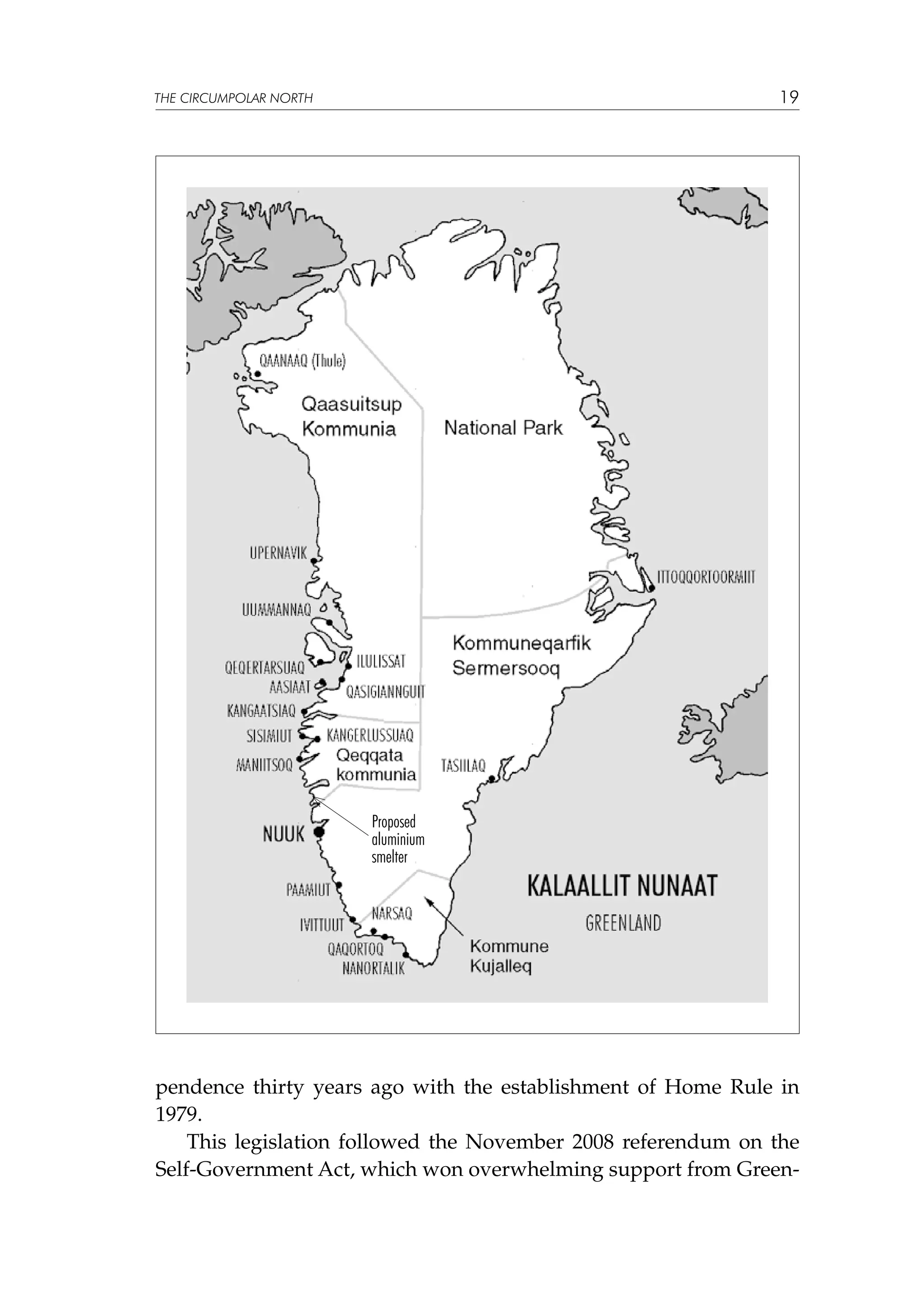
Proposed
aluminium
smelter

pendence thirty years ago with the establishment of Home Rule in
1979.
This legislation followed the November 2008 referendum on the
Self-Government Act, which won overwhelming support from Green-
20

IWGIA - THE INDIGENOUS WORLD - 2010

landers with a 72 per cent voter turnout, and 76 per cent voting in support of the Act.
The Self-Government Act is not only significant for Greenlanders,
the vast majority of whom are indigenous Greenlanders or Inuit; it also
serves as a positive model internationally for indigenous peoples elsewhere.
Its significance also lies in the fact that Greenland now has the possibility of taking over responsibility for the mining resource extraction
sector. This is an area of intense debate in Greenland and the Inuit Circumpolar Council (Greenland) has been vocal in its criticism of the
process, which led to the new legislation on sub-surface resources that
was adopted by parliament on November 27, 2009, prior to which several stakeholders had claimed that their voices had been ignored, and
that the new legislation did not comply with the right to free, prior and
informed consent, or the right to participation in decision-making.

Major political changes
Before the inauguration of Self-Government in June, the Greenland
Premier, Hans Enoksen, decided to announce an early election, although parliament could have continued until November 2010. Enoksen and his party, Siumut, lost the election, and for the first time since
Greenland’s first parliament in 1979, the country now had a party other than Siumut in power. Inuit Ataqatigiit (IA), with Kuupik Kleist as
leader, won over 44 per cent of the vote. With the election on June 2,
Greenland entered a new political era: the winning party decided to
form a coalition with two smaller parties, instead of with the Siumut
party, which was now in second place. The new coalition consists of
IA, a left-wing socialist party (which also works towards independence from Denmark), Demokraatit, a right-leaning party, and Kattusseqatigiit, a small independent party with only one elected Member of
Parliament. The cabinet is now composed of nine Ministers, of whom
six, including the Premier of Greenland, Kuupik Kleist, are from the
Inuit Ataqatigiit party, two from Demokraatit and one from Kattusseqatigiit. Four of the nine ministers are women while 10 of the 31 Members of Parliament are women.
THE CIRCUMPOLAR NORTH

21

The outcome of the election represents both a generational and a
gender shift in Greenland’s political cohort. Not only did Siumut lose
power, its leader Hans Enoksen was replaced by a younger Aleqa
Hammond.
A noteworthy feature of the June election campaign was the new
role played by Greenland’s press, with both newspapers highlighting
abuses of power and failed governance by the then ruling party.

Climate change
With only 18 per cent of Greenland’s surface ice-free, the impact of
global warming and climate change is a major issue for the country.
Greenland, as is so often highlighted internationally, is where the impact of climate change is most dramatic and its consequences are already being extensively felt by its indigenous people.3 However, the
paradox is that the effects of the change in climate and the development of new technologies are creating new possibilities for Greenland.
In his numerous speeches during the United Nations Climate
Change Conference (COP15) in Copenhagen in December 2009, the
Premier of Greenland, Mr. Kuupik Kleist, stressed that Greenland was
looking to develop new industries in the years to come.4 The search for
oil and minerals, the development of hydroelectric plants, and increased traffic in the Arctic are just a few examples of the development
issues Greenland is facing while sea ice is melting and weather conditions are worsening and becoming more difficult to predict.
In order for Greenland to become economically independent of
Denmark, it must develop new industries, and this development will
result in a substantial increase in CO2 emissions in Greenland. The
Government of Greenland has been negotiating with the Danish Government for the right to emit more CO2. Although the COP15 did not
result in an international, legally binding agreement, the conference
helped Greenland and Denmark to reach a tentative agreement on the
CO2 emissions issue, and it helped the international community to recognize Greenland as a transformational economy with the need for
further industrial development.
22

IWGIA - THE INDIGENOUS WORLD - 2010

Earlier in 2009, the Premier of Greenland had also stressed that the
UN Declaration on the Rights of Indigenous Peoples would be implemented in the Greenlandic legislation in years to come.5 A process is
commencing but the Declaration has yet to be fully implemented.
The Inuit Circumpolar Council presented its Call for Climate
Change Action during the COP15. Inuit claimed the right to development while calling for a legally binding agreement to mitigate climate
change. Furthermore, Inuit from across the Arctic called for support to
help them adapt to the effects of climate change.6

Development and economic issues
The Government of Greenland published the country’s climate policy
shortly before the COP15. One goal is to reduce CO2 emissions by five
per cent by 2020. Another is to further develop the use of renewable
energy, increasing the public’s use of hydropower from the current 43
per cent of electricity production to at least 60 per cent by 2020, while
not putting a limit on the CO2 emissions from future industrial development. If Greenland succeeds in developing an oil industry, and further develops the existing mining industry, the country’s CO2 emissions will inevitably increase. The Government of Greenland has announced that principles of Best Available Technologies (BAT) and Best
Environmental Practices (BEP) will be followed in all industrial development projects at all times. Since then, the Greenland Government
has been criticized for not presenting the new climate policy to Parliament for discussion before its public launch.
Greenland has yet to discuss the direction in which the country
should take its industrial development possibilities. At the moment,
the Government of Greenland is negotiating with one of the aluminum
production industry giants, Alcoa Inc. The company has been planning to build an aluminum smelter in the area of Maniitsoq in West
Greenland for several years. Here, and in the three other towns nearby,
public hearings have been conducted, while preparatory scientific surveys of the area are being completed. Hydropower is to be used for the
plant and so two big lakes will be dammed, thereby - according to a
report from the National Museum and Archives of Greenland - flood-
THE CIRCUMPOLAR NORTH

23

ing and losing endless archaeological and historical sites, and radically
and irreversibly changing an inland area traditionally used for summer hunting.7
Several organizations in Greenland are concerned about this development, and the wish is that orderly public hearings are held not just
on the economic aspects of welcoming an aluminum smelting plant
but also aspects of protecting Greenland’s tangible and intangible cultural heritage.

EU seal product ban
In the last few years, the European Union (EU) has been internally
negotiating a ban on seal products, with an exemption for the Inuit. In
July 2009, the European Council adopted a regulation, Article 3 of
which states: “The placing on the market of seal products shall be allowed only where the seal products result from hunts traditionally
conducted by Inuit and other Indigenous communities and which contribute to their subsistence.”8 Although this exemption makes it theoretically possible to trade products from seal hunted by Greenlandic
hunters, all the lobbying for the seal product ban has had the severe
consequence of virtually destroying the market for seal skins.
Seal meat is part of the traditional diet of Greenland. There are
around 1,500 active professional hunters in Greenland, and many leisure hunters. The meat from seals hunted by professional hunters can
be bought at the local markets and is also produced commercially for
national consumers, and the seal hunt makes up a substantial part of
the subsistence economy.
The EU regulation acknowledges that the ban is based on concerns
for animal welfare. The seal product ban is not based on scientific assessments of the viability of seal populations. The seals hunted in
Greenland are not threatened species. The Government of Greenland’s
regulations with respect to the seal hunt are based on the recommendations of international organizations such as the International Council for the Exploration of the Sea, ICES, the North Atlantic Marine
Mammal Commission, NAMMCO, and the Greenland Institute of
Natural Resources, an internationally recognized scientific institution.
24

IWGIA - THE INDIGENOUS WORLD - 2010

The populations of different seal species in the Arctic are thought to
be increasing. Inuit will continue to hunt seal, as the seal hunt is central
to Inuit culture and traditions. For Greenlanders, seal products are also
an important part of national trade and the export of fashion items
such as coats, bags and boots. The EU regulation has made it extremely difficult for Greenlanders to develop this trade. As of the end of
2009, Great Greenland, the biggest tannery in Greenland, had 230,000
seal skins in stock, skins that are now difficult to sell, and the company
was also forced to abstain from creating a seal skin fashion collection
in that same year. Moreover, even though the seal product ban had not
yet entered into force, the company sold only 400 skins at the first of
four European auctions in 2009, while selling no skins at the last three
auctions.9 Great Greenland and the hunters of Greenland are now further subsidized by the Government of Greenland, a situation which is
not sustainable.
The EU seal product regulation will be implemented in 2010. Greenland is currently searching for ways to brand seal products from
Greenland hunters in order to comply with the conditions of the Inuit
exemption in the regulation.
Seal hunting is an inherent part of Inuit culture, and will hopefully
continue to be so. The hunting methods have developed and changed
over time, and seal meat is considered to be one of the healthiest parts
of the Greenland diet. Even so, this tradition is now being challenged
by a regulation of a market far, far away from the hunting sites. The
Greenland system is interlinked, and when a hunter in North Greenland cannot sustain his family because the tannery has been forced to
lower the prices on seal skins, the hunter will be forced to seek other
game. Regulations such as this are making it difficult for Greenlanders
to freely determine the development and use of living resources.


Notes and references
1	
2	
3	

Greenland in Figures, 2009. Statistics Greenland, Greenland Home Rule Government www.statgreen.gl.
Inuit Circumpolar Council, www.inuit.org.
Kielsen Holm, Lene, et al., 2009: Siku-Inuit-Hila The Dynamics of Human-Sea
Ice Relationships: Comparing Changing Environments in Alaska, Nunavut and
THE CIRCUMPOLAR NORTH

4	


5	

6	
7	

8	

9	

25

Greenland. In Climate Change and Arctic Sustainable Development - Scientific, social, cultural and educational challenges, UNESCO.
Kleist, Kuupik, 2009: Melting Snow and Ice - a Call for Action. Speech by the
Premier of Greenland, Mr. Kuupik Kleist, at the Norwegian/Danish side event:
”Melting Snow and Ice - a Call for Action”. Bella Centret Copenhagen December 14,
2009,
http://uk.nanoq.gl/Emner/News/News_from_Government/2009/12/
MeltingSnowandIceAcallForAction.aspx
Kleist, Kuupik, 2009: Inuit and Arctic Indigenous Peoples´ Day, Address by the
Premier of Greenland Mr. Kuupik Kleist on Inuit and Arctic Indigenous Peoples´ Day, North Atlantic House, December 16, 2009, http://uk.nanoq.gl/Emner/News/News_from_Government/2009/12/speech_at_inuit_day.aspx
Kleist, Kuupik, 2009: Statement by Mr. Kuupik Kleist, Premier of Greenland,
2nd Session of the Expert Mechanism on the Rights of Indigenous Peoples, Geneva, 10-14 August 2009. In Making the Declaration Work, eds. Claire Charters
and Rodolfo Stavenhagen. Copenhagen: IWGIA.
The Inuit Call to Global Leaders: Act Now on Climate Change in the Arctic, Inuit Circumpolar Council, www.inuit.org
Knudsen, Pauline K., with contributions from Claus Andreasen. 2009: Culture-historical significance on areas Tasersiaq and Tarsartuup Tasersua in West Greenland & Suggestions for Salvage Archaeologicy and Documentation on Case of Damming Lakes.. Report prepared for Alcoa, Nunatta Katersugaasivia Allagaateqarfialu Greenland National Museum and Archives www.natmus.gl
Regulation (EC) No 1007/2009 of the European Parliament and of the Council
of 16 September 2009 on trade in seal products, Official Journal of the European
Union.
From personal communication with the CEO of Great Greenland. See also Great
Greenland, www.greatgreenland.com

Sara Olsvig is an Inuit from Greenland with an MSc in Anthropology. She
works for the Inuit Circumpolar Council (ICC) Greenland as Human Rights
Issues Coordinator.
26

IWGIA - THE INDIGENOUS WORLD - 2010

SÁPMI SWEDEN
The Sámi people are the indigenous people of the northern part
of the Scandinavian Peninsula and large parts of the Kola Peninsula. The Sámi people therefore live in the four countries of
Sweden, Norway, Finland and Russia. There is no reliable information as to how many Sámi people there are; it is, however,
estimated that they number between 50,000 – 100,000 in all.
Around 20,000 live in Sweden, which is approximately 0.22% of
Sweden’s total population of 9 million. The north-west part of
the Swedish territory is the Sámi people’s traditional territory.
These lands are traditionally used by the Sámi for reindeer
herding, small farming, hunting, fishing and gathering.
Politically, the Sámi people are represented by three Sámi
Parliaments, one in Sweden, one in Norway and one in Finland,
whereas on the Russian side they are organised into NGOs. In
2000, the three Sámi Parliaments established a joint council of
representatives, called the Sami Parliamentary Council.
The Swedish Sámi Parliament is elected by and represents
the Sámi people in Sweden, and at the same time is also a governmental authority. It therefore works as an elected representative
body that looks after Sámi interests, and as an authority that has
to carry out the policies and decisions of the Swedish Parliament
and Swedish Government. There are three specific laws governing Sámi rights in Sweden, namely the Sámi Parliament Act, the
Sámi Language Act and the Reindeer Herding Act.

The Sámi Parliament in Sweden

T

he parliament consists of 31 members representing different Sámi
political parties. The Sámi political parties in Sweden have no for-
THE CIRCUMPOLAR NORTH

27

mal connections to the traditional Swedish political parties. This differs from the Norwegian Sámi Parliament, in which a number of traditional “Norwegian” political parties are represented by Sámi groups
within the parties.1 Rights to land and water, language and political
influence are questions high on the agenda of many Sámi political parties. Other issues dear to the Sámi are reindeer herding, since it is a
traditional industry and way of living, and membership of Sámi villages (local communities).2
Elections to the Sámi Parliament in Sweden were held in May 2009.
The only remarkable changes were that the Landspartiet Svenska Samer
28

IWGIA - THE INDIGENOUS WORLD - 2010

is now officially represented in the parliament once more, after four
years of cooperation with, and under the flag of, another larger Sámi
party, and that the new Álbmut party won one seat. After the elections,
negotiations took place as to which parties would form the Board, which
is like a government for the parliament. The old majority lost and a new
configuration was established. For the 2009 – 2013 period, eight Sámi
political parties are represented in the Sámi Parliament, and the Min
Geaidnu, Landpartiet Svenska Samer, Skogssamerna/Vuovdega, Álbmut and
Jakt och Fiskesamerna parties are represented on the Board. A woman
named Sara Larsson, representing the Min Geaidnu party, became the
new Chair of the Board, the first woman to ever hold this position.

Legal developments
As mentioned in The Indigenous World 2009, a public inquiry into
changes in the Swedish Constitution (Regeringsformen) proposed, in
December 2008, that the Sámi people should have a special mention:
“The possibilities for Sámi people and other ethnic, linguistic and religious minorities to keep and develop their own culture and society
shall be promoted.” The current wording does not mention Sámi explicitly and it says should be promoted instead of shall be promoted. At
first, this proposal received a warm welcome from the Sámi Parliament but, during 2009, it became clear that, if the proposal passes
through the Swedish Parliament (Riksdagen), it will give the Sámi people constitutional support as a national minority rather than as an indigenous people. The Sámi people has been officially recognized in
Sweden as an indigenous people since 1977, and Sweden acknowledges the need to comply with obligations deriving from international
conventions and the UN Declaration on the Rights of Indigenous Peoples (UNDRIP), and to grant similar constitutional standards to the
Sámi people as already obtained in Norway and Finland.3 It is noteworthy that discussions within the public inquiry are emphasising
that the Sámi are an indigenous people in Sweden with special rights
deriving from international conventions ratified and the UNDRIP, and
that the wording of the Finnish and Norwegian constitutions has been
analysed but that the wording of the proposed constitution only gives
THE CIRCUMPOLAR NORTH

29

Sámi the legal position of a national minority and not an indigenous people. In a legal sense, the term indigenous people has a meaning of historical land use and land rights that the term minority does not, and
this should have been reflected in the wording of the proposed constitution by spelling out that the Sámi are an indigenous people.
The issue of whether Sweden will ratify ILO Convention No. 169 or
not was not resolved during 2009. The main reason why Sweden has not
yet ratified the Convention is that Swedish laws on Sámi land rights do
not fit with Article 14 of the Convention. As a way of implementing the
Convention, Sweden has therefore chosen to first adjust national legislation to the Convention before ratifying it, in order to prevent conflicts.
Recent public inquiries have therefore proposed legal changes to reindeer herding and membership of Sámi villages (Sameby) (2001), to Sámi
people’s rights to hunt and fish (2005) and regarding the territory the
Sámi people traditionally occupy (2006). In a press release from 16 September 2009, the government said it had been working on these three
areas and was now about to present historical changes.4 When the new
policy was presented to the public, however, it was clear that no major
changes were being proposed.5 The proposal did not express an aim to
implement ILO 169 or offer solutions to the issues of Sami land rights
and self-determination. It thus received harsh criticism from leading
academics in Sámi law,6 and the Sámi Parliament and Sámi NGOs unanimously advised against the proposal and demanded more thorough
and meaningful changes. After the massive criticism, the government
announced that it was withdrawing this proposal in order to rework it
all over again. This process not only shows that harmonizing the convention and national law is complex but also that there is a lack of political will strong enough to ratify the convention.
The discussion on ratifying the draft Nordic Sámi Convention was
continued in 2009 by the governments of Sweden, Norway and Finland but so far with no results. This draft convention is considered to
be a consolidation of applicable international law, consolidating the
rights of the Sámi people and the obligations of the states.
A new updated Sámi language act was promulgated in June 2009
and came into force on 1 January 2010. This new law widens the geographical area in which people have a right to use the Sámi language
when in contact with the authorities.
30

IWGIA - THE INDIGENOUS WORLD - 2010

A new bilateral convention on reindeer herding was signed in Stockholm between Sweden and Norway on 7 October 2009. The circumstances around the reindeer herding convention were presented in The
Indigenous World 2008. The convention contains regulations governing
how reindeer herding shall be carried out across the border between
Sweden and Norway.7 There are still issues regarding the allocation of
reindeer pasturelands, however, that have not yet been resolved.

Court Cases
During 2009, the Supreme Court decided to hear the Nordmaling case
on the right to reindeer pasturelands, which was described in The Indigenous World 2008 as a potentially decisive case. There have not yet
been any hearings in the case.
There are also a number of cases on the right to reindeer pasturelands ongoing in the lower courts, and one upcoming case on Sámi
rights to hunt and fish.			


Notes and references
1	
2	
3	
4	
5	
6	
7	

www.sametinget.no From the website of the Sámi Parliament in Norway, 10
February 2010.
www.sametinget.se From the website of the Sámi Parliament in Sweden, 10 February 2010.
Statens offentliga utredningar (SOU) 2008, En reformerad grundlag, Stockholm:
Department of Justice, 17 December 2008, pp 454
Dagens Nyheter debatt 2009-09-16
Jordbruksdepartementet 2009, Vissa samepolitiska frågor, Departementsserien
(DS) 2009:40, published 16 september 2009.
Christina Allard et al. 2009. Dagens Nyheter debatt 2009-11-10
http://www.regeringen.se/sb/d/12262/a/132997 From the Government’s official website, 10 February 2010.

Johan Strömgren is a Sámi lawyer who grew up in Ammarnäs, on the Swedish side of Sápmi. He is working as a graduate student at the Sámi University
College in Guovdageaidnu, and is a Ph.D. candidate at the Faculty of Law at
Uppsala University in Sweden.
THE CIRCUMPOLAR NORTH

31

SÁPMI – NORWAY
The Saami are the indigenous people of Norway. There is no available information as to how many they number. A 1999 linguistic
survey found that 23,000 people spoke the Saami language but the
actual number of Saami is estimated to be many times higher than
this. Their status as a people is recognized by constitutional amendment 110a to the Norwegian Constitution (Grunnloven).
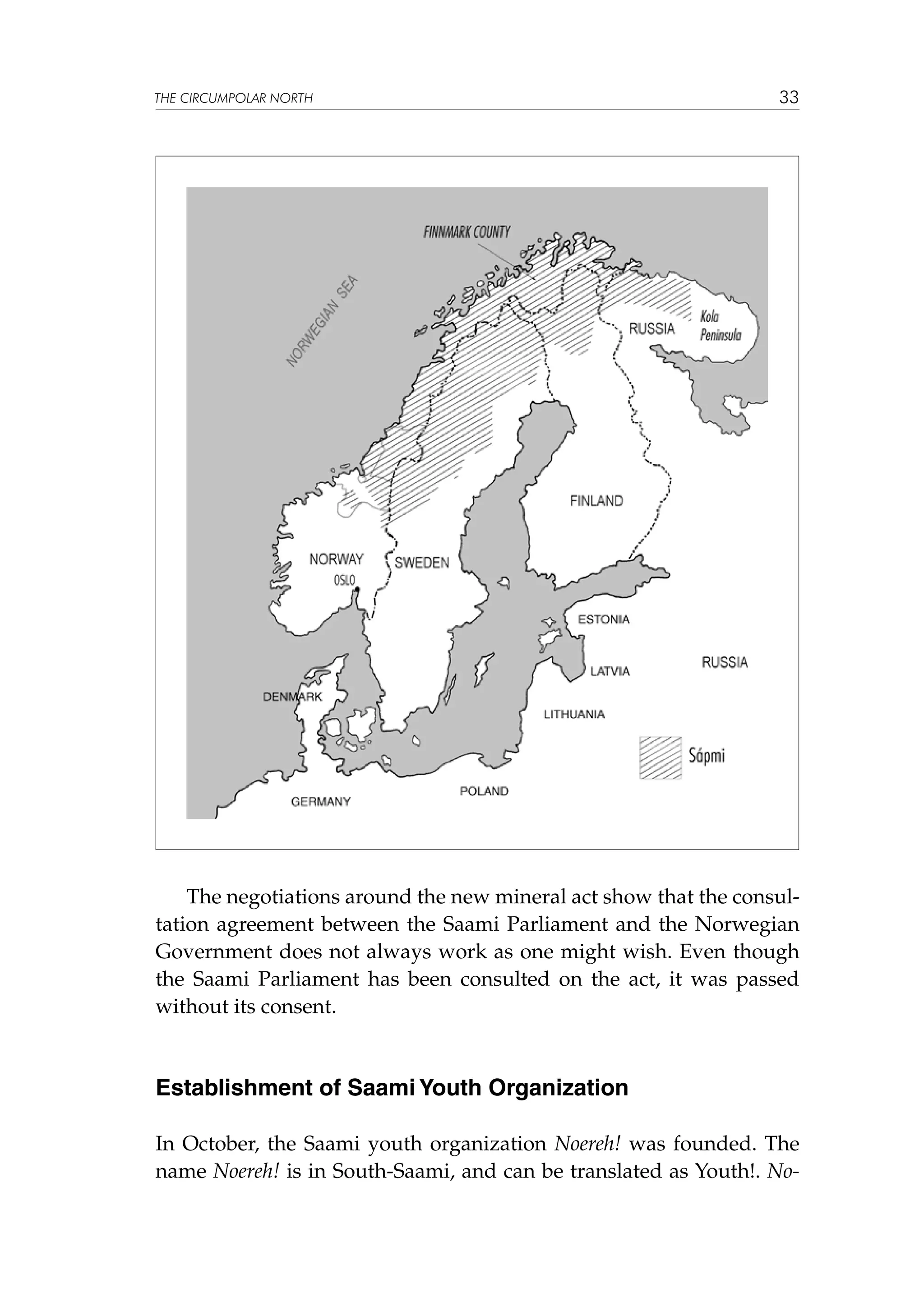
The Saami people’s traditional territories cover large parts
of the Norwegian mainland. Their lands and territories, traditionally used for reindeer herding, fishing, hunting and gathering, are under constant pressure from international and national
mining corporations, state energy enterprises, the Norwegian
Armed Forces, and others.
The Sámediggi (the Saami Parliament) is the democratically
elected political body of the Saami people; its representatives
are elected by and amongst the Saami themselves.1 The Sámediggi is both an important political body and a governmental administrative organ. It regulates its business within the framework laid down by an Act concerning the Sámediggi and other
Saami legal matters (the Sámi Act).2
Norway has ratified all relevant international human rights
instruments, including both the 1966 International Covenant on
Civil and Political Rights and ILO Convention 169. Norway is
also a signatory to the UN Declaration on the Rights of Indigenous Peoples.

Elections to the sixth Saami Parliament

T

he elections to the sixth Saami Parliament were held in September
2009. The two opposing parties, the Norwegian Labour Party and
32

IWGIA - THE INDIGENOUS WORLD - 2010

the Norwegian Saami Association, won nearly 50% of the vote between
them. These two have been the biggest parties since the first elections
in 1989, and they still dominate the Saami Parliament. In cooperation
with several smaller parties, the Labour Party created a majority, and
Egil Olli continued as president. The Olli council now consists of vicepresident Laila Susanne Vars, Marianne Balto, Vibeke Larsen and Ellinor Marita Jåma. The Saami Parliament now has a 49% female representation.
The overall voter turnout was 69.3%, a decline compared to the last
elections in 2005 when 72.6 % chose to vote. In some electoral districts,
voter participation plunged by over 10%.3 Before the elections, there
were some major alterations to the electoral system, including the establishment of larger electoral districts, and changes to the rules concerning election showdowns, which could have influenced electoral
participation.
For the first time in history, the Progress Party, which can be described as a radical right-wing Norwegian party, is represented in the
Saami Parliament. One of its main goals, in both the Norwegian and
Saami Parliaments, is to shut down the Saami Parliament. Debates before the elections were very heated, with a spokesperson for the
Progress Party stating, for example, that the Saami Parliament building would make a nice hotel once it was shut down.

New Mineral Act
During 2009, the Norwegian Parliament passed a new mineral act. After nearly two years of consultations between the Norwegian Government and the Saami Parliament, the act was passed without the consent of the Saami Parliament. The Saami Parliament has been very
critical of the act because it does not acknowledge the Saami people’s
rights, as indigenous people of Norway, to share the benefits of mineral extraction in Saami areas. Nor does it recognize Saami interests
outside of Finnmark county, which implies that the Saami Parliament
will not even be informed when a company is given the right to extract
minerals in Saami areas outside Finnmark.
THE CIRCUMPOLAR NORTH

33

The negotiations around the new mineral act show that the consultation agreement between the Saami Parliament and the Norwegian
Government does not always work as one might wish. Even though
the Saami Parliament has been consulted on the act, it was passed
without its consent.

Establishment of Saami Youth Organization
In October, the Saami youth organization Noereh! was founded. The
name Noereh! is in South-Saami, and can be translated as Youth!. No-
34

IWGIA - THE INDIGENOUS WORLD - 2010

ereh! seeks to create a meeting place where Saami youth can strengthen
their Saami identity and create a feeling of fellowship. The organization also aims to serve as a mouthpiece for all Saami youth, no matter
where they live in Norway. Until the establishment of Noereh!, Saami
youth had nowhere to voice their opinion that was not connected to a
specific party or religion. There are similar youth organizations in
Sweden, Finland and Russia, which Noereh! cooperates with.

Award winning Saami artist
During 2009, the internationally-known Saami artist, Mari Boine, won
several awards for her artistic diversity. She was appointed knight of
the first class in the Royal Norwegian Order of St. Olav in September,
and was also the first Saami artist to receive the Anders Jahre cultural
award. The Anders Jahre cultural award is one of the most prestigious
cultural awards in Norway.


Notes and references
1	

2	

3	

Elections are held every four years at the same time as the elections to the Norwegian Parliament. The elections to the Saami Parliament are based on an electoral register, and in order to be entitled to vote you have to be enrolled on the
Saami election census. To enrol you have to fulfil a subjective and an objective
requirement. The first criterion deals with self-ascription, i.e. whether the person considers herself/himself a Saami, and the second criterion deals with language use. You are entitled to enrol if you have Saami as your home language,
or if your parents, grandparents or great-grandparents have/had Saami as their
mother tongue. You may also enrol if one of your parents has been registered on
the census. At the elections in September, there were 13,902 people registered on
the census, which means that a large number of the Saami living in Norway are
not enrolled on the census.
Initially established to secure the Saami people a voice in Norwegian society, the
Sámediggi can be considered a minority parliament, which implies that it does
not have any legislative powers, and is not economically independent. All economic resources are transferred from the Norwegian Government. The Norwegian Government could in theory withdraw the decision-making power that
has been transferred to the Saami Parliament, even though this is unlikely to
happen.
http://www.ssb.no/english/subjects/00/01/10/sametingsvalg_en
THE CIRCUMPOLAR NORTH

35

Susanne Amalie Andersen is a Saami from the North-Saami area of Norway. She is the leader of the national Saami youth organization, Noereh!, and
a student on the Master’s in Indigenous Studies at the University of Tromsø.
36

IWGIA - THE INDIGENOUS WORLD - 2010

RUSSIA
The Russian Federation is a multiethnic society and home to
more than 100 peoples. Of these, 41 are legally recognised as “indigenous, small-numbered peoples of the North, Siberia and the
Far East”, some others are still striving to obtain this status. This
status is tied to the conditions that a people has no more than
50,000 members, maintains a traditional way of life, inhabits certain remote regions of Russia and identifies itself as a distinct ethnic community. Among the peoples recognised as such are the
Evenks, the Saami, the Yupiq (Eskimo) and the Nenets. Other
Peoples of Asian and Northern Russia such as the Sakha (Yakuts),
Buryat, Komi and Khakass do not hold this status because of
their larger populations. A definition of “indigenous” without
the numerical qualification does not exist in Russian legislation.
The small-numbered indigenous peoples number approximately 250,000 individuals in total and thus make up less than
0.2% of Russia’s population. They traditionally inhabit huge
territories stretching from the Kola Peninsula in the west to the
Bering Strait in the east, and make up about two-thirds of the
Russian territory,
They have traditionally been hunters, gatherers, fisherfolk
and reindeer breeders. For many of them, these activities still
constitute vital parts of their livelihoods, even more since the
collapse of the Soviet economy and the disappearance of the
services it provided. Their languages belong to many different
families, such as Finno-Ugric, Manchu-Tungusic and Paleo-Siberian, and their cultures and world views are closely related to
their environments: the tundras on the shores of the Arctic
Ocean, the vast boreal forests of Northern Eurasia, the Pacific
Coast or the magnificent mountains of the Altai and the volcanoes of Kamchatka.
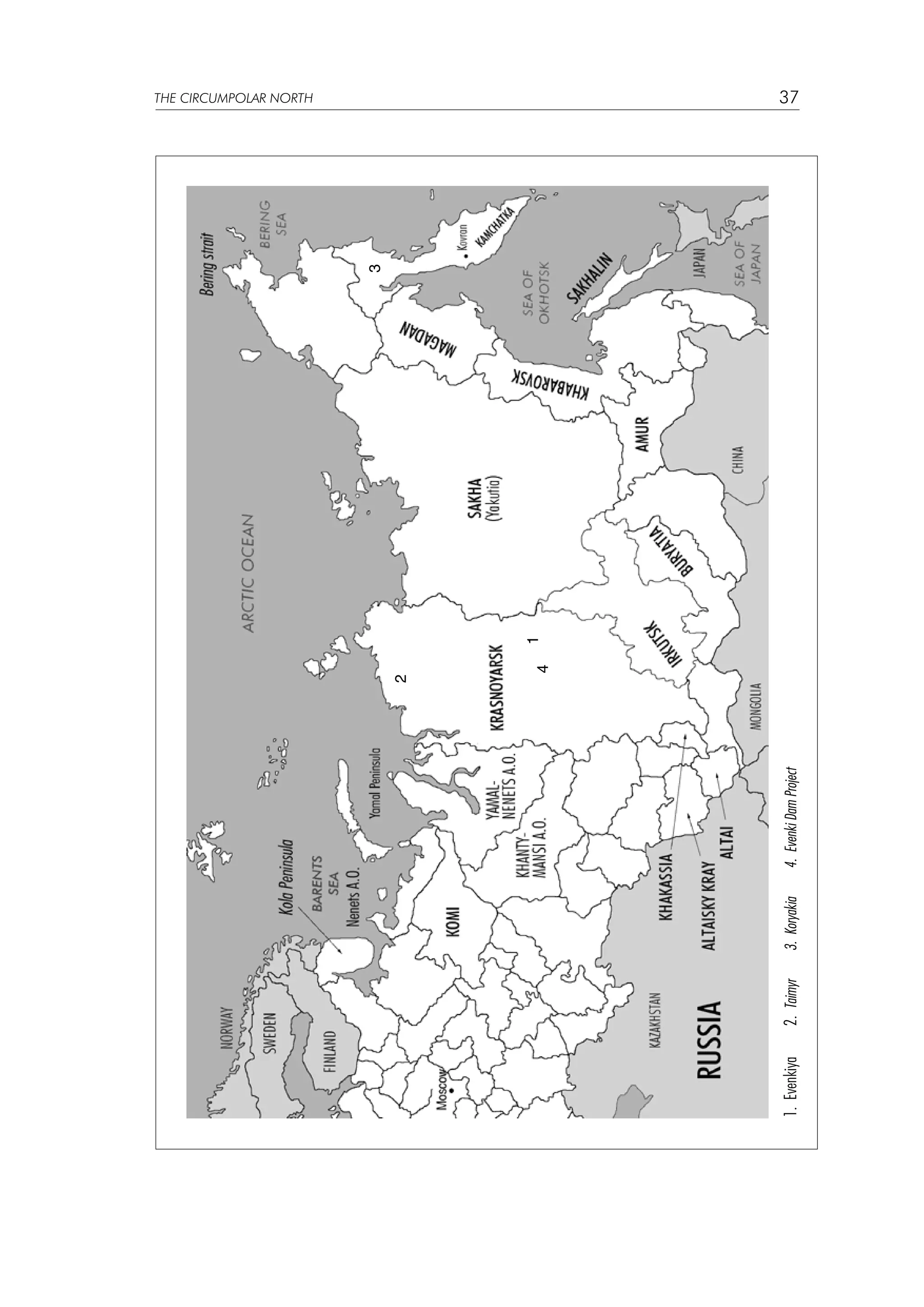
1. Evenkiya

2. Taimyr

3. Koryakia

4. Evenki Dam Project

2

4

1

3

THE CIRCUMPOLAR NORTH

37
38

IWGIA - THE INDIGENOUS WORLD - 2010

In 1990, indigenous activists, intellectuals and writers established a national umbrella organization – the Association of Numerically Small Indigenous Peoples of the North, Siberia, and
the Far East (RAIPON). Today, it represents 42 indigenous peoples and aims to protect their rights at the national and international levels. Their territories are rich in natural resources, such
as oil, gas, and minerals, and heavily affected by large energy
projects such as pipelines and hydroelectric dams. Any industrial project taking place on indigenous peoples’ lands presents
a threat and elicits concern in the indigenous population. A map
by the Center for Support of Indigenous Peoples of the North
(www.csipn.ru) entitled “Places of Potential Conflict Between
Industrial Companies and Numerically Small Indigenous Peoples of the North, Siberia, and the Far East” identifies 70 places
of potential conflict.

T

he legal and socio-economic situation of Russian indigenous peoples did not improve in 2009. New problems were added to existing ones, which are covered in earlier editions of this yearbook. In
particular, problems related to indigenous peoples’ access to traditional natural resources for fishing and hunting were exacerbated.
This was caused by ill-conceived decisions made by the legislative
and executive branches of power, as well as the aggressive position
of commercial companies hurrying to secure rights to any and all
natural resources.

Privatisation and alienation of traditional fishing grounds
The government passed regulatory acts establishing new registries for
fishing grounds as well as new rules for calls for tenders to allocate
fishing grounds. Moreover, in areas where indigenous peoples reside,
fishing grounds were earmarked in the new registries without consideration of either proposals made by indigenous peoples or scientific
rationale. As a result, a large portion of those fisheries previously used
THE CIRCUMPOLAR NORTH

39

for centuries by indigenous peoples for traditional fishing or those that
protected a spawning ground were moved to the registry of fishing
grounds set aside for industrial fishing.
Following calls for tenders for commercial fishing grounds in
spring 2009, many indigenous peoples’ fishing grounds ended up in
the hands of commercial companies, resulting in a lost opportunity for
indigenous peoples to fish in their traditional areas. This has been particularly catastrophic for the indigenous peoples of the Russian Far
East, where traditional fishing has always been the foundation of the
indigenous population’s livelihood. In some Far Eastern regions, such
as Magadan Oblast1 and Khabarovsk Krai,2 the regional administrations attempted to incorporate the interests of indigenous peoples by
setting aside fishing grounds for them outside of the tenders, in direct
conflict with the Russian federal government’s decisions but, in Kamchatka Krai, the administration has been unwilling to compromise,
and as a result, more than 300 indigenous obshchinas3 have been left
without any fishing grounds at all.
Protests by indigenous obshchinas against the new allocation for
fishing grounds took place in northern Sakha republic (Yakutiya) and
on Kamchatka. RAIPON’s Information Center and the Ethno-Ecological Information Center Lach on Kamchatka covered these protests in
their newsletters and updates.
RAIPON submitted an appeal to the Russian president and the
Russian government demanding that fishing ground registries be reviewed in regions where indigenous peoples reside, that fishing
grounds be allocated for traditional fishing and, further, that they be
allocated in a process of consultation with the obshchinas instead of
through commercial tenders.
The Aleutean obshchina “Kignakh” on the Bering Island, which is
a part of Kamchatka krai, protested the legality of the approved fishing
ground registry in court. The case was won in the regional court of
Kamchatka Krai. The Kamchatka administration appealed the Krai
court’s decision, and the case was reviewed by the Russian Supreme
Court in Moscow, where the obshchina’s interests were represented by
the director of RAIPON’s legal center, lawyer Yulia Yakel. The obshchina won this case as well. On October 28, the Russian Supreme Court
upheld the decision of the Kamchatka regional court annulling the
40

IWGIA - THE INDIGENOUS WORLD - 2010

Kamchatka Krai governor’s decree retroactively (back to the inception
date) because it limited the ability of indigenous numerically small
peoples to fish in their traditional fishing grounds. Unfortunately, this
decision does not restore the violated rights of the indigenous peoples
of Kamchatka: between the decree’s inception date the date it was annulled, many traditional fishing grounds had already been allocated to
commercial fishing companies for 20-year periods. The next task for
indigenous peoples will be to get those concessions invalidated.

Privatisation of hunting grounds
The Indigenous World 2008 reports how Evenk obshchinas in Amur Oblast lost their hunting grounds when lands they had previously used
for traditional hunting were put out to tender. With the assistance of
RAIPON’s lawyer Yulia Yakel, the Evenks managed to get the decision
overturned in court. On July 24, 2009 attempts to protect the hunting
rights of indigenous peoples suffered a severe setback when the federal law “On hunting and the preservation of hunting resources and
on changes to specific legislative acts” was passed. The law was drafted by the Committee for Natural Resources and Ecology of the State
Duma, the federal parliament. The main innovation to which indigenous peoples objected was that all hunting grounds, without exception, would be handed over to new owners under long-term lease
agreements, based on tenders. This regulation is dangerous for indigenous hunting obshchinas, as they may lose access to their traditional
hunting lands. During this drafting process, RAIPON experts proposed changes intended to prioritize indigenous peoples’ right to traditional hunting in places where they traditionally reside. However,
the federal hunting law was finally passed without consideration for
the rights of indigenous peoples to preferential access to hunting
grounds.
The new Russian law on hunting further decreased indigenous
peoples’ chances of receiving hunting grounds. Anyone will be able to
participate in the auctions, including commercial hunting companies
working on indigenous lands as well as their employees who may
wish to hunt in their free time. Past hunting experience is one of the
THE CIRCUMPOLAR NORTH

41

criteria determining the bidder’s chances. In the definition used by the
authorities, this will likely play out to the advantage of commercial
hunting enterprises, which have better resources and technical capacity. When no preferential access right is afforded to indigenous peoples’ obshchinas, they will very likely be out-competed by these commercial entities.
The federal law will take effect on April 1, 2010. RAIPON experts are
preparing amendments aimed at protecting indigenous peoples’ rights,
to be incorporated by the Committee for the Affairs of the North and
Numerically Small Indigenous Peoples of the Federation Council.

“Territories of Traditional Nature Use” - land rights hanging
in the balance
The federal law dated May 7, 2001 (49-FZ) “On territories of traditional natural resource use for indigenous peoples of the North, Siberia,
and the Far East of the Russian Federation” is the single most important legal act in Russia aimed at the protection of indigenous peoples’
rights to land. However, even though it was adopted nine years ago, it
has still not been implemented. Not a single Territory of traditional
natural resource use has been approved by the federal government.
On multiple occasions, UN human rights bodies such as the Committee on the Elimination of Racial Discrimination (CERD) have urged the
Russian government to accelerate the process of instituting territories
of traditional natural resource use for indigenous peoples.4
In 2009, Russian president Dmitri Medvedev charged the Russian
government with analysing the implementation of the federal law on
territories of traditional natural resource use. The Ministry of Regional
Development (MinRegion), which is largely in charge of indigenous
affairs, responded to this task by presenting a report which concluded
that respective federal law needed to be revised in order to remove
existing flaws. The Russian government charged MinRegion with preparing a revised version of the federal law by June 15, 2009. The ministry failed to complete to complete this task.
Also in 2009, the Batani International Development Fund for Indigenous Peoples of Russia, which was founded by RAIPON in 2004, pre-
42

IWGIA - THE INDIGENOUS WORLD - 2010

sented a report to MinRegion entitled “Researching the issues of establishing territories of traditional natural resource use for indigenous
numerically small peoples of the North, Siberia, and the Far East”. The
report provides detailed and well-founded proposals aimed at improving the text of the law on territories of traditional natural resource
use as well as the mechanisms for its realization.
Thus, at present, federal Territories of Traditional Nature Use still
do not exist, and on those lands where indigenous numerically small
peoples conduct traditional natural resource use with the goal of basic
sustenance, the best hunting and fishing grounds have already been
handed over to commercial enterprises and other local residents
through auctions and tenders.
There is another threat to the development of traditional natural
resource use related to the unsolved legislative issue of evaluating the
impacts of industrial projects on traditional ways of life and natural
resource use.
According to the federal law “On guarantees of the rights of indigenous small-numbered peoples”, indigenous peoples have the right to
compensation for losses resulting from damage to their territories
caused by economic activity.
In 2005, the Russian federal government accepted a proposal put
forward by RAIPON in the context of the second International Decade
of the World’s Indigenous Peoples to develop and approve until 2007
a methodology for the quantification of damage to land and other natural resources in places of traditional occupation and economic activities traditionally used by Russia’s small-numbered peoples. Developed by a group of qualified specialists, the draft methodology was
presented to MinRegion Russia in 2006. In 2008-2009, the Batani International Development Fund for Indigenous Peoples of Russia conducted a project entitled “Ecological co-management of extractive
companies, public authorities, and indigenous peoples” in three Arctic
regions. Within the project framework, the Fund tested and approved
the specified methodology and submitted a report to that effect to the
State Duma5 (“World of Indigenous Peoples – Vivid Arctic,” #22, 2009).
Despite this, the Russian government has not yet approved the methodology.
THE CIRCUMPOLAR NORTH

43

Lack of self-administration
In its concluding observations on Russia, the UN Committee on the
Elimination of Racial Discrimination (CERD) of September 2008, pointed to the absence of a mechanism ensuring adequate representation of
indigenous peoples in regional state bodies.6 The Vth and VIth Congresses of Indigenous Peoples of the North, Siberia, and the Far East of
Russia held in 2005 and 2009 both authorized the Association of Indigenous Numerically Small Peoples of the North, Siberia, and the Far
East of Russia to represent the interests of these indigenous peoples in
government agencies. On December 15, 2008, at an expanded session
of the Federation Council’s Committee for Northern Affairs and Indigenous Small-Numbered Peoples, it was decided to support the development of a regulation, acknowledging RAIPON as the authorized
representative of the indigenous small-numbered peoples. The regulation, however, was not developed, and the indigenous peoples are still
left without an authorized representative in government, mandated to
participate in decision-making processes affecting issues such as indigenous territories, traditional life ways of life, husbandry, and traditional industries of numerically small peoples, fishing and hunting.

Remote villages left to their own devices, threats from
extractive industries
The situation continues to deteriorate in small, isolated villages of indigenous peoples, especially in the formerly autonomous regions
(okrugs) of Evenkiya, Taimyr and Koryakia. Schools, shops and medical facilities are closing in these settlements, and residents are being
laid off from their jobs. Moreover, the threat of flooding due to the
planned construction of one of the world’s largest hydroelectric dams
on the Lower Tunguska River continues to hang over the indigenous
peoples of Evenkiya and Taymyr, and residents of Koryakiya in Northern Kamchatka are losing their fishing grounds. Kamchatka’s indigenous residents are also under threat of expanding oil and gas exploration on both the land and on the nearby continental shelf. Reindeer
44

IWGIA - THE INDIGENOUS WORLD - 2010

herders on the Yamal Peninsula are suffering due to the construction of
a railroad and pipeline that bisect the entire peninsula from the south
to north-west. These regions are also particularly affected by both the
lack of protected territories of traditional natural resource use for indigenous peoples and also the absence of co-management mechanisms
with the participation of indigenous peoples (see above).

The VI Congress of Indigenous Peoples of the North,
Siberia, and the Far East of Russia
Delegates to the VIth Congress of Indigenous Peoples of the North,
Siberia, and the Far East discussed the above-mentioned problems in
Moscow on April 23-24, 2009. The Congress brought together 330 authorized representatives of indigenous peoples of the North, Siberia,
and the Far East from 27 regions, who had been appointed at regional
congresses, and an almost equal number of guests.
The list of guests of honour included representatives of the Federation Council, of the State Duma, Russian federal ministries, heads of
administration of several northern regions, representatives of the Moscow office of the UN High Commissioner for Human Rights and the
United Nations’ Permanent Forum on Indigenous Issues, the European Commission, IWGIA, the Ministry of Indian and Northern Affairs
of Canada, the Greenlandic Representation in Denmark and other international organizations and government bodies.
Two days prior to the start of the Congress, leaders of most regional indigenous peoples’ organizations met in Moscow to participate in
a preparatory seminar in the Public Chamber.7 During the seminar, experts talked about the current situation and challenges for the legal
protection of the rights of indigenous numerically small peoples, followed by a discussion of the draft resolution and draft recommendations to be adopted by the VIth Congress. These drafts were circulated
widely among Congress participants for discussion. The final Congress documents include delegates’ proposals for improving Russian
legislation with regard to indigenous peoples’ rights, as well as practical recommendations for expanding the work of indigenous organizations in the regions. The resolution and recommendations of the VIth Con-
THE CIRCUMPOLAR NORTH

45

gress are available from RAIPON’s website8 and have been officially
submitted to the State Duma, the Federation Council and the Russian
federal administration.
The framework programme around the Congress also included the
first Russian Youth Forum of indigenous numerically small peoples of
the North. Participants in the Youth Forum met in the same premises
as their elder leaders, the Public Chamber, and discussed their challenges, desires and intentions and developed concrete proposals for
the development of youth policies within the Russian Association of
Indigenous Numerically Small Peoples of the North, Siberia, and the
Far East of Russia. Those proposals were included in the Congress proceedings, which subsequently declared 2010 the year of indigenous
youth.
Shortly before the VIth Congress, the Russian government had approved the Concept Paper for the sustainable development of indigenous
numerically small peoples of the North, Siberia, and the Far East of Russia to
2025. RAIPON experts had been involved in the development of the
Concept Paper and the preparation of the implementation plan for
2009-2011. They advocated the inclusion of several proposals necessary for the protection of indigenous peoples’ rights in the documents,
some of which where eventually accepted. Notably, the Concept Paper
stipulates the creation of territories of traditional natural resource use
(TTP); it calls for the approval of a methodology for assessing the impacts of industrial projects on indigenous peoples and for the creation
of mechanisms safeguarding indigenous peoples’ access to traditional
natural resources, education and public health services; and it advocates the institution of indigenous self-administration in their places of
residence. How and to what extent these plans will be implemented
remains to be seen. RAIPON will strive to ensure the participation of
indigenous peoples in the implementation process.

International human rights advocacy
The problems of Russia’s indigenous peoples were also highlighted in
a joint submission by IWGIA and RAIPON to the Universal Periodic
Review, a peer-review mechanism of the UN Human Rights Council,
46

IWGIA - THE INDIGENOUS WORLD - 2010

which examined the state of human rights in the _Russian Federation
at its 4th session (February 2-13, 2009). The submission can also be
found on IWGIA’s and RAIPON’s websites and has been published in
the journal The Living Arctic. The main outcome of the UPR procedure
with regard to indigenous peoples was that Russia accepted the Danish government’s recommendation to implement the recommendations of the UN Committee on the Elimination of Racial Discrimination
(CERD) from August 2008. At the session, a representative of the Ministry of Regional Development (MinRegion) declared that Russia had
developed a national action plan for the implementation of the recommendations and would deliver a first interim report by the end of 2009.
However, even though the Ministry did eventually present an action
plan for the implantation of the recommendations, it failed entirely to
address the specific recommendations pertaining to indigenous peoples, which included, among other things, implementation of the law
“On Territories of Traditional Nature Use”, reinstatement of the principle of preferential access of indigenous peoples to the resources and
land they depend on and the withdrawal of support for projects that
lead to mass involuntary resettlements, most notably the giant Evenki
hydroelectric dam (see above). Instead, its representatives declared
globally that with the adoption of the concept paper for the sustainable
development of indigenous peoples (see above), the recommendations
had been implemented. RAIPON submitted its criticism to the Public
Chamber for inclusion into the joint report of civil society and human
rights organizations.
Publication of these materials and their discussion at the 4th Session
of the Human Rights Council’s Universal Periodic Review, as well as
at the Permanent Forum on Indigenous Issues in 2009, elicited an inadequate response from MinRegion, which is in charge of indigenous issues. The Ministry held that RAIPON’s criticism of the Russian government constituted slander and an attempt to defame Russia’s policies in an international forum, as publicly stated by several MinRegion
representatives.					
An official visit from the UN’s Special Rapporteur on the rights and
fundamental freedoms of indigenous peoples, James Anaya, took place
from October 4-17, 2009. The Rapporteur met with RAIPON representatives who explained the main issues affecting the enforcement of in-
THE CIRCUMPOLAR NORTH

47

digenous peoples’ rights in Russia. James Anaya said that he had carefully studied the materials included in RAIPON/IWGIA’s Submission
to the Human Rights Council’s Universal Periodic Review.
RAIPON’s Information Center went to great lengths to ensure that,
while visiting various regions, the Rapporteur would meet with representatives of regional indigenous peoples’ organizations outside of
those meetings included in the official visit itinerary. It was thus that
the Rapporteur met with indigenous representatives from Evenkiya
opposing the construction of the giant Evenki hydroelectric dam (see
above). In Khabarovsk, he also met with a representative of the indigenous population of Koryakia, who had to travel there because the
Russian government had opposed Anaya’s wish to visit Kamchatka,
the peninsula in Russia’s Far East the northern half of which is occupied by the formerly autonomous region of Koryakia, whose autonomy was scrapped in 2007. Koryakia is one of Russia’s least accessible
regions, and many indigenous settlements are thus affected by extreme
poverty and vastly inadequate infrastructure.
During a press conference at the conclusion of his official visit on
October 15, 2009, and in response to a question regarding the condition
of human rights and the basic rights of indigenous peoples in the outlying regions, the Special Rapporteur stated, “I am impressed by the
several initiatives by the Government of the Russian Federation and
regional governments to address the concerns of the country’s smallnumbered indigenous peoples…. Significant challenges remain, however, to consolidate and effectively implement these initiatives for the
benefit of these indigenous peoples.”9 The Special Rapporteur’s initial
conclusions noted that the Concept Paper for the Sustainable Development of Indigenous Numerically Small Peoples of the North, Siberia
and the Far East in Russia as approved by the Russian administration
in February 2009 would facilitate the advancement of indigenous peoples and resolve their undesirable situation in socio-economic terms.
However, he also learned that, in many places, indigenous peoples
continue to suffer from poverty, unemployment, and social diseases as
well as facing other challenges connected to accessing traditional activities and effectively participating in decision-making on issues related to these areas. 					

48

IWGIA - THE INDIGENOUS WORLD - 2010

Notes and references
1	
2	
3	

4	
5	
6	
7	

8	
9	

The Russian Federation is divided into 83  “federal subjects”, of which 46 are
oblasts. The term is often translated as “region” or “province”.
Krai is a term used to refer to nine of Russia’s federal subjects. The term is often
translated as territory, province, country or region.
Obshchinas are usually kinship-based indigenous collective enterprises, engaging in traditional economic activities such as fishing, hunting or gathering of
non-timber forest products. They enjoy special tax privileges and were originally designed to have a role in indigenous self-administration, even though the
latter function was never put into practice.
CERD Concluding observations of 2003 (UN doc CERD/C/62/CO/7) Para 20;
concluding observations 2007 (CERD/C/RUS/CO/19); Para 24)
See Article in RAIPON’s journal The Living Arctic, #22, 2009
UN doc CERD/C/RUS/CO/19; Para 2
The Public Chamber is a parliament-like assembly of representatives of the Russian civil society. Its member are appointed in a three-stage procedure whereby
the first third is appointed directly by the president which in turn appoints the
second third. It has a consultative mandate and also administers a small grants
programme.
http://www.raipon.info
http://www.unhchr.ch/huricane/huricane.nsf/view01/7847C99256608064C1
257651004FBB67?opendocument

Olga Murashko is a Russian anthropologist and one of the co-founders of
IWGIA Moscow. She works as a consultant for the Russian national umbrella
organization of indigenous peoples (RAIPON) and coordinates RAIPON’s
legal advocacy work.
THE CIRCUMPOLAR NORTH

49

INUIT REGIONS OF CANADA
In Canada, the Inuit number 50,480 people, or 4.3% of the Aboriginal population. They live in 53 Arctic communities in four
Land Claims regions: Nunatsiavut (Labrador); Nunavik (Quebec); Nunavut; and the Inuvialuit Settlement Region of the
Northwest Territories.
In 2005, the Labrador Inuit Association, formerly representative of the Labrador Inuit, signed a settlement for their land
claim that covers 72,500 square kilometres. The Nunatsiavut
government was created in 2006. It is the only ethnic style government to be formed among the four Inuit regions to date.
The Nunavut land claim, which covers two million square
kilometres, was settled in 1993. The Nunavut government was
created in April 1999.
The Nunavik land claim was settled in 1975 but with no selfgovernment arrangement. The Nunavik area covers 550,000
square kilometres, which is one-third of the province.
The Inuvialuit land claim was signed in 1984 and covers
90,650 square kilometres in the Northwest Territories. They, too,
continue negotiations for self-government arrangements.

Nunatsiavut

A

deadline had been set at the end of 2008 for Inuit to apply for title
to land for which they would not pay fees, and which would give
exclusive right to trap and to construct, use and occupy one or more
cabins within the area’s registered trap lines as set forth in the Labrador Inuit Lands Claims Agreement (LILCA). Over 300 applications
were received and public consultations were held in the Inuit communities to receive feedback and reactions from the Inuit and to open up
discussions on the land tenure applications.
50

IWGIA - THE INDIGENOUS WORLD - 2010

In early 2009, Nunatsiavut’s President Jim Lyall reacted to the federal budget. He complained that social housing programs aimed at
Inuit completely ignored the housing crisis and infrastructure needs of
Labrador Inuit because the allocation for Inuit housing was directed
only at those living above the 60th parallel north. It also did not take
into consideration the need for improved airstrips and harbours to facilitate transportation in and outside of Labrador for the remotely located Inuit communities. The Nunatsiavut government set aside funds
to conduct a feasibility study into establishing a road that would link
the Inuit communities to the Trans-Labrador Highway.1 The provincial
government, however, refused to contribute.
Another salient issue was the Indian Residential Schools Settlement
Agreement (see The Indigenous World 2009), which does not cover Labrador. This is why former Inuit residential school students must resort
to legal action in Canadian courts to settle their cases. The critique expressed by President Jim Lyall was harsh:
We have been told these institutions do not meet the criteria set out in the
Settlement Agreement since Canada was not jointly or solely responsible
for their operation and the care of the children who resided in them. We find
this hard to accept since the federal government provided the funds to operate these facilities. We are appalled the Government of Canada would try to
minimize its involvement in this sad chapter of our history.2
A couple of happy events also took place in 2009: a plaque was unveiled in
Hebron to commemorate those Inuit who had been forced to relocate when
government services and the Moravian Church were shut down in 1959.
The plaque includes the apology from the province of Newfoundland and
Labrador to the Inuit. In November, in preparation for the Vancouver 2010
Olympic Games, the Olympic Torch passed through Hopedale as it voyaged across the Canadian North through the four Inuit regions.

Nunavut
The Nunavut legislature passed two important language laws in 2009:
the Inuit Language Protection Act and the Official Languages Act, the aim
51

THE CIRCUMPOLAR NORTH

2

1

3

1. Kuururjuaq National Park

2. Inuvialuit Region and Beaufort Delta Area

3. Mackenzie Valley

of which is to make Inuktitut the main working language of the Nunavut government and allow residents to receive services in Inuktitut.
Throughout the north, the Inuit population is booming and the
costs of construction have resulted in a housing crisis. The phenomenon of hidden homelessness appears in the cold season when people
go from home to home, staying here and there, having no place of their
own. In 2009, Nunavut received a 100 million dollar budget to build
new housing in its 25 Inuit communities but this is far from enough to
fill the housing need.
Seal hunting was a major issue during the year as Inuit leaders such
as Premier Eva Aariak continued to fight the European Union’s ban on
seal hunting. Inuit hunters say that even though the ban makes an exception for the Inuit seal hunt, there are misconceptions about sustainable seal harvesting, and the economic impact on Inuit is negative.3
In 2009, Inuit hunters in Nunavut caught a bowhead whale whose
valuable meat and muktuk was shared among them. Scientists, whose
past estimates have been at odds with those of the Inuit, also finally
confirmed that the population of bowhead whale was healthy. On the
52

IWGIA - THE INDIGENOUS WORLD - 2010

other hand, some controversy arose when Inuit hunters, the Nunavut
government and the Nunavut Wildlife Management Board discussed
lowering the quota for the polar bear hunt, as scientists estimate their
numbers have decreased.

Nunavik
Nunavik continues to negotiate for self-government arrangements, negotiations that began in 2002. The year 2013 is now set as the expected
date for the creation of the Nunavik Regional Government and the
negotiators’ discussions in 2009 led to a draft final agreement.4
As in the other Inuit regions, Nunavik is experiencing a housing
crisis. Another problem is the continued crisis in youth protection
services, which is partly related to the problems of attracting and keeping social workers in the region. In 2009, Quebec promised to improve
the housing situation for staff and to encourage more social workers to
take on responsibilities.
In an older case, there was an inquiry into the claims of Inuit of
Nunavik that a systematic slaughter of Inuit sled dogs by police officers and government authorities had occurred in the 1950s and 1960s.
The Inuit are asking for an apology and compensation from the federal
and provincial governments. The judge’s interim report concluded
that there was no systematic slaughter of dogs but he did blame the
federal and provincial governments for misusing an agricultural law
to justify the killing of sled dogs and then leaving Inuit to deal with the
loss of their means of transportation.5 A final report is soon to be published. For their part the Inuit of Nunavut, who went through the same
experience, established the Qikiqtani Truth Comission in 2007 to investigate the event.
On a positive note, a bowhead whale hunt occurred for the second
time in the history of Nunavik. All of the communities of Nunavik received a share of bowhead whale meat. The creation of the Kuururjuaq
provincial park near Kangirsualujjuaq also promises to open up the
region to eco-tourism.
THE CIRCUMPOLAR NORTH

53

Inuvialuit Region
The Inuvialuit Regional Corporation (IRC) began negotiating for an
Inuvialuit government in 2006. In 2009 they reached an agreement in
principle, which will hopefully be finalized in 2010. This will ensure
autonomy of decision-making regarding policies, the making of laws
and the delivery of government programs and services.6
A long awaited report from the Joint Review Panel regarding the
Mackenzie Gas Project (see The Indigenous World 2008) was published
in December. The IRC’s Chair, Nellie Cournoyea, sees the Project as a
strong basis for economic development. Basically, the report makes
recommendations for mitigating any environmental and social impacts during the development of the gas pipeline project in the Mackenzie Valley and Beaufort Delta regions.7 The Gas Project is projected
to begin development in the near future and will create jobs for Inuvialuit during construction.8
In 2009, only one of three caribou herds was open for hunting, and
the fact that the United States has listed the polar bear under the Endangered Species Act has had somewhat of an impact on hunters and
outfitters, although they are still able to maintain subsistence and sport
hunting, which ensures an income for the Inuvialuit.9
On a positive note, the IRC celebrated the 25th anniversary of its
land claim in 2009 with photography contests and community events
and worked closely with the other Inuit regions to ensure Inuit participation in the Olympic Games and that an Inuvialuit drum dancing
group would play at the opening ceremony.


Notes and references
1	
2	
3	
4	

Personal communication with Bert Pomeroy, Communications Director, Nunatsiavut government.
Nunatsiavut government, Press Release May 8, 2009.
Personal communication with Press Secretary Emily Woods of Premier Eva
Aariak’s Office.
Nunavik Negotiators’ Newsletter, 2009: Nunavik: a look into the future.
54

5	

6	

7	
8	
9	

IWGIA - THE INDIGENOUS WORLD - 2010

Honourable Jean-Jacques Croteau, Retired Judge of the Superior Court, 2009:
Interim Report: Allegations Concerning the Slaughter of Sled Dogs. Submitted to
Makivik Corporation and Government of Quebec.
Inuvialuit Regional Corporation, 2009: Inuvialuit Self-government Tradition and
Good Government, A summary of an Inuvialuit Self-government Agreement-in-principle.
Joint Review Panel for the Mackenzie Gas Project, 2009: Foundation for a Sustainable Northern Future: Report.
Personal communication with Peggy Jay, Communications Advisor at the Inuvialuit Regional Corporation.
Personal communication with Steven Baryluk, Resource Management Coordinator at the Inuvialuit Game Council.

Lisa Qiluqqi Koperqualuk was born in Puvirnituq, Nunavik (Quebec) and
raised by her grandparents Lydia and Aisa Koperqualuk. Her early experience
includes freelance translation and interpretation and media work in Inuktitut. She has a Bachelor’s degree in Political Science and was Communications
Officer for Makivik Corporation from 2002 to 2007. She is currently earning
a Master’s Degree in Anthropology at Laval University in Quebec City. She
is a founding member of the Saturviit Inuit Women’s Association of Nunavik
incorporated in 2006 and actively promotes e quality between men and women in Inuit society.
NORTH AMERICA
56

IWGIA - THE INDIGENOUS WORLD - 2010

CANADA
The indigenous peoples of Canada are collectively referred to as
“Aboriginal people”. The Constitution Act, 1982 of Canada recognizes three groups of Aboriginal peoples: Indians, Inuit and Métis.
According to the 2006 census, Aboriginal peoples in Canada
total 1,172,790, 3.6% of the population of Canada.1 First Nations
(referred to as “Indians” in the Constitution and generally registered under Canada’s Indian Act2) are a diverse group of
698,025 people, representing more than 52 nations and more
than 60 languages. About 55% live on-reserve and 45% reside
off-reserve in urban, rural, special access and remote areas.
The Métis constitute a distinct Aboriginal nation, numbering 389,780 in 2006, many of whom live in urban centres, mostly
in western Canada. “The Métis people emerged out of the relations of Indian women and European men prior to Canada’s
crystallization as a nation.”
As one of the three remaining states who oppose the UN
Declaration on the Rights of Indigenous Peoples (UNDRIP),
Canada continues to maintain that the UNDRIP does not apply
in Canada and opposes its use in all international standard-setting processes.

Universal Periodic Review

O

n February 3, 2009, Canada had its human rights record assessed
in the UN Human Rights Council’s Universal Periodic Review
(UPR) in Geneva. Approximately three-quarters of the participating
states raised concerns relating to indigenous peoples in Canada. Particular importance was paid to the issue of violence against indigenous
women.3 A number of states also recommended that Canada reassess
57

NORTH AMERICA

3

2
1

1. Ipperwash Provincial Park

2. Cornwall Island

3. Kitchenuhmaykoosib Inninuwug First Nation

its position on the UN Declaration on the Rights of Indigenous Peoples (UNDRIP). In its June 2009 response to the recommendations on
the UNDRIP, the Canadian government refused to reconsider its opposing position. Many indigenous organizations and NGOs submitted reports highlighting Canada’s record with regard to indigenous
peoples in advance of Canada’s review, and continue to engage with
each other on the ongoing work of the UPR.4 It was deeply unfortunate that, in preparing its national report to the UPR, the government
failed to consult with indigenous peoples and civil society. The Canadian Standing Senate Committee on Human Rights examined Canada’s engagement with the UPR, including hearing testimony from
indigenous peoples’ representatives and solidarity organizations.
The government continues its lack of commitment to engagement
with civil society and indigenous peoples with regard to the Universal Periodic Review process.
58

IWGIA - THE INDIGENOUS WORLD - 2010

UN Declaration on the Rights of Indigenous Peoples
On the second anniversary of the adoption of the UNDRIP, indigenous
and human rights organizations released a report by international human rights lawyer, Paul Joffe, entitled “Global Implementation of the
UN Declaration on the Rights of Indigenous Peoples – and Canada’s
Increasing Isolation”.5 Indigenous peoples and human rights advocates continue to be frustrated by the ideological positions that the
government of Canada puts forward in attempts not to recognize the
UNDRIP. Regardless of this, implementation is active in Canada, with
the UNDRIP being used in a variety of forums. Educational initiatives,
legal precedents, awareness raising and formal endorsements from all
sectors of society are ongoing. In December, the Premier of Ontario
wrote to Prime Minister Stephen Harper requesting that the “Government of Canada reconsider its position” in response to the UNDRIP. In
this regard, he added: “As Premier of Ontario, I believe the declaration
reinforces our commitment to engaging in meaningful and constructive dialogue on the future of Canada’s Aboriginal peoples.”
In Québec, an Open Letter was sent to the Premier calling on the
National Assembly to adopt a Motion to support the UNDRIP. The letter was signed by more than 130 public personalities, indigenous and
human rights organizations and trade unions in Québec. Louise Arbour, the former justice of the Supreme Court of Canada and former
High Commissioner for Human Rights, was among the signatories.

Climate Change
Canada was highly criticized both leading up to and at the UN Climate
Change Conference in Copenhagen, mainly because of government
policies that are not seriously tackling the challenges posed by climate
change. Canada’s positions appear driven by economic factors relating
to the Alberta tar (oil) sands. “Climate change is something Mr. Harper
has been forced to tackle with the greatest reluctance. He was long a
skeptic about the science, and he has always feared the economic fallout of serious action.”6
NORTH AMERICA

59

The ongoing weak standards proposed by Canada are in opposition to the growing international recognition of the need for real action. As described by the United Nations Secretary-General, “Climate
change, more than any other challenge facing the world today, is a
planetary crisis that will require strong, focused global action.”7 Canada’s actions have not only invoked the ire of the global community,
they also violate the rule of law, domestically and internationally.
“Many national laws, Aboriginal treaties, and international agreements exist that should be seriously impacting tar sands development.”8
“The United Nations Declaration on the Rights of Indigenous Peoples (UNDRIP) sets out several rights and principles of relevance to
threats posed by climate change.”9 However, the Canadian government has opposed reference to the UNDRIP and use of the term “indigenous peoples” in international forums addressing climate change,
biological diversity and indigenous traditional knowledge. The indigenous peoples in Canada and globally are thus particularly affected by
Canada’s substandard actions on climate change.

Under-funding of services for indigenous children at risk
The federal government spends approximately 22% less per child for
child welfare services on reserves than its provincial counterparts
spend in non-Aboriginal communities. The underfunding of Aboriginal child services has been clearly documented, including in a joint
study with the Department of Indian Affairs.10 A disproportionate
number of indigenous children are taken from their families and placed
in foster care. A critical factor is the failure of the federal government
to provide adequate funds for the delivery of early intervention and
other preventive programs that are generally available to non-indigenous families.
	
The First Nations Child and Family Caring Society of Canada
and the Assembly of First Nations filed a human rights complaint
against Indian and Northern Affairs Canada in 2007. In 2008, the Canadian Human Rights Commission referred the complaint to the Canadian Human Rights Tribunal in order to hold a public hearing with
60

IWGIA - THE INDIGENOUS WORLD - 2010

regard to the under-funding of indigenous children’s welfare on reserves. The Tribunal was requested to determine whether or not discrimination occurred, pursuant to the Canadian Human Rights Act.
The government of Canada has repeatedly tried to stop this investigation, even as their own reports have shown under-funding to be a
critical problem. In 2009, in an attempt to cancel the Tribunal, Canada
argued before the federal court that, although the delivery of services
was covered by the Human Rights Act, the funding for such services
was not. The federal court ruled that the Tribunal should proceed. The
federal government has made the same argument before the Tribunal
in an attempt to prevent the evidence from being heard.
Just as hearings on the merits of the case were scheduled for November 16, 2009, the sitting tribunal member was abruptly replaced by
the new tribunal chair, who was appointed by the government, and
the hearings postponed for reasons that are still not clearly understood.
Meanwhile, the federal government has launched a motion to dismiss
the tribunal on the same grounds that it lost on in the federal court.
This motion is expected to be heard in April 2010 and has the effect of
further delaying a hearing on the merits of the case. As the Caring Society states: “Unnecessary procedural delays are harmful to First Nations children and it is in the joint interests of Canadians and First Nations to determine if discrimination is occurring against thousands of
vulnerable children and their families.”11

Violence against indigenous women
The federal government faced growing calls for a comprehensive and
coordinated national action plan to address the high levels of violence
against indigenous women. Calls for a national action plan were made
by other states as well as indigenous peoples’ organizations and NGOs
at the UN Human Rights Council’s Universal Periodic Review of Canada, at a meeting of federal province and territorial government ministers and in public vigils held across the country. In 2009, the Native
Women’s Association of Canada issued a report into the hundreds of
missing and murdered indigenous women12 and Amnesty International Canada released a five-year follow-up to its 2004 report entitled Sto-
NORTH AMERICA

61

len Sisters.13 “Violence and discrimination against indigenous women
is a human rights concern that is national in scope and tragic in scale,”
said Amnesty International Canada’s Secretary General Alex Neve.
“The positive measures taken in a number of communities and jurisdictions across the country highlight the shocking failure of the federal
government to ensure an effective national response.”

Sharon McIvor
In a partial victory for the equality of rights for Aboriginal women in
Canada, the British Columbia Court of Appeal ruled in the Sharon
McIvor case on April 6, 2009. The judgment found sections of the Indian Act to be discriminatory and unconstitutional. The ruling declared that section 6 of the Indian Act is of no force and effect as it infringes the equality rights guaranteed by section 15 of the Charter. The
federal government has 12 months in which to comply with the ruling,
with proposed amendments.14
The McIvor case arose when Sharon McIvor began her legal challenge, claiming that the criteria used in determining “status” under the
Indian Act was discriminatory. Status can be akin to citizenship, although no longer synonymous with “band membership”. Since the
1880s, Canadian law has defined “status Indian” on the basis of a patriarchal definition. Indian women were permitted to have status but
could largely not transmit their status. In 1985, the law was changed
with Bill C-31. However, McIvor has successfully argued that the modern solution still discriminates against women. Aboriginal women’s
organizations are concerned, however, that the government is not
properly consulting with communities about how changes should be
reflected before the 12-month deadline15. Sharon McIvor sought leave
to appeal the ruling to the Supreme Court of Canada but her request
was denied. Her concern arises from the Court of Appeal’s more narrow characterization of the discrimination, and her sense that the
Court of Appeal decision does not provide a sound basis for legislative
reform. Her position is that the only way to be sure that sex discrimination is finally eliminated is to treat descendants of status Indian wom-
62

IWGIA - THE INDIGENOUS WORLD - 2010

en - matrilineal descendants - in the same manner as descendants of
status Indian men.

Nuu-chah-nulth BC Supreme Court fisheries decision
In Ahousaht Indian Band and Nation v. Canada, Madam Justice Garson of
the BC Supreme Court ruled that the Ehattesaht, the Mowachaht/
Muchalaht, the Hesquiaht, the Ahousaht, and the Tla-o-qui-aht - five
Nuu-chah-nulth Nations whose territories are located on the west
coast of Vancouver Island, have the Aboriginal right to fish any species
of fish within their respective traditional territories (to a seaward
boundary extending nine miles) and to sell fish commercially - but this
does not extend to modern industrial fishing or to unrestricted rights
of commercial scale. Justice Garson found that these rights stem from
ancestral practices, which translate into broader modern entitlements
to fish and to sell fish, beyond the small-scale sale of fish in commercial
markets, however, limited. She declined to rule on Canada’s justification defense and chose not to make any declaration of unjustified infringement. She granted two years to consult and negotiate a regulatory regime for Nuu-chah-nulth that recognizes their aboriginal rights
- without jeopardizing Canada’s legislative objectives and societal interests in regulating the fishery.

Ipperwash Park returned to Chippewas of Kettle and Stony
Point
In response to one of the recommendations that came from the public
inquiry into the police killing of Dudley George, the Ontario government signed an agreement to return the land of Ipperwash Provincial
Park to the Kettle and Stony Point First Nation. The park was occupied
by unarmed protestors in 1995, when a police sniper shot and killed
Dudley George. In the week following the land transfer agreement,
Dudley’s brother Sam George died of cancer. Sam was instrumental in
making the public inquiry happen into the truth about his brother’s
death.
NORTH AMERICA

63

The Inter-American Commission on Human Rights and the
Hul’qumi’num Treaty Group
The Inter-American Commission on Human Rights has approved the
Hul’qumi’num Treaty Group’s petition to hear a case against Canada.
The Hul’qumi’num contend that their human rights to property and
culture were violated by the privatization of their traditional territory
– roughly 300,000 hectares of land on the east coast of Vancouver Island that was taken in the 1800s and converted to private property. In
accepting the case, the Inter-American Commission on Human Rights
found Canadian courts “do not seem to provide any reasonable expectations of success, because Canadian jurisprudence has not obligated
the state to set boundaries, demarcate and record title deeds to lands of
indigenous peoples.” The petition asked the Commission whether the
B.C. treaty process and Canada’s judicial system were effective in protecting Hul’qumi’num human rights as a result of the privatization of
traditional territory.

Akwesasne
In a unilateral decision, the federal government announced that all
border guards would be armed with guns. In the Mohawk community
of Akwesasne, this created a crisis. The border runs through Cornwall
Island, which is part of Akwesasne. This is a community with territory
in both Canada and the US and is connected by bridges. The Mohawk
people strongly opposed the notion that border guards in a residential
area would be armed. The government then shut down the Three Nations Bridge Crossing in response to the Mohawk position of not agreeing to border staff having guns. The Mohawks have continued to try to
negotiate with Canadian Border Services but there is very little dialogue. The border was closed to all traffic for several weeks, causing
hardship to both Mohawks and Canadian and American citizens on
both sides of the border.
The lack of ability to cross this imposed border has placed great
stress on the community. The situation continues to fester. Mohawks
64

IWGIA - THE INDIGENOUS WORLD - 2010

coming into Cornwall Island from the American side must drive across
the island, cross a bridge leaving Akwesasne, report to the Canadian
border services in the city of Cornwall and then return across the
bridge to visit or to return to their homes on Cornwall Island. Anyone
not obeying this order will have their vehicle confiscated and be fined
the next time they enter Canada. Mohawks believe this is a violation of
their right to free access to their home and property.

Update on Truth & Reconciliation Canada
A part of the Indian Residential Schools Settlement Agreement, the
largest class-action settlement in Canadian history, involved establishing Truth and Reconciliation Canada. It got off to a slow start; however,
in July 2009 three new commissioners were announced. Justice Murray
Sinclair, Chief Wilton Littlechild and Marie Wilson have begun work
to fulfill the mandate, described as:
(…)to learn the truth about what happened in the residential schools and
to inform all Canadians about what happened in the schools. The Commission will document the truth of what happened by relying on records
held by those who operated and funded the schools, testimony from officials of the institutions that operated the schools, and experiences reported by survivors, their families, communities and anyone personally affected by the residential school experience and its subsequent impacts.16
Commissioners are meeting with relevant parties across the country
and establishing the infrastructure for this work to be realized.

Victory for Kitchenuhmaykoosib Inninuwug First Nation
The government of Ontario paid Platinex Inc. $5million and the Toronto-based exploration company thus dropped its lawsuit against the
province and the Kitchenuhmaykoosib Inninuwug First Nation and
surrendered all of its mining claims near Big Trout Lake. The fly-in
community, 600 kilometres north of Thunder Bay, also known as KI,
NORTH AMERICA

65

fought for 11 years to stop Platinex from drilling for platinum on its
traditional lands. KI chief Donny Morris and five other community
members were sentenced to six months in jail last year for civil contempt of court after disobeying a court order to allow Platinex to explore on their territory. The Ontario Minister of Northern Development, Mines and Forestry, said that the government had responded to
the community’s concerns by withdrawing lands at Big Trout Lake
from mineral exploration.
Donny Morris has said he went to jail because his community
wanted the government to adhere to numerous Supreme Court of
Canada decisions affirming the duty to consult over development on
Aboriginal lands. The Ontario government has now also reformed the
province’s mining laws. The amended law now includes consultation
requirements but does not clarify the specific procedures to be followed by government and industry. The amendments also fail to require free, prior and informed consent. In the Haida Nation case, Canada’s highest court has ruled that the nature and scope of the Crown’s
duty to consult would require the “full consent of [the] aboriginal na
tion …on very serious issues”.17				

Notes and references
1	
	
2	

3	
4	

5	

Statistics Canada. 2009. Aboriginal Peoples of Canada: 2006 Census. Released 29
January 2009.
http://www.statcan.gc.ca/bsolc/olc-cel/olc-cel?lang=eng&catno=92-593-X
The Indian Act remains the principal vehicle for the exercise of federal jurisdiction over «status Indians», and governs most aspects of their lives. It defines
who is an Indian and regulates band membership and government, taxation,
lands and resources, money management, wills and estates, and education.
Hurley, Mary C., 1999: The Indian Act. http://dsp-psd.pwgsc.gc.ca/CollectionR/LoPBdP/EB/prb9923-e.htm
Human Rights Council. 2009, Report of the Working Group on the Universal Periodic Review: Canada, UN Doc. A/HRC/11/17 (3 Mar. 2009).
See, e.g., Grand Council of the Crees (Eeyou Istchee) et al 2008, Joint Submission to the United Nations Human Rights Council in regard to the Universal Periodic
Review Concerning Canada (Sept. 2008): http://lib.ohchr.org/HRBodies/UPR/
Documents/Session4/CA/JS4_EI_CAN_UPR_S4_2009_GrandCounciloftheCreesEeyouIstchee_Etal_JOINT.pdf.
This report and the accompanying release can be found at http://www.cfsc.
quaker.ca/pages/un.html.
66

6	
7	

8	

9	

10	

11	
12	
	
13	

14	

15	

16	
17	

IWGIA - THE INDIGENOUS WORLD - 2010

Jeffrey Simpson, “Canada and climate change: Nothing gets done, fingers get
pointed”, Globe and Mail (2 October 2009).
United Nations Environment Programme (Catherine P. McMullen and Jason
Jabbour (eds.)), Climate Change Science Compendium (Nairobi: EarthPrint,
2009) at ii (Forward by UN Secretary-General Ban Ki-moon).
Kathryn Tucker, “Ottawa flouts its legal obligations in tar sands development”,
The CCPA Monitor, Economic, Social and Environmental Perspectives, Canadian
Centre for Policy Alternatives, Vol. 16, No. 8, February 2010 at 22.
Human Rights Council. 2009. Report of the Office of the United Nations High Commissioner for Human Rights on the relationship between climate change and human
rights, UN Doc. A/HRC/10/61 (15 January 2009), para. 53.
Amnesty International Canada. 2009. Critical Human Right Tribunal hearings begin today. September 14, 2009. http://www.amnesty.ca/blog2.php?blog=hr_indigenous_peoples&month=9&year=2009.
The First Nations Child and Family Caring Society of Canada. 2009. I am a
Witness. December 31, 2009 http://www.fnwitness.ca/.
Native Women’s Association of Canada. 2009. Voices of Our Sisters In Spirit: A
Report to Families and Communities, (2d ed., 2009):
www.nwac-hq.org/en/documents/NWAC_VoicesofOurSistersInSpiritII_
March2009FINAL.pdf
Amnesty International. 2009. No More Stolen Sisters: The Need for a Comprehensive Response to Discrimination and Violence against Indigenous Women in Canada
(2009): www.amnesty.ca/amnestynews/upload/AMR200122009.pdf
See McIvor’s response to the government proposal. “Sharon McIvor’s Response
to the August 2009 Proposal of Indian and Northern Affairs Canada to Amend
the 1985 Indian Act”. October 6, 2009 http://www.nwac-hq.org/en/documents/SharonMcIvorResponsetoINACProposal.pdf and the Quebec Native
Women’s response: “Quebec Native Women’s Memoir on the McIvor Case” November 13, 2009 at http://www.faq-qnw.org/news.html
See, e.g. “QNW is concerned by the lack of consultation of Aboriginal peoples
from the government on the McIvor case.” At http://www.faq-qnw.org/news.
html
http://www.trc-cvr.ca/about.html
Haida Nation v. British Columbia (Minister of Forests), [2004] 3 S.C.R. 511, para.
24.

Jennifer Preston is the Programme Coordinator for Aboriginal Affairs for
Canadian Friends Service Committee (Quakers). Her work focuses on international and domestic strategies relating to indigenous peoples’ human rights.
This includes the United Nations Declaration on the Rights of Indigenous
Peoples. In this context, she has worked closely with indigenous and state
representatives as well as human rights organizations in various regions of
the world.
67

NORTH AMERICA

THE UNITED STATES
According to the United States Census Bureau,1 approximately
4.9 million people in the U.S. identified as Native American in
combination with another ethnic identity in 2008; that is around
1.6 percent of the total population. There are currently around
335 federally recognized tribes in the United States (minus Alaska).
American Indian nations are theoretically sovereign but limited by individual treaties and federal Indian law, which is in
flux and often dependent on individual U.S. Supreme Court decisions. Tribal governments’ sovereignty is also limited by plenary power of the U.S. Congress, which can unilaterally change
historical treaty articles. Separate federal agencies, such as the
Bureau of Indian Affairs and the Indian Health Service, are responsible for the federal government’s trust responsibilities to
Indian tribes. Some of the lands that are the property of American Indians are held in trust by the government; the government holds the title to the land, and is supposed to manage or at
least extend oversight over the land’s use on behalf of individuals or tribes. The government also has treaty obligations, stemming from historical land sales by Indian nations to the federal
government. More than half of American Indians live off-reservation, many in large cities.
While there are widespread differences between indigenous
nations, as a whole, American Indians have a lower life expectancy and higher poverty rates than the average U.S. citizens. In
2008, 24.2 percent of those who identified themselves only as
American Indian or Alaskan Native were living below the poverty line. Some of the main challenges they face are related to
trust lands and sovereignty, unemployment, housing shortages,
health problems and youth suicides.
68

IWGIA - THE INDIGENOUS WORLD - 2010

New administration, old policies?

F

or many years, the United States has engaged in what some critics
call a policy of “benign neglect”. Many Native peoples voted for
Barack Obama in 2008 in the hope that an Obama administration
would bring a new approach to federal-tribal relationships. The ongoing wars in Iraq and Afghanistan, as well as the economic recession,
have forced the new administration to continue a policy of budget cuts
to the Bureau of Indian Affairs (BIA) and other agencies created to
serve American Indian peoples. While this has, to a certain extent, been
corrected by federal economic stimulus monies earmarked for use by
indigenous nations, state budget cuts at the same time have contributed to a worsening economic situation for many tribes. This is also
true for those tribes who have built successful gaming enterprises, as
casino revenues have been falling.
In several cases, the new policy makers have not shown that they
want to embark on a new relationship. In May, the Obama administration filed a brief in the continuing Arizona Snowball case (see The Indigenous World 2009), opposing the case from coming before the Supreme Court. This means that the administration is satisfied with the
District Court judgment that allowed wastewater-based artificial snow
to be used on a peak in the San Francisco mountains, sacred to many of
the area’s tribes. The court denied the petition to be heard in June. In
February, the new administration also decided to appeal a court decision which ruled that “Indian preference” - a preference for hiring
qualified Native people in positions that deal with the administration
of Indian issues - should include all Indian programs. In November, on
the other hand, President Obama sent out a memo reinforcing a directive to all federal agencies that they have to consult with tribes before
developing federal policies that might impact on Native people.2 Executive Order 13175, signed by the Clinton administration nine years
earlier, had been largely ignored since. President Obama also successfully nominated Larry Echo Hawk, a nationally well-respected member of the Pawnee Nation, as the new director of the BIA. As in other
policies, one could perhaps say that the president is willing to listen to
Native people - and he has placed several in high-level positions in the
69

NORTH AMERICA

5
3
1

2
4

1. Grand Canyon
2. Red Butte

3. Mount Tenabo
4. Tonto National Forest

5. Crow Creek Reservation

administration - but is pursuing a pragmatic course that will not always heed Native voices.

Cobell Settlement
After a federal judge had provided a judgment on the Cobell lawsuit
against the federal government (see The Indigenous World 2009), the
Obama administration reached a settlement agreement in the case. The
lawsuit, stemming from the mismanagement of more than 500,000 Individual Indian Money trust accounts by the federal government over
120 years, is 13 years old and has seen a history of government interference, including the changing of a judge who seemed too sympathetic
to the Native claimants. The exact amount that the government stole
from Native individuals will never be known because documents have
been destroyed by the BIA; Eloise Cobell, the Blackfoot lead plaintiff in
the case, estimated the amount at more than US$45 billion. The settlement was agreed at somewhat more than US$3.4 billion; Eloise Cobell
stated that she agreed to this because “our elders and infirm class
70

IWGIA - THE INDIGENOUS WORLD - 2010

members die, forever prevented from receiving that which is theirs.
We also face the uncomfortable, but unavoidable fact that a large
number of individual Indian trust beneficiaries are among the most
vulnerable people in this country, existing in the direst of poverty. This
settlement can begin to provide hope and a much needed measure of
justice.”3
The agreement will provide at least US$1,500 to each American Indian who had a trust account managed by the federal government in
1994. In return, claimants will not press the government for an historically accurate accounting of these funds. In addition, US$2 billion of
the settlement monies will be set aside to buy lands to become Indian
trust lands in order to battle fractionation of Indian lands. Fractionation has been a serious problem for reservation residents and governments. As the government holds Indian lands in trust, the titles to these
lands are usually not split; every heir to a specific parcel of trust land
owns a fraction of the one title, and nobody can do anything with the
land unless all other co-owners agree. There are parcels of land that are
co-owned by more than 700 people; it is impossible to get all of them
to agree, not to speak of the problem of record keeping by the BIA,
which has been so bad that it is often unclear whether people who appear on records as owners are still alive or not, or where they live. The
Land Consolidation Program funded by the settlement will buy fractionated interests in land from their individual owners and restore
these lands to tribal governments as tribal trust lands. As an incentive
to sell, for every acquisition of a fractionated interest worth more than
US$500, 5% of the sale price will be invested in a scholarship fund for
indigenous students.
The settlement still needs the approval of Congress and the courts.
It also needs to convince its critics. Given the federal government’s
track record, many people are skeptical of the agreement. The monies
for land consolidation, for example, need to be spent within ten years;
all funds not expended within this timeframe will revert back to the
Treasury.4 If the BIA drags its heels, in other words, or if the owners of
fractionated interests are not willing to sell - for reasons of nostalgia,
keeping ties with home communities, or because they do not trust the
federal government - the money will simply never be spent, even if the
agreement is approved. In addition, many observers are upset by the
NORTH AMERICA

71

injustice that the settlement seems to enshrine. Although most people
agree that the government owes individual indigenous people around
US$45 billion - or a little less than a third of the allocations for the wars
in Afghanistan and Iraq for fiscal year 2009 - the government can prevent any future lawsuits and settle with those it has robbed for a fraction of that money.

Trust Lands
The second development in the trust relationship came with the Supreme Court ruling in Carcieri v. Salazar in February. The case directly
affected the Narragansett Tribe of Rhode Island but potentially has
wider consequences. The Narragansett gained 1,800 acres of tribal
lands from Rhode Island in a 1978 settlement but placed this land under state law and jurisdiction. After being granted federal recognition
in 1983, they succeeded in placing the land in trust status with the BIA.
In 1991, the tribe bought an additional 31 acres of land. The housing
development they wanted to build on this land did not correspond
with local regulations. They appealed to the BIA to take the land into
trust. After the BIA agreed in 1998, Rhode Island appealed. The possibility of taking land into trust is established by the 1934 Indian Reorganization Act (IRA), which defines as “Indian” “all persons of Indian
descent who are members of any recognized Indian tribe now under
Federal jurisdiction, and all persons who are descendants of such
members who were, on June 1, 1934, residing within the present
boundaries of any Indian reservation” as well as “all other persons of
one-half or more Indian blood”.5 Despite the established practice that
the BIA has been implementing since 1934 of taking land into trust for
all federally recognized tribes, the Supreme Court ruled in Carcieri
that this could only be done for those tribes that were recognized in
1934. While this ruling cannot reverse any past land-into-trust decisions, it shows once again that the Supreme Court is ready to limit indigenous rights by applying an extremely narrow judicial formalism
to American Indian cases.
In December, the Senate Committee on Indian Affairs approved a
“Carcieri fix”; legislation that would amend the IRA so that it would
72

IWGIA - THE INDIGENOUS WORLD - 2010

simply be applicable to all federally recognized tribes. Congress still
has to vote on this bill, however, which has been heavily opposed by
anti-Indian gaming forces. Indian casinos can only be built on trust
lands, and some interest groups have been trying to prevent the BIA
from taking land into trust, especially off-reservation, for a long time.

Health care
With health care reform a prime objective of the new administration,
the Indian Health Service (IHS), which is the federal agency that is
theoretically obliged by law to provide health services to American
Indians, came into the national spotlight this year. South Dakota Governor Rounds and other Republicans opposed to health care reform,
and particularly to an increased role for the government in health care,
used the IHS to argue against what they call “socialist” medicine. The
attacks on the IHS became so virulent that tribes started to defend the
agency. The IHS has been severely underfunded for many years, in
part because of the same lawmakers who this year called it a “disaster”. It currently operates at a little more than 50 percent of the budget
it would actually require to successfully fulfill its mission (see The Indigenous World 2009). The situation is so bad that, in January, the hospital delivering care to the Rosebud Sioux Tribe in South Dakota was on
the brink of being closed for lack of operating budget.
In December, the Senate attached the Indian Health Care Improvement Act (IHCIA) to the overall health care reform package; the IHCIA
had already been attached to the health care reform bill in the House of
Representatives. The IHCIA has not been passed into law by Congress
for several years. The health care reform bill still needs to be passed by
Congress but this development makes it more likely that the IHCIA
may finally be passed.

Mining
The Hualapai Tribe has renewed a ban on uranium mining on its land.
In addition, Secretary of the Interior Salazar has imposed a two-year
NORTH AMERICA

73

moratorium on new uranium mining claims for approximately
1,000,000 acres of federal land near the Grand Canyon. Uranium mining in northern Arizona has thus become much more difficult. The
Hualapai, Navajo, Havasupai and Hopi nations have all banned uranium mining on their territories (see The Indigenous World 2008). In July,
the Havasupai Tribe held a protest against the reopening of three uranium mines near Red Butte, Arizona, by Canadian company Denison
Mines.
In January, a federal judge ruled against the Western Shoshone
Tribe in Nevada and allowed the opening of what could be the world’s
largest open-pit gold mine near sacred sites on Mount Tenabo. The
court found that the mine would not create a substantial burden on the
continuation of religious practices or believes. In December, however,
the 9th Circuit Court of Appeals halted the construction of the 2,000-foot
deep mine because the Bureau of Land Management’s environmental
impact statement had not considered potential air quality problems
and the dropping of groundwater levels, which could dry up streams
in the area. The ruling agreed with the original decision that the mine
would not impact on Shoshone religious practices. Mount Tenabo lies
within Newe Sogobia, an area of land that was guaranteed to the Western Shoshone in a treaty in 1863; that treaty was declared void through
“gradual encroachment” in 1979 and, in 2004, Shoshone tribal members were awarded, against many voices within the nation, US$140
million in compensation. Land within Newe Sogobia has been heavily
used for mining, nuclear testing and as military training grounds for
decades.
In December, the Senate Energy and Natural Resources Committee
has also approved a 2,400 -acre land swap in Arizona between Resolution Copper Co., a joint venture between Rio Tinto and BHP Billiton,
and the federal government. The deal would allow the construction of
a copper mine in the Tonto National Forest, near Oak Flat and Apache
Leap, sacred sites for tribes. If the deal is approved by Congress, the
resulting copper mine will be the largest in North America. The mine
is opposed by the San Carlos Apache, White Mountain Apache, Hopi,
Hualapai, Yavapai Apache, Camp Verde and Tonto Apache Tribes.
74

IWGIA - THE INDIGENOUS WORLD - 2010

Forced land sale
In December, the Internal Revenue Service (IRS), the federal tax agency, forcibly auctioned off over 7,000 acres of land on the Crow Creek
Reservation in South Dakota. The Crow Creek Sioux Tribe had failed
to pay around US$3.1 million in employment taxes; it claims that the
BIA had advised it that it was tax exempt. Buffalo County, which encompasses the Crow Creek Reservation, has consistently been one of
the poorest counties in the United States and had the lowest per capita
income in the country in the last census. The tribe re-bought the land
in 1998 but it was never put into trust; it was held by Crow Creek
Tribal Farms, which filed for bankruptcy in May. The tribe planned to
use the land for wind power development, one of its only options to
create revenue and jobs.
It is extremely questionable whether the action by the IRS is legal,
since Crow Creek Tribal Farms is not itself in arrears on any taxes. The
IRS simply confiscated lands owned by a corporation that was formed
under tribal laws in order to punish the tribe. Crow Creek has filed a
lawsuit against the IRS; while the auction could not be halted, the sale
of the land is provisional until the suit can be heard in 2010. Tribal
Chairman Brandon Sazue has started a media campaign and has been
occupying the land in protest.

Recognition
In a long-standing recognition case, the Bureau of Indian Affairs denied federal recognition to the Little Shell Chippewa Tribe of Montana
in October. Among other things, federal recognition enables tribes to
receive federal monies and have lands placed in trust (see The Indigenous World 2009). The Little Shell Tribe received a positive provisional
finding from the Clinton administration in 2000 but the Bush administration continually delayed the final decision. The final decision marks
only the second time that a positive provisional finding has been reversed. The tribe, which gained state recognition nine years ago, can
respond to the decision in hopes of gaining a different decision. Mon-
NORTH AMERICA

75

tana Representative Rehberg and Montana Senators Baucus and Tester
have introduced bills to Congress that would recognize the tribe but
such legislative action has not seen much success. This has been evidenced by the Lumbee Tribe of North Carolina, which has seen its efforts fail for over a decade. This year, a reintroduced bill to recognize
the Lumbee was again approved by the House of Representatives, and
gained approval by the Senate Committee on Indian Affairs, but has
not been able to gain a positive vote from the full Senate. The Committee also passed legislation to recognize six tribes that are recognized by
the state of Virginia and are thought to have greeted the settlers at
Jamestown in 1607; the Chickahominy Tribe, the Chickahominy TribeEastern Division, the Upper Mattaponi Tribe, the Rappahannock Tribe,
the Monacan Nation and the Nansemond Tribe.
The recognition process, which takes decades for each tribe, was
the subject of an oversight hearing by the Senate Committee on Indian
Affairs in November. A case in point for the lengthy process was the
positive end of one case. In December, the BIA issued a positive finding for the recognition of the Shinnecock Nation of New York. The
tribe started its federal recognition process in 1978 and finally filed a
lawsuit against the government to receive a decision. The decision is
provisional and will have to be confirmed next year.
Finally, in a development that reaches beyond the North American
shores, two congressional committees also approved bills that would
extend federal recognition to Native Hawaiians. Two versions of the
bill cleared the Senate Committee on Indian Affairs and the House
Natural Resources Committee in December. The legislation would
provide for the “right of the Native Hawaiian people to reorganize the
single Native Hawaiian governing entity to provide for their common
welfare and to adopt appropriate organic governing documents.”5
This would allow for a similar status for Native Hawaiians as for Native Americans and Alaska Natives, under the supervision of the De
partment of the Interior. 6					

Notes and references
1	

See http://www.census.gov/Press-Release/www/releases/archives/facts_
for_features_special_editions/014346.html
76

2	
3	

4	
5	
6	

IWGIA - THE INDIGENOUS WORLD - 2010

Tribal Consultation. Memorandum of November 5, 2009. www.gpoaccess.gov/
presdocs/2009/DCPD-200900887.pdf
Eloise Cobell. Testimony before the Committee on Indian Affairs, United States Senate, December 17, 2009. http://indian.senate.gov/public/_files/ElouiseCobellTestimony.pdf
Cobell v. Salazar, Class Action Settlement Agreement, December 7, 2009. http://
www.cobellsettlement.com/docs/2009.12.07_Settlement_Agreement.pdf
Indian Reorganization Act of 1934
S.1011 / H.R. 2314 Native Hawaiian Government Reorganization Act of 2009.

Sebastian Felix Braun is an anthropologist. He is the author of Buffalo Inc.
American Indians and Economic Development and co-author of Native Peoples of the Northern Plains. An Interdisciplinary Introduction to American
Indian Studies. On leave from his work as assistant professor of American
Indian Studies at the University of North Dakota, he lives in Akron, Ohio.
MEXICO AND
CENTRAL AMERICA
78

IWGIA - THE INDIGENOUS WORLD - 2010

MEXICO
In January 2008, the Catalogue of Indigenous Languages of
Mexico was officially published by the recently created National Institute of Indigenous Languages (INALI). This lists 368
variants of 68 indigenous languages, grouped into 11 linguistic
families.
Although it is difficult to give an accurate estimate of the
indigenous population of Mexico, the National Population
Council (CONAPO) set the number living in the country at the
time of the Population and Housing Census (2005) at 13,365,976,
or 13% of the total population, spread across the 32 states of the
country.
The country ratified ILO Convention 169 in 1990 and, in
1992, Mexico was recognised as a pluricultural nation when Article 6 of the Constitution was amended. In 1994, the Zapatista
National Liberation Army (Ejército Zapatista de Liberación Nacional - EZLN) took up arms in response to the misery and exclusion being suffered by the indigenous peoples. The San Andrés Accords1 were signed in 1996 but it was not until 2001 that
Congress approved the Law on Indigenous Rights and Culture
and, even then, this did not reflect the territorial rights and political representation enshrined in the San Andrés Accords.
More than 300 challenges to the law were rejected. From 2003
onwards, the EZLN and the Indigenous National Congress
(Congreso Nacional Indígena - CNI) began to implement the Accords in practice throughout their territories, creating autonomous indigenous governments in Chiapas, Michoacán and
Oaxaca. Although the states of Chihuahua, Nayarit, Oaxaca,
Quintana Roo and San Luís Potosí have state constitutions with
regard to indigenous peoples, indigenous legal systems are still
not fully recognised.2
79

MEXICO AND CENTRAL AMERICA

6
5

7

43

1.
2.
3.
4.

Oventic and Acteal, Chiapas
Agua Azul Waterfalls, Chiapas
Ayutla, Guerrero
Xochistlahuaca, Guerrero

1-2

5. San Juan Nuevo Parangaricuto, Michoacan
6. Uekakua, Michoacan
7. Santiago Mexquititlán

2009 was marked by persistent violations of the rights of indigenous
men and women on the part of the armed forces and federal and state
police; poor indigenous representation in Congress; a weak federal budget; a dramatic increase in poverty; and the persistence of public policies
that emphasize Mexico’s traditional socio-economic inequalities.

Indigenous poverty and the federal budget

I

n December 2009, the National Council for the Evaluation of Social
Development Policy (CONEVAL) presented the results of the “official methodology for measuring multidimensional poverty in Mexico”. The figures for indigenous peoples show that 75% experience
poverty in all its dimensions, i.e. they have insufficient income to pur-
80

IWGIA - THE INDIGENOUS WORLD - 2010

chase goods and services, and that 39.2% live in extreme poverty because they suffer from more than four simultaneous social deprivations,
with nutrition, access to education, health and housing being the most
common. “Levels of malnutrition remain very high among the indigenous population. In 2006, 33.2% of indigenous children under five years
of age were underweight, as opposed to 48.1% in 1988.” The economic
crisis of 2009, the falling remittances from Mexican migrants in U.S. and
unemployment among young Mexicans are all exacerbating indigenous
people’s vulnerable status, marked by poverty and inequality.3
The above can be explained by the government’s budget. According
to the Constitution, public spending on indigenous issues must be outlined in the federation’s expenditure budget, taking into account “expenditure for the integral development of the peoples and indigenous
communities”. Analysts and scholars in this field are agreed on three
key issues: the insufficiency of the budget, given that only 1.25% of total
resources are allocated to a highly marginalized population that represents over 10% of Mexicans; the inconsistencies in its integrity, mainstreaming and coordination between agencies in terms of achieving the
state’s given objectives regarding indigenous peoples and communities;
and the lack of specific programmes and resources aimed at achieving
the autonomous socio-economic development that indigenous Mexicans demand.4 Added to this, the indigenous legislators themselves
have denounced the under-spend in, and uncertainty of, much of the
economic resources allocated to the institutions, particularly the National Commission for Indigenous Peoples’ Development (CDI).5

The National Programme for Indigenous Peoples’
Development, 2007-2012
In the Mexican federal public administration, when the President of the
Republic first takes office he must publish a National Development Plan setting out the national goals and priorities of the federal government for the
six-year period and, immediately after this, the sectoral programs are announced, including the National Program for Indigenous Peoples’ Development. However, since publication of the former, on 31 May 2007, and despite the promises of the National Commission for Indigenous Peoples’
MEXICO AND CENTRAL AMERICA

81

Development (CDI), the main document relating to the government’s
policy for Mexican indigenous peoples and communities has remained
unknown. The Advisory Council of the Commission, comprising more
than 100 indigenous representatives, has repeatedly expressed its concern
at the vacuum this is creating in the public policies affecting them.6

The General Census of Population and Housing 2010
In Mexico, as in other countries of Latin America, the Census of Population and Housing has been conducted every ten years since 1895.
This census has been criticized in terms of the categories and criteria
applied to record the indigenous population. In fact, until the 2000 census, only one criterion was used to determine the size of the Mexican
indigenous population aged five and above (the respondent’s fluency
in an indigenous language), and another similar criterion to identify
children under five. The self-identification criterion was only introduced in a sample census in 2000, thus contributing to the under-reporting and “statistical invisibility” of an unspecified number of indigenous individuals.7 The situation appears to have worsened once more
in the 2010 General Census. In fact, claiming budgetary constraints,
the National Institute of Statistics and Geography (INEGI), which prepares the basic census form, has reduced the number of questions by
half and removed the category of indigenous self-identification. The
“verification survey”, which appears more comprehensive, will be applied only in a limited sample of households and in communities of
50,000 people or more. This will exclude thousands of small rural and
indigenous communities in Mexico, and deprives the nation of a strategic information tool. The Indigenous Affairs Commission of the
Chamber of Congress issued a request urging the President to ensure
that the 2010 Census was at least as comprehensive as that of 2000.

Closing of the Inter-American Indigenist Institute
On 31 July 2009, with the agreement of the Organisation of American
States, the Board of the Inter-American Indigenist Institute decided
82

IWGIA - THE INDIGENOUS WORLD - 2010

that this multilateral organisation, established by the 1940 Pátzcuaro
Convention, would“cease operations”. The Board also approved the
transfer of its documentary collection, the library and the newspaper
archive to the National Autonomous University of Mexico (UNAM).
The University is committed to creating an Indigenous Peoples of the
Americas Information System and developing a project that will enable indigenous peoples and researchers to access materials documenting much of the history of indigenous peoples in the Western Hemisphere.

Mega-projects on Indigenous Territories
On 24 July 2009, the 11th Tuxtla Summit was held in Costa Rica. The
press only covered condemnation of the coup in Honduras. Presidents
and Heads of State from the region, plus those from the Dominican
Republic and Colombia, agreed to strengthen and continue the Plan
Puebla Panama, renamed the Mesoamerican Integration and Development Project (PM) in 2008, by means of 99 projects and an investment
of 8 billion dollars. In cooperation with the World Bank and the InterAmerican Development Bank, the PM will continue to promote investment and business opportunities in the form of large financial, industrial, mining, trade, energy and tourism structures, along with national
infrastructure. It will pursue the traditional neoliberal and globalising
model of the last two decades, ignoring the current financial and economic crisis. This fails to take account of continued and growing opposition to the PM amongst indigenous, black, and peasant farmer
movements, who oppose this economic model and the projects underway because of their negative socio-environmental impacts on the region and the ensuing poverty.8

The state of the socio-economic development of
the indigenous peoples of Guerrero
The first phase of research into the state of the socio-economic development
of the indigenous peoples of Guerrero has just been completed. This re-
MEXICO AND CENTRAL AMERICA

83

search was conducted by means of an agreement between the Guerrero
government and the UNAM, with the active involvement of the Amusgo, Mixteco, Nahua and Tlapaneco peoples of Guerrero. This is the
most comprehensive study to have been conducted in a Mexican state.
It will provide the government and indigenous organisations with an
information system which, among other things, will include an Indigenous Social Development Index with greater analytical capacity than
those that the official bodies, in association with UNDP, currently use
in Mexico.9

Indigenous business
Indigenous people in Mexico have started up around 5,000 businesses
and micro-businesses in almost 1,000 municipalities. These businesses
generate direct employment and contribute to the gross domestic
product. However, not all these companies benefit from government
assistance as they are not affiliated to any professional organisation or
association.
Within this context, RITA (the Red Indígena de Turismo de México,
A.C.), has promoted the creation of the “Indigenous Business Chamber of Mexico”. The aim of this national initiative, presented at the
Eighth Session of the United Nations Permanent Forum on Indigenous
Issues, is to bring together indigenous entrepreneurs from different
economic activities to foster their economic growth and strengthen
their market position. The aim is also to have an impact on public policy and become an institutional partner of government agencies and
NGOs. It represents a huge opportunity for fomenting indigenousbased local development processes with identity. There is a lack of
technical capacity at grassroots level and hence a need to build local
capacities that can contribute to such an important issue.

Intercultural universities
The Mexican state is unable to guarantee admission to higher education for the whole university-age population, and the indigenous sec-
84

IWGIA - THE INDIGENOUS WORLD - 2010

tor continues to lag behind in terms of access. For the rural and indigenous population, attending these institutions often involves expenses
that are beyond a family’s total income. Although places are limited
and inequalities in access to state universities persist, the state has promoted the creation of a number of intercultural and indigenous universities in Mexico. They provide education to nearly 4,500 indigenous
students.10 Furthermore, under the impetus of a number of indigenous
peoples, international organisations, NGOs and international partners,
various self-support projects are being encouraged, such as the Intercultural University of the Peoples of the South and the Ayuk Intercultural Institute, among others, which receive hardly any government
support. The Latin American Forum on Intercultural Universities for
First Nations and Afro-descendant Peoples, which took place in Mexico City in October, issued a “Mexico Declaration” in which it cites the
various shortcomings of these projects. It proposed “Building a common agenda aimed at strengthening teaching, service, research, community interaction, legislative frameworks, management, evaluation
and academic and student exchanges, and in particular actions that
lead to a strengthening of political positions with regard to national
and international public policies.11

Chiapas - EZLN
The concentration of military and police forces allocated to the “war on
drugs” by the federal government has placed various rural areas and
indigenous territories under siege. This has raised insecurity and violence to unprecedented levels, and led to the criminalisation of ethnopolitical and popular movements. In this context, the Zapatista Army
of National Liberation (EZLN) celebrated its 25th anniversary and 15
years of uprising in Oventic, Chiapas. Pressure continues on the Zapatista territories from the federal and state governments, while major
investors plan tourist and infrastructure developments in the area. The
construction of the San Cristóbal - Palenque highway is undoubtedly
one of the main threats facing the ejido cooperative and indigenous
community authorities. Ignoring the minimum requirements of free,
prior and informed consent, the Ministry of Communications and
MEXICO AND CENTRAL AMERICA

85

Transport began planning the layer of asphalt that will run through
indigenous communities, farmlands, forests and woodlands.12 Conflicts have also begun to emerge between indigenous communities
over this work, with the complicity of the authorities and the involvement of paramilitary groups. In September, the ejido members recaptured the place where a toll booth had once stood on the road to the
Agua Azúl waterfalls. On April 17, the police destroyed it and established a camp there, which remained in place until April 26, when
peasant farmers peacefully removed 40 police officers from the site.
The Fray Bartolomé de las Casas Human Rights Centre is calling for
the intervention of the Inter-American Commission on Human Rights
in the case of eight Tzeltal farmers from San Sebastian Bachajon Tzeltal,
currently in prison in El Amate. It is asking the Commission to call on
the Mexican state to take protective measures on their behalf.

Human rights
The Acteal massacre in Chiapas in December 1997 left 45 indigenous
Tzotzil dead. In August 2009, this case was heard by the National Supreme Court of Justice (SCJN) itself, which ruled that the justice system
had been manipulated in favor of the state. The Court ordered the release of 20 of the indigenous people convicted of the massacre, and a
review of the remaining cases. Twelve years on since the crime was perpetrated, there is therefore no-one to blame given that those who were
sentenced have now been released in a controversial decision of the
SCJN, even though survivors identified them as being responsible for
the massacre. The premise of manipulation of the justice system was
based on arguments put forward by the Las Abejas civil society organisation, one of the groups displaced by the armed conflict that erupted in
January 1994 in Chiapas, and who suffered the attack by paramilitaries
in Acteal. The low-intensity warfare and counter-insurgency campaign
led by the Mexican government against various indigenous communities since the Zapatista uprising therefore remains in force.13
Unfortunately, in terms of human rights, the Mexican government
continues to commit acts that violate the rights of indigenous peoples.
On September 16, Jacinta Francisco Marcial, an indigenous Otomi from
86

IWGIA - THE INDIGENOUS WORLD - 2010

Santiago Mexquititlán, Querétaro, was released from the San José el
Alto prison after spending more than three years behind bars for a
crime she allegedly committed with Teresa Alcántara González and
Alberta Alcántara. The three indigenous women were charged, tried
and sentenced to 21 years in prison and a 2,000-day minimum-wage
fine for the crime of kidnapping six members of the Federal Investigation Agency (AFI) while they were confiscating pirated goods in the
Santiago Mexquititlán market on March 26, 2006. They were arrested
on August 3, 2006. They were then subjected to a highly irregular trial,
including a lack of interpreting facilities, detention in a private vehicle
and fabricated evidence, among other things. In April 2009, Judge
Hanz López Muñoz reopened the case, ordering a re-examination of
the evidence. In this context, the Attorney-General’s Office announced
in early September that it would be presenting “non-incriminating”
findings against Jacinta. Despite Jancinta’s release, two other indigenous women remain in jail.14
The murder of indigenous human rights defenders, Raúl Lucas
Lucía and Manuel Ponce Rosas, in February 2009, members of the Organization for the Future of Mixtec Peoples in Ayutla, Guerrero, clearly
shows the negligent and irresponsible attitude of the state authorities.
Despite complaints and requests, they made no attempt to safeguard
the physical integrity and lives of the defenders, who were tortured
and killed.
The issue of indigenous migrant labourers whose human rights are
being violated this year reached the Inter-American Commission on Human Rights. The Tlachinollan Mountain Human Rights Centre denounced the “Mexican government’s lack of interest in reversing the
discriminatory and dehumanising treatment and exploitation being suffered by indigenous migrants at the hands of agricultural entrepreneurs.” The documentary Migrate or Die helped to highlight the working
conditions of migrants on the large estates in northern Mexico: workers
cannot leave the farms, which are guarded by armed men; they are paid
piece work rates, the chemicals and fertilizers they are exposed to are
banned, they live in corrugated iron shacks and their children do not
attend school. Their salary is below the minimum wage for the region.
Employers have the consent of the state, they are not punished and there
has never been a thorough investigation into the complaints of repeated
MEXICO AND CENTRAL AMERICA

87

violations of the fundamental rights of these workers, who have to travel around selling their labour just to survive.15
Moreover, the Inter-American Commission filed a case against the
Mexican government in the Inter-American Court of Human Rights
for a series of murders, tortures, rapes, disappearances, threats and
harassment by state authorities and military personnel against 107 indigenous people from Guerrero affiliated to the Tlapaneco Indigenous
Peoples Organization and the Organization of the Tlachinollan Mountain. The resolution called on the Mexican state to protect and safeguard the lives of 107 people, including Inés Fernández, sexually
abused by members of the military and intimidated on other occasions. In addition, a report on measures taken in pursuance of the decision of the Court and annexing the comments of the petitioners has to
be submitted.16

Indigenous broadcasters
In terms of indigenous radio and communication, harassment of indigenous communicators and the closure of radio stations continued
in 2009. Various federal agencies began legal proceedings against several dozen indigenous journalists. Two of the most notable cases are
those of Rosa Cruz, an indigenous Purépecha working for Radio
Uekakua, and David Valtierra Arango, director of Radio Ñomndaa, an
Amuzgo people’s radio station in Xochistlahuaca, Guerrero. The
Eiámpiti radio station, in the community of San Juan Nuevo Parangaricutiro, and the Uekakua station in Charapan community, which both
transmit in the Purépecha language, were dismantled by federal authorities. The main argument put forward by the Ministry of Interior
and the Ministry of Communications and Transport to deny indigenous communities’ access to the air waves continues to be the lack of a
legal framework, thus making it impossible for indigenous peoples to
generate the resources needed to create sustainable communication
projects. Indigenous and social organizations therefore promoted public administration training activities, including the production of
Guidelines for Obtaining an Indigenous Broadcasting Licence, which were

produced with public funding.17
88

IWGIA - THE INDIGENOUS WORLD - 2010

Notes and references
1	

2	

3	

4	

5	
6	

7	
8	
9	

10	
11	
12	
13	
14	
15	
16	

The San Andrés Accords are agreements reached between the Zapatista Army
of National Liberation and the Mexican government, at that time headed by
President Ernesto Zedillo. The accords were signed on February 16, 1996, in San
Andrés Larráinzar, Chiapas, and granted autonomy and special rights to the
indigenous population of Mexico. President Zedillo and the Institutional Revolutionary Party (PRI) however, ignored the agreements and instead increased
their military presence with the political support of the other important political
parties, the Democratic Revolution Party and National Action Party (PRD and
PAN).
Aragón Andrade, Orlando. 2007. Los sistemas jurídicos indígenas frente al
derecho estatal en México. Una defensa del pluralismo jurídico. Boletín Mexicano
de Derecho Comparado, Nueva Serie, Year XL, Num. 118, Jan-April 2007, pp.
9-26.
National Council of Evaluation of Social Development Policy (CONEVAL)
Official Methodology for Measuring Multidimensional Poverty in Mexico. National
Results by Federal States. (http://coneval.gob.mx/coneval2/).
Núnez Rodríguez, Violeta. 2009. Budget for Indigenous Issues 2010, Rural
Agenda, Center for Sustainable Rural Development and Food Sovereignty CEDRSSA, Year 1, No. 5, October 2009, 3-6.
Banda, Oscar. ND. ”Indigenous peoples in the Expenditure Budget of the Federation” (unpublished).
INDIGENOUS AFFAIRS COMMITTEE OF THE CONGRESSIONAL CHAMBER, LXI Legislature, Mexico, Parliamentary Gazette, Year XIII, No. 2912-III, 15
December 2009. Population and Housing Census 2010, Material Apoyo1, 15 December 2009.
INEGI, Population and Housing Census 2010, Aguascalientes, Communiqué No.
11/10, January 19, 2010.
www.ircamericas.org/esp/6413 ; www.centralamericadata.com ; www.ciepac.
org/temas/ppp.php
SÁNCHEZ GARCÍA, Carolina y Carlos ZOLLA (eds.). 2010. State of Economic
and Social Development of Indigenous Peoples of Guerrero, Mexico, PUMC / UNAM-SAI, 2010.
http://www.redui.org.mx/
http://eleg.acervo.org/audios/unisur/files/Conclusiones%20del%20
Foro%20y%20Declaracion%20de%20Mexico%2015%20de%20octubre.pdf
http://www.jornada.unam.mx/2009/04/21/index.php?section=politica&artic
le=016n1pol
www.jornada.una.mx/2009/09/05index.php?section=opinion
http://www.eluniversal.com.mx/notas/626835.html
www.eluniversal.com.mx/notas/vi_643253.html
http://www.corteidh.or.cr/bus_fechas_result.cfm?buscarPorFechas=Buscar&f
echaDeInicio=01%2F01%2F2009&fechaDeFin=12%2F31%2F2009&id_Pais=20&
MEXICO AND CENTRAL AMERICA

89

chkCasos=true&chkOPiniones=true&chkMedidas=true&chkSupervisiones=tr
ue
17	 http://radioycomunicacionindigena.blogspot.com/

Note
	
As this Yearbook goes to press, the Mexican state has published the Decree approving the Indigenous Peoples’ Development Programme 2009 – 2012 in the Official
Journal of the Federation.

Dr. Nemesio Rodríguez Mitchell is an Argentine anthropologist with fieldwork experience in various areas such as the Marandú project in Paraguay,
the Tehuantepec Isthmus in Mexico, and on the Afro-indigenous Costa Chica
of Oaxaca and Guerrero in Mexico. He specialises in the socio-environmental
impacts of megaprojects in indigenous and black areas of Latin America. One
of his first publications was Oppression in Argentina: The Mataco Case,
IWGIA Document 21, 1975. He currently holds the Oaxaca seat of the Mexico Multicultural Nation University Programme (PUMC - UNAM). pumc.
oaxaca@gmail.com
Carlos Zolla is Research Coordinator for the PUMC - UNAM. He is a researcher in medical anthropology, indigenous health and traditional medicine.
He is Coordinator of the State of the Socio-economic Development of Mexico’s
Indigenous Peoples Project.
Juan Mario Pérez Martínez is Coordinator of PUMC – UNAM Special
Projects. His areas of study are indigenous peoples’ communication processes
and current ball games of pre-Hispanic origin related to emigration.
90

IWGIA - THE INDIGENOUS WORLD - 2010

GUATEMALA
Guatemala’s indigenous population is estimated at more than 6
million people, or 60% of the population. The main ethnic
groups are as follows the Achi’, Akateco, Awakateco, Chalchiteco, Ch’orti’, Chuj, Itza’, Ixil, Jacalteco, Kaqchikel, K’iche’,
Mam, Mopan, Poqomam, Poqomchi’, Q’anjob’al, Q’eqchi’,
Sakapulteco, Sipakapense, Tektiteko, Tz’utujil, Uspanteko, Xinka and Garifuna. It is important to note that the country still has
no disaggregated statistics for indigenous people, and particularly not indigenous women. 2008 Human Development Report
indicates that 73% of indigenous people are poor and 26% extremely poor, as opposed to 35% and 8% among the non-indigenous population respectively.

T

hrough lack of other concrete evidence, and on the basis of information provided by a number of independent studies, it can be
stated that the situation of Guatemala’s indigenous peoples showed
no significant improvement in 2009. On the contrary, the social exclusion suffered by the indigenous population in relation to the rest of the
country was confirmed.
This report highlights some progress in obtaining compensation
for the damage caused to life and property during the armed conflict,
damage that was disproportionately suffered by the indigenous population. In this regard, special note must be made of the ruling of the
Inter-American Court of Human Rights (IACHR) against the State of
Guatemala for failing to see justice done in a massacre of indigenous
and peasant farmers during the internal armed conflict. The continuing struggles of the indigenous peoples against extraction activities
and against an intended constitutional reform which, among other
91

MEXICO AND CENTRAL AMERICA

1

4

2
5
3

1. Dos Erres
2. San Marcos department

3. Jutiapa department
4. Izabal department

5. Lake Atitlán

things, would block off the space for poli cal participation of the indigenous peoples, are also covered.

Continuing social exclusion of the indigenous population
Despite their struggles and protests, 2009 passed without any substantial improvements in the social, economic or political conditions of
92

IWGIA - THE INDIGENOUS WORLD - 2010

Guatemala’s indigenous peoples. Quite the contrary, the government’s lack of attention to their demands highlighted the scant importance of indigenous issues in public policy. With this, the state has
confirmed its failure to keep its commitments to the indigenous peoples, made in the 1996 Peace Agreements that brought thirty years of
armed conflict in the country to an end, an armed conflict in which
200,000 people lost their lives, 80% of them considered to be indigenous. Nor has the state taken any significant steps towards complying with its commitments resulting from ratification of ILO Convention 169, a situation which became clear in the scant use of this instrument to deal with issues relating to indigenous peoples’ collective
rights.
The scarce progress in recognising indigenous rights demonstrates the debt that the state is accumulating in this regard, with indigenous peoples becoming increasingly vulnerable to the pressures
and threats that come with a development model based on natural
resource exploitation. One example of this is their territorial dispossession in order to establish large-scale extraction activities such as
mining, dams and biofuels on their lands. The report of a visit made
in June 2009 by Víctor Abramovich, first vice-president of the InterAmerican Court of Human Rights, indicates that information was
received regarding the high level of violence in the country, the high
level of social exclusion that seriously affects the indigenous peoples
and the serious situation that the justice administration system is experiencing.
The living conditions of indigenous peoples continue to deteriorate. Socio-economic indicators such as health, education, housing,
employment and income continue to show an enormous gap between
indigenous and non-indigenous people and, in addition, spaces for
civic participation continue to be denied to the indigenous population, highlighting the fact that the country is still carrying a heavy
colonial baggage, visible primarily in the discrimination and racism
that is expressed by Guatemalan society as a whole. The situation of
women continues to be extremely unstable as they have the greatest
social needs, particularly in heath, education and employment.
MEXICO AND CENTRAL AMERICA

93

Reforming the country with an elitist vision and leadership?
During 2009, an intense debate took place on the planned constitutional reforms, proposed - as they themselves commented - by “a dozen citizens” concerned at poverty and violence in Guatemala. These
people represent an economic elite that has held political power in the
country for many years. Among other things, this project, known commonly as ProReform, aims to establish the right to vote only for people
between the ages of 50 and 65, to create a bicameral legislative system
made up of senators and deputies, and to restrict the government’s
functions in order to ensure that people are able to exercise their individual rights to life, property and contracts. The idea for state reform
was proposed some time ago, first as a commitment within the 1996
Peace Agreements and then as a central issue in the 2002 Popular Consultation. Such aspirations were, at that time however, raised within
the context of building a more representative, broad, plural and multiethnic state.
And yet ProReform’s proposal has been designed from an elitist,
exclusive and utilitarian approach. This sector wants to build a tailormade state that will enable it to continue to grow rich whilst at the
same time providing these people with the security they require. In
actual fact, the causes of poverty and violence that are set out in the
preliminary recitals to this proposal lack any serious in-depth analysis,
leading one to believe that such problems could be resolved simply by
providing security and guaranteeing individual rights.
The indigenous peoples’ organisations stated their disapproval at
many areas of the ProReform proposal as they felt it could lead to a
return to brutal colonialism, under the protection of which the country’s elites would grow stronger. For this reason, they issued various
statements and analyses demonstrating the inadvisability of denying
the vote to more than 70% of the population (those outside the 50 to 65
age range). They also questioned the excessive privilege that comfortable, urban, intellectual residents will enjoy in terms of occupying the
posts of senators, deputies and judges, as these positions will need to
be “pre-approved” by a nominations committee. Clearly, from this
logic, the rural, indigenous, peasant farmer and female population will
94

IWGIA - THE INDIGENOUS WORLD - 2010

have few opportunities to be elected. Young people would also be excluded from the right to vote. The indigenous peoples’ organisations
therefore repeatedly expressed their wholehearted rejection of this initiative, considering it to be anti-democratic, unpopular and exclusive.
The indigenous peoples are, however, continuing to express their
interest, their demand even, that the state should be reformulated but,
unlike the ProReform proposal, are highlighting the need to build a
state that recognises its plurinational character and creates space for
the participation of all.

27 years on: first sentence against those who murdered
indigenous community members during the internal
armed conflict
After a long crusade in demand of justice, the families of six indigenous people who disappeared in the 1980s, during the internal armed
conflict, finally gained a response from the country’s courts, with a
member of a paramilitary battalion accused of responsibility for these
events being found guilty. On 31 August, a court in Chimaltenango, 60
kilometres west of the capital, found the paramilitary guilty and sentenced him to 150 years in prison. In another similar case, a court in
Chiquimula, 200 kilometres to the east, found four former soldiers responsible for the forced disappearance of eight indigenous people from
the east of the country, and sentenced them to 53 years in prison. These
are the first court cases to reach a final ruling on atrocities committed
during the armed conflict and have therefore set a precedent for many
victims’ families, who are hoping that justice may finally be done.

New ruling against the Guatemalan state in the InterAmerican Court of Human Rights
Following a lack of response from the national courts with regard to
abuses committed by the public security forces during the internal
armed conflict, the families of the victims turned to the international
courts where, after a long period of analysis, some cases have resulted
MEXICO AND CENTRAL AMERICA

95

in rulings against the Guatemalan state. Such was the case of the massacre of the Dos Erres community, 80 kilometres east of Ciudad Flores,
the departmental capital of Petén. This massacre of men, women and
children was carried out on 7 and 8 December 1982 by the Kaibilies
squad, an elite force of the Guatemalan Army trained to conduct counter-insurgency activities. At least 216 people lost their lives.
This and other massacres committed against defenceless indigenous and peasant farmers took place in the context of a state policy
and pattern of serious human rights violations, with the clear responsibility of the Guatemalan state. Demands for justice began in 1987
(excavations were conducted between 1994 and 1995) but the state
took no measures to clarify, investigate, bring to justice or punish those
allegedly responsible for the actions. The country’s different legal bodies delayed the process; for example, even though a judge had issued
warrants for the arrest of a number of the accused, the Constitutional
Court suspended those warrants in April 2001. Different requests for
constitutional protection lodged by the defendants’ lawyers also delayed the process, demonstrating the state’s failure to see justice done.
In this regard, on 24 November 2009, the Inter-American Court of
Human Rights unanimously declared that Guatemala had violated the
rights to legal guarantees and protection, and had failed in its obligation to respect the rights and duty to adopt domestic law provisions.
For this reason, the IACHR stipulated sanctions against the state by
way of reparation, obliging it to seriously and effectively investigate
the events without further delay, and to commence disciplinary proceedings against the authorities involved, compensating the victims’
families and proceeding to exhume, identify and return the bodies to
their families.
This ruling sets a precedent for the state to assume responsibility
for the abuses committed during the conflict and activates mechanisms
for compensating the victims’ families, most of them indigenous.

Extraction activities and indigenous resistance
Despite the indigenous peoples having expressed their rejection of extraction projects on their ancestral territories in numerous ways, the
96

IWGIA - THE INDIGENOUS WORLD - 2010

Guatemalan state continued to support the large investments being
made by transnational corporations, in cooperation with national businessmen. Mining activities are taking their normal course and some
are even expanding, as demonstrated by the actions of the gold, nickel
and cement companies. The Montana and Entre Mares companies,
subsidiaries of Gold Corp, are continuing their operations as usual in
the departments of San Marcos and Jutiapa, as is the Corporación de
Níquel de Guatemala (CGN) in Izabal Department, the social - and
particularly indigenous - protests appearing not to bother them.
On the contrary, the state has acted promptly to arrest and punish
the indigenous and peasant farmer leaders that have been involved in
the anti-mining movement. The state has systematically refused to
provide detailed information on extraction activities or their environmental and social impacts. An international verification mission, comprising national and international organisations, was conducted from
20 to 25 September and established that there was no evidence that the
indigenous communities had been involved, as required by ILO Convention 169, in the decision-making, planning, implementation or
evaluation of an activity that was affecting their rights and interests.
The indigenous movement has repeatedly demanded that the state
stop granting extraction companies mining concessions on their territories without first consulting them, that compliance with environmental impact assessments is constantly and independently assessed,
that royalties – which have thus far been insignificant for indigenous
peoples - are better redistributed and that, above all, mining activities
that have been questioned for their negative impacts on indigenous
territories are suspended. The expansion of biofuel crops has similarly
continued in indigenous areas, particularly sugarcane and palm oil
crops, thus creating conflicts over land access rights and the control of
ancestral territories.
The state has responded by criminalising the social protests and repressing indigenous, peasant farmer and union leaders. On 28 May, for
example, unknown individuals threatened and tried to kidnap two leaders of the political council of the Guatemalan Union, Indigenous and Peasant Farmer Movement. In another case, a woman lawyer in charge of a
regional legal unit of the Quetzaltenango Indigenous Women’s Ombudsman, in the west of the country, was attacked by unknown individuals.
MEXICO AND CENTRAL AMERICA

97

In a noteworthy breakthrough, the Constitutional Court overwhelmingly reaffirmed that community consultations and all other
rights regulated in ILO Convention 169 were of constitutional standing. All the licences for recognition, exploration and exploitation of
minerals, along with the hydroelectric licences granted by the Ministry
of Energy and Mines without consultation are therefore illegal and arbitrary, as they are in violation of the constitutional right of consultation and, consequently, all other collective and individual rights recognised in the Political Constitution of the Republic and international
human rights agreements ratified by Guatemala.1

Numerous initiatives but little legislative attention
Various indigenous organisations were active throughout the year, participating in different working groups aimed at proposing the introduction or reform of policies and laws that directly concern indigenous peoples. A number of these organisations provide direct or indirect support
to the state bodies established to handle indigenous affairs, and they
have together set up what is known as the Inter-institutional State Coordinating Body (CIIE), which is where these proposals are coming from.
Among the initiatives being discussed are: the Law on recognition of the
competence of the Committee for the Elimination of Racial Discrimination, the Law on consultation of indigenous peoples, the Law on sacred
places, the Law on generalising multicultural bilingual education, the
Law on indigenous jurisdiction, the Law introducing reforms to the Law
on urban and rural development councils, the General Law on indigenous rights and the Law on compensation.
It can thus be seen that there are a large number of proposals relating to indigenous peoples currently being formulated, and some of
these have been referred to the Congress of the Republic. The problem,
however, is that some have now been before the legislature for some
time and there is no apparent political will to approve them. Indigenous representation in Congress is insignificant, not even 10% of congressmen and women. Moreover, although the few indigenous congressmen that there are initially supportive of these initiatives, they
98

IWGIA - THE INDIGENOUS WORLD - 2010

end up having to tow their party line, in which indigenous issues do
not form a priority.
The other problem is that the CIIE itself is made up of indigenous
civil servants with a leaning towards the current government, which
precludes them from taking a leading role when discussing their arguments with other organisations with other political affinities. Fortunately, some of these proposals are being promoted by independent
organisations. Such is the case of the Law on Indigenous Peoples, the
process for which is being led by the National Indigenous and Peasant
Farmer Coordinating Body, the Centre for Legal Action in Human
Rights, the Political Association of Maya Women and the Maya Ombudsman. This law aims to combat the mechanisms that have historically formed the political and legal bases of exclusion, discrimination
and racism against indigenous peoples, and to establish the bases for
the recognition of basic rights such as the right to land, to identity, to
participation and to justice. If these proposals are to steer a favourable
course through Congress then greater openness towards the different
political tendencies among indigenous peoples will be necessary, with
the aim of seeking a consensus and giving better direction to the effects
of their final approval. This will prevent the weakening and disenchantment that can be created by lethargy in the efforts to introduce
changes to the country’s legal framework.

Involvement of the indigenous organisations in
the environmental debate
One of the most dynamic aspects of the year was the active involvement of a number of indigenous organisations in working groups on
the environment and natural resources, in some cases making proposals that were referred to the relevant institutions for their implementation. One example was the government’s support for and formulation
of the National Strategy for Natural Resource Conservation and Management on Communal Lands, which includes actions aimed at recognising indigenous peoples’ collective right to maintain control over,
and benefit from, the management and conservation of natural areas.
Another example was the establishment of the Indigenous Climate
MEXICO AND CENTRAL AMERICA

99

Change Committee, promoted by environmental NGOs and government bodies, and which conducted a wide debate on the implications
of global climate change for indigenous ways of life and on the need
for indigenous peoples to be taken into account when defining actions
to be taken by Guatemala in this regard.
These discussion fora were used by some indigenous organisations
to consolidate their international alliances, and this ultimately led to
proposals being taken to the Copenhagen Climate Change Conference
in December. Further discussion fora were formed for this, such as the
Indigenous Women’s Network, which seeks to make proposals that
respond to the needs and aspirations of women. Despite these efforts,
however, there is still a long way to go before the country’s indigenous
peoples achieve a central role in national-level decision-making, particularly with regard to the way in which the Reducing Emissions from
Deforestation and Forest Degradation (REDD) mechanisms will be implemented. In any case, the production practices, organisational forms,
world view and local knowledge of indigenous peoples are gradually
being recognised as fundamental aspects on which a new relationship
with nature must be based if we are to face up to the consequences of
climate change.
Some activities also took place aimed at opening up the debate on
the role of indigenous peoples in the application of the Convention on
Biological Diversity (CBD), particularly aspects related to Article 8j of
this convention, which refers to indigenous peoples’ right to be taken
into account by the state in the provisions on managing biological diversity and the equitable distribution of the benefits resulting from
their use. However, there are still no concrete instruments enabling the
aims of the CBD to be achieved for indigenous peoples.
Other more independent bodies were very active, conducting studies and holding debates on the implications of particular policies for
the natural resources and territories of indigenous peoples, including
the land administration policy, which aims to bring legal security to
owners throughout the country via a land survey. In this regard, a
warning has been sounded that the body responsible, in this case the
Land Survey Information Registry - which has received a loan from
the World Bank for this purpose - must guarantee the indigenous peoples’ right to individual and collective rights. It is unnecessary to point
100

IWGIA - THE INDIGENOUS WORLD - 2010

out that indigenous peoples have a special link to their lands and ancestral territories, for which reason it is to be hoped that the survey will
recognise these collective rights and provide useful information that
will help to prevent the continuing dispossession of indigenous lands
and territories.

Environmental damage: indigenous peoples are the worst
affected
During the year, Guatemala experienced phenomena that were linked
to global climate change and also to the irrationality of a production
model that is based on resource exploitation regardless of the longterm consequences. The most notorious of these phenomena was the
appearance of a bacterium that colonised Lake Atitlán, one of the country’s most important tourist attractions, affecting the resources of indigenous inhabitants, who make up 90% of the approx. 100,000 people
living in the river basin. Investigations have shown that a lack of investment in wastewater treatment, along with the excessive use of
agrochemicals, has encouraged the growth of this bacterium. It had
immediate effects in terms of a decline in tourists and fish resources,
and it is expected to be some years before the lake’s waters return to
their previous state. Another phenomenon was the appearance of a
fungal disease that affected the maize crop in the north of the country,
leaving thousands of producers without their main source of income.
In the western highlands of the country, a plague of insects devastated hundreds of hectares of pine forest, affecting the communities
that rely on forest activities and products for their daily survival. In the
east of the country, drought caused serious losses in agricultural production, exacerbating the hunger and malnutrition that the population
of this region have suffered for some years.

Political proposals from the indigenous peoples
The political groupings of indigenous peoples this year began to revive in the face not only of the forthcoming elections but also in the
MEXICO AND CENTRAL AMERICA

101

search for ways of creating a force capable of impacting on public policies. Movements such as Winak and 13 Baktun organised numerous
activities aimed at producing proposals in response to the demands of
the indigenous peoples. This is undoubtedly a great challenge, given
the fragmentation that the traditional party political system has caused
among indigenous leaders. This system has been accustomed to including indigenous peoples in its work plans and elected posts, but
always in a secondary position.
However, it is clear that both the indigenous movement and their
political proposals require reformulating so that they are capable of
coordinating the different trends in thought and aspirations, enabling
them to have a forceful impact on the construction of a country that
recognises its multiculturality and that can overcome the inequalities
that have been institutionalised by power groups in relation to the indigenous peoples.					


Notes and references
1	

Guatemala. Constitutional Court. Case 3878-2007. Appeal against constitutional
protection ruling. 21 December 2009.

Silvel Elías is Lecturer in the Faculty of Agronomy of the San Carlos de
Guatemala University
102

IWGIA - THE INDIGENOUS WORLD - 2010

HONDURAS
Given the lack of an official census, it is estimated that the nine
indigenous and Afro-descendant peoples living in Honduras
number 1.27 million inhabitants, divided between the following
groups: Lenca, 720,000; Garífuna, 380.000; Miskito, 87,000; Tolupan, 47,500; Nahua, 20,000; Chortí, 10,500; Pech, 3,800 and Tawahka, 1,500. The territory claimed by the indigenous peoples
accounts for approximately 2 million hectares out of a total national land mass of 11.2 million. Only 10% have a guaranteed
property title.1
	
Each of the peoples retains a degree of individuality, in line
with their habits and customs, and this is reflected in their dayto-day practices in terms of, for example, their community
councils. Honduras ratified ILO Convention 169 in September
1994. In 2007 it voted in favour of the Declaration on the Rights
of Indigenous Peoples. Apart from Convention 169, there is no
case law to protect the rights of indigenous peoples.

The effects of the global financial crisis
2009 was an unusual year in more ways than one. In addition to the
economic effects of the global financial crisis, which resulted in a drastic decline in the purchasing power of the poorest sectors of the population, the year-long political crisis made any state action to address
the people’s different needs virtually impossible.	
Honduras, generally considered to be one of the poorest countries
in the Americas, is heavily dependent on foreign remittances, and has
limited capacity to add value to its export products, primarily grain
and timber. In addition, while tourism provides significant income particularly in the areas of Copán, La Ceiba, the Islas de la Bahía, Utila
MEXICO AND CENTRAL AMERICA

103

and Roatán - since Hurricane Mitch in 1998 most income has come
from the “maquila” (export processing) industry.2
Remittances sent home to their families by the 3 million Hondurans
living legally or illegally in the United States are of the utmost importance.3 These amount to an average of USD 1,000 per migrant per year,
or USD 3 billion in all, some 20% of the country’s GDP.
The indigenous peoples form one of the poorest sectors of society4
and their marginalisation means that they play no part in the formal
economy. Their main source of income lies in maize, beans, coffee, fishing and in the sale of handicrafts. When they provide labour to other
productive sectors, they are paid around USD 5 for a 10-hour day. Few
indigenous families have relatives in the United States, either legal or
illegal.
To the effects of the global crisis must be added the impact of climate change and natural disasters in the north of the country, mainly
affecting the Miskitos, Tawahkas, Pechs and Tolupan in 2009.

The political crisis: the awakening of Lempira?
The political turbulence of the year only served to exacerbate the indigenous peoples’ socio-economic conditions yet more, exposing their
104

IWGIA - THE INDIGENOUS WORLD - 2010

true marginalisation in Honduran society. The first half of the year
consisted of a permanent crisis due to the tensions between the government, the legislature and the judiciary around the “fourth ballot
box”5 and other issues. Indigenous peoples were highly sensitive to
such a situation, given that it meant that their health, education, production and land needs were being addressed even more sporadically
than before the crisis.
Although from some angles the indigenous peoples can be considered as particularly vulnerable to the crisis, in actual fact this period
turned out to be the start of their empowerment. For example, on 18
May, as part of the mobilisation process orchestrated by the government, an unexpected demonstration took place on the part of some
indigenous groups, armed with machetes.6 The aim of this threatening
march was to demand that the Attorney-General’s Office support the
consultation planned for 28 June on the “fourth ballot box” and the
establishment of a Constituent Assembly. The Attorney-General’s Office had lodged a demand for nullification of this consultation, thus
provoking this protest. Some elements of the press noted that a number
of the participants did not seem to be aware of the precise reasons for
their action. One daily paper dryly noted that some of them participants had said they were simply content to have received some colourful banners and new machetes. “We don’t know anything, ask them,”
one of them had said, pointing at his indigenous leaders.
A number of indigenous organisations7 made statements condemning the actions of the Armed Forces and the interference of foreign
governments, stating that the events of 28 June were an attack on democracy. This led to coordination among the indigenous and peasant
farmer organisations and civil society, and ended up promoting a
much-needed process of reorganisation and reunification.
Prior to this, and for the first time since coming to office, the President had invited various indigenous groups to the Presidential Palace
to discuss their land claims. Yet again, however, it turned out that appearances were deceptive, and the President actually had his own
agenda. At the same time, relations began to improve between the indigenous peoples themselves, and so they made the most of this opportunity, joining together in the common cause of gaining respect for
their rights.
MEXICO AND CENTRAL AMERICA

105

The second half of the year became more complicated for the whole
country – there was talk of a “second Mitch”, a second devastating
hurricane in Honduras. Then, on 28 June, accused of high treason and
a series of crimes against the very Constitution he had sworn to defend, President Zelaya was removed from office and replaced by the
President of the Congress in what the indigenous peoples’ organisations considered a coup. Unfortunately, on the morning of 28 June, regardless of the fact that the accusations were based on the very law, the
army decided that instead of arresting Zelaya, they would throw him
out of the country. This was an error of gigantic proportions, given that
it was in flagrant contradiction with the very Constitution the military
were claiming to defend. The reasons for his removal from office, they
later explained, were constitutional, as the Constitution establishes the
rule of “the lesser evil”. The army said it had wanted to avoid the likelihood of a bloody conflict on Honduran territory between President
Zelaya’s supporters and those defending the Constitution.
The international community reacted rapidly, condemning the
move as a “coup” and imposing sanctions aimed at encouraging the
return of the deposed president. The failure of the OAS and other
countries to take events leading up to 28 June into account created international condemnation that was hard to accept for many Hondurans. The wrongful deportation of the President and the clear violation
of the Honduran Constitution ended up, in the eyes of world opinion,
being the only things that mattered, hence the massive and overwhelming international rejection and condemnation. Hence also the deep
consternation of most Hondurans who, in the light of previous events,
were prepared to accept the removal and even deportation of their
President.
In September, Zelaya secretly re-entered the country and took refuge in the Brazilian Embassy. His presence heightened the general
level of tension in the country. In a repeat of history, the indigenous
peoples were discredited by the media as having been manipulated by
the Resistance movement to get involved in this new situation. The
reality is that a number of indigenous peoples made a conscious decision to participate in all the protests as they saw them as a useful opportunity to claim their collective rights.8 None of the media chose to
mention this.
106

IWGIA - THE INDIGENOUS WORLD - 2010

And, unexpectedly but convincingly, the indigenous peoples quietly benefited from the political crisis to promote their own interests
which many, and not only the indigenous peoples, considered mere
necessity: apart from the unconstitutional actions and violations of the
law - both on the part of the previous and the subsequent government
- the current legal framework has failed to actively involve the poorer
sectors in particular in systems of Honduran governance.
Is this a problem of a lack of laws or a lack of their application? In
actual fact, no-one has taken much trouble to clearly specify what actually needs to change. It is as if a new Constitution per se will be sufficient to improve the socio-economic conditions of the majority. By way
of example, there is the failed decree PCM 05-2009 of 30 March, which
talks only of the need for constitutional change, without there being
any mechanisms by which to establish a Constituent Assembly.9 With
regard to indigenous peoples, the issue revolves around ILO Convention 169 and its real application in the context of the national Constitution and this could, in actual fact, be perfectly well achieved within the
context of the current Constitution.
Society in general continues to show its ignorance of indigenous
peoples. In an editorial in the daily “El Heraldo” newspaper at the end
of August, the struggle led by Lempira, chief of the Lenca people, in
1530 was recalled, who unleashed a memorable resistance struggle
against the invaders of that time.10 Reference was made to the right of
the Honduran people to self-determination but, curiously, the article
made no reference to today’s indigenous peoples, their vulnerable economic condition or their marginalisation, further demonstrating their
lack of visibility in the national conscience.11
Between 5 and 9 October, and as a consequence of ex-President Zelaya’s return to the country a few days earlier, there were further protests against the de facto government. Groups of indigenous Lenca were
involved in some of these protests. For reasons largely unclarified (“...
due to the prevailing situation in Honduras since last 28 June…”12) and
because they felt threatened, a group of 12 indigenous people from the
Lenca people – including men, women and children – took the decision to seek refuge in the Guatemalan Embassy with a view to obtaining political asylum. In the end, four of them gave up and returned
home. The incident did, however, demonstrate the importance that in-
MEXICO AND CENTRAL AMERICA

107

digenous peoples can have if they are united in their demands for respect for their collective rights. What actually happened in this case
was that a few indigenous people were threatened for having been
vigorously involved in the protests, to the point of seeking political
asylum.

Actions in support of the indigenous peoples
A series of efforts were made in favour of indigenous rights during
2009 – primarily supported by the Danish organisation, Ibis – in terms
of institutional, political, administrative and thematic strengthening in
areas such as literacy, advocacy, awareness raising and knowledge of
their collective rights.13
Some initiatives of ex–President Manuel Zelaya were supported by
the indigenous peoples, such as membership of the “Bolivarian Alternative” (ALBA) alliance, in terms of its particular emphasis on human
rights, its attention to extreme poverty and to the rights of indigenous
peoples. In addition, his promise last April to redirect resources to indigenous peoples in the context of the land/territory issue and his aspiration to limit the privileges of the traditionally most favoured sectors of
Honduran society were well received by the indigenous people.
In November and December, a number of indigenous organisations14 organised two events to analyse the draft Indigenous Law submitted to Congress. They indicated a series of limitations, deficiencies
and violations of indigenous rights in it. The latest agreement has been
to withdraw this proposal from Congress and work on its revision.
In conclusion, 2009 was, for the indigenous organisations, a year of
consolidation and institutionalisation, with changes in the Presidency
of the Confederation of Indigenous Peoples of Honduras, CONPAH
and the incorporation of three women into its governing body. In general terms, the peoples managed to maintain their organisational structures and, thanks in particular to the support of international cooperation, these structures were strengthened in operational terms. The
Garífuna, having distanced themselves from CONPAH, did not rejoin
given, primarily, the weakness this organisation continues to have in
terms of representing all the country’s indigenous groups and also so
108

IWGIA - THE INDIGENOUS WORLD - 2010

that they could take forward their own agenda in terms of self-determination. It is to be hoped that the unrest in the country has increased
political awareness in general, and among the indigenous peoples in
particular, thus enabling them to take up their struggle for self-determination with greater dedication.				


Notes and references
1	
2	

Approximate figures suggested by members of CONPAH.
Industry exempt from paying national taxes and which essentially provides income to the host country by way of salaries. In the case of Honduras, in the first
months of 2009, and prior to the financial crisis of November 2008, there were
approximately 30,000 such factories in Honduras, creating between USD 100
and 150 million and directly benefiting between 150 and 180,000 members of the
2.5 million-strong labour force, or approx. 7% of the population.
3	 According to the Central Bank, this represents approx. 20% of GDP.
4	 Within this, 44% of the Miskitos, 35% of the Tolupan and 28% of the Pech are
considered to live in extreme poverty.
5	 This refers to a decree law issued by the government to hold a vote on whether
or not to amend the Constitution. This process was not supported by the judiciary or the legislature, nor by other related bodies (National Electoral Court,
Public Prosecutor, Attorney-General’s Office). To this was added a series of episodes and clashes between these bodies, over such issues as the failure to present
a national budget for 2009, the approval of a new minimum wage and the lack
of approval of laws issued by Congress.
6	 Action led by members of COPINH, which is not representative of all indigenous organisations. There were individual statements from indigenous peoples
and some indigenous organisations (FETRIXY, ONILH, CONIMCH, OFRENEH,
COPINH) and also from CONPAH.
7	 FETRIXY, ONILH, CONIMCH, OFRENEH, COPINH and also CONPAH.
8	 The Tolupan (Fetrixy), Copinh and Lenca (Onilhy Ofraneh) peoples participated overwhelmingly in all the demonstrations.
9	 The PCM 2005-2009 states in one of its preambular clauses that: “Honduran
society has experienced significant and substantial changes over the last 27
years that demand a new constitutional framework to adapt to the national reality as a legitimate aspiration of society”. Neither in this decree nor in the public
debate in general was the need for a new Constitution stated.
10	 Lempira was commissioned by Entepica to organise resistance to the penetration of Spanish troops in 1537, establishing his base at Cerquín mountain. When
the Spaniards reached Cerquín, Lempira was found fighting the neighbouring
chiefs but, given the threat, he joined forces with the Lenca de los Cares subgroup and managed to put together an army of almost 30,000 soldiers, coming
from 200 peoples. Other groups also took up arms in response. The Spanish at-
MEXICO AND CENTRAL AMERICA

11	

12	
13	
14	

109

tempts to defeat them, led by Francisco de Montejo and his right-hand man,
Alonso de Cáceres, were unsuccessful until 1537. (Wikipedia)
This is what Benedict Anderson called “the imagined community” (Anderson,
1983) in which nations exist not on the basis of a real face-to-face interaction
between citizens but an imagined one. And only those who are recognised as
forming part of that imagined community have the privilege of reflecting its
spirit: the others are its enemies.
Statement by a group member. See El Heraldo, 10 October 2009, page 8.
Concrete actions reaching the majority of the peoples totalling around USD
725,000 in value.
FETRIXY (Executives/Tolupan), CONPAH (President of Governing Board and
technical advisors), ONILH (Executives/Lenca), FHONDIL (Executives /Lenca), MILH (Directors/Lencas), CONIMCHH (Executives) CHORTIS, APDI (Executives Lenca), AMIR (Lenca)

Jørgen Riis Pedersen is a sociologist and Central America representative of
the Danish environmental organisation, Nepenthes. José Alfredo Coto, coauthor to this article, is an agronomist and MBA in business administration.
He works in Honduras for the Danish human rights and democracy organisation, Ibis.
110

IWGIA - THE INDIGENOUS WORLD - 2010

NICARAGUA
The seven indigenous peoples of Nicaragua live in two main regions: firstly, the Pacific Coast and Centre North of the country
(or simply the Pacific), which is home to four indigenous peoples:
the Chorotega (221,000), the Cacaopera or Matagalpa (97,500),
the Ocanxiu or Sutiaba (49,000) and the Nahoa or Náhuatl
(20,000); and, secondly, the Caribbean (or Atlantic) Coast, inhabited by the Miskitu (150,000), the Sumu-Mayangna (27,000) and
the Rama (2,000).1 Other peoples enjoying collective rights in accordance with the Political Constitution of Nicaragua (1987) are
the black populations of African descent, known as “ethnic communities” in national legislation. These include the Kriol or AfroCaribbeans (43,000) and the Garífuna (2,500).
	
It is only in recent years that initiatives have been taken to
establish regulations for and improve regional autonomy, such
as the 1993 Languages Law; the 2003 General Health Law, which
requires respect for community health models; Law 445 on the
System of Communal Ownership of Indigenous Peoples and
Ethnic Communities of the Autonomous Regions of the Atlantic
Coast of Nicaragua and the Bocay, Coco, Indio and Maíz Rivers,
which came into force at the start of 2003; and the 2006 General
Education Law, which recognises a Regional Autonomous Education System (SEAR).
	
The Sandinista National Liberation Front (FSLN) came to
power in Nicaragua in 1979, subsequently having to face up to
an armed insurgency supported by the United States. Indigenous peoples from the Caribbean Coast, primarily the Miskitu,
took part in this insurgency. In order to put an end to indigenous resistance, the FSLN created the Autonomous Regions of
the North and South Atlantic (RAAN/RAAS) in 1987, on the
basis of a New Political Constitution and the Autonomy Law
111

MEXICO AND CENTRAL AMERICA

5

7

4

1-2 3
8
9

10

4

13

11
4

2

6

12

1.
2.
3.
4.
5.
6.
7.

Sumu Mayagna territory
Miskitu territory
Bosawa Biosphere Reserve
Moskita Community Nation
Mayangna territories of Sauni Arungka
Rama y Kriol territory
Awas Tingni Mayangna Sauni Umani territory

4

8. Nueva Segovia department
9. Madriz department
10. Esteli department
11. Awaltara Indigenous territory
12. Rio San Juan department
13. Jinotega department

(Law 28). Three years later, the FSLN lost the first national democratic elections in Nicaragua to the National Opposition Union
(UNO), headed by the liberal Violeta de Chamorro, and a land
policy was put in place that promoted the colonisation and individual titling of indigenous territories, also commencing the
establishment of protected areas over these territories without
any consultation. Daniel Ortega, the historic leader of the FSLN,
returned to power following the 2007 elections.
112

IWGIA - THE INDIGENOUS WORLD - 2010

Changes in the political context

W

ith the exception of those involved in the Sandinista National
Liberation Front (FSLN), the general perception both within
Nicaragua and among international donors is that Nicaragua’s incipient democracy is growing ever weaker. The Councils for People’s
Power (CPCs), which form a defiant party-political structure for civic
participation, are gaining increasing importance in terms of the distribution of public benefits. In 2009, in violation of Article 147 of the Political Constitution, judges sympathetic to the FSLN in the Supreme
Court of Justice issued a ruling enabling re-election of the FSLN President and local mayors.
Bilateral and multilateral donors are now taking concrete measures
both in response to the absence of corrective measures related to previous municipality elections, which were considered fraudulent, and in
response to the most recent range of anti-democratic initiatives. What
remained of the US’s “Millennium Challenge Account” has been suspended; the group of donors’ funding the Republic’s General Budget
remains frozen and the financial framework for cooperation has been
reduced. It seems now a matter of finding the most direct way of reaching the poor and of restoring the principles of Western democracy.
Along with the European Union and United Nations, bilateral cooperation is assessing the possibility of channelling a large part of its support through national and international civil society organisations, and
geographically towards the Caribbean Coast for its autonomous regions. Although the validity of the failed democratic model that has
been imposed by international donors for decades is scarcely discussed, the focus on these regions has indirectly opened up a discussion on the kinds of partners and recipients of mass funding that exist
in a multicultural context. Nicaraguan civil society alone is incapable
of absorbing the funding that has been released; the local authorities
are often suffering the consequences of corruption, of a lack of legitimacy where local elections were challenged and of credibility problems due to party loyalty (whatever the governing party).
Similar issues can also be seen in the regional governments and
councils. The South Atlantic Autonomous Region (RAAS) spent a good
MEXICO AND CENTRAL AMERICA

113

part of last year paralysed due to party-political conflicts and counteraccusations. The obvious conclusion of some donors is to form direct
links with the territorial authorities of the indigenous peoples and ethnic communities, where the jurisdictions and authorities have a cultural logic, in line with respect for self-determination and Law 445. The
main problems with this strategy is that there is as yet insufficient administrative and technical capacity within these traditional government structures to implement these funds. The question is therefore
whether the international donors will be willing to invest in strengthening these governments or not. This would have the dual advantage
of strengthening intercultural democracy whilst also supporting the
poorest sectors of society.
The response of the Inter-American Development Bank (IDB) has,
rather surprisingly, been to approve increased support to Nicaragua,
focusing on the renewable energy, tax and social sectors, but without
any particular consideration of indigenous peoples.
In addition, the Nicaraguan government last year granted political
asylum to the President of the Inter-Ethnic Association for the Development of the Peruvian Rainforest (AIDESEP), Alberto Pizango Chota,
following the conflict in the Amazonian region of Bagua (see section on
Peru in this publication). Since his arrival in the country, Pizango has not
involved himself in the affairs of Nicaragua’s indigenous movement
but the Peruvian Foreign Office has, nonetheless, noted its disapproval
at his involvement in public events organised by the Nicaraguan government.

Legislative initiatives
The reform of the Regional Autonomy Statute (Law 28), which is currently in unofficial circulation, continues to be discussed internally
among a group of Miskitu leaders from the Atlantic Coast Development Council (CDC) without a consultation process having been commenced. Alliances of civil society organisations and territorial authorities are now calling for such a process to begin. The proposal circulating would involve an in-depth political and administrative reshaping
of the Autonomous Regions. An expansion in the Sumu-Mayangna
114

IWGIA - THE INDIGENOUS WORLD - 2010

and Miskitu part of Jinotega Department is being negotiated in relation to the creation of a new department in the western part of the
RAAS, which would reduce the geographical scope of the autonomous
system in the south. There is also the possibility of limiting the jurisdiction of the municipal authorities to urban/mestizo areas and handing
over public government powers to the territorial authorities, within
jurisdictions corresponding to their lands/territories as titled under
Law 445. This would eliminate the current overlap of municipal and
indigenous jurisdictions and authorities. Whether this will, in actual
fact, open up a space for self-determination will depend, however, on
whether there will be inclusive and ethnically differentiated involvement in the design of the new system, and also on the future links between territorial and regional governments. A reform of the Electoral
Law (in order to comply with the ruling of the Inter-American Court of
Human Rights issued in favour of YATAMA2) would eliminate the obligation to organise and participate in elections only through political
parties, and this is being viewed positively by all indigenous peoples
given that it would help establish a true model of autonomy and selfgovernment. For the reform proposal to move forward, however, the
demarcation and titling process for all indigenous and ethnic territories needs to be completed given that these territories correspond to
the new political jurisdictions envisaged in the reform.
The proposed Law for the Development of Coastal Areas, that originally aimed at nationalising a 200-metre strip of land along the whole
of the country’s coastline and transferring its administration to the
town councils, was unanimously approved in the National Assembly,
but not until one of its articles had been reworded to state that it would
“neither affect nor restrict property and possession rights legally acquired prior to its entry into force”. It now remains to be seen whether
this rewording envisages full control of indigenous lands and territories not yet titled, given that these collective property titles, protected
by Law 445, are not being issued as a way of giving ownership of their
traditional lands to indigenous peoples but in public recognition of a
territorial right that they have always held, in accordance with Law
445 itself, Nicaragua’s Political Constitution and international regulations.
MEXICO AND CENTRAL AMERICA

115

Law 669 on Land Conservation and Use in the Bosawas Biosphere
Reserve, enacted in 2008 and which reiterates the ban on invading and
establishing human settlements on indigenous territories located within this Reserve has, to date, been of little effect. On the contrary, the
recently titled territories have suffered from even more intensive interventions and the inter-institutionally organised removal of illegal intruders continue to be suspended at the last minute. To this must be
added the destruction of goods, the armed conflicts, the death threats
from settlers/mestizos, all organised or supported by landowners and
politicians in search of votes (regional elections are due to take place in
March 2010). This is carried out in cooperation with civil servants, who
undertake to issue individual titles over the lands, titles that have no
legal basis given that they relate to protected areas and indigenous
lands.

The indigenous movement and state institutions
In March, the Miskitu Council of Elders announced that the Moskitia
Community Nation was to separate from the Republic, and gave six
months’ notice of transfer of administrative responsibilities to it. This
initiative was based on arguments of historic rights related to the
forced annexation of the former Moskitia to Nicaragua, the lack of government attention and a feeling that the historic Miskitu leaders,
Brooklyn Rivera and Steadman Fagoth, had betrayed the Miskitu in
return for party-political alliances. Three months later, with no response whatsoever having been received, a demonstration was held in
the RAAN capital, and another in October. The toll was one person
dead because of tear gas thrown by the police and 40 more in prison.
The proposal, however, is weakened by not including the whole Miskitu population and other indigenous peoples of the Caribbean Coast
in it. There was also confusion as to the real objective of the demand,
given the involvement of liberal politicians.
The Umbrella Organisation of the Sumu-Mayangna Nation, (Sumu
Kalpapakna Wahaini Lani-SUKAWALA) has, via a change in legal status, become the Government of the Sumu-Mayangna Nation but, due
to party-political influences, it continues to have difficulty in forming
116

IWGIA - THE INDIGENOUS WORLD - 2010

a sole reference point for all of its nine affiliated territorial authorities,
and achieving agreement among them all.
In December, in Bilwi, the Miskitu marched to the RAAN regional
government building in protest at what they perceived to be the persecution of indigenous people on the part of the army and police in relation to
drugs trafficking. The authorities did not intervene and the protest ended
in the looting of shops and offices. The root of this conflict lies in a series
of light aircraft that have crashed in Nicaragua carrying drugs, and doubts
as to the whereabouts of the shipment. The situation resulted in complaints and imprisonments, even including judges for having unlawfully
released international drugs traffickers captured in the country.
There is a prevailing ambiguity in the appointment of individuals
from the indigenous movement to government posts when such positions should, in actual fact, be made via transparent legislative mechanisms. Their positions in public and semi-public institutions are potentially very important but they lack political and even budgetary autonomy, as is the case of the Ombudsman for Indigenous Rights in the
Pacific, Centre and North Regions, who feels that his post is merely
symbolic given that he receives no state funding for his work. The indigenous authorities of the Pacific have, on a number of occasions,
drawn attention to the fact that his superior, the Nicaraguan Human
Rights Ombudsman, posses lands in the territory of the indigenous
community of Sutiaba.

The process of demarcation and titling of indigenous and
Afro-descendant peoples’ territories
At the end of the year, a further four indigenous territories were titled
under Law 445 (added to the eight already titled). These are the Mayangna territories of Tuahka, Sauni Arungka and Wanki Li Aubra (Miskitu) in the RAAN and the Rama y Kriol Territory in the RAAS. A total
of 12 territories have now been titled and registered out of the total of
23 anticipated by CONADETI. Given the speed at which this process
was carried out in the last few months of the year, however, these titles
suffer from a number of technical weaknesses and inconvenient compromises for indigenous peoples in terms of the reduced size of the
MEXICO AND CENTRAL AMERICA

117

territories claimed. Such was the case of Sauni Arungka and of Rama y
Kriol. The latter moreover having to accept the titling before the demarcation had been completed. Hence, through lack of time and responsibility on the part of the National Institute for Territorial Studies
(INETER), in charge of the official mapping, the boundary established
does not always respect their traditional watershed criteria but turns
the territory into a squared shape,
Despite the inalienability of indigenous lands, 12,400 hectares of
the emblematic territory of Awas Tingni Mayangna Sauni Umani
(AMASAU), titled last year, ended up being bought by the Maderas
Preciosas Indígenas e Industriales de Nicaragua S.A. (MAPIINICSA)
company last year. Shortly prior to this, the International Finance Corporation (IFC), part of the World Bank Group, had granted the Simplemente Madera Group, a partner of MAPIINICSA, a loan of 22 million
dollars for logging activities, including the purchase of 13,000 hectares3
of land. The vendors were former YATAMA combatants to whom the
Nicaraguan government (IFC member) had, in 2006, given 10,400 hectares in usufruct. The case merits special attention given that it was
precisely the logging conflict that led to the Awas Tingni case before
the Inter-American Court of Human Rights, in which the court ruled in
favour of the community and called for the state to pass a law on the
titling of indigenous lands. The sale was denounced by the territorial
authorities, SUKAWALA and the Council of Elders, which caused the
state to establish a commission to investigate the case.
The conflict occurs before the last stage of the demarcation and titling process had been resolved, namely its saneamiento (the resolution of
conflicts with third parties on the territory). In order to do this, National
Demarcation and Titling Commission (CONADETI) produced a manual
that has turned out to be overly bureaucratic and difficult to apply.
With funds from the Inter-American Development Bank (IBD) and
the World Bank, the Land Administration Project (PRODEP) has begun a process of cadastral surveying in the centre-north of the country,
where the Chorotega people’s territories are located. Despite being the
historic owners of these areas, they purchased back their own land
with gold from the Spanish Crown in the 1600s. Now, instead of their
communal titles being considered, the project has begun to recognise
and register individual titles, many of them with a dubious registra-
118

IWGIA - THE INDIGENOUS WORLD - 2010

tion history. As a result, the Chorotega have called a halt to the process
and their authorities have begun negotiations with the Land Titling
Intendency to change the working methods, thus far without success.
The Chorotega authorities are currently also assessing a possible application of Law 445 on their territories, which is plausible given that
this law encompass the whole Coco River basin, including Chorotega
communities living in the departments of Nueva Segovia, Madriz and
to the north of Estelí. The Chorotega are facing great challenges given
that many politicians are claiming individual land titles in the area.
According to the Chorotega leaders, this explains why the General
Law for Indigenous Peoples of the Centre-North and Pacific, considered by the Assembly in 2006, was not passed. It now seems more feasible that ILO Convention 169 may be ratified.

“Development projects” and natural resources
Some of the timber brought down in 2007 by Hurricane Felix is now
beginning to be exploited in the RAAN. Through lack of a national
initiative, the RAAN Government and Regional Council have issued a
resolution removing the usual rigorous stipulations. This is giving rise
to Forest Exploitation Plans, approved by the same bodies and the relevant communal authorities. These will enable houses to be built and
the fallen timber to be sold without the requirement for reforestation.
Nevertheless, reports of irregularities in the approval, handling and
marketing of these plans soon came to light, involving civil servants
from the Ministry of Natural Resources (MARENA) and the National
Forestry Institute (INAFOR).
The RAAS Regional Council has approved the Tumarín 200 MW
hydro-electric mega-project on the Río Grande, Matagalpa. It will be
implemented by the Brasilero Queiroz Gâlvao consortium. It is to be
built on the Awaltara indigenous territory and will involve the relocation of a mestizo community.
The Rama y Kriol territorial government (GTR-K), which represents nine communities in the RAAS and Río San Juan Department
now has the first donors interested in supporting its Autonomous Plan
for Territorial Development and Administration (PADA), published
MEXICO AND CENTRAL AMERICA

119

last year. After five years of support from the Danish Embassy for the
co-management of protected areas, economic development and
strengthening of its authorities, there are now commitments from WB/
DfID for Renewable Energy, Water Transport and Safe Water.
When protected areas are established on lands owned by indigenous or Afro-descendant communities, Law 445 requires – in line with
the new regulations on protected areas – a Joint Management Plan to
be agreed between the parties. There is still no precedent in Nicaragua
for this new kind of shared administration, which goes further than
traditional co-management. The process for approving the Management Plans for the Cerro Silva and Punta Gorda Natural Reserves in
the Rama y Kriol territory (which have to clarify their administration
and management model) have thus become a national issue, as they
will serve as a precedent for all protected areas established on indigenous lands in the country. In terms of area, the majority of the protected areas in Nicaragua overlap with indigenous lands.


Notes and references
1	

2	
3	

Source: Universidad de las Regiones Autónomas de la Costa Caribe Nicaragüense (URACCAN, 2000) and the Rama y Kriol Territorial Government
(GTR-K, 2005-7). Field studies jointly conducted by URACCAN and the GTR-K
with funding from the Danish cooperation agency, DANIDA, as a contribution
to the Rama and Kriol Territorial Assessment.
Yabti Tasba Masraka Nanih Asia Takanka. Miskita organisation that was forced
to become a political party to participate in the elections.
http://www.ifc.org/

Claus Kjaerby holds a Master’s in International Development Studies and Civil Engineering. He is an indigenous affairs and intercultural governance advisor
to the Danish NGO Ibis in Central America. He has spent 13 years working on
organisational development processes, joint management of protected areas, ecotourism and territorial governance with indigenous peoples in the Amazon, the
Andes and Central America. He is currently coordinating conservation, land titling and infrastructure projects on indigenous territories in the Caribbean Coast
with financing from DANIDA and the World Bank/DfID.
120

IWGIA - THE INDIGENOUS WORLD - 2010

COSTA RICA
The national territory of Costa Rica measures 50,900 km2, of
which 3,344 km2 (5.9%) is recognised as indigenous territories.
The law establishes 24 such territories, inhabited by eight peoples, seven of them of South American origin (Huetar in Quitirrisí and Zapatón; Maleku in Guatuso; Bribri in Salitre, Cabagra,
Talamanca Bribri and Kekoldi; Cabecar in Alto Chirripó, Tayni,
Talamanca Cabécar, Telire, Bajo Chirripó, Nairi Awari and Ujarrás; Brunca in Boruca, China Kichá and Rey Curré, Ngöbe in
Abrojos Montezuma, Coto Brus, Conte Burica, Altos de San Antonio and Osa; Teribe in Térraba) and one of Meso-American
origin (Chorotega in Matambú). According to the 2000 census1
of the 63,876 people (1.7% of the total population) who defined
themselves as indigenous, 33,128 (42.3%) lived in the above territories, 18.2% lived in the areas surrounding them and 39.5%
lived in the rest of the country. In the latter half of the 20th century, the country ratified ILO Convention 107 in 1959,2 created
the National Commission for Indigenous Affairs in 1973,3 enacted an Indigenous Law in 19774 and ratified ILO Convention
169 in 1992.5

T

he indigenous peoples of Costa Rica suffer from some of the worst
social exclusion in the country, particularly those living on their
territories where public services (health, education, drinking water,
electricity, roads, transport and communications etc.) are scarce and
the quality frequently below that found in non-indigenous areas. While
the illiteracy rate nationally is 4.8%, in some indigenous territories it
hovers around the 30% mark and, amongst the Cabecar, affects almost
half of the population, up to 95% in Telire territory. Over half of Costa
Rica’s indigenous population live from farming, combining subsist-
MEXICO AND CENTRAL AMERICA

121

ence and cash crops with, in some cases, traditional handicraft production. More recently, in some territories, either at their own initiative or
in collaboration with outside companies, the people have been setting
up tourism projects of different kinds. This is reflective of the fact that
a significant proportion of the country’s indigenous territories border
onto protected areas of great biodiversity and natural landscape value.

Obstacles to indigenous self-determination
The issue of indigenous self-determination was being discussed in
Costa Rica long before ILO Convention 169 was ratified; however, this
convention subsequently provided a legal framework that would enable its practical application.
In 1992, a bill of law was submitted to the Legislative Assembly
entitled “Autonomous Development for Indigenous Peoples in Costa
Rica” (file no. 14,352). Eighteen years on, however, it has still not been
enacted. Some time ago, the Congressional Social Affairs Standing
Committee unanimously approved this bill of law. This did not mean
that it was given priority passage; on the contrary, it was placed among
122

IWGIA - THE INDIGENOUS WORLD - 2010

the bills awaiting ordinary consideration, and which were of no interest
to either the government or the parliamentary political parties. In 2009 it
finally came up for discussion at a full legislative assembly (17 years after its submission) but was returned to the Committee for minor corrections, which were completed by the end of November. By then, however,
Congress had already entered its extraordinary sessions whereby the
government sets the agenda. The bill was not included. This was the
situation as of the end of 2009, and it would seem that there is little political will to achieve indigenous self-determination.
One of the most controversial issues in this law is the abolition of
the National Commission for Indigenous Affairs (Comisión Nacional de
Asuntos Indígenas - CONAI), along with the development associations
set up to represent the indigenous communities. The indigenous organisations look on these latter as para-statal structures that are merely
a substitute for their legitimate forms of indigenous government. The
National Indigenous Committee (Mesa Nacional Indígena - MNI) is of
the opinion that, once the law is approved, indigenous peoples will
obtain state recognition, be able to have their own culturally-based organisations and will have the possibility of producing and implementing plans for their own development with identity. This law ratifies the
right of indigenous peoples to own their territories and recognises
their right over sites of historical, ceremonial and cultural interest. It
represents a great step forward in terms of current legislation and will
involve implementing the postulates of ILO Convention 169. It is important to note that the text that Congress (which has no indigenous
representation) has been discussing for almost two decades has been
submitted to the indigenous organisations and communities for consultation.
According to the MNI, the autonomous development law “which
would be a vehicle for applying ILO Convention 169, continues to be
delayed in Congress due to CONAI’s opposition. This draft bill would
give form to territorial autonomy, indigenous governments, educational systems, community development plans (life plans and plans
for the use and management of natural resources) and permanent consultation.”6
If indigenous self-determination were recognised by the Costa Rican state it would undermine one of the most deeply-rooted identitary
MEXICO AND CENTRAL AMERICA

123

ideologies of its society, that of white society. It would, at the same
time, put an end to the paternalistic vision and practice prevalent within the indigenous institutional framework, namely CONAI, and recognise that ways of exercising power and forms of social organisation
different from those prevalent in the rest of the country do exist. Moreover, decisions over the use of the tourism and mineral potential of
indigenous territories would henceforth be in the hands of the indigenous peoples themselves, which would run counter to the economic
and political interests of the main political parties. It is thus hardly
surprising that the bill has been under parliamentary consideration for
nearly two decades.

Ongoing dispossession of indigenous territories
In Costa Rica, the law sets out territorial rights for indigenous peoples
and nearly 6% of the national territory is stipulated as such. Nevertheless, in practice, the state has not been able to guarantee such rights
and the vast majority of indigenous lands are occupied by non-indigenous owners;
Indigenous organisations are continually drawing attention to the serious deterioration in the economic, social, cultural and political base of the
communities. According to official data, the indigenous communities
have experienced a fall in income and survival possibilities, and are
among the poorest sectors in the country. Over the last ten years, they
have lost more land (there are territories that have lost between 60% and
90% of their lands).7
There have been repeated accusations in recent decades with regard to
non-indigenous settlers and agricultural businesses invading and occupying indigenous lands and yet the state has put no measures in
place to protect indigenous territorial rights. In addition, some parts of
indigenous territories are registered to state institutions rather than to
the communities living on them. This would end if the law on indigenous autonomy were approved.
124

IWGIA - THE INDIGENOUS WORLD - 2010

According to recent studies,8 such dispossession of land is on the
increase and, as indicated by the MNI, may now affect more than half
the area of some territories. The tourism potential of these lands is
clearly one of their most attractive aspects. The National Ombudsman
also noted in this regard that:
Legal insecurity and a failure to respect current legislation with regard to
land tenure persists. The state has failed in its duty to guarantee indigenous communities’ ownership of legally established Indigenous Territories, which continue to be occupied, to a high percentage, by non-indigenous population.9

Indigenous temporary work on coffee plantations
During the coffee harvest, hundreds if not thousands of indigenous
Panamanians, primarily indigenous Ngöbe, travel to the coffee plantations along the borders with and inside Costa Rica. Working and living
conditions are poor and non-indigenous workers face constant discrimination. The Ombudsman indicates in this regard that:
The coffee owners note that indigenous workers have the great virtue of
being able to pick without damaging the plants (…), they also note that
they are responsible, hard-working and dedicated workers. However, this
hard work is not reflected in the exhausting working hours, appalling
living conditions, unsafe transportation to the plantations, the pay they
receive per cajuela10 harvested, and far less in efforts to achieve a fair insurance model. When dealing with various cases in this regard, the Ombudsman has confirmed that the cultural, working and living conditions
of their stay in Costa Rica are in violation of their fundamental rights and
diminish their quality of life, the need for a better quality of life being
precisely why they come here.11
The responsibility for protecting the rights of these temporary indigenous workers is shared between the Panamanian and Costa Rican
states, representatives of which have already met once to consider this
issue. In Costa Rica, a number of public institutions with shared re-
MEXICO AND CENTRAL AMERICA

125

sponsibilities for labour rights are involved (Ministries of Work and
Health, Costa Rican Social Security Office, etc.) The poor conditions of
the indigenous children who accompany their parents on this migration was also denounced during 2009.
Primarily during the New Year celebrations, Ngöbe women from
Costa Rica and Panama are taken to the main cities to beg with their
small children. They are often controlled by organised groups that exploit them and keep them in conditions of servitude, exploiting their
vulnerability. This is in clear violation of their rights as indigenous
women and more active protection is required from the state in this
regard.

Conclusion
The systematic violations of territorial rights has formed the focal point
of the demands of Costa Rica’s indigenous organisations for some decades. The imposition of forms of social organisation alien to the traditional power structures, such as indigenous territory representatives,
and the persistence of a paternalistic public institutionality anchored
in community organisations lacking in local legitimacy has also been a
major problem. Faced with this situation, the indigenous organisations
have reacted and proposed different solutions aimed at the self-determination and development of indigenous peoples. Many of these proposals are concretely included in the draft bill of law on the autonomous development of indigenous peoples. As of 2010, this bill of law
is now entering its 18th year of parliamentary discussion, without the
political parties apparently giving it any priority. And yet despite the
fact that it would clearly represent a significant step towards full application of ILO Convention 169 and that it reflects the priorities of
indigenous Costa Ricans, it will not be sufficient to overcome the conditions of social exclusion suffered by the indigenous peoples of Costa
Rica. This would require the mass mobilisation of public resources in
terms of production infrastructure, health, education, telecommunications and productive investment. Otherwise, discrimination will continue in practice and the indigenous people will continue to be excluded from the benefits of citizenship.			

126

IWGIA - THE INDIGENOUS WORLD - 2010

Notes and references
1	

National Census and Statistics Institute (Inec), 2001. IX Censo Nacional de Población y V de Vivienda Resultados generales, Imprenta Lil, and Elizabeth Solano
Salazar, 2000. La población indígena en Costa Rica según el censo. San José, sle.
2	 On 9 April 1959, Costa Rica ratified ILO Convention 107 of 1957 by means of Ley
Nº 2330, which recognises indigenous land ownership.
3	 By means of Law No. 5251 of 9 July 1973.
4	 On 29 November 1977, the Legislative Assembly enacted the Indigenous Law
(Law No. 6172).
5	 ILO Convention 169 on Indigenous and Tribal Peoples in Independent Countries was ratified by Congress on 16 October 1992 by means of Law No. 7316.
6	 Rojas, Donald, 2008. Visión indígena sobre la implementación del Convenio 169 de la
OIT en Costa Rica. Sle. Page 9.
7	 Ibid. Page 7.
8	 For example: Borge Carvajal, Carlos, 2007. Consulta en los territorios indígenas del
pacífico de Costa Rica del programa de catastro y registro. Informe final. San José,
Programa de los derechos relacionados con la propiedad inmueble en áreas bajo
régimen especial, 2007. Informe de consultoría.
9	 National Ombudsman, 2009.  Cuarto observatorio de Derechos Humanos: La
seguridad humana, una apuesta por la dignidad. Informe Anual de Labores 20082009. San José, Defensoría de los Habitantes. Page 193.
10	 Unit of measurement used in Costa Rica to measure harvested coffee beans and
pay the workers.
11	 Ibid. Page 195.

Carlos Camacho Nassar is a Costa Rican anthropologist specialising in
indigenous issues, with wide experience as an international consultant in different countries of Latin America.
127

MEXICO AND CENTRAL AMERICA

PANAMA
The following make up Panama’s indigenous peoples: the Naso
Tjërdi, Bribri, Ngöbe, Buglé, Emberá, Wounaan and Kuna. According to the 2000 census, they account for 285,231 inhabitants,
or 10.05 % of the country’s total population.
	
The “comarcas” are special political/administrative divisions that guarantee indigenous peoples’ right to collective land
ownership. They also ensure their rights to their natural resources, identity, culture and customs, and recognise their traditional political structure.
	
The Panamanian state has incorporated recognition of the
rights of indigenous peoples into its legislation by recognising
the comarcas as an autonomous system of administration, thus
opening the door to new forms of authority and institutionality.
Each indigenous comarca has a “Comarcal Law” and an administrative organic charter listing its rules and organisational forms.
	
There are five comarcas in Panama. In addition, by means
of Law 72 of 23 December 2008, the government established
“the special procedure for allocating the collective ownership of
indigenous peoples’ lands not included within comarcas”. This
relates to 16 collective properties in Darién province, three in
Alto Bayano, two in Majé Chimán and three in the hydrographic basin of the Panama Canal, which are all in the process of
being allocated.

O

n 3 May 2009, Ricardo Martinelli from the “Alliance for Change”
coalition won Panama’s presidential elections with 60.5% of the
vote. In addition to the President of the Republic, 78 MPs, Mayors and
Corregimiento1 Representatives were elected.
In Panama, indigenous peoples have the right to participate in elections, and they make up 8% of the electorate. In the case of the Kuna
128

IWGIA - THE INDIGENOUS WORLD - 2010

Yala comarca, they participated by electing two MPs and four corregimiento representatives. As they do not have their own political
structure, the indigenous peoples had to participate via the traditional
political parties. In the Emberá-Wounaan comarca, no candidate gained
sufficient votes to win a seat in the National Assembly. The President
of the Republic moreover appointed Lozano Dumazá as Governor of
the Comarca and government representative, without first consulting
their traditional and native authorities.2 In the case of the Ngöbe-Buglé,
they elected three MPs, seven mayors and 58 corregimiento representatives. They also have their own governor. The Kuna de Wargandi
comarca, like the Madungandi comarca, does not form an electoral constituency, and so they joined with the Kuna Yala comarca. They elected
one corregimiento representative while Madungandi elected one corregimiento representative and participated in electing the MP for Constituency 10.1 of the Kuna Yala comarca. The Honourable Antonio Martínez MP was elected from the Revolutionary Democratic Party (PRD).
Lastly, the Naso Tjërdi elected one corregimiento representative.
The seven indigenous peoples of Panama are organised within the
National Coordinating Body of Indigenous Peoples of Panama
(COONAPIP). Although this body dates back to the 1990s, efforts during 2008 and a part of 2009 were channelled into restructuring and reorganising the organisation, incorporating the peoples’ socio-politicaladministrative structures, known as congresses and councils, into it.
The Collective Lands Project of the Emberá-Wounaan was in large part
responsible for COONAPIP’s reorganisation, as it promotes the planning of “...political advocacy for the legalisation of lands and/or territories and the unity of Panama’s indigenous peoples”.
In Mogue community, Emberá-Wounaan comarca, Darién province,
COONAPIP’s 2nd Assembly was held at which Chief Betanio Chiquidama from the Emberá-Wounaan comarca was chosen as the new President. He was later ratified at the 5th Assembly held in May 2009 in
Kuerima community, Ngöbe-Buglé comarca. In addition to the Governing Board, 11 technical secretaries were also appointed.
COONAPIP is the authentic political representative of Panama’s
indigenous peoples. It is currently seeking a new relationship with the
state, focusing on strengthening and consolidating its indigenous institutional structures.
129

MEXICO AND CENTRAL AMERICA

3
5

4
6

1
2

PANAMA
Regional Comarcas
Sub-regional Comarcas
Proposed Comarcas

1. Alto Bayano
2. Majé Chimán
3. Changuinola district

4. Dadnakwe Dupbir
5. Location of hydro-electric dam projects
6. Panama Canal

National Land Administration Programme
The goals and objectives of the National Land Administration Programme (PRONAT) are to “promote the legal security of land tenure,
facilitate access to credit and property investment, ensuring consolidation of protected areas and the integrity of indigenous territories”.3
During 2009, due to the inauguration of a new national government, the programme ground to a halt. The delimitation, demarcation
and physical marking of 1,361 kms of the Ngöbe-Buglé comarca, specifically along the border with Bocas del Toro province (3rd phase)
came to an end in early December without the concession-holding
company having been fully paid off. And in Kuna Yala4 the year ended
without any progress in the delimitation and demarcation of the western part, bordering onto Santa Isabel district, Colón province.
The most intense conflict over land ownership has been in the Naso
Tjërdi comarca, with the Ganadera Bocas company on the Las Tablas side of
Changuinola district, where the Naso Tjërdi are demanding the incorporation of 200 has into their comarca. In December, the government once more
suspended the discussions on creating a new comarca. On 30 November
2009, in a bilateral dialogue between the government and the leaders of the
130

IWGIA - THE INDIGENOUS WORLD - 2010

Naso Tjërdi, it was agreed by means of a Government Commission comprising the Vice-Minister of Government and Justice, the President of the
Indigenous Affairs Committee of the National Assembly and the Director of
Indigenous Policy to hold two meetings in December in the Blue Room of
the National Assembly to address the issue of the “Naso Tjërdi Comarca”.
These plans have not been carried through by the government.

Intercultural bilingual education
At a stroke, the Minister for Education last year cancelled the Bilingual
Intercultural Programme. This was a programme by which the National Department for Bilingual Intercultural Education had been coordinating the process for producing a Model for the Bilingual Intercultural Education of Panama’s seven indigenous peoples, to be rolled
out across the national education system.
Panama’s indigenous peoples are, nevertheless, continuing to
strengthen their native languages, as in the case of the Kuna:
The school at Dadnakwe Dupbir, a village commonly known as San Ignacio de Tupile… is continuing its unique experiment: over the course of
more than 25 years it has been developing a teaching methodology whereby indigenous boys and girls at the school are received in their own language (Kuna or Dulegaya), thus contributing to improving their school
performance, strengthening their individual and collective personality
and facilitating subsequent learning.5

Ngöbe and Naso Tjërdi resistance
In June, during the transition from the Martín Torrijos to the Ricardo
Martinelli government, the Inter-American Commission on Human
Rights (IACHR) granted precautionary measures in favour of members of the Ngöbe communities settled along the Changuinola River in
Bocas del Toro province. The government had granted 6,215 has to the
Chan 75 company to build hydro-electric dams within the Palo Seco
Protected Forest. There are four Ngöbe communities living in this area:
MEXICO AND CENTRAL AMERICA

131

Charco la Pava, Valle del Rey, Guayabal and Changuinola Arriba, consisting of a population of approximately 1,000 people. Another 4,000
would also be affected by the construction.6 The Ngöbe state that the
lands that would be affected form part of their ancestral territory, and
are used to exercise their traditional activities of hunting and fishing.
The Inter-American Commission on Human Rights again granted
precautionary measures7 in November 2009 after Naso Tjërdi families
were forcibly evicted by the Governor of Bocas del Toro province, on
the orders of the Ministry of Government and Justice. The Naso Tjërdi
have now been living in various shelters both in Panama City and in
San Druy for eight months. They are demanding that an area of 200 has
of their ancestral territory be incorporated into their comarca.
In addition, in Kuna Yala, Wargandi, Madungandi and Arimae, the
indigenous peoples denounced invasions of their territories by settlers
but the government took no action.

REDD
The Panamanian government has produced a Preparatory Plan (RPlan) on Reducing Emissions from Deforestation and Forest Degradation (REDD) for the Forest Carbon Partnership Facility (FCPF) and
UN-REDD. Once COONAPIP heard of these activities on the part of
the Panamanian government, through the National Environmental
Authority (ANAM), it commenced an internal analysis and discussion
of the impact this will have on indigenous peoples, given that the remaining primary forest is found in the indigenous comarcas.
Although ANAM’s mission was “to lead, facilitate, oversee and administer environmental management… with the aim of conserving, protecting, restoring and improving the environment”,8 they presented a
document to the World Bank in Geneva in June 2009 that had not complied with mechanisms for indigenous participation or consultation.
The R-PLAN document did not take into account the necessary involvement of indigenous peoples who, for generations, have contributed to
maintaining the wealth and biological diversity of their territories.
The indigenous peoples therefore drew up a list of 17 points to be
taken into account and integrated into the preparatory document as a
132

IWGIA - THE INDIGENOUS WORLD - 2010

minimum for discussion in the document preparations before 2012.
Among the main points are:
	

•	


•	


•	


•	

A COONAPIP training plan and indigenous involvement in
the whole REDD process; training and education of traditional
indigenous technicians, professionals and scientists; revision
and adaptation of rules on indigenous rights in national laws;
administration of forests and forest activities with the support
of COONAPIP’s members;
Implementation of REDD with the concept of good living as the
norm, and ensuring the fair distribution of benefits within the indigenous peoples; promotion of the prior, free and informed consent of the indigenous peoples, using their own mechanisms for
communication, with the support of international instruments;
Observation of the legal security of the indigenous territories
and overlap with territories and lands with protected areas;
observation of treaties and international instruments on indigenous peoples, such as ILO Convention 169 and the UN Declaration on the Rights of Indigenous Peoples;
Establishment of permanent monitoring and evaluation of REDD
actions to be implemented among the indigenous peoples.

In addition, as one of the annexes to the R-Plan UN-REDD document,
COONAPIP presented the following Framework of Principles for Understanding for the REDD Programme Panama in Washington, at the
end of October 2009:
	

•	


•	

Create an environment for dialogue and consultation with the
indigenous peoples, who occupy around 70%9 of the rainforests in which a high percentage of carbon is sequestrated, for
which reason the issue of the legal security of their territories
and overlaps with protected areas is a priority.
Review, analyse and adapt the regulations on indigenous
rights in national laws referring to the environment, to enable
a good relationship between the state and government and the
indigenous peoples’ traditional and native authorities.
MEXICO AND CENTRAL AMERICA


•	


•	


•	

133

Introduce the concept of “Good Living” in order to create an
environment of equality in which the benefits are fairly distributed, bearing in mind the indigenous world vision of balance between Mother Earth and development.
Legally recognise the forested areas existing in the comarcas
and territories as collective property.
Promote prior, free and informed consent of the UN-REDD
preparatory document in the indigenous territories, peoples
and communities.				


Notes and references
1	
2	

3	
4	
5	

6	
7	
8	

9	

A corregimiento is a territorial division. In each corregimiento, the authority is the
representative of the corregimiento.
Law 22 of 8 November 1983, creating the Emberá comarca in Darién, Article 14:
“There will be a Head of Comarcal Administration known as the Comarcal Governor, appointed and removed by the Executive Body, and which will be its
representative in the Comarca”.
Objectives and goals given on the Ministry of the Economy and Finances’ website.
2006-2009 goals given on the Ministry of the Economy and Finances’ website.
Orán Bodin, Reuter. 2008. La Experiencia de la enseñanza bilingüe en Dadnakwe
Dupbir, Kuna Yala: Metodología y práctica de la lengua materna y de la segunda lengua
/ Reuter Orán Bodin/ - Panama, 2008.
INTER-AMERICAN COMMISSION ON HUMAN RIGHTS. MC 56/08 – Indigenous Ngöbe communities and others, Panama.
INTER-AMERICAN COMMISSION ON HUMAN RIGHTS. MC 118/09 –Indigenous Naso Peoples of the Bocas del Toro Region, Panama.
ANAM, 2002. Estrategia Nacional del Ambiente-Panamá. Formulada por la Autoridad Nacional del Ambiente con la contribución del Sector Público y Sociedad Civil.
Second Edition. 2002
Preliminary calculations by COONAPIP, 2009, according to the sum of indigenous territorial area.

Heraclio López Hernández is an indigenous Kuna with a degree in philosophy from the Pontifical Bolivarian University of Medellín, Colombia. He has
conducted various studies into indigenous rights in Spain, Guatemala, Panama and the United States.
SOUTH AMERICA
136

IWGIA - THE INDIGENOUS WORLD - 2010

COLOMBIA
The 2005 census recorded an indigenous population of 1,378,884
(3.4% of the country’s population) made up of 87 peoples living
in ecosystems as disparate as the Andes, the Amazon, the Pacific
Coast, the Eastern Plains and the desert peninsula of Guajira. The
Andean departments of Cauca and Nariño, along with that of La
Guajira, are home to approximately 80% of the country’s indigenous population, though representing only a few of the different
ethnic groups. The greatest number of ethnicities (70) is to be
found in regions such as the Amazon and Orinoco, which have a
very low population density and a highly dispersed pattern of
settlement. A number of these peoples are on the verge of extinction. One particularly distressing case is that of the nomadic Nukak Makú people. Displaced and virtually exterminated, there
are now less than 500 of them remaining (down from 1,400 in
1990). Settlers, coca, cattle farming, drugs trafficking and armed
actors are all playing their part in this ethnocide.
Almost a third of the national territory is made up of Indigenous Reserves, many of them under virtual siege from oil and
mining companies, banana and palm oil plantations, resource
extraction companies, cattle ranches and illicit crops. The 1991
Political Constitution recognises the fundamental rights of indigenous peoples and ratified ILO Convention 169 (now Law
21 of 1991).

The political system, the development model and the
agrarian policy of President Uribe

P

resident Uribe denies that there are conflicts within Colombian society. For him, there are “hordes of terror” in the country that are
SOUTH AMERICA

137

threatening state and society. Against all evidence, he states that there
is no extreme concentration of rural land ownership1 and gives no importance to the fact that the country is home to peoples who are different by virtue of their culture. For him there is no reason for differential
treatment.2 In rural areas, there are apparently only professional producers’ associations and agricultural workers. Problems in Colombian
138

IWGIA - THE INDIGENOUS WORLD - 2010

farming are due to the “evil effects” of NGOs and movements of the
extreme Left, who have poisoned the minds of the peasant farmers.
In line with this vision of agrarian issues, President Uribe proposes
the central focus of his policy as being to defeat the guerrillas (democratic security), which is an essential condition for re-establishing investment confidence and for implementing an efficient agrarian policy in
the country. Uribe is thus capitalising on the growing unpopularity of
the Colombian Revolutionary Armed Forces (Fuerzas Armadas Revolucionarias de Colombia – FARC) which, after half a century of struggle,
has become trapped by the money it obtains from growing and marketing illicit drugs, used to fund its actions. A landowning class that is
“supportive of and accustomed to combining all forms of struggle”
(Alejandro Reyes)3 is also becoming stronger and, in alliance with the
drugs cartels and their paramilitary forces, has embarked on a dirty
war the end of which is not yet in sight.
After huge investments (6.5% of GDP in 2009, plus North American
resources from the Plan Colombia), Colombia’s military forces now
number some half a million (its army is bigger than that of Brazil). And
yet the FARC and the National Liberation Army (Ejército de Liberación
Nacional – ELN) are far from being defeated. According to a report
from the Arco Iris Corporation, although Uribe’s democratic security
policy has managed to dismantle the paramilitary’s machine of terror
(the Colombian Self-Defence Units/ Autodefensas Unidas de Colombia,
AUC), it may now suffer a setback due to the emergence of the so-called
BACRIM criminal gangs which, with almost 6,000 members, are threatening the governability of some 246 municipalities in which they are involved in violent or illegal actions. The report notes that, as of the end of
2009, after seven years of the most costly military operation in Colombia’s
history, the internal war is gaining fresh sustenance in a number of regions
of the country, setting off alarm bells and putting the effectiveness of President Uribe’s democratic security policy at risk.4
This report also supports the hypothesis given in IWGIA Report No. 2
on the Colombian Pacific5 that the internal war being fought in the country is also aimed at removing the indigenous and Afro-Colombian populations from their territories. If this is the case, the uprooting being suffered by these peoples in the armed conflict is not simply “collateral damage”. It is the result of a regional intervention policy designed by legal and
SOUTH AMERICA

139

illegal economic interests; an intervention aimed at appropriating the territories and resources of the black and indigenous communities.
The palm oil companies, mining companies, banana plantations,
cattle ranches and resource extractors have tolerated, sometimes even
promoted and, in all cases, benefited from the armed conflict and drugs
trafficking as the easiest way of destroying the black and indigenous
peoples’ organisations, breaking up their community-based economies
and “freeing up” or “cleansing” (paramilitary jargon) the people from
their territories in order to implement their economic projects.

Illicit crops and their consequences
Although drugs trafficking in Colombia is closely linked to social, economic, institutional and cultural issues, it has more recently been taking on a military dimension insofar as the guerrilla and paramilitary
groups (known as “emerging” gangs, criminal gangs or paramilitaries)
have discovered that the production and marketing of drugs offers
them an important source of income and funding for their armed actions. Hence the fact that the anti-drugs policy of Uribe’s first and second terms in office was a central component of “democratic security”,
something that has had serious consequences for the peasant farmer,
black and indigenous communities living in regions of coca plantations. This focus on security in relation to illicit crops facilitates the
access of other interests aimed at seeking out strategic natural resources (primarily land for plantations). The US anti-drugs military cooperation not only ignores this dimension of the problem but also fails to
understand that the beneficiaries and promoters of these illegal drugs
trafficking economies and economies of “legal” plantation crops (palm
oil, banana, plantain) grown on lands taken by violent means have
been gaining strength within the state, co-opting its institutionality, legalising new capital from their criminal activities and giving fullyfledged acceptance to the new political elites in the country. Given that,
for the US State Department, drugs production continues to represent
a threat to global security, the Colombian territory has become a platform for controlling regional security, resulting in the controversial US
military bases in the country.
140

IWGIA - THE INDIGENOUS WORLD - 2010

Meanwhile, the Colombian government, whilst not unaware of this
process, under-estimates it and makes light of the advance of the
armed conflict. Uribe has focused his efforts, in this last year of his
second term in office, on implementing the other strategy for recovering the productivity of Colombian agriculture. This consists of establishing an agrarian social pact between “professional associations and
producers”, a kind of corporatism which, as a political and social doctrine, promotes state intervention in conflict resolution, bringing workers and businessmen together under one umbrella. This policy has
been thought up by the “Colombia First Think Tank” (Centro de Pensamiento Primero Colombia), a group of Colombians who support President Uribe and his development model with the aim of consolidating
his doctrinal policies to “reshape the nation” in the long term.
This pro-Uribe think tank particularly defends the idea of replacing
(the rhetoric says renewing) the peasant farmer, black and indigenous
peoples’ own organisations with a “new farming leadership” that will
incorporate the interests of both agricultural producers and professional associations, create guidelines that will enable this leadership to
take decisions, and contribute to the implementation of state agricultural policies, undertaking projects that draw significantly on the
methodology and theory of the “new Colombia” development model.
The social and political exclusion suffered by the peasant farmer,
black and indigenous populations, the abomination of their rights, the
discrediting of their economic practices,6 the racial discrimination, the
contempt for their identities and the affronts suffered by their institutions and cultures are all aimed at disproving their right to their lands
and rejecting their economic systems. The outcome being sought is
that of the legalised territorial dispossession of 3 million peasant farmers, justifying a concentration of rural land ownership and stigmatising the urgently required agrarian reform as the “egalitarian ramblings” of communism in order to remove the fervour from the armed
conflict, dismantle peasant economy-focused development plans and
provide subsidies to large businessmen and wealthy influential families to the detriment of the poorest, as in the case of the scandalous
Agro Ingreso Seguro (Secure Agricultural Income) programme.7 The
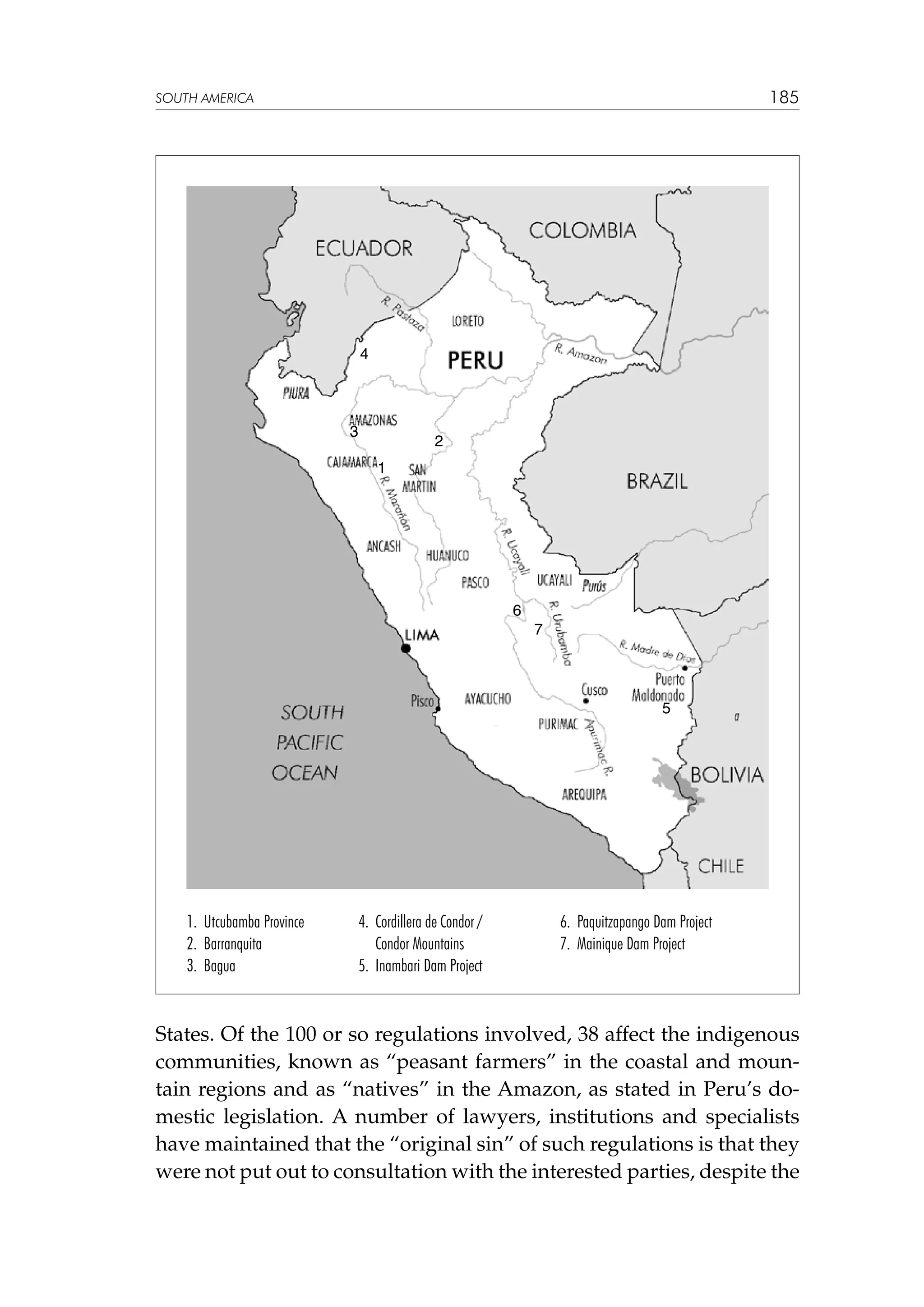
function of these pro-Uribe thinkers has been to demonstrate that the
poor are better off cooperating with the large owners as these latter
SOUTH AMERICA

141

have the knowledge and skills to develop the rural sector; a division of
labour in which some are in control and accumulate wealth so that others are able to work. This state-promoted corporatism is not new, it is
similar to that which was practised by Mussolini in Italy and Salazar in
Portugal.8

Growing disillusionment of the people
Over the last seven years in government, President Uribe has made
considerable progress in terms of strengthening his control over the
state apparatus. Not everybody is behind him, however, and although
he still retains a high popularity rating (close to 70%), there is growing
dissatisfaction among the people. Hardly surprising, given that 2009
was an especially scandalous year: “false positives”,9 corruption and clientelist practices within the state,10 enrichment of the pro-Uribe political
class, using government influence,11 denigrating and wicked treatment
of the displaced,12 insensitive handling of victims of violence13 and those
kidnapped by the guerrillas,14 increased unemployment and an economy in stagnation,15 a health system on the verge of collapse,16 uncertainty with regard to the electoral process17 and a scaling-up of the conflict with neighbouring countries (Venezuela and Ecuador) over the
seven US military bases on Colombian territory. Uncertainty is emerging once more with the consequence that we feel we have become an
unviable country and society, without any future.
In his study “La captura y reconfiguración cooptada del Estado en Colombia”, the researcher Jorge Garay states moreover that we are not going
through a post-conflict period, as the Colombian government has suggested. The narco-paramilitary structures are continuing with other
players. “There has been no counter-balance to the political establishment….as the majority of the parties are narco-para-politicians…”.18

Reasons for hope
Despite the severity of President Uribe’s political authority, he has not
managed to subordinate the whole state apparatus and there are rea-
142

IWGIA - THE INDIGENOUS WORLD - 2010

sons for hope. In the judicial branch “there are judges, magistrates and
staff […] who behave like true officials, respectful of the law and who
sometimes even heroically protect the law”.19 A substantial proportion
of the Constitutional Court’s case law20 and the actions of the Supreme
Court of Justice against paramilitarism and its state supporters are a
considerable indication of this.
In its Ruling 004 of 2009, the Constitutional Court noted that the
indigenous peoples were suffering from “alarming patterns of forced
displacement, murder, lack of food and other serious problems because of the country’s armed conflict and other underlying factors”,
giving rise to urgent situations that had received no corresponding
state response. As a result, the Constitutional Court indicated that
many indigenous peoples across the country were being threatened
“with cultural and physical extinction” and called on the state to provide an integral and effective response to the pressures that were bearing down on both the indigenous and the Afro-Colombian peoples
(Ruling 005 called for a similar response for these latter).
It is not only the Constitutional Court that has stood up for this
broken country. The Supreme Court of Justice has also taken an exemplary role in defending the rule of law, forming the only obstacle to a
state takeover by narco-para-politics. The determination of these judges
to tackle the “white collar” crime that is rife within the state apparatus
has been exemplary, with a good part of the country’s political class
being brought to justice for drugs crimes and paramilitarism (as of
September 2009, 53 Congressmen or women had arrest warrants issued against them). Initially, these Congressmen were going to be tried
for “conspiracy to commit a crime” but, in a complex jurisprudential
twist on the part of the Supreme Court, the “para-politicians will no
longer be charged with conspiracy but with ‘crimes against humanity’
because they were involved in a political project that involved the use
of force to commit atrocities. This relates to an explicit military strategy, with armies supported by social and territorial power bases, to promote a project to “reshape the nation”21 and legalise the interests of
these illegal powers, in alliance with the so-called “legal powers” of
cattle ranchers, palm oil growers, environmental resource extractors,
etc.22
SOUTH AMERICA

143

Other judges in the country took similar action to avoid the AfroColombian peoples from being dispossessed of their lands. On 5 October 2009, for example, the Chocó Administrative Court ordered nine
palm oil companies, two cattle ranches and 24 people to immediately
return land that had been taken by violent means to the black communities of Curvaradó and Jiguamiandó.23

Visit of the UN Special Rapporteur
In his visit to Colombia in July, James Anaya, the UN Special Rapporteur on the situation of human rights and fundamental freedoms of
indigenous people, described “the human rights situation of the indigenous peoples as serious, critical and deeply concerning”, just as the
previous Special Rapporteur, Rodolfo Stavenhagen, had also noted
during his visit in 2004. The testimonies heard by the Special Rapporteur from various indigenous representatives with regard to the effects
of the armed conflict confirmed the Constitutional Court’s appraisal in
its Ruling 004.
It was only to be expected, given that almost 20 years on from ratifying ILO Convention 169, the violence against indigenous peoples
has not diminished in the country. According to data from ONIC, between 2002 and 2009 1,032 indigenous people were murdered in the
country. In the year 2009, up to the end of November, 76 murders had
been recorded. One of the indigenous peoples most affected is the
Awa, who lost 35 people over the course of 2009, 11 of whom, including children, were murdered at knifepoint by the FARC. The Awa state
that this was retaliation on the part of the FARC, which believed that
soldiers from the national army were sheltering in the houses of the
indigenous people, and that indigenous people were collaborating
with them. These people are suffering a process of ethnocide because,
“The terror they suffer…and the military pressures, external territorial
control, political conditioning and economic pressures to which their
communities are being subjected […] prevent them from designing a
life plan or successfully managing their future...”24
In relation to the armed conflict, the Special Rapporteur indicated
in his report that, according to the information received from the indig-
144

IWGIA - THE INDIGENOUS WORLD - 2010

enous organisations, the illegal armed groups, mainly the FARC, were
ignoring human rights and international humanitarian law. These
groups were responsible for a large proportion of the murders and
other crimes (forced recruitment, drafting of boys and girls into the
war effort and use of land mines), which had disproportionately affected the indigenous peoples. The Special Rapporteur also stated that
these crimes had increased drastically since the last visit of Prof.
Stavenhagen.
In his report, the Special Rapporteur therefore called vehemently
on the FARC to respect the fundamental rights of indigenous peoples.
He also urged the government and armed forces not to criminalise the
indigenous Awa as “inhabitants of coca-growing and war zones” as it
was not their fault that their territory had been invaded by coca crops,
an economy that had shattered their food self-sufficiency, destroyed
their abundant environment and broken their organisations.
Notwithstanding the criticisms aimed at the Colombian state for
failing to resolve the indigenous human rights violations, the Special
Rapporteur recognised the security forces’ initiatives to promote respect for human rights, in addition to noting the positive actions taken
by President Uribe’s government, which had taken significant steps
“in health and education to improve the situation of extreme vulnerability experienced by the country’s indigenous peoples”.
Many of the social and human rights organisations criticised the
report as “biased”, given its leniency towards the Uribe government
and its sharp criticism of the FARC.

Indigenous peoples and their role in 2009
Far from being discouraged by these violations of human rights and
international humanitarian law in their communities, and by the government’s policy of encouraging illegitimate practices enabling the
violent and illegal appropriation of their territories and natural resources, and promoting parallel organisations, particularly within the
Cauca indigenous movement, the indigenous peoples have again harnessed the political and organisational potential of their communities
by means of marches, coordinating their territorial, economic, social
SOUTH AMERICA

145

and political demands with those of the black and peasant farmer communities and other popular rural sectors also affected by President
Uribe’s doctrine.
In their communiqués, the Cauca indigenous peoples, who took to
the streets once more in 2009 (for the third time during President
Uribe’s second term in office), referred to their status as an excluded
people, scorned and persecuted by a government that has classified
them as invaders for continuing to attempt the recovery of their territories (“freeing Mother Earth”) from the hands of voracious biofuel
plantation owners. This is a minga25 for life in order to continue defending the rights of the indigenous peoples, but also those of their black
and peasant farmer brothers because, by fighting this economic, legal
and political set-up that is being imposed on the country by the President, the indigenous people are raising the cause of all poor and excluded rural people. Although it is clear that the Uribe doctrine has
disrupted and/or co-opted a part of the popular movement, encouraging a homogenisation of society, it is also clear that there is a growing
movement in favour of the diversity of life (as Hölderling said, “where
there is danger, there is also salvation”). And now, on the basis of the
struggle to forge a new country, there is a concept of interculturality
emerging, in the form of a “social pact” between different groups in
order to build a democratic institutionality. It is an historic stage on
which, as Héctor Díaz Polanco says, “diversity takes on ever greater
weight”.26
This movement has the indigenous struggles against globalisation,
global warming and the destruction of systems and living spaces at its
epicentre, all with the aim of ensuring that the diversity of life does not
disappear from our planet. This is why it is also a focus of rebellion
against all kinds of domination.				


Notes and references
1	

2	

During his first and second terms in office, the Gini coefficient, a technical index
that measures the level of land concentration, increased from 0.87 to 0.91 (one of
the highest in the world. In the US it is around 0.4).
The Attorney-General’s Office stated, in a document provided to the Constitutional Court, that “There are no special policies for ethnic minorities which, to date, are
146

3	
4	
5	
6	

7	

8	

9	

10	

11	

12	
13	

14	

15	

16	

IWGIA - THE INDIGENOUS WORLD - 2010

ignored by the different programmes planned by the government…” http://realidades.lacoctelera.net/
bogota.usembassy.gov/.../wwwfseriehouston2007alejandroreyes.pdf
Nuevo Arco Iris Corporation: Informe 2009 ¿El declive de la Seguridad Democrática? http://www.nuevoarcoiris.org.co/sac/?q=node/605
Colombia: the case of the Naya. IWGIA Report No. 2. 2008, Copenhagen-Bogota.
Moderation in the use of resources and their opposition to waste and destruction is condemned by President Uribe as “running counter to national development and progress”.
Revista Cambio: “Programa Agro Ingreso Seguro ha beneficiado a hijos de políticos y reinas de belleza”. http://www.cambio.com.co/paiscambio/847/ARTICULO-WEB-NOTA_INTERIOR_CAMBIO-6185730.html
Mondragón, Héctor: “The idea of a leadership convinced of a community of
interests between landowners, state, businessmen, peasant farmers, workers
[…] was extensively implemented by the “new” Fascist Italy of Mussolini. […]
a state organisation was promoted with decision-making power over policies,
programmes and budgets and which involved everyone around the interests of
large landowners, disguised as “national interests”. http://colombia.indymedia.org/news/2009/10/108419.php
This is the term used to denote the extrajudicial murder of unemployed youth
by members of the security forces, who were deceived with promises of work.
They were later presented as fallen guerrilla combatants. The aim of these fateful events was to achieve promotion, obtain licences and gain rewards. www.
dhcolombia.info/spip.php?article434
Giving of gifts with the aim of winning Congress’s approval of constitutional
changes aimed at a possible re-election of the President. www.elespectador.
com/tags/yidispolítica
The most well-known case was that of the President’s children, who through
their influence achieved a change in land use (from agricultural to commercial)
in order to establish free trade zones, thus increasing the value of the land onehundred-fold from what they had paid three months earlier. www.eltiempo.
com/archivo/.../MAM-3408439
The negligence and reluctance to seek the return of lands to those displaced by
violence. www.elperiodico.com.co/seccion.php?codigo=0
The victims’ law, by which it was sought to compensate the victims of violence,
was rejected by the Senate, following President Uribe’s decision not to support
it. www.cinep.org.co/node/708
Government opposition to signing a “humanitarian agreement” (“we don’t negotiation with terrorists”) to free those kidnapped (including members of the
security forces) and who have been held by the guerrilla for 10 years or more.
The level of “open” unemployment (which excludes under-employment and
informal sector work) is the highest the country has ever known and also the
highest in Latin America. www.banrep.gov.co/docum/ftp/borra176.pdf
http://www.senado.gov.co/portalsenado/index.php?option=com_
content&view=article&id=1014
SOUTH AMERICA

147

17	 While the country is collapsing in an institutional crisis, the ruling class are
preoccupied with “gossip” over whether the President will run for a second reelection. www.fenalco.com.co/index2.php?option=com_content&do_pdf=1
18	 Garay, Jorge. 2009. La captura y reconfiguración cooptada del Estado en Colombia.
Editorial Método, Bogota.
19	 Mauricio García Villegas, in a letter sent to Fr. Javier Giraldo Moreno S.J, http://
www.razonpublica.org.co/?p=3022
20	 Law 1152 of 2007 or the “Rural Development Statute”, was declared unconstitutional in March 2009 (Ruling C-175) because it had not complied with the due
process of consulting the indigenous and Afro-Colombian peoples. http://
www.prensarural.org/spip/spip.php?article2067. A year previously, for the
same reason, the Forestry Law was declared unenforceable by means of Ruling
C-030 of 2008. http://www.eltiempo.com/archivo/documento/CMS-3930469
	
With Ruling 004 of 2009, the Constitutional Court has called on the government
to protect the fundamental rights of indigenous individuals and peoples displaced by the armed conflict or at risk of forced displacement. http://www.acnur.org/biblioteca/pdf/6981.pdf. And with Ruling 005, it is calling on the government to protect the fundamental rights of indigenous individuals and peoples displaced by the armed conflict or at risk of forced displacement. http:/
www.acnur.org/biblioteca/pdf/6982.pdf
21	 This decision was taken at the “Summit to reshape Colombia”, better known as
the “Santa Fe de Ralito Agreement”.
22	 In Colombia, says Garay, land is the nodal point of the war, the new war that is
being instigated by legal businessmen who are directly or indirectly benefiting
from the action of armed paramilitary groups or guerrillas to expand their economic and political power. Op. cit.
23	 Six of the nine companies mentioned by the Court are involved in criminal proceedings for land usurpation, forced displacement and conspiracy to commit a
crime. In these proceedings, a number of people witnessed that the lands were
bought with the involvement of paramilitary groups, which forced the communities to sell their farms.
24	 Terror en el Pacífico (II). www.servindi.org/actualidad/7509
25	 The term “minga” refers to the alternative and participatory political agenda of
the peasant farmer, black, mestizo and indigenous communities and the mass
mobilisations they have organised in recent years for their rights, fundamentally to land.
26	 Díaz Polanco, Héctor. 2007. Elogio de la diversidad: globalización, multiculturalismo
y etnofagia. Siglo XXI editores, Mexico.

Efraín Jaramillo is an antropologist and member of the Jenzera Work Group
(Grupo de Trabajo Jenzerá)
148

IWGIA - THE INDIGENOUS WORLD - 2010

VENEZUELA
Venezuela is a multicultural country that recognises the existence of indigenous peoples and communities. The indigenous
peoples in Venezuela are the Akawayo, Amorúa, Añú, Arawak,
Arutani, Ayamán, Baniva, Baré, Barí, Caquetío, Cumanagoto,
Chaima, E´ñepá, Gayón, Guanano, Hoti, Inga, Japreria, Jirajara,
Jivi, Kari´ña, Kubeo, Kuiva, Kurripako, Mako, Makushi, Nengatú, Pemón, Piapoko, Píritu, Puinave, Pumé, Sáliva, Sánema,
Sapé, Timoto-cuica, Waikerí, Wanai, Wapishana, Warao, Warekena, Wayuu, Wotjuja, Yanomami, Yavarana, Ye´kuana and Yukpa.
Of the country’s 26 million inhabitants, 2.2% are indigenous.
The 1999 Constitution recognised the country’s multi-ethnic
and pluricultural nature for the first time and includes a special
section devoted to indigenous rights. It opens up opportunities
for indigenous political participation at national, state and local
level. In 2001, the Law on Demarcation and Guarantee of Habitat and Lands of Indigenous Peoples came into force; in 2002
ILO Convention 169 was ratified; in 2005, the Law on Indigenous Peoples and Communities expanded and consolidated
this framework of rights.

Regulatory and institutional progress

T

en years of the Hugo Chávez government were celebrated in 2009,
and the National Constitution was enacted. According to the indigenous MP, Noelí Pocaterra, “52 laws indirectly restore indigenous
rights and six instruments directly benefit them”.1 The Law on Cultural Heritage of Indigenous Peoples and Communities and the Law
on Indigenous Craftsmen and Women were also enacted in 2009. In
addition, discussions and consultations commenced around the draft
149

SOUTH AMERICA

2 4

3

5
1

6

1. Autana Mountain
2. Sierra de Perijá

3. Palital area
4. Machiques

5. Aura River Basin
6. Alto Orinoco

Law on Coordination between the Special Indigenous Jurisdiction and
the National Judicial System. These legal instruments represent a series of regulatory advances that have been transferring the government’s pro-indigenous rhetoric into concrete legislation.
The recognition of Venezuelan society as multi-ethnic and pluricultural was an historic break with the former model of a socially and
culturally homogeneous country in which diversity was invisible. This
model played down the ideological differences within “national society” and, up to 1999, it was replicated by the state apparatus and sus-
150

IWGIA - THE INDIGENOUS WORLD - 2010

tained by an ethnocidal legal framework that attempted to “incorporate” the ethnic minorities via their gradual “civilisation”.
The country’s new model forms an unprecedented challenge for
the state, which is now required – by means of an inherited institutional apparatus that was developed by the previous model – to produce public policies that are respectful of the socio-cultural diversity
and adapted to the specific features of all social groups within the nation. Cultural barriers form the most complex challenge, as there is
little understanding of social and cultural factors stemming from the
knowledge, actions and practices of the indigenous peoples.
The new political and legal context has favoured the involvement
of indigenous representatives in arenas of power and in elected political posts, something unprecedented in the country’s history. The government institutions have been adapting to the new regulations, setting up offices to design and implement public policies aimed at the
indigenous population, according to their specific responsibilities.
Most of these bodies are headed by indigenous people.
Despite these important achievements, however, progress in implementing these regulations has been limited and the practical results
ambiguous, given the difficulties civil servants have in creating interculturally focused policies. To this must be added a lack of coordination among the indigenous movement itself and its failure to produce
an agenda to guide the design of government policies.
In addition, despite the government’s efforts to generate alternatives to the inherited model, it continues to focus on a developmentalist economic model based on natural resource exploitation. This creates conflicts with the population living in areas of high mining, logging, agro-industrial or geostrategic potential.

The Ministry of Popular Power for Indigenous Peoples
Created in 2007 as the “guiding body and coordinator of government
policies in indigenous affairs”,2 the Ministry for Indigenous Peoples
(MINPI) is in fact being run simply to provide immediate assistance as
a palliative to both current and structural problems. It is backed up by
a torrent of financial resources but lacks any strategic vision with which
SOUTH AMERICA

151

to guide the design and implementation of public policies. Tasks, efforts
and resource investments are duplicated, and there is little inter-institutional coordination, on top of which crucial issues such as land demarcation are overlooked. Ignoring the vision of the communities themselves
when seeking to resolve their problems, it has been implementing
projects of no cultural relevance such as house and infrastructure construction, medical operations, food distributions, personal equipment
and vehicles, and the allocation of salaried posts and financing. This has
simply forged stronger clientilist relationships for electoral purposes,
diminishing local leaderships and causing division and conflict.
One clear example of MINPI’s failure to connect with the traditional
indigenous authorities can be seen in the case of a permit granted by the
ministry authorising the Russian Alpine Federation to climb Autana
Mountain (Autana municipality, Amazonas State), a mountain sacred to
the Wotjuja (Piaroa) and Jivi peoples. The Russian climbers arrived at
their base camp but the Piaroa prevented them from making the ascent.
The Piaroa people and their Council of Elders complained to the District
Attorney’s Office and the Ombudsman. At the request of these bodies, a
court passed protective measures over the sacred Autana Mountain in
favour of the Piaroa people, in order to avoid violating their right to
protect their sacred and religious places.3 Ignoring this decision, the
Russian Alpine Federation appealed to President Chávez and MINPI,
which then issued a new permit subject to the prior consultation of the
Piaroa. These latter held a number of meetings at which they stated their
disagreement and, finally, the Indigenous Organisation of United Piaroa
of Sipapo – Territory of the Four Rivers (OIPUS) held an assembly in
December, at Caño Uña, with representatives from the communities of
the four rivers of Autana municipality and the Piaroa Council of Elders,
at which they categorically rejected the new request.4

The indigenous movement
When Hugo Chávez came to power, the indigenous organisations initially dropped their agenda of protest and their demands for their
rights, and their organisations thus lost much of their capacity for organisation and mobilisation. Many of their leaders took positions
152

IWGIA - THE INDIGENOUS WORLD - 2010

within state departments, and followed the government line. A decade
on, however, lack of concrete progress in implementing effective public policies has led to discontent among the grassroots communities,
within the indigenous movement and among the leaders themselves.
This situation was discussed in May 2009 by the National Indian
Council of Venezuela (CONIVE) at a meeting organised by the Regional Organisation of Indigenous Peoples of the Amazon (ORPIA), where
they recognised that;
For the 10 years following approval of the Bolivarian Constitution, the
indigenous movement offered its sustained support to the processes of
change from within its own organisational spaces and from the posts occupied by indigenous leaders in the national, regional and local governments. Despite the gains that these political spaces represent, the indigenous movement has been demobilised, without any concrete protest agenda, with little independence, split, divided and, in some cases, in confrontation. The indigenous movement recognises the need to take up its own
agenda once more, in line with the progress in implementing recognised
rights (...), particularly the right to environment and indigenous lands.5

Land demarcation
The process of demarcating indigenous lands is at a virtual standstill,
demonstrating the government’s lack of will to respond to this important demand. The criteria followed by the National Demarcation Commission (CND) restrict indigenous rights by avoiding self-demarcation, issuing plot titles to communities without recognising the entire
territories of peoples, and recognising the rights of third party landowners and mining and logging concession holders over and above
ancestral indigenous rights. In Amazonas, Bolívar, Delta Amacuro and
Zulia states – the regions with the greatest and most diverse indigenous population - there has been almost no progress.
From 2005 to 2009, 40 collective property titles were granted representing a total of 1,000,516 hectares and benefiting 73 communities.
This covers 3% of the 2,295 indigenous communities in the country. At
SOUTH AMERICA

153

an average rate of 14.6 communities per year, the titling process could
take 150 years to complete.
On 12 October, Day of Indigenous Resistance, the national government celebrated in the Sierra de Perijá by delivering four collective
property titles to the Aroy, Shirapta and Tinacoa sectors of the Yukpa
people (Sierra de Perijá, Zulia state) representing a total of 41,630 hectares, and to the Palital community of the Kari´ña people (Anzoátegui
state)6 for an unknown area.
On 23 October, Chief Kari´ña José Luis León of the Palital community submitted a document to the courts complaining about irregularities in the “Property Title”. His complaint can be summarised in three
points: 1. The areas approved by the community assembly and agreed
with the Regional Demarcation Commission were not respected; 2. The
rights of third parties were recognised within the demarcated zone; 3.
Sergio Rodríguez, Vice-minister for Territorial Ordering within the Ministry for the Environment, was directly responsible for these irregularities.7 Finally, he requested that “the Executive Power, Public Defence,
Ombudsman and the Supreme Court of Justice take all administrative or
legal measures within their power to obtain a revision of the document
content as reflected in the title.”8 Following this complaint, José Luis
León has been subjected to harassment from the National Guard.9
This lack of guarantees over their territories is, for example, enabling the lands of the Pemón people in Santa Elena de Uairén to be
invaded by around 300 settlers, who have been granted provisional
occupation permits by the local authorities. This unlawful situation led
to a conflict of ownership that ended in a clash between the indigenous
people and the invaders in October 2009.10

Meeting on Demarcation of Indigenous Territories and
Environment
On 30 November and 1 December, at the campus of the Bolivarian University of Venezuela (UBV), a meeting was held that was attended by
a large number of indigenous chiefs and leaders, along with representatives of government institutions. As a result of the event, a press release was published that stated;
154

IWGIA - THE INDIGENOUS WORLD - 2010

We are fighting for demarcation because nothing has yet been resolved.
We are pursuing this dream and we still cannot sleep peacefully (…) The
titles we are being given are an attempt to deceive us. We continue to
sleep ill because of this deception since it means that estate owners, cattle
ranchers, mining and logging companies, recognised as “third parties”,
remain a danger. They can’t kill us but they pay others to do so and so our
sons and daughters also cannot sleep in peace.
We reject the fact that they consider us invaders on our own lands.
Most of the “third parties” do not actually have any rights, they are simple occupiers and, with these demarcations, what they are doing is legalising their occupation. This is why we are calling for a land regularisation
because those who are called “third parties” are actually invaders.11
The press release demanded: a) the removal of the president and other
members of the CND and the Regional Commissions; b) effective implementation of indigenous peoples’ right to participate in the demarcation process and allocation of the necessary resources to do so; c)
respect for the right to be informed about the process in their own languages; d) correction of the errors made in the demarcations and
titlings; e) approval of the self-demarcations undertaken by the indigenous peoples themselves; f) issuing of a title for each indigenous people, covering all the communities or sectors without dividing them; g)
respect for the boundaries indicated in the self-demarcation, refraining
from recognising third-party rights and resource exploration and exploitation concessions; and h) issuing of titles only following prior approval of the final text by the indigenous people at an assembly conducted by the legitimate authorities and using indigenous languages.
Creation of the Indigenous Rights Watchdog
The “José Manuel Romero” Indigenous Rights Watchdog was established
in April 2009 by students and lecturers from the UBV, along with social
activists and communities motivated to come together and systematically
support indigenous demands by monitoring the situation and increasing
their visibility with the general public and relevant authorities.12
SOUTH AMERICA

155

The organisation has initially developed a pilot project with the indigenous Yukpa communities of Sierra de Perijá, making field visits to
the area in order to conduct a situation assessment; organising training
workshops and seminars on human rights, indigenous rights and territorial demarcation; and making proposals to the Venezuelan state
aimed at guiding implementation of the Yukpa people’s rights.13

The Yukpa case
Previously displaced from the foothills of the mountains towards the
Sierra de Perijá by cattle ranchers, the Yukpa began the recovery of
their lands in the 1970s by occupying some of the large estates. Since
then, they have been subjected to harassment from the cattle farmers
- with the support of the Armed Forces and paramilitary groups aimed at removing them from the lands they have been recovering.14
However, “the conflict is not limited to clashes between cattle farmers
and indigenous people as there are also peasant farmers in the mountains with relatively small plots, Colombian refugees, guerrillas and
paramilitaries who cross the border without any difficulty,”15 along
with the threat, albeit latent, of coal and other mining projects.
The conflict came to a head in 2008 when the Yukpa invaded a
number of estates and the cattle ranchers, via the use of unlawful
armed groups, threatened and attacked members of the different communities. The Army and the National Guard intervened, terrorising
the indigenous people,16 particularly Chief Sabino Romero Izarra, his
family and other members of the Chaktapa community.17
Because of this, on 24 August 2008, President Chávez declared: “Let
there be no doubt: between estate owners and Indians, this government
sides with the Indians. Justice for Indians! Land for Indians!”18 and, on
12 October that same year, he announced the “Yukpa Integrated Plan”
which envisages implementing 34 projects, includes resources for the
land demarcation process and involves ten ministries.19
According to the Indigenous Rights Watchdog, implementation of
the Plan has in practice been characterised by a lack of cultural adaptation, the imposition of projects without prior consultation or due information, and the exclusion of the traditional Yukpa authorities from the
156

IWGIA - THE INDIGENOUS WORLD - 2010

decision-making, which has led to processes of forced assimilation, internal conflict and divisions.20 The demarcation of the Yukpa territory
began in November 2008 but the Regional Demarcation Commission
for Zulia State excluded the indigenous peoples from the process, refused them access to information and ignored the self-demarcation
submitted by the Yukpa in 2004.21
On 10 March 2009, a National Meeting for the Demarcation of the
Yukpa-Barí Lands in Zulia State was organised by the Homo et Natura
Society and, at that meeting, peasant farmers, cattle ranchers and indigenous peoples agreed to resolve their differences and conflicts
peacefully. Unfortunately, there were no representatives from the CND
in attendance. The Association of Machiques Cattle Ranchers and the
Peasant Farmer Revolutionary Front agreed to withdraw from the indigenous lands on the condition that the government provide them
with due compensation and appropriate payment.22
On 12 October, collective property titles were issued to three sectors
of the Yukpa people: Tinacoa, Aroy and Shirapta, benefiting 33 communities. Four sectors remain outstanding: Toromo, Neremü, Khasmera
and Tokuko. This is because their leaders reject the government proposal, believing that it reduces the area of their territory, and because
they want one single demarcation for the whole Yukpa territory.23

Criminalisation of Chief Sabino Romero Izarra
The climate of tension that arose around the Yukpa land demarcation
process resulted, on 13 October, in a clash between the families of Chief
Olegario Romero from the Guamopamocha community and Chief
Sabino Romero from the Chaktapa community, resulting in two deaths
and three people injured, including Chief Sabino Romero Izarra himself.24 The following day, support group members took him to the
Coromoto de Maracaibo Hospital but, shortly afterwards, without any
court order, a military contingent transferred him to the Maracaibo
Military Hospital.25 He remained there incommunicado until 16 October when, thanks to pressure from the Yukpa and their support groups,
Sabino was able to speak to his lawyers.
SOUTH AMERICA

157

On 15 October, four Chaktapa residents, including Sabino’s daughter, were arrested in Machiques town as they were preparing to make
a complaint about the aggression against them two days previously.26
On 21 October, Sabino was moved to the First Infantry Division in
Maracaibo and, two days later, was taken before the court, along with
Alexander Fernández (arrested on the 15 October in Machiques). The
next day, Judge Judith Rojas ordered that the accused be held on remand for crimes of murder, conspiracy against the Venezuelan state,
cattle rustling and bodily harm. Their defence lawyers claimed a conflict of competence, and that the case should be heard by an indigenous
jurisdiction, but the request was dismissed.27 Since then they have been
held incommunicado at the Macoa Military Fort in Machiques de Perijá under conditions that are in violation of their human rights. Chief
Sabino Romero fears there is a plan to discredit him by linking him to
violent groups involved in drugs trafficking so that he can be eliminated in a faked escape.28
Ricardo Colmenares, defence lawyer, states that “from the very
start, they have failed to respect minimum procedures laid down by
the Venezuelan legal system and the rights enshrined in our constitution by depriving Sabino Romero Izarro and his family of their freedom, hindering his legitimate defence, subjecting him to interrogation
without the presence of a lawyer, harassment, psychological torture
and terror”.29 In addition this has been in violation of the legal code
governing indigenous issues and the special indigenous jurisdiction,
which gives these defendants the right to be judged by the Yukpa people’s own system of justice.30
According to Lusbi Portillo, from Homo et Natura Society “they
are seeking to criminalise Sabino (…) in order to obtain his removal
once and for all from the struggle for land and dignity. Unfortunately, the national government and cattle farming oligarchy are
agreed in their aims. They have proceeded against Sabino Romero
Izarra, the clearest and most consistent spokesperson for the Yukpa
people (…) in the hope of thus breaking the resistance of all the
other communities.”31
158

IWGIA - THE INDIGENOUS WORLD - 2010

Mining in the Alto Caura
The Caura River basin (Bolívar State) is one of the most pristine and biologically intact areas of Venezuela. It comprises 4.5 million hectares of
tropical rainforest and is unique in its biological megadiversity, its cultural diversity and its high water production. Since 2006, illegal miners
have been invading it in search of gold, destroying ecosystems and affecting the indigenous Ye´kuana, Sánema and Hoti communities. According to anthropologist Nalúa Silva from the National Experimental
University of Guayana (UNEG), many of these miners came from Paragua (Raúl Leoni municipality) following their eviction by the government in 2006, and from Brazil following recognition of the “Raposa
Serra do Sol” indigenous lands.32 The Caura River basin is covered by
five environmental protection concepts, and ancestral indigenous lands
that were self-demarcated some years ago although they are still awaiting the collective property title. The indigenous Kuyujani, along with
representatives from environmental NGOs and UNEG, have been complaining about the displacement of indigenous communities, the destruction of ecosystems and the complicity of the soldiers who are responsible for safeguarding the area, but the national government has
failed to take any real, effective or sustained measures to prevent the
serious impacts on the indigenous communities and the environment.

Health
The Indigenous Health Department (DSI) of the Ministry of Health is
working to adapt its services and programmes to the specific needs of
indigenous peoples, and significant progress is being made. And yet
these people continue to be the least attended sector and continue to
suffer the worst health conditions in the country.33
One important experiment has been the implementation of Services of Care and Guidance for Indigenous Peoples (SAOI) at indigenous
peoples’ main referral hospitals. These services seek to improve the
quality of care for indigenous peoples by means of bilingual intercultural facilitators who support the patient, mediating with the health
SOUTH AMERICA

159

professionals, serving as interpreters and facilitating the help they
need within the institution. In 2009, there were 25 SAOI operating in
hospitals located in indigenous areas and in the country’s capital.
The Yanomami Health Plan began in 2005 and seeks to expand sustainable and culturally appropriate health services to 80% of the
Yanomami population (Amazonas State), who have been historically
under-attended or even completely overlooked in terms of health provision.34 The logistical challenges are significant in this regard and the
extensive air support of the Armed Forces has been decisive in the success of this plan.
Although these examples are evidence of health policies that are
well-targeted at indigenous peoples’ care, the DSI has been experiencing budget cuts for a number of years now, and this has diminished its
capacity for action and affected the quality of its services. The Yanomami Health Plan is now virtually at a standstill for lack of money.
In October, there was an outbreak of fever, cough and breathing
difficulties among Yanomami communities of the Alto Orinoco, Amazonas State. The cases tested positive for influenza A (seasonal) and
AH1N1, and resulted in 8 deaths and 2,000 more infections. The Ministry of Health immediately quarantined the area, increased the number
of health workers, took samples and treated those affected and their
contacts, thus managing to contain the spread with no further deaths.
The Yanomami health agents played an essential role in this as part of
the epidemiological monitoring system and in caring for patients.
It is suspected that the disease may have been picked up at La Esmeralda where, on 10 October, a conference on medical care was organised by MINPI. A large number of Yanomami came into contact
with people from the state capital and the interior of the country at this
event. Two days later, a sports day was organised by the Alto Orinoco
council in a nearby community. This again brought together large
numbers of indigenous peoples and may have added to the spread of

the infection. 35						

Notes and references
1	
	

Agencia Bolivariana de Noticias, 18.12.09.
<http://www.abn.info.ve/noticia.php?articulo=212432&lee=4>
160

2	
3	
4	
5	

6	
7	
8	

9	
10	
	
	
11	
12	

13	
14	
15	
16	
17	
18	
19	
20	
21	
22	
23	
24	
25	
26	
27	
28	
29	
30	

IWGIA - THE INDIGENOUS WORLD - 2010

<http://www.minpi.gob.ve/web/es/quienes-somos-mainmenu-59>
CRBV, Article 121.
Communication from OIPUS to Minister Maldonado on 10.12.09 and Minutes
of OIPUS Assembly on 27.12.09.
Meeting at Tobogán de la Selva, 28 and 29 May 2009. CONIVE and its regional
affiliated organisations (ORPIA, ORPIAZ, FIB, CORPIA, Regional Organisation
of the Indigenous Peoples of the Delta Amacuro). Mimeo.
El Universal, 13.10.09.
ElPuebloSoberano.net, 27.10.09.
Consideraciones de nuestro derechos constitucionales, de la Ley Orgánica de
los Pueblos y Comunidades Indígenas, respecto al contenido del título de propiedad colectiva de hábitat y tierras de la comunidad indígena kariña de Palital,
municipio Independencia del estado Anzoátegui, adjudicado en fecha
11/10/2009 y la línea de inclusión que dicta el Presidente Chávez. Palital, October/2009. Mimeo. <http://www.elpueblosoberano.net/?p=4726>
Tatiana Arcos, pers.comm.
Correo del Caroní, 15.10.09. Online:
<http://venezuela.indymedia.org/fr/2009/10/25168.shtml>,
<http://www.correodelcaroni.com/content/view/138116/149>
Ultimas Noticias, 03.12.09. <http://www.medioscomunitarios.org/pag/index.
php?id=33&idn=11979>, <http://www.aporrea.org/ddhh/a91176.html>.
Activity report of the “José Manuel Romero” Indigenous Rights Watchdog
(April-August 2009). UBV Zulia, Legal Studies Programme. Mimeo. <http://
www.aporrea.org/poderpopular/a84580.html>
<http://www.aporrea.org/poderpopular/a84580.html>
PROVEA. 2008. Situación de los Derechos Humanos en Venezuela: Informe anual oct.
2007-sep. 2008. P. 158.
El Nacional, 12.10.08.
PROVEA. 2008. Situación de los Derechos Humanos en Venezuela: Informe anual oct.
2007-sep. 2008. P. 159.
PROVEA. 2009. Situación de los Derechos Humanos en Venezuela: Informe anual oct.
2008-sep. 2009. P. 118.
Aló, Presidente Programme N° 318, in Ultimas Noticias, 11.10.09.
Activity report of the “José Manuel Romero” Indigenous Rights Watchdog
(April-August 2009). UBV Zulia, Legal Studies Programme. Mimeo.
Idem.
Idem.
PROVEA. 2009. Situación de los Derechos Humanos en Venezuela: Informe anual oct.
2008-sep. 2009. P. 117-8.
Últimas Noticias, 11.10.09.
El Nacional, 15.10.09.
<http://www.elpueblosoberano.net/?p=3787>
<http://www.elpueblosoberano.net/?p=3820>
<http://www.elpueblosoberano.net/?p=4490>
<http://www.elpueblosoberano.net/?p=7423>
<http://www.elpueblosoberano.net/?p=4175>
CRBV, Article 260.
SOUTH AMERICA

161

31	 <http://www.elpueblosoberano.net/?p=4310>
32	 El Progreso, 17.05.09.
33	 Freire, G. 2007. Salud Indígena en Venezuela, vol. 1. Caracas: Ministry of Health.
p. 14.
34	 Kelly and Carrera. 2007. “Los Yanomami” in: Salud Indígena en Venezuela, vol. 1.
Caracas: Ministry of Health. p. 371.
35	 http://culturaysalud.blogspot.com/2009/11/acerca-de-los-casos-ah1n1-enamazonas-2.html

Aimé Tillett is a member of the Association for the Multi-ethnic Human
Development of the Amazon (WATANIBA) and has been involved in the Indigenous Health Department of the Ministry of Health since 2003. In association with Luis Bello, María Teresa Quispe, Tatiana Arcos and Carlos Botto.
162

IWGIA - THE INDIGENOUS WORLD - 2010

SURINAME
Indigenous peoples in Suriname number 18,200 people, or approximately 3.7% of the total population of 492,0001 (census
2004/2007), while an additional 2-3,000 live in neighboring
French Guiana after fleeing the “Interior War” in the late 1980s.
The four most numerous peoples are the Kali’ña (Caribs), Lokono (Arawaks), Trio (Tirio, Tareno) and Wayana. In addition,
there are small settlements of other Amazonian indigenous peoples in the south-west and south of Suriname which, however,
now consist of only a few families, including the Akurio, WaiWai, Katuena/Tunayana, Mawayana, Pireuyana, Sikiiyana,
Okomoyana, Alamayana, Maraso, Sirewu and Sakëta. The
Kali’ña and Lokono live mainly in the northern part of the country and are sometimes referred to as “lowland” indigenous peoples, whereas the Trio, Wayana and other Amazonian peoples
live in the south and are referred to as “highland” peoples.
The legislative system of Suriname, based on colonial legislation, does not recognize indigenous or tribal peoples. Suriname is the only country in the Western Hemisphere without
any legislation on indigenous peoples’ land (and other) rights.
This forms a major threat to the survival, well-being and respect
for the rights of indigenous and tribal peoples in Suriname, particularly with the rapidly increasing attention on the many natural resources of Suriname (including bauxite, gold, water resources, forests and biodiversity). The main indigenous organization in Suriname is Vereniging van Inheemse Dorpshoofden in
Suriname (VIDS; Association of Indigenous Village Leaders in
Suriname), which unites the traditional authorities of indigenous villages from all over the country. Other indigenous organizations are the Organization of Indigenous Peoples in Suriname (OIS) and Sanomaro Esa.
SOUTH AMERICA

163

The Interior

A

dministratively, Suriname is divided into ten districts but, geopolitically, a distinction is made between the capital Paramaribo, other coastal areas and “the Interior”. More than half of the total
population lives in Paramaribo, which has all major public services.
Most other coastal areas also avail of utilities such as electricity,
mostly derived from the Afobakka hydro-electricity power plant in
the district of Brokopondo, and running water. The Interior however, can only be reached by dust roads, rivers or small air planes,
often lacks electricity and running water, has inferior medical and
educational services and facilities, and telecommunications are only possible in some areas, provided by cell phone companies. “The
Interior” is not a circumscriptive geographic area (although it does
164

IWGIA - THE INDIGENOUS WORLD - 2010

overlap largely with the districts of Sipaliwini, Brokopondo, Para
and Marowijne) but is used to refer to all places inhabited traditionally by either indigenous peoples (“Amerindians”) or Maroons
(”Bushnegroes”). Maroons are tribal peoples, descendants of West
African slaves who were able to fight themselves free from slavery
and who established communities in the forests, helped to do so by
the indigenous peoples in the 17th and 18th centuries. There are six
distinct Maroon peoples, namely the Saamaka, Aucanisi, Paamaka,
Aluku, Matawai and Kwinti. Just like the indigenous peoples, they
live mostly tribally, dependent on the forests in the Interior, but
with growing numbers in urban areas. Most if not all, of the challenges that indigenous peoples are confronted with in relation to a
lack of recognition of rights are also encountered by the Maroons.
There is therefore a close cooperation between indigenous peoples
and Maroons on the issues of land rights, other collective rights and
the demand for better development opportunities.

The political environment
Parliamentary and district-level elections will be held in May 2010.
Important changes are expected from these elections. In 2008 and
2009, the Association of Indigenous Village Leaders in Suriname
(VIDS) undertook a thorough analysis of the participation of indigenous peoples in national politics and considered options for participating (or not) in the upcoming elections, particularly in light of
the limited but potentially crucial voting power of indigenous peoples, who live all over the country, in various districts. Based on this
analysis, VIDS established an Indigenous Commission to conduct
an analysis of political parties that respect the rights and interests of
indigenous peoples, and that might offer favorable cooperation.
The commission evolved into the ‘Verenigd Politiek Platform’ (VPP;
United Political Platform) and is, at the time of the writing this article, about to sign a cooperation agreement to participate in the upcoming elections with a specific political party that does respect
basic principles, namely cooperation on the basis of equality, maintenance of the indigenous peoples’ identity and respect for interna-
SOUTH AMERICA

165

tionally recognized indigenous peoples’ rights, now and after an
eventual electoral victory.

Disrespect for indigenous peoples’ rights
2009 saw a continuation of the government’s failure to respect indigenous peoples’ rights in Suriname, even in spite of binding rulings from the Inter-American Court of Human Rights2 and clear
“Concluding Observations” from the Committee on the Elimination
of Racial Discrimination (CERD)3 Among others, land rights continue to be violated through the allocation of natural resource exploitation concessions on indigenous land to third parties, and
large-scale “development” projects are being initiated and implemented without meaningful consultation of the indigenous and
tribal peoples that are substantially affected by these projects. Particularly concerning have been the project “Support to Sustainable
Development of the Interior” (SSDI), funded by the Inter-American
Development Bank (IDB), and the development and submission of
a Readiness Project Identification Note (RPIN) and, subsequently,
the Readiness Project Proposal (RPP) for requesting REDD readiness funds from the World Bank. In both cases, indigenous and Maroon communities and organizations were not properly consulted,
even though these initiatives represent far-reaching and long-term
programs that will impact on indigenous peoples’ rights, lives, cultures and existence. Neither the government nor the IDB or World
Bank responded concretely to the concerns repeatedly voiced by
VIDS and VSG (Vereniging van Saramaccaanse Gezagsdragers – Association of Saramacca Authorities).
Various villages were confronted with individuals or private
companies that had received titles for resource exploitation on indigenous lands. Due to the fact that indigenous territories are not
formally recognized in Surinamese legislation, the government issues various kinds of licenses in areas that are considered state “domain”. This leads to repeated conflicts and protests. In 2009, a formal petition was submitted by VIDS and the indigenous community of Maho (Saramacca District) to the Inter-American Commis-
166

IWGIA - THE INDIGENOUS WORLD - 2010

sion on Human Rights (IACHR) requesting an investigation and
measures against the violation of the rights of the Maho community,
including to its ancestral lands and territories. This community has
particularly suffered from many breaches of its territorial and other
rights, and domestic petitions, protests and even a hunger strike
have not resulted in any protective or corrective measures from the
government. A similar petition was submitted and accepted (considered admissible) by the IACHR in 2007 regarding an infringement of the rights of indigenous communities in the Lower Marowijne River region. Recommendations from the Commission to the
government on the Lower Marowijne case are expected shortly.
Another very troublesome matter that threatens many if not all
indigenous and Maroon communities in Suriname is that of contaminated water. Almost all creeks and rivers in Suriname are being
polluted by (illegal) small-scale gold mining, which uses mercury.
Mercury is used to bind gold deposits but is dumped into creeks
and rivers after use, or evaporates into the air after burning off the
gold amalgamate. Research and also practical evidence have shown
abnormally high concentrations of mercury in the bodies of villagers who depend on creeks, rivers and rainwater for their water
source. This is already having detrimental effects on the health of
many communities. There are no structural measures being taken
against this pollution, which has already existed for many years
and continues to grow as a problem, since there are many gold deposits all over the country.
In 2009, several indigenous villages were also confronted with
other forms of water pollution, causing the deaths of at least two
persons, probably due to bacterial or viral contamination of the well
water or creeks. Education and health facilities in indigenous communities continue to be very substandard and inadequate; the same
is true for all other governmental responsibilities, including safe
water, employment and entrepreneurial opportunities, transport,
telecommunication and access to justice.
Climatic disturbances have also hit Suriname. Apart from the
changes in and unpredictability of the usual rainy and dry seasons,
flooding again hit parts of Suriname in 2009, including the village
of Galibi in East Suriname.
SOUTH AMERICA

167

The indigenous peoples’ movement
The Association of Indigenous Village Leaders in Suriname (VIDS)
has its technical bureau in the capital, Paramaribo, and has regional
working arms in the form of regional coordinating bodies. The main
thematic areas that VIDS works in, through the implementation of
its multi-annual program, are land and other collective rights;
strengthening of the traditional authority system; support to autonomous sustainable community development; strengthening of
socio-political participation; and promoting intercultural education. Apart from the work with the Maho and Lower Marowijne
cases described above, some significant initiatives in 2009 were the
development of village regulations in various regions, the development of a participation protocol (based on the principles of free,
prior and informed consent), a review of the implementation of international standards on protected areas in indigenous territories,
and awareness raising on bilingual, intercultural education in indigenous villages.


Notes and references
1	

2	
3	

The population is ethnically and religiously highly diverse, consisting of
Hindustani (27.4%), Creoles (17.7%), Maroons (“Bushnegroes”, 14.7%), Javanese (14.6%), mixed (12.5%), indigenous peoples (“Amerindians”, 3.7%) and
Chinese (1.8%). At least 15 different languages are spoken on a daily basis in
Suriname but the official language is Dutch while the lingua franca used in
informal conversations is Sranan Tongo (Surinamese).
http://www.corteidh.or.cr/docs/casos/articulos/seriec_172_ing.pdf
http://www.unhcr.org/refworld/type,CONCOBSERVATIONS,,SUR,,0.
html

Max Ooft is Policy Officer at the Bureau of the Association of Indigenous
Village Leaders in Suriname (Bureau VIDS). He was the Regional Secretary and also interim Executive Secretary of the International Alliance of
168

IWGIA - THE INDIGENOUS WORLD - 2010

Indigenous and Tribal Peoples of the Tropical Forests during the 1990s. He
has continued to work, when required, as technical assistant for this organization as well as for the Coordinadora de Organizaciones Indígenas de
la Cuenca Amazónica (COICA), and has also worked for the Secretariat of
the UN Permanent Forum on Indigenous Issues to design and deliver a
training module for UN Staff on indigenous peoples’ issues. From 2002 –
2008, he worked for the United Nations Development Programme (UNDP) in Suriname. He holds a doctorandus (drs) in medical sciences and a
Master’s in Business Administration (MBA).
169

SOUTH AMERICA

ECUADOR
Ecuador’s total population numbers some 13,406,270 inhabitants, with 14 indigenous nationalities or peoples and Afro-descendant peoples affiliated in a series of local, regional and national organisations representing more than 1.5 million inhabitants. In the Central North Amazon, within the boundaries of the
Yasuní National Park, two indigenous peoples are living in voluntary isolation: the Tagaeri and the Taromenane. One and a
half years since the approval of the Constitution, and with the
country now a “...constitutional social, democratic, sovereign,
independent, unitary, intercultural, plurinational and secular
state of law and justice”, the relevant legal and institutional reforms in this regard are moving forward slowly, coming up
against a number of difficulties and stumbling blocks linked –
among other things – to a clash of visions between a large part
of the indigenous movement, represented by the Confederation
of Indigenous Nationalities of Ecuador (CONAIE), and the government of President Rafael Correa, whose main challenge is to
achieve the objectives of the “National Plan for Good Living”.

T

here were at least two broad areas of tension over the period in
question: on the one hand, the complex transition from a uninational to a plurinational state and, on the other, the persistence of an
extractivist economic model that has consequences for indigenous
peoples’ territories. In both cases, the fact that President Correa’s government has prioritised a national/popular approach seems paradoxically to have subordinated or overlooked the historic demands of the
indigenous nationalities, which include control over and legalisation
of their ancestral territories and lands, along with full exercise of their
rights as subjects of law, as enshrined in the 2008 Constitution. This
170

IWGIA - THE INDIGENOUS WORLD - 2010

constitution allows them to exercise a “different form” of citizenship
by establishing autonomies and permits them the right of self-determination within the unitary state.
How were these disagreements and misunderstandings between a
government with a nationalist and integrationist approach of expanding extraction activities and an indigenous movement seeking to develop its territories through the full exercise of its economic, social,
cultural, political and territorial rights manifested? We can identify at
least three moments over the past year in which there seemed to be an
alternation between distancing and rapprochement without, in the
end, any clear conclusion being reached: a first moment of tension
marked by the demonstrations against the Mining Law and the disagreements around the laws on water, popular participation, food sovereignty, decentralisation and territorial organisation, bilingual intercultural communication and education; a second moment linked to the
establishment of mechanisms for dialogue that sought to channel and
process differences around issues arising during first moment of tension; and a third moment of virtual breakdown, when the government
continued to implement its extractivist timetable despite the reservations and demands of the organisations, who were calling for a moratorium and for an agreement to be reached.
It should be noted, moreover, that while in political terms the Alianza País governing party was consolidating its control over the state
apparatus in order to promote the package of reforms, there was at the
same time a growing concentration of power in the Head of State,
which created difficulties within the party and the leftwing block of
allies that was in place from mid-2006 to the end of 2008, when the
referendum approving the Constitution was held. According to Alberto Acosta, former President of the Constituent Assembly and previously one of the regime’s strong men, “…this constant ambiguity between social movement and corporativism is preventing him (Correa)
from understanding that a social movement is not a corporate organisation. And he is not capable of sitting down at a table to discuss the
process of shared common hopes so that we can move forward together without the need to hand out posts and privileges. In three years, he
has demonstrated that he does not have the will, he is not prepared to
171

SOUTH AMERICA

6

1

2

4
3

1. Yasuní National Park
2. Shyri Mining Project

5

3. Macara Mining Project
4. Bella María Mining Project

5. Monterrey Mining Project
6. Pungarayaku Oil Field

do it and he will continue to consolidate a highly personalised, extremely vertical power with authoritarian and Messianic overtones”.1

End of the romance: discord around mining and oil
With the honeymoon period following the design and approval of the
Political Constitution over, a time of disagreement began with the indigenous mobilisation against the draft Mining Law being promoted
by the government, a law that was provisionally approved by the Legislative Commission. This also led the indigenous organisations –
headed by CONAIE – to announce that they would be submitting a
legal appeal for unconstitutionality. The protests began in the southeast of the country, in the border province of Zamora at the start of
172

IWGIA - THE INDIGENOUS WORLD - 2010

January and subsequently lasted for four days, ending on 21 January
having included the partial closure of roads and a hunger strike. They
involved primarily the organisations from the Sierra Norte (provinces
of Imbabura and the north of Pichincha) and the Sierra Sur (Azuay
Province).2 Leaders of the strike denounced the excessive use of the
security forces to suppress demonstrators and the arrests of a number
of leaders, including Ángel Ullaguari, Carlos Rumipuglla, Kevin Ullaguari Morocho and Vicente Zhunio Samaniego, President of the
Peasant Farmer Association of Limón Indanza. All of these people
were assaulted and arrested during the protests. The demonstrations
resulted in seven people being injured, five of them police officers, and
14 people arrested. “The exaggerated deployment of the security forces prevented community members from leaving the provincial capitals. There was a lack of broad debate in all this, in addition to the fact
that the Constitution has been violated, Article 57 (17) of which states
that the adoption of legislative measures that are likely to affect rights
must be subject to prior consultation,” stated Jorge Guamán, coordinator of the Pachakútik movement.3
The version of the Mining Law that was approved contains: a) 158
articles and a total of 18 temporary provisions, including changes in its
nature from organic to ordinary; b) a public invitation to tender for the
granting of concessions; c) regulations governing the concessions; d)
concession permits; e) a ban on discharging toxic waste and on environmental damage; f) the right to information and consultation; and g)
royalties for mineral exploitation, among other things.4 Luis Andrango
and Patricio Santi, leaders of two organisations closer to the government, the National Federation of Peasant Farmer, Indigenous and
Black Organisations (FENOCIN) and the Federation of Evangelical Indigenous Peoples of Ecuador (FEINE) respectively, stated that “70% of
our observations were included but we disagree with the lack of precision in the prior consultation mechanisms for the indigenous nationalities and peoples and the distribution of utilities in a given area”. For
its part, CONAIE lodged its appeal for the unconstitutionality of this
law on 2 April, warning that it would not permit mineral exploitation
on its territories without prior consultation. Marlon Santi, President of
the indigenous organisation, submitted the legal appeal arguing that it
“was in violation of the right to prior consultation”.
SOUTH AMERICA

173

For Mario Melo, legal advisor and specialist in indigenous rights,
“The spirit of the law is putting the lands and territories of the communities at risk because, according to Article 15, they can be expropriated simply by arguing an alleged ‘collective interest’ while at the
same time guaranteeing ‘freedom of prospecting’ to any individual or
company to seek minerals without requesting anyone’s permission.
This means, moreover, that private and community properties will be
subject to rights and responsibilities by means of which the miners will
occupy them and decide on important aspects.”5
According to the Minister for Mines and Oil, Germánico Pinto,
“The importance of this new Mining Law lies in the fact that it establishes new rules of play that enable the state to take over the regulation
and control of the whole mining sector, as established in the Constitution, in order to create appropriate and effective management of mining in Ecuador”.6
This statement contrasts with the scepticism and mistrust of a wide
range of local communities and social organisations, particularly in the
Amazon, who, in more than 40 years of oil exploitation, have experienced little or no economic benefits but have suffered from water contamination, soil degradation, the fragmentation of their communities
and other negative direct and indirect social, cultural and environmental impacts. In this regard, the state has never guaranteed the validity
of their basic rights, and has never demonstrated any real capacity to
regulate or sanction extractive companies that fail to comply with the
established rules, or which corrupt leaders and local authorities with
bribes. These are companies which, apart from enjoying impunity for
their crimes, have evaded paying taxes for more than three decades
and have influenced the legal and institutional design of the sector,
demonstrating an enormous power of influence over the highest
spheres of state power, both national and local.
Something along the same lines was seen in the current mining sector scenario when Canadian corporations, headed by Cornerstone
Capital Resources Inc., held working meetings in Toronto with senior
civil servants from the Ministry of Non-Renewable Natural Resources
and Strategic Sectors aimed at approving their environmental studies
and plans relating to gold mining projects at Shyri, Macará, Bella María
and Monterrey, located in the south of Ecuador on the border with
174

IWGIA - THE INDIGENOUS WORLD - 2010

Peru, just a few days before the government was to approve the secondary regulations for the Mining Law.7
As he signed off the regulations bringing the Mining Law into effect, in Zaruma, President Rafael Correa stated: “We will never roll
back the Mining Law because the responsible development of mining
is fundamental to the country’s development (…) This Law has been
duly popularised and yet, despite this, there is still opposition from
fundamentalist groups who do not understand that we have a democracy in Ecuador, in which we protect the common good and not the
infantile fundamentalism of a few.”8
Once the regulations had been approved, the government signed
the creation of the National Mining Company ENAMI EP9 into existence and established the new Agency for Mining Regulation and Control. This body began its tasks by replacing mining titles and producing a census of small-scale mining. According to Diósgrafo Chamba,
director of this state agency, “It is a process established in the Regulations governing the Mining Law and means that the concessions that
were current after Mandate 6 will need to replace their titles and accept
the new mining laws”. 10
In other words, the state is updating the files on the mining companies in order to issue them with new mining titles. It must be recalled
that, by means of the Mining Mandate, the 2008 Constituent Assembly
had stipulated a review of 4,340 concessions, of which 334 were shelved
as they did not have environmental impact studies and had not respected procedures for prior consultation with the communities, while
another 955 were suspended for reasons such as the invalidity of the
mining title or a failure to comply with the concession period.
In the case of the ENAMI EP state mining company, created on the
last day of 2009, the official text indicates that, “It may enter into partnership, create private public partnerships, subsidiaries, temporary
unions, strategic alliances, consortia, coordinating companies or other
similar groupings” and that, in accordance with the Mining Law, “it
will be involved in all stages of activity”. This decision on the part of
the government only led to a deterioration in its fragile relations with
the indigenous movement. “This is the problem with the current government, because when you want to continue the dialogue to find a
solution to the Mining Law, it forges ahead with its own agenda, not
SOUTH AMERICA

175

listening to the proposals of the people, the country’s indigenous communities,” stressed Delfín Tenesaca, President Elect of Ecuarunari,
CONAIE’s affiliate in the Sierra region.
To this action must be added others, such as the concessions granted to the Catholic missionaries when, on 12 June, President Correa
signed Executive Decree No. 1780 authorising the signing of a contract
between the state and some Catholic missions who undertook to “work
enthusiastically for the development, strengthening of cultures, evangelisation and incorporation into the country’s socio-economic life of
all human groups that inhabit or will inhabit the territorial jurisdiction
entrusted to their care, exalting the values of Ecuadorian nationality”.11
According to Inés Shiguango, Vice-President of the Confederation of
Indigenous Nationalities of the Ecuadorian Amazon CONFENIAE
(one of CONAIE’s three affiliates), “…the aim of Decree 1780 is to disregard and violate freedom of belief and religion, which also applies to
the spirituality of our nationalities. This, in sum, is a form of discrimination that is in violation of the Constitution itself and of our rights,
which have already been recognised.”12
The other case is that of oil exploitation on indigenous territory,
without respect for the rights enshrined in the Constitution, as demonstrated by the contract between the state and the Canadian company,
Ivanhoe, for exploratory work in the Pungarayaku oil field, located in
Napo province in the north of the Amazon, inside the Napo Runa
(Kichwa) territory and the Sumaco-Napo Galeras National Park. According to Sharimiat Shiguango, President of the Confederation of the
Kichwa Nationality of Napo (CONAKINO), “This oil company intends to enter our territory without complying with constitutional procedures and international agreements, such as prior and informed consultation. We were never informed of the signing of the contract, and
yet they are now planning to drill for this extra heavy crude oil.”13 According to CONFENIAE, the crude oil at Pungarayaku is between 4
and 15 API, extra heavy and of lesser quality and value. To extract this
requires three times more energy than to produce a barrel of conventional oil and emits three times more carbon dioxide into the atmosphere.14
176

IWGIA - THE INDIGENOUS WORLD - 2010

Water and scarce channels for participation
A similar story of tensions and disagreements can be seen in relation to
the “Draft Organic Law on Water Resources, the Use and Exploitation
of Water” which, over the course of the year, was produced in seven
official versions, all of which demonstrated innumerable contradictions with the Constitution. The involvement of the social and indigenous organisations in this was limited simply to issues of a general
informative nature.
Once again, the government authorities and legislators of Alianza
País were the key players, and their bloc is not a homogeneous one,
given that there are positions openly in favour of private interests
around water, “indifferent” positions and positions committed to indepth change. In the case of President Correa, there are people in his
team of advisors who are very close to big business and who have
hence coloured the tone of the discussions and official positions in this
regard. This largely explains the fact that, gradually, a perverse intent
has been gaining ground aimed at minimising – by legal means - the
greatest constitutional achievements in substantive issues, namely
civic participation, collective rights and rights to nature.
As regards the indigenous organisations, FENOCIN, Ecuarunari,
the National Peasant Farmer Confederation (CNC), the Irrigation and
Drinking Water Committees and the Water Resource Forum, they held
discussion and analysis meetings from April to September to suggest
alternatives to the draft texts. The main challenge for them was to ensure that the new legal framework guaranteed “full participation in
water resource management and its institutionality; recognition and
strengthening of the community systems for managing their own water; ensuring democratic irrigation management along with alternative
mechanisms for funding community management of water systems;
and also guaranteeing the use of water in line with the laws of Mother
Earth”.15
This perspective of the organisations was being diminished, however, as Ricardo Buitrón, activist and member of Acción Ecológica explains: “Important guarantees were made in the new Constitution of
Ecuador, including the right to water, recognition of the exclusive pub-
SOUTH AMERICA

177

lic and community management of water – thus closing the door to
privatisation -, a single water authority, the management and protection of water sources or priority use to guarantee the environmental
flow, human consumption and food sovereignty. These important advances are, however, being overturned in the new Law on Water Resources”.16
Various of the preliminary versions circulating up to the middle of
the year aimed to introduce the concept of joint ventures, thus opening
water management up to private participation, in response to the interests of the Interagua de Guayaquil concession holder, as well as restrictions over the right to water, describing it as enforceable in terms
of access to drinking water and water for domestic use. Instead of a
sole water authority, it also aimed to divide up these tasks between the
national environmental authority and some ministries such as housing
or agriculture.
Because of the above, in September, CONAIE decided “to make
public its condemnation of the mining and oil concessions and its demand for inclusion of its proposals in the Water Law” and, along with
the Irrigation and Drinking Water Committees, decided to stage a protest in “Defence of Water, Life and the Plurinational State”.
CONAIE’s protests gained ground in the media, with different nuances in different regions. While in the Sierra region, the call was not
particularly well-heeded, a more intense protest took place in the Amazon headed by the Interprovincial Federation of Shuar Centres
(FICSH) from the provinces of Pastaza and Morona Santiago, in the
central Amazon, and specifically in the area around the provincial capital of Macas, along the Upano River. José Akachu, President of the
FICSH spoke of “the possibility of declaring ourselves an autonomous
nationality, in order to establish our own laws and create a Shuar army
to protect the water, air and all the natural wealth that is in the area”.
For Tito Puanchir, also a Shuar and President of CONFENIAE, “Our
decision as nationalities was to establish a region with financial autonomy, capable of administering justice and with its own natural resource management. We are not asking for anything that is not envisaged within the Constitution that was written by this government.”17
In the area of the Upano River, members of the FICSH blocked the
road and took control of the main access bridge into the provincial
178

IWGIA - THE INDIGENOUS WORLD - 2010

capital of Macas. Through the “Voice of Arutam” radio station, they
called for the women to meet at protest sites to set up communal kitchens. The police drafted in 50 officers to try and evict the protestors,
which led to clashes in which a Shuar teacher, Bosco Wizuma, from
Corazón de Jesús community and the father of six children, was shot
dead. Forty more people were injured, all of them police officers. After
a series of mutual accusations over responsibility for the Upano River
incident, the government and CONAIE agreed to talk. “I regret the fact
that dialogue has come about as a result of violence that cost the life of
a Shuar teacher. The proposals we are making are unified and agreed
with the three regional bodies of the national organisation,” explained
Marlon Santi, President of CONAIE.	

Dialogue in the midst of mistrust and uncertainty
For Luis Yampis, CONAIE’s territories leader, “The rapprochement
with the government is neither certain nor clear, as we know that instead of Pastaza or Morona (in the centre of the Amazon) being declared ecological provinces, the mining and oil contracts and concessions will continue on our territories.”
Amidst great expectations and media coverage, the first talks were
held on 5 October between President Correa, various state ministers
and the senior executives of CONAIE and its affiliated organisations.
Six agreements were made: a) to establish, by means of presidential
decree, the indigenous peoples/government dialogue in order to work
on CONAIE’s agenda;18 b) to revise Presidential Decree No. 1585 on
Bilingual Intercultural Education; c) to analyse the reforms of the Mining Law through a responsible technical committee; d) to submit a unified and agreed proposal around the Water Law to the National Assembly, based on proposals from the indigenous organisations and
national government; e) to entrust the Truth Commission with investigating the causes of and responsibility for the death of Bosco Wizuma;
f) to analyse the content of the messages broadcast by “Voice of Arutam” to establish if their content was an incitement to violence during
the week of the indigenous uprising.19
SOUTH AMERICA

179

On the basis of these points, working committees were established
around: a) indigenous territorial constituencies, b) plurinationality, c)
water, d) natural resources and e) indigenous institutions. In addition,
a committee was appointed to coordinate and investigate the Upano
River events, both in terms of Wizuma’s death and the role of the
“Voice of Arutam” radio station during the uprising. These bipartite
committees (indigenous/governmental organisations) suffered varied
fates during the eight weeks in which they were operational: while the
water and bilingual intercultural education (indigenous institutions)
committees made progress on some points of agreement, the others
were scarcely able to plan and meet, given the enormous difficulties
the indigenous organisations had in processing information and designing proposals of a technical/legal nature. At no time did the government provide technical or logistical support to the process which,
combined with repeated statements from President Correa against the
indigenous organisations and their main leaders, ended up blocking
the dialogue process.
In his visit to the headquarters of the Inter-American Commission
on Human Rights (IACHR) in Washington, Marlon Santi, President of
CONAIE asked this body for its support as observer to the dialogue
process established with the government. “We are concerned that there
are laws that affect our territories, such as the Mining Law or the Water
Law, and I am asking that international observers such as the IACHR
attend the talks.”20 There was no formal response or action from the
IACHR to this request.
In the case of the Water Law, the committee created for this purpose
managed to come up with a basic proposal. This work facilitated an
intense debate and approval of the draft law – in the first instance – in
the National Assembly. Three sensitive issues remain for the social organisations: the institutionality of water, participation and the free
provision of a necessary minimum. There is unanimous agreement on
a majority of points although differences do exist around these three
issues.
This partial progress, along with the action taken by the government - through the National Telecommunications Council (Conatel) to close the “Voice of Arutam” radio station, and the signing in November in Zaruma – while discussions on the issue should still have
180

IWGIA - THE INDIGENOUS WORLD - 2010

been continuing– of regulations associated with the Mining Law, created new tensions and negatively influenced the environment and the
resolutions of the Ecuarunari Congress. The situation ended with a
breakdown in the talks and the announcement of new demonstrations.
“Given the lack of responsibility and political will of Rafael Correa’s
government, which continues to take unilateral decisions whilst continuing with the talks, as in the issuing of the Mining Law regulations,
Ecuarunari has decided to withdraw from the talks between CONAIE
and the government.”21 “The talks have been a show. We are sure that
it was a strategy to gain time in which to apply his policies,” stated
Delfín Tenesaca, President of Ecuarunari.22
For Doris Soliz, from the government’s National Secretariat for
Peoples and Civic Participation, “We need to empower our political
action and empower the construction of social subjects in this process
of change, which is the synthesis of many social movements: indigenous, peasant, women, environmental, youth, etc. And this is one of
the challenges we have as a political project. How do we channel this
extremely important energy of the social movements into this project
for change? How do we ensure that this project for change is empowered, beyond protest demands and corporate interests?”23
According to Alianza País National Assembly member and former
Minister of the Interior, Fernando Bustamante, “The outstanding government tasks relate to the agrarian and indigenous sectors, and go
beyond the personal leadership of President Correa to a more institutional leadership (...) There has been a coastal and highly productivist
bias in agrarian policy. The outstanding task is to make deep changes
in the agrarian structure, above all in the Sierra region, and in the
structure by which most peasant farmers access resources. In terms of
the indigenous peoples, the issues have not been clearly resolved, and
it is fundamental to integrate the new concept of union and of difference, how we are going to give fair space to the population whose
identity dates back to the ancestral peoples, without destroying the
institutionality of the Republic”.24
In sum, in the final stages of the year, mutual distrust weighed
heavier than a desire to find solutions, and so the path of in-depth reform of the uninational state structure in Ecuador does not seem very
clear in the short term. For James Anaya, UN Special Rapporteur on
SOUTH AMERICA

181

the situation of human rights and fundamental freedoms of indigenous people who visited Quito at the end of the year, “It was satisfactory to note that CONAIE had demonstrated a capacity for making
proposals and decisions aimed at promoting an Ecuador of diversity
and of rights. Much of the content of its demands is based on ILO Convention 169 and on the UN Declaration on the Rights of Indigenous
Peoples and it is essential to continue demanding these rights.”25 

Notes and references
1	


Alberto Acosta, “Ni proceso dictatorial ni golpe de Estado”, Interview in Revista
Vanguardia No.224, 25/1/2010, Quito, p.27. For a broader analysis of the Ecuadorian political process and particularly the misunderstandings between Correa’s government and the indigenous movement, see the interesting work by
Rickard Lalander. 2009. “Los Indígenas y la Revolución Ciudadana. Rupturas y
Alianzas en Cotacachi y Otavalo”, in Revista Ecuador Debate No.77, Centro Andino de Acción Popular CAAO, Quito, August 2009, pp. 185-218.
2	 Cf. “Continúa huelga reclamando diálogo por ley minera”, Diario El Mercurio,
Cuenca, 8/1/2009.
3	 Cf. “La movilización minera, sin fuerza”, El Comercio, Quito 21/1/2009, p. A3.
4	 The Mining Law was announced in the Supplement to Official Bulletin No. 517
of 29/1/2009.
5	 Melo, Mario.2009. Cinco razones jurídicas para oponerse a la nueva Ley de Minería,
Fundación Pachamama, Quito,18/1/2009.
6	 Cf. “Nueva Ley Minera permite al Estado recuperar el control de los recursos
naturales no renovables”, in El Ciudadano al Día, Quito. Tuesday 15/9/2009.
7	 More information can be found at http//www.cornerstoneresources.com y en
la nota “Cornerstone Capital Resources Inc.: Government of Ecuador Confirms
Date of Approval on Mining Regulations and Authorization to Resume Exploration Activities”. The reference site is: http://finance.yahoo.com/news/Cornerstone-Capital-Resources-ccn-3491674495.html?x=0. The regulations in question are: General Regulation on the Mining Law, Executive Decree No.119; Special Regulation on Small-scale and Artisanal Mining, Executive Decree No. 120;
Environmental Regulation for Mining Activities in the Republic of Ecuador, Executive Decree No.121.
8	 Diario Expreso, Guayaquil, 5/11/2009.
9	 Executive Decree No.203 of 31/12/2009, published in Official Bulletin No.108 of
14/1/2010.
10	 “2051 concesiones mineras están vigentes”, Diario El Comercio, Quito,
27/1/2010.
11	 Cf. Executive Decree 1780, published in Official Bulletin No. 620 of Thursday
25/6/2009.
12	 Personal note, via email, Unión Base, Confeniae, Pastaza, 30/7/2009.
182

IWGIA - THE INDIGENOUS WORLD - 2010

13	 Complaint of activities by the Ivanhoe company in Rukullakta, Napo,
16/7/2009.
14	 “Impactos del Proyecto de Extracción de Crudo Extra Pesado en la Amazonía
Ecuatoriana”. Report for the UN Special Rapporteur during his visit to Ecuador.
Unión Base, December 2009.
15	 “Los pueblos del Sur plantean levantamiento para defender el agua”, Agencia de
Noticias Plurinacional del Ecuador, Friday 11/09/2009.
16	 Cf. Buitrón Ricardo. 2009. “Ley de Aguas: un panorama incierto”, in Derechos
del Pueblo No.172. Comisión Ecuménica de Derechos Humanos CEDHU, Quito,
August 2009, pp.8 and following.
17	 “Izquierda vs. Izquierda. Las fisuras en la revolución ciudadana”, in Vistazo
No.1011, Editores Nacionales SA, Guayaquil, 8/10/2009, pág.15.
18	 In this respect, President Correa signed Executive Decree No. 96, of
14/10/2009.
19	 “Primer Encuentro entre Gobierno y CONAIE permite lograr puntos de acuerdo”. Cf. http/www. Ecuadorinmediato.com, Quito, 5/10/2009. Cf. “Los indígenas socializan los acuerdos”, El Telégrafo, Guayaquil, 7/10/ 2009, p. 4; Cf. Nuñez,
Jorge. 2009. “Transparencia y Diálogo”, El Telégrafo, Guayaquil, 9/10/2009;
“Gobierno Traza hoy su agenda para el diálogo”, in El Telégrafo, Guayaquil,
8/10/2009, p.6; Cf. “Ecuadorian Indigenous Mobilization Results in Government Negotiations, Strengthened Movement”, Global Exchange, Programs in
the Americas, http://www.globalexchange.org/countries/americas/ecuador/6411.html
20	 Cf. “Santi pide a la CIDH vigilar diálogos”, Agencia EFE-Diario Hoy, Quito,
4/11/2009.
21	 ECUARUNARI, “Acuerdos y Resoluciones”, III Congreso Ecuarunari, Cochapamba (Cangahua), Pichincha, 19/12/2009.
22	 Cf. El cierre de Arutam marca otro distanciamiento CONAIE-Gobierno, Diario
El Comercio, Quito, 27/12/2009, p. A3. Melo, Mario, “The Closing of the Voice of
Arutam, Shuar Federation and the Crisis of State and Rights Justice”, Fundación
Pachamama, Quito.
23	 Cf. Soliz, Doris. 2010. “Segundo Tiempo del Régimen”, in Vanguardia No.225,
Quito, 1/2/2010.
24	 Cf. “Asambleista de País reconoce que gobierno tiene tareas pendientes en sector agrario e indígena”, El Comercio, Quito, 18/1/2010.
25 Cf. James Anaya, Relator de la ONU visita la CONAIE. Boletín de Prensa, CONAIE, Quito, 10/12/2009.

Pablo Ortiz-T. is a researcher and university professor. For more information, please contact: mushukster@gmail.com
183

SOUTH AMERICA

PERU
The 2nd Census of Indigenous Communities, carried out in
1,786 Amazonian communities during 2007, gathered information on 51 of the 60 ethnic groups existing in the forests. Nine of
them were not recorded “because some ethnic groups no longer
form communities, having been absorbed into other peoples; in
addition, there are ethnic groups which, given their situation of
isolation, are very difficult to reach”.1 An Amazonian indigenous population of 332,975 inhabitants was recorded, mostly
belonging to the Asháninka (26.6%) and Awajún (16.6%)
peoples. 47.5 % of the indigenous population is under 15 years
of age, and 46.5% has no kind of health insurance. 19.4% stated
that they were unable to read or write but, in the case of women,
this rose to 28.1%, out of a population in which only 47.3% of
those over 15 have received any kind of primary education. In
addition, the Census noted that 3,360,331 people spoke the Quechua language and 443,248 the Aymara,2 indigenous languages
predominant in the coastal-Andes region of Peru. Peru has ratified ILO Convention 169 on Indigenous and Tribal Peoples.

Introduction

D

espite signing ILO Convention 169 on indigenous and tribal peoples and also being one of the main promoters of the process for
adopting the UN Declaration on the Rights of Indigenous Peoples,
Peru has made little real progress with regard to the collective rights of
indigenous peoples. Alan García Pérez’s second term in office, which
began in July 2006, has continued the path of neoliberal and extractivist policies begun in the 1990s, and has made efforts to decree a favourable legal framework, even surpassing the powers granted by Con-
184

IWGIA - THE INDIGENOUS WORLD - 2010

gress, to accommodate the Free Trade Agreement with the United
States. This policy, known as the “dog in a manger” (because it is based
on the premise that the indigenous or native communities hold enormous resources that they are unable to use but will also not let others
use), has generated an overwhelming response from the Amazonian
indigenous movement, which for the second year running organised a
national day of protest and mobilisation.
One of the most tragic episodes of the year was the violent eviction
of hundreds of demonstrators from a stretch of the Fernando Belaúnde
Terry highway in Utcubamba province, Amazonas department, with
the consequence of 34 deaths. This conflict, known as the “Bagua
events”, led to the greatest political defeat of the government so far,
and marked a turning point in national politics.
The Amazonian indigenous movement, organised primarily
through the Inter-ethnic Association of the Peruvian Rainforest AIDESEP consolidated its leading role and, in practice, shook the government severely, which was unable to face up to the political crisis created in its relationship with the Amazon region. Attempts were made to
break up the Amazonian organisation, imprison its leaders and create
parallel organisations, measures that later turned out to be rash and
counter-productive for the government. More recently, this latter has
focused on the detailed scrutiny of Aidesep’s handling of the funds
received from international cooperation with the aim of discrediting it
and imposing administrative sanctions.
Meanwhile, collective rights – particularly the right to territory and
to free, prior and informed consultation - are gaining greater coverage
and becoming increasingly demanded by the organisations themselves, sectors of national and international civil society, and even public
institutions such as the Ombudsman, all of whom are advocating for
their full respect.

The policy of clearing or the “dog in a manger”
The main threat to Peru‘s indigenous peoples and communities was
the package of legislative decrees enacted by the government with the
aim of implementing the Free Trade Agreement (FTA) with the United
185

SOUTH AMERICA

4

3

2
1

6
7

5

1. Utcubamba Province
2. Barranquita
3. Bagua

4. Cordillera de Condor /
Condor Mountains
5. Inambari Dam Project

6. Paquitzapango Dam Project
7. Mainique Dam Project

States. Of the 100 or so regulations involved, 38 affect the indigenous
communities, known as “peasant farmers” in the coastal and mountain regions and as “natives” in the Amazon, as stated in Peru’s domestic legislation. A number of lawyers, institutions and specialists
have maintained that the “original sin” of such regulations is that they
were not put out to consultation with the interested parties, despite the
186

IWGIA - THE INDIGENOUS WORLD - 2010

fact that they will affect them both directly and indirectly and, moreover, that the government went “too far” in legislating on issues that did
not form part of the FTA. The regulations are aimed at weakening the
collective land ownership system (Legislative Decrees 1015 and 1073),
restricting collective rights in order to encourage a land market (L.D.
1064) and permitting a change in land and forest resource use to agricultural, with the possibility of it being allocated in concessions (L.D.
1090), all of which has been denounced by the indigenous organisations.
The hidden intention behind this policy, which is still underway, is
to strip the Amazonian forest of rights in order to encourage the neolatifundización of the land (Róger Rumrrill).3 This in effect means the legal break-up of the Amazonian communities so that their territories
can be handed over to large investors interested in producing biofuels.
One such investor is the Romero Group, which has deforested large
areas in the San Martín region in order to grow palm oil. This has been
recorded in a video on YouTube4 and gave rise to a resistance campaign in the settlement of Barranquita. As the specialist José Álvarez
Alonso warned, “The government does not know the Amazon nor
does it have an appropriate policy for its development”.5

International observation of Peru
One important aspect is the international attention paid to the Peruvian government’s conduct with regard to indigenous peoples. On the
one hand, the Working Group on Indigenous Populations of the National Coordinating Body for Human Rights has produced alternative
reports on compliance with ILO Convention 169 which have borne
fruits in the conclusions of some of the reports of the ILO’s Committee
of Experts in the Application of Conventions and Recommendations
(CEACR). This latter has thus urged the government to “provide a unifying criterion for the peoples likely to be covered by the Convention”
and concluded that Peru was failing to comply with the right to consultation.6 On the other hand, James Anaya, UN Special Rapporteur on
the situation of human rights and fundamental freedoms of indigenous people7 visited Peru and recommended that a credible and inde-
SOUTH AMERICA

187

pendent specialist commission be set up, possibly involving representatives from the international community. This did not see the light of
day, however.

Background to the Bagua events
The most significant event of 2009 was undoubtedly the Bagua conflict, which ended in 34 identified deaths (24 police officers and 10 indigenous people) and 84 civilians with firearm injuries. In addition, as
of January 2010, a senior police officer was still missing.
The Bagua events were related to the second day of protest by
Amazonian indigenous peoples demanding that the decrees so harmful to the indigenous peoples and communities, and for which there
had been no consultation, be rescinded. The first day of protest, in
2008, was successful in getting legislative decrees 1015 and 1073 overturned.
The second protest began on 9 April 2009, given the failure to comply with the act signed by the Congress of the Republic to abolish another nine decrees. The Cross-Party Committee, chaired by Congresswoman Gloria Ramos, signed off a report in December 2008 recommending the derogation of these decrees. Had this actually taken place,
the Amazonian protest - along with all the human and economic losses
this entailed - would have been avoided. However, due to APRA’s lack
of interest and political negligence in running Congress, there was no
debate and various manoeuvres were used to prevent the approval of
the report.
Despite some internal differences within Aidesep, it was possible
to obtain the support of nearly all the grassroots organisations throughout the Amazon which, in addition to supporting a platform of claims,
were calling for particular regional and local demands. One of the reasons that the Awajún and Wampis people mobilised particularly in
Bagua was the ongoing threats to their territory, particularly the reduction in the area of the Ichigkat Muja National Park to the benefit of
mining in the Condor Mountains, on the border with Ecuador.
The Research Team of the Development Organisation for the Cenepa Border Communities (Odecofroc) published a report on this (IW-
188

IWGIA - THE INDIGENOUS WORLD - 2010

GIA Report nr. 5) and it forms one of the key background documents to
understanding the Bagua conflict. The report indicates that the
government’s intention to reduce a protected natural area in order “to
benefit mining companies, including some with strong political ties”,
was at the root of the matter and partly explains the violence with
which “contingents of indigenous Awajún and Wampis who had blocked the road”8 were evicted.
The clearing of the road was unnecessary, and was simply aimed at
terrifying and intimidating these two peoples, who had systematically
been denouncing irregularities in, and the illegality of, concessions being granted to foreign companies’ intermediaries in the border area.

The government’s political responsibility
On 3 June, in a session of the Council of Ministers, President Alan
García called for indigenous protestors and their roadblocks to be removed. The Minister of the Interior, Mercedes Cabanillas, took note
and, the next day, held a meeting with the Armed Forces Joint Command to request the army’s support for the police action. This took
place via the dispatch of armed commandos of the National Directorate of Special Operations (Dinoes), armed personnel carriers and helicopters with tear gas to disperse the demonstrators.
The political and operational decisions taken in Lima by the political authorities at the highest level, the Ministry of the Interior’s failure
to consider intelligence reports that recommended a “softly softly”
approach, the dispatch of commandos who knew nothing of the particular situation or local context, the unnecessary breaking off of the
peace agreement between the indigenous people and the police at Oil
Pump Station 6, the lack of effective operational coordination and the
negligence of the general in charge of the operations and other police
chiefs were all just some of the factors that combined to make 5 June
the most catastrophic day in the history of the country’s police force,
given the loss of police life.
Different reports9 described the action of the police and military
authorities, both Defence and Interior, at different ranks and levels, as
criminal negligence. Despite the high cost in human life and the criticisms made, the government has not taken responsibility, however;
SOUTH AMERICA

189

quite the contrary, it has made concerted efforts to hide the truth and
prevent the sanctioning of those responsible.
The first investigation conducted at the scene by the Utcubamba
District Attorney, Luz Marlene Rojas Méndez, resulted in a criminal
complaint being made on 7 August against Peruvian police commanders Luis Elías Muguruza Delgado, Dinoes operational command,
against Commander Javier Uribe Altamirano of the IV Territorial Police Division, and against other commanders and police officers on the
grounds that they lacked a sense of proportionality in using sophisticated weapons and made disproportionate use of lethal firearms
against indigenous protestors defending themselves only with stones,
poles and spears commonly used in their communities.10 The District
Attorney was subsequently unjustifiably removed from the case and
posted as deputy to the Chachapoyas Attorney-General’s Office. Her
complaint was not followed up by the judge of the First Criminal Court
of Utcubamba. In addition, she complained that she had been subjected to threats and that she had received neither protection nor guarantees.
In addition, the National Commission responsible for investigating
the Bagua events was prevented from accessing either the District
Attorney’s investigation or the internal monitoring report of the Ministry for the Interior, which reported irregularities in the police proceedings. Having neither resources nor support, the Final Report was
aborted for lack of consistency and due to bias in favour of the official
view, which tried to explain the events on the basis of the indigenous
peoples’ insufficient understanding of the decrees in question and the
influence of third parties (teachers, opposition parties, NGOs, sectors
of the Church, etc.). In the end, two of its members, - including its President, Jesús Manasés – chose not to sign it and gave 43 reasons for not
doing so.
The criminal negligence of the police in the so-called Curva del
Diablo led to a breaking off of the peace agreement established between the indigenous people and police at Station 6, where 38 people
were being held incommunicado. Culturally, this implied a declaration of war for a traditionally bellicose people, and some of them proceeded to retaliate, resulting in the deaths of 14 police officers.
190

IWGIA - THE INDIGENOUS WORLD - 2010

Both the population and the police force in Bagua were the victims
of this brutal conflict, caused by a bad political decision not to rescind
the legislative decrees. On 18 June, Congress finally overthrew decrees
1090 and 1064. Daysi Zapata Fasabi, who in her position as Vice-President is in charge of Aidesep following the exile of its President Alberto
Pizango to Nicaragua on 9 June 2009, stated that “there were no winners, only victims defending the rights of indigenous peoples and innocent police officers”.

Main trends
Misguidedly, this year the government tried to divide Aidesep by creating parallel organisations and stepping up the criminalisation of indigenous leaders involved in social protest. Civil servants from the
official APRA party and the Institute for the Development of Andean,
Amazonian and Afro-Peruvian Peoples (Indepa) formed the National
Agrarian, Peasant Farmer and Native Confederation (Conac), which
claimed to be the indigenous peoples’ spokesperson before the government, replacing the genuinely representative organisations. In addition,
numerous social institutions expressed their solidarity and identification with the indigenous peoples. Two milestones in this regard were the
march for solidarity held in Lima and the Amo Amazonia (“I love the
Amazon”) Festival.11 Different political parties have also expressed their
interest in incorporating indigenous issues onto their platform and a
number of representatives even visited Alberto Pizango, Aidesep’s President, who is a high-profile person with electoral appeal.

Right to consultation
Never before in Peru has there been so much talk in the press and in political circles about the need to implement and respect the right of consultation contained in ILO Convention 169. One positive reflection of this
concern has been the draft “Framework Consultation Law” produced by
the Ombudsman, along with the Congressional Cross-Party Committee’s
proposal to incorporate prior consultation into the Regulations governing
Congress, the judiciary and the executive. As Alicia Abanto, Head of the
SOUTH AMERICA

191

Ombudsman’s Indigenous Peoples’ Programme commented, “The Peruvian state has not been complying with the right of consultation for 15
years”. However, the fact that consultation is being talked about does not
mean that it is being implemented, as the lawyer, Carlos Soria, from the
Institute for the Common Good (Instituto del Bien Común - IBC) warned,
“Through the Ministry of Energy and Mines, the Peruvian state is acting
in bad faith to implement consultation mechanisms.”

New settings
Dangerous trend towards militarisation
The lack of respect for indigenous peoples and the constant transgression of regulations protecting their rights is a dangerous trend on the
part of government and one that is leading it to permanently overstep
the bounds of legality and legitimacy in order to impose authoritarian
forms that have no place in a democratic society.
Two examples of such an attitude can be seen, for example, in the
Ministry of Energy and Mines’ decision to authorize the commencement of mining exploration in the Condor Mountains, ancestral territory of the Awajún and Wampis peoples, without their consultation or
consent, and which “can be considered a provocation, all the more so
given that the wounds of the Bagua conflict have not closed and the
dialogue is making no significant progress”, in the opinion of the CooperAcción association, a member of the Mining Conflicts Watchdog.
Moreover, “there is a decision to militarise the zones of mining influence as a new strategy for control in the face of increased mining and
socio-environmental conflicts,” warns Javier Jhancke from the ecumenical association Fedepaz. For Jhancke, the murder of peasant farmers
opposed to the Río Blanco mining project and the establishment of military bases at the request of the mining companies is a “test case” that
the government may try to replicate in other parts of the country.

Environmental degradation and new socio-environmental conflicts
The decision to build five hydro-electric power stations in the context
of an integration agreement between Peru and Brazil in order to sup-
192

IWGIA - THE INDIGENOUS WORLD - 2010

ply energy primarily to Brazil has caused new conflicts and resistance
around their gradual implementation. This relates to the Inambari
(2,000 MW), Paquitzapango (2,200 MW), Mainique (607 MW), Tambo
40 (1,287 MW) and Tambo 60 (579 MW) power stations.
The signing of an energy agreement in December 2009 was postponed to March 2010 through lack of consensus over the way in which
the energy will be distributed. The Peruvian proposal is to begin to
supply 80% to Brazil and 20% to Peru and then decrease this every 10
years until Brazil is at zero. The Brazilian proposal, however, is to
maintain a regular supply.
For a start, the Puno Civil Society group denounced the fact that the
Inambari Power Station would directly affect the Interoceánica Sur bridge and asphalted road, as well as the biodiversity and particularly the
Bahuaja-Sonene National Park. For its part, the Asháninka del Río Ene
association (CARE) denounced the fact that the concession for the
planned Paquitzapango Power Station was not put to the Ashaninka
communities for consultation, despite the fact that it would directly
affect them by flooding 14 of their communities.
The Fifth Report of the Mining Conflicts Watchdog in Peru, published in December 2009, indicated that social conflicts had increased
from 195 in 2008 to 284 in 2009. 46% of these conflicts relate to socioenvironmental issues, with there being a constant climate of conflict in
the Piura mountains and conflicts becoming ever more critical around
the Río Blanco Cooper S.A. (former Minera Majaz) mining company.
While the UN Office on Drugs and Crime (UNODC) warned that
illegal coca leaf crops were expanding in the buffer zones around, and
even within, protected natural areas, the Minister for the Environment,
Antonio Brack, recognised that, “there is still much progress to be made in forest monitoring” and highlighted the need to establish a police
corps to safeguard the forests. “This body could also monitor illegal
logging and drugs trafficking within the country,” he stated.

Threats to biodiversity
2009 saw the illegal entry of the seeds of different genetically modified
crops such as maize, soya and cotton, with this possibly being extended to GM animal species. All this in the context of the most privatised
SOUTH AMERICA

193

patents regime in the world, according to biosecurity expert, Isabel Lapeña. “Peru has freely handed over or traded its biodiversity market
out of a desire to sign the Free Trade Agreement with the United
States,” comments this expert, despite the fact that it was not a necessary requirement of the FTA signed with the US.12 The government’s
political decision to sacrifice its biodiversity market for the FTA can
most likely be explained by the fact that the negotiations were influenced by North American private interests. The new regime is set out
in Law 29136 and legislative decrees 1059, 1060, 1075 and 1080, which
encourage the appropriation of biodiversity and access to genetic resources on the part of transnational companies such as Monsanto.

The water war
The official party majority in Congress passed a new Water Law that
increases its private, centralised and anti-ecological nature, according
to the nationalist parliamentary group. Although the legislation is
pending its implementing regulations, the concentration of water
management in the National Water Authority (ANA) once more, along
with the elimination of the Autonomous Basin Authorities that existed
in the previous legislation, are both issues that are being challenged. In
addition, the expression “non-profit making” has been removed,
which was something that established a firm barrier to any attempts to
privatise water.
For 2010, new campaigns are being announced for a referendum to
convert water into a fundamental human right while Omar Landeo,
head of the National Technical Department for Territorial Demarcation
of the Presidency of the Council of Ministers warned that a lack of water
due to climate change may intensify conflicts over territorial demarcation in the country. This official clarified that there are around 320 latent
district and 100 latent provincial conflicts over boundary differences. 

Notes and references
1	

Instituto Nacional de Estadística e Informatica (INEI). 2009: “Resultados definitivos de las comunidades indígenas” National Census 2007: XI on Population
and VI on Housing, Lima, January 2009, p. 7
194

IWGIA - THE INDIGENOUS WORLD - 2010

2	

Instituto Nacional de Estadistica e Informática (INEI). 2009. “Perú: resultados
definitivos” National Census 2007: XI on Population and VI on Housing, Lima,
September 2008, Book 1, p. 563.
3	 Rumrril, Roger. García y el neolatifundismo. La Primera newspaper, see at:
http://www.diariolaprimeraperu.com/online/informe-especial/garcia-y-elneolatifundismo_51638.html
4	 See video at: http://www.servindi.org/producciones/videos/19406
5	 Interview with José Álvarez Alonso: Una alternativa para la conservación de los
bosques amazónicos: Las ACR. Video produced Servindi, see at: http://www.
servindi.org/actualidad/10855
6	 See CEACR report at: http://blog.dhperu.org/wp-content/2009/archivos/observacionCEACR2009.pdf
7	 Anaya, James. 2009. Observaciones sobre la situación de los pueblos indígenas de la
amazonía peruana y los sucesos del 5 de junio y días posteriores en las provincias de
Bagua y Utcubamba, Perú. 20 July 2009. See document at: http://www.onu.org.
pe/upload/documentos/Informe-Relator-Anaya-2009.pdf
8	 See: ODECOFROC Research Team. 2009. Peru: A Chronicle of Deception. Attempts to transfer the Awajún border territory in the Cordillera del Cóndor to the mining industry. IWGIA Report Nº 5 Lima/Copenhagen:IWGIA. (The pdf can be
downloaded from http://www.iwgia.org/sw40930.asp).
9	 One of the different reports produced is that of the International Federation for
Human Rights (FIDH): “Perú-Bagua, derramamiento de sangre en el contexto del
Paro amazónico – Urge abrir diálogo de buena fe” which highlights the government’s “political responsibility” in those acts, for having mounted “a badly
planned and badly executed police operation”. See report at: http://www.fidh.
org/IMG/pdf/rapperou529esp.pdf
10	 District Attorney denounces police chiefs for the “Curva del Diablo” massacre,
at http://diario-ahora.com/component/index.php?vidNoticia=832
11	 The Amo Amazonia Festival organised numerous activities of music, art, painting, photography, food, handicrafts, installations and talks to raise general
awareness in Lima about the Amazon Region. The activities conducted in October were organised by Shinai and the Lima Municipal Authorities and implemented with the support of different cooperation and solidarity organisations.
More information at: http://www.amoamazonia.org/
12	 Lapeña, Isabel. “El gobierno ha canjeado su mercado de biodiversidad por firmar el
TLC”, interview by Servindi. Read the notes and listen to the tape at: http://
www.servindi.org/actualidad/10935

Jorge Agurto is a social communicator and president of the NGO Servicios
en Comunicación Intercultural Servindi. He is promoter and head of Servindi’s Indigenous Information Service, website: www.servindi.org, e-mail:
jorgeagurto@servindi.org.
195

SOUTH AMERICA

BOLIVIA
According to the 2001 National Census, 62% of the Bolivian
population aged 15 or over is of indigenous origin. There are 36
recognised indigenous peoples, the largest groups being the
Quechua (49.5%) and the Aymara (40.6%), who live in the western Andes. The Chiquitano (3.6%), Guaraní (2.5%) and Moxeño
(1.4%) peoples correspond, along with the remaining 2.4%, to
the 31 indigenous peoples that live in the lowlands in the east of
the country. The indigenous peoples have more than 11 million
hectares of land consolidated as collective property under the
legal concept of Native Community Lands (Tierras Comunitarias
de Origen - TCO). Bolivia signed ILO Convention 169 in 1991.
The UN Declaration on the Rights of Indigenous Peoples was
approved on 7 November 2007, by means of Law No. 3760.

I

n a referendum held on 25 January 2009, more than 60% of the Bolivian electorate approved the new State Political Constitution (CPE).
In another referendum held on the same day, 80.65% of the population
decided to limit the maximum size of private agricultural holdings to
5,000 hectares, above which properties would be considered as estates.
The transitory regulations of the Constitution also established an electoral timeframe for the renewal of elected political posts, with the prior
requirement of the approval of an electoral law. The approval of this
law was dependent on the agreement of the minor parties in the National Congress, however, as the ruling party, the Movement to Socialism (MAS), did not have the necessary majority in this assembly. One
of the main issues to be defined in this law was the way in which indigenous peoples would participate in the elections. The new Constitution indicates that the Plurinational Legislative Assembly will comprise representatives elected in plurinominal (proportionally elected
196

IWGIA - THE INDIGENOUS WORLD - 2010

by department), uninominal (geographical) and special indigenous
constituencies.1
The indigenous peoples, particularly those from the lowlands, in
coordination with other social sectors,2 worked on a proposed Electoral Law that would respect their constitutional rights. At meetings held
between the indigenous leaders and various government officials,
agreements were reached and promises made to incorporate the indigenous movement’s proposals into the ruling party’s bill of law but,
when the time came, these were rejected. Moreover, when the governing party commenced negotiations with the opposition with a view
to approving the Law, the indigenous organisations were expressly excluded and decisions were taken on their rights without either their
prior consultation or participation as established in the new Constitution.
On 14 April, after a week-long hunger strike, the President approved Law No. 4021, the final text of which was strongly challenged by
the indigenous organisations due to a number of constitutional transgressions. These can be summarised as: a) the few special seats allocated in the Plurinational Legislative Assembly, set at seven, far removed
from the 14, or worse still the 36, called for by the organisations; b) indigenous representatives were to be elected by means of universal, individual and secret suffrage, without an indigenous register and with
their constituencies open to party political participation, in clear contradiction of the provisions of articles 11, 26 and 211 of the Constitution
and c) their organisations had no legal possibility of authorising their
candidates. The approval of Law 4021 thus put the utmost strain on
the indigenous strategic alliance with the MAS, and this was to have
later repercussions when the lists of party candidates were produced.

Alliances of the indigenous movements with the MAS
Despite these problems, the political alliance was renewed and the
highland and lowland organisations succeeded in getting some candidates onto the governing party’s lists in order to participate in the December elections. The President’s promise to the indigenous peoples
with regard to including on the party lists those candidates who had
197

SOUTH AMERICA

4
3

2
5
1

1. Huacaya Municipality
2. Charagua del Chaco Municipality
3. Jesús de Machaca Municipality

4. Isiboro Sécure Indigenous Territory and National Park
5. Alto Parapeti

been elected at the organisations’ events was only partly fulfilled as it
conflicted with his party’s electoral strategy of prioritising – above all in
the Oriente or East – candidates from the urban middle classes, sidelined by the intolerant and racist actions of the opposition. This strategy,
which sought to “de-ruralise” or “de-peasantise” the MAS in order to
incorporate the urban middle classes, prevailed over the indigenous organisations’ expectations, and these latter were either relegated to minor
positions or disappeared from the final decisions altogether.
198

IWGIA - THE INDIGENOUS WORLD - 2010

Despite all this, Confederation of Indigenous Peoples of Bolivia
(CIDOB) decided that it would run under the governing party’s banner in the special constituencies as the government had given it full
freedom over the process, with candidates elected by its regional organisations and at organic events. The indigenous people managed to
win four seats in the uninominal and plurinominal constituencies:
three men as full members and one woman as substitute.

Evo Morales President again3
The elections held on 6 December renewed the mandate of the indigenous president, Evo Morales, with an historic majority of 64.22%, far
greater than the 53.7% he had obtained in 2005 and close to the 67%
that ratified him in the recall referendum of 2008. These results gave
the MAS 114 Assembly members out of a total of 166, i.e. 88 deputies
and 26 senators. This gives the governing party the much-needed twothirds majority with which to speed up implementation of the New
Constitution. The opposition, diminished and divided, obtained
35.61%, distributed primarily between Manfred Reyes Villa (26.59%)
the candidate for the Plan Progreso Para Bolivia - Convergencia Nacional
(PPB-CN) grouping, and the cement magnate Samuel Doria Medina
(5.65%) from Unidad Nacional. The other groups did not win any seats:
Alianza Social (AS), headed by the former Mayor of Potosí, René Joaquino, won only 2.30% of the vote; and the four remaining parties, MUSPA, GENTE, PULSO and BSD, scarcely 1.07%.
These elections were conducted using the new “biometric registration”4 process, which managed to register 5,139,554 million inhabitants, thus extending the voting pool and removing any doubts as to
the legitimacy of the results, which were questioned by the opposition
parties. Voter participation was high, at 94.67%.

Indigenous peoples in the Plurinational Legislative Assembly5
Despite some issues with these electoral rules, 6 December was an
“historic” date for Bolivia’s indigenous peoples. For the first time in
SOUTH AMERICA

199

national politics, indigenous representatives - directly chosen by their
parent organisations - now form a part of the Plurinational Legislative
Assembly. Five were elected in special constituencies by 45,069 votes
in seven departments, while another three come from the uninominal
and plurinominal constituencies.
Of the seven special constituencies, the candidates put forward by
the organisations and included on the MAS lists were victorious in six.
Jorge Medina Barra, representing the Afro-Bolivian people, shared a
ticket with Blanca Cartagena Chuqui, from the Tacana people to the
north of La Paz, the result of a CIDOB-Afro-Bolivian interorganisational agreement accepted by the governing party. The vote for the organisations’ candidates was overwhelming everywhere except in Santa
Cruz and Tarija departments. Here, the opposition sectors made the
most of a number of indigenous people who had been expelled from
the movement, thus reducing its vote, although in the case of Santa
Cruz, the Guaraní people’s decision to support their leader, Wilson
Changaray, in the 59th uninominal constituency should also be noted
as a mitigating factor. This reduced the support for Bienvenido Zacu,
who stood as candidate for the special constituency covering the indigenous vote for the whole of the department.
In the case of Pando, CIDOB’s candidate lost by only 39 votes to
Julio Cortéz of the PPB-CN opposition coalition.6
The historic leader of the Mojeño people, Marcial Fabricano, expelled from CIDOB and even punished by his people for having broken
the community’s rules on many occasions,7 stood for the main opposition grouping led by Manfred Reyes Villa. Fabricano was squarely beaten by CIDOB’s current vice-president, Pedro Nuni Caity, also a Mojeño, in the special constituency for Beni department. With 3,127 votes or
74.9%, he left the Beni prefecture candidate far behind, as he could
muster only 736 votes or 17.6%.
The indigenous candidates who stood in plurinominal and uninominal constituencies with CIDOB’s support won the anticipated seats.
In Chuquisaca department, the MAS-IPSP victory of 56.05% gave a
seat in the Plurinational Legislative Assembly to the former mburubicha
guasu of the Council of Guaraní Captains of Chuquisaca (CCCH),
Efraín Balderas Chávez, who was second on the party list. The CCCH
is the Guaraní organisation in Chuquisaca department that represents
200

IWGIA - THE INDIGENOUS WORLD - 2010

the captive communities and families on cattle ranches and farming
estates in the inter-Andean Chaco. Efraín, himself born into slavery on
an estate, was the first “grand captain” of his organisation, and has
decisively campaigned for the release of his brothers via the recovery
and re-establishment of the Guaraní people’s ancestral territory.8
The candidate for uninominal constituency 59 in Santa Cruz department, Wilson Changaray, current president of the Guaraní People’s
Assembly (APG), the most significant Guaraní indigenous protest organisation in the Chaco Boreal, won 47.8% of the vote, thus managing
to de-seat the long-standing landowning representation from its bastion in Cordillera province of Santa Cruz department.
The negative aspect on which the organisations do, however, need
to work is that of parity for women among the candidates presented.
In the cases of María Teresa Limpias, Mojeño representative of the National Confederation of Indigenous Women of Bolivia (CNAMIB), who
successfully won a seat as substitute member, and five further women
in the special constituencies, they all had to stand for substitute posts
because the permanent seats were taken by men.

Bolivia autonomous country9
On 6 December, Bolivia took a decision to become a fully decentralised
and autonomous state. This had already been decided by the eastern
departments - Santa Cruz, Beni, Pando and Tarija - in a referendum on
2 July 2006, and now the western departments of La Paz, Oruro, Potosí,
Cochabamba and Chuquisaca followed suit.
With around an 80% approval rating, the people’s desire to move
towards a new system of state administration in these departments
was clear. This contrasts with the majority NO vote in the 2006 referendum, which was due to a most unfortunate decision on the part of the
President, Evo Morales, who instructed his supporters to vote against
autonomy. This was something that the civic movement of the lowlands
had been calling for, and so an extremely popular demand ended up
being appropriated by the powerful business sectors in the East, thus
delaying the state modernisation that was so badly needed for the
country’s institutional restructuring.
SOUTH AMERICA

201

The Third Transitory Provision of Law No. 4021 established that,
by means of a referendum parallel to the December elections, the indigenous and native peoples could vote to turn their municipal administrative units into indigenous autonomies, a right established in Article
294 II of the Constitution and regulated by Supreme Decree 0231/09 of
2 August. The conversion of these municipalities into “municipal-based” indigenous autonomies has the political advantage of not affecting the current territorial jurisdictions, involving modifications to the
system of administration and authority.
On 6 December, 11 municipalities decided to become “peasant farmer
native indigenous autonomies”, in application of Article 294 II of the Constitution. 80.4% of the citizens of Gran Chaco province in Tarija department
also voted YES to regional autonomy, a new municipal- and provincial-based management and planning unit established in the Constitution.
The results of these referenda show that, in 11 of the municipalities
in which the conversion referenda were held, the population voted in
favour. The only exception was Carahuara de Carangas in Oruro, where they voted NO, possibly because of the popularity of the municipal
authorities and the uncertainty that changing a successful administration model would cause.
In three cases, the vote was very tight. In Huacaya and Charagua
del Chaco municipalities, where the YES vote won by 53% and 55%
respectively, autonomy was taken up and promoted by the Guaraní
people who, with great effort, imposed their will on an area historically dominated by large landowners who had subjugated these people
for more than a century. The municipality of Jesús de Machaca in La
Paz department, one of the first municipalities to call for the referendum, and also the jurisdiction of an ancient “marka”,10 almost impermeable to colonial or republican institutional changes, was racked by
internal disputes and the NO vote achieved a worrying 43.9%.
The positive results in the indigenous municipal and departmental
referenda are insufficient for the autonomous regime to come into force immediately. Article 275 of the Constitution establishes an almost
uniform path that must be followed in the areas that have voted for
autonomy. This anticipates the following three steps: a) approval by
2/3 of all members of the deliberative body; b) a constitutionality
check and c) a referendum approving the statute. For this to take place
202

IWGIA - THE INDIGENOUS WORLD - 2010

there needs to be: a) elections (planned for April 2010) to the departmental assemblies and municipal councils, which are the deliberative bodies that have to approve the statutes; b) for the constitutionality check there needs to be: 1) popular election of the judges to the Plurinational Constitutional Court, 2) approval of the Law on the Judiciary
and 3) approval of the Law on the Plurinational Constitutional Court,
in addition to 4) absolute priority given to revising the statutes, given
the enormous legal workload generated in more than three years of
inactivity on the part of the Court. As can be seen, in strictly formal
terms, autonomy has a long way to go before it can become a reality in
those regions that have voted for it.

Changes to the electoral system for April 2010
In line with the Constitution, departments and municipalities with a minority indigenous presence will have representatives of these peoples in
their assemblies and on their councils, directly elected via their own rules
and procedures. On 21 December, the Plurinational Electoral Body issued
Resolution No. 0363 modifying Law No. 4021 and improving a number of
aspects raised by the indigenous organisations, although little or no account was taken of the proposals sent by the organisations.
Although the number of indigenous representatives in the departmental assemblies has not changed from that stipulated in the
Law, Resolution No. 0363 does enable their own rules and procedures
(habits and customs) to be applied when electing indigenous assembly
members, who will be the direct representatives of their peoples. Nevertheless, the indigenous movement’s organisations were still not recognised as sufficiently representative to accredit their peoples’ assembly members, thus legitimising apocryphal organisations born under
the influence of national political polarisation.

Legislative agenda 2010
For much of 2009, the indigenous organisations worked on an alternative proposal to the Framework Law on Autonomies and Decentralisa-
SOUTH AMERICA

203

tion that would facilitate access to the three kinds of autonomy: “municipal”, “territorial” and “regional”, the second in particular as this
is the most complex through lack of correspondence between the municipal, provincial and departmental administrative units and the
socio-cultural units in which the indigenous peoples exercise their
territoriality. The draft Law on the Executive Body, produced by the
Ministry for Autonomies, has been challenged by the organisations
due to the demographic, technical and legal obstacles it raises in addition to those established in the Constitution. In any case, the indigenous autonomies may also be conditional upon the approval of a
specific organic law, according to the government programme announced by the MAS, which also included amending the Law on Political/Administrative Units (UPA) and the Law on Boundaries, given the certain redefinition that access to autonomy on the part of
some indigenous territories will mean.
At the start of the year, a draft amendment to the Law on Hydrocarbons No. 3058 of 2005 was submitted to Parliament (now the Plurinational Legislative Assembly). This Law, which was the result of
intense social protest that led to the resignation of President Carlos
Mesa Gisbert (2003-2005), was the legal basis for the so-called “nationalisation of hydrocarbons”, a far-reaching measure on the part of
Evo Morales’ government, adopted by means of Supreme Decree No.
28701. Law 3058 was also revolutionary because, like few others in
the world, it devotes a whole section to the rights of indigenous
peoples, highlighting consultation and participation and legal guarantees for the exercise of these rights on the part of these peoples.
The draft amendment to the Law on Hydrocarbons proposes the
virtual disappearance of indigenous titles, considering them an
affront to “national development”, in a vision that is in complete contradiction with not only the Constitution but the very bases of the
new development model that is supporting this process of change,
the motto of which is “living well” or “good living” (buen vivir), and
which includes principles of balance and harmony with nature, complementarity and reciprocity in social relations and respect for the
environment.
204

IWGIA - THE INDIGENOUS WORLD - 2010

Process to release the Guaraní families in captivity
On 31 December 2008, the state passed a provision and titling resolution to supplement the title delivered to the indigenous peoples of the
Sub-office of the Isiboro Sécure Indigenous Territory and National
Park (TIPNIS). This symbolic territory was recognised as an indigenous territory by President Jaime Paz Zamora in a supreme decree following the 1990 March “For territory and dignity”, after many years of
struggle on the part of the people to achieve full recognition of their
ancestral lands in the context of the titling regularisation process. The
final area issued by INRA was 1,091,000 hectares.
The process of releasing the captive communities in the Chaco de
Santa Cruz, concretely in the Alto Parapetí area, has made significant
progress on the basis of work undertaken by the National Agrarian
Reform Institute (INRA), which has completed the field work and laboratory stages of the regularisation process. The results of this can be
seen in zones 3 and 4, where 19,625 hectares have been recognised to
the Guaraní people, while 16,514 hectares have been recognised to 47
third parties. On the other hand, more than 40,000 hectares have been
returned, without compensation, to landowners who had been proven
to be holding Guaraní families in situations of servitude. In zones 2
and 5, still in Alto Parapetí, 23,563 hectares have been returned to previously captive families and 66,003 hectares have been recognised to
234 legal estate owners.

Recognition of the rights of people living in voluntary
isolation
Article 31 of the Constitution indicates that these peoples “…shall be
protected and respected in their ways of individual and collective life”
(Art. 31 I). Similarly, “...they shall enjoy the right to remain in this condition, to the demarcation and legal consolidation of the territory they
occupy”. A number of groups of the Ayoreo people are in a situation of
voluntary isolation in the Bolivian and Paraguayan Chaco. The indigenous organisations and the national state have been working to rec-
SOUTH AMERICA

205

ognise the rights of these groups, undertaking diplomatic negotiations
such as the Boquerón Agreement, signed between Presidents Fernando Lugo and Evo Morales, which promotes recognition of the rights of
peoples in a state of initial contact. This agreement has formed the
framework within which the state authorities, NGOs and indigenous
organisations in both countries have been promoting the possibility of
demarcating a significant area on both sides of the border where there
is reliable information that Ayoreo families are living in a state of voluntary isolation. In Bolivia, an indigenous team has been established,
trained by the Paraguayan NGO Iniciativa Motocoive, with the aim of
determining the presence of their brothers in the areas these families
habitually frequent.
In Bolivia, the Vice-Minster for Lands, under the Ministry for Rural
Development and Lands, in coordination with the Center for Legal
Studies and Social Research (CEJIS) and the Organisation of the Native
Ayoreo of the Bolivian East (CANOB), has agreed a draft supreme decree which, if approved by the government, will recognise an area of
three million hectares for the indigenous populations living in the area
of Santa Cruz department that borders Paraguay. The draft’s concrete
objectives are to: a) recognise the situation of voluntary isolation of the
Ayoreo groups; b) provisionally establish a fixed area with protection
measures of immediate effect; c) define the procedures for demarcation, monitoring, protection and legal consolidation of their territory;
and d) establish specific powers on the part of the Vice-Minister for
Lands. A specific budget with which to implement the decree is also
anticipated. 						


Notes and references
1	

2	

3	

The special peasant farmer native indigenous constituencies are electoral jurisdictions defined by the Law in which the population has the right to elect their
representative to the Plurinational Legislative Assembly by means of their own
rules and procedures.
The Confederation of Indigenous Peoples of Bolivia (CIDOB), the Federations
of Peasant Farmers and Settlers of Santa Cruz, the Coordinating Body of Ethnic
Peoples of Santa Cruz, (CPESC), Neighbourhood Federations and other regional social movements united in the so-called Eastern Bloc.
CIDOB-CEJIS, Bolivia Plurinacional, N°1. Santa Cruz, December 2009.
206

IWGIA - THE INDIGENOUS WORLD - 2010

4	

Biometric registration is a system of computerised electoral registration. It is an
important tool for electoral transparency given that it can very precisely determine the number of voters, thus preventing double registrations and hence
multiple voting which leads to fraud.
5	 CIDOB-CEJIS, Bolivia Plurinacional, N°1. Santa Cruz, December 2009.
6	 This result can be explained by the difficult socio-political conditions being experienced by the peoples in these regions, who are still suffering from the effects
of the Porvenir Massacre in 2008.
7	 The case became nationally known as Fabricano was the objective of a “guasca”
(a whipping), a community sanction established in Mojeño customary law, at
the hands of the indigenous authorities of the village. The application of this
punishment unleashed a national debate on the use of certain punishments prohibited in Western law, although it was also an opportunity for some parts of the
media and those opposed to recognising indigenous rights to discredit the exercise of community justice and justify the position that it related to savage and
inhuman practices.
8	 CIDOB 2009.
9	 CIDOB-CEJIS, Bolivia Plurinacional, N°1. Santa Cruz, December 2009.
10	 The marka is the Aymara’s collective unit for distribution of communal lands
and state domain. The marka is a group of communities and various markas
make a suyu, a larger unit of Andean indigenous government.

Leonardo Tamburini is a lawyer and Director of the Center for Legal Studies and Social Research (CEJIS) cejis@scbbs-bo.com
207

SOUTH AMERICA

BRAZIL
Brazil covers an area of 851,196,500 hectares and, within this,
there are 654 Indigenous Lands (terras indígenas TIs) accounting
for a total of 115,499,53 hectares. In other words, 13.56% of the
national territory is reserved for indigenous peoples. Most of
the TIs are concentrated in the Legal Amazon: 417 TIs covering
approximately 113,822,141 hectares. The remaining 1.39% is divided between the north-east, south-east, south and centrewest.
	
The indigenous population of Brazil numbers 734,127 people, or 0.4% of the national population; 383,298 of these people
live in urban areas. Grouped into 227 peoples, only four of them
– the Guaraní – can claim more than 20,000 members; half of
thes e peoples actually have populations of less than 500. It is
estimated that there are 46 peoples living in isolation or voluntary isolation.1

2009 was marked, once more, by the federal government’s failure to
implement the guarantees of international agreements such as ILO
Convention 169 and the UN Declaration on the Rights of Indigenous
Peoples, or indeed the guarantees of the 1988 Federal Constitution itself. One clear example of this was the establishment of the Accelerated
Growth Plan (PAC) that have a direct or indirect impact on indigenous
lands, without the prior consultation of the communities. The critical
situation in which the indigenous peoples of Mato Grosso do Sul find
themselves is another example. It is here that they are suffering the
greatest number of cases of dispossession, aggression against, and
murder of, indigenous peoples.
A kind of aggression can also be noted in the budget destined for
the indigenous population for 2010, which is no different from that of
2008: the same $ 795.6 million, to be distributed to 24 specific actions,
208

IWGIA - THE INDIGENOUS WORLD - 2010

the main one being the Programme for the Protection and Promotion
of Indigenous Peoples, which will receive $ 680 million3. The aim of
this programme is to ensure that indigenous peoples are able to maintain or recover the necessary conditions by which to reproduce their
ways of life, and to provide them with opportunities to overcome the
asymmetries in their relationship with Brazilian society in general.

Demarcation and conflict on indigenous lands
According to the Socio-environmental Institute, over the almost eight
years of Luiz Inácio Lula da Silva’s government, 71 Indigenous Lands
have been declared, representing a total of 12,888,594 hectares, and 89
have been ratified, totalling 23,972,455 hectares. This government is
the one that has declared and ratified the least Indigenous Lands. On
21 December 2009, eight presidential decrees ratified 5 million hectares
of Indigenous Lands in Amazonia and 7,175 hectares for the Indians of
Mato Grosso do Sul, in addition to expropriating a rural property on
which to settle Tuxá Indian families in Bahia.
The ratified lands are: Anaro, in Roraima – 30,473 hectares; Balaio, in
Amazonas – 257,281 hectares; Lago do Correio, in Amazonas – 13,209 hectares; São Domingos del Jacapari y Estación, in Amazonas – 134,781 hectares; Prosperidad, in Amazonas – 5,572 hectares; Las Casas, in Pará –
21,344 hectares; Trombetas Mapuera, between Amazonas, Pará and Roraima – 3,970,898 hectares; Zo’e, in Pará – 668,565 hectares; Arroio Korá, in
Mato Grosso do Sul – 7,175 hectares; Tuxá de Rodajas, in Bahia – 4,328
hectares; making a total in the Legal Amazon of 5,102,123 hectares.
The Raposa Sierra do Sol Indigenous Land was ratified in three legal stages: the first two on 27 August and 16 December 2008; however,
the ruling was only passed on 19 March 2009 establishing the 19 conditions by which the demarcation would be made effective, and which
had to be followed by the public authorities.
The federal government’s slowness in the demarcation process is
the result of pressure on the part of groups with an economic interest
in the Indigenous Lands. Data from the Institute for Socio-economic
Studies (INESC) shows that, in 2008, the National Indian Foundation
(FUNAI) failed to spend almost 50% of the budget destined for demar-
209

SOUTH AMERICA

7
10
9

8
6

5
1
2
4
3

1.
2.
3.
4.
5.
6.

Rio Brilhante Municipality
BR 463 Federal Highway
Paranhos Municipality
Coronel Sapucaia Municipality
Sidrolândia Municipality
Xingu Indigenous Park

11

7. 	Belo Monte Hydro-Electric Project
8. 	Juruna Hydro-Electric Complex
9. 	Madeira River Hydro-Electric Complex
10. Estreito - Tocantins Hydro-Electric Project
11. Bacia do Rio Tibagi Hydro-Electric Plant

cations, in other words of the $ 15.228 million of authorised funding,
FUNAI only spent $ 2.427 million and carried over $ 4.322 million to
2009, failing to use almost $ 8.5 million.
210

IWGIA - THE INDIGENOUS WORLD - 2010

Mato Grosso do Sul
The lands traditionally occupied by the indigenous peoples are their permanent possession, and they alone can enjoy the wealth that lies in the
soil, the rivers and the lakes found on them. The lands referred to in this
article are inalienable and unavailable, and the rights over them imprescriptible.4
Another year has passed and the problem of indigenous land demarcation has still not been resolved! More deaths and conflict occurred,
as in the case of Mato Grosso do Sul, the Brazilian state with the second
largest indigenous population in the country - around 60,000 indigenous inhabitants. The region is home to one of the most complicated
land conflicts in Brazil, due to its fertile land, currently occupied by
large estate owners for cattle ranching, sugar cane and soya crops. The
federal government has turned a blind eye to the conflict between agribusiness and the indigenous population. In 2009, 27 indigenous people were murdered in the state (out of a total of 54 indigenous murders
in the whole country) and two indigenous settlements were attacked
and burned by private militia (data from CIMI).
In 2007, the Federal Attorney-General’s Office, the Ministry of Justice,
the National Indian Foundation (FUNAI) and 23 indigenous leaders
signed the Terms for Readjusted Conduct (TAC) in which FUNAI undertook to identify 36 indigenous lands. The Terms were harshly criticised by
the Mato Grosso do Sul government, however, and also by the agricultural and livestock lobby. They have thus continued to be ignored in the
state, and the consequence has been aggression against the indigenous
population, who have been suffering at the hands of private militia:
	

•	

Laranjeira Ñanderu traditional land, in Rio Brilhante municipality: 35 families with more than 60 children were evicted in
the demarcation process. The identification should have taken
place in 2008 but it was suspended on a number of occasions
due to legal actions lodged by the region’s estate owners. The
families remain living along the highway, in vulnerable condi-
SOUTH AMERICA


•	


•	


•	


•	

211

tions, as they have no running water and no adequate food or
shelter.
Apyka’y Community: comprising 15 families who have been
living along the edges of the BR 463 for six years, awaiting the
demarcation of their traditional lands. In addition to their vulnerable living conditions, the community was attacked by a
group of 10 armed men on 18 September 2009. One man was
shot and wounded and a number of huts were burned down.
According to the Federal General Attorney’s Office, the case
should be considered as attempted genocide because “an
armed group had the explicit intention of attacking another
group because of its ethnic characteristics, because they were
indigenous.” 5
Paraguassu village, in the municipality of Paranhos: 600 people are being subjected to threats from armed groups on the
two hectares of territory they have taken back. Eight people
have committed suicide. Two indigenous teachers have been
murdered.
Kurussu Ambá, in the municipality of Coronel Sapucaia: 250
families that spent four years living along the edges of the MS
289 highway have taken back their native territory. They are
now being threatened by private militias.
Tierra Buriti, municipality of Sidrolândia: 300 Terena were
evicted from their lands – identified in 2001 – by private militiamen and soldiers, without a court order.

Growth Acceleration Plan - PAC
The PAC is Luis Inácio Lula da Silva’s plan for the development of
Brazil; 44% of the hydro-electric power that is being planned by the
government will be on Indigenous Lands. There are 83 hydro-electric
plants in operation and another 247 planned for Amazonia, which
could affect 44,000 people.6
The UN Declaration on the Rights of Indigenous Peoples, signed by
Brazil in 2007, establishes that the indigenous population have the
right to free, prior and informed consent, and ILO Convention 169
212

IWGIA - THE INDIGENOUS WORLD - 2010

similarly guarantees indigenous peoples the right to be properly consulted before adopting legislative or administrative measures of any
kind, including infrastructure, mining and the use of water resources.

Actions planned by the PAC on indigenous lands
	

•	


•	


•	

	 •	

The construction of small hydro-electric power stations within
the area of the Xingu Indigenous Park is outlined, including
highways and enterprises that will have a socio-environmental impact. A number of indigenous leaders from the 15 ethnic
groups living in the Park are calling for clarification of the government’s plan of works.
For the Belo Monte hydro-electric plant, 1,522 km² of land will
be destroyed in Volta Grande do Xingu - 516 km² will be flooded and 1,006 km² will dry up because of permanent diversion.
The project anticipates actions on the Tocantins, Araguaia, Uatumã, Madeira, Xingu, Tapajós and Trombetas rivers.
The construction of small hydro-electric power stations (PCH)
and hydro-electric plants (UHE) in Mato Grosso, many of
which are on indigenous lands, will cause irreversible damage
to the environment and have a direct and indirect impact on
the communities and their territories. One example is the Juruna complex, which includes building eight small hydroelectric power stations and two hydro-electric plants: this will
directly affect five ethnic groups: the Enawenê-nawe, Nambikwara, Pareci, Myky and Rikbaktsa living in the north-east of
the state.7
The impact of the Madeira River Complex construction works
on indigenous peoples living in isolation is extremely serious,
particularly for those living in the environmental stations of
Serra de Três Irmãos, Mujica Nava and the basin of the Jaci
Paraná and Candeias rivers. The main threats are the UrucuPorto Velho gas pipeline, the action of loggers and soya farmers, and the Madeira River hydro-electric power plant. The
Madeira River – Santo Antonio Hydro-electric Complex will
directly affect the Karitiana and Karipuna peoples, who are
SOUTH AMERICA

213

protesting due to the rise in river level and interference in the
region’s wildlife and plant life.
At the 19th Assembly of the Karitana Indigenous People’s Association
(AKOT PYTIM ADNIPA), the indigenous people demanded involvement in the discussions and prior consultation, as anticipated in ILO
Convention 169 and the UN Declaration on the Rights of Indigenous
Peoples. The indigenous population was not consulted regarding the
PAC’s actions in the region, which represents a breach of these agreements and a failure to comply with the stipulations of the Federal Constitution. The case of the Belo Monte Hydro-electric Plant will be presented at a public hearing on large dams in America before the InterAmerican Commission on Human Rights.
In the opinion of the general coordinator of the Roraima Indigenous Council (CIR), Dionito José de Sousa, the state’s indigenous peoples have lived very well up until now with neither mining projects nor
hydro-electric plants.8 Brazil’s indigenous organisations9 have stated
that they fiercely reject the construction of the Belo Monte hydro-electric
plant in Pará, in addition to other projects such as the San Francisco
River transposition, in Pernambuco; the building of the Brazil Harbour
in Sao Paulo; construction of the Estreito – Tocantins hydro-electric
plant; the Rio Madeira - Rondônia hydro-electric complex; construction
of the Bacia do Rio Tibagi hydro-electric power plant and small hydroelectric power stations (PCHs) in Paraná; the construction of 4 PCHs in
Santa Catalina; the construction of 3 PCHs in Río Grande do Sul, the
construction of PCHs in the Xingu Park; the establishment of alcohol
factories in Pantanal and Mato Grosso do Sul, and the surfacing of the
BR 319 in Amazonas, and the BR 163 in Mato Grosso and in Pará.
The indigenous people were given no right of prior consultation in
any of these projects.

Indigenous peoples in isolation
The Brazil - Bolivia highway (BR-429), 291 kilometres long from the
south of Rondônia to Bolivia is in breach of all international agree-
214

IWGIA - THE INDIGENOUS WORLD - 2010

ments. It may decimate the indigenous Yvyraparakwara and Jurureí
peoples, in addition to other as yet unknown ethnic groups.

Indigenous movements
	

•	


•	


•	


•	

Terra Livre Camp – Brasilia, from 4 to 8 May. Considered to be
the most important meeting, this was organised by indigenous
organisations from all over the country, along with non-governmental organisations.10 The outcome of the meeting was a
document sent to President Lula, demanding – by supervisory
order – the right to veto mineral and water exploration projects
on indigenous lands and the establishment of work contracts
without the intermediary of União. All these elements refer to
the reform of the Indigenous Statute, in the National Congress
since 1994. During the camp, indigenous peoples from all over
the country also denounced violations of their rights, particularly to land and healthcare, as noted in the meeting’s final
document.11 Peoples from all the regions continue to struggle
for demarcation of their lands or to remove illegal settlers from
demarcated lands. The situation of the Guaraní Kaiowá, in
Mato Grosso do Sul, was noted by a number of peoples, who
stated their support of the Guaraní struggle.
3rd Continental Guaraní Meeting - Rio Grande do Sul, from 5 to
7 February. The main issues were the demarcation of traditional
lands and the poverty to which the Guaraní are subjected.
Around 150 indigenous individuals attended the meeting.
Seminar in Médio Rio Negro, from 30 September to 3 October.  Coordinated by the Federation of Indigenous Organisations of the Río Negro (FOIRN)12 on the theme of territorial
organisation. The movement is based on the sustainable development of the Médio Rio Negro, prioritising environmental conservation, and discussing the creation and redefining of
Conservation Units by the municipalities.
Meeting of the Alternative Cooperation Network - Rio Branco
(Acre), from 14 to 24 October. Organised by indigenous and
non-governmental organisations, this meeting focused on
SOUTH AMERICA

215

training for the territorial and environmental management of
indigenous lands, with the involvement of 35 indigenous organisations. Two issues were discussed: ways of establishing
training processes for territorial management, bearing in mind
the specific features of each people, and the importance of dialogue with social players within the environment of the territory, for example, Peruvian loggers on the border with Acre.

Prospecting
Reduced to some 1,300 people living in 34 villages within four Indigenous Lands (Roosevelt, Parque Aripuanã, Aripuanã and Serra Morena), the indigenous Cinta Larga – who numbered around 5,000 in 1968
– are fighting to ensure the safety of their lands, located in the west of
Mato Grosso and to the north-east of Rondônia. The miners in the region have, in turn, begun a campaign of intimidation with the support
of the Rondônia media, which is publishing false information aimed at
egging on the indigenous peoples. According to the General Prosecutor, Reginaldo Pereira da Trindade, from the MPF, “The indigenous
people are hungry, they have nowhere to live, they are suffering from
a lack of medicine, medical care, everything, they have nowhere and
no possibility of studying.” He also noted that, in September 2004, following the deaths of 29 miners in the country, a presidential decree set
up a working group aimed at putting a stop to diamond mining on the
lands of the Cinta Larga, but that this had had no effect.13

Health
Indigenous health is the responsibility of the National Indian Foundation (FUNAI). Nevertheless, its work is no longer being implemented
in most municipalities, as can be seen from the complaints of corruption, lack of doctors and medicines, and lack of equipment to care for
the indigenous peoples. In 2009, due to this lack, there was an outbreak
of malaria among the Yanomami, affecting 70 people, along with the
216

IWGIA - THE INDIGENOUS WORLD - 2010

appearance of a new strain of malaria in Médio Rio Negro, affecting
primarily women and children.
A number of protests were organised by indigenous organisations
aimed at calling for the creation of a special secretariat for indigenous
health but there has thus far been no decision in this regard.

Conclusion
Two international commissions visited the country between 2008 and
2009: the ILO’s Committee of Experts on the Application of Conventions
and Recommendations and the UN Special Rapporteur on the human
rights and fundamental freedoms of indigenous people. The Special
Rapporteur visited Brazil from 18 to 25 August 2008 and came to the following conclusions: the Brazilian government’s priorities for the country’s social and economic development seem to be out of line with government policies aimed specifically at indigenous peoples. According to
his report, this problem is manifested in an absence of indigenous consultation when planning and implementing activities that directly affect
the lives of indigenous communities and their natural resources.14
The ILO’s Committee of Experts on the Application of Conventions
and Recommendations called for clarification from the Brazilian government with regard to the Belo Monte hydro-electric plant, the San
Francisco River transposition, the draft Law on the Contigo hydroelectric plant, the Raposa Serra do Sol Reserve, the disastrous situation
of the Guaraní-Kaiowá and mining on the lands of the Cinta Larga.
Since 2007, we have seen the Brazilian government’s growing intervention on Indigenous Lands, in clear disregard of these peoples, and
its failure to comply with international agreements signed by the country, and with the 1988 Constitution.			


Notes and references
1	

Information from the Socio-environmental Institute (Instituto Socioambiental
(ISA)), the Indigenous Missionary Council (Consejo Indigenista Misionero
(CIMI)) and the Brazilian Institute of Geography and Statistics (Instituto Brasileiro de Geografía e Estadística (IBGE)).
SOUTH AMERICA

3	
4	
5	
	
6	
7	
8	
9	

10	

11	
12	

13	
14	

217

The executive bodies are: Ministry of Justice through FUNAI; Ministry of Health
through FUNASA; apart from the ministries of Sports and the Environment.
Federal Constitution of 1988, Chapter VII, Article 231, second and fourth paragraph.
Available from
http://www.cimi.org.br/dev.php?system=news7action
See www.socioambiental.org
See www.cimi.org.br
See www.socioambiental.org
Articulação dos Povos Indígenas do Brasil (APIB); Articulação dos Povos Indígenas do Nordeste, Minas Gerais e Espírito Santo (APOINME); Articulação dos
Povos Indígenas do Pantanal e Região (ARPIPAN), Articulação dos Povos Indígenas do Sul (ARPINSUL); Articulação dos Povos Indígenas do Sudeste
(ARPINSUDESTE); Grande Assembleia do Povo Guarani (ATY Guassu) and
Coordenação das Organizações Indígenas da Amazônia Brasileira (COIAB)
Articulação dos Povos Indígenas do Brasil (APIB); Coordenação das Organizações Indígenas da Amazônia Brasileira (COIAB); Articulação dos Povos Indígenas do Nordeste, Minas Gerais e Espírito Santo (APOINME); Articulação dos
Povos Indígenas do Sul (ARPINSUL); Articulação dos Povos Indígenas do Pantanal e Região (ARPIPAN); Articulação dos Povos Indígenas do Sudeste
(ARPINSUDESTE e Aty Guasu); Fórum em Defesa dos Direitos Indígenas
(FDDI); Conselho Indígena de Roraima (CIR); Federação das Organizações Indígenas do Rio Negro (FOIRN); Centro de Trabalho Indigenista (CTI); Conselho
Indigenista Missionário (CIMI), Instituto de Estudos Socioeconômicos (INESC);
Instituto Socioambiental (ISA); Conselho de Missão entre Índios (COMIN), Associação Nacional de Ação Indigenista (ANAI); Associação Brasileira de Antropologia (ABA); Operação Amazônia Nativa (OPAN) and Frente Parlamentar de
Apoio aos Povos Indígenas.
Available from http://ajindo.blogspot.com/2009/05/documento-final-do-viacampamento-terra.html
Grassroots associations in cooperation with the River Negro Network, the Socio-environmental Institute, the Amazonian Foundation, WWF Brazil and the
Ecological Research Institute.
See http://pfdc.pgr.mpf.gov.br/clipping/outubro-2009/cnpi-apoia-reivindicacoes-do-povo-indigena-cinta-larga/
Available from www.cimi.org.br

Maria de Lourdes Alcantara de Beldi is an anthropologist, scientific coordinator of the “Imaginary and Memory Group” and editor of the Revista Imaginário of Sao Paulo University. For the last five years, she has been working
with indigenous youth from the Dourados Reserve in Mato Grosso do Sul.
218

IWGIA - THE INDIGENOUS WORLD - 2010

PARAGUAY

1

The 2008 survey of indigenous households (EHI 2008), produced by the Department for Statistics, Surveys and Census
(DGECC), describes the living conditions of indigenous peoples
in Paraguay.2 It gives an estimated indigenous population of
108,803, with the majority living in 603 communities. The indigenous population represents approximately 2% of the Paraguayan population. Twenty indigenous peoples are recorded,
belonging to 5 different linguistic families.3
The indigenous peoples of Paraguay endure humiliating living conditions. They survive in an extreme poverty that forms
a unifying feature of all aspects of their lives. The main reasons
for this are; lack of their own land, which jeopardises their access to the natural resources they need for their survival; the
impossibility of implementing development proposals; and the
gradual loss of their culture. The lack of land also contributes to
a decline in the satisfaction of other economic, social and cultural rights.
This coupled with the general absence of public policies,
and their inefficiency where they are implemented, contributes
to high mortality rates and the migration of indigenous groups
to the cities.
Paraguay has a favourable legislative framework for the recognition of indigenous rights, having transposed ILO Convention 169 into its domestic legislation in 1993.

General observations

W

ith the new government formed in 2008, the hopes of better days
for indigenous peoples grew ever greater in the context of the
219

SOUTH AMERICA

8

5
4

2

6

3

7
1

1. Ciudad del Este
2. Concepcion

3. Sawhoyamaxa community
4. Yakye Axa community

5. Pedro Juan Caballero
6. Avakva del Jasuka Vende

7. Itakyry
8. Ayoreo Totobiegosode

official rhetoric, and expectations ran high. President Fernando Lugo
undertook to improve the misery and humiliation of those who had
been suffering from social exclusion for years, precluded from any
possibility of development and deprived of their lands. He stated as
much during his election campaign, on taking office in 2008 and again
before the United Nations in 2009.
In the wake of this eulogy came the government’s actions: the
appointment – for the first time in history – of an indigenous person to
head the Paraguayan Indigenous Institute (Instituto Paraguayo del Indí-
220

IWGIA - THE INDIGENOUS WORLD - 2010

gena - INDI). It should be noted that this was the last post to be appointed and the only one for which the political leaders who were demanding more space within the new government showed no interest,
perhaps an indication of their contempt for its role.
Demonstrations on the part of indigenous communities and organisations followed, accompanied by political repression in the streets,
something never before seen in almost twenty years of democratic
openness (1989). At the end of December 2008, after 4 months of negotiations, INDI’s President, Margarita Mbywângi, resigned and a new
election was promised, this time by means of a popular vote in an indigenous congress, so that the indigenous leaders could vote for their
representatives, one for each region according to the impromptu guidelines issued by the Presidential Palace.
From conflicts in squares packed with indigenous people the situation moved to one of propaganda in the communities, the new backdrop to an unusual electoral dispute that was diminishing the communities’ autonomy and weakening and destroying their true political
institutions. And so faced with the government’s inability and clear
lack of appropriateness to handle indigenous issues, the desire for a
modern state was gradually fading in the face of the misery of its stereotypical progressive policy.
It should be noted that INDI is not supposed to be an indigenous
parliament, since its legal status and administrative position – based
on a principle of delegation – mean that it only represents the President of the Republic, to whom it reports directly. Its institutional aim is
to provide specialist advice and guidance to the formulation, elaboration and implementation of state-run policies and programmes for indigenous peoples in all spheres, as well as general coordination of indigenist policy.
This situation of institutional abandonment and marginalisation
was not accompanied by a policy aimed at prioritising its work, promoting its role as leader of the sector’s policies. Quite the contrary, the
difficulties it has gone through have merely restricted the debate to the
presidency of the body, to the indigenous nature or not of its management. As far as President Lugo’s government is concerned (since August 2008) there have already been four simultaneous appointments to
its leadership.
SOUTH AMERICA

221

The rhetoric of participation
The right to participation is an age-old demand of the indigenous peoples and their organisations; the experience of the past year has not
been promising, however. The indigenous peoples, as collective groupings with their own identity and organisations, are still not considered
the subjects of political rights, even under the current government of
Fernando Lugo, despite the fact that this latter has constantly proclaimed their recognition.
Participation needs to be considered within the principle of self-determination, which puts the different peoples on an equal footing with
each other and with the rest of the Paraguayan population, such that
their own voices can increase the quality of democracy on the basis of a
real political expression of the ethnic diversity that enriches the country.
However, since October 2008 and as of the end of 2009, the respective legal framework has not been observed. Moreover, the debate has
gone in the direction of a serious distortion of the nature and meaning
of participation, as a fundamental political right in democracy, devaluing the state’s role as guarantor of that right and turning it into the
promoter of unprecedented propaganda for the appointment of a public official, as was the case with the President of INDI.
One example of how indigenous democratic participation has been
frustrated by the government's ineptitude can be seen in the events
that followed the news of the Indigenous Congress, convened but
not recognised by the President of the Republic, and which led to one
of the most prolonged institutional crises ever within INDI. This body
has encountered massive discontent on the part of indigenous peoples
over the course of its last four presidencies, and yet this seems to have
been an insufficient lesson for the government in terms of how to support institutionality, respect the law and propose a well thought out
mechanism for consultation that could guarantee the indigenous
peoples' right of participation. The desire to incorporate indigenous
peoples into the state via an “Ethnic Council”, another of the attempts
noted within the period in question, corresponded to none other than
a corporate vision destined instead to damage this principle.
222

IWGIA - THE INDIGENOUS WORLD - 2010

President Lugo appeared to notice, halfway through the process,
that the result of the dispute between indigenous groups with regard
to the imposition of one candidate or another was not turning out as
expected. He therefore decided to ignore the decision of some leaders,
who had already convened their own meeting. This sad experience
was not publicly revised, recognised or rectified, either before indigenous leaders or public opinion in general. Despite the warnings of civil
society specialists and many indigenous organisations that they were
not open to this kind of manhandling, the unfortunate chapter on the
“Indigenous Congress” did not even provide lessons on how to do
better in the future.

The squares as the backdrop to a wider conflict
The indigenous peoples, whose abandonment and misery many Paraguayans have perhaps become accustomed to, are the tragic result of
the agro-export and livestock economic model that has been implemented on the basis of an appropriation of the best agricultural lands
and pastures, lands that were once the living areas and ancestral domain of the indigenous communities. The evictions and forced displacements caused by this exclusive model were the order of the day
throughout the year in question, particularly in the east of the country,
along with deprivation of the right to a clean environment and to life
itself, due to the indiscriminate spraying of large areas inhabited by
families of different ethnic groups.
An INDI report4 gives one example of this, the case of the Mbyá of
Caazapá department, where communities confirmed the deaths of 12
people during the year in question. These deaths, as noted by the indigenist body and other state departments, were probably caused by a
combination of malnutrition and chronic intoxication through the use
of agrochemicals in the immediate environment of their settlements.
Situations similar to those in Caazapá led to ever more Mbyá, Avá
and others fleeing primarily from the eastern region, to settle first in
the squares and later on around the outskirts of cities such as Asunción, Ciudad del Este and Concepción. This has been a growing phenomenon over the past year. It leaves indigenous teenagers and young
SOUTH AMERICA

223

girls seriously exposed to sexual exploitation and trafficking in the
squares and on the streets of Asunción and other cities, far from their
home communities.
A survey conducted by the National Secretariat for Childhood and
Adolescence (Secretaría Nacional de la Niñez y la Adolescencia - SNNA)5
bears witness to the fact that 13 urban settlements have grown up in
Asunción and neighbouring towns over the last 10 years, i.e. 1.3 settlements per year.

Old sentences, new lawsuit, the restitution of rights is
taking its time
The maximum three-year period granted by the Inter-American Court
of Human Rights to the state in order to comply with the requirement
to return the indigenous people’s lands in the case of the indigenous
Sawhoyamaxa community vs. Paraguay has come to an end. There is
also a continuing failure to comply with the sentence passed by that
same court in the case of Yakye Axa vs. Paraguay. The Inter-American
Court recognised that the rights of both communities had been violated and yet both still remain without land and largely in the same situation as before the 2005 and 2006 rulings. Their situation has even deteriorated. In Sawhoyamaxa, 13 community members died in 2009 as a
result of the state’s lack of action and failure to provide the assistance
called for in the Ruling. Most of these victims were children suffering
from easily preventable illnesses.6
In the Yakye Axa case, the planned land expropriation, sent by the
government to the Chamber of Senators in November 2008, was rejected
at a full sitting of that house in October 2009. This decision was preceded
by reports against from four advisory committees, including the Human
Rights Committee, chaired by Senator Ana María Mendoza de Acha, from
the Patria Querida party, who managed to find a basis for rejecting the
project, along with Senator Silvio Ovelar, from the Asociación Nacional Republicana – Partido Colorado. On the basis of this rhetoric, the Enxet people
of Yakye Axa were once again deprived of their lands, with the argument
that the action was not in line with the rights of victims or the ruling of the
Inter-American Court; namely, the alleged rational use of the lands, the
224

IWGIA - THE INDIGENOUS WORLD - 2010

existence of other indigenous lands in the area, the supposed division of
the community, the manipulation of Tierraviva, the NGO advising the
community, the supposedly hidden interests of this latter, etc.7
This clearly shows that, instead of weighing up the rights of the victims, the obligations imposed by the international court and the international duties deriving from the ruling, the Senate instead gave precedence
to the corporate interests of large-scale cattle ranchers, whose mentality
remains rooted in the past, far remote from modernity and the law.
Another case demonstrating the systematic and mass violation of
the rights of indigenous peoples was notified to the state by the InterAmerican Court in August 2009 for violation of the indigenous Xakmok
Kásek community’s rights to collective land ownership, to life, to legal
guarantees and protection, to legal status and the rights of the child, to
the detriment of its members.

The disproportionate effects of evictions
The impact of evictions and forced displacements, with the ensuing
consequences of hunger, greater poverty and illness, weighs most
heavily on indigenous women and children, particularly in terms of
reproductive health care and maternal infant mortality. In the case of
children and adolescents in particular, this is in direct violation of their
right to identity, given that the link with the land is a constituent element of indigenous culture, and the evictions and forced displacements uproot them at a key moment in the formation of their individual and collective personality.

Manduvi’y case
In July 2009, a district attorney, accompanied by some 50 members of
the National Police under the control of Supt. Miguel Chaparro, proceeded to evict the indigenous families of this community, burning
huts and belongings until everything was completely destroyed.8 This
action took place without any court order; quite the contrary, an injunction not to make any further moves was ignored by the AttorneyGeneral’s Office. It goes without saying that the Constitution of the
SOUTH AMERICA

225

Republic prohibits the transfer of indigenous communities without
their express and informed consent.9

Paĩ Tavyterã case
In June 2009, a judge from Pedro Juan Caballero (Amambay department) ruled on the enclosure of part of the lands of the Paĩ Retã Juaju
association of the Paĩ Tavyterã people, depriving them of 400 has of their
traditional territory (the title to which they held) at the sacred site known
as Avakua del Jasuka Venda (also known as Cerro Guazú) in Amambay
department. This led to an eviction in favour of the Central del Paraguay
company, the owner of more than 60,000 hectares of adjoining land.

Itakyrý case
Senator Ana María Mendoza de Acha would seem to have used her
position in the Human Rights Committee to demand that the Ministry
of the Interior evict these indigenous people, without considering the
rights of the communities affected nor the state’s duty to ensure protection of their traditional living area, particularly bearing in mind that
the lands had property titles acquired by INDI, as confirmed in an official communiqué from INDI in October 2009.

Ayoreo Totobiegosode case
Neither the international campaigns nor the Ministry for the Environment itself could prevent the destruction of the living area of this people, one of the last groups of indigenous people living in voluntary
isolation. The bulldozers of the Jaguarete Porã company are refusing to
comply with Resolution 104/09 of 6 August 2009 ruling on the suspension of this company’s licence.

Co-existing with hunger
The most visible state efforts in the sector this year involved the creation of the National Programme for Indigenous Peoples’ Care (Pro-
226

IWGIA - THE INDIGENOUS WORLD - 2010

napi), established by means of Decree 19,545 of 30 April 2009. This has
been set up for an 18-month period and involves different government
ministries under INDI’s coordination. It aims to lay the foundations
for a permanent consultation and dialogue with indigenous peoples in
order to culminate in a national indigenous peoples’ meeting and the
design of an indigenous policy and institutional mechanisms for their
integral care.
The programme comprises emergency, mitigation and rehabilitation phases within which are proposed, among other things, guarantees for their lands and institutionalisation. The decree envisaging these phases extended the mitigation period for eight months, and even
though it should now be implementing the second phase of the programme, it has in practice only made progress in the first and, even
then, has not reached all the indigenous communities as was intended.
The Ministry for Social Action began the mitigation phase in the indigenous communities in the Eastern Region and the Ministry for National Emergencies is assisting the communities in the Western Region, in
accordance with National Emergency Law 3730 of 2009.
More recent, although without any visible impact as yet, is the Project for the Development of Paraguay’s Indigenous Communities,
launched in September 2009 under the responsibility of the Ministry
for Social Action and in coordination with INDI. This project has received a donation from the Japanese Social Development Fund and focuses on land regularisation, access to education, health and housing,
production support for income generation, transfers, civic participation and access to justice.
Also noteworthy, and not without its difficulties but making progress, is the work of the Ministry of Public Health and Social Well-Being, which has launched the National Indigenous Health Policy (validated by Resolution 653 of 7 September 2009). Responsibility for its
implementation falls to the General Directorate for Health Services
and the General Directorate for Primary Health Care. Follow-up will
be undertaken by the General Directorate for Assistance to Vulnerable
Groups. This policy seeks to coordinate private and public institutions,
provide an intercultural focus, train indigenous and non-indigenous
health promoters and strengthen indigenous medicine, among other
things.
SOUTH AMERICA

227

Apart from the above mentioned programmes and projects, notable more for their aspirations than their results, the indigenous communities’ situation remains, generally, one of constant emergency: the
lack of food, either due to environmental degradation, the lack of land,
adverse climate conditions or other factors, demands greater attention
and the implementation of large-scale plans. Efforts so far have been
restricted simply to providing assistance by means of fairly regular
deliveries of food, capable in the best case scenario of preventing their
prolonged starvation but not of overcoming their chronic malnutrition
or hunger.

Conclusion: A construct with no support
It cannot be said that the situation of indigenous peoples improved
during 2009, certainly not in terms of achieving their rights. Quite the
contrary, there are alarming signs of a deterioration. The failure to
comply with the rulings of the Inter-American Court, INDI’s lack of
stability, the scant impact of social programmes, the serious exposure
of the communities to problems resulting from the droughts in the
Chaco, etc., all form a worrying backdrop that only increases the sector’s vulnerability.					


Notes and references
1	

2	
3	

4	

This article draws heavily on a text published in the 2009 Human Rights Report
of the Paraguayan Human Rights Coordinating Body (Coordinadora de Derechos
Humanos del Paraguay) by the same author. Ayala Amarilla, Oscar. 2009 Una
política pendiente: en Codehupy (2009). Derechos Humanos en Paraguay 2009. Asunción, pp. 395 – 406.
http://www.dgeec.gov.py
The Guaraní (Aché, Avá Guaraní, Mbya, Pai Tavytera, Guaraní Ñandeva, Guaraní Occidental); the Lengua Maskoy (Toba Maskoy, Enlhet Norte, Enxet Sur,
Sanapaná, Toba, Angaité, Guaná); the Mataco Mataguayo (Nivaclé, Maká, Manjui); the Zamuco (Ayoreo, Yvytoso, Tomáraho); the Guaicurú (Toba Qom).
Cf. Report on the Mbya indigenous communities of Caazapá department,
signed by Esther Prieto, 23 September 2009.
228

5	

6	

7	
8	
9	

IWGIA - THE INDIGENOUS WORLD - 2010

Cf. Document from the “First meeting of indigenous peoples from AMA urban
territories” [AMA – Metropolitan Area of Asunción], National Secretariat for
Childhood and Adolescence, 11 October 2009.
Cf. Report presented by the Sawhoyamaxa to the Inter-American Court of Human Rights during the oversight hearing for the ruling, held in La Paz (Bolivia),
15 July 2009.
Cf. Journal of sessions of the Chamber of Senators, Ordinary session of 15 October 2009.
Cf. Report from the Centre for Study and Research into Rural Law and Agrarian
Reform (Ceidra), made public on 24 July 2009.
Article 64. “On community ownership their removal or transfer from their habitat without their express consent is prohibited”.

Oscar Ayala Amarilla is a lawyer and the executive coordinator of the human
rights NGO Tierraviva a los Pueblos Indígenas del Chaco. Over the last
15 years, he has devoted his time to litigation and research into the human
rights of indigenous peoples.
229

SOUTH AMERICA

ARGENTINA
Argentina is a federal state comprising 23 provinces with a total
population of almost 40 million. The results of the Additional
Survey on Indigenous Populations, published by the National
Institute for Statistics and Census, gives a total of 600,329 people
who recognise themselves as descending from or belonging to an
indigenous people.1 The indigenous organisations do not believe
this to be a credible number, however, for various reasons: because the methodology used in the survey was inadequate, because a large number of indigenous people live in urban areas
where the survey could not be fully conducted and because there
are still many people in the country who hide their indigenous
identity for fear of discrimination. It should also be noted that,
when the survey was designed in 2001, it was based on the existence of 18 different peoples in the country whereas now there are
more than 31. This shows that there has been a notable increase in
awareness amongst indigenous people in terms of their ethnic
belonging. Legally, the indigenous peoples have specific constitutional rights at federal level and also in a number of provincial
states. ILO Convention 169 and other universal human rights instruments such as the International Covenant on Civil and Political Rights and the International Covenant on Economic, Social
and Cultural Rights are also in force, with constitutional status.

T

his report on the current situation in the south of Argentina is being written at a very special moment in the country’s short history
as a Republic. On 25 May 2010, it will be celebrating 200 years as a
modern state and, in the midst of the official festivities, the 30+ first
nations, who have not yet felt the benefits of the independence and
freedom proclaimed by official history, will renew their call for historic
justice and for the return of their lands.
230

IWGIA - THE INDIGENOUS WORLD - 2010

Surveying the territories of indigenous peoples throughout
the country
When the Argentine Congress enacted Law 26,160 “Emergency Law
on Possession and Ownership of Indigenous Community Lands” in
November 2006, expectations were high given its clear objectives.
These were: a) to suspend the implementation of eviction rulings and
actions relating to lands traditionally owned by the indigenous communities; b) for the National Institute for Indigenous Affairs (INAI) to
conduct a three-year technical/legal/cadastral survey of the lands occupied by the communities. The traditional strongholds of power were
opposed to it, however, worried that the fraudulent way in which indigenous territories had been grabbed more than a century ago might
now come to light. The provincial governments effectively boycotted
Law 26,160 and so, three years on, the benefits of this law have yet to
be perceived, despite the felt need on the part of the indigenous organisations grouped into the Council for Indigenous Participation
(Consejo de Participación Indígena – CPI). For their part, those responsible for justice administration and for considering new legal and constitutional frameworks (judges, prosecutors, defence lawyers, etc.) were
incapable of dealing with this new legal context, and violent evictions
and trials of indigenous authorities took place despite the validity of
the Emergency Law on Territory. A wave of repression and complaints
was again unleashed at different points around the country. The result
was that the National Congress was forced to debate an extension of
the Emergency Law’s validity. On 18 November 2009, Law 26,554 was
thus approved extending the validity of this legislation until 23 November 2013. This was approved almost unanimously by Congress,
with the sole exception of three members of the governing party of
Neuquén Province, who voted against the proposal.
In practice, only eight of Argentina’s 23 provinces have actually
signed working agreements with INAI to conduct the surveys of indigenous territories. Moreover, even the existence of an agreement
does not necessarily imply that the survey is being conducted. The
example of Santa Cruz Province is typical. This province signed an
231

SOUTH AMERICA

1
2

4
53

9
6

7

8

1
2
3
4

La Primavera Native Reserve
Colalao de Valle
Zonal Ragiñce
Loncopué Department

5 Tres Puntas Mountain
6 Corcovado and Cerro Centinela
7 Taquetren

8 Antileo Lof
9 Cuesta del Ternero
10 Lof Currumil

agreement with INAI in 2008 and INAI subsequently transferred the
funds necessary for the work. More than a year later, however, nothing
has even been started. It is also a typical case in that only eight Tehuelche
232

IWGIA - THE INDIGENOUS WORLD - 2010

and Mapuche communities (four urban and four semi-rural) are actually
asking for such a survey to be conducted, meaning that the process
would not take long to complete. The question therefore arises as to why
it has not yet been conducted. Is it due to state bureaucracy and apathy
or are there other private interests at play? What’s more, even once the
indigenous territories have been surveyed, neither the law nor the Institute guarantees that they will be titled to the communities, and so it is
likely that there will eventually be an explosion of legal cases taken out
against private owners, corporations, state bodies, etc. Who will handle
these and who will cover the costs of litigation? INAI has a Community
Strengthening Programme for this but would it really be able to handle
all these cases at the same time? Law 26,160 is a weak instrument in the
face of the hegemony of the provincial authorities within whose jurisdiction the communities fall. Two examples can be given in which public
knowledge of the issue has mobilised both national and international
support. After a long struggle for justice both within Salta Province and
Argentina, the Lhaka Honhat Association of Aboriginal Communities’
claim reached the Inter-American Commission on Human Rights in
1999, and this body is currently considering filing a report that would
condemn the Argentine State for violating the territorial rights of the 50
communities that make up this association.2
In Formosa Province, 150 communities have requested that a survey
be conducted in accordance with Law 26,160. As the provincial government refused to sign the relevant agreement, the Toba/Qom La Primavera
community requested support from a number of national bodies, held
public demonstrations, attended all necessary meetings and made complaints to be referred by the National Institute against Discrimination to
the UN Committee on the Elimination of Racism and Discrimination, all
without satisfaction. For this reason, in December 2009, its leader decided
to set up home on land being inhabited by a number of families from this
community, as a sign of protest and support, given that these latter were
being harassed by the local police. Their case is similar to that of the other
communities in Argentina: despite being the legitimate owners of their
territories, the lands were declared “state lands” by the authorities and
then sold to non-indigenous third parties. Such is the argument put forward by the Celía family, who claim to have owned the ancestral lands of
La Primavera since 1939. Curiously, Provincial Decree 1363 of 1963 calls
SOUTH AMERICA

233

for the return of 1,800 has of the Celia family’s holding because it falls
within the “La Primavera Native Reserve”. This therefore means that the
same provincial government had already recognised that these were lands
traditionally occupied by the community. The Celía family are not the
only claimants, however; the Formosa National University is building an
Institute for Agricultural and Livestock Farming Research on the indigenous territory and, to top it all, by creating the Pilcomayo River National
Park, part of the territory now falls within the jurisdiction of the National
Parks Administration. In summary, La Primavera is disputing its territory
with three non-indigenous players and will, sooner or later, have to settle
the issue through the domestic or international courts. In the meantime,
police posted in the vicinity of the indigenous settlements are threatening
the families with forced eviction and pursuing their leaders.3

Police violence and continuing evictions
In Tucumán Province, 40 families from the indigenous community of
Quilmes were last year evicted from the area of Colalao del Valle on
the orders of the Justice of the Peace. The police destroyed their houses
and around 120 people were abandoned, with their few belongings,
strung out along the Ruta Nacional (national highway) 40.
An elder from Chuschagasta community paid for his group’s resistance with his life when three armed individuals burst into the community in Trancas Department. According to the press, the person responsible was the private owner of a sawmill who stated that he owned
the indigenous lands. The Chuschagasta community’s struggle intensified around the middle of September last year, with constant threats
from landowners aimed at obtaining their ancestral lands; the community is calling for full validity and application of Law 26,160.4

Law protecting the Native Forests
Another important event in relation to the fate of native territories and
forests, constantly threatened by the advancing frontier of the soya
monocrop, was the approval at the end of 2008 of National Law 26,331
234

IWGIA - THE INDIGENOUS WORLD - 2010

on Minimum Budgets for the Environmental Protection of the Native
Forests - better known as the Forests Law. This law obliges the provinces to conduct a territorial reorganisation so that they can stipulate
the type of use that could be given to their forests. In addition, the
regulation envisages creating a fund to compensate provinces who
make efforts to preserve this environmental resource. The criterion for
zonification and the forest uses will be determined by means of a methodology laid out in the national law, which stipulates three categories
of native forest conservation.
This situation has given rise to intense debate around two issues: a)
the indigenous organisations maintain that this zonification must be
subordinate to the results of the Territorial Surveying established by
Emergency Law 26,160; and b) that the compensation fund must be
administered by the indigenous peoples themselves and that they
must be considered “rights holders” whether they hold property titles
or not, on the basis of the right of traditional possession.
According to a National Inventory of Native Forests, conducted by
the Ministry for the Environment, between 2002 and 2006 Argentina
lost 1,108,669 hectares of its native forest, equivalent to 280,000 hectares a year, 759 hectares a day or 32 hectares every hour. Salta tops
these statistics: over this period, the private sector cleared 414,934 hectares in this province, more than double that recorded between 19982002. In 2007, surpassing all expectations, the government authorised
the felling of 435,399 hectares. In this context, in a unanimous ruling,
the Supreme Court of Justice upheld a precautionary measure submitted by 18 communities and ordered the suspension of the clearing and
felling authorised by the Salta government in December 2007 in the
departments of San Martín, Orán, Rivadavia and Santa Victoria Este.5
The clearing continued, however, and by December 2009 it was clear
that it had been taking place in what were, according to Provincial Law
7543 on Forest Organisation, Category II forests used by indigenous
peoples. In addition to the precautionary measure, Decree No. 2789
has also therefore been breached, Article 1 of which indicates that
“During the validity of Law No. 26,16, outstanding authorisations for
clearance may not be implemented on properties included in Category
II (yellow) defined by Law 7543 and its implementing regulations
SOUTH AMERICA

235

which, as of the date of this decree, are subject to a formal claim on the
part of indigenous communities…”.

Campaign against the indigenous organisations and
traditional authorities
The reaction of the traditional power bases, landowners and businessmen
linked to political power circles in the southern provinces had an impact
that went beyond the regional level when the country’s mass media,
headed by La Nación (daily newspaper that supports the traditional landowning oligarchy), launched a campaign to vilify the Mapuche movement in the south of the country. They spread lies and distorted the truth
on the basis of false assumptions: alleged separatist demands, calls for
violence, the denial of the states of Chile and Argentina etc.
To this was added the smear campaign headed by the landowner, Natalio Sapag, a leading businessman in Neuquén Province and brother of
Governor Jorge Sapag, who went as far as to link the Mapuche organisational demands to infiltrators from the Revolutionary Armed Forces of
Colombia (FARC) and the Basque Separatist Movement, ETA. These kinds
of claims would sound nonsensical if it were not for the fact that it was the
Neuquén Legislature itself that, in an October declaration, called on the
federal justice system to commence an investigation into the Mapuche
movement’s terrorist connections with ETA and the FARC.
The situation is no different in the far north of the country: to what
has already been noted in terms of the repression of members of the
Quilmes Indian community in Tucumán, and the harassment and
criminalisation of the Toba protest in La Primavera, must be added the
unexpected draft bill of law presented by the National Chamber of
Deputies to prohibit the work of NGOs supporting and advising communities in Formosa.

Extractive industries on Mapuche territory
With the 1994 constitutional reform, the hydrocarbons map of the
country received a boost of tragic proportions for the indigenous peo-
236

IWGIA - THE INDIGENOUS WORLD - 2010

ples, as it transferred ownership of “natural resources” to the provinces and turned local governments into the first point of contact for
private capital. A model remains in force that focuses exclusively on
business profitability rather than social need; for almost twenty years
an over-exploitation of the proven reserves of the state-run YPF has
been encouraged, without any “replacement” – in other words no investment made in new prospecting. This has led to a dramatic fall in
the country’s extraction and reserves of oil and gas, hence the urgency
and need to expand the extraction frontier by issuing invitations to
tender for new areas of hydrocarbon exploration and exploitation.
This has had a serious impact in Neuquén as most of the oil and gas
concessions are located on Mapuche community territory. The “Zonal
Ragiñce” (central region of the province), which is home to 17 communities, is worst affected by this industry. The region can be divided
into areas of exploratory work, areas of transport (both gas and oil
pipelines) and, lastly, areas of extraction work proper, via wells. To the
territories currently affected, such as Loma de la Lata, Lof Logko
Puran, Lof Gelay Ko, Lof Wenxu Xawun Leufu, Lof Wiñoy Folil, in
which Repsol and Apache are involved, must be added the remaining
communities that are affected by the enormous concession granted to
the Pluspetrol-Enarsa oil company, and which will affect 12 communities in all. The work of this concession is currently paralysed due to the
resistance of the affected communities, who are demanding that the
state apply the law of Free, Prior and Informed Consent (FIPC) as a
pre-requisite to any attempt to enter the territories, creating a climate
of conflict and an as yet unpredictable outcome.
The indefatigable Mapuche resistance to harmful large-scale (opencast) mining has taken place on the territory of the Mapuche community of Mellao Morales, in Loncopue, Neuquén. There, the CorMiNe
company (Neuquén Mining Corporation, state-run company), signed
a mining operations contract with an option to purchase with the Chinese-run company, Emprendimientos Mineros S.A., currently chaired
by Jihuan Wo.
The copper mine to be established will be located on the banks of
the Agrio River, at the foot of the Tres Puntas mountain in Paraje Campana Mawida, more specifically within the Mapuche territory of the
SOUTH AMERICA

237

Mellao Morales community. The established plan is to dynamite 28
tonnes of the Tres Punas mountain every day.
The community reacted in the face of such a threat to their lives
and, with the solidarity of the social movements (AVAL – AVACAM
–Neuquén Church – unions – etc.), put up an unprecedented resistance
to the large-scale mining. What’s more, despite authoritarianism, aggression and smear campaigns on the part of the provincial government, they managed not only to suspend the Public Hearing that had
been organised but to get the case heard by the highest court in the
province (Higher Court of Justice) and, in the case “Mellao Morales
Mapuche Community vs. Corporación Minera de Nequén S.E in Administrative Proceedings, case no. 2642/9”, won the precautionary
measure of “prohibiting innovation”, as they had requested.
This decision of the Higher Court of Justice of Neuquén had a significant political impact and established the concept of Free, Prior and
Informed Consent as a guarantee of debate in any planned development on Mapuche territory.
Alongside this case, the Neuquén Legislature was debating a bill of
law to ban the use of contaminants in activities related to large-scale
mining. Given that “there’s none so deaf as those that won’t hear”, this
bill - presented by the opposition parties - ended up being shelved and
another law, unopposed to large-scale mining but establishing checks
and monitoring of the possible impacts of open-cast mining, was approved in record time. This was rejected and condemned by the Mapuche
community and the environmental and social sectors, who see this law
simply as a smoke screen to conceal the aggressive entry of mining companies onto their territories. These companies now see fertile legal
ground for setting up business in Neuquén, with extremely serious costs
for the territory and crops because the use of mercury, cyanide and sulphuric acid will be permitted. The backdrop to conflict has been set.

Criminalisation and repression
The expeditious way in which the Governor of Neuquén Province,
Jorge Sapag, resolved the Mapuche demand was by evoking the threat
of the “crackdown” that his government’s most reactionary sectors
238

IWGIA - THE INDIGENOUS WORLD - 2010

would demand by way of a lesson. This leads one to a most serious
observation: this administration has been responsible for the worst repression of the Mapuche people ever, as demonstrated by the violent
evictions that have taken place, without taking the presence of children or elders into account in the use of police violence. There are currently 32 criminal and 28 civil cases proceeding against the communities in resistance, involving dozens of traditional authorities and the
Mapuche Confederation of Neuquén. To this must be added the request for intervention on the part of the Department for Legal Status in
relation to the Mapuche Confederation of Neuquén, in a real institutional persecution that turns a state institution (Department for Legal
Status) into a mechanism for control and persecution rather than a
body for recognising indigenous institutionality.
This situation of persecution and repression extended throughout
the whole of the Mapuche native region:
	

•	


•	


•	

In the area of Corcovado and Cerro Centinela in March 2009,
an act of unprecedented violence occurred that led to arrests,
torture and the disappearance of Luciano González, and to the
abuse and ill-treatment of numerous inhabitants of Corcovado. A child of 16 paralysed by the blows received, peace imposed at gunpoint in the whole village, state terror the norm,
all this was subsequently described by Judge Carina Estefania
as mere misdemeanours, denying the charges made by the
Mapuche organisations. The Governor of Chubut Das Neves,
also denied the charges of atrocities and extreme actions made
by the victims of this abuse.
From 17 December 2009 onwards, the Lefimi Community began to return to their ancestral territory, affected by the “Navidad” mining megaproject in the area of Taquetren (Chubut).
“It is urgent and necessary to return to our land to protect it
and safeguard it from the mortal damage of mining companies,” the Mapuche Lof indicated and which, in addition, denounced the landowner Manuel Raposeira as being responsible for the fraudulent usurpation of the land in 1980.
An eviction order was issued against families of the Antileo
Lof in Chubut by the Civil, Commercial, Employment, Rural
SOUTH AMERICA


•	


•	

239

and Mining Court of the Sarmiento circuit, sitting in that town
under the supervision of Dr. Gustavo. M. A. Antoun – Judge,
evicting cattle, horses and sheep from their territory.
In Río Negro, 11 Mapuche communities and the Indigenous
Advisory Council brought a lawsuit against the Río Negro
State in order to obtain a ruling on the full and definitive recognition of the fractions of traditional territory, to establish a
commission to investigate the dispossessions and thefts of
land, and to return land to the following communities: Kom
Kiñé Mu (in Arroyo Las Minas); Villar-Cayumán Lof (of Quili
Bandera); Antual-Albornoz Lof (Carrilafquen Grande); Mariano Epulef Lof (Anecón Chico); Pedraza-Melivillo Lof (Carrilafquen Chica); Paillecheo-Huayquilicán Lof (Bajo El Caín);
Lleiful-Cayumil Lof (Somuncura plateau); Sayhueque Lof
(Colitoro); Ponce-Luengo Lof (Carrilafquen Grande); José
Manuel Pichún community (Cuesta del Ternero) and Newen
Twain Kom (Ñorquinco)
The Río Negro government, headed by Miguel Saiz, called for the
eviction of the José Manuel Pichún Mapuche Community from
the land recovery in the area of Cuesta del Ternero, which began
in June. “For the first time, the provincial government has come
out and shown its plan for the systematic denial of the rights of
the native peoples to Wallmapu,” denounced the community.

Mapuche people’s response: organisation, mobilisation
and proposals
Despite experiencing the worst state repression of the last few decades,
the Mapuche Region has also generated the greatest level of mobilisation. The clearest expression of this was following the harsh repression
suffered by the Lof Currumil community, in Pulmarí region, when
they were evicted at the request of the Tigerway company. Civil society’s reaction, through social movements, human rights organisations,
students, etc., was at that moment so overwhelming that it created an
unprecedented demonstration of almost 4,000 people. It was a harsh
240

IWGIA - THE INDIGENOUS WORLD - 2010

wake up call for the government as the protest took place outside the
Presidential Palace itself.
When the Indigenous Rights Watchdog – ODHPI – was established
in February 2009, a powerful technical tool was also created for the
Mapuche’s political organisation. An Honorary Council, with the most
representative figures from the intellectual, academic, artistic and human rights worlds, is providing strong support to the Mapuche struggle at a very special moment in history. As Dr. Micaela Gomiz, ODHPI
member, stated: “…the justice system is criminalising and repressing
the right to territory, in other words, to live, to possess one’s space and
to try to co-exist alongside all others in that space…”.
A strategy of building alliances and forging agreements with the
social movements has been another clear expression of indigenous organisation and mobilisation. This culminated, in November 2009, in
what was known as the Social Constituent Assembly for the Reworking of the State. This is a group of social, neighbourhood, union, religious and party political organisations that have come together in the
hope of challenging a partitocratic system that has lost its social legitimacy and to demand alternatives aimed at moving towards a system
of representation based on a plurinational political system. Indigenous
peoples’ involvement in this Social Constituent Assembly was a stimulating and necessary element in working towards the reshaping of an
exhausted monocultural state that offers no solutions.

Towards a plurinational bicentenary
Throughout 2009 the indigenous peoples, and the Mapuche in particular, were leading players in the search for a united, strong and
representative voice in the face of a deaf state. One such attempt was
the structure know as the “Follow-up Commission” to the National
Meeting of Organisations of Native Peoples for an Intercultural State
in the Run-up to the Bicentenary, which brought together many of
the country’s indigenous organisations in a number of meetings
aimed at “establishing a Pact in the Bicentenary between Indigenous
Peoples and the State”. Another attempt to raise awareness and create a strong position in the face of a political power unable to include
SOUTH AMERICA

241

indigenous peoples in its policies in any meaningful way was the
meeting of the four strongest peoples (from an organisational and
demographic point of view): the Kolla, Mapuche, Diaguita and Qom/
Toba. The “Meeting of Four Peoples” brought together the Mapuche
Confederation of Neuquén (Mapuche), the Qollamarka Organisation
of Salta (Kolla), the Union of Peoples of the Diaguita Nation of Salta
and Tucumán (Diaguita) and the Intertoba de Formosa (Qom). Aware
that it will be a conflictive issue over the coming years, the debate
focused on the “Indigenous Peoples’ Right to Sovereignty over Natural Resources”. The indigenous peoples are aware of the greater responsibility of their associations, and that they are now better organised, hence the proposal to coordinate their response to the authorities with regard to the Bicentenary in May of next year with other
peoples.
Lastly, in December, the Kolla Tupac Amaru People’s association
organised a debate in Jujuy Province on the impact of 200 years of the
Argentine state and agreed, with representatives form the Mocovi,
Qom, Mapuche and Guarani peoples, to call on the country’s other
indigenous peoples to hold an “Attack before the Bicentenary”: a
march of indigenous peoples from all over the country converging on
the capital in order to establish – through direct dialogue with the
government – an agreement for a new relationship based on fulfilling
the historic debt to the indigenous peoples.

Women on the move
Zapatista, Kariri, Wayú Quechua, Aymara, Wichi, Asháninka, Maya,
Mapuche, Tonocote, Diaguita, M’yba Tupi Guaraní, Kolla, Qom, Pilagá
and other indigenous peoples’ women leaders from the region visited
the country to attend the international workshop “Impact of Public
Policies on the Rights of Indigenous Peoples and Women: sexual and
reproductive rights”. Delegations from Bolivia, Brazil, Chile, Ecuador,
Guatemala, Mexico, Paraguay, Peru and Venezuela, belonging to more
than 20 organisations, met from 4 November in Buenos Aires.
 This was organised by the Continental Liaison Committee of Indigenous Women – South American Region, the National Council of
242

IWGIA - THE INDIGENOUS WORLD - 2010

Indigenous Women of Argentina, Chirapaq, the Centre for Peruvian
Indigenous Cultures and the Mapuche Confederation of Neuquén,
with the support of the United Nations Population Fund.


Notes and references
1	

2	
3	
4	
5	

Instituto Nacional de Estadística y Censos (INDEC). Results of the Additional
Survey of Indigenous Peoples —ECPI— conducted from 2004 on. http://www.
indec.mecon.ar/webcenso/ECPI/index_ecpi.asp
For more information: www.cels.org.ar/.../informe_iwigia_argentina_caso_
lhaka_honhat.pdf
For more information: comunidadlaprimavera@blogspot.com
For more information: www.andhes.com.ar
CSJN, Dino Salas and others vs. Province of Salta and National State on 29 December 2008.

This report has been written by:
The Neuquén Indigenous Rights Watchdog. The Watchdog works to defend indigenous rights and monitor their fulfilment on the part of the state. It
also aims to create an indigenous rights culture in which harmonious intercultural co-existence and respect for diversity are guaranteed.
Morita Carrasco is an anthropologist and researcher at Buenos Aires University. She works as a consultant to the Centre for Legal and Social Studies,
CELT. She also works with the Lhaka Honhat Association in Salta.
243

SOUTH AMERICA

CHILE
According to available statistics (2006), the population that selfidentifies as indigenous numbers 1,060,786 people, or 6.6% of
the country’s population. The majority of these belong to the
Mapuche people (87.2%). The rest identify as Aymara (7.8%),
Atacameña or Lickanantay (2.8%), Diaguita (0.8%), Quechua
(0.6%), Colla (0.3%), Rapa Nui (0.2%), Kaweskar (0.2%) or Yagan (0.1%). 69.4% of the indigenous population live in urban
areas – herof 27.1% in the metropolitan region of Santiago.1
These indigenous peoples suffer from serious discrimination. In political terms, this can be seen in the absence of indigenous representatives in the National Congress2 and their under-representation in regional and local governments in their
areas. In socio-economic terms, as of 2006, 19% of the indigenous population were living below the poverty line, in contrast
to 13.7% of the non-indigenous population. Indigenous rights
are regulated by Law No. 19,253 of 1993 on “encouragement,
protection and development of the indigenous peoples”, although this legislation is far below the applicable international
standards. To this must be added Law No. 20,249 establishing
the coastal marine space of native peoples, which entered into
force in September 2009 and ILO Convention 169, which was
ratified by the Chilean state in 2008 and entered into force in
September 2009.

D

uring 2009, various initiatives were tabled for constitutional and
legal reforms relating to indigenous peoples. The indigenous
peoples were not consulted regarding any of them. In September 2009,
the Bachelet government issued Decree No. 124 regulating the consultation and participation of indigenous peoples, following the entry
244

IWGIA - THE INDIGENOUS WORLD - 2010

into force of ILO Convention 169. Paradoxically, the indigenous peoples were also not consulted about the content of this decree.
In addition, during the year, the UN Human Rights Council, along
with the Committee against Torture, the Committee for the Elimination of Racial Discrimination and the UN Special Rapporteur on the
Situation of Human Rights and Fundamental Freedoms of Indigenous
Peoples, James Anaya, who visited Chile in April, all stated their concern at the serious lack of protection of the collective rights of indigenous peoples, as well as violations of their individual rights. Unfortunately, numerous recommendations made by these UN bodies and
agencies to the Chilean state to ensure the legal recognition and effective protection of these rights have not been implemented.

The current legislative framework
Law No. 19,253 has been applicable to indigenous peoples since 1993.
It created the National Corporation for Indigenous Development (CONADI) as the coordinating body of indigenous policy, and recognised
indigenous rights to their lands and cultures. This law does not, however, recognise indigenous peoples as such but only as “ethnic groups”.
It does not recognise their traditional organisations or their political
rights – such as autonomy, self-management, indigenous justice – nor
rights to territory and natural resources. Some sectoral-based legislation also applies to indigenous peoples, enabling the granting of concessions to and exploitation of the natural resources located on their
lands and territories on the part of third parties.3 To this must be added
the Basic Environmental Law (No. 19,300 of 1994), which establishes a
system for environmental impact assessments that does not take indigenous participation into account in decisions on investment projects
that may affect their lands and territories.4 Such a proposal was rejected by the Senate.
Law No. 20,249 was approved in 2008 (Decree of 18/2/2008), establishing the coastal marine space of native peoples. This law recognises
and safeguards the customary use of coastal areas by the indigenous
communities that are closely linked to them, thus enabling them to
maintain their traditions and natural resource use. These areas will be
SOUTH AMERICA

245

transferred to the indigenous communities and associations by the relevant public bodies by means of an agreement. The area to be included
will be that necessary to enable current customary use to be exercised.
These areas will be of indefinite duration, provided that the management plans that have to be submitted to the state are implemented. The
246

IWGIA - THE INDIGENOUS WORLD - 2010

implementing regulations for this law came into force in 2009.5 Despite
this, the rights of Lafkenche communities along the coast are continuing to come under pressure from the fishing and salmon farming industries. They have also been threatened by private projects, such as
the sea pipeline proposed for the Bahía de Mehuin, Los Ríos Region,
by the Arauco forestry company for their cellulose production plant at
Valdivia.
ILO Convention 169 on Indigenous and Tribal Peoples entered into
force in September. The political, territorial and cultural rights it enshrines will henceforward form a part of the Chilean legal order. In
line with the majority interpretation, endorsed by the Chilean government in its report to the UN Human Rights Council of 2009, and in
accordance with Article 5 indent 2 of the Political Constitution of the
Republic, the human rights established in this and other current international human rights treaties ratified by Chile are of constitutional
standing, thereby prevailing over other inferior legislation. This was
not, however, the interpretation of the Constitutional Court when, by
means of a ruling in April 2008,6 it imposed serious restrictions on the
validity of Convention 169.
To this must be added the limitations to its scope created by the
adoption of Decree No. 124 (4 September 2009), which establishes regulations for Article 34 of Law No. 19,253 with the aim of regulating the
consultation and participation of indigenous peoples.7 In terms of
form, this decree - conceived of as provisional by the government - was
not sent to the indigenous peoples for consultation, thus violating the
very convention that it is intended to regulate. In terms of content, the
following are just some of the decree’s defects: it regulates Article 34 of
Law 19,253 which, given the restrictions on its scope, should be understood as having been repealed by Article 6 of Convention 169, which is
of a higher legal standing; it defines the aim of consultation as permitting the indigenous peoples to “express their opinion on the form, the
time and the reason for certain administrative and legislative measures”, and not as a state duty aimed at obtaining the consent of indigenous peoples in good faith with regard to the proposed measures; it
excludes public companies and local councils from its application,
among others, leaving the application of these standards to the discretion of these bodies; with regard to investment projects, it orders the
SOUTH AMERICA

247

application of consultation and participation procedures to sectoral
laws, leaving it to the discretion of the relevant public body to apply
the standards to regulations; it establishes a rigid and brief timeframe
for holding consultations, thus preventing them from being appropriately conducted; it establishes the aim of the consultation as that of
achieving agreement or consent with regard to the proposed measures,
adding “without this preventing them from being implemented” (Article 12); and with regard to constitutional, legal and regulatory bills of
law that directly affect indigenous peoples, it establishes that only the
“broad ideas” must be put out for consultation, in violation of the
meaning and scope of Article 6 of ILO Convention 169.8 For these reasons, the indigenous peoples’ and human rights organisations have
questioned the government’s good faith in promoting these implementing regulations.

Proposals for legal reform
The proposed constitutional reforms regarding indigenous peoples
had still not been passed by the end of 2009. The general text approved
by the Senate in March 2009, like that debated in 2008, was produced
without adequately consulting or involving the indigenous peoples it
affects. In fact, the consultation that took place with indigenous peoples in this regard was conducted by the “Origins” Programme, a government programme for development issues, for which reason the
Mapuche organisation, Consejo de Todas las Tierras, lodged an appeal for
protection before the courts in July 2009, given the illegality of this
consultation and the fact that it contravened Convention 169. Concern
at the lack of adequate consultation of indigenous peoples in this constitutional reform led the Special Rapporteur, James Anaya, to send a
letter to the Chilean government in April 2009 setting out the “international principles applicable to consultation with regard to constitutional reforms relating to indigenous rights in Chile”.9 In terms of the content, the general proposal approved by the Senate establishes the indivisibility of the “Chilean Nation”, thereby denying the plurinationality
of the state, now recognised by the constitutions of such countries as
Bolivia and Ecuador. Despite James Anaya’s observations, the govern-
248

IWGIA - THE INDIGENOUS WORLD - 2010

ment presented a new proposal for constitutional reform to the Senate
that differed little from that already approved, and which was again
produced without consideration for the principles of indigenous consultation. As of the end of 2009, the bill was undergoing its first reading in the Senate, being considered as a matter of “straightforward
urgency”.
The government presented another two legislative initiatives to
Congress in September 2009. The first was to establish the Ministry of
Indigenous Affairs and the second to create a National Indigenous
Peoples’ Council. These initiatives were called into question by the indigenous peoples for their lack of adequate consultation and, in the
case of the Council, for being a merely decorative concept guaranteeing no indigenous presence within the state powers. Like the constitutional reform, they were challenged before the courts for being in violation of Convention 169.10 Both proposals, being considered as matters
of “straightforward urgency”, have not yet been approved.

Contradictions in public policies
As in the past, government policy was last year marked by contradictions. Formally, the government maintained its rhetoric in favour of
indigenous rights, pressing ahead in the production of a policy entitled
“Recognition: a Social Pact for Multiculturality”, proposed by President Bachelet in 2008.
In terms of indigenous lands, the government did not follow
through with its announcements that it would purchase land for the
115 Mapuche communities prioritised by the CONADI Council. As of
October 2009, only 47 communities had had lands purchased via this
body’s Land Fund. This backlog led the government, in the last quarter of 2009, to announce additional resources that would enable the
process to be completed by March 2010. The total resources committed
to purchasing the 115 communities’ lands will thus total USD 181 million between 2008 and 2010, with 28,000 hectares becoming indigenous.11 The problems with this policy, in addition to the delays in its
implementation, include the high price paid by CONADI for the lands
purchased due to the speculative prices set by their current legal own-
SOUTH AMERICA

249

ers,12 an obstacle that could have been overcome by resorting to the
alternative of public use expropriation, as given in the Political Constitution; the serious conflicts and clashes between the communities that
have been created by the state’s arbitrary allocation in favour of some
of them;13 and the failure to consider traditional indigenous occupation as a criterion for prioritising the application of CONADI’s Land
Fund.
In addition, and as in previous years, the government continued its
policy of expanding the global economy into the resource-rich indigenous territories, supporting numerous private investment projects and
promoting public projects within them, against the wishes of the communities living there and with serious social, cultural and environmental impacts.
In the case of the Andean peoples of the north of the country, mining of their ancestral lands has increased due to the rising price of minerals on the market. New projects have been subjected to environmental assessments, the most symbolic being the El Morro mining project,
operated by Barrick Gold on the territory of the Diaguita Huascoaltinos. This large-scale project is having a serious impact on the community’s water resources. To this must be added the questionable Pascua
Lama Mining Project, operated by the same transnational company,
and affecting the same indigenous territory. This latter project, which
began operating in September 2009, has caused serious damage, in
particular in terms of water management. This has been noted by the
General Water Directorate, which has requested that the environmental authority apply sanctions.
In the south of the country, on Mapuche ancestral territory, logging,
hydro-electric and salmon farming activities have all continued and
intensified. The impacts of the logging industry are being felt primarily in Malleco Province, which has been heavily planted with eucalyptus and radiata pine plantations, on territories claimed by the Mapuche.
Linked to this logging activity, during 2009 Celulosa Arauco pressed
on with its proposal to build a pipeline to the sea to discharge its contaminating waste from the Valdivia cellulose plant, affecting Lafkenche
communities in the Rios Region. The project has now been submitted
to the environmental impact assessment stipulated by law. The process
of public scrutiny conducted on the basis of the provisions of the envi-
250

IWGIA - THE INDIGENOUS WORLD - 2010

ronmental law does not ensure the indigenous peoples’ right of prior
consultation as established in ILO Convention 169, for which reason it
was challenged by the Lafkenche. In the mountains, hydro-electric
projects have proliferated, threatening Mapuche communities. These
include: the Angostura Project of the Colbún company in the Bio Bio
river basin, affecting Mapuche – Pehuenche families; the plans by SN
Power, a company with Norwegian backing, to build four “run-of-theriver” hydroelectric power stations of between 34 MW and 320 MW in
Liquiñe, Coñaripe and Rupumeica (Los Ríos Region), each flooding
between 100 and 300 hectares; and the Neltume project of Endesa, in
Panguipulli commune (Los Ríos Region). In addition, salmon farming
projects are moving ahead or were proposed in 2009 in the mountain
valleys of the Bío Bío to the south, most of them on rivers forming part
of the ancestral and current habitat of Mapuche communities, contaminating the water courses, and affecting their material and cultural survival. There has to date been no consultation with regard to these
projects, as stipulated by Convention 169, and they are affecting the
right to environment given in this Convention, for which reason they
have been rejected by the communities.
To this must be added the threat to indigenous peoples from the
national and international tenders for exploratory concessions for 20
probable sources of geothermal energy that were published by the
Chilean state in May 2009. At least 15 of them compromise indigenous
territories and water resources in the north of Chile. This is in addition
to the Géiseres del Tatio geothermal project, implementation of which
(exploratory phase) began this year, seriously affecting the geothermal
field to such an extent that the environmental authority ruled a temporary suspension of the project. In addition, geothermal concessions are
being negotiated in the Huantija and Pampa Lagunilla (Geothermal
concessions Lirima 1, 2, 3 and 4), San Rafael and Cancosa sectors,
which also compromise indigenous territories. In the case of the south,
the area known as Sollipulli has also been included in the exploratory
zone being put out to tender, which covers the mountain communes of
Araucanía, affecting around 17 Mapuche communities and a protected
area (Villarrica National Park). As in the north of the country, this administrative action and its procedures have been carried out without
the consultation stipulated in Convention 169. The affected communi-
SOUTH AMERICA

251

ties have commenced administrative and legal actions to defend their
territorial rights, without any results to date.
In April, the government submitted a proposal for a “Responsible
Code of Conduct for Investments in Lands and Areas of Indigenous
Development”. The document proposed guidelines, obligatory for
public companies and voluntary for private ones, in order to ensure
that investments on the said lands are “responsible”. Apart from the
fact that the indigenous peoples were not consulted, such a proposal is
not in line with Convention 169 and was therefore rejected by their
organisations. Paradoxically, it was declared illegal by the highest governmental authorities, albeit due to pressure from businessmen who
saw it as a threat to their investments rather than because of the indigenous criticism it had engendered.

Criminalisation
Indigenous, and particularly Mapuche, social protest at the investment
projects and the state’s delay in finding a solution to their ancestral
land claims continued to be heavily criminalised by the state. During
2009, acts of police violence intensified against Mapuche individuals.
The Observatorio Ciudadano (Citizens’ Watchdog) gathered information
on 25 police operations in Mapuche territory, most of them in rural
communities. Cases of torture, cruel, inhuman and degrading treatment affecting 55 Mapuche individuals were noted in these operations.
During one of them, conducted last August, Jaime Mendoza Collío, a
young Mapuche, died after being shot in the back by police officers
evicting people from a plot of land claimed by his community in Ercilla. This brings the total of Mapuche victims to three in the context of
the land conflicts, as a consequence of the disproportionate use of police force. Other serious incidents involved the firing of ball bearings,
tear gas, beatings and kidnappings via helicopter, all attributable to the
state police forces, and affecting Mapuche children in the communities
of Temucuicui and Rofue, in Araucanía. The seriousness of these actions led UNICEF to intervene, and to the submission of a request for
precautionary measures to the Inter-American Commission on Human Rights.
252

IWGIA - THE INDIGENOUS WORLD - 2010

Another example of the increasing criminalisation of the Mapuche
people over the course of 2009 can be seen in the prosecutions of those
defending their rights. As of the end of 2009, a total of 47 Mapuche, or
their supporters, were on remand in prison, accused of committing
terrorist crimes as listed in the Anti-terrorist Law (N° 18,314).
The criminal prosecutions being promoted by the state (AttorneyGeneral’s Office) against the defenders of Mapuche rights contrasts
with the impunity that the crimes committed against them by police
officers have enjoyed. Such crimes, including the above-mentioned
murders by police officers, have gone unpunished because they were
tried before the military courts, which lack the necessary impartiality
to hear crimes committed by police officers against civilians, and because of a lack of will on the part of the authorities to impose the administrative sanctions available in law.14

Case law
An assessment must be made of the developments in case law with
regard to indigenous rights claims during 2009. Even before the full
entry into force of Convention 169, the courts had begun to admit the
claims of these peoples on the basis of its provisions. Thus, in May
2009, in José Segundo Remulcao’s appeal for protection on behalf of
the Juan Meli de Melipeuco community (near Sollipulli), in Araucanía,
lodged against the Regional Environmental Committee for the environmental authorisation of a fish farming project in the Peuco River
upstream from the community, the Temuco Court of Appeal ordered
the company responsible to refrain from actions that would contaminate the water, referring in this regard to Convention 169, and its Article 13 in particular, on the importance of their lands and territories to
indigenous peoples.15 In September, the same Court admitted an appeal for protection from machi16 Francisca Linconao from Padre las Casas commune, in Araucanía, lodged against the Palermo Forestry
Company for the illegal felling of native trees existing in a property
bordering a menoko, or wetland, a sacred site for the Mapuche. In admitting the appeal and ordering the individual to refrain from felling
native trees in an area less than 400 metres from the sector, the Court
SOUTH AMERICA

253

based its ruling on Convention 169 and the UN Declaration on the
Rights of Indigenous Peoples. The ruling was ratified by the Supreme
Court in November.
In the case of the Andean peoples in the north of the country, the
most symbolic ruling was that issued by the Supreme Court in favour
of the Aymara Chusmiza – Usmagama community, reiterating previous case law17 in the sense that Article 19 para 24 of the Political Constitution recognises as a fundamental guarantee “both the water rights
constituted by act of authority and also coming from customary use”.18
Case law recognises, on the basis of Law 19,253, the state’s duty to
guarantee the protection, formation and re-establishment of the ancestral property rights of these communities, “with which the Chilean
State recognises indigenous rights over the lands and their resources,
which constitutes a recognition of the customary right of these native
ethnic groups, validating indigenous ownership of these goods”.19

The visit of the UN Special Rapporteur
The visit, from 5 to 9 April, of the UN Special Rapporteur on the Situation of Human Rights and Fundamental Freedoms of Indigenous Peoples was an important landmark for Chile’s indigenous peoples. In his
visit, the Special Rapporteur followed up the recommendations made
in 2004 by the previous Special Rapporteur, Rodolfo Stavenhagen,
when he visited Chile in 2003 to observe the situation of indigenous
rights. In his report last September, the Special Rapporteur stated his
concern at, among other indigenous rights issues in the country: the
fact that indigenous peoples feel excluded from the decision-making
relating to government and legislative policies concerning them; the
absence of a legal mechanism by which to recognise their rights to land
or natural resources on the basis of indigenous ancestral occupation, in
line with previous recommendations and international law in this regard; the fact that land purchases are resulting in the fragmentation of
the Mapuche territories; and the fact that the recommendations of the
previous Special Rapporteur and the stipulations of Convention 169
had not been implemented in relation to natural resource exploitation
on indigenous lands and territories. To this must be added the Rap-
254

IWGIA - THE INDIGENOUS WORLD - 2010

porteur’s concern regarding procedural irregularities and discrimination of Mapuche individuals in the context of land and natural resource
conflicts. His recommendations, which included the adoption of constitutional and legal reforms in consultation with the indigenous peoples, and
the revision of public policy, particularly regarding land, in order to make
recognition of land rights deriving from indigenous occupation possible,
have not been implemented by the government to date.20
To the Special Rapporteur’s concern could be added, in 2009, that
of the Human Rights Council and the Committee for the Elimination
of Racial Discrimination, both UN bodies that identified the situation
of indigenous rights in the country as being one of the most serious
issues to be tackled by the state from a human rights perspective.

Conclusions
2009 ended with a negative balance in terms of indigenous rights in
Chile. Although ratification of ILO Convention 169 has created a new
legal framework for indigenous peoples, and some of the courts’ decisions have safeguarded their rights to land and natural resources, the
Political Constitution still fails to recognise the ethnic and cultural diversity of the country. Bills of law put forward by the government with
regard to indigenous peoples, and even the regulations on their participation and consultation in decision-making that affects them, have
not been the object of adequate consultation. The public policies that
apply to indigenous peoples continue to be marked by contradictions.
Thus while land purchases for indigenous peoples have increased, the
authorities continue to back investment projects on their lands and territories, without consultation processes and without the affected communities’ being involved in the benefits. The criminalisation of indigenous, particularly Mapuche, social protest is affecting a large number
of people and communities, including innocent children. The state has
paid no attention to the recommendations of the different treaty bodies, the Human Rights Council and the Special Rapporteur, James
Anaya, with regard to guaranteeing the human rights and fundamental freedoms of indigenous people. One is therefore forced to conclude
that the conflicts between the indigenous peoples and the state, so
SOUTH AMERICA

255

characteristic of recent years, are likely to continue, with serious consequences for inter-ethnic co-existence in the country.


Notes and references
1	
2	

Government of Chile, Casen Survey 2006.
In the parliamentary elections of December 2009, not one indigenous representative was elected. Moreover, Gustavo Quilaqueo, President of the Mapuche
Wallmapuwen party, was arbitrarily prevented by the Electoral Department
from submitting his independent candidacy to the Chamber of Deputies for
District 51, in Araucanía, as he did not comply with the formal requirements of
the electoral law, which make it virtually impossible for independent indigenous candidates to stand for parliament.
3	 Including the Water Code (D.F.L. No. 1,222 of 1981), the Mining Code (Law No.
18,248 of 1983) and the General Fisheries and Agriculture Law (No. 18,892 of
1991), and the Law on Geothermal Energy Concessions (No. 19,657 of 2000).
4	 Acción por los Cisnes et. al., Recomendaciones Ciudadanas a la reforma Ambiental, 25 September 2009, unpublished.
5	 Chile, Informe Nacional Presentado de Conformidad con el Párrafo 15 a) Anexo de la
resolución 5/1 del Consejo de Derechos Humanos, United Nations, Human Rights
Council, A/HRC/WG.6/5/CH/1, 16 February 2009.
6	 Although this establishes that the right to consultation (Article 6 N° 1 A and N°
2) is a constitutional one, it notes that this must not be understood as an obligatory negotiation and thus it is not binding and nor does it affect the exclusive
powers of the authorities. In relation to the right to participate in development
plans and programmes likely to affect them (7 N° 1 (2)), it also indicates that this
is constitutional but cannot include exercising sovereignty, and cannot take the
form of a legally binding referendum. Constitutional Court, Ruling of 3 April
2008 (Roll 1050).
7	 Article 34 of Law No. 19,253 stipulates: “The State’s administrative departments
and regional organisations must listen to and consider the opinion of the indigenous organisations recognised by this law when they involve or relate to indigenous issues”.
8	 Meza-Lopehandía, Matías, El reglamento sobre consulta a pueblos indígenas
propuesto por el Gobierno de Chile, la buena fe y el derecho internacional de los
Derechos Humanos, 2009, available at www.observatorio.cl
9	 The letter, dated 21 April 2009, was sent by James Anaya to the Presidential
Commissioner for Indigenous Affairs. The Special Rapporteur attached as an
annex, The situation of indigenous peoples in Chile: follow-up to the recommendations
made by the previous Special Rapporteur, 14 September 2009, Human Rights Council A/HRC/12/34/Add.6. available at http://www2.ohchr.org/english/bodies/hrcouncil/docs/12session/A.HRC.12.34.Add.6_sp.pdf
10	 Consejo de Todas las Tierras, October 2009, http://www.mapuche.info/news/
clarin091007.html
256

IWGIA - THE INDIGENOUS WORLD - 2010

11	 Fredes, Ivan, “Inédita suma de $ 100 mil millones en dos años gasta Gobierno en
tierras para mapuches”, in El Mercurio, 10 October 2010, p. c 10.
12	 According to CONADI, in 2009 up to USD 30,000 per hectare was being paid
(case of the Ancapi Ñancucheo de Ercilla community).
13	 Case of the Temucuicui community in Ercilla, and the case of the conflict created
between communities with the allocation of the Santa Margarita plot, in Vilcun,
both in Araucanía.
14	 As of the time of writing this report in January 2010, the Valdivia Military Court
was passing a mere two-year suspended sentence for the crime of unnecessary
violence resulting in death on the police officers who killed Matías Catrileo in
January 2008, with which this crime goes virtually unpunished.
15	 The ruling, however, was quashed by the Supreme Court in July 2009.
16	 Mapuche shaman.
17	 2004 ruling in favour of the Atacameña de Toconce community vs. ESSAN S.A.
18	 Iquique Court of Appeals, No. 817, year 2006, whereas clause 3. Ratified by the
Supreme Court on 26 November 2009, No. 2480, 2008.
19	 Idem, see whereas clause 9, ruling 817, Iquique Court of Appeal, 2006. Ratified
by the Supreme Court on 26 November 2009, No. 2480 year 2008.
20	 Special Rapporteur James Anaya, op. cit.

By José Aylwin, in association with the team of Observatorio Ciudadano
(www.observatorio.cl). José Aylwin is a lecturer in law and indigenous peoples in the Faculty of Legal and Social Sciences of the Universidad Austral de
Valdivia, Chile.
AUSTRALIA,
NEW ZEALAND
AND THE PACIFIC
258

IWGIA - THE INDIGENOUS WORLD - 2010

AUSTRALIA
Indigenous people hold a long and complex connection with
the Australian landscape, including marine and coastal areas.
Some estimates maintain that this relationship has endured for
at least 40,000 years.1 At colonisation in 1788, there may have
been 1.5 million people in Australia.2 In June 2006, indigenous
people made up 2.5% of the Australian population, or 520,000
individuals.3 In 1788, indigenous people lived in all parts of
Australia. Today the majority live in regional centres (43%) or
cities (32%), although some still live on traditional land and
coastal estates.
Despite recent improvements, the health status of indigenous Australians remains below that of other Australians.
Rates of infant mortality amongst indigenous Australians, although declining, remains unacceptably high at 10-15%, and
life expectancy for indigenous Australians (59 for males and
65 for females) is 17 years less than that of the wider population.
Although indigenous Australians have a number of special
needs, particularly in relation to health and education, there is
little legislation relating specifically to broader indigenous issues. While some government policies leave much to be desired, progress is being made in the area of cross-cultural land
management and legal recognition of traditional marine estates, as well as broader communication and understanding of
the realities and the complexity of “remote” indigenous Australia.
In early April, the Australian government officially endorsed
the United Nations Declaration on the Rights of Indigenous
Peoples.
australia, NEW ZEALAND and the pacific

259

1

AUSTRALIA
1. Dhimirru Indigenous Protected Area

Volatile climate

C

limate change poses a significant threat to the health, cultures and
livelihoods of indigenous people, both in Australia and around
the world. The United Nations Climate Change Conference in Copenhagen in December 2009 was the main daily news focus for weeks in
Australia until it ended in disappointment and recriminations.
Although Australia’s Melanesian region of Torres Strait, especially
Saibai Island close to Papua New Guinea, is often subjected to the crisis of sea-level rise, the Copenhagen 2009 lead-up and conference reportage did not see much Australian awareness of or sympathy for
their situation. Not only is much of the Australian public still skeptical
about climate change but the mining and energy industries – coal being Australia’s principal national export – lobby policy-makers vigorously, both publicly and privately, to oppose government action, and
voices of the opposition have not hesitated to call climate change
260

IWGIA - THE INDIGENOUS WORLD - 2010

“crap” and even a “left-wing conspiracy to de-industrialise the
world”.4
Indeed, for the peoples of the small island nations of the Pacific and
Torres Strait region, as well as indigenous peoples of mainland and
coastal Australia, the effects of climate change pose significant and immediate concerns. These include loss of access to traditional lands and
waters, changes in species migration patterns and vegetation distribution and loss of ability to undertake cultural practices and traditions.
Also of major concern are the effects of projected sea-level rise, including loss of traditional land, degradation of marine and coral ecosystems and decreased agricultural stability.5
The 2009 release of the Australian Human Rights Commission’s
(AHRC) Native Title Report 2008, brought to light some significant effects of climate change on indigenous Australians, including the immediate concern for “maintenance of traditional life, language and
culture.”6
The report highlighted the limitations of current government approaches to engaging indigenous people in climate change policy,
pointing to Australia’s endorsement of the United Nations Declaration
on the Rights of Indigenous Peoples as an important step in responding to the complexities of climate change, given the current absence of
legal recognition and protection for aboriginal people in this area.

Indigenous Land Management
Within Australia, progressive and internationally significant developments are taking place, particularly in the area of cross-cultural land
management and legal recognition of Aboriginal marine estates. Indeed, the maintenance of biological diversity, indigenous cultural
integrity and the preservation of critical ecosystems are also crucial
elements of a coherent climate change policy.7
A key innovation taking hold around Australia is the Indigenous
Protected Area (IPA) program. An IPA is an area of land and sea that
is voluntarily declared and managed by aboriginal people for the
conservation of biodiversity and cultural values under IUCN categories. The program has been developed collaboratively by indigenous
australia, NEW ZEALAND and the pacific

261

landholders, together with federal, state and local conservation agencies. To date, there are 33 designated Indigenous Protected Areas
across Australia, with 40 consultation projects underway.8
IPAs have emerged from an assertion of indigenous interests and
rights to land and sea management, recognition of the importance of
indigenous involvement in protected area management in Australia,
and as a government response to the challenges of the Australian
Government National Reserve System, in which each bio-region of
Australia is to be represented within the strategic conservation of
land and sea areas.9 The IPA system provides a significant contribution to biodiversity conservation in Australia under the National Reserve System, with IPA’s accounting for 23% of the total area under
conservation. This is expected to increase to 40% over the next few
years.10
The innovations associated with the initiation of the IPA program
relate to the way in which the International Union for Conservation
of Nature (IUCN) guidelines have been interpreted and mark a fundamental re-evaluation of how protected areas are established and
managed in Australia and beyond. This is through a focus on informal arrangements under existing IUCN categories, which allow for
non-legislated agreements to govern a protected area.11 Notably, in
one case in the Northern Territory, an IPA (the Dhimurru IPA of North
East Arnhem Land) agreement has also been negotiated and legislated between the Northern Territory Parks and Wildlife Service (NTPWS) and the Yolngu Aboriginal people of this area.12
Importantly, the IPA system creates a collaborative framework of
cooperation that may exist independently of legal tenure, as demonstrated with the recent development of “Sea Country IPAs” over
coastal and marine areas in the Northern Territory (NT).
The Indigenous Protected Area (IPA) program provides important links between the diverse cultural, social and economic priorities of indigenous Australians and the biodiversity goals of the Australian Government. The program provides clear avenues for indigenous economic, social and cultural development to co-exist with environmental protection and land and sea management around Australia.
262

IWGIA - THE INDIGENOUS WORLD - 2010

Blue Mud Bay
Indigenous protection and management of remote coastal areas in Australia was strengthened recently with the Blue Mud Bay decision of the
High Court in Canberra. In this case, the Northern Territory Government
(NTG) had appealed against a Federal Court decision involving the Arnhem Land Aboriginal Land Trust. The High Court confirmed that a grant
of freehold as Aboriginal Land under the Aboriginal Land Rights (Northern Territory) Act 1976 extended to the low water mark. While the court
upheld the view that the NTG did have the power to grant commercial
fishing licences, it found that it did not have the right to allow commercial
fishers entry to tidal waters over Aboriginal-owned land.
This decision is unprecedented in Australia and, as a result, fishing licences will need to be negotiated with indigenous communities over an
inter-tidal zone that covers over 5,000km, that is, 80% of the coastline of
the Northern Territory. The decision provides the Yolngu traditional owners of North East Arnhem land with a level of protection and exclusive
rights to the intertidal zone and provides clear opportunities for the negotiation of new commercial and recreational fishing opportunities, and employment in Sea Country management through local ranger groups.
The Blue Mud Bay decision from the High Court stands as one of
the most significant affirmations of indigenous legal rights in recent
Australian history. The High Court’s decision gives Australia the opportunity, belatedly, to catch up with Canada and New Zealand in
building co-operative structures between government, business and
indigenous peoples in commercial fisheries.13
The decision represents a significant step towards providing a
range of opportunities for the sustained and continued development
of remote Australian indigenous communities and the protection of
their interests and traditional lands in the Northern Territory.

“Remote Focus”
During 2009, national media, politicians and the public continued to
emote and argue over “Remote Australia”, the most useful input being
australia, NEW ZEALAND and the pacific

263

Remote Focus, a report by Desert Knowledge Australia,14 and a feature
article in the newspaper The Australian by Nicolas Rothwell.15 This demolished the legitimacy of present governance and administration
across Northern Australia. The SBS television network’s DVD and
book First Australians16 won national and world-wide acclaim for telling the story of indigenous Australia and giving a powerful critique of
its more recent history. Throughout 2008, The Tall Man17 by Chloe
Hooper collected virtually every book prize possible and was noticed
internationally for revealing the death of a Palm Island, Queensland
Aborigine at the hands of the police, and the context of latter-day British handling of “the natives”. Also, the Aboriginal law professor Larissa Behrendt recounted her educational struggle on the early contemporary Sydney-centred Aboriginal rights scene in an autobiographical
novel entitled Legacy,18 while Noel Pearson of Cape York Peninsula
outlined proposals for Aboriginal education and the need for cultural
autonomy in the book Radical Hope.19 At year’s end, Throwing off the
cloak by Elizabeth Osborne - a valuable up-to-the-minute social and
political history of the Torres Strait Islands - appeared.20 Warwick
Thornton’s film Samson and Delilah explored with great subtlety the
confronting dynamics of contemporary indigenous Australia, particularly in Central Australia.
Some notable events included the recognition of Professor Michael
(Mick) Dodson’s long-standing commitment to justice and reconciliation for Aboriginal people by being given the Australian of the Year
Award. Les Malezer, Chairperson of the Foundation for Aboriginal
and Islander Research Action (FAIRA), was awarded the 2008 Australian Human Rights Medal for his contribution to indigenous peoples’
justice worldwide.
These are important events in that they give voice to an otherwise
voiceless reality; that of remote indigenous Australia, of which so little
is known in major urban centres today.

Concluding remarks
To date, efforts to include indigenous people in climate change policy
and recognition of its adverse effects on Aboriginal people have been
264

IWGIA - THE INDIGENOUS WORLD - 2010

minimal. Recent developments, however, in the area of cross-cultural
land management, legal recognition of Aboriginal marine estates and
the endorsement of the United Nations Declaration on the Rights of
Indigenous Peoples in April 2009 have set valuable benchmarks for
appropriate and respectful dialogue with indigenous Australia. Furthermore, these developments provide some level of optimism and
recognition of potential for future possibilities across the whole spectrum of indigenous policies in Australia.
In the realm of Australian cultural life, 2009 saw an increased interest in and awareness of the situation of Aboriginal people. However,
prejudices and paternalism still stand in the way of a real discussion
regarding a national representative body for Australia’s indigenous
peoples with any power. Even some notable Aboriginal persons oppose the concept because of the failure of the previous National body
ATSIC (Aboriginal and Torres Strait Islander Commission 1990 - 2005),
which was abolished by the Howard government in 2004. “Failed” because some elected members were guilty of crimes, real or imputed.
Australia’s national and state legislatures are rich in bad conduct and
members being sent to jail, even heads of government. So why are
Aboriginal persons supposed to be exemplary angels or saints?


Notes and references
1	

2	

3	

Many Aboriginal people maintain that they were created when distinct Creator
Beings formed the land at the beginning of time (often termed “the Dreaming”).
It is now widely accepted among archaeologists that the earliest undisputed age
for the occupation of Australia by human beings is 40,000 to 50,000 years ago.
O’Connell J.F. and Allen F.J., 1998. When did humans first arrive in greater Australia and why is it important to know?, Evolutionary Anthropology, 6:132–146.
The actual numbers are highly disputed because of the difficulty in estimating a
population so very much changed by colonisation. Numbers range from 300,000
to 1.5 million, the latter being widely accepted nowadays. Butlin, N. 1993. Economics and the Dreamtime. Cambridge: Cambridge University Press; Reynolds,
H. 2001. An indelible stain? The question of genocide in Australia’s history. Ringwood Victoria: Penguin; Gray, A. 2001. Indigenous Australian: Demographic
and Social History in J. Jupp (ed.) The Australian People: an Encyclopaedia of the
nation, its people and their origins. Cambridge: Cambridge University Press,
pp.88-93.
Australian Bureau of Statistics, 2007. Population Distribution, Aboriginal and
Torres Strait Islander Australians, 2006. Available from
australia, NEW ZEALAND and the pacific


265

http://www.ausstats.abs.gov.au/ausstats/subscriber.nsf/0/377284127F90329
7CA25733700241AC0/$File/47050_2006.pdf Accessed 29 January 2009
4 	 Ferguson, S. 2009. Malcolm and the Malcontents. Four Corners, ABC. Retrieved
January 29, 2010, from http://www.abc.net.au/4corners/content/2009/s2737676.
5	 Altman, J.C and Jordan, K. 2008. Impact of Climate Change on Indigenous Australians: Submission to the Garnaut Climate Change Review. CAEPR Tropical
Issue No. 3/2008. ANU College of Arts and Social Sciences Centre for Aboriginal
Economic Policy Research.
	
See also: Macchi, M. 2008. Traditional Peoples and Climate Change: Issues Paper.
International Union for the Conservation of Nature (IUCN). Available from:
	
www.ohchr.org/english/issues/climatechange/docs/IUCN.pdf
6 	 Australian Human Rights Commission. 2009. 2008 Native Title Report. Human
Rights and Equal Opportunity Commission. Sydney.
	
http://www.humanrights.gov.au/social_justice/nt_report/ntreport08/p124
7 	 Australian Human Rights Commission. 2009. 2008 Native Title Report. Human
Rights and Equal Opportunity Commission. Sydney.
	
http://www.humanrights.gov.au/social_justice/nt_report/ntreport08/
8 	 EPA 2010. About Indigenous Protected Areas. Retrieved Jan 29, 2010, from
	
http://www.environment.gov.au/indigenous/ipa/background.html
9 	 Szabo, S. and D. Smyth. 2003. Indigenous Protected Areas in Australia. In Innovative Governance: Indigenous Peoples, Local Communities and Protected Areas,
eds. Jaireth, H. and D. Smyth. IUCN-sponsored publication. New Delhi: Ane
Books.145-164.
10	 EPA 2010. op.cit
11 	 IUCN. 1994. Guidelines for Protected Area Management Categories CNPPA with the
assistance of WCMC, IUCN, Gland, Switzerland and Cambridge, UK
12 	 Dhimurru 2008. IPA Plan of Management 2008 to 2015. Prepared by Dhimurru
Aboriginal Corporation Wearne Advisers and Sam Muller, Nhulunbuy NT.
	
See the Website, http://www.atns.net.au/agreement.asp?EntityID=1530.
13	 Brennan, S. 2008. Wet or Dry, It’s Aboriginal Land: The Blue Mud Bay Decision
on the Intertidal Zone, 7(7) Indigenous Law Bulletin 6.
14 	 DKA. 2008. remote FOCUS: Revitalising Remote Australia. Alice Springs, Northern Territory: Desert Knowledge Australia
15 	 Rothwell, N. 2009. The failed state. The Australian. October 24 2009. The Australian. December 17, 2009. The Parallel universe with a life of its own. Retrieved
Jan 29, 2010, from
	
http://www.theaustralian.com.au/news/opinion/the-parallel-universe-witha-life-of-its-own/story-e6frg71x-1225811211859
16 	 Perkins, R., et al. 2008. First Australians, SBS (Special Broadcasting Service)
DVD; also as book from Miegunyah Press, Melbourne.
17 	 Hooper, Chloe. 2008. The Tall Man. Melbourne: Hamish Hamilton
18 	 Behrendt, Larissa. 2009. Legacy. Brisbane: University of Queensland Press.
19 	 Pearson, Noel. 2009. Radical Hope: Education and equality in Australia. Melbourne:
Black Inc.
20 	 Osborne, Elizabeth. 2009. Throwing off the Cloak: Reclaiming self-reliance in Torres
Strait. Canberra: Aboriginal Studies Press.
266

IWGIA - THE INDIGENOUS WORLD - 2010

Anton Kajlich is a post-graduate environmental researcher and ranger with
Aboriginal communities in Northern Australia. Anton has worked for Northern Territory and indigenous community-based organisations on Aboriginal
cultural heritage and cross-cultural land and sea management. Peter Jull is
Adjunct Associate Professor, Australian Centre for Peace and Conflict Studies, University of Queensland, Brisbane, and also a member of IWGIA’s International Advisory Board
australia, NEW ZEALAND and the pacific

267

AOTEAROA (NEW ZEALAND)
Māori the indigenous people of Aotearoa represent 17%1 of the
4.3 million people living in New Zealand. Besides, 110,000 Māori
work and reside in Australia. Due in part to ongoing nationwide
Māori language revitalisation, Māori cultural identity is strong.
Whilst rural marae (traditional community centres) and their
custodians are still considered the root of Māori identity, urban
centres have, since the 1950s, become places in which Māori
have recourse to Māori performing arts, etc. Most Māori live in
urban centres. The gap between Māori and non-Māori is pervasive. Indicative measures include: Māori life expectancy is almost 10 years less than non-Māori; household income is 72% of
the national average; half of Māori males leave secondary school
with no qualifications and 50% of New Zealand’s prison population are Māori.
There are two versions of the Treaty of Waitangi, an Englishlanguage version and a Māori-language version. The Treaty was
signed between the British and Māori in 1840 and granted right
of governance to the British, promised that Māori would retain
sovereignty over their lands and resources and conferred the
rights of British citizens on Māori. The Treaty has, however, limited legal status in the courts and Parliament; accordingly, protection of Māori rights is largely dependent upon political will
and the ad hoc recognition of the Treaty.
The current National (centre-right) government has not yet
followed Australia in reversing its vote against the UN Declaration on the Rights of Indigenous Peoples.
268

IWGIA - THE INDIGENOUS WORLD - 2010

National developments
2009 was the second year in office for the centre-right government led by
the National Party, which has a Confidence and Supply Agreement2
with the Māori Party who returned five seats in the 2008 election. There
are another eleven Māori members of parliament (MPs) belonging to
other parties.
In June, Metiria Turei, Green MP since 2002, was elected as Green Party
co‑leader. Turei’s focus is on conservation, Māori and education issues. It is
significant to have a young Māori woman such as Metiria Turei as the coleader of the Green Party and it signals a potential shift in the party towards a
strengthening of its relevance to Māori.
In 2009, the Māori Party supported a number of policy initiatives
aimed at improving Māori well-being, the most significant being their
“Whānau ora” policy, which aims to have Māori social service providers deliver social services traditionally delivered by the state to Māori
communities.
The government is reforming eight local authorities in Auckland3
into a single “super‑city” council but, even after widespread calls from
Māori for Māori seats, the government has not been willing to entrench
Māori seats on the council. This ignores the Royal Commission of Enquiry, which recommends Māori seats based on the Treaty principle of
partnership. Māori Party co-leader Dr Pita Sharples called the move
“institutionalised racism”.

Privatising the sacred
In October 2009, the Cabinet agreed to introduce laws that will allow
for the privatisation of water. This legislation, to be introduced in parliament in the next few months, will allow councils to pass over control
of water to private companies, allow private companies to own water
infrastructure and allow councils to sign contracts with private companies lasting 35 years (the current limit is 15). These changes are aimed
at allowing for public-private partnership models (PPPs) in water delivery. PPPs are globally the most common form of water privatisation.
269

australia, NEW ZEALAND and the pacific

Internationally they
are shown to lead to
higher water costs,
less
accountability
and reduced services.
The privatisation of
water is an affront to
Māori sovereign rights
as it negates the cultural and sacred relationship Māori have
with water and fails
to uphold both the
rights conferred on
Māori in the Treaty of
Waitangi and in the
UN Declaration on
the Rights of Indigenous Peoples.

Biocolonialism
Genetic technologies
and genetic modification are marketed and
promoted by life science networks and multi-nationals such as Monsanto, Cargill Corporation, DuPont and Aventis as benefiting Māori communities. However, it is clear to many Māori that technologies that give rise to the mixing of DNA between and within species cut across the essence of Māori
culture, spiritual beliefs and practices. Genetic modification, or “biopiracy” as it has been termed by many Māori, is viewed as a new
wave of colonisation. In 2009, New Zealand’s largest Crown Research
Institute, AgResearch, submitted a very concerning application to the
Environmental Risk Management Authority, seeking permission to
undertake blanket genetic engineering (GE) - based research across a
270

IWGIA - THE INDIGENOUS WORLD - 2010

wider variety of species over a 15-20 year period. The application was
unspecific and lacking in detail on the social and environmental impacts, and failed to account of Māori concerns. It was therefore strongly
opposed on cultural grounds by Māori communities, indigenous activists, Te Waka Kai Ora (the National Māori Organics Collective) and the
national NGO GE Free New Zealand. The application was turned
down by the High Court for many reasons, including the failure of the
application to properly consult with Maori. However, the decision is
being appealed, with a hearing expected in early 2010.4

Update on “anti-terror” raids
2009 marked two years since police, on 15 October 2007, “armed to the
teeth and bristling”,5 raided a Tūhoe community in Ruātoki and other
individuals’ homes under the Terrorism Suppression Act (see The Indigenous World 2009). Hearings have resulted in arms possession charges for all 18 arrested, and charges of “participation in a criminal group”
for five of them. The 18 defendants will be brought before the Auckland High Court in August 2011. Fundraising for those facing charges
and awareness raising initiatives continue. The October 15th Solidarity
Group, for example, print and distribute newsletters twice yearly and
regularly update their website.6 In October, “Explosive Expression” –
an art exhibition and auction - was held in Wellington, raising $20,000
towards trial expenses.

Breaches of the Treaty of Waitangi
Claims related to breaches of the Treaty of Waitangi are heard by the
Waitangi Tribunal7. The Tribunal continues to be hampered by limited
funding and huge numbers of claims. In another revision of the claim
resolution timeframe, the government now aims to settle all claims by
2014, and has earmarked $22.4M to achieve this. The government continues to push for direct negotiations with iwi (tribes) rather than waiting for the Tribunal’s recommendations. Three key deeds of settlement
signalling a resolution to Treaty breaches between the Crown and
australia, NEW ZEALAND and the pacific

271

tribes were finalised in 2009 – these were between Ngāti Whare (Bay of
Plenty), Ngāti Manawa (central North Island) and Whanganui (west
North Island).
Protection of the traditional, cultural and intellectual property of
indigenous communities is an issue with which the Wai 262,8 a claim to
protect mātauranga Māori (Māori knowledge and practices), engages
(see the Indigenous World 2009). Inasmuch as the claim is not related to
a specific block of land, it has certain similarities to the Wai 11 claim
related to the Māori language, and the outcomes of Wai 11 may be edifying. After Wai 11 hearings, the government was found to have failed
in its Treaty obligations to protect the Māori language as a taonga (treasure, resource).9 The issue is complex, so it is perhaps not surprising
that a report on Wai 262 had still not been received from the Waitangi
Tribunal in 2009. How these (as yet unknown) recommendations may
sit alongside the (as yet unratified) UN Declaration on the Rights of
Indigenous Peoples is an area for speculation.

Customary rights to the foreshore and seabed
2009 saw potentially positive developments regarding the “legislative
theft” known as the Foreshore and Seabed Act 2004.10 Under the terms
of the Confidence and Supply Agreement that the Māori Party entered
into with the National government, a ministerial review of the 2004
Bill was commissioned by Attorney-General, Christopher Finlayson.
The enquiry attracted almost 600 oral and written submissions, presented at 21 public meetings (rather hastily) convened over a month in
April 2009. The consultation, which also re-examined original submissions from 2004, confirmed “widespread dissatisfaction” with the bill
amongst both Māori and Pākehā. The government is considering the
report11 and its recommendations on Act amendments. One of the recommendations – which concurs with that of the former UN Special
Rapporteur on the situation of human rights and fundamental
freedoms, Rodolfo Stavenhagen (2005)12 – is to repeal the Act. A balance will have to be struck to ensure that such an Act upholds mana
whenua,13 and can serve both customary and public interests.
272

IWGIA - THE INDIGENOUS WORLD - 2010

The Emissions Trading Scheme
In late 2009, the National Party and the Māori Party struck a deal to
push an Emissions Trading Scheme (ETS) bill through Parliament. This
bill basically means less obligation for everyone, weakening both the
current scheme and doing very little to reduce emissions.14 For example, the bill places no further obligations to reduce emissions on the
agricultural sector, which is the country’s largest contributor to the
economy and biggest carbon emitter, before 2015. The Māori Party promoted their support of this environmentally weak bill as a victory for
the Māori due to the fact that it would mean a windfall for some Māori
foresters, the insulation of the houses of 8,000 extra low income households, and the setting aside of around 35,000 ha of Conservation land
where five iwi will be able to plant trees to offset forests cleared from
land they received in their treaty settlements. However, the Federation
of Māori Authorities (FOMA) opposed the ETS due to a prior deal done
with three Māori tribes and the impact it would have on Māori with
forestry interests. Many Māori, on the other hand, called into question
the Māori Party’s commitment to the fundamental premise within
Māori society of taking care of Papatūānuku (our Mother Earth) arguing
that the bill did not do enough to reduce carbon emissions.

Building resilience
There has been a deepening of the groundswell of indigenous movements in New Zealand that are calling for climate justice for indigenous communities. Community-based Māori groups, such as Natives
for Climate Change Justice, are developing and sharing skills to build
resilience amongst Māori communities to climate change. This is resulting in a resurgence of community-based gardens, an interest and
reclaiming of traditional gardening-and-growing-practices and a desire amongst many Māori communities to live sustainably.
One particular initiative that deserves mentioning is the work of Te
Waka Kai Ora (the National Māori Organics Collective),15 which is supporting the work of maara kai (food gardens) within Māori communi-
australia, NEW ZEALAND and the pacific

273

ties. This is grassroots work that supports Māori communities to develop and reclaim traditional skills to grow food. The work is also political in that it provides Māori communities with an opportunity to
resist multinational grown and produced food by supporting and reestablishing local food gardens. Seed‑saving initiatives amongst Māori
communities are growing, with Māori-run seed banks sharing seed
within and across tribes – thus enhancing and strengthening tribal resilience to climate change.				


Notes and references
1	
2	
3	
4	
5	
6	
7	

8	
9	

10	

11	
12	
13	

14	
15	

Most of the population statistics cited here are based on the New Zealand Census
2006.
In the Confidence and Supply agreement, the Māori Party agree to support the National party with its members’ motions and votes on certain issues.
New Zealand’s largest city, with a population of 1.3 million, and New Zealand’s
highest density of urban‑dwelling Māori and Pacific Islanders.
See http://www.gefree.org.nz/
Keenan, Danny. 2008. Introduction: Searching for Terror in Terror in Our Midst?, ed.
Danny Keenan. Wellington: Huia Publishers.
http://www.october15thsolidarity.info/
The Waitangi Tribunal, established by Act in 1975, is an independent commission of
enquiry that hears claims of breaches to the Treaty of Waitangi and makes recommendations of redress to the government.
Each Waitangi Tribunal claim is coded with “Wai” and a number.
Māori was made an official language of New Zealand in 1987 as a result of this finding. However, this legislation has not restored life to the language and today initiatives to promote at-home speaking of Māori are considered the most promising ways
of revitalising the language.
In 2004, the Labour-led (centre-left) government coalition passed the Foreshore and
Seabed Act, vesting government ownership in coastal areas of New Zealand that had
never been ceded by Māori. This brought 30,000 Māori in opposition from all over
Aotearoa to Parliament in an historic protest against “legislative theft” and the contemporary confiscation of Māori land. In protest, MP Tariana Turia left the Labour
party, and formed the Māori Party. See previous IWGIA entries for more details.
See http://www2.justice.govt.nz/ministerial-review/
A copy of the Report of the UN Special Rapporteur is available at http://www.converge.org.nz/pma/srnzmarch06.pdf
Mana whenua, literally “pre-eminence land”, conveys the importance of maintaining
the land’s spiritual and physical integrity. This is a responsibility of its guardians, who
are linked to the land through genealogical occupation.
See http://www.greens.org.nz/climatechange
See http://www.huamaori.com/
274

IWGIA - THE INDIGENOUS WORLD - 2010

Jessica Hutchings is of Ngai Tahu Ngāti Huirapa and Indian descent. She
has a PhD in Environmental Studies from Victoria University of Wellington
and is currently a part‑time lecturer in Environmental Studies at Victoria
University in Wellington. She is also a Māori hua parakore (organic) grower
and lives on 16 hectares of land that she farms sustainably to support a selfsufficient life style for her family.
O. Rīpeka Mercier is of Ngāti Porou and Cornish descent. She has a PhD in
Condensed Matter Physics from Victoria University of Wellington. She is
now a Lecturer in Māori and Indigenous Studies at Victoria University.
275

australia, NEW ZEALAND and the pacific

GUAM
Guam, known as Guåhan (to have) to its indigenous Chamorus,1
is the largest and southernmost island in the Mariana Islands archipelago, encompassing approximately 212 square miles. The
Chamorus came to the Marianas over 4,000 years ago. Since 1521,
Guam has been under the colonial rule of Spain (1521-1898),2 the
United States (1898-1941), Japan (1941-1944) and, again, the U.S.
(1944-present). Guam is the longest colonized possession in the
world. Currently under U.S. administration, Guam is an unorganized unincorporated territory and does not have its own constitution but instead what is known as the Organic Act, which
was created in 1950 and granted U.S. citizenship to the Chamorus
of Guam. Only part of the U.S. Constitution applies to the
Chamorus of Guam, as the people are not allowed to vote for the
U.S. president and do not have a voting delegate in the White
House.3 Guam has been on the U.N. list of Non-Self-Governing
Territories (NSGTs) since 1946, meaning that its indigenous
Chamorus have yet to practice their right to self-determination.4
The Chamorus of Guam make up about 37% of the 175,000-strong
population, thus making them the largest ethnic group on the island but still a minority. The Chamorus of the Marianas are currently being challenged by the re-militarization of their islands,
which has come to be known as the “military buildup”, a devastating move by the U.S. against the indigenous population and
the place they call home.

And the Buildup must go on…

I

n 2009, the United States continued its plans for the relocation of
around 10,000 marines and their 9,000 dependents from Okinawa to
276

IWGIA - THE INDIGENOUS WORLD - 2010

Guam. In addition to these numbers, army and air force personnel and
their dependents from elsewhere in the Pacific are going to be transferred to Guam, along with 50,000 off-island construction workers. The
proposed increase in population is approx. 79,000 people by 2014.5 Although the proposed military buildup is supposed to bring economic
benefits to the people of the Marianas, it more importantly poses a
major threat to the Chamorus.6 Not only will the increase in population further outnumber the Chamorus on Guam, the construction of a
berthing area in Apra Harbor “to support U.S. Navy transient nuclear
air-craft carriers” and the establishment of a U.S. Army Air and Missile
Defense Task Force (AMDTF)7 will also add to the existing U.S. military presence on Guam,8 a presence that is still being contested by the
Chamorus of Guam.

Buildup woes
On November 21, 2009, the Joint Guam Program Office (JGPO) and the
U.S. Navy released the draft environmental impact statement (DEIS)
for Guam and the Northern Marianas and gave the people of the Marianas until February 17, 2010, to submit their comments.9 Once the
people of Guam had read through the document, which is about
11,000 pages long, they began to realize that they were not exactly
benefiting from the buildup. Chamoru landowners have been questioning the need for and motives behind the United States’ desire to
take more land. One example is the desire to purchase or lease land
in Yigu for a live firing range. This area is currently owned by
Chamoru families, and they are refusing to sell their lands or have
the lands condemned for this purpose. The area is also the location of
what is known as Pågat Cave, a place that many people like to go
hiking, and an ancient Chamoru village site.
While some people of Guam support the buildup (mostly business owners—spearheaded by the Guam Chamber of Commerce—
and realtors), there are many who oppose it. In May 2009, a youth-led
rally, Chule` Tatte Guåhan (Reclaim Guåhan), was held in Hagåtña, the
capital of Guam. This event helped to raise awareness of the military
buildup and showed that many of Guam’s youth did not want it.
Shortly after the DEIS was released in November, We Are Guåhan, a
australia, NEW ZEALAND and the pacific

(usa)

277

coalition comprising
several activist organizations and individuals, was created. Its
major goals are to educate the community
about the buildup and
the DEIS and to protest against it. This
coalition is unique in
that it is youth-led and
is open to anyone who
calls
Guam
their
home.10	
	 The draft environmental impact statement public hearings
are slated for January
2010.

Indigenous Chamoru issues
War claims
2009 was also the year that Guam delegate to Congress, Madeleine
Bordallo, fought for WWII reparations for the Chamoru victims and
their descendants after the pain and suffering they faced during the
Japanese occupation. The bill, formally known as H.R. 44 or the Guam
World War II Loyalty Recognition Act, was very close to passing but
did not because Bordallo refused to compromise on any parts of the
proposed bill with the U.S. Senate leaders. Consequently, the war reparations were excluded from the U.S. defense spending bill. Bordallo
stated that she would continue to work to get the bill for the longawaited reparations passed.11
278

IWGIA - THE INDIGENOUS WORLD - 2010

Fishing rights
The indigenous fishing rights bill was also a major issue in 2009. The
bill, initially known as Bill 327 and now known as Bill 190, was proposed by Senators Judith Guthertz and Rory Respicio and would allow for the Guam Department of Agriculture (DOA) to create programs and regulations that would recognize Chamoru fishing rights
and practices. It also proposes that indigenous Chamorus should be
able to fish off-shore and harvest ocean resources through the creation
of a Guam Aquatic Resources Council, composed of six indigenous
Chamorus from six Chamoru grassroots organizations. However,
while the bill calls for Chamoru fishing rights and practices to be recognized, it does not necessarily allow for fishing in Guam’s aquatic
preserves, though many people have interpreted the bill as allowing
such action.12 The Chamoru proponents of the bill have stated that they
“do not fish for profit but to put food on the table” and that they do not
overfish because they know the appropriate places and times to fish.
To the Chamorus, who have always been fishermen, fishing is moreover a cultural practice that allows them to connect with their past and
the people they come from. However, opponents to the bill have argued that it is discriminatory to non-Chamorus and could harm
Guam’s aquatic preserves. Yet according to Article 11 of the U.N. Declaration on the Rights of Indigenous Peoples (which the U.S. continues
to fail to recognize), “Indigenous peoples have the right to practise and
revitalize their cultural traditions and customs. This includes the right
to maintain, protect, and develop the past, present, and future manifestations of their cultures [….].” The preliminary hearing for the bill
was held in August. The final hearing and decision-making have yet to
take place. 						


Notes and references
1	

The Chamorus are the indigenous people of the Marianas Islands. Chamoru
also refers to the indigenous culture and language of the Marianas. In the early
1990s, there was debate over the spelling of Chamoru. The various spellings of
Chamoru included the following: Chamoru, Chamorro, and CHamoru. The author chooses to use “Chamoru”.
australia, NEW ZEALAND and the pacific

279

2	

Some people say that Guam was not formally colonized by the Spanish until the
1600s. However, the first point of contact between the Spanish and the Chamorus
was in 1521, when Magellan landed on Guam. It was at this time that the Portuguese explorer and his crew killed many Chamorus.
3	 Chamorus are only able to send a non-voting delegate to the U.S. Congress.
4	 According to Article 3 of the U.N. Declaration on the Rights of Indigenous Peoples, “Indigenous peoples have the right to self-determination.”
5	 See Guam Draft Environmental Impact Statement/Overseas Environmental
Impact Statement (DEIS).
6	 While most of the proposed demographic and infrastructural changes will be on
Guam, Tini`an and Sa`ipan are also going to be affected, both of which are
smaller than Guam.
7	 See “Introduction”, Guam DEIS.
8	 The U.S. military currently owns one-third of the land on Guam (Andersen Air
Force Base, Naval Hospital, Naval Station, NCTAMS and Polaris Point are just
a few places the U.S. condemned land for).
9	 These comments and the public hearing testimonies (to be held in January 2010)
would be taken into consideration for the final DEIS.
10	 See Weareguahan.com.
11	 See Matthews, Laura. 2010. War claims provision excluded from defense spending bill. Pika - An entertainment guide of the Pacific Daily News, January 1, 2010 Vol.
10 No. 1
	
http://www.guampdn.com/guampublishing/special-sections/pika2010/pg7.
shtml.
12	 See http://www.youtube.com/watch?v=SrTXEgaPP7Qfeature=related,
	
http://www.youtube.com/watch?v=7XCfFXMJ110feature=related, and
	 http://www.youtube.com/watch?v=a-y-VhfjmWAfeature=related.

Kisha Borja-Kicho`cho` is a Chamoru daughter of Guåhan. She is currently a second year graduate student in Pacific Islands Studies at the University
of Hawai`i at Mānoa. She is a poet, an activist, and an active member in several organizations. Her poetry has been published in Wanderlust (a student
publication at Hawai`i Pacific University), Storyboard (a a student publication at the University of Guam), and The Space Between—Negotiating
Culture, Place, and Identity in the Pacific (a graduate student publication
at UH-Mānoa). Her poetry has also been accepted to the first ever Micronesian anthology (forthcoming). Her main goal is to go back to Guåhan and help
the people and place she comes from.
280

IWGIA - THE INDIGENOUS WORLD - 2010

WEST PAPUA
West Papua covers the western part of the island of New Guinea, comprising the Indonesian provinces of Papua and Papua
Barat. 50% of its 2.7 million inhabitants are indigenous. The remaining 50% are Indonesian migrants, many of whom have
been brought to West Papua by the Indonesian government’s
large-scale transmigration program.
Within Indonesia, West Papua is a territory of extremes. On the
negative side, it is the region with the lowest development index.
Forty percent of its population is poor (compared to the national
average of 16.6%). The maternal mortality rate is the highest in Indonesia (1,025 per 100,000 live births compared to 307 for the nation as a whole) and HIV/AIDS prevalence is the highest in the
country (a case rate of 67.55 out of every 100,000 people).1 Papua is
the province with the widest variation in HDI (Human Development Index). It ranges from a very low 47 in the rugged highlands
of Jayawijaya where mainly indigenous peoples live to 73 in the
port city of Sorong with a big transmigrant community.2
	 On the positive side, it can be reported that West Papua is
the most geographically and culturally diverse of Indonesia’s
provinces, with more than 250 Melanesian indigenous ethnic
groups. West Papuan forests cover 42 million hectares, 24% of
Indonesia’s total forested area and West Papua is home to 54%
of Indonesia’s biodiversity.
One of the big challenges is to find a way in which the natural resources can be used to improve the livelihoods of the indigenous peoples. In this, the Papuans feel supported by the UN
Declaration on the Rights of Indigenous of Peoples (13/09/2007),
and the Law on Special Autonomy which Indonesia passed in
2001 for Papua Province. The province originally covered the
whole of West Papua but in 2003, the Indonesian government
australia, NEW ZEALAND and the pacific

281

declared the westernmost part of the island a separate province,
and in 2007 this was named Papua Barat (West Papua). The split
is widely opposed by the Papuans, where it is viewed as a violation of the special autonomy law.

Special autonomy and human rights

I

ndonesia has been walking the path of democratisation since 1998:
Suharto has already been replaced by three democratically-elected
presidents, the role of the army is being restrained, corruption is being
tackled. West Papua is still closed to foreign journalists and organisations such as Amnesty International, however; development organisations such as the Dutch Cordaid and the International Red Cross
(ICRC) are also watched closely.
In a reaction to the massive Papua Peoples’ Congress in June 2000,
which called for secession from Indonesia through dialogue, then-president Wahid agreed to the Special Autonomy for Papua, which was
designed by Papuan intellectuals. Although succeeding presidents,
Presidents Megawati and Yudhoyono, have attempted to prevent actual implementation of the autonomy law, the genie is out of the bottle
and civil society organisations and politicians in Papua have drawn up
a clear agenda that is emphatically linked to international agendas in
the field of human rights, indigenous rights and climate change. The
Netherlands, the European Union and the US are explicitly calling for
the actual implementation of the Special Autonomy as a way out of the
present conflict between the suppressed indigenous peoples of West
Papua and the central government in Jakarta.
Law No. 21 of 2001 on special autonomy gives local government the
authority to manage its own administration. This law has enabled Papua
to obtain a special autonomy fund and establish a Papua People’s Assembly (MRP), the function of which is to protect the basic rights of Papuans
and give consideration and feedback in relation to the appointment of the
police chief and military command. The special autonomy law is also intended to address human rights violations. In this respect, however, the
authorities have thus far largely failed, for the following reasons:
282

IWGIA - THE INDIGENOUS WORLD - 2010


•	


•	


•	


•	

Human rights is considered a sensitive issue and the civil authority does not want to be considered “separatist”.
Internally, there is a lack of understanding about decisionmaking mechanisms in the respective institutions. As a result,
management and administration does not function properly.
There is no support or coordination among the three institutions (governor, MRP and parliament) to respond to sensitive
issues such as human rights abuses.
Special autonomy is still understood within the context of
community development (economy, health and education)
and not as a means to recognize and respect human rights.

The civil authority in Papua is expected to play a significant role as an
umbrella for the protection of Papuans’ basic rights but this role has
not been exercised. As a result, disappointment and pessimism is being expressed in the form of demonstrations and the hoisting of the
morning star flag. Papuans feel that the future of democracy and human rights in Papua is still bleak.

Ongoing conflicts
Violent conflicts arose in West Papua in connection with the general elections in 2009. Both civilians and security personnel fell victim to the conflict, while the main actors have still not been identified. As usual, the
police and military claim that the National Liberation Army and Freedom
Papua Organization (TPN/OPM) were responsible for initiating the conflicts. Using the label of separatist is an effective way of silencing and destroying any critical movement and a justification for conducting military
operations and bringing more troops to Papua. There are currently around
100 military posts established in border areas, comprising 4 battalions
from outside Papua and 10,000 military personnel both from KODAM
(territorial commands) and KOREM (district commands).3
A number of cases of violence occurring in Papua during the year
were claimed by the government and the security apparatus to be the
work of the TPN/OPM. The most recent case was the Freeport incident, which resulted in five casualties: the accusation that the TPN/OPM
australia, NEW ZEALAND and the pacific

283

was the main perpetrator was doubted by many people because the methods used and the way in which the victims died did not sound like the
work of the TPN/OPM. Doubts were also expressed by Matius Murib,
member of the Human Rights Commission in Papua 4 and the Vice-Governor of Papua.5 A coalition of civil society, both in Papua and Jakarta,
has called on all people to refrain from accusing and discrediting certain
groups before further investigations can be conducted and proper evidence established.6 This is supported by the Governor of Papua.7
During 2009, there were also incidents that were obviously perpetrated by the security apparatus. For example, a civilian, Agus Ohee, was
shot in May 2009 by police in Sentani.8 Other incidents were the shooting
of Isak Psakor by the military in June 2009,9 and the shooting of Melkias
Agapa by the military in Nabire in June 2009. In these incidents only the
individual perpetrator was blamed and held responsible for his action.

No freedom of expression
In the past, only the TPN and OPM have been accused of being separatists but, in recent years, religious institutions, NGOs and local institutions have also been similarly accused.10
284

IWGIA - THE INDIGENOUS WORLD - 2010

Indonesian Law No. 9 of 1998 protects and guarantees freedom of
expression. However, when Papuans express their opinion on human
rights violations and call for justice, they are often suspected of being
separatist and arrested. For example, Buchtar Tabuni, a student and human rights activist, had to face trial because he led a rally welcoming the
launch of the International Parliament for West Papua (IPWP).11 In another incident, 16 activists were arrested in Nabire district for organizing
a rally in support of the launch of the IPWP based in London, UK.12 According to Amnesty International, between December 2008 and April
2009, at least 21 people were injured by police forces in Nabi district, and
at least 17 were repeatedly beaten and otherwise ill-treated during and
after arrests between January and April 2009. Amnesty International also received credible information on two cases of unlawful killings in
April and June 2009. No independent and impartial investigation into
these reports seems to have been conducted.13
Ironically, the government tries to justify this action by referring to
Article 19 indent 3 of the International Covenant on Civil and Political
Rights (ICCPR) according to which the right to freedom of expression
can be restricted for the protection of national security or of public order.14 Furthermore, in 2009 the Papua police chief issued regulation
No. Pol:perkap/02/III/2009, which restricts and prohibits rallies, orations and provocative acts.

REDD
West Papua has 42 million hectares of forest with an impressive biodiversity (85% of the forests is intact/virgin) and a storage capacity of
400 tons of CO2 per hectare. As such, West Papua holds third place
after the Amazon and the Congo Basin. Indonesia holds an alarming
3rd place in the field of CO2 emissions (behind China and the US) and
deforestation is responsible for 75% of these emissions.
West Papua is the “new frontier” for the logging and oil palm industry (after the profitable clear-cutting in Sumatra and Kalimantan). But
the forests in West Papua also offer perspectives for income from the
REDD-mechanism (Reduction of Emission from Deforestation and Degradation of Forests), one of the instruments to combat climate change.
australia, NEW ZEALAND and the pacific

285

The provincial government in Papua has adopted a law stipulating
that the forests are owned by the communities who, for generations,
have managed them in a sustainable way. The central Indonesian government, however, sticks to the idea that the forests belong to the
state. The head of the Papua Agency for Natural Resources and Environmental Management (BPSDALH) stated that the proceeds from
REDD-activities should benefit the local communities and not the central government in Jakarta.15
In November 2009, more than 200 people participated in the congress “Save the Peoples and Forest of Papua” organised by Papua civil
society organisations. The participants declared that “all forms of activities and initiatives for carbon trading and carbon compensation
which do not recognize the rights of adat communities in the land of
Papua should be stopped”.

Oil palm plantations
The central government in Jakarta aims to turn over an area of 5 million hectares in West Papua to plantations of oil palms and pulp-wood
trees. A report of the United Nations Environment Programme (UNEP)
of October 2009 stated that two-thirds of the new Indonesian oil palm
plantations had been achieved through the clear cutting of tropical
rainforest. Next to this environmental disaster, the establishment of
millions of hectares of plantations will make the Papuans a minority in
their own land, as around 1.6 millions (migrant) workers will be need
ed to run these plantations.16

Notes and references
1	
2	

3	

See UNDP. Annual Report 2007, http://www.undp.or.id/pubs/docs/UNDP%20
ANN%20REP%20EN.pdf
See Indonesia Human Development Report 2004, The Economics of Democracy, Financing Human Development in Indonesia, http://hdr.undp.org/en/reports/
nationalreports/asiathepacific/indonesia/indonesia_2004_en.pdf
Pangdam XVII Cenderasih gives this information in a meeting with NGOs in
Jayapur, 20 April 2009
286

4	
5	
6	
7	
8	
9	
10	

11	

12	

13	
	
14	
15	
16	

IWGIA - THE INDIGENOUS WORLD - 2010

Cenderawasih Post, Police Should Reveal the perpetrator of Timika Case, 16 July
2009
Cenderawasih Post 16 April 2009, Jayapura
This statement can be confirmed by a press release issued by the coalition of
civil society in Jakarta.
Cenderawasih Post, Belum tentu itu Sipil (The perpetrators Might Not be Civilians), 14 July 2009
Cenderawasih Post Warga Kampung Harapan Blokir Jalan Raya , 6 May 2009.
This case can also be accessed via the national media.
Cenderawasih Post, Di Arso Seorang remaja Tertembak, 22 June 2009. This case
can also be accessed via the national media.
In a meeting in Jakarta to launch the book, Papua Road Map, written by LIPI,
Vice-Governor of Papua, Alex Hesegem, who was also the speaker, said local
government was also suspected of being separatist.
Buchtar Tabuni was convicted to three years in prison. Initially, the prosecutor
charged Buchtar using Article 106 of the Criminal Code but the judge decided
that Buchtar’s act was more provocative and charged him with Rrticle 160.
An advocacy team for legal and human rights enforcement is providing legal
assistance to 16 activists in Nabire as they are charged with subversion (against
Article 106 of the Criminal Code).
Amnesty International 2009. Open letter to Regional Police Chief, November
30, 2009.
http://www.amnesty.org/en/library/asset/ASA21/024/2009/en/45e72f7fc743-41bc-b29a-2aa1111efd96/asa210242009en.pdf
http://www2.ohchr.org/English/law/ccpr.htm
see Jakarta Post, 14 November 2009: Papua hopes to cash in with REDD.
see The Straits Times (Singapore, 21 August 2007: Tussle for Papua’s Forests.

Editor’s Note: West Papua is included in the section on the Pacific as we take ethnographic regions as our point of departure rather than following strict state boundaries. This is in line with indigenous peoples’ world-view and cultural identification
which, in many cases, cut across state borders.

Viktor Kaisiëpo was international representative of the Dewan Adat Papua
- the Papua Customary Council, and member of the Presidium of the Papua
Council (PDP). On January 31, 2010 he died in full confidence that the struggle of the Papua Indigenous Peoples would continue and bear fruit.
Leo Imbiri is General-Secretary of Dewan Adat Papua - Papua Customary
Council, a position he has held since February 2002. He also holds the position
of Chairman of Yadupa - Papua Youth Village Foundation (since August
2002) and Member of the Papua Presidium Council (since June 2000).
australia, NEW ZEALAND and the pacific

Viktor Kaisiëpo
14 September 1948 – 31 January 2010

Viktor was a very close friend of IWGIA. As representative of
first the West Papua People's Front and since 2006 the Dewan
Adat Papua, Viktor made enormous contributions to promote
the recognition of indigenous peoples rights and to promote
the rights of his people in Papua. With the death of Viktor, we
have all lost a great human rights advocate and a wonderful
friend.

287
288

IWGIA - THE INDIGENOUS WORLD - 2010

TUVALU
Tuvalu voted to separate from the Gilbert Islands in 1974. On 1
October 1978, the island nation became independent. Tuvalu
became a member of the United Nations in 2000.The four reef
islands and five atolls, consisting of a mere 26 sq. kilometres, is
one of the most densely populated independent states in the
UN and also the second smallest in terms of population, with
11,000 citizens. No point on Tuvalu is more than 4.5 metres
above sea level.
	
Tuvalu is a constitutional monarchy. The parliament (Te
Fale o Palamene) consists of 15 members that are popularly elected every four years from eight constituencies. There are no formal political parties.
	
Subsistence farming and fishing are the primary economic
activities. One of the main sources of revenue is the sale of its
domain name “TV” for commercial use.
	
Tuvalu is a party to and has ratified two international human rights treaties – the Convention on the Elimination of All
Forms of Discrimination Against Women (CEDAW) and the
Convention on the Rights of the Child (CRC).

I

n 2009, the human rights situation in Tuvalu came to prominence
twice on the global stage: at the United Nations CEDAW session in
July and at the UN Climate Change Conference (COP 15) in December.

Women’s rights
Under the CEDAW Convention, the state has a duty to comprehend
and coordinate actions on the 30 articles, and report to the Committee
australia, NEW ZEALAND and the pacific

289

Tuvalu
periodically through national reports. At the CEDAW’s 897th and 898th
meetings on 29 July 2009, Tuvalu took this first step since ratification
(in 1999), with a significant high-level delegation led by the Minister of
Home Affairs.
Tuvalu pointed out the importance of culture in its opening statement and also referred to it in various responses throughout the sixhour session. The CEDAW Chair, Naela Gabr, commented, “We are not
asking you to overlook tradition. On the contrary, it is important to use
culture to translate women’s rights into daily life. In every society,
there are harmful practices and we must detect them and try to have a
societal dialogue and to get rid of them.”1
290

IWGIA - THE INDIGENOUS WORLD - 2010

Domestic violence was one of the prominent issues raised by the 23
CEDAW members. Tuvalu noted that a new police act was currently
going through the legislature which would provide process to ensure
protection for women. One issue that was consistently raised related to
the percentage of the budget that was focused on implementing women’s rights. Afe Pita, Tuvalu’s Ambassador to the UN, defended the
budget, “Education is the highest sector in the national budget in terms
of allocation. Next to that is health (…). That reflects the values of Tuvalu.”2 It was also stated that Tuvalu women now have educational
opportunities. One program highlighted was the possibility of studying in Cuba to become a medical doctor. In the first class, all five are
women. In the next upcoming class, 11 out of 15 are women.
As a result of the Tuvalu government’s interaction with CEDAW
committee members, an understanding was created among ministers,
division representatives, department workers, legal officers, traditional council members, the attorney-general and the ambassador as to the
potential steps to be taken to secure women’s rights in Tuvalu. If there
are similar conversations in homes and communities then CEDAW
will have achieved its aspiration. Tuvalu will have until 2012 to complete its third and fourth reports to CEDAW indicating its ability to
implement the articles securing gender justice.

Climate change and women
The impact of climate change and Tuvalu women’s rights are interconnected areas of interest. As Afe Pita, Ambassador to the UN noted,
“The basic freedoms we are working to guarantee for all women and
citizens of Tuvalu are being eroded like the sands on our sacred homeland due to climate change as we are on the frontline of this global
epidemic facing our world’s environment. (…) The future problem of
becoming the world’s first climate refugees and the loss of culture
looms over the people. (…) Women are the standard bearers of the
traditional knowledge that explains our natural world. However, anxiety is increasing when food fails to appear in places it has been found
since time immemorial.”3 The Minister of Home Affairs noted, “Climate change has huge impacts on indigenous peoples as a whole,
australia, NEW ZEALAND and the pacific

291

whereas women are more disproportionately impacted and face a
double-discrimination due to the emerging extreme weather of global
warming. Climate change poses a grave threat to the lives, welfares
and traditions of the most vulnerable sectors of society especially
women of Tuvalu. The right to food, water, health and equality will be
directly impacted with the increasing immediacy of climate change.”4

The UN Framework Convention on Climate Change
At the COP 15, Tuvalu actively participated as one of the 43 members
of the Alliance of Small Island States. Tuvalu’s proposal was dubbed
the Tuvalu Copenhagen Protocol, with its core being a legally binding
agreement that would hold countries accountable for their emissions
and also protect small countries dealing with the immediate consequences. The position of restricting temperatures to a 1.5oC rise would
stabilize carbon concentration at 350 parts per million in the atmosphere, down from the current 387 ppm.
The proposals by Ian Fry, chief negotiator for Tuvalu, sparked civil
society groups such as the TckTckTck campaign and 350.org to coordinate protests in the Bella Center chanting, “Tuvalu is the new deal.”
This caused a suspension of the negotiations at the Copenhagen Summit during the first week.
During COP 15 Ian Fry, chief negotiator for Tuvalu expressed an
emotional plea to save his homeland; “The fate of my country rests in
your hands,”5 Fry noted. As is known, Tuvalu’s pleas from the Pacific
were not answered in the Copenhagen Accord. The climate change
challenge will be the top concern for indigenous peoples, with the aspiration of a legally binding treaty to limit carbon and protect our
planet at the UNFCCC Conference of Parties in Mexico 2010.


Notes and references
1	
2	
3	
4	

Naela Gabr, CEDAW Chair Statement on 29 July 2009, New York.
Afe Pita, Tuvalu Ambassador Statement on 29 July 2009, New York
Ibid
Willy Telavi, Statement on 29 July 2009, New York
292

5	

IWGIA - THE INDIGENOUS WORLD - 2010

Ian Fry, Chief Negotiator for Tuvalu Statement at UN Framework Convention
on Climate Change Conference of Parties December 2009, Copenhagen.

Joshua Cooper is a lecturer at the University of Hawaii teaching classes in
Political Science and Journalism. Cooper is an East-West Center Asia Pacific
Leadership Program Fellow focusing on climate change and human rights in
Oceania and Asia. Cooper has spearheaded advocacy efforts at the UN human
rights charter and treaty bodies assisting indigenous peoples movements to
promote and protect human rights. Cooper also is a Climate Project Fellow
partnering and presenting with Al Gore for grassroots solutions to global
challenges
australia, NEW ZEALAND and the pacific

293

HAWAII
Ka Pae Aina o Hawaii (the Hawaiian Archipelago) is made up of
137 islands, reefs and shoals, stretching 1,523 miles south-east to
north-west and consisting of a total land area of approximately
6,425 square miles. Kanaka Maoli, the indigenous people of Ka
Pae Aina o Hawaii, represent approximately 20% of the total
population of 1.2 million.
In 1893, the Government of Hawaii, led by Queen Liliuokalani, was illegally overthrown and a Provisional Government
formed without the consent of Kanaka Maoli and in violation of
treaties and international law. Since 1959, Hawaii has been a
state of the US.
Kanaka Maoli continue to struggle and suffer from the
wrongs that were done in the past and continue today. Although
the US has still not endorsed the UN Declaration on the Rights
of Indigenous Peoples, it guides the actions and aspirations of
the indigenous peoples of Hawaii, together with local declarations such as the Palapala Paoakalani. 1

Genetically modified organisms

K

alo (taro or colocasia esculenta) is one of the most important crops,2
a principle staple3 of the Native Hawaiian diet, a kinolau (earthly
body forms of the Akua (Gods))4 and a kaikuaana5 (elder sibling) to all
Native Hawaiians.
In 2009, a number of bills were introduced to the Hawaii State Legislature regarding Kalo or taro. A piece of legislation known as the preemption bill would have allowed biotech and GMO activities to take
place without any public, state or county oversight or regulation. The
Native Hawaiian community, including the mahiai (farmers), intro-
294

IWGIA - THE INDIGENOUS WORLD - 2010

duced another bill that would establish a ban on developing, testing,
propagating, releasing, importing, planting and growing genetically
modified taro in the state. As the bills progressed through the legislature, politicians, researchers and private industry representatives tried
to change them so that they only protected Hawaiian varieties of taro.
However, taro farmers did not support this idea. The genetic modification of any taro varieties poses serious health and allergy risks to consumers, and irreversible threats to Hawaii’s ecosystem and taro farming. 7,000 people demonstrated their support and called for a ten-year
moratorium on the genetic modification of taro. They came out to legislative hearings and community events, visited elected officials, gave
school presentations, signed petitions and submitted written testimonies.

The Akaka Bill
The  Native Hawaiian  Government  Reorganization  Act, more commonly known as the Akaka Bill, was re-introduced by the elected Hawaiian Senators and Representatives in the United States Congress in
May 2009. This year, hearings were held in Washington D.C. before the
House Committee on Natural Resources and the Senate Committee on
Indian Affairs.
Senate Bill 1011 states that the purpose of this Act is to provide a
process for the reorganization of the single Native Hawaiian governing entity and the reaffirmation of the special political and legal relationship between the United States and the Native Hawaiian governing entity for the purposes of continuing a government-to-government
relationship.6
It has been ten years since the first Akaka Bill was introduced into
Congress, and since a hearing was held and allowed in the State of
Hawaii. The original bill that had a hearing in Hawaii and the present
bill are, however, completely different. Kanaka Maoli have thus not
been appraised, consulted nor extended the fundamental democratic
opportunity of giving any input or testifying in relation to one of the
most important bills that has come into Hawaii since the state was created.7
australia, NEW ZEALAND and the pacific

295

Both the House and Senate bills state that Native
Hawaiians are indigenous native people of the
United States; however,
neither bill provides for
an inventory of Hawaiian
trust lands, nor an allocation of land or resources
for the federally-created
“Hawaiian Governing Entity”. In addition, the bills prevent Hawaiians from obtaining judicial redress for claims. Many Kanaka Maoli
oppose the imposition of “Native American” status in light of the US’s
admission of the illegal overthrow of the Hawaiian Kingdom8 and Hawaii’s status under international law as a UN Non-Self Governing Territory from 1942-1959. In addition to significant cultural and ethnic
distinctions, Kanaka Maoli assert that their unique relationship with
the US and their human rights under the UNDRIP mandate mean that
they should be afforded their right to self-determination, and to freely
determine their political status and their cultural, economic and social
development.

Mauna Kea sacred temple
The summit of Mauna Kea continues to be exploited by foreign
corporations and the University of Hawaii (UH), which profit from
telescope activities at the public’s expense.9 The summit area is a wahi
pana (sacred place) and hosts one of the most rare habitats in the world,
home to the endemic Wekiu bug and the endangered Silversword.
In 2009, lobbyists for the UH, backed by powerful foreign telescope
developers, pushed hard to take control of Mauna Kea’s public trust
resources10 and override the conservation laws currently barring further development on Kanaka Maoli´s sacred summits. Bills were introduced in the Hawaii State Legislature giving the UH authority over
the 11,000-plus acres of ceded lands that it leases from the Department
of Land and Natural Resources.
296

IWGIA - THE INDIGENOUS WORLD - 2010

Native Hawaiian practitioners, conservationists and activists challenged the State of Hawaii’s Board of Land and Natural Resources and
the UH for rushing through a process that would pave the way for the
building of a massive new thirty-meter telescope atop Mauna Kea despite public opposition. They asked for an administrative review of the
UH’s new development plan for the summit. Unfortunately, the Board
of Land and Natural Resources and Judge Hara of the Hawaii Third
Circuit Court ruled no to this appeal. Thousands of years of traditional
knowledge codified in the landscape may be lost, and practitioners
will no longer be able to keep that knowledge alive.
Once again some of the very basic fundamental rights of Kanaka
Maoli have been ignored and abridged, the right to freedom of religion, and the right to have a spiritual relationship with the land.


Notes and references
1	
2	
3	
4	
5	
6	
	
7	

8	

9	

The Paoakalani Declaration http://kaahapono.com/PaoakalaniDeclaration05.
pdf.
Abbott, Isabella Aiona. 1992. Laau Hawaii: Traditional Hawaiian Uses of Plants.
Honolulu: Bishop Museum. 23.
Handy, E.S. Craighill and Elizabeth Green Handy. 1991. Native Planters in Old
Hawaii: Their Life, Lore, and Environment. Honolulu: Bishop Museum. p.73
Proc. of Ka ‘Aha Pono, Hawaii. Ka ‘Aha Pono, 28 Sept. 2007. Web. 28 Dec. 2009.
http://kaahapono.com/PaoakalaniDeclaration05.pdf.
Handy and Handy. 1991. Op.cit.p.74
United States. Cong. Senate. The Library of Congress Thomas. 111th Cong., 1st
sess. S 1011. Web. 31 Dec. 2009.
http://thomas.loc.gov/cgi-bin/query/D?c111:1:./temp/~c111tGgU8W::.
Trask, Mililani B. 2009. The Akaka Bill Lecture. Kamakakuokalani Center for
Hawaiian Studies, Manoa. What is the Akaka Bill? 3 Sept. 2009. Web. 15 Jan. 2010.
http://www.youtube.com/watch?v=kZ--Z75ZAvofeature=channel.
United States. Cong. Senate. The Library of Congress Thomas. 103rd Cong., 1st
sess. Public Law 103-150. Web. 15 Mar. 2010. http://thomas.loc.gov/cgi-bin/
query/D?c103:2:./temp/~c103l1eBRZ::.
Telescopic activities on the sacred mountain have many negative impacts. According to the Final Environmental Impact Statement for a previous telescope
project: “From a cumulative perspective, the impact of past, present, and reasonably foreseeable future activities on cultural resources on Mauna Kea is substantial and adverse.” As a direct result of the development and activities on
Mauna Kea, the endemic Wekiu bug population has been reduced by 99.7%.
There are also numerous toxic materials used by the observatories on Mauna
Kea, including elemental mercury and hazardous solvents. At least one observatory has had four documented mercury spills.
10	 Article XII of the Hawaii State Constitution is headed Hawaiian Affairs and Section 4 is entitled Public Trust. This section states that the lands granted to the
State of Hawaii by Section 5(b) of the Admission Act shall be held by the State
as a public trust for native Hawaiians and the general public.

Malia Nobrega is from HanapēpēValley on the island of Kaua`i. For the last
eight years, she has advocated for indigenous rights at all levels. She is the
President of the Waikiki Hawaiian Civic Club, which is very active within the
legislature, advocating for the protection of biodiversity. As an educator she
has taught music, dance, language arts and media in the Hawaiian Language
Immersion program to children aged 5-18. Malia is also one of the founders of
the global indigenous portal that is for, by and about indigenous peoples (indigenousportal.com).
EAST 
SOUTH EAST ASIA
300

IWGIA - THE INDIGENOUS WORLD - 2010

JAPAN
The two indigenous peoples of Japan, the Ainu and the Okinawans live on the northernmost and southernmost islands of the
country’s archipelago. The Ainu territory stretches from Sakhalin
and the Kurile Islands (now both Russian territories) to the northern part of present-day Japan, including the entire island of
Hokkaido. Hokkaido was unilaterally incorporated into the Japanese state in 1869. Although most Ainu still live in Hokkaido, over
the second half of the 20th century, tens of thousands migrated to
Japan’s urban centres for work and to escape the more prevalent
discrimination on Hokkaido. Since June 2008, the Ainu have been
officially recognized as an indigenous people of Japan.
The indigenous population of the Ryūkyūs Islands, which
now make up Japan’s present-day Okinawa prefecture, comprises several indigenous language groups with distinct cultural traits. Japan forcibly annexed the Ryūkyūs in 1879 but later
relinquished the islands to the US in exchange for its own independence after World War Two. In 1972, the islands were reincorporated into the Japanese state, but the US military remained.
Currently, 75% of all US forces in Japan are located in Okinawa
prefecture, a mere 0.6% of Japan’s territory. 50,000 US military
personnel, their dependents and civilian contractors occupy 37
military installations on Okinawa Island, the largest and most
populated of the archipelago. The Okinawans are not officially
recognized as indigenous by the Japanese government.

The Ainu

T

he Japanese Government has a long history of denying the Ainu
their identity as an indigenous people and thus their right to self-
EAST  SOUTH EAST ASIA

301

determination. Today, the Ainu are still not fully recognized as indigenous peoples of Japan in accordance with standards of international
law, even after the Japanese Diet (House of Representatives) passed a
resolution calling for recognition of the Ainu as an indigenous people
of Japan on June 6, 2008.
302

IWGIA - THE INDIGENOUS WORLD - 2010

Considerable confusion commenced on June 24, 2008 immediately
after the adoption of the resolution, when the Japanese Government,
in response to a question from a Diet member, took the position of not
being able to decide whether the term “indigenous peoples” used in
the Diet resolution was synonymous with “indigenous peoples” in the
United Nations Declaration on the Rights of Indigenous Peoples (UNDRIP) or not because the UNDRIP lacked a defining clause (see The
Indigenous World 2009).1
Meanwhile, the government established an “Expert Meeting Concerning Ainu Affairs”, with support from the Prime Minister and his
Cabinet, to hear the opinions of various experts with a legal, historical
and/or human rights background, including the Hokkaido governor.
At the grassroots level, there were several discussions and events
among the Ainu before and after the Resolution but the main issues
were their rights to access social welfare and their general rights as an
indigenous people.
According to the Ainu leader Mr. Hasegawa, the Tokyo-based Ainu
Utari Liaison Group2 had already organized a rally and collected 12,000
signatures for a petition requesting that the government recognize the
Ainu as an indigenous people and work on an Ainu policy in line with
the UNDRIP back in 2008.3
In July 2009, the committee of the “Expert Meeting Concerning
Ainu Affairs” came up with its final report, outlining the contours of a
new policy on the Ainu. The main points in the report are that 1) the
Ainu are an indigenous people of Japan; 2) the government should
establish institutions for the Ainu such as an educational institute, research institute, exhibition hall and memorial place for Ainu ancestors
that have been mistreated (their remains are still kept in the universities where they were used for research projects several decades ago); 3)
it should also recognize the impact of the previous assimilation policy
on Ainu culture and living conditions; and 4) compulsory education
should include accurate information on Ainu culture and history in
order to promote further understanding of the Ainu among the general public, including nationwide events and activities such as a national “Ainu Day”. This is aimed at eliminating discrimination of the
Ainu, and promoting better mutual understanding between Ainu and
non-Ainu. The report furthermore advises 5) that there is a need for
EAST  SOUTH EAST ASIA

303

new Ainu law to be enacted to implement the new Ainu policy proposed in the report, and 6) that there is a need to establish a permanent
council on Ainu policy to discuss related issues in the future. The report considers that the discussion on “self-determination” is still a
“long-term agenda”. Clearly, the committee focused more on cultural
rather than political aspects such as “self-determination”, and it is now
for the new council to properly address these questions. The report
also proposed that the policy on social welfare and educational support be further discussed in the permanent council on Ainu policy.4
In December 2009, after the submission of the report of the committee of the “Expert Meeting Concerning Ainu Affairs”, a new council
under an advisory body of the Secretariat Cabinet was established in
order to discuss issues raised in the report as well as other relevant
questions. In the 14-member council, five seats are reserved for Ainu
representatives. The committee will assume its work on January 29,
2010.

The Okinawans
Okinawans’ most pressing problems stem from the presence of US
military forces which, in turn, depends on the Japanese governments’
systematic violations of Okinawans’ indigenous rights and their rights
as Japanese citizens.
Among the problems dominating the past year was the ongoing
struggle against an agreement by the US and Japanese governments to
construct several additional US military facilities on Okinawa Island in
exchange for closing some outdated facilities. Central to this agreement, first announced in 1996, is the construction of a massive new
military base on the island’s rural Cape Henoko in exchange for closing the Marine Corps’ Futenma Air Station, which is dangerously located in the middle of Okinawa’s crowded Ginowan City. Since 1996,
the two governments have represented the plan as an altruistic move
toward “lessening the burden” of the US bases on Okinawans, and
presented the new base as merely a “replacement facility” for Futenma
base. However, it is clear that the overall aim is to strengthen and modernize US military capabilities on the islands. In 2006, the two govern-
304

IWGIA - THE INDIGENOUS WORLD - 2010

ments expanded on the proposed base, nearly doubling its size and
military functions. If built, the military complex would be 1,800 m long
with two runways. It would also include a deep-water military port
and related facilities. The military also plans to build at least four large
helipads in the forests of nearby Takae village. The helipads will serve
as training facilities for the military’s new (and crash-prone) MV-22
Osprey aircraft, signaling the incorporation of a new mission at the
base.
Construction of the air and naval base will involve massive landfills in Henoko and Oura Bays, ensuring the destruction of a diverse
yet fragile eco-system of coral reefs, coastal tideland and the habitats of
several endangered species endemic to Okinawa Island. Marine experts warn that the combination of the construction and ongoing operations of the base will also destroy the fishing resources well beyond
the immediate site, irreversibly impacting nearby coastal communities’ cultural and economic relationship with the sea.
The Japanese Defense Ministry released the findings of its own environmental impact assessment in August 2009. The survey endorses
U.S. military and Japanese claims that the 2006 design is the most realistic in terms of construction and environmental effects. The report
said construction would have little effect on marine life. Okinawa officials and local environmentalists challenged the reliability of the survey, pointing out that it not only lacked the opinions and concerns of
the communities the project would affect but also lacked a “zero
option”—the now internationally recognized practice of including
within its environmental impact assessment the option of canceling a
project if its impact is deemed too detrimental.
Meanwhile, with the Japanese government’s support, the Pentagon
insists it will keep Futenma Air Station in operation until the new military complex is completed and operational. The August 2004 crash of
a large transport helicopter from Futenma into a college campus in
Ginowan reconfirmed the Pentagon’s own acknowledgements of the
dangers the base poses to the city’s residents. Even if construction on
the new base began immediately, completion would be expected to
take at least 5-7 years. But other developments this past year suggest
that the fate of the plan remains uncertain.
EAST  SOUTH EAST ASIA

305

In particular, this past
year saw the continuation
of sustained local opposition to the project, which
the two governments seem
to have underestimated at
every turn. For over 13
years, popular and official
opposition has prevented
any real progress at Henoko. The campaign is a
multi-pronged struggle, involving litigation in Japan
and the US, formal condemJAPAN
nation in international fora
(including UN indigenous
and human rights meetings), and sustained non-violent civil disobedience at the proposed
sites of the base and the helipads at Takae. The 2006 agreement also
spurred an increase in transnational indigenous activism between
Okinawa and Guam. The expanded agreement includes a plan to move
8,000 Marines from Okinawa to the US colony of Guam, making the
reduction of US forces in Okinawa dependent on their significant increase in the island territory of the Chamorro people. US officials have
made it clear that Futenma will not be closed and the number of Marines will not be reduced unless Okinawans accept the new military
complex at Cape Henoko.
A shift in Japan’s national politics has also introduced uncertainty
regarding the new base. Okinawans were cautiously hopeful following the landmark September 2009 election of Hatoyama Yukio as Japan’s prime minister, which shifted power away from the long-ruling
conservative (and pro-US) Liberal Democratic Party. Hatoyama’s campaign platform included an explicit promise to renegotiate the 2006
agreement so that the new base would not be built on Okinawa. For its
part, the Obama administration made it clear that it would not renegotiate what Bill Clinton and George W. Bush had set in motion. Immediately after taking office, Obama sent Secretary of State Hillary Clinton
306

IWGIA - THE INDIGENOUS WORLD - 2010

to Japan in February 2009 to sign an accord with Japan’s previous LDP
administration—the “Guam Treaty”—reaffirming the 2006 plan. Soon
after his election, the new Japanese prime minister began to backtrack
on his promise to Okinawans. At the time of this writing, however,
Hatoyama’s administration has postponed its decision regarding the
new base until May 2010.
While the 2006 agreement would mean an overall decrease in the
number of troops stationed in Okinawa, the majority of Okinawans
oppose the plan. Activists argue that it not only signals the indefinite
presence of tens of thousands of US military personnel on the island
but also increases the burden of the bases in the island’s rural northeast. If built, the new complex would mean an influx of thousands of
military personnel and military activity into the Henoko area. This
would most certainly result in an increase in the everyday problems
associated with the militarization of their island.
The past year offers examples of the range of effects Okinawans
routinely experience, and their lack of protection as Japanese citizens.
Off-base vandalism by the children of military personnel compelled
military officials to impose a special curfew on base youth. An Okinawan man was killed in a hit-and-run incident by a US serviceman. Local
officials blame the death of another Okinawan man, who choked while
at a festival on a US military base, on the inability of Okinawan emergency vehicles to quickly gain access to the bases, and on the military’s
policy of not transporting local civilians in military ambulances. An extended drought early in the year raised the specter of water rationing
across Okinawa Island, where the US military per capita consumption
of water has been shown to be four times that of Okinawans. 400 residents appealed against a Japanese court decision rejecting their demand
that the Japanese government should protect its citizens by limiting the
US military’s night-time flight operations at Futenma Air Station. Although in the same ruling the court did find the Japanese government
negligent and ordered it to compensate residents living around Futenma, Tokyo filed an appeal against that aspect of the ruling. 	

EAST  SOUTH EAST ASIA

307

Notes and references
1	

2	

3	
4	

Ainu Resource Centre: additional information in relation to the fifth Japanese
report submitted under Article 40 paragraph 1(b) of the International Covenant
on Civil and Political Rights, September 8, 2008 from a journal of Kanako Uzawa;
A comparison between Japan and Norway regarding the Indigenous and Tribal
Peoples Convention, 1989 (No. 169) from Gáldu, Resource Centre for the Rights
of Indigenous Peoples.
The Ainu Utari Liaison Group (Ainu Utari Renrakukai) is composed of four
main organizations: Rera no Kai, Tokyo Ainu Kyokai, Kanto Utari Kai and Pewre Utari Kai, all located in the greater metropolitan area.
Hasegawa, Personal communication, June 24, 2009
Hasegawa; Personal Communication: August 2, 2009  Asahi Shimbun Press;
Ainu policy and legislation suggested, “Expert Meeting Concerning Ainu Affairs” budget etc, July 30, 2009 translated by Kanako Uzawa

Kanako Uzawa holds a Masters in Indigenous Studies from the University
of Tromsø. She was an intern with ILO in Geneva working on the project to
Promote ILO Policy on Indigenous and Tribal People. As a member of the
Rera Association, she is active in cultural preservation and furthering the
indigenous rights of her people, the Ainu. She currently works as free-lance
consultant on Ainu issues. Kelly Dietz is a professor in the Department of
Politics at Ithaca College in New York, and a board member of the Shimin
Gaikou Centre. Her research and activism is focused on militarization, especially within minority and indigenous territories.
308

IWGIA - THE INDIGENOUS WORLD - 2010

CHINA
According to the last census of 2000, there are 105,226,114 people belonging to ethnic minority groups, and they comprise
8.47% of the total population of China. The government officially recognizes 55 ethnic minorities. There are 20 ethnic minority groups in China with populations of less than 100,000
people and, together, they number about 420,000 people. The
Chinese government does not recognize the term “indigenous
peoples”. Although it has not been clearly established which of
the ethnic minority groups can be considered as indigenous peoples, it is generally understood that they mainly comprise the
ethnic minority groups living in the south-west of the country
and a few groups in the north, east and on Hainan Island. Many
of these belong to the category of small ethnic groups. They are
mostly subsistence farmers belonging to the poorest segment of
the country and they have illiteracy rates of over 50%.

T

he People’s Republic of China celebrated the nation’s 60-years anniversary in 2009. The victory of the Communist revolution in 1949
marked the founding of modern China. For the 60-year anniversary,
China made concerted efforts to publicize the many achievements and
improved development for its ethnic minority peoples. Alongside the
objectives of state propaganda and social policy guidance for its citizens, the publicity campaign also had to deal with several major incidents in recent years involving ethnic minority groups and their aftereffects. One of the major incidents of ethnic violence occurred on July
5, 2009, when Uighurs clashed with Han Chinese in the Uighur Autonomous Region of Xinjiang. This resulted in hundreds of deaths and
arrests but also received much news coverage, and sparked concern
and condemnation in the international community.
EAST  SOUTH EAST ASIA

309

Government publicity campaign and first National Human
Rights Action Plan
For its publicity campaign in 2009, the central government published a
series of “White Papers” which focused on ethnic minority peoples of
China. Intended to consolidate government policies, they provide
comprehensive treatment of the positive achievements of these policies. The series included White Papers on “Fifty Years of Democratic
Reform in Tibet” published in March, “China’s Actions for Disaster Prevention and Reduction” in May, “Development and Progress in Xinjiang” in September, and “China’s Ethnic Policy and Common Prosperity and Development of All Ethnic Groups” also in September.
In addition, the Information Office of the State Council issued the
“National Human Rights Action Plan of China (2009-2010)” on April
13.1 This was China’s first publication of a national working plan on
the issue of human rights. The document sets out programs and goals
to be implemented over two years, with pledges to protect and improve human rights conditions. The action plan is divided into five
310

IWGIA - THE INDIGENOUS WORLD - 2010

sections: 1. Economic, Social and Cultural Rights; 2. Civil and Political
Rights; 3. Rights and Interests of Ethnic Minorities, Women, Children,
Elderly People and the Disabled; 4. Education in Human Rights; and 5.
Performing International Human Rights Duties, and Conducting Exchanges and Cooperation in the Field of International Human Rights.
With regards to the rights of ethnic minorities, the document states
that, “In China, all ethnic groups are equal, and the state protects the
lawful rights and interests of ethnic minorities.” Pledges for the protection of ethnic minorities’ rights are listed as follows:


•	
•	


•	


•	


•	


•	


•	

Promoting law-making related to the affairs of ethnic minorities;
Guaranteeing that ethnic minorities exercise the right to manage the affairs of ethnic autonomous areas and participate in
managing state affairs;
Promoting the development of education for ethnic minorities, including the establishment of ethnic schools and education and adopting bilingual teaching, The goal by 2010 is to
ensure access to nine-year compulsory education for more
than 95% of the population of ethnic autonomous areas;
Strengthening the training of personnel of ethnic minorities,
and making efforts to let the proportion of people from ethnic
minorities in employment approach the proportion of the ethnic minority population in China’s total population;
Guaranteeing ethnic minorities’ right to learn, use and develop their own spoken and written languages;
Promoting the development of the cultures of ethnic minorities;
Promoting economic development in areas inhabited by ethnic minorities and raising the standard of living of the ethnic
minorities.

The list of rights of ethnic groups to be found in the action plan as
quoted above are, however, very similar to official announcements
from the Chinese government. The objectives are the same as those its
policies have intended for over the past 60 years. The past policies
were aimed at finding solutions to the sensitive issues and difficult
problems of inter-ethnic relationships. Maintaining national unity has
EAST  SOUTH EAST ASIA

311

always been the primary consideration in the government’s dealings
with ethnic minority groups.
The White Paper “China’s Ethnic Policy and Common Prosperity
and Development of All Ethnic Groups” published in September,2 contains a lengthy outline and discussion, with a total of 25,000 words in
the Chinese language. The emphasis was placed on the same basic
principles of equality of ethnic groups, unity of ethnic peoples, promoting laws for ethnic autonomy, and prosperity for all ethnic groups.
For economic development, the goals are also as previously stated: to
lift them out of poverty and ensure that all ethnic groups achieve modernization and more comfortable living.
From these government policy papers and public information releases, it is easy to see that the Chinese government is quite proud of
its national policy on ethnic minority peoples, its benevolent intent
and its accomplished goals. However, all the rights granted and guaranteed to the ethnic minority groups, such as right to autonomy, right
to education, language rights, right to preserve their culture, right to
economic development, must be realized under the ”One Unified China” principle. China’s economy has seen rapid growth in the past two
decades, and the citizens are more concerned with personal wealth. It
has often been observed that many of the rights of ethnic minority
groups are sacrificed for the sake of economic development or for the
best interest of the state.
One news item from Chinese and foreign media agencies in 2009
serves as a fitting example. The news reported on the Ewenki people of
China’s northeast frontier:3
The Ewenki ethnic people live in the forests and mountains of China’s
northeast provinces, and they are hunters and reindeer herders by their
traditional nomadic lifestyle. But the government has a new plan for
them. For improving their living conditions, the government is requesting the nomadic Ewenki people to settle down. The plan is to move them
into tourism conservation parks, thus to promote tourism and local economy by attracting tourists to see them. The Ewenki people however do not
accept becoming a live-show tourist attraction. Despite the promise of
better education and medical care, they fear their language will gradually
disappear, and they would be forced to change their traditional way of life.
312

IWGIA - THE INDIGENOUS WORLD - 2010

Therefore, some of the Ewenki clans are returning to the forests, after
their forced settlement in the park. The government insists that for Ewenki to settle down in one place is the best way to preserve their culture, and
to improve their living conditions. However, to the Ewenki people this is
only wishful thinking by the Chinese government and they did not have
a say in the decision.
To most observers, this case involving the Ewenki people provides a
good illustration of the attitude of the Chinese government in its implementation of ethnic policies: It is often overbearing and paternalistic.

Ethnic clashes in Xinjiang
Overall, while the government proclaims the positive achievements of
its ethnic minority policies, the reality is different. Following the ethnic
riot in Tibetan regions in 2008, there was conflict and clashes between
ethnic groups in Urumqi, the capital of Xinjiang Uighur Autonomous
Region on July 5, 2009. The violence between Uighurs and Han Chinese was the worst seen in the region for decades. It was ignited by
news reports of fighting between Uighur and Han Chinese employees
at a toy factory in Guangdong Province in southern China. From there
it led to ethnic group feuds and street battles in Urumqi. According to
the official tally, there were more than 200 deaths, and over 2,000 injured. There was a series of needle-stabbing incidents in Xinjiang later
in September, and also gatherings of protesting crowds to demand the
resignation of the Communist party’s secretary-general in Xinjiang region in order to take responsibility for this social disorder and ethnic
violence.
The background was the decades-old tension between the Han
Chinese and the Uighur minority people, who are the majority in Xinjiang but are losing out in economic and political power to the mass
influx of Han Chinese into the region. Another factor was the involvement of Uighur organizations in foreign countries, members of the exiled Uighur community and others in the independence movement of
Uighur Xinjiang, which aims to secede from China and restore the historical East Turkestan nation and the independence of the Uighur peo-
EAST  SOUTH EAST ASIA

313

ple. News and follow-up reports from Chinese government agencies
claim that the ethnic violence in Urumqi was a calculated plot by Ms
Rebiya Kadeer, leader of the World Uighur Congress. The Chinese
government says Rebiya Kadeer is the main instigator and must bear
all responsibility for the casualties and destruction.
For most observers, however, the Chinese government is using Rebiya Kadeer as a convenient excuse to explain away the incident. Of
the 20 million population of Xinjiang, 45% are Uighurs, and Han Chinese have already reached 40%. In the Xinjiang capital city of Urumqi,
Han Chinese are up to 75%, and Uighurs only 20%.
The government has started plans to “modernize” Urumqi and
Kashgar, the two largest cities in Xinjiang. These new economic and
building projects aim to accommodate the expanding population and
the needs of the new influx of Han Chinese migrants from other provinces. Much of the old Uighur traditional business and residential districts have been torn down to make way for new constructions. Last
year, besides riots in Urumqi, international attention also focused on
Kashgar. This famous Silk Road city and a major trading post of central
Asia was in the news due to the fact that its historic Uighur business
center was being demolished.4 This death-blow to Kashgar’s historic
old center, and the removal of its traditional culture and its Uighur
residents, only serves to exacerbate the tense ethnic relationship and
feeling of oppression and marginalization of the Uighur people in Xinjiang region.
In the cities of Urumqi and Kashgar, the Han Chinese and the Uighurs live together but the social, economic and cultural differences
between them are just too great. It is like two different worlds existing
side by side. Furthermore, there are large discrepancies in the allocation of resources, and dissatisfaction among the Uighurs with the unequal share of political and economic power. These are more likely to
be the main reasons behind the ethnic clash in Xinjiang.
From August 25 to September 17, 2009, the Chinese government
staged an exhibition on ethnic minority groups, held at the Cultural
Palace for Nationalities in Beijing. It was organized in connection with
the 60-year anniversary of modern China to celebrate the many
achievements in China’s five major ethnic autonomous regions, the
improvement in living conditions for ethnic minority groups and their
314

IWGIA - THE INDIGENOUS WORLD - 2010

boost in personal income. The exhibition presented happy scenes of
ethnic minority communities and highlighted a bright future for them
in China. In the same exhibition area, however, bloody scenes of the
ethnic clashes in Xinjiang were also on display. With the deliberate arrangement of two very contrasting images of ethnic minority peoples,
the Chinese government is sending out a strong message to its citizens
and to the world: given the might of the national government, the
choice is clear for the ethnic minority peoples – they can choose to be
obedient and follow the rules, or not to obey and suffer the consequences.						


Notes and references
1	

2	
3	
4	

Full Text of the National Human Rights Action Plan of China (2009-2010) April
13, 2009, http://news.xinhuanet.com/english/2009-04/13/content_11177126.
htm
http://www.china.org.cn/government/whitepaper/node_7078073.htm Sept.
27, 2009
AP News - Oct. 5, 2009 http://desertification.wordpress.com/2009/10/05/traditions-fade-as-china-settles-nomads-in-towns-google-ap/
To Protect an Ancient City, China Moves to Raze It (Kashgar), New York Times,
May 27, 2009. http://www.nytimes.com/2009/05/28/world/asia/28kashgar.
html; Tearing Down Old Kashgar: Another Blow to the Uighurs, Time Magazine,
Jul. 29, 2009, http://www.time.com/time/world/article/0,8599,1913166,00.
html

Huang Chi-ping is a lecturer in Ethnology Department at the National
Cheng-Chi University in Taiwan, where she is doing her Ph.D. research on
the Yi group of China’s ethnic minority peoples. Her field of specialty is on
Ethnography and Ethnic Literature. She is serving as editor for the “Aboriginal Education World” journal. The present report was translated into English
by Jason Pan, Director of the indigenous rights activist organization TARAPing Pu, and a former executive council member of Asia Indigenous Peoples
Pact.  Jason is an indigenous Pazeh (one of the lowland Ping Pu groups) of
Liyutan Village, Miaoli County.  He worked for many years as a news journalist with English media agencies.
315

EAST  SOUTH EAST ASIA

TIBET
The Tibetan people consider themselves an occupied nation rather than an indigenous people but share many characteristics with
indigenous peoples. Tibet was brought under the control of the
People’s Republic of China in 1959 after the popular uprising in
the capital Lhasa on 10 March 1959. This led to the flight of Tibet’s
spiritual and political leader, the 14th Dalai Lama and, with him,
thousands of Tibetans into exile. Hundreds of thousands of Tibetans are believed to have died as a result of the occupation, imprisonment and starvation. At least 120,000 now live in exile.
	
Tibetans currently number an estimated six million, half of
whom live in the Tibetan Autonomous Region (TAR) and half in
Amdo and Kham, now incorporated into Chinese provinces. Tibetans are outnumbered by a growing Chinese immigrant population in urban areas. They are considered a national minority, a
status that in principle allows them some autonomy, social and
cultural rights. In reality, Tibetans are marginalized and oppressed in their own country and their right to freedom of expression and self-determination is denied. Any questioning of the
Chinese occupation has serious repercussions and China’s human rights record in Tibet continues to be a matter of international concern. Despite the unrelenting efforts of the Dalai Lama
and his Government in Exile, China has not shown genuine interest in solving the Tibet issue or allowing real autonomy in Tibet.

Tibet, China and the world

D

espite international protests, the strategy of kowtowing to Chinese pressure instead of staying firm on the Tibetan people’s right
to self determination becomes more common as China’s influence
316

IWGIA - THE INDIGENOUS WORLD - 2010

grows. For example, in December 2009, in an effort to please China and
probably hoping to persuade negotiators to make a positive contribution to the UN Climate Change Conference (COP15), the Danish Government for the first time publicly stated that it opposed Tibetan independence. Simultaneously, a delegation from the Tibetan Government
in Exile for the first time participated in a Climate Summit. With support from the international working group, Tibet Third Pole, the delegation created new alliances, met the press and held public events both
at the official COP 15 and the NGO Climate Forum. The goal was to
create awareness of Tibet’s importance as the world’s Third Pole, not
least for Asia’s water resources, and on human rights issues closely
related to climate change, particularly the resettlement of nomads.
There were no new meetings in 2009 between the Tibetan Government in Exile and the Chinese Government. However, in August, concerned Chinese individuals and Tibetan delegates met in Geneva at the
Finding Common Ground conference, which concluded that the root
cause of the Tibetan issue was not conflict between the Chinese and
Tibetan peoples but the autocratic rule of China in Tibet. It concluded
that resolution of the Tibetan issue was closely related to the democratization of China.
In May, in defiance of the government position that defines the uprising of the Tibetan people in 2008 (see The Indigenous World 2009) as
“criminal activities”, the Beijing-based lawyers’ organization Gongmeng published a report that pointed to policy failings by the government as the reason for the protests. As expected, the authorities shut
down the organization, calling it “illegal”, and the Beijing Justice Bureau revoked the licenses of 53 lawyers associated with the group.

Nothing new in Tibet
In terms of positive change, 2009 brought nothing new to Tibet. On the
contrary, recent developments only consolidated and, in some cases,
aggravated the situation in which the Tibetan people find themselves.
China refuses to listen to their plea for reforms and freedoms and turns
a deaf ear to international protests over widespread human rights
abuses and other concerns. 2009 marked the 50-year commemoration
317

EAST  SOUTH EAST ASIA

1
2

Tibet Autonomous Region

1. Drango Monastery

2. Dado Village

of the uprising in Lhasa and 60 years of Chinese occupation. The authorities choose not to learn from the protests of 2008 and announced
a new holiday to celebrate the “liberation” of Tibet, the so-called “Serf
Emancipation Day” on March 28, only serving to create even deeper
resentment of the occupying People’s Republic of China (PRC).
Tibet continues to be heavily controlled. On 4 February, the Chinese
state mouthpiece, the Xinhua News Agency, released a report on the
stepping up of security restrictions. It spelled out 33 points to combat
security threats, in which 15 points dealt with security concerns in Tibet. The paper also listed three “Categories of People” as being the
most potent threat to social stability and security, including individuals who took part in last year’s protests, individuals who illegally left
and re-entered Tibet, and monks and nuns expelled from monasteries
and nunneries. As a consequence, the number of refugees from Tibet
dropped significantly. Compared with the usual average of around
2,000, only 691 Tibetans managed to escape last year.
Freedom of religion continued to be severely curtailed. The Chinese authorities’ tactic of intimidation and restriction of religious ac-
318

IWGIA - THE INDIGENOUS WORLD - 2010

tivities and movements of monks and nuns in religious institutions
ensures a steady decline in the quality of religious education. It may
also be one of the main reasons for the large number of monks and
nuns participating in the protests in 2008.
The Chinese administration in Tibet, with its focus on infrastructure, resource extraction and urban development, awards most contracts to out-of-province state-owned enterprises rather than to locally-owned and operated businesses. It almost fully neglects the development of human capacity and service delivery to the Tibetan population. This is evident in the UN Human Development Report where
Tibet’s human development index is at the bottom of all of the PRC’s
provinces. The high level of illiteracy results in Tibetans being at a significant disadvantage in terms of protecting their human rights, enjoying the rights of citizenship and economic advancement. The Chinese
continue to hold top positions in nearly all counties and prefectures,
making it extremely difficult for Tibetans to have a say in decision
making. In the name of progress, resettlement programs have been uprooting and disrupting traditional Tibetan ways of life, especially for
nomads, at an increasing pace. In violation of international laws on
development, the affected populations are neither heard nor compensated. The unavailability of affordable health care, especially in rural
areas where 80% of Tibetans live, is another concern. China focuses its
resources and attention on cities that attract the most tourists and
where the large majority of Chinese immigrants live. Education under
the rule of the Chinese has mostly been treated as a vehicle to strengthen China’s grip on Tibet. The poor condition of schools, low quality of
teaching and the discouragement of children from speaking their own
language and learning their own history all contribute to the marginalization of most Tibetans.

Human rights abuses
The Annual Report of the Tibetan Centre for Human Rights and Democracy (TCHRD) states that a total of 1,542 people are known to remain in detention or to be serving prison sentences since the protests
in Tibet. Tibetan areas outside the Tibetan Autonomous Region have
EAST  SOUTH EAST ASIA

319

witnessed the largest number of protest incidents since spring 2008
and, consequently, a large number of convictions. There is an indication that these areas, which used to enjoy relatively more freedom, are
experiencing increased control. According to the report, over 334
known Tibetans have received convictions since the protests. Eleven
are known to have been served with life sentences and five were condemned to death. Most defendants had no independent legal counsel.
Where the defendants were being represented by a lawyer of choice,
these representations were disqualified. One of the highest profile cases was the sentencing of Phurbu Tsering Rinpoche to 8.5 years in prison. His lawyer from Beijing was barred from representing him and, in
a closed-door trial, the court sentenced him to a fixed imprisonment
term on charges of “possessing weapons”. In March, a 27-year-old
monk from Drango Monastery in Kardze, Eastern Tibet, was reported
dead. To commemorate the arrests, torture and detentions of Drango
monks during the protests, the monk had called on local Tibetans to
forego crop cultivation and harvest as a gesture of mourning. He was
arrested while pasting leaflets up on walls. He died shortly afterwards, probably from the beatings he received. The Chinese authorities maintained that he committed suicide. On 27 March 2009, the People’s Armed Police (PAP) arrested 11 Tibetans from Da-do Village in
Eastern Tibet for defying the Chinese authorities’ order to till their
farm lands.
A report submitted to the UN Special Rapporteur on Freedom of
Religion or Belief on the circumstances leading up to suicides by Tibetan monks and nuns in Chinese-occupied Tibet since 10 March 2008
documents a rise in the number of suicides due to the atrocities that the
Chinese authorities commit against the Tibetan people. This is clearly a
failure of a sovereign state to protect its people’s basic human rights. 

Charlotte Mathiassen, social anthropologist and development advisor, and
involved with Tibet for more than 20 years. She is chairwoman of the Association for a Free Tibet, Denmark, Nordic representative in the International
Tibet Support Network (ITSN) and co-coordinator of Tibet Third Pole. She
currently works as programme coordinator at ADRA Denmark.
320

IWGIA - THE INDIGENOUS WORLD - 2010

TAIWAN
The officially recognized indigenous population of Taiwan
numbers 484,174 people (2007), or 2.1% of the total population.
Fourteen indigenous peoples are officially recognized.1 In addition, there are at least nine Ping Pu (“plains or lowland”) indigenous peoples who are denied official recognition.2 Most of Taiwan’s indigenous peoples live in the hills and central mountains, on the east coast, and in the central and south regions.
The main challenges facing indigenous peoples in Taiwan
continue to be rapidly disappearing cultures and languages,
low social status and encroachment on their land. A number of
national laws protect their rights, including the Constitutional
Amendments (2005) on indigenous representation in the Legislative Assembly, protection of language and culture, political
participation, the Indigenous Peoples’ Basic Act (2005), the Education Act for Indigenous Peoples (2004), the Status Act for Indigenous Peoples (2001), the Regulations Regarding Recognition of Indigenous Peoples (2002) and the Name Act, which allows indigenous peoples to register their original names in Chinese characters and to annotate them in Romanized script
(2003). Unfortunately, serious discrepancies and overlapping in
the legislation, coupled with only partial implementation of
laws guaranteeing the rights of indigenous peoples, have stymied progress towards self-governance.

Devastating impact of Typhoon Morakot

O

n August 7 and 8, 2009, Typhoon Morakot swept into southern
Taiwan with heavy rains, especially in the mountains and hills
where indigenous peoples live. The torrential rain led to flash floods in
321

EAST  SOUTH EAST ASIA

1. 	Ali Shan
2.	 Namashia
3.	 Majia
1
2
10
9
6
5
4 8
3
7

4.	 Wutai
5.	 Sandimen
6.	 Maolin
7.	 Dajen
8.	 Beinan
9.	 Jiahsien
10.	Siaolin

rivers, the inundation of downstream and low-lying areas, and landslides that cut off roads and waterways and ravaged many indigenous
villages, especially in the mainly indigenous townships of Ali Shan,
Namashia, Majia, Wutai, Sandimen, Maolin, Dajen, Beinan and Jiahsien.3 According to an official tally, Typhoon Morakot resulted in 704
deaths, and 1,622 houses destroyed. Among these, the Siaolin village
(in Jiahsien Township) of the lowland Ping Pu aborigine Tavorlong
people (of the Siraya group) suffered the most tragic fate. The entire
village was buried under rubble and debris from a huge landslide, due
to the collapse of a mountain slope. Around 500 villagers of Siaolin lost
their lives. It was the largest loss of life due to a natural disaster in
Taiwan’s history. In the aftermath, the survivors of Siaolin village and
other indigenous communities are finding it difficult to sustain their
culture and tradition, due to the loss of their families and their community land.4
322

IWGIA - THE INDIGENOUS WORLD - 2010

The destruction caused by Typhoon Morakot was exacerbated by
human error and mismanagement. It was only after the weather had
stabilized a few days later that the emergency rescue efforts began to
make their way into the disaster areas. More than 10,000 residents of
indigenous communities in the mountains were airlifted to lower
ground centers, where they were housed in temporary shelters. The
public fiercely criticized the Ministry of the Interior for inattention to
the alarming situation, the slow reaction on the part of emergency operations, their ineffective rescue efforts and the delay in official government response when foreign countries had offered their assistance.
As a result, once the rescue operations had finished, the central government had to replace several ministers to placate public anger.
Once the situation had stabilized and their safety was assured,
some residents returned to their villages in the mountains and hills.
These communities were given a safety assessment by a team of engineers, geologists and other experts. If an indigenous community is
deemed to be in an area of potential geohazard occurrence, it is designated a “special regulated zone”. This means that residents are prohibited from living there and have to relocate elsewhere. Only those communities deemed safe are allowed to rebuild their villages on the original site. This new government policy has led to controversy and protest, as a number of indigenous communities questioned the results of
the geohazard risk assessment by the experts. Some indigenous groups
believe they will lose their rights to land if their community is deemed
unsafe and designated a “special regulated zone”.5

Political developments
A shake-up in the government affected the Council of Indigenous Peoples (CIP) in 2009. At the start of the year, Ms Chang Jen-Hsiang was
Minister for the CIP. However, the former Kuomintang (KMT) party
indigenous legislator had a tough time during her tenure. There were
complaints from indigenous constituents of bureaucratic red-tape and
inefficiency in the CIP’s work under her leadership. She was also a
controversial figure, being perceived as having a patronizing attitude
and badly handling several important issues, including the lowland
EAST  SOUTH EAST ASIA

323

Ping Pu aborigine peoples demand for restoration of indigenous status
and official recognition, the request for indigenous rights to traditional
hunting practices, and the return of indigenous peoples’ traditional territory. Finally, during the Typhoon Morakot disaster, she failed to actively engage with the affected indigenous communities and did not
work effectively with other agencies on the rescue and recovery efforts.
She was therefore replaced during the subsequent cabinet reshuffle.
Professor Sun Ta-Chuan (indigenous Puyuma name: Paelabang
Danapan) was promoted to the position of new CIP minister. Sun was
the CIP vice-minister when the Council was established in 1996. With
his main experience in academia, Sun is well-known for his studies on
indigenous culture and indigenous literature. The CIP’s current major
areas of work are the rebuilding efforts after the Morakot Disaster, the
promulgation of the “Indigenous Autonomy Law”, and the demand
by lowland Ping Pu aborigine peoples to gain official recognition as
indigenous people.
During 2009, an important change in political jurisdiction took
place. The central government pushed through a revised Local Government Systems Act which upgraded four counties and cities to new
“Special Municipality City Governments”. Some indigenous townships will come under the new jurisdiction. There will consequently be
three types of local government jurisdiction for the indigenous communities: Mountain Indigenous Townships, Lowland Indigenous
Townships and Town Municipalities, and Indigenous Community
Districts within the Special Municipal City Government. There are five
indigenous townships in the last category, which are mainly villages in
mountainous areas. They will see an upgrade in their local government status, and will be able to receive a greater share of the budget
and resource allocation. The heads of these municipal districts will
now be appointed, however, and their elected representatives reduced.
Some indigenous townships with smaller population may be merged
with neighbouring townships, which could have a majority of non-indigenous residents. With the inclusion of indigenous townships into
the new “Special Municipality City Government”, their economy will
improve but, conversely, it will have a negative impact on political representation and power-sharing. It will also reduce the CIP’s administrative territory.
324

IWGIA - THE INDIGENOUS WORLD - 2010

Still no recognition of Ping Pu aborigine peoples
The demand for official recognition as indigenous peoples by the lowland Ping Pu aborigine peoples continued in 2009. It was spearheaded
by the Tainan County Siraya peoples’ organizations and other Ping Pu
aborigine groups, with a series of rallies and protest actions. The Tainan Siraya Culture Association and other Ping Pu aborigine groups
have collected their household registration records dating from the
Japanese Colonial Era (which had individuals registered according to
their ethnic groups, with lowland Ping Pu aborigines denoted as “Shou
Fan” – the “familiar aborigine” while the “mountain aborigines” were
denoted as “Seng Fan” – the “unfamiliar aborigine”. Only the latter
were given the official status of “indigenous peoples” when the CIP
was established in 1996).
They also presented the government edict from the Interior Ministry in 1950, which gave notice to Siraya and other lowland Ping Pu
aborigine peoples that they would be able to apply for indigenous people status. To demand this recognition, they held a public hearing in
the Legislature on February 24, and organized a large rally in Taipei
City on May 2, 2009, when more than 3,000 lowland Ping Pu aborigines came from across Taiwan to press their case.6 Petitions were presented to the CIP and the Presidential Office. The CIP, however, rejected their request, stating that there was no basis in law to grant indigenous people status to Ping Pu aborigine peoples. The CIP (at that
time headed by Ms Chang Jen-Hsiang) released a press statement in
response, which questioned the role of Ping Pu aborigines during the
past history of struggle on the part of Taiwan’s ethnic groups and also
cast doubts over the ethnic identity of the Ping Pu aborigine peoples.
Furthermore, in the press statement, a common expression was used to
describe the actions of the Ping Pu aborigine peoples, saying they were
like “beggars who chase away the temple master”. Ping Pu aborigine
community leaders and activists were outraged at such a grave insult
and discrimination on the part of a government minister. Led by Ms
Uma Talavan, head of the Tainan Siraya Culture Association and other
Ping Pu aborigine activists, they staged a sit-in at the CIP office building. They also held several protest rallies with supporters in front of
EAST  SOUTH EAST ASIA

325

the CIP in the following months. The Ping Pu aborigine activists vowed
to continue their protest against the CIP, and to further present their
case to the central government and the Taiwanese public.7
In November, Tainan County Government organized a conference
on “Demand for Recognition and Indigenous Status for Ping Pu Siraya
People” .The new CIP minister, Sun Ta-Chuan, was in attendance with
other CIP officials. Tainan County Government established the Siraya
Indigenous Affairs Commission in 2005, and has helped the Ping Pu
aborigine peoples in their struggle. The Commission initiated a registration process for Siraya people in Tainan County who want to be
granted indigenous status. Thus far they have registered more than
10,000 persons of Siraya descent. However, there has been no progress
on the part of the government to date, and the CIP still refuses to recognize the lowland Ping Pu aborigine groups as indigenous peoples. 

Notes and references
1	

2	

3	

	
4	


5	
	
6	

The officially recognized indigenous groups are: Amis (Pangcah), Atayal (Tayal), Bunun, Kavalan, Paiwan, Puyuma, Rukai, Sediq (Sejiq), Saisiyat, Sakizaya,
Tao (Yami), Thao, Truku and Tsou.
The nine groups of plains or lowland Ping Pu indigenous peoples are: Babuza,
Hoanya, Kahabu, Ketagalan, Makatao, Papora, Pazeh, Siraya (including Tavorlong)
and Taokas. Since they do not yet have «indigenous» status in Taiwan, to differentiate, we refer to them in this article as lowland Ping Pu aborigine peoples.
AP. Typhoon pummels Taiwan; 600 missing in mudslide. Aug. 10, 2009. http://
www.etaiwannews.com/etn/news_content.php?id=1027809lang=eng_
newscate_img=328.jpgcate_rss=news_Weather
NY Times. Death Toll Is Still Rising After Storm in Taiwan. Aug. 14, 2009. http://
www.nytimes.com/2009/08/15/world/asia/15taiwan.html?_r=2ref=world
Siaolin is also written as Hsiaolin, Xiaolin, or Shiaolin
Taipei Times. A buried village mourns, and plans for the future. Nov. 2, 2009
http://www.taipeitimes.com/News/taiwan/archives­ 2009/11/02/2003457465
/
Katz, Paul 2009. Revival - Siaolin Village and its Plains Aborigine Culture. The
China Beat. Nov. 4, 2009 http://www.thechinabeat.org/?p=1079
Taiwan News. Taiwan Typhoon Morakot victims protest against relocation. Nov.19,
2009.
h t t p : / / w w w. t a i w a n n e w s . c o m . t w / e t n / n e w s _ c o n t e n t . p h p ? i d = 11 ­
12859lang=eng_newscate_img=83.jpgcate_rss=news_Politics_TAIWAN
Taipei Times. Pingpu Aborigines heat up battle for ethnic identity. May 3, 2009
http://www.taipeitimes.com/News/taiwan/archives/2009/05/03/2003442637
326


7	
	

IWGIA - THE INDIGENOUS WORLD - 2010

Indigenous Peoples Issues Today. Indigenous Siraya People of Taiwan: Protest Status
by Government. April 12, 2009.
http://indigenousissuestoday.blogspot.com/2009/04/indigenous-siraya-people-of-taiwan.html
Taipei Times. CIP rejects Pingpu status claim. June 25. 2009. http://www.taipeitimes.com/News/taiwan/archives/2009/06/25/2003447064
Taipei Times. Pingpu rejects CIP’s “beggar” apology. July 3, 2009 http://www.
taipeitimes.com/News/front/archives/2009/07/03/2003447753

Professor Pasuya Poiconu is from the indigenous Tsou people of Ali Shan
township, central Taiwan. He teaches at the Taiwan National Chung Cheng
University, and his research focuses on indigenous literature and mythology.
He has published a number of books on these subjects. He was previously the
director of the Taiwan National Museum of Prehistory and is currently also
serving as a committee member of the government agency responsible for
civil service examinations.   The present report was translated into English by
Jason Pan, Director of the  indigenous  rights activist organization  TARAPing Pu, and a former executive council member of Asia Indigenous Peoples
Pact.  Jason is an indigenous Pazeh (one of the lowland Ping Pu groups) of
Liyutan Village, Miaoli County.  He worked for many years as a news journalist with English media agencies.
327

EAST  SOUTH EAST ASIA

PHILIPPINES
Of the country’s current projected population of 92.23 million, indigenous peoples are estimated to comprise some 10%, or around 9.2
million. There has been no accurate comprehensive count of Philippine indigenous peoples since 1916. They generally live in geographically isolated areas with a lack of access to basic social services
and few opportunities for mainstream economic activities. They are
usually the people with the least education and the smallest income.
In contrast, commercially valuable natural resources such as minerals, forests and rivers can mainly be found in their areas, making
them continuously vulnerable to development aggression.
The different indigenous groups in the northern mountains
of Luzon (Cordillera) are collectively called Igorot while the different groups in the southern island of Mindanao are collectively called Lumad. There are smaller groups collectively called
Mangyan in the central islands as well as even smaller, more
scattered, groups in the central islands and Luzon. They generally cannot be differentiated physically from the majority population, except for a few bands of dark-skinned people collectively called Negritos.
The year 2009 commemorated the twelfth year of the promulgation of the Republic Act 8371, known as the Indigenous
Peoples’ Rights Act (IPRA). The law calls for respect for indigenous peoples’ cultural integrity, right to their lands and right
to self-directed development of these lands. 1

Report on the status of indigenous peoples in the Philippines

A

n assessment of the status of indigenous peoples in the Philippines reached the international stage in 2009. Two years previ-
328

IWGIA - THE INDIGENOUS WORLD - 2010

ously, the United Nation’s Committee on the Elimination of Racial Discrimination2 (CERD) had directed the Philippine government to submit a long-overdue status report to its August 2009 meeting. Apart
from a general report, the government was asked to respond to the
complaint lodged with the CERD in August 2007 by the Subanen, an
indigenous group in western Mindanao, southern Philippines, relating
to the government’s inaction with regard to the encroachment of a Canadian mining company onto their ancestral land.
The government report commenced by stating that there was no
racial discrimination in the Philippines since its citizens all came from
Malay stock. And then, for the rest of the report, the government listed
its various laws and policies that showed its efforts to avoid discrimination against indigenous and Muslim peoples in the country.
Fully expecting that the official government report would not reflect contentious issues, a group of indigenous peoples’ federations
and support groups formed a committee to write a Shadow Report
that was also presented to the Committee. The Shadow Report pointed
out that the government had misinterpreted the Convention’s definition – that racial discrimination referred to anything that had the effect
of denying the equal enjoyment of human rights. The Shadow Report
went on to cite several cases over the past decade where such discrimination had been manifested to the detriment of indigenous peoples.
The CERD found it difficult to believe that there was no discrimination in a multi-cultural, multi-ethnic country like the Philippines.
While praising the Philippine government for the number of human
rights-affirming laws it had passed, the CERD recommended that it
respond to the recorded complaints regarding infringements of the
rights of its indigenous peoples. In particular, the Committee required
the government to report back in July 2010 with regard to:
	

•	


•	

reports of the United Nations Special Rapporteur on extrajudicial, summary or arbitrary executions and of the United Nations Special Rapporteur on the situation of human rights and
fundamental freedoms of indigenous people;
respect for customary laws and practices of the Subanon people on Mount Canatuan; and
329

EAST  SOUTH EAST ASIA

1

1. Intex Mining Project


•	

steps to streamline the process to obtain land rights certificates
and to put effective measures in place for the protection of
communities from retaliation and violations when attempting
to exercise their rights.
330

IWGIA - THE INDIGENOUS WORLD - 2010

Tenurial security: titling of and development planning for
indigenous peoples’ lands
The National Commission on Indigenous Peoples (NCIP) was proud
to report that the pace of indigenous peoples’ land titling had quickened over the past few years. In 2009, 34 titles covering 465,000 hectares were approved by the NCIP’s Commission En-Banc, bringing the
total number of approved CADTs (Certificate of Ancestral Domain Titles, which are mandated by the IPRA) to 141. This represents more
than one quarter of the CADTs approved since the very start in 2002,
and NCIP claims that more than half of the CADTs have only been approved in the last two years. The 141 CADTs represent around one
quarter of the total projected applications. They cover 3.5 million hectares, or around half of the anticipated area to be requested, with a total population of 843,000 people, who are the actual rights holders.
This is less than one-tenth of the indigenous population of the Philippines.3
An effort by the NCIP supposedly to improve the titling process
was to finalize the “Omnibus Rules on Delineation and Recognition of
Ancestral Domains and Lands”, which was made effective as official
policy in August 2009 although its draft had been approved by the
NCIP in 2008. Since no comprehensive study has been done yet it cannot be assessed whether it represents an improvement or not.
The IPRA recognizes that processes of development planning for
indigenous peoples’ communities should respect their unique cultures
and be mindful of their marginalized situation. In the law, such a plan
is called an Ancestral Domain Sustainable Development and Protection Plan (ADSDPP). The NCIP claims that it has assisted in the formulation of 80 ADSDPPs and is currently helping with 30 more. There is
no official record of how many ADSDPPs are being supported outside
of the NCIP.4
While a CADT and an ADSDPP should ideally be enough to ensure
indigenous peoples’ rights over their territories, this is not the case in
the Philippines where there are many conflicting laws referring to land
use and ownership. This is exacerbated by the government’s continuing prioritisation of economic ventures that tend to encroach on indig-
EAST  SOUTH EAST ASIA

331

enous peoples’ lands, in particular mining and, more recently, biofuel
plantations. Overall, encroachment onto indigenous peoples’ lands
continues and is increasing. There is also the challenge of ensuring that
CADTs and ADSDPPs are not inadvertently used as negotiating tools
for such encroachment.

Development assistance
The Philippine government is in the midst of preparing a new Medium-Term Philippine Development Plan (MTPDT), and so the NCIP is
in the process of firming up an MTPDT for Indigenous Peoples. In
crafting the Plan, the NCIP needs to resolve the issue that it is primarily a policy-making and monitoring body for the government’s concerns regarding indigenous peoples. In other words, it needs to assist
other government agencies to include and make appropriate programs
for indigenous peoples rather than taking on direct service provision.
On the other hand, the temptation to take on service provision is great
when other government agencies remain blind or insensitive to indigenous peoples.5
There is now more official development aid being directed to indigenous peoples, and the NCIP in particular. The United Nations Development Programme (UNDP) has consolidated its assistance to indigenous peoples by putting together all such assistance under a project
entitled “Strengthening Indigenous Peoples’ Rights and Development
in the Philippines (2009-2011)”, which is to be implemented by the
NCIP. The project will work in three strategic areas: 1. land, domains
and resources; 2. governance; and 3. conflict prevention/access to justice. Also in 2009, the European Union approved several proposals to
contribute to strengthening indigenous peoples’ governance and is
contemplating more support for other areas, such as access to justice
and health in the coming years. Australian Aid has helped introduce
new approaches to basic education delivery, including access for indigenous peoples, and has decided to support projects that address the
need for educational reforms in order to adequately address the particular situation of indigenous peoples.6
332

IWGIA - THE INDIGENOUS WORLD - 2010

Civil society organizations (CSOs) are putting more effort into specific indigenous peoples’ issues. By way of example, the Alternative
Budget Initiative (ABI), a consortium of CSOs working for reform in
the formulation of the national budget, is attempting to mainstream
indigenous peoples’ discussions in its various committees.7
Inevitably, indigenous peoples are highlighted when it comes to
climate change discussions given that, in the Philippines, the remaining forests are mainly found in their ancestral domains. In early 2009,
the Philippine government finally acknowledged the importance of
putting climate change on the development agenda via the creation of
the PNCCC or Philippine National Committee on Climate Change and
the appointment of a climate change secretary. It is expected that some
CSOs working with indigenous peoples will be on the lookout to ensure that their rights are not trampled on in the name of climate change
mitigation, as is feared by indigenous peoples’ rights advocates.
On the educational front, in consultation with CSOs, the Department of Education has completed a framework on the special education system for indigenous peoples. This was supposed to be rapidly
implemented as an official policy. The process became stalled, however, when one of the Department’s officials crucial to the finalization
insisted that the way to address the formal education needs of indigenous peoples was by means of something similar to that of the Muslim’s Madrassa system or that of the Alternative Learning System.8

Indigenous peoples’ representation
The issue of genuine and meaningful representation of indigenous
peoples in governance structures was highlighted this year. The National Statistics Office (NSO) finally agreed to include an ethnicity
question in the national census scheduled for 2010, after several years
of negotiations between the NSO and the NCIP. It is recognized that
this is just a first step. The training of census enumerators is critical so
that the purpose of getting an accurate count of indigenous peoples
can be achieved. For example, can enumerators be motivated enough
to trek up to isolated areas where a significant portion of the indigenous population still resides? Will they be sensitive enough to cull out
EAST  SOUTH EAST ASIA

333

the appropriate answers, given the difficulties with language and attitudes (e.g. an attitude of superiority among the enumerators)?9
National elections will be held in 2010 to choose a president and
legislators as well as local officials, from the provincial to the municipal level. In 2009, at least four indigenous peoples’ parties were established to vie for a legislative seat through the party list system. The
party list system was designed to provide a chance for basic sectors to
achieve one to three representatives in the Congress if a sectoral party
could garner the vote of at least 1% of the voting population. The
chances of an indigenous peoples’ party winning a seat are lessened by
the fact that there are a number of parties competing for the relatively
small number of indigenous voters or voters sympathetic to their concerns. Purported attempts to consolidate the parties seem to have
failed, however, indicating that ideological and political differences
still prevent the formation of a unified national indigenous peoples’
movement.
The challenges facing the enforcement of indigenous peoples’
rights in the Philippines – among others, encroachment of business
interests onto their lands, lack of recognition of their worth and contribution to society, refusal to recognize their right to representation –
have not lessened in 2009 and will continue in 2010. The coming year
does, however, offer indigenous peoples many opportunities and
openings – among them, that of being a player in climate change discussions, more attention in policy advocacy and development assistance, a voice in the census, a chance in the national elections, the need
to monitor the CERD recommendations – and they and their support
groups will surely work on these.


Notes and references
1	

2	

Data in this section are taken from: http://www.census.gov.ph/ accessed 14
February 2010; and Sabino Padilla, Jr. 2000. Katutubong Mamamayan. Manila/
Copenhagen: International Work Group for Indigenous Affairs (IWGIA).
The CERD is mandated to monitor the performance of states parties that have
signed the Convention on the Elimination of All Forms of Racial Discrimination;
the Philippines is a signatory. Other sources on the CERD are the following:
http://www.indigenousportal.com/Human-Rights/Philippines-Committeeon-Elimination-of-Racial-Discrimination-Consider-Report-of-the-Philippines.
334

3	
4	

5	

6	

7	

8	

9	

IWGIA - THE INDIGENOUS WORLD - 2010

html; http://philippines-cerd.blogspot.com/; CERD, Consideration of Reports
Submitted by States Parties under Article 9 of the Convention, Concluding Observations of the Committee on the Eli­ ination of Racial Discrimination, Philippines,
m
28 August 2009; Reports Submitted by States Parties under Article 9 of the Convention, 15th to 20th Periodic Reports Due in 2008, Philippines, June 2008. The
Mount Canatuan case has been described in The Indigenous World 2008.
Ancestral Domains Office, NCIP, Status of Approved CADTs per Region as of December 31, 2009. Estimations are from internal discussions of AnthroWatch.
Shared by Eugenio A. Insigne, NCIP Chair, in his speech during the “State of the
World’s Indigenous Peoples: Manila Launch” sponsored by the UNDP, Quezon
City, 9 February 2010.
As discussed during the NCIP-sponsored “Stakeholders Forum on the Formulation of a Comprehensive Indigenous Peoples Master Plan”, Quezon City, 25
August 2009. AnthroWatch was invited to this forum.
AnthroWatch was among those invited to take part in the series of consultation
reviews of the UNDP IP Programme document from April to November 2009.
Information on the AusAid assistance can be found at http://www.ausaid.gov.
au/country/country.cfm?CountryID=31.
In its 2009 Strategic Planning Workshop held in Binangonan, Rizal, on June 1112, 2009, CSOs working with indigenous peoples (among them AnthroWatch)
were invited to participate and form an IP cluster.
As shared by the Assisi Development Foundation, an NGO working closely
with the Department of Education on this, during a meeting of Forging Partnerships for Peace, a loose coalition of indigenous peoples’ support groups which
took place in Pasig City on 12 January 2010. The Alternative Learning System
(ALS) is a free education program implemented by the Department of Education. It aims to benefit those who cannot afford formal schooling and is adapted
to their schedule, knowledge and skills.
Shared in the same forum on the MTPDP for indigenous peoples mentioned
above and, later in the year, in discussions with Grace Marie T. Pascua, Director
of the NCIP’s Office for Planning and Policy Research.

María Teresa Guia-Padilla is Executive Director of Anthropology Watch,
which is a non-governmental organization (NGO) composed of anthropologists and other social scientists who work with and for indigenous peoples in
the Philippines. It engages in assistance to land titling, culturally appropriate
community development planning, capacity building and advocacy on indigenous peoples’ issues.
335

EAST  SOUTH EAST ASIA

INDONESIA
Indonesia has a population of around 220 million. The government recognizes 365 ethnic and sub-ethnic groups as komunitas adat terpencil (geographically-isolated customary law communities). They number about 1.1 million. However, many
more peoples consider themselves, or are considered by others, as indigenous. The national indigenous peoples’ organization, Aliansi Masyarakat Adat Nusantara (AMAN), uses the
term masyarakat adat to refer to indigenous peoples. A conservative estimate of the number of indigenous peoples in Indonesia amounts to between 30 and 40 million people.
The third amendment to the Indonesian Constitution recognizes indigenous peoples’ rights in Article 18b-2. In more
recent legislation there is an implicit, though conditional, recognition of some rights of peoples referred to as masyarakat
adat or masyarakat hukum adat, such as Act No. 5/1960 on Basic
Agrarian Regulation, Act No. 39/1999 on Human Rights, MPR
Decree No X/2001 on Agrarian Reform.
However, government officials argue that the concept of
indigenous peoples is not applicable, as almost all Indonesians
(with the exception of the ethnic Chinese) are indigenous and
thus entitled to the same rights. Consequently, the government
has rejected calls for special treatment by groups identifying
themselves as indigenous.
Indonesia is a signatory to the UN Declaration on the
Rights of Indigenous Peoples.
336

IWGIA - THE INDIGENOUS WORLD - 2010

Coastal Waters Management Right (HP3) for indigenous
peoples and the new Environmental Act

B

y the end of 2009, little progress had been made with regard to
policies on indigenous peoples’ rights. Only Law No. 27 of 2007 on
coastal and small island management is considered to be a relatively big
step forward with regard to the recognition of indigenous peoples’ rights.
The progressive spirit of the Act has been criticized, however, particularly with regard to the recent policy development on the coastal waters
management right (HP3). The plan to apply HP3 has resulted in a discussion on its pros and cons among the public and NGOs. There is much concern that HP3 – which allows the commercialization of water areas – will
undermine the rights of indigenous peoples. In relation to this, indigenous
peoples observe that the application of HP3 in indigenous territories is only
acceptable if it reinforces respect for, recognition and protection of, indigenous peoples living in the respective areas.
From 2 to 4 September, the Department of Marine Areas and Fisheries held a consultation with indigenous representatives as part of the
Government Regulation (GR) on the HP3 development process. HP3
was accepted on the condition that the government adopted some
rules and requirements in the GR. One of the requirements was that
the application of HP3 should be restricted to indigenous peoples, indigenous organizations and indigenous peoples in partnership with
any other party. The national indigenous peoples’ alliance, Aliansi
Masyarakat Adat Nusantara (AMAN), suggested that the duration of
management rights under HP3 should be limited to 10 years. According to the regulation, before HP3 is granted, the regional government
should develop a management zoning plan. AMAN urged that the
zoning process should guarantee the full participation of the indigenous peoples concerned. AMAN’s Secretary General, Mr. Abdon
Nababan, stated that any HP3 in indigenous territories should be recognized through communal certificates or a letter from the District
Head. The process to obtain HP3 for indigenous peoples should be
simplified and public consultation should become the stepping stone
to the participation of indigenous peoples in further decision-making
processes. It is also important that the government seriously oversees
1. Pati District	

3

2. Manggarai Barat District 	

3. Humambas District

1

4. Balangan District

4

2

EAST  SOUTH EAST ASIA

337
338

IWGIA - THE INDIGENOUS WORLD - 2010

the application of HP3 in order to prevent harm and losses to indigenous peoples, as was the case in forest and mining concessions.
In the meantime, hope grew on 8 September 2009, when the national House of Representatives (DPR) endorsed Law No 32 of 2009 on
Protection and Management of the Environment to replace Law No 23
of 1997 on Management of the Environment. In the new environmental
law, the central, provincial and district governments have the authority to develop policies on the procedures for recognising the existence
and rights of indigenous peoples in connection with the protection and
management of the environment (Article 63 paragraph t). In this, indigenous peoples’ empowerment should be achieved through indigenous knowledge-based environmental management systems, as well
as through capacity building. The empowerment should include natural resource management and utilization rights for indigenous peoples. This is based on an understanding that recognising their rights
provides certainty to indigenous peoples that they will benefit when
they conserve the environment and natural resources.

Discussion of the Act on the Protection of Indigenous
Peoples’ Rights in the National Legislation Program
In 2004, the Regional Representatives (Dewan Perwakilan Daerah –
DPD) proposed a draft Act on the Protection of Indigenous Peoples’
Rights (RUU PHMA) to parliament for its inclusion in the National
Legislative Program (Program Legislasi Nasional - Prolegnas). On 30
November 2009, Ad-Hoc Committee (PAH) I of the DPD invited
AMAN to participate in a hearing concerning the draft Act.
AMAN outlined the scope of the draft Act as follows:


•	
•	
•	

Identification of indigenous peoples as collective rights holders;
Right to land, territory and resources;
Right to self-governance and self-management in accordance
with indigenous peoples’ social, economic and cultural systems, their customary law and institutions;
EAST  SOUTH EAST ASIA


•	

339

Right to determine the development model that best suits their
needs and situations.

The terms used for indigenous peoples vary between the Indonesian
Constitution and the existing laws and regulations. This uncertain situation has been the source of marginalization of indigenous peoples,
depriving them of their rights and the protection they need. AMAN
therefore sees the urgency of a specific Act in order to bridge gaps and
resolve conflicts between existing acts, policies and regulations relevant to indigenous peoples in Indonesia. The draft Act is expected to
be comprehensive and inter-sectoral and to ensure that indigenous
peoples can enjoy their human rights and fundamental freedoms, allowing them to fully determine their social, economic and cultural development.
However, the result of the negotiation between parliament and the
DPD’s Law-Making Committee (PPUU) was that the draft Act was not
included on the priority list for the 2010 National Legislation Program.
There is thus still a long way to go before indigenous peoples and their
rights are legally recognised.

One-decade anniversary of the awakening of the
Indigenous Peoples of the Archipelago
Indigenous peoples in Indonesia observe 17 March every year as Indigenous Peoples’ Day. This particular date is to commemorate the
first Congress of the Indigenous Peoples of the Archipelago in 1999.
On commemorating the one-decade anniversary, and in collaboration
with the Indonesian National Commission on Human Rights (KOMNAS HAM), AMAN held an interactive dialog entitled “Considering
National Mechanisms to achieve recognition, protection and fulfilment
of the Rights and Fundamental Freedoms of Indigenous Peoples in Indonesia”. The main speaker was the UN Special Rapporteur on the
situation of human rights and fundamental freedoms of indigenous
people, Prof. James F. Anaya. The anniversary meeting culminated in
the signing of a Memorandum of Understanding between AMAN and
340

IWGIA - THE INDIGENOUS WORLD - 2010

KOMNAS HAM on “mainstreaming Indonesia’s indigenous peoples’
rights-based approaches”.

The 2009 national election and indigenous peoples’
participation
The 2009 national election was an important political event for indigenous peoples in Indonesia. It was used as an indicator of indigenous
peoples’ political participation, which has been a top priority since the
first national indigenous peoples’ congress in 1999, given that indigenous peoples’ marginalisation from formal political processes has led
to the issuing of national and regional regulations that deprive them of
their rights and that adversely affect their lives and interests in the
national development process.
Through AMAN, the indigenous peoples therefore agreed not only
to focus on exercising democracy through advocacy work in order to
reform policies but also to seek political representation in the state’s political institutions by means of existing formal democratic processes.
Political participation as mandated by AMAN’s Congress in 2007
was translated into intervention in the 2009 national election. The electoral strategy that was developed was not one of forming a political
party but of encouraging and supporting all AMAN members to nominate candidates for the legislature. 212 of AMAN’s political cadres
were officially registered as legislative member candidates, either
through the non-party mechanism for the election of the Regional
House of Representatives (DPD) or through the political party mechanism for the National House of Representatives (DPR) at city/district,
provincial and national levels.
Furthermore, AMAN furnished its political cadres with “how-towin-the-election” strategies, and bound them, if successful, to a commitment to promote genuine democracy, human rights-based development approaches, and sustainable and just agrarian and natural resource management policies. Officially, AMAN gathered its political
cadres through the National Consultation Forum for Indigenous Peoples’ Political Delegation before the campaign period for the national
election started.
EAST  SOUTH EAST ASIA

341

The legislative elections were held in April 2009 but only a few of
AMAN’s cadres were successful. Of the 212 candidates (194 men and
18 women) only 22 ware elected: two Regional Representatives, one
into a Provincial Parliament, 19 into Municipal/District Parliaments.
The 2009 elections did, however, teach AMAN’s activists a useful lesson in developing future political strategies.

National Consultation on Climate Change and REDD
4 – 9 August 2009 saw a series of activities within AMAN, starting with
the Indigenous Peoples’ National Consultation on Climate Change
and REDD, followed by AMAN’s National Annual Planning Meeting,
and the celebration of the International Indigenous Peoples’ Day. The
National Consultation and the Annual Planning Meeting were attended by 139 participants comprising representatives of AMAN’s headquarters, Council Members and Regional Chapters. The activities were
aimed at formulating an annual working program and strategies for
the future, particularly to prepare AMAN’s members to respond to
REDD and climate change.

Conflicts over natural resources and neglect of the
principle of Free, Prior and Informed Consent (FPIC)
In 2009, conflicts related to natural resources were prevalent throughout Indonesia. AMAN’s data show that the year saw several cases of
dispossession of indigenous peoples’ land by plantations, mining companies and others. Moreover, many of AMAN’s indigenous activists
were criminalised for protesting. Eight members of the Sedulur Sikep,
an indigenous people in Pati District, Central Java Province, were arrested for protesting against the establishment of a cement plant owned
by the Semen Gresik corporation. The plant was erected on customary
land without the knowledge and consent of the indigenous community. The community seized the company’s cars and employees. The
police, acting in support of the company, managed to free the hostages
and arrested eight Sedulur Sikep activists.
342

IWGIA - THE INDIGENOUS WORLD - 2010

In West Kalimantan, the indigenous Semunying Jaya confronted
the palm oil company, PT. Ledo Lestari (PTLL), which was still operating despite its permit having ended on 20 December 2007. The company was even expanding its operations and this triggered the community’s anger. They seized the company’s heavy vehicles. As a result,
the village head and some community members were arrested. Komnas HAM investigated the case and found out that PTLL had committed human rights violations towards the indigenous Semunying Jaya.
Similar cases occurred throughout West Kalimantan Province, such as
in the districts of Sanggau, Ketapang, Sintang, Melawi, Landak and
Sambas.
In Manggarai Barat District, East Nusa Tenggara, the indigenous
peoples rallied to the Regent’s office (28 June 2009) protesting against
a gold company, PT. Grand Nusantara, that was to start exploratory
work on their customary land.
In the meantime, in North Sumatera, conflicts erupted between the
indigenous Batak of Pandumaan village and Sipitu Huta village in
Humbahas District, and PT. Toba Pulp Lestari, Tbk (PTTPL). The cause
of the conflict was their loss of their customary tombak haminjon (benzoin forest/grove) and the felling of the trees in it by PT TPL.
The few examples mentioned here are indicative of the situation
throughout the country and are the result of a lack of change in the legal system and the state’s policies regarding indigenous peoples’
rights. In most cases, neglect of the principle of Free Prior and Informed
Consent (FPIC) is at the root of the conflicts.

Application of customary justice to police officers
A rare event, and maybe the first in Indonesia, happened on 6 July
2009 in Berabai District, South Kalimantan Province, when four officers of Hulu Sungai Tengah police district received sentences under
customary law. The officers were brought to customary justice for mistreating and molesting a child of the Balai Japan Chief from Mianau
Village, in Balangan District. The officers were sentenced to a 20-tahil
fine (one tahil equals USD 30) by the Dayak Meratus court. Besides
having to pay the fine, the officers were obliged to pay Piduduk (a kind
EAST  SOUTH EAST ASIA

343

of indemnity in which those convicted give rice, eggs, brown sugar,
coconuts, needles and threads) to the community. Prior to the court
case, a traditional ritual was performed.


References
Gaung AMAN, April – May 2009 edition
Gaung AMAN, June – September 2009 edition
Dewan Perwakilan Daerah, http://dpd.go.id/dpd.go.id/legislasi.php?c=prolegnas
	
http://www.banjarmasinpost.co.id/read/artikel/16458/polisi-divonis-hukum-adat-20-tahil
Equator News,
	
http://www.equator-news.com/index.php?mib=berita.detailid=11651
The Jakarta Post,
	
http://www.thejakartapost.com/news/2009/10/28/ilo-pushes-govt-customary-land-rights.html#
Kompas, 17 March 2009
Kompas, 8 September 2009
TEMPO Interaktif, Friday, 23 January 2009

Abdon Nababan is the General Secretary of the Aliansi Masyarakat Adat
Nusantara (AMAN), the nationwide alliance of indigenous peoples of Indonesia. Rukka Sombolinggi is a Toraja who previously worked with AMAN.
She now works as a consultant on indigenous peoples’ issues and serves as
Member of the Executive Council of Asia Indigenous Peoples Pact (AIPP).
Jopi Peranginangin is the Information and Communications Officer of
AMAN.
344

IWGIA - THE INDIGENOUS WORLD - 2010

MALAYSIA
In all, the indigenous peoples of Malaysia represent around
12% of the 28.6 million people in Malaysia.
The Orang Asli are the indigenous peoples of Peninsular
Malaysia. They number 150,000, representing a mere 0.6% of
the national population. Anthropologists and government officials have traditionally regarded the Orang Asli as consisting
of three main groups comprising several distinct sub-groups:
Negrito (Semang), Senoi and Aboriginal-Malay.
In Sarawak, the indigenous peoples are collectively called
Orang Ulu or Dayak and include the Iban, Bidayuh, Kenyah,
Kayan, Kedayan, Murut, Punan, Bisayah, Kelabit, Berawan
and Penan. They constitute around 50% of Sarawak’s population of 2.5 million people.
The 39 different indigenous ethnic groups in Sabah are
called natives or Anak Negeri. At present, they account for
about 47.4% of the total population of Sabah, a steep drop from
the 60% estimated in 2000.
In Sarawak and Sabah, laws introduced by the British during their colonial rule recognizing the customary land rights
and customary law of the indigenous peoples are still in place.
However, they are not properly implemented, and even outright ignored by the government, which gives priority to largescale resource extraction and plantations of private companies
over the rights and interests of the indigenous communities.

Deception and assimilation

I

n Peninsular Malaysia, the year saw the federal government and
the Department of Orang Asli Affairs (JHEOA) taking proactive
EAST  SOUTH EAST ASIA

345

measures to promote the
perception
that
the
Orang Asli were being
well cared for by the
government. To this end,
a series of paid advertorials were placed in the
mainstream newspapers
informing the general
public of the amounts of
money that had been allocated for the upliftment of the Orang Asli,
and of the various programmes aimed at encouraging them to accept
modernity.
The public relations
campaign was also levelled at the United Nations. In response to concerns raised by the indigenous peoples of Malaysia via the Human
Rights Council’s Universal Periodic Review of
Malaysia, the Malaysian
Permanent Mission informed the General Assembly that “…ensuring
the protection of the
rights and the development of our indigenous
populations has always
been a national priority,
[and that] … the status
of indigenous people in
346

IWGIA - THE INDIGENOUS WORLD - 2010

Malaysia has been recognized since even before the time of our national independence.”1
While it is not denied that substantial financial allocations have been
set aside for development projects for the Orang Asli, there is very little
basis to the claim that the rights of the Orang Asli (and the natives of
Sabah and Sarawak) are protected and recognised (no less than nine
court cases involving Orang Asli land rights are currently in the courts
for settlement. And in the landmark Sagong Tasi land rights case (see The
Indigenous World 2009), the Federal government is still appealing against
the decisions of the High Court and Court of Appeal that recognized
native title in favour of the Orang Asli). On the contrary, it is clear that in
the states where the opposition coalition Pakatan Rakyat is in control of
the government, especially in the states of Perak and Selangor, the rights
of the Orang Asli are recognised and protected. The Selangor government, for example, decided to withdraw its Federal Court appeal in the
Sagong Tasi case (which the previous Barisan Nasional/National Front
state government had been pursuing). The opposition government also
established the Selangor Orang Asli Land Task Force, headed by and
composed mainly of Orang Asli leaders, to address the remaining land
and development issues in the state.
A similar Orang Asli land task force was established in Perak state
during the time the Pakatan Rakyat was in government but this was
dismantled as soon as the Barisan Nasional government wrested control of the state in a questionable political coup in February 2009. The
gains the Orang Asli made in the ten months when the opposition was
in government – including the cancellation of two logging and development projects in Orang Asli areas, and the promise of land titles for
all Orang Asli in the state – were erased simply by a change in state
government. These are the same members of the coalition National
Front government that sent a representative to the UN to tell them
that, “For Malaysia, ensuring the protection of the rights and the development of our indigenous populations has always been a national
priority, and we have undertaken various efforts in this regard.”
In another public relations exercise, the federal government announced in December that it was giving land to 19,990 heads of
households, or 72 per cent of the total number of Orang Asli heads of
families.2 Each family is to get two to six acres of land, depending on
EAST  SOUTH EAST ASIA

347

the state’s ability to release such land for this purpose. In all, around
50,563 hectares of land are to be given to the Orang Asli.
This announcement was aimed at portraying the government as
benevolent and having the interests of the Orang Asli at heart. For
the general public, and even some critical commentators, this was the
message they received. In reality, however, the Orang Asli were again
being given a poor deal.
First, it was not for the government to “give” to the Orang Asli
what was already theirs. The Orang Asli has long asked for the rights
to their lands to be recognised. The courts, for their part, have already done so but the Barisan Nasional government has not. Second,
given the way in which the new Orang Asli Land Policy was approved by the National Land Council in December – without prior
consultation and without consent from the Orang Asli – it is clear
that this was done without the interests of the Orang Asli at heart. In
fact, the new Orang Asli Land Policy came with several conditions.
One, all aboriginal areas currently approved, or under application,
for gazetting as an Orang Asli reserve will be nullified. This means
that the Orang Asli will actually lose rights to around 57,000 hectares
that the government currently accepts as belonging to the Orang Asli
under native title. This figure does not include an even bigger area
that the Orang Asli are seeking claim to, and which is in dispute.
Furthermore, under the new policy, the land is to be given as individual titles although, for the first 15 years, those titles will be locked
to a corporation and obliged to develop the land with oil palm or
rubber. This model has failed to bring the Orang Asli out of poverty
but is still being propagated because it is a very lucrative business for
the corporations involved. Additionally, those Orang Asli who accept the title to their individual plots will not be allowed to make any
legal claim to their communal or “roaming” areas.

Changes in legislation related to indigenous rights
In Sabah, while the amendment to the Sabah Land Ordinance 1930
passed by the State Legislative Assembly in November 19, 2009 is
supposed to make application for communal titles easier, the idea
348

IWGIA - THE INDIGENOUS WORLD - 2010

behind the amendment is still based on a paternalistic attitude towards preventing the sale of land by indigenous peoples.3 Sections 76
and 77 of the Land Ordinance already provide for the approval of a
Communal Title4 but, with the amendment, will now restrict the sale
of land under communal title to cases where the land is subdivided.
This will need to have the prior approval of the land revenue collector, who in fact holds the title in trust. Governments have in the past
vigorously promoted individual titles, which involved very slow
procedural processes, while large tracts of native customary lands
have been alienated for plantations and other development projects.
Nevertheless, this amendment is lauded by many as an effective tool
for protecting the rights of natives to their land in the long term. Issuing communal titles would not only encourage collective protection but it is hoped that the process would be faster than the previous
issuing of individual titles.
However, many are also of the view that the legal instrument of
“power of attorney” needs to be regulated more strictly to avoid its
continued misuse. Many indigenous peoples have been tricked into
signing away their land by giving the right to another person (giving
that person “power of attorney”), often to middlemen and dubious
legal representatives. The Sabah Law Association and indigenous
peoples in Sabah, however, see the establishment of a powerful Land
Tribunal as a more important way of resolving the increasing number
of land conflicts and land grabs in the state. Another amendment
made by the Sabah State Legislative Assembly in November 2009
was to the Interpretation Ordinance (i.e. the definition of native), introducing tighter control of the processing of native certificates or
Sijil Anak Negeri.5 There have been numerous allegations of forged
native certificates, while some indigenous citizens have been unable
to obtain the benefits of such a certificate and have thus been deprived of their right to own native land.

Development aggression
In 2009, development aggression in the form of logging, plantations
or other land development projects continued to be among the major
EAST  SOUTH EAST ASIA

349

challenges facing the indigenous peoples of Malaysia. The indigenous peoples’ movements continued to resist these through protests,
campaigns and court battles. This resulted in arrests, including of 15
indigenous activists (representatives of communities, local indigenous organisations and the national indigenous organisation JOAS,
and one state legislative assembly member) who tried to hand a
memorandum to the Sarawak Chief Minister.6 In Sarawak, five indigenous Penan communities are suing the Sarawak state government
and three licensees of timber and planted-forest concessions at the
High Court of Sarawak and Sabah.7 The new land rights litigation
affects forestry operations on the part of the three Malaysian timber
conglomerates, Samling, Interhill and Timberplus, in concessions issued to Damai Cove Resorts, Samling Plywood, Samling Reforestation and Timberplus.
The Penan are demanding land titles for an area of 80,000 hectares, the nullification of the four unlawfully issued timber and
planted-forest licences and also compensation for damage done by
the logging companies in the course of their past operations. In particular, the Penan are asking the court to issue a mandatory injunction against the licensees, plus their contractors and subcontractors,
and calling for the removal of all structures, equipment and machinery from the plaintiffs’ native customary rights land.
Another contentious development project is the planned construction of 16 dams in Sabah and 23 in Sarawak. In Sabah, one example is the proposed 2.8 billion Ringgit (USD 819 million) Kaiduan
dam in Upper Papar River, which would lead to the forced eviction
of the inhabitants of nine indigenous villages.8 This dam will not only destroy this almost pristine environment but will also submerge 12
sq km of land used by the communities, including paddy fields,
houses, farms and community forest. Approval for the construction
of the dam was granted by the state cabinet on April 2009 despite the
fact that a social and environmental impact assessment was not conducted and the free, prior and informed consent of the communities
was not obtained. Apparently, in its proposal to the State cabinet, the
local construction company, WCT Berhad, implied that the area was
unoccupied, that people had no rights over the land and that the forests had been destroyed.
350

IWGIA - THE INDIGENOUS WORLD - 2010

In Sarawak, villagers from two settlements in upper Bengoh district have gone to court in an attempt to stop the building of the
planned 310 million Ringgit (USD 90.7 million) Bengoh dam, which
will flood approx. 1,600 ha.9 Once completed, the dam will store
around 144.1 million cubic metres of water, which will be supplied to
the Batu Kitang treatment plant. This will increase the plant’s current
capacity of 786 mega-litres per day (MLD) to 2,047 MLD for use by
consumers in two nearby cities. However, it will also affect four settlements involving 394 indigenous families.
Meanwhile, police investigations into the rape of several Penan
women10 have been closed without any perpetrators being charged.
This does not mean these crimes were not committed. Rather it is an
indictment of a criminal justice system that has failed to protect and
uphold the rights of the most vulnerable. Until steps are taken, such
as better inter-agency cooperation, more allocation of resources and
sensitivity training for the judiciary and prosecutors, this denial of
justice to indigenous rape survivors is doomed to continue.


Notes and references
1	

2	
3	
	
4	

5	
	
6	
	
7	
8	

Statement by Mr. Zahid Rastam, First Secretary, Permanent Mission of Malaysia to the United Nations on agenda item 66 (a): indigenous issues of the third
committee of the 64th session of the United Nations General Assembly, New
York. 19 October 2009.
New Straits Times, 5 December 2009. Historic land deal to help Orang Asli.
For further information, see
http://www.dailyexpress.com.my/news.cfm?NewsID=68970
Section 76: In cases where a claim to customary tenure of land has been established or a claim to native customary rights has been dealt with by a grant of
land and such land is held for the common use and benefit of natives and is
not assigned to any individual as his private property it shall be lawful for the
Minister to sanction a communal native title for such land in the name of the
Collector as trustee for the natives concerned but without power of sale. Such
communal native title shall be held to be a title under this Part, but shall be
subject to such rent as the Minister may order.
For further information, see
http://www.dailyexpress.com.my/news.cfm?NewsID=68896
See
http://www.rengah.c2o.org/news/article.php?identifer=de­ 756t­ ubject=2
0
s
See http://www.rengah.c2o.org/news/article.php?identifer=de0774t
For further information, see http://stopkaiduandam.blogspot.com/
EAST  SOUTH EAST ASIA

351

9	

See http://www.malaysianmirror.com/homedetail/45-home/15070-nativesreject-dam-take-court-action
10	 See The Indigenous World 2009

Jannie Lasimbang, a Kadazan from Sabah, Malaysia, is currently the
Chairperson-Rapporteur of the UN Expert Mechanism on the Rights of Indigenous Peoples under the Human Rights Council. She was formerly a
board member of the UN Voluntary Fund for Indigenous Populations, and
was the Secretary-General of the Asia Indigenous Peoples Pact
Foundation(AIPP) from 2000 – 2008.
352

IWGIA - THE INDIGENOUS WORLD - 2010

THAILAND
The indigenous peoples of Thailand mainly live in three geographical regions of the country: indigenous fisher communities
(the chao-lae) and small populations of hunter-gatherers in the
south of Thailand; small groups on the Korat plateau of the northeast, and in eastern Thailand, especially along the border with
Laos and Cambodia; and the many different highland peoples in
the north and north-west of the country (the chao-khao). With the
drawing of national boundaries in Southeast Asia during the colonial era and in the wake of decolonization, many peoples living
in remote highlands and forests were divided. There is thus not a
single indigenous people that resides only in Thailand.
Nine so-called “hill tribes” are officially recognized: the
Hmong, Karen, Lisu, Mien, Akha, Lahu, Lua, Thin and Khamu.1
There is no comprehensive official census data on the population of indigenous peoples. The most often quoted figure is that
of the Department of Welfare  Social Development. According
to this source, there are 3,429 “hill tribe” villages with a total
population of 923,257 people.2 Obviously, the indigenous peoples of the south and northeast are not included.
A widespread misconception of indigenous peoples being
drug producers and posing a threat to national security and the
environment has historically shaped government policies towards indigenous peoples in the northern highlands. Despite
positive developments in recent years, it continues to underlie
the attitudes and actions of government officials. 296,000 indigenous persons in Thailand still lack citizenship,3 which restricts
their ability to access public services such as basic health care or
admission to schools.
Thailand has ratified or is a signatory to the Convention on
Biological Diversity (CBD), the United Nations Framework
EAST  SOUTH EAST ASIA

353

Convention on Climate Change (UNFCCC), the Convention on
the Rights of the Child (CRC), the International Covenant on
Civil and Political rights (ICCPR), the Convention on the Elimination of all Forms of Racial Discrimination (CERD), the Universal Declaration of Human Rights, and the United Nations
Declaration on the Rights of Indigenous Peoples (UNDRIP).

General political situation

T

he political conflict in Thailand, in particular between those in
support of the ousted ex-Prime Minister Thaksin Shinawatra4 and
those who are against him, continued in 2009 without any prospect of
imminent resolution. This has caused a stalemate in Thai politics and
has a negative impact on the country’s indigenous peoples, since their
issues and concerns are neither taken into consideration nor discussed
by any of the sides. The Network of Indigenous Peoples in Thailand
(NIPT) thus agreed, along with many other civil society groups, that
there should be a call for political reform in order to increase the space
for people’s participation in democratic processes.

Indigenous villagers charged with causing global warming
Thailand has ratified most of the key international treaties regarding
human rights. Articles 66 and 67 of the new 2007 Constitution explicitly mention the right of communities to the sustainable management
and use of natural resources. This has not yet been translated into practice on the ground. On the contrary, the state has imposed more laws
and measures to control villagers; for instance, the promulgation of the
National Internal Security Act in 2007, and the imposition of measures
to penalize villagers on charges of causing global warming. Such measures have, according to the Department of National Park, Wildlife and
Plant Conservation (DNP), been developed since 1997 and entered into
force in 2004. But it is only recently that people have been arrested and
354

IWGIA - THE INDIGENOUS WORLD - 2010

sentenced on the explicit charge of “causing global warming”. Two
cases are worthy of note:
Between February and April 2008, forestry officials arrested Mr. Dipaepho and Mrs. Nawhemui, both from the Karen indigenous people,
as they were preparing their fields for planting chillies and upland
rice. The charges against them relate to clearing of land, felling trees
and burning the forest within a national forest. This was considered as
contributing to the degradation of national forest land, damaging a
water source without permission and causing a rise in temperature.
Mr. Dipaepho was charged with damaging 21 rai and 89 wah (8.2
acres] of land at a value of 3,181,500 baht (US$91,000). Mrs. Nawhemui
was charged with damaging 13 rai and 8 wah (5.2 acres) of land at a
value of 1,963,500 baht (US$56,000). Both have been sentenced to pay
full compensation for these “damages”. The court further ordered that
Mr. Dipaepho be sent to prison for two years and six months but, as he
had confessed to the so-called “crime”, this was reduced to one year
and three months. Mrs. Nawhemui was also sentenced to two years in
prison, which was later reduced to one year after she also confessed to
the so-called “crime”.
Both of them had been released on bail, which was guaranteed by
the Local Administration Unit members from Maewaluang Sub-district. Both of them petitioned the Appeal Court. The Appeal Court
ruled that the case had not followed proper court procedure, as the
defendant claimed, and has therefore ordered the reopening of the
case. It is now ongoing and NIPT is concerned that it will set a precedent for future action by the government, which will have drastic impacts on indigenous peoples.
The DNP used different rates to assess the “damages” caused by
the accused, depending on the type of forest and the type of damage
such as, for example, “loss of nutrients”, “causing soil not to be able to
absorb rain water” and “causing a rise in temperature”. The latter was
assessed at 4,453 Thai Baht (135 USD) per rai (0.16 ha) per year. The
methods used by the DNP to assess the cost of the “damage” are highly questionable in term of their scientific basis and accuracy. These calculations are not only based on rather arbitrary assumptions but betray a poor understanding of hydrological and edaphic processes in
EAST  SOUTH EAST ASIA

355

the forested uplands of Thailand, completely ignoring evidence generated by research over the past decades.
For decades, indigenous shifting cultivators have been arrested
every year for clearing their fields in their fallow forests. What is new
is that, in addition to charges of destroying forest, they are now also
accused of contributing to global warming.
356

IWGIA - THE INDIGENOUS WORLD - 2010

Land and forest policy
Rights over land and forest have been a longstanding problem in Thailand. One of the main causes is a centralized policy and laws which
define all land without land title deeds as belonging to the state. In addition, these laws do not recognize the traditional land use and resource management practices of indigenous peoples. This has led to
conflict over natural resources. In 2009, according to information from
the Office of Planning and Budget within the Ministry of Justice, there
were 1,833 reported cases of forest encroachment.5
There have been a few attempts to solve these problems, such as
the Joint Management of Protected Areas (JoMPA) project partly funded by the Danish Government. In late 2008, under the leadership of the
Democrat Party, the government presented its policy on tackling land
rights issues to Parliament. This policy aims to allocate land to the landless and to try and speed up the process of issuing land title deeds to
those occupying state-owned lands, both non-forested and forested
(i.e. national parks, forest reserves), in the form of community land titles. This policy is consistent with Article 85 (1) of the Constitution. The
discussion on community land titling has been ongoing for years but it
is only the new government that has passed a policy. There have, however, been delays and there is very little progress with regard to implementation.
In March 2009, the National Land Reform Network, composed of
civil society organizations and landless people, which includes indigenous peoples, staged a rally in front of the Government House in
Bangkok to demand the implementation of this new policy and the
passing of a law or mechanism that would provide for land titling. In
response, the government drafted a Prime Minister’s Office Regulation on community land title and established six sub-committees to
deal with land issues. The sub-committee that directly concerns indigenous peoples is the sub-committee on land in forest areas, chaired by
the Minister of Natural Resources and Environment (MINRE). Unfortunately, the work of this sub-committee has been very slow in comparison with the other sub-committees. So far, only one meeting has
EAST  SOUTH EAST ASIA

357

been convened, indicating that the MINRE is unwilling to really address the problem.
Despite the slow work of the sub-committee on land in forest areas,
indigenous peoples and other forest dwellers have moved ahead and
started to implement a number of activities in preparation for the actual titling process. It is envisaged that a number of learning centres on
community land titling will be established in the coming year.

The indigenous peoples’ movement
The indigenous peoples’ movement in Thailand emerged in the 1980s,
and gained momentum in the 1990s, when it forged an alliance with
lowland Thai communities in northern Thailand to resist the government’s relocation policy and assert their rights to land and natural resources. This alliance is called the “Northern Farmers’ Network”. In
1998, indigenous peoples from different groups agreed to form a loose
network entitled the Indigenous and Tribal Peoples’ Assembly (ITPA).
They staged protest rallies demanding citizenship rights and rights regarding land and forest issues. Some of the problems have subsequently (at least, partially) been addressed by the government, but remain
far from solved. In 2007, a wider network of indigenous peoples was
established under the name of the Network of Indigenous Peoples in
Thailand (NIPT), now including indigenous peoples in the south, west
and north-east of the country. The main purpose is to unite the indigenous peoples from different parts of Thailand in order to assert their
rights as enshrined in international laws and the Thai Constitution.
Since then, annual celebrations on the International Day of the World’s
Indigenous People, 9 August, have tried to draw public attention to
their concerns and demands. In 2009, the celebrations focused on land
rights issues and the NITP submitted a statement to the government
demanding recognition of their rights, particularly the right to land
and natural resource management.
The NIPT is currently reviewing its structure and functions and is
conducting a feasibility study into establishing an indigenous peoples’
council under Thai law. If implemented, this will represent a big step
forward in the advancement of indigenous rights in Thailand.
358

IWGIA - THE INDIGENOUS WORLD - 2010

Notes and references
1	

2	
3	
4	
5	

Ten groups are sometimes mentioned, i.e. in some official documents the Palaung are also included. The directory of ethnic communities of 20 northern and
western provinces of the Department of Social Development and Welfare of
2002 also includes the Mlabri and Padong.
The figure given is sometimes 1,203,149 people, which includes immigrant Chinese in the north.
Office of National Security, workshop on finding solutions for illegal immigrants, 18 June 2009 at Rimkok resort.
The former Prime Minister of Thailand is currently living in exile.
http://www.coj.go.th/oppb/info.php?info=sub_menucid=12 This statistical
information was only received from the Appeal Court and Supreme Court between January – December 2009.

Kittisak Rattanakrajangsri is a Mien from the north of Thailand. He was
the Secretary General of the International Alliance of Indigenous-Tribal Peoples of the Tropical Forests for several years. He is currently working for the
Indigenous Peoples’ Foundation for Education and Environment (IPF) based
in Chiang Mai.
359

EAST  SOUTH EAST ASIA

CAMBODIA
The indigenous peoples of Cambodia comprise approximately
20 different groups. According to the 2008 population census,
around 1.34% of the total population (or approx. 179,000 people) reported an indigenous language as a mother tongue. The
total indigenous population must, however, be greater than this
as many indigenous people are not able to speak their people’s
language or do not feel confident in saying that they are indigenous.
The Cambodian Constitution (1993) guarantees all citizens
the same rights, regardless of race, color, language or religious
belief. The Cambodian government has made reference to indigenous peoples (literally, indigenous minority peoples) in
various laws and policies.1
Cambodia is signatory to a number of international instruments that protect the rights of indigenous peoples,2 as well as
the Convention on Biological Diversity (1992), which recognizes
the role of indigenous peoples in protecting biodiversity. In addition, the Cambodian government voted to ratify the UN Declaration on the Rights of Indigenous Peoples in the UN General
Assembly.

Legislative developments

I

n 2009, the Government of Cambodia passed the National Policy on
Development of Indigenous Peoples and the Policy on Registration
and Rights to Use Land of Indigenous Communities. The latter considers indigenous communities to be temporary and that they will be integrated into mainstream society sometime in the future. This is not
consistent with international standards,3 which consider indigenous
360

IWGIA - THE INDIGENOUS WORLD - 2010

communities as permanent and having the right to self-determination.
The 2001 Land Law contains provisions for the titling of indigenous
peoples’ communal land and, in 2009, the Royal Government of Cambodia passed a Sub-Decree on Procedures of Registration of Land of
Indigenous Communities. The provisions for communal land titling in
the Sub-Decree apply only to communities that have been registered as
legal entities by the Ministry of Interior. This is tantamount to vesting
the power to determine who is indigenous in state authorities, in direct
violation of the rights of indigenous peoples to self-determination and
to legal personality.4
During consultations on this Sub-Decree, groups involved stated
that the timeframe for comment was insufficient and asked for another
round of comments. Important changes suggested during the drafting
phase by community groups, NGOs and development partners were
not incorporated. The sub-decree is thought to conflict with the Land
Law in some aspects and allows the government to interfere in the internal affairs of communities, such as membership and individual
community members’ rights to land. The protection provided to indigenous communities by the sub-decree is therefore considered low.
Work continues on three pilot sites for communal land titling and is
nearing completion. Once the three pilots are finished, the responsibility for communal land titling will be handed over to the provincial
Land Management departments.
In 2009, the Cambodian government submitted a report on indigenous peoples’ issues to the UN Committee on Economic, Social and
Cultural Rights. In its response, the Committee wrote that it “urges the
State party to implement the 2001 Land Law without further delay and
to ensure that its policies on registration of communal lands do not
contravene the spirit of this law.”5

Land and resource alienation
Government and company websites reveal the large-scale developments planned or already ongoing in Cambodia.6 Large parts of Cambodia have been illegally granted to business interests.
361

EAST  SOUTH EAST ASIA

2

4
7
1

3
5
6

1.
2.
3.
4.

O’Yadav District
Don Sahong Dam Project (Laos)
Sambor Dam Project
Stung Treng

5. Stung Atay Dam Project
6. Stung Cheay Areng Dam Project
7. Boeng Yeak Laom

Indigenous peoples will be affected by many of these developments. Though indigenous communities’ lands are protected by the
Land Law, and their access to forest resources is guaranteed by the
Forestry Law, land alienation and reduced access to resources continues at an increasing rate, for a number of reasons. Economic land concessions (usually for plantations) and mining concessions continue to
be granted and developed on indigenous communities’ lands and on
areas used by indigenous communities. They have been issued and are
362

IWGIA - THE INDIGENOUS WORLD - 2010

operated in violation of Cambodian law7 and have resulted in many
displacements and evictions. In some areas, entire communities have
disintegrated and there is a progressive and deepening loss of cultural
and social resources.
In its report to the Cambodian government, the UN’s Committee
on Economic, Social and Cultural Rights writes that it is concerned
that economic land concessions are “resulting in the displacement of
indigenous peoples from their lands without just compensation and
resettlement, and in the loss of livelihood for rural communities who
depend on land and forest resources for their survival.” The committee
writes further that it “notes with concern, the adverse effects of the
exploitation of natural resources, in particular mining operations and
oil exploration that are being carried out in indigenous territories, contravening the rights of indigenous peoples to their ancestral domains,
lands and natural resources.”8
In addition to the large-scale land developments, land grabbing,
particularly by powerful people, continues to be an enormous problem
and shows no signs of abating. One high-profile case, Kong Yu village
in O’Yadav district (Ratanakiri Province), involving a family member
of the Minister of Economy and Finance and the Secretary of State for
Land Management, continues to be unresolved after more than five
years of litigation and advocacy (see The Indigenous World 2008 and
2009).

Hydropower dams
Many proposed hydropower dam projects pose a direct threat to indigenous peoples’ culture and way of life. The proposed dams are
largely located along three tributaries of the Mekong River in the
north-east (the “3S rivers”: Sesan, Srepok and Sekong), along the Mekong River mainstream, and in the south-west.
Since 1996, indigenous peoples in Ratanakiri, Mondulkiri and
Stung Treng provinces have experienced devastating social, economic,
cultural and environmental impacts from hydropower projects being
built and operated on the 3S rivers upstream in Vietnam and Lao PDR.
The cross-border impacts continue unremedied and unresolved. In
EAST  SOUTH EAST ASIA

363

May 2008, a project development agreement was signed between the
Lao government and a Malaysian company to build the 240 MW Don
Sahong dam located in Lao PDR near the Cambodian border, which
would have enormous impacts on indigenous peoples in Cambodia’s
north-east.
Studies are currently being carried out for seven additional large
dams on the 3S rivers inside Cambodia. In 2009, the Environmental
Impact Assessment (EIA) for the planned 480 MW Lower Sesan 2 dam
on the Sesan River was approved by the Cambodian government despite inadequate public consultation, and opposition from local communities. The dam will have widespread impacts on fisheries in the 3S
area and beyond and will involve the relocation of approximately 5,000
people, many of them indigenous. Tens of thousands of people are expected to be negatively impacted by the project. The proposed resettlement locations are far away from the rivers, in areas of poor agricultural land and in the midst of land concessions.9
Along the lower Mekong River mainstream, feasibility studies are
currently underway for the Sambor (2,600 MW) and Stung Treng (980
MW) dams by Chinese and Vietnamese companies respectively. These
dams would change the ecosystem of the Mekong River, negatively
impacting on the rich fisheries of the Mekong River and Tonle Sap
Lake. The Sambor dam project is expected to resettle approximately
19,000 people, including some Kui villages. The Stung Treng dam
project is expected to resettle around 9,000 people, including Kui and
other indigenous peoples. More than 2,500 people in Cambodia have
expressed opposition to these dams in postcard petitions to Prime
Minister Hun Sen.
Since 2008, five hydropower dams have been approved for construction by Chinese companies in the south-west, many of which
would affect indigenous peoples. Of these dams, the Stung Atay dam
project (120 MW) will involve the resettlement of 430 people, most of
whom are indigenous, and will flood part of the community’s cardamom forest, which is critical to the community’s identity and belief
systems. The reservoir site for the planned Stung Cheay Areng dam
(108 MW) is home to approximately 1,500 indigenous people and the
project will involve the resettlement of 900 people. The EIA for this
dam was approved in 2009.
364

IWGIA - THE INDIGENOUS WORLD - 2010

Threats and intimidation of community leaders and NGOs
Cambodia is signatory to a number of international conventions and
declarations which oblige the government to respect human rights and
freedom of expression and assembly but, currently, the government is
in breach of its obligations. The last few years have seen freedom of
expression and assembly seriously undermined, with opinions restricted, parliamentarians silenced, the media controlled, access to information blocked and assemblies and public demonstrations prevented. Threats and intimidation against indigenous and non-indigenous
community members trying to protect their land and natural resources
have increased.10 In addition, indigenous community representatives
have reported being told repeatedly by government officials that they
have no rights11 and that indigenous peoples must make way for rapid
economic development.12

Education
The Ministry of Education has increased bilingual education to 20 government-run community primary schools in three north-eastern provinces. For the first time, starting in 2009, the Ministry is implementing
bilingual education in five state schools in Ratanakiri Province. A Regional Training Center will be established in 2010 to expand training of
bilingual teachers for three of the north-eastern provinces, and a Provincial Teacher Training Center will be established to increase the
number of qualified indigenous state school teachers. Official guidelines for bilingual education were finalized in a national workshop
held in December 2009.

The indigenous movement
IRAM (Indigenous Rights Active Members) is a group of indigenous
leaders from 15 provinces. Over the past year, IRAM has evolved into
a working group that supports the empowerment of, and networking
EAST  SOUTH EAST ASIA

365

among, indigenous communities. IRAM members have received training in rights education and laws and rights relevant to indigenous peoples, and are developing skills as trainers on indigenous peoples’
rights. Through IRAM, Cambodian indigenous peoples have been involved in UN treaty reporting and advocacy, and IRAM has helped to
disseminate the results of UN reviews to communities. These activities
have also been used as tools for community empowerment, organizing
and networking.
Other indigenous organizations include CIYA (the Cambodian Indigenous Youth Association), OPKC (the Organization to Promote Kui
Culture), the Highlanders Association, and Indigenous Peoples for
Agriculture Development in Cambodia (IADC). Over the last few
years, an indigenous community-based people’s organization aimed
at defending a lake (Boeng Yeak Laom) from a company which wants
to take it over and an Indigenous Peoples Health Network have also
been formed.


Notes and references
1	

2	

3	
4	

5	
6	
7	

For example, the 2001 Cambodian Land Law provides explicit legal recognition
of indigenous communities’ collective land rights and the 2002 Forestry Law
makes explicit reference to the protection of traditional use rights of indigenous
communities and their right to practise “shifting cultivation”.
This includes the International Covenant on Economic, Social and Cultural
Rights (ICESCR), International Covenant on Civil and Political Rights (ICCPR),
and the International Convention on the Elimination of All Forms of Racial Discrimination (CERD).
For example, ILO Convention No. 169 on Indigenous and Tribal Peoples and the
United Nations Declaration on the Rights of Indigenous Peoples (UNDRIP).
See for instance Inter-American Court of Human Rights, Saramaka People v. Suriname. Preliminary Objections, Merits, Reparations and Costs. Judgment of 28 November 2007. Series C No. 172 (discussing the rights of indigenous and tribal
peoples to legal personality, including recognition as peoples, for the purposes
of the recognition and exercise of their collective rights). Available at: http://
www.corteidh.or.cr/docs/casos/articulos/seriec_172_ing.pdf.
http://www2.ohchr.org/english/bodies/cescr/docs/AdvanceVersions/EC12-KHM-CO-1.doc
See overview map of development trends at www.sithi-org
NGO Forum 2008: NGO Position Papers on Cambodia’s Development in 200708: Monitoring the implementation of 2007 CDCF Joint Monitoring Indicators
366

IWGIA - THE INDIGENOUS WORLD - 2010

and the National Strategic Development Plan 2006-10. Phnom Penh, Cambodia.
See also www.sithi.org
8	 http://www2.ohchr.org/english/bodies/cescr/docs/AdvanceVersions/EC12-KHM-CO-1.doc
9	 See Baird, Ian G. 2009. Best Practices in Resettlement and Compensation for Large
Dams: the case of the planned Lower Sesan II hydropower project in northeastern Cambodia.
10	 See Cambodian Human Rights Action Committee 2009. Losing Ground: Forced
Eviction and Intimidation in Cambodia. Phnom Penh, September 2009. Available at
www.chrac.org
11	 See, for example, workshop reports from a) Ratanakiri Land Forum (19-20
March, 2008), available from Indigenous Community Support Organization
(ICSO) and b) National Indigenous Peoples Forum (27-28 October 2008) available from NGO Forum on Cambodia.
12	 Progress Report for Key Trigger Indicators of the Poverty Reduction and Growth Operation Programme, Round – 2. Briefing Paper prepared by members of the NGO Forum on Cambodia, November 2008.

This article was prepared by a group of people working in consultation with
indigenous peoples, who all prefer to remain anonymous. It draws upon documents prepared by the NGO Forum on Cambodia.
367

EAST  SOUTH EAST ASIA

VIET NAM
Since 1979, 54 ethnic groups have been officially recognised in
Viet Nam. However, the country is ethnically much more diverse. 93 different languages have been identified. The Kinh,
or Viet majority, inhabits the lowland deltas of the Red River
in the north, the Mekong Delta in the south and the coastal
land along the Truong Son mountain chain. Ethnic minorities
made up about 14% of the total population of 86 million as of
2008. The Hoa (ca. one million) are the various Chinese groups,
settled mainly in the large cities, while about one million
Khmer, who are culturally linked to Cambodia, live in the Mekong Delta. The other ethnic minorities live in the mountains
and inter-mountain valleys of the country. The Vietnamese
government does not use the term “indigenous peoples” for
any groups, but it is generally the ethnic minorities living in
the mountainous areas that are referred to as Viet Nam’s indigenous peoples. Some of those living in the Northern Mountains, such as the Thai, Tay, Nung, Hmong or Dao, are fairly
large groups, each with between 500,000 and 1.2 million people. But there are many with fewer than 300,000 people, sometimes only a few hundred. Around 650,000 belonging to several ethnic groups live on the plateau of the Central Highlands
(Tay Nguyen) in the south. All ethnic minorities have Vietnamese citizenship. In recent decades, the Kinh people have
increasingly moved to the highlands and the ethnic minority
communities have also left their original lands, resulting in an
increasingly mixed population, particularly in the Central
Highlands, which have attracted large numbers of migrants.
Despite the constant decline in poverty over the past 15 years,
by the end of 2006 there were 61 districts in 20 provinces with
over 50% of poor households. Most of these districts are in the
368

IWGIA - THE INDIGENOUS WORLD - 2010

Northwest, Northeast, Central Coast and Central Highlands
where ethnic minorities account for more than 80% of the population. The most recent Vietnamese Households Living Standard Survey carried out in 2006 showed that the poverty rate
among ethnic minorities was 52.3% as compared to 10.3%
among Kinh and Hoa.

New data on ethnic minority populations

I

n April 2009, Viet Nam carried out its fourth nationwide Population and Household Census, which will provide updated information on the population size, structure and distribution, also in terms
of ethnicity. In addition, the 2009 Census collected information on
education, qualifications, economic activity in the last seven days,
disability, fertility, reasons for death (to estimate the maternal mortality rate) and information on housing conditions such as floor area,
number of rooms, safe water use, telephone and computer usage and
type of fuel used for cooking. In this respect, the census data will
provide information on the failure or success of poverty reduction
programmes such as P135, discussed below. Some provincial Steering Committees for the census had already published the results during the last quarter of 2009. The main results will be analyzed and
disseminated by 2011.
Also in 2009, the second round of data collection for the Survey
Assessment of Vietnamese Youth (SAVY) was conducted. The report
of SAVY 2003 concluded that, “Vietnamese youth face many challenges in negotiating the changing economic and social climate. At
particular risk are vulnerable young people, notably those from ethnic minority backgrounds and in remote areas where poverty acts as
a barrier to education and employment.”(MOH 2004:9) Data and
analytical reports for the second round of SAVY will be available in
2010.
EAST  SOUTH EAST ASIA

369
370

IWGIA - THE INDIGENOUS WORLD - 2010

Assessment of Government development programmes
targeting ethnic minorities
In 2006, the Vietnamese Government adopted the Socio-Economic Development Programme for Ethnic Minorities and Mountainous Areas
Phase II (the so call “P135-II”), funded by both the government and
international donors. The programme targets the poorest communities with a high percentage of ethnic minorities, by means of four
main projects: (1) production development, (2) infrastructural development, (3) training for capacity building, and (4) livelihood improvement. The Committee for Ethnic Minority Affairs (CEMA), a
government agency at Ministry level, is the focal point for the programme.
In 2008, a nationally-led and participatory Mid-Term Review was
conducted, the findings of which were published in June 2009.The
review concluded that the programme had done quite well in reaching out to remote and very poor communes and those posing challenges in terms of linguistic and cultural communication. The programme also scored well in terms of relevance, effectiveness, beneficiaries’ perceptions and quality of service delivery. The best performing project was the one on infrastructural development. A number of
recommendations were made for the short term, including improving planning, budgeting and coordination, and deepening the participatory and decentralized nature of the programme’s implementation process.
For the medium term, the review advises focusing the targeted
poverty reduction programme more on the poorest areas. The development of phase III of the P135 offers a good opportunity to coordinate the programme with the “61 poorest districts framework”, which
was initiated in 2008 by means of Resolution 30A On Rapid and Sustainable Poverty Reduction Programme for the 61 Poor Districts. Unfortunately, the draft outline of the P135-III document does not yet
make any reference to this resolution and/or the framework. A positive development, however, is that cultural aspects of ethnic minorities are being taken into account during the development of this new
phase, which was not the case in the previous phases.
EAST  SOUTH EAST ASIA

371

In their statement during the 2009 Consultative Group Meeting1 on
3 and 4 December, the international NGOs active in Viet Nam stressed
the need to focus on ethnic minority groups when pursuing quality of
growth rather than simply rate of growth. They also emphasized that
tackling poverty among ethnic minorities was one of the remaining
challenges to ending poverty in Vietnam.

South East Asian Human Rights Mechanism
At present, Viet Nam, like most other countries in the Southeast Asian
region, has no national human rights institution, although a national
steering committee on human rights has been established, headed by
Deputy Prime Minister and Minister of Foreign Affairs, Pham Gia
Khiem.
On 23 October 2009, the Heads of State/Government of ASEAN
(Association of South East Asian Nations) launched the 10-member
Asean Intergovernmental Commission on Human Rights (AICHR) in
Thailand. They announced the “Cha-am Hua Hin Declaration on the
Inauguration of the AICHR” to pledge full support to this new ASEAN
body and emphasize their commitment to further develop cooperation
to promote and protect human rights in the region. The Terms of Reference for the regional human rights body had already been approved
by ASEAN Foreign Ministers in July 2009.
The terms of reference for the AICHR do not make specific reference to the rights of indigenous peoples or ethnic minority groups, although some principles of the ASEAN Charter are highlighted, including “respect for different cultures, languages and religions of the peoples of ASEAN, while emphasizing their common values in the spirit
of unity in diversity”.
However, the body does not offer the possibility for citizens and
groups in Viet Nam or elsewhere to hold their governments accountable in terms of respecting and fulfilling basic human rights. It can
only be hoped that the body will advance people’s rights due to its
function of building the capacity of member states toimplement international human rights treaty obligations.
372

IWGIA - THE INDIGENOUS WORLD - 2010

Religious ethnic unrest
In January 2009, the American NGO Human Rights Watch published a
report in which it stated that the rights of ethnic Khmer in the Mekong
Delta of Viet Nam were being abused. The report refers to protests of
Khmer Krom monks in 2007 in Soc Trang Province and Khmer Krom
farmers in 2007 and 2008 in Soc Trang and An Giang provinces. The
monks were protesting at restrictions on the number of days allowed
for certain Khmer religious festivals and calling for Khmer Buddhist
leaders, rather than government appointees, to make decisions regarding the ordination of monks and the content of religious studies curricula offered at pagoda schools. They were also calling for more
Khmer-language education, primarily at secondary level, and for materials to include Cambodian culture, history and geography. The
farmers’ protests concerned the government’s confiscation of their
land, causing them to face increasing landlessness and poverty.
Based on interviews, Human Rights Watch said that monks and
land rights protesters had been arrested and mistreated, and that authorities had instituted stricter surveillance of Khmer Krom activists,
restricted and monitored their movements, banned their publications
and bugged their telephones. In addition, monks had been deprived of
the right to practise their profession, which was particularly painful
due to the central role of monks in Khmer culture.
In a letter to Human Rights Watch, dated 27 October 2008, the Vietnamese Ambassador to the United States, Le Cong Phung, confirmed
that 5 monks had been temporarily detained and were no longer allowed to practise their profession as per a decision of the provincial
Solidarity Association of Patriotic Monks and the provincial Buddhist
Executive Council, due to the violation of religious rules set by the Viet
Nam Buddhist Sangha. Their detention had occurred without any
beating or mistreatment. The Ambassador denied that any ethnic
Khmer land right protester had been put into prison, pre-trial detention or under house arrest. He reiterated that the Vietnamese Government always supported and created favorable conditions for the religious activities of all religious organizations that abide by the law.
EAST  SOUTH EAST ASIA

373

Despite this alleged support from the Vietnamese Government, religion-based protests – both among ethnic minority groups and the
Kinh majority – occur on a regular basis. 			


Note and references
1	

The Consultative Group (CG) Meetings for Vietnam bring together participants
from the Government of Vietnam and representatives of around 50 bilateral and
multilateral donors to Vietnam. Vietnamese and international NGOs and representatives of the Vietnam Business Forum participate as observers. Consultative
Group meetings provide a forum for discussions between the Government of
Vietnam and its development partners on economic policy issues, strategies for
reducing poverty and ODA effectiveness.

Associated France Presse 2009. Vietnam Buddhists seek French asylum, 19 December
2009.
Association of Southeast Asian Nations (ASEAN) 2009. Terms of Reference Of
ASEAN Intergovernmental Commission on Human Rights, http://www.aseanhrmech.org
Committee For Ethnic Minority Affairs, United Nations Development Programme
(UNDP) 2009. Reviewing the past. Responding to new challenges. Mid-Term Review
of Programme 135-II, 2006-2008.
General Statistics Office (GSO) 2007. Result of the survey on household living standards 2006, http://www.gso.gov.vn.
	
- 2009. Poverty and Inequality in Viet Nam 1993-2006.
General Statistics Office (GSO), United Nations Population Fund (UNFPA) 2007.
Plan for the 2009 Population and Housing Census of Viet Nam.
Government of the Socialist Republic of Viet Nam 2009. Summary outline of the
programme document of the programme for socio-economic development in communes
and villages facing extreme difficulties in ethnic minority and mountainous areas in the
2011-2015 period (first draft).
Human Rights Watch 2009. On the Margins. Rights Abuses of Ethnic Khmer in Vietnam’s Mekong Delta. http://www.hrw.org/en/reports/2009/01/21/margins-0.
	
- Vietnam: End Attacks on Bat Nha Buddhists, 16 December 2009. http://www.
hrw.org/en/asia/vietnam.
	
- Vietnam: Halt Abuses of Ethnic Khmer in Mekong Delta, 21 January 2009. http://
www.hrw.org/en/asia/vietnam.
	
- Vietnam: Sharp Backsliding on Religious Freedom, 18 October 2009. http://www.
hrw.org/en/asia/vietnam.
	
International Non-Governmental Organization (INGO) statement for the Vietnam
Consultative group meeting, 3-4 December 2009.
McCurry, J. 2009. Vietnamese Buddhists seek asylum in France. Guardian.co.uk, 17
December 2009.
374

IWGIA - THE INDIGENOUS WORLD - 2010

Ministry of Health (MOH), General Statistics Office (GSO) 2004. Report of the Survey Assessment of Vietnamese Youth in 2003. http://www.gso.gov.vn/default_en.
aspx?tabid=484idmid=4ItemID=4152
	
- 2009. Questionnaire for the Survey Assessment of Vietnamese Youth 2.
The Central Census Steering Committee Vietnam 2009. Population and Housing
Census Questionnaire.
The Government of the Socialist Republic of Viet Nam 2008. Resolution On Rapid
and Sustainable Poverty Reduction Programme for the 61 Poor Districts.
	
The Wall Street Journal. Asean’s Toothless Council.22 July 2009. http://online.
wsj.com/article/SB10001424052970203517304574303592053848748.
html#articleTabs%3Darticle
United Nations Development Programme (UNDP) 2008. Human Development Report 2007/2008, http://hdr.undp.org/en/reports/global/hdr2007-2008/.
United Nations Vietnam 2009. First time UN agencies jointly take part in census monitoring. http://www.un.org.vn
US Department of State 2009. 2008 Human Rights Report Vietnam, http://www.
state.gov.

Due to the sensitivity of some issues covered in this article the authors prefer
to remain anonymous
375

EAST  SOUTH EAST ASIA

LAOS
With a population of over seven million, Laos is the most ethnically diverse country in mainland Southeast Asia. The ethnic
Lao, comprising around a third of the population, dominate the
country economically and culturally. Another third consists of
members of other Tai language-speaking groups. The remaining third have first languages in the Mon-Khmer, Sino-Tibetan
and Hmong-Ieu Mien families. These groups are sometimes
considered to be the “indigenous peoples” of Laos, although
officially all ethnic groups have equal status, and the concept of
“indigenous peoples” is not recognized. The Lao government
currently recognizes over 100 ethnic sub-groups within 49 ethnic groups.
	
The indigenous peoples of Laos historically resided predominantly in mountainous areas, although many have been
resettled to the lowlands in recent decades. They are generally
economically worse off than Lao groups, and form a majority in
Laos’ 47 poorest districts. They are experiencing various livelihood-related challenges, and their lands and resources are under increasing pressure from government development policies
and commercial natural resource exploitation. There is no specific legislation in Laos with regard to indigenous peoples.

Economic Land Concessions

I

n recent years there has been a massive expansion of economic land
concessions in Laos for a wide range of industrial tree and agricultural crops. However, in May 2007 Prime Minister Bouasone Bouphavanh announced a moratorium on new land concessions1 (see Indigenous World 2008). This had only a limited effect, however (see Indige-
376

IWGIA - THE INDIGENOUS WORLD - 2010

nous World 2009). In mid-2009, the government again began officially
issuing large land concessions, with concessions over 150 ha needing
the approval of the National Land Management Authority (NMLA).2
However, just a few weeks later the government announced that the
moratorium would be resumed. According to the Vientiane Times, during the week prior to the cabinet’s decision, members of the National
Assembly had urged the government to address problems of land concessions, claiming that people in their constituencies were complaining that these were having negative impacts on livelihoods and national protected areas.3 But it appears that the new moratorium is even
weaker than the first one. It only applies to concessions larger than
1,000 ha. More importantly, the Vientiane Times reported that, “[I]f an
urgent case arises, with an investor needing more than 1,000 hectares
of land to carry out a business, the sectors concerned will advise the
cabinet in making a decision”.4 Indeed, a number of large concessions
have been approved since the moratorium was reinstated.
Many questions are being asked about the wisdom of expanding
rubber in Laos. In 2008, international prices for rubber dropped rapidly, leading government officials to question whether planting so
much rubber was really the right decision.5 Also, some members of the
National Assembly have proposed that rubber expansion be frozen
due to land conflicts with local people.6 The deputy governor of the
predominantly indigenous Xekong Province, Phonephet Khewlavong,
who is himself from the indigenous Harak (Alak) ethnic group, told a
Vientiane Times reporter in July 2009 that the government was having a
hard time finding the land requested by investors for growing rubber.
He claimed that 19,000 ha of rubber had already been approved for the
province by central government but that so far only 5,000 ha had been
allocated. He also claimed that the province could not even provide
8,000 ha, as the land had already all been allocated as the private plots
of villagers, communal village land, forestry land and watershed protection forests. The deputy governor also claimed that increased mechanization and the use of herbicides in rubber plantations were leaving
villagers with less employment opportunities.7	
Despite the Lao government’s land concession moratoriums and its
apparent desire to limit rubber expansion, as of June 2009 it was estimated that there were 180,000 ha of rubber plantations in Laos,8 up
377

EAST  SOUTH EAST ASIA

3

2

1

4

1. Kaleum District

2. Lamam District

3. Vilabourg District

4. Bolaven Plateau

from a negligible amount just five years ago. In March 2009, the Vietnam Rubber Group announced that 200,000 ha of new rubber plantations would be developed in Laos and Cambodia over the coming
years.9 Other Vietnamese companies have made similar announcements10 although, in September 2009, a group of Vietnamese businessmen, including a representative of the Thai Hoa Company, complained
that complicated land granting procedures had slowed down their
company’s rubber development project in Savannakhet.
378

IWGIA - THE INDIGENOUS WORLD - 2010

Hydroelectric Dams
The global financial crisis continued to have serious implications for
large hydropower dam development in Laos during 2009. Although
plans for a number of large dams went ahead over the year, many
projects were either delayed or temporarily cancelled. This was largely
because of a lack of markets for electricity in Thailand and Vietnam.
For example, the Xekong 4 and Nam Kong dams, which would both
heavily impact on indigenous peoples in the Xekong River Basin, have
so far not moved ahead as expected. However, some villages in Kaleum and Lamam districts, which would be negatively affected by the
Xekong 4 dam, were being resettled away from the Xekong River at the
end of 2009. This defies the standard resettlement practices associated
with large dams.11 Yet it is being partially justified by the negative impacts of Typhoon Ketsana, which—in November—caused considerable damage and loss of life, especially in areas populated by indigenous peoples in Salavan, Xekong and Attapeu provinces. The government has taken advantage of the situation to move people while they
are fearful of staying next to the river, even though there is still no clear
plan for any funding to be made available by the dam builders to support the resettlement process.

Mining
Early 2009 saw a continuation of the sharp decline in commodity prices. However, by mid-2009 the trend had been reversed and increases in
commodity prices were leading to plans to expand Laos’ largest mineral extraction operations,12 the Sepon copper and gold mines in Savannakhet Province operated by Lang Xang Minerals Limited.13 However, ethnic Brou and Phou Thai villagers affected by the original mine,
and expected to be affected by its expansion, have become increasingly
dissatisfied with the mitigation and compensation measures. Despite
company claims of community support,14 towards the end of 2009
there was civil disobedience in the mine area in Vilaboury District.
Some villagers had organized blockades of the mining site to prevent
EAST  SOUTH EAST ASIA

379

supplies from arriving, something almost unheard of in Laos. Villagers
apparently feel strongly that they have not been provided with enough
employment. Lang Xang Minerals Limited was previously owned by
the Australian company OZ Minerals but was purchased by the Chinese company Minmetals in June 2009.
	 There are various other large mining projects—either in operation
or being planned—that threaten the lands, resources and livelihoods
of indigenous peoples. A large bauxite mine being planned by the Sino-Lao Aluminum Corporation on the Bolaven Plateau in Champasak
Province is one project of particular concern to indigenous peoples in
southern Laos.

Hmong Repatriation from Thailand Continues
In 2004, as a result of the Lao government’s crackdown on armed antigovernment groups, large numbers of Hmong, many if not most of
them innocent civilians, fled Laos and sought refuge across the border
in Thailand’s Petchabun Province. In November 2006, Laos and Thailand struck a deal to repatriate the 7,000 Hmong from the Huay Nam
Khao camp, even though organizations such as Amnesty International
and Human Rights Watch criticized the agreement (see Indigenous
World 2008). However, returning the Hmong to Laos has proved difficult. Hmong Lao leaders insisted that they would not return to Laos.
Many wanted to be resettled in the USA,15 fearing repression if they
returned to Laos.16 In May, Médecins Sans Frontières (MSF) withdrew
its medical support from the camp, accusing the Thai government of
increasingly applying restrictions and coercive methods to pressure
the refugees to return to Laos.17 However, the Lao Brigadier General
Bounsiang Champaphanh commented—when visiting the camp in
August 2009—that, “many of the illegal migrants in Thailand are seeking economic advantage. However, when they have returned home,
they are treated as good citizens of Laos and receive the rights and
freedom according to the constitution and the laws of the Lao PDR.”18
Finally, and despite international protests, during the last days of 2009
the last 4,400 Hmong in Huay Nam Khao camp were forcibly repatri-
380

IWGIA - THE INDIGENOUS WORLD - 2010

ated to Laos, plus 158 detained in Nong Khai and already identified as
people at risk by the UNHCR. It is still too early to know their fate.19

Charges against Vang Pao Dropped
In 2007, Vang Pao, the Lao Hmong rebel leader and former general of
the US-backed anti-communist Hmong army who now lives in exile in
the US, was charged - along with 11 other defendants from California
- for allegedly attempting to buy large quantities of weapons for rebels
in Thailand so that they could attack the Lao capital of Vientiane and
overthrow the government. The arrests both shocked and galvanized
the US Hmong community, including many who do not normally support the former general. But, in September 2009, the charges against
Vang Pao were dropped by the US federal government, although the
indictments against his co-defendants are still pending.20

Indigenous Peoples’ Day Celebrated in Laos
On August 9, 2009 the Lao government, with support from the United
Nations, publically celebrated the International Day of the World’s Indigenous Peoples, representing the first time that Laos had openly celebrated this significant day. In a speech made at the celebrations in
Vientiane, the Vice-President of the Lao Front for National Construction, Dr. Sayamang Vongsack, noted that all ethnic groups in Laos had
the right to protect, preserve and promote the fine customs and cultures of their own groups and those of the nation. He also emphasized
that any acts that caused division and discrimination among ethnic

groups was strictly prohibited.21

Notes and references
1	
2	
3	
4	

Vientiane Times 2007. Govt suspends land concessions. May 9.
Vientiane Times 2009. Govt resumes land concessions. June 16.
Vientiane Times 2009. Govt again suspends land concessions. July 2.
Ibid.
EAST  SOUTH EAST ASIA

5	
6	
7	
8	
9	
10	

11	
12	

13	

14	
15	
16	
17	
18	
19	
20	
21	

381

Vientiane Times 2009. Rubber bounces into spotlight amid forestry concerns.
June 9.
Pongkhao, S. 2009. Minister assesses effectiveness of rubber plantations. Vientiane Times, July 17.
Pongkhao, S. 2009. Xekong faces land shortages over rubber. Vientiane Times,
July 9.
Vientiane Times 2009. Rubber bounces into spotlight amid forestry concerns.
June 9.
Thanh Nien 2009. Vietnam set to grow rubbers on Cambodia, Laos estates. March
23.
Baird, I.G. 2010: Land, rubber and people: Rapid agrarian change and responses in southern Laos. Journal of Lao Studies 1(1): 1-47; Pansivongsay, M. 2009. Vietnamese firm bounces ahead with rubber project. Vientiane Times, October 19;
Vientiane Times 2009. Rubber company plants seeds of development in Attapeu.
April 21.
World Commission on Dams 2000. Dams and development: A new framework for
decision-making. Earthscan Publications, London, 356 pp.
There are approximately 132 mining companies operating in Laos, a dramatic
increase from just a few years ago. Vientiane Times 2009. Large gold reserves
augur bright future. May 29.
Lang Xang Minerals Limited was owned by the Australian company OZ Minerals, but was purchased by the Chinese company Minmetals in June 2009 (cf.Vientiane Times 2009. Sepon copper expansion plans on hold. June 19).
Vientiane Times 2009. Sepon copper expansion leads MMG’s internal growth.
November 6.
Tansubhapol, T. 2009. Hmong say they won’t go back. Bangkok Post, August 8.
Radio Australia 2009. Hmong refugees face repatriation to Laos. February 5.
McCartan, B. 2009. Hmong caught in repatriation trap. Asia Times. May 29.
Vientiane Times 2009. Lao senior officials visit Houaynamkhao camp. August
14.
British Broadcasting Corporation 2009. UN seeks access to repatriated Hmong
in Laos, December 30.
McKinley, J. 2009. U.S. drops case against exiled Hmong leader. New York Times,
September 19.
Sangsomboun, P. 2009. Lao celebrates international indigenous day. Vientiane
Times, August 11.

Ian G. Baird, originally from Canada, has a Ph.D in Human Geography and
has been working on natural resource management and ethnic identity issues
in mainland Southeast Asia for 23 years. He is Executive Director of the Global Association for People and the Environment, a Canadian NGO active in
Laos.
382

IWGIA - THE INDIGENOUS WORLD - 2010

BURMA
Burma’s diversity encompasses over 100 different ethnic groups.
The Burmans make up an estimated 68 percent of Burma’s 50
million people. Other major ethnic groups include the Shan,
Karen, Rakhine, Karenni, Chin, Kachin and Mon. The country is
divided into seven, mainly Burman-dominated divisions and
seven ethnic states. While the majority Burmans consider themselves to be indigenous as well, this article focuses on the marginalized indigenous groups commonly referred to as “ethnic
nationalities”. Burma has been ruled by a succession of Burmandominated military regimes since the popularly elected government was toppled in 1962. The regime has justified its rule,
characterized by the oppression of ethnic nationalities, by claiming that the military is the only institution that can prevent Burma from disintegrating along ethnic lines. After decades of
armed conflict, the military regime negotiated a series of ceasefire agreements in the early and mid-1990s. While these resulted
in the establishment of special regions with some degree of administrative autonomy, the agreements also allowed the military regime to progressively expand its presence and benefit
from the unchecked exploitation of natural resources in ethnic
areas. In 1990, the military regime held the first general elections in 30 years. The National League for Democracy, a prodemocracy party led by Aung San Suu Kyi, won over 80% of the
parliamentary seats and the United Nationalities Alliance
(UNA), a coalition of 12 ethnic political parties, won 10% of the
seats.1 However, the regime refused to honor the election results
and never convened the parliament.
383

EAST  SOUTH EAST ASIA

9

1

4

7

3

6

8
5

2

1. 	 Kokang Region
2.	 Dta Greh Township, Hpa-an District
3.	 Laikha Township

4.	 Mong Kerng Township
5.	 Papun District
6.	 Maday Island

7.	 Kyaukpyu Township
8.	 Manuang Township
9.	 Myitsone Dam Site
384

IWGIA - THE INDIGENOUS WORLD - 2010

Ethnic nationalities declare election boycott,
and oppose constitution

A

s Burma’s military regime, the State Peace and Development
Council (SPDC), pushed ahead with plans to hold elections in
2010, increasing numbers of ethnic organizations declared that they
would not participate in the poll. Groups that announced the boycott
included the United Nationalities Alliance, the National Democratic
Front,2 the Kachin Independence Organization, the Kachin National
Organization, the Karenni National Progressive Party and the Shan
State Army – South.
The boycott is a means of opposing the SPDC-drafted Constitution,
which cements the military subjugation and Burmanization of ethnic
nationalities. The “elected” Parliament is obliged to implement the
charter, which was adopted through a sham referendum in May 2008.
The regime’s Constitution does not promote or protect the rights of
the ethnic nationalities, nor does it allow for decentralization of political and economic power. While granting very limited legislative and
executive powers to local bodies, the Constitution guarantees the national Parliament and the executive branch exclusive powers to legislate and govern on critical issues such as land administration, use of
natural resources, education and justice.
The Constitution also institutionalizes military control over the
ethnic nationality areas. The President appoints the Minister of Border
Affairs from a list provided by the Commander-in-Chief. The Commander-in-Chief also selects Defense Services personnel responsible
for security and border affairs at the State and Regional level.

Ceasefire groups pressured into Border Guard Force
The constitution also requires that “all the armed forces in the Union
shall be under the command of the Defense Services”. In April 2009,
the junta issued an ultimatum to all ethnic ceasefire groups to incorporate their armed forces into a new Border Guard Force under the control of the SPDC Army. Despite numerous rounds of talks initiated by
EAST  SOUTH EAST ASIA

385

senior SPDC Army officials, the larger ceasefire groups resisted or rejected the ultimatum outright.
As a result, relations between the military regime and the ethnic
ceasefire groups that rejected the Border Guard Force proposal deteriorated, with the SPDC increasing its military presence in Northeastern
Burma’s Kachin and Shan States.
In August, the SPDC launched an all-out armed offensive against
the Myanmar National Democratic Alliance Army (MNDAA), a ceasefire group in the Kokang region of Northern Shan State that rejected
the Border Guard Force ultimatum, ending a 20-year ceasefire. The
military operation forced around 37,000 refugees into China.3 On 30
August, the SPDC declared that, after three days of fighting, the region
had “regained peace”.4 On 8 September, the new provisional government installed by the regime in the Kokang region said that its armed
forces would join the SPDC’s Border Guard Force.5
Staunch resistance to the Border Guard Force ultimatum continued, generating concern among China and other neighbors that war
was imminent. While the Kachin Independence Organization offered,
as a compromise, to transform their troops into an autonomous Kachin
Regional Guard Force, Burma’s largest ceasefire group, the 20,000-strong
United Wa State Army (UWSA), showed no sign of accepting the junta’s ultimatum. The SPDC was forced to extend its 31 October deadline
to the end of December.
By the end of 2009, only seven ceasefire groups had agreed to transform their armed forces into SPDC-controlled Border Guard Forces.
Aside from the Democratic Karen Buddhist Army (DKBA), which is
estimated to have 6,000 soldiers,6 the list includes only smaller ethnic
ceasefire armies with a strength ranging from 200 to 1,000 troops.
Meanwhile, several ceasefire groups, including the UWSA, the National Democratic Alliance Army, the Shan State Army – North and the
Kachin Independence Army mobilized and recruited additional forces
in preparation for possible offensives by the SPDC Army.
The crisis continues to spark security concerns among Burma’s
neighbors, particularly Thailand and China. In October, a senior official in Thailand’s National Security Council warned that as many as
200,000 refugees could flee into Northern Thailand if fighting broke
out between the SPDC and the UWSA.7 In December, Chinese Vice-
386

IWGIA - THE INDIGENOUS WORLD - 2010

President Xi Jinping pressed the SPDC for stability along the Sino-Burma border and urged the junta to resolve tensions along the border by
peaceful means.8
A marked increase in cross-border smuggling of illegal drugs from
Shan State into Thailand has been linked to the escalating tensions between the regime and the resisting ethnic ceasefire groups. In anticipation of war, some groups involved in the production of heroin have
begun selling their stocks to buy weapons.9 Thailand, in particular,
witnessed an increased drug inflow, as shown by the seizure of 2,795
pounds of heroin by authorities in Northern Thailand between October 2008 and August 2009, a 2,100 percent increase in the amount of
heroin seized a year earlier.10

Military offensives in Eastern Burma worsen
Parallel to the push to incorporate the ethnic ceasefire groups’ armed
forces into the regime’s Army, the junta intensified military operations
against non-ceasefire groups in Eastern Burma.
In early June, SPDC Army and DKBA joint forces launched a series
of offensives against the Karen National Union (KNU) and its military
arm, the Karen National Liberation Army, in Southern Karen State. An
estimated 6,400 Karen civilians fled into Thailand.11 Refugees included
around 3,500 internally displaced persons, mostly women and children, from the Ler Per Her camp in Dta Greh Township, Hpa-an District.12
Between 27 July and 1 August, the SPDC Army launched a military
offensive against civilian populations in Shan State in retaliation for
the killing of 11 soldiers by the Shan State Army-South on 15 July. SPDC Army troops forced an estimated 10,000 people in 39 villages in
Laikha Township and parts of Mong Kerng Township in Central Shan
State out of their villages and burned more than 500 homes.13 It was the
single largest forced displacement in Shan State since 1998 when the
military regime uprooted over 300,000 local villagers.
The regime’s ongoing military campaign against ethnic nationalities in Eastern Burma has resulted in the destruction or forced relocation of 120 villages and the displacement of at least 75,000 people be-
EAST  SOUTH EAST ASIA

387

tween August 2008 and July 2009. Since 1996, the regime’s offensive
has destroyed over 3,500 villages and displaced over 470,000 people.14
The SPDC’s protracted and well-documented practice of forced
displacement, torture, extra-judicial killings and rape of ethnic nationality civilians was highlighted by the United Nations through a Human Rights Council resolution in March and a General Assembly resolution in December.15 The regime’s increasing violations of human
rights and humanitarian law, despite almost 20 years of similar condemnation by UN bodies, prompted calls for the UN Security Council
to make SPDC leaders accountable for their crimes.16 In May, the former
UN Special Rapporteur on human rights in Burma, Paulo Sergio Pinheiro, called on the UN Security Council to request the UN SecretaryGeneral to establish a Commission of Inquiry into war crimes and
crimes against humanity in Burma as a preliminary step towards a referral to the International Criminal Court (ICC).17

Food insecurity remains acute
In January, the Food and Agriculture Organization (FAO) and the
World Food Program (WFP) revealed that five million people in Burma
were in need of food assistance.18 Food shortages were particularly severe in Karen, Northern Arakan, Northern and Eastern Shan and Chin
States. The crisis was exacerbated by the regime’s orders to farmers to
grow cash crops such as tea and jatropha, as well as arbitrary land confiscations for this purpose.19
In September, it was reported that tens of thousands of civilians in
Northern Shan State were experiencing food shortages because the
SPDC Army offensive against the MNDAA had forced international
agencies to suspend aid projects in the Kokang region.20 Reports also
emerged that 7,000 Karen in Papun District were facing an acute food
shortage due to continued SPDC Army operations in the area.21
In October, reports indicated that the ongoing rat plague in Chin
State, which was causing widespread crop destruction and food shortages, had also spread to areas of Kachin and Arakan States.22
While international attention was mainly focused on post-cyclone
Nargis recovery in the Irrawaddy delta, dire humanitarian needs in
388

IWGIA - THE INDIGENOUS WORLD - 2010

areas inhabited by ethnic nationalities persisted. The SPDC worsened
the situation by blocking relief efforts on the part of international aid
agencies. The WFP admitted it could not get enough food aid to Arakan and Chin States because of travel restrictions imposed by the
SPDC.

Energy projects affect local communities
The SPDC’s eagerness to exploit Burma’s natural resources for its own
profit, coupled with China’s hunger for energy, continued to have serious consequences for many communities living in ethnic nationality
regions.
In early November, China National Petroleum Company announced the start of the construction of a crude oil port and pipeline
on Maday Island, off the coast of Arakan State. The construction
marked the first phase of the 771 km pipeline project which, upon
completion in 2013, will channel approx. 85% of China’s energy imports from Africa and the Middle East, bypassing the Malacca Strait.
The pipeline, cutting across Burma, will pass through Arakan State,
Magwe and Mandalay Divisions and Shan State, entering China’s Yunnan Province.
Land confiscations in the pipeline area have already been documented. In November and December, SPDC authorities in Kyaukpyu
and Manaung Townships in Arakan State seized over 10 acres of land,
150 traditional hand-dug oil wells and a refinery from local villagers.
The regime refused to compensate local villagers and told them that
the land would be leased to the China National Offshore Oil Corporation for oil exploration.23
Meanwhile, the SPDC continued its push for hydroelectric energy,
regardless of the human and environmental costs to local populations.
On 21 December, the SPDC inaugurated the construction of the
Myitsone dam on the Irrawaddy River in Lahpe, 22 miles north of Myitkyina, Kachin State. The Myitsone dam is the first of seven hydropower projects being built by China’s state-owned China Power Investment Corporation and the SPDC in Mali Hka River, N’Mai Hka
EAST  SOUTH EAST ASIA

389

River and Irrawaddy River in Kachin State. When completed, the
152-meter high dam will generate an estimated 3,600 megawatts of
electricity, most of which will be sold to China, earning the military
regime an estimated US$500 million per year.
These dams have a disastrous impact on local communities. On 5
August, SPDC officials told residents that over 60 villages would be
relocated from the Myitsone dam project area.24 On 21 December, the
SPDC ordered another 500 households residing near the dam site to
relocate.25 The construction is likely to displace about 15,000 people.
The regime did not carry out any environmental assessment of the
Myitsone hydropower project and failed to consult affected communities. Local communities have repeatedly protested against the project.
Despite the risks of arrest, villagers held mass prayer vigils along the
river banks and in churches up- and downstream. Students and local
activists also expressed their opposition to the project through posters,
open letters and graffiti campaigns.


Notes and references
1	

2	

3	
4	
5	
6	
7	
8	

The United Nationalities Alliance comprises the Shan National League for Democracy (SNLD), the Arakan League for Democracy (ALD), and six other political parties (Chin National League for Democracy, Kachin State National Congress for Democracy, Karen National Congress for Democracy, Kayah State all
Nationalities League for Democracy, Mon National Democratic Front and Zomi
National Congress)
The National Democratic Front (NDF) is an umbrella group comprising nine
ethnic opposition groups: Arakan Liberation Party, Chin National Front, Lahu
Democratic Front, Pa-laung State Liberation Front, Pa-O People Liberation Organization, Wa National Organization, News Mon State Party, Kayan New Land
Party and Karen National Union.
Xinhua, 31 August 2009, China resolves issue with Sino-Myanmar border inhabitants.
Associated Press, 30 August 2009, Myanmar says 26 forces, 8 rebels killed at border.
Xinhua, 11 September 2009, Kokang group ready to participate in 2010 Myanmar vote.
Irrawaddy, 18 June 2009, DKBA: Burma’s second largest non-state armed
group?
Irrawaddy, 9 October 2009, Defeating the Wa would Win Wide Applause.
Irrawaddy, 21 December 2009, China Tells Than Shwe it Wants ‘Stability, National Reconciliation’.
390

9	
10	
11	
12	

13	

14	
15	
16	
17	
18	

19	

20	
21	
22	

23	

24	
25	

IWGIA - THE INDIGENOUS WORLD - 2010

Agence France- Presse, 26 November 2009, Myanmar rebels cashing in illegal
drugs stocks: UN.
New York Times, 30 September 2009, Crackdown Spurs a Heroin Clearance Sale
in Southeast Asia.
Democratic Voice of Burma, 10 June 2009, UN staff sent to assess Karen refugees.
UN General Assembly, 64th session, Report of the Special Rapporteur on the situation of human rights in Myanmar, 24 August 2009, UN Doc A/64/318, Para
58.
UN General Assembly, 64th session, Report of the Special Rapporteur on the situation of human rights in Myanmar, 24 August 2009, UN Doc A/64/318, Para
60.
Thailand Burma Border Consortium, October 2009, Protracted Displacement and
Militarization in Eastern Burma - 2009 Survey.
UN General Assembly, 64th session, Situation of human rights in Myanmar, Res.
64/238, 24 December 2009.
Human Rights Council, 10th session, Situation of human rights in Myanmar, Res.
10/27, 27 March 2009.
New York Times, 27 May 2009, End Burma’s System of Impunity, by Paulo Sergio
Pinheiro.
See International Human Rights Clinic at Harvard Law School, May 2009, Crimes in
Burma; Altsean-Burma, International Federation of Human Rights, Burma Lawyers’
Council, August 2009, International Crimes Committed in Burma: the urgent
need for a Commission of Inquiry.
UN General Assembly, 64th session, Report of the Special Rapporteur on the situation of human rights in Myanmar, 24 August 2009, UN Doc A/64/318, Para
89-90.
Irrawaddy, 16 September 2009, Food Shortages Reported in Laogai.
Karen Information Center, 15 September 2009, Food shortage stares 7,000 Karen in
the face.
Mizzima News, 16 October 2009, Mice menace causes food scarcity in Arakan
State; Kachin News Group, 19 October 2009, No relief for famine hit Kachin hills
yet.
Kaladan News, 19 November 2009, Land and traditional hand-dug oil wells
seized in Kyaukpryu Township; Narinjara News, 21 December 2009, Traditional
oil wells seized for Asia World Company.
Kachin News Group, 24 August 2009, Irrawaddy hydropower project to displace
many Kachin villagers.
Kachin News Group, 24 December 2009, First 500 households await relocation
from Irrawaddy dam site.

Andrea Martini Rossi is a human rights researcher from Italy. He has
worked in Europe, Latin America and Asia and is currently a Research Officer at the Bangkok-based ALTSEAN-Burma.
SOUTH ASIA
392

IWGIA - THE INDIGENOUS WORLD - 2010

BANGLADESH
The majority of Bangladesh’s 143.3 million people are Bengalis,
and approximately 2.5 million are indigenous peoples belonging to 45 different ethnic groups. These peoples are concentrated in the north, and in the Chittagong Hill Tracts (CHT) in the
south-east of the country. In the CHT, the indigenous peoples
are commonly known as Jummas for their common practice of
swidden cultivation (crop rotation agriculture) locally known
as jum. There is no constitutional recognition of the indigenous
peoples of Bangladesh. They are only referred to as “backward
segments of the population”.
Indigenous peoples remain among the most persecuted of
all minorities, facing discrimination not only on the basis of
their religion and ethnicity but also because of their indigenous
identity and their socio-economic status. In the CHT, the indigenous peoples took up arms in defence of their rights. In December 1997, the 25-year-long civil war ended with a Peace Accord between the Government of Bangladesh and the Parbattya
Chattagram Jana Samhati Samiti (PCJSS, United People’s Party), which led the resistance movement. The Accord recognises
the CHT as a “tribal inhabited” region, its traditional governance system and the role of its chiefs, and it provides building
blocks for indigenous autonomy.

Overall situation

B

efore winning back power in a landslide victory in December 2008,
Awami League, the biggest political party in Bangladesh, pledged
among other things to prevent discriminatory treatment of and human
rights violations against religious and ethnic minorities and indige-
393

SOUTH ASIA

5

4
3

2
1

1. Rangamati District 2. Khagrachari District

3. Rajshahi District

4. Naogaon District 5. Modhupur Forest

nous people and to take special measures to secure indigenous peoples’ original ownership of land and forest areas. Despite its election
pledges, however, no major changes in the human rights situation of
indigenous peoples can be observed. Incidents of sexual harassment
and killing of indigenous women, extra-judicial killing, land grabbing,
eviction, communal tension, arbitrary arrest and detention etc. con-
394

IWGIA - THE INDIGENOUS WORLD - 2010

tinue to be reported. In addition to this, the civil and political rights of
indigenous activists are often violated in connection with their struggle for recognition and respect of their rights, lands and territories.
Addressing the deplorable situation facing indigenous peoples in
the country, the Chairperson of the Bangladesh Indigenous Peoples’ Forum presented a 13-point charter of demands during the International
Day of the World’s Indigenous People. The demands include constitutional recognition of indigenous peoples; ensuring their civil, political,
economic, social and cultural rights along with rights to land, forest and
natural resources; implementation of the CHT Peace Accord; and full
respect for the UN Declaration on the Rights of Indigenous Peoples
(UNDRIP) as well as other international human rights instruments.
Among the positive developments, it should be noted that the Prime
Minister publicly stated the government’s support of the UNDRIP during the International Day of the World’s Indigenous People – although
this stated support still remains to be backed up with concrete action. In
addition to this, the ILO has introduced its PRO 169 programme in
Bangladesh to promote ILO Convention 169, along with the provisions
of other relevant international human rights instruments (including the
UNDRIP), among government officials, indigenous peoples, NGOs and
civil society organisations. It is encouraging to note that an Adivasi Parliamentary Caucus has already been launched to promote and protect the
rights of the indigenous peoples of Bangladesh.1

Chittagong Hill Tracts (CHT)
Implementation of the CHT Accord
With Awami League’s election pledge to fully implement the 1997
CHT Accord, hopes were raised that all the provisions of the Accord
would finally be implemented without further delay. In 2009, a number
of important steps were taken by the government to implement the
Accord, including the withdrawal of a number of temporary military
camps, the reconstitution of the National Committee for Implementation of the CHT Accord, the re-establishment of the Land Commission,
the re-establishment of the Task Force on Rehabilitation of Returnee
Jumma Refugees and Internally Displaced Persons and the Parliamen-
SOUTH ASIA

395

tary Standing Committee on CHT Affairs, as well as a number of coordination meetings with the relevant government bodies and actors.
Another positive action was the advice of the Parliamentary Standing
Committee on CHT Affairs to cancel the leases of 260 plots in the CHT
given out to non-resident individuals and companies who had allegedly violated the terms and conditions of the allocation. It is reported
that the aforesaid lessees, some of whom are very influential, are challenging the cancellations and proposed cancellations.
However, by the end of the year, it became clear that these steps had
not made much difference on the ground. While the government’s announcement on July 29 that it would be withdrawing a brigade of troops
and 35 temporary security camps from the CHT by September was positively received, the withdrawal of army camps is merely a redeployment
of troops to battalion headquarters, and more than 300 camps will remain
in the CHT. Furthermore, the heavily criticised executive order “Operation Uttoron” (Operation Upliftment), which confers rights on the military to intervene in civil matters beyond their proper jurisdiction, has not
been revoked, leaving the CHT under de facto military rule.2
Hence, despite the procedural steps taken in 2009, most of the provisions of the Accord remain unimplemented or only partially implemented. The indigenous peoples of the CHT, along with other civil society organizations, have been urging the government to declare a clear timebound roadmap for the full and proper implementation of the CHT Accord. A similar recommendation was made by the UN Human Rights
Council during the Universal Periodic Review of Bangladesh in February
2009. However, so far the government has refused to set out a roadmap.

Land rights, Land Commission and land alienation
The systematic and forcible displacement from their ancestral land is
still a deep concern for the indigenous peoples in the CHT and several
cases of forcible land grabbing, expansion of settlement of Bengali settlers, acquisition of land for military purposes and communal clashes
related to land conflicts were reported in all three districts.
To address the land disputes in the CHT, the CHT Land Commission was re-established with the appointment of a new Chairman, who
has provided reassurances that that land held under customary law
396

IWGIA - THE INDIGENOUS WORLD - 2010

will be considered when determining land disputes as stipulated in
the CHT Accord. However, the Land Commission has still not started
functioning due, among other things, to a lack of staff and financial
resources and the insistence of the indigenous members of the Commission to amend the CHT Land Dispute Resolution Commission Act
as proposed by the CHT Regional Council. The recommendations include provisions (i) to remove the virtual veto of the Chairperson and
(ii) to delegate the powers of the Land Commission to any member or
official to conduct preliminary inquiries and hearings.

The human rights situation in the CHT
Indigenous peoples in the CHT continue to face human rights violations, including extrajudicial killings, arbitrary arrests, unlawful detentions, torture, rape, attacks, harassment, religious persecution, political harassment, and lack of access to socio-economic rights or to
freedom of expression, including with respect to cultural activities. A
vast majority of cases remain without proper investigation, prosecution or punishment. This culture of a lack of justice and impunity of
offenders pervades the issue of justice in the CHT.3
On June 26, an indigenous youth was shot dead by military forces
in Barkal sub-district in Rangamati. Local army personnel arbitrarily
arrested the youth from the local Shuvalong market and brutally tortured him before shooting and killing him. No action has been taken
by the authorities against the perpetrators.4 On March 15, three innocent indigenous villagers were arrested by the army in Mahalchari
sub-district in Khagrachari. On March 18, two innocent villagers were
arrested by the army in Kudukchari under Rangamati district after a
group of army personnel raided the village.5

Indigenous women in the CHT
In 2009 several cases of discrimination and physical abuse of indigenous women in the CHT were reported but, in many cases, the culprit(s)
went unpunished even when identified by the victim or witnesses.
On September 4, the body of a 50-year-old indigenous woman was
recovered from her jum field in Sindukchari village in Khagrachari dis-
SOUTH ASIA

397

trict. It is believed that the woman was killed by four Bengali settlers
who had attempted to grab her land on several occasions. 6 On November 8, an army officer from Ghilachari army camp under Nanyachar army zone allegedly attempted to rape a Chakma indigenous
woman from Krishnamachara village in Rangamati district. The local
people formed a road blockade to protest at this incident but army
personnel beat the protesters with sticks and firewood, leaving several
women and men seriously injured.
Other incidents include the attempted rape of a Chakma indigenous girl in Langadu sub-district of Rangamati district by Bengali settlers as she was returning home from school and the abuse of a 16-yearold indigenous girl in Panchari sub-district of Khagrachari district by
two unknown Bengali settlers while taking a bath near the stream.

The international CHT Commission7
The CHT Commission carried out its second and third missions to
Bangladesh in February and August with the aim of assessing the situation in the CHT regarding ongoing reports of human rights violations
and monitoring the implementation of the different provisions of the
CHT Accord. The missions were also aimed at following up on recommendations made during previous missions and engaging in dialogue
with concerned parties. The missions held meetings with a wide range
of stakeholders, including the Prime Minister, and among other things
urged the government to ensure the proper functioning of the Land
Commission, initiate the voluntary relocation of Bengali settlers to the
plains, restore civil administration and address the issue of impunity
for human rights violations in the CHT.

Plain lands and northern hills
Land grabbing and evictions
Between 27 and 28 October 2009, an indigenous elder who was also a
leader of Jatiya Adivasi Parishad was allegedly killed by local influential people and land grabbers in the village of Joyda Adarpara under
398

IWGIA - THE INDIGENOUS WORLD - 2010

Godagari sub-district of Rajshahi district.8 The perpetrators have yet to
be arrested and brought to trial. The indigenous communities in the area
believe that influential people are purposely covering up the incident
and they are afraid that the incidents of killings and attacks on indigenous peoples, which have been on the increase in the northern region,
are being done to drive them off their land in a planned manner.
On 12 June 2009, land-grabbers attacked an indigenous village at
Porsha upazila in Naogaon district and destroyed 74 houses. More
than 500 Bengali people attacked the indigenous village and evicted
them from their land. Members of the local police force allegedly stood
half a kilometre away during the attacks but did not interfere. No one
was arrested even though a large procession and protest rally conducted against this heinous attack was organised. The affected families
now live under the open sky without food, shelter or security. 9

The long march: demanding land rights
“The indigenous people contributed to making the land fertile but now
they are neglected in their own country” – this was a statement made by
leaders of the indigenous peoples of the plain land during a demonstration on 28 October 2009. For the first time in this area, the indigenous
peoples conducted a 30-kilometre-long march to demand respect for
their land rights, traditions and customs. The participants urged the
government to establish a separate land commission for the plain land
indigenous peoples, to save the indigenous peoples’ land from grabbers
and to recognise their rights to their traditional lands, including in Modhupur Forest where more than 1,000 Khasi and Garo families face forcible evictions in relation to the establishment of an Eco-park. The participants also demanded that all fake documents prepared for the occupa
tion of indigenous peoples’ lands be declared illegal.10

Notes and references
1	
2	

Daily Newspaper information and Kapaeeng Foundation news.
Report of the Chittagong Hill Tracts Commission’s mission in Bangladesh, August 10-18, 2009: http://www.chtcommission.org/?page_id=13
SOUTH ASIA

399

3	
4	

International CHT Commission mission report, 10-18 August 2009
Sources: the Daily Suprobhat Bangladesh 28 June news, PCJSS news release June
29, 2009
5	 Sources: PCJSS information and publication department
6	 Source: Legal Aid and Research Advancement (LARA Foundation), Kapaeeng
Foundation news, and the Daily Star on 10 September 2009
7	 Report of the Chittagong Hill Tracts Commission’s mission in Bangladesh, February 16-22, 2009 and August 10-18, 2009:
	
http://www.chtcommission.org/?page_id=13
8	 2nd December 2009, New Age, a daily news paper
9	 16 June, 19 June and 23 June 2009, the Daily Star.
10	 29 October 2009, the Daily Star, a daily newspaper

Binota Moy Dhamai is a Jumma from the Tripura people of the Chittagong
Hill Tracts and is an activist in the movement for the rights and recognition
of indigenous peoples in Bangladesh. He currently works as programme coordinator for the Asia Indigenous Peoples Pact (AIPP) (bdtripura@gmail.com).
Sanjeeb Drong is a Garo from northern Bangladesh. He is a columnist and
freelance journalist and currently editor of the indigenous magazine Solidarity. He has published more than 400 articles and four books on indigenous
issues (sdrong@bangla.net).
400

IWGIA - THE INDIGENOUS WORLD - 2010

NEPAL
The total population of Nepal is 22.7 million, and over 100
castes/ethnic and religious groups, and 92 mother tongues were
listed in the 2001 census. Indigenous nationalities (Adivasi Janajati) officially comprise 8.4 million, or 37.19% of the total population, while indigenous peoples’ organizations claim that indigenous nationalities comprise more than 50% of the total
population. Even though they constitute a significant part of the
population, throughout the history of Nepal, indigenous peoples have been marginalized in terms of language, culture, and
political and economic opportunities.
The National Foundation for Development of Indigenous Nationalities (NFDIN) Act of 2002 defines indigenous peoples as “a
tribe or community having its own language, traditional rites
and customs, distinct cultural identity and social structure as well
as a written or unwritten history of their own.”1 Only 59 indigenous nationalities have so far been legally recognized under the
NFDIN Act. However, the list is currently being reviewed by a
high-level task force set up by the government.2 The interim constitution of Nepal from 2007 focuses on promoting cultural diversity and talks about enhancing the skills, knowledge and rights of
indigenous peoples. The indigenous peoples of Nepal are waiting to see how these intentions will be made concrete in the new
constitution, which is in the process of being promulgated. In
2007, the Government of Nepal also ratified ILO Convention 169
on Indigenous and Tribal Peoples and voted in favour of adopting the UN Declaration on the Rights of Indigenous Peoples (UNDRIP) in the UN General Assembly. However, the implementation of ILO Convention 169 is still wanting, and it is yet to be seen
how the new constitution will bring national laws into line with
the provisions of the ILO Convention and UNDRIP.
SOUTH ASIA

401

Political transformation and the role of the indigenous
movement

I

ndigenous peoples’ movements have been able to put pressure on the
Government of Nepal and activate international instruments to support
their struggle on issues such as their language, culture, resources, traditions and skills. These developments have been noted in the interim constitution of Nepal (2007) and in the government’s ratification of ILO Convention 169, as well as in its endorsement of the UN Declaration on the
Rights of Indigenous Peoples. In 2009, the Nepal Federation of Indigenous
Nationalities (NEFIN)3 and the National Foundation for Development of
Indigenous Nationalities (NFDIN) submitted a joint memorandum to the
government asking that those international commitments be honoured in
the new constitution. They also stated that they would not accept the prepared Action Plan for the implementation of ILO 169 unless it took into
account a phase-wise implementation and revision of the plan based on
the international treaties, with full endorsement by the new constitution.
There are considerable worries and concerns among the indigenous
peoples regarding their proportional or adequate representation in the
legislative bodies. In the Constituent Assembly poll held in April 2008,
none of the indigenous parties won seats under the first-past-the-post
system (direct election of constituencies). Only two such parties – the
402

IWGIA - THE INDIGENOUS WORLD - 2010

Federal Democratic National Forum and the Nepal Party - managed to win
one seat each under the proportional representation system.4 However, owing to pressure from the indigenous movements - mainly NEFIN - that had
signed a 21-point agreement with the government on the eve of the election,
national political parties felt obliged to give maximum space to indigenous
peoples. As a result, in a House of 601, around 36.8% of the seats are occupied by indigenous peoples. There are still questions being raised, however,
as to whether these representatives’ first loyalty and commitment will be to
indigenous peoples’ rights or to the parties they belong to. After all, they do
not represent indigenous peoples’ parties or indigenous voters exclusively.
The prevailing system of the “party whip”, which obliges party members in
Parliament or in the Constituent Assembly to follow the decisions of the
party, gives credence to this fear. Many believe, however, that the presence
of indigenous peoples in the Constituent Assembly, though not perfect, is
better than nothing. The indigenous Constituent Assembly members, especially those elected via proportional representation through each party during the Constituent Assembly elections, are more sensitive to indigenous
peoples’ rights than those elected directly or under the first-past-the-post
system as direct representatives of the political parties.
The process of producing the new constitution and the aspirations
of the indigenous peoples are interlinked. The indigenous peoples are
determined to ensure their rights in the new constitution and are moving systematically in that direction. Confusion and uncertainty over
the constitution-making process remains, however, and it will not be
without consequences for the indigenous peoples’ movements if it is
not delivered by the mandatory May 28, 2010 deadline. The Indigenous Nationalities Broad Front, known as the “Mega Front” has been
formed as a pressure group to ensure that the Adivasi Janjatis’ linguistic, cultural and political rights, including the right to self-determination, are ensured in the new constitution. It is also calling for the establishment of a federal autonomous state.

Indigenous peoples and the Constituent Assembly
The Constituent Assembly (CA) has 36.8% indigenous members. Subhash Chandra Nemwang,5 who is the chairperson of the Constituent
SOUTH ASIA

403

Assembly, is one of them. Nemwang states that: “The Constituent Assembly represents most political groups in Nepal. As the first inclusive
constituent assembly that represents Nepal’s multi-religion, multilingual and multiethnic communities, it is a mosaic of Nepali diversity
and pluralism. It is the house of peasants, the house of industrialists
and the house of marginalized people”. There is no doubt as to the inclusive nature of CA members. The issue of how to ensure the fundamental rights and self-determination secured by the interim constitution, international treaties and conventions will, however, depend on
the role played by the indigenous CA members in their respective thematic committees.
Altogether, 11 thematic committees have been formed to prepare
reports on different core issues of the new constitution. The reports of
the committees are to be debated first in the Constitution Committee,
and then by the Constituent Assembly, and adopted preferably by consensus but under no circumstances by less than a two-thirds majority.
The provisions thus adopted will form part of the new constitution
which, according to a joint commitment from the political parties, will
be progressive, inclusive and democratic. Most thematic committees
have already submitted their reports but the one on state restructuring
and another on the model of governance - whether it is going to be a
parliamentary or presidential form or a different model of government
- are outstanding as these are major divisive issues.
Indigenous CA members have been demanding that the thematic
committee’s report on indigenous peoples’ rights should be incorporated by all thematic groups, but they are worried that this demand
may not be included in the final draft. So far, the outcome of the thematic groups has been in favour of the right to self-determination, ethnic autonomy, a secular state, proportional representation and primary
rights over natural resources but these reports have not yet been made
public. This perhaps shows a fear that the recommendations could be
manipulated against the aspirations of the indigenous peoples; for example, if the constituent committee members representing different
political parties were not in favour of passing them through the Constituent Assembly.
404

IWGIA - THE INDIGENOUS WORLD - 2010

The Indigenous Peoples’ Caucus in the Constituent Assembly
The Indigenous Peoples’ Caucus, headed by NEFIN, consists of 176 members, of which 32 are secretariat members. It is a purely informal caucus
with members drawn from different ideologies, coming together to work
on indigenous peoples’ issues and to develop areas of common interest.
Among other things, the Caucus studies and analyzes the reports of the 11
thematic committees of the Constituent Assembly on issues related to indigenous peoples. There are doubts, however, as to whether the members
are able to cut across party lines on issues of indigenous peoples’ rights.
One of the indigenous CA members put it as follows:
Members are less focused and oriented, especially the ones who represent
the Congress and the UML parties. Congress party is more feudal type
and pro-personal and individual freedom and least bothered about collective rights of the indigenous peoples. The Communist Party focuses more
on the international society (jati) and takes up more vociferously the issues of the indigenous peoples.6

State restructuring process
Restructuring of the state has always been a divisive, as well as a priority, issue in Nepal’s current politics and constitution making. The Constituent Assembly, as well as the political parties, have not only failed
to get closer to an understanding of the modality of state restructuring
and the type of federalism that Nepal is to adopt, but there are also
major differences within most of the political parties.
The level of confusion can be seen in the fact that Dr. Ganesh Gurung,7 who was appointed head of the proposed State Restructuring
Council, resigned because no terms of reference had been formulated by
the government for the council’s role and responsibilities. Moreover, the
government also failed to nominate other members to the proposed
council. The Thematic Committee on State Restructuring of the Constituent Assembly has submitted a proposal to form 14 states (provinces)
in Nepal - six of them on the basis of ethnic groups and nationalities and
SOUTH ASIA

405

the rest on the basis of natural borders such as rivers and mountains.
The proposal, however, divides the political spectrum and no decision
has yet been taken on this issue in the Constituent Assembly. 	


Notes and references
1	

2	

3	
4	

5	

6	
7	

The Foundation for Development of Indigenous Nationalities (Janajati Utthan
Rastriya Pratistan) is a focal governmental organization under the Ministry of Local Development with a mandate to make suggestions to the government for improving the situation of the indigenous peoples of Nepal. The NFDIN works
mainly in the areas of preserving culture, language, belief system and history. It
also provides scholarships for education and works for the economic development of indigenous peoples.
Although the Government promulgated the NFDIN Act in 2002 and recognized
59 indigenous nationalities, there is still high demand for recognition of the remaining indigenous nationalities. The task force, under the leadership of Dr. Om
Gurung, who is also the Head of the Sociology department of Tribhuwan University, is making field visits to various parts of Nepal as well as to different states in
India.
NEFIN:http://www.nefin.org.np
Each party contesting the elections had constituency-based lists of candidates that
people could vote for (these are the so-called first-past-the-post votes). Votes
could also be given to the party as such rather than to a particular person. These
votes were then distributed to party candidates representing all groups in society
through a quota system whereby parties had to ensure representation of all in
society among their candidates (all castes and ethnic groups had to be represented, and at least one-third had to be women). Through this so-called proportional
representation system, each party had to distribute its seats coming from votes for
the party lists in such a way that the proportional representation of each caste and
ethnic group was equivalent to their proportion of the total population of the
country. − Ed. note.
Subhash Chandra Nemwang is chairperson of the Constituent Assembly. His
keynote speech at the “International Conference on Dynamics of Constituent
Making in Nepal in Post Conflict Scenario” held in Kathmandu on Jan 15, 2010,
published in The Kathmandu Post on January 25, 2010.
Ram Bahadur Thapa Magar
Dr. Ganesh Gurung, who was named as head of the proposed State Restructuring
Council, is also Professor of the Sociology Department of Tribhuwan University.

Pasang Dolma Sherpa is a member of the High Level Task Force and lecturer in sociology at the Department of Sociology, Tribhuwan University,
Nepal.
406

IWGIA - THE INDIGENOUS WORLD - 2010

INDIA
In India, 461 ethnic groups are recognized as Scheduled Tribes,
and these are considered to be India’s indigenous peoples. In
mainland India, the Scheduled Tribes are usually referred to as
Adivasis, which literally means indigenous peoples. With an estimated population of 84.3 million, they comprise 8.2% of the
total population. There are, however, many more ethnic groups
that would qualify for Scheduled Tribe status but which are not
officially recognized. Estimates of the total number of tribal
groups are as high as 635. The largest concentrations of indigenous peoples are found in the seven states of north-east India,
and the so-called “central tribal belt” stretching from Rajasthan
to West Bengal. India has several laws and constitutional provisions, such as the Fifth Schedule for mainland India and the
Sixth Schedule for certain areas of north-east India, which recognize indigenous peoples’ rights to land and self-governance.
The laws aimed at protecting indigenous peoples have numerous shortcomings and their implementation is far from satisfactory. India has a long history of indigenous peoples’ movements
aimed at asserting their rights.

Legal rights and policy developments

I

n a two-day Annual Conference of th e State Ministers for Social
Welfare and Justice held in New Delhi in September, the State governments reportedly decided to set up Special Courts to try cases registered under the Scheduled Castes and Scheduled Tribes (Prevention
of Atrocities) Act 1989 with a view to decreasing case backlogs and
improving the conviction rate.1
18 10
5 3

16
17

6

13 11
1 12
14
7

8
2
15

1.
2.
3.
4.
5.

North Tripura District
Dantewada District
Latehar District
Khammam District
Surguja District

6.
7.
8.
9.
10.

4 9

East Singhbum District
Dhalai District
Kalinganangar town
West Godavari District
Dumka District

11.
12.
13.
14.

Tamenglong District
Kolasib District
North Cachar Hills
Mamit District

15.
16.
17.
18.

Warrangal District
Jhabua District
Harda District
Giridih District

By the end of 2009, the government of India had failed to release
the final National Tribal Policy drafted by the Ministry of Tribal Affairs
in June 2006. The recommendations of Group of Ministers were incorporated in the Cabinet Note which was submitted to Cabinet Secretariat on 14 July 2008, and resubmitted on 7 November 2008 for placing
before Cabinet for approval. In March 2009 the Cabinet Secretariat re-
408

IWGIA - THE INDIGENOUS WORLD - 2010

turned the Cabinet Note with the remark that the proposal would require further consultations with the Prime Minister’s Office.2

Indigenous peoples engulfed by armed conflicts
In 2009, the indigenous peoples continued to be engulfed by armed conflicts. At present, 21 out of total of 28 Indian states are affected by internal
armed conflicts. with the exception of the states of Jammu and Kashmir,
the rest (7 North Eastern states and 13 other states afflicted by the Naxalite
or Maoist conflict) involve indigenous peoples. Obviously, the indigenous
peoples suffer disproportionately from human rights violations at the
hands of both the security forces and the armed opposition groups.
On 7 July 2009, the Minister of State for Home Affairs informed the
Lok Sabha (Lower House of Parliament) that a total of 255 civilians,
200 security forces and 107 Maoists (also called Naxalites) had been
killed in nine Maoist affected states of India during January–June 2009.
Chhattisgarh state, which is the epicentre of the Naxalite conflict in
India, recorded the highest number of killings (74 civilians, 74 security
personnel and 63 Maoists).3
In July, the Central government and various governments of Naxalite-affected states launched a major anti-Naxal operation named
“Operation Green Hunt”,4 although the authorities have denied its existence. Operation Green Hunt unleashed such atrocities against the
tribal villagers that it came to be dubbed “Operation Tribal Hunt”.5
A fact-finding investigation conducted by human rights organizations reported having found numerous cases of extrajudicial killings,
tortures, arrests, looting and burning of houses and properties by the
security forces comprising the anti-Naxal force, Commando Battalion
for Resolute Action, state police, Special Police Officers and the antiNaxalite Salwa Judum militia activists during Operation Green Hunt in
Chhattisgarh in September-October 2009.6
In the early hours of 10 November 2009, cadres of the banned National Liberation Front of Tripura (NLFT) shot dead eight Reang tribals, including four women, at Pushparampara village in North Tripura
district of Tripura. The victims were reportedly relatives of members of
the NLFT who had surrendered to the police a day earlier. While taking
SOUTH ASIA

409

responsibility for the killings, the NLFT stated that the family members
of the deceased had been involved in snatching a rifle and some cash
from one of the NLFT cadres. Several panic-stricken Reang tribal families fled their homes and took shelter in neighbouring villages.7

Human rights violations against indigenous peoples
Prime Minister admits human rights violations against indigenous
peoples
During 2009, serious human rights violations were perpetrated against
indigenous peoples across India. On 4 November 2009, h while addressing a conference of Chief Ministers and State Ministers of Tribal
Affairs, Prime Minister Dr Manmohan Sing warned that the alienation
of tribals was taking a “dangerous turn” and said the “social and economic abuse of our tribal communities can no longer be tolerated”. He
admitted that there had been a “systemic failure in giving the tribals a
stake in the modern economic processes that inexorably intrude into
their living spaces.”8
The conviction rate for cases of atrocities against the Scheduled
Castes and Scheduled Tribes in India is below 30 per cent under the
Prevention of Atrocities Act of 1989, against the average of 42 per cent
for all cognizable offences under the Indian Penal Code.9

Human rights violations by the security forces
The security forces were responsible for alleged fake encounter killings, torture, arbitrary arrests and other human rights violations
against indigenous peoples. On 8 January 2009, Chhattisgarh Police
claimed to have killed at least 15 armed Maoist cadres in an encounter
at Gollapalli in Dantewada district of Chhattisgarh.10 However, the villagers alleged that police shot dead 17 innocent tribals, including six
women, in cold blood. According to the villagers, a group comprising
security personnel, activists of the Salwa Judum militia and Special Police Officers (SPOs) had allegedly rounded up some villagers to carry
rice bags for them at Simgaram village, a remote village located in the
forests near the border between Chhattisgarh and Andhra Pradesh, on
410

IWGIA - THE INDIGENOUS WORLD - 2010

the afternoon of 8 January 2009, and then shot them dead. On 29 January 2009, the Chhattisgarh High Court directed the state government
of Chhattisgarh to exhume the bodies of the tribals who had been
killed in the alleged encounter and conduct an autopsy on them.11
On 15 April 2009, the paramilitary Central Reserve Police Force
(CRPF) killed five tribal villagers, including two minors, in an alleged
fake encounter in Barhania forest in Latehar district of Jharkhand following the killing of two CRPF personnel in a landmine explosion.
Four of the five victims belonged to one family.12 On 19 April 2009, the
residents of Barhania village protested against the alleged extrajudicial
killing. In view of the mounting protests, the Jharkhand government
ordered an inquiry and transferred three senior officials.13
Human rights organizations accused the security forces and Salwa
Judum members of committing looting, burning, torture and extrajudicial executions during Operation Green Hunt. For example, on 17 September 2009, the security forces - comprising anti-Naxal force, Commando Battalion for Resolute Action (CoBRA), state police, Special
Police Officers and Salwa Judum activists - allegedly tortured and extrajudicially executed six tribal villagers at Gachanpalli village in Dantewada district of Chhattisgarh during Operation Green Hunt.14 On 1
October 2009, the security forces and Salwa Judum members allegedly
extrajudicially killed nine tribal villagers, including four members
from one family, at Gompad village in Dantewada district of Chhattisgarh.15 Witnesses have maintained that all those killed were innocent villagers with no involvement with the Maoists. The security
forces have denied any foul play. Interestingly, however, a key witness
- and one of the petitioners in the Supreme Court in this case - was
taken into custody by the Chhattisgarh police on her way to Delhi for
treatment on 3 January 2010. After her lawyer moved a petition the
Supreme Court on 7 January 2010, it directed the police “not to interfere, in any manner whatsoever ....in her coming to Delhi for her medical treatment.”16 She was later admitted to the All India Institute of
Medical Sciences in Delhi but remained under the strict surveillance of
plain-clothes police officers who refused journalists access to her.17 The
police have also allegedly detained three other witnesses but refuse to
acknowledge their detentions and have banned journalists from going
to Gompad village.18
SOUTH ASIA

411

Human rights violations by armed opposition groups
Armed opposition groups continued to be involved in gross violation
of human rights including killings, abductions and torture during
2009.
The Maoists were the worst violators of the rights of indigenous
peoples and continued to kill innocent tribals on charges of being “police informers”, members of the anti-Maoist civilian militia such as
Salwa Judum and for not obeying their diktats. On 23 February 2009,
the Maoists killed a tribal youth at Surakonda village in Khammam
district of Andhra Pradesh on the charge of acting as a “police informer”.19 Similarly, the Maoists killed a tribal leader after dragging him out
of his house at Kaliveru village in Khammam district of Andhra
Pradesh on 27 April 2009.20 On the night of 31 July 2009, the Maoists
killed a tribal and assaulted his family members for not attending a
public meeting organised by them, at Bhutha village in Surguja district
of Chhattisgarh.21 Again on 4 August 2009, Doren Singh Munda, a central committee member of Jharkhand Mukti Morcha, a political party,
was shot dead allegedly by Maoists at Bagda in East Singhbhum district of Jharkhand.22
National Liberation Front of Tripura (NLFT) militants kidnapped
six Chakma tribesmen from Raishyabari village near the India-Bangladesh border in Tripura’s Dhalai district on 1 October 2009. The militants freed three of them and demanded a ransom of Rs 500,000 (10,600
USD) for the release of three others.23
On 10 November 2009, suspected cadres of the NLTF shot dead
eight Reang tribals including four women at Pushparampara village
under Kanchanpur Police Station in North Tripura district of Tripura.
The victims were relatives of members of NLFT who had surrendered
to the police a day earlier.24

Violence against indigenous women and children
Indigenous women and children are highly vulnerable to violence, including killing, rape and torture by non-tribals, security forces and
members of the armed opposition groups in armed conflict situations.
412

IWGIA - THE INDIGENOUS WORLD - 2010

On 7 June 2009, three Special Police Officers (SPOs) were arrested
on charges of raping two minor tribal girls on 4 June 2009 in tribaldominated Mungiakami village in Tripura. The accused SPOs abducted the victims, students of class VI, as they were returning home after
watching TV at their neighbours’ home and raped them in a nearby
jungle. The victims’ families alleged that the police officers who took
the victims to the hospital for medical tests threatened the victims’
families to withdraw the case and sent the girls back without the tests.
Worse, the local Village Panchayat (Village Council) reportedly asked
two of the accused to marry the victimized girls, while the third was
asked to bear the cost of the wedding ceremony.25
On 15 July 2009, an 18-year-old tribal girl was allegedly raped by
the Sub Inspector of Kalinganagar police station in Orissa. The accused
was arrested and sent into judicial custody after the victim’s father
filed a complaint on 22 July 2009. Preliminary investigations by the
Deputy Superintendent of Police revealed that, after the rape incident,
the accused’s father had met the victim’s family and sought her hand
in marriage for his son. The accused also threatened to kill the victim’s
father if he lodged a complaint.26
On 20 October 2009, the Ministry of Home Affairs (MHA) stated
that Naxals were forcibly recruiting children in areas of south Chhattisgarh. According to MHA, Naxals were forcing the villagers to provide five boys/girls per village for recruitment into their armed
squad.27

Alienation of tribal land
The 5th Schedule and 6th Schedule to the Constitution of India provide
stringent protection of the land belonging to the tribal peoples. In addition, at the state level, there is a plethora of laws prohibiting sale or
transfer of tribal lands to non-tribals. And yet notwithstanding Acts
and Regulations to control alienation of tribal land, tribal people are
being alienated from their land28 (See also The Indigenous World 2009).
On 17 September 2009, the Jharkhand High Court, while hearing a
Public Interest Litigation, summoned the Secretary, Revenue  Land
Reforms of Jharkhand government and the Deputy Commissioner,
SOUTH ASIA

413

Ranchi to be present in the Court to explain alleged illegal transfers of
about 400 acres of tribal lands to non-tribals, which is illegal under the
5th Schedule of the Constitution and the Chotanagpur Tenancy Act,
1908.29
In June 2009 the tribals prevented the Revenue Department officials of Andhra Pradesh from acquiring 10,000 ha of land belonging to
tribals at Gummuluru and Gogimilli villages in West Godavari district
and handing over the same to the Forest Department for development
of reserve forest in Illendu area in Khammam district. The state government wanted to acquire the tribal lands in West Godavari district to
compensate for the loss of reserve forests in Illendu area in neighbouring Khammam district due to mining by Singareni Collieries Company
Limited. The tribal villagers were angry as mining activity has been
depriving them of their livelihood in Khammam and West Godavari
districts.30

The conditions of the tribal internally displaced peoples
Development–induced displacement
Forcible land acquisition has resulted in massive displacement of tribals. The evicted tribals have never been properly compensated or rehabilitated. Across India, tribal people have been protesting against various so-called development projects, such as dams, steel plants, mining
etc., but the government fails to heed to their opposition. As the Ministry of Tribal Affairs noted in its Annual Report 2008-2009,
“Resource rich areas of the country, located largely in the traditional
habitats of the Scheduled Tribes, have been looked upon as the resources of
the entire country and have been exploited for the nation, unfortunately
by extinguishing the rights of the local inhabitants, mainly the Scheduled
Tribes, by paying nominal monetary compensation only for land. Tribal
communities quite often had their habitats and homelands fragmented,
their cultures disrupted, their communities shattered, and have been converted from owners of the resources and well-knit contented communities
to individual wage earners in urban agglomerates with uncertain futures
and threatened existence.”
414

IWGIA - THE INDIGENOUS WORLD - 2010

	 Mining companies in particular usually acquire land “far in excess
of requirements” at much cheaper rates.31
The tribals have been up in arms at various so-called development
projects. On 11 September 2009, thousands of tribal villagers of Potka
block in East Singhbhum district of Jharkhand organised a protest rally
to oppose the proposed plan to acquire land on the part of industrial
companies such as Jindal Steel and Bhushan Steel. The tribal farmers
refused to give away their land for industries to set up on and instead
demanded that the state government should improve agricultural activities in the region.32
In Jharkhand, the tribals have been opposing land acquisitions for
various industrial projects in Santhal Pargana.33.On 6 December 2008,
the police fired upon tribals demonstrating at Kathikund in Dumka
district of Jharkhand against land acquisition for a proposed power
plant by CESC Ltd., a Kolkata-based power company of the RPG
Group. Two tribals were killed while several others sustained serious
injuries.34 Despite the killings, the CESC was firm on going ahead with
the proposed power plant.35
During a two-day public hearing held in Ranchi, Jharkhand, on 7-8
February 2009, the Independent People’s Tribunal headed by Justice
Rajinder Sachar, retired Justice of Delhi High Court, reportedly found
shocking details about the process of land acquisition in Jharkhand.
Justice Sachar stated that from the affidavits and the testimonies of the
victims it was evident that the local tribal villagers were being misled
and signatures on the documents related to their land were being taken under coercion. Some of these documents even appeared to be
forged and fabricated.36
The Action Committee Against Tipaimukh Project (ACATP), an
umbrella group of about 20 organisations in Manipur, is spearheading
the agitation against the proposed 1,500 MW Tipaimukh Multi Purpose Hydel Power project across the Barak River in Manipur. According to the ACATP, the 162.8-foot high dam would submerge 286.2
square km of land owned by tribals. It is estimated that it would affect
27,242 hectares of agricultural land and inundate nearly 100 villages,
displacing over 1,300 families, mostly tribals, in Tamenglong district of
western Manipur.37 In addition, the dam will affect 15-20 tribal villages
in Mizoram.38 In Mizoram, the 12-MW Serlui B hydel project is being
SOUTH ASIA

415

constructed across the Serlui river and has forced 80 tribal families
from Builum village to resettle at Bawktlang village under Kolasib district. However, some 24 tribal families of Builum village refused to accept the rehabilitation benefits in protest at the failure to provide adequate compensation for the loss of their houses, agricultural lands and
farms and gardens. On 15 June 2009, the Asian Centre for Human
Rights, a human rights organization, filed a complaint with the National Human Rights Commission alleging that the state government
had arbitrarily withdrawn all basic facilities such as rice supply, school
and water facilities, healthcare and electricity from Builum village to
force these villagers to vacate their homes.39 Thereafter, the state government of Mizoram constituted a committee to attend to the demands
of these 24 aggrieved families.

Conflict-induced displacement
In its annual report released on 31 March 2009, the Asian Indigenous
and Tribal Peoples Network estimated that a total of 401,425 tribals
have been displaced in India due to armed and ethnic conflicts.40
The ethnic conflict between the Dimasas and the Zemi Naga in the
North Cachar Hills district of Assam in March led to the displacement of
hundreds of people from both communities in May 2009. The immediate
cause of the ethnic conflict was the killing of four Zemi Naga tribals in
Mahur Sub-division between 19 and 23 March 2009 by suspected cadres
of the Dimasa armed group, Dima Halam Daogah (Jowel group). The
Naga insurgents retaliated with similar violence. According to the government of Assam, 63 persons were killed in the ethnic conflict. Of these,
39 belonged to the Naga community and 24 to the Dimasa community;
528 houses including 228 houses of Nagas and 300 houses of Dimasas
were burnt down.41 The state government of Assam set up 32 relief camps
for the displaced persons. As of 10 July 2009, a total of 11,737 persons were
staying in these relief camps. Of these, 6,841 persons belonged to the Naga
community and 4,896 to the Dimasa and other communities.42 In addition,
more than 500 Naga villagers fled their homes and escaped to Tousem
sub-division in Tamenglong district of Manipur.43
Following the killing of a Mizo tribal youth on 13 November 2009
by unidentified criminals at Bungthuam village in Mamit district of
416

IWGIA - THE INDIGENOUS WORLD - 2010

Mizoram, arson attacks took place on the minority Bru (also known as
Reang) tribals. Over 500 Bru houses were burnt down in 111 villages in
Mizoram and over 5,000 Bru tribals were displaced, with over 2,000
fleeing to Tripura44 where they joined over 30,000 Brus who have been
taking shelter in six relief camps since 1997.
According to Human Rights Watch, between 30,000 and 50,000 tribals
have been living in pathetic conditions in Khammam and Warrangal districts of Andhra Pradesh after fleeing their homes in Chhattisgarh due to
the Naxalite conflict.45 In 2009, massive security operations launched
against the Naxals in Dantewada district of Chhattisgarh led to fresh displacements of several tribal families who fled into forests and/or took
shelter with relatives in other villages.46 In December 2009, the National
Commission for Protection of Child Rights termed the conditions of the
tribal Internally Displaced People from Chhattisgarh living on the forest
fringes and villages of Khammam district in Andhra Pradesh as an issue
of “national concern” and asked the authorities to provide for their basic
needs before their sufferings assume epidemic proportions.47

Displacement for security reasons
In Mizoram, a total of 35,438 Chakma tribals from 5,790 families in 49
villages will be displaced due to the ongoing India-Bangladesh fencing
project. To date there has been no decision to resettle them. In reply to
a query under the Right to Information Act 2005 filed by the Asian
Centre for Human Rights, the Ministry of Home Affairs (Border Management), Government of India in its reply (No. 11013/52/2009- BM.
III) dated 16 December 2009 stated, “Neither this Ministry has prepared any plan for rehabilitation nor any proposal has been received in
this Ministry from the Government of Mizoram”.

Repression under forest laws
One year after coming into force on 1 January 2009, the implementation of the Scheduled Tribes and Other Traditional Forest Dwellers
(Recognition of Forest Rights) Act, 2006 has been very unsatisfactory,
depriving tens of thousands of tribals of their rights over forest land.
SOUTH ASIA

417

According to the Ministry of Tribal Affairs, more than 2,663,000 claims
have been filed and more than 688,000 titles have been distributed and
more than 37,000 titles were ready for distribution under the Forest
Rights Act 2006 as of 31 December 2009. Yet, the implementation record
of most states remained very poor. For example, Karnataka received
45,801 claims but none of these had been disposed of by the end of 2009,
and Assam had disposed of only 12,056 claims out of total 101,454 claims
received.48 In Jhabua district of Madhya Pradesh, where 86% of the population is tribal, the District Level Committee (DLC) set up under the
Forest Rights Act 2006 received 1,645 individual claims and one community claim but had approved only 120 of these as of 24 July 2009. The
DLC, which is the final authority to accept or reject the claims under Section 6 (6) of the Forest Rights Act 2006, allegedly summarily rejected 228
claims received from Morjhariya and other hamlets of Mohankot village
in Petlawad block and all 380 claims received from Rasodhi village in
Rama block without providing any reason to the claimants.49
The Forest Department officials and the police in Harda district of
Madhya Pradesh allegedly prevented tribal farmers from sowing or
destroyed their standing crops to deny them right over their plots of
land. The forest officials allegedly harassed, tortured and imprisoned
tribal villagers by implicating them in false cases.
In February 2009, the entire male population numbering more than
350, including children of Barkitand village in Giridih district in Jharkhand
reportedly fled their village after a court issued arrest warrants against
them for alleged destruction of forest and encroachment of forestland under the Forest Act. Some of these cases were a decade old.50
In October 2009, the Jharkhand government withdrew over 100,000
petty cases registered against the tribals under the Forest Conservation Act.
Most of the cases pertained to stealing fruits from forest, cutting woods,
grazing cattle, hunting and entering reserved forests without permission.51

Non implementation of reservation in employment
According to a 2008 government estimate, 39,728 posts reserved for
Scheduled Castes (SCs) and Scheduled Tribes (STs) were lying vacant
in 2009.52 On 14 December 2009, The Asian Age, a English daily reported
418

IWGIA - THE INDIGENOUS WORLD - 2010

that the Department of Personnel  Training under the Ministry of
Personnel, Public Grievances and Pensions in an office memorandum
(OM) had proposed de-reserving vacant posts otherwise meant exclusively for the Scheduled Castes (STs), Scheduled Tribes (STs) and Other
Backward Classes (OBCs) in the name of “public interest”.53
Overall, the government failed to ensure the 7.5% and 15% reservations in government jobs for the Scheduled Tribes and the Scheduled
Castes respectively. This is evident from the findings of the Parliamentary Standing Committee on the Welfare of Scheduled Castes and
Scheduled Tribes presented to the Parliament on 2 December 2009.

Non-utilization and mis-utilization of tribal funds
Full and proper implementation of various welfare and developmental schemes are necessary for improving the conditions of the tribals.
But the state governments have failed to utilize huge amounts of funds
meant for tribal welfare. In its report on the Ministry of Tribal Affairs,
the Parliamentary Standing Committee on Social Justice and Empowerment found that the Ministry of Tribal Affairs had been surrendering
large amount of funds every year for the last 5 years, in 2008-09
amounting to 3.184 billion Rupees (68.07 million USD). The Ministry of
Tribal Affairs cited reasons such as the non-receipt of adequate numbers of complete proposals in accordance with the scheme guidelines
from the State Governments, non-receipt of Utilization Certificates and
lack of physical progress by State Governments, non-filling of vacant
posts etc. as the reasons for the surrender of funds. The Committee
noted that the steps taken by the Ministry of Tribal Affairs were clearly
inadequate as the surrender of funds had been increasing year on
year.54
Similarly, the Parliamentary Standing Committee on Social Justice
and Empowerment found that the Ministry of Tribal Affairs could not
release billions of Rupees to States under the schemes of Special Central Assistance to Tribal Sub-Plan and the Grants under First Proviso to
Article 275(I) of the Constitution during 2008-09 due to non-utilization
of funds during the previous years. Further the Committee found that,
SOUTH ASIA

419

under the various schemes of the Ministry of Tribal Affairs, huge un
spent balances were lying with the State Governments.55

Notes and references
1	
	
2	

3	
	
4	
	
5	
	

6	

7	
8	
9	
10	
11	
12	
13	
14	
15	

Special courts to try cases of atrocities against SC/ST, The Hindu, 14 September
2009 available at
http://www.thehindu.com/2009/09/14/stories/2009091454800700.htm
Second Report of Parliamentary Standing Committee on Social Justice and Empowerment (2009-2010) (Fifteenth Lok Sabha) on Ministry of Tribal Affairs – “Demands
for Grants (2009-2010)”, Page 28, available at http://164.100.47.132/lsscommittee/Social%20Justice%20%20Empowerment/Report%20for%20DFG%20
(2009-10)%20of%20Tribal%20Affairs.pdf
Starred question No. 41 in the Lok Sabha answered on 07.07.2009 by Minister of
the State in the Ministry of Home Affairs, Shri Ajay Maken, available at
http://164.100.47.132/Annexture/lsq15/2/as41.htm
In Chhattisgarh, jail is the cost of filing a public interest litigation plea, The Hindu, 17 January 2010,
http://www.hindu.com/2010/01/17/stories/2010011761241000.htm
Javed Iqbal 2009. Operation tribal hunt?, The New Indian Express, 15 November
2009, available at
http://www.expressbuzz.com/edition/story.aspx?Title=Operation%20tribal%20hunt?artid=IkJdbe8mAgY=SectionID=XVSZ2Fy6Gzo=MainSection
ID=fyV9T2jIa4A=SectionName=m3GntEw72ik=SEO=Operation%20
Green%20Hunt,Maoists
Burnt in oil: A fact-finding report on operation Green hunt in Dantewada in September-October 2009. A report from PUCL (Chhattisgarh), PUDR (Delhi), Vanvasi
Chetna Ashram (Dantewada), Human Rights Law Network (Chhattisgarh), ActionAid (Orissa), Manna Adhikar (Malkangiri) and Zilla Adivasi Ekta Sangh
(Malkangiri), 21 October 2009.
Asian Indigenous and Tribals Peoples’ complaint to National Human Rights
Commission, 20 November 2009
Alienation of tribals taking a dangerous turn: PM, The Sentinel, 6 November
2009.
Atrocities on SCs/STs disturbing: Manmohan, The Hindu, 8 September 2009.
15 Naxalites killed in encounter: State Police, The Hitavadaonline, 9 January
2009.
Maoists’ killing: HC asks govt to exhume bodies, The Times of India, 30 January
2009.
Top police brass shunted, probe into Jharkhand ‘Naxal encounter’, The Indian
Express, 2 May 2009.
Ibid.
“Burnt in oil: A fact-finding report on operation Green hunt in Dantewada in
September-October 2009”, op.cit.
Ibid.
420

IWGIA - THE INDIGENOUS WORLD - 2010

16	 Despite Court order, no sign of wounded petitioner, The Hindu, 13 January 2010,
available at
	
http://www.hindu.com/2010/01/13/stories/2010011357310100.htm
17	 A very special patient, a very special prisoner, The Hindu, 16 January 2010, available at
	
http://www.thehindu.com/2010/01/16/stories/2010011661560100.htm
18	 In Chhattisgarh, jail is the cost of filing a public interest litigation plea, The Hindu, 17 January 2010, available at http://www.hindu.com/2010/01/17/stories/2010011761241000.htm
19	 Tribal youth killed by Maoists, The Hindu, 24 February 2009.
20	 Naxals kill Chhattisgarh tribal leader, The Hindu, 28 April 2009.
21	 Chhattisgarh resident killed for not attending Maoist meet, The Deccan Herald, 1
August 2009.
22	 JMM leader shot dead in East Singhbhum, The Hindu, 5 August 2009.
23	 NLFT rebels kidnap six Chakmas, The Hindu, 3 October 2009.
24	 NLFT kills 8 Reang villagers, The Hindu, 11 November 2009.
25	 Three SPOs arrested for raping two tribal minors, The Sentinel, 9 June 2009.
26	 Cop jailed for rape, The Telegraph, 27 July 2009; and Kalinga Nagar SI arrested for
rape, The Pioneer, 27 July 2009.
27	 Naxals forcibly recruiting kids: Home Ministry, The Tribune, 21 October 2009
28	 Committee on the Welfare of Scheduled Castes and Scheduled Tribes (20082009) (14th Lok Sabha) Thirty-Third Report on Ministry of Tribal Affairs entitled
“National Commission for the Scheduled Tribes – Its mandate and achievements – A review of its organisation and working”.
29	 High Court summons officials in illegal tribal lands transfer case, The Pioneer, 19
September 2009.
30	 Tribals up in arms against acquisition of land, The Hindu, 22 June 2009 .
31	 Ministry of Tribal Affairs, Annual Report 2008-09, Page 198.
32	 Villagers unite against land acquisition by big industrial players, The Pioneer, 12
September 2009.
33	 Adivasis protest land move, The Telegraph, 5 June 2009.
34	 Nalin reiterates demand for power plant at Kathikund, The Times of India, 24
December 2009, http://timesofindia.indiatimes.com/city/ranchi/Nalin-reiterates-demand-for-power-plant-at-Kathikund/articleshow/5375184.cms
35	 CESC firm on power plant in Dumka, The Telegraph, 8 December 2008, available at
http://www.telegraphindia.com/1081208/jsp/frontpage/story_10221184.jsp
36	 Justice Sachar for probe into illegal mutations of tribal land, The Pioneer, 9 February 200.9
37	 Manipur dam will not harm Bangladesh, says India, The Sentinel, 3 July 2009
38	 Dam protesters feel helpless, The Newslink, 7 May 2007.
39	 Communication from Asian Centre for Human Rights, New Delhi.
40	 AITPN , The State of India’s Indigenous and Tribal Peoples 2009, Page 37.
41	 Indian Home Minister’s Statement in the Rajya Sabha on Situation in North
Cachar hills District of Assam, Press Information Bureau, Government of India,
10 July 2009, available at
	
http://www.pib.nic.in/release/release.asp?relid=50149
42	 Ibid.
SOUTH ASIA

421

43	 Naga seeks aid for displaced, The Telegraph, 2 April 2009 available at http://
www.telegraphindia.com/1090402/jsp/northeast/story_10760783.jsp
44	 Information received from Asian Centre for Human Rights (ACHR), available
in ACHR. The State of Conflict Induced IDPs in India, a forthcoming report.
45	 Human Rights Watch. 2008. India: Stop Evicting Displaced people,, 13 April 2008,
available at
	
http://www.hrw.org/en/news/2008/04/13/india-stop-evicting-displacedpeople
46	 Burnt in oil: A fact-finding report on operation Green hunt in Dantewada in September-October 2009, op.cit.
47	 Plight of internally displaced is of national concern: NCPCR, The Hindu, 18 December 2009 available at
	
http://www.hindu.com/2009/12/18/stories/2009121854970500.htm
48	 Ministry of Tribal Affairs. 2010. Status report on implementation of the Scheduled
Tribes and Other Traditional Forest Dwellers (Recognition of Forest Rights) Act, 2006
[for the period ending 31st December, 2009], available at http://www.tribal.nic.
in/writereaddata/mainlinkFile/File1190.pdf
49	 Jhabua tribals denied land under Forest Rights Act, The Hindu, 27 August 2009
50	 Entire village in Jharkhand faces arrest over felling trees, The Times of India, 6
February 2009.
51	 Jharkhand withdraws 1L cases against tribals, The Times of India, 13 October
2009.
52	 Govt will use secret key to unlock SC/ST quota jobs, The Asian Age, 14 December 2009.
53	 Ibid.
54	 Second Report of Parliamentary Standing Committee on Social Justice and Empowerment (2009-2010) (Fifteenth Lok Sabha) on Ministry of Tribal Affairs – “Demands
for Grants (2009-2010)”, Page 18 and 33, available at http://164.100.47.132/lsscommittee/Social%20Justice%20%20Empowerment/Report%20for%20
DFG%20(2009-10)%20of%20Tribal%20Affairs.pdf
55	 Ibid.

Paritosh Chakma is Programmes Coordinator at the Asia Indigenous and
Tribal Peoples Network (AITPN) based in Delhi, India.
422

IWGIA - THE INDIGENOUS WORLD - 2010

NAGALIM
Approximately 4 million in population and comprising more
than 45 different tribes, the Nagas are a transnational indigenous people inhabiting parts of north-east India and north-west
Burma. The Nagas were divided between the two countries
with the colonial transfer of power from Great Britain to India
in 1947. In the absence of democratic mechanisms and platforms
to address their demands, Nagas residing in the federal units of
north-east India (Assam, Arunachal Pradesh, Nagaland and
Manipur) and Burma (Kachin state and Sagaing division) forged
a pan-Naga homeland, Nagalim, transcending modern state
boundaries in order to assert their political identity and aspirations as a nation.
	
The Naga people’s struggle for the right to self-determination dates back to the colonial transfer of power from Great Britain to India. Armed conflict between the Indian state and the
Nagas’ armed opposition forces began in the early 1950s and it
is one of the longest armed struggles in Asia. A violent history
has marred the Naga areas since the beginning of the 20th century, and undemocratic laws and regulations have governed the
Nagas for more than half a century.

T

he Indo-Naga ceasefire and peace talks have been marked by setbacks and pitfalls, and yet they have continued to survive for more
than 12 years. One wonders why. Approximately 70 rounds of official
talks have been held with no results. While the political talks of initial
years aroused great hopes and expectations, the more recent rounds of
talks have produced no results in terms of finding a political solution.
The consequence is a rapid deterioration in the level of trust, and therefore in the negotiations themselves.
423

SOUTH ASIA

1

1. Ukhrul District (including Shirui Village)

There is also no change in the attitude of the mainstream media and
Indian intellectuals. While some have chosen to remain silent, others
are taking advantage of the deteriorating negotiations and the resulting conflicts on the ground. Both the Indian state and the Naga resistance groups are responsible for the situation and the breakdown in the
social and political fabric of Naga society. The media and Indian intellectuals, however, have a tendency to put the blame solely on the Nagas, thereby continuing to justify military intervention on the part of
the Indian state. The signing of the agreement for political talks is,
however, in itself an acknowledgement of the fact that the root cause of
the conflict is political in nature, i.e. it lies in the non-recognition of the
rights of the Nagas to self-determination, a right enshrined in the Unit-
424

IWGIA - THE INDIGENOUS WORLD - 2010

ed Nations Declaration on the Rights of Indigenous Peoples. For the
Nagas, this is the bottom line, and the intellectuals and the media have
a crucial role in keeping the talks on the right track by guiding the
public and closely monitoring the negotiations.
It is to be expected that the ongoing negotiations would be based
on mutual respect, aimed at finding common ground. However, the
fact that the Government of India has not made any serious attempts
to broaden the base of the peace process by involving other political
parties and stakeholders reflects the lack of seriousness. Secondly, it
has made no response to the charter of demands put forward by the
National Socialist Council of Nagaland (NSCN-IM) years ago. If this is
the scenario after 12 years, the ceasefire and negotiations are obviously
part of a tactic to wear down the Naga resistance and movement for
self-determination.

The peace talks
The official talks in 2009 were very low-key and, as expected, did not
produce any results. However, in an ambiguous move by the central
government, the Home Secretary of the Home Ministry (HM), Mr. G.K.
Pillai, accompanied by the Director of the Ministry of Home Affairs
(East), Mr. MC Mahanathan, were sent to pay a visit to the states of
Manipur and Nagaland in order to allegedly conduct a broad-based
consultation with the state officials, civil society organisations and the
military commands in the region. Such “consultation visits” have been
conducted before but never as part of a mutually-agreed process. Visits
to the region would take place out of the blue and, rather than contributing to confidence and trust, would result in confusion and, sometimes, conflict between communities. In connection with the latest
“consultation visit”, Mr. Pillai revealed in the media that central government was on the verge of announcing a “counter proposal” to the
charter of demands submitted by the NSCN-IM to the Government of
India.
Mr. Pillai maintained that the proposal would be “a broad-based
political package.”1 He further asserted that what was being contemplated was not the “doling out” of funds by the centre for certain de-
SOUTH ASIA

425

velopment and economic activities in Naga-inhabited areas but would
take into account current political realities. On further questioning, it
was clarified that the geographical integration of all Naga areas would
not be possible, but he added that the possibility of involving the Naga
people in areas of culture, social practices and customary laws would
be taken into account. What the package will contain has still not been
revealed. The only concrete point he made was that it would contain
greater political and financial autonomy.
In this move, he therefore explained to the Naga public that this
was a fresh initiative to change the strategy, as the negotiation process
could not be dragged on for much longer without producing any outcome.2 With reference to the different political factions among the Naga resistance movement, he emphasized that the government did not
want a situation where one “underground group” accepted the offer
while the others rejected it. Consultation with the Naga public was
therefore necessary to ensure that the package was broadly accepted,
especially by the Naga Hoho (the pan-Naga organisation of traditional
tribal councils and leaders) and other civil society organisations.
Informed sections of Naga society raised questions as to the underlying intentions of this initiative and the public, too, were generally not
highly enthusiastic. This was clearly expressed by the Naga people
when the President of the Naga Hoho stated that any offer should
come through the negotiating table, and the negotiators could then put
it to the people. Only then would it be acceptable to discuss it.
Following this, the Joint Working Group (JWG) of the National Socialist Council of Nagaland Isaac-Muivah faction (NSCN-IM) and Kaplang faction (NSNC-K), and the Naga National Council (NNC), rejected the idea of accepting any such form of “conditional package”
offered by the Indian Government.

The situation on the ground
The situation on the ground in 2008 was sour and bitter, although 2009
saw some respite in the state of Nagaland. Newspapers reported a decrease in factional encounters, extortion, killing of civilians etc. This
426

IWGIA - THE INDIGENOUS WORLD - 2010

was attributed to the successful ongoing process of reconciliation that
is being led by the Forum for Naga Reconciliation (FNR, see below).
The situation in Southern Nagalim (in Manipur state) is, however,
deteriorating. Violent encounters between the NSCN-IM and the Indian Army have increased. Harassment of and assaults on civilians by
the Indian Army have also increased. The following are some of the
most serious incidents:
	

•	


•	


•	

Around 2.00 a.m. on 19 January, the 17 Assam Rifles (AR)
laid siege to Shirui village to force out NSCN (IM) cadres
stationed in a camp on the edge of the village. To prevent a
showdown between the AR and the NSCN (IM) personnel,
women from the village and the surrounding villages intervened by keeping a vigil near the main thoroughfare
to the NSCN camp. The siege lasted until 2 February. In
an utterly inhumane act, the AR also cut off water and
food supplies to the camp. By the end of the siege, more
than 1,500 women from Shirui and other villages had taken
part in the vigil. The siege created immense anxiety and
fear among the villagers of Shirui and the surrounding communities, and economic hardship as well.
The unprovoked firing by the Assam Rifles on a group of
NSCN (IM) cadres between Godah and Shakok villages under
Phungyar Police Station in Ukhrul district on 12 August led to
the cold-blooded murder of Mr. Salmon Hungyo, aged 28,
from Chahong village, a cadre of the NSCN (IM). He was arrested and tortured near the site of the incident. Another cadre
of the NSCN-IM also later succumbed to his injuries.
In mid-August, the Assam Rifles resorted to three days of random shelling and bombing with rocket propellers on the agricultural and forest areas of Godah, Shakok, Loushing and
Loushing Khunthak villages under Phungyar Police Station in
Ukhrul District, Manipur. The NSCN was apparently their target. The civil administration could do nothing and innocent
villagers were subjected to immense psychological trauma as
they were also not allowed to leave their villages.
427

SOUTH ASIA

These incidents once again brought to light the old issue of coverage of
the ceasefire area. The Indian Government has, to date, remained ambiguous with regard to use of the term “without territorial limit” in the
ceasefire agreement, while the NSCN (IM) insists that it covers all Naga-inhabited areas.

Call for unity and reconciliation
The reconciliation process under the leadership of the Forum for Naga
Reconciliation (FNR) has made some progress. The FNR claims that
the historic “Covenant of Reconciliation” jointly signed by the leaders
of the three main political factions, Swu (NSCN-IM), Khaplang (NSCNK) and Brig Singnya (NNC), on 14 and 15 June is the centerpiece holding the reconciliation process together. Other positive political outcomes are:
	

•	


•	


•	


•	

A Joint Working Group (JWG) comprising the NSCN-IM,
NSCN-K and NNC was formed on 25 August with main task
of facilitating a meeting at the highest level.
On 22-25 September, the NSCN-IM, NSCN-K and NNC jointly
pledged to cease all forms of offensive activity.
On 27 September, the Commander-in-Chief of the Naga Army
(NSCN-IM) publicly stated that the Nagas could not afford another internecine war.
On 28 September, the JWG declared that they would reject any
form of conditional package offered by the Government of India to the Nagas.

According to newspaper reports, the sharp decline in factional killings
and the restoring of a sense of restraint and calm are the direct outcomes of the reconciliation process. In the Morung Express3 (a local
daily in Nagaland) Along Longkumer reports that, in one of the highlevel meetings with India’s Prime Minister, a top police official from
Nagaland credited the work of the FNR in controlling and helping to
bring down the level of factional killings. Further, the recently formed
Joint Working Group of the three armed resistance groups has started
428

IWGIA - THE INDIGENOUS WORLD - 2010

discussing joint initiatives. These are healthy signs in terms of keeping
the engine of reconciliation running. The proposed meeting at the
highest level of the groups is another positive sign that the FNR could
help to achieve.						


Notes and references
1	
2	
3	

The Morung Express 13 October, ,Nagaland.
Eastern Mirror, 13 October, Nagaland.
http://www.morungexpress.com/political_affairs/13120.html

Gam A. Shimray is a member of the Naga Peoples’ Movement for Human
Rights and is currently working as Assistant to the Secretary General for the
Asia Indigenous Peoples Pact (AIPP).
MIDDLE EAST
430

IWGIA - THE INDIGENOUS WORLD - 2010

THE PALESTINIAN BEDOUIN
IN ISRAEL
The Naqab (Negev) Bedouin number approximately 200,000
and make up 2.2% of Israel’s total population. Half of the
Bedouin have been displaced from their land and live in government-planned towns, while the other half still live in traditional villages which are not recognized by the state. They are
an overwhelmingly young community, with over 65% under
the age of 20.
The Naqab Bedouin are among the indigenous Palestinian
Arabs who remained in Israel after 1948 and are today a minority group of Israeli citizens. Traditionally, they were organized
into semi-nomadic tribes which derived their livelihood from
livestock and seasonal agriculture.

2009 brought no improvements to the situation of the Palestinian
Bedouin in Israel. While some hopes for change had been raised by the
Report of the Commission for the Resolution of Arab Settlement in the
Negev (the Goldberg Commission), the continued destruction of houses
and crops and the activities undertaken by the Jewish National Fund
(JNF) contributed instead to a further deterioration in their livelihood.

The Goldberg Report
The Goldberg Commission was appointed in 2007 and tasked to formulate a new policy and regulations regarding the Naqab Bedouin settlements in the Negev (Naqab). Its report, released in late December
2008, included some unprecedented statements. It recognized that Is-
431

MIDDLE EAST

3
4

2

1

1. Wadi Al Na’am

2. Twail Abu Jarwal

3. Al-Araqib

4. Goral Junction

rael’s official policies toward Bedouin citizens had been inappropriate,
and it recognized them as residents of the Negev, dwelling on their
historic lands or on lands allocated to them by the state. It concluded
that they were not “trespassers” and recommended that the state
should legalize their status, recognize existing Bedouin villages and
legalize construction within them.1
The report did not, however, live up to the expectations of the Jewish and Arab organizations working for the rights of the Bedouin. They
had lobbied for the recognition of all of the unresolved land claims
submitted by Bedouin in 1970 (approximately 600,000 dunams or
150,000 acres) as well as the recognition of all of the unrecognized vil-
432

IWGIA - THE INDIGENOUS WORLD - 2010

lages in the Negev with the evacuation by consent of villages that are
located near polluted industrial zones. The report recommended a further confiscation of around 75% of the lands claimed by the Bedouin,
and recommended allowing settlement of Bedouin and land holdings
only within a reservation area. It also failed to say unequivocally how
to go about recognizing specific Bedouin villages but instead presented a number of impediments that could indefinitely delay or even halt
such a recognition process. It furthermore failed to provide clear recommendations for implementing a joint planning process, or concrete
guidelines to guarantee basic services and infrastructure and spur economic development.2
The government accepted the Goldberg Commission’s recommendations in early January 2009 and established a committee (the Praver
Committee) to translate the recommendations into a plan for implementation. It was to submit its recommendations within six months,
including, inter alia, a plan for applying the mechanism for the Bedouin
to join the agreement process and for reinforcing the mechanism for
carrying out the recommendations, including issues that would be arranged by legislation. As of December 2009, the team had not submitted its recommendations.

House demolitions
In the mean time, the policy of evicting the Bedouin population from
their villages and concentrating them in townships continued. The
pretext was the same as in previous years: new structures erected in
unrecognized villages are illegal (there are, in fact, no avenues for legal
construction within these villages). On the basis of aerial photographs
to detect new buildings, owners of new constructions are served with
an administrative order to demolish their house. If they fail to do so,
they are criminally prosecuted for unlicensed building, are fined and
have to pay the costs of the demolition. After demolition, no consideration is given to where the evicted family will live.
More than 99 demolition cases were registered in 2009, affecting
more than 20 different villages. Not only houses but also huts and tents
were targeted. In Wadi Al Na’am, an ecological mosque was demol-
MIDDLE EAST

433

ished for the second time in less than six months, and other demolished structures included a tent that served as a young people’s club, a
kindergarten and a grocery shop. Crop destructions also continued. A
relatively recent High Court ruling now prohibits air spraying with
Round-up. Other means, however, have been used, such as plowing
up the fields and uprooting olive trees. In 2009, this affected at least
600-700 dunams of crops and more than 200 olive trees.3
Several villages experienced repeated demolitions. The residents of
Twail Abu Jarwal, for instance, had all their huts and tents destroyed
and their water tanks confiscated on six different occasions in 2009
(over 30 times since 2001) while those of Al-Araqib suffered the same
fate twice in 2009. Al-Araqib is the historic land of many Bedouin tribes
such as El-Ukbi, Al-Turi and others and they have struggled for their
land since 1951 when they were evacuated (as were the residents of
Twail Abu Jarwal and many others) by the Israeli Defence Force (IDF)
for six months, due to “army exercises”. The tribes were sent to temporary settlements, some 25 kilometres away, which have never been officially recognized. Since then, tribe members have tried to get their
lands returned. Some actually hold documents indicating their ownership of the land, but the state does not consider these documents as
legally binding and part of the land in Al-Araqib has been designated
for a Jewish settlement, Giv’ot Bar. The Bedouin, however, are decided
in continuing their struggle. Some of them have therefore settled in
tents and huts near the ruins of their former homes.

The Jewish National Fund
The motive behind the repeated raids against Al-Araqib and Twail
Abu-Jarwal is an ambitious afforestation project that aims to create a
fait accompli and make an on-going legal case meaningless by taking
over their land and planting trees.
This project is one of the main components of the Blueprint Negev
campaign, a 10 year, US$ 600 million initiative of the Jewish National
Fund (Keren Kayemet Leyisrael in Hebrew, JNF-KKL) “to develop the
Negev Desert in a sustainable manner and make it home to the next
generation of Israel’s residents”.4 This ambitious investment pro-
434

IWGIA - THE INDIGENOUS WORLD - 2010

gramme5 aims at the Judaization/de-Arabization of the Negev through
the “revitalization” of the Negev. It is being presented on JNF’s website as “vital if Israel is to reduce the over-crowding in the centre of the
country”, since… “the Negev... has 60% of Israel’s land area, but only
7% of its population.”6
JNF was created in 1901 with the purpose of buying land for exclusive Jewish settlement. Later, it also became involved in the establishment of new settlements and large afforestation projects—most of
them on former Palestinian-owned land. It eventually grew into an
influential “quasi-governmental” organization,7 with strong links to
the Israeli Land Authority (ILA), and it today owns 13% of the land in
Israel. Internationally, it has attained the image of being a progressive
“green and ecological organization”, and a large part of its funding
comes from private and public Western donations.8 In July 2009, the
State of Israel signed a “Land Swap Agreement” which transfers 5060,000 dunams of available and unplanned land in the Negev and in
the Galilee to the JNF in exchange for a similar amount of JNF-owned
land, mainly in the cities. 9
The onslaught against Al-Araqib and Twail Abu-Jarwal has been
met with protests and the situation came to a boil in September when
violent confrontations broke out between security forces and local
Bedouin at the Goral Junction in the Negev, leaving two civilians injured and 15 arrested. The Sheik Sayach Al-Turi declared that the development work being done on his land was nothing short of “a declaration of war by the State of Israel on its Bedouin citizens.” A few
weeks later, hundreds of Negev residents, Jews and Arabs, as well as
friends and supporters from all over the country, gathered in solidarity
near the two villages.10

An uncertain future
2009 will be remembered as a year of lost opportunities. Had the State
of Israel acted on some of the Goldberg Report’s findings and taken
into account the recommendations of the leadership of the residents of
the unrecognized villages, the Regional Council of Unrecognized Villages (RCUV), and NGOs working on the ground such as the Negev
MIDDLE EAST

435

Coexistence Forum for Civil Equality, a new leaf could have been
turned in its relations with its Arab Bedouin citizens in the Negev. 2009
could thus have marked the beginning of a new relationship of trust
between the Bedouin and the state. Instead, the Israeli state allowed
the systematic discrimination against the Palestinian Bedouin to continue at an increased level. It can indeed be asked whether the country
is on the brink of a new dark era regarding Jewish-Arab relations in the

Negev.11 						

Notes and references
1	

See the 2009 Report of the Association for Civil Rights in Israel (ACRI) on The
State of Human Rights in Israel and the Occupied Territories, p. 22. Available at
http://www.acri.org.il/pdf/state2009en.pdf
2	 Ibid.
3	 This section is based on data from the Negev Coexistence Forum for Civil Equality available at http://dukium.org
4	 See “Our History” on JNF’s Web site: http://www.jnf.org/about-jnf/history/
index.html#100th
5	 Other components include infrastructure, water reservoirs, housing and agriculture. For more details, see, e.g. http://support.jnf.org/docs/BlueNegevUpdate716a.pdf
6	 Ibid. See also See also JFN-UK’s Web site at ://www.jnf.co.uk/negev_negba.
html
7	 Ismael Abu-Saad, 2008. “Introduction: State rule and indigenous resistance
among Al Naqab Bedouin Arabs”. HAGAR Studies in Culture, Polity and Identities Vol.8 (2) 2008: 3-24. Available from http://www.geog.bgu.ac.il/members/
yiftachel/books/Hagar-Bedouins-%20articles.pdf
8	 JNF has tax exempt charity status in the US and Canada, meaning it also receives government money from them.
9	 See http://www.adalah.org/newsletter/eng/jul09/Adalah_ACRI_letter_re_
Israel_and_JNF_land_swap_july_2009.pdf
10	 See Gush Shalom Press Release at http://zope.gush-shalom.org/home/en/
channels/press_releases/1254607624
11	 See, e.g., Ben White, 2009. “Shattering Israel’s image of ‘democracy’”, The
Guardian online, 3 December 2009, at http://www.guardian.co.uk/commentisfree/2009/dec/03/israel-negev. See also Human Rights Watch Report “Israel:
End Systematic Bias against Bedouins”, March 2008, at http://www.hrw.org/
en/news/2008/03/30/israel-end-systematic-bias-against-bedouin
436

IWGIA - THE INDIGENOUS WORLD - 2010

This article has been compiled and edited by Diana Vinding with the help of
Dr. Yeela Raanan, RCUV, and on the basis of material provided by RCUV
and the Negev Co-Existence Forum for Equality as well as other material
found on relevant web pages, cited in the endnotes. Diana Vinding is an anthropologist and member of IWGIA’s Board. She has followed the situation in
the Negev region for many years, and visited in 2005.
NORTH AND WEST AFRICA
438

IWGIA - THE INDIGENOUS WORLD - 2010

MOROCCO
The Amazigh (Berber) peoples are considered to be the indigenous peoples of North Africa. The most recent census in Morocco (2006) estimated the number of Amazigh speakers to be
28% of the population. Amazigh associations strongly challenge
this and instead claim a rate of 65 to 70%. This means that the
Amazigh-speaking population of Morocco may well number
around 20 million, with around 30 million throughout the whole
of North Africa and the Sahel.
The administrative and legal system of Morocco has been
highly Arabised, and the Amazigh culture and way of life is
under constant pressure to assimilate. Morocco is a unitary state
with a centralised authority, a single religion, a single language
and a systematic marginalisation of all aspects of the Amazigh
identity. Recent years have seen positive changes, with the establishment of the Royal Institute of Amazigh Culture, recognition of the Amazigh alphabet and introduction of mother-tongue
education in the Amazigh language in state schools. However,
as documented in this article, the situation again seems to be
deteriorating. The Amazigh people have founded an organisation called the “Amazigh Cultural Movement” to advocate for
their rights. There are now more than 800 Amazigh associations
established throughout the whole of Morocco. It is a civil society
movement based on universal values of human rights.

The general situation of Amazigh rights

A

ccording to its current constitution, Morocco is an Arab country
and the constitution makes no reference to Amazigh identity or
language. The fact that Arabic is the official language and that the
NORTH AND WEST AFRICA

439

Amazigh language has no constitutional recognition means that government departments (education, information, justice, administration)
and their staff are legally able to prevent the Amazigh from using their
own language, on the pretext that it is not official. In the context of the
Amazigh movement’s calls for a constitutionalisation of the Amazigh
language, in 2009 a number of associations published a memorandum
sent to the King calling for the Amazigh language to be recognised as
an official language.1
Since the inauguration of the most recent government (at the end of
2007), headed by Istiqlal, a party hostile to Amazigh rights, the Amazigh
movement has watched this government’s policies closely. Reports on
440

IWGIA - THE INDIGENOUS WORLD - 2010

human rights in general and on Amazigh rights in particular highlight
this government’s reactionary policy with regard to Amazigh rights.
This is negatively affecting the encouraging steps the King has wanted
to take in favour of the Amazigh people since 2001. Most of these reports described 2009 as a year in which Amazigh rights took a step
backwards.

The civil and political rights of the Amazigh
The 2007 ban on the Amazigh Democratic Party (PDA), on the pretext
that it was ethnically-based, remains in force. Furthermore, some
Amazigh associations, in Casablanca, Tanalt and Assa among others,
have still not received any registration from the authorities, despite
having submitted all the requested registration papers.
Some peaceful Amazigh demonstrations were forcibly dispersed
during 2009. According to a report from Tamaynut, the largest Amazigh
organisation, the local authorities in Taghjijt, in the south, used force
against students who were organising a sit-in in front of the local authority buildings on 1 December 2009 to demand their rights. Several
activists were arrested and taken before the Guelmim court in the
southern part of Morocco. On 14 December, five students were given
stiff sentences:


•	
•	


•	


•	


•	

Abdallah Bougfou: one-year mandatory prison sentence
Abdelaziz Soulami: 6-month mandatory prison sentence plus
a 5,000 DH (Moroccan Dirham) (equivalent to 500 Euros) fine
Ahmed Habibi: 6-month mandatory prison sentence plus
5,000 DH fine
Mohamed Chouiss: 6-month mandatory prison sentence plus
5,000 DH fine
Elbachir Hezam: 4-month mandatory prison sentence.2

According to Tamaynut’s report, a further eight of their activists are
also being prosecuted for their involvement in the same demonstration.
NORTH AND WEST AFRICA

441

According to a press release dated 10 January 2010 issued by the
Amazigh World Congress, six activists, including four members of the
federal council of the Amazigh World Congress, are being prosecuted
in Mrirt, in the Middle Atlas, for having supported the indigenous
population in their protests against a project that had not followed the
requirements for prior and informed consultation of the local people.3
In the same context (relating to the same protests against the above
mentioned project), the Meknes Court of Appeal this year also sentenced Amazigh political prisoners to stiff sentences:


•	
•	


•	


•	

10-year mandatory prison sentence for Hamid Oudouch
10-year mandatory prison sentence for Mustapha Ousaya,
with a fine of 100,000 DH each (equivalent to 10,000 Euros)
1-year mandatory prison sentence for  Younes Hejja, Youssef
Ait Elbacha
1-year prison sentences for Mohammed Ennaouari, Mohemmed Echami H. Ait Lbacha, Younes Hejja, Chami and Nouari
and fines of 1,000 DH.4 (equivalent to 100 Euros)

The Amazigh organisations denounced these sentences, describing
them as politically motivated and unjust, calling for the defendants’
acquittal and release. The Amazigh cultural movement is currently organising a mass mobilisation for the release of these prisoners.

Ban on Amazigh names
Despite the government’s undertaking to the UN Human Rights Committee in April 2008, in which Morocco considered that the problem of
Amazigh first names had been resolved once and for all, the problem
still exists in some Moroccan regions and towns. Many Moroccans living in towns and villages throughout the country and abroad who
choose Amazigh first names for their children have been refused the
right to register these names by the local authorities holding the civil
registers.
During the first five months of 2009, various cases of a refusal to
register Amazigh first names were noted, according to a report on
442

IWGIA - THE INDIGENOUS WORLD - 2010

Amazigh rights published by the Amazigh network on the occasion of
the 61st anniversary of the UN Declaration of Human Rights. The first
names concerned are:


•	
•	
•	
•	
•	

TAZIRI, refused in Tahala, Tafraoute Region, Tiznit Province
SIFAW, refused in Meknes
SIMANE, refused in Boufkrane Region in the Middle Atlas
AYOUR, refused in Beni Mellal
TITRIT-TOUDA, refused in Créteil in France

In France, as in the case of Titrit-Touda,5 and in the Netherlands, Moroccans wishing to give their children Amazigh first names suffer the
same problems as their compatriots back home. This is why the international organisation, Human Rights Watch (HRW), sent a letter to
the Moroccan Minister of the Interior on 16 June 2009 highlighting
these five cases and calling for an explanation. “Morocco has taken
measures to recognise the cultural rights of the Amazigh,” stated Sarah Leah Whitson, director of HRW’s Middle East and North Africa
Division. “The right of parents to choose the names of their children
now needs to be recognised.”6 Several Moroccan human rights associations and other Amazigh associations also sent letters and published press releases on this ban, which affects one of the most fundamental civil rights.
This ban not only relates to first names but also place names. Several Amazigh place names have been changed to take an Arabic form,
such as Imi Ougadir, which is now Foum Lhsen in the southern Tata
region of Morocco, and the Illalen tribe who are now the Hilala, to
give but two examples.

Amazigh language teaching in crisis
In 2003, Morocco decided to begin teaching the Amazigh language,
apparently in response to demands from the Amazigh Cultural
Movement. Efforts have been made to introduce it but there has been
strong resistance to the initiative. A number of schools remain cold
and indifferent to this project. There is no clear system within the
NORTH AND WEST AFRICA

443

Ministry of Education for monitoring the introduction of this language. Everything depends on the conviction and will of individual
head teachers and teachers. The Royal Institute for Amazigh Culture,
a body established by King Mohamed VI, has on several occasions
highlighted major operational difficulties in the teaching of the
Amazigh language, citing the Ministry of Education as responsible.
This led the Amazigh associations to organise a meeting in Rabat at
the start of October 2009 to consider this problem. A press release
was published pointing the finger at the Ministry of Education for its
lack of will in applying the King’s instructions regarding teaching of
the Amazigh language.7 In the same context, Tamaynut and the Confederation of Amazigh Associations of South Morocco (Tamunt n Iffus) sent a letter to the Minister of Education, but received no response. Reports on Amazigh teaching estimate that only 10% of pupils are being regularly taught this language. Alongside this situation, teaching programmes contain no Amazigh history or culture.

Information
The enthusiasm that was aroused following the creation of the Royal
Institute for Amazigh Culture (IRCAM) has since been stifled by a
policy of marginalisation and a climate of contempt on the part of
officials towards anything Amazigh. The creation of the Amazigh TV
channel has not yet seen the light of day, and a press release from the
Minister of Information states that the launch of this channel has
been postponed until 6 January 2010. In Morocco today, there are 7
Arabic-speaking channels and the Amazigh language accounts for
only 2% of airtime.
The few Amazigh programmes that are broadcast focus primarily
on an old-fashioned folkloric view of the Amazigh that links them to
the Bedouin and to ignorance. The programmes belittle the value and
sophistication of the Amazigh population and it is imperative that
such broadcasts are rectified by providing them with the necessary
and accurate scientific and technical data to bring them closer into
line with the Amazigh reality.
444

IWGIA - THE INDIGENOUS WORLD - 2010

Positive Morocco
Although the situation of Amazigh rights leaves much to be desired,
there is however a positive climate in Morocco, which leads to a feeling
of optimism amongst the population. Morocco remains a flexible country with a rule of law, in contrast to other neighbouring countries. Morocco hosts Amazigh congresses and meetings with no problems or
prohibitions (meetings of the Amazigh World Congress are banned in
Algeria and Libya). In the town of Alhoussaima, in the north of Morocco, Amazigh associations organised a large meeting on federalism
on 6 and 7 November 2009, with the participation of Amazigh from
North Africa, including Kabyle from Algeria and Tuareg from Mali
and Niger. The Moroccan authorities facilitated their stay in Morocco,
demonstrating the openness of Morocco to Amazigh demands and
their activities. Morocco also remains constructive towards the international activities of Amazigh organisations that participate in the UN
bodies such as the Human Rights Council in Geneva or the Permanent
Forum on Indigenous Issues in New York.
As for other civil society organisations, particularly those working
on human rights, they are beginning to support Amazigh proposals,
demonstrating the credibility and legitimacy of the Amazigh Cultural
Movement’s demands. This latter remains a peaceful movement demanding its rights by legitimate means. It has become a responsible
partner and Morocco must listen to its appeals and engage in direct
dialogue with it so that it can contribute appropriate solutions to the
problems of Amazigh identity.
Despite the discontent and pessimism of the year, the Amazigh
Cultural Movement is still alive and vigilant, and open to initiatives
that could see Amazigh demands satisfied, so that we can build a new
Morocco that is reflective of its plurality.			


Notes and references
1	
2	

Agraw Amazigh, Moroccan newspaper, November 2009.
Press release from Tamaynut and Reseau Iguidar, Agraw Amazigh, January
2010.
NORTH AND WEST AFRICA

3	
4	
5	

6	
7	

445

Press release from the Amazigh World Congress, Agraw Amazigh, January 2010.
Agraw Amazigh, January 2010.
A little girl was born to Mr and Mrs Elhabib Immel, of Moroccan nationality, at
the Community Health Centre in Creteil on 21 February 2009. They chose to
give their daughter not just one but two Amazigh first names: «Titrit» (meaning
«star») and «Touda» as a second name. It should be noted that there is no problem with the Arabic name «Nejma», which also means «star», and yet Titrit is
banned, as it is of Amazigh origin. Source: www. amazighworld.net
www.amazighworld.net
www.tamuntnifuss.org

Dr. Mohamed Handaine is the President of the Confederation of Amazigh
Associations of South Morocco (Tamunt n Iffus), Agadir, Morocco. He is a
university graduate, historian and writer, and board member of the Coordination Autochtone Francophone (CAF). He is a founder member of the Amazigh
World Congress and has published a number of works on Amazigh history
and culture. He is also the IPACC North African Regional Representative.
446

IWGIA - THE INDIGENOUS WORLD - 2010

ALGERIA
In the absence of an official census of the indigenous population
of Algeria, Amazigh organisations estimate the Amazigh-speaking population to be around 1/3 of the total population, which
was 36 million people in 2008. The Amazigh live mainly in 5
regions: Kabylia in the north, with at least 6 million inhabitants,
Aurès in the east with 4 million inhabitants, Chenoua, the
mountainous coastal area to the west of Algiers, with a population of around 500,000 Amazigh, M’zab in the south with a population of 500,000, and the Tuareg territory in the Sahara, with a
population of 500,000 spread over more than 1 million km2.
There are also a large number of Amazigh living in the southwest of the country (Tlemcen and Béchar regions) and also in
the south (Touggourt, Timimoun), accounting for some tens of
thousands of individuals. Cities such as Algiers, Blida, Oran,
and Constantine are also home to several tens of thousands of
people who are historically and culturally Amazigh but who
have, over the years, been Arabised, undergoing a gradual process of acculturation.
The indigenous inhabitants can be distinguished from the rest
of the population not only by their language (Tamazight) but also
by their way of life and their culture. Urbanisation and a policy of
Arabisation are, however, gradually erasing the characteristic
features of the Amazigh. The Algerian state does not recognise
the indigenous nature of the Amazigh, nor their collective rights
as a people and Algeria has neither signed nor ratified ILO Convention 169 on the rights of indigenous peoples.
After decades of demands and popular struggles, the
Amazigh language was finally constitutionally recognised
as a “national language” in 2002. Despite this improvement,
the Amazigh identity continues to be marginalised and
NORTH AND WEST AFRICA

“folklorised” by the state institutions. Algeria is always officially presented as an “Arab country”, anti-Amazigh laws
are still in force (such as the Arabisation Law of 1992) and,
when the Amazigh identity is mentioned, it is always misrepresented.
On an international level, Algeria has ratified the main international human rights standards, in particular the International
Covenant on Economic, Social and Cultural Rights and the African Charter on Human and Peoples’ Rights, and voted for the
UN Declaration on the Rights of Indigenous Peoples in 2007.
These texts remain largely unknown to the vast majority of the
population, however, and are thus not applied. This has led to
numerous observations and comments made to the Algerian
government by the UN treaty monitoring bodies.

447
448

IWGIA - THE INDIGENOUS WORLD - 2010

Identity denial continues

A

fter decades of struggle and sacrifice and, in particular, their
boycott of an exclusively Arabising education system, the
Amazigh achieved their first amendment to the country’s constitution in 1996, which has since then stated in its preamble that the fundamental components of Algerian identity are “Islam, the Arab identity and the Amazigh identity”. After further popular uprisings, bloodily repressed by the Algerian government in 2001 (with 126 dead and
5,000 wounded), the Constitution was further amended in 2002 with
the addition of Article 3a, which stipulates that “Tamazight is also a
national language. The State shall work for its promotion and development in all its linguistic variations in use in the country”.
These amendments would seem to be a positive step in favour of
recognising the individual and collective rights of the Amazigh people. Legislation and state resources, however, remain entirely focused
on exclusively promoting the Arab-Islamic identity of Algeria. The
Amazigh identity remains marginalised and “folklorised” and the
few initiatives that have taken place in the media and in teaching
have faced numerous obstacles to their implementation.
In 2008, a new Civil and Administrative Procedural Code was
adopted (Law 08-09 of 25/02/2008). Article 8 stipulates that
Legal proceedings and actions such as petitions and records must be in
Arabic to be admissible. Documents and supporting evidence must be
in Arabic or accompanied by an official translation to be admissible.
Discussions and pleadings shall be conducted in Arabic. Decisions shall
be issued in Arabic or automatically nullified by the judge.
This new legislation completes the legal arsenal (Arabisation Law,
Law on associations and political parties) that excludes Tamzight
from the public arena.
After the adoption of Tamazight’s status as “national language”,
the Amazigh were expecting administrative, legal and institutional
measures to be taken aimed at promoting and developing the use of
the Amazigh language within the education system, administration
NORTH AND WEST AFRICA

449

and the media. But, in practice, Tamazight faces a lack of will and
various institutional obstacles that prevent its expansion, to the point
that Tamzight teachers are frequently forced to strike in order to gain
respect for their rights (salaries, equivalent status to that of their colleagues). The director of the National Pedagogical and Linguistic
Centre for the Teaching of Tamazight (CNPLET), founded in 2005,
denounces the contradiction between “the colossal educational task
allocated to the centre and its derisory financial, human and physical
resources, in addition to a skeletal administrative staff and legal obstacles”. He adds that “this eloquently illustrates the authorities’ reluctance, lack of political will even, to standardise and develop Tamazight”.1 The General Secretary of the High Commission for Amazigh
Identity (HCA) also regrets the fact that “thirteen years on since its
entry into Algerian schools in 1995, the public teaching of the Amazigh
language is still at an experimental stage”.2
In terms of the media, after decades of waiting, the Algerian government finally decided to establish an Amazigh-speaking TV channel in March 2009. Symbolically, this was considered a step in the
right direction by the Amazigh people but the mere six hours of
broadcasting per day and the content of this channel are highly disappointing. A substantial part of the schedule is given over to religious or folkloric broadcasts, and foreign films and documentaries
are dubbed into Arabic with Tamzight subtitles written in Arabic
script, something that is inaccessible and unacceptable to the
Amazigh. This channel is consequently ignored by the vast majority
of the Amazigh population.
Whilst most of the wilayas (provinces) in the country have a local
radio station, Tizi-Wezzu (Kabylia) does not. As for the wilaya of
Vgayet (Béjaia in Kabylia), its radio station’s management is increasingly requiring presenters to use Arabic in their broadcasts, to the
detriment of Tamazight. One Kabyl presenter was sacked in December 2009 for refusing to broadcast in Arabic.
Algeria regularly organises international festivals of Arab culture
(Arab and African dance, Arab-Andalucian music, Arab cinema, “Algiers, capital of Arab culture” etc.) but there are no similar Amazigh
cultural events. In these state-organised events, the Amazigh culture
450

IWGIA - THE INDIGENOUS WORLD - 2010

is merely presented in a simplistic, “folklorised” manner, and as a
sub-component of Arab culture.
It is difficult, impossible even, to give a child an Amazigh first
name anywhere in Algeria as the authorities consider such names
alien to Arab-Islamic civilisation. It is the same for road and shop
signs; written Tamazight is increasingly rare in Kabylia and absent
from other Amazigh-speaking regions.

Marginalisation and impoverishment of the Amazigh
The low standard of living of the Amazigh people is directly related
to the policy of marginalisation of their regions and to the fact that
they receive no benefits from their territories’ natural resources (forests, water, gas, oil) as these are controlled by the central government. Poverty is particularly widespread in the mountain and desert
regions (Aurès, Kabylia and the Sahara) where unemployment is far
higher than the national average (the national average is 30%, and
unemployment stands at 50% in Kabylia and Aurès). In the wilaya of
Tizi-Wezzu, for example, there has been no significant industrial investment for 30 years. Even private investment is put off by the numerous bureaucratic hurdles. Consequently, unemployment, acculturation and deprivations of all kinds affect the people, the young in
particular, who seek compensation in alcohol and drugs or who simply leave the area. When all other doors are closed to them, they
sometimes see suicide as their only remaining option. Virtually unknown 15 years ago, this phenomenon is now taking on alarming
proportions: 203 recorded cases in 2009 in Algeria, with a predominance in the Amazigh-speaking regions.
Mountainous, forested and close to Algiers (50 kms), Kabylia
seems to have become a refuge for armed Islamist groups. At least,
this is the pretext given by the Algerian authorities for the heightened military presence in the region. According to many witness accounts, the soldiers intentionally set fire to Kabylia’s forests, angering the local population. This was particularly the case over the summer of 2009 in the Ait Yahya Moussa, Yakouren and Tadmait moun-
NORTH AND WEST AFRICA

451

tains. Thousands of hectares were burned, destroying olive, fig and
chestnut groves along with other fruit trees and animal species.

Attacks on fundamental freedoms
Fundamental freedoms continue to be restricted and defenders of
Amazigh rights continue to be harassed by the police and courts.
Members of the Movement for Kabyl Autonomy (MAK) are a particular target of threats and intimidation, including Ferhat Mehenni, President of MAK, who is being pursued by the Algerian justice system.
The leaders of the World Amazigh Congress (CMA) were arrested on 5
August 2009, in the middle of a press conference at Tizi-Wezzu, and
questioned by the police. The non-Algerian members of the CMA were
held in custody for 48 hours and interrogated several times before being deported.
The victims of the repression of the Black Spring of 20013 and human rights activists who are denouncing the impunity of the authors
and perpetrators of the crimes committed in Kabylia and Aurès at that
time are also being threatened with reprisals by the state’s security officers. The CMA’s vice-president in Algeria was unlawfully prevented
from leaving Algeria last year and the police strongly recommended
that he no longer broach the issue of impunity. At the same time, in
April 2009, the Head of State, Mr. Bouteflika, contemptuously declared,
“I have not yet been able to ascertain, from where I stand, how this
tragedy came about or who caused it”. And yet it was he himself that
appointed a commission of inquiry (Issad Commission), the conclusions of which clearly placed the blame with the police.
Freedom of conscience is also flouted in Algeria, and particularly in
Kabylia, where Christians are particularly discriminated against:
banned from building churches, sacked from their jobs and attacked,
with the perpetrators enjoying complete impunity. Despite Article 36
of the Constitution, which states that “freedom of conscience and freedom of opinion are inviolable”, the Algerian authorities cannot conceive of an Algerian that might not be a Muslim.
As regards Amazigh women, they suffer from a dual discrimination: as women and as Amazigh. The main cause of this situation is the
452

IWGIA - THE INDIGENOUS WORLD - 2010

“Family Code” (adopted in 1984), which confines women to a state of
inferiority and submission to men and perpetuates their discrimination. Founded on the basis of religion (Islamic Sharia Law), this law
seriously violates women’s rights and freedoms and is in flagrant contradiction with the human ideal of justice and equality of rights. To
religious dogma must be added the weight of certain traditions, which
act as an obstacle to women’s emancipation. Because it is alien to their
culture, the Amazigh reject this archaic law that authorises polygamy
(Article 8 of Decree 05-02 of 27/02/2005), makes women lifelong minors (Article 11) and forbids them from marrying non-Muslims (Article 30). In spite of this unfavourable context, Amazigh women do manage to climb the social and professional ladder. Individual successes
cannot, however, make up for the lack of progress in recognising and
respecting their collective rights. There is, for example, still no Amazigh
women’s association in Algeria.


Notes and references
1	
2	
3	

A. Dourari. 2009. Le Soir d’Algérie, 21/04/2009
Youcef Merahi, interview with radio station 2, reported in the daily newspaper
Le Soir d’Algérie, 29/03/2008
In April, May and June 2001, the state security services killed more than 100
people during mass popular demonstrations in Kabylia. On 14 June 2001, 2 million Amazigh took to the streets of Algiers to protest against the repression,
their economic and social marginalization and the denial of their identity.

Belkacem Lounes is a Doctor of Economics, university teacher, President of
the Amazigh World Congress (an NGO defending Amazigh rights) and the
author of numerous reports and articles on Amazigh rights. He is also the
author of the study on “the constitutional, legislative and administrative protection of the indigenous peoples in Algeria”, produced for the ILO, the African Commission on Human and Peoples’ Rights and the University of Pretoria. Geneva, 2009.
453

NORTH AND WEST AFRICA

NIGER
Niger’s indigenous populations are the Peul, Tuareg and Toubou. These peoples are all transhumant pastoralists. Niger’s total 2009 population was estimated at 14,693,110.
8.5% of the population are Peul, i.e. 1,248,914 individuals.
They are mostly cattle and sheep herders but some of them have
converted to agriculture because they lost their livestock during
the droughts. They live in all regions of the country. The Peul
can be further sub-divided into a number of groups, namely the
Tolèbé, Gorgabé, Djelgobé and Bororo.
8.3% of the population are Tuareg, i.e. 1,219,528 individuals.
They are camel and goat herders. They live in the north (Agadez and Tahoua) and west (Tillabery) of the country.
1.5% of the population are Toubou, i.e. 220,397 individuals.
They are camel herders and live in the east of the country: Tesker (Zinder), N’guigmi (Diffa) and along the border with Libya
(Bilma).
Pastoralism remains the only development sector not governed by any legislation. Although a Pastoral Code has been
under consideration for 11 years, it has remained blocked by
certain powerful individuals such as MPs and ministers who
have an interest in buying pastureland for farming or other private purposes.

2009 was marked by:
•	
•	
•	

massacres against the Peul pastoralists;
constitutional violations at the highest level;
the end of the armed rebellion.
454

IWGIA - THE INDIGENOUS WORLD - 2010

Massacres against the Peul

M

assacres began in December 2008 when the Zarma1 of Banibangou in the Tillabery region of Ouallam department decided
to kill all the Peul in the area because of their ethnicity, and in order to
obtain their livestock and land. When the anti-Peul operations commenced, the Peul took refuge in the police station. Some of them fled to
the capital, Niamey, and others to neighbouring Mali. The Zarma then
turned on the administrative authorities, who were cleansed of their
Peul members. The Zarma drove out all officials who were ethnic
Peul and left only Zarma in post. The head of the administrative office
(a Peul) was forced to flee, along with the doctor and all Peul teachers.
Since then, Zarma villages have been organising attacks against the
Peul in the form of outright Peul man-hunts. They kill the people and take
their livestock. This has resulted so far in the deaths of 235 Peul and the
rustling of more than 20,000 head of cattle. The attacks are organized in
such a way that the Zarma of Banibangou attack and take the cattle. They
then find a Zarma carrier that transports the cattle to Benin and Nigeria.
Finally, the defence and security personnel at the border (who are Zarma)
facilitate the passage of the animals. In this way, there is a whole network
organising the transport of livestock stolen during the attacks.
Entire Peul settlements have been destroyed, for example, Bissaou
and Aboyok in the Tillabery region of western Niger. Peul who have
escaped the man-hunts have sought refuge at Foukaratan in Mali.
They are being killed on the basis of their ethnic belonging, and this
bloodbath has been taking place with the complicity of the administrative and judicial authorities. Attacks are still continuing; one Peul was
killed and more than 300 head of small livestock stolen at Aboyok on
19 December 2009. All these attacks are followed by the destruction of
the Peuls’ livelihood, for instance, by starting forest fires which destroy pastures essential for the survival of the Peul and their livestock.
All these attacks happen with complete impunity, and no action is taken by the authorities (who are dominated by Zarma) to arrest or bring
to justice those who commit the crimes. The Peul victims complain and
report the attacks, even including naming the perpetrators as they are
often known, and yet nothing is done.
NORTH AND WEST AFRICA

455

These attacks are not limited to the Tillabery region. In fact, having seen
what the Zarma of Ouallam in the Tillabery region were able to do with
complete impunity, the Zarma of Boboye (Dosso region) decided to do the
same. In August 2009, almost a dozen Zarma villages assembled at the
Fakara pasturelands and killed 11 Peul, most of them women and children.
Fortunately, the authorities there took a different attitude to those of Tillabery and proceeded to arrest six people, thus calming the situation.

Constitutional violations at the highest level
2009 was marked by a gradual challenging of the rule of law at the
highest level. In fact, as President Tandja Mamadou neared the end of
456

IWGIA - THE INDIGENOUS WORLD - 2010

his second and final term in office, as stipulated by the Constitution of
9 August 1999, he decided that he wanted to remain in power, despite
constitutional provisions to the contrary.
Articles 362 and 1363 of the Constitution prohibited the possibility
of remaining in office for more than 2 terms, and so Mr Tandja – after
considering a number of scenarios each as implausible4 as the last – finally decided to overturn the Constitution itself, with some of his supporters hastening to invade the state press to assert that the Constitution was no more than a scrap of paper written by men. This led to:
•	
•	
•	
•	
•	

the National Assembly being dissolved on 24 May 2009;
the Constitutional Court being dissolved;
a referendum being called for 4 August 2009;
parliamentary elections being held on 20 October 2009;
local elections being held on 27 December 2009.

This unconstitutional process has resulted in Tandja Mamadou now
being in office for a third term. Since then, Niger has been thrust into
an unprecedented political crisis the end of which is not yet in sight,
despite efforts on the part of the country’s democratic forces and the
international community, which has announced sanctions against
what is now an illegal and illegitimate regime.
Against such a backdrop, it is scarcely surprising that the general
human rights situation in Niger is alarming, and even more so when it
relates to populations such as nomadic pastoralists, who have traditionally faced discrimination.

The end of the armed rebellion
After two years of carnage on all sides, the two fronts of the armed
rebellion in northern Niger reached a peace agreement with the Niger
government in October 2009. The rebellion was instigated in 2007 by
the Nigerian Movement for Justice (Mouvement des Nigériens pour la
Justice - MNJ), a Tuareg movement demanding greater resource sharing and more economic development within its communities and, in
2008, the MNJ split, giving rise to the Front of Forces for Recovery
NORTH AND WEST AFRICA

457

(Front des Forces pour le Redressement - FFR). Under the aegis of Colonel
Kadhafi of Libya, the different armed fronts have laid down their arms
and signed the peace agreement. The situation in the Agadez area

is normalizing. However, the key concerns and interests of the indigenous population are still not being addressed.
The peace process has enabled the government and the French uranium mining company AREVA to move forward with their plans to
mine the Imouraren uranium mine deposit, in accordance with the
mining agreement that was signed in January 2009. This agreement
has not, however, taken the interests of the indigenous Tuareg population into account. The whole process has taken place without any involvement of the indigenous Tuareg population and no forms of compensation have been discussed or anticipated. The lack of benefits from
other ongoing uranium mining activities in the Agadez area and the
negative environmental and health consequences of the uranium mining activities were some of the reasons behind the rebellion in the first
place, a rebellion for which the local population paid the heaviest price.
The indigenous population will most probably continue to be the victims of expanded uranium mining activities, losing their pastureland
without any compensation and suffering from the ensuing pollution
and radiation.

Legislative issues
Having been under discussion for 11 years, Niger’s government finally
placed the draft Pastoral Code before the National Assembly for adoption in May 2009. However, members of parliament hostile to this bill
sent it back, calling for a full parliamentary debate. Before this could
take place, however, the Assembly had been dissolved. All development sectors have a law protecting them except livestock rearing. Once
adopted, the Pastoral Code will protect the livestock sector, particularly in terms of land, since, as we know from paragraph 93 of the
February 2006 report of the African Commission on Human and Peoples’ Rights: “the Peul have no right to land”.
The lack of a law protecting the rights of pastoralists is contributing
to the above situation, in which Peul settlements are attacked and their
458

IWGIA - THE INDIGENOUS WORLD - 2010

livelihoods and houses destroyed, with women and children the main
victims.								


Notes and references
1	

2	
3	

4	

The Zarma people make up around 21% of the population of Niger. They are
sedentary farmers and live mainly in the south-western parts of Niger. The
Zarma are dominant in the army and other key institutions in Niger.
Article 36 says that the President of the Republic is elected for five years by free,
secret and direct universal suffrage. He or she may be re-elected just once.
Article 136 says that no review of the Constitution can be commenced or continued whilst the integrity of the national territory is in danger. It further states that
the republican form of the state, multi-party politics, the principle of separation
of the state and religion and the provisions of Articles 36 and 141 of this Constitution may not be revised.
He wanted the political class to stand with him and together violate the Constitution, enabling him to have a third term in office by amending Article 36, which
cannot be revised. He then suggested that the people grant him a three-year
extension without any legal basis, to enable him to finish the work he had started (and the first foundations of which he had laid most opportunely only a few
months previously). It was only after all these attempts had failed that he moved
to forcibly impose a new constitution granting him a three-year extension without the need for elections.

Harouna Abarchi works with the Association pour la Redynamisation de
l’Elevage au Niger (AREN), Niamey, Niger.
459

NORTH AND WEST AFRICA

BURKINA FASO
Burkina Faso has a population of 14,017,262 (4th General Census of Population and Housing, December 2006) comprising
some 60 different ethnic groups. Those peoples considered to be
indigenous include the pastoralist Peul (also called the fulɓe
durooɓe) and the Tuareg. There are no reliable statistics on the
exact number of pastoralists in Burkina Faso. They can be found
throughout the whole country but are particularly concentrated
in the northern regions of Séno, Soum, Yagha and Oudalan. The
Peul and the Tuareg most often live in areas which are geographically isolated, dry and economically marginalized and
they are often the victims of human rights abuses. Burkinabe
nomadic pastoralists, even if innocent of any crime, have thus
been subjected to numerous acts of violence: their houses burnt,
their possessions stolen, their animals killed or disappeared,
children and the elderly killed, bodies left to decay and their
families forbidden from retrieving them.
Peul pastoralists are gradually becoming sedentarised in
some parts of Burkina Faso. There are, however, still many who
remain nomadic, following seasonal migrations and travelling
hundreds of kilometres into neighbouring countries, particularly Togo, Benin and Ghana. Unlike other populations in Burkina Faso, the nomadic Peul are pastoralists whose whole lives
are governed by the activities necessary for the survival of their
animals and many of them still reject any activity not related to
extensive livestock rearing. To enable, amongst other things, the
sedentarisation of nomads in regions where they form true ethnic islands, pastoral areas have been demarcated by the state.
The existence of indigenous peoples is not recognized by the
Constitution of Burkina Faso. The Constitution guarantees education and health for all; however, due to lack of resources and
proper infrastructure, the nomadic populations can, in practice,
only enjoy these rights to a very limited extent.
460

IWGIA - THE INDIGENOUS WORLD - 2010

Introduction

E

ver since colonial times, African countries have been led by alumni
from European-style schools, leading to a wide gap between governors and governed. The indigenous peoples suffer particularly from
this gap. We are here referring to indigenous peoples in the ACHPR’s
(African Commission on Human and Peoples’ Rights) sense of the
term, namely those peoples who are the victims of different forms of
marginalisation, both political and social, and who also suffer domination and exploitation at the hands of national political and economic
structures that are generally designed to reflect the interests and activities of the majority groups. This discrimination, domination and
marginalisation violates their human rights as peoples/communities,
threatens the sustainability of their culture and way of life and prevents them from fully participating in decision-making processes. The
nomadic Peul pastoralists, commonly known as fulɓe durooɓe, are one of
Africa’s indigenous peoples. They follow the same way of life in all
countries in which they are found. This article will focus on the fulɓe
durooɓe of Burkina Faso and on major events of 2009.

“Peul hunts” – nothing out of the ordinary…
For the indigenous Peul of Burkina Faso, 2009 was marked by no particularly special events. In fact, if entire settlements of innocent nomadic pastoralists had been burned, their annual food stores ransacked, dozens of animals slaughtered or disappeared, helpless old
men and women left to fend for themselves, children separated from
their parents after having to hide in the bush, refugees hunted out and
brutally murdered, bodies left to rot in the open…. this would have
been nothing out of the ordinary for a nomadic Peul pastoralist in
Burkina Faso.
In fact, the situation in 2009 was not as bad as 2008. Apart from
strong pressure to chase nomadic pastoralists from their living areas,
or prevent them from accessing pastures or water, the most notable
event of the year was the “Peul hunt” in Poyo, in the rural commune
NORTH AND WEST AFRICA

461

of Bondigui, located 35 km from Diébougou, administrative capital of
Bouguiriba Province, which took place on 23 November.
One of Burkina Faso’s daily newspapers, Le Pays No. 4507 from
Monday 7 December 2009 reports that the origin of the Poyo events lay
in an altercation between pastoralists and arable farmers during which
one of the pastoralists shot a farmer with a locally-made gun before
taking off. According to some sources, notes the newspaper
the gun used apparently belonged to the victim, Bê Jean Kam, although
his testimony would seem to refute this. Following this act, the local population of Wan, largely young people, burnt the huts and crops of the
pastoralists at Poyo, 13 km from Wan. At the scene, we were able to note
the effectiveness of this raid on Poyo. While there was no actual loss of
human life, the pastoralists were left spread across the countryside, at
least until 27 November (4th day). We were thus unable to talk to them
to obtain their version of events.1
Whatever massacres of pastoralists may have taken place in the provinces bordering Côte d’Ivoire, Ghana, Togo and Benin, one thing is a
462

IWGIA - THE INDIGENOUS WORLD - 2010

constant: when a nomadic pastoralist kills or injures a farmer, pastoralists throughout the whole area have to pay, sometimes with their life,
and regardless of their innocence.

A rural land law detrimental to indigenous peoples
Following the adoption of its National Land Security in Rural Areas
Policy by means of Decree No. 2007-610/PRES/PM/MAHRH of 4 October 2007, Burkina Faso adopted a law on the rural land system, Law
No. 034-2009 of 16 June 2009.
While this law has the advantage of establishing the land ownership system applicable to rural lands, some of its articles (Articles 71
and 81) do not militate in favour of nomadic pastoralists, who are generally excluded from decision-making at village level. The law anticipates creating a specialist sub-committee in each village responsible
for land issues, under the aegis of the village development council (Article 81). And yet nomadic pastoralists are unable to form a part of
these sub-committees, being marginalised minorities that are excluded
from village structures. They are still considered as outsiders, even in
villages where their grandfather may have been born.
Moreover, Article 71 stipulates that private individuals or corporate bodies wishing to undertake non-profit making production activities in rural areas should be allowed to purchase pastoral lands developed by the state or by the regional authorities. This will herald the
eventual death of extensive livestock farming. At the moment the
“nouveau riche” are in the process of obtaining the lands of poor peasant farmers for next to nothing: gifts in kind, simple friendship, false
expectations, etc. Educated and with an understanding of the way in
which the land system, and also the administration, works, the “nouveau riche” will ignore the original landowners who have for centuries
co-existed with the nomadic pastoralists and block off the traditional
cattle trails, making water and pastures inaccessible to the pastoralists
and their livestock. And the nomadic pastoralists will be forced to
move to more remote areas.
NORTH AND WEST AFRICA

463

The indigenous movement
The indigenous peoples of Burkina Faso are becoming increasingly
aware of the fact that their cultural identity, which is established on the
basis of traditional pastoralism, is under threat. In the past they were
able to find refuge in other countries where they were more readily accepted but, these days, they face the same difficulties everywhere.2
In order to preserve their culture and lifestyle they are also required
to be more heavily involved in the socio-political activities of the village
in order to ensure their use of pastures and cattle trails. Unfortunately,
for nomadic pastoralists to be involved in village activities requires a
certain level of education and knowledge, which they have thus far refused. In fact, these people are notable for their lack of organisation, their
failure to educate their children to ensure a long-term voice in village
decision-making and their lack of involvement in political activities.
A trend towards greater reflection can, however, be seen, aimed at
finding ways of maintaining their indigenous identity. Their leaders
now respond to invitations from NGOs to participate in training courses on a number of issues. They very rarely initiate meetings themselves
around their own concerns, however, and this represents a weakness
in terms of organising to defend their own interests. In other words, an
indigenous movement as a force that is aware of its interests and the
challenges facing it is still not a reality in Burkina Faso. To achieve this,
the indigenous people first need to establish an information, education
and communication network. Until this network has been established,
the NGO ADCPM (Association for the Protection of the Rights and the
Promotion of Cultural Diversities of Minority Groups) is working to
bring about the best conditions in which the specific rights of indigenous peoples can be defended, and this needs to link into the protection that national and international laws can afford them.

Recommendations
Despite the ongoing massacres of Burkina Faso’s indigenous people, there
is still hope on the horizon, hence the following recommendations:
464

IWGIA - THE INDIGENOUS WORLD - 2010

	 •	
		

Adopt a law on the specific human rights of
nomadic pastoralists:


The pastoralist sector3 contributes more than 12% of GDP and
represents 25% of Burkina Faso’s export income. Three million
Burkinabe live, essentially, from pastoralism. And yet despite
this, less than 2% of the budget allocated to rural development
goes into this sector. Given that it does not subsidise pastoralists, Burkina Faso would benefit from adopting a specific law
on indigenous peoples’ rights. This would help to better protect these groups and keep them within the country. The rural
land law also needs to be reconsidered. In fact, it should be
revised so that Burkina Faso’s pastoral areas become zones exclusively reserved for traditional pastoralism and thus out of
bounds to the “nouveau riche”, who have neither soul nor character and who believe in “keeping everything only for themselves”.


Create an information, education and communication network
for indigenous organisations to promote their rights:

•	


Such a network would work to protect the human rights of
nomadic pastoralists, who suffer the same violations everywhere, in Burkina Faso, Niger, Benin, etc. 		


Notes and references
1	

2	

3	

Conflits agriculteurs/éleveurs: des cases incendiées dans la Bougouriba. Le Pays
6 December 2009. Article consulted on 10 December 2009. Available online at
http://www.lepays.bf/spip.php?article781
Read the article: Kouessi, Dominique C. 2010. Affrontements entre peuls et
cultivateurs de Datouri à Cobly dans l’Atacora. In Le Meilleur, Benin daily information and analysis newspaper, 2 February 2010. Available online at http://
www.lemeilleur.info/spip.php?article105
abc Burkina No. 329. Les éleveurs du Burkina en transhumance vers la maîtrise
de leur avenir. Available online at http://burkinafaso.coteazur.free.fr/documents/actualite/abc-burkina-329-mai09.pdf
NORTH AND WEST AFRICA

465

Issa Diallo is a senior research fellow at the National Center for Scientific
and Technological Research in Ouagadougou. He is also president of the Association for the Protection of the Rights and the Promotion of Cultural Diversities of Minority Groups (ADCPM), officially recognized by the Government of Burkina Faso since 2005. ADCPM’s objective is to promote human
and cultural rights, especially for people from minority groups. He is also the
author of newspaper articles on the ethnic conflict involving the  killing of
Peul people in Burkina Faso.
THE HORN OF AFRICA 
EAST AFRICA
468

IWGIA - THE INDIGENOUS WORLD - 2010

ETHIOPIA
Pastoralism in Ethiopia constitutes a unique and important way
of life for close to 10 million people of the country’s total estimated population of 76 million1 Pastoralists live in around seven of the country’s nine regions, inhabiting almost the entire
lowlands, which constitute around 61% of its landmass. Pastoralists own 40% of the livestock population in the country. Pastoralists live a fragile existence mainly characterized by unpredictable and unstable climatic conditions. They are affected by
recurring droughts, persistent food insecurity, conflict, flood,
inadequate services and infrastructure and they are among the
poorest of the poor in terms of disposable incomes, access to
social services and general welfare. Access to health care and primary and secondary education is very low compared with other
areas (mid and highlands) of the country. The pastoral population is heterogeneous in its ethnic composition and social structure, having some larger ethnic groups such as the Somalis and
Oromos, with well over four million pastoral people each, while
the Afars account for 1.5 million. The rest are Omotic pastoral
groups such as the Hamer, Dassenech, Nygagaton and Erbore,
and the Nuer and other groups in the western lowlands.

Socio-economic matters

A

fter the success of its first phase, the Pastoral Community Development Project (PCDP), one of the biggest government projects in
the pastoral areas of Ethiopia, has extended its reach to three times as
many households. The project will improve health, sanitation, food,
safe drinking water and basic education and also enhance pastoralists’
access to financial services; in particular, it will encourage the estab-
THE HORN OF AFRICA AND EAST AFRICA

469

lishment of women-owned pastoral rural savings and credit cooperatives (IFAD 2009). The total PCDP fund is US $139 million, to which
IFAD has contributed US $39 million, the World Bank US $86 million
and the regional governments and pastoral community the remainder.2 The Japan Social Development Fund, which for the past 4 years
has contributed to the PCDP objectives in the first phase through the
Pastoralist Forum Ethiopia (PFE) and 11 selected NGOs, however,
withdrew its funding in June 2009 and the participation of NGOs in
the PCDP was therefore halted.
The Plan for Accelerated and Sustained Development to End Poverty (PASDEP), Annual Progress Report (APR) 2007/08 was released
in March 2009.3 The report revealed that, in order to respond to the
educational needs of pastoral and semi-pastoral areas, special programs have been implemented. Accordingly, Alternative Basic Education Centres (ABECs) are being built to reach out-of-school children
and children from pastoral areas. The Gross Enrolment Ratio (GER) in
Afar and Somali regional states has thus been increasing. The GER in
470

IWGIA - THE INDIGENOUS WORLD - 2010

Afar during the year under consideration increased to 50.3% from
39.7% in 2006/07. In the same manner, the GER in Somali has increased
by 11.8 % from 48.9 % in 2006/07 to 60.7% in 2007/08. Although these
developments are an encouraging step, the pastoral sector program of
the PASDEP was not implemented well as per the pastoral chapter set
out in the PASDEP. The chapter on pastoralism was developed by PFE
and submitted to the Ethiopian government for inclusion in PASDEP.
In terms of infrastructure, the pastoralist areas are receiving benefits. Seven of the big road investments underway are in Somali region.
Rural electrification and telephone density is improving. In addition,
the Government of Ethiopia has given due attention to improving the
livelihoods of pastoral women. The formulation of a Women’s Development and Change Package for pastoral women has been finalized
and implementation has commenced.

Political factors
The Federal Democratic Republic of Ethiopia’s House of Peoples’ Representatives passed 54 bills in 2009. The Proclamation to provide for the
registration and regulation of charities and societies (Proclamation
621/2009) was the most important one as far as NGOs/CSOs are concerned. This law has negatively affected NGOs working on advocacy
and human right issues in general. The law prohibits local NGOs/Ethiopian NGOs from accessing foreign funds amounting to more than 10%
of their annual income (cash and property). Local NGOs are thus forced
to raise 90% of their expenditure internally. Those resident NGOs that
are eligible to raise foreign funds exceeding 10% of their annual income
are not allowed to work on human rights, democracy, conflicts or protection of women’s and children’s rights. The law states that these areas
are reserved only for Ethiopian charities and societies.
Despite the fact that the pastoralists have requested that the government establish a pastoral ministry or commission at federal level,
none of the proclamations enacted by the end of 2009 had addressed
this request.
In April 2009, the Afar National Regional Government formulated
a Land Use and Administration Policy to be implemented at the re-
THE HORN OF AFRICA AND EAST AFRICA

471

gional level. PFE facilitated discussions among pastoralists and partners to enrich the policy document. This policy is a breakthrough insofar as land matters are concerned in a pastoral context in Ethiopia.

Climate change issues
The implications of climate change for pastoral livelihoods have yet to
be fully understood. Some actors believe that pastoralists will be the
first to feel the effects of climate change whilst others consider that,
since pastoralism is an adaptation to climate change, pastoralists will
be amongst those best equipped to deal with such a threat. Government organizations, CSOs and NGOs are working on adaptation and
mitigation measures at all levels. The threat of climate change to rural
areas in Ethiopia was mentioned in the national climate change conference held for the first time in Addis Ababa on 15 January 2009. In the
conference, the Prime Minister of FDRE, H.E. Ato Meles Zenawi,
stressed that poverty poses a major obstacle to Ethiopian farmers’ ability to adapt to climate change.
Ethiopia was chosen as Africa’s spokesperson on climate change
and to lead the common negotiating team at the UN Climate Change
Conference in Copenhagen. “Africa is keenly aware of the significance
of climate change negotiations, and the Copenhagen Summit,” said
the Prime Minister of Ethiopia. “That is why, for the first time since the
establishment of the OAU, Africa has decided to speak with one voice
and to field a single negotiating team mandated to negotiate on behalf
of all the member states of the African Union,” he added. Despite the
importance of climate change and its effects on pastoral livelihoods,
there are, however, only slow moves towards discussing and developing strategies for the adaptation and mitigation of the impacts of climate change in pastoral areas.
The issue of pastoral land degradation caused by over-grazing and
environmental pollution is not being addressed. This is especially the
case regarding the Awash River, which is the main source of water for
the Afar and the Kereyou pastoral groups. The Afar and Kereyou pastoralists are continuously complaining that they are suffering from the
472

IWGIA - THE INDIGENOUS WORLD - 2010

chemicals that the commercial and state farms are alleged to have
dumped in the Awash River.

Training media reporting on pastoralism
In March 2009, the Pastoralist Forum Ethiopia (PFE) organized visits
of groups of journalists from the public and private media to the pastoral region of Afar to assess the situation of the pastoralists. The emphasis was on producing stories and case studies on the pasture and
water supply as well as on animal and human health seen in relation
to the environmental pollution of the Awash River. The journalists
were able to discuss with community representatives, government
officials and research institutes in the region. Since their return from
the field visit, the journalists have been producing and publishing
articles in various media for the information of the general public
and policy-makers.

Policy dialogue
Afar Pastoralist Development Forum (APDF), in partnership with Pastoralist Forum Ethiopia (PFE), has been implementing a project entitled “Capacity Building of NGOs/CSOs in Advocacy and Dialogue for
Sustainable Pastoralist Development in the Afar Regional State”. The
general objective of the project is to build formal relationships between
the government, community institutions and NGOs/CSOs whereby
the community can continuously raise and discuss their priority issues, including advocating for necessary changes where government
policy gaps constrain pastoralist livelihoods. In 2009, as part of the
above project activity, Afar Pastoral Development Forum (APDF), in
collaboration with PFE, the Regional Disaster Prevention Preparedness Bureau and the Regional Pastoral and Rural Coordination Bureau
organized three regional dialogue forums on various key pastoral issues.
THE HORN OF AFRICA AND EAST AFRICA

473

11th Ethiopian Pastoralist Day
Jointly with the Ministry of Federal Affairs (MoFA) and the Pastoralist
Affairs Standing Committee (PASC) in the FDRE House of Peoples’
Representatives, PFE organized the 11th Ethiopian Pastoralist Day
(EPD) celebrations at the national level. The motto of the day was “We
Ensure Ethiopian Renaissance on Firm Ground by Upholding Achievements in Pastoralist Communities”. The overall objectives of the 11th
EPD were to consolidate encouraging achievements obtained so far in
pastoral development and recognition of pastoralists; to enhance pastoral solidarity and amplify pastoralists’ voice; and to influence policy
makers and all pastoral actors to renew their commitment to the overarching goal of enhancing good governance and sustainable pastoralist development in the Ethiopian Millennium. It was attended by more
than 1,300 participants representing pastoralist communities from all
pastoral regions, senior officials from federal and regional governments, donor communities, NGOs, academic and research institutions,
private sector representatives, etc.
H.E Prime Minister Meles Zenawi officiated the opening ceremony
with members of his cabinet accompanying him. In his opening speech,
the PM called for all pastoral actors to explore and scale-up best pastoral development practices by convincing and mobilizing pastoral communities at large. Ethiopian Radio broadcast live from the event in different languages, while the press also gave it good coverage. The event
was also well covered by the radio.
The resolution of the 11th EPD4 states as follows:
	

•	


•	

We strongly request the commitment and attention of the federal and regional governments to scale up and disseminate
best practices/experiences in the land use and administration
policy of the Afar region to other pastoral regions.
We ask for urgent completion of the ongoing peace building
and conflict early warning system study and to immediately
implement the same in order to sustainably solve conflicts
474

IWGIA - THE INDIGENOUS WORLD - 2010


•	


•	


•	


•	


•	


•	


•	


•	

among different pastoral groups in different parts of the country.
We ask for continued implementation and expansion of infrastructure development, social service delivery and activities
promoting sustainable development and benefiting pastoral
communities.
We ask for continuation and wider implementation of the existing and promising livestock resource-centered pastoral food
security effort and also for wider implementation of crop and
livestock extension packages through support with research.
As the natural resources of the pastoral areas are degrading
due to natural and human-made calamities, we strongly ask
for the greater attention of our government in order to promote natural resource conservation/protection measures by
integrating traditional and modern natural resource management conservation practices.
We highly appreciate and acknowledge the efforts made so far
with regard to expanding education in pastoral areas. However, we are highly concerned at the quality and access of the
mobile community. To improve the quality and coverage of
education in pastoral areas, we therefore ask for the development and implementation of a new education curriculum that
is in line with the specific features of the pastoral way of life.
We ask for strengthened and continued implementation of the
existing efforts to establish micro-finance institutions in order
to link local communities into national and international markets.
We strongly ask for the continued commitment and special efforts of the federal governments, pastoral regional governments and other partners in supporting pastoral development
in order to achieve the MDGs.
We ask for improved budget allocation for pastoral areas, taking into account the age-old marginalization, wider area coverage, backwardness, existing huge livestock resource potential and complexity of pastoral problems.
We appreciate the efforts of the government in establishing
various institutions to support pastoral development. How-
THE HORN OF AFRICA AND EAST AFRICA


•	

475

ever, we believe that establishing an autonomous pastoral
ministry would be highly beneficial to pastoral development.
We therefore urge the government to restructure pastoral institutions through a sharing of experiences with other countries.
We Ethiopian pastoralists are committed and willing to stand
with our government and other pastoral development partners and contribute to ensuring Ethiopian renaissance on firm
ground by upholding our achievements or best practices in
pastoral areas.					


Notes and references
1	
2	
3	

4	

Central Statistics Agency, 2007. Official Census Addis Ababa.
Pastoral Community Development Project (PCDP). 2008. Project Appraisal Document.
Ministry of Finance and Economic Development (MoFED) 2009. Annual
Progress Report (APR) 2007/08. Ethiopia: Building on Progress: A Plan for Accelerated
and Sustained Development to End Poverty (PASDEP). Addis Ababa.
Translated from the Amharic version of the resolution.

Tezera Getahun Tiruneh is the Executive Director of the Pastoralist Forum
Ethiopia (PFE), a local umbrella NGO with 36 members working on pastoral
advocacy, networking, coordination and capacity building. Since his graduation in 1998 from Alemaya University of Agriculture (now Haramaya University) with an MSc. in Agriculture and Animal Production, he has been
engaged in various areas of development and advocacy work in different
NGOs and government institutions. His areas of competency include leadership, advocacy and lobbying for the rights of marginalized social groups,
project team building and management, and design and management of integrated rural/pastoral development.
Dr. Daniel Temesgen Gelan is the Policy Research Officer of the Pastoralist
Forum Ethiopia. He has a PhD specializing in Entrepreneurship Development in Agriculture. He has been working as an Assistant Professor at Hawassa University (Ethiopia), and is engaged in research and extension work
with government and NGOs.
476

IWGIA - THE INDIGENOUS WORLD - 2010

KENYA
In Kenya, the peoples who identify with the indigenous movement are mainly pastoralists and hunter-gatherers as well as a
number of small farming communities.1 Pastoralists are estimated to comprise 25% of the national population while the largest individual community of hunter-gatherers is approximately
30,000. Pastoralists mostly occupy the arid and semi-arid lands in
northern Kenya and towards the border of Kenya and Tanzania
in the south. Hunter-gatherers include the Ogiek, Sengwer,
Yaaku, Waata, El Molo, Boni (Bajuni), Malakote, Wagoshi and
Sanya while pastoralists include the Turkana, Rendille, Borana,
Maasai, Samburu, Ilchamus, Somali, Gabra, Pokot, Endorois and
others. They all face land and resource tenure insecurity, poor
service delivery, poor political representation, discrimination and
exclusion. Their situation seems to get worse each year, with increasing competition for resources in their areas. There is no specific legislation governing indigenous peoples in Kenya. However, the indigenous peoples’ planning framework, designed and
implemented in 2006 by the Office of the President, in collaboration with the World Bank, provides a basis for free, prior and informed consultation and, with this, sustainable development
could be achieved among indigenous peoples. The new draft
constitution also specifically includes minorities and peoples
who have been marginalized as a result of various historical processes, which could be interpreted to include indigenous peoples.

Introduction

T

he past year was an interesting one for Kenya. The country passed
a number of significant pieces of legislation all of which have seri-
477

THE HORN OF AFRICA AND EAST AFRICA

3
4

5
1
2

1. Kiambu District
2. Nairobi National Park

3. Samburu District
4. Bariongo and Kobiatek Districts

5. Mau Forest Complex

ous impacts on the lives of indigenous peoples. It also experienced one
of the worst droughts in living history, exacerbated by climate change.

The final steps in the making of a new constitution
On 17 November 2009, after a long process, a harmonized Draft Constitution was released to the public by a committee of experts. The next
478

IWGIA - THE INDIGENOUS WORLD - 2010

step is to prepare the draft for a referendum, scheduled for March 2010.
If it passes the referendum this time round (it was rejected the first
time in 2005), it is expected that the new constitution will include the
position of a Prime Minister, reduce the powers of the presidency and
introduce many checks and balances on all public offices in order to
limit abuse of power.
The highlight of the Draft Constitution is the extent to which it will
promote and protect the rights of disadvantaged and marginalized
groups and minorities - a principle not found in the present constitution. The Draft Constitution emphasizes that marginalized communities are entitled to enjoy all rights and fundamental freedoms enshrined
in the Bill of Rights, and goes even further by mandating that the state
“shall take legislative and other measures to put in place affirmative
action programmes designed to benefit minorities and marginalized
groups.”2 This is meant to ensure that marginalized groups have full
participation and representation in governance and in all other spheres
of national life, including special opportunities for access to employment. The Draft Constitution also makes special reference to women
and the disabled in terms of representation, protection of fundamental
rights and affirmative action.
The Draft Constitution proposes the creation of regional governments and counties, which will form the building blocks of government. A devolved system of government will be created to recognize
the right of local communities to manage their own affairs as well as to
protect the interests of minorities and marginalized groups. The devolved system will ensure equitable distribution of national resources
and enhanced checks and balances and the separation of powers.
Overall, a devolved system of government will give local communities
powers of self-governance and self-determination with regard to their
own destiny and development. This is what indigenous peoples are
excited about in the new constitution.
The Draft Constitution institutes better governance, which is meant
to bring about fairness to all peoples, including indigenous peoples. It
seeks to empower Parliament and the Cabinet, which will approve all
major appointments by the president. It also establishes a Supreme
Court, and seeks to guarantee the freedom and independence of the
media.3 So far, the Draft Constitution represents the will of Kenyans as
THE HORN OF AFRICA AND EAST AFRICA

479

expressed in written memoranda and in public hearings, where many
indigenous peoples have also made verbal as well as written submissions.4

The National Land Policy becomes law
Besides the drafting of the new constitution, the year also witnessed
the conclusion of yet another long process when, in August, the National Land Policy was finally passed by Parliament as Sessional Paper
(No. 3) of 2009 (unpublished).
According to the new policy, land “belongs to the people of Kenya
collectively as a nation, communities and as individuals.” Tenure
rights can be held by the public, a community or privately. While the
policy does not cater for collective titling of land per se, it is possible
that the category of “community land” is conceptually collective.
The draft land policy also encourages communities to settle land
disputes through recognized community initiatives consistent with
the Constitution, and it proposes the elimination of gender discrimination in laws, customs and practices related to land by allowing women
to inherit land.5
On trust land (much of the land belonging to indigenous peoples
since independence in 1963 is held in trust by local County Councils),
the draft land policy proposes that it shall be held in trust for the people by the government and administered on their behalf by the National Land Commission. The land shall not be disposed of or used
except under the terms of an Act of Parliament specifying the nature
and terms of the disposal or use. According to Odenda Lumumba, Director of the Kenya Land Alliance, “This will end the trend where trust
land has been used to reward individuals by those in power.”6
The general public perceive the adoption of the policy as a national
victory that puts an end to the history of poor land management practices reflected in serious environmental degradation, increasing poverty and food insecurity. Those genuinely seeking ways of reducing
ethnic tensions also hope that the policy will form the foundations of
peaceful co-existence since it is presumably expected to protect rights
of ownership. Additionally, indigenous communities feel that the na-
480

IWGIA - THE INDIGENOUS WORLD - 2010

tional land policy will guarantee security of tenure to communities
and reduce land-related conflicts.

Climate change, a devastating drought and increased
conflicts
One of the worst droughts in the history of Kenya was experienced in
2009. While some farming communities also experienced failed crops
and serious food shortages, pastoralists all over the country experienced the utmost devastation. An increase in cattle rustling was noted
in many parts of the country, particularly among the pastoralists in the
north and north-east, resulting in disruption of normal social and economic activities and increased insecurity.
The drought was long and intense and was not predicted, and it is
believed to have been a result of climate change. People kept on hoping for rains that never fell and, in the process, the grass dried up and
so did the water sources. Consequently, some people lost all their herds
and others lost large portions of them. This decimated herds and
threatened the lives of many pastoralists. Human deaths were reported in almost every district occupied by pastoralists. Livestock were
moved to just about everywhere that grass was available, including
across district, regional and international borders. Pastoralists in the
south of the country moved to Tanzania, those in the northwest moved
to Uganda and so on.
Wherever pastoralists and their herds moved, they experienced
harsh realities. While some ended up developing good relations with
their hosts, a great number tell of experiences that resemble horror stories. One Maasai family from Kajiado district moved to Kiambu district and, one night as they grazed their livestock in an open grass field,
they were confronted by a group of machete-wielding youths who
killed the whole herd of 30 cattle and chopped it to pieces. The youths
turned out to be the outlawed Mungiki sect.7 The family returned
home empty-handed and nothing was done to the sect, which was allegedly hired by some rich and powerful individuals (some in government) to protect agricultural lands from being “invaded” by pastoralists. Besides being biased against pastoralists, it is also generally be-
THE HORN OF AFRICA AND EAST AFRICA

481

lieved that the reason the sect is very powerful is because it is funded
by rich people from Central Province for the purposes of maintaining
economic and political hegemony in the country.8 The incident is not
random but something pastoralists all around the country have experienced, including poisoning and maiming of livestock.9
A group that went to the Nairobi National Park was attacked by the
Kenya Wildlife Rangers. One of them fought off the attackers with a stick.
In retaliation, he was shot dead with a rifle. The authorities did nothing.
Fear, lack of shelter and hence exposure to cold and rain in the forests, lack of food and water and frequent theft and violence were all
common experiences of the displaced pastoralists. Although they were
truly Internally Displaced Persons (IDP) by virtue of climatic conditions, they were not provided any shelter or food rations like other
IDPs who, for political reasons, have been living in camps since the
post-election violence in 2007. However, exceptionally, the Hindu community living in Nairobi clubbed together and contributed money to
purchase bales of hay and went round distributing them regularly to
migrant pastoralists tucked away in occasional open spaces of the outlying Nairobi suburbs.10 This was reportedly because they did not wish
to see the livestock suffer.

Government attacks its own citizens:
the operation against the Samburu
In February and March, allegedly following an incident of cattle rustling in which livestock belonging to the Meru (farmers) and Borana
(indigenous pastoralists)11 were reportedly raided by the Samburu, security agents, including the paramilitary General Service Unit (GSU),
were ordered to carry out a security operation against suspected cattle
rustlers in Samburu district of northern Kenya. The operation was ordered by the Ministry of Internal Security. Even after the Samburu had
returned all the livestock, the security operation continued. It resulted
in the displacement of more than 2,000 members of the Samburu community and the confiscation of their animals. A report by the Kenya National Commission on Human Rights stated that, allegedly, following an
incident of cattle rustling in which livestock belonging to the Meru and
482

IWGIA - THE INDIGENOUS WORLD - 2010

Borana peoples were reportedly raided by the Samburu people, the security forces killed at least 40 Samburu people and illegally drove away
herds of cattle. The security forces reportedly launched a series of assaults on Samburu villagers, combing the ground using helicopters,
sprinkling hot water on women and children and shooting indiscriminately at local residents resisting the operation.12 It was said that the
government’s heavy hand was meant to teach the pastoralist Samburu a
lesson about the consequences of cattle rustling.13
This operation has led to increased poverty among the Samburu,
due to a combination of reduced stock numbers and the inaccessibility
of grazing areas. Those most affected by the violence could no longer
venture into their usual dry season grazing areas with their animals for
fear of attacks by cattle rustlers from other communities and/or the
security forces. Thus pastoralist Samburu men had to drive their cattle
further away to safer locations, thereby denying children and women
left behind the milk that is required for their sustenance. Poverty and
malnutrition were thus the direct consequences of government action
against it own citizens.

The Endorois landmark case
An African regional issue that has been of great significance to indigenous peoples in Kenya is the Endorois case, which has been before the
African Commission on Human and Peoples’ Rights for several years.
In 2009, the case was determined in favour of the Endorois community,
a hunter/gatherer and pastoralist community of around 60,000 people
living in the Baringo and Koibatek administrative districts of Kenya.
The case was filed by the Centre for Minority Rights Development
(CEMIRIDE) and Minority Rights Group International (MRG), on behalf of the Endorois community, among others. The complainants alleged violations resulting from the displacement of the Endorois community from their ancestral lands, the failure to adequately compensate them for the loss of their property, the disruption of the community’s
pastoral enterprise and violations of the right to practise their religion
and culture, as well as their right to development. They also alleged that
the Government of Kenya was in violation of the African Charter on Hu-
THE HORN OF AFRICA AND EAST AFRICA

483

man and Peoples’ Rights, the Constitution of Kenya and international
law by forcibly removing them from their ancestral lands without proper prior consultations and adequate and effective compensation.
The complainants sought a declaration that the Republic of Kenya
was in violation of Articles 8, 14, 17, 21 and 22 of the African Charter.
The complainants also sought freedom to practice their religion and
culture and restitution of their land, with legal title and clear demarcation as well as compensation to the community for all the loss they
have suffered.
At the conclusion of the case, the African Commission on Human and
Peoples’ Rights made the following recommendations:
1.	 In view of the above, the African Commission finds that the Respondent State
is in violation of Articles 1, 8, 14, 17, 21 and 22 of the African Charter. The
African Commission recommends that the Respondent State:
•		 Recognise rights of ownership to the Endorois and Restitute Endorois
ancestral land.
•		 Ensure that the Endorois community has unrestricted access to Lake
Bogoria and surrounding sites for religious and cultural rites and for
grazing their cattle.
•		 Pay adequate compensation to the community for all the loss suffered.
•		 Pay royalties to the Endorois from existing economic activities and
ensure that they benefit from employment possibilities within the Reserve.
•		 Grant registration to the Endorois Welfare Committee.
•		 Engage in dialogue with the Complainants for the effective implementation of these recommendations.
•		 Report on the implementation of these recommendations within three
months from the date of notification.
2.	 The African Commission avails its good offices to assist the parties in the
implementation of these recommendations.
The case will provide an important precedent to all indigenous communities whose rights have been violated by their respective states.
484

IWGIA - THE INDIGENOUS WORLD - 2010

The Mau: possible eviction of the Ogiek
Owing to the extreme depletion of the Mau forest complex in the western part of Kenya and subsequent drying up of important rivers, the
Kenyan Government has committed itself to rehabilitating the water
tower and restoring the extensively damaged ecosystem. In order to
address the problem, a task force led by the Prime Minister was formed
to collect relevant information and give guidance on how to proceed.
A report was prepared that indicated that, in order to rehabilitate the
Mau water catchment, there was a need to evict (compensate and resettle elsewhere) local communities. Among those to be evicted are the
indigenous Ogiek, who have always lived in the Mau forest. While the
eviction is yet to be effected, the Ogiek have decided to take the case to
court, including the African Commission on Human and Peoples’
Rights, to seek recourse. As we went to press, the Ogiek people had not
yet been evicted. 					


Notes and references
1	

2	

3	
4	
5	
6	

See the The Indigenous World 2003. Report of the Working Group on Indigenous
Populations/Communities of the African Commission on Human and Peoples’ Rights.
Copenhagen: IWGIA.
The draft defines the marginalized as “a community which, by reason of its
relatively small population or for any other reason has been unable to fully participate in the integrated social and economic life of Kenya as a whole; a traditional community which, out of a need or desire to preserve its unique culture
and identity from assimilation, has remained outside the integrated social and
economic life of Kenya as a whole; an indigenous community that has retained
and maintained a traditional lifestyle and livelihood based on a hunter or gatherer economy; pastoral persons and communities, whether they are nomadic or
a settled community which, because of its relative geographic isolation, has experienced only marginal participation in the integrated social and economic life
of the country; and any group which as a result of laws or practices have been
disadvantaged by discrimination.” (see Draft Constitution, 2009 pp.44.)
Draft Constitution, 2009 pp.51.
Memoranda sent to the committee of experts were shared among many indigenous communities including the Ogiek, Samburu and Maasai.
Sessional Paper No.3 of 2009 on The National Land Policy.
Quoted in The Standard, 18 November 2009.
THE HORN OF AFRICA AND EAST AFRICA

7	

8	

9	
10	
11	

12	
13	

485

Mungiki is an outlawed Kikuyu sect that funds its operations by imposing “taxes” on public businesses such as public transport vehicles, alleging that they
provide “protection”. In the name of promoting Kikuyu culture, they also enforce certain traditional practices such as FGM (which the Kikuyu have largely
ceased to practice) on Kikuyu women. They are also known to take snuff and
tobacco, which was a common Kikuyu practice. With little guidance from the
elders (except to be used for short-term political gains) on what Kikuyu culture
is or was, the Mungiki sect has turned into a terror gang of many unemployed
youth.
The report on the post-election violence established that some of the activities of
the outlawed Mungiki sect were planned from State House. See also the Republic of Kenya. 2008. Report of the Commission of Inquiry into Post Election Violence
(CIPEV), or Waki Report.
Personal information obtained from the affected family, Dec. 2009.
This was witnessed during the months of July and August 2009 in Karen, Nairobi.
Cattle rustling is an age old practice found among various neighbouring communities. Initially, it involved the pilfering of a few livestock by one side or the
other but, with the flow of arms into Kenya from Somalia, Sudan and Uganda
(following the ousting of the President of Uganda in 1979 by Tanzanian forces) ,
it became an easy way of obtaining more livestock, or restocking following
droughts. This resulted in heightened conflicts and loss of lives. In attempting
to resolve such ensuing conflicts state agents would, every once in a while, carry
out disarmaments exercises, forcibly or voluntarily at a given period of amnesty.
However, when the conflict is between pastoralists and farmers, where the latter exert more state power, disarmament would involve forcibly taking away
guns from pastoralists and giving them to the farmers clandestinely. Alternatively, as happened in Samburu, sending state security agents to pacify pastoralists so that the farmers (Meru are farmers) are empowered at the expense of
pastoralists. The matter, however, becomes a bit complicated when it is two
pastoralist communities that are involved. In this case, the state (or the ruling
party) might use political intrigues to “bribe” one community by pacifying its
neighbor through disarmament in exchange for votes. These intrigues are commonplace in Northern Kenya.
Report of the Kenya National Commission on Human Rights. 2009: Draft report on Samburu killings (unpl).
It was also alleged that the operation was meant to impress on the Meru community of Central Province that the person behind the operation (a soon-to-retire permanent secretary who was supposedly interested in vying for the parliamentary seat) could make a good candidate.

Naomi Kipuri is the Executive Director of Arid Lands Institute in Kenya.
She is an anthropologist, a researcher and activist on indigenous rights and is
a member of The Working Group on Indigenous Populations/Communities in
Africa.
486

IWGIA - THE INDIGENOUS WORLD - 2010

UGANDA
Indigenous peoples in Uganda include the traditional hunter/
gatherer Batwa communities, also known as Twa and Benet, and
pastoralist groups such as the Karamojong and the Ik. They are
not specifically recognized as indigenous by the government.
The Benet, who number around 20,000 people, live in the
north-eastern part of Uganda and are former hunter/gatherers.
The 6,700 or so Batwa, who live primarily in the south-western
region of Uganda, are also former hunter/gatherers. They were
dispossessed of their ancestral land when the Bwindi and Mgahinga forests were gazetted as national parks in 1991.1
The Constitution has no express protection for indigenous
peoples but provides for affirmative action in favour of marginalized groups. The Land Act of 1998 and the National Environment Statute of 1995 protect customary interests in land and traditional uses of forests. However, these laws also authorize the
government to exclude human activities in any forest area by declaring it a protected forest, thus nullifying the customary land
rights of indigenous peoples.2 Uganda is a signatory to the United Nations Declaration on the Rights of Indigenous Peoples.

Main issues for the Batwa

I

n 2009, the Batwa continued to organise themselves to advocate for
their rights at the local, national and international level.

International level
At the international level, the Batwa continued to put pressure on the
Ugandan Government through the submission of an alternative report
487

THE HORN OF AFRICA AND EAST AFRICA

4 5

1
2

3

1. Bwindi National Park
2. Mgahinga Gorilla National Park

3. Echuya Forest Reserve
4. Kapchorwa

5. Bukwo District

to the African Commission on Human and Peoples’ Rights in advance
of the submission of the Ugandan state’s own report on the human and
peoples’ rights situation in Uganda.3 The submission of the alternative
report by the Batwa organisation, the United Organisation for Batwa
Development in Uganda, caused the African Commission to demand a
response from the Ugandan Government regarding the situation of the
Batwa. This response is still pending. In addition, the Batwa also made
an urgent request to the United Nations Special Rapporteur on the
situation of human rights and fundamental freedoms of indigenous
488

IWGIA - THE INDIGENOUS WORLD - 2010

people to ask him to contact the Ugandan Government and visit Uganda to investigate their situation.4

National level
At the national level, the main event of 2009 was the issuing of a Declaration by Batwa representatives from 41 communities in five districts
of Uganda. This Declaration calls on the government to acknowledge
the chronic situation of the Batwa and redress the historical and current injustices they face. The Declaration emphasizes that:
	

1.	


2.	


3.	
4.	


5.	


6.	


7.	

Our indigenous home has been transformed into the Bwindi
and Mgahinga National Parks and Echuya Central Forest Reserve by the Government of Uganda.
We are homeless and landless and this has denied us a source
of livelihood and decent living.
We have a fundamental right to our ancestral lands.
We are entitled to preferential access to sustainable resources
and to derive revenue from our ancestral lands under current
government programs.
Pending the resolution of our land claims, the government
should provide alternative land for our resettlement.
Since the forest forms the basis of our cultural and spiritual
heritage, the government should allow us to access the forest
for purposes of preserving our cultural values.
Since we have been marginalised in terms of accessing national services and opportunities for development programs, the
government should affirmatively provide us with education
and health services as well as programs such as National Agricultural Advisory Services and Prosperity for All (BONA
BAGAGAWALE).5

In the months following the issuing of the Declaration, the Batwa actively tried to disseminate the document to policy makers within central government. By the end of 2009, however, they had still not received a response from any government officials although they were
continuing to visit all levels of government to demand one.
THE HORN OF AFRICA AND EAST AFRICA

489

Local level
At the local level, the Batwa have been working to create an advocacy
strategy that will help them to achieve their aspirations at all levels. To
this end they have been heavily involved in training sessions throughout their communities and actively visiting their local leaders to demand redress for their situation.

Summary
Despite seeing an increase in lobbying and advocacy activity from the
Batwa in 2009, they have so far failed to secure a specific response from
the government to address their situation. Nonetheless, the Batwa are
resolute in their determination and hope to achieve some positive responses from the government in the coming year.

Main issues for the Benet
The Benet is a former hunter-gatherer and now pastoralist community
which historically occupied the upper slopes of Mount Elgon until this
area was declared a protected area during the colonial period. The
Ugandan Government tried to resettle the Benet in 1983 but made a
number of mistakes which left some Benet excluded from the process.
Between 2002 and 2005, their rights to land were finally realized
through a court process spearheaded by NGOs operating in the area.
Although a court victory brought hope, such hope has been short lived
as the judgment has still not been implemented. 3,173 eligible beneficiaries are still landless as a result of a flawed government resettlement
process.

Events in 2009 in the Benet area - Kapchorwa
Due to pressure from civil society to implement the provisions of the
consent judgment of 2005, the Ugandan government reluctantly endorsed the 1983 park boundary and resettled the Yatiu section of the
Benet into temporary settlements in April 2009. There have been no
490

IWGIA - THE INDIGENOUS WORLD - 2010

indications from the government as to whether they are planning to do
anything to have these people resettled permanently. In addition, this
resettlement was marred with corruption and 88 families who did not
comply were left out of the resettlement process entirely.

Events in 2009 in the Kapsekek area – Bukwo
The Kapseke are another section of the Benet but, unlike the Yatui who
were resettled, the Kapseke have remained in their original location of
Kapsekek village in Bukwo district. As the Kapseke are also subject to
the consent judgment, the Ugandan Government identified land and
approved their permanent resettlement in 2009. However, powerful
individuals in the area manipulated the system and ended up amassing huge chunks of land for themselves. This was achieved through
impersonation and the inclusion of ghost names on the list of beneficiaries. Approximately 130 community members who refused to be
fraudulently used were not allocated any land at all. At the end of the
exercise, the illegal beneficiaries had more land than the genuine ones
and any complaints from community members were met with harassment and, in some cases, police charges.

Summary
In summary, the Benets’ human rights are being grossly violated by all
levels of government, despite the success of the 2005 court judgment.
Reports to the Uganda Human Rights Commission and the Office of
the Inspector General have yielded no results. The Benet are currently
in a state of confusion and are contemplating what strategies they can
employ to seek redress for the government’s failure to effectively implement the 2005 judgment. 				

	

Notes and references
1 	 United Organisation of Batwa Development in Uganda (UOBDU), 2004: Report about Batwa data. August 2004, Uganda, p.3.
2	 Land Act (1998), Articles 2 and 44; National Environment Statute (1995), Article
46.
THE HORN OF AFRICA AND EAST AFRICA

3	
	
4	

	
5	

491

Alternative Report to the Second Periodic Report of Uganda to the African Commission
on Human and Peoples’ Rights. May 2009.
Available at: www.forestpeoples.org/documents/africa/uganda_achpr_supp_
rep_may09_eng.pdf
Urgent communication to the United Nations Special Rapporteur on the situation of
human rights and fundamental freedoms of indigenous people concerning the situation
of the Batwa indigenous people of south-west Uganda. July 2009.
Available at: http://www.forestpeoples.org/documents/africa/uganda_uobdu_sp_rapp_jul09_eng.pdf
The Batwa Declaration to the Government of Uganda on Securing their Land Rights,
February 2009. Available at: www.forestpeoples.org/documents/africa/uganda_batwa_declaration_feb09_eng.pdf.

David Mukhwana is a former paralegal support worker for the Benet Lobby
Group, a representative organisation of the Benet, which has fought for their
rights over the last 38 years. David Mukhwana is currently an Advocacy
Program Officer for the Uganda Land Alliance, a national NGO advocating
for fair land laws and policies in Uganda. d_mukhwana@yahoo.com. Penninah Zaninka works for the United Organisation for Batwa Development in
Uganda, the representative organisation of the Batwa in south-west Uganda.
This organisation has been working since 2000 to support its members in the
districts of Kisoro, Kabale and Kanungu. zaninkah@yahoo.com. Chris Kidd
is an anthropologist working for the Forest Peoples Programme, a charity that
supports the rights of forest peoples internationally. Chris previously completed his PhD thesis on the effects of conservation and development initiatives on the life projects of the Batwa in Uganda.
Contact: chris@forestpeoples.org
492

IWGIA - THE INDIGENOUS WORLD - 2010

TANZANIA
Tanzania is estimated to have a total of 125 – 130 ethnic groups,
falling mainly into the four categories of Bantu, Cushite, NiloHamite and San. While there may be more ethnic groups that
identify themselves as indigenous peoples, four groups have
been organising themselves and their struggles around the concept and movement of indigenous peoples. The four groups are
the hunter-gatherer Akie and Hadzabe, and the pastoralist
Barabaig and Maasai. Population estimates1 put the Maasai in
Tanzania at 430,000, the Datoga group to which the Barabaig
belongs at 87,978, the Hadzabe at 1,0002 and the Akie (Ndorobo)
at 5,268.
While the livelihoods of these groups are diverse, they all
share a strong attachment to the land, distinct identities, vulnerability and marginalisation. They experience similar problems
in relation to tenure insecurity, poverty and inadequate political
representation. There is no specific national policy or legislation
on indigenous peoples per se in Tanzania. On the contrary, a
number of policies, strategies and programmes that do not reflect the interests of the indigenous peoples in terms of access to
land and natural resources, basic social services and justice are
continuously being developed, resulting in a deteriorating and
increasingly hostile political environment for both pastoralists
and hunter-gatherers.

Policy developments

E

vents in 2009 showed that the Tanzanian National Investment Policy is heavily tilted in favour of Foreign Direct Investment as a
panacea for economic growth. Foreign investment in the country is, in
493

THE HORN OF AFRICA AND EAST AFRICA

2
1
3

1. Ngorongoro
Conservation Area


2. Loliondo Game
Controlled Area

3. Hanang District

itself, viewed as successful regardless of whether it entails violating
indigenous peoples’ rights to livelihoods.3 Thus, in July 2009, more
than 200 houses in eight indigenous Maasai villages were reduced to
ashes, allegedly to make way for a commercial hunting tourism company. 2009 was also characterized by false solutions to environmental
conservation. For example, the banning of cultivation in Ngorongoro
Conservation Area, despite the fact that drought had left the people in
Ngorongoro completely destitute. The year also witnessed continued
and almost unabated land encroachments, as reported by the Barabaig
pastoralists who, in December, vowed to use confrontation to resist
494

IWGIA - THE INDIGENOUS WORLD - 2010

further encroachment onto their pastureland.4 Each of these events is
discussed in further detail below.

Human rights violations in Loliondo
Forced evictions
In 1992, the Government of Tanzania granted a commercial hunting
licence on land belonging to eight registered villages in Loliondo Division, Ngorongoro District in northern Tanzania. The licence was granted to the Ottelo Bussiness Cooperation (OBC) - a United Arab Emirates
company believed to be owned by Brigadier Mohamed Abdulrahim
Al-Ali, a member of that country’s Royal Family. The eight villages
include Soitsambu, Oloipiri, Ololosokwan, Loosoito/Maaloni, Oloerien Magaiduru, Piyaya, Arash and Malambo, all located within the
boundaries of the Loliondo Game Controlled Area where human settlement is permitted. As a result of the hunting licence, the Maasai pastoralists lost control over important parts of their village lands that
were fundamental for their livelihoods. These areas contain key natural resources such as salt licks and water and they provide refuge in
times of acute drought.
Apart from the fact that Maasai pastoralists had been living in the
area for over a hundred years, the said villages and village lands are
legally recognized under the laws of Tanzania, in particular the Land
Act, Cap. 113, the Village Land Act, Cap. 114 and the Local Government (District Authorities) Act, Cap. 287. These land laws state that the
rights of villagers over village lands is non-derogable by any law or
authority and that whenever there is a conflict between the Land Act
and any other law, the provisions of the Land Act shall prevail. Furthermore, the wildlife laws, in particular the Wildlife Conservation
Act, Cap. 283, allow for the coexistence of wildlife and human beings
in Game Controlled Areas.
In total disregard for the rule of law, the government leadership of
Ngorongoro District, in collaboration with the OBC security guards,
forcibly evicted Maasai pastoralists in July 2009 by burning more than
200 of their homes.5 Women who objected to the evictions, and even
those who did not, were allegedly sexually harassed and abused by
THE HORN OF AFRICA AND EAST AFRICA

495

the police officers. A young man named Ngodidyo Ngatete Rotiken, of
Soitsambo village, was allegedly shot in the eye by a police officer. In
October, he was arrested and imprisoned. Many other villagers - especially those who were vocal in condemning the atrocities - have apparently been maliciously prosecuted and generally intimidated by the
police officers. By December 2009, around 22 of them had been arrested and prosecuted, but later released. Women, children, sick and disabled people and the elderly were left to fend for themselves amidst
forced evictions and ravaging drought. An eleven-year-old girl named
Naingosie Gume disappeared during the panic and chaos following
the evictions and is still missing to date. During the eviction, the villagers lost their property, including cows and goats, and witnessed their
clothes, money and utensils destroyed by fire. No compensation has
been offered by the government.

Criticism and advocacy
Both local and international human rights advocacy NGOs are of the
opinion that the forced evictions were extremely detrimental to the
survival of the villagers, and that they represent a violation of national
laws and international human rights law. The decision to evict the villagers was taken without Free, Prior and Informed Consent and without conducting full and informed consultation of the affected pastoralists.
The case also generated strong international criticism. The African
Commission on Human and Peoples’ Rights sent a Letter of Appeal to
the President of Tanzania6 and, in November 2009, two community
members from Loliondo testified before the African Commission in
the Gambia, calling on the Commission to come to their assistance.
Also in 2009, the UN Special Rapporteur on the rights and fundamental freedoms of indigenous people wrote to the Government of Tanzania about the case. The European foreign embassies in Tanzania were
equally concerned at the situation, the Danish Ambassador, for example, strongly criticizing the forced evictions during a public speech delivered in Ngorongoro District.
A fact-finding mission was conducted by pastoral civil society organizations led by PINGOS Forum and CORDS (Community Research
496

IWGIA - THE INDIGENOUS WORLD - 2010

and Development Services), in collaboration with Dar-Es-Salaambased members of the Feminist Activist Coalition (FEMACT). In their
report, a number of human rights violations were alleged and the need
for the government to initiate an independent inquiry into the matter
was demonstrated.
The Member of Parliament for Ngorongoro also gave information
on the violations, with a view to seeking Parliament’s intervention. In
response to the MP’s statement, the Speaker of the House instructed
the parliamentary committee on land and the environment to visit Loliondo to asses the truth of the matter. The committee, chaired by Hon.
Job Ndugai (MP for Kongwa constituency), went to Loliondo as instructed and managed to interview stakeholders, including the alleged
victims. The committee was supposed to present its findings to a parliamentary session at the beginning of 2010. However, for reasons that
are yet to be made public, it was decided not to present the findings possibly because they might be damaging to the ruling party at a time
when the country is awaiting general elections. However, even prior to
the decision not to present the findings, the Tanzanian media had already reported on the affected community’s dissatisfaction with the
conduct of the committee members. The community in question claims
that the chairman intimidated them and was biased in favour of the
OBC investor.

The Maasai in Ngorongoro
The Ngorongoro Conservation Area is a multiple land-use area in
which indigenous pastoralists are permitted to co-exist with wildlife.
It was excised from the Serengeti National Park in 1959 following evictions of the Maasai pastoralists from Serengeti. The area is governed
by the Ngorongoro Conservation Act of 1959. This Act prohibits cultivation but permits pastoralism for the reason that it is compatible with
wildlife conservation while agriculture is not. Initially, this was not a
problem for the pastoralists because they had sufficient cattle to support their household needs. However, matters changed during the
early 1990s when many livestock died as a result of diseases, leaving
the Maasai poorer and unable to support their families.
THE HORN OF AFRICA AND EAST AFRICA

497

This sad state of affairs compelled the then Prime Minister, Mr.
Samwel Malecela, to lift the ban on cultivation in order to save the
Maasai pastoralists from starvation. Other efforts included restocking,
which was conducted by the ERETO project, a bilateral project of the
Government of Tanzania and the Government of Denmark. This initiative enabled the Maasai in Ngorongoro to meet their basic needs despite the fact that the law in force was still unambiguous as to the fact
that cultivation was not permitted in the Conservation Area.
In 2009, the ban was resumed. This came at a time when the pastoralists had lost almost 80% of their livestock due to the worst drought
in Tanzania’s history. It is thought that this decision was influenced by
pressure from the UN and international conservation agencies, which
threatened to propose removing the area from the UNESCO World
Heritage list if Tanzania did not prohibit cultivation in the Ngorongoro
Conservation Area. The indigenous Maasai pastoralists are deeply
troubled by this decision, which prevents them from cultivating their
small plots of potatoes, corn and beans.
Defending the decision, the Ngorongoro Conservation Authority
claims that it has conducted a study and found that small farms are
expanding and livestock numbers increasing, hence threatening the
environmental integrity of the area. According to residents of the area,
this survey is flawed, however, and its conclusions incorrect. Livestock
numbers have not increased nor has farming expanded. On the contrary, food insecurity is a constant and real threat to the indigenous
peoples of Ngorongoro.

Continued mistreatment of Barabaig indigenous
pastoralists
Indigenous Barabaig pastoralists have been on the receiving end of
human rights violations since the late 1970s when their pasturelands
were taken by the government for the purposes of growing barley. The
Barabaig pastoralists were forcibly evicted and severely tortured. In
response, the Barabaig instituted court cases and exhausted all local
remedies, in vain. The land grab was inconsiderate of indigenous Barabaig livelihoods and undermined their existence. There was, in addi-
498

IWGIA - THE INDIGENOUS WORLD - 2010

tion, no in-depth analysis of the viability of barley farming in the arid
lands of the Barabaig, where pastoralism is the only practical economic model of land use. The project therefore came to a halt and, in 2004,
the Cabinet of Ministers resolved that the land should revert back to
the pastoralists.
In December 2009, however, there arose serious clashes between
the citizens of Mogitu village in Hanang District and land surveyors
from the Hanang District Council. The latter wanted to survey the land
for allocation to the general public, including farmers who are allegedly polluting the water catchment areas around Mount Hanang. The
villagers of Mogitu were resisting distribution of their land on the
grounds that it belonged to them.
The resistance and ensuing riots involving the police and farmers
from the highlands led to five Barabaig people being seriously injured
and 19 Barabaig villagers, including their chairperson, arrested and
put on remand for eight days.7 The villagers of Mogitu slept outside
their houses for 15 days, only 50 meters from the scene of the clashes,
waiting for the district authority to invade their land. Sleeping outside
was also meant to demonstrate solidarity with the arrested Barabaig
villagers.
The chairperson was later charged with allegedly provoking the
villagers into demonstrating. Other villagers were charged with illegally preventing government officials from performing their lawful
duties. This land crisis is still unresolved. The district council has,
however, suspended the land survey.

Climate change/REDD and indigenous peoples’ rights
In 2009, Tanzania’s indigenous peoples actively engaged in developing the national REDD programme. This was following the realization
that Tanzania had embarked on developing a national REDD strategy
with funding from the Government of Norway without involving its
indigenous peoples. It was further realized that there was already a
task force charged with coordinating UN-REDD activities in place in
Tanzania, and on which indigenous peoples were not represented,
THE HORN OF AFRICA AND EAST AFRICA

499

contrary to the Operational Guidance issued by the UN-REDD Policy
Board.8
This Operational Guidance provides that, in order to be endorsed
by the UN-REDD technical secretariat for approval by the UN-REDD
programme policy board, draft National Joint Programmes (NJPs)
must submit minutes of a “validation meeting” of national stakeholders, including indigenous peoples’ representative(s). Tanzania’s indigenous peoples had at no time been consulted prior to approval of the
draft NJP. A NJP is a project document on the basis of which funds are
approved by the UN-REDD policy board for a particular UN-REDD
pilot country.
In response to the above, representatives of indigenous peoples’
organizations in Tanzania formed the National Indigenous Peoples9
Coordinating Committee on REDD (NIPCC-REDD) in March 2009.10
This committee is responsible for, among other things, keeping an eye
on how the national REDD programme is being designed and implemented, with a focus on indigenous peoples’ livelihoods and traditional practices.
On 27 June 2009, the NIPCC-REDD, in collaboration with CORDS,
organized a strategic meeting of stakeholders to discuss the likely impacts of REDD on indigenous peoples’ livelihoods in Tanzania.11 The
meeting’s objectives were threefold: firstly, to discuss and share information with indigenous peoples’ representatives with regard to how
likely it was that REDD programmes would affect indigenous peoples’
livelihoods in Tanzania. Secondly, to discuss and agree on a joint strategy as to how to effectively engage in dialogue with the Government
of Tanzania as well as donors and, thirdly, to learn from the experiences of the indigenous peoples of the Democratic Republic of Congo,
who had effectively engaged in the REDD processes in their country.
Participants were drawn from indigenous peoples’ organizations in
Tanzania representing the four ethnic groups that self-identify as indigenous peoples.
Participants endorsed the five members of the NIPCC-REDD and
mandated the committee to act as a bridge between indigenous peoples, on the one hand, and the Government of Tanzania and donors, on
the other. Two more members were added, namely: William Olenasha
and Shirley Baldwin. Olenasha is an advocate of the High Court of
500

IWGIA - THE INDIGENOUS WORLD - 2010

Tanzania currently working with the Joint Oxfam Livelihood Taskforce
(JOLIT) as a Land and Pastoralism specialist. Baldwin is the National
Pastoralist Policy Liaison Officer based in Dar-Es-Salaam.
During the meeting, it was observed that if indigenous peoples did
not meaningfully engage in the REDD process then the negative stereotypical attitude that claims that pastoralists/indigenous peoples destroy the environment would be perpetuated. Another threat is the
possible enactment of laws, policies, plans and strategies that may continue to negatively affect indigenous peoples’ rights to land, natural
resources, livelihoods and culture.
It was recommended that the design of the National REDD strategy
should not exclude indigenous peoples from being REDD beneficiaries on the pretext, for example, that most of their lands are already
under some sort of legal protection (such as a conservation area). The
NIPCC-REDD was also urged to lobby for the inclusion of indigenous
peoples’ representatives in the national REDD task force and other climate change-related committees. It was made clear that if they can
engage meaningfully, indigenous peoples in Tanzania will be able to
ensure that the REDD programme is designed and implemented in a
manner that respects their rights, pursuant to international human
rights instruments such as the United Nations Declaration on the
Rights of Indigenous Peoples (UNDRIP). 			


Notes and references
1	
	
2	

3	

4	
5	
6	

Http://www.answers.com/Maasai;
www.answers.com/Datoga; www.answers.com/Hadza.
Other sources estimate the Hadzabe at between 1,000 – 1,500 people. See for
instance Madsen, Andrew. 2000. The Hadzabe of Tanzania. Land and Human Rights
for a Hunter-Gatherer Community. Copenhagen: IWGIA.
Laltaika, E. I. 2009. A Review of the Tanzania Investment Act in the Light of Pastoralist Livelihood System. Arusha: PINGOS Forum, UCRT and PWC, December
2009.
See the newspaper article: Wabarabaig Watangaza Vita’ (literally meaning “The
Barabaig Declare a War”. Nipashe. 20 December 2009.
See Feminist Activist Coalition (FEMACT) 2009. Report of findings on Loliondo
Evictions 19-21 August 2009
The letter can be found at: www.achpr.org
THE HORN OF AFRICA AND EAST AFRICA

501

7	

See Legal and Human Rights Center and PINGOs. 2010. Report of a Fact-finding
Mission. Unpublished report.
8	 The Operational Guidance provides that indigenous peoples shall be represented on national steering committees or equivalent bodies.
9	 The organizations are the Pastoralist Indigenous Non Governmental Organizations (PINGOS) Forum; Community Research and Development Services
(CORDS); Ujamaa Community Resource Trust (UCRT) and the Tanzania Association of Pastoralists and Hunter Gatherers’ Organizations (TAPHGO).
10	 The committee comprises the following five members: Edward Porokwa (chairperson); Elifuraha Laltaika (secretary); Edward Parmelo (member); Andrew
Msami (member) and Jackson Muro (member).
11	 The International Work Group on Indigenous Affairs (IWGIA) sponsored the
meeting.

Elifuraha Isaya Laltaika is a lecturer in law and head of the Constitutional and Administrative Law Department at the Makumira campus of Tumaini University. He also works with the Community Research and Development Services (CORDS) as a legal officer. He holds a Bachelor of Laws (LL.B)
from the University of Dar-Es-Salaam and a Master of Laws (LL.M) from the
University of KwaZulu Natal in South Africa. Laltaika is also the elected Indigenous Peoples of Africa Representative to the Policy Board of the UN
REDD.
Edward Thomas Porokwa is the Executive Director of PINGOS FORUM
(the National Membership/Umbrella Organization for Pastoralists and Hunter-Gatherers in Tanzania). He holds a Bachelor of Laws (LL.B) from the University of Dar-Es-salaam and a Masters in Business Administration (MBA)
from the Eastern and Southern Africa Management Institute (ESAMI).
CENTRAL AFRICA
504

IWGIA - THE INDIGENOUS WORLD - 2010

RWANDA
The indigenous Batwa population of Rwanda is known by various names: indigenous Rwandans, ancient hunter-gatherers,
Batwa, Pygmies, Potters, or the “historically marginalized population” (abahejwe inyuma n’amateka). This last name was invented by the Government of Rwanda following a constitutional
review in 2003, with the aim of categorically refusing to recognise the indigenous identity of the Batwa of Rwanda.
The Rwandan potters live throughout the country and
number between 33,000 and 35,000 people out of a total population of around 9,500,000, i.e. 0.41% of the population.1
Prior to 1973 when national parks were created in Rwanda, the
Batwa lived mainly from hunting and gathering in the territory’s natural forests. They were expelled from their ancestral lands with no
warning, compensation or other means of subsistence. They now constitute the poorest and most marginalized ethnic group in Rwanda.
	 Statistics from 20042 clearly illustrate this. For example, 77% of
the Batwa cannot read, write or count; only 30% have health insurance
(although this figure is today nearer 50%); more than 46% of Batwa
families live in huts (straw houses); 47% have no farmland (this is
nearly four time higher than the national average); 95% of them produce pottery, although their clay products are sold at less than the cost
of production; 60% of the Batwa barely even eat once a day.
	 Their complete lack of representation in governance structures has been a great problem for the Batwa. However, Article
82, para 2 of the Rwandan Constitution, amended by revision
no. 2 of 8 December 2005, stipulates that eight members of the
Senate must be appointed by the President of the Republic, who
shall also ensure representation of historically marginalized
communities. However, at the moment the potter community
has only one representative in the Senate.
505

CENTRAL AFRICA

1
2

1. Kayonza District

2. Karongi District

T

he situation of the potters of Rwanda improved slightly during
2009; however, major problems persisted including:


•	


•	


•	

A lack of support for potter children studying at private
schools;3
A lack of funds to assist and train potter children who have not
had the chance to go on to secondary school and who need
vocational training;
Food insecurity and chronic and extreme poverty, due to a lack
of agricultural land and jobs, and low levels of education.
506

IWGIA - THE INDIGENOUS WORLD - 2010

General trends in Rwanda’s political and legislative
spheres
Political representation
In March 2009, a Mutwa, the Hon. Juvénal Sebishwi, was appointed as
a new Senator. He is helping to advocate for the improvement of the
Batwa people’s living conditions.
Over the period 2007-2009, 23 potters/Batwa were elected to the different local decision-making bodies, including two potters at the level of
“cellule” (the lowest administrative level) in Kayonza and Karongi Districts. Of these, one - Dieu Donné Kazungu - was elected to the salaried
post of Executive Secretary of the “cellule” in Karongi District.

Land allocation
Article 87 of Organic Law No. 08/2005 of 14/07/2009 on the land system in Rwanda stipulates that the state has a duty to find land for
those who have been deprived of their right to own land. And yet
those potters who were driven out of their ancestral lands when they
became protected parks, or who have been made landless following
government town development programmes (umudugudu), or who
have been refugees since the 1994 genocide, or who have been affected
by the sale of land, all run the risk of being left without land since the
implementation of the land policy has thus far not taken the specific
situation and needs of the Batwa into consideration.
During 2008-2009, the Rwanda National Human Rights Commission trained more than 5,000 Batwa from different districts in their fundamental human rights. The commission also visited some Batwa
communities to investigate their poor living conditions and advocate
with regard to some of their problems.

Achievements and problems of the government programmes for the
Batwa
There are a number of government programmes for Rwandan potters
ongoing in the context of poverty reduction. These include:
CENTRAL AFRICA

507

Health
	 •	 In 2009, 50% of the Batwa were covered by state health insurance.4 However, the remaining 50% faced a range of specific
problems in getting insured. They are, for example, unable to
contribute their co-payment and they lack photos in order to
obtain the insurance. Moreover, there is a general lack of health
schemes as the local authorities are showing no will to resolve
the problems of the Batwa, and the Batwa cannot afford to attend the few health centres available.

Land and housing
	 •	 50 Batwa households received agricultural land equivalent to
40 hectares from the local authorities last year: 23 households
in the east, 10 in the north, 3 in the south and 14 in the west.
	 •	 629 potter households in Rwanda received houses: 18 in Kigali,
141 in the east, 281 in the west, 144 in the north and 45 in the
south. These houses have been built by MINALOC (the Ministry of Local Administration, Good Governance and Social Affairs).
	 •	 51 cows were distributed to potters via local poverty reduction
programmes.

Education
	 •	 The programme of support for the secondary schooling of 169
potter children, which was being run by MINALOC in 2008,
was transferred to MINEDUC (Ministry of Education) in 2009,
forcing 89 students who were studying in private schools to
drop out because MINEDUC only supports children studying
at state schools.
	 •	 14 young potters are studying at state and private universities
with loans to cover their fees from the SFAR, a government institution.5 On finishing their studies, the student has to reimburse the SFAR with the amount received.
508

IWGIA - THE INDIGENOUS WORLD - 2010

Situation of women potters in Rwanda
The women potters of Rwanda are not represented in decision-making
bodies. They live in extreme and chronic poverty and marry young
and illegally. They have a very low level of education as only 50 Batwa
girls currently attend secondary school, and only four are attending
university. In addition to their poor living conditions, the women and
girls suffer from sexual abuse and some have to resort to prostitution
in order to survive. More than 15% of women potters are now HIV+
and they receive no assistance in this regard. COPORWA (the Community of Rwandan Potters) has also noted a very high number of
children born outside of marriage, particularly to other Rwandan men
who are not willing to recognise the child or its mother because of discrimination.

The indigenous movement
Six members of COPORWA attended the celebrations of the International Day of the World’s Indigenous Peoples held in Bujumbura, Burundi, involving 150 representatives from indigenous organisations
from the four countries of the Great Lakes Region (Rwanda, Burundi,
Democratic Republic of Congo and Uganda). Senior Burundian officials, along with NGO and embassy staff, also attended.

COPORWA’s achievements on behalf of the Rwandan potters
During 2009, COPORWA implemented the following activities:


•	 Human rights: 60 potter representatives (45 women and 15 men)
were trained in national and international women’s rights; 60
potters recovered their lost lands through COPORWA’s intervention; and five murder cases were considered by the administrative and judicial authorities.
•	 Livelihoods: 160 potters grouped into eight cooperatives were
supported in agricultural, livestock and commercial activities.
CENTRAL AFRICA


509

•	 Education: COPORWA monitored the education of children at
secondary school and of 10 young potters at university.


Notes and references
1	

2	
3	

4	
5	

According to a socio-economic survey carried out in 2004 by CAURWA (la
Communauté des Autochtones Rwandais) now known as COPORWA (the
Community of Rwandan Potters) in collaboration with the Statistics Department of the Ministry of Finance and Economic Planning.
See endnote 1 above.
Private schools are run by individuals and churches. They are very expensive to
attend because they are not subsidized by the government and potter/Batwa
children thus need full scholarships. In state schools, the government supports
some scholarships.
This health insurance covers all medical services. However, you have to pay
10% of the total cost yourself.
SFAR: School Financing Agency in Rwanda

Mr Zéphyrin Kalimba is Director of COPORWA (Community of Rwandan
Potters). He is a member of the Working Group on Indigenous Populations of
the African Commission on Human and Peoples’ Rights.
510

IWGIA - THE INDIGENOUS WORLD - 2010

BURUNDI
The Batwa are the indigenous people of Burundi. A census conducted by UNIPROBA (Unissons-nous pour la Promotion des Batwa), with funding from IWGIA, estimates the number of Batwa
in Burundi to be 78,071,1 or approximately 1 % of the population. They have traditionally lived by hunting and gathering
alongside the Tutsi and Hutu farmers and ranchers, who represents 15% and 84% of the population respectively.
The Batwa live spread throughout the country’s provinces
and speak the national language, Kirundi, with an accent that
distinguishes them from other ethnic groups. No longer able to
live by hunting and gathering, the Batwa of Burundi are now
demanding land on which to live and farm.
Burundi has made efforts to recognise the existence of the
Batwa as a specific group. In fact, the new Constitution of Burundi (28 February 2005) sets aside three seats in the National
Assembly and three seats in the Senate for the Batwa. Since 2006,
a Batwa representative has been appointed to the National Commission for Land and Other Assets in order to represent the interests of the Batwa with reference to land, another member of the
Batwa community has been appointed as inspector within the
General Inspectorate of the State and, more recently, a Batwa was
appointed economic adviser to the Governor of Kirundo, in the
north of the country. It should be noted that these appointments
are all made following consultations with UNIPROBA, the only
organisation created by and for the Batwa of Burundi.

Human rights situation in Burundi

G

enerally there is a resurgence of massive human rights violations in Burundi. There are more and more rapes and robberies
CENTRAL AFRICA

511

by armed persons, cases of killings are increasing on a daily basis and
people are being arbitrarily arrested by elements of the national police.
On the question of Batwa rights, Burundi is trying to find solutions in
association with Unissons nous pour la Promotion des Batwa (UNIPROBA).
Issues that the government and UNIPROBA were working together
on in 2009 included land distribution and housing.

The issue of land
The Batwa in Burundi live in extreme poverty due to a lack of arable land, which forms the basis of the national economy. According
512

IWGIA - THE INDIGENOUS WORLD - 2010

to common and deep-rooted values in Burundi, the land not only
guarantees people’s subsistence but is also a component of civil
rights recognition. A lack of access to land is a violation of the 1966
International Covenant on Civil and Political Rights, the International Covenant on Economic, Social and Cultural Rights and the
African Charter on Human and Peoples’ Rights, all of which Burundi has ratified. It is also a violation of the Universal Declaration
of Human Rights, Article 22 of which stipulates that: “Everyone, as
a member of society, has the right to social security and is entitled to
realization, through national effort and international co-operation and
in accordance with the organization and resources of each State, of the
economic, social and cultural rights indispensable for his dignity and
the free development of his personality”.
In an attempt to resolve landlessness among the Batwa, UNIPROBA
approached IWGIA to work specifically on this issue. A survey of the
land situation of the Batwa in Burundi was thus conducted from August 2006 to January 2008. The results of this survey showed that over
80% of Batwa owned land of less than 0.5 hectares, which is considered
the minimum size for a family to be able to survive in Burundi. This
survey and documentation provided the basis on which to lobby the
government of Burundi to facilitate research and undertake land distribution to the Batwa. In 2008, the Ministry of Water, Environment
and Land Planning thus ordered the Director General of Planning to
collaborate with UNIPROBA to ensure that all Mutwa2 had access to a
piece of land of at least 0.5 ha. Technicians in this department have
been trained to measure and distribute land to the Batwa throughout
the country. In the provinces of Bubanza, Bururi, Makamba, Cibitoke,
Kirundo Gitega, Bujumbura and Cankuzo, around 50% of the Batwa
who were landless now have access to land. This activity began in 2009
and is ongoing. A team led by the General Director of Territorial Management and a coordinator of the Batwa land distribution project is
working two weeks per month in the field on land distribution. The
Government of Burundi is planning to complete the land distribution
to the Batwa by the end of 2010.
For the Batwa living in and around the city, UNIPROBA was given
50 plots of land to distribute to Batwa families to enable them to build
houses.3
CENTRAL AFRICA

513

Right to participate in political life

In 2009, with the support of Minority Rights Group International,
UNIPROBA organized a series of workshops on the rights of indigenous and minority peoples, including the right to participation. It
was a good opportunity to get the media to broadcast on Batwa issues and to make people understand that the rights of the Batwa in
Burundi are being violated.
To ensure representation, the law governing the municipal elections of 2010 recognizes the representation of a Mutwa on each communal council which means that, after the 2010 elections, the Batwa
should have 129 representatives. It should be noted that each appointment is made in consultation with UNIPROBA as the indigenous organization.

Right to health

The Batwa have lost the opportunity to cure themselves with
medicinal plants as a result of forest destruction. Lack of funds
to pay for medical consultations has aggravated their health
situation. Vaccination programs almost completely overlook
them and this leads to a high mortality rate, particularly among
the children. The programs against AIDS never include Batwa,
who have no information regarding the illness or prevention
measures.
The few Batwa who manage to obtain money to go to a health center face a double marginalization. They are not allowed to sit in the
waiting room with other patients because they are accused of smelling.
Doctors who are treating a Mutwa call others to be present during the
consultation when in fact the consultation should be confidential. They
do this because it is so unusual for a Mutwa to go to the hospital. Consequently, the Batwa prefer to stay home and die in dignity rather than
go through the humiliation of a health center.
514

IWGIA - THE INDIGENOUS WORLD - 2010

Celebration of International Day of Indigenous Peoples

The Batwa of the Great Lakes celebrated International Indigenous
Peoples’ Day in Bujumbura in October 2009. People from Burundi,
Rwanda, Uganda and the Democratic Republic of Congo participated
and 30 Batwa from each of these countries attended the celebra-

tions. Cultural groups performed and, through song and dance, the
Batwa denounced the violations of their rights and came up with
possible solutions.
The celebration itself was preceded by a two-day workshop in Bujumbura where the Batwa exchanged experiences on the situation of
their rights in the region. Several officials from Burundi and NGOs
working on human rights issues were invited and many attended. The
Ministers of National Defense, Public Works and Youth, Sports and
Culture thus officially opened the workshop. In his speech, the Minister for Youth, Sports and Culture urged the Batwa to wake up and
work for their rights because no one else will do it for them. He promised that the government of Burundi would continue to support the
Batwa via UNIPROBA. He also promised that the government of Burundi would try its best to make the other governments in the region
work for respect and promotion of the rights of the Batwa.


Notes and references
1	
2	
3	

UNIPROBA, Rapport sur la situation foncière des Batwa du Burundi, August
2006-January 2008, Bujumbura, p16.
Singular of Batwa.
The government of Burundi is constructing so called “Village de paix” (peace
villages). In these villages, they want to have all ethnics groups living together
so that conflicts are prevented. Previously, when you spoke of putting all ethnics groups together, you would be speaking of Hutus and Tutsis. Now, however, with UNIPROBA’s lobbying, when they speak about all ethnic groups, the
Batwa are included. This is why these plots were distributed, so that the Batwa
can live in the village of Maramvya near Bujumbura, the capital city.
CENTRAL AFRICA

515

Vital Bambanze is a Mutwa from Burundi. He is a founding member of
UNIPROBA and Chair and Central Africa Representative of the Indigenous
Peoples of Africa Coordinating Committee (IPACC). He was appointed by the
President as Batwa representative to the National Land Commission and the
President of the Inventories. He has a degree in Social Arts from the Department of African Languages and Literature, University of Burundi.
516

IWGIA - THE INDIGENOUS WORLD - 2010

DEMOCRATIC REPUBLIC
OF CONGO
The indigenous Pygmies of the Democratic Republic of Congo
are estimated to number around 660,000 people out of a total
population of approx 65 million, i.e. 1% of the Congolese population. They are found in nine of the country’s 11 provinces and,
depending on the province, they are known as: Batwa, Cwa, Baka
or Mbuti. 65% of the DRC is covered in forest. Most indigenous
Pygmies live in the forest and depend on it for their survival.
They are considered to be the first people or inhabitants of the
country. As a direct result of historical and ongoing expropriation of indigenous lands for conservation and logging, many
have been forced to abandon their traditional way of life and
culture based on hunting and gathering and become landless
squatters living on the fringes of settled society. Some have been
forced into relationships of bonded labour with Bantu “masters”. Indigenous peoples’ overall situation is considerably
worse than the national population: they experience inferior living conditions and poor access to services such as health and
education.1 Their participation in DRC’s social and political affairs is low, and they encounter discrimination in various forms,
including racial stereotyping, social exclusion and systematic
violations of their rights.
Since the 2006 elections, the Pygmies have received voting
cards that can be used as national identity cards and which establish their citizenship.
Problems of land access are acute in the east of the DRC,
particularly in North and South Kivu where there is a high population density. In Orientale, Equateur and Bandundu provinces, they are victims of industrial operations, which are invading
CENTRAL AFRICA

their living spaces. The creation of protected areas also represents a real problem for the Pygmies, particularly given the
strict policing of conservation areas that has been established in
all national parks.
Over the last few years, new legal texts have had an influence on advocacy work for the promotion of indigenous rights.
These relate, for example, to the 2002 Forest Code, the new 2006
Constitution and the UN Declaration on the Rights of Indigenous Peoples, to which the DRC is a signatory. The International Covenant on Civil and Political Rights, the African Charter
on Civil and Political Rights and the World Bank safeguard
measures have also inspired indigenous advocacy work. These

517
518

IWGIA - THE INDIGENOUS WORLD - 2010

texts have opened the eyes of indigenous peoples and they have
made use of them, with interesting results in 2009, as we shall see.

The Kahuzi Biega National Park court case
In South Kivu, 2009 began with legal action against the Congolese Institute for Nature Conservation (ICCN) and the Congolese Government, commenced by the indigenous Pygmies who had been thrown
out of the Kahuzi Biega Park in 1975, now a World Heritage site. The
Pygmies had lived in the area since time immemorial until, unexpectedly and without any prior survey or consultation, and allegedly in application of Decree Law of 30 November 1970 and Decree Law of 22 July
1975, the Park’s size was increased from 60,000 to 600,000 hectares and
the 6,000 Pygmies living there were evicted and left landless and deprived of the necessary resources for their survival. The victims are calling for their living space to be returned and that the ICCN, which is responsible for the park and the evictions, be ordered to comply with coercive measures. These measures include free schooling for indigenous
Pygmy children up to university level and free medical care, along with
all other public services, for a 20-year duration, and also to pay a sum of
USD 100 million to each community for the damages suffered.
On 18 May 2009, the court ordered a visit to the field, as requested
by the indigenous people’s lawyers. Agreeing to this visit is a very
important step, as it will enable the judges to see the realities on the
ground. The indigenous associations and their supporters are ready to
prevent any attempts at politicising this process, as has been the case
in the past, and to put a stop to the threats hanging over some associations and the indigenous people involved in this case. Such threats include censorship of NGO work and arrests and torture of indigenous
people. A good verdict will be an opportunity to set a precedent for
other similar cases. Should the ruling be unfavourable, there are regional and international mechanisms that can be turned to. It is nevertheless to be hoped that the Congolese government will understand
that the indigenous people have the right to a fair trial.
CENTRAL AFRICA

519

Land distribution
Through fear of court cases, land is being distributed by the ICCN to
some indigenous people in North and South Kivu.
The indigenous Pygmies of Bunyakiri, Mushenyi District in Kalehe
Territory, South Kivu Province recently received a plot of land of approximately 10 hectares, which they had been occupying since the start
of 2009. This is the outcome of the work of the NGO Protection of Plant
and Wildlife and Indigenous Peoples (PFPA), which is supported by
Héritiers de la Justice, Worldwide Fund for Nature (WWF) and the
ICCN. Some ten indigenous Pygmy families are living on this plot. It
should be noted that these families were among those thrown out of
the Kahuzi Biega Park. Such actions, which have also been taking place
in North Kivu in favour of some indigenous Pygmies evicted from
Virunga Park, are obviously good. However, some associations active
in the promotion of indigenous rights believe that they should not be
considered a gift but a right and that such manoeuvres should not diminish the momentum gained by the indigenous people in their claims
for justice with regard to the damages suffered.

Effects of the indigenous complaint against the World Bank
In 2007, the World Bank’s Inspection Panel concluded that the indigenous complaint from 2005 (see The Indigenous World 2006) - that the
Word Bank (WB) had failed to implement safeguards in projects likely
to have a negative impact on indigenous peoples in the DRC - was
well-founded. It nevertheless remains to be seen how the WB will implement the Panel’s recommendations.
With regard to this process, in June 2009 the Congolese Government, via the Ministry of Environment, Nature Conservation and
Tourism, organised a consultative workshop to extend and validate a
draft National Development Strategy for Indigenous Peoples. This
strategy is the government framework for indigenous peoples’ rights
and development issues. It identifies the causes of indigenous impoverishment and proposes a 15-year development programme, including
520

IWGIA - THE INDIGENOUS WORLD - 2010

issues such as education, health, culture, socio-economic development,
environment and participation of indigenous peoples in all sectors, including politics. The most important point in this strategy is that it
anticipates the production of specific legislation on indigenous rights
in the Democratic Republic of Congo. The WB supported this consultation process by funding the workshop and by stating its readiness to
fund the strategy together with other funders. Various delegates from
indigenous communities participated in the workshop, along with a
representative from the WB.
The document resulting from the workshop was submitted to the
WB, which has validated it and handed it back to the government so
that it can produce a 15-year development plan for indigenous peoples, broken down into three 5-year phases. In principle, the development plan and programme may be submitted to donors who, headed
by the WB, could mobilise funding. This is an important event as it is
the first time the government has directly committed itself to discussing the issue of indigenous development and the first time the WB has
made efforts to bring the process this far. The path is still a long one
and we shall have to trust in the good faith of the partners to avoid the
difficulties encountered in relation to other development aid programmes and the Millennium Development Goals. Many development programmes have failed, including the MDGs. The targets were
not reached and there is a fear that the indigenous peoples’ development strategy will also not be implemented because of a lack of will on
the part of the donors.
Other effects of the process of developing the National Development Strategy for Indigenous Peoples include an increased awareness
on the part of indigenous peoples’ representatives with regard to the
REDD – Reducing Emissions from Deforestation and Forest Degradation in Developing Countries – programme. The Readiness Preparation Plan (RPP) of DRC submitted to the World Bank by the Forest
Carbon Partnership Facility (FCPF) thus includes this National Development Strategy for Indigenous Peoples as one of its components. A
decree was signed by the Prime Minister on 27 November 2009 instigating the REDD programme and anticipating three bodies, the most
important of which is a four-person National Committee with one
place reserved for a delegate from the indigenous communities This
CENTRAL AFRICA

521

recognition in the official text is a very significant step forward, and
one which shows that, without their presence, the REDD process will
not succeed.						


Notes and references
1	

A September 2006 report published by the UN highlighted the increasing prevalence of HIV/AIDS amongst indigenous communities, spread by sexual violence and left untreated due to their poverty and social isolation. United Nations’ Integrated Regional Information Networks (IRIN), 13 September 2006:
DRC: Sexual violence, lack of healthcare spreads HIV/AIDS among pygmies. Available
at: http://www.plusnews.org/aidsreport.asp?reportid=6371

Barume, Albert Kwokwo. 2000. Heading towards extinction? Indigenous rights in Africa. The case of the Kahuzi Biega National Park.Copenhagen: IWGIA  FPP. IWGIA
Document No 101.
Lewis, Jerome. 2001. The Batwa Pygmies of the Great Lakes Region. UK: Minority
Rights Group.
GTZ. 2000. KDNP management plan Kinshasa: Bukavu: ICCN.
ERND Institute. 2009. Les autochtones pygmées a la quête de la justice en RDC cas du
procès contre l’Institut Congolais pour la conservation de la nature et le gouvernement
du Congo.ERND Institute, June 2009.
World Bank. 2009. Framework document for the indigenous peoples’ development strategy
in DRC. The World Bank, October 2009.
Haki Yetu. 2008. Monthly bulletin of Héritiers de la Justice. October 2008
The World Bank 2007. Conclusion of the World Bank Inspection Panel. Report No.
40746-ZR August 2007.

Roger Muchuba Buhereko is a lawyer by profession, a member of the legal
unit of the “Réseau Ressources Naturelles” and of the “Dynamique des
Groupes Autochtones en RD Congo” and coordinator of the “Climate Project
and REDD”. From 2002 to 2008 he was programme officer and human rights
consultant at Héritiers de la Justice. He is national deputy coordinator for the
“National Coalition for the International Criminal Court” and for Congolese
civil society’s REDD Climate Working Group. He is also legal consultant to
ERND (Environnement Ressources Naturelles et Développement) Institute
for the programme of legal and administrative support to peoples.
522

IWGIA - THE INDIGENOUS WORLD - 2010

THE REPUBLIC OF CONGO
The Republic of Congo covers an area of 342,000 km2 and has a
population of approximately 3,900,000, with an average density
of 11 inhabitants per square kilometre.1
More than half the people live in towns which are, for the
most part, in the south of the country, in particular Brazzaville
(the capital) and Pointe-Noire (the second largest town). The
population comprises nine large ethnic groups subdivided into
a number of sub-groups, comprising around 75 tribes in all. The
main groups are: the Fang, the M’bochi, the Oubangui, the Kota,
the Téké, the Makaa, the N’zabi, the Sangha and the Kongo.
Alongside this primarily Bantu-speaking population can be
found the indigenous people, commonly known as Pygmies.2
Estimated at around 300,000 individuals, the indigenous
population represents approximately 10% of the country’s total
population.3 They can be divided into two main groups: the
Babongo (in the south) and the Bambenga (in the north). These
groups can themselves be sub-divided into a number of smaller
groups: the Batswa, Baaka, Babi, Babongo, Bagyeli, Bakola, Baluma, Bangombe, Mbendjele and Mikaya.4 Although found
throughout the whole national territory, the indigenous population live primarily in the departments of Niari, Lekoumou, Likouala, Plateaux and Sangha. Some have now settled on the land
but most still live a semi-nomadic life based around hunting
and gathering.
Despite various initiatives aimed at improving their access
to civil and political, socio-economic and cultural rights, the indigenous groups still live in extreme poverty. They are the victims of marginalisation and discrimination of all kinds.
CENTRAL AFRICA

523

Law on the rights of indigenous peoples adopted

O

n 23 December 2009, the Council of Ministers of the Congolese
government adopted the Law on promoting and protecting indigenous peoples in the Republic of Congo. The law describes indigenous peoples as: “Those peoples who are distinguished from other groups of
the national population by their cultural activity and institutions, and
who are governed by their own customs and traditions. These peoples
include those who are native to the lands they traditionally occupy or
use”. The law forbids the use of the term “Pygmy” due to its negative
524

IWGIA - THE INDIGENOUS WORLD - 2010

connotations and according to the wishes of the indigenous peoples
themselves. It covers all the rights contained in the UN Declaration on
the Rights of Indigenous Peoples, including civil, political, economic,
social and cultural rights, along with the right to prior consultation.
By adopting this law, the government of the Republic has demonstrated its commitment to ensuring respect for indigenous peoples’
rights, in accordance with international human rights standards and
international humanitarian law. It is now possible to talk of real hope
for indigenous peoples, as their specific rights are recognised.
The law on promoting and protecting indigenous peoples in the
Congo is the work of the government, NGOs, indigenous peoples’ organizations and UNICEF’s regional office.
In order to involve indigenous peoples in decisions affecting their
own future, a National Indigenous Peoples’ Network (RENAPAC) was
set up in 2007 with the financial support of UNICEF, in cooperation
with the government. This network has, since November 2009, had an
office within the Ministry for Sustainable Development, Forestry Economy and Environment.

Forest Stewardship Certification
The Congolaise Industrielle de Bois (CIB) logging company has implemented Forest Stewardship Certification (FSC) in Sangha Department.
In 2009, CIB continued to conduct its logging activities in line with the
legal and customary rights of indigenous peoples to use their traditional land and their natural resources. The company supports the
communities to continue their traditional livelihoods of hunting and
gathering.

Cause for hope
Irrespective of the positive developments in 2009, Congo’s indigenous
peoples are still living in a situation of extreme poverty and marginalization, in which they are facing insecurity, a lack of safe access to natural resources and a lack of rights to education, health or citizenship.
CENTRAL AFRICA

525

Access to justice, to land, jobs and elections is also not fully guaranteed
for indigenous peoples in Congo. Indigenous peoples’ representation
is non-existent within democratically-elected institutions such as the
National Assembly, the Senate, the National Human Rights Commission and the Economic and Social Council.
	 Despite all these obstacles, indigenous peoples are, however, becoming more aware of their rights, their value and their place in Congolese society, thanks to non-governmental organisations and the National Indigenous Peoples’ Network (RENAPAC), with the support of
the government and UNICEF. With such a positive attitude, the Congo’s indigenous peoples can but continue to make progress.


Notes and references
1	
2	

Estimate as of 1 January 2009 (Source: Direction Générale de la Population).
The term «Pygmy» has negative connotations since, etymologically, it refers to
“people of very small size”.
3	 This is an estimate made by a number of institutions, through lack of reliable
data (Cf. UNICEF 2004, Rapport final UNICEF au donateur du projet d’amélioration
des conditions d’accès aux services de base de la minorité pygmée (Baka) en République
du Congo, p. 4, August 2004; Comité National de Lutte Contre la Pauvreté 2008,
Document final de Stratégie de Réduction de la Pauvreté, 31 mars 2008, p.56). Data
from the last General Population Census (in 2007) has not yet been broken down
by ethnic group. In 1984, the General Census of Population and Housing listed
more than 20,000 indigenous people, being 1.14% of the Congolese population
at that time.
4	 Observatoire Congolais des Droits de l’Homme (OCDH) and the Rainforest
Foundation 2006, The Rights of Indigenous Peoples in the Republic of Congo: an
analysis of the national context plus recommendations. Report produced as civil society’s contribution to the “Law on the promotion and protection of the Congo’s
Pygmies”, Brazzaville, June 2006, p.5.
ACHPR  IWGIA. 2007. Report of the African Commission’s Working Group on Indigenous Populations/Communities: research and information visit to the Republic of
Congo, September 2005. Copenhagen: International Work Group for Indigenous
Affairs.
Guedje Chaungeu, Nicole Marie , Patrice Bigombe. 2008. L’évolution de la certification forestière en Afrique Centrale: un aboutissement ou une illusion de plus
pour la gestion responsable et bénéfique des forêts du Bassin du Congo, in Roulet, Pierre Arnaud  Pierre Assenmaker. Gouvernance et environnement en Afrique
Centrale. Le modèle participatif en question, Tervureu: Musée Royal de l’Afrique
Centrale, PP. 53-72.
526

IWGIA - THE INDIGENOUS WORLD - 2010

Loubaky, Moundélé Chanel. 2003. La question des pygmées en Afrique Centrale. Paper
published as part of a capacity-building internship on human rights at the UN
Center for Human Rights and Democracy in Central Africa, Yaoundé, Cameroon.
Mban Ampha, Garcia Cynthia. 2006. Rapport sur la situation des Peuples Autochtones
de la République du Congo. , Geneva:Dijon University and United Nations.
Moké, Loamba. 2006. Exclusion Socio–Politique, servitude et discrimination des Populations/Communautés Autochtones. Regional awareness raising seminar: Indigenous Rights in Central Africa, 2006.
Moké, Loamba. 2007. Etat des lieux sur les politiques Gouvernementales, programmes et
législation concernant les Peuples Autochtones en Afrique. Presentation made at the
capacity building seminar for indigenous organisations and organisations
working with indigenous issues in Lubumbashi, DRC. Organised by AFRCAPACITY and OSAPY.
OCDH and the Rainforest Foundation: June 2006. Summary Report. The Rights of
Indigenous Peoples in the Republic of Congo: an analysis of the national context plus
recommendations. Rainforest Foundation and OCDH.

Moké Loamba is a sociologist and lecturer at the Ecole Nationale Moyenne
d’Administration (ENMA). He is the President of the Association pour les
Droits de l’Homme et l’Univers Carcéral (ADHUC) and has been a human
rights defender since 1995. He is member of the African Union’s Economic,
Social and Cultural Council (ECOSOCC) and participated in the African
Commission’s Working Group on Indigenous Populations/Communities’ research and information visits to the Central African Republic (2006); Gabon
(2007) and Democratic Republic of Congo (2009).
527

CENTRAL AFRICA

GABON
Indigenous hunter-gatherer communities (often referred to as
Pygmies) are located throughout Gabon and include numerous
ethnic groups (Baka, Babongo, Bakoya, Baghame, Barimba, Akoula, Akwoa, etc.) separated by locality, language and culture.
Pygmy communities are found in a range of socio-economic
situations: urban and forest-based. Their livelihoods and cultures remain inextricably tied to the forest areas of the country
(85% of Gabon is forested). It has recently been estimated that
the number of Pygmies in Gabon is approximately 20,000 out of
a national population of 1, 520,911.1
The last decade has seen the rise of the indigenous movement and four officially recognised indigenous organizations.2
Since 2002, due to increasing environmental threats posed by
expanding extractive industries, the country has received a
large influx of foreign funding and human resources to support
Congo Basin conservation initiatives, in particular the establishment of 13 National Parks. Out of these developments has
grown an awareness of the rights of local and indigenous peoples in matters concerning the conservation and development
of the country. In 2005, Gabon agreed to its own Indigenous
Peoples’ Plan as part of a World Bank policy loan agreement for
the Forest and Environment Sector Program.3 This marked the
government’s first official recognition of the existence of and its
responsibility towards indigenous peoples. In 2007, Gabon voted for the UN Declaration on the Rights of Indigenous Peoples.
Pygmy communities in Gabon are threatened by severe environmental damage to ancestral lands and resources, the building of
roads, dams and railways, large-scale commercial bush-meat hunting, insecurity of land tenure and encroachment through logging
and extractive activities, conservation developments and regula-
528

IWGIA - THE INDIGENOUS WORLD - 2010

tions, resettlement and integration plans, insufficient representation
in community land claims and lack of sufficient funding and support for indigenous organizations to function autonomously.

Political and legislative developments

O

n June 8, 2009, after 42 years in office, President Omar Bongo,
Africa’s longest reigning President, suffered a cardiac arrest and
died. Despite receiving criticism for his autocratic style of leadership
and increasing allegations of corruption towards the end of his life,
President Bongo was credited with achieving stability and peace in a
small oil-rich country otherwise surrounded by political turbulence
and was remembered internationally for his work in conservation and
his commitment to conflict resolution across the continent.4 His death
and the inevitable threat it posed to the stability of the country raised
fears for the future welfare of Gabonese indigenous peoples. Due to
the peace and affluence achieved under President Bongo’s leadership,
forest-based hunter-gathers in Gabon have been relatively protected
from the degree of human rights abuses and upheaval experienced by
Pygmy populations living in nearby countries with a recent history of
conflict. The stability of the country has also protected the cultural importance and valued status of Forest Peoples within the fabric of society, as First Peoples and expert spiritual consultants and healers. Postindependence development policies focusing on expanding logging
and extractive industries and resettling forest-based communities by
the roadside have, however, gradually increased Gabonese Pygmy
communities’ vulnerability to marginalisation and poverty.
In the aftermath of Omar Bongo’s death, there was growing unrest
and political insecurity, which led to the country being declared unsafe. Many expatriates fled the country, curfews were implemented
and, at one point, the borders were closed.
The tenuous situation in Gabon lasted right through the summer,
leading up to the election for the next president, which was held on
August 30. A new wave of civil unrest erupted around September 3
529

CENTRAL AFRICA

1

1. Kongou Falls

when it was announced that the son of the deceased, Ali Ben Bongo,
had won the election with 41.7 % of the vote.
In the wake of the election, opposition parties challenged the result
of the vote, thus pressurizing the Constitutional Court to conduct a
recount. The results of the recount were announced on October 12, and
were virtually identical. Ali Bongo was sworn in on October 16.
While peace was thankfully regained after months of uncertainty
and tumult, pre-existing threats to Gabon’s indigenous peoples remain
unchanged. President Ali Bongo has voiced his commitment to a
“Green Gabon”; however, economic developments, forest policy and
National Park legislation remain areas of concern for the future.
2009 was a transition year for Gabon since most of the management
structures in the country changed. Consequently, there were no significant legislative developments at the national level affecting or concerning
530

IWGIA - THE INDIGENOUS WORLD - 2010

indigenous people and many programs and pending policies have
been delayed or remain dormant, such as the long-awaited implementation of the World Bank’s Indigenous Peoples’ Plan. The exception to
this was Gabon’s continued involvement in the carbon credits discussions. A number of meetings took place in the nation’s capital, including a two-day workshop (September 29-30) attended by indigenous
and civil society delegates on Gabon’s preparatory programme on
REDD (Reduction of Emissions from Degradation and Deforestation)
funded by the World Bank’s Forest Carbon Partnership. The workshop
aimed to create a dialogue between the Ministry of the Environment,
indigenous peoples and environmental NGOs, to promote community
involvement and indigenous peoples’ rights in preparation for the UN
Climate Change Conference in December at which a significant Gabonese delegation was present.

Policies, programmes and projects
In April, Marc Ona, founder of the ecological organization, Brainforest
(a local offshoot of the Rainforest Foundation (RFF)) was awarded a
Goldman Environmental Prize for his courage in campaigning against
the Belinga mining project in the north-east of Gabon, which would
also involve the construction of a hydro-electric dam at Kongou Falls
and the building of a railway, road and port by the Chinese company
CMEC. The Kongou Falls are located in the Ivindo National Park in
north-east Gabon and the affected area is close to two other national
parks and local Bakoya and Baka communities.
Having accomplished the training of indigenous representatives
and communities in participative mapping techniques, RFF plans to
commence its large-scale indigenous communities’ mapping project
amongst Babongo, Bakoya and Baka communities in Gabon. RFF is
also planning a project to facilitate community involvement in the development of protected area legislation in Gabon, involving representatives from ANPN (l’Agence Nationale des Parcs Nationaux - National
Parks Agency) national and international NGOs and indigenous communities.
CENTRAL AFRICA

531

Current projects in the forest and environment sector that focus on
local and indigenous peoples are increasingly being channelled
through and monitored by the Wildlife Conservation Society (WCS)
and World Wildlife Fund (WWF).
The northern region of Waka National Park (formerly referred to as
the Massif du Chaillu) is now largely controlled by WCS and National
Park staff. Park-related projects in the area include relocating Babongo
eco-trackers to work in Loango National Park, and the building of a
large school in the Babongo village of Makoko. Since 2007, WCS and
ANPN (funded by US AID), in collaboration with the indigenous organization MINAPYGA and IPACC (Indigenous Peoples of Africa Coordinating Committee), have been working with local communities in
the Waka region to support them to create village associations as a
means of self-determination.
The Babongo and Mitsogho communities have been seriously affected by large-scale destructive logging activities conducted by SinoMalaysian companies. The situation is predicted to worsen due to a
large contract to fell the rainforest between the Lopé and Waka National Parks, which are the traditional territories of the Babongo and
neighbouring Bantu groups (Mitsogho, Masango, Akélé). There are
also government plans to replace a rudimentary car ferry crossing with
a permanent bridge to allow traffic to pass over the Ngounié River at
Sindara - the principle access point to Waka National Park headquarters and the local communities mentioned. This would cause irreversible changes to the area as the river has acted as a natural barrier that
keeps the region relatively isolated.
In May, in partnership with MINAPYGA, UNESCO completed the
second part of the project entitled “The Promotion and Safeguarding
of the Cultural Expression of the Forest Peoples amongst the Babongo
of the Massif de Chaillu in Central Gabon”. The project aims to create
a cultural audit through film, focusing on the Babongo and Bakoya
peoples, and to produce a final documentary. This work builds on previous UNESCO projects that sponsored the training of indigenous
cameramen and cinematography.
532

IWGIA - THE INDIGENOUS WORLD - 2010

Indigenous representation
During 2009, Leonard Odambo (representing MINAPYGA) attended a
number of important regional and international forums and training
programmes including: the Permanent Forum on Indigenous Issues in
May; a World Bank Sponsored “training of trainers” course on REDD
(Reduced Emissions from Deforestation and Degradation) in February; preparations for the World Bank Forest Carbon Partnership’s
workshop for Gabonese indigenous and civil society delegates held at
CENAREST in Libreville (September 29-30); and the IPACC members
meeting held in Bujumbura (October 27) to prepare a final statement to
COP15 regarding indigenous views on Adaptation and Mitigation.
These meetings were designed to create a platform that includes and
promotes the rights of indigenous peoples as key stakeholders in these
developments and harnesses their knowledge on issues pertaining to
climate change. Within Gabon, Odambo met regularly with government representatives to plan future projects addressing the challenges
of poverty and assimilation amongst forest peoples.
In April, the new IPACC Executive Committee elections took place
and Leonard Odambo and Helene Andou Nze renounced their posts
as Deputy Regional Representative and Women’s Representative for
Central Africa.
The Baka organization Edzengui had a very challenging year due
to leadership problems and restructuring within the organisation.
WWF Libreville continues to support the organization through meetings and re-planning of delayed projects. Active projects include funding from FFEM (Fond Français pour l’Environnement Mondial) to promote alternative sources of income and cultural activities for ecotourism for Baka communities around the Minkébé Park and DACEFI
(Developing Community Alternatives to Illegal Forest Exploitation) in
particular to promote agriculture amongst Baka communities.
The Babongo organization ADCPPG continues to work independently of the other Pygmy organisations, in close consultation with government ministries. It has been progressing gradually with plans to
launch a Pygmy television channel and an indigenous honey-collecting
business and has attended selected national and regional meetings. 
CENTRAL AFRICA

533

Notes and references
1	

2	

3	

4	
	

In 2005, based on existing research and the current national census, the Association for the Development of Pygmy Peoples’ Culture in Gabon (ADCPPG) estimated the highest total to date for Gabonese Pygmy populations, at 20,005 out
of a national population of approximately 1,400,000 (Massandé, D. 2005. Organisation Territoriale du Gabon, Démographie Chiffrés des Peuples Autochtones Pygmées de Gabon. ADCPPG report, 30 June 2005). His figures for the Pygmy communities remain the most current and thorough, however the national population figures from Gabon are now estimated at 1, 520,911 (Ministry of Planning
– personal communication 2008).
Mouvement des Autochtones et Pygmées du Gabon (MINAPYGA) representing Bakoya and established in 1997, Edzengui (representing Baka and established in
2002 in close collaboration with WWF, Association pour le Développement de la
Culture des Peuples Pygmées du Gabon (ADCPPG) representing Babongo and established in 2003. Kutimuvara was established in 2002 to represent Varama
groups and other Southern indigenous minority groups e.g. the Bagama. Due to
the fact that the organization is based outside the capital, without any strong
partnerships or external support, this organization remains less developed than
the other indigenous organizations.
Schmidt-Soltau, K., 2005: Programme Sectoriel Forêts et Environnement (PSFE)
Plan de Développement des Peuples Autochtones. Rapport Final. July 2005.
World Bank, Washington.
Obama, Barack H. 2009 Statement on the Death of President Omar Bongo of
Gabon. June 8, 2009. Washington.
http://www.encyclopedia.com/doc/1P3-1764485251.html

Judy Knight is a consultant anthropologist based in Gabon and the UK. She
has worked on a number of projects with Central African indigenous forest
communities since 1992. In Gabon, she has worked closely with indigenous
NGOs consulting projects for UNESCO foreign embassies and major conservation organisations on indigenous peoples’ rights and the safeguarding of
traditional forest-related knowledge, in and around protected areas.
Contact: jkanthro@yahoo.co.uk.
534

IWGIA - THE INDIGENOUS WORLD - 2010

CAMEROON
Among Cameroon’s more than 17 million inhabitants, some
communities self-identify as indigenous. These include the
hunter/gatherer Pygmies, the nomadic Mbororo pastoralists
and the Kirdi mountain communities. The indigenous Pygmies
can be further divided into three sub-groups, namely, around
4,000 Bagyeli or Bakola, more than 40,000 Baka and around 300
Bedzan.1 These communities live along the forested borders
with Gabon, the Republic of Congo and the Central African Republic. Together the Pygmies represent around 0.4% of the total
population of Cameroon. The Mbororo living in Cameroon are
estimated to number over 1 million people and they make up
about 12% of the population.2 The Mbororo live primarily along
the borders with Nigeria, Chad and the Central African Republic.3 Three groups of Mbororo are found in Cameroon: the Wodaabe in the Northern Region of Cameroon; the Jafun, who are
found all over the national territory, especially in the North
West, West, Adamawa and Eastern Regions; and the last group,
the Galegi, popularly known as the Aku, in the East, Adamawa,
West and North West Regions.
The Kirdi communities live high up in the Mandara Mountain range, in the north of Cameroon. Their precise number is
not known.
The Constitution of the Republic of Cameroon uses the word
“indigenous”;4 however, it is not clear to whom it can be applied. The country has adopted a Plan for the Development of
the “Pygmy” Peoples within the context of its Poverty Reduction Strategy Paper. A Plan for Indigenous and Vulnerable Peoples has also been developed in the context of the oil pipeline
carrying Chadian oil to the Cameroonian port of Kribi.
535

CENTRAL AFRICA

2

4
3

1

1. Mayos

2. Carrefoure Batour

3. Bamendra

4. Wum

Changes in legislation and the participation of indigenous
peoples

A

draft law on Marginal Populations in Cameroon is still under
scrutiny by the Cameroon Government through the Ministry of
Social Affairs (see The Indigenous World 2009). Indigenous communities
have not yet been officially consulted, nor has their request to use the
term indigenous peoples instead of marginal people been taken into
consideration.
536

IWGIA - THE INDIGENOUS WORLD - 2010

The draft law addresses issues such as land ownership, culture and
social rights. The Cameroon Government, however, remains silent
with regard to some current indigenous issues and demands, notably
the lack of indigenous peoples’ representation in decision-making
bodies, especially the parliament; the recognition of indigenous peoples’ chieftaincies on an equal footing with non-indigenous chieftaincies; the ratification of ILO Convention 169 and the implementation of
the UN Declaration on the Rights of Indigenous Peoples.

Specific policies and programs
An important event for indigenous communities in Cameroon was the
government’s official commitment to celebrate the Day of the World’s
Indigenous People on 9 August 2009. The Indigenous Day was celebrated in Yaoundé, the capital city, in a ceremony presided over personally by the Minister of Social Affairs and in the presence of other
government dignitaries.
A new innovation in 2009 was the launching of the indigenous week,
culminating in a visit by the Minister of Social Affairs to two indigenous villages. The two villages visited were Mayos (Pygmy village)
and Carreffour Batoure (Mbororo village). This was seen as the first
step towards government recognition of indigenous peoples as it was
the first time a minister had gone to the hinterland with the purpose of
visiting indigenous peoples.
Another major event in 2009 was the visit of the Minister of Social
Affairs to the regional office of the Mbororo organization MBOSCUDA
(Mbororo Social and Cultural Development Association) in Bamenda,
North West Region, where she promised to sign a protocol accord to
support the Mbororo community and to support the initiation of a
code for pastoralists by the Ministry of Livestock.

Assaults on and neglect of the Mbororo
Kidnappings and killings of Mbororo children by armed bandits for
ransom along the Cameroon–Chad-Central African Republic border in
CENTRAL AFRICA

537

the Northern and Eastern Regions continued in 2009. Among them
was a two-year old Mbororo girl who was kidnapped in Ndop, northwestern Cameroon in August. Security forces, especially on the Cameroon side of the border, are still struggling desperately to bring the
situation under control.
In September, a Mbororo man named Sale Musa died in a cell following torture by soldiers in Wum, North West Region. The matter is
under investigation.
Mbororo refugees from the Central African Republic who have settled in border villages in Cameroon have been abandoned and left to
fend for themselves with no food, shelter or security.

Land rights and forest
The invasion, grabbing and confiscation of indigenous peoples’ traditional land by dominant farmer communities and some powerful individuals continues with impunity. Mbororo pastoralists in the North
West, West and East Regions have been deprived of most of their grazing land, as exemplified by the expansion of the Ndawara cattle ranch
in the North West Region.
Around 40% of Cameroon’s national territory is covered by tropical
rainforest, which forms part of the Congo Basin. Most indigenous Pygmy communities live in this forest and they are the victims of the massive commercial exploitation of timber. They are neither aware of nor
benefiting from the forest royalties (revenue) that are paid to forest villages by timber exploitation companies. On the contrary, Pygmies are
pushed further into the forest every year due to development projects
and the establishment of reserves, which also put severe restrictions on
their rights to hunting, thus threatening their traditional livelihood
and culture.

Climate change and REDD
Cameroon is one of the countries selected to participate in and benefit
from the World Bank’s Forest Carbon Partnership Facility (FCPF)
538

IWGIA - THE INDIGENOUS WORLD - 2010

funding of REDD (Reducing Emissions from Deforestation and Degradation) programmes.
The Pygmies, who are the original settlers and owners of the forest,
have not been involved in the national REDD process nor is there any
indigenous representative on the REDD implementation pilot committee appointed by the Minister of Environment in 2009. The indigenous
peoples of Cameroon therefore fear that REDD activities will simply
further the confiscation of their ancestral land.
Indigenous communities continue to suffer from the effects of climate change. In 2009, for example, many cattle were lost due to
drought. When the rains finally came they were violent, with floods
and lightning, killing further cattle. In addition, indigenous people
who migrated to the coastal cities of Yaounde and Douala through
poverty, where they now live in swampy slums, were rendered homeless by the floods.					


Notes and references
1	

2	
3	
4	

Barume, A.K. 2005. Etude sur le cadre légal pour la protection des droits des peuples
indigènes et tribunaux au Cameroun. International Labor Organization, ILO, Geneva, p.24.
MBOSCUDA statistics study. INADES FORMATION, 1996.
Ibid, p.25.
The preamble to the Cameroon Constitution stipulates: “The State shall ensure
the protection of minorities and preserve the rights of indigenous populations,
in accordance with the law”.

Ibrahim Njobdi is a journalist and indigenous rights campaigner.
Ramatu Sali is women and gender coordinator at MBOSCUDA regional
office, Bamenda, Cameroon.
SOUTHERN AFRICA
540

IWGIA - THE INDIGENOUS WORLD - 2010

ANGOLA
The indigenous San peoples of southern Angola, also known as
Bushmen, are the oldest inhabitants of Angola and southern Africa and are mainly located in remote and inaccessible areas.
Many (mainly in Cuando and Cubango province) still live as
hunter-gatherers, staying in rudimentary shelters and moving
within their ancestral territories, while others have settled in
homesteads where they practise agriculture, surrounded by
Bantu neighbours, or live in urban communities.
The population of Angola numbers around 15.5 million people and the San are estimated to account for approximately 0.04
percent of that figure. The majority of the San reside in Huíla,
Cunene and Cuando Cubango provinces in southern Angola
and probably also in Moxico Province in south-eastern Angola.
The exact numbers and location of all San communities is not,
however, known.
The San is a small, vulnerable ethnic minority. In Angola,
they live in extreme poverty, often in areas that are not yet
cleared of landmines. The illiteracy rate among Angolan San is
very high and, due to lack of infrastructure, lack of birth certificates and discrimination, few San children attend schools. The
mortality rate of the San is very high due to lack of clinics. Even
in areas where there are private clinics, San families do not have
money to pay for medication and treatments.
Angola has ratified ILO Convention 107 concerning the Protection and Integration of Indigenous and other Tribal and SemiTribal Populations in Independent Countries. However, there are
no specific laws on indigenous peoples’ rights in Angola.
The new Angolan Constitution that has recently been approved
by the National Assembly unfortunately does not foresee a specific
policy or law to protect the indigenous peoples of the country.
541

SOUTHERN AFRICA

2

1. Kipungo District

1

2. Cacula District

OCADEC’s development programme

T

he NGO Organização Cristã de Apoio ao Desenvolvimento Comunitário
(OCADEC)1 has been working with 5000 !Xun San communities in
Huíla, Cunene, Cuando Cubango and Moxico provinces since 2001.
An important part of OCADEC’s work has been to advocate and encourage the government to change their attitude toward the San, and,
through consultation, to find solutions to improve the living condi-
542

IWGIA - THE INDIGENOUS WORLD - 2010

tions of the San and to help implement development initiatives, including the establishment of social services in the San villages.
OCADEC is currently supporting development projects through
which San people are receiving ploughing oxen and cows for breeding,
capacity building and disaster management training. A particular focus
has been placed on Cunene Province, where for the last two years people
have been suffering from floods and where interventions are urgently
needed in order to protect the people living in the affected areas. The Angolan government, through the civil protection unit, NGOs, donor organisations and some embassies, has made a huge effort to mitigate the worst
consequences of the floods and the affected families and communities
have been moved to safe areas. They have been provided with tents, blankets, food, kitchen utensils etc., all of which were lost in the floods.
In 2009, OCADEC also implemented an HIV/AIDS programme,
which is being run in conjunction with a food security programme.
Community members, including the San, were given information
handbooks and pamphlets showing how a person gets infected and, in
case of infection, how the family and the whole community should
treat them and how/where to apply for medication. During 2009,
ODADEC also worked on:
	

•	


•	


•	
•	


•	


•	
•	
•	

Promoting campaigns at national level on the rights of indigenous peoples
Promoting land rights campaigns, including identifying ancestral land belonging to the San, giving assistance in applying
for land certificates and promoting access to natural resources
Capacity building on resource management
Advocating for access to primary schools and the building of
schools in the San villages
Advocating for identity cards for San adults and birth certificates for children
Running children’s programmes
Promoting San culture and language
Advocating for recognition of the San leadership structures

As an outcome of the capacity building, the San are creating Village
Development Committees (VDCs) as a shared leadership structure.
SOUTHERN AFRICA

543

The VDCs are a basic organizational structure on the ground through
which villagers are encouraged to set up a management committee to
manage the people’s interests. The VDCs are responsible for:
	

•	


•	


•	


•	


•	


•	

Applying to government for the construction and running of primary schools. For example, in October 2007, with the support of
OCADEC, VDCs applied for two primary schools and two clinics
for the San communities of Mupembati and Derruba in Kipungo
District, Huíla Province. The two schools will be operational by
2010, allowing the children in these areas to go to school.
Establishing simple buildings in villages where the government has not yet built a clinic. These are buildings that are
suitable for clinics and where traditional medical knowledge
can be applied alongside basic “modern” first aid.
Considering the construction of meeting places in the centers
of San villages.
Facilitating, in co-operation with OCADEC, the mapping of
village land use and making land-use plans, which includes
locating the most suitable land for crop cultivation, grazing
livestock, residential areas and the village centre.
Encouraging the planting of fruit trees either on selected land
and/or around family houses.
Considering the establishment of vegetable garden plots near
water sources in the villages and allocating allotments to interested San individuals.

It is envisaged that the VDCs will soon develop into a San representative
body or organisation (the Angolan San National Council). The Angolan
San National Council will be set up by elected members from the VDCs in
order to represent Angolan San interests and serve as a lobbying and advocacy body with the government, donors and/or supporting organisations.

Government engagement with San people
During 2009, the provincial government of Huíla was engaged in:
544

IWGIA - THE INDIGENOUS WORLD - 2010


•	


•	


•	

Building two clinics and two schools in two different San villages in Kipungo municipality. The schools will be opened for
the communities surrounding the villages in 2010;
Running literacy programs for the San adults until the schools
are running. These literacy programs include promoting or revitalizing the San culture;
Preparing for the San people from Hupa village in Cacula District, Huila Province to obtain a title deed for their land from
the Angolan government.

Based on the experiences and lessons learned through working with
the government of Huíla Province, the VDC members and OCADEC
will, in 2010, approach the provincial governments of Cunene and
Cuando Cubango to investigate other experiences and to consider
what can be done in order to provide assistance to the San communities in these two provinces. It is also to be hoped that, given the requirements of the new constitution, the newly formed government
will work more towards the country’s development, focussing specifically on the poor communities. 				


Note
1	

OCADEC is a non-governmental organisation which was established in conjunction with WIMSA – Working Group of Indigenous Minorities in Southern
Africa in 2001. OCADEC’s main objectives include assisting the Angolan San
communities in their struggle against discrimination and social exclusion, assisting them in their efforts to obtain political and cultural rights and helping
them to identify development strategies.

Gaspar Daniel is a linguist and currently the administrator of OCADEC
Angola. E-mail: ocadec.angola@gmail.com
545

SOUTHERN AFRICA

NAMIBIA
It is generally accepted that the San (Bushmen), who number
some 38,000 people in Namibia, are indigenous to the country.
San were, in the past, hunter-gatherers but today many of them
raise crops and livestock, produce crafts, engage in rural and
urban labour, and work on commercial farms and in the mines
of Namibia. San are found scattered across many parts of Namibia, especially in the central and northern parts of the country. The San are divided into a number of different groups, each
speaking their own language and having distinct cultural identities, traditions and histories. The largest of these groups is the
Hai//om, who number some 11,000 and who reside near the
Etosha National Park and surrounding areas in northern Namibia. Ju/’hoansi San, who number some 7,000 in Namibia, reside mainly in the Otjozondjupa Region, including Tsumkwe
District East. Khwe San, who number some 5,000, reside mainly
in the Caprivi Region, with some of them found in Tsumkwe
District West along with !Xun. The San are some of the poorest
and most marginalized peoples in Namibia. Over 80% of Namibian San have been dispossessed of their ancestral lands and
territories.
Another group widely recognized as indigenous is the Himba, who are pastoralist (herding) peoples and number some
25,000. They reside mainly in the semi-arid north-west Kunene
Region. The Basters, a group of mainly Afrikaans-speaking people who number 36,000 and reside in the southern part of Namibia and the Nama, a Khoekhoe-speaking peoples who
number some 72,000 and live mainly in the southern part, also
consider themselves indigenous. The Nama include 1,800 Topnaar of the Kuiseb Valley who live in a dozen small settlements.
Together, the indigenous peoples of Namibia represent some
546

IWGIA - THE INDIGENOUS WORLD - 2010

eight per cent of the total population, which in 2009 was
2,108,665 people.
Namibia does not have any national legislation that deals
directly with indigenous peoples, nor does the Namibian Constitution mention indigenous peoples. Namibia does, however,
have a government program aimed at helping San. This program is overseen by the Deputy Prime Minister and implemented through several government ministries. Namibia is a signatory to the United Nations Declaration on the Rights of Indigenous Peoples.

General developments

N

amibia held its fourth democratic elections on 27-28 November
2009. President Hifikepunye Pohamba was re-elected for a second term, and the governing South West Africa Peoples Organization
(SWAPO) retained its decisive two-thirds majority after winning over
74% of the vote. Following the elections, many of the country’s opposition parties claimed that fraud and other electoral irregularities had
occurred.1 In the run-up to the elections, the electoral observer status
of the National Society for Human Rights (NSHR) was withdrawn by
the National Electoral Commission, but the Namibian High Court
passed a judgment in support of the NSHR’s right to monitor the elections.
In a report issued on December 9, 2009, the National Society for
Human Rights stated that the general security situation in the country
had “continued to deteriorate” and that the overall socio-economic
well-being of a sizable number of people had declined.2 This was particularly true for those living below the poverty line, some of whom
were members of indigenous minority groups. Low levels of economic
and social well-being and landlessness continued to be major issues
faced by indigenous peoples in Namibia in 2009, according to the
Working Group of Indigenous Minorities in Southern Africa (WIMSA),
the National Society for Human Rights and the Legal Assistance Center.3
SOUTHERN AFRICA

547

Conservancies
Land reform
In 2009, the Government of Namibia continued its efforts to promote
land reform in both the communal and commercial (freehold farming)
areas of the country. The pace of this land reform, part of which involved acquiring commercial farms from their owners and re-allocating them to landless families and individuals, was slow.
548

IWGIA - THE INDIGENOUS WORLD - 2010

	 The members of the N/a Jaqna Conservancy in Tsumkwe District
West, many of whom are !Xun and Khwe San, continued to press the
case that their conservancy should not be part of the land reform program, since they did not want to have people from other areas settled
on land inside their conservancy. They preferred instead to retain its
original purpose as a communal conservancy in which the membership can lease out the rights over some of the wildlife to safari operators and engage in income-generating activities, including the exploitation of high-value medicinal plants and timber.

Commercial exploitation
As of October 2009, there were 59 registered communal conservancies
in Namibia, encompassing over 133,092 square kilometres and containing 174,000 people. Some of these conservancies, such as the Nyae
Nyae Conservancy and some of the Kunene conservancies, in which
Himba represent a majority of the members, were making hundreds of
thousands of Namibian dollars in exchange for tourism and safari
hunting lease fees, and some of them had a dozen or more people employed in various capacities in the tourism industry.4 It should be noted that many of the communal conservancies have large numbers of
members, so the distribution of funds from communal conservancy
activities is relatively limited on an individual basis.
In 2009, as in previous years, there were efforts on the part of conservancy members to exploit high-value medicinal plants, one example being the grapple plant (also known as Devil’s Claw - sengaparile,
Harpagophytum procumbens). In 2009, there were over 375 permit holders for the exploitation of Devil’s Claw, which is used for medicinal
purposes in Europe and North America. It was estimated that the Nyae Nyae Conservancy made over N$400,000 from Devil’s Claw in 2009.
Trophy hunting lease fees paid to the Nyae Nyae Conservancy in 2009
totalled more than N$1,000,000. Other activities of the Nyae Nyae
Conservancy in Namibia include community-based natural resource
management, water protection, garden development and food security. In 2009, there were also efforts on the part of Namibian non-governmental organizations, including Integrated Rural Development and
Nature Conservation (IRDNC), along with international foreign per-
SOUTHERN AFRICA

549

fume and cosmetic companies, to assess the commercial potential of
plants used by Himba communities in Kunene and San groups residing in the Bwabwata National Park in West Caprivi. These plants,
which include Ximenia americana, Ximenia caffra, and Commiphora wildii,
are valued highly by both local communities and transnational and
Namibian companies for their oils and scents.
In Tsumkwe District West, the N/a Jaqna Conservancy and Community Forestry Committee, along with conservancy community members and school children, initiated a project in cooperation with the Directorate of Forestry to plant and promote the growth of camel thorn
trees (Acacia erioloba). Progress was also made in registering a community forest in Tsumkwe District East, the Nyae Nyae Conservancy.

Landless labourers
While not officially recognized as members or participants of commercial conservancies, indigenous farm workers, who accounted for some
30,000 of the total 220,000 farm workers and their dependents in Namibia in 2009, also contributed to land management on commercial
conservancy farms. The problem, however, is that indigenous farm
workers are often the last ones hired and the first ones fired in times of
economic uncertainty, as experienced over the last year. Moreover, government land reform initiatives in 2009 continued to provide inadequate
coverage for farm workers and indigenous agricultural labourers.
Although post-independence labour legislation, including the Labour Act of 2007, is characterized as making critical improvements to
labour rights in Namibia, it has been claimed that many of the gains of
collective bargaining and the country’s labour movements have failed
to decrease poverty among non-industrial unskilled and semi-skilled
workers, which many indigenous people would be classified as. Substantial debate and criticism followed a ruling this year by Namibia’s
highest court, which deemed the Labour Act’s ban on labour-hire, or
“agency work”, in which labour brokers employ and provide clients
with employees, unconstitutional. Critics of the court’s decision expressed concern over issues of exploitation and a lack of benefits, particularly in light of the racially-based contract labour systems of Namibia’s apartheid past.5
550

IWGIA - THE INDIGENOUS WORLD - 2010

Encroachment
On April 29, 2009, five Herero families from Gam in north-eastern Namibia cut the veterinary cordon fence and brought several hundred
livestock into the Nyae Nyae Conservancy, the oldest and second largest communal conservancy in the country, setting in motion a chain of
events that is still reverberating around the region. On May 8, several
hundred livestock were confiscated by the Namibian police after
Ju/’hoan Traditional Authority Tsamkxao /Toma laid charges against
those who had entered the region illegally. On May 11, ten Herero
farmers were arrested and bail was set at N$1,000.
The veterinary cordon fence – also called the Red Line – separates
the area from which Namibia can export foot-and-mouth free livestock
to the European Union. The zone where cattle are presumably at risk
of carrying foot-and-mouth disease is called the Red Zone and livestock and livestock products cannot be exported out of that area. The
Nyae Nyae Conservancy is within this Red Zone. What this means, in
essence, is that if the Herero livestock were ordered to be returned to
Gam – that is outside the Red Zone, then Namibia would be violating
the agreements it has made with the European Union and it could lose
its access to the most lucrative beef market in the world. Debate over
the issue raged nationally in the newspapers, on television and on the
Web through blogs.
On May 12, 2009, a high-level task force was formed to look into the
situation in Nyae Nyae. On May 13, the police confiscated 595 cattle
although 400 other cattle were reportedly left grazing in the Nyae Nyae area. On May 18, another 160 cattle were confiscated, bringing the
total to some 2,000 head. However, some of the confiscated cattle were
taken back by their owners to the conservancy grazing areas, where
they utilized the water, grazing and browsing resources. On July 27, a
trial was held for the people arrested, who were fined and released on
their own recognizance. As of December 31, 2009 the livestock were
still in Nyae Nyae. The people of Nyae Nyae filed a legal claim against
the group, which they maintain illegally invaded their land and utilized their grazing, water and other resources without permission. Debate over how to handle these issues continued to rage as 2009 came to
a close.
SOUTHERN AFRICA

551

Mining
In 2009, Namibia expanded its efforts to promote mineral exploration
and mining in the country, reaching new agreements with transnational corporations and establishing the first state-owned mining company, Epangelo Mining. While Namibia is known primarily for its diamond and uranium production, Epangelo Mining will focus on a variety of minerals including gold and copper.6 The Himba and other
groups in Kunene Region recommended that the Namibian government allow the establishment of regional mineral committees to oversee the ways in which mineral revenues were being utilized at the local
level.7 The Government of Namibia continues to maintain that minerals are a state resource.

Climate change
In the past year, Namibia, which is Africa’s driest country and one in
which rights over access to water are a crucial issue, has made a strong
case concerning the impacts of climate change on disadvantaged peoples, including indigenous groups and minorities. At the UN Climate
Change Conference held in Copenhagen, Denmark in December 2009,
the Namibia Prime Minister, Nahas Angula, asked that countries that
emit large amounts of carbon dioxide and other greenhouse gases make
specific commitments to reduce such emissions in order to reduce the
impacts of climate change on peoples and habitats.8 In 2009, indigenous
communities in Namibia also called for greater efforts to reduce their
vulnerability to the impacts of climate change. Some of them called for
Namibia’s delegation to the UN Climate Change Conference to push for
efforts to reduce the negative effects of climate change.

The indigenous movement
In 2009, the San, Himba and Nama peoples found productive ways to
insert themselves into the Namibian national rights dialogues, among
552

IWGIA - THE INDIGENOUS WORLD - 2010

them a vigorous defence of their intellectual stewardship of environmental resources, and educational and linguistic activism tailored to
the needs of their communities. In 2009, the Working Group of Indigenous Minorities in Southern Africa (WIMSA) developed a number of
books in Khwedam and !Kung in partnership with the National Institute for Educational Development in Namibia (NIED), the Icelandic
Development Agency (ICEIDA), the Bernard van Leer Foundation
(BvL) and Evangelischer Entwicklungsdienst (EED).9 WIMSA also has
an education programme aimed at assisting San students who make it
past Grade 12 but who do not have the financial means to continue
their education. This programme, which was sponsored in part by
Skorpion Zinc,10 sponsored 16 full-time students at the University of
Namibia, Polytechnic, Windhoek College of Education and the International University of Management in 2009.11
Non-governmental organizations such as the Nyae Nyae Development Foundation of Namibia (NNDFN) and other NGOs working in
the rural areas promoted the manufacture, marketing, exhibition and
sale of beads and other crafts, a set of activities that assisted marginalized indigenous and minority women in the country. Indigenous
women and children continued to face abuse and mistreatment but the
Government of Namibia engaged in a public education campaign
aimed at reducing domestic violence and promoting women’s and
children’s rights. HIV/AIDS and tuberculosis continued to be a health
rights issue for indigenous women, children and men in Namibia.
There were on-going efforts during 2009 to address the livelihoods,
health, education and well-being of indigenous peoples and minorities
on the part of government and civil society in Namibia, with particular
attention being paid to poverty alleviation, culturally relevant education, and land and resource rights issues.			


Notes and references
1	


Namibia: Opposition Challenges Election Results,
http://www.nytimes.com/2009/12/08/world/africa/08briefs-003.html
Namibia Opposition Figure Claims Irregularities in Recent Vote see
http://www1.voanews.com/english/news/africa/Namibia-Opposition-FigureClaims-Irregularities-in-Recent-Vote--79859317.html
SOUTHERN AFRICA

553

2	

National Society for Human Rights, Namibia Human Rights Report Ad Interim.
Windhoek: National Society for Human Rights (NSHR), December 10, 2009, pp.
6-7, 10, 27.
3	 See www.wimsanet.org, National Society for Human Rights, www.nshr.org.na,
and Legal Assistance Center, www.lac.org.na
4	 See Namibia Association of CBNRM Support Organizations
	
http://www.nacso.org.na/SOC_profiles/conservancysummary.php
5	 See Jauch, Herbert, Lucy Edwards and Braam Cupido, “A Rich Country with
Poor People: Inequality in Namibia.” Windhoek, Namibia: Labour Resource
and Research Institute; Namibia: Labour Hire is Legal. http://allafrica.com/
stories/200912150420.html; “Labour ruling ‘insensitive’ towards poor” http://
www.newera.com.na/article.php?articleid=9090; “Unfair treatment not only at
labour-hire firms”
	
http://www.namibian.com.na/news/full-story/archive/2010/january/article/unfair-treatment-not-only-at-labour-hire-firms/
6	 Namibia establishes Epangelo Mining, its first state-owned mining company
http://www.energydigital.com/MarketSector/Mining-and-Aggregates/Namibia-establishes-Epangelo-Mining--its-first-state-owned-mining-company_39526.aspx
7	 Desie Heita, “Kunene wants mining committees” http://www.newera.com.
na/article.php?articleid=8732
8	 Namibia Makes Case On Climate, http://allafrica.com/stories/200912240277.
html
9	 See the article, “Mother tongue materials launched.”
	
http://www.wimsanet.org/news
10	 The 8th largest zinc mine in the world based in south-west Namibia.
11	 Skorpion supports WIMSA with much needed funds.
	 http://www.economist.com.na/index.php?option=com_contentview=articl
eid=20542:skorpion-supports-wimsa-with-much-neededfundscatid=539:general-newsItemid=60

Robert K. Hitchcock is an American anthropologist on the Boards of the
Kalahari Peoples Fund and IWGIA. Megan Biesele is the director of the Kalahari Peoples Fund, based in Austin, Texas, USA. Ryan T. Klataske is a
doctoral student in anthropology at Michigan State University who is engaged in doctoral research on commercial conservancies and labour issues in
central Namibia.
554

IWGIA - THE INDIGENOUS WORLD - 2010

BOTSWANA
The Botswana Government does not recognize any specific
groups as indigenous to the country, maintaining instead that
all citizens of the country are indigenous. Some groups in Botswana maintain that they are indigenous, including the San
(known in Botswana as the Basarwa) who, in July 2009, numbered some 52,000. The San in Botswana were traditionally seen
as hunter-gatherers but, in fact, the vast majority of them are smallscale agropastoralists and people with mixed economies who reside both in rural and urban areas, especially in the Kalahari Desert
and in the eastern part of the country. The San are sub-divided in
Botswana into a large number of named groups, most of whom
speak their own mother-tongue. Some of these groups include the
Ju/’hoansi, Bugakhwe, //Anikhwe, Tsexakhwe, !Xoo, Naro, G/
wi, G//ana, Kua, Tshwa, Deti, ‡Khomani, ‡Hoa, //’Xau‡esi, Balala, Shua, Danisi and /Xaisa. The San are some of the poorest and
most underprivileged people in Botswana, with a high percentage
of them living below the poverty line.
In the south of the country are the Balala, who number some
1,200 in Southern (Ngwaketse) District and extending into
Kgalagadi District, and the Nama, Khoekhoe-speaking people
who number 1,400 and who are also found in the south, extending into Namibia and South Africa. The majority of the San,
Nama, and Balala reside in the Kalahari Desert region of Botswana. The percentage of the population in Botswana that considers itself to be indigenous is 3.3%. There are no specific laws
on indigenous peoples’ rights in Botswana nor is the concept of
indigenous peoples included in the Constitution. Botswana is a
signatory to the United Nations Declaration on the Rights of
Indigenous Peoples.
SOUTHERN AFRICA

555

General developments in the political and legislative context

E

lections were held in Botswana on 16 October 2009 and, as has
been the case in all previous elections, the Botswana Democratic
Party won with 53.26 percent of the vote. Acting President Seretse
Khama Ian Khama was elected President and Mompathi Merafe VicePresident.
Informal discussions with people participating in the elections indicated that at least some of the reasons why they voted the way they
did related to the ways in which the Government of Botswana has
556

IWGIA - THE INDIGENOUS WORLD - 2010

dealt with the issue of the Central Kalahari Game Reserve and the
rights of San and Bakgalagadi. Some voter interviews suggested that
people were concerned about how minorities were being treated in
Botswana and how the government was approaching development.
In 2009, there were also questions raised by United Nations agencies and non-governmental organizations as to the rights of minorities
and indigenous peoples in Botswana. On December 1, 2008, representatives of the Botswana Government took part in the Universal Periodic Review (UPR) process of the United Nations Human Rights
Council, the report of which was made available on 13 January 2009.1
Issues relating to indigenous peoples, including the San of the Central
Kalahari Game Reserve, were raised by the various governments who
took part in the review process. Botswana’s response was that it was
engaged in consulting with the people of the Central Kalahari Game
Reserve in late 2008 and early 2009, and that it was also in the process of
establishing a national-level human rights institution in the country.
Questions about indigenous rights issues were also raised by the
United NationsSpecial Rapporteur on the situation of human rights
and fundamental freedoms of indigenous people, S. James Anaya, who
visited Botswana from March 19 to March 27, 2009. During the course
of his visit, he met with Botswana Government representatives, indigenous communities and their leaders and a variety of civil society organizations. His visit was aimed at assessing the particular challenges
facing marginalized indigenous groups in Botswana. In his report, the
Special Rapporteur noted that, in its Revised Remote Area Development Programme Policy of 2009, the Government of Botswana acknowledged that certain communities “find particular and intractable
disadvantages, either for logistical reasons, or because of long standing historical prejudice and subjugation by the dominant groups.”2
As was noted in a preliminary note on his visit to Botswana,3 the
Special Rapporteur said that he had to take into account the repeated
statements of discontent among all the communities he visited regarding “the fulfillment of rights associated with access to health and education services, land and resources, and the decision-making processes
affecting them.” While the final report on this visit is yet to be made
available publicly, it is clear from the Government of Botswana’s reaction to the preliminary report and to the UPR that it believes it is fol-
557

lowing international human rights standards and that it is engaged in
a multicultural approach to development.

Specific developments
Central Kalahari Game Reserve
As noted in previous issues of The Indigenous World (1998-2009), the
Government of Botswana opted in the latter part of the 1990s and in
2002 to resettle people, including San and Bakgalagadi, off of the lands
on which they had resided for generations in the Central Kalahari
Game Reserve, the largest conservation area in the country. This action
led to a two-and-a-half year long landmark legal case involving the
rights of local people to return to their land and their rights to subsistence hunting, which was won by the former residents of the reserve in
the High Court of Botswana on December 13, 2006.4
There were relatively few developments relating to the Central Kalahari issue in 2009. The Government of Botswana did not provide the
Special Game Licenses called for by the High Court decision. It also
did not give the people who had moved back into the Central Kalahari
Game Reserve the right to use boreholes in the Central Kalahari, raising the question of the right to water. The government continued to
maintain its position that it would not provide services in the Central
Kalahari (that is, access to health, schooling, water or provision of
food). There were advocacy actions on the part of civil society in 2009
to have the court decision implemented, and discussions around the
possibility of going back to court if the government did not abide by
the High Court rulings.
In December 2009, a tourist lodge was opened in the northern part
of the Central Kalahari Game Reserve. This lodge not only provides
facilities for guests but also has a swimming pool, something that people living in the Central Kalahari feel is inappropriate since it means
that the tourists and support staff at the lodge have access to water for
recreational purposes while they themselves lack access to water even
for drinking. The only way in which Central Kalahari residents can
obtain water is by depending on the natural surface water that accumulates during rains, exploiting water-bearing plants (melons and
558

IWGIA - THE INDIGENOUS WORLD - 2010

roots) or, on occasion, getting water brought in by truck in drums or jerry
cans by relatives and friends. The number of people estimated to be living
at least part-time on the reserve in 2009 was between 250 and 300.
Community trusts
In 2009, there were over 100 community trusts in Botswana involved
with natural resources. Around a third of these have a major population that identifies itself as indigenous. These community trusts are
government-recognized institutions with constitutions and management
committees that oversee wildlife resources. The number of these trusts is
growing, and the activities of the trusts have important implications for
the empowerment of indigenous peoples and other minorities.
In 2009, the Trust for Okavango Cultural and Development Initiatives and other members of the NGO Kuru Family of Organizations
(KFO) worked with the De Beers (Debswana) diamond mining company to establish a wide-ranging support program for the Ju/’hoan
San and Mbukushu communities in the Tsodilo Hills of Ngamiland,
now a UNESCO World Heritage Site. This fund will facilitate development in the Tsodilo Hills region, including the establishment of a multi-purpose community trust and local-level capacity-building. A critical issue raised by local people is the potential conflicts that may arise
between the UNESCO World Heritage goals and objectives and their
own objectives regarding community development. In this case, the
conflict is between the World Heritage Site conservation goals and the
desire of local people for economic development and social services.5
Mineral exploration companies continued their surveys of various
parts of Botswana, including the Aha Hills in western Ngamiland. Local people continued to maintain that they wanted the rights to some
of the benefits of mineral development in their areas, something that
the Government of Botswana disagrees with, arguing instead that
mineral resources belong to the state and “the people of the nation”.

The indigenous movement
Non-government organizations working with San, Nama and other
indigenous and minority groups in Botswana continued to argue that
559

all people in the country should be treated the same and that everyone,
regardless of their ethnic background, has basic human rights, a position that the Government of Botswana said it agreed with. Behind the
scenes, there continued to be discussions among local communities
about establishing a national-level council of indigenous peoples, although no concrete steps were taken in that direction during 2009.

Other challenges
The biggest issues facing indigenous peoples in Botswana continue to
be discrimination, poverty, lack of access to land and resources and
lack of recognition of their rights as indigenous peoples.
Botswana has not allowed San, Nama or other minority languages
to be taught in the schools, preferring instead to have all students take
Setswana and English.6 San and other groups in Botswana have continued to press for their social, economic and cultural rights, including
the right to teach children their mother tongue in schools.
The majority of San continue to face limited and inequitable access
to state-run health care and welfare services. Most health care workers
are not able to communicate with San patients in a common language.
Medical supplies, including HIV rapid test kits, treatments and consistent service delivery in rural areas, remain a major challenge. Numerous areas still lack basic medication and mobile clinic stops are not
yet comprehensive or reliable. Other limitations to effective health care
include poverty, alcohol abuse, and the vastness of the area in which
the San people live.
Additionally, one-third of the population in Ghanzi District (which
has a large San population) reside on private farms and it has been difficult to establish partnerships with farm owners to provide health
services to the San workers and their families.
Botswana’s National TB Program reported that tuberculosis rates
in Ghanzi District were the highest in the country with 1,200/100,000
compared to the national rate of 511/100,000 in 2006.7 Multi-drug-resistant tuberculosis, teenage pregnancy, HIV/AIDS, sexually-transmitted infections and malnutrition are the most pressing health issues
for the San in this area. In response to current challenges, KFO´s Com-
560

IWGIA - THE INDIGENOUS WORLD - 2010

munity Health Program is dedicated to increasing access to health care
for the San as well as facilitating rural community-based TB care. In
2009, KFO collaborated with the Ghanzi District Health Team and ACHAP (African Comprehensive HIV/AIDS Partnership) on a pilot
project with local Naro, Ju/’hoansi and !Xoo language speakers based
in the anti-retroviral (ARV) clinic in Ghanzi Primary Hospital. Four
interpreters were appointed and proved to be very successful, according to both health care workers and patients. Unfortunately, advocacy
efforts to establish an increased number of interpreters in permanent
positions within the government health care system remain unsuccessful. Due to funding problems, the San interpreters’ jobs were terminated and the scheme put on hold in December 2009 until potential
funding from external development partners could be found.


Notes and references
1	

2	
3	

4	

5	

6	

7	

United Nations Human Rights Council, Tenth Session, Agenda Item 6. Report of
the Working Group on the Universal Periodic Review: Botswana. Geneva: Human
Rights Council. A/HRC/10/69, 13 January, 2009.
Republic of Botswana. 2009. Revised Remote Area Development Programme Policy
of 2009. Gaborone: Republic of Botswana, p. 1.
See United Nations Human Rights Council, Twelfth Session, Agenda Item 3.
Promotion and Protection of Human Rights, Civil, Political, Economic, Social and Cultural Rights, Including the Right to Development. Report of the Special Rapporteur on
the Situation of Human Rights and Fundamental Freedoms of Indigenous People, James
Anaya, Addendum: Preliminary Note on the Situation of Indigenous Peoples in Botswana. Geneva: Human Rights Council. A/12/34/Add. 4, 23 September, 2009,
p. 3.
For a discussion of some of the issues relating to this important legal case, see
Solway, Jacqueline. 2009. “Human Rights and NGO ‘Wrongs’: Conflict Diamonds, Culture Wars, and the ‘Bushman Question’”. Africa 79, no. 3 (2009): 329343.
Doctoral research on these issues has been carried out by Rachel Giraudo, an
anthropologist at the University of California-Berkeley. Her dissertation research is on Heritage Tourism and Development of the Tsodilo Hills, Botswana.
For a discussion of minority rights involving language and culture in Botswana,
see Ramahobo, Lydia Nyati. 2009. Minority Tribes in Botswana: The Politics of
Recognition. London: Minority Rights Group.
Republic of Botswana Ministry of Health, National Tuberculosis Control Program
Strategic Plan 2008-2012.
SOUTHERN AFRICA

561

Robert K. Hitchcock is an American anthropologist who is on the board of
the Kalahari Peoples Fund, a non-profit organization working on behalf of the
peoples of southern Africa. He also sits on the board of IWGIA. Maria Sapignoli is an Italian anthropologist working on a doctorate at Essex University in the United Kingdom. Wayne A. Babchuk is a lecturer and Adjunct
Professor of Anthropology at the University of Nebraska-Lincon, Lincoln, Nebraska, USA. Jan Luedert is a German political scientist working on a doctorate at the University of British Columbia in Canada. Laura Martindale
is the Community Health Coordinator for Letloa, part of the KFO based at
D’Kar in Ghanzi District, Botswana.
562

IWGIA - THE INDIGENOUS WORLD - 2010

SOUTH AF
0001 i _2010_eb
0001 i _2010_eb
0001 i _2010_eb
0001 i _2010_eb
0001 i _2010_eb
0001 i _2010_eb
0001 i _2010_eb
0001 i _2010_eb
0001 i _2010_eb
0001 i _2010_eb
0001 i _2010_eb
0001 i _2010_eb
0001 i _2010_eb
0001 i _2010_eb
0001 i _2010_eb
0001 i _2010_eb
0001 i _2010_eb
0001 i _2010_eb
0001 i _2010_eb
0001 i _2010_eb
0001 i _2010_eb
0001 i _2010_eb
0001 i _2010_eb
0001 i _2010_eb
0001 i _2010_eb
0001 i _2010_eb
0001 i _2010_eb
0001 i _2010_eb
0001 i _2010_eb
0001 i _2010_eb
0001 i _2010_eb
0001 i _2010_eb
0001 i _2010_eb
0001 i _2010_eb
0001 i _2010_eb
0001 i _2010_eb
0001 i _2010_eb
0001 i _2010_eb
0001 i _2010_eb
0001 i _2010_eb
0001 i _2010_eb
0001 i _2010_eb
0001 i _2010_eb
0001 i _2010_eb
0001 i _2010_eb
0001 i _2010_eb
0001 i _2010_eb
0001 i _2010_eb
0001 i _2010_eb
0001 i _2010_eb
0001 i _2010_eb
0001 i _2010_eb
0001 i _2010_eb
0001 i _2010_eb
0001 i _2010_eb
0001 i _2010_eb
0001 i _2010_eb
0001 i _2010_eb
0001 i _2010_eb
0001 i _2010_eb
0001 i _2010_eb
0001 i _2010_eb
0001 i _2010_eb
0001 i _2010_eb
0001 i _2010_eb
0001 i _2010_eb
0001 i _2010_eb
0001 i _2010_eb
0001 i _2010_eb
0001 i _2010_eb

0001 i _2010_eb

  • 1.
    IWGIA THE INDIGENOUS WORLD2010 Region and country reports covering most of the indigenous world. Updated information on international and regional processes relating to indigenous peoples. The Indigenous World 2010 is an essential source of information and indispensable tool for those who need to be informed about the most recent issues and developments that have impacted on indigenous peoples worldwide. It is published in English and Spanish. INTERNATIONAL WORK GROUP FOR INDIGENOUS AFFAIRS THE INDIGENOUS WORLD 2010 This yearbook contains a comprehensive update on the current situation of indigenous peoples and their human rights, and provides an overview of the most important developments in international and regional processes during 2009. 72 indigenous and non-indigenous scholars and activists provide their insight and knowledge to the book with: THE INDIGENOUS WORLD 2010
  • 2.
  • 3.
    THE INDIGENOUS WORLD2010 Compilation and editing: Cæcilie Mikkelsen Regional editors: The Circumpolar North & North America: Cæcilie Mikkelsen Central and South America: Alejandro Parellada Australia and the Pacific: Cæcilie Mikkelsen Asia: Christian Erni and Christina Nilsson The Middle East: Diana Vinding Africa: Marianne Wiben Jensen and Geneviève Rose International Processes: Lola García-Alix and Cæcilie Mikkelsen Cover and typesetting: Jorge Monrás Maps: Ronan McHugh and Jorge Monrás English translation: Elaine Bolton and Brenda Gonzalez Proof reading: Elaine Bolton Russian translation: Jennifer Castner Prepress and Print: Eks-Skolens Trykkeri, Copenhagen, Denmark © The authors and The International Work Group for Indigenous Affairs (IWGIA), 2010 - All Rights Reserved The reproduction and distribution of information contained in The Indigenous World is welcome as long as the source is cited. However, the translation of articles into other languages and the reproduction of the whole BOOK is not allowed without the consent of IWGIA. The articles in The Indigenous World reflect the authors’ own views and opinions and not necessarily those of IWGIA itself, nor can IWGIA be held responsible for the accuracy of their content. Hurridocs CIP data Title: The Indigenous World 2010 Edited by: Cæcilie Mikkelsen Pages: 632 ISSN: 1024-0217 ISBN: 978-87-91563-75-1 Language: English Index: 1. Indigenous Peoples – 2. Yearbook – 3. International Processes Geografical area: World Publication date: April 2010 The Indigenous World is published annually in English and Spanish. Director: Lola García-Alix Administrator: Zoya Shahbazian Distribution in North America: Transaction Publishers 300 McGaw Drive Raritan Center - Edison, NJ 08857 www.transactionpub.com This book has been produced with financial support from the Danish Ministry of Foreign Affairs and NORAD. INTERNATIONAL WORK GROUP FOR INDIGENOUS AFFAIRS Classensgade 11 E, DK 2100 - Copenhagen, Denmark Tel: (45) 35 27 05 00 - Fax: (45) 35 27 05 07 E-mail: iwgia@iwgia.org - Web: www.iwgia.org
  • 4.
    CONTENTS Editorial.............................................................................................................10 PART I –COUNTRY REPORTS The Circumpolar North Greenland.......................................................................................................18 Sápmi Sweden......................................................................................................26 Norway......................................................................................................31 Russian Federation.......................................................................................36 Inuit Regions of Canada. .............................................................................49 . North America Canada...........................................................................................................56 United States of America.............................................................................67 Mexico and Central America Mexico............................................................................................................78 Guatemala......................................................................................................90 Honduras.....................................................................................................102 . Nicaragua..................................................................................................... 110 Costa Rica.....................................................................................................120 Panama.........................................................................................................127 South America Colombia......................................................................................................136 Venezuela.....................................................................................................148 Suriname......................................................................................................162 Ecuador. .......................................................................................................169 . Peru...............................................................................................................183 Bolivia...........................................................................................................195 Brazil.............................................................................................................207 Paraguay. .....................................................................................................218 . Argentina......................................................................................................229 Chile..............................................................................................................243
  • 5.
    Australia, New Zealandand the Pacific Australia.......................................................................................................258 Aotearoa (New Zealand). ..........................................................................267 . Guam............................................................................................................275 . West Papua...................................................................................................281 Tuvalu...........................................................................................................288 Hawaii..........................................................................................................293 . East and South East Asia Japan.............................................................................................................300 China.............................................................................................................308 Tibet. .............................................................................................................315 . Taiwan..........................................................................................................320 . Philippines...................................................................................................327 Indonesia......................................................................................................335 Malaysia.......................................................................................................344 Thailand. ......................................................................................................352 . Cambodia.....................................................................................................359 Viet Nam......................................................................................................367 . Laos...............................................................................................................375 Burma ..........................................................................................................382 South Asia Bangladesh...................................................................................................392 Nepal. ...........................................................................................................400 . India..............................................................................................................406 Nagalim........................................................................................................422 Middle East The Palestinian Bedouin in Israel.............................................................430 North and West Africa Morocco........................................................................................................438 Algeria..........................................................................................................446 Niger.............................................................................................................453 Burkina Faso................................................................................................459
  • 6.
    The Horn ofAfrica and East Africa Ethiopia........................................................................................................468 . Kenya............................................................................................................476 Uganda.........................................................................................................486 Tanzania.......................................................................................................492 . Central Africa Rwanda.........................................................................................................504 Burundi.........................................................................................................510 The Democratic Republic of Congo (DRC).............................................516 The Republic of Congo...............................................................................522 Gabon............................................................................................................527 Cameroon.....................................................................................................534 Southern Africa Angola. .........................................................................................................540 . Namibia........................................................................................................545 Botswana......................................................................................................554 South Africa.................................................................................................562 PART II - INTERNATIONAL PROCESSES The UN Permanent Forum on Indigenous Issues......................................570 The Expert Mechanism on the Rights of Indigenous Peopes...................576 The Special Rapporteur on Indigenous Peoples........................................583 . The Universal Periodic Review. ...................................................................590 . The UN Framework Convention on Climate Change ..............................595 The Convention on Biological Diversity.....................................................604 . The African Commission on Human and Peoples’ Rights.......................613 The Arctic Council..........................................................................................620 PART III - General Information About IWGIA. ................................................................................................. 626 . Becoming a member....................................................................................... 627 IWGIA publications 2009............................................................................... 628
  • 8.
  • 9.
    10 IWGIA - THEINDIGENOUS WORLD - 2010 EDITORIAL T he right to self-determination is at the heart of indigenous peoples’ struggles worldwide. In 2009, some major steps were taken towards this goal, especially in Greenland and Bolivia. In 2009, Greenland entered a new era after some years of internal deliberations followed by negotiations with Denmark, when on its national day of June 21, Danish Queen Margrethe officially handed over the Self-Government Act to the President of the Greenland Parliament. This Act gives Greenland greater autonomy and, for example, makes Greenlandic the only official language and obliges the Danish Government to hold prior consultation with the Greenland Self Government before presenting bills that affect Greenland. The new Greenland-Denmark relationship began 30 years ago with the establishment of Home Rule in 1979 and has been further developed by the principles laid out in the UN Declaration on the Rights of Indigenous Peoples (UNDRIP). In Bolivia, another kind of indigenous self-determination was achieved when, in January, a long and difficult process was concluded with the approval of the new State Constitution that declares Bolivia to be a plurinational and communitarian state and improves the rights of indigenous peoples with regard to, among other things, electoral representation and language, and which stipulates the framework for improved autonomy for indigenous territories. On December 6, the indigenous president, Evo Morales, was re-elected and the governing party won a two-thirds majority that will enable the government to speed up the implementation of the new Constitution. Although not nearly as far reaching, the Indigenous World 2010 reports on various other achievements for indigenous peoples in 2009. For example, although the government of Cameroon is still only considering a draft law on Marginal Populations, it this year officially engaged in celebrating Indigenous Peoples’ Day for the first time and took steps towards further dialogue with indigenous organisations. In the Republic of Congo, hopes were raised for the future of indigenous peoples when the year ended with the adoption of a Law on promoting and protect-
  • 10.
    EDITORIAL 11 ing indigenous peoples.It covers all the rights contained in the UNDRIP and thus represents a huge step forward in the endorsement of indigenous rights in Africa. It should also be mentioned that, in April, Australia finally endorsed the UNDRIP, leaving New Zealand, Canada and the US as the only remaining states to object to its adoption. In spite of the positive developments achieved in 2009, the articles in this year’s edition of The Indigenous World show once again a frighteningly clear picture of the situation of indigenous peoples as of 2010 as one of an uphill struggle for physical and cultural survival in a world dominated by environmental insecurity, development aggression and continuous criminalization of indigenous lifestyles and social protests. It is noteworthy how many of this year’s articles refer to the UNDRIP, ILO Convention 169 on Indigenous and Tribal Peoples, the Universal Periodic Review mechanism of the UN Human Rights Council and the Special Rapporteur on the situation of human rights and fundamental freedoms of indigenous people as key legal tools and human rights mechanisms used by indigenous peoples. However, it is also clear that international agreements and human rights mechanisms are far from enough to safeguard indigenous peoples from abuses of their fundamental rights. The situation for indigenous peoples in Latin America in 2009 was for example characterized by the huge implementation gap between the law and actual practice. When national economic interests are balanced against the indigenous peoples’ rights to consultation and free, prior and informed consent, the latter systematically lose out. An example of this is the Brazilian President’s high-profile “Growth Acceleration Plan”, which contains plans for the building of hundreds of hydro-electric power plants on indigenous land in the Amazon rainforest, none of which have been presented for consultation with the affected indigenous peoples. The issue of indigenous peoples’ right to be consulted, as well as their right to participate in decision-making processes, was also given particular attention by the UN Special Rapporteur and the Expert Mechanism on the Rights of Indigenous Peoples. In his 2nd report to the UN Human Rights Council in September 2009, the Special Rapporteur devoted the second half of his report to an analysis of the duty of states to consult with indigenous peoples on matters affecting them. Also in September 2009,
  • 11.
    12 IWGIA - THEINDIGENOUS WORLD - 2010 the Human Rights Council requested the Mechanism to carry out a study on indigenous peoples and the right to participate in decision-making. Climate change 2009 will be remembered for the heightened focus on climate change and the enormous challenge we all face in safeguarding the planet. Although 2009 ended with disillusion over the outcome of the Climate Change Conference in Copenhagen, which resulted in a disappointing and inconclusive Copenhagen Accord, it also left a trace of hope that the renewed alliances between indigenous peoples and global civil society might bear fruit in the new decade, as expressed in many of this year’s articles. Not since the Earth Summit in Rio in 1992 has so much hope and determination to find common solutions to a global problem been expressed by governments and civil society alike. During 2009 the International Indigenous Peoples’ Forum on Climate Change (IIPFCC) worked hard to secure recognition of indigenous peoples’ rights in the context of the UN Framework Convention on Climate Change (UNFCCC) negotiations..In this process they succeeded in getting a reference to the UNDRIP in the draft decision on Reducing Emissions from Deforestation and Forest Degradation (REDD). The devastating effects of climate change on indigenous peoples and their livelihoods is reflected in many of the country reports. Indigenous peoples are, moreover, at risk of falling victim to some of the mitigation measures suggested by the international community, including “green” sources of energy, such as soybean and oil palm plantations for bio-fuel production and the construction of dams for the production of hydroelectric power. Likewise it remains to be seen whether REDD schemes will respect indigenous peoples’ right to be consulted and their free, prior and informed consent, or if they will merely scale up industrial rubber and oil palm reforestation schemes, as experienced in e.g. Cambodia, Indonesia, Malaysia and Colombia or, alternatively, form another incentive to create old-fashioned forest reserves and thus an excuse to evict indigenous peoples from their traditional lands.
  • 12.
    EDITORIAL 13 Development aggression The UNPermanent Forum on Indigenous Issues is going to discuss Development with Identity in 2010 but, as can be seen from the 64 country reports contained in this volume, events occurring in many parts of the world are better described as development aggression: the imposition of large-scale development schemes supposedly in the interests of national development, which lead to large-scale dispossession and human rights violations. In Russia, where the implementation of the Federal Law of 2001 on territories of traditional natural resource use is still pending nearly a decade after its adoption, indigenous peoples are increasingly competing with commercial interests for access to their traditional fishing and hunting grounds, which are being put up for tender. In Asia, large-scale development schemes include industrial tree plantations such as rubber (Laos, Cambodia) and oil palm (Indonesia, Malaysia), mining (e.g. Laos, Cambodia, India) and dams (e.g. Malaysia, Burma, India). In Tanzania, development of the tourism industry once again led to gross human rights violations, when in July eight Masaai communities were violently evicted by private security guards together with the local police to make way for a foreign hunting and tourism company, despite the fact that the villages in question held non-derogable rights to their village lands by national law. Over the summer, Peru also witnessed the military backing of development activities which led to one of the worst social conflicts between indigenous peoples and the government in the recent history of the country, now known as the Bagua Event. This event resulted in the death of 34 persons when an indigenous occupation of a road in Utcubamba Province, sparked by Awajún and Wampis concern over ongoing mining activities on their territories, was violently cleared by military police. Criminalization The social unrest in Peru was rooted in a national indigenous mobilisation against a new law that would allow mining and oil companies to
  • 13.
    14 IWGIA - THEINDIGENOUS WORLD - 2010 enter their territories without consultation and without their free, prior and informed consent. Instead of following the recommendations of the UN Special Rapporteur, James Anaya, to set up an independent commission to investigate the incident, the Peruvian Government has attempted to cover up the event and criminalize the indigenous organisations. Forceful evictions of indigenous communities to make way for oil and mining as well as agribusiness took place in e.g. the homelands of the Mapuche people in both Chile and Argentina and were followed by a systematic criminalisation of the people who dared to protest. When organising to claim their lawful rights, the Mapuche movement in southern Argentina was faced with false accusations of separatism from the traditional political elite, along with accusations of violence and links to foreign terrorist organisations. Threats and intimidation against indigenous community members trying to protect their land and natural resources were also reported from Asia. In Cambodia, indigenous community representatives have reported being repeatedly told by government officials that they have no rights and that indigenous peoples must make way for rapid economic development. While it is well documented how the global fear of terror since 2001 has been put to use to criminalise social protest, a case from Thailand this year indicate a frightening new scenario in which climate change is being used as a weapon to combat the traditional slash-and-burn landuse practices of indigenous peoples, as indigenous farmers have been charged with causing a rise in temperature. A heavy, and by all standards unfair charge, considering the scale of emissions from small-scale farming compared to commercial logging, soy bean plantations etc. Development with identity Nowhere has the concept of development with identity been more relevant in 2009 than in Bolivia and Greenland. A draft amendment to the Law on Hydrocarbons of 2005, (which devotes a whole section to the rights of indigenous peoples, highlighting consultation and participation and legal guarantees) was submitted to the Bolivian Parliament. According to the article from Bolivia in this volume, the draft amendment “proposes the virtual disappear-
  • 14.
    EDITORIAL 15 ance of indigenoustitles, considering them an affront to ‘national development’, in a vision that is in complete contradiction with not only the Constitution but the very basis of the new development model that is supporting this process of change, the motto of which is ‘living well’ or ‘good living’ (buen vivir), and which includes principles of balance and harmony with nature, complementarity and reciprocity in social relations and respect for the environment.” At IWGIA, we cannot help but be cautious with regard to the increasing use of references to good living and the rights of Mother Earth within a human rights framework. Although such language may better reflect an indigenous worldview than the language of human rights, it is important to be wary as to the potential implications. As many of this year’s articles show, the sympathetic rhetoric of governments on festive occasions is one thing but the cold facts when “development” projects are being implemented on indigenous territories is quite another. As the right to be consulted is often disregarded, the one recourse open to indigenous peoples is the courtroom, where in 2009 indigenous peoples won various battles against national governments with reference to international human rights instruments such as ILO 169 and the UNDRIP. With the 2009 achievement of Self Government for Greenland, the question is now what kind of development the Greenlanders want. The Greenlandic Self Government surprised many with their proposal to increase Greenland’s CO2 emissions over the coming years in order to develop its industry, including the mining resource extraction sector. This issue has been the focus of heated debates throughout the year and the consultation regarding the new legislation on sub-surface resources adopted by the Parliament in November has been criticized for being inadequate and for not complying with the right to free, prior and informed consent, or the right to participation in decision-making. The major challenge for countries where indigenous peoples are in control of the government is thus to balance the need for securing financial resources with that of respect for indigenous human rights – not least the right to free, prior and informed consent. Let us hope that 2010 will show indigenous governments taking a lead in the promotion, and not least the implementation, of this central
  • 15.
    16 IWGIA - THEINDIGENOUS WORLD - 2010 right of indigenous peoples, as stipulated in ILO Convention 169 and the UN Declaration on the Rights of Indigenous Peoples. About this book First and foremost, IWGIA would like to thank all the contributors to this volume for their commitment and their collaboration. Without them, IWGIA would never be able to publish such a comprehensive overview of the past year’s developments and events in the indigenous world. The authors of this volume are indigenous and non-indigenous activists and scholars who have worked with the indigenous movement for many years and are part of IWGIA’s network. They are identified by IWGIA’s regional coordinators on the basis of their knowledge and network in the regions. All the contributions are offered on a voluntary basis and IWGIA does not pay for the articles to be written – this we consider a strength but it also means that we cannot guarantee to include all countries or all aspects of importance to indigenous peoples every year. This year the volume includes 64 country reports and 8 reports on international processes. The articles in the book express the views and visions of the authors, and IWGIA cannot be held responsible for the opinions stated therein. We therefore encourage those who are interested in obtaining more information about a specific country to contact the authors directly. It is nonetheless our policy to allow those authors who wish to remain anonymous to do so, due to the sensitivity of some of the issues raised in their articles. A number of country reports presented here take their point of departure as ethnographic regions rather than following strict state boundaries. This policy has raised criticism, but is in accordance with indigenous peoples’ worldview and cultural identification which, in many cases, cut across state borders. The Indigenous World should be seen as a reference book and we hope that you will be able to use it as a basis for obtaining further information on indigenous issues worldwide.  Cæcilie Mikkelsen, editor and Lola García-Alix, director, April 2010
  • 16.
    PART I REGION AND COUNTRYREPORTS THE CIRCUMPOLAR NORTH
  • 17.
    18 IWGIA - THEINDIGENOUS WORLD - 2010 GREENLAND Kalaallit Nunaat (Greenland) has, with its Home Rule Government, been a self-governing country within the Danish Realm since 1979. In 2009, Greenland entered a new era with the inauguration of the new Self-Government Act, which gives the country further autonomy. Greenland has a public government, and aims to establish a sustainable economy in order to achieve greater independence. The population numbers 57,000, of whom 50,000 are indigenous Greenlanders, or Inuit. Greenland’s diverse culture includes subsistence hunting, commercial fisheries, tourism and emerging efforts to develop the oil and mining industries. Approximately 50 per cent of the State Budget is subsidized by Denmark.1 The Inuit Circumpolar Council (ICC)2 is the only Indigenous Peoples’ Organization (IPO) in the Kingdom of Denmark, and is accredited Special Consultative status under ECOSOC in the United Nations. While the Inuit of Greenland are represented through the Inuit Circumpolar Council in different international fora, Greenland is officially still represented through the Danish State. Self-government breakthrough G reenland achieved a major breakthrough in 2009 in its determination to gain full independence from Denmark. On May 19, 2009, the Danish Parliament voted in favor of the new Greenland Self-Government Act. One month later on June 21, Queen Margrethe of Denmark officially handed over the Self-Government Act to the President of the Greenland Parliament. This latest and significant step means further autonomy for Greenland, which started on the path to inde-
  • 18.
    19 THE CIRCUMPOLAR NORTH Proposed aluminium smelter pendencethirty years ago with the establishment of Home Rule in 1979. This legislation followed the November 2008 referendum on the Self-Government Act, which won overwhelming support from Green-
  • 19.
    20 IWGIA - THEINDIGENOUS WORLD - 2010 landers with a 72 per cent voter turnout, and 76 per cent voting in support of the Act. The Self-Government Act is not only significant for Greenlanders, the vast majority of whom are indigenous Greenlanders or Inuit; it also serves as a positive model internationally for indigenous peoples elsewhere. Its significance also lies in the fact that Greenland now has the possibility of taking over responsibility for the mining resource extraction sector. This is an area of intense debate in Greenland and the Inuit Circumpolar Council (Greenland) has been vocal in its criticism of the process, which led to the new legislation on sub-surface resources that was adopted by parliament on November 27, 2009, prior to which several stakeholders had claimed that their voices had been ignored, and that the new legislation did not comply with the right to free, prior and informed consent, or the right to participation in decision-making. Major political changes Before the inauguration of Self-Government in June, the Greenland Premier, Hans Enoksen, decided to announce an early election, although parliament could have continued until November 2010. Enoksen and his party, Siumut, lost the election, and for the first time since Greenland’s first parliament in 1979, the country now had a party other than Siumut in power. Inuit Ataqatigiit (IA), with Kuupik Kleist as leader, won over 44 per cent of the vote. With the election on June 2, Greenland entered a new political era: the winning party decided to form a coalition with two smaller parties, instead of with the Siumut party, which was now in second place. The new coalition consists of IA, a left-wing socialist party (which also works towards independence from Denmark), Demokraatit, a right-leaning party, and Kattusseqatigiit, a small independent party with only one elected Member of Parliament. The cabinet is now composed of nine Ministers, of whom six, including the Premier of Greenland, Kuupik Kleist, are from the Inuit Ataqatigiit party, two from Demokraatit and one from Kattusseqatigiit. Four of the nine ministers are women while 10 of the 31 Members of Parliament are women.
  • 20.
    THE CIRCUMPOLAR NORTH 21 Theoutcome of the election represents both a generational and a gender shift in Greenland’s political cohort. Not only did Siumut lose power, its leader Hans Enoksen was replaced by a younger Aleqa Hammond. A noteworthy feature of the June election campaign was the new role played by Greenland’s press, with both newspapers highlighting abuses of power and failed governance by the then ruling party. Climate change With only 18 per cent of Greenland’s surface ice-free, the impact of global warming and climate change is a major issue for the country. Greenland, as is so often highlighted internationally, is where the impact of climate change is most dramatic and its consequences are already being extensively felt by its indigenous people.3 However, the paradox is that the effects of the change in climate and the development of new technologies are creating new possibilities for Greenland. In his numerous speeches during the United Nations Climate Change Conference (COP15) in Copenhagen in December 2009, the Premier of Greenland, Mr. Kuupik Kleist, stressed that Greenland was looking to develop new industries in the years to come.4 The search for oil and minerals, the development of hydroelectric plants, and increased traffic in the Arctic are just a few examples of the development issues Greenland is facing while sea ice is melting and weather conditions are worsening and becoming more difficult to predict. In order for Greenland to become economically independent of Denmark, it must develop new industries, and this development will result in a substantial increase in CO2 emissions in Greenland. The Government of Greenland has been negotiating with the Danish Government for the right to emit more CO2. Although the COP15 did not result in an international, legally binding agreement, the conference helped Greenland and Denmark to reach a tentative agreement on the CO2 emissions issue, and it helped the international community to recognize Greenland as a transformational economy with the need for further industrial development.
  • 21.
    22 IWGIA - THEINDIGENOUS WORLD - 2010 Earlier in 2009, the Premier of Greenland had also stressed that the UN Declaration on the Rights of Indigenous Peoples would be implemented in the Greenlandic legislation in years to come.5 A process is commencing but the Declaration has yet to be fully implemented. The Inuit Circumpolar Council presented its Call for Climate Change Action during the COP15. Inuit claimed the right to development while calling for a legally binding agreement to mitigate climate change. Furthermore, Inuit from across the Arctic called for support to help them adapt to the effects of climate change.6 Development and economic issues The Government of Greenland published the country’s climate policy shortly before the COP15. One goal is to reduce CO2 emissions by five per cent by 2020. Another is to further develop the use of renewable energy, increasing the public’s use of hydropower from the current 43 per cent of electricity production to at least 60 per cent by 2020, while not putting a limit on the CO2 emissions from future industrial development. If Greenland succeeds in developing an oil industry, and further develops the existing mining industry, the country’s CO2 emissions will inevitably increase. The Government of Greenland has announced that principles of Best Available Technologies (BAT) and Best Environmental Practices (BEP) will be followed in all industrial development projects at all times. Since then, the Greenland Government has been criticized for not presenting the new climate policy to Parliament for discussion before its public launch. Greenland has yet to discuss the direction in which the country should take its industrial development possibilities. At the moment, the Government of Greenland is negotiating with one of the aluminum production industry giants, Alcoa Inc. The company has been planning to build an aluminum smelter in the area of Maniitsoq in West Greenland for several years. Here, and in the three other towns nearby, public hearings have been conducted, while preparatory scientific surveys of the area are being completed. Hydropower is to be used for the plant and so two big lakes will be dammed, thereby - according to a report from the National Museum and Archives of Greenland - flood-
  • 22.
    THE CIRCUMPOLAR NORTH 23 ingand losing endless archaeological and historical sites, and radically and irreversibly changing an inland area traditionally used for summer hunting.7 Several organizations in Greenland are concerned about this development, and the wish is that orderly public hearings are held not just on the economic aspects of welcoming an aluminum smelting plant but also aspects of protecting Greenland’s tangible and intangible cultural heritage. EU seal product ban In the last few years, the European Union (EU) has been internally negotiating a ban on seal products, with an exemption for the Inuit. In July 2009, the European Council adopted a regulation, Article 3 of which states: “The placing on the market of seal products shall be allowed only where the seal products result from hunts traditionally conducted by Inuit and other Indigenous communities and which contribute to their subsistence.”8 Although this exemption makes it theoretically possible to trade products from seal hunted by Greenlandic hunters, all the lobbying for the seal product ban has had the severe consequence of virtually destroying the market for seal skins. Seal meat is part of the traditional diet of Greenland. There are around 1,500 active professional hunters in Greenland, and many leisure hunters. The meat from seals hunted by professional hunters can be bought at the local markets and is also produced commercially for national consumers, and the seal hunt makes up a substantial part of the subsistence economy. The EU regulation acknowledges that the ban is based on concerns for animal welfare. The seal product ban is not based on scientific assessments of the viability of seal populations. The seals hunted in Greenland are not threatened species. The Government of Greenland’s regulations with respect to the seal hunt are based on the recommendations of international organizations such as the International Council for the Exploration of the Sea, ICES, the North Atlantic Marine Mammal Commission, NAMMCO, and the Greenland Institute of Natural Resources, an internationally recognized scientific institution.
  • 23.
    24 IWGIA - THEINDIGENOUS WORLD - 2010 The populations of different seal species in the Arctic are thought to be increasing. Inuit will continue to hunt seal, as the seal hunt is central to Inuit culture and traditions. For Greenlanders, seal products are also an important part of national trade and the export of fashion items such as coats, bags and boots. The EU regulation has made it extremely difficult for Greenlanders to develop this trade. As of the end of 2009, Great Greenland, the biggest tannery in Greenland, had 230,000 seal skins in stock, skins that are now difficult to sell, and the company was also forced to abstain from creating a seal skin fashion collection in that same year. Moreover, even though the seal product ban had not yet entered into force, the company sold only 400 skins at the first of four European auctions in 2009, while selling no skins at the last three auctions.9 Great Greenland and the hunters of Greenland are now further subsidized by the Government of Greenland, a situation which is not sustainable. The EU seal product regulation will be implemented in 2010. Greenland is currently searching for ways to brand seal products from Greenland hunters in order to comply with the conditions of the Inuit exemption in the regulation. Seal hunting is an inherent part of Inuit culture, and will hopefully continue to be so. The hunting methods have developed and changed over time, and seal meat is considered to be one of the healthiest parts of the Greenland diet. Even so, this tradition is now being challenged by a regulation of a market far, far away from the hunting sites. The Greenland system is interlinked, and when a hunter in North Greenland cannot sustain his family because the tannery has been forced to lower the prices on seal skins, the hunter will be forced to seek other game. Regulations such as this are making it difficult for Greenlanders to freely determine the development and use of living resources.  Notes and references 1 2 3 Greenland in Figures, 2009. Statistics Greenland, Greenland Home Rule Government www.statgreen.gl. Inuit Circumpolar Council, www.inuit.org. Kielsen Holm, Lene, et al., 2009: Siku-Inuit-Hila The Dynamics of Human-Sea Ice Relationships: Comparing Changing Environments in Alaska, Nunavut and
  • 24.
    THE CIRCUMPOLAR NORTH 4 5 6 7 8 9 25 Greenland.In Climate Change and Arctic Sustainable Development - Scientific, social, cultural and educational challenges, UNESCO. Kleist, Kuupik, 2009: Melting Snow and Ice - a Call for Action. Speech by the Premier of Greenland, Mr. Kuupik Kleist, at the Norwegian/Danish side event: ”Melting Snow and Ice - a Call for Action”. Bella Centret Copenhagen December 14, 2009, http://uk.nanoq.gl/Emner/News/News_from_Government/2009/12/ MeltingSnowandIceAcallForAction.aspx Kleist, Kuupik, 2009: Inuit and Arctic Indigenous Peoples´ Day, Address by the Premier of Greenland Mr. Kuupik Kleist on Inuit and Arctic Indigenous Peoples´ Day, North Atlantic House, December 16, 2009, http://uk.nanoq.gl/Emner/News/News_from_Government/2009/12/speech_at_inuit_day.aspx Kleist, Kuupik, 2009: Statement by Mr. Kuupik Kleist, Premier of Greenland, 2nd Session of the Expert Mechanism on the Rights of Indigenous Peoples, Geneva, 10-14 August 2009. In Making the Declaration Work, eds. Claire Charters and Rodolfo Stavenhagen. Copenhagen: IWGIA. The Inuit Call to Global Leaders: Act Now on Climate Change in the Arctic, Inuit Circumpolar Council, www.inuit.org Knudsen, Pauline K., with contributions from Claus Andreasen. 2009: Culture-historical significance on areas Tasersiaq and Tarsartuup Tasersua in West Greenland & Suggestions for Salvage Archaeologicy and Documentation on Case of Damming Lakes.. Report prepared for Alcoa, Nunatta Katersugaasivia Allagaateqarfialu Greenland National Museum and Archives www.natmus.gl Regulation (EC) No 1007/2009 of the European Parliament and of the Council of 16 September 2009 on trade in seal products, Official Journal of the European Union. From personal communication with the CEO of Great Greenland. See also Great Greenland, www.greatgreenland.com Sara Olsvig is an Inuit from Greenland with an MSc in Anthropology. She works for the Inuit Circumpolar Council (ICC) Greenland as Human Rights Issues Coordinator.
  • 25.
    26 IWGIA - THEINDIGENOUS WORLD - 2010 SÁPMI SWEDEN The Sámi people are the indigenous people of the northern part of the Scandinavian Peninsula and large parts of the Kola Peninsula. The Sámi people therefore live in the four countries of Sweden, Norway, Finland and Russia. There is no reliable information as to how many Sámi people there are; it is, however, estimated that they number between 50,000 – 100,000 in all. Around 20,000 live in Sweden, which is approximately 0.22% of Sweden’s total population of 9 million. The north-west part of the Swedish territory is the Sámi people’s traditional territory. These lands are traditionally used by the Sámi for reindeer herding, small farming, hunting, fishing and gathering. Politically, the Sámi people are represented by three Sámi Parliaments, one in Sweden, one in Norway and one in Finland, whereas on the Russian side they are organised into NGOs. In 2000, the three Sámi Parliaments established a joint council of representatives, called the Sami Parliamentary Council. The Swedish Sámi Parliament is elected by and represents the Sámi people in Sweden, and at the same time is also a governmental authority. It therefore works as an elected representative body that looks after Sámi interests, and as an authority that has to carry out the policies and decisions of the Swedish Parliament and Swedish Government. There are three specific laws governing Sámi rights in Sweden, namely the Sámi Parliament Act, the Sámi Language Act and the Reindeer Herding Act. The Sámi Parliament in Sweden T he parliament consists of 31 members representing different Sámi political parties. The Sámi political parties in Sweden have no for-
  • 26.
    THE CIRCUMPOLAR NORTH 27 malconnections to the traditional Swedish political parties. This differs from the Norwegian Sámi Parliament, in which a number of traditional “Norwegian” political parties are represented by Sámi groups within the parties.1 Rights to land and water, language and political influence are questions high on the agenda of many Sámi political parties. Other issues dear to the Sámi are reindeer herding, since it is a traditional industry and way of living, and membership of Sámi villages (local communities).2 Elections to the Sámi Parliament in Sweden were held in May 2009. The only remarkable changes were that the Landspartiet Svenska Samer
  • 27.
    28 IWGIA - THEINDIGENOUS WORLD - 2010 is now officially represented in the parliament once more, after four years of cooperation with, and under the flag of, another larger Sámi party, and that the new Álbmut party won one seat. After the elections, negotiations took place as to which parties would form the Board, which is like a government for the parliament. The old majority lost and a new configuration was established. For the 2009 – 2013 period, eight Sámi political parties are represented in the Sámi Parliament, and the Min Geaidnu, Landpartiet Svenska Samer, Skogssamerna/Vuovdega, Álbmut and Jakt och Fiskesamerna parties are represented on the Board. A woman named Sara Larsson, representing the Min Geaidnu party, became the new Chair of the Board, the first woman to ever hold this position. Legal developments As mentioned in The Indigenous World 2009, a public inquiry into changes in the Swedish Constitution (Regeringsformen) proposed, in December 2008, that the Sámi people should have a special mention: “The possibilities for Sámi people and other ethnic, linguistic and religious minorities to keep and develop their own culture and society shall be promoted.” The current wording does not mention Sámi explicitly and it says should be promoted instead of shall be promoted. At first, this proposal received a warm welcome from the Sámi Parliament but, during 2009, it became clear that, if the proposal passes through the Swedish Parliament (Riksdagen), it will give the Sámi people constitutional support as a national minority rather than as an indigenous people. The Sámi people has been officially recognized in Sweden as an indigenous people since 1977, and Sweden acknowledges the need to comply with obligations deriving from international conventions and the UN Declaration on the Rights of Indigenous Peoples (UNDRIP), and to grant similar constitutional standards to the Sámi people as already obtained in Norway and Finland.3 It is noteworthy that discussions within the public inquiry are emphasising that the Sámi are an indigenous people in Sweden with special rights deriving from international conventions ratified and the UNDRIP, and that the wording of the Finnish and Norwegian constitutions has been analysed but that the wording of the proposed constitution only gives
  • 28.
    THE CIRCUMPOLAR NORTH 29 Sámithe legal position of a national minority and not an indigenous people. In a legal sense, the term indigenous people has a meaning of historical land use and land rights that the term minority does not, and this should have been reflected in the wording of the proposed constitution by spelling out that the Sámi are an indigenous people. The issue of whether Sweden will ratify ILO Convention No. 169 or not was not resolved during 2009. The main reason why Sweden has not yet ratified the Convention is that Swedish laws on Sámi land rights do not fit with Article 14 of the Convention. As a way of implementing the Convention, Sweden has therefore chosen to first adjust national legislation to the Convention before ratifying it, in order to prevent conflicts. Recent public inquiries have therefore proposed legal changes to reindeer herding and membership of Sámi villages (Sameby) (2001), to Sámi people’s rights to hunt and fish (2005) and regarding the territory the Sámi people traditionally occupy (2006). In a press release from 16 September 2009, the government said it had been working on these three areas and was now about to present historical changes.4 When the new policy was presented to the public, however, it was clear that no major changes were being proposed.5 The proposal did not express an aim to implement ILO 169 or offer solutions to the issues of Sami land rights and self-determination. It thus received harsh criticism from leading academics in Sámi law,6 and the Sámi Parliament and Sámi NGOs unanimously advised against the proposal and demanded more thorough and meaningful changes. After the massive criticism, the government announced that it was withdrawing this proposal in order to rework it all over again. This process not only shows that harmonizing the convention and national law is complex but also that there is a lack of political will strong enough to ratify the convention. The discussion on ratifying the draft Nordic Sámi Convention was continued in 2009 by the governments of Sweden, Norway and Finland but so far with no results. This draft convention is considered to be a consolidation of applicable international law, consolidating the rights of the Sámi people and the obligations of the states. A new updated Sámi language act was promulgated in June 2009 and came into force on 1 January 2010. This new law widens the geographical area in which people have a right to use the Sámi language when in contact with the authorities.
  • 29.
    30 IWGIA - THEINDIGENOUS WORLD - 2010 A new bilateral convention on reindeer herding was signed in Stockholm between Sweden and Norway on 7 October 2009. The circumstances around the reindeer herding convention were presented in The Indigenous World 2008. The convention contains regulations governing how reindeer herding shall be carried out across the border between Sweden and Norway.7 There are still issues regarding the allocation of reindeer pasturelands, however, that have not yet been resolved. Court Cases During 2009, the Supreme Court decided to hear the Nordmaling case on the right to reindeer pasturelands, which was described in The Indigenous World 2008 as a potentially decisive case. There have not yet been any hearings in the case. There are also a number of cases on the right to reindeer pasturelands ongoing in the lower courts, and one upcoming case on Sámi rights to hunt and fish.  Notes and references 1 2 3 4 5 6 7 www.sametinget.no From the website of the Sámi Parliament in Norway, 10 February 2010. www.sametinget.se From the website of the Sámi Parliament in Sweden, 10 February 2010. Statens offentliga utredningar (SOU) 2008, En reformerad grundlag, Stockholm: Department of Justice, 17 December 2008, pp 454 Dagens Nyheter debatt 2009-09-16 Jordbruksdepartementet 2009, Vissa samepolitiska frågor, Departementsserien (DS) 2009:40, published 16 september 2009. Christina Allard et al. 2009. Dagens Nyheter debatt 2009-11-10 http://www.regeringen.se/sb/d/12262/a/132997 From the Government’s official website, 10 February 2010. Johan Strömgren is a Sámi lawyer who grew up in Ammarnäs, on the Swedish side of Sápmi. He is working as a graduate student at the Sámi University College in Guovdageaidnu, and is a Ph.D. candidate at the Faculty of Law at Uppsala University in Sweden.
  • 30.
    THE CIRCUMPOLAR NORTH 31 SÁPMI– NORWAY The Saami are the indigenous people of Norway. There is no available information as to how many they number. A 1999 linguistic survey found that 23,000 people spoke the Saami language but the actual number of Saami is estimated to be many times higher than this. Their status as a people is recognized by constitutional amendment 110a to the Norwegian Constitution (Grunnloven). The Saami people’s traditional territories cover large parts of the Norwegian mainland. Their lands and territories, traditionally used for reindeer herding, fishing, hunting and gathering, are under constant pressure from international and national mining corporations, state energy enterprises, the Norwegian Armed Forces, and others. The Sámediggi (the Saami Parliament) is the democratically elected political body of the Saami people; its representatives are elected by and amongst the Saami themselves.1 The Sámediggi is both an important political body and a governmental administrative organ. It regulates its business within the framework laid down by an Act concerning the Sámediggi and other Saami legal matters (the Sámi Act).2 Norway has ratified all relevant international human rights instruments, including both the 1966 International Covenant on Civil and Political Rights and ILO Convention 169. Norway is also a signatory to the UN Declaration on the Rights of Indigenous Peoples. Elections to the sixth Saami Parliament T he elections to the sixth Saami Parliament were held in September 2009. The two opposing parties, the Norwegian Labour Party and
  • 31.
    32 IWGIA - THEINDIGENOUS WORLD - 2010 the Norwegian Saami Association, won nearly 50% of the vote between them. These two have been the biggest parties since the first elections in 1989, and they still dominate the Saami Parliament. In cooperation with several smaller parties, the Labour Party created a majority, and Egil Olli continued as president. The Olli council now consists of vicepresident Laila Susanne Vars, Marianne Balto, Vibeke Larsen and Ellinor Marita Jåma. The Saami Parliament now has a 49% female representation. The overall voter turnout was 69.3%, a decline compared to the last elections in 2005 when 72.6 % chose to vote. In some electoral districts, voter participation plunged by over 10%.3 Before the elections, there were some major alterations to the electoral system, including the establishment of larger electoral districts, and changes to the rules concerning election showdowns, which could have influenced electoral participation. For the first time in history, the Progress Party, which can be described as a radical right-wing Norwegian party, is represented in the Saami Parliament. One of its main goals, in both the Norwegian and Saami Parliaments, is to shut down the Saami Parliament. Debates before the elections were very heated, with a spokesperson for the Progress Party stating, for example, that the Saami Parliament building would make a nice hotel once it was shut down. New Mineral Act During 2009, the Norwegian Parliament passed a new mineral act. After nearly two years of consultations between the Norwegian Government and the Saami Parliament, the act was passed without the consent of the Saami Parliament. The Saami Parliament has been very critical of the act because it does not acknowledge the Saami people’s rights, as indigenous people of Norway, to share the benefits of mineral extraction in Saami areas. Nor does it recognize Saami interests outside of Finnmark county, which implies that the Saami Parliament will not even be informed when a company is given the right to extract minerals in Saami areas outside Finnmark.
  • 32.
    THE CIRCUMPOLAR NORTH 33 Thenegotiations around the new mineral act show that the consultation agreement between the Saami Parliament and the Norwegian Government does not always work as one might wish. Even though the Saami Parliament has been consulted on the act, it was passed without its consent. Establishment of Saami Youth Organization In October, the Saami youth organization Noereh! was founded. The name Noereh! is in South-Saami, and can be translated as Youth!. No-
  • 33.
    34 IWGIA - THEINDIGENOUS WORLD - 2010 ereh! seeks to create a meeting place where Saami youth can strengthen their Saami identity and create a feeling of fellowship. The organization also aims to serve as a mouthpiece for all Saami youth, no matter where they live in Norway. Until the establishment of Noereh!, Saami youth had nowhere to voice their opinion that was not connected to a specific party or religion. There are similar youth organizations in Sweden, Finland and Russia, which Noereh! cooperates with. Award winning Saami artist During 2009, the internationally-known Saami artist, Mari Boine, won several awards for her artistic diversity. She was appointed knight of the first class in the Royal Norwegian Order of St. Olav in September, and was also the first Saami artist to receive the Anders Jahre cultural award. The Anders Jahre cultural award is one of the most prestigious cultural awards in Norway.  Notes and references 1 2 3 Elections are held every four years at the same time as the elections to the Norwegian Parliament. The elections to the Saami Parliament are based on an electoral register, and in order to be entitled to vote you have to be enrolled on the Saami election census. To enrol you have to fulfil a subjective and an objective requirement. The first criterion deals with self-ascription, i.e. whether the person considers herself/himself a Saami, and the second criterion deals with language use. You are entitled to enrol if you have Saami as your home language, or if your parents, grandparents or great-grandparents have/had Saami as their mother tongue. You may also enrol if one of your parents has been registered on the census. At the elections in September, there were 13,902 people registered on the census, which means that a large number of the Saami living in Norway are not enrolled on the census. Initially established to secure the Saami people a voice in Norwegian society, the Sámediggi can be considered a minority parliament, which implies that it does not have any legislative powers, and is not economically independent. All economic resources are transferred from the Norwegian Government. The Norwegian Government could in theory withdraw the decision-making power that has been transferred to the Saami Parliament, even though this is unlikely to happen. http://www.ssb.no/english/subjects/00/01/10/sametingsvalg_en
  • 34.
    THE CIRCUMPOLAR NORTH 35 SusanneAmalie Andersen is a Saami from the North-Saami area of Norway. She is the leader of the national Saami youth organization, Noereh!, and a student on the Master’s in Indigenous Studies at the University of Tromsø.
  • 35.
    36 IWGIA - THEINDIGENOUS WORLD - 2010 RUSSIA The Russian Federation is a multiethnic society and home to more than 100 peoples. Of these, 41 are legally recognised as “indigenous, small-numbered peoples of the North, Siberia and the Far East”, some others are still striving to obtain this status. This status is tied to the conditions that a people has no more than 50,000 members, maintains a traditional way of life, inhabits certain remote regions of Russia and identifies itself as a distinct ethnic community. Among the peoples recognised as such are the Evenks, the Saami, the Yupiq (Eskimo) and the Nenets. Other Peoples of Asian and Northern Russia such as the Sakha (Yakuts), Buryat, Komi and Khakass do not hold this status because of their larger populations. A definition of “indigenous” without the numerical qualification does not exist in Russian legislation. The small-numbered indigenous peoples number approximately 250,000 individuals in total and thus make up less than 0.2% of Russia’s population. They traditionally inhabit huge territories stretching from the Kola Peninsula in the west to the Bering Strait in the east, and make up about two-thirds of the Russian territory, They have traditionally been hunters, gatherers, fisherfolk and reindeer breeders. For many of them, these activities still constitute vital parts of their livelihoods, even more since the collapse of the Soviet economy and the disappearance of the services it provided. Their languages belong to many different families, such as Finno-Ugric, Manchu-Tungusic and Paleo-Siberian, and their cultures and world views are closely related to their environments: the tundras on the shores of the Arctic Ocean, the vast boreal forests of Northern Eurasia, the Pacific Coast or the magnificent mountains of the Altai and the volcanoes of Kamchatka.
  • 36.
    1. Evenkiya 2. Taimyr 3.Koryakia 4. Evenki Dam Project 2 4 1 3 THE CIRCUMPOLAR NORTH 37
  • 37.
    38 IWGIA - THEINDIGENOUS WORLD - 2010 In 1990, indigenous activists, intellectuals and writers established a national umbrella organization – the Association of Numerically Small Indigenous Peoples of the North, Siberia, and the Far East (RAIPON). Today, it represents 42 indigenous peoples and aims to protect their rights at the national and international levels. Their territories are rich in natural resources, such as oil, gas, and minerals, and heavily affected by large energy projects such as pipelines and hydroelectric dams. Any industrial project taking place on indigenous peoples’ lands presents a threat and elicits concern in the indigenous population. A map by the Center for Support of Indigenous Peoples of the North (www.csipn.ru) entitled “Places of Potential Conflict Between Industrial Companies and Numerically Small Indigenous Peoples of the North, Siberia, and the Far East” identifies 70 places of potential conflict. T he legal and socio-economic situation of Russian indigenous peoples did not improve in 2009. New problems were added to existing ones, which are covered in earlier editions of this yearbook. In particular, problems related to indigenous peoples’ access to traditional natural resources for fishing and hunting were exacerbated. This was caused by ill-conceived decisions made by the legislative and executive branches of power, as well as the aggressive position of commercial companies hurrying to secure rights to any and all natural resources. Privatisation and alienation of traditional fishing grounds The government passed regulatory acts establishing new registries for fishing grounds as well as new rules for calls for tenders to allocate fishing grounds. Moreover, in areas where indigenous peoples reside, fishing grounds were earmarked in the new registries without consideration of either proposals made by indigenous peoples or scientific rationale. As a result, a large portion of those fisheries previously used
  • 38.
    THE CIRCUMPOLAR NORTH 39 forcenturies by indigenous peoples for traditional fishing or those that protected a spawning ground were moved to the registry of fishing grounds set aside for industrial fishing. Following calls for tenders for commercial fishing grounds in spring 2009, many indigenous peoples’ fishing grounds ended up in the hands of commercial companies, resulting in a lost opportunity for indigenous peoples to fish in their traditional areas. This has been particularly catastrophic for the indigenous peoples of the Russian Far East, where traditional fishing has always been the foundation of the indigenous population’s livelihood. In some Far Eastern regions, such as Magadan Oblast1 and Khabarovsk Krai,2 the regional administrations attempted to incorporate the interests of indigenous peoples by setting aside fishing grounds for them outside of the tenders, in direct conflict with the Russian federal government’s decisions but, in Kamchatka Krai, the administration has been unwilling to compromise, and as a result, more than 300 indigenous obshchinas3 have been left without any fishing grounds at all. Protests by indigenous obshchinas against the new allocation for fishing grounds took place in northern Sakha republic (Yakutiya) and on Kamchatka. RAIPON’s Information Center and the Ethno-Ecological Information Center Lach on Kamchatka covered these protests in their newsletters and updates. RAIPON submitted an appeal to the Russian president and the Russian government demanding that fishing ground registries be reviewed in regions where indigenous peoples reside, that fishing grounds be allocated for traditional fishing and, further, that they be allocated in a process of consultation with the obshchinas instead of through commercial tenders. The Aleutean obshchina “Kignakh” on the Bering Island, which is a part of Kamchatka krai, protested the legality of the approved fishing ground registry in court. The case was won in the regional court of Kamchatka Krai. The Kamchatka administration appealed the Krai court’s decision, and the case was reviewed by the Russian Supreme Court in Moscow, where the obshchina’s interests were represented by the director of RAIPON’s legal center, lawyer Yulia Yakel. The obshchina won this case as well. On October 28, the Russian Supreme Court upheld the decision of the Kamchatka regional court annulling the
  • 39.
    40 IWGIA - THEINDIGENOUS WORLD - 2010 Kamchatka Krai governor’s decree retroactively (back to the inception date) because it limited the ability of indigenous numerically small peoples to fish in their traditional fishing grounds. Unfortunately, this decision does not restore the violated rights of the indigenous peoples of Kamchatka: between the decree’s inception date the date it was annulled, many traditional fishing grounds had already been allocated to commercial fishing companies for 20-year periods. The next task for indigenous peoples will be to get those concessions invalidated. Privatisation of hunting grounds The Indigenous World 2008 reports how Evenk obshchinas in Amur Oblast lost their hunting grounds when lands they had previously used for traditional hunting were put out to tender. With the assistance of RAIPON’s lawyer Yulia Yakel, the Evenks managed to get the decision overturned in court. On July 24, 2009 attempts to protect the hunting rights of indigenous peoples suffered a severe setback when the federal law “On hunting and the preservation of hunting resources and on changes to specific legislative acts” was passed. The law was drafted by the Committee for Natural Resources and Ecology of the State Duma, the federal parliament. The main innovation to which indigenous peoples objected was that all hunting grounds, without exception, would be handed over to new owners under long-term lease agreements, based on tenders. This regulation is dangerous for indigenous hunting obshchinas, as they may lose access to their traditional hunting lands. During this drafting process, RAIPON experts proposed changes intended to prioritize indigenous peoples’ right to traditional hunting in places where they traditionally reside. However, the federal hunting law was finally passed without consideration for the rights of indigenous peoples to preferential access to hunting grounds. The new Russian law on hunting further decreased indigenous peoples’ chances of receiving hunting grounds. Anyone will be able to participate in the auctions, including commercial hunting companies working on indigenous lands as well as their employees who may wish to hunt in their free time. Past hunting experience is one of the
  • 40.
    THE CIRCUMPOLAR NORTH 41 criteriadetermining the bidder’s chances. In the definition used by the authorities, this will likely play out to the advantage of commercial hunting enterprises, which have better resources and technical capacity. When no preferential access right is afforded to indigenous peoples’ obshchinas, they will very likely be out-competed by these commercial entities. The federal law will take effect on April 1, 2010. RAIPON experts are preparing amendments aimed at protecting indigenous peoples’ rights, to be incorporated by the Committee for the Affairs of the North and Numerically Small Indigenous Peoples of the Federation Council. “Territories of Traditional Nature Use” - land rights hanging in the balance The federal law dated May 7, 2001 (49-FZ) “On territories of traditional natural resource use for indigenous peoples of the North, Siberia, and the Far East of the Russian Federation” is the single most important legal act in Russia aimed at the protection of indigenous peoples’ rights to land. However, even though it was adopted nine years ago, it has still not been implemented. Not a single Territory of traditional natural resource use has been approved by the federal government. On multiple occasions, UN human rights bodies such as the Committee on the Elimination of Racial Discrimination (CERD) have urged the Russian government to accelerate the process of instituting territories of traditional natural resource use for indigenous peoples.4 In 2009, Russian president Dmitri Medvedev charged the Russian government with analysing the implementation of the federal law on territories of traditional natural resource use. The Ministry of Regional Development (MinRegion), which is largely in charge of indigenous affairs, responded to this task by presenting a report which concluded that respective federal law needed to be revised in order to remove existing flaws. The Russian government charged MinRegion with preparing a revised version of the federal law by June 15, 2009. The ministry failed to complete to complete this task. Also in 2009, the Batani International Development Fund for Indigenous Peoples of Russia, which was founded by RAIPON in 2004, pre-
  • 41.
    42 IWGIA - THEINDIGENOUS WORLD - 2010 sented a report to MinRegion entitled “Researching the issues of establishing territories of traditional natural resource use for indigenous numerically small peoples of the North, Siberia, and the Far East”. The report provides detailed and well-founded proposals aimed at improving the text of the law on territories of traditional natural resource use as well as the mechanisms for its realization. Thus, at present, federal Territories of Traditional Nature Use still do not exist, and on those lands where indigenous numerically small peoples conduct traditional natural resource use with the goal of basic sustenance, the best hunting and fishing grounds have already been handed over to commercial enterprises and other local residents through auctions and tenders. There is another threat to the development of traditional natural resource use related to the unsolved legislative issue of evaluating the impacts of industrial projects on traditional ways of life and natural resource use. According to the federal law “On guarantees of the rights of indigenous small-numbered peoples”, indigenous peoples have the right to compensation for losses resulting from damage to their territories caused by economic activity. In 2005, the Russian federal government accepted a proposal put forward by RAIPON in the context of the second International Decade of the World’s Indigenous Peoples to develop and approve until 2007 a methodology for the quantification of damage to land and other natural resources in places of traditional occupation and economic activities traditionally used by Russia’s small-numbered peoples. Developed by a group of qualified specialists, the draft methodology was presented to MinRegion Russia in 2006. In 2008-2009, the Batani International Development Fund for Indigenous Peoples of Russia conducted a project entitled “Ecological co-management of extractive companies, public authorities, and indigenous peoples” in three Arctic regions. Within the project framework, the Fund tested and approved the specified methodology and submitted a report to that effect to the State Duma5 (“World of Indigenous Peoples – Vivid Arctic,” #22, 2009). Despite this, the Russian government has not yet approved the methodology.
  • 42.
    THE CIRCUMPOLAR NORTH 43 Lackof self-administration In its concluding observations on Russia, the UN Committee on the Elimination of Racial Discrimination (CERD) of September 2008, pointed to the absence of a mechanism ensuring adequate representation of indigenous peoples in regional state bodies.6 The Vth and VIth Congresses of Indigenous Peoples of the North, Siberia, and the Far East of Russia held in 2005 and 2009 both authorized the Association of Indigenous Numerically Small Peoples of the North, Siberia, and the Far East of Russia to represent the interests of these indigenous peoples in government agencies. On December 15, 2008, at an expanded session of the Federation Council’s Committee for Northern Affairs and Indigenous Small-Numbered Peoples, it was decided to support the development of a regulation, acknowledging RAIPON as the authorized representative of the indigenous small-numbered peoples. The regulation, however, was not developed, and the indigenous peoples are still left without an authorized representative in government, mandated to participate in decision-making processes affecting issues such as indigenous territories, traditional life ways of life, husbandry, and traditional industries of numerically small peoples, fishing and hunting. Remote villages left to their own devices, threats from extractive industries The situation continues to deteriorate in small, isolated villages of indigenous peoples, especially in the formerly autonomous regions (okrugs) of Evenkiya, Taimyr and Koryakia. Schools, shops and medical facilities are closing in these settlements, and residents are being laid off from their jobs. Moreover, the threat of flooding due to the planned construction of one of the world’s largest hydroelectric dams on the Lower Tunguska River continues to hang over the indigenous peoples of Evenkiya and Taymyr, and residents of Koryakiya in Northern Kamchatka are losing their fishing grounds. Kamchatka’s indigenous residents are also under threat of expanding oil and gas exploration on both the land and on the nearby continental shelf. Reindeer
  • 43.
    44 IWGIA - THEINDIGENOUS WORLD - 2010 herders on the Yamal Peninsula are suffering due to the construction of a railroad and pipeline that bisect the entire peninsula from the south to north-west. These regions are also particularly affected by both the lack of protected territories of traditional natural resource use for indigenous peoples and also the absence of co-management mechanisms with the participation of indigenous peoples (see above). The VI Congress of Indigenous Peoples of the North, Siberia, and the Far East of Russia Delegates to the VIth Congress of Indigenous Peoples of the North, Siberia, and the Far East discussed the above-mentioned problems in Moscow on April 23-24, 2009. The Congress brought together 330 authorized representatives of indigenous peoples of the North, Siberia, and the Far East from 27 regions, who had been appointed at regional congresses, and an almost equal number of guests. The list of guests of honour included representatives of the Federation Council, of the State Duma, Russian federal ministries, heads of administration of several northern regions, representatives of the Moscow office of the UN High Commissioner for Human Rights and the United Nations’ Permanent Forum on Indigenous Issues, the European Commission, IWGIA, the Ministry of Indian and Northern Affairs of Canada, the Greenlandic Representation in Denmark and other international organizations and government bodies. Two days prior to the start of the Congress, leaders of most regional indigenous peoples’ organizations met in Moscow to participate in a preparatory seminar in the Public Chamber.7 During the seminar, experts talked about the current situation and challenges for the legal protection of the rights of indigenous numerically small peoples, followed by a discussion of the draft resolution and draft recommendations to be adopted by the VIth Congress. These drafts were circulated widely among Congress participants for discussion. The final Congress documents include delegates’ proposals for improving Russian legislation with regard to indigenous peoples’ rights, as well as practical recommendations for expanding the work of indigenous organizations in the regions. The resolution and recommendations of the VIth Con-
  • 44.
    THE CIRCUMPOLAR NORTH 45 gressare available from RAIPON’s website8 and have been officially submitted to the State Duma, the Federation Council and the Russian federal administration. The framework programme around the Congress also included the first Russian Youth Forum of indigenous numerically small peoples of the North. Participants in the Youth Forum met in the same premises as their elder leaders, the Public Chamber, and discussed their challenges, desires and intentions and developed concrete proposals for the development of youth policies within the Russian Association of Indigenous Numerically Small Peoples of the North, Siberia, and the Far East of Russia. Those proposals were included in the Congress proceedings, which subsequently declared 2010 the year of indigenous youth. Shortly before the VIth Congress, the Russian government had approved the Concept Paper for the sustainable development of indigenous numerically small peoples of the North, Siberia, and the Far East of Russia to 2025. RAIPON experts had been involved in the development of the Concept Paper and the preparation of the implementation plan for 2009-2011. They advocated the inclusion of several proposals necessary for the protection of indigenous peoples’ rights in the documents, some of which where eventually accepted. Notably, the Concept Paper stipulates the creation of territories of traditional natural resource use (TTP); it calls for the approval of a methodology for assessing the impacts of industrial projects on indigenous peoples and for the creation of mechanisms safeguarding indigenous peoples’ access to traditional natural resources, education and public health services; and it advocates the institution of indigenous self-administration in their places of residence. How and to what extent these plans will be implemented remains to be seen. RAIPON will strive to ensure the participation of indigenous peoples in the implementation process. International human rights advocacy The problems of Russia’s indigenous peoples were also highlighted in a joint submission by IWGIA and RAIPON to the Universal Periodic Review, a peer-review mechanism of the UN Human Rights Council,
  • 45.
    46 IWGIA - THEINDIGENOUS WORLD - 2010 which examined the state of human rights in the _Russian Federation at its 4th session (February 2-13, 2009). The submission can also be found on IWGIA’s and RAIPON’s websites and has been published in the journal The Living Arctic. The main outcome of the UPR procedure with regard to indigenous peoples was that Russia accepted the Danish government’s recommendation to implement the recommendations of the UN Committee on the Elimination of Racial Discrimination (CERD) from August 2008. At the session, a representative of the Ministry of Regional Development (MinRegion) declared that Russia had developed a national action plan for the implementation of the recommendations and would deliver a first interim report by the end of 2009. However, even though the Ministry did eventually present an action plan for the implantation of the recommendations, it failed entirely to address the specific recommendations pertaining to indigenous peoples, which included, among other things, implementation of the law “On Territories of Traditional Nature Use”, reinstatement of the principle of preferential access of indigenous peoples to the resources and land they depend on and the withdrawal of support for projects that lead to mass involuntary resettlements, most notably the giant Evenki hydroelectric dam (see above). Instead, its representatives declared globally that with the adoption of the concept paper for the sustainable development of indigenous peoples (see above), the recommendations had been implemented. RAIPON submitted its criticism to the Public Chamber for inclusion into the joint report of civil society and human rights organizations. Publication of these materials and their discussion at the 4th Session of the Human Rights Council’s Universal Periodic Review, as well as at the Permanent Forum on Indigenous Issues in 2009, elicited an inadequate response from MinRegion, which is in charge of indigenous issues. The Ministry held that RAIPON’s criticism of the Russian government constituted slander and an attempt to defame Russia’s policies in an international forum, as publicly stated by several MinRegion representatives. An official visit from the UN’s Special Rapporteur on the rights and fundamental freedoms of indigenous peoples, James Anaya, took place from October 4-17, 2009. The Rapporteur met with RAIPON representatives who explained the main issues affecting the enforcement of in-
  • 46.
    THE CIRCUMPOLAR NORTH 47 digenouspeoples’ rights in Russia. James Anaya said that he had carefully studied the materials included in RAIPON/IWGIA’s Submission to the Human Rights Council’s Universal Periodic Review. RAIPON’s Information Center went to great lengths to ensure that, while visiting various regions, the Rapporteur would meet with representatives of regional indigenous peoples’ organizations outside of those meetings included in the official visit itinerary. It was thus that the Rapporteur met with indigenous representatives from Evenkiya opposing the construction of the giant Evenki hydroelectric dam (see above). In Khabarovsk, he also met with a representative of the indigenous population of Koryakia, who had to travel there because the Russian government had opposed Anaya’s wish to visit Kamchatka, the peninsula in Russia’s Far East the northern half of which is occupied by the formerly autonomous region of Koryakia, whose autonomy was scrapped in 2007. Koryakia is one of Russia’s least accessible regions, and many indigenous settlements are thus affected by extreme poverty and vastly inadequate infrastructure. During a press conference at the conclusion of his official visit on October 15, 2009, and in response to a question regarding the condition of human rights and the basic rights of indigenous peoples in the outlying regions, the Special Rapporteur stated, “I am impressed by the several initiatives by the Government of the Russian Federation and regional governments to address the concerns of the country’s smallnumbered indigenous peoples…. Significant challenges remain, however, to consolidate and effectively implement these initiatives for the benefit of these indigenous peoples.”9 The Special Rapporteur’s initial conclusions noted that the Concept Paper for the Sustainable Development of Indigenous Numerically Small Peoples of the North, Siberia and the Far East in Russia as approved by the Russian administration in February 2009 would facilitate the advancement of indigenous peoples and resolve their undesirable situation in socio-economic terms. However, he also learned that, in many places, indigenous peoples continue to suffer from poverty, unemployment, and social diseases as well as facing other challenges connected to accessing traditional activities and effectively participating in decision-making on issues related to these areas. 
  • 47.
    48 IWGIA - THEINDIGENOUS WORLD - 2010 Notes and references 1 2 3 4 5 6 7 8 9 The Russian Federation is divided into 83  “federal subjects”, of which 46 are oblasts. The term is often translated as “region” or “province”. Krai is a term used to refer to nine of Russia’s federal subjects. The term is often translated as territory, province, country or region. Obshchinas are usually kinship-based indigenous collective enterprises, engaging in traditional economic activities such as fishing, hunting or gathering of non-timber forest products. They enjoy special tax privileges and were originally designed to have a role in indigenous self-administration, even though the latter function was never put into practice. CERD Concluding observations of 2003 (UN doc CERD/C/62/CO/7) Para 20; concluding observations 2007 (CERD/C/RUS/CO/19); Para 24) See Article in RAIPON’s journal The Living Arctic, #22, 2009 UN doc CERD/C/RUS/CO/19; Para 2 The Public Chamber is a parliament-like assembly of representatives of the Russian civil society. Its member are appointed in a three-stage procedure whereby the first third is appointed directly by the president which in turn appoints the second third. It has a consultative mandate and also administers a small grants programme. http://www.raipon.info http://www.unhchr.ch/huricane/huricane.nsf/view01/7847C99256608064C1 257651004FBB67?opendocument Olga Murashko is a Russian anthropologist and one of the co-founders of IWGIA Moscow. She works as a consultant for the Russian national umbrella organization of indigenous peoples (RAIPON) and coordinates RAIPON’s legal advocacy work.
  • 48.
    THE CIRCUMPOLAR NORTH 49 INUITREGIONS OF CANADA In Canada, the Inuit number 50,480 people, or 4.3% of the Aboriginal population. They live in 53 Arctic communities in four Land Claims regions: Nunatsiavut (Labrador); Nunavik (Quebec); Nunavut; and the Inuvialuit Settlement Region of the Northwest Territories. In 2005, the Labrador Inuit Association, formerly representative of the Labrador Inuit, signed a settlement for their land claim that covers 72,500 square kilometres. The Nunatsiavut government was created in 2006. It is the only ethnic style government to be formed among the four Inuit regions to date. The Nunavut land claim, which covers two million square kilometres, was settled in 1993. The Nunavut government was created in April 1999. The Nunavik land claim was settled in 1975 but with no selfgovernment arrangement. The Nunavik area covers 550,000 square kilometres, which is one-third of the province. The Inuvialuit land claim was signed in 1984 and covers 90,650 square kilometres in the Northwest Territories. They, too, continue negotiations for self-government arrangements. Nunatsiavut A deadline had been set at the end of 2008 for Inuit to apply for title to land for which they would not pay fees, and which would give exclusive right to trap and to construct, use and occupy one or more cabins within the area’s registered trap lines as set forth in the Labrador Inuit Lands Claims Agreement (LILCA). Over 300 applications were received and public consultations were held in the Inuit communities to receive feedback and reactions from the Inuit and to open up discussions on the land tenure applications.
  • 49.
    50 IWGIA - THEINDIGENOUS WORLD - 2010 In early 2009, Nunatsiavut’s President Jim Lyall reacted to the federal budget. He complained that social housing programs aimed at Inuit completely ignored the housing crisis and infrastructure needs of Labrador Inuit because the allocation for Inuit housing was directed only at those living above the 60th parallel north. It also did not take into consideration the need for improved airstrips and harbours to facilitate transportation in and outside of Labrador for the remotely located Inuit communities. The Nunatsiavut government set aside funds to conduct a feasibility study into establishing a road that would link the Inuit communities to the Trans-Labrador Highway.1 The provincial government, however, refused to contribute. Another salient issue was the Indian Residential Schools Settlement Agreement (see The Indigenous World 2009), which does not cover Labrador. This is why former Inuit residential school students must resort to legal action in Canadian courts to settle their cases. The critique expressed by President Jim Lyall was harsh: We have been told these institutions do not meet the criteria set out in the Settlement Agreement since Canada was not jointly or solely responsible for their operation and the care of the children who resided in them. We find this hard to accept since the federal government provided the funds to operate these facilities. We are appalled the Government of Canada would try to minimize its involvement in this sad chapter of our history.2 A couple of happy events also took place in 2009: a plaque was unveiled in Hebron to commemorate those Inuit who had been forced to relocate when government services and the Moravian Church were shut down in 1959. The plaque includes the apology from the province of Newfoundland and Labrador to the Inuit. In November, in preparation for the Vancouver 2010 Olympic Games, the Olympic Torch passed through Hopedale as it voyaged across the Canadian North through the four Inuit regions. Nunavut The Nunavut legislature passed two important language laws in 2009: the Inuit Language Protection Act and the Official Languages Act, the aim
  • 50.
    51 THE CIRCUMPOLAR NORTH 2 1 3 1.Kuururjuaq National Park 2. Inuvialuit Region and Beaufort Delta Area 3. Mackenzie Valley of which is to make Inuktitut the main working language of the Nunavut government and allow residents to receive services in Inuktitut. Throughout the north, the Inuit population is booming and the costs of construction have resulted in a housing crisis. The phenomenon of hidden homelessness appears in the cold season when people go from home to home, staying here and there, having no place of their own. In 2009, Nunavut received a 100 million dollar budget to build new housing in its 25 Inuit communities but this is far from enough to fill the housing need. Seal hunting was a major issue during the year as Inuit leaders such as Premier Eva Aariak continued to fight the European Union’s ban on seal hunting. Inuit hunters say that even though the ban makes an exception for the Inuit seal hunt, there are misconceptions about sustainable seal harvesting, and the economic impact on Inuit is negative.3 In 2009, Inuit hunters in Nunavut caught a bowhead whale whose valuable meat and muktuk was shared among them. Scientists, whose past estimates have been at odds with those of the Inuit, also finally confirmed that the population of bowhead whale was healthy. On the
  • 51.
    52 IWGIA - THEINDIGENOUS WORLD - 2010 other hand, some controversy arose when Inuit hunters, the Nunavut government and the Nunavut Wildlife Management Board discussed lowering the quota for the polar bear hunt, as scientists estimate their numbers have decreased. Nunavik Nunavik continues to negotiate for self-government arrangements, negotiations that began in 2002. The year 2013 is now set as the expected date for the creation of the Nunavik Regional Government and the negotiators’ discussions in 2009 led to a draft final agreement.4 As in the other Inuit regions, Nunavik is experiencing a housing crisis. Another problem is the continued crisis in youth protection services, which is partly related to the problems of attracting and keeping social workers in the region. In 2009, Quebec promised to improve the housing situation for staff and to encourage more social workers to take on responsibilities. In an older case, there was an inquiry into the claims of Inuit of Nunavik that a systematic slaughter of Inuit sled dogs by police officers and government authorities had occurred in the 1950s and 1960s. The Inuit are asking for an apology and compensation from the federal and provincial governments. The judge’s interim report concluded that there was no systematic slaughter of dogs but he did blame the federal and provincial governments for misusing an agricultural law to justify the killing of sled dogs and then leaving Inuit to deal with the loss of their means of transportation.5 A final report is soon to be published. For their part the Inuit of Nunavut, who went through the same experience, established the Qikiqtani Truth Comission in 2007 to investigate the event. On a positive note, a bowhead whale hunt occurred for the second time in the history of Nunavik. All of the communities of Nunavik received a share of bowhead whale meat. The creation of the Kuururjuaq provincial park near Kangirsualujjuaq also promises to open up the region to eco-tourism.
  • 52.
    THE CIRCUMPOLAR NORTH 53 InuvialuitRegion The Inuvialuit Regional Corporation (IRC) began negotiating for an Inuvialuit government in 2006. In 2009 they reached an agreement in principle, which will hopefully be finalized in 2010. This will ensure autonomy of decision-making regarding policies, the making of laws and the delivery of government programs and services.6 A long awaited report from the Joint Review Panel regarding the Mackenzie Gas Project (see The Indigenous World 2008) was published in December. The IRC’s Chair, Nellie Cournoyea, sees the Project as a strong basis for economic development. Basically, the report makes recommendations for mitigating any environmental and social impacts during the development of the gas pipeline project in the Mackenzie Valley and Beaufort Delta regions.7 The Gas Project is projected to begin development in the near future and will create jobs for Inuvialuit during construction.8 In 2009, only one of three caribou herds was open for hunting, and the fact that the United States has listed the polar bear under the Endangered Species Act has had somewhat of an impact on hunters and outfitters, although they are still able to maintain subsistence and sport hunting, which ensures an income for the Inuvialuit.9 On a positive note, the IRC celebrated the 25th anniversary of its land claim in 2009 with photography contests and community events and worked closely with the other Inuit regions to ensure Inuit participation in the Olympic Games and that an Inuvialuit drum dancing group would play at the opening ceremony.  Notes and references 1 2 3 4 Personal communication with Bert Pomeroy, Communications Director, Nunatsiavut government. Nunatsiavut government, Press Release May 8, 2009. Personal communication with Press Secretary Emily Woods of Premier Eva Aariak’s Office. Nunavik Negotiators’ Newsletter, 2009: Nunavik: a look into the future.
  • 53.
    54 5 6 7 8 9 IWGIA - THEINDIGENOUS WORLD - 2010 Honourable Jean-Jacques Croteau, Retired Judge of the Superior Court, 2009: Interim Report: Allegations Concerning the Slaughter of Sled Dogs. Submitted to Makivik Corporation and Government of Quebec. Inuvialuit Regional Corporation, 2009: Inuvialuit Self-government Tradition and Good Government, A summary of an Inuvialuit Self-government Agreement-in-principle. Joint Review Panel for the Mackenzie Gas Project, 2009: Foundation for a Sustainable Northern Future: Report. Personal communication with Peggy Jay, Communications Advisor at the Inuvialuit Regional Corporation. Personal communication with Steven Baryluk, Resource Management Coordinator at the Inuvialuit Game Council. Lisa Qiluqqi Koperqualuk was born in Puvirnituq, Nunavik (Quebec) and raised by her grandparents Lydia and Aisa Koperqualuk. Her early experience includes freelance translation and interpretation and media work in Inuktitut. She has a Bachelor’s degree in Political Science and was Communications Officer for Makivik Corporation from 2002 to 2007. She is currently earning a Master’s Degree in Anthropology at Laval University in Quebec City. She is a founding member of the Saturviit Inuit Women’s Association of Nunavik incorporated in 2006 and actively promotes e quality between men and women in Inuit society.
  • 54.
  • 55.
    56 IWGIA - THEINDIGENOUS WORLD - 2010 CANADA The indigenous peoples of Canada are collectively referred to as “Aboriginal people”. The Constitution Act, 1982 of Canada recognizes three groups of Aboriginal peoples: Indians, Inuit and Métis. According to the 2006 census, Aboriginal peoples in Canada total 1,172,790, 3.6% of the population of Canada.1 First Nations (referred to as “Indians” in the Constitution and generally registered under Canada’s Indian Act2) are a diverse group of 698,025 people, representing more than 52 nations and more than 60 languages. About 55% live on-reserve and 45% reside off-reserve in urban, rural, special access and remote areas. The Métis constitute a distinct Aboriginal nation, numbering 389,780 in 2006, many of whom live in urban centres, mostly in western Canada. “The Métis people emerged out of the relations of Indian women and European men prior to Canada’s crystallization as a nation.” As one of the three remaining states who oppose the UN Declaration on the Rights of Indigenous Peoples (UNDRIP), Canada continues to maintain that the UNDRIP does not apply in Canada and opposes its use in all international standard-setting processes. Universal Periodic Review O n February 3, 2009, Canada had its human rights record assessed in the UN Human Rights Council’s Universal Periodic Review (UPR) in Geneva. Approximately three-quarters of the participating states raised concerns relating to indigenous peoples in Canada. Particular importance was paid to the issue of violence against indigenous women.3 A number of states also recommended that Canada reassess
  • 56.
    57 NORTH AMERICA 3 2 1 1. IpperwashProvincial Park 2. Cornwall Island 3. Kitchenuhmaykoosib Inninuwug First Nation its position on the UN Declaration on the Rights of Indigenous Peoples (UNDRIP). In its June 2009 response to the recommendations on the UNDRIP, the Canadian government refused to reconsider its opposing position. Many indigenous organizations and NGOs submitted reports highlighting Canada’s record with regard to indigenous peoples in advance of Canada’s review, and continue to engage with each other on the ongoing work of the UPR.4 It was deeply unfortunate that, in preparing its national report to the UPR, the government failed to consult with indigenous peoples and civil society. The Canadian Standing Senate Committee on Human Rights examined Canada’s engagement with the UPR, including hearing testimony from indigenous peoples’ representatives and solidarity organizations. The government continues its lack of commitment to engagement with civil society and indigenous peoples with regard to the Universal Periodic Review process.
  • 57.
    58 IWGIA - THEINDIGENOUS WORLD - 2010 UN Declaration on the Rights of Indigenous Peoples On the second anniversary of the adoption of the UNDRIP, indigenous and human rights organizations released a report by international human rights lawyer, Paul Joffe, entitled “Global Implementation of the UN Declaration on the Rights of Indigenous Peoples – and Canada’s Increasing Isolation”.5 Indigenous peoples and human rights advocates continue to be frustrated by the ideological positions that the government of Canada puts forward in attempts not to recognize the UNDRIP. Regardless of this, implementation is active in Canada, with the UNDRIP being used in a variety of forums. Educational initiatives, legal precedents, awareness raising and formal endorsements from all sectors of society are ongoing. In December, the Premier of Ontario wrote to Prime Minister Stephen Harper requesting that the “Government of Canada reconsider its position” in response to the UNDRIP. In this regard, he added: “As Premier of Ontario, I believe the declaration reinforces our commitment to engaging in meaningful and constructive dialogue on the future of Canada’s Aboriginal peoples.” In Québec, an Open Letter was sent to the Premier calling on the National Assembly to adopt a Motion to support the UNDRIP. The letter was signed by more than 130 public personalities, indigenous and human rights organizations and trade unions in Québec. Louise Arbour, the former justice of the Supreme Court of Canada and former High Commissioner for Human Rights, was among the signatories. Climate Change Canada was highly criticized both leading up to and at the UN Climate Change Conference in Copenhagen, mainly because of government policies that are not seriously tackling the challenges posed by climate change. Canada’s positions appear driven by economic factors relating to the Alberta tar (oil) sands. “Climate change is something Mr. Harper has been forced to tackle with the greatest reluctance. He was long a skeptic about the science, and he has always feared the economic fallout of serious action.”6
  • 58.
    NORTH AMERICA 59 The ongoingweak standards proposed by Canada are in opposition to the growing international recognition of the need for real action. As described by the United Nations Secretary-General, “Climate change, more than any other challenge facing the world today, is a planetary crisis that will require strong, focused global action.”7 Canada’s actions have not only invoked the ire of the global community, they also violate the rule of law, domestically and internationally. “Many national laws, Aboriginal treaties, and international agreements exist that should be seriously impacting tar sands development.”8 “The United Nations Declaration on the Rights of Indigenous Peoples (UNDRIP) sets out several rights and principles of relevance to threats posed by climate change.”9 However, the Canadian government has opposed reference to the UNDRIP and use of the term “indigenous peoples” in international forums addressing climate change, biological diversity and indigenous traditional knowledge. The indigenous peoples in Canada and globally are thus particularly affected by Canada’s substandard actions on climate change. Under-funding of services for indigenous children at risk The federal government spends approximately 22% less per child for child welfare services on reserves than its provincial counterparts spend in non-Aboriginal communities. The underfunding of Aboriginal child services has been clearly documented, including in a joint study with the Department of Indian Affairs.10 A disproportionate number of indigenous children are taken from their families and placed in foster care. A critical factor is the failure of the federal government to provide adequate funds for the delivery of early intervention and other preventive programs that are generally available to non-indigenous families. The First Nations Child and Family Caring Society of Canada and the Assembly of First Nations filed a human rights complaint against Indian and Northern Affairs Canada in 2007. In 2008, the Canadian Human Rights Commission referred the complaint to the Canadian Human Rights Tribunal in order to hold a public hearing with
  • 59.
    60 IWGIA - THEINDIGENOUS WORLD - 2010 regard to the under-funding of indigenous children’s welfare on reserves. The Tribunal was requested to determine whether or not discrimination occurred, pursuant to the Canadian Human Rights Act. The government of Canada has repeatedly tried to stop this investigation, even as their own reports have shown under-funding to be a critical problem. In 2009, in an attempt to cancel the Tribunal, Canada argued before the federal court that, although the delivery of services was covered by the Human Rights Act, the funding for such services was not. The federal court ruled that the Tribunal should proceed. The federal government has made the same argument before the Tribunal in an attempt to prevent the evidence from being heard. Just as hearings on the merits of the case were scheduled for November 16, 2009, the sitting tribunal member was abruptly replaced by the new tribunal chair, who was appointed by the government, and the hearings postponed for reasons that are still not clearly understood. Meanwhile, the federal government has launched a motion to dismiss the tribunal on the same grounds that it lost on in the federal court. This motion is expected to be heard in April 2010 and has the effect of further delaying a hearing on the merits of the case. As the Caring Society states: “Unnecessary procedural delays are harmful to First Nations children and it is in the joint interests of Canadians and First Nations to determine if discrimination is occurring against thousands of vulnerable children and their families.”11 Violence against indigenous women The federal government faced growing calls for a comprehensive and coordinated national action plan to address the high levels of violence against indigenous women. Calls for a national action plan were made by other states as well as indigenous peoples’ organizations and NGOs at the UN Human Rights Council’s Universal Periodic Review of Canada, at a meeting of federal province and territorial government ministers and in public vigils held across the country. In 2009, the Native Women’s Association of Canada issued a report into the hundreds of missing and murdered indigenous women12 and Amnesty International Canada released a five-year follow-up to its 2004 report entitled Sto-
  • 60.
    NORTH AMERICA 61 len Sisters.13“Violence and discrimination against indigenous women is a human rights concern that is national in scope and tragic in scale,” said Amnesty International Canada’s Secretary General Alex Neve. “The positive measures taken in a number of communities and jurisdictions across the country highlight the shocking failure of the federal government to ensure an effective national response.” Sharon McIvor In a partial victory for the equality of rights for Aboriginal women in Canada, the British Columbia Court of Appeal ruled in the Sharon McIvor case on April 6, 2009. The judgment found sections of the Indian Act to be discriminatory and unconstitutional. The ruling declared that section 6 of the Indian Act is of no force and effect as it infringes the equality rights guaranteed by section 15 of the Charter. The federal government has 12 months in which to comply with the ruling, with proposed amendments.14 The McIvor case arose when Sharon McIvor began her legal challenge, claiming that the criteria used in determining “status” under the Indian Act was discriminatory. Status can be akin to citizenship, although no longer synonymous with “band membership”. Since the 1880s, Canadian law has defined “status Indian” on the basis of a patriarchal definition. Indian women were permitted to have status but could largely not transmit their status. In 1985, the law was changed with Bill C-31. However, McIvor has successfully argued that the modern solution still discriminates against women. Aboriginal women’s organizations are concerned, however, that the government is not properly consulting with communities about how changes should be reflected before the 12-month deadline15. Sharon McIvor sought leave to appeal the ruling to the Supreme Court of Canada but her request was denied. Her concern arises from the Court of Appeal’s more narrow characterization of the discrimination, and her sense that the Court of Appeal decision does not provide a sound basis for legislative reform. Her position is that the only way to be sure that sex discrimination is finally eliminated is to treat descendants of status Indian wom-
  • 61.
    62 IWGIA - THEINDIGENOUS WORLD - 2010 en - matrilineal descendants - in the same manner as descendants of status Indian men. Nuu-chah-nulth BC Supreme Court fisheries decision In Ahousaht Indian Band and Nation v. Canada, Madam Justice Garson of the BC Supreme Court ruled that the Ehattesaht, the Mowachaht/ Muchalaht, the Hesquiaht, the Ahousaht, and the Tla-o-qui-aht - five Nuu-chah-nulth Nations whose territories are located on the west coast of Vancouver Island, have the Aboriginal right to fish any species of fish within their respective traditional territories (to a seaward boundary extending nine miles) and to sell fish commercially - but this does not extend to modern industrial fishing or to unrestricted rights of commercial scale. Justice Garson found that these rights stem from ancestral practices, which translate into broader modern entitlements to fish and to sell fish, beyond the small-scale sale of fish in commercial markets, however, limited. She declined to rule on Canada’s justification defense and chose not to make any declaration of unjustified infringement. She granted two years to consult and negotiate a regulatory regime for Nuu-chah-nulth that recognizes their aboriginal rights - without jeopardizing Canada’s legislative objectives and societal interests in regulating the fishery. Ipperwash Park returned to Chippewas of Kettle and Stony Point In response to one of the recommendations that came from the public inquiry into the police killing of Dudley George, the Ontario government signed an agreement to return the land of Ipperwash Provincial Park to the Kettle and Stony Point First Nation. The park was occupied by unarmed protestors in 1995, when a police sniper shot and killed Dudley George. In the week following the land transfer agreement, Dudley’s brother Sam George died of cancer. Sam was instrumental in making the public inquiry happen into the truth about his brother’s death.
  • 62.
    NORTH AMERICA 63 The Inter-AmericanCommission on Human Rights and the Hul’qumi’num Treaty Group The Inter-American Commission on Human Rights has approved the Hul’qumi’num Treaty Group’s petition to hear a case against Canada. The Hul’qumi’num contend that their human rights to property and culture were violated by the privatization of their traditional territory – roughly 300,000 hectares of land on the east coast of Vancouver Island that was taken in the 1800s and converted to private property. In accepting the case, the Inter-American Commission on Human Rights found Canadian courts “do not seem to provide any reasonable expectations of success, because Canadian jurisprudence has not obligated the state to set boundaries, demarcate and record title deeds to lands of indigenous peoples.” The petition asked the Commission whether the B.C. treaty process and Canada’s judicial system were effective in protecting Hul’qumi’num human rights as a result of the privatization of traditional territory. Akwesasne In a unilateral decision, the federal government announced that all border guards would be armed with guns. In the Mohawk community of Akwesasne, this created a crisis. The border runs through Cornwall Island, which is part of Akwesasne. This is a community with territory in both Canada and the US and is connected by bridges. The Mohawk people strongly opposed the notion that border guards in a residential area would be armed. The government then shut down the Three Nations Bridge Crossing in response to the Mohawk position of not agreeing to border staff having guns. The Mohawks have continued to try to negotiate with Canadian Border Services but there is very little dialogue. The border was closed to all traffic for several weeks, causing hardship to both Mohawks and Canadian and American citizens on both sides of the border. The lack of ability to cross this imposed border has placed great stress on the community. The situation continues to fester. Mohawks
  • 63.
    64 IWGIA - THEINDIGENOUS WORLD - 2010 coming into Cornwall Island from the American side must drive across the island, cross a bridge leaving Akwesasne, report to the Canadian border services in the city of Cornwall and then return across the bridge to visit or to return to their homes on Cornwall Island. Anyone not obeying this order will have their vehicle confiscated and be fined the next time they enter Canada. Mohawks believe this is a violation of their right to free access to their home and property. Update on Truth & Reconciliation Canada A part of the Indian Residential Schools Settlement Agreement, the largest class-action settlement in Canadian history, involved establishing Truth and Reconciliation Canada. It got off to a slow start; however, in July 2009 three new commissioners were announced. Justice Murray Sinclair, Chief Wilton Littlechild and Marie Wilson have begun work to fulfill the mandate, described as: (…)to learn the truth about what happened in the residential schools and to inform all Canadians about what happened in the schools. The Commission will document the truth of what happened by relying on records held by those who operated and funded the schools, testimony from officials of the institutions that operated the schools, and experiences reported by survivors, their families, communities and anyone personally affected by the residential school experience and its subsequent impacts.16 Commissioners are meeting with relevant parties across the country and establishing the infrastructure for this work to be realized. Victory for Kitchenuhmaykoosib Inninuwug First Nation The government of Ontario paid Platinex Inc. $5million and the Toronto-based exploration company thus dropped its lawsuit against the province and the Kitchenuhmaykoosib Inninuwug First Nation and surrendered all of its mining claims near Big Trout Lake. The fly-in community, 600 kilometres north of Thunder Bay, also known as KI,
  • 64.
    NORTH AMERICA 65 fought for11 years to stop Platinex from drilling for platinum on its traditional lands. KI chief Donny Morris and five other community members were sentenced to six months in jail last year for civil contempt of court after disobeying a court order to allow Platinex to explore on their territory. The Ontario Minister of Northern Development, Mines and Forestry, said that the government had responded to the community’s concerns by withdrawing lands at Big Trout Lake from mineral exploration. Donny Morris has said he went to jail because his community wanted the government to adhere to numerous Supreme Court of Canada decisions affirming the duty to consult over development on Aboriginal lands. The Ontario government has now also reformed the province’s mining laws. The amended law now includes consultation requirements but does not clarify the specific procedures to be followed by government and industry. The amendments also fail to require free, prior and informed consent. In the Haida Nation case, Canada’s highest court has ruled that the nature and scope of the Crown’s duty to consult would require the “full consent of [the] aboriginal na tion …on very serious issues”.17 Notes and references 1 2 3 4 5 Statistics Canada. 2009. Aboriginal Peoples of Canada: 2006 Census. Released 29 January 2009. http://www.statcan.gc.ca/bsolc/olc-cel/olc-cel?lang=eng&catno=92-593-X The Indian Act remains the principal vehicle for the exercise of federal jurisdiction over «status Indians», and governs most aspects of their lives. It defines who is an Indian and regulates band membership and government, taxation, lands and resources, money management, wills and estates, and education. Hurley, Mary C., 1999: The Indian Act. http://dsp-psd.pwgsc.gc.ca/CollectionR/LoPBdP/EB/prb9923-e.htm Human Rights Council. 2009, Report of the Working Group on the Universal Periodic Review: Canada, UN Doc. A/HRC/11/17 (3 Mar. 2009). See, e.g., Grand Council of the Crees (Eeyou Istchee) et al 2008, Joint Submission to the United Nations Human Rights Council in regard to the Universal Periodic Review Concerning Canada (Sept. 2008): http://lib.ohchr.org/HRBodies/UPR/ Documents/Session4/CA/JS4_EI_CAN_UPR_S4_2009_GrandCounciloftheCreesEeyouIstchee_Etal_JOINT.pdf. This report and the accompanying release can be found at http://www.cfsc. quaker.ca/pages/un.html.
  • 65.
    66 6 7 8 9 10 11 12 13 14 15 16 17 IWGIA - THEINDIGENOUS WORLD - 2010 Jeffrey Simpson, “Canada and climate change: Nothing gets done, fingers get pointed”, Globe and Mail (2 October 2009). United Nations Environment Programme (Catherine P. McMullen and Jason Jabbour (eds.)), Climate Change Science Compendium (Nairobi: EarthPrint, 2009) at ii (Forward by UN Secretary-General Ban Ki-moon). Kathryn Tucker, “Ottawa flouts its legal obligations in tar sands development”, The CCPA Monitor, Economic, Social and Environmental Perspectives, Canadian Centre for Policy Alternatives, Vol. 16, No. 8, February 2010 at 22. Human Rights Council. 2009. Report of the Office of the United Nations High Commissioner for Human Rights on the relationship between climate change and human rights, UN Doc. A/HRC/10/61 (15 January 2009), para. 53. Amnesty International Canada. 2009. Critical Human Right Tribunal hearings begin today. September 14, 2009. http://www.amnesty.ca/blog2.php?blog=hr_indigenous_peoples&month=9&year=2009. The First Nations Child and Family Caring Society of Canada. 2009. I am a Witness. December 31, 2009 http://www.fnwitness.ca/. Native Women’s Association of Canada. 2009. Voices of Our Sisters In Spirit: A Report to Families and Communities, (2d ed., 2009): www.nwac-hq.org/en/documents/NWAC_VoicesofOurSistersInSpiritII_ March2009FINAL.pdf Amnesty International. 2009. No More Stolen Sisters: The Need for a Comprehensive Response to Discrimination and Violence against Indigenous Women in Canada (2009): www.amnesty.ca/amnestynews/upload/AMR200122009.pdf See McIvor’s response to the government proposal. “Sharon McIvor’s Response to the August 2009 Proposal of Indian and Northern Affairs Canada to Amend the 1985 Indian Act”. October 6, 2009 http://www.nwac-hq.org/en/documents/SharonMcIvorResponsetoINACProposal.pdf and the Quebec Native Women’s response: “Quebec Native Women’s Memoir on the McIvor Case” November 13, 2009 at http://www.faq-qnw.org/news.html See, e.g. “QNW is concerned by the lack of consultation of Aboriginal peoples from the government on the McIvor case.” At http://www.faq-qnw.org/news. html http://www.trc-cvr.ca/about.html Haida Nation v. British Columbia (Minister of Forests), [2004] 3 S.C.R. 511, para. 24. Jennifer Preston is the Programme Coordinator for Aboriginal Affairs for Canadian Friends Service Committee (Quakers). Her work focuses on international and domestic strategies relating to indigenous peoples’ human rights. This includes the United Nations Declaration on the Rights of Indigenous Peoples. In this context, she has worked closely with indigenous and state representatives as well as human rights organizations in various regions of the world.
  • 66.
    67 NORTH AMERICA THE UNITEDSTATES According to the United States Census Bureau,1 approximately 4.9 million people in the U.S. identified as Native American in combination with another ethnic identity in 2008; that is around 1.6 percent of the total population. There are currently around 335 federally recognized tribes in the United States (minus Alaska). American Indian nations are theoretically sovereign but limited by individual treaties and federal Indian law, which is in flux and often dependent on individual U.S. Supreme Court decisions. Tribal governments’ sovereignty is also limited by plenary power of the U.S. Congress, which can unilaterally change historical treaty articles. Separate federal agencies, such as the Bureau of Indian Affairs and the Indian Health Service, are responsible for the federal government’s trust responsibilities to Indian tribes. Some of the lands that are the property of American Indians are held in trust by the government; the government holds the title to the land, and is supposed to manage or at least extend oversight over the land’s use on behalf of individuals or tribes. The government also has treaty obligations, stemming from historical land sales by Indian nations to the federal government. More than half of American Indians live off-reservation, many in large cities. While there are widespread differences between indigenous nations, as a whole, American Indians have a lower life expectancy and higher poverty rates than the average U.S. citizens. In 2008, 24.2 percent of those who identified themselves only as American Indian or Alaskan Native were living below the poverty line. Some of the main challenges they face are related to trust lands and sovereignty, unemployment, housing shortages, health problems and youth suicides.
  • 67.
    68 IWGIA - THEINDIGENOUS WORLD - 2010 New administration, old policies? F or many years, the United States has engaged in what some critics call a policy of “benign neglect”. Many Native peoples voted for Barack Obama in 2008 in the hope that an Obama administration would bring a new approach to federal-tribal relationships. The ongoing wars in Iraq and Afghanistan, as well as the economic recession, have forced the new administration to continue a policy of budget cuts to the Bureau of Indian Affairs (BIA) and other agencies created to serve American Indian peoples. While this has, to a certain extent, been corrected by federal economic stimulus monies earmarked for use by indigenous nations, state budget cuts at the same time have contributed to a worsening economic situation for many tribes. This is also true for those tribes who have built successful gaming enterprises, as casino revenues have been falling. In several cases, the new policy makers have not shown that they want to embark on a new relationship. In May, the Obama administration filed a brief in the continuing Arizona Snowball case (see The Indigenous World 2009), opposing the case from coming before the Supreme Court. This means that the administration is satisfied with the District Court judgment that allowed wastewater-based artificial snow to be used on a peak in the San Francisco mountains, sacred to many of the area’s tribes. The court denied the petition to be heard in June. In February, the new administration also decided to appeal a court decision which ruled that “Indian preference” - a preference for hiring qualified Native people in positions that deal with the administration of Indian issues - should include all Indian programs. In November, on the other hand, President Obama sent out a memo reinforcing a directive to all federal agencies that they have to consult with tribes before developing federal policies that might impact on Native people.2 Executive Order 13175, signed by the Clinton administration nine years earlier, had been largely ignored since. President Obama also successfully nominated Larry Echo Hawk, a nationally well-respected member of the Pawnee Nation, as the new director of the BIA. As in other policies, one could perhaps say that the president is willing to listen to Native people - and he has placed several in high-level positions in the
  • 68.
    69 NORTH AMERICA 5 3 1 2 4 1. GrandCanyon 2. Red Butte 3. Mount Tenabo 4. Tonto National Forest 5. Crow Creek Reservation administration - but is pursuing a pragmatic course that will not always heed Native voices. Cobell Settlement After a federal judge had provided a judgment on the Cobell lawsuit against the federal government (see The Indigenous World 2009), the Obama administration reached a settlement agreement in the case. The lawsuit, stemming from the mismanagement of more than 500,000 Individual Indian Money trust accounts by the federal government over 120 years, is 13 years old and has seen a history of government interference, including the changing of a judge who seemed too sympathetic to the Native claimants. The exact amount that the government stole from Native individuals will never be known because documents have been destroyed by the BIA; Eloise Cobell, the Blackfoot lead plaintiff in the case, estimated the amount at more than US$45 billion. The settlement was agreed at somewhat more than US$3.4 billion; Eloise Cobell stated that she agreed to this because “our elders and infirm class
  • 69.
    70 IWGIA - THEINDIGENOUS WORLD - 2010 members die, forever prevented from receiving that which is theirs. We also face the uncomfortable, but unavoidable fact that a large number of individual Indian trust beneficiaries are among the most vulnerable people in this country, existing in the direst of poverty. This settlement can begin to provide hope and a much needed measure of justice.”3 The agreement will provide at least US$1,500 to each American Indian who had a trust account managed by the federal government in 1994. In return, claimants will not press the government for an historically accurate accounting of these funds. In addition, US$2 billion of the settlement monies will be set aside to buy lands to become Indian trust lands in order to battle fractionation of Indian lands. Fractionation has been a serious problem for reservation residents and governments. As the government holds Indian lands in trust, the titles to these lands are usually not split; every heir to a specific parcel of trust land owns a fraction of the one title, and nobody can do anything with the land unless all other co-owners agree. There are parcels of land that are co-owned by more than 700 people; it is impossible to get all of them to agree, not to speak of the problem of record keeping by the BIA, which has been so bad that it is often unclear whether people who appear on records as owners are still alive or not, or where they live. The Land Consolidation Program funded by the settlement will buy fractionated interests in land from their individual owners and restore these lands to tribal governments as tribal trust lands. As an incentive to sell, for every acquisition of a fractionated interest worth more than US$500, 5% of the sale price will be invested in a scholarship fund for indigenous students. The settlement still needs the approval of Congress and the courts. It also needs to convince its critics. Given the federal government’s track record, many people are skeptical of the agreement. The monies for land consolidation, for example, need to be spent within ten years; all funds not expended within this timeframe will revert back to the Treasury.4 If the BIA drags its heels, in other words, or if the owners of fractionated interests are not willing to sell - for reasons of nostalgia, keeping ties with home communities, or because they do not trust the federal government - the money will simply never be spent, even if the agreement is approved. In addition, many observers are upset by the
  • 70.
    NORTH AMERICA 71 injustice thatthe settlement seems to enshrine. Although most people agree that the government owes individual indigenous people around US$45 billion - or a little less than a third of the allocations for the wars in Afghanistan and Iraq for fiscal year 2009 - the government can prevent any future lawsuits and settle with those it has robbed for a fraction of that money. Trust Lands The second development in the trust relationship came with the Supreme Court ruling in Carcieri v. Salazar in February. The case directly affected the Narragansett Tribe of Rhode Island but potentially has wider consequences. The Narragansett gained 1,800 acres of tribal lands from Rhode Island in a 1978 settlement but placed this land under state law and jurisdiction. After being granted federal recognition in 1983, they succeeded in placing the land in trust status with the BIA. In 1991, the tribe bought an additional 31 acres of land. The housing development they wanted to build on this land did not correspond with local regulations. They appealed to the BIA to take the land into trust. After the BIA agreed in 1998, Rhode Island appealed. The possibility of taking land into trust is established by the 1934 Indian Reorganization Act (IRA), which defines as “Indian” “all persons of Indian descent who are members of any recognized Indian tribe now under Federal jurisdiction, and all persons who are descendants of such members who were, on June 1, 1934, residing within the present boundaries of any Indian reservation” as well as “all other persons of one-half or more Indian blood”.5 Despite the established practice that the BIA has been implementing since 1934 of taking land into trust for all federally recognized tribes, the Supreme Court ruled in Carcieri that this could only be done for those tribes that were recognized in 1934. While this ruling cannot reverse any past land-into-trust decisions, it shows once again that the Supreme Court is ready to limit indigenous rights by applying an extremely narrow judicial formalism to American Indian cases. In December, the Senate Committee on Indian Affairs approved a “Carcieri fix”; legislation that would amend the IRA so that it would
  • 71.
    72 IWGIA - THEINDIGENOUS WORLD - 2010 simply be applicable to all federally recognized tribes. Congress still has to vote on this bill, however, which has been heavily opposed by anti-Indian gaming forces. Indian casinos can only be built on trust lands, and some interest groups have been trying to prevent the BIA from taking land into trust, especially off-reservation, for a long time. Health care With health care reform a prime objective of the new administration, the Indian Health Service (IHS), which is the federal agency that is theoretically obliged by law to provide health services to American Indians, came into the national spotlight this year. South Dakota Governor Rounds and other Republicans opposed to health care reform, and particularly to an increased role for the government in health care, used the IHS to argue against what they call “socialist” medicine. The attacks on the IHS became so virulent that tribes started to defend the agency. The IHS has been severely underfunded for many years, in part because of the same lawmakers who this year called it a “disaster”. It currently operates at a little more than 50 percent of the budget it would actually require to successfully fulfill its mission (see The Indigenous World 2009). The situation is so bad that, in January, the hospital delivering care to the Rosebud Sioux Tribe in South Dakota was on the brink of being closed for lack of operating budget. In December, the Senate attached the Indian Health Care Improvement Act (IHCIA) to the overall health care reform package; the IHCIA had already been attached to the health care reform bill in the House of Representatives. The IHCIA has not been passed into law by Congress for several years. The health care reform bill still needs to be passed by Congress but this development makes it more likely that the IHCIA may finally be passed. Mining The Hualapai Tribe has renewed a ban on uranium mining on its land. In addition, Secretary of the Interior Salazar has imposed a two-year
  • 72.
    NORTH AMERICA 73 moratorium onnew uranium mining claims for approximately 1,000,000 acres of federal land near the Grand Canyon. Uranium mining in northern Arizona has thus become much more difficult. The Hualapai, Navajo, Havasupai and Hopi nations have all banned uranium mining on their territories (see The Indigenous World 2008). In July, the Havasupai Tribe held a protest against the reopening of three uranium mines near Red Butte, Arizona, by Canadian company Denison Mines. In January, a federal judge ruled against the Western Shoshone Tribe in Nevada and allowed the opening of what could be the world’s largest open-pit gold mine near sacred sites on Mount Tenabo. The court found that the mine would not create a substantial burden on the continuation of religious practices or believes. In December, however, the 9th Circuit Court of Appeals halted the construction of the 2,000-foot deep mine because the Bureau of Land Management’s environmental impact statement had not considered potential air quality problems and the dropping of groundwater levels, which could dry up streams in the area. The ruling agreed with the original decision that the mine would not impact on Shoshone religious practices. Mount Tenabo lies within Newe Sogobia, an area of land that was guaranteed to the Western Shoshone in a treaty in 1863; that treaty was declared void through “gradual encroachment” in 1979 and, in 2004, Shoshone tribal members were awarded, against many voices within the nation, US$140 million in compensation. Land within Newe Sogobia has been heavily used for mining, nuclear testing and as military training grounds for decades. In December, the Senate Energy and Natural Resources Committee has also approved a 2,400 -acre land swap in Arizona between Resolution Copper Co., a joint venture between Rio Tinto and BHP Billiton, and the federal government. The deal would allow the construction of a copper mine in the Tonto National Forest, near Oak Flat and Apache Leap, sacred sites for tribes. If the deal is approved by Congress, the resulting copper mine will be the largest in North America. The mine is opposed by the San Carlos Apache, White Mountain Apache, Hopi, Hualapai, Yavapai Apache, Camp Verde and Tonto Apache Tribes.
  • 73.
    74 IWGIA - THEINDIGENOUS WORLD - 2010 Forced land sale In December, the Internal Revenue Service (IRS), the federal tax agency, forcibly auctioned off over 7,000 acres of land on the Crow Creek Reservation in South Dakota. The Crow Creek Sioux Tribe had failed to pay around US$3.1 million in employment taxes; it claims that the BIA had advised it that it was tax exempt. Buffalo County, which encompasses the Crow Creek Reservation, has consistently been one of the poorest counties in the United States and had the lowest per capita income in the country in the last census. The tribe re-bought the land in 1998 but it was never put into trust; it was held by Crow Creek Tribal Farms, which filed for bankruptcy in May. The tribe planned to use the land for wind power development, one of its only options to create revenue and jobs. It is extremely questionable whether the action by the IRS is legal, since Crow Creek Tribal Farms is not itself in arrears on any taxes. The IRS simply confiscated lands owned by a corporation that was formed under tribal laws in order to punish the tribe. Crow Creek has filed a lawsuit against the IRS; while the auction could not be halted, the sale of the land is provisional until the suit can be heard in 2010. Tribal Chairman Brandon Sazue has started a media campaign and has been occupying the land in protest. Recognition In a long-standing recognition case, the Bureau of Indian Affairs denied federal recognition to the Little Shell Chippewa Tribe of Montana in October. Among other things, federal recognition enables tribes to receive federal monies and have lands placed in trust (see The Indigenous World 2009). The Little Shell Tribe received a positive provisional finding from the Clinton administration in 2000 but the Bush administration continually delayed the final decision. The final decision marks only the second time that a positive provisional finding has been reversed. The tribe, which gained state recognition nine years ago, can respond to the decision in hopes of gaining a different decision. Mon-
  • 74.
    NORTH AMERICA 75 tana RepresentativeRehberg and Montana Senators Baucus and Tester have introduced bills to Congress that would recognize the tribe but such legislative action has not seen much success. This has been evidenced by the Lumbee Tribe of North Carolina, which has seen its efforts fail for over a decade. This year, a reintroduced bill to recognize the Lumbee was again approved by the House of Representatives, and gained approval by the Senate Committee on Indian Affairs, but has not been able to gain a positive vote from the full Senate. The Committee also passed legislation to recognize six tribes that are recognized by the state of Virginia and are thought to have greeted the settlers at Jamestown in 1607; the Chickahominy Tribe, the Chickahominy TribeEastern Division, the Upper Mattaponi Tribe, the Rappahannock Tribe, the Monacan Nation and the Nansemond Tribe. The recognition process, which takes decades for each tribe, was the subject of an oversight hearing by the Senate Committee on Indian Affairs in November. A case in point for the lengthy process was the positive end of one case. In December, the BIA issued a positive finding for the recognition of the Shinnecock Nation of New York. The tribe started its federal recognition process in 1978 and finally filed a lawsuit against the government to receive a decision. The decision is provisional and will have to be confirmed next year. Finally, in a development that reaches beyond the North American shores, two congressional committees also approved bills that would extend federal recognition to Native Hawaiians. Two versions of the bill cleared the Senate Committee on Indian Affairs and the House Natural Resources Committee in December. The legislation would provide for the “right of the Native Hawaiian people to reorganize the single Native Hawaiian governing entity to provide for their common welfare and to adopt appropriate organic governing documents.”5 This would allow for a similar status for Native Hawaiians as for Native Americans and Alaska Natives, under the supervision of the De partment of the Interior. 6 Notes and references 1 See http://www.census.gov/Press-Release/www/releases/archives/facts_ for_features_special_editions/014346.html
  • 75.
    76 2 3 4 5 6 IWGIA - THEINDIGENOUS WORLD - 2010 Tribal Consultation. Memorandum of November 5, 2009. www.gpoaccess.gov/ presdocs/2009/DCPD-200900887.pdf Eloise Cobell. Testimony before the Committee on Indian Affairs, United States Senate, December 17, 2009. http://indian.senate.gov/public/_files/ElouiseCobellTestimony.pdf Cobell v. Salazar, Class Action Settlement Agreement, December 7, 2009. http:// www.cobellsettlement.com/docs/2009.12.07_Settlement_Agreement.pdf Indian Reorganization Act of 1934 S.1011 / H.R. 2314 Native Hawaiian Government Reorganization Act of 2009. Sebastian Felix Braun is an anthropologist. He is the author of Buffalo Inc. American Indians and Economic Development and co-author of Native Peoples of the Northern Plains. An Interdisciplinary Introduction to American Indian Studies. On leave from his work as assistant professor of American Indian Studies at the University of North Dakota, he lives in Akron, Ohio.
  • 76.
  • 77.
    78 IWGIA - THEINDIGENOUS WORLD - 2010 MEXICO In January 2008, the Catalogue of Indigenous Languages of Mexico was officially published by the recently created National Institute of Indigenous Languages (INALI). This lists 368 variants of 68 indigenous languages, grouped into 11 linguistic families. Although it is difficult to give an accurate estimate of the indigenous population of Mexico, the National Population Council (CONAPO) set the number living in the country at the time of the Population and Housing Census (2005) at 13,365,976, or 13% of the total population, spread across the 32 states of the country. The country ratified ILO Convention 169 in 1990 and, in 1992, Mexico was recognised as a pluricultural nation when Article 6 of the Constitution was amended. In 1994, the Zapatista National Liberation Army (Ejército Zapatista de Liberación Nacional - EZLN) took up arms in response to the misery and exclusion being suffered by the indigenous peoples. The San Andrés Accords1 were signed in 1996 but it was not until 2001 that Congress approved the Law on Indigenous Rights and Culture and, even then, this did not reflect the territorial rights and political representation enshrined in the San Andrés Accords. More than 300 challenges to the law were rejected. From 2003 onwards, the EZLN and the Indigenous National Congress (Congreso Nacional Indígena - CNI) began to implement the Accords in practice throughout their territories, creating autonomous indigenous governments in Chiapas, Michoacán and Oaxaca. Although the states of Chihuahua, Nayarit, Oaxaca, Quintana Roo and San Luís Potosí have state constitutions with regard to indigenous peoples, indigenous legal systems are still not fully recognised.2
  • 78.
    79 MEXICO AND CENTRALAMERICA 6 5 7 43 1. 2. 3. 4. Oventic and Acteal, Chiapas Agua Azul Waterfalls, Chiapas Ayutla, Guerrero Xochistlahuaca, Guerrero 1-2 5. San Juan Nuevo Parangaricuto, Michoacan 6. Uekakua, Michoacan 7. Santiago Mexquititlán 2009 was marked by persistent violations of the rights of indigenous men and women on the part of the armed forces and federal and state police; poor indigenous representation in Congress; a weak federal budget; a dramatic increase in poverty; and the persistence of public policies that emphasize Mexico’s traditional socio-economic inequalities. Indigenous poverty and the federal budget I n December 2009, the National Council for the Evaluation of Social Development Policy (CONEVAL) presented the results of the “official methodology for measuring multidimensional poverty in Mexico”. The figures for indigenous peoples show that 75% experience poverty in all its dimensions, i.e. they have insufficient income to pur-
  • 79.
    80 IWGIA - THEINDIGENOUS WORLD - 2010 chase goods and services, and that 39.2% live in extreme poverty because they suffer from more than four simultaneous social deprivations, with nutrition, access to education, health and housing being the most common. “Levels of malnutrition remain very high among the indigenous population. In 2006, 33.2% of indigenous children under five years of age were underweight, as opposed to 48.1% in 1988.” The economic crisis of 2009, the falling remittances from Mexican migrants in U.S. and unemployment among young Mexicans are all exacerbating indigenous people’s vulnerable status, marked by poverty and inequality.3 The above can be explained by the government’s budget. According to the Constitution, public spending on indigenous issues must be outlined in the federation’s expenditure budget, taking into account “expenditure for the integral development of the peoples and indigenous communities”. Analysts and scholars in this field are agreed on three key issues: the insufficiency of the budget, given that only 1.25% of total resources are allocated to a highly marginalized population that represents over 10% of Mexicans; the inconsistencies in its integrity, mainstreaming and coordination between agencies in terms of achieving the state’s given objectives regarding indigenous peoples and communities; and the lack of specific programmes and resources aimed at achieving the autonomous socio-economic development that indigenous Mexicans demand.4 Added to this, the indigenous legislators themselves have denounced the under-spend in, and uncertainty of, much of the economic resources allocated to the institutions, particularly the National Commission for Indigenous Peoples’ Development (CDI).5 The National Programme for Indigenous Peoples’ Development, 2007-2012 In the Mexican federal public administration, when the President of the Republic first takes office he must publish a National Development Plan setting out the national goals and priorities of the federal government for the six-year period and, immediately after this, the sectoral programs are announced, including the National Program for Indigenous Peoples’ Development. However, since publication of the former, on 31 May 2007, and despite the promises of the National Commission for Indigenous Peoples’
  • 80.
    MEXICO AND CENTRALAMERICA 81 Development (CDI), the main document relating to the government’s policy for Mexican indigenous peoples and communities has remained unknown. The Advisory Council of the Commission, comprising more than 100 indigenous representatives, has repeatedly expressed its concern at the vacuum this is creating in the public policies affecting them.6 The General Census of Population and Housing 2010 In Mexico, as in other countries of Latin America, the Census of Population and Housing has been conducted every ten years since 1895. This census has been criticized in terms of the categories and criteria applied to record the indigenous population. In fact, until the 2000 census, only one criterion was used to determine the size of the Mexican indigenous population aged five and above (the respondent’s fluency in an indigenous language), and another similar criterion to identify children under five. The self-identification criterion was only introduced in a sample census in 2000, thus contributing to the under-reporting and “statistical invisibility” of an unspecified number of indigenous individuals.7 The situation appears to have worsened once more in the 2010 General Census. In fact, claiming budgetary constraints, the National Institute of Statistics and Geography (INEGI), which prepares the basic census form, has reduced the number of questions by half and removed the category of indigenous self-identification. The “verification survey”, which appears more comprehensive, will be applied only in a limited sample of households and in communities of 50,000 people or more. This will exclude thousands of small rural and indigenous communities in Mexico, and deprives the nation of a strategic information tool. The Indigenous Affairs Commission of the Chamber of Congress issued a request urging the President to ensure that the 2010 Census was at least as comprehensive as that of 2000. Closing of the Inter-American Indigenist Institute On 31 July 2009, with the agreement of the Organisation of American States, the Board of the Inter-American Indigenist Institute decided
  • 81.
    82 IWGIA - THEINDIGENOUS WORLD - 2010 that this multilateral organisation, established by the 1940 Pátzcuaro Convention, would“cease operations”. The Board also approved the transfer of its documentary collection, the library and the newspaper archive to the National Autonomous University of Mexico (UNAM). The University is committed to creating an Indigenous Peoples of the Americas Information System and developing a project that will enable indigenous peoples and researchers to access materials documenting much of the history of indigenous peoples in the Western Hemisphere. Mega-projects on Indigenous Territories On 24 July 2009, the 11th Tuxtla Summit was held in Costa Rica. The press only covered condemnation of the coup in Honduras. Presidents and Heads of State from the region, plus those from the Dominican Republic and Colombia, agreed to strengthen and continue the Plan Puebla Panama, renamed the Mesoamerican Integration and Development Project (PM) in 2008, by means of 99 projects and an investment of 8 billion dollars. In cooperation with the World Bank and the InterAmerican Development Bank, the PM will continue to promote investment and business opportunities in the form of large financial, industrial, mining, trade, energy and tourism structures, along with national infrastructure. It will pursue the traditional neoliberal and globalising model of the last two decades, ignoring the current financial and economic crisis. This fails to take account of continued and growing opposition to the PM amongst indigenous, black, and peasant farmer movements, who oppose this economic model and the projects underway because of their negative socio-environmental impacts on the region and the ensuing poverty.8 The state of the socio-economic development of the indigenous peoples of Guerrero The first phase of research into the state of the socio-economic development of the indigenous peoples of Guerrero has just been completed. This re-
  • 82.
    MEXICO AND CENTRALAMERICA 83 search was conducted by means of an agreement between the Guerrero government and the UNAM, with the active involvement of the Amusgo, Mixteco, Nahua and Tlapaneco peoples of Guerrero. This is the most comprehensive study to have been conducted in a Mexican state. It will provide the government and indigenous organisations with an information system which, among other things, will include an Indigenous Social Development Index with greater analytical capacity than those that the official bodies, in association with UNDP, currently use in Mexico.9 Indigenous business Indigenous people in Mexico have started up around 5,000 businesses and micro-businesses in almost 1,000 municipalities. These businesses generate direct employment and contribute to the gross domestic product. However, not all these companies benefit from government assistance as they are not affiliated to any professional organisation or association. Within this context, RITA (the Red Indígena de Turismo de México, A.C.), has promoted the creation of the “Indigenous Business Chamber of Mexico”. The aim of this national initiative, presented at the Eighth Session of the United Nations Permanent Forum on Indigenous Issues, is to bring together indigenous entrepreneurs from different economic activities to foster their economic growth and strengthen their market position. The aim is also to have an impact on public policy and become an institutional partner of government agencies and NGOs. It represents a huge opportunity for fomenting indigenousbased local development processes with identity. There is a lack of technical capacity at grassroots level and hence a need to build local capacities that can contribute to such an important issue. Intercultural universities The Mexican state is unable to guarantee admission to higher education for the whole university-age population, and the indigenous sec-
  • 83.
    84 IWGIA - THEINDIGENOUS WORLD - 2010 tor continues to lag behind in terms of access. For the rural and indigenous population, attending these institutions often involves expenses that are beyond a family’s total income. Although places are limited and inequalities in access to state universities persist, the state has promoted the creation of a number of intercultural and indigenous universities in Mexico. They provide education to nearly 4,500 indigenous students.10 Furthermore, under the impetus of a number of indigenous peoples, international organisations, NGOs and international partners, various self-support projects are being encouraged, such as the Intercultural University of the Peoples of the South and the Ayuk Intercultural Institute, among others, which receive hardly any government support. The Latin American Forum on Intercultural Universities for First Nations and Afro-descendant Peoples, which took place in Mexico City in October, issued a “Mexico Declaration” in which it cites the various shortcomings of these projects. It proposed “Building a common agenda aimed at strengthening teaching, service, research, community interaction, legislative frameworks, management, evaluation and academic and student exchanges, and in particular actions that lead to a strengthening of political positions with regard to national and international public policies.11 Chiapas - EZLN The concentration of military and police forces allocated to the “war on drugs” by the federal government has placed various rural areas and indigenous territories under siege. This has raised insecurity and violence to unprecedented levels, and led to the criminalisation of ethnopolitical and popular movements. In this context, the Zapatista Army of National Liberation (EZLN) celebrated its 25th anniversary and 15 years of uprising in Oventic, Chiapas. Pressure continues on the Zapatista territories from the federal and state governments, while major investors plan tourist and infrastructure developments in the area. The construction of the San Cristóbal - Palenque highway is undoubtedly one of the main threats facing the ejido cooperative and indigenous community authorities. Ignoring the minimum requirements of free, prior and informed consent, the Ministry of Communications and
  • 84.
    MEXICO AND CENTRALAMERICA 85 Transport began planning the layer of asphalt that will run through indigenous communities, farmlands, forests and woodlands.12 Conflicts have also begun to emerge between indigenous communities over this work, with the complicity of the authorities and the involvement of paramilitary groups. In September, the ejido members recaptured the place where a toll booth had once stood on the road to the Agua Azúl waterfalls. On April 17, the police destroyed it and established a camp there, which remained in place until April 26, when peasant farmers peacefully removed 40 police officers from the site. The Fray Bartolomé de las Casas Human Rights Centre is calling for the intervention of the Inter-American Commission on Human Rights in the case of eight Tzeltal farmers from San Sebastian Bachajon Tzeltal, currently in prison in El Amate. It is asking the Commission to call on the Mexican state to take protective measures on their behalf. Human rights The Acteal massacre in Chiapas in December 1997 left 45 indigenous Tzotzil dead. In August 2009, this case was heard by the National Supreme Court of Justice (SCJN) itself, which ruled that the justice system had been manipulated in favor of the state. The Court ordered the release of 20 of the indigenous people convicted of the massacre, and a review of the remaining cases. Twelve years on since the crime was perpetrated, there is therefore no-one to blame given that those who were sentenced have now been released in a controversial decision of the SCJN, even though survivors identified them as being responsible for the massacre. The premise of manipulation of the justice system was based on arguments put forward by the Las Abejas civil society organisation, one of the groups displaced by the armed conflict that erupted in January 1994 in Chiapas, and who suffered the attack by paramilitaries in Acteal. The low-intensity warfare and counter-insurgency campaign led by the Mexican government against various indigenous communities since the Zapatista uprising therefore remains in force.13 Unfortunately, in terms of human rights, the Mexican government continues to commit acts that violate the rights of indigenous peoples. On September 16, Jacinta Francisco Marcial, an indigenous Otomi from
  • 85.
    86 IWGIA - THEINDIGENOUS WORLD - 2010 Santiago Mexquititlán, Querétaro, was released from the San José el Alto prison after spending more than three years behind bars for a crime she allegedly committed with Teresa Alcántara González and Alberta Alcántara. The three indigenous women were charged, tried and sentenced to 21 years in prison and a 2,000-day minimum-wage fine for the crime of kidnapping six members of the Federal Investigation Agency (AFI) while they were confiscating pirated goods in the Santiago Mexquititlán market on March 26, 2006. They were arrested on August 3, 2006. They were then subjected to a highly irregular trial, including a lack of interpreting facilities, detention in a private vehicle and fabricated evidence, among other things. In April 2009, Judge Hanz López Muñoz reopened the case, ordering a re-examination of the evidence. In this context, the Attorney-General’s Office announced in early September that it would be presenting “non-incriminating” findings against Jacinta. Despite Jancinta’s release, two other indigenous women remain in jail.14 The murder of indigenous human rights defenders, Raúl Lucas Lucía and Manuel Ponce Rosas, in February 2009, members of the Organization for the Future of Mixtec Peoples in Ayutla, Guerrero, clearly shows the negligent and irresponsible attitude of the state authorities. Despite complaints and requests, they made no attempt to safeguard the physical integrity and lives of the defenders, who were tortured and killed. The issue of indigenous migrant labourers whose human rights are being violated this year reached the Inter-American Commission on Human Rights. The Tlachinollan Mountain Human Rights Centre denounced the “Mexican government’s lack of interest in reversing the discriminatory and dehumanising treatment and exploitation being suffered by indigenous migrants at the hands of agricultural entrepreneurs.” The documentary Migrate or Die helped to highlight the working conditions of migrants on the large estates in northern Mexico: workers cannot leave the farms, which are guarded by armed men; they are paid piece work rates, the chemicals and fertilizers they are exposed to are banned, they live in corrugated iron shacks and their children do not attend school. Their salary is below the minimum wage for the region. Employers have the consent of the state, they are not punished and there has never been a thorough investigation into the complaints of repeated
  • 86.
    MEXICO AND CENTRALAMERICA 87 violations of the fundamental rights of these workers, who have to travel around selling their labour just to survive.15 Moreover, the Inter-American Commission filed a case against the Mexican government in the Inter-American Court of Human Rights for a series of murders, tortures, rapes, disappearances, threats and harassment by state authorities and military personnel against 107 indigenous people from Guerrero affiliated to the Tlapaneco Indigenous Peoples Organization and the Organization of the Tlachinollan Mountain. The resolution called on the Mexican state to protect and safeguard the lives of 107 people, including Inés Fernández, sexually abused by members of the military and intimidated on other occasions. In addition, a report on measures taken in pursuance of the decision of the Court and annexing the comments of the petitioners has to be submitted.16 Indigenous broadcasters In terms of indigenous radio and communication, harassment of indigenous communicators and the closure of radio stations continued in 2009. Various federal agencies began legal proceedings against several dozen indigenous journalists. Two of the most notable cases are those of Rosa Cruz, an indigenous Purépecha working for Radio Uekakua, and David Valtierra Arango, director of Radio Ñomndaa, an Amuzgo people’s radio station in Xochistlahuaca, Guerrero. The Eiámpiti radio station, in the community of San Juan Nuevo Parangaricutiro, and the Uekakua station in Charapan community, which both transmit in the Purépecha language, were dismantled by federal authorities. The main argument put forward by the Ministry of Interior and the Ministry of Communications and Transport to deny indigenous communities’ access to the air waves continues to be the lack of a legal framework, thus making it impossible for indigenous peoples to generate the resources needed to create sustainable communication projects. Indigenous and social organizations therefore promoted public administration training activities, including the production of Guidelines for Obtaining an Indigenous Broadcasting Licence, which were  produced with public funding.17
  • 87.
    88 IWGIA - THEINDIGENOUS WORLD - 2010 Notes and references 1 2 3 4 5 6 7 8 9 10 11 12 13 14 15 16 The San Andrés Accords are agreements reached between the Zapatista Army of National Liberation and the Mexican government, at that time headed by President Ernesto Zedillo. The accords were signed on February 16, 1996, in San Andrés Larráinzar, Chiapas, and granted autonomy and special rights to the indigenous population of Mexico. President Zedillo and the Institutional Revolutionary Party (PRI) however, ignored the agreements and instead increased their military presence with the political support of the other important political parties, the Democratic Revolution Party and National Action Party (PRD and PAN). Aragón Andrade, Orlando. 2007. Los sistemas jurídicos indígenas frente al derecho estatal en México. Una defensa del pluralismo jurídico. Boletín Mexicano de Derecho Comparado, Nueva Serie, Year XL, Num. 118, Jan-April 2007, pp. 9-26. National Council of Evaluation of Social Development Policy (CONEVAL) Official Methodology for Measuring Multidimensional Poverty in Mexico. National Results by Federal States. (http://coneval.gob.mx/coneval2/). Núnez Rodríguez, Violeta. 2009. Budget for Indigenous Issues 2010, Rural Agenda, Center for Sustainable Rural Development and Food Sovereignty CEDRSSA, Year 1, No. 5, October 2009, 3-6. Banda, Oscar. ND. ”Indigenous peoples in the Expenditure Budget of the Federation” (unpublished). INDIGENOUS AFFAIRS COMMITTEE OF THE CONGRESSIONAL CHAMBER, LXI Legislature, Mexico, Parliamentary Gazette, Year XIII, No. 2912-III, 15 December 2009. Population and Housing Census 2010, Material Apoyo1, 15 December 2009. INEGI, Population and Housing Census 2010, Aguascalientes, Communiqué No. 11/10, January 19, 2010. www.ircamericas.org/esp/6413 ; www.centralamericadata.com ; www.ciepac. org/temas/ppp.php SÁNCHEZ GARCÍA, Carolina y Carlos ZOLLA (eds.). 2010. State of Economic and Social Development of Indigenous Peoples of Guerrero, Mexico, PUMC / UNAM-SAI, 2010. http://www.redui.org.mx/ http://eleg.acervo.org/audios/unisur/files/Conclusiones%20del%20 Foro%20y%20Declaracion%20de%20Mexico%2015%20de%20octubre.pdf http://www.jornada.unam.mx/2009/04/21/index.php?section=politica&artic le=016n1pol www.jornada.una.mx/2009/09/05index.php?section=opinion http://www.eluniversal.com.mx/notas/626835.html www.eluniversal.com.mx/notas/vi_643253.html http://www.corteidh.or.cr/bus_fechas_result.cfm?buscarPorFechas=Buscar&f echaDeInicio=01%2F01%2F2009&fechaDeFin=12%2F31%2F2009&id_Pais=20&
  • 88.
    MEXICO AND CENTRALAMERICA 89 chkCasos=true&chkOPiniones=true&chkMedidas=true&chkSupervisiones=tr ue 17 http://radioycomunicacionindigena.blogspot.com/ Note As this Yearbook goes to press, the Mexican state has published the Decree approving the Indigenous Peoples’ Development Programme 2009 – 2012 in the Official Journal of the Federation. Dr. Nemesio Rodríguez Mitchell is an Argentine anthropologist with fieldwork experience in various areas such as the Marandú project in Paraguay, the Tehuantepec Isthmus in Mexico, and on the Afro-indigenous Costa Chica of Oaxaca and Guerrero in Mexico. He specialises in the socio-environmental impacts of megaprojects in indigenous and black areas of Latin America. One of his first publications was Oppression in Argentina: The Mataco Case, IWGIA Document 21, 1975. He currently holds the Oaxaca seat of the Mexico Multicultural Nation University Programme (PUMC - UNAM). pumc. oaxaca@gmail.com Carlos Zolla is Research Coordinator for the PUMC - UNAM. He is a researcher in medical anthropology, indigenous health and traditional medicine. He is Coordinator of the State of the Socio-economic Development of Mexico’s Indigenous Peoples Project. Juan Mario Pérez Martínez is Coordinator of PUMC – UNAM Special Projects. His areas of study are indigenous peoples’ communication processes and current ball games of pre-Hispanic origin related to emigration.
  • 89.
    90 IWGIA - THEINDIGENOUS WORLD - 2010 GUATEMALA Guatemala’s indigenous population is estimated at more than 6 million people, or 60% of the population. The main ethnic groups are as follows the Achi’, Akateco, Awakateco, Chalchiteco, Ch’orti’, Chuj, Itza’, Ixil, Jacalteco, Kaqchikel, K’iche’, Mam, Mopan, Poqomam, Poqomchi’, Q’anjob’al, Q’eqchi’, Sakapulteco, Sipakapense, Tektiteko, Tz’utujil, Uspanteko, Xinka and Garifuna. It is important to note that the country still has no disaggregated statistics for indigenous people, and particularly not indigenous women. 2008 Human Development Report indicates that 73% of indigenous people are poor and 26% extremely poor, as opposed to 35% and 8% among the non-indigenous population respectively. T hrough lack of other concrete evidence, and on the basis of information provided by a number of independent studies, it can be stated that the situation of Guatemala’s indigenous peoples showed no significant improvement in 2009. On the contrary, the social exclusion suffered by the indigenous population in relation to the rest of the country was confirmed. This report highlights some progress in obtaining compensation for the damage caused to life and property during the armed conflict, damage that was disproportionately suffered by the indigenous population. In this regard, special note must be made of the ruling of the Inter-American Court of Human Rights (IACHR) against the State of Guatemala for failing to see justice done in a massacre of indigenous and peasant farmers during the internal armed conflict. The continuing struggles of the indigenous peoples against extraction activities and against an intended constitutional reform which, among other
  • 90.
    91 MEXICO AND CENTRALAMERICA 1 4 2 5 3 1. Dos Erres 2. San Marcos department 3. Jutiapa department 4. Izabal department 5. Lake Atitlán things, would block off the space for poli cal participation of the indigenous peoples, are also covered. Continuing social exclusion of the indigenous population Despite their struggles and protests, 2009 passed without any substantial improvements in the social, economic or political conditions of
  • 91.
    92 IWGIA - THEINDIGENOUS WORLD - 2010 Guatemala’s indigenous peoples. Quite the contrary, the government’s lack of attention to their demands highlighted the scant importance of indigenous issues in public policy. With this, the state has confirmed its failure to keep its commitments to the indigenous peoples, made in the 1996 Peace Agreements that brought thirty years of armed conflict in the country to an end, an armed conflict in which 200,000 people lost their lives, 80% of them considered to be indigenous. Nor has the state taken any significant steps towards complying with its commitments resulting from ratification of ILO Convention 169, a situation which became clear in the scant use of this instrument to deal with issues relating to indigenous peoples’ collective rights. The scarce progress in recognising indigenous rights demonstrates the debt that the state is accumulating in this regard, with indigenous peoples becoming increasingly vulnerable to the pressures and threats that come with a development model based on natural resource exploitation. One example of this is their territorial dispossession in order to establish large-scale extraction activities such as mining, dams and biofuels on their lands. The report of a visit made in June 2009 by Víctor Abramovich, first vice-president of the InterAmerican Court of Human Rights, indicates that information was received regarding the high level of violence in the country, the high level of social exclusion that seriously affects the indigenous peoples and the serious situation that the justice administration system is experiencing. The living conditions of indigenous peoples continue to deteriorate. Socio-economic indicators such as health, education, housing, employment and income continue to show an enormous gap between indigenous and non-indigenous people and, in addition, spaces for civic participation continue to be denied to the indigenous population, highlighting the fact that the country is still carrying a heavy colonial baggage, visible primarily in the discrimination and racism that is expressed by Guatemalan society as a whole. The situation of women continues to be extremely unstable as they have the greatest social needs, particularly in heath, education and employment.
  • 92.
    MEXICO AND CENTRALAMERICA 93 Reforming the country with an elitist vision and leadership? During 2009, an intense debate took place on the planned constitutional reforms, proposed - as they themselves commented - by “a dozen citizens” concerned at poverty and violence in Guatemala. These people represent an economic elite that has held political power in the country for many years. Among other things, this project, known commonly as ProReform, aims to establish the right to vote only for people between the ages of 50 and 65, to create a bicameral legislative system made up of senators and deputies, and to restrict the government’s functions in order to ensure that people are able to exercise their individual rights to life, property and contracts. The idea for state reform was proposed some time ago, first as a commitment within the 1996 Peace Agreements and then as a central issue in the 2002 Popular Consultation. Such aspirations were, at that time however, raised within the context of building a more representative, broad, plural and multiethnic state. And yet ProReform’s proposal has been designed from an elitist, exclusive and utilitarian approach. This sector wants to build a tailormade state that will enable it to continue to grow rich whilst at the same time providing these people with the security they require. In actual fact, the causes of poverty and violence that are set out in the preliminary recitals to this proposal lack any serious in-depth analysis, leading one to believe that such problems could be resolved simply by providing security and guaranteeing individual rights. The indigenous peoples’ organisations stated their disapproval at many areas of the ProReform proposal as they felt it could lead to a return to brutal colonialism, under the protection of which the country’s elites would grow stronger. For this reason, they issued various statements and analyses demonstrating the inadvisability of denying the vote to more than 70% of the population (those outside the 50 to 65 age range). They also questioned the excessive privilege that comfortable, urban, intellectual residents will enjoy in terms of occupying the posts of senators, deputies and judges, as these positions will need to be “pre-approved” by a nominations committee. Clearly, from this logic, the rural, indigenous, peasant farmer and female population will
  • 93.
    94 IWGIA - THEINDIGENOUS WORLD - 2010 have few opportunities to be elected. Young people would also be excluded from the right to vote. The indigenous peoples’ organisations therefore repeatedly expressed their wholehearted rejection of this initiative, considering it to be anti-democratic, unpopular and exclusive. The indigenous peoples are, however, continuing to express their interest, their demand even, that the state should be reformulated but, unlike the ProReform proposal, are highlighting the need to build a state that recognises its plurinational character and creates space for the participation of all. 27 years on: first sentence against those who murdered indigenous community members during the internal armed conflict After a long crusade in demand of justice, the families of six indigenous people who disappeared in the 1980s, during the internal armed conflict, finally gained a response from the country’s courts, with a member of a paramilitary battalion accused of responsibility for these events being found guilty. On 31 August, a court in Chimaltenango, 60 kilometres west of the capital, found the paramilitary guilty and sentenced him to 150 years in prison. In another similar case, a court in Chiquimula, 200 kilometres to the east, found four former soldiers responsible for the forced disappearance of eight indigenous people from the east of the country, and sentenced them to 53 years in prison. These are the first court cases to reach a final ruling on atrocities committed during the armed conflict and have therefore set a precedent for many victims’ families, who are hoping that justice may finally be done. New ruling against the Guatemalan state in the InterAmerican Court of Human Rights Following a lack of response from the national courts with regard to abuses committed by the public security forces during the internal armed conflict, the families of the victims turned to the international courts where, after a long period of analysis, some cases have resulted
  • 94.
    MEXICO AND CENTRALAMERICA 95 in rulings against the Guatemalan state. Such was the case of the massacre of the Dos Erres community, 80 kilometres east of Ciudad Flores, the departmental capital of Petén. This massacre of men, women and children was carried out on 7 and 8 December 1982 by the Kaibilies squad, an elite force of the Guatemalan Army trained to conduct counter-insurgency activities. At least 216 people lost their lives. This and other massacres committed against defenceless indigenous and peasant farmers took place in the context of a state policy and pattern of serious human rights violations, with the clear responsibility of the Guatemalan state. Demands for justice began in 1987 (excavations were conducted between 1994 and 1995) but the state took no measures to clarify, investigate, bring to justice or punish those allegedly responsible for the actions. The country’s different legal bodies delayed the process; for example, even though a judge had issued warrants for the arrest of a number of the accused, the Constitutional Court suspended those warrants in April 2001. Different requests for constitutional protection lodged by the defendants’ lawyers also delayed the process, demonstrating the state’s failure to see justice done. In this regard, on 24 November 2009, the Inter-American Court of Human Rights unanimously declared that Guatemala had violated the rights to legal guarantees and protection, and had failed in its obligation to respect the rights and duty to adopt domestic law provisions. For this reason, the IACHR stipulated sanctions against the state by way of reparation, obliging it to seriously and effectively investigate the events without further delay, and to commence disciplinary proceedings against the authorities involved, compensating the victims’ families and proceeding to exhume, identify and return the bodies to their families. This ruling sets a precedent for the state to assume responsibility for the abuses committed during the conflict and activates mechanisms for compensating the victims’ families, most of them indigenous. Extraction activities and indigenous resistance Despite the indigenous peoples having expressed their rejection of extraction projects on their ancestral territories in numerous ways, the
  • 95.
    96 IWGIA - THEINDIGENOUS WORLD - 2010 Guatemalan state continued to support the large investments being made by transnational corporations, in cooperation with national businessmen. Mining activities are taking their normal course and some are even expanding, as demonstrated by the actions of the gold, nickel and cement companies. The Montana and Entre Mares companies, subsidiaries of Gold Corp, are continuing their operations as usual in the departments of San Marcos and Jutiapa, as is the Corporación de Níquel de Guatemala (CGN) in Izabal Department, the social - and particularly indigenous - protests appearing not to bother them. On the contrary, the state has acted promptly to arrest and punish the indigenous and peasant farmer leaders that have been involved in the anti-mining movement. The state has systematically refused to provide detailed information on extraction activities or their environmental and social impacts. An international verification mission, comprising national and international organisations, was conducted from 20 to 25 September and established that there was no evidence that the indigenous communities had been involved, as required by ILO Convention 169, in the decision-making, planning, implementation or evaluation of an activity that was affecting their rights and interests. The indigenous movement has repeatedly demanded that the state stop granting extraction companies mining concessions on their territories without first consulting them, that compliance with environmental impact assessments is constantly and independently assessed, that royalties – which have thus far been insignificant for indigenous peoples - are better redistributed and that, above all, mining activities that have been questioned for their negative impacts on indigenous territories are suspended. The expansion of biofuel crops has similarly continued in indigenous areas, particularly sugarcane and palm oil crops, thus creating conflicts over land access rights and the control of ancestral territories. The state has responded by criminalising the social protests and repressing indigenous, peasant farmer and union leaders. On 28 May, for example, unknown individuals threatened and tried to kidnap two leaders of the political council of the Guatemalan Union, Indigenous and Peasant Farmer Movement. In another case, a woman lawyer in charge of a regional legal unit of the Quetzaltenango Indigenous Women’s Ombudsman, in the west of the country, was attacked by unknown individuals.
  • 96.
    MEXICO AND CENTRALAMERICA 97 In a noteworthy breakthrough, the Constitutional Court overwhelmingly reaffirmed that community consultations and all other rights regulated in ILO Convention 169 were of constitutional standing. All the licences for recognition, exploration and exploitation of minerals, along with the hydroelectric licences granted by the Ministry of Energy and Mines without consultation are therefore illegal and arbitrary, as they are in violation of the constitutional right of consultation and, consequently, all other collective and individual rights recognised in the Political Constitution of the Republic and international human rights agreements ratified by Guatemala.1 Numerous initiatives but little legislative attention Various indigenous organisations were active throughout the year, participating in different working groups aimed at proposing the introduction or reform of policies and laws that directly concern indigenous peoples. A number of these organisations provide direct or indirect support to the state bodies established to handle indigenous affairs, and they have together set up what is known as the Inter-institutional State Coordinating Body (CIIE), which is where these proposals are coming from. Among the initiatives being discussed are: the Law on recognition of the competence of the Committee for the Elimination of Racial Discrimination, the Law on consultation of indigenous peoples, the Law on sacred places, the Law on generalising multicultural bilingual education, the Law on indigenous jurisdiction, the Law introducing reforms to the Law on urban and rural development councils, the General Law on indigenous rights and the Law on compensation. It can thus be seen that there are a large number of proposals relating to indigenous peoples currently being formulated, and some of these have been referred to the Congress of the Republic. The problem, however, is that some have now been before the legislature for some time and there is no apparent political will to approve them. Indigenous representation in Congress is insignificant, not even 10% of congressmen and women. Moreover, although the few indigenous congressmen that there are initially supportive of these initiatives, they
  • 97.
    98 IWGIA - THEINDIGENOUS WORLD - 2010 end up having to tow their party line, in which indigenous issues do not form a priority. The other problem is that the CIIE itself is made up of indigenous civil servants with a leaning towards the current government, which precludes them from taking a leading role when discussing their arguments with other organisations with other political affinities. Fortunately, some of these proposals are being promoted by independent organisations. Such is the case of the Law on Indigenous Peoples, the process for which is being led by the National Indigenous and Peasant Farmer Coordinating Body, the Centre for Legal Action in Human Rights, the Political Association of Maya Women and the Maya Ombudsman. This law aims to combat the mechanisms that have historically formed the political and legal bases of exclusion, discrimination and racism against indigenous peoples, and to establish the bases for the recognition of basic rights such as the right to land, to identity, to participation and to justice. If these proposals are to steer a favourable course through Congress then greater openness towards the different political tendencies among indigenous peoples will be necessary, with the aim of seeking a consensus and giving better direction to the effects of their final approval. This will prevent the weakening and disenchantment that can be created by lethargy in the efforts to introduce changes to the country’s legal framework. Involvement of the indigenous organisations in the environmental debate One of the most dynamic aspects of the year was the active involvement of a number of indigenous organisations in working groups on the environment and natural resources, in some cases making proposals that were referred to the relevant institutions for their implementation. One example was the government’s support for and formulation of the National Strategy for Natural Resource Conservation and Management on Communal Lands, which includes actions aimed at recognising indigenous peoples’ collective right to maintain control over, and benefit from, the management and conservation of natural areas. Another example was the establishment of the Indigenous Climate
  • 98.
    MEXICO AND CENTRALAMERICA 99 Change Committee, promoted by environmental NGOs and government bodies, and which conducted a wide debate on the implications of global climate change for indigenous ways of life and on the need for indigenous peoples to be taken into account when defining actions to be taken by Guatemala in this regard. These discussion fora were used by some indigenous organisations to consolidate their international alliances, and this ultimately led to proposals being taken to the Copenhagen Climate Change Conference in December. Further discussion fora were formed for this, such as the Indigenous Women’s Network, which seeks to make proposals that respond to the needs and aspirations of women. Despite these efforts, however, there is still a long way to go before the country’s indigenous peoples achieve a central role in national-level decision-making, particularly with regard to the way in which the Reducing Emissions from Deforestation and Forest Degradation (REDD) mechanisms will be implemented. In any case, the production practices, organisational forms, world view and local knowledge of indigenous peoples are gradually being recognised as fundamental aspects on which a new relationship with nature must be based if we are to face up to the consequences of climate change. Some activities also took place aimed at opening up the debate on the role of indigenous peoples in the application of the Convention on Biological Diversity (CBD), particularly aspects related to Article 8j of this convention, which refers to indigenous peoples’ right to be taken into account by the state in the provisions on managing biological diversity and the equitable distribution of the benefits resulting from their use. However, there are still no concrete instruments enabling the aims of the CBD to be achieved for indigenous peoples. Other more independent bodies were very active, conducting studies and holding debates on the implications of particular policies for the natural resources and territories of indigenous peoples, including the land administration policy, which aims to bring legal security to owners throughout the country via a land survey. In this regard, a warning has been sounded that the body responsible, in this case the Land Survey Information Registry - which has received a loan from the World Bank for this purpose - must guarantee the indigenous peoples’ right to individual and collective rights. It is unnecessary to point
  • 99.
    100 IWGIA - THEINDIGENOUS WORLD - 2010 out that indigenous peoples have a special link to their lands and ancestral territories, for which reason it is to be hoped that the survey will recognise these collective rights and provide useful information that will help to prevent the continuing dispossession of indigenous lands and territories. Environmental damage: indigenous peoples are the worst affected During the year, Guatemala experienced phenomena that were linked to global climate change and also to the irrationality of a production model that is based on resource exploitation regardless of the longterm consequences. The most notorious of these phenomena was the appearance of a bacterium that colonised Lake Atitlán, one of the country’s most important tourist attractions, affecting the resources of indigenous inhabitants, who make up 90% of the approx. 100,000 people living in the river basin. Investigations have shown that a lack of investment in wastewater treatment, along with the excessive use of agrochemicals, has encouraged the growth of this bacterium. It had immediate effects in terms of a decline in tourists and fish resources, and it is expected to be some years before the lake’s waters return to their previous state. Another phenomenon was the appearance of a fungal disease that affected the maize crop in the north of the country, leaving thousands of producers without their main source of income. In the western highlands of the country, a plague of insects devastated hundreds of hectares of pine forest, affecting the communities that rely on forest activities and products for their daily survival. In the east of the country, drought caused serious losses in agricultural production, exacerbating the hunger and malnutrition that the population of this region have suffered for some years. Political proposals from the indigenous peoples The political groupings of indigenous peoples this year began to revive in the face not only of the forthcoming elections but also in the
  • 100.
    MEXICO AND CENTRALAMERICA 101 search for ways of creating a force capable of impacting on public policies. Movements such as Winak and 13 Baktun organised numerous activities aimed at producing proposals in response to the demands of the indigenous peoples. This is undoubtedly a great challenge, given the fragmentation that the traditional party political system has caused among indigenous leaders. This system has been accustomed to including indigenous peoples in its work plans and elected posts, but always in a secondary position. However, it is clear that both the indigenous movement and their political proposals require reformulating so that they are capable of coordinating the different trends in thought and aspirations, enabling them to have a forceful impact on the construction of a country that recognises its multiculturality and that can overcome the inequalities that have been institutionalised by power groups in relation to the indigenous peoples.  Notes and references 1 Guatemala. Constitutional Court. Case 3878-2007. Appeal against constitutional protection ruling. 21 December 2009. Silvel Elías is Lecturer in the Faculty of Agronomy of the San Carlos de Guatemala University
  • 101.
    102 IWGIA - THEINDIGENOUS WORLD - 2010 HONDURAS Given the lack of an official census, it is estimated that the nine indigenous and Afro-descendant peoples living in Honduras number 1.27 million inhabitants, divided between the following groups: Lenca, 720,000; Garífuna, 380.000; Miskito, 87,000; Tolupan, 47,500; Nahua, 20,000; Chortí, 10,500; Pech, 3,800 and Tawahka, 1,500. The territory claimed by the indigenous peoples accounts for approximately 2 million hectares out of a total national land mass of 11.2 million. Only 10% have a guaranteed property title.1 Each of the peoples retains a degree of individuality, in line with their habits and customs, and this is reflected in their dayto-day practices in terms of, for example, their community councils. Honduras ratified ILO Convention 169 in September 1994. In 2007 it voted in favour of the Declaration on the Rights of Indigenous Peoples. Apart from Convention 169, there is no case law to protect the rights of indigenous peoples. The effects of the global financial crisis 2009 was an unusual year in more ways than one. In addition to the economic effects of the global financial crisis, which resulted in a drastic decline in the purchasing power of the poorest sectors of the population, the year-long political crisis made any state action to address the people’s different needs virtually impossible. Honduras, generally considered to be one of the poorest countries in the Americas, is heavily dependent on foreign remittances, and has limited capacity to add value to its export products, primarily grain and timber. In addition, while tourism provides significant income particularly in the areas of Copán, La Ceiba, the Islas de la Bahía, Utila
  • 102.
    MEXICO AND CENTRALAMERICA 103 and Roatán - since Hurricane Mitch in 1998 most income has come from the “maquila” (export processing) industry.2 Remittances sent home to their families by the 3 million Hondurans living legally or illegally in the United States are of the utmost importance.3 These amount to an average of USD 1,000 per migrant per year, or USD 3 billion in all, some 20% of the country’s GDP. The indigenous peoples form one of the poorest sectors of society4 and their marginalisation means that they play no part in the formal economy. Their main source of income lies in maize, beans, coffee, fishing and in the sale of handicrafts. When they provide labour to other productive sectors, they are paid around USD 5 for a 10-hour day. Few indigenous families have relatives in the United States, either legal or illegal. To the effects of the global crisis must be added the impact of climate change and natural disasters in the north of the country, mainly affecting the Miskitos, Tawahkas, Pechs and Tolupan in 2009. The political crisis: the awakening of Lempira? The political turbulence of the year only served to exacerbate the indigenous peoples’ socio-economic conditions yet more, exposing their
  • 103.
    104 IWGIA - THEINDIGENOUS WORLD - 2010 true marginalisation in Honduran society. The first half of the year consisted of a permanent crisis due to the tensions between the government, the legislature and the judiciary around the “fourth ballot box”5 and other issues. Indigenous peoples were highly sensitive to such a situation, given that it meant that their health, education, production and land needs were being addressed even more sporadically than before the crisis. Although from some angles the indigenous peoples can be considered as particularly vulnerable to the crisis, in actual fact this period turned out to be the start of their empowerment. For example, on 18 May, as part of the mobilisation process orchestrated by the government, an unexpected demonstration took place on the part of some indigenous groups, armed with machetes.6 The aim of this threatening march was to demand that the Attorney-General’s Office support the consultation planned for 28 June on the “fourth ballot box” and the establishment of a Constituent Assembly. The Attorney-General’s Office had lodged a demand for nullification of this consultation, thus provoking this protest. Some elements of the press noted that a number of the participants did not seem to be aware of the precise reasons for their action. One daily paper dryly noted that some of them participants had said they were simply content to have received some colourful banners and new machetes. “We don’t know anything, ask them,” one of them had said, pointing at his indigenous leaders. A number of indigenous organisations7 made statements condemning the actions of the Armed Forces and the interference of foreign governments, stating that the events of 28 June were an attack on democracy. This led to coordination among the indigenous and peasant farmer organisations and civil society, and ended up promoting a much-needed process of reorganisation and reunification. Prior to this, and for the first time since coming to office, the President had invited various indigenous groups to the Presidential Palace to discuss their land claims. Yet again, however, it turned out that appearances were deceptive, and the President actually had his own agenda. At the same time, relations began to improve between the indigenous peoples themselves, and so they made the most of this opportunity, joining together in the common cause of gaining respect for their rights.
  • 104.
    MEXICO AND CENTRALAMERICA 105 The second half of the year became more complicated for the whole country – there was talk of a “second Mitch”, a second devastating hurricane in Honduras. Then, on 28 June, accused of high treason and a series of crimes against the very Constitution he had sworn to defend, President Zelaya was removed from office and replaced by the President of the Congress in what the indigenous peoples’ organisations considered a coup. Unfortunately, on the morning of 28 June, regardless of the fact that the accusations were based on the very law, the army decided that instead of arresting Zelaya, they would throw him out of the country. This was an error of gigantic proportions, given that it was in flagrant contradiction with the very Constitution the military were claiming to defend. The reasons for his removal from office, they later explained, were constitutional, as the Constitution establishes the rule of “the lesser evil”. The army said it had wanted to avoid the likelihood of a bloody conflict on Honduran territory between President Zelaya’s supporters and those defending the Constitution. The international community reacted rapidly, condemning the move as a “coup” and imposing sanctions aimed at encouraging the return of the deposed president. The failure of the OAS and other countries to take events leading up to 28 June into account created international condemnation that was hard to accept for many Hondurans. The wrongful deportation of the President and the clear violation of the Honduran Constitution ended up, in the eyes of world opinion, being the only things that mattered, hence the massive and overwhelming international rejection and condemnation. Hence also the deep consternation of most Hondurans who, in the light of previous events, were prepared to accept the removal and even deportation of their President. In September, Zelaya secretly re-entered the country and took refuge in the Brazilian Embassy. His presence heightened the general level of tension in the country. In a repeat of history, the indigenous peoples were discredited by the media as having been manipulated by the Resistance movement to get involved in this new situation. The reality is that a number of indigenous peoples made a conscious decision to participate in all the protests as they saw them as a useful opportunity to claim their collective rights.8 None of the media chose to mention this.
  • 105.
    106 IWGIA - THEINDIGENOUS WORLD - 2010 And, unexpectedly but convincingly, the indigenous peoples quietly benefited from the political crisis to promote their own interests which many, and not only the indigenous peoples, considered mere necessity: apart from the unconstitutional actions and violations of the law - both on the part of the previous and the subsequent government - the current legal framework has failed to actively involve the poorer sectors in particular in systems of Honduran governance. Is this a problem of a lack of laws or a lack of their application? In actual fact, no-one has taken much trouble to clearly specify what actually needs to change. It is as if a new Constitution per se will be sufficient to improve the socio-economic conditions of the majority. By way of example, there is the failed decree PCM 05-2009 of 30 March, which talks only of the need for constitutional change, without there being any mechanisms by which to establish a Constituent Assembly.9 With regard to indigenous peoples, the issue revolves around ILO Convention 169 and its real application in the context of the national Constitution and this could, in actual fact, be perfectly well achieved within the context of the current Constitution. Society in general continues to show its ignorance of indigenous peoples. In an editorial in the daily “El Heraldo” newspaper at the end of August, the struggle led by Lempira, chief of the Lenca people, in 1530 was recalled, who unleashed a memorable resistance struggle against the invaders of that time.10 Reference was made to the right of the Honduran people to self-determination but, curiously, the article made no reference to today’s indigenous peoples, their vulnerable economic condition or their marginalisation, further demonstrating their lack of visibility in the national conscience.11 Between 5 and 9 October, and as a consequence of ex-President Zelaya’s return to the country a few days earlier, there were further protests against the de facto government. Groups of indigenous Lenca were involved in some of these protests. For reasons largely unclarified (“... due to the prevailing situation in Honduras since last 28 June…”12) and because they felt threatened, a group of 12 indigenous people from the Lenca people – including men, women and children – took the decision to seek refuge in the Guatemalan Embassy with a view to obtaining political asylum. In the end, four of them gave up and returned home. The incident did, however, demonstrate the importance that in-
  • 106.
    MEXICO AND CENTRALAMERICA 107 digenous peoples can have if they are united in their demands for respect for their collective rights. What actually happened in this case was that a few indigenous people were threatened for having been vigorously involved in the protests, to the point of seeking political asylum. Actions in support of the indigenous peoples A series of efforts were made in favour of indigenous rights during 2009 – primarily supported by the Danish organisation, Ibis – in terms of institutional, political, administrative and thematic strengthening in areas such as literacy, advocacy, awareness raising and knowledge of their collective rights.13 Some initiatives of ex–President Manuel Zelaya were supported by the indigenous peoples, such as membership of the “Bolivarian Alternative” (ALBA) alliance, in terms of its particular emphasis on human rights, its attention to extreme poverty and to the rights of indigenous peoples. In addition, his promise last April to redirect resources to indigenous peoples in the context of the land/territory issue and his aspiration to limit the privileges of the traditionally most favoured sectors of Honduran society were well received by the indigenous people. In November and December, a number of indigenous organisations14 organised two events to analyse the draft Indigenous Law submitted to Congress. They indicated a series of limitations, deficiencies and violations of indigenous rights in it. The latest agreement has been to withdraw this proposal from Congress and work on its revision. In conclusion, 2009 was, for the indigenous organisations, a year of consolidation and institutionalisation, with changes in the Presidency of the Confederation of Indigenous Peoples of Honduras, CONPAH and the incorporation of three women into its governing body. In general terms, the peoples managed to maintain their organisational structures and, thanks in particular to the support of international cooperation, these structures were strengthened in operational terms. The Garífuna, having distanced themselves from CONPAH, did not rejoin given, primarily, the weakness this organisation continues to have in terms of representing all the country’s indigenous groups and also so
  • 107.
    108 IWGIA - THEINDIGENOUS WORLD - 2010 that they could take forward their own agenda in terms of self-determination. It is to be hoped that the unrest in the country has increased political awareness in general, and among the indigenous peoples in particular, thus enabling them to take up their struggle for self-determination with greater dedication.  Notes and references 1 2 Approximate figures suggested by members of CONPAH. Industry exempt from paying national taxes and which essentially provides income to the host country by way of salaries. In the case of Honduras, in the first months of 2009, and prior to the financial crisis of November 2008, there were approximately 30,000 such factories in Honduras, creating between USD 100 and 150 million and directly benefiting between 150 and 180,000 members of the 2.5 million-strong labour force, or approx. 7% of the population. 3 According to the Central Bank, this represents approx. 20% of GDP. 4 Within this, 44% of the Miskitos, 35% of the Tolupan and 28% of the Pech are considered to live in extreme poverty. 5 This refers to a decree law issued by the government to hold a vote on whether or not to amend the Constitution. This process was not supported by the judiciary or the legislature, nor by other related bodies (National Electoral Court, Public Prosecutor, Attorney-General’s Office). To this was added a series of episodes and clashes between these bodies, over such issues as the failure to present a national budget for 2009, the approval of a new minimum wage and the lack of approval of laws issued by Congress. 6 Action led by members of COPINH, which is not representative of all indigenous organisations. There were individual statements from indigenous peoples and some indigenous organisations (FETRIXY, ONILH, CONIMCH, OFRENEH, COPINH) and also from CONPAH. 7 FETRIXY, ONILH, CONIMCH, OFRENEH, COPINH and also CONPAH. 8 The Tolupan (Fetrixy), Copinh and Lenca (Onilhy Ofraneh) peoples participated overwhelmingly in all the demonstrations. 9 The PCM 2005-2009 states in one of its preambular clauses that: “Honduran society has experienced significant and substantial changes over the last 27 years that demand a new constitutional framework to adapt to the national reality as a legitimate aspiration of society”. Neither in this decree nor in the public debate in general was the need for a new Constitution stated. 10 Lempira was commissioned by Entepica to organise resistance to the penetration of Spanish troops in 1537, establishing his base at Cerquín mountain. When the Spaniards reached Cerquín, Lempira was found fighting the neighbouring chiefs but, given the threat, he joined forces with the Lenca de los Cares subgroup and managed to put together an army of almost 30,000 soldiers, coming from 200 peoples. Other groups also took up arms in response. The Spanish at-
  • 108.
    MEXICO AND CENTRALAMERICA 11 12 13 14 109 tempts to defeat them, led by Francisco de Montejo and his right-hand man, Alonso de Cáceres, were unsuccessful until 1537. (Wikipedia) This is what Benedict Anderson called “the imagined community” (Anderson, 1983) in which nations exist not on the basis of a real face-to-face interaction between citizens but an imagined one. And only those who are recognised as forming part of that imagined community have the privilege of reflecting its spirit: the others are its enemies. Statement by a group member. See El Heraldo, 10 October 2009, page 8. Concrete actions reaching the majority of the peoples totalling around USD 725,000 in value. FETRIXY (Executives/Tolupan), CONPAH (President of Governing Board and technical advisors), ONILH (Executives/Lenca), FHONDIL (Executives /Lenca), MILH (Directors/Lencas), CONIMCHH (Executives) CHORTIS, APDI (Executives Lenca), AMIR (Lenca) Jørgen Riis Pedersen is a sociologist and Central America representative of the Danish environmental organisation, Nepenthes. José Alfredo Coto, coauthor to this article, is an agronomist and MBA in business administration. He works in Honduras for the Danish human rights and democracy organisation, Ibis.
  • 109.
    110 IWGIA - THEINDIGENOUS WORLD - 2010 NICARAGUA The seven indigenous peoples of Nicaragua live in two main regions: firstly, the Pacific Coast and Centre North of the country (or simply the Pacific), which is home to four indigenous peoples: the Chorotega (221,000), the Cacaopera or Matagalpa (97,500), the Ocanxiu or Sutiaba (49,000) and the Nahoa or Náhuatl (20,000); and, secondly, the Caribbean (or Atlantic) Coast, inhabited by the Miskitu (150,000), the Sumu-Mayangna (27,000) and the Rama (2,000).1 Other peoples enjoying collective rights in accordance with the Political Constitution of Nicaragua (1987) are the black populations of African descent, known as “ethnic communities” in national legislation. These include the Kriol or AfroCaribbeans (43,000) and the Garífuna (2,500). It is only in recent years that initiatives have been taken to establish regulations for and improve regional autonomy, such as the 1993 Languages Law; the 2003 General Health Law, which requires respect for community health models; Law 445 on the System of Communal Ownership of Indigenous Peoples and Ethnic Communities of the Autonomous Regions of the Atlantic Coast of Nicaragua and the Bocay, Coco, Indio and Maíz Rivers, which came into force at the start of 2003; and the 2006 General Education Law, which recognises a Regional Autonomous Education System (SEAR). The Sandinista National Liberation Front (FSLN) came to power in Nicaragua in 1979, subsequently having to face up to an armed insurgency supported by the United States. Indigenous peoples from the Caribbean Coast, primarily the Miskitu, took part in this insurgency. In order to put an end to indigenous resistance, the FSLN created the Autonomous Regions of the North and South Atlantic (RAAN/RAAS) in 1987, on the basis of a New Political Constitution and the Autonomy Law
  • 110.
    111 MEXICO AND CENTRALAMERICA 5 7 4 1-2 3 8 9 10 4 13 11 4 2 6 12 1. 2. 3. 4. 5. 6. 7. Sumu Mayagna territory Miskitu territory Bosawa Biosphere Reserve Moskita Community Nation Mayangna territories of Sauni Arungka Rama y Kriol territory Awas Tingni Mayangna Sauni Umani territory 4 8. Nueva Segovia department 9. Madriz department 10. Esteli department 11. Awaltara Indigenous territory 12. Rio San Juan department 13. Jinotega department (Law 28). Three years later, the FSLN lost the first national democratic elections in Nicaragua to the National Opposition Union (UNO), headed by the liberal Violeta de Chamorro, and a land policy was put in place that promoted the colonisation and individual titling of indigenous territories, also commencing the establishment of protected areas over these territories without any consultation. Daniel Ortega, the historic leader of the FSLN, returned to power following the 2007 elections.
  • 111.
    112 IWGIA - THEINDIGENOUS WORLD - 2010 Changes in the political context W ith the exception of those involved in the Sandinista National Liberation Front (FSLN), the general perception both within Nicaragua and among international donors is that Nicaragua’s incipient democracy is growing ever weaker. The Councils for People’s Power (CPCs), which form a defiant party-political structure for civic participation, are gaining increasing importance in terms of the distribution of public benefits. In 2009, in violation of Article 147 of the Political Constitution, judges sympathetic to the FSLN in the Supreme Court of Justice issued a ruling enabling re-election of the FSLN President and local mayors. Bilateral and multilateral donors are now taking concrete measures both in response to the absence of corrective measures related to previous municipality elections, which were considered fraudulent, and in response to the most recent range of anti-democratic initiatives. What remained of the US’s “Millennium Challenge Account” has been suspended; the group of donors’ funding the Republic’s General Budget remains frozen and the financial framework for cooperation has been reduced. It seems now a matter of finding the most direct way of reaching the poor and of restoring the principles of Western democracy. Along with the European Union and United Nations, bilateral cooperation is assessing the possibility of channelling a large part of its support through national and international civil society organisations, and geographically towards the Caribbean Coast for its autonomous regions. Although the validity of the failed democratic model that has been imposed by international donors for decades is scarcely discussed, the focus on these regions has indirectly opened up a discussion on the kinds of partners and recipients of mass funding that exist in a multicultural context. Nicaraguan civil society alone is incapable of absorbing the funding that has been released; the local authorities are often suffering the consequences of corruption, of a lack of legitimacy where local elections were challenged and of credibility problems due to party loyalty (whatever the governing party). Similar issues can also be seen in the regional governments and councils. The South Atlantic Autonomous Region (RAAS) spent a good
  • 112.
    MEXICO AND CENTRALAMERICA 113 part of last year paralysed due to party-political conflicts and counteraccusations. The obvious conclusion of some donors is to form direct links with the territorial authorities of the indigenous peoples and ethnic communities, where the jurisdictions and authorities have a cultural logic, in line with respect for self-determination and Law 445. The main problems with this strategy is that there is as yet insufficient administrative and technical capacity within these traditional government structures to implement these funds. The question is therefore whether the international donors will be willing to invest in strengthening these governments or not. This would have the dual advantage of strengthening intercultural democracy whilst also supporting the poorest sectors of society. The response of the Inter-American Development Bank (IDB) has, rather surprisingly, been to approve increased support to Nicaragua, focusing on the renewable energy, tax and social sectors, but without any particular consideration of indigenous peoples. In addition, the Nicaraguan government last year granted political asylum to the President of the Inter-Ethnic Association for the Development of the Peruvian Rainforest (AIDESEP), Alberto Pizango Chota, following the conflict in the Amazonian region of Bagua (see section on Peru in this publication). Since his arrival in the country, Pizango has not involved himself in the affairs of Nicaragua’s indigenous movement but the Peruvian Foreign Office has, nonetheless, noted its disapproval at his involvement in public events organised by the Nicaraguan government. Legislative initiatives The reform of the Regional Autonomy Statute (Law 28), which is currently in unofficial circulation, continues to be discussed internally among a group of Miskitu leaders from the Atlantic Coast Development Council (CDC) without a consultation process having been commenced. Alliances of civil society organisations and territorial authorities are now calling for such a process to begin. The proposal circulating would involve an in-depth political and administrative reshaping of the Autonomous Regions. An expansion in the Sumu-Mayangna
  • 113.
    114 IWGIA - THEINDIGENOUS WORLD - 2010 and Miskitu part of Jinotega Department is being negotiated in relation to the creation of a new department in the western part of the RAAS, which would reduce the geographical scope of the autonomous system in the south. There is also the possibility of limiting the jurisdiction of the municipal authorities to urban/mestizo areas and handing over public government powers to the territorial authorities, within jurisdictions corresponding to their lands/territories as titled under Law 445. This would eliminate the current overlap of municipal and indigenous jurisdictions and authorities. Whether this will, in actual fact, open up a space for self-determination will depend, however, on whether there will be inclusive and ethnically differentiated involvement in the design of the new system, and also on the future links between territorial and regional governments. A reform of the Electoral Law (in order to comply with the ruling of the Inter-American Court of Human Rights issued in favour of YATAMA2) would eliminate the obligation to organise and participate in elections only through political parties, and this is being viewed positively by all indigenous peoples given that it would help establish a true model of autonomy and selfgovernment. For the reform proposal to move forward, however, the demarcation and titling process for all indigenous and ethnic territories needs to be completed given that these territories correspond to the new political jurisdictions envisaged in the reform. The proposed Law for the Development of Coastal Areas, that originally aimed at nationalising a 200-metre strip of land along the whole of the country’s coastline and transferring its administration to the town councils, was unanimously approved in the National Assembly, but not until one of its articles had been reworded to state that it would “neither affect nor restrict property and possession rights legally acquired prior to its entry into force”. It now remains to be seen whether this rewording envisages full control of indigenous lands and territories not yet titled, given that these collective property titles, protected by Law 445, are not being issued as a way of giving ownership of their traditional lands to indigenous peoples but in public recognition of a territorial right that they have always held, in accordance with Law 445 itself, Nicaragua’s Political Constitution and international regulations.
  • 114.
    MEXICO AND CENTRALAMERICA 115 Law 669 on Land Conservation and Use in the Bosawas Biosphere Reserve, enacted in 2008 and which reiterates the ban on invading and establishing human settlements on indigenous territories located within this Reserve has, to date, been of little effect. On the contrary, the recently titled territories have suffered from even more intensive interventions and the inter-institutionally organised removal of illegal intruders continue to be suspended at the last minute. To this must be added the destruction of goods, the armed conflicts, the death threats from settlers/mestizos, all organised or supported by landowners and politicians in search of votes (regional elections are due to take place in March 2010). This is carried out in cooperation with civil servants, who undertake to issue individual titles over the lands, titles that have no legal basis given that they relate to protected areas and indigenous lands. The indigenous movement and state institutions In March, the Miskitu Council of Elders announced that the Moskitia Community Nation was to separate from the Republic, and gave six months’ notice of transfer of administrative responsibilities to it. This initiative was based on arguments of historic rights related to the forced annexation of the former Moskitia to Nicaragua, the lack of government attention and a feeling that the historic Miskitu leaders, Brooklyn Rivera and Steadman Fagoth, had betrayed the Miskitu in return for party-political alliances. Three months later, with no response whatsoever having been received, a demonstration was held in the RAAN capital, and another in October. The toll was one person dead because of tear gas thrown by the police and 40 more in prison. The proposal, however, is weakened by not including the whole Miskitu population and other indigenous peoples of the Caribbean Coast in it. There was also confusion as to the real objective of the demand, given the involvement of liberal politicians. The Umbrella Organisation of the Sumu-Mayangna Nation, (Sumu Kalpapakna Wahaini Lani-SUKAWALA) has, via a change in legal status, become the Government of the Sumu-Mayangna Nation but, due to party-political influences, it continues to have difficulty in forming
  • 115.
    116 IWGIA - THEINDIGENOUS WORLD - 2010 a sole reference point for all of its nine affiliated territorial authorities, and achieving agreement among them all. In December, in Bilwi, the Miskitu marched to the RAAN regional government building in protest at what they perceived to be the persecution of indigenous people on the part of the army and police in relation to drugs trafficking. The authorities did not intervene and the protest ended in the looting of shops and offices. The root of this conflict lies in a series of light aircraft that have crashed in Nicaragua carrying drugs, and doubts as to the whereabouts of the shipment. The situation resulted in complaints and imprisonments, even including judges for having unlawfully released international drugs traffickers captured in the country. There is a prevailing ambiguity in the appointment of individuals from the indigenous movement to government posts when such positions should, in actual fact, be made via transparent legislative mechanisms. Their positions in public and semi-public institutions are potentially very important but they lack political and even budgetary autonomy, as is the case of the Ombudsman for Indigenous Rights in the Pacific, Centre and North Regions, who feels that his post is merely symbolic given that he receives no state funding for his work. The indigenous authorities of the Pacific have, on a number of occasions, drawn attention to the fact that his superior, the Nicaraguan Human Rights Ombudsman, posses lands in the territory of the indigenous community of Sutiaba. The process of demarcation and titling of indigenous and Afro-descendant peoples’ territories At the end of the year, a further four indigenous territories were titled under Law 445 (added to the eight already titled). These are the Mayangna territories of Tuahka, Sauni Arungka and Wanki Li Aubra (Miskitu) in the RAAN and the Rama y Kriol Territory in the RAAS. A total of 12 territories have now been titled and registered out of the total of 23 anticipated by CONADETI. Given the speed at which this process was carried out in the last few months of the year, however, these titles suffer from a number of technical weaknesses and inconvenient compromises for indigenous peoples in terms of the reduced size of the
  • 116.
    MEXICO AND CENTRALAMERICA 117 territories claimed. Such was the case of Sauni Arungka and of Rama y Kriol. The latter moreover having to accept the titling before the demarcation had been completed. Hence, through lack of time and responsibility on the part of the National Institute for Territorial Studies (INETER), in charge of the official mapping, the boundary established does not always respect their traditional watershed criteria but turns the territory into a squared shape, Despite the inalienability of indigenous lands, 12,400 hectares of the emblematic territory of Awas Tingni Mayangna Sauni Umani (AMASAU), titled last year, ended up being bought by the Maderas Preciosas Indígenas e Industriales de Nicaragua S.A. (MAPIINICSA) company last year. Shortly prior to this, the International Finance Corporation (IFC), part of the World Bank Group, had granted the Simplemente Madera Group, a partner of MAPIINICSA, a loan of 22 million dollars for logging activities, including the purchase of 13,000 hectares3 of land. The vendors were former YATAMA combatants to whom the Nicaraguan government (IFC member) had, in 2006, given 10,400 hectares in usufruct. The case merits special attention given that it was precisely the logging conflict that led to the Awas Tingni case before the Inter-American Court of Human Rights, in which the court ruled in favour of the community and called for the state to pass a law on the titling of indigenous lands. The sale was denounced by the territorial authorities, SUKAWALA and the Council of Elders, which caused the state to establish a commission to investigate the case. The conflict occurs before the last stage of the demarcation and titling process had been resolved, namely its saneamiento (the resolution of conflicts with third parties on the territory). In order to do this, National Demarcation and Titling Commission (CONADETI) produced a manual that has turned out to be overly bureaucratic and difficult to apply. With funds from the Inter-American Development Bank (IBD) and the World Bank, the Land Administration Project (PRODEP) has begun a process of cadastral surveying in the centre-north of the country, where the Chorotega people’s territories are located. Despite being the historic owners of these areas, they purchased back their own land with gold from the Spanish Crown in the 1600s. Now, instead of their communal titles being considered, the project has begun to recognise and register individual titles, many of them with a dubious registra-
  • 117.
    118 IWGIA - THEINDIGENOUS WORLD - 2010 tion history. As a result, the Chorotega have called a halt to the process and their authorities have begun negotiations with the Land Titling Intendency to change the working methods, thus far without success. The Chorotega authorities are currently also assessing a possible application of Law 445 on their territories, which is plausible given that this law encompass the whole Coco River basin, including Chorotega communities living in the departments of Nueva Segovia, Madriz and to the north of Estelí. The Chorotega are facing great challenges given that many politicians are claiming individual land titles in the area. According to the Chorotega leaders, this explains why the General Law for Indigenous Peoples of the Centre-North and Pacific, considered by the Assembly in 2006, was not passed. It now seems more feasible that ILO Convention 169 may be ratified. “Development projects” and natural resources Some of the timber brought down in 2007 by Hurricane Felix is now beginning to be exploited in the RAAN. Through lack of a national initiative, the RAAN Government and Regional Council have issued a resolution removing the usual rigorous stipulations. This is giving rise to Forest Exploitation Plans, approved by the same bodies and the relevant communal authorities. These will enable houses to be built and the fallen timber to be sold without the requirement for reforestation. Nevertheless, reports of irregularities in the approval, handling and marketing of these plans soon came to light, involving civil servants from the Ministry of Natural Resources (MARENA) and the National Forestry Institute (INAFOR). The RAAS Regional Council has approved the Tumarín 200 MW hydro-electric mega-project on the Río Grande, Matagalpa. It will be implemented by the Brasilero Queiroz Gâlvao consortium. It is to be built on the Awaltara indigenous territory and will involve the relocation of a mestizo community. The Rama y Kriol territorial government (GTR-K), which represents nine communities in the RAAS and Río San Juan Department now has the first donors interested in supporting its Autonomous Plan for Territorial Development and Administration (PADA), published
  • 118.
    MEXICO AND CENTRALAMERICA 119 last year. After five years of support from the Danish Embassy for the co-management of protected areas, economic development and strengthening of its authorities, there are now commitments from WB/ DfID for Renewable Energy, Water Transport and Safe Water. When protected areas are established on lands owned by indigenous or Afro-descendant communities, Law 445 requires – in line with the new regulations on protected areas – a Joint Management Plan to be agreed between the parties. There is still no precedent in Nicaragua for this new kind of shared administration, which goes further than traditional co-management. The process for approving the Management Plans for the Cerro Silva and Punta Gorda Natural Reserves in the Rama y Kriol territory (which have to clarify their administration and management model) have thus become a national issue, as they will serve as a precedent for all protected areas established on indigenous lands in the country. In terms of area, the majority of the protected areas in Nicaragua overlap with indigenous lands.  Notes and references 1 2 3 Source: Universidad de las Regiones Autónomas de la Costa Caribe Nicaragüense (URACCAN, 2000) and the Rama y Kriol Territorial Government (GTR-K, 2005-7). Field studies jointly conducted by URACCAN and the GTR-K with funding from the Danish cooperation agency, DANIDA, as a contribution to the Rama and Kriol Territorial Assessment. Yabti Tasba Masraka Nanih Asia Takanka. Miskita organisation that was forced to become a political party to participate in the elections. http://www.ifc.org/ Claus Kjaerby holds a Master’s in International Development Studies and Civil Engineering. He is an indigenous affairs and intercultural governance advisor to the Danish NGO Ibis in Central America. He has spent 13 years working on organisational development processes, joint management of protected areas, ecotourism and territorial governance with indigenous peoples in the Amazon, the Andes and Central America. He is currently coordinating conservation, land titling and infrastructure projects on indigenous territories in the Caribbean Coast with financing from DANIDA and the World Bank/DfID.
  • 119.
    120 IWGIA - THEINDIGENOUS WORLD - 2010 COSTA RICA The national territory of Costa Rica measures 50,900 km2, of which 3,344 km2 (5.9%) is recognised as indigenous territories. The law establishes 24 such territories, inhabited by eight peoples, seven of them of South American origin (Huetar in Quitirrisí and Zapatón; Maleku in Guatuso; Bribri in Salitre, Cabagra, Talamanca Bribri and Kekoldi; Cabecar in Alto Chirripó, Tayni, Talamanca Cabécar, Telire, Bajo Chirripó, Nairi Awari and Ujarrás; Brunca in Boruca, China Kichá and Rey Curré, Ngöbe in Abrojos Montezuma, Coto Brus, Conte Burica, Altos de San Antonio and Osa; Teribe in Térraba) and one of Meso-American origin (Chorotega in Matambú). According to the 2000 census1 of the 63,876 people (1.7% of the total population) who defined themselves as indigenous, 33,128 (42.3%) lived in the above territories, 18.2% lived in the areas surrounding them and 39.5% lived in the rest of the country. In the latter half of the 20th century, the country ratified ILO Convention 107 in 1959,2 created the National Commission for Indigenous Affairs in 1973,3 enacted an Indigenous Law in 19774 and ratified ILO Convention 169 in 1992.5 T he indigenous peoples of Costa Rica suffer from some of the worst social exclusion in the country, particularly those living on their territories where public services (health, education, drinking water, electricity, roads, transport and communications etc.) are scarce and the quality frequently below that found in non-indigenous areas. While the illiteracy rate nationally is 4.8%, in some indigenous territories it hovers around the 30% mark and, amongst the Cabecar, affects almost half of the population, up to 95% in Telire territory. Over half of Costa Rica’s indigenous population live from farming, combining subsist-
  • 120.
    MEXICO AND CENTRALAMERICA 121 ence and cash crops with, in some cases, traditional handicraft production. More recently, in some territories, either at their own initiative or in collaboration with outside companies, the people have been setting up tourism projects of different kinds. This is reflective of the fact that a significant proportion of the country’s indigenous territories border onto protected areas of great biodiversity and natural landscape value. Obstacles to indigenous self-determination The issue of indigenous self-determination was being discussed in Costa Rica long before ILO Convention 169 was ratified; however, this convention subsequently provided a legal framework that would enable its practical application. In 1992, a bill of law was submitted to the Legislative Assembly entitled “Autonomous Development for Indigenous Peoples in Costa Rica” (file no. 14,352). Eighteen years on, however, it has still not been enacted. Some time ago, the Congressional Social Affairs Standing Committee unanimously approved this bill of law. This did not mean that it was given priority passage; on the contrary, it was placed among
  • 121.
    122 IWGIA - THEINDIGENOUS WORLD - 2010 the bills awaiting ordinary consideration, and which were of no interest to either the government or the parliamentary political parties. In 2009 it finally came up for discussion at a full legislative assembly (17 years after its submission) but was returned to the Committee for minor corrections, which were completed by the end of November. By then, however, Congress had already entered its extraordinary sessions whereby the government sets the agenda. The bill was not included. This was the situation as of the end of 2009, and it would seem that there is little political will to achieve indigenous self-determination. One of the most controversial issues in this law is the abolition of the National Commission for Indigenous Affairs (Comisión Nacional de Asuntos Indígenas - CONAI), along with the development associations set up to represent the indigenous communities. The indigenous organisations look on these latter as para-statal structures that are merely a substitute for their legitimate forms of indigenous government. The National Indigenous Committee (Mesa Nacional Indígena - MNI) is of the opinion that, once the law is approved, indigenous peoples will obtain state recognition, be able to have their own culturally-based organisations and will have the possibility of producing and implementing plans for their own development with identity. This law ratifies the right of indigenous peoples to own their territories and recognises their right over sites of historical, ceremonial and cultural interest. It represents a great step forward in terms of current legislation and will involve implementing the postulates of ILO Convention 169. It is important to note that the text that Congress (which has no indigenous representation) has been discussing for almost two decades has been submitted to the indigenous organisations and communities for consultation. According to the MNI, the autonomous development law “which would be a vehicle for applying ILO Convention 169, continues to be delayed in Congress due to CONAI’s opposition. This draft bill would give form to territorial autonomy, indigenous governments, educational systems, community development plans (life plans and plans for the use and management of natural resources) and permanent consultation.”6 If indigenous self-determination were recognised by the Costa Rican state it would undermine one of the most deeply-rooted identitary
  • 122.
    MEXICO AND CENTRALAMERICA 123 ideologies of its society, that of white society. It would, at the same time, put an end to the paternalistic vision and practice prevalent within the indigenous institutional framework, namely CONAI, and recognise that ways of exercising power and forms of social organisation different from those prevalent in the rest of the country do exist. Moreover, decisions over the use of the tourism and mineral potential of indigenous territories would henceforth be in the hands of the indigenous peoples themselves, which would run counter to the economic and political interests of the main political parties. It is thus hardly surprising that the bill has been under parliamentary consideration for nearly two decades. Ongoing dispossession of indigenous territories In Costa Rica, the law sets out territorial rights for indigenous peoples and nearly 6% of the national territory is stipulated as such. Nevertheless, in practice, the state has not been able to guarantee such rights and the vast majority of indigenous lands are occupied by non-indigenous owners; Indigenous organisations are continually drawing attention to the serious deterioration in the economic, social, cultural and political base of the communities. According to official data, the indigenous communities have experienced a fall in income and survival possibilities, and are among the poorest sectors in the country. Over the last ten years, they have lost more land (there are territories that have lost between 60% and 90% of their lands).7 There have been repeated accusations in recent decades with regard to non-indigenous settlers and agricultural businesses invading and occupying indigenous lands and yet the state has put no measures in place to protect indigenous territorial rights. In addition, some parts of indigenous territories are registered to state institutions rather than to the communities living on them. This would end if the law on indigenous autonomy were approved.
  • 123.
    124 IWGIA - THEINDIGENOUS WORLD - 2010 According to recent studies,8 such dispossession of land is on the increase and, as indicated by the MNI, may now affect more than half the area of some territories. The tourism potential of these lands is clearly one of their most attractive aspects. The National Ombudsman also noted in this regard that: Legal insecurity and a failure to respect current legislation with regard to land tenure persists. The state has failed in its duty to guarantee indigenous communities’ ownership of legally established Indigenous Territories, which continue to be occupied, to a high percentage, by non-indigenous population.9 Indigenous temporary work on coffee plantations During the coffee harvest, hundreds if not thousands of indigenous Panamanians, primarily indigenous Ngöbe, travel to the coffee plantations along the borders with and inside Costa Rica. Working and living conditions are poor and non-indigenous workers face constant discrimination. The Ombudsman indicates in this regard that: The coffee owners note that indigenous workers have the great virtue of being able to pick without damaging the plants (…), they also note that they are responsible, hard-working and dedicated workers. However, this hard work is not reflected in the exhausting working hours, appalling living conditions, unsafe transportation to the plantations, the pay they receive per cajuela10 harvested, and far less in efforts to achieve a fair insurance model. When dealing with various cases in this regard, the Ombudsman has confirmed that the cultural, working and living conditions of their stay in Costa Rica are in violation of their fundamental rights and diminish their quality of life, the need for a better quality of life being precisely why they come here.11 The responsibility for protecting the rights of these temporary indigenous workers is shared between the Panamanian and Costa Rican states, representatives of which have already met once to consider this issue. In Costa Rica, a number of public institutions with shared re-
  • 124.
    MEXICO AND CENTRALAMERICA 125 sponsibilities for labour rights are involved (Ministries of Work and Health, Costa Rican Social Security Office, etc.) The poor conditions of the indigenous children who accompany their parents on this migration was also denounced during 2009. Primarily during the New Year celebrations, Ngöbe women from Costa Rica and Panama are taken to the main cities to beg with their small children. They are often controlled by organised groups that exploit them and keep them in conditions of servitude, exploiting their vulnerability. This is in clear violation of their rights as indigenous women and more active protection is required from the state in this regard. Conclusion The systematic violations of territorial rights has formed the focal point of the demands of Costa Rica’s indigenous organisations for some decades. The imposition of forms of social organisation alien to the traditional power structures, such as indigenous territory representatives, and the persistence of a paternalistic public institutionality anchored in community organisations lacking in local legitimacy has also been a major problem. Faced with this situation, the indigenous organisations have reacted and proposed different solutions aimed at the self-determination and development of indigenous peoples. Many of these proposals are concretely included in the draft bill of law on the autonomous development of indigenous peoples. As of 2010, this bill of law is now entering its 18th year of parliamentary discussion, without the political parties apparently giving it any priority. And yet despite the fact that it would clearly represent a significant step towards full application of ILO Convention 169 and that it reflects the priorities of indigenous Costa Ricans, it will not be sufficient to overcome the conditions of social exclusion suffered by the indigenous peoples of Costa Rica. This would require the mass mobilisation of public resources in terms of production infrastructure, health, education, telecommunications and productive investment. Otherwise, discrimination will continue in practice and the indigenous people will continue to be excluded from the benefits of citizenship. 
  • 125.
    126 IWGIA - THEINDIGENOUS WORLD - 2010 Notes and references 1 National Census and Statistics Institute (Inec), 2001. IX Censo Nacional de Población y V de Vivienda Resultados generales, Imprenta Lil, and Elizabeth Solano Salazar, 2000. La población indígena en Costa Rica según el censo. San José, sle. 2 On 9 April 1959, Costa Rica ratified ILO Convention 107 of 1957 by means of Ley Nº 2330, which recognises indigenous land ownership. 3 By means of Law No. 5251 of 9 July 1973. 4 On 29 November 1977, the Legislative Assembly enacted the Indigenous Law (Law No. 6172). 5 ILO Convention 169 on Indigenous and Tribal Peoples in Independent Countries was ratified by Congress on 16 October 1992 by means of Law No. 7316. 6 Rojas, Donald, 2008. Visión indígena sobre la implementación del Convenio 169 de la OIT en Costa Rica. Sle. Page 9. 7 Ibid. Page 7. 8 For example: Borge Carvajal, Carlos, 2007. Consulta en los territorios indígenas del pacífico de Costa Rica del programa de catastro y registro. Informe final. San José, Programa de los derechos relacionados con la propiedad inmueble en áreas bajo régimen especial, 2007. Informe de consultoría. 9 National Ombudsman, 2009.  Cuarto observatorio de Derechos Humanos: La seguridad humana, una apuesta por la dignidad. Informe Anual de Labores 20082009. San José, Defensoría de los Habitantes. Page 193. 10 Unit of measurement used in Costa Rica to measure harvested coffee beans and pay the workers. 11 Ibid. Page 195. Carlos Camacho Nassar is a Costa Rican anthropologist specialising in indigenous issues, with wide experience as an international consultant in different countries of Latin America.
  • 126.
    127 MEXICO AND CENTRALAMERICA PANAMA The following make up Panama’s indigenous peoples: the Naso Tjërdi, Bribri, Ngöbe, Buglé, Emberá, Wounaan and Kuna. According to the 2000 census, they account for 285,231 inhabitants, or 10.05 % of the country’s total population. The “comarcas” are special political/administrative divisions that guarantee indigenous peoples’ right to collective land ownership. They also ensure their rights to their natural resources, identity, culture and customs, and recognise their traditional political structure. The Panamanian state has incorporated recognition of the rights of indigenous peoples into its legislation by recognising the comarcas as an autonomous system of administration, thus opening the door to new forms of authority and institutionality. Each indigenous comarca has a “Comarcal Law” and an administrative organic charter listing its rules and organisational forms. There are five comarcas in Panama. In addition, by means of Law 72 of 23 December 2008, the government established “the special procedure for allocating the collective ownership of indigenous peoples’ lands not included within comarcas”. This relates to 16 collective properties in Darién province, three in Alto Bayano, two in Majé Chimán and three in the hydrographic basin of the Panama Canal, which are all in the process of being allocated. O n 3 May 2009, Ricardo Martinelli from the “Alliance for Change” coalition won Panama’s presidential elections with 60.5% of the vote. In addition to the President of the Republic, 78 MPs, Mayors and Corregimiento1 Representatives were elected. In Panama, indigenous peoples have the right to participate in elections, and they make up 8% of the electorate. In the case of the Kuna
  • 127.
    128 IWGIA - THEINDIGENOUS WORLD - 2010 Yala comarca, they participated by electing two MPs and four corregimiento representatives. As they do not have their own political structure, the indigenous peoples had to participate via the traditional political parties. In the Emberá-Wounaan comarca, no candidate gained sufficient votes to win a seat in the National Assembly. The President of the Republic moreover appointed Lozano Dumazá as Governor of the Comarca and government representative, without first consulting their traditional and native authorities.2 In the case of the Ngöbe-Buglé, they elected three MPs, seven mayors and 58 corregimiento representatives. They also have their own governor. The Kuna de Wargandi comarca, like the Madungandi comarca, does not form an electoral constituency, and so they joined with the Kuna Yala comarca. They elected one corregimiento representative while Madungandi elected one corregimiento representative and participated in electing the MP for Constituency 10.1 of the Kuna Yala comarca. The Honourable Antonio Martínez MP was elected from the Revolutionary Democratic Party (PRD). Lastly, the Naso Tjërdi elected one corregimiento representative. The seven indigenous peoples of Panama are organised within the National Coordinating Body of Indigenous Peoples of Panama (COONAPIP). Although this body dates back to the 1990s, efforts during 2008 and a part of 2009 were channelled into restructuring and reorganising the organisation, incorporating the peoples’ socio-politicaladministrative structures, known as congresses and councils, into it. The Collective Lands Project of the Emberá-Wounaan was in large part responsible for COONAPIP’s reorganisation, as it promotes the planning of “...political advocacy for the legalisation of lands and/or territories and the unity of Panama’s indigenous peoples”. In Mogue community, Emberá-Wounaan comarca, Darién province, COONAPIP’s 2nd Assembly was held at which Chief Betanio Chiquidama from the Emberá-Wounaan comarca was chosen as the new President. He was later ratified at the 5th Assembly held in May 2009 in Kuerima community, Ngöbe-Buglé comarca. In addition to the Governing Board, 11 technical secretaries were also appointed. COONAPIP is the authentic political representative of Panama’s indigenous peoples. It is currently seeking a new relationship with the state, focusing on strengthening and consolidating its indigenous institutional structures.
  • 128.
    129 MEXICO AND CENTRALAMERICA 3 5 4 6 1 2 PANAMA Regional Comarcas Sub-regional Comarcas Proposed Comarcas 1. Alto Bayano 2. Majé Chimán 3. Changuinola district 4. Dadnakwe Dupbir 5. Location of hydro-electric dam projects 6. Panama Canal National Land Administration Programme The goals and objectives of the National Land Administration Programme (PRONAT) are to “promote the legal security of land tenure, facilitate access to credit and property investment, ensuring consolidation of protected areas and the integrity of indigenous territories”.3 During 2009, due to the inauguration of a new national government, the programme ground to a halt. The delimitation, demarcation and physical marking of 1,361 kms of the Ngöbe-Buglé comarca, specifically along the border with Bocas del Toro province (3rd phase) came to an end in early December without the concession-holding company having been fully paid off. And in Kuna Yala4 the year ended without any progress in the delimitation and demarcation of the western part, bordering onto Santa Isabel district, Colón province. The most intense conflict over land ownership has been in the Naso Tjërdi comarca, with the Ganadera Bocas company on the Las Tablas side of Changuinola district, where the Naso Tjërdi are demanding the incorporation of 200 has into their comarca. In December, the government once more suspended the discussions on creating a new comarca. On 30 November 2009, in a bilateral dialogue between the government and the leaders of the
  • 129.
    130 IWGIA - THEINDIGENOUS WORLD - 2010 Naso Tjërdi, it was agreed by means of a Government Commission comprising the Vice-Minister of Government and Justice, the President of the Indigenous Affairs Committee of the National Assembly and the Director of Indigenous Policy to hold two meetings in December in the Blue Room of the National Assembly to address the issue of the “Naso Tjërdi Comarca”. These plans have not been carried through by the government. Intercultural bilingual education At a stroke, the Minister for Education last year cancelled the Bilingual Intercultural Programme. This was a programme by which the National Department for Bilingual Intercultural Education had been coordinating the process for producing a Model for the Bilingual Intercultural Education of Panama’s seven indigenous peoples, to be rolled out across the national education system. Panama’s indigenous peoples are, nevertheless, continuing to strengthen their native languages, as in the case of the Kuna: The school at Dadnakwe Dupbir, a village commonly known as San Ignacio de Tupile… is continuing its unique experiment: over the course of more than 25 years it has been developing a teaching methodology whereby indigenous boys and girls at the school are received in their own language (Kuna or Dulegaya), thus contributing to improving their school performance, strengthening their individual and collective personality and facilitating subsequent learning.5 Ngöbe and Naso Tjërdi resistance In June, during the transition from the Martín Torrijos to the Ricardo Martinelli government, the Inter-American Commission on Human Rights (IACHR) granted precautionary measures in favour of members of the Ngöbe communities settled along the Changuinola River in Bocas del Toro province. The government had granted 6,215 has to the Chan 75 company to build hydro-electric dams within the Palo Seco Protected Forest. There are four Ngöbe communities living in this area:
  • 130.
    MEXICO AND CENTRALAMERICA 131 Charco la Pava, Valle del Rey, Guayabal and Changuinola Arriba, consisting of a population of approximately 1,000 people. Another 4,000 would also be affected by the construction.6 The Ngöbe state that the lands that would be affected form part of their ancestral territory, and are used to exercise their traditional activities of hunting and fishing. The Inter-American Commission on Human Rights again granted precautionary measures7 in November 2009 after Naso Tjërdi families were forcibly evicted by the Governor of Bocas del Toro province, on the orders of the Ministry of Government and Justice. The Naso Tjërdi have now been living in various shelters both in Panama City and in San Druy for eight months. They are demanding that an area of 200 has of their ancestral territory be incorporated into their comarca. In addition, in Kuna Yala, Wargandi, Madungandi and Arimae, the indigenous peoples denounced invasions of their territories by settlers but the government took no action. REDD The Panamanian government has produced a Preparatory Plan (RPlan) on Reducing Emissions from Deforestation and Forest Degradation (REDD) for the Forest Carbon Partnership Facility (FCPF) and UN-REDD. Once COONAPIP heard of these activities on the part of the Panamanian government, through the National Environmental Authority (ANAM), it commenced an internal analysis and discussion of the impact this will have on indigenous peoples, given that the remaining primary forest is found in the indigenous comarcas. Although ANAM’s mission was “to lead, facilitate, oversee and administer environmental management… with the aim of conserving, protecting, restoring and improving the environment”,8 they presented a document to the World Bank in Geneva in June 2009 that had not complied with mechanisms for indigenous participation or consultation. The R-PLAN document did not take into account the necessary involvement of indigenous peoples who, for generations, have contributed to maintaining the wealth and biological diversity of their territories. The indigenous peoples therefore drew up a list of 17 points to be taken into account and integrated into the preparatory document as a
  • 131.
    132 IWGIA - THEINDIGENOUS WORLD - 2010 minimum for discussion in the document preparations before 2012. Among the main points are: • • • • A COONAPIP training plan and indigenous involvement in the whole REDD process; training and education of traditional indigenous technicians, professionals and scientists; revision and adaptation of rules on indigenous rights in national laws; administration of forests and forest activities with the support of COONAPIP’s members; Implementation of REDD with the concept of good living as the norm, and ensuring the fair distribution of benefits within the indigenous peoples; promotion of the prior, free and informed consent of the indigenous peoples, using their own mechanisms for communication, with the support of international instruments; Observation of the legal security of the indigenous territories and overlap with territories and lands with protected areas; observation of treaties and international instruments on indigenous peoples, such as ILO Convention 169 and the UN Declaration on the Rights of Indigenous Peoples; Establishment of permanent monitoring and evaluation of REDD actions to be implemented among the indigenous peoples. In addition, as one of the annexes to the R-Plan UN-REDD document, COONAPIP presented the following Framework of Principles for Understanding for the REDD Programme Panama in Washington, at the end of October 2009: • • Create an environment for dialogue and consultation with the indigenous peoples, who occupy around 70%9 of the rainforests in which a high percentage of carbon is sequestrated, for which reason the issue of the legal security of their territories and overlaps with protected areas is a priority. Review, analyse and adapt the regulations on indigenous rights in national laws referring to the environment, to enable a good relationship between the state and government and the indigenous peoples’ traditional and native authorities.
  • 132.
    MEXICO AND CENTRALAMERICA • • • 133 Introduce the concept of “Good Living” in order to create an environment of equality in which the benefits are fairly distributed, bearing in mind the indigenous world vision of balance between Mother Earth and development. Legally recognise the forested areas existing in the comarcas and territories as collective property. Promote prior, free and informed consent of the UN-REDD preparatory document in the indigenous territories, peoples and communities.  Notes and references 1 2 3 4 5 6 7 8 9 A corregimiento is a territorial division. In each corregimiento, the authority is the representative of the corregimiento. Law 22 of 8 November 1983, creating the Emberá comarca in Darién, Article 14: “There will be a Head of Comarcal Administration known as the Comarcal Governor, appointed and removed by the Executive Body, and which will be its representative in the Comarca”. Objectives and goals given on the Ministry of the Economy and Finances’ website. 2006-2009 goals given on the Ministry of the Economy and Finances’ website. Orán Bodin, Reuter. 2008. La Experiencia de la enseñanza bilingüe en Dadnakwe Dupbir, Kuna Yala: Metodología y práctica de la lengua materna y de la segunda lengua / Reuter Orán Bodin/ - Panama, 2008. INTER-AMERICAN COMMISSION ON HUMAN RIGHTS. MC 56/08 – Indigenous Ngöbe communities and others, Panama. INTER-AMERICAN COMMISSION ON HUMAN RIGHTS. MC 118/09 –Indigenous Naso Peoples of the Bocas del Toro Region, Panama. ANAM, 2002. Estrategia Nacional del Ambiente-Panamá. Formulada por la Autoridad Nacional del Ambiente con la contribución del Sector Público y Sociedad Civil. Second Edition. 2002 Preliminary calculations by COONAPIP, 2009, according to the sum of indigenous territorial area. Heraclio López Hernández is an indigenous Kuna with a degree in philosophy from the Pontifical Bolivarian University of Medellín, Colombia. He has conducted various studies into indigenous rights in Spain, Guatemala, Panama and the United States.
  • 134.
  • 135.
    136 IWGIA - THEINDIGENOUS WORLD - 2010 COLOMBIA The 2005 census recorded an indigenous population of 1,378,884 (3.4% of the country’s population) made up of 87 peoples living in ecosystems as disparate as the Andes, the Amazon, the Pacific Coast, the Eastern Plains and the desert peninsula of Guajira. The Andean departments of Cauca and Nariño, along with that of La Guajira, are home to approximately 80% of the country’s indigenous population, though representing only a few of the different ethnic groups. The greatest number of ethnicities (70) is to be found in regions such as the Amazon and Orinoco, which have a very low population density and a highly dispersed pattern of settlement. A number of these peoples are on the verge of extinction. One particularly distressing case is that of the nomadic Nukak Makú people. Displaced and virtually exterminated, there are now less than 500 of them remaining (down from 1,400 in 1990). Settlers, coca, cattle farming, drugs trafficking and armed actors are all playing their part in this ethnocide. Almost a third of the national territory is made up of Indigenous Reserves, many of them under virtual siege from oil and mining companies, banana and palm oil plantations, resource extraction companies, cattle ranches and illicit crops. The 1991 Political Constitution recognises the fundamental rights of indigenous peoples and ratified ILO Convention 169 (now Law 21 of 1991). The political system, the development model and the agrarian policy of President Uribe P resident Uribe denies that there are conflicts within Colombian society. For him, there are “hordes of terror” in the country that are
  • 136.
    SOUTH AMERICA 137 threatening stateand society. Against all evidence, he states that there is no extreme concentration of rural land ownership1 and gives no importance to the fact that the country is home to peoples who are different by virtue of their culture. For him there is no reason for differential treatment.2 In rural areas, there are apparently only professional producers’ associations and agricultural workers. Problems in Colombian
  • 137.
    138 IWGIA - THEINDIGENOUS WORLD - 2010 farming are due to the “evil effects” of NGOs and movements of the extreme Left, who have poisoned the minds of the peasant farmers. In line with this vision of agrarian issues, President Uribe proposes the central focus of his policy as being to defeat the guerrillas (democratic security), which is an essential condition for re-establishing investment confidence and for implementing an efficient agrarian policy in the country. Uribe is thus capitalising on the growing unpopularity of the Colombian Revolutionary Armed Forces (Fuerzas Armadas Revolucionarias de Colombia – FARC) which, after half a century of struggle, has become trapped by the money it obtains from growing and marketing illicit drugs, used to fund its actions. A landowning class that is “supportive of and accustomed to combining all forms of struggle” (Alejandro Reyes)3 is also becoming stronger and, in alliance with the drugs cartels and their paramilitary forces, has embarked on a dirty war the end of which is not yet in sight. After huge investments (6.5% of GDP in 2009, plus North American resources from the Plan Colombia), Colombia’s military forces now number some half a million (its army is bigger than that of Brazil). And yet the FARC and the National Liberation Army (Ejército de Liberación Nacional – ELN) are far from being defeated. According to a report from the Arco Iris Corporation, although Uribe’s democratic security policy has managed to dismantle the paramilitary’s machine of terror (the Colombian Self-Defence Units/ Autodefensas Unidas de Colombia, AUC), it may now suffer a setback due to the emergence of the so-called BACRIM criminal gangs which, with almost 6,000 members, are threatening the governability of some 246 municipalities in which they are involved in violent or illegal actions. The report notes that, as of the end of 2009, after seven years of the most costly military operation in Colombia’s history, the internal war is gaining fresh sustenance in a number of regions of the country, setting off alarm bells and putting the effectiveness of President Uribe’s democratic security policy at risk.4 This report also supports the hypothesis given in IWGIA Report No. 2 on the Colombian Pacific5 that the internal war being fought in the country is also aimed at removing the indigenous and Afro-Colombian populations from their territories. If this is the case, the uprooting being suffered by these peoples in the armed conflict is not simply “collateral damage”. It is the result of a regional intervention policy designed by legal and
  • 138.
    SOUTH AMERICA 139 illegal economicinterests; an intervention aimed at appropriating the territories and resources of the black and indigenous communities. The palm oil companies, mining companies, banana plantations, cattle ranches and resource extractors have tolerated, sometimes even promoted and, in all cases, benefited from the armed conflict and drugs trafficking as the easiest way of destroying the black and indigenous peoples’ organisations, breaking up their community-based economies and “freeing up” or “cleansing” (paramilitary jargon) the people from their territories in order to implement their economic projects. Illicit crops and their consequences Although drugs trafficking in Colombia is closely linked to social, economic, institutional and cultural issues, it has more recently been taking on a military dimension insofar as the guerrilla and paramilitary groups (known as “emerging” gangs, criminal gangs or paramilitaries) have discovered that the production and marketing of drugs offers them an important source of income and funding for their armed actions. Hence the fact that the anti-drugs policy of Uribe’s first and second terms in office was a central component of “democratic security”, something that has had serious consequences for the peasant farmer, black and indigenous communities living in regions of coca plantations. This focus on security in relation to illicit crops facilitates the access of other interests aimed at seeking out strategic natural resources (primarily land for plantations). The US anti-drugs military cooperation not only ignores this dimension of the problem but also fails to understand that the beneficiaries and promoters of these illegal drugs trafficking economies and economies of “legal” plantation crops (palm oil, banana, plantain) grown on lands taken by violent means have been gaining strength within the state, co-opting its institutionality, legalising new capital from their criminal activities and giving fullyfledged acceptance to the new political elites in the country. Given that, for the US State Department, drugs production continues to represent a threat to global security, the Colombian territory has become a platform for controlling regional security, resulting in the controversial US military bases in the country.
  • 139.
    140 IWGIA - THEINDIGENOUS WORLD - 2010 Meanwhile, the Colombian government, whilst not unaware of this process, under-estimates it and makes light of the advance of the armed conflict. Uribe has focused his efforts, in this last year of his second term in office, on implementing the other strategy for recovering the productivity of Colombian agriculture. This consists of establishing an agrarian social pact between “professional associations and producers”, a kind of corporatism which, as a political and social doctrine, promotes state intervention in conflict resolution, bringing workers and businessmen together under one umbrella. This policy has been thought up by the “Colombia First Think Tank” (Centro de Pensamiento Primero Colombia), a group of Colombians who support President Uribe and his development model with the aim of consolidating his doctrinal policies to “reshape the nation” in the long term. This pro-Uribe think tank particularly defends the idea of replacing (the rhetoric says renewing) the peasant farmer, black and indigenous peoples’ own organisations with a “new farming leadership” that will incorporate the interests of both agricultural producers and professional associations, create guidelines that will enable this leadership to take decisions, and contribute to the implementation of state agricultural policies, undertaking projects that draw significantly on the methodology and theory of the “new Colombia” development model. The social and political exclusion suffered by the peasant farmer, black and indigenous populations, the abomination of their rights, the discrediting of their economic practices,6 the racial discrimination, the contempt for their identities and the affronts suffered by their institutions and cultures are all aimed at disproving their right to their lands and rejecting their economic systems. The outcome being sought is that of the legalised territorial dispossession of 3 million peasant farmers, justifying a concentration of rural land ownership and stigmatising the urgently required agrarian reform as the “egalitarian ramblings” of communism in order to remove the fervour from the armed conflict, dismantle peasant economy-focused development plans and provide subsidies to large businessmen and wealthy influential families to the detriment of the poorest, as in the case of the scandalous Agro Ingreso Seguro (Secure Agricultural Income) programme.7 The function of these pro-Uribe thinkers has been to demonstrate that the poor are better off cooperating with the large owners as these latter
  • 140.
    SOUTH AMERICA 141 have theknowledge and skills to develop the rural sector; a division of labour in which some are in control and accumulate wealth so that others are able to work. This state-promoted corporatism is not new, it is similar to that which was practised by Mussolini in Italy and Salazar in Portugal.8 Growing disillusionment of the people Over the last seven years in government, President Uribe has made considerable progress in terms of strengthening his control over the state apparatus. Not everybody is behind him, however, and although he still retains a high popularity rating (close to 70%), there is growing dissatisfaction among the people. Hardly surprising, given that 2009 was an especially scandalous year: “false positives”,9 corruption and clientelist practices within the state,10 enrichment of the pro-Uribe political class, using government influence,11 denigrating and wicked treatment of the displaced,12 insensitive handling of victims of violence13 and those kidnapped by the guerrillas,14 increased unemployment and an economy in stagnation,15 a health system on the verge of collapse,16 uncertainty with regard to the electoral process17 and a scaling-up of the conflict with neighbouring countries (Venezuela and Ecuador) over the seven US military bases on Colombian territory. Uncertainty is emerging once more with the consequence that we feel we have become an unviable country and society, without any future. In his study “La captura y reconfiguración cooptada del Estado en Colombia”, the researcher Jorge Garay states moreover that we are not going through a post-conflict period, as the Colombian government has suggested. The narco-paramilitary structures are continuing with other players. “There has been no counter-balance to the political establishment….as the majority of the parties are narco-para-politicians…”.18 Reasons for hope Despite the severity of President Uribe’s political authority, he has not managed to subordinate the whole state apparatus and there are rea-
  • 141.
    142 IWGIA - THEINDIGENOUS WORLD - 2010 sons for hope. In the judicial branch “there are judges, magistrates and staff […] who behave like true officials, respectful of the law and who sometimes even heroically protect the law”.19 A substantial proportion of the Constitutional Court’s case law20 and the actions of the Supreme Court of Justice against paramilitarism and its state supporters are a considerable indication of this. In its Ruling 004 of 2009, the Constitutional Court noted that the indigenous peoples were suffering from “alarming patterns of forced displacement, murder, lack of food and other serious problems because of the country’s armed conflict and other underlying factors”, giving rise to urgent situations that had received no corresponding state response. As a result, the Constitutional Court indicated that many indigenous peoples across the country were being threatened “with cultural and physical extinction” and called on the state to provide an integral and effective response to the pressures that were bearing down on both the indigenous and the Afro-Colombian peoples (Ruling 005 called for a similar response for these latter). It is not only the Constitutional Court that has stood up for this broken country. The Supreme Court of Justice has also taken an exemplary role in defending the rule of law, forming the only obstacle to a state takeover by narco-para-politics. The determination of these judges to tackle the “white collar” crime that is rife within the state apparatus has been exemplary, with a good part of the country’s political class being brought to justice for drugs crimes and paramilitarism (as of September 2009, 53 Congressmen or women had arrest warrants issued against them). Initially, these Congressmen were going to be tried for “conspiracy to commit a crime” but, in a complex jurisprudential twist on the part of the Supreme Court, the “para-politicians will no longer be charged with conspiracy but with ‘crimes against humanity’ because they were involved in a political project that involved the use of force to commit atrocities. This relates to an explicit military strategy, with armies supported by social and territorial power bases, to promote a project to “reshape the nation”21 and legalise the interests of these illegal powers, in alliance with the so-called “legal powers” of cattle ranchers, palm oil growers, environmental resource extractors, etc.22
  • 142.
    SOUTH AMERICA 143 Other judgesin the country took similar action to avoid the AfroColombian peoples from being dispossessed of their lands. On 5 October 2009, for example, the Chocó Administrative Court ordered nine palm oil companies, two cattle ranches and 24 people to immediately return land that had been taken by violent means to the black communities of Curvaradó and Jiguamiandó.23 Visit of the UN Special Rapporteur In his visit to Colombia in July, James Anaya, the UN Special Rapporteur on the situation of human rights and fundamental freedoms of indigenous people, described “the human rights situation of the indigenous peoples as serious, critical and deeply concerning”, just as the previous Special Rapporteur, Rodolfo Stavenhagen, had also noted during his visit in 2004. The testimonies heard by the Special Rapporteur from various indigenous representatives with regard to the effects of the armed conflict confirmed the Constitutional Court’s appraisal in its Ruling 004. It was only to be expected, given that almost 20 years on from ratifying ILO Convention 169, the violence against indigenous peoples has not diminished in the country. According to data from ONIC, between 2002 and 2009 1,032 indigenous people were murdered in the country. In the year 2009, up to the end of November, 76 murders had been recorded. One of the indigenous peoples most affected is the Awa, who lost 35 people over the course of 2009, 11 of whom, including children, were murdered at knifepoint by the FARC. The Awa state that this was retaliation on the part of the FARC, which believed that soldiers from the national army were sheltering in the houses of the indigenous people, and that indigenous people were collaborating with them. These people are suffering a process of ethnocide because, “The terror they suffer…and the military pressures, external territorial control, political conditioning and economic pressures to which their communities are being subjected […] prevent them from designing a life plan or successfully managing their future...”24 In relation to the armed conflict, the Special Rapporteur indicated in his report that, according to the information received from the indig-
  • 143.
    144 IWGIA - THEINDIGENOUS WORLD - 2010 enous organisations, the illegal armed groups, mainly the FARC, were ignoring human rights and international humanitarian law. These groups were responsible for a large proportion of the murders and other crimes (forced recruitment, drafting of boys and girls into the war effort and use of land mines), which had disproportionately affected the indigenous peoples. The Special Rapporteur also stated that these crimes had increased drastically since the last visit of Prof. Stavenhagen. In his report, the Special Rapporteur therefore called vehemently on the FARC to respect the fundamental rights of indigenous peoples. He also urged the government and armed forces not to criminalise the indigenous Awa as “inhabitants of coca-growing and war zones” as it was not their fault that their territory had been invaded by coca crops, an economy that had shattered their food self-sufficiency, destroyed their abundant environment and broken their organisations. Notwithstanding the criticisms aimed at the Colombian state for failing to resolve the indigenous human rights violations, the Special Rapporteur recognised the security forces’ initiatives to promote respect for human rights, in addition to noting the positive actions taken by President Uribe’s government, which had taken significant steps “in health and education to improve the situation of extreme vulnerability experienced by the country’s indigenous peoples”. Many of the social and human rights organisations criticised the report as “biased”, given its leniency towards the Uribe government and its sharp criticism of the FARC. Indigenous peoples and their role in 2009 Far from being discouraged by these violations of human rights and international humanitarian law in their communities, and by the government’s policy of encouraging illegitimate practices enabling the violent and illegal appropriation of their territories and natural resources, and promoting parallel organisations, particularly within the Cauca indigenous movement, the indigenous peoples have again harnessed the political and organisational potential of their communities by means of marches, coordinating their territorial, economic, social
  • 144.
    SOUTH AMERICA 145 and politicaldemands with those of the black and peasant farmer communities and other popular rural sectors also affected by President Uribe’s doctrine. In their communiqués, the Cauca indigenous peoples, who took to the streets once more in 2009 (for the third time during President Uribe’s second term in office), referred to their status as an excluded people, scorned and persecuted by a government that has classified them as invaders for continuing to attempt the recovery of their territories (“freeing Mother Earth”) from the hands of voracious biofuel plantation owners. This is a minga25 for life in order to continue defending the rights of the indigenous peoples, but also those of their black and peasant farmer brothers because, by fighting this economic, legal and political set-up that is being imposed on the country by the President, the indigenous people are raising the cause of all poor and excluded rural people. Although it is clear that the Uribe doctrine has disrupted and/or co-opted a part of the popular movement, encouraging a homogenisation of society, it is also clear that there is a growing movement in favour of the diversity of life (as Hölderling said, “where there is danger, there is also salvation”). And now, on the basis of the struggle to forge a new country, there is a concept of interculturality emerging, in the form of a “social pact” between different groups in order to build a democratic institutionality. It is an historic stage on which, as Héctor Díaz Polanco says, “diversity takes on ever greater weight”.26 This movement has the indigenous struggles against globalisation, global warming and the destruction of systems and living spaces at its epicentre, all with the aim of ensuring that the diversity of life does not disappear from our planet. This is why it is also a focus of rebellion against all kinds of domination.  Notes and references 1 2 During his first and second terms in office, the Gini coefficient, a technical index that measures the level of land concentration, increased from 0.87 to 0.91 (one of the highest in the world. In the US it is around 0.4). The Attorney-General’s Office stated, in a document provided to the Constitutional Court, that “There are no special policies for ethnic minorities which, to date, are
  • 145.
    146 3 4 5 6 7 8 9 10 11 12 13 14 15 16 IWGIA - THEINDIGENOUS WORLD - 2010 ignored by the different programmes planned by the government…” http://realidades.lacoctelera.net/ bogota.usembassy.gov/.../wwwfseriehouston2007alejandroreyes.pdf Nuevo Arco Iris Corporation: Informe 2009 ¿El declive de la Seguridad Democrática? http://www.nuevoarcoiris.org.co/sac/?q=node/605 Colombia: the case of the Naya. IWGIA Report No. 2. 2008, Copenhagen-Bogota. Moderation in the use of resources and their opposition to waste and destruction is condemned by President Uribe as “running counter to national development and progress”. Revista Cambio: “Programa Agro Ingreso Seguro ha beneficiado a hijos de políticos y reinas de belleza”. http://www.cambio.com.co/paiscambio/847/ARTICULO-WEB-NOTA_INTERIOR_CAMBIO-6185730.html Mondragón, Héctor: “The idea of a leadership convinced of a community of interests between landowners, state, businessmen, peasant farmers, workers […] was extensively implemented by the “new” Fascist Italy of Mussolini. […] a state organisation was promoted with decision-making power over policies, programmes and budgets and which involved everyone around the interests of large landowners, disguised as “national interests”. http://colombia.indymedia.org/news/2009/10/108419.php This is the term used to denote the extrajudicial murder of unemployed youth by members of the security forces, who were deceived with promises of work. They were later presented as fallen guerrilla combatants. The aim of these fateful events was to achieve promotion, obtain licences and gain rewards. www. dhcolombia.info/spip.php?article434 Giving of gifts with the aim of winning Congress’s approval of constitutional changes aimed at a possible re-election of the President. www.elespectador. com/tags/yidispolítica The most well-known case was that of the President’s children, who through their influence achieved a change in land use (from agricultural to commercial) in order to establish free trade zones, thus increasing the value of the land onehundred-fold from what they had paid three months earlier. www.eltiempo. com/archivo/.../MAM-3408439 The negligence and reluctance to seek the return of lands to those displaced by violence. www.elperiodico.com.co/seccion.php?codigo=0 The victims’ law, by which it was sought to compensate the victims of violence, was rejected by the Senate, following President Uribe’s decision not to support it. www.cinep.org.co/node/708 Government opposition to signing a “humanitarian agreement” (“we don’t negotiation with terrorists”) to free those kidnapped (including members of the security forces) and who have been held by the guerrilla for 10 years or more. The level of “open” unemployment (which excludes under-employment and informal sector work) is the highest the country has ever known and also the highest in Latin America. www.banrep.gov.co/docum/ftp/borra176.pdf http://www.senado.gov.co/portalsenado/index.php?option=com_ content&view=article&id=1014
  • 146.
    SOUTH AMERICA 147 17 Whilethe country is collapsing in an institutional crisis, the ruling class are preoccupied with “gossip” over whether the President will run for a second reelection. www.fenalco.com.co/index2.php?option=com_content&do_pdf=1 18 Garay, Jorge. 2009. La captura y reconfiguración cooptada del Estado en Colombia. Editorial Método, Bogota. 19 Mauricio García Villegas, in a letter sent to Fr. Javier Giraldo Moreno S.J, http:// www.razonpublica.org.co/?p=3022 20 Law 1152 of 2007 or the “Rural Development Statute”, was declared unconstitutional in March 2009 (Ruling C-175) because it had not complied with the due process of consulting the indigenous and Afro-Colombian peoples. http:// www.prensarural.org/spip/spip.php?article2067. A year previously, for the same reason, the Forestry Law was declared unenforceable by means of Ruling C-030 of 2008. http://www.eltiempo.com/archivo/documento/CMS-3930469 With Ruling 004 of 2009, the Constitutional Court has called on the government to protect the fundamental rights of indigenous individuals and peoples displaced by the armed conflict or at risk of forced displacement. http://www.acnur.org/biblioteca/pdf/6981.pdf. And with Ruling 005, it is calling on the government to protect the fundamental rights of indigenous individuals and peoples displaced by the armed conflict or at risk of forced displacement. http:/ www.acnur.org/biblioteca/pdf/6982.pdf 21 This decision was taken at the “Summit to reshape Colombia”, better known as the “Santa Fe de Ralito Agreement”. 22 In Colombia, says Garay, land is the nodal point of the war, the new war that is being instigated by legal businessmen who are directly or indirectly benefiting from the action of armed paramilitary groups or guerrillas to expand their economic and political power. Op. cit. 23 Six of the nine companies mentioned by the Court are involved in criminal proceedings for land usurpation, forced displacement and conspiracy to commit a crime. In these proceedings, a number of people witnessed that the lands were bought with the involvement of paramilitary groups, which forced the communities to sell their farms. 24 Terror en el Pacífico (II). www.servindi.org/actualidad/7509 25 The term “minga” refers to the alternative and participatory political agenda of the peasant farmer, black, mestizo and indigenous communities and the mass mobilisations they have organised in recent years for their rights, fundamentally to land. 26 Díaz Polanco, Héctor. 2007. Elogio de la diversidad: globalización, multiculturalismo y etnofagia. Siglo XXI editores, Mexico. Efraín Jaramillo is an antropologist and member of the Jenzera Work Group (Grupo de Trabajo Jenzerá)
  • 147.
    148 IWGIA - THEINDIGENOUS WORLD - 2010 VENEZUELA Venezuela is a multicultural country that recognises the existence of indigenous peoples and communities. The indigenous peoples in Venezuela are the Akawayo, Amorúa, Añú, Arawak, Arutani, Ayamán, Baniva, Baré, Barí, Caquetío, Cumanagoto, Chaima, E´ñepá, Gayón, Guanano, Hoti, Inga, Japreria, Jirajara, Jivi, Kari´ña, Kubeo, Kuiva, Kurripako, Mako, Makushi, Nengatú, Pemón, Piapoko, Píritu, Puinave, Pumé, Sáliva, Sánema, Sapé, Timoto-cuica, Waikerí, Wanai, Wapishana, Warao, Warekena, Wayuu, Wotjuja, Yanomami, Yavarana, Ye´kuana and Yukpa. Of the country’s 26 million inhabitants, 2.2% are indigenous. The 1999 Constitution recognised the country’s multi-ethnic and pluricultural nature for the first time and includes a special section devoted to indigenous rights. It opens up opportunities for indigenous political participation at national, state and local level. In 2001, the Law on Demarcation and Guarantee of Habitat and Lands of Indigenous Peoples came into force; in 2002 ILO Convention 169 was ratified; in 2005, the Law on Indigenous Peoples and Communities expanded and consolidated this framework of rights. Regulatory and institutional progress T en years of the Hugo Chávez government were celebrated in 2009, and the National Constitution was enacted. According to the indigenous MP, Noelí Pocaterra, “52 laws indirectly restore indigenous rights and six instruments directly benefit them”.1 The Law on Cultural Heritage of Indigenous Peoples and Communities and the Law on Indigenous Craftsmen and Women were also enacted in 2009. In addition, discussions and consultations commenced around the draft
  • 148.
    149 SOUTH AMERICA 2 4 3 5 1 6 1.Autana Mountain 2. Sierra de Perijá 3. Palital area 4. Machiques 5. Aura River Basin 6. Alto Orinoco Law on Coordination between the Special Indigenous Jurisdiction and the National Judicial System. These legal instruments represent a series of regulatory advances that have been transferring the government’s pro-indigenous rhetoric into concrete legislation. The recognition of Venezuelan society as multi-ethnic and pluricultural was an historic break with the former model of a socially and culturally homogeneous country in which diversity was invisible. This model played down the ideological differences within “national society” and, up to 1999, it was replicated by the state apparatus and sus-
  • 149.
    150 IWGIA - THEINDIGENOUS WORLD - 2010 tained by an ethnocidal legal framework that attempted to “incorporate” the ethnic minorities via their gradual “civilisation”. The country’s new model forms an unprecedented challenge for the state, which is now required – by means of an inherited institutional apparatus that was developed by the previous model – to produce public policies that are respectful of the socio-cultural diversity and adapted to the specific features of all social groups within the nation. Cultural barriers form the most complex challenge, as there is little understanding of social and cultural factors stemming from the knowledge, actions and practices of the indigenous peoples. The new political and legal context has favoured the involvement of indigenous representatives in arenas of power and in elected political posts, something unprecedented in the country’s history. The government institutions have been adapting to the new regulations, setting up offices to design and implement public policies aimed at the indigenous population, according to their specific responsibilities. Most of these bodies are headed by indigenous people. Despite these important achievements, however, progress in implementing these regulations has been limited and the practical results ambiguous, given the difficulties civil servants have in creating interculturally focused policies. To this must be added a lack of coordination among the indigenous movement itself and its failure to produce an agenda to guide the design of government policies. In addition, despite the government’s efforts to generate alternatives to the inherited model, it continues to focus on a developmentalist economic model based on natural resource exploitation. This creates conflicts with the population living in areas of high mining, logging, agro-industrial or geostrategic potential. The Ministry of Popular Power for Indigenous Peoples Created in 2007 as the “guiding body and coordinator of government policies in indigenous affairs”,2 the Ministry for Indigenous Peoples (MINPI) is in fact being run simply to provide immediate assistance as a palliative to both current and structural problems. It is backed up by a torrent of financial resources but lacks any strategic vision with which
  • 150.
    SOUTH AMERICA 151 to guidethe design and implementation of public policies. Tasks, efforts and resource investments are duplicated, and there is little inter-institutional coordination, on top of which crucial issues such as land demarcation are overlooked. Ignoring the vision of the communities themselves when seeking to resolve their problems, it has been implementing projects of no cultural relevance such as house and infrastructure construction, medical operations, food distributions, personal equipment and vehicles, and the allocation of salaried posts and financing. This has simply forged stronger clientilist relationships for electoral purposes, diminishing local leaderships and causing division and conflict. One clear example of MINPI’s failure to connect with the traditional indigenous authorities can be seen in the case of a permit granted by the ministry authorising the Russian Alpine Federation to climb Autana Mountain (Autana municipality, Amazonas State), a mountain sacred to the Wotjuja (Piaroa) and Jivi peoples. The Russian climbers arrived at their base camp but the Piaroa prevented them from making the ascent. The Piaroa people and their Council of Elders complained to the District Attorney’s Office and the Ombudsman. At the request of these bodies, a court passed protective measures over the sacred Autana Mountain in favour of the Piaroa people, in order to avoid violating their right to protect their sacred and religious places.3 Ignoring this decision, the Russian Alpine Federation appealed to President Chávez and MINPI, which then issued a new permit subject to the prior consultation of the Piaroa. These latter held a number of meetings at which they stated their disagreement and, finally, the Indigenous Organisation of United Piaroa of Sipapo – Territory of the Four Rivers (OIPUS) held an assembly in December, at Caño Uña, with representatives from the communities of the four rivers of Autana municipality and the Piaroa Council of Elders, at which they categorically rejected the new request.4 The indigenous movement When Hugo Chávez came to power, the indigenous organisations initially dropped their agenda of protest and their demands for their rights, and their organisations thus lost much of their capacity for organisation and mobilisation. Many of their leaders took positions
  • 151.
    152 IWGIA - THEINDIGENOUS WORLD - 2010 within state departments, and followed the government line. A decade on, however, lack of concrete progress in implementing effective public policies has led to discontent among the grassroots communities, within the indigenous movement and among the leaders themselves. This situation was discussed in May 2009 by the National Indian Council of Venezuela (CONIVE) at a meeting organised by the Regional Organisation of Indigenous Peoples of the Amazon (ORPIA), where they recognised that; For the 10 years following approval of the Bolivarian Constitution, the indigenous movement offered its sustained support to the processes of change from within its own organisational spaces and from the posts occupied by indigenous leaders in the national, regional and local governments. Despite the gains that these political spaces represent, the indigenous movement has been demobilised, without any concrete protest agenda, with little independence, split, divided and, in some cases, in confrontation. The indigenous movement recognises the need to take up its own agenda once more, in line with the progress in implementing recognised rights (...), particularly the right to environment and indigenous lands.5 Land demarcation The process of demarcating indigenous lands is at a virtual standstill, demonstrating the government’s lack of will to respond to this important demand. The criteria followed by the National Demarcation Commission (CND) restrict indigenous rights by avoiding self-demarcation, issuing plot titles to communities without recognising the entire territories of peoples, and recognising the rights of third party landowners and mining and logging concession holders over and above ancestral indigenous rights. In Amazonas, Bolívar, Delta Amacuro and Zulia states – the regions with the greatest and most diverse indigenous population - there has been almost no progress. From 2005 to 2009, 40 collective property titles were granted representing a total of 1,000,516 hectares and benefiting 73 communities. This covers 3% of the 2,295 indigenous communities in the country. At
  • 152.
    SOUTH AMERICA 153 an averagerate of 14.6 communities per year, the titling process could take 150 years to complete. On 12 October, Day of Indigenous Resistance, the national government celebrated in the Sierra de Perijá by delivering four collective property titles to the Aroy, Shirapta and Tinacoa sectors of the Yukpa people (Sierra de Perijá, Zulia state) representing a total of 41,630 hectares, and to the Palital community of the Kari´ña people (Anzoátegui state)6 for an unknown area. On 23 October, Chief Kari´ña José Luis León of the Palital community submitted a document to the courts complaining about irregularities in the “Property Title”. His complaint can be summarised in three points: 1. The areas approved by the community assembly and agreed with the Regional Demarcation Commission were not respected; 2. The rights of third parties were recognised within the demarcated zone; 3. Sergio Rodríguez, Vice-minister for Territorial Ordering within the Ministry for the Environment, was directly responsible for these irregularities.7 Finally, he requested that “the Executive Power, Public Defence, Ombudsman and the Supreme Court of Justice take all administrative or legal measures within their power to obtain a revision of the document content as reflected in the title.”8 Following this complaint, José Luis León has been subjected to harassment from the National Guard.9 This lack of guarantees over their territories is, for example, enabling the lands of the Pemón people in Santa Elena de Uairén to be invaded by around 300 settlers, who have been granted provisional occupation permits by the local authorities. This unlawful situation led to a conflict of ownership that ended in a clash between the indigenous people and the invaders in October 2009.10 Meeting on Demarcation of Indigenous Territories and Environment On 30 November and 1 December, at the campus of the Bolivarian University of Venezuela (UBV), a meeting was held that was attended by a large number of indigenous chiefs and leaders, along with representatives of government institutions. As a result of the event, a press release was published that stated;
  • 153.
    154 IWGIA - THEINDIGENOUS WORLD - 2010 We are fighting for demarcation because nothing has yet been resolved. We are pursuing this dream and we still cannot sleep peacefully (…) The titles we are being given are an attempt to deceive us. We continue to sleep ill because of this deception since it means that estate owners, cattle ranchers, mining and logging companies, recognised as “third parties”, remain a danger. They can’t kill us but they pay others to do so and so our sons and daughters also cannot sleep in peace. We reject the fact that they consider us invaders on our own lands. Most of the “third parties” do not actually have any rights, they are simple occupiers and, with these demarcations, what they are doing is legalising their occupation. This is why we are calling for a land regularisation because those who are called “third parties” are actually invaders.11 The press release demanded: a) the removal of the president and other members of the CND and the Regional Commissions; b) effective implementation of indigenous peoples’ right to participate in the demarcation process and allocation of the necessary resources to do so; c) respect for the right to be informed about the process in their own languages; d) correction of the errors made in the demarcations and titlings; e) approval of the self-demarcations undertaken by the indigenous peoples themselves; f) issuing of a title for each indigenous people, covering all the communities or sectors without dividing them; g) respect for the boundaries indicated in the self-demarcation, refraining from recognising third-party rights and resource exploration and exploitation concessions; and h) issuing of titles only following prior approval of the final text by the indigenous people at an assembly conducted by the legitimate authorities and using indigenous languages. Creation of the Indigenous Rights Watchdog The “José Manuel Romero” Indigenous Rights Watchdog was established in April 2009 by students and lecturers from the UBV, along with social activists and communities motivated to come together and systematically support indigenous demands by monitoring the situation and increasing their visibility with the general public and relevant authorities.12
  • 154.
    SOUTH AMERICA 155 The organisationhas initially developed a pilot project with the indigenous Yukpa communities of Sierra de Perijá, making field visits to the area in order to conduct a situation assessment; organising training workshops and seminars on human rights, indigenous rights and territorial demarcation; and making proposals to the Venezuelan state aimed at guiding implementation of the Yukpa people’s rights.13 The Yukpa case Previously displaced from the foothills of the mountains towards the Sierra de Perijá by cattle ranchers, the Yukpa began the recovery of their lands in the 1970s by occupying some of the large estates. Since then, they have been subjected to harassment from the cattle farmers - with the support of the Armed Forces and paramilitary groups aimed at removing them from the lands they have been recovering.14 However, “the conflict is not limited to clashes between cattle farmers and indigenous people as there are also peasant farmers in the mountains with relatively small plots, Colombian refugees, guerrillas and paramilitaries who cross the border without any difficulty,”15 along with the threat, albeit latent, of coal and other mining projects. The conflict came to a head in 2008 when the Yukpa invaded a number of estates and the cattle ranchers, via the use of unlawful armed groups, threatened and attacked members of the different communities. The Army and the National Guard intervened, terrorising the indigenous people,16 particularly Chief Sabino Romero Izarra, his family and other members of the Chaktapa community.17 Because of this, on 24 August 2008, President Chávez declared: “Let there be no doubt: between estate owners and Indians, this government sides with the Indians. Justice for Indians! Land for Indians!”18 and, on 12 October that same year, he announced the “Yukpa Integrated Plan” which envisages implementing 34 projects, includes resources for the land demarcation process and involves ten ministries.19 According to the Indigenous Rights Watchdog, implementation of the Plan has in practice been characterised by a lack of cultural adaptation, the imposition of projects without prior consultation or due information, and the exclusion of the traditional Yukpa authorities from the
  • 155.
    156 IWGIA - THEINDIGENOUS WORLD - 2010 decision-making, which has led to processes of forced assimilation, internal conflict and divisions.20 The demarcation of the Yukpa territory began in November 2008 but the Regional Demarcation Commission for Zulia State excluded the indigenous peoples from the process, refused them access to information and ignored the self-demarcation submitted by the Yukpa in 2004.21 On 10 March 2009, a National Meeting for the Demarcation of the Yukpa-Barí Lands in Zulia State was organised by the Homo et Natura Society and, at that meeting, peasant farmers, cattle ranchers and indigenous peoples agreed to resolve their differences and conflicts peacefully. Unfortunately, there were no representatives from the CND in attendance. The Association of Machiques Cattle Ranchers and the Peasant Farmer Revolutionary Front agreed to withdraw from the indigenous lands on the condition that the government provide them with due compensation and appropriate payment.22 On 12 October, collective property titles were issued to three sectors of the Yukpa people: Tinacoa, Aroy and Shirapta, benefiting 33 communities. Four sectors remain outstanding: Toromo, Neremü, Khasmera and Tokuko. This is because their leaders reject the government proposal, believing that it reduces the area of their territory, and because they want one single demarcation for the whole Yukpa territory.23 Criminalisation of Chief Sabino Romero Izarra The climate of tension that arose around the Yukpa land demarcation process resulted, on 13 October, in a clash between the families of Chief Olegario Romero from the Guamopamocha community and Chief Sabino Romero from the Chaktapa community, resulting in two deaths and three people injured, including Chief Sabino Romero Izarra himself.24 The following day, support group members took him to the Coromoto de Maracaibo Hospital but, shortly afterwards, without any court order, a military contingent transferred him to the Maracaibo Military Hospital.25 He remained there incommunicado until 16 October when, thanks to pressure from the Yukpa and their support groups, Sabino was able to speak to his lawyers.
  • 156.
    SOUTH AMERICA 157 On 15October, four Chaktapa residents, including Sabino’s daughter, were arrested in Machiques town as they were preparing to make a complaint about the aggression against them two days previously.26 On 21 October, Sabino was moved to the First Infantry Division in Maracaibo and, two days later, was taken before the court, along with Alexander Fernández (arrested on the 15 October in Machiques). The next day, Judge Judith Rojas ordered that the accused be held on remand for crimes of murder, conspiracy against the Venezuelan state, cattle rustling and bodily harm. Their defence lawyers claimed a conflict of competence, and that the case should be heard by an indigenous jurisdiction, but the request was dismissed.27 Since then they have been held incommunicado at the Macoa Military Fort in Machiques de Perijá under conditions that are in violation of their human rights. Chief Sabino Romero fears there is a plan to discredit him by linking him to violent groups involved in drugs trafficking so that he can be eliminated in a faked escape.28 Ricardo Colmenares, defence lawyer, states that “from the very start, they have failed to respect minimum procedures laid down by the Venezuelan legal system and the rights enshrined in our constitution by depriving Sabino Romero Izarro and his family of their freedom, hindering his legitimate defence, subjecting him to interrogation without the presence of a lawyer, harassment, psychological torture and terror”.29 In addition this has been in violation of the legal code governing indigenous issues and the special indigenous jurisdiction, which gives these defendants the right to be judged by the Yukpa people’s own system of justice.30 According to Lusbi Portillo, from Homo et Natura Society “they are seeking to criminalise Sabino (…) in order to obtain his removal once and for all from the struggle for land and dignity. Unfortunately, the national government and cattle farming oligarchy are agreed in their aims. They have proceeded against Sabino Romero Izarra, the clearest and most consistent spokesperson for the Yukpa people (…) in the hope of thus breaking the resistance of all the other communities.”31
  • 157.
    158 IWGIA - THEINDIGENOUS WORLD - 2010 Mining in the Alto Caura The Caura River basin (Bolívar State) is one of the most pristine and biologically intact areas of Venezuela. It comprises 4.5 million hectares of tropical rainforest and is unique in its biological megadiversity, its cultural diversity and its high water production. Since 2006, illegal miners have been invading it in search of gold, destroying ecosystems and affecting the indigenous Ye´kuana, Sánema and Hoti communities. According to anthropologist Nalúa Silva from the National Experimental University of Guayana (UNEG), many of these miners came from Paragua (Raúl Leoni municipality) following their eviction by the government in 2006, and from Brazil following recognition of the “Raposa Serra do Sol” indigenous lands.32 The Caura River basin is covered by five environmental protection concepts, and ancestral indigenous lands that were self-demarcated some years ago although they are still awaiting the collective property title. The indigenous Kuyujani, along with representatives from environmental NGOs and UNEG, have been complaining about the displacement of indigenous communities, the destruction of ecosystems and the complicity of the soldiers who are responsible for safeguarding the area, but the national government has failed to take any real, effective or sustained measures to prevent the serious impacts on the indigenous communities and the environment. Health The Indigenous Health Department (DSI) of the Ministry of Health is working to adapt its services and programmes to the specific needs of indigenous peoples, and significant progress is being made. And yet these people continue to be the least attended sector and continue to suffer the worst health conditions in the country.33 One important experiment has been the implementation of Services of Care and Guidance for Indigenous Peoples (SAOI) at indigenous peoples’ main referral hospitals. These services seek to improve the quality of care for indigenous peoples by means of bilingual intercultural facilitators who support the patient, mediating with the health
  • 158.
    SOUTH AMERICA 159 professionals, servingas interpreters and facilitating the help they need within the institution. In 2009, there were 25 SAOI operating in hospitals located in indigenous areas and in the country’s capital. The Yanomami Health Plan began in 2005 and seeks to expand sustainable and culturally appropriate health services to 80% of the Yanomami population (Amazonas State), who have been historically under-attended or even completely overlooked in terms of health provision.34 The logistical challenges are significant in this regard and the extensive air support of the Armed Forces has been decisive in the success of this plan. Although these examples are evidence of health policies that are well-targeted at indigenous peoples’ care, the DSI has been experiencing budget cuts for a number of years now, and this has diminished its capacity for action and affected the quality of its services. The Yanomami Health Plan is now virtually at a standstill for lack of money. In October, there was an outbreak of fever, cough and breathing difficulties among Yanomami communities of the Alto Orinoco, Amazonas State. The cases tested positive for influenza A (seasonal) and AH1N1, and resulted in 8 deaths and 2,000 more infections. The Ministry of Health immediately quarantined the area, increased the number of health workers, took samples and treated those affected and their contacts, thus managing to contain the spread with no further deaths. The Yanomami health agents played an essential role in this as part of the epidemiological monitoring system and in caring for patients. It is suspected that the disease may have been picked up at La Esmeralda where, on 10 October, a conference on medical care was organised by MINPI. A large number of Yanomami came into contact with people from the state capital and the interior of the country at this event. Two days later, a sports day was organised by the Alto Orinoco council in a nearby community. This again brought together large numbers of indigenous peoples and may have added to the spread of  the infection. 35 Notes and references 1 Agencia Bolivariana de Noticias, 18.12.09. <http://www.abn.info.ve/noticia.php?articulo=212432&lee=4>
  • 159.
    160 2 3 4 5 6 7 8 9 10 11 12 13 14 15 16 17 18 19 20 21 22 23 24 25 26 27 28 29 30 IWGIA - THEINDIGENOUS WORLD - 2010 <http://www.minpi.gob.ve/web/es/quienes-somos-mainmenu-59> CRBV, Article 121. Communication from OIPUS to Minister Maldonado on 10.12.09 and Minutes of OIPUS Assembly on 27.12.09. Meeting at Tobogán de la Selva, 28 and 29 May 2009. CONIVE and its regional affiliated organisations (ORPIA, ORPIAZ, FIB, CORPIA, Regional Organisation of the Indigenous Peoples of the Delta Amacuro). Mimeo. El Universal, 13.10.09. ElPuebloSoberano.net, 27.10.09. Consideraciones de nuestro derechos constitucionales, de la Ley Orgánica de los Pueblos y Comunidades Indígenas, respecto al contenido del título de propiedad colectiva de hábitat y tierras de la comunidad indígena kariña de Palital, municipio Independencia del estado Anzoátegui, adjudicado en fecha 11/10/2009 y la línea de inclusión que dicta el Presidente Chávez. Palital, October/2009. Mimeo. <http://www.elpueblosoberano.net/?p=4726> Tatiana Arcos, pers.comm. Correo del Caroní, 15.10.09. Online: <http://venezuela.indymedia.org/fr/2009/10/25168.shtml>, <http://www.correodelcaroni.com/content/view/138116/149> Ultimas Noticias, 03.12.09. <http://www.medioscomunitarios.org/pag/index. php?id=33&idn=11979>, <http://www.aporrea.org/ddhh/a91176.html>. Activity report of the “José Manuel Romero” Indigenous Rights Watchdog (April-August 2009). UBV Zulia, Legal Studies Programme. Mimeo. <http:// www.aporrea.org/poderpopular/a84580.html> <http://www.aporrea.org/poderpopular/a84580.html> PROVEA. 2008. Situación de los Derechos Humanos en Venezuela: Informe anual oct. 2007-sep. 2008. P. 158. El Nacional, 12.10.08. PROVEA. 2008. Situación de los Derechos Humanos en Venezuela: Informe anual oct. 2007-sep. 2008. P. 159. PROVEA. 2009. Situación de los Derechos Humanos en Venezuela: Informe anual oct. 2008-sep. 2009. P. 118. Aló, Presidente Programme N° 318, in Ultimas Noticias, 11.10.09. Activity report of the “José Manuel Romero” Indigenous Rights Watchdog (April-August 2009). UBV Zulia, Legal Studies Programme. Mimeo. Idem. Idem. PROVEA. 2009. Situación de los Derechos Humanos en Venezuela: Informe anual oct. 2008-sep. 2009. P. 117-8. Últimas Noticias, 11.10.09. El Nacional, 15.10.09. <http://www.elpueblosoberano.net/?p=3787> <http://www.elpueblosoberano.net/?p=3820> <http://www.elpueblosoberano.net/?p=4490> <http://www.elpueblosoberano.net/?p=7423> <http://www.elpueblosoberano.net/?p=4175> CRBV, Article 260.
  • 160.
    SOUTH AMERICA 161 31 <http://www.elpueblosoberano.net/?p=4310> 32 El Progreso, 17.05.09. 33 Freire, G. 2007. Salud Indígena en Venezuela, vol. 1. Caracas: Ministry of Health. p. 14. 34 Kelly and Carrera. 2007. “Los Yanomami” in: Salud Indígena en Venezuela, vol. 1. Caracas: Ministry of Health. p. 371. 35 http://culturaysalud.blogspot.com/2009/11/acerca-de-los-casos-ah1n1-enamazonas-2.html Aimé Tillett is a member of the Association for the Multi-ethnic Human Development of the Amazon (WATANIBA) and has been involved in the Indigenous Health Department of the Ministry of Health since 2003. In association with Luis Bello, María Teresa Quispe, Tatiana Arcos and Carlos Botto.
  • 161.
    162 IWGIA - THEINDIGENOUS WORLD - 2010 SURINAME Indigenous peoples in Suriname number 18,200 people, or approximately 3.7% of the total population of 492,0001 (census 2004/2007), while an additional 2-3,000 live in neighboring French Guiana after fleeing the “Interior War” in the late 1980s. The four most numerous peoples are the Kali’ña (Caribs), Lokono (Arawaks), Trio (Tirio, Tareno) and Wayana. In addition, there are small settlements of other Amazonian indigenous peoples in the south-west and south of Suriname which, however, now consist of only a few families, including the Akurio, WaiWai, Katuena/Tunayana, Mawayana, Pireuyana, Sikiiyana, Okomoyana, Alamayana, Maraso, Sirewu and Sakëta. The Kali’ña and Lokono live mainly in the northern part of the country and are sometimes referred to as “lowland” indigenous peoples, whereas the Trio, Wayana and other Amazonian peoples live in the south and are referred to as “highland” peoples. The legislative system of Suriname, based on colonial legislation, does not recognize indigenous or tribal peoples. Suriname is the only country in the Western Hemisphere without any legislation on indigenous peoples’ land (and other) rights. This forms a major threat to the survival, well-being and respect for the rights of indigenous and tribal peoples in Suriname, particularly with the rapidly increasing attention on the many natural resources of Suriname (including bauxite, gold, water resources, forests and biodiversity). The main indigenous organization in Suriname is Vereniging van Inheemse Dorpshoofden in Suriname (VIDS; Association of Indigenous Village Leaders in Suriname), which unites the traditional authorities of indigenous villages from all over the country. Other indigenous organizations are the Organization of Indigenous Peoples in Suriname (OIS) and Sanomaro Esa.
  • 162.
    SOUTH AMERICA 163 The Interior A dministratively,Suriname is divided into ten districts but, geopolitically, a distinction is made between the capital Paramaribo, other coastal areas and “the Interior”. More than half of the total population lives in Paramaribo, which has all major public services. Most other coastal areas also avail of utilities such as electricity, mostly derived from the Afobakka hydro-electricity power plant in the district of Brokopondo, and running water. The Interior however, can only be reached by dust roads, rivers or small air planes, often lacks electricity and running water, has inferior medical and educational services and facilities, and telecommunications are only possible in some areas, provided by cell phone companies. “The Interior” is not a circumscriptive geographic area (although it does
  • 163.
    164 IWGIA - THEINDIGENOUS WORLD - 2010 overlap largely with the districts of Sipaliwini, Brokopondo, Para and Marowijne) but is used to refer to all places inhabited traditionally by either indigenous peoples (“Amerindians”) or Maroons (”Bushnegroes”). Maroons are tribal peoples, descendants of West African slaves who were able to fight themselves free from slavery and who established communities in the forests, helped to do so by the indigenous peoples in the 17th and 18th centuries. There are six distinct Maroon peoples, namely the Saamaka, Aucanisi, Paamaka, Aluku, Matawai and Kwinti. Just like the indigenous peoples, they live mostly tribally, dependent on the forests in the Interior, but with growing numbers in urban areas. Most if not all, of the challenges that indigenous peoples are confronted with in relation to a lack of recognition of rights are also encountered by the Maroons. There is therefore a close cooperation between indigenous peoples and Maroons on the issues of land rights, other collective rights and the demand for better development opportunities. The political environment Parliamentary and district-level elections will be held in May 2010. Important changes are expected from these elections. In 2008 and 2009, the Association of Indigenous Village Leaders in Suriname (VIDS) undertook a thorough analysis of the participation of indigenous peoples in national politics and considered options for participating (or not) in the upcoming elections, particularly in light of the limited but potentially crucial voting power of indigenous peoples, who live all over the country, in various districts. Based on this analysis, VIDS established an Indigenous Commission to conduct an analysis of political parties that respect the rights and interests of indigenous peoples, and that might offer favorable cooperation. The commission evolved into the ‘Verenigd Politiek Platform’ (VPP; United Political Platform) and is, at the time of the writing this article, about to sign a cooperation agreement to participate in the upcoming elections with a specific political party that does respect basic principles, namely cooperation on the basis of equality, maintenance of the indigenous peoples’ identity and respect for interna-
  • 164.
    SOUTH AMERICA 165 tionally recognizedindigenous peoples’ rights, now and after an eventual electoral victory. Disrespect for indigenous peoples’ rights 2009 saw a continuation of the government’s failure to respect indigenous peoples’ rights in Suriname, even in spite of binding rulings from the Inter-American Court of Human Rights2 and clear “Concluding Observations” from the Committee on the Elimination of Racial Discrimination (CERD)3 Among others, land rights continue to be violated through the allocation of natural resource exploitation concessions on indigenous land to third parties, and large-scale “development” projects are being initiated and implemented without meaningful consultation of the indigenous and tribal peoples that are substantially affected by these projects. Particularly concerning have been the project “Support to Sustainable Development of the Interior” (SSDI), funded by the Inter-American Development Bank (IDB), and the development and submission of a Readiness Project Identification Note (RPIN) and, subsequently, the Readiness Project Proposal (RPP) for requesting REDD readiness funds from the World Bank. In both cases, indigenous and Maroon communities and organizations were not properly consulted, even though these initiatives represent far-reaching and long-term programs that will impact on indigenous peoples’ rights, lives, cultures and existence. Neither the government nor the IDB or World Bank responded concretely to the concerns repeatedly voiced by VIDS and VSG (Vereniging van Saramaccaanse Gezagsdragers – Association of Saramacca Authorities). Various villages were confronted with individuals or private companies that had received titles for resource exploitation on indigenous lands. Due to the fact that indigenous territories are not formally recognized in Surinamese legislation, the government issues various kinds of licenses in areas that are considered state “domain”. This leads to repeated conflicts and protests. In 2009, a formal petition was submitted by VIDS and the indigenous community of Maho (Saramacca District) to the Inter-American Commis-
  • 165.
    166 IWGIA - THEINDIGENOUS WORLD - 2010 sion on Human Rights (IACHR) requesting an investigation and measures against the violation of the rights of the Maho community, including to its ancestral lands and territories. This community has particularly suffered from many breaches of its territorial and other rights, and domestic petitions, protests and even a hunger strike have not resulted in any protective or corrective measures from the government. A similar petition was submitted and accepted (considered admissible) by the IACHR in 2007 regarding an infringement of the rights of indigenous communities in the Lower Marowijne River region. Recommendations from the Commission to the government on the Lower Marowijne case are expected shortly. Another very troublesome matter that threatens many if not all indigenous and Maroon communities in Suriname is that of contaminated water. Almost all creeks and rivers in Suriname are being polluted by (illegal) small-scale gold mining, which uses mercury. Mercury is used to bind gold deposits but is dumped into creeks and rivers after use, or evaporates into the air after burning off the gold amalgamate. Research and also practical evidence have shown abnormally high concentrations of mercury in the bodies of villagers who depend on creeks, rivers and rainwater for their water source. This is already having detrimental effects on the health of many communities. There are no structural measures being taken against this pollution, which has already existed for many years and continues to grow as a problem, since there are many gold deposits all over the country. In 2009, several indigenous villages were also confronted with other forms of water pollution, causing the deaths of at least two persons, probably due to bacterial or viral contamination of the well water or creeks. Education and health facilities in indigenous communities continue to be very substandard and inadequate; the same is true for all other governmental responsibilities, including safe water, employment and entrepreneurial opportunities, transport, telecommunication and access to justice. Climatic disturbances have also hit Suriname. Apart from the changes in and unpredictability of the usual rainy and dry seasons, flooding again hit parts of Suriname in 2009, including the village of Galibi in East Suriname.
  • 166.
    SOUTH AMERICA 167 The indigenouspeoples’ movement The Association of Indigenous Village Leaders in Suriname (VIDS) has its technical bureau in the capital, Paramaribo, and has regional working arms in the form of regional coordinating bodies. The main thematic areas that VIDS works in, through the implementation of its multi-annual program, are land and other collective rights; strengthening of the traditional authority system; support to autonomous sustainable community development; strengthening of socio-political participation; and promoting intercultural education. Apart from the work with the Maho and Lower Marowijne cases described above, some significant initiatives in 2009 were the development of village regulations in various regions, the development of a participation protocol (based on the principles of free, prior and informed consent), a review of the implementation of international standards on protected areas in indigenous territories, and awareness raising on bilingual, intercultural education in indigenous villages.  Notes and references 1 2 3 The population is ethnically and religiously highly diverse, consisting of Hindustani (27.4%), Creoles (17.7%), Maroons (“Bushnegroes”, 14.7%), Javanese (14.6%), mixed (12.5%), indigenous peoples (“Amerindians”, 3.7%) and Chinese (1.8%). At least 15 different languages are spoken on a daily basis in Suriname but the official language is Dutch while the lingua franca used in informal conversations is Sranan Tongo (Surinamese). http://www.corteidh.or.cr/docs/casos/articulos/seriec_172_ing.pdf http://www.unhcr.org/refworld/type,CONCOBSERVATIONS,,SUR,,0. html Max Ooft is Policy Officer at the Bureau of the Association of Indigenous Village Leaders in Suriname (Bureau VIDS). He was the Regional Secretary and also interim Executive Secretary of the International Alliance of
  • 167.
    168 IWGIA - THEINDIGENOUS WORLD - 2010 Indigenous and Tribal Peoples of the Tropical Forests during the 1990s. He has continued to work, when required, as technical assistant for this organization as well as for the Coordinadora de Organizaciones Indígenas de la Cuenca Amazónica (COICA), and has also worked for the Secretariat of the UN Permanent Forum on Indigenous Issues to design and deliver a training module for UN Staff on indigenous peoples’ issues. From 2002 – 2008, he worked for the United Nations Development Programme (UNDP) in Suriname. He holds a doctorandus (drs) in medical sciences and a Master’s in Business Administration (MBA).
  • 168.
    169 SOUTH AMERICA ECUADOR Ecuador’s totalpopulation numbers some 13,406,270 inhabitants, with 14 indigenous nationalities or peoples and Afro-descendant peoples affiliated in a series of local, regional and national organisations representing more than 1.5 million inhabitants. In the Central North Amazon, within the boundaries of the Yasuní National Park, two indigenous peoples are living in voluntary isolation: the Tagaeri and the Taromenane. One and a half years since the approval of the Constitution, and with the country now a “...constitutional social, democratic, sovereign, independent, unitary, intercultural, plurinational and secular state of law and justice”, the relevant legal and institutional reforms in this regard are moving forward slowly, coming up against a number of difficulties and stumbling blocks linked – among other things – to a clash of visions between a large part of the indigenous movement, represented by the Confederation of Indigenous Nationalities of Ecuador (CONAIE), and the government of President Rafael Correa, whose main challenge is to achieve the objectives of the “National Plan for Good Living”. T here were at least two broad areas of tension over the period in question: on the one hand, the complex transition from a uninational to a plurinational state and, on the other, the persistence of an extractivist economic model that has consequences for indigenous peoples’ territories. In both cases, the fact that President Correa’s government has prioritised a national/popular approach seems paradoxically to have subordinated or overlooked the historic demands of the indigenous nationalities, which include control over and legalisation of their ancestral territories and lands, along with full exercise of their rights as subjects of law, as enshrined in the 2008 Constitution. This
  • 169.
    170 IWGIA - THEINDIGENOUS WORLD - 2010 constitution allows them to exercise a “different form” of citizenship by establishing autonomies and permits them the right of self-determination within the unitary state. How were these disagreements and misunderstandings between a government with a nationalist and integrationist approach of expanding extraction activities and an indigenous movement seeking to develop its territories through the full exercise of its economic, social, cultural, political and territorial rights manifested? We can identify at least three moments over the past year in which there seemed to be an alternation between distancing and rapprochement without, in the end, any clear conclusion being reached: a first moment of tension marked by the demonstrations against the Mining Law and the disagreements around the laws on water, popular participation, food sovereignty, decentralisation and territorial organisation, bilingual intercultural communication and education; a second moment linked to the establishment of mechanisms for dialogue that sought to channel and process differences around issues arising during first moment of tension; and a third moment of virtual breakdown, when the government continued to implement its extractivist timetable despite the reservations and demands of the organisations, who were calling for a moratorium and for an agreement to be reached. It should be noted, moreover, that while in political terms the Alianza País governing party was consolidating its control over the state apparatus in order to promote the package of reforms, there was at the same time a growing concentration of power in the Head of State, which created difficulties within the party and the leftwing block of allies that was in place from mid-2006 to the end of 2008, when the referendum approving the Constitution was held. According to Alberto Acosta, former President of the Constituent Assembly and previously one of the regime’s strong men, “…this constant ambiguity between social movement and corporativism is preventing him (Correa) from understanding that a social movement is not a corporate organisation. And he is not capable of sitting down at a table to discuss the process of shared common hopes so that we can move forward together without the need to hand out posts and privileges. In three years, he has demonstrated that he does not have the will, he is not prepared to
  • 170.
    171 SOUTH AMERICA 6 1 2 4 3 1. YasuníNational Park 2. Shyri Mining Project 5 3. Macara Mining Project 4. Bella María Mining Project 5. Monterrey Mining Project 6. Pungarayaku Oil Field do it and he will continue to consolidate a highly personalised, extremely vertical power with authoritarian and Messianic overtones”.1 End of the romance: discord around mining and oil With the honeymoon period following the design and approval of the Political Constitution over, a time of disagreement began with the indigenous mobilisation against the draft Mining Law being promoted by the government, a law that was provisionally approved by the Legislative Commission. This also led the indigenous organisations – headed by CONAIE – to announce that they would be submitting a legal appeal for unconstitutionality. The protests began in the southeast of the country, in the border province of Zamora at the start of
  • 171.
    172 IWGIA - THEINDIGENOUS WORLD - 2010 January and subsequently lasted for four days, ending on 21 January having included the partial closure of roads and a hunger strike. They involved primarily the organisations from the Sierra Norte (provinces of Imbabura and the north of Pichincha) and the Sierra Sur (Azuay Province).2 Leaders of the strike denounced the excessive use of the security forces to suppress demonstrators and the arrests of a number of leaders, including Ángel Ullaguari, Carlos Rumipuglla, Kevin Ullaguari Morocho and Vicente Zhunio Samaniego, President of the Peasant Farmer Association of Limón Indanza. All of these people were assaulted and arrested during the protests. The demonstrations resulted in seven people being injured, five of them police officers, and 14 people arrested. “The exaggerated deployment of the security forces prevented community members from leaving the provincial capitals. There was a lack of broad debate in all this, in addition to the fact that the Constitution has been violated, Article 57 (17) of which states that the adoption of legislative measures that are likely to affect rights must be subject to prior consultation,” stated Jorge Guamán, coordinator of the Pachakútik movement.3 The version of the Mining Law that was approved contains: a) 158 articles and a total of 18 temporary provisions, including changes in its nature from organic to ordinary; b) a public invitation to tender for the granting of concessions; c) regulations governing the concessions; d) concession permits; e) a ban on discharging toxic waste and on environmental damage; f) the right to information and consultation; and g) royalties for mineral exploitation, among other things.4 Luis Andrango and Patricio Santi, leaders of two organisations closer to the government, the National Federation of Peasant Farmer, Indigenous and Black Organisations (FENOCIN) and the Federation of Evangelical Indigenous Peoples of Ecuador (FEINE) respectively, stated that “70% of our observations were included but we disagree with the lack of precision in the prior consultation mechanisms for the indigenous nationalities and peoples and the distribution of utilities in a given area”. For its part, CONAIE lodged its appeal for the unconstitutionality of this law on 2 April, warning that it would not permit mineral exploitation on its territories without prior consultation. Marlon Santi, President of the indigenous organisation, submitted the legal appeal arguing that it “was in violation of the right to prior consultation”.
  • 172.
    SOUTH AMERICA 173 For MarioMelo, legal advisor and specialist in indigenous rights, “The spirit of the law is putting the lands and territories of the communities at risk because, according to Article 15, they can be expropriated simply by arguing an alleged ‘collective interest’ while at the same time guaranteeing ‘freedom of prospecting’ to any individual or company to seek minerals without requesting anyone’s permission. This means, moreover, that private and community properties will be subject to rights and responsibilities by means of which the miners will occupy them and decide on important aspects.”5 According to the Minister for Mines and Oil, Germánico Pinto, “The importance of this new Mining Law lies in the fact that it establishes new rules of play that enable the state to take over the regulation and control of the whole mining sector, as established in the Constitution, in order to create appropriate and effective management of mining in Ecuador”.6 This statement contrasts with the scepticism and mistrust of a wide range of local communities and social organisations, particularly in the Amazon, who, in more than 40 years of oil exploitation, have experienced little or no economic benefits but have suffered from water contamination, soil degradation, the fragmentation of their communities and other negative direct and indirect social, cultural and environmental impacts. In this regard, the state has never guaranteed the validity of their basic rights, and has never demonstrated any real capacity to regulate or sanction extractive companies that fail to comply with the established rules, or which corrupt leaders and local authorities with bribes. These are companies which, apart from enjoying impunity for their crimes, have evaded paying taxes for more than three decades and have influenced the legal and institutional design of the sector, demonstrating an enormous power of influence over the highest spheres of state power, both national and local. Something along the same lines was seen in the current mining sector scenario when Canadian corporations, headed by Cornerstone Capital Resources Inc., held working meetings in Toronto with senior civil servants from the Ministry of Non-Renewable Natural Resources and Strategic Sectors aimed at approving their environmental studies and plans relating to gold mining projects at Shyri, Macará, Bella María and Monterrey, located in the south of Ecuador on the border with
  • 173.
    174 IWGIA - THEINDIGENOUS WORLD - 2010 Peru, just a few days before the government was to approve the secondary regulations for the Mining Law.7 As he signed off the regulations bringing the Mining Law into effect, in Zaruma, President Rafael Correa stated: “We will never roll back the Mining Law because the responsible development of mining is fundamental to the country’s development (…) This Law has been duly popularised and yet, despite this, there is still opposition from fundamentalist groups who do not understand that we have a democracy in Ecuador, in which we protect the common good and not the infantile fundamentalism of a few.”8 Once the regulations had been approved, the government signed the creation of the National Mining Company ENAMI EP9 into existence and established the new Agency for Mining Regulation and Control. This body began its tasks by replacing mining titles and producing a census of small-scale mining. According to Diósgrafo Chamba, director of this state agency, “It is a process established in the Regulations governing the Mining Law and means that the concessions that were current after Mandate 6 will need to replace their titles and accept the new mining laws”. 10 In other words, the state is updating the files on the mining companies in order to issue them with new mining titles. It must be recalled that, by means of the Mining Mandate, the 2008 Constituent Assembly had stipulated a review of 4,340 concessions, of which 334 were shelved as they did not have environmental impact studies and had not respected procedures for prior consultation with the communities, while another 955 were suspended for reasons such as the invalidity of the mining title or a failure to comply with the concession period. In the case of the ENAMI EP state mining company, created on the last day of 2009, the official text indicates that, “It may enter into partnership, create private public partnerships, subsidiaries, temporary unions, strategic alliances, consortia, coordinating companies or other similar groupings” and that, in accordance with the Mining Law, “it will be involved in all stages of activity”. This decision on the part of the government only led to a deterioration in its fragile relations with the indigenous movement. “This is the problem with the current government, because when you want to continue the dialogue to find a solution to the Mining Law, it forges ahead with its own agenda, not
  • 174.
    SOUTH AMERICA 175 listening tothe proposals of the people, the country’s indigenous communities,” stressed Delfín Tenesaca, President Elect of Ecuarunari, CONAIE’s affiliate in the Sierra region. To this action must be added others, such as the concessions granted to the Catholic missionaries when, on 12 June, President Correa signed Executive Decree No. 1780 authorising the signing of a contract between the state and some Catholic missions who undertook to “work enthusiastically for the development, strengthening of cultures, evangelisation and incorporation into the country’s socio-economic life of all human groups that inhabit or will inhabit the territorial jurisdiction entrusted to their care, exalting the values of Ecuadorian nationality”.11 According to Inés Shiguango, Vice-President of the Confederation of Indigenous Nationalities of the Ecuadorian Amazon CONFENIAE (one of CONAIE’s three affiliates), “…the aim of Decree 1780 is to disregard and violate freedom of belief and religion, which also applies to the spirituality of our nationalities. This, in sum, is a form of discrimination that is in violation of the Constitution itself and of our rights, which have already been recognised.”12 The other case is that of oil exploitation on indigenous territory, without respect for the rights enshrined in the Constitution, as demonstrated by the contract between the state and the Canadian company, Ivanhoe, for exploratory work in the Pungarayaku oil field, located in Napo province in the north of the Amazon, inside the Napo Runa (Kichwa) territory and the Sumaco-Napo Galeras National Park. According to Sharimiat Shiguango, President of the Confederation of the Kichwa Nationality of Napo (CONAKINO), “This oil company intends to enter our territory without complying with constitutional procedures and international agreements, such as prior and informed consultation. We were never informed of the signing of the contract, and yet they are now planning to drill for this extra heavy crude oil.”13 According to CONFENIAE, the crude oil at Pungarayaku is between 4 and 15 API, extra heavy and of lesser quality and value. To extract this requires three times more energy than to produce a barrel of conventional oil and emits three times more carbon dioxide into the atmosphere.14
  • 175.
    176 IWGIA - THEINDIGENOUS WORLD - 2010 Water and scarce channels for participation A similar story of tensions and disagreements can be seen in relation to the “Draft Organic Law on Water Resources, the Use and Exploitation of Water” which, over the course of the year, was produced in seven official versions, all of which demonstrated innumerable contradictions with the Constitution. The involvement of the social and indigenous organisations in this was limited simply to issues of a general informative nature. Once again, the government authorities and legislators of Alianza País were the key players, and their bloc is not a homogeneous one, given that there are positions openly in favour of private interests around water, “indifferent” positions and positions committed to indepth change. In the case of President Correa, there are people in his team of advisors who are very close to big business and who have hence coloured the tone of the discussions and official positions in this regard. This largely explains the fact that, gradually, a perverse intent has been gaining ground aimed at minimising – by legal means - the greatest constitutional achievements in substantive issues, namely civic participation, collective rights and rights to nature. As regards the indigenous organisations, FENOCIN, Ecuarunari, the National Peasant Farmer Confederation (CNC), the Irrigation and Drinking Water Committees and the Water Resource Forum, they held discussion and analysis meetings from April to September to suggest alternatives to the draft texts. The main challenge for them was to ensure that the new legal framework guaranteed “full participation in water resource management and its institutionality; recognition and strengthening of the community systems for managing their own water; ensuring democratic irrigation management along with alternative mechanisms for funding community management of water systems; and also guaranteeing the use of water in line with the laws of Mother Earth”.15 This perspective of the organisations was being diminished, however, as Ricardo Buitrón, activist and member of Acción Ecológica explains: “Important guarantees were made in the new Constitution of Ecuador, including the right to water, recognition of the exclusive pub-
  • 176.
    SOUTH AMERICA 177 lic andcommunity management of water – thus closing the door to privatisation -, a single water authority, the management and protection of water sources or priority use to guarantee the environmental flow, human consumption and food sovereignty. These important advances are, however, being overturned in the new Law on Water Resources”.16 Various of the preliminary versions circulating up to the middle of the year aimed to introduce the concept of joint ventures, thus opening water management up to private participation, in response to the interests of the Interagua de Guayaquil concession holder, as well as restrictions over the right to water, describing it as enforceable in terms of access to drinking water and water for domestic use. Instead of a sole water authority, it also aimed to divide up these tasks between the national environmental authority and some ministries such as housing or agriculture. Because of the above, in September, CONAIE decided “to make public its condemnation of the mining and oil concessions and its demand for inclusion of its proposals in the Water Law” and, along with the Irrigation and Drinking Water Committees, decided to stage a protest in “Defence of Water, Life and the Plurinational State”. CONAIE’s protests gained ground in the media, with different nuances in different regions. While in the Sierra region, the call was not particularly well-heeded, a more intense protest took place in the Amazon headed by the Interprovincial Federation of Shuar Centres (FICSH) from the provinces of Pastaza and Morona Santiago, in the central Amazon, and specifically in the area around the provincial capital of Macas, along the Upano River. José Akachu, President of the FICSH spoke of “the possibility of declaring ourselves an autonomous nationality, in order to establish our own laws and create a Shuar army to protect the water, air and all the natural wealth that is in the area”. For Tito Puanchir, also a Shuar and President of CONFENIAE, “Our decision as nationalities was to establish a region with financial autonomy, capable of administering justice and with its own natural resource management. We are not asking for anything that is not envisaged within the Constitution that was written by this government.”17 In the area of the Upano River, members of the FICSH blocked the road and took control of the main access bridge into the provincial
  • 177.
    178 IWGIA - THEINDIGENOUS WORLD - 2010 capital of Macas. Through the “Voice of Arutam” radio station, they called for the women to meet at protest sites to set up communal kitchens. The police drafted in 50 officers to try and evict the protestors, which led to clashes in which a Shuar teacher, Bosco Wizuma, from Corazón de Jesús community and the father of six children, was shot dead. Forty more people were injured, all of them police officers. After a series of mutual accusations over responsibility for the Upano River incident, the government and CONAIE agreed to talk. “I regret the fact that dialogue has come about as a result of violence that cost the life of a Shuar teacher. The proposals we are making are unified and agreed with the three regional bodies of the national organisation,” explained Marlon Santi, President of CONAIE. Dialogue in the midst of mistrust and uncertainty For Luis Yampis, CONAIE’s territories leader, “The rapprochement with the government is neither certain nor clear, as we know that instead of Pastaza or Morona (in the centre of the Amazon) being declared ecological provinces, the mining and oil contracts and concessions will continue on our territories.” Amidst great expectations and media coverage, the first talks were held on 5 October between President Correa, various state ministers and the senior executives of CONAIE and its affiliated organisations. Six agreements were made: a) to establish, by means of presidential decree, the indigenous peoples/government dialogue in order to work on CONAIE’s agenda;18 b) to revise Presidential Decree No. 1585 on Bilingual Intercultural Education; c) to analyse the reforms of the Mining Law through a responsible technical committee; d) to submit a unified and agreed proposal around the Water Law to the National Assembly, based on proposals from the indigenous organisations and national government; e) to entrust the Truth Commission with investigating the causes of and responsibility for the death of Bosco Wizuma; f) to analyse the content of the messages broadcast by “Voice of Arutam” to establish if their content was an incitement to violence during the week of the indigenous uprising.19
  • 178.
    SOUTH AMERICA 179 On thebasis of these points, working committees were established around: a) indigenous territorial constituencies, b) plurinationality, c) water, d) natural resources and e) indigenous institutions. In addition, a committee was appointed to coordinate and investigate the Upano River events, both in terms of Wizuma’s death and the role of the “Voice of Arutam” radio station during the uprising. These bipartite committees (indigenous/governmental organisations) suffered varied fates during the eight weeks in which they were operational: while the water and bilingual intercultural education (indigenous institutions) committees made progress on some points of agreement, the others were scarcely able to plan and meet, given the enormous difficulties the indigenous organisations had in processing information and designing proposals of a technical/legal nature. At no time did the government provide technical or logistical support to the process which, combined with repeated statements from President Correa against the indigenous organisations and their main leaders, ended up blocking the dialogue process. In his visit to the headquarters of the Inter-American Commission on Human Rights (IACHR) in Washington, Marlon Santi, President of CONAIE asked this body for its support as observer to the dialogue process established with the government. “We are concerned that there are laws that affect our territories, such as the Mining Law or the Water Law, and I am asking that international observers such as the IACHR attend the talks.”20 There was no formal response or action from the IACHR to this request. In the case of the Water Law, the committee created for this purpose managed to come up with a basic proposal. This work facilitated an intense debate and approval of the draft law – in the first instance – in the National Assembly. Three sensitive issues remain for the social organisations: the institutionality of water, participation and the free provision of a necessary minimum. There is unanimous agreement on a majority of points although differences do exist around these three issues. This partial progress, along with the action taken by the government - through the National Telecommunications Council (Conatel) to close the “Voice of Arutam” radio station, and the signing in November in Zaruma – while discussions on the issue should still have
  • 179.
    180 IWGIA - THEINDIGENOUS WORLD - 2010 been continuing– of regulations associated with the Mining Law, created new tensions and negatively influenced the environment and the resolutions of the Ecuarunari Congress. The situation ended with a breakdown in the talks and the announcement of new demonstrations. “Given the lack of responsibility and political will of Rafael Correa’s government, which continues to take unilateral decisions whilst continuing with the talks, as in the issuing of the Mining Law regulations, Ecuarunari has decided to withdraw from the talks between CONAIE and the government.”21 “The talks have been a show. We are sure that it was a strategy to gain time in which to apply his policies,” stated Delfín Tenesaca, President of Ecuarunari.22 For Doris Soliz, from the government’s National Secretariat for Peoples and Civic Participation, “We need to empower our political action and empower the construction of social subjects in this process of change, which is the synthesis of many social movements: indigenous, peasant, women, environmental, youth, etc. And this is one of the challenges we have as a political project. How do we channel this extremely important energy of the social movements into this project for change? How do we ensure that this project for change is empowered, beyond protest demands and corporate interests?”23 According to Alianza País National Assembly member and former Minister of the Interior, Fernando Bustamante, “The outstanding government tasks relate to the agrarian and indigenous sectors, and go beyond the personal leadership of President Correa to a more institutional leadership (...) There has been a coastal and highly productivist bias in agrarian policy. The outstanding task is to make deep changes in the agrarian structure, above all in the Sierra region, and in the structure by which most peasant farmers access resources. In terms of the indigenous peoples, the issues have not been clearly resolved, and it is fundamental to integrate the new concept of union and of difference, how we are going to give fair space to the population whose identity dates back to the ancestral peoples, without destroying the institutionality of the Republic”.24 In sum, in the final stages of the year, mutual distrust weighed heavier than a desire to find solutions, and so the path of in-depth reform of the uninational state structure in Ecuador does not seem very clear in the short term. For James Anaya, UN Special Rapporteur on
  • 180.
    SOUTH AMERICA 181 the situationof human rights and fundamental freedoms of indigenous people who visited Quito at the end of the year, “It was satisfactory to note that CONAIE had demonstrated a capacity for making proposals and decisions aimed at promoting an Ecuador of diversity and of rights. Much of the content of its demands is based on ILO Convention 169 and on the UN Declaration on the Rights of Indigenous Peoples and it is essential to continue demanding these rights.”25  Notes and references 1 Alberto Acosta, “Ni proceso dictatorial ni golpe de Estado”, Interview in Revista Vanguardia No.224, 25/1/2010, Quito, p.27. For a broader analysis of the Ecuadorian political process and particularly the misunderstandings between Correa’s government and the indigenous movement, see the interesting work by Rickard Lalander. 2009. “Los Indígenas y la Revolución Ciudadana. Rupturas y Alianzas en Cotacachi y Otavalo”, in Revista Ecuador Debate No.77, Centro Andino de Acción Popular CAAO, Quito, August 2009, pp. 185-218. 2 Cf. “Continúa huelga reclamando diálogo por ley minera”, Diario El Mercurio, Cuenca, 8/1/2009. 3 Cf. “La movilización minera, sin fuerza”, El Comercio, Quito 21/1/2009, p. A3. 4 The Mining Law was announced in the Supplement to Official Bulletin No. 517 of 29/1/2009. 5 Melo, Mario.2009. Cinco razones jurídicas para oponerse a la nueva Ley de Minería, Fundación Pachamama, Quito,18/1/2009. 6 Cf. “Nueva Ley Minera permite al Estado recuperar el control de los recursos naturales no renovables”, in El Ciudadano al Día, Quito. Tuesday 15/9/2009. 7 More information can be found at http//www.cornerstoneresources.com y en la nota “Cornerstone Capital Resources Inc.: Government of Ecuador Confirms Date of Approval on Mining Regulations and Authorization to Resume Exploration Activities”. The reference site is: http://finance.yahoo.com/news/Cornerstone-Capital-Resources-ccn-3491674495.html?x=0. The regulations in question are: General Regulation on the Mining Law, Executive Decree No.119; Special Regulation on Small-scale and Artisanal Mining, Executive Decree No. 120; Environmental Regulation for Mining Activities in the Republic of Ecuador, Executive Decree No.121. 8 Diario Expreso, Guayaquil, 5/11/2009. 9 Executive Decree No.203 of 31/12/2009, published in Official Bulletin No.108 of 14/1/2010. 10 “2051 concesiones mineras están vigentes”, Diario El Comercio, Quito, 27/1/2010. 11 Cf. Executive Decree 1780, published in Official Bulletin No. 620 of Thursday 25/6/2009. 12 Personal note, via email, Unión Base, Confeniae, Pastaza, 30/7/2009.
  • 181.
    182 IWGIA - THEINDIGENOUS WORLD - 2010 13 Complaint of activities by the Ivanhoe company in Rukullakta, Napo, 16/7/2009. 14 “Impactos del Proyecto de Extracción de Crudo Extra Pesado en la Amazonía Ecuatoriana”. Report for the UN Special Rapporteur during his visit to Ecuador. Unión Base, December 2009. 15 “Los pueblos del Sur plantean levantamiento para defender el agua”, Agencia de Noticias Plurinacional del Ecuador, Friday 11/09/2009. 16 Cf. Buitrón Ricardo. 2009. “Ley de Aguas: un panorama incierto”, in Derechos del Pueblo No.172. Comisión Ecuménica de Derechos Humanos CEDHU, Quito, August 2009, pp.8 and following. 17 “Izquierda vs. Izquierda. Las fisuras en la revolución ciudadana”, in Vistazo No.1011, Editores Nacionales SA, Guayaquil, 8/10/2009, pág.15. 18 In this respect, President Correa signed Executive Decree No. 96, of 14/10/2009. 19 “Primer Encuentro entre Gobierno y CONAIE permite lograr puntos de acuerdo”. Cf. http/www. Ecuadorinmediato.com, Quito, 5/10/2009. Cf. “Los indígenas socializan los acuerdos”, El Telégrafo, Guayaquil, 7/10/ 2009, p. 4; Cf. Nuñez, Jorge. 2009. “Transparencia y Diálogo”, El Telégrafo, Guayaquil, 9/10/2009; “Gobierno Traza hoy su agenda para el diálogo”, in El Telégrafo, Guayaquil, 8/10/2009, p.6; Cf. “Ecuadorian Indigenous Mobilization Results in Government Negotiations, Strengthened Movement”, Global Exchange, Programs in the Americas, http://www.globalexchange.org/countries/americas/ecuador/6411.html 20 Cf. “Santi pide a la CIDH vigilar diálogos”, Agencia EFE-Diario Hoy, Quito, 4/11/2009. 21 ECUARUNARI, “Acuerdos y Resoluciones”, III Congreso Ecuarunari, Cochapamba (Cangahua), Pichincha, 19/12/2009. 22 Cf. El cierre de Arutam marca otro distanciamiento CONAIE-Gobierno, Diario El Comercio, Quito, 27/12/2009, p. A3. Melo, Mario, “The Closing of the Voice of Arutam, Shuar Federation and the Crisis of State and Rights Justice”, Fundación Pachamama, Quito. 23 Cf. Soliz, Doris. 2010. “Segundo Tiempo del Régimen”, in Vanguardia No.225, Quito, 1/2/2010. 24 Cf. “Asambleista de País reconoce que gobierno tiene tareas pendientes en sector agrario e indígena”, El Comercio, Quito, 18/1/2010. 25 Cf. James Anaya, Relator de la ONU visita la CONAIE. Boletín de Prensa, CONAIE, Quito, 10/12/2009. Pablo Ortiz-T. is a researcher and university professor. For more information, please contact: mushukster@gmail.com
  • 182.
    183 SOUTH AMERICA PERU The 2ndCensus of Indigenous Communities, carried out in 1,786 Amazonian communities during 2007, gathered information on 51 of the 60 ethnic groups existing in the forests. Nine of them were not recorded “because some ethnic groups no longer form communities, having been absorbed into other peoples; in addition, there are ethnic groups which, given their situation of isolation, are very difficult to reach”.1 An Amazonian indigenous population of 332,975 inhabitants was recorded, mostly belonging to the Asháninka (26.6%) and Awajún (16.6%) peoples. 47.5 % of the indigenous population is under 15 years of age, and 46.5% has no kind of health insurance. 19.4% stated that they were unable to read or write but, in the case of women, this rose to 28.1%, out of a population in which only 47.3% of those over 15 have received any kind of primary education. In addition, the Census noted that 3,360,331 people spoke the Quechua language and 443,248 the Aymara,2 indigenous languages predominant in the coastal-Andes region of Peru. Peru has ratified ILO Convention 169 on Indigenous and Tribal Peoples. Introduction D espite signing ILO Convention 169 on indigenous and tribal peoples and also being one of the main promoters of the process for adopting the UN Declaration on the Rights of Indigenous Peoples, Peru has made little real progress with regard to the collective rights of indigenous peoples. Alan García Pérez’s second term in office, which began in July 2006, has continued the path of neoliberal and extractivist policies begun in the 1990s, and has made efforts to decree a favourable legal framework, even surpassing the powers granted by Con-
  • 183.
    184 IWGIA - THEINDIGENOUS WORLD - 2010 gress, to accommodate the Free Trade Agreement with the United States. This policy, known as the “dog in a manger” (because it is based on the premise that the indigenous or native communities hold enormous resources that they are unable to use but will also not let others use), has generated an overwhelming response from the Amazonian indigenous movement, which for the second year running organised a national day of protest and mobilisation. One of the most tragic episodes of the year was the violent eviction of hundreds of demonstrators from a stretch of the Fernando Belaúnde Terry highway in Utcubamba province, Amazonas department, with the consequence of 34 deaths. This conflict, known as the “Bagua events”, led to the greatest political defeat of the government so far, and marked a turning point in national politics. The Amazonian indigenous movement, organised primarily through the Inter-ethnic Association of the Peruvian Rainforest AIDESEP consolidated its leading role and, in practice, shook the government severely, which was unable to face up to the political crisis created in its relationship with the Amazon region. Attempts were made to break up the Amazonian organisation, imprison its leaders and create parallel organisations, measures that later turned out to be rash and counter-productive for the government. More recently, this latter has focused on the detailed scrutiny of Aidesep’s handling of the funds received from international cooperation with the aim of discrediting it and imposing administrative sanctions. Meanwhile, collective rights – particularly the right to territory and to free, prior and informed consultation - are gaining greater coverage and becoming increasingly demanded by the organisations themselves, sectors of national and international civil society, and even public institutions such as the Ombudsman, all of whom are advocating for their full respect. The policy of clearing or the “dog in a manger” The main threat to Peru‘s indigenous peoples and communities was the package of legislative decrees enacted by the government with the aim of implementing the Free Trade Agreement (FTA) with the United
  • 184.
    185 SOUTH AMERICA 4 3 2 1 6 7 5 1. UtcubambaProvince 2. Barranquita 3. Bagua 4. Cordillera de Condor / Condor Mountains 5. Inambari Dam Project 6. Paquitzapango Dam Project 7. Mainique Dam Project States. Of the 100 or so regulations involved, 38 affect the indigenous communities, known as “peasant farmers” in the coastal and mountain regions and as “natives” in the Amazon, as stated in Peru’s domestic legislation. A number of lawyers, institutions and specialists have maintained that the “original sin” of such regulations is that they were not put out to consultation with the interested parties, despite the
  • 185.
    186 IWGIA - THEINDIGENOUS WORLD - 2010 fact that they will affect them both directly and indirectly and, moreover, that the government went “too far” in legislating on issues that did not form part of the FTA. The regulations are aimed at weakening the collective land ownership system (Legislative Decrees 1015 and 1073), restricting collective rights in order to encourage a land market (L.D. 1064) and permitting a change in land and forest resource use to agricultural, with the possibility of it being allocated in concessions (L.D. 1090), all of which has been denounced by the indigenous organisations. The hidden intention behind this policy, which is still underway, is to strip the Amazonian forest of rights in order to encourage the neolatifundización of the land (Róger Rumrrill).3 This in effect means the legal break-up of the Amazonian communities so that their territories can be handed over to large investors interested in producing biofuels. One such investor is the Romero Group, which has deforested large areas in the San Martín region in order to grow palm oil. This has been recorded in a video on YouTube4 and gave rise to a resistance campaign in the settlement of Barranquita. As the specialist José Álvarez Alonso warned, “The government does not know the Amazon nor does it have an appropriate policy for its development”.5 International observation of Peru One important aspect is the international attention paid to the Peruvian government’s conduct with regard to indigenous peoples. On the one hand, the Working Group on Indigenous Populations of the National Coordinating Body for Human Rights has produced alternative reports on compliance with ILO Convention 169 which have borne fruits in the conclusions of some of the reports of the ILO’s Committee of Experts in the Application of Conventions and Recommendations (CEACR). This latter has thus urged the government to “provide a unifying criterion for the peoples likely to be covered by the Convention” and concluded that Peru was failing to comply with the right to consultation.6 On the other hand, James Anaya, UN Special Rapporteur on the situation of human rights and fundamental freedoms of indigenous people7 visited Peru and recommended that a credible and inde-
  • 186.
    SOUTH AMERICA 187 pendent specialistcommission be set up, possibly involving representatives from the international community. This did not see the light of day, however. Background to the Bagua events The most significant event of 2009 was undoubtedly the Bagua conflict, which ended in 34 identified deaths (24 police officers and 10 indigenous people) and 84 civilians with firearm injuries. In addition, as of January 2010, a senior police officer was still missing. The Bagua events were related to the second day of protest by Amazonian indigenous peoples demanding that the decrees so harmful to the indigenous peoples and communities, and for which there had been no consultation, be rescinded. The first day of protest, in 2008, was successful in getting legislative decrees 1015 and 1073 overturned. The second protest began on 9 April 2009, given the failure to comply with the act signed by the Congress of the Republic to abolish another nine decrees. The Cross-Party Committee, chaired by Congresswoman Gloria Ramos, signed off a report in December 2008 recommending the derogation of these decrees. Had this actually taken place, the Amazonian protest - along with all the human and economic losses this entailed - would have been avoided. However, due to APRA’s lack of interest and political negligence in running Congress, there was no debate and various manoeuvres were used to prevent the approval of the report. Despite some internal differences within Aidesep, it was possible to obtain the support of nearly all the grassroots organisations throughout the Amazon which, in addition to supporting a platform of claims, were calling for particular regional and local demands. One of the reasons that the Awajún and Wampis people mobilised particularly in Bagua was the ongoing threats to their territory, particularly the reduction in the area of the Ichigkat Muja National Park to the benefit of mining in the Condor Mountains, on the border with Ecuador. The Research Team of the Development Organisation for the Cenepa Border Communities (Odecofroc) published a report on this (IW-
  • 187.
    188 IWGIA - THEINDIGENOUS WORLD - 2010 GIA Report nr. 5) and it forms one of the key background documents to understanding the Bagua conflict. The report indicates that the government’s intention to reduce a protected natural area in order “to benefit mining companies, including some with strong political ties”, was at the root of the matter and partly explains the violence with which “contingents of indigenous Awajún and Wampis who had blocked the road”8 were evicted. The clearing of the road was unnecessary, and was simply aimed at terrifying and intimidating these two peoples, who had systematically been denouncing irregularities in, and the illegality of, concessions being granted to foreign companies’ intermediaries in the border area. The government’s political responsibility On 3 June, in a session of the Council of Ministers, President Alan García called for indigenous protestors and their roadblocks to be removed. The Minister of the Interior, Mercedes Cabanillas, took note and, the next day, held a meeting with the Armed Forces Joint Command to request the army’s support for the police action. This took place via the dispatch of armed commandos of the National Directorate of Special Operations (Dinoes), armed personnel carriers and helicopters with tear gas to disperse the demonstrators. The political and operational decisions taken in Lima by the political authorities at the highest level, the Ministry of the Interior’s failure to consider intelligence reports that recommended a “softly softly” approach, the dispatch of commandos who knew nothing of the particular situation or local context, the unnecessary breaking off of the peace agreement between the indigenous people and the police at Oil Pump Station 6, the lack of effective operational coordination and the negligence of the general in charge of the operations and other police chiefs were all just some of the factors that combined to make 5 June the most catastrophic day in the history of the country’s police force, given the loss of police life. Different reports9 described the action of the police and military authorities, both Defence and Interior, at different ranks and levels, as criminal negligence. Despite the high cost in human life and the criticisms made, the government has not taken responsibility, however;
  • 188.
    SOUTH AMERICA 189 quite thecontrary, it has made concerted efforts to hide the truth and prevent the sanctioning of those responsible. The first investigation conducted at the scene by the Utcubamba District Attorney, Luz Marlene Rojas Méndez, resulted in a criminal complaint being made on 7 August against Peruvian police commanders Luis Elías Muguruza Delgado, Dinoes operational command, against Commander Javier Uribe Altamirano of the IV Territorial Police Division, and against other commanders and police officers on the grounds that they lacked a sense of proportionality in using sophisticated weapons and made disproportionate use of lethal firearms against indigenous protestors defending themselves only with stones, poles and spears commonly used in their communities.10 The District Attorney was subsequently unjustifiably removed from the case and posted as deputy to the Chachapoyas Attorney-General’s Office. Her complaint was not followed up by the judge of the First Criminal Court of Utcubamba. In addition, she complained that she had been subjected to threats and that she had received neither protection nor guarantees. In addition, the National Commission responsible for investigating the Bagua events was prevented from accessing either the District Attorney’s investigation or the internal monitoring report of the Ministry for the Interior, which reported irregularities in the police proceedings. Having neither resources nor support, the Final Report was aborted for lack of consistency and due to bias in favour of the official view, which tried to explain the events on the basis of the indigenous peoples’ insufficient understanding of the decrees in question and the influence of third parties (teachers, opposition parties, NGOs, sectors of the Church, etc.). In the end, two of its members, - including its President, Jesús Manasés – chose not to sign it and gave 43 reasons for not doing so. The criminal negligence of the police in the so-called Curva del Diablo led to a breaking off of the peace agreement established between the indigenous people and police at Station 6, where 38 people were being held incommunicado. Culturally, this implied a declaration of war for a traditionally bellicose people, and some of them proceeded to retaliate, resulting in the deaths of 14 police officers.
  • 189.
    190 IWGIA - THEINDIGENOUS WORLD - 2010 Both the population and the police force in Bagua were the victims of this brutal conflict, caused by a bad political decision not to rescind the legislative decrees. On 18 June, Congress finally overthrew decrees 1090 and 1064. Daysi Zapata Fasabi, who in her position as Vice-President is in charge of Aidesep following the exile of its President Alberto Pizango to Nicaragua on 9 June 2009, stated that “there were no winners, only victims defending the rights of indigenous peoples and innocent police officers”. Main trends Misguidedly, this year the government tried to divide Aidesep by creating parallel organisations and stepping up the criminalisation of indigenous leaders involved in social protest. Civil servants from the official APRA party and the Institute for the Development of Andean, Amazonian and Afro-Peruvian Peoples (Indepa) formed the National Agrarian, Peasant Farmer and Native Confederation (Conac), which claimed to be the indigenous peoples’ spokesperson before the government, replacing the genuinely representative organisations. In addition, numerous social institutions expressed their solidarity and identification with the indigenous peoples. Two milestones in this regard were the march for solidarity held in Lima and the Amo Amazonia (“I love the Amazon”) Festival.11 Different political parties have also expressed their interest in incorporating indigenous issues onto their platform and a number of representatives even visited Alberto Pizango, Aidesep’s President, who is a high-profile person with electoral appeal. Right to consultation Never before in Peru has there been so much talk in the press and in political circles about the need to implement and respect the right of consultation contained in ILO Convention 169. One positive reflection of this concern has been the draft “Framework Consultation Law” produced by the Ombudsman, along with the Congressional Cross-Party Committee’s proposal to incorporate prior consultation into the Regulations governing Congress, the judiciary and the executive. As Alicia Abanto, Head of the
  • 190.
    SOUTH AMERICA 191 Ombudsman’s IndigenousPeoples’ Programme commented, “The Peruvian state has not been complying with the right of consultation for 15 years”. However, the fact that consultation is being talked about does not mean that it is being implemented, as the lawyer, Carlos Soria, from the Institute for the Common Good (Instituto del Bien Común - IBC) warned, “Through the Ministry of Energy and Mines, the Peruvian state is acting in bad faith to implement consultation mechanisms.” New settings Dangerous trend towards militarisation The lack of respect for indigenous peoples and the constant transgression of regulations protecting their rights is a dangerous trend on the part of government and one that is leading it to permanently overstep the bounds of legality and legitimacy in order to impose authoritarian forms that have no place in a democratic society. Two examples of such an attitude can be seen, for example, in the Ministry of Energy and Mines’ decision to authorize the commencement of mining exploration in the Condor Mountains, ancestral territory of the Awajún and Wampis peoples, without their consultation or consent, and which “can be considered a provocation, all the more so given that the wounds of the Bagua conflict have not closed and the dialogue is making no significant progress”, in the opinion of the CooperAcción association, a member of the Mining Conflicts Watchdog. Moreover, “there is a decision to militarise the zones of mining influence as a new strategy for control in the face of increased mining and socio-environmental conflicts,” warns Javier Jhancke from the ecumenical association Fedepaz. For Jhancke, the murder of peasant farmers opposed to the Río Blanco mining project and the establishment of military bases at the request of the mining companies is a “test case” that the government may try to replicate in other parts of the country. Environmental degradation and new socio-environmental conflicts The decision to build five hydro-electric power stations in the context of an integration agreement between Peru and Brazil in order to sup-
  • 191.
    192 IWGIA - THEINDIGENOUS WORLD - 2010 ply energy primarily to Brazil has caused new conflicts and resistance around their gradual implementation. This relates to the Inambari (2,000 MW), Paquitzapango (2,200 MW), Mainique (607 MW), Tambo 40 (1,287 MW) and Tambo 60 (579 MW) power stations. The signing of an energy agreement in December 2009 was postponed to March 2010 through lack of consensus over the way in which the energy will be distributed. The Peruvian proposal is to begin to supply 80% to Brazil and 20% to Peru and then decrease this every 10 years until Brazil is at zero. The Brazilian proposal, however, is to maintain a regular supply. For a start, the Puno Civil Society group denounced the fact that the Inambari Power Station would directly affect the Interoceánica Sur bridge and asphalted road, as well as the biodiversity and particularly the Bahuaja-Sonene National Park. For its part, the Asháninka del Río Ene association (CARE) denounced the fact that the concession for the planned Paquitzapango Power Station was not put to the Ashaninka communities for consultation, despite the fact that it would directly affect them by flooding 14 of their communities. The Fifth Report of the Mining Conflicts Watchdog in Peru, published in December 2009, indicated that social conflicts had increased from 195 in 2008 to 284 in 2009. 46% of these conflicts relate to socioenvironmental issues, with there being a constant climate of conflict in the Piura mountains and conflicts becoming ever more critical around the Río Blanco Cooper S.A. (former Minera Majaz) mining company. While the UN Office on Drugs and Crime (UNODC) warned that illegal coca leaf crops were expanding in the buffer zones around, and even within, protected natural areas, the Minister for the Environment, Antonio Brack, recognised that, “there is still much progress to be made in forest monitoring” and highlighted the need to establish a police corps to safeguard the forests. “This body could also monitor illegal logging and drugs trafficking within the country,” he stated. Threats to biodiversity 2009 saw the illegal entry of the seeds of different genetically modified crops such as maize, soya and cotton, with this possibly being extended to GM animal species. All this in the context of the most privatised
  • 192.
    SOUTH AMERICA 193 patents regimein the world, according to biosecurity expert, Isabel Lapeña. “Peru has freely handed over or traded its biodiversity market out of a desire to sign the Free Trade Agreement with the United States,” comments this expert, despite the fact that it was not a necessary requirement of the FTA signed with the US.12 The government’s political decision to sacrifice its biodiversity market for the FTA can most likely be explained by the fact that the negotiations were influenced by North American private interests. The new regime is set out in Law 29136 and legislative decrees 1059, 1060, 1075 and 1080, which encourage the appropriation of biodiversity and access to genetic resources on the part of transnational companies such as Monsanto. The water war The official party majority in Congress passed a new Water Law that increases its private, centralised and anti-ecological nature, according to the nationalist parliamentary group. Although the legislation is pending its implementing regulations, the concentration of water management in the National Water Authority (ANA) once more, along with the elimination of the Autonomous Basin Authorities that existed in the previous legislation, are both issues that are being challenged. In addition, the expression “non-profit making” has been removed, which was something that established a firm barrier to any attempts to privatise water. For 2010, new campaigns are being announced for a referendum to convert water into a fundamental human right while Omar Landeo, head of the National Technical Department for Territorial Demarcation of the Presidency of the Council of Ministers warned that a lack of water due to climate change may intensify conflicts over territorial demarcation in the country. This official clarified that there are around 320 latent district and 100 latent provincial conflicts over boundary differences.  Notes and references 1 Instituto Nacional de Estadística e Informatica (INEI). 2009: “Resultados definitivos de las comunidades indígenas” National Census 2007: XI on Population and VI on Housing, Lima, January 2009, p. 7
  • 193.
    194 IWGIA - THEINDIGENOUS WORLD - 2010 2 Instituto Nacional de Estadistica e Informática (INEI). 2009. “Perú: resultados definitivos” National Census 2007: XI on Population and VI on Housing, Lima, September 2008, Book 1, p. 563. 3 Rumrril, Roger. García y el neolatifundismo. La Primera newspaper, see at: http://www.diariolaprimeraperu.com/online/informe-especial/garcia-y-elneolatifundismo_51638.html 4 See video at: http://www.servindi.org/producciones/videos/19406 5 Interview with José Álvarez Alonso: Una alternativa para la conservación de los bosques amazónicos: Las ACR. Video produced Servindi, see at: http://www. servindi.org/actualidad/10855 6 See CEACR report at: http://blog.dhperu.org/wp-content/2009/archivos/observacionCEACR2009.pdf 7 Anaya, James. 2009. Observaciones sobre la situación de los pueblos indígenas de la amazonía peruana y los sucesos del 5 de junio y días posteriores en las provincias de Bagua y Utcubamba, Perú. 20 July 2009. See document at: http://www.onu.org. pe/upload/documentos/Informe-Relator-Anaya-2009.pdf 8 See: ODECOFROC Research Team. 2009. Peru: A Chronicle of Deception. Attempts to transfer the Awajún border territory in the Cordillera del Cóndor to the mining industry. IWGIA Report Nº 5 Lima/Copenhagen:IWGIA. (The pdf can be downloaded from http://www.iwgia.org/sw40930.asp). 9 One of the different reports produced is that of the International Federation for Human Rights (FIDH): “Perú-Bagua, derramamiento de sangre en el contexto del Paro amazónico – Urge abrir diálogo de buena fe” which highlights the government’s “political responsibility” in those acts, for having mounted “a badly planned and badly executed police operation”. See report at: http://www.fidh. org/IMG/pdf/rapperou529esp.pdf 10 District Attorney denounces police chiefs for the “Curva del Diablo” massacre, at http://diario-ahora.com/component/index.php?vidNoticia=832 11 The Amo Amazonia Festival organised numerous activities of music, art, painting, photography, food, handicrafts, installations and talks to raise general awareness in Lima about the Amazon Region. The activities conducted in October were organised by Shinai and the Lima Municipal Authorities and implemented with the support of different cooperation and solidarity organisations. More information at: http://www.amoamazonia.org/ 12 Lapeña, Isabel. “El gobierno ha canjeado su mercado de biodiversidad por firmar el TLC”, interview by Servindi. Read the notes and listen to the tape at: http:// www.servindi.org/actualidad/10935 Jorge Agurto is a social communicator and president of the NGO Servicios en Comunicación Intercultural Servindi. He is promoter and head of Servindi’s Indigenous Information Service, website: www.servindi.org, e-mail: jorgeagurto@servindi.org.
  • 194.
    195 SOUTH AMERICA BOLIVIA According tothe 2001 National Census, 62% of the Bolivian population aged 15 or over is of indigenous origin. There are 36 recognised indigenous peoples, the largest groups being the Quechua (49.5%) and the Aymara (40.6%), who live in the western Andes. The Chiquitano (3.6%), Guaraní (2.5%) and Moxeño (1.4%) peoples correspond, along with the remaining 2.4%, to the 31 indigenous peoples that live in the lowlands in the east of the country. The indigenous peoples have more than 11 million hectares of land consolidated as collective property under the legal concept of Native Community Lands (Tierras Comunitarias de Origen - TCO). Bolivia signed ILO Convention 169 in 1991. The UN Declaration on the Rights of Indigenous Peoples was approved on 7 November 2007, by means of Law No. 3760. I n a referendum held on 25 January 2009, more than 60% of the Bolivian electorate approved the new State Political Constitution (CPE). In another referendum held on the same day, 80.65% of the population decided to limit the maximum size of private agricultural holdings to 5,000 hectares, above which properties would be considered as estates. The transitory regulations of the Constitution also established an electoral timeframe for the renewal of elected political posts, with the prior requirement of the approval of an electoral law. The approval of this law was dependent on the agreement of the minor parties in the National Congress, however, as the ruling party, the Movement to Socialism (MAS), did not have the necessary majority in this assembly. One of the main issues to be defined in this law was the way in which indigenous peoples would participate in the elections. The new Constitution indicates that the Plurinational Legislative Assembly will comprise representatives elected in plurinominal (proportionally elected
  • 195.
    196 IWGIA - THEINDIGENOUS WORLD - 2010 by department), uninominal (geographical) and special indigenous constituencies.1 The indigenous peoples, particularly those from the lowlands, in coordination with other social sectors,2 worked on a proposed Electoral Law that would respect their constitutional rights. At meetings held between the indigenous leaders and various government officials, agreements were reached and promises made to incorporate the indigenous movement’s proposals into the ruling party’s bill of law but, when the time came, these were rejected. Moreover, when the governing party commenced negotiations with the opposition with a view to approving the Law, the indigenous organisations were expressly excluded and decisions were taken on their rights without either their prior consultation or participation as established in the new Constitution. On 14 April, after a week-long hunger strike, the President approved Law No. 4021, the final text of which was strongly challenged by the indigenous organisations due to a number of constitutional transgressions. These can be summarised as: a) the few special seats allocated in the Plurinational Legislative Assembly, set at seven, far removed from the 14, or worse still the 36, called for by the organisations; b) indigenous representatives were to be elected by means of universal, individual and secret suffrage, without an indigenous register and with their constituencies open to party political participation, in clear contradiction of the provisions of articles 11, 26 and 211 of the Constitution and c) their organisations had no legal possibility of authorising their candidates. The approval of Law 4021 thus put the utmost strain on the indigenous strategic alliance with the MAS, and this was to have later repercussions when the lists of party candidates were produced. Alliances of the indigenous movements with the MAS Despite these problems, the political alliance was renewed and the highland and lowland organisations succeeded in getting some candidates onto the governing party’s lists in order to participate in the December elections. The President’s promise to the indigenous peoples with regard to including on the party lists those candidates who had
  • 196.
    197 SOUTH AMERICA 4 3 2 5 1 1. HuacayaMunicipality 2. Charagua del Chaco Municipality 3. Jesús de Machaca Municipality 4. Isiboro Sécure Indigenous Territory and National Park 5. Alto Parapeti been elected at the organisations’ events was only partly fulfilled as it conflicted with his party’s electoral strategy of prioritising – above all in the Oriente or East – candidates from the urban middle classes, sidelined by the intolerant and racist actions of the opposition. This strategy, which sought to “de-ruralise” or “de-peasantise” the MAS in order to incorporate the urban middle classes, prevailed over the indigenous organisations’ expectations, and these latter were either relegated to minor positions or disappeared from the final decisions altogether.
  • 197.
    198 IWGIA - THEINDIGENOUS WORLD - 2010 Despite all this, Confederation of Indigenous Peoples of Bolivia (CIDOB) decided that it would run under the governing party’s banner in the special constituencies as the government had given it full freedom over the process, with candidates elected by its regional organisations and at organic events. The indigenous people managed to win four seats in the uninominal and plurinominal constituencies: three men as full members and one woman as substitute. Evo Morales President again3 The elections held on 6 December renewed the mandate of the indigenous president, Evo Morales, with an historic majority of 64.22%, far greater than the 53.7% he had obtained in 2005 and close to the 67% that ratified him in the recall referendum of 2008. These results gave the MAS 114 Assembly members out of a total of 166, i.e. 88 deputies and 26 senators. This gives the governing party the much-needed twothirds majority with which to speed up implementation of the New Constitution. The opposition, diminished and divided, obtained 35.61%, distributed primarily between Manfred Reyes Villa (26.59%) the candidate for the Plan Progreso Para Bolivia - Convergencia Nacional (PPB-CN) grouping, and the cement magnate Samuel Doria Medina (5.65%) from Unidad Nacional. The other groups did not win any seats: Alianza Social (AS), headed by the former Mayor of Potosí, René Joaquino, won only 2.30% of the vote; and the four remaining parties, MUSPA, GENTE, PULSO and BSD, scarcely 1.07%. These elections were conducted using the new “biometric registration”4 process, which managed to register 5,139,554 million inhabitants, thus extending the voting pool and removing any doubts as to the legitimacy of the results, which were questioned by the opposition parties. Voter participation was high, at 94.67%. Indigenous peoples in the Plurinational Legislative Assembly5 Despite some issues with these electoral rules, 6 December was an “historic” date for Bolivia’s indigenous peoples. For the first time in
  • 198.
    SOUTH AMERICA 199 national politics,indigenous representatives - directly chosen by their parent organisations - now form a part of the Plurinational Legislative Assembly. Five were elected in special constituencies by 45,069 votes in seven departments, while another three come from the uninominal and plurinominal constituencies. Of the seven special constituencies, the candidates put forward by the organisations and included on the MAS lists were victorious in six. Jorge Medina Barra, representing the Afro-Bolivian people, shared a ticket with Blanca Cartagena Chuqui, from the Tacana people to the north of La Paz, the result of a CIDOB-Afro-Bolivian interorganisational agreement accepted by the governing party. The vote for the organisations’ candidates was overwhelming everywhere except in Santa Cruz and Tarija departments. Here, the opposition sectors made the most of a number of indigenous people who had been expelled from the movement, thus reducing its vote, although in the case of Santa Cruz, the Guaraní people’s decision to support their leader, Wilson Changaray, in the 59th uninominal constituency should also be noted as a mitigating factor. This reduced the support for Bienvenido Zacu, who stood as candidate for the special constituency covering the indigenous vote for the whole of the department. In the case of Pando, CIDOB’s candidate lost by only 39 votes to Julio Cortéz of the PPB-CN opposition coalition.6 The historic leader of the Mojeño people, Marcial Fabricano, expelled from CIDOB and even punished by his people for having broken the community’s rules on many occasions,7 stood for the main opposition grouping led by Manfred Reyes Villa. Fabricano was squarely beaten by CIDOB’s current vice-president, Pedro Nuni Caity, also a Mojeño, in the special constituency for Beni department. With 3,127 votes or 74.9%, he left the Beni prefecture candidate far behind, as he could muster only 736 votes or 17.6%. The indigenous candidates who stood in plurinominal and uninominal constituencies with CIDOB’s support won the anticipated seats. In Chuquisaca department, the MAS-IPSP victory of 56.05% gave a seat in the Plurinational Legislative Assembly to the former mburubicha guasu of the Council of Guaraní Captains of Chuquisaca (CCCH), Efraín Balderas Chávez, who was second on the party list. The CCCH is the Guaraní organisation in Chuquisaca department that represents
  • 199.
    200 IWGIA - THEINDIGENOUS WORLD - 2010 the captive communities and families on cattle ranches and farming estates in the inter-Andean Chaco. Efraín, himself born into slavery on an estate, was the first “grand captain” of his organisation, and has decisively campaigned for the release of his brothers via the recovery and re-establishment of the Guaraní people’s ancestral territory.8 The candidate for uninominal constituency 59 in Santa Cruz department, Wilson Changaray, current president of the Guaraní People’s Assembly (APG), the most significant Guaraní indigenous protest organisation in the Chaco Boreal, won 47.8% of the vote, thus managing to de-seat the long-standing landowning representation from its bastion in Cordillera province of Santa Cruz department. The negative aspect on which the organisations do, however, need to work is that of parity for women among the candidates presented. In the cases of María Teresa Limpias, Mojeño representative of the National Confederation of Indigenous Women of Bolivia (CNAMIB), who successfully won a seat as substitute member, and five further women in the special constituencies, they all had to stand for substitute posts because the permanent seats were taken by men. Bolivia autonomous country9 On 6 December, Bolivia took a decision to become a fully decentralised and autonomous state. This had already been decided by the eastern departments - Santa Cruz, Beni, Pando and Tarija - in a referendum on 2 July 2006, and now the western departments of La Paz, Oruro, Potosí, Cochabamba and Chuquisaca followed suit. With around an 80% approval rating, the people’s desire to move towards a new system of state administration in these departments was clear. This contrasts with the majority NO vote in the 2006 referendum, which was due to a most unfortunate decision on the part of the President, Evo Morales, who instructed his supporters to vote against autonomy. This was something that the civic movement of the lowlands had been calling for, and so an extremely popular demand ended up being appropriated by the powerful business sectors in the East, thus delaying the state modernisation that was so badly needed for the country’s institutional restructuring.
  • 200.
    SOUTH AMERICA 201 The ThirdTransitory Provision of Law No. 4021 established that, by means of a referendum parallel to the December elections, the indigenous and native peoples could vote to turn their municipal administrative units into indigenous autonomies, a right established in Article 294 II of the Constitution and regulated by Supreme Decree 0231/09 of 2 August. The conversion of these municipalities into “municipal-based” indigenous autonomies has the political advantage of not affecting the current territorial jurisdictions, involving modifications to the system of administration and authority. On 6 December, 11 municipalities decided to become “peasant farmer native indigenous autonomies”, in application of Article 294 II of the Constitution. 80.4% of the citizens of Gran Chaco province in Tarija department also voted YES to regional autonomy, a new municipal- and provincial-based management and planning unit established in the Constitution. The results of these referenda show that, in 11 of the municipalities in which the conversion referenda were held, the population voted in favour. The only exception was Carahuara de Carangas in Oruro, where they voted NO, possibly because of the popularity of the municipal authorities and the uncertainty that changing a successful administration model would cause. In three cases, the vote was very tight. In Huacaya and Charagua del Chaco municipalities, where the YES vote won by 53% and 55% respectively, autonomy was taken up and promoted by the Guaraní people who, with great effort, imposed their will on an area historically dominated by large landowners who had subjugated these people for more than a century. The municipality of Jesús de Machaca in La Paz department, one of the first municipalities to call for the referendum, and also the jurisdiction of an ancient “marka”,10 almost impermeable to colonial or republican institutional changes, was racked by internal disputes and the NO vote achieved a worrying 43.9%. The positive results in the indigenous municipal and departmental referenda are insufficient for the autonomous regime to come into force immediately. Article 275 of the Constitution establishes an almost uniform path that must be followed in the areas that have voted for autonomy. This anticipates the following three steps: a) approval by 2/3 of all members of the deliberative body; b) a constitutionality check and c) a referendum approving the statute. For this to take place
  • 201.
    202 IWGIA - THEINDIGENOUS WORLD - 2010 there needs to be: a) elections (planned for April 2010) to the departmental assemblies and municipal councils, which are the deliberative bodies that have to approve the statutes; b) for the constitutionality check there needs to be: 1) popular election of the judges to the Plurinational Constitutional Court, 2) approval of the Law on the Judiciary and 3) approval of the Law on the Plurinational Constitutional Court, in addition to 4) absolute priority given to revising the statutes, given the enormous legal workload generated in more than three years of inactivity on the part of the Court. As can be seen, in strictly formal terms, autonomy has a long way to go before it can become a reality in those regions that have voted for it. Changes to the electoral system for April 2010 In line with the Constitution, departments and municipalities with a minority indigenous presence will have representatives of these peoples in their assemblies and on their councils, directly elected via their own rules and procedures. On 21 December, the Plurinational Electoral Body issued Resolution No. 0363 modifying Law No. 4021 and improving a number of aspects raised by the indigenous organisations, although little or no account was taken of the proposals sent by the organisations. Although the number of indigenous representatives in the departmental assemblies has not changed from that stipulated in the Law, Resolution No. 0363 does enable their own rules and procedures (habits and customs) to be applied when electing indigenous assembly members, who will be the direct representatives of their peoples. Nevertheless, the indigenous movement’s organisations were still not recognised as sufficiently representative to accredit their peoples’ assembly members, thus legitimising apocryphal organisations born under the influence of national political polarisation. Legislative agenda 2010 For much of 2009, the indigenous organisations worked on an alternative proposal to the Framework Law on Autonomies and Decentralisa-
  • 202.
    SOUTH AMERICA 203 tion thatwould facilitate access to the three kinds of autonomy: “municipal”, “territorial” and “regional”, the second in particular as this is the most complex through lack of correspondence between the municipal, provincial and departmental administrative units and the socio-cultural units in which the indigenous peoples exercise their territoriality. The draft Law on the Executive Body, produced by the Ministry for Autonomies, has been challenged by the organisations due to the demographic, technical and legal obstacles it raises in addition to those established in the Constitution. In any case, the indigenous autonomies may also be conditional upon the approval of a specific organic law, according to the government programme announced by the MAS, which also included amending the Law on Political/Administrative Units (UPA) and the Law on Boundaries, given the certain redefinition that access to autonomy on the part of some indigenous territories will mean. At the start of the year, a draft amendment to the Law on Hydrocarbons No. 3058 of 2005 was submitted to Parliament (now the Plurinational Legislative Assembly). This Law, which was the result of intense social protest that led to the resignation of President Carlos Mesa Gisbert (2003-2005), was the legal basis for the so-called “nationalisation of hydrocarbons”, a far-reaching measure on the part of Evo Morales’ government, adopted by means of Supreme Decree No. 28701. Law 3058 was also revolutionary because, like few others in the world, it devotes a whole section to the rights of indigenous peoples, highlighting consultation and participation and legal guarantees for the exercise of these rights on the part of these peoples. The draft amendment to the Law on Hydrocarbons proposes the virtual disappearance of indigenous titles, considering them an affront to “national development”, in a vision that is in complete contradiction with not only the Constitution but the very bases of the new development model that is supporting this process of change, the motto of which is “living well” or “good living” (buen vivir), and which includes principles of balance and harmony with nature, complementarity and reciprocity in social relations and respect for the environment.
  • 203.
    204 IWGIA - THEINDIGENOUS WORLD - 2010 Process to release the Guaraní families in captivity On 31 December 2008, the state passed a provision and titling resolution to supplement the title delivered to the indigenous peoples of the Sub-office of the Isiboro Sécure Indigenous Territory and National Park (TIPNIS). This symbolic territory was recognised as an indigenous territory by President Jaime Paz Zamora in a supreme decree following the 1990 March “For territory and dignity”, after many years of struggle on the part of the people to achieve full recognition of their ancestral lands in the context of the titling regularisation process. The final area issued by INRA was 1,091,000 hectares. The process of releasing the captive communities in the Chaco de Santa Cruz, concretely in the Alto Parapetí area, has made significant progress on the basis of work undertaken by the National Agrarian Reform Institute (INRA), which has completed the field work and laboratory stages of the regularisation process. The results of this can be seen in zones 3 and 4, where 19,625 hectares have been recognised to the Guaraní people, while 16,514 hectares have been recognised to 47 third parties. On the other hand, more than 40,000 hectares have been returned, without compensation, to landowners who had been proven to be holding Guaraní families in situations of servitude. In zones 2 and 5, still in Alto Parapetí, 23,563 hectares have been returned to previously captive families and 66,003 hectares have been recognised to 234 legal estate owners. Recognition of the rights of people living in voluntary isolation Article 31 of the Constitution indicates that these peoples “…shall be protected and respected in their ways of individual and collective life” (Art. 31 I). Similarly, “...they shall enjoy the right to remain in this condition, to the demarcation and legal consolidation of the territory they occupy”. A number of groups of the Ayoreo people are in a situation of voluntary isolation in the Bolivian and Paraguayan Chaco. The indigenous organisations and the national state have been working to rec-
  • 204.
    SOUTH AMERICA 205 ognise therights of these groups, undertaking diplomatic negotiations such as the Boquerón Agreement, signed between Presidents Fernando Lugo and Evo Morales, which promotes recognition of the rights of peoples in a state of initial contact. This agreement has formed the framework within which the state authorities, NGOs and indigenous organisations in both countries have been promoting the possibility of demarcating a significant area on both sides of the border where there is reliable information that Ayoreo families are living in a state of voluntary isolation. In Bolivia, an indigenous team has been established, trained by the Paraguayan NGO Iniciativa Motocoive, with the aim of determining the presence of their brothers in the areas these families habitually frequent. In Bolivia, the Vice-Minster for Lands, under the Ministry for Rural Development and Lands, in coordination with the Center for Legal Studies and Social Research (CEJIS) and the Organisation of the Native Ayoreo of the Bolivian East (CANOB), has agreed a draft supreme decree which, if approved by the government, will recognise an area of three million hectares for the indigenous populations living in the area of Santa Cruz department that borders Paraguay. The draft’s concrete objectives are to: a) recognise the situation of voluntary isolation of the Ayoreo groups; b) provisionally establish a fixed area with protection measures of immediate effect; c) define the procedures for demarcation, monitoring, protection and legal consolidation of their territory; and d) establish specific powers on the part of the Vice-Minister for Lands. A specific budget with which to implement the decree is also anticipated.  Notes and references 1 2 3 The special peasant farmer native indigenous constituencies are electoral jurisdictions defined by the Law in which the population has the right to elect their representative to the Plurinational Legislative Assembly by means of their own rules and procedures. The Confederation of Indigenous Peoples of Bolivia (CIDOB), the Federations of Peasant Farmers and Settlers of Santa Cruz, the Coordinating Body of Ethnic Peoples of Santa Cruz, (CPESC), Neighbourhood Federations and other regional social movements united in the so-called Eastern Bloc. CIDOB-CEJIS, Bolivia Plurinacional, N°1. Santa Cruz, December 2009.
  • 205.
    206 IWGIA - THEINDIGENOUS WORLD - 2010 4 Biometric registration is a system of computerised electoral registration. It is an important tool for electoral transparency given that it can very precisely determine the number of voters, thus preventing double registrations and hence multiple voting which leads to fraud. 5 CIDOB-CEJIS, Bolivia Plurinacional, N°1. Santa Cruz, December 2009. 6 This result can be explained by the difficult socio-political conditions being experienced by the peoples in these regions, who are still suffering from the effects of the Porvenir Massacre in 2008. 7 The case became nationally known as Fabricano was the objective of a “guasca” (a whipping), a community sanction established in Mojeño customary law, at the hands of the indigenous authorities of the village. The application of this punishment unleashed a national debate on the use of certain punishments prohibited in Western law, although it was also an opportunity for some parts of the media and those opposed to recognising indigenous rights to discredit the exercise of community justice and justify the position that it related to savage and inhuman practices. 8 CIDOB 2009. 9 CIDOB-CEJIS, Bolivia Plurinacional, N°1. Santa Cruz, December 2009. 10 The marka is the Aymara’s collective unit for distribution of communal lands and state domain. The marka is a group of communities and various markas make a suyu, a larger unit of Andean indigenous government. Leonardo Tamburini is a lawyer and Director of the Center for Legal Studies and Social Research (CEJIS) cejis@scbbs-bo.com
  • 206.
    207 SOUTH AMERICA BRAZIL Brazil coversan area of 851,196,500 hectares and, within this, there are 654 Indigenous Lands (terras indígenas TIs) accounting for a total of 115,499,53 hectares. In other words, 13.56% of the national territory is reserved for indigenous peoples. Most of the TIs are concentrated in the Legal Amazon: 417 TIs covering approximately 113,822,141 hectares. The remaining 1.39% is divided between the north-east, south-east, south and centrewest. The indigenous population of Brazil numbers 734,127 people, or 0.4% of the national population; 383,298 of these people live in urban areas. Grouped into 227 peoples, only four of them – the Guaraní – can claim more than 20,000 members; half of thes e peoples actually have populations of less than 500. It is estimated that there are 46 peoples living in isolation or voluntary isolation.1 2009 was marked, once more, by the federal government’s failure to implement the guarantees of international agreements such as ILO Convention 169 and the UN Declaration on the Rights of Indigenous Peoples, or indeed the guarantees of the 1988 Federal Constitution itself. One clear example of this was the establishment of the Accelerated Growth Plan (PAC) that have a direct or indirect impact on indigenous lands, without the prior consultation of the communities. The critical situation in which the indigenous peoples of Mato Grosso do Sul find themselves is another example. It is here that they are suffering the greatest number of cases of dispossession, aggression against, and murder of, indigenous peoples. A kind of aggression can also be noted in the budget destined for the indigenous population for 2010, which is no different from that of 2008: the same $ 795.6 million, to be distributed to 24 specific actions,
  • 207.
    208 IWGIA - THEINDIGENOUS WORLD - 2010 the main one being the Programme for the Protection and Promotion of Indigenous Peoples, which will receive $ 680 million3. The aim of this programme is to ensure that indigenous peoples are able to maintain or recover the necessary conditions by which to reproduce their ways of life, and to provide them with opportunities to overcome the asymmetries in their relationship with Brazilian society in general. Demarcation and conflict on indigenous lands According to the Socio-environmental Institute, over the almost eight years of Luiz Inácio Lula da Silva’s government, 71 Indigenous Lands have been declared, representing a total of 12,888,594 hectares, and 89 have been ratified, totalling 23,972,455 hectares. This government is the one that has declared and ratified the least Indigenous Lands. On 21 December 2009, eight presidential decrees ratified 5 million hectares of Indigenous Lands in Amazonia and 7,175 hectares for the Indians of Mato Grosso do Sul, in addition to expropriating a rural property on which to settle Tuxá Indian families in Bahia. The ratified lands are: Anaro, in Roraima – 30,473 hectares; Balaio, in Amazonas – 257,281 hectares; Lago do Correio, in Amazonas – 13,209 hectares; São Domingos del Jacapari y Estación, in Amazonas – 134,781 hectares; Prosperidad, in Amazonas – 5,572 hectares; Las Casas, in Pará – 21,344 hectares; Trombetas Mapuera, between Amazonas, Pará and Roraima – 3,970,898 hectares; Zo’e, in Pará – 668,565 hectares; Arroio Korá, in Mato Grosso do Sul – 7,175 hectares; Tuxá de Rodajas, in Bahia – 4,328 hectares; making a total in the Legal Amazon of 5,102,123 hectares. The Raposa Sierra do Sol Indigenous Land was ratified in three legal stages: the first two on 27 August and 16 December 2008; however, the ruling was only passed on 19 March 2009 establishing the 19 conditions by which the demarcation would be made effective, and which had to be followed by the public authorities. The federal government’s slowness in the demarcation process is the result of pressure on the part of groups with an economic interest in the Indigenous Lands. Data from the Institute for Socio-economic Studies (INESC) shows that, in 2008, the National Indian Foundation (FUNAI) failed to spend almost 50% of the budget destined for demar-
  • 208.
    209 SOUTH AMERICA 7 10 9 8 6 5 1 2 4 3 1. 2. 3. 4. 5. 6. Rio BrilhanteMunicipality BR 463 Federal Highway Paranhos Municipality Coronel Sapucaia Municipality Sidrolândia Municipality Xingu Indigenous Park 11 7. Belo Monte Hydro-Electric Project 8. Juruna Hydro-Electric Complex 9. Madeira River Hydro-Electric Complex 10. Estreito - Tocantins Hydro-Electric Project 11. Bacia do Rio Tibagi Hydro-Electric Plant cations, in other words of the $ 15.228 million of authorised funding, FUNAI only spent $ 2.427 million and carried over $ 4.322 million to 2009, failing to use almost $ 8.5 million.
  • 209.
    210 IWGIA - THEINDIGENOUS WORLD - 2010 Mato Grosso do Sul The lands traditionally occupied by the indigenous peoples are their permanent possession, and they alone can enjoy the wealth that lies in the soil, the rivers and the lakes found on them. The lands referred to in this article are inalienable and unavailable, and the rights over them imprescriptible.4 Another year has passed and the problem of indigenous land demarcation has still not been resolved! More deaths and conflict occurred, as in the case of Mato Grosso do Sul, the Brazilian state with the second largest indigenous population in the country - around 60,000 indigenous inhabitants. The region is home to one of the most complicated land conflicts in Brazil, due to its fertile land, currently occupied by large estate owners for cattle ranching, sugar cane and soya crops. The federal government has turned a blind eye to the conflict between agribusiness and the indigenous population. In 2009, 27 indigenous people were murdered in the state (out of a total of 54 indigenous murders in the whole country) and two indigenous settlements were attacked and burned by private militia (data from CIMI). In 2007, the Federal Attorney-General’s Office, the Ministry of Justice, the National Indian Foundation (FUNAI) and 23 indigenous leaders signed the Terms for Readjusted Conduct (TAC) in which FUNAI undertook to identify 36 indigenous lands. The Terms were harshly criticised by the Mato Grosso do Sul government, however, and also by the agricultural and livestock lobby. They have thus continued to be ignored in the state, and the consequence has been aggression against the indigenous population, who have been suffering at the hands of private militia: • Laranjeira Ñanderu traditional land, in Rio Brilhante municipality: 35 families with more than 60 children were evicted in the demarcation process. The identification should have taken place in 2008 but it was suspended on a number of occasions due to legal actions lodged by the region’s estate owners. The families remain living along the highway, in vulnerable condi-
  • 210.
    SOUTH AMERICA • • • • 211 tions, asthey have no running water and no adequate food or shelter. Apyka’y Community: comprising 15 families who have been living along the edges of the BR 463 for six years, awaiting the demarcation of their traditional lands. In addition to their vulnerable living conditions, the community was attacked by a group of 10 armed men on 18 September 2009. One man was shot and wounded and a number of huts were burned down. According to the Federal General Attorney’s Office, the case should be considered as attempted genocide because “an armed group had the explicit intention of attacking another group because of its ethnic characteristics, because they were indigenous.” 5 Paraguassu village, in the municipality of Paranhos: 600 people are being subjected to threats from armed groups on the two hectares of territory they have taken back. Eight people have committed suicide. Two indigenous teachers have been murdered. Kurussu Ambá, in the municipality of Coronel Sapucaia: 250 families that spent four years living along the edges of the MS 289 highway have taken back their native territory. They are now being threatened by private militias. Tierra Buriti, municipality of Sidrolândia: 300 Terena were evicted from their lands – identified in 2001 – by private militiamen and soldiers, without a court order. Growth Acceleration Plan - PAC The PAC is Luis Inácio Lula da Silva’s plan for the development of Brazil; 44% of the hydro-electric power that is being planned by the government will be on Indigenous Lands. There are 83 hydro-electric plants in operation and another 247 planned for Amazonia, which could affect 44,000 people.6 The UN Declaration on the Rights of Indigenous Peoples, signed by Brazil in 2007, establishes that the indigenous population have the right to free, prior and informed consent, and ILO Convention 169
  • 211.
    212 IWGIA - THEINDIGENOUS WORLD - 2010 similarly guarantees indigenous peoples the right to be properly consulted before adopting legislative or administrative measures of any kind, including infrastructure, mining and the use of water resources. Actions planned by the PAC on indigenous lands • • • • The construction of small hydro-electric power stations within the area of the Xingu Indigenous Park is outlined, including highways and enterprises that will have a socio-environmental impact. A number of indigenous leaders from the 15 ethnic groups living in the Park are calling for clarification of the government’s plan of works. For the Belo Monte hydro-electric plant, 1,522 km² of land will be destroyed in Volta Grande do Xingu - 516 km² will be flooded and 1,006 km² will dry up because of permanent diversion. The project anticipates actions on the Tocantins, Araguaia, Uatumã, Madeira, Xingu, Tapajós and Trombetas rivers. The construction of small hydro-electric power stations (PCH) and hydro-electric plants (UHE) in Mato Grosso, many of which are on indigenous lands, will cause irreversible damage to the environment and have a direct and indirect impact on the communities and their territories. One example is the Juruna complex, which includes building eight small hydroelectric power stations and two hydro-electric plants: this will directly affect five ethnic groups: the Enawenê-nawe, Nambikwara, Pareci, Myky and Rikbaktsa living in the north-east of the state.7 The impact of the Madeira River Complex construction works on indigenous peoples living in isolation is extremely serious, particularly for those living in the environmental stations of Serra de Três Irmãos, Mujica Nava and the basin of the Jaci Paraná and Candeias rivers. The main threats are the UrucuPorto Velho gas pipeline, the action of loggers and soya farmers, and the Madeira River hydro-electric power plant. The Madeira River – Santo Antonio Hydro-electric Complex will directly affect the Karitiana and Karipuna peoples, who are
  • 212.
    SOUTH AMERICA 213 protesting dueto the rise in river level and interference in the region’s wildlife and plant life. At the 19th Assembly of the Karitana Indigenous People’s Association (AKOT PYTIM ADNIPA), the indigenous people demanded involvement in the discussions and prior consultation, as anticipated in ILO Convention 169 and the UN Declaration on the Rights of Indigenous Peoples. The indigenous population was not consulted regarding the PAC’s actions in the region, which represents a breach of these agreements and a failure to comply with the stipulations of the Federal Constitution. The case of the Belo Monte Hydro-electric Plant will be presented at a public hearing on large dams in America before the InterAmerican Commission on Human Rights. In the opinion of the general coordinator of the Roraima Indigenous Council (CIR), Dionito José de Sousa, the state’s indigenous peoples have lived very well up until now with neither mining projects nor hydro-electric plants.8 Brazil’s indigenous organisations9 have stated that they fiercely reject the construction of the Belo Monte hydro-electric plant in Pará, in addition to other projects such as the San Francisco River transposition, in Pernambuco; the building of the Brazil Harbour in Sao Paulo; construction of the Estreito – Tocantins hydro-electric plant; the Rio Madeira - Rondônia hydro-electric complex; construction of the Bacia do Rio Tibagi hydro-electric power plant and small hydroelectric power stations (PCHs) in Paraná; the construction of 4 PCHs in Santa Catalina; the construction of 3 PCHs in Río Grande do Sul, the construction of PCHs in the Xingu Park; the establishment of alcohol factories in Pantanal and Mato Grosso do Sul, and the surfacing of the BR 319 in Amazonas, and the BR 163 in Mato Grosso and in Pará. The indigenous people were given no right of prior consultation in any of these projects. Indigenous peoples in isolation The Brazil - Bolivia highway (BR-429), 291 kilometres long from the south of Rondônia to Bolivia is in breach of all international agree-
  • 213.
    214 IWGIA - THEINDIGENOUS WORLD - 2010 ments. It may decimate the indigenous Yvyraparakwara and Jurureí peoples, in addition to other as yet unknown ethnic groups. Indigenous movements • • • • Terra Livre Camp – Brasilia, from 4 to 8 May. Considered to be the most important meeting, this was organised by indigenous organisations from all over the country, along with non-governmental organisations.10 The outcome of the meeting was a document sent to President Lula, demanding – by supervisory order – the right to veto mineral and water exploration projects on indigenous lands and the establishment of work contracts without the intermediary of União. All these elements refer to the reform of the Indigenous Statute, in the National Congress since 1994. During the camp, indigenous peoples from all over the country also denounced violations of their rights, particularly to land and healthcare, as noted in the meeting’s final document.11 Peoples from all the regions continue to struggle for demarcation of their lands or to remove illegal settlers from demarcated lands. The situation of the Guaraní Kaiowá, in Mato Grosso do Sul, was noted by a number of peoples, who stated their support of the Guaraní struggle. 3rd Continental Guaraní Meeting - Rio Grande do Sul, from 5 to 7 February. The main issues were the demarcation of traditional lands and the poverty to which the Guaraní are subjected. Around 150 indigenous individuals attended the meeting. Seminar in Médio Rio Negro, from 30 September to 3 October.  Coordinated by the Federation of Indigenous Organisations of the Río Negro (FOIRN)12 on the theme of territorial organisation. The movement is based on the sustainable development of the Médio Rio Negro, prioritising environmental conservation, and discussing the creation and redefining of Conservation Units by the municipalities. Meeting of the Alternative Cooperation Network - Rio Branco (Acre), from 14 to 24 October. Organised by indigenous and non-governmental organisations, this meeting focused on
  • 214.
    SOUTH AMERICA 215 training forthe territorial and environmental management of indigenous lands, with the involvement of 35 indigenous organisations. Two issues were discussed: ways of establishing training processes for territorial management, bearing in mind the specific features of each people, and the importance of dialogue with social players within the environment of the territory, for example, Peruvian loggers on the border with Acre. Prospecting Reduced to some 1,300 people living in 34 villages within four Indigenous Lands (Roosevelt, Parque Aripuanã, Aripuanã and Serra Morena), the indigenous Cinta Larga – who numbered around 5,000 in 1968 – are fighting to ensure the safety of their lands, located in the west of Mato Grosso and to the north-east of Rondônia. The miners in the region have, in turn, begun a campaign of intimidation with the support of the Rondônia media, which is publishing false information aimed at egging on the indigenous peoples. According to the General Prosecutor, Reginaldo Pereira da Trindade, from the MPF, “The indigenous people are hungry, they have nowhere to live, they are suffering from a lack of medicine, medical care, everything, they have nowhere and no possibility of studying.” He also noted that, in September 2004, following the deaths of 29 miners in the country, a presidential decree set up a working group aimed at putting a stop to diamond mining on the lands of the Cinta Larga, but that this had had no effect.13 Health Indigenous health is the responsibility of the National Indian Foundation (FUNAI). Nevertheless, its work is no longer being implemented in most municipalities, as can be seen from the complaints of corruption, lack of doctors and medicines, and lack of equipment to care for the indigenous peoples. In 2009, due to this lack, there was an outbreak of malaria among the Yanomami, affecting 70 people, along with the
  • 215.
    216 IWGIA - THEINDIGENOUS WORLD - 2010 appearance of a new strain of malaria in Médio Rio Negro, affecting primarily women and children. A number of protests were organised by indigenous organisations aimed at calling for the creation of a special secretariat for indigenous health but there has thus far been no decision in this regard. Conclusion Two international commissions visited the country between 2008 and 2009: the ILO’s Committee of Experts on the Application of Conventions and Recommendations and the UN Special Rapporteur on the human rights and fundamental freedoms of indigenous people. The Special Rapporteur visited Brazil from 18 to 25 August 2008 and came to the following conclusions: the Brazilian government’s priorities for the country’s social and economic development seem to be out of line with government policies aimed specifically at indigenous peoples. According to his report, this problem is manifested in an absence of indigenous consultation when planning and implementing activities that directly affect the lives of indigenous communities and their natural resources.14 The ILO’s Committee of Experts on the Application of Conventions and Recommendations called for clarification from the Brazilian government with regard to the Belo Monte hydro-electric plant, the San Francisco River transposition, the draft Law on the Contigo hydroelectric plant, the Raposa Serra do Sol Reserve, the disastrous situation of the Guaraní-Kaiowá and mining on the lands of the Cinta Larga. Since 2007, we have seen the Brazilian government’s growing intervention on Indigenous Lands, in clear disregard of these peoples, and its failure to comply with international agreements signed by the country, and with the 1988 Constitution.  Notes and references 1 Information from the Socio-environmental Institute (Instituto Socioambiental (ISA)), the Indigenous Missionary Council (Consejo Indigenista Misionero (CIMI)) and the Brazilian Institute of Geography and Statistics (Instituto Brasileiro de Geografía e Estadística (IBGE)).
  • 216.
    SOUTH AMERICA 3 4 5 6 7 8 9 10 11 12 13 14 217 The executivebodies are: Ministry of Justice through FUNAI; Ministry of Health through FUNASA; apart from the ministries of Sports and the Environment. Federal Constitution of 1988, Chapter VII, Article 231, second and fourth paragraph. Available from http://www.cimi.org.br/dev.php?system=news7action See www.socioambiental.org See www.cimi.org.br See www.socioambiental.org Articulação dos Povos Indígenas do Brasil (APIB); Articulação dos Povos Indígenas do Nordeste, Minas Gerais e Espírito Santo (APOINME); Articulação dos Povos Indígenas do Pantanal e Região (ARPIPAN), Articulação dos Povos Indígenas do Sul (ARPINSUL); Articulação dos Povos Indígenas do Sudeste (ARPINSUDESTE); Grande Assembleia do Povo Guarani (ATY Guassu) and Coordenação das Organizações Indígenas da Amazônia Brasileira (COIAB) Articulação dos Povos Indígenas do Brasil (APIB); Coordenação das Organizações Indígenas da Amazônia Brasileira (COIAB); Articulação dos Povos Indígenas do Nordeste, Minas Gerais e Espírito Santo (APOINME); Articulação dos Povos Indígenas do Sul (ARPINSUL); Articulação dos Povos Indígenas do Pantanal e Região (ARPIPAN); Articulação dos Povos Indígenas do Sudeste (ARPINSUDESTE e Aty Guasu); Fórum em Defesa dos Direitos Indígenas (FDDI); Conselho Indígena de Roraima (CIR); Federação das Organizações Indígenas do Rio Negro (FOIRN); Centro de Trabalho Indigenista (CTI); Conselho Indigenista Missionário (CIMI), Instituto de Estudos Socioeconômicos (INESC); Instituto Socioambiental (ISA); Conselho de Missão entre Índios (COMIN), Associação Nacional de Ação Indigenista (ANAI); Associação Brasileira de Antropologia (ABA); Operação Amazônia Nativa (OPAN) and Frente Parlamentar de Apoio aos Povos Indígenas. Available from http://ajindo.blogspot.com/2009/05/documento-final-do-viacampamento-terra.html Grassroots associations in cooperation with the River Negro Network, the Socio-environmental Institute, the Amazonian Foundation, WWF Brazil and the Ecological Research Institute. See http://pfdc.pgr.mpf.gov.br/clipping/outubro-2009/cnpi-apoia-reivindicacoes-do-povo-indigena-cinta-larga/ Available from www.cimi.org.br Maria de Lourdes Alcantara de Beldi is an anthropologist, scientific coordinator of the “Imaginary and Memory Group” and editor of the Revista Imaginário of Sao Paulo University. For the last five years, she has been working with indigenous youth from the Dourados Reserve in Mato Grosso do Sul.
  • 217.
    218 IWGIA - THEINDIGENOUS WORLD - 2010 PARAGUAY 1 The 2008 survey of indigenous households (EHI 2008), produced by the Department for Statistics, Surveys and Census (DGECC), describes the living conditions of indigenous peoples in Paraguay.2 It gives an estimated indigenous population of 108,803, with the majority living in 603 communities. The indigenous population represents approximately 2% of the Paraguayan population. Twenty indigenous peoples are recorded, belonging to 5 different linguistic families.3 The indigenous peoples of Paraguay endure humiliating living conditions. They survive in an extreme poverty that forms a unifying feature of all aspects of their lives. The main reasons for this are; lack of their own land, which jeopardises their access to the natural resources they need for their survival; the impossibility of implementing development proposals; and the gradual loss of their culture. The lack of land also contributes to a decline in the satisfaction of other economic, social and cultural rights. This coupled with the general absence of public policies, and their inefficiency where they are implemented, contributes to high mortality rates and the migration of indigenous groups to the cities. Paraguay has a favourable legislative framework for the recognition of indigenous rights, having transposed ILO Convention 169 into its domestic legislation in 1993. General observations W ith the new government formed in 2008, the hopes of better days for indigenous peoples grew ever greater in the context of the
  • 218.
    219 SOUTH AMERICA 8 5 4 2 6 3 7 1 1. Ciudaddel Este 2. Concepcion 3. Sawhoyamaxa community 4. Yakye Axa community 5. Pedro Juan Caballero 6. Avakva del Jasuka Vende 7. Itakyry 8. Ayoreo Totobiegosode official rhetoric, and expectations ran high. President Fernando Lugo undertook to improve the misery and humiliation of those who had been suffering from social exclusion for years, precluded from any possibility of development and deprived of their lands. He stated as much during his election campaign, on taking office in 2008 and again before the United Nations in 2009. In the wake of this eulogy came the government’s actions: the appointment – for the first time in history – of an indigenous person to head the Paraguayan Indigenous Institute (Instituto Paraguayo del Indí-
  • 219.
    220 IWGIA - THEINDIGENOUS WORLD - 2010 gena - INDI). It should be noted that this was the last post to be appointed and the only one for which the political leaders who were demanding more space within the new government showed no interest, perhaps an indication of their contempt for its role. Demonstrations on the part of indigenous communities and organisations followed, accompanied by political repression in the streets, something never before seen in almost twenty years of democratic openness (1989). At the end of December 2008, after 4 months of negotiations, INDI’s President, Margarita Mbywângi, resigned and a new election was promised, this time by means of a popular vote in an indigenous congress, so that the indigenous leaders could vote for their representatives, one for each region according to the impromptu guidelines issued by the Presidential Palace. From conflicts in squares packed with indigenous people the situation moved to one of propaganda in the communities, the new backdrop to an unusual electoral dispute that was diminishing the communities’ autonomy and weakening and destroying their true political institutions. And so faced with the government’s inability and clear lack of appropriateness to handle indigenous issues, the desire for a modern state was gradually fading in the face of the misery of its stereotypical progressive policy. It should be noted that INDI is not supposed to be an indigenous parliament, since its legal status and administrative position – based on a principle of delegation – mean that it only represents the President of the Republic, to whom it reports directly. Its institutional aim is to provide specialist advice and guidance to the formulation, elaboration and implementation of state-run policies and programmes for indigenous peoples in all spheres, as well as general coordination of indigenist policy. This situation of institutional abandonment and marginalisation was not accompanied by a policy aimed at prioritising its work, promoting its role as leader of the sector’s policies. Quite the contrary, the difficulties it has gone through have merely restricted the debate to the presidency of the body, to the indigenous nature or not of its management. As far as President Lugo’s government is concerned (since August 2008) there have already been four simultaneous appointments to its leadership.
  • 220.
    SOUTH AMERICA 221 The rhetoricof participation The right to participation is an age-old demand of the indigenous peoples and their organisations; the experience of the past year has not been promising, however. The indigenous peoples, as collective groupings with their own identity and organisations, are still not considered the subjects of political rights, even under the current government of Fernando Lugo, despite the fact that this latter has constantly proclaimed their recognition. Participation needs to be considered within the principle of self-determination, which puts the different peoples on an equal footing with each other and with the rest of the Paraguayan population, such that their own voices can increase the quality of democracy on the basis of a real political expression of the ethnic diversity that enriches the country. However, since October 2008 and as of the end of 2009, the respective legal framework has not been observed. Moreover, the debate has gone in the direction of a serious distortion of the nature and meaning of participation, as a fundamental political right in democracy, devaluing the state’s role as guarantor of that right and turning it into the promoter of unprecedented propaganda for the appointment of a public official, as was the case with the President of INDI. One example of how indigenous democratic participation has been frustrated by the government's ineptitude can be seen in the events that followed the news of the Indigenous Congress, convened but not recognised by the President of the Republic, and which led to one of the most prolonged institutional crises ever within INDI. This body has encountered massive discontent on the part of indigenous peoples over the course of its last four presidencies, and yet this seems to have been an insufficient lesson for the government in terms of how to support institutionality, respect the law and propose a well thought out mechanism for consultation that could guarantee the indigenous peoples' right of participation. The desire to incorporate indigenous peoples into the state via an “Ethnic Council”, another of the attempts noted within the period in question, corresponded to none other than a corporate vision destined instead to damage this principle.
  • 221.
    222 IWGIA - THEINDIGENOUS WORLD - 2010 President Lugo appeared to notice, halfway through the process, that the result of the dispute between indigenous groups with regard to the imposition of one candidate or another was not turning out as expected. He therefore decided to ignore the decision of some leaders, who had already convened their own meeting. This sad experience was not publicly revised, recognised or rectified, either before indigenous leaders or public opinion in general. Despite the warnings of civil society specialists and many indigenous organisations that they were not open to this kind of manhandling, the unfortunate chapter on the “Indigenous Congress” did not even provide lessons on how to do better in the future. The squares as the backdrop to a wider conflict The indigenous peoples, whose abandonment and misery many Paraguayans have perhaps become accustomed to, are the tragic result of the agro-export and livestock economic model that has been implemented on the basis of an appropriation of the best agricultural lands and pastures, lands that were once the living areas and ancestral domain of the indigenous communities. The evictions and forced displacements caused by this exclusive model were the order of the day throughout the year in question, particularly in the east of the country, along with deprivation of the right to a clean environment and to life itself, due to the indiscriminate spraying of large areas inhabited by families of different ethnic groups. An INDI report4 gives one example of this, the case of the Mbyá of Caazapá department, where communities confirmed the deaths of 12 people during the year in question. These deaths, as noted by the indigenist body and other state departments, were probably caused by a combination of malnutrition and chronic intoxication through the use of agrochemicals in the immediate environment of their settlements. Situations similar to those in Caazapá led to ever more Mbyá, Avá and others fleeing primarily from the eastern region, to settle first in the squares and later on around the outskirts of cities such as Asunción, Ciudad del Este and Concepción. This has been a growing phenomenon over the past year. It leaves indigenous teenagers and young
  • 222.
    SOUTH AMERICA 223 girls seriouslyexposed to sexual exploitation and trafficking in the squares and on the streets of Asunción and other cities, far from their home communities. A survey conducted by the National Secretariat for Childhood and Adolescence (Secretaría Nacional de la Niñez y la Adolescencia - SNNA)5 bears witness to the fact that 13 urban settlements have grown up in Asunción and neighbouring towns over the last 10 years, i.e. 1.3 settlements per year. Old sentences, new lawsuit, the restitution of rights is taking its time The maximum three-year period granted by the Inter-American Court of Human Rights to the state in order to comply with the requirement to return the indigenous people’s lands in the case of the indigenous Sawhoyamaxa community vs. Paraguay has come to an end. There is also a continuing failure to comply with the sentence passed by that same court in the case of Yakye Axa vs. Paraguay. The Inter-American Court recognised that the rights of both communities had been violated and yet both still remain without land and largely in the same situation as before the 2005 and 2006 rulings. Their situation has even deteriorated. In Sawhoyamaxa, 13 community members died in 2009 as a result of the state’s lack of action and failure to provide the assistance called for in the Ruling. Most of these victims were children suffering from easily preventable illnesses.6 In the Yakye Axa case, the planned land expropriation, sent by the government to the Chamber of Senators in November 2008, was rejected at a full sitting of that house in October 2009. This decision was preceded by reports against from four advisory committees, including the Human Rights Committee, chaired by Senator Ana María Mendoza de Acha, from the Patria Querida party, who managed to find a basis for rejecting the project, along with Senator Silvio Ovelar, from the Asociación Nacional Republicana – Partido Colorado. On the basis of this rhetoric, the Enxet people of Yakye Axa were once again deprived of their lands, with the argument that the action was not in line with the rights of victims or the ruling of the Inter-American Court; namely, the alleged rational use of the lands, the
  • 223.
    224 IWGIA - THEINDIGENOUS WORLD - 2010 existence of other indigenous lands in the area, the supposed division of the community, the manipulation of Tierraviva, the NGO advising the community, the supposedly hidden interests of this latter, etc.7 This clearly shows that, instead of weighing up the rights of the victims, the obligations imposed by the international court and the international duties deriving from the ruling, the Senate instead gave precedence to the corporate interests of large-scale cattle ranchers, whose mentality remains rooted in the past, far remote from modernity and the law. Another case demonstrating the systematic and mass violation of the rights of indigenous peoples was notified to the state by the InterAmerican Court in August 2009 for violation of the indigenous Xakmok Kásek community’s rights to collective land ownership, to life, to legal guarantees and protection, to legal status and the rights of the child, to the detriment of its members. The disproportionate effects of evictions The impact of evictions and forced displacements, with the ensuing consequences of hunger, greater poverty and illness, weighs most heavily on indigenous women and children, particularly in terms of reproductive health care and maternal infant mortality. In the case of children and adolescents in particular, this is in direct violation of their right to identity, given that the link with the land is a constituent element of indigenous culture, and the evictions and forced displacements uproot them at a key moment in the formation of their individual and collective personality. Manduvi’y case In July 2009, a district attorney, accompanied by some 50 members of the National Police under the control of Supt. Miguel Chaparro, proceeded to evict the indigenous families of this community, burning huts and belongings until everything was completely destroyed.8 This action took place without any court order; quite the contrary, an injunction not to make any further moves was ignored by the AttorneyGeneral’s Office. It goes without saying that the Constitution of the
  • 224.
    SOUTH AMERICA 225 Republic prohibitsthe transfer of indigenous communities without their express and informed consent.9 Paĩ Tavyterã case In June 2009, a judge from Pedro Juan Caballero (Amambay department) ruled on the enclosure of part of the lands of the Paĩ Retã Juaju association of the Paĩ Tavyterã people, depriving them of 400 has of their traditional territory (the title to which they held) at the sacred site known as Avakua del Jasuka Venda (also known as Cerro Guazú) in Amambay department. This led to an eviction in favour of the Central del Paraguay company, the owner of more than 60,000 hectares of adjoining land. Itakyrý case Senator Ana María Mendoza de Acha would seem to have used her position in the Human Rights Committee to demand that the Ministry of the Interior evict these indigenous people, without considering the rights of the communities affected nor the state’s duty to ensure protection of their traditional living area, particularly bearing in mind that the lands had property titles acquired by INDI, as confirmed in an official communiqué from INDI in October 2009. Ayoreo Totobiegosode case Neither the international campaigns nor the Ministry for the Environment itself could prevent the destruction of the living area of this people, one of the last groups of indigenous people living in voluntary isolation. The bulldozers of the Jaguarete Porã company are refusing to comply with Resolution 104/09 of 6 August 2009 ruling on the suspension of this company’s licence. Co-existing with hunger The most visible state efforts in the sector this year involved the creation of the National Programme for Indigenous Peoples’ Care (Pro-
  • 225.
    226 IWGIA - THEINDIGENOUS WORLD - 2010 napi), established by means of Decree 19,545 of 30 April 2009. This has been set up for an 18-month period and involves different government ministries under INDI’s coordination. It aims to lay the foundations for a permanent consultation and dialogue with indigenous peoples in order to culminate in a national indigenous peoples’ meeting and the design of an indigenous policy and institutional mechanisms for their integral care. The programme comprises emergency, mitigation and rehabilitation phases within which are proposed, among other things, guarantees for their lands and institutionalisation. The decree envisaging these phases extended the mitigation period for eight months, and even though it should now be implementing the second phase of the programme, it has in practice only made progress in the first and, even then, has not reached all the indigenous communities as was intended. The Ministry for Social Action began the mitigation phase in the indigenous communities in the Eastern Region and the Ministry for National Emergencies is assisting the communities in the Western Region, in accordance with National Emergency Law 3730 of 2009. More recent, although without any visible impact as yet, is the Project for the Development of Paraguay’s Indigenous Communities, launched in September 2009 under the responsibility of the Ministry for Social Action and in coordination with INDI. This project has received a donation from the Japanese Social Development Fund and focuses on land regularisation, access to education, health and housing, production support for income generation, transfers, civic participation and access to justice. Also noteworthy, and not without its difficulties but making progress, is the work of the Ministry of Public Health and Social Well-Being, which has launched the National Indigenous Health Policy (validated by Resolution 653 of 7 September 2009). Responsibility for its implementation falls to the General Directorate for Health Services and the General Directorate for Primary Health Care. Follow-up will be undertaken by the General Directorate for Assistance to Vulnerable Groups. This policy seeks to coordinate private and public institutions, provide an intercultural focus, train indigenous and non-indigenous health promoters and strengthen indigenous medicine, among other things.
  • 226.
    SOUTH AMERICA 227 Apart fromthe above mentioned programmes and projects, notable more for their aspirations than their results, the indigenous communities’ situation remains, generally, one of constant emergency: the lack of food, either due to environmental degradation, the lack of land, adverse climate conditions or other factors, demands greater attention and the implementation of large-scale plans. Efforts so far have been restricted simply to providing assistance by means of fairly regular deliveries of food, capable in the best case scenario of preventing their prolonged starvation but not of overcoming their chronic malnutrition or hunger. Conclusion: A construct with no support It cannot be said that the situation of indigenous peoples improved during 2009, certainly not in terms of achieving their rights. Quite the contrary, there are alarming signs of a deterioration. The failure to comply with the rulings of the Inter-American Court, INDI’s lack of stability, the scant impact of social programmes, the serious exposure of the communities to problems resulting from the droughts in the Chaco, etc., all form a worrying backdrop that only increases the sector’s vulnerability.  Notes and references 1 2 3 4 This article draws heavily on a text published in the 2009 Human Rights Report of the Paraguayan Human Rights Coordinating Body (Coordinadora de Derechos Humanos del Paraguay) by the same author. Ayala Amarilla, Oscar. 2009 Una política pendiente: en Codehupy (2009). Derechos Humanos en Paraguay 2009. Asunción, pp. 395 – 406. http://www.dgeec.gov.py The Guaraní (Aché, Avá Guaraní, Mbya, Pai Tavytera, Guaraní Ñandeva, Guaraní Occidental); the Lengua Maskoy (Toba Maskoy, Enlhet Norte, Enxet Sur, Sanapaná, Toba, Angaité, Guaná); the Mataco Mataguayo (Nivaclé, Maká, Manjui); the Zamuco (Ayoreo, Yvytoso, Tomáraho); the Guaicurú (Toba Qom). Cf. Report on the Mbya indigenous communities of Caazapá department, signed by Esther Prieto, 23 September 2009.
  • 227.
    228 5 6 7 8 9 IWGIA - THEINDIGENOUS WORLD - 2010 Cf. Document from the “First meeting of indigenous peoples from AMA urban territories” [AMA – Metropolitan Area of Asunción], National Secretariat for Childhood and Adolescence, 11 October 2009. Cf. Report presented by the Sawhoyamaxa to the Inter-American Court of Human Rights during the oversight hearing for the ruling, held in La Paz (Bolivia), 15 July 2009. Cf. Journal of sessions of the Chamber of Senators, Ordinary session of 15 October 2009. Cf. Report from the Centre for Study and Research into Rural Law and Agrarian Reform (Ceidra), made public on 24 July 2009. Article 64. “On community ownership their removal or transfer from their habitat without their express consent is prohibited”. Oscar Ayala Amarilla is a lawyer and the executive coordinator of the human rights NGO Tierraviva a los Pueblos Indígenas del Chaco. Over the last 15 years, he has devoted his time to litigation and research into the human rights of indigenous peoples.
  • 228.
    229 SOUTH AMERICA ARGENTINA Argentina isa federal state comprising 23 provinces with a total population of almost 40 million. The results of the Additional Survey on Indigenous Populations, published by the National Institute for Statistics and Census, gives a total of 600,329 people who recognise themselves as descending from or belonging to an indigenous people.1 The indigenous organisations do not believe this to be a credible number, however, for various reasons: because the methodology used in the survey was inadequate, because a large number of indigenous people live in urban areas where the survey could not be fully conducted and because there are still many people in the country who hide their indigenous identity for fear of discrimination. It should also be noted that, when the survey was designed in 2001, it was based on the existence of 18 different peoples in the country whereas now there are more than 31. This shows that there has been a notable increase in awareness amongst indigenous people in terms of their ethnic belonging. Legally, the indigenous peoples have specific constitutional rights at federal level and also in a number of provincial states. ILO Convention 169 and other universal human rights instruments such as the International Covenant on Civil and Political Rights and the International Covenant on Economic, Social and Cultural Rights are also in force, with constitutional status. T his report on the current situation in the south of Argentina is being written at a very special moment in the country’s short history as a Republic. On 25 May 2010, it will be celebrating 200 years as a modern state and, in the midst of the official festivities, the 30+ first nations, who have not yet felt the benefits of the independence and freedom proclaimed by official history, will renew their call for historic justice and for the return of their lands.
  • 229.
    230 IWGIA - THEINDIGENOUS WORLD - 2010 Surveying the territories of indigenous peoples throughout the country When the Argentine Congress enacted Law 26,160 “Emergency Law on Possession and Ownership of Indigenous Community Lands” in November 2006, expectations were high given its clear objectives. These were: a) to suspend the implementation of eviction rulings and actions relating to lands traditionally owned by the indigenous communities; b) for the National Institute for Indigenous Affairs (INAI) to conduct a three-year technical/legal/cadastral survey of the lands occupied by the communities. The traditional strongholds of power were opposed to it, however, worried that the fraudulent way in which indigenous territories had been grabbed more than a century ago might now come to light. The provincial governments effectively boycotted Law 26,160 and so, three years on, the benefits of this law have yet to be perceived, despite the felt need on the part of the indigenous organisations grouped into the Council for Indigenous Participation (Consejo de Participación Indígena – CPI). For their part, those responsible for justice administration and for considering new legal and constitutional frameworks (judges, prosecutors, defence lawyers, etc.) were incapable of dealing with this new legal context, and violent evictions and trials of indigenous authorities took place despite the validity of the Emergency Law on Territory. A wave of repression and complaints was again unleashed at different points around the country. The result was that the National Congress was forced to debate an extension of the Emergency Law’s validity. On 18 November 2009, Law 26,554 was thus approved extending the validity of this legislation until 23 November 2013. This was approved almost unanimously by Congress, with the sole exception of three members of the governing party of Neuquén Province, who voted against the proposal. In practice, only eight of Argentina’s 23 provinces have actually signed working agreements with INAI to conduct the surveys of indigenous territories. Moreover, even the existence of an agreement does not necessarily imply that the survey is being conducted. The example of Santa Cruz Province is typical. This province signed an
  • 230.
    231 SOUTH AMERICA 1 2 4 53 9 6 7 8 1 2 3 4 La PrimaveraNative Reserve Colalao de Valle Zonal Ragiñce Loncopué Department 5 Tres Puntas Mountain 6 Corcovado and Cerro Centinela 7 Taquetren 8 Antileo Lof 9 Cuesta del Ternero 10 Lof Currumil agreement with INAI in 2008 and INAI subsequently transferred the funds necessary for the work. More than a year later, however, nothing has even been started. It is also a typical case in that only eight Tehuelche
  • 231.
    232 IWGIA - THEINDIGENOUS WORLD - 2010 and Mapuche communities (four urban and four semi-rural) are actually asking for such a survey to be conducted, meaning that the process would not take long to complete. The question therefore arises as to why it has not yet been conducted. Is it due to state bureaucracy and apathy or are there other private interests at play? What’s more, even once the indigenous territories have been surveyed, neither the law nor the Institute guarantees that they will be titled to the communities, and so it is likely that there will eventually be an explosion of legal cases taken out against private owners, corporations, state bodies, etc. Who will handle these and who will cover the costs of litigation? INAI has a Community Strengthening Programme for this but would it really be able to handle all these cases at the same time? Law 26,160 is a weak instrument in the face of the hegemony of the provincial authorities within whose jurisdiction the communities fall. Two examples can be given in which public knowledge of the issue has mobilised both national and international support. After a long struggle for justice both within Salta Province and Argentina, the Lhaka Honhat Association of Aboriginal Communities’ claim reached the Inter-American Commission on Human Rights in 1999, and this body is currently considering filing a report that would condemn the Argentine State for violating the territorial rights of the 50 communities that make up this association.2 In Formosa Province, 150 communities have requested that a survey be conducted in accordance with Law 26,160. As the provincial government refused to sign the relevant agreement, the Toba/Qom La Primavera community requested support from a number of national bodies, held public demonstrations, attended all necessary meetings and made complaints to be referred by the National Institute against Discrimination to the UN Committee on the Elimination of Racism and Discrimination, all without satisfaction. For this reason, in December 2009, its leader decided to set up home on land being inhabited by a number of families from this community, as a sign of protest and support, given that these latter were being harassed by the local police. Their case is similar to that of the other communities in Argentina: despite being the legitimate owners of their territories, the lands were declared “state lands” by the authorities and then sold to non-indigenous third parties. Such is the argument put forward by the Celía family, who claim to have owned the ancestral lands of La Primavera since 1939. Curiously, Provincial Decree 1363 of 1963 calls
  • 232.
    SOUTH AMERICA 233 for thereturn of 1,800 has of the Celia family’s holding because it falls within the “La Primavera Native Reserve”. This therefore means that the same provincial government had already recognised that these were lands traditionally occupied by the community. The Celía family are not the only claimants, however; the Formosa National University is building an Institute for Agricultural and Livestock Farming Research on the indigenous territory and, to top it all, by creating the Pilcomayo River National Park, part of the territory now falls within the jurisdiction of the National Parks Administration. In summary, La Primavera is disputing its territory with three non-indigenous players and will, sooner or later, have to settle the issue through the domestic or international courts. In the meantime, police posted in the vicinity of the indigenous settlements are threatening the families with forced eviction and pursuing their leaders.3 Police violence and continuing evictions In Tucumán Province, 40 families from the indigenous community of Quilmes were last year evicted from the area of Colalao del Valle on the orders of the Justice of the Peace. The police destroyed their houses and around 120 people were abandoned, with their few belongings, strung out along the Ruta Nacional (national highway) 40. An elder from Chuschagasta community paid for his group’s resistance with his life when three armed individuals burst into the community in Trancas Department. According to the press, the person responsible was the private owner of a sawmill who stated that he owned the indigenous lands. The Chuschagasta community’s struggle intensified around the middle of September last year, with constant threats from landowners aimed at obtaining their ancestral lands; the community is calling for full validity and application of Law 26,160.4 Law protecting the Native Forests Another important event in relation to the fate of native territories and forests, constantly threatened by the advancing frontier of the soya monocrop, was the approval at the end of 2008 of National Law 26,331
  • 233.
    234 IWGIA - THEINDIGENOUS WORLD - 2010 on Minimum Budgets for the Environmental Protection of the Native Forests - better known as the Forests Law. This law obliges the provinces to conduct a territorial reorganisation so that they can stipulate the type of use that could be given to their forests. In addition, the regulation envisages creating a fund to compensate provinces who make efforts to preserve this environmental resource. The criterion for zonification and the forest uses will be determined by means of a methodology laid out in the national law, which stipulates three categories of native forest conservation. This situation has given rise to intense debate around two issues: a) the indigenous organisations maintain that this zonification must be subordinate to the results of the Territorial Surveying established by Emergency Law 26,160; and b) that the compensation fund must be administered by the indigenous peoples themselves and that they must be considered “rights holders” whether they hold property titles or not, on the basis of the right of traditional possession. According to a National Inventory of Native Forests, conducted by the Ministry for the Environment, between 2002 and 2006 Argentina lost 1,108,669 hectares of its native forest, equivalent to 280,000 hectares a year, 759 hectares a day or 32 hectares every hour. Salta tops these statistics: over this period, the private sector cleared 414,934 hectares in this province, more than double that recorded between 19982002. In 2007, surpassing all expectations, the government authorised the felling of 435,399 hectares. In this context, in a unanimous ruling, the Supreme Court of Justice upheld a precautionary measure submitted by 18 communities and ordered the suspension of the clearing and felling authorised by the Salta government in December 2007 in the departments of San Martín, Orán, Rivadavia and Santa Victoria Este.5 The clearing continued, however, and by December 2009 it was clear that it had been taking place in what were, according to Provincial Law 7543 on Forest Organisation, Category II forests used by indigenous peoples. In addition to the precautionary measure, Decree No. 2789 has also therefore been breached, Article 1 of which indicates that “During the validity of Law No. 26,16, outstanding authorisations for clearance may not be implemented on properties included in Category II (yellow) defined by Law 7543 and its implementing regulations
  • 234.
    SOUTH AMERICA 235 which, asof the date of this decree, are subject to a formal claim on the part of indigenous communities…”. Campaign against the indigenous organisations and traditional authorities The reaction of the traditional power bases, landowners and businessmen linked to political power circles in the southern provinces had an impact that went beyond the regional level when the country’s mass media, headed by La Nación (daily newspaper that supports the traditional landowning oligarchy), launched a campaign to vilify the Mapuche movement in the south of the country. They spread lies and distorted the truth on the basis of false assumptions: alleged separatist demands, calls for violence, the denial of the states of Chile and Argentina etc. To this was added the smear campaign headed by the landowner, Natalio Sapag, a leading businessman in Neuquén Province and brother of Governor Jorge Sapag, who went as far as to link the Mapuche organisational demands to infiltrators from the Revolutionary Armed Forces of Colombia (FARC) and the Basque Separatist Movement, ETA. These kinds of claims would sound nonsensical if it were not for the fact that it was the Neuquén Legislature itself that, in an October declaration, called on the federal justice system to commence an investigation into the Mapuche movement’s terrorist connections with ETA and the FARC. The situation is no different in the far north of the country: to what has already been noted in terms of the repression of members of the Quilmes Indian community in Tucumán, and the harassment and criminalisation of the Toba protest in La Primavera, must be added the unexpected draft bill of law presented by the National Chamber of Deputies to prohibit the work of NGOs supporting and advising communities in Formosa. Extractive industries on Mapuche territory With the 1994 constitutional reform, the hydrocarbons map of the country received a boost of tragic proportions for the indigenous peo-
  • 235.
    236 IWGIA - THEINDIGENOUS WORLD - 2010 ples, as it transferred ownership of “natural resources” to the provinces and turned local governments into the first point of contact for private capital. A model remains in force that focuses exclusively on business profitability rather than social need; for almost twenty years an over-exploitation of the proven reserves of the state-run YPF has been encouraged, without any “replacement” – in other words no investment made in new prospecting. This has led to a dramatic fall in the country’s extraction and reserves of oil and gas, hence the urgency and need to expand the extraction frontier by issuing invitations to tender for new areas of hydrocarbon exploration and exploitation. This has had a serious impact in Neuquén as most of the oil and gas concessions are located on Mapuche community territory. The “Zonal Ragiñce” (central region of the province), which is home to 17 communities, is worst affected by this industry. The region can be divided into areas of exploratory work, areas of transport (both gas and oil pipelines) and, lastly, areas of extraction work proper, via wells. To the territories currently affected, such as Loma de la Lata, Lof Logko Puran, Lof Gelay Ko, Lof Wenxu Xawun Leufu, Lof Wiñoy Folil, in which Repsol and Apache are involved, must be added the remaining communities that are affected by the enormous concession granted to the Pluspetrol-Enarsa oil company, and which will affect 12 communities in all. The work of this concession is currently paralysed due to the resistance of the affected communities, who are demanding that the state apply the law of Free, Prior and Informed Consent (FIPC) as a pre-requisite to any attempt to enter the territories, creating a climate of conflict and an as yet unpredictable outcome. The indefatigable Mapuche resistance to harmful large-scale (opencast) mining has taken place on the territory of the Mapuche community of Mellao Morales, in Loncopue, Neuquén. There, the CorMiNe company (Neuquén Mining Corporation, state-run company), signed a mining operations contract with an option to purchase with the Chinese-run company, Emprendimientos Mineros S.A., currently chaired by Jihuan Wo. The copper mine to be established will be located on the banks of the Agrio River, at the foot of the Tres Puntas mountain in Paraje Campana Mawida, more specifically within the Mapuche territory of the
  • 236.
    SOUTH AMERICA 237 Mellao Moralescommunity. The established plan is to dynamite 28 tonnes of the Tres Punas mountain every day. The community reacted in the face of such a threat to their lives and, with the solidarity of the social movements (AVAL – AVACAM –Neuquén Church – unions – etc.), put up an unprecedented resistance to the large-scale mining. What’s more, despite authoritarianism, aggression and smear campaigns on the part of the provincial government, they managed not only to suspend the Public Hearing that had been organised but to get the case heard by the highest court in the province (Higher Court of Justice) and, in the case “Mellao Morales Mapuche Community vs. Corporación Minera de Nequén S.E in Administrative Proceedings, case no. 2642/9”, won the precautionary measure of “prohibiting innovation”, as they had requested. This decision of the Higher Court of Justice of Neuquén had a significant political impact and established the concept of Free, Prior and Informed Consent as a guarantee of debate in any planned development on Mapuche territory. Alongside this case, the Neuquén Legislature was debating a bill of law to ban the use of contaminants in activities related to large-scale mining. Given that “there’s none so deaf as those that won’t hear”, this bill - presented by the opposition parties - ended up being shelved and another law, unopposed to large-scale mining but establishing checks and monitoring of the possible impacts of open-cast mining, was approved in record time. This was rejected and condemned by the Mapuche community and the environmental and social sectors, who see this law simply as a smoke screen to conceal the aggressive entry of mining companies onto their territories. These companies now see fertile legal ground for setting up business in Neuquén, with extremely serious costs for the territory and crops because the use of mercury, cyanide and sulphuric acid will be permitted. The backdrop to conflict has been set. Criminalisation and repression The expeditious way in which the Governor of Neuquén Province, Jorge Sapag, resolved the Mapuche demand was by evoking the threat of the “crackdown” that his government’s most reactionary sectors
  • 237.
    238 IWGIA - THEINDIGENOUS WORLD - 2010 would demand by way of a lesson. This leads one to a most serious observation: this administration has been responsible for the worst repression of the Mapuche people ever, as demonstrated by the violent evictions that have taken place, without taking the presence of children or elders into account in the use of police violence. There are currently 32 criminal and 28 civil cases proceeding against the communities in resistance, involving dozens of traditional authorities and the Mapuche Confederation of Neuquén. To this must be added the request for intervention on the part of the Department for Legal Status in relation to the Mapuche Confederation of Neuquén, in a real institutional persecution that turns a state institution (Department for Legal Status) into a mechanism for control and persecution rather than a body for recognising indigenous institutionality. This situation of persecution and repression extended throughout the whole of the Mapuche native region: • • • In the area of Corcovado and Cerro Centinela in March 2009, an act of unprecedented violence occurred that led to arrests, torture and the disappearance of Luciano González, and to the abuse and ill-treatment of numerous inhabitants of Corcovado. A child of 16 paralysed by the blows received, peace imposed at gunpoint in the whole village, state terror the norm, all this was subsequently described by Judge Carina Estefania as mere misdemeanours, denying the charges made by the Mapuche organisations. The Governor of Chubut Das Neves, also denied the charges of atrocities and extreme actions made by the victims of this abuse. From 17 December 2009 onwards, the Lefimi Community began to return to their ancestral territory, affected by the “Navidad” mining megaproject in the area of Taquetren (Chubut). “It is urgent and necessary to return to our land to protect it and safeguard it from the mortal damage of mining companies,” the Mapuche Lof indicated and which, in addition, denounced the landowner Manuel Raposeira as being responsible for the fraudulent usurpation of the land in 1980. An eviction order was issued against families of the Antileo Lof in Chubut by the Civil, Commercial, Employment, Rural
  • 238.
    SOUTH AMERICA • • 239 and MiningCourt of the Sarmiento circuit, sitting in that town under the supervision of Dr. Gustavo. M. A. Antoun – Judge, evicting cattle, horses and sheep from their territory. In Río Negro, 11 Mapuche communities and the Indigenous Advisory Council brought a lawsuit against the Río Negro State in order to obtain a ruling on the full and definitive recognition of the fractions of traditional territory, to establish a commission to investigate the dispossessions and thefts of land, and to return land to the following communities: Kom Kiñé Mu (in Arroyo Las Minas); Villar-Cayumán Lof (of Quili Bandera); Antual-Albornoz Lof (Carrilafquen Grande); Mariano Epulef Lof (Anecón Chico); Pedraza-Melivillo Lof (Carrilafquen Chica); Paillecheo-Huayquilicán Lof (Bajo El Caín); Lleiful-Cayumil Lof (Somuncura plateau); Sayhueque Lof (Colitoro); Ponce-Luengo Lof (Carrilafquen Grande); José Manuel Pichún community (Cuesta del Ternero) and Newen Twain Kom (Ñorquinco) The Río Negro government, headed by Miguel Saiz, called for the eviction of the José Manuel Pichún Mapuche Community from the land recovery in the area of Cuesta del Ternero, which began in June. “For the first time, the provincial government has come out and shown its plan for the systematic denial of the rights of the native peoples to Wallmapu,” denounced the community. Mapuche people’s response: organisation, mobilisation and proposals Despite experiencing the worst state repression of the last few decades, the Mapuche Region has also generated the greatest level of mobilisation. The clearest expression of this was following the harsh repression suffered by the Lof Currumil community, in Pulmarí region, when they were evicted at the request of the Tigerway company. Civil society’s reaction, through social movements, human rights organisations, students, etc., was at that moment so overwhelming that it created an unprecedented demonstration of almost 4,000 people. It was a harsh
  • 239.
    240 IWGIA - THEINDIGENOUS WORLD - 2010 wake up call for the government as the protest took place outside the Presidential Palace itself. When the Indigenous Rights Watchdog – ODHPI – was established in February 2009, a powerful technical tool was also created for the Mapuche’s political organisation. An Honorary Council, with the most representative figures from the intellectual, academic, artistic and human rights worlds, is providing strong support to the Mapuche struggle at a very special moment in history. As Dr. Micaela Gomiz, ODHPI member, stated: “…the justice system is criminalising and repressing the right to territory, in other words, to live, to possess one’s space and to try to co-exist alongside all others in that space…”. A strategy of building alliances and forging agreements with the social movements has been another clear expression of indigenous organisation and mobilisation. This culminated, in November 2009, in what was known as the Social Constituent Assembly for the Reworking of the State. This is a group of social, neighbourhood, union, religious and party political organisations that have come together in the hope of challenging a partitocratic system that has lost its social legitimacy and to demand alternatives aimed at moving towards a system of representation based on a plurinational political system. Indigenous peoples’ involvement in this Social Constituent Assembly was a stimulating and necessary element in working towards the reshaping of an exhausted monocultural state that offers no solutions. Towards a plurinational bicentenary Throughout 2009 the indigenous peoples, and the Mapuche in particular, were leading players in the search for a united, strong and representative voice in the face of a deaf state. One such attempt was the structure know as the “Follow-up Commission” to the National Meeting of Organisations of Native Peoples for an Intercultural State in the Run-up to the Bicentenary, which brought together many of the country’s indigenous organisations in a number of meetings aimed at “establishing a Pact in the Bicentenary between Indigenous Peoples and the State”. Another attempt to raise awareness and create a strong position in the face of a political power unable to include
  • 240.
    SOUTH AMERICA 241 indigenous peoplesin its policies in any meaningful way was the meeting of the four strongest peoples (from an organisational and demographic point of view): the Kolla, Mapuche, Diaguita and Qom/ Toba. The “Meeting of Four Peoples” brought together the Mapuche Confederation of Neuquén (Mapuche), the Qollamarka Organisation of Salta (Kolla), the Union of Peoples of the Diaguita Nation of Salta and Tucumán (Diaguita) and the Intertoba de Formosa (Qom). Aware that it will be a conflictive issue over the coming years, the debate focused on the “Indigenous Peoples’ Right to Sovereignty over Natural Resources”. The indigenous peoples are aware of the greater responsibility of their associations, and that they are now better organised, hence the proposal to coordinate their response to the authorities with regard to the Bicentenary in May of next year with other peoples. Lastly, in December, the Kolla Tupac Amaru People’s association organised a debate in Jujuy Province on the impact of 200 years of the Argentine state and agreed, with representatives form the Mocovi, Qom, Mapuche and Guarani peoples, to call on the country’s other indigenous peoples to hold an “Attack before the Bicentenary”: a march of indigenous peoples from all over the country converging on the capital in order to establish – through direct dialogue with the government – an agreement for a new relationship based on fulfilling the historic debt to the indigenous peoples. Women on the move Zapatista, Kariri, Wayú Quechua, Aymara, Wichi, Asháninka, Maya, Mapuche, Tonocote, Diaguita, M’yba Tupi Guaraní, Kolla, Qom, Pilagá and other indigenous peoples’ women leaders from the region visited the country to attend the international workshop “Impact of Public Policies on the Rights of Indigenous Peoples and Women: sexual and reproductive rights”. Delegations from Bolivia, Brazil, Chile, Ecuador, Guatemala, Mexico, Paraguay, Peru and Venezuela, belonging to more than 20 organisations, met from 4 November in Buenos Aires.  This was organised by the Continental Liaison Committee of Indigenous Women – South American Region, the National Council of
  • 241.
    242 IWGIA - THEINDIGENOUS WORLD - 2010 Indigenous Women of Argentina, Chirapaq, the Centre for Peruvian Indigenous Cultures and the Mapuche Confederation of Neuquén, with the support of the United Nations Population Fund.  Notes and references 1 2 3 4 5 Instituto Nacional de Estadística y Censos (INDEC). Results of the Additional Survey of Indigenous Peoples —ECPI— conducted from 2004 on. http://www. indec.mecon.ar/webcenso/ECPI/index_ecpi.asp For more information: www.cels.org.ar/.../informe_iwigia_argentina_caso_ lhaka_honhat.pdf For more information: comunidadlaprimavera@blogspot.com For more information: www.andhes.com.ar CSJN, Dino Salas and others vs. Province of Salta and National State on 29 December 2008. This report has been written by: The Neuquén Indigenous Rights Watchdog. The Watchdog works to defend indigenous rights and monitor their fulfilment on the part of the state. It also aims to create an indigenous rights culture in which harmonious intercultural co-existence and respect for diversity are guaranteed. Morita Carrasco is an anthropologist and researcher at Buenos Aires University. She works as a consultant to the Centre for Legal and Social Studies, CELT. She also works with the Lhaka Honhat Association in Salta.
  • 242.
    243 SOUTH AMERICA CHILE According toavailable statistics (2006), the population that selfidentifies as indigenous numbers 1,060,786 people, or 6.6% of the country’s population. The majority of these belong to the Mapuche people (87.2%). The rest identify as Aymara (7.8%), Atacameña or Lickanantay (2.8%), Diaguita (0.8%), Quechua (0.6%), Colla (0.3%), Rapa Nui (0.2%), Kaweskar (0.2%) or Yagan (0.1%). 69.4% of the indigenous population live in urban areas – herof 27.1% in the metropolitan region of Santiago.1 These indigenous peoples suffer from serious discrimination. In political terms, this can be seen in the absence of indigenous representatives in the National Congress2 and their under-representation in regional and local governments in their areas. In socio-economic terms, as of 2006, 19% of the indigenous population were living below the poverty line, in contrast to 13.7% of the non-indigenous population. Indigenous rights are regulated by Law No. 19,253 of 1993 on “encouragement, protection and development of the indigenous peoples”, although this legislation is far below the applicable international standards. To this must be added Law No. 20,249 establishing the coastal marine space of native peoples, which entered into force in September 2009 and ILO Convention 169, which was ratified by the Chilean state in 2008 and entered into force in September 2009. D uring 2009, various initiatives were tabled for constitutional and legal reforms relating to indigenous peoples. The indigenous peoples were not consulted regarding any of them. In September 2009, the Bachelet government issued Decree No. 124 regulating the consultation and participation of indigenous peoples, following the entry
  • 243.
    244 IWGIA - THEINDIGENOUS WORLD - 2010 into force of ILO Convention 169. Paradoxically, the indigenous peoples were also not consulted about the content of this decree. In addition, during the year, the UN Human Rights Council, along with the Committee against Torture, the Committee for the Elimination of Racial Discrimination and the UN Special Rapporteur on the Situation of Human Rights and Fundamental Freedoms of Indigenous Peoples, James Anaya, who visited Chile in April, all stated their concern at the serious lack of protection of the collective rights of indigenous peoples, as well as violations of their individual rights. Unfortunately, numerous recommendations made by these UN bodies and agencies to the Chilean state to ensure the legal recognition and effective protection of these rights have not been implemented. The current legislative framework Law No. 19,253 has been applicable to indigenous peoples since 1993. It created the National Corporation for Indigenous Development (CONADI) as the coordinating body of indigenous policy, and recognised indigenous rights to their lands and cultures. This law does not, however, recognise indigenous peoples as such but only as “ethnic groups”. It does not recognise their traditional organisations or their political rights – such as autonomy, self-management, indigenous justice – nor rights to territory and natural resources. Some sectoral-based legislation also applies to indigenous peoples, enabling the granting of concessions to and exploitation of the natural resources located on their lands and territories on the part of third parties.3 To this must be added the Basic Environmental Law (No. 19,300 of 1994), which establishes a system for environmental impact assessments that does not take indigenous participation into account in decisions on investment projects that may affect their lands and territories.4 Such a proposal was rejected by the Senate. Law No. 20,249 was approved in 2008 (Decree of 18/2/2008), establishing the coastal marine space of native peoples. This law recognises and safeguards the customary use of coastal areas by the indigenous communities that are closely linked to them, thus enabling them to maintain their traditions and natural resource use. These areas will be
  • 244.
    SOUTH AMERICA 245 transferred tothe indigenous communities and associations by the relevant public bodies by means of an agreement. The area to be included will be that necessary to enable current customary use to be exercised. These areas will be of indefinite duration, provided that the management plans that have to be submitted to the state are implemented. The
  • 245.
    246 IWGIA - THEINDIGENOUS WORLD - 2010 implementing regulations for this law came into force in 2009.5 Despite this, the rights of Lafkenche communities along the coast are continuing to come under pressure from the fishing and salmon farming industries. They have also been threatened by private projects, such as the sea pipeline proposed for the Bahía de Mehuin, Los Ríos Region, by the Arauco forestry company for their cellulose production plant at Valdivia. ILO Convention 169 on Indigenous and Tribal Peoples entered into force in September. The political, territorial and cultural rights it enshrines will henceforward form a part of the Chilean legal order. In line with the majority interpretation, endorsed by the Chilean government in its report to the UN Human Rights Council of 2009, and in accordance with Article 5 indent 2 of the Political Constitution of the Republic, the human rights established in this and other current international human rights treaties ratified by Chile are of constitutional standing, thereby prevailing over other inferior legislation. This was not, however, the interpretation of the Constitutional Court when, by means of a ruling in April 2008,6 it imposed serious restrictions on the validity of Convention 169. To this must be added the limitations to its scope created by the adoption of Decree No. 124 (4 September 2009), which establishes regulations for Article 34 of Law No. 19,253 with the aim of regulating the consultation and participation of indigenous peoples.7 In terms of form, this decree - conceived of as provisional by the government - was not sent to the indigenous peoples for consultation, thus violating the very convention that it is intended to regulate. In terms of content, the following are just some of the decree’s defects: it regulates Article 34 of Law 19,253 which, given the restrictions on its scope, should be understood as having been repealed by Article 6 of Convention 169, which is of a higher legal standing; it defines the aim of consultation as permitting the indigenous peoples to “express their opinion on the form, the time and the reason for certain administrative and legislative measures”, and not as a state duty aimed at obtaining the consent of indigenous peoples in good faith with regard to the proposed measures; it excludes public companies and local councils from its application, among others, leaving the application of these standards to the discretion of these bodies; with regard to investment projects, it orders the
  • 246.
    SOUTH AMERICA 247 application ofconsultation and participation procedures to sectoral laws, leaving it to the discretion of the relevant public body to apply the standards to regulations; it establishes a rigid and brief timeframe for holding consultations, thus preventing them from being appropriately conducted; it establishes the aim of the consultation as that of achieving agreement or consent with regard to the proposed measures, adding “without this preventing them from being implemented” (Article 12); and with regard to constitutional, legal and regulatory bills of law that directly affect indigenous peoples, it establishes that only the “broad ideas” must be put out for consultation, in violation of the meaning and scope of Article 6 of ILO Convention 169.8 For these reasons, the indigenous peoples’ and human rights organisations have questioned the government’s good faith in promoting these implementing regulations. Proposals for legal reform The proposed constitutional reforms regarding indigenous peoples had still not been passed by the end of 2009. The general text approved by the Senate in March 2009, like that debated in 2008, was produced without adequately consulting or involving the indigenous peoples it affects. In fact, the consultation that took place with indigenous peoples in this regard was conducted by the “Origins” Programme, a government programme for development issues, for which reason the Mapuche organisation, Consejo de Todas las Tierras, lodged an appeal for protection before the courts in July 2009, given the illegality of this consultation and the fact that it contravened Convention 169. Concern at the lack of adequate consultation of indigenous peoples in this constitutional reform led the Special Rapporteur, James Anaya, to send a letter to the Chilean government in April 2009 setting out the “international principles applicable to consultation with regard to constitutional reforms relating to indigenous rights in Chile”.9 In terms of the content, the general proposal approved by the Senate establishes the indivisibility of the “Chilean Nation”, thereby denying the plurinationality of the state, now recognised by the constitutions of such countries as Bolivia and Ecuador. Despite James Anaya’s observations, the govern-
  • 247.
    248 IWGIA - THEINDIGENOUS WORLD - 2010 ment presented a new proposal for constitutional reform to the Senate that differed little from that already approved, and which was again produced without consideration for the principles of indigenous consultation. As of the end of 2009, the bill was undergoing its first reading in the Senate, being considered as a matter of “straightforward urgency”. The government presented another two legislative initiatives to Congress in September 2009. The first was to establish the Ministry of Indigenous Affairs and the second to create a National Indigenous Peoples’ Council. These initiatives were called into question by the indigenous peoples for their lack of adequate consultation and, in the case of the Council, for being a merely decorative concept guaranteeing no indigenous presence within the state powers. Like the constitutional reform, they were challenged before the courts for being in violation of Convention 169.10 Both proposals, being considered as matters of “straightforward urgency”, have not yet been approved. Contradictions in public policies As in the past, government policy was last year marked by contradictions. Formally, the government maintained its rhetoric in favour of indigenous rights, pressing ahead in the production of a policy entitled “Recognition: a Social Pact for Multiculturality”, proposed by President Bachelet in 2008. In terms of indigenous lands, the government did not follow through with its announcements that it would purchase land for the 115 Mapuche communities prioritised by the CONADI Council. As of October 2009, only 47 communities had had lands purchased via this body’s Land Fund. This backlog led the government, in the last quarter of 2009, to announce additional resources that would enable the process to be completed by March 2010. The total resources committed to purchasing the 115 communities’ lands will thus total USD 181 million between 2008 and 2010, with 28,000 hectares becoming indigenous.11 The problems with this policy, in addition to the delays in its implementation, include the high price paid by CONADI for the lands purchased due to the speculative prices set by their current legal own-
  • 248.
    SOUTH AMERICA 249 ers,12 anobstacle that could have been overcome by resorting to the alternative of public use expropriation, as given in the Political Constitution; the serious conflicts and clashes between the communities that have been created by the state’s arbitrary allocation in favour of some of them;13 and the failure to consider traditional indigenous occupation as a criterion for prioritising the application of CONADI’s Land Fund. In addition, and as in previous years, the government continued its policy of expanding the global economy into the resource-rich indigenous territories, supporting numerous private investment projects and promoting public projects within them, against the wishes of the communities living there and with serious social, cultural and environmental impacts. In the case of the Andean peoples of the north of the country, mining of their ancestral lands has increased due to the rising price of minerals on the market. New projects have been subjected to environmental assessments, the most symbolic being the El Morro mining project, operated by Barrick Gold on the territory of the Diaguita Huascoaltinos. This large-scale project is having a serious impact on the community’s water resources. To this must be added the questionable Pascua Lama Mining Project, operated by the same transnational company, and affecting the same indigenous territory. This latter project, which began operating in September 2009, has caused serious damage, in particular in terms of water management. This has been noted by the General Water Directorate, which has requested that the environmental authority apply sanctions. In the south of the country, on Mapuche ancestral territory, logging, hydro-electric and salmon farming activities have all continued and intensified. The impacts of the logging industry are being felt primarily in Malleco Province, which has been heavily planted with eucalyptus and radiata pine plantations, on territories claimed by the Mapuche. Linked to this logging activity, during 2009 Celulosa Arauco pressed on with its proposal to build a pipeline to the sea to discharge its contaminating waste from the Valdivia cellulose plant, affecting Lafkenche communities in the Rios Region. The project has now been submitted to the environmental impact assessment stipulated by law. The process of public scrutiny conducted on the basis of the provisions of the envi-
  • 249.
    250 IWGIA - THEINDIGENOUS WORLD - 2010 ronmental law does not ensure the indigenous peoples’ right of prior consultation as established in ILO Convention 169, for which reason it was challenged by the Lafkenche. In the mountains, hydro-electric projects have proliferated, threatening Mapuche communities. These include: the Angostura Project of the Colbún company in the Bio Bio river basin, affecting Mapuche – Pehuenche families; the plans by SN Power, a company with Norwegian backing, to build four “run-of-theriver” hydroelectric power stations of between 34 MW and 320 MW in Liquiñe, Coñaripe and Rupumeica (Los Ríos Region), each flooding between 100 and 300 hectares; and the Neltume project of Endesa, in Panguipulli commune (Los Ríos Region). In addition, salmon farming projects are moving ahead or were proposed in 2009 in the mountain valleys of the Bío Bío to the south, most of them on rivers forming part of the ancestral and current habitat of Mapuche communities, contaminating the water courses, and affecting their material and cultural survival. There has to date been no consultation with regard to these projects, as stipulated by Convention 169, and they are affecting the right to environment given in this Convention, for which reason they have been rejected by the communities. To this must be added the threat to indigenous peoples from the national and international tenders for exploratory concessions for 20 probable sources of geothermal energy that were published by the Chilean state in May 2009. At least 15 of them compromise indigenous territories and water resources in the north of Chile. This is in addition to the Géiseres del Tatio geothermal project, implementation of which (exploratory phase) began this year, seriously affecting the geothermal field to such an extent that the environmental authority ruled a temporary suspension of the project. In addition, geothermal concessions are being negotiated in the Huantija and Pampa Lagunilla (Geothermal concessions Lirima 1, 2, 3 and 4), San Rafael and Cancosa sectors, which also compromise indigenous territories. In the case of the south, the area known as Sollipulli has also been included in the exploratory zone being put out to tender, which covers the mountain communes of Araucanía, affecting around 17 Mapuche communities and a protected area (Villarrica National Park). As in the north of the country, this administrative action and its procedures have been carried out without the consultation stipulated in Convention 169. The affected communi-
  • 250.
    SOUTH AMERICA 251 ties havecommenced administrative and legal actions to defend their territorial rights, without any results to date. In April, the government submitted a proposal for a “Responsible Code of Conduct for Investments in Lands and Areas of Indigenous Development”. The document proposed guidelines, obligatory for public companies and voluntary for private ones, in order to ensure that investments on the said lands are “responsible”. Apart from the fact that the indigenous peoples were not consulted, such a proposal is not in line with Convention 169 and was therefore rejected by their organisations. Paradoxically, it was declared illegal by the highest governmental authorities, albeit due to pressure from businessmen who saw it as a threat to their investments rather than because of the indigenous criticism it had engendered. Criminalisation Indigenous, and particularly Mapuche, social protest at the investment projects and the state’s delay in finding a solution to their ancestral land claims continued to be heavily criminalised by the state. During 2009, acts of police violence intensified against Mapuche individuals. The Observatorio Ciudadano (Citizens’ Watchdog) gathered information on 25 police operations in Mapuche territory, most of them in rural communities. Cases of torture, cruel, inhuman and degrading treatment affecting 55 Mapuche individuals were noted in these operations. During one of them, conducted last August, Jaime Mendoza Collío, a young Mapuche, died after being shot in the back by police officers evicting people from a plot of land claimed by his community in Ercilla. This brings the total of Mapuche victims to three in the context of the land conflicts, as a consequence of the disproportionate use of police force. Other serious incidents involved the firing of ball bearings, tear gas, beatings and kidnappings via helicopter, all attributable to the state police forces, and affecting Mapuche children in the communities of Temucuicui and Rofue, in Araucanía. The seriousness of these actions led UNICEF to intervene, and to the submission of a request for precautionary measures to the Inter-American Commission on Human Rights.
  • 251.
    252 IWGIA - THEINDIGENOUS WORLD - 2010 Another example of the increasing criminalisation of the Mapuche people over the course of 2009 can be seen in the prosecutions of those defending their rights. As of the end of 2009, a total of 47 Mapuche, or their supporters, were on remand in prison, accused of committing terrorist crimes as listed in the Anti-terrorist Law (N° 18,314). The criminal prosecutions being promoted by the state (AttorneyGeneral’s Office) against the defenders of Mapuche rights contrasts with the impunity that the crimes committed against them by police officers have enjoyed. Such crimes, including the above-mentioned murders by police officers, have gone unpunished because they were tried before the military courts, which lack the necessary impartiality to hear crimes committed by police officers against civilians, and because of a lack of will on the part of the authorities to impose the administrative sanctions available in law.14 Case law An assessment must be made of the developments in case law with regard to indigenous rights claims during 2009. Even before the full entry into force of Convention 169, the courts had begun to admit the claims of these peoples on the basis of its provisions. Thus, in May 2009, in José Segundo Remulcao’s appeal for protection on behalf of the Juan Meli de Melipeuco community (near Sollipulli), in Araucanía, lodged against the Regional Environmental Committee for the environmental authorisation of a fish farming project in the Peuco River upstream from the community, the Temuco Court of Appeal ordered the company responsible to refrain from actions that would contaminate the water, referring in this regard to Convention 169, and its Article 13 in particular, on the importance of their lands and territories to indigenous peoples.15 In September, the same Court admitted an appeal for protection from machi16 Francisca Linconao from Padre las Casas commune, in Araucanía, lodged against the Palermo Forestry Company for the illegal felling of native trees existing in a property bordering a menoko, or wetland, a sacred site for the Mapuche. In admitting the appeal and ordering the individual to refrain from felling native trees in an area less than 400 metres from the sector, the Court
  • 252.
    SOUTH AMERICA 253 based itsruling on Convention 169 and the UN Declaration on the Rights of Indigenous Peoples. The ruling was ratified by the Supreme Court in November. In the case of the Andean peoples in the north of the country, the most symbolic ruling was that issued by the Supreme Court in favour of the Aymara Chusmiza – Usmagama community, reiterating previous case law17 in the sense that Article 19 para 24 of the Political Constitution recognises as a fundamental guarantee “both the water rights constituted by act of authority and also coming from customary use”.18 Case law recognises, on the basis of Law 19,253, the state’s duty to guarantee the protection, formation and re-establishment of the ancestral property rights of these communities, “with which the Chilean State recognises indigenous rights over the lands and their resources, which constitutes a recognition of the customary right of these native ethnic groups, validating indigenous ownership of these goods”.19 The visit of the UN Special Rapporteur The visit, from 5 to 9 April, of the UN Special Rapporteur on the Situation of Human Rights and Fundamental Freedoms of Indigenous Peoples was an important landmark for Chile’s indigenous peoples. In his visit, the Special Rapporteur followed up the recommendations made in 2004 by the previous Special Rapporteur, Rodolfo Stavenhagen, when he visited Chile in 2003 to observe the situation of indigenous rights. In his report last September, the Special Rapporteur stated his concern at, among other indigenous rights issues in the country: the fact that indigenous peoples feel excluded from the decision-making relating to government and legislative policies concerning them; the absence of a legal mechanism by which to recognise their rights to land or natural resources on the basis of indigenous ancestral occupation, in line with previous recommendations and international law in this regard; the fact that land purchases are resulting in the fragmentation of the Mapuche territories; and the fact that the recommendations of the previous Special Rapporteur and the stipulations of Convention 169 had not been implemented in relation to natural resource exploitation on indigenous lands and territories. To this must be added the Rap-
  • 253.
    254 IWGIA - THEINDIGENOUS WORLD - 2010 porteur’s concern regarding procedural irregularities and discrimination of Mapuche individuals in the context of land and natural resource conflicts. His recommendations, which included the adoption of constitutional and legal reforms in consultation with the indigenous peoples, and the revision of public policy, particularly regarding land, in order to make recognition of land rights deriving from indigenous occupation possible, have not been implemented by the government to date.20 To the Special Rapporteur’s concern could be added, in 2009, that of the Human Rights Council and the Committee for the Elimination of Racial Discrimination, both UN bodies that identified the situation of indigenous rights in the country as being one of the most serious issues to be tackled by the state from a human rights perspective. Conclusions 2009 ended with a negative balance in terms of indigenous rights in Chile. Although ratification of ILO Convention 169 has created a new legal framework for indigenous peoples, and some of the courts’ decisions have safeguarded their rights to land and natural resources, the Political Constitution still fails to recognise the ethnic and cultural diversity of the country. Bills of law put forward by the government with regard to indigenous peoples, and even the regulations on their participation and consultation in decision-making that affects them, have not been the object of adequate consultation. The public policies that apply to indigenous peoples continue to be marked by contradictions. Thus while land purchases for indigenous peoples have increased, the authorities continue to back investment projects on their lands and territories, without consultation processes and without the affected communities’ being involved in the benefits. The criminalisation of indigenous, particularly Mapuche, social protest is affecting a large number of people and communities, including innocent children. The state has paid no attention to the recommendations of the different treaty bodies, the Human Rights Council and the Special Rapporteur, James Anaya, with regard to guaranteeing the human rights and fundamental freedoms of indigenous people. One is therefore forced to conclude that the conflicts between the indigenous peoples and the state, so
  • 254.
    SOUTH AMERICA 255 characteristic ofrecent years, are likely to continue, with serious consequences for inter-ethnic co-existence in the country.  Notes and references 1 2 Government of Chile, Casen Survey 2006. In the parliamentary elections of December 2009, not one indigenous representative was elected. Moreover, Gustavo Quilaqueo, President of the Mapuche Wallmapuwen party, was arbitrarily prevented by the Electoral Department from submitting his independent candidacy to the Chamber of Deputies for District 51, in Araucanía, as he did not comply with the formal requirements of the electoral law, which make it virtually impossible for independent indigenous candidates to stand for parliament. 3 Including the Water Code (D.F.L. No. 1,222 of 1981), the Mining Code (Law No. 18,248 of 1983) and the General Fisheries and Agriculture Law (No. 18,892 of 1991), and the Law on Geothermal Energy Concessions (No. 19,657 of 2000). 4 Acción por los Cisnes et. al., Recomendaciones Ciudadanas a la reforma Ambiental, 25 September 2009, unpublished. 5 Chile, Informe Nacional Presentado de Conformidad con el Párrafo 15 a) Anexo de la resolución 5/1 del Consejo de Derechos Humanos, United Nations, Human Rights Council, A/HRC/WG.6/5/CH/1, 16 February 2009. 6 Although this establishes that the right to consultation (Article 6 N° 1 A and N° 2) is a constitutional one, it notes that this must not be understood as an obligatory negotiation and thus it is not binding and nor does it affect the exclusive powers of the authorities. In relation to the right to participate in development plans and programmes likely to affect them (7 N° 1 (2)), it also indicates that this is constitutional but cannot include exercising sovereignty, and cannot take the form of a legally binding referendum. Constitutional Court, Ruling of 3 April 2008 (Roll 1050). 7 Article 34 of Law No. 19,253 stipulates: “The State’s administrative departments and regional organisations must listen to and consider the opinion of the indigenous organisations recognised by this law when they involve or relate to indigenous issues”. 8 Meza-Lopehandía, Matías, El reglamento sobre consulta a pueblos indígenas propuesto por el Gobierno de Chile, la buena fe y el derecho internacional de los Derechos Humanos, 2009, available at www.observatorio.cl 9 The letter, dated 21 April 2009, was sent by James Anaya to the Presidential Commissioner for Indigenous Affairs. The Special Rapporteur attached as an annex, The situation of indigenous peoples in Chile: follow-up to the recommendations made by the previous Special Rapporteur, 14 September 2009, Human Rights Council A/HRC/12/34/Add.6. available at http://www2.ohchr.org/english/bodies/hrcouncil/docs/12session/A.HRC.12.34.Add.6_sp.pdf 10 Consejo de Todas las Tierras, October 2009, http://www.mapuche.info/news/ clarin091007.html
  • 255.
    256 IWGIA - THEINDIGENOUS WORLD - 2010 11 Fredes, Ivan, “Inédita suma de $ 100 mil millones en dos años gasta Gobierno en tierras para mapuches”, in El Mercurio, 10 October 2010, p. c 10. 12 According to CONADI, in 2009 up to USD 30,000 per hectare was being paid (case of the Ancapi Ñancucheo de Ercilla community). 13 Case of the Temucuicui community in Ercilla, and the case of the conflict created between communities with the allocation of the Santa Margarita plot, in Vilcun, both in Araucanía. 14 As of the time of writing this report in January 2010, the Valdivia Military Court was passing a mere two-year suspended sentence for the crime of unnecessary violence resulting in death on the police officers who killed Matías Catrileo in January 2008, with which this crime goes virtually unpunished. 15 The ruling, however, was quashed by the Supreme Court in July 2009. 16 Mapuche shaman. 17 2004 ruling in favour of the Atacameña de Toconce community vs. ESSAN S.A. 18 Iquique Court of Appeals, No. 817, year 2006, whereas clause 3. Ratified by the Supreme Court on 26 November 2009, No. 2480, 2008. 19 Idem, see whereas clause 9, ruling 817, Iquique Court of Appeal, 2006. Ratified by the Supreme Court on 26 November 2009, No. 2480 year 2008. 20 Special Rapporteur James Anaya, op. cit. By José Aylwin, in association with the team of Observatorio Ciudadano (www.observatorio.cl). José Aylwin is a lecturer in law and indigenous peoples in the Faculty of Legal and Social Sciences of the Universidad Austral de Valdivia, Chile.
  • 256.
  • 257.
    258 IWGIA - THEINDIGENOUS WORLD - 2010 AUSTRALIA Indigenous people hold a long and complex connection with the Australian landscape, including marine and coastal areas. Some estimates maintain that this relationship has endured for at least 40,000 years.1 At colonisation in 1788, there may have been 1.5 million people in Australia.2 In June 2006, indigenous people made up 2.5% of the Australian population, or 520,000 individuals.3 In 1788, indigenous people lived in all parts of Australia. Today the majority live in regional centres (43%) or cities (32%), although some still live on traditional land and coastal estates. Despite recent improvements, the health status of indigenous Australians remains below that of other Australians. Rates of infant mortality amongst indigenous Australians, although declining, remains unacceptably high at 10-15%, and life expectancy for indigenous Australians (59 for males and 65 for females) is 17 years less than that of the wider population. Although indigenous Australians have a number of special needs, particularly in relation to health and education, there is little legislation relating specifically to broader indigenous issues. While some government policies leave much to be desired, progress is being made in the area of cross-cultural land management and legal recognition of traditional marine estates, as well as broader communication and understanding of the realities and the complexity of “remote” indigenous Australia. In early April, the Australian government officially endorsed the United Nations Declaration on the Rights of Indigenous Peoples.
  • 258.
    australia, NEW ZEALANDand the pacific 259 1 AUSTRALIA 1. Dhimirru Indigenous Protected Area Volatile climate C limate change poses a significant threat to the health, cultures and livelihoods of indigenous people, both in Australia and around the world. The United Nations Climate Change Conference in Copenhagen in December 2009 was the main daily news focus for weeks in Australia until it ended in disappointment and recriminations. Although Australia’s Melanesian region of Torres Strait, especially Saibai Island close to Papua New Guinea, is often subjected to the crisis of sea-level rise, the Copenhagen 2009 lead-up and conference reportage did not see much Australian awareness of or sympathy for their situation. Not only is much of the Australian public still skeptical about climate change but the mining and energy industries – coal being Australia’s principal national export – lobby policy-makers vigorously, both publicly and privately, to oppose government action, and voices of the opposition have not hesitated to call climate change
  • 259.
    260 IWGIA - THEINDIGENOUS WORLD - 2010 “crap” and even a “left-wing conspiracy to de-industrialise the world”.4 Indeed, for the peoples of the small island nations of the Pacific and Torres Strait region, as well as indigenous peoples of mainland and coastal Australia, the effects of climate change pose significant and immediate concerns. These include loss of access to traditional lands and waters, changes in species migration patterns and vegetation distribution and loss of ability to undertake cultural practices and traditions. Also of major concern are the effects of projected sea-level rise, including loss of traditional land, degradation of marine and coral ecosystems and decreased agricultural stability.5 The 2009 release of the Australian Human Rights Commission’s (AHRC) Native Title Report 2008, brought to light some significant effects of climate change on indigenous Australians, including the immediate concern for “maintenance of traditional life, language and culture.”6 The report highlighted the limitations of current government approaches to engaging indigenous people in climate change policy, pointing to Australia’s endorsement of the United Nations Declaration on the Rights of Indigenous Peoples as an important step in responding to the complexities of climate change, given the current absence of legal recognition and protection for aboriginal people in this area. Indigenous Land Management Within Australia, progressive and internationally significant developments are taking place, particularly in the area of cross-cultural land management and legal recognition of Aboriginal marine estates. Indeed, the maintenance of biological diversity, indigenous cultural integrity and the preservation of critical ecosystems are also crucial elements of a coherent climate change policy.7 A key innovation taking hold around Australia is the Indigenous Protected Area (IPA) program. An IPA is an area of land and sea that is voluntarily declared and managed by aboriginal people for the conservation of biodiversity and cultural values under IUCN categories. The program has been developed collaboratively by indigenous
  • 260.
    australia, NEW ZEALANDand the pacific 261 landholders, together with federal, state and local conservation agencies. To date, there are 33 designated Indigenous Protected Areas across Australia, with 40 consultation projects underway.8 IPAs have emerged from an assertion of indigenous interests and rights to land and sea management, recognition of the importance of indigenous involvement in protected area management in Australia, and as a government response to the challenges of the Australian Government National Reserve System, in which each bio-region of Australia is to be represented within the strategic conservation of land and sea areas.9 The IPA system provides a significant contribution to biodiversity conservation in Australia under the National Reserve System, with IPA’s accounting for 23% of the total area under conservation. This is expected to increase to 40% over the next few years.10 The innovations associated with the initiation of the IPA program relate to the way in which the International Union for Conservation of Nature (IUCN) guidelines have been interpreted and mark a fundamental re-evaluation of how protected areas are established and managed in Australia and beyond. This is through a focus on informal arrangements under existing IUCN categories, which allow for non-legislated agreements to govern a protected area.11 Notably, in one case in the Northern Territory, an IPA (the Dhimurru IPA of North East Arnhem Land) agreement has also been negotiated and legislated between the Northern Territory Parks and Wildlife Service (NTPWS) and the Yolngu Aboriginal people of this area.12 Importantly, the IPA system creates a collaborative framework of cooperation that may exist independently of legal tenure, as demonstrated with the recent development of “Sea Country IPAs” over coastal and marine areas in the Northern Territory (NT). The Indigenous Protected Area (IPA) program provides important links between the diverse cultural, social and economic priorities of indigenous Australians and the biodiversity goals of the Australian Government. The program provides clear avenues for indigenous economic, social and cultural development to co-exist with environmental protection and land and sea management around Australia.
  • 261.
    262 IWGIA - THEINDIGENOUS WORLD - 2010 Blue Mud Bay Indigenous protection and management of remote coastal areas in Australia was strengthened recently with the Blue Mud Bay decision of the High Court in Canberra. In this case, the Northern Territory Government (NTG) had appealed against a Federal Court decision involving the Arnhem Land Aboriginal Land Trust. The High Court confirmed that a grant of freehold as Aboriginal Land under the Aboriginal Land Rights (Northern Territory) Act 1976 extended to the low water mark. While the court upheld the view that the NTG did have the power to grant commercial fishing licences, it found that it did not have the right to allow commercial fishers entry to tidal waters over Aboriginal-owned land. This decision is unprecedented in Australia and, as a result, fishing licences will need to be negotiated with indigenous communities over an inter-tidal zone that covers over 5,000km, that is, 80% of the coastline of the Northern Territory. The decision provides the Yolngu traditional owners of North East Arnhem land with a level of protection and exclusive rights to the intertidal zone and provides clear opportunities for the negotiation of new commercial and recreational fishing opportunities, and employment in Sea Country management through local ranger groups. The Blue Mud Bay decision from the High Court stands as one of the most significant affirmations of indigenous legal rights in recent Australian history. The High Court’s decision gives Australia the opportunity, belatedly, to catch up with Canada and New Zealand in building co-operative structures between government, business and indigenous peoples in commercial fisheries.13 The decision represents a significant step towards providing a range of opportunities for the sustained and continued development of remote Australian indigenous communities and the protection of their interests and traditional lands in the Northern Territory. “Remote Focus” During 2009, national media, politicians and the public continued to emote and argue over “Remote Australia”, the most useful input being
  • 262.
    australia, NEW ZEALANDand the pacific 263 Remote Focus, a report by Desert Knowledge Australia,14 and a feature article in the newspaper The Australian by Nicolas Rothwell.15 This demolished the legitimacy of present governance and administration across Northern Australia. The SBS television network’s DVD and book First Australians16 won national and world-wide acclaim for telling the story of indigenous Australia and giving a powerful critique of its more recent history. Throughout 2008, The Tall Man17 by Chloe Hooper collected virtually every book prize possible and was noticed internationally for revealing the death of a Palm Island, Queensland Aborigine at the hands of the police, and the context of latter-day British handling of “the natives”. Also, the Aboriginal law professor Larissa Behrendt recounted her educational struggle on the early contemporary Sydney-centred Aboriginal rights scene in an autobiographical novel entitled Legacy,18 while Noel Pearson of Cape York Peninsula outlined proposals for Aboriginal education and the need for cultural autonomy in the book Radical Hope.19 At year’s end, Throwing off the cloak by Elizabeth Osborne - a valuable up-to-the-minute social and political history of the Torres Strait Islands - appeared.20 Warwick Thornton’s film Samson and Delilah explored with great subtlety the confronting dynamics of contemporary indigenous Australia, particularly in Central Australia. Some notable events included the recognition of Professor Michael (Mick) Dodson’s long-standing commitment to justice and reconciliation for Aboriginal people by being given the Australian of the Year Award. Les Malezer, Chairperson of the Foundation for Aboriginal and Islander Research Action (FAIRA), was awarded the 2008 Australian Human Rights Medal for his contribution to indigenous peoples’ justice worldwide. These are important events in that they give voice to an otherwise voiceless reality; that of remote indigenous Australia, of which so little is known in major urban centres today. Concluding remarks To date, efforts to include indigenous people in climate change policy and recognition of its adverse effects on Aboriginal people have been
  • 263.
    264 IWGIA - THEINDIGENOUS WORLD - 2010 minimal. Recent developments, however, in the area of cross-cultural land management, legal recognition of Aboriginal marine estates and the endorsement of the United Nations Declaration on the Rights of Indigenous Peoples in April 2009 have set valuable benchmarks for appropriate and respectful dialogue with indigenous Australia. Furthermore, these developments provide some level of optimism and recognition of potential for future possibilities across the whole spectrum of indigenous policies in Australia. In the realm of Australian cultural life, 2009 saw an increased interest in and awareness of the situation of Aboriginal people. However, prejudices and paternalism still stand in the way of a real discussion regarding a national representative body for Australia’s indigenous peoples with any power. Even some notable Aboriginal persons oppose the concept because of the failure of the previous National body ATSIC (Aboriginal and Torres Strait Islander Commission 1990 - 2005), which was abolished by the Howard government in 2004. “Failed” because some elected members were guilty of crimes, real or imputed. Australia’s national and state legislatures are rich in bad conduct and members being sent to jail, even heads of government. So why are Aboriginal persons supposed to be exemplary angels or saints?  Notes and references 1 2 3 Many Aboriginal people maintain that they were created when distinct Creator Beings formed the land at the beginning of time (often termed “the Dreaming”). It is now widely accepted among archaeologists that the earliest undisputed age for the occupation of Australia by human beings is 40,000 to 50,000 years ago. O’Connell J.F. and Allen F.J., 1998. When did humans first arrive in greater Australia and why is it important to know?, Evolutionary Anthropology, 6:132–146. The actual numbers are highly disputed because of the difficulty in estimating a population so very much changed by colonisation. Numbers range from 300,000 to 1.5 million, the latter being widely accepted nowadays. Butlin, N. 1993. Economics and the Dreamtime. Cambridge: Cambridge University Press; Reynolds, H. 2001. An indelible stain? The question of genocide in Australia’s history. Ringwood Victoria: Penguin; Gray, A. 2001. Indigenous Australian: Demographic and Social History in J. Jupp (ed.) The Australian People: an Encyclopaedia of the nation, its people and their origins. Cambridge: Cambridge University Press, pp.88-93. Australian Bureau of Statistics, 2007. Population Distribution, Aboriginal and Torres Strait Islander Australians, 2006. Available from
  • 264.
    australia, NEW ZEALANDand the pacific 265 http://www.ausstats.abs.gov.au/ausstats/subscriber.nsf/0/377284127F90329 7CA25733700241AC0/$File/47050_2006.pdf Accessed 29 January 2009 4 Ferguson, S. 2009. Malcolm and the Malcontents. Four Corners, ABC. Retrieved January 29, 2010, from http://www.abc.net.au/4corners/content/2009/s2737676. 5 Altman, J.C and Jordan, K. 2008. Impact of Climate Change on Indigenous Australians: Submission to the Garnaut Climate Change Review. CAEPR Tropical Issue No. 3/2008. ANU College of Arts and Social Sciences Centre for Aboriginal Economic Policy Research. See also: Macchi, M. 2008. Traditional Peoples and Climate Change: Issues Paper. International Union for the Conservation of Nature (IUCN). Available from: www.ohchr.org/english/issues/climatechange/docs/IUCN.pdf 6 Australian Human Rights Commission. 2009. 2008 Native Title Report. Human Rights and Equal Opportunity Commission. Sydney. http://www.humanrights.gov.au/social_justice/nt_report/ntreport08/p124 7 Australian Human Rights Commission. 2009. 2008 Native Title Report. Human Rights and Equal Opportunity Commission. Sydney. http://www.humanrights.gov.au/social_justice/nt_report/ntreport08/ 8 EPA 2010. About Indigenous Protected Areas. Retrieved Jan 29, 2010, from http://www.environment.gov.au/indigenous/ipa/background.html 9 Szabo, S. and D. Smyth. 2003. Indigenous Protected Areas in Australia. In Innovative Governance: Indigenous Peoples, Local Communities and Protected Areas, eds. Jaireth, H. and D. Smyth. IUCN-sponsored publication. New Delhi: Ane Books.145-164. 10 EPA 2010. op.cit 11 IUCN. 1994. Guidelines for Protected Area Management Categories CNPPA with the assistance of WCMC, IUCN, Gland, Switzerland and Cambridge, UK 12 Dhimurru 2008. IPA Plan of Management 2008 to 2015. Prepared by Dhimurru Aboriginal Corporation Wearne Advisers and Sam Muller, Nhulunbuy NT. See the Website, http://www.atns.net.au/agreement.asp?EntityID=1530. 13 Brennan, S. 2008. Wet or Dry, It’s Aboriginal Land: The Blue Mud Bay Decision on the Intertidal Zone, 7(7) Indigenous Law Bulletin 6. 14 DKA. 2008. remote FOCUS: Revitalising Remote Australia. Alice Springs, Northern Territory: Desert Knowledge Australia 15 Rothwell, N. 2009. The failed state. The Australian. October 24 2009. The Australian. December 17, 2009. The Parallel universe with a life of its own. Retrieved Jan 29, 2010, from http://www.theaustralian.com.au/news/opinion/the-parallel-universe-witha-life-of-its-own/story-e6frg71x-1225811211859 16 Perkins, R., et al. 2008. First Australians, SBS (Special Broadcasting Service) DVD; also as book from Miegunyah Press, Melbourne. 17 Hooper, Chloe. 2008. The Tall Man. Melbourne: Hamish Hamilton 18 Behrendt, Larissa. 2009. Legacy. Brisbane: University of Queensland Press. 19 Pearson, Noel. 2009. Radical Hope: Education and equality in Australia. Melbourne: Black Inc. 20 Osborne, Elizabeth. 2009. Throwing off the Cloak: Reclaiming self-reliance in Torres Strait. Canberra: Aboriginal Studies Press.
  • 265.
    266 IWGIA - THEINDIGENOUS WORLD - 2010 Anton Kajlich is a post-graduate environmental researcher and ranger with Aboriginal communities in Northern Australia. Anton has worked for Northern Territory and indigenous community-based organisations on Aboriginal cultural heritage and cross-cultural land and sea management. Peter Jull is Adjunct Associate Professor, Australian Centre for Peace and Conflict Studies, University of Queensland, Brisbane, and also a member of IWGIA’s International Advisory Board
  • 266.
    australia, NEW ZEALANDand the pacific 267 AOTEAROA (NEW ZEALAND) Māori the indigenous people of Aotearoa represent 17%1 of the 4.3 million people living in New Zealand. Besides, 110,000 Māori work and reside in Australia. Due in part to ongoing nationwide Māori language revitalisation, Māori cultural identity is strong. Whilst rural marae (traditional community centres) and their custodians are still considered the root of Māori identity, urban centres have, since the 1950s, become places in which Māori have recourse to Māori performing arts, etc. Most Māori live in urban centres. The gap between Māori and non-Māori is pervasive. Indicative measures include: Māori life expectancy is almost 10 years less than non-Māori; household income is 72% of the national average; half of Māori males leave secondary school with no qualifications and 50% of New Zealand’s prison population are Māori. There are two versions of the Treaty of Waitangi, an Englishlanguage version and a Māori-language version. The Treaty was signed between the British and Māori in 1840 and granted right of governance to the British, promised that Māori would retain sovereignty over their lands and resources and conferred the rights of British citizens on Māori. The Treaty has, however, limited legal status in the courts and Parliament; accordingly, protection of Māori rights is largely dependent upon political will and the ad hoc recognition of the Treaty. The current National (centre-right) government has not yet followed Australia in reversing its vote against the UN Declaration on the Rights of Indigenous Peoples.
  • 267.
    268 IWGIA - THEINDIGENOUS WORLD - 2010 National developments 2009 was the second year in office for the centre-right government led by the National Party, which has a Confidence and Supply Agreement2 with the Māori Party who returned five seats in the 2008 election. There are another eleven Māori members of parliament (MPs) belonging to other parties. In June, Metiria Turei, Green MP since 2002, was elected as Green Party co‑leader. Turei’s focus is on conservation, Māori and education issues. It is significant to have a young Māori woman such as Metiria Turei as the coleader of the Green Party and it signals a potential shift in the party towards a strengthening of its relevance to Māori. In 2009, the Māori Party supported a number of policy initiatives aimed at improving Māori well-being, the most significant being their “Whānau ora” policy, which aims to have Māori social service providers deliver social services traditionally delivered by the state to Māori communities. The government is reforming eight local authorities in Auckland3 into a single “super‑city” council but, even after widespread calls from Māori for Māori seats, the government has not been willing to entrench Māori seats on the council. This ignores the Royal Commission of Enquiry, which recommends Māori seats based on the Treaty principle of partnership. Māori Party co-leader Dr Pita Sharples called the move “institutionalised racism”. Privatising the sacred In October 2009, the Cabinet agreed to introduce laws that will allow for the privatisation of water. This legislation, to be introduced in parliament in the next few months, will allow councils to pass over control of water to private companies, allow private companies to own water infrastructure and allow councils to sign contracts with private companies lasting 35 years (the current limit is 15). These changes are aimed at allowing for public-private partnership models (PPPs) in water delivery. PPPs are globally the most common form of water privatisation.
  • 268.
    269 australia, NEW ZEALANDand the pacific Internationally they are shown to lead to higher water costs, less accountability and reduced services. The privatisation of water is an affront to Māori sovereign rights as it negates the cultural and sacred relationship Māori have with water and fails to uphold both the rights conferred on Māori in the Treaty of Waitangi and in the UN Declaration on the Rights of Indigenous Peoples. Biocolonialism Genetic technologies and genetic modification are marketed and promoted by life science networks and multi-nationals such as Monsanto, Cargill Corporation, DuPont and Aventis as benefiting Māori communities. However, it is clear to many Māori that technologies that give rise to the mixing of DNA between and within species cut across the essence of Māori culture, spiritual beliefs and practices. Genetic modification, or “biopiracy” as it has been termed by many Māori, is viewed as a new wave of colonisation. In 2009, New Zealand’s largest Crown Research Institute, AgResearch, submitted a very concerning application to the Environmental Risk Management Authority, seeking permission to undertake blanket genetic engineering (GE) - based research across a
  • 269.
    270 IWGIA - THEINDIGENOUS WORLD - 2010 wider variety of species over a 15-20 year period. The application was unspecific and lacking in detail on the social and environmental impacts, and failed to account of Māori concerns. It was therefore strongly opposed on cultural grounds by Māori communities, indigenous activists, Te Waka Kai Ora (the National Māori Organics Collective) and the national NGO GE Free New Zealand. The application was turned down by the High Court for many reasons, including the failure of the application to properly consult with Maori. However, the decision is being appealed, with a hearing expected in early 2010.4 Update on “anti-terror” raids 2009 marked two years since police, on 15 October 2007, “armed to the teeth and bristling”,5 raided a Tūhoe community in Ruātoki and other individuals’ homes under the Terrorism Suppression Act (see The Indigenous World 2009). Hearings have resulted in arms possession charges for all 18 arrested, and charges of “participation in a criminal group” for five of them. The 18 defendants will be brought before the Auckland High Court in August 2011. Fundraising for those facing charges and awareness raising initiatives continue. The October 15th Solidarity Group, for example, print and distribute newsletters twice yearly and regularly update their website.6 In October, “Explosive Expression” – an art exhibition and auction - was held in Wellington, raising $20,000 towards trial expenses. Breaches of the Treaty of Waitangi Claims related to breaches of the Treaty of Waitangi are heard by the Waitangi Tribunal7. The Tribunal continues to be hampered by limited funding and huge numbers of claims. In another revision of the claim resolution timeframe, the government now aims to settle all claims by 2014, and has earmarked $22.4M to achieve this. The government continues to push for direct negotiations with iwi (tribes) rather than waiting for the Tribunal’s recommendations. Three key deeds of settlement signalling a resolution to Treaty breaches between the Crown and
  • 270.
    australia, NEW ZEALANDand the pacific 271 tribes were finalised in 2009 – these were between Ngāti Whare (Bay of Plenty), Ngāti Manawa (central North Island) and Whanganui (west North Island). Protection of the traditional, cultural and intellectual property of indigenous communities is an issue with which the Wai 262,8 a claim to protect mātauranga Māori (Māori knowledge and practices), engages (see the Indigenous World 2009). Inasmuch as the claim is not related to a specific block of land, it has certain similarities to the Wai 11 claim related to the Māori language, and the outcomes of Wai 11 may be edifying. After Wai 11 hearings, the government was found to have failed in its Treaty obligations to protect the Māori language as a taonga (treasure, resource).9 The issue is complex, so it is perhaps not surprising that a report on Wai 262 had still not been received from the Waitangi Tribunal in 2009. How these (as yet unknown) recommendations may sit alongside the (as yet unratified) UN Declaration on the Rights of Indigenous Peoples is an area for speculation. Customary rights to the foreshore and seabed 2009 saw potentially positive developments regarding the “legislative theft” known as the Foreshore and Seabed Act 2004.10 Under the terms of the Confidence and Supply Agreement that the Māori Party entered into with the National government, a ministerial review of the 2004 Bill was commissioned by Attorney-General, Christopher Finlayson. The enquiry attracted almost 600 oral and written submissions, presented at 21 public meetings (rather hastily) convened over a month in April 2009. The consultation, which also re-examined original submissions from 2004, confirmed “widespread dissatisfaction” with the bill amongst both Māori and Pākehā. The government is considering the report11 and its recommendations on Act amendments. One of the recommendations – which concurs with that of the former UN Special Rapporteur on the situation of human rights and fundamental freedoms, Rodolfo Stavenhagen (2005)12 – is to repeal the Act. A balance will have to be struck to ensure that such an Act upholds mana whenua,13 and can serve both customary and public interests.
  • 271.
    272 IWGIA - THEINDIGENOUS WORLD - 2010 The Emissions Trading Scheme In late 2009, the National Party and the Māori Party struck a deal to push an Emissions Trading Scheme (ETS) bill through Parliament. This bill basically means less obligation for everyone, weakening both the current scheme and doing very little to reduce emissions.14 For example, the bill places no further obligations to reduce emissions on the agricultural sector, which is the country’s largest contributor to the economy and biggest carbon emitter, before 2015. The Māori Party promoted their support of this environmentally weak bill as a victory for the Māori due to the fact that it would mean a windfall for some Māori foresters, the insulation of the houses of 8,000 extra low income households, and the setting aside of around 35,000 ha of Conservation land where five iwi will be able to plant trees to offset forests cleared from land they received in their treaty settlements. However, the Federation of Māori Authorities (FOMA) opposed the ETS due to a prior deal done with three Māori tribes and the impact it would have on Māori with forestry interests. Many Māori, on the other hand, called into question the Māori Party’s commitment to the fundamental premise within Māori society of taking care of Papatūānuku (our Mother Earth) arguing that the bill did not do enough to reduce carbon emissions. Building resilience There has been a deepening of the groundswell of indigenous movements in New Zealand that are calling for climate justice for indigenous communities. Community-based Māori groups, such as Natives for Climate Change Justice, are developing and sharing skills to build resilience amongst Māori communities to climate change. This is resulting in a resurgence of community-based gardens, an interest and reclaiming of traditional gardening-and-growing-practices and a desire amongst many Māori communities to live sustainably. One particular initiative that deserves mentioning is the work of Te Waka Kai Ora (the National Māori Organics Collective),15 which is supporting the work of maara kai (food gardens) within Māori communi-
  • 272.
    australia, NEW ZEALANDand the pacific 273 ties. This is grassroots work that supports Māori communities to develop and reclaim traditional skills to grow food. The work is also political in that it provides Māori communities with an opportunity to resist multinational grown and produced food by supporting and reestablishing local food gardens. Seed‑saving initiatives amongst Māori communities are growing, with Māori-run seed banks sharing seed within and across tribes – thus enhancing and strengthening tribal resilience to climate change.  Notes and references 1 2 3 4 5 6 7 8 9 10 11 12 13 14 15 Most of the population statistics cited here are based on the New Zealand Census 2006. In the Confidence and Supply agreement, the Māori Party agree to support the National party with its members’ motions and votes on certain issues. New Zealand’s largest city, with a population of 1.3 million, and New Zealand’s highest density of urban‑dwelling Māori and Pacific Islanders. See http://www.gefree.org.nz/ Keenan, Danny. 2008. Introduction: Searching for Terror in Terror in Our Midst?, ed. Danny Keenan. Wellington: Huia Publishers. http://www.october15thsolidarity.info/ The Waitangi Tribunal, established by Act in 1975, is an independent commission of enquiry that hears claims of breaches to the Treaty of Waitangi and makes recommendations of redress to the government. Each Waitangi Tribunal claim is coded with “Wai” and a number. Māori was made an official language of New Zealand in 1987 as a result of this finding. However, this legislation has not restored life to the language and today initiatives to promote at-home speaking of Māori are considered the most promising ways of revitalising the language. In 2004, the Labour-led (centre-left) government coalition passed the Foreshore and Seabed Act, vesting government ownership in coastal areas of New Zealand that had never been ceded by Māori. This brought 30,000 Māori in opposition from all over Aotearoa to Parliament in an historic protest against “legislative theft” and the contemporary confiscation of Māori land. In protest, MP Tariana Turia left the Labour party, and formed the Māori Party. See previous IWGIA entries for more details. See http://www2.justice.govt.nz/ministerial-review/ A copy of the Report of the UN Special Rapporteur is available at http://www.converge.org.nz/pma/srnzmarch06.pdf Mana whenua, literally “pre-eminence land”, conveys the importance of maintaining the land’s spiritual and physical integrity. This is a responsibility of its guardians, who are linked to the land through genealogical occupation. See http://www.greens.org.nz/climatechange See http://www.huamaori.com/
  • 273.
    274 IWGIA - THEINDIGENOUS WORLD - 2010 Jessica Hutchings is of Ngai Tahu Ngāti Huirapa and Indian descent. She has a PhD in Environmental Studies from Victoria University of Wellington and is currently a part‑time lecturer in Environmental Studies at Victoria University in Wellington. She is also a Māori hua parakore (organic) grower and lives on 16 hectares of land that she farms sustainably to support a selfsufficient life style for her family. O. Rīpeka Mercier is of Ngāti Porou and Cornish descent. She has a PhD in Condensed Matter Physics from Victoria University of Wellington. She is now a Lecturer in Māori and Indigenous Studies at Victoria University.
  • 274.
    275 australia, NEW ZEALANDand the pacific GUAM Guam, known as Guåhan (to have) to its indigenous Chamorus,1 is the largest and southernmost island in the Mariana Islands archipelago, encompassing approximately 212 square miles. The Chamorus came to the Marianas over 4,000 years ago. Since 1521, Guam has been under the colonial rule of Spain (1521-1898),2 the United States (1898-1941), Japan (1941-1944) and, again, the U.S. (1944-present). Guam is the longest colonized possession in the world. Currently under U.S. administration, Guam is an unorganized unincorporated territory and does not have its own constitution but instead what is known as the Organic Act, which was created in 1950 and granted U.S. citizenship to the Chamorus of Guam. Only part of the U.S. Constitution applies to the Chamorus of Guam, as the people are not allowed to vote for the U.S. president and do not have a voting delegate in the White House.3 Guam has been on the U.N. list of Non-Self-Governing Territories (NSGTs) since 1946, meaning that its indigenous Chamorus have yet to practice their right to self-determination.4 The Chamorus of Guam make up about 37% of the 175,000-strong population, thus making them the largest ethnic group on the island but still a minority. The Chamorus of the Marianas are currently being challenged by the re-militarization of their islands, which has come to be known as the “military buildup”, a devastating move by the U.S. against the indigenous population and the place they call home. And the Buildup must go on… I n 2009, the United States continued its plans for the relocation of around 10,000 marines and their 9,000 dependents from Okinawa to
  • 275.
    276 IWGIA - THEINDIGENOUS WORLD - 2010 Guam. In addition to these numbers, army and air force personnel and their dependents from elsewhere in the Pacific are going to be transferred to Guam, along with 50,000 off-island construction workers. The proposed increase in population is approx. 79,000 people by 2014.5 Although the proposed military buildup is supposed to bring economic benefits to the people of the Marianas, it more importantly poses a major threat to the Chamorus.6 Not only will the increase in population further outnumber the Chamorus on Guam, the construction of a berthing area in Apra Harbor “to support U.S. Navy transient nuclear air-craft carriers” and the establishment of a U.S. Army Air and Missile Defense Task Force (AMDTF)7 will also add to the existing U.S. military presence on Guam,8 a presence that is still being contested by the Chamorus of Guam. Buildup woes On November 21, 2009, the Joint Guam Program Office (JGPO) and the U.S. Navy released the draft environmental impact statement (DEIS) for Guam and the Northern Marianas and gave the people of the Marianas until February 17, 2010, to submit their comments.9 Once the people of Guam had read through the document, which is about 11,000 pages long, they began to realize that they were not exactly benefiting from the buildup. Chamoru landowners have been questioning the need for and motives behind the United States’ desire to take more land. One example is the desire to purchase or lease land in Yigu for a live firing range. This area is currently owned by Chamoru families, and they are refusing to sell their lands or have the lands condemned for this purpose. The area is also the location of what is known as Pågat Cave, a place that many people like to go hiking, and an ancient Chamoru village site. While some people of Guam support the buildup (mostly business owners—spearheaded by the Guam Chamber of Commerce— and realtors), there are many who oppose it. In May 2009, a youth-led rally, Chule` Tatte Guåhan (Reclaim Guåhan), was held in Hagåtña, the capital of Guam. This event helped to raise awareness of the military buildup and showed that many of Guam’s youth did not want it. Shortly after the DEIS was released in November, We Are Guåhan, a
  • 276.
    australia, NEW ZEALANDand the pacific (usa) 277 coalition comprising several activist organizations and individuals, was created. Its major goals are to educate the community about the buildup and the DEIS and to protest against it. This coalition is unique in that it is youth-led and is open to anyone who calls Guam their home.10 The draft environmental impact statement public hearings are slated for January 2010. Indigenous Chamoru issues War claims 2009 was also the year that Guam delegate to Congress, Madeleine Bordallo, fought for WWII reparations for the Chamoru victims and their descendants after the pain and suffering they faced during the Japanese occupation. The bill, formally known as H.R. 44 or the Guam World War II Loyalty Recognition Act, was very close to passing but did not because Bordallo refused to compromise on any parts of the proposed bill with the U.S. Senate leaders. Consequently, the war reparations were excluded from the U.S. defense spending bill. Bordallo stated that she would continue to work to get the bill for the longawaited reparations passed.11
  • 277.
    278 IWGIA - THEINDIGENOUS WORLD - 2010 Fishing rights The indigenous fishing rights bill was also a major issue in 2009. The bill, initially known as Bill 327 and now known as Bill 190, was proposed by Senators Judith Guthertz and Rory Respicio and would allow for the Guam Department of Agriculture (DOA) to create programs and regulations that would recognize Chamoru fishing rights and practices. It also proposes that indigenous Chamorus should be able to fish off-shore and harvest ocean resources through the creation of a Guam Aquatic Resources Council, composed of six indigenous Chamorus from six Chamoru grassroots organizations. However, while the bill calls for Chamoru fishing rights and practices to be recognized, it does not necessarily allow for fishing in Guam’s aquatic preserves, though many people have interpreted the bill as allowing such action.12 The Chamoru proponents of the bill have stated that they “do not fish for profit but to put food on the table” and that they do not overfish because they know the appropriate places and times to fish. To the Chamorus, who have always been fishermen, fishing is moreover a cultural practice that allows them to connect with their past and the people they come from. However, opponents to the bill have argued that it is discriminatory to non-Chamorus and could harm Guam’s aquatic preserves. Yet according to Article 11 of the U.N. Declaration on the Rights of Indigenous Peoples (which the U.S. continues to fail to recognize), “Indigenous peoples have the right to practise and revitalize their cultural traditions and customs. This includes the right to maintain, protect, and develop the past, present, and future manifestations of their cultures [….].” The preliminary hearing for the bill was held in August. The final hearing and decision-making have yet to take place.  Notes and references 1 The Chamorus are the indigenous people of the Marianas Islands. Chamoru also refers to the indigenous culture and language of the Marianas. In the early 1990s, there was debate over the spelling of Chamoru. The various spellings of Chamoru included the following: Chamoru, Chamorro, and CHamoru. The author chooses to use “Chamoru”.
  • 278.
    australia, NEW ZEALANDand the pacific 279 2 Some people say that Guam was not formally colonized by the Spanish until the 1600s. However, the first point of contact between the Spanish and the Chamorus was in 1521, when Magellan landed on Guam. It was at this time that the Portuguese explorer and his crew killed many Chamorus. 3 Chamorus are only able to send a non-voting delegate to the U.S. Congress. 4 According to Article 3 of the U.N. Declaration on the Rights of Indigenous Peoples, “Indigenous peoples have the right to self-determination.” 5 See Guam Draft Environmental Impact Statement/Overseas Environmental Impact Statement (DEIS). 6 While most of the proposed demographic and infrastructural changes will be on Guam, Tini`an and Sa`ipan are also going to be affected, both of which are smaller than Guam. 7 See “Introduction”, Guam DEIS. 8 The U.S. military currently owns one-third of the land on Guam (Andersen Air Force Base, Naval Hospital, Naval Station, NCTAMS and Polaris Point are just a few places the U.S. condemned land for). 9 These comments and the public hearing testimonies (to be held in January 2010) would be taken into consideration for the final DEIS. 10 See Weareguahan.com. 11 See Matthews, Laura. 2010. War claims provision excluded from defense spending bill. Pika - An entertainment guide of the Pacific Daily News, January 1, 2010 Vol. 10 No. 1 http://www.guampdn.com/guampublishing/special-sections/pika2010/pg7. shtml. 12 See http://www.youtube.com/watch?v=SrTXEgaPP7Qfeature=related, http://www.youtube.com/watch?v=7XCfFXMJ110feature=related, and http://www.youtube.com/watch?v=a-y-VhfjmWAfeature=related. Kisha Borja-Kicho`cho` is a Chamoru daughter of Guåhan. She is currently a second year graduate student in Pacific Islands Studies at the University of Hawai`i at Mānoa. She is a poet, an activist, and an active member in several organizations. Her poetry has been published in Wanderlust (a student publication at Hawai`i Pacific University), Storyboard (a a student publication at the University of Guam), and The Space Between—Negotiating Culture, Place, and Identity in the Pacific (a graduate student publication at UH-Mānoa). Her poetry has also been accepted to the first ever Micronesian anthology (forthcoming). Her main goal is to go back to Guåhan and help the people and place she comes from.
  • 279.
    280 IWGIA - THEINDIGENOUS WORLD - 2010 WEST PAPUA West Papua covers the western part of the island of New Guinea, comprising the Indonesian provinces of Papua and Papua Barat. 50% of its 2.7 million inhabitants are indigenous. The remaining 50% are Indonesian migrants, many of whom have been brought to West Papua by the Indonesian government’s large-scale transmigration program. Within Indonesia, West Papua is a territory of extremes. On the negative side, it is the region with the lowest development index. Forty percent of its population is poor (compared to the national average of 16.6%). The maternal mortality rate is the highest in Indonesia (1,025 per 100,000 live births compared to 307 for the nation as a whole) and HIV/AIDS prevalence is the highest in the country (a case rate of 67.55 out of every 100,000 people).1 Papua is the province with the widest variation in HDI (Human Development Index). It ranges from a very low 47 in the rugged highlands of Jayawijaya where mainly indigenous peoples live to 73 in the port city of Sorong with a big transmigrant community.2 On the positive side, it can be reported that West Papua is the most geographically and culturally diverse of Indonesia’s provinces, with more than 250 Melanesian indigenous ethnic groups. West Papuan forests cover 42 million hectares, 24% of Indonesia’s total forested area and West Papua is home to 54% of Indonesia’s biodiversity. One of the big challenges is to find a way in which the natural resources can be used to improve the livelihoods of the indigenous peoples. In this, the Papuans feel supported by the UN Declaration on the Rights of Indigenous of Peoples (13/09/2007), and the Law on Special Autonomy which Indonesia passed in 2001 for Papua Province. The province originally covered the whole of West Papua but in 2003, the Indonesian government
  • 280.
    australia, NEW ZEALANDand the pacific 281 declared the westernmost part of the island a separate province, and in 2007 this was named Papua Barat (West Papua). The split is widely opposed by the Papuans, where it is viewed as a violation of the special autonomy law. Special autonomy and human rights I ndonesia has been walking the path of democratisation since 1998: Suharto has already been replaced by three democratically-elected presidents, the role of the army is being restrained, corruption is being tackled. West Papua is still closed to foreign journalists and organisations such as Amnesty International, however; development organisations such as the Dutch Cordaid and the International Red Cross (ICRC) are also watched closely. In a reaction to the massive Papua Peoples’ Congress in June 2000, which called for secession from Indonesia through dialogue, then-president Wahid agreed to the Special Autonomy for Papua, which was designed by Papuan intellectuals. Although succeeding presidents, Presidents Megawati and Yudhoyono, have attempted to prevent actual implementation of the autonomy law, the genie is out of the bottle and civil society organisations and politicians in Papua have drawn up a clear agenda that is emphatically linked to international agendas in the field of human rights, indigenous rights and climate change. The Netherlands, the European Union and the US are explicitly calling for the actual implementation of the Special Autonomy as a way out of the present conflict between the suppressed indigenous peoples of West Papua and the central government in Jakarta. Law No. 21 of 2001 on special autonomy gives local government the authority to manage its own administration. This law has enabled Papua to obtain a special autonomy fund and establish a Papua People’s Assembly (MRP), the function of which is to protect the basic rights of Papuans and give consideration and feedback in relation to the appointment of the police chief and military command. The special autonomy law is also intended to address human rights violations. In this respect, however, the authorities have thus far largely failed, for the following reasons:
  • 281.
    282 IWGIA - THEINDIGENOUS WORLD - 2010 • • • • Human rights is considered a sensitive issue and the civil authority does not want to be considered “separatist”. Internally, there is a lack of understanding about decisionmaking mechanisms in the respective institutions. As a result, management and administration does not function properly. There is no support or coordination among the three institutions (governor, MRP and parliament) to respond to sensitive issues such as human rights abuses. Special autonomy is still understood within the context of community development (economy, health and education) and not as a means to recognize and respect human rights. The civil authority in Papua is expected to play a significant role as an umbrella for the protection of Papuans’ basic rights but this role has not been exercised. As a result, disappointment and pessimism is being expressed in the form of demonstrations and the hoisting of the morning star flag. Papuans feel that the future of democracy and human rights in Papua is still bleak. Ongoing conflicts Violent conflicts arose in West Papua in connection with the general elections in 2009. Both civilians and security personnel fell victim to the conflict, while the main actors have still not been identified. As usual, the police and military claim that the National Liberation Army and Freedom Papua Organization (TPN/OPM) were responsible for initiating the conflicts. Using the label of separatist is an effective way of silencing and destroying any critical movement and a justification for conducting military operations and bringing more troops to Papua. There are currently around 100 military posts established in border areas, comprising 4 battalions from outside Papua and 10,000 military personnel both from KODAM (territorial commands) and KOREM (district commands).3 A number of cases of violence occurring in Papua during the year were claimed by the government and the security apparatus to be the work of the TPN/OPM. The most recent case was the Freeport incident, which resulted in five casualties: the accusation that the TPN/OPM
  • 282.
    australia, NEW ZEALANDand the pacific 283 was the main perpetrator was doubted by many people because the methods used and the way in which the victims died did not sound like the work of the TPN/OPM. Doubts were also expressed by Matius Murib, member of the Human Rights Commission in Papua 4 and the Vice-Governor of Papua.5 A coalition of civil society, both in Papua and Jakarta, has called on all people to refrain from accusing and discrediting certain groups before further investigations can be conducted and proper evidence established.6 This is supported by the Governor of Papua.7 During 2009, there were also incidents that were obviously perpetrated by the security apparatus. For example, a civilian, Agus Ohee, was shot in May 2009 by police in Sentani.8 Other incidents were the shooting of Isak Psakor by the military in June 2009,9 and the shooting of Melkias Agapa by the military in Nabire in June 2009. In these incidents only the individual perpetrator was blamed and held responsible for his action. No freedom of expression In the past, only the TPN and OPM have been accused of being separatists but, in recent years, religious institutions, NGOs and local institutions have also been similarly accused.10
  • 283.
    284 IWGIA - THEINDIGENOUS WORLD - 2010 Indonesian Law No. 9 of 1998 protects and guarantees freedom of expression. However, when Papuans express their opinion on human rights violations and call for justice, they are often suspected of being separatist and arrested. For example, Buchtar Tabuni, a student and human rights activist, had to face trial because he led a rally welcoming the launch of the International Parliament for West Papua (IPWP).11 In another incident, 16 activists were arrested in Nabire district for organizing a rally in support of the launch of the IPWP based in London, UK.12 According to Amnesty International, between December 2008 and April 2009, at least 21 people were injured by police forces in Nabi district, and at least 17 were repeatedly beaten and otherwise ill-treated during and after arrests between January and April 2009. Amnesty International also received credible information on two cases of unlawful killings in April and June 2009. No independent and impartial investigation into these reports seems to have been conducted.13 Ironically, the government tries to justify this action by referring to Article 19 indent 3 of the International Covenant on Civil and Political Rights (ICCPR) according to which the right to freedom of expression can be restricted for the protection of national security or of public order.14 Furthermore, in 2009 the Papua police chief issued regulation No. Pol:perkap/02/III/2009, which restricts and prohibits rallies, orations and provocative acts. REDD West Papua has 42 million hectares of forest with an impressive biodiversity (85% of the forests is intact/virgin) and a storage capacity of 400 tons of CO2 per hectare. As such, West Papua holds third place after the Amazon and the Congo Basin. Indonesia holds an alarming 3rd place in the field of CO2 emissions (behind China and the US) and deforestation is responsible for 75% of these emissions. West Papua is the “new frontier” for the logging and oil palm industry (after the profitable clear-cutting in Sumatra and Kalimantan). But the forests in West Papua also offer perspectives for income from the REDD-mechanism (Reduction of Emission from Deforestation and Degradation of Forests), one of the instruments to combat climate change.
  • 284.
    australia, NEW ZEALANDand the pacific 285 The provincial government in Papua has adopted a law stipulating that the forests are owned by the communities who, for generations, have managed them in a sustainable way. The central Indonesian government, however, sticks to the idea that the forests belong to the state. The head of the Papua Agency for Natural Resources and Environmental Management (BPSDALH) stated that the proceeds from REDD-activities should benefit the local communities and not the central government in Jakarta.15 In November 2009, more than 200 people participated in the congress “Save the Peoples and Forest of Papua” organised by Papua civil society organisations. The participants declared that “all forms of activities and initiatives for carbon trading and carbon compensation which do not recognize the rights of adat communities in the land of Papua should be stopped”. Oil palm plantations The central government in Jakarta aims to turn over an area of 5 million hectares in West Papua to plantations of oil palms and pulp-wood trees. A report of the United Nations Environment Programme (UNEP) of October 2009 stated that two-thirds of the new Indonesian oil palm plantations had been achieved through the clear cutting of tropical rainforest. Next to this environmental disaster, the establishment of millions of hectares of plantations will make the Papuans a minority in their own land, as around 1.6 millions (migrant) workers will be need ed to run these plantations.16 Notes and references 1 2 3 See UNDP. Annual Report 2007, http://www.undp.or.id/pubs/docs/UNDP%20 ANN%20REP%20EN.pdf See Indonesia Human Development Report 2004, The Economics of Democracy, Financing Human Development in Indonesia, http://hdr.undp.org/en/reports/ nationalreports/asiathepacific/indonesia/indonesia_2004_en.pdf Pangdam XVII Cenderasih gives this information in a meeting with NGOs in Jayapur, 20 April 2009
  • 285.
    286 4 5 6 7 8 9 10 11 12 13 14 15 16 IWGIA - THEINDIGENOUS WORLD - 2010 Cenderawasih Post, Police Should Reveal the perpetrator of Timika Case, 16 July 2009 Cenderawasih Post 16 April 2009, Jayapura This statement can be confirmed by a press release issued by the coalition of civil society in Jakarta. Cenderawasih Post, Belum tentu itu Sipil (The perpetrators Might Not be Civilians), 14 July 2009 Cenderawasih Post Warga Kampung Harapan Blokir Jalan Raya , 6 May 2009. This case can also be accessed via the national media. Cenderawasih Post, Di Arso Seorang remaja Tertembak, 22 June 2009. This case can also be accessed via the national media. In a meeting in Jakarta to launch the book, Papua Road Map, written by LIPI, Vice-Governor of Papua, Alex Hesegem, who was also the speaker, said local government was also suspected of being separatist. Buchtar Tabuni was convicted to three years in prison. Initially, the prosecutor charged Buchtar using Article 106 of the Criminal Code but the judge decided that Buchtar’s act was more provocative and charged him with Rrticle 160. An advocacy team for legal and human rights enforcement is providing legal assistance to 16 activists in Nabire as they are charged with subversion (against Article 106 of the Criminal Code). Amnesty International 2009. Open letter to Regional Police Chief, November 30, 2009. http://www.amnesty.org/en/library/asset/ASA21/024/2009/en/45e72f7fc743-41bc-b29a-2aa1111efd96/asa210242009en.pdf http://www2.ohchr.org/English/law/ccpr.htm see Jakarta Post, 14 November 2009: Papua hopes to cash in with REDD. see The Straits Times (Singapore, 21 August 2007: Tussle for Papua’s Forests. Editor’s Note: West Papua is included in the section on the Pacific as we take ethnographic regions as our point of departure rather than following strict state boundaries. This is in line with indigenous peoples’ world-view and cultural identification which, in many cases, cut across state borders. Viktor Kaisiëpo was international representative of the Dewan Adat Papua - the Papua Customary Council, and member of the Presidium of the Papua Council (PDP). On January 31, 2010 he died in full confidence that the struggle of the Papua Indigenous Peoples would continue and bear fruit. Leo Imbiri is General-Secretary of Dewan Adat Papua - Papua Customary Council, a position he has held since February 2002. He also holds the position of Chairman of Yadupa - Papua Youth Village Foundation (since August 2002) and Member of the Papua Presidium Council (since June 2000).
  • 286.
    australia, NEW ZEALANDand the pacific Viktor Kaisiëpo 14 September 1948 – 31 January 2010 Viktor was a very close friend of IWGIA. As representative of first the West Papua People's Front and since 2006 the Dewan Adat Papua, Viktor made enormous contributions to promote the recognition of indigenous peoples rights and to promote the rights of his people in Papua. With the death of Viktor, we have all lost a great human rights advocate and a wonderful friend. 287
  • 287.
    288 IWGIA - THEINDIGENOUS WORLD - 2010 TUVALU Tuvalu voted to separate from the Gilbert Islands in 1974. On 1 October 1978, the island nation became independent. Tuvalu became a member of the United Nations in 2000.The four reef islands and five atolls, consisting of a mere 26 sq. kilometres, is one of the most densely populated independent states in the UN and also the second smallest in terms of population, with 11,000 citizens. No point on Tuvalu is more than 4.5 metres above sea level. Tuvalu is a constitutional monarchy. The parliament (Te Fale o Palamene) consists of 15 members that are popularly elected every four years from eight constituencies. There are no formal political parties. Subsistence farming and fishing are the primary economic activities. One of the main sources of revenue is the sale of its domain name “TV” for commercial use. Tuvalu is a party to and has ratified two international human rights treaties – the Convention on the Elimination of All Forms of Discrimination Against Women (CEDAW) and the Convention on the Rights of the Child (CRC). I n 2009, the human rights situation in Tuvalu came to prominence twice on the global stage: at the United Nations CEDAW session in July and at the UN Climate Change Conference (COP 15) in December. Women’s rights Under the CEDAW Convention, the state has a duty to comprehend and coordinate actions on the 30 articles, and report to the Committee
  • 288.
    australia, NEW ZEALANDand the pacific 289 Tuvalu periodically through national reports. At the CEDAW’s 897th and 898th meetings on 29 July 2009, Tuvalu took this first step since ratification (in 1999), with a significant high-level delegation led by the Minister of Home Affairs. Tuvalu pointed out the importance of culture in its opening statement and also referred to it in various responses throughout the sixhour session. The CEDAW Chair, Naela Gabr, commented, “We are not asking you to overlook tradition. On the contrary, it is important to use culture to translate women’s rights into daily life. In every society, there are harmful practices and we must detect them and try to have a societal dialogue and to get rid of them.”1
  • 289.
    290 IWGIA - THEINDIGENOUS WORLD - 2010 Domestic violence was one of the prominent issues raised by the 23 CEDAW members. Tuvalu noted that a new police act was currently going through the legislature which would provide process to ensure protection for women. One issue that was consistently raised related to the percentage of the budget that was focused on implementing women’s rights. Afe Pita, Tuvalu’s Ambassador to the UN, defended the budget, “Education is the highest sector in the national budget in terms of allocation. Next to that is health (…). That reflects the values of Tuvalu.”2 It was also stated that Tuvalu women now have educational opportunities. One program highlighted was the possibility of studying in Cuba to become a medical doctor. In the first class, all five are women. In the next upcoming class, 11 out of 15 are women. As a result of the Tuvalu government’s interaction with CEDAW committee members, an understanding was created among ministers, division representatives, department workers, legal officers, traditional council members, the attorney-general and the ambassador as to the potential steps to be taken to secure women’s rights in Tuvalu. If there are similar conversations in homes and communities then CEDAW will have achieved its aspiration. Tuvalu will have until 2012 to complete its third and fourth reports to CEDAW indicating its ability to implement the articles securing gender justice. Climate change and women The impact of climate change and Tuvalu women’s rights are interconnected areas of interest. As Afe Pita, Ambassador to the UN noted, “The basic freedoms we are working to guarantee for all women and citizens of Tuvalu are being eroded like the sands on our sacred homeland due to climate change as we are on the frontline of this global epidemic facing our world’s environment. (…) The future problem of becoming the world’s first climate refugees and the loss of culture looms over the people. (…) Women are the standard bearers of the traditional knowledge that explains our natural world. However, anxiety is increasing when food fails to appear in places it has been found since time immemorial.”3 The Minister of Home Affairs noted, “Climate change has huge impacts on indigenous peoples as a whole,
  • 290.
    australia, NEW ZEALANDand the pacific 291 whereas women are more disproportionately impacted and face a double-discrimination due to the emerging extreme weather of global warming. Climate change poses a grave threat to the lives, welfares and traditions of the most vulnerable sectors of society especially women of Tuvalu. The right to food, water, health and equality will be directly impacted with the increasing immediacy of climate change.”4 The UN Framework Convention on Climate Change At the COP 15, Tuvalu actively participated as one of the 43 members of the Alliance of Small Island States. Tuvalu’s proposal was dubbed the Tuvalu Copenhagen Protocol, with its core being a legally binding agreement that would hold countries accountable for their emissions and also protect small countries dealing with the immediate consequences. The position of restricting temperatures to a 1.5oC rise would stabilize carbon concentration at 350 parts per million in the atmosphere, down from the current 387 ppm. The proposals by Ian Fry, chief negotiator for Tuvalu, sparked civil society groups such as the TckTckTck campaign and 350.org to coordinate protests in the Bella Center chanting, “Tuvalu is the new deal.” This caused a suspension of the negotiations at the Copenhagen Summit during the first week. During COP 15 Ian Fry, chief negotiator for Tuvalu expressed an emotional plea to save his homeland; “The fate of my country rests in your hands,”5 Fry noted. As is known, Tuvalu’s pleas from the Pacific were not answered in the Copenhagen Accord. The climate change challenge will be the top concern for indigenous peoples, with the aspiration of a legally binding treaty to limit carbon and protect our planet at the UNFCCC Conference of Parties in Mexico 2010.  Notes and references 1 2 3 4 Naela Gabr, CEDAW Chair Statement on 29 July 2009, New York. Afe Pita, Tuvalu Ambassador Statement on 29 July 2009, New York Ibid Willy Telavi, Statement on 29 July 2009, New York
  • 291.
    292 5 IWGIA - THEINDIGENOUS WORLD - 2010 Ian Fry, Chief Negotiator for Tuvalu Statement at UN Framework Convention on Climate Change Conference of Parties December 2009, Copenhagen. Joshua Cooper is a lecturer at the University of Hawaii teaching classes in Political Science and Journalism. Cooper is an East-West Center Asia Pacific Leadership Program Fellow focusing on climate change and human rights in Oceania and Asia. Cooper has spearheaded advocacy efforts at the UN human rights charter and treaty bodies assisting indigenous peoples movements to promote and protect human rights. Cooper also is a Climate Project Fellow partnering and presenting with Al Gore for grassroots solutions to global challenges
  • 292.
    australia, NEW ZEALANDand the pacific 293 HAWAII Ka Pae Aina o Hawaii (the Hawaiian Archipelago) is made up of 137 islands, reefs and shoals, stretching 1,523 miles south-east to north-west and consisting of a total land area of approximately 6,425 square miles. Kanaka Maoli, the indigenous people of Ka Pae Aina o Hawaii, represent approximately 20% of the total population of 1.2 million. In 1893, the Government of Hawaii, led by Queen Liliuokalani, was illegally overthrown and a Provisional Government formed without the consent of Kanaka Maoli and in violation of treaties and international law. Since 1959, Hawaii has been a state of the US. Kanaka Maoli continue to struggle and suffer from the wrongs that were done in the past and continue today. Although the US has still not endorsed the UN Declaration on the Rights of Indigenous Peoples, it guides the actions and aspirations of the indigenous peoples of Hawaii, together with local declarations such as the Palapala Paoakalani. 1 Genetically modified organisms K alo (taro or colocasia esculenta) is one of the most important crops,2 a principle staple3 of the Native Hawaiian diet, a kinolau (earthly body forms of the Akua (Gods))4 and a kaikuaana5 (elder sibling) to all Native Hawaiians. In 2009, a number of bills were introduced to the Hawaii State Legislature regarding Kalo or taro. A piece of legislation known as the preemption bill would have allowed biotech and GMO activities to take place without any public, state or county oversight or regulation. The Native Hawaiian community, including the mahiai (farmers), intro-
  • 293.
    294 IWGIA - THEINDIGENOUS WORLD - 2010 duced another bill that would establish a ban on developing, testing, propagating, releasing, importing, planting and growing genetically modified taro in the state. As the bills progressed through the legislature, politicians, researchers and private industry representatives tried to change them so that they only protected Hawaiian varieties of taro. However, taro farmers did not support this idea. The genetic modification of any taro varieties poses serious health and allergy risks to consumers, and irreversible threats to Hawaii’s ecosystem and taro farming. 7,000 people demonstrated their support and called for a ten-year moratorium on the genetic modification of taro. They came out to legislative hearings and community events, visited elected officials, gave school presentations, signed petitions and submitted written testimonies. The Akaka Bill The  Native Hawaiian  Government  Reorganization  Act, more commonly known as the Akaka Bill, was re-introduced by the elected Hawaiian Senators and Representatives in the United States Congress in May 2009. This year, hearings were held in Washington D.C. before the House Committee on Natural Resources and the Senate Committee on Indian Affairs. Senate Bill 1011 states that the purpose of this Act is to provide a process for the reorganization of the single Native Hawaiian governing entity and the reaffirmation of the special political and legal relationship between the United States and the Native Hawaiian governing entity for the purposes of continuing a government-to-government relationship.6 It has been ten years since the first Akaka Bill was introduced into Congress, and since a hearing was held and allowed in the State of Hawaii. The original bill that had a hearing in Hawaii and the present bill are, however, completely different. Kanaka Maoli have thus not been appraised, consulted nor extended the fundamental democratic opportunity of giving any input or testifying in relation to one of the most important bills that has come into Hawaii since the state was created.7
  • 294.
    australia, NEW ZEALANDand the pacific 295 Both the House and Senate bills state that Native Hawaiians are indigenous native people of the United States; however, neither bill provides for an inventory of Hawaiian trust lands, nor an allocation of land or resources for the federally-created “Hawaiian Governing Entity”. In addition, the bills prevent Hawaiians from obtaining judicial redress for claims. Many Kanaka Maoli oppose the imposition of “Native American” status in light of the US’s admission of the illegal overthrow of the Hawaiian Kingdom8 and Hawaii’s status under international law as a UN Non-Self Governing Territory from 1942-1959. In addition to significant cultural and ethnic distinctions, Kanaka Maoli assert that their unique relationship with the US and their human rights under the UNDRIP mandate mean that they should be afforded their right to self-determination, and to freely determine their political status and their cultural, economic and social development. Mauna Kea sacred temple The summit of Mauna Kea continues to be exploited by foreign corporations and the University of Hawaii (UH), which profit from telescope activities at the public’s expense.9 The summit area is a wahi pana (sacred place) and hosts one of the most rare habitats in the world, home to the endemic Wekiu bug and the endangered Silversword. In 2009, lobbyists for the UH, backed by powerful foreign telescope developers, pushed hard to take control of Mauna Kea’s public trust resources10 and override the conservation laws currently barring further development on Kanaka Maoli´s sacred summits. Bills were introduced in the Hawaii State Legislature giving the UH authority over the 11,000-plus acres of ceded lands that it leases from the Department of Land and Natural Resources.
  • 295.
    296 IWGIA - THEINDIGENOUS WORLD - 2010 Native Hawaiian practitioners, conservationists and activists challenged the State of Hawaii’s Board of Land and Natural Resources and the UH for rushing through a process that would pave the way for the building of a massive new thirty-meter telescope atop Mauna Kea despite public opposition. They asked for an administrative review of the UH’s new development plan for the summit. Unfortunately, the Board of Land and Natural Resources and Judge Hara of the Hawaii Third Circuit Court ruled no to this appeal. Thousands of years of traditional knowledge codified in the landscape may be lost, and practitioners will no longer be able to keep that knowledge alive. Once again some of the very basic fundamental rights of Kanaka Maoli have been ignored and abridged, the right to freedom of religion, and the right to have a spiritual relationship with the land.  Notes and references 1 2 3 4 5 6 7 8 9 The Paoakalani Declaration http://kaahapono.com/PaoakalaniDeclaration05. pdf. Abbott, Isabella Aiona. 1992. Laau Hawaii: Traditional Hawaiian Uses of Plants. Honolulu: Bishop Museum. 23. Handy, E.S. Craighill and Elizabeth Green Handy. 1991. Native Planters in Old Hawaii: Their Life, Lore, and Environment. Honolulu: Bishop Museum. p.73 Proc. of Ka ‘Aha Pono, Hawaii. Ka ‘Aha Pono, 28 Sept. 2007. Web. 28 Dec. 2009. http://kaahapono.com/PaoakalaniDeclaration05.pdf. Handy and Handy. 1991. Op.cit.p.74 United States. Cong. Senate. The Library of Congress Thomas. 111th Cong., 1st sess. S 1011. Web. 31 Dec. 2009. http://thomas.loc.gov/cgi-bin/query/D?c111:1:./temp/~c111tGgU8W::. Trask, Mililani B. 2009. The Akaka Bill Lecture. Kamakakuokalani Center for Hawaiian Studies, Manoa. What is the Akaka Bill? 3 Sept. 2009. Web. 15 Jan. 2010. http://www.youtube.com/watch?v=kZ--Z75ZAvofeature=channel. United States. Cong. Senate. The Library of Congress Thomas. 103rd Cong., 1st sess. Public Law 103-150. Web. 15 Mar. 2010. http://thomas.loc.gov/cgi-bin/ query/D?c103:2:./temp/~c103l1eBRZ::. Telescopic activities on the sacred mountain have many negative impacts. According to the Final Environmental Impact Statement for a previous telescope project: “From a cumulative perspective, the impact of past, present, and reasonably foreseeable future activities on cultural resources on Mauna Kea is substantial and adverse.” As a direct result of the development and activities on Mauna Kea, the endemic Wekiu bug population has been reduced by 99.7%. There are also numerous toxic materials used by the observatories on Mauna
  • 296.
    Kea, including elementalmercury and hazardous solvents. At least one observatory has had four documented mercury spills. 10 Article XII of the Hawaii State Constitution is headed Hawaiian Affairs and Section 4 is entitled Public Trust. This section states that the lands granted to the State of Hawaii by Section 5(b) of the Admission Act shall be held by the State as a public trust for native Hawaiians and the general public. Malia Nobrega is from HanapēpēValley on the island of Kaua`i. For the last eight years, she has advocated for indigenous rights at all levels. She is the President of the Waikiki Hawaiian Civic Club, which is very active within the legislature, advocating for the protection of biodiversity. As an educator she has taught music, dance, language arts and media in the Hawaiian Language Immersion program to children aged 5-18. Malia is also one of the founders of the global indigenous portal that is for, by and about indigenous peoples (indigenousportal.com).
  • 298.
  • 299.
    300 IWGIA - THEINDIGENOUS WORLD - 2010 JAPAN The two indigenous peoples of Japan, the Ainu and the Okinawans live on the northernmost and southernmost islands of the country’s archipelago. The Ainu territory stretches from Sakhalin and the Kurile Islands (now both Russian territories) to the northern part of present-day Japan, including the entire island of Hokkaido. Hokkaido was unilaterally incorporated into the Japanese state in 1869. Although most Ainu still live in Hokkaido, over the second half of the 20th century, tens of thousands migrated to Japan’s urban centres for work and to escape the more prevalent discrimination on Hokkaido. Since June 2008, the Ainu have been officially recognized as an indigenous people of Japan. The indigenous population of the Ryūkyūs Islands, which now make up Japan’s present-day Okinawa prefecture, comprises several indigenous language groups with distinct cultural traits. Japan forcibly annexed the Ryūkyūs in 1879 but later relinquished the islands to the US in exchange for its own independence after World War Two. In 1972, the islands were reincorporated into the Japanese state, but the US military remained. Currently, 75% of all US forces in Japan are located in Okinawa prefecture, a mere 0.6% of Japan’s territory. 50,000 US military personnel, their dependents and civilian contractors occupy 37 military installations on Okinawa Island, the largest and most populated of the archipelago. The Okinawans are not officially recognized as indigenous by the Japanese government. The Ainu T he Japanese Government has a long history of denying the Ainu their identity as an indigenous people and thus their right to self-
  • 300.
    EAST SOUTHEAST ASIA 301 determination. Today, the Ainu are still not fully recognized as indigenous peoples of Japan in accordance with standards of international law, even after the Japanese Diet (House of Representatives) passed a resolution calling for recognition of the Ainu as an indigenous people of Japan on June 6, 2008.
  • 301.
    302 IWGIA - THEINDIGENOUS WORLD - 2010 Considerable confusion commenced on June 24, 2008 immediately after the adoption of the resolution, when the Japanese Government, in response to a question from a Diet member, took the position of not being able to decide whether the term “indigenous peoples” used in the Diet resolution was synonymous with “indigenous peoples” in the United Nations Declaration on the Rights of Indigenous Peoples (UNDRIP) or not because the UNDRIP lacked a defining clause (see The Indigenous World 2009).1 Meanwhile, the government established an “Expert Meeting Concerning Ainu Affairs”, with support from the Prime Minister and his Cabinet, to hear the opinions of various experts with a legal, historical and/or human rights background, including the Hokkaido governor. At the grassroots level, there were several discussions and events among the Ainu before and after the Resolution but the main issues were their rights to access social welfare and their general rights as an indigenous people. According to the Ainu leader Mr. Hasegawa, the Tokyo-based Ainu Utari Liaison Group2 had already organized a rally and collected 12,000 signatures for a petition requesting that the government recognize the Ainu as an indigenous people and work on an Ainu policy in line with the UNDRIP back in 2008.3 In July 2009, the committee of the “Expert Meeting Concerning Ainu Affairs” came up with its final report, outlining the contours of a new policy on the Ainu. The main points in the report are that 1) the Ainu are an indigenous people of Japan; 2) the government should establish institutions for the Ainu such as an educational institute, research institute, exhibition hall and memorial place for Ainu ancestors that have been mistreated (their remains are still kept in the universities where they were used for research projects several decades ago); 3) it should also recognize the impact of the previous assimilation policy on Ainu culture and living conditions; and 4) compulsory education should include accurate information on Ainu culture and history in order to promote further understanding of the Ainu among the general public, including nationwide events and activities such as a national “Ainu Day”. This is aimed at eliminating discrimination of the Ainu, and promoting better mutual understanding between Ainu and non-Ainu. The report furthermore advises 5) that there is a need for
  • 302.
    EAST SOUTHEAST ASIA 303 new Ainu law to be enacted to implement the new Ainu policy proposed in the report, and 6) that there is a need to establish a permanent council on Ainu policy to discuss related issues in the future. The report considers that the discussion on “self-determination” is still a “long-term agenda”. Clearly, the committee focused more on cultural rather than political aspects such as “self-determination”, and it is now for the new council to properly address these questions. The report also proposed that the policy on social welfare and educational support be further discussed in the permanent council on Ainu policy.4 In December 2009, after the submission of the report of the committee of the “Expert Meeting Concerning Ainu Affairs”, a new council under an advisory body of the Secretariat Cabinet was established in order to discuss issues raised in the report as well as other relevant questions. In the 14-member council, five seats are reserved for Ainu representatives. The committee will assume its work on January 29, 2010. The Okinawans Okinawans’ most pressing problems stem from the presence of US military forces which, in turn, depends on the Japanese governments’ systematic violations of Okinawans’ indigenous rights and their rights as Japanese citizens. Among the problems dominating the past year was the ongoing struggle against an agreement by the US and Japanese governments to construct several additional US military facilities on Okinawa Island in exchange for closing some outdated facilities. Central to this agreement, first announced in 1996, is the construction of a massive new military base on the island’s rural Cape Henoko in exchange for closing the Marine Corps’ Futenma Air Station, which is dangerously located in the middle of Okinawa’s crowded Ginowan City. Since 1996, the two governments have represented the plan as an altruistic move toward “lessening the burden” of the US bases on Okinawans, and presented the new base as merely a “replacement facility” for Futenma base. However, it is clear that the overall aim is to strengthen and modernize US military capabilities on the islands. In 2006, the two govern-
  • 303.
    304 IWGIA - THEINDIGENOUS WORLD - 2010 ments expanded on the proposed base, nearly doubling its size and military functions. If built, the military complex would be 1,800 m long with two runways. It would also include a deep-water military port and related facilities. The military also plans to build at least four large helipads in the forests of nearby Takae village. The helipads will serve as training facilities for the military’s new (and crash-prone) MV-22 Osprey aircraft, signaling the incorporation of a new mission at the base. Construction of the air and naval base will involve massive landfills in Henoko and Oura Bays, ensuring the destruction of a diverse yet fragile eco-system of coral reefs, coastal tideland and the habitats of several endangered species endemic to Okinawa Island. Marine experts warn that the combination of the construction and ongoing operations of the base will also destroy the fishing resources well beyond the immediate site, irreversibly impacting nearby coastal communities’ cultural and economic relationship with the sea. The Japanese Defense Ministry released the findings of its own environmental impact assessment in August 2009. The survey endorses U.S. military and Japanese claims that the 2006 design is the most realistic in terms of construction and environmental effects. The report said construction would have little effect on marine life. Okinawa officials and local environmentalists challenged the reliability of the survey, pointing out that it not only lacked the opinions and concerns of the communities the project would affect but also lacked a “zero option”—the now internationally recognized practice of including within its environmental impact assessment the option of canceling a project if its impact is deemed too detrimental. Meanwhile, with the Japanese government’s support, the Pentagon insists it will keep Futenma Air Station in operation until the new military complex is completed and operational. The August 2004 crash of a large transport helicopter from Futenma into a college campus in Ginowan reconfirmed the Pentagon’s own acknowledgements of the dangers the base poses to the city’s residents. Even if construction on the new base began immediately, completion would be expected to take at least 5-7 years. But other developments this past year suggest that the fate of the plan remains uncertain.
  • 304.
    EAST SOUTHEAST ASIA 305 In particular, this past year saw the continuation of sustained local opposition to the project, which the two governments seem to have underestimated at every turn. For over 13 years, popular and official opposition has prevented any real progress at Henoko. The campaign is a multi-pronged struggle, involving litigation in Japan and the US, formal condemJAPAN nation in international fora (including UN indigenous and human rights meetings), and sustained non-violent civil disobedience at the proposed sites of the base and the helipads at Takae. The 2006 agreement also spurred an increase in transnational indigenous activism between Okinawa and Guam. The expanded agreement includes a plan to move 8,000 Marines from Okinawa to the US colony of Guam, making the reduction of US forces in Okinawa dependent on their significant increase in the island territory of the Chamorro people. US officials have made it clear that Futenma will not be closed and the number of Marines will not be reduced unless Okinawans accept the new military complex at Cape Henoko. A shift in Japan’s national politics has also introduced uncertainty regarding the new base. Okinawans were cautiously hopeful following the landmark September 2009 election of Hatoyama Yukio as Japan’s prime minister, which shifted power away from the long-ruling conservative (and pro-US) Liberal Democratic Party. Hatoyama’s campaign platform included an explicit promise to renegotiate the 2006 agreement so that the new base would not be built on Okinawa. For its part, the Obama administration made it clear that it would not renegotiate what Bill Clinton and George W. Bush had set in motion. Immediately after taking office, Obama sent Secretary of State Hillary Clinton
  • 305.
    306 IWGIA - THEINDIGENOUS WORLD - 2010 to Japan in February 2009 to sign an accord with Japan’s previous LDP administration—the “Guam Treaty”—reaffirming the 2006 plan. Soon after his election, the new Japanese prime minister began to backtrack on his promise to Okinawans. At the time of this writing, however, Hatoyama’s administration has postponed its decision regarding the new base until May 2010. While the 2006 agreement would mean an overall decrease in the number of troops stationed in Okinawa, the majority of Okinawans oppose the plan. Activists argue that it not only signals the indefinite presence of tens of thousands of US military personnel on the island but also increases the burden of the bases in the island’s rural northeast. If built, the new complex would mean an influx of thousands of military personnel and military activity into the Henoko area. This would most certainly result in an increase in the everyday problems associated with the militarization of their island. The past year offers examples of the range of effects Okinawans routinely experience, and their lack of protection as Japanese citizens. Off-base vandalism by the children of military personnel compelled military officials to impose a special curfew on base youth. An Okinawan man was killed in a hit-and-run incident by a US serviceman. Local officials blame the death of another Okinawan man, who choked while at a festival on a US military base, on the inability of Okinawan emergency vehicles to quickly gain access to the bases, and on the military’s policy of not transporting local civilians in military ambulances. An extended drought early in the year raised the specter of water rationing across Okinawa Island, where the US military per capita consumption of water has been shown to be four times that of Okinawans. 400 residents appealed against a Japanese court decision rejecting their demand that the Japanese government should protect its citizens by limiting the US military’s night-time flight operations at Futenma Air Station. Although in the same ruling the court did find the Japanese government negligent and ordered it to compensate residents living around Futenma, Tokyo filed an appeal against that aspect of the ruling. 
  • 306.
    EAST SOUTHEAST ASIA 307 Notes and references 1 2 3 4 Ainu Resource Centre: additional information in relation to the fifth Japanese report submitted under Article 40 paragraph 1(b) of the International Covenant on Civil and Political Rights, September 8, 2008 from a journal of Kanako Uzawa; A comparison between Japan and Norway regarding the Indigenous and Tribal Peoples Convention, 1989 (No. 169) from Gáldu, Resource Centre for the Rights of Indigenous Peoples. The Ainu Utari Liaison Group (Ainu Utari Renrakukai) is composed of four main organizations: Rera no Kai, Tokyo Ainu Kyokai, Kanto Utari Kai and Pewre Utari Kai, all located in the greater metropolitan area. Hasegawa, Personal communication, June 24, 2009 Hasegawa; Personal Communication: August 2, 2009 Asahi Shimbun Press; Ainu policy and legislation suggested, “Expert Meeting Concerning Ainu Affairs” budget etc, July 30, 2009 translated by Kanako Uzawa Kanako Uzawa holds a Masters in Indigenous Studies from the University of Tromsø. She was an intern with ILO in Geneva working on the project to Promote ILO Policy on Indigenous and Tribal People. As a member of the Rera Association, she is active in cultural preservation and furthering the indigenous rights of her people, the Ainu. She currently works as free-lance consultant on Ainu issues. Kelly Dietz is a professor in the Department of Politics at Ithaca College in New York, and a board member of the Shimin Gaikou Centre. Her research and activism is focused on militarization, especially within minority and indigenous territories.
  • 307.
    308 IWGIA - THEINDIGENOUS WORLD - 2010 CHINA According to the last census of 2000, there are 105,226,114 people belonging to ethnic minority groups, and they comprise 8.47% of the total population of China. The government officially recognizes 55 ethnic minorities. There are 20 ethnic minority groups in China with populations of less than 100,000 people and, together, they number about 420,000 people. The Chinese government does not recognize the term “indigenous peoples”. Although it has not been clearly established which of the ethnic minority groups can be considered as indigenous peoples, it is generally understood that they mainly comprise the ethnic minority groups living in the south-west of the country and a few groups in the north, east and on Hainan Island. Many of these belong to the category of small ethnic groups. They are mostly subsistence farmers belonging to the poorest segment of the country and they have illiteracy rates of over 50%. T he People’s Republic of China celebrated the nation’s 60-years anniversary in 2009. The victory of the Communist revolution in 1949 marked the founding of modern China. For the 60-year anniversary, China made concerted efforts to publicize the many achievements and improved development for its ethnic minority peoples. Alongside the objectives of state propaganda and social policy guidance for its citizens, the publicity campaign also had to deal with several major incidents in recent years involving ethnic minority groups and their aftereffects. One of the major incidents of ethnic violence occurred on July 5, 2009, when Uighurs clashed with Han Chinese in the Uighur Autonomous Region of Xinjiang. This resulted in hundreds of deaths and arrests but also received much news coverage, and sparked concern and condemnation in the international community.
  • 308.
    EAST SOUTHEAST ASIA 309 Government publicity campaign and first National Human Rights Action Plan For its publicity campaign in 2009, the central government published a series of “White Papers” which focused on ethnic minority peoples of China. Intended to consolidate government policies, they provide comprehensive treatment of the positive achievements of these policies. The series included White Papers on “Fifty Years of Democratic Reform in Tibet” published in March, “China’s Actions for Disaster Prevention and Reduction” in May, “Development and Progress in Xinjiang” in September, and “China’s Ethnic Policy and Common Prosperity and Development of All Ethnic Groups” also in September. In addition, the Information Office of the State Council issued the “National Human Rights Action Plan of China (2009-2010)” on April 13.1 This was China’s first publication of a national working plan on the issue of human rights. The document sets out programs and goals to be implemented over two years, with pledges to protect and improve human rights conditions. The action plan is divided into five
  • 309.
    310 IWGIA - THEINDIGENOUS WORLD - 2010 sections: 1. Economic, Social and Cultural Rights; 2. Civil and Political Rights; 3. Rights and Interests of Ethnic Minorities, Women, Children, Elderly People and the Disabled; 4. Education in Human Rights; and 5. Performing International Human Rights Duties, and Conducting Exchanges and Cooperation in the Field of International Human Rights. With regards to the rights of ethnic minorities, the document states that, “In China, all ethnic groups are equal, and the state protects the lawful rights and interests of ethnic minorities.” Pledges for the protection of ethnic minorities’ rights are listed as follows: • • • • • • • Promoting law-making related to the affairs of ethnic minorities; Guaranteeing that ethnic minorities exercise the right to manage the affairs of ethnic autonomous areas and participate in managing state affairs; Promoting the development of education for ethnic minorities, including the establishment of ethnic schools and education and adopting bilingual teaching, The goal by 2010 is to ensure access to nine-year compulsory education for more than 95% of the population of ethnic autonomous areas; Strengthening the training of personnel of ethnic minorities, and making efforts to let the proportion of people from ethnic minorities in employment approach the proportion of the ethnic minority population in China’s total population; Guaranteeing ethnic minorities’ right to learn, use and develop their own spoken and written languages; Promoting the development of the cultures of ethnic minorities; Promoting economic development in areas inhabited by ethnic minorities and raising the standard of living of the ethnic minorities. The list of rights of ethnic groups to be found in the action plan as quoted above are, however, very similar to official announcements from the Chinese government. The objectives are the same as those its policies have intended for over the past 60 years. The past policies were aimed at finding solutions to the sensitive issues and difficult problems of inter-ethnic relationships. Maintaining national unity has
  • 310.
    EAST SOUTHEAST ASIA 311 always been the primary consideration in the government’s dealings with ethnic minority groups. The White Paper “China’s Ethnic Policy and Common Prosperity and Development of All Ethnic Groups” published in September,2 contains a lengthy outline and discussion, with a total of 25,000 words in the Chinese language. The emphasis was placed on the same basic principles of equality of ethnic groups, unity of ethnic peoples, promoting laws for ethnic autonomy, and prosperity for all ethnic groups. For economic development, the goals are also as previously stated: to lift them out of poverty and ensure that all ethnic groups achieve modernization and more comfortable living. From these government policy papers and public information releases, it is easy to see that the Chinese government is quite proud of its national policy on ethnic minority peoples, its benevolent intent and its accomplished goals. However, all the rights granted and guaranteed to the ethnic minority groups, such as right to autonomy, right to education, language rights, right to preserve their culture, right to economic development, must be realized under the ”One Unified China” principle. China’s economy has seen rapid growth in the past two decades, and the citizens are more concerned with personal wealth. It has often been observed that many of the rights of ethnic minority groups are sacrificed for the sake of economic development or for the best interest of the state. One news item from Chinese and foreign media agencies in 2009 serves as a fitting example. The news reported on the Ewenki people of China’s northeast frontier:3 The Ewenki ethnic people live in the forests and mountains of China’s northeast provinces, and they are hunters and reindeer herders by their traditional nomadic lifestyle. But the government has a new plan for them. For improving their living conditions, the government is requesting the nomadic Ewenki people to settle down. The plan is to move them into tourism conservation parks, thus to promote tourism and local economy by attracting tourists to see them. The Ewenki people however do not accept becoming a live-show tourist attraction. Despite the promise of better education and medical care, they fear their language will gradually disappear, and they would be forced to change their traditional way of life.
  • 311.
    312 IWGIA - THEINDIGENOUS WORLD - 2010 Therefore, some of the Ewenki clans are returning to the forests, after their forced settlement in the park. The government insists that for Ewenki to settle down in one place is the best way to preserve their culture, and to improve their living conditions. However, to the Ewenki people this is only wishful thinking by the Chinese government and they did not have a say in the decision. To most observers, this case involving the Ewenki people provides a good illustration of the attitude of the Chinese government in its implementation of ethnic policies: It is often overbearing and paternalistic. Ethnic clashes in Xinjiang Overall, while the government proclaims the positive achievements of its ethnic minority policies, the reality is different. Following the ethnic riot in Tibetan regions in 2008, there was conflict and clashes between ethnic groups in Urumqi, the capital of Xinjiang Uighur Autonomous Region on July 5, 2009. The violence between Uighurs and Han Chinese was the worst seen in the region for decades. It was ignited by news reports of fighting between Uighur and Han Chinese employees at a toy factory in Guangdong Province in southern China. From there it led to ethnic group feuds and street battles in Urumqi. According to the official tally, there were more than 200 deaths, and over 2,000 injured. There was a series of needle-stabbing incidents in Xinjiang later in September, and also gatherings of protesting crowds to demand the resignation of the Communist party’s secretary-general in Xinjiang region in order to take responsibility for this social disorder and ethnic violence. The background was the decades-old tension between the Han Chinese and the Uighur minority people, who are the majority in Xinjiang but are losing out in economic and political power to the mass influx of Han Chinese into the region. Another factor was the involvement of Uighur organizations in foreign countries, members of the exiled Uighur community and others in the independence movement of Uighur Xinjiang, which aims to secede from China and restore the historical East Turkestan nation and the independence of the Uighur peo-
  • 312.
    EAST SOUTHEAST ASIA 313 ple. News and follow-up reports from Chinese government agencies claim that the ethnic violence in Urumqi was a calculated plot by Ms Rebiya Kadeer, leader of the World Uighur Congress. The Chinese government says Rebiya Kadeer is the main instigator and must bear all responsibility for the casualties and destruction. For most observers, however, the Chinese government is using Rebiya Kadeer as a convenient excuse to explain away the incident. Of the 20 million population of Xinjiang, 45% are Uighurs, and Han Chinese have already reached 40%. In the Xinjiang capital city of Urumqi, Han Chinese are up to 75%, and Uighurs only 20%. The government has started plans to “modernize” Urumqi and Kashgar, the two largest cities in Xinjiang. These new economic and building projects aim to accommodate the expanding population and the needs of the new influx of Han Chinese migrants from other provinces. Much of the old Uighur traditional business and residential districts have been torn down to make way for new constructions. Last year, besides riots in Urumqi, international attention also focused on Kashgar. This famous Silk Road city and a major trading post of central Asia was in the news due to the fact that its historic Uighur business center was being demolished.4 This death-blow to Kashgar’s historic old center, and the removal of its traditional culture and its Uighur residents, only serves to exacerbate the tense ethnic relationship and feeling of oppression and marginalization of the Uighur people in Xinjiang region. In the cities of Urumqi and Kashgar, the Han Chinese and the Uighurs live together but the social, economic and cultural differences between them are just too great. It is like two different worlds existing side by side. Furthermore, there are large discrepancies in the allocation of resources, and dissatisfaction among the Uighurs with the unequal share of political and economic power. These are more likely to be the main reasons behind the ethnic clash in Xinjiang. From August 25 to September 17, 2009, the Chinese government staged an exhibition on ethnic minority groups, held at the Cultural Palace for Nationalities in Beijing. It was organized in connection with the 60-year anniversary of modern China to celebrate the many achievements in China’s five major ethnic autonomous regions, the improvement in living conditions for ethnic minority groups and their
  • 313.
    314 IWGIA - THEINDIGENOUS WORLD - 2010 boost in personal income. The exhibition presented happy scenes of ethnic minority communities and highlighted a bright future for them in China. In the same exhibition area, however, bloody scenes of the ethnic clashes in Xinjiang were also on display. With the deliberate arrangement of two very contrasting images of ethnic minority peoples, the Chinese government is sending out a strong message to its citizens and to the world: given the might of the national government, the choice is clear for the ethnic minority peoples – they can choose to be obedient and follow the rules, or not to obey and suffer the consequences.  Notes and references 1 2 3 4 Full Text of the National Human Rights Action Plan of China (2009-2010) April 13, 2009, http://news.xinhuanet.com/english/2009-04/13/content_11177126. htm http://www.china.org.cn/government/whitepaper/node_7078073.htm Sept. 27, 2009 AP News - Oct. 5, 2009 http://desertification.wordpress.com/2009/10/05/traditions-fade-as-china-settles-nomads-in-towns-google-ap/ To Protect an Ancient City, China Moves to Raze It (Kashgar), New York Times, May 27, 2009. http://www.nytimes.com/2009/05/28/world/asia/28kashgar. html; Tearing Down Old Kashgar: Another Blow to the Uighurs, Time Magazine, Jul. 29, 2009, http://www.time.com/time/world/article/0,8599,1913166,00. html Huang Chi-ping is a lecturer in Ethnology Department at the National Cheng-Chi University in Taiwan, where she is doing her Ph.D. research on the Yi group of China’s ethnic minority peoples. Her field of specialty is on Ethnography and Ethnic Literature. She is serving as editor for the “Aboriginal Education World” journal. The present report was translated into English by Jason Pan, Director of the indigenous rights activist organization TARAPing Pu, and a former executive council member of Asia Indigenous Peoples Pact.  Jason is an indigenous Pazeh (one of the lowland Ping Pu groups) of Liyutan Village, Miaoli County.  He worked for many years as a news journalist with English media agencies.
  • 314.
    315 EAST SOUTHEAST ASIA TIBET The Tibetan people consider themselves an occupied nation rather than an indigenous people but share many characteristics with indigenous peoples. Tibet was brought under the control of the People’s Republic of China in 1959 after the popular uprising in the capital Lhasa on 10 March 1959. This led to the flight of Tibet’s spiritual and political leader, the 14th Dalai Lama and, with him, thousands of Tibetans into exile. Hundreds of thousands of Tibetans are believed to have died as a result of the occupation, imprisonment and starvation. At least 120,000 now live in exile. Tibetans currently number an estimated six million, half of whom live in the Tibetan Autonomous Region (TAR) and half in Amdo and Kham, now incorporated into Chinese provinces. Tibetans are outnumbered by a growing Chinese immigrant population in urban areas. They are considered a national minority, a status that in principle allows them some autonomy, social and cultural rights. In reality, Tibetans are marginalized and oppressed in their own country and their right to freedom of expression and self-determination is denied. Any questioning of the Chinese occupation has serious repercussions and China’s human rights record in Tibet continues to be a matter of international concern. Despite the unrelenting efforts of the Dalai Lama and his Government in Exile, China has not shown genuine interest in solving the Tibet issue or allowing real autonomy in Tibet. Tibet, China and the world D espite international protests, the strategy of kowtowing to Chinese pressure instead of staying firm on the Tibetan people’s right to self determination becomes more common as China’s influence
  • 315.
    316 IWGIA - THEINDIGENOUS WORLD - 2010 grows. For example, in December 2009, in an effort to please China and probably hoping to persuade negotiators to make a positive contribution to the UN Climate Change Conference (COP15), the Danish Government for the first time publicly stated that it opposed Tibetan independence. Simultaneously, a delegation from the Tibetan Government in Exile for the first time participated in a Climate Summit. With support from the international working group, Tibet Third Pole, the delegation created new alliances, met the press and held public events both at the official COP 15 and the NGO Climate Forum. The goal was to create awareness of Tibet’s importance as the world’s Third Pole, not least for Asia’s water resources, and on human rights issues closely related to climate change, particularly the resettlement of nomads. There were no new meetings in 2009 between the Tibetan Government in Exile and the Chinese Government. However, in August, concerned Chinese individuals and Tibetan delegates met in Geneva at the Finding Common Ground conference, which concluded that the root cause of the Tibetan issue was not conflict between the Chinese and Tibetan peoples but the autocratic rule of China in Tibet. It concluded that resolution of the Tibetan issue was closely related to the democratization of China. In May, in defiance of the government position that defines the uprising of the Tibetan people in 2008 (see The Indigenous World 2009) as “criminal activities”, the Beijing-based lawyers’ organization Gongmeng published a report that pointed to policy failings by the government as the reason for the protests. As expected, the authorities shut down the organization, calling it “illegal”, and the Beijing Justice Bureau revoked the licenses of 53 lawyers associated with the group. Nothing new in Tibet In terms of positive change, 2009 brought nothing new to Tibet. On the contrary, recent developments only consolidated and, in some cases, aggravated the situation in which the Tibetan people find themselves. China refuses to listen to their plea for reforms and freedoms and turns a deaf ear to international protests over widespread human rights abuses and other concerns. 2009 marked the 50-year commemoration
  • 316.
    317 EAST SOUTHEAST ASIA 1 2 Tibet Autonomous Region 1. Drango Monastery 2. Dado Village of the uprising in Lhasa and 60 years of Chinese occupation. The authorities choose not to learn from the protests of 2008 and announced a new holiday to celebrate the “liberation” of Tibet, the so-called “Serf Emancipation Day” on March 28, only serving to create even deeper resentment of the occupying People’s Republic of China (PRC). Tibet continues to be heavily controlled. On 4 February, the Chinese state mouthpiece, the Xinhua News Agency, released a report on the stepping up of security restrictions. It spelled out 33 points to combat security threats, in which 15 points dealt with security concerns in Tibet. The paper also listed three “Categories of People” as being the most potent threat to social stability and security, including individuals who took part in last year’s protests, individuals who illegally left and re-entered Tibet, and monks and nuns expelled from monasteries and nunneries. As a consequence, the number of refugees from Tibet dropped significantly. Compared with the usual average of around 2,000, only 691 Tibetans managed to escape last year. Freedom of religion continued to be severely curtailed. The Chinese authorities’ tactic of intimidation and restriction of religious ac-
  • 317.
    318 IWGIA - THEINDIGENOUS WORLD - 2010 tivities and movements of monks and nuns in religious institutions ensures a steady decline in the quality of religious education. It may also be one of the main reasons for the large number of monks and nuns participating in the protests in 2008. The Chinese administration in Tibet, with its focus on infrastructure, resource extraction and urban development, awards most contracts to out-of-province state-owned enterprises rather than to locally-owned and operated businesses. It almost fully neglects the development of human capacity and service delivery to the Tibetan population. This is evident in the UN Human Development Report where Tibet’s human development index is at the bottom of all of the PRC’s provinces. The high level of illiteracy results in Tibetans being at a significant disadvantage in terms of protecting their human rights, enjoying the rights of citizenship and economic advancement. The Chinese continue to hold top positions in nearly all counties and prefectures, making it extremely difficult for Tibetans to have a say in decision making. In the name of progress, resettlement programs have been uprooting and disrupting traditional Tibetan ways of life, especially for nomads, at an increasing pace. In violation of international laws on development, the affected populations are neither heard nor compensated. The unavailability of affordable health care, especially in rural areas where 80% of Tibetans live, is another concern. China focuses its resources and attention on cities that attract the most tourists and where the large majority of Chinese immigrants live. Education under the rule of the Chinese has mostly been treated as a vehicle to strengthen China’s grip on Tibet. The poor condition of schools, low quality of teaching and the discouragement of children from speaking their own language and learning their own history all contribute to the marginalization of most Tibetans. Human rights abuses The Annual Report of the Tibetan Centre for Human Rights and Democracy (TCHRD) states that a total of 1,542 people are known to remain in detention or to be serving prison sentences since the protests in Tibet. Tibetan areas outside the Tibetan Autonomous Region have
  • 318.
    EAST SOUTHEAST ASIA 319 witnessed the largest number of protest incidents since spring 2008 and, consequently, a large number of convictions. There is an indication that these areas, which used to enjoy relatively more freedom, are experiencing increased control. According to the report, over 334 known Tibetans have received convictions since the protests. Eleven are known to have been served with life sentences and five were condemned to death. Most defendants had no independent legal counsel. Where the defendants were being represented by a lawyer of choice, these representations were disqualified. One of the highest profile cases was the sentencing of Phurbu Tsering Rinpoche to 8.5 years in prison. His lawyer from Beijing was barred from representing him and, in a closed-door trial, the court sentenced him to a fixed imprisonment term on charges of “possessing weapons”. In March, a 27-year-old monk from Drango Monastery in Kardze, Eastern Tibet, was reported dead. To commemorate the arrests, torture and detentions of Drango monks during the protests, the monk had called on local Tibetans to forego crop cultivation and harvest as a gesture of mourning. He was arrested while pasting leaflets up on walls. He died shortly afterwards, probably from the beatings he received. The Chinese authorities maintained that he committed suicide. On 27 March 2009, the People’s Armed Police (PAP) arrested 11 Tibetans from Da-do Village in Eastern Tibet for defying the Chinese authorities’ order to till their farm lands. A report submitted to the UN Special Rapporteur on Freedom of Religion or Belief on the circumstances leading up to suicides by Tibetan monks and nuns in Chinese-occupied Tibet since 10 March 2008 documents a rise in the number of suicides due to the atrocities that the Chinese authorities commit against the Tibetan people. This is clearly a failure of a sovereign state to protect its people’s basic human rights.  Charlotte Mathiassen, social anthropologist and development advisor, and involved with Tibet for more than 20 years. She is chairwoman of the Association for a Free Tibet, Denmark, Nordic representative in the International Tibet Support Network (ITSN) and co-coordinator of Tibet Third Pole. She currently works as programme coordinator at ADRA Denmark.
  • 319.
    320 IWGIA - THEINDIGENOUS WORLD - 2010 TAIWAN The officially recognized indigenous population of Taiwan numbers 484,174 people (2007), or 2.1% of the total population. Fourteen indigenous peoples are officially recognized.1 In addition, there are at least nine Ping Pu (“plains or lowland”) indigenous peoples who are denied official recognition.2 Most of Taiwan’s indigenous peoples live in the hills and central mountains, on the east coast, and in the central and south regions. The main challenges facing indigenous peoples in Taiwan continue to be rapidly disappearing cultures and languages, low social status and encroachment on their land. A number of national laws protect their rights, including the Constitutional Amendments (2005) on indigenous representation in the Legislative Assembly, protection of language and culture, political participation, the Indigenous Peoples’ Basic Act (2005), the Education Act for Indigenous Peoples (2004), the Status Act for Indigenous Peoples (2001), the Regulations Regarding Recognition of Indigenous Peoples (2002) and the Name Act, which allows indigenous peoples to register their original names in Chinese characters and to annotate them in Romanized script (2003). Unfortunately, serious discrepancies and overlapping in the legislation, coupled with only partial implementation of laws guaranteeing the rights of indigenous peoples, have stymied progress towards self-governance. Devastating impact of Typhoon Morakot O n August 7 and 8, 2009, Typhoon Morakot swept into southern Taiwan with heavy rains, especially in the mountains and hills where indigenous peoples live. The torrential rain led to flash floods in
  • 320.
    321 EAST SOUTHEAST ASIA 1. Ali Shan 2. Namashia 3. Majia 1 2 10 9 6 5 4 8 3 7 4. Wutai 5. Sandimen 6. Maolin 7. Dajen 8. Beinan 9. Jiahsien 10. Siaolin rivers, the inundation of downstream and low-lying areas, and landslides that cut off roads and waterways and ravaged many indigenous villages, especially in the mainly indigenous townships of Ali Shan, Namashia, Majia, Wutai, Sandimen, Maolin, Dajen, Beinan and Jiahsien.3 According to an official tally, Typhoon Morakot resulted in 704 deaths, and 1,622 houses destroyed. Among these, the Siaolin village (in Jiahsien Township) of the lowland Ping Pu aborigine Tavorlong people (of the Siraya group) suffered the most tragic fate. The entire village was buried under rubble and debris from a huge landslide, due to the collapse of a mountain slope. Around 500 villagers of Siaolin lost their lives. It was the largest loss of life due to a natural disaster in Taiwan’s history. In the aftermath, the survivors of Siaolin village and other indigenous communities are finding it difficult to sustain their culture and tradition, due to the loss of their families and their community land.4
  • 321.
    322 IWGIA - THEINDIGENOUS WORLD - 2010 The destruction caused by Typhoon Morakot was exacerbated by human error and mismanagement. It was only after the weather had stabilized a few days later that the emergency rescue efforts began to make their way into the disaster areas. More than 10,000 residents of indigenous communities in the mountains were airlifted to lower ground centers, where they were housed in temporary shelters. The public fiercely criticized the Ministry of the Interior for inattention to the alarming situation, the slow reaction on the part of emergency operations, their ineffective rescue efforts and the delay in official government response when foreign countries had offered their assistance. As a result, once the rescue operations had finished, the central government had to replace several ministers to placate public anger. Once the situation had stabilized and their safety was assured, some residents returned to their villages in the mountains and hills. These communities were given a safety assessment by a team of engineers, geologists and other experts. If an indigenous community is deemed to be in an area of potential geohazard occurrence, it is designated a “special regulated zone”. This means that residents are prohibited from living there and have to relocate elsewhere. Only those communities deemed safe are allowed to rebuild their villages on the original site. This new government policy has led to controversy and protest, as a number of indigenous communities questioned the results of the geohazard risk assessment by the experts. Some indigenous groups believe they will lose their rights to land if their community is deemed unsafe and designated a “special regulated zone”.5 Political developments A shake-up in the government affected the Council of Indigenous Peoples (CIP) in 2009. At the start of the year, Ms Chang Jen-Hsiang was Minister for the CIP. However, the former Kuomintang (KMT) party indigenous legislator had a tough time during her tenure. There were complaints from indigenous constituents of bureaucratic red-tape and inefficiency in the CIP’s work under her leadership. She was also a controversial figure, being perceived as having a patronizing attitude and badly handling several important issues, including the lowland
  • 322.
    EAST SOUTHEAST ASIA 323 Ping Pu aborigine peoples demand for restoration of indigenous status and official recognition, the request for indigenous rights to traditional hunting practices, and the return of indigenous peoples’ traditional territory. Finally, during the Typhoon Morakot disaster, she failed to actively engage with the affected indigenous communities and did not work effectively with other agencies on the rescue and recovery efforts. She was therefore replaced during the subsequent cabinet reshuffle. Professor Sun Ta-Chuan (indigenous Puyuma name: Paelabang Danapan) was promoted to the position of new CIP minister. Sun was the CIP vice-minister when the Council was established in 1996. With his main experience in academia, Sun is well-known for his studies on indigenous culture and indigenous literature. The CIP’s current major areas of work are the rebuilding efforts after the Morakot Disaster, the promulgation of the “Indigenous Autonomy Law”, and the demand by lowland Ping Pu aborigine peoples to gain official recognition as indigenous people. During 2009, an important change in political jurisdiction took place. The central government pushed through a revised Local Government Systems Act which upgraded four counties and cities to new “Special Municipality City Governments”. Some indigenous townships will come under the new jurisdiction. There will consequently be three types of local government jurisdiction for the indigenous communities: Mountain Indigenous Townships, Lowland Indigenous Townships and Town Municipalities, and Indigenous Community Districts within the Special Municipal City Government. There are five indigenous townships in the last category, which are mainly villages in mountainous areas. They will see an upgrade in their local government status, and will be able to receive a greater share of the budget and resource allocation. The heads of these municipal districts will now be appointed, however, and their elected representatives reduced. Some indigenous townships with smaller population may be merged with neighbouring townships, which could have a majority of non-indigenous residents. With the inclusion of indigenous townships into the new “Special Municipality City Government”, their economy will improve but, conversely, it will have a negative impact on political representation and power-sharing. It will also reduce the CIP’s administrative territory.
  • 323.
    324 IWGIA - THEINDIGENOUS WORLD - 2010 Still no recognition of Ping Pu aborigine peoples The demand for official recognition as indigenous peoples by the lowland Ping Pu aborigine peoples continued in 2009. It was spearheaded by the Tainan County Siraya peoples’ organizations and other Ping Pu aborigine groups, with a series of rallies and protest actions. The Tainan Siraya Culture Association and other Ping Pu aborigine groups have collected their household registration records dating from the Japanese Colonial Era (which had individuals registered according to their ethnic groups, with lowland Ping Pu aborigines denoted as “Shou Fan” – the “familiar aborigine” while the “mountain aborigines” were denoted as “Seng Fan” – the “unfamiliar aborigine”. Only the latter were given the official status of “indigenous peoples” when the CIP was established in 1996). They also presented the government edict from the Interior Ministry in 1950, which gave notice to Siraya and other lowland Ping Pu aborigine peoples that they would be able to apply for indigenous people status. To demand this recognition, they held a public hearing in the Legislature on February 24, and organized a large rally in Taipei City on May 2, 2009, when more than 3,000 lowland Ping Pu aborigines came from across Taiwan to press their case.6 Petitions were presented to the CIP and the Presidential Office. The CIP, however, rejected their request, stating that there was no basis in law to grant indigenous people status to Ping Pu aborigine peoples. The CIP (at that time headed by Ms Chang Jen-Hsiang) released a press statement in response, which questioned the role of Ping Pu aborigines during the past history of struggle on the part of Taiwan’s ethnic groups and also cast doubts over the ethnic identity of the Ping Pu aborigine peoples. Furthermore, in the press statement, a common expression was used to describe the actions of the Ping Pu aborigine peoples, saying they were like “beggars who chase away the temple master”. Ping Pu aborigine community leaders and activists were outraged at such a grave insult and discrimination on the part of a government minister. Led by Ms Uma Talavan, head of the Tainan Siraya Culture Association and other Ping Pu aborigine activists, they staged a sit-in at the CIP office building. They also held several protest rallies with supporters in front of
  • 324.
    EAST SOUTHEAST ASIA 325 the CIP in the following months. The Ping Pu aborigine activists vowed to continue their protest against the CIP, and to further present their case to the central government and the Taiwanese public.7 In November, Tainan County Government organized a conference on “Demand for Recognition and Indigenous Status for Ping Pu Siraya People” .The new CIP minister, Sun Ta-Chuan, was in attendance with other CIP officials. Tainan County Government established the Siraya Indigenous Affairs Commission in 2005, and has helped the Ping Pu aborigine peoples in their struggle. The Commission initiated a registration process for Siraya people in Tainan County who want to be granted indigenous status. Thus far they have registered more than 10,000 persons of Siraya descent. However, there has been no progress on the part of the government to date, and the CIP still refuses to recognize the lowland Ping Pu aborigine groups as indigenous peoples.  Notes and references 1 2 3 4 5 6 The officially recognized indigenous groups are: Amis (Pangcah), Atayal (Tayal), Bunun, Kavalan, Paiwan, Puyuma, Rukai, Sediq (Sejiq), Saisiyat, Sakizaya, Tao (Yami), Thao, Truku and Tsou. The nine groups of plains or lowland Ping Pu indigenous peoples are: Babuza, Hoanya, Kahabu, Ketagalan, Makatao, Papora, Pazeh, Siraya (including Tavorlong) and Taokas. Since they do not yet have «indigenous» status in Taiwan, to differentiate, we refer to them in this article as lowland Ping Pu aborigine peoples. AP. Typhoon pummels Taiwan; 600 missing in mudslide. Aug. 10, 2009. http:// www.etaiwannews.com/etn/news_content.php?id=1027809lang=eng_ newscate_img=328.jpgcate_rss=news_Weather NY Times. Death Toll Is Still Rising After Storm in Taiwan. Aug. 14, 2009. http:// www.nytimes.com/2009/08/15/world/asia/15taiwan.html?_r=2ref=world Siaolin is also written as Hsiaolin, Xiaolin, or Shiaolin Taipei Times. A buried village mourns, and plans for the future. Nov. 2, 2009 http://www.taipeitimes.com/News/taiwan/archives­ 2009/11/02/2003457465 / Katz, Paul 2009. Revival - Siaolin Village and its Plains Aborigine Culture. The China Beat. Nov. 4, 2009 http://www.thechinabeat.org/?p=1079 Taiwan News. Taiwan Typhoon Morakot victims protest against relocation. Nov.19, 2009. h t t p : / / w w w. t a i w a n n e w s . c o m . t w / e t n / n e w s _ c o n t e n t . p h p ? i d = 11 ­ 12859lang=eng_newscate_img=83.jpgcate_rss=news_Politics_TAIWAN Taipei Times. Pingpu Aborigines heat up battle for ethnic identity. May 3, 2009 http://www.taipeitimes.com/News/taiwan/archives/2009/05/03/2003442637
  • 325.
    326 7 IWGIA - THEINDIGENOUS WORLD - 2010 Indigenous Peoples Issues Today. Indigenous Siraya People of Taiwan: Protest Status by Government. April 12, 2009. http://indigenousissuestoday.blogspot.com/2009/04/indigenous-siraya-people-of-taiwan.html Taipei Times. CIP rejects Pingpu status claim. June 25. 2009. http://www.taipeitimes.com/News/taiwan/archives/2009/06/25/2003447064 Taipei Times. Pingpu rejects CIP’s “beggar” apology. July 3, 2009 http://www. taipeitimes.com/News/front/archives/2009/07/03/2003447753 Professor Pasuya Poiconu is from the indigenous Tsou people of Ali Shan township, central Taiwan. He teaches at the Taiwan National Chung Cheng University, and his research focuses on indigenous literature and mythology. He has published a number of books on these subjects. He was previously the director of the Taiwan National Museum of Prehistory and is currently also serving as a committee member of the government agency responsible for civil service examinations.   The present report was translated into English by Jason Pan, Director of the  indigenous  rights activist organization  TARAPing Pu, and a former executive council member of Asia Indigenous Peoples Pact.  Jason is an indigenous Pazeh (one of the lowland Ping Pu groups) of Liyutan Village, Miaoli County.  He worked for many years as a news journalist with English media agencies.
  • 326.
    327 EAST SOUTHEAST ASIA PHILIPPINES Of the country’s current projected population of 92.23 million, indigenous peoples are estimated to comprise some 10%, or around 9.2 million. There has been no accurate comprehensive count of Philippine indigenous peoples since 1916. They generally live in geographically isolated areas with a lack of access to basic social services and few opportunities for mainstream economic activities. They are usually the people with the least education and the smallest income. In contrast, commercially valuable natural resources such as minerals, forests and rivers can mainly be found in their areas, making them continuously vulnerable to development aggression. The different indigenous groups in the northern mountains of Luzon (Cordillera) are collectively called Igorot while the different groups in the southern island of Mindanao are collectively called Lumad. There are smaller groups collectively called Mangyan in the central islands as well as even smaller, more scattered, groups in the central islands and Luzon. They generally cannot be differentiated physically from the majority population, except for a few bands of dark-skinned people collectively called Negritos. The year 2009 commemorated the twelfth year of the promulgation of the Republic Act 8371, known as the Indigenous Peoples’ Rights Act (IPRA). The law calls for respect for indigenous peoples’ cultural integrity, right to their lands and right to self-directed development of these lands. 1 Report on the status of indigenous peoples in the Philippines A n assessment of the status of indigenous peoples in the Philippines reached the international stage in 2009. Two years previ-
  • 327.
    328 IWGIA - THEINDIGENOUS WORLD - 2010 ously, the United Nation’s Committee on the Elimination of Racial Discrimination2 (CERD) had directed the Philippine government to submit a long-overdue status report to its August 2009 meeting. Apart from a general report, the government was asked to respond to the complaint lodged with the CERD in August 2007 by the Subanen, an indigenous group in western Mindanao, southern Philippines, relating to the government’s inaction with regard to the encroachment of a Canadian mining company onto their ancestral land. The government report commenced by stating that there was no racial discrimination in the Philippines since its citizens all came from Malay stock. And then, for the rest of the report, the government listed its various laws and policies that showed its efforts to avoid discrimination against indigenous and Muslim peoples in the country. Fully expecting that the official government report would not reflect contentious issues, a group of indigenous peoples’ federations and support groups formed a committee to write a Shadow Report that was also presented to the Committee. The Shadow Report pointed out that the government had misinterpreted the Convention’s definition – that racial discrimination referred to anything that had the effect of denying the equal enjoyment of human rights. The Shadow Report went on to cite several cases over the past decade where such discrimination had been manifested to the detriment of indigenous peoples. The CERD found it difficult to believe that there was no discrimination in a multi-cultural, multi-ethnic country like the Philippines. While praising the Philippine government for the number of human rights-affirming laws it had passed, the CERD recommended that it respond to the recorded complaints regarding infringements of the rights of its indigenous peoples. In particular, the Committee required the government to report back in July 2010 with regard to: • • reports of the United Nations Special Rapporteur on extrajudicial, summary or arbitrary executions and of the United Nations Special Rapporteur on the situation of human rights and fundamental freedoms of indigenous people; respect for customary laws and practices of the Subanon people on Mount Canatuan; and
  • 328.
    329 EAST SOUTHEAST ASIA 1 1. Intex Mining Project • steps to streamline the process to obtain land rights certificates and to put effective measures in place for the protection of communities from retaliation and violations when attempting to exercise their rights.
  • 329.
    330 IWGIA - THEINDIGENOUS WORLD - 2010 Tenurial security: titling of and development planning for indigenous peoples’ lands The National Commission on Indigenous Peoples (NCIP) was proud to report that the pace of indigenous peoples’ land titling had quickened over the past few years. In 2009, 34 titles covering 465,000 hectares were approved by the NCIP’s Commission En-Banc, bringing the total number of approved CADTs (Certificate of Ancestral Domain Titles, which are mandated by the IPRA) to 141. This represents more than one quarter of the CADTs approved since the very start in 2002, and NCIP claims that more than half of the CADTs have only been approved in the last two years. The 141 CADTs represent around one quarter of the total projected applications. They cover 3.5 million hectares, or around half of the anticipated area to be requested, with a total population of 843,000 people, who are the actual rights holders. This is less than one-tenth of the indigenous population of the Philippines.3 An effort by the NCIP supposedly to improve the titling process was to finalize the “Omnibus Rules on Delineation and Recognition of Ancestral Domains and Lands”, which was made effective as official policy in August 2009 although its draft had been approved by the NCIP in 2008. Since no comprehensive study has been done yet it cannot be assessed whether it represents an improvement or not. The IPRA recognizes that processes of development planning for indigenous peoples’ communities should respect their unique cultures and be mindful of their marginalized situation. In the law, such a plan is called an Ancestral Domain Sustainable Development and Protection Plan (ADSDPP). The NCIP claims that it has assisted in the formulation of 80 ADSDPPs and is currently helping with 30 more. There is no official record of how many ADSDPPs are being supported outside of the NCIP.4 While a CADT and an ADSDPP should ideally be enough to ensure indigenous peoples’ rights over their territories, this is not the case in the Philippines where there are many conflicting laws referring to land use and ownership. This is exacerbated by the government’s continuing prioritisation of economic ventures that tend to encroach on indig-
  • 330.
    EAST SOUTHEAST ASIA 331 enous peoples’ lands, in particular mining and, more recently, biofuel plantations. Overall, encroachment onto indigenous peoples’ lands continues and is increasing. There is also the challenge of ensuring that CADTs and ADSDPPs are not inadvertently used as negotiating tools for such encroachment. Development assistance The Philippine government is in the midst of preparing a new Medium-Term Philippine Development Plan (MTPDT), and so the NCIP is in the process of firming up an MTPDT for Indigenous Peoples. In crafting the Plan, the NCIP needs to resolve the issue that it is primarily a policy-making and monitoring body for the government’s concerns regarding indigenous peoples. In other words, it needs to assist other government agencies to include and make appropriate programs for indigenous peoples rather than taking on direct service provision. On the other hand, the temptation to take on service provision is great when other government agencies remain blind or insensitive to indigenous peoples.5 There is now more official development aid being directed to indigenous peoples, and the NCIP in particular. The United Nations Development Programme (UNDP) has consolidated its assistance to indigenous peoples by putting together all such assistance under a project entitled “Strengthening Indigenous Peoples’ Rights and Development in the Philippines (2009-2011)”, which is to be implemented by the NCIP. The project will work in three strategic areas: 1. land, domains and resources; 2. governance; and 3. conflict prevention/access to justice. Also in 2009, the European Union approved several proposals to contribute to strengthening indigenous peoples’ governance and is contemplating more support for other areas, such as access to justice and health in the coming years. Australian Aid has helped introduce new approaches to basic education delivery, including access for indigenous peoples, and has decided to support projects that address the need for educational reforms in order to adequately address the particular situation of indigenous peoples.6
  • 331.
    332 IWGIA - THEINDIGENOUS WORLD - 2010 Civil society organizations (CSOs) are putting more effort into specific indigenous peoples’ issues. By way of example, the Alternative Budget Initiative (ABI), a consortium of CSOs working for reform in the formulation of the national budget, is attempting to mainstream indigenous peoples’ discussions in its various committees.7 Inevitably, indigenous peoples are highlighted when it comes to climate change discussions given that, in the Philippines, the remaining forests are mainly found in their ancestral domains. In early 2009, the Philippine government finally acknowledged the importance of putting climate change on the development agenda via the creation of the PNCCC or Philippine National Committee on Climate Change and the appointment of a climate change secretary. It is expected that some CSOs working with indigenous peoples will be on the lookout to ensure that their rights are not trampled on in the name of climate change mitigation, as is feared by indigenous peoples’ rights advocates. On the educational front, in consultation with CSOs, the Department of Education has completed a framework on the special education system for indigenous peoples. This was supposed to be rapidly implemented as an official policy. The process became stalled, however, when one of the Department’s officials crucial to the finalization insisted that the way to address the formal education needs of indigenous peoples was by means of something similar to that of the Muslim’s Madrassa system or that of the Alternative Learning System.8 Indigenous peoples’ representation The issue of genuine and meaningful representation of indigenous peoples in governance structures was highlighted this year. The National Statistics Office (NSO) finally agreed to include an ethnicity question in the national census scheduled for 2010, after several years of negotiations between the NSO and the NCIP. It is recognized that this is just a first step. The training of census enumerators is critical so that the purpose of getting an accurate count of indigenous peoples can be achieved. For example, can enumerators be motivated enough to trek up to isolated areas where a significant portion of the indigenous population still resides? Will they be sensitive enough to cull out
  • 332.
    EAST SOUTHEAST ASIA 333 the appropriate answers, given the difficulties with language and attitudes (e.g. an attitude of superiority among the enumerators)?9 National elections will be held in 2010 to choose a president and legislators as well as local officials, from the provincial to the municipal level. In 2009, at least four indigenous peoples’ parties were established to vie for a legislative seat through the party list system. The party list system was designed to provide a chance for basic sectors to achieve one to three representatives in the Congress if a sectoral party could garner the vote of at least 1% of the voting population. The chances of an indigenous peoples’ party winning a seat are lessened by the fact that there are a number of parties competing for the relatively small number of indigenous voters or voters sympathetic to their concerns. Purported attempts to consolidate the parties seem to have failed, however, indicating that ideological and political differences still prevent the formation of a unified national indigenous peoples’ movement. The challenges facing the enforcement of indigenous peoples’ rights in the Philippines – among others, encroachment of business interests onto their lands, lack of recognition of their worth and contribution to society, refusal to recognize their right to representation – have not lessened in 2009 and will continue in 2010. The coming year does, however, offer indigenous peoples many opportunities and openings – among them, that of being a player in climate change discussions, more attention in policy advocacy and development assistance, a voice in the census, a chance in the national elections, the need to monitor the CERD recommendations – and they and their support groups will surely work on these.  Notes and references 1 2 Data in this section are taken from: http://www.census.gov.ph/ accessed 14 February 2010; and Sabino Padilla, Jr. 2000. Katutubong Mamamayan. Manila/ Copenhagen: International Work Group for Indigenous Affairs (IWGIA). The CERD is mandated to monitor the performance of states parties that have signed the Convention on the Elimination of All Forms of Racial Discrimination; the Philippines is a signatory. Other sources on the CERD are the following: http://www.indigenousportal.com/Human-Rights/Philippines-Committeeon-Elimination-of-Racial-Discrimination-Consider-Report-of-the-Philippines.
  • 333.
    334 3 4 5 6 7 8 9 IWGIA - THEINDIGENOUS WORLD - 2010 html; http://philippines-cerd.blogspot.com/; CERD, Consideration of Reports Submitted by States Parties under Article 9 of the Convention, Concluding Observations of the Committee on the Eli­ ination of Racial Discrimination, Philippines, m 28 August 2009; Reports Submitted by States Parties under Article 9 of the Convention, 15th to 20th Periodic Reports Due in 2008, Philippines, June 2008. The Mount Canatuan case has been described in The Indigenous World 2008. Ancestral Domains Office, NCIP, Status of Approved CADTs per Region as of December 31, 2009. Estimations are from internal discussions of AnthroWatch. Shared by Eugenio A. Insigne, NCIP Chair, in his speech during the “State of the World’s Indigenous Peoples: Manila Launch” sponsored by the UNDP, Quezon City, 9 February 2010. As discussed during the NCIP-sponsored “Stakeholders Forum on the Formulation of a Comprehensive Indigenous Peoples Master Plan”, Quezon City, 25 August 2009. AnthroWatch was invited to this forum. AnthroWatch was among those invited to take part in the series of consultation reviews of the UNDP IP Programme document from April to November 2009. Information on the AusAid assistance can be found at http://www.ausaid.gov. au/country/country.cfm?CountryID=31. In its 2009 Strategic Planning Workshop held in Binangonan, Rizal, on June 1112, 2009, CSOs working with indigenous peoples (among them AnthroWatch) were invited to participate and form an IP cluster. As shared by the Assisi Development Foundation, an NGO working closely with the Department of Education on this, during a meeting of Forging Partnerships for Peace, a loose coalition of indigenous peoples’ support groups which took place in Pasig City on 12 January 2010. The Alternative Learning System (ALS) is a free education program implemented by the Department of Education. It aims to benefit those who cannot afford formal schooling and is adapted to their schedule, knowledge and skills. Shared in the same forum on the MTPDP for indigenous peoples mentioned above and, later in the year, in discussions with Grace Marie T. Pascua, Director of the NCIP’s Office for Planning and Policy Research. María Teresa Guia-Padilla is Executive Director of Anthropology Watch, which is a non-governmental organization (NGO) composed of anthropologists and other social scientists who work with and for indigenous peoples in the Philippines. It engages in assistance to land titling, culturally appropriate community development planning, capacity building and advocacy on indigenous peoples’ issues.
  • 334.
    335 EAST SOUTHEAST ASIA INDONESIA Indonesia has a population of around 220 million. The government recognizes 365 ethnic and sub-ethnic groups as komunitas adat terpencil (geographically-isolated customary law communities). They number about 1.1 million. However, many more peoples consider themselves, or are considered by others, as indigenous. The national indigenous peoples’ organization, Aliansi Masyarakat Adat Nusantara (AMAN), uses the term masyarakat adat to refer to indigenous peoples. A conservative estimate of the number of indigenous peoples in Indonesia amounts to between 30 and 40 million people. The third amendment to the Indonesian Constitution recognizes indigenous peoples’ rights in Article 18b-2. In more recent legislation there is an implicit, though conditional, recognition of some rights of peoples referred to as masyarakat adat or masyarakat hukum adat, such as Act No. 5/1960 on Basic Agrarian Regulation, Act No. 39/1999 on Human Rights, MPR Decree No X/2001 on Agrarian Reform. However, government officials argue that the concept of indigenous peoples is not applicable, as almost all Indonesians (with the exception of the ethnic Chinese) are indigenous and thus entitled to the same rights. Consequently, the government has rejected calls for special treatment by groups identifying themselves as indigenous. Indonesia is a signatory to the UN Declaration on the Rights of Indigenous Peoples.
  • 335.
    336 IWGIA - THEINDIGENOUS WORLD - 2010 Coastal Waters Management Right (HP3) for indigenous peoples and the new Environmental Act B y the end of 2009, little progress had been made with regard to policies on indigenous peoples’ rights. Only Law No. 27 of 2007 on coastal and small island management is considered to be a relatively big step forward with regard to the recognition of indigenous peoples’ rights. The progressive spirit of the Act has been criticized, however, particularly with regard to the recent policy development on the coastal waters management right (HP3). The plan to apply HP3 has resulted in a discussion on its pros and cons among the public and NGOs. There is much concern that HP3 – which allows the commercialization of water areas – will undermine the rights of indigenous peoples. In relation to this, indigenous peoples observe that the application of HP3 in indigenous territories is only acceptable if it reinforces respect for, recognition and protection of, indigenous peoples living in the respective areas. From 2 to 4 September, the Department of Marine Areas and Fisheries held a consultation with indigenous representatives as part of the Government Regulation (GR) on the HP3 development process. HP3 was accepted on the condition that the government adopted some rules and requirements in the GR. One of the requirements was that the application of HP3 should be restricted to indigenous peoples, indigenous organizations and indigenous peoples in partnership with any other party. The national indigenous peoples’ alliance, Aliansi Masyarakat Adat Nusantara (AMAN), suggested that the duration of management rights under HP3 should be limited to 10 years. According to the regulation, before HP3 is granted, the regional government should develop a management zoning plan. AMAN urged that the zoning process should guarantee the full participation of the indigenous peoples concerned. AMAN’s Secretary General, Mr. Abdon Nababan, stated that any HP3 in indigenous territories should be recognized through communal certificates or a letter from the District Head. The process to obtain HP3 for indigenous peoples should be simplified and public consultation should become the stepping stone to the participation of indigenous peoples in further decision-making processes. It is also important that the government seriously oversees
  • 336.
    1. Pati District 3 2.Manggarai Barat District 3. Humambas District 1 4. Balangan District 4 2 EAST SOUTH EAST ASIA 337
  • 337.
    338 IWGIA - THEINDIGENOUS WORLD - 2010 the application of HP3 in order to prevent harm and losses to indigenous peoples, as was the case in forest and mining concessions. In the meantime, hope grew on 8 September 2009, when the national House of Representatives (DPR) endorsed Law No 32 of 2009 on Protection and Management of the Environment to replace Law No 23 of 1997 on Management of the Environment. In the new environmental law, the central, provincial and district governments have the authority to develop policies on the procedures for recognising the existence and rights of indigenous peoples in connection with the protection and management of the environment (Article 63 paragraph t). In this, indigenous peoples’ empowerment should be achieved through indigenous knowledge-based environmental management systems, as well as through capacity building. The empowerment should include natural resource management and utilization rights for indigenous peoples. This is based on an understanding that recognising their rights provides certainty to indigenous peoples that they will benefit when they conserve the environment and natural resources. Discussion of the Act on the Protection of Indigenous Peoples’ Rights in the National Legislation Program In 2004, the Regional Representatives (Dewan Perwakilan Daerah – DPD) proposed a draft Act on the Protection of Indigenous Peoples’ Rights (RUU PHMA) to parliament for its inclusion in the National Legislative Program (Program Legislasi Nasional - Prolegnas). On 30 November 2009, Ad-Hoc Committee (PAH) I of the DPD invited AMAN to participate in a hearing concerning the draft Act. AMAN outlined the scope of the draft Act as follows: • • • Identification of indigenous peoples as collective rights holders; Right to land, territory and resources; Right to self-governance and self-management in accordance with indigenous peoples’ social, economic and cultural systems, their customary law and institutions;
  • 338.
    EAST SOUTHEAST ASIA • 339 Right to determine the development model that best suits their needs and situations. The terms used for indigenous peoples vary between the Indonesian Constitution and the existing laws and regulations. This uncertain situation has been the source of marginalization of indigenous peoples, depriving them of their rights and the protection they need. AMAN therefore sees the urgency of a specific Act in order to bridge gaps and resolve conflicts between existing acts, policies and regulations relevant to indigenous peoples in Indonesia. The draft Act is expected to be comprehensive and inter-sectoral and to ensure that indigenous peoples can enjoy their human rights and fundamental freedoms, allowing them to fully determine their social, economic and cultural development. However, the result of the negotiation between parliament and the DPD’s Law-Making Committee (PPUU) was that the draft Act was not included on the priority list for the 2010 National Legislation Program. There is thus still a long way to go before indigenous peoples and their rights are legally recognised. One-decade anniversary of the awakening of the Indigenous Peoples of the Archipelago Indigenous peoples in Indonesia observe 17 March every year as Indigenous Peoples’ Day. This particular date is to commemorate the first Congress of the Indigenous Peoples of the Archipelago in 1999. On commemorating the one-decade anniversary, and in collaboration with the Indonesian National Commission on Human Rights (KOMNAS HAM), AMAN held an interactive dialog entitled “Considering National Mechanisms to achieve recognition, protection and fulfilment of the Rights and Fundamental Freedoms of Indigenous Peoples in Indonesia”. The main speaker was the UN Special Rapporteur on the situation of human rights and fundamental freedoms of indigenous people, Prof. James F. Anaya. The anniversary meeting culminated in the signing of a Memorandum of Understanding between AMAN and
  • 339.
    340 IWGIA - THEINDIGENOUS WORLD - 2010 KOMNAS HAM on “mainstreaming Indonesia’s indigenous peoples’ rights-based approaches”. The 2009 national election and indigenous peoples’ participation The 2009 national election was an important political event for indigenous peoples in Indonesia. It was used as an indicator of indigenous peoples’ political participation, which has been a top priority since the first national indigenous peoples’ congress in 1999, given that indigenous peoples’ marginalisation from formal political processes has led to the issuing of national and regional regulations that deprive them of their rights and that adversely affect their lives and interests in the national development process. Through AMAN, the indigenous peoples therefore agreed not only to focus on exercising democracy through advocacy work in order to reform policies but also to seek political representation in the state’s political institutions by means of existing formal democratic processes. Political participation as mandated by AMAN’s Congress in 2007 was translated into intervention in the 2009 national election. The electoral strategy that was developed was not one of forming a political party but of encouraging and supporting all AMAN members to nominate candidates for the legislature. 212 of AMAN’s political cadres were officially registered as legislative member candidates, either through the non-party mechanism for the election of the Regional House of Representatives (DPD) or through the political party mechanism for the National House of Representatives (DPR) at city/district, provincial and national levels. Furthermore, AMAN furnished its political cadres with “how-towin-the-election” strategies, and bound them, if successful, to a commitment to promote genuine democracy, human rights-based development approaches, and sustainable and just agrarian and natural resource management policies. Officially, AMAN gathered its political cadres through the National Consultation Forum for Indigenous Peoples’ Political Delegation before the campaign period for the national election started.
  • 340.
    EAST SOUTHEAST ASIA 341 The legislative elections were held in April 2009 but only a few of AMAN’s cadres were successful. Of the 212 candidates (194 men and 18 women) only 22 ware elected: two Regional Representatives, one into a Provincial Parliament, 19 into Municipal/District Parliaments. The 2009 elections did, however, teach AMAN’s activists a useful lesson in developing future political strategies. National Consultation on Climate Change and REDD 4 – 9 August 2009 saw a series of activities within AMAN, starting with the Indigenous Peoples’ National Consultation on Climate Change and REDD, followed by AMAN’s National Annual Planning Meeting, and the celebration of the International Indigenous Peoples’ Day. The National Consultation and the Annual Planning Meeting were attended by 139 participants comprising representatives of AMAN’s headquarters, Council Members and Regional Chapters. The activities were aimed at formulating an annual working program and strategies for the future, particularly to prepare AMAN’s members to respond to REDD and climate change. Conflicts over natural resources and neglect of the principle of Free, Prior and Informed Consent (FPIC) In 2009, conflicts related to natural resources were prevalent throughout Indonesia. AMAN’s data show that the year saw several cases of dispossession of indigenous peoples’ land by plantations, mining companies and others. Moreover, many of AMAN’s indigenous activists were criminalised for protesting. Eight members of the Sedulur Sikep, an indigenous people in Pati District, Central Java Province, were arrested for protesting against the establishment of a cement plant owned by the Semen Gresik corporation. The plant was erected on customary land without the knowledge and consent of the indigenous community. The community seized the company’s cars and employees. The police, acting in support of the company, managed to free the hostages and arrested eight Sedulur Sikep activists.
  • 341.
    342 IWGIA - THEINDIGENOUS WORLD - 2010 In West Kalimantan, the indigenous Semunying Jaya confronted the palm oil company, PT. Ledo Lestari (PTLL), which was still operating despite its permit having ended on 20 December 2007. The company was even expanding its operations and this triggered the community’s anger. They seized the company’s heavy vehicles. As a result, the village head and some community members were arrested. Komnas HAM investigated the case and found out that PTLL had committed human rights violations towards the indigenous Semunying Jaya. Similar cases occurred throughout West Kalimantan Province, such as in the districts of Sanggau, Ketapang, Sintang, Melawi, Landak and Sambas. In Manggarai Barat District, East Nusa Tenggara, the indigenous peoples rallied to the Regent’s office (28 June 2009) protesting against a gold company, PT. Grand Nusantara, that was to start exploratory work on their customary land. In the meantime, in North Sumatera, conflicts erupted between the indigenous Batak of Pandumaan village and Sipitu Huta village in Humbahas District, and PT. Toba Pulp Lestari, Tbk (PTTPL). The cause of the conflict was their loss of their customary tombak haminjon (benzoin forest/grove) and the felling of the trees in it by PT TPL. The few examples mentioned here are indicative of the situation throughout the country and are the result of a lack of change in the legal system and the state’s policies regarding indigenous peoples’ rights. In most cases, neglect of the principle of Free Prior and Informed Consent (FPIC) is at the root of the conflicts. Application of customary justice to police officers A rare event, and maybe the first in Indonesia, happened on 6 July 2009 in Berabai District, South Kalimantan Province, when four officers of Hulu Sungai Tengah police district received sentences under customary law. The officers were brought to customary justice for mistreating and molesting a child of the Balai Japan Chief from Mianau Village, in Balangan District. The officers were sentenced to a 20-tahil fine (one tahil equals USD 30) by the Dayak Meratus court. Besides having to pay the fine, the officers were obliged to pay Piduduk (a kind
  • 342.
    EAST SOUTHEAST ASIA 343 of indemnity in which those convicted give rice, eggs, brown sugar, coconuts, needles and threads) to the community. Prior to the court case, a traditional ritual was performed.  References Gaung AMAN, April – May 2009 edition Gaung AMAN, June – September 2009 edition Dewan Perwakilan Daerah, http://dpd.go.id/dpd.go.id/legislasi.php?c=prolegnas http://www.banjarmasinpost.co.id/read/artikel/16458/polisi-divonis-hukum-adat-20-tahil Equator News, http://www.equator-news.com/index.php?mib=berita.detailid=11651 The Jakarta Post, http://www.thejakartapost.com/news/2009/10/28/ilo-pushes-govt-customary-land-rights.html# Kompas, 17 March 2009 Kompas, 8 September 2009 TEMPO Interaktif, Friday, 23 January 2009 Abdon Nababan is the General Secretary of the Aliansi Masyarakat Adat Nusantara (AMAN), the nationwide alliance of indigenous peoples of Indonesia. Rukka Sombolinggi is a Toraja who previously worked with AMAN. She now works as a consultant on indigenous peoples’ issues and serves as Member of the Executive Council of Asia Indigenous Peoples Pact (AIPP). Jopi Peranginangin is the Information and Communications Officer of AMAN.
  • 343.
    344 IWGIA - THEINDIGENOUS WORLD - 2010 MALAYSIA In all, the indigenous peoples of Malaysia represent around 12% of the 28.6 million people in Malaysia. The Orang Asli are the indigenous peoples of Peninsular Malaysia. They number 150,000, representing a mere 0.6% of the national population. Anthropologists and government officials have traditionally regarded the Orang Asli as consisting of three main groups comprising several distinct sub-groups: Negrito (Semang), Senoi and Aboriginal-Malay. In Sarawak, the indigenous peoples are collectively called Orang Ulu or Dayak and include the Iban, Bidayuh, Kenyah, Kayan, Kedayan, Murut, Punan, Bisayah, Kelabit, Berawan and Penan. They constitute around 50% of Sarawak’s population of 2.5 million people. The 39 different indigenous ethnic groups in Sabah are called natives or Anak Negeri. At present, they account for about 47.4% of the total population of Sabah, a steep drop from the 60% estimated in 2000. In Sarawak and Sabah, laws introduced by the British during their colonial rule recognizing the customary land rights and customary law of the indigenous peoples are still in place. However, they are not properly implemented, and even outright ignored by the government, which gives priority to largescale resource extraction and plantations of private companies over the rights and interests of the indigenous communities. Deception and assimilation I n Peninsular Malaysia, the year saw the federal government and the Department of Orang Asli Affairs (JHEOA) taking proactive
  • 344.
    EAST SOUTHEAST ASIA 345 measures to promote the perception that the Orang Asli were being well cared for by the government. To this end, a series of paid advertorials were placed in the mainstream newspapers informing the general public of the amounts of money that had been allocated for the upliftment of the Orang Asli, and of the various programmes aimed at encouraging them to accept modernity. The public relations campaign was also levelled at the United Nations. In response to concerns raised by the indigenous peoples of Malaysia via the Human Rights Council’s Universal Periodic Review of Malaysia, the Malaysian Permanent Mission informed the General Assembly that “…ensuring the protection of the rights and the development of our indigenous populations has always been a national priority, [and that] … the status of indigenous people in
  • 345.
    346 IWGIA - THEINDIGENOUS WORLD - 2010 Malaysia has been recognized since even before the time of our national independence.”1 While it is not denied that substantial financial allocations have been set aside for development projects for the Orang Asli, there is very little basis to the claim that the rights of the Orang Asli (and the natives of Sabah and Sarawak) are protected and recognised (no less than nine court cases involving Orang Asli land rights are currently in the courts for settlement. And in the landmark Sagong Tasi land rights case (see The Indigenous World 2009), the Federal government is still appealing against the decisions of the High Court and Court of Appeal that recognized native title in favour of the Orang Asli). On the contrary, it is clear that in the states where the opposition coalition Pakatan Rakyat is in control of the government, especially in the states of Perak and Selangor, the rights of the Orang Asli are recognised and protected. The Selangor government, for example, decided to withdraw its Federal Court appeal in the Sagong Tasi case (which the previous Barisan Nasional/National Front state government had been pursuing). The opposition government also established the Selangor Orang Asli Land Task Force, headed by and composed mainly of Orang Asli leaders, to address the remaining land and development issues in the state. A similar Orang Asli land task force was established in Perak state during the time the Pakatan Rakyat was in government but this was dismantled as soon as the Barisan Nasional government wrested control of the state in a questionable political coup in February 2009. The gains the Orang Asli made in the ten months when the opposition was in government – including the cancellation of two logging and development projects in Orang Asli areas, and the promise of land titles for all Orang Asli in the state – were erased simply by a change in state government. These are the same members of the coalition National Front government that sent a representative to the UN to tell them that, “For Malaysia, ensuring the protection of the rights and the development of our indigenous populations has always been a national priority, and we have undertaken various efforts in this regard.” In another public relations exercise, the federal government announced in December that it was giving land to 19,990 heads of households, or 72 per cent of the total number of Orang Asli heads of families.2 Each family is to get two to six acres of land, depending on
  • 346.
    EAST SOUTHEAST ASIA 347 the state’s ability to release such land for this purpose. In all, around 50,563 hectares of land are to be given to the Orang Asli. This announcement was aimed at portraying the government as benevolent and having the interests of the Orang Asli at heart. For the general public, and even some critical commentators, this was the message they received. In reality, however, the Orang Asli were again being given a poor deal. First, it was not for the government to “give” to the Orang Asli what was already theirs. The Orang Asli has long asked for the rights to their lands to be recognised. The courts, for their part, have already done so but the Barisan Nasional government has not. Second, given the way in which the new Orang Asli Land Policy was approved by the National Land Council in December – without prior consultation and without consent from the Orang Asli – it is clear that this was done without the interests of the Orang Asli at heart. In fact, the new Orang Asli Land Policy came with several conditions. One, all aboriginal areas currently approved, or under application, for gazetting as an Orang Asli reserve will be nullified. This means that the Orang Asli will actually lose rights to around 57,000 hectares that the government currently accepts as belonging to the Orang Asli under native title. This figure does not include an even bigger area that the Orang Asli are seeking claim to, and which is in dispute. Furthermore, under the new policy, the land is to be given as individual titles although, for the first 15 years, those titles will be locked to a corporation and obliged to develop the land with oil palm or rubber. This model has failed to bring the Orang Asli out of poverty but is still being propagated because it is a very lucrative business for the corporations involved. Additionally, those Orang Asli who accept the title to their individual plots will not be allowed to make any legal claim to their communal or “roaming” areas. Changes in legislation related to indigenous rights In Sabah, while the amendment to the Sabah Land Ordinance 1930 passed by the State Legislative Assembly in November 19, 2009 is supposed to make application for communal titles easier, the idea
  • 347.
    348 IWGIA - THEINDIGENOUS WORLD - 2010 behind the amendment is still based on a paternalistic attitude towards preventing the sale of land by indigenous peoples.3 Sections 76 and 77 of the Land Ordinance already provide for the approval of a Communal Title4 but, with the amendment, will now restrict the sale of land under communal title to cases where the land is subdivided. This will need to have the prior approval of the land revenue collector, who in fact holds the title in trust. Governments have in the past vigorously promoted individual titles, which involved very slow procedural processes, while large tracts of native customary lands have been alienated for plantations and other development projects. Nevertheless, this amendment is lauded by many as an effective tool for protecting the rights of natives to their land in the long term. Issuing communal titles would not only encourage collective protection but it is hoped that the process would be faster than the previous issuing of individual titles. However, many are also of the view that the legal instrument of “power of attorney” needs to be regulated more strictly to avoid its continued misuse. Many indigenous peoples have been tricked into signing away their land by giving the right to another person (giving that person “power of attorney”), often to middlemen and dubious legal representatives. The Sabah Law Association and indigenous peoples in Sabah, however, see the establishment of a powerful Land Tribunal as a more important way of resolving the increasing number of land conflicts and land grabs in the state. Another amendment made by the Sabah State Legislative Assembly in November 2009 was to the Interpretation Ordinance (i.e. the definition of native), introducing tighter control of the processing of native certificates or Sijil Anak Negeri.5 There have been numerous allegations of forged native certificates, while some indigenous citizens have been unable to obtain the benefits of such a certificate and have thus been deprived of their right to own native land. Development aggression In 2009, development aggression in the form of logging, plantations or other land development projects continued to be among the major
  • 348.
    EAST SOUTHEAST ASIA 349 challenges facing the indigenous peoples of Malaysia. The indigenous peoples’ movements continued to resist these through protests, campaigns and court battles. This resulted in arrests, including of 15 indigenous activists (representatives of communities, local indigenous organisations and the national indigenous organisation JOAS, and one state legislative assembly member) who tried to hand a memorandum to the Sarawak Chief Minister.6 In Sarawak, five indigenous Penan communities are suing the Sarawak state government and three licensees of timber and planted-forest concessions at the High Court of Sarawak and Sabah.7 The new land rights litigation affects forestry operations on the part of the three Malaysian timber conglomerates, Samling, Interhill and Timberplus, in concessions issued to Damai Cove Resorts, Samling Plywood, Samling Reforestation and Timberplus. The Penan are demanding land titles for an area of 80,000 hectares, the nullification of the four unlawfully issued timber and planted-forest licences and also compensation for damage done by the logging companies in the course of their past operations. In particular, the Penan are asking the court to issue a mandatory injunction against the licensees, plus their contractors and subcontractors, and calling for the removal of all structures, equipment and machinery from the plaintiffs’ native customary rights land. Another contentious development project is the planned construction of 16 dams in Sabah and 23 in Sarawak. In Sabah, one example is the proposed 2.8 billion Ringgit (USD 819 million) Kaiduan dam in Upper Papar River, which would lead to the forced eviction of the inhabitants of nine indigenous villages.8 This dam will not only destroy this almost pristine environment but will also submerge 12 sq km of land used by the communities, including paddy fields, houses, farms and community forest. Approval for the construction of the dam was granted by the state cabinet on April 2009 despite the fact that a social and environmental impact assessment was not conducted and the free, prior and informed consent of the communities was not obtained. Apparently, in its proposal to the State cabinet, the local construction company, WCT Berhad, implied that the area was unoccupied, that people had no rights over the land and that the forests had been destroyed.
  • 349.
    350 IWGIA - THEINDIGENOUS WORLD - 2010 In Sarawak, villagers from two settlements in upper Bengoh district have gone to court in an attempt to stop the building of the planned 310 million Ringgit (USD 90.7 million) Bengoh dam, which will flood approx. 1,600 ha.9 Once completed, the dam will store around 144.1 million cubic metres of water, which will be supplied to the Batu Kitang treatment plant. This will increase the plant’s current capacity of 786 mega-litres per day (MLD) to 2,047 MLD for use by consumers in two nearby cities. However, it will also affect four settlements involving 394 indigenous families. Meanwhile, police investigations into the rape of several Penan women10 have been closed without any perpetrators being charged. This does not mean these crimes were not committed. Rather it is an indictment of a criminal justice system that has failed to protect and uphold the rights of the most vulnerable. Until steps are taken, such as better inter-agency cooperation, more allocation of resources and sensitivity training for the judiciary and prosecutors, this denial of justice to indigenous rape survivors is doomed to continue.  Notes and references 1 2 3 4 5 6 7 8 Statement by Mr. Zahid Rastam, First Secretary, Permanent Mission of Malaysia to the United Nations on agenda item 66 (a): indigenous issues of the third committee of the 64th session of the United Nations General Assembly, New York. 19 October 2009. New Straits Times, 5 December 2009. Historic land deal to help Orang Asli. For further information, see http://www.dailyexpress.com.my/news.cfm?NewsID=68970 Section 76: In cases where a claim to customary tenure of land has been established or a claim to native customary rights has been dealt with by a grant of land and such land is held for the common use and benefit of natives and is not assigned to any individual as his private property it shall be lawful for the Minister to sanction a communal native title for such land in the name of the Collector as trustee for the natives concerned but without power of sale. Such communal native title shall be held to be a title under this Part, but shall be subject to such rent as the Minister may order. For further information, see http://www.dailyexpress.com.my/news.cfm?NewsID=68896 See http://www.rengah.c2o.org/news/article.php?identifer=de­ 756t­ ubject=2 0 s See http://www.rengah.c2o.org/news/article.php?identifer=de0774t For further information, see http://stopkaiduandam.blogspot.com/
  • 350.
    EAST SOUTHEAST ASIA 351 9 See http://www.malaysianmirror.com/homedetail/45-home/15070-nativesreject-dam-take-court-action 10 See The Indigenous World 2009 Jannie Lasimbang, a Kadazan from Sabah, Malaysia, is currently the Chairperson-Rapporteur of the UN Expert Mechanism on the Rights of Indigenous Peoples under the Human Rights Council. She was formerly a board member of the UN Voluntary Fund for Indigenous Populations, and was the Secretary-General of the Asia Indigenous Peoples Pact Foundation(AIPP) from 2000 – 2008.
  • 351.
    352 IWGIA - THEINDIGENOUS WORLD - 2010 THAILAND The indigenous peoples of Thailand mainly live in three geographical regions of the country: indigenous fisher communities (the chao-lae) and small populations of hunter-gatherers in the south of Thailand; small groups on the Korat plateau of the northeast, and in eastern Thailand, especially along the border with Laos and Cambodia; and the many different highland peoples in the north and north-west of the country (the chao-khao). With the drawing of national boundaries in Southeast Asia during the colonial era and in the wake of decolonization, many peoples living in remote highlands and forests were divided. There is thus not a single indigenous people that resides only in Thailand. Nine so-called “hill tribes” are officially recognized: the Hmong, Karen, Lisu, Mien, Akha, Lahu, Lua, Thin and Khamu.1 There is no comprehensive official census data on the population of indigenous peoples. The most often quoted figure is that of the Department of Welfare Social Development. According to this source, there are 3,429 “hill tribe” villages with a total population of 923,257 people.2 Obviously, the indigenous peoples of the south and northeast are not included. A widespread misconception of indigenous peoples being drug producers and posing a threat to national security and the environment has historically shaped government policies towards indigenous peoples in the northern highlands. Despite positive developments in recent years, it continues to underlie the attitudes and actions of government officials. 296,000 indigenous persons in Thailand still lack citizenship,3 which restricts their ability to access public services such as basic health care or admission to schools. Thailand has ratified or is a signatory to the Convention on Biological Diversity (CBD), the United Nations Framework
  • 352.
    EAST SOUTHEAST ASIA 353 Convention on Climate Change (UNFCCC), the Convention on the Rights of the Child (CRC), the International Covenant on Civil and Political rights (ICCPR), the Convention on the Elimination of all Forms of Racial Discrimination (CERD), the Universal Declaration of Human Rights, and the United Nations Declaration on the Rights of Indigenous Peoples (UNDRIP). General political situation T he political conflict in Thailand, in particular between those in support of the ousted ex-Prime Minister Thaksin Shinawatra4 and those who are against him, continued in 2009 without any prospect of imminent resolution. This has caused a stalemate in Thai politics and has a negative impact on the country’s indigenous peoples, since their issues and concerns are neither taken into consideration nor discussed by any of the sides. The Network of Indigenous Peoples in Thailand (NIPT) thus agreed, along with many other civil society groups, that there should be a call for political reform in order to increase the space for people’s participation in democratic processes. Indigenous villagers charged with causing global warming Thailand has ratified most of the key international treaties regarding human rights. Articles 66 and 67 of the new 2007 Constitution explicitly mention the right of communities to the sustainable management and use of natural resources. This has not yet been translated into practice on the ground. On the contrary, the state has imposed more laws and measures to control villagers; for instance, the promulgation of the National Internal Security Act in 2007, and the imposition of measures to penalize villagers on charges of causing global warming. Such measures have, according to the Department of National Park, Wildlife and Plant Conservation (DNP), been developed since 1997 and entered into force in 2004. But it is only recently that people have been arrested and
  • 353.
    354 IWGIA - THEINDIGENOUS WORLD - 2010 sentenced on the explicit charge of “causing global warming”. Two cases are worthy of note: Between February and April 2008, forestry officials arrested Mr. Dipaepho and Mrs. Nawhemui, both from the Karen indigenous people, as they were preparing their fields for planting chillies and upland rice. The charges against them relate to clearing of land, felling trees and burning the forest within a national forest. This was considered as contributing to the degradation of national forest land, damaging a water source without permission and causing a rise in temperature. Mr. Dipaepho was charged with damaging 21 rai and 89 wah (8.2 acres] of land at a value of 3,181,500 baht (US$91,000). Mrs. Nawhemui was charged with damaging 13 rai and 8 wah (5.2 acres) of land at a value of 1,963,500 baht (US$56,000). Both have been sentenced to pay full compensation for these “damages”. The court further ordered that Mr. Dipaepho be sent to prison for two years and six months but, as he had confessed to the so-called “crime”, this was reduced to one year and three months. Mrs. Nawhemui was also sentenced to two years in prison, which was later reduced to one year after she also confessed to the so-called “crime”. Both of them had been released on bail, which was guaranteed by the Local Administration Unit members from Maewaluang Sub-district. Both of them petitioned the Appeal Court. The Appeal Court ruled that the case had not followed proper court procedure, as the defendant claimed, and has therefore ordered the reopening of the case. It is now ongoing and NIPT is concerned that it will set a precedent for future action by the government, which will have drastic impacts on indigenous peoples. The DNP used different rates to assess the “damages” caused by the accused, depending on the type of forest and the type of damage such as, for example, “loss of nutrients”, “causing soil not to be able to absorb rain water” and “causing a rise in temperature”. The latter was assessed at 4,453 Thai Baht (135 USD) per rai (0.16 ha) per year. The methods used by the DNP to assess the cost of the “damage” are highly questionable in term of their scientific basis and accuracy. These calculations are not only based on rather arbitrary assumptions but betray a poor understanding of hydrological and edaphic processes in
  • 354.
    EAST SOUTHEAST ASIA 355 the forested uplands of Thailand, completely ignoring evidence generated by research over the past decades. For decades, indigenous shifting cultivators have been arrested every year for clearing their fields in their fallow forests. What is new is that, in addition to charges of destroying forest, they are now also accused of contributing to global warming.
  • 355.
    356 IWGIA - THEINDIGENOUS WORLD - 2010 Land and forest policy Rights over land and forest have been a longstanding problem in Thailand. One of the main causes is a centralized policy and laws which define all land without land title deeds as belonging to the state. In addition, these laws do not recognize the traditional land use and resource management practices of indigenous peoples. This has led to conflict over natural resources. In 2009, according to information from the Office of Planning and Budget within the Ministry of Justice, there were 1,833 reported cases of forest encroachment.5 There have been a few attempts to solve these problems, such as the Joint Management of Protected Areas (JoMPA) project partly funded by the Danish Government. In late 2008, under the leadership of the Democrat Party, the government presented its policy on tackling land rights issues to Parliament. This policy aims to allocate land to the landless and to try and speed up the process of issuing land title deeds to those occupying state-owned lands, both non-forested and forested (i.e. national parks, forest reserves), in the form of community land titles. This policy is consistent with Article 85 (1) of the Constitution. The discussion on community land titling has been ongoing for years but it is only the new government that has passed a policy. There have, however, been delays and there is very little progress with regard to implementation. In March 2009, the National Land Reform Network, composed of civil society organizations and landless people, which includes indigenous peoples, staged a rally in front of the Government House in Bangkok to demand the implementation of this new policy and the passing of a law or mechanism that would provide for land titling. In response, the government drafted a Prime Minister’s Office Regulation on community land title and established six sub-committees to deal with land issues. The sub-committee that directly concerns indigenous peoples is the sub-committee on land in forest areas, chaired by the Minister of Natural Resources and Environment (MINRE). Unfortunately, the work of this sub-committee has been very slow in comparison with the other sub-committees. So far, only one meeting has
  • 356.
    EAST SOUTHEAST ASIA 357 been convened, indicating that the MINRE is unwilling to really address the problem. Despite the slow work of the sub-committee on land in forest areas, indigenous peoples and other forest dwellers have moved ahead and started to implement a number of activities in preparation for the actual titling process. It is envisaged that a number of learning centres on community land titling will be established in the coming year. The indigenous peoples’ movement The indigenous peoples’ movement in Thailand emerged in the 1980s, and gained momentum in the 1990s, when it forged an alliance with lowland Thai communities in northern Thailand to resist the government’s relocation policy and assert their rights to land and natural resources. This alliance is called the “Northern Farmers’ Network”. In 1998, indigenous peoples from different groups agreed to form a loose network entitled the Indigenous and Tribal Peoples’ Assembly (ITPA). They staged protest rallies demanding citizenship rights and rights regarding land and forest issues. Some of the problems have subsequently (at least, partially) been addressed by the government, but remain far from solved. In 2007, a wider network of indigenous peoples was established under the name of the Network of Indigenous Peoples in Thailand (NIPT), now including indigenous peoples in the south, west and north-east of the country. The main purpose is to unite the indigenous peoples from different parts of Thailand in order to assert their rights as enshrined in international laws and the Thai Constitution. Since then, annual celebrations on the International Day of the World’s Indigenous People, 9 August, have tried to draw public attention to their concerns and demands. In 2009, the celebrations focused on land rights issues and the NITP submitted a statement to the government demanding recognition of their rights, particularly the right to land and natural resource management. The NIPT is currently reviewing its structure and functions and is conducting a feasibility study into establishing an indigenous peoples’ council under Thai law. If implemented, this will represent a big step forward in the advancement of indigenous rights in Thailand.
  • 357.
    358 IWGIA - THEINDIGENOUS WORLD - 2010 Notes and references 1 2 3 4 5 Ten groups are sometimes mentioned, i.e. in some official documents the Palaung are also included. The directory of ethnic communities of 20 northern and western provinces of the Department of Social Development and Welfare of 2002 also includes the Mlabri and Padong. The figure given is sometimes 1,203,149 people, which includes immigrant Chinese in the north. Office of National Security, workshop on finding solutions for illegal immigrants, 18 June 2009 at Rimkok resort. The former Prime Minister of Thailand is currently living in exile. http://www.coj.go.th/oppb/info.php?info=sub_menucid=12 This statistical information was only received from the Appeal Court and Supreme Court between January – December 2009. Kittisak Rattanakrajangsri is a Mien from the north of Thailand. He was the Secretary General of the International Alliance of Indigenous-Tribal Peoples of the Tropical Forests for several years. He is currently working for the Indigenous Peoples’ Foundation for Education and Environment (IPF) based in Chiang Mai.
  • 358.
    359 EAST SOUTHEAST ASIA CAMBODIA The indigenous peoples of Cambodia comprise approximately 20 different groups. According to the 2008 population census, around 1.34% of the total population (or approx. 179,000 people) reported an indigenous language as a mother tongue. The total indigenous population must, however, be greater than this as many indigenous people are not able to speak their people’s language or do not feel confident in saying that they are indigenous. The Cambodian Constitution (1993) guarantees all citizens the same rights, regardless of race, color, language or religious belief. The Cambodian government has made reference to indigenous peoples (literally, indigenous minority peoples) in various laws and policies.1 Cambodia is signatory to a number of international instruments that protect the rights of indigenous peoples,2 as well as the Convention on Biological Diversity (1992), which recognizes the role of indigenous peoples in protecting biodiversity. In addition, the Cambodian government voted to ratify the UN Declaration on the Rights of Indigenous Peoples in the UN General Assembly. Legislative developments I n 2009, the Government of Cambodia passed the National Policy on Development of Indigenous Peoples and the Policy on Registration and Rights to Use Land of Indigenous Communities. The latter considers indigenous communities to be temporary and that they will be integrated into mainstream society sometime in the future. This is not consistent with international standards,3 which consider indigenous
  • 359.
    360 IWGIA - THEINDIGENOUS WORLD - 2010 communities as permanent and having the right to self-determination. The 2001 Land Law contains provisions for the titling of indigenous peoples’ communal land and, in 2009, the Royal Government of Cambodia passed a Sub-Decree on Procedures of Registration of Land of Indigenous Communities. The provisions for communal land titling in the Sub-Decree apply only to communities that have been registered as legal entities by the Ministry of Interior. This is tantamount to vesting the power to determine who is indigenous in state authorities, in direct violation of the rights of indigenous peoples to self-determination and to legal personality.4 During consultations on this Sub-Decree, groups involved stated that the timeframe for comment was insufficient and asked for another round of comments. Important changes suggested during the drafting phase by community groups, NGOs and development partners were not incorporated. The sub-decree is thought to conflict with the Land Law in some aspects and allows the government to interfere in the internal affairs of communities, such as membership and individual community members’ rights to land. The protection provided to indigenous communities by the sub-decree is therefore considered low. Work continues on three pilot sites for communal land titling and is nearing completion. Once the three pilots are finished, the responsibility for communal land titling will be handed over to the provincial Land Management departments. In 2009, the Cambodian government submitted a report on indigenous peoples’ issues to the UN Committee on Economic, Social and Cultural Rights. In its response, the Committee wrote that it “urges the State party to implement the 2001 Land Law without further delay and to ensure that its policies on registration of communal lands do not contravene the spirit of this law.”5 Land and resource alienation Government and company websites reveal the large-scale developments planned or already ongoing in Cambodia.6 Large parts of Cambodia have been illegally granted to business interests.
  • 360.
    361 EAST SOUTHEAST ASIA 2 4 7 1 3 5 6 1. 2. 3. 4. O’Yadav District Don Sahong Dam Project (Laos) Sambor Dam Project Stung Treng 5. Stung Atay Dam Project 6. Stung Cheay Areng Dam Project 7. Boeng Yeak Laom Indigenous peoples will be affected by many of these developments. Though indigenous communities’ lands are protected by the Land Law, and their access to forest resources is guaranteed by the Forestry Law, land alienation and reduced access to resources continues at an increasing rate, for a number of reasons. Economic land concessions (usually for plantations) and mining concessions continue to be granted and developed on indigenous communities’ lands and on areas used by indigenous communities. They have been issued and are
  • 361.
    362 IWGIA - THEINDIGENOUS WORLD - 2010 operated in violation of Cambodian law7 and have resulted in many displacements and evictions. In some areas, entire communities have disintegrated and there is a progressive and deepening loss of cultural and social resources. In its report to the Cambodian government, the UN’s Committee on Economic, Social and Cultural Rights writes that it is concerned that economic land concessions are “resulting in the displacement of indigenous peoples from their lands without just compensation and resettlement, and in the loss of livelihood for rural communities who depend on land and forest resources for their survival.” The committee writes further that it “notes with concern, the adverse effects of the exploitation of natural resources, in particular mining operations and oil exploration that are being carried out in indigenous territories, contravening the rights of indigenous peoples to their ancestral domains, lands and natural resources.”8 In addition to the large-scale land developments, land grabbing, particularly by powerful people, continues to be an enormous problem and shows no signs of abating. One high-profile case, Kong Yu village in O’Yadav district (Ratanakiri Province), involving a family member of the Minister of Economy and Finance and the Secretary of State for Land Management, continues to be unresolved after more than five years of litigation and advocacy (see The Indigenous World 2008 and 2009). Hydropower dams Many proposed hydropower dam projects pose a direct threat to indigenous peoples’ culture and way of life. The proposed dams are largely located along three tributaries of the Mekong River in the north-east (the “3S rivers”: Sesan, Srepok and Sekong), along the Mekong River mainstream, and in the south-west. Since 1996, indigenous peoples in Ratanakiri, Mondulkiri and Stung Treng provinces have experienced devastating social, economic, cultural and environmental impacts from hydropower projects being built and operated on the 3S rivers upstream in Vietnam and Lao PDR. The cross-border impacts continue unremedied and unresolved. In
  • 362.
    EAST SOUTHEAST ASIA 363 May 2008, a project development agreement was signed between the Lao government and a Malaysian company to build the 240 MW Don Sahong dam located in Lao PDR near the Cambodian border, which would have enormous impacts on indigenous peoples in Cambodia’s north-east. Studies are currently being carried out for seven additional large dams on the 3S rivers inside Cambodia. In 2009, the Environmental Impact Assessment (EIA) for the planned 480 MW Lower Sesan 2 dam on the Sesan River was approved by the Cambodian government despite inadequate public consultation, and opposition from local communities. The dam will have widespread impacts on fisheries in the 3S area and beyond and will involve the relocation of approximately 5,000 people, many of them indigenous. Tens of thousands of people are expected to be negatively impacted by the project. The proposed resettlement locations are far away from the rivers, in areas of poor agricultural land and in the midst of land concessions.9 Along the lower Mekong River mainstream, feasibility studies are currently underway for the Sambor (2,600 MW) and Stung Treng (980 MW) dams by Chinese and Vietnamese companies respectively. These dams would change the ecosystem of the Mekong River, negatively impacting on the rich fisheries of the Mekong River and Tonle Sap Lake. The Sambor dam project is expected to resettle approximately 19,000 people, including some Kui villages. The Stung Treng dam project is expected to resettle around 9,000 people, including Kui and other indigenous peoples. More than 2,500 people in Cambodia have expressed opposition to these dams in postcard petitions to Prime Minister Hun Sen. Since 2008, five hydropower dams have been approved for construction by Chinese companies in the south-west, many of which would affect indigenous peoples. Of these dams, the Stung Atay dam project (120 MW) will involve the resettlement of 430 people, most of whom are indigenous, and will flood part of the community’s cardamom forest, which is critical to the community’s identity and belief systems. The reservoir site for the planned Stung Cheay Areng dam (108 MW) is home to approximately 1,500 indigenous people and the project will involve the resettlement of 900 people. The EIA for this dam was approved in 2009.
  • 363.
    364 IWGIA - THEINDIGENOUS WORLD - 2010 Threats and intimidation of community leaders and NGOs Cambodia is signatory to a number of international conventions and declarations which oblige the government to respect human rights and freedom of expression and assembly but, currently, the government is in breach of its obligations. The last few years have seen freedom of expression and assembly seriously undermined, with opinions restricted, parliamentarians silenced, the media controlled, access to information blocked and assemblies and public demonstrations prevented. Threats and intimidation against indigenous and non-indigenous community members trying to protect their land and natural resources have increased.10 In addition, indigenous community representatives have reported being told repeatedly by government officials that they have no rights11 and that indigenous peoples must make way for rapid economic development.12 Education The Ministry of Education has increased bilingual education to 20 government-run community primary schools in three north-eastern provinces. For the first time, starting in 2009, the Ministry is implementing bilingual education in five state schools in Ratanakiri Province. A Regional Training Center will be established in 2010 to expand training of bilingual teachers for three of the north-eastern provinces, and a Provincial Teacher Training Center will be established to increase the number of qualified indigenous state school teachers. Official guidelines for bilingual education were finalized in a national workshop held in December 2009. The indigenous movement IRAM (Indigenous Rights Active Members) is a group of indigenous leaders from 15 provinces. Over the past year, IRAM has evolved into a working group that supports the empowerment of, and networking
  • 364.
    EAST SOUTHEAST ASIA 365 among, indigenous communities. IRAM members have received training in rights education and laws and rights relevant to indigenous peoples, and are developing skills as trainers on indigenous peoples’ rights. Through IRAM, Cambodian indigenous peoples have been involved in UN treaty reporting and advocacy, and IRAM has helped to disseminate the results of UN reviews to communities. These activities have also been used as tools for community empowerment, organizing and networking. Other indigenous organizations include CIYA (the Cambodian Indigenous Youth Association), OPKC (the Organization to Promote Kui Culture), the Highlanders Association, and Indigenous Peoples for Agriculture Development in Cambodia (IADC). Over the last few years, an indigenous community-based people’s organization aimed at defending a lake (Boeng Yeak Laom) from a company which wants to take it over and an Indigenous Peoples Health Network have also been formed.  Notes and references 1 2 3 4 5 6 7 For example, the 2001 Cambodian Land Law provides explicit legal recognition of indigenous communities’ collective land rights and the 2002 Forestry Law makes explicit reference to the protection of traditional use rights of indigenous communities and their right to practise “shifting cultivation”. This includes the International Covenant on Economic, Social and Cultural Rights (ICESCR), International Covenant on Civil and Political Rights (ICCPR), and the International Convention on the Elimination of All Forms of Racial Discrimination (CERD). For example, ILO Convention No. 169 on Indigenous and Tribal Peoples and the United Nations Declaration on the Rights of Indigenous Peoples (UNDRIP). See for instance Inter-American Court of Human Rights, Saramaka People v. Suriname. Preliminary Objections, Merits, Reparations and Costs. Judgment of 28 November 2007. Series C No. 172 (discussing the rights of indigenous and tribal peoples to legal personality, including recognition as peoples, for the purposes of the recognition and exercise of their collective rights). Available at: http:// www.corteidh.or.cr/docs/casos/articulos/seriec_172_ing.pdf. http://www2.ohchr.org/english/bodies/cescr/docs/AdvanceVersions/EC12-KHM-CO-1.doc See overview map of development trends at www.sithi-org NGO Forum 2008: NGO Position Papers on Cambodia’s Development in 200708: Monitoring the implementation of 2007 CDCF Joint Monitoring Indicators
  • 365.
    366 IWGIA - THEINDIGENOUS WORLD - 2010 and the National Strategic Development Plan 2006-10. Phnom Penh, Cambodia. See also www.sithi.org 8 http://www2.ohchr.org/english/bodies/cescr/docs/AdvanceVersions/EC12-KHM-CO-1.doc 9 See Baird, Ian G. 2009. Best Practices in Resettlement and Compensation for Large Dams: the case of the planned Lower Sesan II hydropower project in northeastern Cambodia. 10 See Cambodian Human Rights Action Committee 2009. Losing Ground: Forced Eviction and Intimidation in Cambodia. Phnom Penh, September 2009. Available at www.chrac.org 11 See, for example, workshop reports from a) Ratanakiri Land Forum (19-20 March, 2008), available from Indigenous Community Support Organization (ICSO) and b) National Indigenous Peoples Forum (27-28 October 2008) available from NGO Forum on Cambodia. 12 Progress Report for Key Trigger Indicators of the Poverty Reduction and Growth Operation Programme, Round – 2. Briefing Paper prepared by members of the NGO Forum on Cambodia, November 2008. This article was prepared by a group of people working in consultation with indigenous peoples, who all prefer to remain anonymous. It draws upon documents prepared by the NGO Forum on Cambodia.
  • 366.
    367 EAST SOUTHEAST ASIA VIET NAM Since 1979, 54 ethnic groups have been officially recognised in Viet Nam. However, the country is ethnically much more diverse. 93 different languages have been identified. The Kinh, or Viet majority, inhabits the lowland deltas of the Red River in the north, the Mekong Delta in the south and the coastal land along the Truong Son mountain chain. Ethnic minorities made up about 14% of the total population of 86 million as of 2008. The Hoa (ca. one million) are the various Chinese groups, settled mainly in the large cities, while about one million Khmer, who are culturally linked to Cambodia, live in the Mekong Delta. The other ethnic minorities live in the mountains and inter-mountain valleys of the country. The Vietnamese government does not use the term “indigenous peoples” for any groups, but it is generally the ethnic minorities living in the mountainous areas that are referred to as Viet Nam’s indigenous peoples. Some of those living in the Northern Mountains, such as the Thai, Tay, Nung, Hmong or Dao, are fairly large groups, each with between 500,000 and 1.2 million people. But there are many with fewer than 300,000 people, sometimes only a few hundred. Around 650,000 belonging to several ethnic groups live on the plateau of the Central Highlands (Tay Nguyen) in the south. All ethnic minorities have Vietnamese citizenship. In recent decades, the Kinh people have increasingly moved to the highlands and the ethnic minority communities have also left their original lands, resulting in an increasingly mixed population, particularly in the Central Highlands, which have attracted large numbers of migrants. Despite the constant decline in poverty over the past 15 years, by the end of 2006 there were 61 districts in 20 provinces with over 50% of poor households. Most of these districts are in the
  • 367.
    368 IWGIA - THEINDIGENOUS WORLD - 2010 Northwest, Northeast, Central Coast and Central Highlands where ethnic minorities account for more than 80% of the population. The most recent Vietnamese Households Living Standard Survey carried out in 2006 showed that the poverty rate among ethnic minorities was 52.3% as compared to 10.3% among Kinh and Hoa. New data on ethnic minority populations I n April 2009, Viet Nam carried out its fourth nationwide Population and Household Census, which will provide updated information on the population size, structure and distribution, also in terms of ethnicity. In addition, the 2009 Census collected information on education, qualifications, economic activity in the last seven days, disability, fertility, reasons for death (to estimate the maternal mortality rate) and information on housing conditions such as floor area, number of rooms, safe water use, telephone and computer usage and type of fuel used for cooking. In this respect, the census data will provide information on the failure or success of poverty reduction programmes such as P135, discussed below. Some provincial Steering Committees for the census had already published the results during the last quarter of 2009. The main results will be analyzed and disseminated by 2011. Also in 2009, the second round of data collection for the Survey Assessment of Vietnamese Youth (SAVY) was conducted. The report of SAVY 2003 concluded that, “Vietnamese youth face many challenges in negotiating the changing economic and social climate. At particular risk are vulnerable young people, notably those from ethnic minority backgrounds and in remote areas where poverty acts as a barrier to education and employment.”(MOH 2004:9) Data and analytical reports for the second round of SAVY will be available in 2010.
  • 368.
    EAST SOUTHEAST ASIA 369
  • 369.
    370 IWGIA - THEINDIGENOUS WORLD - 2010 Assessment of Government development programmes targeting ethnic minorities In 2006, the Vietnamese Government adopted the Socio-Economic Development Programme for Ethnic Minorities and Mountainous Areas Phase II (the so call “P135-II”), funded by both the government and international donors. The programme targets the poorest communities with a high percentage of ethnic minorities, by means of four main projects: (1) production development, (2) infrastructural development, (3) training for capacity building, and (4) livelihood improvement. The Committee for Ethnic Minority Affairs (CEMA), a government agency at Ministry level, is the focal point for the programme. In 2008, a nationally-led and participatory Mid-Term Review was conducted, the findings of which were published in June 2009.The review concluded that the programme had done quite well in reaching out to remote and very poor communes and those posing challenges in terms of linguistic and cultural communication. The programme also scored well in terms of relevance, effectiveness, beneficiaries’ perceptions and quality of service delivery. The best performing project was the one on infrastructural development. A number of recommendations were made for the short term, including improving planning, budgeting and coordination, and deepening the participatory and decentralized nature of the programme’s implementation process. For the medium term, the review advises focusing the targeted poverty reduction programme more on the poorest areas. The development of phase III of the P135 offers a good opportunity to coordinate the programme with the “61 poorest districts framework”, which was initiated in 2008 by means of Resolution 30A On Rapid and Sustainable Poverty Reduction Programme for the 61 Poor Districts. Unfortunately, the draft outline of the P135-III document does not yet make any reference to this resolution and/or the framework. A positive development, however, is that cultural aspects of ethnic minorities are being taken into account during the development of this new phase, which was not the case in the previous phases.
  • 370.
    EAST SOUTHEAST ASIA 371 In their statement during the 2009 Consultative Group Meeting1 on 3 and 4 December, the international NGOs active in Viet Nam stressed the need to focus on ethnic minority groups when pursuing quality of growth rather than simply rate of growth. They also emphasized that tackling poverty among ethnic minorities was one of the remaining challenges to ending poverty in Vietnam. South East Asian Human Rights Mechanism At present, Viet Nam, like most other countries in the Southeast Asian region, has no national human rights institution, although a national steering committee on human rights has been established, headed by Deputy Prime Minister and Minister of Foreign Affairs, Pham Gia Khiem. On 23 October 2009, the Heads of State/Government of ASEAN (Association of South East Asian Nations) launched the 10-member Asean Intergovernmental Commission on Human Rights (AICHR) in Thailand. They announced the “Cha-am Hua Hin Declaration on the Inauguration of the AICHR” to pledge full support to this new ASEAN body and emphasize their commitment to further develop cooperation to promote and protect human rights in the region. The Terms of Reference for the regional human rights body had already been approved by ASEAN Foreign Ministers in July 2009. The terms of reference for the AICHR do not make specific reference to the rights of indigenous peoples or ethnic minority groups, although some principles of the ASEAN Charter are highlighted, including “respect for different cultures, languages and religions of the peoples of ASEAN, while emphasizing their common values in the spirit of unity in diversity”. However, the body does not offer the possibility for citizens and groups in Viet Nam or elsewhere to hold their governments accountable in terms of respecting and fulfilling basic human rights. It can only be hoped that the body will advance people’s rights due to its function of building the capacity of member states toimplement international human rights treaty obligations.
  • 371.
    372 IWGIA - THEINDIGENOUS WORLD - 2010 Religious ethnic unrest In January 2009, the American NGO Human Rights Watch published a report in which it stated that the rights of ethnic Khmer in the Mekong Delta of Viet Nam were being abused. The report refers to protests of Khmer Krom monks in 2007 in Soc Trang Province and Khmer Krom farmers in 2007 and 2008 in Soc Trang and An Giang provinces. The monks were protesting at restrictions on the number of days allowed for certain Khmer religious festivals and calling for Khmer Buddhist leaders, rather than government appointees, to make decisions regarding the ordination of monks and the content of religious studies curricula offered at pagoda schools. They were also calling for more Khmer-language education, primarily at secondary level, and for materials to include Cambodian culture, history and geography. The farmers’ protests concerned the government’s confiscation of their land, causing them to face increasing landlessness and poverty. Based on interviews, Human Rights Watch said that monks and land rights protesters had been arrested and mistreated, and that authorities had instituted stricter surveillance of Khmer Krom activists, restricted and monitored their movements, banned their publications and bugged their telephones. In addition, monks had been deprived of the right to practise their profession, which was particularly painful due to the central role of monks in Khmer culture. In a letter to Human Rights Watch, dated 27 October 2008, the Vietnamese Ambassador to the United States, Le Cong Phung, confirmed that 5 monks had been temporarily detained and were no longer allowed to practise their profession as per a decision of the provincial Solidarity Association of Patriotic Monks and the provincial Buddhist Executive Council, due to the violation of religious rules set by the Viet Nam Buddhist Sangha. Their detention had occurred without any beating or mistreatment. The Ambassador denied that any ethnic Khmer land right protester had been put into prison, pre-trial detention or under house arrest. He reiterated that the Vietnamese Government always supported and created favorable conditions for the religious activities of all religious organizations that abide by the law.
  • 372.
    EAST SOUTHEAST ASIA 373 Despite this alleged support from the Vietnamese Government, religion-based protests – both among ethnic minority groups and the Kinh majority – occur on a regular basis.  Note and references 1 The Consultative Group (CG) Meetings for Vietnam bring together participants from the Government of Vietnam and representatives of around 50 bilateral and multilateral donors to Vietnam. Vietnamese and international NGOs and representatives of the Vietnam Business Forum participate as observers. Consultative Group meetings provide a forum for discussions between the Government of Vietnam and its development partners on economic policy issues, strategies for reducing poverty and ODA effectiveness. Associated France Presse 2009. Vietnam Buddhists seek French asylum, 19 December 2009. Association of Southeast Asian Nations (ASEAN) 2009. Terms of Reference Of ASEAN Intergovernmental Commission on Human Rights, http://www.aseanhrmech.org Committee For Ethnic Minority Affairs, United Nations Development Programme (UNDP) 2009. Reviewing the past. Responding to new challenges. Mid-Term Review of Programme 135-II, 2006-2008. General Statistics Office (GSO) 2007. Result of the survey on household living standards 2006, http://www.gso.gov.vn. - 2009. Poverty and Inequality in Viet Nam 1993-2006. General Statistics Office (GSO), United Nations Population Fund (UNFPA) 2007. Plan for the 2009 Population and Housing Census of Viet Nam. Government of the Socialist Republic of Viet Nam 2009. Summary outline of the programme document of the programme for socio-economic development in communes and villages facing extreme difficulties in ethnic minority and mountainous areas in the 2011-2015 period (first draft). Human Rights Watch 2009. On the Margins. Rights Abuses of Ethnic Khmer in Vietnam’s Mekong Delta. http://www.hrw.org/en/reports/2009/01/21/margins-0. - Vietnam: End Attacks on Bat Nha Buddhists, 16 December 2009. http://www. hrw.org/en/asia/vietnam. - Vietnam: Halt Abuses of Ethnic Khmer in Mekong Delta, 21 January 2009. http:// www.hrw.org/en/asia/vietnam. - Vietnam: Sharp Backsliding on Religious Freedom, 18 October 2009. http://www. hrw.org/en/asia/vietnam. International Non-Governmental Organization (INGO) statement for the Vietnam Consultative group meeting, 3-4 December 2009. McCurry, J. 2009. Vietnamese Buddhists seek asylum in France. Guardian.co.uk, 17 December 2009.
  • 373.
    374 IWGIA - THEINDIGENOUS WORLD - 2010 Ministry of Health (MOH), General Statistics Office (GSO) 2004. Report of the Survey Assessment of Vietnamese Youth in 2003. http://www.gso.gov.vn/default_en. aspx?tabid=484idmid=4ItemID=4152 - 2009. Questionnaire for the Survey Assessment of Vietnamese Youth 2. The Central Census Steering Committee Vietnam 2009. Population and Housing Census Questionnaire. The Government of the Socialist Republic of Viet Nam 2008. Resolution On Rapid and Sustainable Poverty Reduction Programme for the 61 Poor Districts. The Wall Street Journal. Asean’s Toothless Council.22 July 2009. http://online. wsj.com/article/SB10001424052970203517304574303592053848748. html#articleTabs%3Darticle United Nations Development Programme (UNDP) 2008. Human Development Report 2007/2008, http://hdr.undp.org/en/reports/global/hdr2007-2008/. United Nations Vietnam 2009. First time UN agencies jointly take part in census monitoring. http://www.un.org.vn US Department of State 2009. 2008 Human Rights Report Vietnam, http://www. state.gov. Due to the sensitivity of some issues covered in this article the authors prefer to remain anonymous
  • 374.
    375 EAST SOUTHEAST ASIA LAOS With a population of over seven million, Laos is the most ethnically diverse country in mainland Southeast Asia. The ethnic Lao, comprising around a third of the population, dominate the country economically and culturally. Another third consists of members of other Tai language-speaking groups. The remaining third have first languages in the Mon-Khmer, Sino-Tibetan and Hmong-Ieu Mien families. These groups are sometimes considered to be the “indigenous peoples” of Laos, although officially all ethnic groups have equal status, and the concept of “indigenous peoples” is not recognized. The Lao government currently recognizes over 100 ethnic sub-groups within 49 ethnic groups. The indigenous peoples of Laos historically resided predominantly in mountainous areas, although many have been resettled to the lowlands in recent decades. They are generally economically worse off than Lao groups, and form a majority in Laos’ 47 poorest districts. They are experiencing various livelihood-related challenges, and their lands and resources are under increasing pressure from government development policies and commercial natural resource exploitation. There is no specific legislation in Laos with regard to indigenous peoples. Economic Land Concessions I n recent years there has been a massive expansion of economic land concessions in Laos for a wide range of industrial tree and agricultural crops. However, in May 2007 Prime Minister Bouasone Bouphavanh announced a moratorium on new land concessions1 (see Indigenous World 2008). This had only a limited effect, however (see Indige-
  • 375.
    376 IWGIA - THEINDIGENOUS WORLD - 2010 nous World 2009). In mid-2009, the government again began officially issuing large land concessions, with concessions over 150 ha needing the approval of the National Land Management Authority (NMLA).2 However, just a few weeks later the government announced that the moratorium would be resumed. According to the Vientiane Times, during the week prior to the cabinet’s decision, members of the National Assembly had urged the government to address problems of land concessions, claiming that people in their constituencies were complaining that these were having negative impacts on livelihoods and national protected areas.3 But it appears that the new moratorium is even weaker than the first one. It only applies to concessions larger than 1,000 ha. More importantly, the Vientiane Times reported that, “[I]f an urgent case arises, with an investor needing more than 1,000 hectares of land to carry out a business, the sectors concerned will advise the cabinet in making a decision”.4 Indeed, a number of large concessions have been approved since the moratorium was reinstated. Many questions are being asked about the wisdom of expanding rubber in Laos. In 2008, international prices for rubber dropped rapidly, leading government officials to question whether planting so much rubber was really the right decision.5 Also, some members of the National Assembly have proposed that rubber expansion be frozen due to land conflicts with local people.6 The deputy governor of the predominantly indigenous Xekong Province, Phonephet Khewlavong, who is himself from the indigenous Harak (Alak) ethnic group, told a Vientiane Times reporter in July 2009 that the government was having a hard time finding the land requested by investors for growing rubber. He claimed that 19,000 ha of rubber had already been approved for the province by central government but that so far only 5,000 ha had been allocated. He also claimed that the province could not even provide 8,000 ha, as the land had already all been allocated as the private plots of villagers, communal village land, forestry land and watershed protection forests. The deputy governor also claimed that increased mechanization and the use of herbicides in rubber plantations were leaving villagers with less employment opportunities.7 Despite the Lao government’s land concession moratoriums and its apparent desire to limit rubber expansion, as of June 2009 it was estimated that there were 180,000 ha of rubber plantations in Laos,8 up
  • 376.
    377 EAST SOUTHEAST ASIA 3 2 1 4 1. Kaleum District 2. Lamam District 3. Vilabourg District 4. Bolaven Plateau from a negligible amount just five years ago. In March 2009, the Vietnam Rubber Group announced that 200,000 ha of new rubber plantations would be developed in Laos and Cambodia over the coming years.9 Other Vietnamese companies have made similar announcements10 although, in September 2009, a group of Vietnamese businessmen, including a representative of the Thai Hoa Company, complained that complicated land granting procedures had slowed down their company’s rubber development project in Savannakhet.
  • 377.
    378 IWGIA - THEINDIGENOUS WORLD - 2010 Hydroelectric Dams The global financial crisis continued to have serious implications for large hydropower dam development in Laos during 2009. Although plans for a number of large dams went ahead over the year, many projects were either delayed or temporarily cancelled. This was largely because of a lack of markets for electricity in Thailand and Vietnam. For example, the Xekong 4 and Nam Kong dams, which would both heavily impact on indigenous peoples in the Xekong River Basin, have so far not moved ahead as expected. However, some villages in Kaleum and Lamam districts, which would be negatively affected by the Xekong 4 dam, were being resettled away from the Xekong River at the end of 2009. This defies the standard resettlement practices associated with large dams.11 Yet it is being partially justified by the negative impacts of Typhoon Ketsana, which—in November—caused considerable damage and loss of life, especially in areas populated by indigenous peoples in Salavan, Xekong and Attapeu provinces. The government has taken advantage of the situation to move people while they are fearful of staying next to the river, even though there is still no clear plan for any funding to be made available by the dam builders to support the resettlement process. Mining Early 2009 saw a continuation of the sharp decline in commodity prices. However, by mid-2009 the trend had been reversed and increases in commodity prices were leading to plans to expand Laos’ largest mineral extraction operations,12 the Sepon copper and gold mines in Savannakhet Province operated by Lang Xang Minerals Limited.13 However, ethnic Brou and Phou Thai villagers affected by the original mine, and expected to be affected by its expansion, have become increasingly dissatisfied with the mitigation and compensation measures. Despite company claims of community support,14 towards the end of 2009 there was civil disobedience in the mine area in Vilaboury District. Some villagers had organized blockades of the mining site to prevent
  • 378.
    EAST SOUTHEAST ASIA 379 supplies from arriving, something almost unheard of in Laos. Villagers apparently feel strongly that they have not been provided with enough employment. Lang Xang Minerals Limited was previously owned by the Australian company OZ Minerals but was purchased by the Chinese company Minmetals in June 2009. There are various other large mining projects—either in operation or being planned—that threaten the lands, resources and livelihoods of indigenous peoples. A large bauxite mine being planned by the Sino-Lao Aluminum Corporation on the Bolaven Plateau in Champasak Province is one project of particular concern to indigenous peoples in southern Laos. Hmong Repatriation from Thailand Continues In 2004, as a result of the Lao government’s crackdown on armed antigovernment groups, large numbers of Hmong, many if not most of them innocent civilians, fled Laos and sought refuge across the border in Thailand’s Petchabun Province. In November 2006, Laos and Thailand struck a deal to repatriate the 7,000 Hmong from the Huay Nam Khao camp, even though organizations such as Amnesty International and Human Rights Watch criticized the agreement (see Indigenous World 2008). However, returning the Hmong to Laos has proved difficult. Hmong Lao leaders insisted that they would not return to Laos. Many wanted to be resettled in the USA,15 fearing repression if they returned to Laos.16 In May, Médecins Sans Frontières (MSF) withdrew its medical support from the camp, accusing the Thai government of increasingly applying restrictions and coercive methods to pressure the refugees to return to Laos.17 However, the Lao Brigadier General Bounsiang Champaphanh commented—when visiting the camp in August 2009—that, “many of the illegal migrants in Thailand are seeking economic advantage. However, when they have returned home, they are treated as good citizens of Laos and receive the rights and freedom according to the constitution and the laws of the Lao PDR.”18 Finally, and despite international protests, during the last days of 2009 the last 4,400 Hmong in Huay Nam Khao camp were forcibly repatri-
  • 379.
    380 IWGIA - THEINDIGENOUS WORLD - 2010 ated to Laos, plus 158 detained in Nong Khai and already identified as people at risk by the UNHCR. It is still too early to know their fate.19 Charges against Vang Pao Dropped In 2007, Vang Pao, the Lao Hmong rebel leader and former general of the US-backed anti-communist Hmong army who now lives in exile in the US, was charged - along with 11 other defendants from California - for allegedly attempting to buy large quantities of weapons for rebels in Thailand so that they could attack the Lao capital of Vientiane and overthrow the government. The arrests both shocked and galvanized the US Hmong community, including many who do not normally support the former general. But, in September 2009, the charges against Vang Pao were dropped by the US federal government, although the indictments against his co-defendants are still pending.20 Indigenous Peoples’ Day Celebrated in Laos On August 9, 2009 the Lao government, with support from the United Nations, publically celebrated the International Day of the World’s Indigenous Peoples, representing the first time that Laos had openly celebrated this significant day. In a speech made at the celebrations in Vientiane, the Vice-President of the Lao Front for National Construction, Dr. Sayamang Vongsack, noted that all ethnic groups in Laos had the right to protect, preserve and promote the fine customs and cultures of their own groups and those of the nation. He also emphasized that any acts that caused division and discrimination among ethnic  groups was strictly prohibited.21 Notes and references 1 2 3 4 Vientiane Times 2007. Govt suspends land concessions. May 9. Vientiane Times 2009. Govt resumes land concessions. June 16. Vientiane Times 2009. Govt again suspends land concessions. July 2. Ibid.
  • 380.
    EAST SOUTHEAST ASIA 5 6 7 8 9 10 11 12 13 14 15 16 17 18 19 20 21 381 Vientiane Times 2009. Rubber bounces into spotlight amid forestry concerns. June 9. Pongkhao, S. 2009. Minister assesses effectiveness of rubber plantations. Vientiane Times, July 17. Pongkhao, S. 2009. Xekong faces land shortages over rubber. Vientiane Times, July 9. Vientiane Times 2009. Rubber bounces into spotlight amid forestry concerns. June 9. Thanh Nien 2009. Vietnam set to grow rubbers on Cambodia, Laos estates. March 23. Baird, I.G. 2010: Land, rubber and people: Rapid agrarian change and responses in southern Laos. Journal of Lao Studies 1(1): 1-47; Pansivongsay, M. 2009. Vietnamese firm bounces ahead with rubber project. Vientiane Times, October 19; Vientiane Times 2009. Rubber company plants seeds of development in Attapeu. April 21. World Commission on Dams 2000. Dams and development: A new framework for decision-making. Earthscan Publications, London, 356 pp. There are approximately 132 mining companies operating in Laos, a dramatic increase from just a few years ago. Vientiane Times 2009. Large gold reserves augur bright future. May 29. Lang Xang Minerals Limited was owned by the Australian company OZ Minerals, but was purchased by the Chinese company Minmetals in June 2009 (cf.Vientiane Times 2009. Sepon copper expansion plans on hold. June 19). Vientiane Times 2009. Sepon copper expansion leads MMG’s internal growth. November 6. Tansubhapol, T. 2009. Hmong say they won’t go back. Bangkok Post, August 8. Radio Australia 2009. Hmong refugees face repatriation to Laos. February 5. McCartan, B. 2009. Hmong caught in repatriation trap. Asia Times. May 29. Vientiane Times 2009. Lao senior officials visit Houaynamkhao camp. August 14. British Broadcasting Corporation 2009. UN seeks access to repatriated Hmong in Laos, December 30. McKinley, J. 2009. U.S. drops case against exiled Hmong leader. New York Times, September 19. Sangsomboun, P. 2009. Lao celebrates international indigenous day. Vientiane Times, August 11. Ian G. Baird, originally from Canada, has a Ph.D in Human Geography and has been working on natural resource management and ethnic identity issues in mainland Southeast Asia for 23 years. He is Executive Director of the Global Association for People and the Environment, a Canadian NGO active in Laos.
  • 381.
    382 IWGIA - THEINDIGENOUS WORLD - 2010 BURMA Burma’s diversity encompasses over 100 different ethnic groups. The Burmans make up an estimated 68 percent of Burma’s 50 million people. Other major ethnic groups include the Shan, Karen, Rakhine, Karenni, Chin, Kachin and Mon. The country is divided into seven, mainly Burman-dominated divisions and seven ethnic states. While the majority Burmans consider themselves to be indigenous as well, this article focuses on the marginalized indigenous groups commonly referred to as “ethnic nationalities”. Burma has been ruled by a succession of Burmandominated military regimes since the popularly elected government was toppled in 1962. The regime has justified its rule, characterized by the oppression of ethnic nationalities, by claiming that the military is the only institution that can prevent Burma from disintegrating along ethnic lines. After decades of armed conflict, the military regime negotiated a series of ceasefire agreements in the early and mid-1990s. While these resulted in the establishment of special regions with some degree of administrative autonomy, the agreements also allowed the military regime to progressively expand its presence and benefit from the unchecked exploitation of natural resources in ethnic areas. In 1990, the military regime held the first general elections in 30 years. The National League for Democracy, a prodemocracy party led by Aung San Suu Kyi, won over 80% of the parliamentary seats and the United Nationalities Alliance (UNA), a coalition of 12 ethnic political parties, won 10% of the seats.1 However, the regime refused to honor the election results and never convened the parliament.
  • 382.
    383 EAST SOUTHEAST ASIA 9 1 4 7 3 6 8 5 2 1. Kokang Region 2. Dta Greh Township, Hpa-an District 3. Laikha Township 4. Mong Kerng Township 5. Papun District 6. Maday Island 7. Kyaukpyu Township 8. Manuang Township 9. Myitsone Dam Site
  • 383.
    384 IWGIA - THEINDIGENOUS WORLD - 2010 Ethnic nationalities declare election boycott, and oppose constitution A s Burma’s military regime, the State Peace and Development Council (SPDC), pushed ahead with plans to hold elections in 2010, increasing numbers of ethnic organizations declared that they would not participate in the poll. Groups that announced the boycott included the United Nationalities Alliance, the National Democratic Front,2 the Kachin Independence Organization, the Kachin National Organization, the Karenni National Progressive Party and the Shan State Army – South. The boycott is a means of opposing the SPDC-drafted Constitution, which cements the military subjugation and Burmanization of ethnic nationalities. The “elected” Parliament is obliged to implement the charter, which was adopted through a sham referendum in May 2008. The regime’s Constitution does not promote or protect the rights of the ethnic nationalities, nor does it allow for decentralization of political and economic power. While granting very limited legislative and executive powers to local bodies, the Constitution guarantees the national Parliament and the executive branch exclusive powers to legislate and govern on critical issues such as land administration, use of natural resources, education and justice. The Constitution also institutionalizes military control over the ethnic nationality areas. The President appoints the Minister of Border Affairs from a list provided by the Commander-in-Chief. The Commander-in-Chief also selects Defense Services personnel responsible for security and border affairs at the State and Regional level. Ceasefire groups pressured into Border Guard Force The constitution also requires that “all the armed forces in the Union shall be under the command of the Defense Services”. In April 2009, the junta issued an ultimatum to all ethnic ceasefire groups to incorporate their armed forces into a new Border Guard Force under the control of the SPDC Army. Despite numerous rounds of talks initiated by
  • 384.
    EAST SOUTHEAST ASIA 385 senior SPDC Army officials, the larger ceasefire groups resisted or rejected the ultimatum outright. As a result, relations between the military regime and the ethnic ceasefire groups that rejected the Border Guard Force proposal deteriorated, with the SPDC increasing its military presence in Northeastern Burma’s Kachin and Shan States. In August, the SPDC launched an all-out armed offensive against the Myanmar National Democratic Alliance Army (MNDAA), a ceasefire group in the Kokang region of Northern Shan State that rejected the Border Guard Force ultimatum, ending a 20-year ceasefire. The military operation forced around 37,000 refugees into China.3 On 30 August, the SPDC declared that, after three days of fighting, the region had “regained peace”.4 On 8 September, the new provisional government installed by the regime in the Kokang region said that its armed forces would join the SPDC’s Border Guard Force.5 Staunch resistance to the Border Guard Force ultimatum continued, generating concern among China and other neighbors that war was imminent. While the Kachin Independence Organization offered, as a compromise, to transform their troops into an autonomous Kachin Regional Guard Force, Burma’s largest ceasefire group, the 20,000-strong United Wa State Army (UWSA), showed no sign of accepting the junta’s ultimatum. The SPDC was forced to extend its 31 October deadline to the end of December. By the end of 2009, only seven ceasefire groups had agreed to transform their armed forces into SPDC-controlled Border Guard Forces. Aside from the Democratic Karen Buddhist Army (DKBA), which is estimated to have 6,000 soldiers,6 the list includes only smaller ethnic ceasefire armies with a strength ranging from 200 to 1,000 troops. Meanwhile, several ceasefire groups, including the UWSA, the National Democratic Alliance Army, the Shan State Army – North and the Kachin Independence Army mobilized and recruited additional forces in preparation for possible offensives by the SPDC Army. The crisis continues to spark security concerns among Burma’s neighbors, particularly Thailand and China. In October, a senior official in Thailand’s National Security Council warned that as many as 200,000 refugees could flee into Northern Thailand if fighting broke out between the SPDC and the UWSA.7 In December, Chinese Vice-
  • 385.
    386 IWGIA - THEINDIGENOUS WORLD - 2010 President Xi Jinping pressed the SPDC for stability along the Sino-Burma border and urged the junta to resolve tensions along the border by peaceful means.8 A marked increase in cross-border smuggling of illegal drugs from Shan State into Thailand has been linked to the escalating tensions between the regime and the resisting ethnic ceasefire groups. In anticipation of war, some groups involved in the production of heroin have begun selling their stocks to buy weapons.9 Thailand, in particular, witnessed an increased drug inflow, as shown by the seizure of 2,795 pounds of heroin by authorities in Northern Thailand between October 2008 and August 2009, a 2,100 percent increase in the amount of heroin seized a year earlier.10 Military offensives in Eastern Burma worsen Parallel to the push to incorporate the ethnic ceasefire groups’ armed forces into the regime’s Army, the junta intensified military operations against non-ceasefire groups in Eastern Burma. In early June, SPDC Army and DKBA joint forces launched a series of offensives against the Karen National Union (KNU) and its military arm, the Karen National Liberation Army, in Southern Karen State. An estimated 6,400 Karen civilians fled into Thailand.11 Refugees included around 3,500 internally displaced persons, mostly women and children, from the Ler Per Her camp in Dta Greh Township, Hpa-an District.12 Between 27 July and 1 August, the SPDC Army launched a military offensive against civilian populations in Shan State in retaliation for the killing of 11 soldiers by the Shan State Army-South on 15 July. SPDC Army troops forced an estimated 10,000 people in 39 villages in Laikha Township and parts of Mong Kerng Township in Central Shan State out of their villages and burned more than 500 homes.13 It was the single largest forced displacement in Shan State since 1998 when the military regime uprooted over 300,000 local villagers. The regime’s ongoing military campaign against ethnic nationalities in Eastern Burma has resulted in the destruction or forced relocation of 120 villages and the displacement of at least 75,000 people be-
  • 386.
    EAST SOUTHEAST ASIA 387 tween August 2008 and July 2009. Since 1996, the regime’s offensive has destroyed over 3,500 villages and displaced over 470,000 people.14 The SPDC’s protracted and well-documented practice of forced displacement, torture, extra-judicial killings and rape of ethnic nationality civilians was highlighted by the United Nations through a Human Rights Council resolution in March and a General Assembly resolution in December.15 The regime’s increasing violations of human rights and humanitarian law, despite almost 20 years of similar condemnation by UN bodies, prompted calls for the UN Security Council to make SPDC leaders accountable for their crimes.16 In May, the former UN Special Rapporteur on human rights in Burma, Paulo Sergio Pinheiro, called on the UN Security Council to request the UN SecretaryGeneral to establish a Commission of Inquiry into war crimes and crimes against humanity in Burma as a preliminary step towards a referral to the International Criminal Court (ICC).17 Food insecurity remains acute In January, the Food and Agriculture Organization (FAO) and the World Food Program (WFP) revealed that five million people in Burma were in need of food assistance.18 Food shortages were particularly severe in Karen, Northern Arakan, Northern and Eastern Shan and Chin States. The crisis was exacerbated by the regime’s orders to farmers to grow cash crops such as tea and jatropha, as well as arbitrary land confiscations for this purpose.19 In September, it was reported that tens of thousands of civilians in Northern Shan State were experiencing food shortages because the SPDC Army offensive against the MNDAA had forced international agencies to suspend aid projects in the Kokang region.20 Reports also emerged that 7,000 Karen in Papun District were facing an acute food shortage due to continued SPDC Army operations in the area.21 In October, reports indicated that the ongoing rat plague in Chin State, which was causing widespread crop destruction and food shortages, had also spread to areas of Kachin and Arakan States.22 While international attention was mainly focused on post-cyclone Nargis recovery in the Irrawaddy delta, dire humanitarian needs in
  • 387.
    388 IWGIA - THEINDIGENOUS WORLD - 2010 areas inhabited by ethnic nationalities persisted. The SPDC worsened the situation by blocking relief efforts on the part of international aid agencies. The WFP admitted it could not get enough food aid to Arakan and Chin States because of travel restrictions imposed by the SPDC. Energy projects affect local communities The SPDC’s eagerness to exploit Burma’s natural resources for its own profit, coupled with China’s hunger for energy, continued to have serious consequences for many communities living in ethnic nationality regions. In early November, China National Petroleum Company announced the start of the construction of a crude oil port and pipeline on Maday Island, off the coast of Arakan State. The construction marked the first phase of the 771 km pipeline project which, upon completion in 2013, will channel approx. 85% of China’s energy imports from Africa and the Middle East, bypassing the Malacca Strait. The pipeline, cutting across Burma, will pass through Arakan State, Magwe and Mandalay Divisions and Shan State, entering China’s Yunnan Province. Land confiscations in the pipeline area have already been documented. In November and December, SPDC authorities in Kyaukpyu and Manaung Townships in Arakan State seized over 10 acres of land, 150 traditional hand-dug oil wells and a refinery from local villagers. The regime refused to compensate local villagers and told them that the land would be leased to the China National Offshore Oil Corporation for oil exploration.23 Meanwhile, the SPDC continued its push for hydroelectric energy, regardless of the human and environmental costs to local populations. On 21 December, the SPDC inaugurated the construction of the Myitsone dam on the Irrawaddy River in Lahpe, 22 miles north of Myitkyina, Kachin State. The Myitsone dam is the first of seven hydropower projects being built by China’s state-owned China Power Investment Corporation and the SPDC in Mali Hka River, N’Mai Hka
  • 388.
    EAST SOUTHEAST ASIA 389 River and Irrawaddy River in Kachin State. When completed, the 152-meter high dam will generate an estimated 3,600 megawatts of electricity, most of which will be sold to China, earning the military regime an estimated US$500 million per year. These dams have a disastrous impact on local communities. On 5 August, SPDC officials told residents that over 60 villages would be relocated from the Myitsone dam project area.24 On 21 December, the SPDC ordered another 500 households residing near the dam site to relocate.25 The construction is likely to displace about 15,000 people. The regime did not carry out any environmental assessment of the Myitsone hydropower project and failed to consult affected communities. Local communities have repeatedly protested against the project. Despite the risks of arrest, villagers held mass prayer vigils along the river banks and in churches up- and downstream. Students and local activists also expressed their opposition to the project through posters, open letters and graffiti campaigns.  Notes and references 1 2 3 4 5 6 7 8 The United Nationalities Alliance comprises the Shan National League for Democracy (SNLD), the Arakan League for Democracy (ALD), and six other political parties (Chin National League for Democracy, Kachin State National Congress for Democracy, Karen National Congress for Democracy, Kayah State all Nationalities League for Democracy, Mon National Democratic Front and Zomi National Congress) The National Democratic Front (NDF) is an umbrella group comprising nine ethnic opposition groups: Arakan Liberation Party, Chin National Front, Lahu Democratic Front, Pa-laung State Liberation Front, Pa-O People Liberation Organization, Wa National Organization, News Mon State Party, Kayan New Land Party and Karen National Union. Xinhua, 31 August 2009, China resolves issue with Sino-Myanmar border inhabitants. Associated Press, 30 August 2009, Myanmar says 26 forces, 8 rebels killed at border. Xinhua, 11 September 2009, Kokang group ready to participate in 2010 Myanmar vote. Irrawaddy, 18 June 2009, DKBA: Burma’s second largest non-state armed group? Irrawaddy, 9 October 2009, Defeating the Wa would Win Wide Applause. Irrawaddy, 21 December 2009, China Tells Than Shwe it Wants ‘Stability, National Reconciliation’.
  • 389.
    390 9 10 11 12 13 14 15 16 17 18 19 20 21 22 23 24 25 IWGIA - THEINDIGENOUS WORLD - 2010 Agence France- Presse, 26 November 2009, Myanmar rebels cashing in illegal drugs stocks: UN. New York Times, 30 September 2009, Crackdown Spurs a Heroin Clearance Sale in Southeast Asia. Democratic Voice of Burma, 10 June 2009, UN staff sent to assess Karen refugees. UN General Assembly, 64th session, Report of the Special Rapporteur on the situation of human rights in Myanmar, 24 August 2009, UN Doc A/64/318, Para 58. UN General Assembly, 64th session, Report of the Special Rapporteur on the situation of human rights in Myanmar, 24 August 2009, UN Doc A/64/318, Para 60. Thailand Burma Border Consortium, October 2009, Protracted Displacement and Militarization in Eastern Burma - 2009 Survey. UN General Assembly, 64th session, Situation of human rights in Myanmar, Res. 64/238, 24 December 2009. Human Rights Council, 10th session, Situation of human rights in Myanmar, Res. 10/27, 27 March 2009. New York Times, 27 May 2009, End Burma’s System of Impunity, by Paulo Sergio Pinheiro. See International Human Rights Clinic at Harvard Law School, May 2009, Crimes in Burma; Altsean-Burma, International Federation of Human Rights, Burma Lawyers’ Council, August 2009, International Crimes Committed in Burma: the urgent need for a Commission of Inquiry. UN General Assembly, 64th session, Report of the Special Rapporteur on the situation of human rights in Myanmar, 24 August 2009, UN Doc A/64/318, Para 89-90. Irrawaddy, 16 September 2009, Food Shortages Reported in Laogai. Karen Information Center, 15 September 2009, Food shortage stares 7,000 Karen in the face. Mizzima News, 16 October 2009, Mice menace causes food scarcity in Arakan State; Kachin News Group, 19 October 2009, No relief for famine hit Kachin hills yet. Kaladan News, 19 November 2009, Land and traditional hand-dug oil wells seized in Kyaukpryu Township; Narinjara News, 21 December 2009, Traditional oil wells seized for Asia World Company. Kachin News Group, 24 August 2009, Irrawaddy hydropower project to displace many Kachin villagers. Kachin News Group, 24 December 2009, First 500 households await relocation from Irrawaddy dam site. Andrea Martini Rossi is a human rights researcher from Italy. He has worked in Europe, Latin America and Asia and is currently a Research Officer at the Bangkok-based ALTSEAN-Burma.
  • 390.
  • 391.
    392 IWGIA - THEINDIGENOUS WORLD - 2010 BANGLADESH The majority of Bangladesh’s 143.3 million people are Bengalis, and approximately 2.5 million are indigenous peoples belonging to 45 different ethnic groups. These peoples are concentrated in the north, and in the Chittagong Hill Tracts (CHT) in the south-east of the country. In the CHT, the indigenous peoples are commonly known as Jummas for their common practice of swidden cultivation (crop rotation agriculture) locally known as jum. There is no constitutional recognition of the indigenous peoples of Bangladesh. They are only referred to as “backward segments of the population”. Indigenous peoples remain among the most persecuted of all minorities, facing discrimination not only on the basis of their religion and ethnicity but also because of their indigenous identity and their socio-economic status. In the CHT, the indigenous peoples took up arms in defence of their rights. In December 1997, the 25-year-long civil war ended with a Peace Accord between the Government of Bangladesh and the Parbattya Chattagram Jana Samhati Samiti (PCJSS, United People’s Party), which led the resistance movement. The Accord recognises the CHT as a “tribal inhabited” region, its traditional governance system and the role of its chiefs, and it provides building blocks for indigenous autonomy. Overall situation B efore winning back power in a landslide victory in December 2008, Awami League, the biggest political party in Bangladesh, pledged among other things to prevent discriminatory treatment of and human rights violations against religious and ethnic minorities and indige-
  • 392.
    393 SOUTH ASIA 5 4 3 2 1 1. RangamatiDistrict 2. Khagrachari District 3. Rajshahi District 4. Naogaon District 5. Modhupur Forest nous people and to take special measures to secure indigenous peoples’ original ownership of land and forest areas. Despite its election pledges, however, no major changes in the human rights situation of indigenous peoples can be observed. Incidents of sexual harassment and killing of indigenous women, extra-judicial killing, land grabbing, eviction, communal tension, arbitrary arrest and detention etc. con-
  • 393.
    394 IWGIA - THEINDIGENOUS WORLD - 2010 tinue to be reported. In addition to this, the civil and political rights of indigenous activists are often violated in connection with their struggle for recognition and respect of their rights, lands and territories. Addressing the deplorable situation facing indigenous peoples in the country, the Chairperson of the Bangladesh Indigenous Peoples’ Forum presented a 13-point charter of demands during the International Day of the World’s Indigenous People. The demands include constitutional recognition of indigenous peoples; ensuring their civil, political, economic, social and cultural rights along with rights to land, forest and natural resources; implementation of the CHT Peace Accord; and full respect for the UN Declaration on the Rights of Indigenous Peoples (UNDRIP) as well as other international human rights instruments. Among the positive developments, it should be noted that the Prime Minister publicly stated the government’s support of the UNDRIP during the International Day of the World’s Indigenous People – although this stated support still remains to be backed up with concrete action. In addition to this, the ILO has introduced its PRO 169 programme in Bangladesh to promote ILO Convention 169, along with the provisions of other relevant international human rights instruments (including the UNDRIP), among government officials, indigenous peoples, NGOs and civil society organisations. It is encouraging to note that an Adivasi Parliamentary Caucus has already been launched to promote and protect the rights of the indigenous peoples of Bangladesh.1 Chittagong Hill Tracts (CHT) Implementation of the CHT Accord With Awami League’s election pledge to fully implement the 1997 CHT Accord, hopes were raised that all the provisions of the Accord would finally be implemented without further delay. In 2009, a number of important steps were taken by the government to implement the Accord, including the withdrawal of a number of temporary military camps, the reconstitution of the National Committee for Implementation of the CHT Accord, the re-establishment of the Land Commission, the re-establishment of the Task Force on Rehabilitation of Returnee Jumma Refugees and Internally Displaced Persons and the Parliamen-
  • 394.
    SOUTH ASIA 395 tary StandingCommittee on CHT Affairs, as well as a number of coordination meetings with the relevant government bodies and actors. Another positive action was the advice of the Parliamentary Standing Committee on CHT Affairs to cancel the leases of 260 plots in the CHT given out to non-resident individuals and companies who had allegedly violated the terms and conditions of the allocation. It is reported that the aforesaid lessees, some of whom are very influential, are challenging the cancellations and proposed cancellations. However, by the end of the year, it became clear that these steps had not made much difference on the ground. While the government’s announcement on July 29 that it would be withdrawing a brigade of troops and 35 temporary security camps from the CHT by September was positively received, the withdrawal of army camps is merely a redeployment of troops to battalion headquarters, and more than 300 camps will remain in the CHT. Furthermore, the heavily criticised executive order “Operation Uttoron” (Operation Upliftment), which confers rights on the military to intervene in civil matters beyond their proper jurisdiction, has not been revoked, leaving the CHT under de facto military rule.2 Hence, despite the procedural steps taken in 2009, most of the provisions of the Accord remain unimplemented or only partially implemented. The indigenous peoples of the CHT, along with other civil society organizations, have been urging the government to declare a clear timebound roadmap for the full and proper implementation of the CHT Accord. A similar recommendation was made by the UN Human Rights Council during the Universal Periodic Review of Bangladesh in February 2009. However, so far the government has refused to set out a roadmap. Land rights, Land Commission and land alienation The systematic and forcible displacement from their ancestral land is still a deep concern for the indigenous peoples in the CHT and several cases of forcible land grabbing, expansion of settlement of Bengali settlers, acquisition of land for military purposes and communal clashes related to land conflicts were reported in all three districts. To address the land disputes in the CHT, the CHT Land Commission was re-established with the appointment of a new Chairman, who has provided reassurances that that land held under customary law
  • 395.
    396 IWGIA - THEINDIGENOUS WORLD - 2010 will be considered when determining land disputes as stipulated in the CHT Accord. However, the Land Commission has still not started functioning due, among other things, to a lack of staff and financial resources and the insistence of the indigenous members of the Commission to amend the CHT Land Dispute Resolution Commission Act as proposed by the CHT Regional Council. The recommendations include provisions (i) to remove the virtual veto of the Chairperson and (ii) to delegate the powers of the Land Commission to any member or official to conduct preliminary inquiries and hearings. The human rights situation in the CHT Indigenous peoples in the CHT continue to face human rights violations, including extrajudicial killings, arbitrary arrests, unlawful detentions, torture, rape, attacks, harassment, religious persecution, political harassment, and lack of access to socio-economic rights or to freedom of expression, including with respect to cultural activities. A vast majority of cases remain without proper investigation, prosecution or punishment. This culture of a lack of justice and impunity of offenders pervades the issue of justice in the CHT.3 On June 26, an indigenous youth was shot dead by military forces in Barkal sub-district in Rangamati. Local army personnel arbitrarily arrested the youth from the local Shuvalong market and brutally tortured him before shooting and killing him. No action has been taken by the authorities against the perpetrators.4 On March 15, three innocent indigenous villagers were arrested by the army in Mahalchari sub-district in Khagrachari. On March 18, two innocent villagers were arrested by the army in Kudukchari under Rangamati district after a group of army personnel raided the village.5 Indigenous women in the CHT In 2009 several cases of discrimination and physical abuse of indigenous women in the CHT were reported but, in many cases, the culprit(s) went unpunished even when identified by the victim or witnesses. On September 4, the body of a 50-year-old indigenous woman was recovered from her jum field in Sindukchari village in Khagrachari dis-
  • 396.
    SOUTH ASIA 397 trict. Itis believed that the woman was killed by four Bengali settlers who had attempted to grab her land on several occasions. 6 On November 8, an army officer from Ghilachari army camp under Nanyachar army zone allegedly attempted to rape a Chakma indigenous woman from Krishnamachara village in Rangamati district. The local people formed a road blockade to protest at this incident but army personnel beat the protesters with sticks and firewood, leaving several women and men seriously injured. Other incidents include the attempted rape of a Chakma indigenous girl in Langadu sub-district of Rangamati district by Bengali settlers as she was returning home from school and the abuse of a 16-yearold indigenous girl in Panchari sub-district of Khagrachari district by two unknown Bengali settlers while taking a bath near the stream. The international CHT Commission7 The CHT Commission carried out its second and third missions to Bangladesh in February and August with the aim of assessing the situation in the CHT regarding ongoing reports of human rights violations and monitoring the implementation of the different provisions of the CHT Accord. The missions were also aimed at following up on recommendations made during previous missions and engaging in dialogue with concerned parties. The missions held meetings with a wide range of stakeholders, including the Prime Minister, and among other things urged the government to ensure the proper functioning of the Land Commission, initiate the voluntary relocation of Bengali settlers to the plains, restore civil administration and address the issue of impunity for human rights violations in the CHT. Plain lands and northern hills Land grabbing and evictions Between 27 and 28 October 2009, an indigenous elder who was also a leader of Jatiya Adivasi Parishad was allegedly killed by local influential people and land grabbers in the village of Joyda Adarpara under
  • 397.
    398 IWGIA - THEINDIGENOUS WORLD - 2010 Godagari sub-district of Rajshahi district.8 The perpetrators have yet to be arrested and brought to trial. The indigenous communities in the area believe that influential people are purposely covering up the incident and they are afraid that the incidents of killings and attacks on indigenous peoples, which have been on the increase in the northern region, are being done to drive them off their land in a planned manner. On 12 June 2009, land-grabbers attacked an indigenous village at Porsha upazila in Naogaon district and destroyed 74 houses. More than 500 Bengali people attacked the indigenous village and evicted them from their land. Members of the local police force allegedly stood half a kilometre away during the attacks but did not interfere. No one was arrested even though a large procession and protest rally conducted against this heinous attack was organised. The affected families now live under the open sky without food, shelter or security. 9 The long march: demanding land rights “The indigenous people contributed to making the land fertile but now they are neglected in their own country” – this was a statement made by leaders of the indigenous peoples of the plain land during a demonstration on 28 October 2009. For the first time in this area, the indigenous peoples conducted a 30-kilometre-long march to demand respect for their land rights, traditions and customs. The participants urged the government to establish a separate land commission for the plain land indigenous peoples, to save the indigenous peoples’ land from grabbers and to recognise their rights to their traditional lands, including in Modhupur Forest where more than 1,000 Khasi and Garo families face forcible evictions in relation to the establishment of an Eco-park. The participants also demanded that all fake documents prepared for the occupa tion of indigenous peoples’ lands be declared illegal.10 Notes and references 1 2 Daily Newspaper information and Kapaeeng Foundation news. Report of the Chittagong Hill Tracts Commission’s mission in Bangladesh, August 10-18, 2009: http://www.chtcommission.org/?page_id=13
  • 398.
    SOUTH ASIA 399 3 4 International CHTCommission mission report, 10-18 August 2009 Sources: the Daily Suprobhat Bangladesh 28 June news, PCJSS news release June 29, 2009 5 Sources: PCJSS information and publication department 6 Source: Legal Aid and Research Advancement (LARA Foundation), Kapaeeng Foundation news, and the Daily Star on 10 September 2009 7 Report of the Chittagong Hill Tracts Commission’s mission in Bangladesh, February 16-22, 2009 and August 10-18, 2009: http://www.chtcommission.org/?page_id=13 8 2nd December 2009, New Age, a daily news paper 9 16 June, 19 June and 23 June 2009, the Daily Star. 10 29 October 2009, the Daily Star, a daily newspaper Binota Moy Dhamai is a Jumma from the Tripura people of the Chittagong Hill Tracts and is an activist in the movement for the rights and recognition of indigenous peoples in Bangladesh. He currently works as programme coordinator for the Asia Indigenous Peoples Pact (AIPP) (bdtripura@gmail.com). Sanjeeb Drong is a Garo from northern Bangladesh. He is a columnist and freelance journalist and currently editor of the indigenous magazine Solidarity. He has published more than 400 articles and four books on indigenous issues (sdrong@bangla.net).
  • 399.
    400 IWGIA - THEINDIGENOUS WORLD - 2010 NEPAL The total population of Nepal is 22.7 million, and over 100 castes/ethnic and religious groups, and 92 mother tongues were listed in the 2001 census. Indigenous nationalities (Adivasi Janajati) officially comprise 8.4 million, or 37.19% of the total population, while indigenous peoples’ organizations claim that indigenous nationalities comprise more than 50% of the total population. Even though they constitute a significant part of the population, throughout the history of Nepal, indigenous peoples have been marginalized in terms of language, culture, and political and economic opportunities. The National Foundation for Development of Indigenous Nationalities (NFDIN) Act of 2002 defines indigenous peoples as “a tribe or community having its own language, traditional rites and customs, distinct cultural identity and social structure as well as a written or unwritten history of their own.”1 Only 59 indigenous nationalities have so far been legally recognized under the NFDIN Act. However, the list is currently being reviewed by a high-level task force set up by the government.2 The interim constitution of Nepal from 2007 focuses on promoting cultural diversity and talks about enhancing the skills, knowledge and rights of indigenous peoples. The indigenous peoples of Nepal are waiting to see how these intentions will be made concrete in the new constitution, which is in the process of being promulgated. In 2007, the Government of Nepal also ratified ILO Convention 169 on Indigenous and Tribal Peoples and voted in favour of adopting the UN Declaration on the Rights of Indigenous Peoples (UNDRIP) in the UN General Assembly. However, the implementation of ILO Convention 169 is still wanting, and it is yet to be seen how the new constitution will bring national laws into line with the provisions of the ILO Convention and UNDRIP.
  • 400.
    SOUTH ASIA 401 Political transformationand the role of the indigenous movement I ndigenous peoples’ movements have been able to put pressure on the Government of Nepal and activate international instruments to support their struggle on issues such as their language, culture, resources, traditions and skills. These developments have been noted in the interim constitution of Nepal (2007) and in the government’s ratification of ILO Convention 169, as well as in its endorsement of the UN Declaration on the Rights of Indigenous Peoples. In 2009, the Nepal Federation of Indigenous Nationalities (NEFIN)3 and the National Foundation for Development of Indigenous Nationalities (NFDIN) submitted a joint memorandum to the government asking that those international commitments be honoured in the new constitution. They also stated that they would not accept the prepared Action Plan for the implementation of ILO 169 unless it took into account a phase-wise implementation and revision of the plan based on the international treaties, with full endorsement by the new constitution. There are considerable worries and concerns among the indigenous peoples regarding their proportional or adequate representation in the legislative bodies. In the Constituent Assembly poll held in April 2008, none of the indigenous parties won seats under the first-past-the-post system (direct election of constituencies). Only two such parties – the
  • 401.
    402 IWGIA - THEINDIGENOUS WORLD - 2010 Federal Democratic National Forum and the Nepal Party - managed to win one seat each under the proportional representation system.4 However, owing to pressure from the indigenous movements - mainly NEFIN - that had signed a 21-point agreement with the government on the eve of the election, national political parties felt obliged to give maximum space to indigenous peoples. As a result, in a House of 601, around 36.8% of the seats are occupied by indigenous peoples. There are still questions being raised, however, as to whether these representatives’ first loyalty and commitment will be to indigenous peoples’ rights or to the parties they belong to. After all, they do not represent indigenous peoples’ parties or indigenous voters exclusively. The prevailing system of the “party whip”, which obliges party members in Parliament or in the Constituent Assembly to follow the decisions of the party, gives credence to this fear. Many believe, however, that the presence of indigenous peoples in the Constituent Assembly, though not perfect, is better than nothing. The indigenous Constituent Assembly members, especially those elected via proportional representation through each party during the Constituent Assembly elections, are more sensitive to indigenous peoples’ rights than those elected directly or under the first-past-the-post system as direct representatives of the political parties. The process of producing the new constitution and the aspirations of the indigenous peoples are interlinked. The indigenous peoples are determined to ensure their rights in the new constitution and are moving systematically in that direction. Confusion and uncertainty over the constitution-making process remains, however, and it will not be without consequences for the indigenous peoples’ movements if it is not delivered by the mandatory May 28, 2010 deadline. The Indigenous Nationalities Broad Front, known as the “Mega Front” has been formed as a pressure group to ensure that the Adivasi Janjatis’ linguistic, cultural and political rights, including the right to self-determination, are ensured in the new constitution. It is also calling for the establishment of a federal autonomous state. Indigenous peoples and the Constituent Assembly The Constituent Assembly (CA) has 36.8% indigenous members. Subhash Chandra Nemwang,5 who is the chairperson of the Constituent
  • 402.
    SOUTH ASIA 403 Assembly, isone of them. Nemwang states that: “The Constituent Assembly represents most political groups in Nepal. As the first inclusive constituent assembly that represents Nepal’s multi-religion, multilingual and multiethnic communities, it is a mosaic of Nepali diversity and pluralism. It is the house of peasants, the house of industrialists and the house of marginalized people”. There is no doubt as to the inclusive nature of CA members. The issue of how to ensure the fundamental rights and self-determination secured by the interim constitution, international treaties and conventions will, however, depend on the role played by the indigenous CA members in their respective thematic committees. Altogether, 11 thematic committees have been formed to prepare reports on different core issues of the new constitution. The reports of the committees are to be debated first in the Constitution Committee, and then by the Constituent Assembly, and adopted preferably by consensus but under no circumstances by less than a two-thirds majority. The provisions thus adopted will form part of the new constitution which, according to a joint commitment from the political parties, will be progressive, inclusive and democratic. Most thematic committees have already submitted their reports but the one on state restructuring and another on the model of governance - whether it is going to be a parliamentary or presidential form or a different model of government - are outstanding as these are major divisive issues. Indigenous CA members have been demanding that the thematic committee’s report on indigenous peoples’ rights should be incorporated by all thematic groups, but they are worried that this demand may not be included in the final draft. So far, the outcome of the thematic groups has been in favour of the right to self-determination, ethnic autonomy, a secular state, proportional representation and primary rights over natural resources but these reports have not yet been made public. This perhaps shows a fear that the recommendations could be manipulated against the aspirations of the indigenous peoples; for example, if the constituent committee members representing different political parties were not in favour of passing them through the Constituent Assembly.
  • 403.
    404 IWGIA - THEINDIGENOUS WORLD - 2010 The Indigenous Peoples’ Caucus in the Constituent Assembly The Indigenous Peoples’ Caucus, headed by NEFIN, consists of 176 members, of which 32 are secretariat members. It is a purely informal caucus with members drawn from different ideologies, coming together to work on indigenous peoples’ issues and to develop areas of common interest. Among other things, the Caucus studies and analyzes the reports of the 11 thematic committees of the Constituent Assembly on issues related to indigenous peoples. There are doubts, however, as to whether the members are able to cut across party lines on issues of indigenous peoples’ rights. One of the indigenous CA members put it as follows: Members are less focused and oriented, especially the ones who represent the Congress and the UML parties. Congress party is more feudal type and pro-personal and individual freedom and least bothered about collective rights of the indigenous peoples. The Communist Party focuses more on the international society (jati) and takes up more vociferously the issues of the indigenous peoples.6 State restructuring process Restructuring of the state has always been a divisive, as well as a priority, issue in Nepal’s current politics and constitution making. The Constituent Assembly, as well as the political parties, have not only failed to get closer to an understanding of the modality of state restructuring and the type of federalism that Nepal is to adopt, but there are also major differences within most of the political parties. The level of confusion can be seen in the fact that Dr. Ganesh Gurung,7 who was appointed head of the proposed State Restructuring Council, resigned because no terms of reference had been formulated by the government for the council’s role and responsibilities. Moreover, the government also failed to nominate other members to the proposed council. The Thematic Committee on State Restructuring of the Constituent Assembly has submitted a proposal to form 14 states (provinces) in Nepal - six of them on the basis of ethnic groups and nationalities and
  • 404.
    SOUTH ASIA 405 the reston the basis of natural borders such as rivers and mountains. The proposal, however, divides the political spectrum and no decision has yet been taken on this issue in the Constituent Assembly.  Notes and references 1 2 3 4 5 6 7 The Foundation for Development of Indigenous Nationalities (Janajati Utthan Rastriya Pratistan) is a focal governmental organization under the Ministry of Local Development with a mandate to make suggestions to the government for improving the situation of the indigenous peoples of Nepal. The NFDIN works mainly in the areas of preserving culture, language, belief system and history. It also provides scholarships for education and works for the economic development of indigenous peoples. Although the Government promulgated the NFDIN Act in 2002 and recognized 59 indigenous nationalities, there is still high demand for recognition of the remaining indigenous nationalities. The task force, under the leadership of Dr. Om Gurung, who is also the Head of the Sociology department of Tribhuwan University, is making field visits to various parts of Nepal as well as to different states in India. NEFIN:http://www.nefin.org.np Each party contesting the elections had constituency-based lists of candidates that people could vote for (these are the so-called first-past-the-post votes). Votes could also be given to the party as such rather than to a particular person. These votes were then distributed to party candidates representing all groups in society through a quota system whereby parties had to ensure representation of all in society among their candidates (all castes and ethnic groups had to be represented, and at least one-third had to be women). Through this so-called proportional representation system, each party had to distribute its seats coming from votes for the party lists in such a way that the proportional representation of each caste and ethnic group was equivalent to their proportion of the total population of the country. − Ed. note. Subhash Chandra Nemwang is chairperson of the Constituent Assembly. His keynote speech at the “International Conference on Dynamics of Constituent Making in Nepal in Post Conflict Scenario” held in Kathmandu on Jan 15, 2010, published in The Kathmandu Post on January 25, 2010. Ram Bahadur Thapa Magar Dr. Ganesh Gurung, who was named as head of the proposed State Restructuring Council, is also Professor of the Sociology Department of Tribhuwan University. Pasang Dolma Sherpa is a member of the High Level Task Force and lecturer in sociology at the Department of Sociology, Tribhuwan University, Nepal.
  • 405.
    406 IWGIA - THEINDIGENOUS WORLD - 2010 INDIA In India, 461 ethnic groups are recognized as Scheduled Tribes, and these are considered to be India’s indigenous peoples. In mainland India, the Scheduled Tribes are usually referred to as Adivasis, which literally means indigenous peoples. With an estimated population of 84.3 million, they comprise 8.2% of the total population. There are, however, many more ethnic groups that would qualify for Scheduled Tribe status but which are not officially recognized. Estimates of the total number of tribal groups are as high as 635. The largest concentrations of indigenous peoples are found in the seven states of north-east India, and the so-called “central tribal belt” stretching from Rajasthan to West Bengal. India has several laws and constitutional provisions, such as the Fifth Schedule for mainland India and the Sixth Schedule for certain areas of north-east India, which recognize indigenous peoples’ rights to land and self-governance. The laws aimed at protecting indigenous peoples have numerous shortcomings and their implementation is far from satisfactory. India has a long history of indigenous peoples’ movements aimed at asserting their rights. Legal rights and policy developments I n a two-day Annual Conference of th e State Ministers for Social Welfare and Justice held in New Delhi in September, the State governments reportedly decided to set up Special Courts to try cases registered under the Scheduled Castes and Scheduled Tribes (Prevention of Atrocities) Act 1989 with a view to decreasing case backlogs and improving the conviction rate.1
  • 406.
    18 10 5 3 16 17 6 1311 1 12 14 7 8 2 15 1. 2. 3. 4. 5. North Tripura District Dantewada District Latehar District Khammam District Surguja District 6. 7. 8. 9. 10. 4 9 East Singhbum District Dhalai District Kalinganangar town West Godavari District Dumka District 11. 12. 13. 14. Tamenglong District Kolasib District North Cachar Hills Mamit District 15. 16. 17. 18. Warrangal District Jhabua District Harda District Giridih District By the end of 2009, the government of India had failed to release the final National Tribal Policy drafted by the Ministry of Tribal Affairs in June 2006. The recommendations of Group of Ministers were incorporated in the Cabinet Note which was submitted to Cabinet Secretariat on 14 July 2008, and resubmitted on 7 November 2008 for placing before Cabinet for approval. In March 2009 the Cabinet Secretariat re-
  • 407.
    408 IWGIA - THEINDIGENOUS WORLD - 2010 turned the Cabinet Note with the remark that the proposal would require further consultations with the Prime Minister’s Office.2 Indigenous peoples engulfed by armed conflicts In 2009, the indigenous peoples continued to be engulfed by armed conflicts. At present, 21 out of total of 28 Indian states are affected by internal armed conflicts. with the exception of the states of Jammu and Kashmir, the rest (7 North Eastern states and 13 other states afflicted by the Naxalite or Maoist conflict) involve indigenous peoples. Obviously, the indigenous peoples suffer disproportionately from human rights violations at the hands of both the security forces and the armed opposition groups. On 7 July 2009, the Minister of State for Home Affairs informed the Lok Sabha (Lower House of Parliament) that a total of 255 civilians, 200 security forces and 107 Maoists (also called Naxalites) had been killed in nine Maoist affected states of India during January–June 2009. Chhattisgarh state, which is the epicentre of the Naxalite conflict in India, recorded the highest number of killings (74 civilians, 74 security personnel and 63 Maoists).3 In July, the Central government and various governments of Naxalite-affected states launched a major anti-Naxal operation named “Operation Green Hunt”,4 although the authorities have denied its existence. Operation Green Hunt unleashed such atrocities against the tribal villagers that it came to be dubbed “Operation Tribal Hunt”.5 A fact-finding investigation conducted by human rights organizations reported having found numerous cases of extrajudicial killings, tortures, arrests, looting and burning of houses and properties by the security forces comprising the anti-Naxal force, Commando Battalion for Resolute Action, state police, Special Police Officers and the antiNaxalite Salwa Judum militia activists during Operation Green Hunt in Chhattisgarh in September-October 2009.6 In the early hours of 10 November 2009, cadres of the banned National Liberation Front of Tripura (NLFT) shot dead eight Reang tribals, including four women, at Pushparampara village in North Tripura district of Tripura. The victims were reportedly relatives of members of the NLFT who had surrendered to the police a day earlier. While taking
  • 408.
    SOUTH ASIA 409 responsibility forthe killings, the NLFT stated that the family members of the deceased had been involved in snatching a rifle and some cash from one of the NLFT cadres. Several panic-stricken Reang tribal families fled their homes and took shelter in neighbouring villages.7 Human rights violations against indigenous peoples Prime Minister admits human rights violations against indigenous peoples During 2009, serious human rights violations were perpetrated against indigenous peoples across India. On 4 November 2009, h while addressing a conference of Chief Ministers and State Ministers of Tribal Affairs, Prime Minister Dr Manmohan Sing warned that the alienation of tribals was taking a “dangerous turn” and said the “social and economic abuse of our tribal communities can no longer be tolerated”. He admitted that there had been a “systemic failure in giving the tribals a stake in the modern economic processes that inexorably intrude into their living spaces.”8 The conviction rate for cases of atrocities against the Scheduled Castes and Scheduled Tribes in India is below 30 per cent under the Prevention of Atrocities Act of 1989, against the average of 42 per cent for all cognizable offences under the Indian Penal Code.9 Human rights violations by the security forces The security forces were responsible for alleged fake encounter killings, torture, arbitrary arrests and other human rights violations against indigenous peoples. On 8 January 2009, Chhattisgarh Police claimed to have killed at least 15 armed Maoist cadres in an encounter at Gollapalli in Dantewada district of Chhattisgarh.10 However, the villagers alleged that police shot dead 17 innocent tribals, including six women, in cold blood. According to the villagers, a group comprising security personnel, activists of the Salwa Judum militia and Special Police Officers (SPOs) had allegedly rounded up some villagers to carry rice bags for them at Simgaram village, a remote village located in the forests near the border between Chhattisgarh and Andhra Pradesh, on
  • 409.
    410 IWGIA - THEINDIGENOUS WORLD - 2010 the afternoon of 8 January 2009, and then shot them dead. On 29 January 2009, the Chhattisgarh High Court directed the state government of Chhattisgarh to exhume the bodies of the tribals who had been killed in the alleged encounter and conduct an autopsy on them.11 On 15 April 2009, the paramilitary Central Reserve Police Force (CRPF) killed five tribal villagers, including two minors, in an alleged fake encounter in Barhania forest in Latehar district of Jharkhand following the killing of two CRPF personnel in a landmine explosion. Four of the five victims belonged to one family.12 On 19 April 2009, the residents of Barhania village protested against the alleged extrajudicial killing. In view of the mounting protests, the Jharkhand government ordered an inquiry and transferred three senior officials.13 Human rights organizations accused the security forces and Salwa Judum members of committing looting, burning, torture and extrajudicial executions during Operation Green Hunt. For example, on 17 September 2009, the security forces - comprising anti-Naxal force, Commando Battalion for Resolute Action (CoBRA), state police, Special Police Officers and Salwa Judum activists - allegedly tortured and extrajudicially executed six tribal villagers at Gachanpalli village in Dantewada district of Chhattisgarh during Operation Green Hunt.14 On 1 October 2009, the security forces and Salwa Judum members allegedly extrajudicially killed nine tribal villagers, including four members from one family, at Gompad village in Dantewada district of Chhattisgarh.15 Witnesses have maintained that all those killed were innocent villagers with no involvement with the Maoists. The security forces have denied any foul play. Interestingly, however, a key witness - and one of the petitioners in the Supreme Court in this case - was taken into custody by the Chhattisgarh police on her way to Delhi for treatment on 3 January 2010. After her lawyer moved a petition the Supreme Court on 7 January 2010, it directed the police “not to interfere, in any manner whatsoever ....in her coming to Delhi for her medical treatment.”16 She was later admitted to the All India Institute of Medical Sciences in Delhi but remained under the strict surveillance of plain-clothes police officers who refused journalists access to her.17 The police have also allegedly detained three other witnesses but refuse to acknowledge their detentions and have banned journalists from going to Gompad village.18
  • 410.
    SOUTH ASIA 411 Human rightsviolations by armed opposition groups Armed opposition groups continued to be involved in gross violation of human rights including killings, abductions and torture during 2009. The Maoists were the worst violators of the rights of indigenous peoples and continued to kill innocent tribals on charges of being “police informers”, members of the anti-Maoist civilian militia such as Salwa Judum and for not obeying their diktats. On 23 February 2009, the Maoists killed a tribal youth at Surakonda village in Khammam district of Andhra Pradesh on the charge of acting as a “police informer”.19 Similarly, the Maoists killed a tribal leader after dragging him out of his house at Kaliveru village in Khammam district of Andhra Pradesh on 27 April 2009.20 On the night of 31 July 2009, the Maoists killed a tribal and assaulted his family members for not attending a public meeting organised by them, at Bhutha village in Surguja district of Chhattisgarh.21 Again on 4 August 2009, Doren Singh Munda, a central committee member of Jharkhand Mukti Morcha, a political party, was shot dead allegedly by Maoists at Bagda in East Singhbhum district of Jharkhand.22 National Liberation Front of Tripura (NLFT) militants kidnapped six Chakma tribesmen from Raishyabari village near the India-Bangladesh border in Tripura’s Dhalai district on 1 October 2009. The militants freed three of them and demanded a ransom of Rs 500,000 (10,600 USD) for the release of three others.23 On 10 November 2009, suspected cadres of the NLTF shot dead eight Reang tribals including four women at Pushparampara village under Kanchanpur Police Station in North Tripura district of Tripura. The victims were relatives of members of NLFT who had surrendered to the police a day earlier.24 Violence against indigenous women and children Indigenous women and children are highly vulnerable to violence, including killing, rape and torture by non-tribals, security forces and members of the armed opposition groups in armed conflict situations.
  • 411.
    412 IWGIA - THEINDIGENOUS WORLD - 2010 On 7 June 2009, three Special Police Officers (SPOs) were arrested on charges of raping two minor tribal girls on 4 June 2009 in tribaldominated Mungiakami village in Tripura. The accused SPOs abducted the victims, students of class VI, as they were returning home after watching TV at their neighbours’ home and raped them in a nearby jungle. The victims’ families alleged that the police officers who took the victims to the hospital for medical tests threatened the victims’ families to withdraw the case and sent the girls back without the tests. Worse, the local Village Panchayat (Village Council) reportedly asked two of the accused to marry the victimized girls, while the third was asked to bear the cost of the wedding ceremony.25 On 15 July 2009, an 18-year-old tribal girl was allegedly raped by the Sub Inspector of Kalinganagar police station in Orissa. The accused was arrested and sent into judicial custody after the victim’s father filed a complaint on 22 July 2009. Preliminary investigations by the Deputy Superintendent of Police revealed that, after the rape incident, the accused’s father had met the victim’s family and sought her hand in marriage for his son. The accused also threatened to kill the victim’s father if he lodged a complaint.26 On 20 October 2009, the Ministry of Home Affairs (MHA) stated that Naxals were forcibly recruiting children in areas of south Chhattisgarh. According to MHA, Naxals were forcing the villagers to provide five boys/girls per village for recruitment into their armed squad.27 Alienation of tribal land The 5th Schedule and 6th Schedule to the Constitution of India provide stringent protection of the land belonging to the tribal peoples. In addition, at the state level, there is a plethora of laws prohibiting sale or transfer of tribal lands to non-tribals. And yet notwithstanding Acts and Regulations to control alienation of tribal land, tribal people are being alienated from their land28 (See also The Indigenous World 2009). On 17 September 2009, the Jharkhand High Court, while hearing a Public Interest Litigation, summoned the Secretary, Revenue Land Reforms of Jharkhand government and the Deputy Commissioner,
  • 412.
    SOUTH ASIA 413 Ranchi tobe present in the Court to explain alleged illegal transfers of about 400 acres of tribal lands to non-tribals, which is illegal under the 5th Schedule of the Constitution and the Chotanagpur Tenancy Act, 1908.29 In June 2009 the tribals prevented the Revenue Department officials of Andhra Pradesh from acquiring 10,000 ha of land belonging to tribals at Gummuluru and Gogimilli villages in West Godavari district and handing over the same to the Forest Department for development of reserve forest in Illendu area in Khammam district. The state government wanted to acquire the tribal lands in West Godavari district to compensate for the loss of reserve forests in Illendu area in neighbouring Khammam district due to mining by Singareni Collieries Company Limited. The tribal villagers were angry as mining activity has been depriving them of their livelihood in Khammam and West Godavari districts.30 The conditions of the tribal internally displaced peoples Development–induced displacement Forcible land acquisition has resulted in massive displacement of tribals. The evicted tribals have never been properly compensated or rehabilitated. Across India, tribal people have been protesting against various so-called development projects, such as dams, steel plants, mining etc., but the government fails to heed to their opposition. As the Ministry of Tribal Affairs noted in its Annual Report 2008-2009, “Resource rich areas of the country, located largely in the traditional habitats of the Scheduled Tribes, have been looked upon as the resources of the entire country and have been exploited for the nation, unfortunately by extinguishing the rights of the local inhabitants, mainly the Scheduled Tribes, by paying nominal monetary compensation only for land. Tribal communities quite often had their habitats and homelands fragmented, their cultures disrupted, their communities shattered, and have been converted from owners of the resources and well-knit contented communities to individual wage earners in urban agglomerates with uncertain futures and threatened existence.”
  • 413.
    414 IWGIA - THEINDIGENOUS WORLD - 2010 Mining companies in particular usually acquire land “far in excess of requirements” at much cheaper rates.31 The tribals have been up in arms at various so-called development projects. On 11 September 2009, thousands of tribal villagers of Potka block in East Singhbhum district of Jharkhand organised a protest rally to oppose the proposed plan to acquire land on the part of industrial companies such as Jindal Steel and Bhushan Steel. The tribal farmers refused to give away their land for industries to set up on and instead demanded that the state government should improve agricultural activities in the region.32 In Jharkhand, the tribals have been opposing land acquisitions for various industrial projects in Santhal Pargana.33.On 6 December 2008, the police fired upon tribals demonstrating at Kathikund in Dumka district of Jharkhand against land acquisition for a proposed power plant by CESC Ltd., a Kolkata-based power company of the RPG Group. Two tribals were killed while several others sustained serious injuries.34 Despite the killings, the CESC was firm on going ahead with the proposed power plant.35 During a two-day public hearing held in Ranchi, Jharkhand, on 7-8 February 2009, the Independent People’s Tribunal headed by Justice Rajinder Sachar, retired Justice of Delhi High Court, reportedly found shocking details about the process of land acquisition in Jharkhand. Justice Sachar stated that from the affidavits and the testimonies of the victims it was evident that the local tribal villagers were being misled and signatures on the documents related to their land were being taken under coercion. Some of these documents even appeared to be forged and fabricated.36 The Action Committee Against Tipaimukh Project (ACATP), an umbrella group of about 20 organisations in Manipur, is spearheading the agitation against the proposed 1,500 MW Tipaimukh Multi Purpose Hydel Power project across the Barak River in Manipur. According to the ACATP, the 162.8-foot high dam would submerge 286.2 square km of land owned by tribals. It is estimated that it would affect 27,242 hectares of agricultural land and inundate nearly 100 villages, displacing over 1,300 families, mostly tribals, in Tamenglong district of western Manipur.37 In addition, the dam will affect 15-20 tribal villages in Mizoram.38 In Mizoram, the 12-MW Serlui B hydel project is being
  • 414.
    SOUTH ASIA 415 constructed acrossthe Serlui river and has forced 80 tribal families from Builum village to resettle at Bawktlang village under Kolasib district. However, some 24 tribal families of Builum village refused to accept the rehabilitation benefits in protest at the failure to provide adequate compensation for the loss of their houses, agricultural lands and farms and gardens. On 15 June 2009, the Asian Centre for Human Rights, a human rights organization, filed a complaint with the National Human Rights Commission alleging that the state government had arbitrarily withdrawn all basic facilities such as rice supply, school and water facilities, healthcare and electricity from Builum village to force these villagers to vacate their homes.39 Thereafter, the state government of Mizoram constituted a committee to attend to the demands of these 24 aggrieved families. Conflict-induced displacement In its annual report released on 31 March 2009, the Asian Indigenous and Tribal Peoples Network estimated that a total of 401,425 tribals have been displaced in India due to armed and ethnic conflicts.40 The ethnic conflict between the Dimasas and the Zemi Naga in the North Cachar Hills district of Assam in March led to the displacement of hundreds of people from both communities in May 2009. The immediate cause of the ethnic conflict was the killing of four Zemi Naga tribals in Mahur Sub-division between 19 and 23 March 2009 by suspected cadres of the Dimasa armed group, Dima Halam Daogah (Jowel group). The Naga insurgents retaliated with similar violence. According to the government of Assam, 63 persons were killed in the ethnic conflict. Of these, 39 belonged to the Naga community and 24 to the Dimasa community; 528 houses including 228 houses of Nagas and 300 houses of Dimasas were burnt down.41 The state government of Assam set up 32 relief camps for the displaced persons. As of 10 July 2009, a total of 11,737 persons were staying in these relief camps. Of these, 6,841 persons belonged to the Naga community and 4,896 to the Dimasa and other communities.42 In addition, more than 500 Naga villagers fled their homes and escaped to Tousem sub-division in Tamenglong district of Manipur.43 Following the killing of a Mizo tribal youth on 13 November 2009 by unidentified criminals at Bungthuam village in Mamit district of
  • 415.
    416 IWGIA - THEINDIGENOUS WORLD - 2010 Mizoram, arson attacks took place on the minority Bru (also known as Reang) tribals. Over 500 Bru houses were burnt down in 111 villages in Mizoram and over 5,000 Bru tribals were displaced, with over 2,000 fleeing to Tripura44 where they joined over 30,000 Brus who have been taking shelter in six relief camps since 1997. According to Human Rights Watch, between 30,000 and 50,000 tribals have been living in pathetic conditions in Khammam and Warrangal districts of Andhra Pradesh after fleeing their homes in Chhattisgarh due to the Naxalite conflict.45 In 2009, massive security operations launched against the Naxals in Dantewada district of Chhattisgarh led to fresh displacements of several tribal families who fled into forests and/or took shelter with relatives in other villages.46 In December 2009, the National Commission for Protection of Child Rights termed the conditions of the tribal Internally Displaced People from Chhattisgarh living on the forest fringes and villages of Khammam district in Andhra Pradesh as an issue of “national concern” and asked the authorities to provide for their basic needs before their sufferings assume epidemic proportions.47 Displacement for security reasons In Mizoram, a total of 35,438 Chakma tribals from 5,790 families in 49 villages will be displaced due to the ongoing India-Bangladesh fencing project. To date there has been no decision to resettle them. In reply to a query under the Right to Information Act 2005 filed by the Asian Centre for Human Rights, the Ministry of Home Affairs (Border Management), Government of India in its reply (No. 11013/52/2009- BM. III) dated 16 December 2009 stated, “Neither this Ministry has prepared any plan for rehabilitation nor any proposal has been received in this Ministry from the Government of Mizoram”. Repression under forest laws One year after coming into force on 1 January 2009, the implementation of the Scheduled Tribes and Other Traditional Forest Dwellers (Recognition of Forest Rights) Act, 2006 has been very unsatisfactory, depriving tens of thousands of tribals of their rights over forest land.
  • 416.
    SOUTH ASIA 417 According tothe Ministry of Tribal Affairs, more than 2,663,000 claims have been filed and more than 688,000 titles have been distributed and more than 37,000 titles were ready for distribution under the Forest Rights Act 2006 as of 31 December 2009. Yet, the implementation record of most states remained very poor. For example, Karnataka received 45,801 claims but none of these had been disposed of by the end of 2009, and Assam had disposed of only 12,056 claims out of total 101,454 claims received.48 In Jhabua district of Madhya Pradesh, where 86% of the population is tribal, the District Level Committee (DLC) set up under the Forest Rights Act 2006 received 1,645 individual claims and one community claim but had approved only 120 of these as of 24 July 2009. The DLC, which is the final authority to accept or reject the claims under Section 6 (6) of the Forest Rights Act 2006, allegedly summarily rejected 228 claims received from Morjhariya and other hamlets of Mohankot village in Petlawad block and all 380 claims received from Rasodhi village in Rama block without providing any reason to the claimants.49 The Forest Department officials and the police in Harda district of Madhya Pradesh allegedly prevented tribal farmers from sowing or destroyed their standing crops to deny them right over their plots of land. The forest officials allegedly harassed, tortured and imprisoned tribal villagers by implicating them in false cases. In February 2009, the entire male population numbering more than 350, including children of Barkitand village in Giridih district in Jharkhand reportedly fled their village after a court issued arrest warrants against them for alleged destruction of forest and encroachment of forestland under the Forest Act. Some of these cases were a decade old.50 In October 2009, the Jharkhand government withdrew over 100,000 petty cases registered against the tribals under the Forest Conservation Act. Most of the cases pertained to stealing fruits from forest, cutting woods, grazing cattle, hunting and entering reserved forests without permission.51 Non implementation of reservation in employment According to a 2008 government estimate, 39,728 posts reserved for Scheduled Castes (SCs) and Scheduled Tribes (STs) were lying vacant in 2009.52 On 14 December 2009, The Asian Age, a English daily reported
  • 417.
    418 IWGIA - THEINDIGENOUS WORLD - 2010 that the Department of Personnel Training under the Ministry of Personnel, Public Grievances and Pensions in an office memorandum (OM) had proposed de-reserving vacant posts otherwise meant exclusively for the Scheduled Castes (STs), Scheduled Tribes (STs) and Other Backward Classes (OBCs) in the name of “public interest”.53 Overall, the government failed to ensure the 7.5% and 15% reservations in government jobs for the Scheduled Tribes and the Scheduled Castes respectively. This is evident from the findings of the Parliamentary Standing Committee on the Welfare of Scheduled Castes and Scheduled Tribes presented to the Parliament on 2 December 2009. Non-utilization and mis-utilization of tribal funds Full and proper implementation of various welfare and developmental schemes are necessary for improving the conditions of the tribals. But the state governments have failed to utilize huge amounts of funds meant for tribal welfare. In its report on the Ministry of Tribal Affairs, the Parliamentary Standing Committee on Social Justice and Empowerment found that the Ministry of Tribal Affairs had been surrendering large amount of funds every year for the last 5 years, in 2008-09 amounting to 3.184 billion Rupees (68.07 million USD). The Ministry of Tribal Affairs cited reasons such as the non-receipt of adequate numbers of complete proposals in accordance with the scheme guidelines from the State Governments, non-receipt of Utilization Certificates and lack of physical progress by State Governments, non-filling of vacant posts etc. as the reasons for the surrender of funds. The Committee noted that the steps taken by the Ministry of Tribal Affairs were clearly inadequate as the surrender of funds had been increasing year on year.54 Similarly, the Parliamentary Standing Committee on Social Justice and Empowerment found that the Ministry of Tribal Affairs could not release billions of Rupees to States under the schemes of Special Central Assistance to Tribal Sub-Plan and the Grants under First Proviso to Article 275(I) of the Constitution during 2008-09 due to non-utilization of funds during the previous years. Further the Committee found that,
  • 418.
    SOUTH ASIA 419 under thevarious schemes of the Ministry of Tribal Affairs, huge un spent balances were lying with the State Governments.55 Notes and references 1 2 3 4 5 6 7 8 9 10 11 12 13 14 15 Special courts to try cases of atrocities against SC/ST, The Hindu, 14 September 2009 available at http://www.thehindu.com/2009/09/14/stories/2009091454800700.htm Second Report of Parliamentary Standing Committee on Social Justice and Empowerment (2009-2010) (Fifteenth Lok Sabha) on Ministry of Tribal Affairs – “Demands for Grants (2009-2010)”, Page 28, available at http://164.100.47.132/lsscommittee/Social%20Justice%20%20Empowerment/Report%20for%20DFG%20 (2009-10)%20of%20Tribal%20Affairs.pdf Starred question No. 41 in the Lok Sabha answered on 07.07.2009 by Minister of the State in the Ministry of Home Affairs, Shri Ajay Maken, available at http://164.100.47.132/Annexture/lsq15/2/as41.htm In Chhattisgarh, jail is the cost of filing a public interest litigation plea, The Hindu, 17 January 2010, http://www.hindu.com/2010/01/17/stories/2010011761241000.htm Javed Iqbal 2009. Operation tribal hunt?, The New Indian Express, 15 November 2009, available at http://www.expressbuzz.com/edition/story.aspx?Title=Operation%20tribal%20hunt?artid=IkJdbe8mAgY=SectionID=XVSZ2Fy6Gzo=MainSection ID=fyV9T2jIa4A=SectionName=m3GntEw72ik=SEO=Operation%20 Green%20Hunt,Maoists Burnt in oil: A fact-finding report on operation Green hunt in Dantewada in September-October 2009. A report from PUCL (Chhattisgarh), PUDR (Delhi), Vanvasi Chetna Ashram (Dantewada), Human Rights Law Network (Chhattisgarh), ActionAid (Orissa), Manna Adhikar (Malkangiri) and Zilla Adivasi Ekta Sangh (Malkangiri), 21 October 2009. Asian Indigenous and Tribals Peoples’ complaint to National Human Rights Commission, 20 November 2009 Alienation of tribals taking a dangerous turn: PM, The Sentinel, 6 November 2009. Atrocities on SCs/STs disturbing: Manmohan, The Hindu, 8 September 2009. 15 Naxalites killed in encounter: State Police, The Hitavadaonline, 9 January 2009. Maoists’ killing: HC asks govt to exhume bodies, The Times of India, 30 January 2009. Top police brass shunted, probe into Jharkhand ‘Naxal encounter’, The Indian Express, 2 May 2009. Ibid. “Burnt in oil: A fact-finding report on operation Green hunt in Dantewada in September-October 2009”, op.cit. Ibid.
  • 419.
    420 IWGIA - THEINDIGENOUS WORLD - 2010 16 Despite Court order, no sign of wounded petitioner, The Hindu, 13 January 2010, available at http://www.hindu.com/2010/01/13/stories/2010011357310100.htm 17 A very special patient, a very special prisoner, The Hindu, 16 January 2010, available at http://www.thehindu.com/2010/01/16/stories/2010011661560100.htm 18 In Chhattisgarh, jail is the cost of filing a public interest litigation plea, The Hindu, 17 January 2010, available at http://www.hindu.com/2010/01/17/stories/2010011761241000.htm 19 Tribal youth killed by Maoists, The Hindu, 24 February 2009. 20 Naxals kill Chhattisgarh tribal leader, The Hindu, 28 April 2009. 21 Chhattisgarh resident killed for not attending Maoist meet, The Deccan Herald, 1 August 2009. 22 JMM leader shot dead in East Singhbhum, The Hindu, 5 August 2009. 23 NLFT rebels kidnap six Chakmas, The Hindu, 3 October 2009. 24 NLFT kills 8 Reang villagers, The Hindu, 11 November 2009. 25 Three SPOs arrested for raping two tribal minors, The Sentinel, 9 June 2009. 26 Cop jailed for rape, The Telegraph, 27 July 2009; and Kalinga Nagar SI arrested for rape, The Pioneer, 27 July 2009. 27 Naxals forcibly recruiting kids: Home Ministry, The Tribune, 21 October 2009 28 Committee on the Welfare of Scheduled Castes and Scheduled Tribes (20082009) (14th Lok Sabha) Thirty-Third Report on Ministry of Tribal Affairs entitled “National Commission for the Scheduled Tribes – Its mandate and achievements – A review of its organisation and working”. 29 High Court summons officials in illegal tribal lands transfer case, The Pioneer, 19 September 2009. 30 Tribals up in arms against acquisition of land, The Hindu, 22 June 2009 . 31 Ministry of Tribal Affairs, Annual Report 2008-09, Page 198. 32 Villagers unite against land acquisition by big industrial players, The Pioneer, 12 September 2009. 33 Adivasis protest land move, The Telegraph, 5 June 2009. 34 Nalin reiterates demand for power plant at Kathikund, The Times of India, 24 December 2009, http://timesofindia.indiatimes.com/city/ranchi/Nalin-reiterates-demand-for-power-plant-at-Kathikund/articleshow/5375184.cms 35 CESC firm on power plant in Dumka, The Telegraph, 8 December 2008, available at http://www.telegraphindia.com/1081208/jsp/frontpage/story_10221184.jsp 36 Justice Sachar for probe into illegal mutations of tribal land, The Pioneer, 9 February 200.9 37 Manipur dam will not harm Bangladesh, says India, The Sentinel, 3 July 2009 38 Dam protesters feel helpless, The Newslink, 7 May 2007. 39 Communication from Asian Centre for Human Rights, New Delhi. 40 AITPN , The State of India’s Indigenous and Tribal Peoples 2009, Page 37. 41 Indian Home Minister’s Statement in the Rajya Sabha on Situation in North Cachar hills District of Assam, Press Information Bureau, Government of India, 10 July 2009, available at http://www.pib.nic.in/release/release.asp?relid=50149 42 Ibid.
  • 420.
    SOUTH ASIA 421 43 Nagaseeks aid for displaced, The Telegraph, 2 April 2009 available at http:// www.telegraphindia.com/1090402/jsp/northeast/story_10760783.jsp 44 Information received from Asian Centre for Human Rights (ACHR), available in ACHR. The State of Conflict Induced IDPs in India, a forthcoming report. 45 Human Rights Watch. 2008. India: Stop Evicting Displaced people,, 13 April 2008, available at http://www.hrw.org/en/news/2008/04/13/india-stop-evicting-displacedpeople 46 Burnt in oil: A fact-finding report on operation Green hunt in Dantewada in September-October 2009, op.cit. 47 Plight of internally displaced is of national concern: NCPCR, The Hindu, 18 December 2009 available at http://www.hindu.com/2009/12/18/stories/2009121854970500.htm 48 Ministry of Tribal Affairs. 2010. Status report on implementation of the Scheduled Tribes and Other Traditional Forest Dwellers (Recognition of Forest Rights) Act, 2006 [for the period ending 31st December, 2009], available at http://www.tribal.nic. in/writereaddata/mainlinkFile/File1190.pdf 49 Jhabua tribals denied land under Forest Rights Act, The Hindu, 27 August 2009 50 Entire village in Jharkhand faces arrest over felling trees, The Times of India, 6 February 2009. 51 Jharkhand withdraws 1L cases against tribals, The Times of India, 13 October 2009. 52 Govt will use secret key to unlock SC/ST quota jobs, The Asian Age, 14 December 2009. 53 Ibid. 54 Second Report of Parliamentary Standing Committee on Social Justice and Empowerment (2009-2010) (Fifteenth Lok Sabha) on Ministry of Tribal Affairs – “Demands for Grants (2009-2010)”, Page 18 and 33, available at http://164.100.47.132/lsscommittee/Social%20Justice%20%20Empowerment/Report%20for%20 DFG%20(2009-10)%20of%20Tribal%20Affairs.pdf 55 Ibid. Paritosh Chakma is Programmes Coordinator at the Asia Indigenous and Tribal Peoples Network (AITPN) based in Delhi, India.
  • 421.
    422 IWGIA - THEINDIGENOUS WORLD - 2010 NAGALIM Approximately 4 million in population and comprising more than 45 different tribes, the Nagas are a transnational indigenous people inhabiting parts of north-east India and north-west Burma. The Nagas were divided between the two countries with the colonial transfer of power from Great Britain to India in 1947. In the absence of democratic mechanisms and platforms to address their demands, Nagas residing in the federal units of north-east India (Assam, Arunachal Pradesh, Nagaland and Manipur) and Burma (Kachin state and Sagaing division) forged a pan-Naga homeland, Nagalim, transcending modern state boundaries in order to assert their political identity and aspirations as a nation. The Naga people’s struggle for the right to self-determination dates back to the colonial transfer of power from Great Britain to India. Armed conflict between the Indian state and the Nagas’ armed opposition forces began in the early 1950s and it is one of the longest armed struggles in Asia. A violent history has marred the Naga areas since the beginning of the 20th century, and undemocratic laws and regulations have governed the Nagas for more than half a century. T he Indo-Naga ceasefire and peace talks have been marked by setbacks and pitfalls, and yet they have continued to survive for more than 12 years. One wonders why. Approximately 70 rounds of official talks have been held with no results. While the political talks of initial years aroused great hopes and expectations, the more recent rounds of talks have produced no results in terms of finding a political solution. The consequence is a rapid deterioration in the level of trust, and therefore in the negotiations themselves.
  • 422.
    423 SOUTH ASIA 1 1. UkhrulDistrict (including Shirui Village) There is also no change in the attitude of the mainstream media and Indian intellectuals. While some have chosen to remain silent, others are taking advantage of the deteriorating negotiations and the resulting conflicts on the ground. Both the Indian state and the Naga resistance groups are responsible for the situation and the breakdown in the social and political fabric of Naga society. The media and Indian intellectuals, however, have a tendency to put the blame solely on the Nagas, thereby continuing to justify military intervention on the part of the Indian state. The signing of the agreement for political talks is, however, in itself an acknowledgement of the fact that the root cause of the conflict is political in nature, i.e. it lies in the non-recognition of the rights of the Nagas to self-determination, a right enshrined in the Unit-
  • 423.
    424 IWGIA - THEINDIGENOUS WORLD - 2010 ed Nations Declaration on the Rights of Indigenous Peoples. For the Nagas, this is the bottom line, and the intellectuals and the media have a crucial role in keeping the talks on the right track by guiding the public and closely monitoring the negotiations. It is to be expected that the ongoing negotiations would be based on mutual respect, aimed at finding common ground. However, the fact that the Government of India has not made any serious attempts to broaden the base of the peace process by involving other political parties and stakeholders reflects the lack of seriousness. Secondly, it has made no response to the charter of demands put forward by the National Socialist Council of Nagaland (NSCN-IM) years ago. If this is the scenario after 12 years, the ceasefire and negotiations are obviously part of a tactic to wear down the Naga resistance and movement for self-determination. The peace talks The official talks in 2009 were very low-key and, as expected, did not produce any results. However, in an ambiguous move by the central government, the Home Secretary of the Home Ministry (HM), Mr. G.K. Pillai, accompanied by the Director of the Ministry of Home Affairs (East), Mr. MC Mahanathan, were sent to pay a visit to the states of Manipur and Nagaland in order to allegedly conduct a broad-based consultation with the state officials, civil society organisations and the military commands in the region. Such “consultation visits” have been conducted before but never as part of a mutually-agreed process. Visits to the region would take place out of the blue and, rather than contributing to confidence and trust, would result in confusion and, sometimes, conflict between communities. In connection with the latest “consultation visit”, Mr. Pillai revealed in the media that central government was on the verge of announcing a “counter proposal” to the charter of demands submitted by the NSCN-IM to the Government of India. Mr. Pillai maintained that the proposal would be “a broad-based political package.”1 He further asserted that what was being contemplated was not the “doling out” of funds by the centre for certain de-
  • 424.
    SOUTH ASIA 425 velopment andeconomic activities in Naga-inhabited areas but would take into account current political realities. On further questioning, it was clarified that the geographical integration of all Naga areas would not be possible, but he added that the possibility of involving the Naga people in areas of culture, social practices and customary laws would be taken into account. What the package will contain has still not been revealed. The only concrete point he made was that it would contain greater political and financial autonomy. In this move, he therefore explained to the Naga public that this was a fresh initiative to change the strategy, as the negotiation process could not be dragged on for much longer without producing any outcome.2 With reference to the different political factions among the Naga resistance movement, he emphasized that the government did not want a situation where one “underground group” accepted the offer while the others rejected it. Consultation with the Naga public was therefore necessary to ensure that the package was broadly accepted, especially by the Naga Hoho (the pan-Naga organisation of traditional tribal councils and leaders) and other civil society organisations. Informed sections of Naga society raised questions as to the underlying intentions of this initiative and the public, too, were generally not highly enthusiastic. This was clearly expressed by the Naga people when the President of the Naga Hoho stated that any offer should come through the negotiating table, and the negotiators could then put it to the people. Only then would it be acceptable to discuss it. Following this, the Joint Working Group (JWG) of the National Socialist Council of Nagaland Isaac-Muivah faction (NSCN-IM) and Kaplang faction (NSNC-K), and the Naga National Council (NNC), rejected the idea of accepting any such form of “conditional package” offered by the Indian Government. The situation on the ground The situation on the ground in 2008 was sour and bitter, although 2009 saw some respite in the state of Nagaland. Newspapers reported a decrease in factional encounters, extortion, killing of civilians etc. This
  • 425.
    426 IWGIA - THEINDIGENOUS WORLD - 2010 was attributed to the successful ongoing process of reconciliation that is being led by the Forum for Naga Reconciliation (FNR, see below). The situation in Southern Nagalim (in Manipur state) is, however, deteriorating. Violent encounters between the NSCN-IM and the Indian Army have increased. Harassment of and assaults on civilians by the Indian Army have also increased. The following are some of the most serious incidents: • • • Around 2.00 a.m. on 19 January, the 17 Assam Rifles (AR) laid siege to Shirui village to force out NSCN (IM) cadres stationed in a camp on the edge of the village. To prevent a showdown between the AR and the NSCN (IM) personnel, women from the village and the surrounding villages intervened by keeping a vigil near the main thoroughfare to the NSCN camp. The siege lasted until 2 February. In an utterly inhumane act, the AR also cut off water and food supplies to the camp. By the end of the siege, more than 1,500 women from Shirui and other villages had taken part in the vigil. The siege created immense anxiety and fear among the villagers of Shirui and the surrounding communities, and economic hardship as well. The unprovoked firing by the Assam Rifles on a group of NSCN (IM) cadres between Godah and Shakok villages under Phungyar Police Station in Ukhrul district on 12 August led to the cold-blooded murder of Mr. Salmon Hungyo, aged 28, from Chahong village, a cadre of the NSCN (IM). He was arrested and tortured near the site of the incident. Another cadre of the NSCN-IM also later succumbed to his injuries. In mid-August, the Assam Rifles resorted to three days of random shelling and bombing with rocket propellers on the agricultural and forest areas of Godah, Shakok, Loushing and Loushing Khunthak villages under Phungyar Police Station in Ukhrul District, Manipur. The NSCN was apparently their target. The civil administration could do nothing and innocent villagers were subjected to immense psychological trauma as they were also not allowed to leave their villages.
  • 426.
    427 SOUTH ASIA These incidentsonce again brought to light the old issue of coverage of the ceasefire area. The Indian Government has, to date, remained ambiguous with regard to use of the term “without territorial limit” in the ceasefire agreement, while the NSCN (IM) insists that it covers all Naga-inhabited areas. Call for unity and reconciliation The reconciliation process under the leadership of the Forum for Naga Reconciliation (FNR) has made some progress. The FNR claims that the historic “Covenant of Reconciliation” jointly signed by the leaders of the three main political factions, Swu (NSCN-IM), Khaplang (NSCNK) and Brig Singnya (NNC), on 14 and 15 June is the centerpiece holding the reconciliation process together. Other positive political outcomes are: • • • • A Joint Working Group (JWG) comprising the NSCN-IM, NSCN-K and NNC was formed on 25 August with main task of facilitating a meeting at the highest level. On 22-25 September, the NSCN-IM, NSCN-K and NNC jointly pledged to cease all forms of offensive activity. On 27 September, the Commander-in-Chief of the Naga Army (NSCN-IM) publicly stated that the Nagas could not afford another internecine war. On 28 September, the JWG declared that they would reject any form of conditional package offered by the Government of India to the Nagas. According to newspaper reports, the sharp decline in factional killings and the restoring of a sense of restraint and calm are the direct outcomes of the reconciliation process. In the Morung Express3 (a local daily in Nagaland) Along Longkumer reports that, in one of the highlevel meetings with India’s Prime Minister, a top police official from Nagaland credited the work of the FNR in controlling and helping to bring down the level of factional killings. Further, the recently formed Joint Working Group of the three armed resistance groups has started
  • 427.
    428 IWGIA - THEINDIGENOUS WORLD - 2010 discussing joint initiatives. These are healthy signs in terms of keeping the engine of reconciliation running. The proposed meeting at the highest level of the groups is another positive sign that the FNR could help to achieve.  Notes and references 1 2 3 The Morung Express 13 October, ,Nagaland. Eastern Mirror, 13 October, Nagaland. http://www.morungexpress.com/political_affairs/13120.html Gam A. Shimray is a member of the Naga Peoples’ Movement for Human Rights and is currently working as Assistant to the Secretary General for the Asia Indigenous Peoples Pact (AIPP).
  • 428.
  • 429.
    430 IWGIA - THEINDIGENOUS WORLD - 2010 THE PALESTINIAN BEDOUIN IN ISRAEL The Naqab (Negev) Bedouin number approximately 200,000 and make up 2.2% of Israel’s total population. Half of the Bedouin have been displaced from their land and live in government-planned towns, while the other half still live in traditional villages which are not recognized by the state. They are an overwhelmingly young community, with over 65% under the age of 20. The Naqab Bedouin are among the indigenous Palestinian Arabs who remained in Israel after 1948 and are today a minority group of Israeli citizens. Traditionally, they were organized into semi-nomadic tribes which derived their livelihood from livestock and seasonal agriculture. 2009 brought no improvements to the situation of the Palestinian Bedouin in Israel. While some hopes for change had been raised by the Report of the Commission for the Resolution of Arab Settlement in the Negev (the Goldberg Commission), the continued destruction of houses and crops and the activities undertaken by the Jewish National Fund (JNF) contributed instead to a further deterioration in their livelihood. The Goldberg Report The Goldberg Commission was appointed in 2007 and tasked to formulate a new policy and regulations regarding the Naqab Bedouin settlements in the Negev (Naqab). Its report, released in late December 2008, included some unprecedented statements. It recognized that Is-
  • 430.
    431 MIDDLE EAST 3 4 2 1 1. WadiAl Na’am 2. Twail Abu Jarwal 3. Al-Araqib 4. Goral Junction rael’s official policies toward Bedouin citizens had been inappropriate, and it recognized them as residents of the Negev, dwelling on their historic lands or on lands allocated to them by the state. It concluded that they were not “trespassers” and recommended that the state should legalize their status, recognize existing Bedouin villages and legalize construction within them.1 The report did not, however, live up to the expectations of the Jewish and Arab organizations working for the rights of the Bedouin. They had lobbied for the recognition of all of the unresolved land claims submitted by Bedouin in 1970 (approximately 600,000 dunams or 150,000 acres) as well as the recognition of all of the unrecognized vil-
  • 431.
    432 IWGIA - THEINDIGENOUS WORLD - 2010 lages in the Negev with the evacuation by consent of villages that are located near polluted industrial zones. The report recommended a further confiscation of around 75% of the lands claimed by the Bedouin, and recommended allowing settlement of Bedouin and land holdings only within a reservation area. It also failed to say unequivocally how to go about recognizing specific Bedouin villages but instead presented a number of impediments that could indefinitely delay or even halt such a recognition process. It furthermore failed to provide clear recommendations for implementing a joint planning process, or concrete guidelines to guarantee basic services and infrastructure and spur economic development.2 The government accepted the Goldberg Commission’s recommendations in early January 2009 and established a committee (the Praver Committee) to translate the recommendations into a plan for implementation. It was to submit its recommendations within six months, including, inter alia, a plan for applying the mechanism for the Bedouin to join the agreement process and for reinforcing the mechanism for carrying out the recommendations, including issues that would be arranged by legislation. As of December 2009, the team had not submitted its recommendations. House demolitions In the mean time, the policy of evicting the Bedouin population from their villages and concentrating them in townships continued. The pretext was the same as in previous years: new structures erected in unrecognized villages are illegal (there are, in fact, no avenues for legal construction within these villages). On the basis of aerial photographs to detect new buildings, owners of new constructions are served with an administrative order to demolish their house. If they fail to do so, they are criminally prosecuted for unlicensed building, are fined and have to pay the costs of the demolition. After demolition, no consideration is given to where the evicted family will live. More than 99 demolition cases were registered in 2009, affecting more than 20 different villages. Not only houses but also huts and tents were targeted. In Wadi Al Na’am, an ecological mosque was demol-
  • 432.
    MIDDLE EAST 433 ished forthe second time in less than six months, and other demolished structures included a tent that served as a young people’s club, a kindergarten and a grocery shop. Crop destructions also continued. A relatively recent High Court ruling now prohibits air spraying with Round-up. Other means, however, have been used, such as plowing up the fields and uprooting olive trees. In 2009, this affected at least 600-700 dunams of crops and more than 200 olive trees.3 Several villages experienced repeated demolitions. The residents of Twail Abu Jarwal, for instance, had all their huts and tents destroyed and their water tanks confiscated on six different occasions in 2009 (over 30 times since 2001) while those of Al-Araqib suffered the same fate twice in 2009. Al-Araqib is the historic land of many Bedouin tribes such as El-Ukbi, Al-Turi and others and they have struggled for their land since 1951 when they were evacuated (as were the residents of Twail Abu Jarwal and many others) by the Israeli Defence Force (IDF) for six months, due to “army exercises”. The tribes were sent to temporary settlements, some 25 kilometres away, which have never been officially recognized. Since then, tribe members have tried to get their lands returned. Some actually hold documents indicating their ownership of the land, but the state does not consider these documents as legally binding and part of the land in Al-Araqib has been designated for a Jewish settlement, Giv’ot Bar. The Bedouin, however, are decided in continuing their struggle. Some of them have therefore settled in tents and huts near the ruins of their former homes. The Jewish National Fund The motive behind the repeated raids against Al-Araqib and Twail Abu-Jarwal is an ambitious afforestation project that aims to create a fait accompli and make an on-going legal case meaningless by taking over their land and planting trees. This project is one of the main components of the Blueprint Negev campaign, a 10 year, US$ 600 million initiative of the Jewish National Fund (Keren Kayemet Leyisrael in Hebrew, JNF-KKL) “to develop the Negev Desert in a sustainable manner and make it home to the next generation of Israel’s residents”.4 This ambitious investment pro-
  • 433.
    434 IWGIA - THEINDIGENOUS WORLD - 2010 gramme5 aims at the Judaization/de-Arabization of the Negev through the “revitalization” of the Negev. It is being presented on JNF’s website as “vital if Israel is to reduce the over-crowding in the centre of the country”, since… “the Negev... has 60% of Israel’s land area, but only 7% of its population.”6 JNF was created in 1901 with the purpose of buying land for exclusive Jewish settlement. Later, it also became involved in the establishment of new settlements and large afforestation projects—most of them on former Palestinian-owned land. It eventually grew into an influential “quasi-governmental” organization,7 with strong links to the Israeli Land Authority (ILA), and it today owns 13% of the land in Israel. Internationally, it has attained the image of being a progressive “green and ecological organization”, and a large part of its funding comes from private and public Western donations.8 In July 2009, the State of Israel signed a “Land Swap Agreement” which transfers 5060,000 dunams of available and unplanned land in the Negev and in the Galilee to the JNF in exchange for a similar amount of JNF-owned land, mainly in the cities. 9 The onslaught against Al-Araqib and Twail Abu-Jarwal has been met with protests and the situation came to a boil in September when violent confrontations broke out between security forces and local Bedouin at the Goral Junction in the Negev, leaving two civilians injured and 15 arrested. The Sheik Sayach Al-Turi declared that the development work being done on his land was nothing short of “a declaration of war by the State of Israel on its Bedouin citizens.” A few weeks later, hundreds of Negev residents, Jews and Arabs, as well as friends and supporters from all over the country, gathered in solidarity near the two villages.10 An uncertain future 2009 will be remembered as a year of lost opportunities. Had the State of Israel acted on some of the Goldberg Report’s findings and taken into account the recommendations of the leadership of the residents of the unrecognized villages, the Regional Council of Unrecognized Villages (RCUV), and NGOs working on the ground such as the Negev
  • 434.
    MIDDLE EAST 435 Coexistence Forumfor Civil Equality, a new leaf could have been turned in its relations with its Arab Bedouin citizens in the Negev. 2009 could thus have marked the beginning of a new relationship of trust between the Bedouin and the state. Instead, the Israeli state allowed the systematic discrimination against the Palestinian Bedouin to continue at an increased level. It can indeed be asked whether the country is on the brink of a new dark era regarding Jewish-Arab relations in the  Negev.11 Notes and references 1 See the 2009 Report of the Association for Civil Rights in Israel (ACRI) on The State of Human Rights in Israel and the Occupied Territories, p. 22. Available at http://www.acri.org.il/pdf/state2009en.pdf 2 Ibid. 3 This section is based on data from the Negev Coexistence Forum for Civil Equality available at http://dukium.org 4 See “Our History” on JNF’s Web site: http://www.jnf.org/about-jnf/history/ index.html#100th 5 Other components include infrastructure, water reservoirs, housing and agriculture. For more details, see, e.g. http://support.jnf.org/docs/BlueNegevUpdate716a.pdf 6 Ibid. See also See also JFN-UK’s Web site at ://www.jnf.co.uk/negev_negba. html 7 Ismael Abu-Saad, 2008. “Introduction: State rule and indigenous resistance among Al Naqab Bedouin Arabs”. HAGAR Studies in Culture, Polity and Identities Vol.8 (2) 2008: 3-24. Available from http://www.geog.bgu.ac.il/members/ yiftachel/books/Hagar-Bedouins-%20articles.pdf 8 JNF has tax exempt charity status in the US and Canada, meaning it also receives government money from them. 9 See http://www.adalah.org/newsletter/eng/jul09/Adalah_ACRI_letter_re_ Israel_and_JNF_land_swap_july_2009.pdf 10 See Gush Shalom Press Release at http://zope.gush-shalom.org/home/en/ channels/press_releases/1254607624 11 See, e.g., Ben White, 2009. “Shattering Israel’s image of ‘democracy’”, The Guardian online, 3 December 2009, at http://www.guardian.co.uk/commentisfree/2009/dec/03/israel-negev. See also Human Rights Watch Report “Israel: End Systematic Bias against Bedouins”, March 2008, at http://www.hrw.org/ en/news/2008/03/30/israel-end-systematic-bias-against-bedouin
  • 435.
    436 IWGIA - THEINDIGENOUS WORLD - 2010 This article has been compiled and edited by Diana Vinding with the help of Dr. Yeela Raanan, RCUV, and on the basis of material provided by RCUV and the Negev Co-Existence Forum for Equality as well as other material found on relevant web pages, cited in the endnotes. Diana Vinding is an anthropologist and member of IWGIA’s Board. She has followed the situation in the Negev region for many years, and visited in 2005.
  • 436.
  • 437.
    438 IWGIA - THEINDIGENOUS WORLD - 2010 MOROCCO The Amazigh (Berber) peoples are considered to be the indigenous peoples of North Africa. The most recent census in Morocco (2006) estimated the number of Amazigh speakers to be 28% of the population. Amazigh associations strongly challenge this and instead claim a rate of 65 to 70%. This means that the Amazigh-speaking population of Morocco may well number around 20 million, with around 30 million throughout the whole of North Africa and the Sahel. The administrative and legal system of Morocco has been highly Arabised, and the Amazigh culture and way of life is under constant pressure to assimilate. Morocco is a unitary state with a centralised authority, a single religion, a single language and a systematic marginalisation of all aspects of the Amazigh identity. Recent years have seen positive changes, with the establishment of the Royal Institute of Amazigh Culture, recognition of the Amazigh alphabet and introduction of mother-tongue education in the Amazigh language in state schools. However, as documented in this article, the situation again seems to be deteriorating. The Amazigh people have founded an organisation called the “Amazigh Cultural Movement” to advocate for their rights. There are now more than 800 Amazigh associations established throughout the whole of Morocco. It is a civil society movement based on universal values of human rights. The general situation of Amazigh rights A ccording to its current constitution, Morocco is an Arab country and the constitution makes no reference to Amazigh identity or language. The fact that Arabic is the official language and that the
  • 438.
    NORTH AND WESTAFRICA 439 Amazigh language has no constitutional recognition means that government departments (education, information, justice, administration) and their staff are legally able to prevent the Amazigh from using their own language, on the pretext that it is not official. In the context of the Amazigh movement’s calls for a constitutionalisation of the Amazigh language, in 2009 a number of associations published a memorandum sent to the King calling for the Amazigh language to be recognised as an official language.1 Since the inauguration of the most recent government (at the end of 2007), headed by Istiqlal, a party hostile to Amazigh rights, the Amazigh movement has watched this government’s policies closely. Reports on
  • 439.
    440 IWGIA - THEINDIGENOUS WORLD - 2010 human rights in general and on Amazigh rights in particular highlight this government’s reactionary policy with regard to Amazigh rights. This is negatively affecting the encouraging steps the King has wanted to take in favour of the Amazigh people since 2001. Most of these reports described 2009 as a year in which Amazigh rights took a step backwards. The civil and political rights of the Amazigh The 2007 ban on the Amazigh Democratic Party (PDA), on the pretext that it was ethnically-based, remains in force. Furthermore, some Amazigh associations, in Casablanca, Tanalt and Assa among others, have still not received any registration from the authorities, despite having submitted all the requested registration papers. Some peaceful Amazigh demonstrations were forcibly dispersed during 2009. According to a report from Tamaynut, the largest Amazigh organisation, the local authorities in Taghjijt, in the south, used force against students who were organising a sit-in in front of the local authority buildings on 1 December 2009 to demand their rights. Several activists were arrested and taken before the Guelmim court in the southern part of Morocco. On 14 December, five students were given stiff sentences: • • • • • Abdallah Bougfou: one-year mandatory prison sentence Abdelaziz Soulami: 6-month mandatory prison sentence plus a 5,000 DH (Moroccan Dirham) (equivalent to 500 Euros) fine Ahmed Habibi: 6-month mandatory prison sentence plus 5,000 DH fine Mohamed Chouiss: 6-month mandatory prison sentence plus 5,000 DH fine Elbachir Hezam: 4-month mandatory prison sentence.2 According to Tamaynut’s report, a further eight of their activists are also being prosecuted for their involvement in the same demonstration.
  • 440.
    NORTH AND WESTAFRICA 441 According to a press release dated 10 January 2010 issued by the Amazigh World Congress, six activists, including four members of the federal council of the Amazigh World Congress, are being prosecuted in Mrirt, in the Middle Atlas, for having supported the indigenous population in their protests against a project that had not followed the requirements for prior and informed consultation of the local people.3 In the same context (relating to the same protests against the above mentioned project), the Meknes Court of Appeal this year also sentenced Amazigh political prisoners to stiff sentences: • • • • 10-year mandatory prison sentence for Hamid Oudouch 10-year mandatory prison sentence for Mustapha Ousaya, with a fine of 100,000 DH each (equivalent to 10,000 Euros) 1-year mandatory prison sentence for  Younes Hejja, Youssef Ait Elbacha 1-year prison sentences for Mohammed Ennaouari, Mohemmed Echami H. Ait Lbacha, Younes Hejja, Chami and Nouari and fines of 1,000 DH.4 (equivalent to 100 Euros) The Amazigh organisations denounced these sentences, describing them as politically motivated and unjust, calling for the defendants’ acquittal and release. The Amazigh cultural movement is currently organising a mass mobilisation for the release of these prisoners. Ban on Amazigh names Despite the government’s undertaking to the UN Human Rights Committee in April 2008, in which Morocco considered that the problem of Amazigh first names had been resolved once and for all, the problem still exists in some Moroccan regions and towns. Many Moroccans living in towns and villages throughout the country and abroad who choose Amazigh first names for their children have been refused the right to register these names by the local authorities holding the civil registers. During the first five months of 2009, various cases of a refusal to register Amazigh first names were noted, according to a report on
  • 441.
    442 IWGIA - THEINDIGENOUS WORLD - 2010 Amazigh rights published by the Amazigh network on the occasion of the 61st anniversary of the UN Declaration of Human Rights. The first names concerned are: • • • • • TAZIRI, refused in Tahala, Tafraoute Region, Tiznit Province SIFAW, refused in Meknes SIMANE, refused in Boufkrane Region in the Middle Atlas AYOUR, refused in Beni Mellal TITRIT-TOUDA, refused in Créteil in France In France, as in the case of Titrit-Touda,5 and in the Netherlands, Moroccans wishing to give their children Amazigh first names suffer the same problems as their compatriots back home. This is why the international organisation, Human Rights Watch (HRW), sent a letter to the Moroccan Minister of the Interior on 16 June 2009 highlighting these five cases and calling for an explanation. “Morocco has taken measures to recognise the cultural rights of the Amazigh,” stated Sarah Leah Whitson, director of HRW’s Middle East and North Africa Division. “The right of parents to choose the names of their children now needs to be recognised.”6 Several Moroccan human rights associations and other Amazigh associations also sent letters and published press releases on this ban, which affects one of the most fundamental civil rights. This ban not only relates to first names but also place names. Several Amazigh place names have been changed to take an Arabic form, such as Imi Ougadir, which is now Foum Lhsen in the southern Tata region of Morocco, and the Illalen tribe who are now the Hilala, to give but two examples. Amazigh language teaching in crisis In 2003, Morocco decided to begin teaching the Amazigh language, apparently in response to demands from the Amazigh Cultural Movement. Efforts have been made to introduce it but there has been strong resistance to the initiative. A number of schools remain cold and indifferent to this project. There is no clear system within the
  • 442.
    NORTH AND WESTAFRICA 443 Ministry of Education for monitoring the introduction of this language. Everything depends on the conviction and will of individual head teachers and teachers. The Royal Institute for Amazigh Culture, a body established by King Mohamed VI, has on several occasions highlighted major operational difficulties in the teaching of the Amazigh language, citing the Ministry of Education as responsible. This led the Amazigh associations to organise a meeting in Rabat at the start of October 2009 to consider this problem. A press release was published pointing the finger at the Ministry of Education for its lack of will in applying the King’s instructions regarding teaching of the Amazigh language.7 In the same context, Tamaynut and the Confederation of Amazigh Associations of South Morocco (Tamunt n Iffus) sent a letter to the Minister of Education, but received no response. Reports on Amazigh teaching estimate that only 10% of pupils are being regularly taught this language. Alongside this situation, teaching programmes contain no Amazigh history or culture. Information The enthusiasm that was aroused following the creation of the Royal Institute for Amazigh Culture (IRCAM) has since been stifled by a policy of marginalisation and a climate of contempt on the part of officials towards anything Amazigh. The creation of the Amazigh TV channel has not yet seen the light of day, and a press release from the Minister of Information states that the launch of this channel has been postponed until 6 January 2010. In Morocco today, there are 7 Arabic-speaking channels and the Amazigh language accounts for only 2% of airtime. The few Amazigh programmes that are broadcast focus primarily on an old-fashioned folkloric view of the Amazigh that links them to the Bedouin and to ignorance. The programmes belittle the value and sophistication of the Amazigh population and it is imperative that such broadcasts are rectified by providing them with the necessary and accurate scientific and technical data to bring them closer into line with the Amazigh reality.
  • 443.
    444 IWGIA - THEINDIGENOUS WORLD - 2010 Positive Morocco Although the situation of Amazigh rights leaves much to be desired, there is however a positive climate in Morocco, which leads to a feeling of optimism amongst the population. Morocco remains a flexible country with a rule of law, in contrast to other neighbouring countries. Morocco hosts Amazigh congresses and meetings with no problems or prohibitions (meetings of the Amazigh World Congress are banned in Algeria and Libya). In the town of Alhoussaima, in the north of Morocco, Amazigh associations organised a large meeting on federalism on 6 and 7 November 2009, with the participation of Amazigh from North Africa, including Kabyle from Algeria and Tuareg from Mali and Niger. The Moroccan authorities facilitated their stay in Morocco, demonstrating the openness of Morocco to Amazigh demands and their activities. Morocco also remains constructive towards the international activities of Amazigh organisations that participate in the UN bodies such as the Human Rights Council in Geneva or the Permanent Forum on Indigenous Issues in New York. As for other civil society organisations, particularly those working on human rights, they are beginning to support Amazigh proposals, demonstrating the credibility and legitimacy of the Amazigh Cultural Movement’s demands. This latter remains a peaceful movement demanding its rights by legitimate means. It has become a responsible partner and Morocco must listen to its appeals and engage in direct dialogue with it so that it can contribute appropriate solutions to the problems of Amazigh identity. Despite the discontent and pessimism of the year, the Amazigh Cultural Movement is still alive and vigilant, and open to initiatives that could see Amazigh demands satisfied, so that we can build a new Morocco that is reflective of its plurality.  Notes and references 1 2 Agraw Amazigh, Moroccan newspaper, November 2009. Press release from Tamaynut and Reseau Iguidar, Agraw Amazigh, January 2010.
  • 444.
    NORTH AND WESTAFRICA 3 4 5 6 7 445 Press release from the Amazigh World Congress, Agraw Amazigh, January 2010. Agraw Amazigh, January 2010. A little girl was born to Mr and Mrs Elhabib Immel, of Moroccan nationality, at the Community Health Centre in Creteil on 21 February 2009. They chose to give their daughter not just one but two Amazigh first names: «Titrit» (meaning «star») and «Touda» as a second name. It should be noted that there is no problem with the Arabic name «Nejma», which also means «star», and yet Titrit is banned, as it is of Amazigh origin. Source: www. amazighworld.net www.amazighworld.net www.tamuntnifuss.org Dr. Mohamed Handaine is the President of the Confederation of Amazigh Associations of South Morocco (Tamunt n Iffus), Agadir, Morocco. He is a university graduate, historian and writer, and board member of the Coordination Autochtone Francophone (CAF). He is a founder member of the Amazigh World Congress and has published a number of works on Amazigh history and culture. He is also the IPACC North African Regional Representative.
  • 445.
    446 IWGIA - THEINDIGENOUS WORLD - 2010 ALGERIA In the absence of an official census of the indigenous population of Algeria, Amazigh organisations estimate the Amazigh-speaking population to be around 1/3 of the total population, which was 36 million people in 2008. The Amazigh live mainly in 5 regions: Kabylia in the north, with at least 6 million inhabitants, Aurès in the east with 4 million inhabitants, Chenoua, the mountainous coastal area to the west of Algiers, with a population of around 500,000 Amazigh, M’zab in the south with a population of 500,000, and the Tuareg territory in the Sahara, with a population of 500,000 spread over more than 1 million km2. There are also a large number of Amazigh living in the southwest of the country (Tlemcen and Béchar regions) and also in the south (Touggourt, Timimoun), accounting for some tens of thousands of individuals. Cities such as Algiers, Blida, Oran, and Constantine are also home to several tens of thousands of people who are historically and culturally Amazigh but who have, over the years, been Arabised, undergoing a gradual process of acculturation. The indigenous inhabitants can be distinguished from the rest of the population not only by their language (Tamazight) but also by their way of life and their culture. Urbanisation and a policy of Arabisation are, however, gradually erasing the characteristic features of the Amazigh. The Algerian state does not recognise the indigenous nature of the Amazigh, nor their collective rights as a people and Algeria has neither signed nor ratified ILO Convention 169 on the rights of indigenous peoples. After decades of demands and popular struggles, the Amazigh language was finally constitutionally recognised as a “national language” in 2002. Despite this improvement, the Amazigh identity continues to be marginalised and
  • 446.
    NORTH AND WESTAFRICA “folklorised” by the state institutions. Algeria is always officially presented as an “Arab country”, anti-Amazigh laws are still in force (such as the Arabisation Law of 1992) and, when the Amazigh identity is mentioned, it is always misrepresented. On an international level, Algeria has ratified the main international human rights standards, in particular the International Covenant on Economic, Social and Cultural Rights and the African Charter on Human and Peoples’ Rights, and voted for the UN Declaration on the Rights of Indigenous Peoples in 2007. These texts remain largely unknown to the vast majority of the population, however, and are thus not applied. This has led to numerous observations and comments made to the Algerian government by the UN treaty monitoring bodies. 447
  • 447.
    448 IWGIA - THEINDIGENOUS WORLD - 2010 Identity denial continues A fter decades of struggle and sacrifice and, in particular, their boycott of an exclusively Arabising education system, the Amazigh achieved their first amendment to the country’s constitution in 1996, which has since then stated in its preamble that the fundamental components of Algerian identity are “Islam, the Arab identity and the Amazigh identity”. After further popular uprisings, bloodily repressed by the Algerian government in 2001 (with 126 dead and 5,000 wounded), the Constitution was further amended in 2002 with the addition of Article 3a, which stipulates that “Tamazight is also a national language. The State shall work for its promotion and development in all its linguistic variations in use in the country”. These amendments would seem to be a positive step in favour of recognising the individual and collective rights of the Amazigh people. Legislation and state resources, however, remain entirely focused on exclusively promoting the Arab-Islamic identity of Algeria. The Amazigh identity remains marginalised and “folklorised” and the few initiatives that have taken place in the media and in teaching have faced numerous obstacles to their implementation. In 2008, a new Civil and Administrative Procedural Code was adopted (Law 08-09 of 25/02/2008). Article 8 stipulates that Legal proceedings and actions such as petitions and records must be in Arabic to be admissible. Documents and supporting evidence must be in Arabic or accompanied by an official translation to be admissible. Discussions and pleadings shall be conducted in Arabic. Decisions shall be issued in Arabic or automatically nullified by the judge. This new legislation completes the legal arsenal (Arabisation Law, Law on associations and political parties) that excludes Tamzight from the public arena. After the adoption of Tamazight’s status as “national language”, the Amazigh were expecting administrative, legal and institutional measures to be taken aimed at promoting and developing the use of the Amazigh language within the education system, administration
  • 448.
    NORTH AND WESTAFRICA 449 and the media. But, in practice, Tamazight faces a lack of will and various institutional obstacles that prevent its expansion, to the point that Tamzight teachers are frequently forced to strike in order to gain respect for their rights (salaries, equivalent status to that of their colleagues). The director of the National Pedagogical and Linguistic Centre for the Teaching of Tamazight (CNPLET), founded in 2005, denounces the contradiction between “the colossal educational task allocated to the centre and its derisory financial, human and physical resources, in addition to a skeletal administrative staff and legal obstacles”. He adds that “this eloquently illustrates the authorities’ reluctance, lack of political will even, to standardise and develop Tamazight”.1 The General Secretary of the High Commission for Amazigh Identity (HCA) also regrets the fact that “thirteen years on since its entry into Algerian schools in 1995, the public teaching of the Amazigh language is still at an experimental stage”.2 In terms of the media, after decades of waiting, the Algerian government finally decided to establish an Amazigh-speaking TV channel in March 2009. Symbolically, this was considered a step in the right direction by the Amazigh people but the mere six hours of broadcasting per day and the content of this channel are highly disappointing. A substantial part of the schedule is given over to religious or folkloric broadcasts, and foreign films and documentaries are dubbed into Arabic with Tamzight subtitles written in Arabic script, something that is inaccessible and unacceptable to the Amazigh. This channel is consequently ignored by the vast majority of the Amazigh population. Whilst most of the wilayas (provinces) in the country have a local radio station, Tizi-Wezzu (Kabylia) does not. As for the wilaya of Vgayet (Béjaia in Kabylia), its radio station’s management is increasingly requiring presenters to use Arabic in their broadcasts, to the detriment of Tamazight. One Kabyl presenter was sacked in December 2009 for refusing to broadcast in Arabic. Algeria regularly organises international festivals of Arab culture (Arab and African dance, Arab-Andalucian music, Arab cinema, “Algiers, capital of Arab culture” etc.) but there are no similar Amazigh cultural events. In these state-organised events, the Amazigh culture
  • 449.
    450 IWGIA - THEINDIGENOUS WORLD - 2010 is merely presented in a simplistic, “folklorised” manner, and as a sub-component of Arab culture. It is difficult, impossible even, to give a child an Amazigh first name anywhere in Algeria as the authorities consider such names alien to Arab-Islamic civilisation. It is the same for road and shop signs; written Tamazight is increasingly rare in Kabylia and absent from other Amazigh-speaking regions. Marginalisation and impoverishment of the Amazigh The low standard of living of the Amazigh people is directly related to the policy of marginalisation of their regions and to the fact that they receive no benefits from their territories’ natural resources (forests, water, gas, oil) as these are controlled by the central government. Poverty is particularly widespread in the mountain and desert regions (Aurès, Kabylia and the Sahara) where unemployment is far higher than the national average (the national average is 30%, and unemployment stands at 50% in Kabylia and Aurès). In the wilaya of Tizi-Wezzu, for example, there has been no significant industrial investment for 30 years. Even private investment is put off by the numerous bureaucratic hurdles. Consequently, unemployment, acculturation and deprivations of all kinds affect the people, the young in particular, who seek compensation in alcohol and drugs or who simply leave the area. When all other doors are closed to them, they sometimes see suicide as their only remaining option. Virtually unknown 15 years ago, this phenomenon is now taking on alarming proportions: 203 recorded cases in 2009 in Algeria, with a predominance in the Amazigh-speaking regions. Mountainous, forested and close to Algiers (50 kms), Kabylia seems to have become a refuge for armed Islamist groups. At least, this is the pretext given by the Algerian authorities for the heightened military presence in the region. According to many witness accounts, the soldiers intentionally set fire to Kabylia’s forests, angering the local population. This was particularly the case over the summer of 2009 in the Ait Yahya Moussa, Yakouren and Tadmait moun-
  • 450.
    NORTH AND WESTAFRICA 451 tains. Thousands of hectares were burned, destroying olive, fig and chestnut groves along with other fruit trees and animal species. Attacks on fundamental freedoms Fundamental freedoms continue to be restricted and defenders of Amazigh rights continue to be harassed by the police and courts. Members of the Movement for Kabyl Autonomy (MAK) are a particular target of threats and intimidation, including Ferhat Mehenni, President of MAK, who is being pursued by the Algerian justice system. The leaders of the World Amazigh Congress (CMA) were arrested on 5 August 2009, in the middle of a press conference at Tizi-Wezzu, and questioned by the police. The non-Algerian members of the CMA were held in custody for 48 hours and interrogated several times before being deported. The victims of the repression of the Black Spring of 20013 and human rights activists who are denouncing the impunity of the authors and perpetrators of the crimes committed in Kabylia and Aurès at that time are also being threatened with reprisals by the state’s security officers. The CMA’s vice-president in Algeria was unlawfully prevented from leaving Algeria last year and the police strongly recommended that he no longer broach the issue of impunity. At the same time, in April 2009, the Head of State, Mr. Bouteflika, contemptuously declared, “I have not yet been able to ascertain, from where I stand, how this tragedy came about or who caused it”. And yet it was he himself that appointed a commission of inquiry (Issad Commission), the conclusions of which clearly placed the blame with the police. Freedom of conscience is also flouted in Algeria, and particularly in Kabylia, where Christians are particularly discriminated against: banned from building churches, sacked from their jobs and attacked, with the perpetrators enjoying complete impunity. Despite Article 36 of the Constitution, which states that “freedom of conscience and freedom of opinion are inviolable”, the Algerian authorities cannot conceive of an Algerian that might not be a Muslim. As regards Amazigh women, they suffer from a dual discrimination: as women and as Amazigh. The main cause of this situation is the
  • 451.
    452 IWGIA - THEINDIGENOUS WORLD - 2010 “Family Code” (adopted in 1984), which confines women to a state of inferiority and submission to men and perpetuates their discrimination. Founded on the basis of religion (Islamic Sharia Law), this law seriously violates women’s rights and freedoms and is in flagrant contradiction with the human ideal of justice and equality of rights. To religious dogma must be added the weight of certain traditions, which act as an obstacle to women’s emancipation. Because it is alien to their culture, the Amazigh reject this archaic law that authorises polygamy (Article 8 of Decree 05-02 of 27/02/2005), makes women lifelong minors (Article 11) and forbids them from marrying non-Muslims (Article 30). In spite of this unfavourable context, Amazigh women do manage to climb the social and professional ladder. Individual successes cannot, however, make up for the lack of progress in recognising and respecting their collective rights. There is, for example, still no Amazigh women’s association in Algeria.  Notes and references 1 2 3 A. Dourari. 2009. Le Soir d’Algérie, 21/04/2009 Youcef Merahi, interview with radio station 2, reported in the daily newspaper Le Soir d’Algérie, 29/03/2008 In April, May and June 2001, the state security services killed more than 100 people during mass popular demonstrations in Kabylia. On 14 June 2001, 2 million Amazigh took to the streets of Algiers to protest against the repression, their economic and social marginalization and the denial of their identity. Belkacem Lounes is a Doctor of Economics, university teacher, President of the Amazigh World Congress (an NGO defending Amazigh rights) and the author of numerous reports and articles on Amazigh rights. He is also the author of the study on “the constitutional, legislative and administrative protection of the indigenous peoples in Algeria”, produced for the ILO, the African Commission on Human and Peoples’ Rights and the University of Pretoria. Geneva, 2009.
  • 452.
    453 NORTH AND WESTAFRICA NIGER Niger’s indigenous populations are the Peul, Tuareg and Toubou. These peoples are all transhumant pastoralists. Niger’s total 2009 population was estimated at 14,693,110. 8.5% of the population are Peul, i.e. 1,248,914 individuals. They are mostly cattle and sheep herders but some of them have converted to agriculture because they lost their livestock during the droughts. They live in all regions of the country. The Peul can be further sub-divided into a number of groups, namely the Tolèbé, Gorgabé, Djelgobé and Bororo. 8.3% of the population are Tuareg, i.e. 1,219,528 individuals. They are camel and goat herders. They live in the north (Agadez and Tahoua) and west (Tillabery) of the country. 1.5% of the population are Toubou, i.e. 220,397 individuals. They are camel herders and live in the east of the country: Tesker (Zinder), N’guigmi (Diffa) and along the border with Libya (Bilma). Pastoralism remains the only development sector not governed by any legislation. Although a Pastoral Code has been under consideration for 11 years, it has remained blocked by certain powerful individuals such as MPs and ministers who have an interest in buying pastureland for farming or other private purposes. 2009 was marked by: • • • massacres against the Peul pastoralists; constitutional violations at the highest level; the end of the armed rebellion.
  • 453.
    454 IWGIA - THEINDIGENOUS WORLD - 2010 Massacres against the Peul M assacres began in December 2008 when the Zarma1 of Banibangou in the Tillabery region of Ouallam department decided to kill all the Peul in the area because of their ethnicity, and in order to obtain their livestock and land. When the anti-Peul operations commenced, the Peul took refuge in the police station. Some of them fled to the capital, Niamey, and others to neighbouring Mali. The Zarma then turned on the administrative authorities, who were cleansed of their Peul members. The Zarma drove out all officials who were ethnic Peul and left only Zarma in post. The head of the administrative office (a Peul) was forced to flee, along with the doctor and all Peul teachers. Since then, Zarma villages have been organising attacks against the Peul in the form of outright Peul man-hunts. They kill the people and take their livestock. This has resulted so far in the deaths of 235 Peul and the rustling of more than 20,000 head of cattle. The attacks are organized in such a way that the Zarma of Banibangou attack and take the cattle. They then find a Zarma carrier that transports the cattle to Benin and Nigeria. Finally, the defence and security personnel at the border (who are Zarma) facilitate the passage of the animals. In this way, there is a whole network organising the transport of livestock stolen during the attacks. Entire Peul settlements have been destroyed, for example, Bissaou and Aboyok in the Tillabery region of western Niger. Peul who have escaped the man-hunts have sought refuge at Foukaratan in Mali. They are being killed on the basis of their ethnic belonging, and this bloodbath has been taking place with the complicity of the administrative and judicial authorities. Attacks are still continuing; one Peul was killed and more than 300 head of small livestock stolen at Aboyok on 19 December 2009. All these attacks are followed by the destruction of the Peuls’ livelihood, for instance, by starting forest fires which destroy pastures essential for the survival of the Peul and their livestock. All these attacks happen with complete impunity, and no action is taken by the authorities (who are dominated by Zarma) to arrest or bring to justice those who commit the crimes. The Peul victims complain and report the attacks, even including naming the perpetrators as they are often known, and yet nothing is done.
  • 454.
    NORTH AND WESTAFRICA 455 These attacks are not limited to the Tillabery region. In fact, having seen what the Zarma of Ouallam in the Tillabery region were able to do with complete impunity, the Zarma of Boboye (Dosso region) decided to do the same. In August 2009, almost a dozen Zarma villages assembled at the Fakara pasturelands and killed 11 Peul, most of them women and children. Fortunately, the authorities there took a different attitude to those of Tillabery and proceeded to arrest six people, thus calming the situation. Constitutional violations at the highest level 2009 was marked by a gradual challenging of the rule of law at the highest level. In fact, as President Tandja Mamadou neared the end of
  • 455.
    456 IWGIA - THEINDIGENOUS WORLD - 2010 his second and final term in office, as stipulated by the Constitution of 9 August 1999, he decided that he wanted to remain in power, despite constitutional provisions to the contrary. Articles 362 and 1363 of the Constitution prohibited the possibility of remaining in office for more than 2 terms, and so Mr Tandja – after considering a number of scenarios each as implausible4 as the last – finally decided to overturn the Constitution itself, with some of his supporters hastening to invade the state press to assert that the Constitution was no more than a scrap of paper written by men. This led to: • • • • • the National Assembly being dissolved on 24 May 2009; the Constitutional Court being dissolved; a referendum being called for 4 August 2009; parliamentary elections being held on 20 October 2009; local elections being held on 27 December 2009. This unconstitutional process has resulted in Tandja Mamadou now being in office for a third term. Since then, Niger has been thrust into an unprecedented political crisis the end of which is not yet in sight, despite efforts on the part of the country’s democratic forces and the international community, which has announced sanctions against what is now an illegal and illegitimate regime. Against such a backdrop, it is scarcely surprising that the general human rights situation in Niger is alarming, and even more so when it relates to populations such as nomadic pastoralists, who have traditionally faced discrimination. The end of the armed rebellion After two years of carnage on all sides, the two fronts of the armed rebellion in northern Niger reached a peace agreement with the Niger government in October 2009. The rebellion was instigated in 2007 by the Nigerian Movement for Justice (Mouvement des Nigériens pour la Justice - MNJ), a Tuareg movement demanding greater resource sharing and more economic development within its communities and, in 2008, the MNJ split, giving rise to the Front of Forces for Recovery
  • 456.
    NORTH AND WESTAFRICA 457 (Front des Forces pour le Redressement - FFR). Under the aegis of Colonel Kadhafi of Libya, the different armed fronts have laid down their arms and signed the peace agreement. The situation in the Agadez area is normalizing. However, the key concerns and interests of the indigenous population are still not being addressed. The peace process has enabled the government and the French uranium mining company AREVA to move forward with their plans to mine the Imouraren uranium mine deposit, in accordance with the mining agreement that was signed in January 2009. This agreement has not, however, taken the interests of the indigenous Tuareg population into account. The whole process has taken place without any involvement of the indigenous Tuareg population and no forms of compensation have been discussed or anticipated. The lack of benefits from other ongoing uranium mining activities in the Agadez area and the negative environmental and health consequences of the uranium mining activities were some of the reasons behind the rebellion in the first place, a rebellion for which the local population paid the heaviest price. The indigenous population will most probably continue to be the victims of expanded uranium mining activities, losing their pastureland without any compensation and suffering from the ensuing pollution and radiation. Legislative issues Having been under discussion for 11 years, Niger’s government finally placed the draft Pastoral Code before the National Assembly for adoption in May 2009. However, members of parliament hostile to this bill sent it back, calling for a full parliamentary debate. Before this could take place, however, the Assembly had been dissolved. All development sectors have a law protecting them except livestock rearing. Once adopted, the Pastoral Code will protect the livestock sector, particularly in terms of land, since, as we know from paragraph 93 of the February 2006 report of the African Commission on Human and Peoples’ Rights: “the Peul have no right to land”. The lack of a law protecting the rights of pastoralists is contributing to the above situation, in which Peul settlements are attacked and their
  • 457.
    458 IWGIA - THEINDIGENOUS WORLD - 2010 livelihoods and houses destroyed, with women and children the main victims.  Notes and references 1 2 3 4 The Zarma people make up around 21% of the population of Niger. They are sedentary farmers and live mainly in the south-western parts of Niger. The Zarma are dominant in the army and other key institutions in Niger. Article 36 says that the President of the Republic is elected for five years by free, secret and direct universal suffrage. He or she may be re-elected just once. Article 136 says that no review of the Constitution can be commenced or continued whilst the integrity of the national territory is in danger. It further states that the republican form of the state, multi-party politics, the principle of separation of the state and religion and the provisions of Articles 36 and 141 of this Constitution may not be revised. He wanted the political class to stand with him and together violate the Constitution, enabling him to have a third term in office by amending Article 36, which cannot be revised. He then suggested that the people grant him a three-year extension without any legal basis, to enable him to finish the work he had started (and the first foundations of which he had laid most opportunely only a few months previously). It was only after all these attempts had failed that he moved to forcibly impose a new constitution granting him a three-year extension without the need for elections. Harouna Abarchi works with the Association pour la Redynamisation de l’Elevage au Niger (AREN), Niamey, Niger.
  • 458.
    459 NORTH AND WESTAFRICA BURKINA FASO Burkina Faso has a population of 14,017,262 (4th General Census of Population and Housing, December 2006) comprising some 60 different ethnic groups. Those peoples considered to be indigenous include the pastoralist Peul (also called the fulɓe durooɓe) and the Tuareg. There are no reliable statistics on the exact number of pastoralists in Burkina Faso. They can be found throughout the whole country but are particularly concentrated in the northern regions of Séno, Soum, Yagha and Oudalan. The Peul and the Tuareg most often live in areas which are geographically isolated, dry and economically marginalized and they are often the victims of human rights abuses. Burkinabe nomadic pastoralists, even if innocent of any crime, have thus been subjected to numerous acts of violence: their houses burnt, their possessions stolen, their animals killed or disappeared, children and the elderly killed, bodies left to decay and their families forbidden from retrieving them. Peul pastoralists are gradually becoming sedentarised in some parts of Burkina Faso. There are, however, still many who remain nomadic, following seasonal migrations and travelling hundreds of kilometres into neighbouring countries, particularly Togo, Benin and Ghana. Unlike other populations in Burkina Faso, the nomadic Peul are pastoralists whose whole lives are governed by the activities necessary for the survival of their animals and many of them still reject any activity not related to extensive livestock rearing. To enable, amongst other things, the sedentarisation of nomads in regions where they form true ethnic islands, pastoral areas have been demarcated by the state. The existence of indigenous peoples is not recognized by the Constitution of Burkina Faso. The Constitution guarantees education and health for all; however, due to lack of resources and proper infrastructure, the nomadic populations can, in practice, only enjoy these rights to a very limited extent.
  • 459.
    460 IWGIA - THEINDIGENOUS WORLD - 2010 Introduction E ver since colonial times, African countries have been led by alumni from European-style schools, leading to a wide gap between governors and governed. The indigenous peoples suffer particularly from this gap. We are here referring to indigenous peoples in the ACHPR’s (African Commission on Human and Peoples’ Rights) sense of the term, namely those peoples who are the victims of different forms of marginalisation, both political and social, and who also suffer domination and exploitation at the hands of national political and economic structures that are generally designed to reflect the interests and activities of the majority groups. This discrimination, domination and marginalisation violates their human rights as peoples/communities, threatens the sustainability of their culture and way of life and prevents them from fully participating in decision-making processes. The nomadic Peul pastoralists, commonly known as fulɓe durooɓe, are one of Africa’s indigenous peoples. They follow the same way of life in all countries in which they are found. This article will focus on the fulɓe durooɓe of Burkina Faso and on major events of 2009. “Peul hunts” – nothing out of the ordinary… For the indigenous Peul of Burkina Faso, 2009 was marked by no particularly special events. In fact, if entire settlements of innocent nomadic pastoralists had been burned, their annual food stores ransacked, dozens of animals slaughtered or disappeared, helpless old men and women left to fend for themselves, children separated from their parents after having to hide in the bush, refugees hunted out and brutally murdered, bodies left to rot in the open…. this would have been nothing out of the ordinary for a nomadic Peul pastoralist in Burkina Faso. In fact, the situation in 2009 was not as bad as 2008. Apart from strong pressure to chase nomadic pastoralists from their living areas, or prevent them from accessing pastures or water, the most notable event of the year was the “Peul hunt” in Poyo, in the rural commune
  • 460.
    NORTH AND WESTAFRICA 461 of Bondigui, located 35 km from Diébougou, administrative capital of Bouguiriba Province, which took place on 23 November. One of Burkina Faso’s daily newspapers, Le Pays No. 4507 from Monday 7 December 2009 reports that the origin of the Poyo events lay in an altercation between pastoralists and arable farmers during which one of the pastoralists shot a farmer with a locally-made gun before taking off. According to some sources, notes the newspaper the gun used apparently belonged to the victim, Bê Jean Kam, although his testimony would seem to refute this. Following this act, the local population of Wan, largely young people, burnt the huts and crops of the pastoralists at Poyo, 13 km from Wan. At the scene, we were able to note the effectiveness of this raid on Poyo. While there was no actual loss of human life, the pastoralists were left spread across the countryside, at least until 27 November (4th day). We were thus unable to talk to them to obtain their version of events.1 Whatever massacres of pastoralists may have taken place in the provinces bordering Côte d’Ivoire, Ghana, Togo and Benin, one thing is a
  • 461.
    462 IWGIA - THEINDIGENOUS WORLD - 2010 constant: when a nomadic pastoralist kills or injures a farmer, pastoralists throughout the whole area have to pay, sometimes with their life, and regardless of their innocence. A rural land law detrimental to indigenous peoples Following the adoption of its National Land Security in Rural Areas Policy by means of Decree No. 2007-610/PRES/PM/MAHRH of 4 October 2007, Burkina Faso adopted a law on the rural land system, Law No. 034-2009 of 16 June 2009. While this law has the advantage of establishing the land ownership system applicable to rural lands, some of its articles (Articles 71 and 81) do not militate in favour of nomadic pastoralists, who are generally excluded from decision-making at village level. The law anticipates creating a specialist sub-committee in each village responsible for land issues, under the aegis of the village development council (Article 81). And yet nomadic pastoralists are unable to form a part of these sub-committees, being marginalised minorities that are excluded from village structures. They are still considered as outsiders, even in villages where their grandfather may have been born. Moreover, Article 71 stipulates that private individuals or corporate bodies wishing to undertake non-profit making production activities in rural areas should be allowed to purchase pastoral lands developed by the state or by the regional authorities. This will herald the eventual death of extensive livestock farming. At the moment the “nouveau riche” are in the process of obtaining the lands of poor peasant farmers for next to nothing: gifts in kind, simple friendship, false expectations, etc. Educated and with an understanding of the way in which the land system, and also the administration, works, the “nouveau riche” will ignore the original landowners who have for centuries co-existed with the nomadic pastoralists and block off the traditional cattle trails, making water and pastures inaccessible to the pastoralists and their livestock. And the nomadic pastoralists will be forced to move to more remote areas.
  • 462.
    NORTH AND WESTAFRICA 463 The indigenous movement The indigenous peoples of Burkina Faso are becoming increasingly aware of the fact that their cultural identity, which is established on the basis of traditional pastoralism, is under threat. In the past they were able to find refuge in other countries where they were more readily accepted but, these days, they face the same difficulties everywhere.2 In order to preserve their culture and lifestyle they are also required to be more heavily involved in the socio-political activities of the village in order to ensure their use of pastures and cattle trails. Unfortunately, for nomadic pastoralists to be involved in village activities requires a certain level of education and knowledge, which they have thus far refused. In fact, these people are notable for their lack of organisation, their failure to educate their children to ensure a long-term voice in village decision-making and their lack of involvement in political activities. A trend towards greater reflection can, however, be seen, aimed at finding ways of maintaining their indigenous identity. Their leaders now respond to invitations from NGOs to participate in training courses on a number of issues. They very rarely initiate meetings themselves around their own concerns, however, and this represents a weakness in terms of organising to defend their own interests. In other words, an indigenous movement as a force that is aware of its interests and the challenges facing it is still not a reality in Burkina Faso. To achieve this, the indigenous people first need to establish an information, education and communication network. Until this network has been established, the NGO ADCPM (Association for the Protection of the Rights and the Promotion of Cultural Diversities of Minority Groups) is working to bring about the best conditions in which the specific rights of indigenous peoples can be defended, and this needs to link into the protection that national and international laws can afford them. Recommendations Despite the ongoing massacres of Burkina Faso’s indigenous people, there is still hope on the horizon, hence the following recommendations:
  • 463.
    464 IWGIA - THEINDIGENOUS WORLD - 2010 • Adopt a law on the specific human rights of nomadic pastoralists: The pastoralist sector3 contributes more than 12% of GDP and represents 25% of Burkina Faso’s export income. Three million Burkinabe live, essentially, from pastoralism. And yet despite this, less than 2% of the budget allocated to rural development goes into this sector. Given that it does not subsidise pastoralists, Burkina Faso would benefit from adopting a specific law on indigenous peoples’ rights. This would help to better protect these groups and keep them within the country. The rural land law also needs to be reconsidered. In fact, it should be revised so that Burkina Faso’s pastoral areas become zones exclusively reserved for traditional pastoralism and thus out of bounds to the “nouveau riche”, who have neither soul nor character and who believe in “keeping everything only for themselves”. Create an information, education and communication network for indigenous organisations to promote their rights: • Such a network would work to protect the human rights of nomadic pastoralists, who suffer the same violations everywhere, in Burkina Faso, Niger, Benin, etc.  Notes and references 1 2 3 Conflits agriculteurs/éleveurs: des cases incendiées dans la Bougouriba. Le Pays 6 December 2009. Article consulted on 10 December 2009. Available online at http://www.lepays.bf/spip.php?article781 Read the article: Kouessi, Dominique C. 2010. Affrontements entre peuls et cultivateurs de Datouri à Cobly dans l’Atacora. In Le Meilleur, Benin daily information and analysis newspaper, 2 February 2010. Available online at http:// www.lemeilleur.info/spip.php?article105 abc Burkina No. 329. Les éleveurs du Burkina en transhumance vers la maîtrise de leur avenir. Available online at http://burkinafaso.coteazur.free.fr/documents/actualite/abc-burkina-329-mai09.pdf
  • 464.
    NORTH AND WESTAFRICA 465 Issa Diallo is a senior research fellow at the National Center for Scientific and Technological Research in Ouagadougou. He is also president of the Association for the Protection of the Rights and the Promotion of Cultural Diversities of Minority Groups (ADCPM), officially recognized by the Government of Burkina Faso since 2005. ADCPM’s objective is to promote human and cultural rights, especially for people from minority groups. He is also the author of newspaper articles on the ethnic conflict involving the  killing of Peul people in Burkina Faso.
  • 466.
    THE HORN OFAFRICA EAST AFRICA
  • 467.
    468 IWGIA - THEINDIGENOUS WORLD - 2010 ETHIOPIA Pastoralism in Ethiopia constitutes a unique and important way of life for close to 10 million people of the country’s total estimated population of 76 million1 Pastoralists live in around seven of the country’s nine regions, inhabiting almost the entire lowlands, which constitute around 61% of its landmass. Pastoralists own 40% of the livestock population in the country. Pastoralists live a fragile existence mainly characterized by unpredictable and unstable climatic conditions. They are affected by recurring droughts, persistent food insecurity, conflict, flood, inadequate services and infrastructure and they are among the poorest of the poor in terms of disposable incomes, access to social services and general welfare. Access to health care and primary and secondary education is very low compared with other areas (mid and highlands) of the country. The pastoral population is heterogeneous in its ethnic composition and social structure, having some larger ethnic groups such as the Somalis and Oromos, with well over four million pastoral people each, while the Afars account for 1.5 million. The rest are Omotic pastoral groups such as the Hamer, Dassenech, Nygagaton and Erbore, and the Nuer and other groups in the western lowlands. Socio-economic matters A fter the success of its first phase, the Pastoral Community Development Project (PCDP), one of the biggest government projects in the pastoral areas of Ethiopia, has extended its reach to three times as many households. The project will improve health, sanitation, food, safe drinking water and basic education and also enhance pastoralists’ access to financial services; in particular, it will encourage the estab-
  • 468.
    THE HORN OFAFRICA AND EAST AFRICA 469 lishment of women-owned pastoral rural savings and credit cooperatives (IFAD 2009). The total PCDP fund is US $139 million, to which IFAD has contributed US $39 million, the World Bank US $86 million and the regional governments and pastoral community the remainder.2 The Japan Social Development Fund, which for the past 4 years has contributed to the PCDP objectives in the first phase through the Pastoralist Forum Ethiopia (PFE) and 11 selected NGOs, however, withdrew its funding in June 2009 and the participation of NGOs in the PCDP was therefore halted. The Plan for Accelerated and Sustained Development to End Poverty (PASDEP), Annual Progress Report (APR) 2007/08 was released in March 2009.3 The report revealed that, in order to respond to the educational needs of pastoral and semi-pastoral areas, special programs have been implemented. Accordingly, Alternative Basic Education Centres (ABECs) are being built to reach out-of-school children and children from pastoral areas. The Gross Enrolment Ratio (GER) in Afar and Somali regional states has thus been increasing. The GER in
  • 469.
    470 IWGIA - THEINDIGENOUS WORLD - 2010 Afar during the year under consideration increased to 50.3% from 39.7% in 2006/07. In the same manner, the GER in Somali has increased by 11.8 % from 48.9 % in 2006/07 to 60.7% in 2007/08. Although these developments are an encouraging step, the pastoral sector program of the PASDEP was not implemented well as per the pastoral chapter set out in the PASDEP. The chapter on pastoralism was developed by PFE and submitted to the Ethiopian government for inclusion in PASDEP. In terms of infrastructure, the pastoralist areas are receiving benefits. Seven of the big road investments underway are in Somali region. Rural electrification and telephone density is improving. In addition, the Government of Ethiopia has given due attention to improving the livelihoods of pastoral women. The formulation of a Women’s Development and Change Package for pastoral women has been finalized and implementation has commenced. Political factors The Federal Democratic Republic of Ethiopia’s House of Peoples’ Representatives passed 54 bills in 2009. The Proclamation to provide for the registration and regulation of charities and societies (Proclamation 621/2009) was the most important one as far as NGOs/CSOs are concerned. This law has negatively affected NGOs working on advocacy and human right issues in general. The law prohibits local NGOs/Ethiopian NGOs from accessing foreign funds amounting to more than 10% of their annual income (cash and property). Local NGOs are thus forced to raise 90% of their expenditure internally. Those resident NGOs that are eligible to raise foreign funds exceeding 10% of their annual income are not allowed to work on human rights, democracy, conflicts or protection of women’s and children’s rights. The law states that these areas are reserved only for Ethiopian charities and societies. Despite the fact that the pastoralists have requested that the government establish a pastoral ministry or commission at federal level, none of the proclamations enacted by the end of 2009 had addressed this request. In April 2009, the Afar National Regional Government formulated a Land Use and Administration Policy to be implemented at the re-
  • 470.
    THE HORN OFAFRICA AND EAST AFRICA 471 gional level. PFE facilitated discussions among pastoralists and partners to enrich the policy document. This policy is a breakthrough insofar as land matters are concerned in a pastoral context in Ethiopia. Climate change issues The implications of climate change for pastoral livelihoods have yet to be fully understood. Some actors believe that pastoralists will be the first to feel the effects of climate change whilst others consider that, since pastoralism is an adaptation to climate change, pastoralists will be amongst those best equipped to deal with such a threat. Government organizations, CSOs and NGOs are working on adaptation and mitigation measures at all levels. The threat of climate change to rural areas in Ethiopia was mentioned in the national climate change conference held for the first time in Addis Ababa on 15 January 2009. In the conference, the Prime Minister of FDRE, H.E. Ato Meles Zenawi, stressed that poverty poses a major obstacle to Ethiopian farmers’ ability to adapt to climate change. Ethiopia was chosen as Africa’s spokesperson on climate change and to lead the common negotiating team at the UN Climate Change Conference in Copenhagen. “Africa is keenly aware of the significance of climate change negotiations, and the Copenhagen Summit,” said the Prime Minister of Ethiopia. “That is why, for the first time since the establishment of the OAU, Africa has decided to speak with one voice and to field a single negotiating team mandated to negotiate on behalf of all the member states of the African Union,” he added. Despite the importance of climate change and its effects on pastoral livelihoods, there are, however, only slow moves towards discussing and developing strategies for the adaptation and mitigation of the impacts of climate change in pastoral areas. The issue of pastoral land degradation caused by over-grazing and environmental pollution is not being addressed. This is especially the case regarding the Awash River, which is the main source of water for the Afar and the Kereyou pastoral groups. The Afar and Kereyou pastoralists are continuously complaining that they are suffering from the
  • 471.
    472 IWGIA - THEINDIGENOUS WORLD - 2010 chemicals that the commercial and state farms are alleged to have dumped in the Awash River. Training media reporting on pastoralism In March 2009, the Pastoralist Forum Ethiopia (PFE) organized visits of groups of journalists from the public and private media to the pastoral region of Afar to assess the situation of the pastoralists. The emphasis was on producing stories and case studies on the pasture and water supply as well as on animal and human health seen in relation to the environmental pollution of the Awash River. The journalists were able to discuss with community representatives, government officials and research institutes in the region. Since their return from the field visit, the journalists have been producing and publishing articles in various media for the information of the general public and policy-makers. Policy dialogue Afar Pastoralist Development Forum (APDF), in partnership with Pastoralist Forum Ethiopia (PFE), has been implementing a project entitled “Capacity Building of NGOs/CSOs in Advocacy and Dialogue for Sustainable Pastoralist Development in the Afar Regional State”. The general objective of the project is to build formal relationships between the government, community institutions and NGOs/CSOs whereby the community can continuously raise and discuss their priority issues, including advocating for necessary changes where government policy gaps constrain pastoralist livelihoods. In 2009, as part of the above project activity, Afar Pastoral Development Forum (APDF), in collaboration with PFE, the Regional Disaster Prevention Preparedness Bureau and the Regional Pastoral and Rural Coordination Bureau organized three regional dialogue forums on various key pastoral issues.
  • 472.
    THE HORN OFAFRICA AND EAST AFRICA 473 11th Ethiopian Pastoralist Day Jointly with the Ministry of Federal Affairs (MoFA) and the Pastoralist Affairs Standing Committee (PASC) in the FDRE House of Peoples’ Representatives, PFE organized the 11th Ethiopian Pastoralist Day (EPD) celebrations at the national level. The motto of the day was “We Ensure Ethiopian Renaissance on Firm Ground by Upholding Achievements in Pastoralist Communities”. The overall objectives of the 11th EPD were to consolidate encouraging achievements obtained so far in pastoral development and recognition of pastoralists; to enhance pastoral solidarity and amplify pastoralists’ voice; and to influence policy makers and all pastoral actors to renew their commitment to the overarching goal of enhancing good governance and sustainable pastoralist development in the Ethiopian Millennium. It was attended by more than 1,300 participants representing pastoralist communities from all pastoral regions, senior officials from federal and regional governments, donor communities, NGOs, academic and research institutions, private sector representatives, etc. H.E Prime Minister Meles Zenawi officiated the opening ceremony with members of his cabinet accompanying him. In his opening speech, the PM called for all pastoral actors to explore and scale-up best pastoral development practices by convincing and mobilizing pastoral communities at large. Ethiopian Radio broadcast live from the event in different languages, while the press also gave it good coverage. The event was also well covered by the radio. The resolution of the 11th EPD4 states as follows: • • We strongly request the commitment and attention of the federal and regional governments to scale up and disseminate best practices/experiences in the land use and administration policy of the Afar region to other pastoral regions. We ask for urgent completion of the ongoing peace building and conflict early warning system study and to immediately implement the same in order to sustainably solve conflicts
  • 473.
    474 IWGIA - THEINDIGENOUS WORLD - 2010 • • • • • • • • among different pastoral groups in different parts of the country. We ask for continued implementation and expansion of infrastructure development, social service delivery and activities promoting sustainable development and benefiting pastoral communities. We ask for continuation and wider implementation of the existing and promising livestock resource-centered pastoral food security effort and also for wider implementation of crop and livestock extension packages through support with research. As the natural resources of the pastoral areas are degrading due to natural and human-made calamities, we strongly ask for the greater attention of our government in order to promote natural resource conservation/protection measures by integrating traditional and modern natural resource management conservation practices. We highly appreciate and acknowledge the efforts made so far with regard to expanding education in pastoral areas. However, we are highly concerned at the quality and access of the mobile community. To improve the quality and coverage of education in pastoral areas, we therefore ask for the development and implementation of a new education curriculum that is in line with the specific features of the pastoral way of life. We ask for strengthened and continued implementation of the existing efforts to establish micro-finance institutions in order to link local communities into national and international markets. We strongly ask for the continued commitment and special efforts of the federal governments, pastoral regional governments and other partners in supporting pastoral development in order to achieve the MDGs. We ask for improved budget allocation for pastoral areas, taking into account the age-old marginalization, wider area coverage, backwardness, existing huge livestock resource potential and complexity of pastoral problems. We appreciate the efforts of the government in establishing various institutions to support pastoral development. How-
  • 474.
    THE HORN OFAFRICA AND EAST AFRICA • 475 ever, we believe that establishing an autonomous pastoral ministry would be highly beneficial to pastoral development. We therefore urge the government to restructure pastoral institutions through a sharing of experiences with other countries. We Ethiopian pastoralists are committed and willing to stand with our government and other pastoral development partners and contribute to ensuring Ethiopian renaissance on firm ground by upholding our achievements or best practices in pastoral areas.  Notes and references 1 2 3 4 Central Statistics Agency, 2007. Official Census Addis Ababa. Pastoral Community Development Project (PCDP). 2008. Project Appraisal Document. Ministry of Finance and Economic Development (MoFED) 2009. Annual Progress Report (APR) 2007/08. Ethiopia: Building on Progress: A Plan for Accelerated and Sustained Development to End Poverty (PASDEP). Addis Ababa. Translated from the Amharic version of the resolution. Tezera Getahun Tiruneh is the Executive Director of the Pastoralist Forum Ethiopia (PFE), a local umbrella NGO with 36 members working on pastoral advocacy, networking, coordination and capacity building. Since his graduation in 1998 from Alemaya University of Agriculture (now Haramaya University) with an MSc. in Agriculture and Animal Production, he has been engaged in various areas of development and advocacy work in different NGOs and government institutions. His areas of competency include leadership, advocacy and lobbying for the rights of marginalized social groups, project team building and management, and design and management of integrated rural/pastoral development. Dr. Daniel Temesgen Gelan is the Policy Research Officer of the Pastoralist Forum Ethiopia. He has a PhD specializing in Entrepreneurship Development in Agriculture. He has been working as an Assistant Professor at Hawassa University (Ethiopia), and is engaged in research and extension work with government and NGOs.
  • 475.
    476 IWGIA - THEINDIGENOUS WORLD - 2010 KENYA In Kenya, the peoples who identify with the indigenous movement are mainly pastoralists and hunter-gatherers as well as a number of small farming communities.1 Pastoralists are estimated to comprise 25% of the national population while the largest individual community of hunter-gatherers is approximately 30,000. Pastoralists mostly occupy the arid and semi-arid lands in northern Kenya and towards the border of Kenya and Tanzania in the south. Hunter-gatherers include the Ogiek, Sengwer, Yaaku, Waata, El Molo, Boni (Bajuni), Malakote, Wagoshi and Sanya while pastoralists include the Turkana, Rendille, Borana, Maasai, Samburu, Ilchamus, Somali, Gabra, Pokot, Endorois and others. They all face land and resource tenure insecurity, poor service delivery, poor political representation, discrimination and exclusion. Their situation seems to get worse each year, with increasing competition for resources in their areas. There is no specific legislation governing indigenous peoples in Kenya. However, the indigenous peoples’ planning framework, designed and implemented in 2006 by the Office of the President, in collaboration with the World Bank, provides a basis for free, prior and informed consultation and, with this, sustainable development could be achieved among indigenous peoples. The new draft constitution also specifically includes minorities and peoples who have been marginalized as a result of various historical processes, which could be interpreted to include indigenous peoples. Introduction T he past year was an interesting one for Kenya. The country passed a number of significant pieces of legislation all of which have seri-
  • 476.
    477 THE HORN OFAFRICA AND EAST AFRICA 3 4 5 1 2 1. Kiambu District 2. Nairobi National Park 3. Samburu District 4. Bariongo and Kobiatek Districts 5. Mau Forest Complex ous impacts on the lives of indigenous peoples. It also experienced one of the worst droughts in living history, exacerbated by climate change. The final steps in the making of a new constitution On 17 November 2009, after a long process, a harmonized Draft Constitution was released to the public by a committee of experts. The next
  • 477.
    478 IWGIA - THEINDIGENOUS WORLD - 2010 step is to prepare the draft for a referendum, scheduled for March 2010. If it passes the referendum this time round (it was rejected the first time in 2005), it is expected that the new constitution will include the position of a Prime Minister, reduce the powers of the presidency and introduce many checks and balances on all public offices in order to limit abuse of power. The highlight of the Draft Constitution is the extent to which it will promote and protect the rights of disadvantaged and marginalized groups and minorities - a principle not found in the present constitution. The Draft Constitution emphasizes that marginalized communities are entitled to enjoy all rights and fundamental freedoms enshrined in the Bill of Rights, and goes even further by mandating that the state “shall take legislative and other measures to put in place affirmative action programmes designed to benefit minorities and marginalized groups.”2 This is meant to ensure that marginalized groups have full participation and representation in governance and in all other spheres of national life, including special opportunities for access to employment. The Draft Constitution also makes special reference to women and the disabled in terms of representation, protection of fundamental rights and affirmative action. The Draft Constitution proposes the creation of regional governments and counties, which will form the building blocks of government. A devolved system of government will be created to recognize the right of local communities to manage their own affairs as well as to protect the interests of minorities and marginalized groups. The devolved system will ensure equitable distribution of national resources and enhanced checks and balances and the separation of powers. Overall, a devolved system of government will give local communities powers of self-governance and self-determination with regard to their own destiny and development. This is what indigenous peoples are excited about in the new constitution. The Draft Constitution institutes better governance, which is meant to bring about fairness to all peoples, including indigenous peoples. It seeks to empower Parliament and the Cabinet, which will approve all major appointments by the president. It also establishes a Supreme Court, and seeks to guarantee the freedom and independence of the media.3 So far, the Draft Constitution represents the will of Kenyans as
  • 478.
    THE HORN OFAFRICA AND EAST AFRICA 479 expressed in written memoranda and in public hearings, where many indigenous peoples have also made verbal as well as written submissions.4 The National Land Policy becomes law Besides the drafting of the new constitution, the year also witnessed the conclusion of yet another long process when, in August, the National Land Policy was finally passed by Parliament as Sessional Paper (No. 3) of 2009 (unpublished). According to the new policy, land “belongs to the people of Kenya collectively as a nation, communities and as individuals.” Tenure rights can be held by the public, a community or privately. While the policy does not cater for collective titling of land per se, it is possible that the category of “community land” is conceptually collective. The draft land policy also encourages communities to settle land disputes through recognized community initiatives consistent with the Constitution, and it proposes the elimination of gender discrimination in laws, customs and practices related to land by allowing women to inherit land.5 On trust land (much of the land belonging to indigenous peoples since independence in 1963 is held in trust by local County Councils), the draft land policy proposes that it shall be held in trust for the people by the government and administered on their behalf by the National Land Commission. The land shall not be disposed of or used except under the terms of an Act of Parliament specifying the nature and terms of the disposal or use. According to Odenda Lumumba, Director of the Kenya Land Alliance, “This will end the trend where trust land has been used to reward individuals by those in power.”6 The general public perceive the adoption of the policy as a national victory that puts an end to the history of poor land management practices reflected in serious environmental degradation, increasing poverty and food insecurity. Those genuinely seeking ways of reducing ethnic tensions also hope that the policy will form the foundations of peaceful co-existence since it is presumably expected to protect rights of ownership. Additionally, indigenous communities feel that the na-
  • 479.
    480 IWGIA - THEINDIGENOUS WORLD - 2010 tional land policy will guarantee security of tenure to communities and reduce land-related conflicts. Climate change, a devastating drought and increased conflicts One of the worst droughts in the history of Kenya was experienced in 2009. While some farming communities also experienced failed crops and serious food shortages, pastoralists all over the country experienced the utmost devastation. An increase in cattle rustling was noted in many parts of the country, particularly among the pastoralists in the north and north-east, resulting in disruption of normal social and economic activities and increased insecurity. The drought was long and intense and was not predicted, and it is believed to have been a result of climate change. People kept on hoping for rains that never fell and, in the process, the grass dried up and so did the water sources. Consequently, some people lost all their herds and others lost large portions of them. This decimated herds and threatened the lives of many pastoralists. Human deaths were reported in almost every district occupied by pastoralists. Livestock were moved to just about everywhere that grass was available, including across district, regional and international borders. Pastoralists in the south of the country moved to Tanzania, those in the northwest moved to Uganda and so on. Wherever pastoralists and their herds moved, they experienced harsh realities. While some ended up developing good relations with their hosts, a great number tell of experiences that resemble horror stories. One Maasai family from Kajiado district moved to Kiambu district and, one night as they grazed their livestock in an open grass field, they were confronted by a group of machete-wielding youths who killed the whole herd of 30 cattle and chopped it to pieces. The youths turned out to be the outlawed Mungiki sect.7 The family returned home empty-handed and nothing was done to the sect, which was allegedly hired by some rich and powerful individuals (some in government) to protect agricultural lands from being “invaded” by pastoralists. Besides being biased against pastoralists, it is also generally be-
  • 480.
    THE HORN OFAFRICA AND EAST AFRICA 481 lieved that the reason the sect is very powerful is because it is funded by rich people from Central Province for the purposes of maintaining economic and political hegemony in the country.8 The incident is not random but something pastoralists all around the country have experienced, including poisoning and maiming of livestock.9 A group that went to the Nairobi National Park was attacked by the Kenya Wildlife Rangers. One of them fought off the attackers with a stick. In retaliation, he was shot dead with a rifle. The authorities did nothing. Fear, lack of shelter and hence exposure to cold and rain in the forests, lack of food and water and frequent theft and violence were all common experiences of the displaced pastoralists. Although they were truly Internally Displaced Persons (IDP) by virtue of climatic conditions, they were not provided any shelter or food rations like other IDPs who, for political reasons, have been living in camps since the post-election violence in 2007. However, exceptionally, the Hindu community living in Nairobi clubbed together and contributed money to purchase bales of hay and went round distributing them regularly to migrant pastoralists tucked away in occasional open spaces of the outlying Nairobi suburbs.10 This was reportedly because they did not wish to see the livestock suffer. Government attacks its own citizens: the operation against the Samburu In February and March, allegedly following an incident of cattle rustling in which livestock belonging to the Meru (farmers) and Borana (indigenous pastoralists)11 were reportedly raided by the Samburu, security agents, including the paramilitary General Service Unit (GSU), were ordered to carry out a security operation against suspected cattle rustlers in Samburu district of northern Kenya. The operation was ordered by the Ministry of Internal Security. Even after the Samburu had returned all the livestock, the security operation continued. It resulted in the displacement of more than 2,000 members of the Samburu community and the confiscation of their animals. A report by the Kenya National Commission on Human Rights stated that, allegedly, following an incident of cattle rustling in which livestock belonging to the Meru and
  • 481.
    482 IWGIA - THEINDIGENOUS WORLD - 2010 Borana peoples were reportedly raided by the Samburu people, the security forces killed at least 40 Samburu people and illegally drove away herds of cattle. The security forces reportedly launched a series of assaults on Samburu villagers, combing the ground using helicopters, sprinkling hot water on women and children and shooting indiscriminately at local residents resisting the operation.12 It was said that the government’s heavy hand was meant to teach the pastoralist Samburu a lesson about the consequences of cattle rustling.13 This operation has led to increased poverty among the Samburu, due to a combination of reduced stock numbers and the inaccessibility of grazing areas. Those most affected by the violence could no longer venture into their usual dry season grazing areas with their animals for fear of attacks by cattle rustlers from other communities and/or the security forces. Thus pastoralist Samburu men had to drive their cattle further away to safer locations, thereby denying children and women left behind the milk that is required for their sustenance. Poverty and malnutrition were thus the direct consequences of government action against it own citizens. The Endorois landmark case An African regional issue that has been of great significance to indigenous peoples in Kenya is the Endorois case, which has been before the African Commission on Human and Peoples’ Rights for several years. In 2009, the case was determined in favour of the Endorois community, a hunter/gatherer and pastoralist community of around 60,000 people living in the Baringo and Koibatek administrative districts of Kenya. The case was filed by the Centre for Minority Rights Development (CEMIRIDE) and Minority Rights Group International (MRG), on behalf of the Endorois community, among others. The complainants alleged violations resulting from the displacement of the Endorois community from their ancestral lands, the failure to adequately compensate them for the loss of their property, the disruption of the community’s pastoral enterprise and violations of the right to practise their religion and culture, as well as their right to development. They also alleged that the Government of Kenya was in violation of the African Charter on Hu-
  • 482.
    THE HORN OFAFRICA AND EAST AFRICA 483 man and Peoples’ Rights, the Constitution of Kenya and international law by forcibly removing them from their ancestral lands without proper prior consultations and adequate and effective compensation. The complainants sought a declaration that the Republic of Kenya was in violation of Articles 8, 14, 17, 21 and 22 of the African Charter. The complainants also sought freedom to practice their religion and culture and restitution of their land, with legal title and clear demarcation as well as compensation to the community for all the loss they have suffered. At the conclusion of the case, the African Commission on Human and Peoples’ Rights made the following recommendations: 1. In view of the above, the African Commission finds that the Respondent State is in violation of Articles 1, 8, 14, 17, 21 and 22 of the African Charter. The African Commission recommends that the Respondent State: • Recognise rights of ownership to the Endorois and Restitute Endorois ancestral land. • Ensure that the Endorois community has unrestricted access to Lake Bogoria and surrounding sites for religious and cultural rites and for grazing their cattle. • Pay adequate compensation to the community for all the loss suffered. • Pay royalties to the Endorois from existing economic activities and ensure that they benefit from employment possibilities within the Reserve. • Grant registration to the Endorois Welfare Committee. • Engage in dialogue with the Complainants for the effective implementation of these recommendations. • Report on the implementation of these recommendations within three months from the date of notification. 2. The African Commission avails its good offices to assist the parties in the implementation of these recommendations. The case will provide an important precedent to all indigenous communities whose rights have been violated by their respective states.
  • 483.
    484 IWGIA - THEINDIGENOUS WORLD - 2010 The Mau: possible eviction of the Ogiek Owing to the extreme depletion of the Mau forest complex in the western part of Kenya and subsequent drying up of important rivers, the Kenyan Government has committed itself to rehabilitating the water tower and restoring the extensively damaged ecosystem. In order to address the problem, a task force led by the Prime Minister was formed to collect relevant information and give guidance on how to proceed. A report was prepared that indicated that, in order to rehabilitate the Mau water catchment, there was a need to evict (compensate and resettle elsewhere) local communities. Among those to be evicted are the indigenous Ogiek, who have always lived in the Mau forest. While the eviction is yet to be effected, the Ogiek have decided to take the case to court, including the African Commission on Human and Peoples’ Rights, to seek recourse. As we went to press, the Ogiek people had not yet been evicted.  Notes and references 1 2 3 4 5 6 See the The Indigenous World 2003. Report of the Working Group on Indigenous Populations/Communities of the African Commission on Human and Peoples’ Rights. Copenhagen: IWGIA. The draft defines the marginalized as “a community which, by reason of its relatively small population or for any other reason has been unable to fully participate in the integrated social and economic life of Kenya as a whole; a traditional community which, out of a need or desire to preserve its unique culture and identity from assimilation, has remained outside the integrated social and economic life of Kenya as a whole; an indigenous community that has retained and maintained a traditional lifestyle and livelihood based on a hunter or gatherer economy; pastoral persons and communities, whether they are nomadic or a settled community which, because of its relative geographic isolation, has experienced only marginal participation in the integrated social and economic life of the country; and any group which as a result of laws or practices have been disadvantaged by discrimination.” (see Draft Constitution, 2009 pp.44.) Draft Constitution, 2009 pp.51. Memoranda sent to the committee of experts were shared among many indigenous communities including the Ogiek, Samburu and Maasai. Sessional Paper No.3 of 2009 on The National Land Policy. Quoted in The Standard, 18 November 2009.
  • 484.
    THE HORN OFAFRICA AND EAST AFRICA 7 8 9 10 11 12 13 485 Mungiki is an outlawed Kikuyu sect that funds its operations by imposing “taxes” on public businesses such as public transport vehicles, alleging that they provide “protection”. In the name of promoting Kikuyu culture, they also enforce certain traditional practices such as FGM (which the Kikuyu have largely ceased to practice) on Kikuyu women. They are also known to take snuff and tobacco, which was a common Kikuyu practice. With little guidance from the elders (except to be used for short-term political gains) on what Kikuyu culture is or was, the Mungiki sect has turned into a terror gang of many unemployed youth. The report on the post-election violence established that some of the activities of the outlawed Mungiki sect were planned from State House. See also the Republic of Kenya. 2008. Report of the Commission of Inquiry into Post Election Violence (CIPEV), or Waki Report. Personal information obtained from the affected family, Dec. 2009. This was witnessed during the months of July and August 2009 in Karen, Nairobi. Cattle rustling is an age old practice found among various neighbouring communities. Initially, it involved the pilfering of a few livestock by one side or the other but, with the flow of arms into Kenya from Somalia, Sudan and Uganda (following the ousting of the President of Uganda in 1979 by Tanzanian forces) , it became an easy way of obtaining more livestock, or restocking following droughts. This resulted in heightened conflicts and loss of lives. In attempting to resolve such ensuing conflicts state agents would, every once in a while, carry out disarmaments exercises, forcibly or voluntarily at a given period of amnesty. However, when the conflict is between pastoralists and farmers, where the latter exert more state power, disarmament would involve forcibly taking away guns from pastoralists and giving them to the farmers clandestinely. Alternatively, as happened in Samburu, sending state security agents to pacify pastoralists so that the farmers (Meru are farmers) are empowered at the expense of pastoralists. The matter, however, becomes a bit complicated when it is two pastoralist communities that are involved. In this case, the state (or the ruling party) might use political intrigues to “bribe” one community by pacifying its neighbor through disarmament in exchange for votes. These intrigues are commonplace in Northern Kenya. Report of the Kenya National Commission on Human Rights. 2009: Draft report on Samburu killings (unpl). It was also alleged that the operation was meant to impress on the Meru community of Central Province that the person behind the operation (a soon-to-retire permanent secretary who was supposedly interested in vying for the parliamentary seat) could make a good candidate. Naomi Kipuri is the Executive Director of Arid Lands Institute in Kenya. She is an anthropologist, a researcher and activist on indigenous rights and is a member of The Working Group on Indigenous Populations/Communities in Africa.
  • 485.
    486 IWGIA - THEINDIGENOUS WORLD - 2010 UGANDA Indigenous peoples in Uganda include the traditional hunter/ gatherer Batwa communities, also known as Twa and Benet, and pastoralist groups such as the Karamojong and the Ik. They are not specifically recognized as indigenous by the government. The Benet, who number around 20,000 people, live in the north-eastern part of Uganda and are former hunter/gatherers. The 6,700 or so Batwa, who live primarily in the south-western region of Uganda, are also former hunter/gatherers. They were dispossessed of their ancestral land when the Bwindi and Mgahinga forests were gazetted as national parks in 1991.1 The Constitution has no express protection for indigenous peoples but provides for affirmative action in favour of marginalized groups. The Land Act of 1998 and the National Environment Statute of 1995 protect customary interests in land and traditional uses of forests. However, these laws also authorize the government to exclude human activities in any forest area by declaring it a protected forest, thus nullifying the customary land rights of indigenous peoples.2 Uganda is a signatory to the United Nations Declaration on the Rights of Indigenous Peoples. Main issues for the Batwa I n 2009, the Batwa continued to organise themselves to advocate for their rights at the local, national and international level. International level At the international level, the Batwa continued to put pressure on the Ugandan Government through the submission of an alternative report
  • 486.
    487 THE HORN OFAFRICA AND EAST AFRICA 4 5 1 2 3 1. Bwindi National Park 2. Mgahinga Gorilla National Park 3. Echuya Forest Reserve 4. Kapchorwa 5. Bukwo District to the African Commission on Human and Peoples’ Rights in advance of the submission of the Ugandan state’s own report on the human and peoples’ rights situation in Uganda.3 The submission of the alternative report by the Batwa organisation, the United Organisation for Batwa Development in Uganda, caused the African Commission to demand a response from the Ugandan Government regarding the situation of the Batwa. This response is still pending. In addition, the Batwa also made an urgent request to the United Nations Special Rapporteur on the situation of human rights and fundamental freedoms of indigenous
  • 487.
    488 IWGIA - THEINDIGENOUS WORLD - 2010 people to ask him to contact the Ugandan Government and visit Uganda to investigate their situation.4 National level At the national level, the main event of 2009 was the issuing of a Declaration by Batwa representatives from 41 communities in five districts of Uganda. This Declaration calls on the government to acknowledge the chronic situation of the Batwa and redress the historical and current injustices they face. The Declaration emphasizes that: 1. 2. 3. 4. 5. 6. 7. Our indigenous home has been transformed into the Bwindi and Mgahinga National Parks and Echuya Central Forest Reserve by the Government of Uganda. We are homeless and landless and this has denied us a source of livelihood and decent living. We have a fundamental right to our ancestral lands. We are entitled to preferential access to sustainable resources and to derive revenue from our ancestral lands under current government programs. Pending the resolution of our land claims, the government should provide alternative land for our resettlement. Since the forest forms the basis of our cultural and spiritual heritage, the government should allow us to access the forest for purposes of preserving our cultural values. Since we have been marginalised in terms of accessing national services and opportunities for development programs, the government should affirmatively provide us with education and health services as well as programs such as National Agricultural Advisory Services and Prosperity for All (BONA BAGAGAWALE).5 In the months following the issuing of the Declaration, the Batwa actively tried to disseminate the document to policy makers within central government. By the end of 2009, however, they had still not received a response from any government officials although they were continuing to visit all levels of government to demand one.
  • 488.
    THE HORN OFAFRICA AND EAST AFRICA 489 Local level At the local level, the Batwa have been working to create an advocacy strategy that will help them to achieve their aspirations at all levels. To this end they have been heavily involved in training sessions throughout their communities and actively visiting their local leaders to demand redress for their situation. Summary Despite seeing an increase in lobbying and advocacy activity from the Batwa in 2009, they have so far failed to secure a specific response from the government to address their situation. Nonetheless, the Batwa are resolute in their determination and hope to achieve some positive responses from the government in the coming year. Main issues for the Benet The Benet is a former hunter-gatherer and now pastoralist community which historically occupied the upper slopes of Mount Elgon until this area was declared a protected area during the colonial period. The Ugandan Government tried to resettle the Benet in 1983 but made a number of mistakes which left some Benet excluded from the process. Between 2002 and 2005, their rights to land were finally realized through a court process spearheaded by NGOs operating in the area. Although a court victory brought hope, such hope has been short lived as the judgment has still not been implemented. 3,173 eligible beneficiaries are still landless as a result of a flawed government resettlement process. Events in 2009 in the Benet area - Kapchorwa Due to pressure from civil society to implement the provisions of the consent judgment of 2005, the Ugandan government reluctantly endorsed the 1983 park boundary and resettled the Yatiu section of the Benet into temporary settlements in April 2009. There have been no
  • 489.
    490 IWGIA - THEINDIGENOUS WORLD - 2010 indications from the government as to whether they are planning to do anything to have these people resettled permanently. In addition, this resettlement was marred with corruption and 88 families who did not comply were left out of the resettlement process entirely. Events in 2009 in the Kapsekek area – Bukwo The Kapseke are another section of the Benet but, unlike the Yatui who were resettled, the Kapseke have remained in their original location of Kapsekek village in Bukwo district. As the Kapseke are also subject to the consent judgment, the Ugandan Government identified land and approved their permanent resettlement in 2009. However, powerful individuals in the area manipulated the system and ended up amassing huge chunks of land for themselves. This was achieved through impersonation and the inclusion of ghost names on the list of beneficiaries. Approximately 130 community members who refused to be fraudulently used were not allocated any land at all. At the end of the exercise, the illegal beneficiaries had more land than the genuine ones and any complaints from community members were met with harassment and, in some cases, police charges. Summary In summary, the Benets’ human rights are being grossly violated by all levels of government, despite the success of the 2005 court judgment. Reports to the Uganda Human Rights Commission and the Office of the Inspector General have yielded no results. The Benet are currently in a state of confusion and are contemplating what strategies they can employ to seek redress for the government’s failure to effectively implement the 2005 judgment.  Notes and references 1 United Organisation of Batwa Development in Uganda (UOBDU), 2004: Report about Batwa data. August 2004, Uganda, p.3. 2 Land Act (1998), Articles 2 and 44; National Environment Statute (1995), Article 46.
  • 490.
    THE HORN OFAFRICA AND EAST AFRICA 3 4 5 491 Alternative Report to the Second Periodic Report of Uganda to the African Commission on Human and Peoples’ Rights. May 2009. Available at: www.forestpeoples.org/documents/africa/uganda_achpr_supp_ rep_may09_eng.pdf Urgent communication to the United Nations Special Rapporteur on the situation of human rights and fundamental freedoms of indigenous people concerning the situation of the Batwa indigenous people of south-west Uganda. July 2009. Available at: http://www.forestpeoples.org/documents/africa/uganda_uobdu_sp_rapp_jul09_eng.pdf The Batwa Declaration to the Government of Uganda on Securing their Land Rights, February 2009. Available at: www.forestpeoples.org/documents/africa/uganda_batwa_declaration_feb09_eng.pdf. David Mukhwana is a former paralegal support worker for the Benet Lobby Group, a representative organisation of the Benet, which has fought for their rights over the last 38 years. David Mukhwana is currently an Advocacy Program Officer for the Uganda Land Alliance, a national NGO advocating for fair land laws and policies in Uganda. d_mukhwana@yahoo.com. Penninah Zaninka works for the United Organisation for Batwa Development in Uganda, the representative organisation of the Batwa in south-west Uganda. This organisation has been working since 2000 to support its members in the districts of Kisoro, Kabale and Kanungu. zaninkah@yahoo.com. Chris Kidd is an anthropologist working for the Forest Peoples Programme, a charity that supports the rights of forest peoples internationally. Chris previously completed his PhD thesis on the effects of conservation and development initiatives on the life projects of the Batwa in Uganda. Contact: chris@forestpeoples.org
  • 491.
    492 IWGIA - THEINDIGENOUS WORLD - 2010 TANZANIA Tanzania is estimated to have a total of 125 – 130 ethnic groups, falling mainly into the four categories of Bantu, Cushite, NiloHamite and San. While there may be more ethnic groups that identify themselves as indigenous peoples, four groups have been organising themselves and their struggles around the concept and movement of indigenous peoples. The four groups are the hunter-gatherer Akie and Hadzabe, and the pastoralist Barabaig and Maasai. Population estimates1 put the Maasai in Tanzania at 430,000, the Datoga group to which the Barabaig belongs at 87,978, the Hadzabe at 1,0002 and the Akie (Ndorobo) at 5,268. While the livelihoods of these groups are diverse, they all share a strong attachment to the land, distinct identities, vulnerability and marginalisation. They experience similar problems in relation to tenure insecurity, poverty and inadequate political representation. There is no specific national policy or legislation on indigenous peoples per se in Tanzania. On the contrary, a number of policies, strategies and programmes that do not reflect the interests of the indigenous peoples in terms of access to land and natural resources, basic social services and justice are continuously being developed, resulting in a deteriorating and increasingly hostile political environment for both pastoralists and hunter-gatherers. Policy developments E vents in 2009 showed that the Tanzanian National Investment Policy is heavily tilted in favour of Foreign Direct Investment as a panacea for economic growth. Foreign investment in the country is, in
  • 492.
    493 THE HORN OFAFRICA AND EAST AFRICA 2 1 3 1. Ngorongoro Conservation Area 2. Loliondo Game Controlled Area 3. Hanang District itself, viewed as successful regardless of whether it entails violating indigenous peoples’ rights to livelihoods.3 Thus, in July 2009, more than 200 houses in eight indigenous Maasai villages were reduced to ashes, allegedly to make way for a commercial hunting tourism company. 2009 was also characterized by false solutions to environmental conservation. For example, the banning of cultivation in Ngorongoro Conservation Area, despite the fact that drought had left the people in Ngorongoro completely destitute. The year also witnessed continued and almost unabated land encroachments, as reported by the Barabaig pastoralists who, in December, vowed to use confrontation to resist
  • 493.
    494 IWGIA - THEINDIGENOUS WORLD - 2010 further encroachment onto their pastureland.4 Each of these events is discussed in further detail below. Human rights violations in Loliondo Forced evictions In 1992, the Government of Tanzania granted a commercial hunting licence on land belonging to eight registered villages in Loliondo Division, Ngorongoro District in northern Tanzania. The licence was granted to the Ottelo Bussiness Cooperation (OBC) - a United Arab Emirates company believed to be owned by Brigadier Mohamed Abdulrahim Al-Ali, a member of that country’s Royal Family. The eight villages include Soitsambu, Oloipiri, Ololosokwan, Loosoito/Maaloni, Oloerien Magaiduru, Piyaya, Arash and Malambo, all located within the boundaries of the Loliondo Game Controlled Area where human settlement is permitted. As a result of the hunting licence, the Maasai pastoralists lost control over important parts of their village lands that were fundamental for their livelihoods. These areas contain key natural resources such as salt licks and water and they provide refuge in times of acute drought. Apart from the fact that Maasai pastoralists had been living in the area for over a hundred years, the said villages and village lands are legally recognized under the laws of Tanzania, in particular the Land Act, Cap. 113, the Village Land Act, Cap. 114 and the Local Government (District Authorities) Act, Cap. 287. These land laws state that the rights of villagers over village lands is non-derogable by any law or authority and that whenever there is a conflict between the Land Act and any other law, the provisions of the Land Act shall prevail. Furthermore, the wildlife laws, in particular the Wildlife Conservation Act, Cap. 283, allow for the coexistence of wildlife and human beings in Game Controlled Areas. In total disregard for the rule of law, the government leadership of Ngorongoro District, in collaboration with the OBC security guards, forcibly evicted Maasai pastoralists in July 2009 by burning more than 200 of their homes.5 Women who objected to the evictions, and even those who did not, were allegedly sexually harassed and abused by
  • 494.
    THE HORN OFAFRICA AND EAST AFRICA 495 the police officers. A young man named Ngodidyo Ngatete Rotiken, of Soitsambo village, was allegedly shot in the eye by a police officer. In October, he was arrested and imprisoned. Many other villagers - especially those who were vocal in condemning the atrocities - have apparently been maliciously prosecuted and generally intimidated by the police officers. By December 2009, around 22 of them had been arrested and prosecuted, but later released. Women, children, sick and disabled people and the elderly were left to fend for themselves amidst forced evictions and ravaging drought. An eleven-year-old girl named Naingosie Gume disappeared during the panic and chaos following the evictions and is still missing to date. During the eviction, the villagers lost their property, including cows and goats, and witnessed their clothes, money and utensils destroyed by fire. No compensation has been offered by the government. Criticism and advocacy Both local and international human rights advocacy NGOs are of the opinion that the forced evictions were extremely detrimental to the survival of the villagers, and that they represent a violation of national laws and international human rights law. The decision to evict the villagers was taken without Free, Prior and Informed Consent and without conducting full and informed consultation of the affected pastoralists. The case also generated strong international criticism. The African Commission on Human and Peoples’ Rights sent a Letter of Appeal to the President of Tanzania6 and, in November 2009, two community members from Loliondo testified before the African Commission in the Gambia, calling on the Commission to come to their assistance. Also in 2009, the UN Special Rapporteur on the rights and fundamental freedoms of indigenous people wrote to the Government of Tanzania about the case. The European foreign embassies in Tanzania were equally concerned at the situation, the Danish Ambassador, for example, strongly criticizing the forced evictions during a public speech delivered in Ngorongoro District. A fact-finding mission was conducted by pastoral civil society organizations led by PINGOS Forum and CORDS (Community Research
  • 495.
    496 IWGIA - THEINDIGENOUS WORLD - 2010 and Development Services), in collaboration with Dar-Es-Salaambased members of the Feminist Activist Coalition (FEMACT). In their report, a number of human rights violations were alleged and the need for the government to initiate an independent inquiry into the matter was demonstrated. The Member of Parliament for Ngorongoro also gave information on the violations, with a view to seeking Parliament’s intervention. In response to the MP’s statement, the Speaker of the House instructed the parliamentary committee on land and the environment to visit Loliondo to asses the truth of the matter. The committee, chaired by Hon. Job Ndugai (MP for Kongwa constituency), went to Loliondo as instructed and managed to interview stakeholders, including the alleged victims. The committee was supposed to present its findings to a parliamentary session at the beginning of 2010. However, for reasons that are yet to be made public, it was decided not to present the findings possibly because they might be damaging to the ruling party at a time when the country is awaiting general elections. However, even prior to the decision not to present the findings, the Tanzanian media had already reported on the affected community’s dissatisfaction with the conduct of the committee members. The community in question claims that the chairman intimidated them and was biased in favour of the OBC investor. The Maasai in Ngorongoro The Ngorongoro Conservation Area is a multiple land-use area in which indigenous pastoralists are permitted to co-exist with wildlife. It was excised from the Serengeti National Park in 1959 following evictions of the Maasai pastoralists from Serengeti. The area is governed by the Ngorongoro Conservation Act of 1959. This Act prohibits cultivation but permits pastoralism for the reason that it is compatible with wildlife conservation while agriculture is not. Initially, this was not a problem for the pastoralists because they had sufficient cattle to support their household needs. However, matters changed during the early 1990s when many livestock died as a result of diseases, leaving the Maasai poorer and unable to support their families.
  • 496.
    THE HORN OFAFRICA AND EAST AFRICA 497 This sad state of affairs compelled the then Prime Minister, Mr. Samwel Malecela, to lift the ban on cultivation in order to save the Maasai pastoralists from starvation. Other efforts included restocking, which was conducted by the ERETO project, a bilateral project of the Government of Tanzania and the Government of Denmark. This initiative enabled the Maasai in Ngorongoro to meet their basic needs despite the fact that the law in force was still unambiguous as to the fact that cultivation was not permitted in the Conservation Area. In 2009, the ban was resumed. This came at a time when the pastoralists had lost almost 80% of their livestock due to the worst drought in Tanzania’s history. It is thought that this decision was influenced by pressure from the UN and international conservation agencies, which threatened to propose removing the area from the UNESCO World Heritage list if Tanzania did not prohibit cultivation in the Ngorongoro Conservation Area. The indigenous Maasai pastoralists are deeply troubled by this decision, which prevents them from cultivating their small plots of potatoes, corn and beans. Defending the decision, the Ngorongoro Conservation Authority claims that it has conducted a study and found that small farms are expanding and livestock numbers increasing, hence threatening the environmental integrity of the area. According to residents of the area, this survey is flawed, however, and its conclusions incorrect. Livestock numbers have not increased nor has farming expanded. On the contrary, food insecurity is a constant and real threat to the indigenous peoples of Ngorongoro. Continued mistreatment of Barabaig indigenous pastoralists Indigenous Barabaig pastoralists have been on the receiving end of human rights violations since the late 1970s when their pasturelands were taken by the government for the purposes of growing barley. The Barabaig pastoralists were forcibly evicted and severely tortured. In response, the Barabaig instituted court cases and exhausted all local remedies, in vain. The land grab was inconsiderate of indigenous Barabaig livelihoods and undermined their existence. There was, in addi-
  • 497.
    498 IWGIA - THEINDIGENOUS WORLD - 2010 tion, no in-depth analysis of the viability of barley farming in the arid lands of the Barabaig, where pastoralism is the only practical economic model of land use. The project therefore came to a halt and, in 2004, the Cabinet of Ministers resolved that the land should revert back to the pastoralists. In December 2009, however, there arose serious clashes between the citizens of Mogitu village in Hanang District and land surveyors from the Hanang District Council. The latter wanted to survey the land for allocation to the general public, including farmers who are allegedly polluting the water catchment areas around Mount Hanang. The villagers of Mogitu were resisting distribution of their land on the grounds that it belonged to them. The resistance and ensuing riots involving the police and farmers from the highlands led to five Barabaig people being seriously injured and 19 Barabaig villagers, including their chairperson, arrested and put on remand for eight days.7 The villagers of Mogitu slept outside their houses for 15 days, only 50 meters from the scene of the clashes, waiting for the district authority to invade their land. Sleeping outside was also meant to demonstrate solidarity with the arrested Barabaig villagers. The chairperson was later charged with allegedly provoking the villagers into demonstrating. Other villagers were charged with illegally preventing government officials from performing their lawful duties. This land crisis is still unresolved. The district council has, however, suspended the land survey. Climate change/REDD and indigenous peoples’ rights In 2009, Tanzania’s indigenous peoples actively engaged in developing the national REDD programme. This was following the realization that Tanzania had embarked on developing a national REDD strategy with funding from the Government of Norway without involving its indigenous peoples. It was further realized that there was already a task force charged with coordinating UN-REDD activities in place in Tanzania, and on which indigenous peoples were not represented,
  • 498.
    THE HORN OFAFRICA AND EAST AFRICA 499 contrary to the Operational Guidance issued by the UN-REDD Policy Board.8 This Operational Guidance provides that, in order to be endorsed by the UN-REDD technical secretariat for approval by the UN-REDD programme policy board, draft National Joint Programmes (NJPs) must submit minutes of a “validation meeting” of national stakeholders, including indigenous peoples’ representative(s). Tanzania’s indigenous peoples had at no time been consulted prior to approval of the draft NJP. A NJP is a project document on the basis of which funds are approved by the UN-REDD policy board for a particular UN-REDD pilot country. In response to the above, representatives of indigenous peoples’ organizations in Tanzania formed the National Indigenous Peoples9 Coordinating Committee on REDD (NIPCC-REDD) in March 2009.10 This committee is responsible for, among other things, keeping an eye on how the national REDD programme is being designed and implemented, with a focus on indigenous peoples’ livelihoods and traditional practices. On 27 June 2009, the NIPCC-REDD, in collaboration with CORDS, organized a strategic meeting of stakeholders to discuss the likely impacts of REDD on indigenous peoples’ livelihoods in Tanzania.11 The meeting’s objectives were threefold: firstly, to discuss and share information with indigenous peoples’ representatives with regard to how likely it was that REDD programmes would affect indigenous peoples’ livelihoods in Tanzania. Secondly, to discuss and agree on a joint strategy as to how to effectively engage in dialogue with the Government of Tanzania as well as donors and, thirdly, to learn from the experiences of the indigenous peoples of the Democratic Republic of Congo, who had effectively engaged in the REDD processes in their country. Participants were drawn from indigenous peoples’ organizations in Tanzania representing the four ethnic groups that self-identify as indigenous peoples. Participants endorsed the five members of the NIPCC-REDD and mandated the committee to act as a bridge between indigenous peoples, on the one hand, and the Government of Tanzania and donors, on the other. Two more members were added, namely: William Olenasha and Shirley Baldwin. Olenasha is an advocate of the High Court of
  • 499.
    500 IWGIA - THEINDIGENOUS WORLD - 2010 Tanzania currently working with the Joint Oxfam Livelihood Taskforce (JOLIT) as a Land and Pastoralism specialist. Baldwin is the National Pastoralist Policy Liaison Officer based in Dar-Es-Salaam. During the meeting, it was observed that if indigenous peoples did not meaningfully engage in the REDD process then the negative stereotypical attitude that claims that pastoralists/indigenous peoples destroy the environment would be perpetuated. Another threat is the possible enactment of laws, policies, plans and strategies that may continue to negatively affect indigenous peoples’ rights to land, natural resources, livelihoods and culture. It was recommended that the design of the National REDD strategy should not exclude indigenous peoples from being REDD beneficiaries on the pretext, for example, that most of their lands are already under some sort of legal protection (such as a conservation area). The NIPCC-REDD was also urged to lobby for the inclusion of indigenous peoples’ representatives in the national REDD task force and other climate change-related committees. It was made clear that if they can engage meaningfully, indigenous peoples in Tanzania will be able to ensure that the REDD programme is designed and implemented in a manner that respects their rights, pursuant to international human rights instruments such as the United Nations Declaration on the Rights of Indigenous Peoples (UNDRIP).  Notes and references 1 2 3 4 5 6 Http://www.answers.com/Maasai; www.answers.com/Datoga; www.answers.com/Hadza. Other sources estimate the Hadzabe at between 1,000 – 1,500 people. See for instance Madsen, Andrew. 2000. The Hadzabe of Tanzania. Land and Human Rights for a Hunter-Gatherer Community. Copenhagen: IWGIA. Laltaika, E. I. 2009. A Review of the Tanzania Investment Act in the Light of Pastoralist Livelihood System. Arusha: PINGOS Forum, UCRT and PWC, December 2009. See the newspaper article: Wabarabaig Watangaza Vita’ (literally meaning “The Barabaig Declare a War”. Nipashe. 20 December 2009. See Feminist Activist Coalition (FEMACT) 2009. Report of findings on Loliondo Evictions 19-21 August 2009 The letter can be found at: www.achpr.org
  • 500.
    THE HORN OFAFRICA AND EAST AFRICA 501 7 See Legal and Human Rights Center and PINGOs. 2010. Report of a Fact-finding Mission. Unpublished report. 8 The Operational Guidance provides that indigenous peoples shall be represented on national steering committees or equivalent bodies. 9 The organizations are the Pastoralist Indigenous Non Governmental Organizations (PINGOS) Forum; Community Research and Development Services (CORDS); Ujamaa Community Resource Trust (UCRT) and the Tanzania Association of Pastoralists and Hunter Gatherers’ Organizations (TAPHGO). 10 The committee comprises the following five members: Edward Porokwa (chairperson); Elifuraha Laltaika (secretary); Edward Parmelo (member); Andrew Msami (member) and Jackson Muro (member). 11 The International Work Group on Indigenous Affairs (IWGIA) sponsored the meeting. Elifuraha Isaya Laltaika is a lecturer in law and head of the Constitutional and Administrative Law Department at the Makumira campus of Tumaini University. He also works with the Community Research and Development Services (CORDS) as a legal officer. He holds a Bachelor of Laws (LL.B) from the University of Dar-Es-Salaam and a Master of Laws (LL.M) from the University of KwaZulu Natal in South Africa. Laltaika is also the elected Indigenous Peoples of Africa Representative to the Policy Board of the UN REDD. Edward Thomas Porokwa is the Executive Director of PINGOS FORUM (the National Membership/Umbrella Organization for Pastoralists and Hunter-Gatherers in Tanzania). He holds a Bachelor of Laws (LL.B) from the University of Dar-Es-salaam and a Masters in Business Administration (MBA) from the Eastern and Southern Africa Management Institute (ESAMI).
  • 502.
  • 503.
    504 IWGIA - THEINDIGENOUS WORLD - 2010 RWANDA The indigenous Batwa population of Rwanda is known by various names: indigenous Rwandans, ancient hunter-gatherers, Batwa, Pygmies, Potters, or the “historically marginalized population” (abahejwe inyuma n’amateka). This last name was invented by the Government of Rwanda following a constitutional review in 2003, with the aim of categorically refusing to recognise the indigenous identity of the Batwa of Rwanda. The Rwandan potters live throughout the country and number between 33,000 and 35,000 people out of a total population of around 9,500,000, i.e. 0.41% of the population.1 Prior to 1973 when national parks were created in Rwanda, the Batwa lived mainly from hunting and gathering in the territory’s natural forests. They were expelled from their ancestral lands with no warning, compensation or other means of subsistence. They now constitute the poorest and most marginalized ethnic group in Rwanda. Statistics from 20042 clearly illustrate this. For example, 77% of the Batwa cannot read, write or count; only 30% have health insurance (although this figure is today nearer 50%); more than 46% of Batwa families live in huts (straw houses); 47% have no farmland (this is nearly four time higher than the national average); 95% of them produce pottery, although their clay products are sold at less than the cost of production; 60% of the Batwa barely even eat once a day. Their complete lack of representation in governance structures has been a great problem for the Batwa. However, Article 82, para 2 of the Rwandan Constitution, amended by revision no. 2 of 8 December 2005, stipulates that eight members of the Senate must be appointed by the President of the Republic, who shall also ensure representation of historically marginalized communities. However, at the moment the potter community has only one representative in the Senate.
  • 504.
    505 CENTRAL AFRICA 1 2 1. KayonzaDistrict 2. Karongi District T he situation of the potters of Rwanda improved slightly during 2009; however, major problems persisted including: • • • A lack of support for potter children studying at private schools;3 A lack of funds to assist and train potter children who have not had the chance to go on to secondary school and who need vocational training; Food insecurity and chronic and extreme poverty, due to a lack of agricultural land and jobs, and low levels of education.
  • 505.
    506 IWGIA - THEINDIGENOUS WORLD - 2010 General trends in Rwanda’s political and legislative spheres Political representation In March 2009, a Mutwa, the Hon. Juvénal Sebishwi, was appointed as a new Senator. He is helping to advocate for the improvement of the Batwa people’s living conditions. Over the period 2007-2009, 23 potters/Batwa were elected to the different local decision-making bodies, including two potters at the level of “cellule” (the lowest administrative level) in Kayonza and Karongi Districts. Of these, one - Dieu Donné Kazungu - was elected to the salaried post of Executive Secretary of the “cellule” in Karongi District. Land allocation Article 87 of Organic Law No. 08/2005 of 14/07/2009 on the land system in Rwanda stipulates that the state has a duty to find land for those who have been deprived of their right to own land. And yet those potters who were driven out of their ancestral lands when they became protected parks, or who have been made landless following government town development programmes (umudugudu), or who have been refugees since the 1994 genocide, or who have been affected by the sale of land, all run the risk of being left without land since the implementation of the land policy has thus far not taken the specific situation and needs of the Batwa into consideration. During 2008-2009, the Rwanda National Human Rights Commission trained more than 5,000 Batwa from different districts in their fundamental human rights. The commission also visited some Batwa communities to investigate their poor living conditions and advocate with regard to some of their problems. Achievements and problems of the government programmes for the Batwa There are a number of government programmes for Rwandan potters ongoing in the context of poverty reduction. These include:
  • 506.
    CENTRAL AFRICA 507 Health • In 2009, 50% of the Batwa were covered by state health insurance.4 However, the remaining 50% faced a range of specific problems in getting insured. They are, for example, unable to contribute their co-payment and they lack photos in order to obtain the insurance. Moreover, there is a general lack of health schemes as the local authorities are showing no will to resolve the problems of the Batwa, and the Batwa cannot afford to attend the few health centres available. Land and housing • 50 Batwa households received agricultural land equivalent to 40 hectares from the local authorities last year: 23 households in the east, 10 in the north, 3 in the south and 14 in the west. • 629 potter households in Rwanda received houses: 18 in Kigali, 141 in the east, 281 in the west, 144 in the north and 45 in the south. These houses have been built by MINALOC (the Ministry of Local Administration, Good Governance and Social Affairs). • 51 cows were distributed to potters via local poverty reduction programmes. Education • The programme of support for the secondary schooling of 169 potter children, which was being run by MINALOC in 2008, was transferred to MINEDUC (Ministry of Education) in 2009, forcing 89 students who were studying in private schools to drop out because MINEDUC only supports children studying at state schools. • 14 young potters are studying at state and private universities with loans to cover their fees from the SFAR, a government institution.5 On finishing their studies, the student has to reimburse the SFAR with the amount received.
  • 507.
    508 IWGIA - THEINDIGENOUS WORLD - 2010 Situation of women potters in Rwanda The women potters of Rwanda are not represented in decision-making bodies. They live in extreme and chronic poverty and marry young and illegally. They have a very low level of education as only 50 Batwa girls currently attend secondary school, and only four are attending university. In addition to their poor living conditions, the women and girls suffer from sexual abuse and some have to resort to prostitution in order to survive. More than 15% of women potters are now HIV+ and they receive no assistance in this regard. COPORWA (the Community of Rwandan Potters) has also noted a very high number of children born outside of marriage, particularly to other Rwandan men who are not willing to recognise the child or its mother because of discrimination. The indigenous movement Six members of COPORWA attended the celebrations of the International Day of the World’s Indigenous Peoples held in Bujumbura, Burundi, involving 150 representatives from indigenous organisations from the four countries of the Great Lakes Region (Rwanda, Burundi, Democratic Republic of Congo and Uganda). Senior Burundian officials, along with NGO and embassy staff, also attended. COPORWA’s achievements on behalf of the Rwandan potters During 2009, COPORWA implemented the following activities: • Human rights: 60 potter representatives (45 women and 15 men) were trained in national and international women’s rights; 60 potters recovered their lost lands through COPORWA’s intervention; and five murder cases were considered by the administrative and judicial authorities. • Livelihoods: 160 potters grouped into eight cooperatives were supported in agricultural, livestock and commercial activities.
  • 508.
    CENTRAL AFRICA 509 • Education:COPORWA monitored the education of children at secondary school and of 10 young potters at university.  Notes and references 1 2 3 4 5 According to a socio-economic survey carried out in 2004 by CAURWA (la Communauté des Autochtones Rwandais) now known as COPORWA (the Community of Rwandan Potters) in collaboration with the Statistics Department of the Ministry of Finance and Economic Planning. See endnote 1 above. Private schools are run by individuals and churches. They are very expensive to attend because they are not subsidized by the government and potter/Batwa children thus need full scholarships. In state schools, the government supports some scholarships. This health insurance covers all medical services. However, you have to pay 10% of the total cost yourself. SFAR: School Financing Agency in Rwanda Mr Zéphyrin Kalimba is Director of COPORWA (Community of Rwandan Potters). He is a member of the Working Group on Indigenous Populations of the African Commission on Human and Peoples’ Rights.
  • 509.
    510 IWGIA - THEINDIGENOUS WORLD - 2010 BURUNDI The Batwa are the indigenous people of Burundi. A census conducted by UNIPROBA (Unissons-nous pour la Promotion des Batwa), with funding from IWGIA, estimates the number of Batwa in Burundi to be 78,071,1 or approximately 1 % of the population. They have traditionally lived by hunting and gathering alongside the Tutsi and Hutu farmers and ranchers, who represents 15% and 84% of the population respectively. The Batwa live spread throughout the country’s provinces and speak the national language, Kirundi, with an accent that distinguishes them from other ethnic groups. No longer able to live by hunting and gathering, the Batwa of Burundi are now demanding land on which to live and farm. Burundi has made efforts to recognise the existence of the Batwa as a specific group. In fact, the new Constitution of Burundi (28 February 2005) sets aside three seats in the National Assembly and three seats in the Senate for the Batwa. Since 2006, a Batwa representative has been appointed to the National Commission for Land and Other Assets in order to represent the interests of the Batwa with reference to land, another member of the Batwa community has been appointed as inspector within the General Inspectorate of the State and, more recently, a Batwa was appointed economic adviser to the Governor of Kirundo, in the north of the country. It should be noted that these appointments are all made following consultations with UNIPROBA, the only organisation created by and for the Batwa of Burundi. Human rights situation in Burundi G enerally there is a resurgence of massive human rights violations in Burundi. There are more and more rapes and robberies
  • 510.
    CENTRAL AFRICA 511 by armedpersons, cases of killings are increasing on a daily basis and people are being arbitrarily arrested by elements of the national police. On the question of Batwa rights, Burundi is trying to find solutions in association with Unissons nous pour la Promotion des Batwa (UNIPROBA). Issues that the government and UNIPROBA were working together on in 2009 included land distribution and housing. The issue of land The Batwa in Burundi live in extreme poverty due to a lack of arable land, which forms the basis of the national economy. According
  • 511.
    512 IWGIA - THEINDIGENOUS WORLD - 2010 to common and deep-rooted values in Burundi, the land not only guarantees people’s subsistence but is also a component of civil rights recognition. A lack of access to land is a violation of the 1966 International Covenant on Civil and Political Rights, the International Covenant on Economic, Social and Cultural Rights and the African Charter on Human and Peoples’ Rights, all of which Burundi has ratified. It is also a violation of the Universal Declaration of Human Rights, Article 22 of which stipulates that: “Everyone, as a member of society, has the right to social security and is entitled to realization, through national effort and international co-operation and in accordance with the organization and resources of each State, of the economic, social and cultural rights indispensable for his dignity and the free development of his personality”. In an attempt to resolve landlessness among the Batwa, UNIPROBA approached IWGIA to work specifically on this issue. A survey of the land situation of the Batwa in Burundi was thus conducted from August 2006 to January 2008. The results of this survey showed that over 80% of Batwa owned land of less than 0.5 hectares, which is considered the minimum size for a family to be able to survive in Burundi. This survey and documentation provided the basis on which to lobby the government of Burundi to facilitate research and undertake land distribution to the Batwa. In 2008, the Ministry of Water, Environment and Land Planning thus ordered the Director General of Planning to collaborate with UNIPROBA to ensure that all Mutwa2 had access to a piece of land of at least 0.5 ha. Technicians in this department have been trained to measure and distribute land to the Batwa throughout the country. In the provinces of Bubanza, Bururi, Makamba, Cibitoke, Kirundo Gitega, Bujumbura and Cankuzo, around 50% of the Batwa who were landless now have access to land. This activity began in 2009 and is ongoing. A team led by the General Director of Territorial Management and a coordinator of the Batwa land distribution project is working two weeks per month in the field on land distribution. The Government of Burundi is planning to complete the land distribution to the Batwa by the end of 2010. For the Batwa living in and around the city, UNIPROBA was given 50 plots of land to distribute to Batwa families to enable them to build houses.3
  • 512.
    CENTRAL AFRICA 513 Right toparticipate in political life In 2009, with the support of Minority Rights Group International, UNIPROBA organized a series of workshops on the rights of indigenous and minority peoples, including the right to participation. It was a good opportunity to get the media to broadcast on Batwa issues and to make people understand that the rights of the Batwa in Burundi are being violated. To ensure representation, the law governing the municipal elections of 2010 recognizes the representation of a Mutwa on each communal council which means that, after the 2010 elections, the Batwa should have 129 representatives. It should be noted that each appointment is made in consultation with UNIPROBA as the indigenous organization. Right to health The Batwa have lost the opportunity to cure themselves with medicinal plants as a result of forest destruction. Lack of funds to pay for medical consultations has aggravated their health situation. Vaccination programs almost completely overlook them and this leads to a high mortality rate, particularly among the children. The programs against AIDS never include Batwa, who have no information regarding the illness or prevention measures. The few Batwa who manage to obtain money to go to a health center face a double marginalization. They are not allowed to sit in the waiting room with other patients because they are accused of smelling. Doctors who are treating a Mutwa call others to be present during the consultation when in fact the consultation should be confidential. They do this because it is so unusual for a Mutwa to go to the hospital. Consequently, the Batwa prefer to stay home and die in dignity rather than go through the humiliation of a health center.
  • 513.
    514 IWGIA - THEINDIGENOUS WORLD - 2010 Celebration of International Day of Indigenous Peoples The Batwa of the Great Lakes celebrated International Indigenous Peoples’ Day in Bujumbura in October 2009. People from Burundi, Rwanda, Uganda and the Democratic Republic of Congo participated and 30 Batwa from each of these countries attended the celebra- tions. Cultural groups performed and, through song and dance, the Batwa denounced the violations of their rights and came up with possible solutions. The celebration itself was preceded by a two-day workshop in Bujumbura where the Batwa exchanged experiences on the situation of their rights in the region. Several officials from Burundi and NGOs working on human rights issues were invited and many attended. The Ministers of National Defense, Public Works and Youth, Sports and Culture thus officially opened the workshop. In his speech, the Minister for Youth, Sports and Culture urged the Batwa to wake up and work for their rights because no one else will do it for them. He promised that the government of Burundi would continue to support the Batwa via UNIPROBA. He also promised that the government of Burundi would try its best to make the other governments in the region work for respect and promotion of the rights of the Batwa.  Notes and references 1 2 3 UNIPROBA, Rapport sur la situation foncière des Batwa du Burundi, August 2006-January 2008, Bujumbura, p16. Singular of Batwa. The government of Burundi is constructing so called “Village de paix” (peace villages). In these villages, they want to have all ethnics groups living together so that conflicts are prevented. Previously, when you spoke of putting all ethnics groups together, you would be speaking of Hutus and Tutsis. Now, however, with UNIPROBA’s lobbying, when they speak about all ethnic groups, the Batwa are included. This is why these plots were distributed, so that the Batwa can live in the village of Maramvya near Bujumbura, the capital city.
  • 514.
    CENTRAL AFRICA 515 Vital Bambanzeis a Mutwa from Burundi. He is a founding member of UNIPROBA and Chair and Central Africa Representative of the Indigenous Peoples of Africa Coordinating Committee (IPACC). He was appointed by the President as Batwa representative to the National Land Commission and the President of the Inventories. He has a degree in Social Arts from the Department of African Languages and Literature, University of Burundi.
  • 515.
    516 IWGIA - THEINDIGENOUS WORLD - 2010 DEMOCRATIC REPUBLIC OF CONGO The indigenous Pygmies of the Democratic Republic of Congo are estimated to number around 660,000 people out of a total population of approx 65 million, i.e. 1% of the Congolese population. They are found in nine of the country’s 11 provinces and, depending on the province, they are known as: Batwa, Cwa, Baka or Mbuti. 65% of the DRC is covered in forest. Most indigenous Pygmies live in the forest and depend on it for their survival. They are considered to be the first people or inhabitants of the country. As a direct result of historical and ongoing expropriation of indigenous lands for conservation and logging, many have been forced to abandon their traditional way of life and culture based on hunting and gathering and become landless squatters living on the fringes of settled society. Some have been forced into relationships of bonded labour with Bantu “masters”. Indigenous peoples’ overall situation is considerably worse than the national population: they experience inferior living conditions and poor access to services such as health and education.1 Their participation in DRC’s social and political affairs is low, and they encounter discrimination in various forms, including racial stereotyping, social exclusion and systematic violations of their rights. Since the 2006 elections, the Pygmies have received voting cards that can be used as national identity cards and which establish their citizenship. Problems of land access are acute in the east of the DRC, particularly in North and South Kivu where there is a high population density. In Orientale, Equateur and Bandundu provinces, they are victims of industrial operations, which are invading
  • 516.
    CENTRAL AFRICA their livingspaces. The creation of protected areas also represents a real problem for the Pygmies, particularly given the strict policing of conservation areas that has been established in all national parks. Over the last few years, new legal texts have had an influence on advocacy work for the promotion of indigenous rights. These relate, for example, to the 2002 Forest Code, the new 2006 Constitution and the UN Declaration on the Rights of Indigenous Peoples, to which the DRC is a signatory. The International Covenant on Civil and Political Rights, the African Charter on Civil and Political Rights and the World Bank safeguard measures have also inspired indigenous advocacy work. These 517
  • 517.
    518 IWGIA - THEINDIGENOUS WORLD - 2010 texts have opened the eyes of indigenous peoples and they have made use of them, with interesting results in 2009, as we shall see. The Kahuzi Biega National Park court case In South Kivu, 2009 began with legal action against the Congolese Institute for Nature Conservation (ICCN) and the Congolese Government, commenced by the indigenous Pygmies who had been thrown out of the Kahuzi Biega Park in 1975, now a World Heritage site. The Pygmies had lived in the area since time immemorial until, unexpectedly and without any prior survey or consultation, and allegedly in application of Decree Law of 30 November 1970 and Decree Law of 22 July 1975, the Park’s size was increased from 60,000 to 600,000 hectares and the 6,000 Pygmies living there were evicted and left landless and deprived of the necessary resources for their survival. The victims are calling for their living space to be returned and that the ICCN, which is responsible for the park and the evictions, be ordered to comply with coercive measures. These measures include free schooling for indigenous Pygmy children up to university level and free medical care, along with all other public services, for a 20-year duration, and also to pay a sum of USD 100 million to each community for the damages suffered. On 18 May 2009, the court ordered a visit to the field, as requested by the indigenous people’s lawyers. Agreeing to this visit is a very important step, as it will enable the judges to see the realities on the ground. The indigenous associations and their supporters are ready to prevent any attempts at politicising this process, as has been the case in the past, and to put a stop to the threats hanging over some associations and the indigenous people involved in this case. Such threats include censorship of NGO work and arrests and torture of indigenous people. A good verdict will be an opportunity to set a precedent for other similar cases. Should the ruling be unfavourable, there are regional and international mechanisms that can be turned to. It is nevertheless to be hoped that the Congolese government will understand that the indigenous people have the right to a fair trial.
  • 518.
    CENTRAL AFRICA 519 Land distribution Throughfear of court cases, land is being distributed by the ICCN to some indigenous people in North and South Kivu. The indigenous Pygmies of Bunyakiri, Mushenyi District in Kalehe Territory, South Kivu Province recently received a plot of land of approximately 10 hectares, which they had been occupying since the start of 2009. This is the outcome of the work of the NGO Protection of Plant and Wildlife and Indigenous Peoples (PFPA), which is supported by Héritiers de la Justice, Worldwide Fund for Nature (WWF) and the ICCN. Some ten indigenous Pygmy families are living on this plot. It should be noted that these families were among those thrown out of the Kahuzi Biega Park. Such actions, which have also been taking place in North Kivu in favour of some indigenous Pygmies evicted from Virunga Park, are obviously good. However, some associations active in the promotion of indigenous rights believe that they should not be considered a gift but a right and that such manoeuvres should not diminish the momentum gained by the indigenous people in their claims for justice with regard to the damages suffered. Effects of the indigenous complaint against the World Bank In 2007, the World Bank’s Inspection Panel concluded that the indigenous complaint from 2005 (see The Indigenous World 2006) - that the Word Bank (WB) had failed to implement safeguards in projects likely to have a negative impact on indigenous peoples in the DRC - was well-founded. It nevertheless remains to be seen how the WB will implement the Panel’s recommendations. With regard to this process, in June 2009 the Congolese Government, via the Ministry of Environment, Nature Conservation and Tourism, organised a consultative workshop to extend and validate a draft National Development Strategy for Indigenous Peoples. This strategy is the government framework for indigenous peoples’ rights and development issues. It identifies the causes of indigenous impoverishment and proposes a 15-year development programme, including
  • 519.
    520 IWGIA - THEINDIGENOUS WORLD - 2010 issues such as education, health, culture, socio-economic development, environment and participation of indigenous peoples in all sectors, including politics. The most important point in this strategy is that it anticipates the production of specific legislation on indigenous rights in the Democratic Republic of Congo. The WB supported this consultation process by funding the workshop and by stating its readiness to fund the strategy together with other funders. Various delegates from indigenous communities participated in the workshop, along with a representative from the WB. The document resulting from the workshop was submitted to the WB, which has validated it and handed it back to the government so that it can produce a 15-year development plan for indigenous peoples, broken down into three 5-year phases. In principle, the development plan and programme may be submitted to donors who, headed by the WB, could mobilise funding. This is an important event as it is the first time the government has directly committed itself to discussing the issue of indigenous development and the first time the WB has made efforts to bring the process this far. The path is still a long one and we shall have to trust in the good faith of the partners to avoid the difficulties encountered in relation to other development aid programmes and the Millennium Development Goals. Many development programmes have failed, including the MDGs. The targets were not reached and there is a fear that the indigenous peoples’ development strategy will also not be implemented because of a lack of will on the part of the donors. Other effects of the process of developing the National Development Strategy for Indigenous Peoples include an increased awareness on the part of indigenous peoples’ representatives with regard to the REDD – Reducing Emissions from Deforestation and Forest Degradation in Developing Countries – programme. The Readiness Preparation Plan (RPP) of DRC submitted to the World Bank by the Forest Carbon Partnership Facility (FCPF) thus includes this National Development Strategy for Indigenous Peoples as one of its components. A decree was signed by the Prime Minister on 27 November 2009 instigating the REDD programme and anticipating three bodies, the most important of which is a four-person National Committee with one place reserved for a delegate from the indigenous communities This
  • 520.
    CENTRAL AFRICA 521 recognition inthe official text is a very significant step forward, and one which shows that, without their presence, the REDD process will not succeed.  Notes and references 1 A September 2006 report published by the UN highlighted the increasing prevalence of HIV/AIDS amongst indigenous communities, spread by sexual violence and left untreated due to their poverty and social isolation. United Nations’ Integrated Regional Information Networks (IRIN), 13 September 2006: DRC: Sexual violence, lack of healthcare spreads HIV/AIDS among pygmies. Available at: http://www.plusnews.org/aidsreport.asp?reportid=6371 Barume, Albert Kwokwo. 2000. Heading towards extinction? Indigenous rights in Africa. The case of the Kahuzi Biega National Park.Copenhagen: IWGIA FPP. IWGIA Document No 101. Lewis, Jerome. 2001. The Batwa Pygmies of the Great Lakes Region. UK: Minority Rights Group. GTZ. 2000. KDNP management plan Kinshasa: Bukavu: ICCN. ERND Institute. 2009. Les autochtones pygmées a la quête de la justice en RDC cas du procès contre l’Institut Congolais pour la conservation de la nature et le gouvernement du Congo.ERND Institute, June 2009. World Bank. 2009. Framework document for the indigenous peoples’ development strategy in DRC. The World Bank, October 2009. Haki Yetu. 2008. Monthly bulletin of Héritiers de la Justice. October 2008 The World Bank 2007. Conclusion of the World Bank Inspection Panel. Report No. 40746-ZR August 2007. Roger Muchuba Buhereko is a lawyer by profession, a member of the legal unit of the “Réseau Ressources Naturelles” and of the “Dynamique des Groupes Autochtones en RD Congo” and coordinator of the “Climate Project and REDD”. From 2002 to 2008 he was programme officer and human rights consultant at Héritiers de la Justice. He is national deputy coordinator for the “National Coalition for the International Criminal Court” and for Congolese civil society’s REDD Climate Working Group. He is also legal consultant to ERND (Environnement Ressources Naturelles et Développement) Institute for the programme of legal and administrative support to peoples.
  • 521.
    522 IWGIA - THEINDIGENOUS WORLD - 2010 THE REPUBLIC OF CONGO The Republic of Congo covers an area of 342,000 km2 and has a population of approximately 3,900,000, with an average density of 11 inhabitants per square kilometre.1 More than half the people live in towns which are, for the most part, in the south of the country, in particular Brazzaville (the capital) and Pointe-Noire (the second largest town). The population comprises nine large ethnic groups subdivided into a number of sub-groups, comprising around 75 tribes in all. The main groups are: the Fang, the M’bochi, the Oubangui, the Kota, the Téké, the Makaa, the N’zabi, the Sangha and the Kongo. Alongside this primarily Bantu-speaking population can be found the indigenous people, commonly known as Pygmies.2 Estimated at around 300,000 individuals, the indigenous population represents approximately 10% of the country’s total population.3 They can be divided into two main groups: the Babongo (in the south) and the Bambenga (in the north). These groups can themselves be sub-divided into a number of smaller groups: the Batswa, Baaka, Babi, Babongo, Bagyeli, Bakola, Baluma, Bangombe, Mbendjele and Mikaya.4 Although found throughout the whole national territory, the indigenous population live primarily in the departments of Niari, Lekoumou, Likouala, Plateaux and Sangha. Some have now settled on the land but most still live a semi-nomadic life based around hunting and gathering. Despite various initiatives aimed at improving their access to civil and political, socio-economic and cultural rights, the indigenous groups still live in extreme poverty. They are the victims of marginalisation and discrimination of all kinds.
  • 522.
    CENTRAL AFRICA 523 Law onthe rights of indigenous peoples adopted O n 23 December 2009, the Council of Ministers of the Congolese government adopted the Law on promoting and protecting indigenous peoples in the Republic of Congo. The law describes indigenous peoples as: “Those peoples who are distinguished from other groups of the national population by their cultural activity and institutions, and who are governed by their own customs and traditions. These peoples include those who are native to the lands they traditionally occupy or use”. The law forbids the use of the term “Pygmy” due to its negative
  • 523.
    524 IWGIA - THEINDIGENOUS WORLD - 2010 connotations and according to the wishes of the indigenous peoples themselves. It covers all the rights contained in the UN Declaration on the Rights of Indigenous Peoples, including civil, political, economic, social and cultural rights, along with the right to prior consultation. By adopting this law, the government of the Republic has demonstrated its commitment to ensuring respect for indigenous peoples’ rights, in accordance with international human rights standards and international humanitarian law. It is now possible to talk of real hope for indigenous peoples, as their specific rights are recognised. The law on promoting and protecting indigenous peoples in the Congo is the work of the government, NGOs, indigenous peoples’ organizations and UNICEF’s regional office. In order to involve indigenous peoples in decisions affecting their own future, a National Indigenous Peoples’ Network (RENAPAC) was set up in 2007 with the financial support of UNICEF, in cooperation with the government. This network has, since November 2009, had an office within the Ministry for Sustainable Development, Forestry Economy and Environment. Forest Stewardship Certification The Congolaise Industrielle de Bois (CIB) logging company has implemented Forest Stewardship Certification (FSC) in Sangha Department. In 2009, CIB continued to conduct its logging activities in line with the legal and customary rights of indigenous peoples to use their traditional land and their natural resources. The company supports the communities to continue their traditional livelihoods of hunting and gathering. Cause for hope Irrespective of the positive developments in 2009, Congo’s indigenous peoples are still living in a situation of extreme poverty and marginalization, in which they are facing insecurity, a lack of safe access to natural resources and a lack of rights to education, health or citizenship.
  • 524.
    CENTRAL AFRICA 525 Access tojustice, to land, jobs and elections is also not fully guaranteed for indigenous peoples in Congo. Indigenous peoples’ representation is non-existent within democratically-elected institutions such as the National Assembly, the Senate, the National Human Rights Commission and the Economic and Social Council. Despite all these obstacles, indigenous peoples are, however, becoming more aware of their rights, their value and their place in Congolese society, thanks to non-governmental organisations and the National Indigenous Peoples’ Network (RENAPAC), with the support of the government and UNICEF. With such a positive attitude, the Congo’s indigenous peoples can but continue to make progress.  Notes and references 1 2 Estimate as of 1 January 2009 (Source: Direction Générale de la Population). The term «Pygmy» has negative connotations since, etymologically, it refers to “people of very small size”. 3 This is an estimate made by a number of institutions, through lack of reliable data (Cf. UNICEF 2004, Rapport final UNICEF au donateur du projet d’amélioration des conditions d’accès aux services de base de la minorité pygmée (Baka) en République du Congo, p. 4, August 2004; Comité National de Lutte Contre la Pauvreté 2008, Document final de Stratégie de Réduction de la Pauvreté, 31 mars 2008, p.56). Data from the last General Population Census (in 2007) has not yet been broken down by ethnic group. In 1984, the General Census of Population and Housing listed more than 20,000 indigenous people, being 1.14% of the Congolese population at that time. 4 Observatoire Congolais des Droits de l’Homme (OCDH) and the Rainforest Foundation 2006, The Rights of Indigenous Peoples in the Republic of Congo: an analysis of the national context plus recommendations. Report produced as civil society’s contribution to the “Law on the promotion and protection of the Congo’s Pygmies”, Brazzaville, June 2006, p.5. ACHPR IWGIA. 2007. Report of the African Commission’s Working Group on Indigenous Populations/Communities: research and information visit to the Republic of Congo, September 2005. Copenhagen: International Work Group for Indigenous Affairs. Guedje Chaungeu, Nicole Marie , Patrice Bigombe. 2008. L’évolution de la certification forestière en Afrique Centrale: un aboutissement ou une illusion de plus pour la gestion responsable et bénéfique des forêts du Bassin du Congo, in Roulet, Pierre Arnaud Pierre Assenmaker. Gouvernance et environnement en Afrique Centrale. Le modèle participatif en question, Tervureu: Musée Royal de l’Afrique Centrale, PP. 53-72.
  • 525.
    526 IWGIA - THEINDIGENOUS WORLD - 2010 Loubaky, Moundélé Chanel. 2003. La question des pygmées en Afrique Centrale. Paper published as part of a capacity-building internship on human rights at the UN Center for Human Rights and Democracy in Central Africa, Yaoundé, Cameroon. Mban Ampha, Garcia Cynthia. 2006. Rapport sur la situation des Peuples Autochtones de la République du Congo. , Geneva:Dijon University and United Nations. Moké, Loamba. 2006. Exclusion Socio–Politique, servitude et discrimination des Populations/Communautés Autochtones. Regional awareness raising seminar: Indigenous Rights in Central Africa, 2006. Moké, Loamba. 2007. Etat des lieux sur les politiques Gouvernementales, programmes et législation concernant les Peuples Autochtones en Afrique. Presentation made at the capacity building seminar for indigenous organisations and organisations working with indigenous issues in Lubumbashi, DRC. Organised by AFRCAPACITY and OSAPY. OCDH and the Rainforest Foundation: June 2006. Summary Report. The Rights of Indigenous Peoples in the Republic of Congo: an analysis of the national context plus recommendations. Rainforest Foundation and OCDH. Moké Loamba is a sociologist and lecturer at the Ecole Nationale Moyenne d’Administration (ENMA). He is the President of the Association pour les Droits de l’Homme et l’Univers Carcéral (ADHUC) and has been a human rights defender since 1995. He is member of the African Union’s Economic, Social and Cultural Council (ECOSOCC) and participated in the African Commission’s Working Group on Indigenous Populations/Communities’ research and information visits to the Central African Republic (2006); Gabon (2007) and Democratic Republic of Congo (2009).
  • 526.
    527 CENTRAL AFRICA GABON Indigenous hunter-gatherercommunities (often referred to as Pygmies) are located throughout Gabon and include numerous ethnic groups (Baka, Babongo, Bakoya, Baghame, Barimba, Akoula, Akwoa, etc.) separated by locality, language and culture. Pygmy communities are found in a range of socio-economic situations: urban and forest-based. Their livelihoods and cultures remain inextricably tied to the forest areas of the country (85% of Gabon is forested). It has recently been estimated that the number of Pygmies in Gabon is approximately 20,000 out of a national population of 1, 520,911.1 The last decade has seen the rise of the indigenous movement and four officially recognised indigenous organizations.2 Since 2002, due to increasing environmental threats posed by expanding extractive industries, the country has received a large influx of foreign funding and human resources to support Congo Basin conservation initiatives, in particular the establishment of 13 National Parks. Out of these developments has grown an awareness of the rights of local and indigenous peoples in matters concerning the conservation and development of the country. In 2005, Gabon agreed to its own Indigenous Peoples’ Plan as part of a World Bank policy loan agreement for the Forest and Environment Sector Program.3 This marked the government’s first official recognition of the existence of and its responsibility towards indigenous peoples. In 2007, Gabon voted for the UN Declaration on the Rights of Indigenous Peoples. Pygmy communities in Gabon are threatened by severe environmental damage to ancestral lands and resources, the building of roads, dams and railways, large-scale commercial bush-meat hunting, insecurity of land tenure and encroachment through logging and extractive activities, conservation developments and regula-
  • 527.
    528 IWGIA - THEINDIGENOUS WORLD - 2010 tions, resettlement and integration plans, insufficient representation in community land claims and lack of sufficient funding and support for indigenous organizations to function autonomously. Political and legislative developments O n June 8, 2009, after 42 years in office, President Omar Bongo, Africa’s longest reigning President, suffered a cardiac arrest and died. Despite receiving criticism for his autocratic style of leadership and increasing allegations of corruption towards the end of his life, President Bongo was credited with achieving stability and peace in a small oil-rich country otherwise surrounded by political turbulence and was remembered internationally for his work in conservation and his commitment to conflict resolution across the continent.4 His death and the inevitable threat it posed to the stability of the country raised fears for the future welfare of Gabonese indigenous peoples. Due to the peace and affluence achieved under President Bongo’s leadership, forest-based hunter-gathers in Gabon have been relatively protected from the degree of human rights abuses and upheaval experienced by Pygmy populations living in nearby countries with a recent history of conflict. The stability of the country has also protected the cultural importance and valued status of Forest Peoples within the fabric of society, as First Peoples and expert spiritual consultants and healers. Postindependence development policies focusing on expanding logging and extractive industries and resettling forest-based communities by the roadside have, however, gradually increased Gabonese Pygmy communities’ vulnerability to marginalisation and poverty. In the aftermath of Omar Bongo’s death, there was growing unrest and political insecurity, which led to the country being declared unsafe. Many expatriates fled the country, curfews were implemented and, at one point, the borders were closed. The tenuous situation in Gabon lasted right through the summer, leading up to the election for the next president, which was held on August 30. A new wave of civil unrest erupted around September 3
  • 528.
    529 CENTRAL AFRICA 1 1. KongouFalls when it was announced that the son of the deceased, Ali Ben Bongo, had won the election with 41.7 % of the vote. In the wake of the election, opposition parties challenged the result of the vote, thus pressurizing the Constitutional Court to conduct a recount. The results of the recount were announced on October 12, and were virtually identical. Ali Bongo was sworn in on October 16. While peace was thankfully regained after months of uncertainty and tumult, pre-existing threats to Gabon’s indigenous peoples remain unchanged. President Ali Bongo has voiced his commitment to a “Green Gabon”; however, economic developments, forest policy and National Park legislation remain areas of concern for the future. 2009 was a transition year for Gabon since most of the management structures in the country changed. Consequently, there were no significant legislative developments at the national level affecting or concerning
  • 529.
    530 IWGIA - THEINDIGENOUS WORLD - 2010 indigenous people and many programs and pending policies have been delayed or remain dormant, such as the long-awaited implementation of the World Bank’s Indigenous Peoples’ Plan. The exception to this was Gabon’s continued involvement in the carbon credits discussions. A number of meetings took place in the nation’s capital, including a two-day workshop (September 29-30) attended by indigenous and civil society delegates on Gabon’s preparatory programme on REDD (Reduction of Emissions from Degradation and Deforestation) funded by the World Bank’s Forest Carbon Partnership. The workshop aimed to create a dialogue between the Ministry of the Environment, indigenous peoples and environmental NGOs, to promote community involvement and indigenous peoples’ rights in preparation for the UN Climate Change Conference in December at which a significant Gabonese delegation was present. Policies, programmes and projects In April, Marc Ona, founder of the ecological organization, Brainforest (a local offshoot of the Rainforest Foundation (RFF)) was awarded a Goldman Environmental Prize for his courage in campaigning against the Belinga mining project in the north-east of Gabon, which would also involve the construction of a hydro-electric dam at Kongou Falls and the building of a railway, road and port by the Chinese company CMEC. The Kongou Falls are located in the Ivindo National Park in north-east Gabon and the affected area is close to two other national parks and local Bakoya and Baka communities. Having accomplished the training of indigenous representatives and communities in participative mapping techniques, RFF plans to commence its large-scale indigenous communities’ mapping project amongst Babongo, Bakoya and Baka communities in Gabon. RFF is also planning a project to facilitate community involvement in the development of protected area legislation in Gabon, involving representatives from ANPN (l’Agence Nationale des Parcs Nationaux - National Parks Agency) national and international NGOs and indigenous communities.
  • 530.
    CENTRAL AFRICA 531 Current projectsin the forest and environment sector that focus on local and indigenous peoples are increasingly being channelled through and monitored by the Wildlife Conservation Society (WCS) and World Wildlife Fund (WWF). The northern region of Waka National Park (formerly referred to as the Massif du Chaillu) is now largely controlled by WCS and National Park staff. Park-related projects in the area include relocating Babongo eco-trackers to work in Loango National Park, and the building of a large school in the Babongo village of Makoko. Since 2007, WCS and ANPN (funded by US AID), in collaboration with the indigenous organization MINAPYGA and IPACC (Indigenous Peoples of Africa Coordinating Committee), have been working with local communities in the Waka region to support them to create village associations as a means of self-determination. The Babongo and Mitsogho communities have been seriously affected by large-scale destructive logging activities conducted by SinoMalaysian companies. The situation is predicted to worsen due to a large contract to fell the rainforest between the Lopé and Waka National Parks, which are the traditional territories of the Babongo and neighbouring Bantu groups (Mitsogho, Masango, Akélé). There are also government plans to replace a rudimentary car ferry crossing with a permanent bridge to allow traffic to pass over the Ngounié River at Sindara - the principle access point to Waka National Park headquarters and the local communities mentioned. This would cause irreversible changes to the area as the river has acted as a natural barrier that keeps the region relatively isolated. In May, in partnership with MINAPYGA, UNESCO completed the second part of the project entitled “The Promotion and Safeguarding of the Cultural Expression of the Forest Peoples amongst the Babongo of the Massif de Chaillu in Central Gabon”. The project aims to create a cultural audit through film, focusing on the Babongo and Bakoya peoples, and to produce a final documentary. This work builds on previous UNESCO projects that sponsored the training of indigenous cameramen and cinematography.
  • 531.
    532 IWGIA - THEINDIGENOUS WORLD - 2010 Indigenous representation During 2009, Leonard Odambo (representing MINAPYGA) attended a number of important regional and international forums and training programmes including: the Permanent Forum on Indigenous Issues in May; a World Bank Sponsored “training of trainers” course on REDD (Reduced Emissions from Deforestation and Degradation) in February; preparations for the World Bank Forest Carbon Partnership’s workshop for Gabonese indigenous and civil society delegates held at CENAREST in Libreville (September 29-30); and the IPACC members meeting held in Bujumbura (October 27) to prepare a final statement to COP15 regarding indigenous views on Adaptation and Mitigation. These meetings were designed to create a platform that includes and promotes the rights of indigenous peoples as key stakeholders in these developments and harnesses their knowledge on issues pertaining to climate change. Within Gabon, Odambo met regularly with government representatives to plan future projects addressing the challenges of poverty and assimilation amongst forest peoples. In April, the new IPACC Executive Committee elections took place and Leonard Odambo and Helene Andou Nze renounced their posts as Deputy Regional Representative and Women’s Representative for Central Africa. The Baka organization Edzengui had a very challenging year due to leadership problems and restructuring within the organisation. WWF Libreville continues to support the organization through meetings and re-planning of delayed projects. Active projects include funding from FFEM (Fond Français pour l’Environnement Mondial) to promote alternative sources of income and cultural activities for ecotourism for Baka communities around the Minkébé Park and DACEFI (Developing Community Alternatives to Illegal Forest Exploitation) in particular to promote agriculture amongst Baka communities. The Babongo organization ADCPPG continues to work independently of the other Pygmy organisations, in close consultation with government ministries. It has been progressing gradually with plans to launch a Pygmy television channel and an indigenous honey-collecting business and has attended selected national and regional meetings. 
  • 532.
    CENTRAL AFRICA 533 Notes andreferences 1 2 3 4 In 2005, based on existing research and the current national census, the Association for the Development of Pygmy Peoples’ Culture in Gabon (ADCPPG) estimated the highest total to date for Gabonese Pygmy populations, at 20,005 out of a national population of approximately 1,400,000 (Massandé, D. 2005. Organisation Territoriale du Gabon, Démographie Chiffrés des Peuples Autochtones Pygmées de Gabon. ADCPPG report, 30 June 2005). His figures for the Pygmy communities remain the most current and thorough, however the national population figures from Gabon are now estimated at 1, 520,911 (Ministry of Planning – personal communication 2008). Mouvement des Autochtones et Pygmées du Gabon (MINAPYGA) representing Bakoya and established in 1997, Edzengui (representing Baka and established in 2002 in close collaboration with WWF, Association pour le Développement de la Culture des Peuples Pygmées du Gabon (ADCPPG) representing Babongo and established in 2003. Kutimuvara was established in 2002 to represent Varama groups and other Southern indigenous minority groups e.g. the Bagama. Due to the fact that the organization is based outside the capital, without any strong partnerships or external support, this organization remains less developed than the other indigenous organizations. Schmidt-Soltau, K., 2005: Programme Sectoriel Forêts et Environnement (PSFE) Plan de Développement des Peuples Autochtones. Rapport Final. July 2005. World Bank, Washington. Obama, Barack H. 2009 Statement on the Death of President Omar Bongo of Gabon. June 8, 2009. Washington. http://www.encyclopedia.com/doc/1P3-1764485251.html Judy Knight is a consultant anthropologist based in Gabon and the UK. She has worked on a number of projects with Central African indigenous forest communities since 1992. In Gabon, she has worked closely with indigenous NGOs consulting projects for UNESCO foreign embassies and major conservation organisations on indigenous peoples’ rights and the safeguarding of traditional forest-related knowledge, in and around protected areas. Contact: jkanthro@yahoo.co.uk.
  • 533.
    534 IWGIA - THEINDIGENOUS WORLD - 2010 CAMEROON Among Cameroon’s more than 17 million inhabitants, some communities self-identify as indigenous. These include the hunter/gatherer Pygmies, the nomadic Mbororo pastoralists and the Kirdi mountain communities. The indigenous Pygmies can be further divided into three sub-groups, namely, around 4,000 Bagyeli or Bakola, more than 40,000 Baka and around 300 Bedzan.1 These communities live along the forested borders with Gabon, the Republic of Congo and the Central African Republic. Together the Pygmies represent around 0.4% of the total population of Cameroon. The Mbororo living in Cameroon are estimated to number over 1 million people and they make up about 12% of the population.2 The Mbororo live primarily along the borders with Nigeria, Chad and the Central African Republic.3 Three groups of Mbororo are found in Cameroon: the Wodaabe in the Northern Region of Cameroon; the Jafun, who are found all over the national territory, especially in the North West, West, Adamawa and Eastern Regions; and the last group, the Galegi, popularly known as the Aku, in the East, Adamawa, West and North West Regions. The Kirdi communities live high up in the Mandara Mountain range, in the north of Cameroon. Their precise number is not known. The Constitution of the Republic of Cameroon uses the word “indigenous”;4 however, it is not clear to whom it can be applied. The country has adopted a Plan for the Development of the “Pygmy” Peoples within the context of its Poverty Reduction Strategy Paper. A Plan for Indigenous and Vulnerable Peoples has also been developed in the context of the oil pipeline carrying Chadian oil to the Cameroonian port of Kribi.
  • 534.
    535 CENTRAL AFRICA 2 4 3 1 1. Mayos 2.Carrefoure Batour 3. Bamendra 4. Wum Changes in legislation and the participation of indigenous peoples A draft law on Marginal Populations in Cameroon is still under scrutiny by the Cameroon Government through the Ministry of Social Affairs (see The Indigenous World 2009). Indigenous communities have not yet been officially consulted, nor has their request to use the term indigenous peoples instead of marginal people been taken into consideration.
  • 535.
    536 IWGIA - THEINDIGENOUS WORLD - 2010 The draft law addresses issues such as land ownership, culture and social rights. The Cameroon Government, however, remains silent with regard to some current indigenous issues and demands, notably the lack of indigenous peoples’ representation in decision-making bodies, especially the parliament; the recognition of indigenous peoples’ chieftaincies on an equal footing with non-indigenous chieftaincies; the ratification of ILO Convention 169 and the implementation of the UN Declaration on the Rights of Indigenous Peoples. Specific policies and programs An important event for indigenous communities in Cameroon was the government’s official commitment to celebrate the Day of the World’s Indigenous People on 9 August 2009. The Indigenous Day was celebrated in Yaoundé, the capital city, in a ceremony presided over personally by the Minister of Social Affairs and in the presence of other government dignitaries. A new innovation in 2009 was the launching of the indigenous week, culminating in a visit by the Minister of Social Affairs to two indigenous villages. The two villages visited were Mayos (Pygmy village) and Carreffour Batoure (Mbororo village). This was seen as the first step towards government recognition of indigenous peoples as it was the first time a minister had gone to the hinterland with the purpose of visiting indigenous peoples. Another major event in 2009 was the visit of the Minister of Social Affairs to the regional office of the Mbororo organization MBOSCUDA (Mbororo Social and Cultural Development Association) in Bamenda, North West Region, where she promised to sign a protocol accord to support the Mbororo community and to support the initiation of a code for pastoralists by the Ministry of Livestock. Assaults on and neglect of the Mbororo Kidnappings and killings of Mbororo children by armed bandits for ransom along the Cameroon–Chad-Central African Republic border in
  • 536.
    CENTRAL AFRICA 537 the Northernand Eastern Regions continued in 2009. Among them was a two-year old Mbororo girl who was kidnapped in Ndop, northwestern Cameroon in August. Security forces, especially on the Cameroon side of the border, are still struggling desperately to bring the situation under control. In September, a Mbororo man named Sale Musa died in a cell following torture by soldiers in Wum, North West Region. The matter is under investigation. Mbororo refugees from the Central African Republic who have settled in border villages in Cameroon have been abandoned and left to fend for themselves with no food, shelter or security. Land rights and forest The invasion, grabbing and confiscation of indigenous peoples’ traditional land by dominant farmer communities and some powerful individuals continues with impunity. Mbororo pastoralists in the North West, West and East Regions have been deprived of most of their grazing land, as exemplified by the expansion of the Ndawara cattle ranch in the North West Region. Around 40% of Cameroon’s national territory is covered by tropical rainforest, which forms part of the Congo Basin. Most indigenous Pygmy communities live in this forest and they are the victims of the massive commercial exploitation of timber. They are neither aware of nor benefiting from the forest royalties (revenue) that are paid to forest villages by timber exploitation companies. On the contrary, Pygmies are pushed further into the forest every year due to development projects and the establishment of reserves, which also put severe restrictions on their rights to hunting, thus threatening their traditional livelihood and culture. Climate change and REDD Cameroon is one of the countries selected to participate in and benefit from the World Bank’s Forest Carbon Partnership Facility (FCPF)
  • 537.
    538 IWGIA - THEINDIGENOUS WORLD - 2010 funding of REDD (Reducing Emissions from Deforestation and Degradation) programmes. The Pygmies, who are the original settlers and owners of the forest, have not been involved in the national REDD process nor is there any indigenous representative on the REDD implementation pilot committee appointed by the Minister of Environment in 2009. The indigenous peoples of Cameroon therefore fear that REDD activities will simply further the confiscation of their ancestral land. Indigenous communities continue to suffer from the effects of climate change. In 2009, for example, many cattle were lost due to drought. When the rains finally came they were violent, with floods and lightning, killing further cattle. In addition, indigenous people who migrated to the coastal cities of Yaounde and Douala through poverty, where they now live in swampy slums, were rendered homeless by the floods.  Notes and references 1 2 3 4 Barume, A.K. 2005. Etude sur le cadre légal pour la protection des droits des peuples indigènes et tribunaux au Cameroun. International Labor Organization, ILO, Geneva, p.24. MBOSCUDA statistics study. INADES FORMATION, 1996. Ibid, p.25. The preamble to the Cameroon Constitution stipulates: “The State shall ensure the protection of minorities and preserve the rights of indigenous populations, in accordance with the law”. Ibrahim Njobdi is a journalist and indigenous rights campaigner. Ramatu Sali is women and gender coordinator at MBOSCUDA regional office, Bamenda, Cameroon.
  • 538.
  • 539.
    540 IWGIA - THEINDIGENOUS WORLD - 2010 ANGOLA The indigenous San peoples of southern Angola, also known as Bushmen, are the oldest inhabitants of Angola and southern Africa and are mainly located in remote and inaccessible areas. Many (mainly in Cuando and Cubango province) still live as hunter-gatherers, staying in rudimentary shelters and moving within their ancestral territories, while others have settled in homesteads where they practise agriculture, surrounded by Bantu neighbours, or live in urban communities. The population of Angola numbers around 15.5 million people and the San are estimated to account for approximately 0.04 percent of that figure. The majority of the San reside in Huíla, Cunene and Cuando Cubango provinces in southern Angola and probably also in Moxico Province in south-eastern Angola. The exact numbers and location of all San communities is not, however, known. The San is a small, vulnerable ethnic minority. In Angola, they live in extreme poverty, often in areas that are not yet cleared of landmines. The illiteracy rate among Angolan San is very high and, due to lack of infrastructure, lack of birth certificates and discrimination, few San children attend schools. The mortality rate of the San is very high due to lack of clinics. Even in areas where there are private clinics, San families do not have money to pay for medication and treatments. Angola has ratified ILO Convention 107 concerning the Protection and Integration of Indigenous and other Tribal and SemiTribal Populations in Independent Countries. However, there are no specific laws on indigenous peoples’ rights in Angola. The new Angolan Constitution that has recently been approved by the National Assembly unfortunately does not foresee a specific policy or law to protect the indigenous peoples of the country.
  • 540.
    541 SOUTHERN AFRICA 2 1. KipungoDistrict 1 2. Cacula District OCADEC’s development programme T he NGO Organização Cristã de Apoio ao Desenvolvimento Comunitário (OCADEC)1 has been working with 5000 !Xun San communities in Huíla, Cunene, Cuando Cubango and Moxico provinces since 2001. An important part of OCADEC’s work has been to advocate and encourage the government to change their attitude toward the San, and, through consultation, to find solutions to improve the living condi-
  • 541.
    542 IWGIA - THEINDIGENOUS WORLD - 2010 tions of the San and to help implement development initiatives, including the establishment of social services in the San villages. OCADEC is currently supporting development projects through which San people are receiving ploughing oxen and cows for breeding, capacity building and disaster management training. A particular focus has been placed on Cunene Province, where for the last two years people have been suffering from floods and where interventions are urgently needed in order to protect the people living in the affected areas. The Angolan government, through the civil protection unit, NGOs, donor organisations and some embassies, has made a huge effort to mitigate the worst consequences of the floods and the affected families and communities have been moved to safe areas. They have been provided with tents, blankets, food, kitchen utensils etc., all of which were lost in the floods. In 2009, OCADEC also implemented an HIV/AIDS programme, which is being run in conjunction with a food security programme. Community members, including the San, were given information handbooks and pamphlets showing how a person gets infected and, in case of infection, how the family and the whole community should treat them and how/where to apply for medication. During 2009, ODADEC also worked on: • • • • • • • • Promoting campaigns at national level on the rights of indigenous peoples Promoting land rights campaigns, including identifying ancestral land belonging to the San, giving assistance in applying for land certificates and promoting access to natural resources Capacity building on resource management Advocating for access to primary schools and the building of schools in the San villages Advocating for identity cards for San adults and birth certificates for children Running children’s programmes Promoting San culture and language Advocating for recognition of the San leadership structures As an outcome of the capacity building, the San are creating Village Development Committees (VDCs) as a shared leadership structure.
  • 542.
    SOUTHERN AFRICA 543 The VDCsare a basic organizational structure on the ground through which villagers are encouraged to set up a management committee to manage the people’s interests. The VDCs are responsible for: • • • • • • Applying to government for the construction and running of primary schools. For example, in October 2007, with the support of OCADEC, VDCs applied for two primary schools and two clinics for the San communities of Mupembati and Derruba in Kipungo District, Huíla Province. The two schools will be operational by 2010, allowing the children in these areas to go to school. Establishing simple buildings in villages where the government has not yet built a clinic. These are buildings that are suitable for clinics and where traditional medical knowledge can be applied alongside basic “modern” first aid. Considering the construction of meeting places in the centers of San villages. Facilitating, in co-operation with OCADEC, the mapping of village land use and making land-use plans, which includes locating the most suitable land for crop cultivation, grazing livestock, residential areas and the village centre. Encouraging the planting of fruit trees either on selected land and/or around family houses. Considering the establishment of vegetable garden plots near water sources in the villages and allocating allotments to interested San individuals. It is envisaged that the VDCs will soon develop into a San representative body or organisation (the Angolan San National Council). The Angolan San National Council will be set up by elected members from the VDCs in order to represent Angolan San interests and serve as a lobbying and advocacy body with the government, donors and/or supporting organisations. Government engagement with San people During 2009, the provincial government of Huíla was engaged in:
  • 543.
    544 IWGIA - THEINDIGENOUS WORLD - 2010 • • • Building two clinics and two schools in two different San villages in Kipungo municipality. The schools will be opened for the communities surrounding the villages in 2010; Running literacy programs for the San adults until the schools are running. These literacy programs include promoting or revitalizing the San culture; Preparing for the San people from Hupa village in Cacula District, Huila Province to obtain a title deed for their land from the Angolan government. Based on the experiences and lessons learned through working with the government of Huíla Province, the VDC members and OCADEC will, in 2010, approach the provincial governments of Cunene and Cuando Cubango to investigate other experiences and to consider what can be done in order to provide assistance to the San communities in these two provinces. It is also to be hoped that, given the requirements of the new constitution, the newly formed government will work more towards the country’s development, focussing specifically on the poor communities.  Note 1 OCADEC is a non-governmental organisation which was established in conjunction with WIMSA – Working Group of Indigenous Minorities in Southern Africa in 2001. OCADEC’s main objectives include assisting the Angolan San communities in their struggle against discrimination and social exclusion, assisting them in their efforts to obtain political and cultural rights and helping them to identify development strategies. Gaspar Daniel is a linguist and currently the administrator of OCADEC Angola. E-mail: ocadec.angola@gmail.com
  • 544.
    545 SOUTHERN AFRICA NAMIBIA It isgenerally accepted that the San (Bushmen), who number some 38,000 people in Namibia, are indigenous to the country. San were, in the past, hunter-gatherers but today many of them raise crops and livestock, produce crafts, engage in rural and urban labour, and work on commercial farms and in the mines of Namibia. San are found scattered across many parts of Namibia, especially in the central and northern parts of the country. The San are divided into a number of different groups, each speaking their own language and having distinct cultural identities, traditions and histories. The largest of these groups is the Hai//om, who number some 11,000 and who reside near the Etosha National Park and surrounding areas in northern Namibia. Ju/’hoansi San, who number some 7,000 in Namibia, reside mainly in the Otjozondjupa Region, including Tsumkwe District East. Khwe San, who number some 5,000, reside mainly in the Caprivi Region, with some of them found in Tsumkwe District West along with !Xun. The San are some of the poorest and most marginalized peoples in Namibia. Over 80% of Namibian San have been dispossessed of their ancestral lands and territories. Another group widely recognized as indigenous is the Himba, who are pastoralist (herding) peoples and number some 25,000. They reside mainly in the semi-arid north-west Kunene Region. The Basters, a group of mainly Afrikaans-speaking people who number 36,000 and reside in the southern part of Namibia and the Nama, a Khoekhoe-speaking peoples who number some 72,000 and live mainly in the southern part, also consider themselves indigenous. The Nama include 1,800 Topnaar of the Kuiseb Valley who live in a dozen small settlements. Together, the indigenous peoples of Namibia represent some
  • 545.
    546 IWGIA - THEINDIGENOUS WORLD - 2010 eight per cent of the total population, which in 2009 was 2,108,665 people. Namibia does not have any national legislation that deals directly with indigenous peoples, nor does the Namibian Constitution mention indigenous peoples. Namibia does, however, have a government program aimed at helping San. This program is overseen by the Deputy Prime Minister and implemented through several government ministries. Namibia is a signatory to the United Nations Declaration on the Rights of Indigenous Peoples. General developments N amibia held its fourth democratic elections on 27-28 November 2009. President Hifikepunye Pohamba was re-elected for a second term, and the governing South West Africa Peoples Organization (SWAPO) retained its decisive two-thirds majority after winning over 74% of the vote. Following the elections, many of the country’s opposition parties claimed that fraud and other electoral irregularities had occurred.1 In the run-up to the elections, the electoral observer status of the National Society for Human Rights (NSHR) was withdrawn by the National Electoral Commission, but the Namibian High Court passed a judgment in support of the NSHR’s right to monitor the elections. In a report issued on December 9, 2009, the National Society for Human Rights stated that the general security situation in the country had “continued to deteriorate” and that the overall socio-economic well-being of a sizable number of people had declined.2 This was particularly true for those living below the poverty line, some of whom were members of indigenous minority groups. Low levels of economic and social well-being and landlessness continued to be major issues faced by indigenous peoples in Namibia in 2009, according to the Working Group of Indigenous Minorities in Southern Africa (WIMSA), the National Society for Human Rights and the Legal Assistance Center.3
  • 546.
    SOUTHERN AFRICA 547 Conservancies Land reform In2009, the Government of Namibia continued its efforts to promote land reform in both the communal and commercial (freehold farming) areas of the country. The pace of this land reform, part of which involved acquiring commercial farms from their owners and re-allocating them to landless families and individuals, was slow.
  • 547.
    548 IWGIA - THEINDIGENOUS WORLD - 2010 The members of the N/a Jaqna Conservancy in Tsumkwe District West, many of whom are !Xun and Khwe San, continued to press the case that their conservancy should not be part of the land reform program, since they did not want to have people from other areas settled on land inside their conservancy. They preferred instead to retain its original purpose as a communal conservancy in which the membership can lease out the rights over some of the wildlife to safari operators and engage in income-generating activities, including the exploitation of high-value medicinal plants and timber. Commercial exploitation As of October 2009, there were 59 registered communal conservancies in Namibia, encompassing over 133,092 square kilometres and containing 174,000 people. Some of these conservancies, such as the Nyae Nyae Conservancy and some of the Kunene conservancies, in which Himba represent a majority of the members, were making hundreds of thousands of Namibian dollars in exchange for tourism and safari hunting lease fees, and some of them had a dozen or more people employed in various capacities in the tourism industry.4 It should be noted that many of the communal conservancies have large numbers of members, so the distribution of funds from communal conservancy activities is relatively limited on an individual basis. In 2009, as in previous years, there were efforts on the part of conservancy members to exploit high-value medicinal plants, one example being the grapple plant (also known as Devil’s Claw - sengaparile, Harpagophytum procumbens). In 2009, there were over 375 permit holders for the exploitation of Devil’s Claw, which is used for medicinal purposes in Europe and North America. It was estimated that the Nyae Nyae Conservancy made over N$400,000 from Devil’s Claw in 2009. Trophy hunting lease fees paid to the Nyae Nyae Conservancy in 2009 totalled more than N$1,000,000. Other activities of the Nyae Nyae Conservancy in Namibia include community-based natural resource management, water protection, garden development and food security. In 2009, there were also efforts on the part of Namibian non-governmental organizations, including Integrated Rural Development and Nature Conservation (IRDNC), along with international foreign per-
  • 548.
    SOUTHERN AFRICA 549 fume andcosmetic companies, to assess the commercial potential of plants used by Himba communities in Kunene and San groups residing in the Bwabwata National Park in West Caprivi. These plants, which include Ximenia americana, Ximenia caffra, and Commiphora wildii, are valued highly by both local communities and transnational and Namibian companies for their oils and scents. In Tsumkwe District West, the N/a Jaqna Conservancy and Community Forestry Committee, along with conservancy community members and school children, initiated a project in cooperation with the Directorate of Forestry to plant and promote the growth of camel thorn trees (Acacia erioloba). Progress was also made in registering a community forest in Tsumkwe District East, the Nyae Nyae Conservancy. Landless labourers While not officially recognized as members or participants of commercial conservancies, indigenous farm workers, who accounted for some 30,000 of the total 220,000 farm workers and their dependents in Namibia in 2009, also contributed to land management on commercial conservancy farms. The problem, however, is that indigenous farm workers are often the last ones hired and the first ones fired in times of economic uncertainty, as experienced over the last year. Moreover, government land reform initiatives in 2009 continued to provide inadequate coverage for farm workers and indigenous agricultural labourers. Although post-independence labour legislation, including the Labour Act of 2007, is characterized as making critical improvements to labour rights in Namibia, it has been claimed that many of the gains of collective bargaining and the country’s labour movements have failed to decrease poverty among non-industrial unskilled and semi-skilled workers, which many indigenous people would be classified as. Substantial debate and criticism followed a ruling this year by Namibia’s highest court, which deemed the Labour Act’s ban on labour-hire, or “agency work”, in which labour brokers employ and provide clients with employees, unconstitutional. Critics of the court’s decision expressed concern over issues of exploitation and a lack of benefits, particularly in light of the racially-based contract labour systems of Namibia’s apartheid past.5
  • 549.
    550 IWGIA - THEINDIGENOUS WORLD - 2010 Encroachment On April 29, 2009, five Herero families from Gam in north-eastern Namibia cut the veterinary cordon fence and brought several hundred livestock into the Nyae Nyae Conservancy, the oldest and second largest communal conservancy in the country, setting in motion a chain of events that is still reverberating around the region. On May 8, several hundred livestock were confiscated by the Namibian police after Ju/’hoan Traditional Authority Tsamkxao /Toma laid charges against those who had entered the region illegally. On May 11, ten Herero farmers were arrested and bail was set at N$1,000. The veterinary cordon fence – also called the Red Line – separates the area from which Namibia can export foot-and-mouth free livestock to the European Union. The zone where cattle are presumably at risk of carrying foot-and-mouth disease is called the Red Zone and livestock and livestock products cannot be exported out of that area. The Nyae Nyae Conservancy is within this Red Zone. What this means, in essence, is that if the Herero livestock were ordered to be returned to Gam – that is outside the Red Zone, then Namibia would be violating the agreements it has made with the European Union and it could lose its access to the most lucrative beef market in the world. Debate over the issue raged nationally in the newspapers, on television and on the Web through blogs. On May 12, 2009, a high-level task force was formed to look into the situation in Nyae Nyae. On May 13, the police confiscated 595 cattle although 400 other cattle were reportedly left grazing in the Nyae Nyae area. On May 18, another 160 cattle were confiscated, bringing the total to some 2,000 head. However, some of the confiscated cattle were taken back by their owners to the conservancy grazing areas, where they utilized the water, grazing and browsing resources. On July 27, a trial was held for the people arrested, who were fined and released on their own recognizance. As of December 31, 2009 the livestock were still in Nyae Nyae. The people of Nyae Nyae filed a legal claim against the group, which they maintain illegally invaded their land and utilized their grazing, water and other resources without permission. Debate over how to handle these issues continued to rage as 2009 came to a close.
  • 550.
    SOUTHERN AFRICA 551 Mining In 2009,Namibia expanded its efforts to promote mineral exploration and mining in the country, reaching new agreements with transnational corporations and establishing the first state-owned mining company, Epangelo Mining. While Namibia is known primarily for its diamond and uranium production, Epangelo Mining will focus on a variety of minerals including gold and copper.6 The Himba and other groups in Kunene Region recommended that the Namibian government allow the establishment of regional mineral committees to oversee the ways in which mineral revenues were being utilized at the local level.7 The Government of Namibia continues to maintain that minerals are a state resource. Climate change In the past year, Namibia, which is Africa’s driest country and one in which rights over access to water are a crucial issue, has made a strong case concerning the impacts of climate change on disadvantaged peoples, including indigenous groups and minorities. At the UN Climate Change Conference held in Copenhagen, Denmark in December 2009, the Namibia Prime Minister, Nahas Angula, asked that countries that emit large amounts of carbon dioxide and other greenhouse gases make specific commitments to reduce such emissions in order to reduce the impacts of climate change on peoples and habitats.8 In 2009, indigenous communities in Namibia also called for greater efforts to reduce their vulnerability to the impacts of climate change. Some of them called for Namibia’s delegation to the UN Climate Change Conference to push for efforts to reduce the negative effects of climate change. The indigenous movement In 2009, the San, Himba and Nama peoples found productive ways to insert themselves into the Namibian national rights dialogues, among
  • 551.
    552 IWGIA - THEINDIGENOUS WORLD - 2010 them a vigorous defence of their intellectual stewardship of environmental resources, and educational and linguistic activism tailored to the needs of their communities. In 2009, the Working Group of Indigenous Minorities in Southern Africa (WIMSA) developed a number of books in Khwedam and !Kung in partnership with the National Institute for Educational Development in Namibia (NIED), the Icelandic Development Agency (ICEIDA), the Bernard van Leer Foundation (BvL) and Evangelischer Entwicklungsdienst (EED).9 WIMSA also has an education programme aimed at assisting San students who make it past Grade 12 but who do not have the financial means to continue their education. This programme, which was sponsored in part by Skorpion Zinc,10 sponsored 16 full-time students at the University of Namibia, Polytechnic, Windhoek College of Education and the International University of Management in 2009.11 Non-governmental organizations such as the Nyae Nyae Development Foundation of Namibia (NNDFN) and other NGOs working in the rural areas promoted the manufacture, marketing, exhibition and sale of beads and other crafts, a set of activities that assisted marginalized indigenous and minority women in the country. Indigenous women and children continued to face abuse and mistreatment but the Government of Namibia engaged in a public education campaign aimed at reducing domestic violence and promoting women’s and children’s rights. HIV/AIDS and tuberculosis continued to be a health rights issue for indigenous women, children and men in Namibia. There were on-going efforts during 2009 to address the livelihoods, health, education and well-being of indigenous peoples and minorities on the part of government and civil society in Namibia, with particular attention being paid to poverty alleviation, culturally relevant education, and land and resource rights issues.  Notes and references 1 Namibia: Opposition Challenges Election Results, http://www.nytimes.com/2009/12/08/world/africa/08briefs-003.html Namibia Opposition Figure Claims Irregularities in Recent Vote see http://www1.voanews.com/english/news/africa/Namibia-Opposition-FigureClaims-Irregularities-in-Recent-Vote--79859317.html
  • 552.
    SOUTHERN AFRICA 553 2 National Societyfor Human Rights, Namibia Human Rights Report Ad Interim. Windhoek: National Society for Human Rights (NSHR), December 10, 2009, pp. 6-7, 10, 27. 3 See www.wimsanet.org, National Society for Human Rights, www.nshr.org.na, and Legal Assistance Center, www.lac.org.na 4 See Namibia Association of CBNRM Support Organizations http://www.nacso.org.na/SOC_profiles/conservancysummary.php 5 See Jauch, Herbert, Lucy Edwards and Braam Cupido, “A Rich Country with Poor People: Inequality in Namibia.” Windhoek, Namibia: Labour Resource and Research Institute; Namibia: Labour Hire is Legal. http://allafrica.com/ stories/200912150420.html; “Labour ruling ‘insensitive’ towards poor” http:// www.newera.com.na/article.php?articleid=9090; “Unfair treatment not only at labour-hire firms” http://www.namibian.com.na/news/full-story/archive/2010/january/article/unfair-treatment-not-only-at-labour-hire-firms/ 6 Namibia establishes Epangelo Mining, its first state-owned mining company http://www.energydigital.com/MarketSector/Mining-and-Aggregates/Namibia-establishes-Epangelo-Mining--its-first-state-owned-mining-company_39526.aspx 7 Desie Heita, “Kunene wants mining committees” http://www.newera.com. na/article.php?articleid=8732 8 Namibia Makes Case On Climate, http://allafrica.com/stories/200912240277. html 9 See the article, “Mother tongue materials launched.” http://www.wimsanet.org/news 10 The 8th largest zinc mine in the world based in south-west Namibia. 11 Skorpion supports WIMSA with much needed funds. http://www.economist.com.na/index.php?option=com_contentview=articl eid=20542:skorpion-supports-wimsa-with-much-neededfundscatid=539:general-newsItemid=60 Robert K. Hitchcock is an American anthropologist on the Boards of the Kalahari Peoples Fund and IWGIA. Megan Biesele is the director of the Kalahari Peoples Fund, based in Austin, Texas, USA. Ryan T. Klataske is a doctoral student in anthropology at Michigan State University who is engaged in doctoral research on commercial conservancies and labour issues in central Namibia.
  • 553.
    554 IWGIA - THEINDIGENOUS WORLD - 2010 BOTSWANA The Botswana Government does not recognize any specific groups as indigenous to the country, maintaining instead that all citizens of the country are indigenous. Some groups in Botswana maintain that they are indigenous, including the San (known in Botswana as the Basarwa) who, in July 2009, numbered some 52,000. The San in Botswana were traditionally seen as hunter-gatherers but, in fact, the vast majority of them are smallscale agropastoralists and people with mixed economies who reside both in rural and urban areas, especially in the Kalahari Desert and in the eastern part of the country. The San are sub-divided in Botswana into a large number of named groups, most of whom speak their own mother-tongue. Some of these groups include the Ju/’hoansi, Bugakhwe, //Anikhwe, Tsexakhwe, !Xoo, Naro, G/ wi, G//ana, Kua, Tshwa, Deti, ‡Khomani, ‡Hoa, //’Xau‡esi, Balala, Shua, Danisi and /Xaisa. The San are some of the poorest and most underprivileged people in Botswana, with a high percentage of them living below the poverty line. In the south of the country are the Balala, who number some 1,200 in Southern (Ngwaketse) District and extending into Kgalagadi District, and the Nama, Khoekhoe-speaking people who number 1,400 and who are also found in the south, extending into Namibia and South Africa. The majority of the San, Nama, and Balala reside in the Kalahari Desert region of Botswana. The percentage of the population in Botswana that considers itself to be indigenous is 3.3%. There are no specific laws on indigenous peoples’ rights in Botswana nor is the concept of indigenous peoples included in the Constitution. Botswana is a signatory to the United Nations Declaration on the Rights of Indigenous Peoples.
  • 554.
    SOUTHERN AFRICA 555 General developmentsin the political and legislative context E lections were held in Botswana on 16 October 2009 and, as has been the case in all previous elections, the Botswana Democratic Party won with 53.26 percent of the vote. Acting President Seretse Khama Ian Khama was elected President and Mompathi Merafe VicePresident. Informal discussions with people participating in the elections indicated that at least some of the reasons why they voted the way they did related to the ways in which the Government of Botswana has
  • 555.
    556 IWGIA - THEINDIGENOUS WORLD - 2010 dealt with the issue of the Central Kalahari Game Reserve and the rights of San and Bakgalagadi. Some voter interviews suggested that people were concerned about how minorities were being treated in Botswana and how the government was approaching development. In 2009, there were also questions raised by United Nations agencies and non-governmental organizations as to the rights of minorities and indigenous peoples in Botswana. On December 1, 2008, representatives of the Botswana Government took part in the Universal Periodic Review (UPR) process of the United Nations Human Rights Council, the report of which was made available on 13 January 2009.1 Issues relating to indigenous peoples, including the San of the Central Kalahari Game Reserve, were raised by the various governments who took part in the review process. Botswana’s response was that it was engaged in consulting with the people of the Central Kalahari Game Reserve in late 2008 and early 2009, and that it was also in the process of establishing a national-level human rights institution in the country. Questions about indigenous rights issues were also raised by the United NationsSpecial Rapporteur on the situation of human rights and fundamental freedoms of indigenous people, S. James Anaya, who visited Botswana from March 19 to March 27, 2009. During the course of his visit, he met with Botswana Government representatives, indigenous communities and their leaders and a variety of civil society organizations. His visit was aimed at assessing the particular challenges facing marginalized indigenous groups in Botswana. In his report, the Special Rapporteur noted that, in its Revised Remote Area Development Programme Policy of 2009, the Government of Botswana acknowledged that certain communities “find particular and intractable disadvantages, either for logistical reasons, or because of long standing historical prejudice and subjugation by the dominant groups.”2 As was noted in a preliminary note on his visit to Botswana,3 the Special Rapporteur said that he had to take into account the repeated statements of discontent among all the communities he visited regarding “the fulfillment of rights associated with access to health and education services, land and resources, and the decision-making processes affecting them.” While the final report on this visit is yet to be made available publicly, it is clear from the Government of Botswana’s reaction to the preliminary report and to the UPR that it believes it is fol-
  • 556.
    557 lowing international humanrights standards and that it is engaged in a multicultural approach to development. Specific developments Central Kalahari Game Reserve As noted in previous issues of The Indigenous World (1998-2009), the Government of Botswana opted in the latter part of the 1990s and in 2002 to resettle people, including San and Bakgalagadi, off of the lands on which they had resided for generations in the Central Kalahari Game Reserve, the largest conservation area in the country. This action led to a two-and-a-half year long landmark legal case involving the rights of local people to return to their land and their rights to subsistence hunting, which was won by the former residents of the reserve in the High Court of Botswana on December 13, 2006.4 There were relatively few developments relating to the Central Kalahari issue in 2009. The Government of Botswana did not provide the Special Game Licenses called for by the High Court decision. It also did not give the people who had moved back into the Central Kalahari Game Reserve the right to use boreholes in the Central Kalahari, raising the question of the right to water. The government continued to maintain its position that it would not provide services in the Central Kalahari (that is, access to health, schooling, water or provision of food). There were advocacy actions on the part of civil society in 2009 to have the court decision implemented, and discussions around the possibility of going back to court if the government did not abide by the High Court rulings. In December 2009, a tourist lodge was opened in the northern part of the Central Kalahari Game Reserve. This lodge not only provides facilities for guests but also has a swimming pool, something that people living in the Central Kalahari feel is inappropriate since it means that the tourists and support staff at the lodge have access to water for recreational purposes while they themselves lack access to water even for drinking. The only way in which Central Kalahari residents can obtain water is by depending on the natural surface water that accumulates during rains, exploiting water-bearing plants (melons and
  • 557.
    558 IWGIA - THEINDIGENOUS WORLD - 2010 roots) or, on occasion, getting water brought in by truck in drums or jerry cans by relatives and friends. The number of people estimated to be living at least part-time on the reserve in 2009 was between 250 and 300. Community trusts In 2009, there were over 100 community trusts in Botswana involved with natural resources. Around a third of these have a major population that identifies itself as indigenous. These community trusts are government-recognized institutions with constitutions and management committees that oversee wildlife resources. The number of these trusts is growing, and the activities of the trusts have important implications for the empowerment of indigenous peoples and other minorities. In 2009, the Trust for Okavango Cultural and Development Initiatives and other members of the NGO Kuru Family of Organizations (KFO) worked with the De Beers (Debswana) diamond mining company to establish a wide-ranging support program for the Ju/’hoan San and Mbukushu communities in the Tsodilo Hills of Ngamiland, now a UNESCO World Heritage Site. This fund will facilitate development in the Tsodilo Hills region, including the establishment of a multi-purpose community trust and local-level capacity-building. A critical issue raised by local people is the potential conflicts that may arise between the UNESCO World Heritage goals and objectives and their own objectives regarding community development. In this case, the conflict is between the World Heritage Site conservation goals and the desire of local people for economic development and social services.5 Mineral exploration companies continued their surveys of various parts of Botswana, including the Aha Hills in western Ngamiland. Local people continued to maintain that they wanted the rights to some of the benefits of mineral development in their areas, something that the Government of Botswana disagrees with, arguing instead that mineral resources belong to the state and “the people of the nation”. The indigenous movement Non-government organizations working with San, Nama and other indigenous and minority groups in Botswana continued to argue that
  • 558.
    559 all people inthe country should be treated the same and that everyone, regardless of their ethnic background, has basic human rights, a position that the Government of Botswana said it agreed with. Behind the scenes, there continued to be discussions among local communities about establishing a national-level council of indigenous peoples, although no concrete steps were taken in that direction during 2009. Other challenges The biggest issues facing indigenous peoples in Botswana continue to be discrimination, poverty, lack of access to land and resources and lack of recognition of their rights as indigenous peoples. Botswana has not allowed San, Nama or other minority languages to be taught in the schools, preferring instead to have all students take Setswana and English.6 San and other groups in Botswana have continued to press for their social, economic and cultural rights, including the right to teach children their mother tongue in schools. The majority of San continue to face limited and inequitable access to state-run health care and welfare services. Most health care workers are not able to communicate with San patients in a common language. Medical supplies, including HIV rapid test kits, treatments and consistent service delivery in rural areas, remain a major challenge. Numerous areas still lack basic medication and mobile clinic stops are not yet comprehensive or reliable. Other limitations to effective health care include poverty, alcohol abuse, and the vastness of the area in which the San people live. Additionally, one-third of the population in Ghanzi District (which has a large San population) reside on private farms and it has been difficult to establish partnerships with farm owners to provide health services to the San workers and their families. Botswana’s National TB Program reported that tuberculosis rates in Ghanzi District were the highest in the country with 1,200/100,000 compared to the national rate of 511/100,000 in 2006.7 Multi-drug-resistant tuberculosis, teenage pregnancy, HIV/AIDS, sexually-transmitted infections and malnutrition are the most pressing health issues for the San in this area. In response to current challenges, KFO´s Com-
  • 559.
    560 IWGIA - THEINDIGENOUS WORLD - 2010 munity Health Program is dedicated to increasing access to health care for the San as well as facilitating rural community-based TB care. In 2009, KFO collaborated with the Ghanzi District Health Team and ACHAP (African Comprehensive HIV/AIDS Partnership) on a pilot project with local Naro, Ju/’hoansi and !Xoo language speakers based in the anti-retroviral (ARV) clinic in Ghanzi Primary Hospital. Four interpreters were appointed and proved to be very successful, according to both health care workers and patients. Unfortunately, advocacy efforts to establish an increased number of interpreters in permanent positions within the government health care system remain unsuccessful. Due to funding problems, the San interpreters’ jobs were terminated and the scheme put on hold in December 2009 until potential funding from external development partners could be found.  Notes and references 1 2 3 4 5 6 7 United Nations Human Rights Council, Tenth Session, Agenda Item 6. Report of the Working Group on the Universal Periodic Review: Botswana. Geneva: Human Rights Council. A/HRC/10/69, 13 January, 2009. Republic of Botswana. 2009. Revised Remote Area Development Programme Policy of 2009. Gaborone: Republic of Botswana, p. 1. See United Nations Human Rights Council, Twelfth Session, Agenda Item 3. Promotion and Protection of Human Rights, Civil, Political, Economic, Social and Cultural Rights, Including the Right to Development. Report of the Special Rapporteur on the Situation of Human Rights and Fundamental Freedoms of Indigenous People, James Anaya, Addendum: Preliminary Note on the Situation of Indigenous Peoples in Botswana. Geneva: Human Rights Council. A/12/34/Add. 4, 23 September, 2009, p. 3. For a discussion of some of the issues relating to this important legal case, see Solway, Jacqueline. 2009. “Human Rights and NGO ‘Wrongs’: Conflict Diamonds, Culture Wars, and the ‘Bushman Question’”. Africa 79, no. 3 (2009): 329343. Doctoral research on these issues has been carried out by Rachel Giraudo, an anthropologist at the University of California-Berkeley. Her dissertation research is on Heritage Tourism and Development of the Tsodilo Hills, Botswana. For a discussion of minority rights involving language and culture in Botswana, see Ramahobo, Lydia Nyati. 2009. Minority Tribes in Botswana: The Politics of Recognition. London: Minority Rights Group. Republic of Botswana Ministry of Health, National Tuberculosis Control Program Strategic Plan 2008-2012.
  • 560.
    SOUTHERN AFRICA 561 Robert K.Hitchcock is an American anthropologist who is on the board of the Kalahari Peoples Fund, a non-profit organization working on behalf of the peoples of southern Africa. He also sits on the board of IWGIA. Maria Sapignoli is an Italian anthropologist working on a doctorate at Essex University in the United Kingdom. Wayne A. Babchuk is a lecturer and Adjunct Professor of Anthropology at the University of Nebraska-Lincon, Lincoln, Nebraska, USA. Jan Luedert is a German political scientist working on a doctorate at the University of British Columbia in Canada. Laura Martindale is the Community Health Coordinator for Letloa, part of the KFO based at D’Kar in Ghanzi District, Botswana.
  • 561.
    562 IWGIA - THEINDIGENOUS WORLD - 2010 SOUTH AF