Applied Clay Science 67–68 (2012) 119–124 
Contents lists available at SciVerse ScienceDirect 
Applied Clay Science 
journal homepage: www.elsevier.com/locate/clay 
Research paper 
Brine wastewater pretreatment using clay minerals and organoclays as flocculants 
Tom N. König a,b, Sivan Shulami a, Giora Rytwo a,b,⁎ 
a Tel Hai College, Dept. of Environmental Sciences, Upper Galilee 12210, Israel 
b Environmental Physical Chemistry Laboratory, MIGAL, Galilee Technological Center, Kiryat Shmona, Israel 
a r t i c l e i n f o a b s t r a c t 
Article history: 
Received 21 May 2011 
Received in revised form 12 May 2012 
Accepted 23 May 2012 
Available online 12 July 2012 
Keywords: 
Pickle brine waste water 
Flocculation 
Organoclay 
Smectite 
Berberine 
Sepiolite 
Use of conventional pretreatment for pickle industry brine wastewater (BWW) is not efficient due to its low 
pH, high salt content and high concentrations of suspended and organic matter. The goal of this work was to 
inspect different clay minerals and berberine-based organoclays as possible flocculants to reduce BWWturbidity, 
total and volatile suspended solids (TSS and VSS, respectively) and chemical oxygen demand (COD). Preliminary 
flocculation tests showed Volclay KWK (VO) and Pangel C150 (C150) to be the best candidates for a two-step 
sedimentation test, with the highest TSS, VSS, COD and turbidity reductions. Adsorption isotherms showed 
that VO and C150 adsorb different amounts of berberine, and therefore a common reference line for organoclay 
preparation was based on their point of zero charge. Two-step sedimentation tests showed that combining 
VO-berberine and VO (organoclay and raw clay, respectively) better reduces the inspected parameters than 
two steps with VO, whereas the opposite held true for C150-berberine and C150. Out of all treatments, two 
steps using C150 showed the best TSS, COD and turbidity reduction. C150 appears to be an excellent candidate 
for a future multistage flocculation and sedimentation processes for BWWtreatment. 
© 2012 Elsevier B.V. All rights reserved. 
1. Introduction 
The pickle industry generates large volumes of brine wastewater 
(BWW), mostly from the manufacturing line but also during routine 
maintenance, such as equipment cleaning. BWW from this industry 
is usually characterized by low pH (3.5–6), high salt content (mainly 
NaCl; 2500–14,000 mg/L) and high concentrations of dissolved and 
suspended solids, composed mostly of organic matter (Little et al., 
1976). This BWW is considered hazardous to the environment, and if 
not treated properly, might cause groundwater and freshwater pollu-tion 
and soil sodification (Sparks, 1995). 
Conventional wastewater-treatment processes such as activated 
sludge are not effective forBWW, because biological activity is inhibited 
by the high salt concentrations. Therefore, different approaches were 
examined, such as biological treatment using halobacteria (Kargi and 
Dinçer, 1996; Kargi and Uygur, 1996; Lefebvre et al., 2005), chemical 
flocculation (Song et al., 2004), and various membrane-filtration 
processes such as membrane distillation (Gryta et al., 2006), reverse 
osmosis (RO) and electrodialysis (Metcalf and Eddy, Inc., 2003). 
Coagulation and flocculation are common practices for fine-particle sedi-mentation. 
Reacting tannery BWWwith aluminum sulfate (“alum”) and 
ferric chloride was shown to significantly reduce the concentration of 
volatile suspended solids (VSS) and chemical oxygen demand (COD), 
but efficiency of the process was pH-dependent (Song et al., 2004). 
Alum's high pHdependency might constitute a drawbackwhen treating 
pickleBWWdue to variations in the acidity of the effluentswhich might 
cause decreased efficiency, and consequently increased treatment costs. 
Even though the suitability of terms as VSS and TSS is arguable, since the 
techniques measure as the matter of fact dispersed solids, both terms 
are so widely used in water and wastewater literature (APHA, 2005; 
Metcalf and Eddy, Inc., 2003), that we will employ them along the 
manuscript as defined by the references above. 
Clay minerals are inorganic colloids with large specific surface 
area and a net negative charge which can be electrically compensated 
for by inorganic or organic cations from the environment (Johnston, 
1996). In dispersion, these counter ions are organized in two layers: 
some of the neutralizing cations are relatively tightly bound to the clay 
mineral surface (the Stern layer), whereas the rest of the counterions 
formthe diffuse layer near the claymineral. The thickness of the electrical 
double layer strongly depends on the ion concentration in the solution. A 
relatively wide electrical double layermight prevent particle aggregation 
and settling due to electrical rejection between the particles. The 
electrical double layer narrows at higher concentrations of inorganic 
or organic cations, resulting in faster aggregation and settling processes 
(Lagaly, 2006). Therefore, high concentrations of cations (such as Na+) 
in BWW will yield a relatively thin double layer, making clay minerals 
possible candidates as flocculants. 
Organoclays studied for the pretreatment of paper industry waste 
water (Bouffard, 1998), olive oil waste water (Mousavi et al., 2006) 
Abbreviations: BWW, brine waste water; C150, Pangel C150 sepiolite; COD, chemical 
oxygen demand; PZC, point of zero charge; VSS, volatile suspended solids; TSS, total 
suspended solids; VO, food-grade Volclay KWK bentonite. 
⁎ Corresponding author at: Tel Hai College, Faculty of Sciences and Technology, Dept. 
of Environmental Sciences, Upper Galilee 12210, Israel. Fax: +972 4 6944980. 
E-mail addresses: giorarytwo@gmail.com, rytwo@telhai.ac.il (G. Rytwo). 
0169-1317/$ – see front matter © 2012 Elsevier B.V. All rights reserved. 
doi:10.1016/j.clay.2012.05.009
120 T.N. König et al. / Applied Clay Science 67–68 (2012) 119–124 
and winery effluent (Rytwo et al., 2011a,b), might also be candidates 
as flocculants, not only due to their ability to aggregate and settle 
quickly (Lagaly, 2006), but also due to the adsorption of large 
amounts of organic compounds (Rytwo and Gonen, 2006; Rytwo et 
al., 2007). 
Multistage coagulation and sedimentation processes for the treat-ment 
of industrial effluents were implied by Garrote et al. (1995), 
who used ferric chloride (FeCl3) and calcium hydroxide (CaOH) to re-move 
COD from tannery wastewater, and by Rytwo et al. (2011b), 
who used organosepiolites based on crystal violet and raw sepiolites 
for the pretreatment of winery effluents. Clay minerals modified with 
berberine (5,6-dihydro-9,10-dimehtoxybenzo[g]-1,3 benzodioxolo 
[5,6-a] quinolizinium) were also suggested as possible flocculants for 
the pretreatment of winery and BWW effluents (Rytwo et al., 2011a). 
The goal of this study was to examine the use of different clayminerals 
and berberine-based organoclays as flocculants in a two-step sedimen-tation 
test for BWW treatment, and their efficacy as a pretreatment in 
reducing concentrations of suspended solids and organic content of 
the studied BWW. 
2. Materials and methods 
2.1. Materials 
Raw BWW was sampled at Beit-Hashita pickle factory (Kibbutz 
Beit-Hashita, Israel), transported to the laboratory in 10-L containers, 
and kept at roomtemperature until experimentation. SWy-2Wyoming 
Na-montmorillonite (SWy-2) was purchased from the Source Clay 
Repository of The Clay Minerals Society (Columbia, MO). Food-grade 
Volclay KWK bentonite (VO) (American Colloid Company, Arlington 
Heights, IL) was generously supplied by Micha Vaadia (Galil Mountains 
Winery, Israel). Egyptian bentonite (EB) (EBDC Bentonite Co., Alexandria, 
Egypt) was obtained from Naheel Ibrahim (Ibrahim Construction Co.). 
Two types of Yunclillos sepiolite, S9 and C150, (S9, C150) were provided 
by Tolsa (Madrid, Spain). Berberine chloride was purchased from Sigma- 
Aldrich (Rehovot, Israel). All materials were used without treatment or 
purification except for VO, which was pulverized with a mortar and 
pestle prior to use to eliminate large aggregates. 
2.2. Clay and organoclay preparation 
Clay mineral dispersions (10 g/L) were prepared by dispersing the 
clays in distilled waterwith continuousmagnetic stirring. The organoclay 
dispersions were prepared by adding the required weighed amount of 
berberine to a pre-prepared 1% (m/v) dispersion during continuous 
stirring and further agitation overnight to ensure complete adsorption. 
Complete adsorption was confirmed by measuring the amount of 
berberine remaining in the supernatant. 
2.3. Tests 
The concentration of “total suspended solids” (TSS) as defined in the 
literature (APHA, 2005)was determined by filtering 5 mL of the sample 
through a 47-mm glass fiber membrane (Sartorious Stedim Biotech 
GmbH, Goettingen, Germany) with pore diameter of 0.45 μm, and 
drying at 105 °C for 1 h. VSS concentrations were determined by 
kilning the TSS filters in 550 °C. Both TSS and VSS concentrations were 
calculated from the mass balance. Turbidity was measured using a 
LaMotte 2020i turbidimeter. Chloride concentrations were measured 
using a Merck Chloride kit (Aquamerck No. 1.11106.0001). Chemical 
oxygen demand (COD) testswere performed using Merck COD solution 
A (no. 1.14538.0065) and solution B (no. 1.14538.0065). CODtestswere 
conducted by adding themanufacturer-recommended volumes of the re-agents 
to 10 mL pre-prepared glass test tubes with white plastic screw 
caps (Hach), and the required volume of sample (diluted 1:10). The test 
tubes were then placed in a preheated reactor (Merck Thermoreaktor 
TR300) at 148 °C for 2 h, and COD contents were measured using a 
LaMotte SMART2 colorimeter. pH was measured using a Cyberscan 500 
pH meter with a 6-mm plastic electrode. 
2.4. Preliminary flocculation tests 
Preliminary flocculation tests were conducted to choose the clays 
which were most effective at reducing BWW turbidity, TSS, VSS, and 
COD. The clay mineral dispersion was added to BWW to achieve a 
final volume of 250 mL and a final clay concentration of 0.1% (m/v). 
The dispersions were stirred thoroughly for 1 min and left to settle 
for 1 h. The upper effluents were gently removed for the TSS, VSS and 
turbidity tests. pH and chloride concentrations were also measured at 
the beginning and end of the process. This procedure was conducted 
in triplicate for all clay types tested. COD was measured once for each 
clay type. The chosen clay minerals were then used in a two-step sedi-mentation 
test. 
2.5. Two-step sedimentation test 
After choosing the clay minerals exhibiting the best reduction in 
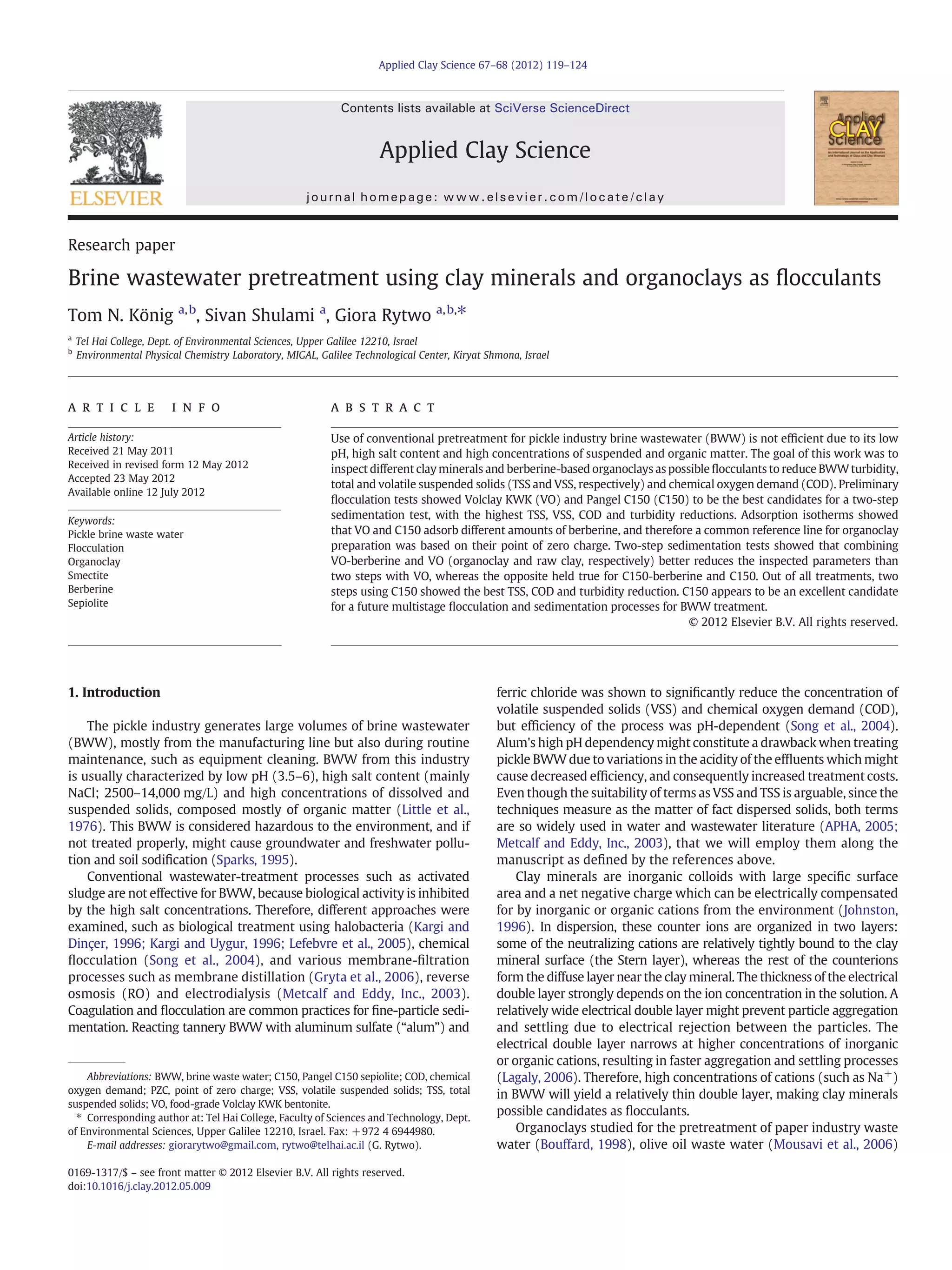
TSS and VSS, a two-step sedimentation test (Fig. 1) was conducted. 
The first step was performed with organoclay dispersions which 
were prepared as described in subsection 2.2. The organoclay dispersion 
was mixed with BWW to achieve a final volume of 250 mL with an 
organoclay concentration of 0.1%. The dispersion was stirred thoroughly 
for 1 min and left to settle for 1 h. The effluent was gently removed for 
the TSS, VSS, COD and turbidity tests. The second cycle was performed 
by mixing the remaining effluent with a new clay dispersion giving a 
final concentration of 0.1%. The dispersion was stirred for 1 min, and 
left to settle for 1 h. Finally, the effluent was gently removed and again 
TSS, VSS, COD and turbidity tests were performed. This entire procedure 
was conducted in triplicate for each type of organoclay, and a control test 
was performed using raw claymineral dispersions in both cycles. pHwas 
measured at the beginning and end of each cycle. 
2.6. Additional measurements 
Adsorption isotherms of berberine on the chosen clay minerals 
were determined in plastic tubes with screw caps by adding 2 mL of 
1% clay dispersion and increasing volumes of 2 mM berberine solution. 
Distilled water was added to reach a final volume of 20mL. The tubes 
were shaken with an orbital shaker for 3 days. Then, a 10-mL aliquot 
was centrifuged in a Juan C-3000 at 4000 RPM (app. 2860 g). The con-centration 
of berberine remaining in each tube was determined by the 
BWW with 
organoclay 
After 1 
hour 
BWW 
Settled organoclay 
Second step – adding 
BWW raw clay dispersion 
with clay 
BWW 
Raw BWW 
After 1 hour 
Clear Brine 
Settled clay 
Stirring 1 
minute 
Stirring 
1 minute 
First step – adding 
organoclay dispersion 
Fig. 1. Schematic description of the two-step sedimentation test.
T.N. König et al. / Applied Clay Science 67–68 (2012) 119–124 121 
HP 8452A spectrophotometer at 422 nm (Rytwo et al., 2008). A 10-mL 
aliquot of the dispersion was used for point of zero charge (PZC) mea-surements, 
using a particle charge detector (Mütek PCD 03) connected 
to an automatic titration unit (Mütek PCD titrator T3) with a charge-compensating 
polyelectrolyte, as described by Rytwo et al. (2005). 
The cationic polyelectrolyte poly-DADMAC (poly-diallyl-dimethyl-am-monium 
chloride) and the anionic polyelectrolyte PES-Na (polyethene 
sodium sulfonate) were used for titration of the negative and positive 
surface charge of the samples, respectively. 
Attenuated Total Reflection-Fourier Transform Infrared (ATR-FTIR) 
spectra of air-dried samples of sepiolite and the organo-cations 
adsorbed to it were measured in a Nicolet Avatar 320 FTIR, using a 
MIRacle ATR device with a diamond crystal plate (Pike Technologies, 
Madison, WI). Spectra were recorded at 4 cm– 1 nominal resolution 
with mathematical corrections yielding a 1.0 cm– 1 actual resolution 
and 100 measurements were averaged. OMNIC 8.1 (Thermo Fisher 
Scientific Inc.) program analytical procedures were used to convert 
the spectra from ATR to absorbance. 
3. Results and discussion 
3.1. Preliminary coagulation tests 
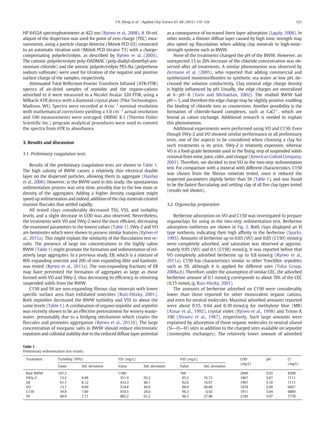
Results of the preliminary coagulation tests are shown in Table 1. 
The high salinity of BWW causes a relatively thin electrical double 
layer on the dispersed particles, allowing them to aggregate (Hanhui 
et al., 2006). However, in the BWWused in this study, the spontaneous 
sedimentation process was very slow, possibly due to the low mass or 
density of the aggregates. Adding a higher density coagulant might 
speed up sedimentation and indeed, addition of the clay minerals created 
massive floccules that settled rapidly. 
All tested clays considerably decreased TSS, VSS, and turbidity 
levels, and a slight decrease in COD was also observed. Nevertheless, 
the treatments with VO and SWy-2 were the most efficient, decreasing 
the examined parameters to the lowest values (Table 1).SWy-2 and VO 
are bentoniteswhichwere shown to possess similar features (Rytwo et 
al., 2011a). This might explain the similarity of the flocculation test re-sults. 
The presence of large ion concentrations in the highly saline 
BWW(Table 1)might promote the formation and sedimentation of rel-atively 
large aggregates. In a previous study, EB, which is a mixture of 
80% expanding smectite and 20% of non expanding illite and kaolinite, 
was tested (Rytwo et al., 2011a). The non-expanding fractions of EB 
may have prevented the formation of aggregates as large as those 
formed with VO and SWy-2, thus decreasing its efficiency in removing 
suspended solids from the BWW. 
C150 and S9 are non-expanding fibrous clay minerals with lower 
specific surface area than exfoliated smectites (Ruiz-Hitzky, 2001). 
Both sepiolites decreased the BWW turbidity and VSS to about the 
same levels (Table 1). A combination of organo-sepiolite and sepiolite 
was recently shown to be an effective pretreatment for winery waste-water, 
presumably due to a bridging mechanism which creates the 
floccules and promotes aggregation (Rytwo et al., 2011b). The large 
concentration of inorganic salts in BWW should reduce electrostatic 
repulsion and colloidal stability due to the reduced diffuse layer potential 
as a consequence of increased Stern layer adsorption (Lagaly, 2006). In 
other words, a thinner diffuse layer caused by high ionic strength may 
also speed up flocculation when adding clay minerals to high-ionic-strength 
systems such as BWW. 
None of the treatments changed the pH of the BWW. However, an 
unexpected 15 to 20% decrease of the chloride concentration was ob-served 
after all treatments. A similar phenomenon was observed by 
Zermane et al. (2005), who reported that adding commercial and 
synthesized montmorillonites to synthetic sea water at low pH, de-creased 
the solution conductivity. Clay mineral edge charge density 
is highly influenced by pH. Usually, the edge charges are neutralized 
at 6bpHb8 (Yariv and Michaelian, 2002). The studied BWW had 
pH=5, and therefore the edge charge may be slightly positive, enabling 
the binding of chloride ions as counterions. Another possibility is the 
formation of chloride-based complexes, such as CaCl+, which are 
bound as cation exchange. Additional research is needed to explain 
this phenomenon. 
Additional experiments were performed using VO and C150. Even 
though SWy-2 and VO showed similar performance in all preliminary 
tests, one of the aspects to be considered when choosing a clay for 
such treatments is its price. SWy-2 is relatively expensive, whereas 
VO is a food-grade bentonite used in the fining step of suspended solids 
removal fromwine, juice, cider, and vinegar (American Colloid Company, 
2001). Therefore, we decided to test VO in the two-step sedimentation 
test. For comparison with a mineral with different characteristics, C150 
was chosen from the fibrous minerals tested, since it reduced the 
inspected parameters slightly better than S9 (Table 1), and was found 
to be the fastest flocculating and settling clay of all five clay types tested 
(results not shown). 
3.2. Organoclay preparation 
Berberine adsorption on VO and C150 was investigated to prepare 
organoclays for using in the two-step sedimentation test. Berberine 
adsorption isotherms are shown in Fig. 2. Both clays displayed an H 
type isotherm, indicating their high affinity to the berberine (Sparks, 
1995). Amounts of berberine up to 0.65 (VO) and 0.05 (C150) mmol/g 
were completely adsorbed, and saturation was observed at approxi-mately 
0.95 (VO) and 0.1 (C150) mmol/g. It was reported before that 
VO completely adsorbed berberine up to 0.8 mmol/g (Rytwo et al., 
2011a). C150 has characteristics similar to other Yunclillos sepiolites 
such as S9, although it is applied for different uses (Tolsa Group, 
2008a,b). Therefore, under the assumption of similar CEC, the adsorbed 
berberine amount of 0.1 mmol/g corresponds to about 70% of the CEC 
(0.15mmolc/g, Ruiz-Hitzky, 2001). 
The amounts of berberine adsorbed on C150 were considerably 
lower than those reported for other monovalent organic cations, 
and even for neutral molecules. Maximal adsorbed amounts reported 
were about 0.55, 0.64 and 0.30 mmol/g for methylene blue (MB) 
(Aznar et al., 1992), crystal violet (Rytwo et al., 1998) and Triton-X 
100 (Alvarez et al., 1987), respectively. Such large amounts were 
explained by adsorption of those organic molecules to neutral silanol 
(Si―O―H) sites in addition to the charged sites available on sepiolite 
(isomorphic exchanges). The relatively lower amount of adsorbed 
Table 1 
Preliminary sedimentation test results. 
Treatment Turbidity (NTU) TSS (mg/L) VSS (mg/L) COD 
(mg/L) 
pH Cl– 
(mg/L) 
Value Std. deviation Value Std. deviation Value Std. deviation 
Raw BWW 167.2 1180 760 2840 5.03 8200 
SWy-2 12.2 0.49 351.9 93.2 85.2 35.72 1867 5.07 7111 
EB 61.7 8.12 433.3 40.1 92.6 16.97 1967 5.10 7111 
VO 13.7 0.69 314.8 44.9 88.9 40.06 1878 5.09 6667 
C150 39.8 7.80 418.5 28.0 96.3 6.42 1911 5.04 6889 
S9 40.9 7.71 485.2 61.2 96.3 27.96 2189 5.07 7778
122 T.N. König et al. / Applied Clay Science 67–68 (2012) 119–124 
1.0 
0.9 
0.8 
0.7 
0.6 
0.5 
0.4 
0.3 
0.2 
0.1 
berberine found here raises the question of whether it adsorbs on 
both types of sites. FTIR measurements showed that divalent organic 
cations such as diquat and paraquat do not adsorb to neutral sites of 
sepiolite (Rytwo et al., 2002), and a similar procedure was performed 
in this study. The Si―O―H vibration cause a band at 3700 cm–1, and 
a doublet due to O―H deformation was observed at approximately 
800 cm–1 (Kodama, 1985; Nakanishi and Solomon, 1977). Shifts or 
changes in these peaks may indicate interactions of the organic cations 
with the silanol groups, and are interpreted as adsorption to the neutral 
sites. 
Fig. 3 shows FTIR spectra of both the doublet due to the O―H de-formation, 
and the main Si―O―H vibration. Raw C150 sepiolite 
exhibited two clear deformation bands at 786 and 766 cm–1. Adsorp-tion 
of a monovalent organic cation that interacts with the silanol 
such as MB at about 60% of the CEC (MB-C150) completely changed 
this band into a single broad peak at 764 cm−1. Adsorption of the 
same amount of berberine (Ber-C150) did not affect the O―H doublet. 
Similar effects were observed for the main Si―O―H vibration whereas 
the vibration band of raw sepiolite appeared at 3689 cm−1. Ber-C150 
showed the same behavior, while MB adsorbed to C150 yielded a 
bathochromic shift of about 10 cm−1. As in previous studies (Rytwo 
et al., 2002), we concluded that in contrast to other monovalent 
organo-cations such as MB, berberine does not adsorb on the neutral 
sites of sepiolite, explaining the relatively low total adsorbed amounts 
(Fig. 2). We speculate that this lack of interaction with the silanol 
groups might be due to the relatively larger and more rigid structure 
of berberine. 
Particle charges were measured to test the influence of the 
adsorbed berberine on this parameter. Fig. 4 shows the particle 
charge as a function of the amount of berberine added. The PZC of 
VO and C150 was reached at 100% CEC (0.8 mmol/g) and about 60% 
CEC (0.09 mmol/g), respectively. In both clays, charge reversal was 
observed above 100% CEC. The adsorption isotherm corresponded to 
the charge variation of the clays. The PZC was reached when berberine 
traces began to be detected in the supernatant. Similar results were ob-served 
previously for crystal violet adsorption on sepiolite (Rytwo et al., 
2011b) and berberine adsorption on SWy-2 (Rytwo et al., 2008). 
To provide a common reference line between the two very different 
clays in the sedimentation experiments, the PZCwas taken as a suitable 
base for comparison. Therefore, organoclays for the two-step sedimen-tation 
testswere preparedwith the amount of berberine corresponding 
to the PZC. 
3.3. Two-step sedimentation tests 
The Adsorption isotherms (Fig. 2) showed that at 0.8 (VO) and 
0.09 (C150) mmol/g added berberine, >99% of the berberine was 
adsorbed. The traces of berberine remaining in solution yielded a 
yellowish color. The assumption that exposure to large concentra-tions 
of Na+might cause desorption of the organo-cation was evalu-ated 
using a Gouy–Chapman–Stern adsorption model (Rytwo et al., 
1998; Rytwo, 2004; Margalit and Rytwo, 2011, unpublished results). 
Calculation indicated that no desorption of berberine is expected, as 
described also in previous studies for the influence of ionic strength 
on the adsorption of organo-cations (Margulies et al., 1988). Therefore, 
and as described in Fig. 1, the first step was conducted using the 
organoclays, and raw clays were used in the second step for two rea-sons: 
to further reduce the inspected parameters and to adsorb any 
berberine left after first cycle. 
TSS, VSS, COD and turbidity of the two-step sedimentation tests are 
shown in Fig. 5. VO-berberine (Ber-VO) showed higher TSS, VSS, 
COD and turbidity values after the first step than the control (raw VO). 
However, the use of raw VO in the second step was effective, since no 
berberine was visible after the second step, and the inspected parameters 
were strongly reduced (354, 37, 1426 mg/L and 13 NTU for TSS, VSS, COD 
and turbidity, respectively). 
Differences between Ber-C150 and C150 in the first step were rela-tively 
small: Ber-C150 showed slightly lower VSS and COD concentra-tions 
than the control, while TSS and turbidity were slightly higher 
(Fig. 5). Like VO, the use of raw C150 in the second step was successful 
at adsorbing the residual berberine. However, the use of rawC150 in the 
second step did not decrease the inspected parameters to values below 
0.0 
0.00 0.05 0.10 0.15 0.20 0.25 0.30 0.35 0.40 
Berberine equilibrium concentration [mmol/L] 
Berberine adsorbed concentration 
[mmol/g] 
C150 
VO 
Fig. 2. Berberine adsorption isotherms on VO (squares) and C150 (rhombuses). 
3690 3680 
786 
784 
C150 
Ber-C150 
Wavenumbers (cm-1) 
3679 
3689 
766 
800 780 760 
MB-C150 
Fig. 3. FTIR spectra of Si―O―H stretching andO―H deformation vibrations of C150 sepio-lite, 
MB adsorbed on C150 and berberine adsorbed on C150. The amounts of both organo-cations 
added were 0.09mmol/g. 
100 
0 
-100 
-200 
-300 
-400 
-500 
5 
-5 
-15 
-25 
-35 
0 20 40 60 80 100 120 140 160 
Berberine added [%CEC] 
VO particle charge 
[mmolc/kg] 
-45 
C150 particle charge 
[mmolc/kg] 
VO 
C150 
Fig. 4. VO (squares, left axis) and C150 (rhombuses, right axis) charge as a function of 
added berberine in relation to the CEC of the clay.
T.N. König et al. / Applied Clay Science 67–68 (2012) 119–124 123 
a 1200 
b 
1000 
800 
600 
400 
200 
c 180 
d 
160 
140 
120 
100 
80 
60 
40 
20 
the control values. In fact, two steps using raw C150 yielded the best 
performance of all treatments and the largest reduction of TSS, COD 
and turbidity (123, 1296mg/L and 8.2 NTU, respectively). 
4. Conclusions 
Brine effluents from the pickle industry contain high concentra-tions 
of organic matter and suspended solids. This study presents a 
pretreatment of BWW with clays and organoclays. Reacting BWW 
with clay minerals in general was efficient . TSS, VSS and turbidity were 
reduced by one order of magnitude, and COD was slightly reduced. 
Two-step sedimentation tests were also examined for their ability to 
further decrease the inspected parameters. However, the results were 
inconclusive, with the two clays chosen for the process showing differ-ent 
trends. Using Ber-VO in the first step and VO in the second step gave 
slightly better results than using raw VO in both steps. On the other 
hand, the combination of Ber-C150 and C150 was less effective than 
using raw C150 in both steps. Rather unexpectedly, after two steps 
C150 gave even better results than VO. These results, combined with 
the very fast aggregation and settling observed with C150, make 
the sepiolite an excellent candidate for a future multistage flocculation 
and sedimentation processes for BWWtreatments. 
It is important to note that this and previous experiments indicate 
that wastewater pretreatment is a highly enigmatic process, involving 
many known and unknown factors. As seen previously, reactingwinery 
effluents with organo-sepiolites yielded better results than crude sepi-olites 
(Rytwo et al., 2011b). On the other hand, in a previous study 
(Rytwo et al., 2011a), EB reduced the turbidity values in brine to 15% 
of the initial value, whereas VO increased the turbidity of the brine 
effluents. In the present work, EB reduced the turbidity to 37% of its 
initial value, whereas VO reduced it to 8%. Such completely different 
behavior indicates that there are other factorswhich might affect a clay's 
ability to clear different types ofwaste water, and sometimes even differ-ent 
batches of the same waste water. In this specific case, BWWfor both 
800 
700 
600 
500 
400 
300 
200 
100 
0 
VO control Ber-VO C150 control Ber-C150 
Treatment 
3500 
3000 
2500 
2000 
1500 
1000 
500 
studies was from the same factory and had similar salinity, but while in 
this study it was from pickled cucumber preparation, wastewater for the 
Rytwo et al. (2011b) study was collected froman olive-pickling process. 
Thus, while raw clay treatments were highly susceptible to the exact 
composition of the waste water, berberine-based organoclays provided 
a relatively efficient pretreatment in both previous and present studies. 
Acknowledgments 
Part of this study was performed using instruments purchased with 
the aid of the J.C.A. Berberine desorption evaluations were performed 
with the support of the Israeli Ministry of Agriculture program no. 
862-0231-10. 
References 
Alvarez, A., Santaren, J., Perez-Castells, R., Casal, B., Ruiz-Hitzky, E., Levitz, P., Fripiat, J.J., 
1987. Surfactant adsorption and rheological behavior of surface modified sepiolite. 
In: Schultz, L.G., van Olphen, H., Mumpton, F.A. (Eds.), Proceedings of the Interna-tional 
Clay Conference, Denver, 1985. The Clay Minerals Society, Bloomington, IN, 
pp. 370–374. 
American Colloid Company, 2001. Volclay KWK Food Grade Technical Data. American 
Colloid Company, Arlington Heights, IL. 
APHAAWWAWEF, 2005. Standard Methods for the Examination of Water and Wastewater, 
21st ed. American Public Health Association, Washington DC, USA. 
Aznar, A.J., Casal, B., Ruiz-Hitzky, E., Lopez-Arbeloa, I., Lopez-Arbeloa, F., Santaren, J., 
Alvarez, A., 1992. Adsorption of methylene blue on sepiolite gels: spectroscopic 
and rheological studies. Clay Minerals 27, 101–108. 
Bouffard, S.C., 1998. Application of Natural and Tailored Minerals to the Treatment of 
Thermomechanical PaperMillWhite Water. MSc Thesis, University of British Columbia, 
BC. 
Garrote, J.I., Bao, M., Castro, P., Bao, M.J., 1995. Treatment of tannery effluents by a two 
step coagulation/flocculation process. Water Research 29, 2605–2608. 
Gryta, M., Tomaszewska, M., Karakulski, K., 2006. Wastewater treatment by membrane 
distillation. Desalination 198, 67–73. 
Hanhui, Z., Xiaoqi, Z., Xuehui, Z., 2006. Coagu-flocculationmechanismof flocculant and its 
physical model. 2004 ECI Conference on Separations Technology VI: New Perspective 
on Very Large-Scale Operations. The Berkeley Electronic Press, Berkeley, CA. 
VSS [mg/L] 
1st. step 
2nd. step 
0 
VO control Ber-VO C150 control Ber-C150 
Treatment 
VO control Ber-VO C150 control Ber-C150 
Treatment 
VO control Ber-VO C150 control Ber-C150 
Treatment 
TSS [mg/L] 
1st. step 
2nd. step 
0 
turbidity [NTU] 
1st. step 
2nd.step 
0 
COD [mg/L] 
1st. step 
2nd. step 
Fig. 5. TSS, VSS, turbidity and COD (a, b, c and d, respectively) concentrations after two 1-h sedimentation steps. Bold lines represent raw BWW parameters. Ber-VO and Ber-C150 
series denote the use of the organoclays and raw clay minerals in the 1st and 2nd step, respectively, whereas VO control and C150 control series denote the use of the raw minerals 
for both steps.
124 T.N. König et al. / Applied Clay Science 67–68 (2012) 119–124 
Johnston, C.T., 1996. Sorption of organic compounds on clay minerals: a surface functional 
group approach. In: Sawhney, B. (Ed.), CMSWorkshop Lectures. Organic Pollutants in 
the Environment, vol. 8. The Clay Mineral Society, Boulder, CO, pp. 1–44. 
Kargi, F., Dinçer, A.R., 1996. Enhancement of biological treatment performance of saline 
wastewater by halophilic bacteria. Bioprocess and Biosystems Engineering 15, 
51–58. 
Kargi, F., Uygur, A., 1996. Biological treatment of saline wastewater in an aerated percolator 
unit utilizing halophilic bacteria. Environmental Technology 17, 325–330. 
Kodama, H., 1985. Infrared Spectra of Minerals: Reference Guide to Identification and 
Characterization of Minerals for the Study of Soils. Research Branch, Agriculture 
Canada, Ottawa, p. 156. 
Lagaly, G., 2006. Colloid clay science. In: Bergaya, F., Theng, B.K.G., Lagaly, G. (Eds.), 
Handbook of Clay Sceince. Elsevier Ltd., Amsterdam, pp. 309–377. 
Lefebvre, O., Vasudevan, N., Torrijos, M., Thanasekaran, K., Moletta, R., 2005. Halophilic 
biological treatment of tannery soak liquor in a sequencing batch reactor. Water 
Research 39, 1471–1480. 
Little, L.W., Lamb III, J.C., Horney, L.F., 1976. Characterization and treatment of brine 
wastewaters from the cucumber pickle industry. UNC Wastewater Research Center, 
Department of Environmental Sciences and Engineering. UNC Wastewater Research 
Center, Department of Environmental Sciences and Engineering, School of Public 
Health University of North Carolina at Chapel Hill. ESE Publication No. 399. 
Margulies, L., Rozen, H., Nir, S., 1988. Model for competitive adsorption of organic cations 
on clays. Clays and Clay Minerals 36, 270–276. 
Metcalf and Eddy, Inc., 2003. Wastewater Engineering: Treatment and Reuse, fourth 
ed. McGraw-Hill, New York. 
Mousavi, S.M., Alemzadeh, I., Vossoughi,M., 2006. Use ofmodified bentonite for phenolic ad-sorption 
in treatment of olive oil mill wastewater. Iranian J. Sci. Technol. 30, 613–619. 
Nakanishi, K., Solomon, P.H., 1977. Infrared Absorption Spectroscopy. Holden-Day, 
Oakland, CA, p. 54. 
Ruiz-Hitzky, E., 2001. Molecular access to intracrystalline tunnels of sepiolite. Journal 
of Materials Chemistry 11, 86–91. 
Rytwo, G. 2004 A worksheet adsorption/desorption model on clays, in Clay Surfaces: 
Fundamentals and Applications, Wypych F. and Satyanarayana, K.G. (Eds.) in the 
Series: “Interface Science and Technology book series”, Series Editor: A Hubbard, 
Elsevier Academic Press, Amsterdam, The Netherlands, p. 153–183. 
Rytwo, G., Gonen, Y., 2006. Very fast sorbent for organic dyes and pollutants. Colloid & 
Polymer Science 284, 817–820. 
Rytwo, G., Nir, S., Margulies, L., Casal, B., Merino, J., Ruiz-Hitzky, E., Serratosa, J.M., 1998. 
Adsorption of monovalent organic cations on sepiolite: experimental results and 
model calculations. Clays and Clay Minerals 46, 340–348. 
Rytwo, G., Serban, C., Tropp, D., 2002. Adsorption and interactions of diquat, paraquat and 
methyl green on sepiolite: experimental results and model calculations. Applied Clay 
Science 20 (6), 273–282. 
Rytwo, G., Gonen, Y., Afuta, S., Dultz, S., 2005. Interactions of pendimethalin with an 
organo-montmorillonite complex. Applied Clay Science 28, 67–77. 
Rytwo, G., Kohavi, Y., Botnick, I., Gonen, Y., 2007. Use of CV- and TPP-montmorillonite for 
the removal of priority pollutants from water. Applied Clay Science 36, 182–190. 
Rytwo, G., Gonen, Y., Afuta, S., 2008. Preparation of Berberine–montmorillonite– 
metolachlor formulations from hydrophobic/hydrophilic mixtures. Applied Clay 
Science 41, 47–60. 
Rytwo, G., Rettig, A., Gonen, Y., 2011a. Organo-sepiolite particles for efficient pretreatment of 
organic wastewater: application to winery effluents. Applied Clay Science 51, 390–394. 
Rytwo, G., Varman, H., Bluvshtein, N., König, T.N., Mendelovits, A., Sandler, A., 2011b. 
Adsorption of berberine on commercial minerals. Applied Clay Science 51, 43–50. 
Song, Z., Williams, C.J., Edyvean, R.G.J., 2004. Treatment of tannery wastewater by 
chemical coagulation. Desalination 164, 249–259. 
Sparks, D.L., 1995. Environmental Soil Chemistry. Academic Press, Inc., London, UK. 
Tolsa Group, 2008a. Pangel C150 Technical Data Sheet. Tolsa SA, Madrid 28022, Spain. 
Tolsa Group, 2008b. Pangel S9 Technical Data Sheet. Tolsa SA, Madrid 28022, Spain. 
Yariv, S., Michaelian, K.H., 2002. Structure and surface acidity of clay minerals. In: Yariv, 
S., Cross, H. (Eds.), Organo-Clay Complexes and Interactions. Marcel Dekker, Inc., 
New York, pp. 1–38. 
Zermane, F., Naceur, M.W., Cheknane, B., Messaoudene, N.A., 2005. Adsorption of 
humic acids by a modified Algerian montmorillonite in synthesized seawater. 
Desalination 179, 375–380.

מאמר של סיוון

  • 1.
    Applied Clay Science67–68 (2012) 119–124 Contents lists available at SciVerse ScienceDirect Applied Clay Science journal homepage: www.elsevier.com/locate/clay Research paper Brine wastewater pretreatment using clay minerals and organoclays as flocculants Tom N. König a,b, Sivan Shulami a, Giora Rytwo a,b,⁎ a Tel Hai College, Dept. of Environmental Sciences, Upper Galilee 12210, Israel b Environmental Physical Chemistry Laboratory, MIGAL, Galilee Technological Center, Kiryat Shmona, Israel a r t i c l e i n f o a b s t r a c t Article history: Received 21 May 2011 Received in revised form 12 May 2012 Accepted 23 May 2012 Available online 12 July 2012 Keywords: Pickle brine waste water Flocculation Organoclay Smectite Berberine Sepiolite Use of conventional pretreatment for pickle industry brine wastewater (BWW) is not efficient due to its low pH, high salt content and high concentrations of suspended and organic matter. The goal of this work was to inspect different clay minerals and berberine-based organoclays as possible flocculants to reduce BWWturbidity, total and volatile suspended solids (TSS and VSS, respectively) and chemical oxygen demand (COD). Preliminary flocculation tests showed Volclay KWK (VO) and Pangel C150 (C150) to be the best candidates for a two-step sedimentation test, with the highest TSS, VSS, COD and turbidity reductions. Adsorption isotherms showed that VO and C150 adsorb different amounts of berberine, and therefore a common reference line for organoclay preparation was based on their point of zero charge. Two-step sedimentation tests showed that combining VO-berberine and VO (organoclay and raw clay, respectively) better reduces the inspected parameters than two steps with VO, whereas the opposite held true for C150-berberine and C150. Out of all treatments, two steps using C150 showed the best TSS, COD and turbidity reduction. C150 appears to be an excellent candidate for a future multistage flocculation and sedimentation processes for BWWtreatment. © 2012 Elsevier B.V. All rights reserved. 1. Introduction The pickle industry generates large volumes of brine wastewater (BWW), mostly from the manufacturing line but also during routine maintenance, such as equipment cleaning. BWW from this industry is usually characterized by low pH (3.5–6), high salt content (mainly NaCl; 2500–14,000 mg/L) and high concentrations of dissolved and suspended solids, composed mostly of organic matter (Little et al., 1976). This BWW is considered hazardous to the environment, and if not treated properly, might cause groundwater and freshwater pollu-tion and soil sodification (Sparks, 1995). Conventional wastewater-treatment processes such as activated sludge are not effective forBWW, because biological activity is inhibited by the high salt concentrations. Therefore, different approaches were examined, such as biological treatment using halobacteria (Kargi and Dinçer, 1996; Kargi and Uygur, 1996; Lefebvre et al., 2005), chemical flocculation (Song et al., 2004), and various membrane-filtration processes such as membrane distillation (Gryta et al., 2006), reverse osmosis (RO) and electrodialysis (Metcalf and Eddy, Inc., 2003). Coagulation and flocculation are common practices for fine-particle sedi-mentation. Reacting tannery BWWwith aluminum sulfate (“alum”) and ferric chloride was shown to significantly reduce the concentration of volatile suspended solids (VSS) and chemical oxygen demand (COD), but efficiency of the process was pH-dependent (Song et al., 2004). Alum's high pHdependency might constitute a drawbackwhen treating pickleBWWdue to variations in the acidity of the effluentswhich might cause decreased efficiency, and consequently increased treatment costs. Even though the suitability of terms as VSS and TSS is arguable, since the techniques measure as the matter of fact dispersed solids, both terms are so widely used in water and wastewater literature (APHA, 2005; Metcalf and Eddy, Inc., 2003), that we will employ them along the manuscript as defined by the references above. Clay minerals are inorganic colloids with large specific surface area and a net negative charge which can be electrically compensated for by inorganic or organic cations from the environment (Johnston, 1996). In dispersion, these counter ions are organized in two layers: some of the neutralizing cations are relatively tightly bound to the clay mineral surface (the Stern layer), whereas the rest of the counterions formthe diffuse layer near the claymineral. The thickness of the electrical double layer strongly depends on the ion concentration in the solution. A relatively wide electrical double layermight prevent particle aggregation and settling due to electrical rejection between the particles. The electrical double layer narrows at higher concentrations of inorganic or organic cations, resulting in faster aggregation and settling processes (Lagaly, 2006). Therefore, high concentrations of cations (such as Na+) in BWW will yield a relatively thin double layer, making clay minerals possible candidates as flocculants. Organoclays studied for the pretreatment of paper industry waste water (Bouffard, 1998), olive oil waste water (Mousavi et al., 2006) Abbreviations: BWW, brine waste water; C150, Pangel C150 sepiolite; COD, chemical oxygen demand; PZC, point of zero charge; VSS, volatile suspended solids; TSS, total suspended solids; VO, food-grade Volclay KWK bentonite. ⁎ Corresponding author at: Tel Hai College, Faculty of Sciences and Technology, Dept. of Environmental Sciences, Upper Galilee 12210, Israel. Fax: +972 4 6944980. E-mail addresses: giorarytwo@gmail.com, rytwo@telhai.ac.il (G. Rytwo). 0169-1317/$ – see front matter © 2012 Elsevier B.V. All rights reserved. doi:10.1016/j.clay.2012.05.009
  • 2.
    120 T.N. Königet al. / Applied Clay Science 67–68 (2012) 119–124 and winery effluent (Rytwo et al., 2011a,b), might also be candidates as flocculants, not only due to their ability to aggregate and settle quickly (Lagaly, 2006), but also due to the adsorption of large amounts of organic compounds (Rytwo and Gonen, 2006; Rytwo et al., 2007). Multistage coagulation and sedimentation processes for the treat-ment of industrial effluents were implied by Garrote et al. (1995), who used ferric chloride (FeCl3) and calcium hydroxide (CaOH) to re-move COD from tannery wastewater, and by Rytwo et al. (2011b), who used organosepiolites based on crystal violet and raw sepiolites for the pretreatment of winery effluents. Clay minerals modified with berberine (5,6-dihydro-9,10-dimehtoxybenzo[g]-1,3 benzodioxolo [5,6-a] quinolizinium) were also suggested as possible flocculants for the pretreatment of winery and BWW effluents (Rytwo et al., 2011a). The goal of this study was to examine the use of different clayminerals and berberine-based organoclays as flocculants in a two-step sedimen-tation test for BWW treatment, and their efficacy as a pretreatment in reducing concentrations of suspended solids and organic content of the studied BWW. 2. Materials and methods 2.1. Materials Raw BWW was sampled at Beit-Hashita pickle factory (Kibbutz Beit-Hashita, Israel), transported to the laboratory in 10-L containers, and kept at roomtemperature until experimentation. SWy-2Wyoming Na-montmorillonite (SWy-2) was purchased from the Source Clay Repository of The Clay Minerals Society (Columbia, MO). Food-grade Volclay KWK bentonite (VO) (American Colloid Company, Arlington Heights, IL) was generously supplied by Micha Vaadia (Galil Mountains Winery, Israel). Egyptian bentonite (EB) (EBDC Bentonite Co., Alexandria, Egypt) was obtained from Naheel Ibrahim (Ibrahim Construction Co.). Two types of Yunclillos sepiolite, S9 and C150, (S9, C150) were provided by Tolsa (Madrid, Spain). Berberine chloride was purchased from Sigma- Aldrich (Rehovot, Israel). All materials were used without treatment or purification except for VO, which was pulverized with a mortar and pestle prior to use to eliminate large aggregates. 2.2. Clay and organoclay preparation Clay mineral dispersions (10 g/L) were prepared by dispersing the clays in distilled waterwith continuousmagnetic stirring. The organoclay dispersions were prepared by adding the required weighed amount of berberine to a pre-prepared 1% (m/v) dispersion during continuous stirring and further agitation overnight to ensure complete adsorption. Complete adsorption was confirmed by measuring the amount of berberine remaining in the supernatant. 2.3. Tests The concentration of “total suspended solids” (TSS) as defined in the literature (APHA, 2005)was determined by filtering 5 mL of the sample through a 47-mm glass fiber membrane (Sartorious Stedim Biotech GmbH, Goettingen, Germany) with pore diameter of 0.45 μm, and drying at 105 °C for 1 h. VSS concentrations were determined by kilning the TSS filters in 550 °C. Both TSS and VSS concentrations were calculated from the mass balance. Turbidity was measured using a LaMotte 2020i turbidimeter. Chloride concentrations were measured using a Merck Chloride kit (Aquamerck No. 1.11106.0001). Chemical oxygen demand (COD) testswere performed using Merck COD solution A (no. 1.14538.0065) and solution B (no. 1.14538.0065). CODtestswere conducted by adding themanufacturer-recommended volumes of the re-agents to 10 mL pre-prepared glass test tubes with white plastic screw caps (Hach), and the required volume of sample (diluted 1:10). The test tubes were then placed in a preheated reactor (Merck Thermoreaktor TR300) at 148 °C for 2 h, and COD contents were measured using a LaMotte SMART2 colorimeter. pH was measured using a Cyberscan 500 pH meter with a 6-mm plastic electrode. 2.4. Preliminary flocculation tests Preliminary flocculation tests were conducted to choose the clays which were most effective at reducing BWW turbidity, TSS, VSS, and COD. The clay mineral dispersion was added to BWW to achieve a final volume of 250 mL and a final clay concentration of 0.1% (m/v). The dispersions were stirred thoroughly for 1 min and left to settle for 1 h. The upper effluents were gently removed for the TSS, VSS and turbidity tests. pH and chloride concentrations were also measured at the beginning and end of the process. This procedure was conducted in triplicate for all clay types tested. COD was measured once for each clay type. The chosen clay minerals were then used in a two-step sedi-mentation test. 2.5. Two-step sedimentation test After choosing the clay minerals exhibiting the best reduction in TSS and VSS, a two-step sedimentation test (Fig. 1) was conducted. The first step was performed with organoclay dispersions which were prepared as described in subsection 2.2. The organoclay dispersion was mixed with BWW to achieve a final volume of 250 mL with an organoclay concentration of 0.1%. The dispersion was stirred thoroughly for 1 min and left to settle for 1 h. The effluent was gently removed for the TSS, VSS, COD and turbidity tests. The second cycle was performed by mixing the remaining effluent with a new clay dispersion giving a final concentration of 0.1%. The dispersion was stirred for 1 min, and left to settle for 1 h. Finally, the effluent was gently removed and again TSS, VSS, COD and turbidity tests were performed. This entire procedure was conducted in triplicate for each type of organoclay, and a control test was performed using raw claymineral dispersions in both cycles. pHwas measured at the beginning and end of each cycle. 2.6. Additional measurements Adsorption isotherms of berberine on the chosen clay minerals were determined in plastic tubes with screw caps by adding 2 mL of 1% clay dispersion and increasing volumes of 2 mM berberine solution. Distilled water was added to reach a final volume of 20mL. The tubes were shaken with an orbital shaker for 3 days. Then, a 10-mL aliquot was centrifuged in a Juan C-3000 at 4000 RPM (app. 2860 g). The con-centration of berberine remaining in each tube was determined by the BWW with organoclay After 1 hour BWW Settled organoclay Second step – adding BWW raw clay dispersion with clay BWW Raw BWW After 1 hour Clear Brine Settled clay Stirring 1 minute Stirring 1 minute First step – adding organoclay dispersion Fig. 1. Schematic description of the two-step sedimentation test.
  • 3.
    T.N. König etal. / Applied Clay Science 67–68 (2012) 119–124 121 HP 8452A spectrophotometer at 422 nm (Rytwo et al., 2008). A 10-mL aliquot of the dispersion was used for point of zero charge (PZC) mea-surements, using a particle charge detector (Mütek PCD 03) connected to an automatic titration unit (Mütek PCD titrator T3) with a charge-compensating polyelectrolyte, as described by Rytwo et al. (2005). The cationic polyelectrolyte poly-DADMAC (poly-diallyl-dimethyl-am-monium chloride) and the anionic polyelectrolyte PES-Na (polyethene sodium sulfonate) were used for titration of the negative and positive surface charge of the samples, respectively. Attenuated Total Reflection-Fourier Transform Infrared (ATR-FTIR) spectra of air-dried samples of sepiolite and the organo-cations adsorbed to it were measured in a Nicolet Avatar 320 FTIR, using a MIRacle ATR device with a diamond crystal plate (Pike Technologies, Madison, WI). Spectra were recorded at 4 cm– 1 nominal resolution with mathematical corrections yielding a 1.0 cm– 1 actual resolution and 100 measurements were averaged. OMNIC 8.1 (Thermo Fisher Scientific Inc.) program analytical procedures were used to convert the spectra from ATR to absorbance. 3. Results and discussion 3.1. Preliminary coagulation tests Results of the preliminary coagulation tests are shown in Table 1. The high salinity of BWW causes a relatively thin electrical double layer on the dispersed particles, allowing them to aggregate (Hanhui et al., 2006). However, in the BWWused in this study, the spontaneous sedimentation process was very slow, possibly due to the low mass or density of the aggregates. Adding a higher density coagulant might speed up sedimentation and indeed, addition of the clay minerals created massive floccules that settled rapidly. All tested clays considerably decreased TSS, VSS, and turbidity levels, and a slight decrease in COD was also observed. Nevertheless, the treatments with VO and SWy-2 were the most efficient, decreasing the examined parameters to the lowest values (Table 1).SWy-2 and VO are bentoniteswhichwere shown to possess similar features (Rytwo et al., 2011a). This might explain the similarity of the flocculation test re-sults. The presence of large ion concentrations in the highly saline BWW(Table 1)might promote the formation and sedimentation of rel-atively large aggregates. In a previous study, EB, which is a mixture of 80% expanding smectite and 20% of non expanding illite and kaolinite, was tested (Rytwo et al., 2011a). The non-expanding fractions of EB may have prevented the formation of aggregates as large as those formed with VO and SWy-2, thus decreasing its efficiency in removing suspended solids from the BWW. C150 and S9 are non-expanding fibrous clay minerals with lower specific surface area than exfoliated smectites (Ruiz-Hitzky, 2001). Both sepiolites decreased the BWW turbidity and VSS to about the same levels (Table 1). A combination of organo-sepiolite and sepiolite was recently shown to be an effective pretreatment for winery waste-water, presumably due to a bridging mechanism which creates the floccules and promotes aggregation (Rytwo et al., 2011b). The large concentration of inorganic salts in BWW should reduce electrostatic repulsion and colloidal stability due to the reduced diffuse layer potential as a consequence of increased Stern layer adsorption (Lagaly, 2006). In other words, a thinner diffuse layer caused by high ionic strength may also speed up flocculation when adding clay minerals to high-ionic-strength systems such as BWW. None of the treatments changed the pH of the BWW. However, an unexpected 15 to 20% decrease of the chloride concentration was ob-served after all treatments. A similar phenomenon was observed by Zermane et al. (2005), who reported that adding commercial and synthesized montmorillonites to synthetic sea water at low pH, de-creased the solution conductivity. Clay mineral edge charge density is highly influenced by pH. Usually, the edge charges are neutralized at 6bpHb8 (Yariv and Michaelian, 2002). The studied BWW had pH=5, and therefore the edge charge may be slightly positive, enabling the binding of chloride ions as counterions. Another possibility is the formation of chloride-based complexes, such as CaCl+, which are bound as cation exchange. Additional research is needed to explain this phenomenon. Additional experiments were performed using VO and C150. Even though SWy-2 and VO showed similar performance in all preliminary tests, one of the aspects to be considered when choosing a clay for such treatments is its price. SWy-2 is relatively expensive, whereas VO is a food-grade bentonite used in the fining step of suspended solids removal fromwine, juice, cider, and vinegar (American Colloid Company, 2001). Therefore, we decided to test VO in the two-step sedimentation test. For comparison with a mineral with different characteristics, C150 was chosen from the fibrous minerals tested, since it reduced the inspected parameters slightly better than S9 (Table 1), and was found to be the fastest flocculating and settling clay of all five clay types tested (results not shown). 3.2. Organoclay preparation Berberine adsorption on VO and C150 was investigated to prepare organoclays for using in the two-step sedimentation test. Berberine adsorption isotherms are shown in Fig. 2. Both clays displayed an H type isotherm, indicating their high affinity to the berberine (Sparks, 1995). Amounts of berberine up to 0.65 (VO) and 0.05 (C150) mmol/g were completely adsorbed, and saturation was observed at approxi-mately 0.95 (VO) and 0.1 (C150) mmol/g. It was reported before that VO completely adsorbed berberine up to 0.8 mmol/g (Rytwo et al., 2011a). C150 has characteristics similar to other Yunclillos sepiolites such as S9, although it is applied for different uses (Tolsa Group, 2008a,b). Therefore, under the assumption of similar CEC, the adsorbed berberine amount of 0.1 mmol/g corresponds to about 70% of the CEC (0.15mmolc/g, Ruiz-Hitzky, 2001). The amounts of berberine adsorbed on C150 were considerably lower than those reported for other monovalent organic cations, and even for neutral molecules. Maximal adsorbed amounts reported were about 0.55, 0.64 and 0.30 mmol/g for methylene blue (MB) (Aznar et al., 1992), crystal violet (Rytwo et al., 1998) and Triton-X 100 (Alvarez et al., 1987), respectively. Such large amounts were explained by adsorption of those organic molecules to neutral silanol (Si―O―H) sites in addition to the charged sites available on sepiolite (isomorphic exchanges). The relatively lower amount of adsorbed Table 1 Preliminary sedimentation test results. Treatment Turbidity (NTU) TSS (mg/L) VSS (mg/L) COD (mg/L) pH Cl– (mg/L) Value Std. deviation Value Std. deviation Value Std. deviation Raw BWW 167.2 1180 760 2840 5.03 8200 SWy-2 12.2 0.49 351.9 93.2 85.2 35.72 1867 5.07 7111 EB 61.7 8.12 433.3 40.1 92.6 16.97 1967 5.10 7111 VO 13.7 0.69 314.8 44.9 88.9 40.06 1878 5.09 6667 C150 39.8 7.80 418.5 28.0 96.3 6.42 1911 5.04 6889 S9 40.9 7.71 485.2 61.2 96.3 27.96 2189 5.07 7778
  • 4.
    122 T.N. Königet al. / Applied Clay Science 67–68 (2012) 119–124 1.0 0.9 0.8 0.7 0.6 0.5 0.4 0.3 0.2 0.1 berberine found here raises the question of whether it adsorbs on both types of sites. FTIR measurements showed that divalent organic cations such as diquat and paraquat do not adsorb to neutral sites of sepiolite (Rytwo et al., 2002), and a similar procedure was performed in this study. The Si―O―H vibration cause a band at 3700 cm–1, and a doublet due to O―H deformation was observed at approximately 800 cm–1 (Kodama, 1985; Nakanishi and Solomon, 1977). Shifts or changes in these peaks may indicate interactions of the organic cations with the silanol groups, and are interpreted as adsorption to the neutral sites. Fig. 3 shows FTIR spectra of both the doublet due to the O―H de-formation, and the main Si―O―H vibration. Raw C150 sepiolite exhibited two clear deformation bands at 786 and 766 cm–1. Adsorp-tion of a monovalent organic cation that interacts with the silanol such as MB at about 60% of the CEC (MB-C150) completely changed this band into a single broad peak at 764 cm−1. Adsorption of the same amount of berberine (Ber-C150) did not affect the O―H doublet. Similar effects were observed for the main Si―O―H vibration whereas the vibration band of raw sepiolite appeared at 3689 cm−1. Ber-C150 showed the same behavior, while MB adsorbed to C150 yielded a bathochromic shift of about 10 cm−1. As in previous studies (Rytwo et al., 2002), we concluded that in contrast to other monovalent organo-cations such as MB, berberine does not adsorb on the neutral sites of sepiolite, explaining the relatively low total adsorbed amounts (Fig. 2). We speculate that this lack of interaction with the silanol groups might be due to the relatively larger and more rigid structure of berberine. Particle charges were measured to test the influence of the adsorbed berberine on this parameter. Fig. 4 shows the particle charge as a function of the amount of berberine added. The PZC of VO and C150 was reached at 100% CEC (0.8 mmol/g) and about 60% CEC (0.09 mmol/g), respectively. In both clays, charge reversal was observed above 100% CEC. The adsorption isotherm corresponded to the charge variation of the clays. The PZC was reached when berberine traces began to be detected in the supernatant. Similar results were ob-served previously for crystal violet adsorption on sepiolite (Rytwo et al., 2011b) and berberine adsorption on SWy-2 (Rytwo et al., 2008). To provide a common reference line between the two very different clays in the sedimentation experiments, the PZCwas taken as a suitable base for comparison. Therefore, organoclays for the two-step sedimen-tation testswere preparedwith the amount of berberine corresponding to the PZC. 3.3. Two-step sedimentation tests The Adsorption isotherms (Fig. 2) showed that at 0.8 (VO) and 0.09 (C150) mmol/g added berberine, >99% of the berberine was adsorbed. The traces of berberine remaining in solution yielded a yellowish color. The assumption that exposure to large concentra-tions of Na+might cause desorption of the organo-cation was evalu-ated using a Gouy–Chapman–Stern adsorption model (Rytwo et al., 1998; Rytwo, 2004; Margalit and Rytwo, 2011, unpublished results). Calculation indicated that no desorption of berberine is expected, as described also in previous studies for the influence of ionic strength on the adsorption of organo-cations (Margulies et al., 1988). Therefore, and as described in Fig. 1, the first step was conducted using the organoclays, and raw clays were used in the second step for two rea-sons: to further reduce the inspected parameters and to adsorb any berberine left after first cycle. TSS, VSS, COD and turbidity of the two-step sedimentation tests are shown in Fig. 5. VO-berberine (Ber-VO) showed higher TSS, VSS, COD and turbidity values after the first step than the control (raw VO). However, the use of raw VO in the second step was effective, since no berberine was visible after the second step, and the inspected parameters were strongly reduced (354, 37, 1426 mg/L and 13 NTU for TSS, VSS, COD and turbidity, respectively). Differences between Ber-C150 and C150 in the first step were rela-tively small: Ber-C150 showed slightly lower VSS and COD concentra-tions than the control, while TSS and turbidity were slightly higher (Fig. 5). Like VO, the use of raw C150 in the second step was successful at adsorbing the residual berberine. However, the use of rawC150 in the second step did not decrease the inspected parameters to values below 0.0 0.00 0.05 0.10 0.15 0.20 0.25 0.30 0.35 0.40 Berberine equilibrium concentration [mmol/L] Berberine adsorbed concentration [mmol/g] C150 VO Fig. 2. Berberine adsorption isotherms on VO (squares) and C150 (rhombuses). 3690 3680 786 784 C150 Ber-C150 Wavenumbers (cm-1) 3679 3689 766 800 780 760 MB-C150 Fig. 3. FTIR spectra of Si―O―H stretching andO―H deformation vibrations of C150 sepio-lite, MB adsorbed on C150 and berberine adsorbed on C150. The amounts of both organo-cations added were 0.09mmol/g. 100 0 -100 -200 -300 -400 -500 5 -5 -15 -25 -35 0 20 40 60 80 100 120 140 160 Berberine added [%CEC] VO particle charge [mmolc/kg] -45 C150 particle charge [mmolc/kg] VO C150 Fig. 4. VO (squares, left axis) and C150 (rhombuses, right axis) charge as a function of added berberine in relation to the CEC of the clay.
  • 5.
    T.N. König etal. / Applied Clay Science 67–68 (2012) 119–124 123 a 1200 b 1000 800 600 400 200 c 180 d 160 140 120 100 80 60 40 20 the control values. In fact, two steps using raw C150 yielded the best performance of all treatments and the largest reduction of TSS, COD and turbidity (123, 1296mg/L and 8.2 NTU, respectively). 4. Conclusions Brine effluents from the pickle industry contain high concentra-tions of organic matter and suspended solids. This study presents a pretreatment of BWW with clays and organoclays. Reacting BWW with clay minerals in general was efficient . TSS, VSS and turbidity were reduced by one order of magnitude, and COD was slightly reduced. Two-step sedimentation tests were also examined for their ability to further decrease the inspected parameters. However, the results were inconclusive, with the two clays chosen for the process showing differ-ent trends. Using Ber-VO in the first step and VO in the second step gave slightly better results than using raw VO in both steps. On the other hand, the combination of Ber-C150 and C150 was less effective than using raw C150 in both steps. Rather unexpectedly, after two steps C150 gave even better results than VO. These results, combined with the very fast aggregation and settling observed with C150, make the sepiolite an excellent candidate for a future multistage flocculation and sedimentation processes for BWWtreatments. It is important to note that this and previous experiments indicate that wastewater pretreatment is a highly enigmatic process, involving many known and unknown factors. As seen previously, reactingwinery effluents with organo-sepiolites yielded better results than crude sepi-olites (Rytwo et al., 2011b). On the other hand, in a previous study (Rytwo et al., 2011a), EB reduced the turbidity values in brine to 15% of the initial value, whereas VO increased the turbidity of the brine effluents. In the present work, EB reduced the turbidity to 37% of its initial value, whereas VO reduced it to 8%. Such completely different behavior indicates that there are other factorswhich might affect a clay's ability to clear different types ofwaste water, and sometimes even differ-ent batches of the same waste water. In this specific case, BWWfor both 800 700 600 500 400 300 200 100 0 VO control Ber-VO C150 control Ber-C150 Treatment 3500 3000 2500 2000 1500 1000 500 studies was from the same factory and had similar salinity, but while in this study it was from pickled cucumber preparation, wastewater for the Rytwo et al. (2011b) study was collected froman olive-pickling process. Thus, while raw clay treatments were highly susceptible to the exact composition of the waste water, berberine-based organoclays provided a relatively efficient pretreatment in both previous and present studies. Acknowledgments Part of this study was performed using instruments purchased with the aid of the J.C.A. Berberine desorption evaluations were performed with the support of the Israeli Ministry of Agriculture program no. 862-0231-10. References Alvarez, A., Santaren, J., Perez-Castells, R., Casal, B., Ruiz-Hitzky, E., Levitz, P., Fripiat, J.J., 1987. Surfactant adsorption and rheological behavior of surface modified sepiolite. In: Schultz, L.G., van Olphen, H., Mumpton, F.A. (Eds.), Proceedings of the Interna-tional Clay Conference, Denver, 1985. The Clay Minerals Society, Bloomington, IN, pp. 370–374. American Colloid Company, 2001. Volclay KWK Food Grade Technical Data. American Colloid Company, Arlington Heights, IL. APHAAWWAWEF, 2005. Standard Methods for the Examination of Water and Wastewater, 21st ed. American Public Health Association, Washington DC, USA. Aznar, A.J., Casal, B., Ruiz-Hitzky, E., Lopez-Arbeloa, I., Lopez-Arbeloa, F., Santaren, J., Alvarez, A., 1992. Adsorption of methylene blue on sepiolite gels: spectroscopic and rheological studies. Clay Minerals 27, 101–108. Bouffard, S.C., 1998. Application of Natural and Tailored Minerals to the Treatment of Thermomechanical PaperMillWhite Water. MSc Thesis, University of British Columbia, BC. Garrote, J.I., Bao, M., Castro, P., Bao, M.J., 1995. Treatment of tannery effluents by a two step coagulation/flocculation process. Water Research 29, 2605–2608. Gryta, M., Tomaszewska, M., Karakulski, K., 2006. Wastewater treatment by membrane distillation. Desalination 198, 67–73. Hanhui, Z., Xiaoqi, Z., Xuehui, Z., 2006. Coagu-flocculationmechanismof flocculant and its physical model. 2004 ECI Conference on Separations Technology VI: New Perspective on Very Large-Scale Operations. The Berkeley Electronic Press, Berkeley, CA. VSS [mg/L] 1st. step 2nd. step 0 VO control Ber-VO C150 control Ber-C150 Treatment VO control Ber-VO C150 control Ber-C150 Treatment VO control Ber-VO C150 control Ber-C150 Treatment TSS [mg/L] 1st. step 2nd. step 0 turbidity [NTU] 1st. step 2nd.step 0 COD [mg/L] 1st. step 2nd. step Fig. 5. TSS, VSS, turbidity and COD (a, b, c and d, respectively) concentrations after two 1-h sedimentation steps. Bold lines represent raw BWW parameters. Ber-VO and Ber-C150 series denote the use of the organoclays and raw clay minerals in the 1st and 2nd step, respectively, whereas VO control and C150 control series denote the use of the raw minerals for both steps.
  • 6.
    124 T.N. Königet al. / Applied Clay Science 67–68 (2012) 119–124 Johnston, C.T., 1996. Sorption of organic compounds on clay minerals: a surface functional group approach. In: Sawhney, B. (Ed.), CMSWorkshop Lectures. Organic Pollutants in the Environment, vol. 8. The Clay Mineral Society, Boulder, CO, pp. 1–44. Kargi, F., Dinçer, A.R., 1996. Enhancement of biological treatment performance of saline wastewater by halophilic bacteria. Bioprocess and Biosystems Engineering 15, 51–58. Kargi, F., Uygur, A., 1996. Biological treatment of saline wastewater in an aerated percolator unit utilizing halophilic bacteria. Environmental Technology 17, 325–330. Kodama, H., 1985. Infrared Spectra of Minerals: Reference Guide to Identification and Characterization of Minerals for the Study of Soils. Research Branch, Agriculture Canada, Ottawa, p. 156. Lagaly, G., 2006. Colloid clay science. In: Bergaya, F., Theng, B.K.G., Lagaly, G. (Eds.), Handbook of Clay Sceince. Elsevier Ltd., Amsterdam, pp. 309–377. Lefebvre, O., Vasudevan, N., Torrijos, M., Thanasekaran, K., Moletta, R., 2005. Halophilic biological treatment of tannery soak liquor in a sequencing batch reactor. Water Research 39, 1471–1480. Little, L.W., Lamb III, J.C., Horney, L.F., 1976. Characterization and treatment of brine wastewaters from the cucumber pickle industry. UNC Wastewater Research Center, Department of Environmental Sciences and Engineering. UNC Wastewater Research Center, Department of Environmental Sciences and Engineering, School of Public Health University of North Carolina at Chapel Hill. ESE Publication No. 399. Margulies, L., Rozen, H., Nir, S., 1988. Model for competitive adsorption of organic cations on clays. Clays and Clay Minerals 36, 270–276. Metcalf and Eddy, Inc., 2003. Wastewater Engineering: Treatment and Reuse, fourth ed. McGraw-Hill, New York. Mousavi, S.M., Alemzadeh, I., Vossoughi,M., 2006. Use ofmodified bentonite for phenolic ad-sorption in treatment of olive oil mill wastewater. Iranian J. Sci. Technol. 30, 613–619. Nakanishi, K., Solomon, P.H., 1977. Infrared Absorption Spectroscopy. Holden-Day, Oakland, CA, p. 54. Ruiz-Hitzky, E., 2001. Molecular access to intracrystalline tunnels of sepiolite. Journal of Materials Chemistry 11, 86–91. Rytwo, G. 2004 A worksheet adsorption/desorption model on clays, in Clay Surfaces: Fundamentals and Applications, Wypych F. and Satyanarayana, K.G. (Eds.) in the Series: “Interface Science and Technology book series”, Series Editor: A Hubbard, Elsevier Academic Press, Amsterdam, The Netherlands, p. 153–183. Rytwo, G., Gonen, Y., 2006. Very fast sorbent for organic dyes and pollutants. Colloid & Polymer Science 284, 817–820. Rytwo, G., Nir, S., Margulies, L., Casal, B., Merino, J., Ruiz-Hitzky, E., Serratosa, J.M., 1998. Adsorption of monovalent organic cations on sepiolite: experimental results and model calculations. Clays and Clay Minerals 46, 340–348. Rytwo, G., Serban, C., Tropp, D., 2002. Adsorption and interactions of diquat, paraquat and methyl green on sepiolite: experimental results and model calculations. Applied Clay Science 20 (6), 273–282. Rytwo, G., Gonen, Y., Afuta, S., Dultz, S., 2005. Interactions of pendimethalin with an organo-montmorillonite complex. Applied Clay Science 28, 67–77. Rytwo, G., Kohavi, Y., Botnick, I., Gonen, Y., 2007. Use of CV- and TPP-montmorillonite for the removal of priority pollutants from water. Applied Clay Science 36, 182–190. Rytwo, G., Gonen, Y., Afuta, S., 2008. Preparation of Berberine–montmorillonite– metolachlor formulations from hydrophobic/hydrophilic mixtures. Applied Clay Science 41, 47–60. Rytwo, G., Rettig, A., Gonen, Y., 2011a. Organo-sepiolite particles for efficient pretreatment of organic wastewater: application to winery effluents. Applied Clay Science 51, 390–394. Rytwo, G., Varman, H., Bluvshtein, N., König, T.N., Mendelovits, A., Sandler, A., 2011b. Adsorption of berberine on commercial minerals. Applied Clay Science 51, 43–50. Song, Z., Williams, C.J., Edyvean, R.G.J., 2004. Treatment of tannery wastewater by chemical coagulation. Desalination 164, 249–259. Sparks, D.L., 1995. Environmental Soil Chemistry. Academic Press, Inc., London, UK. Tolsa Group, 2008a. Pangel C150 Technical Data Sheet. Tolsa SA, Madrid 28022, Spain. Tolsa Group, 2008b. Pangel S9 Technical Data Sheet. Tolsa SA, Madrid 28022, Spain. Yariv, S., Michaelian, K.H., 2002. Structure and surface acidity of clay minerals. In: Yariv, S., Cross, H. (Eds.), Organo-Clay Complexes and Interactions. Marcel Dekker, Inc., New York, pp. 1–38. Zermane, F., Naceur, M.W., Cheknane, B., Messaoudene, N.A., 2005. Adsorption of humic acids by a modified Algerian montmorillonite in synthesized seawater. Desalination 179, 375–380.