SMALL SCALE INDUSTRIES IN INDIA
1
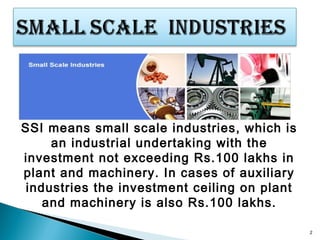
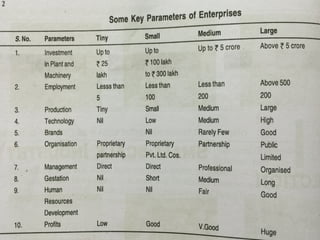
SSI means small scale industries, which is
an industrial undertaking with the
investment not exceeding Rs.100 lakhs in
plant and machinery. In cases of auxiliary
industries the investment ceiling on plant
and machinery is also Rs.100 lakhs.
2

ACCORDING TO FISCAL COMMISSION -1950: “A UNIT OPERATING
WITH HIRED LABOUR , USUALLY 10 TO 50 HANDS “.
 ACCORDING TO SSI BOARD -1955:” A UNIT EMPLOYING LESS THAN
50 PERSONS IF POWER AND LESS THAN 100 PERSONS WITHOUT
THE USE OF POWER AND WITH A CAPITAL INVESTMENT RUPEES 5
LAKH”.
3
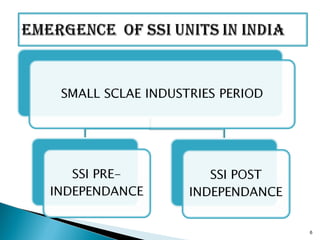
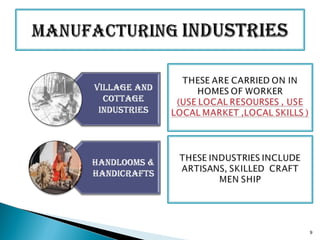
 Before Independence, the present small scale
industry was meant to denote the village and the
urban cottage industry.
 This group included a variety of industries ranging from
manufacturing of Iron safes, locks, carpets, marble
jigs, baskets, hand-loom cloth and the like.
 In fact, at that time the term „cottage and Small scale
industries‟ was used in juxtaposition to large scale industries,
which were established under the British patronage.
 They received encouragement and support during the freedom
movement.
 The small scale industries found a prominent place in the
economic programme envisaged by the Indian
National Congress.
4
After 1947
Jawaharlal Nehru maintained separate entities of small scale industries. He
was of the view that a small industry was the middle sector and it would
overlap both the cottage and the large industries.
1977 industrial Policy
The basic policy support of SSI sector had its roots in the Industrial Policy
Resolution 1977, laid emphasis on reservation of items.
The reservation economically viable and technologically feasible products to
be exclusively manufactured by small scale industry began with a list of 47
items which was gradually extended to too many products.
At Present 812 items are in the reserved list.
The limit on the fixed capital investment for SSI’s was Rs 7.5 lakhs and for
ancillaries it was Rs 10 lakhs. After the Industrial Policy, the ceiling for
investment for SSI’s was raised to Rs 60 lakhs and Rs 70 lakhs for ancillaries .
5
6
7
8
9
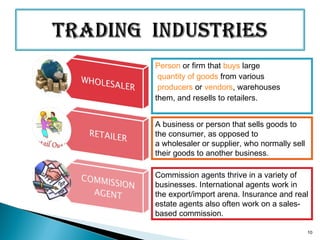
Person or firm that buys large
 quantity of goods from various
 producers or vendors, warehouses 
them, and resells to retailers.
A business or person that sells goods to
the consumer, as opposed to
a wholesaler or supplier, who normally sell
their goods to another business.
Commission agents thrive in a variety of
businesses. International agents work in
the export/import arena. Insurance and real
estate agents also often work on a sales-
based commission.
10
11
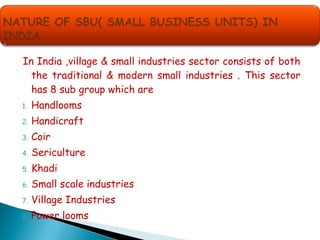
In India ,village & small industries sector consists of both
the traditional & modern small industries . This sector
has 8 sub group which are
1. Handlooms
2. Handicraft
3. Coir
4. Sericulture
5. Khadi
6. Small scale industries
7. Village Industries
8. Power looms
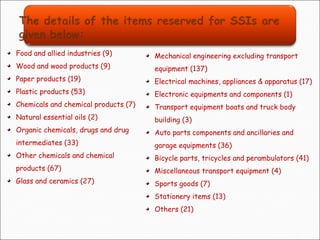
Food and allied industries (9)
Wood and wood products (9)
Paper products (19)
Plastic products (53)
Chemicals and chemical products (7)
Natural essential oils (2)
Organic chemicals, drugs and drug
intermediates (33)
Other chemicals and chemical
products (67)
Glass and ceramics (27)
Mechanical engineering excluding transport
equipment (137)
Electrical machines, appliances & apparatus (17)
Electronic equipments and components (1)
Transport equipment boats and truck body
building (3)
Auto parts components and ancillaries and
garage equipments (36)
Bicycle parts, tricycles and perambulators (41)
Miscellaneous transport equipment (4)
Sports goods (7)
Stationery items (13)
Others (21)
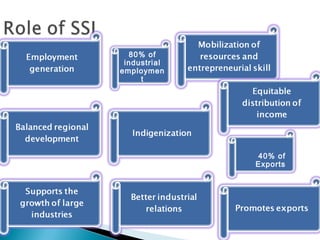
40% of
Exports
80% of
industrial
employmen
t
PERFORMANCE
OF
SMALL SCALE
INDUSTRIES
IN
INDIA
PERFORMANCE
OF
SMALL SCALE
INDUSTRIES
IN
INDIA
15
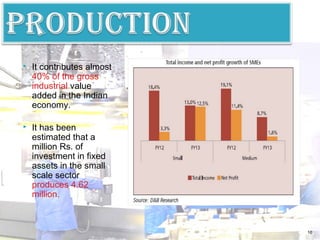
 It contributes almost
40% of the gross
industrial value
added in the Indian
economy.
 It has been
estimated that a
million Rs. of
investment in fixed
assets in the small
scale sector
produces 4.62
million.
16
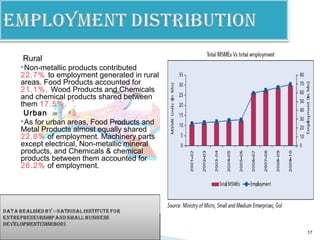
Rural
Non-metallic products contributed
22.7% to employment generated in rural
areas. Food Products accounted for
21.1%, Wood Products and Chemicals
and chemical products shared between
them 17.5%.
Urban
As for urban areas, Food Products and
Metal Products almost equally shared
22.8% of employment. Machinery parts
except electrical, Non-metallic mineral
products, and Chemicals & chemical
products between them accounted for
26.2% of employment.
17
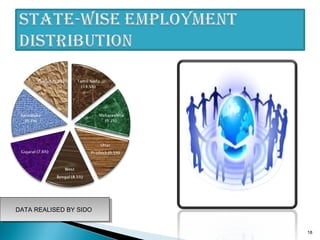
DATA REALISED BY SIDODATA REALISED BY SIDO
18
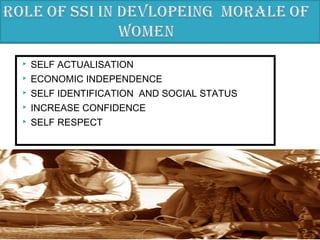
 SELF ACTUALISATION
 ECONOMIC INDEPENDENCE
 SELF IDENTIFICATION AND SOCIAL STATUS
 INCREASE CONFIDENCE
 SELF RESPECT
19
20
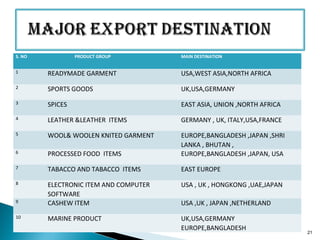
S. NO PRODUCT GROUP MAIN DESTINATION
1 READYMADE GARMENT USA,WEST ASIA,NORTH AFRICA
2 SPORTS GOODS UK,USA,GERMANY
3 SPICES EAST ASIA, UNION ,NORTH AFRICA
4 LEATHER &LEATHER ITEMS GERMANY , UK, ITALY,USA,FRANCE
5 WOOL& WOOLEN KNITED GARMENT EUROPE,BANGLADESH ,JAPAN ,SHRI
LANKA , BHUTAN ,
6 PROCESSED FOOD ITEMS EUROPE,BANGLADESH ,JAPAN, USA
7 TABACCO AND TABACCO ITEMS EAST EUROPE
8 ELECTRONIC ITEM AND COMPUTER
SOFTWARE
USA , UK , HONGKONG ,UAE,JAPAN
9 CASHEW ITEM USA ,UK , JAPAN ,NETHERLAND
10 MARINE PRODUCT UK,USA,GERMANY
EUROPE,BANGLADESH
21
22
23
24
25
26
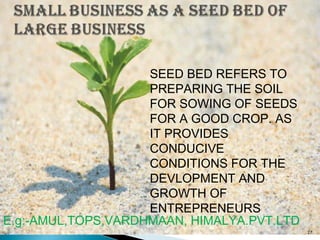
SEED BED REFERS TO
PREPARING THE SOIL
FOR SOWING OF SEEDS
FOR A GOOD CROP. AS
IT PROVIDES
CONDUCIVE
CONDITIONS FOR THE
DEVLOPMENT AND
GROWTH OF
ENTREPRENEURS
E.g:-AMUL,TOPS,VARDHMAAN, HIMALYA.PVT.LTD
27
 To sum up we can say that SSI serves as a seed
bed of entrepreneurship as it provides conducive
conditions for the development and growth of
entrepreneurs . Small entereprises require low
investment and simple technology and use local
resources to meet local demands through
personal contacts.
28
29
30
https://www.youtube.com/watch?
v=CyeVzQu0dZo

Small Scale Industries

  • 1.
  • 2.
    SSI means smallscale industries, which is an industrial undertaking with the investment not exceeding Rs.100 lakhs in plant and machinery. In cases of auxiliary industries the investment ceiling on plant and machinery is also Rs.100 lakhs. 2
  • 3.
     ACCORDING TO FISCALCOMMISSION -1950: “A UNIT OPERATING WITH HIRED LABOUR , USUALLY 10 TO 50 HANDS “.  ACCORDING TO SSI BOARD -1955:” A UNIT EMPLOYING LESS THAN 50 PERSONS IF POWER AND LESS THAN 100 PERSONS WITHOUT THE USE OF POWER AND WITH A CAPITAL INVESTMENT RUPEES 5 LAKH”. 3
  • 4.
     Before Independence,the present small scale industry was meant to denote the village and the urban cottage industry.  This group included a variety of industries ranging from manufacturing of Iron safes, locks, carpets, marble jigs, baskets, hand-loom cloth and the like.  In fact, at that time the term „cottage and Small scale industries‟ was used in juxtaposition to large scale industries, which were established under the British patronage.  They received encouragement and support during the freedom movement.  The small scale industries found a prominent place in the economic programme envisaged by the Indian National Congress. 4
  • 5.
    After 1947 Jawaharlal Nehrumaintained separate entities of small scale industries. He was of the view that a small industry was the middle sector and it would overlap both the cottage and the large industries. 1977 industrial Policy The basic policy support of SSI sector had its roots in the Industrial Policy Resolution 1977, laid emphasis on reservation of items. The reservation economically viable and technologically feasible products to be exclusively manufactured by small scale industry began with a list of 47 items which was gradually extended to too many products. At Present 812 items are in the reserved list. The limit on the fixed capital investment for SSI’s was Rs 7.5 lakhs and for ancillaries it was Rs 10 lakhs. After the Industrial Policy, the ceiling for investment for SSI’s was raised to Rs 60 lakhs and Rs 70 lakhs for ancillaries . 5
  • 6.
  • 7.
  • 8.
  • 9.
  • 10.
    Person or firm that buys large  quantity ofgoods from various  producers or vendors, warehouses  them, and resells to retailers. A business or person that sells goods to the consumer, as opposed to a wholesaler or supplier, who normally sell their goods to another business. Commission agents thrive in a variety of businesses. International agents work in the export/import arena. Insurance and real estate agents also often work on a sales- based commission. 10
  • 11.
  • 12.
    In India ,village& small industries sector consists of both the traditional & modern small industries . This sector has 8 sub group which are 1. Handlooms 2. Handicraft 3. Coir 4. Sericulture 5. Khadi 6. Small scale industries 7. Village Industries 8. Power looms
  • 13.
    Food and alliedindustries (9) Wood and wood products (9) Paper products (19) Plastic products (53) Chemicals and chemical products (7) Natural essential oils (2) Organic chemicals, drugs and drug intermediates (33) Other chemicals and chemical products (67) Glass and ceramics (27) Mechanical engineering excluding transport equipment (137) Electrical machines, appliances & apparatus (17) Electronic equipments and components (1) Transport equipment boats and truck body building (3) Auto parts components and ancillaries and garage equipments (36) Bicycle parts, tricycles and perambulators (41) Miscellaneous transport equipment (4) Sports goods (7) Stationery items (13) Others (21)
  • 14.
  • 15.
  • 16.
     It contributesalmost 40% of the gross industrial value added in the Indian economy.  It has been estimated that a million Rs. of investment in fixed assets in the small scale sector produces 4.62 million. 16
  • 17.
    Rural Non-metallic products contributed 22.7%to employment generated in rural areas. Food Products accounted for 21.1%, Wood Products and Chemicals and chemical products shared between them 17.5%. Urban As for urban areas, Food Products and Metal Products almost equally shared 22.8% of employment. Machinery parts except electrical, Non-metallic mineral products, and Chemicals & chemical products between them accounted for 26.2% of employment. 17
  • 18.
    DATA REALISED BYSIDODATA REALISED BY SIDO 18
  • 19.
     SELF ACTUALISATION ECONOMIC INDEPENDENCE  SELF IDENTIFICATION AND SOCIAL STATUS  INCREASE CONFIDENCE  SELF RESPECT 19
  • 20.
  • 21.
    S. NO PRODUCTGROUP MAIN DESTINATION 1 READYMADE GARMENT USA,WEST ASIA,NORTH AFRICA 2 SPORTS GOODS UK,USA,GERMANY 3 SPICES EAST ASIA, UNION ,NORTH AFRICA 4 LEATHER &LEATHER ITEMS GERMANY , UK, ITALY,USA,FRANCE 5 WOOL& WOOLEN KNITED GARMENT EUROPE,BANGLADESH ,JAPAN ,SHRI LANKA , BHUTAN , 6 PROCESSED FOOD ITEMS EUROPE,BANGLADESH ,JAPAN, USA 7 TABACCO AND TABACCO ITEMS EAST EUROPE 8 ELECTRONIC ITEM AND COMPUTER SOFTWARE USA , UK , HONGKONG ,UAE,JAPAN 9 CASHEW ITEM USA ,UK , JAPAN ,NETHERLAND 10 MARINE PRODUCT UK,USA,GERMANY EUROPE,BANGLADESH 21
  • 22.
  • 23.
  • 24.
  • 25.
  • 26.
  • 27.
    SEED BED REFERSTO PREPARING THE SOIL FOR SOWING OF SEEDS FOR A GOOD CROP. AS IT PROVIDES CONDUCIVE CONDITIONS FOR THE DEVLOPMENT AND GROWTH OF ENTREPRENEURS E.g:-AMUL,TOPS,VARDHMAAN, HIMALYA.PVT.LTD 27
  • 28.
     To sumup we can say that SSI serves as a seed bed of entrepreneurship as it provides conducive conditions for the development and growth of entrepreneurs . Small entereprises require low investment and simple technology and use local resources to meet local demands through personal contacts. 28
  • 29.
  • 30.