How Congress Works
Part I
Structure, Organization,
& Legislative Process
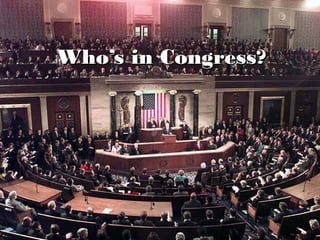
Who’s in Congress?
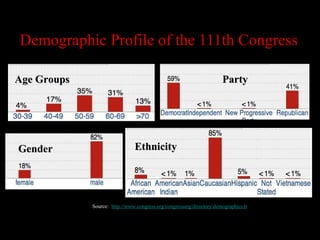
Demographic Profile of the 111th Congress
Age Groups

Gender

Party

Ethnicity

Source: http://www.congress.org/congressorg/directory/demographics.tt
House-Senate Differences
Senate

House







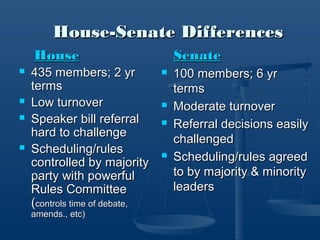
435 members; 2 yr
terms
Low turnover
Speaker bill referral
hard to challenge
Scheduling/rules
controlled by majority
party with powerful
Rules Committee
(controls time of debate,
amends., etc)








100 members; 6 yr
terms
Moderate turnover
Referral decisions easily
challenged
Scheduling/rules agreed
to by majority & minority
leaders
House-Senate Differences








House
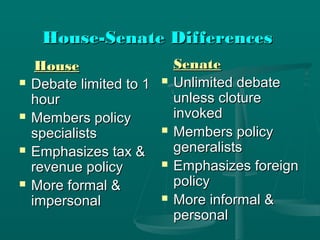
Debate limited to 1
hour
Members policy
specialists
Emphasizes tax &
revenue policy
More formal &
impersonal









Senate
Unlimited debate
unless cloture
invoked
Members policy
generalists
Emphasizes foreign
policy
More informal &
personal
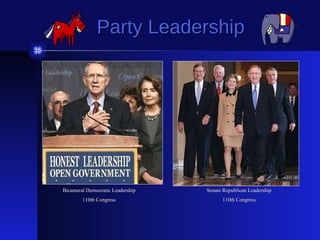
Party Leadership

Bicameral Democratic Leadership

Senate Republican Leadership

110th Congress

110th Congress
HOUSE LEADERSHIP
Speaker
(majority party)

Republicans:
• Majority Leader
• Majority Whip
• Chairman of the
Caucus
• Steering & Policy
Committee
• Democratic
Congressional
Campaign Committee

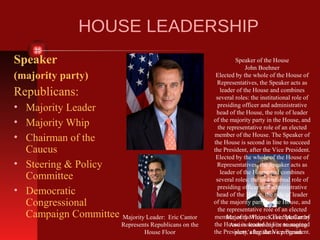
Majority Leader: Eric Cantor
Represents Republicans on the
House Floor

Speaker of the House
John Boehner
Elected by the whole of the House of
Representatives, the Speaker acts as
leader of the House and combines
several roles: the institutional role of
presiding officer and administrative
head of the House, the role of leader
of the majority party in the House, and
the representative role of an elected
member of the House. The Speaker of
the House is second in line to succeed
the President, after the Vice President.
Elected by the whole of the House of
Representatives, the Speaker acts as
leader of the House and combines
several roles: the institutional role of
presiding officer and administrative
head of the House, the role of leader
of the majority party in the House, and
the representative role of an elected
member of the House. The Speaker of
Majority Whip: Kevin McCarthy
the House is second in line managing
Assists leadership in to succeed
the President, after the Vice President.
party’s legislative program
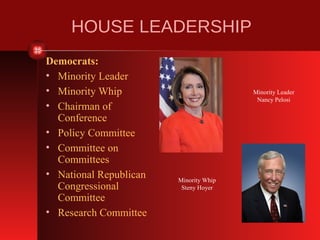
HOUSE LEADERSHIP
Democrats:
• Minority Leader
• Minority Whip
• Chairman of
Conference
• Policy Committee
• Committee on
Committees
• National Republican
Congressional
Committee
• Research Committee

Minority Leader
Nancy Pelosi

Minority Whip
Steny Hoyer
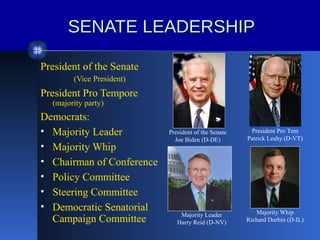
SENATE LEADERSHIP
President of the Senate
(Vice President)

President Pro Tempore
(majority party)

Democrats:
• Majority Leader
• Majority Whip
• Chairman of Conference
• Policy Committee
• Steering Committee
• Democratic Senatorial
Campaign Committee

President of the Senate
Joe Biden (D-DE)

President Pro Tem
Patrick Leahy (D-VT)

Majority Leader
Harry Reid (D-NV)

Majority Whip
Richard Durbin (D-IL)
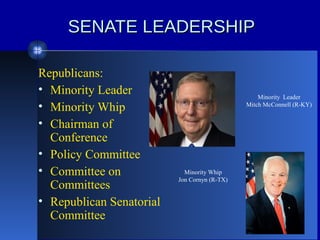
SENATE LEADERSHIP
Republicans:
• Minority Leader
• Minority Whip
• Chairman of
Conference
• Policy Committee
• Committee on
Committees
• Republican Senatorial
Committee

Minority Leader
Mitch McConnell (R-KY)

Minority Whip
Jon Cornyn (R-TX)
Strength of Party Structure?
•

Measure of party strength:
1. Ability of leaders to control party rules
and organization
2. Extent to which party members vote
together in the House and Senate
• Senate: less party-centered and leader
oriented
Party Unity
• Lower today than 100 years ago, but…..
• Ideology important variable explaining party
voting (members vote with their party 80% of the
time)
• Party polarization - vote in which majority of
democrats oppose majority of republicans
• Polarization trends:
o 1976 HR = 36%; S = 37%
o 1995 HR = 73%; S = 69%
o 2000 HR = 43%; S = 49%
CAUCUSES
• Groups (may be bipartisan) meeting to pursue
common legislative objectives
• Rivals to parties in policy formulation
• Examples: Democratic Study Group,
Congressional Black Caucus, Tuesday Lunch
Bunch, Human Rights, Congressional Caucus for
Women’s Issues, Out of Iraq Caucus,
Rural Caucus, Travel & Tourism Caucus, House
Caucus on Missing and Exploited Children
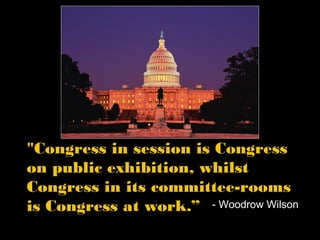
"Congress in session is Congress
on public exhibition, whilst
Congress in its committee-rooms
is Congress at work.” - Woodrow Wilson
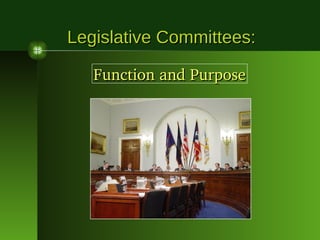
Legislative Committees:
Function and Purpose
Legislative Committees:
Function & Purpose

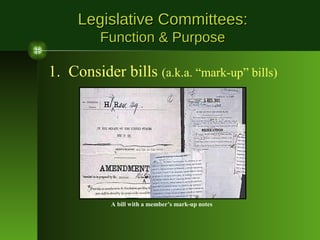
1. Consider bills (a.k.a. “mark-up” bills)

A bill with a member’s mark-up notes
Legislative Committees:
Function & Purpose

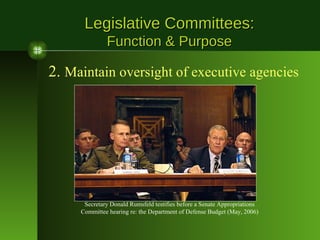
2. Maintain oversight of executive agencies

Secretary Donald Rumsfeld testifies before a Senate Appropriations
Committee hearing re: the Department of Defense Budget (May, 2006)
Legislative Committees:
Function & Purpose

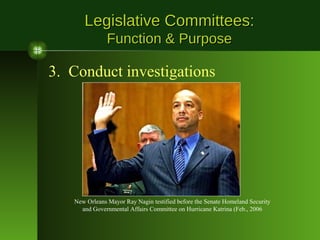
3. Conduct investigations

New Orleans Mayor Ray Nagin testified before the Senate Homeland Security
and Governmental Affairs Committee on Hurricane Katrina (Feb., 2006
Types of Committees
 Standing Committees - permanent panel with full
legislative functions and oversight responsibilities
• Subcommittees – formed to tackle very specific
tasks within the jurisdiction of the full committees
 Select or Special Committees - groups appointed for a
limited purpose and limited duration
 Joint Committees - includes members of both
chambers to conduct studies or perform housekeeping
tasks
 Conference Committee - includes members of House &
Senate to work out differences between similar bills
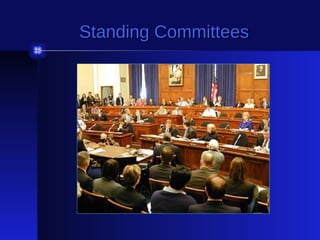
Standing Committees
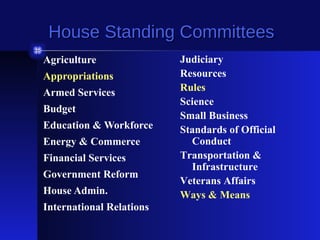
House Standing Committees
Agriculture
Appropriations
Armed Services
Budget
Education & Workforce
Energy & Commerce
Financial Services
Government Reform
House Admin.
International Relations

Judiciary
Resources
Rules
Science
Small Business
Standards of Official
Conduct
Transportation &
Infrastructure
Veterans Affairs
Ways & Means
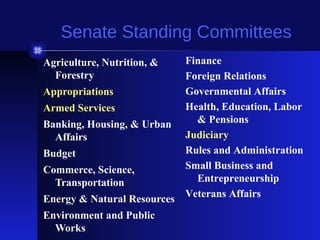
Senate Standing Committees
Finance
Foreign Relations
Governmental Affairs
Appropriations
Health, Education, Labor
Armed Services
& Pensions
Banking, Housing, & Urban
Judiciary
Affairs
Rules and Administration
Budget
Small Business and
Commerce, Science,
Entrepreneurship
Transportation
Energy & Natural Resources Veterans Affairs
Agriculture, Nutrition, &
Forestry

Environment and Public
Works
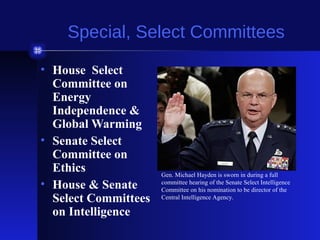
Special, Select Committees
• House Select
Committee on
Energy
Independence &
Global Warming
• Senate Select
Committee on
Ethics
• House & Senate
Select Committees
on Intelligence

Gen. Michael Hayden is sworn in during a full
committee hearing of the Senate Select Intelligence
Committee on his nomination to be director of the
Central Intelligence Agency.
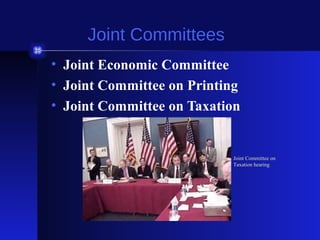
Joint Committees
• Joint Economic Committee
• Joint Committee on Printing
• Joint Committee on Taxation

Joint Committee on
Taxation hearing
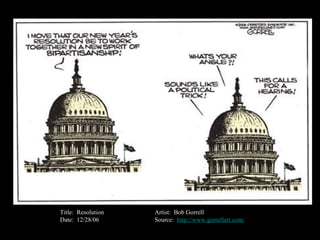
Title: Resolution
Date: 12/28/06

Artist: Bob Gorrell
Source: http://www.gorrellart.com/
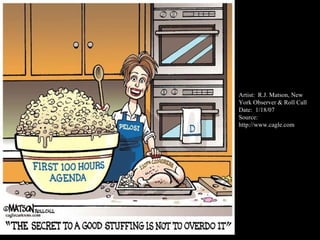
Artist: R.J. Matson, New
York Observer & Roll Call
Date: 1/18/07
Source:
http://www.cagle.com

How Congress Works

  • 1.
    How Congress Works PartI Structure, Organization, & Legislative Process
  • 2.
  • 3.
    Demographic Profile ofthe 111th Congress Age Groups Gender Party Ethnicity Source: http://www.congress.org/congressorg/directory/demographics.tt
  • 4.
    House-Senate Differences Senate House     435 members;2 yr terms Low turnover Speaker bill referral hard to challenge Scheduling/rules controlled by majority party with powerful Rules Committee (controls time of debate, amends., etc)     100 members; 6 yr terms Moderate turnover Referral decisions easily challenged Scheduling/rules agreed to by majority & minority leaders
  • 5.
    House-Senate Differences     House Debate limitedto 1 hour Members policy specialists Emphasizes tax & revenue policy More formal & impersonal     Senate Unlimited debate unless cloture invoked Members policy generalists Emphasizes foreign policy More informal & personal
  • 6.
    Party Leadership Bicameral DemocraticLeadership Senate Republican Leadership 110th Congress 110th Congress
  • 7.
    HOUSE LEADERSHIP Speaker (majority party) Republicans: •Majority Leader • Majority Whip • Chairman of the Caucus • Steering & Policy Committee • Democratic Congressional Campaign Committee Majority Leader: Eric Cantor Represents Republicans on the House Floor Speaker of the House John Boehner Elected by the whole of the House of Representatives, the Speaker acts as leader of the House and combines several roles: the institutional role of presiding officer and administrative head of the House, the role of leader of the majority party in the House, and the representative role of an elected member of the House. The Speaker of the House is second in line to succeed the President, after the Vice President. Elected by the whole of the House of Representatives, the Speaker acts as leader of the House and combines several roles: the institutional role of presiding officer and administrative head of the House, the role of leader of the majority party in the House, and the representative role of an elected member of the House. The Speaker of Majority Whip: Kevin McCarthy the House is second in line managing Assists leadership in to succeed the President, after the Vice President. party’s legislative program
  • 8.
    HOUSE LEADERSHIP Democrats: • MinorityLeader • Minority Whip • Chairman of Conference • Policy Committee • Committee on Committees • National Republican Congressional Committee • Research Committee Minority Leader Nancy Pelosi Minority Whip Steny Hoyer
  • 9.
    SENATE LEADERSHIP President ofthe Senate (Vice President) President Pro Tempore (majority party) Democrats: • Majority Leader • Majority Whip • Chairman of Conference • Policy Committee • Steering Committee • Democratic Senatorial Campaign Committee President of the Senate Joe Biden (D-DE) President Pro Tem Patrick Leahy (D-VT) Majority Leader Harry Reid (D-NV) Majority Whip Richard Durbin (D-IL)
  • 10.
    SENATE LEADERSHIP Republicans: • MinorityLeader • Minority Whip • Chairman of Conference • Policy Committee • Committee on Committees • Republican Senatorial Committee Minority Leader Mitch McConnell (R-KY) Minority Whip Jon Cornyn (R-TX)
  • 11.
    Strength of PartyStructure? • Measure of party strength: 1. Ability of leaders to control party rules and organization 2. Extent to which party members vote together in the House and Senate • Senate: less party-centered and leader oriented
  • 12.
    Party Unity • Lowertoday than 100 years ago, but….. • Ideology important variable explaining party voting (members vote with their party 80% of the time) • Party polarization - vote in which majority of democrats oppose majority of republicans • Polarization trends: o 1976 HR = 36%; S = 37% o 1995 HR = 73%; S = 69% o 2000 HR = 43%; S = 49%
  • 13.
    CAUCUSES • Groups (maybe bipartisan) meeting to pursue common legislative objectives • Rivals to parties in policy formulation • Examples: Democratic Study Group, Congressional Black Caucus, Tuesday Lunch Bunch, Human Rights, Congressional Caucus for Women’s Issues, Out of Iraq Caucus, Rural Caucus, Travel & Tourism Caucus, House Caucus on Missing and Exploited Children
  • 14.
    "Congress in sessionis Congress on public exhibition, whilst Congress in its committee-rooms is Congress at work.” - Woodrow Wilson
  • 15.
  • 16.
    Legislative Committees: Function &Purpose 1. Consider bills (a.k.a. “mark-up” bills) A bill with a member’s mark-up notes
  • 17.
    Legislative Committees: Function &Purpose 2. Maintain oversight of executive agencies Secretary Donald Rumsfeld testifies before a Senate Appropriations Committee hearing re: the Department of Defense Budget (May, 2006)
  • 18.
    Legislative Committees: Function &Purpose 3. Conduct investigations New Orleans Mayor Ray Nagin testified before the Senate Homeland Security and Governmental Affairs Committee on Hurricane Katrina (Feb., 2006
  • 19.
    Types of Committees Standing Committees - permanent panel with full legislative functions and oversight responsibilities • Subcommittees – formed to tackle very specific tasks within the jurisdiction of the full committees  Select or Special Committees - groups appointed for a limited purpose and limited duration  Joint Committees - includes members of both chambers to conduct studies or perform housekeeping tasks  Conference Committee - includes members of House & Senate to work out differences between similar bills
  • 20.
  • 21.
    House Standing Committees Agriculture Appropriations ArmedServices Budget Education & Workforce Energy & Commerce Financial Services Government Reform House Admin. International Relations Judiciary Resources Rules Science Small Business Standards of Official Conduct Transportation & Infrastructure Veterans Affairs Ways & Means
  • 22.
    Senate Standing Committees Finance ForeignRelations Governmental Affairs Appropriations Health, Education, Labor Armed Services & Pensions Banking, Housing, & Urban Judiciary Affairs Rules and Administration Budget Small Business and Commerce, Science, Entrepreneurship Transportation Energy & Natural Resources Veterans Affairs Agriculture, Nutrition, & Forestry Environment and Public Works
  • 23.
    Special, Select Committees •House Select Committee on Energy Independence & Global Warming • Senate Select Committee on Ethics • House & Senate Select Committees on Intelligence Gen. Michael Hayden is sworn in during a full committee hearing of the Senate Select Intelligence Committee on his nomination to be director of the Central Intelligence Agency.
  • 24.
    Joint Committees • JointEconomic Committee • Joint Committee on Printing • Joint Committee on Taxation Joint Committee on Taxation hearing
  • 25.
    Title: Resolution Date: 12/28/06 Artist:Bob Gorrell Source: http://www.gorrellart.com/
  • 26.
    Artist: R.J. Matson,New York Observer & Roll Call Date: 1/18/07 Source: http://www.cagle.com