Phenomenographic interviews as a learning process 
Eva Hornung, Shahd Salha, Sheila Webber 
Oxford, September 2014
Structure 
•Introduction 
•Three perspectives 
–Sheila 
–Shahd 
–Eva 
•Drawing together the three experiences 
•Conclusions 
Hornung, Salha, Webber, 2014
Three key elements 
•We are writing a paper: emerging thoughts in this presentation 
•Learning experiences of the researcher (may consider: cultural context, attitude to research, personal feelings about phenomenography; relationship to interviewees/research) 
•Learning experiences of the interviewees 
•The context/environment of the interview (e.g. context of interview (where/who/when etc.), changing roles, setting, environment of the research process, what happens after the interview and after the research has “finished”) 
Hornung, Salha, Webber, 2014
SHEILA: FIRST PHENOMENOGRAPHIC RESEARCH 
UK academics‟ conceptions of information literacy and of teaching information literacy (Webber et al. (2005); Boon et al (2007) etc.) 
80 academics; 20 each from 4 disciplines 
Sample varied in terms of university, age, gender, research rating of department etc. 
Research Assistant interviewer, mostly interviewed them in their offices 
Fellow researcher, but mostly not in their discipline 
Not investigating their own discipline 
Hornung, Salha, Webber, 2014
MY EXPERIENCE OF INTERVIEWS 
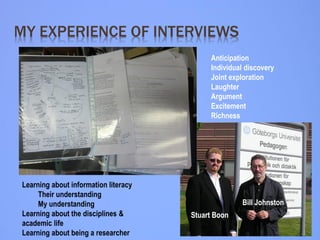
Stuart Boon 
Bill Johnston 
Anticipation Individual discovery Joint exploration Laughter Argument Excitement Richness 
Learning about information literacy 
Their understanding 
My understanding 
Learning about the disciplines & academic life 
Learning about being a researcher
“I think that the way that you have asked me the questions and the way that the discussion has been structured has actually pushed me to reflect in a pretty significant way, actually, about both the theoretical and the practical model [of information literacy] So I would thank you for that because I suspect I am … going to go off and do something with this as well, which was perhaps not your intention” (English (discipline) academic 6) 
Those with most complex conceptions of teaching/ information literacy most vocal in describing impact/ learning (I think: haven‟t explored systematically) 
Hornung, Salha, Webber, 2014
FURTHER EXPERIENCES OF PHENOMENOGRAPHIC INTERVIEWEES 
With my PhD students 
As external examiner 
Through “rediscovering” the interview transcripts (they still live!) 
Hornung, Salha, Webber, 2014
THE SCENE FROM SYRIAN CONTEXT 
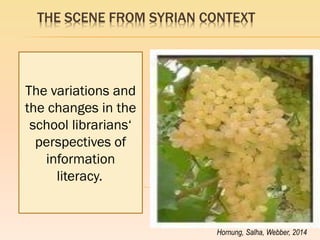
The variations and the changes in the school librarians„ perspectives of information literacy.. 
Hornung, Salha, Webber, 2014
BACKGROUND ABOUT THE EXPERIENCE 
The study provides a new way, which is less common, to conduct two phenomenographic researches in the same study 
The study used a longitudinal and discursive phenomenographic approaches conducted in two parts in 16 months durations counting the time spent for piloting 
The same professionals were interviewed 
Hornung, Salha, Webber, 2014
MY LEARNING EXPERIENCE WITH PHENOMENOGRAPHIC ( SALHA,2011) 
This first research in the Arabic context which used the phenomenographic approach 
No earlier research studies in the similar contexts to learn from 
I was not sure which phenomenographic approach I should adopt 
Hornung, Salha, Webber, 2014
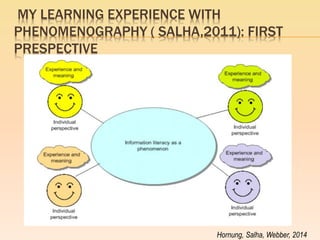
MY LEARNING EXPERIENCE WITH PHENOMENOGRAPHY ( SALHA,2011): FIRST PRESPECTIVE 
Hornung, Salha, Webber, 2014
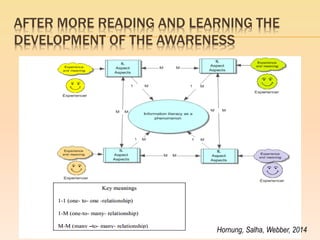
AFTER MORE READING AND LEARNING THE DEVELOPMENT OF THE AWARENESS 
Hornung, Salha, Webber, 2014
PROFESSIONAL EXPERIENCE WITH PHENOMENOGRAPHY 
Professionals had no awareness of the phenomenon of IL 
Some of them knew me but our relationship was limited to tutor-student relationship 
 They were not sure about the meaning of the studied phenomenon so the main feeling was uncertainty and confusion 
The culture of silence and the fear from others were a serious obstacle 
Piloting was a successful strategy to reduce the risk and learn more about the setting 
Hornung, Salha, Webber, 2014
AFTER THE PROGRAMME 
They become more confident 
They became familiar with the studied concept 
We became more familiar with each other 
Established better connection allowed us communicate and share more 
They became more expert interviewees and I became more expert interviewer 
I become more aware of the difficulty and of their learning style 
They became more aware of my interviewing style 
I realised that I can play many roles 
Hornung, Salha, Webber, 2014
THIRD STORY: CPD AND SOLO LIBRARIANS 
On the perceptions of one-person librarians in Ireland of “continuing professional development” 
30 interviewees who ranged from recent graduates to very experienced professionals 
Researcher was peer of participants – played different roles (see Caven, 2012) 
No experience of interviewing and recording 
Hornung, Salha, Webber, 2014
THE NOVICE RESEARCHER 
Field notes and reflective research diary 
Reflections on learning uttered during the interview process influenced the interview schedule 
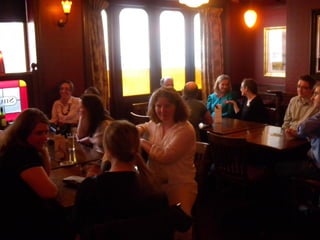
Interviewees were free to choose the setting, which was putting them at ease (but: audibility of recorded interview and interruptions) 
“After the interview” experience – cultural informal context… Irish people love to talk 
Hornung, Salha, Webber, 2014
CATEGORIES OF DESCRIPTION 
Category 1: Upskilling for the sake of the organisation/library service (service orientation) 
Category 2: Developing as a professional librarian (LIS profession orientation) 
Category 3: Helping you to do all the jobs an OPL does (OPL orientation) 
Category 4: When you have learned something and you want to do things in a better way when you come back (personal orientation) 
Category 5: Your development as a human being (lifelong learning orientation) 
Hornung (2013) 
Hornung, Salha, Webber, 2014
LEARNING THROUGH INTERVIEWING PROCESS 
Interviewees mentioned how interviews changed their thinking (category 5 in particular) 
Evidence of previous learning experiences (both surface and deep) 
Relationship between interviewer and interviewee changed 
Interview as a learning experience for both 
The setting influenced the quality of the relationship and of the interview 
Hornung, Salha, Webber, 2014
Common threads in all Three studies 
•Interviewees mentioned how interviews changed their thinking 
•Relationship between interviewer and interviewee changed 
•Interview as a learning experience for both 
•More aware of variation! 
Hornung, Salha, Webber, 2014
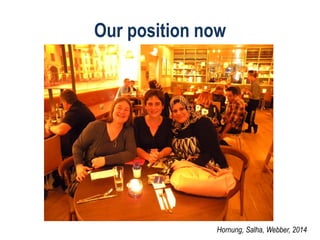
Our position now 
Hornung, Salha, Webber, 2014
Sheila Webber Information School University of Sheffield s.webber@shef.ac.uk Twitter & SL: Sheila Yoshikawa http://information-literacy.blogspot.com/ http://www.slideshare.net/sheilawebber/ Orcid ID 0000-0002-2280-9519 
Dr Eva Hornung CDETB Curriculum Development Unit/Trinity College Dublin hornunge@tcd.ie LinkedIn: Eva Hornung 
Dr Shahd Salha A researcher Sheffield University Information School drshahdsalha@gmail.com LinkedIn: Shahd Salha
References 
•Cavan, V. (2012) “Agony aunt, hostage, intruder or friend? The multiple personas of the interviewer during fieldwork.” Intangible capital, 8 (3), 548-563. 
•Boon, S., Johnston, B. and Webber, S. (2007) "A phenomenographic study of English faculty's conceptions of information literacy." Journal of documentation, 63 (2), 204-228. 
•Hornung, E. (2013) On your own but not alone: one-person librarians in Ireland and their perceptions of Continuing Professional Development. Library trends, 61 (3), 675-702. 
•Salha, S. (2011) The variations and the changes in the school librarians' perspectives of information literacy. PhD Thesis, Information School, University of Sheffield. http://etheses.whiterose.ac.uk/1538/2/Salha,_Shahd.pdf 
•Webber, S., Boon, S. and Johnston, B. (2005) “A comparison of UK academics’ conceptions of information literacy in two disciplines: English and Marketing.” Library and information research, 29 (93), 4-15 
Hornung, Salha, Webber, 2014

Phenomenographic interviews as a learning process

  • 1.
    Phenomenographic interviews asa learning process Eva Hornung, Shahd Salha, Sheila Webber Oxford, September 2014
  • 2.
    Structure •Introduction •Threeperspectives –Sheila –Shahd –Eva •Drawing together the three experiences •Conclusions Hornung, Salha, Webber, 2014
  • 3.
    Three key elements •We are writing a paper: emerging thoughts in this presentation •Learning experiences of the researcher (may consider: cultural context, attitude to research, personal feelings about phenomenography; relationship to interviewees/research) •Learning experiences of the interviewees •The context/environment of the interview (e.g. context of interview (where/who/when etc.), changing roles, setting, environment of the research process, what happens after the interview and after the research has “finished”) Hornung, Salha, Webber, 2014
  • 4.
    SHEILA: FIRST PHENOMENOGRAPHICRESEARCH UK academics‟ conceptions of information literacy and of teaching information literacy (Webber et al. (2005); Boon et al (2007) etc.) 80 academics; 20 each from 4 disciplines Sample varied in terms of university, age, gender, research rating of department etc. Research Assistant interviewer, mostly interviewed them in their offices Fellow researcher, but mostly not in their discipline Not investigating their own discipline Hornung, Salha, Webber, 2014
  • 5.
    MY EXPERIENCE OFINTERVIEWS Stuart Boon Bill Johnston Anticipation Individual discovery Joint exploration Laughter Argument Excitement Richness Learning about information literacy Their understanding My understanding Learning about the disciplines & academic life Learning about being a researcher
  • 6.
    “I think thatthe way that you have asked me the questions and the way that the discussion has been structured has actually pushed me to reflect in a pretty significant way, actually, about both the theoretical and the practical model [of information literacy] So I would thank you for that because I suspect I am … going to go off and do something with this as well, which was perhaps not your intention” (English (discipline) academic 6) Those with most complex conceptions of teaching/ information literacy most vocal in describing impact/ learning (I think: haven‟t explored systematically) Hornung, Salha, Webber, 2014
  • 7.
    FURTHER EXPERIENCES OFPHENOMENOGRAPHIC INTERVIEWEES With my PhD students As external examiner Through “rediscovering” the interview transcripts (they still live!) Hornung, Salha, Webber, 2014
  • 8.
    THE SCENE FROMSYRIAN CONTEXT The variations and the changes in the school librarians„ perspectives of information literacy.. Hornung, Salha, Webber, 2014
  • 9.
    BACKGROUND ABOUT THEEXPERIENCE The study provides a new way, which is less common, to conduct two phenomenographic researches in the same study The study used a longitudinal and discursive phenomenographic approaches conducted in two parts in 16 months durations counting the time spent for piloting The same professionals were interviewed Hornung, Salha, Webber, 2014
  • 10.
    MY LEARNING EXPERIENCEWITH PHENOMENOGRAPHIC ( SALHA,2011) This first research in the Arabic context which used the phenomenographic approach No earlier research studies in the similar contexts to learn from I was not sure which phenomenographic approach I should adopt Hornung, Salha, Webber, 2014
  • 11.
    MY LEARNING EXPERIENCEWITH PHENOMENOGRAPHY ( SALHA,2011): FIRST PRESPECTIVE Hornung, Salha, Webber, 2014
  • 12.
    AFTER MORE READINGAND LEARNING THE DEVELOPMENT OF THE AWARENESS Hornung, Salha, Webber, 2014
  • 13.
    PROFESSIONAL EXPERIENCE WITHPHENOMENOGRAPHY Professionals had no awareness of the phenomenon of IL Some of them knew me but our relationship was limited to tutor-student relationship  They were not sure about the meaning of the studied phenomenon so the main feeling was uncertainty and confusion The culture of silence and the fear from others were a serious obstacle Piloting was a successful strategy to reduce the risk and learn more about the setting Hornung, Salha, Webber, 2014
  • 14.
    AFTER THE PROGRAMME They become more confident They became familiar with the studied concept We became more familiar with each other Established better connection allowed us communicate and share more They became more expert interviewees and I became more expert interviewer I become more aware of the difficulty and of their learning style They became more aware of my interviewing style I realised that I can play many roles Hornung, Salha, Webber, 2014
  • 15.
    THIRD STORY: CPDAND SOLO LIBRARIANS On the perceptions of one-person librarians in Ireland of “continuing professional development” 30 interviewees who ranged from recent graduates to very experienced professionals Researcher was peer of participants – played different roles (see Caven, 2012) No experience of interviewing and recording Hornung, Salha, Webber, 2014
  • 16.
    THE NOVICE RESEARCHER Field notes and reflective research diary Reflections on learning uttered during the interview process influenced the interview schedule Interviewees were free to choose the setting, which was putting them at ease (but: audibility of recorded interview and interruptions) “After the interview” experience – cultural informal context… Irish people love to talk Hornung, Salha, Webber, 2014
  • 18.
    CATEGORIES OF DESCRIPTION Category 1: Upskilling for the sake of the organisation/library service (service orientation) Category 2: Developing as a professional librarian (LIS profession orientation) Category 3: Helping you to do all the jobs an OPL does (OPL orientation) Category 4: When you have learned something and you want to do things in a better way when you come back (personal orientation) Category 5: Your development as a human being (lifelong learning orientation) Hornung (2013) Hornung, Salha, Webber, 2014
  • 19.
    LEARNING THROUGH INTERVIEWINGPROCESS Interviewees mentioned how interviews changed their thinking (category 5 in particular) Evidence of previous learning experiences (both surface and deep) Relationship between interviewer and interviewee changed Interview as a learning experience for both The setting influenced the quality of the relationship and of the interview Hornung, Salha, Webber, 2014
  • 20.
    Common threads inall Three studies •Interviewees mentioned how interviews changed their thinking •Relationship between interviewer and interviewee changed •Interview as a learning experience for both •More aware of variation! Hornung, Salha, Webber, 2014
  • 21.
    Our position now Hornung, Salha, Webber, 2014
  • 22.
    Sheila Webber InformationSchool University of Sheffield s.webber@shef.ac.uk Twitter & SL: Sheila Yoshikawa http://information-literacy.blogspot.com/ http://www.slideshare.net/sheilawebber/ Orcid ID 0000-0002-2280-9519 Dr Eva Hornung CDETB Curriculum Development Unit/Trinity College Dublin hornunge@tcd.ie LinkedIn: Eva Hornung Dr Shahd Salha A researcher Sheffield University Information School drshahdsalha@gmail.com LinkedIn: Shahd Salha
  • 23.
    References •Cavan, V.(2012) “Agony aunt, hostage, intruder or friend? The multiple personas of the interviewer during fieldwork.” Intangible capital, 8 (3), 548-563. •Boon, S., Johnston, B. and Webber, S. (2007) "A phenomenographic study of English faculty's conceptions of information literacy." Journal of documentation, 63 (2), 204-228. •Hornung, E. (2013) On your own but not alone: one-person librarians in Ireland and their perceptions of Continuing Professional Development. Library trends, 61 (3), 675-702. •Salha, S. (2011) The variations and the changes in the school librarians' perspectives of information literacy. PhD Thesis, Information School, University of Sheffield. http://etheses.whiterose.ac.uk/1538/2/Salha,_Shahd.pdf •Webber, S., Boon, S. and Johnston, B. (2005) “A comparison of UK academics’ conceptions of information literacy in two disciplines: English and Marketing.” Library and information research, 29 (93), 4-15 Hornung, Salha, Webber, 2014