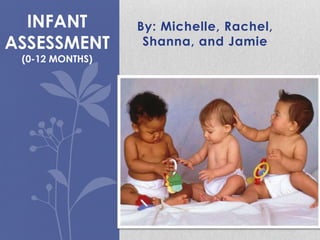
INFANT         By: Michelle, Rachel,
ASSESSMENT        Shanna, and Jamie
 (0-12 MONTHS)
Cognitive
         Activity
• Pay attention to sights and sounds.
• Look for dropped object.
• Gaze at and track an object with
his/her eyes.
• Act to trigger a pleasing sight, sound
or motion, such as kicking at a mobile;
repeat actions many times to cause a
desired effect.
• Show curiosity about things and try
to get things that are out of reach.       Math:
• Imitate sounds; imitate actions, such    Play with toys and things of different
as clapping hands, pushing a toy.          sizes and shapes.
• Search for a hidden object.              • Anticipate “more” during routines.
Cognitive Assessment
  Science:
  Use the senses (mouthing,                   Social Studies:
  watching, grasping, reaching) to            • Show interest in people.
  get information and explore                 • Notice daily routines.
  what’s nearby.
  • Use more than one sense at a              Arts:
  time, such as when looking at,              • Gaze at pictures, photos and mirror
  feeling and shaking a rattle.               images.
  • Repeat behaviors to figure out            • Show interest in sounds, tones,
  cause and effect. For example, a            voices, music, colors and shapes.
  toy released high always goes               • Notice and move to music and/or
  down (law of gravity).                      rhythms.
  • Enjoy filling containers and
  dumping them out.
  • Show interest in animals and
  pictures of animals.
http://www.livestrong.com/article/154193-
infant-cognitive-development-activities/
http://www.del.wa.gov/publications/developm
ent/docs/guidelines.pdf
One to Three Month Old Infant
• Infants will learn to turn their
  heads to preferred positions
                                  Physical Activity
  when lying on their stomachs or        Four to Seven Month Old Infant
  backs                                  • Infants will be able to hold an object
• Infants will be able to hold their       in their hands and bring it to their
  chins up when lying on their             mouths. They will eventually learn to
  stomachs                                 pass an object from one hand to the
• Infants will learn to roll from side     other.
  to side by three months.               • Infants will be able to push their
• Infants will learn to reach out and      heads and shoulders up and rest
  swipe at objects that are within         their weight on their forearms when
  their field of view.                     they are lying on their stomachs.
• Infants will start producing tears     • Infants in this age group will start
  when they cry                            drooling and teething.
                                         • Infants will learn to roll from back to
                                           side, and then they will learn to roll
                                           from stomach to back.
                                         • Infants will learn to pull their feet to
                                           their mouth and play or chew on
                                           toes.
                                         • Infants may sit unsupported for a
                                           brief period of time.
Physical
                          Activity
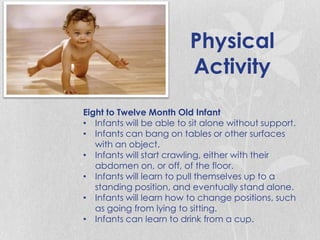
Eight to Twelve Month Old Infant
• Infants will be able to sit alone without support.
• Infants can bang on tables or other surfaces
   with an object.
• Infants will start crawling, either with their
   abdomen on, or off, of the floor.
• Infants will learn to pull themselves up to a
   standing position, and eventually stand alone.
• Infants will learn how to change positions, such
   as going from lying to sitting.
• Infants can learn to drink from a cup.
Physical Assessment
Document:                         6 month old checklist/observation
•    General appearance &         Lay baby on back and leave toys
     behavior                     around him/her. Then observe to see if
     Facial expression           baby crawls, sits up or reaches for
                                  objects.
    • Posture / movement          • Sits briefly by self
    • Behavior                    • sits in high chair
•    Parent observation           • stands briefly while leaning on
                                    furniture
•    Classroom observation
                                  • rolls over both ways
•    Document with camera and     • digs in with toes and hands to move
     take notes of changes in       toward toy
     physical ability             • reaches precisely
•    Take note of what child is   • points at toys
     unable to do                 • manipulates blocks
                                  • uses whole hand to pick up small
                                    objects with thumb and fingers
Social/emotional
          Assessment Checklist
One to Two Months of Age:
During the first 3 months, an infant's
socialization is based around activities
of feeding, sleeping, elimination, and
body positioning. The infant also begins
early stages of learning to self-regulate.
In other words, to tune out when there
is too much stimulus and then arouse
when something of interest comes
about.
The infant will do such things as react to
paper being put over his or her face
and show recognition to mother or            Adapted from: Allen, K.E. & Marotz, I.
                                             (1989). Developmental profiles: Birth
other familiar and favorite caregivers.      to six. Delmar Publisher Inc.
Notes:                                       www.pediatricbehavior.com/ChildD
                                             ev/infantsocialdev.htm
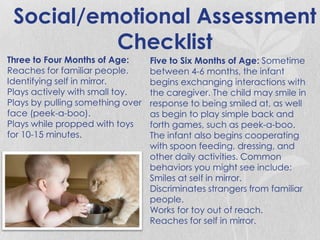
Social/emotional Assessment
          Checklist
Three to Four Months of Age:      Five to Six Months of Age: Sometime
Reaches for familiar people.      between 4-6 months, the infant
Identifying self in mirror.       begins exchanging interactions with
Plays actively with small toy.    the caregiver. The child may smile in
Plays by pulling something over   response to being smiled at, as well
face (peek-a-boo).                as begin to play simple back and
Plays while propped with toys     forth games, such as peek-a-boo.
for 10-15 minutes.                The infant also begins cooperating
                                  with spoon feeding, dressing, and
                                  other daily activities. Common
                                  behaviors you might see include:
                                  Smiles at self in mirror.
                                  Discriminates strangers from familiar
                                  people.
                                  Works for toy out of reach.
                                  Reaches for self in mirror.
Social/emotional Assessment
          Checklist
Seven to Nine Months of Age:           Ten to Twelve Months of Age : During
During the 7-9 month time              the ten to twelve month period, the
period, the infant begins to           infant begins checking self need
initiate activities. The infant will   against caregiver availability. In
work to gain the caregiver's           other words, the infant will look to
attention, will strain to reach an     the primary caregiver and cry when
object out of reach on the floor,      hungry, or look for the caregiver to
and to perform other behaviors         comfort a hurt or when bored.
to manipulate the environment.         Common behaviors at this age
Some common behaviors                  include:
include:                               Recognizes familiar people from a
Clings to familiar people and          distance of 20 feet.
hides face.                            Beginning to demand
Plays with or reaches for self or      independence.
object in mirror by 12 months.         Demands personal attention.
Cooperates with adult in games.        Mouthing toys and items less.
Bites and chews toys.
Language Assessment
Babies may not be talking throughout these
months of their life but they are using
language to communicate. Babies soak
information up like sponges.
By the end of three months old an infant
may:
• Smile when you appear
• Be startled when hearing a loud sound
• Coo
• Quiet or smile when being talked to
• Recognize your voice
• Let out different cries for different needs
Language Assessment
Infants grow rapidly and are learning so
much about the world they are just
seeing for the first time.
By the end of six months an infant may:
• Making gurgling sounds when playing
   or when alone
• Use repetition when talking “Ba Ba”
• Use voice to express pleasure or
   displeasure
• Move eyes in the direction of sound
• Respond to changes in the tone of
   voice you are using
• Notice toys make sounds
• Pay attention to music
Language Assessment
The next six months a lot of                 Infants start using language as soon
language growth happens.                     as they are born.
By a year old an infant may:                 The first thing you hear from your
• Try to imitate words                       baby is a cry. Since an infant has no
• Say a few words (Dada,                     words, this is how they communicate
   Mama, Uh-oh)                              for the first few weeks.
• Understand simple                          When a child Coo’s, smiles, babbles,
   instructions                              or uses expressions, this is all
• Understand No                              language.
• Turn and look in the                       At the age of 12 months children
   direction of sounds                       understand simple commands.
• Use sign language                          Children often understand more
                                             language than what they are able to
                                             use.
http://www.acf.hhs.gov/programs/opre/ehs/    Infants need to be talked to. Children
perf_measures/reports/resources_measuring/
res_meas_cdiff.html                          learn to communicate best when
http://www.brazelton-                        they are talked to and
institute.com/intro.html.
                                             communicated with.
Possible Signs of Developmental Delays
                                      By age 6 months, your baby:
By age 2 months, your baby:
                                      •Doesn’t try to get things that are in reach
• Doesn’t respond to loud sounds      •Shows no affection for caregivers
• Doesn’t watch things as they move   •Doesn’t respond to sounds around him or her
• Doesn’t smile at people             •Has difficulty getting things to mouth
• Doesn’t bring hands to mouth        •Seems very floppy
• Can’t hold head up when pushing     •Doesn’t make vowel sounds (such as “ah,”
  up, when on tummy                   “eh,” “oh”)
                                      •Doesn’t roll over in either direction
                                      •Doesn’t laugh or make squealing sounds
By age 4 months, your baby:
                                      •Seems very stiff, with tight muscles
• Doesn’t watch things as they move
• Doesn’t smile at people             By age 9 months, your baby:
• Can’t hold head steady              •Doesn’t bear weight on legs with support
• Doesn’t coo or make sounds          •Doesn’t sit with help
• Doesn’t bring things to mouth       •Doesn’t babble (“mama,” “baba,” “dada”)
                                      •Doesn’t play any games involving back and-
• Doesn’t push down with legs when
  feet are placed on a hard surface   forth play
                                      •Doesn’t respond to own name
• Has trouble moving one or both
  eyes in all directions              •Doesn’t seem to recognize familiar people
                                      •Doesn’t look where you point
                                      •Doesn’t transfer toys from one hand to the other
Thank
 you!

Infant assessment

  • 1.
    INFANT By: Michelle, Rachel, ASSESSMENT Shanna, and Jamie (0-12 MONTHS)
  • 2.
    Cognitive Activity • Pay attention to sights and sounds. • Look for dropped object. • Gaze at and track an object with his/her eyes. • Act to trigger a pleasing sight, sound or motion, such as kicking at a mobile; repeat actions many times to cause a desired effect. • Show curiosity about things and try to get things that are out of reach. Math: • Imitate sounds; imitate actions, such Play with toys and things of different as clapping hands, pushing a toy. sizes and shapes. • Search for a hidden object. • Anticipate “more” during routines.
  • 3.
    Cognitive Assessment Science: Use the senses (mouthing, Social Studies: watching, grasping, reaching) to • Show interest in people. get information and explore • Notice daily routines. what’s nearby. • Use more than one sense at a Arts: time, such as when looking at, • Gaze at pictures, photos and mirror feeling and shaking a rattle. images. • Repeat behaviors to figure out • Show interest in sounds, tones, cause and effect. For example, a voices, music, colors and shapes. toy released high always goes • Notice and move to music and/or down (law of gravity). rhythms. • Enjoy filling containers and dumping them out. • Show interest in animals and pictures of animals. http://www.livestrong.com/article/154193- infant-cognitive-development-activities/ http://www.del.wa.gov/publications/developm ent/docs/guidelines.pdf
  • 4.
    One to ThreeMonth Old Infant • Infants will learn to turn their heads to preferred positions Physical Activity when lying on their stomachs or Four to Seven Month Old Infant backs • Infants will be able to hold an object • Infants will be able to hold their in their hands and bring it to their chins up when lying on their mouths. They will eventually learn to stomachs pass an object from one hand to the • Infants will learn to roll from side other. to side by three months. • Infants will be able to push their • Infants will learn to reach out and heads and shoulders up and rest swipe at objects that are within their weight on their forearms when their field of view. they are lying on their stomachs. • Infants will start producing tears • Infants in this age group will start when they cry drooling and teething. • Infants will learn to roll from back to side, and then they will learn to roll from stomach to back. • Infants will learn to pull their feet to their mouth and play or chew on toes. • Infants may sit unsupported for a brief period of time.
  • 5.
    Physical Activity Eight to Twelve Month Old Infant • Infants will be able to sit alone without support. • Infants can bang on tables or other surfaces with an object. • Infants will start crawling, either with their abdomen on, or off, of the floor. • Infants will learn to pull themselves up to a standing position, and eventually stand alone. • Infants will learn how to change positions, such as going from lying to sitting. • Infants can learn to drink from a cup.
  • 6.
    Physical Assessment Document: 6 month old checklist/observation • General appearance & Lay baby on back and leave toys behavior around him/her. Then observe to see if  Facial expression baby crawls, sits up or reaches for objects. • Posture / movement • Sits briefly by self • Behavior • sits in high chair • Parent observation • stands briefly while leaning on furniture • Classroom observation • rolls over both ways • Document with camera and • digs in with toes and hands to move take notes of changes in toward toy physical ability • reaches precisely • Take note of what child is • points at toys unable to do • manipulates blocks • uses whole hand to pick up small objects with thumb and fingers
  • 7.
    Social/emotional Assessment Checklist One to Two Months of Age: During the first 3 months, an infant's socialization is based around activities of feeding, sleeping, elimination, and body positioning. The infant also begins early stages of learning to self-regulate. In other words, to tune out when there is too much stimulus and then arouse when something of interest comes about. The infant will do such things as react to paper being put over his or her face and show recognition to mother or Adapted from: Allen, K.E. & Marotz, I. (1989). Developmental profiles: Birth other familiar and favorite caregivers. to six. Delmar Publisher Inc. Notes: www.pediatricbehavior.com/ChildD ev/infantsocialdev.htm
  • 8.
    Social/emotional Assessment Checklist Three to Four Months of Age: Five to Six Months of Age: Sometime Reaches for familiar people. between 4-6 months, the infant Identifying self in mirror. begins exchanging interactions with Plays actively with small toy. the caregiver. The child may smile in Plays by pulling something over response to being smiled at, as well face (peek-a-boo). as begin to play simple back and Plays while propped with toys forth games, such as peek-a-boo. for 10-15 minutes. The infant also begins cooperating with spoon feeding, dressing, and other daily activities. Common behaviors you might see include: Smiles at self in mirror. Discriminates strangers from familiar people. Works for toy out of reach. Reaches for self in mirror.
  • 9.
    Social/emotional Assessment Checklist Seven to Nine Months of Age: Ten to Twelve Months of Age : During During the 7-9 month time the ten to twelve month period, the period, the infant begins to infant begins checking self need initiate activities. The infant will against caregiver availability. In work to gain the caregiver's other words, the infant will look to attention, will strain to reach an the primary caregiver and cry when object out of reach on the floor, hungry, or look for the caregiver to and to perform other behaviors comfort a hurt or when bored. to manipulate the environment. Common behaviors at this age Some common behaviors include: include: Recognizes familiar people from a Clings to familiar people and distance of 20 feet. hides face. Beginning to demand Plays with or reaches for self or independence. object in mirror by 12 months. Demands personal attention. Cooperates with adult in games. Mouthing toys and items less. Bites and chews toys.
  • 10.
    Language Assessment Babies maynot be talking throughout these months of their life but they are using language to communicate. Babies soak information up like sponges. By the end of three months old an infant may: • Smile when you appear • Be startled when hearing a loud sound • Coo • Quiet or smile when being talked to • Recognize your voice • Let out different cries for different needs
  • 11.
    Language Assessment Infants growrapidly and are learning so much about the world they are just seeing for the first time. By the end of six months an infant may: • Making gurgling sounds when playing or when alone • Use repetition when talking “Ba Ba” • Use voice to express pleasure or displeasure • Move eyes in the direction of sound • Respond to changes in the tone of voice you are using • Notice toys make sounds • Pay attention to music
  • 12.
    Language Assessment The nextsix months a lot of Infants start using language as soon language growth happens. as they are born. By a year old an infant may: The first thing you hear from your • Try to imitate words baby is a cry. Since an infant has no • Say a few words (Dada, words, this is how they communicate Mama, Uh-oh) for the first few weeks. • Understand simple When a child Coo’s, smiles, babbles, instructions or uses expressions, this is all • Understand No language. • Turn and look in the At the age of 12 months children direction of sounds understand simple commands. • Use sign language Children often understand more language than what they are able to use. http://www.acf.hhs.gov/programs/opre/ehs/ Infants need to be talked to. Children perf_measures/reports/resources_measuring/ res_meas_cdiff.html learn to communicate best when http://www.brazelton- they are talked to and institute.com/intro.html. communicated with.
  • 13.
    Possible Signs ofDevelopmental Delays By age 6 months, your baby: By age 2 months, your baby: •Doesn’t try to get things that are in reach • Doesn’t respond to loud sounds •Shows no affection for caregivers • Doesn’t watch things as they move •Doesn’t respond to sounds around him or her • Doesn’t smile at people •Has difficulty getting things to mouth • Doesn’t bring hands to mouth •Seems very floppy • Can’t hold head up when pushing •Doesn’t make vowel sounds (such as “ah,” up, when on tummy “eh,” “oh”) •Doesn’t roll over in either direction •Doesn’t laugh or make squealing sounds By age 4 months, your baby: •Seems very stiff, with tight muscles • Doesn’t watch things as they move • Doesn’t smile at people By age 9 months, your baby: • Can’t hold head steady •Doesn’t bear weight on legs with support • Doesn’t coo or make sounds •Doesn’t sit with help • Doesn’t bring things to mouth •Doesn’t babble (“mama,” “baba,” “dada”) •Doesn’t play any games involving back and- • Doesn’t push down with legs when feet are placed on a hard surface forth play •Doesn’t respond to own name • Has trouble moving one or both eyes in all directions •Doesn’t seem to recognize familiar people •Doesn’t look where you point •Doesn’t transfer toys from one hand to the other
  • 14.