


INTRODUCTION
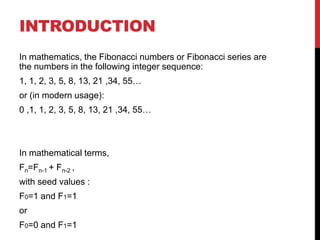
In mathematics, the Fibonacci numbers or Fibonacci series are
the numbers in the following integer sequence:
1, 1, 2, 3, 5, 8, 13, 21 ,34, 55…
or (in modern usage):
0 ,1, 1, 2, 3, 5, 8, 13, 21 ,34, 55…
In mathematical terms,
Fn=Fn-1 + Fn-2 ,
with seed values :
F0=1 and F1=1
or
F0=0 and F1=1
…
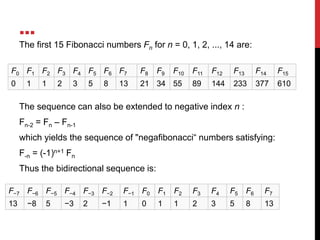
F0 F1 F2 F3 F4 F5 F6 F7 F8 F9 F10 F11 F12 F13 F14 F15
0 1 1 2 3 5 8 13 21 34 55 89 144 233 377 610
The first 15 Fibonacci numbers Fn for n = 0, 1, 2, ..., 14 are:
The sequence can also be extended to negative index n :
Fn-2 = Fn – Fn-1
which yields the sequence of "negafibonacci“ numbers satisfying:
F-n = (-1)n+1 Fn
Thus the bidirectional sequence is:
F−7 F−6 F−5 F−4 F−3 F−2 F−1 F0 F1 F2 F3 F4 F5 F6 F7
13 −8 5 −3 2 −1 1 0 1 1 2 3 5 8 13
HISTORY
The Fibonacci sequence is
named after Fibonacci. His 1202
book Liber Abaci introduced the
sequence to Western European
mathematics.
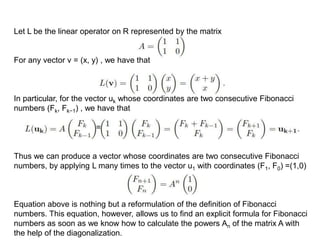
Let L be the linear operator on R represented by the matrix
For any vector v = (x, y) , we have that
In particular, for the vector uk whose coordinates are two consecutive Fibonacci
numbers (Fk, Fk−1) , we have that
=
Thus we can produce a vector whose coordinates are two consecutive Fibonacci
numbers, by applying L many times to the vector u1 with coordinates (F1, F0) =(1,0)
Equation above is nothing but a reformulation of the definition of Fibonacci
numbers. This equation, however, allows us to find an explicit formula for Fibonacci
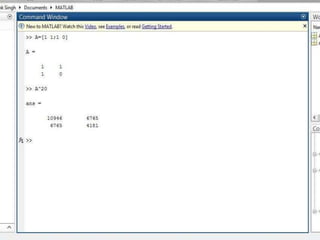
numbers as soon as we know how to calculate the powers An of the matrix A with
the help of the diagonalization.
DIAGONALIZATION
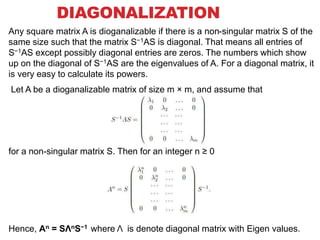
Any square matrix A is dioganalizable if there is a non-singular matrix S of the
same size such that the matrix S−1AS is diagonal. That means all entries of
S−1AS except possibly diagonal entries are zeros. The numbers which show
up on the diagonal of S−1AS are the eigenvalues of A. For a diagonal matrix, it
is very easy to calculate its powers.
Let A be a dioganalizable matrix of size m × m, and assume that
for a non-singular matrix S. Then for an integer n ≥ 0
Hence, An = SΛnS−1 where Λ is denote diagonal matrix with Eigen values.
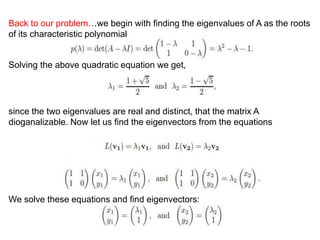
Back to our problem…we begin with finding the eigenvalues of A as the roots
of its characteristic polynomial
Solving the above quadratic equation we get,
since the two eigenvalues are real and distinct, that the matrix A
dioganalizable. Now let us find the eigenvectors from the equations
We solve these equations and find eigenvectors:
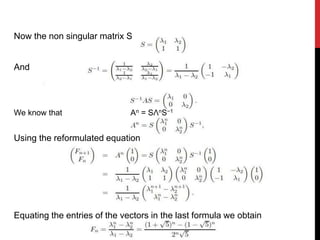
Now the non singular matrix S
And
We know that An = SΛnS−1
Using the reformulated equation
Equating the entries of the vectors in the last formula we obtain
KEPLER THEOREM
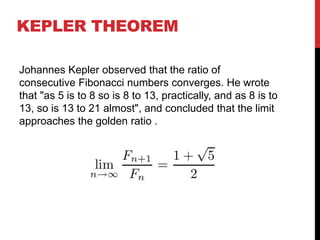
Johannes Kepler observed that the ratio of
consecutive Fibonacci numbers converges. He wrote
that "as 5 is to 8 so is 8 to 13, practically, and as 8 is to
13, so is 13 to 21 almost", and concluded that the limit
approaches the golden ratio .
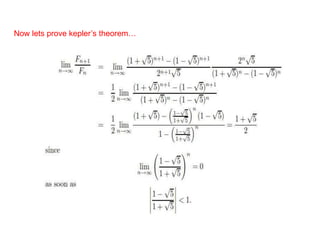
Now lets prove kepler’s theorem…
RECOGNIZING FIBONACCI NUMBERS
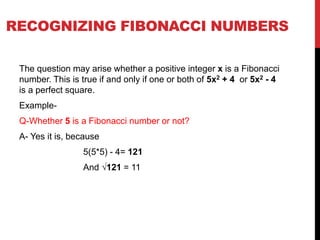
The question may arise whether a positive integer x is a Fibonacci
number. This is true if and only if one or both of 5x2 + 4 or 5x2 - 4
is a perfect square.
Example-
Q-Whether 5 is a Fibonacci number or not?
A- Yes it is, because
5(5*5) - 4= 121
And √121 = 11
DIVISIBILITY PROPERTIES
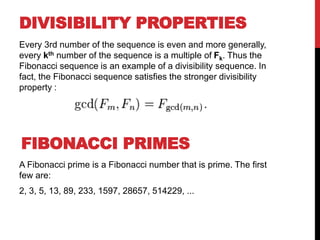
Every 3rd number of the sequence is even and more generally,
every kth number of the sequence is a multiple of Fk. Thus the
Fibonacci sequence is an example of a divisibility sequence. In
fact, the Fibonacci sequence satisfies the stronger divisibility
property :
A Fibonacci prime is a Fibonacci number that is prime. The first
few are:
2, 3, 5, 13, 89, 233, 1597, 28657, 514229, ...
FIBONACCI PRIMES
APPLICATIONS
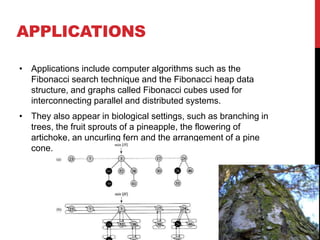
• Applications include computer algorithms such as the
Fibonacci search technique and the Fibonacci heap data
structure, and graphs called Fibonacci cubes used for
interconnecting parallel and distributed systems.
• They also appear in biological settings, such as branching in
trees, the fruit sprouts of a pineapple, the flowering of
artichoke, an uncurling fern and the arrangement of a pine
cone.
OBSERVATION
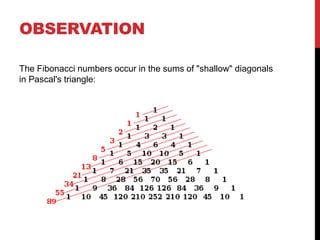
The Fibonacci numbers occur in the sums of "shallow" diagonals
in Pascal's triangle:
INTRODUCTION
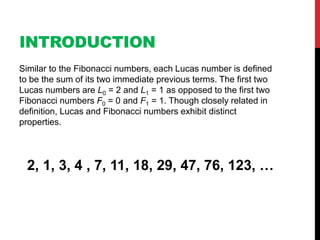
Similar to the Fibonacci numbers, each Lucas number is defined
to be the sum of its two immediate previous terms. The first two
Lucas numbers are L0 = 2 and L1 = 1 as opposed to the first two
Fibonacci numbers F0 = 0 and F1 = 1. Though closely related in
definition, Lucas and Fibonacci numbers exhibit distinct
properties.
2, 1, 3, 4 , 7, 11, 18, 29, 47, 76, 123, …
…
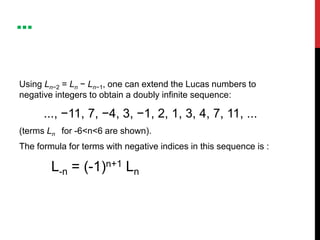
Using Ln−2 = Ln − Ln−1, one can extend the Lucas numbers to
negative integers to obtain a doubly infinite sequence:
..., −11, 7, −4, 3, −1, 2, 1, 3, 4, 7, 11, ...
(terms Ln for -6<n<6 are shown).
The formula for terms with negative indices in this sequence is :
L-n = (-1)n+1 Ln
RELATIONSHIP TO
FIBONACCI NUMBERS
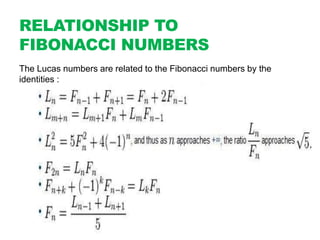
The Lucas numbers are related to the Fibonacci numbers by the
identities :
LUCAS PRIMES
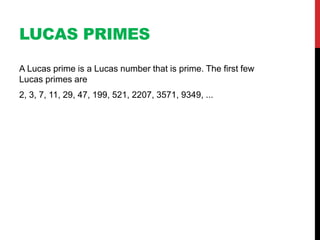
A Lucas prime is a Lucas number that is prime. The first few
Lucas primes are
2, 3, 7, 11, 29, 47, 199, 521, 2207, 3571, 9349, ...
Fibonacci numbers And  Lucas numbers

Fibonacci numbers And Lucas numbers

  • 3.
    INTRODUCTION In mathematics, theFibonacci numbers or Fibonacci series are the numbers in the following integer sequence: 1, 1, 2, 3, 5, 8, 13, 21 ,34, 55… or (in modern usage): 0 ,1, 1, 2, 3, 5, 8, 13, 21 ,34, 55… In mathematical terms, Fn=Fn-1 + Fn-2 , with seed values : F0=1 and F1=1 or F0=0 and F1=1
  • 4.
    … F0 F1 F2F3 F4 F5 F6 F7 F8 F9 F10 F11 F12 F13 F14 F15 0 1 1 2 3 5 8 13 21 34 55 89 144 233 377 610 The first 15 Fibonacci numbers Fn for n = 0, 1, 2, ..., 14 are: The sequence can also be extended to negative index n : Fn-2 = Fn – Fn-1 which yields the sequence of "negafibonacci“ numbers satisfying: F-n = (-1)n+1 Fn Thus the bidirectional sequence is: F−7 F−6 F−5 F−4 F−3 F−2 F−1 F0 F1 F2 F3 F4 F5 F6 F7 13 −8 5 −3 2 −1 1 0 1 1 2 3 5 8 13
  • 5.
    HISTORY The Fibonacci sequenceis named after Fibonacci. His 1202 book Liber Abaci introduced the sequence to Western European mathematics.
  • 7.
    Let L bethe linear operator on R represented by the matrix For any vector v = (x, y) , we have that In particular, for the vector uk whose coordinates are two consecutive Fibonacci numbers (Fk, Fk−1) , we have that = Thus we can produce a vector whose coordinates are two consecutive Fibonacci numbers, by applying L many times to the vector u1 with coordinates (F1, F0) =(1,0) Equation above is nothing but a reformulation of the definition of Fibonacci numbers. This equation, however, allows us to find an explicit formula for Fibonacci numbers as soon as we know how to calculate the powers An of the matrix A with the help of the diagonalization.
  • 8.
    DIAGONALIZATION Any square matrixA is dioganalizable if there is a non-singular matrix S of the same size such that the matrix S−1AS is diagonal. That means all entries of S−1AS except possibly diagonal entries are zeros. The numbers which show up on the diagonal of S−1AS are the eigenvalues of A. For a diagonal matrix, it is very easy to calculate its powers. Let A be a dioganalizable matrix of size m × m, and assume that for a non-singular matrix S. Then for an integer n ≥ 0 Hence, An = SΛnS−1 where Λ is denote diagonal matrix with Eigen values.
  • 10.
    Back to ourproblem…we begin with finding the eigenvalues of A as the roots of its characteristic polynomial Solving the above quadratic equation we get, since the two eigenvalues are real and distinct, that the matrix A dioganalizable. Now let us find the eigenvectors from the equations We solve these equations and find eigenvectors:
  • 11.
    Now the nonsingular matrix S And We know that An = SΛnS−1 Using the reformulated equation Equating the entries of the vectors in the last formula we obtain
  • 12.
    KEPLER THEOREM Johannes Keplerobserved that the ratio of consecutive Fibonacci numbers converges. He wrote that "as 5 is to 8 so is 8 to 13, practically, and as 8 is to 13, so is 13 to 21 almost", and concluded that the limit approaches the golden ratio .
  • 13.
    Now lets provekepler’s theorem…
  • 14.
    RECOGNIZING FIBONACCI NUMBERS Thequestion may arise whether a positive integer x is a Fibonacci number. This is true if and only if one or both of 5x2 + 4 or 5x2 - 4 is a perfect square. Example- Q-Whether 5 is a Fibonacci number or not? A- Yes it is, because 5(5*5) - 4= 121 And √121 = 11
  • 15.
    DIVISIBILITY PROPERTIES Every 3rdnumber of the sequence is even and more generally, every kth number of the sequence is a multiple of Fk. Thus the Fibonacci sequence is an example of a divisibility sequence. In fact, the Fibonacci sequence satisfies the stronger divisibility property : A Fibonacci prime is a Fibonacci number that is prime. The first few are: 2, 3, 5, 13, 89, 233, 1597, 28657, 514229, ... FIBONACCI PRIMES
  • 16.
    APPLICATIONS • Applications includecomputer algorithms such as the Fibonacci search technique and the Fibonacci heap data structure, and graphs called Fibonacci cubes used for interconnecting parallel and distributed systems. • They also appear in biological settings, such as branching in trees, the fruit sprouts of a pineapple, the flowering of artichoke, an uncurling fern and the arrangement of a pine cone.
  • 17.
    OBSERVATION The Fibonacci numbersoccur in the sums of "shallow" diagonals in Pascal's triangle:
  • 19.
    INTRODUCTION Similar to theFibonacci numbers, each Lucas number is defined to be the sum of its two immediate previous terms. The first two Lucas numbers are L0 = 2 and L1 = 1 as opposed to the first two Fibonacci numbers F0 = 0 and F1 = 1. Though closely related in definition, Lucas and Fibonacci numbers exhibit distinct properties. 2, 1, 3, 4 , 7, 11, 18, 29, 47, 76, 123, …
  • 20.
    … Using Ln−2 =Ln − Ln−1, one can extend the Lucas numbers to negative integers to obtain a doubly infinite sequence: ..., −11, 7, −4, 3, −1, 2, 1, 3, 4, 7, 11, ... (terms Ln for -6<n<6 are shown). The formula for terms with negative indices in this sequence is : L-n = (-1)n+1 Ln
  • 21.
    RELATIONSHIP TO FIBONACCI NUMBERS TheLucas numbers are related to the Fibonacci numbers by the identities :
  • 22.
    LUCAS PRIMES A Lucasprime is a Lucas number that is prime. The first few Lucas primes are 2, 3, 7, 11, 29, 47, 199, 521, 2207, 3571, 9349, ...