Choosing the
 Right Words
Diction and Connotations


  Sharon Elin / CCPS Online   revised 2012
Think of words as
  superheroes.
Think of words as
  superheroes.

 They appear ordinary most of
    the time, but they have
        hidden powers.
What is Diction?
What is Diction?
    The selection of the
  most precise words and
  phrases that express a
    message correctly,
  clearly, and effectively.
Diction includes…
Diction includes…
     Grammar
Diction includes…
     Grammar
    Vocabulary
Diction includes…
     Grammar
    Vocabulary
  Sounds of words
Diction includes…
         Grammar
       Vocabulary
     Sounds of words
Tones or attitudes of words
Diction includes…
         Grammar
       Vocabulary
     Sounds of words
Tones or attitudes of words
    Meanings of words
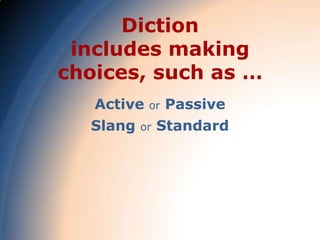
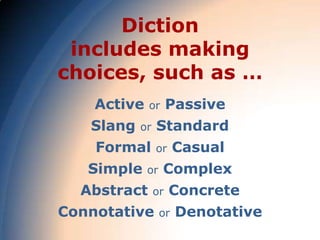
Diction
 includes making
choices, such as …
Diction
 includes making
choices, such as …
   Active   or   Passive
Diction
 includes making
choices, such as …
   Active   or   Passive
  Slang   or   Standard
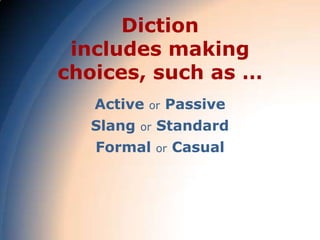
Diction
 includes making
choices, such as …
   Active   or   Passive
  Slang   or   Standard
   Formal      or   Casual
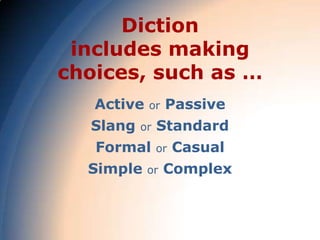
Diction
 includes making
choices, such as …
   Active   or   Passive
  Slang   or   Standard
   Formal      or   Casual
  Simple    or   Complex
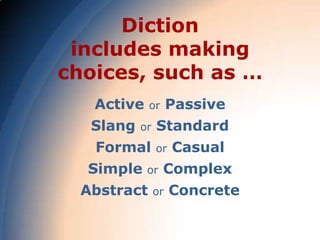
Diction
 includes making
choices, such as …
   Active    or      Passive
   Slang   or   Standard
   Formal       or   Casual
  Simple    or    Complex
  Abstract      or   Concrete
Diction
 includes making
choices, such as …
    Active   or      Passive
   Slang   or   Standard
    Formal      or     Casual
   Simple    or   Complex
  Abstract      or   Concrete
Connotative       or   Denotative
Why is diction
 important?
Why is diction
    important?
"Your diction, the exact words you choose and the settings in
which you use them, means a great deal to the success of
your writing…”
Why is diction
    important?
"Your diction, the exact words you choose and the settings in
which you use them, means a great deal to the success of
your writing…”
“While your language should be appropriate to the
situation, that generally still leaves plenty of room for
variety…”
Why is diction
    important?
"Your diction, the exact words you choose and the settings in
which you use them, means a great deal to the success of
your writing…”
“While your language should be appropriate to the situation,
that generally still leaves plenty of room for variety…”
“Skillful writers mix words to administer a series of small but
telling surprises...”
Why is diction
      important?
"Your diction, the exact words you choose and the settings in
which you use them, means a great deal to the success of
your writing…”
“While your language should be appropriate to the
situation, that generally still leaves plenty of room for
variety…”
“Skillful writers mix words to administer a series of small but
telling surprises...”

“Readers stay interested because they don't know exactly
what's coming next.”
(Joe Glaser, Understanding Style: Practical Ways to Improve Your Writing. Oxford Univ.
Press, 1999)
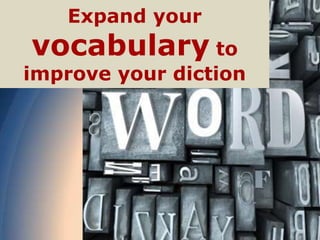
Expand your
vocabulary to
improve your diction
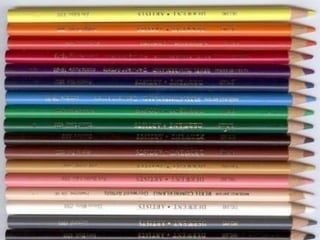
Just as skilled artists need
 a palette of many colors,
      writers need a
 wide variety of words …
… and writers need to
  harness the power of
certain words to influence
  readers in subtle, but
      powerful ways.
Understanding the art of
using                gives
writers a persuasive edge.
Connotation vs.
  Denotation
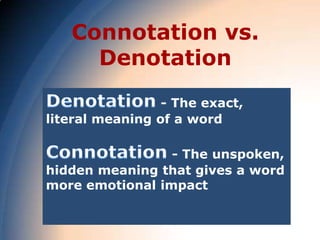
Connotation vs.
     Denotation
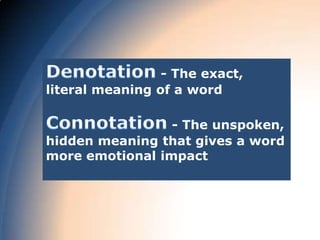
                 - The exact,
literal meaning of a word

                 - The unspoken,
hidden meaning that gives a word
more emotional impact
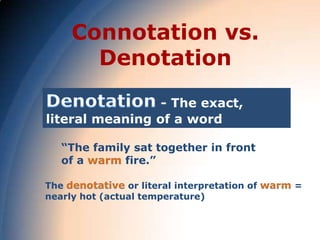
Connotation vs.
       Denotation
                 - The exact,
literal meaning of a word

   “The family sat together in front
   of a      fire.”

The             or literal interpretation of   =
nearly hot (actual temperature)
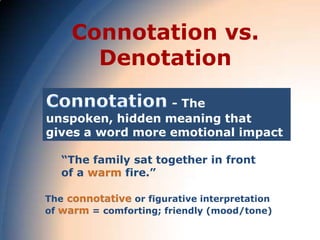
Connotation vs.
        Denotation
                  - The
unspoken, hidden meaning that
gives a word more emotional impact

  “The family sat together in front
  of a      fire.”

The           or figurative interpretation
of     = comforting; friendly (mood/tone)
Connotations

• A                   gives the reader
  or listener a distinct impression or
  feeling, calling on emotion rather
  than fact.

• Through their connotations, words
  set a tone and can reveal hidden
  opinions, attitudes, or judgments.
Connotations

In the following examples,
notice how synonyms have
slightly different meanings,
    revealing a variety of
        connotations.
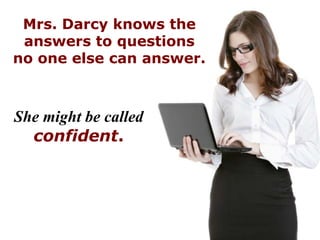
Mrs. Darcy knows the
 answers to questions
no one else can answer.
Mrs. Darcy knows the
 answers to questions
no one else can answer.


She might be called
  informed.
Mrs. Darcy knows the
 answers to questions
no one else can answer.


She might be called
  confident.
Mrs. Darcy knows the
 answers to questions
no one else can answer.


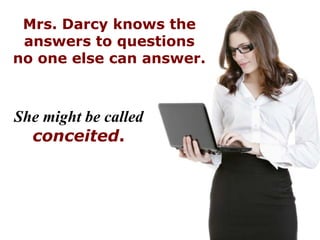
She might be called
  conceited.
Mrs. Darcy knows the
 answers to questions
no one else can answer.

  informed
  confident
  conceited

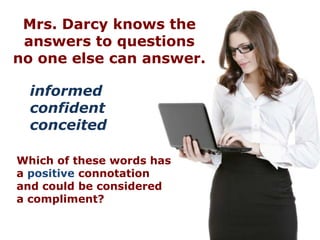
Which of these words has
a neutral connotation and
merely states a fact,
without opinions or
judgment?
Mrs. Darcy knows the
 answers to questions
no one else can answer.

  informed


Which of these words has
a neutral connotation and
merely states a fact,
without opinions or
judgment?
Mrs. Darcy knows the
 answers to questions
no one else can answer.

  informed
  confident
  conceited

Which of these words has
a positive connotation
and could be considered
a compliment?
Mrs. Darcy knows the
 answers to questions
no one else can answer.


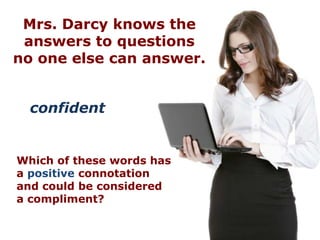
  confident


Which of these words has
a positive connotation
and could be considered
a compliment?
Mrs. Darcy knows the
 answers to questions
no one else can answer.

  informed
  confident
  conceited

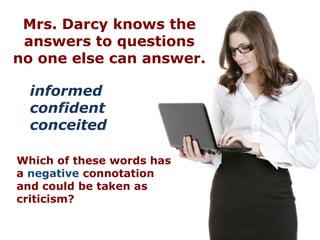
Which of these words has
a negative connotation
and could be taken as
criticism?
Mrs. Darcy knows the
 answers to questions
no one else can answer.


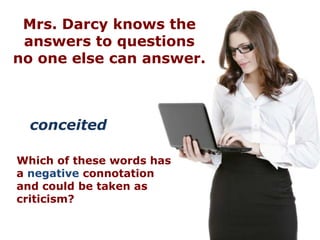
  conceited

Which of these words has
a negative connotation
and could be taken as
criticism?
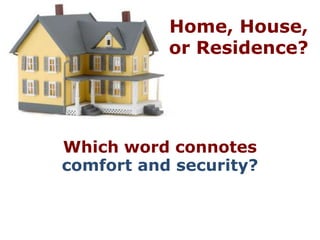
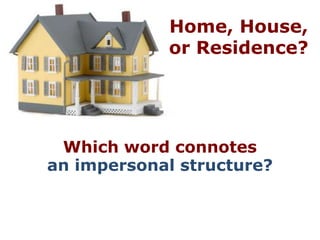
Home, House,
           or Residence?


Which word connotes
comfort and security?
Home, House,
           or Residence?


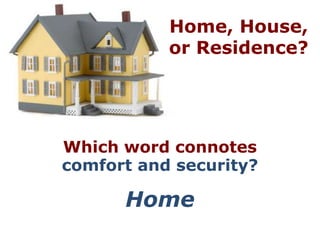
Which word connotes
comfort and security?

      Home
Home, House,
            or Residence?


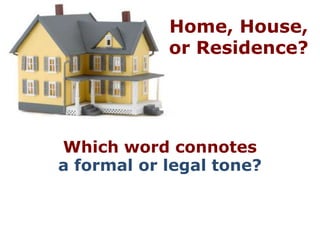
Which word connotes
a formal or legal tone?
Home, House,
            or Residence?


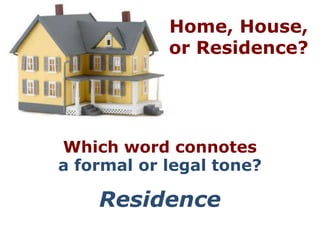
Which word connotes
a formal or legal tone?

    Residence
Home, House,
            or Residence?


 Which word connotes
an impersonal structure?
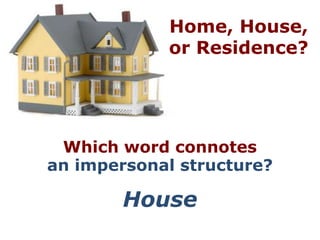
Home, House,
            or Residence?


 Which word connotes
an impersonal structure?

        House
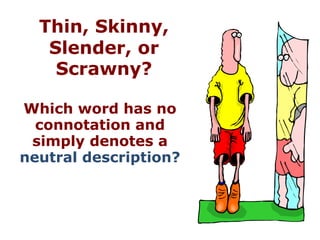
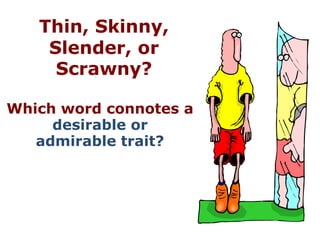
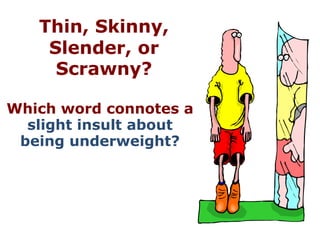
Thin, Skinny,
   Slender, or
    Scrawny?

Which word has no
  connotation and
 simply denotes a
neutral description?
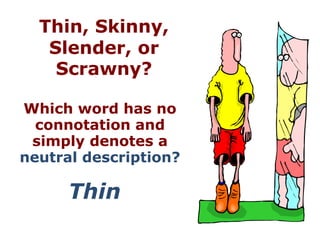
Thin, Skinny,
   Slender, or
    Scrawny?

Which word has no
  connotation and
 simply denotes a
neutral description?

      Thin
Thin, Skinny,
    Slender, or
     Scrawny?

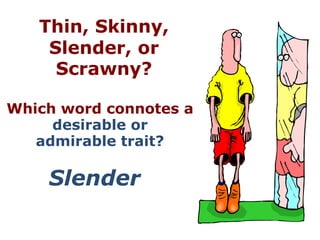
Which word connotes a
     desirable or
   admirable trait?
Thin, Skinny,
    Slender, or
     Scrawny?

Which word connotes a
     desirable or
   admirable trait?

    Slender
Thin, Skinny,
   Slender, or
    Scrawny?

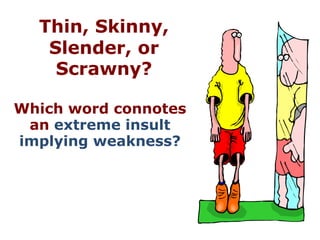
Which word connotes
 an extreme insult
implying weakness?
Thin, Skinny,
   Slender, or
    Scrawny?

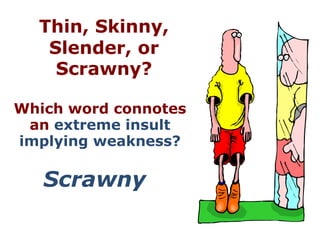
Which word connotes
 an extreme insult
implying weakness?

   Scrawny
Thin, Skinny,
    Slender, or
     Scrawny?

Which word connotes a
  slight insult about
 being underweight?
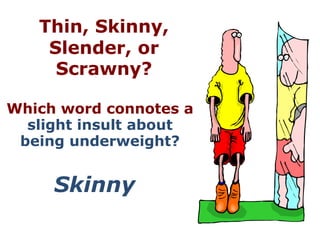
Thin, Skinny,
    Slender, or
     Scrawny?

Which word connotes a
  slight insult about
 being underweight?


     Skinny
Connotations
      Try it on your own!
 Here are more examples showing
how synonyms describing the same
thing can have different meanings.
The differences are subtle, yet the
words have suggestive, persuasive
powers that will influence readers.
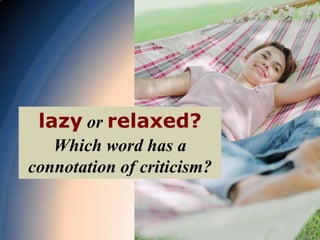
lazy or relaxed?
   Which word has a
connotation of criticism?
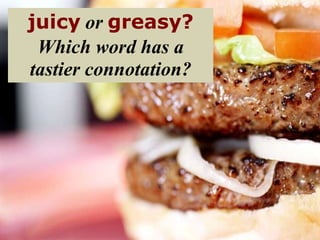
juicy or greasy?
 Which word has a
tastier connotation?
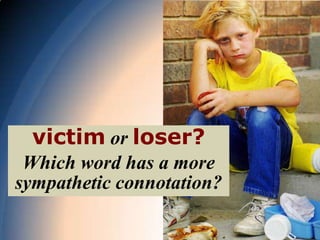
victim or loser?
 Which word has a more
sympathetic connotation?
Review…
What does this
definition refer to?
    The selection of the
  most precise words and
  phrases that express a
    message correctly,
  clearly, and effectively.
What does this
definition refer to?
    The selection of the
  most precise words and
  phrases that express a
    message correctly,
  clearly, and effectively.


       Diction
Remember the
 difference?
- The exact,
literal meaning of a word

                 - The unspoken,
hidden meaning that gives a word
more emotional impact
Choosing the best words:
Pay attention to your diction,
Choosing the best words:
Pay attention to your diction,
   grow your vocabulary,
Choosing the best words:
Pay attention to your diction,
   grow your vocabulary,
              and
use the power of connotations
Thanks for
  watching
  viewing
 examining
considering
 analyzing
 exploring!

Word Choice: Diction and Connotations

  • 1.
    Choosing the RightWords Diction and Connotations Sharon Elin / CCPS Online revised 2012
  • 2.
    Think of wordsas superheroes.
  • 3.
    Think of wordsas superheroes. They appear ordinary most of the time, but they have hidden powers.
  • 4.
  • 5.
    What is Diction? The selection of the most precise words and phrases that express a message correctly, clearly, and effectively.
  • 6.
  • 7.
  • 8.
    Diction includes… Grammar Vocabulary
  • 9.
    Diction includes… Grammar Vocabulary Sounds of words
  • 10.
    Diction includes… Grammar Vocabulary Sounds of words Tones or attitudes of words
  • 11.
    Diction includes… Grammar Vocabulary Sounds of words Tones or attitudes of words Meanings of words
  • 12.
  • 13.
    Diction includes making choices,such as … Active or Passive
  • 14.
    Diction includes making choices,such as … Active or Passive Slang or Standard
  • 15.
    Diction includes making choices,such as … Active or Passive Slang or Standard Formal or Casual
  • 16.
    Diction includes making choices,such as … Active or Passive Slang or Standard Formal or Casual Simple or Complex
  • 17.
    Diction includes making choices,such as … Active or Passive Slang or Standard Formal or Casual Simple or Complex Abstract or Concrete
  • 18.
    Diction includes making choices,such as … Active or Passive Slang or Standard Formal or Casual Simple or Complex Abstract or Concrete Connotative or Denotative
  • 19.
    Why is diction important?
  • 20.
    Why is diction important? "Your diction, the exact words you choose and the settings in which you use them, means a great deal to the success of your writing…”
  • 21.
    Why is diction important? "Your diction, the exact words you choose and the settings in which you use them, means a great deal to the success of your writing…” “While your language should be appropriate to the situation, that generally still leaves plenty of room for variety…”
  • 22.
    Why is diction important? "Your diction, the exact words you choose and the settings in which you use them, means a great deal to the success of your writing…” “While your language should be appropriate to the situation, that generally still leaves plenty of room for variety…” “Skillful writers mix words to administer a series of small but telling surprises...”
  • 23.
    Why is diction important? "Your diction, the exact words you choose and the settings in which you use them, means a great deal to the success of your writing…” “While your language should be appropriate to the situation, that generally still leaves plenty of room for variety…” “Skillful writers mix words to administer a series of small but telling surprises...” “Readers stay interested because they don't know exactly what's coming next.” (Joe Glaser, Understanding Style: Practical Ways to Improve Your Writing. Oxford Univ. Press, 1999)
  • 24.
  • 26.
    Just as skilledartists need a palette of many colors, writers need a wide variety of words …
  • 27.
    … and writersneed to harness the power of certain words to influence readers in subtle, but powerful ways.
  • 28.
    Understanding the artof using gives writers a persuasive edge.
  • 29.
    Connotation vs. Denotation
  • 30.
    Connotation vs. Denotation - The exact, literal meaning of a word - The unspoken, hidden meaning that gives a word more emotional impact
  • 31.
    Connotation vs. Denotation - The exact, literal meaning of a word “The family sat together in front of a fire.” The or literal interpretation of = nearly hot (actual temperature)
  • 32.
    Connotation vs. Denotation - The unspoken, hidden meaning that gives a word more emotional impact “The family sat together in front of a fire.” The or figurative interpretation of = comforting; friendly (mood/tone)
  • 33.
    Connotations • A gives the reader or listener a distinct impression or feeling, calling on emotion rather than fact. • Through their connotations, words set a tone and can reveal hidden opinions, attitudes, or judgments.
  • 34.
    Connotations In the followingexamples, notice how synonyms have slightly different meanings, revealing a variety of connotations.
  • 35.
    Mrs. Darcy knowsthe answers to questions no one else can answer.
  • 36.
    Mrs. Darcy knowsthe answers to questions no one else can answer. She might be called informed.
  • 37.
    Mrs. Darcy knowsthe answers to questions no one else can answer. She might be called confident.
  • 38.
    Mrs. Darcy knowsthe answers to questions no one else can answer. She might be called conceited.
  • 39.
    Mrs. Darcy knowsthe answers to questions no one else can answer. informed confident conceited Which of these words has a neutral connotation and merely states a fact, without opinions or judgment?
  • 40.
    Mrs. Darcy knowsthe answers to questions no one else can answer. informed Which of these words has a neutral connotation and merely states a fact, without opinions or judgment?
  • 41.
    Mrs. Darcy knowsthe answers to questions no one else can answer. informed confident conceited Which of these words has a positive connotation and could be considered a compliment?
  • 42.
    Mrs. Darcy knowsthe answers to questions no one else can answer. confident Which of these words has a positive connotation and could be considered a compliment?
  • 43.
    Mrs. Darcy knowsthe answers to questions no one else can answer. informed confident conceited Which of these words has a negative connotation and could be taken as criticism?
  • 44.
    Mrs. Darcy knowsthe answers to questions no one else can answer. conceited Which of these words has a negative connotation and could be taken as criticism?
  • 45.
    Home, House, or Residence? Which word connotes comfort and security?
  • 46.
    Home, House, or Residence? Which word connotes comfort and security? Home
  • 47.
    Home, House, or Residence? Which word connotes a formal or legal tone?
  • 48.
    Home, House, or Residence? Which word connotes a formal or legal tone? Residence
  • 49.
    Home, House, or Residence? Which word connotes an impersonal structure?
  • 50.
    Home, House, or Residence? Which word connotes an impersonal structure? House
  • 51.
    Thin, Skinny, Slender, or Scrawny? Which word has no connotation and simply denotes a neutral description?
  • 52.
    Thin, Skinny, Slender, or Scrawny? Which word has no connotation and simply denotes a neutral description? Thin
  • 53.
    Thin, Skinny, Slender, or Scrawny? Which word connotes a desirable or admirable trait?
  • 54.
    Thin, Skinny, Slender, or Scrawny? Which word connotes a desirable or admirable trait? Slender
  • 55.
    Thin, Skinny, Slender, or Scrawny? Which word connotes an extreme insult implying weakness?
  • 56.
    Thin, Skinny, Slender, or Scrawny? Which word connotes an extreme insult implying weakness? Scrawny
  • 57.
    Thin, Skinny, Slender, or Scrawny? Which word connotes a slight insult about being underweight?
  • 58.
    Thin, Skinny, Slender, or Scrawny? Which word connotes a slight insult about being underweight? Skinny
  • 59.
    Connotations Try it on your own! Here are more examples showing how synonyms describing the same thing can have different meanings. The differences are subtle, yet the words have suggestive, persuasive powers that will influence readers.
  • 60.
    lazy or relaxed? Which word has a connotation of criticism?
  • 61.
    juicy or greasy? Which word has a tastier connotation?
  • 62.
    victim or loser? Which word has a more sympathetic connotation?
  • 63.
  • 64.
    What does this definitionrefer to? The selection of the most precise words and phrases that express a message correctly, clearly, and effectively.
  • 65.
    What does this definitionrefer to? The selection of the most precise words and phrases that express a message correctly, clearly, and effectively. Diction
  • 66.
  • 67.
    - The exact, literalmeaning of a word - The unspoken, hidden meaning that gives a word more emotional impact
  • 68.
    Choosing the bestwords: Pay attention to your diction,
  • 69.
    Choosing the bestwords: Pay attention to your diction, grow your vocabulary,
  • 70.
    Choosing the bestwords: Pay attention to your diction, grow your vocabulary, and use the power of connotations
  • 71.
    Thanks for watching viewing examining considering analyzing exploring!