Strategic Alignment Model
 Source: Henderson and Venkataraman

             V.T. Raja, Ph.D.,
           College of Business
          Oregon State University
Strategic Alignment Model

• Framework for aligning IT with business strategy
• Framework for conceptualizing and directing
  strategic role/management of IT
• Framework for leveraging IT on a continuous
  basis to achieve sustainable competitive
  advantage
Strategic Alignment Model
  External and Internal Domains

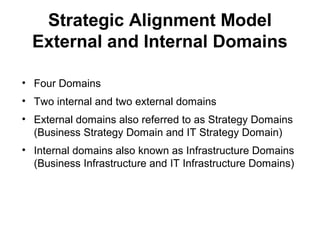
• Four Domains
• Two internal and two external domains
• External domains also referred to as Strategy Domains
  (Business Strategy Domain and IT Strategy Domain)
• Internal domains also known as Infrastructure Domains
  (Business Infrastructure and IT Infrastructure Domains)
Strategic Alignment Model
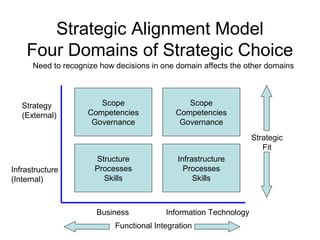
    Four Domains of Strategic Choice
      Need to recognize how decisions in one domain affects the other domains


   Strategy            Scope                    Scope
   (External)       Competencies             Competencies
                     Governance               Governance
                                                                   Strategic
                                                                      Fit
                      Structure              Infrastructure
Infrastructure        Processes                Processes
(Internal)              Skills                    Skills


                       Business           Information Technology
                            Functional Integration
Strategy Domains
• Business
  – Scope: What business are you in?
  – Distinctive Competencies: What do you do well to
    distinguish yourself from your competitors?
  – Governance: What external business relationships do
    you depend on?
• IT
  – Scope: What information technologies support or create
    strategic business opportunities?
  – IT Competencies: What characteristics of IT create
    business advantage?
  – IT Governance: What external relationships does IT
    depend on (outsourcing, vendors, etc.)
Infrastructure Domains
• Business
  – Structure: Organizational structure
  – Processes: What are key business processes?
  – Skills: What HR needed to accomplish specific
    competencies?
• IT
  – Infrastructure: Hardware, Software, Database, Networks
  – Processes: Development, Maintenance, Operations
  – Skills: What skills required to maintain architecture and
    execute the processes?
How to use the
Strategic Alignment Model
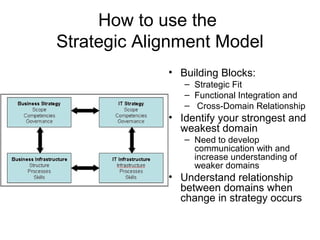
             • Building Blocks:
                – Strategic Fit
                – Functional Integration and
                – Cross-Domain Relationship
             • Identify your strongest and
               weakest domain
                – Need to develop
                  communication with and
                  increase understanding of
                  weaker domains
             • Understand relationship
               between domains when
               change in strategy occurs
Strategy Execution
                     IT is an Expense
•    Business Strategy is the driver of both Business and IT Infrastructures
      – Priority is to improve business processes, which places focus on
        changing business infrastructure. IT focus is on application
        development, driven by need to support business infrastructure


    Business Strategy                 IT Strategy
         Scope                           Scope              Top Mgmt’s Role?
      Competencies                   Competencies
       Governance                     Governance            IT Mgmt’s Role?

                                                            Performance Criteria
                                                            for assessing IT
Business Infrastructure             IT Infrastructure       based on ___?
      Structure                       Infrastructure
      Processes                         Processes           Risk?
        Skills                             Skills
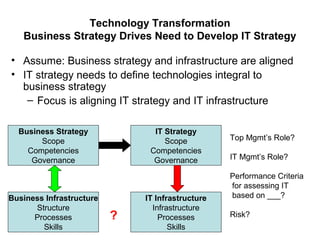
Technology Transformation
   Business Strategy Drives Need to Develop IT Strategy

• Assume: Business strategy and infrastructure are aligned
• IT strategy needs to define technologies integral to
  business strategy
   – Focus is aligning IT strategy and IT infrastructure

  Business Strategy             IT Strategy
       Scope                       Scope          Top Mgmt’s Role?
    Competencies               Competencies
     Governance                 Governance        IT Mgmt’s Role?

                                                  Performance Criteria
                                                  for assessing IT
Business Infrastructure       IT Infrastructure   based on ___?
      Structure                 Infrastructure
      Processes           ?       Processes       Risk?
        Skills                       Skills
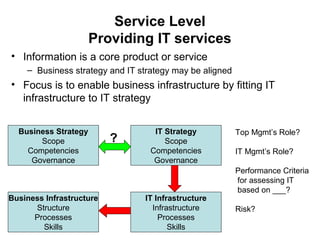
Service Level
                      Providing IT services
• Information is a core product or service
    – Business strategy and IT strategy may be aligned
• Focus is to enable business infrastructure by fitting IT
  infrastructure to IT strategy


  Business Strategy                IT Strategy           Top Mgmt’s Role?
       Scope              ?           Scope
    Competencies                  Competencies           IT Mgmt’s Role?
     Governance                    Governance
                                                         Performance Criteria
                                                         for assessing IT
                                                         based on ___?
Business Infrastructure         IT Infrastructure
      Structure                   Infrastructure         Risk?
      Processes                     Processes
        Skills                         Skills
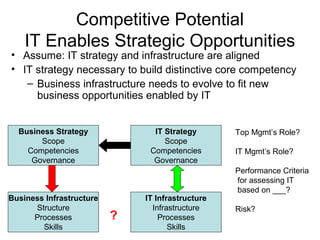
Competitive Potential
    IT Enables Strategic Opportunities
• Assume: IT strategy and infrastructure are aligned
• IT strategy necessary to build distinctive core competency
   – Business infrastructure needs to evolve to fit new
     business opportunities enabled by IT


  Business Strategy             IT Strategy       Top Mgmt’s Role?
       Scope                       Scope
    Competencies               Competencies       IT Mgmt’s Role?
     Governance                 Governance
                                                  Performance Criteria
                                                  for assessing IT
                                                  based on ___?
Business Infrastructure       IT Infrastructure
      Structure                 Infrastructure    Risk?
      Processes           ?       Processes
        Skills                       Skills
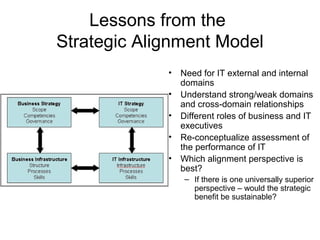
Lessons from the
Strategic Alignment Model
             • Need for IT external and internal
               domains
             • Understand strong/weak domains
               and cross-domain relationships
             • Different roles of business and IT
               executives
             • Re-conceptualize assessment of
               the performance of IT
             • Which alignment perspective is
               best?
                – If there is one universally superior
                  perspective – would the strategic
                  benefit be sustainable?
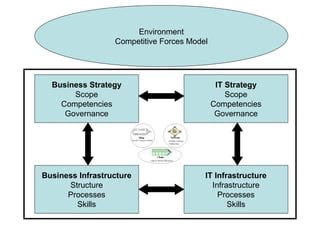
Environment
                  Competitive Forces Model


  Business Strategy                           IT Strategy
       Scope                                     Scope
    Competencies                             Competencies
     Governance                               Governance


Business Infrastructure                  IT Infrastructure
      Structure                            Infrastructure
      Processes                              Processes
        Skills                                  Skills

Strategic alignment model

  • 1.
    Strategic Alignment Model Source: Henderson and Venkataraman V.T. Raja, Ph.D., College of Business Oregon State University
  • 2.
    Strategic Alignment Model •Framework for aligning IT with business strategy • Framework for conceptualizing and directing strategic role/management of IT • Framework for leveraging IT on a continuous basis to achieve sustainable competitive advantage
  • 3.
    Strategic Alignment Model External and Internal Domains • Four Domains • Two internal and two external domains • External domains also referred to as Strategy Domains (Business Strategy Domain and IT Strategy Domain) • Internal domains also known as Infrastructure Domains (Business Infrastructure and IT Infrastructure Domains)
  • 4.
    Strategic Alignment Model Four Domains of Strategic Choice Need to recognize how decisions in one domain affects the other domains Strategy Scope Scope (External) Competencies Competencies Governance Governance Strategic Fit Structure Infrastructure Infrastructure Processes Processes (Internal) Skills Skills Business Information Technology Functional Integration
  • 5.
    Strategy Domains • Business – Scope: What business are you in? – Distinctive Competencies: What do you do well to distinguish yourself from your competitors? – Governance: What external business relationships do you depend on? • IT – Scope: What information technologies support or create strategic business opportunities? – IT Competencies: What characteristics of IT create business advantage? – IT Governance: What external relationships does IT depend on (outsourcing, vendors, etc.)
  • 6.
    Infrastructure Domains • Business – Structure: Organizational structure – Processes: What are key business processes? – Skills: What HR needed to accomplish specific competencies? • IT – Infrastructure: Hardware, Software, Database, Networks – Processes: Development, Maintenance, Operations – Skills: What skills required to maintain architecture and execute the processes?
  • 7.
    How to usethe Strategic Alignment Model • Building Blocks: – Strategic Fit – Functional Integration and – Cross-Domain Relationship • Identify your strongest and weakest domain – Need to develop communication with and increase understanding of weaker domains • Understand relationship between domains when change in strategy occurs
  • 8.
    Strategy Execution IT is an Expense • Business Strategy is the driver of both Business and IT Infrastructures – Priority is to improve business processes, which places focus on changing business infrastructure. IT focus is on application development, driven by need to support business infrastructure Business Strategy IT Strategy Scope Scope Top Mgmt’s Role? Competencies Competencies Governance Governance IT Mgmt’s Role? Performance Criteria for assessing IT Business Infrastructure IT Infrastructure based on ___? Structure Infrastructure Processes Processes Risk? Skills Skills
  • 9.
    Technology Transformation Business Strategy Drives Need to Develop IT Strategy • Assume: Business strategy and infrastructure are aligned • IT strategy needs to define technologies integral to business strategy – Focus is aligning IT strategy and IT infrastructure Business Strategy IT Strategy Scope Scope Top Mgmt’s Role? Competencies Competencies Governance Governance IT Mgmt’s Role? Performance Criteria for assessing IT Business Infrastructure IT Infrastructure based on ___? Structure Infrastructure Processes ? Processes Risk? Skills Skills
  • 10.
    Service Level Providing IT services • Information is a core product or service – Business strategy and IT strategy may be aligned • Focus is to enable business infrastructure by fitting IT infrastructure to IT strategy Business Strategy IT Strategy Top Mgmt’s Role? Scope ? Scope Competencies Competencies IT Mgmt’s Role? Governance Governance Performance Criteria for assessing IT based on ___? Business Infrastructure IT Infrastructure Structure Infrastructure Risk? Processes Processes Skills Skills
  • 11.
    Competitive Potential IT Enables Strategic Opportunities • Assume: IT strategy and infrastructure are aligned • IT strategy necessary to build distinctive core competency – Business infrastructure needs to evolve to fit new business opportunities enabled by IT Business Strategy IT Strategy Top Mgmt’s Role? Scope Scope Competencies Competencies IT Mgmt’s Role? Governance Governance Performance Criteria for assessing IT based on ___? Business Infrastructure IT Infrastructure Structure Infrastructure Risk? Processes ? Processes Skills Skills
  • 12.
    Lessons from the StrategicAlignment Model • Need for IT external and internal domains • Understand strong/weak domains and cross-domain relationships • Different roles of business and IT executives • Re-conceptualize assessment of the performance of IT • Which alignment perspective is best? – If there is one universally superior perspective – would the strategic benefit be sustainable?
  • 13.
    Environment Competitive Forces Model Business Strategy IT Strategy Scope Scope Competencies Competencies Governance Governance Business Infrastructure IT Infrastructure Structure Infrastructure Processes Processes Skills Skills

Editor's Notes

  • #3 No single IT application – however sophisticated and state of the art it may be – could deliver a sustained competitive advantage
  • #4 No single IT application – however sophisticated and state of the art it may be – could deliver a sustained competitive advantage
  • #6 IT Strategy: Example: Primis (McGraw-Hill Inc.) custom edition of textbooks IT Scope: Electronic Imaging Technology Systemic Competence: Superior level of clarity of imaging (an attribute of IT strategy) to guarantee high-quality printing (an attribute of business strategy) and flexible binding capability (IT strategy matches with Business Strategy); Overall – supports business need of offering customized textbook to interested customers IT Governance: Joint ventures and long-term agreements with Eastman Kodak and R.R. Donnelley & Sons Co., to obtain the requisite competencies.
  • #8 Building blocks: Strategic Fit (Between external business domain and internal business domain – same for IT domains); Functional Integration – Need to integrate business and IT domains. SAM calls for cross-domain relationships. (Effective management of IT requires a balance among the choices made across all four domains). Some examples of some dominant cross-domain relationships are discussed next.
  • #9 Top Mgmt’s Role: Strategy Formulator; IT Mgmt’s Role: Strategy Implementor; Performance measure based on financial parameters reflecting a cost center focus. Risk: IT reacts to support business processes – not viewed as a strategic resource E.g. Use automation – Marginal benefits for business due to IT
  • #10 Top Mgmt’s Role: Technology visionary; IT Mgmt’s Role: Technology Architect; Performance Metric: Based on technology leadership – often utilizing a bench-marking approach Risks: IT is not integrated – IT infrastructure lags and does not adequately support business infrastructure Example: American Express Travel Related Services Co., Inc. Bus Strategy: Provide quick approval of purchased made by charge card (w/o any preset spending limit) Provide copies of receipts to cardholders Technology Strategy: Scope/Competenices: Expert Systems, Optical Scanning, Storage and Laser-Printing System; Governance: Make vs. Build (Build expert systems; Purchase Optical Scanning, Storage and Printing Systems)
  • #11 Top Mgmt’s Role – Prioritizer (Articulate how best to allocate the scarce resources both within the firm and the IT marketplace) IT Mgmt’s Role – Leadership – Make the internal service business succeed within the operating guidelines from top management. Performance Measure – Based on customer satisfaction obtained with qualitative and quantitative measurements using internal and external benchmarking (end-user-needs surveying, service-level contracting) Risks: May lose sight of business strategy; IT viewed as a service function independent of business strategy.
  • #12 Top Mgmt’s Role: Business Visionary – How emerging IT would impact business strategy. IT Mgmt’s Role: Catalyst – Identifies and interprets trends in the IT environments to assist the business managers to understand potential effects of IT on business. Performance Criteria – Based on business leadership with qualitative and quantitative measurements pertaining to product leadership such as market share, growth, or new product introduction. Risk: Large IT investments; Change organizational structure to address info flow problems; Re-train employees with new IT. Examples: Nike – ERP – New product introduction (18 months before SAP; After SAP – expected to be around 3 months) Baxter Health Care – Exploitation of its IT position - Software service to healthcare marketplace – Joint venture with IBM (Spectrum project)
  • #13 Maintaining alignment is a process (inherent dynamic nature) Focus of fit will change as strategies evolve
  • #14 With the advent of Internet – Strategy and Competitive Advantage have given way to some new terminology at dot-coms; Porter says these terminology are destructive in some sense e.g., Business Models – Loose conception of how a company does business and generate revenue (Exceedingly low bar to set for building a company). Generating revenue is a far cry from true economic value, and no business model can be evaluated independently of industry structure. E-business and E-Strategy – such terms – encourage managers to view their Internet operations in isolation from the rest of the business – could lead to simplistic approaches to competing using the Internet – and increase the pressure for competitive imitation. Established companies fail to integrate the Internet into their proven strategies and thus never harness their most important advantages.