The Articles of Confederation
“No taxation without representation”It means, 'We will only pay taxes that our representatives in a House or Assembly [or similar body] have approved and passed into a law. The slogan was used by the American revolutionaries and meant they they weren't willing to pay taxes imposed by the British House of Commons - as they were not represented there.
Common SenseA pamphlet written in America by Englishman Thomas Paine, published on January 10, 1776.It called for American independence anda union of the American colonies It was propaganda and influenced colonists to pursue both in the Revolutionary War.
The Articles: powers to Congressmake war and peace (sending/receiving ambassadors and making treaties), raise an army and navy (build a navy and raising an army by asking the states for troops),print money (set up a money system, fix uniform standards of weights and measures), andset up a postal system.
Major weaknesses of the Articles of Confederation:No chief executive to enforce the lawsNo national court system
Could not collect taxes from individuals
No National CurrencySuccesses of AoCTreaty of Paris (1783)ended the Revolutionary War, recognized 13 colonies as free and sovereignstates, and recognized the Mississippi River as the country’s new western border
Successes of the AoCLand Ordinance (1785) provided a way to divide western land into separate territories and created a procedure for the new territories to apply for statehood and join the United States.
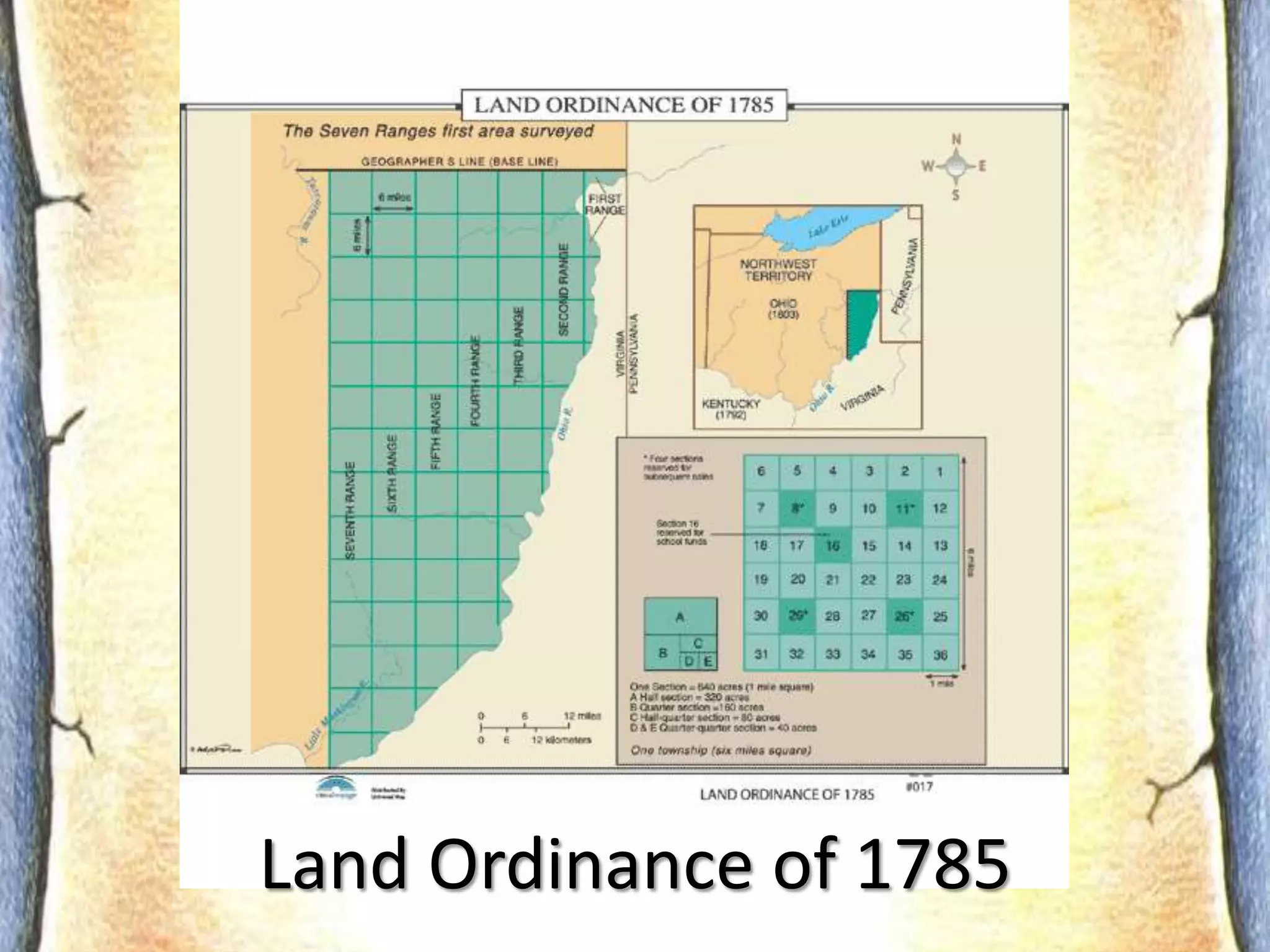
The Land Ordinance of 1785Congress, eager for revenue from the sale of land in the Old Northwest, adopted the Ordinance of 1785. That law required the government to survey the Old Northwest before selling the land to the public. The territory was divided into townships of 6 miles (9.7 kilometers) square. These townships were further divided into 36 sections, each 1 mile (1.6 kilometers) square, an area that equals 640 acres (259 hectares). The 640-acre units were then auctioned off to the public for a price of at least $1 an acre.Few farmers could afford to buy as much as 640 acres. Land speculators, such as the Ohio Company and the Scioto Company, grabbed up most of the land. These companies then divided the land into smaller sections and sold them at a profit.
Land Ordinance of 1785
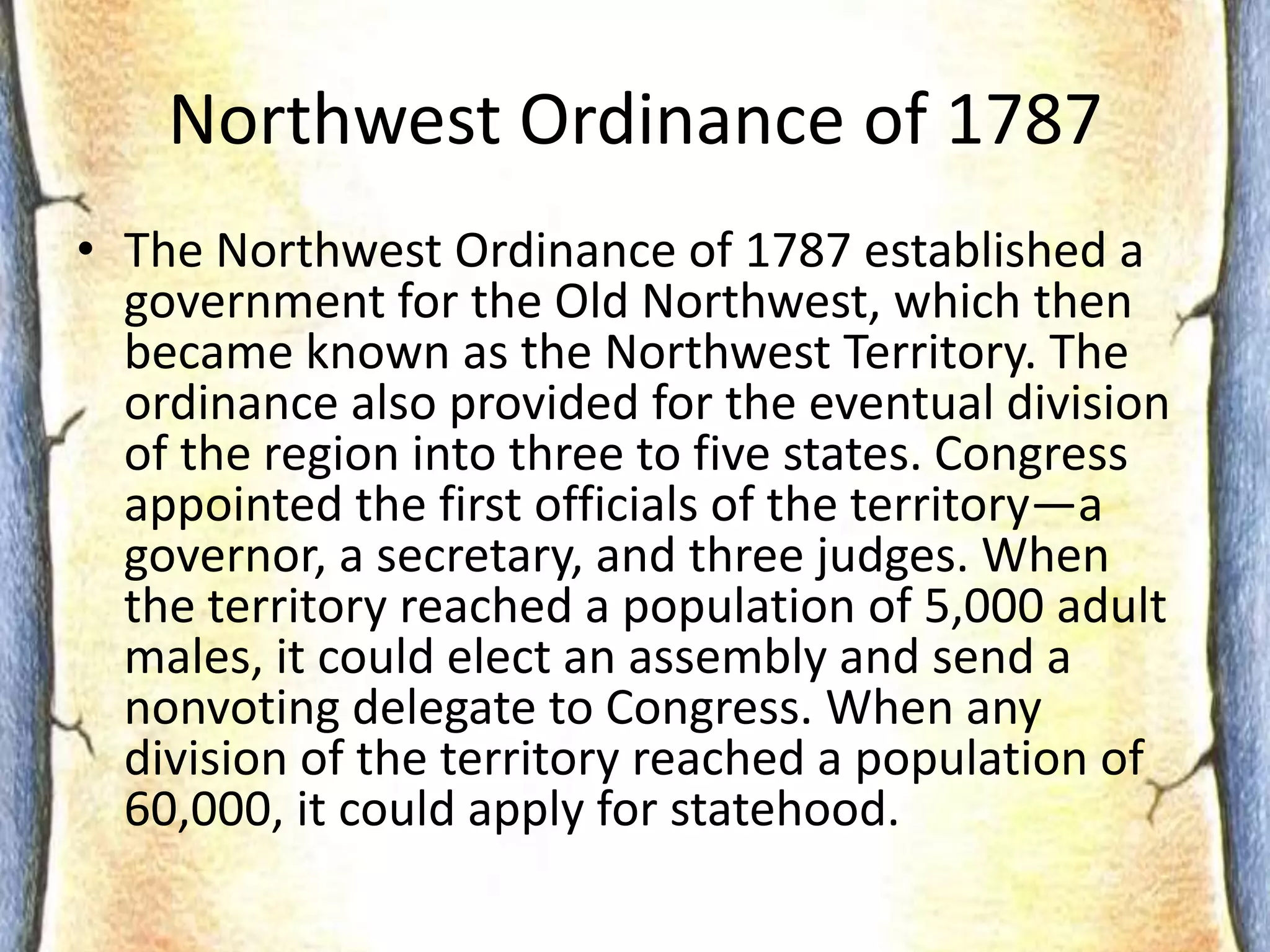
Successes of the AoCNorthwest Ordinance (1787) established a plan for governing the new land between the Appalachian mountains and the Mississippi River. This plan set up government for the territory and also abolished slavery in the new western states.
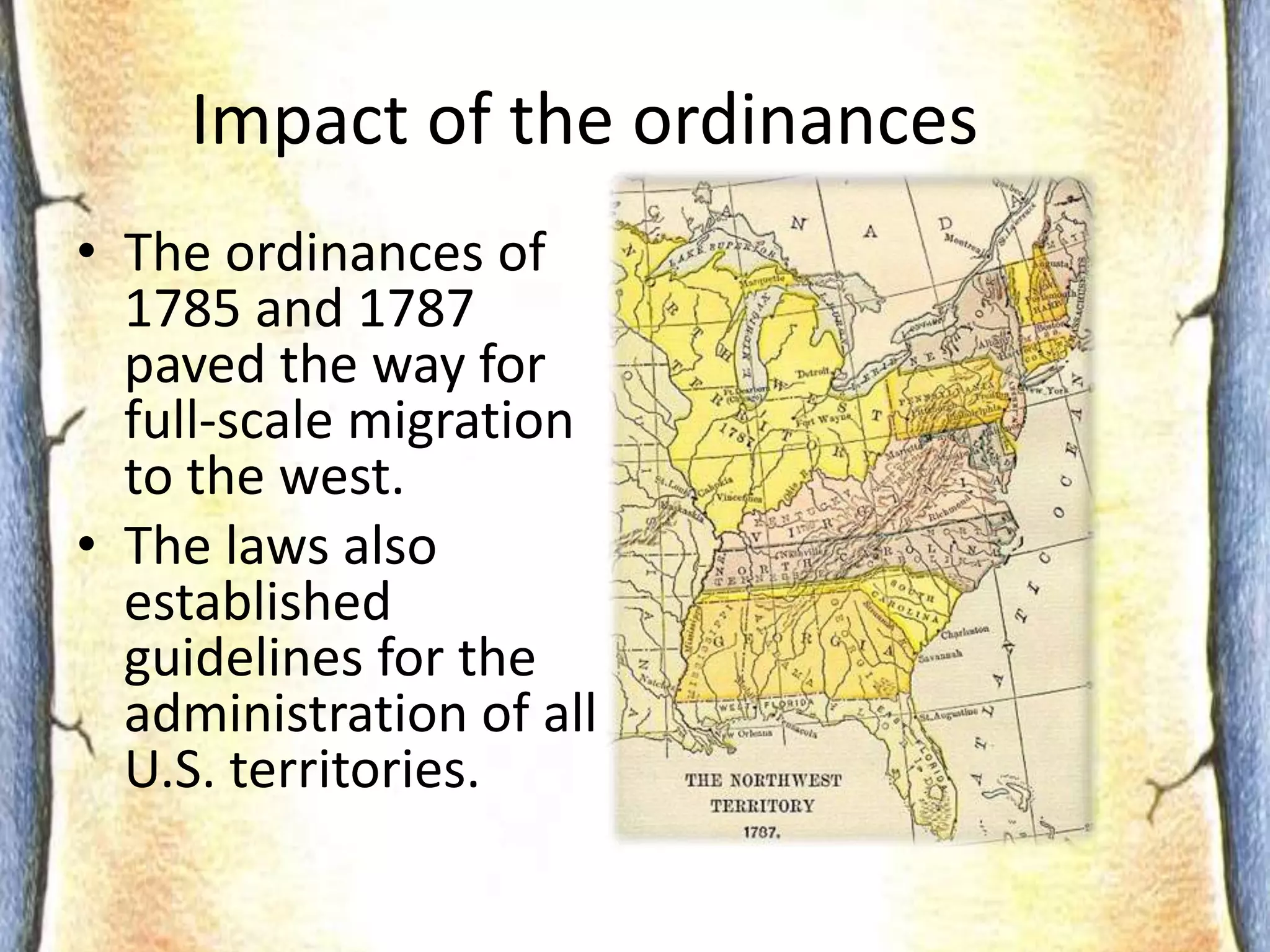
Northwest Ordinance of 1787The Northwest Ordinance of 1787 established a government for the Old Northwest, which then became known as the Northwest Territory. The ordinance also provided for the eventual division of the region into three to five states. Congress appointed the first officials of the territory—a governor, a secretary, and three judges. When the territory reached a population of 5,000 adult males, it could elect an assembly and send a nonvoting delegate to Congress. When any division of the territory reached a population of 60,000, it could apply for statehood.
Impact of the ordinances	The ordinances of 1785 and 1787 paved the way for full-scale migration to the west. The laws also established guidelines for the administration of all U.S. territories.
Failure of the AoCShay’s Rebellion (1787)a group of Massachusetts farmers, lead by Daniel Shay, protested the rising taxes on land. They attacked a federal court house. The revolt convinced many people that the U.S. needed a stronger central government to prevent violence and disorder.
SolutionsTo fix some of the problems with the AoC a Constitutional Convention was called.  At the convention the delegates threw out the AoC and created a new document called the Constitution.Constitution: a written plan of governmentA document that outlines the powers and limitations of governmentBicameral: a legislature with two houses
The Articles of Confederation Vs. The Constitution
Constitution:Provides a written framework for government.A plan or instruction manual of powers and restrictions for governmentLimits or restricts certain powers
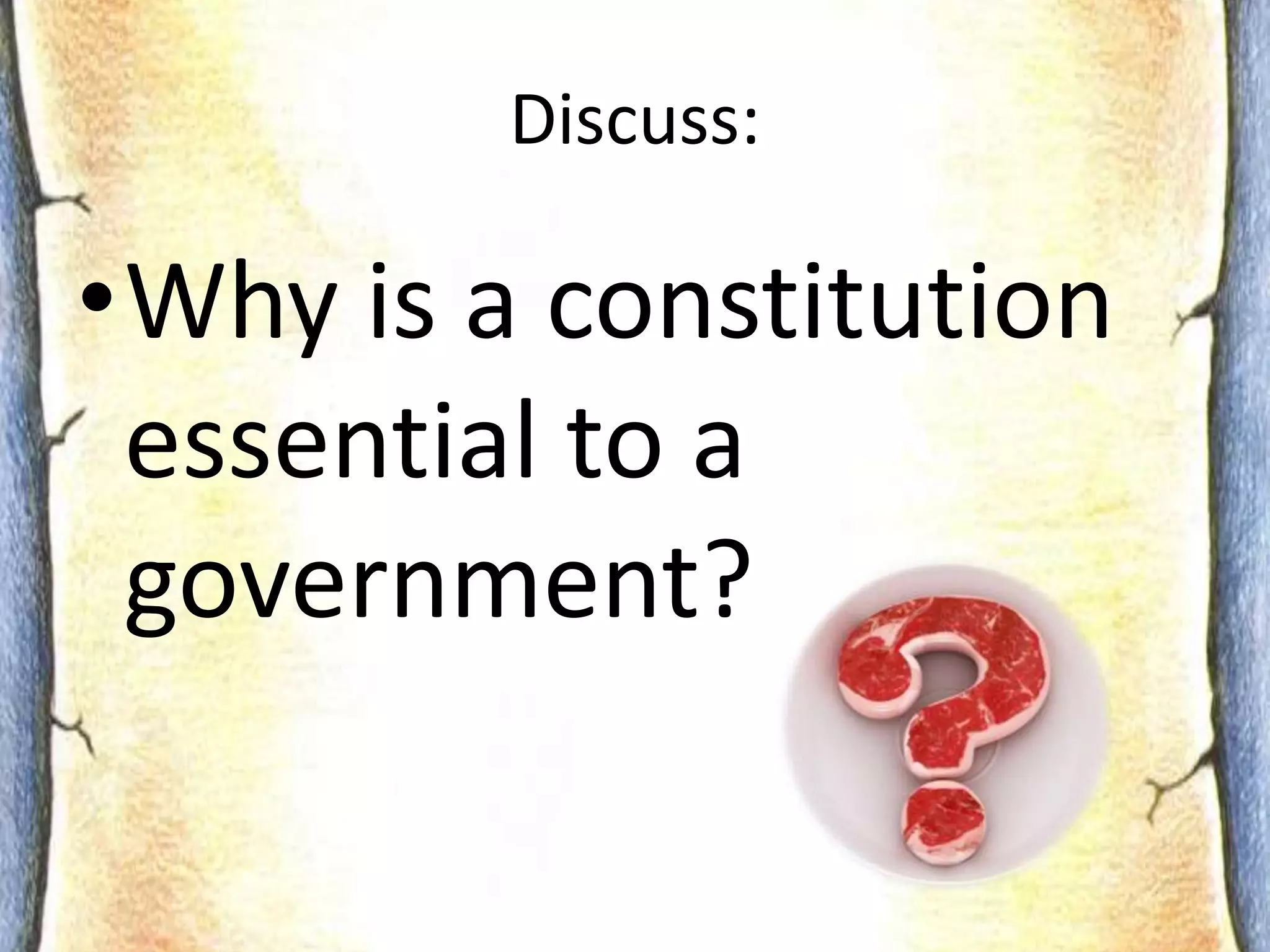
Discuss:Why is a constitution essential to a government?
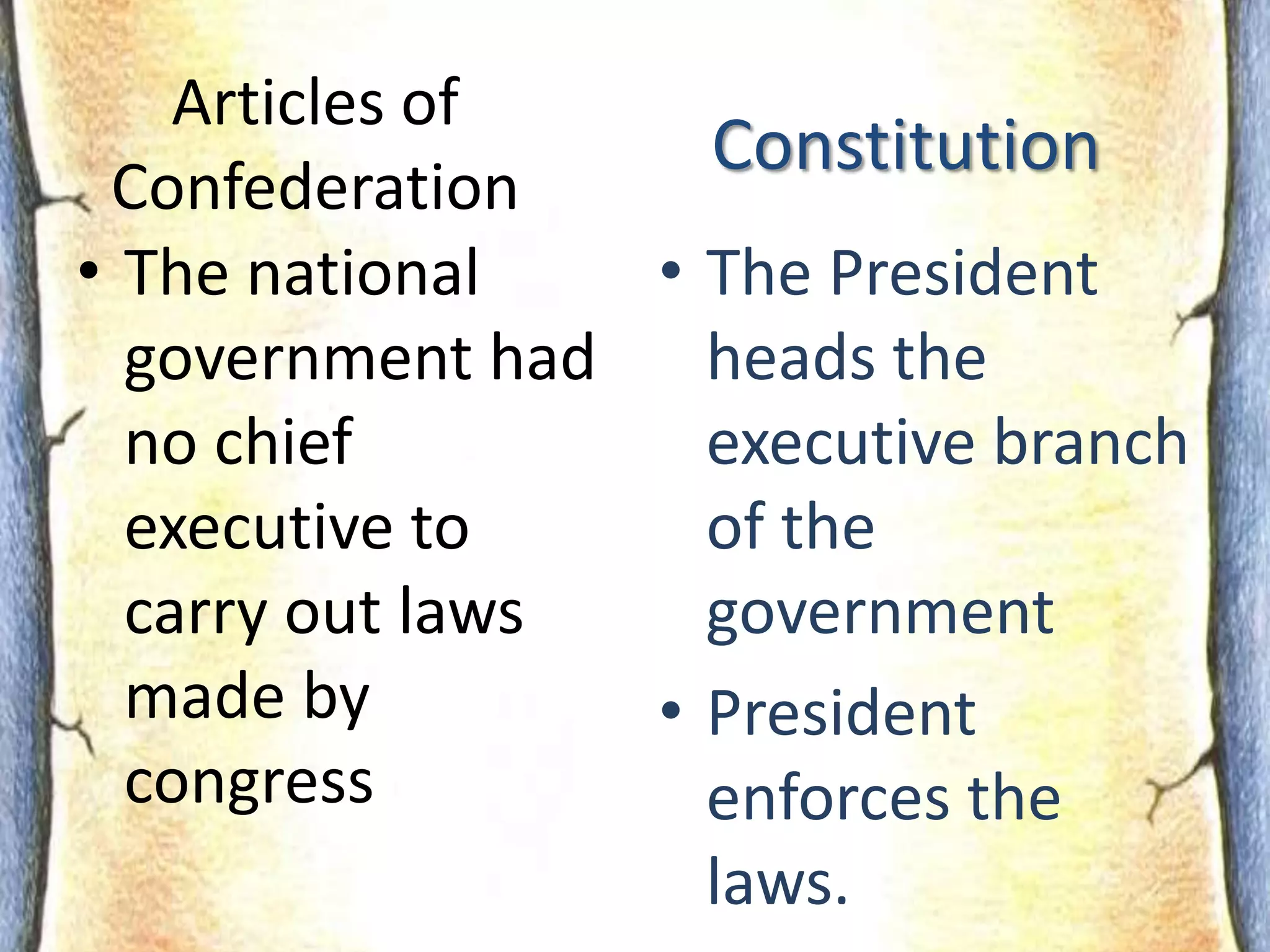
Articles of ConfederationThe national government had no chief executive to carry out laws made by congressThe President heads the executive branch of the governmentPresident enforces the laws.Constitution
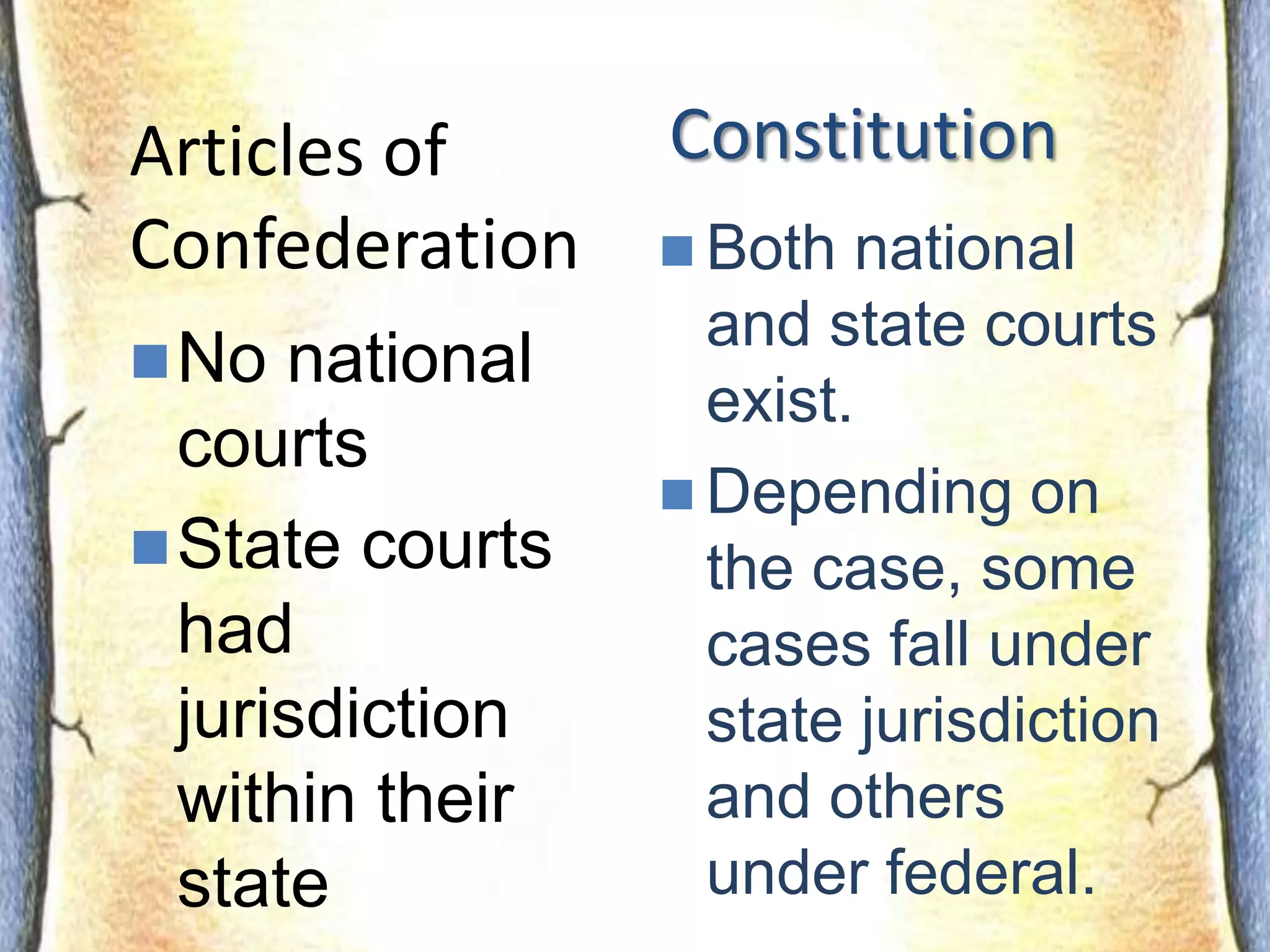
ConstitutionArticles of ConfederationBoth national and state courts exist.
Depending on the case, some cases fall under state jurisdiction and others under federal.
No national courts
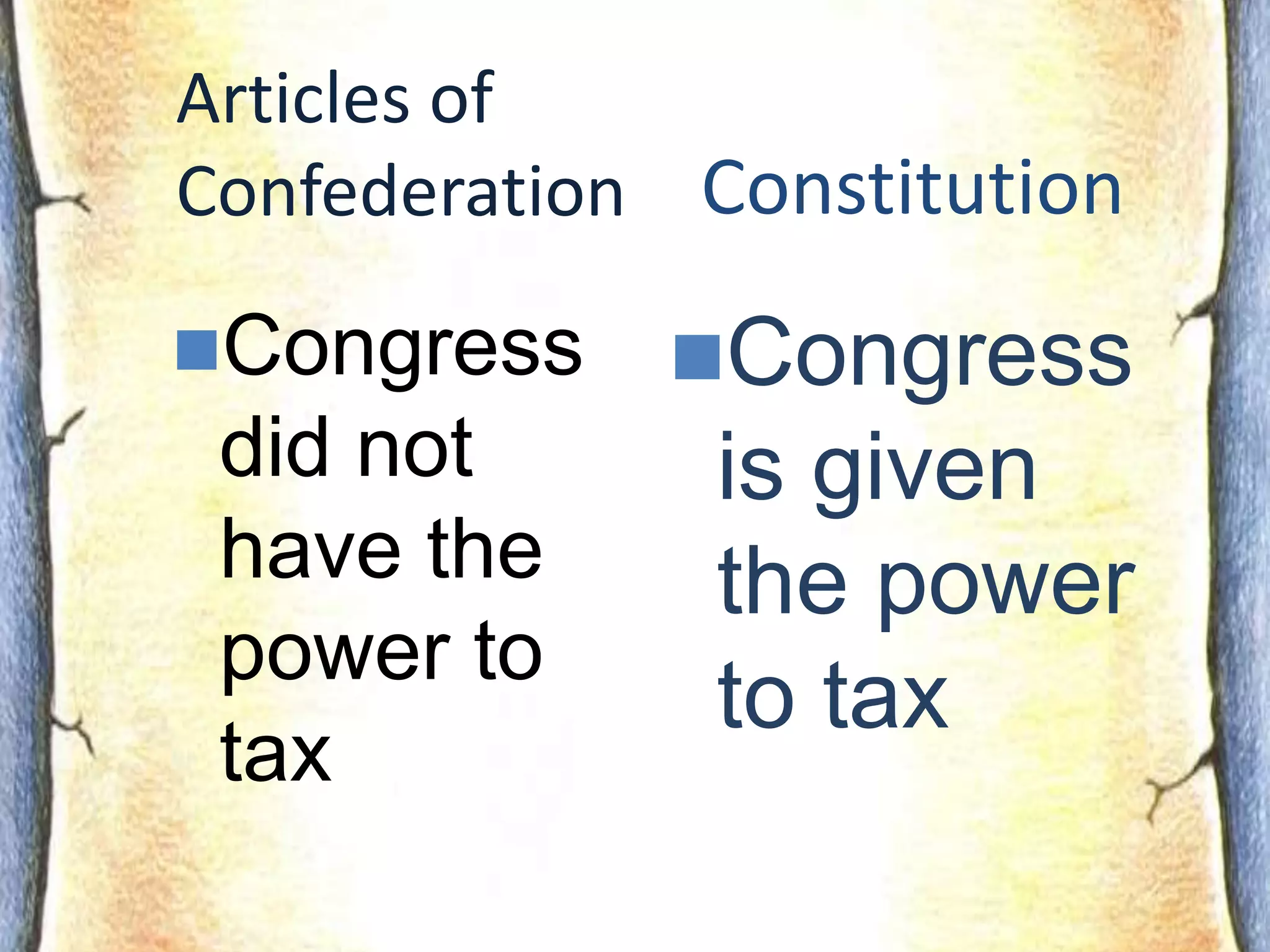
State courts had jurisdiction within their stateArticles of ConfederationConstitutionCongress did not have the power to tax
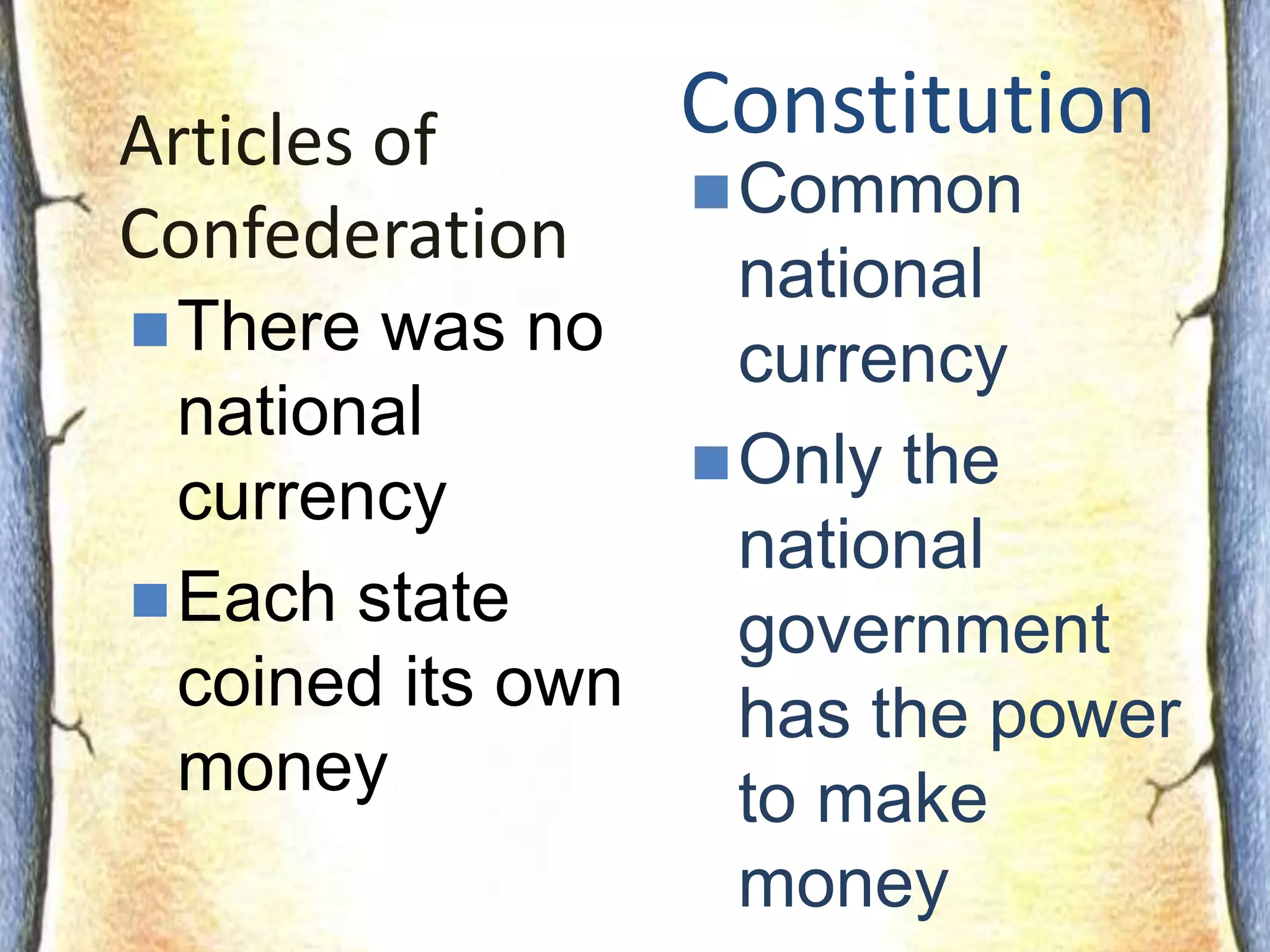
Congress is given the power to taxConstitutionArticles of ConfederationCommon national currency
Only the national government has the power to make money
There was no national currency
Each state coined its own money Discuss:Defend my claim:  The need for a strong executive leader is essential to the functioning of government.
Great or Connecticut CompromiseTopic: Representation in CongressLarge States: 	Virginia PlanLarge states wanted representation by population Small States:New Jersey PlanSmall states wanted equal representation

The Articles Of Confederation

  • 1.
    The Articles ofConfederation
  • 2.
    “No taxation withoutrepresentation”It means, 'We will only pay taxes that our representatives in a House or Assembly [or similar body] have approved and passed into a law. The slogan was used by the American revolutionaries and meant they they weren't willing to pay taxes imposed by the British House of Commons - as they were not represented there.
  • 3.
    Common SenseA pamphletwritten in America by Englishman Thomas Paine, published on January 10, 1776.It called for American independence anda union of the American colonies It was propaganda and influenced colonists to pursue both in the Revolutionary War.
  • 4.
    The Articles: powersto Congressmake war and peace (sending/receiving ambassadors and making treaties), raise an army and navy (build a navy and raising an army by asking the states for troops),print money (set up a money system, fix uniform standards of weights and measures), andset up a postal system.
  • 5.
    Major weaknesses ofthe Articles of Confederation:No chief executive to enforce the lawsNo national court system
  • 6.
    Could not collecttaxes from individuals
  • 7.
    No National CurrencySuccessesof AoCTreaty of Paris (1783)ended the Revolutionary War, recognized 13 colonies as free and sovereignstates, and recognized the Mississippi River as the country’s new western border
  • 8.
    Successes of theAoCLand Ordinance (1785) provided a way to divide western land into separate territories and created a procedure for the new territories to apply for statehood and join the United States.
  • 9.
    The Land Ordinanceof 1785Congress, eager for revenue from the sale of land in the Old Northwest, adopted the Ordinance of 1785. That law required the government to survey the Old Northwest before selling the land to the public. The territory was divided into townships of 6 miles (9.7 kilometers) square. These townships were further divided into 36 sections, each 1 mile (1.6 kilometers) square, an area that equals 640 acres (259 hectares). The 640-acre units were then auctioned off to the public for a price of at least $1 an acre.Few farmers could afford to buy as much as 640 acres. Land speculators, such as the Ohio Company and the Scioto Company, grabbed up most of the land. These companies then divided the land into smaller sections and sold them at a profit.
  • 10.
  • 11.
    Successes of theAoCNorthwest Ordinance (1787) established a plan for governing the new land between the Appalachian mountains and the Mississippi River. This plan set up government for the territory and also abolished slavery in the new western states.
  • 12.
    Northwest Ordinance of1787The Northwest Ordinance of 1787 established a government for the Old Northwest, which then became known as the Northwest Territory. The ordinance also provided for the eventual division of the region into three to five states. Congress appointed the first officials of the territory—a governor, a secretary, and three judges. When the territory reached a population of 5,000 adult males, it could elect an assembly and send a nonvoting delegate to Congress. When any division of the territory reached a population of 60,000, it could apply for statehood.
  • 13.
    Impact of theordinances The ordinances of 1785 and 1787 paved the way for full-scale migration to the west. The laws also established guidelines for the administration of all U.S. territories.
  • 14.
    Failure of theAoCShay’s Rebellion (1787)a group of Massachusetts farmers, lead by Daniel Shay, protested the rising taxes on land. They attacked a federal court house. The revolt convinced many people that the U.S. needed a stronger central government to prevent violence and disorder.
  • 15.
    SolutionsTo fix someof the problems with the AoC a Constitutional Convention was called. At the convention the delegates threw out the AoC and created a new document called the Constitution.Constitution: a written plan of governmentA document that outlines the powers and limitations of governmentBicameral: a legislature with two houses
  • 16.
    The Articles ofConfederation Vs. The Constitution
  • 17.
    Constitution:Provides a writtenframework for government.A plan or instruction manual of powers and restrictions for governmentLimits or restricts certain powers
  • 18.
    Discuss:Why is aconstitution essential to a government?
  • 19.
    Articles of ConfederationThenational government had no chief executive to carry out laws made by congressThe President heads the executive branch of the governmentPresident enforces the laws.Constitution
  • 20.
    ConstitutionArticles of ConfederationBothnational and state courts exist.
  • 21.
    Depending on thecase, some cases fall under state jurisdiction and others under federal.
  • 22.
  • 23.
    State courts hadjurisdiction within their stateArticles of ConfederationConstitutionCongress did not have the power to tax
  • 24.
    Congress is giventhe power to taxConstitutionArticles of ConfederationCommon national currency
  • 25.
    Only the nationalgovernment has the power to make money
  • 26.
    There was nonational currency
  • 27.
    Each state coinedits own money Discuss:Defend my claim: The need for a strong executive leader is essential to the functioning of government.
  • 28.
    Great or ConnecticutCompromiseTopic: Representation in CongressLarge States: Virginia PlanLarge states wanted representation by population Small States:New Jersey PlanSmall states wanted equal representation
  • 29.
    The Great CompromiseBicamerallegislature equal representation = Senate (2 per state)proportional representation =House (population)
  • 30.
    (3/5 Compromise) Three/FifthsCompromise: PopulationSouthSouthern states wanted slaves to count in population countsThey were more dependent on slavery.NorthNorthern states did not want slaves to countThey were less dependent on slavery
  • 31.
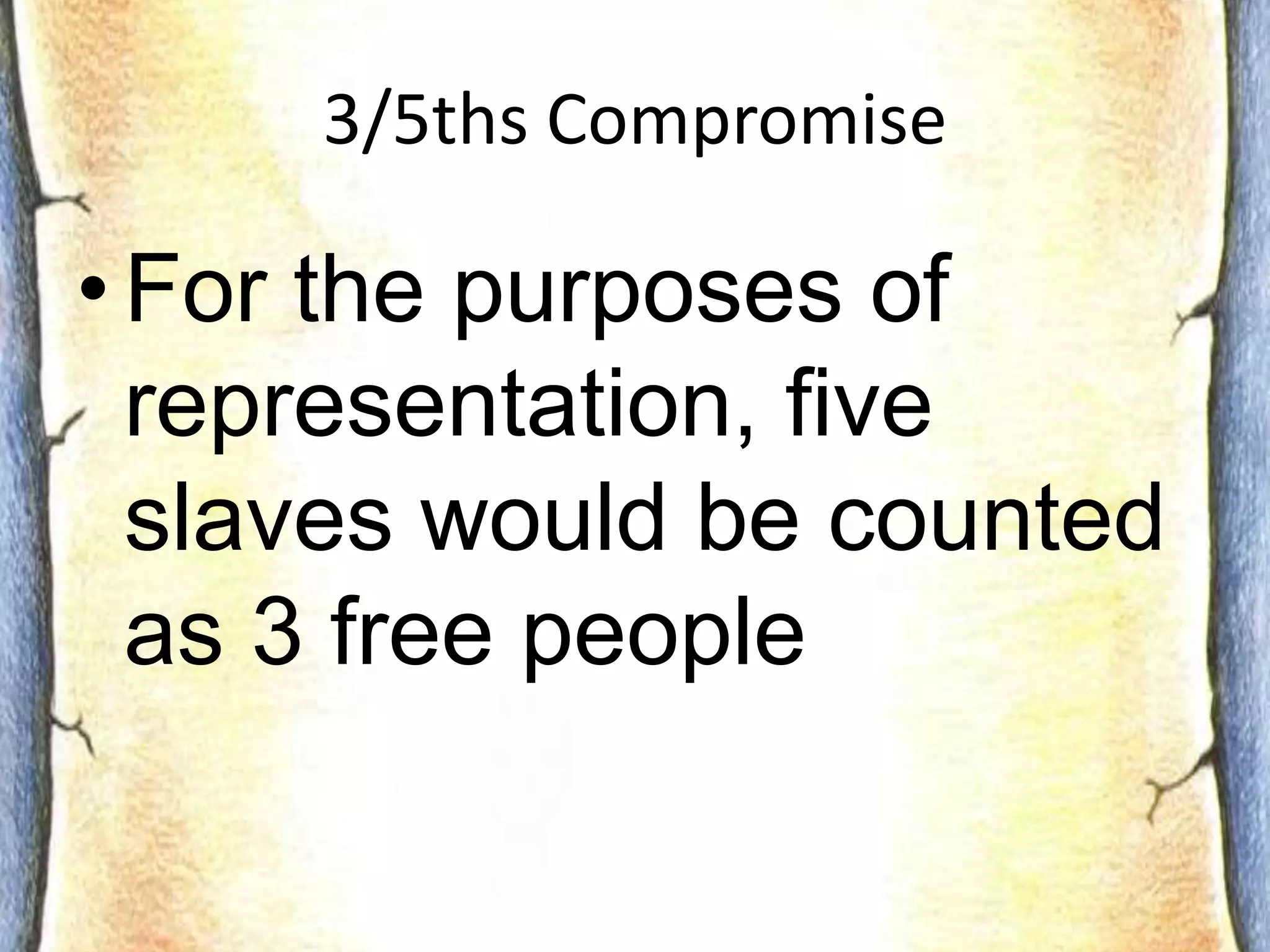
    3/5ths CompromiseFor thepurposes of representation, five slaves would be counted as 3 free people
  • 32.
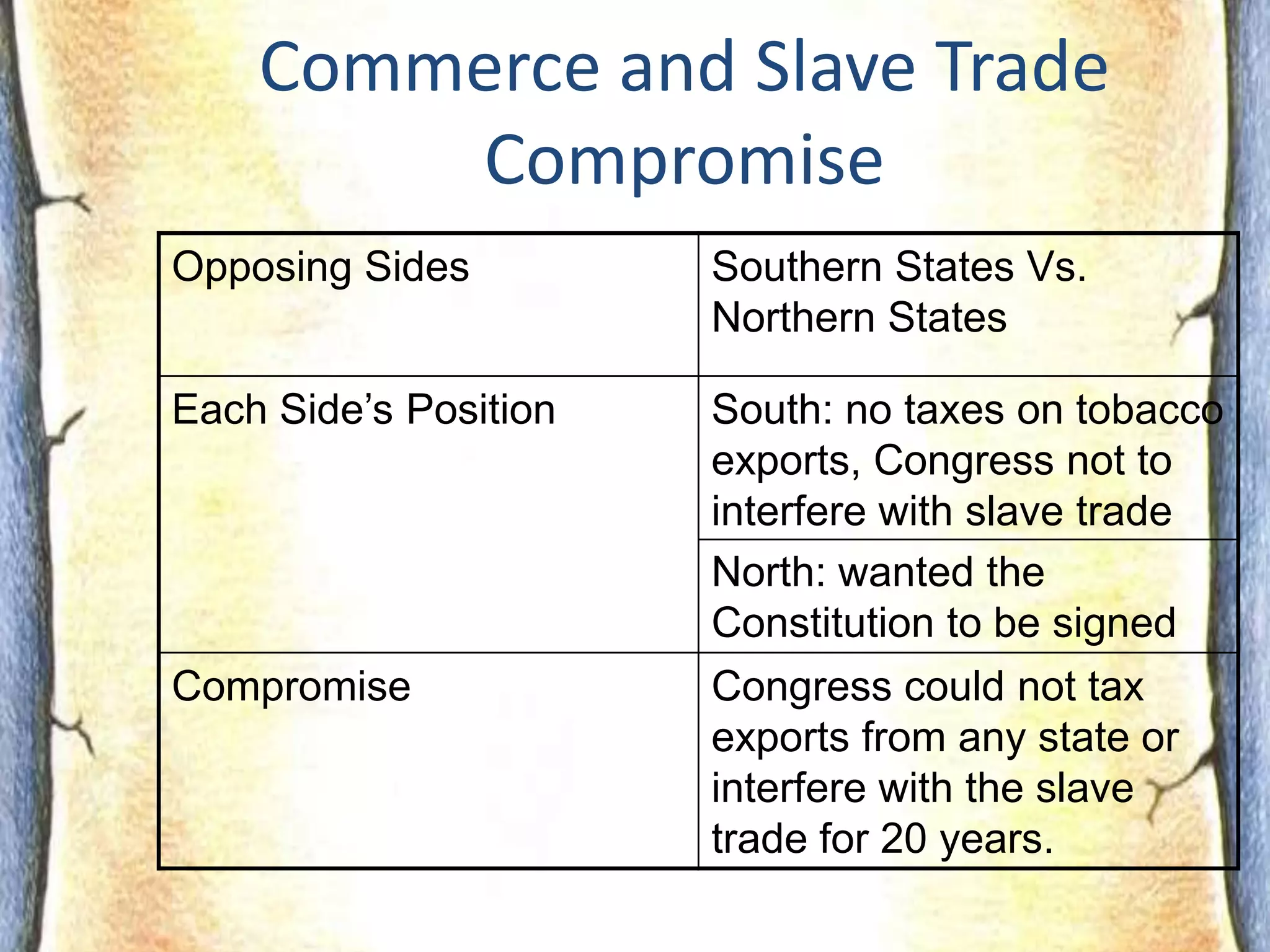
    Commerce and SlaveTrade Compromise
  • 33.
    THINK:Which of thecompromises would you say is most important to our government today?