+
Evaluation Question 2:
How does your media product
represent a particular social
group?
+
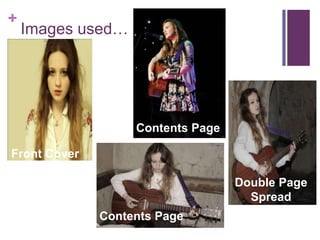
Images used…
Front Cover
Contents Page
Contents Page
Double Page
Spread
+Image Inspiration…
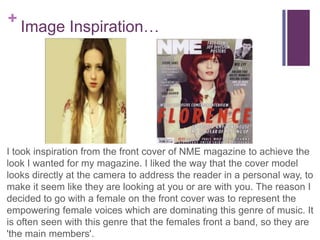
I took inspiration from the front cover of NME magazine to achieve the look
I wanted for my magazine. I liked the way that the cover model looks
directly at the camera to address the reader in a personal way, to make it
seem like they are looking at you or are with you. I feel like this genre of
music (indie, alternative, folk) is more about the tone of voice and the lyrics
of the songs just as much as the live use of instruments, so having the
model look out to the reader it portrays the emotions related the music.The
reason I decided to go with a female on the front cover was to represent the
empowering female voices which are dominating this genre of music. It is
often seen with this genre that the females front a band, so they are 'the
main members'.
+
Audience Representation…
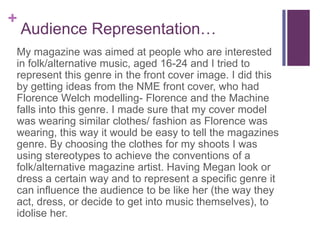
My magazine was aimed at people who are interested
in folk/alternative music, aged 16-24 and I tried to
represent this genre in the front cover image. I did this
by getting ideas from the NME front cover, who had
Florence Welch modelling- Florence and the Machine
falls into this genre. I made sure that my cover model
was wearing similar clothes/ fashion as Florence was
wearing, this way it would be easy to tell the magazines
genre. By choosing the clothes for my shoots I was
using stereotypes to achieve the conventions of a
folk/alternative magazine artist. Having Megan look or
dress a certain way and to represent a specific genre it
can influence the audience to be like her (the way they
act, dress, or decide to get into music themselves), to
idolise her.
+Dominant Ideas…
I think that I supported dominant ideas and conventions of
my chosen social group throughout the magazine process.
I did this by finding out which social group my magazine
will represent and then found out dominant ideas and
conventions that go along with this- these ideas can
change a persons views or opinions.
Ideas I used:
 Typical clothes/ fashion style from this genre. (Shabby Chic,
inspired by styles from the 60’s and 70’s)
 An alternative shoot location to a standard one. (Dark, dull,
grungy, soft lighting and very simplistic)
 Instruments that are associated with the genre. (Guitars,
keyboard)
 Typical mise-en-scene to convey the social group.
+Mise-en-scene…
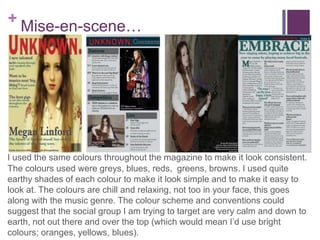
I used the same colours throughout the magazine to make it look
consistent.The colours used were greys, blues, reds, greens, browns. I
used quite earthy shades of each colour to make it look simple and to
make it easy to look at.The colours are chill and relaxing, not too in your
face, this goes along with the music genre.The colour scheme and
conventions could suggest that the social group I am trying to target are
very calm and down to earth, not out there and over the top (which would
mean I’d use bright colours; oranges, yellows, blues).
+
About Megan…
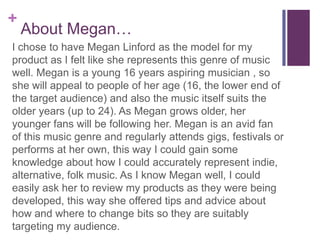
I chose to have Megan Linford as the model for
my product as I felt like she represents this
genre of music well. Megan is a young 16 years
aspiring musician , so she will appeal to people
of her age (16, the lower end of the target
audience) and also the music itself suits the
older years (up to 24). As Megan grows older,
her younger fans will be following her. Megan
is an avid fan of this music genre and regularly
attends gigs, festivals or performs at her own,
this way I could gain some knowledge about
how I could accurately represent indie,
alternative, folk music.
+
About Megan Cont…
As I know Megan well, I could easily ask her to
review my products as they were being
developed, this way she offered tips and advice
about how and where to change bits so they are
suitably targeting my audience. Megan is a
singer-songwriter, she writes lyrics based on
her experiences in life and her enjoyments. As
she writes her own music, it means that the
audience can relate and identify with the lyrics.
Her songs can become very personal to the
individual listener, and can have a different
meaning to each person, although falling into
the same social group.

Evaluation question2

  • 1.
    + Evaluation Question 2: Howdoes your media product represent a particular social group?
  • 2.
    + Images used… Front Cover ContentsPage Contents Page Double Page Spread
  • 3.
    +Image Inspiration… I tookinspiration from the front cover of NME magazine to achieve the look I wanted for my magazine. I liked the way that the cover model looks directly at the camera to address the reader in a personal way, to make it seem like they are looking at you or are with you. I feel like this genre of music (indie, alternative, folk) is more about the tone of voice and the lyrics of the songs just as much as the live use of instruments, so having the model look out to the reader it portrays the emotions related the music.The reason I decided to go with a female on the front cover was to represent the empowering female voices which are dominating this genre of music. It is often seen with this genre that the females front a band, so they are 'the main members'.
  • 4.
    + Audience Representation… My magazinewas aimed at people who are interested in folk/alternative music, aged 16-24 and I tried to represent this genre in the front cover image. I did this by getting ideas from the NME front cover, who had Florence Welch modelling- Florence and the Machine falls into this genre. I made sure that my cover model was wearing similar clothes/ fashion as Florence was wearing, this way it would be easy to tell the magazines genre. By choosing the clothes for my shoots I was using stereotypes to achieve the conventions of a folk/alternative magazine artist. Having Megan look or dress a certain way and to represent a specific genre it can influence the audience to be like her (the way they act, dress, or decide to get into music themselves), to idolise her.
  • 5.
    +Dominant Ideas… I thinkthat I supported dominant ideas and conventions of my chosen social group throughout the magazine process. I did this by finding out which social group my magazine will represent and then found out dominant ideas and conventions that go along with this- these ideas can change a persons views or opinions. Ideas I used:  Typical clothes/ fashion style from this genre. (Shabby Chic, inspired by styles from the 60’s and 70’s)  An alternative shoot location to a standard one. (Dark, dull, grungy, soft lighting and very simplistic)  Instruments that are associated with the genre. (Guitars, keyboard)  Typical mise-en-scene to convey the social group.
  • 6.
    +Mise-en-scene… I used thesame colours throughout the magazine to make it look consistent.The colours used were greys, blues, reds, greens, browns. I used quite earthy shades of each colour to make it look simple and to make it easy to look at.The colours are chill and relaxing, not too in your face, this goes along with the music genre.The colour scheme and conventions could suggest that the social group I am trying to target are very calm and down to earth, not out there and over the top (which would mean I’d use bright colours; oranges, yellows, blues).
  • 7.
    + About Megan… I choseto have Megan Linford as the model for my product as I felt like she represents this genre of music well. Megan is a young 16 years aspiring musician , so she will appeal to people of her age (16, the lower end of the target audience) and also the music itself suits the older years (up to 24). As Megan grows older, her younger fans will be following her. Megan is an avid fan of this music genre and regularly attends gigs, festivals or performs at her own, this way I could gain some knowledge about how I could accurately represent indie, alternative, folk music.
  • 8.
    + About Megan Cont… AsI know Megan well, I could easily ask her to review my products as they were being developed, this way she offered tips and advice about how and where to change bits so they are suitably targeting my audience. Megan is a singer-songwriter, she writes lyrics based on her experiences in life and her enjoyments. As she writes her own music, it means that the audience can relate and identify with the lyrics. Her songs can become very personal to the individual listener, and can have a different meaning to each person, although falling into the same social group.