the  french  new  wave [la nouvelle vague] definitions  and  influence
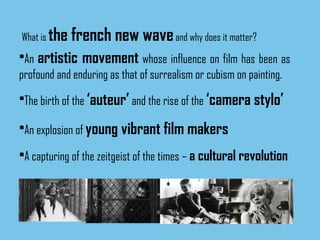
What is  the french new wave  and why does it matter? An  artistic movement  whose influence on film has been as profound and enduring as that of surrealism or cubism on painting. The birth of the  ‘auteur’  and the rise of the  ‘camera stylo’   An explosion of  young vibrant film makers A capturing of the zeitgeist of the times –  a cultural revolution
Origins of the   NEW WAVE The label –  NEW WAVE  appeared in a sociological investigation of the phenomenon of the new post war generation published in L’Express This  survey  involved 8 million French people between the ages of 18 and 30 who were asked questions relating to  fashion, morals, values, lifestyles and cultural behaviour . Cinema was seen as of a  secondary importance The findings were published in a volume under the title of  ‘La Nouvelle Vague: portraits de la jeunesse  [The New Wave: Portraits of Youth]
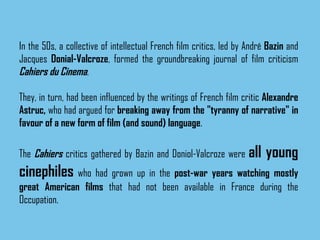
In the 50s, a collective of intellectual French film critics, led by André  Bazin  and Jacques  Donial-Valcroze , formed the groundbreaking journal of film criticism  Cahiers du Cinema .  They, in turn, had been influenced by the writings of French film critic  Alexandre Astruc,  who had argued for  breaking away from the "tyranny of narrative" in favour of a new form of film (and sound) language .  The  Cahiers  critics gathered by Bazin and Doniol-Valcroze were  all young cinephiles  who had grown up in the  post-war years watching mostly great American films  that had not been available in France during the Occupation.
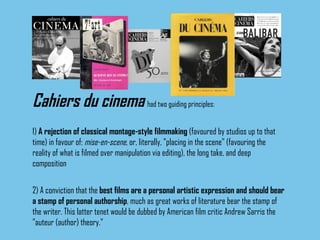
Cahiers du cinema   had two guiding principles: 1)  A rejection of classical montage-style filmmaking  (favoured by studios up to that time) in favour of:  mise-en-scene , or, literally, "placing in the scene" (favouring the reality of what is filmed over manipulation via editing), the long take, and deep composition 2) A conviction that the  best films are a personal artistic expression and should bear a stamp of personal authorship , much as great works of literature bear the stamp of the writer. This latter tenet would be dubbed by American film critic Andrew Sarris the "auteur (author) theory."
The filmmakers of the  French New Wave are unique and distinctive  enough to stand out on their own but they collectively comprised one of the most  influential movements  in cinema history.  Some of the films have aged better than others. Even though they  weren't aiming at mainstream success , many of these films became popular and critically acclaimed worldwide, the subject of much debate, and, ultimately, the inspiration to filmmakers everywhere.  The five filmmakers who came from the  Cahiers du cinema   (Truffaut, Godard, Chabrol, Rivette and Rohmer)  were incredibly prolific: in the years between  1959 and 1966 , the peak of the New Wave, they made 32 films.
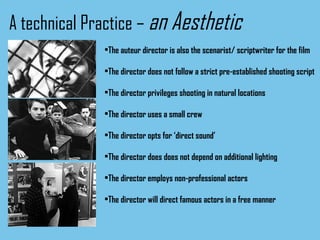
A technical Practice –  an Aesthetic The auteur director is also the scenarist/ scriptwriter for the film The director does not follow a strict pre-established shooting script The director privileges shooting in natural locations The director uses a small crew The director opts for ‘direct sound’ The director does does not depend on additional lighting The director employs non-professional actors The director will direct famous actors in a free manner
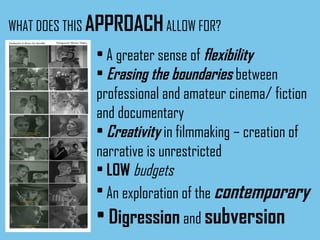
WHAT DOES THIS  APPROACH  ALLOW FOR? A greater sense of   flexibility Erasing the boundaries   between   professional and amateur cinema/ fiction and documentary Creativity   in filmmaking – creation of narrative is unrestricted LOW  budgets An exploration of the   contemporary Digression   and   subversion
TECHNIQUES  of  FILMING Alternative framing   Making mistakes  – Chabrol famously looked into a bolt when asked to look through the eyepiece on his first film Collaboration with cinematographers Natural lighting  – sharp  contrast between Black and White Liberation of the camera from the TRIPOD REPORTAGE  –the HIDDEN camera Fast and sensitive stock – Coutard’s influence Self reference  – the appropriation of certain cinematic techniques and director styles
TECHNIQUES  of   Editing Discontinuity of shot Syncopated editing jump CUT A  disregard  of continuity editing MODERN MONTAGE FLASH  PANS RAPID REFRAMING  from one shot to another The  LONG  take  – static/ mobile or lateral tracking Break the rules –  CREATE  new ones – BREAK  THEM
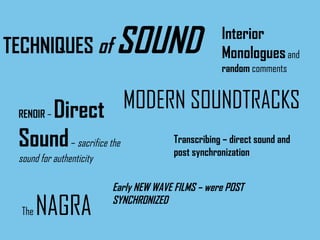
TECHNIQUES  of  SOUND RENOIR  –  Direct Sound  –  sacrifice the sound for authenticity Early NEW WAVE FILMS – were POST SYNCHRONIZED Interior Monologues  and  random  comments The  NAGRA Transcribing – direct sound and post synchronization MODERN SOUNDTRACKS
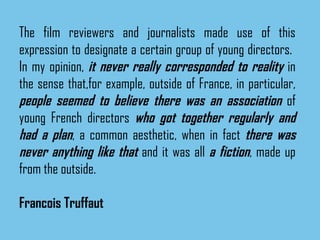
The film reviewers and journalists made use of this expression to designate a certain group of young directors.  In my opinion,  it never really corresponded to reality  in the sense that,for example, outside of France, in particular,  people seemed to believe there was an association  of young French directors  who got together regularly and had a plan , a common aesthetic, when in fact  there was never anything like that  and it was all  a fiction , made up from the outside. Francois Truffaut
KEY TEXTS A BOUT DE SOUFFLE 1960 LES MISTONS 1958 ET DIEU CREA LA FEMME [And God Created Woman] 1956 LES QUATRE CENT COUPS 1959 JULES ET JIM 1962 LE BOUCHER [for the new wave style] 1970 LA PEAU DEUCE 1964 CHARLOTTE ET SON JULES PIERROT LE FOU 1965

French New Wave

  • 1.
    the french new wave [la nouvelle vague] definitions and influence
  • 2.
    What is the french new wave and why does it matter? An artistic movement whose influence on film has been as profound and enduring as that of surrealism or cubism on painting. The birth of the ‘auteur’ and the rise of the ‘camera stylo’ An explosion of young vibrant film makers A capturing of the zeitgeist of the times – a cultural revolution
  • 3.
    Origins of the NEW WAVE The label – NEW WAVE appeared in a sociological investigation of the phenomenon of the new post war generation published in L’Express This survey involved 8 million French people between the ages of 18 and 30 who were asked questions relating to fashion, morals, values, lifestyles and cultural behaviour . Cinema was seen as of a secondary importance The findings were published in a volume under the title of ‘La Nouvelle Vague: portraits de la jeunesse [The New Wave: Portraits of Youth]
  • 4.
    In the 50s,a collective of intellectual French film critics, led by André Bazin and Jacques Donial-Valcroze , formed the groundbreaking journal of film criticism Cahiers du Cinema . They, in turn, had been influenced by the writings of French film critic Alexandre Astruc, who had argued for breaking away from the "tyranny of narrative" in favour of a new form of film (and sound) language . The Cahiers critics gathered by Bazin and Doniol-Valcroze were all young cinephiles who had grown up in the post-war years watching mostly great American films that had not been available in France during the Occupation.
  • 5.
    Cahiers du cinema had two guiding principles: 1) A rejection of classical montage-style filmmaking (favoured by studios up to that time) in favour of: mise-en-scene , or, literally, "placing in the scene" (favouring the reality of what is filmed over manipulation via editing), the long take, and deep composition 2) A conviction that the best films are a personal artistic expression and should bear a stamp of personal authorship , much as great works of literature bear the stamp of the writer. This latter tenet would be dubbed by American film critic Andrew Sarris the "auteur (author) theory."
  • 6.
    The filmmakers ofthe French New Wave are unique and distinctive enough to stand out on their own but they collectively comprised one of the most influential movements in cinema history. Some of the films have aged better than others. Even though they weren't aiming at mainstream success , many of these films became popular and critically acclaimed worldwide, the subject of much debate, and, ultimately, the inspiration to filmmakers everywhere. The five filmmakers who came from the Cahiers du cinema (Truffaut, Godard, Chabrol, Rivette and Rohmer) were incredibly prolific: in the years between 1959 and 1966 , the peak of the New Wave, they made 32 films.
  • 7.
    A technical Practice– an Aesthetic The auteur director is also the scenarist/ scriptwriter for the film The director does not follow a strict pre-established shooting script The director privileges shooting in natural locations The director uses a small crew The director opts for ‘direct sound’ The director does does not depend on additional lighting The director employs non-professional actors The director will direct famous actors in a free manner
  • 8.
    WHAT DOES THIS APPROACH ALLOW FOR? A greater sense of flexibility Erasing the boundaries between professional and amateur cinema/ fiction and documentary Creativity in filmmaking – creation of narrative is unrestricted LOW budgets An exploration of the contemporary Digression and subversion
  • 9.
    TECHNIQUES of FILMING Alternative framing Making mistakes – Chabrol famously looked into a bolt when asked to look through the eyepiece on his first film Collaboration with cinematographers Natural lighting – sharp contrast between Black and White Liberation of the camera from the TRIPOD REPORTAGE –the HIDDEN camera Fast and sensitive stock – Coutard’s influence Self reference – the appropriation of certain cinematic techniques and director styles
  • 10.
    TECHNIQUES of Editing Discontinuity of shot Syncopated editing jump CUT A disregard of continuity editing MODERN MONTAGE FLASH PANS RAPID REFRAMING from one shot to another The LONG take – static/ mobile or lateral tracking Break the rules – CREATE new ones – BREAK THEM
  • 11.
    TECHNIQUES of SOUND RENOIR – Direct Sound – sacrifice the sound for authenticity Early NEW WAVE FILMS – were POST SYNCHRONIZED Interior Monologues and random comments The NAGRA Transcribing – direct sound and post synchronization MODERN SOUNDTRACKS
  • 12.
    The film reviewersand journalists made use of this expression to designate a certain group of young directors. In my opinion, it never really corresponded to reality in the sense that,for example, outside of France, in particular, people seemed to believe there was an association of young French directors who got together regularly and had a plan , a common aesthetic, when in fact there was never anything like that and it was all a fiction , made up from the outside. Francois Truffaut
  • 13.
    KEY TEXTS ABOUT DE SOUFFLE 1960 LES MISTONS 1958 ET DIEU CREA LA FEMME [And God Created Woman] 1956 LES QUATRE CENT COUPS 1959 JULES ET JIM 1962 LE BOUCHER [for the new wave style] 1970 LA PEAU DEUCE 1964 CHARLOTTE ET SON JULES PIERROT LE FOU 1965