Slide content created by Joseph B. Mosca, Monmouth University.
Copyright © Houghton Mifflin Company. All rights reserved.
7
Ready Notes
Basic Elements of
Planning and
Decision Making
For in-class note taking, choose Handouts
or Notes Pages from the print options, with
three slides per page.
SEYAM RAYHAN SHARKAR
Copyright © Houghton Mifflin Company. All rights reserved. 1 - 2
Copyright © Houghton Mifflin Company. All rights reserved. 7 - 3
Organizational Goals
• Goals are critical to
organizational
effectiveness and serve
a number of purposes.
• Purposes of goals:
– Provide guidance.
– Promote good planning.
– Serve as sources of
motivation.
– Mechanism for
evaluation and control.
Copyright © Houghton Mifflin Company. All rights reserved. 7 - 4
Identification Integration
Adaptation RevitalizationCollaboration
Organizations Have a Purpose—
That Is Why They Need Goals
Organizational
purpose for
goals
Copyright © Houghton Mifflin Company. All rights reserved. 7 - 5
Kinds of Goals
• Goals vary by level, area, and time frame.
• Mission: a statement of an organization’s
fundamental purpose.
• Strategic goal: a goal set by and for top
management of the organization.
• Tactical goal: set by and for middle managers
of the organization.
• Operational goal: set by and for lower
managers of the organization.
Copyright © Houghton Mifflin Company. All rights reserved. 7 - 6
Other Goals
• Area: organizations
also set goals for
different areas.
• Time frame:
organizations also
set goals across
different time
frames.
Copyright © Houghton Mifflin Company. All rights reserved. 7 - 7
Responsibilities for Setting Goals
Who sets goals?
– All managers should
be involved in the goal
setting process.
– Each manager has
responsibilities for
setting goals that
correspond to their
level.
Copyright © Houghton Mifflin Company. All rights reserved. 7 - 8
Managing Multiple Goals
• When setting goals
organizations sometimes
experience conflicts or
contradictions among
goals.
• Conflicts are addressed
through the use of the
Optimizing concept:
– Optimizing: balancing and
reconciling possible conflicts
among goals.
Copyright © Houghton Mifflin Company. All rights reserved. 7 - 9
The planning
function
consists of:
What is to be
accomplished?
What is to be
accomplished?
How is it to be
accomplished?
How is it to be
accomplished?
Copyright © Houghton Mifflin Company. All rights reserved. 7 - 10
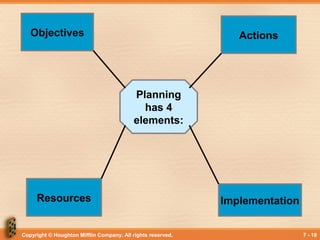
Planning
has 4
elements:
Objectives Actions
Resources Implementation
Copyright © Houghton Mifflin Company. All rights reserved. 7 - 11
Why Is Planning Important?
A task can not be
accomplished if the
manager is not
aware of:
How is
it to be
done
What
has to
be done
When is
it to be
done
Copyright © Houghton Mifflin Company. All rights reserved. 7 - 12
Organizational Planning
Kinds of organizational
plans:
– Strategic plan: a
general plan outlining
decisions of allocation,
priorities, and action
steps necessary to
reach strategic goals.
Copyright © Houghton Mifflin Company. All rights reserved. 7 - 13
Tactical Plans
• A plan aimed at
achieving tactical
and developed to
implement specific
parts of a strategic
plan.
• Operational plan: a
plan that focuses on
carrying out tactical
plans to achieve
operational goals.
Copyright © Houghton Mifflin Company. All rights reserved. 7 - 14
Time Frames for Plans
• Long-range plan: covers many years,
perhaps even decades; common long-
range plans are for five years or more.
• Intermediate plan: usually covers
periods from one to five years.
• Short-range plan: generally covers a
span of one year or less.
Copyright © Houghton Mifflin Company. All rights reserved. 7 - 15
More Types of Plans
• Action plan: used to
put into operation
any other kind of
plan.
• Reaction plan:
designed to allow
the company to
react to an
unforeseen
circumstance.
Copyright © Houghton Mifflin Company. All rights reserved. 7 - 16
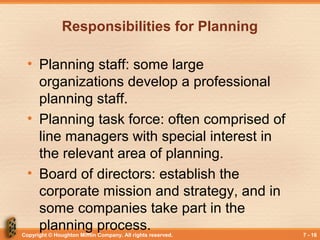
Responsibilities for Planning
• Planning staff: some large
organizations develop a professional
planning staff.
• Planning task force: often comprised of
line managers with special interest in
the relevant area of planning.
• Board of directors: establish the
corporate mission and strategy, and in
some companies take part in the
planning process.
Copyright © Houghton Mifflin Company. All rights reserved. 7 - 17
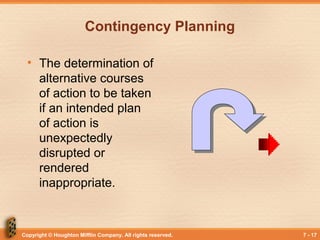
Contingency Planning
• The determination of
alternative courses
of action to be taken
if an intended plan
of action is
unexpectedly
disrupted or
rendered
inappropriate.
Copyright © Houghton Mifflin Company. All rights reserved. 7 - 18
Crisis Management
• The set of procedures
the organization uses in
the event of a disaster
or other unexpected
calamity.
• A related concept is the
set of procedures the
organization uses in the
event of a disaster or
other unexpected
calamity.
Copyright © Houghton Mifflin Company. All rights reserved. 7 - 19
Tactical Planning
The development and executing of
tactical plans:
– Tactical plans are used to accomplish
specific parts of a strategic plan. Each
strategic plan is generally implemented
through several tactical plans. Effective
tactical planning involves both
development and execution.
Copyright © Houghton Mifflin Company. All rights reserved. 7 - 20
Tactical Plan
Development and Execution
Development:
– Recognize and understand
overarching strategic plans
and tactical goals.
– Specify relevant resource
and time issues.
– Identify and articulate
human resource
commitments.
Execution:
– Evaluate each course of
action in light of its goals.
– Obtain and distribute
information and resources.
– Monitor horizontal and
vertical communication and
integration of activities.
– Monitor ongoing activities
for goal achievement.
Copyright © Houghton Mifflin Company. All rights reserved. 7 - 21
Types of Operational Planning
• Single-use plan: developed to carry out
a course of action not likely to be
repeated in the future.
• For a program, a plan for a large set of
activities.
• For a project, a plan of less scope and
complexity than a program.
Copyright © Houghton Mifflin Company. All rights reserved. 7 - 22
Standing Plan
• Developed for activities that recur
regularly over a period of time:
– For a policy, a standing plan specifying the
organization’s general response to a
designated problem or situation.
– Standard operating procedure: a standing
plan outlining steps to be followed in
particular circumstances.
– Rules and regulations: standing plans
describing exactly how specific activities
are to be carried out.
Copyright © Houghton Mifflin Company. All rights reserved. 7 - 23
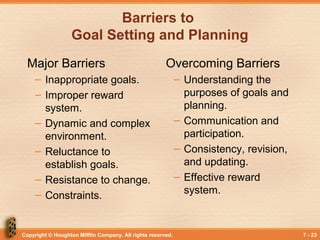
Barriers to
Goal Setting and Planning
Major Barriers
– Inappropriate goals.
– Improper reward
system.
– Dynamic and complex
environment.
– Reluctance to
establish goals.
– Resistance to change.
– Constraints.
Overcoming Barriers
– Understanding the
purposes of goals and
planning.
– Communication and
participation.
– Consistency, revision,
and updating.
– Effective reward
system.

Basic elements of planning and decision making

  • 1.
    Slide content createdby Joseph B. Mosca, Monmouth University. Copyright © Houghton Mifflin Company. All rights reserved. 7 Ready Notes Basic Elements of Planning and Decision Making For in-class note taking, choose Handouts or Notes Pages from the print options, with three slides per page.
  • 2.
    SEYAM RAYHAN SHARKAR Copyright© Houghton Mifflin Company. All rights reserved. 1 - 2
  • 3.
    Copyright © HoughtonMifflin Company. All rights reserved. 7 - 3 Organizational Goals • Goals are critical to organizational effectiveness and serve a number of purposes. • Purposes of goals: – Provide guidance. – Promote good planning. – Serve as sources of motivation. – Mechanism for evaluation and control.
  • 4.
    Copyright © HoughtonMifflin Company. All rights reserved. 7 - 4 Identification Integration Adaptation RevitalizationCollaboration Organizations Have a Purpose— That Is Why They Need Goals Organizational purpose for goals
  • 5.
    Copyright © HoughtonMifflin Company. All rights reserved. 7 - 5 Kinds of Goals • Goals vary by level, area, and time frame. • Mission: a statement of an organization’s fundamental purpose. • Strategic goal: a goal set by and for top management of the organization. • Tactical goal: set by and for middle managers of the organization. • Operational goal: set by and for lower managers of the organization.
  • 6.
    Copyright © HoughtonMifflin Company. All rights reserved. 7 - 6 Other Goals • Area: organizations also set goals for different areas. • Time frame: organizations also set goals across different time frames.
  • 7.
    Copyright © HoughtonMifflin Company. All rights reserved. 7 - 7 Responsibilities for Setting Goals Who sets goals? – All managers should be involved in the goal setting process. – Each manager has responsibilities for setting goals that correspond to their level.
  • 8.
    Copyright © HoughtonMifflin Company. All rights reserved. 7 - 8 Managing Multiple Goals • When setting goals organizations sometimes experience conflicts or contradictions among goals. • Conflicts are addressed through the use of the Optimizing concept: – Optimizing: balancing and reconciling possible conflicts among goals.
  • 9.
    Copyright © HoughtonMifflin Company. All rights reserved. 7 - 9 The planning function consists of: What is to be accomplished? What is to be accomplished? How is it to be accomplished? How is it to be accomplished?
  • 10.
    Copyright © HoughtonMifflin Company. All rights reserved. 7 - 10 Planning has 4 elements: Objectives Actions Resources Implementation
  • 11.
    Copyright © HoughtonMifflin Company. All rights reserved. 7 - 11 Why Is Planning Important? A task can not be accomplished if the manager is not aware of: How is it to be done What has to be done When is it to be done
  • 12.
    Copyright © HoughtonMifflin Company. All rights reserved. 7 - 12 Organizational Planning Kinds of organizational plans: – Strategic plan: a general plan outlining decisions of allocation, priorities, and action steps necessary to reach strategic goals.
  • 13.
    Copyright © HoughtonMifflin Company. All rights reserved. 7 - 13 Tactical Plans • A plan aimed at achieving tactical and developed to implement specific parts of a strategic plan. • Operational plan: a plan that focuses on carrying out tactical plans to achieve operational goals.
  • 14.
    Copyright © HoughtonMifflin Company. All rights reserved. 7 - 14 Time Frames for Plans • Long-range plan: covers many years, perhaps even decades; common long- range plans are for five years or more. • Intermediate plan: usually covers periods from one to five years. • Short-range plan: generally covers a span of one year or less.
  • 15.
    Copyright © HoughtonMifflin Company. All rights reserved. 7 - 15 More Types of Plans • Action plan: used to put into operation any other kind of plan. • Reaction plan: designed to allow the company to react to an unforeseen circumstance.
  • 16.
    Copyright © HoughtonMifflin Company. All rights reserved. 7 - 16 Responsibilities for Planning • Planning staff: some large organizations develop a professional planning staff. • Planning task force: often comprised of line managers with special interest in the relevant area of planning. • Board of directors: establish the corporate mission and strategy, and in some companies take part in the planning process.
  • 17.
    Copyright © HoughtonMifflin Company. All rights reserved. 7 - 17 Contingency Planning • The determination of alternative courses of action to be taken if an intended plan of action is unexpectedly disrupted or rendered inappropriate.
  • 18.
    Copyright © HoughtonMifflin Company. All rights reserved. 7 - 18 Crisis Management • The set of procedures the organization uses in the event of a disaster or other unexpected calamity. • A related concept is the set of procedures the organization uses in the event of a disaster or other unexpected calamity.
  • 19.
    Copyright © HoughtonMifflin Company. All rights reserved. 7 - 19 Tactical Planning The development and executing of tactical plans: – Tactical plans are used to accomplish specific parts of a strategic plan. Each strategic plan is generally implemented through several tactical plans. Effective tactical planning involves both development and execution.
  • 20.
    Copyright © HoughtonMifflin Company. All rights reserved. 7 - 20 Tactical Plan Development and Execution Development: – Recognize and understand overarching strategic plans and tactical goals. – Specify relevant resource and time issues. – Identify and articulate human resource commitments. Execution: – Evaluate each course of action in light of its goals. – Obtain and distribute information and resources. – Monitor horizontal and vertical communication and integration of activities. – Monitor ongoing activities for goal achievement.
  • 21.
    Copyright © HoughtonMifflin Company. All rights reserved. 7 - 21 Types of Operational Planning • Single-use plan: developed to carry out a course of action not likely to be repeated in the future. • For a program, a plan for a large set of activities. • For a project, a plan of less scope and complexity than a program.
  • 22.
    Copyright © HoughtonMifflin Company. All rights reserved. 7 - 22 Standing Plan • Developed for activities that recur regularly over a period of time: – For a policy, a standing plan specifying the organization’s general response to a designated problem or situation. – Standard operating procedure: a standing plan outlining steps to be followed in particular circumstances. – Rules and regulations: standing plans describing exactly how specific activities are to be carried out.
  • 23.
    Copyright © HoughtonMifflin Company. All rights reserved. 7 - 23 Barriers to Goal Setting and Planning Major Barriers – Inappropriate goals. – Improper reward system. – Dynamic and complex environment. – Reluctance to establish goals. – Resistance to change. – Constraints. Overcoming Barriers – Understanding the purposes of goals and planning. – Communication and participation. – Consistency, revision, and updating. – Effective reward system.