Visit https://testbankfan.com to download the full version and
browse more test banks or solution manuals
Management 10th Edition Robbins Solutions Manual
_____ Press the link below to begin your download _____
https://testbankfan.com/product/management-10th-edition-
robbins-solutions-manual/
Access testbankfan.com now to download high-quality
test banks or solution manuals
We believe these products will be a great fit for you. Click
the link to download now, or visit testbankfan.com
to discover even more!
Fundamentals of Management 10th Edition Robbins Solutions
Manual
https://testbankfan.com/product/fundamentals-of-management-10th-
edition-robbins-solutions-manual/
Fundamentals of Management 10th Edition Robbins Test Bank
https://testbankfan.com/product/fundamentals-of-management-10th-
edition-robbins-test-bank/
Management 12th Edition Robbins Solutions Manual
https://testbankfan.com/product/management-12th-edition-robbins-
solutions-manual/
Organic Chemistry Principles and Mechanisms 2nd Edition
Karty Solutions Manual
https://testbankfan.com/product/organic-chemistry-principles-and-
mechanisms-2nd-edition-karty-solutions-manual/
Ethics and Issues in Contemporary Nursing 2nd Edition
Burkhardt Test Bank
https://testbankfan.com/product/ethics-and-issues-in-contemporary-
nursing-2nd-edition-burkhardt-test-bank/
Supply Chain Management A Logistics Perspective 9th
Edition Coyle Test Bank
https://testbankfan.com/product/supply-chain-management-a-logistics-
perspective-9th-edition-coyle-test-bank/
ETHICS 1st Edition Camp Test Bank
https://testbankfan.com/product/ethics-1st-edition-camp-test-bank/
Organizational Behavior Improving Performance and
Commitment in the Workplace 5th Edition Colquitt Solutions
Manual
https://testbankfan.com/product/organizational-behavior-improving-
performance-and-commitment-in-the-workplace-5th-edition-colquitt-
solutions-manual/
Strategic Management Theory and Practice 4th Edition
Parnell Test Bank
https://testbankfan.com/product/strategic-management-theory-and-
practice-4th-edition-parnell-test-bank/
Effective Human Relations Interpersonal and Organizational
Applications 12th Edition Reece Test Bank
https://testbankfan.com/product/effective-human-relations-
interpersonal-and-organizational-applications-12th-edition-reece-test-
bank/
7-1
Copyright © 2012 Pearson Canada Inc., Toronto, Ontario.
Chapter 7
Foundations of Planning
In this chapter, we begin our study of the first of the management functions:
planning. Planning is important because it establishes what an organization is
doing. We’ll look at how managers set goals as well as how they establish plans.
After reading and studying this chapter you will achieve the following learning
outcomes.
LEARNING OUTCOMES
8.1 Define the nature and purpose of planning.
8.2 Understand how managers set goals and develop plans.
8.3 Discuss contemporary issues in planning
CHAPTER VIGNETTE
Your students may be familiar with the adage, “If you fail to plan, you plan to fail.”
Chapter 8 examines skills needed for effectiveness in the first of the four
management functions—planning. After learning about the purposes of planning,
students will discover how managers at different levels of an organization develop
plans and empower employees to participate in the planning process.
The chapter vignette tells the story of the Blue Man Group, one well known to
many students and how they needed to employ planning techniques to help them
deal with the transition from a small performance troupe to a much larger business
concept and brand. The first vignette asks the students to think about how planning
can help deal with the temporary loss of a group member due to illness, the third
focuses on issues relating to growth while the third vignette focuses on the failed
attempt to open Toronto.
CHAPTER OUTLINE
INTRODUCTION
Planning is one of the four functions of management. Fundamental
information about managerial planning is presented in this chapter; the
text discusses the nature and purposes of planning, strategies for
effective planning, and contemporary planning issues.
1. WHAT IS PLANNING?
Planning involves defining the organization’s goals, establishing an
overall strategy for achieving these goals, and developing a
comprehensive set of plans to integrate and coordinate organizational
work. The term planning as used in this chapter refers to formal planning.
A. Purposes of Planning.
Planning is important and serves many significant purposes.
1. Planning gives direction to the organization.
7-2
Copyright © 2012 Pearson Canada Inc., Toronto, Ontario.
2. Planning reduces uncertainty.
3. Planning reduces overlapping and wasteful activities.
4. Planning establishes the goals or standards that are used
in controlling.
B. Planning and Performance.
Research has shown we cannot assume organizations with formal
planning processes always outperform those organizations that
don’t have formal planning processes.
1. Generally speaking, however, formal planning is
associated with positive financial results.
3. HOW DO MANAGERS PLAN?
Planning is often called the primary management function because it
establishes the basis for all other functions. Planning involves two
important elements: goals and plans. Goals are desired outcomes for
individuals, groups, or entire organizations. Goals are objectives—the two
terms are used interchangeably. Plans are documents that outline how
goals are going to be met and that typically describe resource allocations,
schedules, and other necessary actions to accomplish the goals.
A. Approaches to Establishing Goals.
Goals can be established through a process of traditional goal
setting or through management by objectives:
1. Traditional goal setting is defined as the process
whereby goals are set at the top of the organization and
then broken down into sub goals for each level in an
organization.
a. Top managers are assumed to know what’s best
because they see the “big picture.”
b. These goals are also often largely nonoperational.
c. Specificity is achieved as each manager applies his
or her own set of interpretations and biases.
d. However, what often results is that objectives lose
clarity and unity as they move from top to bottom.
(See Exhibit 7-1)
e. When the hierarchy of objectives is clearly defined,
it forms an integrated means-end chain in which
higher- level objectives are linked to lower-level
objectives. These lower-level objectives serve as
the means for the accomplishment of the higher-
level objectives. And the goals at the lower levels
(means) must be achieved in order to reach the
goals at the next level (ends).
2. Management by objectives (MBO) is defined as a system
in which specific performance goals are jointly determined
by employees and their managers, progress toward
accomplishing these goals is periodically reviewed, and
rewards are allocated on the basis of this progress.
a. MBO consists of four elements:
1. Goal specificity
2. Participative decision-making
7-3
Copyright © 2012 Pearson Canada Inc., Toronto, Ontario.
3. Explicit time period
4. Performance feedback
b. MBO makes objectives operational through the
process by which they cascade down through the
organization.
c. Exhibit 7-2 lists the steps in a typical MBO
program.
d. Does MBO work? Studies of actual MBO programs
confirm that MBO can increase employee
performance and organizational productivity.
However, top- management commitment and
involvement are important contributions to the
success of an MBO program.
3. Characteristics of Well-Designed Goals (See Exhibit 7-3).
a. Written in terms of outcomes
b. Measurable and quantifiable
c. Clear as to a time frame
d. Challenging, but attainable
e. Written down
f. Communicated to all organizational members
4. Steps in Goals Setting—Five Steps.
a. Review the organization’s mission or the purpose
of an organization.
Goals should reflect what the mission statement
says.
b. Evaluate available resources.
c. Determine individually, or with input from others,
the goals.
d. Write down the goals and communicate them to all
who need to know.
e. Review results and whether goals are being met.
B. Developing Plans.
The process of developing plans is influenced by three
contingency factors and by the planning approach followed.
1. Types of Plans.
The most popular ways to describe organizational plans
are pictured in Exhibit 7-4. The characteristics include:
a. Breadth (strategic vs. operational)
(1) Strategic plans apply to the entire
organization, establish the organization’s overall
goals, and seek to position the organization in
terms of its environment.
(2) Operational plans are short term, specific,
and standing. They specify the details of how the
overall goals are to be achieved.
b. Time frame (short term vs. long term)
We define long-term plans as those with a time
frame beyond three years. We define short-term
7-4
Copyright © 2012 Pearson Canada Inc., Toronto, Ontario.
plans as those with a time frame of one year or
less.
c. Specificity (directional vs. specific)
(1) Specific plans are plans that are clearly
defined and that leave no room for interpretation.
They have clearly defined objectives. There’s no
ambiguity and no problem with misunderstanding.
(2) Directional plans are flexible plans that set
out general guidelines. They provide focus but don’t
lock managers into specific goals or courses of
action. (Exhibit 7–5 illustrates how specific and
directional planning differ, with the directional plan
indicating only the intent to get from “A” to “B” and
the specific plan identifying the exact route that one
would take to go from “A” to “B”.)
d. Frequency of use (single use vs. standing)
(1) A single-use plan is a one-time plan
specifically designed to meet the needs of a unique
situation.
(2) Standing plans are ongoing plans that
provide guidance for activities performed
repeatedly. Standing plans include policies, rules,
and procedures.
2. Contingency Factors in Planning.
a. Manager’s level in the organization. (See Exhibit 7-
6.) Operational planning usually dominates the
planning activities of lower-level managers. As
managers move up through the levels of the
organization, their planning becomes more strategy
oriented.
b. Degree of environmental uncertainty. The greater
the environmental uncertainty, the more plans
should be directional and emphasis placed on the
short term.
1) When uncertainty is high, plans should be
specific, but flexible.
2) Managers must be prepared to rework and
amend plans, or even to abandon their
plans.
c. Time frame of plans.
1) Commitment concept means that plans
should extend far enough to meet those
commitments made when the plans were
developed.
2) Planning for too long or for too short a time
period is inefficient and ineffective.
3. Approaches to Planning.
7-5
Copyright © 2012 Pearson Canada Inc., Toronto, Ontario.
a. Traditional Approach—planning was done entirely
by top-level managers who were often assisted by
a formal planning department.
b. Organizational Member Involvement—plans aren’t
handed down from one level to the next, but are
developed at the various levels to meet specific
needs.
4. CURRENT ISSUES IN PLANNING.
This section looks at criticisms of planning and how managers can plan
effectively in dynamic environments.
A. Criticisms of Planning.
Although planning is an important and popular managerial
function, five major arguments have been directed against
planning.
1. Planning may create rigidity. Formal planning may “lock”
an organization into specific goals and specific timetables
that were established under certain environmental
conditions. If the environment changes, managers may
believe they’re locked into the current plans.
2. Plans cannot be developed for a dynamic environment.
Managing under chaotic environmental conditions requires
flexibility, and that may mean not being tied to formal
plans.
3. Formal plans cannot replace intuition and creativity. The
formal planning process may emphasize the mechanics
and routines of planning and ignore important aspects.
4. Planning focuses managers’ attention on today’s
competition not on tomorrow’s survival. Formal planning
has a tendency to make managers focus on today’s
realities, not on tomorrow’s possibilities.
5. Formal planning reinforces success, which may lead to
failure. Because the "plans" have led to success, there
may be reluctance on the part of managers to change or
discard previously successful plans. "If it ain’t broke, why
fix it?"
B. Effective Planning in Dynamic Environments.
The external environment is constantly changing.
1. Managers want to develop plans that are specific, but
flexible.
2. Managers must recognize that planning is an ongoing
process, and they should be willing to change directions if
environmental conditions warrant.
3. Flexibility is particularly important.
4. Managers must stay alert to environmental changes that
could impact the effective implementation of plans and
make changes as needed.
7-6
Copyright © 2012 Pearson Canada Inc., Toronto, Ontario.
ANSWERS TO READING FOR
COMPREHENSION QUESTIONS
1. What are the benefits of planning?
Planning provides direction to managers and non-managers alike.
Planning reduces uncertainty by forcing managers to look ahead,
anticipate change, consider the impact of change, and develop
appropriate responses. Planning reduces overlapping and wasteful
activities. Planning establishes the goals or standards that are used in
controlling.
2. Contrast formal with informal planning.
In informal planning, very little, if anything, is written down. In formal
planning, there are written plans at various levels, people are assigned
responsibilities, there is a great deal of detail, etc. Formal planning
involves specific goals to be achieved within specific timetables.
3. Compare an organization's mission with its objectives.
Every organization has a mission that defines its purpose and answers
the question, “What business or businesses are we in?” In essence the
mission is a directional plan. The mission applies to the entire
organization, establishes the organization's overall objectives, and seeks
to position the organization in terms of its environment. Objectives are
tactical or specific "plans" that are quantified for achieving specific goals.
They can apply to individuals, work units, or the organization. The mission
cannot be accomplished without the accomplishment of objectives.
Objectives need a mission in order to be clear and coordinated.
4. Describe the differences between a) strategic and operational plans, b)
short and long-term plans, and c) specific and directional plans.
a) Strategic plans tend to cover a longer time frame and a broader view of
the organization and also include the formulation of goals, whereas
operational plans define ways to achieve the goals and tend to cover
shorter time periods.
b) Short-term plans are generally within a time frame of a year or less
while long terms plans are those with a time frame beyond three years.
c) Specific plans are plans that are clearly defined and do not leave room
for interpretation, whereas directional plans are more flexible, and
although they provide focus, they do not lock managers into specific goals
or courses of action.
5. Under what circumstances are short-term plans preferred? Under what
circumstances are specific plans preferred?
Short-term covers less than one year. Plans should extend far enough to
see through those commitments that are made today. The greater the
uncertainty, the more plans should be of the short-term variety. Shorter-
term plans allow for better accommodation of changes by providing more
flexibility.
7-7
Copyright © 2012 Pearson Canada Inc., Toronto, Ontario.
Specific plans have clearly defined objectives and leave no room
for misinterpretation. They should be used when conditions are relatively
certain and management can operate on some unchanging assumptions.
6. How can managers plan effectively in dynamic environments?
In a dynamic environment, managers need to develop plans that are
specific, yet flexible. Managers should recognize that planning is an
ongoing process and they should be willing to change direction if the
environment changes. As well, flattening the organizational hierarchy to
push responsibility to the lower levels of the organization can facilitate
planning.
ANSWERS TO LINKING CONCEPTS TO
PRACTICE QUESTIONS
1. If planning is so crucial, why do some managers choose not to do it?
What would you advise these managers?
Managers may choose not to do it because they don’t know how or they
claim they don’t have the time to do it. Others may say that it’s a waste of
time, and that the future is going to happen whether or not they plan. But,
all of these reasons do not discount the importance of planning. Every
manager should engage in planning.
2. Would a manager ever use informal planning?
In informal planning, nothing is written down, and there is little or no
sharing of goals with others. Informal planning is general and lacks
continuity. Although it’s more common in smaller organizations, where the
owner-manager has a vision of where he or she wants the business to go
and how to get there, informal planning does exist in some large
organizations as well. Informal planning can help set guidelines. It may
not be effective for either large projects or for large organizations.
3. Explain how planning involves decisions today that will have an impact
later.
Decisions that managers make as they plan will influence how activities
are organized, how employees are managed, and what controlling is
performed. So even as managers look to the future by planning, the
decisions they’re making as they plan will have an effect on the other
managerial activities.
4. How might planning in a not-for-profit organization such as the Canadian
Cancer Society differ from planning in a for-profit organization such as
Molson?
The process of planning itself won’t differ, but the content of the plans will
differ. The types of objectives that are established and the plans that are
formulated will be different because a not-for-profit organization isn’t
focused on profit objectives like the for-profit organization.
7-8
Copyright © 2012 Pearson Canada Inc., Toronto, Ontario.
5. What types of planning do you do in your personal life? Describe these
plans in terms of being (a) strategic or operational, (b) short- or long-term,
and (c) specific or directional.
Students’ responses to this will, of course, vary. Most will probably
mention planning for completing their education and may even mention
career planning. Encourage them to think in terms of their everyday lives
about the types of daily, weekly, monthly, or yearly planning they do.
6. “Organizations that fail to plan are planning to fail.” Do you agree or
disagree with this statement? Explain your position.
While managers (and anyone else) can advance reasons for why they
shouldn’t plan (because it’s inflexible, or doesn’t allow creativity and
intuition, for instance), planning helps one to prepare to meet the
challenges that may arise. Without a plan it becomes difficult to evaluate
how many employees are needed, how much inventory is needed, etc.
7. Will planning become more or less important to managers in the future?
Why?
Planning will probably become more important to managers in the future
because of the uncertainty present in the environment. There are so
many changes taking place in both the general and specific environments
of organizations, and many of these changes are taking place rapidly.
Planning helps managers cope with the uncertainties by forcing managers
to look ahead, anticipate change, consider the impact of the change, and
develop appropriate responses.
WORKING TOGETHER : TEAM BASED
EXERCISE
Helping Design a Training Program
This exercise asks students to develop goals for each of three stages of a project
to develop an Internet researching training program. The three stages of the
projects are: (1) researching corporate customer needs, (2) researching the
Internet for specific information sources and techniques that could be used in the
training module, and (3) designing and writing specific training modules.
This exercise is useful to provide students with experience in writing goals
and also to illustrate the characteristics of well-designed goals.
7-9
Copyright © 2012 Pearson Canada Inc., Toronto, Ontario.
Teaching Suggestions:
1. Break students into groups of three or four and have each group develop
3 goals for each stage.
2. Once all the groups have had an opportunity to develop their goals have
each group record their goals on a flipchart or on the board.
3. Referring to the characteristics of well-designed goals, ask the group to
indicate whether it meets the criteria of a well-designed goal.
For those goals that do not meet the criteria, have students offer suggestions as
to how the goal could be changed/reworded in order to make it more valuable
ETHICS IN ACTION
Ethical Dilemma Exercise: What Should Managers Do When Pressured to
Deliver Results?
Imagine that you are a district manager with Coca-Cola and you are being
promoted to a new position at the end of the month. Your area’s sales are an
important component of the corporation’s provincial and national sales goals.
However, this month’s sales are running below the planned level. Should you
ask area supermarkets to double their current monthly order and promise that
any unsold Coca-Cola products can be returned the following month?
Teaching Suggestions:
This exercise asks students to think about the challenges that managers often
face in terms of trying to achieve organization’s goals or pursue a strategic plan.
If this exercise is used to generate classroom discussion you may want to have
students discuss their views on how best to balance an individual’s goals with an
organization’s goals. There may be opposing views as to whether this would
constitute unethical behaviour. You may ask students their views on what
actions could be taken that would help address the situation and still be
considered within ethical boundaries.
CASE APPLICATION
Lend Lease Corporation
Managing Director Greg Clarke is trying to decide whether to put together a PCG
(project-control-group) for a development project his company is pursuing in
London. Would this level of planning help the project? What kind of team should
he consider putting together for the PCG and why? What might be the downsides
of using a PCG?
Answer: (Suggestion only, and should be developed by the instructor.)
A project-control-group (PCG) could be set up to engage in team planning to
outline the project. The team should be a mix of people with different interests:
developers, some members of the community, and possibly a few retailers who
might open stores in the complex. This group can set accountability standards
through using agendas, minutes, financial reviews, and other reports.
The downside of this approach is that the team may take on too much
ownership and insist on outcomes that may not be in the best interest of Lend
7-10
Copyright © 2012 Pearson Canada Inc., Toronto, Ontario.
Lease. Therefore, Clarke needs to emphasize that the role of the group is
advisory, and that they do not have decision-making autonomy.
Additional Discussion Questions:
1. What role do you think goals play in planning done at Lend Lease?
Explain.
Goals play a substantial role in Lend Lease’s planning. The goal of doing
something that has never been done before is Lend Lease’s guiding
philosophy, and it creates the standard that the business follows when
determining new projects and ventures.
2. How does Lend Lease illustrate effective planning in a dynamic
environment?
Planning involves defining the organization’s goals, establishing an
overall strategy for achieving those goals, and developing a
comprehensive set of plans to integrate and coordinate organizational
work. Lend Lease clearly defined its goal—to do things that have never
been done before—and began working to build the Bluewater shopping
complex in Kent, England.
3. What approach to developing plans does Lend Lease appear to follow?
Explain.
Lend Lease appears to follow formal planning. Specific goals with
deadlines were set, and the end result was the completion of the
Bluewater project early, under budget, and fully leased.
4. Would Lend Lease’s approach work in other organizations? Why or why
not?
This approach would work in many organizations that have the flexibility
and culture to allow for creativity and “thinking outside the box,” such as
Lend Lease. The goals of the organization would have to reflect the
desire to achieve something original or improve on the existing product
and/or service.
4. Lend Lease has a strong commitment to environmentally sustainable
development. (Check out its Web site for information on its core values.)
How might these core values affect planning efforts?
From the Web site: Commitment to Environmental Sustainable
Development. Lend Lease is committed to fostering environmental
sustainability in our activities and developments. The company prides
itself on it willingness to shoulder the responsibility of making a difference.
Our objective is to ensure a balance between economics, environment
and social goods to provide greater benefits to all. Our process is
predicated on total stakeholder involvement. This ensures that we
capture innovation, manage costs, and deliver ongoing benefits for all. It
is clear that Lend Lease’s focus on planning is driven by their
environmental concerns.
7-11
Copyright © 2012 Pearson Canada Inc., Toronto, Ontario.
DEVELOPING YOUR DIAGNOSTIC AND
ANALYTICAL SKILLS
Ready or Not…
Questions:
1. What role do you think goals might play in a company’s planning for any
potential avian flu outbreak? List some goals that you think might be
important?
Many companies have plans in place to respond to unforeseen events
like natural disasters to ensure that the company is able to continue to
operate to the best of its ability in terms of meeting the needs of
customers and employees.
The goals of maintaining the viability of a company and making
provisions for a safe and healthy workplace require both short-range and
long-range planning. As Deutsche Bank has realized, additional goals
might include ensuring that employees in infected zones do not carry the
disease to their co-workers, communicating medical news updates to
company employees in all of the company’s locations, and preparing for
economic slowdowns.
2. What types of plans might companies need for this situation (for instance,
short term, long term, or both)? Explain why you think these plans would
be important?
Short-term plans would be critical to allow companies to be able to
function and respond to the situation immediately. Long-term plans would
also come into play to address the future impact that might be felt in the
organization if significant losses or damages were experienced.
You may want to direct your students to the article “If You Fail to
Plan, You Plan to Fail,” by Representative Nita Lowey (D-N.Y.). This
article strikingly communicates the urgency of the need for organizational
planning under the threat of avian influenza and is an example of the type
of information every manager should know. The article can be found in
the July 14, 2006, issue of The Hill at
http://www.hillnews.com/thehill/export/TheHill/News/Frontpage/111505/lo
wy.html].
3. How does this scenario reflect planning in a dynamic environment? What
would managers need to do to make their planning effective in such an
environment?
This scenario is a prime example of how the external environment
surrounding an organization can constantly be changing and how
important it is for an organization to be able to respond to changes and
events in a timely manner. Planning can facilitate this process and allow
an organization to not only respond to changes but also to capitalize on
opportunities that might arise.
In a dynamic environment, managers need to develop plans that
are specific yet flexible. Managers should be alert to environmental
7-12
Copyright © 2012 Pearson Canada Inc., Toronto, Ontario.
changes that may impact implementation of plans and make changes as
needed. As well, allowing lower levels of the organization to have more
responsibility in terms of establishing goals and plans will improve the
overall effectiveness of planning and may also lead to innovation.
HBSC has already made arrangements for its employees to work
from their homes in case of a pandemic and is planning to divide work
among the company’s different locations. In order to have timely
contingency plans, managers must keep abreast of medical
developments and adjust their plans accordingly. They will need to
remain alert to changes in the environment and establish mechanisms to
examine their plans regularly.
4. What could other companies learn from Deutsche Bank’s and HSBC’s
experiences?
These two organizations have illustrated the fact that proactive planning is
possible and very much a necessity in today’s uncertain environment
considering the far-reaching effects that something like a pandemic could
have on an organization. Both organizations have used creative thinking
and innovation in making plans and have carefully considered the welfare
of their employees in the planning process.
5. Pick a company (any size, any kind, or any location) and describe how an
influenza pandemic might affect it. Now, develop plans for this company
to deal with such an outbreak.
You may want to divide your class into several teams and use this activity
as a group exercise. Encourage your students to think creatively in
developing their company’s plans to combat the effects of an influenza
outbreak. Remind students that they will want to make both short-term
and long-term plans in this situation.
Student answers may vary, however, most will identify the impact
that a pandemic would have on the workforce and their ability to deliver
products and services to customers.
DEVELOPING YOUR INTERPERSONAL SKILLS
Setting Goals
You are a store manager of a large supermarket and want to establish an MBO-
type program in your store. How would you go about setting goals in your new
position? Include examples of goals for the jobs of butcher, cashier, and bakery
manager?
Teaching Suggestions:
This exercise provides an opportunity to review the concept of MBO and the
advantages associated with using this type of goal setting. The elements
associated with such a program should also be reviewed; goal specificity,
participative decision-making, specific time periods, and performance feedback.
As well, the steps associated with establishing an MBO program should be
7-13
Copyright © 2012 Pearson Canada Inc., Toronto, Ontario.
mentioned as students discuss how they would go about establishing goals for
the various positions and the supermarket as a whole.
ADDITIONAL CHAPTER INFORMATION
With a turbulent economy and high levels of uncertainty, planning and strategic
planning, in particular, present difficult challenges for managers. The article
“There Is No Alternative to…” provides an interesting contemporary approach to
planning in an uncertain economy. Scenario planning was pioneered by Royal
Dutch/Shell to anticipate global changes. The article looks beyond scenario
planning in which “everything” is in a state of flux. The article can be found in
FastCompany, Issue 60, July 2002, Page 106 (By Ian Wylie). A link to this
source is [http://www.fastcompany.com/magazine/60/tina.html].
Another Random Scribd Document
with Unrelated Content
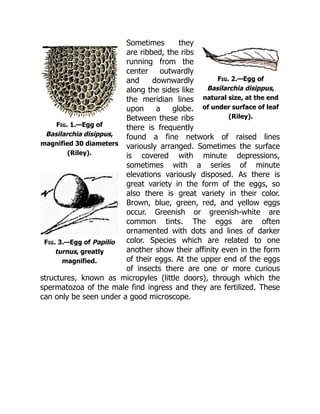
Fig. 1.—Egg of
Basilarchia disippus,
magnified 30 diameters
(Riley).
Fig. 2.—Egg of
Basilarchia disippus,
natural size, at the end
of under surface of leaf
(Riley).
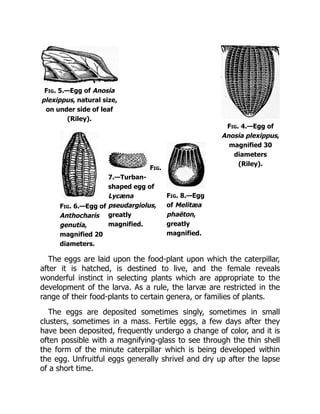
Fig. 3.—Egg of Papilio
turnus, greatly
magnified.
Sometimes they
are ribbed, the ribs
running from the
center outwardly
and downwardly
along the sides like
the meridian lines
upon a globe.
Between these ribs
there is frequently
found a fine network of raised lines
variously arranged. Sometimes the surface
is covered with minute depressions,
sometimes with a series of minute
elevations variously disposed. As there is
great variety in the form of the eggs, so
also there is great variety in their color.
Brown, blue, green, red, and yellow eggs
occur. Greenish or greenish-white are
common tints. The eggs are often
ornamented with dots and lines of darker
color. Species which are related to one
another show their affinity even in the form
of their eggs. At the upper end of the eggs
of insects there are one or more curious
structures, known as micropyles (little doors), through which the
spermatozoa of the male find ingress and they are fertilized. These
can only be seen under a good microscope.
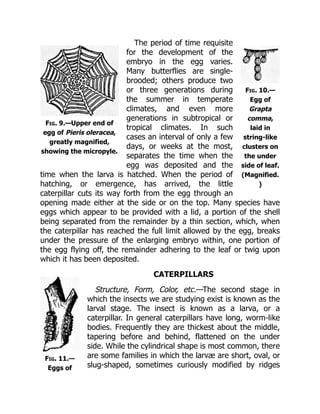
Fig. 4.—Egg of
Anosia plexippus,
magnified 30
diameters
(Riley).
Fig. 5.—Egg of Anosia
plexippus, natural size,
on under side of leaf
(Riley).
Fig. 6.—Egg of
Anthocharis
genutia,
magnified 20
diameters.
Fig.
7.—Turban-
shaped egg of
Lycæna
pseudargiolus,
greatly
magnified.
Fig. 8.—Egg
of Melitæa
phaëton,
greatly
magnified.
The eggs are laid upon the food-plant upon which the caterpillar,
after it is hatched, is destined to live, and the female reveals
wonderful instinct in selecting plants which are appropriate to the
development of the larva. As a rule, the larvæ are restricted in the
range of their food-plants to certain genera, or families of plants.
The eggs are deposited sometimes singly, sometimes in small
clusters, sometimes in a mass. Fertile eggs, a few days after they
have been deposited, frequently undergo a change of color, and it is
often possible with a magnifying-glass to see through the thin shell
the form of the minute caterpillar which is being developed within
the egg. Unfruitful eggs generally shrivel and dry up after the lapse
of a short time.
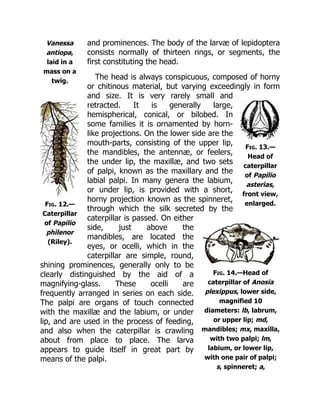
Fig. 9.—Upper end of
egg of Pieris oleracea,
greatly magnified,
showing the micropyle.
Fig. 10.—
Egg of
Grapta
comma,
laid in
string-like
clusters on
the under
side of leaf.
(Magnified.
)
Fig. 11.—
Eggs of
The period of time requisite
for the development of the
embryo in the egg varies.
Many butterflies are single-
brooded; others produce two
or three generations during
the summer in temperate
climates, and even more
generations in subtropical or
tropical climates. In such
cases an interval of only a few
days, or weeks at the most,
separates the time when the
egg was deposited and the
time when the larva is hatched. When the period of
hatching, or emergence, has arrived, the little
caterpillar cuts its way forth from the egg through an
opening made either at the side or on the top. Many species have
eggs which appear to be provided with a lid, a portion of the shell
being separated from the remainder by a thin section, which, when
the caterpillar has reached the full limit allowed by the egg, breaks
under the pressure of the enlarging embryo within, one portion of
the egg flying off, the remainder adhering to the leaf or twig upon
which it has been deposited.
CATERPILLARS
Structure, Form, Color, etc.—The second stage in
which the insects we are studying exist is known as the
larval stage. The insect is known as a larva, or a
caterpillar. In general caterpillars have long, worm-like
bodies. Frequently they are thickest about the middle,
tapering before and behind, flattened on the under
side. While the cylindrical shape is most common, there
are some families in which the larvæ are short, oval, or
slug-shaped, sometimes curiously modified by ridges
Vanessa
antiopa,
laid in a
mass on a
twig.
Fig. 12.—
Caterpillar
of Papilio
philenor
(Riley).
Fig. 13.—
Head of
caterpillar
of Papilio
asterias,
front view,
enlarged.
Fig. 14.—Head of
caterpillar of Anosia
plexippus, lower side,
magnified 10
diameters: lb, labrum,
or upper lip; md,
mandibles; mx, maxilla,
with two palpi; lm,
labium, or lower lip,
with one pair of palpi;
s, spinneret; a,
and prominences. The body of the larvæ of lepidoptera
consists normally of thirteen rings, or segments, the
first constituting the head.
The head is always conspicuous, composed of horny
or chitinous material, but varying exceedingly in form
and size. It is very rarely small and
retracted. It is generally large,
hemispherical, conical, or bilobed. In
some families it is ornamented by horn-
like projections. On the lower side are the
mouth-parts, consisting of the upper lip,
the mandibles, the antennæ, or feelers,
the under lip, the maxillæ, and two sets
of palpi, known as the maxillary and the
labial palpi. In many genera the labium,
or under lip, is provided with a short,
horny projection known as the spinneret,
through which the silk secreted by the
caterpillar is passed. On either
side, just above the
mandibles, are located the
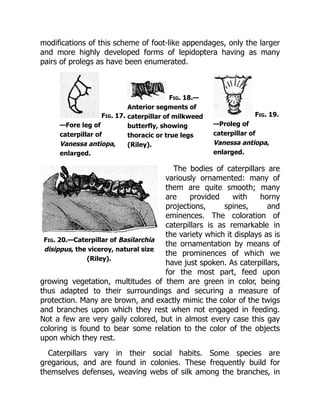
eyes, or ocelli, which in the
caterpillar are simple, round,
shining prominences, generally only to be
clearly distinguished by the aid of a
magnifying-glass. These ocelli are
frequently arranged in series on each side.
The palpi are organs of touch connected
with the maxillæ and the labium, or under
lip, and are used in the process of feeding,
and also when the caterpillar is crawling
about from place to place. The larva
appears to guide itself in great part by
means of the palpi.
antenna; o, ocelli.
(After Burgess.)
Fig. 15.—
Head of
caterpillar
of Anosia
plexippus,
side view,
showing
ocelli.
Plate
II
The body of the caterpillar is covered by a thin skin,
which often lies in wrinkled folds, admitting of great
freedom of motion. The body is composed, as we have
seen, of rings, or segments, the first three of which,
back of the head, correspond to the thorax of the
perfect insect, and the last nine to the abdomen of the
butterfly. On each ring, with the exception of the
second, the third, and the last, there is found on either
side a small oval opening known as a spiracle, through
which the creature breathes. As a rule, the spiracles of
the first and eleventh rings are larger in size than the
others.
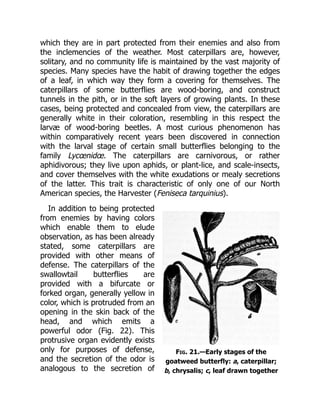
Fig 16.—Caterpillar of
Anosia plexippus,
milkweed butterfly
(Riley).
Every caterpillar has on each of the first three segments a pair of
legs, which are organs composed of three somewhat horny parts
covered and bound together with skin, and armed at their
extremities by a sharp claw (Fig. 17). These three pairs of feet in the
caterpillar are always known as the fore legs, and correspond to the
six which are found in the butterfly or the moth. In addition, in most
cases, we find four pairs of prolegs on the under side of the
segments from the sixth to the ninth, and another pair on the last
segment, which latter pair are called the anal prolegs. These organs,
which are necessary to the life of the caterpillar, do not reappear in
the perfect insect, but are lost when the transformation from the
caterpillar to the chrysalis takes place. There are various
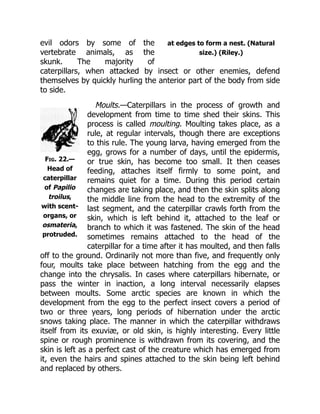
Fig. 20.—Caterpillar of Basilarchia
disippus, the viceroy, natural size
(Riley).
modifications of this scheme of foot-like appendages, only the larger
and more highly developed forms of lepidoptera having as many
pairs of prolegs as have been enumerated.
Fig. 17.
—Fore leg of
caterpillar of
Vanessa antiopa,
enlarged.
Fig. 18.—
Anterior segments of
caterpillar of milkweed
butterfly, showing
thoracic or true legs
(Riley).
Fig. 19.
—Proleg of
caterpillar of
Vanessa antiopa,
enlarged.
The bodies of caterpillars are
variously ornamented: many of
them are quite smooth; many
are provided with horny
projections, spines, and
eminences. The coloration of
caterpillars is as remarkable in
the variety which it displays as is
the ornamentation by means of
the prominences of which we
have just spoken. As caterpillars,
for the most part, feed upon
growing vegetation, multitudes of them are green in color, being
thus adapted to their surroundings and securing a measure of
protection. Many are brown, and exactly mimic the color of the twigs
and branches upon which they rest when not engaged in feeding.
Not a few are very gaily colored, but in almost every case this gay
coloring is found to bear some relation to the color of the objects
upon which they rest.
Caterpillars vary in their social habits. Some species are
gregarious, and are found in colonies. These frequently build for
themselves defenses, weaving webs of silk among the branches, in
Fig. 21.—Early stages of the
goatweed butterfly: a, caterpillar;
b, chrysalis; c, leaf drawn together
which they are in part protected from their enemies and also from
the inclemencies of the weather. Most caterpillars are, however,
solitary, and no community life is maintained by the vast majority of
species. Many species have the habit of drawing together the edges
of a leaf, in which way they form a covering for themselves. The
caterpillars of some butterflies are wood-boring, and construct
tunnels in the pith, or in the soft layers of growing plants. In these
cases, being protected and concealed from view, the caterpillars are
generally white in their coloration, resembling in this respect the
larvæ of wood-boring beetles. A most curious phenomenon has
within comparatively recent years been discovered in connection
with the larval stage of certain small butterflies belonging to the
family Lycœnidœ. The caterpillars are carnivorous, or rather
aphidivorous; they live upon aphids, or plant-lice, and scale-insects,
and cover themselves with the white exudations or mealy secretions
of the latter. This trait is characteristic of only one of our North
American species, the Harvester (Feniseca tarquinius).
In addition to being protected
from enemies by having colors
which enable them to elude
observation, as has been already
stated, some caterpillars are
provided with other means of
defense. The caterpillars of the
swallowtail butterflies are
provided with a bifurcate or
forked organ, generally yellow in
color, which is protruded from an
opening in the skin back of the
head, and which emits a
powerful odor (Fig. 22). This
protrusive organ evidently exists
only for purposes of defense,
and the secretion of the odor is
analogous to the secretion of
at edges to form a nest. (Natural
size.) (Riley.)
Fig. 22.—
Head of
caterpillar
of Papilio
troilus,
with scent-
organs, or
osmateria,
protruded.
evil odors by some of the
vertebrate animals, as the
skunk. The majority of
caterpillars, when attacked by insect or other enemies, defend
themselves by quickly hurling the anterior part of the body from side
to side.
Moults.—Caterpillars in the process of growth and
development from time to time shed their skins. This
process is called moulting. Moulting takes place, as a
rule, at regular intervals, though there are exceptions
to this rule. The young larva, having emerged from the
egg, grows for a number of days, until the epidermis,
or true skin, has become too small. It then ceases
feeding, attaches itself firmly to some point, and
remains quiet for a time. During this period certain
changes are taking place, and then the skin splits along
the middle line from the head to the extremity of the
last segment, and the caterpillar crawls forth from the
skin, which is left behind it, attached to the leaf or
branch to which it was fastened. The skin of the head
sometimes remains attached to the head of the
caterpillar for a time after it has moulted, and then falls
off to the ground. Ordinarily not more than five, and frequently only
four, moults take place between hatching from the egg and the
change into the chrysalis. In cases where caterpillars hibernate, or
pass the winter in inaction, a long interval necessarily elapses
between moults. Some arctic species are known in which the
development from the egg to the perfect insect covers a period of
two or three years, long periods of hibernation under the arctic
snows taking place. The manner in which the caterpillar withdraws
itself from its exuviæ, or old skin, is highly interesting. Every little
spine or rough prominence is withdrawn from its covering, and the
skin is left as a perfect cast of the creature which has emerged from
it, even the hairs and spines attached to the skin being left behind
and replaced by others.
The Food of the Caterpillar.—The vast majority of the caterpillars
of butterflies subsist upon vegetable food, the only exceptions being
the singular one already noted in which the larvæ feed upon scale-
insects. Some of the Hesperiidæ, a group in which the relationship
between butterflies and moths is shown, have larvæ which burrow in
the roots and stems of vegetation.
Duration of the Larval State.—The duration of the larval state
varies greatly. In temperate climates the majority of species exist in
the caterpillar state for from two to three months, and where
hibernation takes place, for ten months. Many caterpillars which
hibernate do so immediately after emerging from the egg and before
having made the first moult. The great majority, however, hibernate
after having passed one or more moults. With the approach of
spring they renew their feeding upon the first reappearance of the
foliage of their proper food-plant, or are transformed into chrysalids
and presently emerge as perfect insects. A few species live
gregariously during the period of hibernation, constructing for
themselves a shelter of leaves woven together with strands of silk.
Transformation.—The larval or caterpillar stage having been
completed, and full development having been attained, the
caterpillar is transformed into a pupa, or chrysalis. Of this, the third
stage in the life of the insect, we now shall speak at length.
THE PUPA, OR CHRYSALIS
The caterpillars of many butterflies attach themselves by a button
of silk to the under surface of a branch or stone, or other projecting
surface, and are transformed into chrysalids, which are naked, and
which hang perpendicularly from the surface to which they are
attached. Other caterpillars attach themselves to surfaces by means
of a button of silk which holds the anal extremity of the chrysalis,
and have, in addition, a girdle of silk which passes around the middle
of the chrysalis, holding it in place very much as a papoose is held
on the back of an Indian squaw by a strap passed over her
shoulders.
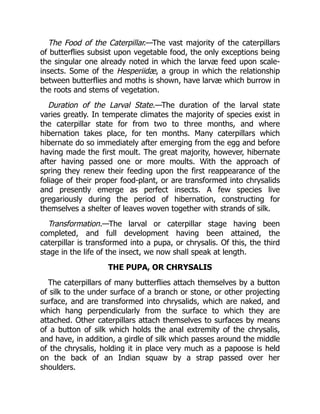
Fig. 23.—Caterpillar of Anosia
plexippus, undergoing change into
chrysalis: a, caterpillar just before
rending of the skin; b, chrysalis just
before the cremaster, or hook, at
its end is withdrawn; c, chrysalis
holding itself in place by the folds
of the shed skin caught between
the edges of the abdominal
segments, while with the
cremaster, armed with microscopic
hooks, it searches for the button of
silk from which it is to hang (Riley).
(Compare Fig. 24, showing final
form of the chrysalis.)
The Form of Chrysalids.—The forms assumed by the insect in this
stage of its being vary very greatly, though there is a general
resemblance among the different families and subfamilies, so that it
is easy for one who has studied the matter to tell approximately to
what family the form belongs, even when it is not specifically known.
Chrysalids are in most cases obscure in coloring, though a few are
quite brilliant, and, as in the case of the common milkweed butterfly
(Anosia plexippus), ornamented with golden-hued spots. The
chrysalids of the Nymphalidæ, one of the largest groups of
butterflies, are all suspended. The chrysalids of the Papilionidæ, or
swallowtail butterflies, are held in place by girdles, and generally are
bifurcate or cleft at the upper end (Fig. 25), and are greenish or
wood-brown in color.
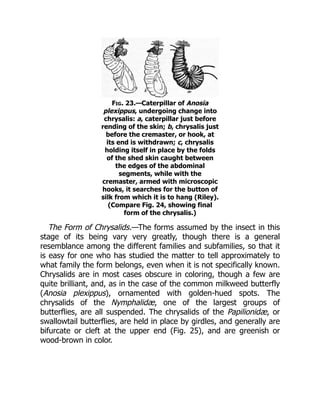
Fig. 24.—
Chrysalis of
Anosia
plexippus,
final form
(Riley).
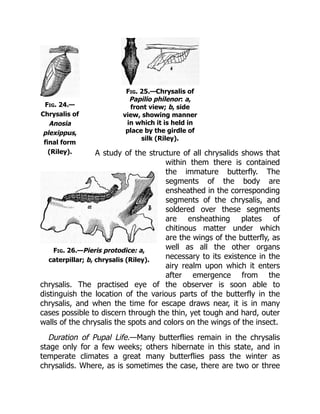
Fig. 26.—Pieris protodice: a,
caterpillar; b, chrysalis (Riley).
Fig. 25.—Chrysalis of
Papilio philenor: a,
front view; b, side
view, showing manner
in which it is held in
place by the girdle of
silk (Riley).
A study of the structure of all chrysalids shows that
within them there is contained
the immature butterfly. The
segments of the body are
ensheathed in the corresponding
segments of the chrysalis, and
soldered over these segments
are ensheathing plates of
chitinous matter under which
are the wings of the butterfly, as
well as all the other organs
necessary to its existence in the
airy realm upon which it enters
after emergence from the
chrysalis. The practised eye of the observer is soon able to
distinguish the location of the various parts of the butterfly in the
chrysalis, and when the time for escape draws near, it is in many
cases possible to discern through the thin, yet tough and hard, outer
walls of the chrysalis the spots and colors on the wings of the insect.
Duration of Pupal Life.—Many butterflies remain in the chrysalis
stage only for a few weeks; others hibernate in this state, and in
temperate climates a great many butterflies pass the winter as
chrysalids. Where, as is sometimes the case, there are two or three
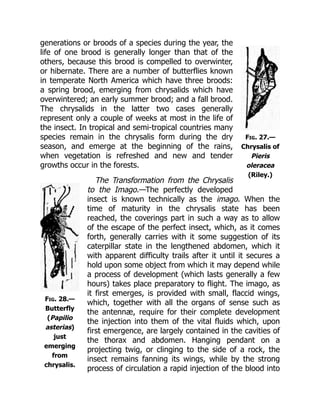
Fig. 27.—
Chrysalis of
Pieris
oleracea
(Riley.)
Fig. 28.—
Butterfly
(Papilio
asterias)
just
emerging
from
chrysalis.
generations or broods of a species during the year, the
life of one brood is generally longer than that of the
others, because this brood is compelled to overwinter,
or hibernate. There are a number of butterflies known
in temperate North America which have three broods:
a spring brood, emerging from chrysalids which have
overwintered; an early summer brood; and a fall brood.
The chrysalids in the latter two cases generally
represent only a couple of weeks at most in the life of
the insect. In tropical and semi-tropical countries many
species remain in the chrysalis form during the dry
season, and emerge at the beginning of the rains,
when vegetation is refreshed and new and tender
growths occur in the forests.
The Transformation from the Chrysalis
to the Imago.—The perfectly developed
insect is known technically as the imago. When the
time of maturity in the chrysalis state has been
reached, the coverings part in such a way as to allow
of the escape of the perfect insect, which, as it comes
forth, generally carries with it some suggestion of its
caterpillar state in the lengthened abdomen, which it
with apparent difficulty trails after it until it secures a
hold upon some object from which it may depend while
a process of development (which lasts generally a few
hours) takes place preparatory to flight. The imago, as
it first emerges, is provided with small, flaccid wings,
which, together with all the organs of sense such as
the antennæ, require for their complete development
the injection into them of the vital fluids which, upon
first emergence, are largely contained in the cavities of
the thorax and abdomen. Hanging pendant on a
projecting twig, or clinging to the side of a rock, the
insect remains fanning its wings, while by the strong
process of circulation a rapid injection of the blood into
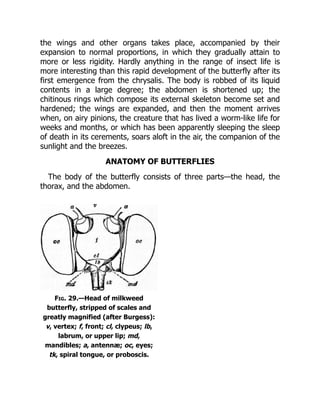
Fig. 29.—Head of milkweed
butterfly, stripped of scales and
greatly magnified (after Burgess):
v, vertex; f, front; cl, clypeus; lb,
labrum, or upper lip; md,
mandibles; a, antennæ; oc, eyes;
tk, spiral tongue, or proboscis.
the wings and other organs takes place, accompanied by their
expansion to normal proportions, in which they gradually attain to
more or less rigidity. Hardly anything in the range of insect life is
more interesting than this rapid development of the butterfly after its
first emergence from the chrysalis. The body is robbed of its liquid
contents in a large degree; the abdomen is shortened up; the
chitinous rings which compose its external skeleton become set and
hardened; the wings are expanded, and then the moment arrives
when, on airy pinions, the creature that has lived a worm-like life for
weeks and months, or which has been apparently sleeping the sleep
of death in its cerements, soars aloft in the air, the companion of the
sunlight and the breezes.
ANATOMY OF BUTTERFLIES
The body of the butterfly consists of three parts—the head, the
thorax, and the abdomen.
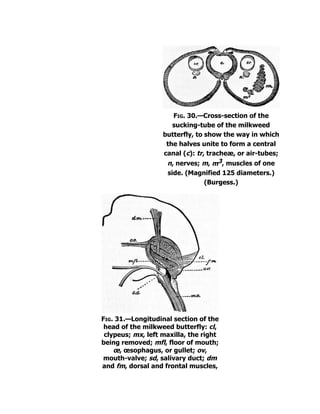
Fig. 30.—Cross-section of the
sucking-tube of the milkweed
butterfly, to show the way in which
the halves unite to form a central
canal (c): tr, tracheæ, or air-tubes;
n, nerves; m, m3, muscles of one
side. (Magnified 125 diameters.)
(Burgess.)
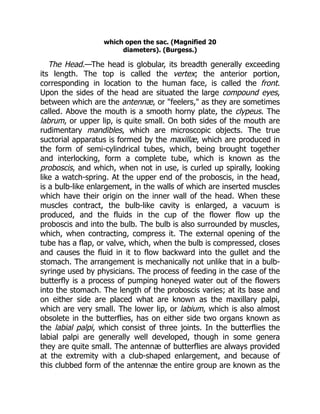
Fig. 31.—Longitudinal section of the
head of the milkweed butterfly: cl,
clypeus; mx, left maxilla, the right
being removed; mfl, floor of mouth;
œ, œsophagus, or gullet; ov,
mouth-valve; sd, salivary duct; dm
and fm, dorsal and frontal muscles,
which open the sac. (Magnified 20
diameters). (Burgess.)
The Head.—The head is globular, its breadth generally exceeding
its length. The top is called the vertex; the anterior portion,
corresponding in location to the human face, is called the front.
Upon the sides of the head are situated the large compound eyes,
between which are the antennæ, or "feelers," as they are sometimes
called. Above the mouth is a smooth horny plate, the clypeus. The
labrum, or upper lip, is quite small. On both sides of the mouth are
rudimentary mandibles, which are microscopic objects. The true
suctorial apparatus is formed by the maxillæ, which are produced in
the form of semi-cylindrical tubes, which, being brought together
and interlocking, form a complete tube, which is known as the
proboscis, and which, when not in use, is curled up spirally, looking
like a watch-spring. At the upper end of the proboscis, in the head,
is a bulb-like enlargement, in the walls of which are inserted muscles
which have their origin on the inner wall of the head. When these
muscles contract, the bulb-like cavity is enlarged, a vacuum is
produced, and the fluids in the cup of the flower flow up the
proboscis and into the bulb. The bulb is also surrounded by muscles,
which, when contracting, compress it. The external opening of the
tube has a flap, or valve, which, when the bulb is compressed, closes
and causes the fluid in it to flow backward into the gullet and the
stomach. The arrangement is mechanically not unlike that in a bulb-
syringe used by physicians. The process of feeding in the case of the
butterfly is a process of pumping honeyed water out of the flowers
into the stomach. The length of the proboscis varies; at its base and
on either side are placed what are known as the maxillary palpi,
which are very small. The lower lip, or labium, which is also almost
obsolete in the butterflies, has on either side two organs known as
the labial palpi, which consist of three joints. In the butterflies the
labial palpi are generally well developed, though in some genera
they are quite small. The antennæ of butterflies are always provided
at the extremity with a club-shaped enlargement, and because of
this clubbed form of the antennæ the entire group are known as the
Fig. 33.—
Labial
Rhopalocera, the word being compounded from the Greek word
(ῥοπαλον), which means a club, and the word κεραζ (keras) which
means a horn.
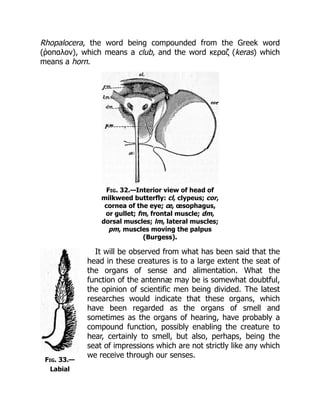
Fig. 32.—Interior view of head of
milkweed butterfly: cl, clypeus; cor,
cornea of the eye; œ, œsophagus,
or gullet; fm, frontal muscle; dm,
dorsal muscles; lm, lateral muscles;
pm, muscles moving the palpus
(Burgess).
It will be observed from what has been said that the
head in these creatures is to a large extent the seat of
the organs of sense and alimentation. What the
function of the antennæ may be is somewhat doubtful,
the opinion of scientific men being divided. The latest
researches would indicate that these organs, which
have been regarded as the organs of smell and
sometimes as the organs of hearing, have probably a
compound function, possibly enabling the creature to
hear, certainly to smell, but also, perhaps, being the
seat of impressions which are not strictly like any which
we receive through our senses.
palpus of
Colias,
magnified
10
diameters.
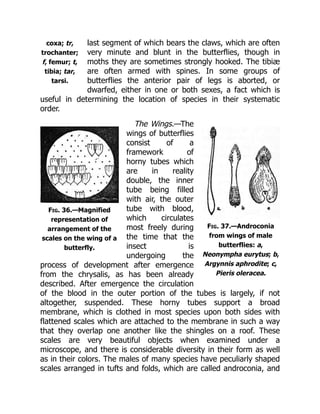
Fig. 34.—Colias
philodice: a, antenna;
p, extremity of palpus;
pl, prothoracic leg; ml,
mesothoracic leg; hl,
metathoracic or hind
leg; t, proboscis.
Fig. 35.—
Leg of
butterfly: c,
Thorax.—The thorax is more
or less oval in form, being
somewhat flattened upon its
upper surface. It is composed
of three parts, or segments,
closely united, which can only
be distinguished from one another by a
careful dissection. The anterior segment is
known as the prothorax, the middle
segment as the mesothorax, and the after
segment as the metathorax. The legs are
attached in pairs to these three subdivisions
of the thorax, the anterior pair being
therefore sometimes spoken of as the
prothoracic legs, the second pair as the
mesothoracic legs, and the latter pair as the metathoracic legs (Fig.
34). On either side of the mesothorax are attached the anterior pair
of wings, over which, at their insertion into the body, are the tegulæ,
or lappets; on either side of the metathorax are the posterior pair of
wings. It will be seen from what has been said that the thorax bears
the organs of locomotion. The under side of the thorax is frequently
spoken of by writers, in describing butterflies, as the pectus, or
breast.
The Abdomen.—The abdomen is formed normally of nine
segments, and in most butterflies is shorter than the hind wings. On
the last segment there are various appendages, which are mainly
sexual in their nature.
The Legs.—Butterflies have six legs, arranged in
three pairs, as we have already seen. Each leg consists
of five parts, the first of which, nearest the body, is
called the coxa, with which articulates a ring-like piece
known as the trochanter. To this is attached the femur,
and united with the femur, forming an angle with it, is
the tibia. To the tibia is attached the tarsus, or foot, the
coxa; tr,
trochanter;
f, femur; t,
tibia; tar,
tarsi.
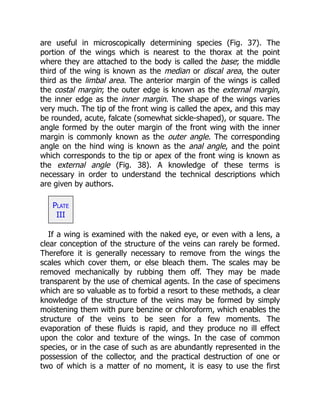
Fig. 36.—Magnified
representation of
arrangement of the
scales on the wing of a
butterfly.
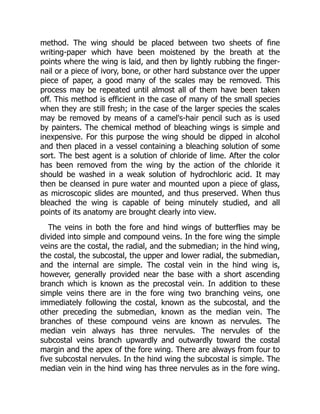
Fig. 37.—Androconia
from wings of male
butterflies: a,
Neonympha eurytus; b,
Argynnis aphrodite; c,
Pieris oleracea.
last segment of which bears the claws, which are often
very minute and blunt in the butterflies, though in
moths they are sometimes strongly hooked. The tibiæ
are often armed with spines. In some groups of
butterflies the anterior pair of legs is aborted, or
dwarfed, either in one or both sexes, a fact which is
useful in determining the location of species in their systematic
order.
The Wings.—The
wings of butterflies
consist of a
framework of
horny tubes which
are in reality
double, the inner
tube being filled
with air, the outer
tube with blood,
which circulates
most freely during
the time that the
insect is
undergoing the
process of development after emergence
from the chrysalis, as has been already
described. After emergence the circulation
of the blood in the outer portion of the tubes is largely, if not
altogether, suspended. These horny tubes support a broad
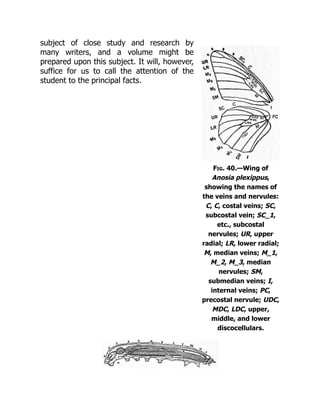
membrane, which is clothed in most species upon both sides with
flattened scales which are attached to the membrane in such a way
that they overlap one another like the shingles on a roof. These
scales are very beautiful objects when examined under a
microscope, and there is considerable diversity in their form as well
as in their colors. The males of many species have peculiarly shaped
scales arranged in tufts and folds, which are called androconia, and
are useful in microscopically determining species (Fig. 37). The
portion of the wings which is nearest to the thorax at the point
where they are attached to the body is called the base; the middle
third of the wing is known as the median or discal area, the outer
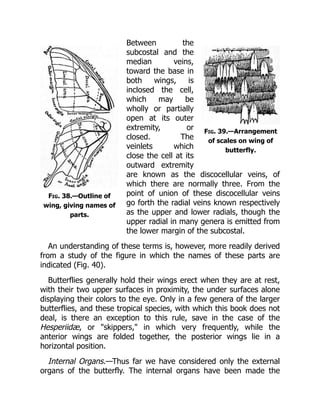
third as the limbal area. The anterior margin of the wings is called
the costal margin; the outer edge is known as the external margin,
the inner edge as the inner margin. The shape of the wings varies
very much. The tip of the front wing is called the apex, and this may
be rounded, acute, falcate (somewhat sickle-shaped), or square. The
angle formed by the outer margin of the front wing with the inner
margin is commonly known as the outer angle. The corresponding
angle on the hind wing is known as the anal angle, and the point
which corresponds to the tip or apex of the front wing is known as
the external angle (Fig. 38). A knowledge of these terms is
necessary in order to understand the technical descriptions which
are given by authors.
Plate
III
If a wing is examined with the naked eye, or even with a lens, a
clear conception of the structure of the veins can rarely be formed.
Therefore it is generally necessary to remove from the wings the
scales which cover them, or else bleach them. The scales may be
removed mechanically by rubbing them off. They may be made
transparent by the use of chemical agents. In the case of specimens
which are so valuable as to forbid a resort to these methods, a clear
knowledge of the structure of the veins may be formed by simply
moistening them with pure benzine or chloroform, which enables the
structure of the veins to be seen for a few moments. The
evaporation of these fluids is rapid, and they produce no ill effect
upon the color and texture of the wings. In the case of common
species, or in the case of such as are abundantly represented in the
possession of the collector, and the practical destruction of one or
two of which is a matter of no moment, it is easy to use the first
method. The wing should be placed between two sheets of fine
writing-paper which have been moistened by the breath at the
points where the wing is laid, and then by lightly rubbing the finger-
nail or a piece of ivory, bone, or other hard substance over the upper
piece of paper, a good many of the scales may be removed. This
process may be repeated until almost all of them have been taken
off. This method is efficient in the case of many of the small species
when they are still fresh; in the case of the larger species the scales
may be removed by means of a camel's-hair pencil such as is used
by painters. The chemical method of bleaching wings is simple and
inexpensive. For this purpose the wing should be dipped in alcohol
and then placed in a vessel containing a bleaching solution of some
sort. The best agent is a solution of chloride of lime. After the color
has been removed from the wing by the action of the chloride it
should be washed in a weak solution of hydrochloric acid. It may
then be cleansed in pure water and mounted upon a piece of glass,
as microscopic slides are mounted, and thus preserved. When thus
bleached the wing is capable of being minutely studied, and all
points of its anatomy are brought clearly into view.
The veins in both the fore and hind wings of butterflies may be
divided into simple and compound veins. In the fore wing the simple
veins are the costal, the radial, and the submedian; in the hind wing,
the costal, the subcostal, the upper and lower radial, the submedian,
and the internal are simple. The costal vein in the hind wing is,
however, generally provided near the base with a short ascending
branch which is known as the precostal vein. In addition to these
simple veins there are in the fore wing two branching veins, one
immediately following the costal, known as the subcostal, and the
other preceding the submedian, known as the median vein. The
branches of these compound veins are known as nervules. The
median vein always has three nervules. The nervules of the
subcostal veins branch upwardly and outwardly toward the costal
margin and the apex of the fore wing. There are always from four to
five subcostal nervules. In the hind wing the subcostal is simple. The
median vein in the hind wing has three nervules as in the fore wing.
Fig. 38.—Outline of
wing, giving names of
parts.
Fig. 39.—Arrangement
of scales on wing of
butterfly.
Between the
subcostal and the
median veins,
toward the base in
both wings, is
inclosed the cell,
which may be
wholly or partially
open at its outer
extremity, or
closed. The
veinlets which
close the cell at its
outward extremity
are known as the discocellular veins, of
which there are normally three. From the
point of union of these discocellular veins
go forth the radial veins known respectively
as the upper and lower radials, though the
upper radial in many genera is emitted from
the lower margin of the subcostal.
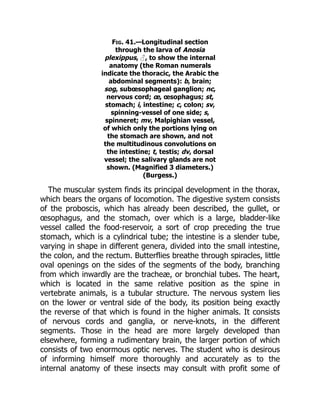
An understanding of these terms is, however, more readily derived
from a study of the figure in which the names of these parts are
indicated (Fig. 40).
Butterflies generally hold their wings erect when they are at rest,
with their two upper surfaces in proximity, the under surfaces alone
displaying their colors to the eye. Only in a few genera of the larger
butterflies, and these tropical species, with which this book does not
deal, is there an exception to this rule, save in the case of the
Hesperiidæ, or "skippers," in which very frequently, while the
anterior wings are folded together, the posterior wings lie in a
horizontal position.
Internal Organs.—Thus far we have considered only the external
organs of the butterfly. The internal organs have been made the
Fig. 40.—Wing of
Anosia plexippus,
showing the names of
the veins and nervules:
C, C, costal veins; SC,
subcostal vein; SC_1,
etc., subcostal
nervules; UR, upper
radial; LR, lower radial;
M, median veins; M_1,
M_2, M_3, median
nervules; SM,
submedian veins; I,
internal veins; PC,
precostal nervule; UDC,
MDC, LDC, upper,
middle, and lower
discocellulars.
subject of close study and research by
many writers, and a volume might be
prepared upon this subject. It will, however,
suffice for us to call the attention of the
student to the principal facts.
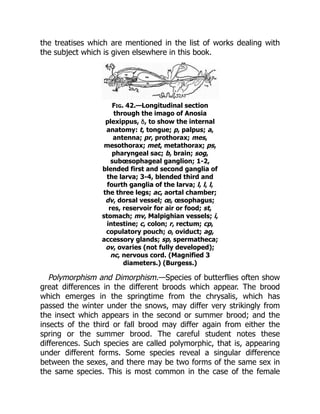
Fig. 41.—Longitudinal section
through the larva of Anosia
plexippus, ♂, to show the internal
anatomy (the Roman numerals
indicate the thoracic, the Arabic the
abdominal segments): b, brain;
sog, subœsophageal ganglion; nc,
nervous cord; œ, œsophagus; st,
stomach; i, intestine; c, colon; sv,
spinning-vessel of one side; s,
spinneret; mv, Malpighian vessel,
of which only the portions lying on
the stomach are shown, and not
the multitudinous convolutions on
the intestine; t, testis; dv, dorsal
vessel; the salivary glands are not
shown. (Magnified 3 diameters.)
(Burgess.)
The muscular system finds its principal development in the thorax,
which bears the organs of locomotion. The digestive system consists
of the proboscis, which has already been described, the gullet, or
œsophagus, and the stomach, over which is a large, bladder-like
vessel called the food-reservoir, a sort of crop preceding the true
stomach, which is a cylindrical tube; the intestine is a slender tube,
varying in shape in different genera, divided into the small intestine,
the colon, and the rectum. Butterflies breathe through spiracles, little
oval openings on the sides of the segments of the body, branching
from which inwardly are the tracheæ, or bronchial tubes. The heart,
which is located in the same relative position as the spine in
vertebrate animals, is a tubular structure. The nervous system lies
on the lower or ventral side of the body, its position being exactly
the reverse of that which is found in the higher animals. It consists
of nervous cords and ganglia, or nerve-knots, in the different
segments. Those in the head are more largely developed than
elsewhere, forming a rudimentary brain, the larger portion of which
consists of two enormous optic nerves. The student who is desirous
of informing himself more thoroughly and accurately as to the
internal anatomy of these insects may consult with profit some of
the treatises which are mentioned in the list of works dealing with
the subject which is given elsewhere in this book.
Fig. 42.—Longitudinal section
through the imago of Anosia
plexippus, ♁, to show the internal
anatomy: t, tongue; p, palpus; a,
antenna; pr, prothorax; mes,
mesothorax; met, metathorax; ps,
pharyngeal sac; b, brain; sog,
subœsophageal ganglion; 1-2,
blended first and second ganglia of
the larva; 3-4, blended third and
fourth ganglia of the larva; l, l, l,
the three legs; ac, aortal chamber;
dv, dorsal vessel; œ, œsophagus;
res, reservoir for air or food; st,
stomach; mv, Malpighian vessels; i,
intestine; c, colon; r, rectum; cp,
copulatory pouch; o, oviduct; ag,
accessory glands; sp, spermatheca;
ov, ovaries (not fully developed);
nc, nervous cord. (Magnified 3
diameters.) (Burgess.)
Polymorphism and Dimorphism.—Species of butterflies often show
great differences in the different broods which appear. The brood
which emerges in the springtime from the chrysalis, which has
passed the winter under the snows, may differ very strikingly from
the insect which appears in the second or summer brood; and the
insects of the third or fall brood may differ again from either the
spring or the summer brood. The careful student notes these
differences. Such species are called polymorphic, that is, appearing
under different forms. Some species reveal a singular difference
between the sexes, and there may be two forms of the same sex in
the same species. This is most common in the case of the female
butterfly, and where there are two forms of the female or the male
such a species is said to have dimorphic females or males. This
phenomenon is revealed in the case of the well-known Turnus
Butterfly; in the colder regions of the continent the females are
yellow banded with black, like the males, but in more southern
portions of the continent black females are quite common, and these
dark females were once thought, before the truth was known, to
constitute a separate species.
Albinism and Melanism.—Albinos, white or light-colored forms, are
quite common among butterflies, principally among the females. On
the other hand, melanism, or a tendency to the production of dark
or even black forms, reveals itself. Melanism is rather more common
in the case of the male sex than in the female sex. The collector and
student will always endeavor, if possible, to preserve these curious
aberrations, as they are called. We do not yet entirely understand
what are the causes which are at work to produce these changes in
the color, and all such aberrant specimens have interest for the
scientific man.
Monstrosities.—Curious malformations, producing monstrosities,
sometimes occur among insects, as in other animals, and such
malformed specimens should likewise be preserved when found. One
form of malformation which is not altogether uncommon consists in
an apparent confusion of sexes in specimens, the wings of a male
insect being attached to the body of a female, or half of an insect
being male and half female.
Mimicry.—One of the most singular and interesting facts in the
animal kingdom is what has been styled mimicry. Certain colors and
forms are possessed by animals which adapt them to their
surroundings in such wise that they are in a greater or less degree
secured from observation and attack. Or they possess forms and
colors which cause them to approximate in appearance other
creatures, which for some reason are feared or disliked by animals
which might prey upon them, and in consequence of this
resemblance enjoy partial or entire immunity. Some butterflies, for
instance, resemble dried leaves, and as they are seated upon the
twigs of trees they wholly elude the eye. This illustrates the first
form of mimicry. Other butterflies so closely approximate in form and
color species which birds and other insects will not attack, because
of the disagreeable juices which their bodies contain, that they are
shunned by their natural enemies, in spite of the fact that they
belong to groups of insects which are ordinarily greedily devoured by
birds and other animals. A good illustration of this fact is found in
the case of the Disippus Butterfly, which belongs to a group which is
not specially protected, but is often the prey of insect-eating
creatures. This butterfly has assumed almost the exact color and
markings of the milkweed butterfly, Anosia plexippus, which is
distasteful to birds, and hence enjoys peculiar freedom from the
attacks of enemies. Because this adaptation of one form to another
evidently serves the purpose of defense this phenomenon has been
called "protective mimicry." The reader who is curious to know more
about the subject will do well to consult the writings of Mr. Alfred
Russel Wallace and Mr. Darwin, who have written at length upon
mimicry among butterflies. There is here a field of most interesting
inquiry for the student.
The Distribution of Butterflies.—Butterflies are found everywhere
that plant life suited to the nourishment of the caterpillars is found.
There are some species which are arctic and are found in the brief
summer of the cold North and upon the lofty summits of high
mountains which have an arctic climate. Most of them are, however,
children of the sun, and chiefly abound in the temperate and tropical
regions of the earth. While the number of species which are found in
the tropics vastly exceeds the number of species found in the
temperate zone, it is apparently true that the number of specimens
of certain species is far more numerous in temperate regions than in
the tropics. Very rarely in tropical countries are great assemblages of
butterflies to be seen, such as may be found in the summer months
in the United States, swarming around damp places, or hovering
over the fields of blooming clover or weeds. In the whole vast region
extending from the Rio Grande of Texas to the arctic circle it is
doubtful whether more than seven hundred species of butterflies are
found. On the continent of Europe there are only about four hundred
and fifty species. The number of species of butterflies and the
number of species of birds in the United States are very nearly the
same.
CHAPTER II
THE CAPTURE, PREPARATION, AND
PRESERVATION OF SPECIMENS
Welcome to our website – the perfect destination for book lovers and
knowledge seekers. We believe that every book holds a new world,
offering opportunities for learning, discovery, and personal growth.
That’s why we are dedicated to bringing you a diverse collection of
books, ranging from classic literature and specialized publications to
self-development guides and children's books.
More than just a book-buying platform, we strive to be a bridge
connecting you with timeless cultural and intellectual values. With an
elegant, user-friendly interface and a smart search system, you can
quickly find the books that best suit your interests. Additionally,
our special promotions and home delivery services help you save time
and fully enjoy the joy of reading.
Join us on a journey of knowledge exploration, passion nurturing, and
personal growth every day!
testbankfan.com


Management 10th Edition Robbins Solutions Manual

  • 1.
    Visit https://testbankfan.com todownload the full version and browse more test banks or solution manuals Management 10th Edition Robbins Solutions Manual _____ Press the link below to begin your download _____ https://testbankfan.com/product/management-10th-edition- robbins-solutions-manual/ Access testbankfan.com now to download high-quality test banks or solution manuals
  • 2.
    We believe theseproducts will be a great fit for you. Click the link to download now, or visit testbankfan.com to discover even more! Fundamentals of Management 10th Edition Robbins Solutions Manual https://testbankfan.com/product/fundamentals-of-management-10th- edition-robbins-solutions-manual/ Fundamentals of Management 10th Edition Robbins Test Bank https://testbankfan.com/product/fundamentals-of-management-10th- edition-robbins-test-bank/ Management 12th Edition Robbins Solutions Manual https://testbankfan.com/product/management-12th-edition-robbins- solutions-manual/ Organic Chemistry Principles and Mechanisms 2nd Edition Karty Solutions Manual https://testbankfan.com/product/organic-chemistry-principles-and- mechanisms-2nd-edition-karty-solutions-manual/
  • 3.
    Ethics and Issuesin Contemporary Nursing 2nd Edition Burkhardt Test Bank https://testbankfan.com/product/ethics-and-issues-in-contemporary- nursing-2nd-edition-burkhardt-test-bank/ Supply Chain Management A Logistics Perspective 9th Edition Coyle Test Bank https://testbankfan.com/product/supply-chain-management-a-logistics- perspective-9th-edition-coyle-test-bank/ ETHICS 1st Edition Camp Test Bank https://testbankfan.com/product/ethics-1st-edition-camp-test-bank/ Organizational Behavior Improving Performance and Commitment in the Workplace 5th Edition Colquitt Solutions Manual https://testbankfan.com/product/organizational-behavior-improving- performance-and-commitment-in-the-workplace-5th-edition-colquitt- solutions-manual/ Strategic Management Theory and Practice 4th Edition Parnell Test Bank https://testbankfan.com/product/strategic-management-theory-and- practice-4th-edition-parnell-test-bank/
  • 4.
    Effective Human RelationsInterpersonal and Organizational Applications 12th Edition Reece Test Bank https://testbankfan.com/product/effective-human-relations- interpersonal-and-organizational-applications-12th-edition-reece-test- bank/
  • 5.
    7-1 Copyright © 2012Pearson Canada Inc., Toronto, Ontario. Chapter 7 Foundations of Planning In this chapter, we begin our study of the first of the management functions: planning. Planning is important because it establishes what an organization is doing. We’ll look at how managers set goals as well as how they establish plans. After reading and studying this chapter you will achieve the following learning outcomes. LEARNING OUTCOMES 8.1 Define the nature and purpose of planning. 8.2 Understand how managers set goals and develop plans. 8.3 Discuss contemporary issues in planning CHAPTER VIGNETTE Your students may be familiar with the adage, “If you fail to plan, you plan to fail.” Chapter 8 examines skills needed for effectiveness in the first of the four management functions—planning. After learning about the purposes of planning, students will discover how managers at different levels of an organization develop plans and empower employees to participate in the planning process. The chapter vignette tells the story of the Blue Man Group, one well known to many students and how they needed to employ planning techniques to help them deal with the transition from a small performance troupe to a much larger business concept and brand. The first vignette asks the students to think about how planning can help deal with the temporary loss of a group member due to illness, the third focuses on issues relating to growth while the third vignette focuses on the failed attempt to open Toronto. CHAPTER OUTLINE INTRODUCTION Planning is one of the four functions of management. Fundamental information about managerial planning is presented in this chapter; the text discusses the nature and purposes of planning, strategies for effective planning, and contemporary planning issues. 1. WHAT IS PLANNING? Planning involves defining the organization’s goals, establishing an overall strategy for achieving these goals, and developing a comprehensive set of plans to integrate and coordinate organizational work. The term planning as used in this chapter refers to formal planning. A. Purposes of Planning. Planning is important and serves many significant purposes. 1. Planning gives direction to the organization.
  • 6.
    7-2 Copyright © 2012Pearson Canada Inc., Toronto, Ontario. 2. Planning reduces uncertainty. 3. Planning reduces overlapping and wasteful activities. 4. Planning establishes the goals or standards that are used in controlling. B. Planning and Performance. Research has shown we cannot assume organizations with formal planning processes always outperform those organizations that don’t have formal planning processes. 1. Generally speaking, however, formal planning is associated with positive financial results. 3. HOW DO MANAGERS PLAN? Planning is often called the primary management function because it establishes the basis for all other functions. Planning involves two important elements: goals and plans. Goals are desired outcomes for individuals, groups, or entire organizations. Goals are objectives—the two terms are used interchangeably. Plans are documents that outline how goals are going to be met and that typically describe resource allocations, schedules, and other necessary actions to accomplish the goals. A. Approaches to Establishing Goals. Goals can be established through a process of traditional goal setting or through management by objectives: 1. Traditional goal setting is defined as the process whereby goals are set at the top of the organization and then broken down into sub goals for each level in an organization. a. Top managers are assumed to know what’s best because they see the “big picture.” b. These goals are also often largely nonoperational. c. Specificity is achieved as each manager applies his or her own set of interpretations and biases. d. However, what often results is that objectives lose clarity and unity as they move from top to bottom. (See Exhibit 7-1) e. When the hierarchy of objectives is clearly defined, it forms an integrated means-end chain in which higher- level objectives are linked to lower-level objectives. These lower-level objectives serve as the means for the accomplishment of the higher- level objectives. And the goals at the lower levels (means) must be achieved in order to reach the goals at the next level (ends). 2. Management by objectives (MBO) is defined as a system in which specific performance goals are jointly determined by employees and their managers, progress toward accomplishing these goals is periodically reviewed, and rewards are allocated on the basis of this progress. a. MBO consists of four elements: 1. Goal specificity 2. Participative decision-making
  • 7.
    7-3 Copyright © 2012Pearson Canada Inc., Toronto, Ontario. 3. Explicit time period 4. Performance feedback b. MBO makes objectives operational through the process by which they cascade down through the organization. c. Exhibit 7-2 lists the steps in a typical MBO program. d. Does MBO work? Studies of actual MBO programs confirm that MBO can increase employee performance and organizational productivity. However, top- management commitment and involvement are important contributions to the success of an MBO program. 3. Characteristics of Well-Designed Goals (See Exhibit 7-3). a. Written in terms of outcomes b. Measurable and quantifiable c. Clear as to a time frame d. Challenging, but attainable e. Written down f. Communicated to all organizational members 4. Steps in Goals Setting—Five Steps. a. Review the organization’s mission or the purpose of an organization. Goals should reflect what the mission statement says. b. Evaluate available resources. c. Determine individually, or with input from others, the goals. d. Write down the goals and communicate them to all who need to know. e. Review results and whether goals are being met. B. Developing Plans. The process of developing plans is influenced by three contingency factors and by the planning approach followed. 1. Types of Plans. The most popular ways to describe organizational plans are pictured in Exhibit 7-4. The characteristics include: a. Breadth (strategic vs. operational) (1) Strategic plans apply to the entire organization, establish the organization’s overall goals, and seek to position the organization in terms of its environment. (2) Operational plans are short term, specific, and standing. They specify the details of how the overall goals are to be achieved. b. Time frame (short term vs. long term) We define long-term plans as those with a time frame beyond three years. We define short-term
  • 8.
    7-4 Copyright © 2012Pearson Canada Inc., Toronto, Ontario. plans as those with a time frame of one year or less. c. Specificity (directional vs. specific) (1) Specific plans are plans that are clearly defined and that leave no room for interpretation. They have clearly defined objectives. There’s no ambiguity and no problem with misunderstanding. (2) Directional plans are flexible plans that set out general guidelines. They provide focus but don’t lock managers into specific goals or courses of action. (Exhibit 7–5 illustrates how specific and directional planning differ, with the directional plan indicating only the intent to get from “A” to “B” and the specific plan identifying the exact route that one would take to go from “A” to “B”.) d. Frequency of use (single use vs. standing) (1) A single-use plan is a one-time plan specifically designed to meet the needs of a unique situation. (2) Standing plans are ongoing plans that provide guidance for activities performed repeatedly. Standing plans include policies, rules, and procedures. 2. Contingency Factors in Planning. a. Manager’s level in the organization. (See Exhibit 7- 6.) Operational planning usually dominates the planning activities of lower-level managers. As managers move up through the levels of the organization, their planning becomes more strategy oriented. b. Degree of environmental uncertainty. The greater the environmental uncertainty, the more plans should be directional and emphasis placed on the short term. 1) When uncertainty is high, plans should be specific, but flexible. 2) Managers must be prepared to rework and amend plans, or even to abandon their plans. c. Time frame of plans. 1) Commitment concept means that plans should extend far enough to meet those commitments made when the plans were developed. 2) Planning for too long or for too short a time period is inefficient and ineffective. 3. Approaches to Planning.
  • 9.
    7-5 Copyright © 2012Pearson Canada Inc., Toronto, Ontario. a. Traditional Approach—planning was done entirely by top-level managers who were often assisted by a formal planning department. b. Organizational Member Involvement—plans aren’t handed down from one level to the next, but are developed at the various levels to meet specific needs. 4. CURRENT ISSUES IN PLANNING. This section looks at criticisms of planning and how managers can plan effectively in dynamic environments. A. Criticisms of Planning. Although planning is an important and popular managerial function, five major arguments have been directed against planning. 1. Planning may create rigidity. Formal planning may “lock” an organization into specific goals and specific timetables that were established under certain environmental conditions. If the environment changes, managers may believe they’re locked into the current plans. 2. Plans cannot be developed for a dynamic environment. Managing under chaotic environmental conditions requires flexibility, and that may mean not being tied to formal plans. 3. Formal plans cannot replace intuition and creativity. The formal planning process may emphasize the mechanics and routines of planning and ignore important aspects. 4. Planning focuses managers’ attention on today’s competition not on tomorrow’s survival. Formal planning has a tendency to make managers focus on today’s realities, not on tomorrow’s possibilities. 5. Formal planning reinforces success, which may lead to failure. Because the "plans" have led to success, there may be reluctance on the part of managers to change or discard previously successful plans. "If it ain’t broke, why fix it?" B. Effective Planning in Dynamic Environments. The external environment is constantly changing. 1. Managers want to develop plans that are specific, but flexible. 2. Managers must recognize that planning is an ongoing process, and they should be willing to change directions if environmental conditions warrant. 3. Flexibility is particularly important. 4. Managers must stay alert to environmental changes that could impact the effective implementation of plans and make changes as needed.
  • 10.
    7-6 Copyright © 2012Pearson Canada Inc., Toronto, Ontario. ANSWERS TO READING FOR COMPREHENSION QUESTIONS 1. What are the benefits of planning? Planning provides direction to managers and non-managers alike. Planning reduces uncertainty by forcing managers to look ahead, anticipate change, consider the impact of change, and develop appropriate responses. Planning reduces overlapping and wasteful activities. Planning establishes the goals or standards that are used in controlling. 2. Contrast formal with informal planning. In informal planning, very little, if anything, is written down. In formal planning, there are written plans at various levels, people are assigned responsibilities, there is a great deal of detail, etc. Formal planning involves specific goals to be achieved within specific timetables. 3. Compare an organization's mission with its objectives. Every organization has a mission that defines its purpose and answers the question, “What business or businesses are we in?” In essence the mission is a directional plan. The mission applies to the entire organization, establishes the organization's overall objectives, and seeks to position the organization in terms of its environment. Objectives are tactical or specific "plans" that are quantified for achieving specific goals. They can apply to individuals, work units, or the organization. The mission cannot be accomplished without the accomplishment of objectives. Objectives need a mission in order to be clear and coordinated. 4. Describe the differences between a) strategic and operational plans, b) short and long-term plans, and c) specific and directional plans. a) Strategic plans tend to cover a longer time frame and a broader view of the organization and also include the formulation of goals, whereas operational plans define ways to achieve the goals and tend to cover shorter time periods. b) Short-term plans are generally within a time frame of a year or less while long terms plans are those with a time frame beyond three years. c) Specific plans are plans that are clearly defined and do not leave room for interpretation, whereas directional plans are more flexible, and although they provide focus, they do not lock managers into specific goals or courses of action. 5. Under what circumstances are short-term plans preferred? Under what circumstances are specific plans preferred? Short-term covers less than one year. Plans should extend far enough to see through those commitments that are made today. The greater the uncertainty, the more plans should be of the short-term variety. Shorter- term plans allow for better accommodation of changes by providing more flexibility.
  • 11.
    7-7 Copyright © 2012Pearson Canada Inc., Toronto, Ontario. Specific plans have clearly defined objectives and leave no room for misinterpretation. They should be used when conditions are relatively certain and management can operate on some unchanging assumptions. 6. How can managers plan effectively in dynamic environments? In a dynamic environment, managers need to develop plans that are specific, yet flexible. Managers should recognize that planning is an ongoing process and they should be willing to change direction if the environment changes. As well, flattening the organizational hierarchy to push responsibility to the lower levels of the organization can facilitate planning. ANSWERS TO LINKING CONCEPTS TO PRACTICE QUESTIONS 1. If planning is so crucial, why do some managers choose not to do it? What would you advise these managers? Managers may choose not to do it because they don’t know how or they claim they don’t have the time to do it. Others may say that it’s a waste of time, and that the future is going to happen whether or not they plan. But, all of these reasons do not discount the importance of planning. Every manager should engage in planning. 2. Would a manager ever use informal planning? In informal planning, nothing is written down, and there is little or no sharing of goals with others. Informal planning is general and lacks continuity. Although it’s more common in smaller organizations, where the owner-manager has a vision of where he or she wants the business to go and how to get there, informal planning does exist in some large organizations as well. Informal planning can help set guidelines. It may not be effective for either large projects or for large organizations. 3. Explain how planning involves decisions today that will have an impact later. Decisions that managers make as they plan will influence how activities are organized, how employees are managed, and what controlling is performed. So even as managers look to the future by planning, the decisions they’re making as they plan will have an effect on the other managerial activities. 4. How might planning in a not-for-profit organization such as the Canadian Cancer Society differ from planning in a for-profit organization such as Molson? The process of planning itself won’t differ, but the content of the plans will differ. The types of objectives that are established and the plans that are formulated will be different because a not-for-profit organization isn’t focused on profit objectives like the for-profit organization.
  • 12.
    7-8 Copyright © 2012Pearson Canada Inc., Toronto, Ontario. 5. What types of planning do you do in your personal life? Describe these plans in terms of being (a) strategic or operational, (b) short- or long-term, and (c) specific or directional. Students’ responses to this will, of course, vary. Most will probably mention planning for completing their education and may even mention career planning. Encourage them to think in terms of their everyday lives about the types of daily, weekly, monthly, or yearly planning they do. 6. “Organizations that fail to plan are planning to fail.” Do you agree or disagree with this statement? Explain your position. While managers (and anyone else) can advance reasons for why they shouldn’t plan (because it’s inflexible, or doesn’t allow creativity and intuition, for instance), planning helps one to prepare to meet the challenges that may arise. Without a plan it becomes difficult to evaluate how many employees are needed, how much inventory is needed, etc. 7. Will planning become more or less important to managers in the future? Why? Planning will probably become more important to managers in the future because of the uncertainty present in the environment. There are so many changes taking place in both the general and specific environments of organizations, and many of these changes are taking place rapidly. Planning helps managers cope with the uncertainties by forcing managers to look ahead, anticipate change, consider the impact of the change, and develop appropriate responses. WORKING TOGETHER : TEAM BASED EXERCISE Helping Design a Training Program This exercise asks students to develop goals for each of three stages of a project to develop an Internet researching training program. The three stages of the projects are: (1) researching corporate customer needs, (2) researching the Internet for specific information sources and techniques that could be used in the training module, and (3) designing and writing specific training modules. This exercise is useful to provide students with experience in writing goals and also to illustrate the characteristics of well-designed goals.
  • 13.
    7-9 Copyright © 2012Pearson Canada Inc., Toronto, Ontario. Teaching Suggestions: 1. Break students into groups of three or four and have each group develop 3 goals for each stage. 2. Once all the groups have had an opportunity to develop their goals have each group record their goals on a flipchart or on the board. 3. Referring to the characteristics of well-designed goals, ask the group to indicate whether it meets the criteria of a well-designed goal. For those goals that do not meet the criteria, have students offer suggestions as to how the goal could be changed/reworded in order to make it more valuable ETHICS IN ACTION Ethical Dilemma Exercise: What Should Managers Do When Pressured to Deliver Results? Imagine that you are a district manager with Coca-Cola and you are being promoted to a new position at the end of the month. Your area’s sales are an important component of the corporation’s provincial and national sales goals. However, this month’s sales are running below the planned level. Should you ask area supermarkets to double their current monthly order and promise that any unsold Coca-Cola products can be returned the following month? Teaching Suggestions: This exercise asks students to think about the challenges that managers often face in terms of trying to achieve organization’s goals or pursue a strategic plan. If this exercise is used to generate classroom discussion you may want to have students discuss their views on how best to balance an individual’s goals with an organization’s goals. There may be opposing views as to whether this would constitute unethical behaviour. You may ask students their views on what actions could be taken that would help address the situation and still be considered within ethical boundaries. CASE APPLICATION Lend Lease Corporation Managing Director Greg Clarke is trying to decide whether to put together a PCG (project-control-group) for a development project his company is pursuing in London. Would this level of planning help the project? What kind of team should he consider putting together for the PCG and why? What might be the downsides of using a PCG? Answer: (Suggestion only, and should be developed by the instructor.) A project-control-group (PCG) could be set up to engage in team planning to outline the project. The team should be a mix of people with different interests: developers, some members of the community, and possibly a few retailers who might open stores in the complex. This group can set accountability standards through using agendas, minutes, financial reviews, and other reports. The downside of this approach is that the team may take on too much ownership and insist on outcomes that may not be in the best interest of Lend
  • 14.
    7-10 Copyright © 2012Pearson Canada Inc., Toronto, Ontario. Lease. Therefore, Clarke needs to emphasize that the role of the group is advisory, and that they do not have decision-making autonomy. Additional Discussion Questions: 1. What role do you think goals play in planning done at Lend Lease? Explain. Goals play a substantial role in Lend Lease’s planning. The goal of doing something that has never been done before is Lend Lease’s guiding philosophy, and it creates the standard that the business follows when determining new projects and ventures. 2. How does Lend Lease illustrate effective planning in a dynamic environment? Planning involves defining the organization’s goals, establishing an overall strategy for achieving those goals, and developing a comprehensive set of plans to integrate and coordinate organizational work. Lend Lease clearly defined its goal—to do things that have never been done before—and began working to build the Bluewater shopping complex in Kent, England. 3. What approach to developing plans does Lend Lease appear to follow? Explain. Lend Lease appears to follow formal planning. Specific goals with deadlines were set, and the end result was the completion of the Bluewater project early, under budget, and fully leased. 4. Would Lend Lease’s approach work in other organizations? Why or why not? This approach would work in many organizations that have the flexibility and culture to allow for creativity and “thinking outside the box,” such as Lend Lease. The goals of the organization would have to reflect the desire to achieve something original or improve on the existing product and/or service. 4. Lend Lease has a strong commitment to environmentally sustainable development. (Check out its Web site for information on its core values.) How might these core values affect planning efforts? From the Web site: Commitment to Environmental Sustainable Development. Lend Lease is committed to fostering environmental sustainability in our activities and developments. The company prides itself on it willingness to shoulder the responsibility of making a difference. Our objective is to ensure a balance between economics, environment and social goods to provide greater benefits to all. Our process is predicated on total stakeholder involvement. This ensures that we capture innovation, manage costs, and deliver ongoing benefits for all. It is clear that Lend Lease’s focus on planning is driven by their environmental concerns.
  • 15.
    7-11 Copyright © 2012Pearson Canada Inc., Toronto, Ontario. DEVELOPING YOUR DIAGNOSTIC AND ANALYTICAL SKILLS Ready or Not… Questions: 1. What role do you think goals might play in a company’s planning for any potential avian flu outbreak? List some goals that you think might be important? Many companies have plans in place to respond to unforeseen events like natural disasters to ensure that the company is able to continue to operate to the best of its ability in terms of meeting the needs of customers and employees. The goals of maintaining the viability of a company and making provisions for a safe and healthy workplace require both short-range and long-range planning. As Deutsche Bank has realized, additional goals might include ensuring that employees in infected zones do not carry the disease to their co-workers, communicating medical news updates to company employees in all of the company’s locations, and preparing for economic slowdowns. 2. What types of plans might companies need for this situation (for instance, short term, long term, or both)? Explain why you think these plans would be important? Short-term plans would be critical to allow companies to be able to function and respond to the situation immediately. Long-term plans would also come into play to address the future impact that might be felt in the organization if significant losses or damages were experienced. You may want to direct your students to the article “If You Fail to Plan, You Plan to Fail,” by Representative Nita Lowey (D-N.Y.). This article strikingly communicates the urgency of the need for organizational planning under the threat of avian influenza and is an example of the type of information every manager should know. The article can be found in the July 14, 2006, issue of The Hill at http://www.hillnews.com/thehill/export/TheHill/News/Frontpage/111505/lo wy.html]. 3. How does this scenario reflect planning in a dynamic environment? What would managers need to do to make their planning effective in such an environment? This scenario is a prime example of how the external environment surrounding an organization can constantly be changing and how important it is for an organization to be able to respond to changes and events in a timely manner. Planning can facilitate this process and allow an organization to not only respond to changes but also to capitalize on opportunities that might arise. In a dynamic environment, managers need to develop plans that are specific yet flexible. Managers should be alert to environmental
  • 16.
    7-12 Copyright © 2012Pearson Canada Inc., Toronto, Ontario. changes that may impact implementation of plans and make changes as needed. As well, allowing lower levels of the organization to have more responsibility in terms of establishing goals and plans will improve the overall effectiveness of planning and may also lead to innovation. HBSC has already made arrangements for its employees to work from their homes in case of a pandemic and is planning to divide work among the company’s different locations. In order to have timely contingency plans, managers must keep abreast of medical developments and adjust their plans accordingly. They will need to remain alert to changes in the environment and establish mechanisms to examine their plans regularly. 4. What could other companies learn from Deutsche Bank’s and HSBC’s experiences? These two organizations have illustrated the fact that proactive planning is possible and very much a necessity in today’s uncertain environment considering the far-reaching effects that something like a pandemic could have on an organization. Both organizations have used creative thinking and innovation in making plans and have carefully considered the welfare of their employees in the planning process. 5. Pick a company (any size, any kind, or any location) and describe how an influenza pandemic might affect it. Now, develop plans for this company to deal with such an outbreak. You may want to divide your class into several teams and use this activity as a group exercise. Encourage your students to think creatively in developing their company’s plans to combat the effects of an influenza outbreak. Remind students that they will want to make both short-term and long-term plans in this situation. Student answers may vary, however, most will identify the impact that a pandemic would have on the workforce and their ability to deliver products and services to customers. DEVELOPING YOUR INTERPERSONAL SKILLS Setting Goals You are a store manager of a large supermarket and want to establish an MBO- type program in your store. How would you go about setting goals in your new position? Include examples of goals for the jobs of butcher, cashier, and bakery manager? Teaching Suggestions: This exercise provides an opportunity to review the concept of MBO and the advantages associated with using this type of goal setting. The elements associated with such a program should also be reviewed; goal specificity, participative decision-making, specific time periods, and performance feedback. As well, the steps associated with establishing an MBO program should be
  • 17.
    7-13 Copyright © 2012Pearson Canada Inc., Toronto, Ontario. mentioned as students discuss how they would go about establishing goals for the various positions and the supermarket as a whole. ADDITIONAL CHAPTER INFORMATION With a turbulent economy and high levels of uncertainty, planning and strategic planning, in particular, present difficult challenges for managers. The article “There Is No Alternative to…” provides an interesting contemporary approach to planning in an uncertain economy. Scenario planning was pioneered by Royal Dutch/Shell to anticipate global changes. The article looks beyond scenario planning in which “everything” is in a state of flux. The article can be found in FastCompany, Issue 60, July 2002, Page 106 (By Ian Wylie). A link to this source is [http://www.fastcompany.com/magazine/60/tina.html].
  • 18.
    Another Random ScribdDocument with Unrelated Content
  • 19.
    Fig. 1.—Egg of Basilarchiadisippus, magnified 30 diameters (Riley). Fig. 2.—Egg of Basilarchia disippus, natural size, at the end of under surface of leaf (Riley). Fig. 3.—Egg of Papilio turnus, greatly magnified. Sometimes they are ribbed, the ribs running from the center outwardly and downwardly along the sides like the meridian lines upon a globe. Between these ribs there is frequently found a fine network of raised lines variously arranged. Sometimes the surface is covered with minute depressions, sometimes with a series of minute elevations variously disposed. As there is great variety in the form of the eggs, so also there is great variety in their color. Brown, blue, green, red, and yellow eggs occur. Greenish or greenish-white are common tints. The eggs are often ornamented with dots and lines of darker color. Species which are related to one another show their affinity even in the form of their eggs. At the upper end of the eggs of insects there are one or more curious structures, known as micropyles (little doors), through which the spermatozoa of the male find ingress and they are fertilized. These can only be seen under a good microscope.
  • 20.
    Fig. 4.—Egg of Anosiaplexippus, magnified 30 diameters (Riley). Fig. 5.—Egg of Anosia plexippus, natural size, on under side of leaf (Riley). Fig. 6.—Egg of Anthocharis genutia, magnified 20 diameters. Fig. 7.—Turban- shaped egg of Lycæna pseudargiolus, greatly magnified. Fig. 8.—Egg of Melitæa phaëton, greatly magnified. The eggs are laid upon the food-plant upon which the caterpillar, after it is hatched, is destined to live, and the female reveals wonderful instinct in selecting plants which are appropriate to the development of the larva. As a rule, the larvæ are restricted in the range of their food-plants to certain genera, or families of plants. The eggs are deposited sometimes singly, sometimes in small clusters, sometimes in a mass. Fertile eggs, a few days after they have been deposited, frequently undergo a change of color, and it is often possible with a magnifying-glass to see through the thin shell the form of the minute caterpillar which is being developed within the egg. Unfruitful eggs generally shrivel and dry up after the lapse of a short time.
  • 21.
    Fig. 9.—Upper endof egg of Pieris oleracea, greatly magnified, showing the micropyle. Fig. 10.— Egg of Grapta comma, laid in string-like clusters on the under side of leaf. (Magnified. ) Fig. 11.— Eggs of The period of time requisite for the development of the embryo in the egg varies. Many butterflies are single- brooded; others produce two or three generations during the summer in temperate climates, and even more generations in subtropical or tropical climates. In such cases an interval of only a few days, or weeks at the most, separates the time when the egg was deposited and the time when the larva is hatched. When the period of hatching, or emergence, has arrived, the little caterpillar cuts its way forth from the egg through an opening made either at the side or on the top. Many species have eggs which appear to be provided with a lid, a portion of the shell being separated from the remainder by a thin section, which, when the caterpillar has reached the full limit allowed by the egg, breaks under the pressure of the enlarging embryo within, one portion of the egg flying off, the remainder adhering to the leaf or twig upon which it has been deposited. CATERPILLARS Structure, Form, Color, etc.—The second stage in which the insects we are studying exist is known as the larval stage. The insect is known as a larva, or a caterpillar. In general caterpillars have long, worm-like bodies. Frequently they are thickest about the middle, tapering before and behind, flattened on the under side. While the cylindrical shape is most common, there are some families in which the larvæ are short, oval, or slug-shaped, sometimes curiously modified by ridges
  • 22.
    Vanessa antiopa, laid in a masson a twig. Fig. 12.— Caterpillar of Papilio philenor (Riley). Fig. 13.— Head of caterpillar of Papilio asterias, front view, enlarged. Fig. 14.—Head of caterpillar of Anosia plexippus, lower side, magnified 10 diameters: lb, labrum, or upper lip; md, mandibles; mx, maxilla, with two palpi; lm, labium, or lower lip, with one pair of palpi; s, spinneret; a, and prominences. The body of the larvæ of lepidoptera consists normally of thirteen rings, or segments, the first constituting the head. The head is always conspicuous, composed of horny or chitinous material, but varying exceedingly in form and size. It is very rarely small and retracted. It is generally large, hemispherical, conical, or bilobed. In some families it is ornamented by horn- like projections. On the lower side are the mouth-parts, consisting of the upper lip, the mandibles, the antennæ, or feelers, the under lip, the maxillæ, and two sets of palpi, known as the maxillary and the labial palpi. In many genera the labium, or under lip, is provided with a short, horny projection known as the spinneret, through which the silk secreted by the caterpillar is passed. On either side, just above the mandibles, are located the eyes, or ocelli, which in the caterpillar are simple, round, shining prominences, generally only to be clearly distinguished by the aid of a magnifying-glass. These ocelli are frequently arranged in series on each side. The palpi are organs of touch connected with the maxillæ and the labium, or under lip, and are used in the process of feeding, and also when the caterpillar is crawling about from place to place. The larva appears to guide itself in great part by means of the palpi.
  • 23.
    antenna; o, ocelli. (AfterBurgess.) Fig. 15.— Head of caterpillar of Anosia plexippus, side view, showing ocelli. Plate II The body of the caterpillar is covered by a thin skin, which often lies in wrinkled folds, admitting of great freedom of motion. The body is composed, as we have seen, of rings, or segments, the first three of which, back of the head, correspond to the thorax of the perfect insect, and the last nine to the abdomen of the butterfly. On each ring, with the exception of the second, the third, and the last, there is found on either side a small oval opening known as a spiracle, through which the creature breathes. As a rule, the spiracles of the first and eleventh rings are larger in size than the others. Fig 16.—Caterpillar of Anosia plexippus, milkweed butterfly (Riley). Every caterpillar has on each of the first three segments a pair of legs, which are organs composed of three somewhat horny parts covered and bound together with skin, and armed at their extremities by a sharp claw (Fig. 17). These three pairs of feet in the caterpillar are always known as the fore legs, and correspond to the six which are found in the butterfly or the moth. In addition, in most cases, we find four pairs of prolegs on the under side of the segments from the sixth to the ninth, and another pair on the last segment, which latter pair are called the anal prolegs. These organs, which are necessary to the life of the caterpillar, do not reappear in the perfect insect, but are lost when the transformation from the caterpillar to the chrysalis takes place. There are various
  • 24.
    Fig. 20.—Caterpillar ofBasilarchia disippus, the viceroy, natural size (Riley). modifications of this scheme of foot-like appendages, only the larger and more highly developed forms of lepidoptera having as many pairs of prolegs as have been enumerated. Fig. 17. —Fore leg of caterpillar of Vanessa antiopa, enlarged. Fig. 18.— Anterior segments of caterpillar of milkweed butterfly, showing thoracic or true legs (Riley). Fig. 19. —Proleg of caterpillar of Vanessa antiopa, enlarged. The bodies of caterpillars are variously ornamented: many of them are quite smooth; many are provided with horny projections, spines, and eminences. The coloration of caterpillars is as remarkable in the variety which it displays as is the ornamentation by means of the prominences of which we have just spoken. As caterpillars, for the most part, feed upon growing vegetation, multitudes of them are green in color, being thus adapted to their surroundings and securing a measure of protection. Many are brown, and exactly mimic the color of the twigs and branches upon which they rest when not engaged in feeding. Not a few are very gaily colored, but in almost every case this gay coloring is found to bear some relation to the color of the objects upon which they rest. Caterpillars vary in their social habits. Some species are gregarious, and are found in colonies. These frequently build for themselves defenses, weaving webs of silk among the branches, in
  • 25.
    Fig. 21.—Early stagesof the goatweed butterfly: a, caterpillar; b, chrysalis; c, leaf drawn together which they are in part protected from their enemies and also from the inclemencies of the weather. Most caterpillars are, however, solitary, and no community life is maintained by the vast majority of species. Many species have the habit of drawing together the edges of a leaf, in which way they form a covering for themselves. The caterpillars of some butterflies are wood-boring, and construct tunnels in the pith, or in the soft layers of growing plants. In these cases, being protected and concealed from view, the caterpillars are generally white in their coloration, resembling in this respect the larvæ of wood-boring beetles. A most curious phenomenon has within comparatively recent years been discovered in connection with the larval stage of certain small butterflies belonging to the family Lycœnidœ. The caterpillars are carnivorous, or rather aphidivorous; they live upon aphids, or plant-lice, and scale-insects, and cover themselves with the white exudations or mealy secretions of the latter. This trait is characteristic of only one of our North American species, the Harvester (Feniseca tarquinius). In addition to being protected from enemies by having colors which enable them to elude observation, as has been already stated, some caterpillars are provided with other means of defense. The caterpillars of the swallowtail butterflies are provided with a bifurcate or forked organ, generally yellow in color, which is protruded from an opening in the skin back of the head, and which emits a powerful odor (Fig. 22). This protrusive organ evidently exists only for purposes of defense, and the secretion of the odor is analogous to the secretion of
  • 26.
    at edges toform a nest. (Natural size.) (Riley.) Fig. 22.— Head of caterpillar of Papilio troilus, with scent- organs, or osmateria, protruded. evil odors by some of the vertebrate animals, as the skunk. The majority of caterpillars, when attacked by insect or other enemies, defend themselves by quickly hurling the anterior part of the body from side to side. Moults.—Caterpillars in the process of growth and development from time to time shed their skins. This process is called moulting. Moulting takes place, as a rule, at regular intervals, though there are exceptions to this rule. The young larva, having emerged from the egg, grows for a number of days, until the epidermis, or true skin, has become too small. It then ceases feeding, attaches itself firmly to some point, and remains quiet for a time. During this period certain changes are taking place, and then the skin splits along the middle line from the head to the extremity of the last segment, and the caterpillar crawls forth from the skin, which is left behind it, attached to the leaf or branch to which it was fastened. The skin of the head sometimes remains attached to the head of the caterpillar for a time after it has moulted, and then falls off to the ground. Ordinarily not more than five, and frequently only four, moults take place between hatching from the egg and the change into the chrysalis. In cases where caterpillars hibernate, or pass the winter in inaction, a long interval necessarily elapses between moults. Some arctic species are known in which the development from the egg to the perfect insect covers a period of two or three years, long periods of hibernation under the arctic snows taking place. The manner in which the caterpillar withdraws itself from its exuviæ, or old skin, is highly interesting. Every little spine or rough prominence is withdrawn from its covering, and the skin is left as a perfect cast of the creature which has emerged from it, even the hairs and spines attached to the skin being left behind and replaced by others.
  • 27.
    The Food ofthe Caterpillar.—The vast majority of the caterpillars of butterflies subsist upon vegetable food, the only exceptions being the singular one already noted in which the larvæ feed upon scale- insects. Some of the Hesperiidæ, a group in which the relationship between butterflies and moths is shown, have larvæ which burrow in the roots and stems of vegetation. Duration of the Larval State.—The duration of the larval state varies greatly. In temperate climates the majority of species exist in the caterpillar state for from two to three months, and where hibernation takes place, for ten months. Many caterpillars which hibernate do so immediately after emerging from the egg and before having made the first moult. The great majority, however, hibernate after having passed one or more moults. With the approach of spring they renew their feeding upon the first reappearance of the foliage of their proper food-plant, or are transformed into chrysalids and presently emerge as perfect insects. A few species live gregariously during the period of hibernation, constructing for themselves a shelter of leaves woven together with strands of silk. Transformation.—The larval or caterpillar stage having been completed, and full development having been attained, the caterpillar is transformed into a pupa, or chrysalis. Of this, the third stage in the life of the insect, we now shall speak at length. THE PUPA, OR CHRYSALIS The caterpillars of many butterflies attach themselves by a button of silk to the under surface of a branch or stone, or other projecting surface, and are transformed into chrysalids, which are naked, and which hang perpendicularly from the surface to which they are attached. Other caterpillars attach themselves to surfaces by means of a button of silk which holds the anal extremity of the chrysalis, and have, in addition, a girdle of silk which passes around the middle of the chrysalis, holding it in place very much as a papoose is held on the back of an Indian squaw by a strap passed over her shoulders.
  • 28.
    Fig. 23.—Caterpillar ofAnosia plexippus, undergoing change into chrysalis: a, caterpillar just before rending of the skin; b, chrysalis just before the cremaster, or hook, at its end is withdrawn; c, chrysalis holding itself in place by the folds of the shed skin caught between the edges of the abdominal segments, while with the cremaster, armed with microscopic hooks, it searches for the button of silk from which it is to hang (Riley). (Compare Fig. 24, showing final form of the chrysalis.) The Form of Chrysalids.—The forms assumed by the insect in this stage of its being vary very greatly, though there is a general resemblance among the different families and subfamilies, so that it is easy for one who has studied the matter to tell approximately to what family the form belongs, even when it is not specifically known. Chrysalids are in most cases obscure in coloring, though a few are quite brilliant, and, as in the case of the common milkweed butterfly (Anosia plexippus), ornamented with golden-hued spots. The chrysalids of the Nymphalidæ, one of the largest groups of butterflies, are all suspended. The chrysalids of the Papilionidæ, or swallowtail butterflies, are held in place by girdles, and generally are bifurcate or cleft at the upper end (Fig. 25), and are greenish or wood-brown in color.
  • 29.
    Fig. 24.— Chrysalis of Anosia plexippus, finalform (Riley). Fig. 26.—Pieris protodice: a, caterpillar; b, chrysalis (Riley). Fig. 25.—Chrysalis of Papilio philenor: a, front view; b, side view, showing manner in which it is held in place by the girdle of silk (Riley). A study of the structure of all chrysalids shows that within them there is contained the immature butterfly. The segments of the body are ensheathed in the corresponding segments of the chrysalis, and soldered over these segments are ensheathing plates of chitinous matter under which are the wings of the butterfly, as well as all the other organs necessary to its existence in the airy realm upon which it enters after emergence from the chrysalis. The practised eye of the observer is soon able to distinguish the location of the various parts of the butterfly in the chrysalis, and when the time for escape draws near, it is in many cases possible to discern through the thin, yet tough and hard, outer walls of the chrysalis the spots and colors on the wings of the insect. Duration of Pupal Life.—Many butterflies remain in the chrysalis stage only for a few weeks; others hibernate in this state, and in temperate climates a great many butterflies pass the winter as chrysalids. Where, as is sometimes the case, there are two or three
  • 30.
    Fig. 27.— Chrysalis of Pieris oleracea (Riley.) Fig.28.— Butterfly (Papilio asterias) just emerging from chrysalis. generations or broods of a species during the year, the life of one brood is generally longer than that of the others, because this brood is compelled to overwinter, or hibernate. There are a number of butterflies known in temperate North America which have three broods: a spring brood, emerging from chrysalids which have overwintered; an early summer brood; and a fall brood. The chrysalids in the latter two cases generally represent only a couple of weeks at most in the life of the insect. In tropical and semi-tropical countries many species remain in the chrysalis form during the dry season, and emerge at the beginning of the rains, when vegetation is refreshed and new and tender growths occur in the forests. The Transformation from the Chrysalis to the Imago.—The perfectly developed insect is known technically as the imago. When the time of maturity in the chrysalis state has been reached, the coverings part in such a way as to allow of the escape of the perfect insect, which, as it comes forth, generally carries with it some suggestion of its caterpillar state in the lengthened abdomen, which it with apparent difficulty trails after it until it secures a hold upon some object from which it may depend while a process of development (which lasts generally a few hours) takes place preparatory to flight. The imago, as it first emerges, is provided with small, flaccid wings, which, together with all the organs of sense such as the antennæ, require for their complete development the injection into them of the vital fluids which, upon first emergence, are largely contained in the cavities of the thorax and abdomen. Hanging pendant on a projecting twig, or clinging to the side of a rock, the insect remains fanning its wings, while by the strong process of circulation a rapid injection of the blood into
  • 31.
    Fig. 29.—Head ofmilkweed butterfly, stripped of scales and greatly magnified (after Burgess): v, vertex; f, front; cl, clypeus; lb, labrum, or upper lip; md, mandibles; a, antennæ; oc, eyes; tk, spiral tongue, or proboscis. the wings and other organs takes place, accompanied by their expansion to normal proportions, in which they gradually attain to more or less rigidity. Hardly anything in the range of insect life is more interesting than this rapid development of the butterfly after its first emergence from the chrysalis. The body is robbed of its liquid contents in a large degree; the abdomen is shortened up; the chitinous rings which compose its external skeleton become set and hardened; the wings are expanded, and then the moment arrives when, on airy pinions, the creature that has lived a worm-like life for weeks and months, or which has been apparently sleeping the sleep of death in its cerements, soars aloft in the air, the companion of the sunlight and the breezes. ANATOMY OF BUTTERFLIES The body of the butterfly consists of three parts—the head, the thorax, and the abdomen.
  • 32.
    Fig. 30.—Cross-section ofthe sucking-tube of the milkweed butterfly, to show the way in which the halves unite to form a central canal (c): tr, tracheæ, or air-tubes; n, nerves; m, m3, muscles of one side. (Magnified 125 diameters.) (Burgess.) Fig. 31.—Longitudinal section of the head of the milkweed butterfly: cl, clypeus; mx, left maxilla, the right being removed; mfl, floor of mouth; œ, œsophagus, or gullet; ov, mouth-valve; sd, salivary duct; dm and fm, dorsal and frontal muscles,
  • 33.
    which open thesac. (Magnified 20 diameters). (Burgess.) The Head.—The head is globular, its breadth generally exceeding its length. The top is called the vertex; the anterior portion, corresponding in location to the human face, is called the front. Upon the sides of the head are situated the large compound eyes, between which are the antennæ, or "feelers," as they are sometimes called. Above the mouth is a smooth horny plate, the clypeus. The labrum, or upper lip, is quite small. On both sides of the mouth are rudimentary mandibles, which are microscopic objects. The true suctorial apparatus is formed by the maxillæ, which are produced in the form of semi-cylindrical tubes, which, being brought together and interlocking, form a complete tube, which is known as the proboscis, and which, when not in use, is curled up spirally, looking like a watch-spring. At the upper end of the proboscis, in the head, is a bulb-like enlargement, in the walls of which are inserted muscles which have their origin on the inner wall of the head. When these muscles contract, the bulb-like cavity is enlarged, a vacuum is produced, and the fluids in the cup of the flower flow up the proboscis and into the bulb. The bulb is also surrounded by muscles, which, when contracting, compress it. The external opening of the tube has a flap, or valve, which, when the bulb is compressed, closes and causes the fluid in it to flow backward into the gullet and the stomach. The arrangement is mechanically not unlike that in a bulb- syringe used by physicians. The process of feeding in the case of the butterfly is a process of pumping honeyed water out of the flowers into the stomach. The length of the proboscis varies; at its base and on either side are placed what are known as the maxillary palpi, which are very small. The lower lip, or labium, which is also almost obsolete in the butterflies, has on either side two organs known as the labial palpi, which consist of three joints. In the butterflies the labial palpi are generally well developed, though in some genera they are quite small. The antennæ of butterflies are always provided at the extremity with a club-shaped enlargement, and because of this clubbed form of the antennæ the entire group are known as the
  • 34.
    Fig. 33.— Labial Rhopalocera, theword being compounded from the Greek word (ῥοπαλον), which means a club, and the word κεραζ (keras) which means a horn. Fig. 32.—Interior view of head of milkweed butterfly: cl, clypeus; cor, cornea of the eye; œ, œsophagus, or gullet; fm, frontal muscle; dm, dorsal muscles; lm, lateral muscles; pm, muscles moving the palpus (Burgess). It will be observed from what has been said that the head in these creatures is to a large extent the seat of the organs of sense and alimentation. What the function of the antennæ may be is somewhat doubtful, the opinion of scientific men being divided. The latest researches would indicate that these organs, which have been regarded as the organs of smell and sometimes as the organs of hearing, have probably a compound function, possibly enabling the creature to hear, certainly to smell, but also, perhaps, being the seat of impressions which are not strictly like any which we receive through our senses.
  • 35.
    palpus of Colias, magnified 10 diameters. Fig. 34.—Colias philodice:a, antenna; p, extremity of palpus; pl, prothoracic leg; ml, mesothoracic leg; hl, metathoracic or hind leg; t, proboscis. Fig. 35.— Leg of butterfly: c, Thorax.—The thorax is more or less oval in form, being somewhat flattened upon its upper surface. It is composed of three parts, or segments, closely united, which can only be distinguished from one another by a careful dissection. The anterior segment is known as the prothorax, the middle segment as the mesothorax, and the after segment as the metathorax. The legs are attached in pairs to these three subdivisions of the thorax, the anterior pair being therefore sometimes spoken of as the prothoracic legs, the second pair as the mesothoracic legs, and the latter pair as the metathoracic legs (Fig. 34). On either side of the mesothorax are attached the anterior pair of wings, over which, at their insertion into the body, are the tegulæ, or lappets; on either side of the metathorax are the posterior pair of wings. It will be seen from what has been said that the thorax bears the organs of locomotion. The under side of the thorax is frequently spoken of by writers, in describing butterflies, as the pectus, or breast. The Abdomen.—The abdomen is formed normally of nine segments, and in most butterflies is shorter than the hind wings. On the last segment there are various appendages, which are mainly sexual in their nature. The Legs.—Butterflies have six legs, arranged in three pairs, as we have already seen. Each leg consists of five parts, the first of which, nearest the body, is called the coxa, with which articulates a ring-like piece known as the trochanter. To this is attached the femur, and united with the femur, forming an angle with it, is the tibia. To the tibia is attached the tarsus, or foot, the
  • 36.
    coxa; tr, trochanter; f, femur;t, tibia; tar, tarsi. Fig. 36.—Magnified representation of arrangement of the scales on the wing of a butterfly. Fig. 37.—Androconia from wings of male butterflies: a, Neonympha eurytus; b, Argynnis aphrodite; c, Pieris oleracea. last segment of which bears the claws, which are often very minute and blunt in the butterflies, though in moths they are sometimes strongly hooked. The tibiæ are often armed with spines. In some groups of butterflies the anterior pair of legs is aborted, or dwarfed, either in one or both sexes, a fact which is useful in determining the location of species in their systematic order. The Wings.—The wings of butterflies consist of a framework of horny tubes which are in reality double, the inner tube being filled with air, the outer tube with blood, which circulates most freely during the time that the insect is undergoing the process of development after emergence from the chrysalis, as has been already described. After emergence the circulation of the blood in the outer portion of the tubes is largely, if not altogether, suspended. These horny tubes support a broad membrane, which is clothed in most species upon both sides with flattened scales which are attached to the membrane in such a way that they overlap one another like the shingles on a roof. These scales are very beautiful objects when examined under a microscope, and there is considerable diversity in their form as well as in their colors. The males of many species have peculiarly shaped scales arranged in tufts and folds, which are called androconia, and
  • 37.
    are useful inmicroscopically determining species (Fig. 37). The portion of the wings which is nearest to the thorax at the point where they are attached to the body is called the base; the middle third of the wing is known as the median or discal area, the outer third as the limbal area. The anterior margin of the wings is called the costal margin; the outer edge is known as the external margin, the inner edge as the inner margin. The shape of the wings varies very much. The tip of the front wing is called the apex, and this may be rounded, acute, falcate (somewhat sickle-shaped), or square. The angle formed by the outer margin of the front wing with the inner margin is commonly known as the outer angle. The corresponding angle on the hind wing is known as the anal angle, and the point which corresponds to the tip or apex of the front wing is known as the external angle (Fig. 38). A knowledge of these terms is necessary in order to understand the technical descriptions which are given by authors. Plate III If a wing is examined with the naked eye, or even with a lens, a clear conception of the structure of the veins can rarely be formed. Therefore it is generally necessary to remove from the wings the scales which cover them, or else bleach them. The scales may be removed mechanically by rubbing them off. They may be made transparent by the use of chemical agents. In the case of specimens which are so valuable as to forbid a resort to these methods, a clear knowledge of the structure of the veins may be formed by simply moistening them with pure benzine or chloroform, which enables the structure of the veins to be seen for a few moments. The evaporation of these fluids is rapid, and they produce no ill effect upon the color and texture of the wings. In the case of common species, or in the case of such as are abundantly represented in the possession of the collector, and the practical destruction of one or two of which is a matter of no moment, it is easy to use the first
  • 38.
    method. The wingshould be placed between two sheets of fine writing-paper which have been moistened by the breath at the points where the wing is laid, and then by lightly rubbing the finger- nail or a piece of ivory, bone, or other hard substance over the upper piece of paper, a good many of the scales may be removed. This process may be repeated until almost all of them have been taken off. This method is efficient in the case of many of the small species when they are still fresh; in the case of the larger species the scales may be removed by means of a camel's-hair pencil such as is used by painters. The chemical method of bleaching wings is simple and inexpensive. For this purpose the wing should be dipped in alcohol and then placed in a vessel containing a bleaching solution of some sort. The best agent is a solution of chloride of lime. After the color has been removed from the wing by the action of the chloride it should be washed in a weak solution of hydrochloric acid. It may then be cleansed in pure water and mounted upon a piece of glass, as microscopic slides are mounted, and thus preserved. When thus bleached the wing is capable of being minutely studied, and all points of its anatomy are brought clearly into view. The veins in both the fore and hind wings of butterflies may be divided into simple and compound veins. In the fore wing the simple veins are the costal, the radial, and the submedian; in the hind wing, the costal, the subcostal, the upper and lower radial, the submedian, and the internal are simple. The costal vein in the hind wing is, however, generally provided near the base with a short ascending branch which is known as the precostal vein. In addition to these simple veins there are in the fore wing two branching veins, one immediately following the costal, known as the subcostal, and the other preceding the submedian, known as the median vein. The branches of these compound veins are known as nervules. The median vein always has three nervules. The nervules of the subcostal veins branch upwardly and outwardly toward the costal margin and the apex of the fore wing. There are always from four to five subcostal nervules. In the hind wing the subcostal is simple. The median vein in the hind wing has three nervules as in the fore wing.
  • 39.
    Fig. 38.—Outline of wing,giving names of parts. Fig. 39.—Arrangement of scales on wing of butterfly. Between the subcostal and the median veins, toward the base in both wings, is inclosed the cell, which may be wholly or partially open at its outer extremity, or closed. The veinlets which close the cell at its outward extremity are known as the discocellular veins, of which there are normally three. From the point of union of these discocellular veins go forth the radial veins known respectively as the upper and lower radials, though the upper radial in many genera is emitted from the lower margin of the subcostal. An understanding of these terms is, however, more readily derived from a study of the figure in which the names of these parts are indicated (Fig. 40). Butterflies generally hold their wings erect when they are at rest, with their two upper surfaces in proximity, the under surfaces alone displaying their colors to the eye. Only in a few genera of the larger butterflies, and these tropical species, with which this book does not deal, is there an exception to this rule, save in the case of the Hesperiidæ, or "skippers," in which very frequently, while the anterior wings are folded together, the posterior wings lie in a horizontal position. Internal Organs.—Thus far we have considered only the external organs of the butterfly. The internal organs have been made the
  • 40.
    Fig. 40.—Wing of Anosiaplexippus, showing the names of the veins and nervules: C, C, costal veins; SC, subcostal vein; SC_1, etc., subcostal nervules; UR, upper radial; LR, lower radial; M, median veins; M_1, M_2, M_3, median nervules; SM, submedian veins; I, internal veins; PC, precostal nervule; UDC, MDC, LDC, upper, middle, and lower discocellulars. subject of close study and research by many writers, and a volume might be prepared upon this subject. It will, however, suffice for us to call the attention of the student to the principal facts.
  • 41.
    Fig. 41.—Longitudinal section throughthe larva of Anosia plexippus, ♂, to show the internal anatomy (the Roman numerals indicate the thoracic, the Arabic the abdominal segments): b, brain; sog, subœsophageal ganglion; nc, nervous cord; œ, œsophagus; st, stomach; i, intestine; c, colon; sv, spinning-vessel of one side; s, spinneret; mv, Malpighian vessel, of which only the portions lying on the stomach are shown, and not the multitudinous convolutions on the intestine; t, testis; dv, dorsal vessel; the salivary glands are not shown. (Magnified 3 diameters.) (Burgess.) The muscular system finds its principal development in the thorax, which bears the organs of locomotion. The digestive system consists of the proboscis, which has already been described, the gullet, or œsophagus, and the stomach, over which is a large, bladder-like vessel called the food-reservoir, a sort of crop preceding the true stomach, which is a cylindrical tube; the intestine is a slender tube, varying in shape in different genera, divided into the small intestine, the colon, and the rectum. Butterflies breathe through spiracles, little oval openings on the sides of the segments of the body, branching from which inwardly are the tracheæ, or bronchial tubes. The heart, which is located in the same relative position as the spine in vertebrate animals, is a tubular structure. The nervous system lies on the lower or ventral side of the body, its position being exactly the reverse of that which is found in the higher animals. It consists of nervous cords and ganglia, or nerve-knots, in the different segments. Those in the head are more largely developed than elsewhere, forming a rudimentary brain, the larger portion of which consists of two enormous optic nerves. The student who is desirous of informing himself more thoroughly and accurately as to the internal anatomy of these insects may consult with profit some of
  • 42.
    the treatises whichare mentioned in the list of works dealing with the subject which is given elsewhere in this book. Fig. 42.—Longitudinal section through the imago of Anosia plexippus, ♁, to show the internal anatomy: t, tongue; p, palpus; a, antenna; pr, prothorax; mes, mesothorax; met, metathorax; ps, pharyngeal sac; b, brain; sog, subœsophageal ganglion; 1-2, blended first and second ganglia of the larva; 3-4, blended third and fourth ganglia of the larva; l, l, l, the three legs; ac, aortal chamber; dv, dorsal vessel; œ, œsophagus; res, reservoir for air or food; st, stomach; mv, Malpighian vessels; i, intestine; c, colon; r, rectum; cp, copulatory pouch; o, oviduct; ag, accessory glands; sp, spermatheca; ov, ovaries (not fully developed); nc, nervous cord. (Magnified 3 diameters.) (Burgess.) Polymorphism and Dimorphism.—Species of butterflies often show great differences in the different broods which appear. The brood which emerges in the springtime from the chrysalis, which has passed the winter under the snows, may differ very strikingly from the insect which appears in the second or summer brood; and the insects of the third or fall brood may differ again from either the spring or the summer brood. The careful student notes these differences. Such species are called polymorphic, that is, appearing under different forms. Some species reveal a singular difference between the sexes, and there may be two forms of the same sex in the same species. This is most common in the case of the female
  • 43.
    butterfly, and wherethere are two forms of the female or the male such a species is said to have dimorphic females or males. This phenomenon is revealed in the case of the well-known Turnus Butterfly; in the colder regions of the continent the females are yellow banded with black, like the males, but in more southern portions of the continent black females are quite common, and these dark females were once thought, before the truth was known, to constitute a separate species. Albinism and Melanism.—Albinos, white or light-colored forms, are quite common among butterflies, principally among the females. On the other hand, melanism, or a tendency to the production of dark or even black forms, reveals itself. Melanism is rather more common in the case of the male sex than in the female sex. The collector and student will always endeavor, if possible, to preserve these curious aberrations, as they are called. We do not yet entirely understand what are the causes which are at work to produce these changes in the color, and all such aberrant specimens have interest for the scientific man. Monstrosities.—Curious malformations, producing monstrosities, sometimes occur among insects, as in other animals, and such malformed specimens should likewise be preserved when found. One form of malformation which is not altogether uncommon consists in an apparent confusion of sexes in specimens, the wings of a male insect being attached to the body of a female, or half of an insect being male and half female. Mimicry.—One of the most singular and interesting facts in the animal kingdom is what has been styled mimicry. Certain colors and forms are possessed by animals which adapt them to their surroundings in such wise that they are in a greater or less degree secured from observation and attack. Or they possess forms and colors which cause them to approximate in appearance other creatures, which for some reason are feared or disliked by animals which might prey upon them, and in consequence of this resemblance enjoy partial or entire immunity. Some butterflies, for
  • 44.
    instance, resemble driedleaves, and as they are seated upon the twigs of trees they wholly elude the eye. This illustrates the first form of mimicry. Other butterflies so closely approximate in form and color species which birds and other insects will not attack, because of the disagreeable juices which their bodies contain, that they are shunned by their natural enemies, in spite of the fact that they belong to groups of insects which are ordinarily greedily devoured by birds and other animals. A good illustration of this fact is found in the case of the Disippus Butterfly, which belongs to a group which is not specially protected, but is often the prey of insect-eating creatures. This butterfly has assumed almost the exact color and markings of the milkweed butterfly, Anosia plexippus, which is distasteful to birds, and hence enjoys peculiar freedom from the attacks of enemies. Because this adaptation of one form to another evidently serves the purpose of defense this phenomenon has been called "protective mimicry." The reader who is curious to know more about the subject will do well to consult the writings of Mr. Alfred Russel Wallace and Mr. Darwin, who have written at length upon mimicry among butterflies. There is here a field of most interesting inquiry for the student. The Distribution of Butterflies.—Butterflies are found everywhere that plant life suited to the nourishment of the caterpillars is found. There are some species which are arctic and are found in the brief summer of the cold North and upon the lofty summits of high mountains which have an arctic climate. Most of them are, however, children of the sun, and chiefly abound in the temperate and tropical regions of the earth. While the number of species which are found in the tropics vastly exceeds the number of species found in the temperate zone, it is apparently true that the number of specimens of certain species is far more numerous in temperate regions than in the tropics. Very rarely in tropical countries are great assemblages of butterflies to be seen, such as may be found in the summer months in the United States, swarming around damp places, or hovering over the fields of blooming clover or weeds. In the whole vast region extending from the Rio Grande of Texas to the arctic circle it is
  • 45.
    doubtful whether morethan seven hundred species of butterflies are found. On the continent of Europe there are only about four hundred and fifty species. The number of species of butterflies and the number of species of birds in the United States are very nearly the same.
  • 46.
    CHAPTER II THE CAPTURE,PREPARATION, AND PRESERVATION OF SPECIMENS
  • 47.
    Welcome to ourwebsite – the perfect destination for book lovers and knowledge seekers. We believe that every book holds a new world, offering opportunities for learning, discovery, and personal growth. That’s why we are dedicated to bringing you a diverse collection of books, ranging from classic literature and specialized publications to self-development guides and children's books. More than just a book-buying platform, we strive to be a bridge connecting you with timeless cultural and intellectual values. With an elegant, user-friendly interface and a smart search system, you can quickly find the books that best suit your interests. Additionally, our special promotions and home delivery services help you save time and fully enjoy the joy of reading. Join us on a journey of knowledge exploration, passion nurturing, and personal growth every day! testbankfan.com