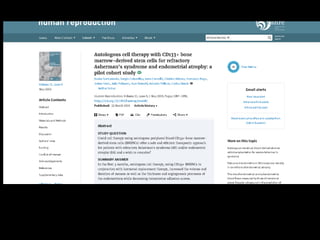
ESHRE Human Reproduction Keynote
lecture by Carlos Simon, 2017
For treating infertility
•Ovarian failure
•Endometrial atrophy
•Azoospermia
•Repeated implantation
failure
National Guidelines for Stem Cell
Research
National Guidelines for Stem Cell
Research - 2013
• There are no approved indications for stem cell
therapy other than Haematopoietic Stem Cell
Transplantation (HSCT) for haematological
disorders. All stem cell therapies other than the
above shall be treated as investigational and may
be conducted only in the form of clinical trials
after obtaining necessary regulatory approvals.
• Use of stem cells for any other purpose outside
the domain of clinical trials will be considered
unethical and hence not permissible.
Draft National Guidelines for Stem
Cell Research 2017
• Use of stem cells in regenerative medicine
holds promise for improving human health by
restoring the function of cells and tissues
damaged due to degeneration and/or injury.
• Like all other medical innovations, emerging
research on stem cells and translational
biology not only requires a sound scientific
rationale, but also strict adherence to ethical,
legal and social issues.
Draft National Guidelines for Stem
Cell Research 2017
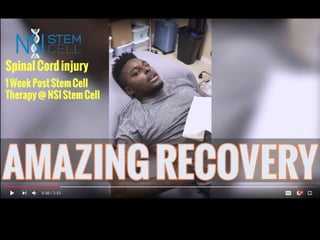
• Indiscriminate use of stem cells without
establishing efficacy for therapy and before
obtaining adequate data on their safety has
created unprecedented difficulties related to
therapeutic profligacy with vulnerable patients
getting exploited.
• In recent years, the use of stem cells in clinical
indications that has not yet been substantiated
scientifically, has posed serious problems to
patients in terms of their well-being and
financial exploitation.
Draft National Guidelines for Stem
Cell Research 2017
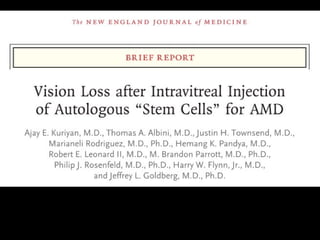
• Potential dangers
• Tumorigenicity of stem cells considering their
capacity for unlimited proliferation
• Possibility of genomic changes arising during
in vitro manipulations
• Limitations related to immunological tissue
incompatibility between individuals
Draft National Guidelines for Stem
Cell Research 2017
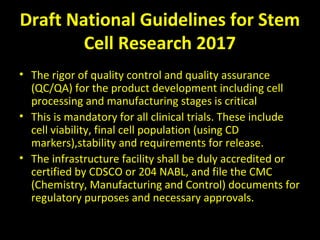
• The rigor of quality control and quality assurance
(QC/QA) for the product development including cell
processing and manufacturing stages is critical
• This is mandatory for all clinical trials. These include
cell viability, final cell population (using CD
markers),stability and requirements for release.
• The infrastructure facility shall be duly accredited or
certified by CDSCO or 204 NABL, and file the CMC
(Chemistry, Manufacturing and Control) documents for
regulatory purposes and necessary approvals.
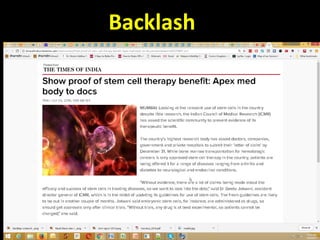
Backlash
The elephant in the room
• None of us will change what we are
doing!
• We all have our personal prejudices
Trigger happy doctor
• We like doing things - " itchy " fingers
• You feel good because you offered
treatment – even if it is useless and
unproven
• Your patient is happy – she feels you
have “treated “ her
• You can charge a lot more, as compared
to doing nothing !
Why it’s easy to fool
doctors
• Personal experience - Small numbers, no
controls, no followup
• Patients change doctors all the time.
Only the success stories come back with
chocolates !
• Reinforces your bias – the easiest person
to fool in the world is yourself
Why it’s easy to fool doctors
• Eminence based medicine – based
on "my extensive clinical
experience”.
• Experts fudge numbers – they lie !
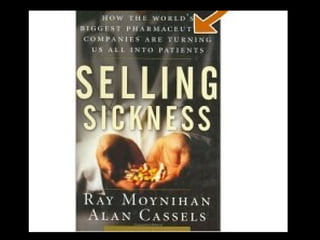
• Sponsored by stem cell companies
who want to sell their products
Doctor vs Doctor
‘From inability to let well alone
From too much zeal for the new and contempt for
what is old
From putting knowledge before wisdom, science
before art, and
Cleverness before common sense;
From treating patients as cases;
And from making the cure of the disease more
grievous than the
Endurance of the same, Good Lord, deliver us.’
Sir Robert Hutchison
Taking patients and doctors for a
ride
• The people selling your patients stem cell treatments
want your patient’s money. 
• They will do their best to convince you that their 
treatment is safe and effective. 
• The more convincing they are then the more money 
they make. 
• The bottom line is that the sellers of dubious stem cell 

treatments are generally in it for the big bucks. 
• Some of these providers truly believe stem cells are 
helpful, but you’ll never see them offering to give 
patients the cells at cost. These are instead very much 
for-profit operations.
The stem cell therapy racket in India

The stem cell therapy racket in India

  • 2.
    ESHRE Human ReproductionKeynote lecture by Carlos Simon, 2017
  • 13.
    For treating infertility •Ovarianfailure •Endometrial atrophy •Azoospermia •Repeated implantation failure
  • 14.
    National Guidelines forStem Cell Research
  • 15.
    National Guidelines forStem Cell Research - 2013 • There are no approved indications for stem cell therapy other than Haematopoietic Stem Cell Transplantation (HSCT) for haematological disorders. All stem cell therapies other than the above shall be treated as investigational and may be conducted only in the form of clinical trials after obtaining necessary regulatory approvals. • Use of stem cells for any other purpose outside the domain of clinical trials will be considered unethical and hence not permissible.
  • 16.
    Draft National Guidelinesfor Stem Cell Research 2017 • Use of stem cells in regenerative medicine holds promise for improving human health by restoring the function of cells and tissues damaged due to degeneration and/or injury. • Like all other medical innovations, emerging research on stem cells and translational biology not only requires a sound scientific rationale, but also strict adherence to ethical, legal and social issues.

  • 17.
    Draft National Guidelinesfor Stem Cell Research 2017 • Indiscriminate use of stem cells without establishing efficacy for therapy and before obtaining adequate data on their safety has created unprecedented difficulties related to therapeutic profligacy with vulnerable patients getting exploited. • In recent years, the use of stem cells in clinical indications that has not yet been substantiated scientifically, has posed serious problems to patients in terms of their well-being and financial exploitation.
  • 18.
    Draft National Guidelinesfor Stem Cell Research 2017 • Potential dangers • Tumorigenicity of stem cells considering their capacity for unlimited proliferation • Possibility of genomic changes arising during in vitro manipulations • Limitations related to immunological tissue incompatibility between individuals
  • 19.
    Draft National Guidelinesfor Stem Cell Research 2017 • The rigor of quality control and quality assurance (QC/QA) for the product development including cell processing and manufacturing stages is critical • This is mandatory for all clinical trials. These include cell viability, final cell population (using CD markers),stability and requirements for release. • The infrastructure facility shall be duly accredited or certified by CDSCO or 204 NABL, and file the CMC (Chemistry, Manufacturing and Control) documents for regulatory purposes and necessary approvals.
  • 23.
  • 25.
    The elephant inthe room • None of us will change what we are doing! • We all have our personal prejudices

  • 26.
    Trigger happy doctor •We like doing things - " itchy " fingers • You feel good because you offered treatment – even if it is useless and unproven • Your patient is happy – she feels you have “treated “ her • You can charge a lot more, as compared to doing nothing !
  • 27.
    Why it’s easyto fool doctors • Personal experience - Small numbers, no controls, no followup • Patients change doctors all the time. Only the success stories come back with chocolates ! • Reinforces your bias – the easiest person to fool in the world is yourself
  • 28.
    Why it’s easyto fool doctors • Eminence based medicine – based on "my extensive clinical experience”. • Experts fudge numbers – they lie ! • Sponsored by stem cell companies who want to sell their products
  • 34.
  • 39.
    ‘From inability tolet well alone From too much zeal for the new and contempt for what is old From putting knowledge before wisdom, science before art, and Cleverness before common sense; From treating patients as cases; And from making the cure of the disease more grievous than the Endurance of the same, Good Lord, deliver us.’ Sir Robert Hutchison
  • 41.
    Taking patients anddoctors for a ride • The people selling your patients stem cell treatments want your patient’s money.  • They will do their best to convince you that their  treatment is safe and effective.  • The more convincing they are then the more money  they make.  • The bottom line is that the sellers of dubious stem cell  treatments are generally in it for the big bucks.  • Some of these providers truly believe stem cells are  helpful, but you’ll never see them offering to give  patients the cells at cost. These are instead very much  for-profit operations.