PRESENT CONTINUOUS
     WITH A FUTURE MEANING - 1
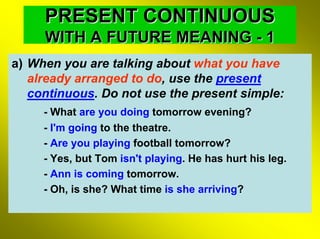
a) When you are talking about what you have
   already arranged to do, use the present
   continuous. Do not use the present simple:
     - What are you doing tomorrow evening?
     - I'm going to the theatre.
     - Are you playing football tomorrow?
     - Yes, but Tom isn't playing. He has hurt his leg.
     - Ann is coming tomorrow.
     - Oh, is she? What time is she arriving?
PRESENT CONTINUOUS
    WITH A FUTURE MEANING - 2

b) The time is nearly always given and is
   usually in the immediate future:

    - He is playing in the concert tonight.
    - We are meeting him after the performance.
PRESENT CONTINUOUS
      WITH A FUTURE MEANING - 3

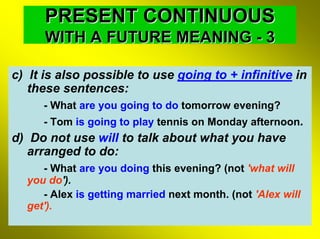
c) It is also possible to use going to + infinitive in
   these sentences:
     - What are you going to do tomorrow evening?
     - Tom is going to play tennis on Monday afternoon.
d) Do not use will to talk about what you have
   arranged to do:
     - What are you doing this evening? (not 'what will
  you do').
     - Alex is getting married next month. (not 'Alex will
  get').
PRESENT CONTINUOUS
        WITH A FUTURE MEANING - 4

e) This method of expressing the future cannot be used
   with verbs which are not normally used in the
   continuous tenses. These verbs should be put into the
   future tense (shall/will):
            - I'm meeting him tonight.
  But       - I shall know tonight.
            - They will be there tomorrow.
     i) To see, however, can be used in this tense with a
  future meaning:
            - I am seeing him tomorrow (= I have an appointment
            with him, 'I am meeting him tomorrow').
     ii) To be can be used when it forms part of a passive
  verb:
            - Our new piano is being delivered this afternoon.
THE SIMPLE PRESENT
         WITH A FUTURE MEANING

a) We use the present simple when we are talking about
   time-tables, programmes, etc. (for example, for public
   transport, cinemas):
      - What time does the film begin?
      - The train leaves Plymouth at 10.30 and arrives in London at
      13.45.
      - The football match starts at 8 o'clock.
      - Tomorrow is Wednesday.


b) But we do not normally use the present simple for
   personal arrangements:
      - What time are you meeting Ann? (not 'do you meet').

Present Continuous Future

  • 1.
    PRESENT CONTINUOUS WITH A FUTURE MEANING - 1 a) When you are talking about what you have already arranged to do, use the present continuous. Do not use the present simple: - What are you doing tomorrow evening? - I'm going to the theatre. - Are you playing football tomorrow? - Yes, but Tom isn't playing. He has hurt his leg. - Ann is coming tomorrow. - Oh, is she? What time is she arriving?
  • 2.
    PRESENT CONTINUOUS WITH A FUTURE MEANING - 2 b) The time is nearly always given and is usually in the immediate future: - He is playing in the concert tonight. - We are meeting him after the performance.
  • 3.
    PRESENT CONTINUOUS WITH A FUTURE MEANING - 3 c) It is also possible to use going to + infinitive in these sentences: - What are you going to do tomorrow evening? - Tom is going to play tennis on Monday afternoon. d) Do not use will to talk about what you have arranged to do: - What are you doing this evening? (not 'what will you do'). - Alex is getting married next month. (not 'Alex will get').
  • 4.
    PRESENT CONTINUOUS WITH A FUTURE MEANING - 4 e) This method of expressing the future cannot be used with verbs which are not normally used in the continuous tenses. These verbs should be put into the future tense (shall/will): - I'm meeting him tonight. But - I shall know tonight. - They will be there tomorrow. i) To see, however, can be used in this tense with a future meaning: - I am seeing him tomorrow (= I have an appointment with him, 'I am meeting him tomorrow'). ii) To be can be used when it forms part of a passive verb: - Our new piano is being delivered this afternoon.
  • 5.
    THE SIMPLE PRESENT WITH A FUTURE MEANING a) We use the present simple when we are talking about time-tables, programmes, etc. (for example, for public transport, cinemas): - What time does the film begin? - The train leaves Plymouth at 10.30 and arrives in London at 13.45. - The football match starts at 8 o'clock. - Tomorrow is Wednesday. b) But we do not normally use the present simple for personal arrangements: - What time are you meeting Ann? (not 'do you meet').