Future Plans 
Be going to vs. Present continuous
Definite Arrangement 
We use the Present Continuous to 
talk about definite arrangements for 
the future – something we have 
already decided on for the future. 
Sorry, I can’t help you. I’m leaving in 
the morning.
 Beth: Do you want to go to the beach 
tomorrow? 
 Jenny: I’d love to, but not before 4 
o’clock. 
 Beth: Why? What are you doing in the 
morning? 
 Jenny: Oh, I’m doing a million things. At 
8 o’clock I’m going to the dentist. Then 
I’m meeting my mother and helping her 
with the shopping. After that I’m taking 
my dog to the vet and rushing back to 
meet Sarah at the airport.
Plans and Intentions 
We use be going to + infinitive to talk 
about future plans or intentions – 
something we have a plan for. 
I’m going to fix television tomorrow. 
Why are you going to buy a new bike?
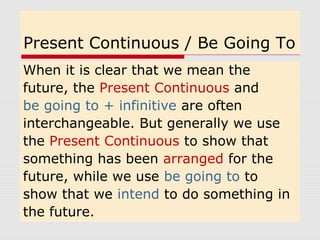
Present Continuous / Be Going To 
When it is clear that we mean the 
future, the Present Continuous and 
be going to + infinitive are often 
interchangeable. But generally we use 
the Present Continuous to show that 
something has been arranged for the 
future, while we use be going to to 
show that we intend to do something in 
the future.
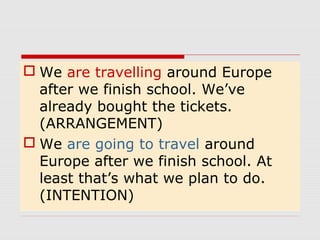
 We are travelling around Europe 
after we finish school. We’ve 
already bought the tickets. 
(ARRANGEMENT) 
 We are going to travel around 
Europe after we finish school. At 
least that’s what we plan to do. 
(INTENTION)
 We are travelling around Europe 
after we finish school. We’ve 
already bought the tickets. 
(ARRANGEMENT) 
 We are going to travel around 
Europe after we finish school. At 
least that’s what we plan to do. 
(INTENTION)

Going to or pre cont

  • 1.
    Future Plans Begoing to vs. Present continuous
  • 2.
    Definite Arrangement Weuse the Present Continuous to talk about definite arrangements for the future – something we have already decided on for the future. Sorry, I can’t help you. I’m leaving in the morning.
  • 3.
     Beth: Doyou want to go to the beach tomorrow?  Jenny: I’d love to, but not before 4 o’clock.  Beth: Why? What are you doing in the morning?  Jenny: Oh, I’m doing a million things. At 8 o’clock I’m going to the dentist. Then I’m meeting my mother and helping her with the shopping. After that I’m taking my dog to the vet and rushing back to meet Sarah at the airport.
  • 4.
    Plans and Intentions We use be going to + infinitive to talk about future plans or intentions – something we have a plan for. I’m going to fix television tomorrow. Why are you going to buy a new bike?
  • 5.
    Present Continuous /Be Going To When it is clear that we mean the future, the Present Continuous and be going to + infinitive are often interchangeable. But generally we use the Present Continuous to show that something has been arranged for the future, while we use be going to to show that we intend to do something in the future.
  • 6.
     We aretravelling around Europe after we finish school. We’ve already bought the tickets. (ARRANGEMENT)  We are going to travel around Europe after we finish school. At least that’s what we plan to do. (INTENTION)
  • 7.
     We aretravelling around Europe after we finish school. We’ve already bought the tickets. (ARRANGEMENT)  We are going to travel around Europe after we finish school. At least that’s what we plan to do. (INTENTION)