Engineering 245 The Lean LaunchPad Session 1: Overview/Business Models/Customer Development Professors Steve Blank, Ann Miura-Ko, Jon Feiber http://e245.stanford.edu/
Agenda “ Is This the Right Course for Me?” Course Objectives/teams/project Introductions Class Logistics Building a “Lean Startup” Idea Sizing the Opportunity Business Models Customer Development Break :  Stay If You Want to Be in the Class Class  “Culture” and Next Steps
Course Objectives Understand the real world aspects of Entrepreneurship by getting out of the building Analyze and assess an opportunity Build the product Get orders Work with a team Learn whether entrepreneurship is for you
What Will you Learn? Opportunity evaluation Search for a Business Model Customer Discovery and Validation Operating and decision making in chaos with insufficient data Teamwork
The Course  ‘By the Numbers’ 3/4 Units of Credit 3 Instructors, 2 CAs, 25+ Mentors,  8 Lectures 8 Weekly 10-minute presentations 1 Final 30 minute presentation 3 Textbooks 5 -10 hours of work a week  outside the classroom
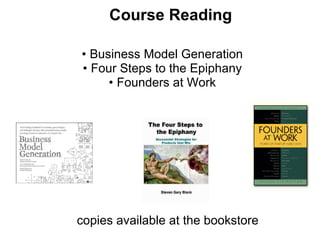
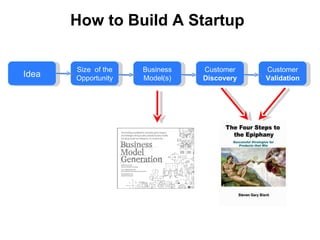
Course Reading Business Model Generation Four Steps to the Epiphany Founders at Work copies available at the bookstore
This Class is  Hard You can ’t pass by attending the class Your grade is determined by the work you do  outside the class There ’s a lot of it You are dependent on teamwork and teammates – communication is critical
Teams Suggested team size is 4 people Deadline for team formation is Jan 6 th   Must contact your mentors by Jan 7 th   Present Weekly and for Final Weekly lessons learned Final is demo and summary Class is about teamwork, discovery and fast iteration
Team Projects Any  for-profit  scalable  startup If you are a domain expert, that ’s your best bet (but not required) If you pick a web project, you have to build it (and there needs to be some novelty)
Team Deliverables Each Week Lessons Learned presentation 10 minutes Updated blog/wiki 10 ’s of hours of “outside the building” progress Final Presentation 30 minute Lessons Learned Summary
Grading Individual - 20% Participation in class 20% Team - 80% Weekly summary and out of the building progress 50% Final Presentation 30%
Introductions
Steve Blank,  Ann-Miura-Ko, Jon Feiber 8 startups in Silicon Valley Semiconductors Supercomputers Consumer electronics Video games Enterprise software Military intelligence [email_address] twitter sgblank www.steveblank.com Yale BS EE McKinsey and Co. Charles River Ventures Stanford Ph.D MS&E TA: E145, Mayfield Fellows, MS&E 273 V.C. @ Floodgate [email_address] @annimaniac BS CS/Astro Physics U of Colorado VP Networking SUN V.C. @ MDV since 1991
Steve Blank,  Ann-Miura-Ko , Jon Feiber 8 startups - 32 years in Silicon Valley Semiconductors Supercomputers Consumer electronics Video games Enterprise software Military intelligence Teach: Stanford, Berkeley, Columbia Details at www.steveblank.com Yale BS EE McKinsey and Co. Charles River Ventures Stanford Ph.D MS&E V.C. @ Floodgate [email_address] @annimaniac BS CS/Astro Physics U of Colorado VP Networking SUN V.C. @ MDV since 1991
Steve Blank, Ann-Miura-Ko,  Jon Feiber 8 startups - 32 years in Silicon Valley Semiconductors Supercomputers Consumer electronics Video games Enterprise software Military intelligence Teach: Stanford, Berkeley, Columbia Details at www.steveblank.com Yale BS EE McKinsey and Co. Charles River Ventures Stanford Ph.D MS&E V.C. @ Floodgate [email_address] @annimaniac BS CS/Astro Physics U of Colorado 50 th  employee, VP Networking @ Sun V.C. @ MDV since 1991 [email_address]
Course Assistant (CA ’s) Felix Huber MS MS&E 2010 Google Translate Product Mgr CA ’s role :  Class/lecture questions, Grading and attendance Thomas Haymore B.A. in Political Science Stanford Law ( ‘06) J.D. Stanford Law ( ‘12) [email_address] [email_address]
Volunteer Course Assistant (CA ’s) Felix Huber MS MS&E 2010 Google Translate Product Mgr CA ’s role :  Class/lecture questions, Grading and attendance Thomas Haymore B.A. in Political Science Stanford Law ( ‘06) J.D. Stanford Law ( ‘12) [email_address] [email_address]
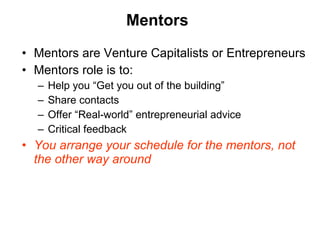
Mentors Mentors are Venture Capitalists or Entrepreneurs Mentors role is to: Help you  “Get you out of the building” Share contacts Offer  “Real-world” entrepreneurial advice Critical feedback You arrange your schedule for the mentors, not the other way around
Class Logistics
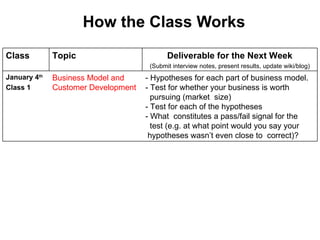
How the Class Works Class Topic Deliverable for the Next Week (Submit interview notes, present results, update wiki/blog) January 4 th   Class 1 Business Model and  Customer Development - Hypotheses for each part of business model. - Test for whether your business is worth  pursuing (market  size) - Test for each of the hypotheses      - What  constitutes a pass/fail signal for the  test (e.g. at what point would you say your hypotheses wasn ’t even close to  correct)?
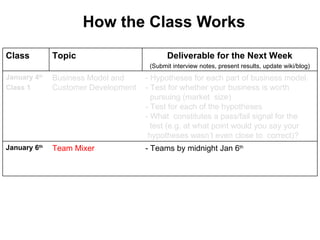
How the Class Works Class Topic Deliverable for the Next Week (Submit interview notes, present results, update wiki/blog) January 4 th   Class 1 Business Model and  Customer Development - Hypotheses for each part of business model. - Test for whether your business is worth  pursuing (market  size) - Test for each of the hypotheses      - What  constitutes a pass/fail signal for the  test (e.g. at what point would you say your hypotheses wasn ’t even close to  correct)?  January 6 th   Team Mixer - Teams by midnight Jan 6 th
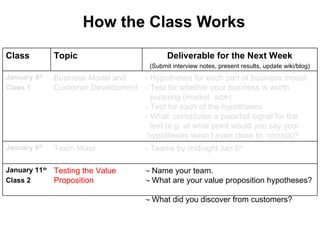
How the Class Works Class Topic Deliverable for the Next Week (Submit interview notes, present results, update wiki/blog) January 4 th   Class 1 Business Model and  Customer Development - Hypotheses for each part of business model. - Test for whether your business is worth  pursuing (market  size) - Test for each of the hypotheses      - What  constitutes a pass/fail signal for the  test (e.g. at what point would you say your hypotheses wasn ’t even close to  correct)?  January 6 th   Team Mixer - Teams by midnight Jan 6 th January 11 th   Class 2  Testing the Value Proposition - Name your team.    - What are your value proposition hypotheses?      - What did you discover from customers?    
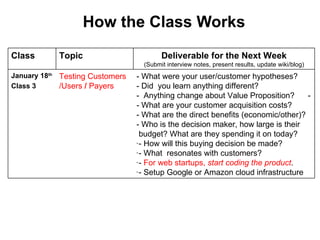
How the Class Works Class Topic Deliverable for the Next Week ( Submit interview notes, present results, update wiki/blog) January 18 th   Class 3 Testing Customers /Users  /   Payers - What were your user/customer hypotheses?   - Did  you learn anything different?     -  Anything change about Value Proposition?      -  - What are your customer acquisition costs?     - What are the direct benefits (economic/other)? - Who is the decision maker, how large is their   budget? What are they spending it on today?   - How will this buying decision be made?   - What  resonates with customers? -  For web startups,  start coding the product .   - Setup Google or Amazon cloud infrastructure
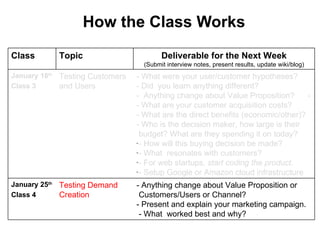
How the Class Works Class Topic Deliverable for the Next Week ( Submit interview notes, present results, update wiki/blog) January 18 th   Class 3 Testing Customers and Users    - What were your user/customer hypotheses?   - Did  you learn anything different?     -  Anything change about Value Proposition?      -  - What are your customer acquisition costs?     - What are the direct benefits (economic/other)? - Who is the decision maker, how large is their   budget? What are they spending it on today?   - How will this buying decision be made?   - What  resonates with customers? - For web startups,  start coding the product .   - Setup Google or Amazon cloud infrastructure January 25 th   Class 4  Testing Demand Creation - Anything change about Value Proposition or  Customers/Users or Channel? - Present and explain your marketing campaign.  - What  worked best and why?
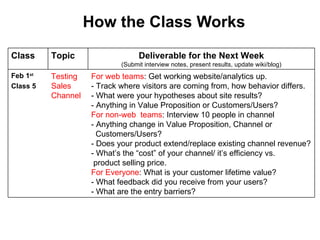
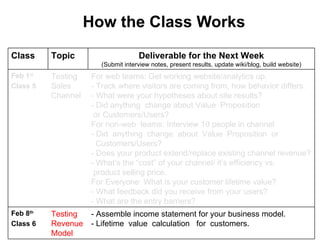
How the Class Works Class Topic Deliverable for the Next Week ( Submit interview notes, present results, update wiki/blog) Feb 1 st   Class 5 Testing Sales Channel For web teams : Get working website/analytics up.  - Track where visitors are coming from, how behavior differs.  - What were your hypotheses about site results? - Anything in Value Proposition or Customers/Users?      For non-web  teams : Interview 10 people in channel  - Anything change in Value Proposition, Channel or  Customers/Users?  - Does your product extend/replace existing channel revenue?  - What ’s the “cost” of your channel/ it’s efficiency vs. product selling price.  For Everyone : What is your customer lifetime value?  - What feedback did you receive from your users? - What are the entry barriers?
How the Class Works Class Topic Deliverable for the Next Week ( Submit interview notes, present results, update wiki/blog, build website) Feb 1 st   Class 5 Testing Sales Channel For web teams: Get working website/analytics up.  - Track where visitors are coming from, how behavior differs.  - What were your hypotheses about site results? - Did anything  change about Value  Proposition or Customers/Users?      For non-web  teams: Interview 10 people in channel  - Did  anything  change  about  Value  Proposition  or  Customers/Users?  - Does your product extend/replace existing channel revenue?  - What ’s the “cost” of your channel/ it’s efficiency vs. product selling price.  For Everyone: What is your customer lifetime value?  - What feedback did you receive from your users? - What are the entry barriers? Feb 8 th   Class 6 Testing Revenue Model - Assemble income statement for your business model.   - Lifetime  value  calculation   for  customers.    
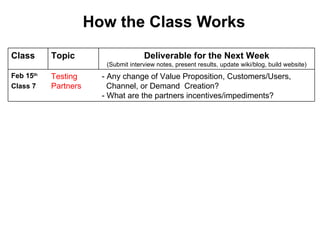
How the Class Works Class Topic Deliverable for the Next Week ( Submit interview notes, present results, update wiki/blog, build website) Feb 15 th   Class 7 Testing Partners - Any change of Value Proposition, Customers/Users,  Channel, or Demand  Creation?  - What are the partners incentives/impediments?
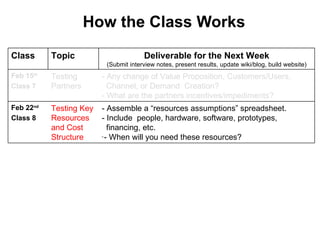
How the Class Works Class Topic Deliverable for the Next Week ( Submit interview notes, present results, update wiki/blog, build website) Feb 15 th   Class 7 Testing Partners - Any change of Value Proposition, Customers/Users,  Channel, or Demand  Creation?  - What are the partners incentives/impediments? Feb 22 nd   Class 8 Testing Key Resources and Cost Structure - Assemble a  “resources assumptions” spreadsheet.     - Include  people, hardware, software, prototypes,  financing, etc. - When will you need these resources?
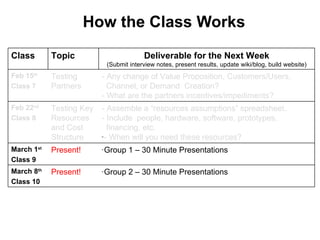
How the Class Works Class Topic Deliverable for the Next Week ( Submit interview notes, present results, update wiki/blog, build website) Feb 15 th   Class 7 Testing Partners - Any change of Value Proposition, Customers/Users,  Channel, or Demand  Creation?  - What are the partners incentives/impediments? Feb 22 nd   Class 8 Testing Key Resources and Cost Structure - Assemble a  “resources assumptions” spreadsheet.     - Include  people, hardware, software, prototypes,  financing, etc. - When will you need these resources? March 1 st Class 9 Present! Group 1 – 30 Minute Presentations March 8 th Class 10 Present! Group 2 – 30 Minute Presentations
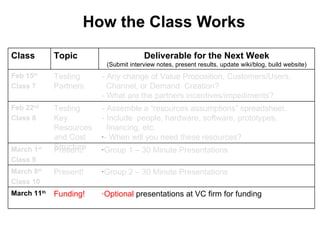
How the Class Works Class Topic Deliverable for the Next Week ( Submit interview notes, present results, update wiki/blog, build website) Feb 15 th   Class 7 Testing Partners - Any change of Value Proposition, Customers/Users,  Channel, or Demand  Creation?  - What are the partners incentives/impediments? Feb 22 nd   Class 8 Testing Key Resources and Cost Structure - Assemble a  “resources assumptions” spreadsheet.     - Include  people, hardware, software, prototypes,  financing, etc. - When will you need these resources? March 1 st Class 9 Present! Group 1 – 30 Minute Presentations March 8 th Class 10 Present! Group 2 – 30 Minute Presentations March 11 th   Funding! Optional  presentations at VC firm for funding
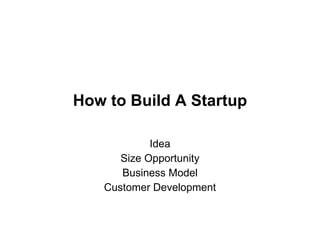
How to Build A Startup Idea Size Opportunity Business Model Customer Development
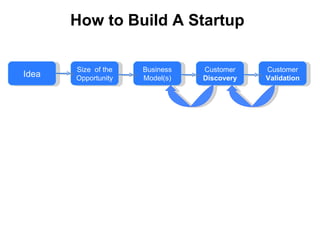
How to Build A Startup Idea Size  of the Opportunity Business Model(s) Customer  Discovery Customer  Validation
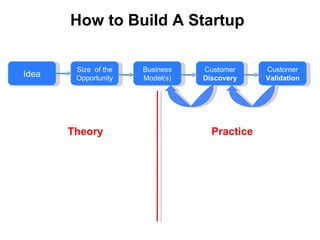
How to Build A Startup Idea Size  of the Opportunity Business Model(s) Customer  Discovery Customer  Validation Theory Practice
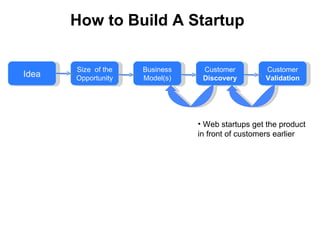
How to Build A Startup Idea Size  of the Opportunity Business Model(s) Customer  Discovery Customer  Validation Web startups get the product in front of customers earlier
How to Build A Startup Idea Size  of the Opportunity Business Model(s) Customer  Discovery Customer  Validation
Idea
We ’re  Engineers Darn It! Aren ’t companies all about product? I have a great technology idea Teach me how to make a company around it Just like Facebook and Google (or Intel or Apple) Stanford
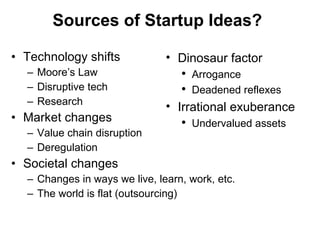
Sources of Startup Ideas? Technology shifts Moore ’s Law Disruptive tech Research Market changes Value chain disruption Deregulation Societal changes Changes in ways we live, learn, work, etc. The world is flat (outsourcing) Dinosaur factor Arrogance Deadened reflexes  Irrational exuberance Undervalued assets
An Idea is _Not_ a  Company
Size of Opportunity
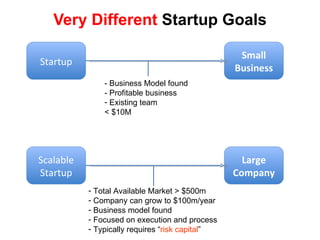
This Class is about  Scalable Startups Not all startups are designed to scale Small business startups have different goals They are done by normal people Scalable startups are designed to grow big Typically require venture capital This means the size of the opportunity needs to be $100’s of millions to billions
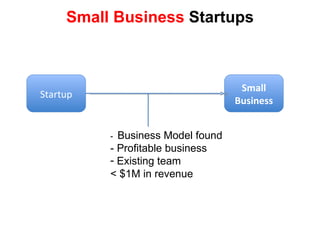
Small Business  Startups Small Business Startup -  Business Model found - Profitable business Existing team < $1M in revenue
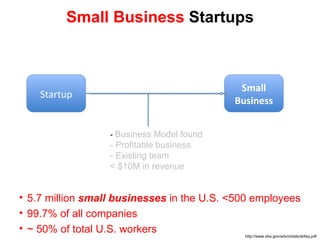
Small Business  Startups -  Business Model found - Profitable business Existing team < $10M in revenue 5.7 million  small businesses  in the U.S. <500 employees 99.7% of all companies ~ 50% of total U.S. workers http://www.sba.gov/advo/stats/sbfaq.pdf Small Business Startup
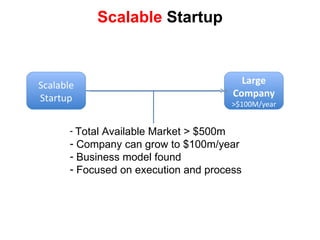
Scalable  Startup Scalable Startup Large Company >$100M/year Total Available Market > $500m Company can grow to $100m/year Business model found Focused on execution and process
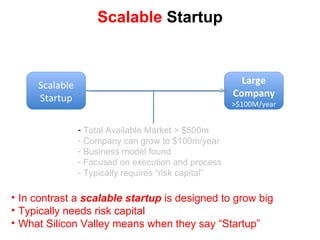
Scalable  Startup Scalable Startup Large Company >$100M/year Total Available Market > $500m Company can grow to $100m/year Business model found Focused on execution and process Typically requires “risk capital” In contrast a  scalable startup  is designed to grow big Typically needs risk capital What Silicon Valley means when they say “Startup”
Very Different  Startup Goals Small Business Startup - Business Model found - Profitable business Existing team < $10M Scalable Startup Large Company Total Available Market > $500m Company can grow to $100m/year Business model found Focused on execution and process Typically requires “ risk capital ”
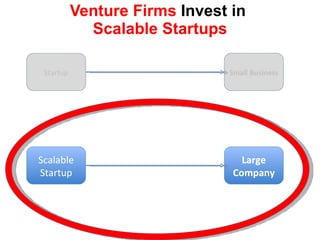
Venture Firms  Invest in  Scalable Startups Small Business Startup Scalable Startup Large Company
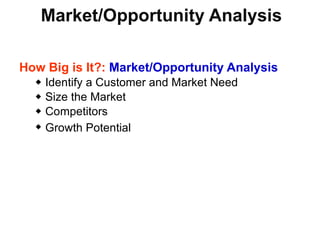
Market/Opportunity Analysis How Big is It?:  Market/Opportunity Analysis Identify a Customer and Market Need Size the Market Competitors Growth Potential
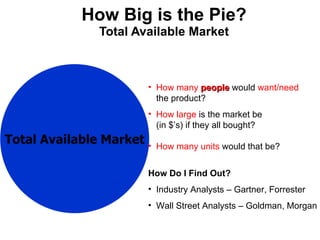
How Big is the Pie? Total Available Market Total Available Market How many   people  would  want/need   the product? How large  is the market be  (in $ ’s) if they all bought? How many units  would that be? How Do I Find Out? Industry Analysts – Gartner, Forrester Wall Street Analysts – Goldman, Morgan
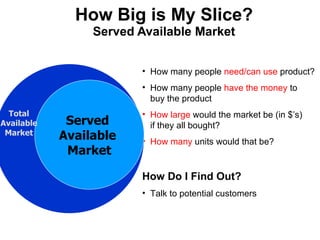
How Big is My Slice? Served Available Market How many people  need/can use  product? How many people  have the money  to  buy the product  How large  would the market be (in $ ’s)  if they all bought? How many  units would that be? How Do I Find Out? Talk to potential customers Served  Available  Market Total Available Market
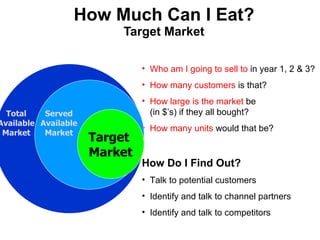
How Much Can I Eat? Target Market Who am I going to sell to  in year 1, 2 & 3?  How many customers  is that? How large   is the market  be  (in $ ’s) if they all bought? How many units  would that be? How Do I Find Out? Talk to potential customers Identify and talk to channel partners Identify and talk to competitors Total Available Market Target  Market Served Available Market
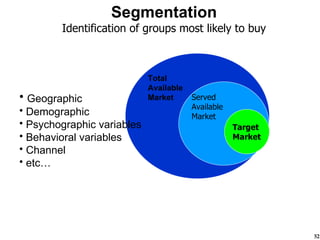
Segmentation Identification of groups most likely to buy Target  Market Geographic Demographic Psychographic variables Behavioral variables Channel etc… Total Available Market Served Available Market
Market Size: Summary Market Size Questions: How big can this market be?  How much of it can we get? Market growth rate Market structure (Mature or in flux?) Most important : Talk to Customers and Sales Channel Next important: Market size by competitive approximation Wall Street analyst reports are great And :  Market research firms  Like Forester, Gartner
Business Model
What Is a Business  Model ? Diagram  of flows between company and customers Scorecard  of hypotheses testing Rapid change  with each iteration and pivot Founder- driven * Alex Osterwalder
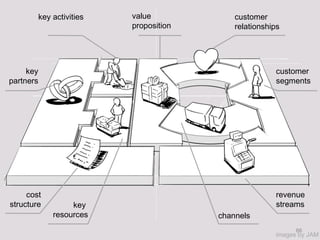
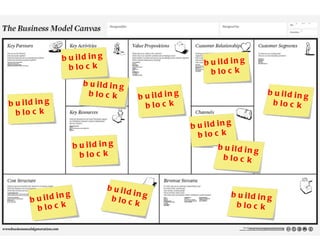
9 building blocks  of a business model:
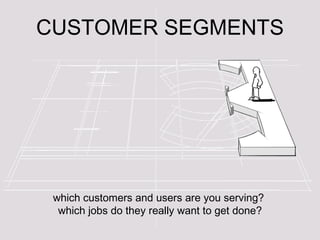
CUSTOMER SEGMENTS which customers and users are you serving?  which jobs do they really want to get done?
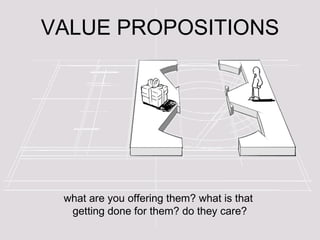
VALUE PROPOSITIONS what are you offering them? what is that  getting done for them? do they care?
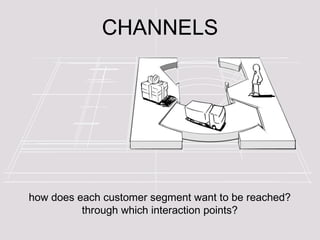
CHANNELS how does each customer segment want to be reached? through which interaction points?
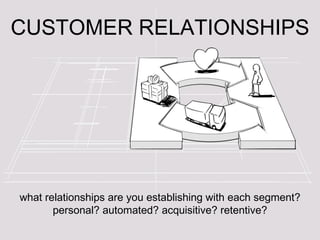
CUSTOMER RELATIONSHIPS what relationships are you establishing with each segment? personal? automated? acquisitive? retentive?
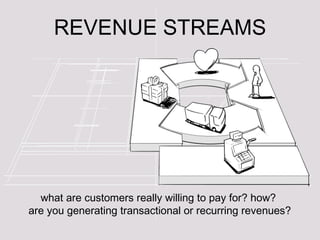
REVENUE STREAMS what are customers really willing to pay for? how?  are you generating transactional or recurring revenues?
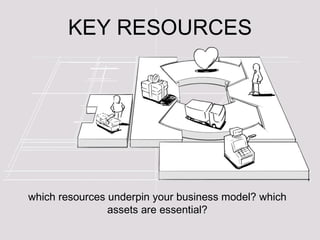
KEY RESOURCES which resources underpin your business model? which assets are essential?
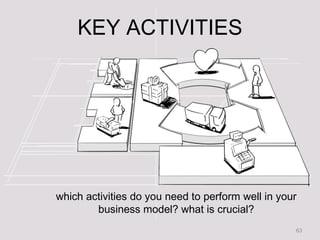
KEY ACTIVITIES which activities do you need to perform well in your business model? what is crucial?
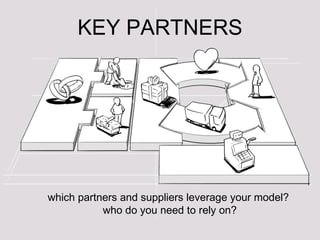
KEY PARTNERS which partners and suppliers leverage your model?  who do you need to rely on?
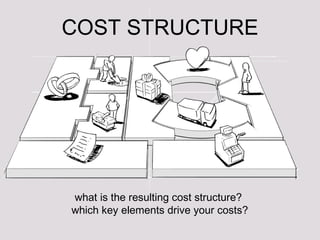
COST STRUCTURE what is the resulting cost structure?  which key elements drive your costs?
images by JAM customer segments key partners cost structure revenue streams channels customer relationships key activities key  resources value proposition
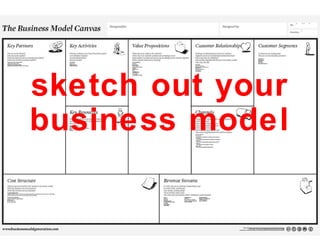
sketch out your business model
building block building block building block building block building block building block building block building block building block building block building block building block
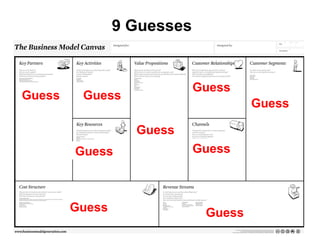
But, Realize They ’re Hypotheses
9 Guesses Guess Guess Guess Guess Guess Guess Guess Guess Guess
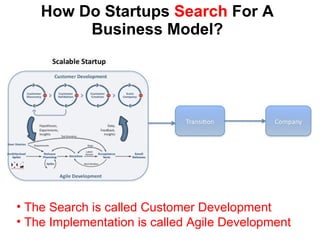
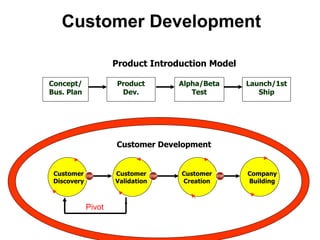
How Do Startups  Search  For A Business Model? The Search is called Customer Development The Implementation is called Agile Development
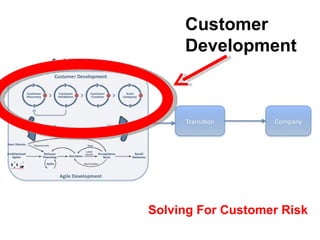
Customer  Development Solving For Customer Risk
Customer Development Get Out of the Building The founders ^
More startups  fail from  a lack of customers  than from a failure of product development (focus on “who” more than “what”)
Customer Development Concept/ Bus. Plan Product Dev. Alpha/Beta Test Launch/1st Ship Product Introduction Model Customer   Development Company Building Customer Discovery Customer Validation Customer Creation Pivot
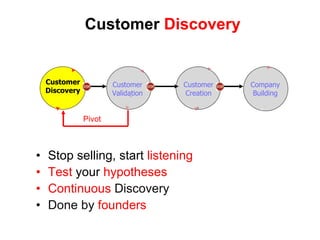
Stop selling, start  listening Test  your  hypotheses Continuous  Discovery Done by  founders Customer  Discovery Customer Discovery Customer Validation Company Building Customer Creation Pivot
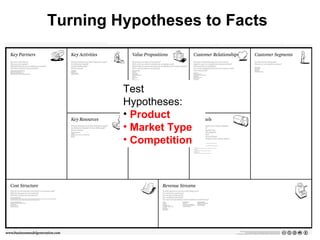
Turning Hypotheses to Facts Test Hypotheses: Product Market Type Competition
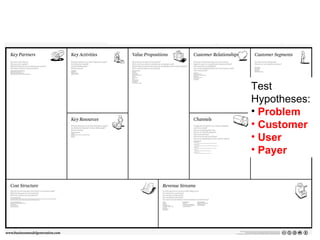
Test Hypotheses: Problem Customer User Payer
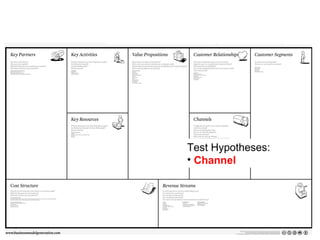
Test Hypotheses: Channel
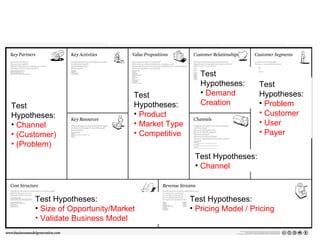
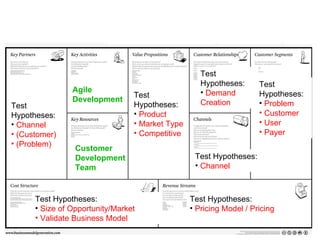
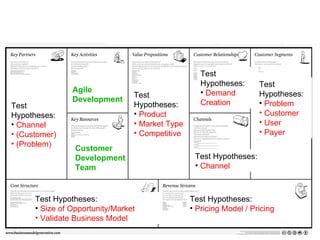
Test Hypotheses: Problem Customer User Payer Test Hypotheses: Demand Creation Test Hypotheses: Channel Test Hypotheses: Product Market Type Competitive Test Hypotheses: Pricing Model / Pricing Test Hypotheses: Size of Opportunity/Market Validate Business Model Test Hypotheses: Channel (Customer) (Problem)
Test Hypotheses: Problem Customer User Payer Test Hypotheses: Demand Creation Test Hypotheses: Channel Test Hypotheses: Product Market Type Competitive Test Hypotheses: Pricing Model / Pricing Test Hypotheses: Size of Opportunity/Market Validate Business Model Test Hypotheses: Channel (Customer) (Problem) Customer Development Team Agile Development
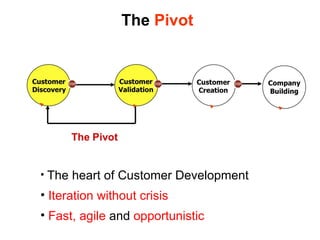
The  Pivot The heart of Customer Development Iteration without crisis Fast, agile  and  opportunistic
Break
Our  “Culture” for E245 Show up on time and stay  ‘til we’re done Keep your commitments (in class and out) Step outside if you must call, email, skype, twitter, chat, surf the web, or do anything unrelated to E245 Entrepreneurship is a  team  sport 80% of your grade depends on working with others
What Lies Ahead:   “To Do” List Check web site for admission lists  attendance is mandatory in session 2  waitlist (if any) will be cleared at beginning of class Form full teams by Session 2  mixer on Thursday, 5:15 at Thornton 110 Team deliverable by next week: Hypotheses for each part of business model. - Test for whether your business is worth  pursuing (market  size) - Test for each of the hypotheses      - What  constitutes a pass/fail signal for the  test (e.g. at what point would you say your hypotheses wasn ’t even close to  correct)?

Stanford E245 Lean LaunchPad winter 10 session 01 course overview rev 4

  • 1.
    Engineering 245 TheLean LaunchPad Session 1: Overview/Business Models/Customer Development Professors Steve Blank, Ann Miura-Ko, Jon Feiber http://e245.stanford.edu/
  • 2.
    Agenda “ IsThis the Right Course for Me?” Course Objectives/teams/project Introductions Class Logistics Building a “Lean Startup” Idea Sizing the Opportunity Business Models Customer Development Break : Stay If You Want to Be in the Class Class “Culture” and Next Steps
  • 3.
    Course Objectives Understandthe real world aspects of Entrepreneurship by getting out of the building Analyze and assess an opportunity Build the product Get orders Work with a team Learn whether entrepreneurship is for you
  • 4.
    What Will youLearn? Opportunity evaluation Search for a Business Model Customer Discovery and Validation Operating and decision making in chaos with insufficient data Teamwork
  • 5.
    The Course ‘By the Numbers’ 3/4 Units of Credit 3 Instructors, 2 CAs, 25+ Mentors, 8 Lectures 8 Weekly 10-minute presentations 1 Final 30 minute presentation 3 Textbooks 5 -10 hours of work a week outside the classroom
  • 6.
    Course Reading BusinessModel Generation Four Steps to the Epiphany Founders at Work copies available at the bookstore
  • 7.
    This Class is Hard You can ’t pass by attending the class Your grade is determined by the work you do outside the class There ’s a lot of it You are dependent on teamwork and teammates – communication is critical
  • 8.
    Teams Suggested teamsize is 4 people Deadline for team formation is Jan 6 th Must contact your mentors by Jan 7 th Present Weekly and for Final Weekly lessons learned Final is demo and summary Class is about teamwork, discovery and fast iteration
  • 9.
    Team Projects Any for-profit scalable startup If you are a domain expert, that ’s your best bet (but not required) If you pick a web project, you have to build it (and there needs to be some novelty)
  • 10.
    Team Deliverables EachWeek Lessons Learned presentation 10 minutes Updated blog/wiki 10 ’s of hours of “outside the building” progress Final Presentation 30 minute Lessons Learned Summary
  • 11.
    Grading Individual -20% Participation in class 20% Team - 80% Weekly summary and out of the building progress 50% Final Presentation 30%
  • 12.
  • 13.
    Steve Blank, Ann-Miura-Ko, Jon Feiber 8 startups in Silicon Valley Semiconductors Supercomputers Consumer electronics Video games Enterprise software Military intelligence [email_address] twitter sgblank www.steveblank.com Yale BS EE McKinsey and Co. Charles River Ventures Stanford Ph.D MS&E TA: E145, Mayfield Fellows, MS&E 273 V.C. @ Floodgate [email_address] @annimaniac BS CS/Astro Physics U of Colorado VP Networking SUN V.C. @ MDV since 1991
  • 14.
    Steve Blank, Ann-Miura-Ko , Jon Feiber 8 startups - 32 years in Silicon Valley Semiconductors Supercomputers Consumer electronics Video games Enterprise software Military intelligence Teach: Stanford, Berkeley, Columbia Details at www.steveblank.com Yale BS EE McKinsey and Co. Charles River Ventures Stanford Ph.D MS&E V.C. @ Floodgate [email_address] @annimaniac BS CS/Astro Physics U of Colorado VP Networking SUN V.C. @ MDV since 1991
  • 15.
    Steve Blank, Ann-Miura-Ko, Jon Feiber 8 startups - 32 years in Silicon Valley Semiconductors Supercomputers Consumer electronics Video games Enterprise software Military intelligence Teach: Stanford, Berkeley, Columbia Details at www.steveblank.com Yale BS EE McKinsey and Co. Charles River Ventures Stanford Ph.D MS&E V.C. @ Floodgate [email_address] @annimaniac BS CS/Astro Physics U of Colorado 50 th employee, VP Networking @ Sun V.C. @ MDV since 1991 [email_address]
  • 16.
    Course Assistant (CA’s) Felix Huber MS MS&E 2010 Google Translate Product Mgr CA ’s role : Class/lecture questions, Grading and attendance Thomas Haymore B.A. in Political Science Stanford Law ( ‘06) J.D. Stanford Law ( ‘12) [email_address] [email_address]
  • 17.
    Volunteer Course Assistant(CA ’s) Felix Huber MS MS&E 2010 Google Translate Product Mgr CA ’s role : Class/lecture questions, Grading and attendance Thomas Haymore B.A. in Political Science Stanford Law ( ‘06) J.D. Stanford Law ( ‘12) [email_address] [email_address]
  • 18.
    Mentors Mentors areVenture Capitalists or Entrepreneurs Mentors role is to: Help you “Get you out of the building” Share contacts Offer “Real-world” entrepreneurial advice Critical feedback You arrange your schedule for the mentors, not the other way around
  • 19.
  • 20.
    How the ClassWorks Class Topic Deliverable for the Next Week (Submit interview notes, present results, update wiki/blog) January 4 th Class 1 Business Model and Customer Development - Hypotheses for each part of business model. - Test for whether your business is worth  pursuing (market  size) - Test for each of the hypotheses     - What  constitutes a pass/fail signal for the  test (e.g. at what point would you say your hypotheses wasn ’t even close to  correct)?
  • 21.
    How the ClassWorks Class Topic Deliverable for the Next Week (Submit interview notes, present results, update wiki/blog) January 4 th Class 1 Business Model and Customer Development - Hypotheses for each part of business model. - Test for whether your business is worth  pursuing (market  size) - Test for each of the hypotheses     - What  constitutes a pass/fail signal for the  test (e.g. at what point would you say your hypotheses wasn ’t even close to  correct)? January 6 th Team Mixer - Teams by midnight Jan 6 th
  • 22.
    How the ClassWorks Class Topic Deliverable for the Next Week (Submit interview notes, present results, update wiki/blog) January 4 th Class 1 Business Model and Customer Development - Hypotheses for each part of business model. - Test for whether your business is worth  pursuing (market  size) - Test for each of the hypotheses     - What  constitutes a pass/fail signal for the  test (e.g. at what point would you say your hypotheses wasn ’t even close to  correct)? January 6 th Team Mixer - Teams by midnight Jan 6 th January 11 th Class 2 Testing the Value Proposition - Name your team.   - What are your value proposition hypotheses?     - What did you discover from customers?    
  • 23.
    How the ClassWorks Class Topic Deliverable for the Next Week ( Submit interview notes, present results, update wiki/blog) January 18 th Class 3 Testing Customers /Users / Payers - What were your user/customer hypotheses?   - Did  you learn anything different?     - Anything change about Value Proposition?      - - What are your customer acquisition costs?     - What are the direct benefits (economic/other)? - Who is the decision maker, how large is their   budget? What are they spending it on today?   - How will this buying decision be made?   - What  resonates with customers? - For web startups, start coding the product .   - Setup Google or Amazon cloud infrastructure
  • 24.
    How the ClassWorks Class Topic Deliverable for the Next Week ( Submit interview notes, present results, update wiki/blog) January 18 th Class 3 Testing Customers and Users   - What were your user/customer hypotheses?   - Did  you learn anything different?     - Anything change about Value Proposition?      - - What are your customer acquisition costs?     - What are the direct benefits (economic/other)? - Who is the decision maker, how large is their   budget? What are they spending it on today?   - How will this buying decision be made?   - What  resonates with customers? - For web startups, start coding the product .   - Setup Google or Amazon cloud infrastructure January 25 th Class 4 Testing Demand Creation - Anything change about Value Proposition or  Customers/Users or Channel? - Present and explain your marketing campaign.  - What  worked best and why?
  • 25.
    How the ClassWorks Class Topic Deliverable for the Next Week ( Submit interview notes, present results, update wiki/blog) Feb 1 st Class 5 Testing Sales Channel For web teams : Get working website/analytics up.  - Track where visitors are coming from, how behavior differs.  - What were your hypotheses about site results? - Anything in Value Proposition or Customers/Users?     For non-web  teams : Interview 10 people in channel - Anything change in Value Proposition, Channel or  Customers/Users? - Does your product extend/replace existing channel revenue? - What ’s the “cost” of your channel/ it’s efficiency vs. product selling price. For Everyone : What is your customer lifetime value? - What feedback did you receive from your users? - What are the entry barriers?
  • 26.
    How the ClassWorks Class Topic Deliverable for the Next Week ( Submit interview notes, present results, update wiki/blog, build website) Feb 1 st Class 5 Testing Sales Channel For web teams: Get working website/analytics up.  - Track where visitors are coming from, how behavior differs.  - What were your hypotheses about site results? - Did anything  change about Value  Proposition or Customers/Users?     For non-web  teams: Interview 10 people in channel - Did  anything  change  about  Value  Proposition  or  Customers/Users? - Does your product extend/replace existing channel revenue? - What ’s the “cost” of your channel/ it’s efficiency vs. product selling price. For Everyone: What is your customer lifetime value? - What feedback did you receive from your users? - What are the entry barriers? Feb 8 th Class 6 Testing Revenue Model - Assemble income statement for your business model.   - Lifetime  value  calculation   for  customers.    
  • 27.
    How the ClassWorks Class Topic Deliverable for the Next Week ( Submit interview notes, present results, update wiki/blog, build website) Feb 15 th Class 7 Testing Partners - Any change of Value Proposition, Customers/Users,  Channel, or Demand  Creation? - What are the partners incentives/impediments?
  • 28.
    How the ClassWorks Class Topic Deliverable for the Next Week ( Submit interview notes, present results, update wiki/blog, build website) Feb 15 th Class 7 Testing Partners - Any change of Value Proposition, Customers/Users,  Channel, or Demand  Creation? - What are the partners incentives/impediments? Feb 22 nd Class 8 Testing Key Resources and Cost Structure - Assemble a “resources assumptions” spreadsheet.     - Include  people, hardware, software, prototypes,  financing, etc. - When will you need these resources?
  • 29.
    How the ClassWorks Class Topic Deliverable for the Next Week ( Submit interview notes, present results, update wiki/blog, build website) Feb 15 th Class 7 Testing Partners - Any change of Value Proposition, Customers/Users,  Channel, or Demand  Creation? - What are the partners incentives/impediments? Feb 22 nd Class 8 Testing Key Resources and Cost Structure - Assemble a “resources assumptions” spreadsheet.     - Include  people, hardware, software, prototypes,  financing, etc. - When will you need these resources? March 1 st Class 9 Present! Group 1 – 30 Minute Presentations March 8 th Class 10 Present! Group 2 – 30 Minute Presentations
  • 30.
    How the ClassWorks Class Topic Deliverable for the Next Week ( Submit interview notes, present results, update wiki/blog, build website) Feb 15 th Class 7 Testing Partners - Any change of Value Proposition, Customers/Users,  Channel, or Demand  Creation? - What are the partners incentives/impediments? Feb 22 nd Class 8 Testing Key Resources and Cost Structure - Assemble a “resources assumptions” spreadsheet.     - Include  people, hardware, software, prototypes,  financing, etc. - When will you need these resources? March 1 st Class 9 Present! Group 1 – 30 Minute Presentations March 8 th Class 10 Present! Group 2 – 30 Minute Presentations March 11 th Funding! Optional presentations at VC firm for funding
  • 31.
    How to BuildA Startup Idea Size Opportunity Business Model Customer Development
  • 32.
    How to BuildA Startup Idea Size of the Opportunity Business Model(s) Customer Discovery Customer Validation
  • 33.
    How to BuildA Startup Idea Size of the Opportunity Business Model(s) Customer Discovery Customer Validation Theory Practice
  • 34.
    How to BuildA Startup Idea Size of the Opportunity Business Model(s) Customer Discovery Customer Validation Web startups get the product in front of customers earlier
  • 35.
    How to BuildA Startup Idea Size of the Opportunity Business Model(s) Customer Discovery Customer Validation
  • 36.
  • 37.
    We ’re Engineers Darn It! Aren ’t companies all about product? I have a great technology idea Teach me how to make a company around it Just like Facebook and Google (or Intel or Apple) Stanford
  • 38.
    Sources of StartupIdeas? Technology shifts Moore ’s Law Disruptive tech Research Market changes Value chain disruption Deregulation Societal changes Changes in ways we live, learn, work, etc. The world is flat (outsourcing) Dinosaur factor Arrogance Deadened reflexes Irrational exuberance Undervalued assets
  • 39.
    An Idea is_Not_ a Company
  • 40.
  • 41.
    This Class isabout Scalable Startups Not all startups are designed to scale Small business startups have different goals They are done by normal people Scalable startups are designed to grow big Typically require venture capital This means the size of the opportunity needs to be $100’s of millions to billions
  • 42.
    Small Business Startups Small Business Startup - Business Model found - Profitable business Existing team < $1M in revenue
  • 43.
    Small Business Startups - Business Model found - Profitable business Existing team < $10M in revenue 5.7 million small businesses in the U.S. <500 employees 99.7% of all companies ~ 50% of total U.S. workers http://www.sba.gov/advo/stats/sbfaq.pdf Small Business Startup
  • 44.
    Scalable StartupScalable Startup Large Company >$100M/year Total Available Market > $500m Company can grow to $100m/year Business model found Focused on execution and process
  • 45.
    Scalable StartupScalable Startup Large Company >$100M/year Total Available Market > $500m Company can grow to $100m/year Business model found Focused on execution and process Typically requires “risk capital” In contrast a scalable startup is designed to grow big Typically needs risk capital What Silicon Valley means when they say “Startup”
  • 46.
    Very Different Startup Goals Small Business Startup - Business Model found - Profitable business Existing team < $10M Scalable Startup Large Company Total Available Market > $500m Company can grow to $100m/year Business model found Focused on execution and process Typically requires “ risk capital ”
  • 47.
    Venture Firms Invest in Scalable Startups Small Business Startup Scalable Startup Large Company
  • 48.
    Market/Opportunity Analysis HowBig is It?: Market/Opportunity Analysis Identify a Customer and Market Need Size the Market Competitors Growth Potential
  • 49.
    How Big isthe Pie? Total Available Market Total Available Market How many people would want/need the product? How large is the market be (in $ ’s) if they all bought? How many units would that be? How Do I Find Out? Industry Analysts – Gartner, Forrester Wall Street Analysts – Goldman, Morgan
  • 50.
    How Big isMy Slice? Served Available Market How many people need/can use product? How many people have the money to buy the product How large would the market be (in $ ’s) if they all bought? How many units would that be? How Do I Find Out? Talk to potential customers Served Available Market Total Available Market
  • 51.
    How Much CanI Eat? Target Market Who am I going to sell to in year 1, 2 & 3? How many customers is that? How large is the market be (in $ ’s) if they all bought? How many units would that be? How Do I Find Out? Talk to potential customers Identify and talk to channel partners Identify and talk to competitors Total Available Market Target Market Served Available Market
  • 52.
    Segmentation Identification ofgroups most likely to buy Target Market Geographic Demographic Psychographic variables Behavioral variables Channel etc… Total Available Market Served Available Market
  • 53.
    Market Size: SummaryMarket Size Questions: How big can this market be? How much of it can we get? Market growth rate Market structure (Mature or in flux?) Most important : Talk to Customers and Sales Channel Next important: Market size by competitive approximation Wall Street analyst reports are great And : Market research firms Like Forester, Gartner
  • 54.
  • 55.
    What Is aBusiness Model ? Diagram of flows between company and customers Scorecard of hypotheses testing Rapid change with each iteration and pivot Founder- driven * Alex Osterwalder
  • 56.
    9 building blocks of a business model:
  • 57.
    CUSTOMER SEGMENTS whichcustomers and users are you serving? which jobs do they really want to get done?
  • 58.
    VALUE PROPOSITIONS whatare you offering them? what is that getting done for them? do they care?
  • 59.
    CHANNELS how doeseach customer segment want to be reached? through which interaction points?
  • 60.
    CUSTOMER RELATIONSHIPS whatrelationships are you establishing with each segment? personal? automated? acquisitive? retentive?
  • 61.
    REVENUE STREAMS whatare customers really willing to pay for? how? are you generating transactional or recurring revenues?
  • 62.
    KEY RESOURCES whichresources underpin your business model? which assets are essential?
  • 63.
    KEY ACTIVITIES whichactivities do you need to perform well in your business model? what is crucial?
  • 64.
    KEY PARTNERS whichpartners and suppliers leverage your model? who do you need to rely on?
  • 65.
    COST STRUCTURE whatis the resulting cost structure? which key elements drive your costs?
  • 66.
    images by JAMcustomer segments key partners cost structure revenue streams channels customer relationships key activities key resources value proposition
  • 67.
    sketch out yourbusiness model
  • 68.
    building block buildingblock building block building block building block building block building block building block building block building block building block building block
  • 69.
    But, Realize They’re Hypotheses
  • 70.
    9 Guesses GuessGuess Guess Guess Guess Guess Guess Guess Guess
  • 71.
    How Do Startups Search For A Business Model? The Search is called Customer Development The Implementation is called Agile Development
  • 72.
    Customer DevelopmentSolving For Customer Risk
  • 73.
    Customer Development GetOut of the Building The founders ^
  • 74.
    More startups fail from a lack of customers than from a failure of product development (focus on “who” more than “what”)
  • 75.
    Customer Development Concept/Bus. Plan Product Dev. Alpha/Beta Test Launch/1st Ship Product Introduction Model Customer Development Company Building Customer Discovery Customer Validation Customer Creation Pivot
  • 76.
    Stop selling, start listening Test your hypotheses Continuous Discovery Done by founders Customer Discovery Customer Discovery Customer Validation Company Building Customer Creation Pivot
  • 77.
    Turning Hypotheses toFacts Test Hypotheses: Product Market Type Competition
  • 78.
    Test Hypotheses: ProblemCustomer User Payer
  • 79.
  • 80.
    Test Hypotheses: ProblemCustomer User Payer Test Hypotheses: Demand Creation Test Hypotheses: Channel Test Hypotheses: Product Market Type Competitive Test Hypotheses: Pricing Model / Pricing Test Hypotheses: Size of Opportunity/Market Validate Business Model Test Hypotheses: Channel (Customer) (Problem)
  • 81.
    Test Hypotheses: ProblemCustomer User Payer Test Hypotheses: Demand Creation Test Hypotheses: Channel Test Hypotheses: Product Market Type Competitive Test Hypotheses: Pricing Model / Pricing Test Hypotheses: Size of Opportunity/Market Validate Business Model Test Hypotheses: Channel (Customer) (Problem) Customer Development Team Agile Development
  • 82.
    Test Hypotheses: ProblemCustomer User Payer Test Hypotheses: Demand Creation Test Hypotheses: Channel Test Hypotheses: Product Market Type Competitive Test Hypotheses: Pricing Model / Pricing Test Hypotheses: Size of Opportunity/Market Validate Business Model Test Hypotheses: Channel (Customer) (Problem) Customer Development Team Agile Development
  • 83.
    The PivotThe heart of Customer Development Iteration without crisis Fast, agile and opportunistic
  • 84.
  • 85.
    Our “Culture”for E245 Show up on time and stay ‘til we’re done Keep your commitments (in class and out) Step outside if you must call, email, skype, twitter, chat, surf the web, or do anything unrelated to E245 Entrepreneurship is a team sport 80% of your grade depends on working with others
  • 86.
    What Lies Ahead: “To Do” List Check web site for admission lists attendance is mandatory in session 2 waitlist (if any) will be cleared at beginning of class Form full teams by Session 2 mixer on Thursday, 5:15 at Thornton 110 Team deliverable by next week: Hypotheses for each part of business model. - Test for whether your business is worth  pursuing (market  size) - Test for each of the hypotheses     - What  constitutes a pass/fail signal for the  test (e.g. at what point would you say your hypotheses wasn ’t even close to  correct)?