LAB REPORT FORMAT
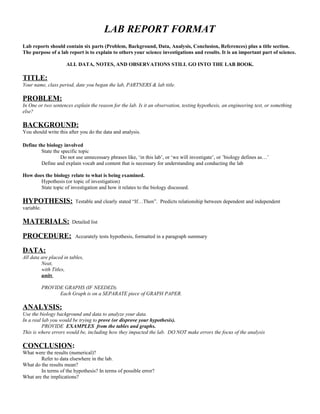
Lab reports should contain six parts (Problem, Background, Data, Analysis, Conclusion, References) plus a title section.
The purpose of a lab report is to explain to others your science investigations and results. It is an important part of science.
ALL DATA, NOTES, AND OBSERVATIONS STILL GO INTO THE LAB BOOK.

TITLE:
Your name, class period, date you began the lab, PARTNERS & lab title.

PROBLEM:
In One or two sentences explain the reason for the lab. Is it an observation, testing hypothesis, an engineering test, or something
else?

BACKGROUND:
You should write this after you do the data and analysis.
Define the biology involved
State the specific topic
Do not use unnecessary phrases like, ‘in this lab’, or ‘we will investigate’, or ’biology defines as…’
Define and explain vocab and content that is necessary for understanding and conducting the lab
How does the biology relate to what is being examined.
Hypothesis (or topic of investigation)
State topic of investigation and how it relates to the biology discussed.

HYPOTHESIS:

Testable and clearly stated “If…Then”. Predicts relationship between dependent and independent

variable.

MATERIALS:

Detailed list

PROCEDURE:

Accurately tests hypothesis, formatted in a paragraph summary

DATA:
All data are placed in tables,
Neat,
with Titles,
units
PROVIDE GRAPHS (IF NEEDED).
Each Graph is on a SEPARATE piece of GRAPH PAPER.

ANALYSIS:
Use the biology background and data to analyze your data.
In a real lab you would be trying to prove (or disprove your hypothesis).
PROVIDE EXAMPLES from the tables and graphs.
This is where errors would be, including how they impacted the lab. DO NOT make errors the focus of the analysis

CONCLUSION:
What were the results (numerical)?
Refer to data elsewhere in the lab.
What do the results mean?
In terms of the hypothesis? In terms of possible error?
What are the implications?
Literature cited:
List references using a standard format
Author, title, publisher, page(s)
Instructor, Course, Lecture title, date
Instructor, Course, Document title, date

Lab report format

  • 1.
    LAB REPORT FORMAT Labreports should contain six parts (Problem, Background, Data, Analysis, Conclusion, References) plus a title section. The purpose of a lab report is to explain to others your science investigations and results. It is an important part of science. ALL DATA, NOTES, AND OBSERVATIONS STILL GO INTO THE LAB BOOK. TITLE: Your name, class period, date you began the lab, PARTNERS & lab title. PROBLEM: In One or two sentences explain the reason for the lab. Is it an observation, testing hypothesis, an engineering test, or something else? BACKGROUND: You should write this after you do the data and analysis. Define the biology involved State the specific topic Do not use unnecessary phrases like, ‘in this lab’, or ‘we will investigate’, or ’biology defines as…’ Define and explain vocab and content that is necessary for understanding and conducting the lab How does the biology relate to what is being examined. Hypothesis (or topic of investigation) State topic of investigation and how it relates to the biology discussed. HYPOTHESIS: Testable and clearly stated “If…Then”. Predicts relationship between dependent and independent variable. MATERIALS: Detailed list PROCEDURE: Accurately tests hypothesis, formatted in a paragraph summary DATA: All data are placed in tables, Neat, with Titles, units PROVIDE GRAPHS (IF NEEDED). Each Graph is on a SEPARATE piece of GRAPH PAPER. ANALYSIS: Use the biology background and data to analyze your data. In a real lab you would be trying to prove (or disprove your hypothesis). PROVIDE EXAMPLES from the tables and graphs. This is where errors would be, including how they impacted the lab. DO NOT make errors the focus of the analysis CONCLUSION: What were the results (numerical)? Refer to data elsewhere in the lab. What do the results mean? In terms of the hypothesis? In terms of possible error? What are the implications?
  • 2.
    Literature cited: List referencesusing a standard format Author, title, publisher, page(s) Instructor, Course, Lecture title, date Instructor, Course, Document title, date