LAB REPORTS
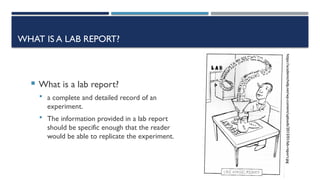
WHAT IS A LAB REPORT?
 What is a lab report?
 a complete and detailed record of an
experiment.
 The information provided in a lab report
should be specific enough that the reader
would be able to replicate the experiment.
https://academichelp.net/wp-content/uploads/2013/01/lab-report.jpg
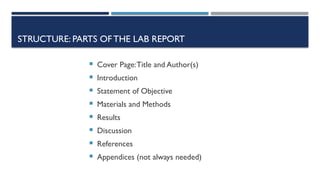
STRUCTURE: PARTS OFTHE LAB REPORT
 Cover Page:Title and Author(s)
 Introduction
 Statement of Objective
 Materials and Methods
 Results
 Discussion
 References
 Appendices (not always needed)
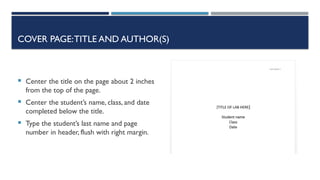
COVER PAGE:TITLE AND AUTHOR(S)
 Center the title on the page about 2 inches
from the top of the page.
 Center the student’s name, class, and date
completed below the title.
 Type the student’s last name and page
number in header, flush with right margin.
INTRODUCTION
What it contains:
 Context of study
 Pertinent background information
 Written in Past Passive tense
 Should be one to two paragraphs
long depending upon the experiment
conducted
What it does not contain:
 Results
 Conclusions about the study
 Non-relevant information
STATEMENT OF OBJECTIVE
 Objective of the experiment
 Answers two questions:
 Why is this experiment being performed?
 What information can I learn?
 Hypothesis
 The student’s educated prediction about
the outcome of the experiment
 Must be clearly stated and specific
 It’s okay for your hypothesis to be
wrong!
MATERIALS AND METHODS
 Contains materials and equipment used along with any explanation(s) of equipment, if
necessary.
 Contains the step-by-step process followed to conduct the experiment.
 Written in paragraph form, NOT a bulleted list.
 Always written in third person (do not use “I”).
 Be as detailed as possible.
 The purpose of this section is to allow another person to follow the instructions and
replicate the experiment.
RESULTS
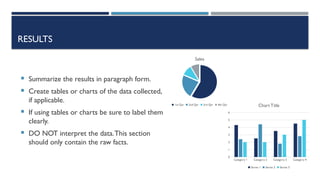
 Summarize the results in paragraph form.
 Create tables or charts of the data collected,
if applicable.
 If using tables or charts be sure to label them
clearly.
 DO NOT interpret the data.This section
should only contain the raw facts.
Category 1 Category 2 Category 3 Category 4
0
1
2
3
4
5
6
Chart Title
Series 1 Series 2 Series 3
Sales
1st Qtr 2nd Qtr 3rd Qtr 4th Qtr
DISCUSSION
Interpretation of data collected
Did the experiment prove or disprove the hypothesis?
If hypothesis was wrong, why and how was it wrong?
Did any errors occur during the procedure?
How might these errors be avoided in the future?
Discussion of the implication of results
REFERENCES
 See your professor to determine if outside sources are necessary and what format to cite
them in.
 Your lab manual counts as a source.
 All sources used should be recorded on a separate page at the end of the report.
 This page is titled either References (APA) or Works Cited (MLA).
 References should be organized alphabetically by authors’ last names.
Need citation help? See aWriting Center Coach or check out the SSTC’s Online Resource Center for more information!
THINGS TO KEEP IN MIND!
 Remember to keep your writing in Past Passive tense.
 Everything is presented as if by a passive-third party observer.
 Ex.You would not say “Timmy ate the bagel.” Rather, you would say “The bagel was eaten.”
 There is an example of a lab report in your lab manual.You can always refer to that if
necessary.
 Have a question? Remember you can always check with your professor!
 Do you need to have an Abstract?
 Do you need to have Appendices?
RESOURCES
 Successful Lab Reports
 Purdue OWL https://owl.english.purdue.edu/owl/resource/726/06/
 Hamilton College http://www.hamilton.edu/writing/writing-resources/lab-reports-for-biology
 Duke University http://twp.duke.edu/uploads/assets/lab_reports.pdf

Lab Report Guidelines for high school notebook

  • 1.
  • 2.
    WHAT IS ALAB REPORT?  What is a lab report?  a complete and detailed record of an experiment.  The information provided in a lab report should be specific enough that the reader would be able to replicate the experiment. https://academichelp.net/wp-content/uploads/2013/01/lab-report.jpg
  • 3.
    STRUCTURE: PARTS OFTHELAB REPORT  Cover Page:Title and Author(s)  Introduction  Statement of Objective  Materials and Methods  Results  Discussion  References  Appendices (not always needed)
  • 4.
    COVER PAGE:TITLE ANDAUTHOR(S)  Center the title on the page about 2 inches from the top of the page.  Center the student’s name, class, and date completed below the title.  Type the student’s last name and page number in header, flush with right margin.
  • 5.
    INTRODUCTION What it contains: Context of study  Pertinent background information  Written in Past Passive tense  Should be one to two paragraphs long depending upon the experiment conducted What it does not contain:  Results  Conclusions about the study  Non-relevant information
  • 6.
    STATEMENT OF OBJECTIVE Objective of the experiment  Answers two questions:  Why is this experiment being performed?  What information can I learn?  Hypothesis  The student’s educated prediction about the outcome of the experiment  Must be clearly stated and specific  It’s okay for your hypothesis to be wrong!
  • 7.
    MATERIALS AND METHODS Contains materials and equipment used along with any explanation(s) of equipment, if necessary.  Contains the step-by-step process followed to conduct the experiment.  Written in paragraph form, NOT a bulleted list.  Always written in third person (do not use “I”).  Be as detailed as possible.  The purpose of this section is to allow another person to follow the instructions and replicate the experiment.
  • 8.
    RESULTS  Summarize theresults in paragraph form.  Create tables or charts of the data collected, if applicable.  If using tables or charts be sure to label them clearly.  DO NOT interpret the data.This section should only contain the raw facts. Category 1 Category 2 Category 3 Category 4 0 1 2 3 4 5 6 Chart Title Series 1 Series 2 Series 3 Sales 1st Qtr 2nd Qtr 3rd Qtr 4th Qtr
  • 9.
    DISCUSSION Interpretation of datacollected Did the experiment prove or disprove the hypothesis? If hypothesis was wrong, why and how was it wrong? Did any errors occur during the procedure? How might these errors be avoided in the future? Discussion of the implication of results
  • 10.
    REFERENCES  See yourprofessor to determine if outside sources are necessary and what format to cite them in.  Your lab manual counts as a source.  All sources used should be recorded on a separate page at the end of the report.  This page is titled either References (APA) or Works Cited (MLA).  References should be organized alphabetically by authors’ last names. Need citation help? See aWriting Center Coach or check out the SSTC’s Online Resource Center for more information!
  • 11.
    THINGS TO KEEPIN MIND!  Remember to keep your writing in Past Passive tense.  Everything is presented as if by a passive-third party observer.  Ex.You would not say “Timmy ate the bagel.” Rather, you would say “The bagel was eaten.”  There is an example of a lab report in your lab manual.You can always refer to that if necessary.  Have a question? Remember you can always check with your professor!  Do you need to have an Abstract?  Do you need to have Appendices?
  • 12.
    RESOURCES  Successful LabReports  Purdue OWL https://owl.english.purdue.edu/owl/resource/726/06/  Hamilton College http://www.hamilton.edu/writing/writing-resources/lab-reports-for-biology  Duke University http://twp.duke.edu/uploads/assets/lab_reports.pdf