SYSTEM APPROACH OF
MANAGEMENT
Presented by: Sauran Rijal
Outlines
• Introduction
• System theory
• Elements of system theory
• Contribution of system theory
• Limitation of system theory
Introduction
• As system can be define as a set of interrelated and interdepended
parts arranged in a manner that produce a unified.
• The system consist of a number of subsystems and all the subsystems
are related to each others.
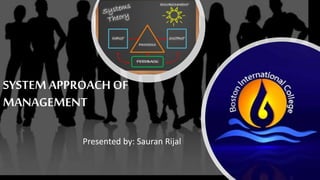
• The system theory can be best studied on the basis of input
processing and output component.
• Systems theory or general systems theory or systemics is an
interdisciplinary field which studies systems as a whole.
• Systems theory was founded by Ludwig von Bertalanffy, William Ross
Ashby and others between the 1940s and the 1970s on principles
from physics, biology and engineering and later grew into numerous
fields including philosophy, sociology, organizational theory,
management, psychotherapy (within family systems therapy) and
economics among others.
Elements of system theory
1. Goal orientation
2. Subsystem
3. Synergy
4. System boundary
5. Flow
6. Feedback
7. Open or closed system
Contributions
• Its provides conceptual framework for a meaningful
analysis of management and organization .
• Its guides managers to lay proper emphasis on the
interdependence and interrelations of various parts
,between orgn and environment .
Limitations
• It is too abstract and cannot be directly and easily applied
to practical problems.
• It dose not offers any tools or techniques of integrations
and nature of interdependencies between organization
and environment.
Conclusion
system theory

system theory

  • 1.
  • 2.
    Outlines • Introduction • Systemtheory • Elements of system theory • Contribution of system theory • Limitation of system theory
  • 3.
    Introduction • As systemcan be define as a set of interrelated and interdepended parts arranged in a manner that produce a unified. • The system consist of a number of subsystems and all the subsystems are related to each others. • The system theory can be best studied on the basis of input processing and output component.
  • 4.
    • Systems theoryor general systems theory or systemics is an interdisciplinary field which studies systems as a whole. • Systems theory was founded by Ludwig von Bertalanffy, William Ross Ashby and others between the 1940s and the 1970s on principles from physics, biology and engineering and later grew into numerous fields including philosophy, sociology, organizational theory, management, psychotherapy (within family systems therapy) and economics among others.
  • 6.
    Elements of systemtheory 1. Goal orientation 2. Subsystem 3. Synergy 4. System boundary 5. Flow 6. Feedback 7. Open or closed system
  • 7.
    Contributions • Its providesconceptual framework for a meaningful analysis of management and organization . • Its guides managers to lay proper emphasis on the interdependence and interrelations of various parts ,between orgn and environment .
  • 8.
    Limitations • It istoo abstract and cannot be directly and easily applied to practical problems. • It dose not offers any tools or techniques of integrations and nature of interdependencies between organization and environment.
  • 9.