SYMMETRY ELEMENTS
AND OPERATIONS
PROF. SOURABH MUKTIBODH
OLD GDC, INDORE
The symmetry
properties of molecules
can be used to predict
vibrational spectra,
hybridization, optical
activity, simplifying
calculations in quantum
mechanics etc.
SOURABH MUKTIBODH
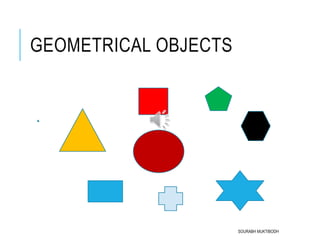
THE TERM SYMMETRY IS
ASSOCIATED WITH-
1. Beauty
2. Regularity
3. Periodicity
4. Harmonicity and
5. Systemization
In geometrical objects.
(molecules for chemist)
SOURABH MUKTIBODH
GEOMETRICAL OBJECTS
SOURABH MUKTIBODH
AND THE MONUMENTS
SOURABH MUKTIBODH
THE EIFFIL TOWER
SOURABH MUKTIBODH
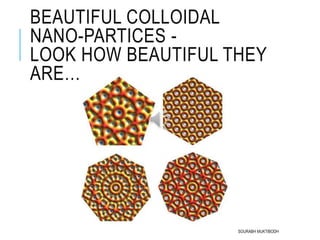
BEAUTIFUL COLLOIDAL
NANO-PARTICES -
LOOK HOW BEAUTIFUL THEY
ARE…….
SOURABH MUKTIBODH
THE QUESTION IS-
How to quantify this beauty aspect
?
and
The answer is……….
SOURABH MUKTIBODH
SYMMETRY ELEMENTS AND
OPERATIONS
Symmetry elements are geometrical entities such
as a plane, an axis (of rotation), centers (of inversion),
etc., through which a symmetry operation can be
performed.
A molecule has a given symmetry element if the
operation leaves the molecule looks as if nothing has
changed (even though atoms and bonds may have been
moved). A symmetry operation produces a
superimposable configuration. (equivalent or
identical configuration.)
SOURABH MUKTIBODH
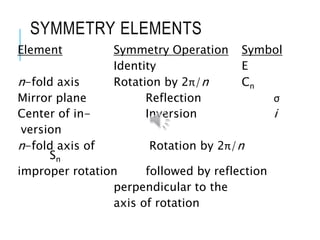
SYMMETRY ELEMENTS
Element Symmetry Operation Symbol
Identity E
n-fold axis Rotation by 2π/n Cn
Mirror plane Reflection σ
Center of in- Inversion i
version
n-fold axis of Rotation by 2π/n
Sn
improper rotation followed by reflection
perpendicular to the
axis of rotation
IDENTITY, E
All molecules have Identity. This operation leaves
the entire molecule unchanged. A highly asymmetric
molecule such as a tetrahedral carbon with 4 different
groups attached has only identity, and no other
symmetry elements. It also signifies operation
of doing nothing. It is there for
mathematical reasons., such as in Group
theory.
Note- some chemists do not consider
this as an operation.
SOURABH MUKTIBODH
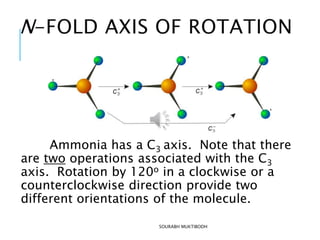
N-FOLD AXIS OF ROTATION
Ammonia has a C3 axis. Note that there
are two operations associated with the C3
axis. Rotation by 120o in a clockwise or a
counterclockwise direction provide two
different orientations of the molecule.
SOURABH MUKTIBODH
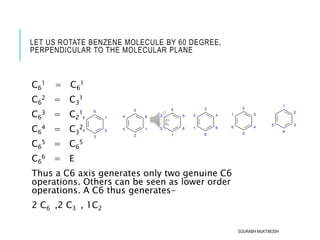
LET US ROTATE BENZENE MOLECULE BY 60 DEGREE,
PERPENDICULAR TO THE MOLECULAR PLANE
C6
1 = C6
1
C6
2 = C3
1
C6
3 = C2
1
C6
4 = C3
2
C6
5 = C6
5
C6
6 = E
Thus a C6 axis generates only two genuine C6
operations. Others can be seen as lower order
operations. A C6 thus generates-
2 C6 ,2 C3 , 1C2
1
2
6
3
5
4
6
1
5
2
4
3
5
6
4
1
3
2
4
5
3
6
2
1
3
4
2
5
1
6
2
3
1
4
5
SOURABH MUKTIBODH
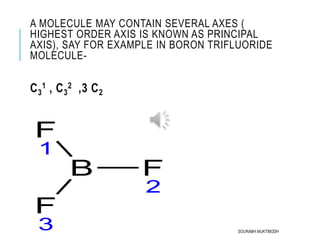
A MOLECULE MAY CONTAIN SEVERAL AXES (
HIGHEST ORDER AXIS IS KNOWN AS PRINCIPAL
AXIS), SAY FOR EXAMPLE IN BORON TRIFLUORIDE
MOLECULE-
C3
1 , C3
2 ,3 C2
B F
2
F
1
F
3 SOURABH MUKTIBODH
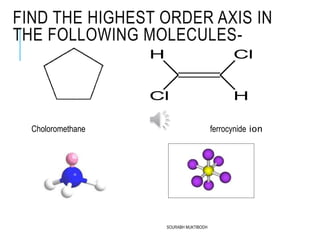
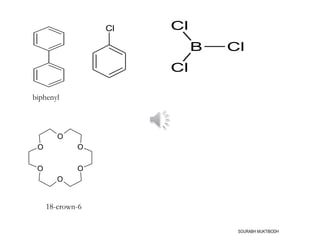
FIND THE HIGHEST ORDER AXIS IN
THE FOLLOWING MOLECULES-
Choloromethane ferrocynide ion
H
ClH
Cl
SOURABH MUKTIBODH
Cl
B Cl
Cl
Cl
O
O
O
O
O
O
biphenyl
18-crown-6
SOURABH MUKTIBODH
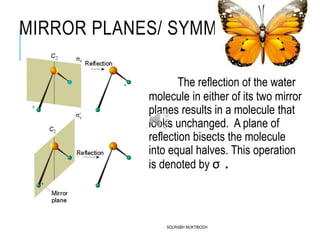
MIRROR PLANES/ SYMMETRY
The reflection of the water
molecule in either of its two mirror
planes results in a molecule that
looks unchanged. A plane of
reflection bisects the molecule
into equal halves. This operation
is denoted by σ .
SOURABH MUKTIBODH
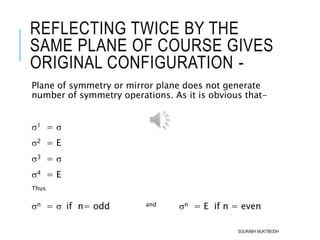
REFLECTING TWICE BY THE
SAME PLANE OF COURSE GIVES
ORIGINAL CONFIGURATION -
Plane of symmetry or mirror plane does not generate
number of symmetry operations. As it is obvious that-
1 = 
2 = E
3 = 
4 = E
Thus
n =  if n= odd and n = E if n = even
SOURABH MUKTIBODH
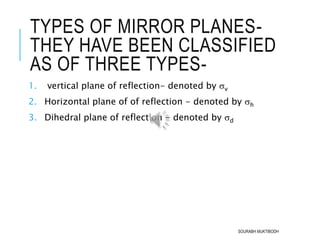
TYPES OF MIRROR PLANES-
THEY HAVE BEEN CLASSIFIED
AS OF THREE TYPES-
1. vertical plane of reflection- denoted by v
2. Horizontal plane of of reflection - denoted by h
3. Dihedral plane of reflection - denoted by d
SOURABH MUKTIBODH
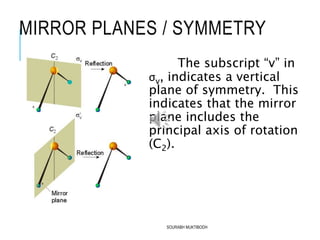
MIRROR PLANES / SYMMETRY
The subscript “v” in
σv, indicates a vertical
plane of symmetry. This
indicates that the mirror
plane includes the
principal axis of rotation
(C2).
SOURABH MUKTIBODH
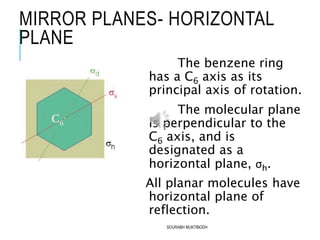
MIRROR PLANES- HORIZONTAL
PLANE
The benzene ring
has a C6 axis as its
principal axis of rotation.
The molecular plane
is perpendicular to the
C6 axis, and is
designated as a
horizontal plane, σh.
All planar molecules have
horizontal plane of
reflection.
C6
.
SOURABH MUKTIBODH
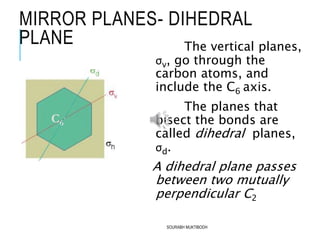
MIRROR PLANES- DIHEDRAL
PLANE The vertical planes,
σv, go through the
carbon atoms, and
include the C6 axis.
The planes that
bisect the bonds are
called dihedral planes,
σd.
A dihedral plane passes
between two mutually
perpendicular C2
C6
.
SOURABH MUKTIBODH
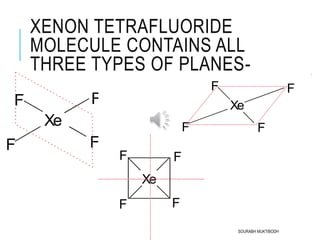
XENON TETRAFLUORIDE
MOLECULE CONTAINS ALL
THREE TYPES OF PLANES-
Xe
F F
F F
Xe
F F
F F
Xe
F F
F F
SOURABH MUKTIBODH
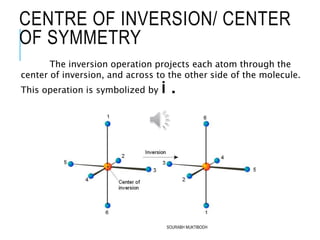
CENTRE OF INVERSION/ CENTER
OF SYMMETRY
The inversion operation projects each atom through the
center of inversion, and across to the other side of the molecule.
This operation is symbolized by i .
SOURABH MUKTIBODH
INVERSION CENTRE
We proceed to identify centre of symmetry as following-
1. choose a centre within the molecule.
2. draw lines in the direction where the atoms are
located.
3. if the same atom in equal and opposite direction is
seen, true for every situation, than the molecule
possesses a centre of symmetry.
SOURABH MUKTIBODH
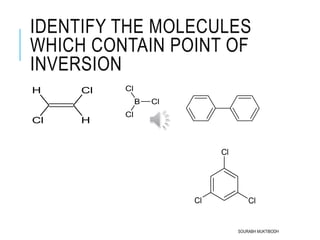
IDENTIFY THE MOLECULES
WHICH CONTAIN POINT OF
INVERSION
H
ClH
Cl
B Cl
Cl
Cl
Cl
ClCl
SOURABH MUKTIBODH
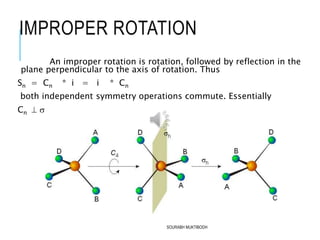
IMPROPER ROTATION
An improper rotation is rotation, followed by reflection in the
plane perpendicular to the axis of rotation. Thus
Sn = Cn * i = i * Cn
both independent symmetry operations commute. Essentially
Cn  
SOURABH MUKTIBODH
IMPROPER ROTATION
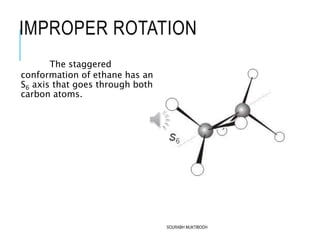
The staggered
conformation of ethane has an
S6 axis that goes through both
carbon atoms.
SOURABH MUKTIBODH
IMPROPER ROTATION
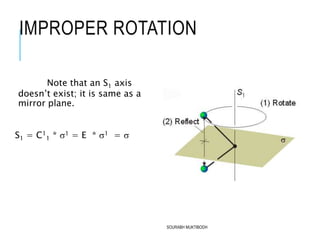
Note that an S1 axis
doesn’t exist; it is same as a
mirror plane.
S1 = C1
1 * 1 = E * 1 = 
SOURABH MUKTIBODH
NOTE THAT SIMILAR TO PROPER
ROTATION, IMPROPER ROTATION
ALSO GENERATES N-1
OPERATIONS, N BEING THE
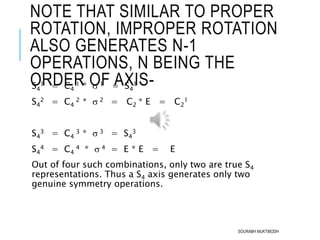
ORDER OF AXIS-S4
1 = C4
1 *  1 = S4
1
S4
2 = C4
2 *  2 = C2 * E = C2
1
S4
3 = C4
3 *  3 = S4
3
S4
4 = C4
4 *  4 = E * E = E
Out of four such combinations, only two are true S4
representations. Thus a S4 axis generates only two
genuine symmetry operations.
SOURABH MUKTIBODH
IMPROPER ROTATION
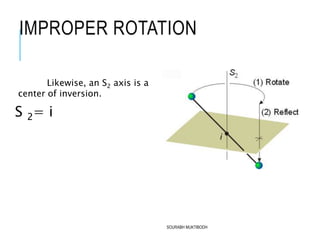
Likewise, an S2 axis is a
center of inversion.
S 2= i
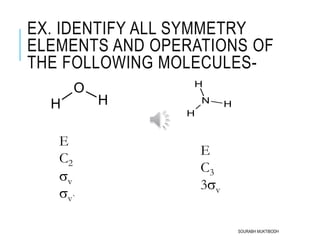
SOURABH MUKTIBODH
EX. IDENTIFY ALL SYMMETRY
ELEMENTS AND OPERATIONS OF
THE FOLLOWING MOLECULES-
O
HH N H
H
H
E
C2
v
v`
E
C3
3v
SOURABH MUKTIBODH
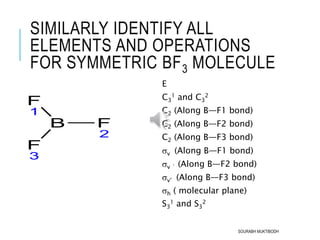
SIMILARLY IDENTIFY ALL
ELEMENTS AND OPERATIONS
FOR SYMMETRIC BF3 MOLECULE
E
C3
1 and C3
2
C2 (Along B—F1 bond)
C2 (Along B—F2 bond)
C2 (Along B—F3 bond)
v (Along B—F1 bond)
v ` (Along B—F2 bond)
v’ (Along B—F3 bond)
h ( molecular plane)
S3
1 and S3
2
B F
2
F
1
F
3
SOURABH MUKTIBODH
SUMMARY
1. Symmetry elements and operations are though, two
slightly different terms, but are often treated collectively.
2. A symmetry operation produces superimposable
configuration.
3. There are five fundamental symmetry elements and
operations. They are 1. identity (E) 2. proper rotation (
Cn) 3. mirror symmetry or reflection () 4. centre of
symmetry or inversion centre (i) and 5. improper
rotation.(Sn)
4. A molecule may or may not contain all symmetry
elements and operations. More operations present
assures more symmetric nature.
5. Symmetry elements and operations allow us to identify
point group of the molecule and then detailed
applications of group theory can be explored.
SOURABH MUKTIBODH
REFERENCES
A.F.Cotton “ Chemical Applications of Group Theory”
ISBN 0471510947
Next- Molecular point group
SOURABH MUKTIBODH

Symmetry Elements and Operations ppt

  • 1.
    SYMMETRY ELEMENTS AND OPERATIONS PROF.SOURABH MUKTIBODH OLD GDC, INDORE The symmetry properties of molecules can be used to predict vibrational spectra, hybridization, optical activity, simplifying calculations in quantum mechanics etc. SOURABH MUKTIBODH
  • 2.
    THE TERM SYMMETRYIS ASSOCIATED WITH- 1. Beauty 2. Regularity 3. Periodicity 4. Harmonicity and 5. Systemization In geometrical objects. (molecules for chemist) SOURABH MUKTIBODH
  • 3.
  • 4.
  • 5.
  • 6.
    BEAUTIFUL COLLOIDAL NANO-PARTICES - LOOKHOW BEAUTIFUL THEY ARE……. SOURABH MUKTIBODH
  • 7.
    THE QUESTION IS- Howto quantify this beauty aspect ? and The answer is………. SOURABH MUKTIBODH
  • 8.
    SYMMETRY ELEMENTS AND OPERATIONS Symmetryelements are geometrical entities such as a plane, an axis (of rotation), centers (of inversion), etc., through which a symmetry operation can be performed. A molecule has a given symmetry element if the operation leaves the molecule looks as if nothing has changed (even though atoms and bonds may have been moved). A symmetry operation produces a superimposable configuration. (equivalent or identical configuration.) SOURABH MUKTIBODH
  • 9.
    SYMMETRY ELEMENTS Element SymmetryOperation Symbol Identity E n-fold axis Rotation by 2π/n Cn Mirror plane Reflection σ Center of in- Inversion i version n-fold axis of Rotation by 2π/n Sn improper rotation followed by reflection perpendicular to the axis of rotation
  • 10.
    IDENTITY, E All moleculeshave Identity. This operation leaves the entire molecule unchanged. A highly asymmetric molecule such as a tetrahedral carbon with 4 different groups attached has only identity, and no other symmetry elements. It also signifies operation of doing nothing. It is there for mathematical reasons., such as in Group theory. Note- some chemists do not consider this as an operation. SOURABH MUKTIBODH
  • 11.
    N-FOLD AXIS OFROTATION Ammonia has a C3 axis. Note that there are two operations associated with the C3 axis. Rotation by 120o in a clockwise or a counterclockwise direction provide two different orientations of the molecule. SOURABH MUKTIBODH
  • 12.
    LET US ROTATEBENZENE MOLECULE BY 60 DEGREE, PERPENDICULAR TO THE MOLECULAR PLANE C6 1 = C6 1 C6 2 = C3 1 C6 3 = C2 1 C6 4 = C3 2 C6 5 = C6 5 C6 6 = E Thus a C6 axis generates only two genuine C6 operations. Others can be seen as lower order operations. A C6 thus generates- 2 C6 ,2 C3 , 1C2 1 2 6 3 5 4 6 1 5 2 4 3 5 6 4 1 3 2 4 5 3 6 2 1 3 4 2 5 1 6 2 3 1 4 5 SOURABH MUKTIBODH
  • 13.
    A MOLECULE MAYCONTAIN SEVERAL AXES ( HIGHEST ORDER AXIS IS KNOWN AS PRINCIPAL AXIS), SAY FOR EXAMPLE IN BORON TRIFLUORIDE MOLECULE- C3 1 , C3 2 ,3 C2 B F 2 F 1 F 3 SOURABH MUKTIBODH
  • 14.
    FIND THE HIGHESTORDER AXIS IN THE FOLLOWING MOLECULES- Choloromethane ferrocynide ion H ClH Cl SOURABH MUKTIBODH
  • 15.
  • 16.
    MIRROR PLANES/ SYMMETRY Thereflection of the water molecule in either of its two mirror planes results in a molecule that looks unchanged. A plane of reflection bisects the molecule into equal halves. This operation is denoted by σ . SOURABH MUKTIBODH
  • 17.
    REFLECTING TWICE BYTHE SAME PLANE OF COURSE GIVES ORIGINAL CONFIGURATION - Plane of symmetry or mirror plane does not generate number of symmetry operations. As it is obvious that- 1 =  2 = E 3 =  4 = E Thus n =  if n= odd and n = E if n = even SOURABH MUKTIBODH
  • 18.
    TYPES OF MIRRORPLANES- THEY HAVE BEEN CLASSIFIED AS OF THREE TYPES- 1. vertical plane of reflection- denoted by v 2. Horizontal plane of of reflection - denoted by h 3. Dihedral plane of reflection - denoted by d SOURABH MUKTIBODH
  • 19.
    MIRROR PLANES /SYMMETRY The subscript “v” in σv, indicates a vertical plane of symmetry. This indicates that the mirror plane includes the principal axis of rotation (C2). SOURABH MUKTIBODH
  • 20.
    MIRROR PLANES- HORIZONTAL PLANE Thebenzene ring has a C6 axis as its principal axis of rotation. The molecular plane is perpendicular to the C6 axis, and is designated as a horizontal plane, σh. All planar molecules have horizontal plane of reflection. C6 . SOURABH MUKTIBODH
  • 21.
    MIRROR PLANES- DIHEDRAL PLANEThe vertical planes, σv, go through the carbon atoms, and include the C6 axis. The planes that bisect the bonds are called dihedral planes, σd. A dihedral plane passes between two mutually perpendicular C2 C6 . SOURABH MUKTIBODH
  • 22.
    XENON TETRAFLUORIDE MOLECULE CONTAINSALL THREE TYPES OF PLANES- Xe F F F F Xe F F F F Xe F F F F SOURABH MUKTIBODH
  • 23.
    CENTRE OF INVERSION/CENTER OF SYMMETRY The inversion operation projects each atom through the center of inversion, and across to the other side of the molecule. This operation is symbolized by i . SOURABH MUKTIBODH
  • 24.
    INVERSION CENTRE We proceedto identify centre of symmetry as following- 1. choose a centre within the molecule. 2. draw lines in the direction where the atoms are located. 3. if the same atom in equal and opposite direction is seen, true for every situation, than the molecule possesses a centre of symmetry. SOURABH MUKTIBODH
  • 25.
    IDENTIFY THE MOLECULES WHICHCONTAIN POINT OF INVERSION H ClH Cl B Cl Cl Cl Cl ClCl SOURABH MUKTIBODH
  • 26.
    IMPROPER ROTATION An improperrotation is rotation, followed by reflection in the plane perpendicular to the axis of rotation. Thus Sn = Cn * i = i * Cn both independent symmetry operations commute. Essentially Cn   SOURABH MUKTIBODH
  • 27.
    IMPROPER ROTATION The staggered conformationof ethane has an S6 axis that goes through both carbon atoms. SOURABH MUKTIBODH
  • 28.
    IMPROPER ROTATION Note thatan S1 axis doesn’t exist; it is same as a mirror plane. S1 = C1 1 * 1 = E * 1 =  SOURABH MUKTIBODH
  • 29.
    NOTE THAT SIMILARTO PROPER ROTATION, IMPROPER ROTATION ALSO GENERATES N-1 OPERATIONS, N BEING THE ORDER OF AXIS-S4 1 = C4 1 *  1 = S4 1 S4 2 = C4 2 *  2 = C2 * E = C2 1 S4 3 = C4 3 *  3 = S4 3 S4 4 = C4 4 *  4 = E * E = E Out of four such combinations, only two are true S4 representations. Thus a S4 axis generates only two genuine symmetry operations. SOURABH MUKTIBODH
  • 30.
    IMPROPER ROTATION Likewise, anS2 axis is a center of inversion. S 2= i SOURABH MUKTIBODH
  • 31.
    EX. IDENTIFY ALLSYMMETRY ELEMENTS AND OPERATIONS OF THE FOLLOWING MOLECULES- O HH N H H H E C2 v v` E C3 3v SOURABH MUKTIBODH
  • 32.
    SIMILARLY IDENTIFY ALL ELEMENTSAND OPERATIONS FOR SYMMETRIC BF3 MOLECULE E C3 1 and C3 2 C2 (Along B—F1 bond) C2 (Along B—F2 bond) C2 (Along B—F3 bond) v (Along B—F1 bond) v ` (Along B—F2 bond) v’ (Along B—F3 bond) h ( molecular plane) S3 1 and S3 2 B F 2 F 1 F 3 SOURABH MUKTIBODH
  • 33.
    SUMMARY 1. Symmetry elementsand operations are though, two slightly different terms, but are often treated collectively. 2. A symmetry operation produces superimposable configuration. 3. There are five fundamental symmetry elements and operations. They are 1. identity (E) 2. proper rotation ( Cn) 3. mirror symmetry or reflection () 4. centre of symmetry or inversion centre (i) and 5. improper rotation.(Sn) 4. A molecule may or may not contain all symmetry elements and operations. More operations present assures more symmetric nature. 5. Symmetry elements and operations allow us to identify point group of the molecule and then detailed applications of group theory can be explored. SOURABH MUKTIBODH
  • 34.
    REFERENCES A.F.Cotton “ ChemicalApplications of Group Theory” ISBN 0471510947 Next- Molecular point group SOURABH MUKTIBODH