

AUTARKY
INTRODUCTION
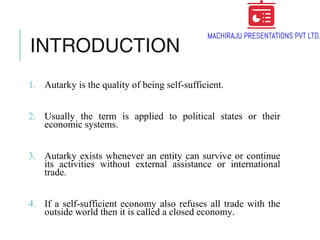
1. Autarky is the quality of being self-sufficient.
2. Usually the term is applied to political states or their
economic systems.
3. Autarky exists whenever an entity can survive or continue
its activities without external assistance or international
trade.
4. If a self-sufficient economy also refuses all trade with the
outside world then it is called a closed economy.
SIMPLE EXPLANATION
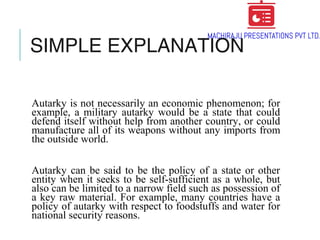
Autarky is not necessarily an economic phenomenon; for
example, a military autarky would be a state that could
defend itself without help from another country, or could
manufacture all of its weapons without any imports from
the outside world.
Autarky can be said to be the policy of a state or other
entity when it seeks to be self-sufficient as a whole, but
also can be limited to a narrow field such as possession of
a key raw material. For example, many countries have a
policy of autarky with respect to foodstuffs and water for
national security reasons.
PROPONENTS OF
AUTARKY
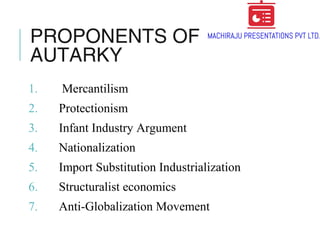
1. Mercantilism
2. Protectionism
3. Infant Industry Argument
4. Nationalization
5. Import Substitution Industrialization
6. Structuralist economics
7. Anti-Globalization Movement
OPPONENTS OF
AUTARKY
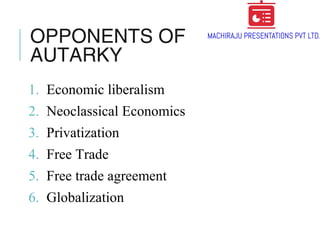
1. Economic liberalism
2. Neoclassical Economics
3. Privatization
4. Free Trade
5. Free trade agreement
6. Globalization
EXAMPLES
Afghanistan, Islamic State of Afghanistan; Under the Taliban,
from 1996 to 2001.
Albania, Peoples Republic of Albania; Became a near-autarky
in 1976, when Communist Party leader Enver Hoxha instituted
a policy of what he termed "self-reliance".Outside trade
increased after Hoxha's death in 1985, though it remained
severely restricted until 1991.
Myanmar, Union of Burma; Followed a policy of autarky
known as the Burmese Way to Socialism under dictator Ne
Win, who ruled the country from 1962 to 1988.
Cambodia, Democratic Kampuchea; Under the Khmer Rouge,
1975–1979.
EXAMPLES
Nazi Germany; Under Adolf Hitler attempted to end
international trade and considered economic self-sufficiency to
be ideal. However, tasked with establishing full autarky in
Germany as part of the Four Year Plan, (beginning in 1936)
Hermann Göring failed to close the German economy.
Guyana; Under Forbes Burnham's PNC dictatorship, from
1970 to 1985.
India; Had a policy of near-autarky that began after its
establishment as an independent state, around 1950; it
increased until 1980 and ended in 1991 due to imminent
bankruptcy.
EXAMPLES
Kingdom of Italy; Under the rule of dictator Benito Mussolini,
claimed to be an autarky,especially after the 1935 invasion of
Abyssinia and subsequent trade embargoes. However, it still
conducted trade with Germany and elsewhere.
Japan; Was partially an autarky during the era known as the "Edo
period", prior to its opening to the west in the 1850s, as part of its
policy of sakoku. There was a moderate amount of trade with
Netherlands, China and Korea; trade with all other countries was
confined to a single port on the island of Dejima.
North Korea; State ideology, Juche, is somewhat based on autarky,
though North Korea is not a genuine autarky as it conducts principles
of trade with a few nations, as well as benefits on Chinese capital and
trade.
EXAMPLES
Romania, People's Republic of Romania; in the 1980s. Nicolae
Ceau escu proposed such goals as paying the entire foreign debt andș
increasing the number of items produced in the country and their
quality. The aim of these policies was to reduce dependency on
foreign imports, as the relationship of Ceau escu with both Westernș
and Communist leaders was worsening.
South Africa; Was forced into partial autarky during the later
Apartheid era, when the country faced ever increasing economic
sanctions from the international community, including an increasing
oil embargo that motivated the state to embark on a successful coal-
to-oil project and also establish its own military industries, including
the creation of its own atomic bomb.
Spain; Under dictator Francisco Franco, was an autarky from 1939
until Franco allowed outside trade again in 1959, coinciding with the
beginning of the Spanish miracle.
EXAMPLES
United States; While still emerging from the American
Revolution and wary of the economic and military might of
Great Britain, came close to complete autarky in 1808 when
President Jefferson declared a self-imposed embargo on
international shipping. The embargo lasted from December
1807 to March 1809.
Dominican Republic; The rural peasants, escaped slaves, and
freed slaves that lived in the sparsely populated woodland
interior of the island nation between the 1600s and early 1900s.
The weak Dominican government had no control on these
autonomous subsistence agriculture based communities.
Autarky : Proponents, Opponents & Examples

Autarky : Proponents, Opponents & Examples

  • 1.
  • 2.
    INTRODUCTION 1. Autarky isthe quality of being self-sufficient. 2. Usually the term is applied to political states or their economic systems. 3. Autarky exists whenever an entity can survive or continue its activities without external assistance or international trade. 4. If a self-sufficient economy also refuses all trade with the outside world then it is called a closed economy.
  • 3.
    SIMPLE EXPLANATION Autarky isnot necessarily an economic phenomenon; for example, a military autarky would be a state that could defend itself without help from another country, or could manufacture all of its weapons without any imports from the outside world. Autarky can be said to be the policy of a state or other entity when it seeks to be self-sufficient as a whole, but also can be limited to a narrow field such as possession of a key raw material. For example, many countries have a policy of autarky with respect to foodstuffs and water for national security reasons.
  • 4.
    PROPONENTS OF AUTARKY 1. Mercantilism 2.Protectionism 3. Infant Industry Argument 4. Nationalization 5. Import Substitution Industrialization 6. Structuralist economics 7. Anti-Globalization Movement
  • 5.
    OPPONENTS OF AUTARKY 1. Economicliberalism 2. Neoclassical Economics 3. Privatization 4. Free Trade 5. Free trade agreement 6. Globalization
  • 6.
    EXAMPLES Afghanistan, Islamic Stateof Afghanistan; Under the Taliban, from 1996 to 2001. Albania, Peoples Republic of Albania; Became a near-autarky in 1976, when Communist Party leader Enver Hoxha instituted a policy of what he termed "self-reliance".Outside trade increased after Hoxha's death in 1985, though it remained severely restricted until 1991. Myanmar, Union of Burma; Followed a policy of autarky known as the Burmese Way to Socialism under dictator Ne Win, who ruled the country from 1962 to 1988. Cambodia, Democratic Kampuchea; Under the Khmer Rouge, 1975–1979.
  • 7.
    EXAMPLES Nazi Germany; UnderAdolf Hitler attempted to end international trade and considered economic self-sufficiency to be ideal. However, tasked with establishing full autarky in Germany as part of the Four Year Plan, (beginning in 1936) Hermann Göring failed to close the German economy. Guyana; Under Forbes Burnham's PNC dictatorship, from 1970 to 1985. India; Had a policy of near-autarky that began after its establishment as an independent state, around 1950; it increased until 1980 and ended in 1991 due to imminent bankruptcy.
  • 8.
    EXAMPLES Kingdom of Italy;Under the rule of dictator Benito Mussolini, claimed to be an autarky,especially after the 1935 invasion of Abyssinia and subsequent trade embargoes. However, it still conducted trade with Germany and elsewhere. Japan; Was partially an autarky during the era known as the "Edo period", prior to its opening to the west in the 1850s, as part of its policy of sakoku. There was a moderate amount of trade with Netherlands, China and Korea; trade with all other countries was confined to a single port on the island of Dejima. North Korea; State ideology, Juche, is somewhat based on autarky, though North Korea is not a genuine autarky as it conducts principles of trade with a few nations, as well as benefits on Chinese capital and trade.
  • 9.
    EXAMPLES Romania, People's Republicof Romania; in the 1980s. Nicolae Ceau escu proposed such goals as paying the entire foreign debt andș increasing the number of items produced in the country and their quality. The aim of these policies was to reduce dependency on foreign imports, as the relationship of Ceau escu with both Westernș and Communist leaders was worsening. South Africa; Was forced into partial autarky during the later Apartheid era, when the country faced ever increasing economic sanctions from the international community, including an increasing oil embargo that motivated the state to embark on a successful coal- to-oil project and also establish its own military industries, including the creation of its own atomic bomb. Spain; Under dictator Francisco Franco, was an autarky from 1939 until Franco allowed outside trade again in 1959, coinciding with the beginning of the Spanish miracle.
  • 10.
    EXAMPLES United States; Whilestill emerging from the American Revolution and wary of the economic and military might of Great Britain, came close to complete autarky in 1808 when President Jefferson declared a self-imposed embargo on international shipping. The embargo lasted from December 1807 to March 1809. Dominican Republic; The rural peasants, escaped slaves, and freed slaves that lived in the sparsely populated woodland interior of the island nation between the 1600s and early 1900s. The weak Dominican government had no control on these autonomous subsistence agriculture based communities.