INTRODUCTION-
Factors that determine the performance of a manufactured
product, other than mechanical and physical properties, include
 Dimensions - linear or angular sizes of a component
specified on the part drawing
 Tolerances - allowable variations from the specified part
dimensions that are permitted in manufacturing.
•A dimension is "a numerical value expressed in appropriate
units of measure and indicated on a drawing and in other
documents along with lines, symbols, and notes to define the
size or geometric characteristic, or both, of a part or part
feature"
Dimensions on part drawings represent nominal or basic sizes
of the part and its features.
A tolerance is "the total amount by which a specific
dimension is permitted to vary. The tolerance is the
difference between the maximum and minimum limits"
Variations occur in any manufacturing process, which
are manifested as variations in part size
Tolerances are used to define the limits of the allowed
variation.
Dimensioning can be divided into three categories:
general dimensioning,
geometric dimensioning, and
surface texture.
TYPES OF TOLERANCES
A Dimensional tolerance is the total amount a specific
dimension is permitted to vary, which is the difference
between maximum and minimum permitted limits of size.
A Geometric tolerance is the maximum or minimum variation
from true geometric form or position that may be permitted in
manufacture.
Geometric tolerance should be employed only for those
requirements of a part critical to its functioning or
interchangeability.
Variation is permitted in both
positive and negative directions
from the nominal dimension
 Possible for a bilateral
tolerance to be unbalanced; for
example, 2.500 +0.010, -0.005
Fig: Ways to specify
tolerance limits for a
nominal dimension of 2.500
Bilateral Tolerance
Unilateral Tolerance
Variation from the specified dimension
is permitted in only one direction
 Either positive or negative, but not
both Fig: Ways to specify
tolerance limits for a
nominal dimension of 2.500
TOLERANCE-
Dimensional tolerance - conventional
Geometric tolerance - modern
unilateral
bilateral
1.00nominal dimension
tolerance
0.95
+ 0.10
- 0.00
1.05 + 0.00
- 0.10
1.00 0.05
0.95 - 1.05means a range
0.05
REASON OF HAVING TOLERANCE
 The raw material may be defect.
 No manufacturing process is perfect.
 Nominal dimension (the "d" value) can not be achieved
exactly.
 Without tolerance we lose the control and as a
consequence cause functional or assembly failure.
 The work piece may be too slender to take the load.
Tolerances and Manufacturing
Processes
Some manufacturing processes are inherently more accurate
than others
Examples:
 Most machining processes are quite accurate, capable of
tolerances = ±0.05 mm (± 0.002 in.) or better
 Sand castings are generally inaccurate, and tolerances of
10 to 20 times those used for machined parts must be
specified
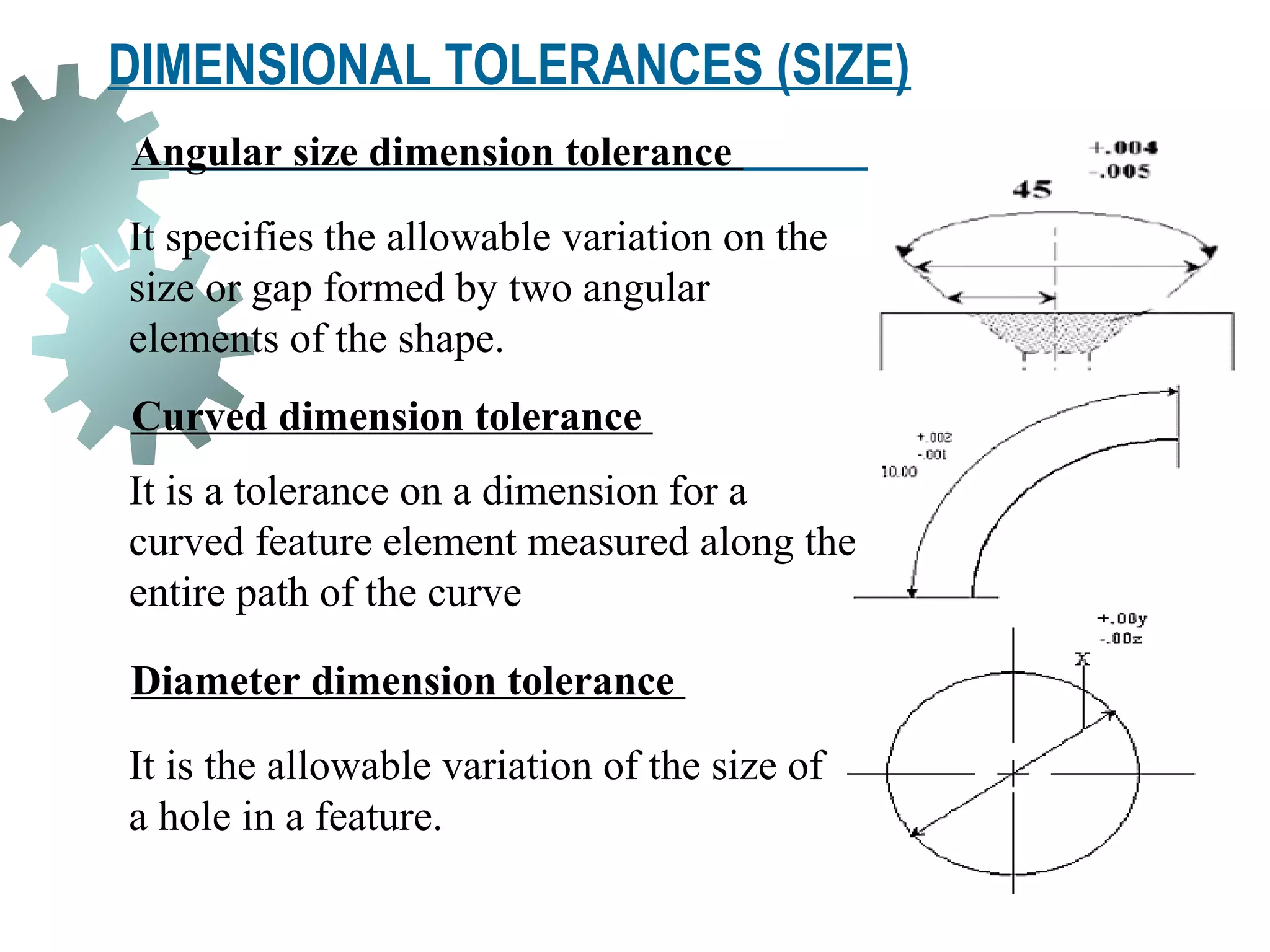
DIMENSIONAL TOLERANCES (SIZE)
Angular size dimension tolerance
It specifies the allowable variation on the
size or gap formed by two angular
elements of the shape.
Curved dimension tolerance
It is a tolerance on a dimension for a
curved feature element measured along the
entire path of the curve
Diameter dimension tolerance
It is the allowable variation of the size of
a hole in a feature.
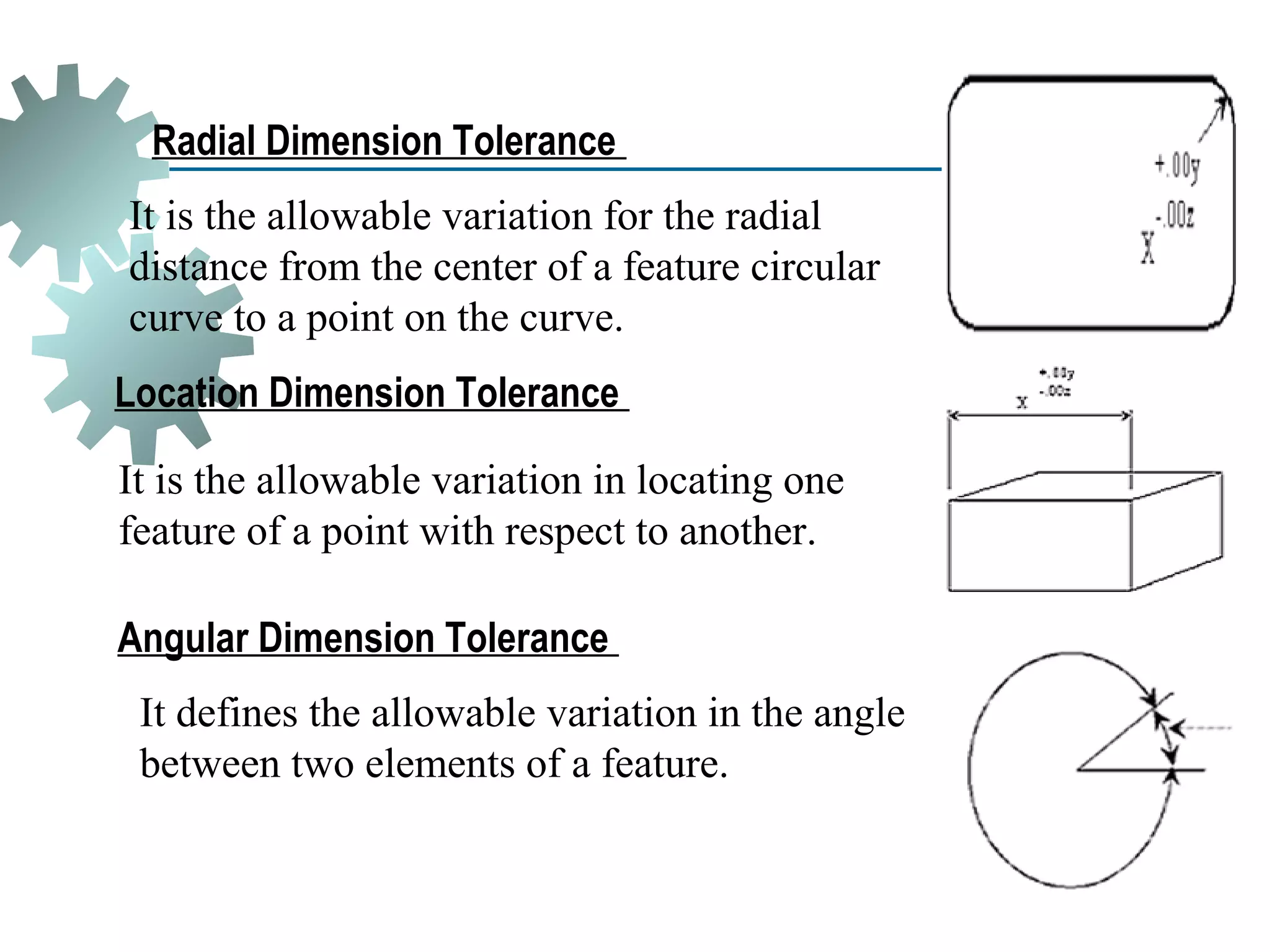
Radial Dimension Tolerance
It is the allowable variation for the radial
distance from the center of a feature circular
curve to a point on the curve.
Location Dimension Tolerance
It is the allowable variation in locating one
feature of a point with respect to another.
Angular Dimension Tolerance
It defines the allowable variation in the angle
between two elements of a feature.
The tolerance of size is normally defined as the difference between th upper
and lower dimensions.
ISO 286 implements 20 grades of accuracy to satisfy the requirements of
different industries.
Production of gauges and instruments.
IT01,   IT0,   IT1,   IT2,   IT3,   IT4,  IT5,  IT6.
Precision and general Industry.
IT 5,   IT6,   IT7,  IT8,  I9,  IT10,  IT11,  IT12.
Semi finished products
IT11,   IT14,   IT15,   IT16.
Structural Engineering
IT16,   IT17,  IT18 .
Tolerance Grades
Preferred fits: A specified system of fits for
holes and shafts for SI units
Tolerancing Holes and Shafts
- Hole basis
•The minimum hole size
equals the basic hole size
• Uses the symbol “H” in the
tolerance specification
- Shaft basis
•The maximum shaft size
equals the basic shaft size
•Uses the symbol “h” in the
tolerance specification
Ex.-20H7f8
40H8f6
Geometrical Tolerances (Form)
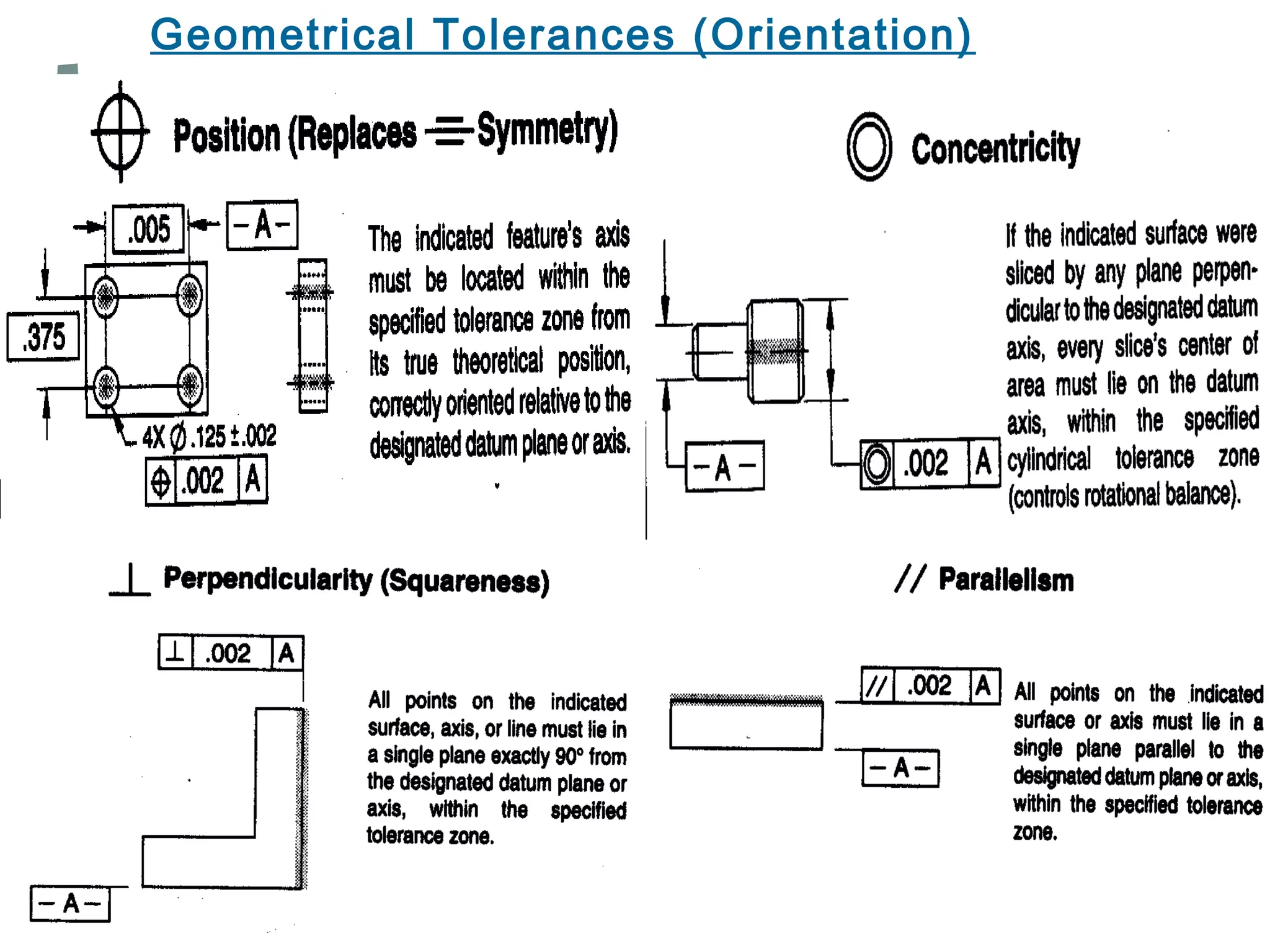
Geometrical Tolerances (Orientation)
INDIVIDUAL (No
Datum
Reference)
INDIVIDUAL or
RELATED
FEATURES
RELATED
FEATURES
(Datum
Reference
Required)
GEOMETRIC CHARACTERISTIC CONTROLS
TYPE OF
FEATURE
TYPE OF
TOLERANCE CHARACTERISTIC SYMBOL
SYMMETRY
FLATNESS
STRAIGHTNESS
CIRCULARITY
CYLINDRICITY
LINE PROFILE
SURFACE PROFILE
PERPENDICULARITY
ANGULARITY
PARALLELISM
CIRCULAR RUNOUT
TOTAL RUNOUT
CONCENTRICITY
POSITION
FORM
PROFILE
ORIENTATION
RUNOUT
LOCATION
14 characteristics that may be controlled
FIT-
When two parts are to be assembled, the relation
resulting from their sixes before assembly is
called FIT.
TYPES OF FIT:-
1.Clearance fit
2. Transition fit
3. Interferance fit
©2007 John Wiley & Sons, Inc. M P Groover, Fundamentals of Modern Manufacturing 3/e
Clearance and Interference fits between two Shafts
and a Hole
Surface Texture
• Repetitive or random deviations from the nominal surface which form the
pattern of the surface
The topography and geometric features of the surface
When highly magnified, the surface is anything but
straight and smooth. It has roughness, waviness, and
Flaws
Surface Roughness and
Surface Finish
Surface roughness - a measurable characteristic based on
roughness deviations
Surface finish - a more subjective term denoting smoothness
and general quality of a surface
 In popular usage, surface finish is often used as a
synonym for surface roughness
 Both terms are within the scope of surface texture
Surface Roughness
Average of vertical deviations from nominal surface over a
specified surface length
Figure - Deviations from nominal surface used in the two definitions of
surface roughness.
Surface Roughness Specification
Fig: Surface texture symbols in engineering drawings: (a)
the symbol and (b) symbol with identification labels.
Elements of surface texture
CONCLUSION
It is impossible to make a perfect component so when we design a part we
specify the acceptable range of features that make-up the part.
Traditionally, the tolerance allocation is done based on the hypothesis that the
assembly process deals with infinitely rigid bodies. The resultant tolerance of
individual components obtained based on this hypothesis will be on the tighter
side, thereby increasing the manufacturing cost.
In reality all the components of the assembly are deformable bodies and they
undergo deformation due to inertia effects. Through finite element simulation,
the
values of deformation due to inertia effects like gravity, angular velocity and
temperature effect have been determined in the design and process planning
stage itself. Due to this, the tolerance requirements of the given assembly are
relaxed to certain extent for critical components, resulting in reduced
manufacturing cost and high product reliability.
With this approach, the component tolerance values found are the most robust
to variation during the product’s application.
These benefits make it possible to create a high-quality and cost-effective
tolerance design.
Geometric Dimension and Tolerance

Geometric Dimension and Tolerance

  • 1.
    INTRODUCTION- Factors that determinethe performance of a manufactured product, other than mechanical and physical properties, include  Dimensions - linear or angular sizes of a component specified on the part drawing  Tolerances - allowable variations from the specified part dimensions that are permitted in manufacturing. •A dimension is "a numerical value expressed in appropriate units of measure and indicated on a drawing and in other documents along with lines, symbols, and notes to define the size or geometric characteristic, or both, of a part or part feature" Dimensions on part drawings represent nominal or basic sizes of the part and its features.
  • 2.
    A tolerance is"the total amount by which a specific dimension is permitted to vary. The tolerance is the difference between the maximum and minimum limits" Variations occur in any manufacturing process, which are manifested as variations in part size Tolerances are used to define the limits of the allowed variation. Dimensioning can be divided into three categories: general dimensioning, geometric dimensioning, and surface texture.
  • 3.
    TYPES OF TOLERANCES ADimensional tolerance is the total amount a specific dimension is permitted to vary, which is the difference between maximum and minimum permitted limits of size. A Geometric tolerance is the maximum or minimum variation from true geometric form or position that may be permitted in manufacture. Geometric tolerance should be employed only for those requirements of a part critical to its functioning or interchangeability.
  • 4.
    Variation is permittedin both positive and negative directions from the nominal dimension  Possible for a bilateral tolerance to be unbalanced; for example, 2.500 +0.010, -0.005 Fig: Ways to specify tolerance limits for a nominal dimension of 2.500 Bilateral Tolerance Unilateral Tolerance Variation from the specified dimension is permitted in only one direction  Either positive or negative, but not both Fig: Ways to specify tolerance limits for a nominal dimension of 2.500
  • 5.
    TOLERANCE- Dimensional tolerance -conventional Geometric tolerance - modern unilateral bilateral 1.00nominal dimension tolerance 0.95 + 0.10 - 0.00 1.05 + 0.00 - 0.10 1.00 0.05 0.95 - 1.05means a range 0.05
  • 6.
    REASON OF HAVINGTOLERANCE  The raw material may be defect.  No manufacturing process is perfect.  Nominal dimension (the "d" value) can not be achieved exactly.  Without tolerance we lose the control and as a consequence cause functional or assembly failure.  The work piece may be too slender to take the load.
  • 7.
    Tolerances and Manufacturing Processes Somemanufacturing processes are inherently more accurate than others Examples:  Most machining processes are quite accurate, capable of tolerances = ±0.05 mm (± 0.002 in.) or better  Sand castings are generally inaccurate, and tolerances of 10 to 20 times those used for machined parts must be specified
  • 8.
    DIMENSIONAL TOLERANCES (SIZE) Angularsize dimension tolerance It specifies the allowable variation on the size or gap formed by two angular elements of the shape. Curved dimension tolerance It is a tolerance on a dimension for a curved feature element measured along the entire path of the curve Diameter dimension tolerance It is the allowable variation of the size of a hole in a feature.
  • 9.
    Radial Dimension Tolerance Itis the allowable variation for the radial distance from the center of a feature circular curve to a point on the curve. Location Dimension Tolerance It is the allowable variation in locating one feature of a point with respect to another. Angular Dimension Tolerance It defines the allowable variation in the angle between two elements of a feature.
  • 10.
    The tolerance ofsize is normally defined as the difference between th upper and lower dimensions. ISO 286 implements 20 grades of accuracy to satisfy the requirements of different industries. Production of gauges and instruments. IT01,   IT0,   IT1,   IT2,   IT3,   IT4,  IT5,  IT6. Precision and general Industry. IT 5,   IT6,   IT7,  IT8,  I9,  IT10,  IT11,  IT12. Semi finished products IT11,   IT14,   IT15,   IT16. Structural Engineering IT16,   IT17,  IT18 . Tolerance Grades
  • 11.
    Preferred fits: Aspecified system of fits for holes and shafts for SI units Tolerancing Holes and Shafts - Hole basis •The minimum hole size equals the basic hole size • Uses the symbol “H” in the tolerance specification - Shaft basis •The maximum shaft size equals the basic shaft size •Uses the symbol “h” in the tolerance specification Ex.-20H7f8 40H8f6
  • 12.
  • 13.
  • 14.
  • 15.
    INDIVIDUAL (No Datum Reference) INDIVIDUAL or RELATED FEATURES RELATED FEATURES (Datum Reference Required) GEOMETRICCHARACTERISTIC CONTROLS TYPE OF FEATURE TYPE OF TOLERANCE CHARACTERISTIC SYMBOL SYMMETRY FLATNESS STRAIGHTNESS CIRCULARITY CYLINDRICITY LINE PROFILE SURFACE PROFILE PERPENDICULARITY ANGULARITY PARALLELISM CIRCULAR RUNOUT TOTAL RUNOUT CONCENTRICITY POSITION FORM PROFILE ORIENTATION RUNOUT LOCATION 14 characteristics that may be controlled
  • 16.
    FIT- When two partsare to be assembled, the relation resulting from their sixes before assembly is called FIT. TYPES OF FIT:- 1.Clearance fit 2. Transition fit 3. Interferance fit
  • 17.
    ©2007 John Wiley& Sons, Inc. M P Groover, Fundamentals of Modern Manufacturing 3/e Clearance and Interference fits between two Shafts and a Hole
  • 18.
    Surface Texture • Repetitiveor random deviations from the nominal surface which form the pattern of the surface The topography and geometric features of the surface When highly magnified, the surface is anything but straight and smooth. It has roughness, waviness, and Flaws
  • 19.
    Surface Roughness and SurfaceFinish Surface roughness - a measurable characteristic based on roughness deviations Surface finish - a more subjective term denoting smoothness and general quality of a surface  In popular usage, surface finish is often used as a synonym for surface roughness  Both terms are within the scope of surface texture
  • 20.
    Surface Roughness Average ofvertical deviations from nominal surface over a specified surface length Figure - Deviations from nominal surface used in the two definitions of surface roughness.
  • 21.
    Surface Roughness Specification Fig:Surface texture symbols in engineering drawings: (a) the symbol and (b) symbol with identification labels.
  • 22.
  • 23.
    CONCLUSION It is impossibleto make a perfect component so when we design a part we specify the acceptable range of features that make-up the part. Traditionally, the tolerance allocation is done based on the hypothesis that the assembly process deals with infinitely rigid bodies. The resultant tolerance of individual components obtained based on this hypothesis will be on the tighter side, thereby increasing the manufacturing cost. In reality all the components of the assembly are deformable bodies and they undergo deformation due to inertia effects. Through finite element simulation, the values of deformation due to inertia effects like gravity, angular velocity and temperature effect have been determined in the design and process planning stage itself. Due to this, the tolerance requirements of the given assembly are relaxed to certain extent for critical components, resulting in reduced manufacturing cost and high product reliability. With this approach, the component tolerance values found are the most robust to variation during the product’s application. These benefits make it possible to create a high-quality and cost-effective tolerance design.