General Aspects of Computer Organization
(Lecture-2)
R S Ananda Murthy
Associate Professor
Department of Electrical & Electronics Engineering,
Sri Jayachamarajendra College of Engineering,
Mysore 570 006
R S Ananda Murthy General Aspects of Computer Organization
Specific Learning Outcomes
After completing this lecture the student should be able to –
Describe different types of computers.
Distinguish between embedded system and a general
purpose computer.
Briefly describe the evolution of x86, ARM and AVR family
of computers.
R S Ananda Murthy General Aspects of Computer Organization
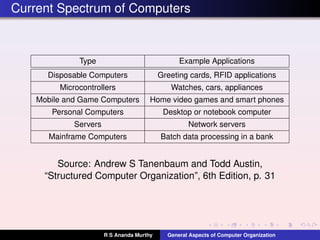
Current Spectrum of Computers
Type Example Applications
Disposable Computers Greeting cards, RFID applications
Microcontrollers Watches, cars, appliances
Mobile and Game Computers Home video games and smart phones
Personal Computers Desktop or notebook computer
Servers Network servers
Mainframe Computers Batch data processing in a bank
Source: Andrew S Tanenbaum and Todd Austin,
“Structured Computer Organization”, 6th Edition, p. 31
R S Ananda Murthy General Aspects of Computer Organization
Disposable Computers
Singing greeting cards, shown on the left side, have single
chips powered by battery.
Radio Frequency IDentification (RFID) chips smaller than
0.5 mm×0.5 mm, shown on the right side, contain tiny
radio transponder and a built-in unique 128-bit ID number.
RFID chips are powered by the incoming radio signal long
enough to transmit the ID number to the querying antenna.
R S Ananda Murthy General Aspects of Computer Organization
Microcontrollers
Embedded systems have single-chip computers known as
microcontrollers.
Microcontrollers are available in different packages as
shown above.
Microcontrollers come with word lengths of 4-bit, 8-bit,
16-bit, and 32-bit.
R S Ananda Murthy General Aspects of Computer Organization
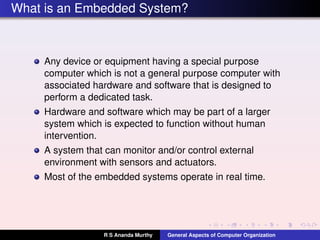
What is an Embedded System?
Any device or equipment having a special purpose
computer which is not a general purpose computer with
associated hardware and software that is designed to
perform a dedicated task.
Hardware and software which may be part of a larger
system which is expected to function without human
intervention.
A system that can monitor and/or control external
environment with sensors and actuators.
Most of the embedded systems operate in real time.
R S Ananda Murthy General Aspects of Computer Organization
Examples of Embedded Systems
A digital camera uses a 32-bit microcontroller.
R S Ananda Murthy General Aspects of Computer Organization
Examples of Embedded Systems
A cell phone uses a 32-bit microcontroller.
R S Ananda Murthy General Aspects of Computer Organization
Examples of Embedded Systems
A microwave oven uses a 16-bit or 32-bit microcontroller.
R S Ananda Murthy General Aspects of Computer Organization
Examples of Embedded Systems
A vending machine uses an 8-bit or 16-bit microcontroller.
R S Ananda Murthy General Aspects of Computer Organization
Examples of Embedded Systems
An ATM uses a 32-bit microcontroller.
R S Ananda Murthy General Aspects of Computer Organization
Examples of Embedded Systems
A washing machine uses a 16-bit microcontroller.
R S Ananda Murthy General Aspects of Computer Organization
Examples of Embedded Systems
A printer uses a 16-bit microcontroller.
R S Ananda Murthy General Aspects of Computer Organization
Examples of Embedded Systems
A modern car uses several 32-bit microcontrollers.
R S Ananda Murthy General Aspects of Computer Organization
Examples of Embedded Systems
This robot uses a 64-bit processor.
R S Ananda Murthy General Aspects of Computer Organization
Examples of Embedded Systems
This DVD player uses a 32-bit processor.
R S Ananda Murthy General Aspects of Computer Organization
Examples of Embedded Systems
This smart energy meter uses a 32-bit processor.
R S Ananda Murthy General Aspects of Computer Organization
What is Not an Embedded System?
A general purpose computer is NOT an embedded system.
R S Ananda Murthy General Aspects of Computer Organization
Features of Gaming Computers
64-bit multiple core CPU operating at high clock speed,
more R/W memory, large high speed secondary storage,
high speed Graphics Processing Unit (GPU), additional
input devices like joysticks, large HD monitor, good quality
speakers.
R S Ananda Murthy General Aspects of Computer Organization
Typical Features of Servers
64-bit multiple processors fault-tolerant architecture
operating at high clock speed, more R/W memory, large
high speed secondary storage, remote configuration
capability with high speed connectivity.
R S Ananda Murthy General Aspects of Computer Organization
Mainframes
These are old room-sized computers with huge data
storage capability, running typically 40-50 years old legacy
software.
R S Ananda Murthy General Aspects of Computer Organization
Supercomputers
Multiple processors fault-tolerant parallel processing
architecture operating at high clock speed, more R/W
memory, large high speed secondary storage, remote
configuration capability with high speed connectivity.
R S Ananda Murthy General Aspects of Computer Organization
Computer Families – x86, ARM, AVR
Nearly all PC’s (including Windows, Linux PCs and Macs)
and server systems belong to x86 family which was
originally started by Intel Corporation.
The ARM architecture dominates the mobile market. For
example, most smartphones and tablet computers are
based on ARM processors.
The AVR architecture is now predominant in low-cost
microcontrollers used in many embedded systems like
washing machines, televisions, cars, microwave ovens etc.
R S Ananda Murthy General Aspects of Computer Organization
Founders of Intel Corporation
Andy Grove, Robert Noyce, and Gordon Moore (Source: Intel)
R S Ananda Murthy General Aspects of Computer Organization
Evolution of Intel x86 Family
Source: A. S.Tanenbaum and Todd Austin, “Structured
Computer Organization”, p. 40, 6th Edition, PHI, 2013.
R S Ananda Murthy General Aspects of Computer Organization
Evolution of ARM Architecture
In early 1980s, U.K.-based company Acron Computer
makes successful launch of BBC Micro Personal Computer
which had an an 8-bit microprocessor, called 6502,
manufactured by a company called MOS Technology, as
CPU.
In 1985, Acron released their own 32-bit CPU with 26-bit
address bus, called Acron-RISC Machine (ARM) which
borrowed ideas from Berkeley RISC project.
Acron released their PC called Archimedes based on ARM
CPU. This became very popular.
Acron-RISC Machine was renamed as Advanced RISC
Machine (ARM) when ARM developers at Acron left the
company and started their own company called ARM.
R S Ananda Murthy General Aspects of Computer Organization
Evolution of ARM Architecture
In 1993 Apple releases its Newton computer which used
ARM 610 CPU.
In mid 1990s, ARM collaborated with Digital Equipment
Corporation (DEC) to develop a high-speed, low-power
version ARM called StrongARM for applications in
low-power hand-held devices.
In 1994 ARM7 architecture was released which is widely
used even today in mobile devices.
At present ARM does not manufacture any processors but
creates designs and ARM-based developer tools and
libraries and licenses them to system designers and chip
manufacturers.
R S Ananda Murthy General Aspects of Computer Organization
Evolution of AVR Architecture
In 1996, at Norwegian Institute of Technology, students
Alf-Egil Bogen and Vegard Wollan designed an 8-bit RISC
CPU chip called AVR (Alf and Vegard’s RISC).
Atmel Norway bought AVR design and in 1997 released
their first AVR microcontroller AT90S1200 which was
pin-compatible with Intel 8051 which was the most popular
microcontroller at that time.
Arduino was started in 2005 as a project to develop
low-cost development boards for students by Massimo
Banzi and David Cuartielles at the Interaction Design
Institute, Ivrea, Italy.
Arduino makes AVR architecture very popolar in low-end
embedded system applications.
R S Ananda Murthy General Aspects of Computer Organization
Microcontroller Classes in the AVR Family
Source: A. S.Tanenbaum and Todd Austin, “Structured
Computer Organization”, p. 48, 6th Edition, PHI, 2013.
R S Ananda Murthy General Aspects of Computer Organization
License
This work is licensed under a
Creative Commons Attribution 4.0 International License.
R S Ananda Murthy General Aspects of Computer Organization

L2 types-of-computers

  • 1.
    General Aspects ofComputer Organization (Lecture-2) R S Ananda Murthy Associate Professor Department of Electrical & Electronics Engineering, Sri Jayachamarajendra College of Engineering, Mysore 570 006 R S Ananda Murthy General Aspects of Computer Organization
  • 2.
    Specific Learning Outcomes Aftercompleting this lecture the student should be able to – Describe different types of computers. Distinguish between embedded system and a general purpose computer. Briefly describe the evolution of x86, ARM and AVR family of computers. R S Ananda Murthy General Aspects of Computer Organization
  • 3.
    Current Spectrum ofComputers Type Example Applications Disposable Computers Greeting cards, RFID applications Microcontrollers Watches, cars, appliances Mobile and Game Computers Home video games and smart phones Personal Computers Desktop or notebook computer Servers Network servers Mainframe Computers Batch data processing in a bank Source: Andrew S Tanenbaum and Todd Austin, “Structured Computer Organization”, 6th Edition, p. 31 R S Ananda Murthy General Aspects of Computer Organization
  • 4.
    Disposable Computers Singing greetingcards, shown on the left side, have single chips powered by battery. Radio Frequency IDentification (RFID) chips smaller than 0.5 mm×0.5 mm, shown on the right side, contain tiny radio transponder and a built-in unique 128-bit ID number. RFID chips are powered by the incoming radio signal long enough to transmit the ID number to the querying antenna. R S Ananda Murthy General Aspects of Computer Organization
  • 5.
    Microcontrollers Embedded systems havesingle-chip computers known as microcontrollers. Microcontrollers are available in different packages as shown above. Microcontrollers come with word lengths of 4-bit, 8-bit, 16-bit, and 32-bit. R S Ananda Murthy General Aspects of Computer Organization
  • 6.
    What is anEmbedded System? Any device or equipment having a special purpose computer which is not a general purpose computer with associated hardware and software that is designed to perform a dedicated task. Hardware and software which may be part of a larger system which is expected to function without human intervention. A system that can monitor and/or control external environment with sensors and actuators. Most of the embedded systems operate in real time. R S Ananda Murthy General Aspects of Computer Organization
  • 7.
    Examples of EmbeddedSystems A digital camera uses a 32-bit microcontroller. R S Ananda Murthy General Aspects of Computer Organization
  • 8.
    Examples of EmbeddedSystems A cell phone uses a 32-bit microcontroller. R S Ananda Murthy General Aspects of Computer Organization
  • 9.
    Examples of EmbeddedSystems A microwave oven uses a 16-bit or 32-bit microcontroller. R S Ananda Murthy General Aspects of Computer Organization
  • 10.
    Examples of EmbeddedSystems A vending machine uses an 8-bit or 16-bit microcontroller. R S Ananda Murthy General Aspects of Computer Organization
  • 11.
    Examples of EmbeddedSystems An ATM uses a 32-bit microcontroller. R S Ananda Murthy General Aspects of Computer Organization
  • 12.
    Examples of EmbeddedSystems A washing machine uses a 16-bit microcontroller. R S Ananda Murthy General Aspects of Computer Organization
  • 13.
    Examples of EmbeddedSystems A printer uses a 16-bit microcontroller. R S Ananda Murthy General Aspects of Computer Organization
  • 14.
    Examples of EmbeddedSystems A modern car uses several 32-bit microcontrollers. R S Ananda Murthy General Aspects of Computer Organization
  • 15.
    Examples of EmbeddedSystems This robot uses a 64-bit processor. R S Ananda Murthy General Aspects of Computer Organization
  • 16.
    Examples of EmbeddedSystems This DVD player uses a 32-bit processor. R S Ananda Murthy General Aspects of Computer Organization
  • 17.
    Examples of EmbeddedSystems This smart energy meter uses a 32-bit processor. R S Ananda Murthy General Aspects of Computer Organization
  • 18.
    What is Notan Embedded System? A general purpose computer is NOT an embedded system. R S Ananda Murthy General Aspects of Computer Organization
  • 19.
    Features of GamingComputers 64-bit multiple core CPU operating at high clock speed, more R/W memory, large high speed secondary storage, high speed Graphics Processing Unit (GPU), additional input devices like joysticks, large HD monitor, good quality speakers. R S Ananda Murthy General Aspects of Computer Organization
  • 20.
    Typical Features ofServers 64-bit multiple processors fault-tolerant architecture operating at high clock speed, more R/W memory, large high speed secondary storage, remote configuration capability with high speed connectivity. R S Ananda Murthy General Aspects of Computer Organization
  • 21.
    Mainframes These are oldroom-sized computers with huge data storage capability, running typically 40-50 years old legacy software. R S Ananda Murthy General Aspects of Computer Organization
  • 22.
    Supercomputers Multiple processors fault-tolerantparallel processing architecture operating at high clock speed, more R/W memory, large high speed secondary storage, remote configuration capability with high speed connectivity. R S Ananda Murthy General Aspects of Computer Organization
  • 23.
    Computer Families –x86, ARM, AVR Nearly all PC’s (including Windows, Linux PCs and Macs) and server systems belong to x86 family which was originally started by Intel Corporation. The ARM architecture dominates the mobile market. For example, most smartphones and tablet computers are based on ARM processors. The AVR architecture is now predominant in low-cost microcontrollers used in many embedded systems like washing machines, televisions, cars, microwave ovens etc. R S Ananda Murthy General Aspects of Computer Organization
  • 24.
    Founders of IntelCorporation Andy Grove, Robert Noyce, and Gordon Moore (Source: Intel) R S Ananda Murthy General Aspects of Computer Organization
  • 25.
    Evolution of Intelx86 Family Source: A. S.Tanenbaum and Todd Austin, “Structured Computer Organization”, p. 40, 6th Edition, PHI, 2013. R S Ananda Murthy General Aspects of Computer Organization
  • 26.
    Evolution of ARMArchitecture In early 1980s, U.K.-based company Acron Computer makes successful launch of BBC Micro Personal Computer which had an an 8-bit microprocessor, called 6502, manufactured by a company called MOS Technology, as CPU. In 1985, Acron released their own 32-bit CPU with 26-bit address bus, called Acron-RISC Machine (ARM) which borrowed ideas from Berkeley RISC project. Acron released their PC called Archimedes based on ARM CPU. This became very popular. Acron-RISC Machine was renamed as Advanced RISC Machine (ARM) when ARM developers at Acron left the company and started their own company called ARM. R S Ananda Murthy General Aspects of Computer Organization
  • 27.
    Evolution of ARMArchitecture In 1993 Apple releases its Newton computer which used ARM 610 CPU. In mid 1990s, ARM collaborated with Digital Equipment Corporation (DEC) to develop a high-speed, low-power version ARM called StrongARM for applications in low-power hand-held devices. In 1994 ARM7 architecture was released which is widely used even today in mobile devices. At present ARM does not manufacture any processors but creates designs and ARM-based developer tools and libraries and licenses them to system designers and chip manufacturers. R S Ananda Murthy General Aspects of Computer Organization
  • 28.
    Evolution of AVRArchitecture In 1996, at Norwegian Institute of Technology, students Alf-Egil Bogen and Vegard Wollan designed an 8-bit RISC CPU chip called AVR (Alf and Vegard’s RISC). Atmel Norway bought AVR design and in 1997 released their first AVR microcontroller AT90S1200 which was pin-compatible with Intel 8051 which was the most popular microcontroller at that time. Arduino was started in 2005 as a project to develop low-cost development boards for students by Massimo Banzi and David Cuartielles at the Interaction Design Institute, Ivrea, Italy. Arduino makes AVR architecture very popolar in low-end embedded system applications. R S Ananda Murthy General Aspects of Computer Organization
  • 29.
    Microcontroller Classes inthe AVR Family Source: A. S.Tanenbaum and Todd Austin, “Structured Computer Organization”, p. 48, 6th Edition, PHI, 2013. R S Ananda Murthy General Aspects of Computer Organization
  • 30.
    License This work islicensed under a Creative Commons Attribution 4.0 International License. R S Ananda Murthy General Aspects of Computer Organization