the effective 
organization 
I N T H E C O N T E X T O F O R G A N I Z A T I O N A L D E V E L O P M E N T 
A L O N Z O C A C H O C A S U G A
T H E E F F E C T I V E O R G A N I Z A T I O N 
WHAT IS ORGANIZATIONAL DEVELOPMENT? 
. . . . . . . . . . . . . . . . . . 
Organizational development is the process through which an 
organization develops the internal capacity to be the most 
effective it can be in its mission work and to sustain itself over the 
long term. 
organizational 
development
T H E E F F E C T I V E O R G A N I Z A T I O N 
WHY PURSUE 
ORGANIZATIONAL DEVELOPMENT? 
. . . . . . . . . . . . . . . . . . 
. . . . ORGANIZATIONAL . . . . . . . SURVIVAL 
. . . . . . . 
whether improving basic systems or providing space to understand 
and address critical transitions, organizations credited OD work with their very survival. 
organizational 
development
T H E E F F E C T I V E O R G A N I Z A T I O N 
WHY PURSUE 
ORGANIZATIONAL DEVELOPMENT? 
. . . . . . . . . . . . . . . . . . 
. . . “. BEING . . THE . . BEST . . WE . . CAN . . BE” 
. . . . 
by improving the quality of their work through human or 
technical investments, organizations built their credibility and accountability in the eyes of 
their constituents and supporters. 
organizational 
development
T H E E F F E C T I V E O R G A N I Z A T I O N 
WHY PURSUE 
ORGANIZATIONAL DEVELOPMENT? 
. . . . . . . . . . . . . . . . . . 
. . . . . . . . . . . . . . . . . . 
RAISING MORE RESOURCES FOR THE MISSION WORK 
as organizations strengthened their capacity 
for evaluation, communication, collaboration and fundraising, they attracted more resources 
to increase the level and impact of their program work. 
organizational 
development
T H E E F F E C T I V E O R G A N I Z A T I O N 
WHY PURSUE 
ORGANIZATIONAL DEVELOPMENT? 
. . . . . . . . . . . . . . . . . . 
. . . . “. WALKING . . . . OUR . . . TALK” 
. . . . . . 
by focusing on the values that are the foundation of the mission work, 
OD led organizations to make a commitment to practice internally what they are seeking to 
accomplish externally. 
organizational 
development
T H E E F F E C T I V E O R G A N I Z A T I O N 
WHY PURSUE 
ORGANIZATIONAL DEVELOPMENT? 
. . . . . . . . . . . . . . . . . . 
. . . . . . . . . . . . . . . . . . 
DEVELOPING STAFF AND BOARD MEMBERS SO THEY CAN IMPROVE PROGRAM RESULTS 
by creating an environment where people feel valued and seek continual learning and 
improvement, staff and board members increased their energy and effectiveness towards 
the achievement of mission. 
organizational 
development
T H E E F F E C T I V E O R G A N I Z A T I O N 
A VISION OF 
ORGANIZATIONAL HEALTH 
. . . . . . . . . . . . . . . . . . 
. . . . . . . . . . . . . . . . . . 
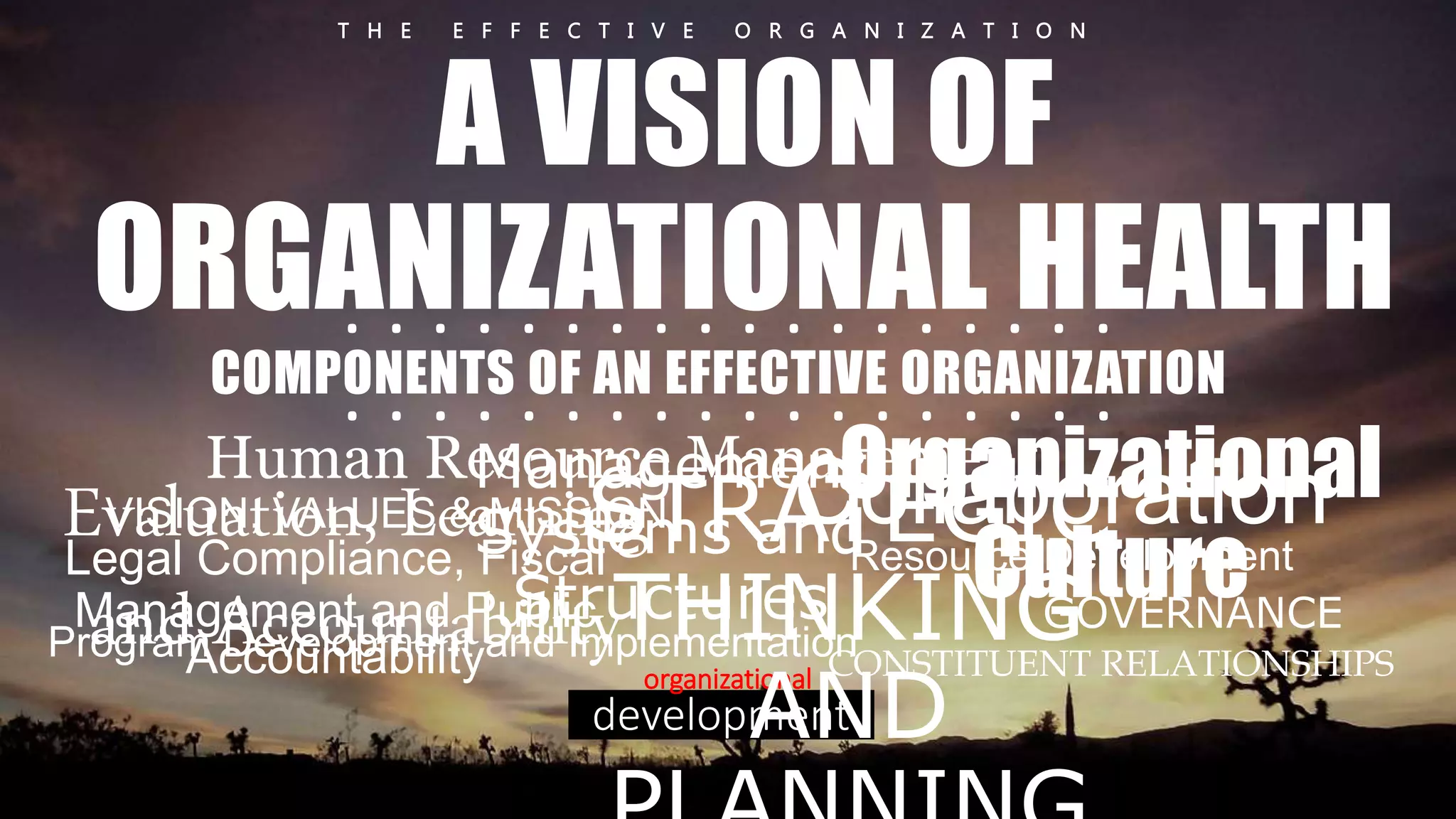
COMPONENTS OF AN EFFECTIVE ORGANIZATION 
Human Resource ManagOermgeannt izational 
Management 
Systems and 
Structures 
Collaboration 
VISION, VALUES & MISSSIONTRATEGIC 
Evaluation, Learning 
and Accountability 
Resource Development 
THINKING 
Program Development and Implementation 
organizational 
AND 
development 
PLANNING 
Legal Compliance, Fiscal 
Management and Public 
Accountability 
Culture 
GOVERNANCE 
CONSTITUENT RELATIONSHIPS
T H E E F F E C T I V E O R G A N I Z A T I O N 
. . . . . . . . . . . . . . . . . . 
. . . . . . . . . . . . SPEAKERS . . . . . . 
organizational 
development 
MABUHAY 
ALONZO 
WEDNESDAY 
CASUGA 
RICHARD RONALD 
CACHO
T H E E F F E C T I V E O R G A N I Z A T I O N 
DESCRIPTIONS 
CORE COMPONENTS 
. . . . . . . . . . . . . . . . . . 
. . . . . . . . . . . . . . . . . . 
VISION, MISSION AND VALUES 
An organization’s values and vision express the essential 
commitments of people in the organization and form the 
foundation for the organization 
organizational 
development
T H E E F F E C T I V E O R G A N I Z A T I O N 
DESCRIPTIONS 
CORE COMPONENTS 
. . . . . . . . . . . . . . . . . . 
. . . . . . . . . . . . . . . . . . 
VISION, MISSION AND VALUES 
Its values are the core beliefs that 
shape the vision and guide the organization’s day-to-day actions. 
organizational 
development
T H E E F F E C T I V E O R G A N I Z A T I O N 
DESCRIPTIONS 
CORE COMPONENTS 
. . . . . . . . . . . . . . . . . . 
. . . . . . . . . . . . . . . . . . 
VISION, MISSION AND VALUES 
The vision describes an organization’s preferred future, the future 
its board, staff and constituents want to help create. 
organizational 
development
T H E E F F E C T I V E O R G A N I Z A T I O N 
DESCRIPTIONS 
CORE COMPONENTS 
. . . . . . . . . . . . . . . . . . 
. . . . . . . . . . . . . . . . . . 
VISION, MISSION AND VALUES 
An organization’s mission, the role it will play in creating the 
preferred future, flows from its vision and values. 
organizational 
development
T H E E F F E C T I V E O R G A N I Z A T I O N 
DESCRIPTIONS 
CORE COMPONENTS 
. . . . . . . . . . . . . . . . . . 
. . . . . . . . . . . . . . . . . . 
VISION, MISSION AND VALUES 
The mission should reflect a realistic but farsighted determination 
of who the organization is, who it serves, what it does, and what it 
can accomplish. 
organizational 
development
T H E E F F E C T I V E O R G A N I Z A T I O N 
DESCRIPTIONS 
CORE COMPONENTS 
. . . . . . . . . . . . . . . . . . 
. . . . . . . . . . . . . . . . . . 
VISION, MISSION AND VALUES 
In strong organizations, vision, values and mission are shared, 
understood and embraced by the board, staff, and members or 
constituents. They are the touchstone for every organizational 
decision. They are reflected in policies, procedures and practices. 
organizational 
development
T H E E F F E C T I V E O R G A N I Z A T I O N 
DESCRIPTIONS 
CORE COMPONENTS 
. . . . . . . . . . . . . . . . . . 
. . . . . . . . . . . . . . . . . . 
VISION, MISSION AND VALUES 
Creating and continually assessing and reaffirming its vision, 
values and mission may be the most important organizational 
development work an organization can undertake. 
organizational 
development
T H E E F F E C T I V E O R G A N I Z A T I O N 
DESCRIPTIONS 
CORE COMPONENTS 
. . . . . . . . . . . . . . . . . . 
. . . . . GOVERNANCE 
. . . . . . . . . . . . . 
A strong board and governance structure can help an 
organization weather critical program, staffing and funding crises 
organizational 
development
T H E E F F E C T I V E O R G A N I Z A T I O N 
DESCRIPTIONS 
CORE COMPONENTS 
. . . . . . . . . . . . . . . . . . 
. . . . . GOVERNANCE 
. . . . . . . . . . . . . 
. On the other hand, many organizations with weak, ineffective 
boards fail to remain effective over the long run, regardless of 
how strong their programs, how healthy their funding base, or 
how skilled their staffs 
organizational 
development
T H E E F F E C T I V E O R G A N I Z A T I O N 
DESCRIPTIONS 
CORE COMPONENTS 
. . . . . . . . . . . . . . . . . . 
. . . . . GOVERNANCE 
. . . . . . . . . . . . . 
The relationships among board and staff members contribute to 
or undermine an organization’s effectiveness. 
organizational 
development
T H E E F F E C T I V E O R G A N I Z A T I O N 
DESCRIPTIONS 
CORE COMPONENTS 
. . . . . . . . . . . . . . . . . . 
. . . . . GOVERNANCE 
. . . . . . . . . . . . . 
organizational 
development 
The most effective 
organizations build and 
nurture trusting relationships 
among their board, staff and 
constituents as the foundation 
for making and acting upon 
good decisions. 
The structures and 
policies for decision 
making should reflect 
the values of the 
organization. 
An organization’s 
governance sets the tone 
for the organizational 
culture and expresses the 
organization’s 
understanding of power 
relationships.
T H E E F F E C T I V E O R G A N I Z A T I O N 
DESCRIPTIONS 
CORE COMPONENTS 
. . . . . . . . . . . . . . . . . . 
. . . . . GOVERNANCE 
. . . . . . . . . . . . . 
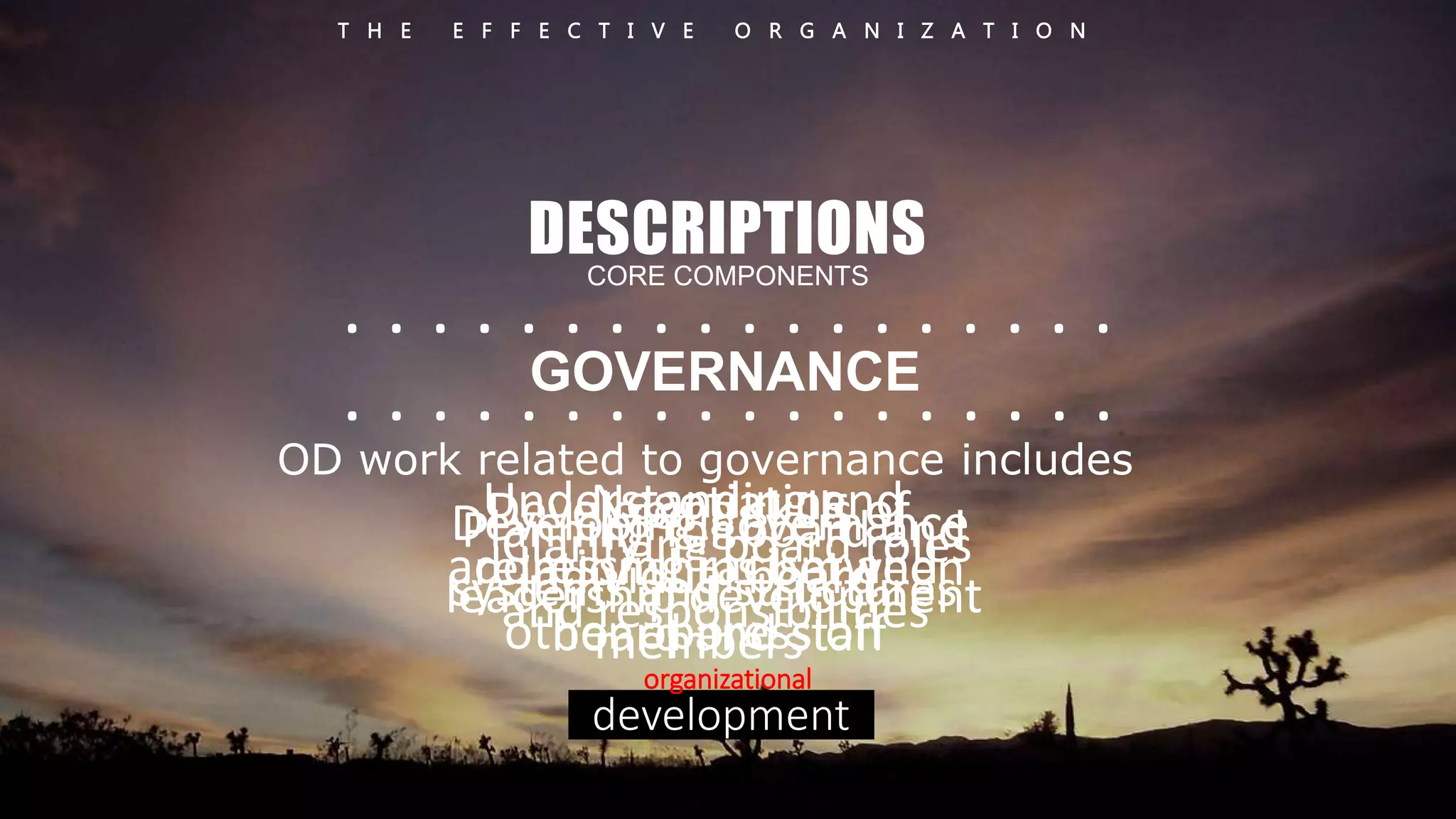
OD work related to governance includes 
Understanding Negotiating 
and 
addressing racism and 
Developing skills of 
individual board 
Developing governance 
systems and structures 
Planning for board and 
leadership development 
Clarifying board roles 
and responsibilities 
relationships between 
other oppression 
board and staff 
members 
organizational 
development
T H E E F F E C T I V E O R G A N I Z A T I O N 
DESCRIPTIONS 
CORE COMPONENTS 
. . . . . . . . . . . . . . . . . . 
. . . . . . . . . . . . . . . . . . 
STRATEGIC THINKING AND PLANNING 
Effective organizations periodically take stock of their strengths 
and weaknesses and the 
environment in which they work in order to set clear goals, 
objectives, strategies and tactics. 
organizational 
development
T H E E F F E C T I V E O R G A N I Z A T I O N 
DESCRIPTIONS 
CORE COMPONENTS 
. . . . . . . . . . . . . . . . . . 
. . . . . . . . . . . . . . . . . . 
STRATEGIC THINKING AND PLANNING 
Strategic thinking and planning are integral to the way the organization 
works day-in and dayout. 
The strategic plan is a living document that informs annual and 
monthly work plans and 
forms the basis for periodic evaluations of staff, board and programs. 
organizational 
development
T H E E F F E C T I V E O R G A N I Z A T I O N 
DESCRIPTIONS 
CORE COMPONENTS 
. . . . . . . . . . . . . . . . . . 
. . . . . . . . . . . . . . . . . . 
STRATEGIC THINKING AND PLANNING 
The organization recognizes the importance of 
Daily decisions, from program implementation to fundraising 
priorities, Even so m, tuhset sbtrea tceognics pisltaenn its wfleitxhi bthlee e sntoraugtehg tioc plan. 
adapting to change, internally and externally, to keep 
respond to new realities. 
its work effective. 
organizational 
development
T H E E F F E C T I V E O R G A N I Z A T I O N 
DESCRIPTIONS 
CORE COMPONENTS 
. . . . . . . . . . . . . . . . . . 
. . . . . . . . . . . . . . . . . . 
PROGRAM DEVELOPMENT AND IMPLEMENTATION 
Program planning and development is the responsibility of staff, 
but it should involve constituents to whom the program—and the 
organization—is accountable. 
organizational 
development
T H E E F F E C T I V E O R G A N I Z A T I O N 
DESCRIPTIONS 
CORE COMPONENTS 
. . . . . . . . . . . . . . . . . . 
. . . . . . . . . . . . . . . . . . 
PROGRAM DEVELOPMENT AND IMPLEMENTATION 
Participants have a stake in the outcomes and are the best 
gauge of the program’s effectiveness. 
organizational 
development
T H E E F F E C T I V E O R G A N I Z A T I O N 
DESCRIPTIONS 
CORE COMPONENTS 
. . . . . . . . . . . . . . . . . . 
. . . . . . . . . . . . . . . . . . 
PROGRAM DEVELOPMENT AND IMPLEMENTATION 
Board members may be important resources for guidance and 
support. In an effective organization, program development, 
evaluation, and strategic planning are interconnected for 
continuous learning. 
organizational 
development
T H E E F F E C T I V E O R G A N I Z A T I O N 
Components of an Effective Organization 
. . . . . . . . . . . . . . . . . . 
EVALUATION, LEARNING AND ACCOUNTABILITY 
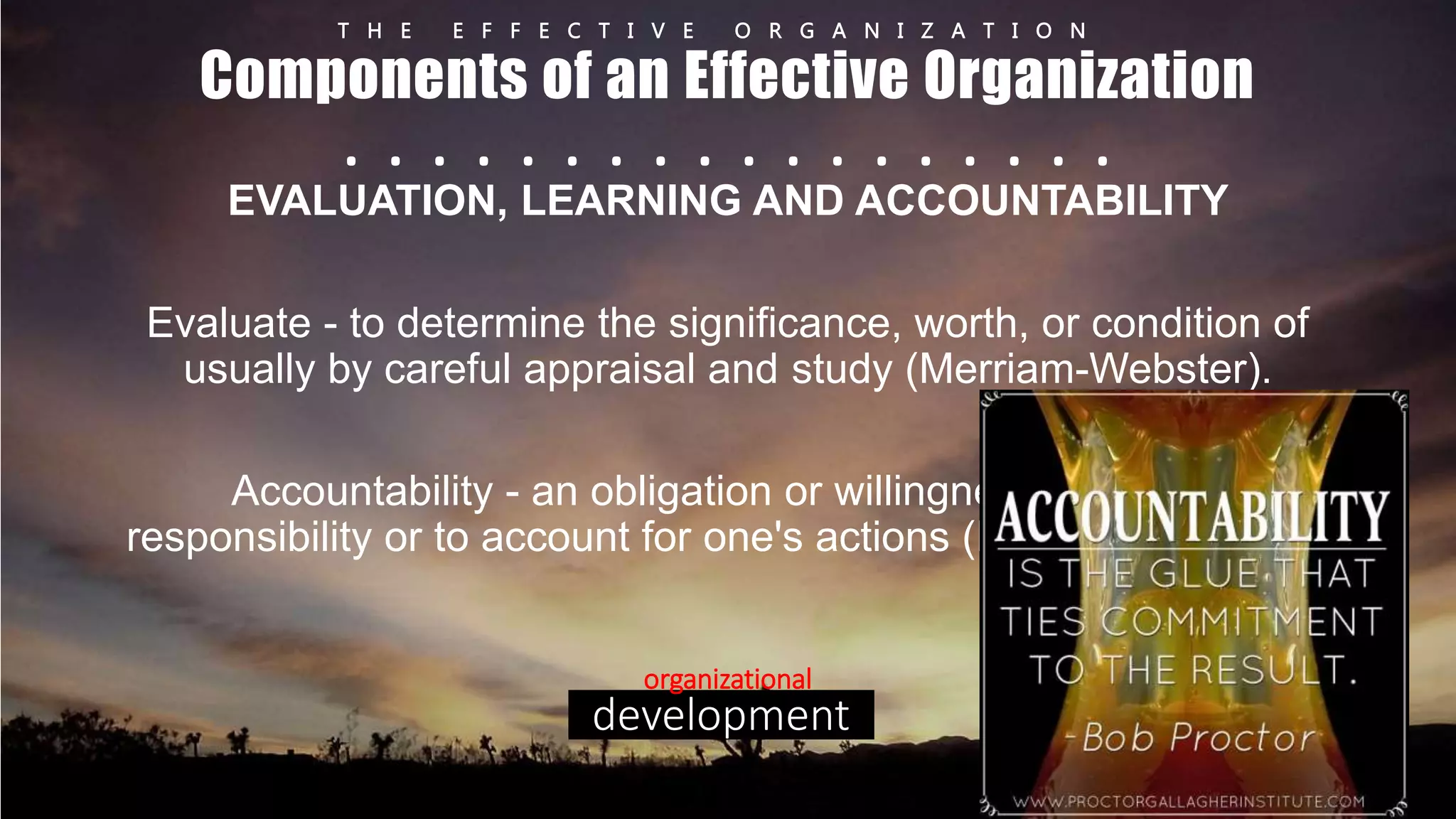
Evaluate - to determine the significance, worth, or condition of 
usually by careful appraisal and study (Merriam-Webster). 
Accountability - an obligation or willingness to accept 
responsibility or to account for one's actions (Merriam-Webster). 
organizational 
development
T H E E F F E C T I V E O R G A N I Z A T I O N 
Effective organizations are active in evaluating their work and 
. . learning . . . . from . . success . . . . and . . failure. 
. . . . 
The ultimate evaluation of any program is its effectiveness toward 
reaching the organization’s mission. 
Effective organizations document their work, report and 
communicate in timely and appropriate ways, and aspire to be 
transparent to their internal and external publics. 
The points of decision-making are determined by such factors as 
ability, sense of responsibility and availability of information. 
On-the-job learning; feedback and advice are freely sought and 
given; each member has potential and something to contribute. 
organizational 
development
T H E E F F E C T I V E O R G A N I Z A T I O N 
. . . . . . . . . . . . . . . . . . 
DESCRIPTIONS 
CORE COMPONENTS 
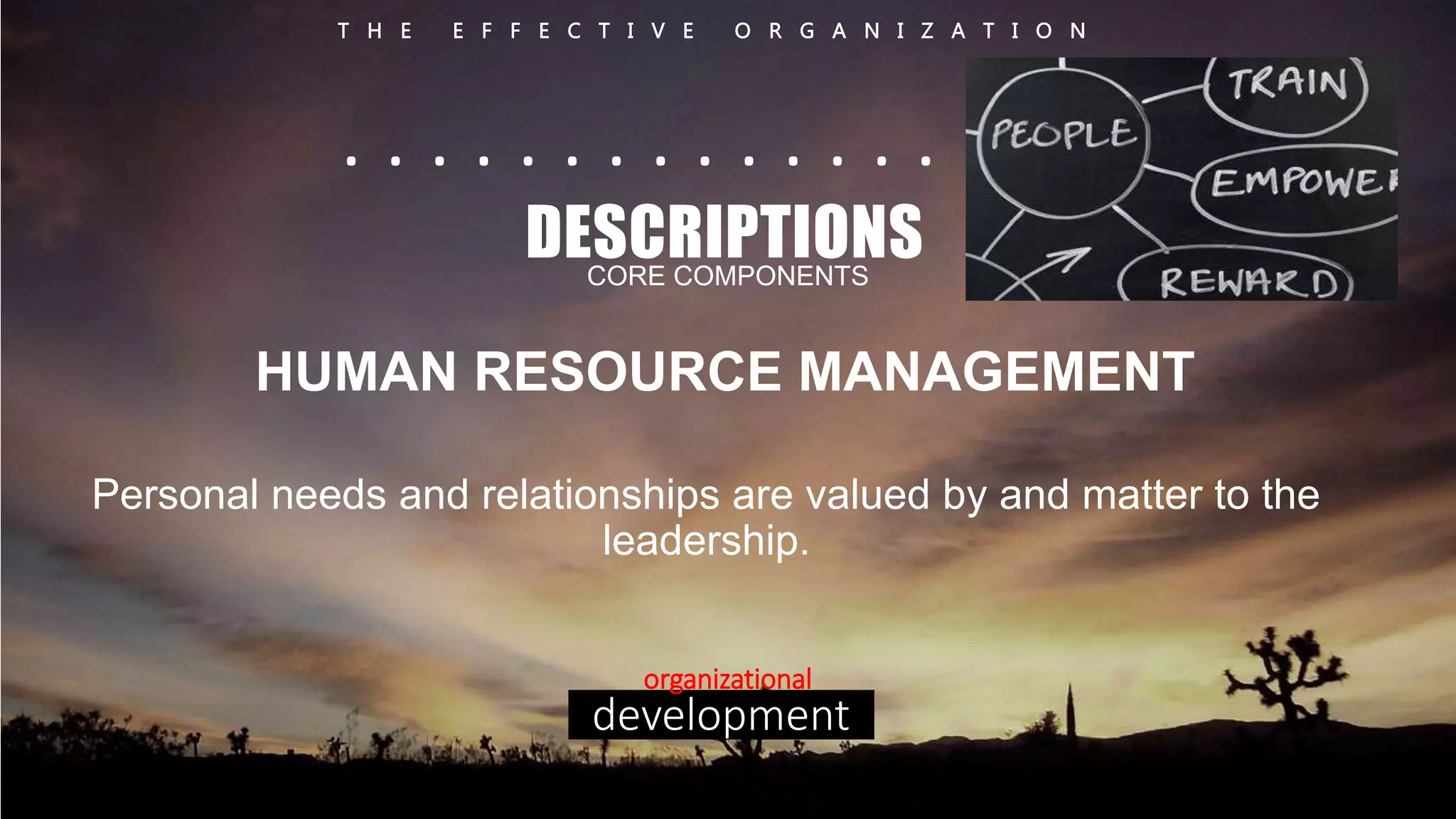
HUMAN RESOURCE MANAGEMENT 
the organizational function that deals with issues related to people 
such as compensation, hiring, performance management, 
organization development, safety, wellness, benefits, employee 
motivation, communication, administration, and training 
(humanresources.com) 
organizational 
development
T H E E F F E C T I V E O R G A N I Z A T I O N 
. . . . . . . . . . . . . . . . . . 
DESCRIPTIONS 
CORE COMPONENTS 
HUMAN RESOURCE MANAGEMENT 
People are often the most valuable resource an organization has. 
How they are developed and managed is critical to their productivity 
and to the organization’s success. 
organizational 
development
T H E E F F E C T I V E O R G A N I Z A T I O N 
. . . . . . . . . . . . . . . . . . 
DESCRIPTIONS 
CORE COMPONENTS 
HUMAN RESOURCE MANAGEMENT 
Effective organizations provide individuals with avenues of service 
and opportunities for personal development that match their skills 
and interests. They offer training, mentoring and professional 
development support. 
organizational 
development
T H E E F F E C T I V E O R G A N I Z A T I O N 
. . . . . . . . . . . . . . . . . . 
DESCRIPTIONS 
CORE COMPONENTS 
HUMAN RESOURCE MANAGEMENT 
Supports the notion that people must take care of themselves and 
not be exhausted by the work. 
organizational 
development
T H E E F F E C T I V E O R G A N I Z A T I O N 
. . . . . . . . . . . . . . . . . . 
DESCRIPTIONS 
CORE COMPONENTS 
HUMAN RESOURCE MANAGEMENT 
Personal needs and relationships are valued by and matter to the 
leadership. 
organizational 
development
T H E E F F E C T I V E O R G A N I Z A T I O N 
. . . . . . . . . . . . . . . . . . 
DESCRIPTIONS 
CORE COMPONENTS 
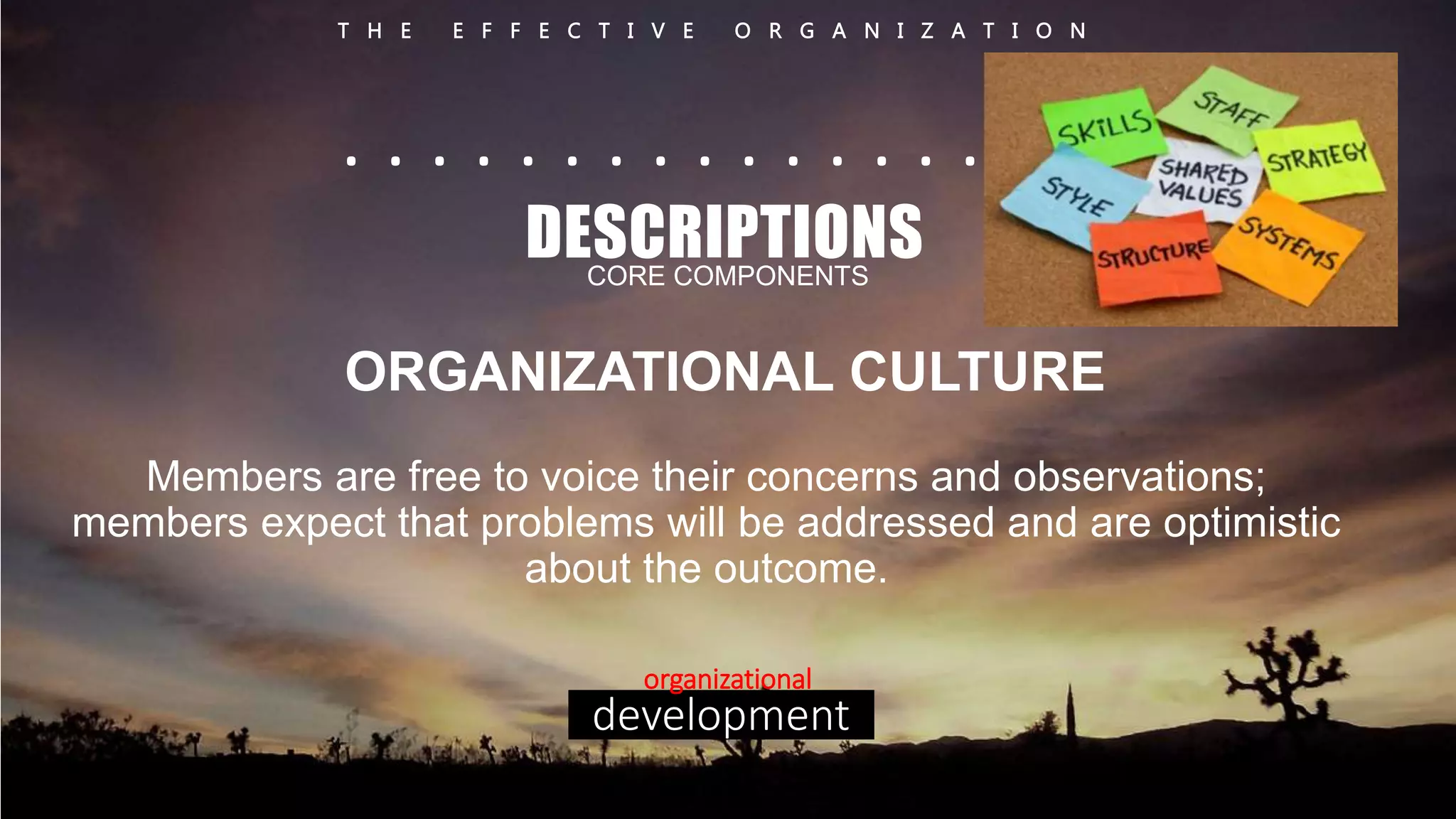
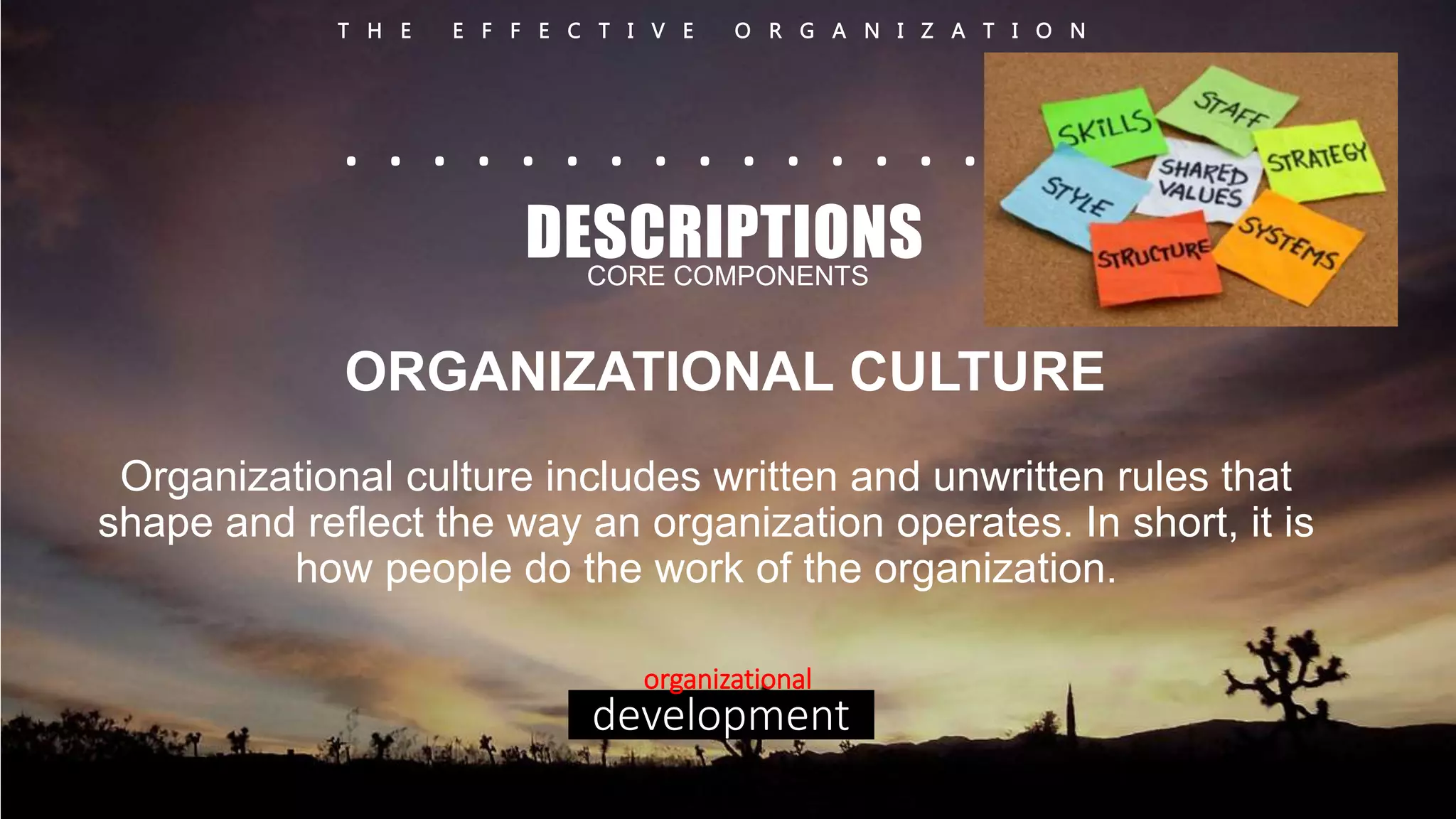
ORGANIZATIONAL CULTURE 
Organizational culture includes written and unwritten rules that 
shape and reflect the way an organization operates. In short, it is 
how people do the work of the organization. 
organizational 
development
T H E E F F E C T I V E O R G A N I Z A T I O N 
. . . . . . . . . . . . . . . . . . 
DESCRIPTIONS 
CORE COMPONENTS 
ORGANIZATIONAL CULTURE 
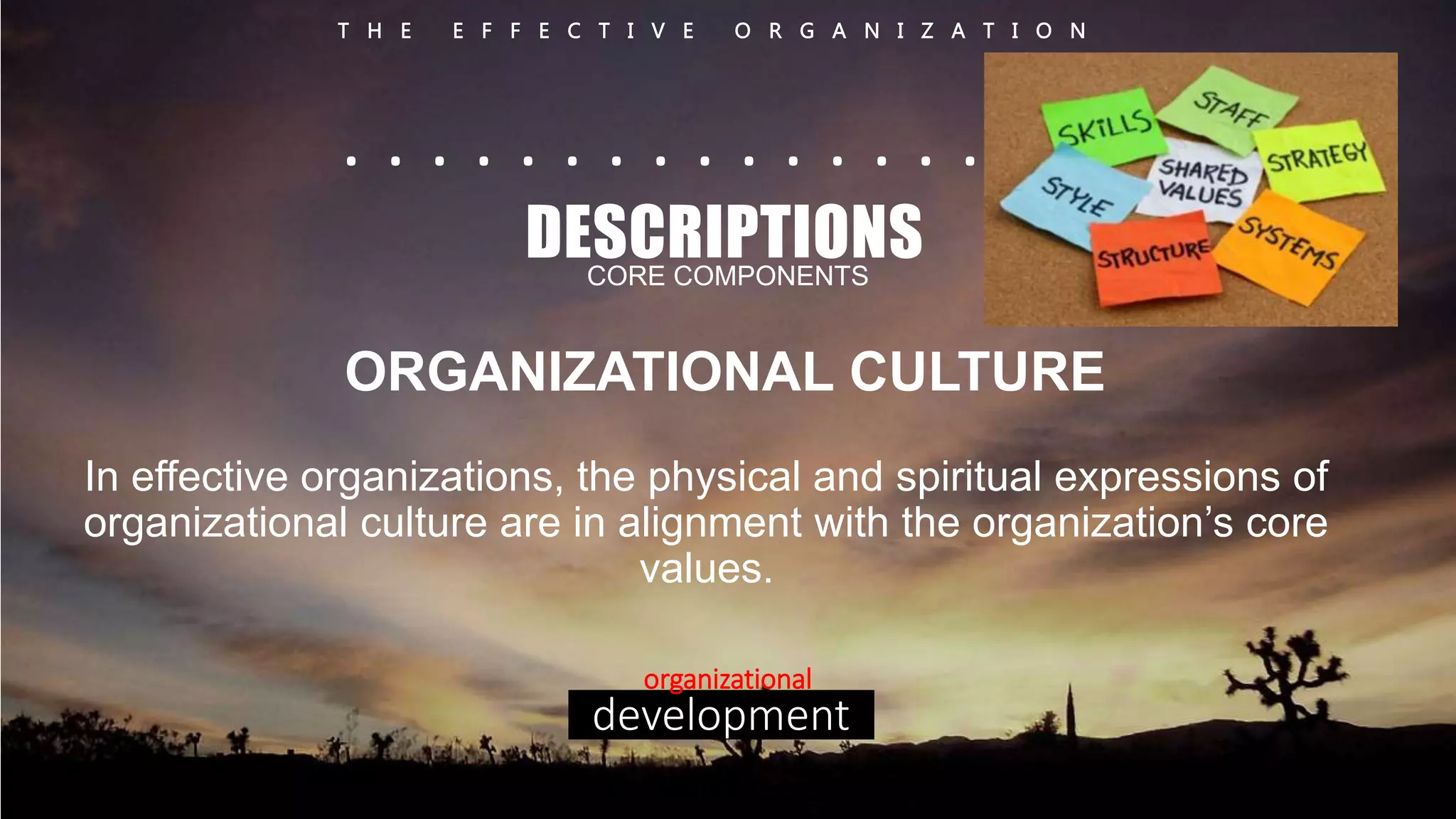
In effective organizations, the physical and spiritual expressions of 
organizational culture are in alignment with the organization’s core 
values. 
organizational 
development
T H E E F F E C T I V E O R G A N I Z A T I O N 
. . . . . . . . . . . . . . . . . . 
DESCRIPTIONS 
CORE COMPONENTS 
ORGANIZATIONAL CULTURE 
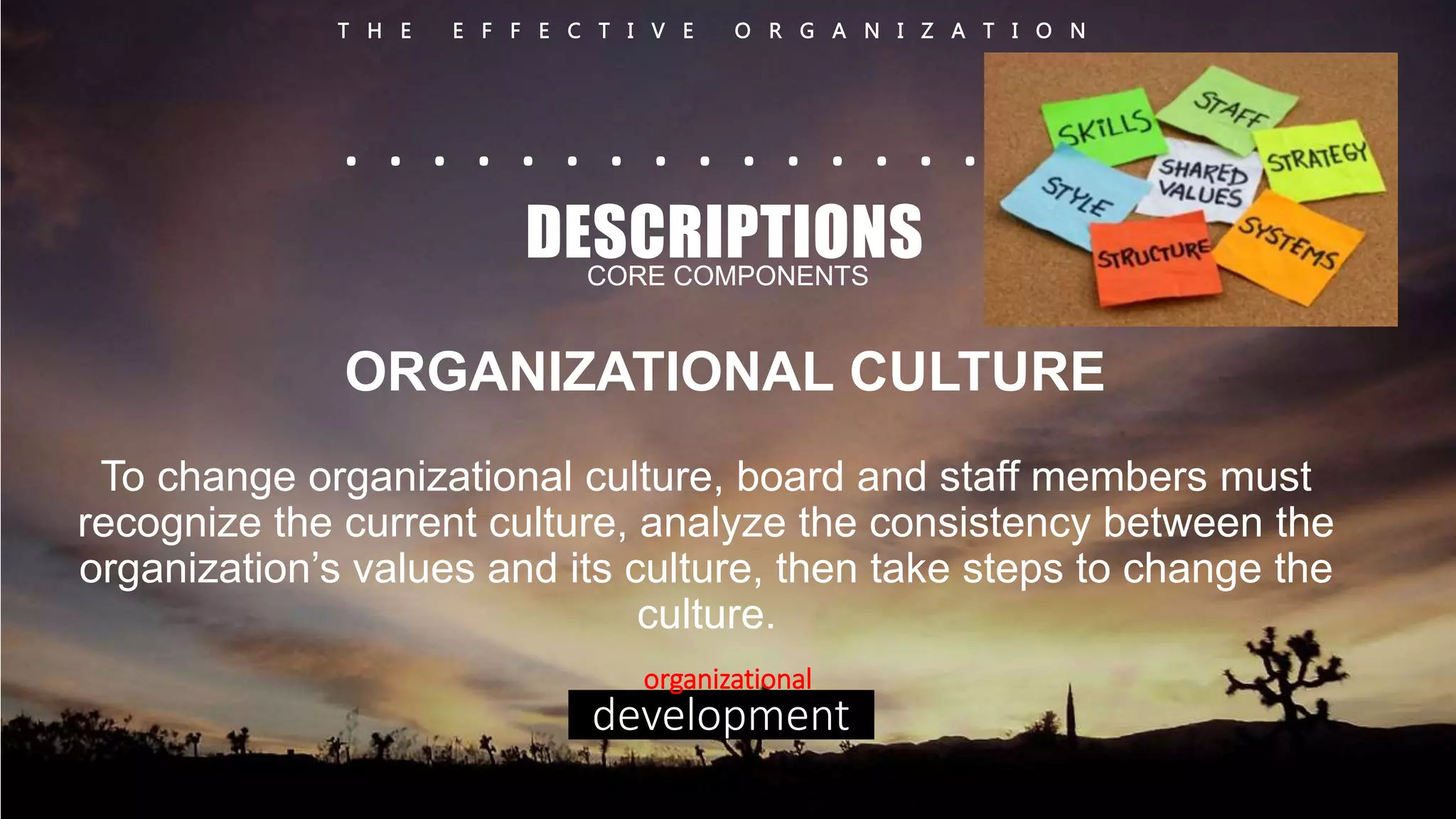
To change organizational culture, board and staff members must 
recognize the current culture, analyze the consistency between the 
organization’s values and its culture, then take steps to change the 
culture. 
organizational 
development
T H E E F F E C T I V E O R G A N I Z A T I O N 
. . . . . . . . . . . . . . . . . . 
DESCRIPTIONS 
CORE COMPONENTS 
ORGANIZATIONAL CULTURE 
Members are free to voice their concerns and observations; 
members expect that problems will be addressed and are optimistic 
about the outcome. 
organizational 
development
T H E E F F E C T I V E O R G A N I Z A T I O N 
. . . . . . . . . . . . . . . . . . 
DESCRIPTIONS 
CORE COMPONENTS 
ORGANIZATIONAL CULTURE 
Relationships are honest; members care about each other; 
sense of community exists. 
organizational 
development
T H E E F F E C T I V E O R G A N I Z A T I O N 
. . . . . . . . . . . . . . . . . . 
DESCRIPTIONS 
CORE COMPONENTS 
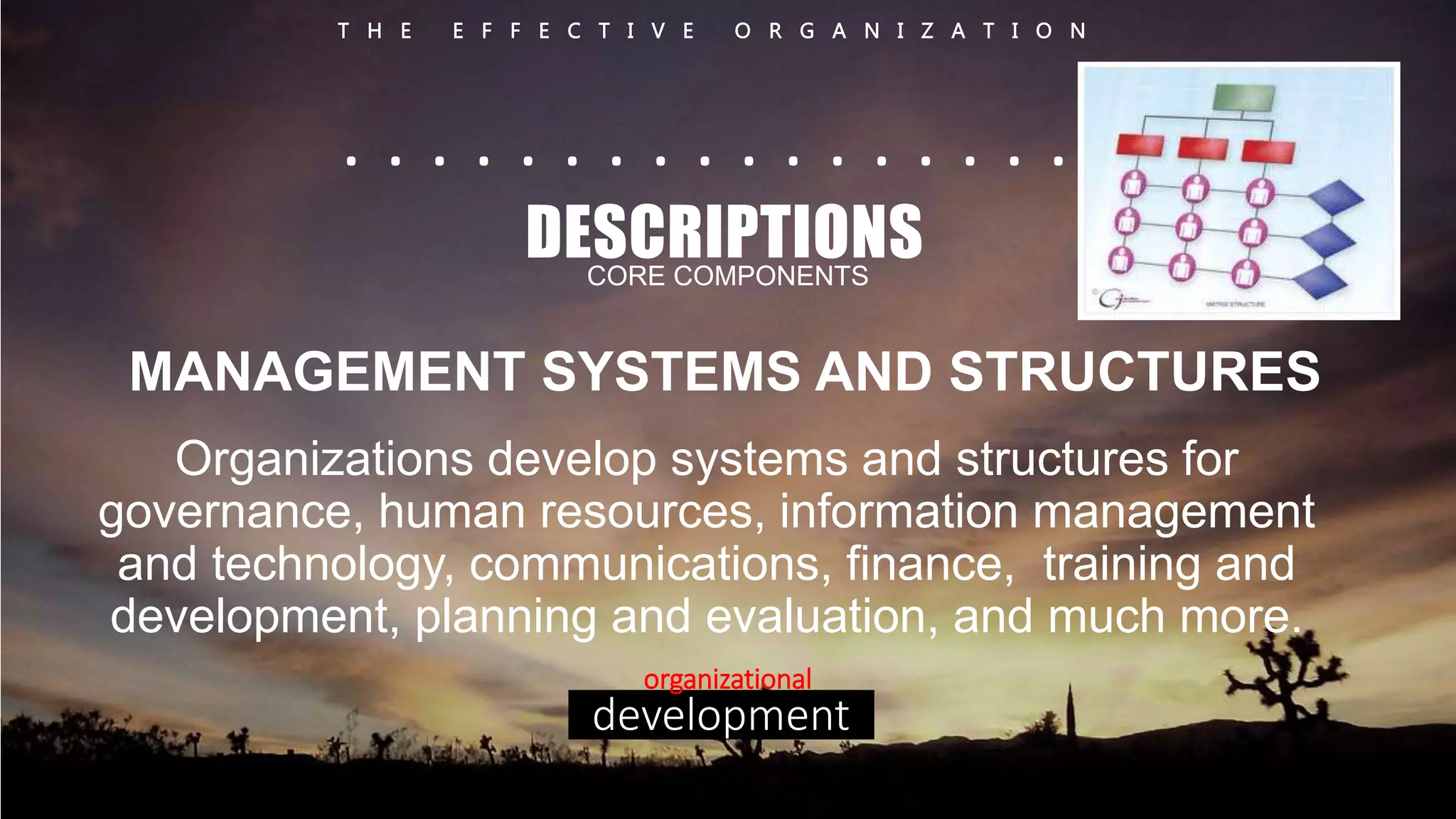
MANAGEMENT SYSTEMS AND STRUCTURES 
Organizations develop systems and structures for 
governance, human resources, information management 
and technology, communications, finance, training and 
development, planning and evaluation, and much more. 
organizational 
development
T H E E F F E C T I V E O R G A N I Z A T I O N 
. . . . . . . . . . . . . . . . . . 
DESCRIPTIONS 
CORE COMPONENTS 
MANAGEMENT SYSTEMS AND STRUCTURES 
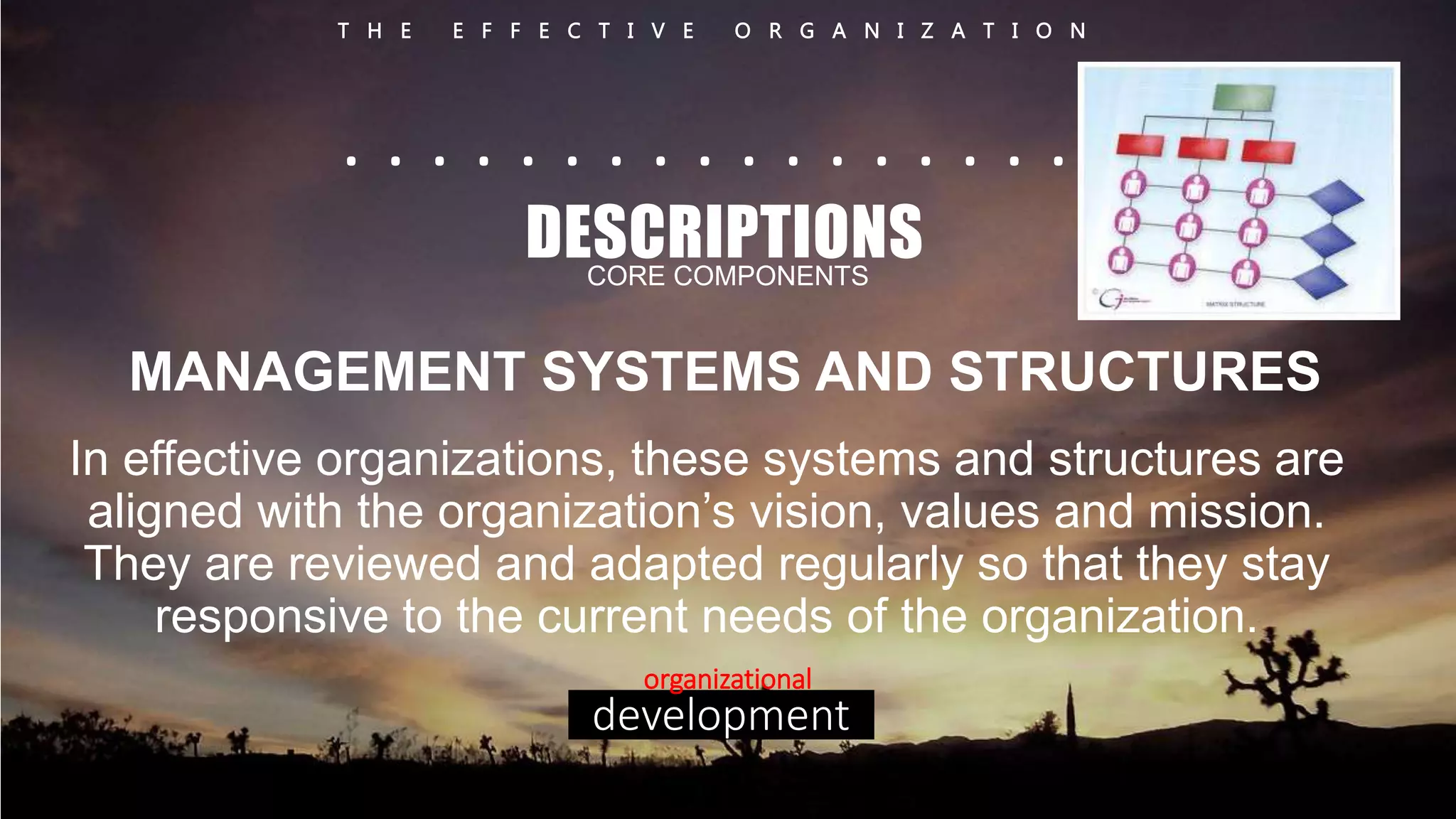
In effective organizations, these systems and structures are 
aligned with the organization’s vision, values and mission. 
They are reviewed and adapted regularly so that they stay 
responsive to the current needs of the organization. 
organizational 
development
T H E E F F E C T I V E O R G A N I Z A T I O N 
. . . . . . . . . . . . . . . . . . 
DESCRIPTIONS 
CORE COMPONENTS 
MANAGEMENT SYSTEMS AND STRUCTURES 
As part of organizational development, organizations may analyze 
and adapt existing systems, develop new systems or structures, or 
document what is already in place. Any of this work must be done in 
the context of the organization’s core values, vision and mission. 
organizational 
development
T H E E F F E C T I V E O R G A N I Z A T I O N 
. . . . . . . . . . . . . . . . . . 
DESCRIPTIONS 
CORE COMPONENTS 
MANAGEMENT SYSTEMS AND STRUCTURES 
Organizational structure, policies and procedures are designed to 
assist members complete the task and to protect the long-term 
health of the organization. 
organizational 
development
T H E E F F E C T I V E O R G A N I Z A T I O N 
. . . . . . . . . . . . . . . . . . 
DESCRIPTIONS 
CORE COMPONENTS 
Legal Compliance, Fiscal Management and Public Accountability 
Effective organizations are accountable to ethical standards that 
may not be legallyenforceable, but are consistent with the 
organization’s values. 
organizational 
development
T H E E F F E C T I V E O R G A N I Z A T I O N 
. . . . . . . . . . . . . . . . . . 
DESCRIPTIONS 
CORE COMPONENTS 
Legal Compliance 
Compliance to DTI, BIR, DOLE and other government institutions 
organizational 
development
T H E E F F E C T I V E O R G A N I Z A T I O N 
. . . . . . . . . . . . . . . . . . 
DESCRIPTIONS 
CORE COMPONENTS 
Fiscal Management 
The planning, directing, monitoring, organizing and controlling of the 
monetary resources of an organization (Business Dictionary) 
organizational 
development
T H E E F F E C T I V E O R G A N I Z A T I O N 
. . . . . . . . . . . . . . . . . . 
DESCRIPTIONS 
CORE COMPONENTS 
Public Accountability 
Members/Employees 
Board 
(Customers) 
Community 
organizational 
development
T H E E F F E C T I V E O R G A N I Z A T I O N 
. . . . . . . . . . . . . . . . . . 
DESCRIPTIONS 
CORE COMPONENTS 
RESOURCE DEVELOPMENT (BUDGET ALLOTMENT) 
Effective organizations have clear plans for resource development 
(budget allocation) and the human capacity to implement those 
plans. 
organizational 
development
T H E E F F E C T I V E O R G A N I Z A T I O N 
. . . . . . . . . . . . . . . . . . 
DESCRIPTIONS 
CORE COMPONENTS 
RESOURCE DEVELOPMENT (BUDGET ALLOTMENT) 
Sustainable resource development (budget allocation) requires clear 
program and financial objectives, a long-range plan and an annual 
plan for budget, active and trained board members, skilled staff, and 
effective systems for record-keeping, communication, evaluation and 
reporting. 
organizational 
development
T H E E F F E C T I V E O R G A N I Z A T I O N 
. . . . . . . . . . . . . . . . . . 
DESCRIPTIONS 
CORE COMPONENTS 
Constituent (Customer) Relationships 
This component permeates all other core components in effective 
organizations. 
organizational 
development
T H E E F F E C T I V E O R G A N I Z A T I O N 
. . . . . . . . . . . . . . . . . . 
DESCRIPTIONS 
CORE COMPONENTS 
Constituent (Customer) Relationships 
Effective organizations are serious about their accountability to their 
constituents (customers). They are responsive to changing realities 
in their communities and seek to change that reality as well. 
organizational 
development
T H E E F F E C T I V E O R G A N I Z A T I O N 
. . . . . . . . . . . . . . . . . . 
DESCRIPTIONS 
CORE COMPONENTS 
Constituent (Customer) Relationships 
In effective organizations, close relationships with constituents 
(customers) are woven into the fabric of the organization, providing 
day-to-day and long-term accountability. 
organizational 
development
T H E E F F E C T I V E O R G A N I Z A T I O N 
. . . . . . . . . . . . . . . . . . 
DESCRIPTIONS 
CORE COMPONENTS 
COLLABORATION 
Organizations must collaborate—by planning together, sharing 
resources, and using complementary strategies—to amplify their 
work. 
organizational 
development
T H E E F F E C T I V E O R G A N I Z A T I O N 
. . . . . . . . . . . . . . . . . . 
organizational 
development
Characteristics T H E of E F an F E C Unhealthy T I V E O R G and A N I Z Healthy A T I O N 
Organization 
. . . . . . . . . . . . . . . . . . 
organizational 
development 
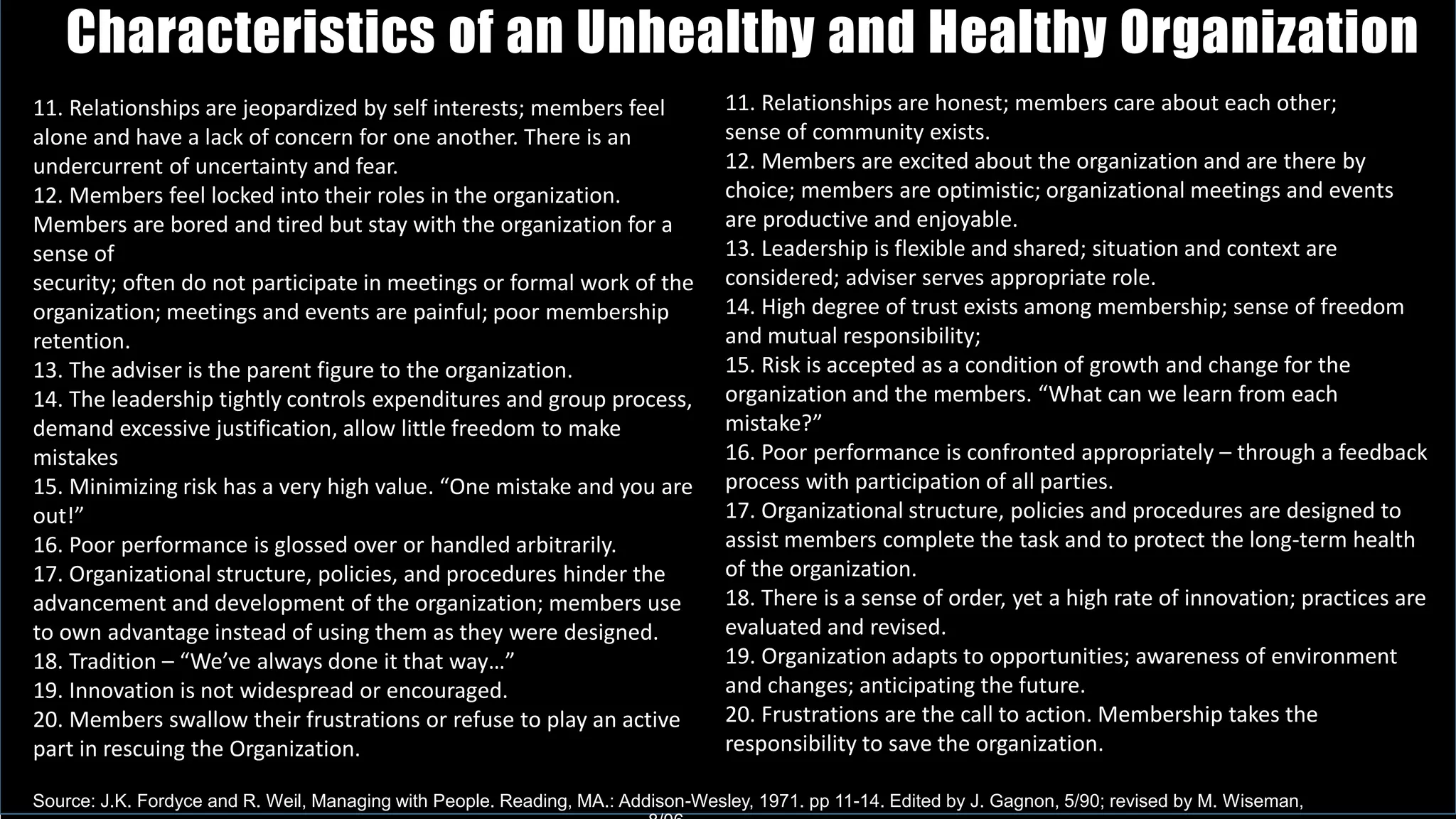
Source: J.K. Fordyce and R. Weil, Managing with People. Reading, MA.: Addison-Wesley, 1971. pp 11-14. Edited by J. Gagnon, 5/90; revised by M. Wiseman, 
8/06. 
1. Goals are widely shared by the members; there is a consistent 
focus on the goals. 
2. Members are free to voice their concerns and observations; 
members expect that problems will be addressed and are 
optimistic about the outcome. 
3. Problem-solving is highly pragmatic; members work together 
informally; leaders are frequently challenged. 
4. The points of decision-making are determined by such factors as 
ability, sense of responsibility and availability of information. 
5. There is a noticeable sense of team play in planning and in 
performance – responsibilities are shared. 
6. The thoughts and opinions of the general membership are sought 
and valued by the leadership. 
7. Personal needs and relationships are valued by and matter to the 
leadership. 
8. Collaboration is the model; members readily ask for or offer 
assistance. 
9. The membership comes together in a crisis and works together until 
a resolution is reached. Conflicts are seen as part of the development 
of the organization; with conflict comes growth. 
10. On-the-job learning; feedback and advice are freely sought and 
given; each member has potential and something to contribute. 
1. General membership has little investment in organizational 
goals 
2. Members see what is wrong but do not offer constructive 
actions to assist organization; members discuss issues outside of 
the group 
3. Members operate on a superficial level –look to leaders to solve 
the problems rather than working together. 
4. Leaders try to control as many decisions as possible; decisions 
are made with inadequate information. 
5. Leaders feel alone; delegated tasks are not completed as 
intended. 
6. The thoughts and opinions of the general membership are not 
respected by the leadership. 
7. Personal needs and feelings are secondary to organizational 
concerns. 
8. Members compete when they need to collaborate. Seeking or 
accepting help is seen as a sign of weakness. Distrust and mean-spiritedness 
reigns. 
9. Members withdraw or cast blame upon others when there is a 
crisis. Conflict is mostly covert and managed by group 
politics/norms; there are endless arguments. 
10. Learning is difficult. Members learn from own mistakes rather 
than learning from their experienced peers; very little feedback is 
offered. Feedback is avoided or not helpful.
Characteristics T H E of E F an F E C Unhealthy T I V E O R G and A N I Z Healthy A T I O N 
Organization 
. . . . . . . . . . . . . . . . . . 
organizational 
development 
Source: J.K. Fordyce and R. Weil, Managing with People. Reading, MA.: Addison-Wesley, 1971. pp 11-14. Edited by J. Gagnon, 5/90; revised by M. Wiseman, 
8/06. 
11. Relationships are honest; members care about each other; 
sense of community exists. 
12. Members are excited about the organization and are there by 
choice; members are optimistic; organizational meetings and events 
are productive and enjoyable. 
13. Leadership is flexible and shared; situation and context are 
considered; adviser serves appropriate role. 
14. High degree of trust exists among membership; sense of freedom 
and mutual responsibility; 
15. Risk is accepted as a condition of growth and change for the 
organization and the members. “What can we learn from each 
mistake?” 
16. Poor performance is confronted appropriately – through a feedback 
process with participation of all parties. 
17. Organizational structure, policies and procedures are designed to 
assist members complete the task and to protect the long-term health 
of the organization. 
18. There is a sense of order, yet a high rate of innovation; practices are 
evaluated and revised. 
19. Organization adapts to opportunities; awareness of environment 
and changes; anticipating the future. 
20. Frustrations are the call to action. Membership takes the 
responsibility to save the organization. 
11. Relationships are jeopardized by self interests; members feel 
alone and have a lack of concern for one another. There is an 
undercurrent of uncertainty and fear. 
12. Members feel locked into their roles in the organization. 
Members are bored and tired but stay with the organization for a 
sense of 
security; often do not participate in meetings or formal work of the 
organization; meetings and events are painful; poor membership 
retention. 
13. The adviser is the parent figure to the organization. 
14. The leadership tightly controls expenditures and group process, 
demand excessive justification, allow little freedom to make 
mistakes 
15. Minimizing risk has a very high value. “One mistake and you are 
out!” 
16. Poor performance is glossed over or handled arbitrarily. 
17. Organizational structure, policies, and procedures hinder the 
advancement and development of the organization; members use 
to own advantage instead of using them as they were designed. 
18. Tradition – “We’ve always done it that way…” 
19. Innovation is not widespread or encouraged. 
20. Members swallow their frustrations or refuse to play an active 
part in rescuing the Organization.

Effective organization in a context of organizational development

  • 1.
    the effective organization I N T H E C O N T E X T O F O R G A N I Z A T I O N A L D E V E L O P M E N T A L O N Z O C A C H O C A S U G A
  • 2.
    T H EE F F E C T I V E O R G A N I Z A T I O N WHAT IS ORGANIZATIONAL DEVELOPMENT? . . . . . . . . . . . . . . . . . . Organizational development is the process through which an organization develops the internal capacity to be the most effective it can be in its mission work and to sustain itself over the long term. organizational development
  • 3.
    T H EE F F E C T I V E O R G A N I Z A T I O N WHY PURSUE ORGANIZATIONAL DEVELOPMENT? . . . . . . . . . . . . . . . . . . . . . . ORGANIZATIONAL . . . . . . . SURVIVAL . . . . . . . whether improving basic systems or providing space to understand and address critical transitions, organizations credited OD work with their very survival. organizational development
  • 4.
    T H EE F F E C T I V E O R G A N I Z A T I O N WHY PURSUE ORGANIZATIONAL DEVELOPMENT? . . . . . . . . . . . . . . . . . . . . . “. BEING . . THE . . BEST . . WE . . CAN . . BE” . . . . by improving the quality of their work through human or technical investments, organizations built their credibility and accountability in the eyes of their constituents and supporters. organizational development
  • 5.
    T H EE F F E C T I V E O R G A N I Z A T I O N WHY PURSUE ORGANIZATIONAL DEVELOPMENT? . . . . . . . . . . . . . . . . . . . . . . . . . . . . . . . . . . . . RAISING MORE RESOURCES FOR THE MISSION WORK as organizations strengthened their capacity for evaluation, communication, collaboration and fundraising, they attracted more resources to increase the level and impact of their program work. organizational development
  • 6.
    T H EE F F E C T I V E O R G A N I Z A T I O N WHY PURSUE ORGANIZATIONAL DEVELOPMENT? . . . . . . . . . . . . . . . . . . . . . . “. WALKING . . . . OUR . . . TALK” . . . . . . by focusing on the values that are the foundation of the mission work, OD led organizations to make a commitment to practice internally what they are seeking to accomplish externally. organizational development
  • 7.
    T H EE F F E C T I V E O R G A N I Z A T I O N WHY PURSUE ORGANIZATIONAL DEVELOPMENT? . . . . . . . . . . . . . . . . . . . . . . . . . . . . . . . . . . . . DEVELOPING STAFF AND BOARD MEMBERS SO THEY CAN IMPROVE PROGRAM RESULTS by creating an environment where people feel valued and seek continual learning and improvement, staff and board members increased their energy and effectiveness towards the achievement of mission. organizational development
  • 8.
    T H EE F F E C T I V E O R G A N I Z A T I O N A VISION OF ORGANIZATIONAL HEALTH . . . . . . . . . . . . . . . . . . . . . . . . . . . . . . . . . . . . COMPONENTS OF AN EFFECTIVE ORGANIZATION Human Resource ManagOermgeannt izational Management Systems and Structures Collaboration VISION, VALUES & MISSSIONTRATEGIC Evaluation, Learning and Accountability Resource Development THINKING Program Development and Implementation organizational AND development PLANNING Legal Compliance, Fiscal Management and Public Accountability Culture GOVERNANCE CONSTITUENT RELATIONSHIPS
  • 11.
    T H EE F F E C T I V E O R G A N I Z A T I O N . . . . . . . . . . . . . . . . . . . . . . . . . . . . . . SPEAKERS . . . . . . organizational development MABUHAY ALONZO WEDNESDAY CASUGA RICHARD RONALD CACHO
  • 12.
    T H EE F F E C T I V E O R G A N I Z A T I O N DESCRIPTIONS CORE COMPONENTS . . . . . . . . . . . . . . . . . . . . . . . . . . . . . . . . . . . . VISION, MISSION AND VALUES An organization’s values and vision express the essential commitments of people in the organization and form the foundation for the organization organizational development
  • 13.
    T H EE F F E C T I V E O R G A N I Z A T I O N DESCRIPTIONS CORE COMPONENTS . . . . . . . . . . . . . . . . . . . . . . . . . . . . . . . . . . . . VISION, MISSION AND VALUES Its values are the core beliefs that shape the vision and guide the organization’s day-to-day actions. organizational development
  • 14.
    T H EE F F E C T I V E O R G A N I Z A T I O N DESCRIPTIONS CORE COMPONENTS . . . . . . . . . . . . . . . . . . . . . . . . . . . . . . . . . . . . VISION, MISSION AND VALUES The vision describes an organization’s preferred future, the future its board, staff and constituents want to help create. organizational development
  • 15.
    T H EE F F E C T I V E O R G A N I Z A T I O N DESCRIPTIONS CORE COMPONENTS . . . . . . . . . . . . . . . . . . . . . . . . . . . . . . . . . . . . VISION, MISSION AND VALUES An organization’s mission, the role it will play in creating the preferred future, flows from its vision and values. organizational development
  • 16.
    T H EE F F E C T I V E O R G A N I Z A T I O N DESCRIPTIONS CORE COMPONENTS . . . . . . . . . . . . . . . . . . . . . . . . . . . . . . . . . . . . VISION, MISSION AND VALUES The mission should reflect a realistic but farsighted determination of who the organization is, who it serves, what it does, and what it can accomplish. organizational development
  • 17.
    T H EE F F E C T I V E O R G A N I Z A T I O N DESCRIPTIONS CORE COMPONENTS . . . . . . . . . . . . . . . . . . . . . . . . . . . . . . . . . . . . VISION, MISSION AND VALUES In strong organizations, vision, values and mission are shared, understood and embraced by the board, staff, and members or constituents. They are the touchstone for every organizational decision. They are reflected in policies, procedures and practices. organizational development
  • 18.
    T H EE F F E C T I V E O R G A N I Z A T I O N DESCRIPTIONS CORE COMPONENTS . . . . . . . . . . . . . . . . . . . . . . . . . . . . . . . . . . . . VISION, MISSION AND VALUES Creating and continually assessing and reaffirming its vision, values and mission may be the most important organizational development work an organization can undertake. organizational development
  • 19.
    T H EE F F E C T I V E O R G A N I Z A T I O N DESCRIPTIONS CORE COMPONENTS . . . . . . . . . . . . . . . . . . . . . . . GOVERNANCE . . . . . . . . . . . . . A strong board and governance structure can help an organization weather critical program, staffing and funding crises organizational development
  • 20.
    T H EE F F E C T I V E O R G A N I Z A T I O N DESCRIPTIONS CORE COMPONENTS . . . . . . . . . . . . . . . . . . . . . . . GOVERNANCE . . . . . . . . . . . . . . On the other hand, many organizations with weak, ineffective boards fail to remain effective over the long run, regardless of how strong their programs, how healthy their funding base, or how skilled their staffs organizational development
  • 21.
    T H EE F F E C T I V E O R G A N I Z A T I O N DESCRIPTIONS CORE COMPONENTS . . . . . . . . . . . . . . . . . . . . . . . GOVERNANCE . . . . . . . . . . . . . The relationships among board and staff members contribute to or undermine an organization’s effectiveness. organizational development
  • 22.
    T H EE F F E C T I V E O R G A N I Z A T I O N DESCRIPTIONS CORE COMPONENTS . . . . . . . . . . . . . . . . . . . . . . . GOVERNANCE . . . . . . . . . . . . . organizational development The most effective organizations build and nurture trusting relationships among their board, staff and constituents as the foundation for making and acting upon good decisions. The structures and policies for decision making should reflect the values of the organization. An organization’s governance sets the tone for the organizational culture and expresses the organization’s understanding of power relationships.
  • 23.
    T H EE F F E C T I V E O R G A N I Z A T I O N DESCRIPTIONS CORE COMPONENTS . . . . . . . . . . . . . . . . . . . . . . . GOVERNANCE . . . . . . . . . . . . . OD work related to governance includes Understanding Negotiating and addressing racism and Developing skills of individual board Developing governance systems and structures Planning for board and leadership development Clarifying board roles and responsibilities relationships between other oppression board and staff members organizational development
  • 24.
    T H EE F F E C T I V E O R G A N I Z A T I O N DESCRIPTIONS CORE COMPONENTS . . . . . . . . . . . . . . . . . . . . . . . . . . . . . . . . . . . . STRATEGIC THINKING AND PLANNING Effective organizations periodically take stock of their strengths and weaknesses and the environment in which they work in order to set clear goals, objectives, strategies and tactics. organizational development
  • 25.
    T H EE F F E C T I V E O R G A N I Z A T I O N DESCRIPTIONS CORE COMPONENTS . . . . . . . . . . . . . . . . . . . . . . . . . . . . . . . . . . . . STRATEGIC THINKING AND PLANNING Strategic thinking and planning are integral to the way the organization works day-in and dayout. The strategic plan is a living document that informs annual and monthly work plans and forms the basis for periodic evaluations of staff, board and programs. organizational development
  • 26.
    T H EE F F E C T I V E O R G A N I Z A T I O N DESCRIPTIONS CORE COMPONENTS . . . . . . . . . . . . . . . . . . . . . . . . . . . . . . . . . . . . STRATEGIC THINKING AND PLANNING The organization recognizes the importance of Daily decisions, from program implementation to fundraising priorities, Even so m, tuhset sbtrea tceognics pisltaenn its wfleitxhi bthlee e sntoraugtehg tioc plan. adapting to change, internally and externally, to keep respond to new realities. its work effective. organizational development
  • 27.
    T H EE F F E C T I V E O R G A N I Z A T I O N DESCRIPTIONS CORE COMPONENTS . . . . . . . . . . . . . . . . . . . . . . . . . . . . . . . . . . . . PROGRAM DEVELOPMENT AND IMPLEMENTATION Program planning and development is the responsibility of staff, but it should involve constituents to whom the program—and the organization—is accountable. organizational development
  • 28.
    T H EE F F E C T I V E O R G A N I Z A T I O N DESCRIPTIONS CORE COMPONENTS . . . . . . . . . . . . . . . . . . . . . . . . . . . . . . . . . . . . PROGRAM DEVELOPMENT AND IMPLEMENTATION Participants have a stake in the outcomes and are the best gauge of the program’s effectiveness. organizational development
  • 29.
    T H EE F F E C T I V E O R G A N I Z A T I O N DESCRIPTIONS CORE COMPONENTS . . . . . . . . . . . . . . . . . . . . . . . . . . . . . . . . . . . . PROGRAM DEVELOPMENT AND IMPLEMENTATION Board members may be important resources for guidance and support. In an effective organization, program development, evaluation, and strategic planning are interconnected for continuous learning. organizational development
  • 30.
    T H EE F F E C T I V E O R G A N I Z A T I O N Components of an Effective Organization . . . . . . . . . . . . . . . . . . EVALUATION, LEARNING AND ACCOUNTABILITY Evaluate - to determine the significance, worth, or condition of usually by careful appraisal and study (Merriam-Webster). Accountability - an obligation or willingness to accept responsibility or to account for one's actions (Merriam-Webster). organizational development
  • 31.
    T H EE F F E C T I V E O R G A N I Z A T I O N Effective organizations are active in evaluating their work and . . learning . . . . from . . success . . . . and . . failure. . . . . The ultimate evaluation of any program is its effectiveness toward reaching the organization’s mission. Effective organizations document their work, report and communicate in timely and appropriate ways, and aspire to be transparent to their internal and external publics. The points of decision-making are determined by such factors as ability, sense of responsibility and availability of information. On-the-job learning; feedback and advice are freely sought and given; each member has potential and something to contribute. organizational development
  • 32.
    T H EE F F E C T I V E O R G A N I Z A T I O N . . . . . . . . . . . . . . . . . . DESCRIPTIONS CORE COMPONENTS HUMAN RESOURCE MANAGEMENT the organizational function that deals with issues related to people such as compensation, hiring, performance management, organization development, safety, wellness, benefits, employee motivation, communication, administration, and training (humanresources.com) organizational development
  • 33.
    T H EE F F E C T I V E O R G A N I Z A T I O N . . . . . . . . . . . . . . . . . . DESCRIPTIONS CORE COMPONENTS HUMAN RESOURCE MANAGEMENT People are often the most valuable resource an organization has. How they are developed and managed is critical to their productivity and to the organization’s success. organizational development
  • 34.
    T H EE F F E C T I V E O R G A N I Z A T I O N . . . . . . . . . . . . . . . . . . DESCRIPTIONS CORE COMPONENTS HUMAN RESOURCE MANAGEMENT Effective organizations provide individuals with avenues of service and opportunities for personal development that match their skills and interests. They offer training, mentoring and professional development support. organizational development
  • 35.
    T H EE F F E C T I V E O R G A N I Z A T I O N . . . . . . . . . . . . . . . . . . DESCRIPTIONS CORE COMPONENTS HUMAN RESOURCE MANAGEMENT Supports the notion that people must take care of themselves and not be exhausted by the work. organizational development
  • 36.
    T H EE F F E C T I V E O R G A N I Z A T I O N . . . . . . . . . . . . . . . . . . DESCRIPTIONS CORE COMPONENTS HUMAN RESOURCE MANAGEMENT Personal needs and relationships are valued by and matter to the leadership. organizational development
  • 37.
    T H EE F F E C T I V E O R G A N I Z A T I O N . . . . . . . . . . . . . . . . . . DESCRIPTIONS CORE COMPONENTS ORGANIZATIONAL CULTURE Organizational culture includes written and unwritten rules that shape and reflect the way an organization operates. In short, it is how people do the work of the organization. organizational development
  • 38.
    T H EE F F E C T I V E O R G A N I Z A T I O N . . . . . . . . . . . . . . . . . . DESCRIPTIONS CORE COMPONENTS ORGANIZATIONAL CULTURE In effective organizations, the physical and spiritual expressions of organizational culture are in alignment with the organization’s core values. organizational development
  • 39.
    T H EE F F E C T I V E O R G A N I Z A T I O N . . . . . . . . . . . . . . . . . . DESCRIPTIONS CORE COMPONENTS ORGANIZATIONAL CULTURE To change organizational culture, board and staff members must recognize the current culture, analyze the consistency between the organization’s values and its culture, then take steps to change the culture. organizational development
  • 40.
    T H EE F F E C T I V E O R G A N I Z A T I O N . . . . . . . . . . . . . . . . . . DESCRIPTIONS CORE COMPONENTS ORGANIZATIONAL CULTURE Members are free to voice their concerns and observations; members expect that problems will be addressed and are optimistic about the outcome. organizational development
  • 41.
    T H EE F F E C T I V E O R G A N I Z A T I O N . . . . . . . . . . . . . . . . . . DESCRIPTIONS CORE COMPONENTS ORGANIZATIONAL CULTURE Relationships are honest; members care about each other; sense of community exists. organizational development
  • 42.
    T H EE F F E C T I V E O R G A N I Z A T I O N . . . . . . . . . . . . . . . . . . DESCRIPTIONS CORE COMPONENTS MANAGEMENT SYSTEMS AND STRUCTURES Organizations develop systems and structures for governance, human resources, information management and technology, communications, finance, training and development, planning and evaluation, and much more. organizational development
  • 43.
    T H EE F F E C T I V E O R G A N I Z A T I O N . . . . . . . . . . . . . . . . . . DESCRIPTIONS CORE COMPONENTS MANAGEMENT SYSTEMS AND STRUCTURES In effective organizations, these systems and structures are aligned with the organization’s vision, values and mission. They are reviewed and adapted regularly so that they stay responsive to the current needs of the organization. organizational development
  • 44.
    T H EE F F E C T I V E O R G A N I Z A T I O N . . . . . . . . . . . . . . . . . . DESCRIPTIONS CORE COMPONENTS MANAGEMENT SYSTEMS AND STRUCTURES As part of organizational development, organizations may analyze and adapt existing systems, develop new systems or structures, or document what is already in place. Any of this work must be done in the context of the organization’s core values, vision and mission. organizational development
  • 45.
    T H EE F F E C T I V E O R G A N I Z A T I O N . . . . . . . . . . . . . . . . . . DESCRIPTIONS CORE COMPONENTS MANAGEMENT SYSTEMS AND STRUCTURES Organizational structure, policies and procedures are designed to assist members complete the task and to protect the long-term health of the organization. organizational development
  • 46.
    T H EE F F E C T I V E O R G A N I Z A T I O N . . . . . . . . . . . . . . . . . . DESCRIPTIONS CORE COMPONENTS Legal Compliance, Fiscal Management and Public Accountability Effective organizations are accountable to ethical standards that may not be legallyenforceable, but are consistent with the organization’s values. organizational development
  • 47.
    T H EE F F E C T I V E O R G A N I Z A T I O N . . . . . . . . . . . . . . . . . . DESCRIPTIONS CORE COMPONENTS Legal Compliance Compliance to DTI, BIR, DOLE and other government institutions organizational development
  • 48.
    T H EE F F E C T I V E O R G A N I Z A T I O N . . . . . . . . . . . . . . . . . . DESCRIPTIONS CORE COMPONENTS Fiscal Management The planning, directing, monitoring, organizing and controlling of the monetary resources of an organization (Business Dictionary) organizational development
  • 49.
    T H EE F F E C T I V E O R G A N I Z A T I O N . . . . . . . . . . . . . . . . . . DESCRIPTIONS CORE COMPONENTS Public Accountability Members/Employees Board (Customers) Community organizational development
  • 50.
    T H EE F F E C T I V E O R G A N I Z A T I O N . . . . . . . . . . . . . . . . . . DESCRIPTIONS CORE COMPONENTS RESOURCE DEVELOPMENT (BUDGET ALLOTMENT) Effective organizations have clear plans for resource development (budget allocation) and the human capacity to implement those plans. organizational development
  • 51.
    T H EE F F E C T I V E O R G A N I Z A T I O N . . . . . . . . . . . . . . . . . . DESCRIPTIONS CORE COMPONENTS RESOURCE DEVELOPMENT (BUDGET ALLOTMENT) Sustainable resource development (budget allocation) requires clear program and financial objectives, a long-range plan and an annual plan for budget, active and trained board members, skilled staff, and effective systems for record-keeping, communication, evaluation and reporting. organizational development
  • 52.
    T H EE F F E C T I V E O R G A N I Z A T I O N . . . . . . . . . . . . . . . . . . DESCRIPTIONS CORE COMPONENTS Constituent (Customer) Relationships This component permeates all other core components in effective organizations. organizational development
  • 53.
    T H EE F F E C T I V E O R G A N I Z A T I O N . . . . . . . . . . . . . . . . . . DESCRIPTIONS CORE COMPONENTS Constituent (Customer) Relationships Effective organizations are serious about their accountability to their constituents (customers). They are responsive to changing realities in their communities and seek to change that reality as well. organizational development
  • 54.
    T H EE F F E C T I V E O R G A N I Z A T I O N . . . . . . . . . . . . . . . . . . DESCRIPTIONS CORE COMPONENTS Constituent (Customer) Relationships In effective organizations, close relationships with constituents (customers) are woven into the fabric of the organization, providing day-to-day and long-term accountability. organizational development
  • 55.
    T H EE F F E C T I V E O R G A N I Z A T I O N . . . . . . . . . . . . . . . . . . DESCRIPTIONS CORE COMPONENTS COLLABORATION Organizations must collaborate—by planning together, sharing resources, and using complementary strategies—to amplify their work. organizational development
  • 56.
    T H EE F F E C T I V E O R G A N I Z A T I O N . . . . . . . . . . . . . . . . . . organizational development
  • 57.
    Characteristics T HE of E F an F E C Unhealthy T I V E O R G and A N I Z Healthy A T I O N Organization . . . . . . . . . . . . . . . . . . organizational development Source: J.K. Fordyce and R. Weil, Managing with People. Reading, MA.: Addison-Wesley, 1971. pp 11-14. Edited by J. Gagnon, 5/90; revised by M. Wiseman, 8/06. 1. Goals are widely shared by the members; there is a consistent focus on the goals. 2. Members are free to voice their concerns and observations; members expect that problems will be addressed and are optimistic about the outcome. 3. Problem-solving is highly pragmatic; members work together informally; leaders are frequently challenged. 4. The points of decision-making are determined by such factors as ability, sense of responsibility and availability of information. 5. There is a noticeable sense of team play in planning and in performance – responsibilities are shared. 6. The thoughts and opinions of the general membership are sought and valued by the leadership. 7. Personal needs and relationships are valued by and matter to the leadership. 8. Collaboration is the model; members readily ask for or offer assistance. 9. The membership comes together in a crisis and works together until a resolution is reached. Conflicts are seen as part of the development of the organization; with conflict comes growth. 10. On-the-job learning; feedback and advice are freely sought and given; each member has potential and something to contribute. 1. General membership has little investment in organizational goals 2. Members see what is wrong but do not offer constructive actions to assist organization; members discuss issues outside of the group 3. Members operate on a superficial level –look to leaders to solve the problems rather than working together. 4. Leaders try to control as many decisions as possible; decisions are made with inadequate information. 5. Leaders feel alone; delegated tasks are not completed as intended. 6. The thoughts and opinions of the general membership are not respected by the leadership. 7. Personal needs and feelings are secondary to organizational concerns. 8. Members compete when they need to collaborate. Seeking or accepting help is seen as a sign of weakness. Distrust and mean-spiritedness reigns. 9. Members withdraw or cast blame upon others when there is a crisis. Conflict is mostly covert and managed by group politics/norms; there are endless arguments. 10. Learning is difficult. Members learn from own mistakes rather than learning from their experienced peers; very little feedback is offered. Feedback is avoided or not helpful.
  • 58.
    Characteristics T HE of E F an F E C Unhealthy T I V E O R G and A N I Z Healthy A T I O N Organization . . . . . . . . . . . . . . . . . . organizational development Source: J.K. Fordyce and R. Weil, Managing with People. Reading, MA.: Addison-Wesley, 1971. pp 11-14. Edited by J. Gagnon, 5/90; revised by M. Wiseman, 8/06. 11. Relationships are honest; members care about each other; sense of community exists. 12. Members are excited about the organization and are there by choice; members are optimistic; organizational meetings and events are productive and enjoyable. 13. Leadership is flexible and shared; situation and context are considered; adviser serves appropriate role. 14. High degree of trust exists among membership; sense of freedom and mutual responsibility; 15. Risk is accepted as a condition of growth and change for the organization and the members. “What can we learn from each mistake?” 16. Poor performance is confronted appropriately – through a feedback process with participation of all parties. 17. Organizational structure, policies and procedures are designed to assist members complete the task and to protect the long-term health of the organization. 18. There is a sense of order, yet a high rate of innovation; practices are evaluated and revised. 19. Organization adapts to opportunities; awareness of environment and changes; anticipating the future. 20. Frustrations are the call to action. Membership takes the responsibility to save the organization. 11. Relationships are jeopardized by self interests; members feel alone and have a lack of concern for one another. There is an undercurrent of uncertainty and fear. 12. Members feel locked into their roles in the organization. Members are bored and tired but stay with the organization for a sense of security; often do not participate in meetings or formal work of the organization; meetings and events are painful; poor membership retention. 13. The adviser is the parent figure to the organization. 14. The leadership tightly controls expenditures and group process, demand excessive justification, allow little freedom to make mistakes 15. Minimizing risk has a very high value. “One mistake and you are out!” 16. Poor performance is glossed over or handled arbitrarily. 17. Organizational structure, policies, and procedures hinder the advancement and development of the organization; members use to own advantage instead of using them as they were designed. 18. Tradition – “We’ve always done it that way…” 19. Innovation is not widespread or encouraged. 20. Members swallow their frustrations or refuse to play an active part in rescuing the Organization.

Editor's Notes

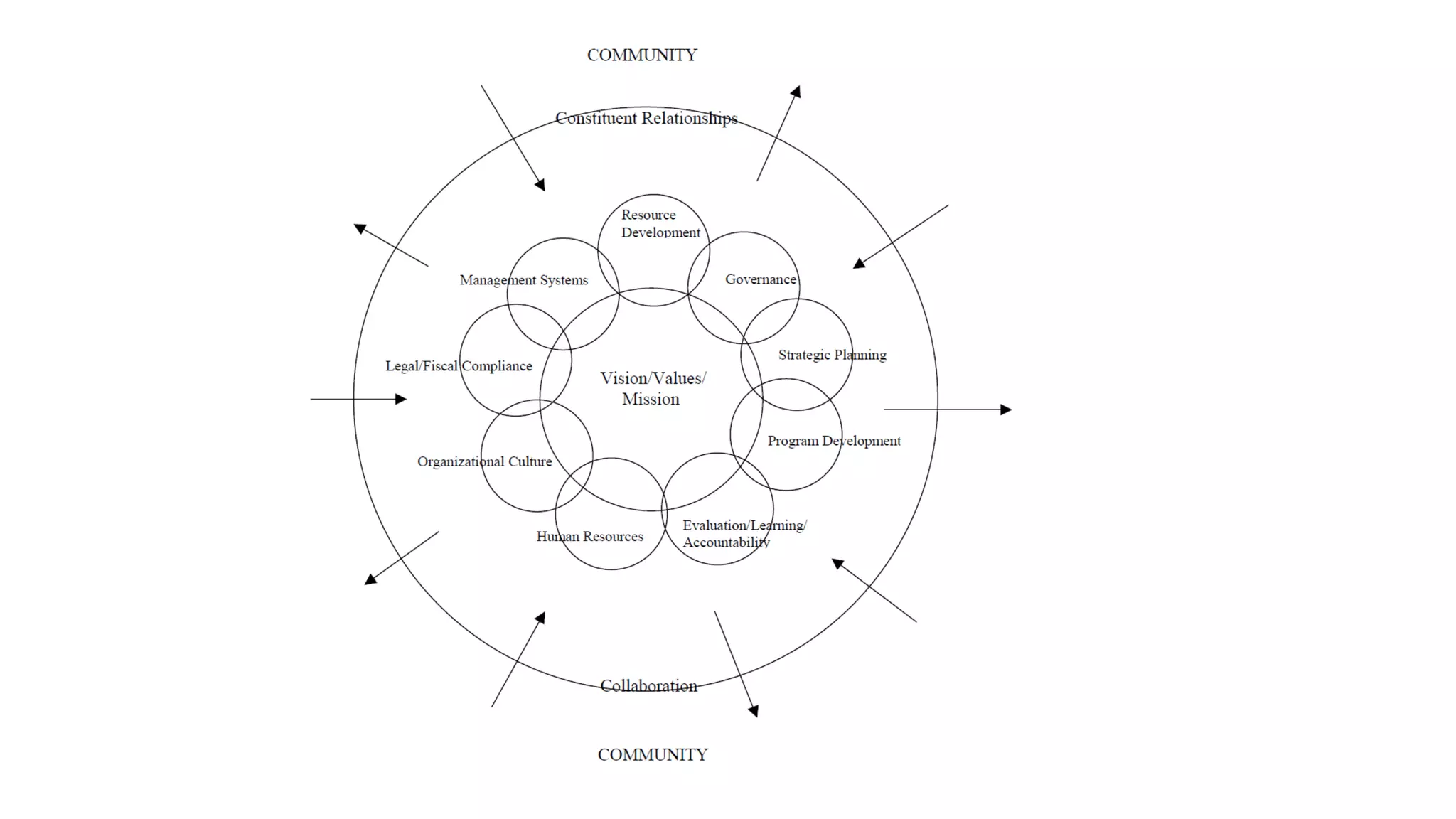
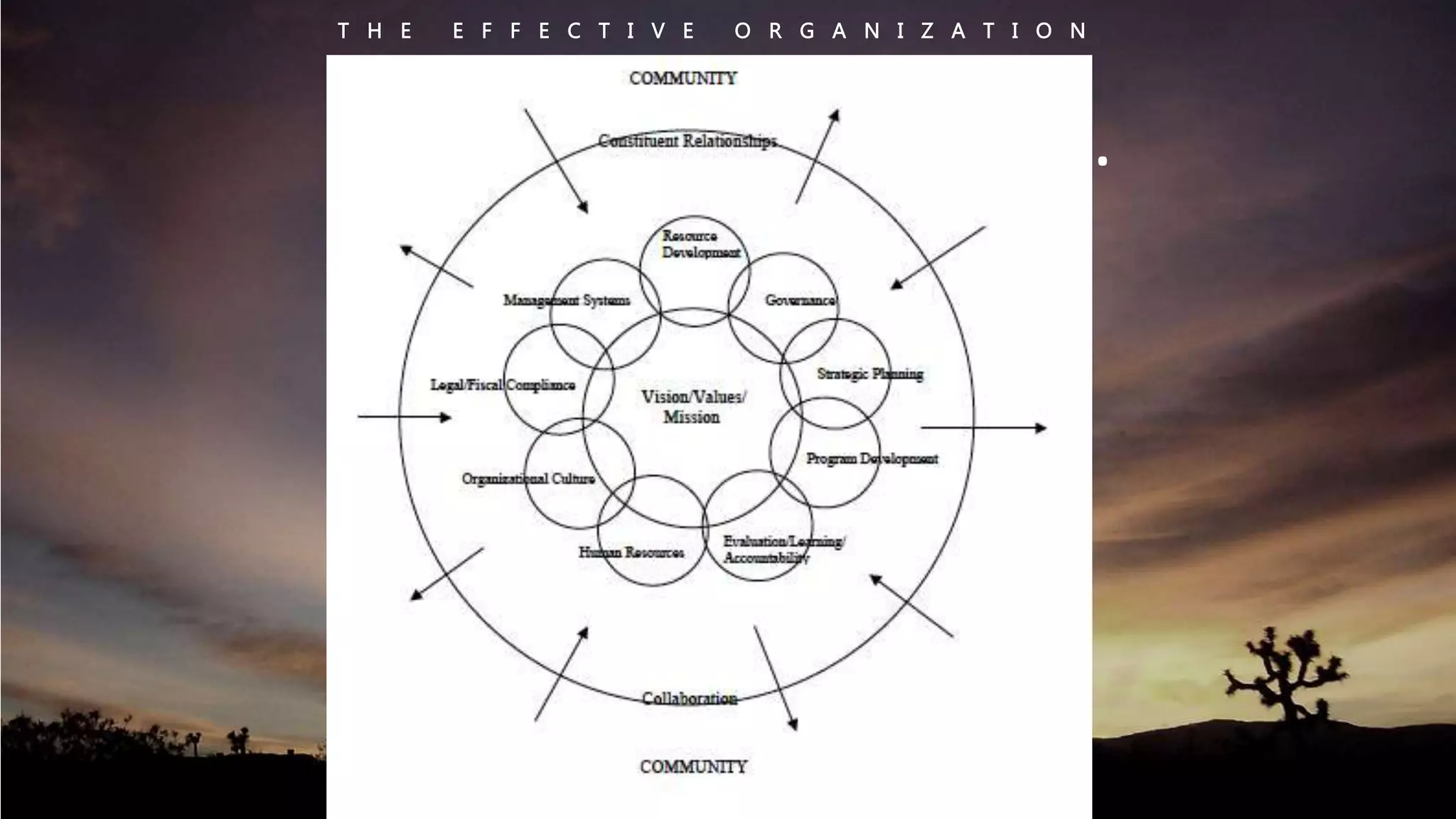
  • #10 The following diagram attempts to capture the interrelationships of the core components and their alignment with the vision, values and mission, which is the core of the organization. The organization’s relationship with its constituents and its collaboration with other community groups form the “line” between the organization and its community. This line is permeable,reflecting the impact of the organization on the community and vice versa.
  • #25 A strategic plan is a road map for an organization’s work. Too many nonprofit organizations operate without a map, thereby compromising their impact. They stay in a crisis mode, responding to emergencies and deadlines, doing more but not necessarily doing better. Or they operate from annual plan to annual plan, without stopping periodically to set the longer-term, strategic context for their work. Board and staff members lack clear priorities and focus on too many goals, leading to confusion within and outside the organization. Funding opportunities dictate program strategies, rather than vice versa, and programs stray from the organization’s core mission.
  • #26 A strategic plan is a road map for an organization’s work. Too many nonprofit organizations operate without a map, thereby compromising their impact. They stay in a crisis mode, responding to emergencies and deadlines, doing more but not necessarily doing better. Or they operate from annual plan to annual plan, without stopping periodically to set the longer-term, strategic context for their work. Board and staff members lack clear priorities and focus on too many goals, leading to confusion within and outside the organization. Funding opportunities dictate program strategies, rather than vice versa, and programs stray from the organization’s core mission.
  • #27 A strategic plan is a road map for an organization’s work. Too many nonprofit organizations operate without a map, thereby compromising their impact. They stay in a crisis mode, responding to emergencies and deadlines, doing more but not necessarily doing better. Or they operate from annual plan to annual plan, without stopping periodically to set the longer-term, strategic context for their work. Board and staff members lack clear priorities and focus on too many goals, leading to confusion within and outside the organization. Funding opportunities dictate program strategies, rather than vice versa, and programs stray from the organization’s core mission.
  • #28 A thoughtful strategic plan sets the direction for an organization, but the process of developing and implementing programs is equally critical to organizational effectiveness. A sound idea can fail if the organization does not pay careful attention to identifying desired outcomes, developing appropriate activities, and giving staff and volunteers the appropriate skills to do the work. Likewise, an effective program will not remain effective if the organization does not monitor its results and adapt the program to new information and lessons learned from evaluation.
  • #29 A thoughtful strategic plan sets the direction for an organization, but the process of developing and implementing programs is equally critical to organizational effectiveness. A sound idea can fail if the organization does not pay careful attention to identifying desired outcomes, developing appropriate activities, and giving staff and volunteers the appropriate skills to do the work. Likewise, an effective program will not remain effective if the organization does not monitor its results and adapt the program to new information and lessons learned from evaluation.
  • #30 A thoughtful strategic plan sets the direction for an organization, but the process of developing and implementing programs is equally critical to organizational effectiveness. A sound idea can fail if the organization does not pay careful attention to identifying desired outcomes, developing appropriate activities, and giving staff and volunteers the appropriate skills to do the work. Likewise, an effective program will not remain effective if the organization does not monitor its results and adapt the program to new information and lessons learned from evaluation.