13-1
Michael A. Hitt
C. Chet Miller
Adrienne Colella
Chapter 13
Organizational
Structure
and Culture
Slides by Ralph R. Braithwaite
13-2
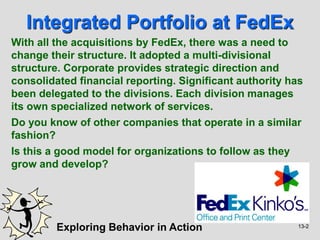
Integrated Portfolio at FedEx
Exploring Behavior in Action
With all the acquisitions by FedEx, there was a need to
change their structure. It adopted a multi-divisional
structure. Corporate provides strategic direction and
consolidated financial reporting. Significant authority has
been delegated to the divisions. Each division manages
its own specialized network of services.
Do you know of other companies that operate in a similar
fashion?
Is this a good model for organizations to follow as they
grow and develop?
13-3
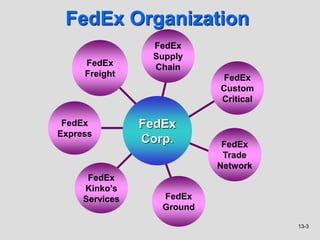
FedEx
Freight
FedEx
Supply
Chain
FedEx
Kinko’s
Services
FedEx
Express
FedEx
Corp.
FedEx
Custom
Critical
FedEx
Trade
Network
FedEx
Ground
FedEx Organization
13-4
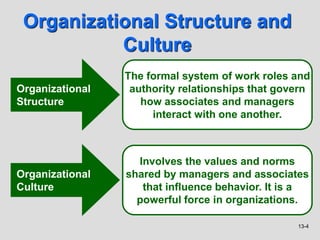
Organizational Structure and
Culture
Organizational
Structure
Organizational
Culture
The formal system of work roles and
authority relationships that govern
how associates and managers
interact with one another.
Involves the values and norms
shared by managers and associates
that influence behavior. It is a
powerful force in organizations.
13-5
Knowledge Objectives
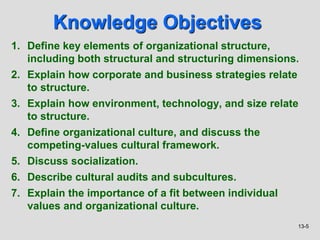
1. Define key elements of organizational structure,
including both structural and structuring dimensions.
2. Explain how corporate and business strategies relate
to structure.
3. Explain how environment, technology, and size relate
to structure.
4. Define organizational culture, and discuss the
competing-values cultural framework.
5. Discuss socialization.
6. Describe cultural audits and subcultures.
7. Explain the importance of a fit between individual
values and organizational culture.
13-6
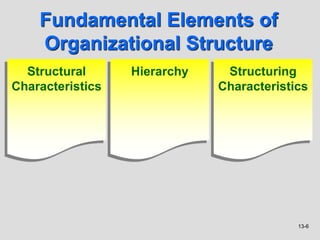
Fundamental Elements of
Organizational Structure
Structural
Characteristics
Structuring
Characteristics
Hierarchy
13-7
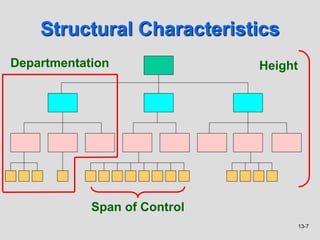
Structural Characteristics
Span of Control
Height
Departmentation
13-8
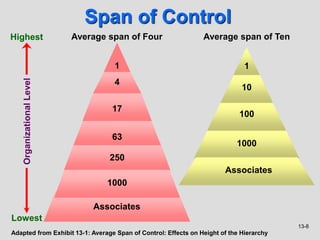
Span of Control
Adapted from Exhibit 13-1: Average Span of Control: Effects on Height of the Hierarchy
Average span of Four Average span of Ten
Highest
Lowest
Organizational
Level
1000
100
10
1
Associates
250
63
17
4
1
Associates
1000
13-9
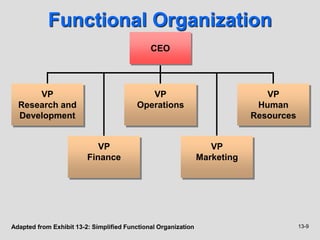
Functional Organization
Adapted from Exhibit 13-2: Simplified Functional Organization
VP
Research and
Development
VP
Research and
Development
VP
Operations
VP
Human
Resources
VP
Finance
VP
Marketing
CEO
13-10
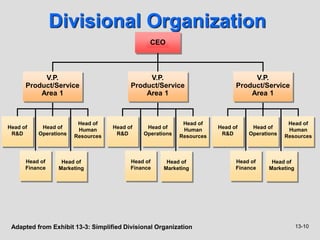
Divisional Organization
Adapted from Exhibit 13-3: Simplified Divisional Organization
CEO
Head of
Operations
Head of
R&D
Head of
Human
Resources
Head of
Finance
Head of
Marketing
V.P.
Product/Service
Area 1
Head of
Operations
Head of
R&D
Head of
Human
Resources
Head of
Finance
Head of
Marketing
V.P.
Product/Service
Area 1
Head of
Operations
Head of
R&D
Head of
Human
Resources
Head of
Finance
Head of
Marketing
V.P.
Product/Service
Area 1
13-11
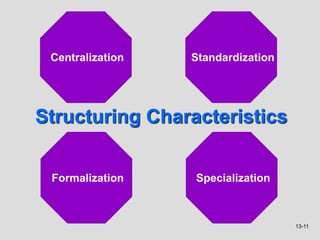
Structuring Characteristics
Centralization Standardization
Formalization Specialization
13-12
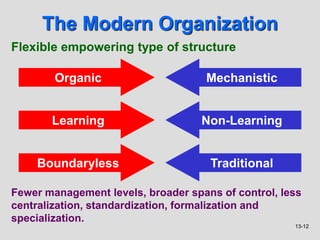
The Modern Organization
Flexible empowering type of structure
Organic
Learning
Boundaryless
Mechanistic
Non-Learning
Traditional
Fewer management levels, broader spans of control, less
centralization, standardization, formalization and
specialization.
13-13
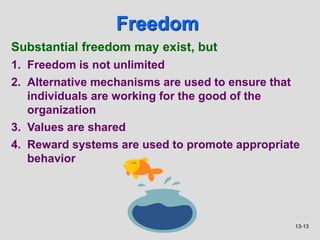
Freedom
Substantial freedom may exist, but
1. Freedom is not unlimited
2. Alternative mechanisms are used to ensure that
individuals are working for the good of the
organization
3. Values are shared
4. Reward systems are used to promote appropriate
behavior
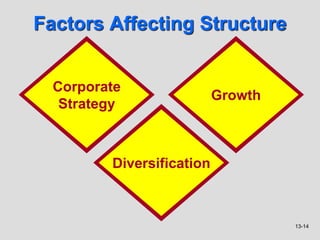
13-14
Factors Affecting Structure
Corporate
Strategy
Growth
Diversification
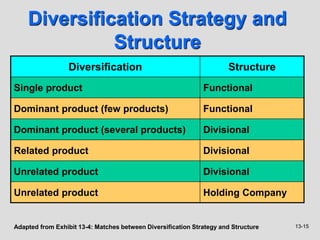
13-15
Diversification Strategy and
Structure
Adapted from Exhibit 13-4: Matches between Diversification Strategy and Structure
Holding Company
Unrelated product
Divisional
Unrelated product
Divisional
Related product
Divisional
Dominant product (several products)
Functional
Dominant product (few products)
Functional
Single product
Structure
Diversification
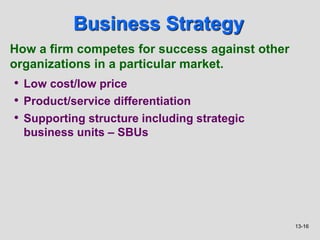
13-16
Business Strategy
• Low cost/low price
• Product/service differentiation
• Supporting structure including strategic
business units – SBUs
How a firm competes for success against other
organizations in a particular market.
13-17
Experiencing
Strategic OB
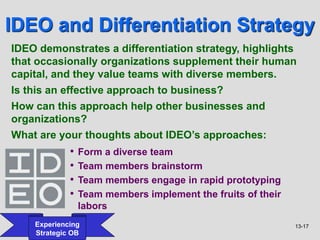
IDEO and Differentiation Strategy
IDEO demonstrates a differentiation strategy, highlights
that occasionally organizations supplement their human
capital, and they value teams with diverse members.
Is this an effective approach to business?
How can this approach help other businesses and
organizations?
What are your thoughts about IDEO’s approaches:
• Form a diverse team
• Team members brainstorm
• Team members engage in rapid prototyping
• Team members implement the fruits of their
labors
13-18
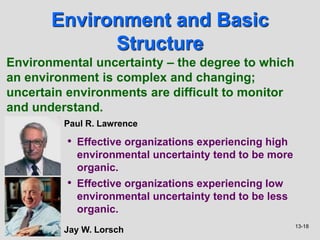
Environment and Basic
Structure
• Effective organizations experiencing high
environmental uncertainty tend to be more
organic.
• Effective organizations experiencing low
environmental uncertainty tend to be less
organic.
Environmental uncertainty – the degree to which
an environment is complex and changing;
uncertain environments are difficult to monitor
and understand.
Jay W. Lorsch
Paul R. Lawrence
13-19
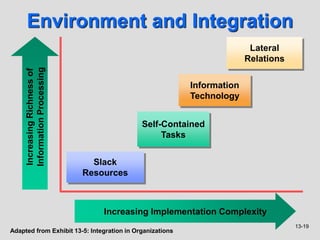
Environment and Integration
Adapted from Exhibit 13-5: Integration in Organizations
Slack
Resources
Self-Contained
Tasks
Information
Technology
Lateral
Relations
Increasing Implementation Complexity
Increasing
Richness
of
Information
Processing
13-20
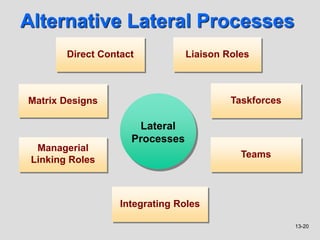
Alternative Lateral Processes
Liaison Roles
Direct Contact
Matrix Designs
Managerial
Linking Roles
Integrating Roles
Teams
Taskforces
Lateral
Processes
13-21
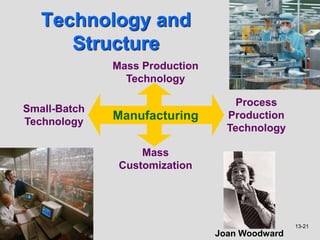
Technology and
Structure
Small-Batch
Technology
Mass Production
Technology
Process
Production
Technology
Mass
Customization
Manufacturing
Joan Woodward
13-22
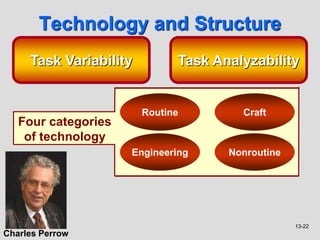
Technology and Structure
Charles Perrow
Task Variability Task Analyzability
Four categories
of technology
Routine Craft
Engineering Nonroutine
13-23
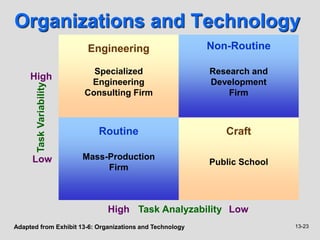
Organizations and Technology
Adapted from Exhibit 13-6: Organizations and Technology
High Low
Task Analyzability
High
Low
Task
Variability
Specialized
Engineering
Consulting Firm
Engineering
Public School
Craft
Research and
Development
Firm
Non-Routine
Mass-Production
Firm
Routine
13-24
Experiencing
Strategic OB
Google Culture Attracts
High-Quality Associates
Larry Page and Sergy Brin
Do you think Google would have enjoyed its success had
a different type of structure and culture been introduced?
What types of organizations could benefit with a similar
structure and culture? What types of organizations might
have difficulty?
As Google continues to grow, will the culture survive or
will it possibly be replaced by a more traditional culture?
13-25
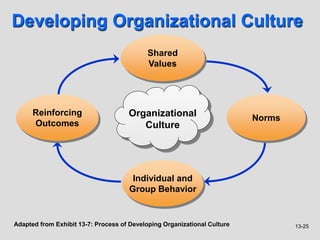
Developing Organizational Culture
Adapted from Exhibit 13-7: Process of Developing Organizational Culture
Organizational
Culture
Norms
Reinforcing
Outcomes
Shared
Values
Individual and
Group Behavior
13-26
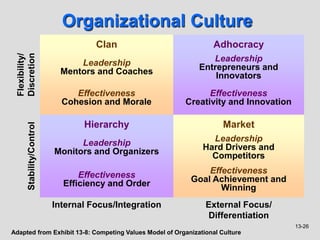
Organizational Culture
Adapted from Exhibit 13-8: Competing Values Model of Organizational Culture
Effectiveness
Cohesion and Morale
Leadership
Mentors and Coaches
Clan
Effectiveness
Creativity and Innovation
Leadership
Entrepreneurs and
Innovators
Adhocracy
Effectiveness
Goal Achievement and
Winning
Leadership
Hard Drivers and
Competitors
Market
Effectiveness
Efficiency and Order
Leadership
Monitors and Organizers
Hierarchy
Internal Focus/Integration External Focus/
Differentiation
Stability/Control
Flexibility/
Discretion
13-27
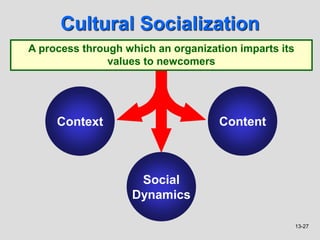
Cultural Socialization
A process through which an organization imparts its
values to newcomers
Context Content
Social
Dynamics
13-28
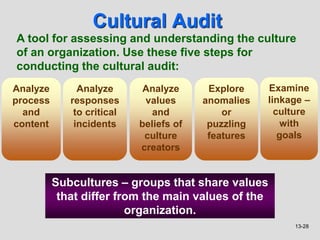
Cultural Audit
A tool for assessing and understanding the culture
of an organization. Use these five steps for
conducting the cultural audit:
Analyze
process
and
content
Analyze
responses
to critical
incidents
Analyze
values
and
beliefs of
culture
creators
Explore
anomalies
or
puzzling
features
Examine
linkage –
culture
with
goals
Subcultures – groups that share values
that differ from the main values of the
organization.
13-29
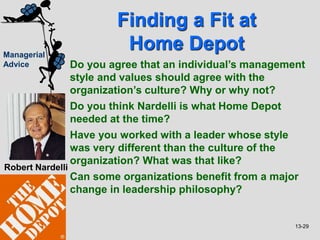
Managerial
Advice
Finding a Fit at
Home Depot
Robert Nardelli
Do you agree that an individual’s management
style and values should agree with the
organization’s culture? Why or why not?
Do you think Nardelli is what Home Depot
needed at the time?
Have you worked with a leader whose style
was very different than the culture of the
organization? What was that like?
Can some organizations benefit from a major
change in leadership philosophy?
13-30
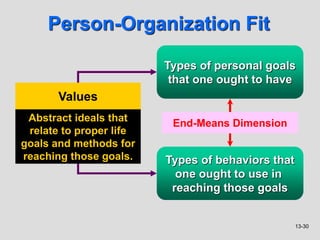
Person-Organization Fit
Abstract ideals that
relate to proper life
goals and methods for
reaching those goals.
Values
Types of personal goals
that one ought to have
Types of behaviors that
one ought to use in
reaching those goals
End-Means Dimension
13-31
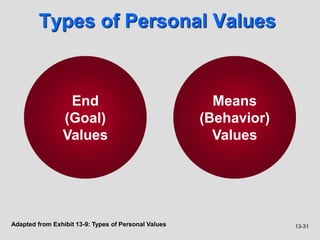
Types of Personal Values
Means
(Behavior)
Values
End
(Goal)
Values
Adapted from Exhibit 13-9: Types of Personal Values
13-32
The Strategic Lens
1. Consider an organization of which you are a member
or an associate. What is the structure in this
organization? Is it centralized or decentralized? Is it
organic and flexible? How would you change the
structure in this organization to make it more effective?
2. How would you describe the culture in the organization
discussed in question #1? How does the culture affect
members’ behavior in the organization?
3. When you become a manager, what type of culture will
you establish in your unit? What values do you want to
emphasize? Why?
13-33
Questions

organizational_structure_and_culture.ppt

  • 1.
    13-1 Michael A. Hitt C.Chet Miller Adrienne Colella Chapter 13 Organizational Structure and Culture Slides by Ralph R. Braithwaite
  • 2.
    13-2 Integrated Portfolio atFedEx Exploring Behavior in Action With all the acquisitions by FedEx, there was a need to change their structure. It adopted a multi-divisional structure. Corporate provides strategic direction and consolidated financial reporting. Significant authority has been delegated to the divisions. Each division manages its own specialized network of services. Do you know of other companies that operate in a similar fashion? Is this a good model for organizations to follow as they grow and develop?
  • 3.
  • 4.
    13-4 Organizational Structure and Culture Organizational Structure Organizational Culture Theformal system of work roles and authority relationships that govern how associates and managers interact with one another. Involves the values and norms shared by managers and associates that influence behavior. It is a powerful force in organizations.
  • 5.
    13-5 Knowledge Objectives 1. Definekey elements of organizational structure, including both structural and structuring dimensions. 2. Explain how corporate and business strategies relate to structure. 3. Explain how environment, technology, and size relate to structure. 4. Define organizational culture, and discuss the competing-values cultural framework. 5. Discuss socialization. 6. Describe cultural audits and subcultures. 7. Explain the importance of a fit between individual values and organizational culture.
  • 6.
    13-6 Fundamental Elements of OrganizationalStructure Structural Characteristics Structuring Characteristics Hierarchy
  • 7.
    13-7 Structural Characteristics Span ofControl Height Departmentation
  • 8.
    13-8 Span of Control Adaptedfrom Exhibit 13-1: Average Span of Control: Effects on Height of the Hierarchy Average span of Four Average span of Ten Highest Lowest Organizational Level 1000 100 10 1 Associates 250 63 17 4 1 Associates 1000
  • 9.
    13-9 Functional Organization Adapted fromExhibit 13-2: Simplified Functional Organization VP Research and Development VP Research and Development VP Operations VP Human Resources VP Finance VP Marketing CEO
  • 10.
    13-10 Divisional Organization Adapted fromExhibit 13-3: Simplified Divisional Organization CEO Head of Operations Head of R&D Head of Human Resources Head of Finance Head of Marketing V.P. Product/Service Area 1 Head of Operations Head of R&D Head of Human Resources Head of Finance Head of Marketing V.P. Product/Service Area 1 Head of Operations Head of R&D Head of Human Resources Head of Finance Head of Marketing V.P. Product/Service Area 1
  • 11.
  • 12.
    13-12 The Modern Organization Flexibleempowering type of structure Organic Learning Boundaryless Mechanistic Non-Learning Traditional Fewer management levels, broader spans of control, less centralization, standardization, formalization and specialization.
  • 13.
    13-13 Freedom Substantial freedom mayexist, but 1. Freedom is not unlimited 2. Alternative mechanisms are used to ensure that individuals are working for the good of the organization 3. Values are shared 4. Reward systems are used to promote appropriate behavior
  • 14.
  • 15.
    13-15 Diversification Strategy and Structure Adaptedfrom Exhibit 13-4: Matches between Diversification Strategy and Structure Holding Company Unrelated product Divisional Unrelated product Divisional Related product Divisional Dominant product (several products) Functional Dominant product (few products) Functional Single product Structure Diversification
  • 16.
    13-16 Business Strategy • Lowcost/low price • Product/service differentiation • Supporting structure including strategic business units – SBUs How a firm competes for success against other organizations in a particular market.
  • 17.
    13-17 Experiencing Strategic OB IDEO andDifferentiation Strategy IDEO demonstrates a differentiation strategy, highlights that occasionally organizations supplement their human capital, and they value teams with diverse members. Is this an effective approach to business? How can this approach help other businesses and organizations? What are your thoughts about IDEO’s approaches: • Form a diverse team • Team members brainstorm • Team members engage in rapid prototyping • Team members implement the fruits of their labors
  • 18.
    13-18 Environment and Basic Structure •Effective organizations experiencing high environmental uncertainty tend to be more organic. • Effective organizations experiencing low environmental uncertainty tend to be less organic. Environmental uncertainty – the degree to which an environment is complex and changing; uncertain environments are difficult to monitor and understand. Jay W. Lorsch Paul R. Lawrence
  • 19.
    13-19 Environment and Integration Adaptedfrom Exhibit 13-5: Integration in Organizations Slack Resources Self-Contained Tasks Information Technology Lateral Relations Increasing Implementation Complexity Increasing Richness of Information Processing
  • 20.
    13-20 Alternative Lateral Processes LiaisonRoles Direct Contact Matrix Designs Managerial Linking Roles Integrating Roles Teams Taskforces Lateral Processes
  • 21.
  • 22.
    13-22 Technology and Structure CharlesPerrow Task Variability Task Analyzability Four categories of technology Routine Craft Engineering Nonroutine
  • 23.
    13-23 Organizations and Technology Adaptedfrom Exhibit 13-6: Organizations and Technology High Low Task Analyzability High Low Task Variability Specialized Engineering Consulting Firm Engineering Public School Craft Research and Development Firm Non-Routine Mass-Production Firm Routine
  • 24.
    13-24 Experiencing Strategic OB Google CultureAttracts High-Quality Associates Larry Page and Sergy Brin Do you think Google would have enjoyed its success had a different type of structure and culture been introduced? What types of organizations could benefit with a similar structure and culture? What types of organizations might have difficulty? As Google continues to grow, will the culture survive or will it possibly be replaced by a more traditional culture?
  • 25.
    13-25 Developing Organizational Culture Adaptedfrom Exhibit 13-7: Process of Developing Organizational Culture Organizational Culture Norms Reinforcing Outcomes Shared Values Individual and Group Behavior
  • 26.
    13-26 Organizational Culture Adapted fromExhibit 13-8: Competing Values Model of Organizational Culture Effectiveness Cohesion and Morale Leadership Mentors and Coaches Clan Effectiveness Creativity and Innovation Leadership Entrepreneurs and Innovators Adhocracy Effectiveness Goal Achievement and Winning Leadership Hard Drivers and Competitors Market Effectiveness Efficiency and Order Leadership Monitors and Organizers Hierarchy Internal Focus/Integration External Focus/ Differentiation Stability/Control Flexibility/ Discretion
  • 27.
    13-27 Cultural Socialization A processthrough which an organization imparts its values to newcomers Context Content Social Dynamics
  • 28.
    13-28 Cultural Audit A toolfor assessing and understanding the culture of an organization. Use these five steps for conducting the cultural audit: Analyze process and content Analyze responses to critical incidents Analyze values and beliefs of culture creators Explore anomalies or puzzling features Examine linkage – culture with goals Subcultures – groups that share values that differ from the main values of the organization.
  • 29.
    13-29 Managerial Advice Finding a Fitat Home Depot Robert Nardelli Do you agree that an individual’s management style and values should agree with the organization’s culture? Why or why not? Do you think Nardelli is what Home Depot needed at the time? Have you worked with a leader whose style was very different than the culture of the organization? What was that like? Can some organizations benefit from a major change in leadership philosophy?
  • 30.
    13-30 Person-Organization Fit Abstract idealsthat relate to proper life goals and methods for reaching those goals. Values Types of personal goals that one ought to have Types of behaviors that one ought to use in reaching those goals End-Means Dimension
  • 31.
    13-31 Types of PersonalValues Means (Behavior) Values End (Goal) Values Adapted from Exhibit 13-9: Types of Personal Values
  • 32.
    13-32 The Strategic Lens 1.Consider an organization of which you are a member or an associate. What is the structure in this organization? Is it centralized or decentralized? Is it organic and flexible? How would you change the structure in this organization to make it more effective? 2. How would you describe the culture in the organization discussed in question #1? How does the culture affect members’ behavior in the organization? 3. When you become a manager, what type of culture will you establish in your unit? What values do you want to emphasize? Why?
  • 33.