GLOBAL WIND PATTERNS
By : Renu Rajbahak
Neha Adhikari
CONTENTS
• Wind
• Formation of wind
• Coriolis effect
• Types of winds: Global and Local wind
• Prevailing wind
• Location of Nepal
WIND RELATES TO AIR
• Air is the combination of all the gases –
that surrouds the earth atmosphere-
• -like carbon dioxide, argon, oxygen,
nitrogen, hydrogen and many more
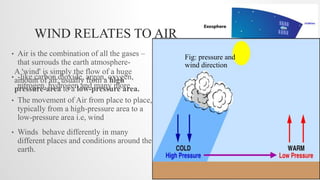
• The movement of Air from place to place,
typically from a high-pressure area to a
low-pressure area i.e, wind
• Winds behave differently in many
different places and conditions around the
earth.
A 'wind' is simply the flow of a huge
amount of air, usually from a high
pressure-area to a low-pressure area.
Fig: layers of atmosphere
Fig: pressure and
wind direction
FORMATION OF WIND
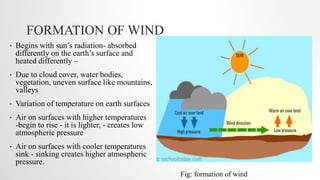
• Begins with sun’s radiation- absorbed
differently on the earth’s surface and
heated differently –
• Due to cloud cover, water bodies,
vegetation, uneven surface like mountains,
valleys
• Variation of temperature on earth surfaces
• Air on surfaces with higher temperatures
-begin to rise - it is lighter, - creates low
atmospheric pressure
• Air on surfaces with cooler temperatures
sink - sinking creates higher atmospheric
pressure.
Fig: formation of wind
FORMATION OF WIND
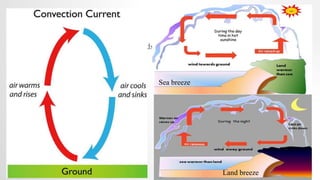
• The behaviour when warm gases or liquids
moving upward and being replaced by
cooler particles is called Convection.
• The energy moving during convection is
called convectional current.
• Convection occurs in liquids and gases –
land breeze and sea breeze
• Sea breeze occurs at day time where as
land breeze at night time
Fig: formation of wind
Sea breeze
Land breeze
CORIOLIS EFFECT
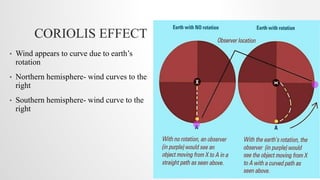
• Wind appears to curve due to earth’s
rotation
• Northern hemisphere- wind curves to the
right
• Southern hemisphere- wind curve to the
right
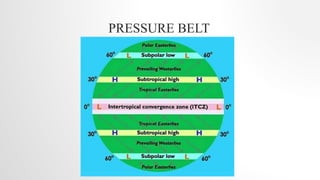
PRESSURE BELT
TYPES OF WINDS
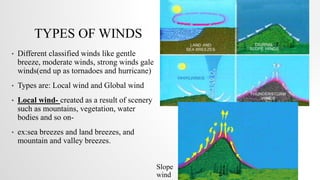
• Different classified winds like gentle
breeze, moderate winds, strong winds gale
winds(end up as tornadoes and hurricane)
• Types are: Local wind and Global wind
• Local wind- created as a result of scenery
such as mountains, vegetation, water
bodies and so on-
• ex:sea breezes and land breezes, and
mountain and valley breezes.
Slope
wind
TYPES OF WINDS
• Global wind - large air masses - created
mainly as a result of the earth’s rotation, the
shape of the earth and the sun’s heating
power.
• Types –
1. Polar easterlies
2. Prevailing westerlies
3. Tropical easterlies/ trade winds
4. Doldrums
TYPES OF WINDS
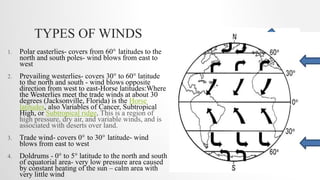
1. Polar easterlies- covers from 60° latitudes to the
north and south poles- wind blows from east to
west
2. Prevailing westerlies- covers 30° to 60° latitude
to the north and south - wind blows opposite
direction from west to east-Horse latitudes:Where
the Westerlies meet the trade winds at about 30
degrees (Jacksonville, Florida) is the Horse
latitudes, also Variables of Cancer, Subtropical
High, or Subtropical ridge. This is a region of
high pressure, dry air, and variable winds, and is
associated with deserts over land.
3. Trade wind- covers 0° to 30° latitude- wind
blows from east to west
4. Doldrums - 0° to 5° latitude to the north and south
of equatorial area- very low pressure area caused
by constant heating of the sun – calm area with
very little wind
PREVAILING WINDS
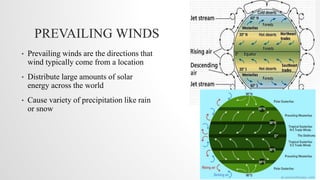
• Prevailing winds are the directions that
wind typically come from a location
• Distribute large amounts of solar
energy across the world
• Cause variety of precipitation like rain
or snow
LOCATION OF NEPAL
• The main latitude and longitude of
Nepal is 28° North and 84° East.
• small Asian country falls within the
Tropic of Cancer and the Arctic
Circle.
• The climatic condition of Nepal is
not typically a temperate one as the
country is located at the foothills of
the Himalayas.
CONCLUSION
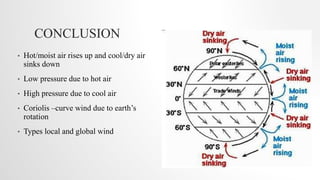
• Hot/moist air rises up and cool/dry air
sinks down
• Low pressure due to hot air
• High pressure due to cool air
• Coriolis –curve wind due to earth’s
rotation
• Types local and global wind
• http://people.senecac.on.ca/kathy.kells/TGL200BB/Intro/winds.html
• Eschooltoday, 2010 http://www.eschooltoday.com/winds/the-coriolis-
effect.html
• https://quizlet.com/22270365/jet-streamsglobal-winds-flash-cards/
THANK YOU!

Global wind patterns

  • 1.
    GLOBAL WIND PATTERNS By: Renu Rajbahak Neha Adhikari
  • 2.
    CONTENTS • Wind • Formationof wind • Coriolis effect • Types of winds: Global and Local wind • Prevailing wind • Location of Nepal
  • 3.
    WIND RELATES TOAIR • Air is the combination of all the gases – that surrouds the earth atmosphere- • -like carbon dioxide, argon, oxygen, nitrogen, hydrogen and many more • The movement of Air from place to place, typically from a high-pressure area to a low-pressure area i.e, wind • Winds behave differently in many different places and conditions around the earth. A 'wind' is simply the flow of a huge amount of air, usually from a high pressure-area to a low-pressure area. Fig: layers of atmosphere Fig: pressure and wind direction
  • 4.
    FORMATION OF WIND •Begins with sun’s radiation- absorbed differently on the earth’s surface and heated differently – • Due to cloud cover, water bodies, vegetation, uneven surface like mountains, valleys • Variation of temperature on earth surfaces • Air on surfaces with higher temperatures -begin to rise - it is lighter, - creates low atmospheric pressure • Air on surfaces with cooler temperatures sink - sinking creates higher atmospheric pressure. Fig: formation of wind
  • 5.
    FORMATION OF WIND •The behaviour when warm gases or liquids moving upward and being replaced by cooler particles is called Convection. • The energy moving during convection is called convectional current. • Convection occurs in liquids and gases – land breeze and sea breeze • Sea breeze occurs at day time where as land breeze at night time Fig: formation of wind Sea breeze Land breeze
  • 6.
    CORIOLIS EFFECT • Windappears to curve due to earth’s rotation • Northern hemisphere- wind curves to the right • Southern hemisphere- wind curve to the right
  • 7.
  • 8.
    TYPES OF WINDS •Different classified winds like gentle breeze, moderate winds, strong winds gale winds(end up as tornadoes and hurricane) • Types are: Local wind and Global wind • Local wind- created as a result of scenery such as mountains, vegetation, water bodies and so on- • ex:sea breezes and land breezes, and mountain and valley breezes. Slope wind
  • 9.
    TYPES OF WINDS •Global wind - large air masses - created mainly as a result of the earth’s rotation, the shape of the earth and the sun’s heating power. • Types – 1. Polar easterlies 2. Prevailing westerlies 3. Tropical easterlies/ trade winds 4. Doldrums
  • 10.
    TYPES OF WINDS 1.Polar easterlies- covers from 60° latitudes to the north and south poles- wind blows from east to west 2. Prevailing westerlies- covers 30° to 60° latitude to the north and south - wind blows opposite direction from west to east-Horse latitudes:Where the Westerlies meet the trade winds at about 30 degrees (Jacksonville, Florida) is the Horse latitudes, also Variables of Cancer, Subtropical High, or Subtropical ridge. This is a region of high pressure, dry air, and variable winds, and is associated with deserts over land. 3. Trade wind- covers 0° to 30° latitude- wind blows from east to west 4. Doldrums - 0° to 5° latitude to the north and south of equatorial area- very low pressure area caused by constant heating of the sun – calm area with very little wind
  • 11.
    PREVAILING WINDS • Prevailingwinds are the directions that wind typically come from a location • Distribute large amounts of solar energy across the world • Cause variety of precipitation like rain or snow
  • 12.
    LOCATION OF NEPAL •The main latitude and longitude of Nepal is 28° North and 84° East. • small Asian country falls within the Tropic of Cancer and the Arctic Circle. • The climatic condition of Nepal is not typically a temperate one as the country is located at the foothills of the Himalayas.
  • 13.
    CONCLUSION • Hot/moist airrises up and cool/dry air sinks down • Low pressure due to hot air • High pressure due to cool air • Coriolis –curve wind due to earth’s rotation • Types local and global wind
  • 14.
    • http://people.senecac.on.ca/kathy.kells/TGL200BB/Intro/winds.html • Eschooltoday,2010 http://www.eschooltoday.com/winds/the-coriolis- effect.html • https://quizlet.com/22270365/jet-streamsglobal-winds-flash-cards/ • https://quizlet.com/22270365/jet-streamsglobal-winds-flash-cards/
  • 15.