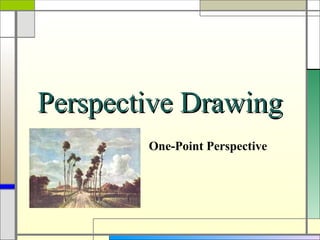
Perspective Drawing
        One-Point Perspective
Perspective
 During the Renaissance artists became
  interested in making paintings and drawing
  look 3D. (like a photo)
 Renaissance- (1450-1600):
Perspective
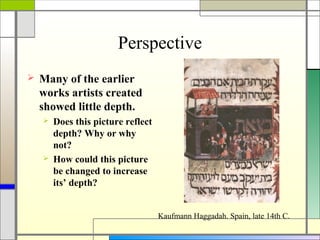
   Many of the earlier
    works artists created
    showed little depth.
       Does this picture reflect
        depth? Why or why
        not?
       How could this picture
        be changed to increase
        its’ depth?


                                    Kaufmann Haggadah. Spain, late 14th C.
Perspective
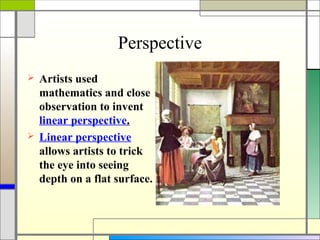
 Artists used
  mathematics and close
  observation to invent
  linear perspective.
 Linear perspective
  allows artists to trick
  the eye into seeing
  depth on a flat surface.
Perspective
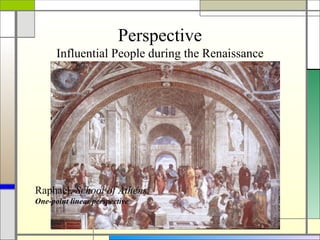
      Influential People during the Renaissance


Raphael, School of Athens,
One-point linear perspective
Perspective
   Linear Perspective:
       Based on the way the human eye sees the world.
       Objects that are closer appear larger, more
        distant objects appear smaller.
       To create the illusion of space the artists creates
        a vanishing point on the horizon line.
       Objects are drawn using orthogonal lines, which
        lead to the vanishing points.
Perspective-VOCAB
   Vanishing Point
       The single point on the horizon where all the lines seem
        to come together-HAS TO BE ON HORIZON LINE
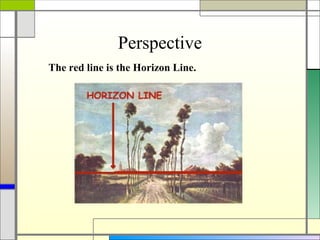
   Horizon Line
       The place where the land and the sky meet.
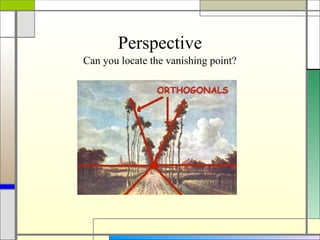
   Orthogonal Line
       Lines that converge at the vanishing point, in real life
        they are parallel but only seem to meet at VP on a 2D
        surface to create the illusion of depth.
Perspective
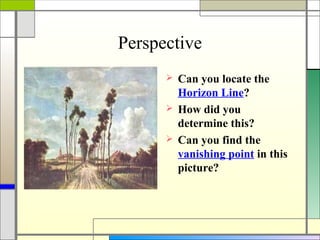
       Can you locate the
        Horizon Line?
       How did you
        determine this?
       Can you find the
        vanishing point in this
        picture?
Perspective
The red line is the Horizon Line.
Perspective
Can you locate the vanishing point?
Perspective
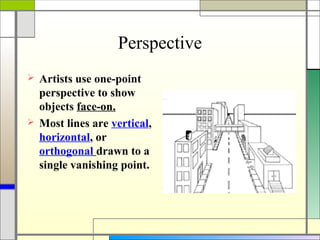
 Artists use one-point
  perspective to show
  objects face-on.
 Most lines are vertical,
  horizontal, or
  orthogonal drawn to a
  single vanishing point.
Perspective
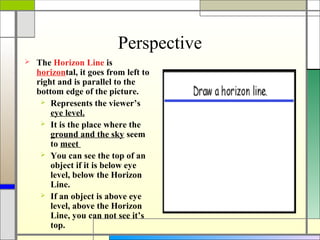
   The Horizon Line is
    horizontal, it goes from left to
    right and is parallel to the
    bottom edge of the picture.
      Represents the viewer’s
        eye level.
      It is the place where the
        ground and the sky seem
        to meet
      You can see the top of an
        object if it is below eye
        level, below the Horizon
        Line.
      If an object is above eye
        level, above the Horizon
        Line, you can not see it’s
        top.
Perspective
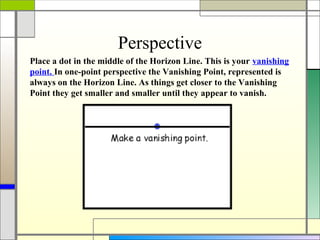
Place a dot in the middle of the Horizon Line. This is your vanishing
point. In one-point perspective the Vanishing Point, represented is
always on the Horizon Line. As things get closer to the Vanishing
Point they get smaller and smaller until they appear to vanish.
Perspective
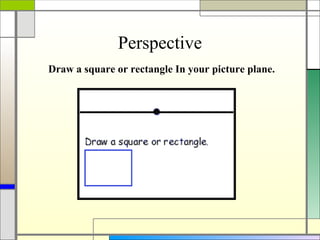
Draw a square or rectangle In your picture plane.
Perspective
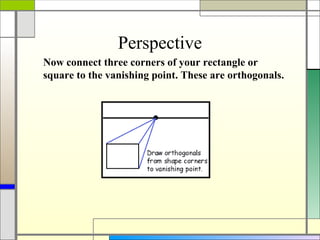
Now connect three corners of your rectangle or
square to the vanishing point. These are orthogonals.
Perspective
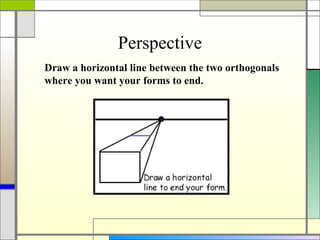
Draw a horizontal line between the two orthogonals
where you want your forms to end.
Perspective
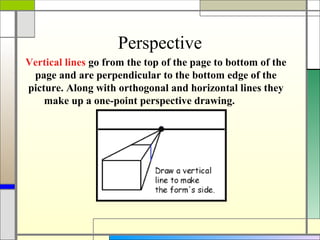
Vertical lines go from the top of the page to bottom of the
 page and are perpendicular to the bottom edge of the
picture. Along with orthogonal and horizontal lines they
    make up a one-point perspective drawing.
Perspective
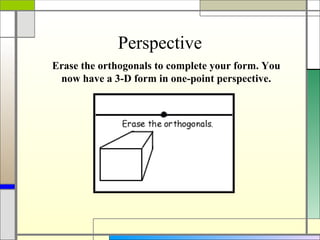
Erase the orthogonals to complete your form. You
 now have a 3-D form in one-point perspective.
Perspective

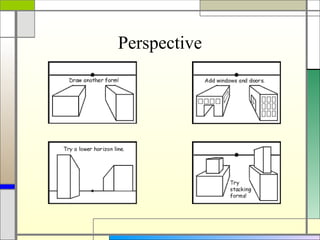
Perspective drawing 1 point a

  • 1.
    Perspective Drawing One-Point Perspective
  • 2.
    Perspective  During theRenaissance artists became interested in making paintings and drawing look 3D. (like a photo)  Renaissance- (1450-1600):
  • 3.
    Perspective  Many of the earlier works artists created showed little depth.  Does this picture reflect depth? Why or why not?  How could this picture be changed to increase its’ depth? Kaufmann Haggadah. Spain, late 14th C.
  • 4.
    Perspective  Artists used mathematics and close observation to invent linear perspective.  Linear perspective allows artists to trick the eye into seeing depth on a flat surface.
  • 5.
    Perspective Influential People during the Renaissance Raphael, School of Athens, One-point linear perspective
  • 6.
    Perspective  Linear Perspective:  Based on the way the human eye sees the world.  Objects that are closer appear larger, more distant objects appear smaller.  To create the illusion of space the artists creates a vanishing point on the horizon line.  Objects are drawn using orthogonal lines, which lead to the vanishing points.
  • 7.
    Perspective-VOCAB  Vanishing Point  The single point on the horizon where all the lines seem to come together-HAS TO BE ON HORIZON LINE  Horizon Line  The place where the land and the sky meet.  Orthogonal Line  Lines that converge at the vanishing point, in real life they are parallel but only seem to meet at VP on a 2D surface to create the illusion of depth.
  • 8.
    Perspective  Can you locate the Horizon Line?  How did you determine this?  Can you find the vanishing point in this picture?
  • 9.
    Perspective The red lineis the Horizon Line.
  • 10.
    Perspective Can you locatethe vanishing point?
  • 11.
    Perspective  Artists useone-point perspective to show objects face-on.  Most lines are vertical, horizontal, or orthogonal drawn to a single vanishing point.
  • 12.
    Perspective  The Horizon Line is horizontal, it goes from left to right and is parallel to the bottom edge of the picture.  Represents the viewer’s eye level.  It is the place where the ground and the sky seem to meet  You can see the top of an object if it is below eye level, below the Horizon Line.  If an object is above eye level, above the Horizon Line, you can not see it’s top.
  • 13.
    Perspective Place a dotin the middle of the Horizon Line. This is your vanishing point. In one-point perspective the Vanishing Point, represented is always on the Horizon Line. As things get closer to the Vanishing Point they get smaller and smaller until they appear to vanish.
  • 14.
    Perspective Draw a squareor rectangle In your picture plane.
  • 15.
    Perspective Now connect threecorners of your rectangle or square to the vanishing point. These are orthogonals.
  • 16.
    Perspective Draw a horizontalline between the two orthogonals where you want your forms to end.
  • 17.
    Perspective Vertical lines gofrom the top of the page to bottom of the page and are perpendicular to the bottom edge of the picture. Along with orthogonal and horizontal lines they make up a one-point perspective drawing.
  • 18.
    Perspective Erase the orthogonalsto complete your form. You now have a 3-D form in one-point perspective.
  • 19.