#DoGoodData
February 7, 9:00 a.m. – 1:00 p.m.
Title:
Job Title, Company name
First & Last Name
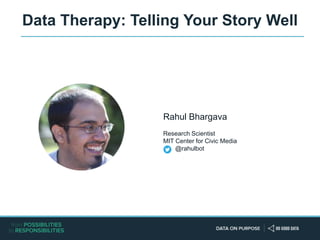
Data Therapy: Telling Your Story Well
Research Scientist
MIT Center for Civic Media
@rahulbot
Rahul Bhargava
#DoGoodData
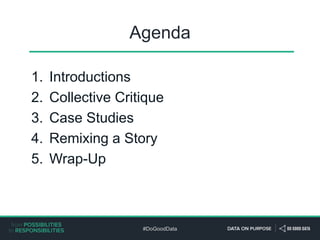
Agenda
1. Introductions
2. Collective Critique
3. Case Studies
4. Remixing a Story
5. Wrap-Up
Introduction
#DoGoodData
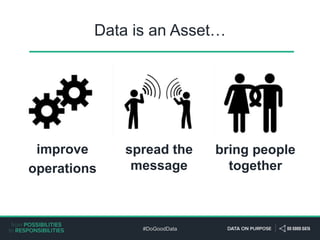
Data is an Asset…
improve
operations
spread the
message
bring people
together
6
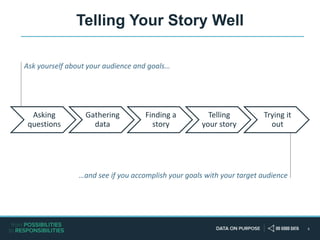
Telling Your Story Well
Asking
questions
Gathering
data
Finding a
story
Telling
your story
Trying it
out
Ask yourself about your audience and goals…
…and see if you accomplish your goals with your target audience
#DoGoodData
Group Therapy
• How are you telling stories
with data right now?
• What do you wish you
were doing?
8
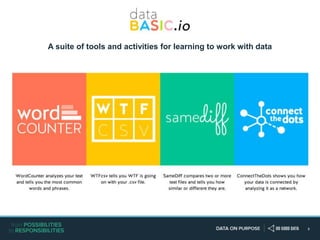
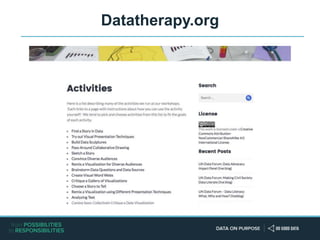
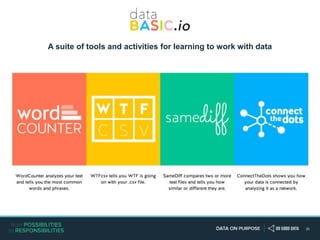
A suite of tools and activities for learning to work with data
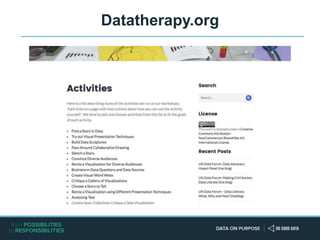
Datatherapy.org
Collective Critique
11
A Thing to Think With
12
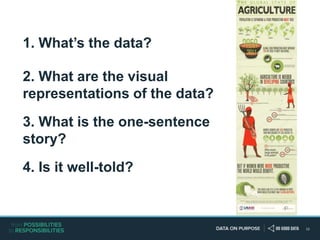
1. What’s the data?
2. What are the visual
representations of the data?
3. What is the one-sentence
story?
4. Is it well-told?
Examples
#DoGoodData
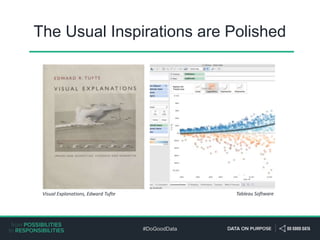
The Usual Inspirations are Polished
Tableau SoftwareVisual Explanations, Edward Tufte
#DoGoodData
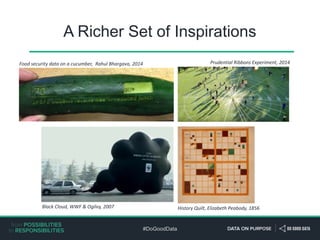
A Richer Set of Inspirations
History Quilt, Elizabeth Peabody, 1856
Prudential Ribbons Experiment, 2014Food security data on a cucumber, Rahul Bhargava, 2014
Black Cloud, WWF & Ogilvy, 2007
#DoGoodData
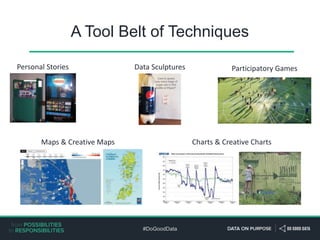
A Tool Belt of Techniques
Personal Stories Data Sculptures
Maps & Creative Maps
Participatory Games
Charts & Creative Charts
Remix a Story
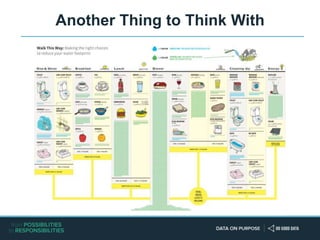
Another Thing to Think With
Audiences
• General public
• Farmers
• Consumers
• Restaurateurs
• Policy Makers
• ….
Goals
• Raise awareness
• Change to lower-water crops
• Buy lower-water groceries
• Offer lower-water meals
• Create incentives for lower water use
• …
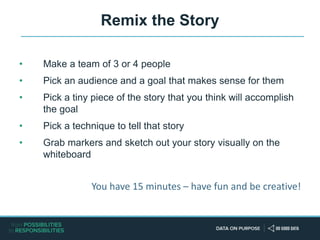
Remix the Story
• Make a team of 3 or 4 people
• Pick an audience and a goal that makes sense for them
• Pick a tiny piece of the story that you think will accomplish
the goal
• Pick a technique to tell that story
• Grab markers and sketch out your story visually on the
whiteboard
You have 15 minutes – have fun and be creative!
Wrap Up
#DoGoodData
February 7, 9:00 a.m. – 1:00 p.m.
Title:
Job Title, Company name
First & Last Name
Know your audience
and your goals before
deciding how to tell
your data-driven story
25
A suite of tools and activities for learning to work with data
Datatherapy.org
Research Scientist
MIT Center for Civic Media
@rahulbot
Rahul Bhargava
Data Therapy: Telling Your Story Well

Data Therapy: Telling Your Story Well

Editor's Notes

  • #3 Recovering computer scientist Presenting and creating tools activities about data literacy for a variety of audiences for 10 years
  • #6 Improving operations is the standard approach, analyzing and metrics oriented, for internal audiences Spreading the message is also common, using data to show impact and effectiveness to external audiences Fewer folks think of the third, in the “campfire” model of bringing people together around data to accomplish a variety of goals at the same time
  • #7 Here is a process, Sometimes a circle, triangle, whatever, but here is a line version The key bit is to figure out how to tell your story well – it’s all about audience and goals
  • #9 Catherine D’Ignazio and I built DataBasic to make this fun New grant will help us work with you all to tailor this to NGO/CSO needs
  • #10 And will support building guides to help you run these fun activities with your colleagues, Instead of crappy short descriptions online
  • #12 USAID 50th anniversary celebration, Created by lemonly
  • #13 USAID 50th anniversary celebration, Created by lemonly, Displayed online and in their HQ as a big banner, (I’m taking it out of context)
  • #15 Data-dense, visually complex representations of complex data-driven stories are the inspirations we most often see.
  • #16 Data-dense, visually complex representations of complex data-driven stories are the inspirations we most often see.
  • #17 A move diverse set of techniques available
  • #19 Based on your context, audience, and goals
  • #20 Based on your context, audience, and goals
  • #21 Make some simplifying assumptions about your audience
  • #22 Make some simplifying assumptions about your audience
  • #23 Make some simplifying assumptions about your audience
  • #25 Hard to over-emphasize how obvious and forgettable this is Need to take this approach to tell your story well
  • #26 Catherine D’Ignazio and I built DataBasic to make this fun New grant will help us work with you all to tailor this to NGO/CSO needs
  • #27 In addition to DataBasic, my datatherapy activities are documented online