ServiceMarketing
TermPaper
Presentation
Manu Sebastian Luka (131141)
Gabbula Sairam (131117)
Raghvendra Kumar (131206)
G. V. Santosh Kumar (131117)
Hussain. M P (131237)
Introduction
Priya Village Roadshow (PVR) Cinemas is one of the largest
cinema chains in India (462 screens, 104 locations in 44 cities pan
India).
The company, which as a joint venture agreement between Priya
Exhibitors Private Limited and Village Roadshow Limited in 1995
with 60:40 ratio, began its commercial operations in June 1997
with the launch of PVR Anupam in Saket Nagar, Delhi, India's
first multiplex.
By introducing the multiplex concept in India, PVR
Cinemas brought in a whole new shift to the cinema viewing
experience: high class seating, state-of-the-art screens and High
quality audio-visual systems.
PVR’s 7 P’s of Marketing
Service Product:
The core benefit is the MOVIES that a customer comes to a
cinema hall along with the attendant experience of PVR
Cinemas. Thus, we can say the following are the expected
product in the case of PVR :
Luxury Cinema.
Bulk Cinemas.
Parties at PVR.
Price
 PVR when it initially started off had a huge advantage of being only
one of its kind in Delhi to begin with. Therefore they could charge a
higher amount to its customers as they were willing to pay it for the
new concept. This high pricing helped them make maximum gains.
 In the case of PVR, they make use of all their tangible elements to
prove to the customers that the movies tickets are worth the price
they are paying for it.
 Prices that had originally started at Rs. 125 (for evening shows) and
Rs. 90 (for morning shows) have gone up to Rs. 150 and Rs. 100
respectively.
 New weekend releases are priced at higher rates ranging
from Rs.250-Rs.300 according to the seating preference.
 PVR Priya has a slightly different pricing system which
varies from Rs.45 to Rs.150 for different slabs of
customers.
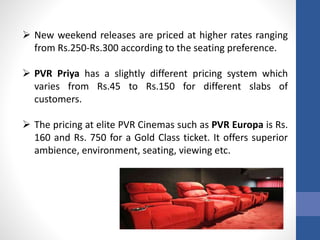
 The pricing at elite PVR Cinemas such as PVR Europa is Rs.
160 and Rs. 750 for a Gold Class ticket. It offers superior
ambience, environment, seating, viewing etc.
Place/Distribution
 The factor of location is very important keeping in view the potential
markets in terms of channel selection and distribution.
 All PVR cinema halls are stationed at good locations in the city.
 This enables them to gather a number of footfalls everyday.
 PVR opens its outlets at eventful yet untapped locations.
 PVR has no other channel of distribution, as their service is sold
solely at their chains.
Promotion
 PVR as a brand indulges into print advertisements on every
Friday giving out the latest movie schedule.
 Any new developments are communicated to the customers
via press releases.
 They are also in collaboration with cellular services like Airtel
which have SMS and win contests which promote both brands
significantly and give out free tickets to the lucky customers.
 PVR hosts various premier shows with leading movie stars
visiting the cinema.
People
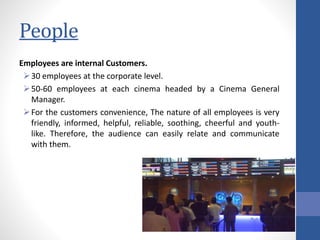
Employees are internal Customers.
30 employees at the corporate level.
50-60 employees at each cinema headed by a Cinema General
Manager.
For the customers convenience, The nature of all employees is very
friendly, informed, helpful, reliable, soothing, cheerful and youth-
like. Therefore, the audience can easily relate and communicate
with them.
Physical Evidence
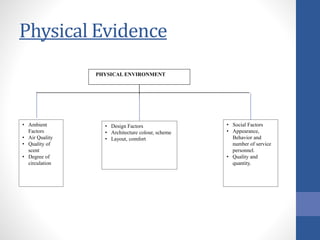
PHYSICAL ENVIRONMENT
• Ambient
Factors
• Air Quality
• Quality of
scent
• Degree of
circulation
• Design Factors
• Architecture colour, scheme
• Layout, comfort
• Social Factors
• Appearance,
Behavior and
number of service
personnel.
• Quality and
quantity.
Physical Evidence
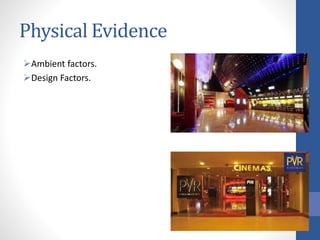
Ambient factors.
Design Factors.
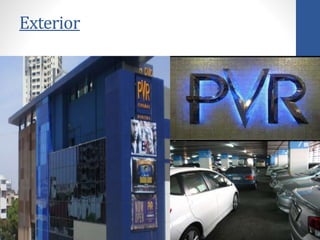
Exterior
Process
It was the first cinema company to introduce computerized
ticketing through use of international box office software in its
cinemas.
First cinema to accept credit cards in India against tickets.
First to offer cinema tickets on Internet with online payment
gateway for payment.
PVR was the first to install surround sound and Dolby in Delhi.
Gurgaon 7 screen megaplex is equipped with the latest THX
approved sound system for the real life sound effects and the
state of the art Xenon based projection technology.
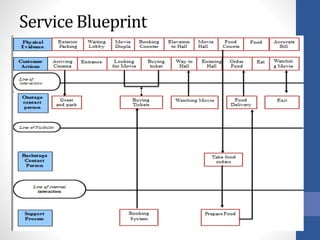
Service Blueprint
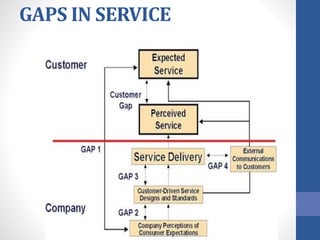
GAPS IN SERVICE
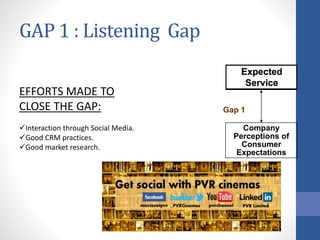
GAP 1 : Listening Gap
Company
Perceptions of
Consumer
Expectations
Gap 1
EFFORTS MADE TO
CLOSE THE GAP:
Interaction through Social Media.
Good CRM practices.
Good market research.
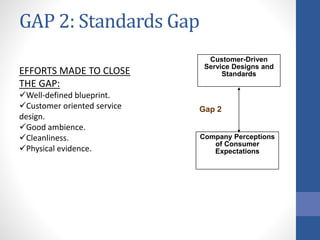
GAP 2: Standards Gap
Customer-Driven
Service Designs and
Standards
Company Perceptions
of Consumer
Expectations
Gap 2
EFFORTS MADE TO CLOSE
THE GAP:
Well-defined blueprint.
Customer oriented service
design.
Good ambience.
Cleanliness.
Physical evidence.
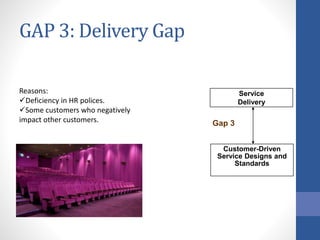
GAP 3: Delivery Gap
Service
Delivery
Customer-Driven
Service Designs and
Standards
Gap 3
Reasons:
Deficiency in HR polices.
Some customers who negatively
impact other customers.
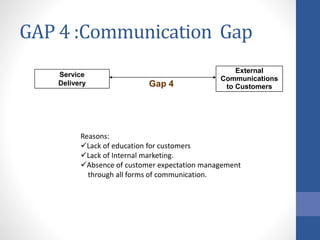
GAP 4 :Communication Gap
Service
Delivery
External
Communications
to CustomersGap 4
Reasons:
Lack of education for customers
Lack of Internal marketing.
Absence of customer expectation management
through all forms of communication.
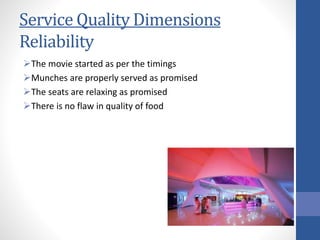
Service Quality Dimensions
Reliability
The movie started as per the timings
Munches are properly served as promised
The seats are relaxing as promised
There is no flaw in quality of food
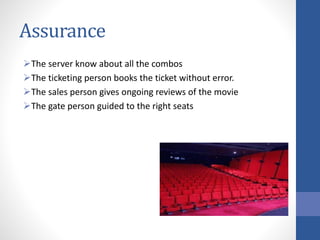
Assurance
The server know about all the combos
The ticketing person books the ticket without error.
The sales person gives ongoing reviews of the movie
The gate person guided to the right seats
Responsiveness
The attendant is available whenever required
Whenever there is a conflict, it is resolved quickly
The telephone help-line respond when called
The munching order was ready quickly.
Empathy
The gate attendant has an affable deportment
The reservation assistant is courteous at all times
The manager give individual attention for any help required
The employees considered all the appropriate needs
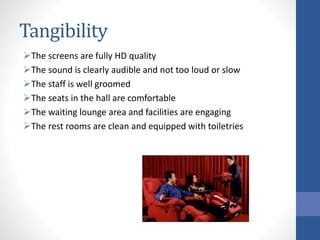
Tangibility
The screens are fully HD quality
The sound is clearly audible and not too loud or slow
The staff is well groomed
The seats in the hall are comfortable
The waiting lounge area and facilities are engaging
The rest rooms are clean and equipped with toiletries
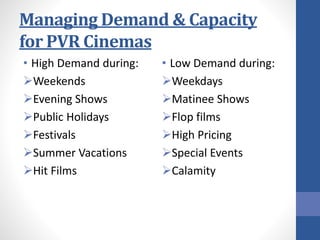
Managing Demand & Capacity
for PVR Cinemas
• High Demand during:
Weekends
Evening Shows
Public Holidays
Festivals
Summer Vacations
Hit Films
• Low Demand during:
Weekdays
Matinee Shows
Flop films
High Pricing
Special Events
Calamity
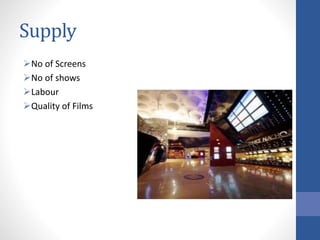
Supply
No of Screens
No of shows
Labour
Quality of Films
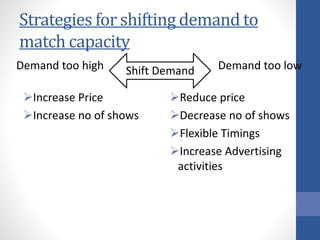
Strategies for shifting demand to
match capacity
Increase Price
Increase no of shows
Reduce price
Decrease no of shows
Flexible Timings
Increase Advertising
activities
Demand too high Demand too lowShift Demand
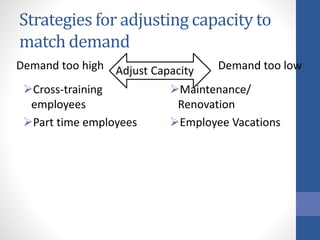
Strategies for adjusting capacity to
match demand
Cross-training
employees
Part time employees
Maintenance/
Renovation
Employee Vacations
Demand too high Demand too lowAdjust Capacity
These are the three potential
bottlenecks:
1. Sometimes due to server shutdown ticket booking and
payments get delay.
2. During weekends or during release of vary hit movies, crowd
controls becomes tough.
3. When customers come in group and create problems to
other customers.
Suggestions
• PVR should use extra servers during expected traffic zone over
internet. It will solve problem of server crash during high
traffic.
• PVR should be proactive during weekends and release of new
movies, PVR should hire staffs for temporary basis during
these times.
• PVR should have strong policy and penalty if single or group of
customers create problem to some other customers.
PVR Marketing Strategies

PVR Marketing Strategies

  • 1.
    ServiceMarketing TermPaper Presentation Manu Sebastian Luka(131141) Gabbula Sairam (131117) Raghvendra Kumar (131206) G. V. Santosh Kumar (131117) Hussain. M P (131237)
  • 2.
    Introduction Priya Village Roadshow(PVR) Cinemas is one of the largest cinema chains in India (462 screens, 104 locations in 44 cities pan India). The company, which as a joint venture agreement between Priya Exhibitors Private Limited and Village Roadshow Limited in 1995 with 60:40 ratio, began its commercial operations in June 1997 with the launch of PVR Anupam in Saket Nagar, Delhi, India's first multiplex. By introducing the multiplex concept in India, PVR Cinemas brought in a whole new shift to the cinema viewing experience: high class seating, state-of-the-art screens and High quality audio-visual systems.
  • 3.
    PVR’s 7 P’sof Marketing Service Product: The core benefit is the MOVIES that a customer comes to a cinema hall along with the attendant experience of PVR Cinemas. Thus, we can say the following are the expected product in the case of PVR : Luxury Cinema. Bulk Cinemas. Parties at PVR.
  • 4.
    Price  PVR whenit initially started off had a huge advantage of being only one of its kind in Delhi to begin with. Therefore they could charge a higher amount to its customers as they were willing to pay it for the new concept. This high pricing helped them make maximum gains.  In the case of PVR, they make use of all their tangible elements to prove to the customers that the movies tickets are worth the price they are paying for it.  Prices that had originally started at Rs. 125 (for evening shows) and Rs. 90 (for morning shows) have gone up to Rs. 150 and Rs. 100 respectively.
  • 5.
     New weekendreleases are priced at higher rates ranging from Rs.250-Rs.300 according to the seating preference.  PVR Priya has a slightly different pricing system which varies from Rs.45 to Rs.150 for different slabs of customers.  The pricing at elite PVR Cinemas such as PVR Europa is Rs. 160 and Rs. 750 for a Gold Class ticket. It offers superior ambience, environment, seating, viewing etc.
  • 6.
    Place/Distribution  The factorof location is very important keeping in view the potential markets in terms of channel selection and distribution.  All PVR cinema halls are stationed at good locations in the city.  This enables them to gather a number of footfalls everyday.  PVR opens its outlets at eventful yet untapped locations.  PVR has no other channel of distribution, as their service is sold solely at their chains.
  • 7.
    Promotion  PVR asa brand indulges into print advertisements on every Friday giving out the latest movie schedule.  Any new developments are communicated to the customers via press releases.  They are also in collaboration with cellular services like Airtel which have SMS and win contests which promote both brands significantly and give out free tickets to the lucky customers.  PVR hosts various premier shows with leading movie stars visiting the cinema.
  • 8.
    People Employees are internalCustomers. 30 employees at the corporate level. 50-60 employees at each cinema headed by a Cinema General Manager. For the customers convenience, The nature of all employees is very friendly, informed, helpful, reliable, soothing, cheerful and youth- like. Therefore, the audience can easily relate and communicate with them.
  • 9.
    Physical Evidence PHYSICAL ENVIRONMENT •Ambient Factors • Air Quality • Quality of scent • Degree of circulation • Design Factors • Architecture colour, scheme • Layout, comfort • Social Factors • Appearance, Behavior and number of service personnel. • Quality and quantity.
  • 10.
  • 11.
  • 12.
    Process It was thefirst cinema company to introduce computerized ticketing through use of international box office software in its cinemas. First cinema to accept credit cards in India against tickets. First to offer cinema tickets on Internet with online payment gateway for payment. PVR was the first to install surround sound and Dolby in Delhi. Gurgaon 7 screen megaplex is equipped with the latest THX approved sound system for the real life sound effects and the state of the art Xenon based projection technology.
  • 13.
  • 14.
  • 15.
    GAP 1 :Listening Gap Company Perceptions of Consumer Expectations Gap 1 EFFORTS MADE TO CLOSE THE GAP: Interaction through Social Media. Good CRM practices. Good market research.
  • 16.
    GAP 2: StandardsGap Customer-Driven Service Designs and Standards Company Perceptions of Consumer Expectations Gap 2 EFFORTS MADE TO CLOSE THE GAP: Well-defined blueprint. Customer oriented service design. Good ambience. Cleanliness. Physical evidence.
  • 17.
    GAP 3: DeliveryGap Service Delivery Customer-Driven Service Designs and Standards Gap 3 Reasons: Deficiency in HR polices. Some customers who negatively impact other customers.
  • 18.
    GAP 4 :CommunicationGap Service Delivery External Communications to CustomersGap 4 Reasons: Lack of education for customers Lack of Internal marketing. Absence of customer expectation management through all forms of communication.
  • 19.
    Service Quality Dimensions Reliability Themovie started as per the timings Munches are properly served as promised The seats are relaxing as promised There is no flaw in quality of food
  • 20.
    Assurance The server knowabout all the combos The ticketing person books the ticket without error. The sales person gives ongoing reviews of the movie The gate person guided to the right seats
  • 21.
    Responsiveness The attendant isavailable whenever required Whenever there is a conflict, it is resolved quickly The telephone help-line respond when called The munching order was ready quickly.
  • 22.
    Empathy The gate attendanthas an affable deportment The reservation assistant is courteous at all times The manager give individual attention for any help required The employees considered all the appropriate needs
  • 23.
    Tangibility The screens arefully HD quality The sound is clearly audible and not too loud or slow The staff is well groomed The seats in the hall are comfortable The waiting lounge area and facilities are engaging The rest rooms are clean and equipped with toiletries
  • 24.
    Managing Demand &Capacity for PVR Cinemas • High Demand during: Weekends Evening Shows Public Holidays Festivals Summer Vacations Hit Films • Low Demand during: Weekdays Matinee Shows Flop films High Pricing Special Events Calamity
  • 25.
    Supply No of Screens Noof shows Labour Quality of Films
  • 26.
    Strategies for shiftingdemand to match capacity Increase Price Increase no of shows Reduce price Decrease no of shows Flexible Timings Increase Advertising activities Demand too high Demand too lowShift Demand
  • 27.
    Strategies for adjustingcapacity to match demand Cross-training employees Part time employees Maintenance/ Renovation Employee Vacations Demand too high Demand too lowAdjust Capacity
  • 28.
    These are thethree potential bottlenecks: 1. Sometimes due to server shutdown ticket booking and payments get delay. 2. During weekends or during release of vary hit movies, crowd controls becomes tough. 3. When customers come in group and create problems to other customers.
  • 29.
    Suggestions • PVR shoulduse extra servers during expected traffic zone over internet. It will solve problem of server crash during high traffic. • PVR should be proactive during weekends and release of new movies, PVR should hire staffs for temporary basis during these times. • PVR should have strong policy and penalty if single or group of customers create problem to some other customers.