GOOD MORNING
SPACE EXPLORERS!
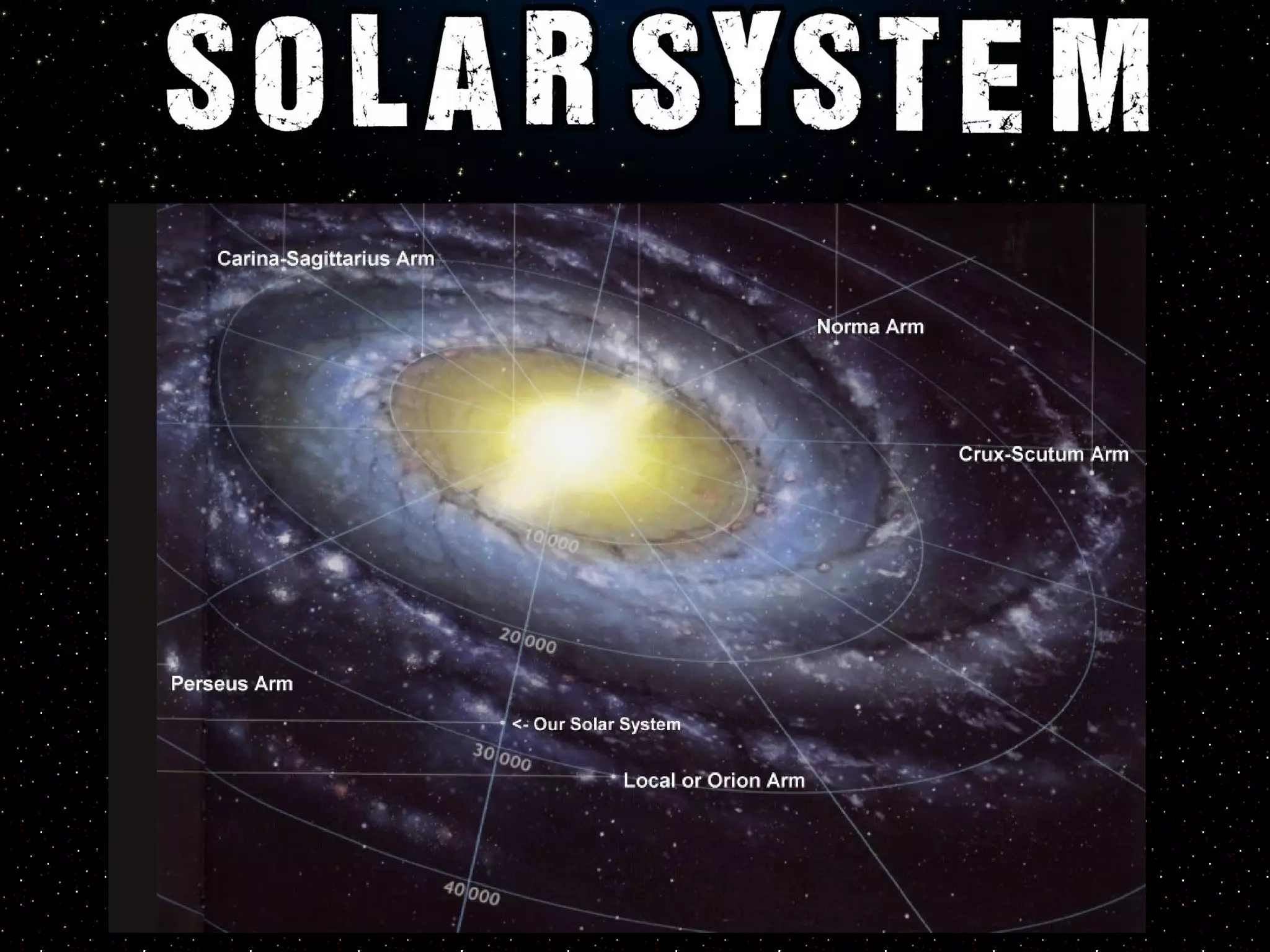
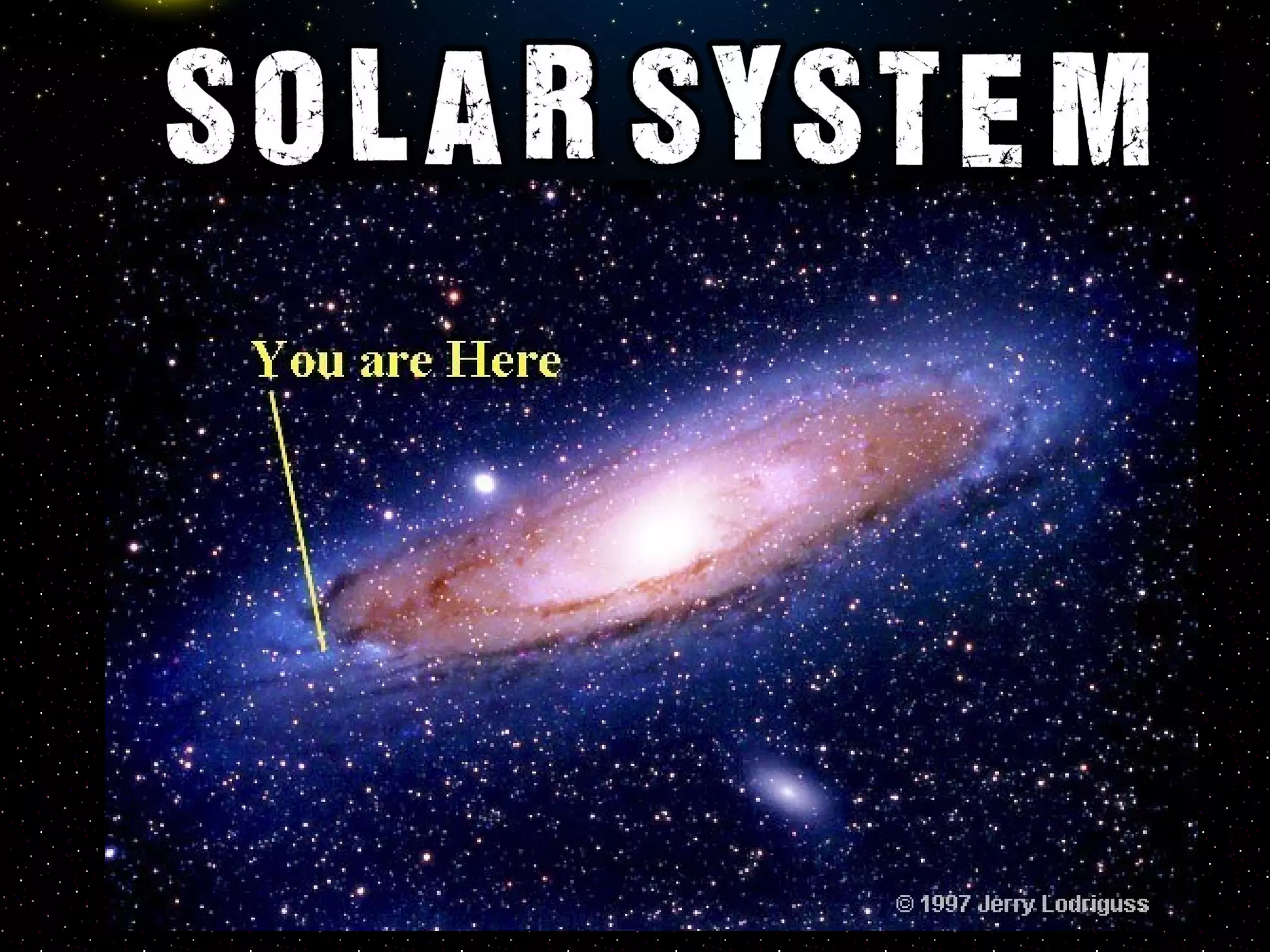
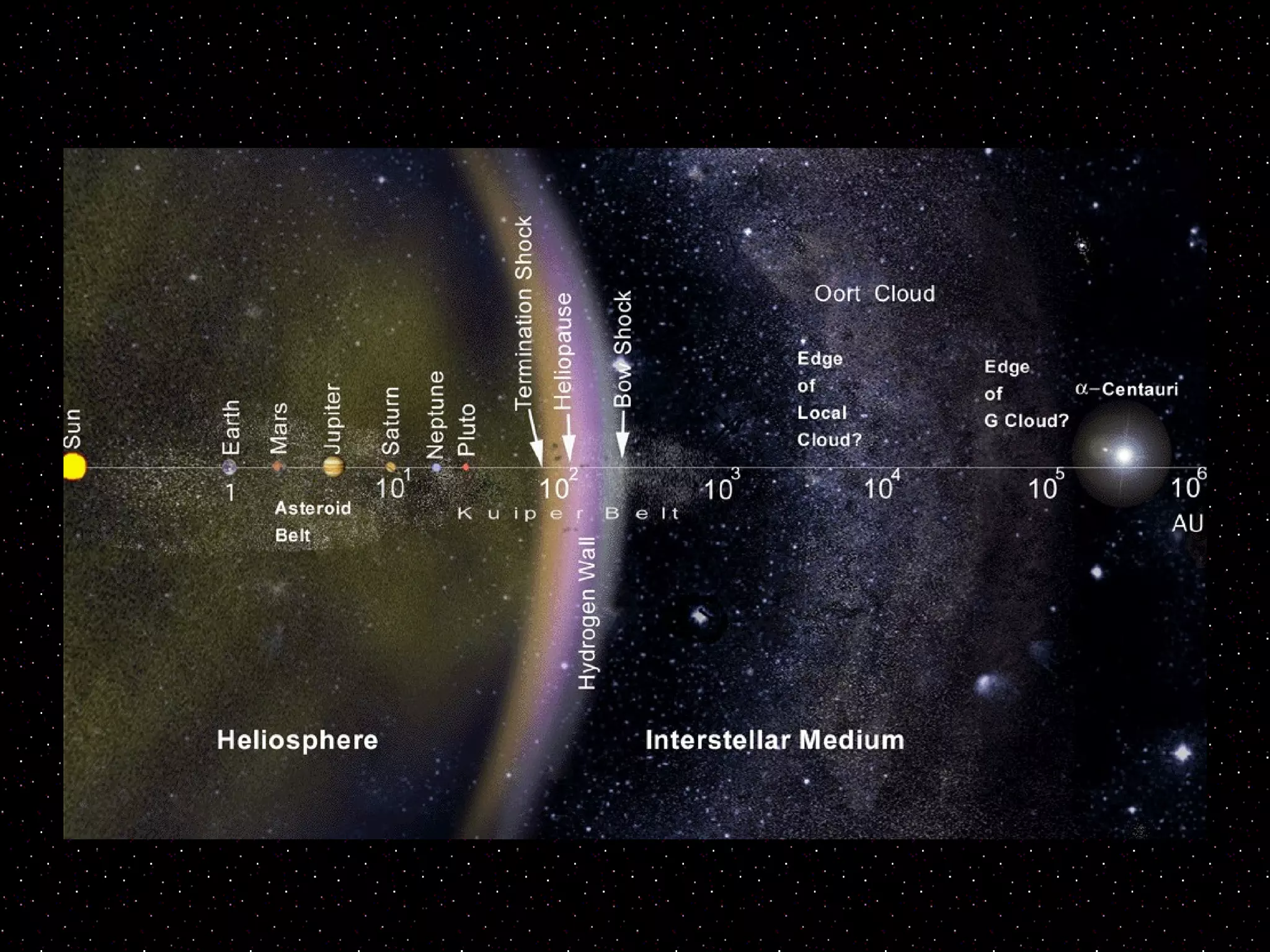
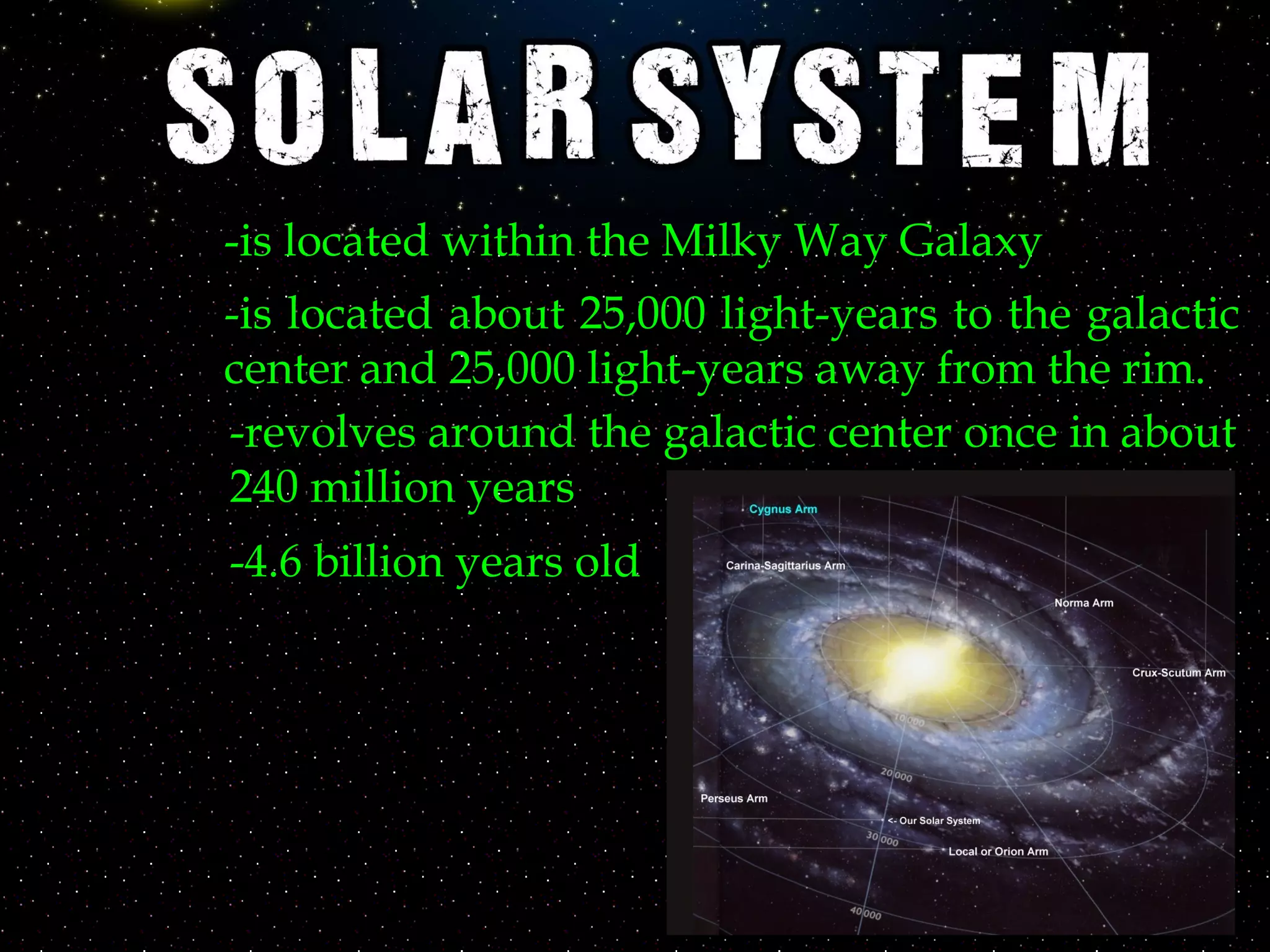
-is located within the Milky Way Galaxy
-is located about 25,000 light-years to the galactic
center and 25,000 light-years away from the rim.
-revolves around the galactic center once in about
240 million years
-4.6 billion years old
Large Scale Features of the
Solar System
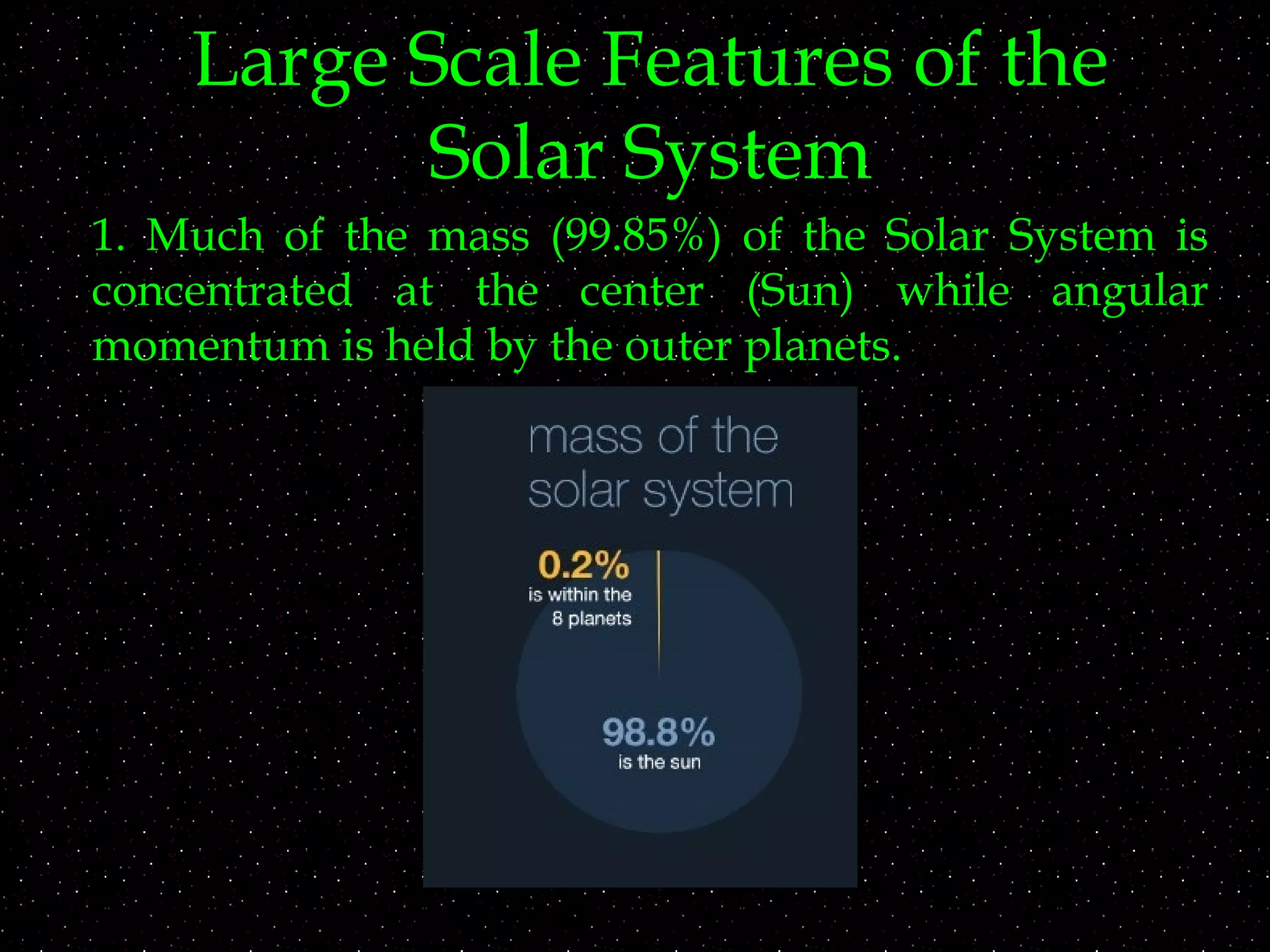
1. Much of the mass (99.85%) of the Solar System is
concentrated at the center (Sun) while angular
momentum is held by the outer planets.
Large Scale Features of the
Solar System
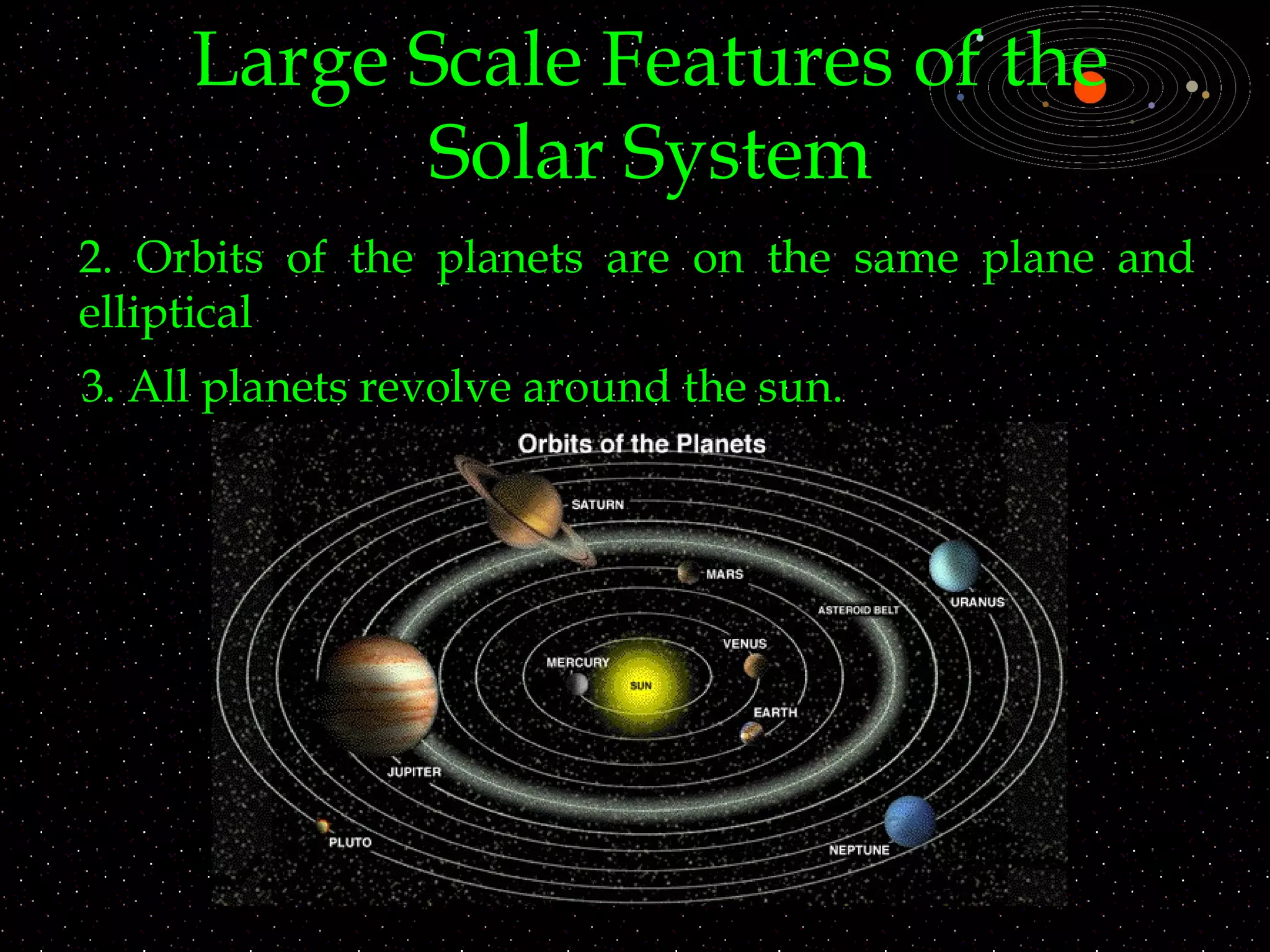
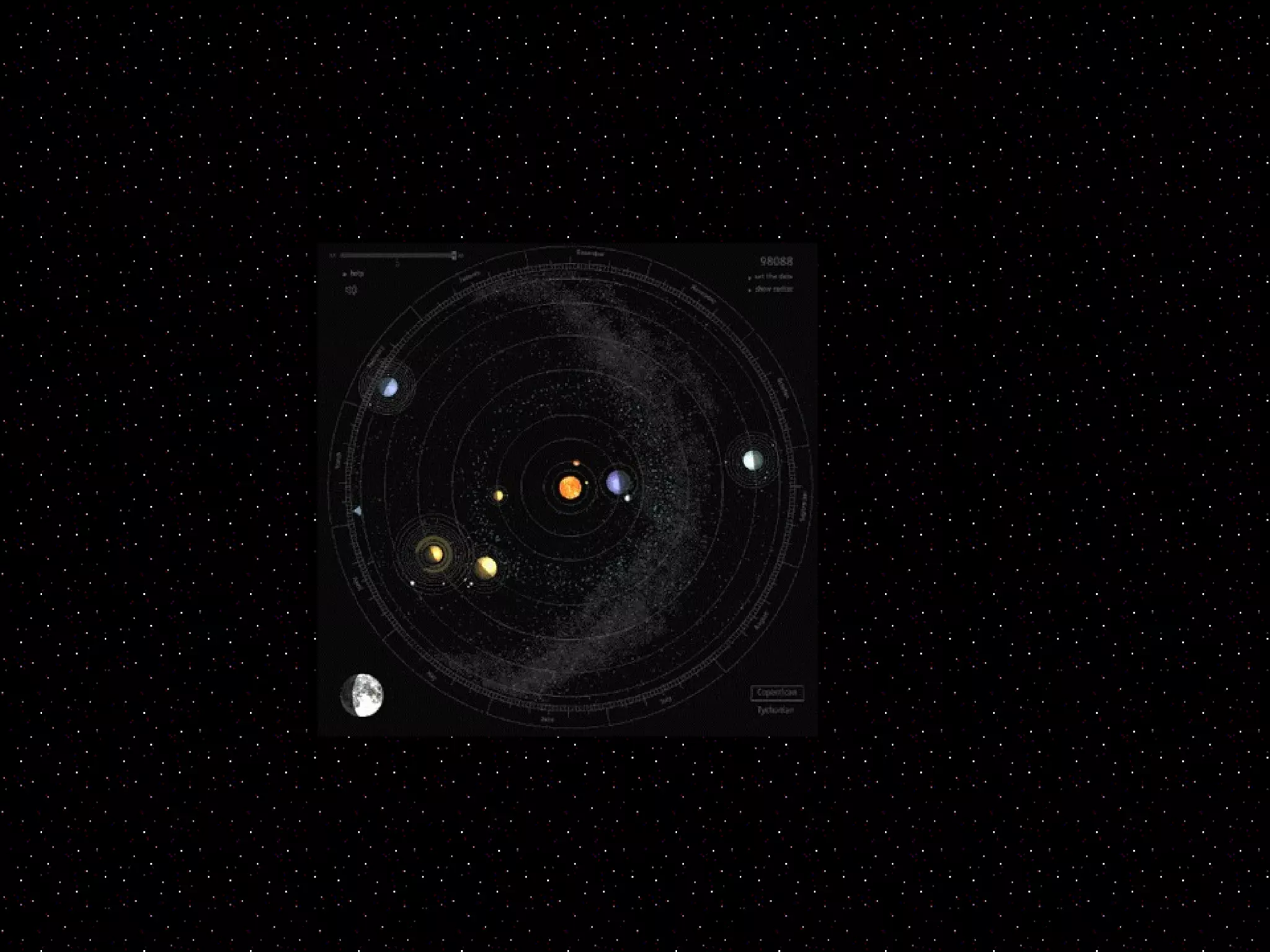
2. Orbits of the planets are on the same plane and
elliptical
3. All planets revolve around the sun.
Large Scale Features of the
Solar System
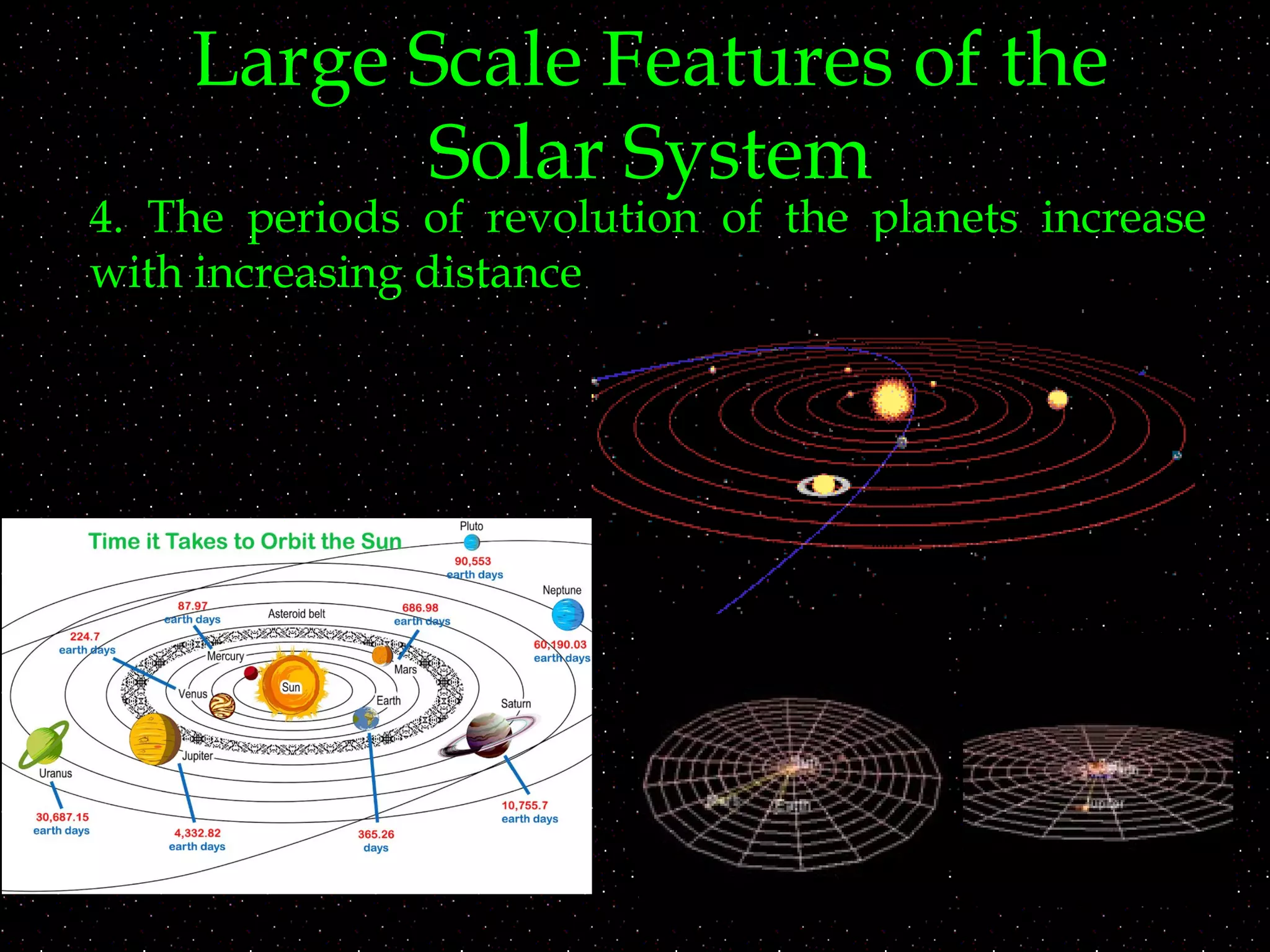
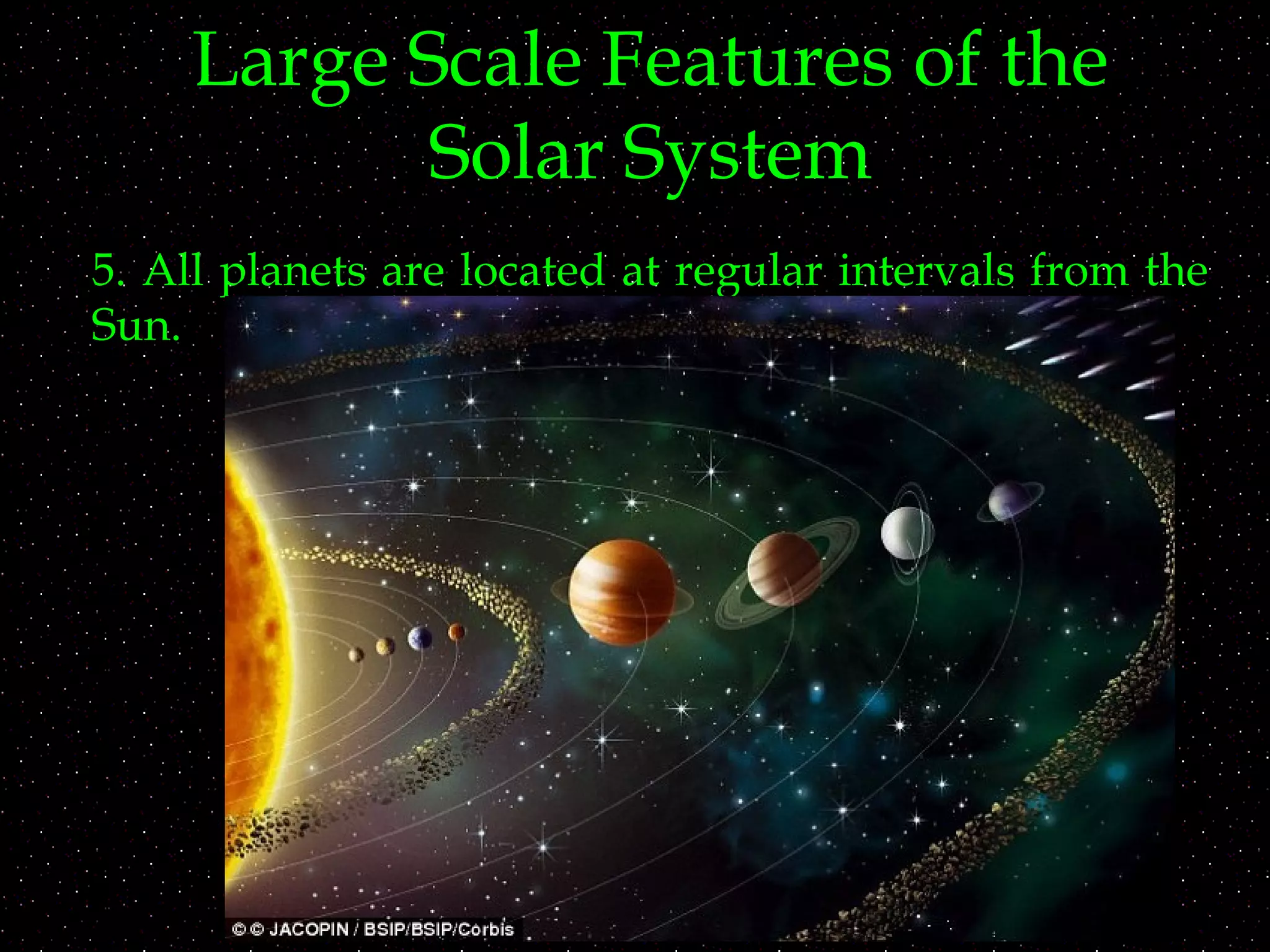
4. The periods of revolution of the planets increase
with increasing distance from the Sun.
Large Scale Features of the
Solar System
5. All planets are located at regular intervals from the
Sun.
Small Scale Features of the
Solar System
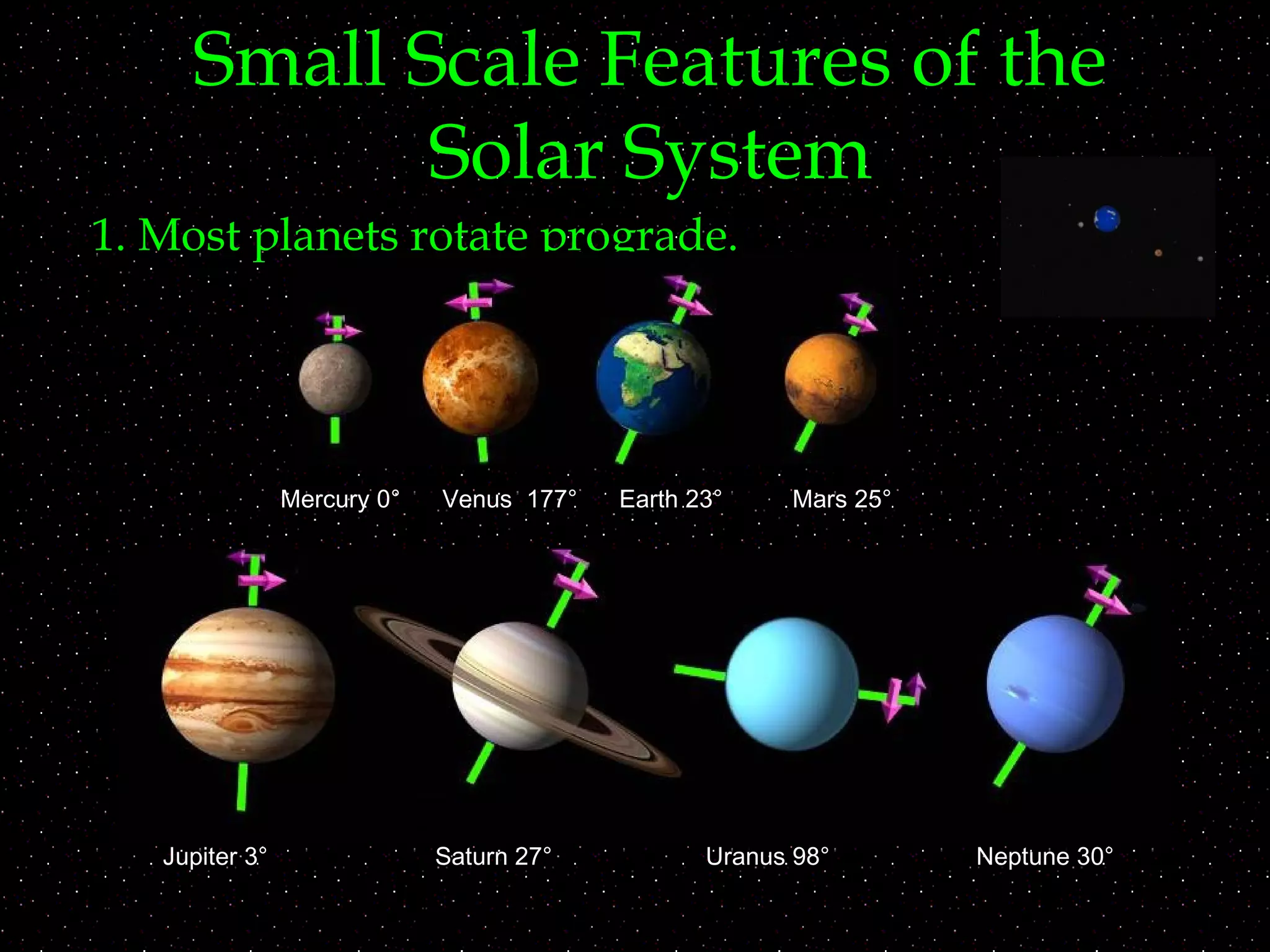
1. Most planets rotate prograde.
Mercury 0° Venus 177° Earth 23° Mars 25°
Jupiter 3° Saturn 27° Uranus 98° Neptune 30°
Small Scale Features of the
Solar System
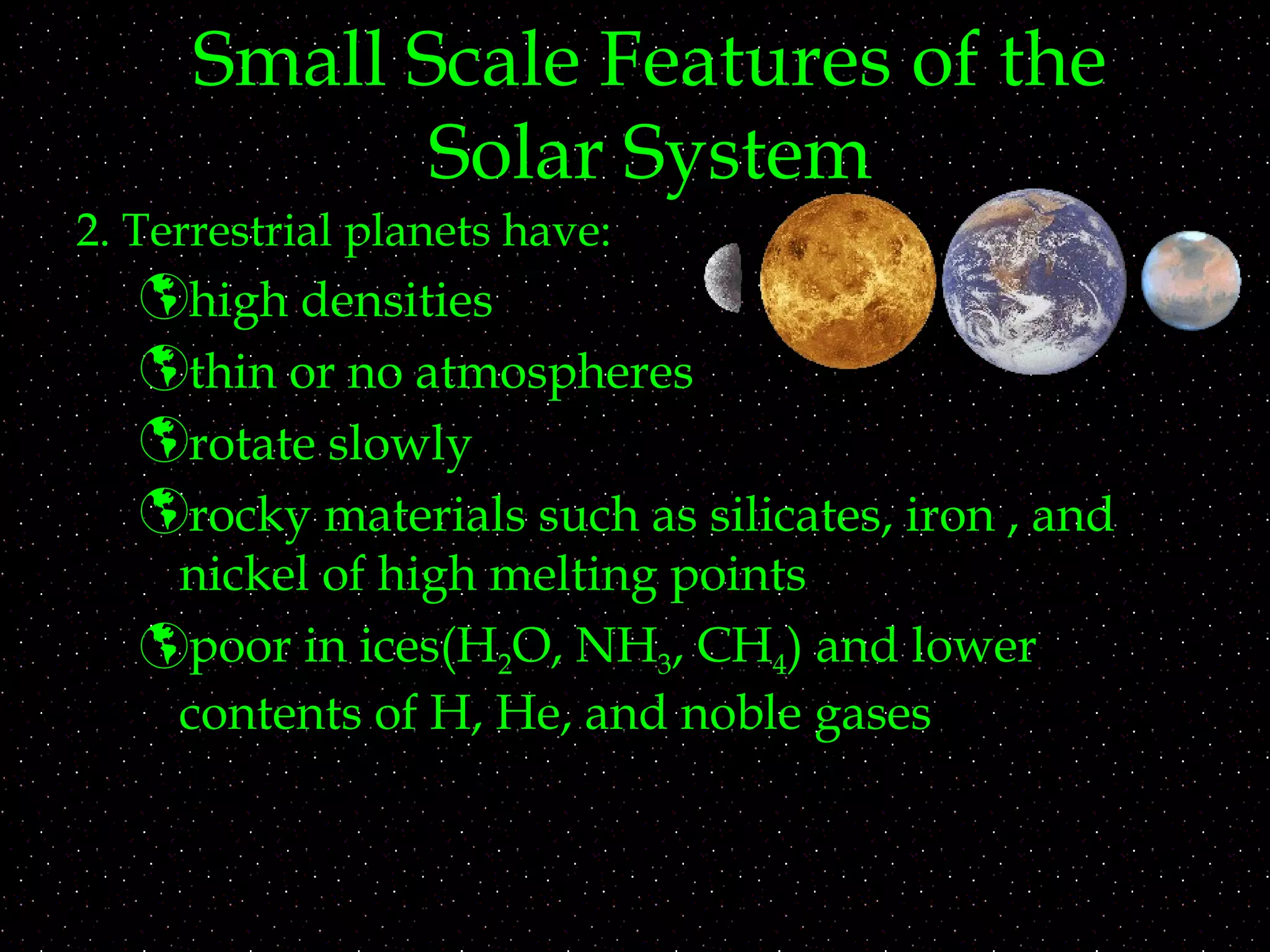
2. Terrestrial planets have:
high densities
thin or no atmospheres
rotate slowly
rocky materials such as silicates, iron , and
nickel of high melting points
poor in ices(H2O, NH3, CH4) and lower
contents of H, He, and noble gases
Small Scale Features of the
Solar System
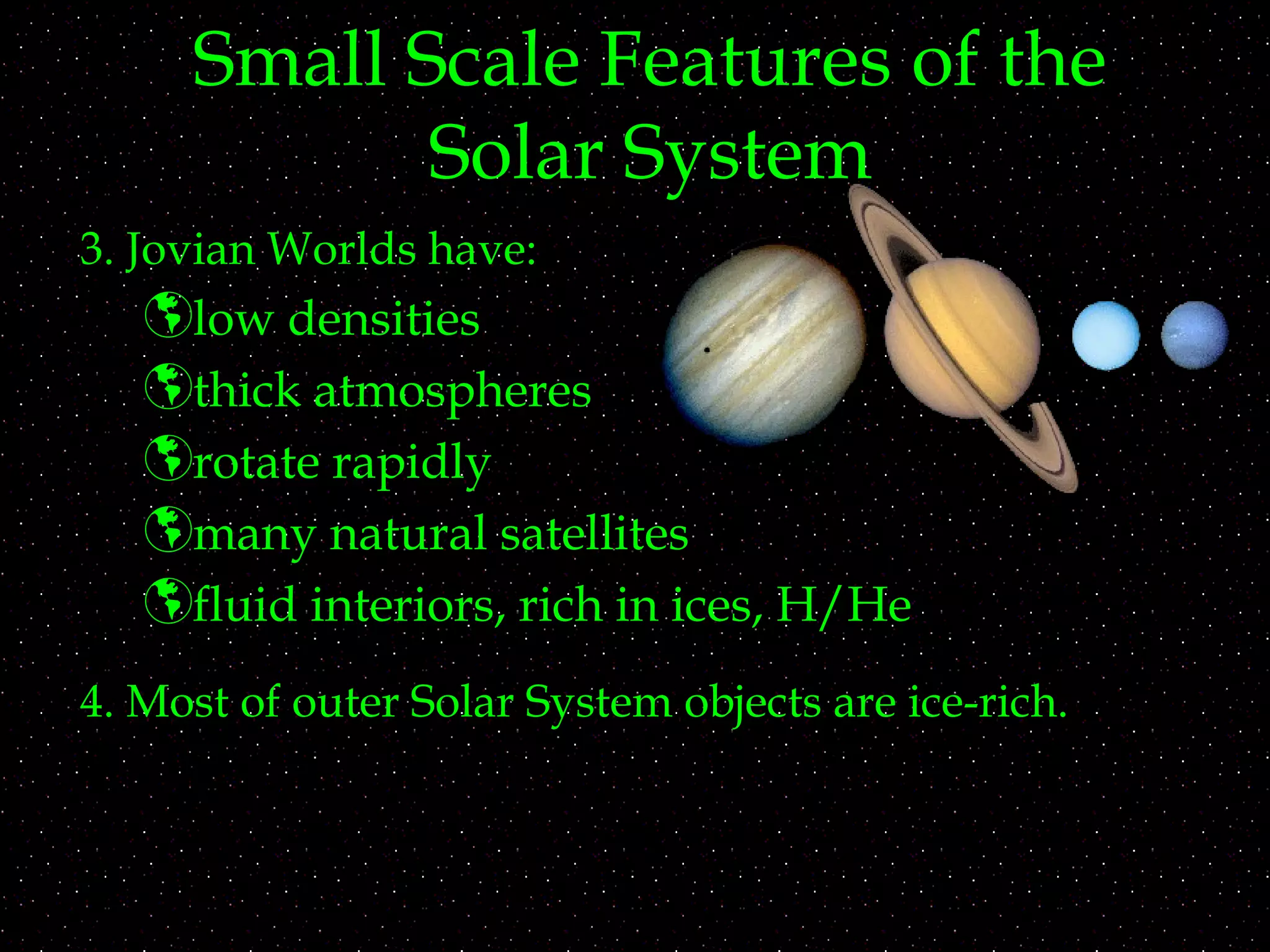
3. Jovian Worlds have:
low densities
thick atmospheres
rotate rapidly
many natural satellites
fluid interiors, rich in ices, H/He
4. Most of outer Solar System objects are ice-rich.
ACTIVITY
PLANETS OF THE
SOLAR SYSTEM
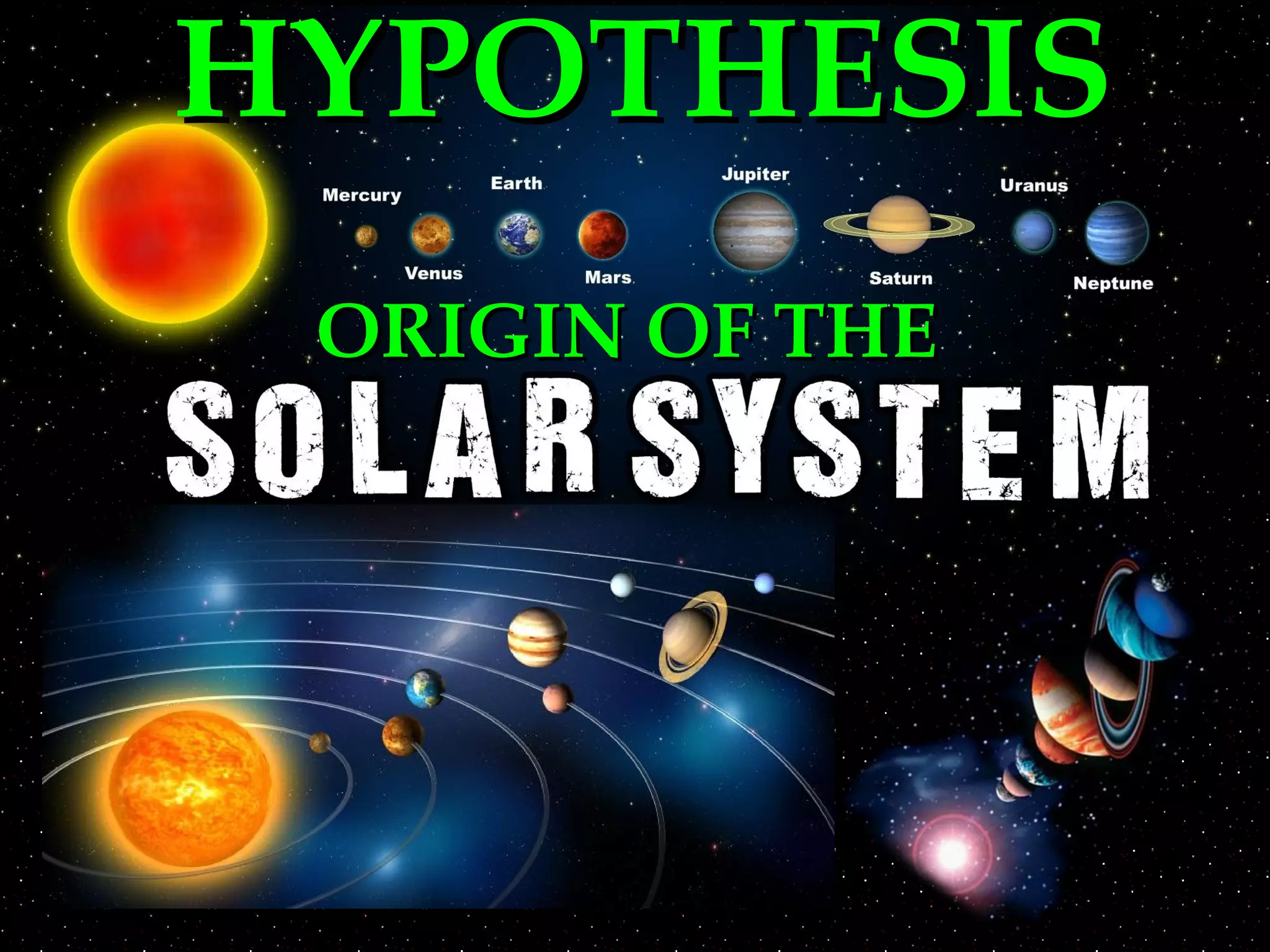
ORIGIN OF THEORIGIN OF THE
HYPOTHESISHYPOTHESIS
NEBULAR HYPOTHESIS
-proposed by Emanuel Swedenborg, Immanuel
Kant, and Pierre-Simon Laplace in 1700s
“A rotating cloud of gas and dust that cools and
contracts in the middle to form the sun and the
rest into a disc that become the planets.”
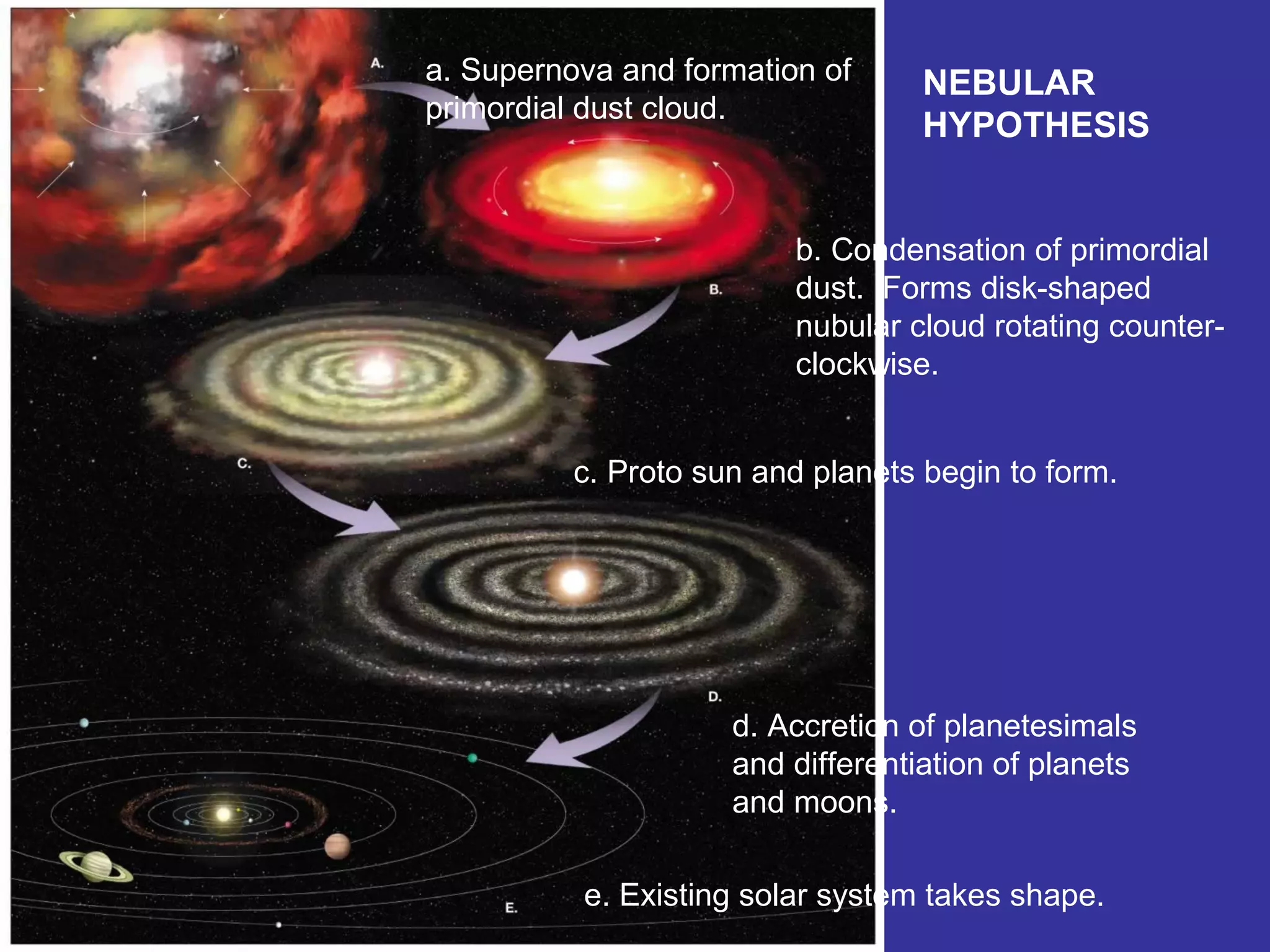
NEBULAR
HYPOTHESIS
b. Condensation of primordial
dust. Forms disk-shaped
nubular cloud rotating counter-
clockwise.
a. Supernova and formation of
primordial dust cloud.
c. Proto sun and planets begin to form.
d. Accretion of planetesimals
and differentiation of planets
and moons.
e. Existing solar system takes shape.
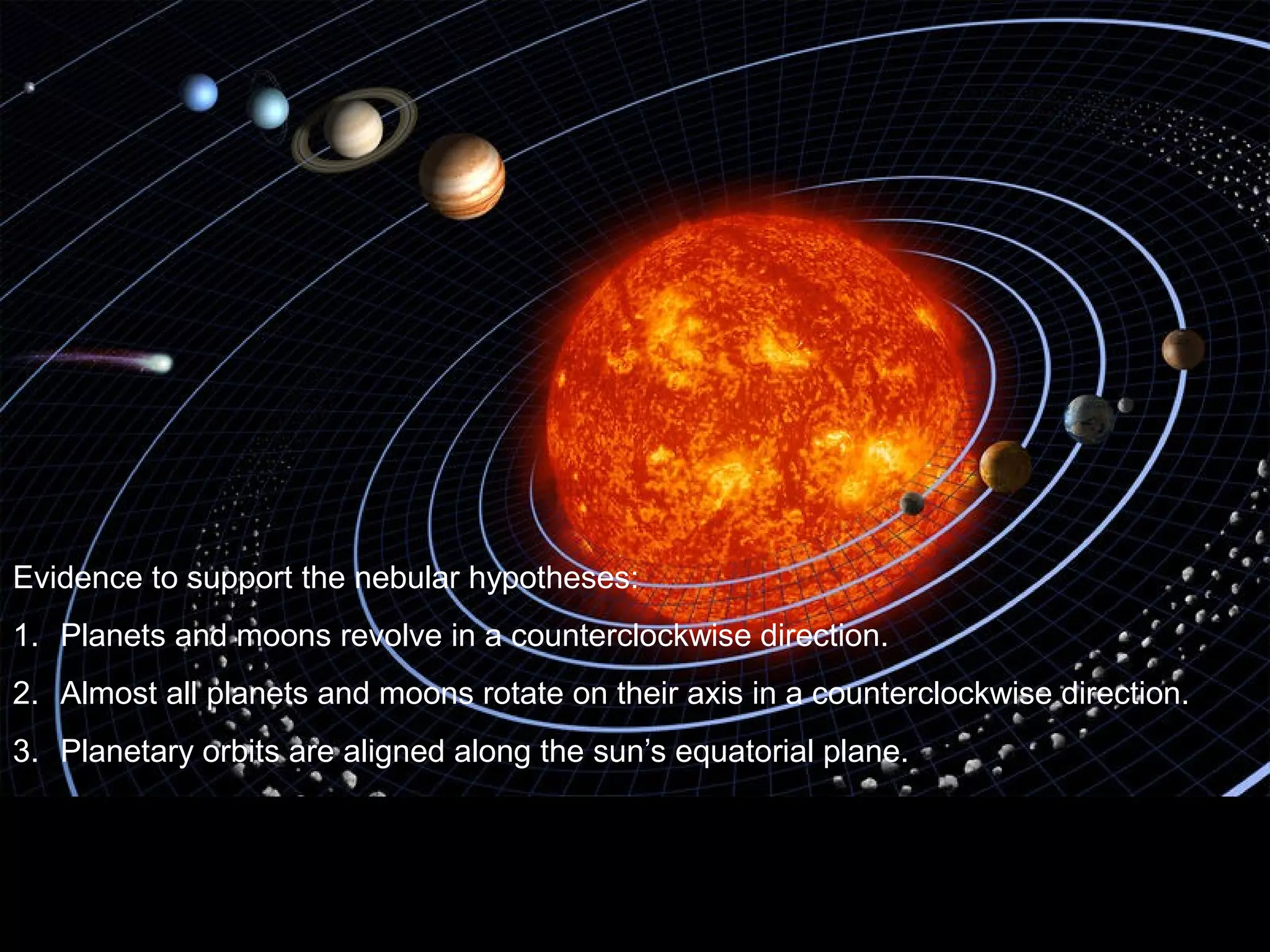
Evidence to support the nebular hypotheses:
1. Planets and moons revolve in a counterclockwise direction.
2. Almost all planets and moons rotate on their axis in a counterclockwise direction.
3. Planetary orbits are aligned along the sun’s equatorial plane.
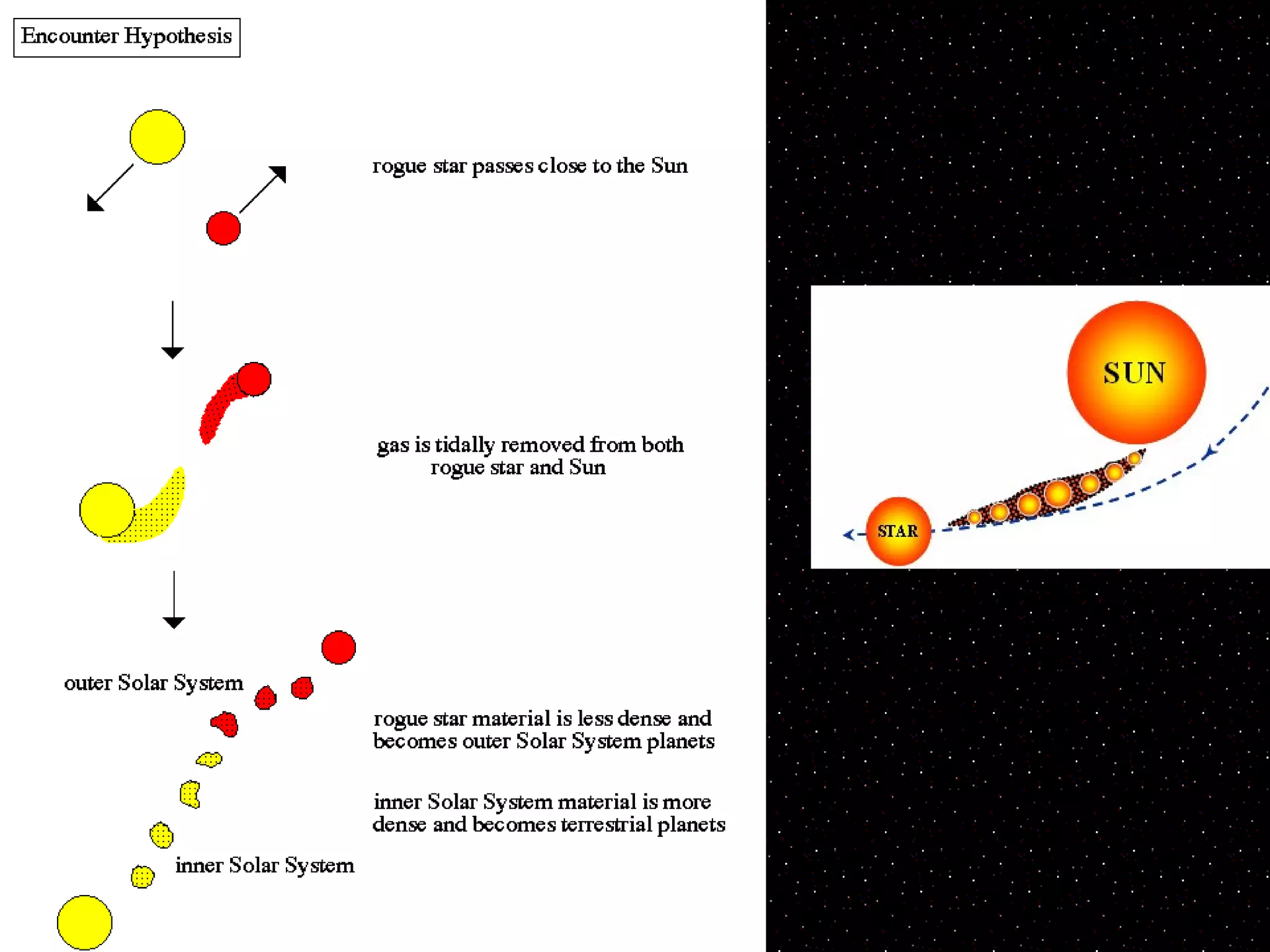
ENCOUNTER HYPOTHESIS
-proposed by Chamberlin and Moulton
“The planets formed from debris torn off the Sun
by a close encounter with another star.”
“That our planets, moons, and sun all spun off
from a collision between stars.”
PROTOPLANET HYPOTHESIS
-developed by Carl von Weizsacker and Gerard
Kuiper
“The Solar System begins to form, as a rotating
cloud, or nebula collapses. But instabilities
develop in the nebula causing dust particles to
pull together. Then the dust particles merge into
billions of planetesimals then collide and form
protoplanets. At the center of the nebular disk
the protosun increases in mass and becomes a
star by the process of hydrogen fusion. 
RECENT ADVANCEMENT
ON THE SOLAR SYSTEM
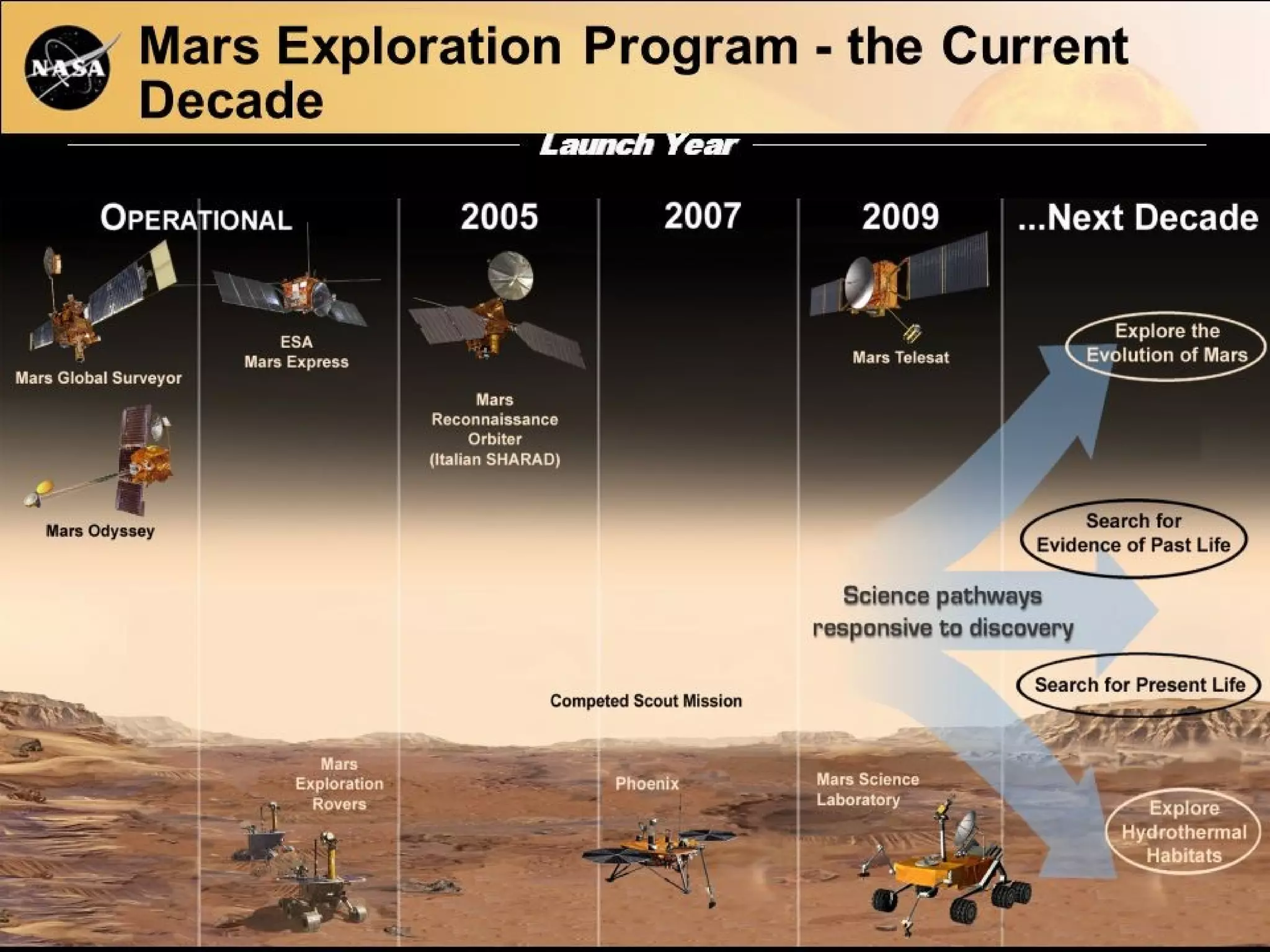
Exploration of Mars
Recently, NASA presented evidence of seasonal
flow liquid water (in the form of brine water) on
the surface of Mars.
RECENT ADVANCEMENT ON THE
SOLAR SYSTEM
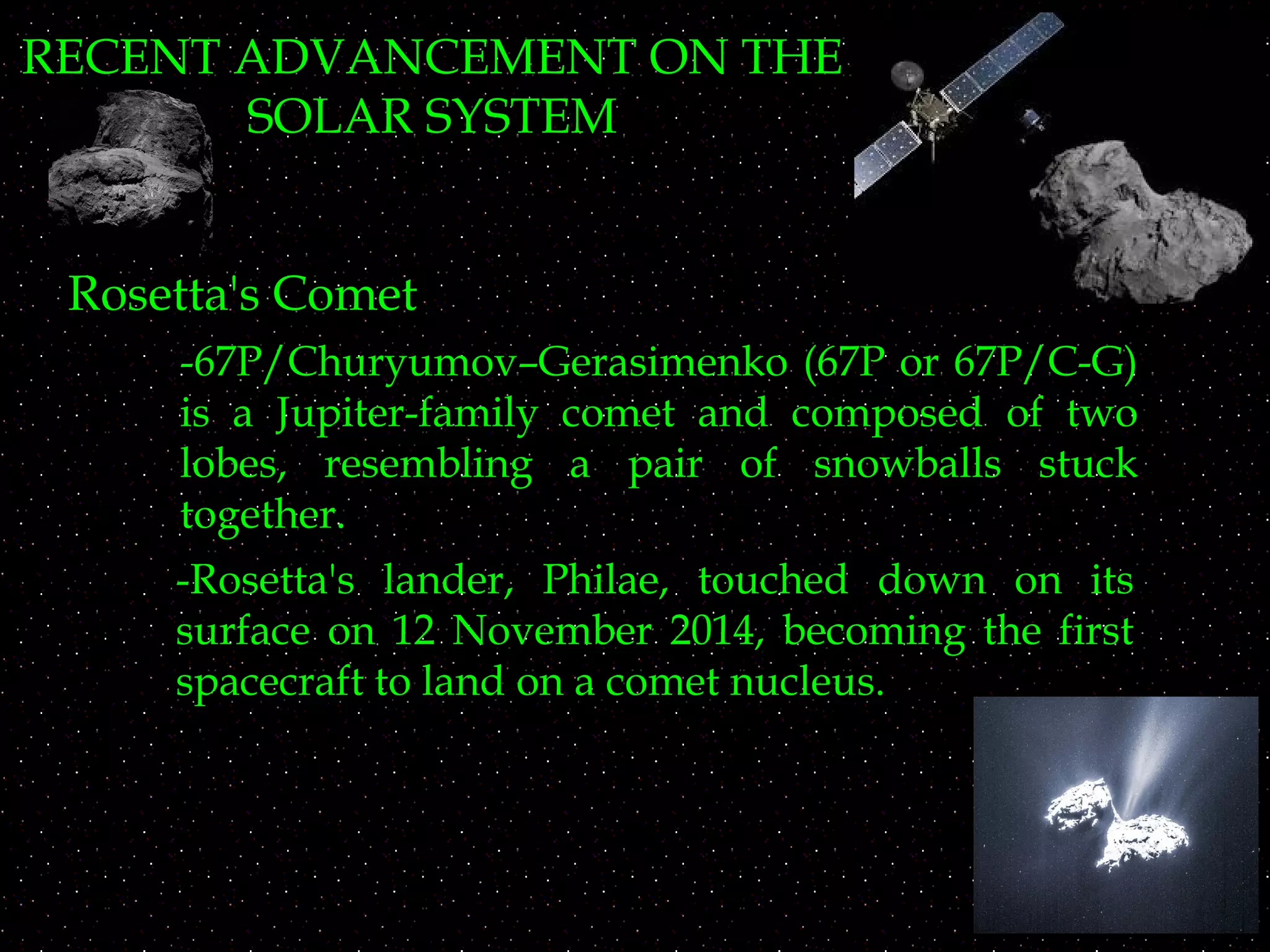
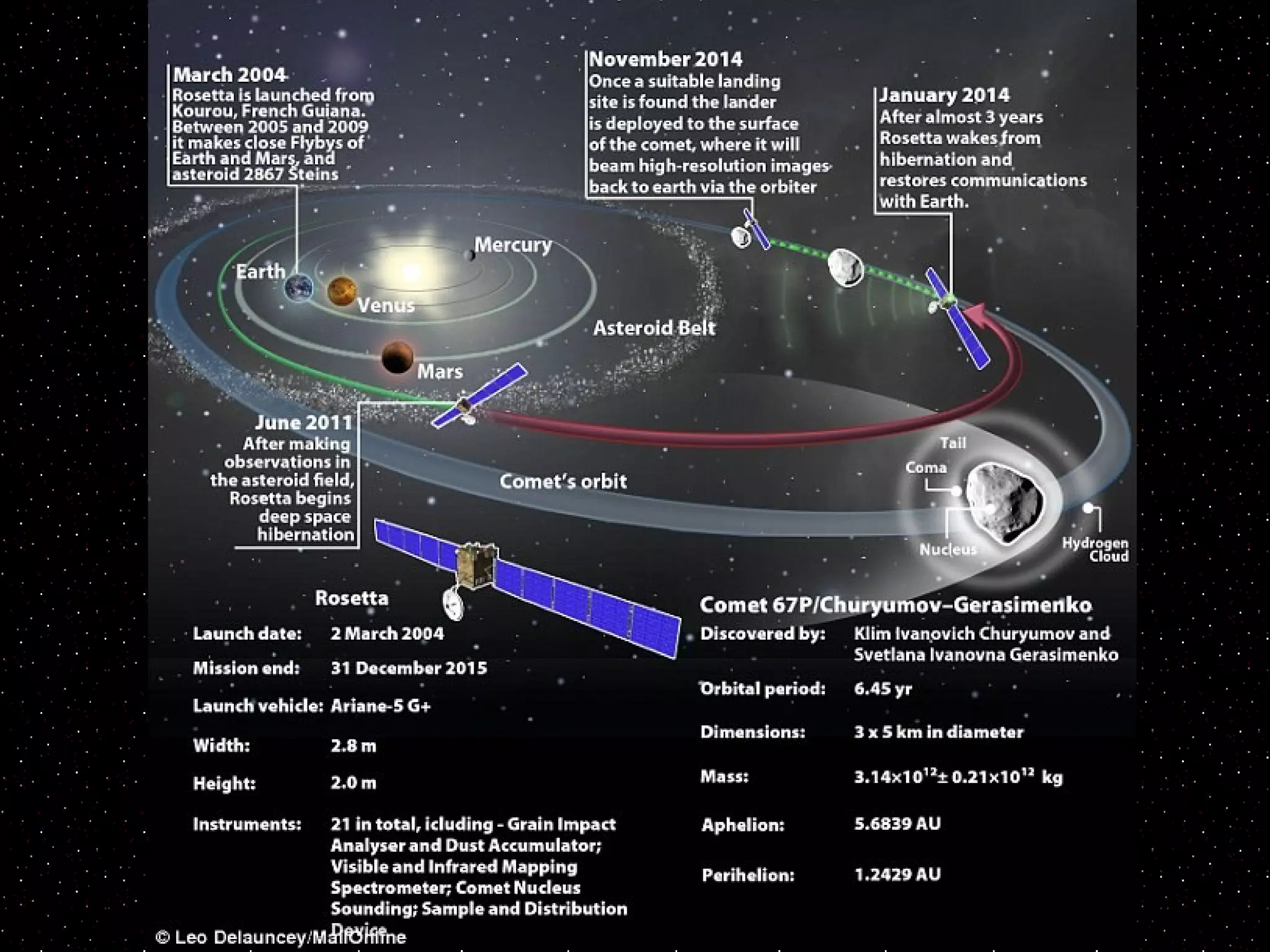
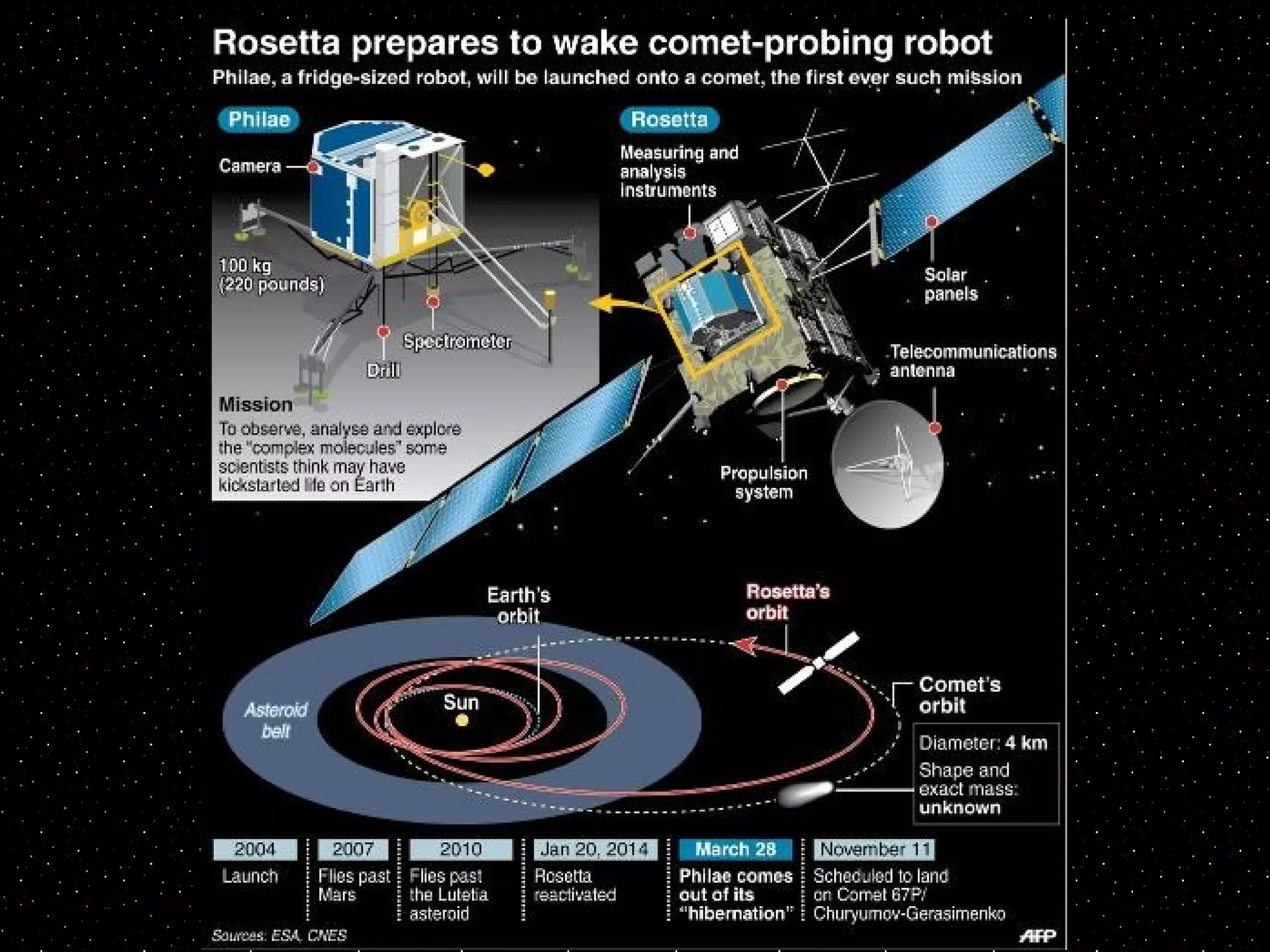
Rosetta's Comet
-67P/Churyumov–Gerasimenko (67P or 67P/C-G)
is a Jupiter-family comet and composed of two
lobes, resembling a pair of snowballs stuck
together.
-Rosetta's lander, Philae, touched down on its
surface on 12 November 2014, becoming the first
spacecraft to land on a comet nucleus.
RECENT ADVANCEMENT ON THE
SOLAR SYSTEM
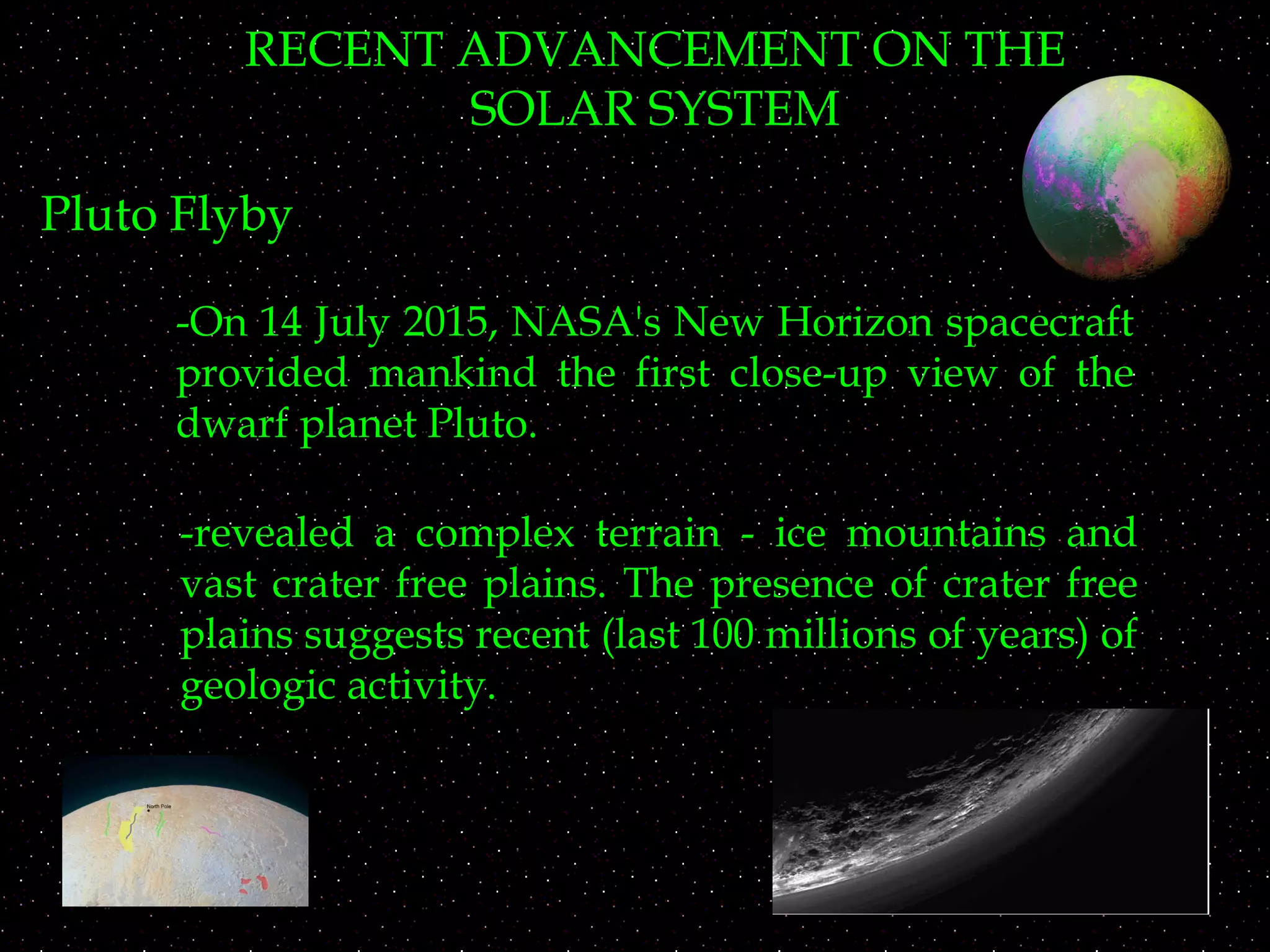
Pluto Flyby
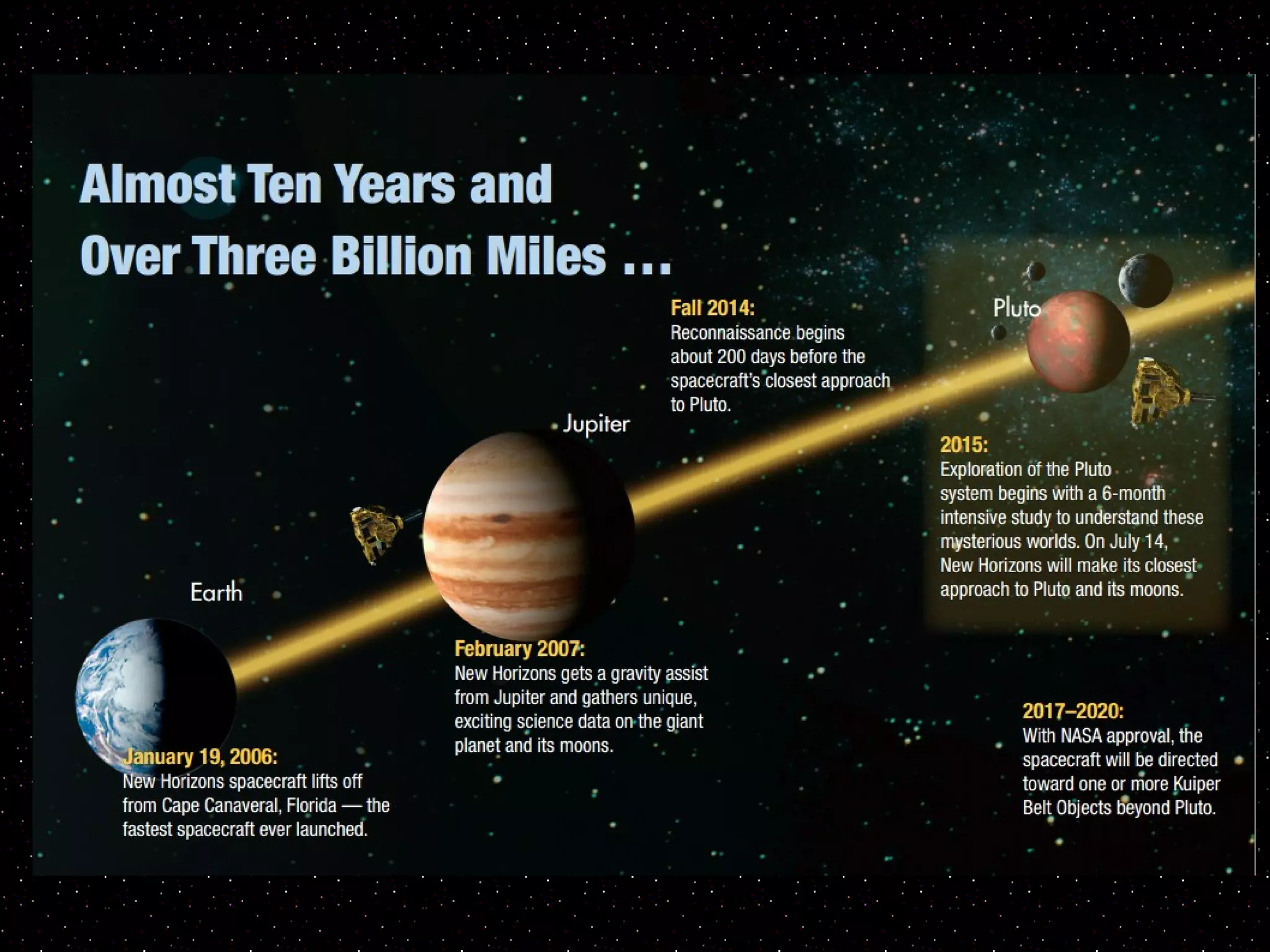
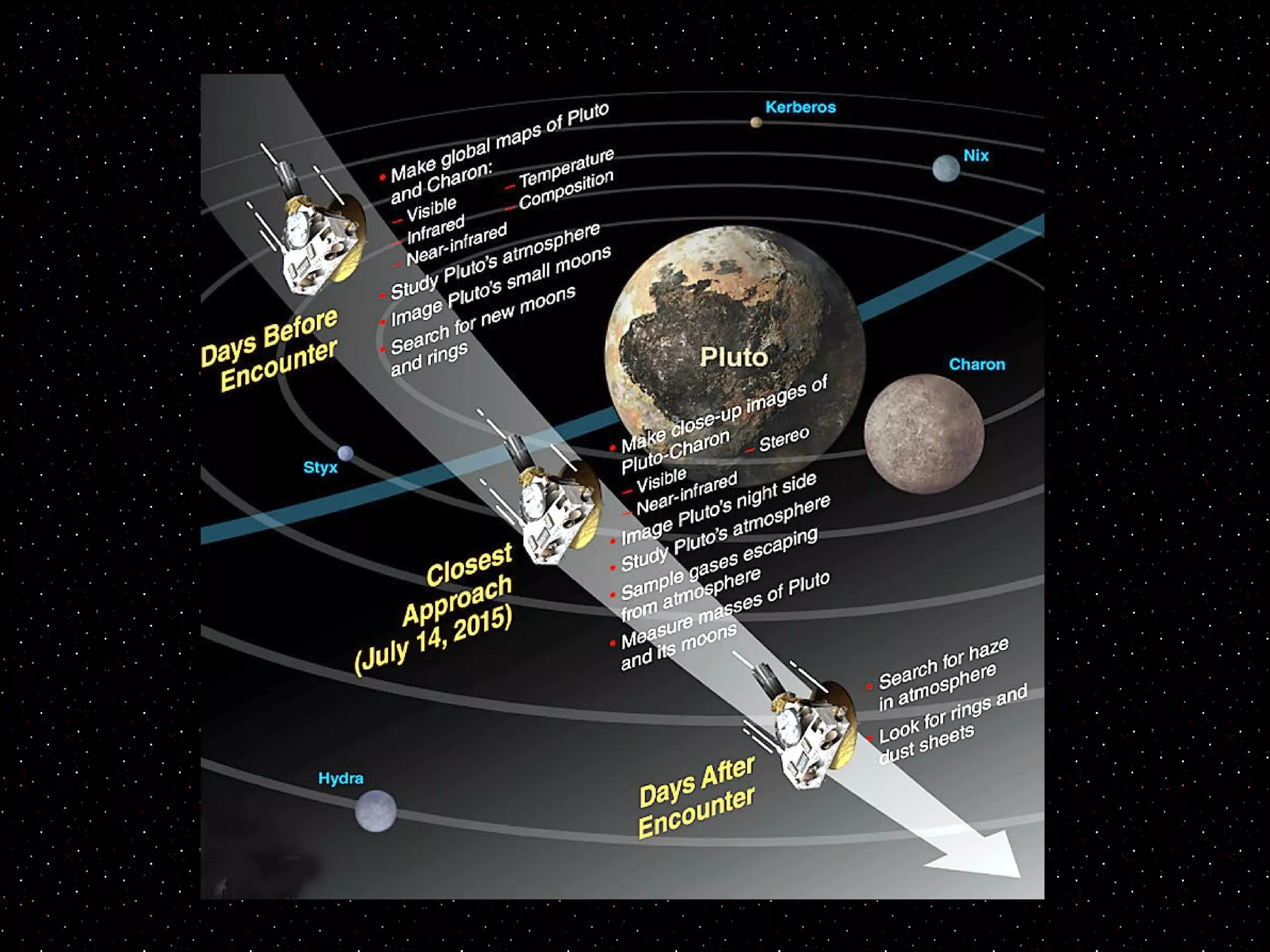
-On 14 July 2015, NASA's New Horizon spacecraft
provided mankind the first close-up view of the
dwarf planet Pluto.
-revealed a complex terrain - ice mountains and
vast crater free plains. The presence of crater free
plains suggests recent (last 100 millions of years) of
geologic activity.
LONG QUIZ TOMORROW!
Review :
Universe and Solar System
Solar System and its Origin)

Solar System and its Origin)

  • 1.
  • 9.
    -is located withinthe Milky Way Galaxy -is located about 25,000 light-years to the galactic center and 25,000 light-years away from the rim. -revolves around the galactic center once in about 240 million years -4.6 billion years old
  • 10.
    Large Scale Featuresof the Solar System 1. Much of the mass (99.85%) of the Solar System is concentrated at the center (Sun) while angular momentum is held by the outer planets.
  • 11.
    Large Scale Featuresof the Solar System 2. Orbits of the planets are on the same plane and elliptical 3. All planets revolve around the sun.
  • 12.
    Large Scale Featuresof the Solar System 4. The periods of revolution of the planets increase with increasing distance from the Sun.
  • 13.
    Large Scale Featuresof the Solar System 5. All planets are located at regular intervals from the Sun.
  • 14.
    Small Scale Featuresof the Solar System 1. Most planets rotate prograde. Mercury 0° Venus 177° Earth 23° Mars 25° Jupiter 3° Saturn 27° Uranus 98° Neptune 30°
  • 15.
    Small Scale Featuresof the Solar System 2. Terrestrial planets have: high densities thin or no atmospheres rotate slowly rocky materials such as silicates, iron , and nickel of high melting points poor in ices(H2O, NH3, CH4) and lower contents of H, He, and noble gases
  • 16.
    Small Scale Featuresof the Solar System 3. Jovian Worlds have: low densities thick atmospheres rotate rapidly many natural satellites fluid interiors, rich in ices, H/He 4. Most of outer Solar System objects are ice-rich.
  • 17.
  • 18.
    ORIGIN OF THEORIGINOF THE HYPOTHESISHYPOTHESIS
  • 19.
    NEBULAR HYPOTHESIS -proposed byEmanuel Swedenborg, Immanuel Kant, and Pierre-Simon Laplace in 1700s “A rotating cloud of gas and dust that cools and contracts in the middle to form the sun and the rest into a disc that become the planets.”
  • 20.
    NEBULAR HYPOTHESIS b. Condensation ofprimordial dust. Forms disk-shaped nubular cloud rotating counter- clockwise. a. Supernova and formation of primordial dust cloud. c. Proto sun and planets begin to form. d. Accretion of planetesimals and differentiation of planets and moons. e. Existing solar system takes shape.
  • 21.
    Evidence to supportthe nebular hypotheses: 1. Planets and moons revolve in a counterclockwise direction. 2. Almost all planets and moons rotate on their axis in a counterclockwise direction. 3. Planetary orbits are aligned along the sun’s equatorial plane.
  • 22.
    ENCOUNTER HYPOTHESIS -proposed byChamberlin and Moulton “The planets formed from debris torn off the Sun by a close encounter with another star.” “That our planets, moons, and sun all spun off from a collision between stars.”
  • 24.
    PROTOPLANET HYPOTHESIS -developed byCarl von Weizsacker and Gerard Kuiper “The Solar System begins to form, as a rotating cloud, or nebula collapses. But instabilities develop in the nebula causing dust particles to pull together. Then the dust particles merge into billions of planetesimals then collide and form protoplanets. At the center of the nebular disk the protosun increases in mass and becomes a star by the process of hydrogen fusion. 
  • 25.
    RECENT ADVANCEMENT ON THESOLAR SYSTEM Exploration of Mars Recently, NASA presented evidence of seasonal flow liquid water (in the form of brine water) on the surface of Mars.
  • 27.
    RECENT ADVANCEMENT ONTHE SOLAR SYSTEM Rosetta's Comet -67P/Churyumov–Gerasimenko (67P or 67P/C-G) is a Jupiter-family comet and composed of two lobes, resembling a pair of snowballs stuck together. -Rosetta's lander, Philae, touched down on its surface on 12 November 2014, becoming the first spacecraft to land on a comet nucleus.
  • 30.
    RECENT ADVANCEMENT ONTHE SOLAR SYSTEM Pluto Flyby -On 14 July 2015, NASA's New Horizon spacecraft provided mankind the first close-up view of the dwarf planet Pluto. -revealed a complex terrain - ice mountains and vast crater free plains. The presence of crater free plains suggests recent (last 100 millions of years) of geologic activity.
  • 34.
    LONG QUIZ TOMORROW! Review: Universe and Solar System

Editor's Notes

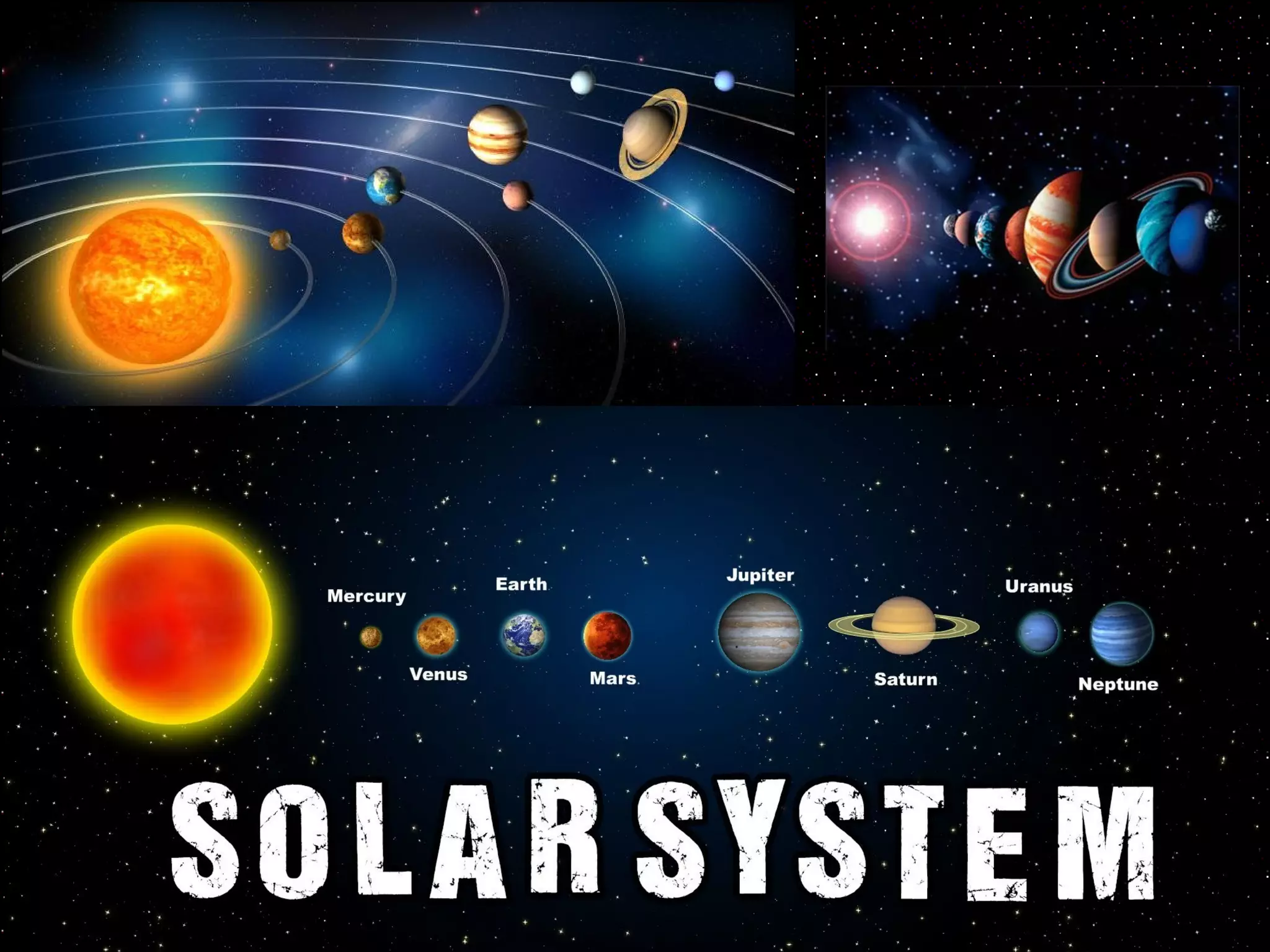
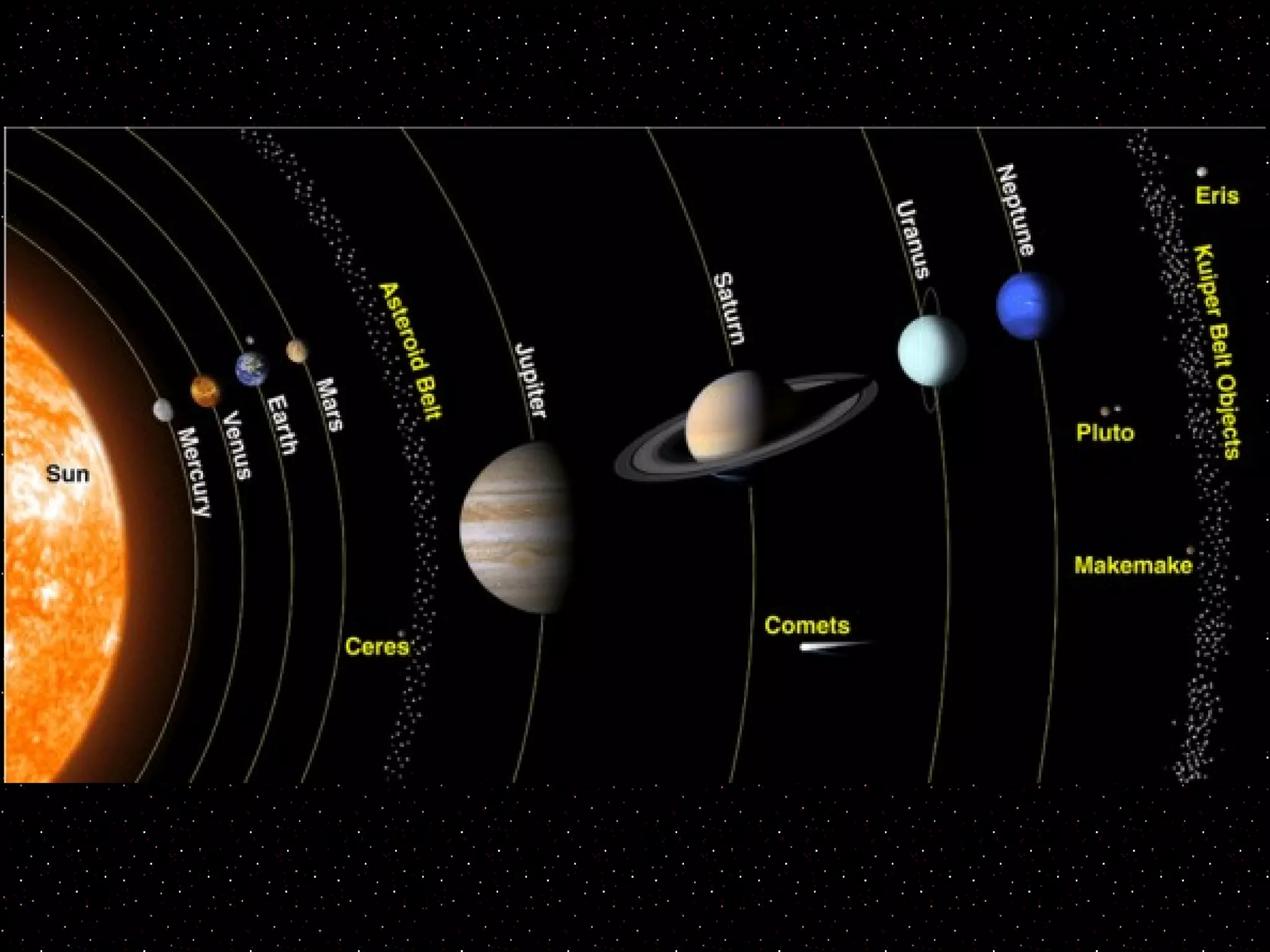
  • #2 Ask the learners for the correct sequence (from the inner planets to the outer planet).
  • #3 Ask the learners what galaxy the solar system resides in
  • #5 Ask the learners for the correct sequence (from the inner planets to the outer planet).
  • #8 1. The Earth, the planet we live on, is part of the Solar System. 2. If we want to know how the Earth formed, we need to understand the origin and evolution of the Solar System.
  • #10 Milky way galaxy -barred spiral galaxy; a huge disc- and spiral-shaped aggregation of about at least 100 billion stars and other bodies; Its spiral arms rotate around a globular cluster or bulge of many, many stars, at the center of which lies a supermassive blackhole; is about 100 million light years across So, imagine a dinner plate as the Milky Way, and draw an imaginary line from the center of the plate to the outside. We’re located about halfway along that line.
  • #11 The Sun contains 99.85% of all the matter in the Solar System. The planets, which condensed out of the same disk of material that formed the Sun, contain only 0.135% of the mass of the solar system.
  • #12 the innermost planet moves fastest, the outermost, the slowest; elliptical = almost circular
  • #13 the innermost planet moves fastest, the outermost, the slowest; elliptical = almost circular
  • #14 the innermost planet moves fastest, the outermost, the slowest; elliptical = almost circular
  • #15 Prograde - counterclockwise when viewed from above the Earth's North Pole. All planets orbit the Sun in the counterclockwise direction (right-hand rule) as seen from above the ecliptic.  This is called direct motion.  The opposite direction is called retrograde. The Sun also rotates in this same direction. Venus, Uranus, and Pluto have a retrograde rotation http://nineplanets.org/tour/ ----animation of the revolution
  • #16 Prograde - counterclockwise when viewed from above the Earth's North Pole. All planets orbit the Sun in the counterclockwise direction (right-hand rule) as seen from above the ecliptic.  This is called direct motion.  The opposite direction is called retrograde. The Sun also rotates in this same direction. Venus, Uranus, and Pluto have a retrograde rotation http://nineplanets.org/tour/ ----animation of the revolution
  • #17 Jovian Worlds or Gas giants
  • #18 Ask the learners for the correct sequence (from the inner planets to the outer planet).
  • #19 1. The Earth, the planet we live on, is part of the Solar System. 2. If we want to know how the Earth formed, we need to understand the origin and evolution of the Solar System.
  • #20 Jovian Worlds or Gas giants
  • #23 Stellar Collision Hypothesis---A rogue star passes close to the Sun about 5 billion years ago. Material, in the form of hot gas, is tidally stripped from the Sun and the rogue star. This material fragments into smaller lumps which form the planets
  • #24 two major problems for a theory of this type. One is that hot gas expands, not contracts. So lumps of hot gas would not form planets. The second is that encounters between stars are extremely rare, so rare as to be improbable in the lifetime of the Universe (15 billion years).
  • #25 A modified version of the nebular hypothesis Then something happened that triggered a pressure change in the center of the cloud, scientists say. Perhaps it was a supernova exploding nearby, or a passing star changing the gravity. Whatever the change, however, the cloud collapsed and created a disc of material, according to NASA. Like any scientific theory, it has to be proven. In order to prove the Protoplanet Hypothesis of Solar System formation, astronomers needed to find protoplanets. Have any been spotted? The answer is yes. Three so far in the asteroid belt, and one located outside our Solar System, in the constellation Taurus. Pallas, Vesta, Ceres, NEXT SLIDE TO SHOW OTHER NOTES
  • #26 Since the 1960s, the Soviet Union and the U.S. have been sending unmanned probes to the planet Mars with the primary purpose of testing the planet's habitability. The early efforts in the exploration of Mars involved flybys through which spectacular photographs of the Martian surface were taken. The first successful landing and operation on the surface of Mars occurred in 1975 under the Viking program of NASA. Recently, NASA, using high resolution imagery of the surface of Mars, presented evidence of seasonal flow liquid water (in the form of brine - salty water) on the surface of Mars.
  • #27 Since the 1960s, the Soviet Union and the U.S. have been sending unmanned probes to the planet Mars with the primary purpose of testing the planet's habitability. The early efforts in the exploration of Mars involved flybys through which spectacular photographs of the Martian surface were taken. The first successful landing and operation on the surface of Mars occurred in 1975 under the Viking program of NASA. Recently, NASA, using high resolution imagery of the surface of Mars, presented evidence of seasonal flow liquid water (in the form of brine - salty water) on the surface of Mars.
  • #28 Europe’s Rosetta spacecraft --- its mission is to rendezvous with and attempt to land a probe (Philae) on a comet in the Kuiper Belt. One of the purpose of the mission is to better understand comets and the early solar systems. Rosseta’s mission –chasing a comet
  • #31 New Horizons robotic probe Pluto in truly psychedelic false color Has layers of atmosphere ….tall mountains Bigger than Eris No new moons discovered 5 moons