PRAYER
ATTENDANCE
ORIGIN OF
THE SOLAR
SYSTEM
MR. MENARD H. BUSTONERA
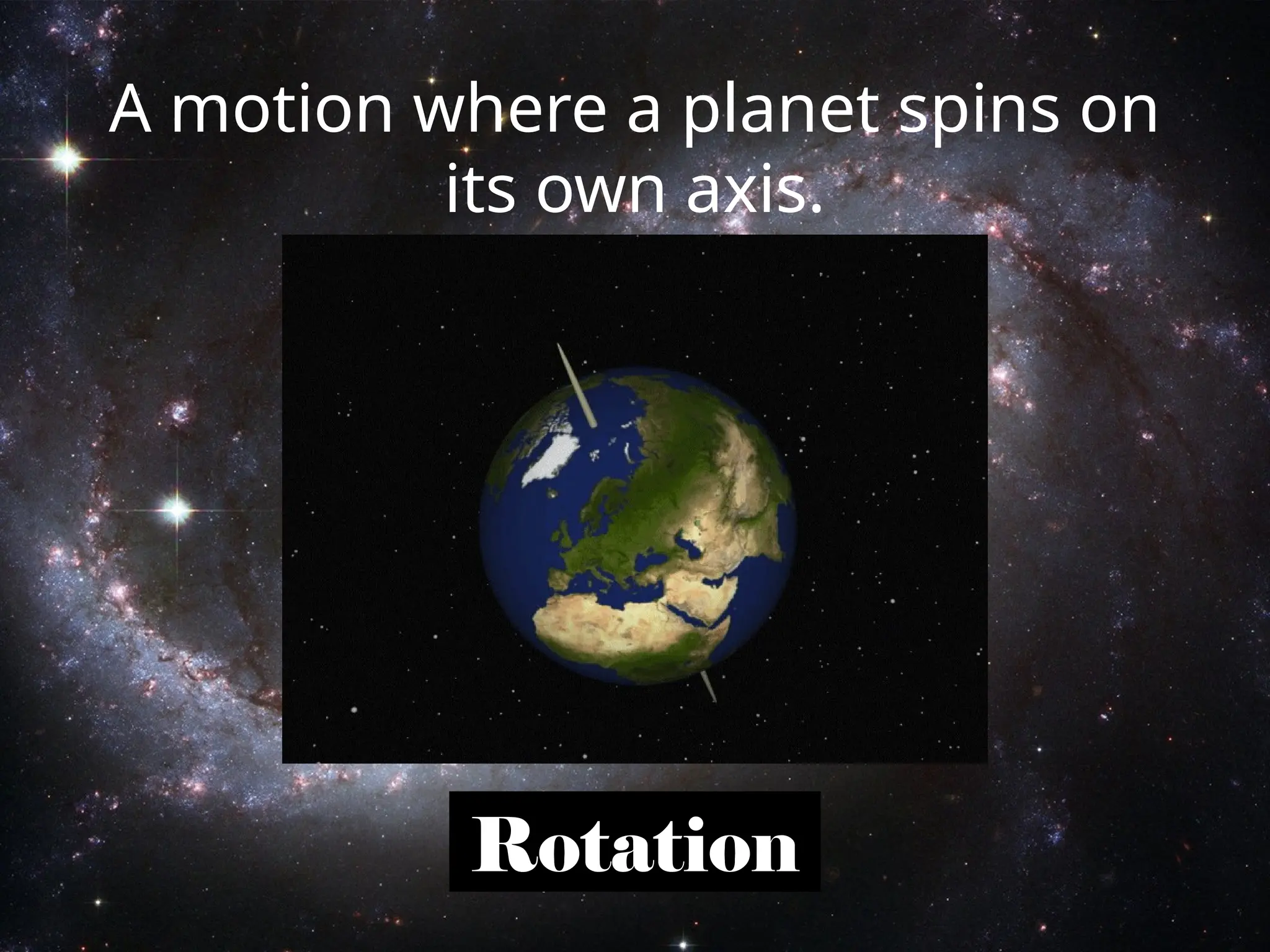
Rotation
A motion where a planet spins on
its own axis.
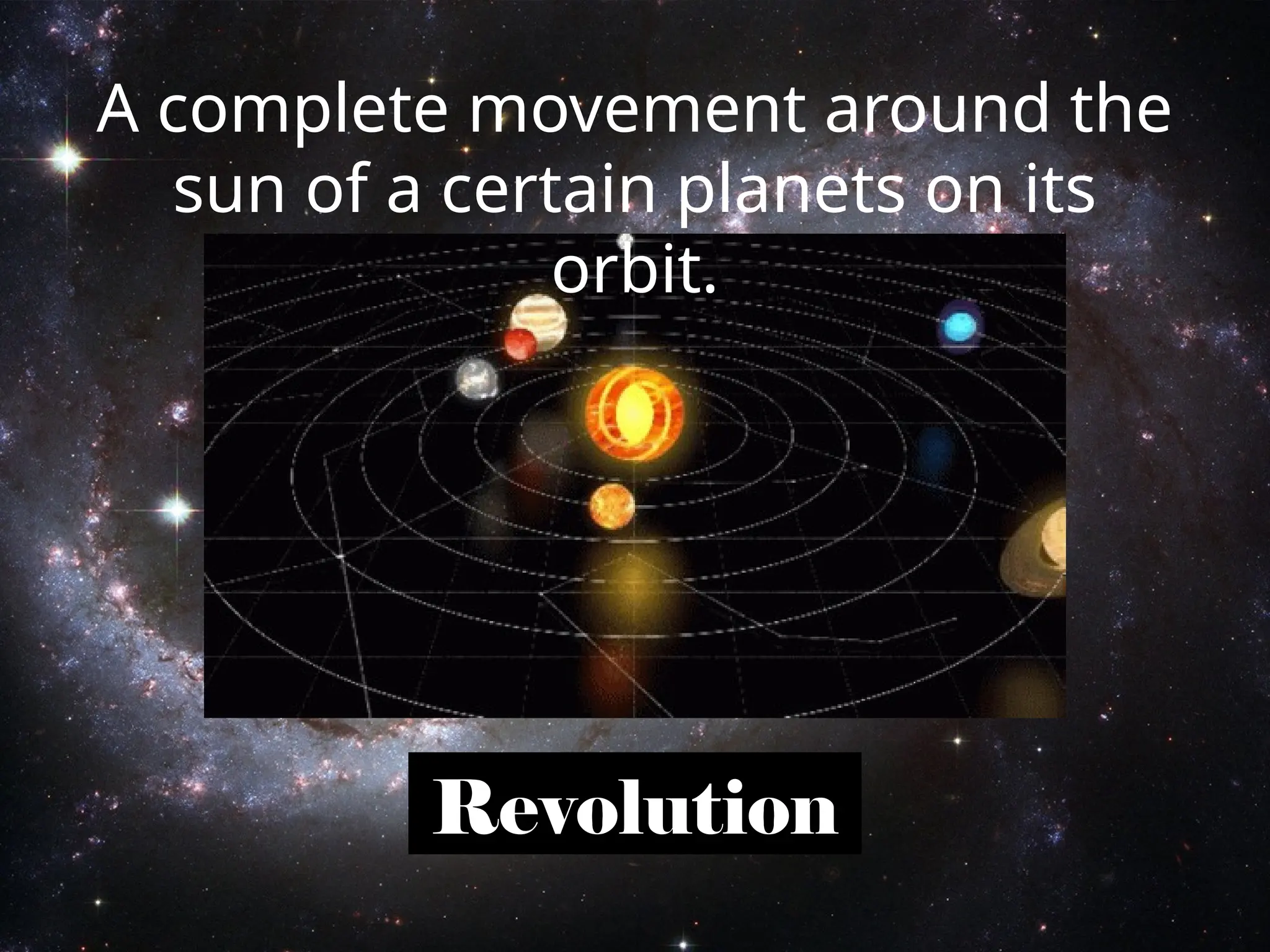
Revolution
A complete movement around the
sun of a certain planets on its
orbit.
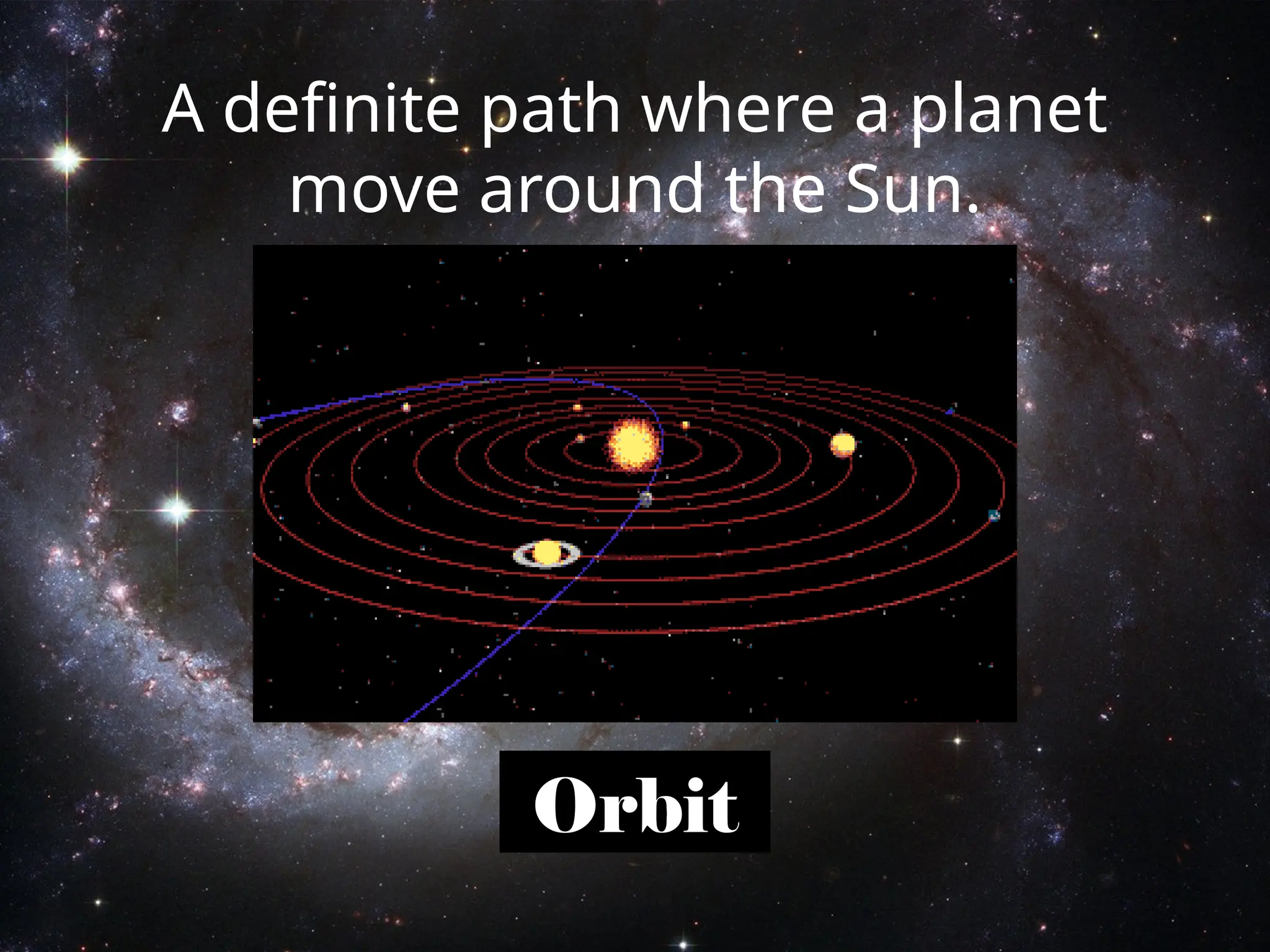
Orbit
A definite path where a planet
move around the Sun.
ORIGIN OF
THE SOLAR
SYSTEM
MR. MENARD H. BUSTONERA
OBJECTIVES:
•Distinguish the historical development
of the theories that explain the origin of
the solar system;
•Compare which of the different
hypotheses best explain the origin of
the solar system.
OVERVIEW:
•The solar system is located in the Milky Way galaxy a
huge disc- and spiral-shaped aggregation of about at
least 100 billion stars and other bodies.
•Its spiral arms rotate around a globular cluster or
bulge of many, many stars, at the center of which lies
a supermassive blackhole;
•This galaxy is about 100 million light years across (1
light year = 9.4607 × 10¹² km.
OVERVIEW:
• The solar system revolves around the galactic center once in about
240 million years;
• The Milky Way is part of the so-called Local Group of galaxies,
which in turn is part of the Virgo super cluster of galaxies;
• Based on the assumption that they are remnants of the materials
from which they were formed, radioactive dating of meteorites,
suggests that the Earth and solar system are 4.6 billion years old on
the assumption that they are remnants of the materials from which
they were formed.
LARGE SCALE FEATURES OF
THE SOLAR SYSTEM
• Much of the mass of the Solar System is concentrated at
the center (Sun) while angular momentum is held by the
outer planets.
• Orbits of the planets elliptical and are on the same plane.
• All planets revolve around the sun.
• The periods of revolution of the planets increase with
increasing distance from the Sun; the innermost planet
moves fastest, the outermost, the slowest;
• All planets are located at regular intervals from the Sun.
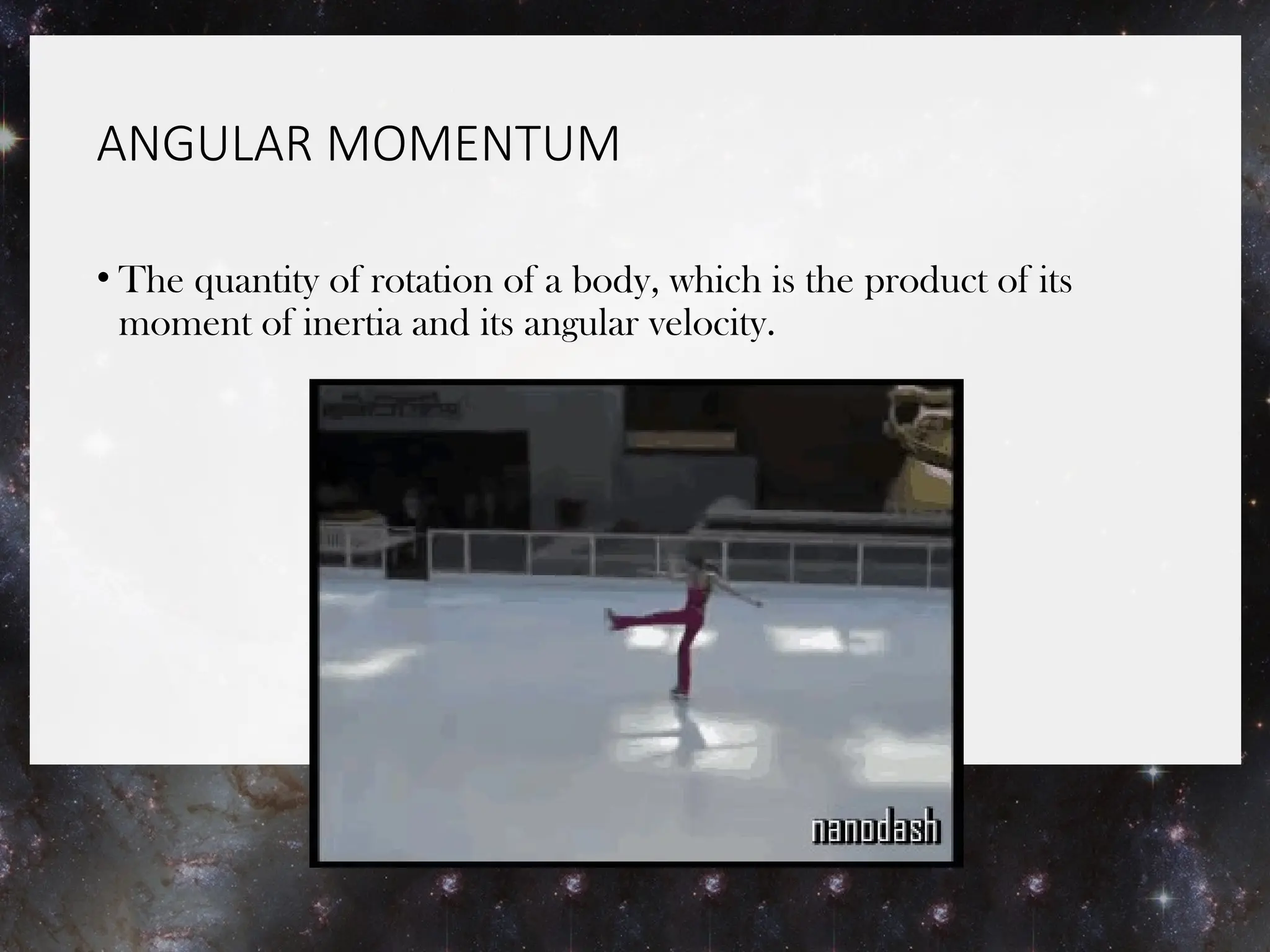
ANGULAR MOMENTUM
• The quantity of rotation of a body, which is the product of its
moment of inertia and its angular velocity.
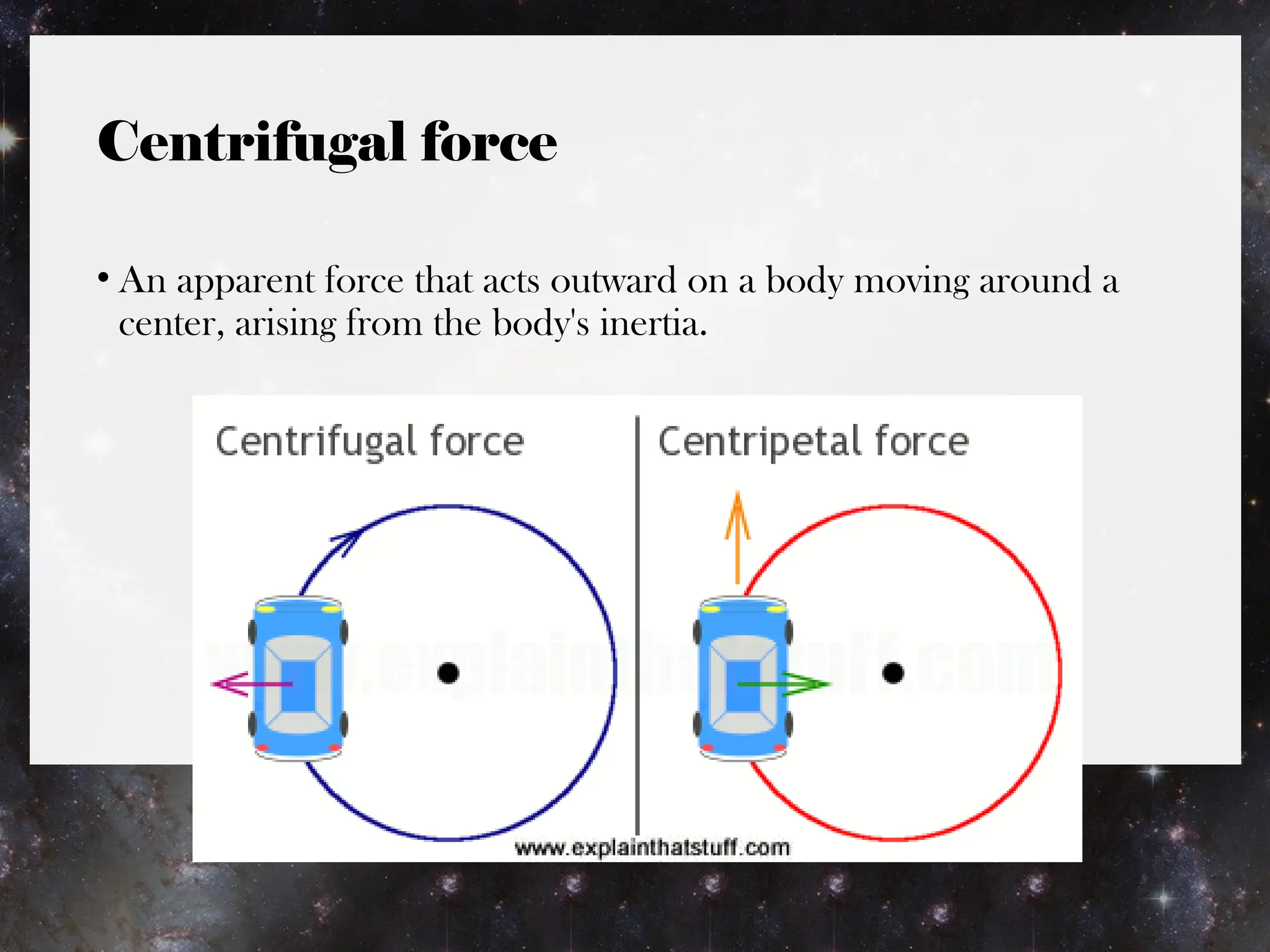
Centrifugal force
• An apparent force that acts outward on a body moving around a
center, arising from the body's inertia.
SMALL SCALE FEATURES OF
THE SOLAR SYSTEM
• Most planets rotate prograde (COUNTERCLOCKWISE)
• Inner terrestrial planets are made of materials with high melting
points such as silicates, iron , and nickel. They rotate slower, have
thin or no atmosphere, higher densities, and lower contents of
volatiles - hydrogen, helium, and noble gases.
• The outer four planets - Jupiter, Saturn, Uranus and Neptune are
called "gas giants" because of the dominance of gases and their
larger size. They rotate faster, have thick atmosphere, lower
densities, and fluid interiors rich in hydrogen, helium and ices
(water, ammonia, methane).
SMALL SCALE FEATURES OF
THE SOLAR SYSTEM
•The asteroid belt lies
between Mars and
Jupiter.
•Meteoroids are
smaller asteroids.
They are thought of as
remnants of a “fake
planet”.
THEORIES REGARDING THE
ORIGIN OF THE SOLAR SYSTEM
Any hypothesis regarding the origin of
the solar system should conform to or
explain both large scale and small scale
properties of the solar system.
NEBULAR HYPOTHESES
PROPONENT:
Emanuel Swedenborg, Immanuel Kant, and Pierre-Simon
Laplace in 1700’s
CONCEPT:
Solar system starts as a large rotating gaseous cloud that
cools and contracts or accrete (due to self-gravity) in the
middle to form the sun and the rest into a disc that
become the planets.
NEBULAR HYPOTHESES
PROPONENT:
Emanuel Swedenborg, Immanuel Kant, and Pierre-Simon
Laplace in 1700’s
CONCEPT:
Solar system starts as a large rotating gaseous cloud that
cools and contracts or accrete (due to self-gravity) in the
middle to form the sun and the rest into a disc that
become the planets.
NEBULAR HYPOTHESES
EVIDENCES
• All planets revolve around the sun in circular orbits caused
by gravity.
• All planets move in the same, one, direction.
• All planets are in the same plane (horizontal). - because they
formed at the same
time
NEBULAR HYPOTHESES
LOOPHOLE:
• This nebular theory failed to account for the
distribution of angular momentum in the solar
system.
ENCOUNTER HYPOTHESES
PROPONENT:
Georges Louis Leclerc, Comte de Buffon’s (1749) – “Sun-
Comet Encounter”
James Jeans’ (1917) – “Sun-Star Encounter”
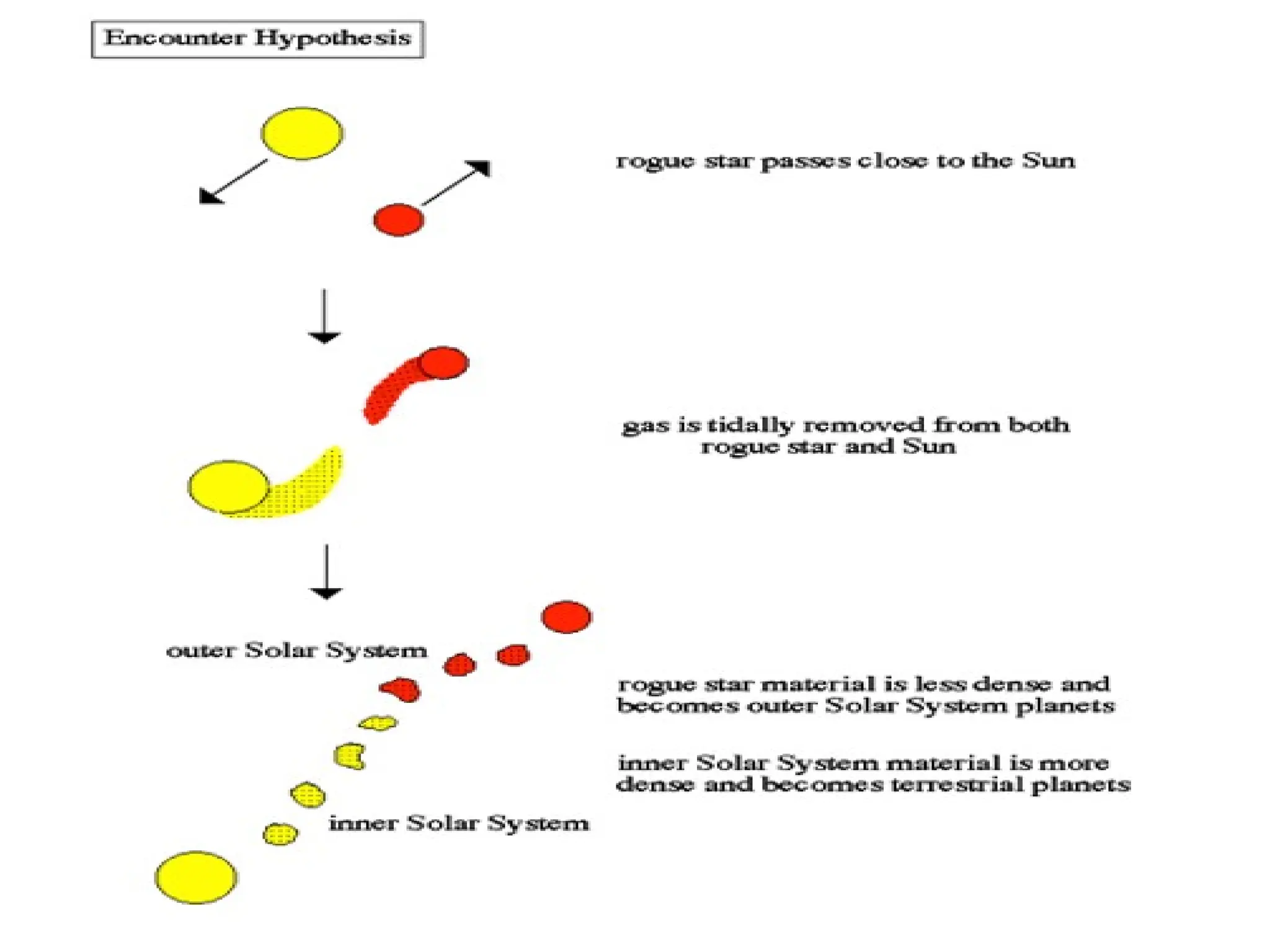
CONCEPT:
States that a rogue star passed close to the sun and stripped
materials (hot gasses) from both the sun and the rogue star.
ENCOUNTER HYPOTHESES
LOOPHOLE:
•Fails to explain how planets are formed (hot gas
from the sun/star expands and will not form
planets);
•This type of encounters are extremely rare.
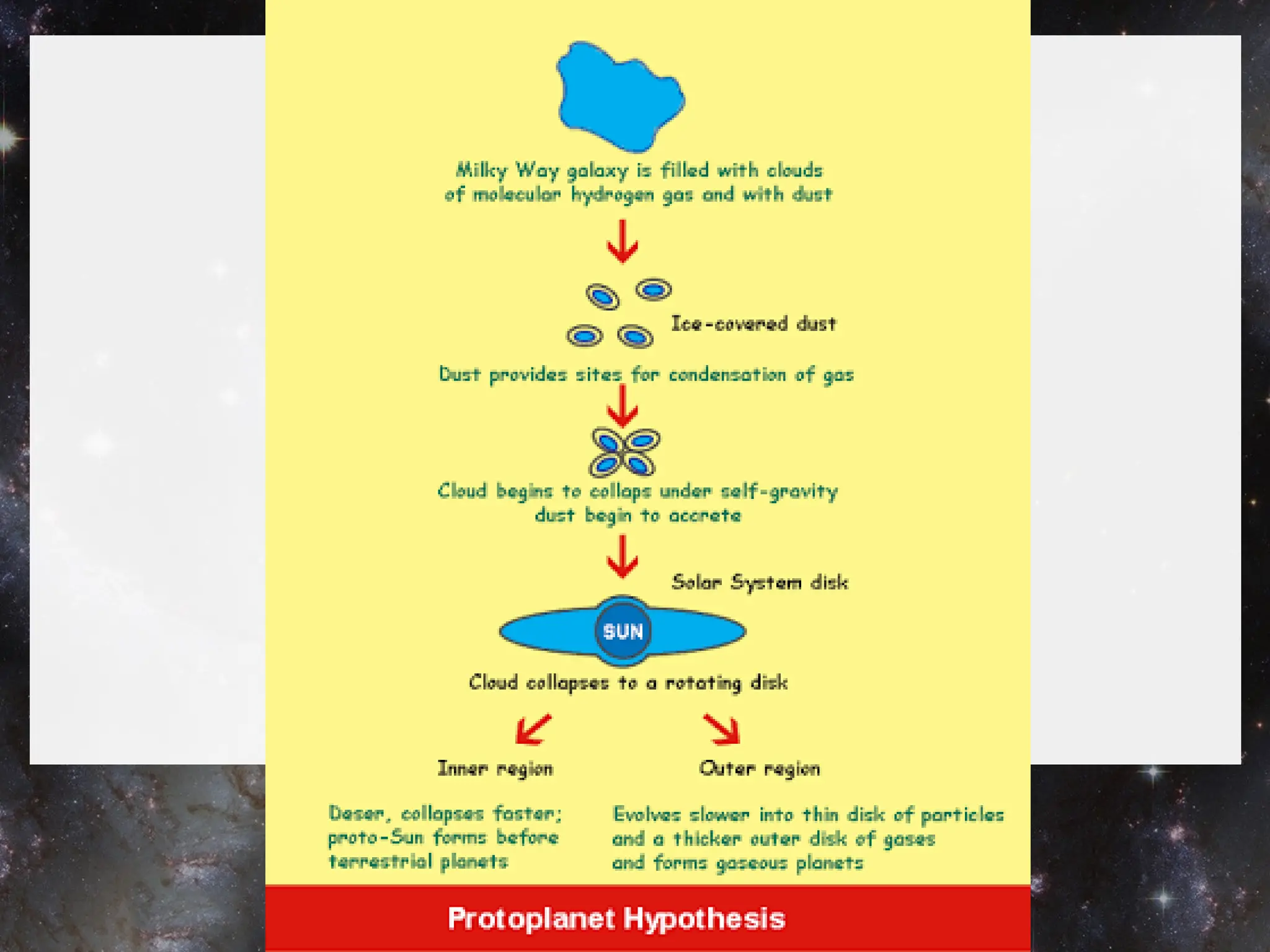
PROTOPLANET HYPOTHESES
PROPONENT:
C.F. Von Weizsacker (1944)
Gerald P. Kuiper
CONCEPT:
The present working model for the formation of the
solar system
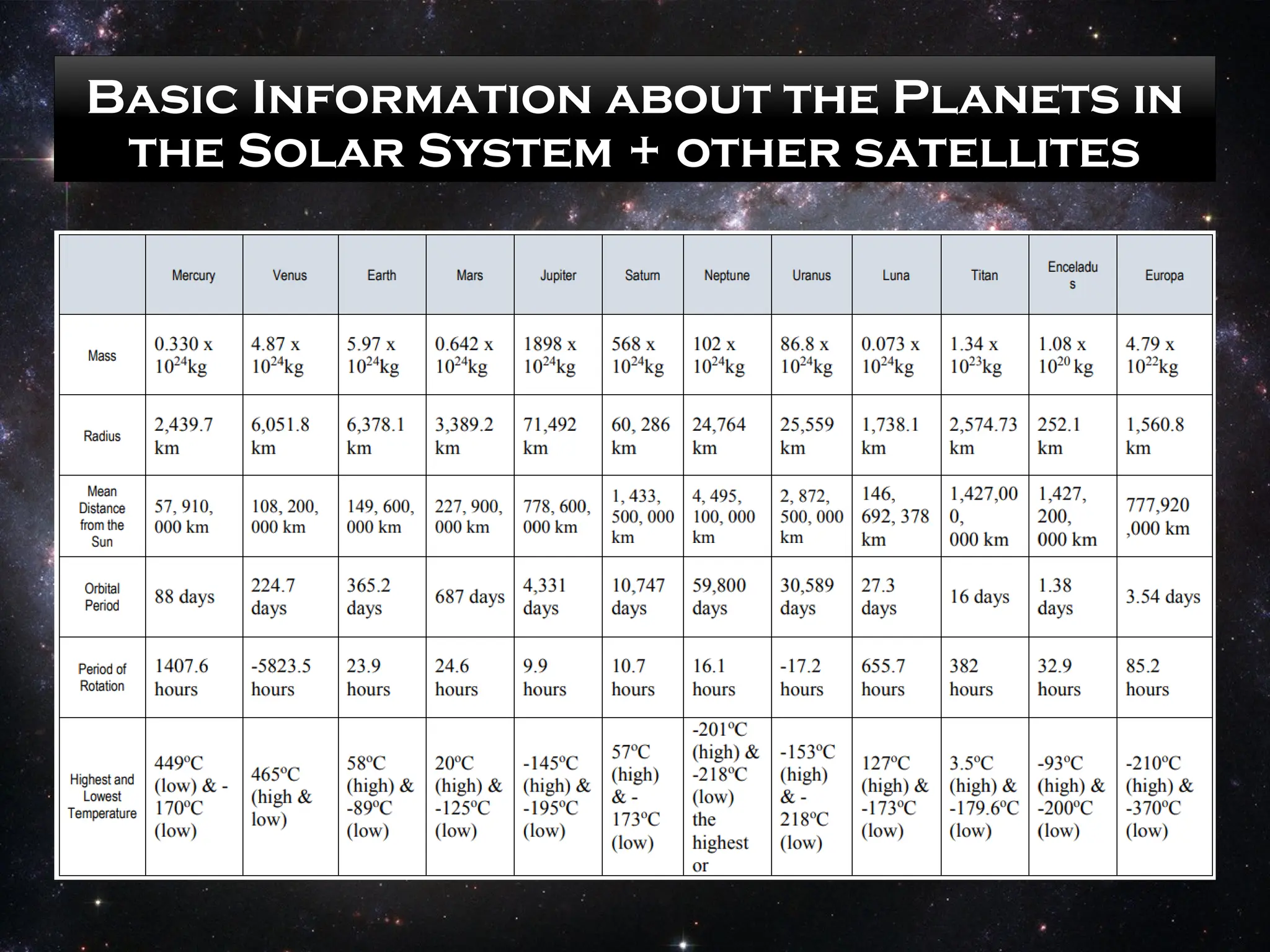
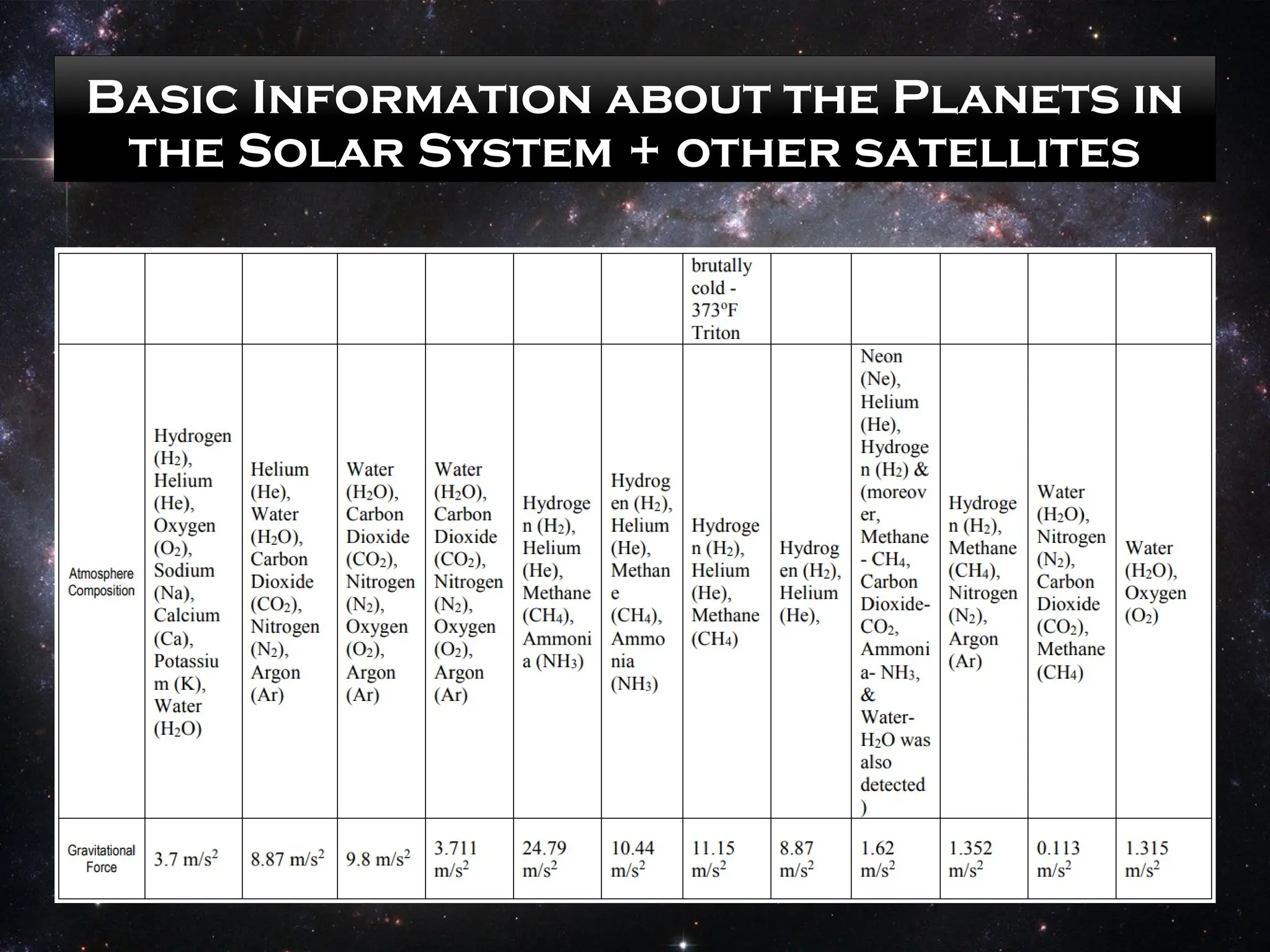
Basic Information about the Planets in
the Solar System + other satellites
Basic Information about the Planets in
the Solar System + other satellites
Small bodies in the solar system
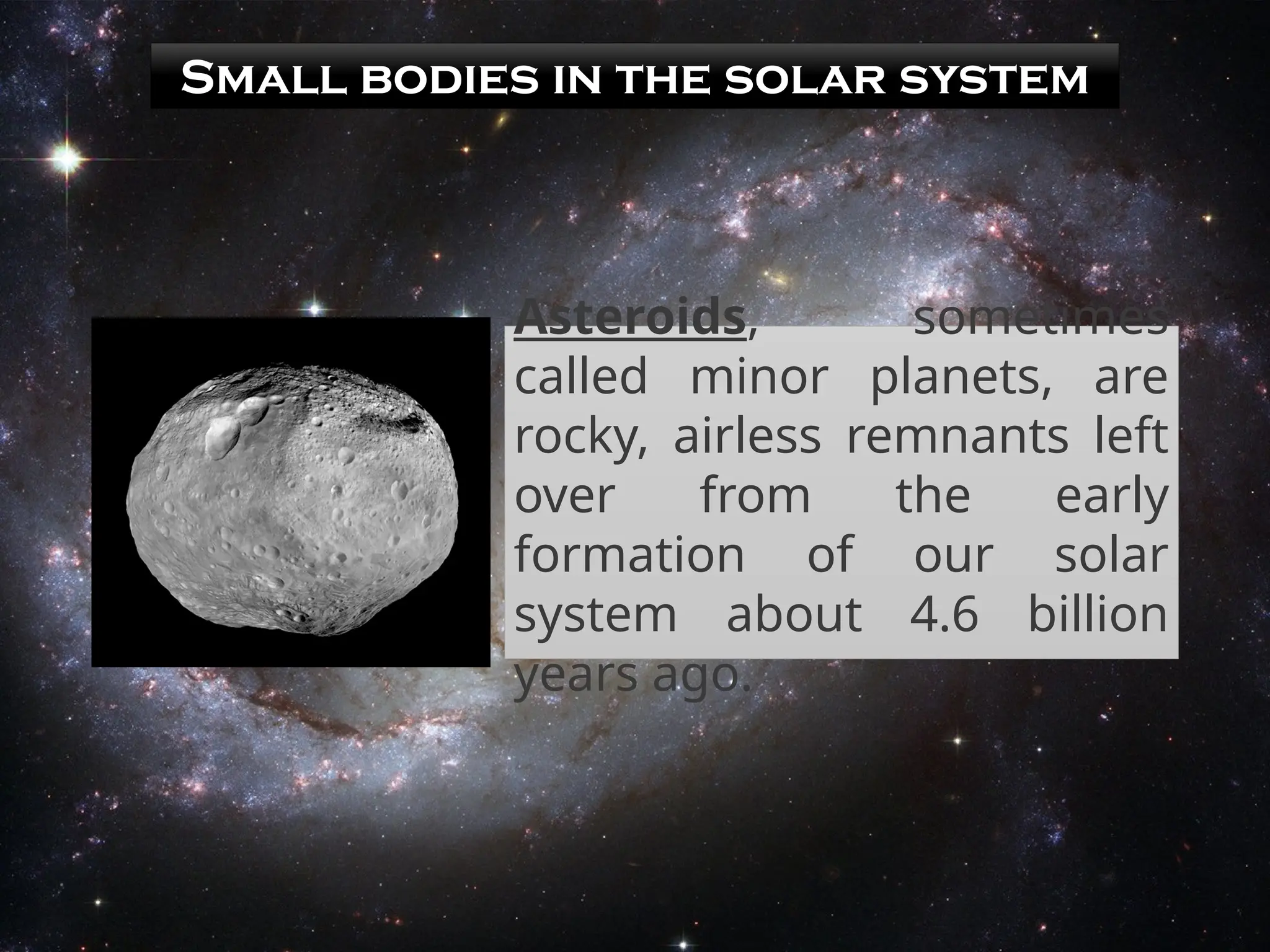
Asteroids, sometimes
called minor planets, are
rocky, airless remnants left
over from the early
formation of our solar
system about 4.6 billion
years ago.
Small bodies in the solar system
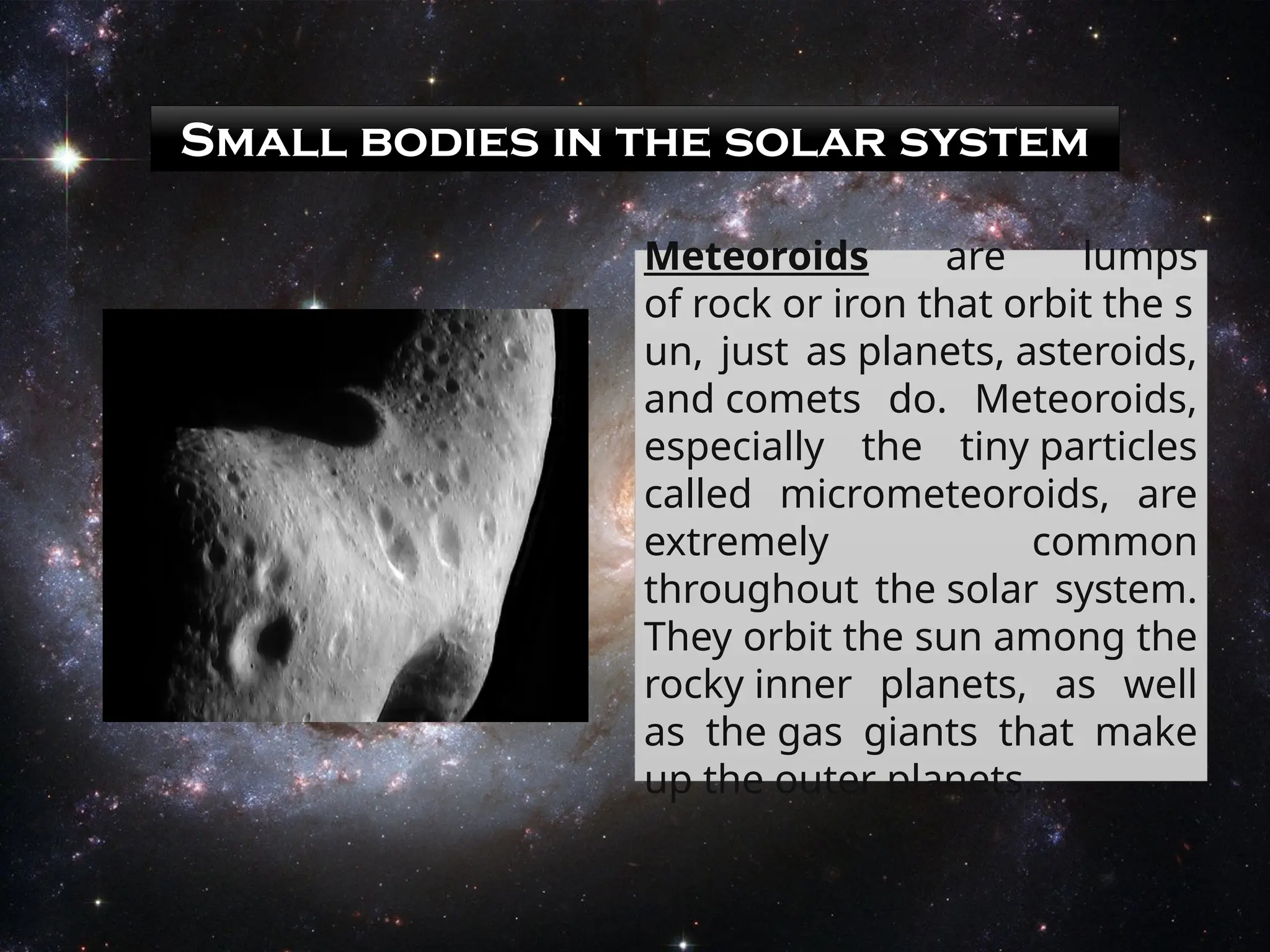
Meteoroids are lumps
of rock or iron that orbit the s
un, just as planets, asteroids,
and comets do. Meteoroids,
especially the tiny particles
called micrometeoroids, are
extremely common
throughout the solar system.
They orbit the sun among the
rocky inner planets, as well
as the gas giants that make
up the outer planets.
Small bodies in the solar system
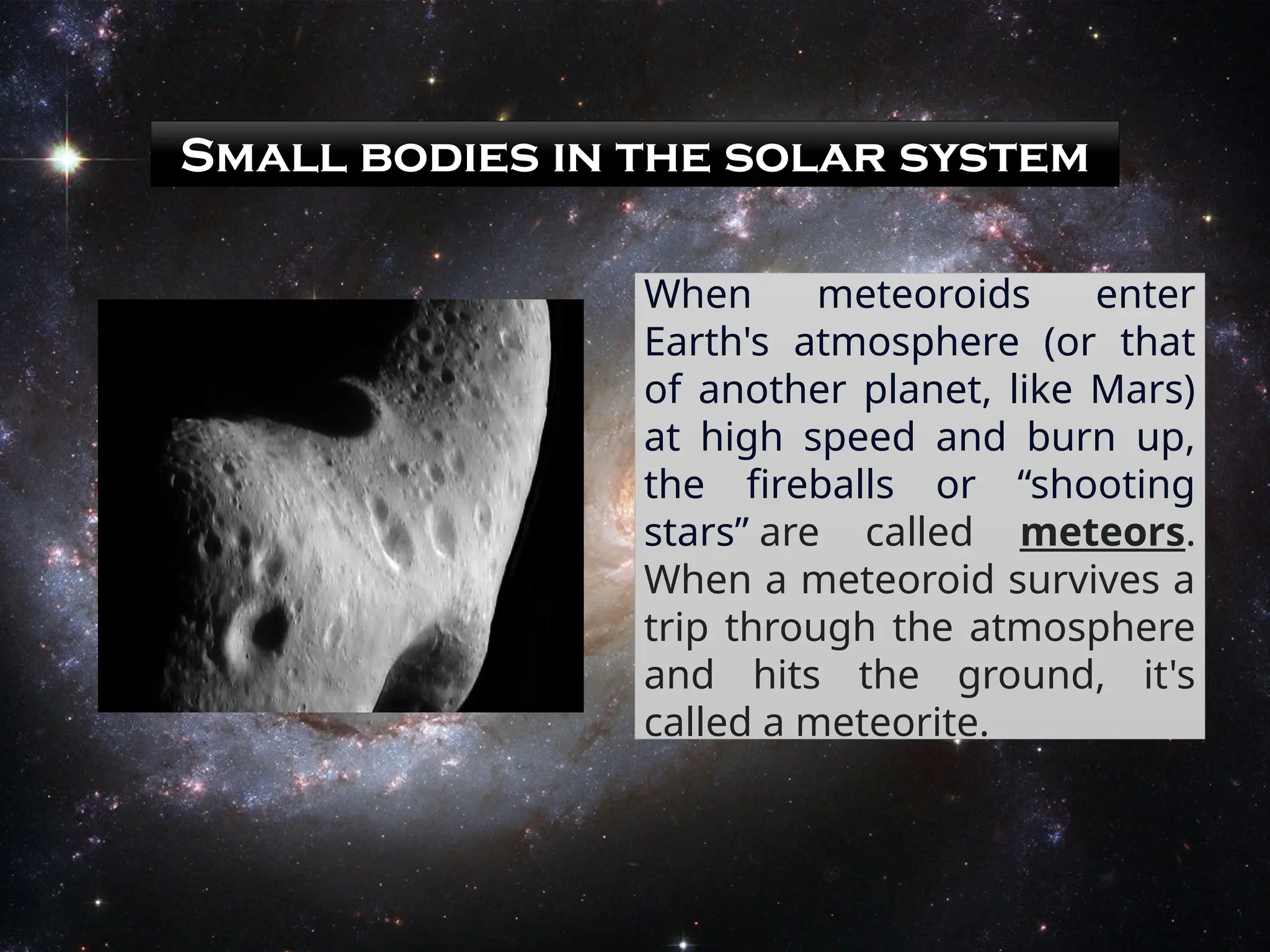
When meteoroids enter
Earth's atmosphere (or that
of another planet, like Mars)
at high speed and burn up,
the fireballs or “shooting
stars” are called meteors.
When a meteoroid survives a
trip through the atmosphere
and hits the ground, it's
called a meteorite.
Small bodies in the solar system
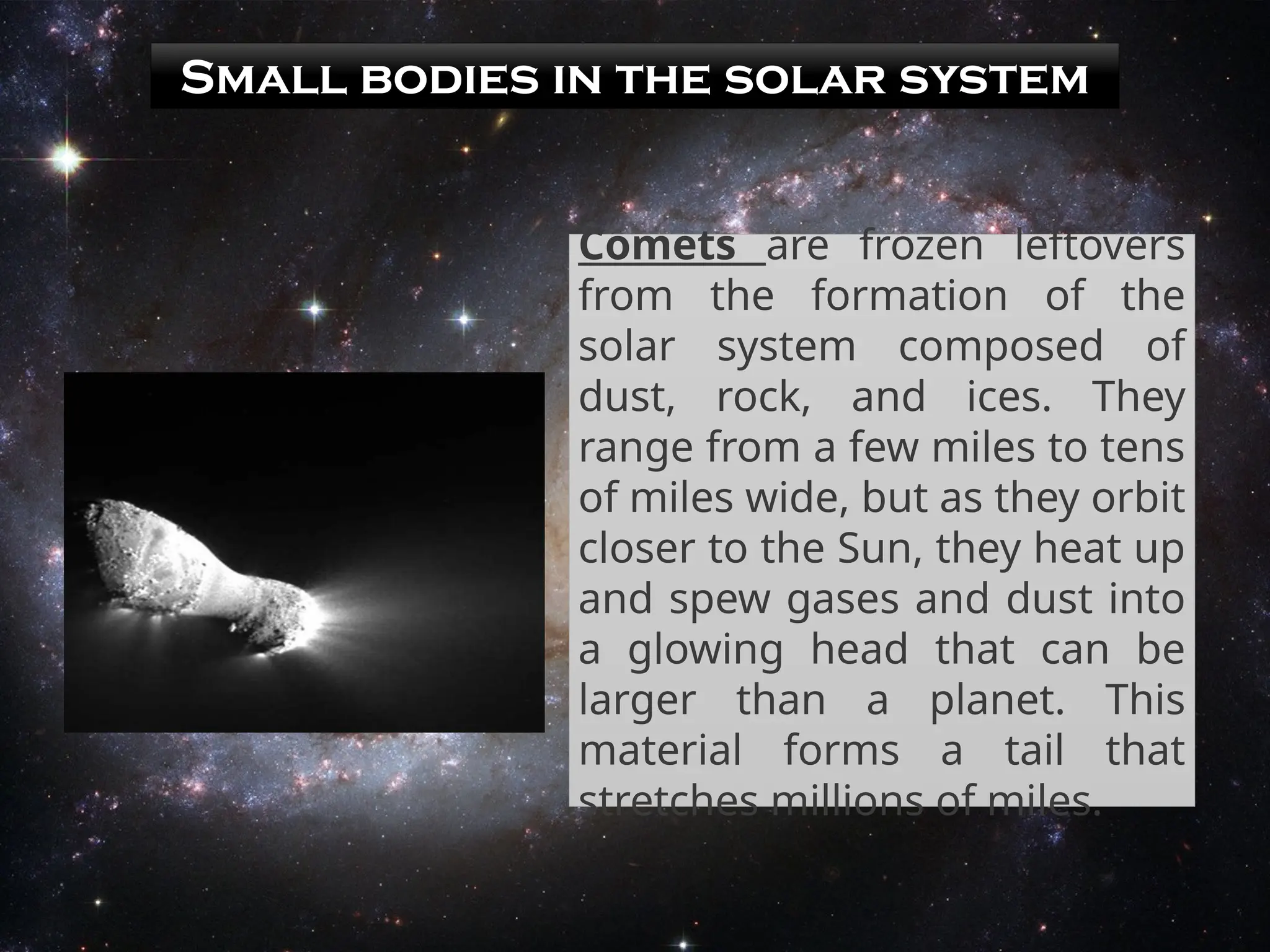
Comets are frozen leftovers
from the formation of the
solar system composed of
dust, rock, and ices. They
range from a few miles to tens
of miles wide, but as they orbit
closer to the Sun, they heat up
and spew gases and dust into
a glowing head that can be
larger than a planet. This
material forms a tail that
stretches millions of miles.
Let’s answer
1. How does mass and radius affect to the possibility and
sustainability of life on a planet?
2. How does the distance of the planet from the sun affect the
possibility and sustainability of life on a planet?
3. Of the different characteristics, which of these affect the surface
temperature of the planet? How?
4. How does surface temperatures affect the possibility and
sustainability of life on a planet?
5. Of the different characteristics, which of these affect the
atmosphere composition of the planet? How?
6. How does atmospheric composition affect the possibility and
sustainability of life on a planet?
7. Aside from Earth, do you think there is a possibility of life among
the different astronomical objects identified in the table?
Lesson-2-Theory on the Origin-of-Solar-System

  • 1.
  • 2.
  • 3.
    ORIGIN OF THE SOLAR SYSTEM MR.MENARD H. BUSTONERA
  • 4.
    Rotation A motion wherea planet spins on its own axis.
  • 5.
    Revolution A complete movementaround the sun of a certain planets on its orbit.
  • 6.
    Orbit A definite pathwhere a planet move around the Sun.
  • 7.
    ORIGIN OF THE SOLAR SYSTEM MR.MENARD H. BUSTONERA
  • 8.
    OBJECTIVES: •Distinguish the historicaldevelopment of the theories that explain the origin of the solar system; •Compare which of the different hypotheses best explain the origin of the solar system.
  • 9.
    OVERVIEW: •The solar systemis located in the Milky Way galaxy a huge disc- and spiral-shaped aggregation of about at least 100 billion stars and other bodies. •Its spiral arms rotate around a globular cluster or bulge of many, many stars, at the center of which lies a supermassive blackhole; •This galaxy is about 100 million light years across (1 light year = 9.4607 × 10¹² km.
  • 10.
    OVERVIEW: • The solarsystem revolves around the galactic center once in about 240 million years; • The Milky Way is part of the so-called Local Group of galaxies, which in turn is part of the Virgo super cluster of galaxies; • Based on the assumption that they are remnants of the materials from which they were formed, radioactive dating of meteorites, suggests that the Earth and solar system are 4.6 billion years old on the assumption that they are remnants of the materials from which they were formed.
  • 11.
    LARGE SCALE FEATURESOF THE SOLAR SYSTEM • Much of the mass of the Solar System is concentrated at the center (Sun) while angular momentum is held by the outer planets. • Orbits of the planets elliptical and are on the same plane. • All planets revolve around the sun. • The periods of revolution of the planets increase with increasing distance from the Sun; the innermost planet moves fastest, the outermost, the slowest; • All planets are located at regular intervals from the Sun.
  • 12.
    ANGULAR MOMENTUM • Thequantity of rotation of a body, which is the product of its moment of inertia and its angular velocity.
  • 13.
    Centrifugal force • Anapparent force that acts outward on a body moving around a center, arising from the body's inertia.
  • 14.
    SMALL SCALE FEATURESOF THE SOLAR SYSTEM • Most planets rotate prograde (COUNTERCLOCKWISE) • Inner terrestrial planets are made of materials with high melting points such as silicates, iron , and nickel. They rotate slower, have thin or no atmosphere, higher densities, and lower contents of volatiles - hydrogen, helium, and noble gases. • The outer four planets - Jupiter, Saturn, Uranus and Neptune are called "gas giants" because of the dominance of gases and their larger size. They rotate faster, have thick atmosphere, lower densities, and fluid interiors rich in hydrogen, helium and ices (water, ammonia, methane).
  • 15.
    SMALL SCALE FEATURESOF THE SOLAR SYSTEM •The asteroid belt lies between Mars and Jupiter. •Meteoroids are smaller asteroids. They are thought of as remnants of a “fake planet”.
  • 16.
    THEORIES REGARDING THE ORIGINOF THE SOLAR SYSTEM Any hypothesis regarding the origin of the solar system should conform to or explain both large scale and small scale properties of the solar system.
  • 17.
    NEBULAR HYPOTHESES PROPONENT: Emanuel Swedenborg,Immanuel Kant, and Pierre-Simon Laplace in 1700’s CONCEPT: Solar system starts as a large rotating gaseous cloud that cools and contracts or accrete (due to self-gravity) in the middle to form the sun and the rest into a disc that become the planets.
  • 18.
    NEBULAR HYPOTHESES PROPONENT: Emanuel Swedenborg,Immanuel Kant, and Pierre-Simon Laplace in 1700’s CONCEPT: Solar system starts as a large rotating gaseous cloud that cools and contracts or accrete (due to self-gravity) in the middle to form the sun and the rest into a disc that become the planets.
  • 19.
    NEBULAR HYPOTHESES EVIDENCES • Allplanets revolve around the sun in circular orbits caused by gravity. • All planets move in the same, one, direction. • All planets are in the same plane (horizontal). - because they formed at the same time
  • 20.
    NEBULAR HYPOTHESES LOOPHOLE: • Thisnebular theory failed to account for the distribution of angular momentum in the solar system.
  • 21.
    ENCOUNTER HYPOTHESES PROPONENT: Georges LouisLeclerc, Comte de Buffon’s (1749) – “Sun- Comet Encounter” James Jeans’ (1917) – “Sun-Star Encounter” CONCEPT: States that a rogue star passed close to the sun and stripped materials (hot gasses) from both the sun and the rogue star.
  • 23.
    ENCOUNTER HYPOTHESES LOOPHOLE: •Fails toexplain how planets are formed (hot gas from the sun/star expands and will not form planets); •This type of encounters are extremely rare.
  • 24.
    PROTOPLANET HYPOTHESES PROPONENT: C.F. VonWeizsacker (1944) Gerald P. Kuiper CONCEPT: The present working model for the formation of the solar system
  • 26.
    Basic Information aboutthe Planets in the Solar System + other satellites
  • 27.
    Basic Information aboutthe Planets in the Solar System + other satellites
  • 28.
    Small bodies inthe solar system Asteroids, sometimes called minor planets, are rocky, airless remnants left over from the early formation of our solar system about 4.6 billion years ago.
  • 29.
    Small bodies inthe solar system Meteoroids are lumps of rock or iron that orbit the s un, just as planets, asteroids, and comets do. Meteoroids, especially the tiny particles called micrometeoroids, are extremely common throughout the solar system. They orbit the sun among the rocky inner planets, as well as the gas giants that make up the outer planets.
  • 30.
    Small bodies inthe solar system When meteoroids enter Earth's atmosphere (or that of another planet, like Mars) at high speed and burn up, the fireballs or “shooting stars” are called meteors. When a meteoroid survives a trip through the atmosphere and hits the ground, it's called a meteorite.
  • 31.
    Small bodies inthe solar system Comets are frozen leftovers from the formation of the solar system composed of dust, rock, and ices. They range from a few miles to tens of miles wide, but as they orbit closer to the Sun, they heat up and spew gases and dust into a glowing head that can be larger than a planet. This material forms a tail that stretches millions of miles.
  • 32.
    Let’s answer 1. Howdoes mass and radius affect to the possibility and sustainability of life on a planet? 2. How does the distance of the planet from the sun affect the possibility and sustainability of life on a planet? 3. Of the different characteristics, which of these affect the surface temperature of the planet? How? 4. How does surface temperatures affect the possibility and sustainability of life on a planet? 5. Of the different characteristics, which of these affect the atmosphere composition of the planet? How? 6. How does atmospheric composition affect the possibility and sustainability of life on a planet? 7. Aside from Earth, do you think there is a possibility of life among the different astronomical objects identified in the table?