Qualcomm Technologies, Inc.
September 2, 2020 @qualcomm_tech
Pushing the boundaries
of AI research
3
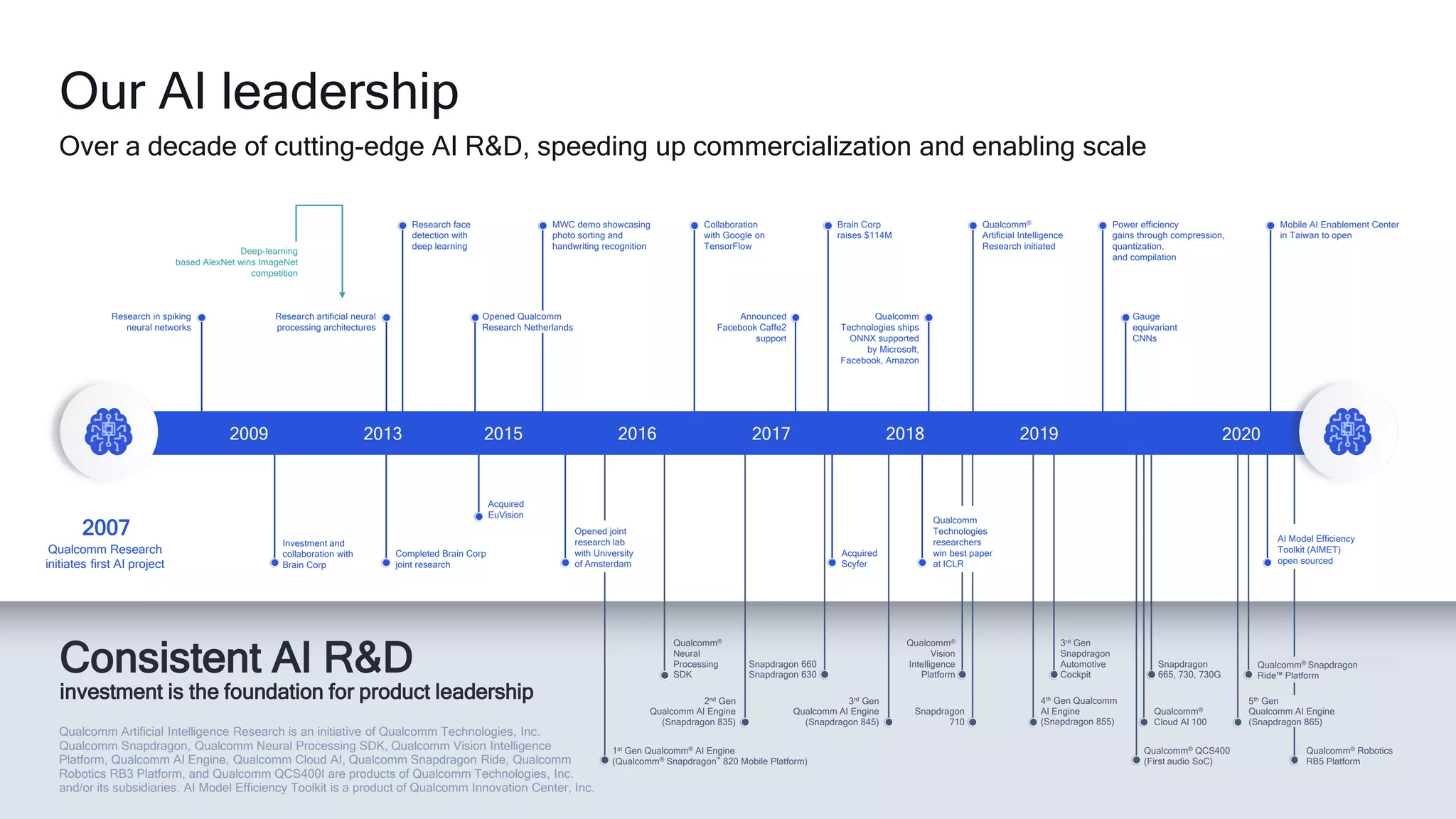
Consistent AI R&D
investment is the foundation for product leadership
1st Gen Qualcomm® AI Engine
(Qualcomm® Snapdragon™ 820 Mobile Platform)
MWC demo showcasing
photo sorting and
handwriting recognition
2nd Gen
Qualcomm AI Engine
(Snapdragon 835)
3rd Gen
Qualcomm AI Engine
(Snapdragon 845)
Brain Corp
raises $114M
Announced
Facebook Caffe2
support
Collaboration
with Google on
TensorFlow
Opened Qualcomm
Research Netherlands
Research face
detection with
deep learning
Research artificial neural
processing architectures
Research in spiking
neural networks
Deep-learning
based AlexNet wins ImageNet
competition
Qualcomm
Technologies ships
ONNX supported
by Microsoft,
Facebook, Amazon
4th Gen Qualcomm
AI Engine
(Snapdragon 855)
Qualcomm®
Artificial Intelligence
Research initiated
Snapdragon
710
Qualcomm®
Cloud AI 100
Qualcomm® QCS400
(First audio SoC)
Mobile AI Enablement Center
in Taiwan to open
Power efficiency
gains through compression,
quantization,
and compilation
Gauge
equivariant
CNNs
Qualcomm® Robotics
RB5 Platform
Our AI leadership
Over a decade of cutting-edge AI R&D, speeding up commercialization and enabling scale
Qualcomm®
Vision
Intelligence
Platform
Qualcomm®
Neural
Processing
SDK
Snapdragon 660
Snapdragon 630
3rd Gen
Snapdragon
Automotive
Cockpit
Snapdragon
665, 730, 730G
5th Gen
Qualcomm AI Engine
(Snapdragon 865)
Qualcomm® Snapdragon
Ride™ Platform
2018201620152009 2013 2017 2019 2020
Qualcomm Research
initiates first AI project
2007
Acquired
EuVision
Completed Brain Corp
joint research
Investment and
collaboration with
Brain Corp
Acquired
Scyfer
Qualcomm
Technologies
researchers
win best paper
at ICLR
Opened joint
research lab
with University
of Amsterdam
AI Model Efficiency
Toolkit (AIMET)
open sourced
Qualcomm Artificial Intelligence Research is an initiative of Qualcomm Technologies, Inc.
Qualcomm Snapdragon, Qualcomm Neural Processing SDK, Qualcomm Vision Intelligence
Platform, Qualcomm AI Engine, Qualcomm Cloud AI, Qualcomm Snapdragon Ride, Qualcomm
Robotics RB3 Platform, and Qualcomm QCS400I are products of Qualcomm Technologies, Inc.
and/or its subsidiaries. AI Model Efficiency Toolkit is a product of Qualcomm Innovation Center, Inc.
4
Automotive
IoT/IIoT
Mobile
Cloud
Power efficiency Efficient learningPersonalization
Action
Reinforcement learning
for decision making
Perception
Object detection, speech
recognition, contextual fusion
Reasoning
Scene understanding, language
understanding, behavior prediction
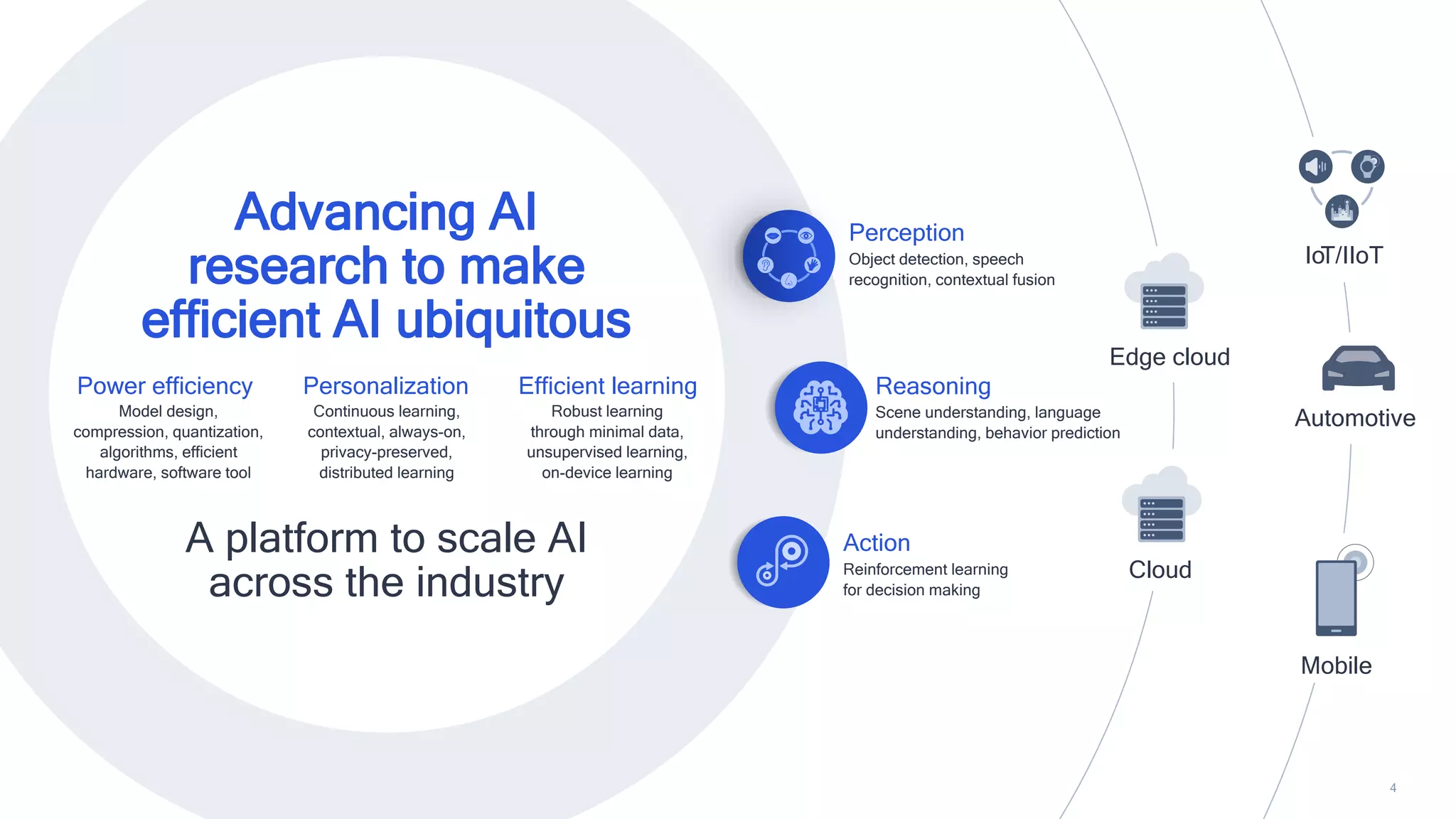
Advancing AI
research to make
efficient AI ubiquitous
A platform to scale AI
across the industry
Edge cloud
Model design,
compression, quantization,
algorithms, efficient
hardware, software tool
Continuous learning,
contextual, always-on,
privacy-preserved,
distributed learning
Robust learning
through minimal data,
unsupervised learning,
on-device learning
5
Bayesian
combinatorial
optimization
Quantum AI
G-CNN
Bayesian
distributed
learning
Deep
generative
models
Deep
transfer
learning
Hybrid
reinforcement
learning
Neural
network
quantization
AI for
wireless
Neural
network
compression
Hardware-
aware
deep learning
Compute
in memory
Energy-efficient
perception
Graph and
kernel
optimization
Power
management
Source
compression
AI for
radar
AI Model
Efficiency Toolkit
Fingerprint
Voice UI
Deep
learning for
graphics
Video
recognition
and prediction
CV DL for
new sensors
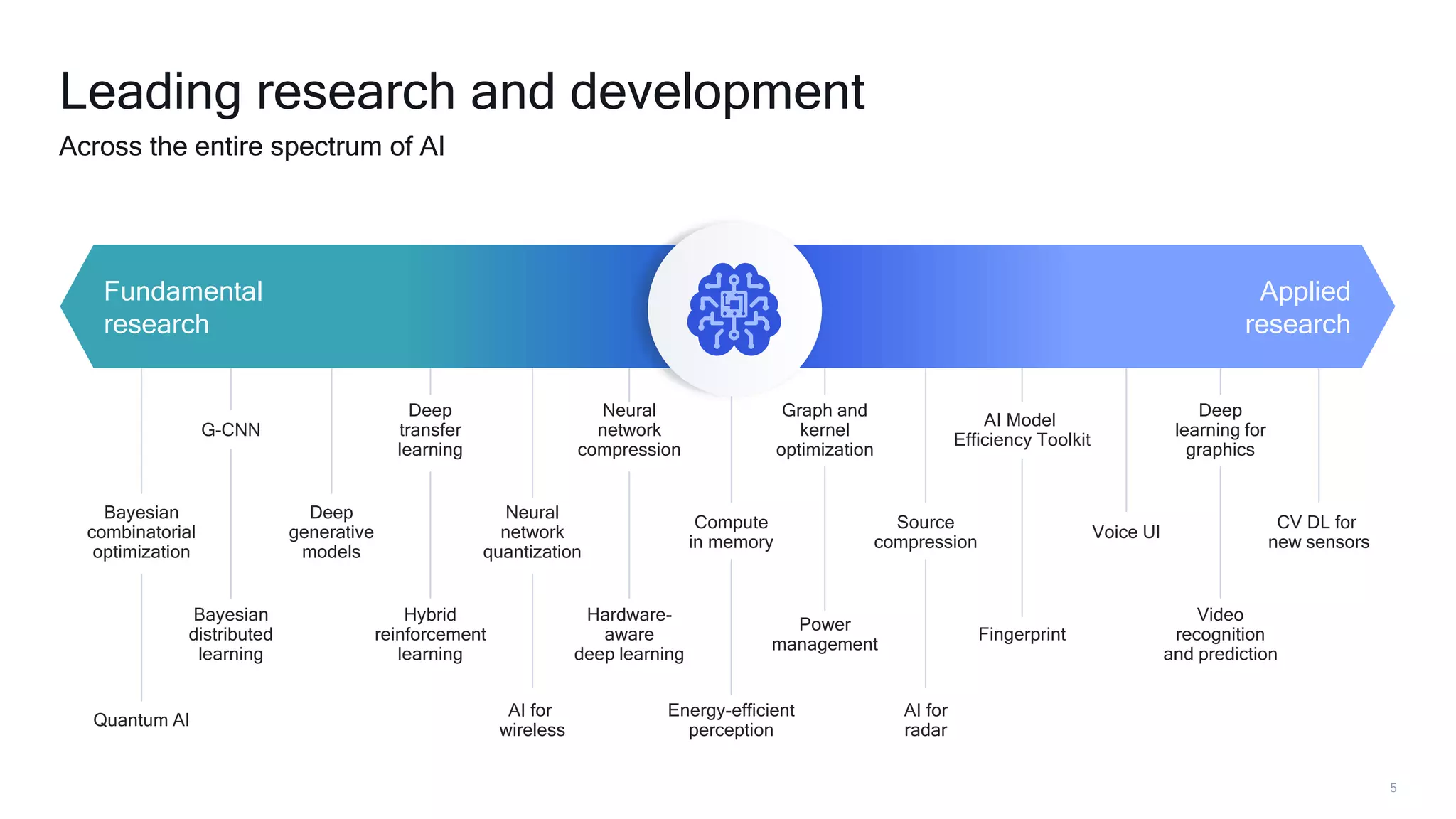
Leading research and development
Across the entire spectrum of AI
Fundamental
research
Applied
research
6
Models trained at
high precision
Inference at
lower precision
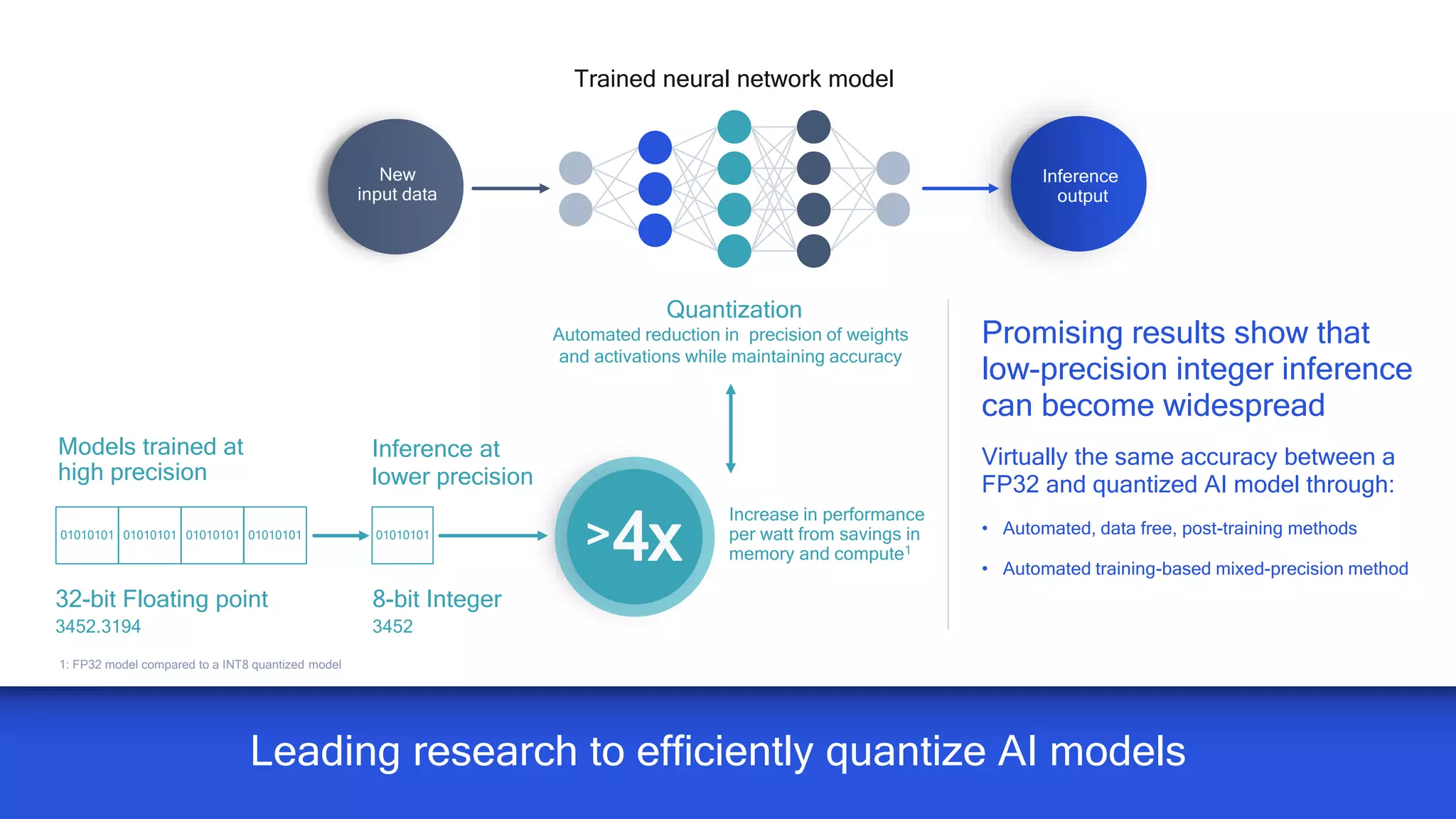
Promising results show that
low-precision integer inference
can become widespread
Virtually the same accuracy between a
FP32 and quantized AI model through:
• Automated, data free, post-training methods
• Automated training-based mixed-precision method
01010101 01010101 01010101 01010101
32-bit Floating point
3452.3194
8-bit Integer
3452
01010101
Leading research to efficiently quantize AI models
Quantization
Increase in performance
per watt from savings in
memory and compute14x
Automated reduction in precision of weights
and activations while maintaining accuracy
>
Trained neural network model
Inference
output
New
input data
1: FP32 model compared to a INT8 quantized model
7
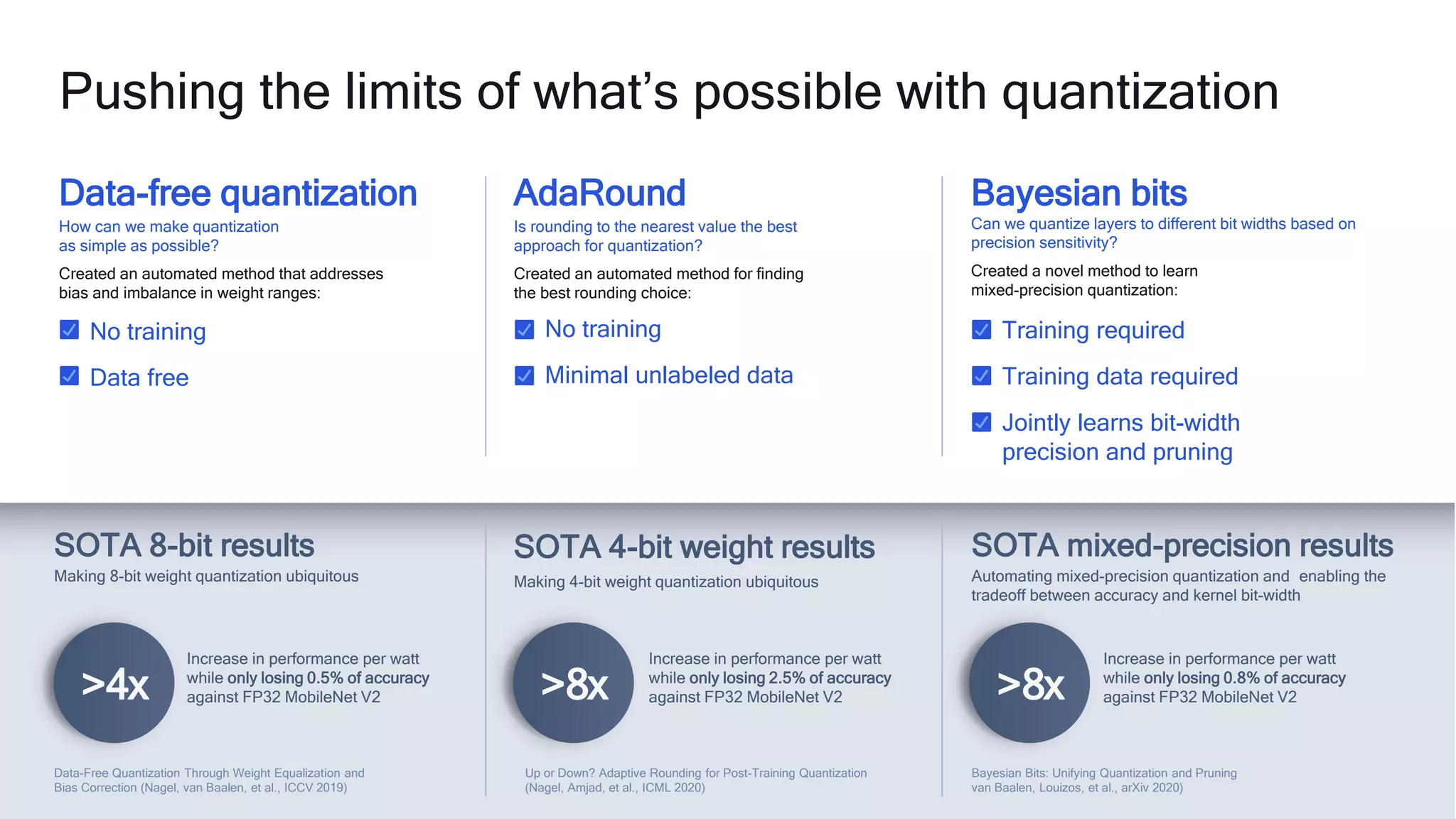
Pushing the limits of what’s possible with quantization
Data-free quantization
How can we make quantization
as simple as possible?
Created an automated method that addresses
bias and imbalance in weight ranges:
AdaRound
Is rounding to the nearest value the best
approach for quantization?
Created an automated method for finding
the best rounding choice:
Bayesian bits
Can we quantize layers to different bit widths based on
precision sensitivity?
Created a novel method to learn
mixed-precision quantization:
SOTA 8-bit results
Making 8-bit weight quantization ubiquitous
SOTA 4-bit weight results
Making 4-bit weight quantization ubiquitous
SOTA mixed-precision results
Automating mixed-precision quantization and enabling the
tradeoff between accuracy and kernel bit-width
>4x >8x >8x
Increase in performance per watt
while only losing 0.5% of accuracy
against FP32 MobileNet V2
Increase in performance per watt
while only losing 2.5% of accuracy
against FP32 MobileNet V2
Increase in performance per watt
while only losing 0.8% of accuracy
against FP32 MobileNet V2
Data-Free Quantization Through Weight Equalization and
Bias Correction (Nagel, van Baalen, et al., ICCV 2019)
Up or Down? Adaptive Rounding for Post-Training Quantization
(Nagel, Amjad, et al., ICML 2020)
Bayesian Bits: Unifying Quantization and Pruning
van Baalen, Louizos, et al., arXiv 2020)
No training
Data free
No training
Minimal unlabeled data
Training required
Training data required
Jointly learns bit-width
precision and pruning
8Qualcomm Neural Processing SDK is a product of Qualcomm Technologies, Inc. and/or its subsidiaries. AI Model Efficiency Toolkit is a product of Qualcomm Innovation Center, Inc.
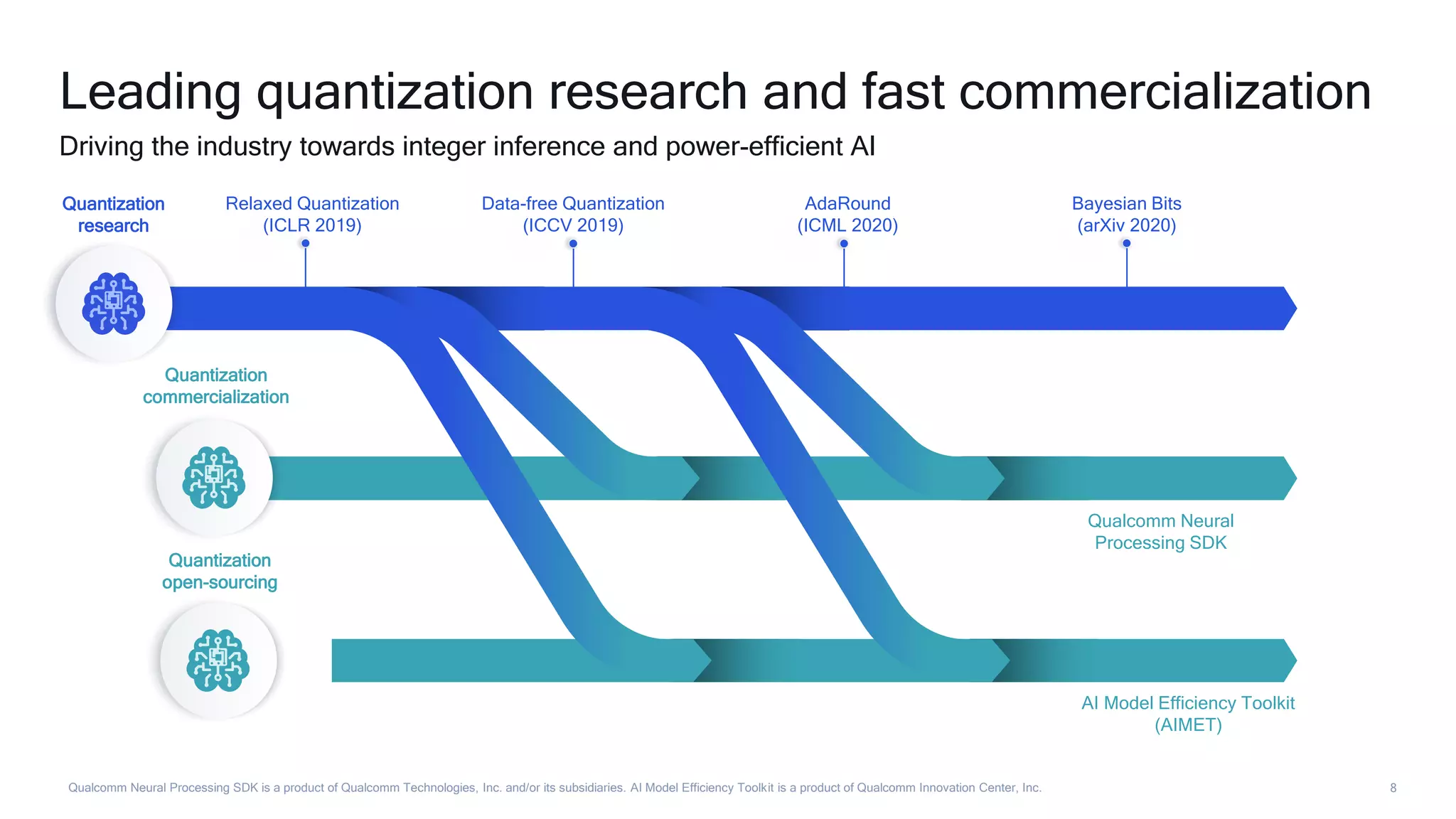
Leading quantization research and fast commercialization
Driving the industry towards integer inference and power-efficient AI
Qualcomm Neural
Processing SDK
Relaxed Quantization
(ICLR 2019)
Data-free Quantization
(ICCV 2019)
AdaRound
(ICML 2020)
Bayesian Bits
(arXiv 2020)
AI Model Efficiency Toolkit
(AIMET)
Quantization
research
Quantization
commercialization
Quantization
open-sourcing
9
Qualcomm AI Research is an initiative of Qualcomm Technologies, Inc. AI Model Efficiency Toolkit is a product of Qualcomm Innovation Center, Inc.
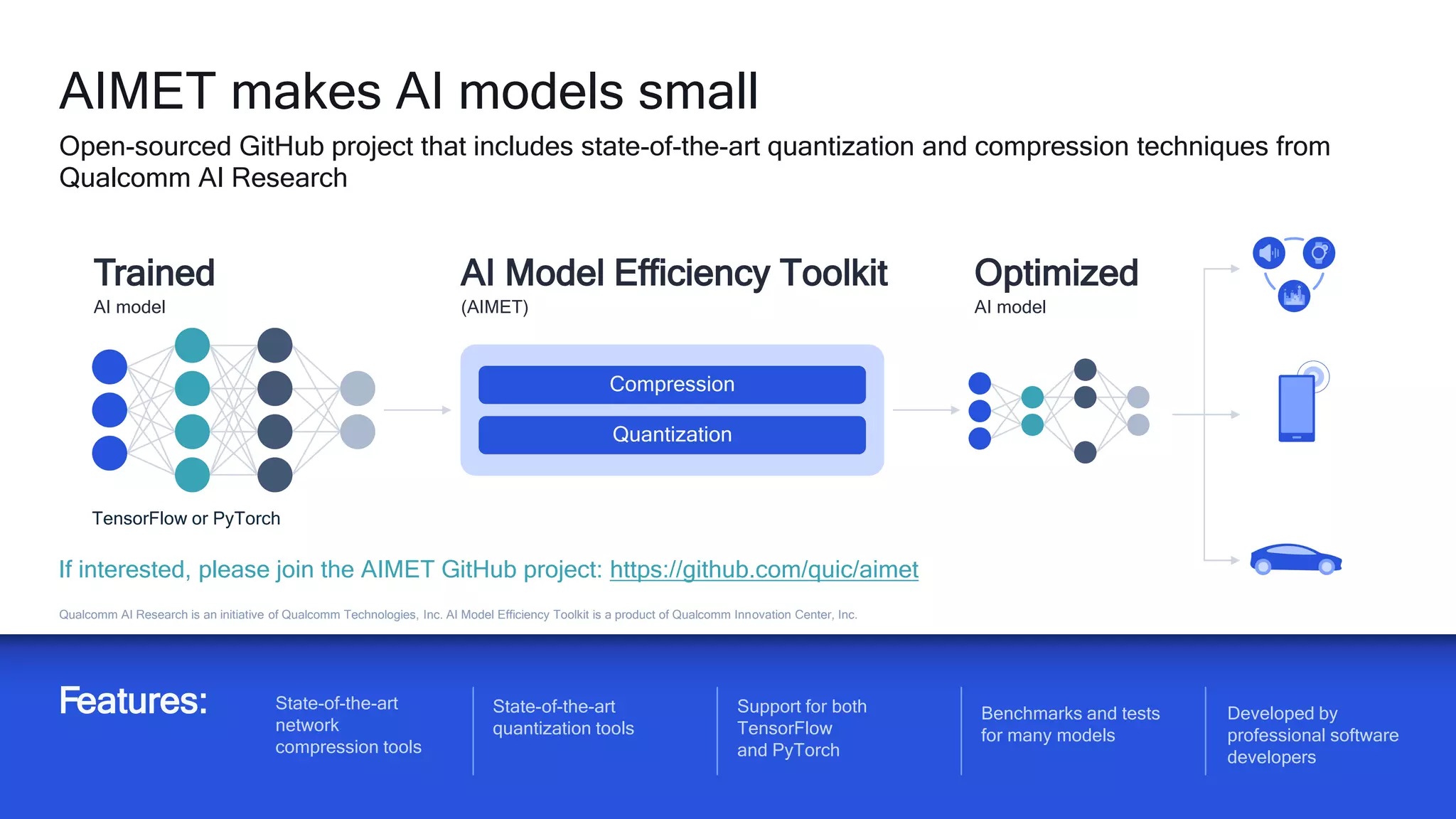
AIMET makes AI models small
Open-sourced GitHub project that includes state-of-the-art quantization and compression techniques from
Qualcomm AI Research
If interested, please join the AIMET GitHub project: https://github.com/quic/aimet
Features: State-of-the-art
network
compression tools
State-of-the-art
quantization tools
Support for both
TensorFlow
and PyTorch
Benchmarks and tests
for many models
Developed by
professional software
developers
Trained
AI model
AI Model Efficiency Toolkit
(AIMET)
Optimized
AI model
TensorFlow or PyTorch
Compression
Quantization
10
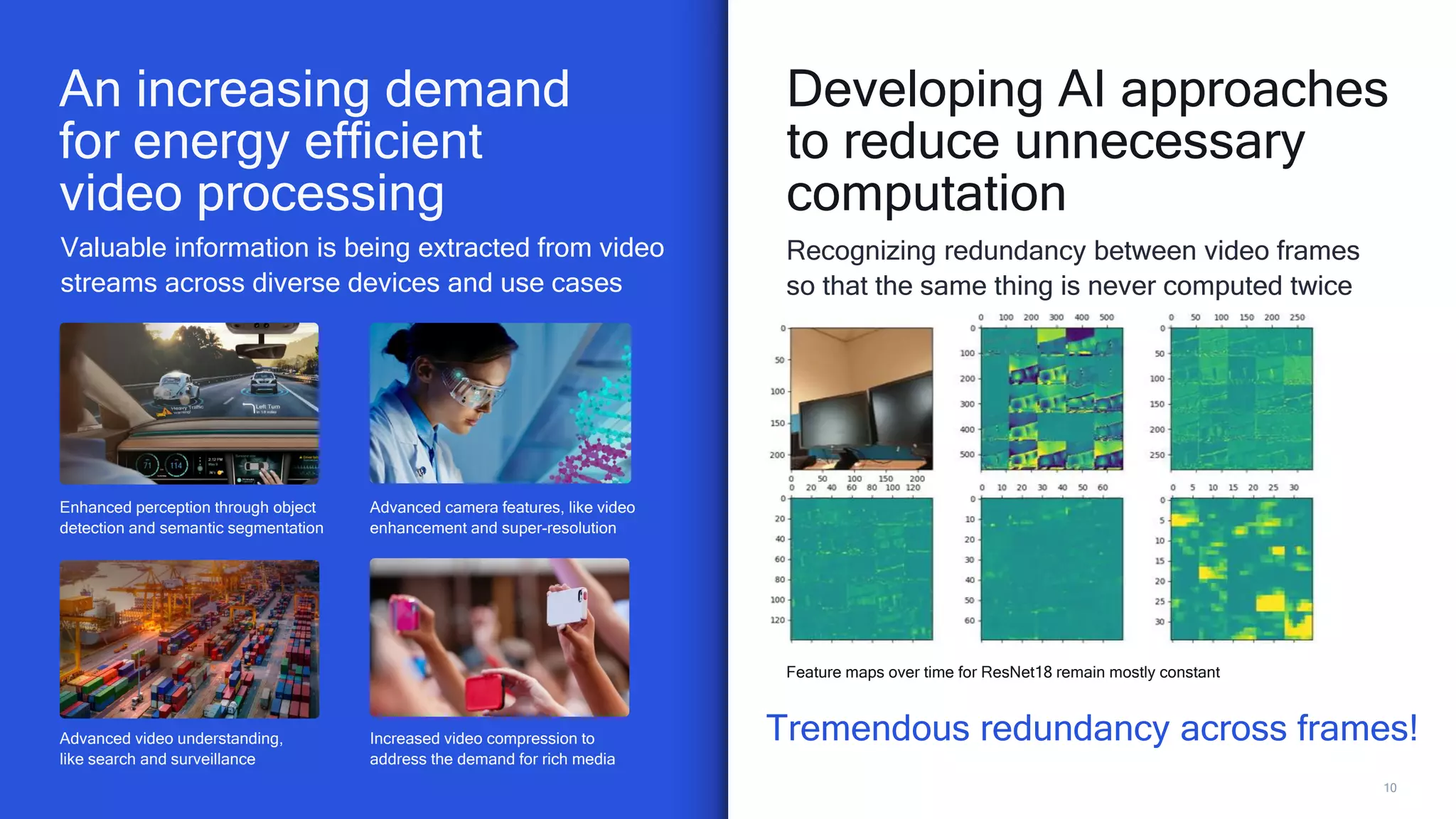
Developing AI approaches
to reduce unnecessary
computation
An increasing demand
for energy efficient
video processing
Valuable information is being extracted from video
streams across diverse devices and use cases
Recognizing redundancy between video frames
so that the same thing is never computed twice
Feature maps over time for ResNet18 remain mostly constant
Tremendous redundancy across frames!
Enhanced perception through object
detection and semantic segmentation
Advanced camera features, like video
enhancement and super-resolution
Advanced video understanding,
like search and surveillance
Increased video compression to
address the demand for rich media
11
1. Bejnordi, Babak Ehteshami, Tijmen Blankevoort, and Max Welling. "Batch shaping for learning conditional channel gated networks." ICLR (2020).
2. Abati, Davide, Jakub Tomczak, Tijmen Blankevoort, Simone Calderara, Rita Cucchiara, and Babak Ehteshami Bejnordi. "Conditional Channel Gated Networks for Task-Aware Continual Learning." CVPR (2020).
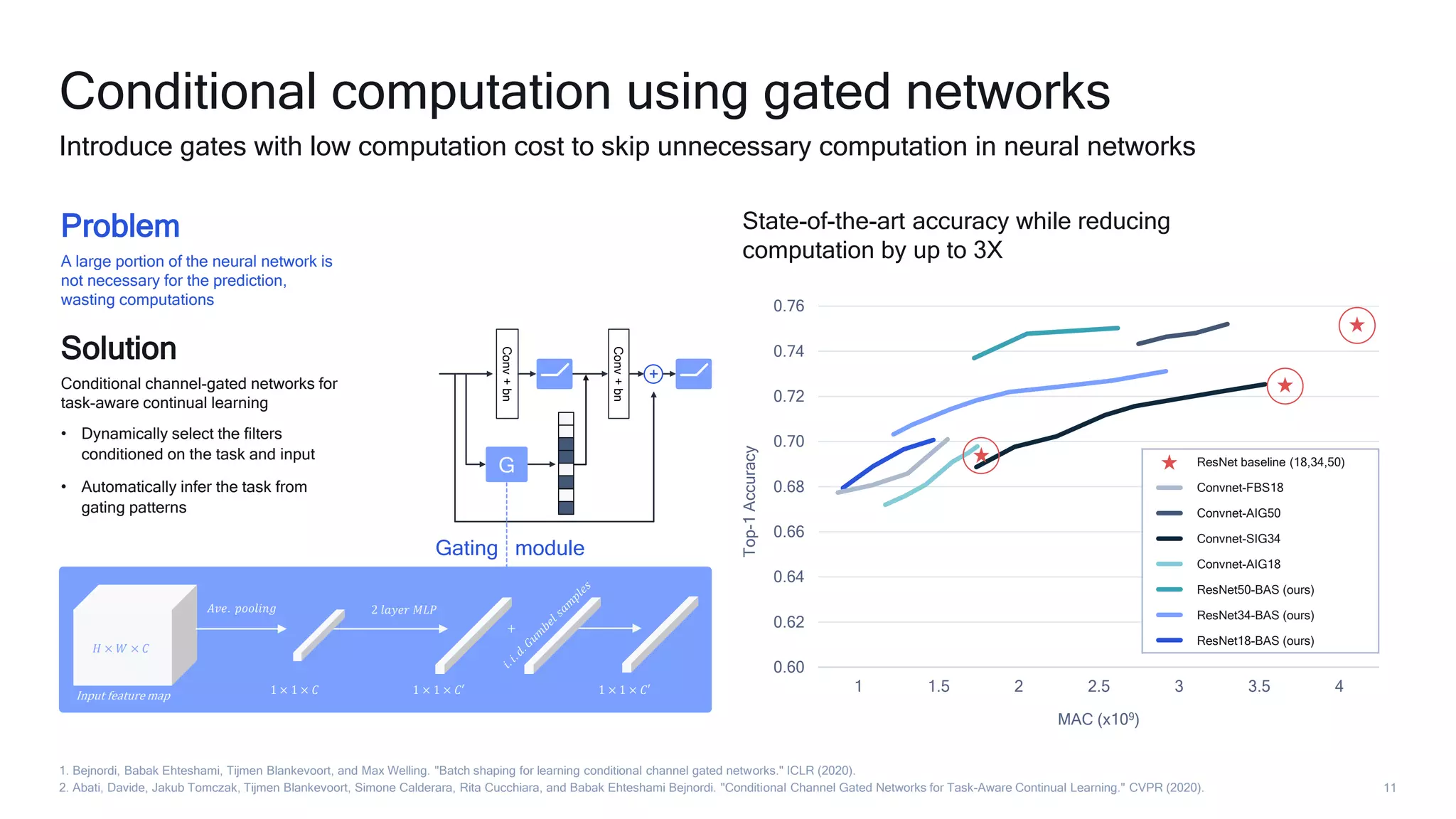
Conditional computation using gated networks
Introduce gates with low computation cost to skip unnecessary computation in neural networks
Problem
A large portion of the neural network is
not necessary for the prediction,
wasting computations
Solution
Conditional channel-gated networks for
task-aware continual learning
• Dynamically select the filters
conditioned on the task and input
• Automatically infer the task from
gating patterns
State-of-the-art accuracy while reducing
computation by up to 3X
𝐻 × 𝑊 × 𝐶
Input feature map
𝐴𝑣𝑒. 𝑝𝑜𝑜𝑙𝑖𝑛𝑔
1 × 1 × 𝐶
2 𝑙𝑎𝑦𝑒𝑟 𝑀𝐿𝑃
1 × 1 × 𝐶′
+
1 × 1 × 𝐶′
Gating module
+
G
Conv+bn
Conv+bn
0.60
0.62
0.64
0.66
0.68
0.70
0.72
0.74
0.76
1 1.5 2 2.5 3 3.5 4
Top-1Accuracy
MAC (x109)
ResNet baseline (18,34,50)
Convnet-FBS18
Convnet-AIG50
Convnet-SIG34
Convnet-AIG18
ResNet50-BAS (ours)
ResNet34-BAS (ours)
ResNet18-BAS (ours)
12
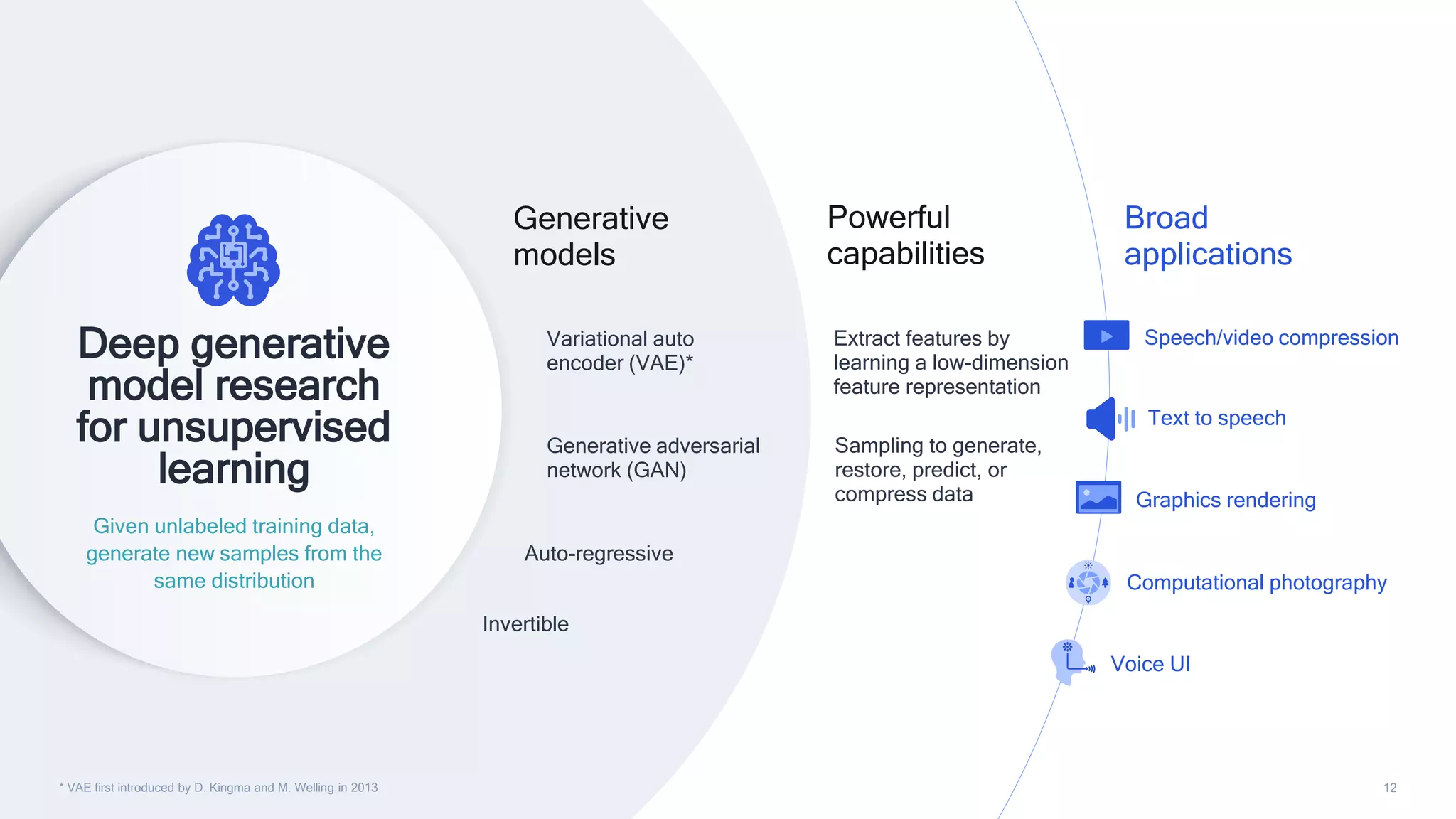
Variational auto
encoder (VAE)*
Invertible
Auto-regressive
Generative adversarial
network (GAN)
Generative
models
Extract features by
learning a low-dimension
feature representation
Sampling to generate,
restore, predict, or
compress data
Powerful
capabilities
Broad
applications
Computational photography
Text to speech
Graphics rendering
Speech/video compression
Voice UI
* VAE first introduced by D. Kingma and M. Welling in 2013
Deep generative
model research
for unsupervised
learning
Given unlabeled training data,
generate new samples from the
same distribution
13
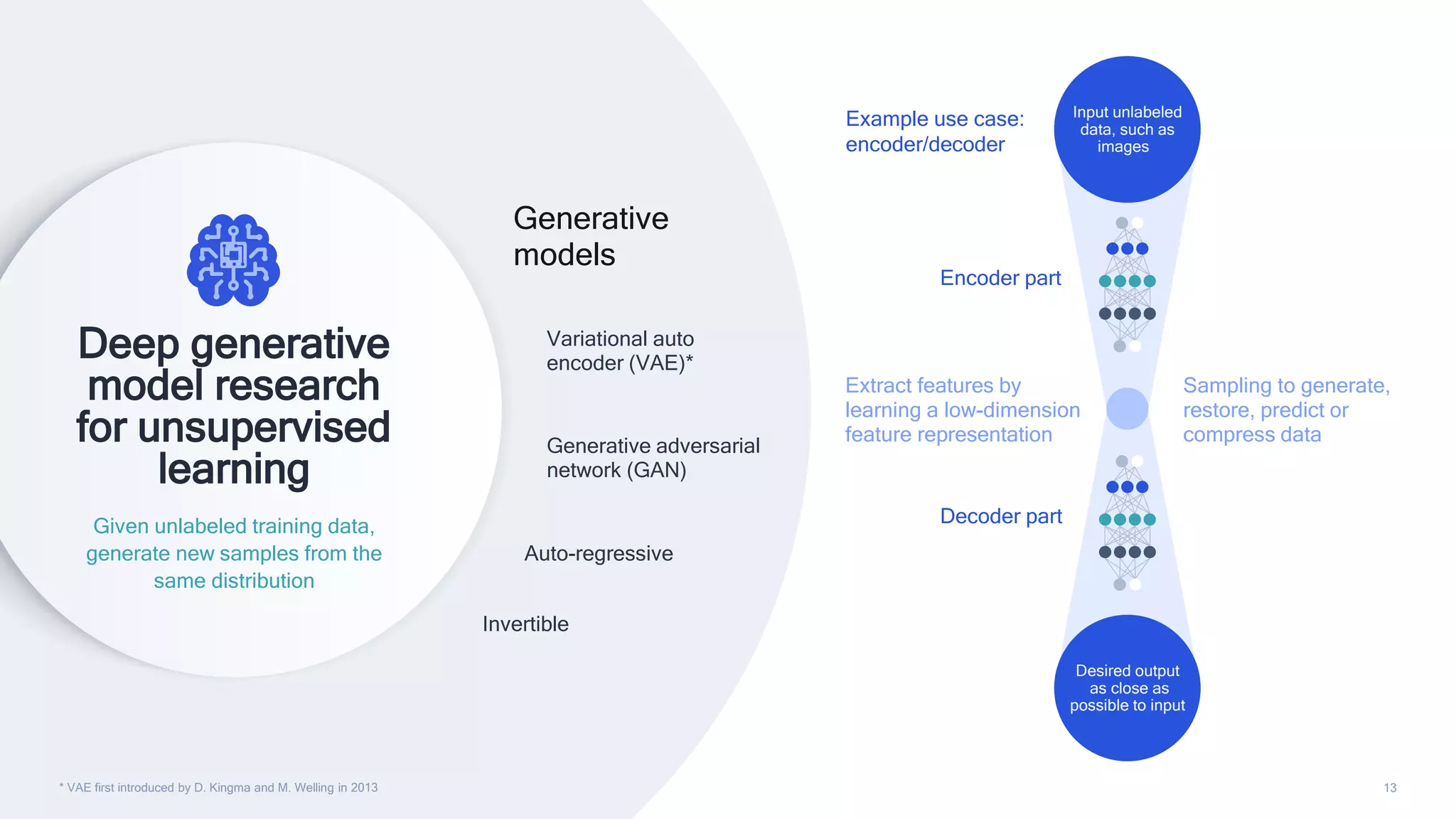
Variational auto
encoder (VAE)*
Invertible
Auto-regressive
Generative adversarial
network (GAN)
Generative
models
Deep generative
model research
for unsupervised
learning
Given unlabeled training data,
generate new samples from the
same distribution
* VAE first introduced by D. Kingma and M. Welling in 2013
Encoder part
Decoder part
Input unlabeled
data, such as
images
Desired output
as close as
possible to input
Example use case:
encoder/decoder
Extract features by
learning a low-dimension
feature representation
Sampling to generate,
restore, predict or
compress data
1414
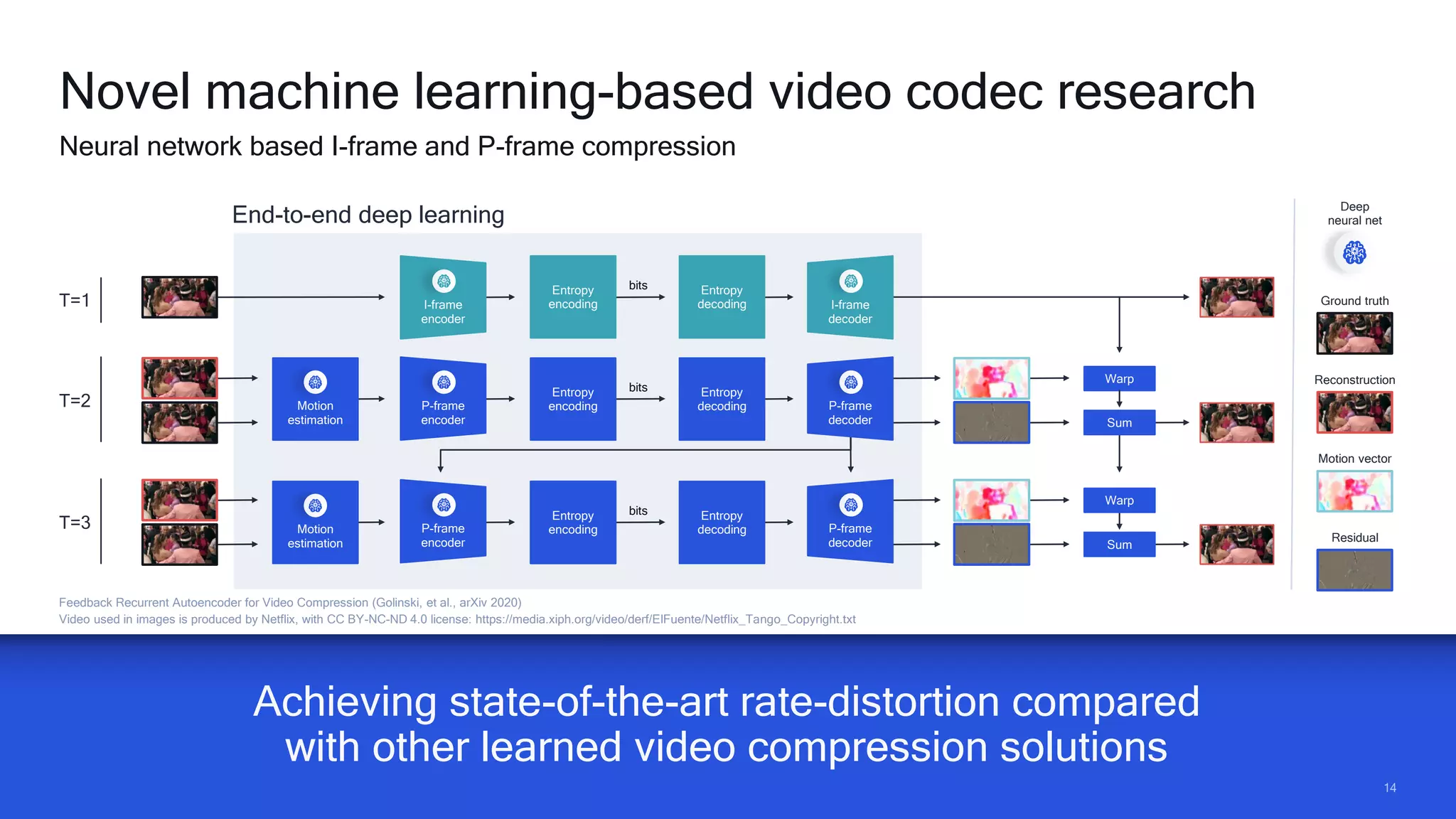
Achieving state-of-the-art rate-distortion compared
with other learned video compression solutions
Feedback Recurrent Autoencoder for Video Compression (Golinski, et al., arXiv 2020)
Video used in images is produced by Netflix, with CC BY-NC-ND 4.0 license: https://media.xiph.org/video/derf/ElFuente/Netflix_Tango_Copyright.txt
Novel machine learning-based video codec research
Neural network based I-frame and P-frame compression
End-to-end deep learning
Reconstruction
Ground truth
Motion vector
Residual
T=3 Motion
estimation
P-frame
encoder
Motion
estimation
Entropy
encoding
bits Entropy
decoding P-frame
decoder Sum
Warp
Deep
neural net
T=1 I-frame
encoder
Entropy
encoding
bits Entropy
decoding I-frame
decoder
T=2 Motion
estimation
P-frame
encoder
Entropy
encoding
bits Entropy
decoding P-frame
decoder
Warp
Sum
15
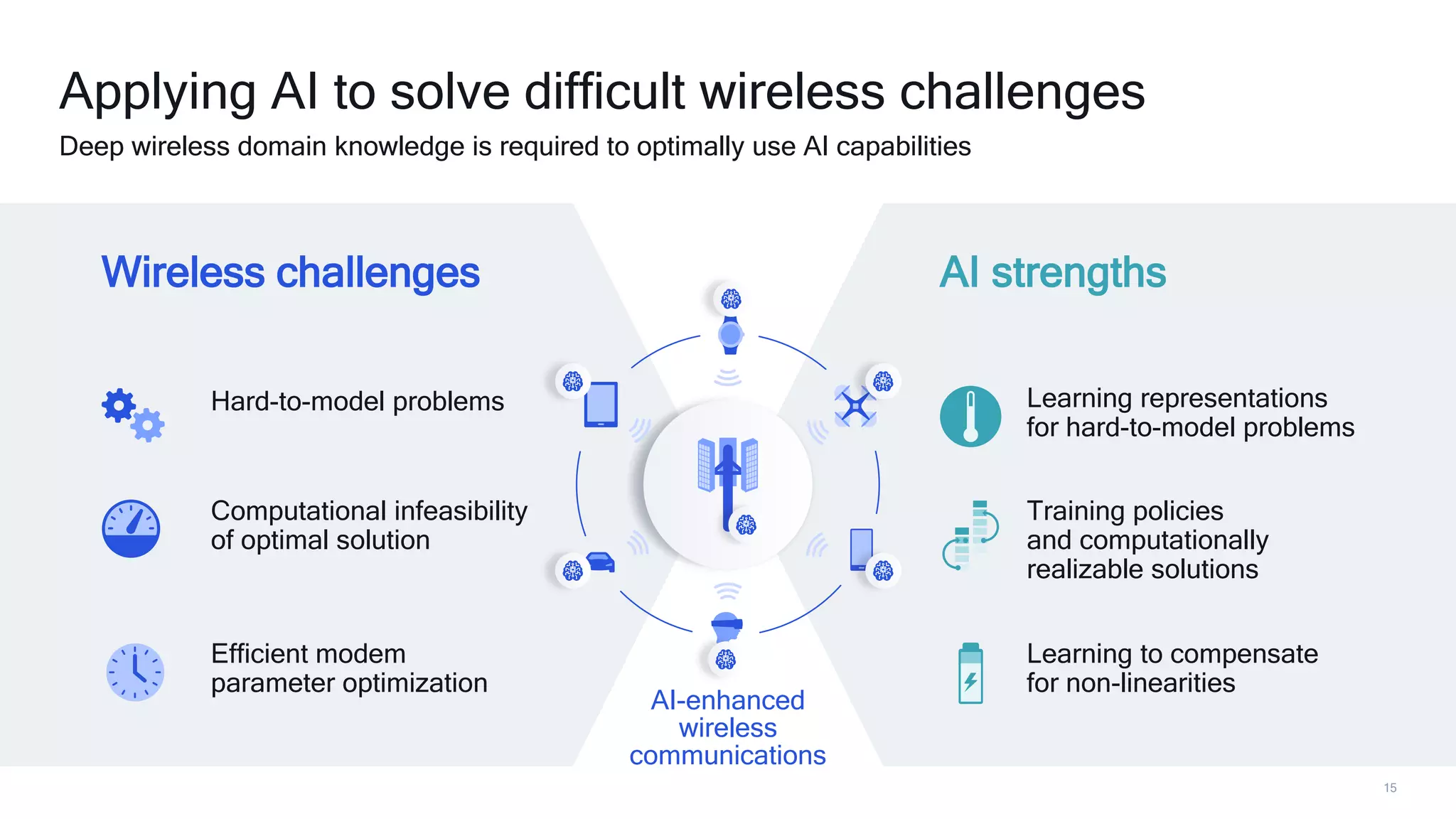
Applying AI to solve difficult wireless challenges
Deep wireless domain knowledge is required to optimally use AI capabilities
Wireless challenges
Hard-to-model problems
Computational infeasibility
of optimal solution
Efficient modem
parameter optimization
AI strengths
Learning representations
for hard-to-model problems
Training policies
and computationally
realizable solutions
Learning to compensate
for non-linearities
AI-enhanced
wireless
communications
16
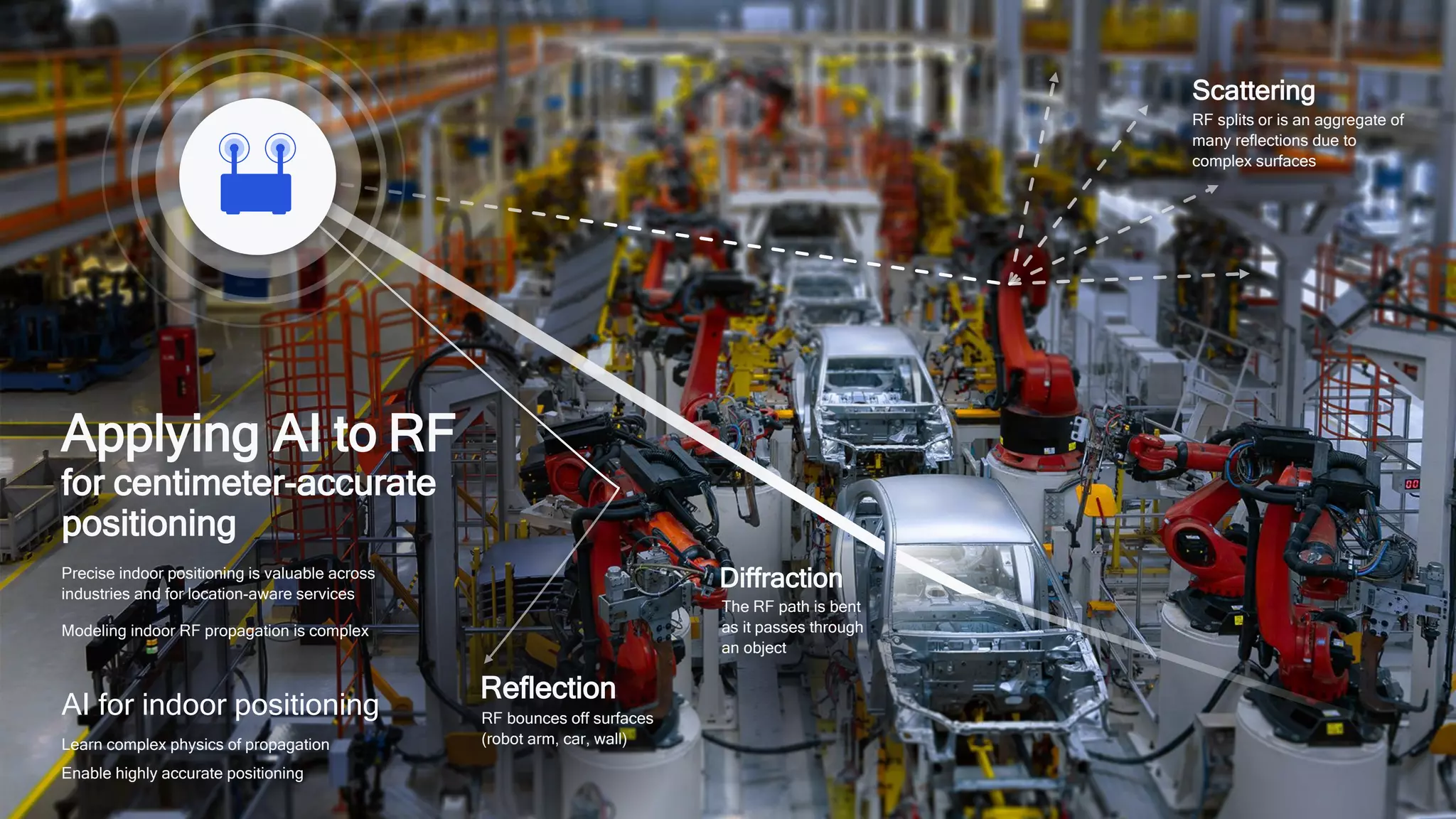
Reflection
RF bounces off surfaces
(robot arm, car, wall)
Scattering
RF splits or is an aggregate of
many reflections due to
complex surfaces
Applying AI to RF
for centimeter-accurate
positioning
Precise indoor positioning is valuable across
industries and for location-aware services
Diffraction
The RF path is bent
as it passes through
an object
Modeling indoor RF propagation is complex
AI for indoor positioning
Learn complex physics of propagation
Enable highly accurate positioning
17
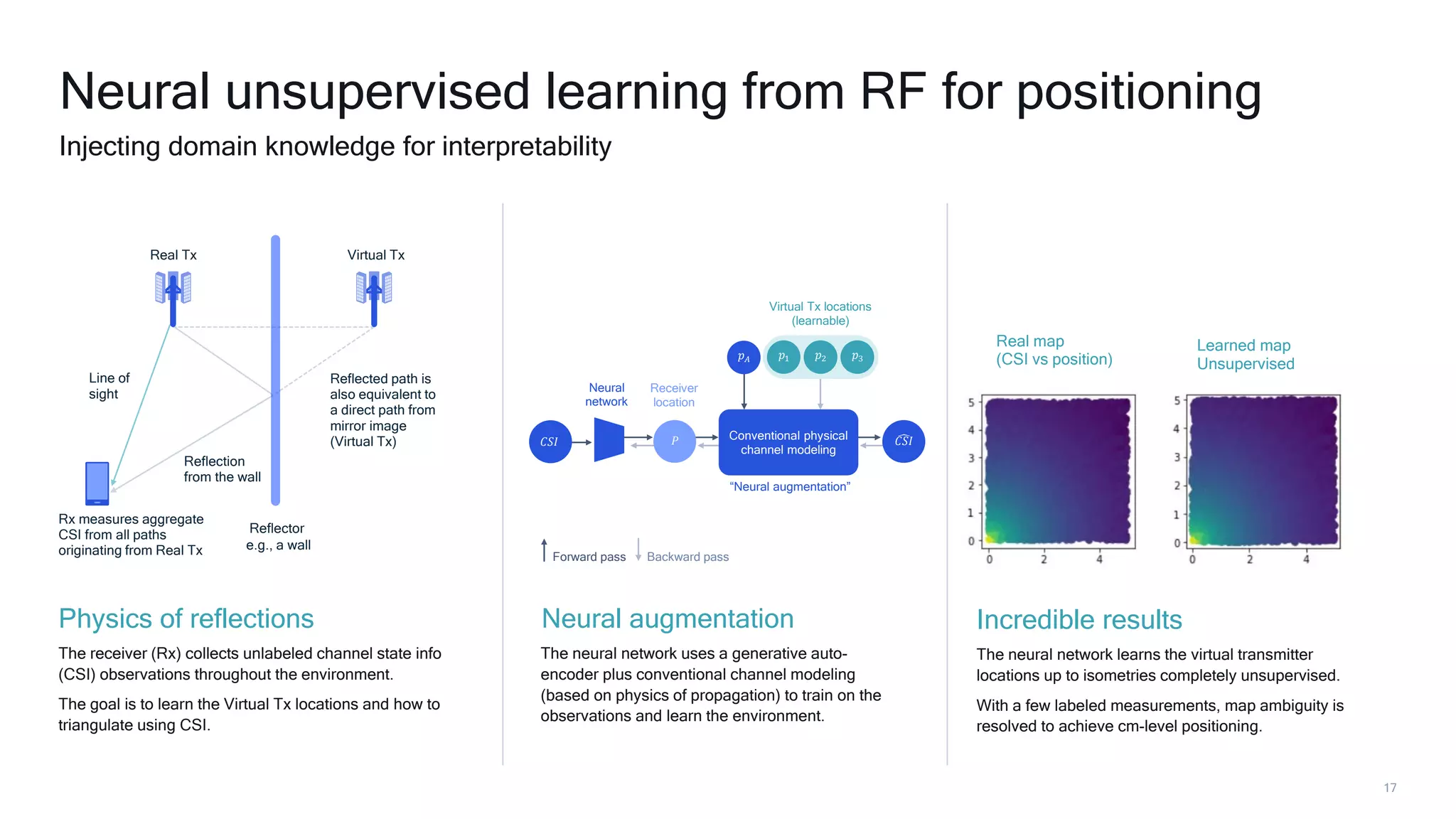
Neural unsupervised learning from RF for positioning
Injecting domain knowledge for interpretability
The neural network learns the virtual transmitter
locations up to isometries completely unsupervised.
With a few labeled measurements, map ambiguity is
resolved to achieve cm-level positioning.
The receiver (Rx) collects unlabeled channel state info
(CSI) observations throughout the environment.
The goal is to learn the Virtual Tx locations and how to
triangulate using CSI.
Real map
(CSI vs position)
Learned map
Unsupervised
Incredible results
𝐶𝑆𝐼 𝑃 Conventional physical
channel modeling
෢𝐶𝑆𝐼
“Neural augmentation”
Neural
network
𝑝 𝐴 𝑝1 𝑝2 𝑝3
Virtual Tx locations
(learnable)
Receiver
location
Forward pass Backward pass
The neural network uses a generative auto-
encoder plus conventional channel modeling
(based on physics of propagation) to train on the
observations and learn the environment.
Reflector
e.g., a wall
Line of
sight
Reflection
from the wall
Rx measures aggregate
CSI from all paths
originating from Real Tx
Reflected path is
also equivalent to
a direct path from
mirror image
(Virtual Tx)
Physics of reflections Neural augmentation
Real Tx Virtual Tx
18
1919
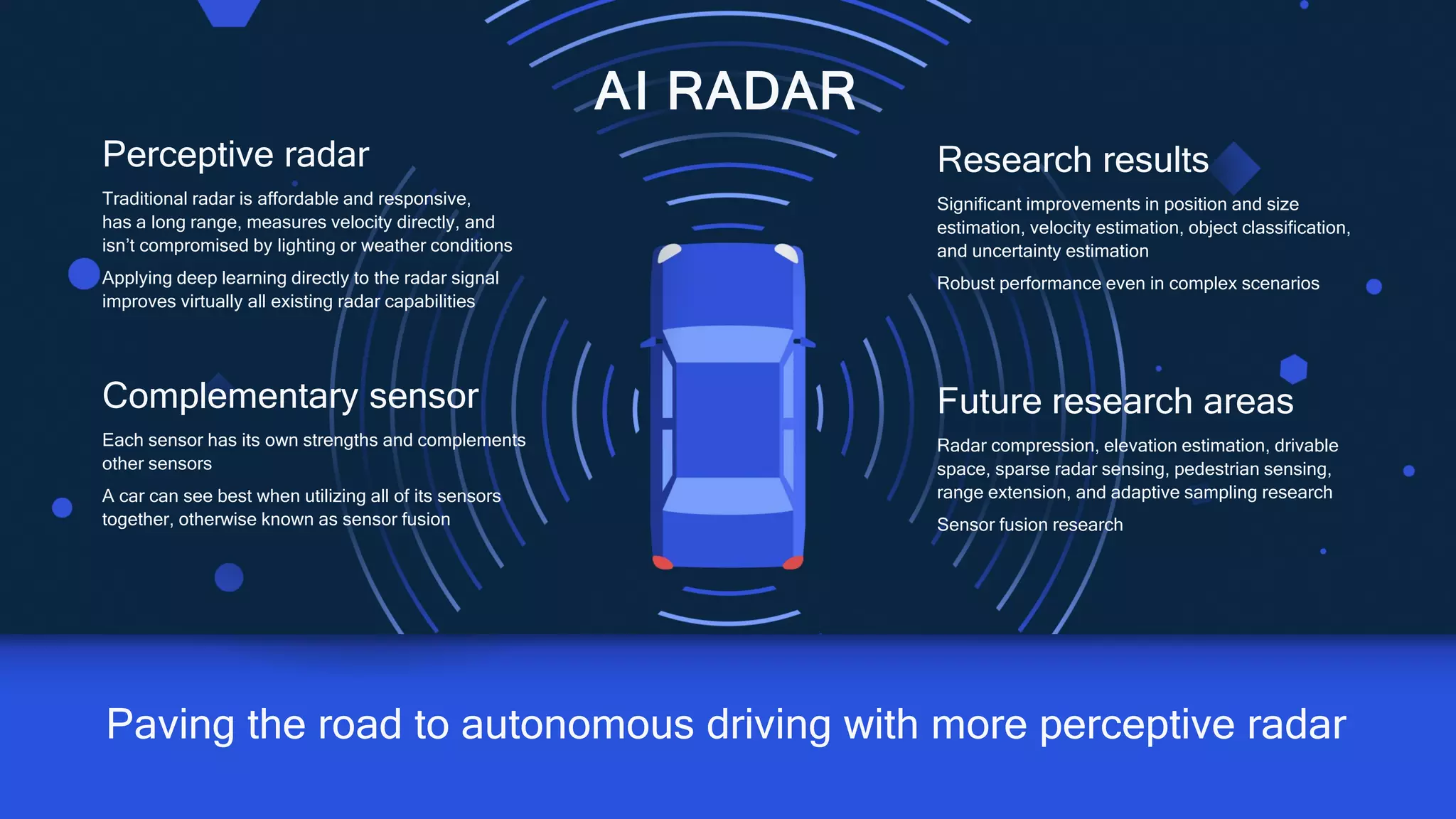
Paving the road to autonomous driving with more perceptive radar
AI RADAR
Research results
Significant improvements in position and size
estimation, velocity estimation, object classification,
and uncertainty estimation
Robust performance even in complex scenarios
Future research areas
Radar compression, elevation estimation, drivable
space, sparse radar sensing, pedestrian sensing,
range extension, and adaptive sampling research
Sensor fusion research
Complementary sensor
Each sensor has its own strengths and complements
other sensors
A car can see best when utilizing all of its sensors
together, otherwise known as sensor fusion
Perceptive radar
Traditional radar is affordable and responsive,
has a long range, measures velocity directly, and
isn’t compromised by lighting or weather conditions
Applying deep learning directly to the radar signal
improves virtually all existing radar capabilities
20
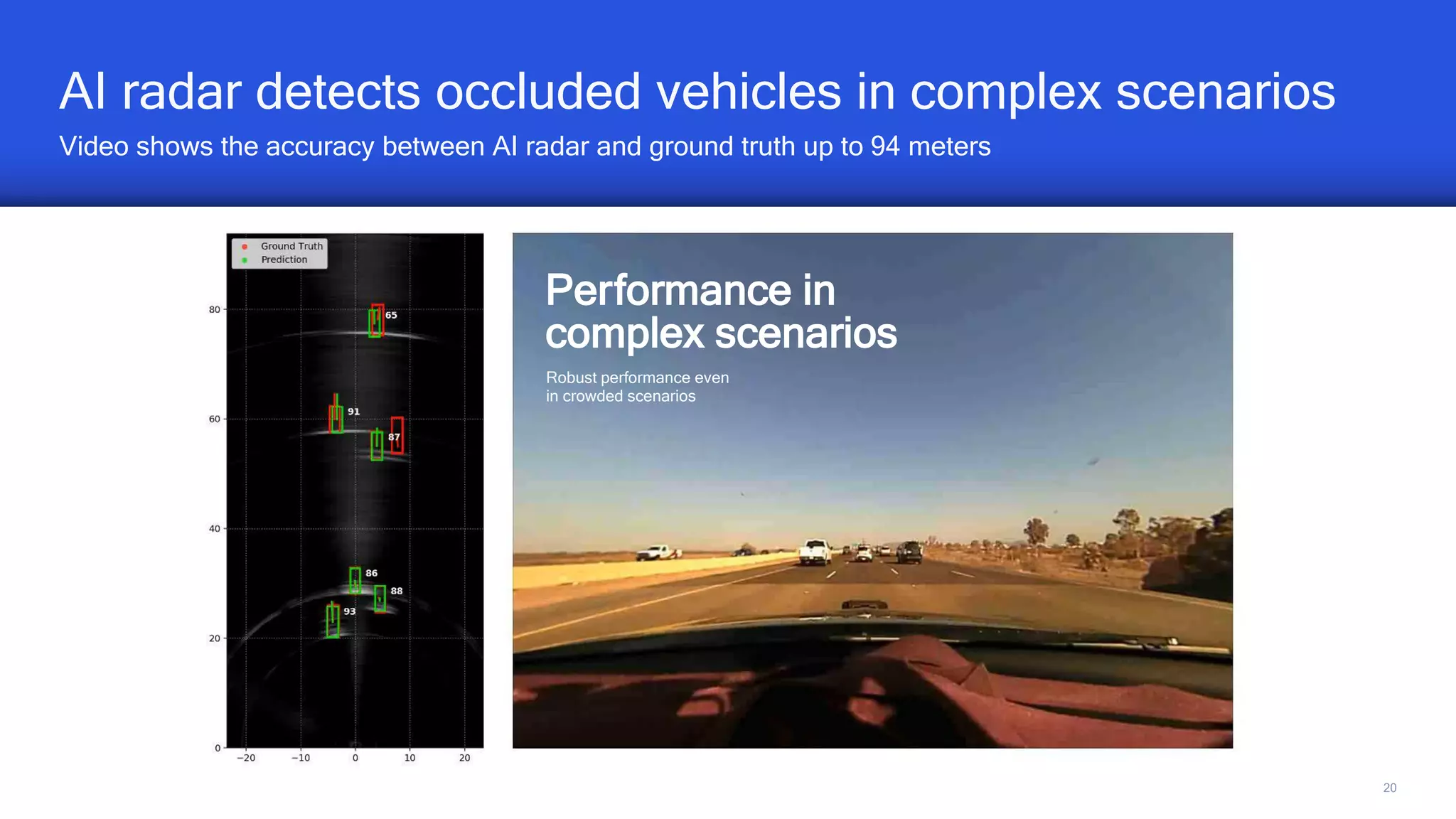
AI radar detects occluded vehicles in complex scenarios
Video shows the accuracy between AI radar and ground truth up to 94 meters
Performance in
complex scenarios
Robust performance even
in crowded scenarios
21
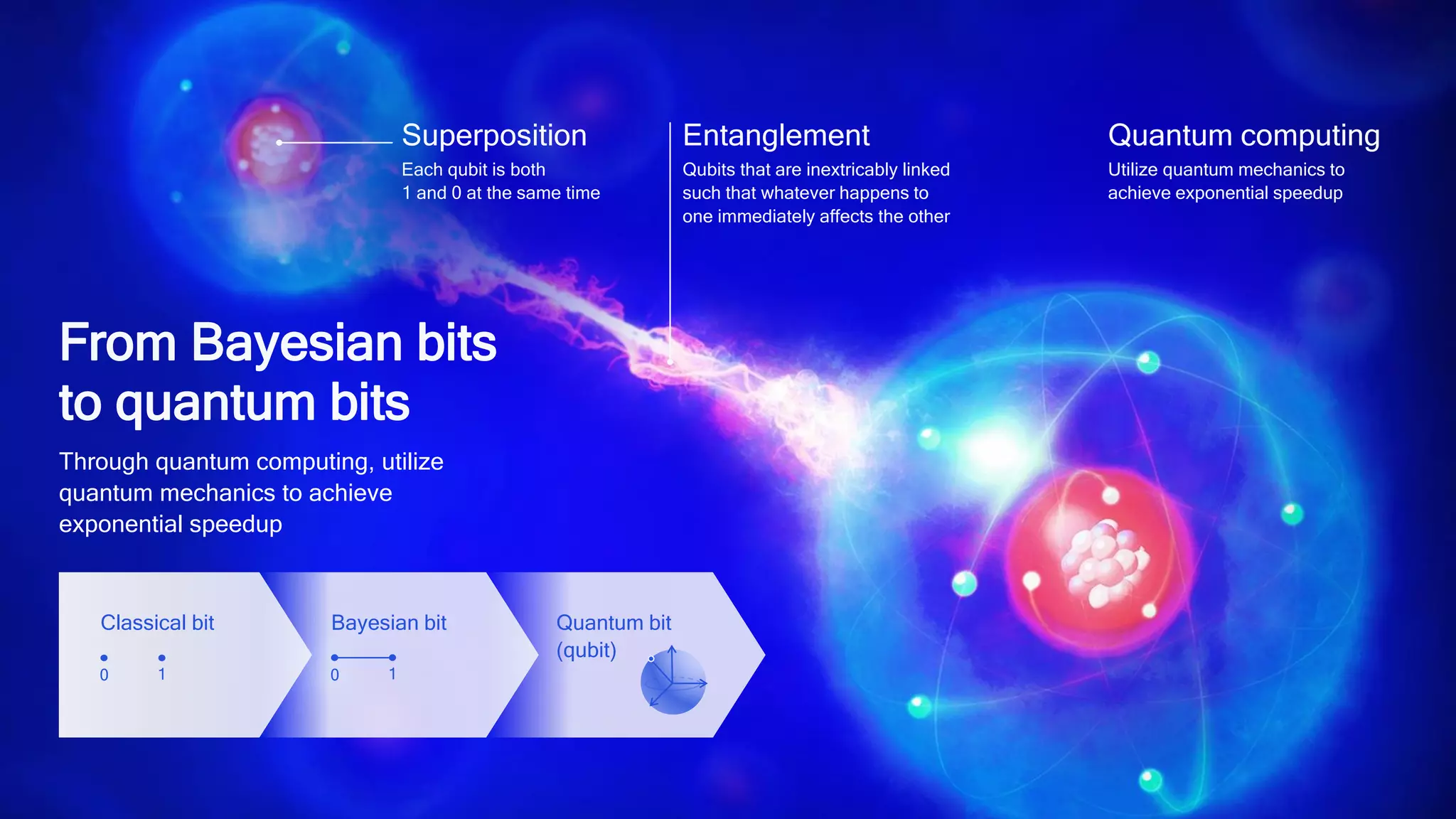
Quantum bit
(qubit)
Through quantum computing, utilize
quantum mechanics to achieve
exponential speedup
Classical bit
10
Entanglement
Qubits that are inextricably linked
such that whatever happens to
one immediately affects the other
Quantum computing
Utilize quantum mechanics to
achieve exponential speedup
Superposition
Each qubit is both
1 and 0 at the same time
Bayesian bit
10
From Bayesian bits
to quantum bits
22
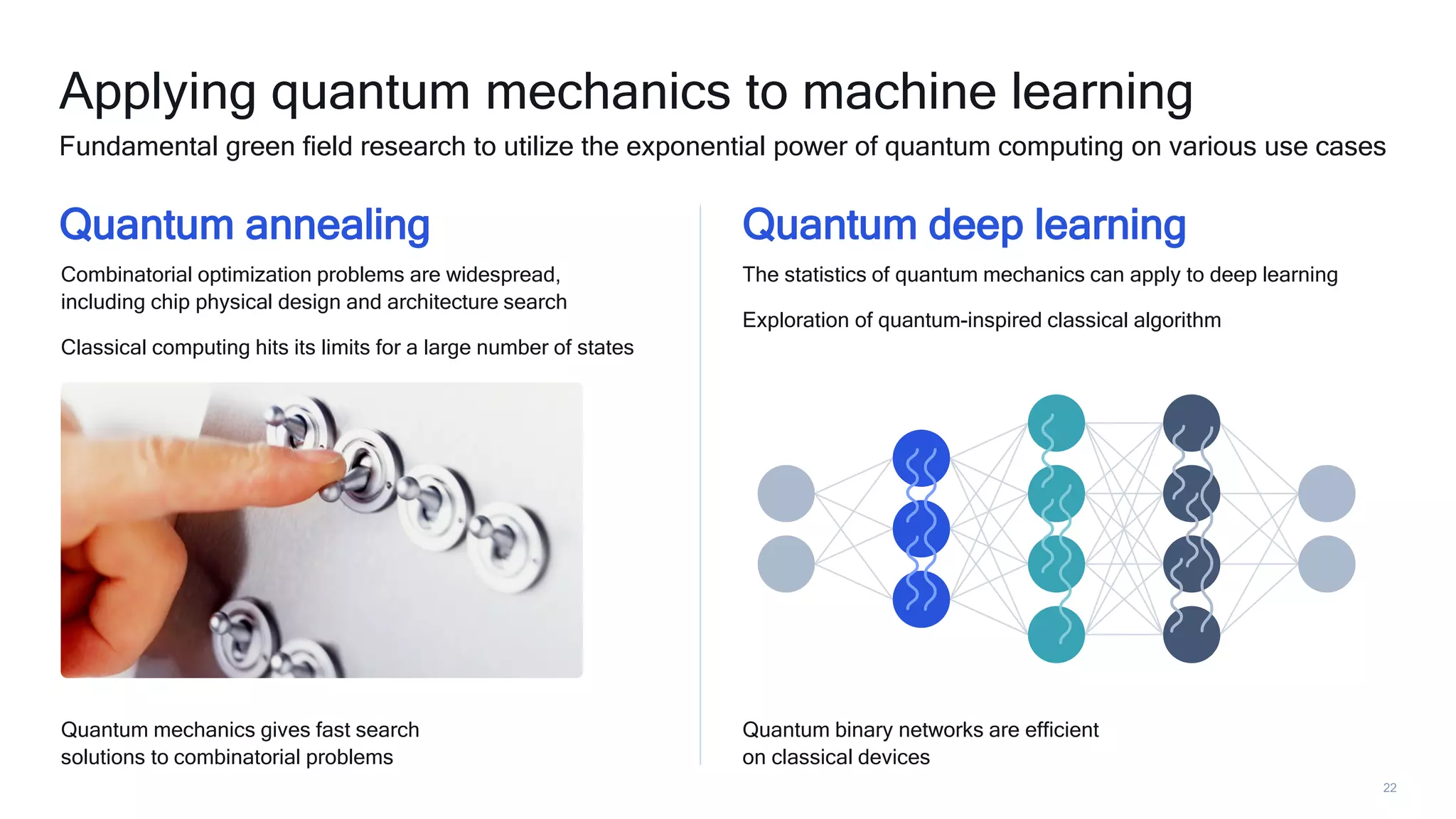
Applying quantum mechanics to machine learning
Fundamental green field research to utilize the exponential power of quantum computing on various use cases
Quantum annealing
Combinatorial optimization problems are widespread,
including chip physical design and architecture search
Classical computing hits its limits for a large number of states
Quantum deep learning
The statistics of quantum mechanics can apply to deep learning
Exploration of quantum-inspired classical algorithm
Quantum binary networks are efficient
on classical devices
Quantum mechanics gives fast search
solutions to combinatorial problems
23
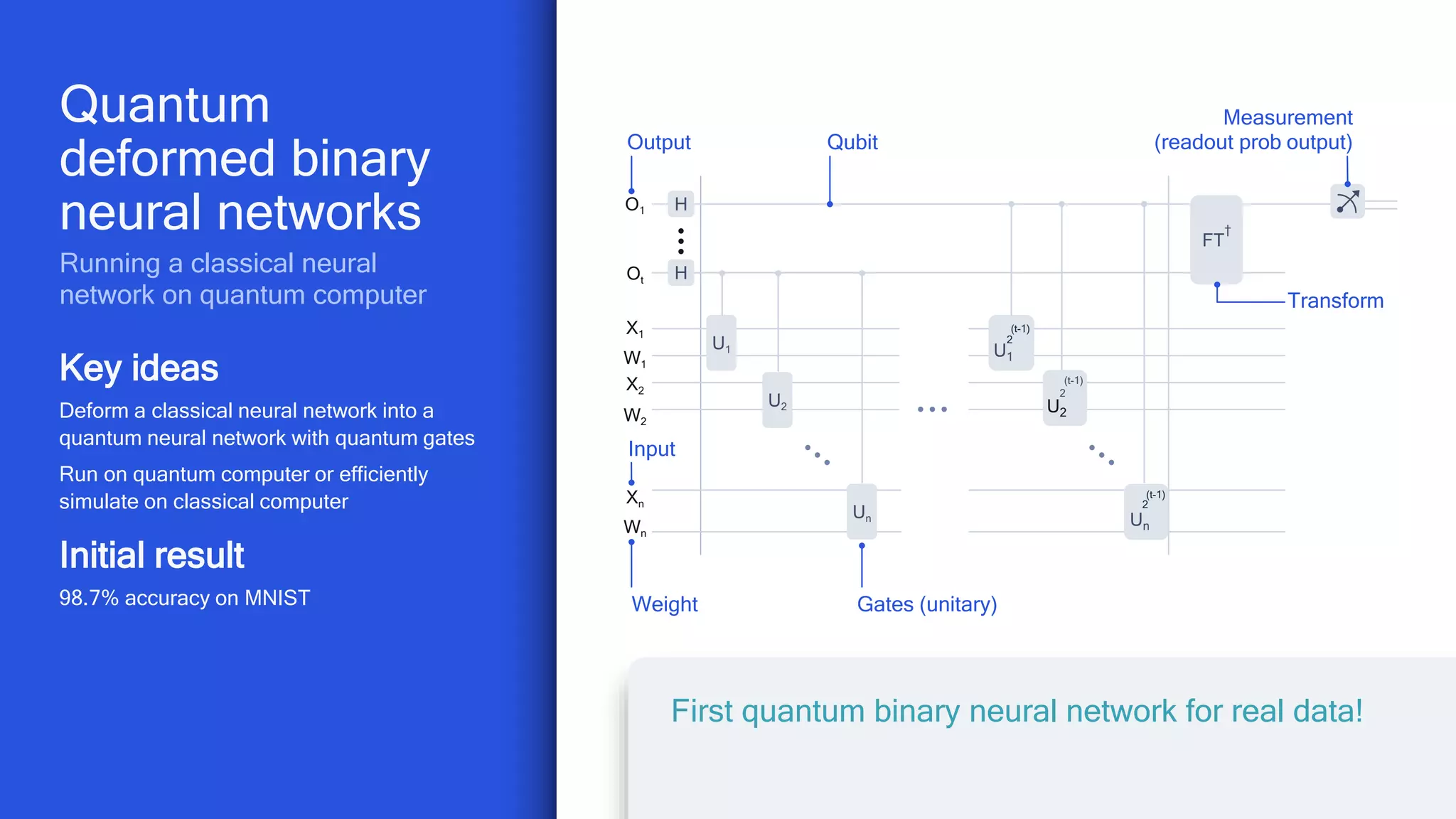
Key ideas
Deform a classical neural network into a
quantum neural network with quantum gates
Run on quantum computer or efficiently
simulate on classical computer
Initial result
98.7% accuracy on MNIST
Quantum
deformed binary
neural networks
Running a classical neural
network on quantum computer
H
U1
U2
2
(t-1)
Un
H
FT
†
O1
Ot
X1
W1
X2
W2
Xn
Wn
● ● ●
●
●
●
●
●
●
●
●
●
Input
Weight
Output
Measurement
(readout prob output)
Gates (unitary)
Qubit
Transform
U1
2
(t-1)
U2
2
(t-1)
Un
First quantum binary neural network for real data!
24
Advancing AI research to make
power efficient AI ubiquitous — from
device to cloud
Conducting leading research and
development across the entire
spectrum of AI
Creating an AI platform fundamental
to scaling AI across the industry
and applications
25
Connect with Us
Questions?
www.qualcomm.com/ai
@qualcomm_tech
www.qualcomm.com/news/onq
http://www.youtube.com/playlist?list=PL8AD95E4F585237C1&feature=plcp
http://www.slideshare.net/qualcommwirelessevolution
Follow us on:
For more information, visit us at:
www.qualcomm.com & www.qualcomm.com/blog
Thank you
Nothing in these materials is an offer to sell any of the
components or devices referenced herein.
©2018-2020 Qualcomm Technologies, Inc. and/or its
affiliated companies. All Rights Reserved.
Qualcomm, Snapdragon, and Snapdragon Ride are
trademarks or registered trademarks of Qualcomm
Incorporated. Other products and brand names may be
trademarks or registered trademarks of their respective
owners.
References in this presentation to “Qualcomm” may mean
Qualcomm Incorporated, Qualcomm Technologies, Inc., and/or
other subsidiaries or business units within the Qualcomm
corporate structure, as applicable. Qualcomm Incorporated
includes Qualcomm’s licensing business, QTL, and the vast
majority of its patent portfolio. Qualcomm Technologies, Inc.,
a wholly-owned subsidiary of Qualcomm Incorporated, operates,
along with its subsidiaries, substantially all of Qualcomm’s
engineering, research and development functions, and
substantially all of its product and services businesses, including
its semiconductor business, QCT.

Pushing the boundaries of AI research

  • 1.
    Qualcomm Technologies, Inc. September2, 2020 @qualcomm_tech Pushing the boundaries of AI research
  • 2.
    3 Consistent AI R&D investmentis the foundation for product leadership 1st Gen Qualcomm® AI Engine (Qualcomm® Snapdragon™ 820 Mobile Platform) MWC demo showcasing photo sorting and handwriting recognition 2nd Gen Qualcomm AI Engine (Snapdragon 835) 3rd Gen Qualcomm AI Engine (Snapdragon 845) Brain Corp raises $114M Announced Facebook Caffe2 support Collaboration with Google on TensorFlow Opened Qualcomm Research Netherlands Research face detection with deep learning Research artificial neural processing architectures Research in spiking neural networks Deep-learning based AlexNet wins ImageNet competition Qualcomm Technologies ships ONNX supported by Microsoft, Facebook, Amazon 4th Gen Qualcomm AI Engine (Snapdragon 855) Qualcomm® Artificial Intelligence Research initiated Snapdragon 710 Qualcomm® Cloud AI 100 Qualcomm® QCS400 (First audio SoC) Mobile AI Enablement Center in Taiwan to open Power efficiency gains through compression, quantization, and compilation Gauge equivariant CNNs Qualcomm® Robotics RB5 Platform Our AI leadership Over a decade of cutting-edge AI R&D, speeding up commercialization and enabling scale Qualcomm® Vision Intelligence Platform Qualcomm® Neural Processing SDK Snapdragon 660 Snapdragon 630 3rd Gen Snapdragon Automotive Cockpit Snapdragon 665, 730, 730G 5th Gen Qualcomm AI Engine (Snapdragon 865) Qualcomm® Snapdragon Ride™ Platform 2018201620152009 2013 2017 2019 2020 Qualcomm Research initiates first AI project 2007 Acquired EuVision Completed Brain Corp joint research Investment and collaboration with Brain Corp Acquired Scyfer Qualcomm Technologies researchers win best paper at ICLR Opened joint research lab with University of Amsterdam AI Model Efficiency Toolkit (AIMET) open sourced Qualcomm Artificial Intelligence Research is an initiative of Qualcomm Technologies, Inc. Qualcomm Snapdragon, Qualcomm Neural Processing SDK, Qualcomm Vision Intelligence Platform, Qualcomm AI Engine, Qualcomm Cloud AI, Qualcomm Snapdragon Ride, Qualcomm Robotics RB3 Platform, and Qualcomm QCS400I are products of Qualcomm Technologies, Inc. and/or its subsidiaries. AI Model Efficiency Toolkit is a product of Qualcomm Innovation Center, Inc.
  • 3.
    4 Automotive IoT/IIoT Mobile Cloud Power efficiency EfficientlearningPersonalization Action Reinforcement learning for decision making Perception Object detection, speech recognition, contextual fusion Reasoning Scene understanding, language understanding, behavior prediction Advancing AI research to make efficient AI ubiquitous A platform to scale AI across the industry Edge cloud Model design, compression, quantization, algorithms, efficient hardware, software tool Continuous learning, contextual, always-on, privacy-preserved, distributed learning Robust learning through minimal data, unsupervised learning, on-device learning
  • 4.
    5 Bayesian combinatorial optimization Quantum AI G-CNN Bayesian distributed learning Deep generative models Deep transfer learning Hybrid reinforcement learning Neural network quantization AI for wireless Neural network compression Hardware- aware deeplearning Compute in memory Energy-efficient perception Graph and kernel optimization Power management Source compression AI for radar AI Model Efficiency Toolkit Fingerprint Voice UI Deep learning for graphics Video recognition and prediction CV DL for new sensors Leading research and development Across the entire spectrum of AI Fundamental research Applied research
  • 5.
    6 Models trained at highprecision Inference at lower precision Promising results show that low-precision integer inference can become widespread Virtually the same accuracy between a FP32 and quantized AI model through: • Automated, data free, post-training methods • Automated training-based mixed-precision method 01010101 01010101 01010101 01010101 32-bit Floating point 3452.3194 8-bit Integer 3452 01010101 Leading research to efficiently quantize AI models Quantization Increase in performance per watt from savings in memory and compute14x Automated reduction in precision of weights and activations while maintaining accuracy > Trained neural network model Inference output New input data 1: FP32 model compared to a INT8 quantized model
  • 6.
    7 Pushing the limitsof what’s possible with quantization Data-free quantization How can we make quantization as simple as possible? Created an automated method that addresses bias and imbalance in weight ranges: AdaRound Is rounding to the nearest value the best approach for quantization? Created an automated method for finding the best rounding choice: Bayesian bits Can we quantize layers to different bit widths based on precision sensitivity? Created a novel method to learn mixed-precision quantization: SOTA 8-bit results Making 8-bit weight quantization ubiquitous SOTA 4-bit weight results Making 4-bit weight quantization ubiquitous SOTA mixed-precision results Automating mixed-precision quantization and enabling the tradeoff between accuracy and kernel bit-width >4x >8x >8x Increase in performance per watt while only losing 0.5% of accuracy against FP32 MobileNet V2 Increase in performance per watt while only losing 2.5% of accuracy against FP32 MobileNet V2 Increase in performance per watt while only losing 0.8% of accuracy against FP32 MobileNet V2 Data-Free Quantization Through Weight Equalization and Bias Correction (Nagel, van Baalen, et al., ICCV 2019) Up or Down? Adaptive Rounding for Post-Training Quantization (Nagel, Amjad, et al., ICML 2020) Bayesian Bits: Unifying Quantization and Pruning van Baalen, Louizos, et al., arXiv 2020) No training Data free No training Minimal unlabeled data Training required Training data required Jointly learns bit-width precision and pruning
  • 7.
    8Qualcomm Neural ProcessingSDK is a product of Qualcomm Technologies, Inc. and/or its subsidiaries. AI Model Efficiency Toolkit is a product of Qualcomm Innovation Center, Inc. Leading quantization research and fast commercialization Driving the industry towards integer inference and power-efficient AI Qualcomm Neural Processing SDK Relaxed Quantization (ICLR 2019) Data-free Quantization (ICCV 2019) AdaRound (ICML 2020) Bayesian Bits (arXiv 2020) AI Model Efficiency Toolkit (AIMET) Quantization research Quantization commercialization Quantization open-sourcing
  • 8.
    9 Qualcomm AI Researchis an initiative of Qualcomm Technologies, Inc. AI Model Efficiency Toolkit is a product of Qualcomm Innovation Center, Inc. AIMET makes AI models small Open-sourced GitHub project that includes state-of-the-art quantization and compression techniques from Qualcomm AI Research If interested, please join the AIMET GitHub project: https://github.com/quic/aimet Features: State-of-the-art network compression tools State-of-the-art quantization tools Support for both TensorFlow and PyTorch Benchmarks and tests for many models Developed by professional software developers Trained AI model AI Model Efficiency Toolkit (AIMET) Optimized AI model TensorFlow or PyTorch Compression Quantization
  • 9.
    10 Developing AI approaches toreduce unnecessary computation An increasing demand for energy efficient video processing Valuable information is being extracted from video streams across diverse devices and use cases Recognizing redundancy between video frames so that the same thing is never computed twice Feature maps over time for ResNet18 remain mostly constant Tremendous redundancy across frames! Enhanced perception through object detection and semantic segmentation Advanced camera features, like video enhancement and super-resolution Advanced video understanding, like search and surveillance Increased video compression to address the demand for rich media
  • 10.
    11 1. Bejnordi, BabakEhteshami, Tijmen Blankevoort, and Max Welling. "Batch shaping for learning conditional channel gated networks." ICLR (2020). 2. Abati, Davide, Jakub Tomczak, Tijmen Blankevoort, Simone Calderara, Rita Cucchiara, and Babak Ehteshami Bejnordi. "Conditional Channel Gated Networks for Task-Aware Continual Learning." CVPR (2020). Conditional computation using gated networks Introduce gates with low computation cost to skip unnecessary computation in neural networks Problem A large portion of the neural network is not necessary for the prediction, wasting computations Solution Conditional channel-gated networks for task-aware continual learning • Dynamically select the filters conditioned on the task and input • Automatically infer the task from gating patterns State-of-the-art accuracy while reducing computation by up to 3X 𝐻 × 𝑊 × 𝐶 Input feature map 𝐴𝑣𝑒. 𝑝𝑜𝑜𝑙𝑖𝑛𝑔 1 × 1 × 𝐶 2 𝑙𝑎𝑦𝑒𝑟 𝑀𝐿𝑃 1 × 1 × 𝐶′ + 1 × 1 × 𝐶′ Gating module + G Conv+bn Conv+bn 0.60 0.62 0.64 0.66 0.68 0.70 0.72 0.74 0.76 1 1.5 2 2.5 3 3.5 4 Top-1Accuracy MAC (x109) ResNet baseline (18,34,50) Convnet-FBS18 Convnet-AIG50 Convnet-SIG34 Convnet-AIG18 ResNet50-BAS (ours) ResNet34-BAS (ours) ResNet18-BAS (ours)
  • 11.
    12 Variational auto encoder (VAE)* Invertible Auto-regressive Generativeadversarial network (GAN) Generative models Extract features by learning a low-dimension feature representation Sampling to generate, restore, predict, or compress data Powerful capabilities Broad applications Computational photography Text to speech Graphics rendering Speech/video compression Voice UI * VAE first introduced by D. Kingma and M. Welling in 2013 Deep generative model research for unsupervised learning Given unlabeled training data, generate new samples from the same distribution
  • 12.
    13 Variational auto encoder (VAE)* Invertible Auto-regressive Generativeadversarial network (GAN) Generative models Deep generative model research for unsupervised learning Given unlabeled training data, generate new samples from the same distribution * VAE first introduced by D. Kingma and M. Welling in 2013 Encoder part Decoder part Input unlabeled data, such as images Desired output as close as possible to input Example use case: encoder/decoder Extract features by learning a low-dimension feature representation Sampling to generate, restore, predict or compress data
  • 13.
    1414 Achieving state-of-the-art rate-distortioncompared with other learned video compression solutions Feedback Recurrent Autoencoder for Video Compression (Golinski, et al., arXiv 2020) Video used in images is produced by Netflix, with CC BY-NC-ND 4.0 license: https://media.xiph.org/video/derf/ElFuente/Netflix_Tango_Copyright.txt Novel machine learning-based video codec research Neural network based I-frame and P-frame compression End-to-end deep learning Reconstruction Ground truth Motion vector Residual T=3 Motion estimation P-frame encoder Motion estimation Entropy encoding bits Entropy decoding P-frame decoder Sum Warp Deep neural net T=1 I-frame encoder Entropy encoding bits Entropy decoding I-frame decoder T=2 Motion estimation P-frame encoder Entropy encoding bits Entropy decoding P-frame decoder Warp Sum
  • 14.
    15 Applying AI tosolve difficult wireless challenges Deep wireless domain knowledge is required to optimally use AI capabilities Wireless challenges Hard-to-model problems Computational infeasibility of optimal solution Efficient modem parameter optimization AI strengths Learning representations for hard-to-model problems Training policies and computationally realizable solutions Learning to compensate for non-linearities AI-enhanced wireless communications
  • 15.
    16 Reflection RF bounces offsurfaces (robot arm, car, wall) Scattering RF splits or is an aggregate of many reflections due to complex surfaces Applying AI to RF for centimeter-accurate positioning Precise indoor positioning is valuable across industries and for location-aware services Diffraction The RF path is bent as it passes through an object Modeling indoor RF propagation is complex AI for indoor positioning Learn complex physics of propagation Enable highly accurate positioning
  • 16.
    17 Neural unsupervised learningfrom RF for positioning Injecting domain knowledge for interpretability The neural network learns the virtual transmitter locations up to isometries completely unsupervised. With a few labeled measurements, map ambiguity is resolved to achieve cm-level positioning. The receiver (Rx) collects unlabeled channel state info (CSI) observations throughout the environment. The goal is to learn the Virtual Tx locations and how to triangulate using CSI. Real map (CSI vs position) Learned map Unsupervised Incredible results 𝐶𝑆𝐼 𝑃 Conventional physical channel modeling ෢𝐶𝑆𝐼 “Neural augmentation” Neural network 𝑝 𝐴 𝑝1 𝑝2 𝑝3 Virtual Tx locations (learnable) Receiver location Forward pass Backward pass The neural network uses a generative auto- encoder plus conventional channel modeling (based on physics of propagation) to train on the observations and learn the environment. Reflector e.g., a wall Line of sight Reflection from the wall Rx measures aggregate CSI from all paths originating from Real Tx Reflected path is also equivalent to a direct path from mirror image (Virtual Tx) Physics of reflections Neural augmentation Real Tx Virtual Tx
  • 17.
  • 18.
    1919 Paving the roadto autonomous driving with more perceptive radar AI RADAR Research results Significant improvements in position and size estimation, velocity estimation, object classification, and uncertainty estimation Robust performance even in complex scenarios Future research areas Radar compression, elevation estimation, drivable space, sparse radar sensing, pedestrian sensing, range extension, and adaptive sampling research Sensor fusion research Complementary sensor Each sensor has its own strengths and complements other sensors A car can see best when utilizing all of its sensors together, otherwise known as sensor fusion Perceptive radar Traditional radar is affordable and responsive, has a long range, measures velocity directly, and isn’t compromised by lighting or weather conditions Applying deep learning directly to the radar signal improves virtually all existing radar capabilities
  • 19.
    20 AI radar detectsoccluded vehicles in complex scenarios Video shows the accuracy between AI radar and ground truth up to 94 meters Performance in complex scenarios Robust performance even in crowded scenarios
  • 20.
    21 Quantum bit (qubit) Through quantumcomputing, utilize quantum mechanics to achieve exponential speedup Classical bit 10 Entanglement Qubits that are inextricably linked such that whatever happens to one immediately affects the other Quantum computing Utilize quantum mechanics to achieve exponential speedup Superposition Each qubit is both 1 and 0 at the same time Bayesian bit 10 From Bayesian bits to quantum bits
  • 21.
    22 Applying quantum mechanicsto machine learning Fundamental green field research to utilize the exponential power of quantum computing on various use cases Quantum annealing Combinatorial optimization problems are widespread, including chip physical design and architecture search Classical computing hits its limits for a large number of states Quantum deep learning The statistics of quantum mechanics can apply to deep learning Exploration of quantum-inspired classical algorithm Quantum binary networks are efficient on classical devices Quantum mechanics gives fast search solutions to combinatorial problems
  • 22.
    23 Key ideas Deform aclassical neural network into a quantum neural network with quantum gates Run on quantum computer or efficiently simulate on classical computer Initial result 98.7% accuracy on MNIST Quantum deformed binary neural networks Running a classical neural network on quantum computer H U1 U2 2 (t-1) Un H FT † O1 Ot X1 W1 X2 W2 Xn Wn ● ● ● ● ● ● ● ● ● ● ● ● Input Weight Output Measurement (readout prob output) Gates (unitary) Qubit Transform U1 2 (t-1) U2 2 (t-1) Un First quantum binary neural network for real data!
  • 23.
    24 Advancing AI researchto make power efficient AI ubiquitous — from device to cloud Conducting leading research and development across the entire spectrum of AI Creating an AI platform fundamental to scaling AI across the industry and applications
  • 24.
  • 25.
    Follow us on: Formore information, visit us at: www.qualcomm.com & www.qualcomm.com/blog Thank you Nothing in these materials is an offer to sell any of the components or devices referenced herein. ©2018-2020 Qualcomm Technologies, Inc. and/or its affiliated companies. All Rights Reserved. Qualcomm, Snapdragon, and Snapdragon Ride are trademarks or registered trademarks of Qualcomm Incorporated. Other products and brand names may be trademarks or registered trademarks of their respective owners. References in this presentation to “Qualcomm” may mean Qualcomm Incorporated, Qualcomm Technologies, Inc., and/or other subsidiaries or business units within the Qualcomm corporate structure, as applicable. Qualcomm Incorporated includes Qualcomm’s licensing business, QTL, and the vast majority of its patent portfolio. Qualcomm Technologies, Inc., a wholly-owned subsidiary of Qualcomm Incorporated, operates, along with its subsidiaries, substantially all of Qualcomm’s engineering, research and development functions, and substantially all of its product and services businesses, including its semiconductor business, QCT.