REFRIGERATION
REFRIGERATORS AND HEAT PUMPS
The objective of a refrigerator is to remove heat
(QL) from the cold medium; the objective of a heat
pump is to supply heat (QH) to a warm medium.
The transfer of heat from a low-temperature
region to a high-temperature one requires
special devices called refrigerators.
Another device that transfers heat from a
low-temperature medium to a high-
temperature one is the heat pump.
Refrigerators and heat pumps are essentially
the same devices; they differ in their
objectives only.
for fixed values of
QL and QH
Refrigeration Cycle

In refrigeration system the heat is
being generally pumped from low
level to higher one & rejected at
that temp.
This rejection of heat from low level to
higher level of temp. can only be
performed with the help of external
work according to second law of
thermodynamics.
Contd….

The total amount of heat being rejected to
the outside body consist of two parts:-
- the heat extracted from the body to be
cooled .
- the heat equivalent to the mechanical
work required for extracting it.
Vapor-Compression Refrigeration Cycle
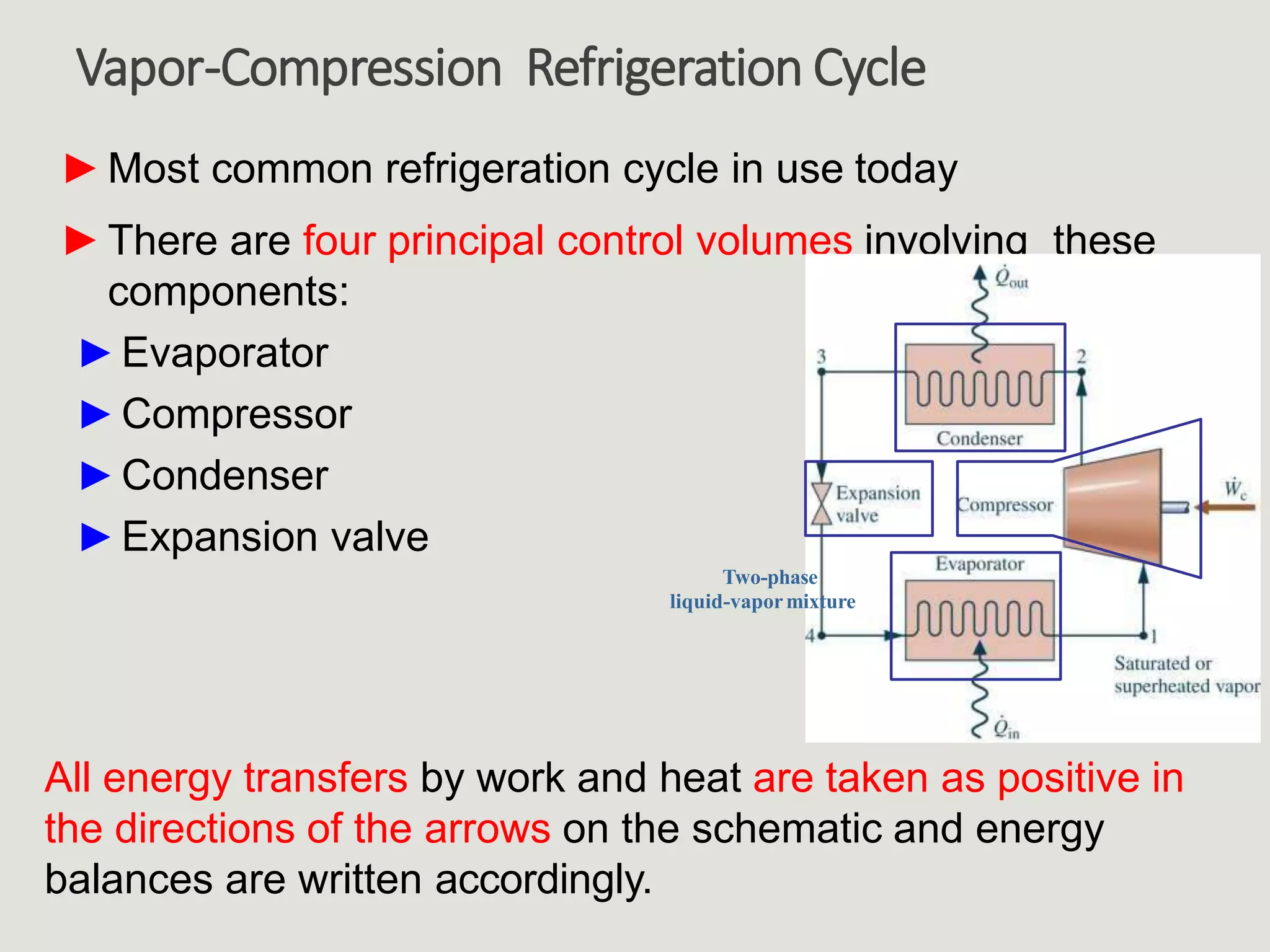
►Most common refrigeration cycle in use today
►There are four principal control volumes involving these
components:
►Evaporator
►Compressor
►Condenser
►Expansion valve
All energy transfers by work and heat are taken as positive in
the directions of the arrows on the schematic and energy
balances are written accordingly.
Two-phase
liquid-vapormixture
Vapor-Compression Refrigeration Cycle
► Engineering model:
►Each component is analyzed as a control volume at steady state
►Dry compression is presumed: the refrigerant is a vapor
► The compressor operates adiabatically
►The refrigerant expanding through the valve undergoes a
throttling process
►Kinetic and potential energy changes are ignored
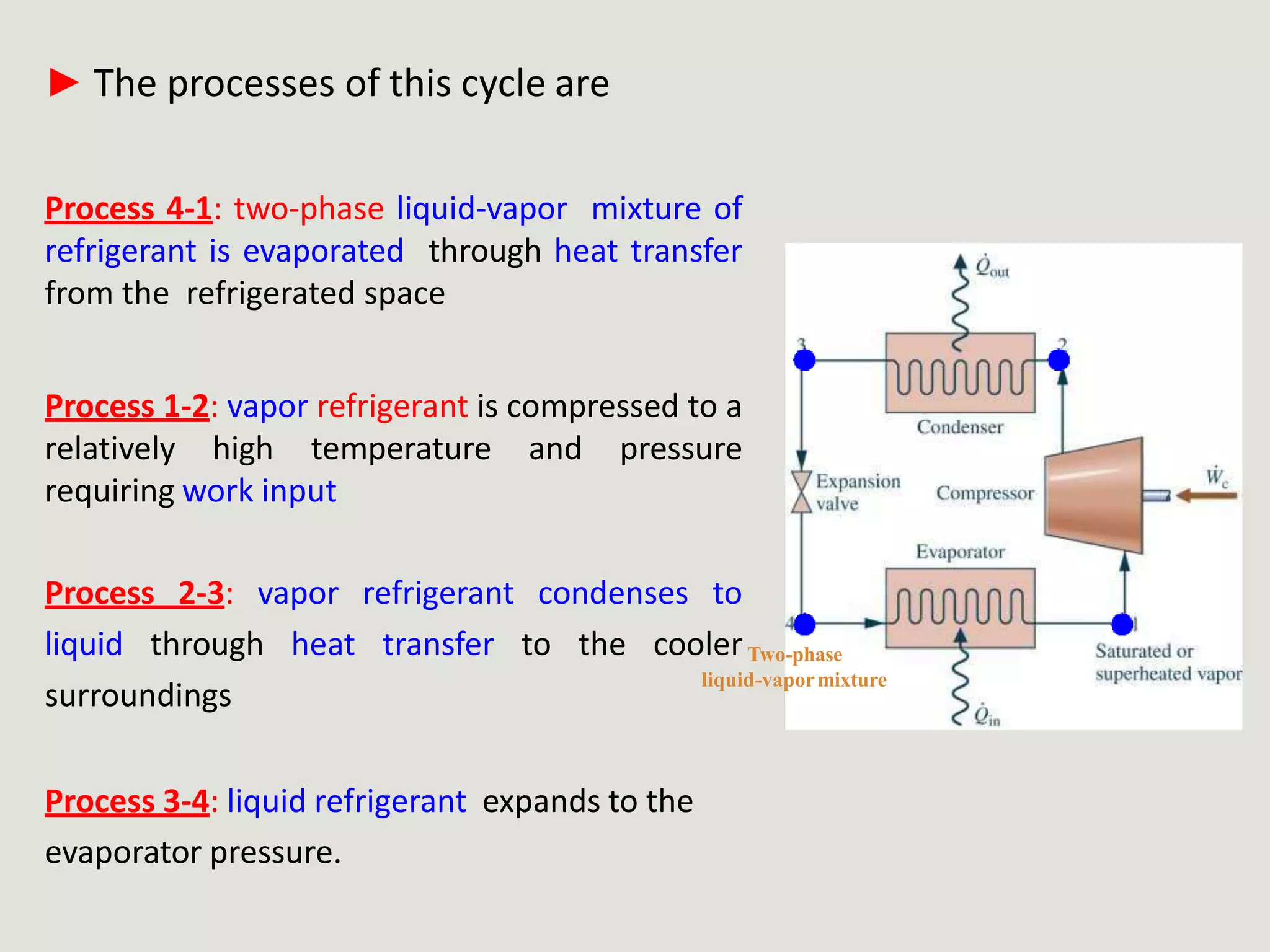
► The processes of this cycle are
Process 4-1: two-phase liquid-vapor mixture of
refrigerant is evaporated through heat transfer
from the refrigerated space
Process 1-2: vapor refrigerant is compressed to a
relatively high temperature and pressure
requiring work input
Process 2-3: vapor refrigerant condenses to
liquid through heat transfer to the cooler
surroundings
Process 3-4: liquid refrigerant expands to the
evaporator pressure.
Two-phase
liquid-vapormixture
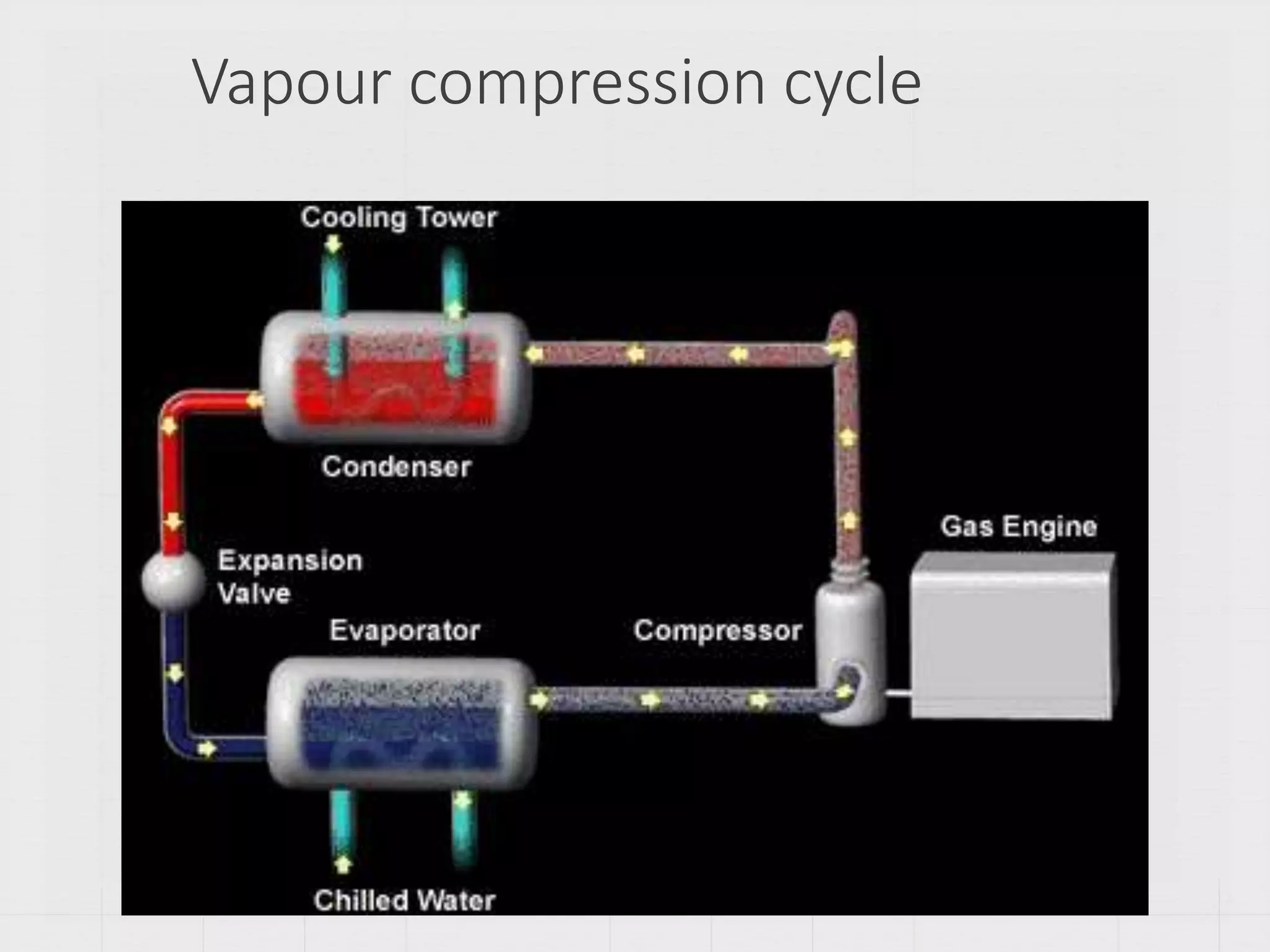
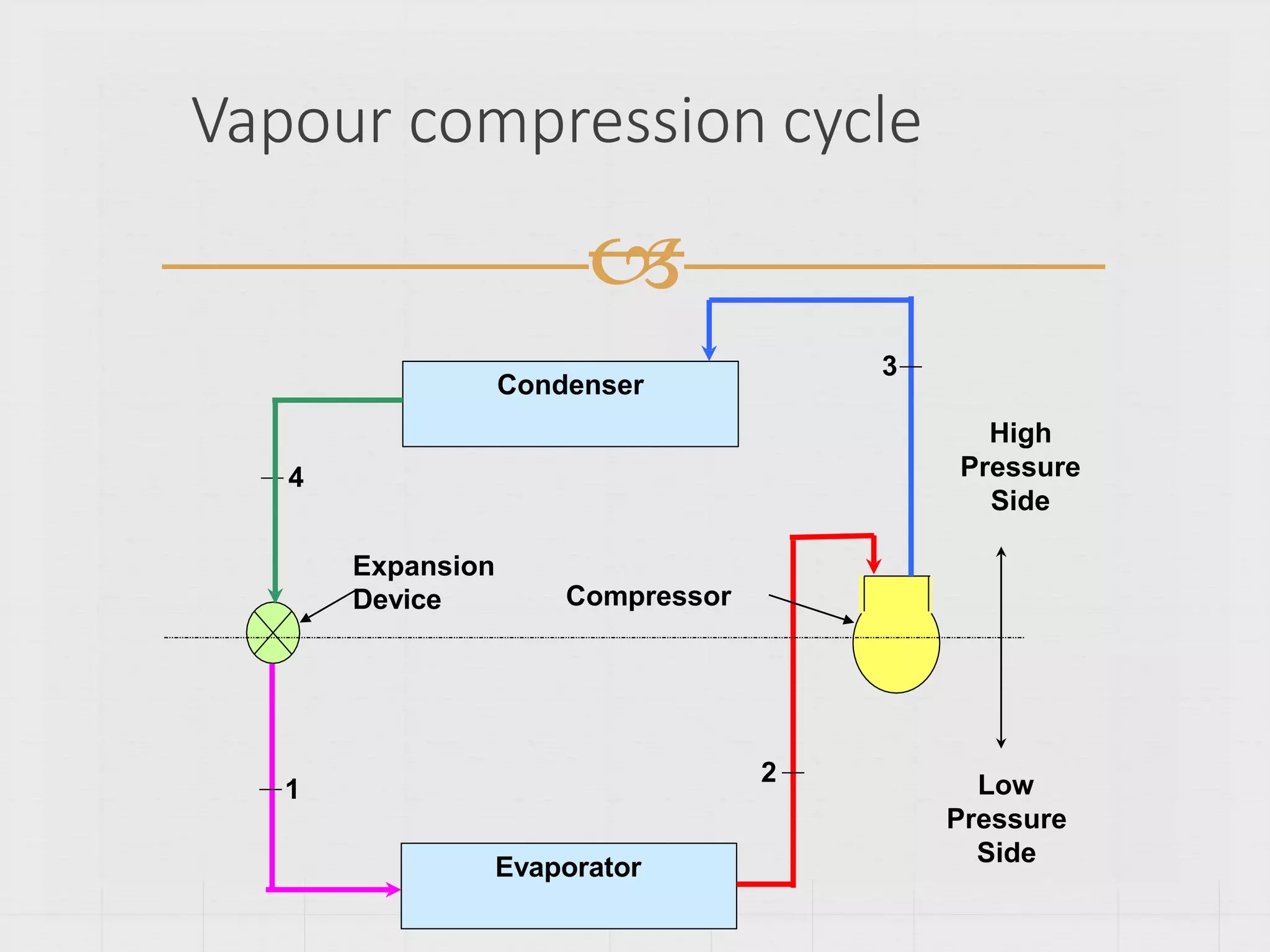
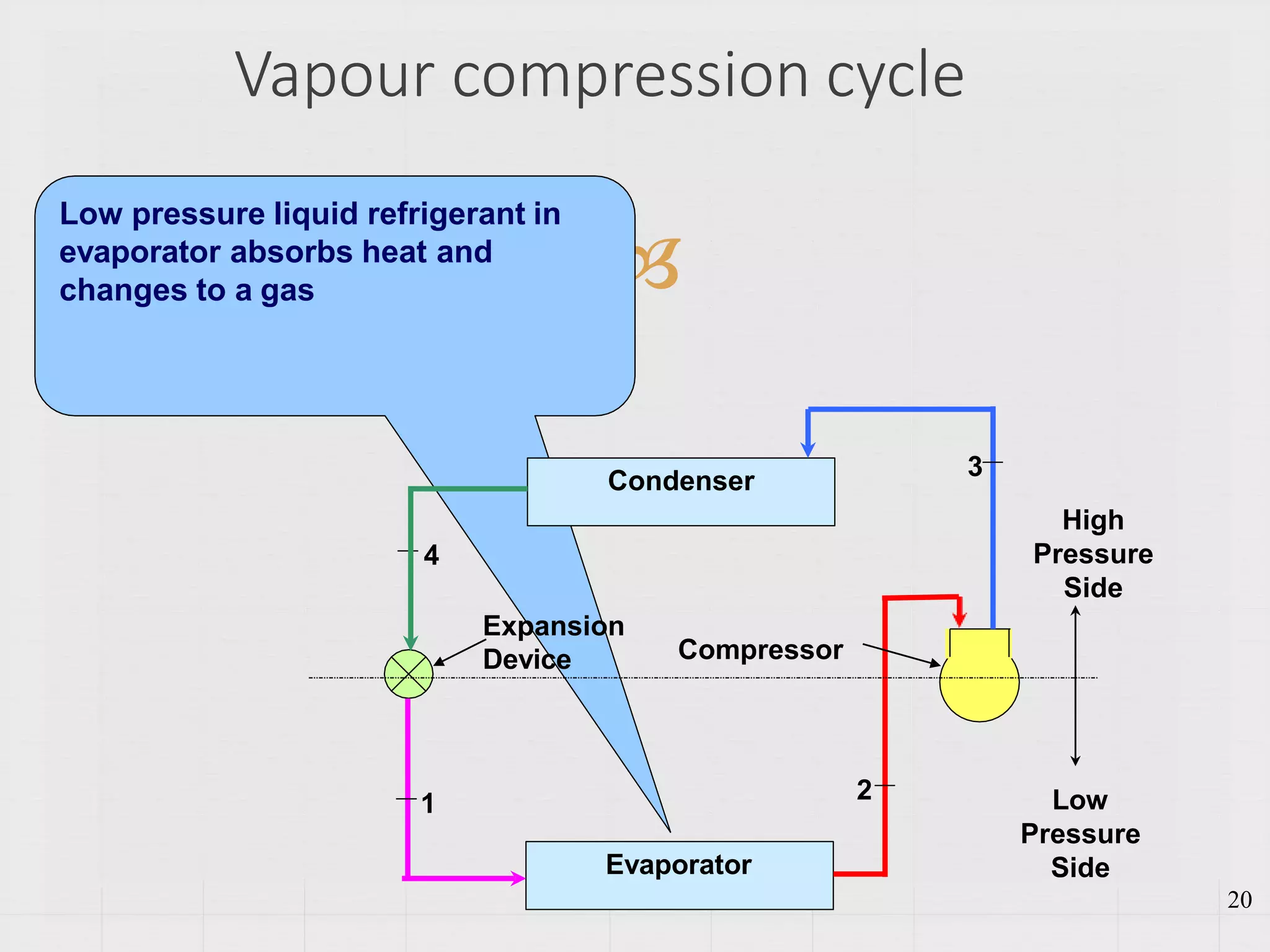
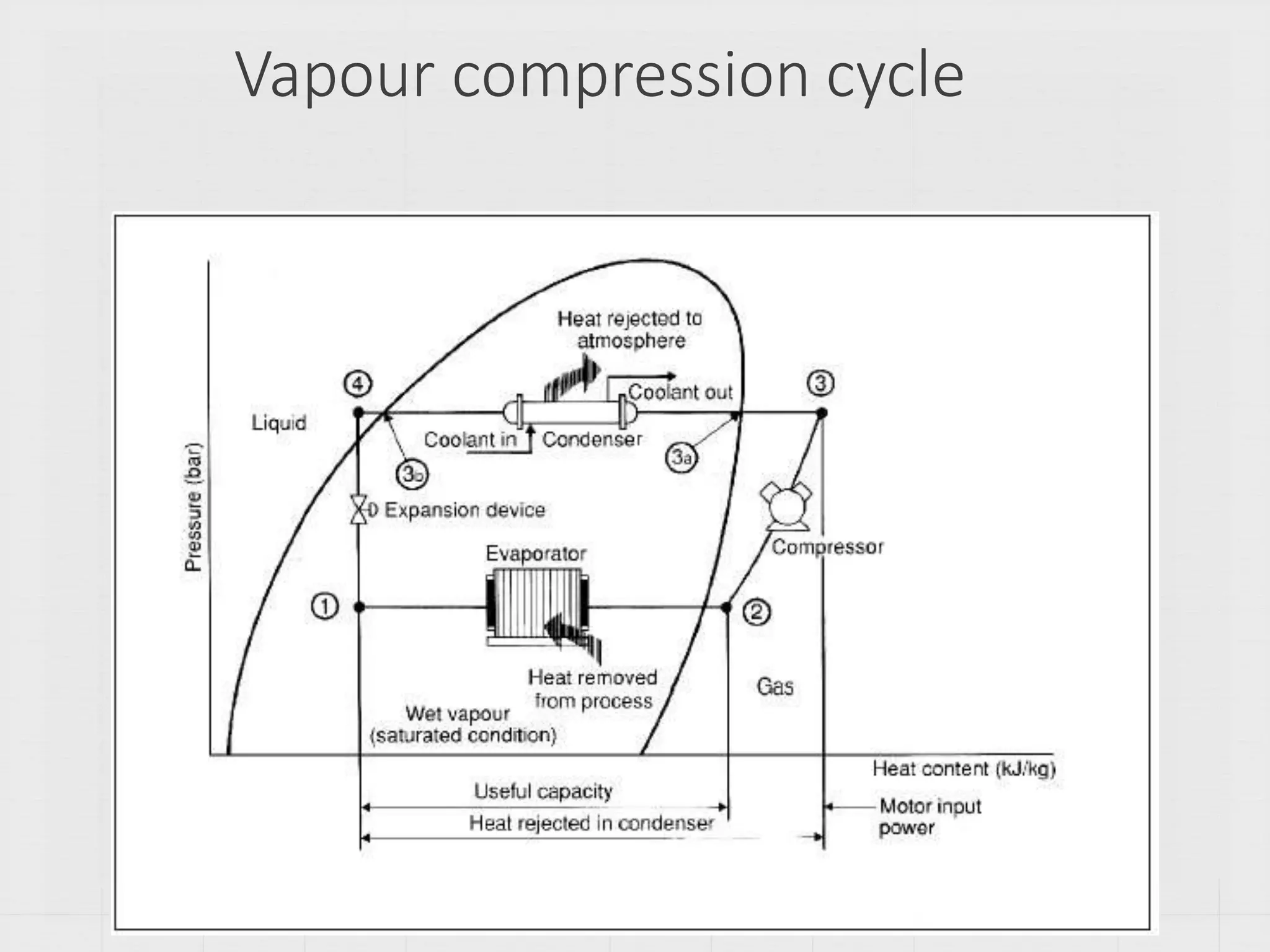
Vapour compression cycle

Condenser
Evaporator
High
Pressure
Side
Low
Pressure
Side
Compressor
Expansion
Device
1
2
3
4
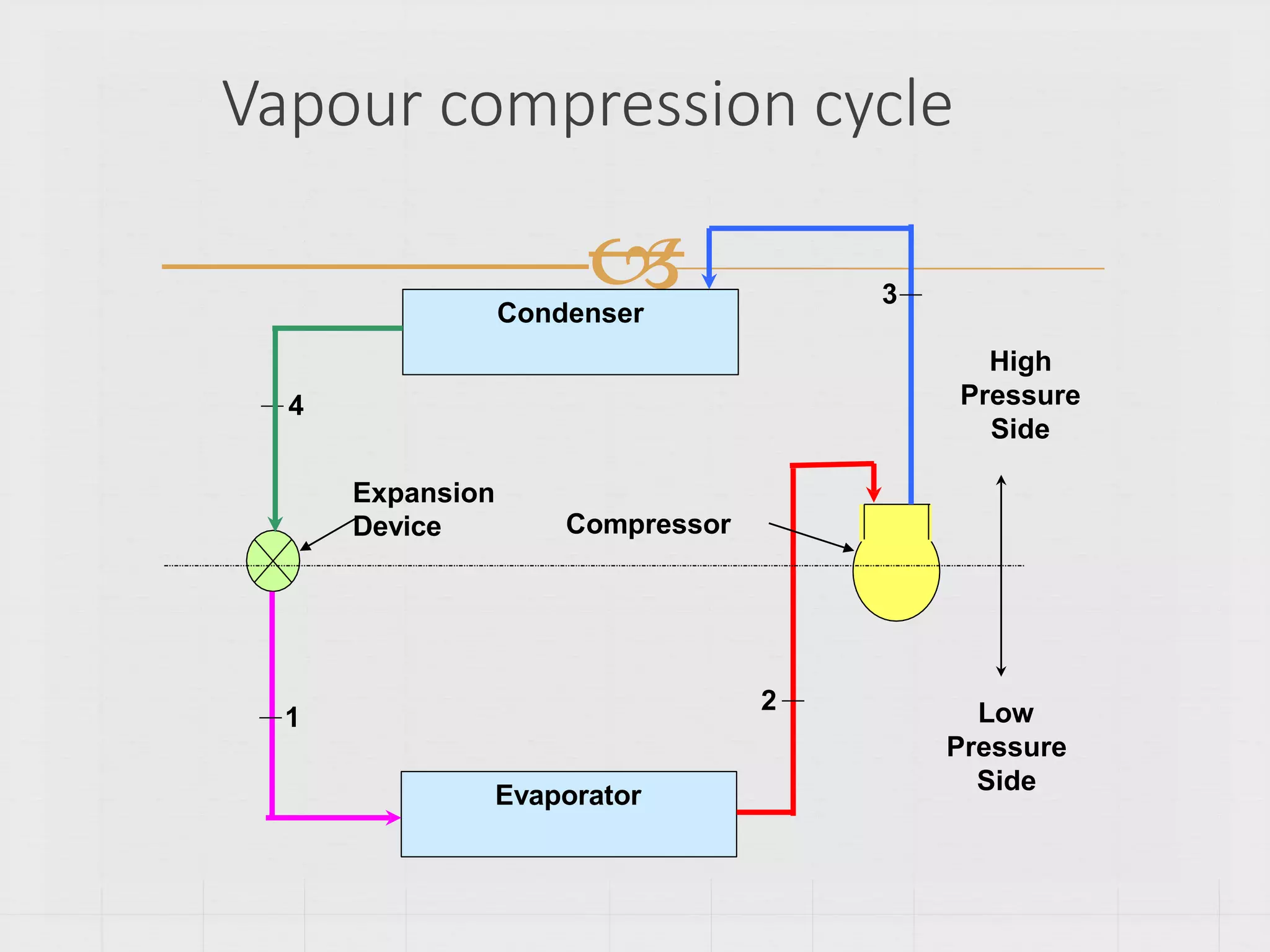
Vapour compression cycle

Vapour compression cycle
Condenser
Evaporator
High
Pressure
Side
Low
Pressure
Side
Compressor
Expansion
Device
1
2
3
4

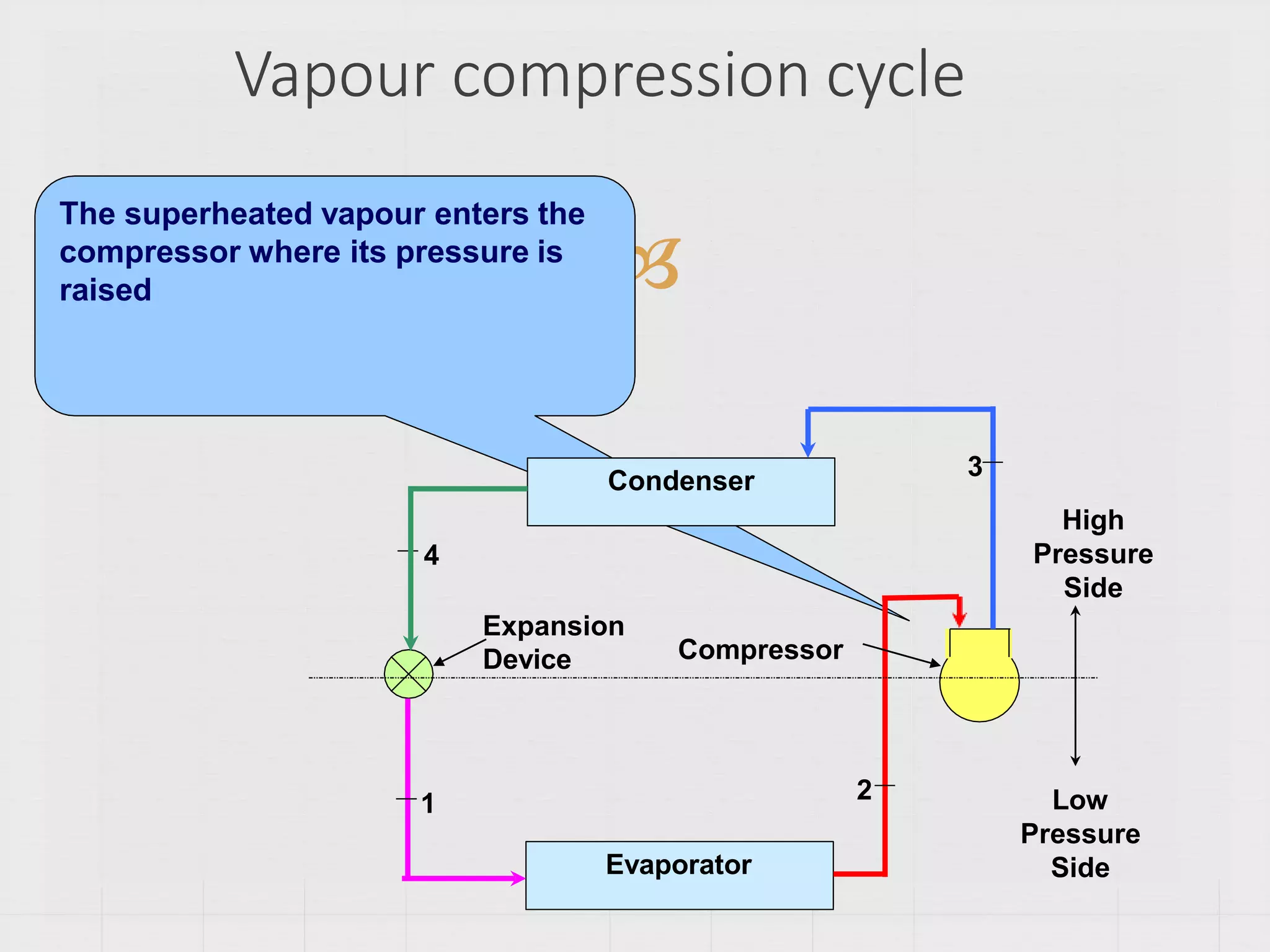
The superheated vapour enters the
compressor where its pressure is
raised
Condenser
Evaporator
High
Pressure
Side
Low
Pressure
Side
Compressor
Expansion
Device
1 2
3
4
Vapour compression cycle

Vapour compression cycle
20
Low pressure liquid refrigerant in
evaporator absorbs heat and
changes to a gas
Condenser
Evaporator
High
Pressure
Side
Low
Pressure
Side
Compressor
Expansion
Device
1 2
3
4

The high pressure superheated gas
is cooled in several stages in the
condenser
Condenser
Evaporator
High
Pressure
Side
Low
Pressure
Side
Compressor
Expansion
Device
1 2
3
4
Vapour compression cycle
Evaporator
Vapor-Compression Refrigeration Cycle
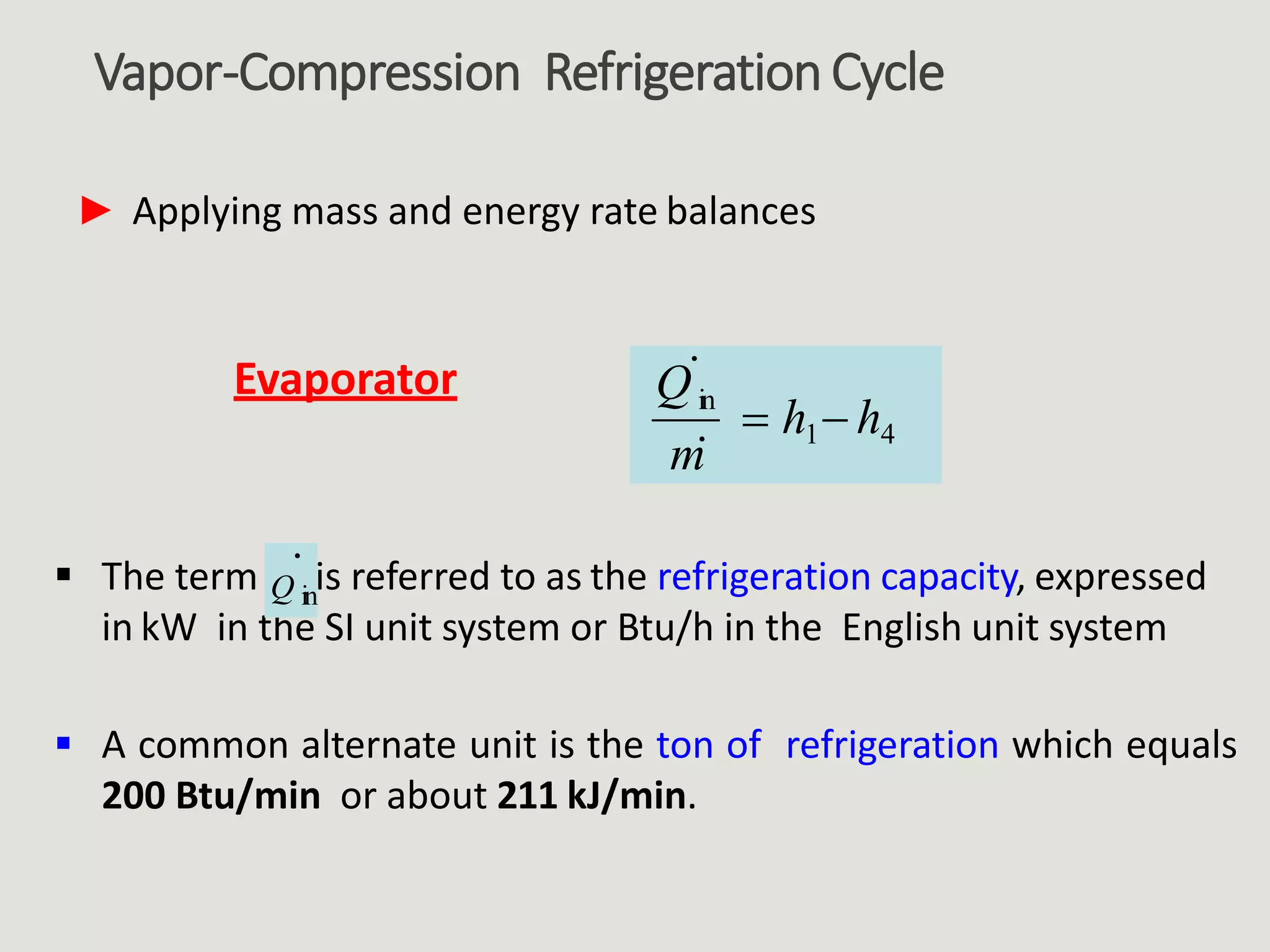
► Applying mass and energy rate balances
 The term is referred to as the refrigeration capacity, expressed
in kW in the SI unit system or Btu/h in the English unit system
 A common alternate unit is the ton of refrigeration which equals
200 Btu/min or about 211 kJ/min.
 h1 h4
Qin
m

Qin
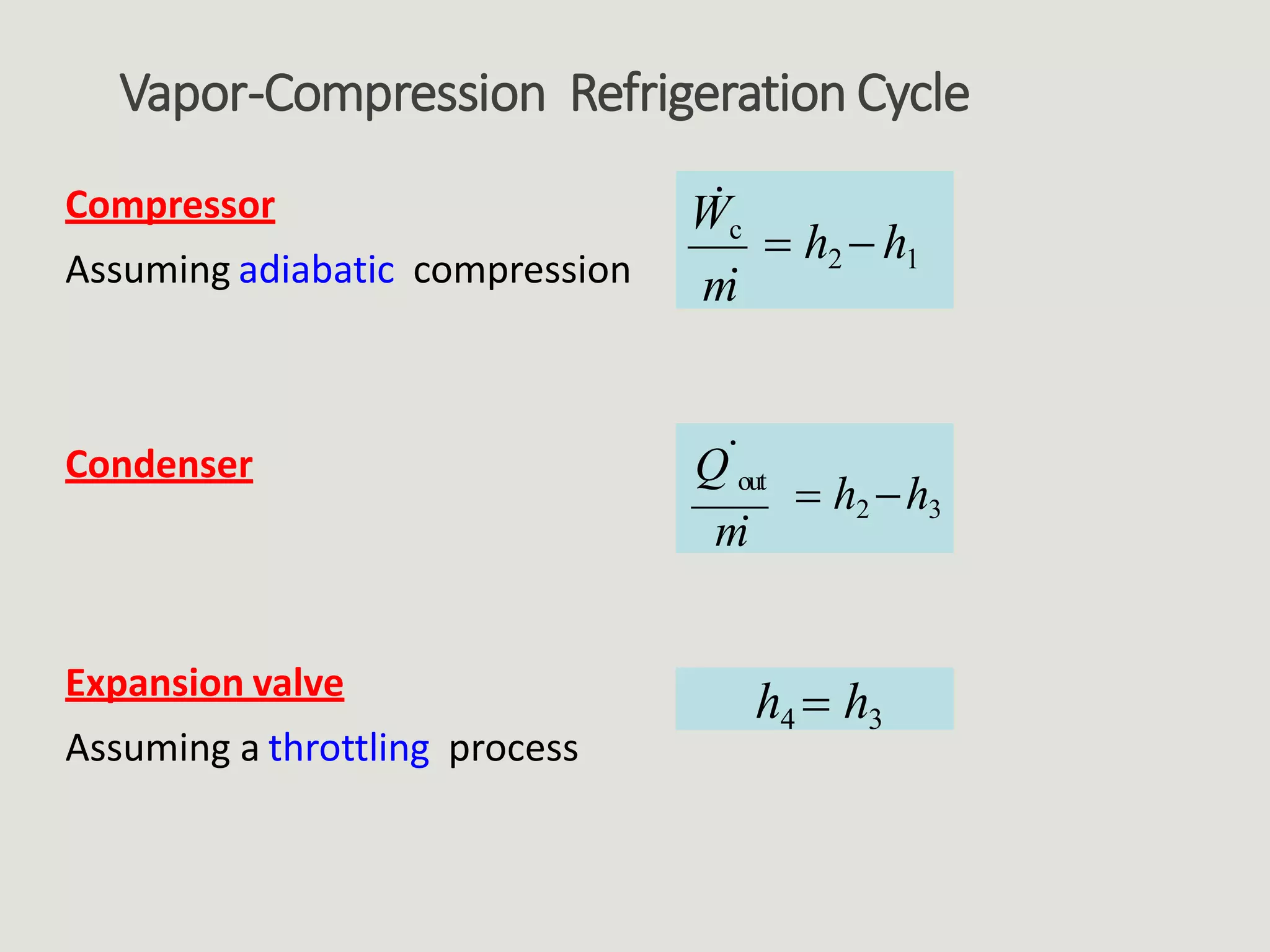
Compressor
Assuming adiabatic compression
Condenser
Expansion valve
Assuming a throttling process
Vapor-Compression Refrigeration Cycle
 h2  h1
W
c
m

h4  h3
 h2 h3
Qout
m

Vapor-Compression Refrigeration Cycle
►Performance parameters
► Coefficient of Performance (COP)
► Carnot Coefficient of Performance
This equation represents the maximum theoretical coefficient of
performance of any refrigeration cycle operating between cold
and hot regions at TC and TH, respectively.
p-h Diagram
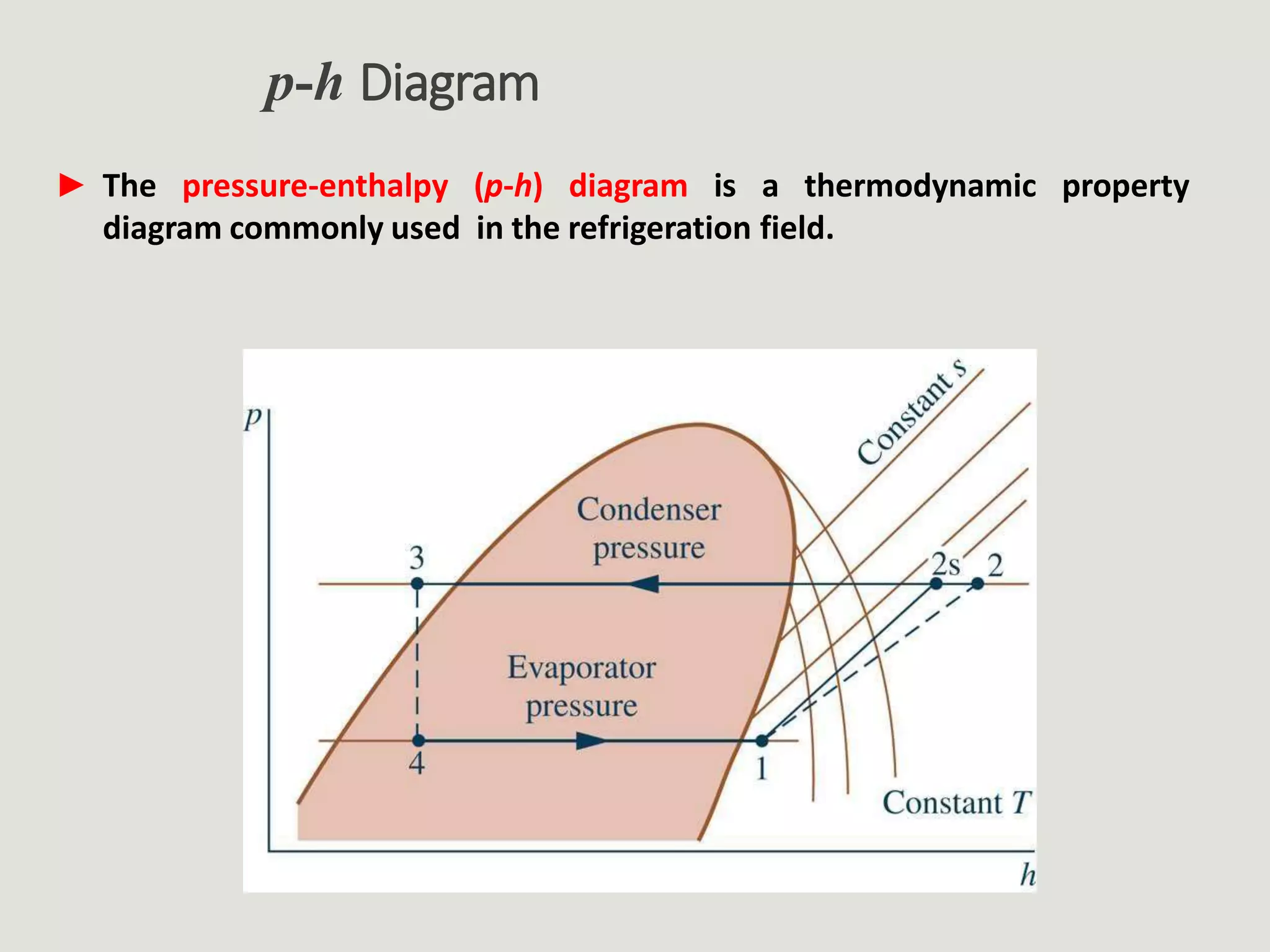
► The pressure-enthalpy (p-h) diagram is a thermodynamic property
diagram commonly used in the refrigeration field.

Vapour compression cycle
Different Vapor CompressionRefrigeration
System
19
If output of compressor is dry saturated vapor,
If output of compressor is superheated vapor,
20
If output of compressor is wet vapor,
21
If input of compressor is superheated vapor,
22
If output of condenser is sub cooled liquid ,
23
Factors affecting COPof VCR System
24
Effect of suction ( evaporation ) pressure :-
◦ Pressure decrease ↓
◦ Specific volume of vapor increase ↑
◦ Work required increase ↑
◦ Refrigerating effect decrease ↓
◦ Hence, COP decrease ↓
Effect of discharge ( condenser ) pressure :-
◦ Pressure increase ↑
◦ Work required increase ↑
◦ Refrigerating effect decrease ↓
◦ Hence, COP decrease ↓
Effect of evaporator &
condenser temperature :-
◦ Evaporator temp. decreases ↓
◦ Condenser temperature increases ↑
◦ Work required increase ↑↑
◦ Refrigerating effect decrease ↓↓
◦ Hence, COP decrease ↓
Effect of Superheated vapor after evaporation :-
◦ Specific volume of vapor increase ↑
◦ Refrigerating capacity decreases ↓
◦ Work required increase ↑
◦ Refrigerating effect decrease ↓
◦ Hence, COP decrease ↓ 25
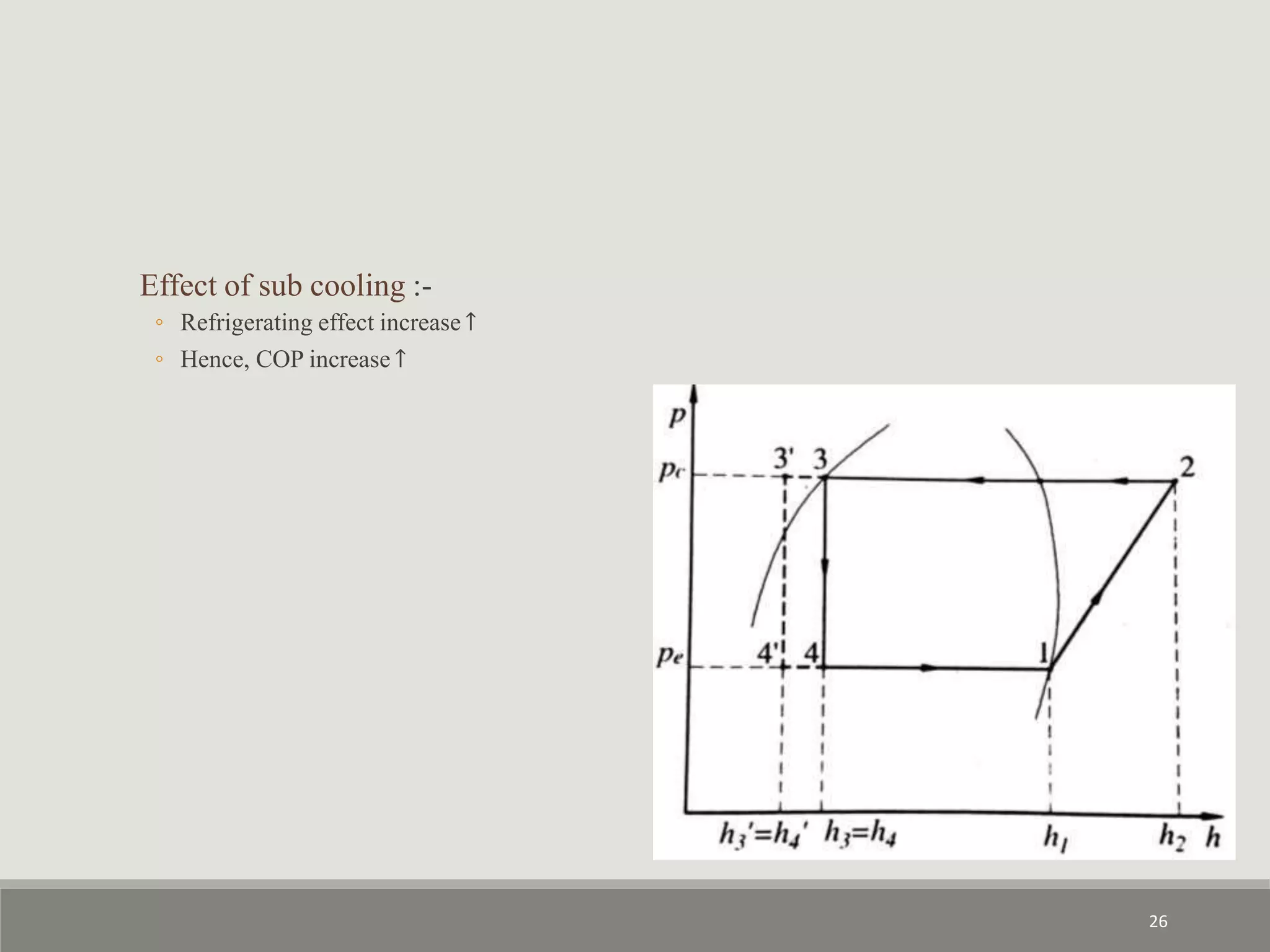
Effect of sub cooling :-
◦ Refrigerating effect increase ↑
◦ Hence, COP increase ↑
26
Selecting Refrigerants
►Refrigerant selection is based on several factors:
►Performance: provides adequate cooling capacity
cost-effectively
► Safety: avoids hazards (i.e., toxicity)
►Environmental impact: minimizes harm to stratospheric
ozone layer and reduces negative impact to global
climate change
Refrigerant Types and Characteristics
Global Warming Potential (GWP) is a simplified index that estimates the potential
future influence on global warming associated with different gases when released
to the atmosphere.
Refrigerant Types and Characteristics
►Chlorofluorocarbons (CFCs) and Hydrochlorofluorocarbons
(HCFCs) are early synthetic refrigerants each containing chlorine.
Because of the adverse effect of chlorine on Earth’s stratospheric
ozone layer, use of these refrigerants is regulated by international
agreement.
►Hydrofluorocarbons (HFCs) and HFC blends are chlorine-free
refrigerants. Blends combine two or more HFCs. While these
chlorine-free refrigerants do not contribute to ozone depletion, with
the exception of R-1234yf, they have high GWP levels.
►Natural refrigerants are nonsynthetic, naturally occurring
substances which serve as refrigerants. These include carbon
dioxide, ammonia, and hydrocarbons. These refrigerants feature
low GWP values; still, concerns have been raised over the toxicity
of NH3 and the safety of the hydrocarbons.
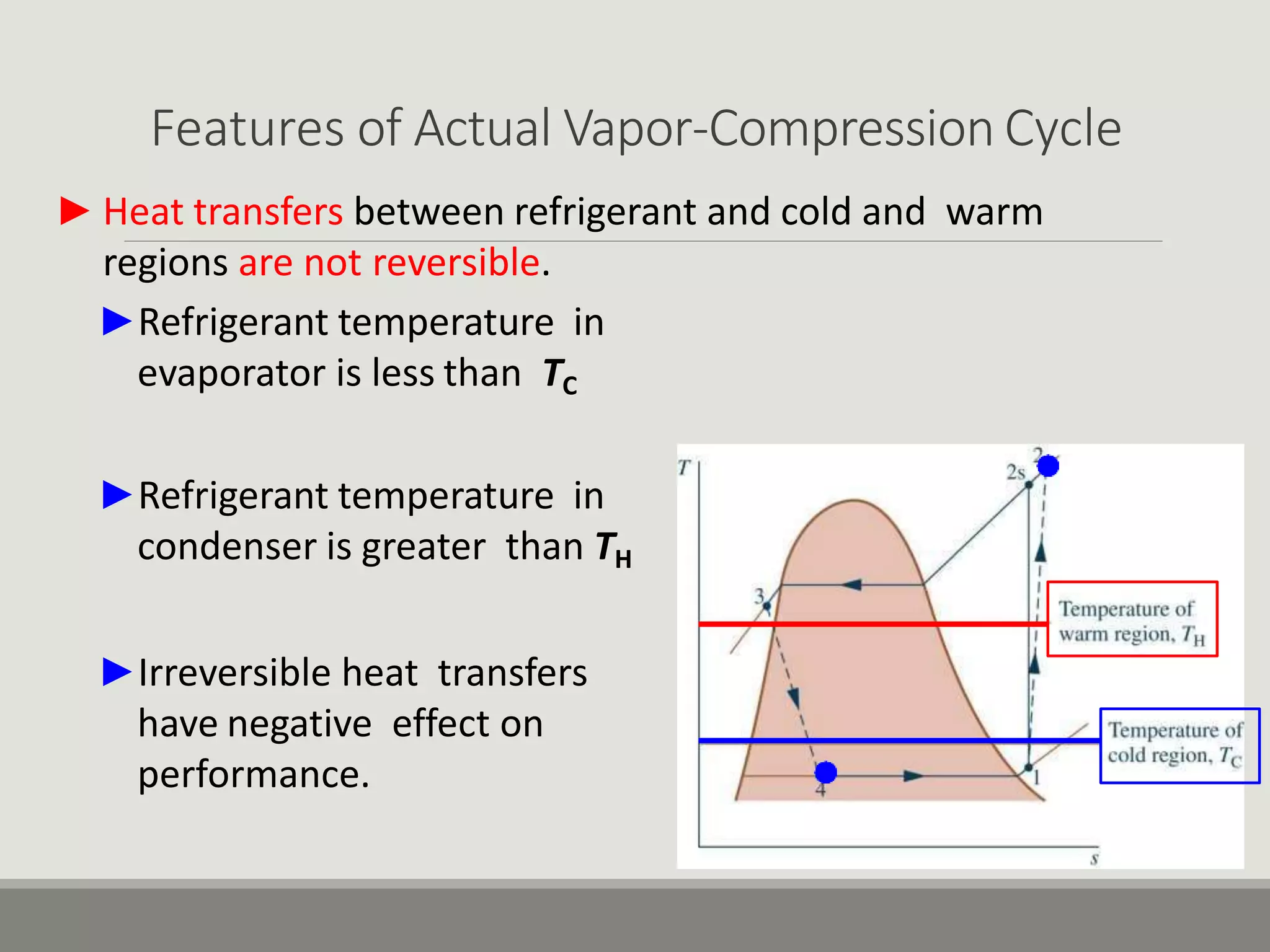
Features of Actual Vapor-Compression Cycle
► Heat transfers between refrigerant and cold and warm
regions are not reversible.
►Refrigerant temperature in
evaporator is less than TC
►Refrigerant temperature in
condenser is greater than TH
►Irreversible heat transfers
have negative effect on
performance.
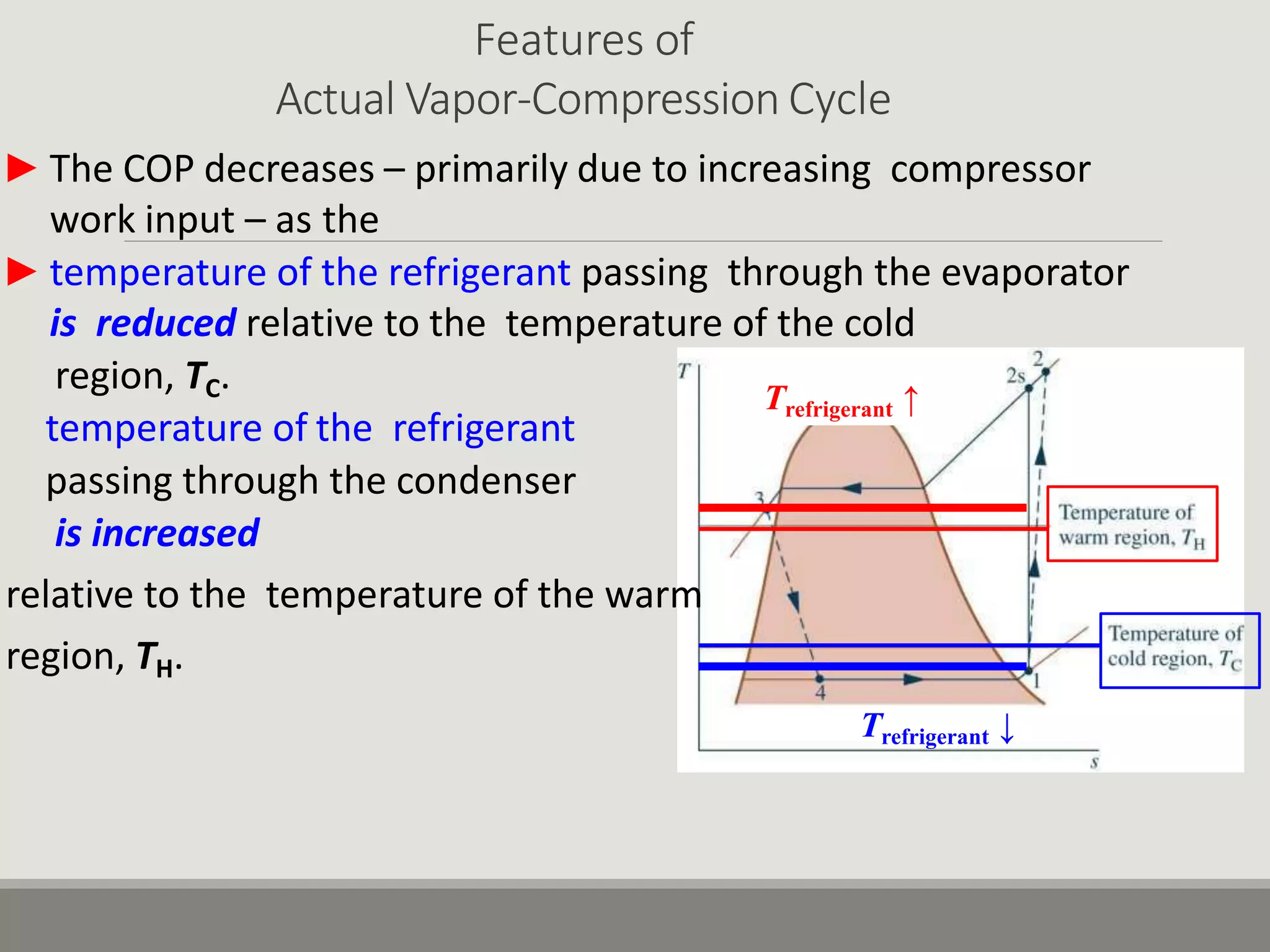
Features of
Actual Vapor-Compression Cycle
► The COP decreases – primarily due to increasing compressor
work input – as the
► temperature of the refrigerant passing through the evaporator
is reduced relative to the temperature of the cold
region, TC.
temperature of the refrigerant
passing through the condenser
is increased
relative to the temperature of the warm
region, TH.
Trefrigerant ↓
Trefrigerant ↑
►Irreversibilities during the compression process are
suggested by dashed line from state 1 to state 2.
►An increase in specific
entropy accompanies an
adiabatic irreversible
compression process.
►The work input for
compression process 1-2 is
greater than for the
counterpart isentropic
compression process 1-2s.
►Since process 4-1, and thus the refrigeration capacity,
is the same for cycles 1-2-3-4-1 and 1-2s-3-4-1, cycle
1-2-3-4-1 has the lower COP.
Isentropic Compressor Efficiency
►The isentropic compressor efficiency is the ratio of
the minimum theoretical work input to the actual
work input, each per unit of mass flowing:
(Eq. 6.48)
work required in an actual
compression from compressor
inlet state to exit pressure
work required in an isentropic
compression from compressor inlet
state to the exit pressure

Vapor compression refrigeration cycle

  • 1.
  • 2.
    REFRIGERATORS AND HEATPUMPS The objective of a refrigerator is to remove heat (QL) from the cold medium; the objective of a heat pump is to supply heat (QH) to a warm medium. The transfer of heat from a low-temperature region to a high-temperature one requires special devices called refrigerators. Another device that transfers heat from a low-temperature medium to a high- temperature one is the heat pump. Refrigerators and heat pumps are essentially the same devices; they differ in their objectives only. for fixed values of QL and QH
  • 3.
    Refrigeration Cycle  In refrigerationsystem the heat is being generally pumped from low level to higher one & rejected at that temp. This rejection of heat from low level to higher level of temp. can only be performed with the help of external work according to second law of thermodynamics.
  • 4.
    Contd….  The total amountof heat being rejected to the outside body consist of two parts:- - the heat extracted from the body to be cooled . - the heat equivalent to the mechanical work required for extracting it.
  • 5.
    Vapor-Compression Refrigeration Cycle ►Mostcommon refrigeration cycle in use today ►There are four principal control volumes involving these components: ►Evaporator ►Compressor ►Condenser ►Expansion valve All energy transfers by work and heat are taken as positive in the directions of the arrows on the schematic and energy balances are written accordingly. Two-phase liquid-vapormixture
  • 6.
    Vapor-Compression Refrigeration Cycle ►Engineering model: ►Each component is analyzed as a control volume at steady state ►Dry compression is presumed: the refrigerant is a vapor ► The compressor operates adiabatically ►The refrigerant expanding through the valve undergoes a throttling process ►Kinetic and potential energy changes are ignored
  • 7.
    ► The processesof this cycle are Process 4-1: two-phase liquid-vapor mixture of refrigerant is evaporated through heat transfer from the refrigerated space Process 1-2: vapor refrigerant is compressed to a relatively high temperature and pressure requiring work input Process 2-3: vapor refrigerant condenses to liquid through heat transfer to the cooler surroundings Process 3-4: liquid refrigerant expands to the evaporator pressure. Two-phase liquid-vapormixture
  • 8.
  • 9.
  • 10.
  • 11.
     The superheated vapourenters the compressor where its pressure is raised Condenser Evaporator High Pressure Side Low Pressure Side Compressor Expansion Device 1 2 3 4 Vapour compression cycle
  • 12.
     Vapour compression cycle 20 Lowpressure liquid refrigerant in evaporator absorbs heat and changes to a gas Condenser Evaporator High Pressure Side Low Pressure Side Compressor Expansion Device 1 2 3 4
  • 13.
     The high pressuresuperheated gas is cooled in several stages in the condenser Condenser Evaporator High Pressure Side Low Pressure Side Compressor Expansion Device 1 2 3 4 Vapour compression cycle
  • 14.
    Evaporator Vapor-Compression Refrigeration Cycle ►Applying mass and energy rate balances  The term is referred to as the refrigeration capacity, expressed in kW in the SI unit system or Btu/h in the English unit system  A common alternate unit is the ton of refrigeration which equals 200 Btu/min or about 211 kJ/min.  h1 h4 Qin m  Qin
  • 15.
    Compressor Assuming adiabatic compression Condenser Expansionvalve Assuming a throttling process Vapor-Compression Refrigeration Cycle  h2  h1 W c m  h4  h3  h2 h3 Qout m 
  • 16.
    Vapor-Compression Refrigeration Cycle ►Performanceparameters ► Coefficient of Performance (COP) ► Carnot Coefficient of Performance This equation represents the maximum theoretical coefficient of performance of any refrigeration cycle operating between cold and hot regions at TC and TH, respectively.
  • 17.
    p-h Diagram ► Thepressure-enthalpy (p-h) diagram is a thermodynamic property diagram commonly used in the refrigeration field.
  • 18.
  • 19.
    Different Vapor CompressionRefrigeration System 19 Ifoutput of compressor is dry saturated vapor,
  • 20.
    If output ofcompressor is superheated vapor, 20
  • 21.
    If output ofcompressor is wet vapor, 21
  • 22.
    If input ofcompressor is superheated vapor, 22
  • 23.
    If output ofcondenser is sub cooled liquid , 23
  • 24.
    Factors affecting COPofVCR System 24 Effect of suction ( evaporation ) pressure :- ◦ Pressure decrease ↓ ◦ Specific volume of vapor increase ↑ ◦ Work required increase ↑ ◦ Refrigerating effect decrease ↓ ◦ Hence, COP decrease ↓ Effect of discharge ( condenser ) pressure :- ◦ Pressure increase ↑ ◦ Work required increase ↑ ◦ Refrigerating effect decrease ↓ ◦ Hence, COP decrease ↓
  • 25.
    Effect of evaporator& condenser temperature :- ◦ Evaporator temp. decreases ↓ ◦ Condenser temperature increases ↑ ◦ Work required increase ↑↑ ◦ Refrigerating effect decrease ↓↓ ◦ Hence, COP decrease ↓ Effect of Superheated vapor after evaporation :- ◦ Specific volume of vapor increase ↑ ◦ Refrigerating capacity decreases ↓ ◦ Work required increase ↑ ◦ Refrigerating effect decrease ↓ ◦ Hence, COP decrease ↓ 25
  • 26.
    Effect of subcooling :- ◦ Refrigerating effect increase ↑ ◦ Hence, COP increase ↑ 26
  • 27.
    Selecting Refrigerants ►Refrigerant selectionis based on several factors: ►Performance: provides adequate cooling capacity cost-effectively ► Safety: avoids hazards (i.e., toxicity) ►Environmental impact: minimizes harm to stratospheric ozone layer and reduces negative impact to global climate change
  • 28.
    Refrigerant Types andCharacteristics Global Warming Potential (GWP) is a simplified index that estimates the potential future influence on global warming associated with different gases when released to the atmosphere.
  • 29.
    Refrigerant Types andCharacteristics ►Chlorofluorocarbons (CFCs) and Hydrochlorofluorocarbons (HCFCs) are early synthetic refrigerants each containing chlorine. Because of the adverse effect of chlorine on Earth’s stratospheric ozone layer, use of these refrigerants is regulated by international agreement. ►Hydrofluorocarbons (HFCs) and HFC blends are chlorine-free refrigerants. Blends combine two or more HFCs. While these chlorine-free refrigerants do not contribute to ozone depletion, with the exception of R-1234yf, they have high GWP levels. ►Natural refrigerants are nonsynthetic, naturally occurring substances which serve as refrigerants. These include carbon dioxide, ammonia, and hydrocarbons. These refrigerants feature low GWP values; still, concerns have been raised over the toxicity of NH3 and the safety of the hydrocarbons.
  • 30.
    Features of ActualVapor-Compression Cycle ► Heat transfers between refrigerant and cold and warm regions are not reversible. ►Refrigerant temperature in evaporator is less than TC ►Refrigerant temperature in condenser is greater than TH ►Irreversible heat transfers have negative effect on performance.
  • 31.
    Features of Actual Vapor-CompressionCycle ► The COP decreases – primarily due to increasing compressor work input – as the ► temperature of the refrigerant passing through the evaporator is reduced relative to the temperature of the cold region, TC. temperature of the refrigerant passing through the condenser is increased relative to the temperature of the warm region, TH. Trefrigerant ↓ Trefrigerant ↑
  • 32.
    ►Irreversibilities during thecompression process are suggested by dashed line from state 1 to state 2. ►An increase in specific entropy accompanies an adiabatic irreversible compression process. ►The work input for compression process 1-2 is greater than for the counterpart isentropic compression process 1-2s. ►Since process 4-1, and thus the refrigeration capacity, is the same for cycles 1-2-3-4-1 and 1-2s-3-4-1, cycle 1-2-3-4-1 has the lower COP.
  • 33.
    Isentropic Compressor Efficiency ►Theisentropic compressor efficiency is the ratio of the minimum theoretical work input to the actual work input, each per unit of mass flowing: (Eq. 6.48) work required in an actual compression from compressor inlet state to exit pressure work required in an isentropic compression from compressor inlet state to the exit pressure