The most important geometric properties of an
aerial photograph are those of an angle and scale.
Angle of Arial Photographs
 The angle at which aerial photograph is taken is
used to classify the photograph into one of three
types viz. vertical, high oblique and low oblique.
 Vertical photograph taken with a single lens is the
most common type of aerial photography used in
remote sensing applications.
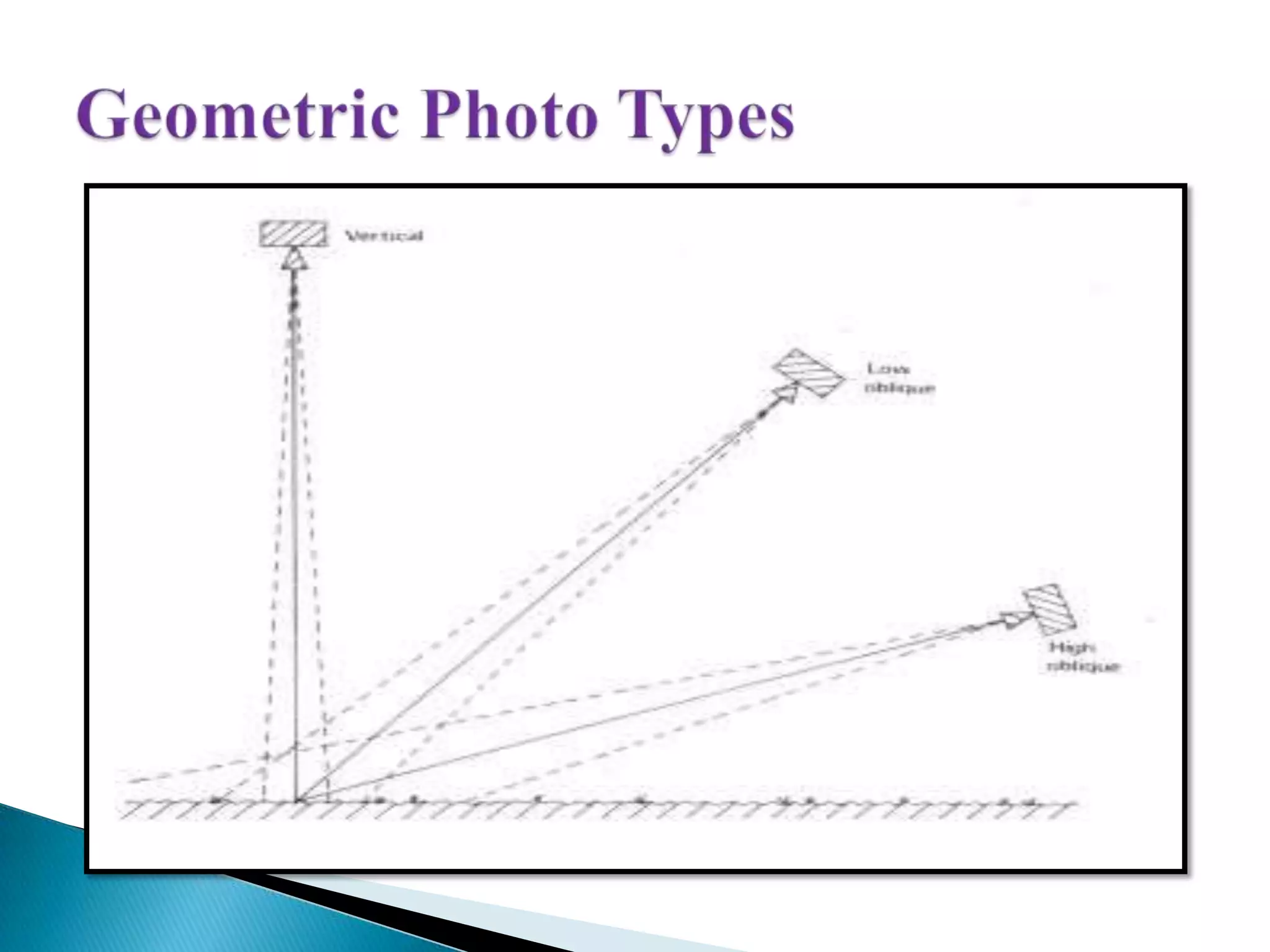
 The vertical photography is taken with the camera
axis pointing vertically downwards.
 Oblique photography is taken with the camera
axis pointing obliquely downwards (intentional
inclination of the camera axis).
 High oblique photography incorporates an image
of the horizon into the photographs while low
oblique photographs do not.
 A ‘truly 'vertical aerial photograph is rarely obtainable
because of unavoidable angular rotations or
tilts, caused by the angular attitude of the aircraft at the
instant of exposure.
 These unavoidable tilts cause slight (1 to 3 degrees )
unintentional inclination of the camera optical
axis, resulting in the acquisition of tilted photographs .
 Vertical photographs have properties similar to those
of a map with a approximately constant scale over the
whole photograph, and therefore can be used for
mapping and measurements.
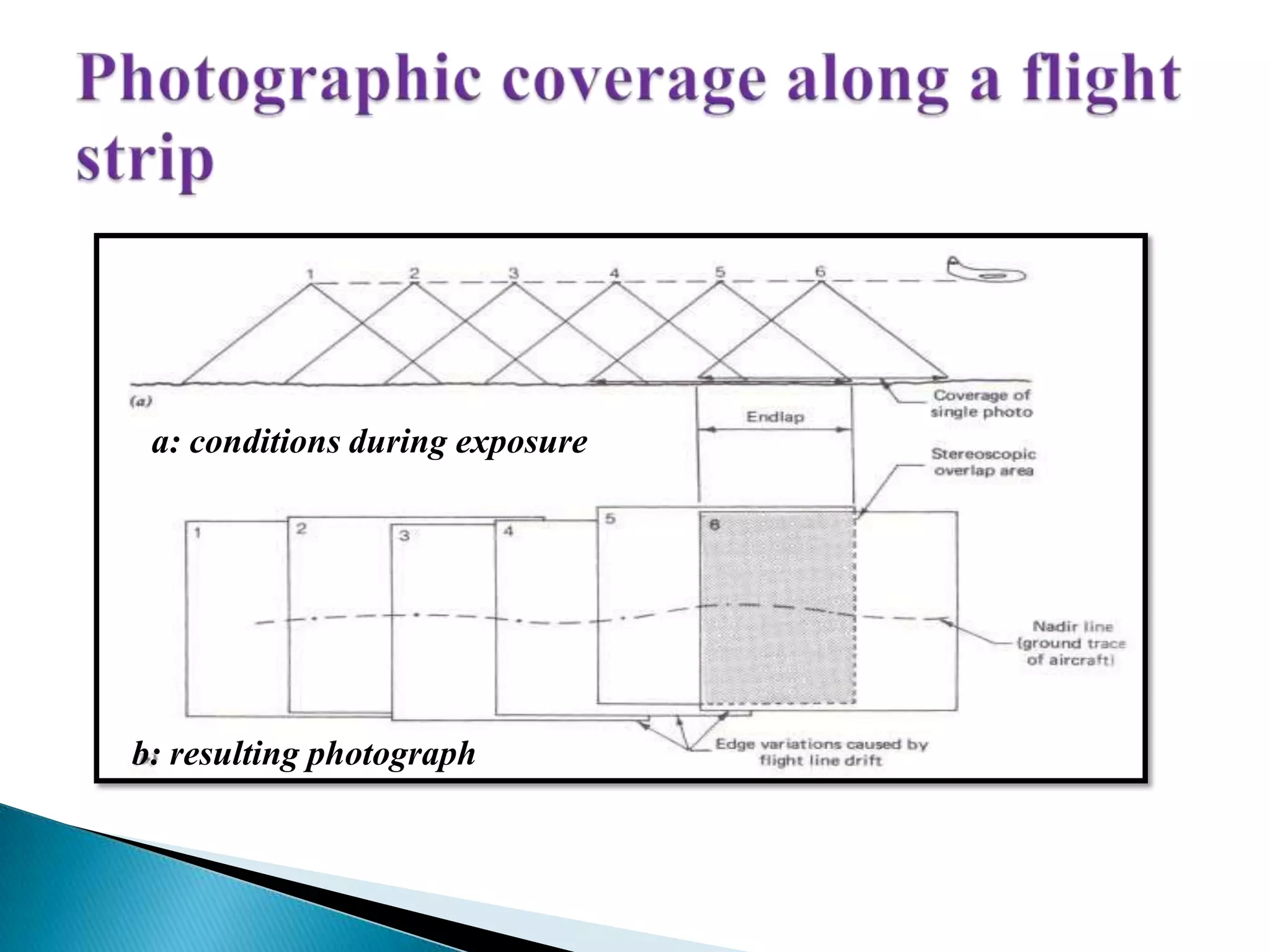
Most vertical aerial photographs are taken with
frame cameras along flight line ,or flight strips.
The line traced on the ground directly beneath the
aircraft during acquisition of photography is
called Nadir line. This line connects the image
centers of the vertical photographs. Successive
photographs are generally taken with some degree
of Endlap. Not only dose this lapping ensure
total coverage along a flight line, but an endlap of
at least 50% is essential for total stereoscopic
coverage of a project area.
a: conditions during exposure
b: resulting photograph
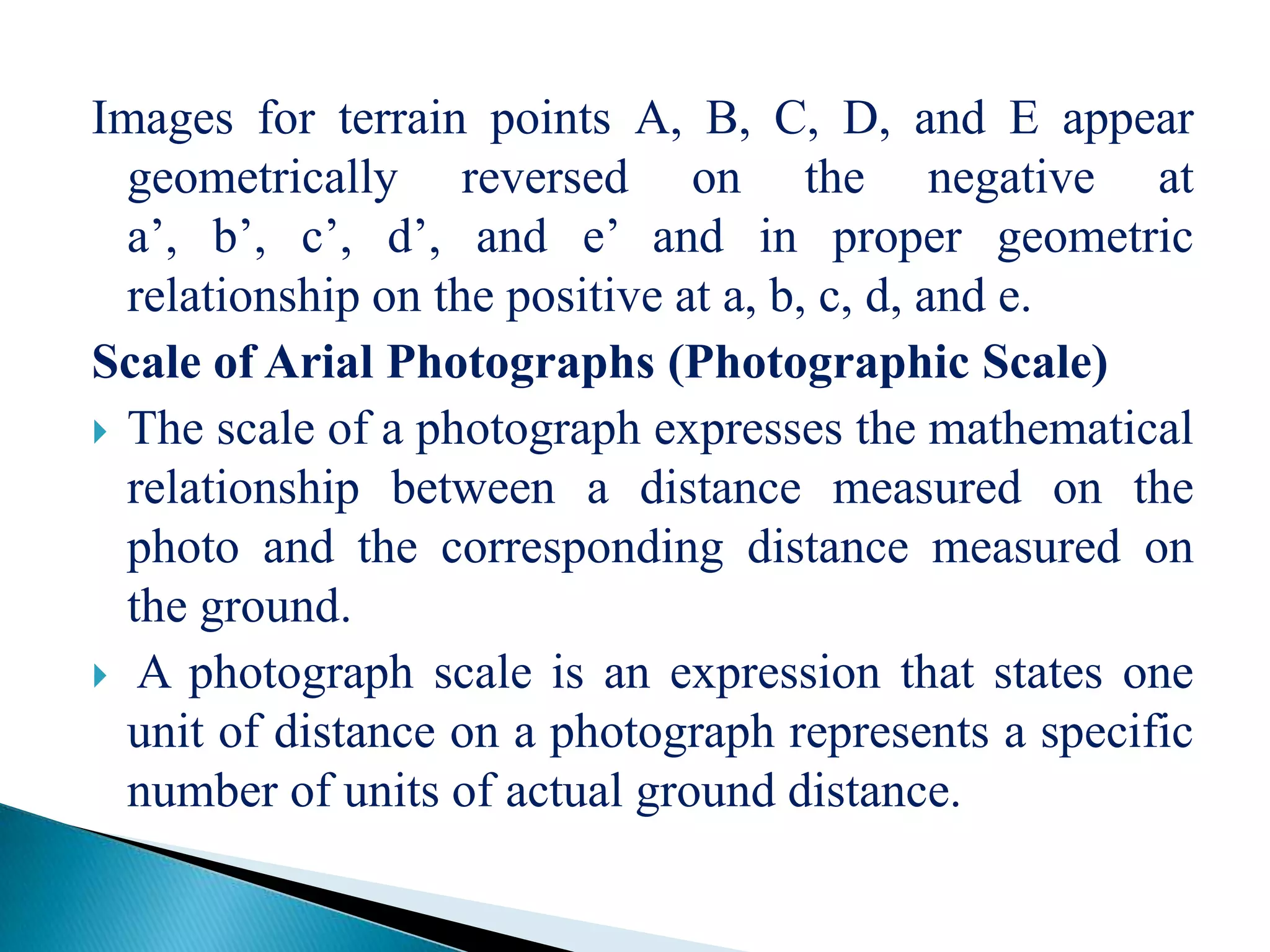
Light rays from terrain objects are imaged in the plane
of the film negative after intersecting at the camera
lens exposure station, L. The negative is located
behind the lens at a distance equal to the lens focal
length, f. Assuming the size of a paper print positive
(or film positive) is equal to that of the
negative, positive image positions can be depicted
diagrammatically in front of the lens in a plane
located at a distance f. This rendition is appropriate in
that most photo positives used for measurement
purposes are contact printed, resulting in the
geometric relationships shown.
The x and y coordinate positions of image points are
referenced with respect to axes formed by straight
lines joining the opposite fiducial marks recorded on
the positive. The x axis is arbitrarily assigned to the
fiducial axis most nearly coincident with the line of
flight and is taken as positive in the forward direction
of flight. The positive y axis is located 90 counter-
clockwise from the positive x axis. Because of the
precision with the fiducial marks and the lens are
placed in a metric camera, the photo coordinate
origin, o, can be assumed to coincide exactly with the
principal point, the intersection of the lens optical
axis and the film plane.
Images for terrain points A, B, C, D, and E appear
geometrically reversed on the negative at
a’, b’, c’, d’, and e’ and in proper geometric
relationship on the positive at a, b, c, d, and e.
Scale of Arial Photographs (Photographic Scale)
 The scale of a photograph expresses the mathematical
relationship between a distance measured on the
photo and the corresponding distance measured on
the ground.
 A photograph scale is an expression that states one
unit of distance on a photograph represents a specific
number of units of actual ground distance.
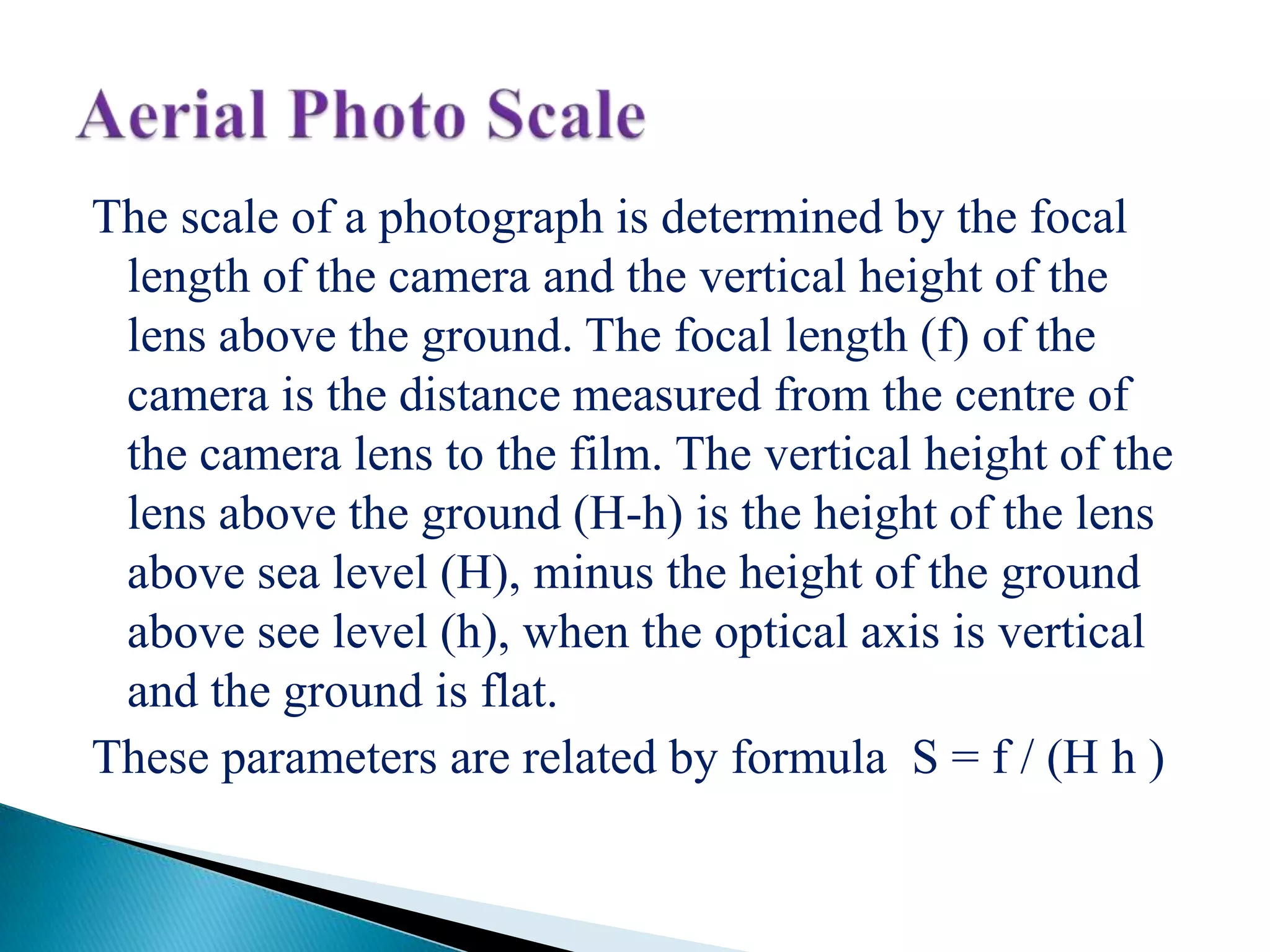
 Scales may be expressed as unit equivalents (1 mm =
25 m), representative fractions (1/25,000) or ratios (1:
25,000).
 Unlike maps, which have a constant scale
throughout, the aerial photographs have a range of
scales that vary in proportion to the elevation of the
terrain involved.
 The most straight forward method for determining
photo scale is to measure the corresponding photo
and ground distances between any two points. The
scale S is then computed as the ratio of the photo
distance d to the ground distance D.
 S = photo scale = photo distance/ground distance =
d/D.
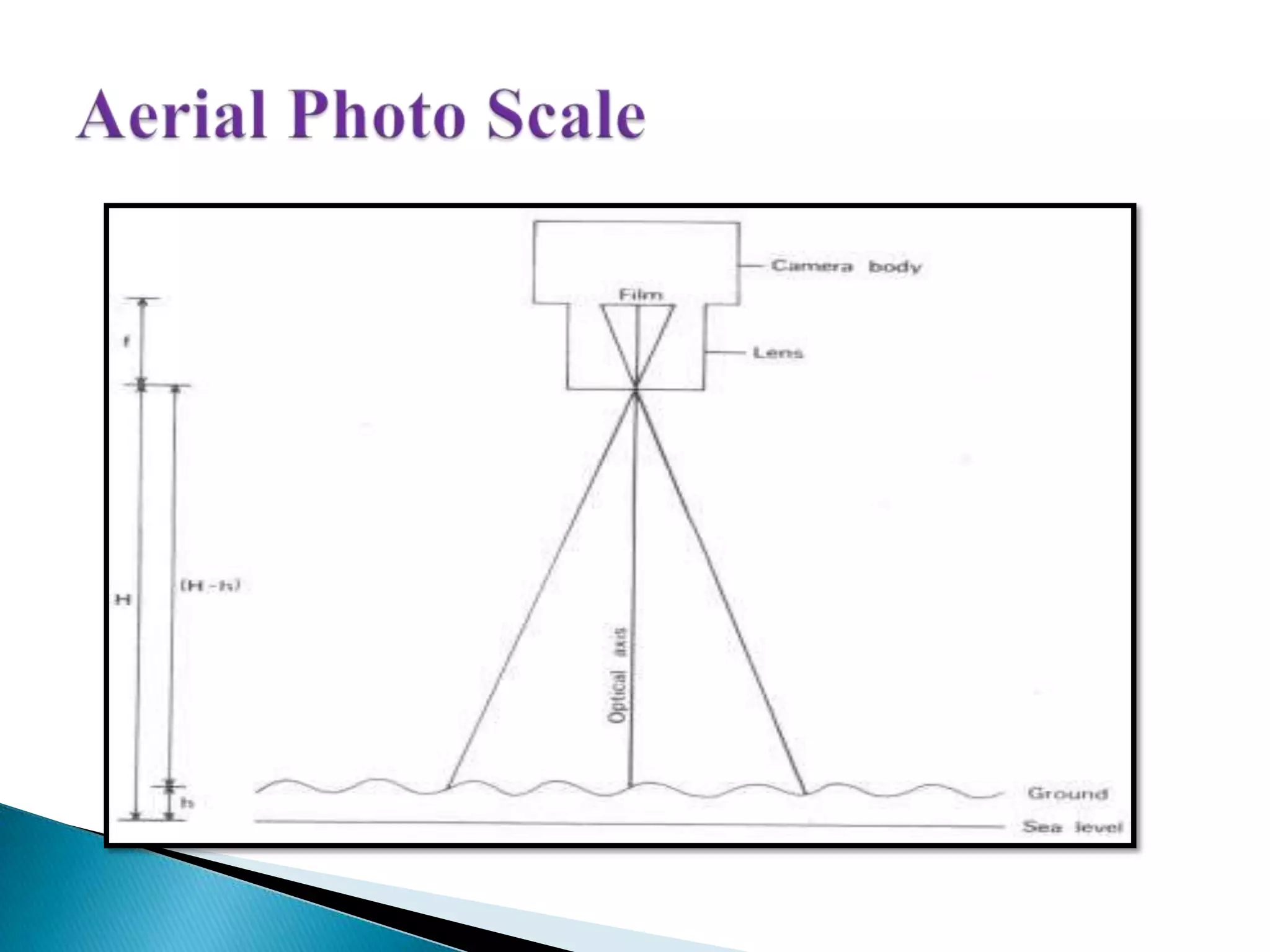
The scale of a photograph is determined by the focal
length of the camera and the vertical height of the
lens above the ground. The focal length (f) of the
camera is the distance measured from the centre of
the camera lens to the film. The vertical height of the
lens above the ground (H-h) is the height of the lens
above sea level (H), minus the height of the ground
above see level (h), when the optical axis is vertical
and the ground is flat.
These parameters are related by formula S = f / (H h )
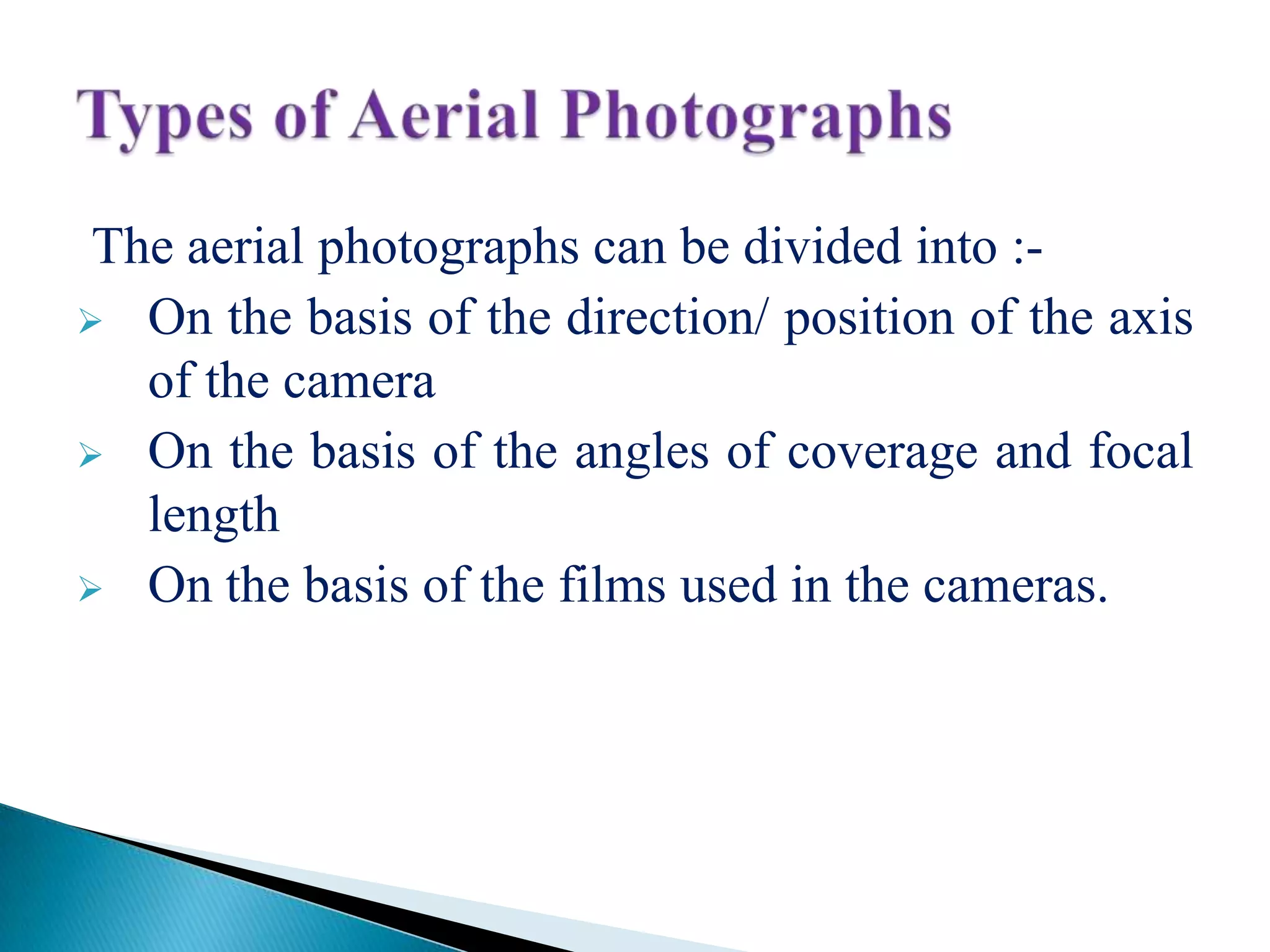
The aerial photographs can be divided into :-
 On the basis of the direction/ position of the axis
of the camera
 On the basis of the angles of coverage and focal
length
 On the basis of the films used in the cameras.
 On the basis of the direction/ position of the axis of
the camera :
1) Vertical
2) Horizontal
3) Oblique
4) Convergent
5) Trimetrogon
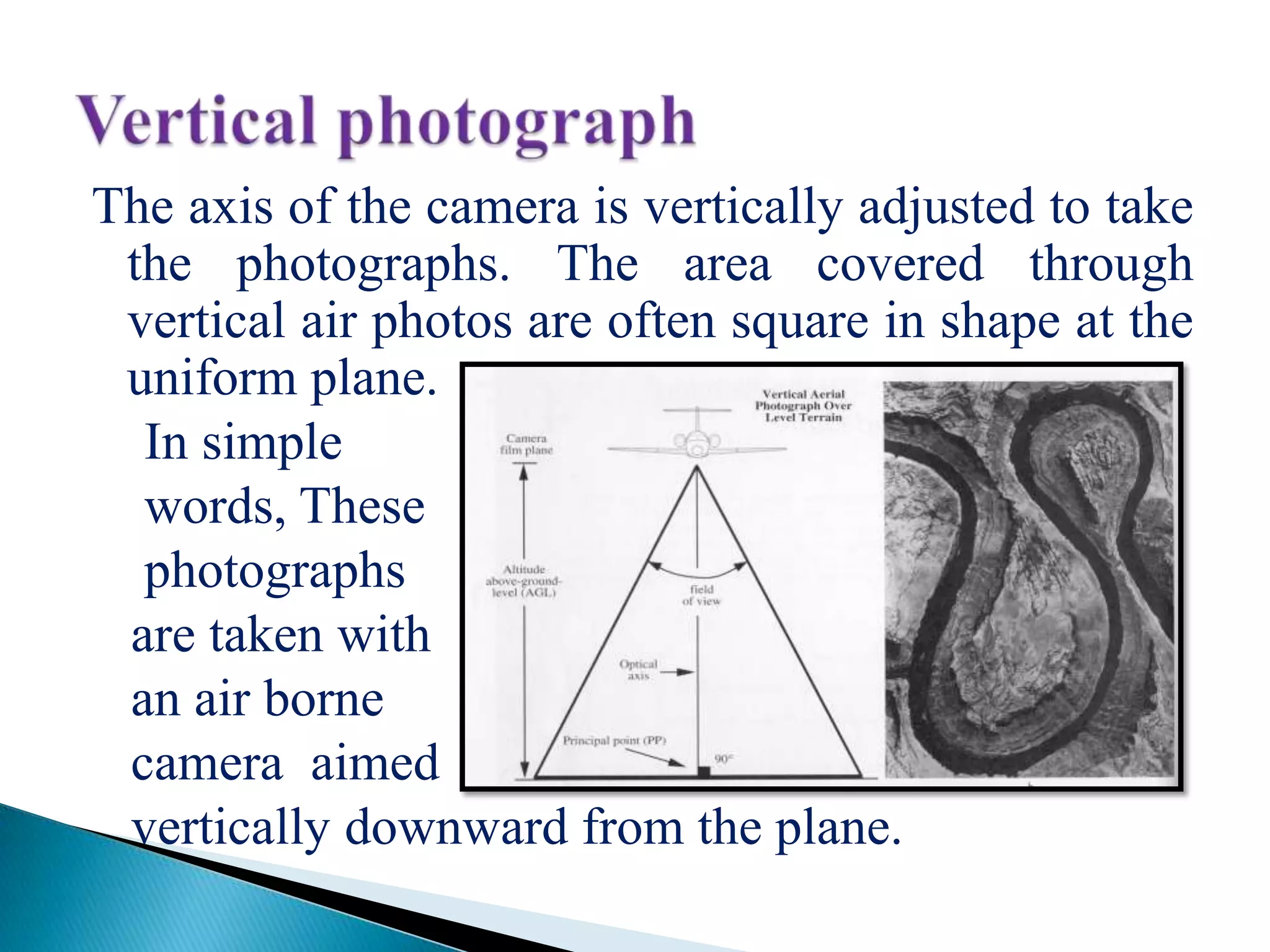
The axis of the camera is vertically adjusted to take
the photographs. The area covered through
vertical air photos are often square in shape at the
uniform plane.
In simple
words, These
photographs
are taken with
an air borne
camera aimed
vertically downward from the plane.
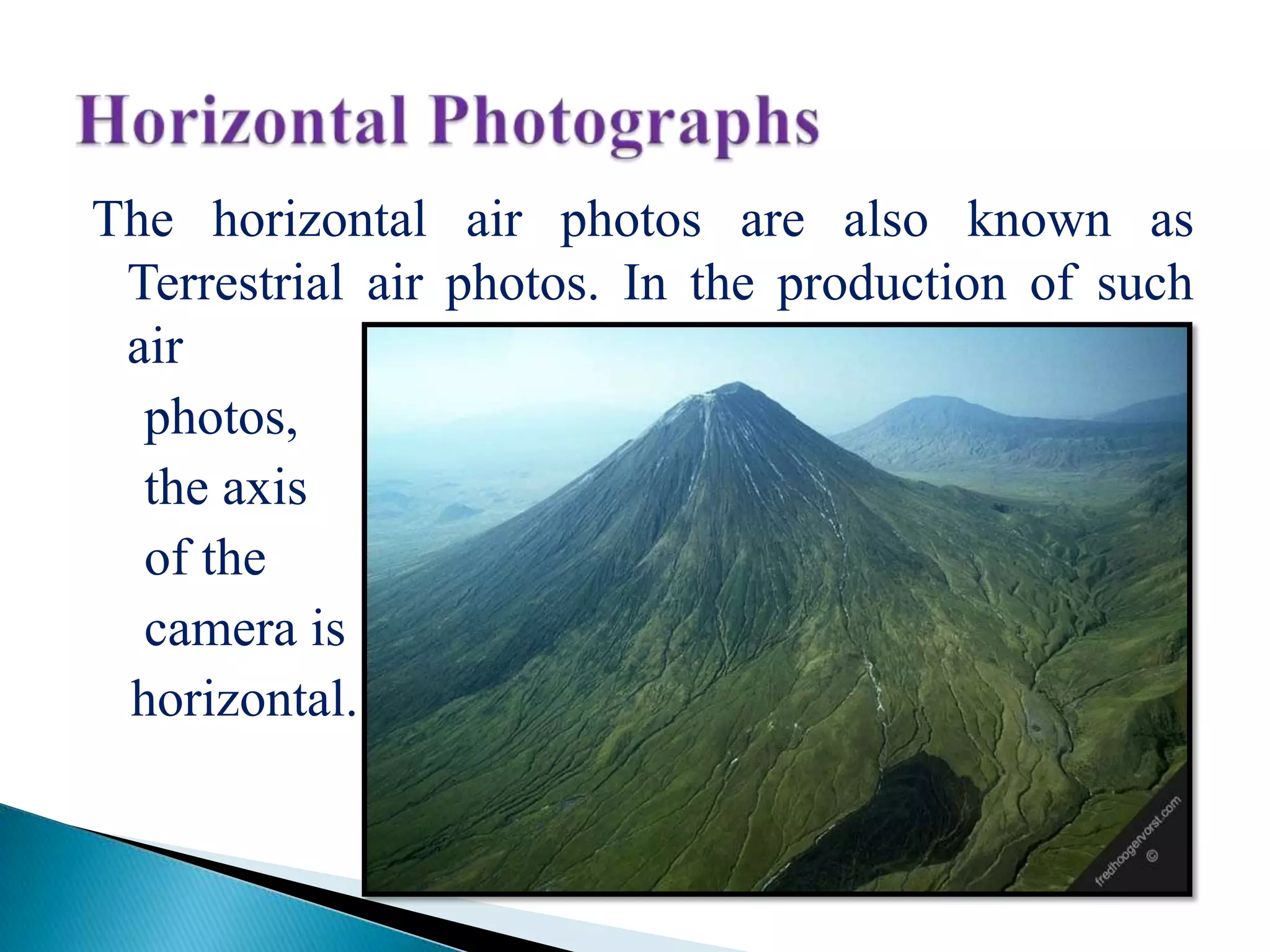
The horizontal air photos are also known as
Terrestrial air photos. In the production of such
air
photos,
the axis
of the
camera is
horizontal.
In the oblique air photos, the adjustment of the axis
of the camera ranges from the vertical to angular
position. The areas covered by oblique air photos
assumed the shape of a trapezium.
An oblique photograph is divided into two types:-
1. Low Oblique Photographs
2. High Oblique Photographs
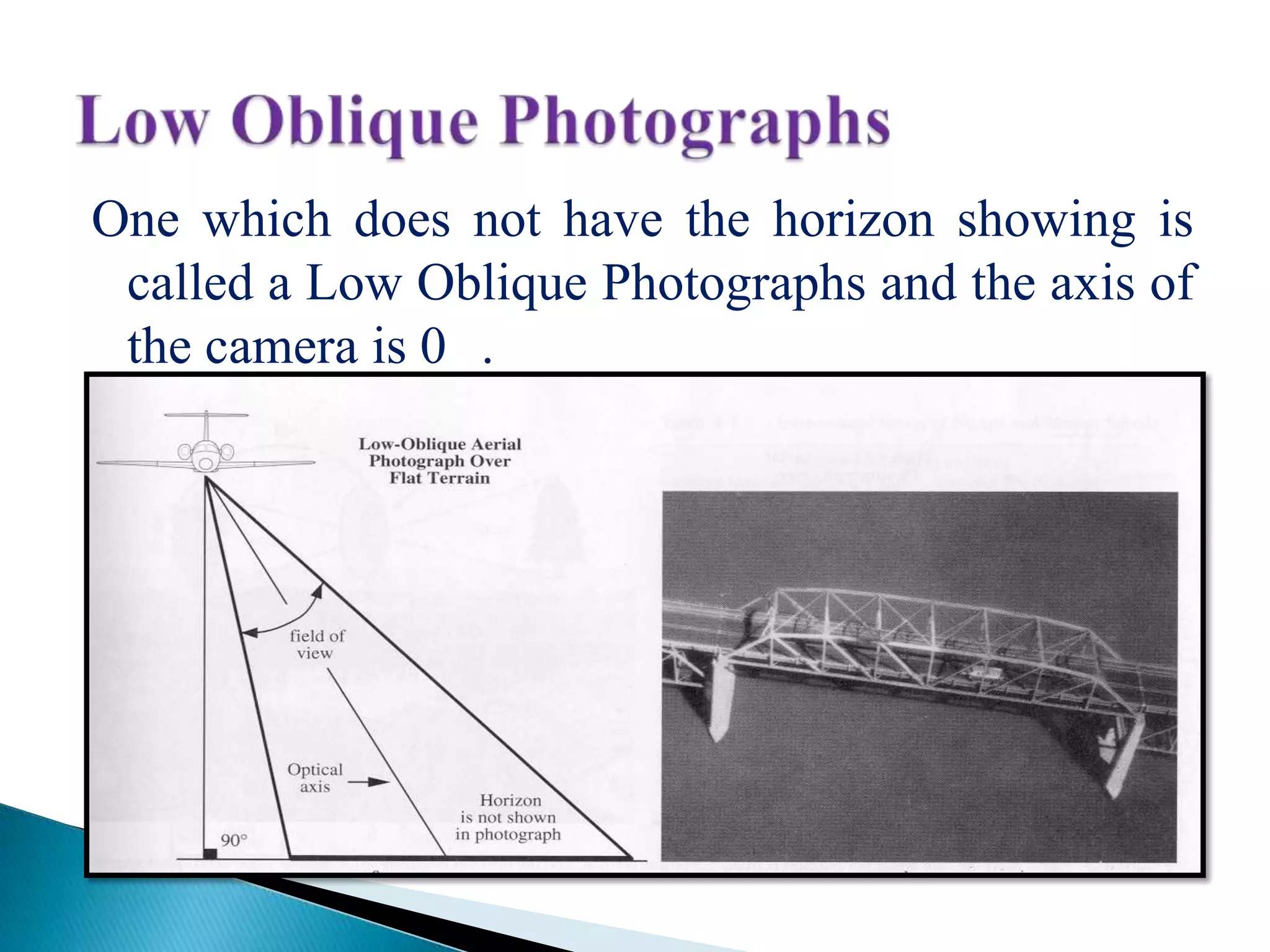
One which does not have the horizon showing is
called a Low Oblique Photographs and the axis of
the camera is 0 .
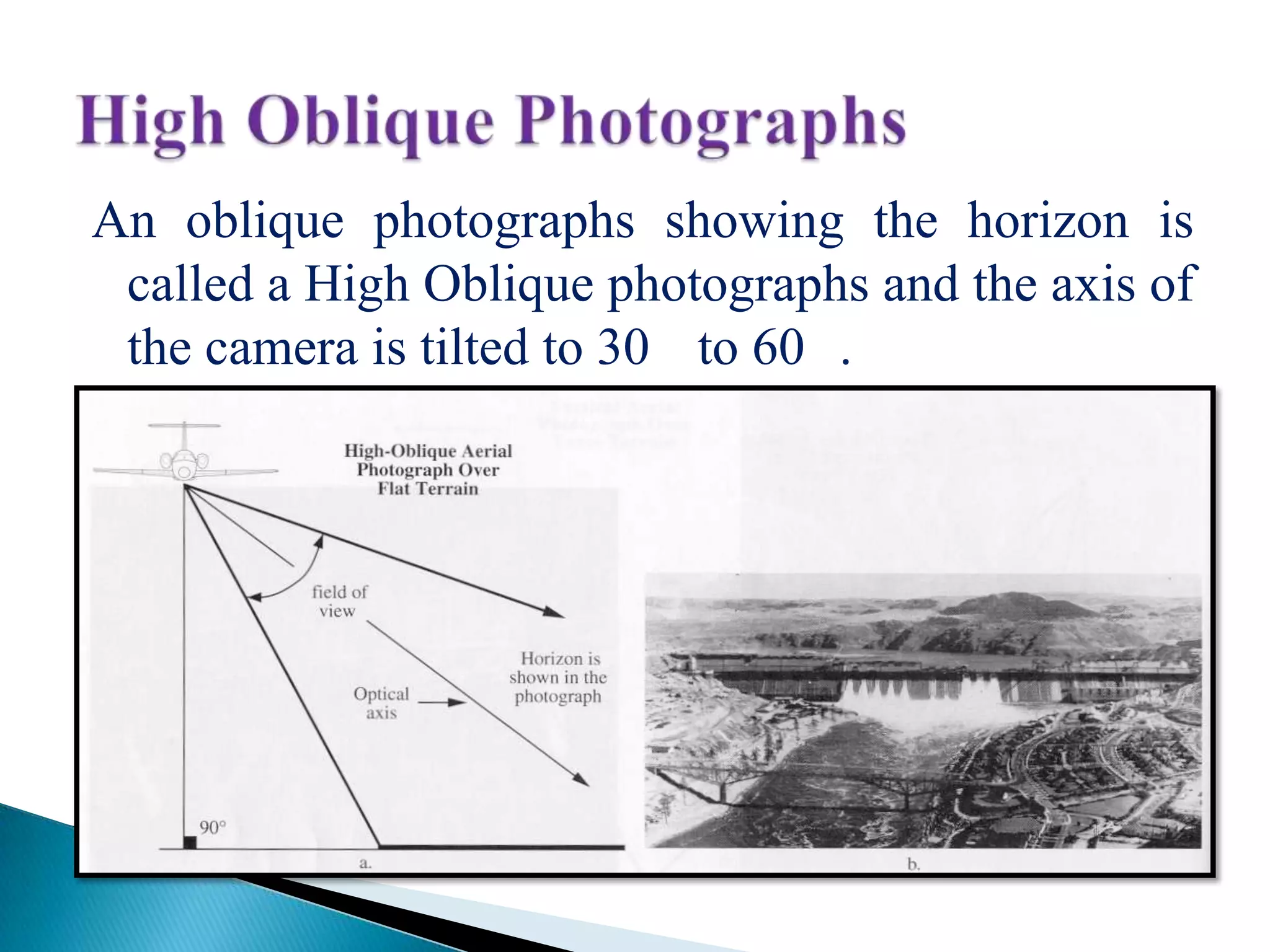
An oblique photographs showing the horizon is
called a High Oblique photographs and the axis of
the camera is tilted to 30 to 60 .
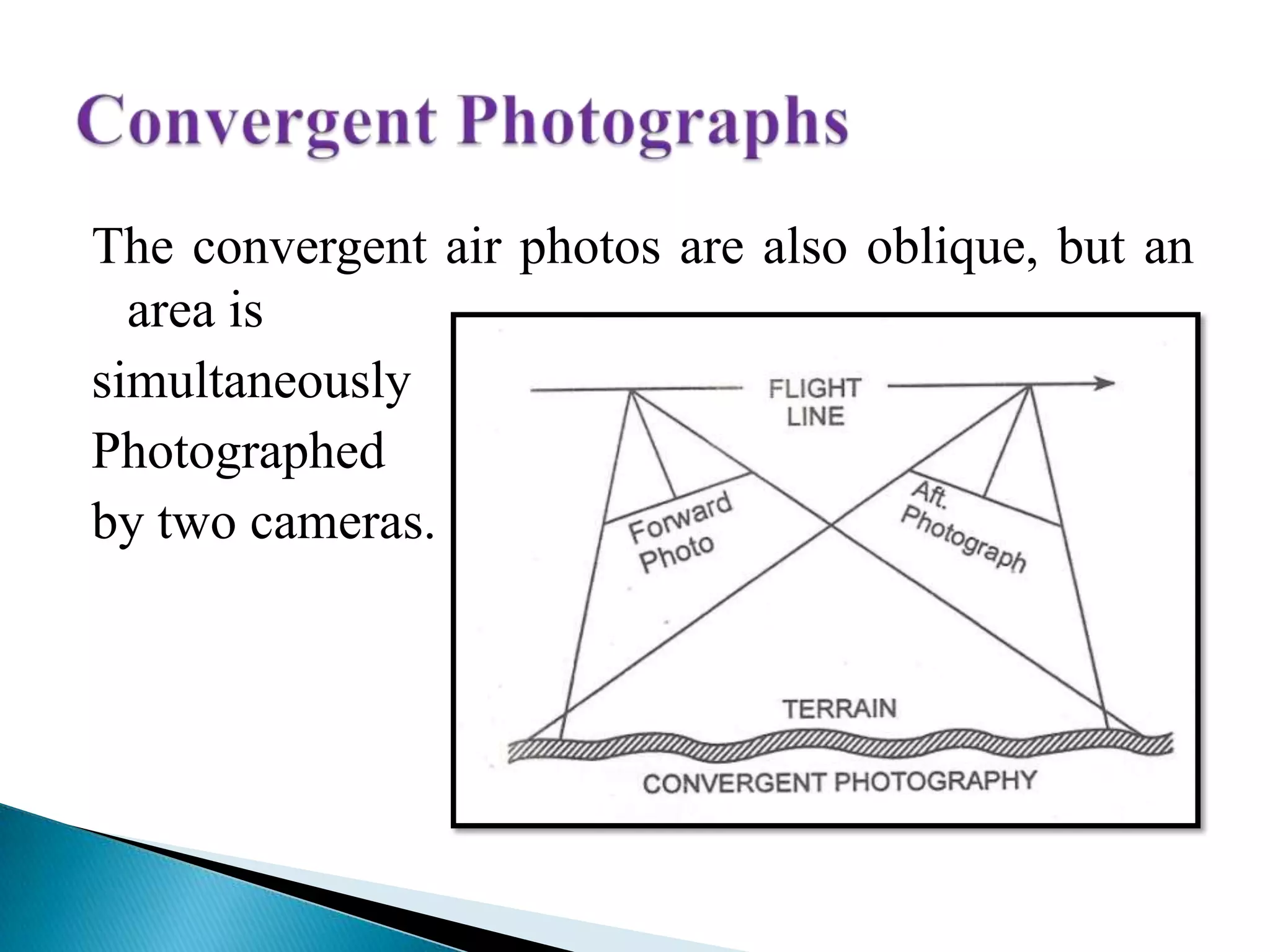
The convergent air photos are also oblique, but an
area is
simultaneously
Photographed
by two cameras.
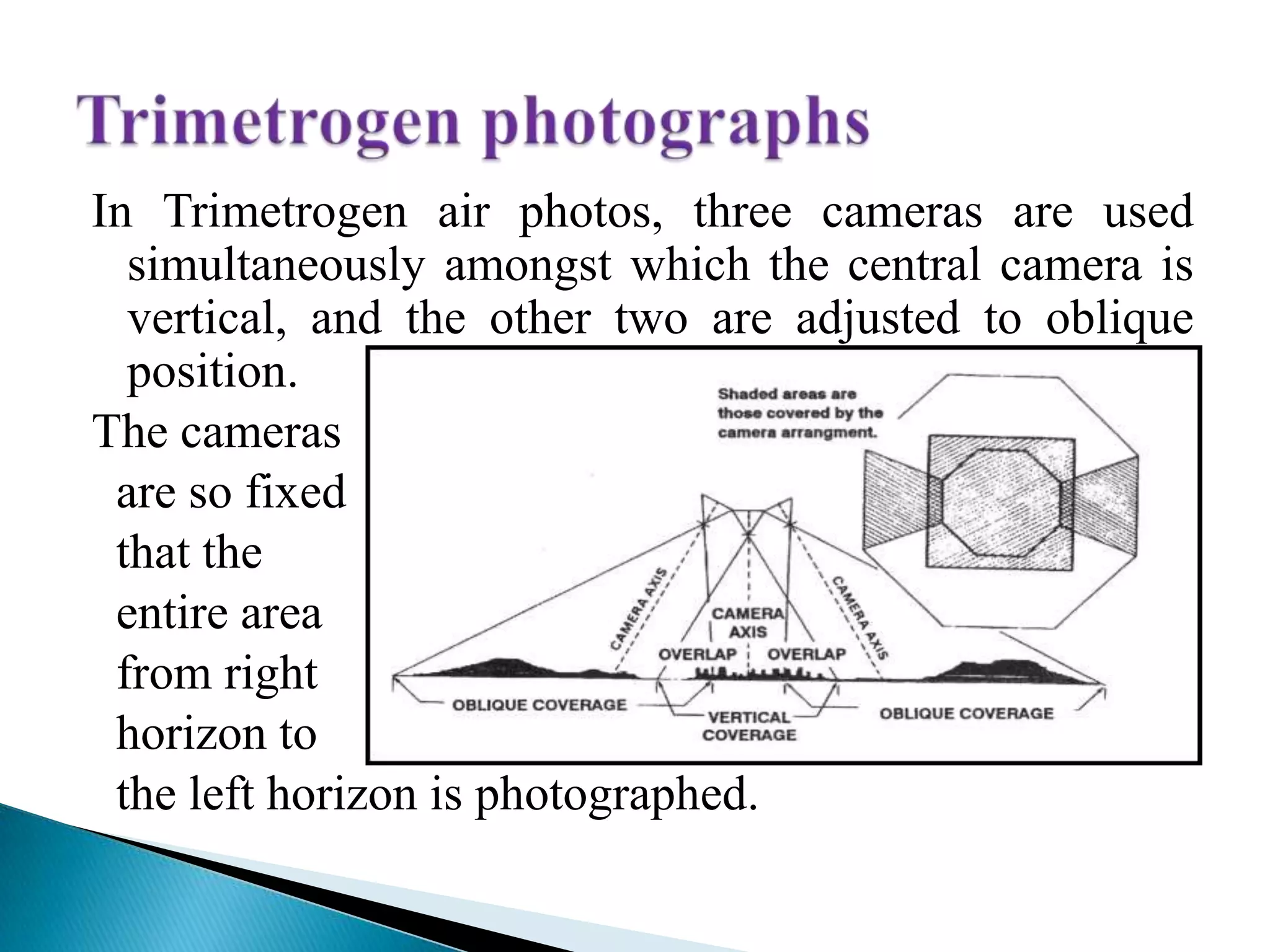
In Trimetrogen air photos, three cameras are used
simultaneously amongst which the central camera is
vertical, and the other two are adjusted to oblique
position.
The cameras
are so fixed
that the
entire area
from right
horizon to
the left horizon is photographed.
 On the basis of the angles of coverage and focal
length
The lenses used in the camera, are of the following
types according to the angles of coverage and the
focal length :
1. Narrow Angle < 60 - More Focal Length
2. Normal Angle 60 - 75
3. Wide Angle 75 - 100
4. Super wide Angle >100 - Low Focal Length.
 On the basis of the films used in the cameras.
On the basis of these category the air photos are
divided into three types such as :
1. Black and white.
2. Infra red (IR)
3. Colored
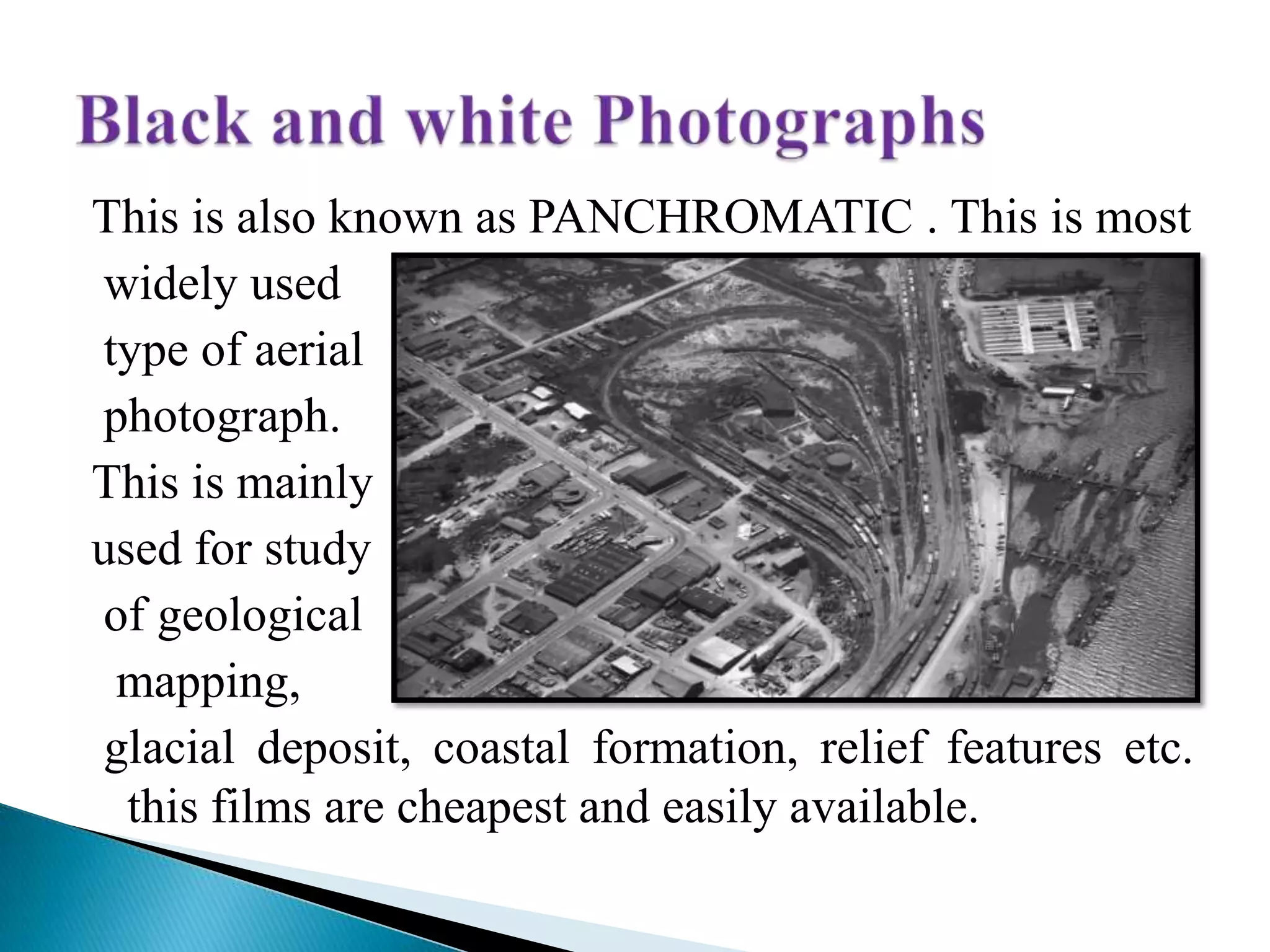
This is also known as PANCHROMATIC . This is most
widely used
type of aerial
photograph.
This is mainly
used for study
of geological
mapping,
glacial deposit, coastal formation, relief features etc.
this films are cheapest and easily available.
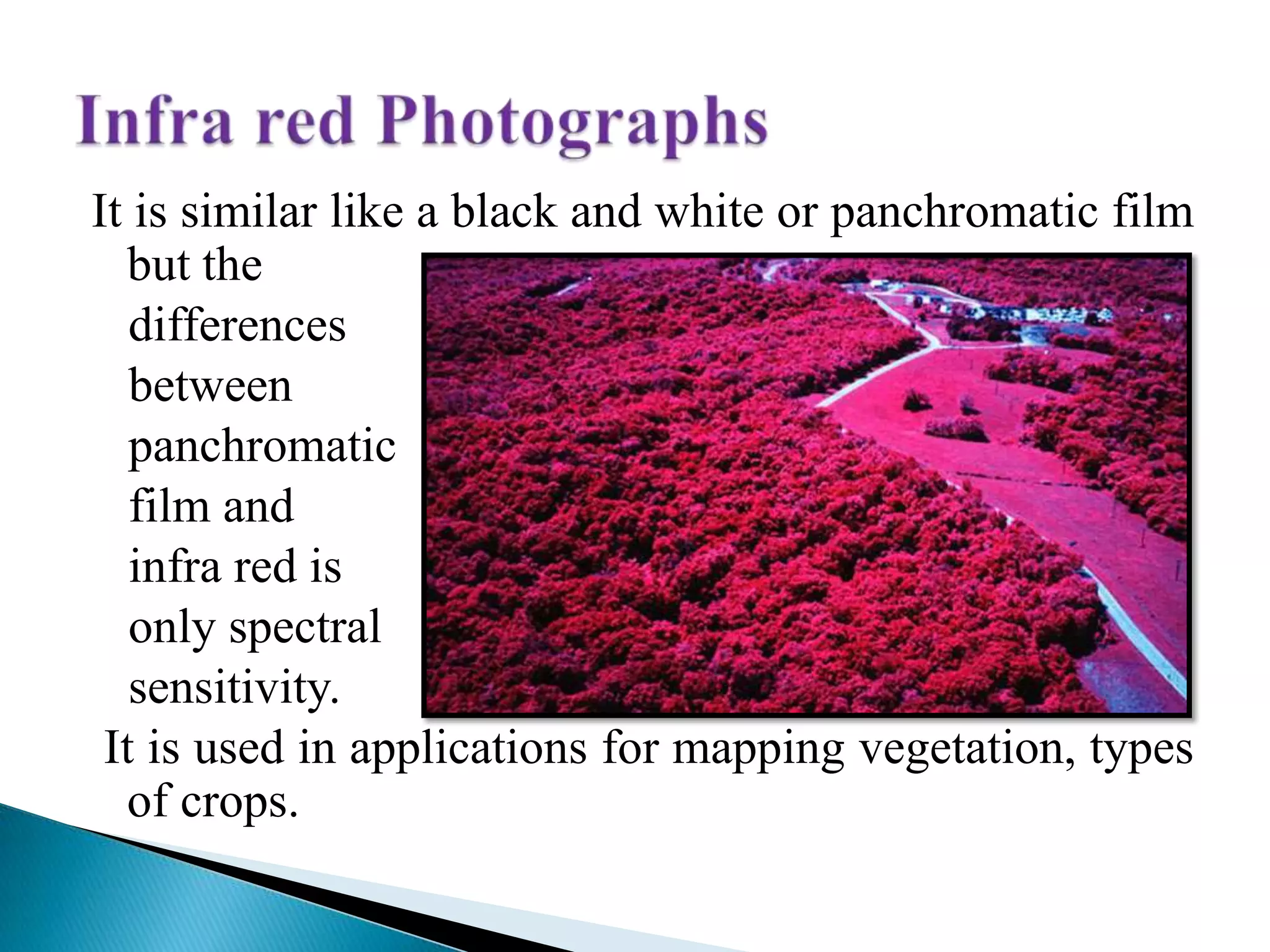
It is similar like a black and white or panchromatic film
but the
differences
between
panchromatic
film and
infra red is
only spectral
sensitivity.
It is used in applications for mapping vegetation, types
of crops.
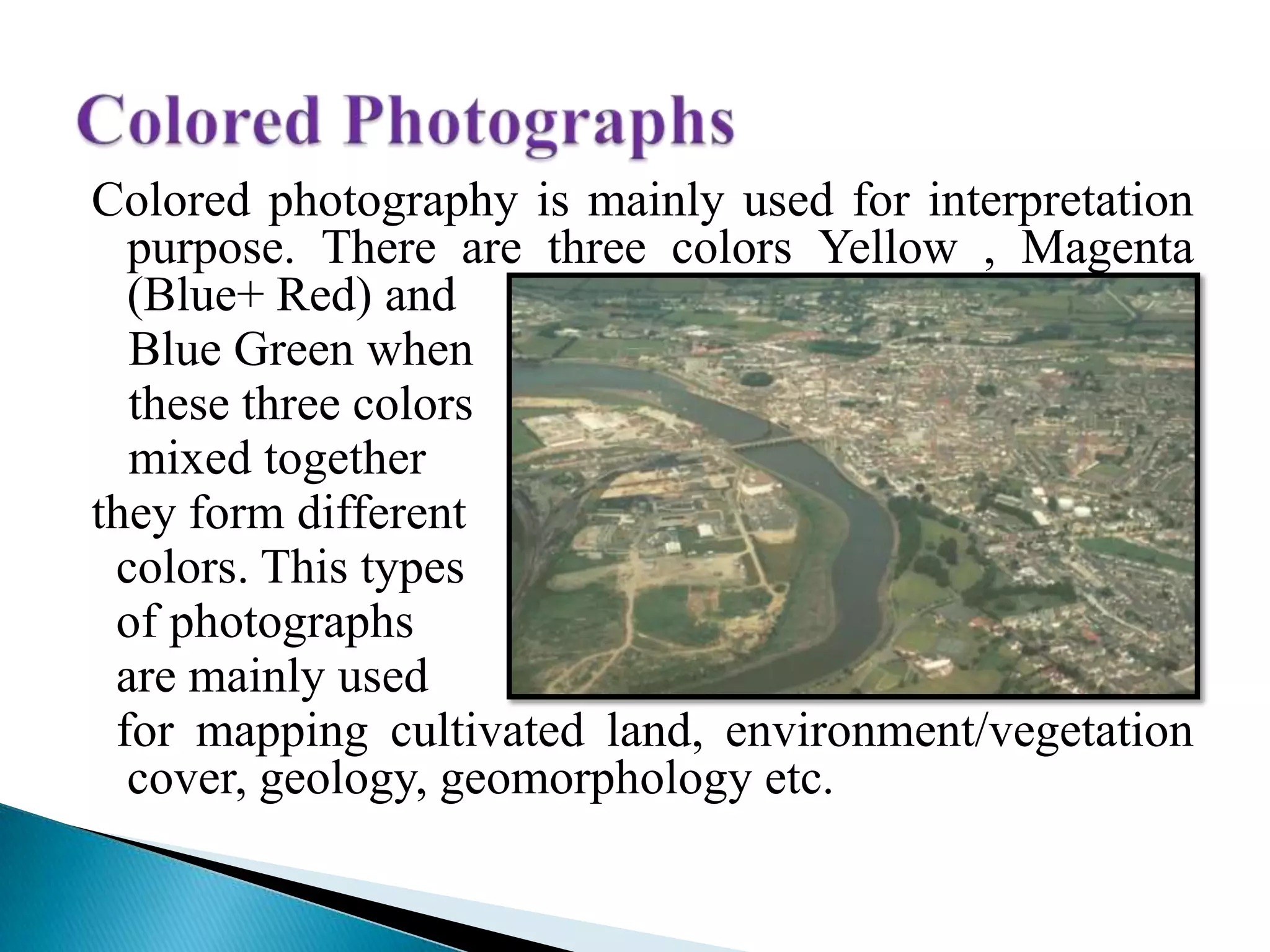
Colored photography is mainly used for interpretation
purpose. There are three colors Yellow , Magenta
(Blue+ Red) and
Blue Green when
these three colors
mixed together
they form different
colors. This types
of photographs
are mainly used
for mapping cultivated land, environment/vegetation
cover, geology, geomorphology etc.
o Rampal . K.K , Handbook of aerial
photography and interpretation.
o Lillesand Kiefer Chipman, Remote Sensing
and Image Interpretation
Geometry and types of aerial photographs

Geometry and types of aerial photographs

  • 3.
    The most importantgeometric properties of an aerial photograph are those of an angle and scale. Angle of Arial Photographs  The angle at which aerial photograph is taken is used to classify the photograph into one of three types viz. vertical, high oblique and low oblique.  Vertical photograph taken with a single lens is the most common type of aerial photography used in remote sensing applications.
  • 5.
     The verticalphotography is taken with the camera axis pointing vertically downwards.  Oblique photography is taken with the camera axis pointing obliquely downwards (intentional inclination of the camera axis).  High oblique photography incorporates an image of the horizon into the photographs while low oblique photographs do not.
  • 6.
     A ‘truly'vertical aerial photograph is rarely obtainable because of unavoidable angular rotations or tilts, caused by the angular attitude of the aircraft at the instant of exposure.  These unavoidable tilts cause slight (1 to 3 degrees ) unintentional inclination of the camera optical axis, resulting in the acquisition of tilted photographs .  Vertical photographs have properties similar to those of a map with a approximately constant scale over the whole photograph, and therefore can be used for mapping and measurements.
  • 7.
    Most vertical aerialphotographs are taken with frame cameras along flight line ,or flight strips. The line traced on the ground directly beneath the aircraft during acquisition of photography is called Nadir line. This line connects the image centers of the vertical photographs. Successive photographs are generally taken with some degree of Endlap. Not only dose this lapping ensure total coverage along a flight line, but an endlap of at least 50% is essential for total stereoscopic coverage of a project area.
  • 8.
    a: conditions duringexposure b: resulting photograph
  • 10.
    Light rays fromterrain objects are imaged in the plane of the film negative after intersecting at the camera lens exposure station, L. The negative is located behind the lens at a distance equal to the lens focal length, f. Assuming the size of a paper print positive (or film positive) is equal to that of the negative, positive image positions can be depicted diagrammatically in front of the lens in a plane located at a distance f. This rendition is appropriate in that most photo positives used for measurement purposes are contact printed, resulting in the geometric relationships shown.
  • 11.
    The x andy coordinate positions of image points are referenced with respect to axes formed by straight lines joining the opposite fiducial marks recorded on the positive. The x axis is arbitrarily assigned to the fiducial axis most nearly coincident with the line of flight and is taken as positive in the forward direction of flight. The positive y axis is located 90 counter- clockwise from the positive x axis. Because of the precision with the fiducial marks and the lens are placed in a metric camera, the photo coordinate origin, o, can be assumed to coincide exactly with the principal point, the intersection of the lens optical axis and the film plane.
  • 12.
    Images for terrainpoints A, B, C, D, and E appear geometrically reversed on the negative at a’, b’, c’, d’, and e’ and in proper geometric relationship on the positive at a, b, c, d, and e. Scale of Arial Photographs (Photographic Scale)  The scale of a photograph expresses the mathematical relationship between a distance measured on the photo and the corresponding distance measured on the ground.  A photograph scale is an expression that states one unit of distance on a photograph represents a specific number of units of actual ground distance.
  • 13.
     Scales maybe expressed as unit equivalents (1 mm = 25 m), representative fractions (1/25,000) or ratios (1: 25,000).  Unlike maps, which have a constant scale throughout, the aerial photographs have a range of scales that vary in proportion to the elevation of the terrain involved.  The most straight forward method for determining photo scale is to measure the corresponding photo and ground distances between any two points. The scale S is then computed as the ratio of the photo distance d to the ground distance D.  S = photo scale = photo distance/ground distance = d/D.
  • 14.
    The scale ofa photograph is determined by the focal length of the camera and the vertical height of the lens above the ground. The focal length (f) of the camera is the distance measured from the centre of the camera lens to the film. The vertical height of the lens above the ground (H-h) is the height of the lens above sea level (H), minus the height of the ground above see level (h), when the optical axis is vertical and the ground is flat. These parameters are related by formula S = f / (H h )
  • 16.
    The aerial photographscan be divided into :-  On the basis of the direction/ position of the axis of the camera  On the basis of the angles of coverage and focal length  On the basis of the films used in the cameras.
  • 17.
     On thebasis of the direction/ position of the axis of the camera : 1) Vertical 2) Horizontal 3) Oblique 4) Convergent 5) Trimetrogon
  • 18.
    The axis ofthe camera is vertically adjusted to take the photographs. The area covered through vertical air photos are often square in shape at the uniform plane. In simple words, These photographs are taken with an air borne camera aimed vertically downward from the plane.
  • 19.
    The horizontal airphotos are also known as Terrestrial air photos. In the production of such air photos, the axis of the camera is horizontal.
  • 20.
    In the obliqueair photos, the adjustment of the axis of the camera ranges from the vertical to angular position. The areas covered by oblique air photos assumed the shape of a trapezium. An oblique photograph is divided into two types:- 1. Low Oblique Photographs 2. High Oblique Photographs
  • 21.
    One which doesnot have the horizon showing is called a Low Oblique Photographs and the axis of the camera is 0 .
  • 22.
    An oblique photographsshowing the horizon is called a High Oblique photographs and the axis of the camera is tilted to 30 to 60 .
  • 23.
    The convergent airphotos are also oblique, but an area is simultaneously Photographed by two cameras.
  • 24.
    In Trimetrogen airphotos, three cameras are used simultaneously amongst which the central camera is vertical, and the other two are adjusted to oblique position. The cameras are so fixed that the entire area from right horizon to the left horizon is photographed.
  • 25.
     On thebasis of the angles of coverage and focal length The lenses used in the camera, are of the following types according to the angles of coverage and the focal length : 1. Narrow Angle < 60 - More Focal Length 2. Normal Angle 60 - 75 3. Wide Angle 75 - 100 4. Super wide Angle >100 - Low Focal Length.
  • 26.
     On thebasis of the films used in the cameras. On the basis of these category the air photos are divided into three types such as : 1. Black and white. 2. Infra red (IR) 3. Colored
  • 27.
    This is alsoknown as PANCHROMATIC . This is most widely used type of aerial photograph. This is mainly used for study of geological mapping, glacial deposit, coastal formation, relief features etc. this films are cheapest and easily available.
  • 28.
    It is similarlike a black and white or panchromatic film but the differences between panchromatic film and infra red is only spectral sensitivity. It is used in applications for mapping vegetation, types of crops.
  • 29.
    Colored photography ismainly used for interpretation purpose. There are three colors Yellow , Magenta (Blue+ Red) and Blue Green when these three colors mixed together they form different colors. This types of photographs are mainly used for mapping cultivated land, environment/vegetation cover, geology, geomorphology etc.
  • 30.
    o Rampal .K.K , Handbook of aerial photography and interpretation. o Lillesand Kiefer Chipman, Remote Sensing and Image Interpretation