P.Missier-2016
Diachronworkshoppanel
Big Data Quality Panel
Diachron Workshop @EDBT
Panta Rhei (Heraclitus, through Plato)
Paolo Missier
Newcastle University, UK
Bordeaux, March 2016
(*) Painting by Johannes Moreelse
(*)
P.Missier-2016
Diachronworkshoppanel
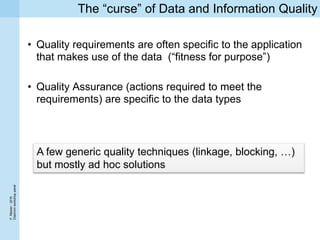
The “curse” of Data and Information Quality
• Quality requirements are often specific to the application
that makes use of the data (“fitness for purpose”)
• Quality Assurance (actions required to meet the
requirements) are specific to the data types
A few generic quality techniques (linkage, blocking, …)
but mostly ad hoc solutions
P.Missier-2016
Diachronworkshoppanel
V for “Veracity”?
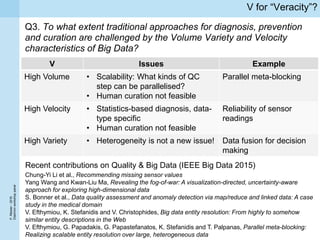
Q3. To what extent traditional approaches for diagnosis, prevention
and curation are challenged by the Volume Variety and Velocity
characteristics of Big Data?
V Issues Example
High Volume • Scalability: What kinds of QC
step can be parallelised?
• Human curation not feasible
Parallel meta-blocking
High Velocity • Statistics-based diagnosis, data-
type specific
• Human curation not feasible
Reliability of sensor
readings
High Variety • Heterogeneity is not a new issue! Data fusion for decision
making
Recent contributions on Quality & Big Data (IEEE Big Data 2015)
Chung-Yi Li et al., Recommending missing sensor values
Yang Wang and Kwan-Liu Ma, Revealing the fog-of-war: A visualization-directed, uncertainty-aware
approach for exploring high-dimensional data
S. Bonner et al., Data quality assessment and anomaly detection via map/reduce and linked data: A case
study in the medical domain
V. Efthymiou, K. Stefanidis and V. Christophides, Big data entity resolution: From highly to somehow
similar entity descriptions in the Web
V. Efthymiou, G. Papadakis, G. Papastefanatos, K. Stefanidis and T. Palpanas, Parallel meta-blocking:
Realizing scalable entity resolution over large, heterogeneous data
P.Missier-2016
Diachronworkshoppanel
Can we ignore quality issues?
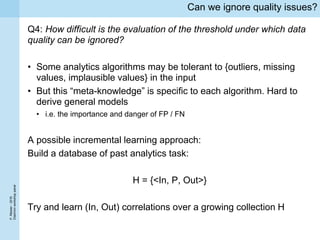
Q4: How difficult is the evaluation of the threshold under which data
quality can be ignored?
• Some analytics algorithms may be tolerant to {outliers, missing
values, implausible values} in the input
• But this “meta-knowledge” is specific to each algorithm. Hard to
derive general models
• i.e. the importance and danger of FP / FN
A possible incremental learning approach:
Build a database of past analytics task:
H = {<In, P, Out>}
Try and learn (In, Out) correlations over a growing collection H
P.Missier-2016
Diachronworkshoppanel
Data to Knowledge
Meta-knowledge
Big
Data
The Big
Analytics
Machine
Algorithms
Tools
Middleware
Reference
datasets
“Valuable
Knowledge”
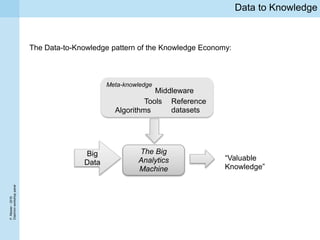
The Data-to-Knowledge pattern of the Knowledge Economy:
P.Missier-2016
Diachronworkshoppanel
The missing element: time
Big
Data
The Big
Analytics
Machine
“Valuable
Knowledge”
V3
V2
V1
Meta-knowledge
Algorithms
Tools
Middleware
Reference
datasets
t
t
t
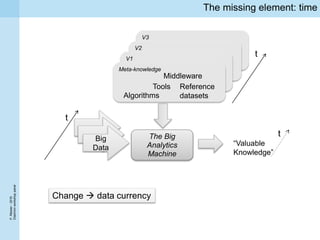
Change  data currency
P.Missier-2016
Diachronworkshoppanel
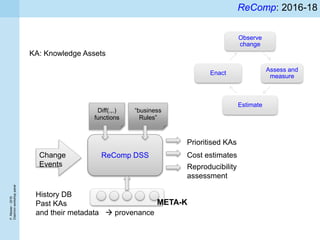
The ReComp decision support system
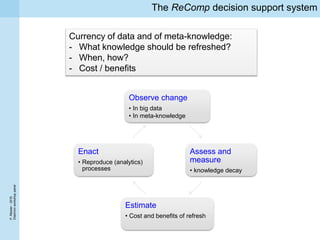
Observe change
• In big data
• In meta-knowledge
Assess and
measure
• knowledge decay
Estimate
• Cost and benefits of refresh
Enact
• Reproduce (analytics)
processes
Currency of data and of meta-knowledge:
- What knowledge should be refreshed?
- When, how?
- Cost / benefits
P.Missier-2016
Diachronworkshoppanel
ReComp: 2016-18
Change
Events
Diff(.,.)
functions
“business
Rules”
Prioritised KAs
Cost estimates
Reproducibility
assessment
ReComp DSS
History DB
Past KAs
and their metadata  provenance
Observe
change
Assess and
measure
Estimate
Enact
KA: Knowledge Assets
META-K
P.Missier-2016
Diachronworkshoppanel
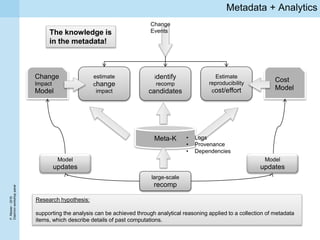
Metadata + Analytics
The knowledge is
in the metadata!
Research hypothesis:
supporting the analysis can be achieved through analytical reasoning applied to a collection of metadata
items, which describe details of past computations.
identify
recomp
candidates
large-scale
recomp
estimate
change
impact
Estimate
reproducibility
cost/effort
Change
Events
Change
Impact
Model
Cost
Model
Model
updates
Model
updates
Meta-K • Logs
• Provenance
• Dependencies

Big Data Quality Panel : Diachron Workshop @EDBT

  • 1.
    P.Missier-2016 Diachronworkshoppanel Big Data QualityPanel Diachron Workshop @EDBT Panta Rhei (Heraclitus, through Plato) Paolo Missier Newcastle University, UK Bordeaux, March 2016 (*) Painting by Johannes Moreelse (*)
  • 2.
    P.Missier-2016 Diachronworkshoppanel The “curse” ofData and Information Quality • Quality requirements are often specific to the application that makes use of the data (“fitness for purpose”) • Quality Assurance (actions required to meet the requirements) are specific to the data types A few generic quality techniques (linkage, blocking, …) but mostly ad hoc solutions
  • 3.
    P.Missier-2016 Diachronworkshoppanel V for “Veracity”? Q3.To what extent traditional approaches for diagnosis, prevention and curation are challenged by the Volume Variety and Velocity characteristics of Big Data? V Issues Example High Volume • Scalability: What kinds of QC step can be parallelised? • Human curation not feasible Parallel meta-blocking High Velocity • Statistics-based diagnosis, data- type specific • Human curation not feasible Reliability of sensor readings High Variety • Heterogeneity is not a new issue! Data fusion for decision making Recent contributions on Quality & Big Data (IEEE Big Data 2015) Chung-Yi Li et al., Recommending missing sensor values Yang Wang and Kwan-Liu Ma, Revealing the fog-of-war: A visualization-directed, uncertainty-aware approach for exploring high-dimensional data S. Bonner et al., Data quality assessment and anomaly detection via map/reduce and linked data: A case study in the medical domain V. Efthymiou, K. Stefanidis and V. Christophides, Big data entity resolution: From highly to somehow similar entity descriptions in the Web V. Efthymiou, G. Papadakis, G. Papastefanatos, K. Stefanidis and T. Palpanas, Parallel meta-blocking: Realizing scalable entity resolution over large, heterogeneous data
  • 4.
    P.Missier-2016 Diachronworkshoppanel Can we ignorequality issues? Q4: How difficult is the evaluation of the threshold under which data quality can be ignored? • Some analytics algorithms may be tolerant to {outliers, missing values, implausible values} in the input • But this “meta-knowledge” is specific to each algorithm. Hard to derive general models • i.e. the importance and danger of FP / FN A possible incremental learning approach: Build a database of past analytics task: H = {<In, P, Out>} Try and learn (In, Out) correlations over a growing collection H
  • 5.
    P.Missier-2016 Diachronworkshoppanel Data to Knowledge Meta-knowledge Big Data TheBig Analytics Machine Algorithms Tools Middleware Reference datasets “Valuable Knowledge” The Data-to-Knowledge pattern of the Knowledge Economy:
  • 6.
    P.Missier-2016 Diachronworkshoppanel The missing element:time Big Data The Big Analytics Machine “Valuable Knowledge” V3 V2 V1 Meta-knowledge Algorithms Tools Middleware Reference datasets t t t Change  data currency
  • 7.
    P.Missier-2016 Diachronworkshoppanel The ReComp decisionsupport system Observe change • In big data • In meta-knowledge Assess and measure • knowledge decay Estimate • Cost and benefits of refresh Enact • Reproduce (analytics) processes Currency of data and of meta-knowledge: - What knowledge should be refreshed? - When, how? - Cost / benefits
  • 8.
    P.Missier-2016 Diachronworkshoppanel ReComp: 2016-18 Change Events Diff(.,.) functions “business Rules” Prioritised KAs Costestimates Reproducibility assessment ReComp DSS History DB Past KAs and their metadata  provenance Observe change Assess and measure Estimate Enact KA: Knowledge Assets META-K
  • 9.
    P.Missier-2016 Diachronworkshoppanel Metadata + Analytics Theknowledge is in the metadata! Research hypothesis: supporting the analysis can be achieved through analytical reasoning applied to a collection of metadata items, which describe details of past computations. identify recomp candidates large-scale recomp estimate change impact Estimate reproducibility cost/effort Change Events Change Impact Model Cost Model Model updates Model updates Meta-K • Logs • Provenance • Dependencies

Editor's Notes

  • #2 The times they are a’changin
  • #10 Problem: this is “blind” and expensive. Can we do better?
  • #11 These items are partly collected automatically, and partly as manual annotations. They include: Logs of past executions, automatically collected, to be used for post hoc performance analysis and estimation of future resource requirements and thus costs (S1) ; Runtime provenance traces and prospective provenance. The former are automatically collected graphs of data dependencies, captured from the computation [11]. The latter are formal descriptions of the analytics process, obtained from the workflow specification, or more generally by manually annotating a script. Both are instrumental to understanding how the knowledge outcomes have changed and why (S5), as well as to estimate future re-computation effects. External data and system dependencies, process and data versions, and system requirements associated with the analytics process, which are used to understand whether it will be practically possible to re-compute the process.