Simple Variant Identification
under ReComp control
Jacek Cała, Paolo Missier
Newcastle University
School of Computing Science
Outline
• Motivation – many computational problems, especially Big Data and
NGS pipelines, face an output deprecation issue
• updates of input data and tools make current results obsolete
• Test case – Simple Variant Identification
• pipeline-like structure, “small-data” process
• easy to implement and experiment with
• Experiments
• 3 different approaches compared with the baseline, blind re-computation
• provide insight into what selective re-computation can/cannot achieve
• Conclusions
The heavyweight of NGS pipelines
• NGS resequencing pipelines are an important example of the Big Data
analytics problems
• Important:
• Are at the core of the genomic analysis
• Big Data:
• raw sequences for WES analysis are measured in 1-20 GB per patient
• for quality purposes patient samples are usually processed in cohorts of 20-40
or close to 1 TB per cohort
• time required to process a 24-sample cohort can easily exceed 2 CPUmonths
• WES is only a fraction of what the WGS analyses require
Tracing change in the NGS resequencing
• Although the skeleton of the pipeline remains fairly static, many
aspects of the NGS are changing continuously
• Changes occur at various points and aspects of the pipeline but are
mainly two-fold:
• new tools and improved versions of the existing tools used at various steps in
the pipeline
• new updated reference and annotation data
• It is challenging to assess the impact of these changes on the output
of the pipeline
• the cost of rerunning the pipeline for all or even a cohort of patients is very
high
ReComp
• Aims to find ways to:
• detect and measure impact of changes in the input data
• allow the computational process to be selectively re-executed
• minimise the cost (runtime, monetary) of the re-execution with the maximum
benefit for the user
• One of the first steps – to run a part of the NGS pipeline under the
ReComp and evaluate potential benefits
The Simple Variant Identification tool
• Can help classify variants into three categories: RED, GREEN, AMBER
• pathogenic, benign and unknown
• uses OMIM GeneMap to identify genes- and variants-in-scope
• uses NCBI ClinVar to classify variants pathogenicity
• The SVI can be attached at the very end of an NGS pipeline
• as a simple, short running process can serve as a test scenario for ReComp
• SVI –> a mini-pipeline
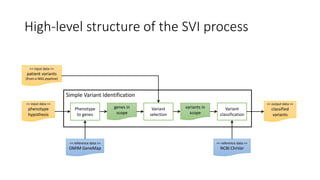
High-level structure of the SVI process
Phenotype
to genes
genes in
scope
Variant
selection
<< input data >>
patient variants
(from a NGS pipeline)
<< input data >>
phenotype
hypothesis
<< reference data >>
OMIM GeneMap
<< reference data >>
NCBI ClinVar
<< output data >>
classified
variants
variants in
scope
Variant
classification
Simple Variant Identification
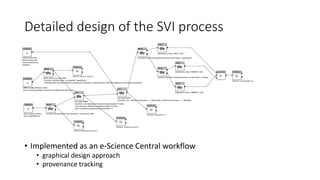
Detailed design of the SVI process
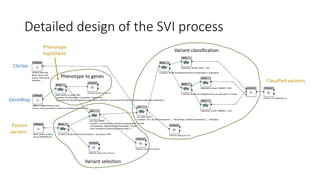
• Implemented as an e-Science Central workflow
• graphical design approach
• provenance tracking
Detailed design of the SVI process
Phenotype to genes
Variant selection
Variant classification
Patient
variants
GeneMap
ClinVar
Classified variants
Phenotype
hypothesis
Running SVI under ReComp
• A set of experiments designed to get insight into what and how
ReComp can help in process re-execution:
1. Blind re-computation
2. Partial re-computation
3. Partial re-computation using input difference
4. Partial re-computation with step-by-step impact analysis
• Experiments run on a set of 16 patients split by 4 different phenotype
hypotheses
• Tracking real changes in OMIM GeneMap and NCBI ClinVar
Experiments: Input data set
Phenotype hypothesis Variant file Variant count File size [MB]
Congenital myasthenic
syndrome
MUN0785 26508 35.5
MUN0789 26726 35.8
MUN0978 26921 35.8
MUN1000 27246 36.3
Parkinsons disease C0011 23940 38.8
C0059 24983 40.4
C0158 24376 39.4
C0176 24280 39.4
Creutzfeldt-Jakob disease A1340 23410 38.0
A1356 24801 40.2
A1362 24271 39.2
A1370 24051 38.9
Frontotemporal dementia -
Amyotrophic lateral sclerosis
B0307 24052 39.0
C0053 23980 38.8
C0171 24387 39.6
D1049 24473 39.5
Experiments: Reference data sets
• Different rate of changes:
• GeneMap changes daily
• ClinVar changes monthly
Database Version
Record
count
File size
[MB]
OMIM
GeneMap
2016-03-08 13053 2.2
2016-04-28 15871 2.7
2016-06-01 15897 2.7
2016-06-02 15897 2.7
2016-06-07 15910 2.7
NCBI ClinVar 2015-02 281023 96.7
2016-02 285041 96.6
2016-05 290815 96.1
Experiment 1: Establishing the baseline –
blind re-computation
• Simple re-execution of the SVI process evoked by changes in
reference data (either GeneMap or ClinVar)
• Involves the maximum cost related to the execution of the process
• Blind re-computation is the baseline for the ReComp evaluation
• we want to be more effective than that
Experiment 1: Results
• Running the SVI workflow on one patient sample takes about 17
minutes
• executed on a single-core VM
• may be optimised –> optimisation out-of-scope at the moment
• Runtime is consistent across different phenotypes
• Changes of the GeneMap and ClinVar version have negligible impact
on the execution time, e.g.:
Run time [mm:ss]
GeneMap version 2016-03-08 2016-04-28 2016-06-07
μ ± σ 17:05 ± 22 17:09 ± 15 17:10 ± 17
Experiment 1: Results
• 17 min per sample => the SVI implementation has capacity of only 84
samples per CPUcore per day
• May be inadequate considering the daily rate of change of GeneMap
• Our goal is to increase this capacity through smart/selective re-
computation
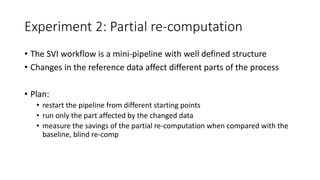
Experiment 2: Partial re-computation
• The SVI workflow is a mini-pipeline with well defined structure
• Changes in the reference data affect different parts of the process
• Plan:
• restart the pipeline from different starting points
• run only the part affected by the changed data
• measure the savings of the partial re-computation when compared with the
baseline, blind re-comp
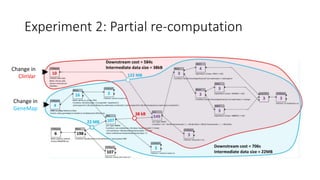
Experiment 2: Partial re-computation
Change in
ClinVar
Change in
GeneMap
Experiment 2: Results
• Running the part of SVI directly involved in
processing updated data can save some
runtime
• Savings depend on:
• the structure of the process
• the point where the changed data are used
• Savings involve the cost of retaining interim
data required in partial re-execution
• the size of the data depends on the
phenotype hypothesis and type of change
• the size is in range of 20–22 MB for GeneMap
changes and 2–334 kB for ClinVar changes
Run time
[mm:ss]
Savings Run time
[mm:ss]
Savings
GeneMap
version
2016-04-28 2016-06-07
μ ± σ 11:51 ± 16 31% 11:50 ± 20 31%
ClinVar
version
2016-02 2016-05
μ ± σ 9:51 ± 14 43% 9:50 ± 15 42%
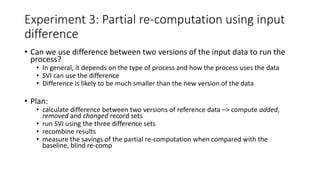
Experiment 3: Partial re-computation using input
difference
• Can we use difference between two versions of the input data to run the
process?
• In general, it depends on the type of process and how the process uses the data
• SVI can use the difference
• Difference is likely to be much smaller than the new version of the data
• Plan:
• calculate difference between two versions of reference data –> compute added,
removed and changed record sets
• run SVI using the three difference sets
• recombine results
• measure the savings of the partial re-computation when compared with the
baseline, blind re-comp
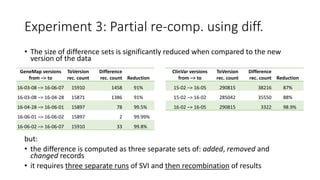
Experiment 3: Partial re-comp. using diff.
• The size of difference sets is significantly reduced when compared to the new
version of the data
but:
• the difference is computed as three separate sets of: added, removed and
changed records
• it requires three separate runs of SVI and then recombination of results
GeneMap versions
from –> to
ToVersion
rec. count
Difference
rec. count Reduction
16-03-08 –> 16-06-07 15910 1458 91%
16-03-08 –> 16-04-28 15871 1386 91%
16-04-28 –> 16-06-01 15897 78 99.5%
16-06-01 –> 16-06-02 15897 2 99.99%
16-06-02 –> 16-06-07 15910 33 99.8%
ClinVar versions
from –> to
ToVersion
rec. count
Difference
rec. count Reduction
15-02 –> 16-05 290815 38216 87%
15-02 –> 16-02 285042 35550 88%
16-02 –> 16-05 290815 3322 98.9%
Experiment 3: Results
• Running the part of SVI directly involved in
processing updated data can save some
runtime
• Running the part of SVI on each difference set
also saves some runtime
• Yet, the total cost of three separate re-
executions may exceed the savings
• Concluding, this approach has a few weak
points:
• running the process on diff. sets is not always
possible
• running the process using diff. sets requires
output recombination
• total runtime may sometimes exceed the
runtime of a regular update
Run time [mm:ss]
Added Removed Changed Total
GeneMap
change
11:30 ± 5 11:27 ± 11 11:36 ± 8 34:34 ± 16
ClinVar
change
2:29 ± 9 0:37 ± 7 0:44 ± 7 3:50 ± 22
Experiment 4: Partial re-computation with
step-by-step impact analysis
• Insight into the structure of the computational process
+Ability to calculate difference sets of various types of data
=> step-by-step re-execution
• Plan:
• compute changes in the intermediate data after each execution step
• stop re-computation when no changes have been detected
• measure the savings of the partial re-computation when compared with the
baseline, blind re-comp
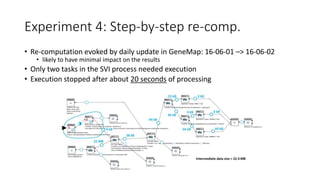
Experiment 4: Step-by-step re-comp.
• Re-computation evoked by daily update in GeneMap: 16-06-01 –> 16-06-02
• likely to have minimal impact on the results
• Only two tasks in the SVI process needed execution
• Execution stopped after about 20 seconds of processing
Experiment 4: Results
• The biggest savings in the runtime out of the three partial re-
computation scenarios
• the step-by-step re-computation was about 30x quicker than the complete re-
execution
• Requires tools to compute difference between various data types
• Incurs costs related to storing all intermediate data
• may be optimised by storing only intermediate data needed by long running
tasks
Conclusions
• Even simple processes like SVI can significantly benefit from selective re-
computation
• Insight into the structure of the pipeline opens a variety of options how re-
computation can be pursued
• NGS pipelines are very good candidates to optimise
• The key building blocks for successful re-computation:
• workflow-based design
• tracking data provenance
• access to intermediate data
• availability of tools to compute data difference sets

ReComp and the Variant Interpretations Case Study

  • 1.
    Simple Variant Identification underReComp control Jacek Cała, Paolo Missier Newcastle University School of Computing Science
  • 2.
    Outline • Motivation –many computational problems, especially Big Data and NGS pipelines, face an output deprecation issue • updates of input data and tools make current results obsolete • Test case – Simple Variant Identification • pipeline-like structure, “small-data” process • easy to implement and experiment with • Experiments • 3 different approaches compared with the baseline, blind re-computation • provide insight into what selective re-computation can/cannot achieve • Conclusions
  • 3.
    The heavyweight ofNGS pipelines • NGS resequencing pipelines are an important example of the Big Data analytics problems • Important: • Are at the core of the genomic analysis • Big Data: • raw sequences for WES analysis are measured in 1-20 GB per patient • for quality purposes patient samples are usually processed in cohorts of 20-40 or close to 1 TB per cohort • time required to process a 24-sample cohort can easily exceed 2 CPUmonths • WES is only a fraction of what the WGS analyses require
  • 4.
    Tracing change inthe NGS resequencing • Although the skeleton of the pipeline remains fairly static, many aspects of the NGS are changing continuously • Changes occur at various points and aspects of the pipeline but are mainly two-fold: • new tools and improved versions of the existing tools used at various steps in the pipeline • new updated reference and annotation data • It is challenging to assess the impact of these changes on the output of the pipeline • the cost of rerunning the pipeline for all or even a cohort of patients is very high
  • 5.
    ReComp • Aims tofind ways to: • detect and measure impact of changes in the input data • allow the computational process to be selectively re-executed • minimise the cost (runtime, monetary) of the re-execution with the maximum benefit for the user • One of the first steps – to run a part of the NGS pipeline under the ReComp and evaluate potential benefits
  • 6.
    The Simple VariantIdentification tool • Can help classify variants into three categories: RED, GREEN, AMBER • pathogenic, benign and unknown • uses OMIM GeneMap to identify genes- and variants-in-scope • uses NCBI ClinVar to classify variants pathogenicity • The SVI can be attached at the very end of an NGS pipeline • as a simple, short running process can serve as a test scenario for ReComp • SVI –> a mini-pipeline
  • 7.
    High-level structure ofthe SVI process Phenotype to genes genes in scope Variant selection << input data >> patient variants (from a NGS pipeline) << input data >> phenotype hypothesis << reference data >> OMIM GeneMap << reference data >> NCBI ClinVar << output data >> classified variants variants in scope Variant classification Simple Variant Identification
  • 8.
    Detailed design ofthe SVI process • Implemented as an e-Science Central workflow • graphical design approach • provenance tracking
  • 9.
    Detailed design ofthe SVI process Phenotype to genes Variant selection Variant classification Patient variants GeneMap ClinVar Classified variants Phenotype hypothesis
  • 10.
    Running SVI underReComp • A set of experiments designed to get insight into what and how ReComp can help in process re-execution: 1. Blind re-computation 2. Partial re-computation 3. Partial re-computation using input difference 4. Partial re-computation with step-by-step impact analysis • Experiments run on a set of 16 patients split by 4 different phenotype hypotheses • Tracking real changes in OMIM GeneMap and NCBI ClinVar
  • 11.
    Experiments: Input dataset Phenotype hypothesis Variant file Variant count File size [MB] Congenital myasthenic syndrome MUN0785 26508 35.5 MUN0789 26726 35.8 MUN0978 26921 35.8 MUN1000 27246 36.3 Parkinsons disease C0011 23940 38.8 C0059 24983 40.4 C0158 24376 39.4 C0176 24280 39.4 Creutzfeldt-Jakob disease A1340 23410 38.0 A1356 24801 40.2 A1362 24271 39.2 A1370 24051 38.9 Frontotemporal dementia - Amyotrophic lateral sclerosis B0307 24052 39.0 C0053 23980 38.8 C0171 24387 39.6 D1049 24473 39.5
  • 12.
    Experiments: Reference datasets • Different rate of changes: • GeneMap changes daily • ClinVar changes monthly Database Version Record count File size [MB] OMIM GeneMap 2016-03-08 13053 2.2 2016-04-28 15871 2.7 2016-06-01 15897 2.7 2016-06-02 15897 2.7 2016-06-07 15910 2.7 NCBI ClinVar 2015-02 281023 96.7 2016-02 285041 96.6 2016-05 290815 96.1
  • 13.
    Experiment 1: Establishingthe baseline – blind re-computation • Simple re-execution of the SVI process evoked by changes in reference data (either GeneMap or ClinVar) • Involves the maximum cost related to the execution of the process • Blind re-computation is the baseline for the ReComp evaluation • we want to be more effective than that
  • 14.
    Experiment 1: Results •Running the SVI workflow on one patient sample takes about 17 minutes • executed on a single-core VM • may be optimised –> optimisation out-of-scope at the moment • Runtime is consistent across different phenotypes • Changes of the GeneMap and ClinVar version have negligible impact on the execution time, e.g.: Run time [mm:ss] GeneMap version 2016-03-08 2016-04-28 2016-06-07 μ ± σ 17:05 ± 22 17:09 ± 15 17:10 ± 17
  • 15.
    Experiment 1: Results •17 min per sample => the SVI implementation has capacity of only 84 samples per CPUcore per day • May be inadequate considering the daily rate of change of GeneMap • Our goal is to increase this capacity through smart/selective re- computation
  • 16.
    Experiment 2: Partialre-computation • The SVI workflow is a mini-pipeline with well defined structure • Changes in the reference data affect different parts of the process • Plan: • restart the pipeline from different starting points • run only the part affected by the changed data • measure the savings of the partial re-computation when compared with the baseline, blind re-comp
  • 17.
    Experiment 2: Partialre-computation Change in ClinVar Change in GeneMap
  • 18.
    Experiment 2: Results •Running the part of SVI directly involved in processing updated data can save some runtime • Savings depend on: • the structure of the process • the point where the changed data are used • Savings involve the cost of retaining interim data required in partial re-execution • the size of the data depends on the phenotype hypothesis and type of change • the size is in range of 20–22 MB for GeneMap changes and 2–334 kB for ClinVar changes Run time [mm:ss] Savings Run time [mm:ss] Savings GeneMap version 2016-04-28 2016-06-07 μ ± σ 11:51 ± 16 31% 11:50 ± 20 31% ClinVar version 2016-02 2016-05 μ ± σ 9:51 ± 14 43% 9:50 ± 15 42%
  • 19.
    Experiment 3: Partialre-computation using input difference • Can we use difference between two versions of the input data to run the process? • In general, it depends on the type of process and how the process uses the data • SVI can use the difference • Difference is likely to be much smaller than the new version of the data • Plan: • calculate difference between two versions of reference data –> compute added, removed and changed record sets • run SVI using the three difference sets • recombine results • measure the savings of the partial re-computation when compared with the baseline, blind re-comp
  • 20.
    Experiment 3: Partialre-comp. using diff. • The size of difference sets is significantly reduced when compared to the new version of the data but: • the difference is computed as three separate sets of: added, removed and changed records • it requires three separate runs of SVI and then recombination of results GeneMap versions from –> to ToVersion rec. count Difference rec. count Reduction 16-03-08 –> 16-06-07 15910 1458 91% 16-03-08 –> 16-04-28 15871 1386 91% 16-04-28 –> 16-06-01 15897 78 99.5% 16-06-01 –> 16-06-02 15897 2 99.99% 16-06-02 –> 16-06-07 15910 33 99.8% ClinVar versions from –> to ToVersion rec. count Difference rec. count Reduction 15-02 –> 16-05 290815 38216 87% 15-02 –> 16-02 285042 35550 88% 16-02 –> 16-05 290815 3322 98.9%
  • 21.
    Experiment 3: Results •Running the part of SVI directly involved in processing updated data can save some runtime • Running the part of SVI on each difference set also saves some runtime • Yet, the total cost of three separate re- executions may exceed the savings • Concluding, this approach has a few weak points: • running the process on diff. sets is not always possible • running the process using diff. sets requires output recombination • total runtime may sometimes exceed the runtime of a regular update Run time [mm:ss] Added Removed Changed Total GeneMap change 11:30 ± 5 11:27 ± 11 11:36 ± 8 34:34 ± 16 ClinVar change 2:29 ± 9 0:37 ± 7 0:44 ± 7 3:50 ± 22
  • 22.
    Experiment 4: Partialre-computation with step-by-step impact analysis • Insight into the structure of the computational process +Ability to calculate difference sets of various types of data => step-by-step re-execution • Plan: • compute changes in the intermediate data after each execution step • stop re-computation when no changes have been detected • measure the savings of the partial re-computation when compared with the baseline, blind re-comp
  • 23.
    Experiment 4: Step-by-stepre-comp. • Re-computation evoked by daily update in GeneMap: 16-06-01 –> 16-06-02 • likely to have minimal impact on the results • Only two tasks in the SVI process needed execution • Execution stopped after about 20 seconds of processing
  • 24.
    Experiment 4: Results •The biggest savings in the runtime out of the three partial re- computation scenarios • the step-by-step re-computation was about 30x quicker than the complete re- execution • Requires tools to compute difference between various data types • Incurs costs related to storing all intermediate data • may be optimised by storing only intermediate data needed by long running tasks
  • 25.
    Conclusions • Even simpleprocesses like SVI can significantly benefit from selective re- computation • Insight into the structure of the pipeline opens a variety of options how re- computation can be pursued • NGS pipelines are very good candidates to optimise • The key building blocks for successful re-computation: • workflow-based design • tracking data provenance • access to intermediate data • availability of tools to compute data difference sets