1
Introduction to ARM-7
The first encounter
Dr. P. H. Zope
Assistant Professor
SSBT’s COET Bambhori Jalgaon
North Maharashtra University Jalgaon India
phzope@gmail.com
9860631040
2
What Is ARM?
• Advanced RISC Machine
• First RISC microprocessor for commercial use
• Market-leader for low-power and cost-
sensitive embedded applications
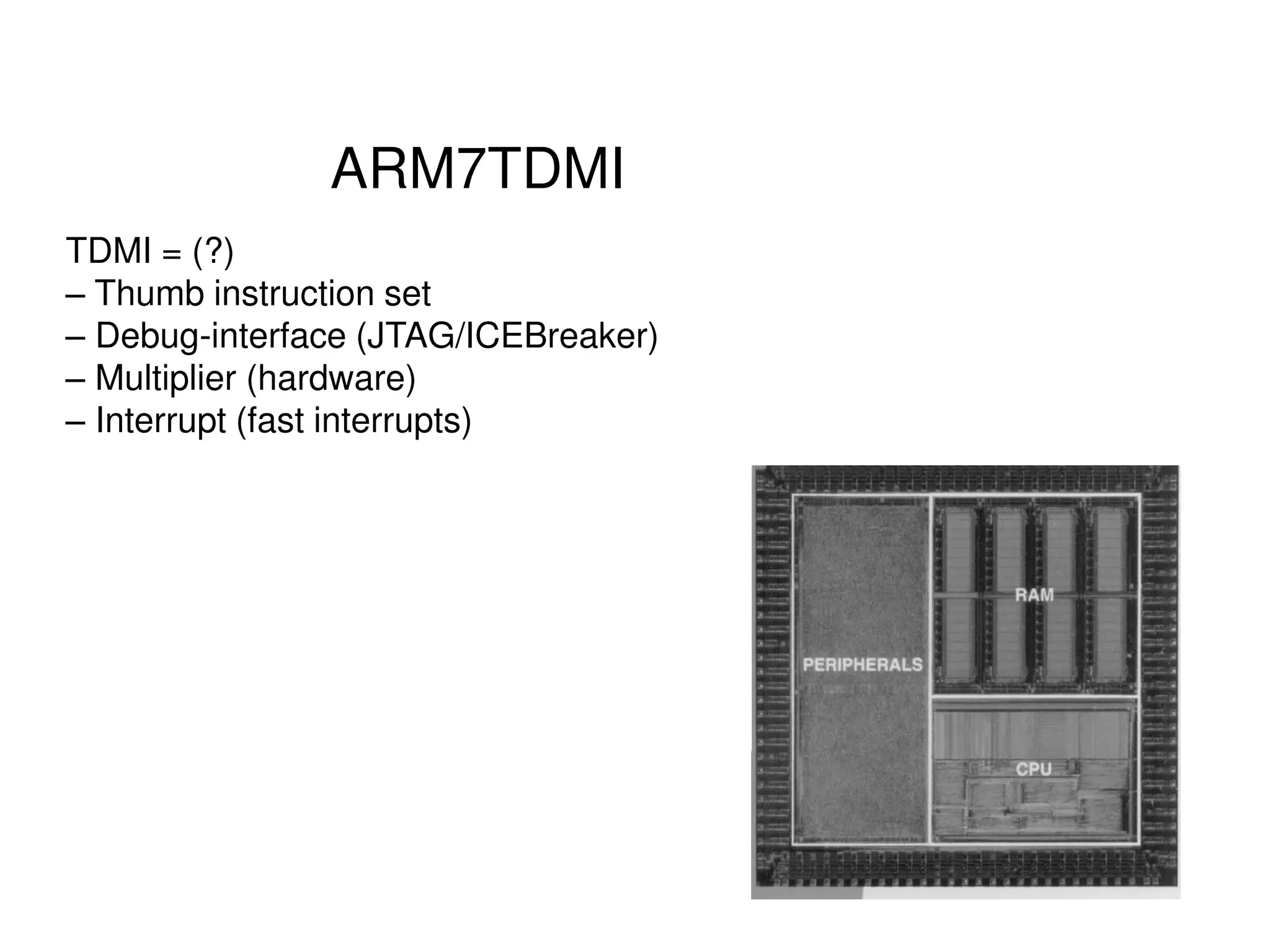
ARM7TDMI
TDMI = (?)
– Thumb instruction set
– Debug-interface (JTAG/ICEBreaker)
– Multiplier (hardware)
– Interrupt (fast interrupts)
•32/16-bit RISC architecture ( ARM v4T )
•32-bit ARM instruction set for maximum performance and flexibility
•16-bit Thumb instruction set for increased code density
•Unified bus interface, 32-bit data bus carries both instructions and data
•8-, 16-, and 32-bit Data Types
•Three-stage pipeline
•4GBytes Linear Address Space
•32-bit ALU and high-performance multiplier
•37 piece of 32 bit register
•Very small die size and low power consumption
•Fully static operation
•Coprocessor interface
•Extensive debug facilities:
Embedded ICE-RT real-time debug unit.
On-chip JTAG interface unit.
•Interface for direct connection to Embedded Trace Macro cell (ETM).
ARM7/ARM9 Architecture Feature Highlights
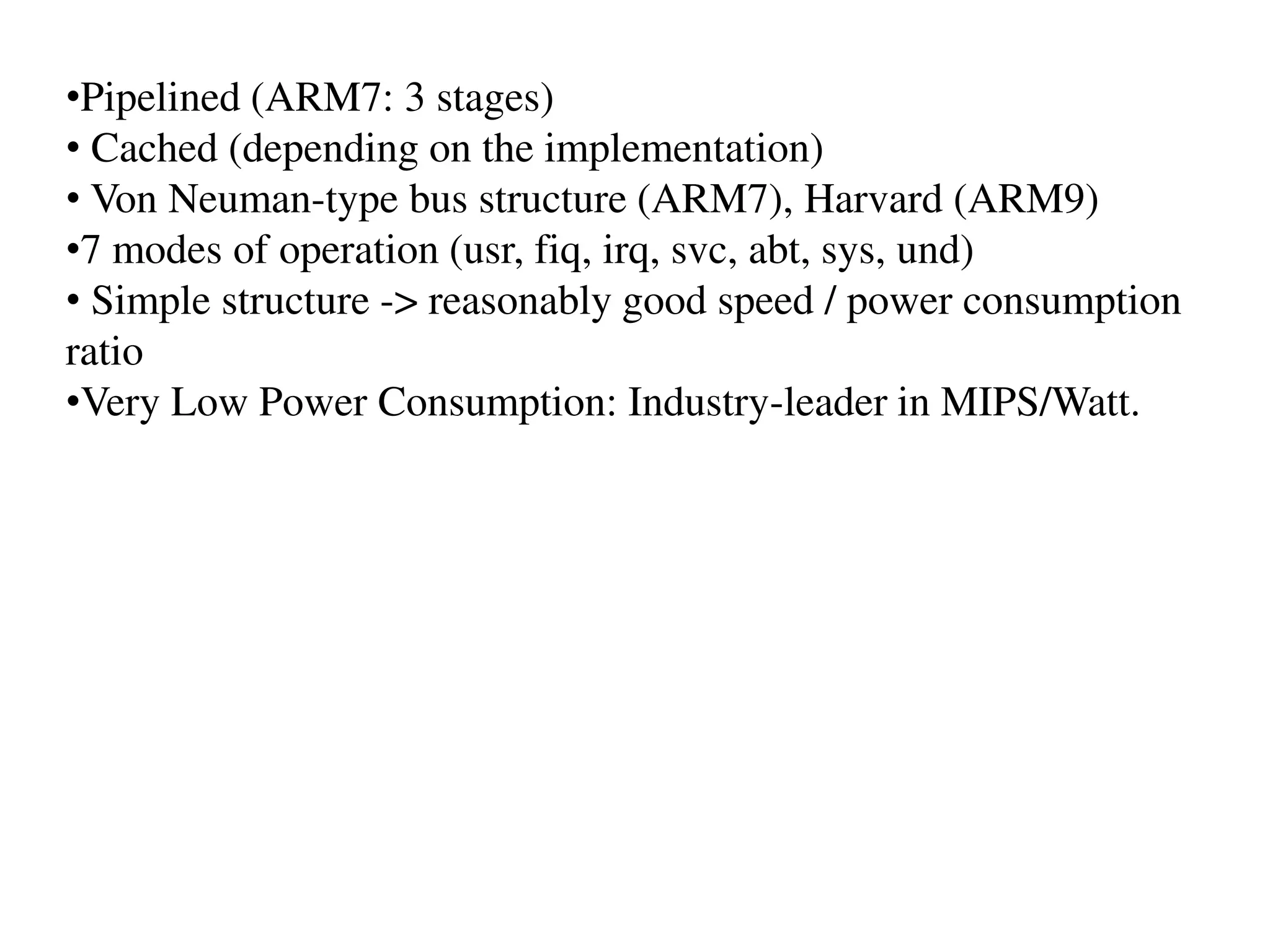
•Pipelined (ARM7: 3 stages)
• Cached (depending on the implementation)
• Von Neuman-type bus structure (ARM7), Harvard (ARM9)
•7 modes of operation (usr, fiq, irq, svc, abt, sys, und)
• Simple structure -> reasonably good speed / power consumption
ratio
•Very Low Power Consumption: Industry-leader in MIPS/Watt.
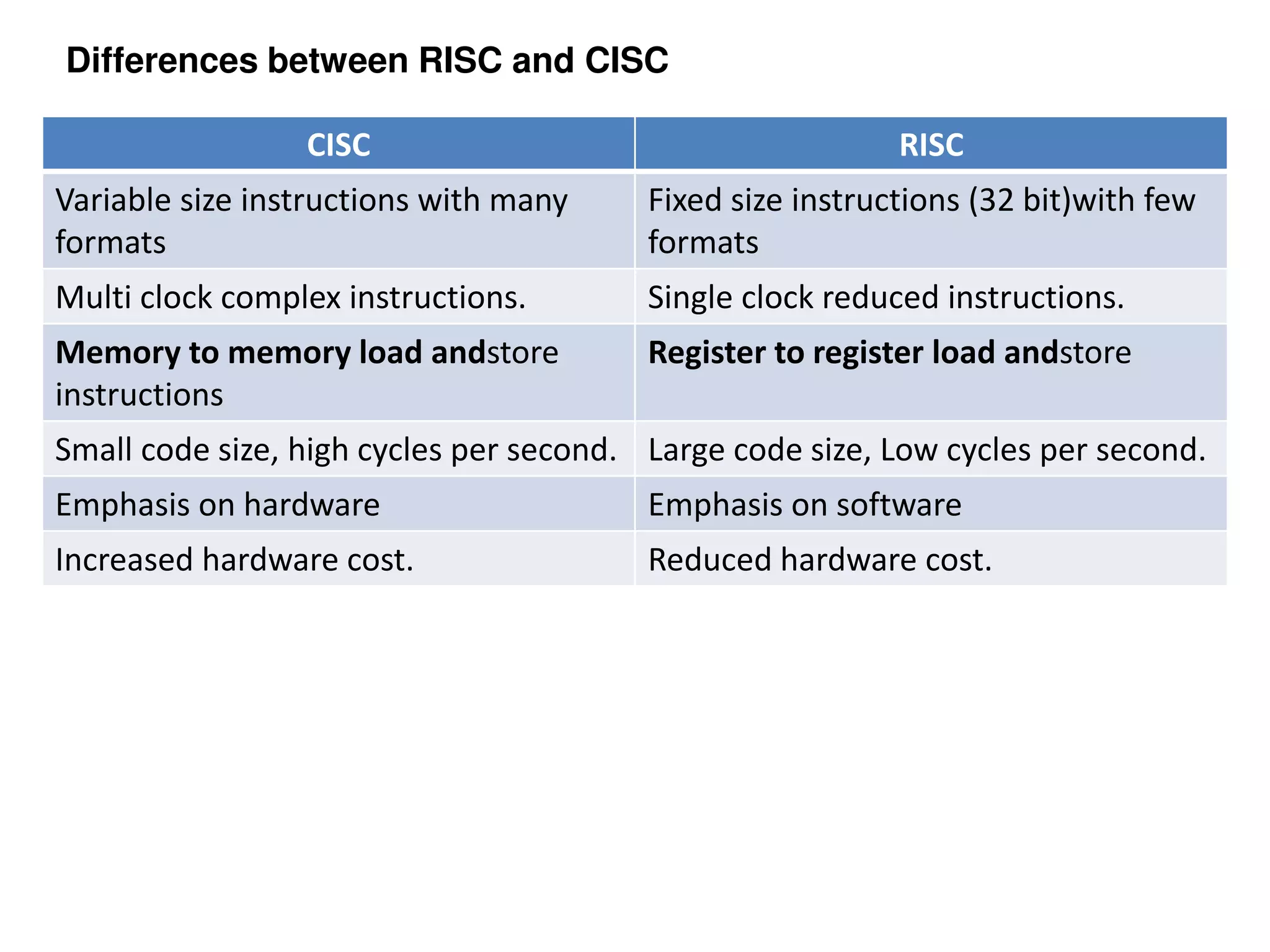
Differences between RISC and CISC
CISC RISC
Variable size instructions with many
formats
Fixed size instructions (32 bit)with few
formats
Multi clock complex instructions. Single clock reduced instructions.
Memory to memory load andstore
instructions
Register to register load andstore
Small code size, high cycles per second. Large code size, Low cycles per second.
Emphasis on hardware Emphasis on software
Increased hardware cost. Reduced hardware cost.
7
ARM Powered Products
8
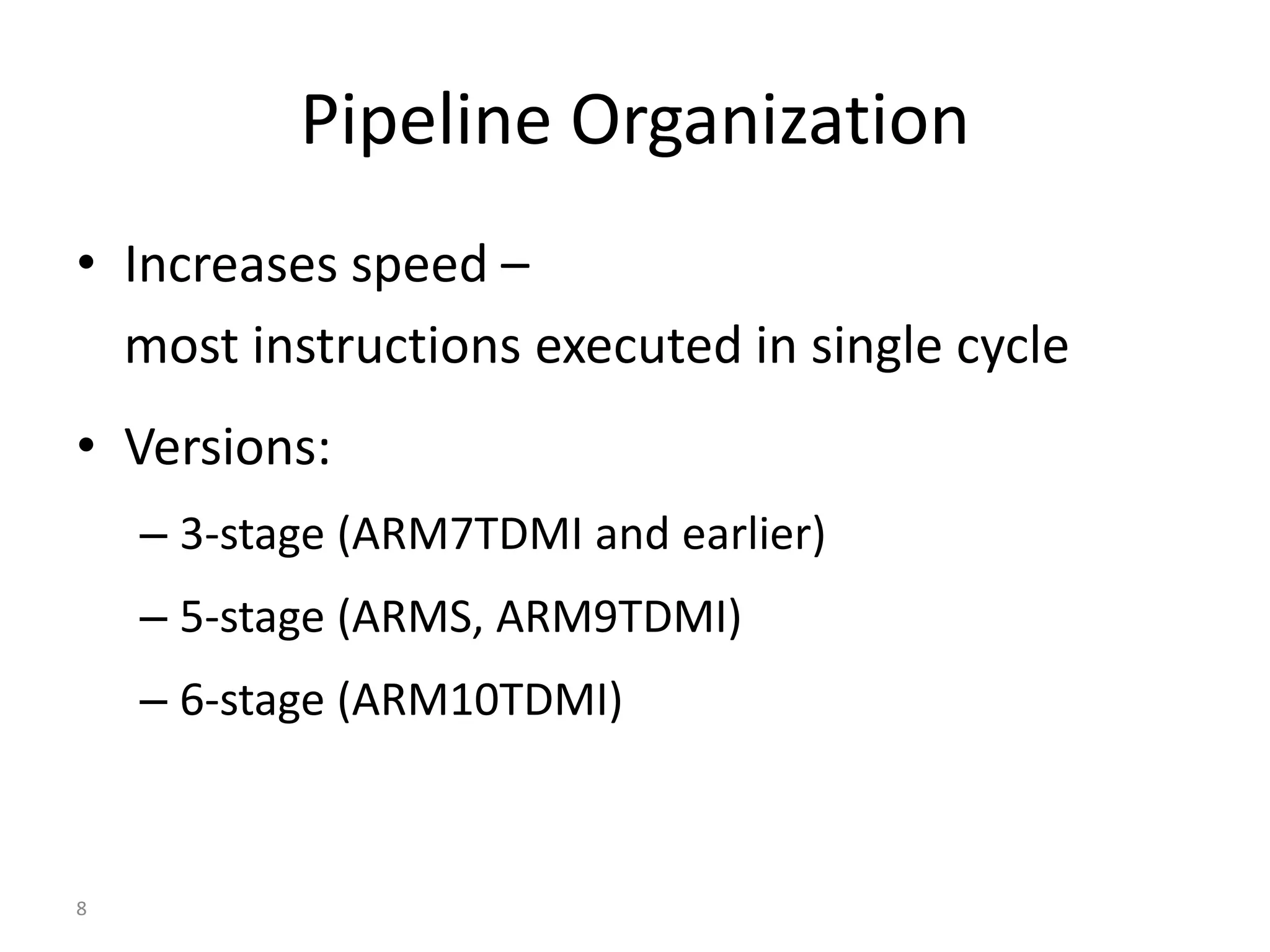
Pipeline Organization
• Increases speed –
most instructions executed in single cycle
• Versions:
– 3-stage (ARM7TDMI and earlier)
– 5-stage (ARMS, ARM9TDMI)
– 6-stage (ARM10TDMI)
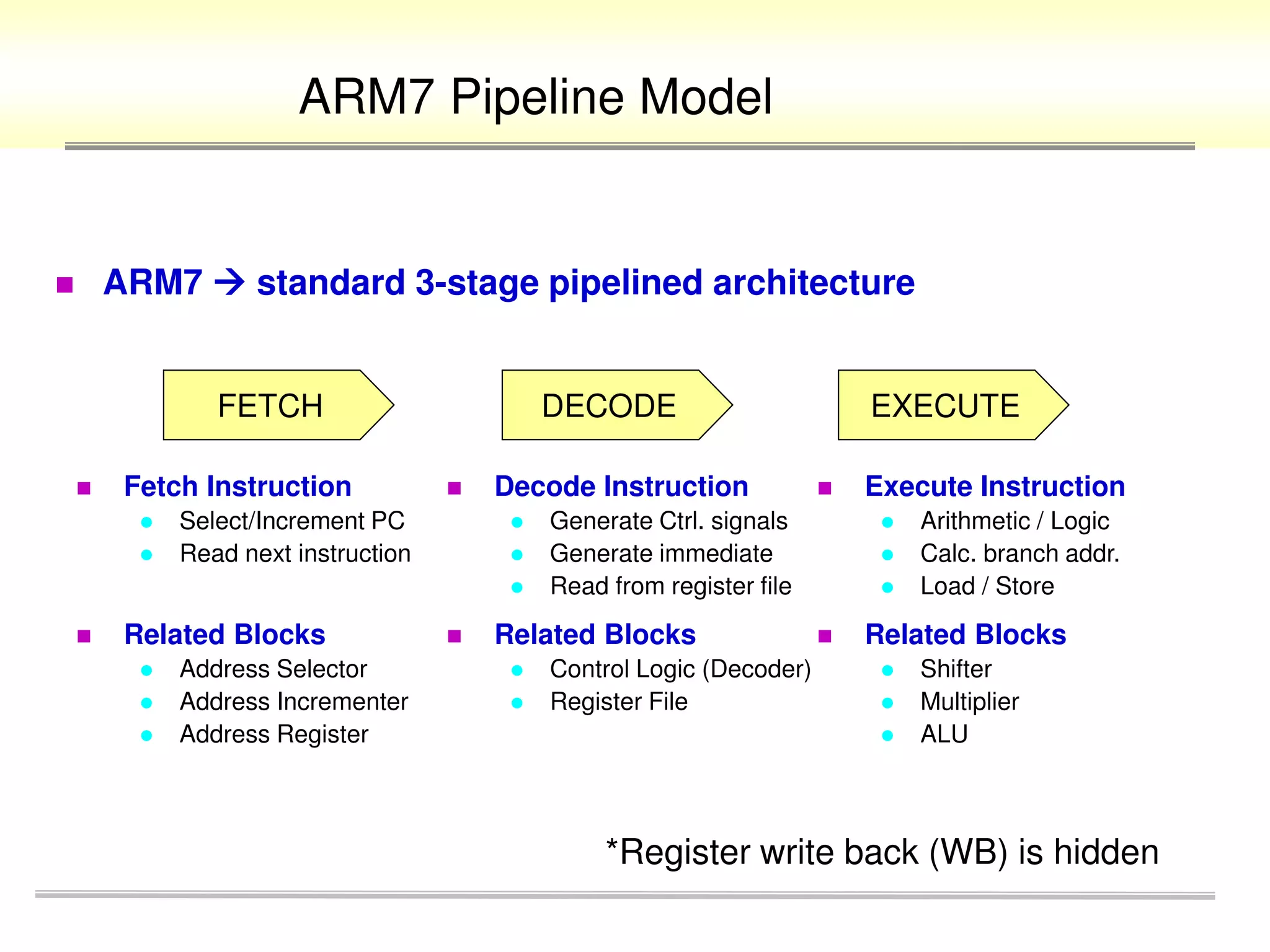
ARM7 Pipeline Model
 ARM7  standard 3-stage pipelined architecture
FETCH DECODE EXECUTE
 Fetch Instruction
 Select/Increment PC
 Read next instruction
 Related Blocks
 Address Selector
 Address Incrementer
 Address Register
 Decode Instruction
 Generate Ctrl. signals
 Generate immediate
 Read from register file
 Related Blocks
 Control Logic (Decoder)
 Register File
 Execute Instruction
 Arithmetic / Logic
 Calc. branch addr.
 Load / Store
 Related Blocks
 Shifter
 Multiplier
 ALU
*Register write back (WB) is hidden
10
Pipeline Organization
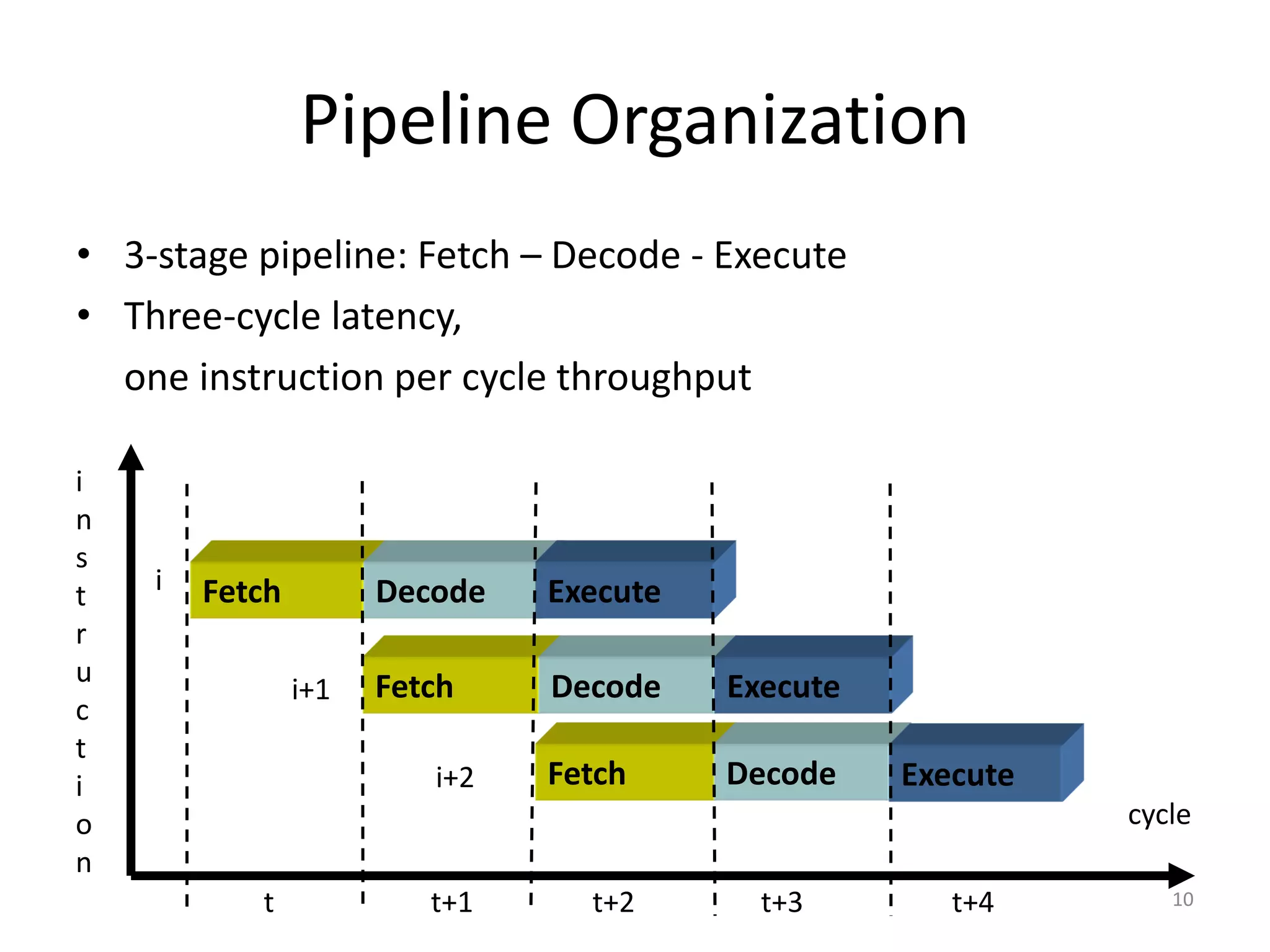
• 3-stage pipeline: Fetch – Decode - Execute
• Three-cycle latency,
one instruction per cycle throughput
cycle
Fetch Decode Execute
i
n
s
t
r
u
c
t
i
o
n
t t+1 t+2 t+3 t+4
i
i+1
i+2
11
Pipeline Organization
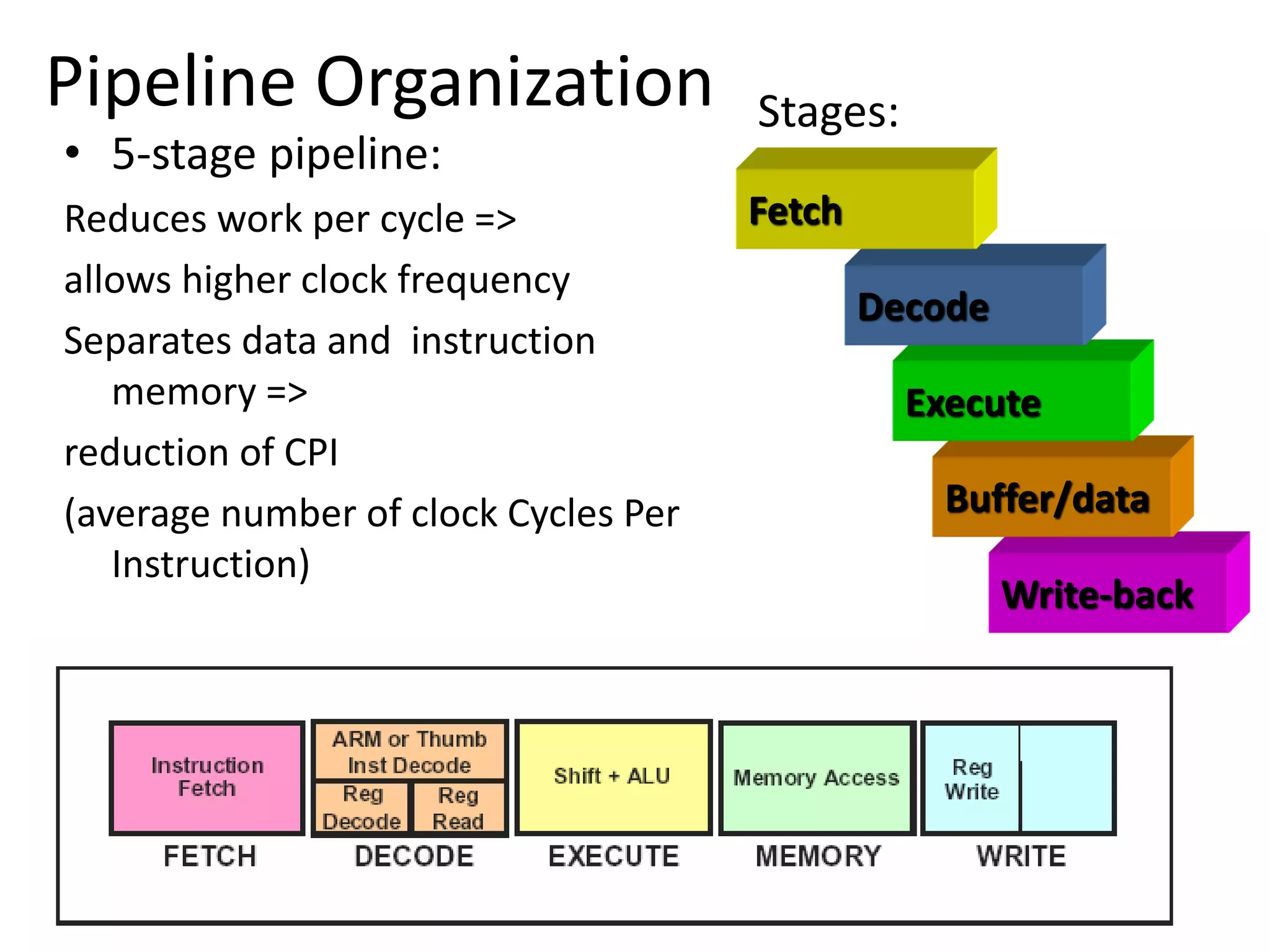
• 5-stage pipeline:
Reduces work per cycle =>
allows higher clock frequency
Separates data and instruction
memory =>
reduction of CPI
(average number of clock Cycles Per
Instruction)
Stages:
Write-back
Buffer/data
Execute
Decode
Fetch
12
Pipeline Organization
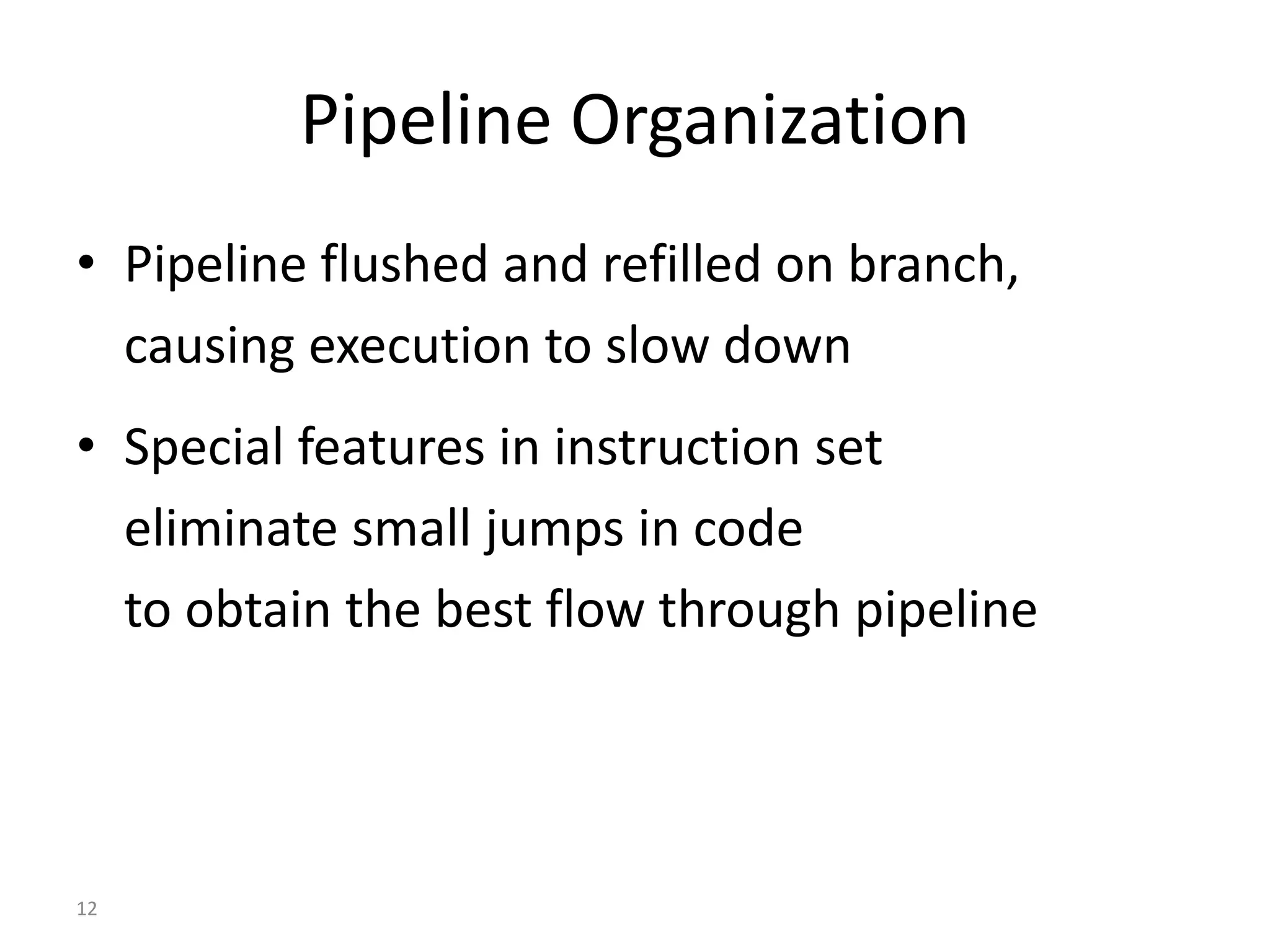
• Pipeline flushed and refilled on branch,
causing execution to slow down
• Special features in instruction set
eliminate small jumps in code
to obtain the best flow through pipeline
ARM-7 Architecture
14
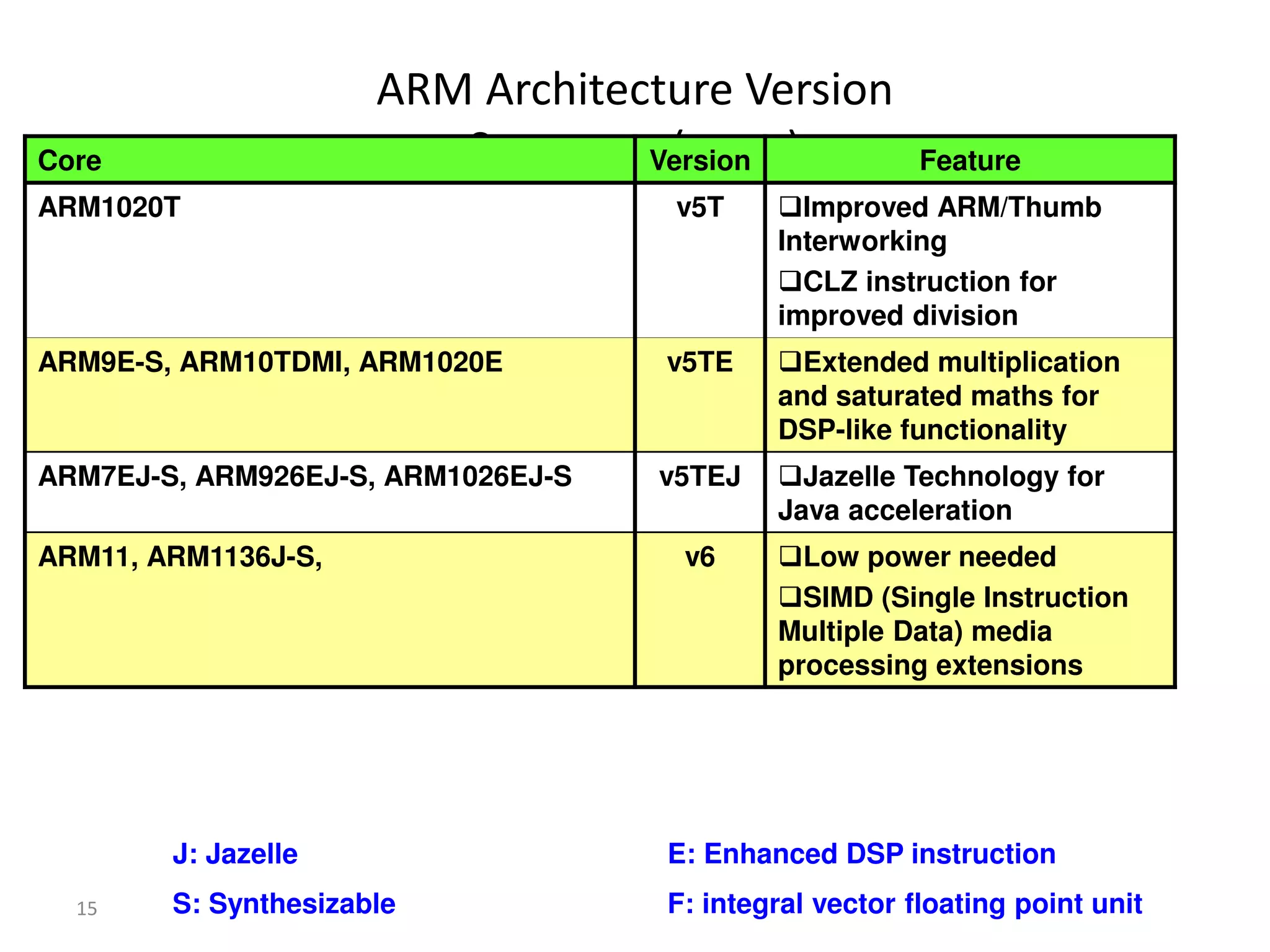
ARM Architecture Version Summary
Core Version Feature
ARM1 v1 26 bit address
ARM2, ARM2as, ARM3 v2 32 bit multiply
coprocessor
ARM6, ARM60, ARM610,
ARM7, ARM710,
ARM7D, ARM7DI
v3 32 bit addresses
Separate PC and PSRs
Undefined instruction and
Abort modes
Fully static
Big or little endian
StrongARM, SA-110, SA-1100
ARM8, ARM810
v4 Half word and signed
halfword/byte support
Enhanced multiplier
System mode
ARM7TDMI, ARM710T, ARM720T, ARM740T
ARM9TDMI, ARM920T, ARM940T
v4T Thumb instruction set
T: Thumb instruction set
M: enhanced Multiplier
D: On-chip Debug
I: Embedded ICE Logic
15
ARM Architecture Version
Summary (cont.)Core Version Feature
ARM1020T v5T Improved ARM/Thumb
Interworking
CLZ instruction for
improved division
ARM9E-S, ARM10TDMI, ARM1020E v5TE Extended multiplication
and saturated maths for
DSP-like functionality
ARM7EJ-S, ARM926EJ-S, ARM1026EJ-S v5TEJ Jazelle Technology for
Java acceleration
ARM11, ARM1136J-S, v6 Low power needed
SIMD (Single Instruction
Multiple Data) media
processing extensions
J: Jazelle
S: Synthesizable F: integral vector floating point unit
E: Enhanced DSP instruction
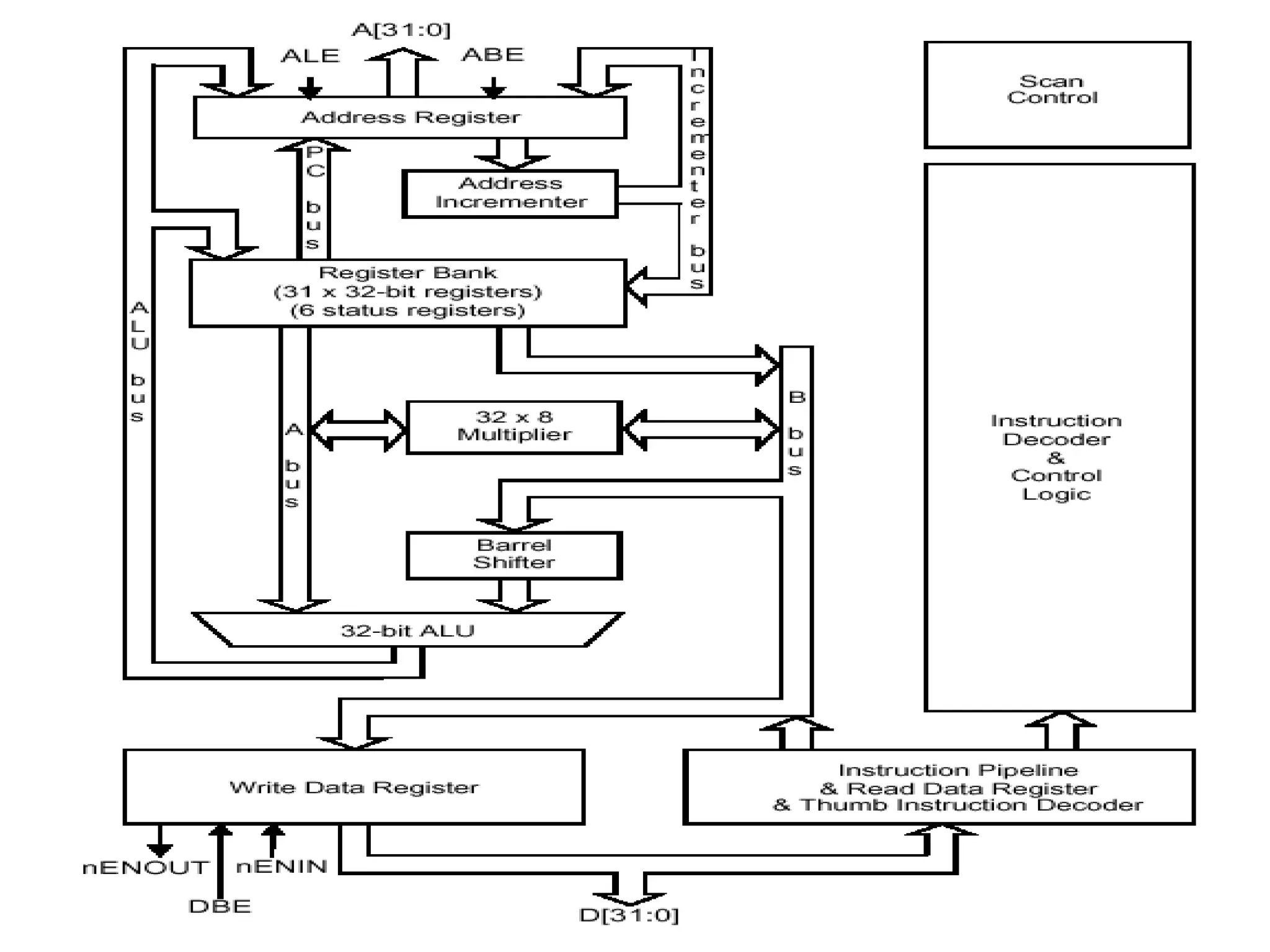
ARM7 Datapath Overview
multiply
data out register
instruction
decode
&
control
incrementer
register
bank
address register
barrel
shifter
A[31:0]
D[31:0]
data in register
ALU
control
P
C
PC
A
L
U
b
u
s
A
b
u
s
B
b
u
s
register
FETCH
DECODE
EXECUTE
(WB)
*Pipeline registers are omitted
18
ARM7TDMI Interface Signals (1/4)
mreq
seq
lock
Dout[31:0]
D[31:0]
r/w
mas[1:0]
mode[4:0]
trans
abort
opc
cpi
cpa
cpb
memory
interface
MMU
interface
coprocessor
interface
mclk
wait
eclk
isy nc
bigend
enin
irq
¼q
reset
enout
abe
Vdd
Vss
clock
control
configuration
interrupts
initialization
bus
control
power
ale
ape
dbe
dbgrq
breakpt
dbgack
debug
exec
extern1
extern0
dbgen
bl[3:0]
TRST
TCK
TMS
TDI
JTAG
controls
TDO
Tbit st atetbe
rangeout0
rangeout1
dbgrqi
commrx
commtx
enouti
highz
busdis
ecapclk
busen
Din[31:0]
A[31:0]
ARM7TDMI
core
tapsm[3:0]
ir[3:0]
tdoen
tck1
tck2
screg[3:0]
TAP
information
driv ebs
ecapclkbs
icapclkbs
highz
pclkbs
rstclkbs
sdinbs
sdoutbs
shclkbs
shclk2bs
boundary
scan
extension
19TM 1939v10 The ARM Architecture
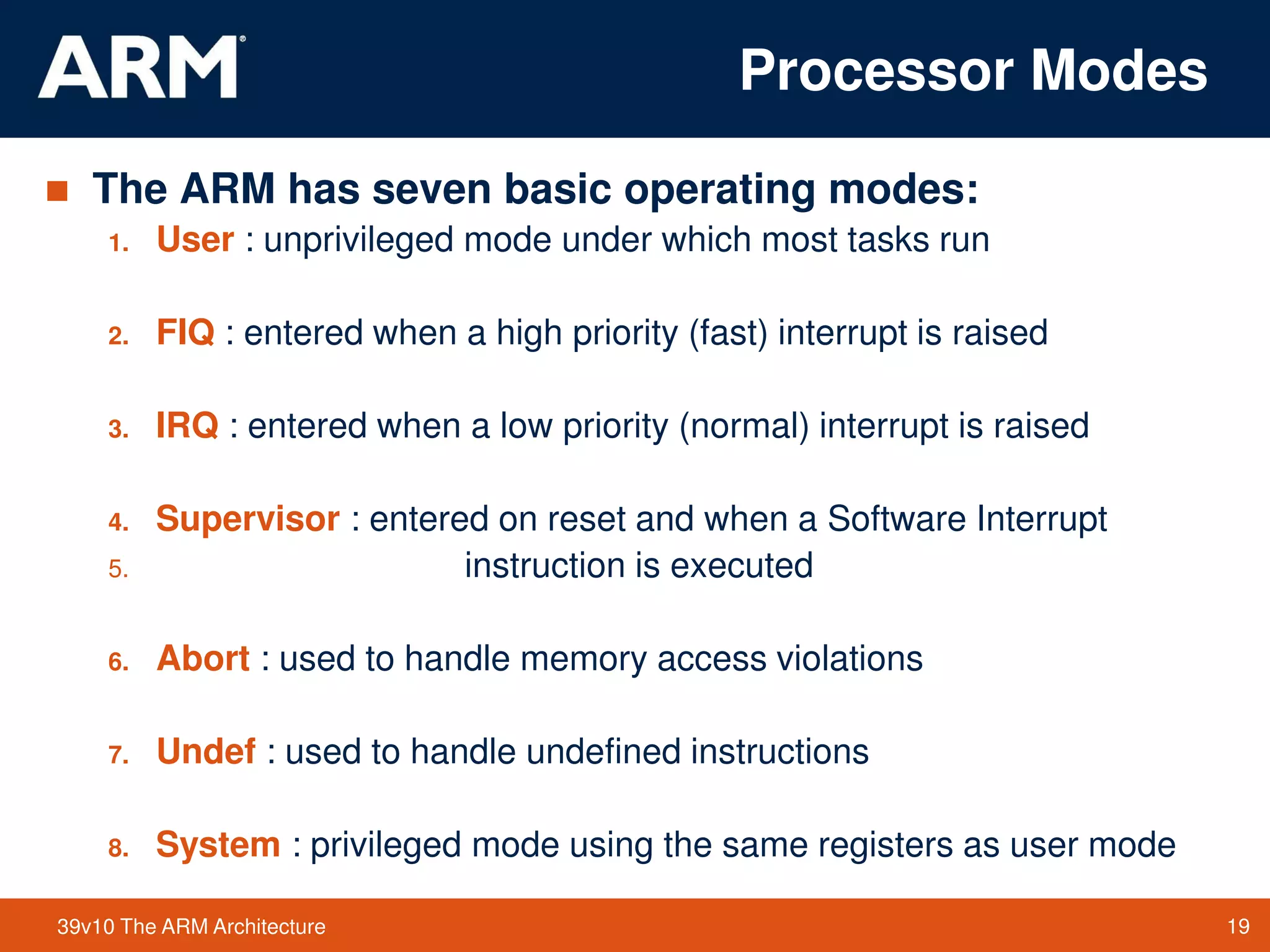
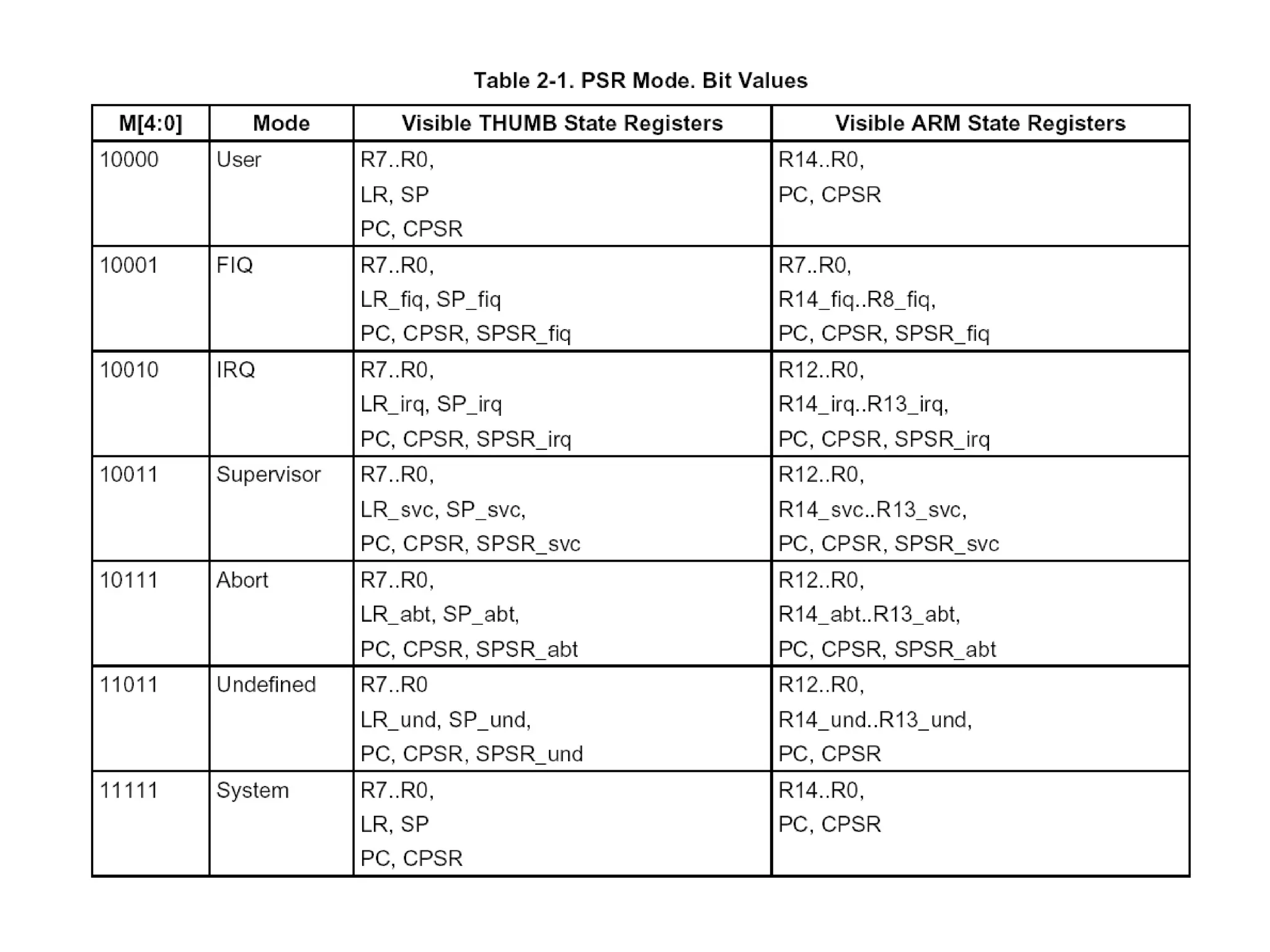
Processor Modes
 The ARM has seven basic operating modes:
1. User : unprivileged mode under which most tasks run
2. FIQ : entered when a high priority (fast) interrupt is raised
3. IRQ : entered when a low priority (normal) interrupt is raised
4. Supervisor : entered on reset and when a Software Interrupt
5. instruction is executed
6. Abort : used to handle memory access violations
7. Undef : used to handle undefined instructions
8. System : privileged mode using the same registers as user mode
20TM 2039v10 The ARM Architecture
r0
r1
r2
r3
r4
r5
r6
r7
r8
r9
r10
r11
r12
r13 (sp)
r14 (lr)
r15 (pc)
cpsr
r13 (sp)
r14 (lr)
spsr
r13 (sp)
r14 (lr)
spsr
r13 (sp)
r14 (lr)
spsr
r13 (sp)
r14 (lr)
spsr
r8
r9
r10
r11
r12
r13 (sp)
r14 (lr)
spsr
FIQ IRQ SVC Undef Abort
User Mode
r0
r1
r2
r3
r4
r5
r6
r7
r8
r9
r10
r11
r12
r13 (sp)
r14 (lr)
r15 (pc)
cpsr
r13 (sp)
r14 (lr)
spsr
r13 (sp)
r14 (lr)
spsr
r13 (sp)
r14 (lr)
spsr
r13 (sp)
r14 (lr)
spsr
r8
r9
r10
r11
r12
r13 (sp)
r14 (lr)
spsr
Current Visible Registers
Banked out Registers
FIQ IRQ SVC Undef Abort
r0
r1
r2
r3
r4
r5
r6
r7
r15 (pc)
cpsr
r13 (sp)
r14 (lr)
spsr
r13 (sp)
r14 (lr)
spsr
r13 (sp)
r14 (lr)
spsr
r13 (sp)
r14 (lr)
spsr
r8
r9
r10
r11
r12
r13 (sp)
r14 (lr)
spsr
Current Visible Registers
Banked out Registers
User IRQ SVC Undef Abort
r8
r9
r10
r11
r12
r13 (sp)
r14 (lr)
FIQ ModeIRQ Mode
r0
r1
r2
r3
r4
r5
r6
r7
r8
r9
r10
r11
r12
r15 (pc)
cpsr
r13 (sp)
r14 (lr)
spsr
r13 (sp)
r14 (lr)
spsr
r13 (sp)
r14 (lr)
spsr
r13 (sp)
r14 (lr)
spsr
r8
r9
r10
r11
r12
r13 (sp)
r14 (lr)
spsr
Current Visible Registers
Banked out Registers
User FIQ SVC Undef Abort
r13 (sp)
r14 (lr)
Undef Mode
r0
r1
r2
r3
r4
r5
r6
r7
r8
r9
r10
r11
r12
r15 (pc)
cpsr
r13 (sp)
r14 (lr)
spsr
r13 (sp)
r14 (lr)
spsr
r13 (sp)
r14 (lr)
spsr
r13 (sp)
r14 (lr)
spsr
r8
r9
r10
r11
r12
r13 (sp)
r14 (lr)
spsr
Current Visible Registers
Banked out Registers
User FIQ IRQ SVC Abort
r13 (sp)
r14 (lr)
SVC Mode
r0
r1
r2
r3
r4
r5
r6
r7
r8
r9
r10
r11
r12
r15 (pc)
cpsr
r13 (sp)
r14 (lr)
spsr
r13 (sp)
r14 (lr)
spsr
r13 (sp)
r14 (lr)
spsr
r13 (sp)
r14 (lr)
spsr
r8
r9
r10
r11
r12
r13 (sp)
r14 (lr)
spsr
Current Visible Registers
Banked out Registers
User FIQ IRQ Undef Abort
r13 (sp)
r14 (lr)
Abort Mode
r0
r1
r2
r3
r4
r5
r6
r7
r8
r9
r10
r11
r12
r15 (pc)
cpsr
r13 (sp)
r14 (lr)
spsr
r13 (sp)
r14 (lr)
spsr
r13 (sp)
r14 (lr)
spsr
r13 (sp)
r14 (lr)
spsr
r8
r9
r10
r11
r12
r13 (sp)
r14 (lr)
spsr
Current Visible Registers
Banked out Registers
User FIQ IRQ SVC Undef
r13 (sp)
r14 (lr)
The ARM Register Set
21TM 2139v10 The ARM Architecture
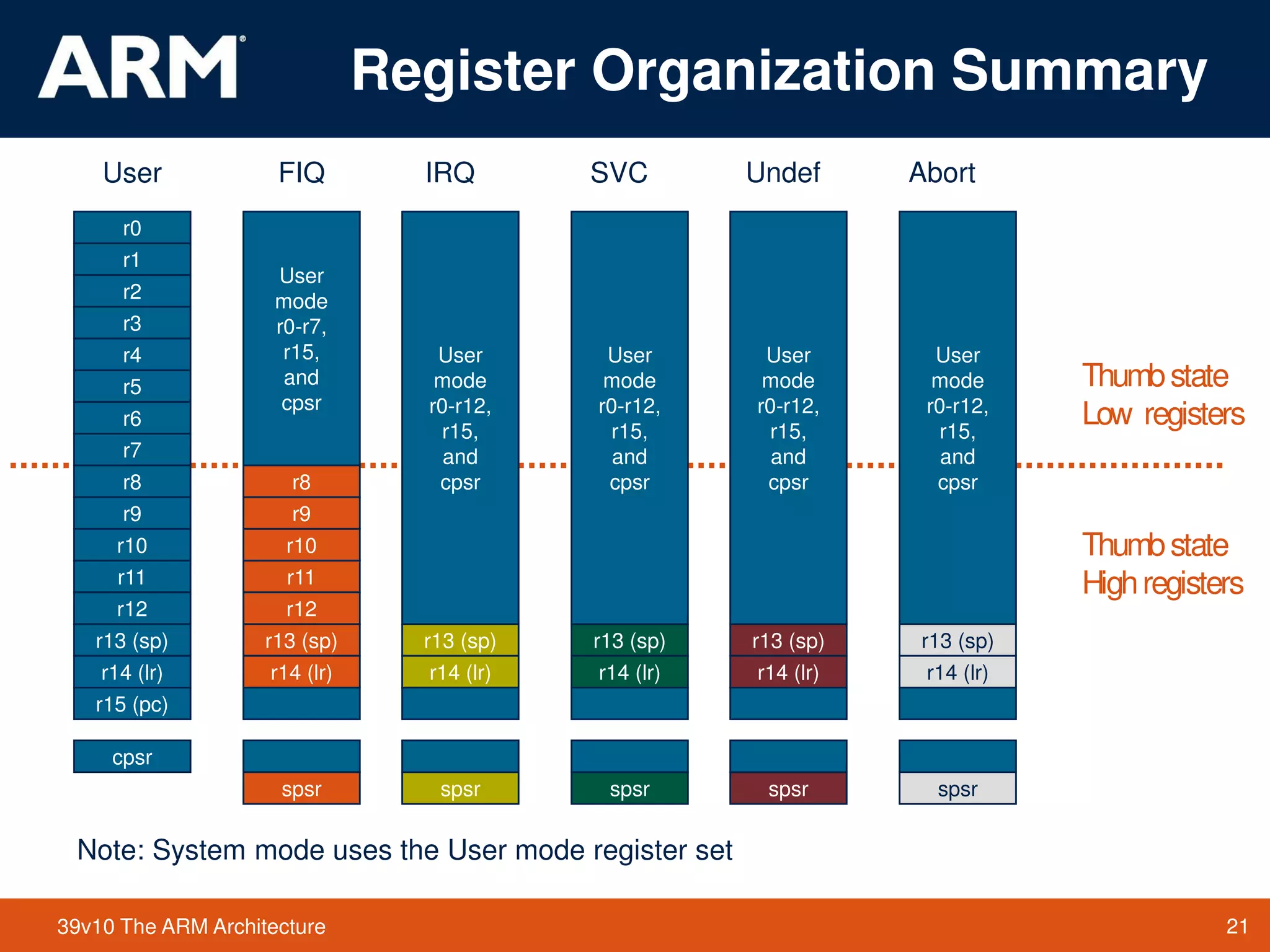
Register Organization Summary
User
mode
r0-r7,
r15,
and
cpsr
r8
r9
r10
r11
r12
r13 (sp)
r14 (lr)
spsr
FIQ
r8
r9
r10
r11
r12
r13 (sp)
r14 (lr)
r15 (pc)
cpsr
r0
r1
r2
r3
r4
r5
r6
r7
User
r13 (sp)
r14 (lr)
spsr
IRQ
User
mode
r0-r12,
r15,
and
cpsr
r13 (sp)
r14 (lr)
spsr
Undef
User
mode
r0-r12,
r15,
and
cpsr
r13 (sp)
r14 (lr)
spsr
SVC
User
mode
r0-r12,
r15,
and
cpsr
r13 (sp)
r14 (lr)
spsr
Abort
User
mode
r0-r12,
r15,
and
cpsr
Thumbstate
Low registers
Thumbstate
Highregisters
Note: System mode uses the User mode register set
22TM 2239v10 The ARM Architecture
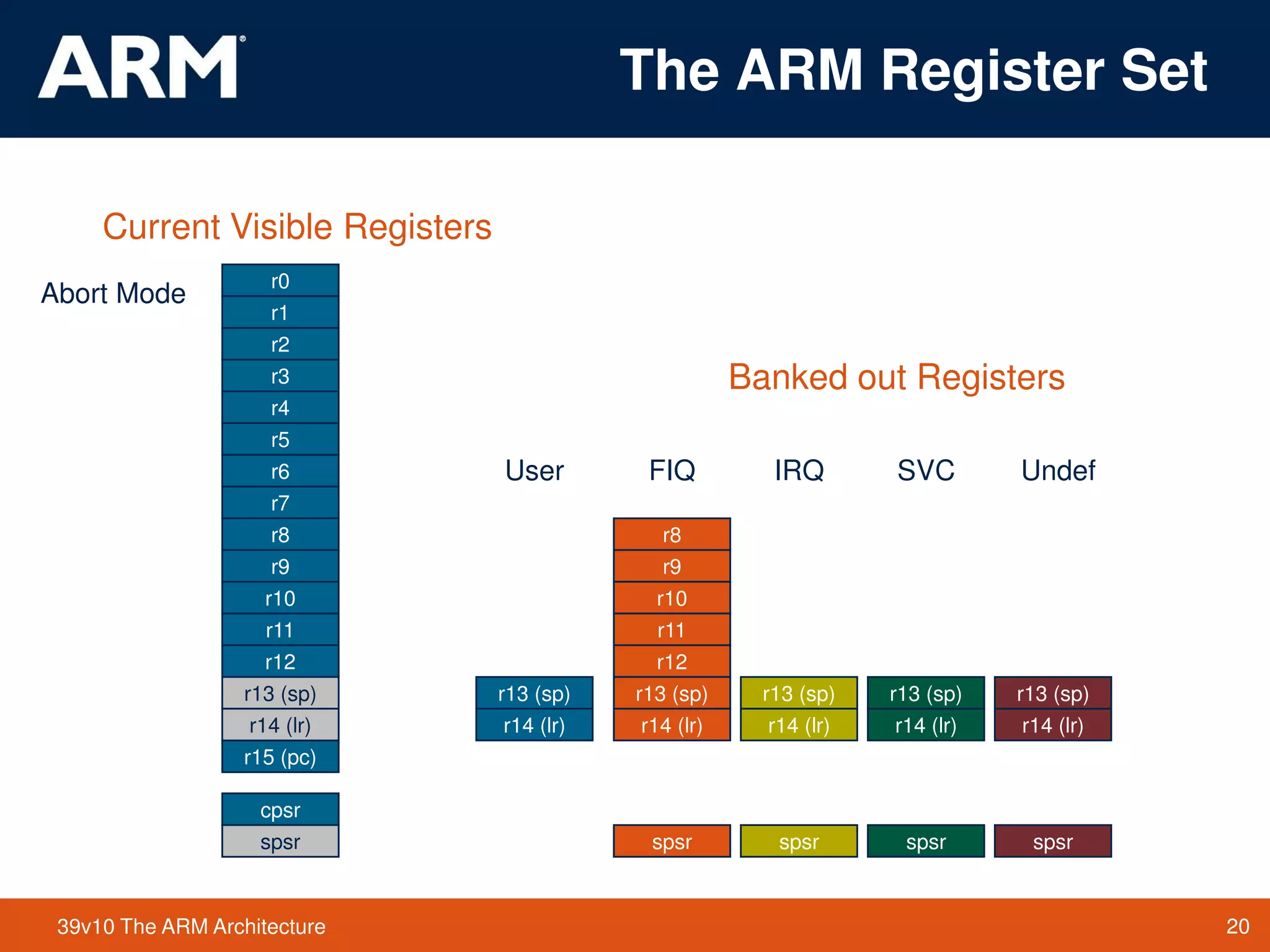
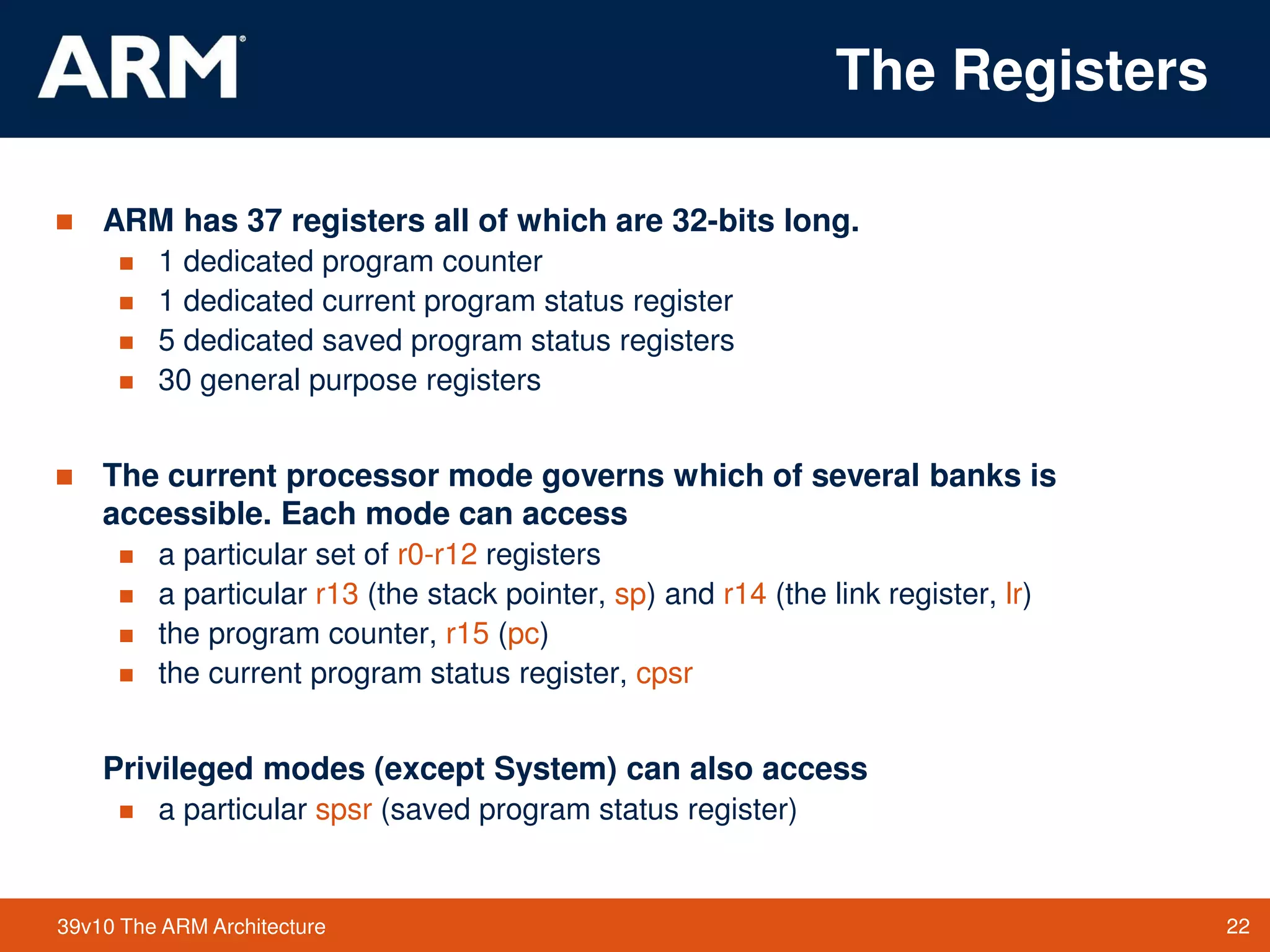
The Registers
 ARM has 37 registers all of which are 32-bits long.
 1 dedicated program counter
 1 dedicated current program status register
 5 dedicated saved program status registers
 30 general purpose registers
 The current processor mode governs which of several banks is
accessible. Each mode can access
 a particular set of r0-r12 registers
 a particular r13 (the stack pointer, sp) and r14 (the link register, lr)
 the program counter, r15 (pc)
 the current program status register, cpsr
Privileged modes (except System) can also access
 a particular spsr (saved program status register)
23TM 2339v10 The ARM Architecture
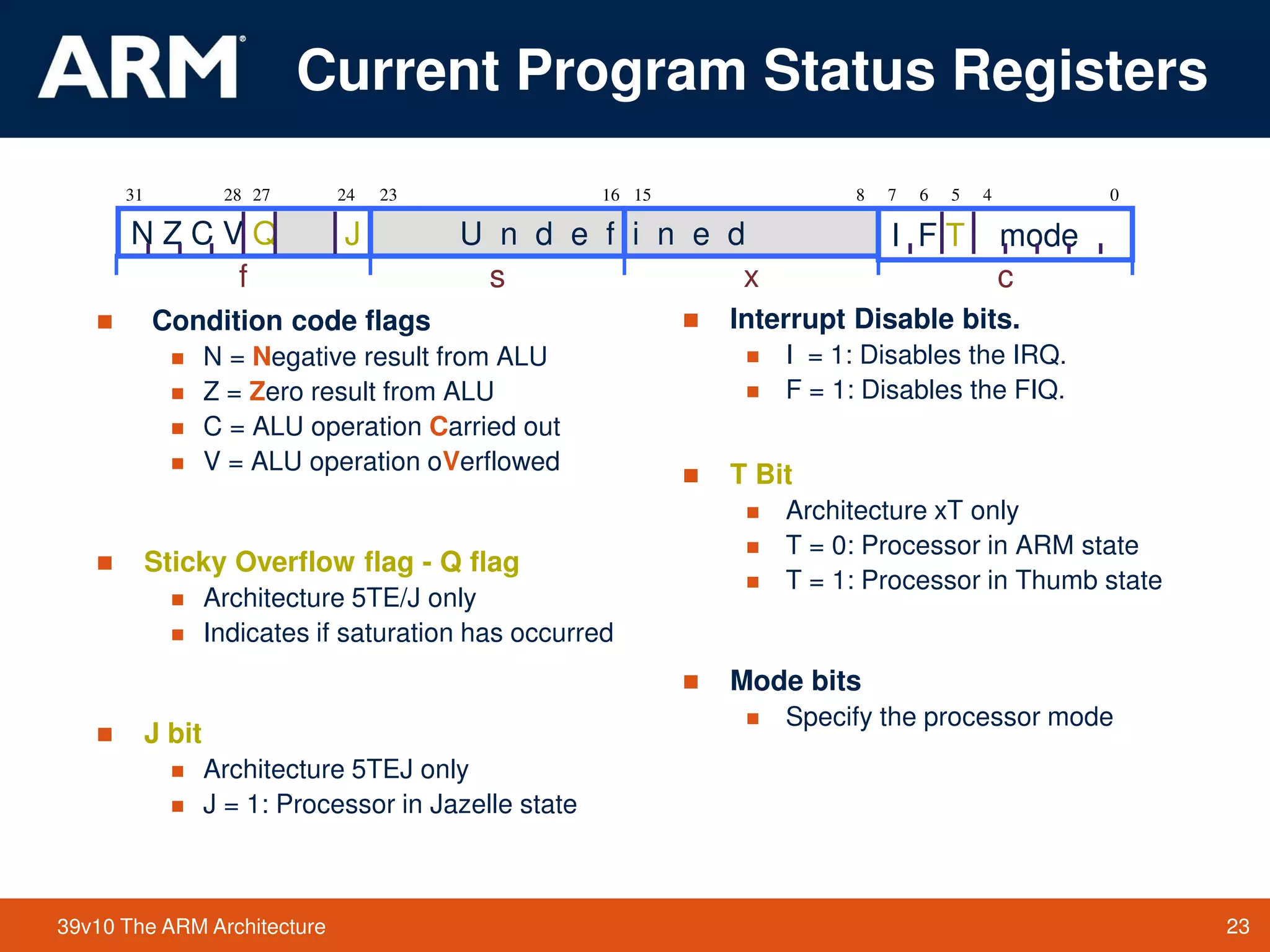
Current Program Status Registers
 Condition code flags
 N = Negative result from ALU
 Z = Zero result from ALU
 C = ALU operation Carried out
 V = ALU operation oVerflowed
 Sticky Overflow flag - Q flag
 Architecture 5TE/J only
 Indicates if saturation has occurred
 J bit
 Architecture 5TEJ only
 J = 1: Processor in Jazelle state
 Interrupt Disable bits.
 I = 1: Disables the IRQ.
 F = 1: Disables the FIQ.
 T Bit
 Architecture xT only
 T = 0: Processor in ARM state
 T = 1: Processor in Thumb state
 Mode bits
 Specify the processor mode
2731
N Z C V Q
28 67
I F T mode
1623 815 5 4 024
f s x c
U n d e f i n e dJ
24TM 2439v10 The ARM Architecture
 When the processor is executing in ARM state:
 All instructions are 32 bits wide
 All instructions must be word aligned
 Therefore the pc value is stored in bits [31:2] with bits [1:0] undefined (as
instruction cannot be halfword or byte aligned).
 When the processor is executing in Thumb state:
 All instructions are 16 bits wide
 All instructions must be halfword aligned
 Therefore the pc value is stored in bits [31:1] with bit [0] undefined (as
instruction cannot be byte aligned).
 When the processor is executing in Jazelle state:
 All instructions are 8 bits wide
 Processor performs a word access to read 4 instructions at once
Program Counter (r15)
25
Saved Program Status Register (SPSR)
Each privileged mode (except system mode) has
associated with it a SPSR
This SPSR is used to save the state of CPSR when
the privileged mode is entered in order that the user
state can be fully restored when the user process is
resumed
Often the SPSR may be untouched from the time
the privileged mode is entered to the time it is used
to restore the CPSR
If the privileged supervisor calls to itself the SPSR
must be copied into a general register and saved
27
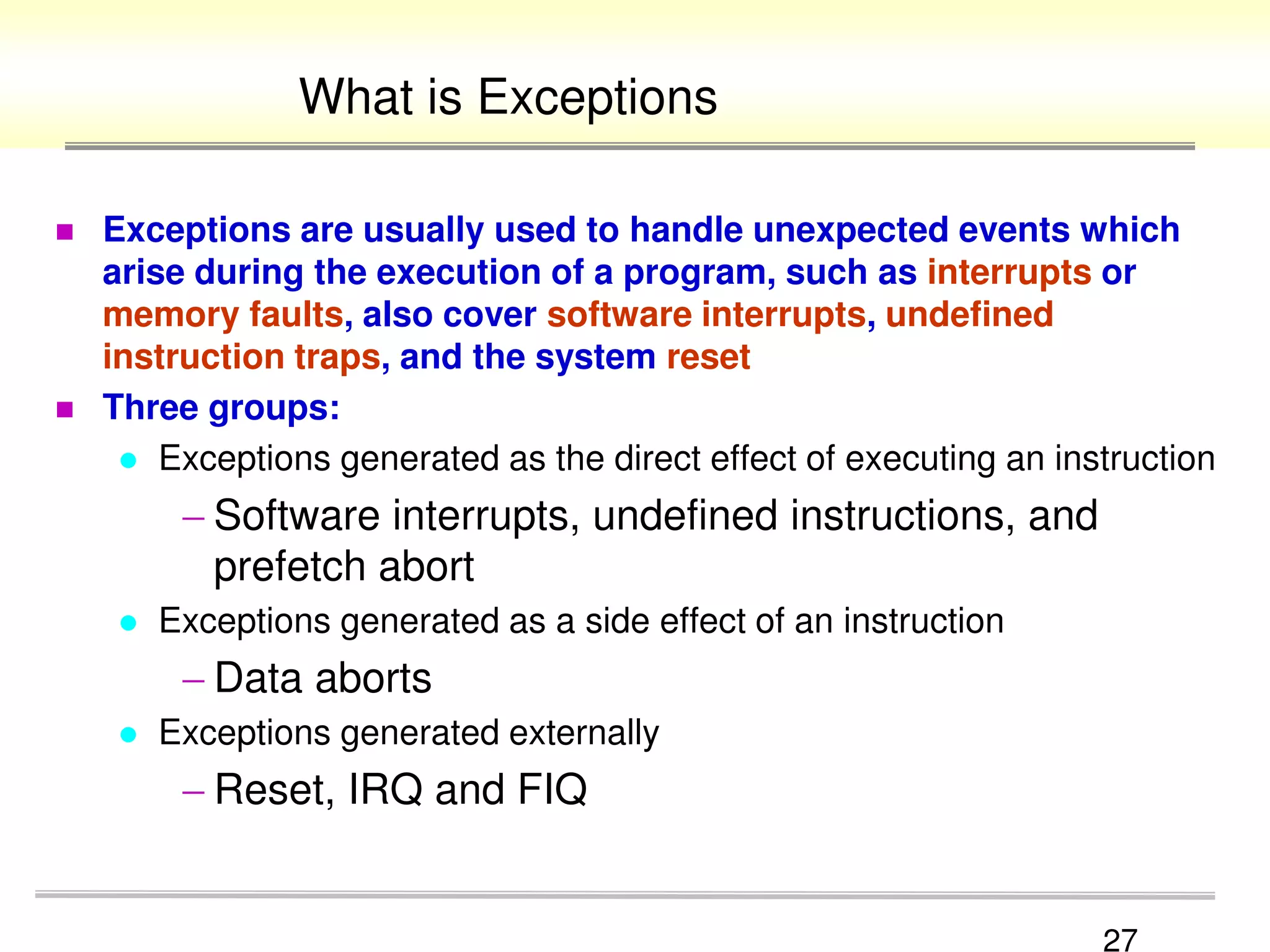
What is Exceptions
 Exceptions are usually used to handle unexpected events which
arise during the execution of a program, such as interrupts or
memory faults, also cover software interrupts, undefined
instruction traps, and the system reset
 Three groups:
 Exceptions generated as the direct effect of executing an instruction
 Software interrupts, undefined instructions, and
prefetch abort
 Exceptions generated as a side effect of an instruction
 Data aborts
 Exceptions generated externally
 Reset, IRQ and FIQ
28
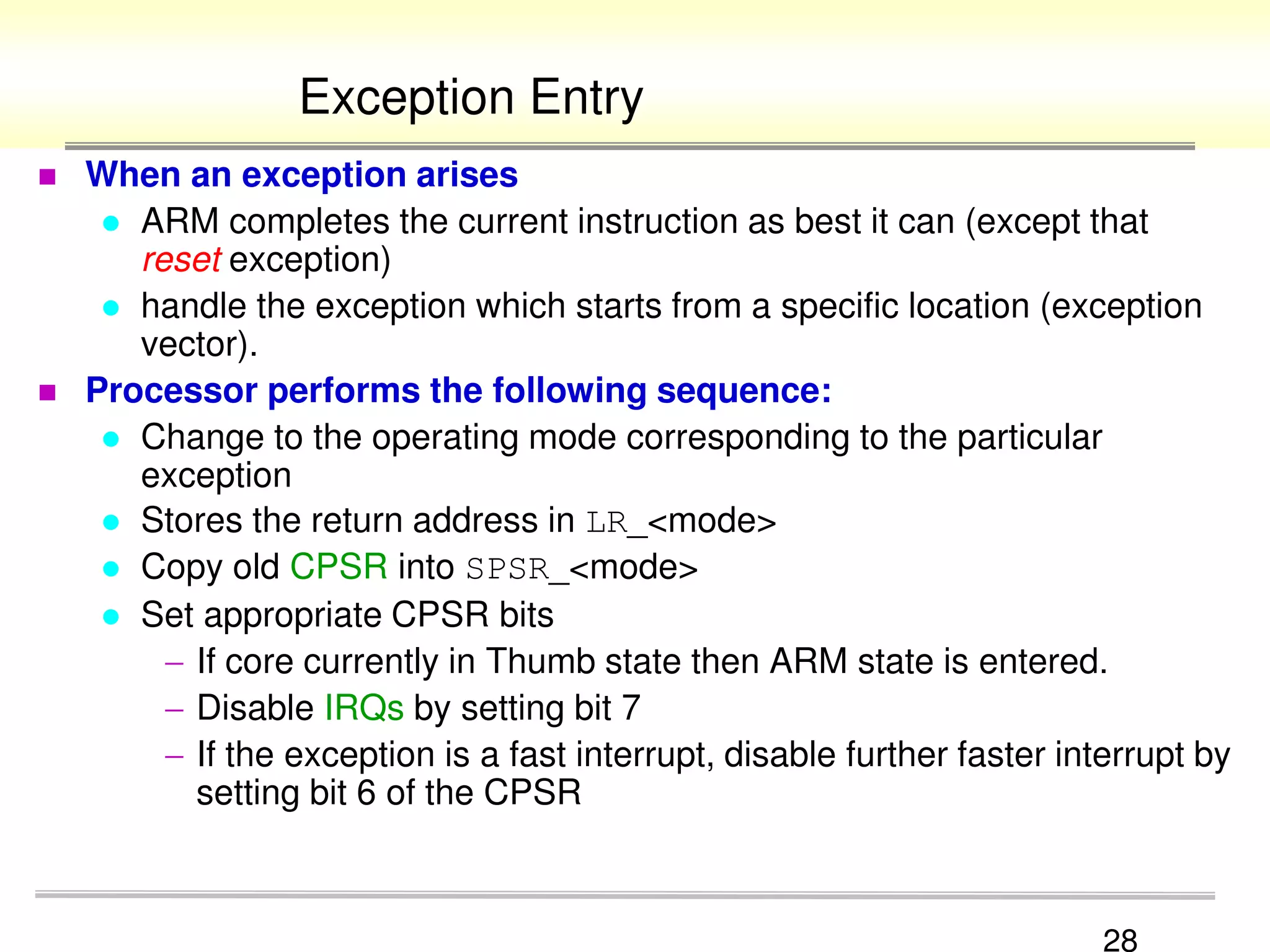
Exception Entry
 When an exception arises
 ARM completes the current instruction as best it can (except that
reset exception)
 handle the exception which starts from a specific location (exception
vector).
 Processor performs the following sequence:
 Change to the operating mode corresponding to the particular
exception
 Stores the return address in LR_<mode>
 Copy old CPSR into SPSR_<mode>
 Set appropriate CPSR bits
 If core currently in Thumb state then ARM state is entered.
 Disable IRQs by setting bit 7
 If the exception is a fast interrupt, disable further faster interrupt by
setting bit 6 of the CPSR
29
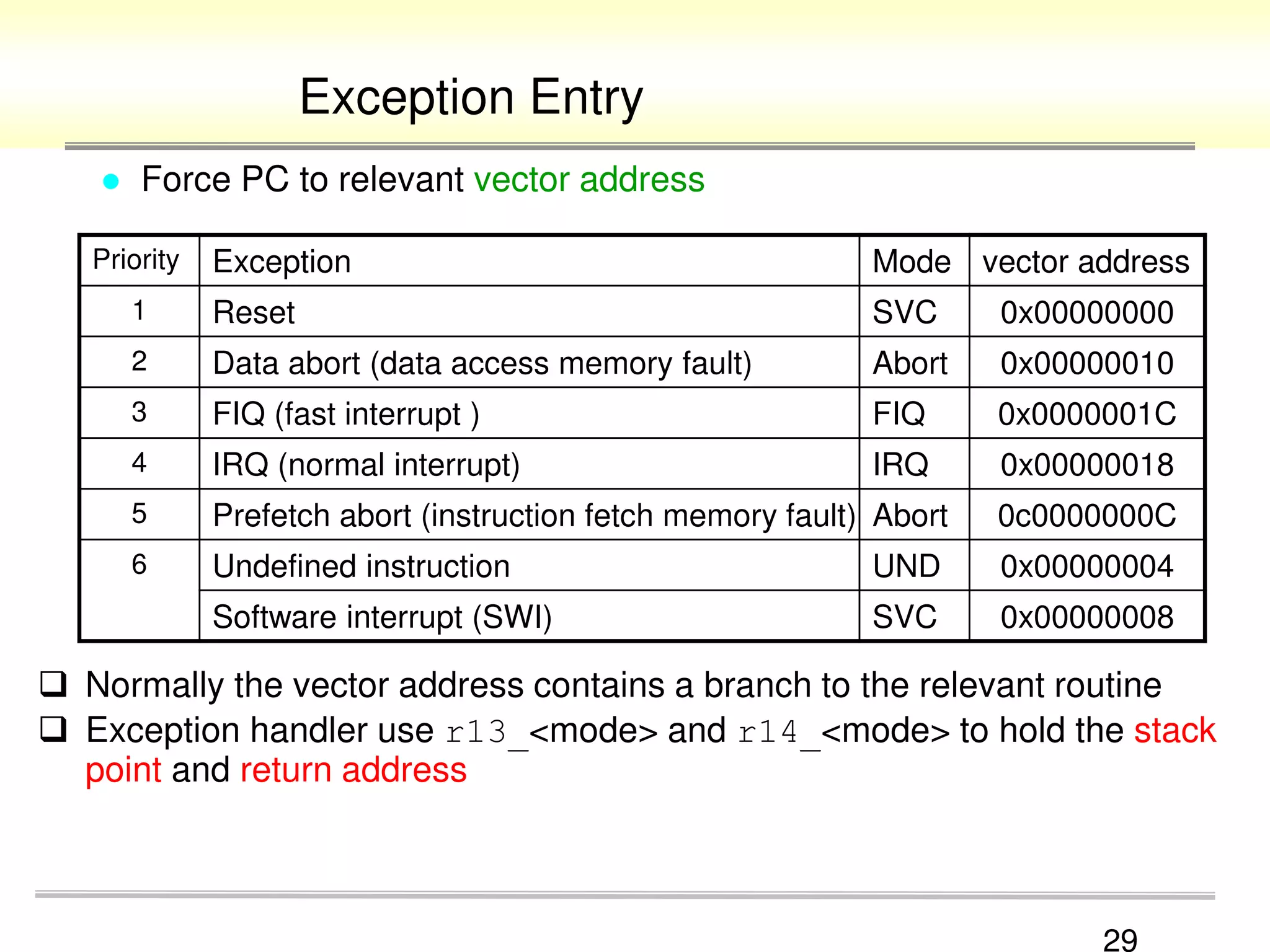
Exception Entry
 Force PC to relevant vector address
 Normally the vector address contains a branch to the relevant routine
 Exception handler use r13_<mode> and r14_<mode> to hold the stack
point and return address
Priority Exception Mode vector address
1 Reset SVC 0x00000000
2 Data abort (data access memory fault) Abort 0x00000010
3 FIQ (fast interrupt ) FIQ 0x0000001C
4 IRQ (normal interrupt) IRQ 0x00000018
5 Prefetch abort (instruction fetch memory fault) Abort 0c0000000C
6 Undefined instruction UND 0x00000004
Software interrupt (SWI) SVC 0x00000008
30
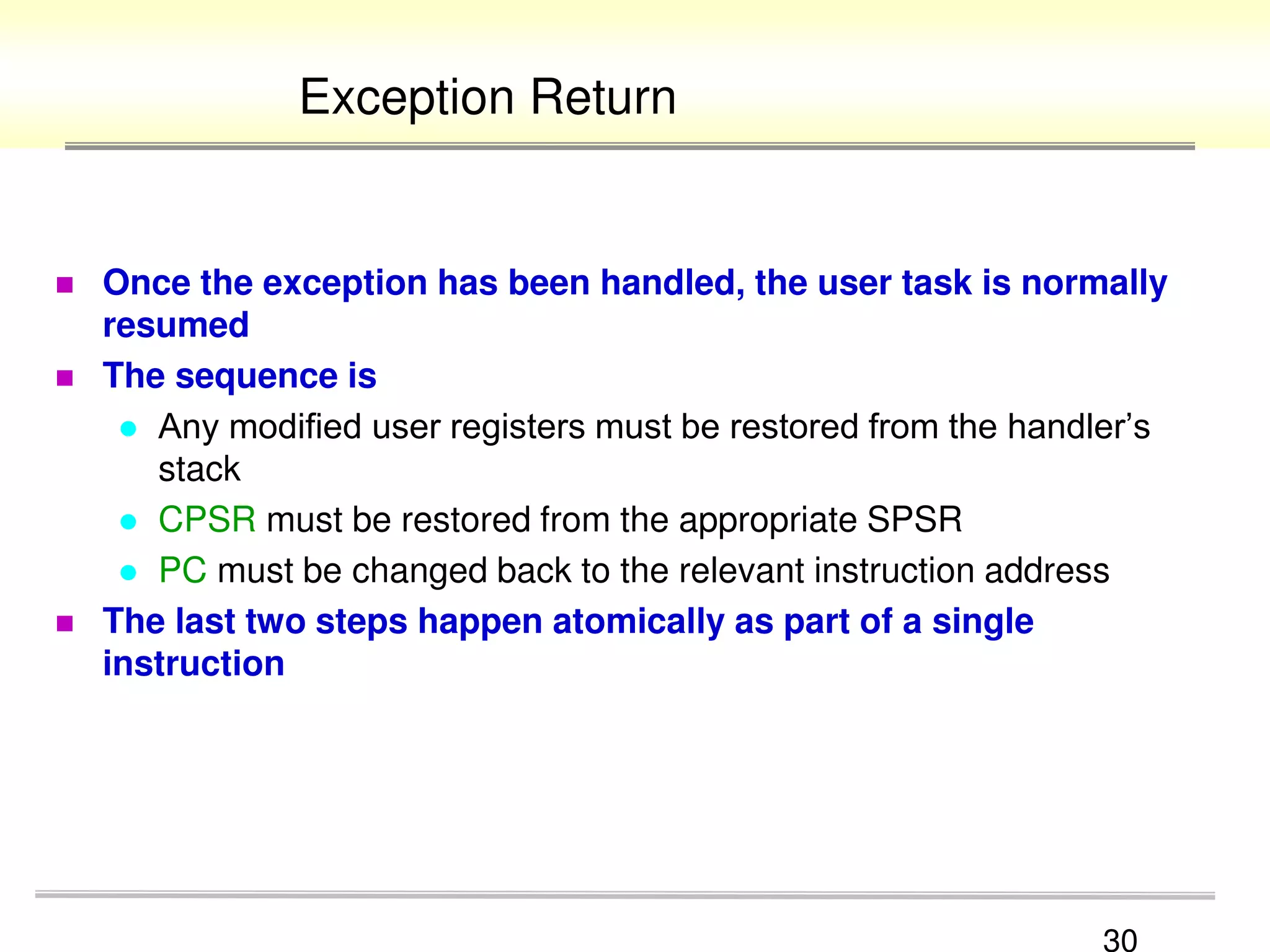
Exception Return
 Once the exception has been handled, the user task is normally
resumed
 The sequence is
 Any modified user registers must be restored from the handler’s
stack
 CPSR must be restored from the appropriate SPSR
 PC must be changed back to the relevant instruction address
 The last two steps happen atomically as part of a single
instruction
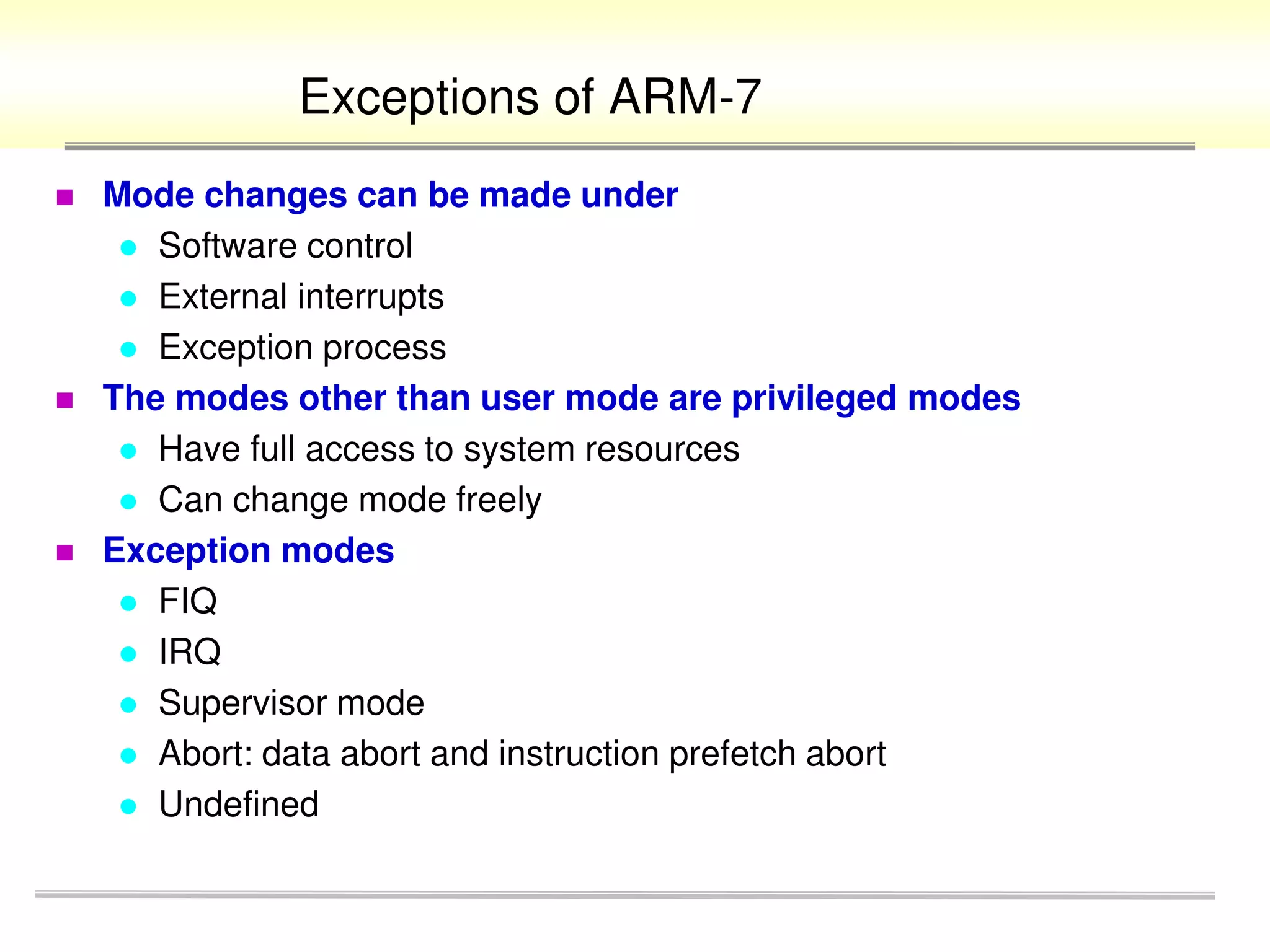
Exceptions of ARM-7
 Mode changes can be made under
 Software control
 External interrupts
 Exception process
 The modes other than user mode are privileged modes
 Have full access to system resources
 Can change mode freely
 Exception modes
 FIQ
 IRQ
 Supervisor mode
 Abort: data abort and instruction prefetch abort
 Undefined
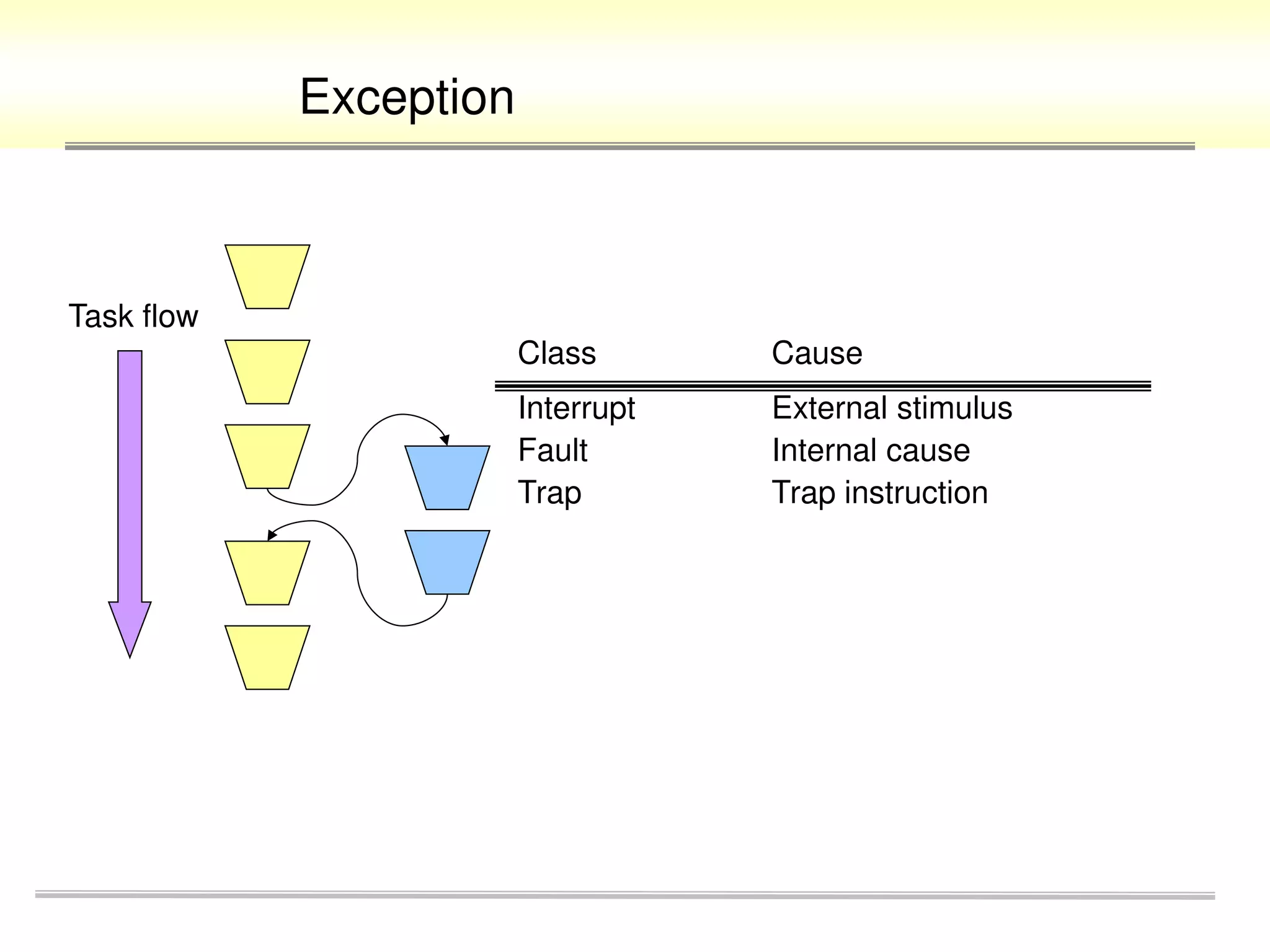
Exception
Task flow
Class Cause
Interrupt External stimulus
Fault Internal cause
Trap Trap instruction
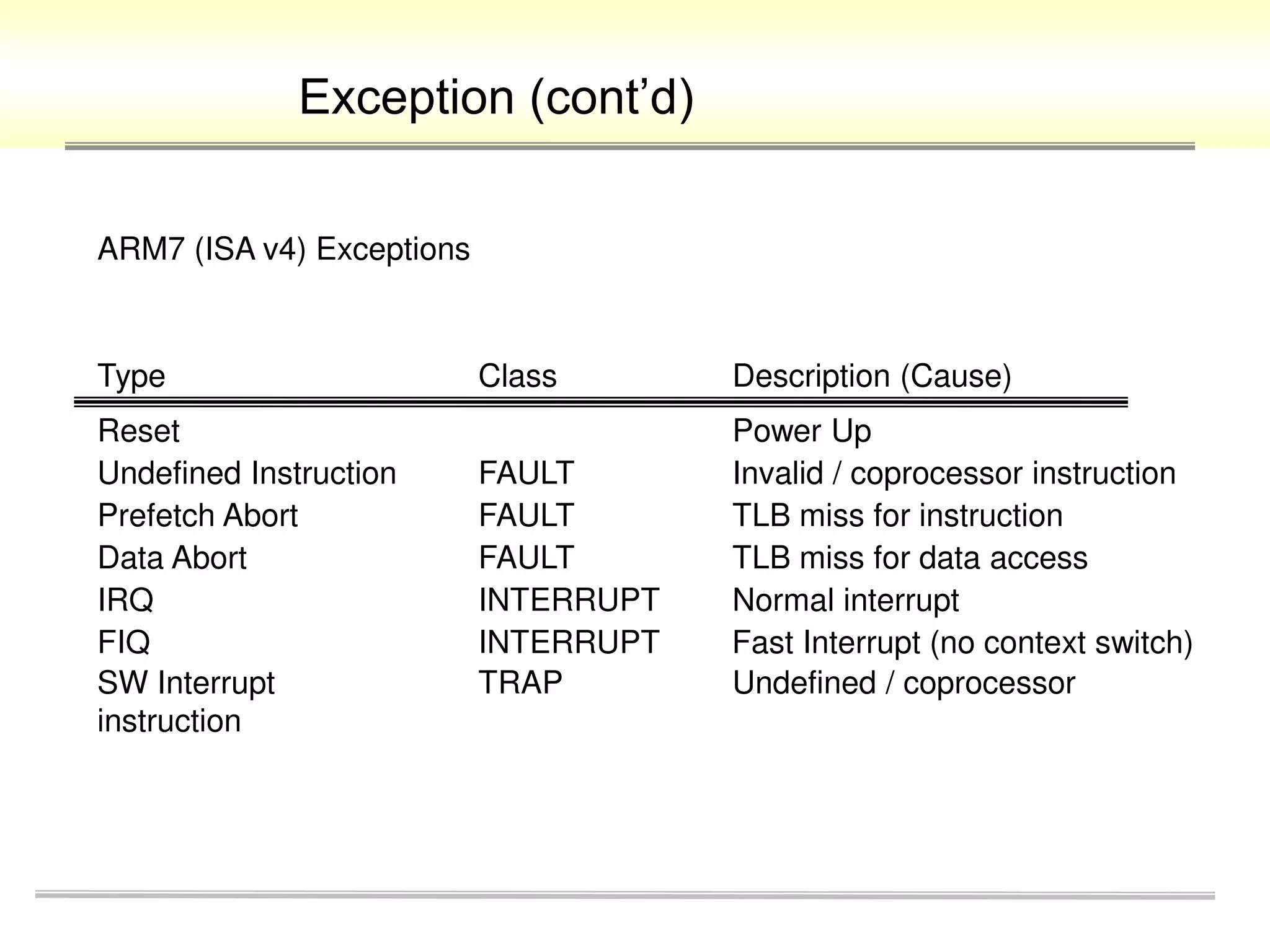
Exception (cont’d)
ARM7 (ISA v4) Exceptions
Type Class Description (Cause)
Reset Power Up
Undefined Instruction FAULT Invalid / coprocessor instruction
Prefetch Abort FAULT TLB miss for instruction
Data Abort FAULT TLB miss for data access
IRQ INTERRUPT Normal interrupt
FIQ INTERRUPT Fast Interrupt (no context switch)
SW Interrupt TRAP Undefined / coprocessor
instruction
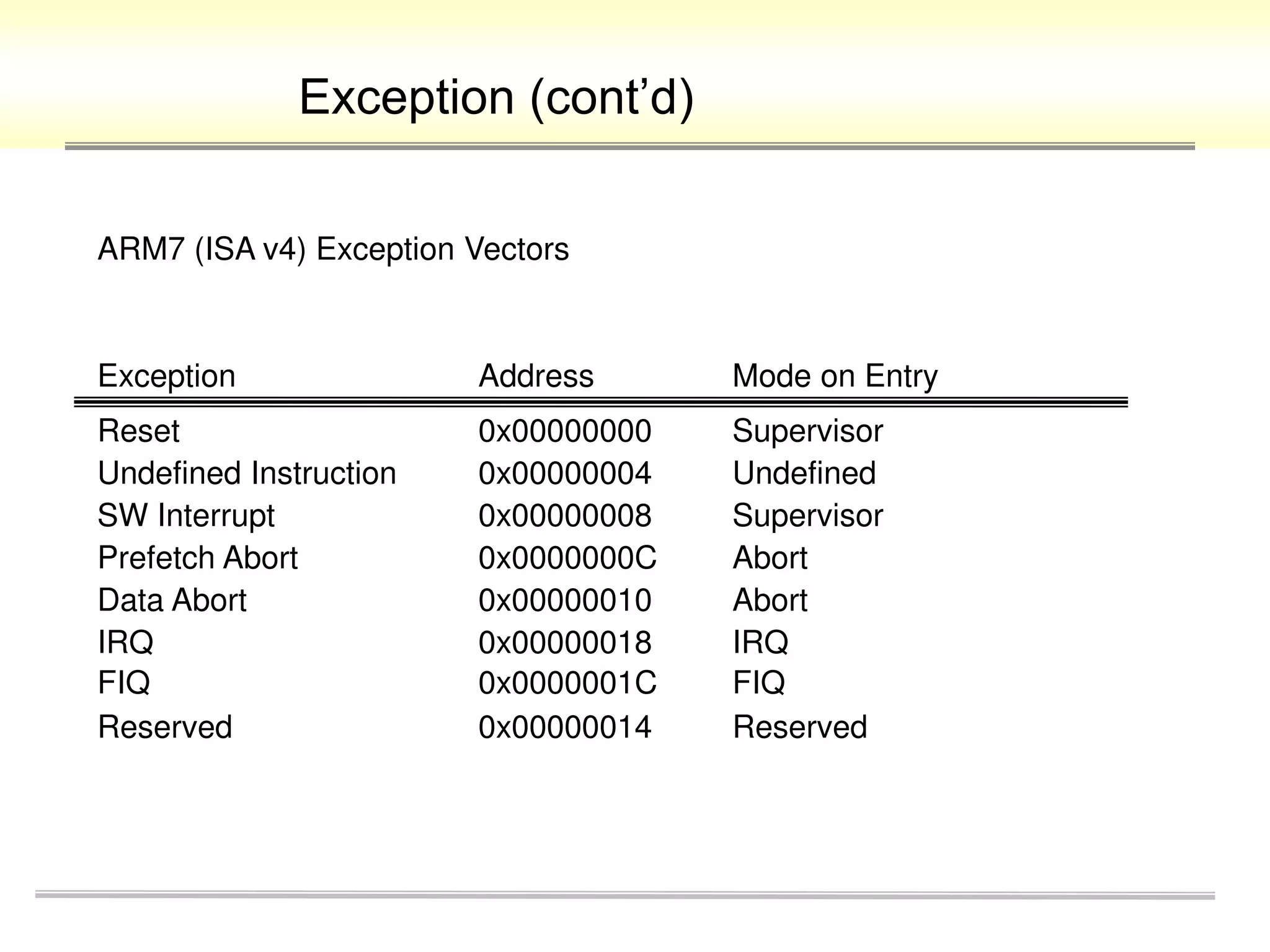
Exception (cont’d)
ARM7 (ISA v4) Exception Vectors
Exception Address Mode on Entry
Reset 0x00000000 Supervisor
Undefined Instruction 0x00000004 Undefined
SW Interrupt 0x00000008 Supervisor
Prefetch Abort 0x0000000C Abort
Data Abort 0x00000010 Abort
IRQ 0x00000018 IRQ
FIQ 0x0000001C FIQ
Reserved 0x00000014 Reserved
Vector Table
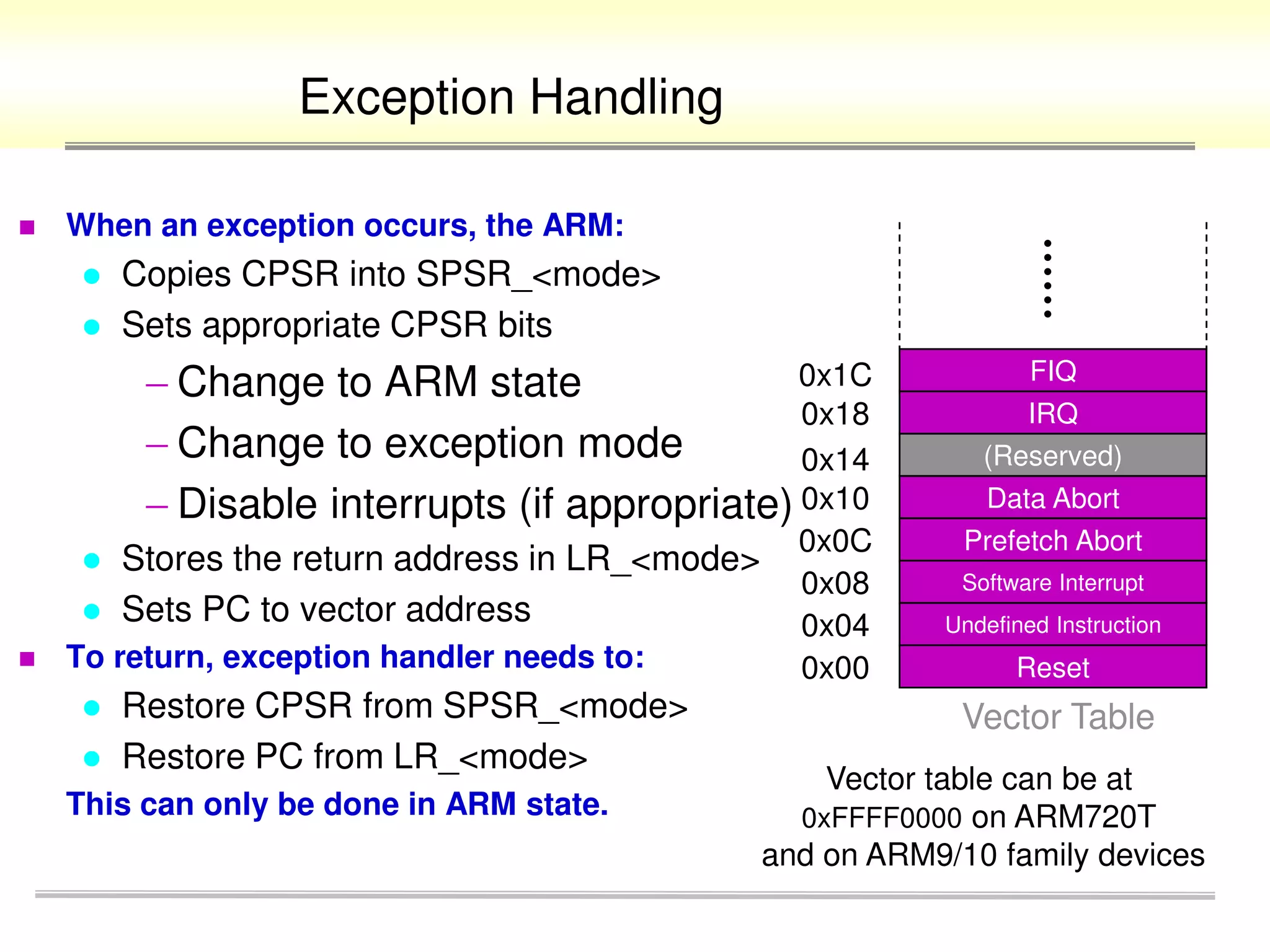
Exception Handling
 When an exception occurs, the ARM:
 Copies CPSR into SPSR_<mode>
 Sets appropriate CPSR bits
 Change to ARM state
 Change to exception mode
 Disable interrupts (if appropriate)
 Stores the return address in LR_<mode>
 Sets PC to vector address
 To return, exception handler needs to:
 Restore CPSR from SPSR_<mode>
 Restore PC from LR_<mode>
This can only be done in ARM state.
Vector table can be at
0xFFFF0000 on ARM720T
and on ARM9/10 family devices
FIQ
IRQ
(Reserved)
Data Abort
Prefetch Abort
Software Interrupt
Undefined Instruction
Reset
0x1C
0x18
0x14
0x10
0x0C
0x08
0x04
0x00
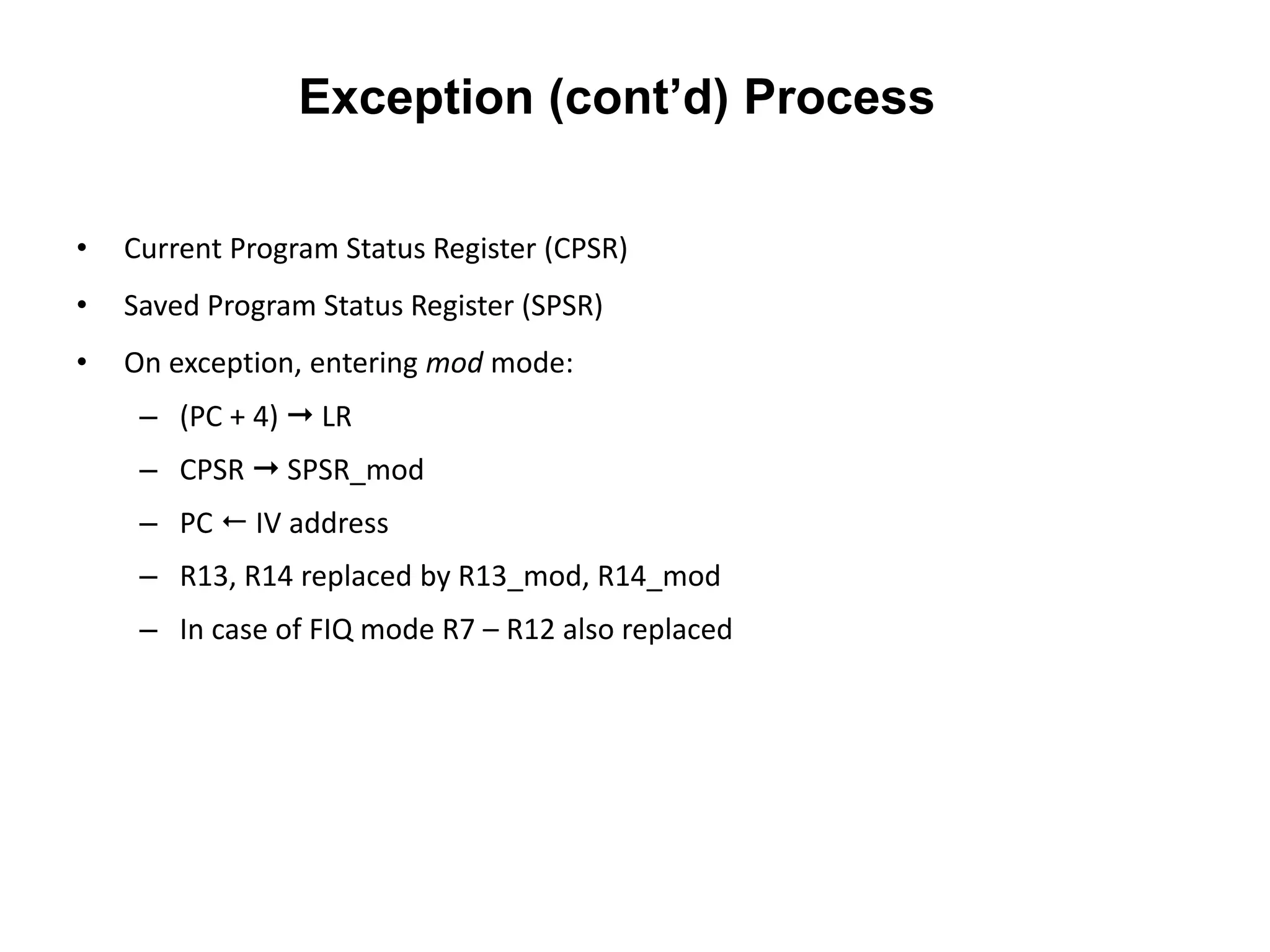
• Current Program Status Register (CPSR)
• Saved Program Status Register (SPSR)
• On exception, entering mod mode:
– (PC + 4)  LR
– CPSR  SPSR_mod
– PC  IV address
– R13, R14 replaced by R13_mod, R14_mod
– In case of FIQ mode R7 – R12 also replaced
Exception (cont’d) Process
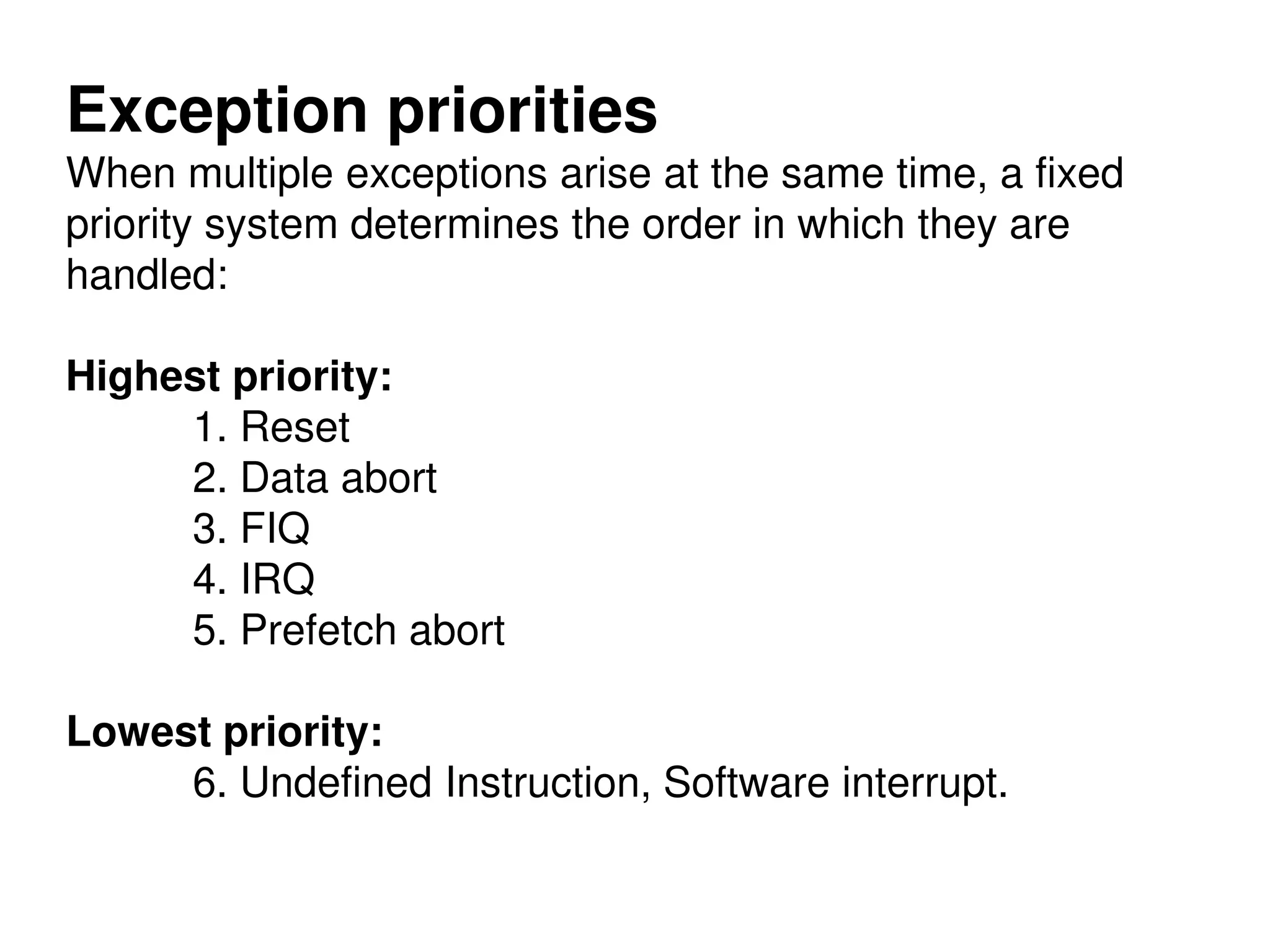
Exception priorities
When multiple exceptions arise at the same time, a fixed
priority system determines the order in which they are
handled:
Highest priority:
1. Reset
2. Data abort
3. FIQ
4. IRQ
5. Prefetch abort
Lowest priority:
6. Undefined Instruction, Software interrupt.
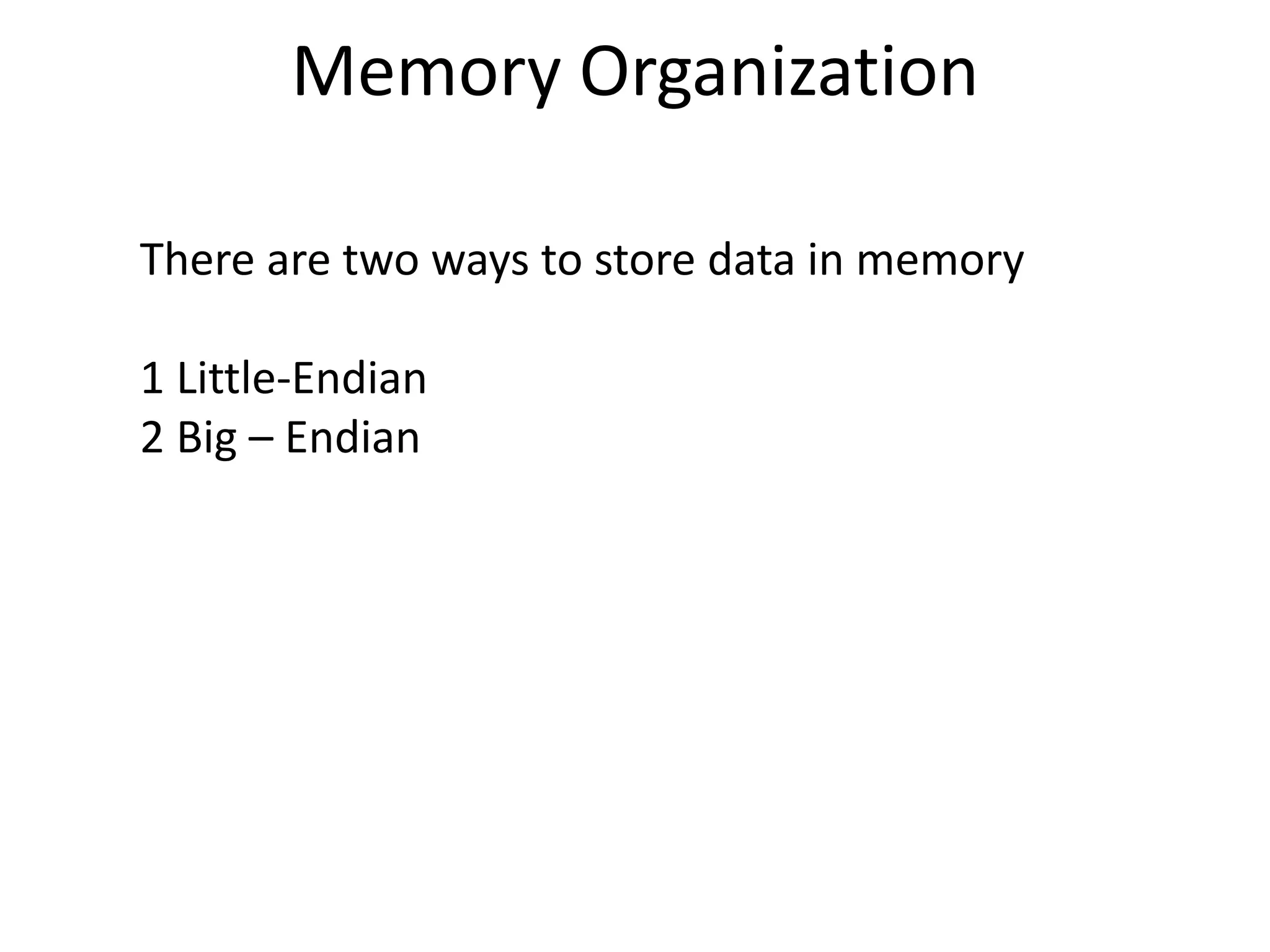
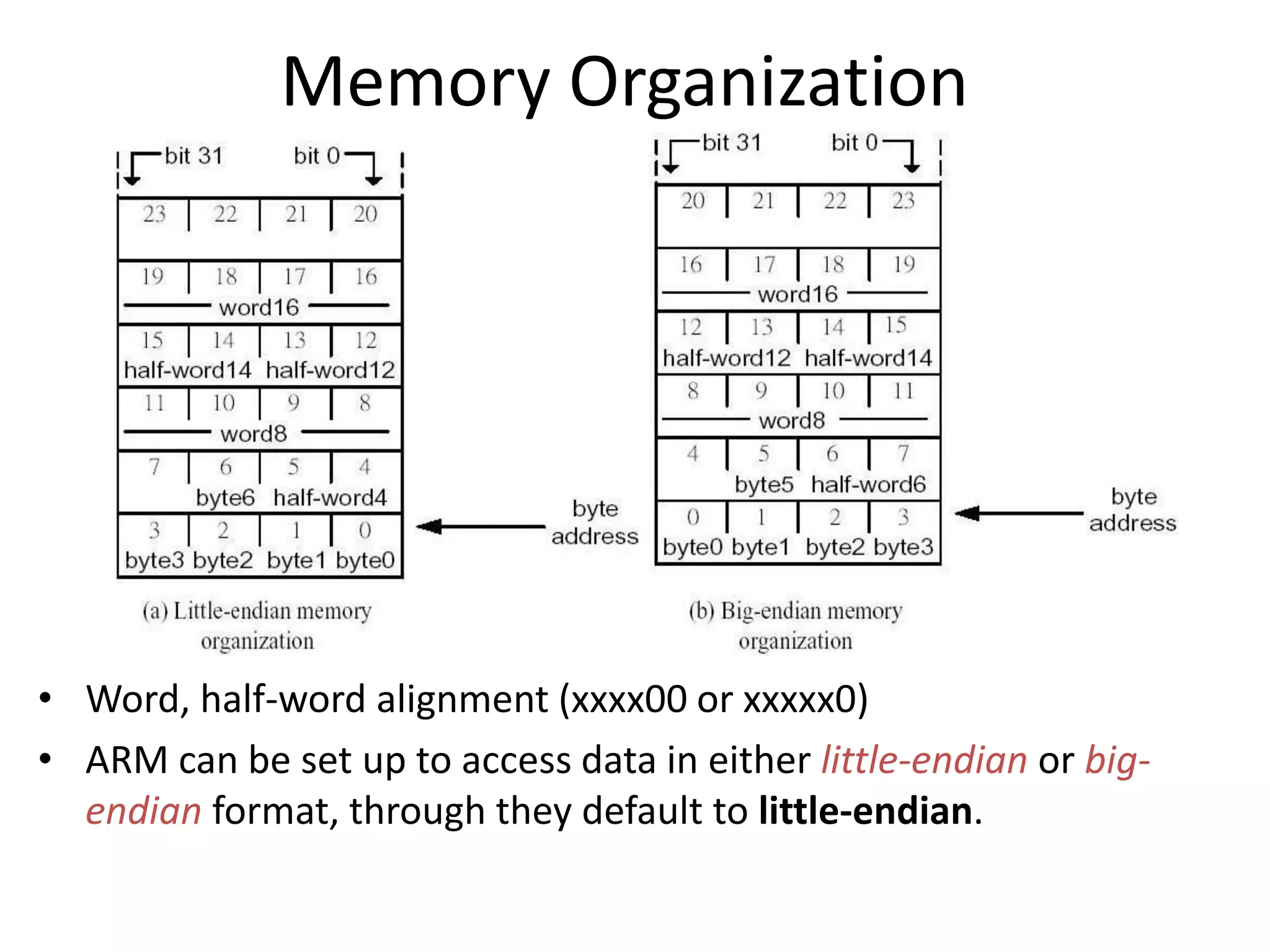
There are two ways to store data in memory
1 Little-Endian
2 Big – Endian
Memory Organization
Memory Organization
• Word, half-word alignment (xxxx00 or xxxxx0)
• ARM can be set up to access data in either little-endian or big-
endian format, through they default to little-endian.
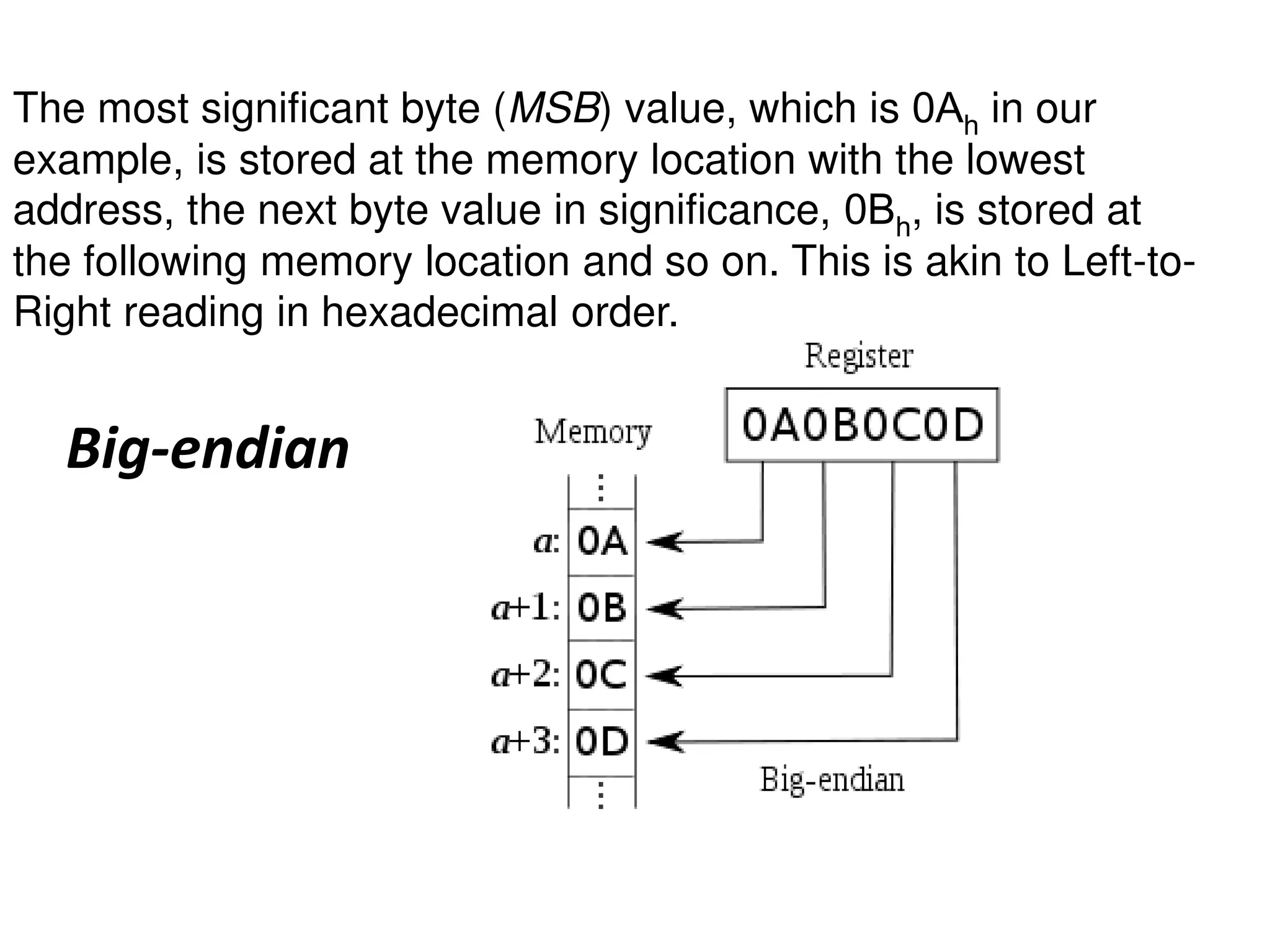
Big-endian
The most significant byte (MSB) value, which is 0Ah in our
example, is stored at the memory location with the lowest
address, the next byte value in significance, 0Bh, is stored at
the following memory location and so on. This is akin to Left-to-
Right reading in hexadecimal order.
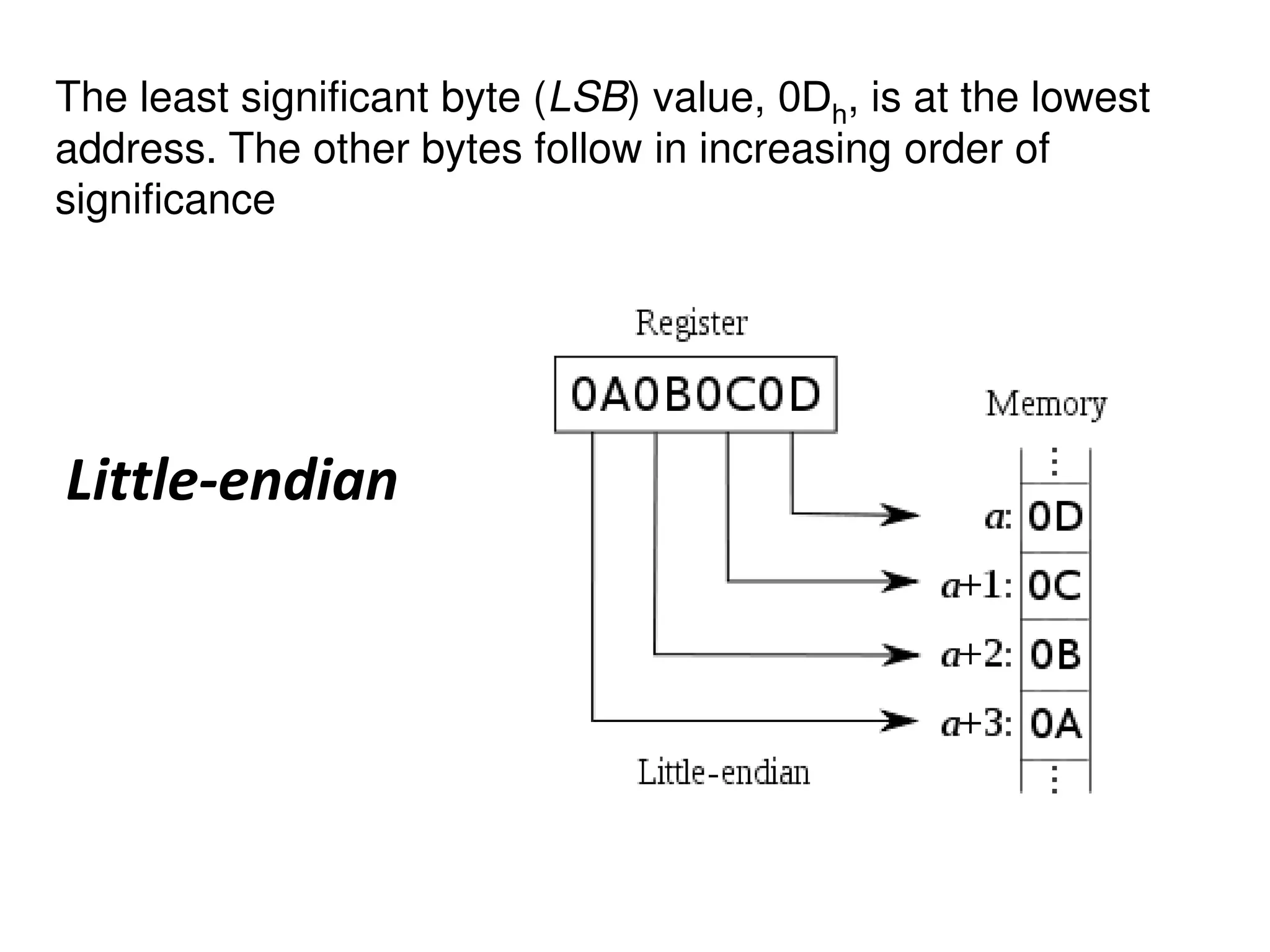
Little-endian
The least significant byte (LSB) value, 0Dh, is at the lowest
address. The other bytes follow in increasing order of
significance
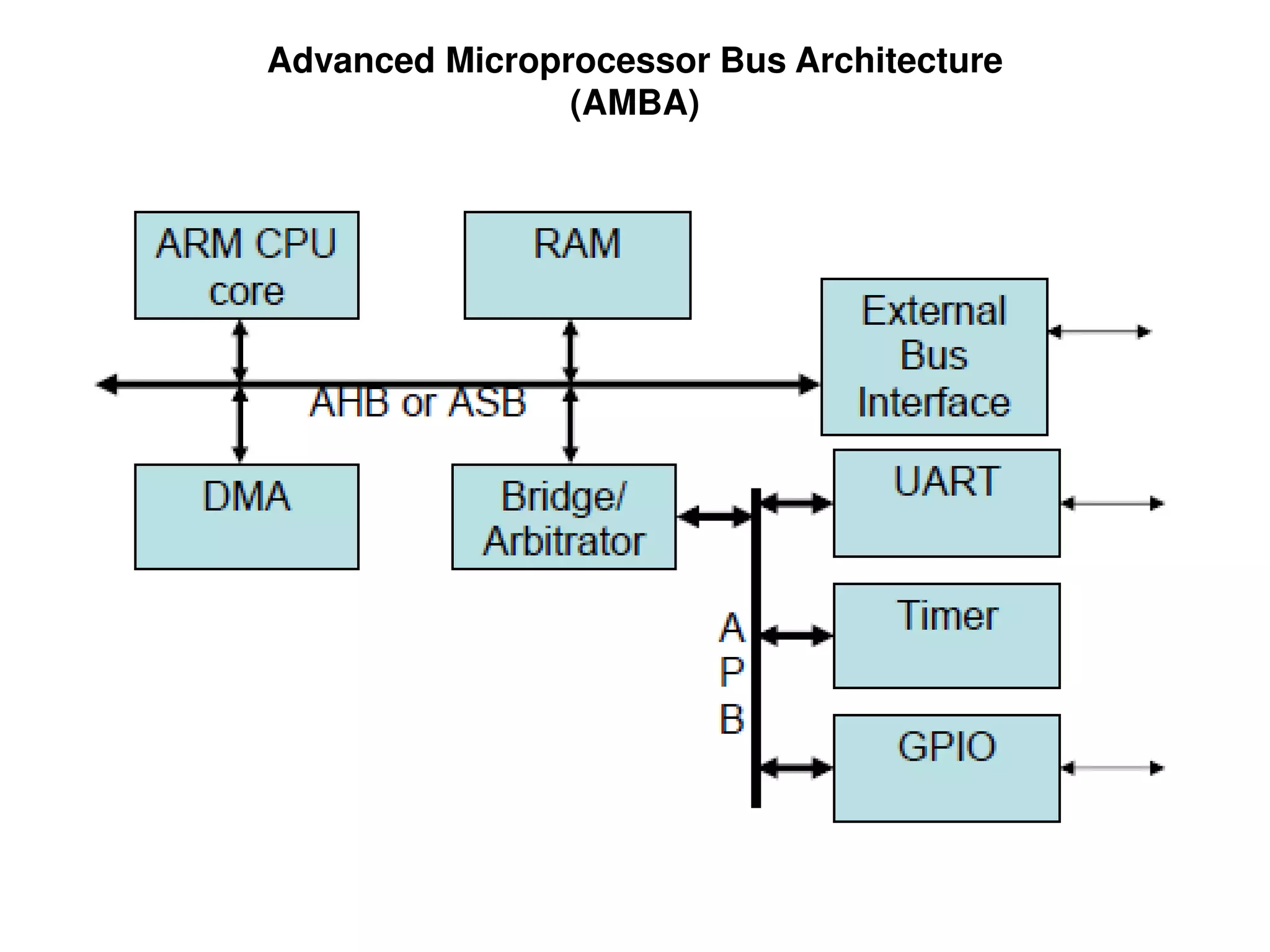
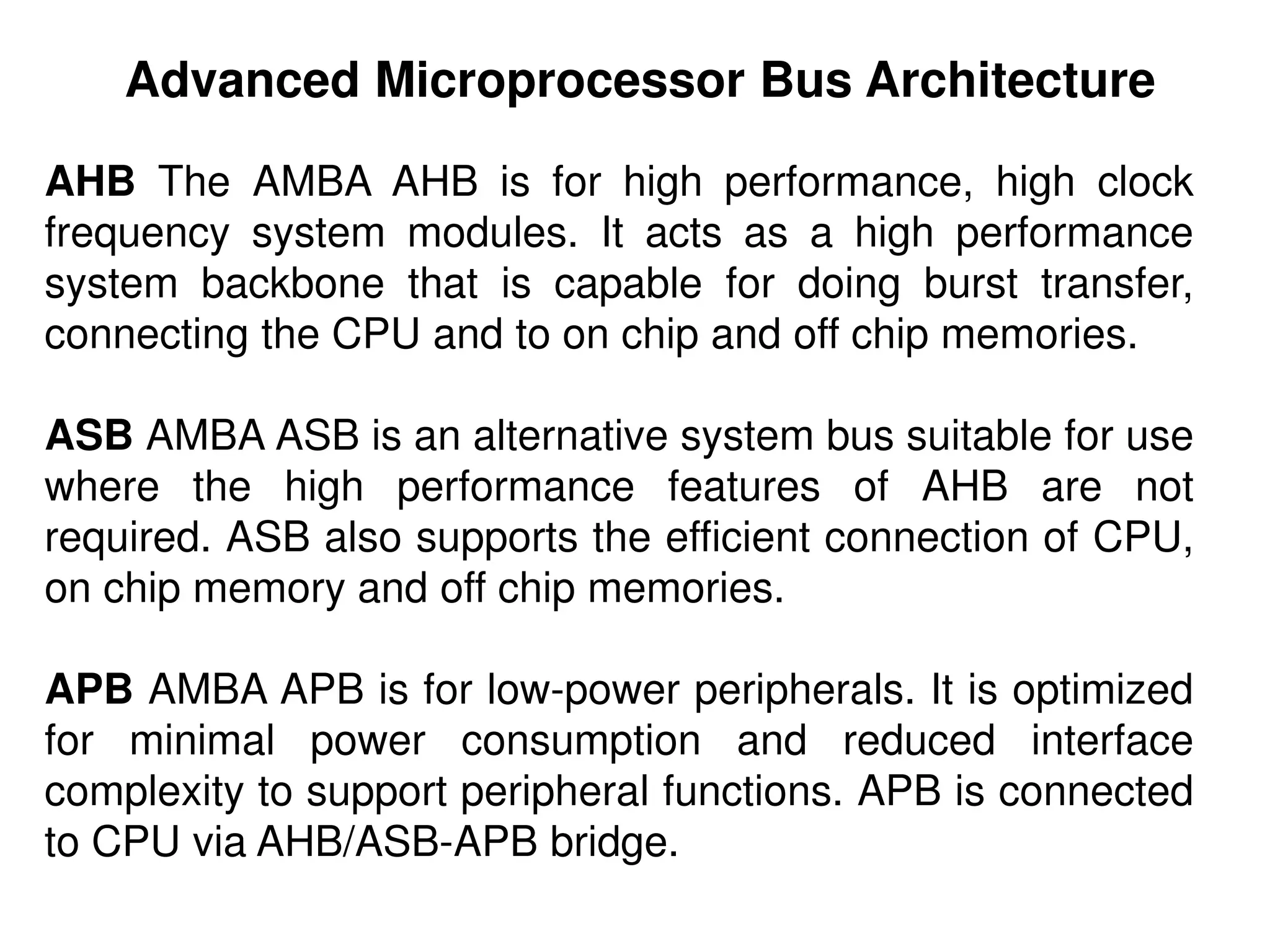
Advanced Microprocessor Bus Architecture
(AMBA)
AHB The AMBA AHB is for high performance, high clock
frequency system modules. It acts as a high performance
system backbone that is capable for doing burst transfer,
connecting the CPU and to on chip and off chip memories.
ASB AMBA ASB is an alternative system bus suitable for use
where the high performance features of AHB are not
required. ASB also supports the efficient connection of CPU,
on chip memory and off chip memories.
APB AMBA APB is for low-power peripherals. It is optimized
for minimal power consumption and reduced interface
complexity to support peripheral functions. APB is connected
to CPU via AHB/ASB-APB bridge.
Advanced Microprocessor Bus Architecture
5-Stage Pipeline ARM Organization
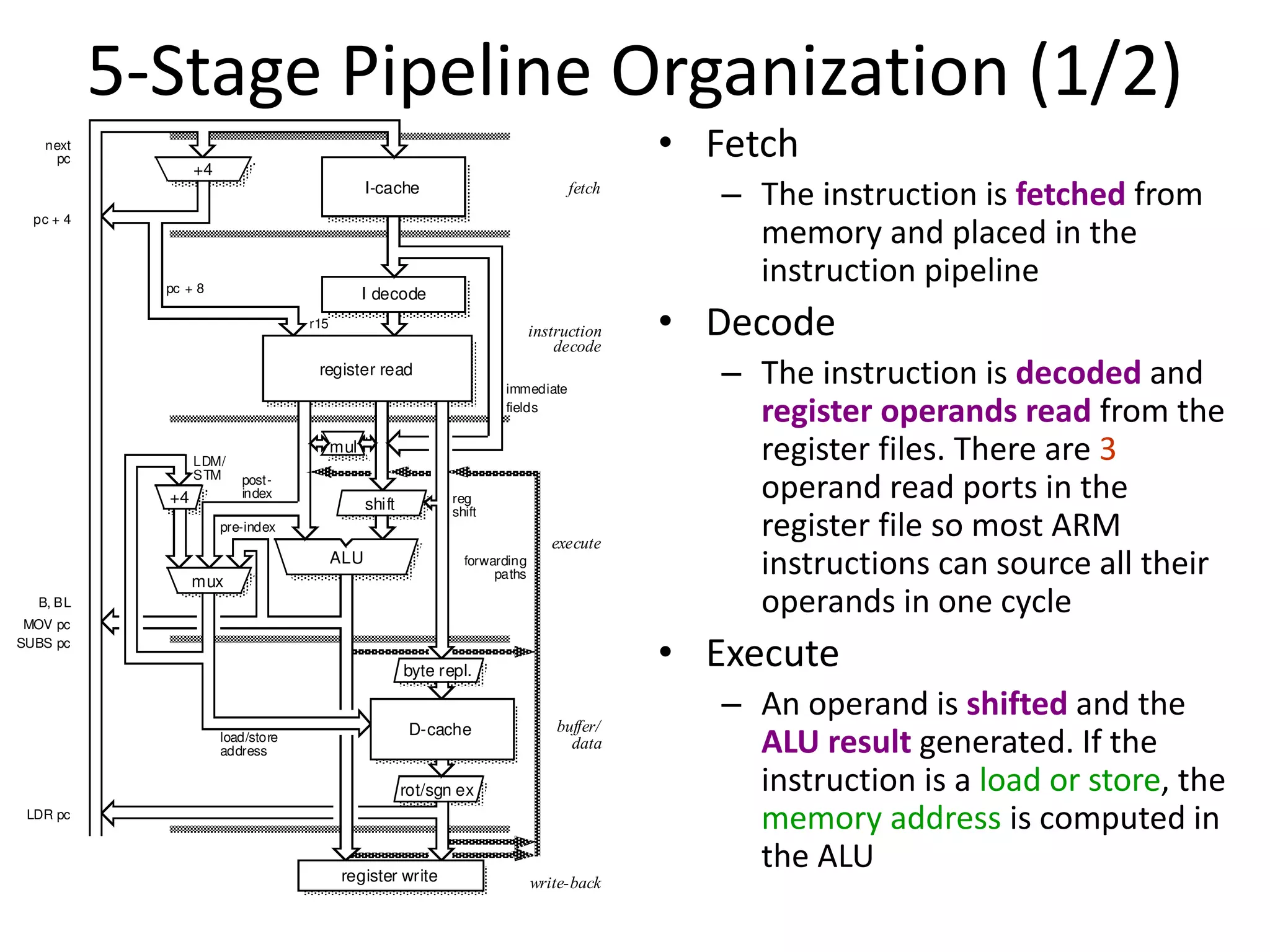
5-Stage Pipeline Organization (1/2)
• Fetch
– The instruction is fetched from
memory and placed in the
instruction pipeline
• Decode
– The instruction is decoded and
register operands read from the
register files. There are 3
operand read ports in the
register file so most ARM
instructions can source all their
operands in one cycle
• Execute
– An operand is shifted and the
ALU result generated. If the
instruction is a load or store, the
memory address is computed in
the ALU
I-cache
rot/sgn ex
+4
byte repl.
ALU
I decode
register read
D-cache
fetch
instruction
decode
execute
buffer/
data
write-back
forwarding
paths
immediate
fields
next
pc
reg
shift
load/store
address
LDR pc
SUBS pc
post-
index
pre-index
LDM/
STM
register write
r15
pc + 8
pc + 4
+4
mux
shift
mul
B, BL
MOV pc
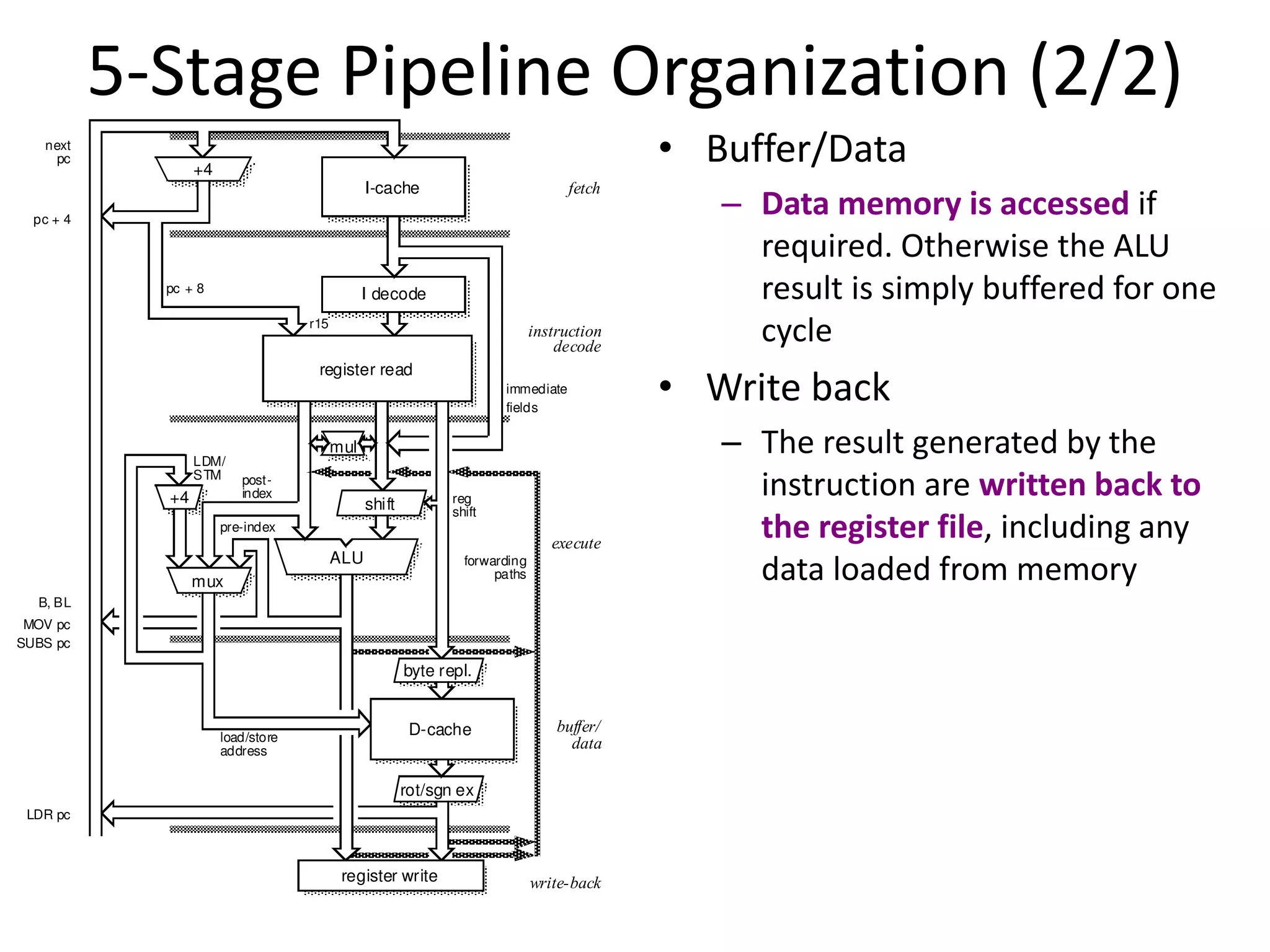
5-Stage Pipeline Organization (2/2)
• Buffer/Data
– Data memory is accessed if
required. Otherwise the ALU
result is simply buffered for one
cycle
• Write back
– The result generated by the
instruction are written back to
the register file, including any
data loaded from memory
I-cache
rot/sgn ex
+4
byte repl.
ALU
I decode
register read
D-cache
fetch
instruction
decode
execute
buffer/
data
write-back
forwarding
paths
immediate
fields
next
pc
reg
shift
load/store
address
LDR pc
SUBS pc
post-
index
pre-index
LDM/
STM
register write
r15
pc + 8
pc + 4
+4
mux
shift
mul
B, BL
MOV pc

Unit II Arm 7 Introduction

  • 1.
    1 Introduction to ARM-7 Thefirst encounter Dr. P. H. Zope Assistant Professor SSBT’s COET Bambhori Jalgaon North Maharashtra University Jalgaon India phzope@gmail.com 9860631040
  • 2.
    2 What Is ARM? •Advanced RISC Machine • First RISC microprocessor for commercial use • Market-leader for low-power and cost- sensitive embedded applications
  • 3.
    ARM7TDMI TDMI = (?) –Thumb instruction set – Debug-interface (JTAG/ICEBreaker) – Multiplier (hardware) – Interrupt (fast interrupts)
  • 4.
    •32/16-bit RISC architecture( ARM v4T ) •32-bit ARM instruction set for maximum performance and flexibility •16-bit Thumb instruction set for increased code density •Unified bus interface, 32-bit data bus carries both instructions and data •8-, 16-, and 32-bit Data Types •Three-stage pipeline •4GBytes Linear Address Space •32-bit ALU and high-performance multiplier •37 piece of 32 bit register •Very small die size and low power consumption •Fully static operation •Coprocessor interface •Extensive debug facilities: Embedded ICE-RT real-time debug unit. On-chip JTAG interface unit. •Interface for direct connection to Embedded Trace Macro cell (ETM). ARM7/ARM9 Architecture Feature Highlights
  • 5.
    •Pipelined (ARM7: 3stages) • Cached (depending on the implementation) • Von Neuman-type bus structure (ARM7), Harvard (ARM9) •7 modes of operation (usr, fiq, irq, svc, abt, sys, und) • Simple structure -> reasonably good speed / power consumption ratio •Very Low Power Consumption: Industry-leader in MIPS/Watt.
  • 6.
    Differences between RISCand CISC CISC RISC Variable size instructions with many formats Fixed size instructions (32 bit)with few formats Multi clock complex instructions. Single clock reduced instructions. Memory to memory load andstore instructions Register to register load andstore Small code size, high cycles per second. Large code size, Low cycles per second. Emphasis on hardware Emphasis on software Increased hardware cost. Reduced hardware cost.
  • 7.
  • 8.
    8 Pipeline Organization • Increasesspeed – most instructions executed in single cycle • Versions: – 3-stage (ARM7TDMI and earlier) – 5-stage (ARMS, ARM9TDMI) – 6-stage (ARM10TDMI)
  • 9.
    ARM7 Pipeline Model ARM7  standard 3-stage pipelined architecture FETCH DECODE EXECUTE  Fetch Instruction  Select/Increment PC  Read next instruction  Related Blocks  Address Selector  Address Incrementer  Address Register  Decode Instruction  Generate Ctrl. signals  Generate immediate  Read from register file  Related Blocks  Control Logic (Decoder)  Register File  Execute Instruction  Arithmetic / Logic  Calc. branch addr.  Load / Store  Related Blocks  Shifter  Multiplier  ALU *Register write back (WB) is hidden
  • 10.
    10 Pipeline Organization • 3-stagepipeline: Fetch – Decode - Execute • Three-cycle latency, one instruction per cycle throughput cycle Fetch Decode Execute Fetch Decode Execute Fetch Decode Execute i n s t r u c t i o n t t+1 t+2 t+3 t+4 i i+1 i+2
  • 11.
    11 Pipeline Organization • 5-stagepipeline: Reduces work per cycle => allows higher clock frequency Separates data and instruction memory => reduction of CPI (average number of clock Cycles Per Instruction) Stages: Write-back Buffer/data Execute Decode Fetch
  • 12.
    12 Pipeline Organization • Pipelineflushed and refilled on branch, causing execution to slow down • Special features in instruction set eliminate small jumps in code to obtain the best flow through pipeline
  • 13.
  • 14.
    14 ARM Architecture VersionSummary Core Version Feature ARM1 v1 26 bit address ARM2, ARM2as, ARM3 v2 32 bit multiply coprocessor ARM6, ARM60, ARM610, ARM7, ARM710, ARM7D, ARM7DI v3 32 bit addresses Separate PC and PSRs Undefined instruction and Abort modes Fully static Big or little endian StrongARM, SA-110, SA-1100 ARM8, ARM810 v4 Half word and signed halfword/byte support Enhanced multiplier System mode ARM7TDMI, ARM710T, ARM720T, ARM740T ARM9TDMI, ARM920T, ARM940T v4T Thumb instruction set T: Thumb instruction set M: enhanced Multiplier D: On-chip Debug I: Embedded ICE Logic
  • 15.
    15 ARM Architecture Version Summary(cont.)Core Version Feature ARM1020T v5T Improved ARM/Thumb Interworking CLZ instruction for improved division ARM9E-S, ARM10TDMI, ARM1020E v5TE Extended multiplication and saturated maths for DSP-like functionality ARM7EJ-S, ARM926EJ-S, ARM1026EJ-S v5TEJ Jazelle Technology for Java acceleration ARM11, ARM1136J-S, v6 Low power needed SIMD (Single Instruction Multiple Data) media processing extensions J: Jazelle S: Synthesizable F: integral vector floating point unit E: Enhanced DSP instruction
  • 17.
    ARM7 Datapath Overview multiply dataout register instruction decode & control incrementer register bank address register barrel shifter A[31:0] D[31:0] data in register ALU control P C PC A L U b u s A b u s B b u s register FETCH DECODE EXECUTE (WB) *Pipeline registers are omitted
  • 18.
    18 ARM7TDMI Interface Signals(1/4) mreq seq lock Dout[31:0] D[31:0] r/w mas[1:0] mode[4:0] trans abort opc cpi cpa cpb memory interface MMU interface coprocessor interface mclk wait eclk isy nc bigend enin irq ¼q reset enout abe Vdd Vss clock control configuration interrupts initialization bus control power ale ape dbe dbgrq breakpt dbgack debug exec extern1 extern0 dbgen bl[3:0] TRST TCK TMS TDI JTAG controls TDO Tbit st atetbe rangeout0 rangeout1 dbgrqi commrx commtx enouti highz busdis ecapclk busen Din[31:0] A[31:0] ARM7TDMI core tapsm[3:0] ir[3:0] tdoen tck1 tck2 screg[3:0] TAP information driv ebs ecapclkbs icapclkbs highz pclkbs rstclkbs sdinbs sdoutbs shclkbs shclk2bs boundary scan extension
  • 19.
    19TM 1939v10 TheARM Architecture Processor Modes  The ARM has seven basic operating modes: 1. User : unprivileged mode under which most tasks run 2. FIQ : entered when a high priority (fast) interrupt is raised 3. IRQ : entered when a low priority (normal) interrupt is raised 4. Supervisor : entered on reset and when a Software Interrupt 5. instruction is executed 6. Abort : used to handle memory access violations 7. Undef : used to handle undefined instructions 8. System : privileged mode using the same registers as user mode
  • 20.
    20TM 2039v10 TheARM Architecture r0 r1 r2 r3 r4 r5 r6 r7 r8 r9 r10 r11 r12 r13 (sp) r14 (lr) r15 (pc) cpsr r13 (sp) r14 (lr) spsr r13 (sp) r14 (lr) spsr r13 (sp) r14 (lr) spsr r13 (sp) r14 (lr) spsr r8 r9 r10 r11 r12 r13 (sp) r14 (lr) spsr FIQ IRQ SVC Undef Abort User Mode r0 r1 r2 r3 r4 r5 r6 r7 r8 r9 r10 r11 r12 r13 (sp) r14 (lr) r15 (pc) cpsr r13 (sp) r14 (lr) spsr r13 (sp) r14 (lr) spsr r13 (sp) r14 (lr) spsr r13 (sp) r14 (lr) spsr r8 r9 r10 r11 r12 r13 (sp) r14 (lr) spsr Current Visible Registers Banked out Registers FIQ IRQ SVC Undef Abort r0 r1 r2 r3 r4 r5 r6 r7 r15 (pc) cpsr r13 (sp) r14 (lr) spsr r13 (sp) r14 (lr) spsr r13 (sp) r14 (lr) spsr r13 (sp) r14 (lr) spsr r8 r9 r10 r11 r12 r13 (sp) r14 (lr) spsr Current Visible Registers Banked out Registers User IRQ SVC Undef Abort r8 r9 r10 r11 r12 r13 (sp) r14 (lr) FIQ ModeIRQ Mode r0 r1 r2 r3 r4 r5 r6 r7 r8 r9 r10 r11 r12 r15 (pc) cpsr r13 (sp) r14 (lr) spsr r13 (sp) r14 (lr) spsr r13 (sp) r14 (lr) spsr r13 (sp) r14 (lr) spsr r8 r9 r10 r11 r12 r13 (sp) r14 (lr) spsr Current Visible Registers Banked out Registers User FIQ SVC Undef Abort r13 (sp) r14 (lr) Undef Mode r0 r1 r2 r3 r4 r5 r6 r7 r8 r9 r10 r11 r12 r15 (pc) cpsr r13 (sp) r14 (lr) spsr r13 (sp) r14 (lr) spsr r13 (sp) r14 (lr) spsr r13 (sp) r14 (lr) spsr r8 r9 r10 r11 r12 r13 (sp) r14 (lr) spsr Current Visible Registers Banked out Registers User FIQ IRQ SVC Abort r13 (sp) r14 (lr) SVC Mode r0 r1 r2 r3 r4 r5 r6 r7 r8 r9 r10 r11 r12 r15 (pc) cpsr r13 (sp) r14 (lr) spsr r13 (sp) r14 (lr) spsr r13 (sp) r14 (lr) spsr r13 (sp) r14 (lr) spsr r8 r9 r10 r11 r12 r13 (sp) r14 (lr) spsr Current Visible Registers Banked out Registers User FIQ IRQ Undef Abort r13 (sp) r14 (lr) Abort Mode r0 r1 r2 r3 r4 r5 r6 r7 r8 r9 r10 r11 r12 r15 (pc) cpsr r13 (sp) r14 (lr) spsr r13 (sp) r14 (lr) spsr r13 (sp) r14 (lr) spsr r13 (sp) r14 (lr) spsr r8 r9 r10 r11 r12 r13 (sp) r14 (lr) spsr Current Visible Registers Banked out Registers User FIQ IRQ SVC Undef r13 (sp) r14 (lr) The ARM Register Set
  • 21.
    21TM 2139v10 TheARM Architecture Register Organization Summary User mode r0-r7, r15, and cpsr r8 r9 r10 r11 r12 r13 (sp) r14 (lr) spsr FIQ r8 r9 r10 r11 r12 r13 (sp) r14 (lr) r15 (pc) cpsr r0 r1 r2 r3 r4 r5 r6 r7 User r13 (sp) r14 (lr) spsr IRQ User mode r0-r12, r15, and cpsr r13 (sp) r14 (lr) spsr Undef User mode r0-r12, r15, and cpsr r13 (sp) r14 (lr) spsr SVC User mode r0-r12, r15, and cpsr r13 (sp) r14 (lr) spsr Abort User mode r0-r12, r15, and cpsr Thumbstate Low registers Thumbstate Highregisters Note: System mode uses the User mode register set
  • 22.
    22TM 2239v10 TheARM Architecture The Registers  ARM has 37 registers all of which are 32-bits long.  1 dedicated program counter  1 dedicated current program status register  5 dedicated saved program status registers  30 general purpose registers  The current processor mode governs which of several banks is accessible. Each mode can access  a particular set of r0-r12 registers  a particular r13 (the stack pointer, sp) and r14 (the link register, lr)  the program counter, r15 (pc)  the current program status register, cpsr Privileged modes (except System) can also access  a particular spsr (saved program status register)
  • 23.
    23TM 2339v10 TheARM Architecture Current Program Status Registers  Condition code flags  N = Negative result from ALU  Z = Zero result from ALU  C = ALU operation Carried out  V = ALU operation oVerflowed  Sticky Overflow flag - Q flag  Architecture 5TE/J only  Indicates if saturation has occurred  J bit  Architecture 5TEJ only  J = 1: Processor in Jazelle state  Interrupt Disable bits.  I = 1: Disables the IRQ.  F = 1: Disables the FIQ.  T Bit  Architecture xT only  T = 0: Processor in ARM state  T = 1: Processor in Thumb state  Mode bits  Specify the processor mode 2731 N Z C V Q 28 67 I F T mode 1623 815 5 4 024 f s x c U n d e f i n e dJ
  • 24.
    24TM 2439v10 TheARM Architecture  When the processor is executing in ARM state:  All instructions are 32 bits wide  All instructions must be word aligned  Therefore the pc value is stored in bits [31:2] with bits [1:0] undefined (as instruction cannot be halfword or byte aligned).  When the processor is executing in Thumb state:  All instructions are 16 bits wide  All instructions must be halfword aligned  Therefore the pc value is stored in bits [31:1] with bit [0] undefined (as instruction cannot be byte aligned).  When the processor is executing in Jazelle state:  All instructions are 8 bits wide  Processor performs a word access to read 4 instructions at once Program Counter (r15)
  • 25.
    25 Saved Program StatusRegister (SPSR) Each privileged mode (except system mode) has associated with it a SPSR This SPSR is used to save the state of CPSR when the privileged mode is entered in order that the user state can be fully restored when the user process is resumed Often the SPSR may be untouched from the time the privileged mode is entered to the time it is used to restore the CPSR If the privileged supervisor calls to itself the SPSR must be copied into a general register and saved
  • 27.
    27 What is Exceptions Exceptions are usually used to handle unexpected events which arise during the execution of a program, such as interrupts or memory faults, also cover software interrupts, undefined instruction traps, and the system reset  Three groups:  Exceptions generated as the direct effect of executing an instruction  Software interrupts, undefined instructions, and prefetch abort  Exceptions generated as a side effect of an instruction  Data aborts  Exceptions generated externally  Reset, IRQ and FIQ
  • 28.
    28 Exception Entry  Whenan exception arises  ARM completes the current instruction as best it can (except that reset exception)  handle the exception which starts from a specific location (exception vector).  Processor performs the following sequence:  Change to the operating mode corresponding to the particular exception  Stores the return address in LR_<mode>  Copy old CPSR into SPSR_<mode>  Set appropriate CPSR bits  If core currently in Thumb state then ARM state is entered.  Disable IRQs by setting bit 7  If the exception is a fast interrupt, disable further faster interrupt by setting bit 6 of the CPSR
  • 29.
    29 Exception Entry  ForcePC to relevant vector address  Normally the vector address contains a branch to the relevant routine  Exception handler use r13_<mode> and r14_<mode> to hold the stack point and return address Priority Exception Mode vector address 1 Reset SVC 0x00000000 2 Data abort (data access memory fault) Abort 0x00000010 3 FIQ (fast interrupt ) FIQ 0x0000001C 4 IRQ (normal interrupt) IRQ 0x00000018 5 Prefetch abort (instruction fetch memory fault) Abort 0c0000000C 6 Undefined instruction UND 0x00000004 Software interrupt (SWI) SVC 0x00000008
  • 30.
    30 Exception Return  Oncethe exception has been handled, the user task is normally resumed  The sequence is  Any modified user registers must be restored from the handler’s stack  CPSR must be restored from the appropriate SPSR  PC must be changed back to the relevant instruction address  The last two steps happen atomically as part of a single instruction
  • 31.
    Exceptions of ARM-7 Mode changes can be made under  Software control  External interrupts  Exception process  The modes other than user mode are privileged modes  Have full access to system resources  Can change mode freely  Exception modes  FIQ  IRQ  Supervisor mode  Abort: data abort and instruction prefetch abort  Undefined
  • 32.
    Exception Task flow Class Cause InterruptExternal stimulus Fault Internal cause Trap Trap instruction
  • 33.
    Exception (cont’d) ARM7 (ISAv4) Exceptions Type Class Description (Cause) Reset Power Up Undefined Instruction FAULT Invalid / coprocessor instruction Prefetch Abort FAULT TLB miss for instruction Data Abort FAULT TLB miss for data access IRQ INTERRUPT Normal interrupt FIQ INTERRUPT Fast Interrupt (no context switch) SW Interrupt TRAP Undefined / coprocessor instruction
  • 34.
    Exception (cont’d) ARM7 (ISAv4) Exception Vectors Exception Address Mode on Entry Reset 0x00000000 Supervisor Undefined Instruction 0x00000004 Undefined SW Interrupt 0x00000008 Supervisor Prefetch Abort 0x0000000C Abort Data Abort 0x00000010 Abort IRQ 0x00000018 IRQ FIQ 0x0000001C FIQ Reserved 0x00000014 Reserved
  • 35.
    Vector Table Exception Handling When an exception occurs, the ARM:  Copies CPSR into SPSR_<mode>  Sets appropriate CPSR bits  Change to ARM state  Change to exception mode  Disable interrupts (if appropriate)  Stores the return address in LR_<mode>  Sets PC to vector address  To return, exception handler needs to:  Restore CPSR from SPSR_<mode>  Restore PC from LR_<mode> This can only be done in ARM state. Vector table can be at 0xFFFF0000 on ARM720T and on ARM9/10 family devices FIQ IRQ (Reserved) Data Abort Prefetch Abort Software Interrupt Undefined Instruction Reset 0x1C 0x18 0x14 0x10 0x0C 0x08 0x04 0x00
  • 36.
    • Current ProgramStatus Register (CPSR) • Saved Program Status Register (SPSR) • On exception, entering mod mode: – (PC + 4)  LR – CPSR  SPSR_mod – PC  IV address – R13, R14 replaced by R13_mod, R14_mod – In case of FIQ mode R7 – R12 also replaced Exception (cont’d) Process
  • 37.
    Exception priorities When multipleexceptions arise at the same time, a fixed priority system determines the order in which they are handled: Highest priority: 1. Reset 2. Data abort 3. FIQ 4. IRQ 5. Prefetch abort Lowest priority: 6. Undefined Instruction, Software interrupt.
  • 38.
    There are twoways to store data in memory 1 Little-Endian 2 Big – Endian Memory Organization
  • 39.
    Memory Organization • Word,half-word alignment (xxxx00 or xxxxx0) • ARM can be set up to access data in either little-endian or big- endian format, through they default to little-endian.
  • 40.
    Big-endian The most significantbyte (MSB) value, which is 0Ah in our example, is stored at the memory location with the lowest address, the next byte value in significance, 0Bh, is stored at the following memory location and so on. This is akin to Left-to- Right reading in hexadecimal order.
  • 41.
    Little-endian The least significantbyte (LSB) value, 0Dh, is at the lowest address. The other bytes follow in increasing order of significance
  • 42.
    Advanced Microprocessor BusArchitecture (AMBA)
  • 43.
    AHB The AMBAAHB is for high performance, high clock frequency system modules. It acts as a high performance system backbone that is capable for doing burst transfer, connecting the CPU and to on chip and off chip memories. ASB AMBA ASB is an alternative system bus suitable for use where the high performance features of AHB are not required. ASB also supports the efficient connection of CPU, on chip memory and off chip memories. APB AMBA APB is for low-power peripherals. It is optimized for minimal power consumption and reduced interface complexity to support peripheral functions. APB is connected to CPU via AHB/ASB-APB bridge. Advanced Microprocessor Bus Architecture
  • 44.
  • 45.
    5-Stage Pipeline Organization(1/2) • Fetch – The instruction is fetched from memory and placed in the instruction pipeline • Decode – The instruction is decoded and register operands read from the register files. There are 3 operand read ports in the register file so most ARM instructions can source all their operands in one cycle • Execute – An operand is shifted and the ALU result generated. If the instruction is a load or store, the memory address is computed in the ALU I-cache rot/sgn ex +4 byte repl. ALU I decode register read D-cache fetch instruction decode execute buffer/ data write-back forwarding paths immediate fields next pc reg shift load/store address LDR pc SUBS pc post- index pre-index LDM/ STM register write r15 pc + 8 pc + 4 +4 mux shift mul B, BL MOV pc
  • 46.
    5-Stage Pipeline Organization(2/2) • Buffer/Data – Data memory is accessed if required. Otherwise the ALU result is simply buffered for one cycle • Write back – The result generated by the instruction are written back to the register file, including any data loaded from memory I-cache rot/sgn ex +4 byte repl. ALU I decode register read D-cache fetch instruction decode execute buffer/ data write-back forwarding paths immediate fields next pc reg shift load/store address LDR pc SUBS pc post- index pre-index LDM/ STM register write r15 pc + 8 pc + 4 +4 mux shift mul B, BL MOV pc