Criteria for Good Decision
Making
How do you know when you have
made a good decision?
Decision Making Steps
1. Stop & reflect
2. Clarify your objectives
-What do you want to achieve?
3. Gather information from other sources
- Review Credo & Business policies for guidance
4. Develop a list of options
5. Consider the impact (pros & cons) of each
option
6. Make your decision
7. Monitor the impact & modify as needed
Ethical & Effective Decisions
• Is it a good decision if you comply with
ethical principles but fail to produce a
desired result?
• Is it a good decision if you achieve a
result but you had to compromise
ethical principles?
We are morally responsible for
the consequences of our
choices.
Not choosing and not acting are
also choices
Perspectives:
Various Ways of Examining Ethical
Issues
• Personal Character
• Cost/Benefit
• Human Value
• Fairness
• Common Good
Personal Character
Perspective
• Focuses on attitudes and values that enable
us to act in ways that develop human
potential.
• Examples: trustworthiness, respect,
responsibility, fairness, caring, good
citizenship.
• From this perspective, what is ethical is what
demonstrates and develops moral character
in ourselves and our communities.
Six Pillars of Character
- Decision Making Filters
• Will my actions promote Trust?
• Am I treating people Respectfully?
• Am I being Responsible, Fair and Caring?
• Am I being a Good Citizen?
This checklist can dramatically improve the
ethical quality of decisions.
Cost/Benefit Perspective
• Focuses on the consequences that
actions or policies have on the well-
being of all persons directly or indirectly
affected by the action or policy.
• From this perspective, of any two
actions, the more ethical one will
produce the greatest balance of benefits
over harms.
Human Value Perspective
• Each person has a fundamental right to
be valued and treated as a free and
equal, rational person capable of
making his or her own decisions.
• From this perspective, the Golden Rule
is the definition of ethical behavior
Fairness Perspective
• Fairness requires consistency in the
way people are treated.
• From this perspective, ethical behavior
treats people the same unless there are
relevant differences between them.
Common Good Perspective
• The community is comprised of
individuals whose own good is bound to
the good of the whole.
• From this perspective, what is ethical is
what advances the common good.
• The good community builds a balance
between individual & group obligations
Case Studies
• Analyse & discuss :
– How Bad is Bad?
– Issues of Sickness
– Recruitment
• Reference the decision making criteria, the 6
pillars of character & the perspectives
• Explain the reasoning behind your decisions &
the process you used to arrive at your choices
More Good Tests
• How would the decision look on the front
page of the newspaper?
• How would you like it if it were done to
you?
• What does your “gut” tell you to do?
• What would the person you most admire
do?
• Could you explain your actions before a
committee of professional peers?
And More….
• Have you used your management as a
sounding board?
• What would the Legal Department say
about this decision?
• What would you do if your children were
watching? What would you want your
child to do in the same situation?
Consider different perspectives!
Which of these perspectives
have you used so far in the Case
Studies?
• Personal Character
• Cost/Benefit
• Human Value
• Fairness
• Common Good
Case Studies
• Analyse & discuss :
– The Limits of Fair Competition
– Dealing with Dissent
• Reference the decision making criteria, the 6
pillars of character, the perspectives & the
process
• Explain the reasoning behind your decisions &
the process you used to arrive at your choices
Personal Accountability
• Look at the Credo & think of a situation
where you took action to address an
issue or challenge & the result had a
positive impact on one of the
stakeholder groups.
– Impacted on either patients, customer,
supplier, fellow employee, community or
shareholder.
“Watch your thoughts; they lead to attitudes.
Watch your attitudes; they lead to words.
Watch your words; they lead to actions.
Watch your actions; they lead to habits.
Watch your habits; they lead to character.
Watch your character; it determines your
destiny.”
Back Up Slides
The Tylenol Tampering Incidents:
What Happened
• In 1982, seven people in the
Chicago area died after
swallowing Extra-Strength
Tylenol capsules laced with
cyanide.
• No one was ever convicted
of the crimes.
• The capsules had been
tampered with after they
left J&J’s manufacturing
facilities.
• In 1986, a woman in New
York died after taking an
Extra-Strength Tylenol
capsule that had cyanide
added to it.
• Again, the tampering had
occurred after the product
left J&J’s manufacturing
facilities.
• One more contaminated
bottle was found in a store
a few miles from where the
first one was purchased.
10
The Tylenol Tampering Incidents: How
J&J Responded
• In 1982, we immediately
recalled and destroyed all
Tylenol capsules.
• We cooperated completely
with regulatory and law-
enforcement agencies, and
kept the public fully
informed during every step
of the investigation.
• A little over a month later,
we put Tylenol Extra
Strength capsules back on
the market.
In 1986, once again, we
immediately recalled and
destroyed all Tylenol
capsules.
• We again cooperated
completely with regulatory
and law-enforcement
agencies, and kept the
public fully informed
during every step of the
investigation.
• This time, J&J stopped
selling Tylenol in capsule
form. But we also went a
step further, and stopped
selling any over-the-
counter medications in
capsule form.
• We began selling a Tylenol
“caplet” that was
essentially a capsule-
shaped tablet.
11
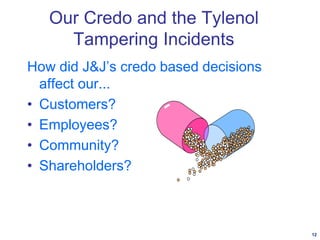
Our Credo and the Tylenol
Tampering Incidents
How did J&J’s credo based decisions
affect our...
• Customers?
• Employees?
• Community?
• Shareholders?
12
Credo Decision-Making
Process
• A decision-making process is a
reminder to slow down and deliberate;
to consider
– The consequences
– The constituencies (stakeholders)
– The options
Seven-Step Process
1. Stop and reflect: Is there an
ethical issue at the personal,
interpersonal, Company, or
community level? Take time to get
your bearings.
2. Clarify goals: What do you want to
accomplish, short- and long-term?
Which do you consider most
important? How will this issue and
each potential resolution affect your
highest-priority objectives?
3. Get and evaluate information: What
assumptions are affecting your personal
perception? How credible is the source of
your data? What is expert opinion, and
what is just a conjecture?
Our Credo
4. Develop a list of options: What are your
alternatives? Broaden your perspective by talking
with others you trust.
5. Consider consequences: Identify stakeholders.
Which perspectives are applicable? Which option:
– would demonstrate strong personal character?
– would lead to the greatest benefit at least cost?
– best values individuals?
– treats all parties in a fair and just manner?
– best promotes the common good?
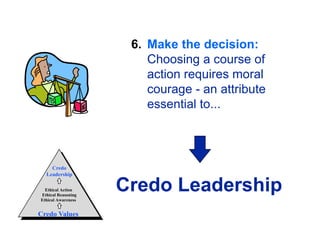
6. Make the decision:
Choosing a course of
action requires moral
courage - an attribute
essential to...
Ethical Awareness
Ethical Reasoning
Ethical Action
Ethical Awareness
Ethical Awareness
Ethical Reasoning
Ethical Action
Credo
Leadership
Credo Values
Credo Leadership
7. Monitor and modify as needed: If the choice
is not producing the intended results or is
causing unintended and undesirable results,
• Reassess the situation
• Make new decisions from among
the choices now available
• Continue to strengthen your ability to make
Credo-based decisions through feedback
from others and self-appraisal

Short version ethical decision making process

  • 1.
    Criteria for GoodDecision Making How do you know when you have made a good decision?
  • 2.
    Decision Making Steps 1.Stop & reflect 2. Clarify your objectives -What do you want to achieve? 3. Gather information from other sources - Review Credo & Business policies for guidance 4. Develop a list of options 5. Consider the impact (pros & cons) of each option 6. Make your decision 7. Monitor the impact & modify as needed
  • 3.
    Ethical & EffectiveDecisions • Is it a good decision if you comply with ethical principles but fail to produce a desired result? • Is it a good decision if you achieve a result but you had to compromise ethical principles?
  • 4.
    We are morallyresponsible for the consequences of our choices. Not choosing and not acting are also choices
  • 5.
    Perspectives: Various Ways ofExamining Ethical Issues • Personal Character • Cost/Benefit • Human Value • Fairness • Common Good
  • 6.
    Personal Character Perspective • Focuseson attitudes and values that enable us to act in ways that develop human potential. • Examples: trustworthiness, respect, responsibility, fairness, caring, good citizenship. • From this perspective, what is ethical is what demonstrates and develops moral character in ourselves and our communities.
  • 7.
    Six Pillars ofCharacter - Decision Making Filters • Will my actions promote Trust? • Am I treating people Respectfully? • Am I being Responsible, Fair and Caring? • Am I being a Good Citizen? This checklist can dramatically improve the ethical quality of decisions.
  • 8.
    Cost/Benefit Perspective • Focuseson the consequences that actions or policies have on the well- being of all persons directly or indirectly affected by the action or policy. • From this perspective, of any two actions, the more ethical one will produce the greatest balance of benefits over harms.
  • 9.
    Human Value Perspective •Each person has a fundamental right to be valued and treated as a free and equal, rational person capable of making his or her own decisions. • From this perspective, the Golden Rule is the definition of ethical behavior
  • 10.
    Fairness Perspective • Fairnessrequires consistency in the way people are treated. • From this perspective, ethical behavior treats people the same unless there are relevant differences between them.
  • 11.
    Common Good Perspective •The community is comprised of individuals whose own good is bound to the good of the whole. • From this perspective, what is ethical is what advances the common good. • The good community builds a balance between individual & group obligations
  • 12.
    Case Studies • Analyse& discuss : – How Bad is Bad? – Issues of Sickness – Recruitment • Reference the decision making criteria, the 6 pillars of character & the perspectives • Explain the reasoning behind your decisions & the process you used to arrive at your choices
  • 13.
    More Good Tests •How would the decision look on the front page of the newspaper? • How would you like it if it were done to you? • What does your “gut” tell you to do? • What would the person you most admire do? • Could you explain your actions before a committee of professional peers?
  • 14.
    And More…. • Haveyou used your management as a sounding board? • What would the Legal Department say about this decision? • What would you do if your children were watching? What would you want your child to do in the same situation? Consider different perspectives!
  • 15.
    Which of theseperspectives have you used so far in the Case Studies? • Personal Character • Cost/Benefit • Human Value • Fairness • Common Good
  • 16.
    Case Studies • Analyse& discuss : – The Limits of Fair Competition – Dealing with Dissent • Reference the decision making criteria, the 6 pillars of character, the perspectives & the process • Explain the reasoning behind your decisions & the process you used to arrive at your choices
  • 17.
    Personal Accountability • Lookat the Credo & think of a situation where you took action to address an issue or challenge & the result had a positive impact on one of the stakeholder groups. – Impacted on either patients, customer, supplier, fellow employee, community or shareholder.
  • 18.
    “Watch your thoughts;they lead to attitudes. Watch your attitudes; they lead to words. Watch your words; they lead to actions. Watch your actions; they lead to habits. Watch your habits; they lead to character. Watch your character; it determines your destiny.”
  • 19.
  • 20.
    The Tylenol TamperingIncidents: What Happened • In 1982, seven people in the Chicago area died after swallowing Extra-Strength Tylenol capsules laced with cyanide. • No one was ever convicted of the crimes. • The capsules had been tampered with after they left J&J’s manufacturing facilities. • In 1986, a woman in New York died after taking an Extra-Strength Tylenol capsule that had cyanide added to it. • Again, the tampering had occurred after the product left J&J’s manufacturing facilities. • One more contaminated bottle was found in a store a few miles from where the first one was purchased. 10
  • 21.
    The Tylenol TamperingIncidents: How J&J Responded • In 1982, we immediately recalled and destroyed all Tylenol capsules. • We cooperated completely with regulatory and law- enforcement agencies, and kept the public fully informed during every step of the investigation. • A little over a month later, we put Tylenol Extra Strength capsules back on the market. In 1986, once again, we immediately recalled and destroyed all Tylenol capsules. • We again cooperated completely with regulatory and law-enforcement agencies, and kept the public fully informed during every step of the investigation. • This time, J&J stopped selling Tylenol in capsule form. But we also went a step further, and stopped selling any over-the- counter medications in capsule form. • We began selling a Tylenol “caplet” that was essentially a capsule- shaped tablet. 11
  • 22.
    Our Credo andthe Tylenol Tampering Incidents How did J&J’s credo based decisions affect our... • Customers? • Employees? • Community? • Shareholders? 12
  • 23.
    Credo Decision-Making Process • Adecision-making process is a reminder to slow down and deliberate; to consider – The consequences – The constituencies (stakeholders) – The options
  • 24.
    Seven-Step Process 1. Stopand reflect: Is there an ethical issue at the personal, interpersonal, Company, or community level? Take time to get your bearings. 2. Clarify goals: What do you want to accomplish, short- and long-term? Which do you consider most important? How will this issue and each potential resolution affect your highest-priority objectives?
  • 25.
    3. Get andevaluate information: What assumptions are affecting your personal perception? How credible is the source of your data? What is expert opinion, and what is just a conjecture? Our Credo
  • 26.
    4. Develop alist of options: What are your alternatives? Broaden your perspective by talking with others you trust. 5. Consider consequences: Identify stakeholders. Which perspectives are applicable? Which option: – would demonstrate strong personal character? – would lead to the greatest benefit at least cost? – best values individuals? – treats all parties in a fair and just manner? – best promotes the common good?
  • 27.
    6. Make thedecision: Choosing a course of action requires moral courage - an attribute essential to... Ethical Awareness Ethical Reasoning Ethical Action Ethical Awareness Ethical Awareness Ethical Reasoning Ethical Action Credo Leadership Credo Values Credo Leadership
  • 28.
    7. Monitor andmodify as needed: If the choice is not producing the intended results or is causing unintended and undesirable results, • Reassess the situation • Make new decisions from among the choices now available • Continue to strengthen your ability to make Credo-based decisions through feedback from others and self-appraisal